Solution Manual For Finance for Executives Managing for Value Creation, 7th Edition Gabriel Hawawini, Claude Viallet Chapter 2-18
Chapter 2 Answers to Review Problems Finance for Executives – 7th Edition
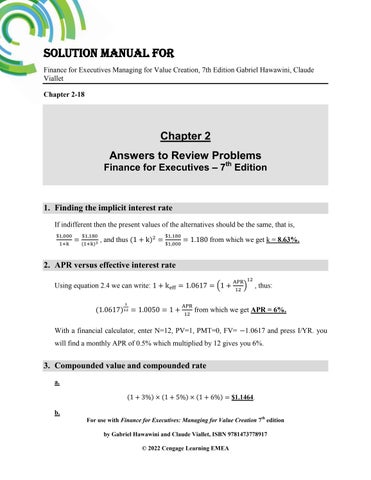
1. Finding the implicit interest rate If indifferent then the present values of the alternatives should be the same, that is, , and thus
from which we get k = 8.63%.
2. APR versus effective interest rate (
Using equation 2.4 we can write:
)
, thus:
from which we get APR = 6%. With a financial calculator, enter N=12, PV=1, PMT=0, FV=
1.0617 and press I/YR. you
will find a monthly APR of 0.5% which multiplied by 12 gives you 6%.
3. Compounded value and compounded rate a. $1.1464. b. For use with Finance for Executives: Managing for Value Creation 7th edition by Gabriel Hawawini and Claude Viallet, ISBN 9781473778917 © 2022 Cengage Learning EMEA
from which we get k = 4.66%.
4. Alternative financing plans PV(Plan 1) = $12,400 + $400 × ADF(T=35; k=6%/12) = $12,400 + $400 × 32.0354 = $25,214. PV(Plan 2) = $492 × ADF(T=60; k=6%/12) = $492 × 51.7256 = $25,449.
The first plan is preferable because it is less expensive because it has a lower present value.
5. Annuity versus perpetuity The future value of the $100 a year for the next 10 years (see formula 2.13 for the future value of an annuity) at the rate ‗k‘ must be equal to the present value, at the end of 10, of a $100 perpetuity at the same rate ‗k‘, hence we have: [
]
, and thus [
]
, from which we get
Using a financial calculator we find k = 7.18%. (Enter N=10, PV=1, PMT=0, FV= 2 and press I/YR. you will find 7.18%.)
6. Valuing a loan a.
The loan will generate fixed interest income of $800,000 (8% of $10 million) every year over the next 4 years plus $10 million at the end of the fourth year. Its value is thus the sum of the present value of 4-year, $800,000 annuity at 7 percent (the prevailing market rate) and the present value of $10 million to be received in 4 years at 7 percent: Value of loan = [$800,000 × ADF(T=4; k=7%)] + [$10,000,000 × DF(T=4; k=7%)] Value of loan = [$800,000 × 3.3872] + [$10,000,000 × 0.7629] = $10,338,760. b.
Value of loan = [$400,000 × ADF(T=8; k=3.5%)] + [$10,000,000 × DF(T=8; k=3.5%)] Value of loan = [$400,000 × 6.8740] + [$10,000,000 × 0.7594] = $10,343,600. For use with Finance for Executives: Managing for Value Creation 7th edition by Gabriel Hawawini and Claude Viallet, ISBN 9781473778917 © 2022 Cengage Learning EMEA
7. Perpetual cash flows a. If the current membership is renewed every year in perpetuity with fees growing at 3 percent annually, its the present value at 6 percent is
. This is a
higher amount than the proposed price of $65,000 for life-long family membership. The lifelong family membership is thus a better deal. b. The interest rate that makes you indifferent is the one that equates the present value of the two choices, that is,
, from which we get k = 6.17%.
c. The annual fee, call it X, that makes you indifferent is giving by the equation: , from which we get X = $1,893.20 d. $68,667, which is the present value of the current membership if it were an annuity growing at 3 percent.
8. American Airlines AAirpass a. [
*
]
(
) +
We have the following information: For use with Finance for Executives: Managing for Value Creation 7th edition by Gabriel Hawawini and Claude Viallet, ISBN 9781473778917 © 2022 Cengage Learning EMEA
Payment amount ( = $1,000,000 Discount rate (k) = 10% or 0.10 Periods (T) = 2008 – 1987 = 21
The present value (PV) of these payments can be now calculated as: [
]
Hence, it costs the company $8,648,694.29 for the AAirpass and this should have been the lowest value at which it should have been sold. b. The information required is as follows:
Payment amount ( = $1,100,000 Discount rate (k) = 10% or 0.10 Growth rate (g) = 5% or 0.05 Periods (T) = 20 *
(
) +
The price of the pass should therefore be ideally higher than $13,323,292.46.
9. Growing annuities versus growing perpetuities a.
It is the present value, at 8 percent, of an annuity of $80 million growing at 3 percent for 5 years. Using formula 2.12 you get: *
(
) +
b.
It is the present value, at 8 percent, of a perpetuity growing at 3 percent, that is, which is $1,600 million.
For use with Finance for Executives: Managing for Value Creation 7th edition by Gabriel Hawawini and Claude Viallet, ISBN 9781473778917 © 2022 Cengage Learning EMEA
10. Mortgage loan a. The monthly mortgage payment, call it X, is the solution to the equation: $80,000 = X × ADF[T=360; 8%/12] = X × 136.2783 from which we get X = $587.03. b. Interest payment in first installment =
$533.33.
Principal repayment = $587.03 – $533.33 = $53.70. c. Total interest payments = Total payments – Principal repayment = ($587.03 × 360) – $80,000 Total interest payments = = $211,330.80
$80,000 = $131,330.80.
11. Retirement planning a. The capital needed at 65, call it X, is an immediate annuity such as: X = $50,000 + $50,000 × ADF[T=19; 6%] = $50,000 + $50,000 × 11.1581 = $607,905.82 The lump sum needed today is the present value at DF (T=40; k=6%): Lump sum = $609,905.82 × DF[T=40; k=6%] = $609,905.82 × 0.0972 = $59,088.45. b. Amount to invest every month is an annuity, call it X, whose present value (including the immediate payment) must be equal to the lump sum $59,088.45, that is: $59,088.45 = X + X × ADF[T=40×12; k=6%/12] = X + X × 181.7476, from which we get X = $323.33.
For use with Finance for Executives: Managing for Value Creation 7th edition by Gabriel Hawawini and Claude Viallet, ISBN 9781473778917 © 2022 Cengage Learning EMEA