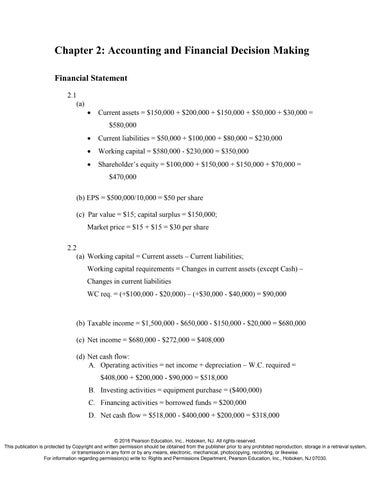
Chapter 2: Accounting and Financial Decision Making Financial Statement 2.1 (a) •
Current assets = $150,000 + $200,000 + $150,000 + $50,000 + $30,000 = $580,000
•
Current liabilities = $50,000 + $100,000 + $80,000 = $230,000
•
Working capital = $580,000 - $230,000 = $350,000
•
Shareholder’s equity = $100,000 + $150,000 + $150,000 + $70,000 = $470,000
(b) EPS = $500,000/10,000 = $50 per share (c) Par value = $15; capital surplus = $150,000; Market price = $15 + $15 = $30 per share 2.2 (a) Working capital = Current assets – Current liabilities; Working capital requirements = Changes in current assets (except Cash) – Changes in current liabilities WC req. = (+$100,000 - $20,000) – (+$30,000 - $40,000) = $90,000
(b) Taxable income = $1,500,000 - $650,000 - $150,000 - $20,000 = $680,000 (c) Net income = $680,000 - $272,000 = $408,000 (d) Net cash flow: A. Operating activities = net income + depreciation – W.C. required = $408,000 + $200,000 - $90,000 = $518,000 B. Investing activities = equipment purchase = ($400,000) C. Financing activities = borrowed funds = $200,000 D. Net cash flow = $518,000 - $400,000 + $200,000 = $318,000
© 2016 Pearson Education, Inc., Hoboken, NJ. All rights reserved. This publication is protected by Copyright and written permission should be obtained from the publisher prior to any prohibited reproduction, storage in a retrieval system, or transmission in any form or by any means, electronic, mechanical, photocopying, recording, or likewise. For information regarding permission(s) write to: Rights and Permissions Department, Pearson Education, Inc., Hoboken, NJ 07030.