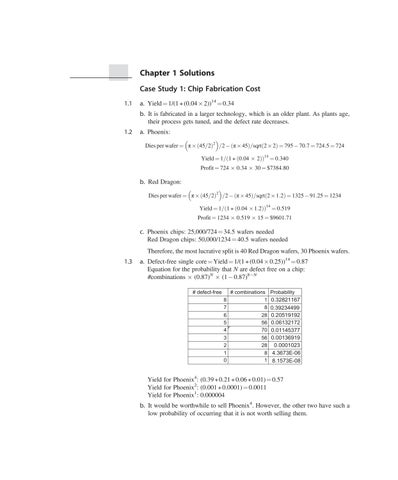
Chapter 1 Solutions Case Study 1: Chip Fabrication Cost 1.1
a. Yield ¼ 1/(1 + (0.04 2))14 ¼ 0.34 b. It is fabricated in a larger technology, which is an older plant. As plants age, their process gets tuned, and the defect rate decreases.
1.2
a. Phoenix:
Dies per wafer ¼ π ð45=2Þ2 =2 ðπ 45Þ=sqrtð2 2Þ ¼ 795 70:7 ¼ 724:5 ¼ 724 Yield ¼ 1=ð1 + ð0:04 2ÞÞ14 ¼ 0:340 Profit ¼ 724 0:34 30 ¼ $7384:80
b. Red Dragon:
Dies per wafer ¼ π ð45=2Þ2 =2 ðπ 45Þ=sqrtð2 1:2Þ ¼ 1325 91:25 ¼ 1234 Yield ¼ 1=ð1 + ð0:04 1:2ÞÞ14 ¼ 0:519 Profit ¼ 1234 0:519 15 ¼ $9601:71
c. Phoenix chips: 25,000/724 ¼ 34.5 wafers needed Red Dragon chips: 50,000/1234 ¼ 40.5 wafers needed Therefore, the most lucrative split is 40 Red Dragon wafers, 30 Phoenix wafers. 1.3
a. Defect-free single core ¼ Yield ¼ 1/(1 + (0.04 0.25))14 ¼ 0.87 Equation for the probability that N are defect free on a chip: #combinations (0.87)N (1 0.87)8 N # defect-free 8 7 6 5 4
# combinations Probability 1 0.32821167 8 0.39234499 28 0.20519192 56 0.06132172 70 0.01145377
3 2 1 0
56 0.00136919 28 0.0001023 8 4.3673E-06 1 8.1573E-08
Yield for Phoenix4: (0.39 + 0.21 + 0.06 + 0.01) ¼ 0.57 Yield for Phoenix2: (0.001 + 0.0001) ¼ 0.0011 Yield for Phoenix1: 0.000004 b. It would be worthwhile to sell Phoenix4. However, the other two have such a low probability of occurring that it is not worth selling them.
2
■
Solutions to Case Studies and Exercises c.
$20 ¼
Wafer size odd dpw 0:28
Step 1: Determine how many Phoenix4 chips are produced for every Phoenix8 chip. There are 57/33 Phoenix4 chips for every Phoenix8 chip ¼ 1.73 $30 + 1:73 $25 ¼ $73:25
Case Study 2: Power Consumption in Computer Systems 1.4
a. Energy: 1/8. Power: Unchanged. b. Energy: Energynew/Energyold ¼ (Voltage 1/8)2/Voltage2 ¼ 0.156 Power: Powernew/Powerold ¼ 0.156 (Frequency 1/8)/Frequency ¼ 0.00195 c. Energy: Energynew/Energyold ¼ (Voltage 0.5)2/Voltage2 ¼ 0.25 Power: Powernew/Powerold ¼ 0.25 (Frequency 1/8)/Frequency ¼ 0.0313 d. 1 core ¼ 25% of the original power, running for 25% of the time. 0:25 0:25 + ð0:25 0:2Þ 0:75 ¼ 0:0625 + 0:0375 ¼ 0:1
1.5
a. Amdahl’s law: 1/(0.8/4 + 0.2) ¼ 1/(0.2 + 0.2) ¼ 1/0.4 ¼ 2.5 b. 4 cores, each at 1/(2.5) the frequency and voltage Energy: Energyquad/Energysingle ¼ 4 (Voltage 1/(2.5))2/Voltage2 ¼ 0.64 Power: Powernew/Powerold ¼ 0.64 (Frequency 1/(2.5))/Frequency ¼ 0.256 c. 2 cores + 2 ASICs vs. 4 cores ð2 + ð0:2 2ÞÞ=4 ¼ ð2:4Þ=4 ¼ 0:6
1.6
a. Workload A speedup: 225,000/13,461 ¼ 16.7 Workload B speedup: 280,000/36,465 ¼ 7.7 1/(0.7/16.7 + 0.3/7.7) b. General-purpose: 0.70 0.42 + 0.30 ¼ 0.594 GPU: 0.70 0.37 + 0.30 ¼ 0.559 TPU: 0.70 0.80 + 0.30 ¼ 0.886 c. General-purpose: 159 W + (455 W 159 W) 0.594 ¼ 335 W GPU: 357 W + (991 W 357 W) 0.559 ¼ 711 W TPU: 290 W + (384 W 290 W) 0.86 ¼ 371 W d. Speedup
A
B
C
GPU
2.46
2.76
1.25
TPU
41.0
21.2
0.167
% Time
0.4
0.1
0.5
Chapter 1 Solutions
■
3
GPU: 1/(0.4/2.46 + 0.1/2.76 + 0.5/1.25) ¼ 1.67 TPU: 1/(0.4/41 + 0.1/21.2 + 0.5/0.17) ¼ 0.33 e. General-purpose: 14,000/504 ¼ 27.8 28 GPU: 14,000/1838 ¼ 7.62 8 TPU: 14,000/861 ¼ 16.3 17 d. General-purpose: 2200/504 ¼ 4.37 4, 14,000/(4 504) ¼ 6.74 7 GPU: 2200/1838 ¼ 1.2 1, 14,000/(1 1838) ¼ 7.62 8 TPU: 2200/861 ¼ 2.56 2, 14,000/(2 861) ¼ 8.13 9
Exercises 1.7
a. Somewhere between 1.410 and 1.5510, or 28.9 80x b. 6043 in 2003, 52% growth rate per year for 12 years is 60,500,000 (rounded) c. 24,129 in 2010, 22% growth rate per year for 15 years is 1,920,000 (rounded) d. Multiple cores on a chip rather than faster single-core performance e. 2 ¼ x4, x ¼ 1.032, 3.2% growth
1.8
a. 50% b. Energy: Energynew/Energyold ¼ (Voltage 1/2)2/Voltage2 ¼ 0.25
1.9
a. 60% b. 0.4 + 0.6 0.2 ¼ 0.58, which reduces the energy to 58% of the original energy c. newPower/oldPower ¼ ½Capacitance (Voltage 0.8)2 (Frequency 0.6)/½ Capacitance Voltage Frequency ¼ 0.82 0.6 ¼ 0.256 of the original power. d. 0.4 + 0.3 2 ¼ 0.46, which reduces the energy to 46% of the original energy
1.10
a. 109/100 ¼ 107 b. 107/107 + 24 ¼ 1 c. [need solution]
1.11
a. 35/10,000 3333 ¼ 11.67 days b. There are several correct answers. One would be that, with the current system, one computer fails approximately every 5 min. 5 min is unlikely to be enough time to isolate the computer, swap it out, and get the computer back on line again. 10 min, however, is much more likely. In any case, it would greatly extend the amount of time before 1/3 of the computers have failed at once. Because the cost of downtime is so huge, being able to extend this is very valuable. c. $90,000 ¼ (x + x + x + 2x)/4 $360,000 ¼ 5x $72,000 ¼ x 4th quarter ¼ $144,000/h
■
Solutions to Case Studies and Exercises
12 10 Net speedup
4
8 6 4 2 0
0
10
20
30 40 50 60 70 Percent vectorization
80
90
100
Figure S.1 Plot of the equation: y 5 100/((100 2 x) + x/10).
1.12
a. See Figure S.1. b. 2 ¼ 1/((1 x) + x/20) 10/19 ¼ x ¼ 52.6% c. (0.526/20)/(0.474 + 0.526/20) ¼ 5.3% d. Extra speedup with 2 units: 1/(0.1 + 0.9/2) ¼ 1.82. 1.82 20 36.4. Total speedup: 1.95. Extra speedup with 4 units: 1/(0.1 + 0.9/4) ¼ 3.08. 3.08 20 61.5. Total speedup: 1.97
1.13
a. old execution time ¼ 0.5 new + 0.5 10 new ¼ 5.5 new b. In the original code, the unenhanced part is equal in time to the enhanced part (sped up by 10), therefore: (1 x) ¼ x/10 10 10x ¼ x 10 ¼ 11x 10/11 ¼ x ¼ 0.91
1.14
a. 1/(0.8 + 0.20/2) ¼ 1.11 b. 1/(0.7 + 0.20/2 + 0.10 3/2) ¼ 1.05 c. fp ops: 0.1/0.95 ¼ 10.5%, cache: 0.15/0.95 ¼ 15.8%
1.15
a. 1/(0.5 + 0.5/22) ¼ 1.91 b. 1/(0.1 + 0.90/22) ¼ 7.10 c. 41% 22 ¼ 9. A runs on 9 cores. Speedup of A on 9 cores: 1/(0.5 + 0.5/9) ¼ 1.8 Overall speedup if 9 cores have 1.8 speedup, others none: 1/(0.6 + 0.4/1.8) ¼ 1.22 d. Calculate values for all processors like in c. Obtain: 1.8, 3, 1.82, 2.5, respectively. e. 1/(0.41/1.8 + 0.27/3 + 0.18/1.82 + 0.14/2.5) ¼ 2.12
Chapter 1 Solutions
1.16
a. 1/(0.2 + 0.8/N) b. 1/(0.2 + 8 0.005 + 0.8/8) ¼ 2.94 c. 1/(0.2 + 3 0.005 + 0.8/8) ¼ 3.17 d. 1/(.2 + logN 0.005 + 0.8/N) e. d/dN (1/((1 P) + logN 0.005 + P/N) ¼ 0)
■
5