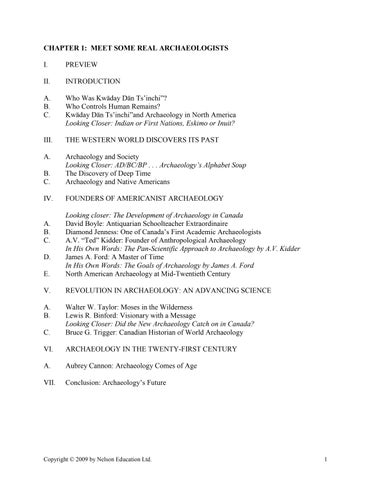
CHAPTER 1: MEET SOME REAL ARCHAEOLOGISTS I.
PREVIEW
II.
INTRODUCTION
A. B. C.
Who Was Kwäday Dän Ts‟inchi”? Who Controls Human Remains? Kwäday Dän Ts‟inchi”and Archaeology in North America Looking Closer: Indian or First Nations, Eskimo or Inuit?
III.
THE WESTERN WORLD DISCOVERS ITS PAST
A. B. C.
Archaeology and Society Looking Closer: AD/BC/BP . . . Archaeology’s Alphabet Soup The Discovery of Deep Time Archaeology and Native Americans
IV.
FOUNDERS OF AMERICANIST ARCHAEOLOGY
E.
Looking closer: The Development of Archaeology in Canada David Boyle: Antiquarian Schoolteacher Extraordinaire Diamond Jenness: One of Canada‟s First Academic Archaeologists A.V. “Ted” Kidder: Founder of Anthropological Archaeology In His Own Words: The Pan-Scientific Approach to Archaeology by A.V. Kidder James A. Ford: A Master of Time In His Own Words: The Goals of Archaeology by James A. Ford North American Archaeology at Mid-Twentieth Century
V.
REVOLUTION IN ARCHAEOLOGY: AN ADVANCING SCIENCE
A. B. C.
Walter W. Taylor: Moses in the Wilderness Lewis R. Binford: Visionary with a Message Looking Closer: Did the New Archaeology Catch on in Canada? Bruce G. Trigger: Canadian Historian of World Archaeology
VI.
ARCHAEOLOGY IN THE TWENTY-FIRST CENTURY
A.
Aubrey Cannon: Archaeology Comes of Age
VII.
Conclusion: Archaeology‟s Future
A. B. C. D.
Copyright © 2009 by Nelson Education Ltd.
1
What Students Should Learn From Chapter 1 1.
How „deep time‟ was discovered, and why the concept is important.
2.
Acronyms (AD, BC etc.) associated with archaeological dating.
3.
A brief history of Americanist Archaeology, including the development of archaeology in Canada.
4.
What caused of the revolution in archaeology in the mid-twentieth century.
5.
The archaeologists discussed in the chapter, and their contributions to the field.
6.
That archaeology today covers a broad spectrum of ideas and approaches to interpreting the past.
2
Copyright © 2009 by Nelson Education Ltd.
Chapter 1 Lecture Suggestions 1.
Summarize the history of scientific thought from the Middle Ages through the modern science revolution, include individual contributions to the studies of archaeology and geology that helped to highlight the concept of „deep time‟. Good sources are Donald Grayson‟s The Establishment of Human Antiquity (1983) and Bruce Trigger‟s A History of Archaeological Thought (2006, second edition).
2.
Explain and summarize the five periods of Americanist Archaeology, beginning with the early antiquarians, through the speculative, classification-descriptive, classificationhistorical, and ending with the explanatory period. Identify individuals associated with each period and highlight their contributions to the field of archaeology. Again, a good source is Bruce Trigger‟s A History of Archaeological Thought (2006, second edition), Pamela Jane Smith and Donald Mitchell, Bringing Back the Past: Historical Perspectives on Canadian Archaeology (1998) and Jane H Kelley and Ronald Williamson, “The Positioning of Archaeology within Anthropology: A Canadian Historical Perspective” (American Antiquity 61:5-20)
3.
Compare the cases of Kwäday Dän Ts‟inchi” and Kennewick man, including the different perspectives and outcomes involving the CAFN and the Native Americans (e.g. NAGPRA). See Beattie et al., “The Kwäday Dän Ts‟inchi Discovery from a Glacier in British Columbia (Canadian Journal of Archaeology 24:129-147), David Thomas, Skull Wars (2000), and Joe Watkins‟, Indigenous Archaeology (2000).
4.
Explain how you became interested in the field of archaeology, what types of classes you had to take, types of jobs you have held in archaeology, what some of the major job fields are today.
Copyright © 2009 by Nelson Education Ltd.
3
Key Terms, Individuals and Concepts AC AD Americanist Archaeology Antiquarian Artifact Aubrey Cannon A.V. “Ted” Kidder bc BC Boucher de Perthes BP Bruce G. Trigger Charles Darwin Charles Lyell Classical Archaeology Conjunctive Approach Culture History David Boyle de‟Pizzicolli Diamond Jenness Ethnology First Nations Inuk / Inuit James A. Ford James Ussher Kwäday Dän Ts‟inchi” Kennewick Man Lewis R. Binford Métis Midden Nabonidus NAGPRA New Archaeology Petrarch Potsherd Stratigraphy The Canadian Institute Trait List Walter W. Taylor William E. Taylor Jr.
4
Copyright © 2009 by Nelson Education Ltd.
Chapter 1 InfoTrac Exercises 1. Have students search for Kwäday Dän Ts‟inchi” to find Mary Ann Dames article summarizing the discovery, analysis, and repatriation of Kwäday Dän Ts‟inchi”s remains. Keywords: Kwäday Dän Ts‟inchi”
2. Ask students to report on the Kennewick man controversy and the differing opinions between the Native American claiming the individual and the scientists suing to study him. Keywords: Kennewick Man 3. Have students look under „Cultural resources AND Canada‟ to access Bennett and Lopoukhine‟s article describing Cultural Resource Management in Canada. Have them write a short paper defining „cultural resource management” and describing the implication of a site‟s social and historic significance. 4. Ask students to look under „Marie Wormington‟ to find Dennis Stanford‟s article about this pioneer woman archaeologist. Have the students outline her life‟s story and contrast her with individuals discussed in the textbook. 5. Have students search for „public archaeology AND Canada‟ to find Lea and Smardz‟s article discussing projects and programs designed to ehance public knowledge about and appreciation for archaeology.
Copyright © 2009 by Nelson Education Ltd.
5