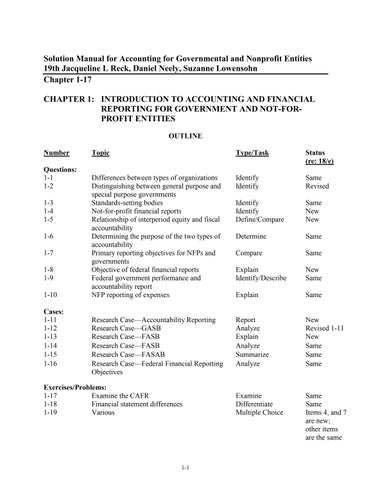
Solution Manual for Accounting for Governmental and Nonprofit Entities 19th Jacqueline L Reck, Daniel Neely, Suzanne Lowensohn Chapter 1-17 CHAPTER 1: INTRODUCTION TO ACCOUNTING AND FINANCIAL REPORTING FOR GOVERNMENT AND NOT-FORPROFIT ENTITIES OUTLINE Number Questions: 1-1 1-2 1-3 1-4 1-5 1-6 1-7 1-8 1-9 1-10 Cases: 1-11 1-12 1-13 1-14 1-15 1-16
Topic
Type/Task
Status (re: 18/e)
Differences between types of organizations Distinguishing between general purpose and special purpose governments Standards-setting bodies Not-for-profit financial reports Relationship of interperiod equity and fiscal accountability Determining the purpose of the two types of accountability Primary reporting objectives for NFPs and governments Objective of federal financial reports Federal government performance and accountability report NFP reporting of expenses
Identify Identify
Same Revised
Identify Identify Define/Compare
Same New New
Determine
Same
Compare
Same
Explain Identify/Describe
New Same
Explain
Same
Research Case—Accountability Reporting Research Case—GASB Research Case—FASB Research Case—FASB Research Case—FASAB Research Case—Federal Financial Reporting Objectives
Report Analyze Explain Analyze Summarize Analyze
New Revised 1-11 New Same Same Same
Examine Differentiate Multiple Choice
Same Same Items 4, and 7 are new; other items are the same
Exercises/Problems: 1-17 Examine the CAFR 1-18 Financial statement differences 1-19 Various
1-1
1-20
Matching concepts and reporting characteristics or requirements for government and NFP organizations Matching standards governing organizations
1-21
Classify
Revised
Classify
Revised
CHAPTER 1: INTRODUCTION TO ACCOUNTING AND FINANCIAL REPORTING FOR GOVERNMENT AND NOT-FORPROFIT ENTITIES Answers to Questions 1-1.
Following is a list of some of the differences between business organizations and government/not-for-profit organizations.
Business Organizations Providers of resources expect either repayment or economic benefits proportionate to the resources provided. Primary operations are undertaken to provide goods or services at a profit. There are defined ownership interests that can be sold, transferred, or redeemed; or entitle the owner to a share of remaining resources at liquidation.
Government/Not-for-for profit Organizations Many providers of resources do not expect repayment or economic benefits proportionate to the resources provided. Primary operations are not undertaken to provide goods or services at a profit or profit equivalent. There are no defined ownership interests.
General Problem Information: Differences between types of organizations Learning Objective: 1-1 Topic: Differences Between Governmental and Not-for-Profit Organizations Bloom’s Taxonomy: Remember Accreditation Skills tag: AACSB: Communication, AICPA: BB Industry Level of Difficulty: Easy 1-2.
a. GP b. SP
c. SP d. GP
e. GP f. SP
General Problem Information: Distinguishing between general purpose and special purpose governments Learning Objective: 1-1 Topic: Differences Between Governmental and Not-for-Profit Organizations Bloom’s Taxonomy: Remember Accreditation Skills tag: AACSB: Communication, AICPA: BB Industry Level of Difficulty: Easy 1-2
1-3.
Illustration 1-1 shows the standard-setting jurisdiction of the FASB, GASB and FASAB. As shown, the FASB has responsibility for setting accounting and financial reporting standards for business entities and nongovernmental not-for-profit organizations. The GASB has responsibility for setting standards for state and local governments and government not-for-profit organizations. The FASAB has responsibility for setting accounting and reporting standards for the federal government and its agencies and departments. General Problem Information: Standards-setting bodies Learning Objective: 1-2 Topic: Sources of Financial Reporting Standards Bloom’s Taxonomy: Remember Accreditation Skills tag: AACSB: Communication, AICPA: FN Reporting Level of Difficulty: Easy
1-4.
The required financial statements for a not-for-profit (NFP) organization applying the FASB standards are (1) Statement of financial position or a balance sheet, (2) Statement of activities, and (3) Statement of cash flows. Although not a required statement, NFPs are also required to provide information on the relationship between functional expenses and natural expenses. The FASB allows NFPs to provide that information using a separate financial statement, a schedule in the notes, or displayed on the statement of activities. General Problem Information: Financial reporting of not-for-profit organizations Learning Objective: 1-6 Topic: Financial Reporting for Not-for-Profit Organizations Bloom’s Taxonomy: Remember Accreditation Skills tag: AACSB: Communication, AICPA: FN Reporting Level of Difficulty: Easy
1-5.
Interperiod equity is whether current period revenues are sufficient to pay for current period services, and it is considered an important component of accountability. Failure to pay for current period services means that the financial burden is being passed to future year taxpayers who may not receive any benefit from the past services. Interperiod equity is closely related to fiscal accountability in that fiscal accountability is intended to help ensure that the government is raising and spending resources in compliance with laws and regulations, which would include the legally approved budget. Providing information on whether the government is meeting budgetary requirements helps in assessing whether the government is ―living within its means‖ (achieving interperiod equity) during the current reporting period.
1-3
Ch. 1, Answers, Question 1-5 (Cont‘d)
General Problem Information: Relationship of interperiod equity and fiscal accountability Learning Objective: 1-3 Learning Objective: 1-4 Topic: Objectives of Financial Reporting; Financial Reporting of State and Local Governments Bloom’s Taxonomy: Analyze Accreditation Skills tag: AACSB: Analytical Thinking, AICPA: BB Critical Thinking Level of Difficulty: Medium 1-6.
The purpose of operational accountability is to assess whether the government has used its resources efficiently and effectively in meeting its operating objectives. The purpose of fiscal accountability is to assess the short-term flow of current financial resources. Government-wide financial statements are primarily focused on providing information to assess operational accountability, while fund financial statements are focused on providing information to assess fiscal accountability. General Problem Information: Determining the purpose of the two types of accountability Learning Objective: 1-4 Topic: Financial Reporting of State and Local Governments Bloom’s Taxonomy: Understand Accreditation Skills tag: AACSB: Communication, AICPA: FN Reporting Level of Difficulty: Easy
1-7.
The primary financial reporting objective for not-for-profit organizations is to provide decision-useful financial information to resource providers, such as donors, members, and creditors. The primary financial reporting objective for a government organization is accountability, but other objectives include providing useful information for economic, social, and political decisions. Thus, the reporting focus for the two types of organizations differs in that the not-for-profit organization financial reports are to focus on providing information that is useful in making decisions; while the government organization financial reports are to focus primarily on providing information that can be used to assess whether public resources were raised and used for their intended purposes. General Problem Information: Primary reporting objectives for NFPs and governments Learning Objective: 1-3 Topic: Objectives of Financial Reporting Bloom’s Taxonomy: Understand Accreditation Skills tag: AACSB: Communication, AICPA: FN Reporting Level of Difficulty: Medium
1-8.
The FASAB indicates that federal financial reports are to help meet the needs of both external and internal users. As such, financial reports are prepared to provide information that is useful in assessing accountability, efficiency, effectiveness and the results of providing and spending federal resources.
1-4
Ch. 1, Answers, Question 1-8 (Cont‘d)
General Problem Information: Objective of federal financial reports Learning Objective: 1-5 Topic: Financial Reporting of the Federal Government Bloom’s Taxonomy: Remember Accreditation Skills tag: AACSB: Communication, AICPA: FN Reporting Level of Difficulty: Easy 1-9.
The four sections of a federal agency‘s performance and accountability report (PAR) are (1) an MD&A, which provides a brief overview of the entire PAR and describes the agency‘s mission and performance goals, among other items; (2) the performance section, essentially consisting of the agency‘s annual performance report (APR); (3) the basic financial statements, which are listed in this chapter; and (4) other accompanying information, such as information about the nation‘s tax burden, the tax gap, challenges facing the agency‘s management, and revenue foregone. General Problem Information: Federal government performance and accountability report Learning Objective: 1-5 Topic: Financial Reporting of the Federal Government Bloom’s Taxonomy: Remember Accreditation Skills tag: AACSB: Communication, AICPA: FN Reporting Level of Difficulty: Easy
1-10. Reporting program expenses separately from management and general expenses and fund-raising costs provides information to donors, members, and oversight bodies to assess the effectiveness of the organization in accomplishing its purpose. Most donors and members wish to have the funds they contribute used for the organizational purpose rather than supporting management costs or fund-raising expenses. This reporting is also necessary for oversight bodies, such as the Internal Revenue Service, to permit the continued existence of the organization as a not-for-profit. General Problem Information: NFP reporting of expenses Learning Objective: 1-6 Topic: Financial Reporting of Not-for-Profit Organizations (NFPs) Bloom’s Taxonomy: Understand Accreditation Skills tag: AACSB: Communication, AICPA: FN Reporting Level of Difficulty: Medium Solutions to Cases 1-11. Instructors may want to note that answers for a are found under Impact, b under Datasets, and c will be determined by the student. As with all websites, the location of the answers may change. Accessing Open Government will provide students with insight into data sources that are becoming increasingly available to users of government data and information. Ch. 1, Solutions, Case 1-11 (Cont‘d) 1-5