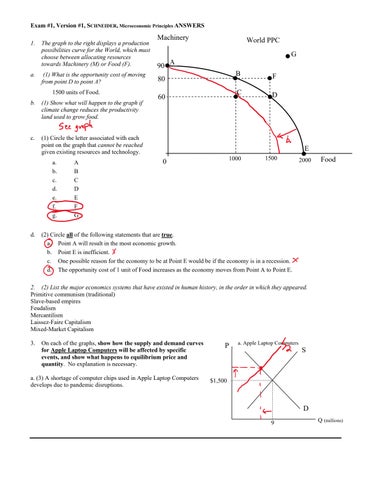
Exam #1, Version #1, SCHNEIDER, Microeconomic Principles ANSWERS 1.
a.
World PPC
90A
(1) What is the opportunity cost of moving from point D to point A?
80
B
F
60
C
D
1500 units of Food. b.
(1) Show what will happen to the graph if climate change reduces the productivity land used to grow food.
c.
(1) Circle the letter associated with each point on the graph that cannot be reached given existing resources and technology. a. b. c. d. e. f. g.
d.
Machinery
The graph to the right displays a production possibilities curve for the World, which must choose between allocating resources towards Machinery (M) or Food (F).
A B C D E F G
G
1000
0
1500
E
2000
Food
(2) Circle all of the following statements that are true. a. Point A will result in the most economic growth. b. Point E is inefficient. c. One possible reason for the economy to be at Point E would be if the economy is in a recession. d. The opportunity cost of 1 unit of Food increases as the economy moves from Point A to Point E.
2. (2) List the major economics systems that have existed in human history, in the order in which they appeared. Primitive communism (traditional) Slave-based empires Feudalism Mercantilism Laissez-Faire Capitalism Mixed-Market Capitalism 3.
On each of the graphs, show how the supply and demand curves for Apple Laptop Computers will be affected by specific events, and show what happens to equilibrium price and quantity. No explanation is necessary.
a. (3) A shortage of computer chips used in Apple Laptop Computers develops due to pandemic disruptions.
P
a. Apple Laptop Computers
S
$1,500
D 9
Q (millions)
2 b. (3) Intel undertakes a massive advertising campaign to convince people to buy laptops not made by Apple. The campaign is so bad that it actually increases Apple’s brand-name identification.
b. Apple Laptop Computers
P
S
$1,500
D Q (millions)
9 c. (3) Apple starts to make more money selling iPhones than it does selling laptop computers.
P
c. Apple Laptop Computers
S
$1,500
D Q (millions)
9 d. (3) Wages of workers all around the world rise due to the end of the global COVID-19 pandemic.
d. Apple Laptop Computers
P
S
$1,500
D Suppose that the Pennsylvania State Legislature legalizes recreational marijuana, creating the market depicted in the 200 graph to the right with an equilibrium price of $100 per unit P($)190 and an equilibrium quantity of 500 units. 180 170 a. (1) On the graph to the right, a $60 per unit excise tax on 160 marijuana would result in a new equilibrium price of $_____________. Show on the graph. b. (1) The total tax revenue from the $60 excise tax received by the government would be $________________. (show your work)
Market for Legalized Marijuana
S
150 140 130 120 110 100 90 80 70 60 50 40 30 20 10 0
Q
D
1000
900
800
700
600
500
400
300
200
100
0
c. (1) Producers’ total revenue after the excise tax is imposed would be $________________. (show your work)
Q (millions)
9
4.
3 5.
(1) In the COVID-19 recession of 2020, incomes decreased by 5% and the quantity of Pabst Blue Ribbon Beer demanded increased by 2%. This tells us that Pabst Blue Ribbon Beer a. Has an elastic demand curve. b. Has an inelastic demand curve. c. Is a normal good. d. Is an inferior good. e. Is a superior good.
6.
(1) According to the Political Economy model of the work day, the wage rate paid to workers is a. Somewhere between the subsistence wage and the level where firms earn a normal profit. b. Affected primarily by the relative power of workers and employers. c. Lower when firms are able to move operations abroad. d. All of the above. e. None of the above.
7.
(1) In 2021 the price of beef increased by 20%. As a result, the quantity of buns demanded decreased by 5% and the quantity of chicken demanded increased by 10%. This means (circle all of the following that are TRUE): a. Beef has an inelastic demand curve. b. Beef is a normal good. c. Buns are a substitute good for beef. d. Buns are complementary good for beef. e. Chicken is a substitute good for beef. f. Chicken is a complementary good for beef.
8.
The government of the state of Pennsylvania wants to help out farmers who supply milk. Currently, the equilibrium price of a gallon of milk in Pennsylvania is $3, and the equilibrium quantity of milk produced is 10 billion gallons. The price elasticity of the demand for Pennsylvania Milk is extremely elastic (𝑒 3 , and the price elasticity of the supply of Pennsylvania Milk is inelastic (𝑒 0.3 . The government is considering (a) a price floor of $4, and (b) a subsidy to Pennsylvania Milk Farmers of $2 per gallon. a. (6) Draw a graph of the market for Pennsylvania Milk. Show as accurately P S as possible how it will be affected by a price floor of $4 per gallon. Determine the cost to the government of buying the surplus (if any), and the total revenue that Pennsylvania Milk Farmers get after that price floor is installed.
𝑒
3
%∆
; %∆𝑃 33.33% %∆𝑄 3 ∗ 33.33% 100% Cost to government is surplus of 11b.* $4=$44 billion. TR for firms is $4*11b.=$44 billion %∆𝑄 𝑒 0.3 ; %∆𝑄 10% 33.33% %∆
$4 $3 D
b. (6) Draw another graph of the market for Pennsylvania Milk in equilibrium. Show how it will be affected by a per-unit subsidy of $2 per gallon. Be as accurate as possible. Determine the cost of the subsidy to the government, and the total revenue that Pennsylvania Milk Farmers will receive after the subsidy is established.
P
The supply curve Q (billions) shifts down by 10 11 exactly $2, resulting in a new equilibrium of about $2.70. Once you pick the new equilibrium price, you compute the new quantity demanded using the price elasticity of demand. %∆ . %∆ 3 ; %∆𝑃 10%. 3 ; 𝑒
S S-2
$4
%∆
%
%∆𝑄 30%. Q2 is 30% higher than 10; Q2=1.3*10=13. Cost of subsidy to government is $2 * 13 billion = $26 billion. Total revenue to firms is ($2.70+$2)*13 b. =$4.70*13b.= $61.1 billion
$3
$2.70
D $1
c. (4) Given that the goal is to help out Pennsylvania Milk Farmers at the least cost to government, while also keeping prices low for consumers if possible, which policy is most effective, and why? The subsidy is the clear best choice. Farmers get more revenue, it costs the government less, and consumers pay lower prices
10 13
Q (billions)