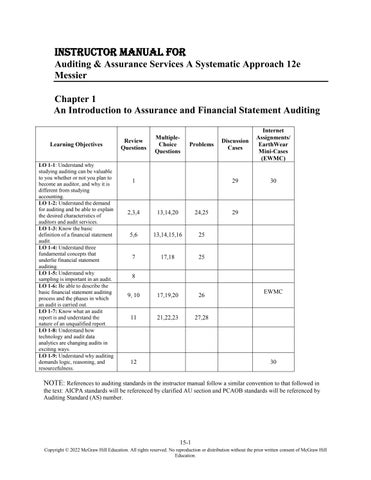
Instructor Manual For Auditing & Assurance Services A Systematic Approach 12e Messier Chapter 1 An Introduction to Assurance and Financial Statement Auditing
Learning Objectives
LO 1-1: Understand why studying auditing can be valuable to you whether or not you plan to become an auditor, and why it is different from studying accounting. LO 1-2: Understand the demand for auditing and be able to explain the desired characteristics of auditors and audit services. LO 1-3: Know the basic definition of a financial statement audit. LO 1-4: Understand three fundamental concepts that underlie financial statement auditing. LO 1-5: Understand why sampling is important in an audit. LO 1-6: Be able to describe the basic financial statement auditing process and the phases in which an audit is carried out. LO 1-7: Know what an audit report is and understand the nature of an unqualified report. LO 1-8: Understand how technology and audit data analytics are changing audits in exciting ways. LO 1-9: Understand why auditing demands logic, reasoning, and resourcefulness.
Review Questions
MultipleChoice Questions
Problems
1
2,3,4
13,14,20
24,25
5,6
13,14,15,16
25
7
17,18
25
9, 10
17,19,20
26
11
21,22,23
27,28
Discussion Cases
Internet Assignments/ EarthWear Mini-Cases (EWMC)
29
30
29
8
12
EWMC
30
NOTE: References to auditing standards in the instructor manual follow a similar convention to that followed in the text: AICPA standards will be referenced by clarified AU section and PCAOB standards will be referenced by Auditing Standard (AS) number.
15-1 Copyright © 2022 McGraw Hill Education. All rights reserved. No reproduction or distribution without the prior written consent of McGraw Hill Education.
END OF CHAPTER MATERIALS COMPARISON CHART
Number Number Comparison in 11th edition in 12th edition 1-1 Unchanged 1-1 1-2 Unchanged 1-2 1-3 Unchanged 1-3 1-4 Unchanged 1-4 1-5 Unchanged 1-5 1-6 Revised 1-6 1-7 Unchanged 1-7 1-8 Unchanged 1-8 1-9 Unchanged 1-9 1-10 Unchanged 1-10 1-11 Unchanged 1-11 1-12 Unchanged 1-12 1-13 Unchanged 1-13 1-14 Unchanged 1-14 1-15 Unchanged 1-15 1-16 Unchanged 1-16 1-17 Unchanged 1-17 1-18 Unchanged 1-18 1-19 Unchanged 1-19 1-20 Unchanged 1-20 1-21 Unchanged 1-21 1-22 Unchanged 1-22 1-23 Unchanged 1-23 1-24 Unchanged 1-24 1-25 Revised 1-25 1-26 Revised 1-26 1-27 Unchanged 1-27 1-28 Unchanged 1-28 1-29 Unchanged 1-29 1-30 Unchanged 1-30
When students enter the first introductory class, they seldom understand what assurance or auditing entails. Generally, they will not have read Chapter 1 before class, so it‘s important to spend the time necessary during the first class to capture students‘ attention and stimulate their interest in auditing.
15-2 Copyright © 2022 McGraw Hill Education. All rights reserved. No reproduction or distribution without the prior written consent of McGraw Hill Education.
Introduction After going over the class expectations, we spend the first part of class discussing and illustrating the demand for auditing and the role of auditing in society. If students are to be interested and excited to dig in and learn this daunting new material, they need to be convinced that it is important and useful. Thus, we also emphasize that the concepts underlying auditing are useful in many contexts other than auditing, including consulting and management. Later in the class, we might ask the students how they would audit the automobile revenues (say $100 billion) of a large automobile manufacturer. We tell them that each car and truck has an invoice on the window and in the company's computer system, and that 8 million cars and trucks were sold. We then ask them how many invoices out of 8 million they want to examine in order to verify the $100 billion of revenues in the financial statements. Of course, you will get some outlandish answers (e.g., 400,000 invoices). We eventually tell them that you may not look at any invoices and that you may rely solely on the company‘s internal controls in conjunction with a careful ratio analysis or other type of analytical procedure. This type of example quickly gets the students' attention that auditing involves a substantial amount of judgment and common sense. [LO 1-1] Tips for Learning Auditing We spend a few minutes on this section emphasizing the differences between the study of accounting (which they are very familiar with) and the study of auditing (which they are not). We try to make sure they understand what auditing focuses on and how it is much more conceptual than their other accounting courses. We introduce the idea of a ―tool kit‖ and how it relates to what we will be covering during the course. [LO 1-2] The Demand for Auditing and Assurance We spend a reasonable amount of time during the first lecture discussing why there is a demand for auditing and assurance services. Many students think that the demand for auditing is driven by the requirements of the Securities laws. It is important that the students have some basic understanding of the agency relationship that leads to the demand for auditing. Figure 1-1 provides a good framework for this discussion. We then bring in how the CPA fits this need with the qualities of independence, integrity, and objectivity. Sometimes we do role-plays, asking students to come to the front of the room. One is selling a car, while the other is interested in buying it. We let them discuss their concerns, what information they want, what the incentives of the two parties are, what information asymmetries might exist, etc. We then tie this scenario, which most students are somewhat familiar with or at least can relate to, back to the idea of the demand for auditing. Use Figure 1-1
15-3 Copyright © 2022 McGraw Hill Education. All rights reserved. No reproduction or distribution without the prior written consent of McGraw Hill Education.
An Assurance Analogy: The Case of the House Inspector Sometimes it is difficult for students to grasp the theoretical perspective of the role accounting and auditing play in the principal-agent relationship, so we use a practical analogy to aid their understanding. We go over how a house inspection is similar to a financial statement audit including who the players are and how their roles relate to what we just discussed. We ask the students what is similar and different between the house inspection and the financial statement audit beginning with Table 1-1. Lastly, we ask the students for other examples of assurance services and again try to relate the specifics of each to the characteristics listed in Table 1-1. Use Table 1-1 We then introduce the concept of ―management assertions‖ by asking the students what specific assertions the company is making about specific financial statement items (for example: cash or inventory). They usually can come up with the most obvious ones: existence, fairly and accurately recorded, and all items are included. They might need to be pushed for some of the others. They may also fail to distinguish between assertions in terms of account balances and assertions in terms of transactions. It is useful to help them understand the differences between assertions for transactions and balances but also how they are related. Then we ask them how, as an auditor, you might go about collecting evidence on the cash account, bringing in what assertions are most important and why. We like to emphasize the differences between assertions about the account balance at the end of the period and the transactions posted to the account during the period, relating these concepts to each other and to the idea of risk from an audit perspective. Use Table 1-2 Next, we talk about what else the prospective investor would want to know besides the quality of management‘s assertions. Finally, we relate all of this back to Table 1-1. Problem 24 could be covered here. [LO 1-4] Fundamental Concepts in Conducting a Financial Statement Audit In this section, we discuss examples of the fundamental concepts in a financial statement audit: materiality, audit risk, and evidence. Our philosophy is that it is much better for students to grasp the fundamental principles and concepts of auditing early on, rather than immerse them in the details of reporting, ethics, or legal liability too soon. We use Figure 1-2 to present a simple overview of the audit process and then introduce the three fundamental concepts and the conceptual and procedural details that a financial statement audit is built on: materiality, audit risk, and evidence relating to management assertions. Use Figure 1-2 This is an extremely important section as much of the rest of the course is built around these three concepts. It is imperative for the students to begin to understand that the auditor‘s judgment 15-4 Copyright © 2022 McGraw Hill Education. All rights reserved. No reproduction or distribution without the prior written consent of McGraw Hill Education.
of materiality and audit risk impact the auditor‘s decision about the nature, timing, and extent of evidence to be gathered. [LO 1-5] Sampling: Inferences Based on Limited Observations Many students have the impression that auditors look at all or most of an entity‘s transactions. This is a good time to introduce the idea behind sampling: auditors make inferences based on a limited (small) number of transactions. Additionally, be sure to highlight the idea that although emerging technologies like AI and big data will enable auditors to review entire populations in some situations, sampling will remain an important audit tool for the foreseeable future, for example in auditing physical inventory counts. [LO 1-6] The Audit Process We begin this section by asking the students how they might go about the audit process and listing steps on the board. Before we begin, we talk about how an auditor should plan and conduct an audit so that audit risk (the risk the auditor may unknowingly fail to appropriately modify his/her opinion on financial statements that are materially misstated) will be limited to an acceptable level. We think about the end result (an opinion) and what information is needed to develop and support that opinion. We try to get something down like this:
Obtain an understanding of the company, its business and industry. Assess risks the company faces and how it deals with those risks. Identify risks that may be likely to lead to material misstatement in the financials. Design audit tests to address those risks. Carry out audit tests and gather evidence. Evaluate the evidence. Issue a report.
We then talk about how this process is carried out in seven phases, using Figure 1-3 to illustrate the process. This provides students with a basic framework for what occurs in an audit and what will be covered in the course. When discussing Figure 1-3 we refer the students to the chapters in the book that will cover each phase. Use Figure 1-3 [LO 1-7] Evaluate Results and Issue Audit Report We reiterate that the purpose of an audit is to issue the audit report and the importance of the evaluation process in choosing the appropriate report to issue. We use Exhibit 1-1 to introduce the ―unqualified‖ opinion and review the components of the updated auditor‘s report. We note that an unqualified opinion is sometimes referred to as a ―clean‖ opinion. We discuss the standards surrounding ―scope limitations‖ and ―departures from GAAP‖ to introduce the other types of audit reports that may be issued (qualified and adverse). Note that the text does not discuss a disclaimer of opinion in this chapter, though it is covered later in the text. We also highlight the newly added section of the report relating to critical audit matters (CAMs) and the 15-5 Copyright © 2022 McGraw Hill Education. All rights reserved. No reproduction or distribution without the prior written consent of McGraw Hill Education.