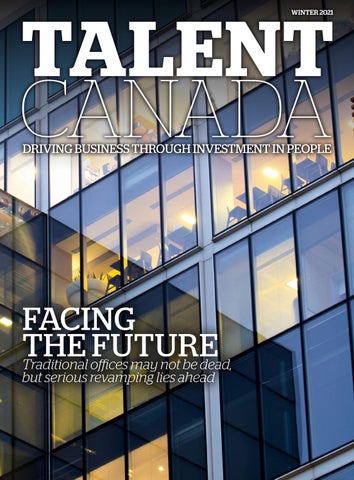

FACING THE FUTURE
Traditional offices may not be dead, but serious revamping lies ahead
“My career has taken me across the public sector in two provinces, working as an HR professional in roles from entry level, up to leadership positions. I believe the CPHR designation has, as a preferred qualification on many postings, assisted in screening me into a number of job competitions in which I became the successful candidate.ˮ
Karen Pettit, CPHR Victoria, BC
CPHRs understand change leadership and achieve results. Now is the time to get your CPHR designation with our executive path. To be eligible you must be a member of a CPHR association, have a degree in any major, have 10 years of senior applied HR experience, and have held an executive position.
In these uncertain times, ensure your HR team consists of CPHRs who will help your executive team apply the best people management strategies.
Contact info@cphrbc.ca and get started today.
4 From the Editor
6 News Briefs/ Stops & Starts
The latest industry news, deal-makers, movers and shakers
8 Hot Topic
What’s next for small business?
9 Work Behaviour
Tips for adjusting to long-term remote work
36 HR Corner
What HR pros should prioritize in 2021
ONLINE
Mental fitness: the next frontier in workplace mental health
Several commentaries by Dr. Bill Howatt are posted in this new weekly website series available at TalentCanada.ca. This partnership takes a deeper look at mental fitness — an approach to prevent mental harm and promote mental health.

ON THE COVER
Office layout will need to be re-evaluated as businesses adjust to not having all employees at the office. (Page 12)


Health and safety will be at the forefront of future business decisions at traditional workspaces.
By Meagan Gillmore
Annual salary surveys complicated by uncertainty of global COVID-19 pandemic.
By Jack Burton
Expert analysis on the federal government’s programs for businesses hard-hit by COVID-19.
By Meagan Gillmore
Experts discuss new opportunities available to employers, leading to improved health outcomes.
By Pierre Chauvin


BY MARCEL VANDER WIER
A lesson on the future of work from the backyard hockey rink
Ilaughed in the moment, but as I ponder further, my son’s comment during a game on our backyard rink is worth another look.
While fishing a puck out of his net in a 2020 game over the holiday break, Jacob’s six-yearold teammate paused for a moment to think.
“Imagine...” was all he was able to get out before being cut off quite succinctly and matter-of-factly by my son.
“There’s no time for imagining! Let’s just keep doing what we’re doing!”
Moments later, the two were celebrating a 21-20 victory.
Recalling that moment now, I wonder if my son’s sentiments hold true for the business world currently coping with the devastating COVID-19 pandemic.
Across the country, employers and senior leaders continue to manage through new-look workplaces and heightened health and safety restrictions ushered in by a pandemic declaration in March 2020.
But imagining what the future of work looks like? There’s not a lot of time for that. Most are only able to keep doing what they’re doing, hoping that this strategy will indeed pay off in a hard-fought victory.
For our part here at Talent Canada, we’re trying our best to assist workplace leaders in the reimagination of work.
On Dec. 12, Talent Canada celebrated its first birthday as a national workplace publication. In year one, our website was visited 130,000 times, with the lion’s share of news coverage dedicated to business and government response to COVID-19.
With appropriate health and safety measures now in place and much of the initial turmoil behind us, our collective imaginations have turned towards understanding the work environment of tomorrow.
So far, our Future of Work virtual event series has included sessions spotlighting virtual health care, and mental health solutions
in a digital age. Our intention is to showcase thought leadership and forecast workplace realities for our audience — business leaders across Canada.
On April 15, we plan to take it a step further, hosting a virtual event tackling Work 4.0 — reimagining work post-pandemic.
Employers have weathered the pandemic with a variety of short-term, innovative solutions designed to keep doors open, staff engaged and productivity at respectable levels.
But as the dust settles, some are taking a step back and exploring long-term strategies to respond to employee demands, capitalize on best practices and take advantage of proven technologies to create the best organizations.
COVID-19 has only accelerated our trip into the future. There’s no turning back now.
INTRODUCING DACOSTA
In this edition of Talent Canada, you will find a centrespread printed in partnership with DACOSTA Magazine
Mathieu Da Costa is considered by most historians as the first Black person to arrive in Canada around 1609.
Da Costa was a trailblazer whose ability to master different languages led him to accompany prominent European explorers, such as Samuel de Champlain and Pierre Dugua de Mons, on their early expeditions into North America, working as an interpreter between them and the Indigenous people of Canada.
Despite Da Costa’s many achievements, very few Canadians know his name.
Today, more than 1 million people make up the Black population in Canada, many of whom are trailblazers in their chosen fields — law, finance, science, engineering and education.
Talent Canada is pleased to partner with DACOSTA Magazine to celebrate the successes of Canadian professionals in the Black, Indigenous and People of Colour (BIPOC) communities in our Winter 2021 issue. | TC
Winter 2021, Vol. 2, No. 1
Reader Service
Print and digital subscription inquires or changes, please contact Beata Olechnowicz, Audience Development Manager
Tel: (416) 510-5182
Fax: (416) 510-6875
Email:
bolechnowicz@annexbusinessmedia.com
Mail: 111 Gordon Baker Rd., Suite 400, Toronto, ON M2H 3R1
EDITOR
Marcel Vander Wier
mvanderwier@annexbusinessmedia.com
ACCOUNT MANAGER
Wendy Serrao wserrao@annexbusinessmedia.com
647-628-3610
ACCOUNT COORDINATOR
Trish Ramsay tramsay@annexbusinessmedia.com
MEDIA DESIGNER
Brooke Shaw
GROUP PUBLISHER
Todd Humber thumber@annexbusinessmedia.com
COO
Scott Jamieson sjamieson@annexbusinessmedia.com
MAILING ADDRESS
111 Gordon Baker Road, Suite 400, Toronto, ON M2H 3R1
Publication Mail Agreement #40065710
Printed in Canada
ISSN 2563-0164 (Print)
ISSN 2563-0172 (Online)
Published four times per year (Winter/Spring/ Summer/Fall) by Annex Business Media
SUBSCRIPTION RATES
Canada – 1 Year $ 26.50 (+ applicable tax) Best pricing (Can/USA/foreign) available online at talentcanada.ca
Occasionally, Talent Canada magazine will mail information on behalf of industry-related groups whose products and services we believe may be of interest to you. If you prefer not to receive this information, please contact our circulation department in any of the four ways listed above.
ANNEX PRIVACY OFFICER
privacy@annexbusinessmedia.com Tel: 800-668-2374
No part of the editorial content of this publication may be reprinted without the publisher’s written permission. ©2021 Annex Publishing and Printing Inc. All rights reserved. Opinions expressed in this magazine are not necessarily those of the editor or the publisher. No liability is assumed for errors or omissions. All advertising is subject to the publisher’s approval. Such approval does not imply any endorsement of the products or services advertised. Publisher reserves the right to refuse advertising that does not meet the standards of the publication.

TIME TO BREAK SOME GLASSDOORS
Ontario’s best workplaces are shaped by the best HR professionals. Only HRPA members have the most up-to-date tools, resources, and skills needed to lead our workforce into the future.

BRIEFS
List of fireable offences grows as result of COVID-19
Legal suits as a result of off-duty misconduct during the COVID-19 pandemic have altered the way managers enforce health mandates and discipline employees. The Canadian Press reports that during this period, employees are facing career consequences for risky behaviour that would otherwise go unnoticed. The cases reflect the growing issue during the pandemic of whether someone’s behaviour is a risk to their employer’s reputation. Recent cases include a London, Ont., nurse being fired for speaking at an anti-lockdown rally.
Canada wants more diversity in
public service
Canada’s federal government is considering legislative changes to ensure recruitment to the public service is fair, transparent and representative. According to the Canadian Press, the possible legal tweaks are intended to make federal departments and agencies more diverse. The government believes that while there has been some progress for
imposed a stay-at-home order in January, and also stepped up workplace enforcement measures. Provincial workplace inspectors are expected to focus on areas of high transmission, including break rooms, and issue tickets those not wearing a mask indoors. More than 10,000 workers have contracted COVID-19 due to work-related exposures in Ontario, according to WSIB data.
following an uproar over the possibility that some people might be applying for the Canada Recovery Sickness Benefit after having engaged in non-essential travel outside the country. The new rules will apply to anyone claiming the sick-leave benefit and two other federal support programs, the Canada Recovery Benefit and the Canada Recovery Caregiving Benefit, after Jan. 3, the Canadian Press reports.
Black Canadians, Indigenous Peoples and others who face racial discrimination in the workplace, too many public servants continue to face obstacles.
Governor general resigns after report on toxic work culture
Canada’s governor general has resigned, following the completion of an independent investigation into the work environment at Rideau Hall in Ottawa. CBC reports indicated Julie Payette allegedly belittled and publicly humiliated employees, reducing some to tears and prompting some to quit. Payette, a former astronaut, was named to the position in 2017. The background screening methodology that was used to screen her predecessor, David Johnston, was abandoned for Payette’s recruitment.
Ontario clamps down on mask rules
In response to “alarming and exceptional circumstances,” the Ontario government is requiring individuals to wear a mask or face covering in the indoor areas of businesses at all times. The province

U.S. rioters face backlash at work
Those who partook in the Jan. 6 riot at the U.S. Capitol are facing career repercussions as a result of their actions. More than 90 people were arrested when Donald Trump loyalists stormed the grounds of the legislative building in Washington, D.C., as lawmakers were assembled to confirm the Electoral College results in favour of Presidentelect Joe Biden. According to the Associated Press, some business owners involved received social-media backlash, while some rank-and-file employees involved in the event were fired.
Federal government alters sick-leave benefit
Canadians applying for COVID-19 benefits now need to report whether they have recently travelled outside of the country. The federal government announced the new requirement Jan. 11,
Ban on CEO bonuses urged, if wage subsidy received
The federal government is being urged to explicitly prevent Canada’s highest-paid CEOs from getting bonuses if their companies obtained wage subsidies, the Canadian Press reports. The pressure came from the Canadian Centre for Policy Alternatives on Jan. 4 — the same day the Ottawa think tank issued a report revealing Canada’s 100 highest-paid CEOs made 202 times more than the average worker in 2019. The think tank also wants Ottawa to introduce a top marginal tax bracket to help pay for the large deficit caused by its response to COVID-19.

Quebec imposes curfew in response to pandemic
A curfew was imposed across the province of Quebec on Jan. 9, and is expected to
remain in place for four weeks. Premier Francois Legault said that due to rising numbers in COVID-19 infections and related hospitalizations, the government had to put in place a form of “shock treatment” in order for citizens to reduce their social interactions. Those breaking the curfew are subject of fines between $1,000 and $6,000. Schools, retail stores and many other businesses have been closed since December.
Sexism faced by female political candidates condemned in N.L.
A historic number of women are running in the Newfoundland and Labrador election, and party leaders are speaking out about the sexism and abuse some of them are facing on the campaign trail. A provincial election is set for Feb. 13. On Jan. 25, Tory Leader Ches Crosbie told the Canadian Press that the behaviour faced by some female candidates constitutes sexist harassment and bullying. “It should not be tolerated by right-thinking people,” he said. “I call on decent people to call out sexist harassment and bullying, wherever they see it. I denounce this behaviour in totality.”
Rollout of COVID-19 vaccine now underway in Canada
Pfizer’s COVID-19 vaccine arrived in Ontario and Quebec in December, with the first shots being administered in Toronto, Montreal and Quebec City. Pfizer developed its vaccine with a novel technique of using messenger RNA (mRNA), which essentially teaches cells how to make the coronavirus’s spike protein and trigger an immune response if infection occurs in the future. Prime Minister Justin Trudeau has assured Canadians that the majority will have an opportunity to be vaccinated by Sept. 2021. Many hope this treatment is the cure to COVID-19.


JOB STOPS AND STARTS
1,000 — TC Energy Corp. is planning to eliminate more than 1,000 construction jobs related to its decision to halt work on its Keystone XL pipeline expansion project. The company suspended work on the project Jan. 20 as U.S. President Joe Biden cancelled a key presidential permit for the pipeline border crossing.
63,000 — Statistics Canada says the economy lost 63,000 jobs in December in the first monthly decline since April amid tightened public health restrictions to slow a resurgence in the pandemic. The unemployment rate edged up to 8.6 per cent compared with 8.5 per cent in November. The result ended a streak of monthly job gains that began in May as restrictions put in place to slow the spread of the pandemic began to ease.
1,000 — Amazon says it will open five facilities in Quebec that will create more than 1,000 jobs and speed up customer deliveries. The U.S. online retail giant says it will add two sorting centres and its first three delivery stations in the province. Amazon’s first sorting centre in Quebec opened last year, creating 500 jobs.
300 — Starbucks says its plan to close up to 300 coffee shops across Canada will be complete by the end of March. The Seattle-based coffeehouse and roastery chain announced the acceleration of its five-year “transformation strategy” last year as it responded to changes in consumer habits during the COVID-19 pandemic.
1,700 — Air Canada says it will cut 1,700 jobs as it scales down operations in response to a new wave of lockdown restrictions. The 25 per cent reduction in service for the first quarter of 2021 will also affect 200 employees at Air Canada’s Express carriers, the company said Jan. 13. The cuts came just days after Air Canada’s latest round of service reductions in Atlantic Canada went into effect on Jan. 11.
1,000 — WestJet Airlines Ltd. says about 1,000 employees will be furloughed, temporarily laid off, put on unpaid leave or have their hours cut in the wake of new travel rules from the federal government. The airline also says it will cut about 30 per cent of its capacity for February and March and pull 160 domestic departures from its schedule.


2,021 — Shopify Inc. plans to double its engineering team this year. The Ottawa-based e-commerce company says it will hire 2,021 new employees this year to work in technical roles. Shopify says on its website that it is looking for people with experience in front-end and back-end development, data, mobile and infrastructure work to join the company.
260,000 — With food-service businesses continuing to face devastating restrictions, Restaurants Canada is calling for a national working group to lay the groundwork for the industry’s revival in 2021. According to a news release, the industry remains 260,000 jobs short of where it was in Feb. 2020.
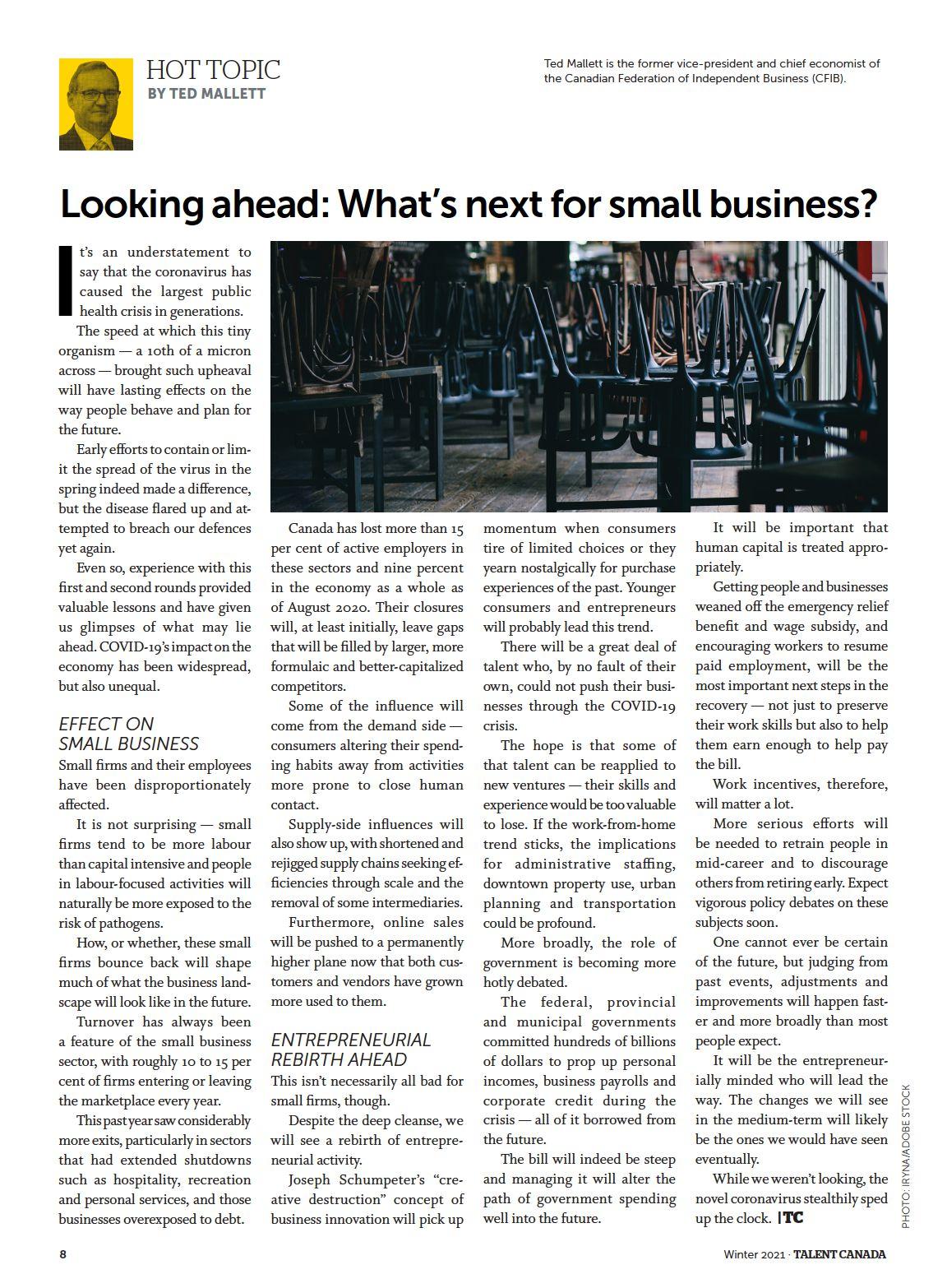

WORK BEHAVIOUR
BY MINA MOVASSELI
Tips for adjusting to long-term remote work
People dreamt of the day that their work would be remote.
But how it eventually came to be was unforeseeable. Now we are in the reality of long-term remote work and it doesn’t seem to have brought the joy some may have expected.
Why? Partially due to the sudden switch of environments, as the mind doesn’t like change and holds on to places and people that are familiar.
This is how our brain is equipped to keep us alive for so long — it finds ways to keep us safe and secure, and any alterations to this will make it feel out of balance.
So as people try to create their own sense of safety and security, we have seen a common behaviour in major cities around the world — people moving to the suburbs or more remote areas.
Yes, some will get the instant benefit of the nature and calmness that the suburbs can bring. But going from one extreme to the next will always make the mind feel uncomfortable. It will try to find its old “security blanket,” hoping that things will go back to normal.
LOSS OF SECURITY, SAFETY
It’s just like when you get a new manager who starts to change things and all you want is time to deal with the new person being added to your day. We need time to adjust to changes — and remote work is a major one. So if we add a new home and a dog or pet, there is a lot of stimulation and excitement to deal with. But it will be like filling a hole with sugar, rather than concrete. The sugar will melt over time and the hole will still be there.
Instead, we need to come to terms with the fact that there was

a major change in one’s life in an environment where a community was created to make one feel that they belong, can relate and be part of the same mission together. A community of people who, in larger organizations, were interviewed numerous times to ensure culture-fit. Ensuring that people will be drawn to the organization and want to mold and conform and uphold the mission.
We are in the reality of long-term remote work and it doesn’t seem to have brought the joy some may have expected.
If that is completely broken down and made virtual, we again lose that sense of security and safety.
So, it is not surprising that depression and anxiety has increased, as there are things in that manmade community workers have lost that they didn’t know they were getting. Like a meal hidden with chemicals, it was made for you to want more.
ADDRESSING CHANGE MINDFULLY
Now we have emotions and cravings for a community that we didn’t know we had.
But if we actually start to address these areas of our lives mindfully, with intention, rather than allowing someone else to be the creator, then we can start to figure out what we like and who we actually want in our community — giving us a chance to go to the opposite side of the spectrum to find more joy.
How? Well, when we are given time to think and reflect, rather than escape through old behaviour patterns like clubbing and drinking and going out, we end up creating a space to question our life.
Yes, this can also lead to a darker place where you question your purpose and your actions throughout your life.
But it can also lead (especially with guidance from a professional) to a place where you can understand yourself better. This idea of self is key to be able to make better decisions in life.
Because as you understand yourself better and learn what you like and dislike without the world telling you — then you can make decisions with good intentions.
This really means making decisions that align with who you know you are or want to be without the pressure of caring what others think and expect of you.
Why is this important? As we make decisions from a place of what we think is best for ourselves, then we feel more calm and aligned.
This calmness is what many people talk about in regards to joy and meditation. It is a place where you can make decisions that you won’t regret, or find relationships and work environments closer to your values.
Then you can decide if you fit in with the culture, without having to mold to the group norms of a manmade community. | TC
Mina Movasseli is a behavioral scientist and founder of The Mindful Blueprint in Toronto.
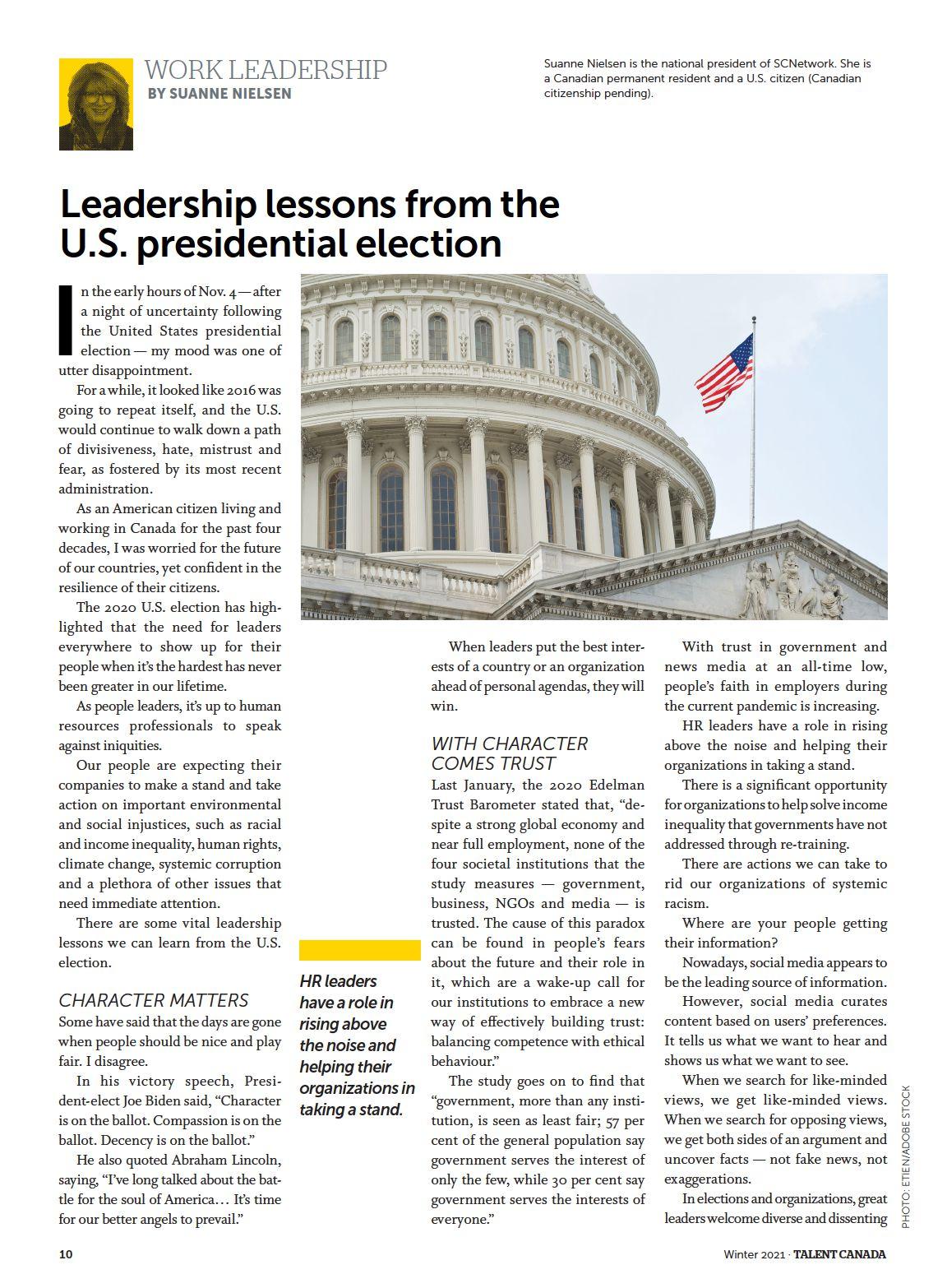
views, ferret out the truth, challenge one another and even have a respectful fight now and then.
LISTEN TO THE DISSENTERS
And what exactly can we learn from the 74 million who voted for the outgoing U.S. president?
What can we learn from those who disagree in our organizations? By embracing differing viewpoints, we can create something better than we ever imagined.
Let’s consider if organizations worked like governments, where leaders needed to be elected after a specified term.
In such a scenario, leaders would focus more on what would
earn them votes, rather than what is best for the long-term success of the organization, its people and its customers. This is not a sustainable strategy.
The United States saw record voter turnouts for the 2020 election. It tells us that people felt strongly. They needed to be heard.
The closest we have to this in organizations is employee engagement surveys. Through these vehicles, we test levels of employee engagement.
People say more with their votes and surveys than they would face-to-face. This is largely due to the power imbalance that discourages employees from breaking their silence.
Engagement surveys allow employees to have an anonymous voice. Leaders need to focus less on the scores, and more on what people are trying to tell us, even if they are dissenting.
Through engagement surveys, leaders can tap into the employee voice needed to make critical organizational changes that can foster workplace well-being.
WELCOME AN INCUMBENT LEADER
Often in organizations, internal CEO candidates compete, and/ or an external CEO candidate emerges on top. Meanwhile, factions develop around candidates.
However, once the decision is made and a new leader is appointed, existing and outgoing leaders need to accept the decision and put their differences aside.
Giving the new leader support of an executive team paves the way for a peaceful and efficient transition of leadership and responsibilities. To do anything else will result in chaos and dysfunction.
The biggest lesson from the U.S. presidential election is that it is up to each of us as individuals and leaders to exercise our voice.
Fear is not a reason to vote, nor is it a reason to check out of organizations. | TC
BECOME A POWERFUL NEGOTIATOR

WHAT IS THE FUTURE

FUTURE OF THE OFFICE?

Safety will be at the forefront of future business decisions, experts say
BY MEAGAN GILLMORE
Flexible plans and a firm understanding of what workers require to do their jobs well are key to making in-person office work succeed throughout the remainder of the COVID-19 pandemic and beyond.
Offices are not dead, said David Zweig, an organizational behaviour professor at the University of Toronto.
Workers “might not be 100 per cent back to the office,” he said. “But I think there is going to be a push to have much more presence in the office than what we currently have, or can have now.”
Working from home has not resulted in the massive decreases in productivity that many managers feared, but many workers find it difficult to collaborate with colleagues while working remotely. This means office spaces need to accommodate in-person individual and group work.
Darren Fleming, CEO and broker of record at Real Strategy, a commercial real estate consulting firm in Ottawa, said offices may need to reduce their space — perhaps by 25 per cent — but there’s still a significant number of workers who would like to work from the office for at least part of the week, or those who are unable to work from home.
“We anticipate that there will be some peak times, rather business or social, that people need to be in the office,” he said.
PREPARING FOR SUDDEN CHANGES
The pandemic has drastically increased the pace of change for occupational health and safety, said Andrea Jacob, an occupational health and safety specialist with the Canadian Centre for Occupational Health and Safety in Hamilton, Ont.
Typically, companies have several months to update their policies and practices before a regulatory change, she said. Throughout the pandemic, government orders and advice changes swiftly, with little notice.
“The pace of change is just a major change itself,” said Jacob.
Some jurisdictions require companies to have specific health and safety plans for COVID-19.
“A good thing to incorporate into that control plan is daily checks for your jurisdiction to see if any changes have been made,” she said.
Regional classifications can impact how offices operate, and workplace leaders should also stay up to date on industry specific regulations. Some health-care workers, for example, work in offices, Jacob points out.
Employers will need to communicate with employers regularly about occupational health and safety — even employees who are working from home.
“Instead of annual health and safety training, workers might need weekly or daily updates or reminders,” said Jacob. “The pace of that has definitely increased. Employees and clients need to stay informed about what the current requirements and safety precautions are.”
Meagan Gillmore is a freelance writer in Toronto.
OH&S ADVICE
“Instead of annual health and safety training, workers might need weekly or daily updates or reminders,” says Andrea Jacob, a specialist with CCOHS.
These precautions could include adjusting schedules so offices don’t get too full; having workers work in cohorts; and directing traffic within the office — for example, designated one stairwell for walking upstairs and another for going downstairs, said Jacob. Companies need to have a plan about how to respond to changes in their organization. This means “managing change carefully instead of just jumping into a choice,” she said.
Potential hazards and benefits of different actions need to be considered. For example, the pandemic has increased the amount of cleaning required at offices; but not all cleaning products are the same. Part of managing the change in cleaning frequency is considering if fragrances or dyes in some products could be harmful to workers, said Jacob.
RETHINKING OFFICE SPACE
Office layout and furniture need to be re-evaluated as businesses adjust to not having all employees at the office for a standard 40-hour workweek.
Staggered schedules could result in smaller office spaces with more shared workstations. However, Zweig predicts there will be a “reckoning” with the trend of open-concept offices.
“That’s not a good approach,” he said, noting it can make it harder for teams to meet, and sometimes for workers to find a place to sit that’s conducive to the tasks they need to complete. It also isn’t very suitable to a pandemic.
Workspace layout “isn’t a one-sizefits-all” solution, he said, noting that when it comes to offices, business leaders should consider adopting an “activity-based work” mindset.
In this model, physical spaces become a “palette of resources” that workers can take to do their tasks. Offices should have a number of rooms that can be used for both team meetings and personal offices, according to Fleming.
And because meetings will likely have fewer people, these spaces can be smaller and used for individual offices when there are no meetings, he said.
“The social contract between the employee and the employer is going to change a little bit,” said Fleming. “Before, when your boss expected you to be there from 8:30 to 4:30, there was a lot more reason for the employee to expect that his or her seat was going to be dedicated to them… Once you get two or three days a week when you work from home, then it’s not going to make any sense.”
Companies should invest in furniture that can be moved easily — such as wheeled tables or sitting areas that can be quickly reconfigured — or can change to meet the needs of different workers, like desks with adjustable heights. There should be plenty of space for mobile devices, and meeting rooms should be equipped to accommodate workers who attend meetings via videoconferencing, he said.
Purchasing new furniture may be a significant expense at the beginning, said Fleming, but if companies downsize their office space, the amount they save in rent could balance out the costs.
PEOPLE MANAGEMENT
Alongside all of this, managers need to be careful to manage employees’ expectations and happiness.
People are naturally territorial, said Zweig. “Once we have a space, in our mind its our space… We do things to make sure we (keep) that space our own.”
Some workers may become unhappy if they notice their colleagues have designated spaces to work, and they don’t, he said.
For shared environments to work, everyone needs to take ownership of tasks like cleaning, said Fleming.
“In a shared space, the onus has got to be on the person leaving the space, as well as the person sitting down to clean everything.”
If there are constant struggles about who will wash the dishes in the sink or empty the dishwasher, then a workforce likely isn’t ready for a shared work environment, he said.
They may also need a worker designated to make sure cultural standards are being maintained, similar to the way librarians make sure everyone can use a library the way they need, said Fleming.
“There is somebody with organizational authority who is there to enforce the cultural behaviour,” he said, noting that person needs to have enough seniority that they’re confident reminding senior staff of the company policies.
Regardless of approach, employers and managers need to remember workers’ needs. Remote work showed the need to be flexible with workers and not to base productivity solely on the amount of time workers are in front of their computer screens.
“We have to change the performance metrics,” said Zweig. “We should be looking at: Are they getting things done? Are they performing well? Are they meeting deadlines? That should be the performance criteria, not if they’re sitting at a computer for eight hours straight. Hopefully with this experience, there’ll be more acceptance of that.”
Fleming cautioned companies against making sweeping generalizations about what workers will want. Employee engagement and consultation is critical before making changes.
“With any human population, you can’t just unilaterally say, ‘This is the new way that we’re going to do everything,’ and find that everyone will be universally pleased,” Fleming said.
Making a change mandatory — especially without asking employees for feedback — can often increase employee stress, or cause them to leave. Those in decision-making positions are encouraged “have a discussion and find out who (workers) are as individuals and what their needs are.” |


Passing the Torch:
A Conversation with the CBA’s Vivene Salmon and Bradley Regehr
Changing of the Guard
By Nicole Edwards
As people around the world pressure companies to prioritize representation, Jason Murray ushers in the new faces of corporate leadership.
Jason Murray’s first glimpse into the effects of poor recruitment practices happened young. He was a student at an arts academy in Toronto’s West End, and the only Black male in his graduating class. A native of the city that created Drake and The Weeknd, he now looks back on the experience as an example of an institution failing to tap into the talent the city offers.
“No one can tell me that there aren’t incredible Black singers, dancers, and visual artists here. There could have been another Diana Ross spawned or another Miles Davis, but the institution was not proactive enough to find that talent and bring them in,” Murray says.
Years later, as the chief executive officer of BIPOC Executive Search, Murray helps organizations make sure they don’t find themselves recruiting from homogenous talent pools — ones that have historically
been white and male. The company’s mission is to help institutions break out of outdated recruitment practices by spotlighting Indigenous, Black, and other racialized candidates who rarely get tapped on the shoulder when recruiters are looking for a company’s next leader.
In Canada, Murray’s work is much needed. A 2020 study by Corporate Knights found that of the S&P/TSX 60 companies, just six of 799 senior executives and four of 686 board members are Black.
Since an organization’s network is a natural place to start in search of a new staff member, these statistics show there’s a significant gap to fill before Black candidates have an equal shot at being considered for high-profile roles.
When asked how this gap got so wide in the first place, Murray points to the bias baked into popular

recruitment practices. “Many individuals who are found in exective searches are individuals who have certain networks, who have walked the halls of certain organizations or institutions,” Murray explains.
A preoccupation with qualifications like test scores, or overvaluing a diploma from a certain alma mater, can be stumbling blocks for groups looking to hire more diverse talent. While education and experience are relevant, Murray says there’s more to think about when meaningfully incorporating diversity, equity, and inclusion into talent searches.
“Of course, technical skill is also important,” Murray says, “but I often will suggest looking at some of the transferable pieces when it comes to people in the BIPOC community because many haven’t been given the opportunity to do a given task before.”
Jason Murray © Samuel Lehner - S.a.M Productions
A 2019 national report by Dalhousie University and the Canadian Centre for Diversity and Inclusion explored perceptions of the importance of diversity and inclusion among existing senior leadership in a host of companies. And while many of the executives surveyed said they believe these strategies are important, the report concluded that few had turned sentiment into action.
In 2014, Deloitte found 40 per cent of Canadian businesses have no one on staff responsible for diversity and inclusion functions. This leaves recruitment practices susceptible to the whims of a human resources department with no diversity, equity, and inclusion training; or worse, it makes it easier for those acting in bad faith to intentionally block diverse candidates. Murray says without policies in place to safeguard against issues like bias, workplaces will have a tough time breaking the cycle of over-recruiting white candidates.
“Colonialist acts have resulted in white men acquiring power over many societies, and people to this very day equate leadership to power. So, the closer you are to that archetype, the more people will start seeing you as someone who harnesses power — and therefore deserving of being a leader,” Murray says. “That’s
the reason why, when people are looking at resumés, bias comes in.”
In the wake of protests in support of Black lives, the public has put enormous pressure on companies to check their biased practices. In response, Murray sees organizations increasingly examining where they have room to grow. “There are people out there realizing there’s something here that’s very important for companies to respond to,” he says. It’s a small but significant first step in shifting the makeup of the corporate world.
In fact, Murray sees many qualities he’d look for in a leader exemplified by the movement. “Black Lives Matter has strategy, vision, they stay on message, they’ve weathered storms, they get buy-in. There are certain things people look for in a leader and everything I just brought up is on that list.”
Murray tells companies looking to more effectively recruit and retain Black talent to own the fact that their company is trying to change. He says organizations shouldn’t shy away from being vocal about their new practices.
“When you don’t have representation on your board, or don’t have a certain group on your senior
Colonialist acts have resulted in white men acquiring power over many societies, and people to this very day equate leadership to power. So, the closer you are to that archetype, the more people will start seeing you as someone who harnesses power — and therefore deserving of being a leader.”
leadership team, there is nothing wrong with saying: ‘We’re trying to be strategic, and part of being strategic is being able to hear from different people, so we’re looking for a diversity of voices.’”
He encourages Black candidates to ask recruiters to do more than just pass their resumés along. “Candidates should be okay with making hiring officers or recruiters feel a little uncomfortable. Ask for help to navigate things. Say, ‘I need you to educate me in terms of what I’m going to encounter. I need you to be my agent right now and work with me so that I am fully prepared.’”
Murray’s imperative to connect Black candidates with opportunities for leadership comes at a time when crisis is spurring action around the globe. “Of course, the social imperative of this work is there,” Murray says, “but we also want to ensure that the untapped potential of people is able to be realized. It’s better for the economy, and it’s better for individuals.”
Though the necessity of an organization like Murray’s is a poignant sign of the times, he’s been on a path to play a leading role like the one he’s in since his art school days.
“When I got into this work, I saw parallels between executive search and the world of theatre casting, right down to the nomenclature — the term talent is used in both. They’re not so different in some ways!” Murray says, laughing.
Murray and his team at BIPOC Executive Search launched in July 2020. Their goal is to help raise the number of Black professionals in Canadian executive leadership to 3.5 per cent by 2025.

Passing the Torch: A Conversation with Vivene Salmon and Bradley Regehr
By Wanda Taylor
Behind every successful lawyer lies passion, drive, and a necessary laser focus for what is easily a gruelling and challenging profession. For two trailblazers paving the way, strong family support has kept them afloat in an everchanging world and an equally evolving profession.
Vivene Salmon, vice president and country compliance manager of global banking and markets compliance at Bank of America Merrill Lynch, and Bradley Regehr, a partner at Maurice Law, smile fondly as they speak about their cherished families. Salmon speaks to her father on the phone every day and has a strong network of siblings and longtime friends in which she confides.
Regehr talks of his three children and life partner, Nalini Reddy, who’s also a lawyer. Regehr was adopted as a child, and so his family also comprises his parents and his five siblings, two of which are from his birth mother, whom he was fortunate enough to meet later on in life along with her spouse and his four children. Together with his supportive in-laws, Regehr’s family
tree resembles more of a “family bush,” and it’s this large family circle that keeps him grounded. Salmon and Regehr acknowledge having a circle of support is vital and important to them, not only for the times we are in but for the demanding legal profession they both love and enjoy.
Their love of family isn’t the only thing these two leaders share. When Salmon stepped into the role as president of the Canadian Bar Association in 2019, she did so as the first person of colour and the first female corporate counsel to ever hold the position in the CBA’s 124-year history. At the end of August 2020,

Vivene Salmon photo © Blair Gable
“It was a special moment not only for me as an individual but for the racialized community.”
Salmon stepped out of this role, making way for its new president, Regehr. He’s the first Indigenous person to ever hold the position.
“I never thought I would have been the person,” Salmon says of her role as president of the CBA. “It was a special moment not only for me as an individual but for the racialized community and, in particular, the Black community and Black female lawyers.”
Regehr says it still amazes him that no Black or Indigenous person held the role prior to Salmon and him, but he hopes the move will encourage other Black and Indigenous people in the profession to become involved in the organization. He recognizes there’s a perception that the CBA may not be a home for Indigenous lawyers, but he feels this will change by continuing Salmon’s outreach and dialogue with the Indigenous Bar Association.
The CBA was formed as a volunteer organization in 1896. Its objective was to be a voice for members of the legal profession in Canada. Its website says the organization is “…dedicated to enhancing the professional and commercial interests of our diverse membership, and to protecting the independence of the judiciary and the Bar.” The organization currently has a branch in every province and territory in Canada and represents more than 36,000 lawyers, notaries, teachers of law, judges, and law students across the country.
The work of a president leading such an expansive organization is exciting and daunting at the same time. During her time as president, Salmon rose to the challenge and made notable strides. She served as chair on a task force to examine the pandemic response to justice issues and to develop recommendations. She also led a widely successful national conference for young lawyers in June, with the theme of innovation. One of Salmon’s goals as president was to try to bridge the gap between veterans in the profession and new lawyers. To
achieve this, she started a podcast to spark intergenerational dialogue and to discuss issues important to the legal profession.
Regehr shares Salmon’s passion for mentoring up-andcoming lawyers, and he’s carrying on that work now in his new role. To their colleagues just embarking on their careers in law, Salmon and Regehr advise them to work in areas in which they have an interest. In order to avoid the burnout seen all too much in a profession that, at times, can be demanding, Regehr notes it’s important for young lawyers to do what they’re passionate about, adding, “Always remember your clients in the midst of it all but learn when to say yes and when to say no.”
Regehr is focused on continuing the member engagement Salmon started during her tenure, and he’s expanding on some of the CBA’s current initiatives, including work on a truth and reconciliation report and an accredited online series the organization launched to provide Indigenous history and background to its members. The wheels of opportunity and possibility turn as Regehr blazes a fresh trail in his role as president, like Salmon did before him.
Themes of change and mentorship are recurring goals shared by these accomplished lawyers. That work is increasingly important today, especially with the crushing blow of an unprecedented global pandemic and the glaring spotlight now placed on systemic inequities amid a racial reckoning.
A 2020 diversity report by Ryerson University indicated that while visible minorities made up more than half of
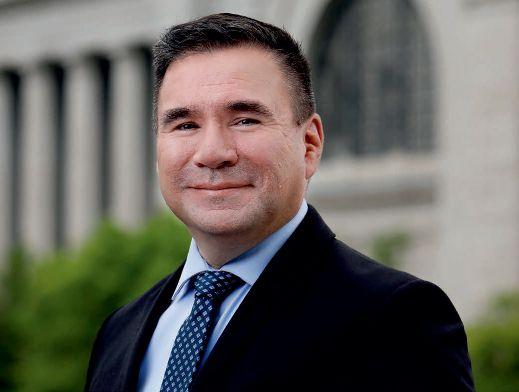
Bradley Regehr © Blair Gable
Toronto’s population, they account for only 4.3 per cent of corporate board members. And of that, less than 1 per cent are from the Black community. The report also showed the Black community represents 7.5 per cent of the Greater Toronto Area; however, only 3.6 per cent of board positions in all sectors combined were held by someone from the Black community.
These statistics have not gone unnoticed by Salmon and Regehr, who agree more needs to be done to address these disparities, including the ones that exist in their own profession. “Organizations and businesses need to be proactive. They need to go out and seek candidates, and not just the same ones,” Regehr says. “There are lots of people nationwide who are qualified and can sit on these boards.”
Salmon agrees, adding, “Policies are not enough. Organizations need to expand their networks and look at who they are hiring.”
The CBA is conscious of its position, and Salmon indicates the organization is trying to make meaningful changes as the country and the world tackle social injustice. While president, Salmon wrote op-eds and released various statements addressing the issues. She received a lot of feedback from people across the country who were excited the CBA was being progressive in that respect. Salmon says the CBA can’t be silent on the
“Organizations need to expand their networks and look at who they are hiring.”
important challenges facing society.
“The legal profession as a whole is a powerful voice that can positively influence Canadian society,” Salmon acknowledges. She reiterates Regehr’s comment about the need to educate society when it comes to the history of residential schools and colonialism. These are all steps toward much-needed change.
In some universities across the country, law programs hold seats for Black and Indigenous students in efforts to increase equity and to graduate a crop of lawyers that better reflect Canada’s cultural makeup. The Schulich
School of Law at Dalhousie University is one example. Students who get accepted into these programs are no less qualified than any other student, yet some have expressed being stigmatized, not only in the program but in their attempts to article at law firms.
Salmon grew up in a working-class family and had to pay her own way through law school. She believes talent will always rise to the top but admits there are obstacles for certain people and the misconceptions about programs like these — designed to level the playing field — need to be dispelled.
“There are stereotypes everywhere, but the perceptions in these kinds of programs are not incumbent on the student to change but are incumbent on the legal profession to change,” she says. If one digs deeper, Salmon points out they’ll discover these are excellent programs. She also feels talent needs to be nurtured, and these kinds of programs provide another opportunity for students to receive that support.
Regehr attended law school at the University of Manitoba in the early 1990s through a similar program for Indigenous students. Back then, Regehr says there were times when he was the recipient of those same stereotypical comments. He was told he hadn’t earned his spot and that he only got into law school because of the program.
But Regehr says he put in the hard work, got the good grades he needed to apply, wrote his admissions test, and passed. He earned his spot like everyone else in the law program. Law schools have traditionally served a specific demographic, and people don’t always want to give up their comforts, he points out, adding, “I am unapologetically a defender and a proponent of those kinds of programs.”
Now, Salmon has passed the torch to Regehr, creating further opportunity for many more students from the Black, Indigenous, and people of colour communities to walk through the doors these two trailblazers have swung wide open. If the global pandemic and this era of unrest due to social injustice has taught us anything, it’s that there’s room for everyone — at boardroom tables, in law programs across the country, in senior management roles, as tireless mentors to new minority lawyers, and, yes, as president of the CBA.

Nadine Spencer is Limitless
By Feleshia Chandler
Nadine Spencer shares her journey to entrepreneurship from Jamaica’s Spanish Town market
For Nadine Spencer, mother, business owner, and chief executive officer of BrandEQ Group and the Black Business and Professional Association, it all started with a bami cake.
Light, fluffy, and delicious, bami (or bammy) cakes are a cassava flatbread traditionally eaten in Spencer’s homeland of Kingston, Jamaica. Spencer’s introduction to business really began with her buying bami cakes and parchment paper from local
vendors at a market in Spanish Town, Jamaica, and selling slices at market value.
When she was 12 years old, Spencer says her mother left Jamaica for Canada with hopes of making a better life for them, leaving Spencer behind with a family friend. Little did her mother know her trusted friend would withdraw Spencer from school and expect her to do errands during the days. One errand would be for her
Nadine Spencer © Natural Image Photography
to travel alone daily from Kingston to Spanish Town, approximately a 40-minute bus ride away, to buy 10 bami cakes.
With only enough money in her pocket to get to the market and to purchase the cakes, Spencer knew she’d need to sell some of those cakes to pay for her bus ride home. She figured out she could buy 13 cakes for the price of 10 and worked out a deal with another vendor to purchase parchment paper. She sold the cakes in packages of two or four wrapped in the paper, selling 12 in total. The last cake she ate for lunch. In the end, she had earned enough money to buy 10 more cakes to bring home and pay for her bus fare. It was this experience that would send her on a path to entrepreneurship, she says.
Once Spencer’s mother became aware of what was happening, she immediately booked her daughter a plane ticket to Canada. But during her first year after being reunited with her mother, she was unable to attend school, so she again drew from the entrepreneurial spirit she had cultivated in the Spanish Town market. She got herself a paper route and worked odd jobs until she was able to enrol in school.
As the years went on, Spencer says she never stopped working. She worked at a call centre, she bought and sold winter coats, drawing on her sales experience and lessons learned in Kingston. She says her experience at the Spanish Town market taught her the power of branding and marketing. She also learned the power of negotiation by haggling for better prices with vendors. These lessons would catapult her forward in the world of business.
In the years building her own pathway to entrepreneurship, Spencer has learned much about herself, including that decisiveness and determination would carry her throughout her life and career. “I never take no for an answer,” she says.
Her client list at BrandEQ, a global marketing and communications agency, includes Mercedes Benz, Four Seasons Hotel and Resorts, and Holt Renfrew, but she also coaches and consults for up-and-coming entrepreneurs. Although her clients vary from the very new to the well-connected and established, there’s one common thread among them all: “People need exposure. Whether they’re a Fortune 500 company or whether they’re a new start-up,” says Spencer, “they need their voices heard in a competitive marketplace.”
Spencer’s focus has now shifted to include community service and engagement. She’s in her third year leading the BBPA and serves as director on both
If you take the risk and you make a mistake, you learn, and there’s value in the learning. Most of the time you’ll take a risk and it’ll work out fabulously.”

Nadine Spencer © Natural Image Photography
the York University Alumni Board and the Lifelong Leadership Institute Board She’s also marketing director for Accelerating Women Entrepreneurs, an organization founded by Whole Foods Market CEO John Mackey. Through these roles, Spencer’s able to focus on her passion for mentorship, particularly the BBPA’s Boss Women entrepreneur-ship program she’s running.
“It’s really teaching women the skills I’ve learned over 30 years in business, and so that’s what drives me.”
When asked, Spencer points to three mantras that helped her pave her own path to success. The first is to never be afraid to take risks. “If you take the risk and you make a mistake, you learn, and there’s value in the learning.... Most of the time you’ll take a risk and it’ll work out fabulously.”
The second is to always show up. “If you don’t show up you miss the opportunity, and you don’t know what’s there for you,” she says.
And the third? “Don’t take yourself too seriously. It’s okay to go with the flow and just have fun.”
The BBPA provides resources and tools to Black-owned businesses among its membership to help them not just exist but thrive, grow, and succeed.
“The work we do at the BBPA is about advancing and working with Black businesses in different sectors,” says Spencer. “We need to know that we exist, and we also need to be i ntentional about doing business with each other in the Black community. It’s one thing to exist, but it’s another to recognize the
importance and value we bring by giving our dollars to Black businesses.”
Although she says the results of the organiz-ation’s efforts in aid of Black entrepreneurship are widely successful, its work is just getting started. “Until there’s equity, the work that we do will not stop.”
That work had to kick into overdrive the first few months of the coronavirus pandemic, as the BBPA worked round the clock to provide some of their members with support once the country went into lockdown. As a result of the strain on Black-owned small businesses, the organization ensured their helpline was open 24 hours a day to provide guidance on government programs, loans, and lines of credit available to keep their member companies operating through the downturn.
“I know it’s hard. We know that, but there are people and places like the BBPA, like myself, and other organizations who are willing to help,” Spencer says. She advises those who are feeling the effects of these times and the resulting tumultuous economy to continue to look for those organizations that can help.
There’s now hope and help on the horizon for Blackowned businesses struggling to stay open on the heels of the pandemic. In September 2020, Prime Minister Justin Trudeau announced a $221 million initiative in support of Black entrepreneurship. The funding will enable Black-owned businesses to build the foundation they need to succeed, and it’ll fuel much-needed training and mentorship vital to levelling the scales of inequity in this country.
To young, up-and-coming professionals, Spencer advises them to “take advantage of the opportunities available for education and continuously learn.” She reiterates the importance mentorship has on those seeking to define themselves in their industry of choice.
“Get a mentor. Have that mentorship or coaching relationship that is ongoing. It’s one of the best things you can do for yourself.”
I know it’s hard. We know that, but there are people and places like the BBPA, like myself, and other organizations who are willing to help.”
Although it may be daunting right now to start a business or to even maintain one, it’s still important to stay grounded. For Spencer, her faith and family allow her to thrive during these trying times. Resilience is key, especially in uncertain times like these, and no matter what, she states, “You have to want it.”
Hiring Trends in a Virtual World: Things to Consider in the New Normal
By Ross Cadastre
The current coronavirus pandemic is disrupting almost every facet of daily life — at work, during family time, and even at play It’s forced business leaders to re-think, re-group, and re-adjust their strategies to solidify business continuity amid the downturn.
Even before the start of the pandemic, the global workforce was moving to a digital platform, connecting employers and employeesalike. The disruption and upheaval resulting from the pandemic has only sped up the transition to a virtual workforce. As a result, the needs, demands, and expectations of businesses have had to evolve too. At first deemed a challenge, this evolution is increasingly viewed as an opportunity to pivot hiring strategies to attract the right talent while creating an enhanced candidate experience.
The only thing talent managers know for sure is that there are complicated days ahead, and so they must constantly re-evaluate how to continue improving and meeting global standards. To do this, they should keep a few considerations in mind that will impact the entire recruitment life cycle.
Hiring for Diversity and “Hiring Black”
When building resilient companies, diversity continues to be recognized as a top effective strategy in human resources and recruiting spaces, especially in delivering considerable performance advantages. Recruiters must heighten focus across all organizational levels to establish an ongoing talent pipeline of diverse individuals. But organizations shouldn’t simply hire for diversity; rather, they should also focus on hiring Black candidates.
In this new normal, companies need to ride the wave of change and create a space for Black leaders. The Black community is under-represented in today’s workforce

and change in this area should start with recruitment strategies.
Organizations’ hiring approach has overwhelm -ingly been identified to exclude Black professionals, so “add and stir” tactics in recruiting must be re-examined to address this issue head-on.
The recent global social justice unrest due to racially motivated incidences of violence against Blacks in the U.S. has brought about an awakening, forcing companies to recognize the reality that having a diverse workforce is not enough.
Ross Cadastre © Marcus Carasco Photography
To truly overcome racial injustice in the face of inequity, organizations must prioritize hiring from the Black talent pool. Indeed, diversity extends far beyond hiring a mix of employees from various races, nationalities, and back-grounds. It also requires companies to lead the charge in dismantling anti-Black systemic racism.
A host of organizations have committed not only to expanding diversity among their top ranks but to setting measurable targets for expanding Black representation within their senior positions. One example is Target Brands, Inc., which seeks to increase its Black workforce by 20 per cent over the next three years.
As well, in November 2020, Scotiabank announced it’ll increase representation of its Black employees in senior leadership roles to 3.5 per cent, in keeping with the company’s BlackNorth Initiative pledge, as well as its goal to increase representation of visible minorities in the company’s leadership roles as a whole by 30 per cent or more.
Enbridge Inc. also signed on to the BNI pledge, in addition to setting the targets of ensuring 28 per cent of its leadership roles are from the Black, Indigenous, and people of colour community, as well as 28 per cent of its workforce by 2025. The energy company is also aiming to have 100 per cent of its workforce complete unconscious bias and anti-racism training by the end of 2021.
Remote Work
Another consideration is for talent managers to embrace the transition toward remote working. Amid the pandemic, recruitment functions continue to feel the brunt of the impact. Face-to-face interactions are no longer viable, and recruitment strategies, which
were once designed for personal interactions, now must be adapted for virtual platforms. This sudden disruption has raised awareness within the recruiting industry of the importance of tailoring techniques to streamline the talent acquisition process.
While the pandemic has forced the workforce to embrace technological advancements, digital platforms are making organizations more acquiescent to the modern work environment. As a result, hiring and work processes have taken a turn for the better, and innovative tools can be leveraged to entice, recruit, and retainemployees. Businesses must embrace remote working as the new normal because it’s here to stay.
A Global Talent Pool
Finally, virtual recruiting is becoming an integral part of minimizing business disruption and accelerating the hiring workflow. Yesterday’s recruiters have evolved and are now equipped with the knowledge and technological tools that enable them to shift from reactive recruitment methods to more proactive approaches in sourcing talent.
Remote working is taking on a literal sense, removing barriers to new markets and, in turn, new talent pools. Organizations seeking to excel at virtual recruitment are embracing these opened doors. They’re already searching for talent intelligence platforms, and the companies that explore this area stand the best chance of leading the charge in the remote workplace setting.
To thrive in today’s highly competitive global talent market, mid-sized to large businesses must turn to all available sources to select the right talent to address their skill shortages. The world is an oyster, and the pearl nestled in the heart of the shell is complete access to highly skilled and talented individuals from across the globe.
In the aftermath of the pandemic, recruitment leaders must work to build up strategies that are resilient. One thing is certain: the talent acquisition industry must be prepared to withstand the wind of change that will surely come again.
In this new normal, companies need to ride the wave of change and create a space for Black leaders. The Black community is under-represented in today’s workforce and change in this area should start with recruitment strategies.”
Ross Cadastre is founder and chief executive officer of KontingenceRecruitmentandITSGlobal.



UNCHARTED WATERS
Crystal ball murky as companies consider 2021 salary decisions
BY JACK BURTON
Each year, annual salary reports help to illuminate compensation trends across industries for the months ahead by aggregating hundreds of organizations’ newly finalized budgets.
However, getting the clear insights necessary for these reports becomes a bit complicated when you add the uncertainty of a global pandemic into the process.
When it came to compensation and cost management for 2021, Morneau Shepell reported that 46 per cent of the 889 organizations surveyed between July and August remained uncertain regarding salary raises and freezes.
At nearly half, it marks “the most uncertainty that we’ve ever
seen in our survey,” said Anand Parsan, national practice leader of Morneau Shepell’s Compensation Consulting practice and research lead behind this year’s report.
Meanwhile, for Mercer, this degree of uncertainty was even higher among their 401 respondents when they initially reached out in late August — at 89 per cent.
By the time they followed up with these organizations in late October, it had since settled to a still-exceptional 49 per cent.
Normandin Beaudry recorded similar numbers, with 40 per cent of the 446 organizations reporting this summer that they still remained undecided for the year ahead when it came to budgets and compensation.
CONSERVATIVE DECISIONS
With a fog of financial uncertainty looming over this year’s compensation reports, it follows that the actual, concrete budgetary decisions that organizations have been able to make are of a largely conservative, if not outright alarmist, nature.
One major budgetary trend that illustrates this overall cautious approach to compensation is the percentage of salary freezes that employees are facing for 2021, with this field appearing to have reached highs not seen in the recent past — if ever.
Normandin Beaudry’s market leader and principal of compensation and performance, Manny Campione, and principal of compensation Diane White explained that, “from 2019 to 2020, 25 per cent of participants across (Canadian) companies reported base salary freezes as a measure to prudently manage salary expense.”
“For comparative purposes,” they clarified, “we typically see upwards of three per cent of participants indicate a salary freeze.”
Mercer reported salary freezes among respondents to be in the eight to nine per cent range.
“I would say in a typical year, you’d have two or three per cent of companies saying that they’re doing a salary freeze, and right up until 2018-19, it had almost gone down to none,” said Gordon Frost, career business leader for Mercer in Montreal.
“There’s always a couple, but the last time we had a soft spike was in the recession after 2013, ’14, and it’s been consistently going down every year thereafter.”
Salary increases still remain on deck for a number of organizations, though, again, the findings show these numbers to be significantly down when compared to the relative standards set by the data of recent years.
“In 2019, the average salary
increase, including freezes, was 2.4 per cent year-over-year — a significantly higher number when compared to the actual base salary increase of 1.6 per cent in 2020,” Parsan said of Morneau Shepell’s findings.
GREATER ISSUES IN FOCUS
The dynamic and unique impacts of the pandemic across industries led Mercer to categorize their respondents’ organizations into three pools — those that have been significantly negatively impacted; those that have been slightly negatively impacted or unaffected; and those that have experienced growth amidst the pandemic.
For struggling organizations — which in many cases have faced setbacks such as staff reductions — the primary focus seems to be on getting their affairs back in order before making any significant financial adjustments, said Frost.
“They’re not planning to do increases until they can kind of bring most of their people back again. Some of them might be planning a really conservative budget increase for next year, and by that I mean like one to 1.5 per cent of their payroll.”
Mercer found that organizations falling into the slightly affected or unaffected range reported an average salary increase of two to 2.5 per cent, while growing organizations fell within the three to 3.5 per cent range when it came to salary increases.
These are unprecedented times, certainly, but just how unprecedented?
Comparisons with any fiscal year of the recent past is sure to illustrate a negative relationship, but what insight can be received about the current financial crisis when compared with one of the few similar periods from this generation — that of the 2008 recession?
“For the first time since then,” Parsan maintains that Morneau Shepell “saw the national average base salary increase projection drop below two per cent, driven by the combined impact of salary freezes and economic instability.”
Normandin Beaudry went as far as to publish an additional report comparing current salary trends with those from 2008, with its conclusions suggesting that the financial devastation of the current moment may eclipse even that of 12 years prior.
“What we do know is that the major difference is since that last recession in ’08 and ‘09, there were, I’d say, steady salary increases in the 2.5 to three per cent range,” said Campione. “With the pandemic in 2020, we will certainly fall short of that.”
FUNDING STAR TALENT
There is some relief to be found from the big-picture negativity when one shifts their focus away from generalized compensation trends and toward salary data for specific, niche-level positions.

Even amongst shrinking finances, data shows that organizations are doing all they can to divert funds toward compensating essential or specific roles within their company, no matter how current events may have them struggling.
According to Frost, Mercer discovered that, “even among overall organizations that have been really hard-hit, they might have some really specific jobs where the skill set is just so critical to their survival, that they’ve targeted some dollars to those job families.”
Hays Canada found similar data suggesting that regardless of the company’s wider compensation trends or bottom line, a slight majority of employers are willing to pay the price of attracting and retaining the personnel critical to navigating the current organizational turbulence.
According to Hays president Travis O’Rourke: “pandemic or not, talent shortages in Canada are real.” Because of this, he explained that Hays found “52 per cent of employers have told us that they are prepared to go outside of their budget range to secure the right talent.”
TOUGH TIMES
A Normandin Beaudry report suggests the financial devastation of the current pandemic may eclipse that of the 2008 recession.
GEOGRAPHICAL DIFFERENCES
The range of the pandemic’s influence on compensation trends not only varies across roles, but also regionally across Canada. Specifically, trends show Canada’s eastern provinces to be faring better, relative to the rest of the country.
White noted that Normandin Beaudry’s data “showed that Quebec is consistently spending a little more than Ontario and the Canada average,” while Parsan pointed toward a relatively stable rate of salary freezes among Maritime provinces in Morneau Shepell’s report.
The report found that eight per cent of employers in New Brunswick committed to salary freezes; followed by nine per cent of employers in Nova Scotia and Newfoundland and Labrador; and 10 per cent in Prince Edward Island.
Atlantic Canada’s stability is further highlighted when contrasted against a Western province such as Alberta, where 16 per cent of organizations have committed to freezing salaries for 2021. | TC
Jack Burton is a freelance writer in Toronto.
NAVIGATING BUSINESS RELIEF DURING A PANDEMIC – AND BEYOND
Experts analyze the Canadian government’s COVID-19 supports
BY MEAGAN GILLMORE
Federal government relief programs for businesses hard-hit by the COVID-19 pandemic — while uneven at times — could prepare the way for future workplace supports.
Job losses have dominated the news cycle, along with infection numbers. Ottawa addressed the job shortage in the government’s Nov. 30 fall fiscal statement.
“The economic shock of the COVID-19 pandemic caused Canada’s working-age employment rate to go from record highs to record lows in a matter of weeks,” Finance Minister Chrystia Freeland said.
Her speech also called the “sudden economic contraction” the greatest since the Great Depression with more than 30 per cent of the workforce losing their jobs entirely or having their hours significantly reduced.

“About 4.4 million Canadians (have regained) their job or lost hours as of October,” she said.
“Still, 636,000 jobs still hadn’t recovered by October and 433,000 workers had less than half the hours they worked before the pandemic. And more Canadians could lose work because of the resurgence of COVID-19.”
Her speech further acknowledged how re-entry into the workforce will become more difficult over time, and the added challenges women, young workers and racialized workers face.
SMALL BUSINESS RUNNING ON ‘FUMES’
Renewed restrictions during the 2020 holiday season, a time many businesses count on to help them balance their books, left many organizations — especially smaller-to medium-sized ones — running on “fumes,” said Dan Kelly, president of the Canadian Federation of Independent Business (CFIB).
“A strong wind could blow down some of these businesses, so locking them down a second time will be enough to kill them,” he said.
Even businesses that remain open
Many businesses were forced to close for a period as a result of COVID-19 restrictions.
Meagan Gillmore is a freelance writer in

have seen a drop in business because more people are following health orders and staying home, said Kelly.
People won’t shop in stores if they’re worried about their health, added Karl Littler, senior vice-president of public affairs at the Retail Council of Canada.
“Public confidence, not only in the economic circumstances, but also in the health-care environment is pretty critical.”
ASSESSING FEDERAL SUPPORTS
Littler called the Canadian Emergency Wage Subsidy (CEWS), under which eligible businesses receive money to use for their employees’ salaries “the crown jewel” of the federal relief benefits for businesses.
According to the federal government, a quarter of private-sector workers benefited from the program in August, with most applications coming from businesses with 25 employees or less.
In November, the government announced it was extending the CEWS until June 2021. The maximum subsidy will be 75 per cent from Dec. 20 to March 13. Businesses receive different amounts of assistance depending on how much revenue they’ve lost.
Other relief efforts didn’t receive as much praise. The Canadian Emergency Commercial Rent Assistance (CECRA) program, which helped businesses pay rent, was a “complete disaster,” said Kelly.
Only landlords could apply; many didn’t. It’s successor, the Canada Emergency Rent Subsidy (CERS) allowed tenants to apply directly and expanded which businesses are eligible.
In addition, businesses who have been negatively impacted by public health orders can receive another 25 per cent in rent support from the Lockdown Support program.
The government promised in November to keep the CERS and Lockdown Support running until June 2021.
“The initial round of programs were a very blunt instrument,” said Littler, calling some of the thresholds or ceilings for receiving support “unfair and seemingly unequitable.”
“The new ones are a lot more rational even if they’re somewhat less generous,” he said. “They’ve gotten better at designing their programs in the 2.0 version.”
FEDERAL PLANS SCRUTINIZED
Despite the improvements, business groups said the fall fiscal statement
lacked a detailed plan.
In a statement, Canadian Chamber of Commerce president and CEO Perrin Beatty praised the government’s promise of relief for sectors hardest hit by the pandemic, including tourism, hospitality, arts and culture and airlines.
However, specific details about how the government will achieve these goals were scarce.
“The government’s plans to manage the pandemic and restore economic growth remain unclear,” Beatty said.
The CFIB praised the extension of relief programs and loans, but noted not all businesses will benefit.
Only those that have lost 70 per cent of revenue can apply for the 75 per cent wage subsidy under CEWS, according to the CFIB.
“It is disappointing that government has not announced further fixes for new businesses and self-employed Canadians, who remain ineligible for nearly all of the key support programs,” Kelly said in a release.
The government presented a more optimistic view of the future for many businesses.
“The overall number of firms forced into bankruptcy remains well below levels seen prior to the pan-
demic, limiting business closings and showing that bold fiscal action is working to prevent long-term damage and economic scarring,” the fall fiscal statement reads.
However, the CFIB estimates one out of every seven small businesses will fail “as a direct result of COVID-19,” according to Kelly.
RE-IMAGINING SUPPORT FOR WORKERS
The COVID-19 pandemic may yet change how governments view providing sick days and financial supports for family caregivers.
The Canadian Recovery Sickness Benefit (CRSB) provides $500 weekly for eligible workers who lose at least half of their scheduled work because they have or might have COVID-19, are self-isolating because of COVID-19, or have an underlying health condition that increases their risk of contracting COVID-19.
Support lasts for a maximum of two workweeks.
“It’s unfortunate that it took COVID to really bring to light the challenges that many workers face on a day-to-day basis,” said Hassan Yussuff, president of the Canadian Labour Congress (CLC).
“Across the country, this has been a real vacuum on the policy front, because many jurisdictions don’t have clear legislated legal protection for workers to get sick days from their employer,” he said.
This means many work while sick, possibly infecting their colleagues. “If you’re not able to bargain for it, you don’t have access to it.”
Workers cannot receive paid leave from their employer for this same time.
RECONFIGURING
SICK LEAVE, EI
David Macdonald, senior economist at the Canadian Centre for Policy Alternatives, called the benefit the
“best worst solution to sick leave in Canada.”
Businesses may decline to provide their employees with paid sick days if they know the federal government has this, he said. “However, it does put this idea of a more general sick leave on the table in Canada. And that is a piece that might survive (after the pandemic).”
The Canada Recovery Care Benefit (CRCB) might open the door to people receiving employment insurance (EI) even if they quit their jobs, said Macdonald.
Under the benefit, eligible workers can receive $500 a week for up to 26 weeks before Sept. 25, 2021, if they can’t work because their children under the age of 12 or family member who needs supervised care is sick or self-isolating because of COVID-19,
Once this benefit ends, many will be “back into a place where workers will be in extreme hardship if they have to take time off and they’re not compensated if they’re sick or have to take care of a loved one,” he said.
EMPLOYER-PROVIDED RELIEF
Some of the most effective relief for workers may not come from governments, but from employers themselves.
“There’s no new trends that have started because of COVID,” said Leah Nord, senior director of workforce strategies and inclusive growth at the Canadian Chamber of Commerce.
“COVID has accelerated them — work-from-home, upskilling or re-skilling.”
Providing flexible work hours for people when they’re working from
“It’s unfortunate that it took COVID to really bring to light the challenges that many workers face.” – Hassan Yussuff, CLC
or if their school or regular programs have been cancelled because of COVID-19.
“EI is based on the premise that you can’t quit — if you quit, you get no EI,” said Macdonald, noting people are often “forced” to stay in bad jobs because they don’t receive support if they choose to leave.
“With the caregiver benefit, you can quit, as long as it’s related to a closure of school or daycare. It does open up the door a little bit,” he said.
“It should be a legislated requirement for employers to provide flexibility for people to have a leave for family care,” added Yussuff, noting he hopes governments address this after the pandemic.
home is one way to help workers take care of their family and work responsibilities, she said, and can especially benefit women who often do more household labour.
“You have to maintain business operations,” said Nord, though acknowledging the responsibilities workers have beyond their jobs is crucial.
Retaining workers is a key way that businesses can prepare for a rebound.
“Try to hang onto as much of your talent as you can,” said Kelly.
“COVID will end, and if you’ve gutted your workplace, and you’ve lost all of your talent, it’s going to be way harder for you to bounce back quickly.” | TC


VIRTUAL HEALTH CARE COMES OF AGE DURING COVID-19
Experts discuss new opportunities available to employers, leading to improved health outcomes
BY PIERRE CHAUVIN
In retrospect, the shift to virtual health care as a result of the COVID-19 pandemic seems inevitable.
During months of lockdown and in-person meeting restrictions, at least half of Canadians used virtual health care, according to a recent Canadian Medical Association poll, with a whopping 91 per cent satisfaction rate.
“It’s brought some normalcy to virtual care,” said April Stewart, a nurse practitioner in Kelowna, B.C., during a Talent Canada roundtable as part of the Future of Work: Virtual Health
Virtual care has allowed patients to book more appointments, save time on commuting, and avoid the stress of having to book long blocks of time off from work.
Care event on Nov. 19.
As head of clinical services with Akira by TELUS Health, a national on-demand virtual care solution, Stewart worked in virtual care before the COVID-19 pandemic.
At that time, there was apprehension from providers and patients alike who didn’t fully understand how it could go mainstream, she said.
“But with COVID, it’s definitely become the norm.”
Delivering care through the screen of a computer also means removing some of the existing barriers of
accessing health, the virtual healthcare experts said.
BETTER HEALTH OUTCOMES
The anxiety, stress and loneliness brought on by the global pandemic saw social workers and therapists receive an influx of patients in a virtual health-care setting.
“We’ve experienced such a surge in clients since the start (of the pandemic) and we’ve really been able to support many, many people with a wide range of concerns,” according to Dylan Zambrano, a registered social worker in Toronto.
And that quick shift on a massive scale has resulted in improved health outcomes, the experts pointed out.
“It’s been actually quite astounding that some people have actually gotten better (during) the pandemic,” said Kathee Andrews, a Toronto psychotherapist and family physician with 30 years of experience.
Virtual care has allowed patients to book more appointments, save time on commuting, and avoid the stress of having to book long blocks of time off from work.
And that’s where one of the trade-offs of virtual care lies — while Andrews noted that virtual care means missing out on certain subtleties of the patient’s body language, it allows for more frequent appointments.
“I’d choose virtual (health) and having the sessions more frequently and more regularly over infrequent sessions in person,” she said.
IMPROVING ACCESSIBILITY
Delivering care through the screen of a computer also means removing some of the existing barriers of accessing health.
“We’re seeing people have a healthier balance and they’re being more proactive with their health because taking an afternoon off work or accessing care isn’t as challenging as it used to be,” said Stewart. “We’re seeing people are more compliant with their treatment recommendations, because they have better access to care than they’ve most likely ever had before.”
During a global pandemic, virtual health care adds a layer of safety, particularly for older and immunocompromised patients.
For people struggling with anxiety and depression, that barrier can take the form of the stigma attached to going to a clinic or having the strength to get there.
INCREASED ADOPTION
Virtual care can be effectively used across the medical field, noted Matt
VIEW OUR VIRTUAL EVENT
Our expert panellists discuss the benefits and limitations of health care delivered virtually, and share practical solutions for workplace leaders to keep pace as employee expectations shift.
Sheldon, a registered physiotherapist in Collingwood, Ont.
“We surprised ourselves as physiotherapists about how effective it has been, and we’ve had great feedback from our clients,” he said.
While virtual care has been around in some version for over 10 years, it hadn’t seen widespread adoption.
“Unfortunately, it’s taken a pandemic to really prove to many people that many forms of health care can be just as effective as in-person health care, and I think both practitioners and clients are starting to notice that,” Zambrano said.
And for specific assessments, critical or specialized care that has to happen in person, virtual health-care providers can perform efficient triage.
That alleviates any concern that virtual health care can’t be as effective as in-person care.
“As health-care professionals, it’s our duty to be giving the best form of care in whatever way that is available to that client,” Sheldon said.
TOWARDS THE FUTURE
The lessons learned during the pandemic will enable doctors to better direct patients towards virtual,
in-person — or a hybrid of the two, according to Sheldon.
But if virtual care removes some barriers, it’s also creating new ones, particularly for communities that don’t have access to reliable, highspeed Internet.
“It’s encouraging to see the government come through with announcements about multiple billions of dollars to invest in that infrastructure and democratize it, which will of course lay the groundwork for the expansion of virtual care,” said Joe Whitney, a product manager at ManuLife Financial in Waterloo, Ont., who oversees their virtual care product.
A massive adoption of virtual care requires provinces to provide clarity around virtual billing codes and the long-term virtual health-care approaches that need to be embedded in health-care curricula, he said.
“I call them limitations now, but they’re not insurmountable,” said Whitney. “They just need to be addressed.”
For employers to embrace and promote virtual care employees can access, it’s about communication first, said François Parent, facility management leader with Equinor Canada in Calgary, Alta.
Managers need to understand the content of the program, its usefulness, and the productivity that will result from it, he said.
With a large number of health and wellness apps, blogs and services, virtual health-care providers have to see themselves as curators of the best, most effective services, said Whitney.
“There’s just so much noise and apps and services coming forward these days that you don’t necessarily know what is the quality of these companies,” he said. | TC
Pierre Chauvin is a freelance writer in Victoria, B.C.
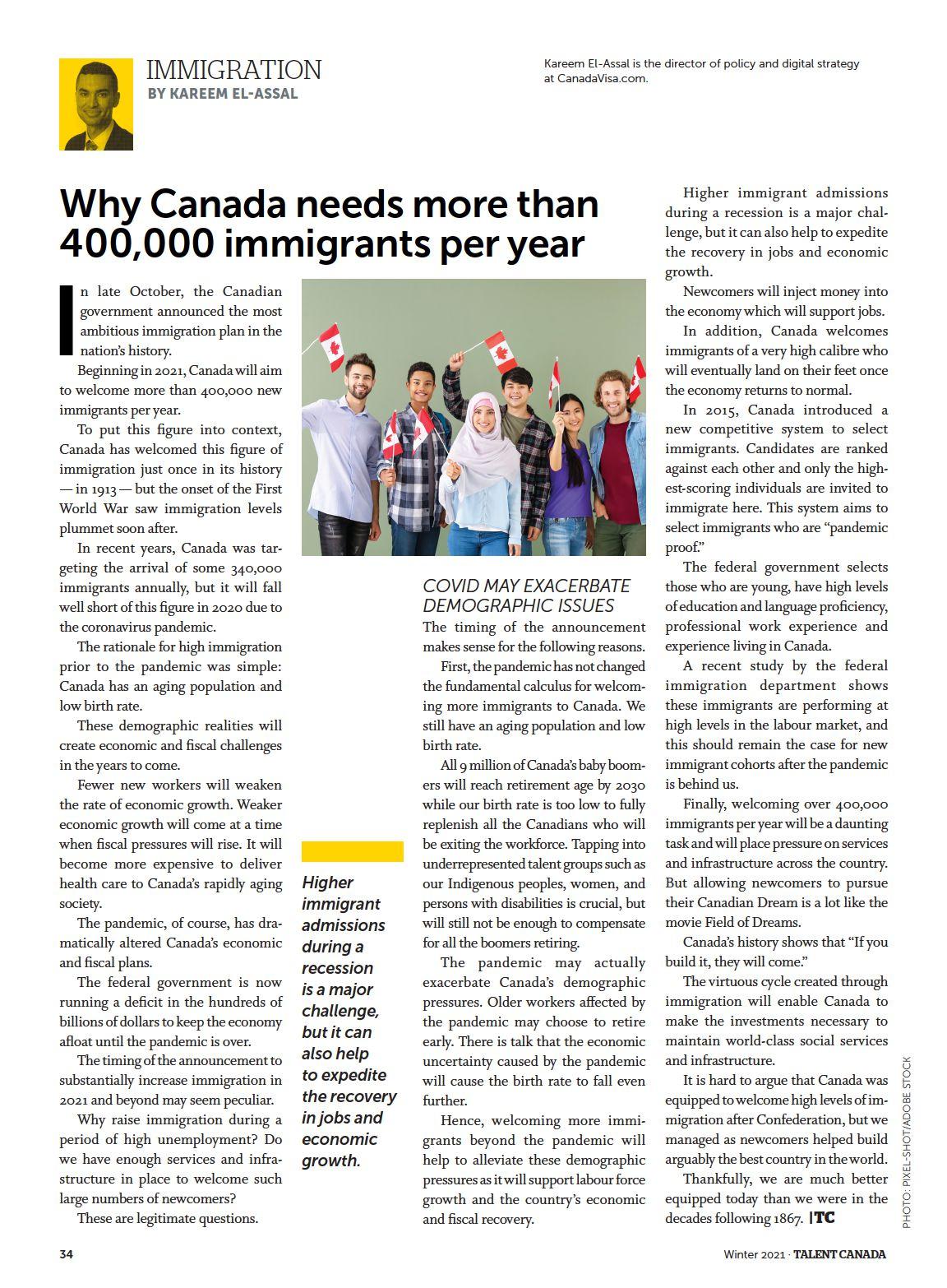
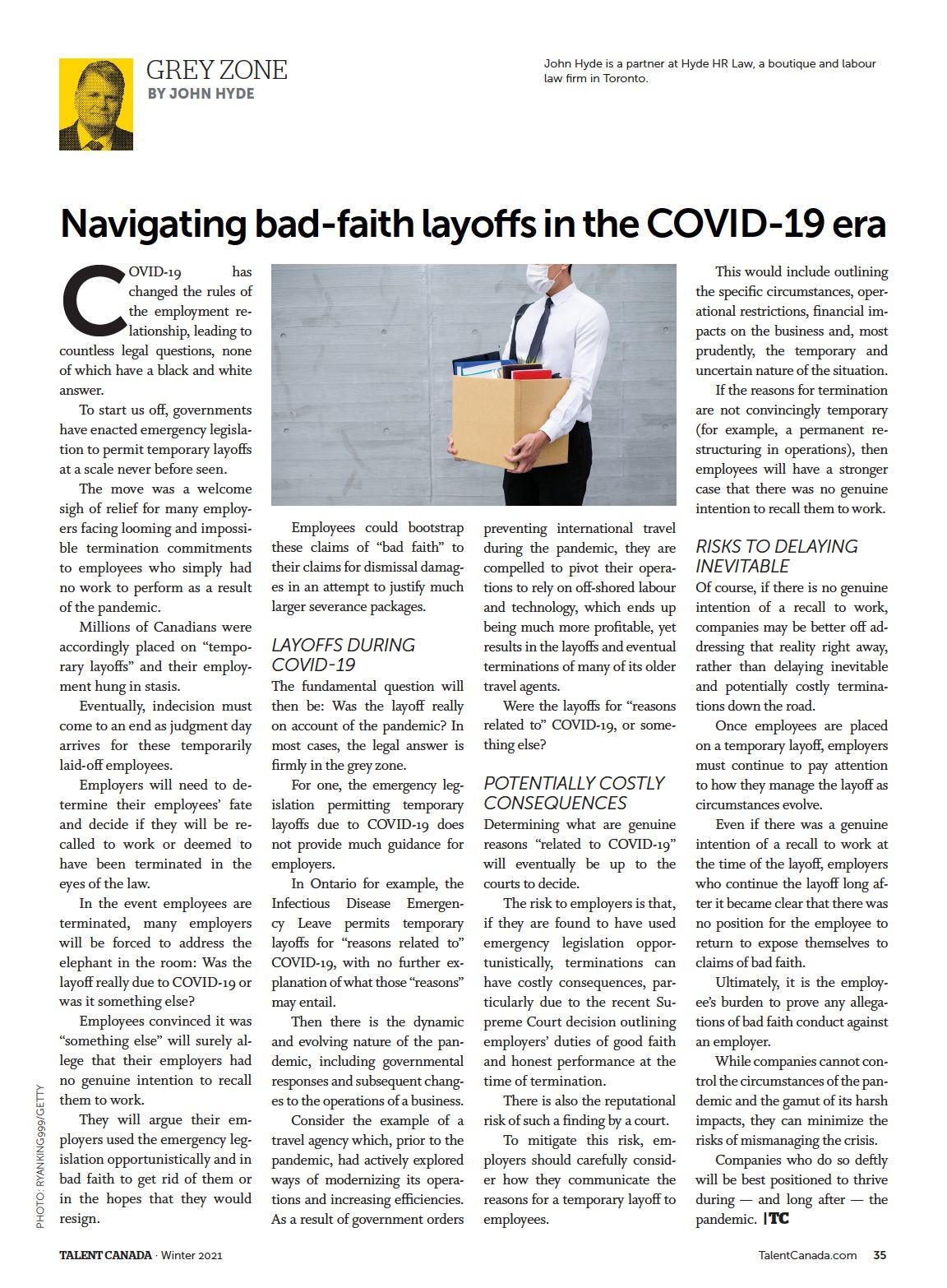
DIVERSITY AND INCLUSION
The data is in and it is clear — greater D+I awareness and practising positively increases performance, results and team satisfaction.
In 2021, data will continue to be tracked, best practices will be refined on an ongoing basis, board and executive leaders will increasingly step up and out to embrace D+I, and I expect ongoing enhanced policy expectations will be brought forward by provincial and federal governments mandating greater transparency with D+I reporting.
We’ve seen examples of progressive boards that set the tone by adopting D+I policies and then cascade change throughout the organization. This top-down sponsorship approach will continue.
In addition, we’ve been listening to a lot of shattered glass lately, with women breaking ceilings across North America — Chrystia Freeland as the first female finance minister, Kamala Harris as the first U.S. vice-president and other noteworthy appointments across sport, entertainment, industry and government.
These are standout moments, but the data still reflects significant inequity as well as institutional roadblocks for women getting to these roles.
We know that HR professionals are unique stewards of D+I within organizations.
It is our job to leverage the organization’s data about equity, access and diversity statistics to spark awareness and change at the top and then support company-wide change thereafter.
RETURN TO WORK/ REMOTE WORK
Many felt Jan. 2021 was a line in
the sand for when returning to work would happen. Even with a vaccine on the horizon, that line will be shifting many times in 2021 and perhaps beyond.
I believe we need to be ready to facilitate ongoing work-from-home capability with improved government and corporate policy. This must be met with a leaderready response in terms of employee eligibility and how to lead teams and individuals in hybrid work environments.
We need to be at the ready for a number of possible outcomes — everything from increased requests to return to workspaces for those who aren’t thriving at home, to companies deciding to reduce their physical workspaces altogether.
CONTINUED FOCUS ON MENTAL HEALTH
Every person has experienced the pandemic in a different way. Family, child care, health and financial stresses are often not apparent. We need to do better to find solutions that accommodate individual workers preferences and needs.
Normalizing mental health with the same value and emphasis we place on physical health can only happen by tackling stigma and role modelling.
I expect mental health awareness and programming to increase and become part of everyday work vernacular.
In 2021, HR professionals should:
• institute best practices that encourage employees to talk and share experiences and needs, including encouraging vulnerability and openness from our leaders
• work with management to increase flexibility and
accommodation, adhering to “one-size-does-not-fit-all” solutions for different employees
• track workforce well-being metrics like absenteeism, drug and paramedical utilization and other indicators related to mental health and anxiety-related causes to benchmark and provide justification for investment and tailored solutions that meet diverse needs
• advocate for getting support from mental health experts and third-party training and service providers
• educate leaders on mental health first aid so they know what to look out for and how to help, including intentional emphasis on making workplaces (whether in-office or virtual) psychologically safe.
PRIORITIZE SELF-CARE
There is good reason that in the event of plane trouble, we are told to place our own oxygen mask on first, and then assist others.
It’s because the old adage is true — if we don’t take care of ourselves first, we will be unable to take care of others.
I’ve spoken with many colleagues over this past year and folks are understandably tired.
Please remember to take the advice and counsel you provide your teams, and take the time you need to rest, recover and recharge.
You’re doing an incredible job and we need you to stay well and be ready for a new kind of “second wave” where HR will lead the next evolution of the modern workplace.
EXECUTIVE-LEVEL COUNSEL NEEDED
We have a seat at the strategic table, so let’s not give it up. Let’s drill the seat to the floor in 2021! HR teams should come together to creatively solve their organization’s most pressing problems, while not missing out on the opportunities associated with business recovery.
Nothing is static. The pandemic continues to shift public thinking and corporate priorities. This means we need to lead and shape the highest-performing workforces, setting them up to handle whatever challenges come their way and being bold in our counsel to executives about how to accelerate progress with highly-aligned talent strategies.
To do this, the greatest impact can be made by building an integrated business and human capital strategy for the organization.
This must be a comprehensive exercise, co-ordinated with all parts of the business.
The strategy should account for how technology supports communication, learning and training, and also how it can increase efficiencies, track essential data and remove excess burden on our teams.
As we look forward, we must aim high. HRPA members are held to the province’s highest standards, so Ontario workplaces can trust us to help unlock business growth and optimize employee potential. This is our goal.
Going into 2021, we believe well-run businesses are essential to a thriving society.
The HRPA exists to ensure HR professionals have the most up-to-date tools and the advanced skills to act as champions for positive change. | TC
OFFICE ODDITIES

Mets fire GM after explicit texts to
female reporter
New York Mets general manager Jared Porter was fired Jan. 19 — five years after sending graphic, uninvited text messages and images to a female reporter when he was working for the Chicago Cubs in their front office. Porter’s actions were reported by ESPN on Jan. 18, according to the Associated Press. In 2016, Porter sent dozens of unanswered texts to the woman, including a picture of “an erect, naked penis,” according to the report.

B.C.-based CEO resigns after Yukon trip, vaccination
Great Canadian Gaming Corp. president and chief executive Rodney Baker resigned Jan. 24, following reports that he and Ekaterina Baker had travelled to a remote Yukon community to receive doses of the COVID-19 vaccine. Yukon Community Services Minister John Streicker said the couple allegedly chartered a plane to Beaver Creek, posing as visiting workers, before receiving shots of COVID-19 vaccine at a mobile clinic, the Canadian Press reported.

Porn allegation dropped against Nova Scotia doctor after mix-up
In a bizarre case of mistaken identity, Halifax police blamed unnamed “partner” agencies on Jan. 26 for providing erroneous information that led to the arrest of a local doctor who was wrongly accused of possessing child pornography. According to the Canadian Press, the governing body for Nova Scotia doctors confirmed police had wrongly accused Dr. David Barnett, a family doctor who works in Cole Harbour, a suburb east of Halifax.
English soccer coach quits after making racist remarks
English Football Association chairman Greg Clarke resigned Nov. 10, 2020, after being condemned for making racist comments during a parliamentary select committee hearing. The departure of Clarke, who is also a vice-president of FIFA, was announced hours after apologizing for inappropriately referencing “coloured footballers,” but not expressing any regret for claiming South Asian people have “different career interests’’ than playing the game and for saying sexuality was a “life choice,” the Associated Press reported. Clarke said his words were unacceptable and a “disservice to our game.”
Former Microsoft worker jailed after stealing digital currency
A former Microsoft worker was sentenced in November 2020 to nine years in prison for a scheme to steal US$10 million in digital currency — money, authorities said, he used to buy an expensive car and lakefront home. Volodymyr Kvashuk, a 26-year-old Ukrainian citizen living in Renton, Wash., was responsible for helping test Microsoft’s online retail sales platform. Prosecutors said he stole digital currency such as gift cards or codes that could be redeemed for Microsoft products or gaming subscriptions, then resold them on the Internet. Much of the money was stolen using email accounts associated with other Microsoft employees, the Associated Press reported. Kvashuk was convicted on charges of tax, money laundering and fraud.
Harassment by spiders, disturbing deliveries: former eBay employees plead guilty
Two former eBay Inc. employees pleaded guilty Oct. 8, 2020, to their roles in a campaign to terrorize a publisher and editor of an online newsletter critical of the company. Their scheme included live spiders and other disturbing deliveries sent to their home. Stephanie Popp and Veronica Zea pleaded guilty to conspiracy to commit cyberstalking and conspiracy to tamper with witnesses, according to the Associated Press. The harassment included deliveries of a funeral wreath and bloody pig Halloween mask, as well as the sending of pornographic magazines with the husband’s name on them to their neighbour’s home.

Biden remodels Oval Office, gets rid of ‘Diet Coke’ button
U.S. President Joe Biden wasted little time in making the Oval Office his own, choosing a deep blue rug and former president Bill Clinton’s deep gold draperies. He removed a bust of former British prime minister Winston Churchill and a painting of former U.S. president Andrew Jackson. According to the Associated Press, Biden has also done away with a button on his desk, used by the previous president to summon a butler delivering Diet Coke.

World- Class Training — Wherever
You Are.

You know that professional development is vital to your organization’s growth and success. We know that you need your team to be able to ramp up quickly and effectively to make that happen. That’s why this spring we’re offering our programs virtually, so that your team can easily access the knowledge they need to lead change in an evolving global economy.
What does a Queen’s IRC virtual program look like? Please contact us today for more details or to register.
Call toll-free: 1-888-858-7838
Email: irc@queensu.ca Visit our website: irc.queensu.ca
SPRING 2021 VIRTUAL PROGRAMS
■ Strategies for Workplace Conicts / Mar. 1-5 (11am-3pm ET)
■ Linking HR Strategy to Business Strategy / Mar. 8-11 (10am-3pm ET)
■ Change Management / Mar. 9-12 (12pm-4pm ET)
■ Building Trust in the Workplace / Mar. 29-Apr. 1 (1pm-4:30pm ET)
■ Strategic Workforce Planning / Apr. 7-9 (1pm-4:30pm ET)
■ OD Foundations / Apr. 12-15 (11am-4pm ET)
■ Mastering Fact-Finding & Investigation / Apr. 19-23 (10am-4:30pm ET)
■ Negotiation Skills / Apr. 26-30 (10am-5pm ET)
■ HR Metrics & Analytics / May 3-6 (10am-3pm ET)
■ Performance Management / May 10-13 (1pm-4pm ET)
■ Coaching Skills / May 17-20 (11am-4pm ET)
■ Labour Arbitration Skills / May 31-Jun. 3 (10am-5pm ET)
■ Organization Design / Jun. 7-11 (11am-3:30pm ET)
■ Labour Relations Foundations / Jun. 14-18 (10am-5pm ET)
■ Negotiation Skills / Jul. 19-23 (10am-5pm ET)