We provide the ultimate in health care solutions, which support the mental and physical well-being of Canadians.
We design affordable benefit plans & educational seminars that help companies attract, retain and motivate their people.
We influence the health sector by providing products and services which keep people healthy and happy.
Today’s healthcare market is changing faster than ever before. Allow us to review your plan’s performance and provide expert analytical advice in renewal negotiation and pricing while mitigating hidden risks and liabilities.
Is your benefit plan helping you attain and keep talent? Is your current plan design sustainable based on the current and forecasted claims pattern? Let us help you stay ahead of the curve, with our in-depth industry knowledge and benchmarking data.
Employee benefits is an essential tool in the success of an organization. It has the capacity to help any company grasp a better picture of employee needs and the required means to bring forward a stronger and healthier workforce.
Workplace romances – especially among bosses and subordinates – are taboo for many reasons.
By Marcel Vander Wier
Retailers
Vander Wier
By Jack Burton
By Marcel Vander Wier
BY TODD HUMBER
‘Let’s go get both’:
Welcome to Talent Canada
Why hello there, senior leader.
Have you heard the latest trend in human resources…
Wait, wait, wait.
Don’t close this magazine. We have a critical business story to tell you, so indulge us for a moment.
During last year’s NBA championship run, Nick Nurse — head coach of the Toronto Raptors — shared a post-game speech he gave in the finals following a Game 2 loss to the Golden State Warriors.
“I said in the locker room, trying not to make them feel so bad that we just lost a home game in the finals, I was like ‘All we’ve gotta do is go [on the road and] get one,” he said. “And Kawhi [Leonard] said ‘Expletive that, let’s go get both.”
Well, Kawhi didn’t say expletive. Nurse cleaned his language up for the press.
Kawhi’s missive sums up the strategy behind Talent Canada — you can invest heavily in people and have a healthier bottom line.
This isn’t your parent’s HR publication. It starts with one simple premise — people matter, more than anything else in your organization.
If you believe that, and invest in the employee experience, your organization will thrive. That’s the mandate of Canada’s newest magazine and information source — to educate senior business leaders about all the great things that happen when you truly understand your most valuable asset walks out the door every single day.
It starts with an incredible list. Annex Business Media, publishers of Talent Canada, have a comprehensive, CASL-compliant email list of nearly 400,000 professionals. They come from all industries — with more than 65 brands and a history of providing engaging content, we have built up an engaged audience that trusts us.
We went through that list to identify more than 65,000 senior professionals — all C-suite level leaders — to educate on the critical importance of investing in people.
In the coming weeks and months, we will
peel back the boardroom doors of some of the most successful organizations in the world to reveal what works — and what doesn’t — when it comes to finding, retaining and engaging the best employees.
This publication is necessary. That’s a bold statement, but one we firmly stand behind; the benefits to any workplace — and to society as a whole — of getting the most out of our people is immeasurable.
Companies with a great culture have soaring productivity, reduced turnover, more innovation and higher profits. This isn’t opinion; it’s not a theory hastily scribbled on a white board by an overpaid consultant. It’s a fact.
Organizations can have everything. A great culture is not an either/or proposition — treating employees well leads to happier customers. And happier customers translate to happy stockholders and owners.
Good employee practices or a healthy bottom line?
Expletive that, let’s go for both.
We invite you to come with us on this journey — senior leaders, C-suite and, yes, HR professionals as we help build stronger organizations through best practices.
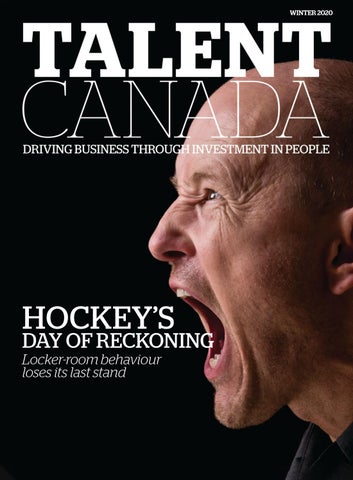
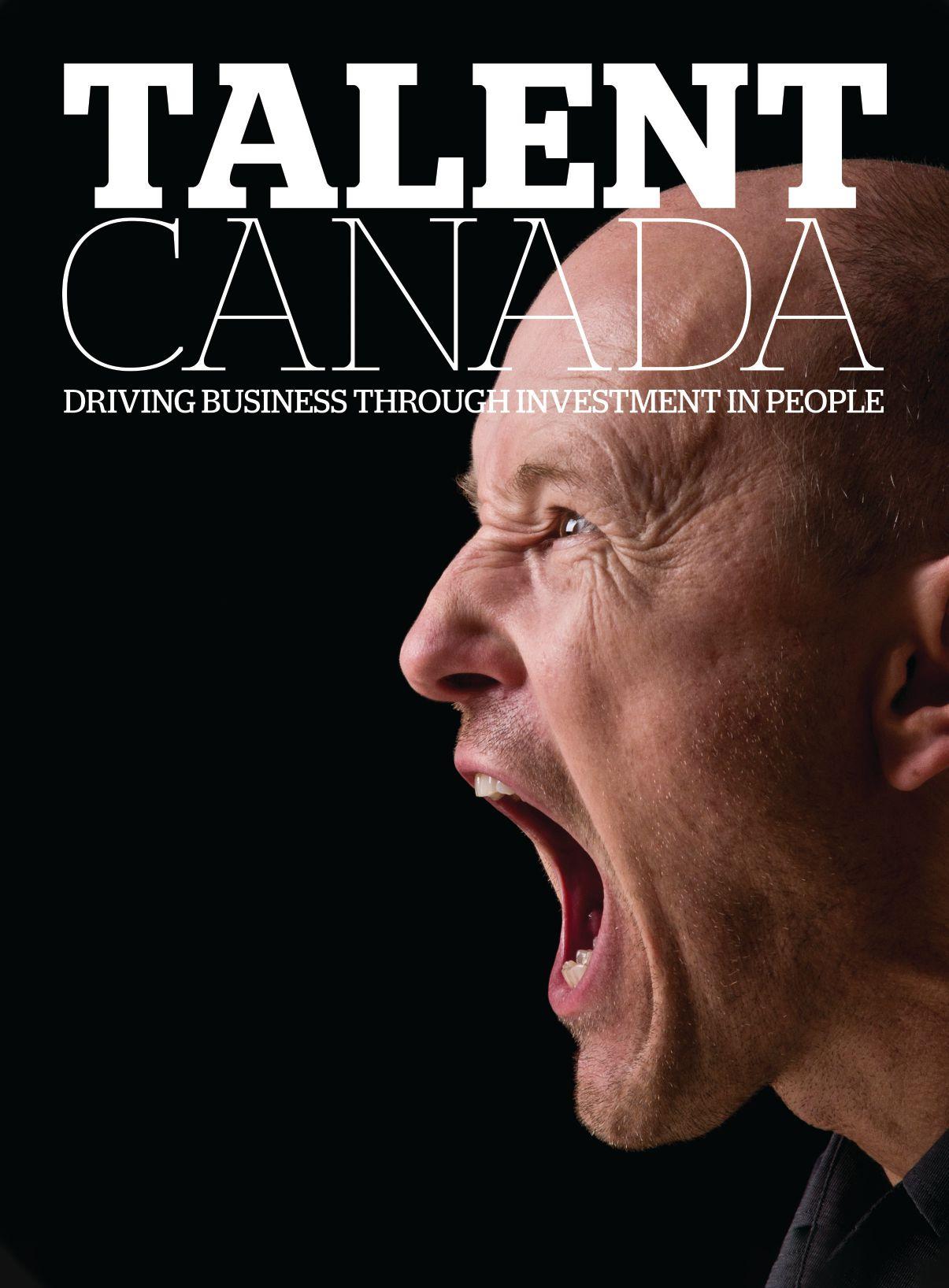
In this issue, we put the spotlight on some critical trends and developments in the employment world. As we planned this issue, we watched the saga unfold in the NHL with accusations of racism, bullying and unprofessional conduct among leaders. It was a unique opportunity to look at how the thinking has evolved with the treatment of employees, and proved that locker-room mentality isn’t welcome anywhere anymore.
In the wake of McDonald’s firing its CEO in the U.S. for a consensual office romance, we also dove deep into that topic — because workplace relationships are far from rare.
Visit www.TalentCanada.ca for more information and to sign up for our weekly newsletters, quarterly digital editions, podcasts, roundtables and more. | TC
111 Gordon Baker Road, Suite 400, Toronto, ON M2H 3R1
Publication Mail Agreement #40065710 Printed in Canada ISSN 1203-6838
Published four times per year (Winter/ Spring/Summer/Fall) by Annex Business Media
CIRCULATION
lmalicdem@annexbusinessmedia.com
Tel: 416-510-5187 • Fax: 416-510-6875 or 416-442-2191
Mail: 111 Gordon Baker Rd., Suite 400, Toronto ON M2H 3R1
SUBSCRIPTION RATES
Canada – 1 Year $ 26.50 (+ applicable tax) Best pricing (Can/USA/foreign) available online at talentcanada.ca
Occasionally, Talent Canada magazine will mail information on behalf of industry-related groups whose products and services we believe may be of interest to you. If you prefer not to receive this information, please contact our circulation department in any of the four ways listed above.
The talent pool may be starting to deepen a little bit, easing the crunch for employers on the hunt for talent. That’s because the economy shed 71,200 jobs in November and the unemployment rate jumped from 5.5 per cent to 5.9 per cent, according to Statistics Canada. Job losses were spread across both full-time and part-time positions — with a decrease of 38,400 full-time jobs and 32,800 part-time positions. But the numbers aren’t all doom and gloom — employment was up by 293,000 jobs from 2018.
NHL launching mandatory training
The National Hockey League will require all employees to attend mandatory training and counselling in an effort to stamp out racism and bullying. Gary Bettman, NHL commissioner, made the announcement at a board of governors meeting in California in December in the wake of a number of high profile incidents. “Inclusion and diversity are not simply buzzwords,” he said. “They are
Manitoba to set limits on executive compensation
a foundational principle for the NHL. Our message is unequivocal: We will not tolerate abusive behaviour of any kind.”
Pay equity on ice
Curling Canada is sweeping the way for equal pay for equal work with its announcement that the men’s and women’s teams will be competing for the same prize money at the 2020 Tim Hortons Brier and Scotties Tournament of Hearts. The men’s and women’s events will both offer prize money of $300,000. Winners will get $105,000; runners-up $65,000; and third-place teams get $45,000. In the past, the men split a total pot of $293,000 while women divvied up $165,000. “This has been one of my goals since I joined Curling Canada in 2016, and a lot of hard work behind the scenes with our stakeholders went into making [this] announcement possible,” said CEO Katherine Henderson.
Manitoba’s provincial government is putting the brakes on compensation for executives in the public sector. A bill introduced in December would set a framework for leaders at schools, health authorities, Crown corporations and other public bodies. Kevin Goertzen, the education minister, pushed information out via social media that noted more than 200 staff at the Winnipeg school board were earning north of $100,000 and the superintendent earned more than $250,000. The bill could set limits on pay and potentially roll back salaries the government deems excessive.
Women business owners more likely to be approved for loans
Women entrepreneurs are less likely to apply for business loans, but are more likely to be approved than their male counterparts, according to a recent survey from Scotiabank and the University of Ottawa. In the last 12 months, seven per cent of women had applied for a business loan, compared with 11 per cent of men. Yet, 88 per cent of loans for women were approved, compared to 77 per cent for men. “The landscape of Canadian entrepreneurship is changing and we’re encouraged to see the number of women be approved for business loans,” said Gillian Riley, president and CEO of Tangerine Bank.
On the road again
Canadian National Railways staff are being relocated for the second time in less than a year, and packing those bags has drawn the ire of the Teamsters union.
With more than 100 radio-traffic control centre jobs switching from Montreal to Edmonton, union president Francoi Laporte said families are being moved “across the country like goods on a train.” Some of these workers were transferred from Toronto to Montreal earlier in 2019.
Southwest workers to share in Boeing settlement cash
Southwest Airlines is receiving a payout of US$125 million from Boeing over the grounding of the Max 737 airplanes following two deadly crashes. Southwest, which was not involved in the accidents, has had to cancel about 175 flights every day because of the shortage of planes. It’s not clear how much money staff will receive, but it will be counted towards profit-sharing for the 2019 fiscal year.
Woman calls bomb threat to her own workplace
A woman in Fergus, Ont., was arrested by the Ontario Provincial Police for allegedly calling in a bomb threat at her office. The charges come after a note was found in the building claiming there was a bomb. The building was evacuated and the employee, 63, is facing multiple charges.
Real-estate firm hands out US$10 million in bonuses
A commercial real-estate firm in Baltimore split a US$10-million
bonus with its nearly 200 employees after it hit a milestone. St. John Properties handed out the cash after it hit its target of developing 20 million square feet of space. The money was handed out based solely on years of service, with the average employee pocketing US$50,000. “We wanted to reward our employees in a big way that would make a significant impact on their lives,” said Edward St. John, the company’s founder and chair. “I am thankful for every one of our employees, for their hard work and dedication. I couldn’t think of a better way to show it.”
Teachers in Ontario launch charter challenge
The four major teachers’ unions in Ontario are fed up with a law passed by the province that caps wage increases in the public sector. Sam Hammond, president of the Elementary Teachers’ Federation of Ontario, said the legislation was “a direct affront to bargaining rights.” In filing the constitutional challenge, union leaders are quick to say it’s “not about the money” and is instead focused on the abililty to negotiate without government interference.
JOB STOPS AND STARTS
250 – The University of Calgary is slashing jobs in the wake of provincial funding decreases. About 100 positions are expected to be eliminated via vacancies, resignations and retirement and 250 jobs will be lost in total. The reductions are focused on management, faculty and support
staff, the university said. The Alberta government cut funding to the school by $33 million, or about 6.9 per cent.
Unknown – CN Rail cited a weakening North American economy in November as it announced an unknown number of job cuts. In a statement, it said it was “adjusting its resources to demand” and cuts will come across management and union jobs. The weak forestry sector in British Columbia is taking a particularly high toll, as are delays in Prairie harvests due to weather issues.
80 – A new potato production facility in Grand Falls, N.B., is expecting to create 80 new jobs. McCain Foods is spending $80 million to increase production, and everything is expected to be completed by early 2021. The growth means McCain will also be buying more potatoes — an estimated increase of 1,200 hectares.
300 – Amazon is building a fulfilment centre on the outskirts of Montreal. When the warehouse opens in 2020, it is expected to create at least 300 full-time positions. The online retail giant now has a dozen fulfilment centres across Canada.
5 – The National Film Board of Canada has cut five positions as it restructures. The losses included the chief digital officer, a director of operation and an administrator.
15 – The famed Toronto International Film Festival (TIFF) is cutting 15 jobs after conducting a review of its five-year strategic plan. It’s not clear exactly what positions are being cut, but TIFF has said it is refocusing its plan and hopes to unveil details later in 2020.
2,400 – WeWork cut 20 per cent of its workforce, or some 2,400 positions, as it sits on the brink of bankruptcy. The company, which offers high-end shared office spaces for rent in more than 120 cities around the world, said the staff being let go are “incredibly talented individuals.” It is also contracting out cleaning services at locations in the U.S. and Canada as it struggles to turn around the business.
Unknown – Wattpad, a Toronto-based tech company, is opening a “second headquarters” in Halifax. In early 2020, it plans to move into a 60,000-square foot facility as it grows and expands. “Opening up... in Halifax will enable us to fully capture that opportunity, and take advantage of the business friendliness in Halifax, take advantage of the talent pool available in Halifax, and let us grow as quickly as possible,” CEO and co-founder Allen Lau told the Canadian Press.
Unknown – Huawei, the Chinese smartphone giant that is drawing controversy as some Western governments block access to 5G networks, has announced plans to move its research centre from the United States to Canada. While details were scarce, 600 jobs were slashed at its Silicon Valley research centre in California. The speed of the move will depend on immigration issues, according to reports — a company spokesperson said they are hoping U.S. staff will be allowed to move to Canada, where the company currently has 1,100 employees.
GUEST COLUMNIST
BY MINA MOVASSELI
Mina Movasseli is a behaviour analyst and founder of Mind the BluePrint. She can be reached at mina@mindtheblueprint.com or visit www.mindtheblueprint.com for more information.
You can’t leave it at the door: Work behaviours affect your personal life
What is it about top employers that everyone wants to work for — is it the ping-pong tables? The beer days? Something else?
As a behaviour analyst, I was interested in answering this question. One of the reasons people aspire to work at great companies is often the culture. But I’ve learned that, while there is often an illusion or assumption that the culture of an award-winning organization is healthy, the reality can be quite different.
And working in a toxic environment can take a severe toll. It happened to me once, and in hindsight, the first sign there was an issue was my decision to start eating lunch at my desk.
If you were spotted heading out for lunch at this organization, you were not taken as seriously or perhaps even viewed as a slacker.
Just by going along with this norm at the office, I was actually going against my values. You should be allowed to do whatever you want on your lunch break, period. Simple, right?
The next red flag was watching volunteers at the organization working on long weekends, without pay, in the hope they would end up with a paying job at the end of it.
Just by not saying a word, I was contributing. I knew it wasn’t right, and yet I did nothing.
This started to have a compound affect on me, far beyond the 9 to 5. We may think we’re able to separate our personal life from our work life, but the brain really can’t — there are no separate compartments.
Creating a ‘new
normal’
Over time, your mind picks up your
When I started to be silent in the workplace, I realized I was also becoming more of a pushover with friends.
new behaviours and creates an automatic response. When it notices you are silent in situations where someone is being taken advantage of, that might become your new normal response — creating a sense of ease and comfort in being silent.
When I started to be silent in the workplace, I realized I was also becoming more of a pushover with friends. I was allowing them to be the decision-makers for everything we did. I didn’t realize it was related to my work life, but that’s how subtle it can be.
As the famous saying goes, “You are the five people you surround yourself with.”
By allowing myself to continue to work in that environment, I was subject to becoming the people around me. I saw them weekly, for hours, hearing them make decisions that went against my values. After a few months, I started hearing my word choices change — I sounded just like the people I did not want to turn into.
Why? Again, our mind does not have compartments. It simply understands that you are constantly hearing these words — and you’ve chosen to accept them.
Now let’s dig deeper. What else could be happening in our personal lives that we may not be fully aware of?
First, when you find yourself in a toxic environment, you are more likely to feel drained or worn down. Second, you can also start taking in the wrong advice. When we feel overwhelmed, we often ask others what they think.
For example, when you are drained and are constantly dealing with toxic situations, you might start to think that what is happening at your work is normal — so you seek
the advice of friends or your spouse.
But what if their advice is not good or it pushes you to stay in an unhealthy situation? You will be less likely to realize this and more likely to blindly follow their advice, given your new reality.
It all leads to confusion about who you truly are — if you don’t remember your values, or what you stand for, you are going to feel inconsistent. This confusion shows up both at work and in your personal life. Your mind does this so it can feel consistent and, therefore, less overwhelmed.
Steps to take
So what should you do? In one word, speak.
Don’t put your position in the workplace hierarchy ahead of your human self. Someone being treated unfairly outside of work is just as bad as inside the office.
If the environment is truly toxic, and you have no control over it, it may be time to change departments — or even employers. While that may sound extreme, think about the toll it is taking on you on a subconscious level. Perhaps then you will begin to realize the severity of the situation.
If you’re in a senior leadership position, there are steps you can take to prevent this from happening at your organization. One tactic is to hold a meeting where employees can practice saying “no” to each other.
It creates a safe space and reinforces the message that they don’t have to say yes to everything simply because they are employees. Over time, this can change the culture of the organization.
Allowing others to be their authentic selves is one of the best gifts an employer can give employees. | TC
BUILDING BETTER LEADERS ACROSS CANADA
You know that professional development is vital to your organization’s growth and success. We know that you need your team to be able to ramp up quickly and effectively to make that happen. That’s why we bring our solutions to you. Queen’s University IRC offers open-enrolment and customized programs across Canada so that your team can easily access the knowledge they need to lead change in an evolving global economy.
FEATURED PROGRAMS FOR 2020
ORGANIZATIONAL DESIGN
Feb. 11-13, 2020: Ottawa
MASTERING FACT FINDING & INVESTIGATION
Feb. 24-27, 2020: Kingston
LINKING HR STRATEGY TO BUSINESS STRATEGY
Feb. 25-27, 2020: Toronto
MANAGING UNIONIZED ENVIRONMENTS
Mar. 3-5, 2020: Toronto
COACHING SKILLS
Mar. 9-10, 2020: Toronto
CHANGE MANAGEMENT
Mar. 10-12, 2020: Kingston
PERFORMANCE MANAGEMENT
Mar. 11-12, 2020: Toronto
LABOUR RELATIONS FOUNDATIONS
Mar. 22-27, 2020: Kingston
Learn more about these & other programs offered across Canada:
Call toll-free: 1-888-858-7838
Email: irc@queensu.ca
Website: irc.queensu.ca
OFFICE ROMANCES
WORKPLACE ROMANCE A NO-GO ZONE IN C-SUITE
Trickle-down effect could include poor morale, retention issues
BY MARCEL VANDER WIER
Romantic relationships in the workplace are both common and dangerous to individual careers, depending on the parties involved.
McDonald’s CEO Stephen Easterbrook found out the hard way in November, when he was dismissed from the fast-food giant’s top post in the U.S. upon discovery that he was involved in a consensual relationship with an employee.
The relationship violated company policy and he was terminated by the board. Easterbrook had served as McDonald’s CEO for five years.
Romantic relationships between senior executives and staff should be avoided, says Nick Rossi, legal counsel and legal claims manager for Peninsula Canada, an HR consultancy in Toronto.
“It’s probably the best bet, especially with huge companies where the CEO is a public figure,” he says. “The last thing you want is — even if there isn’t a conflict of interest — your employees perceiving it to be
One-third of Canadians are currently in a workplace relationship — or have been in the past, according to an ADP Canada survey.
one. That could result in jealousy and poor morale and rumours.”
The McDonald’s incident serves as an example of the broader confusion surrounding workplace romance, says Stuart Rudner, an employment lawyer and mediator with Rudner Law in Markham, Ont.
“It’s so misunderstood for a whole bunch of reasons,” he says. “For the most part, what you do on your own time is still your own business. It only becomes a concern if it has an impact on the workplace.”
Workplace relationships are common, and pursuit of zero-tolerance and non-fraternization policies are not worthwhile, says Rudner.
“The reality is you’re never going to stop people from having those close relationships with their colleagues. Because for most of us, we spend more time with our work family than we do with our actual family.”
CLARITY NEEDED
Confusion on office relationship policies is widespread, according to a recent ADP Canada survey of 885
Canadian workers that revealed onethird of working Canadians are currently in a workplace relationship, or have been in the past.
Of those in workplace relationships, 40 per cent have kept it a secret from management, while 49 per cent claim their employer has no formal policy addressing workplace relationships.
This data should spur employers to action on this file, says Heather Haslam, vice-president of marketing for ADP Canada in Etobicoke, Ont.
“Policies are put in place in order to protect and support employees,” she says. “Employers need to step up [and] work with their employees to create the policies, make sure that
as new people come on board, they understand what those policies are.”
Policies need to be reinforced on an ongoing basis to create an environment where employees are not afraid to dialogue when uncomfortable situations arise, says Haslam.
“It’s not just about having a policy in place, but also that people feel empowered and encouraged and not scared to enter into that dialogue to get the support that they need,” she says. “It behooves everybody — leaders and new employees alike — to be asking about this and to promote those conversations.”
Two of 10 survey respondents indicated they felt pressured to take part in the romantic relationship for reasons affecting their career trajec-
tory.
This is reason enough to encourage a culture of transparency and openness, says Haslam.
“Whether or not that was pressure because they thought that it would advance their career, or that it might give them opportunity to be exposed to a more favourable project, or be better received… regardless of why that was — that’s a number that gets my heart rate increased.”
PUSH FOR POLICY
For best practice to be achieved, two policies regarding workplace relationships should be in place, according to Rossi.
The first is an anti-discrimination and harassment policy — a legal obli-
gation in Canada, he says.
“Employers across Canada have a really strict legal requirement to ensure that their workplace is discrimination and harassment-free.”
Establishing a workplace relationship policy preventing conflicts of interest and relationships between managers and subordinates would also be beneficial, says Rossi.
The policy should also establish a pathway of reporting to an appropriate party and detail specific disciplinary action that would be taken following a violation, he says.
Workplace relationship policy is a growing trend in the social-media era, in which nefarious issues can go viral in a matter of moments, says Rossi.
“As there’s been more attention focused on #MeToo and respect in the workplace, I would say more organizations are probably drafting and implementing these policies,” he says.
“People need to be more careful today than they ever have been in the past and ensure that everyone’s rights are respected properly and that the workplace is a place where everyone feels safe and... treated fairly.”
DISCIPLINE OR DISMISSAL: NOT ABOUT RELATIONSHIP, BUT BREACH OF POLICY
The fallout of the #MeToo movement has altered perceptions around male-female interactions in the workplace, including a heightened awareness surrounding harassment.
The issue of consensual relationships versus coerced activity is now a focus for many employers, with the presumption of innocence no longer the first reaction, according to Rudner.
It’s important to remember that discipline or dismissal is not because of the relationship itself, but rather due to breach of policy, he says.
And when it comes to CEOs, protection of organizational brand is often paramount, as issues involving senior leaders have more impact in the public.
“You can’t have a subordinate involved in a romantic relationship with their superior,” says Rudner. “You can’t have a relationship between two people where one of them controls the compensation of the other, the workload of the other or basically impacts the career path of the other.”
Legal advice is always to disclose the relationship and remove the conflict of interest by transferring the employee to another department or directing them to report to another manager, he says.
But it is also difficult to conclude a CEO does not “have an influence over the career path of an employee,” says Rudner. “There will be a very small number of situations like the CEO of a company where it may be almost impossible.”
In rare cases, it may be possible to have the CEO-employee relationship continue, but only if the board agrees to confidentiality and the employee is able to remain insulated, he says. |
The Professional Recruiter
This program covers a set of key recruitment and selection skills. The goal is to help you reduce recruitment costs, lower the risk of bad hiring decisions and avoid needless litigation. Successful completion of all 3 Modules makes you eligible for membership in the Association of Professional Recruiters of Canada, APRC, with the RPR (Registered Professional Recruiter) designation.
This mixed media package includes a text-based USB Flash Drive with participant workbook and exam. Works
...
DON’T MISS a single issue
SIGN UP for your FREE SUBSCRIPTION to Talent Canada and stay on top of the news, information and advice organizations need to thrive
Talent Canada is a new — and different — type of HR publication. It is designed to educate senior leaders, C-suite professionals and people managers about the importance of investing in employees and all the good things that will happen to the bottom line. In each issue, you’ll find:
• News and information impacting employers
• Case studies on best leadership practices
• Legal insights – tips on hiring, terminations and discipline
• Office oddities – a look at the stranger side of the modern workplace
• Access to exclusive podcasts, webinars and videos
• And so much more!
PLUS you’ll also get the weekly newswire.
HOCKEY GETS AN HR
HR INTERVENTION
‘If there’s been one thing that hockey’s taught us, it’s that these issues are real’
BY MARCEL VANDER WIER
The firing of Toronto Maple Leafs head coach Mike Babcock in November set off a chain reaction in hockey that has led to a cultural reset for Canada’s national pastime.
Following the lead of Leafs forward Mitch Marner, NHL players such as Akim Aliu began speaking out on the abusive environment within the game — specifically in terms of coaches and those in authority.
Calgary Flames head coach Bill Peters resigned following an investigation into past usage of racial language; Chicago Blackhawks assistant Marc Crawford was suspended during a team investigation into past physical abuse; and Dallas Stars head coach Jim Montgomery was fired for unprofessional conduct.
The fallout has led to a full-blown human resources crisis in hockey — something former NHL player Sheldon Kennedy believes could eventually benefit greater society.
“Hockey — because it’s so high profile — has an opportunity to really bring a light to issues that sometimes don’t have that light,” he says.
Hockey’s reckoning holds lessons for senior leadership in workplaces across the country, says Kennedy, co-founder of the Respect Group in Calgary.
These types of incidents can no longer sit in a file on the desks of HR professionals, but rather need to be addressed by the most senior leaders at an organization, he says.
“We’re dealing with issues that carry a lot of fear. If there’s one thing that hockey’s taught us, it’s that these issues are real. They’re impactful, and this is about leadership.”
UNDERSTANDING HARASSMENT
For its part, the National Hockey League has instilled a zero-tolerance policy on harassment and abuse going forward.
“The world is changing for the better,” said NHL commissioner Gary Bettman at a Dec. 9 press conference. “This is an opportunity and a moment for positive change, and this evolution should be expedited for the benefit of everyone associated with the game that we love.”
“Inclusion and diversity are not simply buzzwords. They are a foundational principle for the NHL,” he said. “Our message is unequivocal — we will not tolerate abusive behaviour of any kind… Everyone is entitled to a respectful workplace.”
The league has implemented annual training for all employees in a leadership capacity and employee background checks will be of ultimate importance going forward, said Bettman.
He also discussed the implementation of a hotline for players to report abuse anonymously.
Coaching is emotional, he said.
“Not everyone will approve of every coach’s methods,” said Bettman. “However, there are lines that cannot be crossed. Clearly, physical abuse and racial and homophobic language cross the line.”
“While we acknowledge that there may be other actions that could cross the line or fall in a grey area, we hope that the program we create and its intended consciousness-raising will help better define what is and what is not acceptable conduct, and will make for a better playing and coaching environment.”
Hockey leaders need to be sensitized to possible grey areas in order to act with more caution, he said.
“Even if there’s a line, why get too close to it? Let’s have a respectful workplace where people can feel comfortable doing their jobs.”
MOVING TOWARDS CIVILITY
What has occurred in hockey over the past months could eventually be remembered as hockey’s #MeToo moment, says Lew Bayer, a civility expert in Winnipeg.
“If we think about, say, Don Cherry or Mike Babcock… it’s the same as the #MeToo [movement] in Hollywood,” she says. “You can’t be permissive for decades — and essentially encourage and reward the behaviour — and then act shocked… to hear that it’s actually happening.”
“You can’t boil it down to one person’s misbehaviour. There’s a whole tribe, a whole sports family, a whole collective who encouraged and supported and engaged in that behaviour.”
Inappropriate behaviour has been a long-time issue in sports, according to Bayer.
“It’s surprising to me that for years and years, it’s been completely
obvious that there’s a different set of rules for elite athletes’ behaviour — not just coaches.”
“It’s understood that you don’t talk to a referee or an umpire in a particular way without some expectation of immediate consequence,” she says.
“But you can use that same tone to speak to a player or coach or supplier or parent or sponsor… There’s been this kind of double standard for a long time.”
Rather than implement policy upon policy, civility can succeed under one simple rule, says Bayer: “Everyone in every situation gets exactly the same respect and consideration.”
sectors, says Kennedy.
“Hockey’s made the headlines. And I think that the headlines are, it’s important to make sure we get this right,” he says. “There’s an expectation that companies have these issues addressed and prioritized.”
The steps taken by Bettman and the NHL signify good progress, says Kennedy, noting Hockey Canada has been educating its coaches on abuse for more than 15 years.
“When we first started doing this work, it was a very difficult conversation to have.”
“The way we’ve been handling incivility is with more incivility, and I’m not sure that’s the most effective thing.”
At present, the evaluation of interactions remains a murky process.
“That’s a huge part of the problem. It’s very grey and sometimes we don’t hold a player accountable if he says something that, outside of that context — in practice for example — might be perceived as racist,” she says. “There should be a do-notuse list that is clearly understood. But then we have to be able to hold everybody accountable and it has to apply across the board.”
“The way we’ve been handling incivility is with more incivility and I’m not sure that that’s the most effective thing. However, at the end of the day, we’ve got to start somewhere. Things usually get a little messier before they get better.”
LESSONS FOR LEADERS
Hockey’s troubles hold lessons for senior leaders across all workplace
But the education is paying off in the current generation of players who are not afraid to discuss these issues, he says.
“The shift and the knowledge and the confidence to actually be able to discuss these types of issues is at an all-time high.”
As for dredging up issues that may have occurred in the past, it is a painful but important task, as harassment and abuse are a major contributor to mental-health problems for individuals and within the workplace, says Kennedy.
“We’re going to have to hear it. We have to be able to listen to those individuals,” he says. “Because if we don’t know where we’re coming from, it’s tough to move forward.”
“There is a lot of hurt, pain and suffering that has come with some of these incidences.” | TC
For more coverage of the reckoning in professional sports, visit www. TalentCanada.ca and enter hockey as a search term.
WORKPLACE INVESTIGATIONS
WHEN A HARASSMENT COMPLAINT ARISES, PROCEED WITH CAUTION
Legislation puts onus on employers to conduct fair, impartial workplace investigations
BY BILL HOWATT AND KELLY VANBUSKIRK
The evolution of occupational health and safety (OHS) laws across Canada has resulted in new requirements for companies and organizations to investigate employee harassment and violence concerns. When allegations of harassment or violence arise in a workplace, chances are high there is a legal duty to conduct a formal investigation and, further, that the investigation may be scrutinized.
Understanding why, when and how to investigate can reduce employers’ risks of spending extraordinary amounts of time and money defending these investigations.
WHY YOU MUST INVESTIGATE
In most provinces, governments have passed OHS laws that require employers to act against workplace harassment and violence. There are good reasons for this: a 2018 report from Statistics Canada, Harassment in Canadian Workplaces, found 19 per cent of women and 13 per cent of men had experienced harassment on the job in the past 12 months.
The most common forms were verbal abuse, humiliating behaviour, physical violence and sexual harassment or unwanted sexual attention.
Quite often, harassment negatively impacts both the victim of the behaviour and the workplace generally. As a way of trying to reduce this misconduct, laws require employers to establish anti-harassment policies that set out a process for identifying and dealing with this misconduct.
Anti-harassment laws usually put the onus on employers to receive and investigate complaints and to take appropriate steps to resolve them. It’s a model that has been called “self-regulated regulation” — which means the government has identified the problem [in this case, workplace harassment and violence] and has imposed
obligations on employers to address that problem — but has left the actual mechanics to employers.
WHEN EMPLOYERS MUST INVESTIGATE
As an immediate first step, review the OHS laws and human rights standards for your province. You likely have a duty to create [and regularly assess] an anti-harassment and anti-violence policy and, additionally, to educate staff about it.
Your policy should lay out a process for employees to make harassment or violence complaints and how those complaints will be investigated.
A trap some employers fall into is the mistaken idea that only a formal, written complaint must be dealt with. The law indicates otherwise, and the reality is that even a verbal report of harassment or violence triggers a duty to investigate.
OHS laws set the expectation that when information about possible workplace harassment or violence arises it must be analyzed by a competent investigator. The investigator can be internal or external
Bill Howatt is the Ottawa-based president of Howatt HR. Kelly VanBuskirk is a partner with Lawson Creamer in Saint John, N.B.
WORKPLACE INVESTIGATIONS
to the organization. The employer will need to determine, based on the circumstances, when it warrants an external investigator.
HOW TO INVESTIGATE POSSIBLE HARASSMENT OR VIOLENCE
Conducting an unfair, incomplete or otherwise sloppy investigation can put your organization at greater risk of government scrutiny, litigation and potential legal liability.
A fair investigation is one that is conducted in a competent, timely and unbiased manner and, while not every investigation has to be done by an external investigator, some issues do require that degree of expertise.
Key questions that should be asked when deciding whether an internal or external investigator should be appointed are:
1. Is there a qualified and skilled internal investigator available?
2. Does that internal investigator have sufficient time available to complete the investigation in a reasonable time?
3. Do any of the key participants in the complaint have close personal or professional relationships with the internal investigator that might give rise to concerns about bias?
Once an investigator [internal or external] has been appointed, that person should proceed carefully by taking these steps into consideration:
• Review applicable legislation and policies.
• Review the complaint and any supporting information.
• Ensure that the respondent has been apprised of the allegations.
• Create an initial witness list [subject to amendment later].
• Prepare interview questions. Avoid asking for opinions, such as “Do you think that Person X harassed Person Y?”
A Walmart Canada employee was awarded $300,000 in punitive damages after the investigation was found to be incomplete.
• Determine if specialized resources are needed, such as a computer technician to access emails, a security person to access surveillance video recordings or to unlock secure areas.
• Map out a schedule for conducting interviews and make appointments.
• Decide how to record your interviews, considering handwritten notes, audio recording or video recording. Fundamentally, it’s crucial the investigator you appoint be knowledgeable and experienced. While some legislation expressly requires that a “competent person” conduct any investigation, all OHS legislation implies it. Furthermore, the legal consequences for employers that have appointed inexperienced and untrained investigators have been severe.
CONSEQUENCES OF A BAD INVESTIGATION
Appointing an unqualified investigator might seem like a good cost-saving measure. But the courts appear to be unsympathetic to employers that have tasked either biased or inexperienced investigators with the assessment of harassment or violence complaints. Just a couple of examples:
Doyle v. Zochem Inc., 2017 ONCA 130 (CanLII); 2017 ONSC 920 (CanLII). In this case, the court criticized the employer’s appointment of a manager to conduct an investigation. In addition to other damages, the plaintiff was awarded costs of nearly $425,000.
Boucher v. Wal-Mart Canada Corp., 2014 ONCA 419 (CanLII). Here, the employer’s investigation was found to be incomplete, leading to an incorrect conclusion. In addition to other damages, the plaintiff was awarded $300,000 in aggravated and punitive damages against Walmart.
WHAT YOU NEED TO KNOW
As an employer, it’s important to be aware of your provincial OHS legislation. As well, when a harassment or violence complaint is made, it’s crucial that you:
• act quickly
• refer to your policy for guidance
• appoint a qualified and unbiased investigator. One way to assess an investigator’s competency is to review their experience, education and professional qualifications, as well as what workplace investigation training they have completed. Keep in mind that the type of training an individual has is an important factor, since knowing how to conduct an investigation is not the same as having the necessary skills.
The more competent and skilled your investigator, the less risk for having to deal with a faulty investigation in the future. | TC
PROTECTING MINDS A PRIORITY
Workers face unique stresses, pressures as digital economy brings upheaval
BY MARCEL VANDER WIER
In a world where the only constant is change, mental health has become the fastest-growing category of disability in the workplace.
That’s according to Lewis Smith, national projects manager at the Canada Safety Council in Ottawa. And while much headway has been made, mental health and depression often remain “tricky subjects,” he says. “They sneak in under the radar.”
“As an employer, you really need to have your ear to the ground and be paying attention to sudden, inexplicable mood changes or even just subtle differences in an employee’s routine or attitude,” says Smith. “Oftentimes, that goes undetected and that can lead to many worse situations.”
The digital economy has ushered in rapid change, leaving lifetime employment as all but a distant memory while non-traditional workers increase in popularity and demand.
The current workforce faces unique stresses and pressures, making mental health an increasingly necessary work-
Canadian legislation has continued to evolve to ensure that invisible disabilities are acknowledged, respected, and accommodated to the point of undue hardship.
place discussion, says Liz Horvath, manager of workplace mental health at the Mental Health Commission of Canada in Ottawa.
“There’s more pressure on workers. It’s difficult for people... we know that it’s during times of change that we see the highest rates of uncertainty,” she says. “Uncertainty is one of the top causes of chronic stress, and it’s also the time when we see more conflict, more claims, more turnover and more accidents.”
“It makes a lot of sense for occupational health and safety professionals to get more educated about the impacts of work-related factors on mental health, and the impacts of mental health on being able to do healthy, safe and productive [work].”
Stressors are many
Technological implementation, constant connectivity and the rapid pace of change are three of the main issues affecting workers’ mental health, says Horvath.
“We know that technology is intended to enhance productivity. But it’s not until we get proficient in the technology, and in using it, that that enhancement becomes a reality,” she says.
“Until then, we might actually see a decline in productivity. And that decline, combined with trying to learn the new technology, really can add up to a lot of stress load on the worker — in addition to the stress load they already have.”
Employers need to be mindful in terms of how new technology is introduced, says Horvath.
“It can be exciting, but it can also be very frustrating for many employees.”
Constant connectivity can sap focus and time available for reenergizing, she says.
“Most of us are not very good at getting the rest and the rejuvenation that we need for our body and our mind, and that road to burnout is a very slippery slope. If people aren’t careful, they may not recognize the signs and symptoms until they’re experiencing pronounced signs and symptoms like exhaustion and irritability.”
The job insecurities that have resulted from the rapid change within workplaces has most significantly affected those nearing the end of their
MENTAL HEALTH
careers, says Peter Smith, senior scientist at the Institute for Work and Health (IWH) in Toronto.
And many Canadian households require dual-income earners as a result of rising cost of living, making fears of potential employment loss especially devastating, he says.
“We know these things are related to mental health,” says Smith. “We also need to make the distinction between mental-health conditions that are work-related, and those that are not.”
While both have considerable costs for workplaces, different types of interventions are required, he says.
Progress, setbacks
Conversations surrounding mental health have improved over the last decade, in large part thanks to corporate campaigns such as Bell Let’s Talk, says Lewis Smith.
“As recently as a decade ago, it would have been [near] unthinkable to even bring it up in the conversation, or to suggest you might need to take a mental-health day,” he says. “Now, it’s much more commonly acceptable. It’s much more widely discussed, but we’ve still got a ways to go.”
And while the conversation has lagged in some blue-collar industries, progress is being made, says Smith.
“There seems to be maybe a little bit more reluctance to open the door and discuss mental health openly and honestly. But certainly, as far as your average office goes, the discussion is being had more and more frequently. And anecdotally, I’m seeing a lot more willingness to discuss mental-health issues, and willingness on employers’ part to make the task as easy as possible for their employees.”
Yet even as mental health becomes a top business concern, appropriate data is not being collected to understand the issue at a population level, says Peter Smith.
“At the moment, we’re still taking quite an individualistic approach to mental health — things around building resilience among employees,” he says. “Often the root of these problems is more structural within the workplace — how work is organized… the relationship between management and workers in terms of communication [and] fairness, how work is distributed throughout the organization. These are much more challenging to address in terms of interventions.”
Employers need to think about creating “environments that are less stressful, rather than workers who are more resilient to stress,” says Smith. “I think it would be a good starting point.”
And while some quality workplace programming exists — such as the National Standard of Canada for Psychological Health and Safety — reach remains a challenge, he says.
“We don’t really know at the moment, but I certainly don’t think the current programs are reaching wide enough.”
Workplaces in the throes of change are less likely to offer organizational psychosocial support during those times, says Smith.
“Are we, in effect, preaching to the choir? We can do all the programs we want, but if we’re not measuring things, we don’t
really know if they’re being effective,” he says.
“Understanding and measuring mental health is really the key starting point to addressing and using the workplace as a setting to address mental health in the working population.”
While traditional OHS hazards such as noise or dust can be quantified fairly easily, mental-health risk levels aren’t as easily attained, says Smith.
“When it comes to the psychosocial work environment, we don’t have comparative types of things,” he says. “We need to work on measuring and quantifying work-related psychosocial hazards. We need to provide better guidance to workplaces on how to measure aspects of work that might pose a risk to mental health.”
Unique pressures in the gig economy
Corporate campaigns such as Bell Let’s Talk have improved conversations surrounding mental health.
And while full- and part-time workers feel the pinch, gig and contract workers face more unique scenarios with much of Canada’s minimum labour standards determined by “employment status,” says Finn Makela, law professor at the Université de Sherbrooke in Quebec.
“My impression is that there’s a number of mental-health issues that are arising out of the reorganization of work — and that’s particularly exacerbated in the gig economy,” he says. “But that doesn’t mean that somebody who’s in a standard employment contract doesn’t also have to deal with them.”
In terms of work-life balance, for example, gig workers are under significant economic pressures to be “always available to work,” says Makela. “That wreaks havoc with this ability to differentiate working time from leisure time and family time, which is extremely important to mental health in the workplace.”
And while some workers gladly choose the gig life, others are forced to turn to contract employment due to economic restraint and shifting models of work, he says.
“Despite the rhetoric about record levels of employment
and the labour shortage in Canada, there’s still a lot of people who — for a variety of reasons — are just unable to get into the standard employment contract… [and] a gig job is the [only] game in town.”
Ratings systems in which worker performance is consistently analyzed are another factor in gig workers’ overall mental health, according to Makela.
“When your entire ability to make a living is dependent on decimal points in your ratings that are calculated by an algorithm, then you have this constant pressure to always satisfy the client, no matter how insane their demands. And so, you can see a real problem of depersonalization where the worker is literally alienated from their selves.”
Contract workers face a different set of challenges than those in a standard employment relationship, says Lewis Smith.
“I wouldn’t necessarily say that they’re more or less prone to mental-health issues, but in the gig economy, certainly one of the biggest causes of mental stress is just that — stress. There’s no guaranteed paycheques coming in; it’s very chunked,” he says.
“And because of that, there’s a lack of stability. Stability tends to be one of the more common factors in in getting rid of stress and… mental-health issues.”
Advice for employers
Education remains a primary option for employers looking to better understand mental-health opportunities within the workplace, says Horvath.
“It’s really important for employers and OHS professionals to become educated about mental health,” she says. “There’s a lot of stigma that surrounds mental health still.”
The Mental Health Commission has trained 450,000 Canadians on mental-health first aid and nearly 70,000 on the Working Mind — programs designed to combat stigma and provide action opportunities, says Horvath.
Communication is a critical factor in managing change — it must be multi-directional and continuous. And the focus should turn towards individual resilience, rather than high-level policy, says Lewis Smith.
“The discussion needs to surround the employee, not necessarily the employer,” he says. “Too often, we try to talk about it; we try to talk about what we can do to solve the problem. We try to talk about what we can do to make the job easier.”
“But folks who’re dealing with these issues often don’t want to be talked at. They just want someone to listen and they want to know they’re being heard. And the most important thing that we can do... is to make sure they’re feeling heard.”
Interpersonal relationships should be the focus, says Smith.
“We can parachute in solutions all day and throw a whole lot of money at it. But at the end of the day, what’s really going to make the impact is for an employee to know their employer cares enough to go that extra [mile],” he says.
Employers should also be careful to resist the quick victories that short-term decisions can bring, says Makela.
“Certainly, in the short-term, farming out work to third parties — whether it’s apps or employment agencies — can help with the bottom line because it cuts labour costs,” he says. “But in the medium- and
long-term, it can backfire because you don’t get the loyalty that comes with standard employees who are willing to go the extra mile — to actually look their boss in the face when they screw up.”
Recent overhauls of employment standards have been “radically inadequate” when it comes to dealing with mental health, says Makela.
While some provinces included provisions to child-care leave, personal emergency leave and scheduling rules, “the problem is that they only apply to employees,” he says.
“There’s whole swaths of the population that no matter how good these acts get, they don’t have access to them.”
Going forward, the pressure on lawmakers will only grow, says Makela.
“I assume that there’s going to be pressure that’s other than simply electoral pressure,” he says.
“The gig economy might be a very efficient way to extract value from workers, but there’s also negative externalities that get shunted off to the state.” | TC
This article was originally published in OHS Canada, a sister publication to Talent Canada that focuses on workplace health and safety. For more information, visit www.OHSCanada.com.
Real Hazards. Real People.
Real Stories.
Threads of Life’s speakers tell the real stories behind the health and safety stats. They bring home the devastating impact a workplace tragedy has on families, co-workers, and the community.
RETAILERS IGNORE PEOPLE AT THEIR OWN PERIL
Minimum wage may be the norm, but creative HR practices can drive a lot of ROI
BY JACK BURTON
In the major retail sector, there’s no shortage of factors for companies to pay attention to on their path to success. Beyond the never-ending search for new and available markets, though, is an even more abundant resource worth investing in — your workforce.
The day-to-day function of retail corporations demands a high level of human investment at the store level. Walmart Canada, for example, employs 104,250 workers across its 411 locations. In the retail industry, it’s that human element — and the tens of thousands of faces comprising it — that represents a company’s ability to create satisfied customers.
Despite the importance of workers to retail business operations, it’s rare for retailers to invest in employees beyond the minimum requirements. A study by Statistics Canada in compensation trends found the retail trade to be the consistent leader among Canadian employment sectors in minimum wage
workers over the past two decades — a trend the data shows has sharply increased in recent years.
Aside from the industry standard of per-hour minimum-wage pay, the hours available to retail employees is also lacking. A 2018 study of Walmart employees in the United States revealed half of their surveyed workforce to be employed on a part-time basis, up drastically from part-timers representing 20
per cent of staff in 2005. This decrease in full-time work also appears to have negatively influenced employee satisfaction, with 69 per cent of part-timers claiming they would prefer the stability and income of full-time employment.
There’s an undeniable need for more comprehensive employee wellness programs in retail, though this need makes it much easier for companies with more robust HR
practices to stand out. Evidence suggests a well-cultivated work culture directly increases employee engagement, fiscal returns and brand recognition.
Costco is often held up as the gold standard in retail, and its employee wellness strategy — an industry outlier in its inclusion of competitive pay, benefits and pension compensation — has an impact far beyond bettering the lives of workers.
Comparing the financial performance of Costco to Walmart, it’s notable that Costco has consistently come out ahead in the fields of total return, net income and revenue over the last decade.
Closing out 2019, Costco was valued at $295.67 per share at press time, more than double Walmart’s $118.67, and holds the retail sector’s largest comparable sales growth over the last fiscal year at 6.8 per cent.
Costco may beat out Walmart with HR practices and financial returns, but to what degree do people see the two fields as related?
Kristen Maclellan, director of talent for Burnaby, B.C.-based Best Buy Canada, believes investing in its retail workforce has brought the company more than just an enviable Glassdoor ranking — it’s given Best Buy a workforce that’s “well managed and
poised for future growth.”
Best Buy’s commitment to “providing the best employee experience for each of our team members... supports our company’s growth in a number of ways,” she says.
Specifically, she describes a trickle-down effect where a satisfied worker is reflected in satisfied customers.
“Improved employee retention creates stability in our business and contributes to team and individual engagement,” and this “strong employee engagement is reflected in growing customer satisfaction scores.”
Morneau Shepell, an HR consulting firm, agrees that increased accountability for employee well-being leads to a more engaged workforce. Paula Allen, Morneau Shepell’s senior vice-president of research, analytics, and innovation, says “in Morneau Shepell’s measures, we see workplace engagement increases after the use of employee assistance programs.”
Allen went on to explain that, for employees, “this support makes a huge difference in quality of life and reduction of anxiety, which are all part of well-being and the caring an employer can show, which then supports a positive perception and employment relationship.”
Extended studies from workplace research firm Great Place
to Work concluded the beneficial employee engagement brought by well-being initiatives comes from this behaviour creating in workers a sense of trust in their employers. Beyond more efficient store-level workforces, Great Place to Work believes a high degree of employee trust can be a primary driver of overall corporate success in the retail sector.
The firm studied the impact of H&M Canada’s initiatives to develop a trust-driven work culture and the positive relationship of high-trust employees on key performance indicators is evident; stores saw a 65-per-cent decrease in employee turnover, a 55-per-cent increase of “mystery shopper” customer satisfaction and a 6.5-per-cent increase in sales per hour.
The effect of high-trust workplaces on sustained financial performance also echoes the trends seen in the fiscal divide between Costco and Walmart. Over a 30-year study, independent research firm Russel Investment Group concluded high-trust workplaces have increasingly outperformed over the last two decades, with these workplaces earning on average three times above the stock market as of 2019.
While employee wellness initiatives stimulate a work-
force’s trust, engagement and thus performance, it also has a positive influence on the decision-making processes of prospective consumers and investors. Non-profit firm Just Capital has performed an annual survey of more than 4,000 respondents since 2013 in an effort to determine the most influential corporate behaviour issues when it comes to consumer investment. Consistently topping the list of investor priorities are what Just Capital defines as “worker issues” — which includes fair wages, work-life balance and equal opportunity.
A corporate image built on employee well-being can be potent in influencing the consumer’s perception, to the point where it can act as its own marketing strategy. Returning to prior examples, Walmart invests US$3 billion per year on marketing campaigns and expenses, while Costco’s marketing strategy is seemingly preposterous — it simply doesn’t have one.
By diverting part of their would-be marketing budget into keeping their employees happy, the reputation Costco’s work culture has become an essential [and authentic] part of the wholesalers’ brand, one built upon the values that consumers respond to most. | TC Walmart invests
QUESTIONS TO ASK EVERY CANDIDATE
Putting jobseekers at ease pays dividends for interviewer, company
BY ROWAN O’GRADY
Have you ever questioned your own interview skills? Interviewing isn’t an everyday task for most, and understandably, this means the majority of hiring managers are admittedly out of practice.
For some, the process can be almost as daunting for them as it is for the interviewee. If this sounds like you, then you could be doing your business a huge injustice without even realizing.
After all, we all know interviews are supposed to be a twoway dialogue. So, interviewers must always be aware that interviews are as much about the candidate interviewing you as an employer of choice, as it is the other way around.
By brushing up on your interview skills, and learning a few quick tricks to help keep the interviewee engaged and alert, you will not only ensure the
candidate is put at ease [and as a result, gives their best performance], but you can be sure they will leave having good things to say about your organization.
Prior to the interview, prepare a list of the questions you will want to ask the candidate. Here are some important questions you’ll want to consider asking when you conduct your next interview.
Can you tell me a little about yourself?
This is great way to open the conversation and can also serve as an icebreaker question to help the interviewee relax. It will also provide a general overview of how they see themselves as a professional before you dive into the specifics. Additionally, it will help connect the dots on their resume so you understand not just what they have done, but also why.
Why do you want to work
for the company?
Ask the candidate what they know about your company and once the candidate has finished telling you what they know about your organization, fill in any necessary blanks. This is important to gauge whether candidates have done their research on what makes your company a unique place to work.
Try to give them an insight into what life is like at your company, and enable them to imagine working there. Describe things like the company culture, and what makes it a great place to work. You should also mention any industry accolades which set you apart from the competition, plus any interesting or widely known projects which you have been involved with. What can often excite candidates is the prospect of having a market leader who is renowned in their field.
What are three things most important to you in a job?
Many employers only scrutinize qualifications and skills without properly evaluating
how well the candidate will fit in with the team, organization and company culture. Brainstorm the keywords which describe your team, organization and culture. For instance, you may work at a close-knit organization where everyone is very friendly and team-spirited. Therefore you should look for these attributes in your candidate during the interview.
Prepare a couple questions which can reveal whether or not the candidate possesses the traits that could make them a good fit. For example, in the case of requiring a team-spirited individual, you would ask questions like “How would you describe your style of working?” or “Can you give an example of a time when you worked well in a team?”
Give an example when you had to work with someone who was difficult to get along with. How did you handle interactions with that person? It is important that you also assess the soft skills of the candidate. Soft skills are inherent personality traits which are trickier to teach and harder to measure. Think about which
soft skills would be of benefit to the role — for example, strong conflict resolution and problem-solving skills. Also think about the attributes the previous job holder had which were beneficial to the role, and which weren’t. You should also speak to colleagues in the industry to find out which personality traits they recommend, as well as to your recruiter to get their expertise.
Once the candidate is in front of you, how can you assess a candidate’s soft skills in an interview situation?
It’s much harder to do than assessing technical skills. Ask questions which give them the chance to demonstrate
this skill. You can also read between the lines to see how they demonstrate this skill in the way they talk to you as a senior stakeholder. Do you feel that they come across as confident and able to build a rapport with key decision makers?
Soft skills are not to be underestimated when interviewing for new talent; they can set the difference between a candidate that’s good on paper and one that’s great in practice.
What are you seeking to accomplish career-wise?
Think about the opportunities available within this role. For instance, there may be scope for the successful candidate
to progress their skill set and career within your organization. Will this candidate take advantage of the opportunities available?
You should also find out what their expectations are for training and development opportunities. Internal progression and development could be a core part of your staff retention strategy and a key driver of company performance. Therefore it is important to find a candidate whose career goals are aligned with this.
Remember to keep the interview engaging, interesting and conversational. In doing this, you sell the opportunity to the candidate as much as
you would expect the candidate to sell themselves to you. More so, you will stay in their mind as an employer of choice, ensuring that they walk away saying only good things about you, your organization and the opportunity in hand.
In sum, there are plenty of things you can easily forget to assess for when interviewing for new talent, but being as prepared as possible will increase your chances of finding — and more importantly, retaining — the best candidate for the job | TC
Rowan O’Grady is the president of Hays Canada. For more information, visit www.hays.ca.
LEGAL STRATEGIES
BY SARAH FORTE
Is your corporate strategy ready for #MeToo?
Imagine opening the newspaper and seeing a story about a member of your senior executive team who has been accused of sexual harassment. What would you do if a female employee came into your office sobbing and told you she has been sexually assaulted at work? What if you had a star employee give you notice of resignation, with rumours swirling she was in a relationship with a co-worker that went sideways?
In November, we saw headlines about the very public resignation of the CEO of McDonalds, Steve Easterbrook, over his romantic relationship with an employee. In the same month, we learned TMX Group is investigating allegations of sexual harassment against CEO Lou Eccleston.
Public interest in #MeToo has led to a flood of studies and surveys which have further demonstrated the pervasiveness of sexual harassment at work. Statistics Canada released a report in 2018, finding 29 per cent of women had “experienced unwanted sexual behaviour at work.” That’s one in three — think about how many women work in your organization and apply that math.
While there have long been compelling reasons to focus on respect in the workplace, like good corporate citizenship and employee well-being, there is now hard data on the prevalence of workplace sexual harassment and its impact on market performance and profitability. A recent study by a team of researchers from three major Canadian universities found a high incidence of workplace sexual harassment
negatively correlated with both stock-market performance and profitability.
There are several key components to developing a respectful workplace strategy. Policy and training have long been the exclusive, go-to approaches for tackling sexual harassment at work. While policy and training are still an important part of any respectful workplace strategy, they cannot be effective when used in isolation. A more comprehensive and nuanced approach is needed.
POLICY
Every organization must have a respectful workplace policy that addresses bullying and harassment, including sexual harassment. In British Columbia, WorkSafeBC has a legislated mandate that requires employers to have a bullying and harassment policy. In most, if not all, jurisdictions in Canada, this is the law. Many provincial regulators have downloadable sample polices on their websites, and there are many online resources for policy language. The problem with a downloaded policy is that it almost certainly won’t apply perfectly to your workplace. There is no one size fits all. Ef-
fective polices not only comply with legal requirements, but are also readable and written in plain language [not legalese] and include examples that are relevant to the particular industry and workplace.
TRAINING
In areas of the United States, harassment training has been legally required for decades. However in 2016, the U.S. Equal Employment Opportunity Commission released a study which found no evidence training was effective, based on 30 years of historical data. This study, and numerous academic papers that followed, have recommended a complete overhaul of workplace harassment training.
One critical flaw is the exclusive focus on the perpetrator and the victim. The point of the training was to encourage victims to speak up and tell harassers to stop. These two groups, victims and harassers, are a tiny percentage of any workforce and yet everyone is made to sit through this training.
The best practice is to broaden the focus of the training to be relevant to everyone. Bystander activation training creates a
shared sense of responsibility for workplace respect and enables employees to practise skills they might use to diffuse or intervene in workplace harassment.
AND MORE!
Training and policies are not enough on their own — leadership from the top down is critical. Corporate buy-in can be demonstrated by including an express commitment to respect in the workplace in strategic plans and corporate communications.
Followup is also key. Harassment training has too often been a box-checking exercise — go to the training, sign the attendance sheet, listen [or not] and go back to your desk. Successful workplace training includes identified goals and measures to track effectiveness, as well as scheduled followups on the topics discussed.
LEADING CHANGE
Many organizations have strategic goals including recruitment, retention and succession planning. It is increasingly common to also see diversity, inclusion, gender equity and corporate responsibility for employee well-being at the forefront.
Each of these key performance indicators can be directly impacted by sexual harassment and respect, which in turn affects overall market performance and profitability. Women are taking a stand against workplace sexual harassment and the #MeToo movement is holding companies accountable. Whether driven by people or profit [or both], it is time for a proactive approach. | TC
Sara Forte is a B.C.-based employment lawyer, founder of Forte Law, drafter of plain language polices and creator of StandUp Teams bystander activation training program.
EMPLOYEE ACTIVISM A NEW REALITY
‘It’s critical for a leader and organization to define what they stand for’
BY MARCEL VANDER WIER
The polarization of political discourse and rising popularity of social media platforms have spurred a new trend within workplaces.
Employee activism is the latest issue employers are grappling with following worker walkouts across the world in protest of social issues including sexual harassment, ammunition sales and climate change.
The issue is of greater significance to large organizations with brand influence, says Greg Power, president and CEO of Weber Shandwick Canada, a global public relations company in Toronto.
“Big organizations will be the ones that get the attention, but I think it’s an issue for everybody,” he says.
Small businesses could grapple with this issue as well, missing out on star talent as a result of a values mismatch, says Power.
“Your challenge — regardless of the size of your business — is to recruit and retain the best and the most highly motivated people within your organization.”
From a legal perspective, employers “own” employees’ time in the workplace — including an expectation that staff act in the best interest of the company in their off time as well, according to Lior Samfiru, partner and employment lawyer at Samfiru Tumarkin LLP in Toronto.
“But I would not recommend an employer enforce those policies in the face of social activism,” he says. “Because by doing so, you open the door to many other issues.”
While human resources policy should continue to set out employee expectation and social media policy, enforcing anti-activism policy could result in a blow to recruitment and retention efforts, says Samfiru.
“The practical reality is that you have to turn a blind eye to certain rights that you would otherwise have, and forgo those rights by allowing your employees to be active — because it’s the expectation.”
Shifting values
More than one-third (38 per cent) of American workers have spoken up in support or criticism of their employer’s actions, according to a 2019
Weber Shandwick survey of 1,000 employees in organizations with 500 or more staff.
It’s a growing phenomenon — largely due to the influx of millennials into the workplace, says Power.
“Employees have always cared about the values of the organization they work for, the people that they work with and work for,” he says.
“What’s changed is their ability to express that has accelerated a great deal over the past decade through social media and recognition that their voices not only matter, but their voices can be combined together and have a great impact on a particular issue.”
Millennials are the greatest source of change and they also represent the future of the workforce, says Power.
“The expectation should be that employees will be more activist, not less. And so, it’s important for you to understand it and address it within your organization.”
Today’s workers consider social responsibility far beyond their own immediate environment, says Samfiru.
“Companies are finding that it’s not possible for them to ignore the greater good that employees may be looking after, irrespective of that what that means for the bottom line for the company,” he says.
“It is a real balancing act for employers now and I think more and
more companies are finding themselves unprepared to address that.”
Reactive response
Senior leadership’s response to activism should be multi-faceted, according to Brian Kreissl, HR product development manager with Thomson Reuters in Toronto.
External commentary by workers that crosses lines of confidentiality or respect should continue to be discouraged, he says.
“It’s very important to have policies and remind them of their obligations,” says Kreissl. “You have to make it clear that ‘Yes, we do have freedom of speech up to a point. But as an employee of this company, we have policies around confidentiality, we have an employee code of conduct, communications policies, respectful workplace policies and policies around diversity and inclusion.’”
It is equally important to foster a company culture of openness and transparency, he says.
“People are going to have differences of opinion and… we want to be able to discuss some of these issues transparently.”
Company policy condemning all forms of activism will only lead to employee resentment, says Kreissl.
“That’s when you’re going to get attacked.”
Employers would do well to consider a reactive response to these types of situations, says Samfiru.
“A smart employer will be prepared to address these issues when they come up.”
Implementing policy proactively may do more harm than good on the recruitment side of the business, he says.
“Any business is only as good as its people,” says Samfiru. “So, you have to be socially responsible [and] be mindful that your employees have views on social responsibilities, or you’re not going to have good people.”
Emotional leadership
When facing negative headlines of this type, employers must understand that their primary audience remains their own staff, according to Power.
“They’re the people who need to believe and support and enact your mission and your purpose, and you need them onside,” he says. “Employees have always been the most important audience. I think what’s changed is their ability to make their voices heard, and to express themselves immediately on what they care about.”
Employees want their CEO to speak out on social issues in an authentic way – link it to your business strategy.
The best tactic for a senior executive is to display emotional leadership, based on values, stories and anecdotes that can be understood and remembered, says Power.
“There’s an opportunity for leaders to bring their employees along on the journey, be vulnerable about what they do well and what they struggle with, and share the stories of how they’re trying to make change — rather than publicize policies.”
“You’re as effective as people want to follow you,” he says. “It’s more important to pull people towards a vision than try to push them towards goals.”
Leaders need to ensure they are on the right side of their employees’ passion for social change and embetterment, says Power.
“The job of a leader is to understand what their employees are thinking about and caring about, and ensuring that their organization is aligned… and that they stand for those values,” he says. “That includes standing for them and explaining them when they’re not necessarily the most popular.”
Authenticity wins
More than half of employee activists — 54 per cent — want to influence their employer’s policies and actions, according to the Weber Shandwick research.
Employees want their CEO to speak out on social issues in an authentic way, says Power.
“I think it’s critical for a leader and for an organization to define what they stand for. Choose something that you and your organization can realistically stand for and stand behind. And if you can, link it to your business strategy.”
An ideal definition would be right for the organization, staff, society and business model, he says.
In addition, large employers must be aware of the effect that their business operations and transactions have on their workforce and brand, says Samfiru.
“Employees in the past were just expected to do the work and the company decides where the work comes from and how the work should be done,” he says. “That’s no longer the case.”
“If you want to have good employees, if you want to have happy employees who are dedicated and committed and with you long-term, you have to be mindful of those things. And that may mean forgoing opportunities that would be otherwise good for the business.”
That type of evaluation needs to pre-empt decisions, and employers may need to steer clear of controversial issues, says Samfiru.
In an age of political polarization, companies need to both abide by their stated values and genuinely commit to corporate social responsibility, says Kreissl.
“We’ve become almost segregated from people who have different views and different opinions,” he says. “It gets to the point where people live in these echo chambers.”
“We need to make more of an effort to actually reach out to people who have opinions, thoughts, beliefs that are different from our own. And I think companies can try to help foster some of that too, by encouraging respectful conversations.” | TC
OFFICE ODDITIES
Worst Halloween costume ever
Fort Lauderdale, Fla. – A school administrator who showed up to a costume party dressed as a flasher is under fire for her poor costume choice. The woman, 46, turned up at the party wearing a hat, coat and “tight fabric underneath which replicated a naked female body,” according to a complaint. She allegedly flashed children, staff and colleagues and the costume was so real some people couldn’t tell if it was fake or not. The woman, who earns $155,000 as the director of procurement and warehouse services, could be demoted or even fired.
One chicken sandwich, hold the body slam Columbia, Tenn. – A 29-year-old worker at Popeyes fast-food restaurant picked up a 55-year-old customer and slammed her to the ground in the parking lot after she complained about being double-billed for her order. There are allegations that both the customer, who is white, and the employee, who is black, used racial slurs against each other in the dispute. The woman was hospitalized with broken ribs, a broken leg and a broken elbow. The worker has been charged with a felony of aggravated assault.
University v. trades
Antigonish, N.S. – A plaque at Saint Francis Xavier University that honours former prime minister Brian Mulroney is being criticized as devaluing tradespeople and a slight on mill towns. The quote — “The only way out of a paper mill town is through a university door” — was said to Mulroney by his father when he was considering an apprenticeship over post-secondary education. “Just because post-secondary education is your idea of success, that doesn’t mean that it’s everybody else’s,” wrote social work student Meaghan Marie Landry, in a Facebook post. “Living in a paper mill town is not an obstacle that you need to overcome.”
Bingeworthy HR coming to Netflix
Los Gatos, Calif. – HR is getting the star treatment, courtesy of Netflix. The streaming service announced it is launching a new animated show, created by the same team that produces the very not-safe-for-work comedy Big Mouth. It released a short video teaser featuring a monster standing under a banner that reads “Human Resources: We Manage People.” Nick Kroll, Andrew Goldberg, Mark Levin and Jennifer Flackett are involved in the new project — no launch date has been announced.
Don’t push that button
Amsterdam – Schiphol Airport was shut down and emergency services surrounded a plane after the pilot set off a hijack warning while training a junior pilot. The pilot for Spain’s Air Europa keyed in the code by accident as the plane was preparing for takeoff. “Nothing has happened, all passengers are safe and sound waiting to fly soon. We deeply apologize,” the airline tweeted. No disciplinary action was expected for either of the pilots as a result of the mishap.
All hands on deck
Birmingham, Ala. – When hungry customers at a Waffle House restaurant saw one person struggling to serve a packed restaurant, they sprang into action — donning aprons to bus tables and wash dishes. A spokesperson for the restaurant chain said a miscommunication around scheduling was to blame. Pat Warner told AL.com that while they appreciated the help, Waffle House prefers its associates to be the ones behind the counter.
No hangovers, please: Chipotle checks up on sick employees before paying them
Newport Beach, Calif. – Chipotle is employing a new — and controversial — tactic to check on employees it suspects are faking an illness. If a staff member calls in, they get a call back from a nurse to double-check, said CEO Brian Niccol. “The nurse validates that it’s not a hangover — you’re really sick. And then we pay for the day off to get healthy again,” he said. Chipotle has made headlines for the wrong reasons when it comes to food safety — including a 2017 Norovirus outbreak that was traced to a sick employee. Some staffers say that while the company offers paid sick days, they are discouraged from using them.
Former pizza CEO lays on a lot of cheese
Louisville, Ky. – The former CEO of Papa John’s pizza said he ate 40 pizzas in 30 days from his former company and came to a conclusion: “It’s not the same pizza… it just doesn’t taste as good.” John Schnatter, who founded the chain in 1984, stepped down in 2018 after he made comments about the National Football League’s handling of player protests and an audiotape surfaced where he used a racial slur during a diversity training meeting. In the interview, with television station WDRB, he also claimed he would be welcomed back by employees if the current management team left. “They’d be cheering. They’d be doing backflips. They’d be bouncing off walls.”
Instacreepy
Reading, Pa. – A worker at a nursing home developed an odd hobby — photographing dead residents and sharing the pics with friends and co-workers. The 28-year-old woman admitted snapping the photos, adding she took them because an ex-boyfriend “liked that sort of thing,” according to WPVI-TV. The worker is facing charges of corpse abuse. The victims were between the ages of 84 and 92.