Canada Life cuts group insurance premiums, Air Canada rehires
16,500 staff and more 20 Diversity & Inclusion
Faith-based groups are gaining traction at work
24 Recruitment
Cluster hiring is a trend you should avoid
30 The Back Page Messages of support from our partners
ONLINE
As the recovery continues, check TalentCanada.ca often The journalists at Talent Canada are covering the pandemic in-depth. In the coming weeks, the website will feature stories, information and best practices on reopening businesses and how to keep employees safe on the job as we adjust to the new normal. To ensure you’re receiving the weekly newswire, visit www. talentcanada.ca and click on “Subscribe.”
8
ON THE COVER
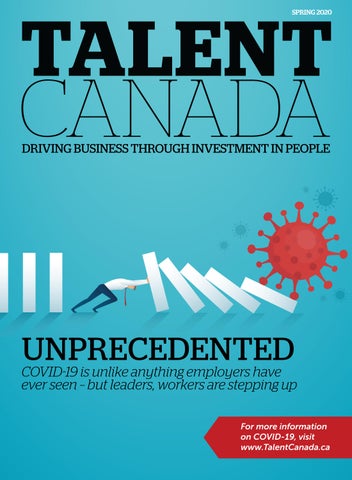
Unprecedented is the only word that works to describe what employers have faced over the last couple of months. See page 8.
8
How employers responded to early days of COVID-19
Results from the exclusive Talent Canada survey of its readers show toll pandemic took on staffing and the bottom line
By Todd Humber
12 Fear, hope and change
Gilbertson Enterprises adjusts to construction in a pandemic - it’s hiring, but the way it operates has changed
By Todd Humber
29 Managers are the key to stopping harassment
The RCMP is facing a $1.1 billion class-action lawsuit that alleges it was negligent in preventing and addressing workplace harassment. Managers have a critical role to play in stamping out this behaviour.
By Bill Howatt and Kelly Vanbuskirk
COVER STORY
BY TODD HUMBER
Unlike anything the modern workplace has ever seen
Unprecedented . The word splashed on the cover of this magazine is the only word that fits these times. As a journalist, I’ve been covering the workplace for more than 20 years — and we’ve never seen anything like COVID-19.
My grandfather lived through the Great Depression in the 1930s, fought his way through Europe in the Second World War and watched as people landed on the moon. But he never experienced a global pandemic.
We haven’t experienced one of this magnitude since the Spanish flu in 1918. There is no rulebook to guide decisions in boardrooms, no sure-fire path to success for companies. But employers, workers and governments across Canada have responded in creative and innovative ways to weather and tame this ferocious beast.
Some industries have been decimated. The restaurant and hospitality sectors were hit hard and fast. Robert Carter of the StratonHunter Group, a consultant in the food services industry, said one in 10 restaurants in Canada have closed permanently. This number could double.
Other industries, though, are thriving. The in-depth stories you’ll find in this issue starting on page 12 tell their story. Pennine Security Solutions can’t hire people fast enough, though their recruitment process has been upended.
Gilbertson Enterprises is pouring just as much concrete as ever — many construction and infrastructure projects are going full out, though some jurisdictions did temporarily pause non-essential work.
Talent Canada’s survey of employers — the results of which you will find starting on page 8 — found that employers are giving what I would call a “tepid” thumbs up for how the federal government has responded. Here, we will endorse the path Ottawa is taking.
It is expensive to the treasury, but it’s an investment that was necessary and it should pay off. Offering employers who are struggling a 75-per-cent wage subsidy is a bold step. Pro -
viding emergency benefits so workers — even those in the gig economy — are helped, is necessary. On-the-fly adjustments have provided emergency loans for business, assistance paying commercial rent, and more.
Is it perfect? No. And it’s not fair to hold that expectation — but the attempt to freeze the economy is laudable, as are efforts to ensure as many employees as possible are still on payrolls, so that when things return to normal the recovery can be faster.
Your employees have been watching, very carefully, how you have responded to the pandemic. This is especially true when it comes to your top talent, the ones who have options and the ones you truly need to sustain business through the crisis and thrive beyond it.
They will remember how you treated employees and the steps you took, for better or worse. Honest and transparent communication always wins the day, and employers who didn’t go that route will learn some hard lessons when COVID-19 fades into history and the economy and job markets rebound.
Your workplace, no matter what industry or sector, is going to change. Over the coming weeks and months, Talent Canada is dedicated to exploring the new realities of working and what this looks like.
We will explore best practices on getting back to work — and watch closely as trends develop. We have seen some of the early consequences: offices being re-arranged to allow physical distancing, the end of hoteling (that practice of not assigning desks) and potentially the death of the time-tested business greeting — the handshake.
Employers that never opened the door to remote work have seen first-hand how business can be done — nearly as well and often better — with telecommuting workers.
Good HR practices are not just recession proof, they are also pandemic proof. They’re not fads; they’re not cost centres. They are an investment in your most important asset. | TC
111 Gordon Baker Road, Suite 400, Toronto, ON M2H 3R1
Publication Mail Agreement #40065710
Printed in Canada
ISSN 2563-0164 (Print)
ISSN 2563-0172 (Online)
Published four times per year (Winter/ Spring/Summer/Fall) by Annex Business Media
CIRCULATION
bolechnowicz@annexbusinessmedia.com Tel: 416-510-5182 • Fax: 416-510-6875 or 416-442-2191
Mail: 111 Gordon Baker Rd., Suite 400, Toronto ON M2H 3R1
SUBSCRIPTION RATES
Canada – 1 Year $ 26.50 (+ applicable tax) Best pricing (Can/USA/foreign) available online at talentcanada.ca
Occasionally, Talent Canada magazine will mail information on behalf of industry-related groups whose products and services we believe may be of interest to you. If you prefer not to receive this information, please contact our circulation department in any of the four ways listed above.
Daniel Gaspar is an articling student with Sherrard Kuzz LLP, one of Canada’s leading employment and labour law firms, representing employers. To learn more and for assistance drafting and implementing employment contracts tailored to your workplace, contact the employment law experts at Sherrard Kuzz LLP
BAD-FAITH DEMOTION GIVES RISE TO SIGNIFICANT DAMAGES
BY DANIEL GASPAR
Constructive dismissal may arise when an employee who has not been expressly terminated claims the employer’s actions amount to a repudiation of the employment contract. If an employee has been constructively dismissed, the employee is entitled to pay in lieu of notice comparable to what would have been received if employment had been terminated without cause and, depending on the severity of the employer’s actions, the employee may also be entitled to aggravated damages.
As a recent Ontario Superior Court of Justice decision — McLean v. Dynacast Ltd., 2019 ONSC 7146 — illustrates, aggravated damages may arise when an employer fails to be candid, reasonable, honest and forthright with an employee.
WHAT HAPPENED?
Christopher McLean had been employed as a unionized maintenance technician with Dynacast for close to 30 years when he was offered and accepted a promotion to the newly created non-unionized position of sales and service technician. He executed a written employment contract entitling him to a salary and sales-based commission.
The contract provided that “any modification to this letter of appointment must be in writing and signed by the parties to it.”
It also contained a termination provision stating “if your employment is terminated without cause, by providing you with remuneration as in accordance with the Employment Standards Act”.
After almost seven years in the new role, McLean was offered a new position refurbishing, maintaining and repairing equipment on the plant floor. Dynacast explained the position change was necessary as sales were down (which was not true). While McLean’s salary would remain unchanged, he would no longer have sales duties or be entitled to commission. Instead, he would be eligible for a bonus based on the amount of refurbishing work he completed.
McLean viewed the new position as a demotion. When he asked Dynacast what would happen if he declined the offer, he was advised he would be deemed to have resigned. This is precisely what happened. McLean, 58 with 35 years’ tenure, declined the offer and was deemed to have resigned. He alleged he was constructively dismissed and sued for wrongful dismissal.
THE COURT FINDS CONSTRUCTIVE DISMISSAL
The court held McLean had been constructively dismissed because:
• a significant portion of the new position involved work of the unionized bargaining unit
• the new work would be on the plant floor and physically demanding; by contrast, his former role was an “office job” where he was able to dress in business casual attire and work in his own office
• the lost commission historically increased McLean’s base compensation by about 10 to 15 per cent a year; this could not be replaced by the proposed bonus target based on work completed
As for McLean’s entitlement to notice of termination or pay in lieu, the court held the termination language in the employment contract did not limit his entitlement to only the Ontario Employment Standards Act, 2000, minimum. Accordingly, McLean was entitled to reasonable notice at common law, which would be significant in light of his age, position and length of service. Generally, “exceptional circumstances” are required before a court will award more than 24 months of reasonable notice. In this case, 28 months was awarded on the basis of:
“… the unilateral breach of the governing contract of employment, the radical reconfiguration of the job description, which in my view amounted to a demotion, the mistaken or misguided rationale proffered for the changes and the domineering attitude taken by the defendant through culminating in the unilateral imposition of the changes.”
Finally, the court held that McLean’s decision not to mitigate by temporarily accepting the new position was reasonable because his return to the plant floor would have been humiliating and embarrassing.
‘BAD FAITH’ WARRANTS ADDITIONAL DAMAGES
In addition to 28 months of notice, the court awarded McLean $25,000 in aggravated/moral damages for bad faith in the manner of its termination. Specifically, the court found Dynacast:
• was aware it could not unilaterally modify the terms of employment, but nonetheless insisted McLean accept the change in position or be deemed to have resigned
• represented to McLean the change to his role was due to a decline in sales when this was “untruthful and misleading”
• placed unreasonable pressure on McLean to accept the role or face a loss of employment without compensation | TC
BRIEFS
Group insurance premiums cut
Canada Life announced it was slashing premiums for employers by 50 per cent for dental and 20 per cent for vision and extended health-care premiums. Premiums for prescription drugs did not decline because it said the services are essential and it had not seen a drop in the number of claims. The reduction was slated to start in early May, retroactive to April 1.
Job postings plunge
The number of positions posted on job boards plunged in midApril, down 43 per cent from 2019 levels, according to Indeed. But there was a glimmer of hope that the economy had hit rock bottom, according to Brendon Bernard, economist at the Indeed Hiring Lab. That’s because the numbers were sta-
bilizing after a rocky couple of weeks in the early days of the pandemic. The pain was felt across all provinces, but Alberta was hardest hit — with the seven-day average of postings down 50 per cent.
Economic activity collapsed in March: Statistics Canada
Of all the numbers that show the impact of COVID-19 on employers, this might be the most telling: economic activity dropped nine per cent in March, the biggest monthly decline ever recorded in Canada. The International Monetary Fund predicts the nation’s economy will contract by 6.2 per cent in 2020.
Alberta could hit 25 per cent unemployment: Premier
Alberta Premier Jason Kenney trotted out a grim statistic, telling an energy conference that the unemployment rate could hit “at least” 25 per cent as a result of COVID-19. That translates to more than 500,000 unemployed workers and the projections didn’t fully account for the collapse in oil prices that
happened in mid-April, when the price temporarily fell below zero dollars a barrel.
Global job toll could be 195 million: UN
The economic toll of shutting down entire economies and ordering workers to stay home is going to be severe. The United Nations said full and partial lockdowns were affecting 2.7 billion workers — or 81 per cent of the global workforce. It expects to see the equivalent of 195 million full-time jobs erased in the second quarter of 2020.
Domestic violence concerns
A Vancouver support society for battered women saw a 300-percent increase in calls in the early weeks of the pandemic amid the stay-at-home orders. Jennifer Charlesworth, British Columbia’s representative for Children and Youth, called it a “perfect storm” because one of the largest groups to report concerns about well-being are teachers and school administrators, and schools are shut down. Employers also have a role to play in reporting suspected domestic violence, by law in some jurisdictions and as a best practice.
Blood test key to returning to work?
Tests that determine whether or not an individual has the
coronavirus antibodies — and is therefore immune and can’t pass it on to others — are being touted by some as a gateway to opening the economy. Workers with the antibodies could safely return to work, and even be seconded to do work in the healthcare sector if necessary. Numerous provinces across Canada are pushing for serology testing to help slow the spread.
Amazon stops operations in France
Amazon pulled the plug in France on April 16 after a court ruled it wasn’t doing enough to protect workers from COVID-19. The court ordered the online retailer to stop selling non-essential goods for one month while it worked out safety measures at its six warehouses in the country. Sales of medicine, hygiene products and food were allowed to continue by the court. But Amazon said the rules were too complex and the fines — potentially 1 million euros for each violation — were too much of a risk. It told workers to stay home as it appealed the ruling and determined how to proceed.
Food supply stressed
Canada’s food supply has been in the spotlight since Day 2 of the outbreak with shortages on grocery store shelves as panic buying set in. But long-term issues have popped up, including
a spate of workers testing positive at meat-processing plants in Ontario and Alberta. And farmers are concerned about a lack of migrant workers to pick fruits and vegetables from the fields. Ottawa is allowing workers in from overseas, but mandating they self-quarantine for 14 days. It set aside $50 million for farmers and food processors to ensure the temporary foreign workers complied with the quarantine. Plans to have unemployed Canadian workers take to the fields have been criticized because they often don’t have the skills or experience, and farms operate on thin margins that rely on efficient workers.
Man arrested for coughing on workers
Police in Edmonton arrested a man — who tested positive for COVID-19 — after he deliberately coughed on a bus driver and then again on officers who arrested him. The man allegedly entered the enclosure protecting the driver on the bus and repeatedly coughed on him. He was charged with assault and contravening an order by the chief medical officer.
Worker run over at Walmart
A security guard in Quebec was fighting for his life in hospital after being deliberately run over by a driver outside a Walmart in Sherbrooke. The man was incensed after being told only one person per vehicle was being allowed inside to shop because of the pandemic. A 25-year-old man was arrested and charged with armed assault with a vehicle, aggravated assault and hit and run.
CEO pay at SNC-Lavalin
Bruce Neil, the former chief executive officer at SNC-Lavalin, earned $7 million in 2019, even though he left the position halfway through the year. That included a base salary of $1.3 million, $4.2 million in share-based awards, a $670,000 bonus and “other compensation” of $891,000. That last figure included the company covering moving costs for his relocation from Montreal to the United Kingdom.
JOB STOPS AND STARTS
16,500 - Air Canada announced plans to rehire 16,500 workers who were laid off before the federal government announced the Canada Emergency Wage Subsidy (CEWS). The airline was among the first to publicly answer federal Finance Minister Bill Morneau’s call to employers to “get ready to rehire people.” The subsidy was available to firms that saw revenues drop 15 per cent in March and 30 per cent for subsequent months. Air Canada said it would qualify in any scenario, as it abruptly reduced its seat capacity by 85 per cent to 90 per cent in early April and reported significant revenue losses.
150 - Samuelsoh, a Montreal-based clothing company that makes high-end menswear, recalled nearly 150 employees after it won a contract to make surgical gowns for the Quebec government. It received an initial order to make 200,000 surgical gowns, and expects to make hundreds of thousands more.
1,500 - Montreal-based CAE announced plans to recall about 1,500 employees thanks to the wage subsidy and a contract it secured to manufacture and supply 10,000 ventilators to the federal government. The first unit was expected to be delivered in early May for certification.
85 - Canopy Growth, the cannabis company based in Smith Falls, Ont., laid off 85 workers, closed facilities and ceased operations in numerous countries. Those cuts came fast on the heels of 500 jobs that were slashed earlier in March, plus 200 retail staff that were let go in April. Many marijuana companies were struggling with cash flow issues even before COVID-19 hit.
1,700 - WestJet announced plans to layoff 1,700 pilots as it struggled to cope with the pandemic. About 700 pilots were to receive notices on May 1, and a further 1,000 would kick in on June 1, according to the Air Line Pilots Association. The news came just one week after WestJet announced it was rehiring 6,400 laid-off workers thanks to the federal 75 per cent wage subsidy.
1,500 - The Halifax Regional Municipality laid off 1,480 workers, targeting casual, temporary and seasonal employees because of the pandemic. That figure included 500 seasonal employees who had yet to start working, but would no longer be hired. The city employs about 5,000 workers in total.
5,200 - Bookstore giant Indigo laid off 5,200 retail employees after it closed locations in mid-March because of COVID-19. But it later announced it was rehiring 545 workers, thanks to the wage subsidy. The workers returning to the payroll are primarily in salaried and leadership roles in retail locations, the company said. It also reported triple-digit growth in online sales as the shopping habits of Canadians changed.
LAYOFFS WIDESPREAD, EMPLOYERS PLAN FOR LONG-TERM PAIN
COVID-19 survey
BY TODD HUMBER
Editor’s note: In early April, Talent Canada conducted a survey of its readers to find out how they were responding to the COVID-19 pandemic. Below you will find the results of the survey, and over the next 11 pages you will hear the real-life stories of how business leaders responded to this unprecedented situation.
Half of Canadian employers have laid off staff because of the COVID-19 pandemic, according to a recent survey by Talent Canada magazine.
The online survey of 182 employers, which took place from April 3 to April 10, found the cuts have been wide and deep at many organizations. Of firms that made cuts, 55.1 per cent had laid off half their staff or more, including 16.3 per cent who had laid off all their employees.
The data provides a snapshot at how the pandemic has affected employers through March and into the
early weeks of April. The job cuts have come fast and furious, and many of the leaders who participated in the survey expect COVID-19 to stick around for a while and impact their business for six months or more.
LONG ROAD AHEAD
Nearly one-half of respondents (43.6 per cent) expect their businesses to be impacted by the pandemic for six months or more.
But nearly as many (40.3 per cent) feel things may improve in the next three to four months.
THE IMPACT ON BUSINESS
The vast majority of companies have seen a negative impact on business because of COVID-19. Just 17.2 per cent said business has not been impacted, while 2.7 per cent said business has actually increased “substantially.”
It’s easy in all the chaos to lose sight of how striking those numbers are — more than one in five respon-
dents to the Talent Canada survey have seen a 75 per cent plus drop in business. It shows just how much some employers are hurting.
EMPLOYERS GIVE OTTAWA MIXED GRADES
The federal government has unveiled some aggressive programs in recent weeks, including the Canada Emergency Wage Subsidy (CEWS). That program will pay employers 75 per cent of a worker’s wages — on the first $58,700 a worker normally earns — for up to 12 weeks. That works out to $847 per week, and it will be retroactive to March 15. Companies that lost 15 per cent of their revenue in March will be eligible. The criteria for April and May will be a 30 per cent drop in revenue.
The survey graded Ottawa’s performance on its response to COVID-19.
Less than one-quarter (23.7 per cent) said they were not satisfied with how Prime Minister Justin Trudeau’s government has respond-
ed for employers.
A slightly larger percentage (27.6 per cent) said they were satisfied while nearly one-half (48.7 per cent) were on the fence.
Though the fine points of the CEWS were worked out during the survey period, employers seemed optimistic about the program. The more employees a company can keep on the payroll, the easier it will be to hit the ground running when the economy starts to open up again.
About one in 10 employers (10.2 per cent) said they were going to recall workers as soon as the CEWS was in place. Nearly one-half (47.2 per cent) weren’t sure, as they were still studying the announcement and almost the same number (42.6 per cent) said Ottawa’s wage subsidy has not changed their decision about laying off workers.
MORE STAFF WORKING FROM HOME
Just over one-third (34.3 per cent) of respondents allowed staff — where appropriate — to work from home
before COVID-19 started shutting down the economy and local and provincial officials started issuing stay-at-home orders.
But by early April, the number of companies with staff working remotely had ballooned to 54.6 per cent. That’s an increase of nearly 60 per cent — a sea-change by any calculation in the number of staff working remotely.
It will be interesting to watch this trend in the long run, because many organizations that have never had staff telecommuting are experiencing it for the first time.
CHALLENGES IN REMOTE WORK
The biggest hurdle identified by business leaders was missing technology. More than four in 10 (42 per cent) said they have had challenges because staff simply don’t have access to the same tools as in the office.
Similarly, 38.2 per cent said there was some jobs that were too difficult or complex to perform
from home — such as handling large files and accounting or payroll issues.
Trust was a fairly significant issue, with 36.6 per cent of leaders stating they had productivity concerns about workers at home — but only 9.9 per cent were concerned about attendance issues.
Relatively few companies — 16.7 per cent — said they were providing workers with financial assistance in setting up home offices.
COMPENSATION, POLICY ISSUES
Employers were far more likely to ask management staff to take pay cuts and forgo bonuses. While 36 per cent of employers had cut executive pay, and 20 per cent had cut management bonuses, only 11 per cent had done the same for employee pay and only eight per cent had slashed staff bonuses.
The message about not asking for a doctor’s note for absences was getting through — 43 per cent said they were not asking for a note. | TC
Do you have staff working from home now because of the pandemic?
Have you taken any of the following measures in response to the COVID-19 pandemic? YES NO
What challenges have arisen when it comes to employees working from home during the pandemic?
How have you been communicating with employees throughout this crisis?
Has your business declined during the pandemic?
Are
in setting up
SUPPORTING YOUR TEAM’S MENTAL HEALTH THROUGH THE TRANSITIONS OF COVID-19
BY LIZ HORVATH
As we navigate through the COVID-19 pandemic and begin to think about how to recover our operations and the economy, it is critical to think about how to build mental health into our emergency management and business continuity plans.
Emergency response and business continuity programs typically focus on minimizing the risk and impact of physical injury, property damage and economic impact. The goal of building mental health into your plans is to minimize the risk of psychological harm to workers and the potential negative impacts to the organization by:
• supporting workers to perform essential work to meet stakeholder needs
• minimizing the risk of mental injury for essential workers and others as we comply with emergency measures
• protecting the mental health of workers as they return to work or return to the physical workplace as emergency measures are eased
• planning for post-pandemic psychological support for workers and their dependents.
Studies of the impact of emergencies and disasters show most of the improvements needed are in the realms of:
• reducing stigma about mental illness
• improving knowledge of signs, symptoms, and interventions
• providing guidance on where to go for support
• improving access to mental health support
• providing an environment with supportive relationships
• empowering managers with good interpersonal skills to be proactive and empathetic in their responses and how they manage the work.
Effective plans for emergency measures and business continuity depend on the outcome of risk assessment and impact analysis. The risk of psychological harm can be assessed using the 14 workplace factors that are known to affect the mental health of workers, which are outlined in the National Standard of Canada on Psychological Health and Safety in the Workplace.
FIVE CRITICAL FACTORS
be applied to reduce risk associated with workplace exposure to psychological stressors. All of the factors are inter-related, so improvements in one will likely result in improvements in others.
TIPS FOR LEADERS
The following are a few suggestions to help you as work continues, or as you begin to hire or reintegrate people back into the workplace after layoff or work from home arrangements.
Provide information about policies, guidelines and procedures that they need to know about in a location where workers can easily find it and communicate about them often.
An infection control protocol should be implemented that includes education about infection prevention and control, screening, disinfection, personal protective equipment, first aid equipment and supplies, and procedures to follow if someone is symptomatic.
The procedures you implement should be in accordance with the level of risk for the worker. Some workers may be at higher risk of infection and higher risk of severe illness or death than others. For example, employees with chronic diseases, transplant patients amd employees with moderate to severe mental illness, among others. Going through emergencies and disasters of any kind can trigger worsening symptoms in a person who is already living with mental illness and can induce the onset of symptoms for someone who is relatively healthy. Research shows that outbreaks of infectious disease can be a precipitating risk factor for mental illness.
“Going through emergencies and disasters of any kind can trigger worsening symptoms in a person who is already living with mental illness”
The control measures that would be needed to minimize the risk of psychological harm can be used to inform emergency management and business continuity programs. The five most critical factors to consider are:
1. Protection of physical safety, which refers to caring how the physical environment affects the worker’s mental health.
2. Psychological and social support, which refers to supportive social interactions and provision of assistance to help with stressors.
3. Balance, which refers to acceptance of the need for a sense of harmony between the demands of personal life, family and work.
4. Workload management, which refers to the ability to complete assigned tasks within the time available.
5. Clear leadership and expectations, which refers to sufficient support to help workers know what they need to do, particularly in times of change.
The hierarchy of risk controls outlined in the Standard should
Identify what support you have available through your organization and in the community for all workers, and in particular for those who are high-risk. Provide education to reduce social stigma and stigma about mental illness, and ask employees to self-identify if they are high-risk.
Encourage them not to let stigma get in the way of protecting their physical and mental health. Be sure to follow legal requirements for confidentiality and privacy. Consider accommodating high-risk workers either through alternative work arrangements or reduced workloads if necessary.
Most importantly, provide a supportive environment where managers, supervisors and other workers are proactive, rather than reactive. This might require training on interpersonal or communication skills, mental health literacy, how to create safe spaces to discuss mental health concerns, how to recognize indicators of mental illness, and how to help a worker in need.
Mental Health First Aid and The Working Mind are two complementary, evidence-based courses offered by the Mental Health Commission of Canada that can help to create a supportive environment.
Liz Horvath is manager, Workplace Mental Health, Opening Minds at the Mental Health Commission of Canada.
FEAR, HOPE AND CHANGE
Gilbertson Enterprises adjusts to construction in a pandemic – it’s hiring, but the way it operates has changed.
BY TODD HUMBER
Bob McKinnon answers his phone, and there’s a big racket going on around him.
Electronic beeps, the sound of passing cars and other indistinguishable sounds reverberate through the phone line. It’s chaos.
“Just let me get back into my truck,” said McKinnon, a crushing supervisor at Gilbertson Enterprises. It’s an aggregates firm based on St. Joseph’s Island in Ontario.
The truck is his solace, a fourwheeled fortress of solitude that drowns out the outside world.
As the line quiets down, he talks about the 14-hour drive ahead of him to the northern Ontario com-
The company was pleasantly surprised at how employees pitched in for each other.
munity of Red Lake, not far from the Manitoba border. He gets a new truck every two years, so the ride is comfortable — if long. And he’s done trips like it many times over the years with construction projects across the province.
What happens in Vegas
In early March, McKinnon and members of his team travelled to Las Vegas to attend ConExpo/ ConAgg, a massive tradeshow that was expected to draw in the neighbourhood of 130,000 attendees from around the world.
In the past, his company would send one employee. This year, it decided to go all out and send four. That event was one of the last ma-
jor conferences to take place in North America, and it shut down early as the reality and scope of the COVID-19 pandemic came into focus.
“The biggest thing was the fear that infected our company,” he said.
The team that went to Vegas all thought they had symptoms of the coronavirus after coming home.
“If you had a sniffle, you thought you had it,” he said. “We lost nine guys overnight (to quarantine and self-isolation) in the crushing area — that was 20 per cent of our team.”
McKinnon said there were two very viable reasons why workers stayed home. First, some had a spouse or family member with an underlying condition that made
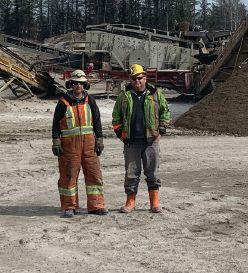
Bob McKinnon (right) at a worksite in Red Lake, Ont. – a 14-hour drive from his home. With him is Chris Anderson, a crusher foreman at Gilbertson Enterprises.
them more susceptible to serious complications if infected. Second, because there is so much travel in the job — like the 14-hour trek he was beginning — there was concern about being exposed.
While none of the workers tested positive, the company made changes to policies and on how work is being done.
Gilbertson has yet to lay any workers off, but it did have employees voluntarily ask to be put on layoff — granting that was something new for the company.
“If they asked, we gave it to them — they get their jobs back, they get their rate of pay back, they don’t lose any seniority,” said McKinnon.
“We understand everything that everybody is going through.”
On the day of our interview, McKinnon went to a management meeting — and social distancing to the extreme was taking place.
“Everybody’s 20 feet apart, not six feet apart. It’s pretty hard to do a roundtable,” he laughed. “We can do it on the phone to a certain extent, but we like to keep our meetings private. We don’t even take our phones into the meeting.”
No decline in business
Business is booming, and Gilbertson has even hired employees to cope with a high workload and a temporary absence of employees.
“The new jobs are not temporary,” he said. “We were shortstaffed going into the winter, and we got a couple of quality guys that had just lost their jobs before COVID-19 started.”
Because their sector has been deemed essential by the province, they are able to keep working. The government is still putting out contracts, awarding contracts and there is a lot of concrete being poured, he said.
A change in philosophy
On the HR side of things, he said
there has been a lot more empathy.
“People are a little more cognizant of their feelings, of why they need a layoff or a day off,” he said.
“People have family. They may have an emergency — a guy comes to work and the kids are still at home, and suddenly everybody’s having a meltdown and he’s like ‘I’ve got to go home.’ You’ve got to let them go home.”
Some staff have elderly parents and they have to do shopping, which can be difficult if they’re working a 12-hour shift.
“They may need to leave a couple of hours early, but guys are covering for them,” said McKinnon. “I’m surprised at how everybody is pitching in for the company and for each other.”
Instead, it is focusing on trying to get its workers a bonus so that when things do open up, they’ll have money to go do something.
With layoffs so rampant, even though his workers are still receiving a paycheque, he knows many of their spouses aren’t.
“Everybody is hurting overall and the morale is down,” he said.
He finds some workers are welcoming a return to work after being home for one week.
“It’s stressful on them; they want to come back to work because it’s easier,” said McKinnon.
He dispenses advice to the team, like going for walks with the “wife and kids and spending time that you’ve never had before.”
“I’ve already had stuff in my life.
“The biggest thing was the fear that infected our company. If you had a sniffle, you thought you had it. We lost nine guys overnight.”
What to do on days off?
One thing that concerns McKinnon is that people are starting to lose a bit of hope for the future.
“It’s like yeah, you can go to work, but what are you going to do on your day off? You can’t go camping. You can’t go on vacation,” he said. “How long is this going to go?”
A lot of the employees work two weeks on, one week off — and the options for that one week off are limited with everything shut down and orders to stay home as much as possible.
Gilbertson is doing what it can to help, though its hands are tied by reality.
“We can’t throw a morale-boosting party,” he said.
I’ve had cancer, so every step you take past that is another day in life,” he said.
“In construction work, it’s high stress. There is high demand, high physical activity and tempers flare up. But you can’t have a temper in this. You can’t get upset, and guys are really stepping up to the plate.”
All in this together
McKinnon points out that everybody on the team is really in the same boat.
“The owner, he can’t go see friends either. He can’t go on a trip; he can’t do what he wants to do,” he said.
In fact, McKinnon said himself — as a supervisor — might have it the worst, because he hears gripes
GAPS IN OTTAWA’S EFFORTS
Gilbertson Enterprises is incurring higher costs to stay open during the pandemic – to the tune of about 10 per cent. But aid from the federal government has been aimed at employers who can’t stay open or who are cutting staff, something McKinnon sounded frustrated about.
about it from workers below him and the owner above him.
“Which is all right, really, because my boss is more or less my best friend,” he said. “We get along really good.”
The company has also been restricting access to the public for its workers when they’re on the job.
“We don’t want you going into corner stores,” he said. Instead, Gilbertson ensures almost everything is available on the jobsite. In the past, workers would get up and go have breakfast at a local restaurant and eat lunch out as well.
“Now, we make all the guys’ meals on site and have all that stuff available,” he said. “Maybe not the snacks or the Red Bull or whatever the guys want to buy extra, but juice and water is on site and available. It has worked out pretty good.”
Grading Ottawa
There is a bit of frustration in McKinnon’s voice about all the help coming from the federal government. Companies that have been hit hard are getting help, but employers like Gilbertson have been left in the cold.
“We know that it’s costing us 10 per cent more to run our business,” he said.
“And the government is not going to help a company that is trying hard to keep people working.”
If Ottawa could help with the cost overruns, perhaps via a tax break, the money would go right into the pockets of employees, he said.
“Pass the 10 per cent to employees. The guys that are making money are the guys that are going to be spending it on construction, buying trucks and at restaurants,” he said.
You can hear in his voice that he wants to give staff a bonus when this is all said and done to thank them and help jumpstart the economy.
Looking ahead
There will undoubtedly be changes in how business is done in the future as a result of the pandemic.
“My boss is 80 and he can see that overall the whole way of doing business is going to change,” he said. “It changed in the depression and it changed after 2007-2008, and it’s going to change again.”
Hygiene is top of mind at the moment — not just in offices but also out in the field.
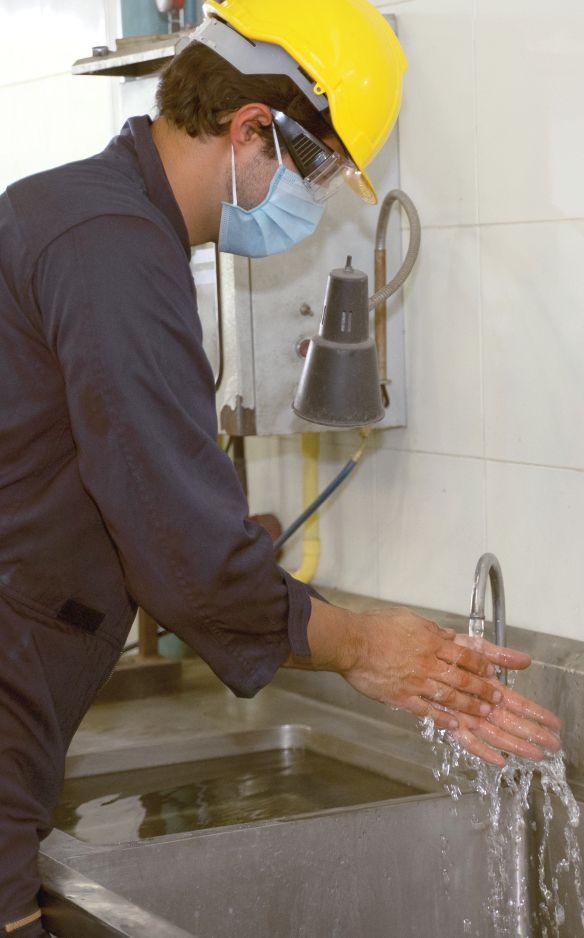
“If you get out of the truck and don’t wash your hands before you get in any piece of equipment, you’re fired,” he said.
“We have to remove you from the site because we don’t know what’s on your hands.”
Equipment is wiped down on the way in, and wiped down on the way out.
“We’re a hot-seat change-out operation,” he said, meaning the
machinery never really stops — just the operator does. “That’s going to change.”
There is now 20 minutes of downtime at shift change. Before COVID-19, it was literally seconds — the time it took one worker to get out and the other to get in.
“You might think it’s overkill, but if something happens — and we didn’t follow the rules — we could be in serious trouble,” he said.
“As long as COVID-19 doesn’t have a vaccine, that’s what is going to happen.”
It means losing a third of an hour’s production twice a day — so you lose two-thirds of an hour over 24 hours.
“Add that up over a year over five crushers, and it’s a lot of money,” he said. “But one COVID case and we have to shut the whole thing down.” | TC
LONGER SHIFTS, PPE AND PLENTY OF LYSOL: COVID-19 AND SECURITY
COO of Pennine Security
proud of how team is coping, says pandemic has put spotlight on importance of employee benefits
BY TODD HUMBER
Idon’t want to alarm anyone, but it’s getting serious and it’s going to hit us hard. Do we have a plan in place?”
That statement, and question — uttered by a supervisor at a Feb. 24 meeting at Pennine Security Solutions — changed everything for the Mississauga, Ont., company, which specializes in security for condo buildings and residences.
Erica Williams, the COO at Pennine, pointed to that moment as the time when COVID-19 stopped being an overseas news curiosity into something very real for her company, her employees, her customers and the country as a whole.
Pennine sprang into action, leaning heavily on its partners who have expertise in emergency preparedness.
“We have quite a number of friends who actually have done pandemic planning — they never thought they would actually use it, but we applied the models to our way of work,” said Williams.
Pennine started modelling how it would run its business if 10 per cent, 20 per cent and 30 per cent of staff were unavailable.
The pace of change in the weeks that followed was stunning, she said — how fast it spread and how serious governments across Canada responded by shutting down the economy.
“We didn’t expect everything to be locked down, that was the last thing we thought would happen,” she said.
CONDO SECURITY
Pennine reached out to its customers — which include the corporations that run condos — to outline how its staff would prepare and to offer advice.
Amenities at the condo buildings had to be shut down, and social distancing measures were put in place for Pennine’s staff working in the lobbies. They put tape on the floors to show the proper
distance from the front desk and put out hand sanitizers.
Workers were given masks and Lysol wipes to use — “we got them before the price went crazy,” she said.
And the information around COVID-19 kept changing, as it was revealed it could survive on surfaces and boxes for long periods of time. The company was lucky, Williams said, because it had a good supply of personal protective equipment (PPE).
There were a lot of tiny details to iron out. For example, it banned employees from sharing pens and worked with delivery companies so parcels could be marked as delivered electronically rather than having to manually sign something.
TRANSPORTATION AND FOOD FOR WORKERS
Pennine has a mobile support unit, something it turned into a chauffeur service for employees who didn’t feel comfortable taking public transit to work. It also changed working hours — instead of having eight-hour shifts, it expanded them to 12 hours.
“That kept our interaction low so there is only one changeover every 24 hours,” said Williams.
It also offered free meals for staff working the longer 12-hour shifts.
“We made a deal with Freshii in Liberty Village (a Toronto neighbourhood). They prep it, and make it fresh and we do curbside pickup and deliver it to each site,” she said.
LAYOFFS
Layoffs were never contemplated at the company, which employs about 250 people throughout southern Ontario. It has been in hiring mode this entire time, as demand for its services has increased in the COVID-19 era.
Grocery stores, for example, have asked for more guards to help control crowds and patrol parking lots, said Williams.
Pennine has been reaching out to former employees to see if they want to come back on the payroll, and it continues to conduct interviews for new hires.
Security work is often what Williams called a “stopgap” job — something people do while in school, waiting to join a police service or going on to other careers. It has lost some staff who had to self-quarantine, or who were afraid to work because they had someone in their home who was elderly or with a compromised immune system.
RECRUITMENT IN A PANDEMIC
There have been some big changes to how the company hires in recent weeks. It used to do a “Walk-In Wednesday” — people were encouraged to come in off the street with a resume and apply. It also attended job fairs to find employees, but both those pipelines have been shut down.
Now, interviews are strictly by appointment only.
“If they pass the phone screen, we invite them in for the first interview,” she said. “If they have the option to have that interview over Facetime or Zoom, we will gladly do that. If they’re more comfortable coming in, we can also do that.”
Because security was deemed essential by the Ontario government, the office remains open. But it’s far from business as usual. When an applicant comes in, there is strict protocol that has to be followed.
Candidates have to wash their hands before they come in, and are handed a pair of gloves and a face mask and
escorted into the boardroom — which has been freshly wiped down with Lysol for each meeting, said Williams. While virtual works for some industries in hiring, it can’t work for security, she said.
They have to sign documents, pick up uniforms and fill out paperwork that can’t be done over the Internet.
The pool of candidates is also smaller than many other sectors, because all security guards have to be licensed. That licence is granted by Service Ontario, and they’re not doing that right now, said Williams. That makes the pool of previous employees so valuable for recruitment.
COMMUNICATIONS
Communicating with staff is a priority, and it comes in all forms. There is a weekly update from the head office, and that is supplemented with daily memos.
“It’s still important for us to show that ‘You’re in the field; we’re in the field, too.’ We’re not going to put you in a dangerous situation.”
“We try to get the managers to do a visit as well, simply because we all believe — even though we’re trying to cut down on face time — it’s still important for us to show that ‘You’re in the field; we’re in the field, too.’ We’re not going to put you in a dangerous situation.”
MORALE
Williams is pleasantly surprised at just how well the teams are coping. Staff are happy hours haven’t been cut, and the company is planning extra compensation for its workers in the range of $2 to $2.50 per hour.
Some companies have referred to it as “hazard pay” but Pennine is purposely avoiding that label.
“We’re doing it as a bonus,” she said. “We really don’t want to call it hazard pay.”
The turnover during the pandemic has been quite low — in the 10 per cent range, something she called “amaz-
Pennine Security, which specializes in condo and residential security, has had to completely revamp its recruitment process during the COVID-19 pandemic.
ing” because the company had been preparing for the worst case — a 20 per cent to 30 per cent reduction.
LOOKING FORWARD
The entire experience with COVID-19 has really but employee benefits in the spotlight, she said.
“We provide health benefits to a lot of our staff, but we make it optional,” she said. “I think I’m not going to make it optional anymore. I don’t want people without benefits, medication, things like that.”
Williams also struck an altruistic tone about the importance of work — and workers earning wages — as the economy recovers. Technology has made off-site monitoring an effective way to provide security with a more profitable margin, she said.
“But I don’t want to go that route because our economy has got to recover after this,” she said. “So we need more people working. I really like our service model and the way we do things — but we will have more guards on our ‘just in case’ list.”
Williams always knew the security industry was insulated from economic downturns.
“I laugh because they always say that security is recession-proof. Well, now we know it’s also pandemic-proof as well.” | TC
The Professional Trainer
Full Accreditation Program on Mixed Media USB Flash Drive
The goal of this program is to teach participants how to assess the need for training, develop the material, prepare the handouts, deliver the content and evaluate the results. Successful completion of all 3 Modules makes you eligible for membership in the Canadian Professional Trainers Association, CPTA, with the RPT (Registered Professional Trainer) designation.
This mixed media package includes a text-based USB Flash Drive with participant workbook and exam. Works on Mac and PC.
regular $945 ... save $200 valid until June 22, 2020 Details at : www.workplace.ca/talent-canada.html
CASE STUDY
COMMUNITY, PEOPLE AND BUSINESS: TERRAPEX’S STRATEGY
CEO gives politicians a passing grade, knows business is changing – and is a fan of transparent and plentiful employee communication
BY TODD HUMBER
Michael Osborne has a new skill to add to his resumé — professional television watcher. Osborne, the CEO of Terrapex, a Toronto-based environmental, geotechnical and health and safety consulting firm with 82 employees, doesn’t usually plant himself in front of the TV during working hours.
But over the last few weeks, as the COVID-19 pandemic swept the globe and shut down economies, that changed.
“My job, until recently, was to watch Trudeau’s or Ford’s press conferences,” he said, referring to the daily briefings by the prime minister and the premier of Ontario. “I did this every day to keep on top of it.”
While government can never be flawless, he gave politicians a passing grade on how everything has been handled when it comes to helping employers. He pointed out that a lot of the questions asked by the media, particularly those for Prime Minister Justin Trudeau, were “Why didn’t you do this?” and “Why didn’t your plan do that?”
“But they put these support programs together so quickly that, of course, they weren’t going to be perfect — but they did a good job,” he said, noting they have continued to tweak them as needed.
Three critical priorities
In the early days, as the scope of the devastation from COVID-19 came into focus, Osborne gathered his management team to discuss how the company would respond. It identified three priorities to focus on, ranked in order:
• social responsibility to the community
• well-being of staff and their families
• sustainability of the business.
Putting the community first may sound altruistic to some, said Osborne. “But it isn’t for us, because we are a service company.”
The management team was united and unanimous in this approach, something Osborne credited to the culture — one that he is “very proud of” — that permeates Terrapex.
Corporate social responsibility
Osborne was humble about the help being given to the community, saying it didn’t do “that much.”
Employees pointed out that the company had an excess stockpile of medical grade gloves. In short order, Terrapex donated two cases to Joseph Brant Hospital in Burlington, Ont., and six cases to the Scarborough Health Network in Toronto’s east end. Small gestures, though, can go a long way.
The real opportunity to make a difference was to have all its employees become ambassadors and models for good behaviour, he said.
“We encouraged staff to be those people who call out others for
not practising social distancing or, if they see any kind of activity that isn’t safe for the community, they call out that behaviour,” he said. “In a good way, not a nasty way.”
Here’s an example: towards the end of March, the company instituted a policy that said only one employee was allowed per vehicle when travelling to job sites. Like many companies, Terrapex uses subcontractors to work on its jobsites. Staff noticed the subcontractors were often arriving with more than one person in their vehicles.
“We debated whether or not we had the authority to tell subcontractors what to do,” said Osborne. “But we decided it didn’t come down to authority. If they weren’t going to practise safe social distancing, we weren’t going to use them.”
Employee well-being
Terrapex made an aggressive staffing decision in the early days of the pandemic.
“Our first response, as the work started to diminish, was to send everybody home,” he said.
The workers were not laid off or fired — they were given two weeks of fully paid “COVID time” while the management team figured out how to respond.
This led to some head-scratching by employees about how to fill out time sheets, but the answer from management was — “this is two weeks of free time,” he said. Stay home, pure and simple.
Where the company has really shone is communication with employees, said Osborne.
“We communicate a ton, and it’s all transparent,” he said.
Terrapex has formed a COVID Management Team — it has representatives from each office, the people and culture team and the health and safety group, among others.
They meet daily via Microsoft Teams and discuss a wide range of topics, including new regulations, clients, workload and how they’re responding. Because the pandemic moves so fast, and it’s difficult to keep up with all the changes, the company created a central online directory to house information so employees have access to the information.
“As early as mid-March, we did a full company teleconference to assure them that the company has their back,” said Osborne. “My personal belief is that the fear of the unknown and uncertainty around the pandemic is probably as dangerous — or more dangerous — than the pandemic itself.”
The communication has been a mix of serious and light — not a “thou shalt not do this” approach but rather using humour where appropriate and providing information on a wide range of topics.
Keeping the business afloat
When the number crunching started, it looked like layoffs might be in the cards.
Osborne expressed some frustration at Ottawa’s Canada Emergency Response Benefit (CERB) — the $2,000 per month payment to workers who have lost work because of COVID-19 but aren’t otherwise eligible for EI benefits.
“Unfortunately, employers can’t top that up — so that threw the plan for a loop,” he said.
Next up was the Canada Emergency Wage Subsidy (CEWS). That’s the 75 per cent wage subsidy available to employers — to a maximum of $847 per week per employee — who have seen revenue declines of at least 15 per cent in March and 30 per cent for subsequent months.
“In March, we didn’t qualify, but it became fairly clear we would qualify in April,” he said. “So instead of layoffs, we would rely on that plan and have communicated to our staff there would be no layoffs until at least mid-May.”
Staff healthy
Nobody on the team at Terrapex has tested positive for COVID-19 to date, but some workers who returned from hotspots in the United States were asked to self-isolate.
There have been some grassroots suggestions from the bottom up that the company has implemented. For example, the one-person-per-vehicle rule came from a front-line employee, said Osborne.
Staff also identified some hygiene concerns. While the company was careful to disinfect any field equipment that staff had to take with them to the jobsite before it left and when it returned, there was no way to decontaminate it during the day. Workers were given gloves to wear, but the system wasn’t perfect.
“We came up with a field disinfection kit — spray bottles with disinfectant, wipes and towels so they can be proactive with site hygiene,” said Osborne.
Light on the horizon
Osborne expects the pandemic to impact his business and society as a whole for some time.
“I think we’re in this for at least the next couple of months, and probably in this for maybe a year-and-a-half before there is a vaccine,” he said. “That’s the only permanent solution.”
But in the short term, he thinks his company has already seen the bottom of the barrel when it comes to its business.
“As our clients become more comfortable with the situation, then if and when restrictions are lifted, it will bounce back,” he said. “I’m not concerned about the viability of our business.”
But the coronavirus could have permanent changes to the way work is done. | TC
DIVERSITY & INCLUSION
RELIGION: THE NEXT FRONTIER
Most employee groups are focused around gender, minorities – but faith groups are gaining
steam
BY MARCEL VANDER WIER
Agrowing trend south of the border has thrust religion back into the HR spotlight.
Faith-based employee groups are gaining steam in the United States, according to Brian Grim, founder and president of the Religious Freedom and Business Foundation in Annapolis, Maryland.
While companies such as American Express and American Airlines have been supporting these groups for 20 years, fresh support from Google, Facebook and Walmart have boosted the popularity of the workplace faith groups, he says.
“There is — just in recent years — an acceleration of that trend among companies such as Walmart, who now
Faith-based groups can have a positive effect on recruitment and retention, as it encourages staff to bring their whole selves into the workplace.
have started their own interfaith employee group,” says Grim. “Others like Salesforce started less than three years ago and it’s now their fastest-growing employee group.”
Largely driven by worker demand, employee faith-based groups have a positive effect on recruitment and retention, as it encourages staff to bring their whole selves to work, he says.
RARE IN CANADA
But the trend hasn’t yet borne fruit north of the border, says Grim.
“In the U.S., there’s more religious involvement of the population, so there’s a wider space for diversity on this issue.”
For now, faith-based employee groups have not yet been popular-
ized in Canada, says Brian Dijkema, vice-president of external affairs for Cardus, a faith-based think tank in Hamilton, Ont.
While religious freedom is regarded as a human right, workplaces are most likely to simply enforce a basic tolerance.
“There is a general consensus that religious freedom is a good thing and that in the workplace, you do want to respect and promote it,” he says.
That is no longer true in Quebec, however, where Bill 21 — preventing some public-sector workers from wearing religious symbols — is essentially state-backed workplace discrimination, says Dijkema.
BEYOND TOLERANCE?
But rather than simply tolerate, organizations would be wise to provide a work environment where staff can fully live out their religious beliefs, he says.
HR departments who allow workers time and space to meditate or pray
are on the right track, moving past accommodation towards encouragement.
“Diversity is very nice if it you can do it without changing anything about yourself or your company — sort of a nice thing that you put on your posters,” says Dijkema.
True diversity is about affirming and engaging, he says.
Religion is often overlooked in the workplace with many refraining from talking faith or politics, says Michael Bach, CEO of the Canadian Centre for Diversity and Inclusion in Toronto.
“We’ve spent a lot of time carefully not talking about religion at work,” he says. “But just as I cannot leave my sexual orientation at the door, I also don’t leave my faith at the door.”
“We’ve spent a lot of time, as employers, trying to avoid the conversation around religion out of fear that we would inevitably alienate somebody. Inevitably, I think what we’ve done is alienated everybody.”
At present, most Canadian employee groups are centred around women and minority groups, but religious groups are worth pursuing, says Bach.
“Just as employers want to be seen as great places to work for women, or for people of colour, for Indigenous people, why not be an employer of choice for people from different religions?”
DIFFERENCE MAKER
The promotion of deep religious difference in the workplace — if handled properly — will lead to a healthier workplace, says Dijkema.
Encouraging the establishment of faith-based employee groups could also be a difference maker in terms of recruitment and retention measures, he says.
“It’s actually taking diversity and inclusion seriously, instead of it just being skin deep — that’s the key,” says Dijkema.
“What ends up happening is that
people realize that businesses that take this seriously are actually being good corporate citizens. They’re recognizing that their customer base, their employee base brings a host of different perspectives into the way they live and follow that up.”
For faith-based employee groups to work appropriately, HR and CEOs should consider them an asset rather than a burden, says Grim.
Additionally, these groups should be grassroots initiatives that fit with company culture, he says.
“It needs to be done in a wellplanned way — one that involves the bottom-up and not top-down,” says Grim. “There are cases where CEOs
“We just want to create space where people can be themselves and not hide something,” he says. “Do it right. Make sure that your code of conduct as an example includes that no one’s allowed to proselytize, so there’s no grey area. Then embrace it, celebrate it.”
Employee faith-based groups should be slanted more towards community than proselytizing, says Bach.
It’s more about moving towards inclusivity — such as moving away from lunch meetings during Ramadan to respect Muslims who may be fasting, he says.
According to Dijkema, while ensuring workers are protected from
Employee faith-based groups should be slanted towards community, not proselytizing.
will think, ‘Oh, this is a great idea. I’m going to start one.’ And then it flops because there was not buy-in from the employees — people weren’t sure what it was.”
Allow employee faith-based groups to grow organically and by staff request, Bach advises employers.
“In my experience, it’s more that the employees — particularly those from different faith groups and religions — that feel like they’re being left out of the diversity and inclusion conversation,” he says.
“A very small percentage of employers have them. It is something that, for whatever reason, either employers have not encouraged it, or people just haven’t stuck up their hand and said, ‘I want this.’”
PROSELYTIZING ISSUES
With thousands of known religions across the globe, employers shouldn’t be afraid to broach the subject, says Bach.
the potential of harassment, blanket anti-proselytization policies should be avoided in favour of respecting religious diversity.
“People do worry about proselytization — I know this comes up routinely,” he says. “There does need to be certain limits on the extent to which, if a person requests you not to talk about it, that you have to respect that and I think that’s where it comes in to play.”
“But the reality is, if you believe something to be true, trying to persuade somebody else that it’s also true — I don’t see how that harms anyone,” says Dijkema. “To what extent does that differ from trying to persuade anybody else about any other particular point of view, including whether you like the Toronto Maple Leafs or not?”
“I’m dead serious about that,” he says. “You should allow the workplace to find its own place in that regard.” | TC
UNHAPPY EMPLOYEES? DON’T GLOSS IT OVER
Joy at work is often overlooked, but there are simple and low-cost solutions
BY JACK BURTON
While you’re always looking for the perfect recipe for building a productive, growth-oriented workforce, chances are you’re probably missing a key ingredient: Happiness.
New research shows that not only is workplace happiness a necessary factor in creating healthy company cultures, but it’s oft-overlooked, to a concerning degree.
Rumeet Billan and Gillian Mandich, of the organization Happy & Resilient, collected data from more than 1,150 respondents between January and February 2020 as part of their Canadian Happiness at Work Study.
It found not only that there was a lack of employees who viewed their workplaces as a source of happiness, but there was also a dearth of resources and policies
from employers to foster it.
“I think organizations need to know that there’s an issue in the workplace where many employees are not experiencing joy, contentment and positive well-being,” Billan said. “Here’s the thing: we spend the majority of our waking hours at work. I don’t know about you, but I would like to enjoy my time at work and the people that I interact with, but also experience joy and contentment and positive well-being.”
High levels of stress
The study also calls attention
THE HAPPINESS INDEX
Is being happy at work important?
73% report it’s very important 88.5% report it impacts productivity
Are Canadians happy at work? 15% are really happy 13.1% are neither happy or unhappy at work
Are staff staying or going?
35.5% think about leaving their organization every day or at least a few times a week
to the widespread prevalence of high-stress workplaces, revealing that 83 per cent of respondents agreed or strongly agreed to feeling stressed out at least once a week. In terms of the factors instilling frequent stress in workers, the findings show that not even one-half of respondents felt a sense of belonging at work (48.6 per cent); appreciated at their workplace (43.6 per cent); or that their workload was manageable (45.7 per cent).
The current state of workplace stress may appear troublesome, but the consequences are even more
demanding of attention. While “a lot of respondents indicated that (stress) impacted productivity,”
Billan also reveals that “over a third of respondents think about leaving their job or organization either every single day or at least a few times a week.”
Low-cost, and free solutions
These findings reframe happiness as more than just an intangible: through factors such as engagement and retention, a lack of happiness in the workplace affects your company’s bottom line. And while the Happiness at Work Study may have revealed some worrisome trends on this front, it’s worth noting that these high-impact issues can be solved with low-cost — or even free — solutions.
“The No. 1 thing that came out of our data about what organizations can do? It’s to listen,” Billan advised. “It was so interesting: as I was looking through the results, I saw how much of (these issues) — appreciation, respect, and communication — have to do with listening. I was kind of taken aback, because this doesn’t cost organizations a thing.”
This call for organizations to listen more to the needs of their workforces comes from the study’s conclusions regarding a number of issues regarding workplace communications. Two-thirds of respondents don’t feel like they receive direct and clear information related to their performance, while three-quarters did not feel that there was adequate communication within their organization.
Psychological safety
The concept of “psychological safety” was brought up by Billan as a key element that both
indicates and influences healthy communication in professional organizations, which she defines as “the degree to which employees feel comfortable and safe to share opinions, thoughts and ideas without fear of negative consequences.”
Though psychological safety may bring much-needed change to the communication issues weighing down employee well-being, it’s also important that these changes begin from the top of the corporate structure.
The need for this change to come from CEOs and key decision-makers is due to the survey’s findings that the majority of respondents “didn’t feel psychologically safe with their board of directors, as well as their superiors or managers.”
It’s only when a sense of comfort is built around employees sharing their own needs and opinions — especially with the knowledge that they will be listened to rather than punished — that a healthy employee culture can begin to grow.
While improving security, communication and engagement all drive positive change in workplace happiness, what’s just as important as developing these strategies is the act of actually implementing them.
“I think on a policy program initiative level, it’s important to ensure that there’s an effective positive well-being strategy,” said Billan. “But it’s also just as important to walk the talk, right?”
Walking the talk
What exactly does it look like for a company to “walk the talk” when it comes to happiness in their workforce?
Billan cited an organization that, in an effort to increase its support for workers and their
WHAT’S CAUSING STRESS AT WORK?
83% experience stress once a week.
Comments from respondents:
“Distractions, inefficiency, mental health concerns of others, communication problems, leadership issues.”
“Poor communication, poor role description and expectations, lack of teamwork and mentorship, micromanagement, not utilizing my skills or knowledge.”
“Frequent state of emergency or panic.”
“Bullying.”
WHAT’S HAPPENING AT WORK?
Less than half of respondents feel: A sense of belonging at work 48.6% Workload is manageable 45.7%
Appreciated at work 43.6%
Psychologically safe 39.1%
Communication key:
33.1% receive direct and clear information related to performance
24.9% say there is effective communication
TIPS FOR ORGANIZATIONS
Respondents were loud and clear:
“Provide good equipment to use, provide wellness and mental health strategies, add more fun to the company culture.”
well-being, “upped what they offered their employees for psychologists from $300 to $3,000.
“That, to me,” she said, “is a fantastic example of walking the talk — saying ‘we believe in (workplace happiness) and we’re going to support it.’”
Warning signs
Billan also highlights a number of indicators that your company may be harbouring low-joy workplaces. Aside from previously-explored factors such as poor communication and stress, other signs that your work culture may need improvement is overall turnover and retention rates, in addition to how employees respond to workload.
“If you notice people aren’t taking their breaks, working through lunch or working long hours, I think that’s a warning sign,” she said.
Another tool to help evaluate workplace happiness is for those in charge to not only look at who or how many amongst their workforce is showing up, but how they are showing up: “I think again absenteeism is important, but also ‘presenteeism’: when employees are at work, are they actually engaged?”
The time for happiness as a key focus of workplace policy decisions may be overdue, but that doesn’t mean it’s too late to be integrating these priorities into company structure — in fact, it’s an opportunity to be part of the new future of employee well-being.
“I do know that (happiness) is becoming a priority that CEOs are beginning to talk about it,” said Billan. “There’s a trend to focus on things that promote well-being and wellness as important, and I think that will continue.” | TC
RECRUITMENT
CLUSTER HIRING: A TREND TO AVOID
Methodology has been popular in tackling post-secondary diversity gaps, but practice may not transition
well to corporate world
BY MARCEL VANDER WIER
While it may be popular in educational circles, cluster hiring does not yet translate well to the corporate world, according to experts.
“It’s become a bit of a fad among universities,” says Creso Sá, professor and co-ordinator for Higher Education program at the University of Toronto. “(But) I’m not sure the situation translates too well from the academic sector.”
Cluster hiring can take on many forms, he says. In the academic experience, it has been used in recruiting multiple professors for their academic experience alongside their fit in a specific interdisciplinary group.
“I’ve been looking out for this for quite a long time — I mean, for 10 to 15 years, I’ve been attentive to it. And in my experience, it’s mostly been limited to universities.”
The practice received major attention on LinkedIn in January,
where it was referred to as the “Hunger Games of hiring.” In that specific instance, cluster hiring was defined as job applicants being split into random groups to craft research proposals for the employer — with those showing the most promise earning the final roles.
But translating this methodology to the corporate setting is a bit fuzzy, according to Rowan O’Grady, president of Hays Canada, a recruitment agency with headquarters in Toronto.
“It just doesn’t sound like a practical idea for experienced individuals,” he says.
DIVERSITY GAINS
Cluster hiring has been occurring in universities for 30 years, says Sá.
Recruitment policies in universities often vary from department to department, with objectives and priorities determined in an ad-hoc fashion, he says.
“You don’t have a whole lot of co-ordination — it’s very decentralized.”
Cluster hiring was a way to set priorities and attempt co-ordination between departments, says Sá.
“On top of that, there have been assertions and boosterism around interdisciplinarity, collaboration and so forth,” he says. “But the first argument was really the driver, which is not the
situation in business, because you have a more centralized process.”
More recently, cluster hiring has also become a way to tackle diversity gaps within universities, says Sá.
“Over time, this has been picked up more,” he says. “The basic argument is not an argument about co-ordination and collaboration… (but rather) instead of bringing in one individual to a department that is not very diverse, we bring a group.”
“They might not necessarily be in the same unit, but we bring these people in together and they have some camaraderie and potentially some mutual help, and they might collaborate and that might help them succeed.”
The practice has been used to boost Indigenous numbers within faculties, for example, says Sá.
“You try to hire five and they come in together and they have that mutual support,” he says. “And also, you try to provide a cluster with some additional resources and some incentives and so on. That’s a more recent trend and that has been done by a few Canadian universities, but on a very small scale.”
CORPORATE CLUSTERS?
Having recruits randomly divided into teams and assigned an exercise with the intent of hiring them as a group seems impractical in corporate settings, says O’Grady.
“I have not heard or seen any companies in the private sector do that,” he says. “I’ve never heard or seen of it actually happening in that way.”
Mass hiring of junior-level workers via assessment centres is more probable, says O’Grady, as prospective employers may desire an opportunity to see how potential recruits interact with their peers and solve problems as a collective.
“It’s not a traditional interview at all. It’s ‘Let’s see them try to do some work. Based on that, we’ll decide on who we want to hire’ … It’s a way of getting a look to see how people work with each other.”
If the clusters were randomized, employers would likely find themselves in a position of picking their favourite recruits from each of the groups, he says.
“I can’t imagine how you could say, ‘We’re going to create these teams. So, you five people are now a team. Do your bit, and then we’ll decide if we want to engage with this five.’ I don’t think anybody would be interested in that.”
Cluster hiring may be effective in research and development, academia and the public sector, but not in the private sector, says O’Grady.
“In IT, in finance and accounting, in construction and real estate, I have not seen that and I would really struggle to understand how it would work.”
‘GOOD INTENTIONS’
In post-secondary situations, clusters are hired with hopes that a group dynamic will be created — though there are no mechanisms in place to actually ensure that happens, says Sá.
“There hasn’t really been any systematic work looking at how
this works,” he says. “There are some good intentions behind it, but there isn’t an incentive or reward structure to drive this forward.”
And with its original design meant to appease post-secondary’s decentralized staff recruitment models, it may not yet translate well to the corporate world, says Sá.
“I don’t see that fundamental problem in just a regular business. You have an HR department — a hierarchy that basically sets the priorities of where hiring is going to happen,” he says. “If you use practices that have been used in universities in business, I don’t see how well that translates or how successful that would be.”
Still, cluster hiring can take many forms and could eventually find success in the private sector, says Sá.
“Business has the tools to turn this into something,” he says.
Sá warns employers from using cluster hiring simply as a public-relations stunt; it should be used only with intent to enact true change.
“I think it would be terrific if companies were launching cluster-hiring initiatives to hire Indigenous people, to hire black Canadians — and use that as a motivator to get 20, 30, 40 Indigenous people in a large organization or the same with other minorities.” | TC
WHAT DOES YOUR BUSINESS NEED TO REACH THE CANADIAN MARKET?
Trying to effectively reach francophone consumers or employees?
Unsure if your existing packaging meets Canadian or US regulatory standards?
Not sure where to start with your Canadian packaging design? Need an affordable solution to make your videos bilingual?
Our small team of Canadian translators, packaging compliance experts and packaging designers can help you access the Canadian market!
THE CASE FOR SLOWING DOWN, AND THINKING
Be more present with ourselves and each other
BY MELINE BEACH
We live in a busy, complex and stressful world where speed trumps quality and connection is expressed by likes, shares and a variety of emojis.
Empathy is a valuable skill for effective connection, communication and leadership. While it seems to always rank in the top five skills that every leader should possess, as evidenced in military training manuals to corporate organizational development programs, it is often underrated and ill-assumed.
Not to confuse it with sympathy, which is based on feelings of sorrow or pity for someone, empathy is rather the ability to imagine and understand the thoughts and emotions of another person from their perspective, by figuratively placing yourself in their shoes, and responding accordingly.
“It is an essential component of emotional intelligence or EQ, which has proven to be more important than IQ in the overall success and trajectory of a leader,” says Janey Piroli, vice-president of global organization-
al development at McCain Foods.
She honed her expertise across 20 years of experience in leadership development, team and executive coaching.
INNATE OR LEARNED?
Considered a right-brain activity, empathy is controlled by a part of the cerebral cortex. This part of the brain allows us to distinguish our own emotional state from that of another person.
According to Prudence Gourguechon, MD, consultant on the psychology of business and dean at Chicago Psychoanalytic Institute, “We are all born with a level of capacity for empathy. A threat or sense of a psychological injury diminishes empathy and can lead us into scapegoating.”
As a mental muscle, our levels of empathy are never fixed and can be flexed appropriately to people and situations. However, it appears that
“We are all born with a level of capacity for empathy. A threat or sense of a psychological injury diminishes empathy and can lead us into scapegoating.”
when there’s stress or strain, empathy is one skill that is often forsaken.
Initial responses to COVID-19 is a prime example. In a time of fear and uncertainty, people’s abrupt and irrational behaviour of hoarding food products and toiletries with complete disregard for others shows how stress and strain can negatively affect empathy, or lack thereof.
Gourguechon, who has been studying human behaviour for over 35 years, adds that empathy is a skill that can also be cultivated through intentional effort. Thankfully, as the initial shock of COVID-19 wore off, many people demonstrated empathy by shifting their thoughts and actions to supporting vulnerable members of society.
Harvey Deutschendorf, an emotional intelligence expert based in Edmonton, believes people are more likely to be empathetic if their parents or guardians were as well.
On a similar note, Donna Letch-
ford, co-founder of Circle Viewpoint, a Toronto-based people first, training and development firm, states that empathy is innate and through a person’s first primary relationship (the attachment between a parent and baby) can flourish or fade. Letchford adds that numerous social and environmental causes over one’s life can affect the strength or weakening of it.
A LEADERSHIP REQUIREMENT
Leaders who have a high level of empathy are better able to relate to and understand the needs of their direct reports, team members and even customers. According to Piroli, this helps build healthier and stronger relationships with higher levels of connection, trust and collaboration, which ultimately leads to higher levels of performance and productivity.
Reversely, a leader who lacks empathy can’t connect well with others. A total lack of empathy can lead people to exhibit very dangerous and damaging behaviours of self-centredness and narcissism.
Kathy Caprino, a Connecticut-based career, leadership and executive coach, works with a number of professionals who bear the brunt of narcissistic behaviour. She warns that a lack of empathy generates challenges in communication and relationship building.
“Simply put, empathy is not something you pull out of a hat and start to use in a crisis or when you need something. It’s a way of living and operating and involves your emotions, language and cognition,” says Caprino. “If you cannot understand, feel or relate to what others experience, and if you can’t sense what others need and want from you, then you’re operating alone and, in a vacuum, and that’s a dangerous place to be as a leader or manager.”
As a therapist, Caprino discovered that leaders unable to demonstrate empathy are often suffering from their own “wounds” — areas in which they feel chronically angry, resentful, unloved, unheard and undervalued — which prevents them from feeling deep concern and care for others. In this case, Caprino states that it’s important to heal yourself first.
WORD OF CAUTION
Charisma is not the same as empathy.
“We have a fundamental human psychological need to join a charismatic, exciting leader who appears brilliant and suggests a riveting experience,” says Gourguechon. “However, the more charismatic someone is, the less empathetic they often are as they’re too focused on themselves than to identify with others.”
One way to see past a charismatic leader’s contagious enthusiasm is to listen to how they talk. Do they speak about profit over people or acknowledge their team’s contribution to the company’s success? Can they think about other people without the lens of their own perspective?
“An ideal leader would be someone who balances both
6BENEFITS OF EMPATHY
Kathy Caprino outlines the following benefits of empathy in our lives, relationships and workplaces.
1. More openminded, openhearted and respectful of others.
2. More objective with ability to regulate own emotions without fear and judgment.
3. More creativity and innovation by encouraging and considering others’ thoughts and ideas.
4. A more diverse and open culture, where different views and approaches are respected and appreciated.
5. Demonstrated care and concern for others and interest in their well-being, growth and success.
6. A more supportive approach to people, helping them feel safe, validated, heard and recognized.
charisma and empathy,” says Gourguechon.
Too empathetic is also a possibility and cause for concern. Deutschendorf warns that if a leader becomes so concerned with pleasing everyone, they become immobilized and unable to make decisions.
IN THE WORKPLACE
Empathy can enter any and all human interactions in the workplace. One of the greatest benefits of having empathy at work is that it fosters an environment of support, trust and inspiration, which leads to engagement, empowerment and inspiration for people to perform their best. Studies show that empathetic leaders also build loyalty, have higher levels of productivity, satisfaction and less absenteeism on their team.
Letchford’s Circle Viewpoint consulting practice focuses on developing a “Culture of Care” through experiential learning in the way that people interact with one another — listen, read and respond with empathy.
What’s the hurry in getting that policy implemented? Driving that organizational change? Or making that business decision that impacts not only your bottom line, but affects your employees, their families and their community?
The ability to pause, actively listen to verbal and non-verbal cues, connect without interruption, ask questions without giving advice and acknowledge the feelings and perceptions of your target audience before reacting are key steps to cultivating empathy.
“Just like me” is a simple practice that Piroli uses in her mindfulness-based emotional intelligence training program, whereby she asks participants to close their eyes and mentally repeat statements said aloud. This exercise encourages participants to think outside themselves and realize we have more in common with each other than we think.
Varun Vashishat, a strategic leader in the financial services industry, participated in one of Piroli’s mindfulness-based training programs and speaks highly of his experience. While he considers himself to be naturally empathetic, the program strengthened his sense of self-awareness and empowered him to tweak his approach to others in the workplace.
“I have more candid conversations with my team and realize that our daily experiences of joy, wins and losses are shared,” says Vashishat. “We are equal contributors and benefit greatly from genuine conversations where we not only hear each other, but we actively listen, which has helped develop a culture of trust and transparency.”
Vashishat has fond memories of great managers he’s worked with before who’ve demonstrated strong empathy skills and the positive effect they’ve had on him. “Even after our paths separated, we were able to retain our friendship — and of course, I would be ecstatic if I had the opportunity to work with them again!” | TC
GUEST COLUMNIST
BY MINA MOVASELLI
Mina Movasseli is a behaviour analyst and founder of Mind the BluePrint. She can be reached at mina@mindtheblueprint.com or visit www.mindtheblueprint.com for more information.
COVID-19 is changing your habits –and it might make you question your job
Behaviours are often viewed as separate from one’s thoughts. But we know different — the simple act of smiling, for example, causes you to be happier and think better thoughts.
So what happens when you start changing your behaviours? We’ve seen a lot of behaviour change recently with people being quarantined.
Change is hard, forced change is different
Changing behaviours can be hard, but sometimes there is no choice in the matter. Most people have not chosen to work from home or stay inside — it was forced onto them by the reality of the pandemic.
This means, for many, personal habits have also undergone a forced change.
Working out at a gym, going to yoga classes or even simply destressing by hanging out with friends after work are all off the table.
When there is little to no alternative to habits, we start to think more. Our minds wander — and we might start listening to them more frequently.
There are a few things guaranteed to happen in this setting — we are going to shop less, buy less and question our life more. With every newscast dedicated to COVID-19, and the world largely shutting down, life choices inevitably start to percolate to the top of our minds.
Isolation makes us go
within, and think about our behaviours, friends, colleagues and place of work.
It makes us question why we spend more time doing one activity over another.
It will also make us more aware of past behaviours and habits. Cooking at home, a very human act, connects us to our inner selves because it is a behaviour so natural throughout evolution — it makes us feel centred.
Being distant from colleagues
Work is a place where you have created a set of routines, consciously or not. When you’re on the job, you are more aware that you are in close contact with others and have less time to think about your personal life.
If you have children, that may seem like a distraction — but they actually keep you in the present. It makes your mind happier, not having to live in the past or future. Again, it helps you see what you value most in life.
This time of questioning leads us to a time of awareness. When we become more aware of what is important, we start seeing our priorities and our values more clearly.
It makes us aware of the toll our work might be taking on our mind and body. In short, it makes us aware of our priorities and whether our workplace is somewhere that deserves the time and attention we give to it.
How your employer responded
If you’re working remotely, one of the things you have had time to reflect on is how your employer reacted to the idea of working from home. When the coronavirus took a turn and became a serious issue, did you still get emails about it being “just a flu?”
That feels like a red flag. Sure, you still have a job but it might come with a feeling of fear of going to work because the company thinks it did its due diligence because it emailed instructions on how to wash your hands.
The true values of organizations come out in times like these and their actions will be memorable.
Some essential workers simply cannot work from home. For them, the point of isolation may seem moot because they’re in close contact with strangers daily.
For these groups, their routine of going to work has not changed. But their thoughts about their employer will drastically change.
Why? While it seems like the rest of the world is in isolation, they have to deal with realities like having to juggle the care of their kids while they go to work. They worry — despite constant emails from managers and HR that reassure them that all is being done to keep them safe — that they are at risk of getting sick and bringing the virus home to their families.
What can you do?
First, identify the thoughts you keep having that make you feel anxious or stressed. Instead of thinking “I am going to get COVID-19,” switch your thoughts to “I am nourishing my body to keep it healthy.”
Second, write a list of what you enjoy doing — things that you temporarily cannot do — and try to find an alternative.
Third, make a list of what you value. For many health will be at the top of the list — and as you go down, notice what old habits didn’t make the cut.
Go back to this list when the quarantine is over so you don’t get back into these old habits that you truly don’t value.
Lastly, do one thing that makes you focus on the present moment. Playing with your pet counts. You can try videos with guided meditation or being grateful for your food and where it came from as you are preparing it.
You’ve had a lot of time to think — and all of this will help you make better decisions with that time. | TC
WORKPLACE HARASSMENT
Bill Howatt is the Ottawa-based president of Howatt HR. For more information, visit www.HowattHR.com. Kelly VanBuskirk is a partner with Lawson Creamer in Saint John, N.B. For more information, visit www.lawsoncreamer.com.
MANAGERS ARE YOUR BEST FRONT LINE IN STOPPING HARASSMENT
BY BILL HOWATT AND KELLY VANBUSKIRK
A$1.1 billion class-action lawsuit against the Royal Canadian Mounted Police is centred on an important claim — mainly, that the RCMP was negligent in preventing and properly addressing workplace harassment. This lawsuit follows a massive sexual harassment class action that cost it more than $100 million to settle. For Canadian employers, the message is clear: an effective “boots on the ground” approach to stop harassment is crucial.
Do managers know what constitutes harassment?
Many employees, including the operations managers tasked with managing workplace behaviours, are unclear as to what kinds of conduct constitutes harassment and bullying.
If an employer’s authority figures don’t know this, they’re unlikely to be successful in preventing or stopping it. Furthermore, even when managers suspect employee behaviour has crossed the line, any one of several factors can discourage proper enforcement of the employer’s anti-harassment policy.
In some cases, harassment and sexual harassment can be mischaracterized as “incivility,” “joking” or “personality conflict.”
These mischaracterizations are used by some managers to justify avoidance of the application of workplace anti-harassment policies or even the issuance of warnings against the misconduct. For employees, failure of managers to effectively address harassment and sexual harassment can signal organizational acceptance of the behaviour.
Even if harassment and sexual harassment are recognized in a workplace, there’s a risk the behaviours won’t be properly addressed.
Why managers need to address harassment
Many workplace harassment and sexual harassment complaints are made to operations managers rather than HR.
Furthermore, managers are strongly positioned to observe and identify harassment harassment behaviours, sometimes in their early stages of development. As a result, managers are the employer’s “boots on the ground” to combat the negative impacts on employee health, operational effectiveness and legal liability.
Six steps
In order to ensure managers have the capability to effectively re-
spond, these steps should be followed:
1. Ensure a well-written, up-to-date anti-harassment policy has been implemented and circulated to all members of the organization.
2. Require managers to study the policy and to participate in thorough training regarding its enforcement.
3. Encourage managers to practice and develop their interpersonal skills to comfortably and effectively enforce the policy.
4. Regularly discuss with managers the organization’s values, including the importance of eliminating workplace harassment.
5. Require regular check-in with managers to reinforce the importance for them to be aware of their behaviour and that of others, and to reinforce the value of no tolerance and no excuses.
6. Discuss challenging cases to ensure that managers are willing and obligated to bring behavioural concerns forward in a timely manner and to seek timely input from their management colleagues.
In Greenwood and Gray v. Canada (RCMP) one issue before the court is the question of the RCMP’s possible negligence in failing to take reasonable steps in its operation or management to provide a work environment that was free from bullying, intimidation and harassment. One defence to such a claim is effectively “due diligence,” or reasonable efforts to combat misconduct of managers.
For employers, the importance of operations managers in those efforts cannot be overstated to prevent unnecessary lawsuits and harm to employees’ mental health. | TC
The RCMP is facing a $1.1 billion class-action lawsuit after it allegedly failed to prevent and address harassment.
Gallagher Canada
“We’re all adjusting to these extraordinary circumstances in different ways, and I’m proud of the team at Gallagher for all the ways we’re staying connected while staying apart. Our team is always up for a little competition, so we’ve hosted a virtual bingo game, a virtual cross-country scavenger hunt, and are on to week three of a wellness challenge with our global team (Canada is in the lead!) Not to mention our walking meetings, the photos we’re sharing and the many virtual coffee, lunch, and happy hours.” — Sarah Beech, area president, Gallagher Canada
TELUS Health
When Canadians got into COVID-19 mode, TELUS Health didn’t miss a beat. Its virtual care solution, Akira by TELUS Health, put out a call for registered nurses and nurse practitioners, and in a matter of days hundreds of clinicians from across the country put their hand up to help. Offering virtual medical consults 24/7 and from anywhere has become more important than ever: Through its platform, Akira offers high-quality health care by text and video
to hundreds of thousands of Canadians. A sincere thank you to all our clinicians!
ADP Canada
“In such a rapidly changing and uncertain time, we’ve seen unprecedented levels of customers and Canadian businesses contacting our teams for important information. As contact volumes skyrocketed, it was a proud moment for us being able to mobilize all parts of the organization to meet this extraordinary demand. Key in succeeding us to timely serve our clients was the ability to adapt, our deep knowledge in work legislation and great technology, which allowed for all of this to happen as a virtual organization.” — Holger Kormann, president of ADP Canada
WordFrog
“My small team of freelancers and I have been handling a large volume of COVID-19-related French and Spanish communications for large corporations, while I have been brushing up on my U.S.A. packaging compliance knowledge to add to our existing Canadian compliance services.
As I’m not able to access my usual office at the beautiful 100 Kellogg building here in London, I have been running WordFrog Inc. entirely from home with two young children, two dogs and my partner in the background.” - Mélanie Bernier, WordFrog Inc.
Mental Health Commission of Canada
In order to stay connected, our team has scheduled virtual “tea
Talent Canada reached out to some of its partners and friends to find out how their businesses are coping during the pandemic. Nobody is going through this alone, and the impacts have been wide ranging — humorous, serious, heartbreaking and inspiring.
time,” where we’re able to find a few moments in our day to participate in a video call with our colleagues. Tea time gives us the chance to a take a break from work and see familiar faces. This voluntary meeting also gives us the opportunity to check in on one another and see how everyone is adjusting.
Rudner Law
“Our firm is pretty unique in the legal world because we are paperless and cloud-based. We are able to work from anywhere so the COVID-19 crisis has not impacted our ability to serve clients. What it has done is reminded us of the need to connect with each other, so in addition to email and extensive use of Google Hangouts to chat throughout the day, we also have regular video meetings.” — Stuart Rudner, founder of Rudner Law
McLuhan & Davies
A global leader in Business Communication training, McLuhan and Davies Communications, Inc. has been providing complimentary webinars to provide critical skills and support during these challenging times. Topics have been driven by requests from the community: how to run more effective virtual meetings; the communication skills
of distress management; interviewing skills. Participants have gained practical tools to help them navigate these challenging times and thrive in the virtual environment.”
Venngo
When the call came for Canadians abroad to get home, car rental companies got to work. They created special offers for those who weren’t able to book airfare. And when they had to reach more of those people in need, they leveraged their partnership with group discount provider Venngo. Since then, Venngo has been working on a wide range of unique client requests. Whether it’s chairs for home offices, or ways to temporarily redeploy their workforce, they’ve reached out to Venngo and its relationships with both brand and group clients to help deliver the necessities of our new normal.
Ultimate Software
Ultimate Software is offering a variety of complimentary resources to keep our people — including our employees, their families, our customers, and our communities — safe, healthy, engaged and productive. Recent examples include daily updates, wellness sessions for employees, public webcasts on HR-related topics, a COVID-19 leadership resource centre for employers, a webinar on navigating COVID-19, and a dedicated Kids’ Corner website to help parents keep their children educated and entertained while working from home. | TC