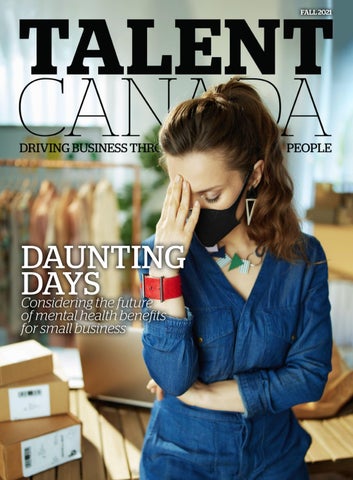
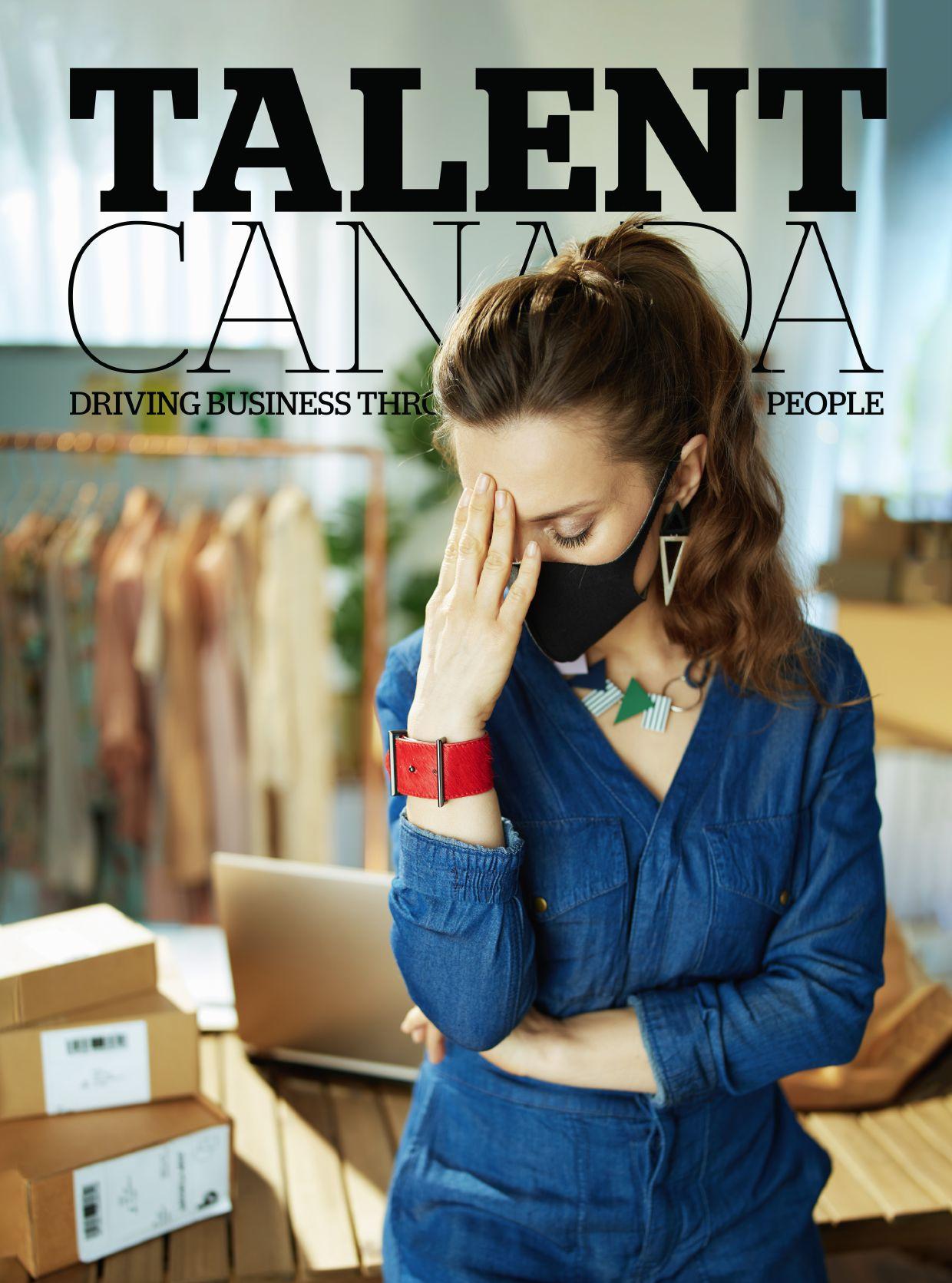
DAUNTING DAYS
Considering the future of mental health benefits for small business
SCAN ME
DEPARTMENTS
4 From the Editor Through COVID-19, leadership has become dangerous work
6 News Briefs
The latest industry news and trends
7 Inclusivity
Workplace diversity and inclusion: What does it really mean?
8 Work Behaviour
What COVID-19 has taught us about work
22 Office Oddities
The stranger side of the modern workplace
ONLINE EXCLUSIVE
Employers vs. workers: Who will win the futureof-work debate?
What every worker needs to remember is that they had a deal with their employer pre-COVID, and for a variety of reasons their employer might want to return to that deal. What every employer needs to remember is that not every employee will want to go back to the old deal now that they have seen the light of the virtual office and the fragility of life.
ON THE COVER
Mental health through COVID-19 is specifically daunting in the context of small business. See page 12.


STORY 12 Right-sizing mental health solutions for small business
Exclusive survey provides insights on psychological needs at Canadian workplaces, and how benefits could help employers begin rebuilding.
By Marcel Vander Wier

16 Labour shortage adds complexity to workplace vaccine mandates
Employers are weighing necessary OH&S benefits of vaccines against potential recruitment obstacles.
By Jack Burton
Aug. 31 implementation gives federal workplaces three years to close gender wage gaps. Will private sector follow suit?
By Jack Burton

BY MARCEL VANDER WIER
Through COVID-19, leadership has become dangerous work
What is happening to Canadian society as we know it?
Since when has taking on a role of leadership in this great country become such a dangerous affair?
Recent days and weeks have revealed various incidents of harassment and vandalism directed towards political leaders.
Liberal Leader Justin Trudeau was pelted with gravel at a campaign stop in London, Ont.
The home and vehicles of St. Catharines, Ont., Mayor Walter Sendzik were vandalized with hateful graffiti.
A raw egg was cracked on the head of Maxime Bernier, leader of the People’s Party of Canada.
Nickel Belt Liberal candidate Marc Serré was assaulted in his campaign office in Sudbury, Ont.
Tack on the anti-vaccine protests taking place in front of hospitals across the country and this is all becoming very unCanadian.
The COVID-19 pandemic has affected all facets of Canadians’ lives, and leaders of all types appear to be the target as tensions boil over.
Messages of “we’re in this together” and “ca va bien aller” have fallen by the wayside for some groups of Canadians as pandemic restrictions continue into their 19th month.
Trust in our societal framework continues to be eroded by the advances of social media, and the cracks are beginning to show. It’s getting ugly. And, as Canadians, we need to be much better than this.
With vaccine passports now being implemented across the country, there is a chance this vitriol begins to be directed towards OH&S
professionals and screening employees who are simply doing their jobs.
To those entrusted with our workplace health and safety, I urge you to continue leading with diligence and professionalism.
For those who say it’s simply time for us all to move on from COVID-19 — unfortunately, that’s now been tried in Alberta, with very poor results.
Jason Kenney’s cry that the pandemic is over in Alberta as of July 1 backfired, and as of press time, the province was returning to a state of health-care crisis less than three months later, with hospitals once again overwhelmed.
Trust in our societal framework continues to be eroded by the advances of social media, and the cracks are beginning to show.
The hard-learned lesson here is that as much as we want to wish this crisis away, it’s not quite that easy.
There’s still some road left in this pandemic, and according to the best experts we have, widespread vaccination is the way out.
As frustrating as it has been, we need to persevere through this trial by holding tight to our roots.
After all, aren’t Canadians best known for being humble and polite, peacekeeping and loving our neighbours? Is not the greatest of these love?
From one Canadian to another, let’s choose to continue to trust the leaders we elected — for the betterment of society as a whole | TC
Fall 2021, Vol. 2, No. 4
Reader Service
Print and digital subscription inquiries or changes, please contact
Beata Olechnowicz, Audience Development Manager
Tel: (416) 510-5182
Fax: (416) 510-6875
Email: bolechnowicz@annexbusinessmedia.com
Mail: 111 Gordon Baker Rd., Suite 400, Toronto, ON M2H 3R1
EDITOR
Marcel Vander Wier
mvanderwier@annexbusinessmedia.com
ACCOUNT MANAGER
Wendy Serrao wserrao@annexbusinessmedia.com
647-628-3610
ACCOUNT COORDINATOR
Trish Ramsay tramsay@annexbusinessmedia.com
MEDIA DESIGNER
Brooke Shaw
GROUP PUBLISHER
Todd Humber thumber@annexbusinessmedia.com
COO
Scott Jamieson sjamieson@annexbusinessmedia.com
MAILING ADDRESS
111 Gordon Baker Road, Suite 400, Toronto, ON M2H 3R1
Publication Mail Agreement #40065710
Printed in Canada
ISSN 2563-0164 (Print)
ISSN 2563-0172 (Online)
Published four times per year (Winter/Spring/ Summer/Fall) by Annex Business Media
SUBSCRIPTION RATES
Canada – 1 Year $ 26.50 (+ applicable tax) Best pricing (Can/USA/foreign) available online at talentcanada.ca
Occasionally, Talent Canada magazine will mail information on behalf of industry-related groups whose products and services we believe may be of interest to you. If you prefer not to receive this information, please contact our circulation department in any of the four ways listed above.
ANNEX PRIVACY OFFICER
privacy@annexbusinessmedia.com Tel: 800-668-2374
No part of the editorial content of this publication may be reprinted without the publisher’s written permission. ©2021 Annex Business Media. All rights reserved. Opinions expressed in this magazine are not necessarily those of the editor or the publisher. No liability is assumed for errors or omissions. All advertising is subject to the publisher’s approval. Such approval does not imply any endorsement of the products or services advertised. Publisher reserves the right to refuse advertising that does not meet the standards of the publication.
Made possible with the support of
The future of business is here.
While businesses keep evolving, CPHRs are bringing their education, expertise and experience to help shape the future of business.
IS YOUR BUSINESS READY?
HIRE A CPHR TODAY.
CPHRBC.CA/BUSINESS


BRIEFS
U.S. mandate takes vaccine decision off employers’
hands
Larger U.S. businesses now won’t have to decide whether to require their employees to get vaccinated against COVID-19. Doing so is now federal policy. President Joe Biden announced sweeping new orders on Sept. 9 that will require employers with more than 100 workers to mandate immunizations or offer weekly testing, the Associated Press reports. The new rules could affect as many as 100 million Americans, although it’s not clear how many of those people are currently unvaccinated.
Ontario to require proof of vaccination in select settings
To further protect Ontarians as the province continues to confront the Delta-driven fourth wave of the COVID-19 pandemic, the government, in consultation with the chief medical officer of health, will require people to be fully vaccinated and provide proof of their vaccination status to access certain businesses and settings starting Sept. 22. Requiring proof of vaccination in these settings reduces risk and is an important step to encourage every last
eligible Ontarian to get their shot, which is critical to protecting the province’s hospital capacity, while also supporting businesses with the tools they need to keep customers safe, stay open and minimize disruptions, the government stated in a news release.
Air Canada’s strict employee vaccine policy could set new workplace bar
Air Canada’s decision not to offer rapid testing as an alternative for employees who refuse to be vaccinated against COVID-19 sets a tough new precedent that other companies may emulate, experts say. The country’s largest airline will require all employees to disclose their vaccination status by Oct. 30, the Canadian Press reports. Employees who don’t have a valid reason for not having their shots, such as a medical exemption, will face consequences “up to and including unpaid leave or termination,” the airline said.
HRPA will not host annual conference in 2022
The Human Resources Professionals Association (HRPA) will not host its traditional annual conference in 2022. The announcement came by way of an Aug. 13 email from HRPA CEO Louise Taylor-Green. “We are
exploring new innovations and are always looking to evolve and improve our approach,” she wrote. “So, for 2022, you won’t see us bring our traditional annual conference back. Rather than host a large conference once a year, HRPA will be bringing you multiple ‘seasonal conferences’ and other virtual events, every few months.”
Ontario extending three-day pandemic sick leave program to end of 2021
Ontario will extend a temporary sick leave program for workers until the end of this year, the Canadian Press reports. Labour Minister Monte McNaughton announced Aug. 31 that the pandemic program set to expire on Sept. 25 would be extended to Dec. 31. He said the spread of the more transmissible Delta variant prompted the move, to give more time for people to get vaccinated and support infected workers. The province introduced three paid days of sick leave in April to accommodate self-isolation requirements during the pandemic, reimbursing employers up to $200 per day for what they pay out.
Amazon to hire 15,000 employees across Canada; increase wages
Amazon Canada will hire 15,000 new warehouse and distribution workers in communities across the country this fall to support its ongoing Canadian expansion plans, the e-commerce giant said Sept. 13, the Canadian Press reports. At the same time, Amazon also announced it will increase the starting wage for its front-line, hourly employees in Canada 27 per cent to $21.65 an hour from
$17 an hour. Existing employees will also receive an additional $1.60 to $2.20 per hour, starting immediately, Amazon said, regardless of how long they’ve been with the company.

Statistics Canada says economy added 90,000 jobs in August
Canada’s economy added 90,000 jobs in August, the third consecutive monthly increase, Statistics Canada reported Sept. 10. The unemployment rate fell to 7.1 per cent for the month, compared with 7.5 per cent in July, bringing the rate to the lowest level since the onset of the pandemic last year. Gains were concentrated in full-time work and in the hard-hit service sector, led by increases in accommodation and food services as restrictions eased in much of the country, the Canadian Press reports. Employment increased in Ontario, Alberta, Saskatchewan and Nova Scotia in August, with little or no change in all other provinces.
WEB POLL:
What will be COVID-19’s lasting effect on the world of work?
• Hybrid workplace ........ 49%
• Widespread remote work 23%
• Increased focus on mental health 18%
• Reinforcement of basic OH&S standards 9%
INCLUSIVITY
BY DANY ASSAF
Dany Assaf is a partner with Torys LLP in Toronto, and the author of Say Please and Thank You, and Stand in Line: One Man’s Story of What Makes Canada Special and How to Keep it that Way.
Workplace diversity and inclusion: What does it really mean?
Today, we are all engaged in efforts to improve diversity and inclusion in our workplaces to strengthen and enrich them for the future.
Businesses that can consistently do that better than their competitors are often the most enduring, innovative, profitable — and can attract and retain the best talent.
But towards that end, as our efforts evolve from identifying past shortcomings, the question turns to: Where do we go from here?
Often, with complicated and intricate issues and the uncertainty surrounding them, it is helpful to pause and reflect on the actual goal of our efforts and work back from there. In the case of any organization and business, it is to ensure it genuinely includes the best people, provides them the best opportunities, and is equipped to fairly recognize and reward each one of us for our contribution.
In other words, the objective is to always strive towards a more and more inclusive meritocracy. It is a critical obligation of every business leader to set the tone and champion this cause.
With this touchstone in mind, we can best gear our efforts within a framework that benefits us all into the future.
TOWARDS AN INCLUSIVE MERITOCRACY
How can we agree on the goal of an inclusive meritocracy?
It remains the only framework for managing the opportunity and expectations of a diverse workforce because it draws upon our common human desire to be recognized for the value of our individual deeds and ideas.

None of us, regardless of our background, wants to be stereotyped or pigeonholed. We all want a platform to be able to soar to unlimited heights and be respected as individuals. This desire is hardwired within us — we just seek platforms that will best allow us to rise.
... it is helpful to pause and reflect on the actual goal of our efforts and work back from there.
While we all accept no one of us is entitled to an outcome, we are all entitled to genuine opportunities in our workplaces and to be fairly recognized and rewarded for our work. We also all feel demoralized and disappointed when we see reward and recognition not based on effort and results.
All of our efforts should be to ultimately create a more perfect meritocracy. Deviations from that otherwise represent some version of sectarianism where we reward one another based on some
identity, rather than the value of our contribution.
This has the potential to pit us against one another and threatens our very idea of work and reward in a market economy; additionally, it is not a sustainable framework.
Fair competition is what we want in the market and the workplace.
CULTIVATING MAXIMUM POTENTIAL
When we think of the concept of diversity in the workplace and beyond, we should also think of the concept of potential — and more importantly, missed potential.
Every business leader’s main responsibility is to make sure they can bring out the maximum potential from every component of their business, and we all know that people are always the most important part.
Businesses that can consistently do that are also often the most innovative because diversity of thought, reasoning, and perspectives pushes us all and instils a rigour to remain on the cutting edge in this increasingly competitive world.
This is also a way to create environments with systems where the whole of efforts is always greater than its parts.
Today, more than ever, leadership demands systematically identifying and dismantling any unjust, illogical, biased or unintended barriers to opportunity, to unlock the potential of those we lead.
We also need to always keep our minds open to the fact that the best person to fill a job or role does not need to look like us, share our background or fulfil any of our preconceived notions of “fit” to honestly assess the requirements.
Inclusive opportunity will bring the best ideas and outcomes in every organization for the benefit of the whole team.
And that is something we can all agree on. | TC

What COVID-19 has taught us about work WORK BEHAVIOUR
IBY MINA MOVASSELI
f something happened today that was unexpected and devastating, you would probably feel a lot of emotions.
Hopefully, at some point while you process it, you would identify the lesson that came from the experience.
Whether that takes days, months or years depends on the person, who they are getting advice from, the situation, and a whole list of factors.
COVID-19 is no different, and it comes with a lot of lessons for workplace leadership.
This is partially because they not only had to think about how to go remote (temporarily or permanently), but also the personal and emotional factors they have to face with their employees going forward.
THIS TIME, IT’S PERSONAL AND BUSINESS
For years, most companies have been trying to get employees to separate their business and personal life.
Even when certain tech companies and start-ups started to bring in a new type of workplace culture that was focused on well-being, it was still frowned upon by many to mix personal and professional — and especially political.
On one end, there are benefits to separating the two worlds, as workplaces that are focused too much on employees’ personal lives have a harder time focusing on getting bigger tasks completed.
Of course, this is dependent on various factors, such as the type of personalities, how well people handle emotions, and of course the level of drama that is discussed — and how frequently.
On the contrary, connecting with

people through personal life stories is a natural part of the mind, and it’s how humans have communicated for centuries.
So, in the work environment when stories are shared, colleagues can feel a sense of community and connection to one another.
However, this has been complicated with remote work, because it is dependent on screen time with colleagues and how much effort leadership puts into creating fun events to connect people virtually.
In further mixing personal and professional lives, COVID-19 has
also placed many workplace leaders in a position to discuss personal situations to identify what kind of remote or flexible work situation people are needing (if that is an option from the employer).
This is on top of figuring out who is and is not vaccinated, and what they should do about their policies going forward, further decreasing the separation between personal life and work life.
Even though it is a safety issue, there are many leaders having to listen to employees about their views on it, which is a major emotional toll.
Mina Movasseli is a behavioral scientist and founder of The Mindful Blueprint in Toronto.
Again, this is being conducted at the same time as needing to figure how to help employees who may be finding it hard to work and deal with the pandemic life, and sharing places for services to help their employees cope.
So, if leaders thought business was a place where the personal was left at home, the pandemic has definitely made it clear that the two are now very related and need to be handled with thorough understanding.
BULLYING IN THE WORKPLACE AND COVID-19
As the lines between personal and professional become more mixed, it increases the chances for people to know one another’s personal views. Especially with COVID-19 and the ample amount of information and access to the internet, many people are choosing a stance — and some are making it clear via social media. This will increase the chances of ostracizing, which is when people leave someone out — a form of bullying.
Leadership has to learn that this is happening and they need to address it going forward.
Because as more people become divided on their views, and policy changes in Canada slowly going towards mandatory vaccines, there will be people feeling like they are not heard or understood, and jobless from it, further creating a divide between employees and a political atmosphere in the workplace, and placing leadership in a position to find ways to create harmony rather than division between their employees.
TECHNOLOGY: FRIEND OR FAUX?
Finding secure ways to communicate and conduct business remotely has become very important to organizations looking to scale during the pandemic.

Some companies who have not figured out how to stay up to date and connected have fallen behind.
This includes those that are able to and are choosing to not provide even one or two days of remote work to their employees.
Workplace community has been complicated by remote work.
Because for them, when the norm becomes partial remote work, the companies without it might only attract certain types of individuals that are willing to come to work, such as those who need separation from their home and kids, or those who need a job and will temporarily work somewhere that is not giving them the same benefits as another competitor.
What COVID-19 has amplified for workplace leadership was the yearning from employees to have the option and freedom to live in places they want to.
Let’s be honest — some people
just function better in a different environment.
With the increase in options of when you go to a coffee shop to different social media platforms, we have become privileged to have options provided to us.
And if it becomes the standard to have a remote work option, then leadership will have to find ways to technologically advance to accommodate the needs of their talent.
In the end, workplace leadership needs to address areas where it might have felt like they should be hands off.
They need to get personal and see that they are very much involved in the lives of their employees and need to find ways to accommodate them in order to keep their talent, rather than getting involved in a way that is controlling and taking away peoples’ freedom. | TC
RETENTION
BY JONATHAN HAMOVITCH
How to retain your employees during office re-openings
As lockdowns lift, most Canadian employers are on the brink of initiating return-to-office protocols amid fears of what’s being monikered as “The Great Resignation” — a global trend birthed by the COVID-19 pandemic that’s poised to see millions of employees switching or quitting their jobs.
Indeed, findings of a recent poll published by Deloitte Canada and LifeWorks claimed that one in four senior managers are considering resignation. Of the 1,200 respondents, 51 per cent considered “leaving, retiring or downshifting from their current organization or position.”
For senior leaders specifically, the relentless pressure to deliver has only been exacerbated by the pandemic, according to Paula Allen, global leader and senior vice-president, research and total well-being at LifeWorks in Toronto.
“In the short term, this increased pressure could lead to behavioural change among senior leadership that trickles down and ultimately causes employee burnout at lower levels. In the longer term, we anticipate seeing a serious risk of turnover among senior leaders,” she said in a media release.
The pandemic has caused people to rethink where they are in their careers, and whether the time is ripe for them to move on and change how they work and where they work from.

As an HR leader, I can vouch for the fact that senior and middle managers are mostly the ones to get caught in the crunch of the workload.
RE-EVALUATING FLEXIBLE HOURS
In hindsight, despite flexible work-from-home (WFH) hours which helped employees with kids, these arrangements changed the flow of a normal, pre-pandemic workday. It didn’t create a natural break between a workday and a non-workday for parents or non-parents.
The fact that employees could take three hours off in the middle of the day to manage personal situations with their kids’ online schooling,
meant they were back at their desks between 8 and 11 p.m. to wrap up their workday.
As such, not having a traditional 9 a.m. to 5 p.m. work schedule brought a separate set of challenges.
Flexible WFH hours for parents ended up impacting those who didn’t have young or adolescent kids at home, as well.
Even if they kept to a regular 9 a.m. to 5 p.m. day, they remained engaged until 11 p.m., as some of their colleagues (perhaps, their bosses) were still on. Employers saw productivity levels shoot up, but employees had no switch-off button.
What’s become evident is that the way employees experienced COVID-19 and WFH was
not homogeneous.
Therefore, employers need to spend more time understanding the unique needs of their employees to engage and retain them.
With return-to-office looming, many are anxious about what they are returning to. Most employees are expecting to return-to-office in a hybrid fashion.
Employers who don’t offer this may end up with retention and recruitment challenges.
SEEKING PRACTICAL SOLUTIONS
To help encourage strong employee engagement, some ways organizations can find longterm solutions for employee retention are:
Jonathan Hamovitch is senior vice-president of talent management at the UJA Federation of Greater Toronto. He is a member of the SCNetwork, a Canadian peer-to-peer HR organization.
Taking the time to listen: Get feedback from employees through surveys or one-toone communications. It’s important to understand the lessons learned from the last 18 months of working remotely — what’s worked, what hasn’t.
Understand that there’s no going back to “the way things were before the pandemic.” Employees want more control and influence over decisions that support organizational bottom lines. Inclusivity, and clear and frequent communications are must-haves.
Fostering a care culture: Employee mental health is a top priority. Therefore, organizations that offer total health and wellness packages emphasizing the importance of not only physical health and safety, but also emotional well-being and purpose, will have a distinct edge over others, when it comes to retention.
Consider consistency, fairness: Determine how important consistency and fairness is versus individualization and meeting individual employee needs. This might be the trickiest to achieve.
Is it OK for one department to say, “people don’t need to come back to work” while another department says, “I want people to come in five days per week?” It’s critical to understand your employee population and figure out how much needs to be customized and how much needs to be mandated across the board.
For example, employers may want to stagger back-tooffice process because some (not all) members of their workforce may be nervous around lunchroom gatherings or taking the elevator.
Start with bringing a third of your workforce back into the office. Observe and re-assess before expanding or rescinding the mandate.
Understand the OH&S component: While committing to workplace health and safety as a primary responsibility, combine the need to be double vaccinated with the flexibility to work from home, if an employer chooses to skip vaccines.
The assumption is that, eventually, the unvaccinated will choose to join their fully vaccinated colleagues in the office over being sequestered at home. However, with the announcement of mandates for federal employees to vaccinate, increasing numbers of corporations will follow suit.
FINDING THE WAY FORWARD
From an HR perspective, the principles that have always stood, still stand. But the way we need to approach those principles to retain, encourage, and motivate our employees needs to be prioritized differently.
At the end of the day, all employees want to be well-communicated with. They want challenging work. They want to get fairly compensated for their contributions to the organization. They want to make sure that organizations invest in their growth and development in a way that gives them future opportunities.
The pandemic has not changed these requirements. But it has changed the way organizations need to modify and implement them to meet the needs of the evolving generations and populations. | TC


RIGHT-SIZING MENTAL HEALTH SOLUTIONS FOR SMALL BUSINESS
Exclusive survey provides insights on mental health needs at Canadian workplaces, and how benefits could help employers begin rebuilding.
BY MARCEL VANDER WIER
It began as a secondary issue at the onset of the COVID-19 pandemic, but as time passes, it’s quickly becoming a bigger priority.
Mental health is now a major talking point at workplaces across Canada, but can be specifically daunting in the context of small business.
Despite emergency government support, small business operators across Canada have borne the brunt of COVID-19. Issues of mental health, burnout and increased stress are all associated with pandemic restrictions and lifestyle alterations.
Looking back at the past 18 months, more than half of small business owners in Canada (55 per cent) say mental health benefits would make a difference to their staff, according to an exclusive survey conducted by Talent Canada

“During the pandemic, everyone had to address the situation in real time as things were unfolding,” said Lisa Villani, regional vice-president, Central and Atlantic, Group Benefits for Sun Life in Toronto. “I think business owners did the best they could with the information and resources available to them.”
Small business owners wear many hats and bear the weight of much stress, she said. “As the pandemic wore on, we saw a significant need from our clients when it came to mental health supports.”
Group benefits providers assisted by offering resources on managing disruption, maintaining organizational health, understanding employee anxiety, leadership skills, and more.
Overwhelming stress has been a major concern for independent business owners through COVID-19,
according to Corinne Pohlmann, senior vice-president of the Canadian Federation of Independent Business (CFIB) in Ottawa. “There’s no doubt this was something that many of them have, obviously, never faced before.”
MENTAL HEALTH BENEFITS SURVEY, ROUNDTABLE
According to the national survey conducted by Talent Canada, in partnership with Sun Life, small business owners used a variety of measures to alleviate the psychological pressures staff faced through the pandemic, including additional time off (60 per cent), flexible work options (58 per cent), and remote work (53 per cent). The online survey was open from Aug. 17 to 30. In total, 277 workplace leaders responded, including 120 representing small business.

On Sept. 13, Talent Canada hosted an exclusive roundtable in partnership with Sun Life to explore the survey results, and discuss the wider context of the future of mental health benefits for small business.
COVID-19 has proved to be a very difficult time for not only workers, but employers as well, said Michael Wood, a longtime small business owner in Ottawa, and professor at Algonquin College.
Much of the stress felt was internalized, he said.
“We’re looking two, three, four, five years down the road for recovery for many small business owners, and right now, mental health across the country is definitely struggling.”
And while negatively affected businesses felt the stress of layoffs and lost revenue, organizations that excelled through the pandemic experienced different pressures in terms of employee safety and continuing productivity, said Mario Maletesta, vice-
president, partner relations, at MGA Distribution in Mississauga, Ont.
“That’s an enormous amount of stress — to be able to continue productivity and keep everybody safe, at a distance.”
MAKING MENTAL HEALTH PRACTICAL
When it comes to small business, are mental health benefits practical?
A large proportion of small employers struggled with attempting to manage employees’ needs through the pandemic, said Pohlmann, citing issues around time constraints, budget and resources.
Where small business owners have an advantage, however, is in terms of close relationships between employer and employee, she said.
“At the end of the day, it comes down to having that communication between an employer and employee that’s going to help anybody dealing with a mental health issue.”
According to Maletesta, benefits providers have worked hard to provide options to employers during COVID-19 — be that employee or employer assistance programs, or digital health platforms like Lumino Health, and virtual care solutions, such as Lumino Health Virtual Care — both from Sun Life.
“Those are some wonderful, additional benefits that have been add-ons, that aren’t necessarily a huge cost,” he said. “Because a benefits program — especially to smaller businesses — it’s an expensive item for them to add on to their bottom line.”
PUSHING THROUGH A PANDEMIC
Regardless of their time constraints through the pandemic, employers did work to assist their workforces through the unique pressures of COVID-19, according to the survey.
Specific mental health supports included: benefits for access to psychologists (44 per cent); mental health toolkits (41 per cent);
SURVEY SAYS...
Small business owners offered the following mental health supports to staff through COVID-19:



access to employee assistance programming (EAP) (41 per cent); and mental health training (39 per cent).
“It’s been a really tough time,” said Wood. “What it comes down to is: if these companies are able to do this... this is great.”
Many employees remain at heightened stress levels as the virus remains prevalent in communities, coupled with children returning to school, he said.
“All of the different things that small businesses can do, that they’re able to do, is definitely amazing and well appreciated by everybody.”
The longer the pandemic lasts, more employers can expect an increase in mental-health related claims and other burnout-related issues from employees, said Maletesta.
“I don’t imagine how anybody could disagree — mental health has skyrocketed,” he said. “The flexibility that employers are allowing, more now than ever, is huge… That will help the stress levels go down, because they have those options.”
Long hours and burnout continue to be factors in mental health issues, added Wood, noting that listening to employees with empathy would go a long way.
“From the owner’s perspective, all the way down to the staff, people are burnt out. They may be looking for changes.”
RIGHT-SIZING MENTAL HEALTH BENEFITS
At present, mental health benefits consist of solutions such as self-guided online sessions,
Specific mental health supports included:
44% benefits for access to psychologists
41% mental health toolkit
41% access to EAP program
39% mental health training

When it comes to the return the office, one in every two employers (53%) expects a full return to work, with the rest split between hybrid and remote opportunities.
virtual or in-person counselling, and customizable spending accounts, Villani said during the roundtable discussion.
“Providing flexible mental health support that fits an employee’s unique needs can empower them to take action — and to take it earlier to improve their mental health and wellness,” she said.
“It’s critical to make it easy for all employees to have access to diverse benefit and wellness solutions — whenever and wherever it serves them best.”
Higher maximums on mental health services are also encouraged to provide “additional and adequate treatment,” said Villani, noting providing options to employees is best practice.
As the conversation around workplace
mental health intensifies, benefits associated with mental health may go mainstream, said Pohlmann, potentially affecting job negotiations in the future.
“From an employer perspective, it makes a lot of sense to try to do what you can to help people through (mental health struggles),” she said. “From a small business perspective, it will be a bit more challenging if it does become a deal breaker.”
Options aren’t plentiful for small employers right now, and packages are “quite expensive,” said Pohlmann, noting many small organizations are enduring budgetary constraints at this time.
“Obviously, whenever there’s a shortage of labour — which is something we’re also trying to deal with right now — these types of things become more important, because employees can ask for them, and they do,” she said.
A variety of plan designs do exist, said Maletesta, even if it’s as simple as a health-care spending account. “Maybe you walk before you run.”
“The introduction of employee assistance programs to more companies that are on the small business side, I think is something that we have to see more.”
COVID-19 EFFECT ON WORKPLACE
Despite the obvious issues and tragic consequences associated with COVID-19, employers responding to Talent Canada’s survey also listed a variety of positive impacts, including: higher productivity, increased flexibility, more time for family, strengthened mental health programs, and an increased awareness of mental health issues.
“The pandemic has proven that people can work from home,” said Wood.
“It gave people an opportunity to reinvent themselves; it gave people an opportunity to reinvent their business.”
There are indeed some silver linings, added Pohlmann.
“It’s fast-tracked a lot of businesses to think about what else they can do. How else can they broaden their business to keep some sort of revenue coming in?”
These improvements won’t go away post-pandemic, she said. “I think that’s a good thing.”
“It’s created, from a business perspective, new opportunities… I think it also helped broaden the understanding of what we need to do to help people through a pretty stressful time,” said Pohlmann.
“When you have basically millions of people going through it at the same time, suddenly it becomes a much more important issue to tackle,” she said.
“Hopefully, going forward, that momentum will continue.” |
THE FUTURE OF MENTAL HEALTH BENEFITS FOR SMALL BUSINESS
Small business owners wear many hats, but the pandemic has strained their capacity like never before.
Lockdowns, workplace safety, supply chain interruptions – the list goes on. Many of you and your employees had to pivot quickly to survive. You did this while dealing with pandemic restrictions that caused significant life and work pressures. This may have dramatically increased stress levels and tested mental health limits.
MEETING THE CHALLENGE
Remarkably, everyone showed tremendous resilience and perseverance. To help employees navigate the changing situation, many of you offered additional mental health supports:
• additional time off to employees
• flexible and remote work options
• access to psychologists through a group benefits plan.
As the pandemic continues, mental health impacts will continue to loom. We know that after traumatic events, many mental health issues surface later.
The good news is that there are additional resources – many free –that can support employee mental health.
MENTAL HEALTH SUPPORTS IS GOOD FOR BUSINESS
Different businesses have different needs. But one constant is the leadership support needed for promoting a strong mental health culture.
A great place to start is to use the free resources available to you and your employees right now.
• Mental Health Strategy Toolkit. Our free online toolkit can help you develop the fundamentals of a workplace mental health strategy. It provides the ‘how to’ versus the ‘what’ for building a strategy, with actionable resources and specific guidance. You can access the toolkit at sunlife.ca/mentalhealthstrategy.
• Online manager training videos. We offer a suite of five online manager mental health training videos. Through these free self-teaching modules, your people leaders learn to:
• identify potential mental health issues in their workplace
• communicate effectively
• help build a healthy environment
• identify and address the stigma related to mental health issues.
• Lumino Health. This is our free digital health platform. It offers health resources to help employees and their families learn how to better manage and improve their mental health.
If you offer a benefits plan, there are many other supports available. These include psychological counselling, virtual care, and more.
MENTAL HEALTH MATTERS – AND YOU CAN MAKE A DIFFERENCE
Positive strategies can play an important role in keeping employees healthy and at work. They can also yield cost savings for business owners from improved productivity and reduced absenteeism.
The pandemic is going to have a lasting impact on all of us. We need to find better ways to support each other, especially at work. We encourage you to visit sunlife.ca/mentalhealth for free resources and information.
When you’re ready, talk to your advisor about building a benefits plan to support the mental well-being of your employees.
To learn more about Sun Life, visit sunlife.ca.
STAFFING IMPACTS VACCINE MANDATES
BY JACK BURTON
With COVID-19 cases trending upward once again, the issue of vaccine passports and workplace vaccine initiatives has only gained more focus in the ongoing discourse around “back to work” protocols and building a safe and engaged staff amongst the turbulence of the pandemic.
In addition to a number of provinces implementing or announcing plans for everyday vaccine passports, workplace vaccine mandates have been announced for employees across numerous industries, such as long-term care home workers in Ontario and British Columbia, along with those in federally-regulated transportation sectors.
These protocols do not come without their fair share of controversy, however.
Complexities stem not only from potential complications that these mandates can have regarding efficient implementation and compliance, but also due to the obstacles that they may pose for employers looking to retain or grow their workforce in a job market characterized by an increasingly problematic labour shortage.
IMPACT ON STAFFING CREATES DIVISIVENESS
Despite the importance of vaccines in preventing the spread of COVID-19, data shows that the potential complications that vaccination mandates can have on workplaces has led to some reluctance and controversy amongst employers in implementing these policies.
A recent poll by the Canadian Federation of Independent Business (CFIB) illuminated the divisiveness of this issue, finding that 48 per cent of their 5,284 members surveyed supported vaccine mandates in their workplaces, with the number increasing to only 55 per cent when these mandates were framed as an alternative to increased lockdown measures.
Koula Vasilopoulos, district president of Western Canada and South America at Robert Half in Calgary, highlighted current staffing difficulties as one factor in this reluctance.
“When it comes to the impact of vaccine mandates on the current skills shortage, as well as recruitment and retention, employers are already struggling to hire talent, and vaccine attestation adds one more hurdle in the recruiting and screening process.”
Among Robert Half’s clients, Vasilopoulos said that the commitment to a vaccinated workforce has manifested in the staffing process through a number of ways.
She noted instances of “employers pulling job offers late in the recruiting process if they find out a candidate isn’t vaccinated,” along with “companies considering ending contract assignments with candidates who aren’t and don’t plan to get vaccinated.”
While these initiatives help employers build toward a safer work environment, Vasilopoulos also pointed out ways that they can disrupt recruitment processes, including lengthening the hiring process so accommodation issues can be explored, such as increased masking and more regular testing, along with the added responsibility of employers having to “navigate accommodation issues and backfill the positions as needed.”
MAKING MANDATES AN OPEN CONVERSATION
With the nuances of this issue, along with the impact it can have on staffing during such a critical time, Vasilopoulos urged communication from employers, saying that, “in today’s talent-short market, setting expectations regarding vaccine requirements from the start is critical.”
Jasmin Guenette, vice-president of national affairs at the CFIB in Montreal, agrees that when it comes to the development and implementation of vaccination mandates in the workplace — especially in the context of the current state of recruitment and retention — fostering an open dialogue is key.
“Talk to your staff; have a meeting and listen to what they have to say, and be respectful to different points of view,” he said.
“Try to achieve your goal in ensuring a safe place to work, without adding any red tape or burdens of cost on your shoulders or that of your business and employees.”
An open discourse around vaccination mandates allows for a work environment that goes beyond just helping employers develop policies that reflect the safety needs of their staff — it allows those employees to feel heard and reaffirms their place as a part of the team, said Guenette.
“Really, it’s about having these conversations and figuring out how to have a safe place to work in, while having the engagement of your employees to make sure that the place is safe and everybody can do the work without worrying too much.” | TC

Jack Burton is a freelance writer in
Talent Canada has partnered with Annex Bookstore to bring you industry-leading titles designed to help busy professionals become more effective leaders.
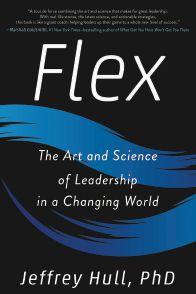
Flex: The Art and Science of Leadership in a Changing World
Changing demographics and structures have led to a seismic shift in terms of the tools needed to successfully manage and grow within a company. From Jeffrey Hull, one of the world’s preeminent leadership coaches, this book is an insightful, indispensable guide to effective leadership with practical tips and the latest evidencebased research, equipping readers with the insights they need to thrive in today’s world.

Engaging Virtual Meetings: Openers, Games, and Activities for Communication, Morale, and Trust
In an era where remote, virtual, and long-distance teams are becoming increasingly useful and necessary, this book is perfect for anyone who manages or works with people in a virtual setting. Bridge the digital divide by incorporating fun and simple activities in your virtual meetings.
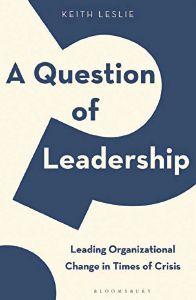
A Question of Leadership: Leading Organizational Change in Times of Crisis
Whether planned or unexpected, change presents leaders with their toughest sustained challenges – regardless of the leader’s seniority or the organization’s size. This book provides a range of illustrative case studies derived from both research and first-hand experience, along with analysis of what works and when, and actionable advice for leaders who find themselves in comparable circumstances..
PAY EQUITY ACT USHERS IN ATTITUDE CHANGE
Aug. 31 implementation gives federal workplaces three years to close gender wage gaps. Will private sector follow suit?
BY JACK BURTON
Since the late 1990s, Ontario and Quebec’s equal pay legislation has aimed to set a precedent of diversity and inclusion in the workplace that has only become more valued and relevant in recent years.
Effective Aug. 31, 2021, the standard set by these policies moves beyond the provincial level with the implementation of the Pay Equity Act for all federal workplaces.
Canada’s Pay Equity Act aims to achieve salary parity amongst men and women, seeking to attain this goal through an initiative that gives employers three years to develop and enforce a set of rules and requirements in identifying and correcting gender discrimination regarding compensation for roles of similar job classes.
“More so than many other statutes, the Pay Equity Act is quite narrow and specific in its main objective — to close the gender wage gap and ensure that workers receive equal pay for work of equal value,” according to Dasha Peregoudova, a labour and employment lawyer at Aird & Berlis in Toronto.
The relatively straightforward aim of the Pay Equity Act does not make its implementation any less necessary or important, she said, highlighting that “practically speaking, the biggest impact should be on women who, according to the most recent data, still earn 89 cents of every dollar a man earns in a role of similar value.”
Despite federal work environments being the focus of the Pay Equity Act, Peregoudova sees the act’s implementation as a potential catalyst in moving provincial governments to introduce similar legislation that extends to the private sector as well.
If introduced, Peregoudova believes that while provincially-mandated pay equity in the private sector may likely still revolve around current, complaints-based protocols, the presence of legislation still places “obligations on employers (that) will no doubt result in more proactive compliance through self-assessment and expert consultation.”
CHANGING THEORIES ON COMPENSATION
The Pay Equity Act’s influence beyond the public sector may also be noticeable in setting compensation standards for workplaces

across the country, said Cynthia MacFarlane, a principal at Mercer Canada in Ottawa, and one of the heads of the organization’s federal pay equity response team.
She believes that after being introduced in federal workplaces, pay equity “might become an attraction and retention type of tool, where the private sector might have to be able to demonstrate that, ‘Yes, we are also very aware of where our male and female employees fall and are protected under the Human Rights Act.’”
By taking cues from federal workplaces, MacFarlane said that employers in the private sector can communicate to both their employees and peers an attitude of recognition and proactivity when dealing with any pay gaps or systemic biases that may be embedded in the company’s culture.
“We could see that becoming something organizations are going to have to say; that they’ve done something to make sure that things are fair.”
STRIVING BEYOND COMPLIANCE
Whether one’s workplace is directly affected by the measures of the Pay Equity Act, or if private sector employers are simply inspired to emphasize equal pay as a core company value, MacFarlane urges that the matter not simply be one of complying to a policy, but also of communicating the values driving those actions.
This means that in their approach, employers should go beyond just following the required rules; she said it is key for employers to broadcast and communicate across all levels of the company culture that being an equal pay workplace is something that they believe in and take seriously.
“That’s one ‘best practice’ we think is important,” said MacFarlane, “where you can take the spirit of all the communications that you have to give to the committee, and think about the real messaging that you want to spread to the entire employee population.” |
FEDERAL ELECTION
RECOVERY TAKES CENTRE STAGE
BY JACK BURTON
Announced a little more than a month before voting day, Canada’s Sept. 20 federal election adds another wrinkle to the current moment of uncertainty.
Specifically, the state of the economy and workforce that candidates currently face is more than just a series of talking points to win favour with business-minded voters — for many employers, it’s an urgent issue that requires a clear solution as soon as possible.
Lydia Miljan, a professor of political science at the University of Windsor in Ontario, pointed to recent market data showing economic retraction and inflationary pressure as two significant influences pushing candidates to focus on economic recovery, especially for employers and business owners.
“There’s a lot of complications that happen when you have the economy shut down for 18 months, and that all is part of the uncertainty,” she said. “Workplaces have contracted, and we have a supply chain issue with so many (industries). If you’re a business that wants to grow — even if you have your full workforce back — you might not be able to do the job because of these supply chain issues.”
DIFFERENT PATHS TO ECONOMIC SUPPORT
The demand for action in the immediate term makes voting in the 2021 election an act of survival for many employers, but which decision is the right one?
Miljan sees the primary distinction between the Liberal and Conservatives’ economic platforms to be in where their support lies, with the Liberals focusing on
worker initiatives and the Conservatives banking on business loans.
Different approaches to smoothing out Canada’s current economic issues continue to be consistent among all of the parties.
The NDP offers a more intense version of the Liberals’ focus on worker support, advocating for more accessible job training, paid sick leave and child-care benefits, a more robust minimum wage and employment insurance (EI) system, and stronger bargaining rights.
Both the Green Party and People’s Party of Canada (PPC) are focusing on larger trends of economic regulation, specifically corporate bailouts.
The Green Party seeks to establish a stronger system of corporate bailout accountability by tying them to workforce maintenance and performance requirements, while the PPC aims to increase Canada’s investment accessibility for both domestic and foreign entities by limiting government intervention through initiatives such as the abolishment of corporate subsidies and capital gains tax.
At the centre of the Liberals’ worker support platform is their affordable daycare policy. Miljan explained that the hope with this policy is that “if you have subsidized daycare for women, more women will be in the workforce and the economy will grow.”
While sound, she is doubtful that the length of implementation that these policies require would satisfy any acute economic demands. “The problem with that plan is that they admit that it’s going to take up to five years to get into place, and that’s not going to be the shot in the arm we need.”
The Conservatives’ grant and loan initiatives, according to Miljan, shows that they are at least mindful that the hardest hit of
the pandemic were smaller, “mom and pop” businesses and main-street Canada. “By giving them supports to help them come back, I think that might be a better short-term solution.”
EQUALITY A WAY TO PERMANENT RECOVERY
While equality-minded policies such as the child-care support of the Liberals’ platform may require more patience, Amanda Bittner, a professor of political science at Newfoundland’s Memorial University, believes that no matter the timeline, a more equal economy is the only permanent fix to both the current turbulence and further regression.
“There are major issues that keep women out of the workforce, including child care,” she said. “Until we take the needs of families seriously, we will be unable to right the ship and solve the problems of either the economy or equality.”
No matter the decision employers end up making, Bittner advocates that it be made out of consideration for the needs of the entire workplace, rather than just its impact on the immediate bottom line.
“Based on the last 18 months in particular, I would say that COVID-19 has laid bare some facts that have been true for quite some time, and I would guess that employers are thinking about this,” she said. “I anticipate that all governments in the future will take seriously the need for a real economic recovery — one that incorporates the needs of the most vulnerable and those who have suffered the most during this pandemic, including front-line workers.”
On Sept. 20, Canada re-elected a minority Liberal government, led by Prime Minister Justin Trudeau. | TC
OFFICE ODDITIES
Trudeau pelted with rocks at election campaign stop in London, Ont.
Police in London, Ont., have concluded an investigation after someone threw gravel at Liberal Leader Justin Trudeau during a campaign event on Sept. 6, the Canadian Press reports. Trudeau told reporters he felt the gravel hit him but was not hurt. The stones not only struck Trudeau, but also some members of his RCMP protective detail and journalists covering the campaign. Trudeau was there to discuss the Liberals’ plan for housing, but spent most of the news conference instead answering questions again about the security of his campaign. Later that week, police charged Shane Marshall, 25, with one count of assault with a weapon. Marshall was the People’s Party of Canada’s Elgin-Middlesex-London Riding Association president, but was removed from his position following the incident. Trudeau went on to lead his party to a minority government in Canada on Sept. 20.
B.C. cabbie finally gets cheque for wages owed
Roughly 10 months after his former employer was ordered to pay him nearly $19,000, Lloyd Pedersen has finally received a cheque, according to the Prince George Citizen. Pederson has been waiting since the end of August 2020, when a B.C. Employment Standards Branch delegate found Emerald Taxi owed him $18,967.11. Some $13,482.78 was for the time he spent behind the wheel while earning less than minimum wage and a further $5,844.33 for vacation pay and additional pay for working statutory holidays and overtime, as well as interest. But Emerald twice appealed the decision to the B.C. Employment Standards Tribunal. Both appeals were denied, largely because Emerald failed to provide new evidence that would overturn the original decision.

Florida governor threatens cities with fines for vaccine mandates
Florida Gov. Ron DeSantis on Sept. 13 threatened local governments with US$5,000 fines per violation for requiring their employees to get vaccinated against the coronavirus that has overrun hospitals and killed tens of thousands across the state. Local municipalities potentially face millions of dollars in cumulative fines for implementing a requirement that their employees get a COVID-19 vaccine, the Republican governor said. “We are not going to let people be fired because of a vaccine mandate,” DeSantis said at a news conference, the Associated Press reports. “You don’t just cast aside people who have been serving faithfully over this issue, over what is basically a personal choice on their individual health.”
Man urinates inside B.C. business after request to wear mask
Port Alberni RCMP are looking to identify a suspect who urinated on the floor and counter of a local business on Vancouver Island after being refused service for refusing to wear a mask. On Aug. 28 just before 9 p.m., police were called to a disturbance at a local restaurant on 3rd Avenue. The complainant said that an unknown man had been in the restaurant and was causing a disturbance at the front counter by not wearing a mask. Staff there got into a heated discussion with him and he was asked to leave. The suspect initially left the business, only to return shortly after. He pulled down his pants and began to urinate on the floor directly in front of the till, much to the shock and screams of staff and customers, said media relations officer sergeant Chris Manseau.
Florida, domestic violence agency settle fight over CEO pay

Florida will receive US$5 million in a settlement with a non-profit domestic violence agency and its former CEO, who were sued over exorbitant pay the state said should have gone to domestic abuse shelters, Attorney General Ashley Moody announced Aug. 26, the Associated Press reports. The state investigated the Florida Coalition Against Domestic Violence after learning president and CEO Tiffany Carr received $7.5 million in compensation — much of it in paid time off — for the three years before she resigned in November 2019. Carr stacked the non-profit’s board of directors, which then approved bonuses, raises and paid time off with unspent money that should have been returned to the state at the end of the fiscal year, Moody said.
Pandemic court leniencies keep woman convicted of defrauding employer out of jail
A 39-year-old bookkeeper entered a guilty plea to a fraud-related charge involving her former employer but avoided a jail sentence in June at the Medicine Hat Court of Queen’s Bench. But Bobbi-Lee Stubbins’ plea deal to a lesser charge of fraudulent concealment from fraud over $5,000 won’t be finalized just yet after Justice Dallas Miller raised concerns regarding the joint defence-Crown sentencing submission. The court heard Stubbins’ was employed at a local crane business when its owner notified police of suspicious e-transfer transactions amounting to nearly $15,000 during the first five months of 2018, according to the Medicine Hat News.
Learn, Connect and Grow
Join CPHR Alberta as a general member today and stay updated on HR industry trends and changes, receive access to exclusive member perks and build your network with our engaged community. Our general members include over 800 industry professionals across Alberta including vendors, partners, educators, payroll professionals, coaches and more. Join us today!











Whether your employees are healthy, experiencing symptoms or recovering, we’re here to support them. And we’ll work with you to develop a plan to make your workplace thrive.
Discover how we can help your employees find real health.