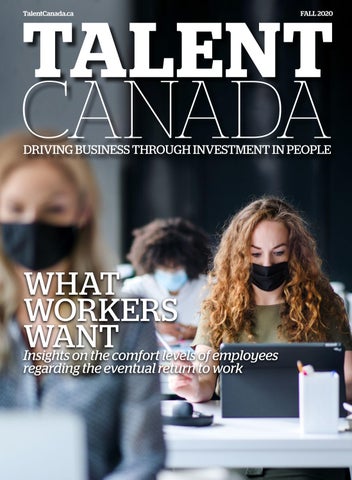

WHAT WORKERS WANT
Insights on the comfort levels of employees regarding the eventual return to work

This Fall, we will be offering virtual seats for many of our programs. What does a Queen’s IRC virtual seat look like? Please contact us today for more details.
■ Coaching Skills / Oct. 20-23, 2020 (half days)
■ Strategies for Workplace Conicts / Oct. 26-29, 2020 (half days)
■ Linking HR Strategy to Business Strategy / Oct. 27-29, 2020 (full days)
■ Change Management / Nov. 2-6, 2020 (half days)
■ OD Foundations / Nov. 3-6, 2020 (full days)
■ Managing Unionized Environments / Nov. 16-19, 2020 (partial days)
■ Performance Management / Nov. 16-17 & 24-25, 2020 (half days)
■ HR Metrics & Analytics / Nov. 24-26, 2020 (full days)
■ Mastering Fact-Finding & Investigation / Nov. 30- Dec. 4, 2020 (partial days)
■ Organizational Design / Dec. 7-11, 2020 (half days)
4 From the Editor
6 News Briefs/ Stops & Starts
8 Work Behaviour
Re-engaging staff after COVID-19 lockdowns
9 Diversity & Inclusion
Being a representative of representation
10 Legal View
Rethinking health benefits through COVID-19
11 Health & Safety
Steps on making the return to work safe
20 Human Resources
Reimagining the office in a post-COVID environment
Virtual Webinar
Full coverage of our recent Workplace Mental Health roundtable event is now available at TalentCanada. ca. Tune in for the discussion on practical, real-life mental health solutions through the COVID-19 pandemic.
ON THE COVER
Seven in 10 employees currently working remotely are uncomfortable with the prospect of returning to their jobsite during COVID-19. (Page 12)



Exclusive survey and virtual roundtable provide insights on comfort levels of employees for the eventual return to jobsites during COVID-19.
By Marcel Vander Wier

Research concludes effects of the pandemic were “more pronounced for workers who are younger, unmarried or less educated.”
By Pierre Chauvin
Having a stable of skilled, performance-driving talent to lead your team down this uncertain path is key.
By Jack Burton
Virtual roundtable unveils tactics to manage costs through the COVID-19 pandemic – and beyond.

Burnt out by COVID-19? Keep calm and carry on FROM THE EDITOR
TBY MARCEL VANDER WIER
here’s no other way to put it — the last six months have been a wild and exhausting journey.
The COVID-19 pandemic and ensuing lockdown measures blew in largely without warning in March — and the storm continues to rage across the world to this day.
We have worked hard as a society to realize some new sense of normal through it all.
Schools have reopened and many businesses have managed to find a way to cope through new guidelines on distancing and personal protective equipment.
Still, our top doctors and medical experts are currently warning of a second wave of COVID-19 cases this fall and the end date to this crisis continues to remain unknown.
All of this points to a sombre winter of more social distancing and isolation, until — yes — a vaccine is generated or some other solution is realized.
I’m fully aware that not all Canadians are on board with the health and safety policies put in place by this government. A quick pass through social media timelines unveils the dissent and nationwide polls confirm it.
But remember, we are only a few months removed from the army’s takeover of various long-term care homes in Ontario and Quebec. This is a serious health issue and we need to treat it as such.
It’s important to remember the current emergency situation is not forever. This too shall pass, though the ramifications of this global pandemic will likely be felt for a while.
I’m not sure where you’re at, but from my vantage point, I remain impressed with the efforts of the majority of Canadians to initially flatten the curve and now further prevent the spread of the novel coronavirus.
I have faith in the resiliency of humankind and in our country’s leaders to serve us to the best of their ability. We will get through this — and we’ll do it together. Please, let’s all do our best to keep calm and carry on.
What does the future hold for Canadian employers and organizational leaders?
The world of work is quickly changing, as this issue of Talent Canada reveals. Corporate culture, diversity, benefits, health and safety policy and retention in a remote environment all go under the microscope in the pages to come.
Our exclusive survey on what employees desire in the return to work takes centre stage, with seven in 10 of those currently working out of office revealing they are uncomfortable with a return during the pandemic.
Benefits for small and medium-sized business owners are also highlighted in this issue, with a call for plans to become more nimble to better serve workers during the pandemic.
Workers’ mental health through these times is another topic of high interest. Our virtual roundtable event — featuring some of Canada’s brightest minds in this area — is now available online. It unveils actionable strategies for managers to better assist workers by increasing resilience and avoiding burnout.
As for our nation’s leaders, they continue to have our backs. Billions have already been spent to assist displaced employees as well as cover rent for organizations in need.
The Sept. 23 speech from the throne indicates further support — no matter the cost. A broader Canada Emergency Wage Subsidy will be extended into next summer, and a transitional Canada Recovery Benefit will assist those who don’t qualify for expanded EI.
And the support won’t end there. Provincial and territorial governments will also be unveiling new plans in the coming weeks as the fall legislative season begins.
For our part, we will continue to provide timely reports on these impactful changes and provide best practices for employers.
Make sure to visit TalentCanada.ca on a daily basis to discover the most up-to-date information and news affecting Canadian workplaces. | TC
Fall 2020, Vol. 1, No. 4
EDITOR
Marcel Vander Wier mvanderwier@annexbusinessmedia.com
ACCOUNT MANAGER
Wendy Serrao wserrao@annexbusinessmedia.com 647-628-3610
ACCOUNT COORDINATOR
Trish Ramsay tramsay@annexbusinessmedia.com
MEDIA DESIGNER
Brooke Shaw
CIRCULATION MANAGER
Beata Olechnowicz bolechnowicz@annexbusinessmedia.com 416-510-5182
GROUP PUBLISHER
Todd Humber thumber@annexbusinessmedia.com
COO
Scott Jamieson sjamieson@annexbusinessmedia.com
MAILING ADDRESS
111 Gordon Baker Road, Suite 400, Toronto, ON M2H 3R1
Publication Mail Agreement #40065710
Printed in Canada
ISSN 2563-0164 (Print)
ISSN 2563-0172 (Online)
Published four times per year (Winter/ Spring/Summer/Fall) by Annex Business Media
CIRCULATION
bolechnowicz@annexbusinessmedia.com
Tel: 416-510-5182 • Fax: 416-510-6875 or 416-442-2191
Mail: 111 Gordon Baker Rd., Suite 400, Toronto ON M2H 3R1
SUBSCRIPTION RATES
Canada – 1 Year $ 26.50 (+ applicable tax) Best pricing (Can/USA/foreign) available online at talentcanada.ca
Occasionally, Talent Canada magazine will mail information on behalf of industry-related groups whose products and services we believe may be of interest to you. If you prefer not to receive this information, please contact our circulation department in any of the four ways listed above.
ANNEX PRIVACY OFFICER
privacy@annexbusinessmedia.com
Tel: 800-668-2374
No part of the editorial content of this publication may be reprinted without the publisher’s written permission. ©2020 Annex Publishing and Printing Inc. All rights reserved. Opinions expressed in this magazine are not necessarily those of the editor or the publisher. No liability is assumed for errors or omissions. All advertising is subject to the publisher’s approval. Such approval does not imply any endorsement of the products or services advertised. Publisher reserves the right to refuse advertising that does not meet the standards of the publication.



REAL HEALTH SOLUTIONS






BRIEFS
Prime minister, cabinet meet to plan way forward
OTTAWA — Prime Minister Justin Trudeau and his cabinet took two days in mid-September to plot Canada’s path through what remains of the COVID-19 pandemic. The planning retreat was meant to focus on the throne speech set for Sept. 23. According to the Canadian Press, the speech is expected to include three main priorities: the measures needed to protect Canadians’ health and avoid another national lockdown; the economic supports needed to help keep Canadians financially afloat while the pandemic continues; and longer-term measures to eventually rebuild the economy.
Ontario premier cracks down on social gatherings
TORONTO — Social gatherings in Toronto, Ottawa and the Peel Region northwest of Toronto were reduced Sept. 18 to 10 people indoors and 25 outdoors due to spikes in COVID-19 cases. Premier Doug Ford said the changes will not apply to businesses. Fines for the organizers of events that
violate the new rules will be a minimum of $10,000, while those attending the gatherings will face $750 fines. Previous limits were 50 people indoors and 100 outside.
Basic income tops Liberal policy priorities
OTTAWA —A guaranteed basic income for all Canadians has emerged as the top policy choice of Liberal MPs, according to the Canadian Press. In September, the Liberal caucus called on the government to adopt the idea in a priority policy resolution for consideration at the party’s upcoming national convention. MPs were said to consider it so important that they’ve designated it their top resolution, guaranteeing that it will go directly to the Nov. 12 to 15 convention for debate and a vote.
Black business owners receive support from feds
TORONTO — Black Canadians who want to start or expand a business will have access to loans and supports for training and mentorship under a new federal program unveiled by Prime Minister Justin Trudeau on Sept. 9. According to the Canadian
Press, the $221-million program — jointly funded by the federal government and eight financial institutions — is the first of its kind to help Black businesses on a national scale. Ottawa is reportedly putting up $93 million over the next four years for the Black Entrepreneurship Program, while participating banks are contributing the rest in loans for Black business owners.

Commercial rent relief extended one more time
OTTAWA — An underused program to give struggling small businesses a break on their rent is getting one more month of service, but without any of the changes critics say are needed to prevent stores from permanently closing their doors. On Sept. 8, one week after rent was due, the federal government said the commercial rentrelief program will provide help to cover rent and lease costs for eligible businesses for September, the Canadian Press reported. In a release, the government called the one-month lifeline a “final extension” for the program.
Worker groups push for change on Labour Day
OTTAWA — The Canadian Labour Congress launched a campaign to coincide with Labour Day, pushing the federal government for changes to the federal social safety net. According to the Canadian Press, the
Labour Congress wants the government to widen planned changes to the employment insurance system to provide jobless benefits to any worker in the country, even after the COVID-19 pandemic ends. The labour group will be pushing the government on skills and apprenticeship training particularly to help youth, and a strategy to help visible minorities and immigrants more easily access federal unemployment benefits.
B.C. pandemic pay slated for distribution in October
VANCOUVER — The B.C. government says temporary pandemic pay that was promised to essential workers in mid-May should be coming in October. The stipend was promised to about 250,000 front-line workers for work done between March and July and some say they’re frustrated it still hasn’t arrived, according to the Canadian Press. The premier’s office said Sept. 3 that ministries and funding agencies are implementing an invoicing and payment system for all employers so that they can receive and distribute the pay to their employees.
Calls to police regarding mental crises rise during COVID-19
OTTAWA — Data from some of Canada’s biggest police forces show major
COVID-19 lockdowns across much of the country in the spring led to a sharp uptick in calls to police for domestic violence and people in a mental health crisis. At the same time, police say reports of many other crimes fell, including robbery, assault, sexual assault and impaired driving, according to the Canadian Press. Statistics Canada released the data Sept. 1 using information provided by 17 police forces across Canada between March and June.
PM shows faith in governor general, despite allegations
OTTAWA — In early September, Prime Minister Justin Trudeau came to the defence of embattled Gov. Gen. Julie Payette, saying Canada has an “excellent” representative for the Queen and that now is not the time to replace the former astronaut. The comments, reported by the Canadian Press, follow allegations that employees in Payette’s office at Rideau Hall have been subject to workplace harassment as well as reports of her having incurred a variety of extraordinary costs since she was named Governor General.
Revamped Uber contracts could hurt class action
TORONTO — Employment lawyer Lior Samfiru says Uber Technologies is trying to keep its Canadian drivers from joining or starting class-action lawsuits against the company. According to the Canadian Press, Samfiru says drivers using the platform were asked to sign new contracts in August that ask them to agree not to pursue class or collective action. Uber, instead, wants drivers to agree to settle their issues with the company through arbitration or on an individual basis. Samfiru says the move threatens to upend a $400-million class-action lawsuit he is waging on behalf of drivers seeking to be recognized as employees.
JOB STOPS AND STARTS
246,000 — Statistics Canada says the economy added 246,000 in August as the pace of job gains slowed compared with July, when 419,000 jobs were added. The figure marked the fourth consecutive month of gains from COVID-19 related lockdowns this spring, bringing the number to within 1.1 million of pre-pandemic levels.
100,000 — Amazon will hire another 100,000 people to keep up with a surge of online orders. The Seattle company said that the new hires will help pack, ship or sort orders, working in part-time and full-time roles, noting the jobs are not related to its typical holiday hiring. The company already had to hire 175,000 people earlier this year to keep up with the rush of online orders.
2,500 — Amazon.com plans to open two new distribution centres in Ontario that will create more than 2,500 new full-time jobs. A new warehouse in Hamilton will require more than 1,500 employees who will pack and ship small items such as books, electronics and toys, while a similar location in Ajax will have more than 1,000 employees who will pack and ship large items such as sports equipment, patio furniture, pet food and other household goods.
500 — British Columbia is hiring 500 health-care professionals to help with its COVID-19 contact tracing efforts ahead of the flu season and a potential surge in cases. The new, temporary jobs will likely be filled by retired health-care professionals and recent graduates, Premier John Horgan said in August.
200 — Bombardier will lay off 200 workers at its plant in Thunder Bay, Ont., as the company winds down production of ventilators. That will leave about 270 employees at the plant, which staffed 1,100 workers as recently as last year. The plane-and-train manufacturer announced a contract in April to help produce 18,000 ventilators for the Ontario government at its then-shuttered plant near Lake Superior.
Unknown — In July, Global News in Toronto announced a “significant” restructuring, confirming to the Canadian Press it had laid off staff, but declining to provide exact numbers. The move was attributed to challenges faced by the news industry in recent years, including regulatory restraints, a lack of government support, advertising losses and COVID-19.
1,000 — LinkedIn announced in July it was laying off nearly 1,000 employees, approximately six per cent of its workforce globally, with unemployment in the U.S. above 13 per cent and national economies from Europe and Asia to the Americas shrinking due to the pandemic. The job cuts will hit global sales and hiring sections of the company.
500 — In July, the operator of Pearson airport — Canada’s largest facility of this type — cut the size of its workforce by 27 per cent due to a reduction of traffic. The Greater Toronto Airports Authority said of the 500 positions to be eliminated, 300 will involve layoffs and voluntary departures. The rest of the positions were vacant.

WORK BEHAVIOUR
BY MINA MOVASSELI
Re-engaging employees after COVID-19 lockdowns
As we continue into isolation, we are seeing many companies choose to keep their employees working remotely.
But what happens to the workplace culture that has been heavily integrated into a company’s identity? Is there room for it in remote work?
How about for those that are back to work with physical distancing in place?
PROTECTING CULTURE
Well, first we need to be aware that the focus seems to be on scaling — or keeping companies afloat.
Of course this is important, but the issue becomes a lack of culture. Since not too long ago, a company’s culture was one of the main reasons why people decided to work for that organization, hoping that it would be a place where they can feel like they belong, a place of community where they have shared interests and a mission.
What we need to know is that this idea of a community is not new — our mind is actually programmed to be part of one, to be surrounded by those who believe in similar values and who bring different skill sets to the table to help one another.
If you dismantle this community by separating interactions — vital for relationship building — then it’s as if a member of another village has come to trade
goods and resources, rather than a team member in the community working together on a shared mission.
This will create a lack of togetherness and be more of a transactional feel.
NOTICE YOUR EMPLOYEES
So, it is important for companies to not lose sight of culture being a key ingredient, because once organizations start to do better and things start to open up, those who don’t feel like they belong to anything might decide to leave.
Wouldn’t you if there wasn’t much of a difference between Company A and B? Because working from home every day and only interacting through video chats lacks the components for one to feel like they belong.
Sure, people can still see facial expressions over video but as Simon Sinek, author of Together Is Better: A Little Book of Inspiration, recently mentioned — we build relationships in between meetings and at the water cooler.
It is those simple hellos and asking how one’s day is where relationships begin to be built.
Surprisingly, it is not during meetings that we really get to know others and their habits.
For example, if someone you see every day looks a bit tired or frustrated, you would ask them if they are
OK. That simple gesture can allow them to feel cared for and seen.
That is where relationships are built and how you see what kind of human beings you are working with. This simple act of noticing if the other person is not seeming well can create a sense of care and humanity in the culture and in workplace relationships.
Of course, there are major upsides to remote work for certain organizations, such as an increase in productivity as there is less chitchat in the workplace; an increase in sales; or an increase in mental well-being, especially from those that had bad managers who were watching everything they did.
But going to the opposite extreme of just being remote is not the answer either, as culture is responsible for keeping a shared vision within the organization.
MAINTAINING COMMUNITY
So, the question becomes: what can we do to keep employees feeling like they are part of a community whilst working remotely during and after COVID-19?
(Every item below should be done with the necessary measures to keep everyone safe during COVID-19)
• Monthly in-person lunch meetings: These can include solutions to remote working issues that may arise.
• Sporting events: Watching a sports event together (if possible) or playing on a sports team. Anyone who is willing will reap the benefits of this and so will the company.
• Trivia contests: Using information employees want to share with one another, employees have to identify which fact belongs to their co-worker. This can help everyone see how similar and relatable they are, even though they are from a different department or background, as well as help them get to know one another.
• Scavenger hunts: Can be done around the city or in a park. This can help people feel like they are taking leadership roles and are contributing to their team members’ achievements.
• Clear face masks: If face masks are still needed, consider providing ones that allow you to see the person’s facial expressions. This is important to building relationships as humans need to see a whole face to feel safe.
• Celebrate wins: Get together when teams have accomplished something or hit quotas.
We need to remember the importance of keeping human interactions through employee engagement, rather than focusing on how much money we can save on an office space or how productive everyone is.
The long-term growth of a company comes from its internal culture. | TC
Mina Movasseli is a behavioral scientist and founder of The Mindful Blueprint in Toronto. She is a regular contributor to Talent Canada.
DIVERSITY & INCLUSION
BY JASON MURRAY
Being a representative of representation in the workplace
The world is in need of change.
Lives — Black lives and Indigenous lives — are being erased by systems meant to protect, leaving communities shook.
Organizations — once leveraging social media to market their goods and services for repute and financial gain — find themselves with hundreds, thousands, or even millions of followers now interested in learning about their opinions and pluralistic makeup of decision-making teams before engaging with said organizations.
In addition to the incredibly courageous work of movements such as Black Lives Matter, the creation of the BlackNorth Initiative — and the hundreds of companies that have pledged to increase the representation of Black people on senior teams — will purge these forces holding the world back from social progress.
And whether we’re conscious to this or not, we all want a better world. We do!
If senior workplace leaders want to strengthen company culture for Black and Indigenous colleagues in particular, they’ll want to keep belonging and intentionality top of mind.
INCLUSION VS. BELONGING
It’s important for leaders and organizations to understand the distinction between inclusion and belonging.
In companies, it is important for underrepresented groups to get a clear sense they are

integrated, that they can bring their whole selves to their work environment, and that their opinions, contributions and unique lived experiences are embraced.
communities are looking for companies to demonstrate that they’re making tangible changes.
In terms of company policies, anti-harassment and non-discrimination, employee code of conduct, and equal opportunity guidelines are important for companies to include in their catalogue of HR policies.
Such policies should be easily accessible to employees, and their effectiveness should continually be measured.
With respect to hiring, companies should ensure job descriptions are welcoming to underrepresented groups.
They should be intentional about sourcing BIPOC talent and should proactively look to attract members of the BIPOC community to senior teams, thereby ensuring a cadre of decision makers that mirror the global population they serve and/or engage with.
It’s important for leaders and organizations to understand the distinction between inclusion and belonging.
Remember, it wasn’t long ago that members of the LGBTQ+ community were fired from jobs if discovered. Black people were once excluded from machine work during the Industrial Revolution, as well as service work when clerical settings began to emerge.
When team members feel they can be their unique and authenticate selves — and a company puts forward policies and intentional messaging in support of all of this while bringing more representation into the fold — everyone brings the best of themselves and everyone gains.
BE INTENTIONAL ON REPRESENTATION
While it’s great to be well-intentioned and well-meaning,
Over the last number of years, companies have been more intentional about gender parity on senior teams. Not only is this the right thing to do, it’s good for business.
We need to take a page out of that playbook and do the same as it relates to the representation of Black and Indigenous people, as well as other underrepresented communities.
One of the most effective ways that we learn as humans is through seeing.
By being intentional about representation on decision-making teams and by seeing more diversity within our workplaces, the better we’ll be for it as individuals — as individuals that relate to one another, and as individuals doing our part to create systemic change in the world. | TC
Jason Murray is president and managing partner of BIPOC Executive Search in Toronto.
LEGAL VIEW
BY RON MINKEN
Rethinking health benefits through COVID-19
Six months have passed since Canadians began to grapple with the COVID-19 pandemic.
Non-essential services were ordered to be shut down, Canadians made the immediate shift to working from home, and life as we knew it was over.
Employers across the country have been required to constantly revamp their policies and practices to ensure they are in compliance with the various provincial emergency orders and to ensure their employees were receiving the adequate care they needed to remain safe and healthy during the pandemic.
Health benefits are not immune to change during COVID-19.
Employers should consider providing the following to their workers, in order to ensure the continued safety and well-being of their workers.
VIRTUAL HEALTH CARE
Since COVID-19 resulted in an immediate need to work from home, health services correspondingly transitioned online.
Canadians are now able to schedule appointments with their health-care providers over the phone. Moreover, psychotherapists now offer mental health services virtually, either through video conferencing or through a telephone call.
As such, employers may wish to consider health and benefit policies that afford employees the opportunity

to access health care virtually. This will ensure that employees are afforded the ability to access vital healthcare services in a safe and accessible manner.
FLEXIBLE WORKFROM-HOME OPTIONS
When the pandemic first struck, employers immediately scrambled to shift workers from on-site to remote work.
Although it may have been difficult for certain employers to do so, the pandemic has demonstrated that remote work is a viable option for many employees who are unable to come into work, due to self-isolation or mandatory quarantine, or as a result of taking care of a loved one who has contracted the coronavirus, or school closures where no other child-care options are available.
However, these situations are not specific to COVID-19.
For example, taking the day off work in order to stay home to care for a loved one who befalls a mild illness — such as the common cold or flu — is something employees
faced prior to COVID-19.
Yet, many employees did not have the option to work from home and were instead required to take a sick day or personal emergency leave day.
Moreover, school closures frequently occur throughout the school year, in the form of professional development days or March break.
For parents of young children, having the flexibility of choosing to work from home in the event of a school closure ensures that they do not need to be absent from work if they are otherwise willing and able to work.
As such, offering the flexibility of a work-from-home option is another benefit employers should consider providing to ensure that their employees have the ability to remain safe while performing their work.
GREATER EMPHASIS ON WELL-BEING
COVID-19 has had a significant impact on the mental health of many Canadians.
Some may have found that COVID-19 exacerbated their pre-existing conditions.
Now, more than ever before, an employee’s mental health is paramount to their overall well-being.
Therefore, in addition to providing health and benefit policies that incorporate access to telehealth services, employers should consider incorporating health benefits that go beyond an employee’s physical health.
For example, services that contribute to an employee’s overall well-being include access to mental health, fitness plans and ergonomic assessments as a response to the physical demands that working from home can have on an employee.
Obtaining a health and benefits package that places a greater emphasis on overall well-being is crucial to ensuring the safety and health of one’s employees.
THE WAY FORWARD
The pandemic has had detrimental consequences for both employers and employees — some more than others.
However, a positive takeaway from this otherwise devastating time is access to improved benefits.
If employers should adopt the aforementioned benefits, not only will employees be provided with accessible treatments and services — such as virtual health care — that will better their mental and physical health, but employers will be able to rely on a stronger and healthier workforce amidst the ongoing pandemic. | TC
Ronald S. Minken is the founder and managing lawyer at Minken Employment Lawyers in Markham, Ont. Tanya Sambi assisted him in the preparation of this commentary.
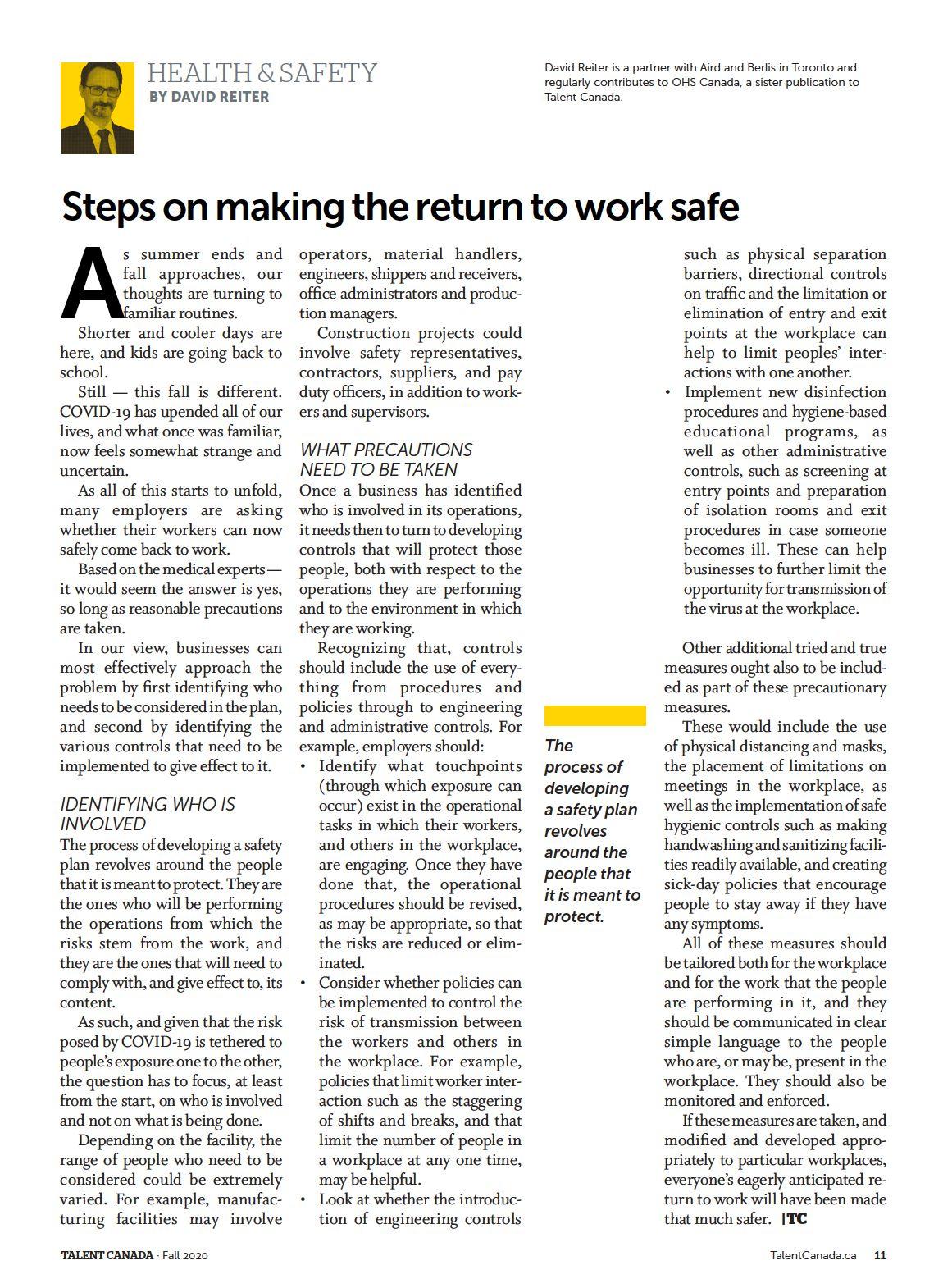
WHAT WORKERS WANT
Exclusive survey provides insights on comfort levels of employees for eventual return to work following the COVID-19 lockdown
BY MARCEL VANDER WIER
Seventy-three per cent of workers currently working remotely full time are uncomfortable with returning to work during the COVID-19 pandemic, according to a Talent Canada survey of 850 workers.
Meanwhile, results indicating that just slightly more than half of those currently working at their typical jobsites feel comfortable is “distressing,” said David Weiss, CEO of Weiss International, an HR consultancy in Toronto.
“They’re the ones that have done the work already during the pandemic, because they were in the office,” he said. “I can understand why it might be a little bit more extreme if you haven’t been to the office at all, but all of it is very, very troublesome.”
“Either it means that organizations have not done what they need to do to make it safer, or organizations haven’t done what they need to do to communicate that it’s safe.”
RETURN TO WORK SURVEY
For the past six months, many workers across Canada have been working from home as businesses shuttered or remained open at reduced capacity
due to the COVID-19 pandemic.
Other businesses never shut down, but had to adjust operations and procedures to ensure worker safety.
As restrictions ease, many employers are wondering: are employees ready to return to work?
According to the national survey conducted by Talent Canada, in partnership with TELUS Employer Solutions, there is a wide disparity in employee readiness.
The online survey was open from Aug. 6 to Sept. 9. A wide range of industries was represented, with 50 per cent of responses coming from office workers.
On Sept. 17, a virtual roundtable was convened to parse the results of the survey, in hopes of giving senior management and HR professionals insights into what may be needed for employers to return to a semblance of normal work operations.
CONSIDERING EMPLOYEES’ PERSPECTIVES
At present, returning to work amid the global COVID-19 pandemic is a critical discussion for employers.
While those with essential work-


ers remained open throughout the nation-wide lockdowns experienced as a result of measures to flatten the curve, others are now attempting to realize what comes next.
Changes to many office settings will need to be made for a full return to occur, said Weiss.
“Those people that have been working through the pandemic onsite have a greater likelihood to be less uncomfortable, because they saw what it’s like, because they’ve been there.”
Remote workers have not yet experienced the new-look workplace, so it is understandable that they would be more anxious about returning, he said.
“In some places, employers have been purposeful and with good

intent,” said Kimberly Humphreys, corporate director of employee experience at Interior Health Authority in Kelowna, B.C.
“With the pandemic, as more information happens and grows, so does people’s perspectives as well as comfort levels,” she said. “Sometimes, employers think that they’ve communicated and gone out… but they haven’t had an ongoing dialogue.”
At the start of the pandemic, 10 per cent of the Interior Health Authority’s workforce of 21,000 began working remotely, said Humphreys.
Dialogue has been maintained through pulse check surveys and support of facilitated questions filtered through senior leaders to staff, she said.
Constant communication with employees through surveys is a key
strategic tool, according to Jose Dino, general manager of TELUS Employer Solutions in Vancouver.
The initial response of your organization at the pandemic’s onset is also of importance, he said, noting the TELUS Work Styles program as an example of allowing employees to choose how they would like to work.
“A lot of our employees are very used to working in a remote environment, so we were able to transition fairly quickly,” said Dino.
The organization also focused on mental health and stresses employees may experience as a result of the pandemic, he said.
ANALYZING COMFORT LEVELS
Employees are looking for leadership
from management and the organization, said Dino, noting that TELUS built a return-to-work playbook, mapping out the process from different perspectives.
“Our focus is to provide our employees with the information that they need and to recognize that their safety is important to us, their mental health and well-being is,” he said. “It’s really how you react, how you respond from an organizational perspective… and providing employees with the necessary tools to be successful.”
As discussion around an eventual return to worksites heats up, workers appear to be more at ease with working remotely.
Nearly one-third of employees desire staggered workdays or start times, four-day work weeks and
opportunities to work from home more consistently, according to the survey.
It’s clear that workers are looking for changes, with some organizations embracing a model supporting improved work-life balance, said Dino.
“Whether or not we find a vaccine soon enough for the current pandemic, how we work is going to change,” he said. “Remote work seems to be becoming more and more prevalent.”
COVID-19’s effect on the workplace has been “one, big social experiment,” said Humphreys.
A theme she is hearing is that people do see a need to “come back together,” she said. “They’re wanting to return to the office, but maybe not the way it was before.”
Statistics show employees are concerned about large groups in one workplace, said Weiss.
“Employees don’t believe they can do this by themselves,” he said. “They need organizational practices and policies in place to help them be safe.”
PREPARING FOR A ‘NEW NORMAL’
When it comes to the eventual return the office, comfort levels in terms of washroom usage, lunch rooms and elevators were largely split, with slightly more respondents indicating that they had little to no concern with using these types of workspaces. Two areas where concerns were greater were public transit and fitness facilities.
Employers have accountabilities to make all workplaces safe, said Humphreys.
“It doesn’t matter if people have a higher level of comfort or not, employers must make sure that how they set up their environmental controls, administrative controls, and give all people that assurance that it’s safe,” she said, noting orientations may be helpful.
Those with higher comfort levels may not be as compliant with new safety protocols — an aspect that cannot be overlooked, said Humphreys.
Workers with greater concern may refuse to come to work if faced with these types of situations, and employers need to ensure workplaces remain safe, she said.
TELUS is currently utilizing an online reservation system for those coming into the office, said Dino.
Even so, organizations must ensure strict policy and procedures are in place around social distancing, he said.
When it comes to specific safety measures, face masks, signage, hand sanitizer — as well as regular sanitization of workspaces — were deemed very important by a majority of respondents.
Workers are resilient, said Humphreys.
“People have adapted and are willing to adapt to these new ways of working,” she said. “I’m just concerned about people’s ability to have the capacity to continue to adapt in all walks of their life.”
Mental health and well-being will be major factors, said Dino.
“Outside of ‘Here’s some hand sanitizer and a mask — may the force be with you,’ we’ve got to look a lot deeper,” he said.
Businesses are transforming due to pandemic restrictions — possibly for good, said Dino.
“We’ve been exposed to new ways of working. In some cases, they’ve become more popular.”
But not everyone is adapting in the same way, he said, noting some remote workers are struggling with feelings of isolation.
REQUESTS FROM REMOTE WORKERS
For those who continue to work from home during the pandemic, flexible work hours, company paid internet and smartphones, as well as virtual health care and video conferencing technology are in demand, according to the survey.
Flexible work — if managed correctly — can improve productivity, retention and work-life balance, said Dino.
But organizations must also be aware of the potential for isolation and effect on managers, he said.
“Not all leaders are comfortable leading in this type of an environment. There’s certainly a lot of work that an organization — specifically human resources — has to do to actually help enable leaders, managers, to lead in this type of environment.”
Internet security and protection of confidential data must also be considered, said Dino.
Organizations are doing their best to keep pace and respond positively to these new demands, said Humphreys.
“It’s going to impact what people value,” she said.
“As time evolves and we get more information — and this just doesn’t become about responding to a pandemic, but focusing on how do we move the workplace forward — all of these pieces will have to be continually re-evaluated.”
Agile principles are increasingly being implemented, said Weiss.
“It’s just survival and good answers are happening much more rapidly, so that’s maybe a positive silver lining on all these problems that we’re seeing.”
COVID-19’S EFFECT ON WORKPLACES
Six months of lockdown have proven that much office work can occur from anywhere.
The trickledown effect could impact organizational facets such as facility usage, said Humphreys.
“How and what we use our building footprint for will be impacted,” she said. “I
do think that there’s going to be some type of creativity and some type of evolution in how we create collaboration spaces. Gone are the days of little cubicles and figuring out how many people we can push into the smallest space possible.”
Workplace constructs will also change, said Humphreys, including the definition of a work day as well as the way work takes place.
“All of these pieces are moving the culture of organizations,” she said. “People are working in different ways — not so much together. How are workplaces and employers going to evolve their practices around embedding organizational culture across many?”
Productivity will come more sharply into focus going forward, said Dino.
“There has to be trust and an organization has to have the kind of culture to help support that,” he said.
The pandemic experience has destroyed the myth that workers will not be productive when working from home, said Weiss. “It’s just not true.”
“People can work remotely — they don’t have to be watched all the time.”
And virtual interactions are shedding light on colleagues’ personal lives in a whole new way, he said.
“We’re in each other’s homes, and all of a sudden the dog comes running by. We’re getting to know people on a level that we weren’t knowing them before.”
“The integration of life with work is getting closer and closer,” said Weiss. “I don’t think that is going to disappear. I think that will be sustained, and leadership needs to know how to nurture it and make it as an asset to really bring people in and have them engaged and committed… and productive, so that we can get really good outcomes, even in this new way of working.” | TC
SEVEN IN 10 UNCOMFORTABLE WITH RETURN TO WORK: SURVEY
A new survey shows nearly seven in 10 employees are feeling uncomfortable about returning to the workplace.
The study by Talent Canada and TELUS Employer Solutions finds that employees who are currently working remotely are concerned about returning to the workplace, including 41 per cent who are very concerned. For employees already spending some time in the workplace, the number falls to 43 per cent.
This gap suggests HR leaders have an opportunity to consider how they will structure a return to the workplace, and how they can address lingering concerns around safety, productivity and wellness over the next few months.
The study also shows that employees are particularly concerned about the risks involved in shared workstations, using public transit and going to cafeterias, restaurants and fitness centres. While they are less concerned about washrooms, elevators and coffee stations, they are evenly split when it comes to worries about the safety of collaboration spaces and carpooling.
The workforce is also indicating they would prefer not to return to pre-pandemic ways of working.
Most say they are quite comfortable working from home and those who are doing it full time are interested in new ways of working such as staggered workdays and start times. About 30 per cent are also interested in a four-day week or continuing to work some days at home. Thirty-one percent would like to stay home full time.
Those who are working from home overwhelmingly expect employers to help them stay productive and healthy. In addition to providing or subsidizing the technology and equipment needed for a home office, workers are looking to employers for advice about staying healthy in their virtual workplaces.
FOCUS ON VIRTUAL HEALTH SERVICES
Virtual health services are an interesting area of focus for respondents, including physical care (38.6 per cent), mental health support (32 per cent) and fitness advice and training (28.3 per cent). This growing interest in virtual health and wellness offers employers an opportunity to add these benefits to their total rewards as a way to build and sustain a healthy workforce while attracting and retaining key talent.
In uncertain times, HR leaders should be working with the rest of their organization to support employees throughout the return-to-workplace process.
• Communicate clearly how you are making your workplace safe: Employees want to know about PPE, safety protocols and expectations.
• Acknowledge concerns about areas outside your control, such as public transit or restaurants, and provide guidance for staying safe.
• Think flexibly about how you design your return to work – involve employees in planning the next few months, and look for opportunities to support work-life balance and healthy habits.
• Ensure your home-based teams have the tools they need to work safely and productively.
• Invest in health and wellness, particularly exploring the benefits of virtual access to care.
The survey was conducted Aug. 6 to Sept. 9 with 850 respondents representing a variety of sectors, roles and business types across Canada.

PANDEMIC EFFECT: HOW COVID-19 IS AFFECTING YOUNG WORKERS’ CAREERS
BY PIERRE CHAUVIN
Canada’s labour market is slowly digging out from the effects of the pandemic, with two-thirds of 3 million jobs lost now recovered. But one category of workers is still lagging behind — young people.
“Young workers are still highly affected,” said Louis-Philippe Beland, economist and assistant professor at Carleton University in Ottawa, who co-authored a paper in May describing the effects of the pandemic on the labour market.
Not surprisingly, the researchers concluded that the effects of the pandemic were “more pronounced for workers who are younger, unmarried or less educated.”
Those starting out their careers are by definition less likely to have senior positions within companies, which in turn leads to low job security, according to Beland.
“A lot of young workers are not in a position where they are able to work from home,” he said.
HOW EMPLOYERS CAN HELP
As the country braces itself for a second wave of the pandemic, employers can assist young people by showing more flexibility, said Beland.
The key reason — graduating in a recession can have longterm impact on salaries and earnings. This in turn has repercussions for the entire economy.
“If you graduate in a recession, it can affect your long-term salary,” Beland said, citing a 2012 study looking at Canadian graduates and their earnings. “And you never catch up.”
That flexibility can be proactively spending more time with new employees, according to André Raymond, director of the career centre and the continuing education centre at Laval University in Quebec City, and the president of the Canadian Education and Research Institute for Counselling (CERIC).
The reason? Working remotely doesn’t offer the same opportunities for new workers to watch and learn from colleagues and get quick mentoring tips.
“We are expecting students and new workers will face some real challenge in the integration of their job,” Raymond said. “A lot of them will fail their first job experience.”
Video meetings can be helpful for employers who can rely

on non-verbal clues to get a sense of an employee’s well-being.
“Human resources have to stop the fire when it appears at first,” he said.
ADVICE FOR YOUNG WORKERS
For young people looking for work, Raymond urges them to make use of the many counselling services available, as job postings are decreasing. For internships alone, Raymond said he noticed a 20 per cent decrease in demand from companies.
Besides the traditional support career counsellors provide — perfecting resumés, understanding the job market — they also connect job-seekers with employers at a time when career fairs are done through a screen and help them develop new strategies to reach employers.
Raymond said he is expecting an increase in career counselling services, as a lot of jobs are becoming more task-oriented because of the remote aspect.
In short — the job they now have is not the job they signed
up for. For young apprentices and those studying in trades, flexibility is key as remote learning opportunities are limited.
“The reality is, 80 per cent of apprenticeship happens on the job through experience working with a certified journey person,” according to Shelley Gray, CEO of B.C.’s Industry Training Authority (ITA).
Because the impact of the pandemic varies wildly between trades, between the ones that fall within government-designed essential services — such as construction — and the ones like the service industry that, even with layers of protection, are struggling to stay afloat, ITA is working on a “trade up to a new career” campaign.
For people who had that hands-on satisfaction of their work, it’s looking at whether there are other trades ITA can help them migrate into, said Gray. And for those who want to stick with their current trades, ITA is looking at whether they can proceed with the next level of schooling.
LEVERAGING EXISTING RESOURCES
ITA’s also had to educate employers on financial incentives available to them that would allow them to take on an apprentice.
“When times were economically strong, a lot of employers

hadn’t used a lot of those services and grants,” Gray said.
Options such as sharing a new employee with another business are now becoming more appealing for employers and allow more apprentices to enter the market.
Raymond cites the Student Work Placement Program at CERIC, launched in 2017, to support paid work experience in science, technology, engineering, math and business programs across the country.
Since the start of the pandemic, the federal government has expanded the program to any field and sector, except for the public service, allowing employers to get up to 75 per cent of a student salary covered.
“Just for the province of Quebec, and just for this summer, (that’s) more than 3,000 subventions under that program,” he said. “It’s true that it has a real impact, helping a lot of small and big companies to create more placement.”
With the pandemic here to last for the foreseeable future, the long hours spent at home or on Zoom have also brought a new set of challenges for all employees’ mental health.
Raymond urges employers to be proactive for all employees, new and existing ones.
“We are only at the beginning of the challenge,” he said. | TC
The Professional Recruiter
This program covers a set of key recruitment and selection skills. The goal is to help you reduce recruitment costs, lower the risk of bad hiring decisions and avoid needless litigation. Successful completion of all 3 Modules makes you eligible for membership in the Association of Professional Recruiters of Canada, APRC, with the RPR (Registered Professional Recruiter) designation.

at : www.workplace.ca/Talent-Canada.html
until November 27, 2020

HOW TO RETAIN YOUR ‘A’ EMPLOYEES IN A REMOTE WORLD
Loss of high-level talent impacts many areas
BY JACK BURTON
Handling the sudden transition into the remote workplace over the last several months has been a journey marked by a stream of new expectations for employers and employees alike.
Having a stable of skilled, performance-driving talent to lead your team down this uncertain path is key, but a look into shifting employee attitudes suggests that this changing terrain may also threaten to take their talents away from your company.
At a glance, the unpredictability of the current economy and job market appears to have significantly halted the cycles of turnover and onboarding.
July data from the Conference
Board of Canada shows that four in 10 companies have implemented hiring freezes, while nearly half of companies included in the report claimed a decrease in voluntary turnover — the lowest Canada has seen in years.
A closer look at the attitudes of employees, though, tells a different story.
SHIFTING EMPLOYEE ATTITUDES
A national survey conducted this summer by Hays Canada assessing employee attitudes in the pandemic era found that nearly half of employees are seriously thinking of leaving their current position, while research from Robert Half in May shows that 47 per cent of Canadian office workers have
experienced a shift in attitude towards their work due to the pandemic.
The Robert Half data also found that 60 per cent of those experiencing an attitude shift now feel more inclined to look for work at other organizations that value staff during unpredictable times, while 29 per cent want to leave their role to pursue a more meaningful or fulfilling position.
“COVID made everyone reflect on what is really important to them,” said Travis O’Rourke, president of Hays Canada in Toronto.
“I watched clients leave institutional organizations and move into start-ups, or switch their focus to philanthropy and real-estate investment.”
These trends indicate more than just potential turbulence when it comes to employee attitudes.
Should these shifts manifest in your top performers leaving, it could also spell instability for both the workforce and overall company operations in the middle of an indefinite and unprecedented adjustment period, where structure is already hard to come by.
EFFECT ON CULTURE, BOTTOM LINE
A major area that these departures threaten to disrupt is overall company culture and employee attitudes, a hindrance that could lead to losing additional members of your team.
“One very important point is the fact that one person’s departure can trigger others to follow,” warned O’Rourke, adding the possibility that, “maybe that first person has plans to take key staff with them.”
And even if the departure of a top employee manages to leave one’s workforce intact, the attitudes of their former co-workers do not go uninfluenced, said Koula Vasilopoulos, district president of Robert Half Canada in Calgary.
“(It’s) important to consider the impact such a departure will have on remaining team members who may question how they will be personally impacted and how their current and future work environment may change,” she said.
When top-performing talent leaves, the disruption has the potential to extend even beyond the employee level and into the area of external clients and customers.
At best, these departures could necessitate some organizational reshuffling, said Vasilopoulos. At worst, it could trigger key clients and accounts to take their business elsewhere, should the measures to preserve that relationship in the absence of their former liaison not properly be in place.
HIGH-IMPACT LOSSES
The departure of one’s top-level employees is a loss that impacts multiple facets of company operations: losing success-driving talent at a time when their skills are most needed; creating low morale (or potentially even additional departures) amongst your workforce; and a scramble to restabilize client relations.
What measures, then, should be taken to avoid this unfortunate, high-impact situation?
The strategies for fostering a retention-oriented work environment within the limitations of the remote workplace begin with companies placing an internal focus on leadership and communication, said Allison Cowan, director of human capital knowledge at the Conference Board of Canada in Ottawa.
“Leadership is critical right now, especially operating with a remote workforce,” she said.
47% of employees claim the pandemic has influenced a shift in their attitudes toward work.
“Communication should be a priority for organizations. This includes managers checking in and making sure employees have what they need to be productive, engaged and successful.”
When organizational leadership takes the responsibility to clearly communicate expectations and regularly check in on the well-being of their employees, a culture of flexibility and understanding emerges.
CONSIDERING FLEXIBILITY, WELL-BEING
Cowan said this flexibility is integral to retaining talent, as it allows employees to feel respected and valued during this period of stress and uncertainty, along with minimizing the need for them to have to choose between their vocation or their home life.
“Given that some of the reasons people leave employers
include employees looking to balance responsibilities at home, flexibility can be a key to retaining employees,” said Cowan.
“As many Canadians are managing a complex return to school this fall, it will be important to understand the impact on individual employees. Listening to the unique needs of employees and providing flexible work arrangements to support them can go a long way to building loyalty,” she said.
In building a remote-work culture aimed at retaining top talent, the need for understanding and acceptance regarding the impact of the pandemic on the lives and attitudes of one’s workforce is echoed by Louise Taylor Green, CEO of the Humans Resources Professionals Association (HRPA) in Toronto.
“Employers need to acknowledge that employees have gone through highly variable experiences during COVID-19, which may have fundamentally changed what they want from work,” she said.
Yet, despite the human resource limitations imposed by COVID and the remote workplace, employees can get what they want from work, said Green, no matter how much their attitudes may have changed — so long as their employers step up and approach this situation as a work-culture wake-up call.
“To retain high-skilled workers, employers need to activate all the levers of their talent strategy to enable business performance,” she said. “Now is the time to modernize talent acquisition, total rewards, performance management and talent development strategies in order to facilitate business recovery and talent growth.” | TC
Jack Burton is a freelance writer in Toronto.

Future friendly HR solutions.
Leveraging our expertise as HR practitioners, our team delivers cost-effective, end-to-end tailored solutions to help organizations maximize the potential of their talent.
• Human capital management (HCM) systems
• HR business process outsourcing (BPO)
• Talent management and recruiting
• Hosting/HR application managed services
Learn more at telus.com/ employersolutions
BRACING FOR A SECOND WAVE
Employers adjust to new normal in workplace operations
BY GRANT CAMERON
In March, a sucker punch from COVID-19 knocked the wind out of the Canadian economy as much of the country’s commerce ground to a halt.
Today, business owners are dusting themselves off and preparing to get into the ring for another round. This, as the country itself braces for a second wave of the novel coronavirus.
To resume business operations in the middle of a pandemic, employers will have to get used to a new normal which includes lowering expectations, being flexible and — above all — making sure workplaces are safe for employees.
“Employee safety has to be paramount,” according to Laurie Jessome, partner in the employment and labour group at Cassells Brock and Blackwell in Toronto. “Employers must make sure that they are up to date on our best understanding of how the virus is transmitted and then apply that knowledge to their own workplace to ensure that they are taking every reasonable precaution to provide their employees with a safe work environment.”
“If your employees can’t work safely and you are faced with a COVID outbreak, productivity is impacted,” she said.
Employers should adopt policies that permit workers to stay home with pay to care for a sick family member and abolish attendancemanagement programs.
Generally speaking, it’s the employer’s responsibility to take every reasonable precaution to protect their workers, said Jessome, so they should review guidelines issued by their provincial ministry of labour.
“I recommend that every employer designate a key point person or team within their workplace to take the lead on COVID mitigation and planning. It is critical to ensure that someone is actually responsible for making sure that appropriate safety measures are considered and, where necessary, implemented.”
INPUT FROM WORKERS
When putting together a reopening plan, business owners must be flexible and consider input from workers, said Troy Winters, senior health and safety officer at the Canadian Union of Public Employees (CUPE) in Ottawa.
“I haven’t talked to a business yet that said, ‘We set a plan and never changed a thing and it worked 100 per cent,’” he said. “From dentists to hair salons and barbers, to municipal operations, they all set goals, started with a plan and made modifications once they received feedback from workers on how their jobs were impacted by the various control measures.”

“But the good news is that when they listened, while still keeping the key goals of infection prevention at the top of list, they were able to implement controls that allowed their business to re-open successfully with workers who felt confident about the safety of their work.”
While much of the country has opened up, employers still must be considerate to the needs of workers because many have lost access to supports and were shut off from family and friends for months.
“Combined with the added pressure of precarious employment, government subsidy plans ending and all the other factors that are weighing on people, I think we will start to see the effects of peoples’ mental resiliency being run into the ground,” said Winters. “While much of this isn’t under the employers’ direct control, employers need to recognize that some workers
simply will not be able to maintain the same output.”
POLICY EXPANSION
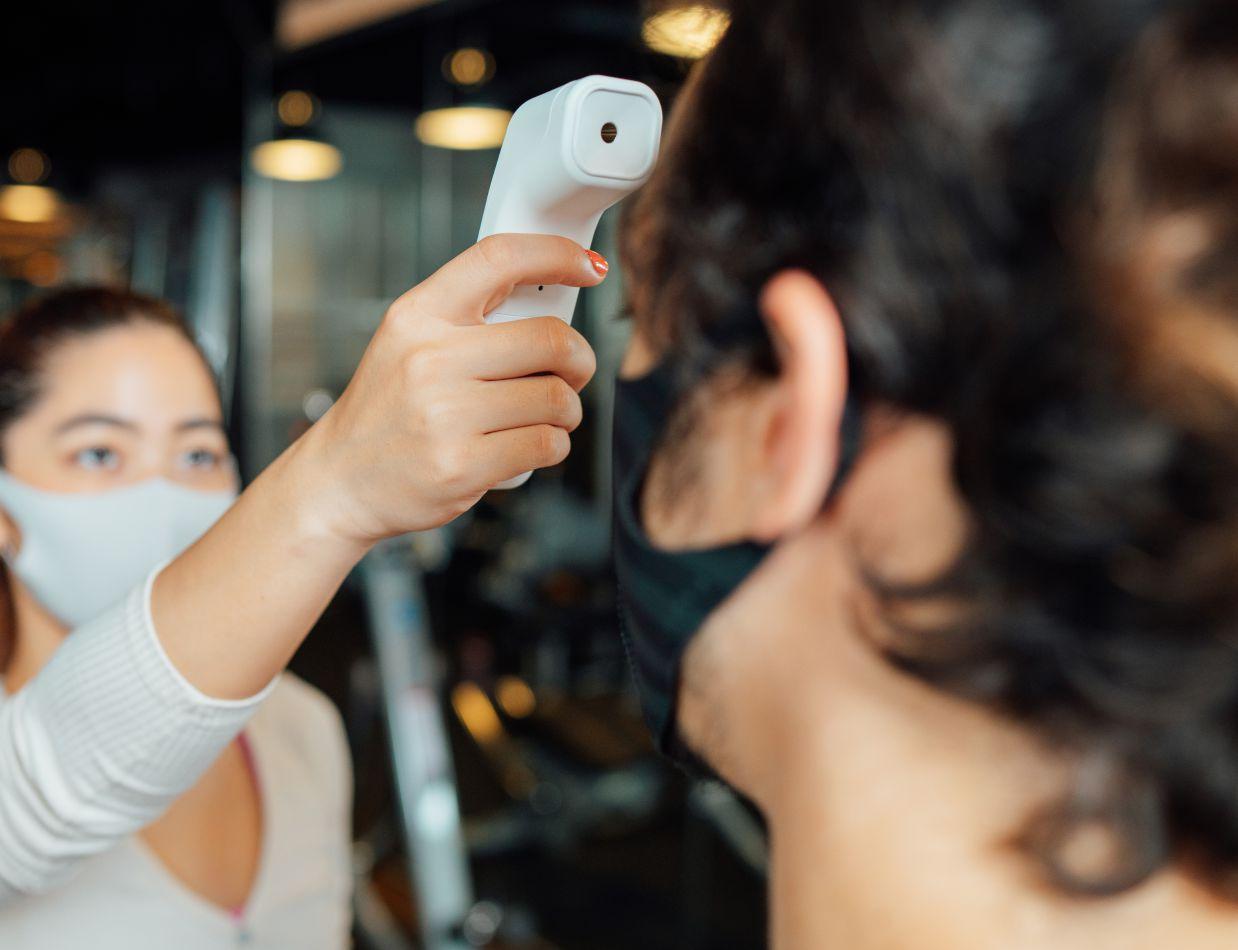
To help — and ultimately keep their businesses operating — employers should adopt policies that permit workers to stay home with pay to care for a sick family member and abolish attendance-management programs, according to Winters, while workers who exhibit flu-like symptoms should also be sent home with pay.
Depending on the workplace, employers should consider engineering controls like installing barriers, changing furniture layout so workers are distanced and ensuring HVAC systems are running well, he said.
Further considerations include administrative controls, such as screening people who enter an office or worksite, and routinely cleaning all frequently touched surfaces such as workstations, elevator buttons and doorknobs.
PPE should be used as an added layer of protection when other control measures are
not completely effective, said Winters, noting the placing of markers on the floor and setting up hallways for one-way travel will limit unnecessary interactions. Disposable wipes, hand-sanitizing liquid and masks for workers close to each other are also suggested.
MITIGATING HAZARDS
Employers must get a handle on what workers do day-to-day to mitigate all hazards, figure out the level of risk that is attached to the work and then put control measures in place, said Jan Chappel, senior technical specialist at the Canadian Centre for Occupational Health and Safety in Hamilton, Ont.
“In general, you would want to quickly do a walk-through of the workplace. You want to think about how people do their work. So, not just where they sit but where they stand, where they walk to. Do you have a point where people collect — like a kitchen or a bathroom, a photocopier, cash register… and how you would help guide people to stay two metres apart in each of those situations.”
If workers must be at desks in an office or a cash register at a store, they must be at least two metres apart in all directions, she said. And if that can’t be done, other steps must be taken to protect workers.
For outdoor work, it might be best to create small teams for workers who are on site, so they stay within their bubble, said Chappel.
“In general, employers have a duty to provide a safe and healthy workplace, so developing a plan is part of it,” she said.
“Developing a return-to-work COVID plan is important. You want to make sure that people understand about the virus and steps that the workplace has taken to prevent the spread and what actions you need to take... You want to do everything you can under the circumstances to implement your control measures, provide enough information, education and training, cleaning, disinfection and any personal protective equipment as well.” | TC
Grant Cameron is a freelance writer in Burlington, Ont.

REIMAGINING BENEFITS FOR SMALL BUSINESS
Roundtable unveils tactics to manage costs through COVID-19 – and beyond
BY MARCEL VANDER WIER
As the world adjusts to a “new normal” ushered in by the current COVID-19 pandemic, small and medium-sized employers will need to become more nimble — especially when it comes to employee benefits.
While the effects of the global pandemic have been largely disastrous, positives can also be found, according to Frank Tangredi, regional vice-president of business development, group benefits with Sun Life in Montreal.
“COVID’s got a lot of drawbacks in the very sad situation it’s created in the world. It is a health crisis,” he said. “But there (are) some opportunities.”
“Having a good benefits plan and a good program being able to support employees in small business will help us drive the economy and drive small business forward.”
A focus on digital, customizable tools and leveraging available and affordable solutions will assist small employers in keeping their business running at maximum capacity, said Tangredi.
“Employers need to have attractive plans to really attract and retain good talent, but it doesn’t have to be that full cafeteria-style flexible plan.”
NAVIGATING THE PANDEMIC
On Sept. 14, Talent Canada hosted an exclusive roundtable in partnership with Sun Life Financial on reimagining benefits for small businesses.
The critical issue facing organizations today is the COVID-19 pandemic, said Tangredi.
“Everyone’s been impacted by COVID-19 and it’s really created unprecedented socio-economic and
health challenges for both employers — business owners — and their employees,” he said. “We’re living through very challenging times.”
The large-scale lockdown has workers facing unique situations, such as caring for a loved one while simultaneously juggling work responsibilities, said Tangredi.
Small business owners have been largely focused on keeping their doors open, but also responding to employee challenges, he said, noting that throughout the pandemic, Sun Life worked to provide “just-in-time support” for plan sponsors and clients.
This included financial relief in terms of flexible premium payment options, as well as premium credits for employee benefits that may have been unusable due to the pandemic, said Tangredi. “It was really important to adapt very quickly.”
Insurance companies largely responded well to the pandemic, according to Patrick Desormeau, president and CEO of Nexim Canada, an insurance solution provider in Laval, Que.
“We were all in the same situation, where we didn’t know what the future held,” he said, noting some businesses decided to suspend benefits periodically. “It was changing every week, every two weeks.”
Many issues were not covered in client contracts, said Desormeau. “We had to go outside the box and think about how we could answer their needs.”
The support from benefits providers was invaluable in the early days of the pandemic, said Dominika Urbanowski, executive administrator or Exro Technologies, a Vancouver-based tech company dedicated to creating intelligent energy management systems.
“We were able to provide our employees with at least some answers, and let them know that they would have coverage.”
ASSISTING RECRUITMENT, RETENTION
It’s important to realize that benefits have become a tool in both recruitment and retention for Canadian workplaces, said Tangredi.
“It’s particularly important for the small business side,” he said, noting a recent Sun Life survey of 591 employers showed 53 per cent use benefits to attract and retain their workforce.
“What we’re seeing in the marketplace is employers and employees are looking for a little bit more flexibility.”
Health-care spending accounts and personal spending accounts are part of that solution, said Tangredi, noting these allow workers to spend benefit dollars on items they find most attractive.
“It absolutely makes a difference,” said Urbanowski. “Being able to provide benefits — even
though we may not be as flexible as some of the larger corporations — it really plays into a decision about employment.”
ENSURING VALUE FOR COST
With budgets tightening and time of essence, education can assist small business owners in making decisions about benefits plans, said Desormeau.
“Cost is obviously the biggest thing,” she said, noting a “pickand-choose” benefits model helps, as it allows organizations to support employees, as well as the bottom line.
TOWARDS TELEMEDICINE
Teleheath is another opportunity to reduce costs for employers and employees, said Tangredi.
Easy-to-use functionality is spurring popularity, said Desormeau, noting the pandemic is pushing digital health forward at a rapid pace.
“We’re never going to go back to the way it was,” he said. “COVID has been good in that way — it’s pushing the industry into the digital age. It’s an industry that’s not easy to move, let’s say. We’re going in the right direction.”
The large-scale lockdown has workers facing unique situations.
“We always tell the employer, ‘Start slow. It’s always easier to add next year, or in two years, than to take away.’ Taking away stuff from the employees is not easy.”
Benefits handed out in the form of health-care spending accounts can be cost-effective, as it is tax free — as opposed to a bump in salary, he said.
Digital opportunities can help reduce cost and increase flexibility for employees, said Tangredi.
“I’ll call it the ‘Amazon shopping experience’ where they can look through digital benefit providers and be able to spend their dollars there,” he said.
Analyzing administrative time spent on benefits is also helpful in terms of “indirect” savings, said Tangredi.
“It’s really focusing more on HR digital administration tools… (and) pushing out the digital solutions to the employee’s smartphone,” he said.
“It simplifies a lot more of the administration for the plan sponsor.”
Online options and administrative supports have benefited Urbanowski’s organization.
“You can drive appreciation of the plan without putting necessarily more dollars,” he said, citing Sun Life’s health-care provider tool Lumino Health as an example.
“To be able to put a whole network of providers, relevant content, discounts (in front of employees), that’s how we drive more value to the plan without necessarily adding costs.”
These services showed high relevance during COVID-19, and will have more prominence going forward, said Tangredi.
“More access to digital platforms, digital services, is where we think employers and employees are looking,” he said, noting telehealth is an automatic add to SunAdvantage plans for groups of 50 employees or less.
“The pandemic certainly has driven a lot of telemedicine.”
Telemedicine can help reduce both cost and hospital wait times for employers and employees, said Desormeau.
“I would imagine it’s going to reduce absenteeism, because employees — instead of staying home — are going to end up going to work more,” he said.
PROPER PLAN UTILIZATION
In terms of proper plan usage, advisers can assist in ensuring options are communicated and fully utilized by employees, said Desormeau.
“A lot of employees don’t know how much insurance costs,” he said.
“Most employers are paying at least 50 per cent of the costs… It’s important for employers to be able to show the employees at least once a year how much they’re contributing towards these benefits.”
Life insurance and disability funding can be undervalued unless an employee is specifically in need of this coverage, said Desormeau.
“Often, people that aren’t that sick or aren’t taking medication feel gypped to a certain extent, because they say, ‘I’m not (using) the plan and I’m paying premiums.’”
Use of options such as telemedicine may improve satisfaction in benefits coverage, as employees may feel as if they’re using the plan more completely, he said.
BENEFITS
MANAGING MENTAL HEALTH
In recent years, mental health coverage has come to the forefront as the stigma fades, but the COVID-19 pandemic has only elevated concerns in this area.
Comfort in accessing information on the subject is necessary and available through options such as employee assistance programs (EAPs) and online cognitive behavioural therapy (CBT), said Tangredi.
“If employees don’t know that (opportunities) exist, or they don’t feel comfortable to access them, then they’re really not driving what we’re looking for. Fostering an environment is really important, and that does go through education,” he said. “It really starts by creating great environments where they feel that they can access that.”
It’s important to note that EAP usage is entirely confidential, said Desormeau.
“The employer never gets to know who called or what they talked about,” he said. “Once the employees know that it is completely confidential… I think that’s the first step on helping the employer on absenteeism.”
COVID-19 has been a strain as many health conditions worsen with stress, said Desormeau.
“That uncertainty, that stress — it’s not a good combination.” | TC
SUN LIFE GROUP BENEFITS WORKING HARDER FOR SMALL BUSINESS
The pandemic has slowed or eliminated growth for businesses of all sizes. But small businesses – the engine of our economy – have been especially hard hit. From lockdown closures to supply chain disruptions to cash flow crunches, small businesses have seen it all. And we introduced many immediate measures to help.
We also introduced many permanent innovations for small businesses. These include digital solutions that reduce the burden of group benefits administration. Small business owners can now spend less time on administration and more time working on managing and growing their business.
Group benefits are very important to small businesses – and are of heightened importance during the COVID-19 pandemic. Group benefits help you attract and retain talent, and they keep your workforce healthy and productive. In addition, recent digital innovations and flexible options make group benefits work even harder for you and your employees. It’s these innovations that have made us the group benefits leader in serving small businesses in Canada.
EASY DIGITAL PLAN ADMINISTRATION
Administration – including group benefits administration – is one of the challenges facing many small businesses. But there are solutions.
The Sun Life + Rise solution is a simple online tool that lets small businesses and their employees manage Sun Life group benefits. And it’s scalable. As small businesses’ needs grow, they can expand the system to include payroll and HR administration. This allows the single entry of information across all platforms. With any benefit change or update, the system automatically adjusts premiums and deductions and syncs information with HR and payroll.
The tool can be securely accessed and provides:
• Simplified online enrolment. Employees can enrol from any mobile device, laptop or desktop.
• A consistent employee experience. Employees have instant, single sign-on access to mysunlife.ca. Everything is at their fingertips – plan booklets, drug and travel cards, claims management and more.
• Automated premium management. The system manages premium calculations and collects premiums directly from payroll. The system handles the remittance of all payments to Sun Life.
The employee experience is also technology-based – with information and transactions all carried out through our secure website or mobile app. Another solution, the my Sun Life mobile app is the highest rated in our industry – rated 4 out of 5 stars. Employees can submit claims, check their health coverage, and find a new local health-care provider. They can also look up drug information. This easy access to information, tools and claims submissions reduces a business’ administration burden even further.
VIRTUAL HEALTH CARE
Virtual health care has been front and centre during the pandemic. But its impact is long lasting. Across all provinces, virtual care has become an essential element of health care.
Lumino Health Virtual Care gives employees access to qualified healthcare professionals when they need them. They can reach them through the Lumino app, or online through a computer, and they can do it at home, at work, or anywhere else in Canada.
When they request a visit, they’re triaged through an artificial intelligence-based system. The system then places the employee into a video chat with a nurse, nurse practitioner or doctor.
Virtual health professionals can resolve about 70 per cent of primary care cases. They can diagnose any condition that doesn’t require a physical exam – and write a prescription if needed. They can also book specialist appointments – including those for mental health treatments – and schedule standard follow-up visits.
EMPLOYEE CHOICE: FLEXIBLE SPENDING ACCOUNTS
A great way of using benefits to attract employees is to add flexibility to your plan. Features like Health Spending Accounts (HSAs) let employees use benefit dollars for health products and services that they want and need. This includes treatments like therapeutic massage, physiotherapy and chiropractor care. Personal Spending Accounts (PSAs) are similar but let employers choose what expenses are eligible for the employee to claim.
Whether an HSA or a PSA, it’s all about choice. Employees can direct their benefit dollars in a way that provides the greatest benefit to them and their family. At the same time, they can still take advantage of other important insurance coverage in case they become disabled or seriously ill.
You wear many hats while managing your business. We can help you win the competitive battle for recruiting high-performing talent while keeping your employees healthy, happy and engaged.
LEARN MORE
To find out more about how Sun Life solutions can help your small business, visit www.risepeople.com/benefitsmadeeasy.
Group Benefits are provided by Sun Life Assurance Company of Canada, a member of the Sun Life group of companies.

Join host Marcel Vander Wier, editor of Talent Canada , as he discusses some of the most critical issues facing employers across the country.
EPISODES NOW AVAILABLE INCLUDE:
• Understanding employee perceptions and concerns in returning to the office during the COVID-19 pandemic, featuring Troy Winters, senior health and safety officer at CUPE
• How to address a toxic workplace culture, featuring Todd Humber, publisher of Talent Canada and Mina Movasseli, a behavioral scientist with The Mindful BluePrint
• Common questions about returning to work post-pandemic, featuring Dr. Ken Jenkins, national medical director of Horizon, supported by Telus Health
• What employers need to know about the federal summer jobs program, featuring MP Irek Kusmierczyk, parliamentary secretary to the Minister of Employment, Workforce Development and Disability Inclusion.
Visit www.TalentCanada.ca/podcasts to listen today.
WORKING

IS REMOTE WORK SUSTAINABLE?
Five best practices for long-term success
BY ASHIRA GOBRIN
Pre-COVID,many workplace leaders believed that we could not be effective working remotely — that we didn’t have the technology, processes and knowledge to make it happen.
However, the pandemic has proven that we can shift to remote work overnight, and for many organizations, it’s here to stay.
Yet, what’s being missed in conversations surrounding remote work is its significant long-term mental health fallout.
SURVIVING OR THRIVING?
Like many organizations, an internal employee survey at Wave Financial Inc. found a consistent bell curve with roughly 20 per cent of staff thriving while
working remotely. Not only is it a manageable scenario, it is preferred.
A majority of approximately 60 per cent said that while it isn’t a preferred situation, the pandemic has forced them to make it work, and even enjoy the flexibility workfrom-home affords. When deemed safe, if offices were to open, they’d strongly consider going in two to three days a week.
And then there was approximately 20 per cent on the other side of that bell curve, who are genuinely suffering. This includes social extroverts whose “people meters” are empty — parents juggling between full-time jobs and young children kept away from schools; those dealing with depression and anxiety brought on by the quarantine; and others
who may have had an existing mental-health issue due to previous trauma.
For this group, the routine of waking up early and going to an office — being surrounded by colleagues — helped manage their conditions. Now, they wake up and go to bed with their anxieties — in isolation.
With 80 per cent of their staff managing or even thriving working from home, most organizations will opt to keep their offices closed.
But when the same group was mapped on the scale of suffering, it was no longer a bell curve. This graph indicated a diagonal line declining to the right, showing 20 per cent of the people are carrying 80 per cent of the suffering.
In other words, we have a world designed for the 80 per cent of people who are thriving, but not for 20 per cent who are carrying 80 per cent of the suffering.
BEST PRACTICES FOR REMOTE WORK
For remote employment to work in the long run, these five best practices need to be top of mind for organizational leaders:
Notice the people who go unnoticed. In an office space, there are always those who quietly work in the corner.
Previously, managers could take the long way around to a meeting room and use the opportunity to catch up with the office introverts.
In a virtual environment, it’s easy to miss the introverts who may choose to keep quiet or their webcams switched off.
Making a conscious effort to check in with those you haven’t heard from during a video call is one of many ways to make the remote work environment more inclusive.
Gamify the onboarding experience. Onboarding presents new hires with mixed emotions.
On the one hand they are excited, eager to learn and please, and feel challenged. On the other hand, it can create anxiety.
Wave Financial Inc. decided to gamify the onboarding experience for new hires to overcome the negative anxiety. The onboarding package includes a game board that, in a fun and creative way, walks our new remote hires through the various steps of their
first day. It ensures they are aware of and able to use the supports available to them.
Pay attention to the visual experience when hiring candidates. In the past, a candidate interview would entail a walk through the office space and physical meet and greets with potential or future colleagues. These would factor into a candidates’ consideration of whether they are a good fit or not.
Today, hiring is entirely digital and restricted to administrative tasks — a review of the digital job description and a Zoom call with company heads sums up the interaction.
This is not enough for a company to convey the emotive components of their culture. Showing video snippets of preCOVID office life can make a big difference.
Do not assume what worked previously will work now. Practices that were good enough before, aren’t anymore.
When faced with a challenge, the key is to not just address the issue at hand for the moment, but to rethink it so the bar can be raised for the foreseeable future.
“Never waste a crisis” is an apt saying for these times. Simply modifying something when the opportunity exists to improve it, is a waste.
Leaders need to prioritize how they can make their remote employees feel emotionally supported and engaged.
Reimagine compensation based on cost of living. Recently, Facebook announced their structured compensation model based on cost of living. They will downward adjust salaries for people moving out of expensive cities to smaller, cheaper ones.
But this needs to be rethought. By cutting salaries of those who have chosen to work remotely and moved out of the downtown core into suburbs due to affordability, managers are conveying that their skills are not enough to create value. This is a complex issue and needs to be handled with fairness and integrity.
The upshot is that the pandemic has opened the HR world up to top talent that is accessible beyond the daily commute. But long-term engagement of employees becomes a bigger issue.
We can be energized during a meeting; however, in a Zoom era, the second a meeting ends, the energy leaves the room, too. The visual engagement does not move beyond the screen.
And yet, human interaction prospers when the energy lingers past the moment. For remote work to be sustainable, employee engagement needs to be reimagined.
Leaders need to prioritize how they can make their remote workers feel emotionally supported and engaged, creating high-trust, outcome-managed environments that allow employees more autonomy to continue making choices on where they work and how they work.
Culture is at the core of it. | TC
Ashira Gobrin is the chief people officer at Wave Financial Inc. in Toronto. She is a member of the Strategic Capability Network’s CHRO Peer Forums.
OFFICE ODDITIES
Fired Honda salesperson files human rights complaint
EDMONTON — A 20-year-old Edmonton woman who was fired from her sales position at a Honda dealership has filed a human rights complaint for dress-code discrimination.
According to a September Facebook post providing details, Caitlin Bernier said she was fired for wearing an “inappropriate” outfit consisting of a tight longsleeve crew neck and black dress pants. According to Bernier, it was the same outfit she was hired in. Management denied Bernier’s claims of discrimination, according to CBC News, noting its office dress code is enforced equally and no employee would be fired for a single violation.
Worker claims he was fired for wearing Trump hat


schools and in the workplace. In September, advocates presented a proposal to New Mexico state lawmakers that would outlaw employers and schools from discriminating against Black and Native American women’s hairstyles. According to the Associated Press, New Mexico is the latest state targeted by a national campaign. Activists said people with Afros, cornrows, dreadlocks and headwraps require human rights protections.
Soccer owner to sell teams after racist comments
UTAH — Real Salt Lake owner Dell Loy Hansen will sell his soccer teams in the wake of reports that he made racist comments, the Associated Press reported. That includes his Major League Soccer (MLS) club, the Utah Royals of the National Women’s Soccer League and the United Soccer League’s Real Monarchs. MLS Commissioner Don Garber announced Hansen’s decision in August. Investigations occurred after The Athletic quoted former employees who said Hansen had made racist statements and used a racial slur. Hansen apologized in a written statement following the MLS announcement.

VIRGINIA — A shipyard worker claims he was fired for refusing to remove a hat supporting U.S. President Donald Trump.
According to the Virginian-Pilot, 55-year-old Dave Sunderland was let go from his position at Newport News Shipbuilding in late August. The private firm builds U.S. aircraft carriers and submarines. The worker said the company’s HR department claimed he violated policy regarding “campaigning” in the workplace. Sunderland said he merely wore the hat while walking from his vehicle to the workplace, and sometimes during a safety meeting.
U.S. states pressured to ban hairstyle prejudice
NEW MEXICO — Some U.S. states are facing pressure to ban race-based discrimination against hair texture and hairstyles in


Lafarge employee fired after reports of noose found
MONTREAL — Lafarge Canada fired one of its employee following reports of a noose being found at a Montreal worksite. In July, the company released a statement saying an act of discrimination involving a “symbol of hatred” had occurred, without giving details. Montreal La Presse first reported the story, indicating a Black employee found the noose hanging in his parking spot in June. The construction materials company conducted an investigation and firing the employee who committed the act was the “only thing to do.”
Trump chastises Goodyear for political policy
WASHINGTON — In August, President Donald Trump urged people to boycott tires from Goodyear Tire and Rubber, tweeting that the Ohio-based company had “announced a BAN ON MAGA HATS.” Trump’s tweet immediately sent the company’s stock downward, according to the Associated Press. Interestingly, the company hadn’t announced such a specific ban. Rather, employees were asked to refrain from workplace expressions involving political campaigns and “forms of advocacy that fall outside the scope of racial justice and equity issues.”
Working remotely? Consider Barbados, island PM urges
BARBADOS — In July, the island nation of Barbados issued a siren call to employees who have been working remotely during the COVID-19 pandemic: Work from the island paradise for a year. Prime Minister Mia Amor Mottley said the government is looking at a 12-month Barbados Welcome Stamp that would allow visitors the option of staying and working for longer periods than a typical vacation. It would allow “persons to come and work from here overseas, digitally so, so that persons don’t need to remain in the countries in which they are.” Short-term travel has become difficult because of testing and quarantine requirements, said Mottley.
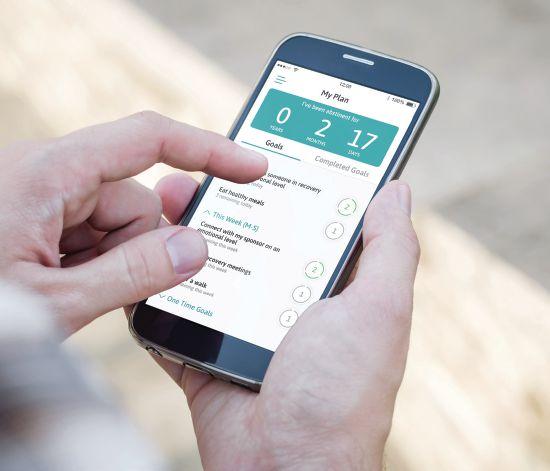
THE CARE OF INPATIENT TREATMENT
EHN Online offers Canada’s first virtual Intensive Outpatient Program providing the treatment employees need while still maintaining their career and home life.
For those who are struggling with depression, anxiety, or addiction, a stable treatment program can make the difference between recovery and relapse. But putting their families and careers on hold to receive inpatient treatment is a disruption many people aren’t able to make. And some outpatient programs simply don’t provide the level of attention some patients need.

THE QUALITY CARE THEY NEED – EVERY DAY
Successful inpatient care provides the tools and skills patients need every single day. That’s why IOP brings that level of care to your employees at home, with eight hours of group sessions, plus one hour of one-on-one therapy per week over the course of eight weeks, and followed by 10 months of weekly online aftercare.
THERE’S AN APP FOR THAT
Available for the first time from EHN Canada, our Intensive Outpatient Program (IOP) offers daily counselling, access to online clinicians, and the freedom to carry on at home and at work.
Only EHN Online puts the control of an employee’s condition in the palm of their hands. EHN Online (Powered by Wagon) is designed to help patients set goals, track their progress, and monitor triggers.
A TEAM OF EXPERTS AT THE READY
One of the biggest concerns we hear about online treatment programs is that they don’t provide the one-on-one connection that patients need. That’s why we have clinical experts trained in virtual counselling whenever patients need them.
FLEXIBILITY AND CONVENIENCE FROM THE COMFORT OF HOME
There are many reasons that an online, in-home treatment plan may be best for a patient: they live far from a treatment centre; have mobility issues; care for young children or other family members; or they are part of a high-risk community who should avoid unnecessary travel during a pandemic.