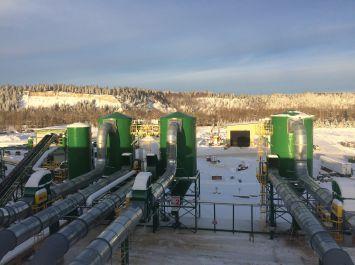
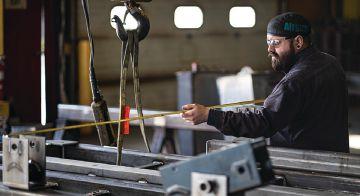
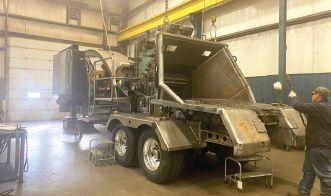
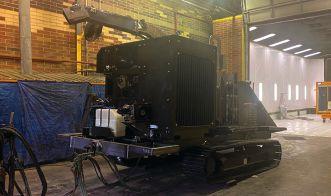
B.C. log hauler transitions to grinding residual fibre, bringing benefits to the local community
16 A carbon negative future?
According to research from FutureMetrics, switching from coal to wood pellets in fossil fuel power plants, in conjunction with bioenergy carbon capture and storage, can permanently remove CO2 from the atmosphere
18 2021 WPAC Show Guide
The Wood Pellet Association of Canada (WPAC)’s annual conference will once again be virtual. Canadian Biomass presents the official show guide.
22 Going green
Quebec greenhouse sees benefits switching from propane to a wood chip boiler for heating
26 Pellet Gear Buyers Guide
Canadian Biomass’ annual Pellet Gear Buyers Guide rounds up suppliers of pellet production equipment
TA little ingenuity CANADIAN BIOMASS
Pilot project in Inuvik just one more example of the benefits the bioeconomy can bring
By Mike Jiggens
here aren’t many eyesores on this earth that are worse than a landfill. Unfortunately, they’re a necessary component of our way of life. Still, they’re ugly, smelly, they produce methane gas, attract vermin, and the list of negative attributes goes on and on.
Landfills are also a magnet for materials that should never be there in the first place. Waste products that can and should instead by recycled continue to make their way to landfills, which not only contributes to the aforementioned problems, but unnecessarily shortens the capacity and lifespan of these sites.
In Inuvik, N.W.T., about 100 tonnes of cardboard finds its way each year to the local landfill. Cardboard is a material normally recycled in most Canadian communities – a practice which greatly lessens the amount that finds its way to a landfill, but that hasn’t been the case in Inuvik. The nearest recycling facilities are a day’s drive away, and the costs of trucking cardboard and other recyclable waste makes the effort impractical.
A simple solution has been conceived that is killing two birds with one stone in Canada’s far North.
Approximately 60 per cent of all waste cardboard from the community is being diverted from the landfill – not to be recycled, but repurposed for practical use.
The Aurora Research Institute in Inuvik has embarked on a project that turns most of the community’s waste cardboard into pellets, thereby reducing the amount of landfill-bound waste and contributing to a useful source of fuel for heating.
The four-year-old project is showing tremendous promise. Blended with wood pel-
lets, the cardboard pellets – even at only five per cent of the mix – are playing an important role in the area’s growing heating market. Interestingly, the research project’s original intent was to look at plastic waste before the focus was redirected toward cardboard. In hindsight, it would seem the research team made the wiser decision.
Accessing waste cardboard isn’t as daunting a task as it might seem. Businesses such as grocery stores and others that deal regularly with cardboard packaging are eager to contribute their cardboard for pellet manufacturing rather than paying tipping fees for disposal at the landfill. It has become a win-win situation for all parties.
The process involved in manufacturing cardboard pellets has its similarities to wood pellet manufacturing as well as its differences. This has been the focus for much of the research. Read the story in this issue on page 10 to learn the science behind processing waste cardboard into pellets.
More good news from this research project is that the cardboard pellet production is poised to be turned over to the private sector so that a continuous output of this supplemental fuel source can be realized in perpetuity. This means job creation for members of the community – another plus.
It’s amazing what a little ingenuity can do. This is a great example of a project that has addressed an environmental concern, has turned an otherwise useless product into one of value, and has positively contributed to a community’s employment picture. •
Volume 21 No. 3
Reader Service
Print and digital subscription inquiries or changes, please contact Anita Madden, Audience Development Manager Tel: (416) 510-5183 Fax: (416) 510-6875 Email: amadden@annexbusinessmedia.com
Mail: 111 Gordon Baker Rd., Suite 400, Toronto, ON M2H 3R1
Editor - Ellen Cools (416) 510-6766 ecools@annexbusinessmedia.com
Interim Editor - Mike Jiggens (519) 429-5184 mjiggens@annexbusinessmedia.com
Contributors - Gordon Murray, William Strauss, Mahmood Ebadian, Guillaume Roy, Peter Diekmeyer
Group Publisher - Todd Humber 416-510-5248 thumber@annexbusinessmedia.com
WPAC Maritime Bioheat conference highlights potential for biomass heating in Canada
By Gordon Murray
On June 2, the first-ever Maritime Bioheat Conference, Net Zero by 2030: Growing the Region’s Largest Source of Renewable Energy, sponsored by the Wood Pellet Association of Canada (WPAC) and Canadian Biomass magazine, put a spotlight on the immense potential for biomass heating in the Maritimes.
Rene Landry, WPAC vice-president and director of wood pellet operations with Shaw Resources in Nova Scotia, closed the virtual event by pointing to the opportunity to position pellets as the leading heating fuel for commercial and institutional applications in areas off the natural gas grid, like the Maritimes.
“By using local natural and renewable resources, provinces like Nova Scotia and New Brunswick could reduce CO2 emissions by 3.2 million tonnes per year, and save nearly $1 billion for household and commercial heating,” he said.
But it will take work, he added: “We need policies that recognize the benefits of biomass at all levels of government, with incentives for investments and a co-ordinated industry approach when we talk to regulators and other decision makers.”
More than 300 delegates registered for the three-hour conference, which was supported by gold sponsors Heizomat Canada and Triple Green Products, and silver sponsors Fink Machine Inc. and BCA Énergie.
Listening to leading bioheat experts from across Canada and Europe, participants heard how Canada, as the world’s second-largest producer of wood pellets, can provide global and domestic marketplaces with clean, renewable and responsible energy as both strive to meet ambitious greenhouse gas (GHG) targets.
But, other countries are far ahead of Canada. Jamie Stephen, Ph.D., managing director of TorchLight Bioresources, said Canada has more demand for space and hot water heat than any other country in the world, yet only one per cent of its population is served by central energy plants fueled by biomass/wood, natural gas, municipal waste or waste heat (pumps). In the Nordic countries, the number is between 55 and 95 per cet.
He questioned why Canada is looking to electricity to reduce its GHG emissions when in some jurisdictions, including the Maritimes, electricity is often more carbon intensive than other energy sources.
In her presentation, “Goodbye oil, hello pellets,” Christiane Egger, vice-president of FEDARENE, deputy manager of OÖ Energiesparverband and manager of the manager of the Ökoenergie-Cluster, said pellets (residential) and wood chips (institutional) are the dominant heating source in Upper Austria. More than 35 per cent of all dwellings are heated by biomass – twice as many as those heating with oil. The 18 per cent using oil for heat account for 45 per cent of CO2 emissions.
“Oil heating is not modern any more, it is dying out,” she said. “Changing is simpler than you think, and the investment pays off with lower energy costs and environmental benefits.”
BIOHEAT SUCCESS IN THE MARITIMES
Théo Losier, development officer with New Brunswick’s Biomass Solutions Biomasse (BSB), spoke of bioheat success stories in the Maritimes, including North America’s first steam wood pellet boiler at the amalgamated Collège communautaire du Nouveau-Brunswick (CCNB) and the Université de Moncton (UDM) Shippagan Campus.
“This was ground-breaking stuff,” Losier said. “Here, we have a carbon-friendly product coming from New Brunswick wood waste, and we are turning it into a clean source of energy that is supporting local businesses and jobs while reducing emissions and costs – it is the future of energy.”
He says other New Brunswick public buildings, including schools and hospitals, now are considering using pellets for energy.
Terrence Sauvé, who works with Ontario’s Ministry of Agriculture, Food and Rural Affairs to increase resource efficiency and competitiveness of farming and agri-food operations, talked about the benefits of bioheat – from more efficient heat to a lower environmental impact.
“We are late in the game,” he admitted. “But the technology is here.
“We just need to get out the word out there. We all talk about renewable electricity but we do not talk about renewable heat like the UK did with their renewable heat incentive.”
Gustav Melin, CEO of Svebio, the Swedish Bioenergy Association, said one reason Sweden’s forest industry is competitive is that 96 per cent of the energy it uses is bioenergy.
“We are able to use waste from forest industry to supply bioenergy. When we harvest a tree, about 50 per cent of the volume becomes energy,” he said.
The point was echoed by Jeremy Williams, Ph.D., president of ArborVitae Environmental Services Ltd. He pointed out that biomass is a way to diversify the forest sector, especially with the shift toward more solid wood in Nova Scotia and New Brunswick.
A key, he said, is to provide more incentives and publicize pilot projects, as well as overcoming misconceptions from the environmental community about the source of the fibre.
All of the sessions from the conference are available to watch on-demand for free at canadianbiomassmagazine.ca/virtual-events. •
CANADA LAUNCHES ITS $1.5-BILLION CLEAN FUELS FUND, CALLING FOR PROJECT PROPOSALS
Canada’s $1.5-billion Clean Fuels Fund was launched today, calling for proposals for projects that increase the country’s capacity to produce clean fuels.
The announcement was made by Seamus O’Regan Jr., minister of natural resources, during the World Hydrogen Technologies Convention hosted by the Canadian Hydrogen and Fuel Cell Association and supported by the International Association for Hydrogen Energy. Introduced in the strengthened climate plan, A Healthy Environment and a Healthy Economy, and reaffirmed in Budget 2021, the fund grows the domestic clean fuels market, supports the implementation of the Clean Fuels Standard and delivers on early actions outlined in the Hydrogen Strategy for Canada.
The fund supports building new or expanding existing clean fuel production facilities, including hydrogen, renewable diesel, synthetic fuels, renewable natural gas and sustainable aviation fuel. Additionally, it supports feasibility and front-end engineering and design studies that will create jobs and enable the sector to grow at the size and pace required to contribute to Canada’s climate goals of a 2030 climate target and reaching net-zero by 2050.
“Clean fuels lower emissions, create jobs, increase our competitiveness and help us reach our climate goals,” O’Regan
said. “The Clean Fuels Fund is how we get to net-zero by 2050.”
It will also establish biomass supply chains to improve logistics for the collection, supply and distribution of biomass materials, such as forest residues, municipal solid waste and agriculture crop residues, as well as the development of essential codes and standards. These investments benefit farmers, grain handlers, forest harvest operators, sawmills and municipal waste services by opening up new opportunities for both traditional feedstock products, such as canola and forest feedstock, as well as new value streams from agriculture, forest and municipal.
The call for proposals for projects to increase domestic clean fuel production capacity is open until Sept. 29, 2021. Natural Resources Canada will provide funding through conditionally repayable contribution agreements of up to 30 per cent of the total eligible project costs, to a maximum of $150 million, per project.
The Clean Fuels Fund addresses critical barriers to growth, such as upfront costs, in the domestic clean fuels market and lays the groundwork for the low carbon fuels of the future. This includes creating good, middle-class jobs for Canadians, and building a stronger and cleaner economy.
$1.3-BILLION HYDROGEN PLANT EYED FOR EDMONTON; WOULD CUT EMISSIONS 95%
A $1.3-billion hydrogen plant may be constructed in Edmonton to produce clean-burning fuel from natural gas.
The governments of Canada and Alberta have signed an agreement with Air Products Canada to build the plant, subject to the completion of agreements in signed memorandums of understanding among the parties and with the necessary permit approvals. If the project goes forward, hydrogen-fuelled electricity and liquid hydrogen for transportation would be produced for transportation. The plant could be operative by 2024 and create about 2,500 jobs.
Natural gas produced in Alberta would see about a 95 per cent carbon reduction by Air Products.
SAN GROUP TO CREATE NEW BIOMASS FACILITY
San Group will invest $100 million into its Port Alberni, B.C., forestry operations in the next year, including $15 million in the company’s San Specialty Sawmill to create a biomass facility that will use shavings and sawdust from their forestry operations.
The company plans to turn any wood waste that can’t be used in their sawmills or the neighbouring Paper Excellence paper mill into wood pellets.
The investment also includes $50$60 million for an agreement to ship lumber via container ships from Port Albertni’s deep sea port, $15 million to upgrade its Coulson sawmill and $15 million to help move San Group’s remanufacturing facility in the city into phase four, adding more automation and CNC technology.
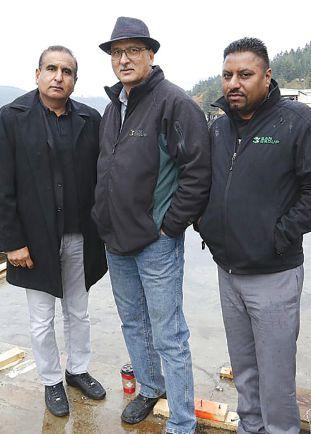
From left: San Group owners Kamal Sanghera (CEO), Suki Sanghera (president) and Paul Deol (vice-president, manufacturing) stand where their new small diameter mill will reside, on the same site as a large diameter mill the company purchased in 2017, located just outside of urban Port Alberni, B.C. Photo by Adam Kveton.
BIOMASS SUPPLY CHAIN RISK STANDARD BECOMES AN OFFICIAL STANDARD IN CANADA
The first edition of CSA W209 has been developed in compliance with Standards Council of Canada requirements for National Standards of Canada. It has been published as a National Standard of Canada by CSA Group. It provides requirements, recommendations and guidance for understanding the potential risks to
biomass supply chains, including the following risk categories and associated risk factors:
• supplier risk
• competitor risk
• supply chain risk
• feedstock quality risk
• feedstock scale-up risk
• internal organizational risk
INDIGENOUS COALITION AND CLEAN ENERGY COMPANY PARTNER FOR NET-ZERO GHG PROJECTS
The Standard applies to activities starting at the harvest point and ending at the plant gate.
Touchwood Agency Tribal Council (TATC) and Rainforest Energy Corp. (RFEC) have signed a memorandum of understanding (MOU) for the joint evaluation and development of clean energy in the TATC member territory.
TATC members include Day Star, George Gordon, Kawakatoose, and Muskowekwan First Nations in Saskatchewan.
The feasibility evaluation will be conducted to site a $250-million clean energy project at Punnichy, Sask. It involves the conversion of Indigenous-sourced waste biomass and natural gas into 87 million litres-per-year of low-carbon gasoline, jet fuel and propane.
Straw, hemp residue, logging slash, and additional sources that would otherwise be burned or left to decay, thereby avoiding greenhouse gas (GHG) emissions, are among the biomass to be evaluated.
Air emissions associated with incinerating biomass to produce electricity are avoided in the process. RFEC is currently in offtake discussions with major crude oil refiners which need low-carbon fuel output to blend down its fossil fuel sales to meet the Canadian Clean Fuel Standard. RFEC’s other projects will be evaluated by TATC for the consideration of participating alongside other Indigenous nations.
“We are pleased to see an opportunity to walk the talk on protecting Mother Earth,” Rod Favel, economic development program manager of TATC, said. “The 40 permanent jobs at each clean energy facility and the potential 250 additional jobs with connected ventures will make a difference in our communities.”
DRAX, BECHTEL WORKING TOGETHER ON BIOMASS PLANTS WITH CARBON CAPTURE AND STORAGE
Bechtel, a noted power plant engineering and construction leader, has entered into an agreement with Drax to create bioenergy with carbon capture and storage (BECCS) plants globally.
Drax has already converted its power station in North Yorkshire, England from coal to biomass, and considers it Europe’s largest decarbonization project. Bechtel is focused upon strategically important regions in North America and Western Europe for building new BECCS plants, and is reviewing ways to optimize the design of a BECCS plant using state-of-the-art engineering to achieve maximize efficiency, performance and cost.
BIOMASS PLANT ALLOWING SIMON FRASER UNIVERSITY TO REDUCE ITS GHG HEATING EMISSIONS
Simon Fraser University is on track to reduce its greenhouse gas emissions by 80 per cent from heating. The reduction in emissions is about the same as the emissions each year from 900 homes. Driving the emissions reduction is a $33-million Corix biomass plant that has just started operating.
The Burnaby, B.C., biomass plant turns clean wood waste that would have otherwise gone to a landfill into a low-carbon source of energy. The plant will help the university achieve its sustainability plan targets.
RESOLUTE WINS INNOVATION AWARD FOR TMP-BIO PLANT
Resolute Forest Products has won an innovation award for its thermomechanical pulp (TMP) biorefinery in Thunder Bay, Ont.
The company received the silver Edison Award in the manufacturing, logistics and transportation category.
The Edison Awards celebrate innovative global products, services and business leaders. Resolute partnered with FPInnovations on the TMP-Bio plant’s patented technology, developed for the commercial production of large quantities of bio-sourced chemicals.
The Biomass Supply Chain Risk Standard – published by the CSA Group – has become an official Canadian standard.
TMaking a difference at home and abroad
The future for our industry to help fight climate change is bright
By Gordon Murray
he world is emerging from the COVID-19 pandemic with renewed energy to tackling climate change. Governments around the globe are moving beyond piecemeal policy and programs to put forward strengthened national climate plan strategies with more defined targets and milestones. Canada released its strengthened climate plan, A Healthy Environment and a Healthy Economy, in December 2020 and followed up in February 2021 with Canada’s Net Zero Future.
While government action is crucial, the corporate sector is increasingly leading the way. Companies from small- and medium-sized enterprises to multi-national giants are taking a hard look at how they can contribute towards and track their own progress on reducing greenhouse gas (GHG) emissions and addressing other sustainable development goals. Global markets and investors are taking a deeper look at what drives long-term value creation in a business, using environmental, social, and governance (ESG) metrics not typically found on a balance sheet to more precisely measure and communicate a company’s value and to signal the importance of building of business that can adapt to industry, regulatory, and market shifts.
Bioenergy currently contributes about one-tenth of the world’s energy sources. While the heating sector remains the largest source of bioenergy globally, bioenergy for electricity has been growing quickly. Increasingly, sustainably sourced woody biomass pellets are seen as an important solution to the growing shift to a low-car-
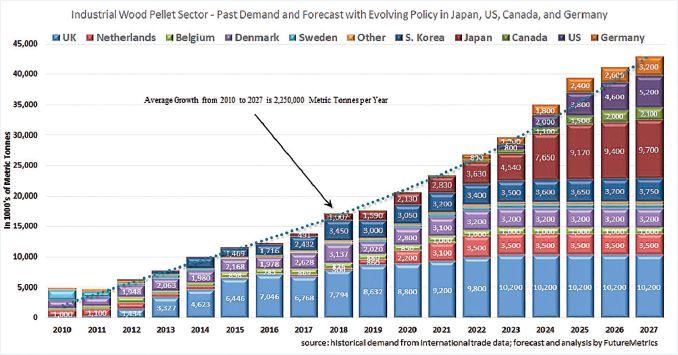
Source: FutureMetrics
bon future. Under evolving policy, the industrial pellet sector is forecast to reach about 43 million metric tonnes per year in 2027 – more than double the demand in 2019.
While Canada’s wood pellets have received strong respect and recognition globally, now is the time to turn our attention to the more substantial contribution we could be making right here at home – environmentally, economically, and socially. For example, in British Columbia alone, the wood pellet sector is creating real value for the forest sector and forest bioeconomy. Not only do we utilize residuals left behind from forest harvesting and primary forest products manufacturing, more than 2,500 men and women are also employed, either directly or indirectly in the wood pellet industry. Most of these jobs are in rural communities, including growing opportunities for Indigenous peoples’ participation.
Canada is blessed with an abundance of hydropower; however, according to the National Energy Board, bioenergy continues to be the second highest renewable energy source – with the energy generated by solid biomass significantly greater than that generated by wind, solar, geothermal, and tidal energy technologies combined. Approximately two-thirds of solid biomass energy in Canada is consumed by industry for process heat and co-generated electricity and one-third is consumed in the residential sector for space heating. Despite having the greatest solid biomass fuel potential and the largest heat consumption per capita of any major economy, Canada significantly trails European countries in solid biomass contribution to energy supply. And despite the numerous international electric utilities that have successfully converted from coal to biomass, Canadian coal power generators are unwilling to convert from coal to solid biomass.
We are making some inroads. Canada has made a commitment to get off high-emission coal. But, most Canadian electric utilities have simply opted to switch to a different fossil fuel, such as natural gas, or to have the government pay them to shut down altogether. And then there is the bioheat opportunity. At the Wood Pellet Association of Canada (WPAC)’s recent Maritime Bioheat Conference on June 2, Jamie Stephen, managing director of TorchLight Bioresources, noted that we have 475 commercial/institutional bioheat projects in Canada (75-5,000 kW scale), with the industry growing at 15 per cent per year. Over 99 per cent are using wood chips or wood pellets, choices depending on wood biomass supply chains, and capex and logistics advantages.
In many regions of Canada, particularly those with existing high heating costs and fossil fuel-dependent heating envi-
ronments, transitioning to biomass heating is a win for the environment and a win for households, businesses, and communities. By using local natural renewable resources, provinces such as Nova Scotia and New Brunswick could reduce CO2 emissions by 3.2 million tonnes per year. This represents 16 per cent of the Canadian Clean Fuel Standard’s 2030 target for liquid fuels. It could also result in a savings of nearly $1 billion for household and commercial heating across the two provinces.
Government policy makers are also turning their attention to the role wood pellets can play in low-carbon innovation. We have a world of possibilities, with most experts agreeing pellets, with their low moisture content and homogenous characteristics, are a critical starting point for biorefineries producing second-generation liquid biofuels and advanced renew-
able biomaterials. The United Nations and international climate leaders have identified bioenergy with carbon capture and storage (BECCS or Bio-CCS) as the preeminent critical ‘negative emissions’ technology. Canadian wood pellets are now being used at Drax Power’s UK BECCS project.
The future for our industry and its contribution to the fight against climate change is bright, both internationally and here at home. From our humble beginnings as a means of phasing out wastewood beehive burners to an internationally recognized source of clean, renewable and responsible energy, I’m proud of the contribution our industry is making every day here at home and around world. But, there’s more work to be done – we will continue to drive research and innovation in our sector, improve safety for our workers and enhance forest health through better utilization of residuals. •
FUNDING FOR EMPLOYERS JOBS FOR YOUTH
DID YOU KNOW?
Green Jobs employers are eligible for a wage match to hire youth (aged 15–30) into jobs that contribute to a more sustainable planet.
Youth can also access mentorship opportunities, skill-building resources, mental health services, equipment subsidies, and much more.
Learn more: pltcanada.org
From cardboard to pellets
Pilot project in Inuvik looks to use waste cardboard for heating
By Mike Jiggens
Apilot research project that began in Inuvik, N.W.T., four years ago is simultaneously addressing two local matters of concern. The first explores a way to reduce the amount of landfill-bound waste cardboard, estimated at 100 tonnes each year. The second – related to the first – looks at taking that cardboard and converting it into a source of fuel for heating.
Under the supervision of Patrick Gall, manager of technology development at Inuvik’s Aurora Research Institute, the production of cardboard pellets as a supplemental fuel source with wood pellets is showing promise in a growing heating market.
He says the concept was born during discussions about ways to mitigate the amount of landfill waste in Inuvik. Inuvik’s remote location makes it impractical to truck waste cardboard to
a recycling centre. The nearest such facilities are located in the Yukon Territory’s Dawson City and Whitehorse, both of which require more than 10 hours of trucking time, as well as the exorbitant costs associated with getting it there.
“A few people were keen on this idea of using cardboard for fuel, and that eventually evolved into the idea of pelletizing cardboard with the intent of using it with the existing pellet infrastructure in Inuvik,” Gall says.
With funding from the Northwest Territories government, ECO Canada and the territories’ waste reduction and recovery program, a feasibility study was initiated to prepare for the research project’s launch. The plan was to perform a sample cardboard collection, develop a literature review of pellet technology and cardboard chemistry, and conduct an environmental analysis.
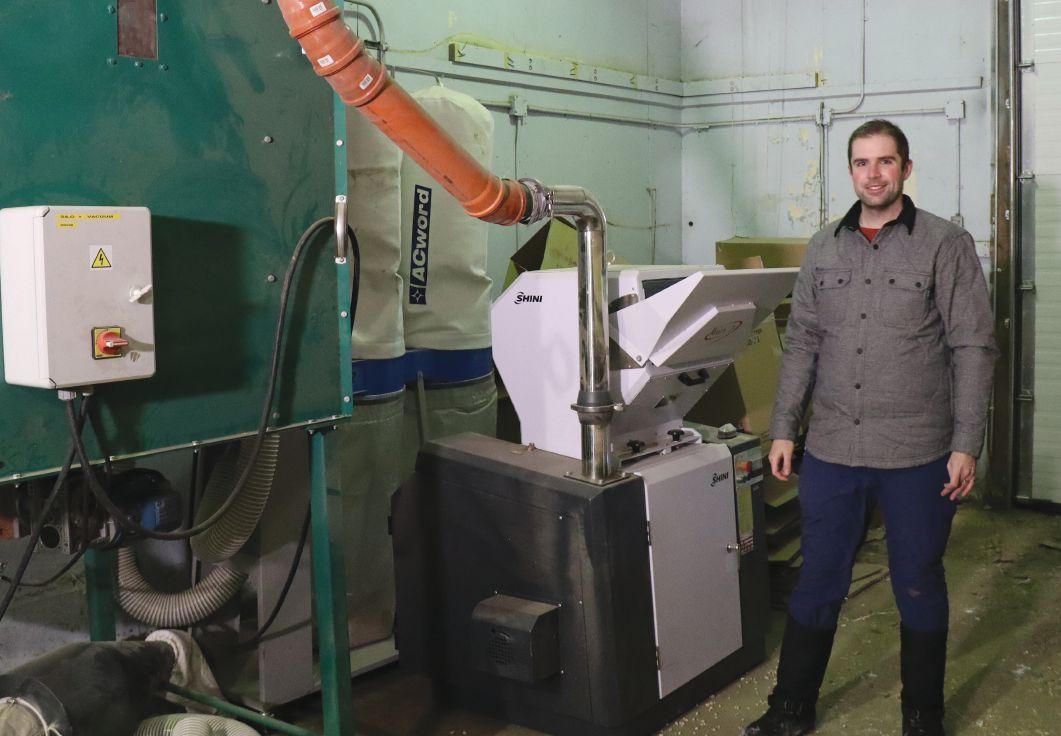
Patrick Gall, manager of technology development at Inuvik’s Aurora Research Institute, next to the granulator and storage silo of the Inuvik Pellet Mill. Photos courtesy Patrick Gall.
It was determined only corrugated cardboard material – what Gall defines as “classic” cardboard used in shipping containers – would be used in the research project. Obtained from grocery stores, hospitals and other large institutions, the carboard is stripped of staples, plastic brackets, labels and any other unwanted material and then weighed. The mass of polymers and non-fibrous materials in the cardboard is also weighed to get a better idea of how much of it is in the cardboard waste stream.
WOOD VS. CARDBOARD PELLETS
During initial discussions about waste diversion, the focus was originally on plastics before it turned to cardboard, Gall says.
The research team contacted mill manufacturers to see if cardboard pellets could be produced in a conventional pellet plant.
“We knew the process was certainly feasible on the manufacturing side,” Gall explains. “The combustion side was a bit more challenging.”
There were concerns about the amount of resultant ash, and cardboard pellets produced today are still being lab tested in order to “check some of the boxes.” Gall says the information he’s gathered is “scattered,” but the research team has been able to make the most of it. The team now has a better understanding of the project’s technical, economic and environmental considerations.
From a manufacturing perspective, the biggest difference between wood and cardboard pellets is that cardboard had originally gone through a pulping process to make the transition from wood to cardboard fibre. The process strips much of the lignin
content – which is what predominantly binds wood pellets – from the wood. Cardboard pellets require cellulose fibre for bonding.
Gall says the cardboard pellets are being made at a temperature slightly higher than that required for wood pellet production. A greater reliance is placed on the cellulose fibres to hold the cardboard pellets’ shape.
The production of wood pellets from waste wood involves a higher-density feedstock than that in cardboard pellet manufacturing. Shredded cardboard, on the other hand, is “super fluffy,” he says, adding that, in a dry climate, it creates concerns that it may not be sufficiently compressed.
“It’s dramatically different from making wood pellets from sawdust,” he says.
TEST RESULTS
But, the process involved in cardboard pellet manufacturing is similar to that of making wood pellets. Once the source cardboard is stripped of any staples, plastics and other unwanted materials, it is shredded in a granulator, producing pieces of cardboard two to three millimetres in size.
“The shredder (manufactured by Shini USA Industries) is working harder than the equivalent wood chipper/granulator combination,” Gall says.
The shredded bits of cardboard are fed into a pellet mill, where they are subjected to considerable heat and pressure. The temperature inside the pelleting chamber can reach 150 C,
while the pressure under the roller can be in the thousands of pounds per square inch.
Gall says there is no heater in the pellet mill, but the pressure applied to the feedstock creates enough internal friction to generate a rapid temperature increase.
The mill being used for the research project – the Inuvik Pellet Mill – is tailored for a medium-sized farm, he says. The work space is about 40 feet long by 10 feet wide, and is able to accommodate a shredder, storage silo and the mill itself. The mill is Lawson Mills Ltd.’s BN-10 model (also associated with the silo) while the boilers are a mix, with most being MES – redistributed Okofen units. The set-up can produce between 200 and 250 pounds of pellets an hour.
“It’s perfect for our experimentation now, and the size of the waste diversion cardboard stream that we have here is not bad at all,” Gall says.
Combustion data suggested five per cent cardboard pellets blended with wood pellets would produce the most desirable results in terms of heat generation and ash content.
For cardboard to fully burn, it requires a little more air than wood pellets. Most pellet boilers have a forced air system, but its settings were adjusted accordingly to ensure the mix burned the most efficiently.
Gall says the data predicted a higher ash percentage with the inclusion of cardboard pellets. Using that value, it was determined 10 per cent by weight mass of ash was expected from the cardboard pellets, while the mass from wood pellets was between one and three per cent. A limit of no more than five per cent ash by mass was recommended for the boilers used for the project.
“We came up with the idea of blending cardboard pellets with wood pellets to amplify the value a little bit, but we never expect to exceed five per cent by mass of ash content,” Gall says, adding that the researchers spoke with mill operators tasked with regular maintenance, who concurred that a five per cent cardboard pellet content was best.
When compressed and burned in a pelletized form, cardboard’s performance increases.
But, controlling the ash content in the boilers was a major concern, he says.
It was also determined that cardboard pellets have 15 per cent less heating value than their wood counterparts. This information was used to come up with an equivalent street value to that of wood pellets, enabling the research team to see if their manufacturing costs exceeded or fell beneath that price. They found they could at least break even or have the chance to become profitable if a subsidy system or municipal waste diversion system could be introduced.
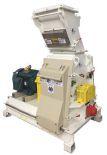
From single units to complete turnkey systems, CSE Bliss Manufacturing specializes in an industry leading line of hammer mills, rotary feeders, pellet coolers, parts and rebuilds, providing the complete solutions that only the CSE Bliss family can offer.
POTENTIAL IMPACT
The cost of gathering waste cardboard can be significant, but Gall suggests many community businesses and organizations are eager to drop off their unwanted material directly at the mill to avoid paying landfill tipping fees.
Much of the cardboard taken to the landfill is either dirty or damaged and can’t be used for pellet production, but Gall figures diverting about 60 per cent of it will enable upwards of 60 tonnes of useable feedstock annually.
The Aurora Research Institute has partnered in the project with Delta Enterprises, a private Gwich’in-owned local company that provided access to one of its workshops to install the pellet mill. Delta is poised to eventually take over the infrastructure’s commercial operation.
“We’re working on training them and teaching them how to use the mill while getting our research questions answered,” Gall says.
To cover the costs of the research project, a $95,000 grant was provided by Northern REACHE (Responsible Energy Approach for Community Health and Electricity), offered by Crown-Indigenous Relations and Northern Affairs Canada. Fixed costs included $75,000 in equipment needed to sustain a 250 pounds-per-hour processing rate. In addition to covering the costs of the shredder, silo and mill, the grant also provided for the costs of electricity and service upgrades.
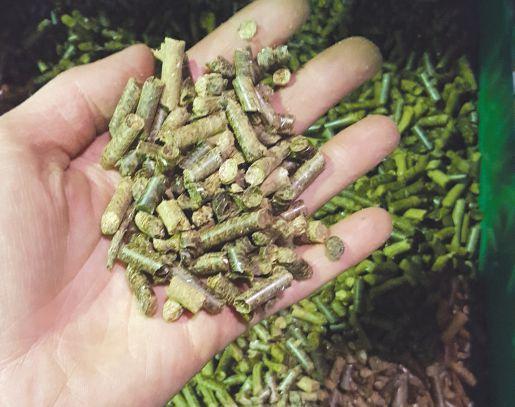
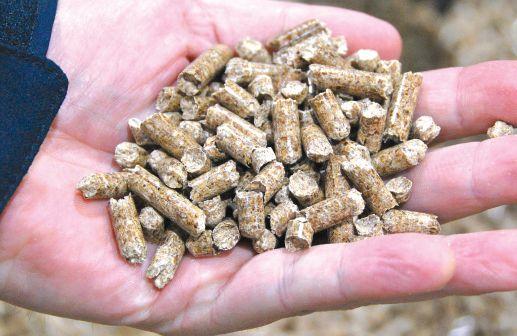
Cardboard pellets produced during the pellet mill commissioning.
Among the anticipated benefits of the project include the creation of local jobs, the conservation of landfill space and a reduction of methane gas emissions from unevenly decomposing cardboard waste. •
FUNDING FOR EMPLOYERS
DID YOU KNOW?
JOBS FOR YOUTH
Green Jobs employers are eligible for a wage match to hire youth (aged 15–30) into jobs that contribute to a more sustainable planet.
SINCE 2018, PLT CANADA HAS
3,500+ IN OVER PAID WORK EXPERIENCES AND SUPPORTED
Youth can also access mentorship opportunities, skill-building resources, mental health services, equipment subsidies, and much more.
Learn more: pltcanada.org.
250+ GREEN JOB EMPLOYERS WITH A WAGE MATCH
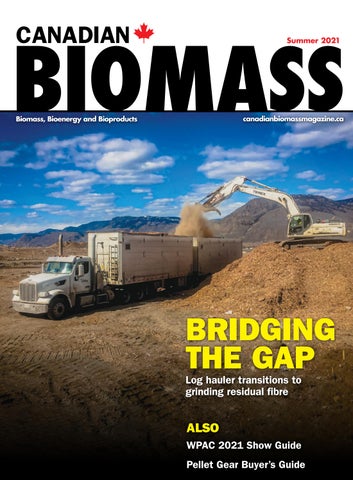
Bridging the gap
Log hauler transitions to grinding residual fibre
By Ellen Cools
In 2019, during the height of the forest industry’s downturn, many sawmills were permanently shut down and logging contractors were faced with a dilemma: move their logging fleet to a different location, or sell their equipment and lay off people? For Merritt, B.C.-based Valley Carriers Ltd., the answer was a mix of both.
The company, which does contract trucking for various pellet plants, sawmills, power plants and pulp mills, sold off some of their equipment and trucks and began to focus more on their grinding operations. This transition was in line with the company’s mission, says Valley Carriers CEO Ben Klassen.
The family-owned and operated business, which employs approximately 100 people, was started by Klassen’s grandfather in 1963. It “has always been a business based on wood residuals, sawdust and any kind of waste products from the mills,” Klassen says. “We always had that value-added piece of, ‘What can we do with this fibre to turn it into a product that people can use?’”
So, when the Forest Enhancement Society of BC (FESBC) put out a call for proposals in the fall of 2020, Klassen saw an opportunity to bring economic and environmental benefits to the community. He applied for funding for a project that would use a forest slash bunder to recover residual forest fibre – which would normally be burned in slash piles – to be used for electricity by a local power producer, Merritt Green Energy. FESBC approved a grant of $416,029 to Valley Carriers for this project, which began in December 2020.
“Valley Carriers already had FESBC funding from our earlier call for proposals, so they had demonstrated good performance, and they were quick to provide us with a new and additive proposal that increased the amount of work they could do,” Dave Conly, FESBC operations manager, says when asked about FESBC’s motivation for awarding this grant.
Valley Carriers’ initial proposal called for using a slash bundler to bundle logging slash so it could be transported using conventional logging trucks.
The idea was to “make this tube, essentially, of slash, wrapped in twine, and then we would be able to haul it out a little bit easier at the time of logging,” Klassen explains. “But, that never really took off. We ran it for two months, but it proved too inefficient.”
This was because the cut blocks Valley Carriers planned to take residual fibre from had less fibre piled on the roadside than originally anticipated. The primary logger had used more of the fibre than expected, Conly says.
As a result, there was less volume to haul, with a further distance to travel, and fewer suitable logs to support the bundles.
“Ultimately, this created production issues and the bundler was only able to produce about one-third of what a traditional grinder is able to do,” Conly explains.
PIVOTING TO GRINDING
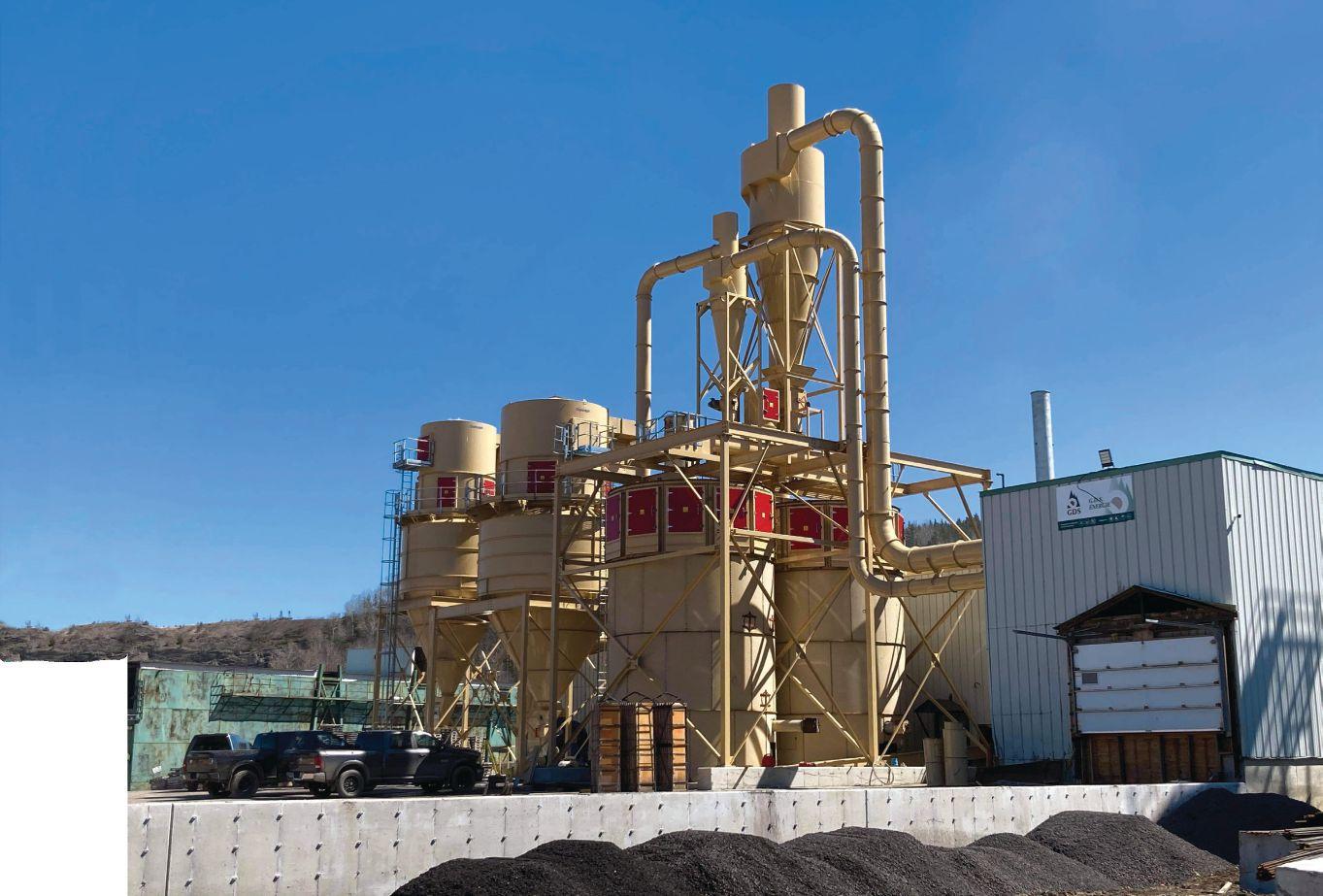
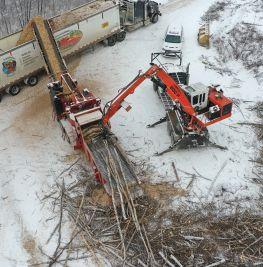
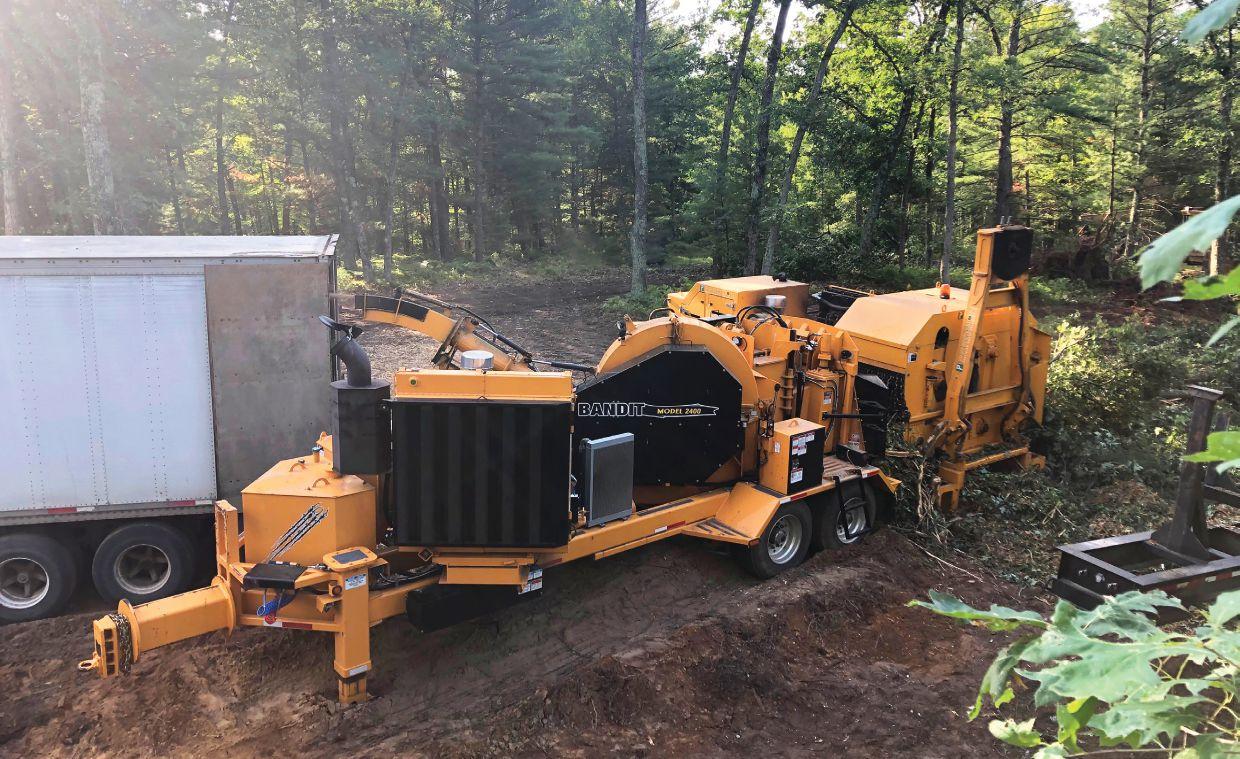
Consequently, Valley Carriers pivoted to traditional horizontal grinding, partnering with Huska Holdings to use three CBI grinders – two 6800s and one 6400.
“Grinders are temperamental machines.
Most of the time, it’s a pretty violent process that they go through, so they tend to breakdown, but these seem to be pretty consistent,” Klassen says.
The partnership with Huska Holdings was a natural one, he adds, noting Valley Carriers has the trucks and the contracts, and Huska Holdings has the capacity to grind a large amount of volume.
Initially, Valley Carriers ground the residuals directly into their chip trucks, but using chip trucks on steep logging roads proved to be a challenge.
“It’s a pretty daunting task for a driver to drag a 53-foot pail around these switchbacks that were made for logging trucks,” Klassen explains.
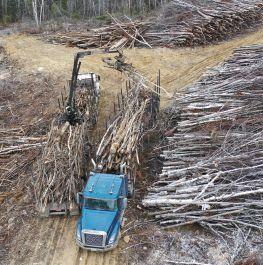
So, the company sold off some of their logging trucks to purchase three new walkingfloor B-trains from Titan Trailers, through their long-term dealer Delta, B.C.-based Ocean Trailers, to haul the residual fibre. “It has a better ground clearance and the hog doesn’t freeze in the winter. You get more volume on the walking floor on flow-through trailers, and their unloading capabilities are pretty quick,” Klassen explains when asked about the benefits of the walking floor B-trains.
Valley Carriers worked with Titan Trailers to make some changes to their flow-through
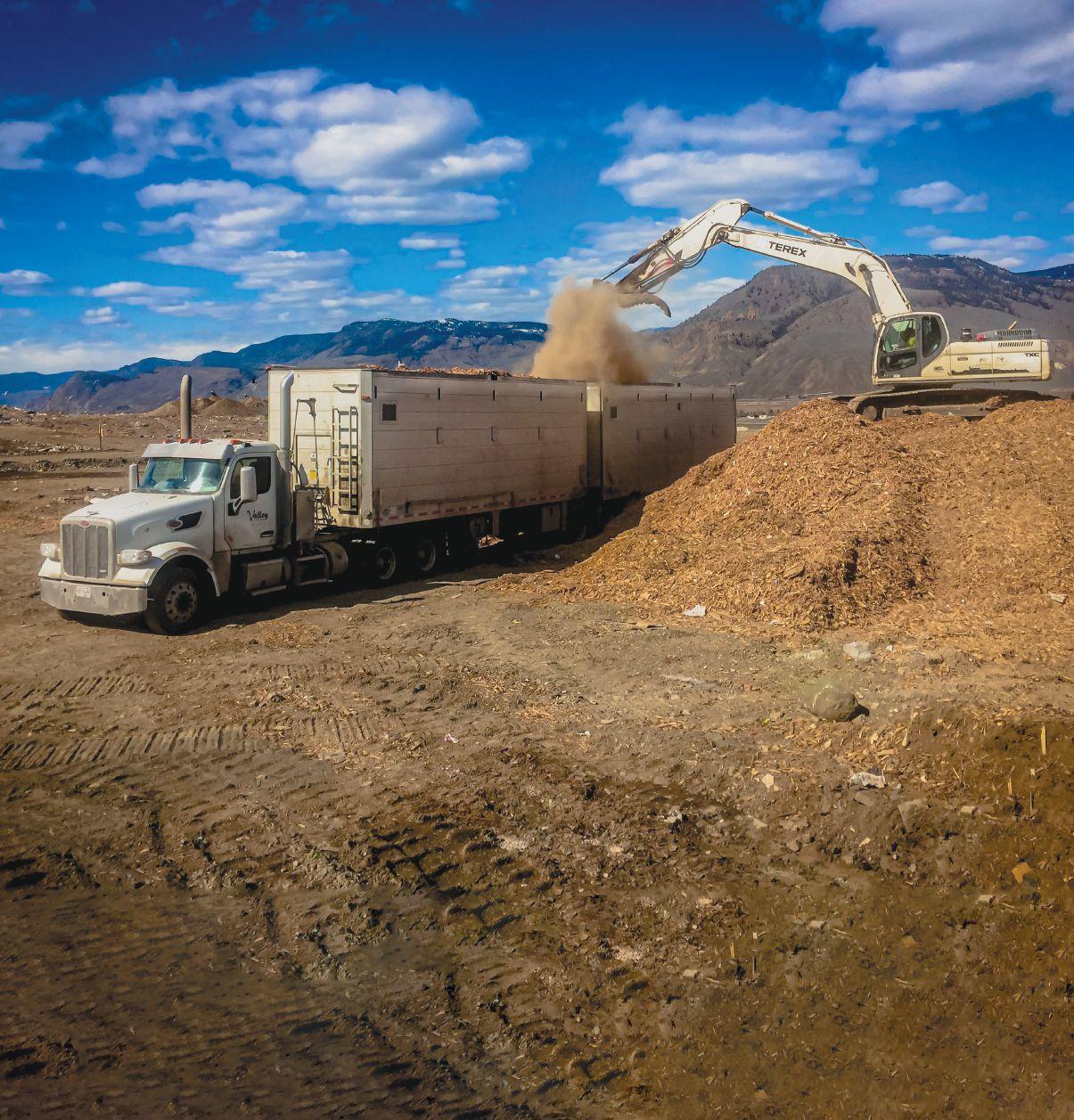
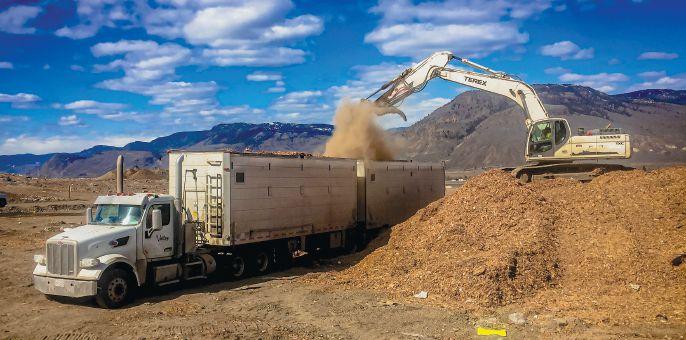
Valley Carriers recently bought three new walking-floor B-trains to transport ground residuals to their clients.
Photo courtesy Ken Dunlop.
B-train, such as adding a hydraulic fifthwheel plate so the trailers can slide together without needing traction. This means that, if operators are unloading the trucks in the winter, the hydraulics hold the trailers together, rather than the traditional method “where you try to lock your brakes, then undo an air lock and try to use your truck’s dry tires to slide the two trailers together.”
Although these types of trailers can’t carry as much fibre as traditional chip trailers, they are more robust because they are welded together, while traditional chip trailers are pot-riveted, Klassen says. And Valley Carriers can unload these trailers in 23 minutes on average, compared to around 40 minutes for a traditional B-train.
Overall, transitioning from slash bundling to horizontal grinding was the right move, and FESBC’s funding made it possible for Valley Carriers to extend their grinding operations, keeping 10 people employed for the project. Employment included the operation of the grinders, a log loader, four Western Star 53-foot trucks with a mix of Titan and TyCroft walking floors, a John Deere D7 grader, and a John Deere 7000 dozer for road building.
IMPACT OF GRINDING
The benefits of this project made the effort worth it. For one thing, grinding wood waste rather than burning it in slash piles provides environmental and public health benefits.
“By not burning these piles, we are avoiding emissions that are harmful to the atmosphere,” Conly explains. “In addition, in areas close to communities, smoke is avoided when the fibre can be utilized. Delivering this wood to a green energy plant produces clean electricity for public use and distribution. This means less small particulate in our air that we breathe.”
By March 31, Valley Carriers had met its commitment to FESBC, which was to provide Merritt Green Energy with enough fibre for 37 days of run time.
“We overachieved on our contracted commitments at a time when, 18 months ago, the power plant in Merritt was running at 70 per cent capacity because they didn’t have enough fibre,” Klassen says. “This year, they have not been down due to a lack of fibre. So, that I would say is a success.
“For us in particular, to have our people employed and our equipment continuing to move, it just tells us that it may take
volume to keep our business strong. It’s not the biggest part of our business, by any stretch, but adding that capacity of four or five trucks and diversified revenue stream keeps us being able to hold a fibre basket for the small mills that we service,” he adds.
Valley Carriers plans to execute similar grinding projects this spring on private land. The company has only used approximately half of the FESBC funding, so they have lined up some cut blocks where they can grind residual fibre in August and September using the remaining funds. Klassen expects the FESBC grant to generate $1.75 million in revenue overall.
“We’re hoping to see FESBC get refunded, and if it does, this is something we can continue for the next four to five years,” he says. “There’s fibre around and available that’s getting under-utilized, being burned, so it would be nice to see that opportunity come again.”
According to Conly, FESBC is planning to support similar projects to help forestry companies find new ways to utilize fibre and avoid burning wood waste in the forest.
“We have encouraged the industry transformation to be more focused on bioenergy opportunities,” he says. “Contractors have been able to adjust their programs, their capital and their workflow.”
Both Klassen and Conly believe grinding wood waste is a good way for loggers to overcome the effects of B.C.’s decreasing fibre supply, but acknowledge that the economics are very tight.
“The economics of bush grinding are hard just because it’s an expensive process. The end users – the pellet mills and power plants – their business models usually don’t support that fibre. So, that’s where FESBC comes in and tries to bridge that gap. The end users can’t afford it at $55 per tonne, but they can afford it at $45, so FESBC funds our operations so that we’re able to keep our production prices attainable for the end users,” Klassen says.
“It’s definitely been a struggle, and some people say we shouldn’t be doing it, but it’s still employment, it’s still value, it turns into power,” he adds. “I can’t see a downside to it.” •
A carbon negative future?
How switching from coal to wood pellets in fossil fuel power plants can remove CO2
By William Strauss
Carbon capture and storage (CCS) used in conjunction with fossil fueled power generation is appealing. However, the best that CCS can achieve with fossil fuels is to approach CO2 neutrality. That is, CCS from fossil fuels cycles carbon that has been sequestered over millions of years from out of the earth and then back into the earth. There is no net change in atmospheric CO2 as a result.
But, we can do better. Carbon neutral is good, carbon negative is much better.
This article will describe a new perspective on the purpose of utility scale pulverized coal (PC) power stations. An accompanying award-winning dashboard compliments this article and can be found at https://tinyurl.com/4nsnxt2r.
If part of an effective strategy for mitigating climate change is to develop ways to optimally remove CO2 permanently from the atmosphere, then, as this article shows, the most efficient and economical way to achieve that goal is to repurpose selected PC power stations. This is more efficient and economical than CCS from ambient air for two reasons.
First, in contrast to CCS from atmospheric air where CO2 concentrations are in the parts per million range (400 ppm = 0.04 per cent), post-combustion CCS is supplied with CO2 levels in the range of eight to 15 per cent. That is 200 to 375 times more concentrated than ambient air. This results in higher CO2 capture per unit of input energy1
Second, if the PC power station is modified to use sustainably produced pellet fuel, not only does the station serve as the supplier of concentrated CO2 to the CCS module, but it is also a generator of baseload renewable power.
Think of the station’s primary purpose as being a negative CO2 pump with a by-product of grid-level constant and reliable electricity. This combination results in a highly cost-effective carbon-negative-plus-power solution. This is only possible with the use of upgraded solid fuel suitable for PC power stations made from continually renewing biomass: i.e., wood pellets.
HOW DOES THIS WORK?
The strategy begins with sustainably managed “working” forests. Mills that use wood as a feedstock depend on a daily supply, essentially in perpetuity. Capital investments of hundreds of millions of dollars in sawmills, pulp and paper mills, engineered building products mills, and pellet mills are made with an expectation of stable supply and stable cost of feedstocks. That is, their demand cannot exceed the regional working forest’s ability to replenish itself.
Unlike the fossil fuel sector, good business practices in the forest products sector lead to good environmental stewardship because
nurturing the forest is necessary for long-term and consistent operations. Sawmills and pellet mills cannot move like drilling rigs do after the drilling rigs have depleted a reserve.
In this example, imagine a working forest that is 300,000 hectares in area2 (about 741,000 acres). This fits into a circle that has a 31-kilometre-radius. Obviously, in most locations, not all of the land area within that circle will be managed timberland. For this exercise, the stylized assumption is that the area is all working forest. If the mills are near the centre of the circle, the maximum distance that they have to travel one way is, on average, less than 31 kilometres. The dashboard mentioned above allows the user to select any size working forest to analyze and allows many of the other input assumptions to be changed.
If we assume that the 300,000 hectares of working forest has an average growth rate of 10 green metric tonnes per hectare per year, then the forest landscape grows three million new green tonnes per year.
Within this stylized forest landscape, there are many different plots in many stages of growth, from seedling to mature. Every year, the mature plots in this 300,000-hectare managed forest yield three million green metric tonnes. The rest of the managed landscape is left to continue to grow and sequester carbon at a constant rate as long as the annual harvest does not exceed the annual growth. The harvested mature plots then begin a new growth cycle that will eventually grow to maturity.
The larger diameter portions of the harvested trees typically go to a sawmill. Some of the harvest, generally small branches, leaves/needles, and often stumps/roots, are typically left behind on the forest floor. Some of the smaller diameter portions of the tree’s stems become feedstock for pulp and paper mills or other engineered building products. And some of the harvest that is not sawmill quality may find its way to a pellet mill. Sawmill byproducts also often become pellet mill feedstock.
In this model, and in the default settings of the dashboard, five per cent is left on the forest floor, 35 per cent becomes building materials (lumber, flooring, furniture, veneer, OSB, etc.), 20 per cent becomes paper or packaging, and the rest is available to the pellet mill (which also includes some of the sawmill’s sawdust and chip by-products). After accounting for the five per cent left in the forest, of the 2.85 million metric tonnes that is removed from the mature plots, just over 1.1 million green tonnes are available for pellet production. The output of the pellet mill in our stylized model is about 524,000 tonnes per year.
The pellet fuel is then transported to the “power” station. Power is in quotes because the station’s purpose is not just for the generation of electricity. The re-purposed power station with bioenergy carbon capture and storage (BECCS) takes the hydrocarbons in the pellet fuel and concentrates the carbon as CO2. The BECCS unit permanently removes the CO2 from the atmosphere. The “byproduct” of the CO2 capture and sequestration is electricity.
A FEASIBLE STRATEGY
Wood, on average, is about 50 per cent carbon. One tonne of carbon atoms produces 3.67 tonnes of CO2. The 283,000 tonnes of carbon in the carbohydrate-based pellet fuel releases about 1,040,000 tonnes per year of CO2 in combustion.
Without BECCS, that CO2 is released into the atmosphere. The new growth in the managed timberlands absorbs all of that and more, since only 40 per cent of the annual new growth becomes pellets. Even without BECCS, the atmosphere sees no net increase in CO2 from the combustion of pellets that are sourced, provided the total stock of forest resources in the mill’s supply region cannot be depleted.
But with BECCS, that 1,040,000 tonnes of CO2 are permanently subtracted from the atmosphere.
The re-purposed PC power station in this model is doing the equivalent of permanently taking about 250,000 cars off the road.
And as a valued by-product of an already valuable environmental service, under the assumptions of the model, the equivalent of almost 103,000 homes are supplied with 100 per cent renewable
electricity that, in contrast to wind and solar generation, is not intermittent or variable, but is baseload.
Many nations are already using pellet fuel in place of coal in PC power stations to lower net CO2 emissions. The use of pellet fuel in power plants sets the foundation for the strategy outlined in this paper.
Wind and solar generation do not have the capacity to be used as efficient negative carbon pumps. Integrating sustainably sourced biomass-based solid fuel that is easily substituted for coal means that some of the existing power stations should have very long lives – not for the primary purpose of renewable power generation (which they will do) but for the purpose of efficiently lowering atmospheric CO2 concentrations.
This is a very attractive strategy that is totally feasible with the current state of technology. It should be part of a portfolio of decarbonization strategies going forward.
NOTES
1. “Current economic analysis estimates a cost of $70–100/tonne of CO2 for carbon capture from flue gas (Vitillo et al., 2017). With only 400 ppm CO2 in air, a DACC process requires a cost between $300 and $1,500 per tonne of CO2 captured (National Academies of Sciences, Engineering, and Medicine, 2019)”. Frontiers in Energy Research, December, 2020; https://www.frontiersin.org/ articles/10.3389/fenrg.2020.560849/pdf
2. To put this into perspective, British Columbia has about 25,000,000 hectares available for logging; or about 83 times more than is in the model used in this analysis. That represents about 42 per cent of the total forested area in B.C. The rest is not available and/or is protected. Source B.C. Ministry of Forests. The states of Georgia, South Carolina, and North Carolina in the U.S. have about a combined 22,240,000 hectares of managed timberland, or about 74 times more than is in the model used in this analysis.
AVAILABLE IN SIZES UP TO DN800 (32 INCHES)
Source: American Forest & Paper Association. •
William Strauss is the president of FutureMetrics LLC.
SHOW GUIDE
Hello Everyone!
I’m pleased to invite you to WPAC’s 2021 Conference and AGM. While we hoped that this year we could all get together in person, it will be another virtual conference. However, that hasn’t stopped us from putting together an impressive series of topics and guest speakers for this year’s conference.
The theme this year is “Making a Difference Globally and at Home.” Increasingly, global customers are setting ambitious targets to lower greenhouse gas (GHG) emissions while locally, here in Canada, policymakers are increasingly touting a low-carbon economy and starting to realize the true power of wood pellets. From a source of responsible, renewable and clean energy to the gateway to the bioeconomy – it starts with pellets and our industry has an important contribution to make globally and domestically.
Together with our media partner, Canadian Biomass magazine, we have put together a condensed program that reflects the opportunities ahead for our sector as well as the key trends and potential headwinds. Key speakers invited include provincial and federal elected officials, senior industry consultants, operating and sustainability professionals from producing companies and power utilities, and leading safety experts. Topics include:
• Global market perspectives
• Trends in responsible sourcing
• Innovating our way to a safer, better product
• Getting to net zero in Canada with pellets
• The power of pellets in the emerging bioeconomy
Once again, the conference will take place in short bursts over three days from September 20-22, 2021. The live conference will take place over three hours on September 20; the AGM – also open to all WPAC members – will be on September 21 for one-and-a-half hours; and there will be a board meeting for one-and-ahalf hours on September 23. In addition, we have loads of pre-recorded presentations available for conference registrants.
We are not charging a fee to participate. We only ask that participants register online at canadianbiomassmagazine.ca/virtual-events-wpacconference-agm-day-1. Although costs are lower than normal, we will still incur expenses, so we are most grateful for our sponsors who are making this event possible.
I want to thank last year’s sponsors who helped us make the conference a reality. We will be reaching out to our partners and others to invite them to sponsor again this year, so stay tuned for more information on our sponsorship opportunities.
As we make our way out of this global pandemic, the virtual conference provides an important vehicle for us to share perspectives and contribute to WPAC’s annual planning. Last year, we had more than 400 attendees from around the world and right here at home.
I invite you all to join us and I look forward to seeing you, virtually.
All the best,
Gordon Murray Executive Director Wood Pellet Association of Canada
AGENDA
Making a Difference Globally and At Home
SEPTEMBER 20-22, 2021
MONDAY, SEPTEMBER 20, 2021
8:00 – 11:00 A.M. PACIFIC
Live Content:
8:00 a.m. to 8:15 a.m
Welcome and Opening Remarks
Speakers: Gordon Murray, WPAC, and Vaughan Bassett, Pinnacle Renewable Energy and WPAC Chair
8:15 a.m. to 8:45 a.m.
Global and Domestic Market Review
8:45 a.m. to 9:05 a.m.
Trends in Responsible Sourcing: Japan, Europe & ENGOs
WPAC Conference & AGM • A Virtual Event
9:05 a.m. to 9:20 a.m. Break
9:20 a.m. to 9:50 a.m.
Innovating our way to a Safer, Better Product
9:50 a.m. to 10:20 a.m.
Getting to Net Zero in Canada with Pellets
10:20 a.m. to 10:50 a.m.
The Power of Pellets in the Emerging Bioeconomy
10:50 a.m. to 11:00 a.m.
Final Thoughts
Speaker: Vaughan Bassett, Pinnacle Renewable Energy
SHOW GUIDE
AGENDA
WPAC Conference & AGM • A Virtual Event Making a Difference Globally and At Home
SEPTEMBER 20-22, 2021
TUESDAY, SEPTEMBER 21, 2021
WPAC Annual General Meeting: 8:00 a.m. to 9:30 a.m. Open to all WPAC members
8:00 a.m. Call to order, introductions, review and approve agenda, competition policy
8:05 a.m. Confirmation of directors and officers
8:10 a.m. Executive director’s report
8:30 a.m. Financial report
8:40 a.m. Appointment of auditors for next year
8:45 a.m. Safety Committee chair’s report
8:55 a.m. Research director’s report
9:05 a.m. Business plan summary for next year
9:30 a.m. Meeting adjourns
FUNDING FOR EMPLOYERS
DID YOU KNOW?
JOBS FOR YOUTH
Green Jobs employers are eligible for a wage match to hire youth (aged 15–30) into jobs that contribute to a more sustainable planet.
SINCE 2018, PLT CANADA HAS
3,500+ IN OVER PAID WORK EXPERIENCES AND SUPPORTED
Youth can also access mentorship opportunities, skill-building resources, mental health services, equipment subsidies, and much more.
Learn more: pltcanada.org.
250+ GREEN JOB EMPLOYERS WITH A WAGE MATCH
AGENDA
SEPTEMBER 20-22,
WEDNESDAY, SEPTEMBER 22, 2021
WPAC Board of Directors Meeting: 8:00 a.m. to 9:30 a.m.
8:00 a.m. Call to order, additions or changes to agenda, new competition policy
8:05 a.m. Business plan for next year
9:05 a.m Financial plan
9:15 a.m. Any other business, date of next board conference call 9:30 a.m. Meeting adjourns
*Agenda is subject to change. All times are PST.
Going green
Greenhouse sees benefits switching to a wood chip boiler for heating
By Guillaume Roy, Translated by Peter Diekmeyer
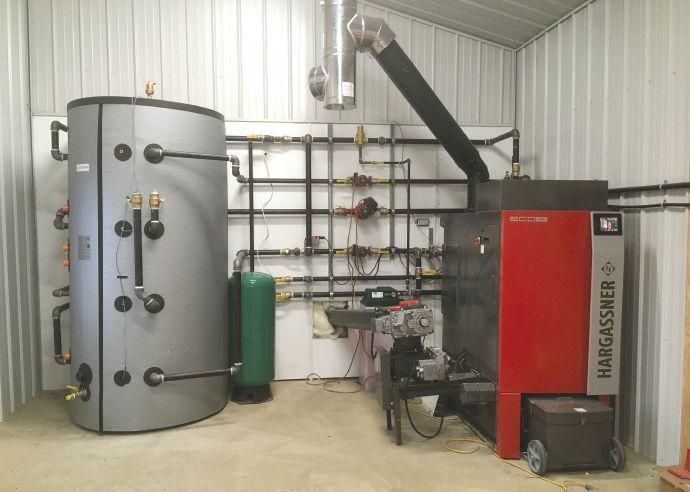
In April 2020, when Frédéric Tremblay installed a Hargassner wood chip boiler at Jardins d’Elisabeth, the vegetable farm and greenhouse he co-owns in SaintElzéar, Que., his primary focus was on efficiency, effectiveness, and productivity.
Tremblay also has his own forestry operations, “So, it makes sense to put leftover wood to good use,” he says.
Getting the wood ready to burn takes a lot of work. But, Tremblay regards the investment in the Hargassner boiler as more than worth it, as it costs next him next to nothing in raw material costs to heat his greenhouses all year round.
Tremblay started by using a standard grinder. But, the system was inadequate and got jammed from time to time.
“The key is using the right material with the right boiler,” he says. That problem was solved after he bought a German-made Heizohack wood chipper from Heizomat to
transform his logs into wood chips optimized for use in the boiler. Since then, the boiler has worked like a charm.
“Effective processing and drying of the wood are also important,” Tremblay says.
“You have to let lumber and logs dry for at least a year, if not two,” he continues. “It’s also important to make sure that air can pass through the wood piles.”
Tremblay’s nearly $130,000 investment to acquire the boiler and the chipper will be financed in part by a grant from the Transition Énergie Québec (TEQ) program. The size of the grant will vary depending on operational performance. According to an initial TAQ assessment, Tremblay will be eligible to receive the lower amount of either 75 per cent of his eligible costs, $125 per ton to compensate for the greenhouse gas emissions the boiler and chipper will enable him to cut, or an amount that will enable him to payback his initial investment over three years.
Frédéric Tremblay installed a Hargassner wood chip boiler at his vegetable farm and greenhouse, Jardins d’Elisabeth, in Saint-Elzéar, Que. Photos courtesy Jardins d’Elisabeth.
“Whatever the calculation, I will be able to repay my investment in three years,” Tremblay says.
In contrast, using propane to heat his greenhouse operations so he could grow produce during the fall would have cost close to $15,000 per year. However, the calculation may seem biased because a producer will not heat his or her greenhouse if it cannot generate enough yield, and thereby sufficient income, to offset heating costs.
That was the case with Tremblay, who estimates that the high propane costs would have made greenhouse operations during the fall season uneconomical.
Instead, the biomass boiler enables him to change his business model by producing more, without needing to burn fossil fuels.
With ample timber supply on his land, getting the biomass costs him nothing except time. But, Tremblay believes that the project would still be economical even if he had to buy the wood.
“I had a truckload of birch delivered into my yard last year for $1,800. Going forward, I expect to consume the equivalent of two truckloads annually,” he explains. “That adds up to about $3,500, which is far less than propane would cost.”
The greenhouses must also be heated in the summer and fall to enable dehumidification, as excess humidity can cause disease problems in the plants.
“I’d be really upset if I had to burn propane to dehumidify,” says Tremblay.
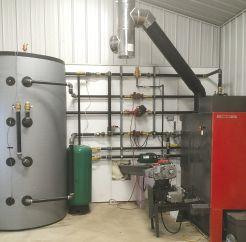
In addition to extending his growing season in the fall, the boiler also enables Tremblay to heat the greenhouse in the winter to about five degrees Celsius, in part so he can start operations faster in the spring, because the heated ground does not need to be thawed. For now, Tremblay only produces some green vegetables, like spinach. However, he is looking at doing more in the future.
Why import petroleum products when an alternate energy resource is within reach? For Frédéric Tremblay, biomass is the ideal heating fuel option. •
HARGASSNER BOILER IMPROVEMENS
• Patented zinc rotary valve, which increases the reliability of the feed auger supply.
• Monitoring of engine power and automatic reverse functions to facilitate deblocking.
• Combustion quality control with the Lambda sensor and the air combustion control devices.
• Improvement of the automatic cleaning and descending system.
• Recycling a portion of the combustion fumes to cool the combustion chamber and the ashes.
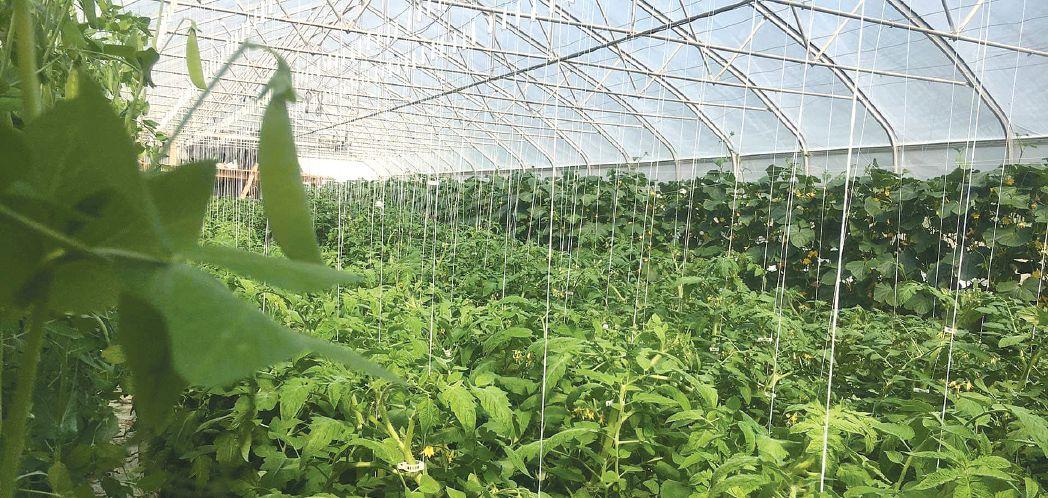
Inside Jardins d’Elisabeth, which produces some green vegetables like spinach.
Dust Safety
The latest collection and suppression systems on the market
Staff Report
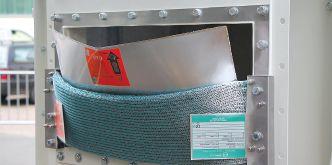
CV Technology is excited to introduce a product to the marketplace that draws upon the company’s 25-plus years of experience with passive flameless explosion protection and allows clients to protect their personnel and process from the effects of a deflagration while simultaneously solving the problem of discharging clean air to the exterior of their facility. With the Interceptor-QV, wood product facilities get the protection they need while safely and efficiently retuning clean air to the facility, thereby reducing HVAC costs and building air make-up issues. Another patented feature of the Interceptor-QV is an integrated thermocouple, which, when exposed to the intense heat of a deflagration, will indicate, via relay, that the system has been involved in an event. A passive system like this is on the job 24 hours a day, 365 days a year. There is nothing to arm and no power source required for the QV to do its job. www.cvtechnology.com
VETS Sheet Metal was founded in 1921 by a World War I veteran and has nearly 100 years of HVAC experience. The
company completes projects in industrial, light industrial and institutional HVAC capacities with a specialization in dust collection and pneumatic conveying. Every application requires a unique approach to the development and implementation of a dust system. Whether the best tool for the job is a traditional cyclone or baghouse or something more unique like a MultiCone or Cyclofilter, VETS can engineer, design, fabricate and install a system that meets or exceeds your plant’s safety and environmental requirements.
www.vetsgroup.com
REMBE
Innovative technology makes it possible to divert combustible dust explosion shock waves and flames in a controlled manner so the required safety area is reduced, valuable usable area is increased and personnel/ equipment are protected from the explosion’s effects. Explosion vents are an economical form of explosion pressure relief but require extensive safety areas that become unusable space. Rembe’s Targo-Vent is an opening angle limiter developed especially for Rembe explosion vents. Targo-Vent guides pressure relief into areas where there is no danger to infrastructure or personnel. Targo-Vent absorbs the enormous repulsive forces of explosion energy and guides the flames/ shock wave in the desired direction so usable area is increased.
www.rembe.us
IEP TECHNOLOGIES
IEP Technologies provides a complete range of cost-effective industrial explosion protection for biomass applications and is pleased to introduce the IV8 Flameless Vent. The IV8 provides an explosion protection
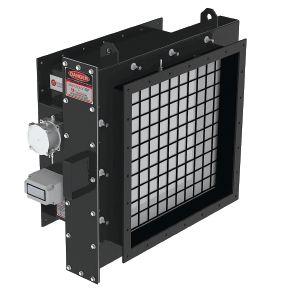
solution for process vessels which are located inside a building or other areas where standard explosion venting cannot be safely employed. The IV8 utilizes a stainless-steel explosion relief vent and flame arresting mesh enclosed in a durable carbon steel-coated frame. The integrated vent burst detection sensor allows plant personnel to respond accordingly in the event of an explosion within the protected application.
www.IEPTechnologies.com
FIKE
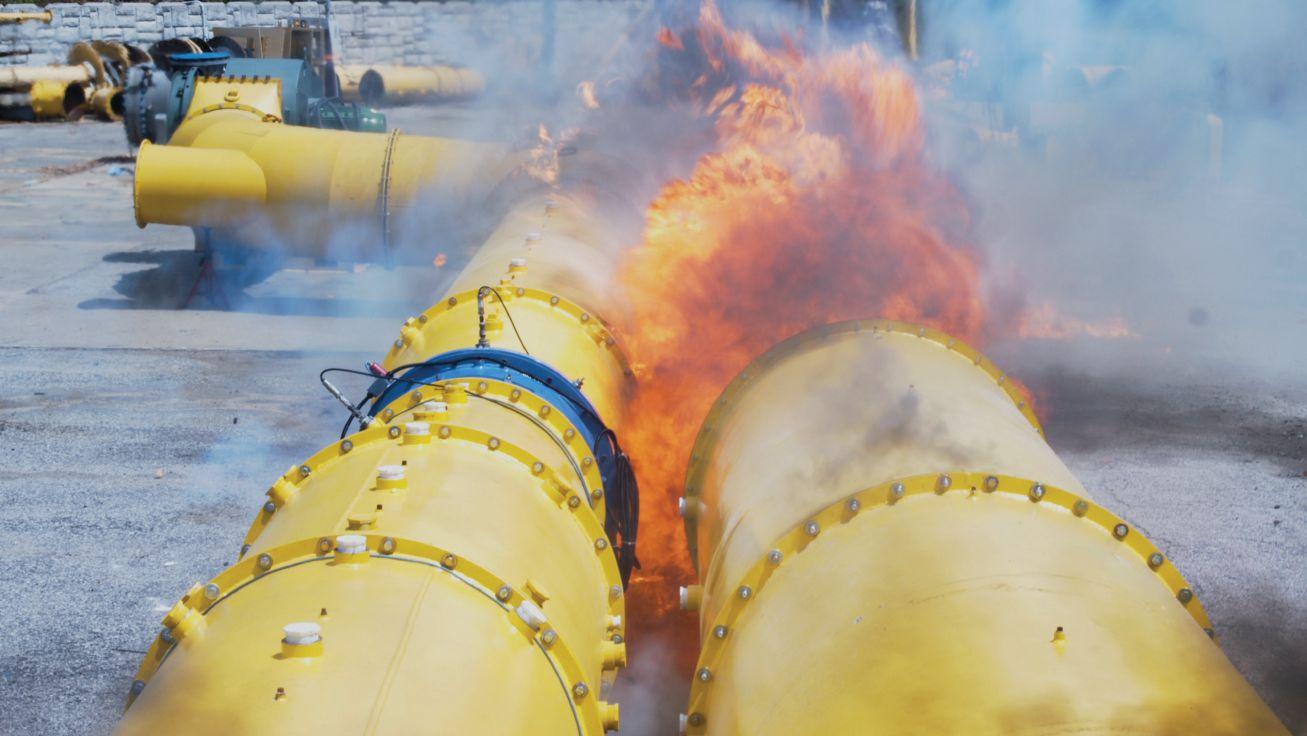
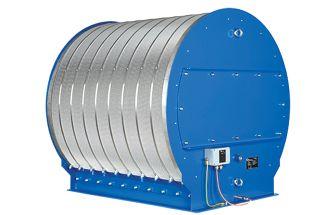
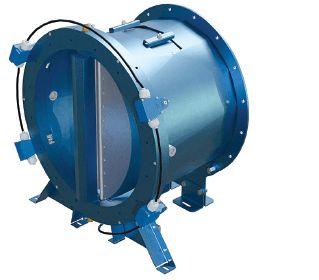
Fike DFI is an ultra-reliable, compact passive explosion isolation valve that’s tested and proven to perform accurately under pressures it might experience during a deflagration within a biomass application. Its lightweight dual-flap assembly allows it to be installed near a vessel and in both vertical and horizontal orientations for sizes up to DN800. DFI exceeds the current EN16447 standard which has been empirically proven to not fully represent real-world applications. For instance, the standard allows for test set-ups to not include a “protected zone pipeline” on the non-deflagration side of the flap valve. Without it, the flap valve may be certified to protect against pressures for which it hasn’t been accurately tested. www.fike.com
VETS SHEET METAL
KICE INDUSTRIES
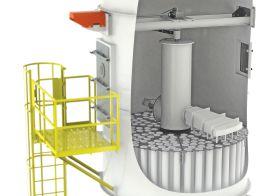
Kice Industries has introduced a new baghouse filter to its product line, the Kice GR Filter. The new and improved design will result in lower energy consumption and extended filter bag life. The new filter contains a patented auto-timing mechanism that does not require mechanical adjustment to ensure proper reverse air timing for cleaning. It has a standard temp rating of 150 degrees F with a max temp option up to 300 degrees F. The filter also has low energy requirements with a 7.5-hp reverse air cleaning blower. www.kice.com
BOSSTEK
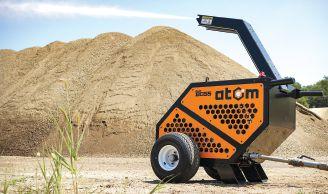
As effective dust control continues to gain priority across a wide range of industries, a new equipment design has been engineered to provide an unmatched level of mobility and performance, delivering effective particle suppression for new and existing applications. The DustBoss Atom from BossTek is a fan-less, self-contained unit that incorporates remote control and 4G LTE telematics technologies to deliver an unprecedented combination of suppression and monitoring. The Atom is well-suited to biomass handling, bulk material processing, demolition projects, recycling operations, transfer stations, ports/shipping applications, quarrying/crushing, concrete curing and even indoor operations where significant air movement may be undesirable. www.bosstek.com
ALLIED BLOWER
For wood processing facilities demanding larger system capabilities, Allied Blower & Sheet Metal has a certified line of Back Blast Dampers (BBD’s) that reach sizes up to 50
inches in diameter. The BBD can resist a vented dust collector explosion reaching a Pred of five psi (0.35 bar) for dusts with a Kst of up to 200 bar-m/second. This range provides safe operation for a large range of deflagrable dusts used in industry. When comparing the options of using a passive mechanical system or an active chemical suppression system, the mechanical systems are perceived to have less maintenance costs due to simplicity in function, design, training requirements, and the low frequency of inspections. With a mechanical BBD, mill staff do not need specialized training or tools when inspecting and keeping maintenance records for NFPA compliance, as they would with an active chemical system. This results in more up-time, allowing for increased production. Allied’s BBDs are built in Canada and designed for easy installation, inspection, and maintenance. The instrumentation meets North American standards to easily integrate into a plant or mill PLC system and is available in Class 2 Div 2. A combination of Allied BDD and an Allied’s NFPA certified rotary feeders can provide NFPA-compliant passive isolation for large sized systems. www.alliedblower.com
BOSS PRODUCTS AMERICA
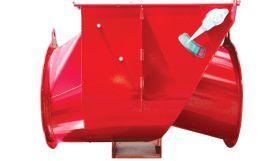
The EV-VF VigiFlap explosion isolation valve has been designed, tested and certified to prevent the propagation of overpressure or flame front caused by a potentially catastrophic explosive event. Intentionally certified for “Intended Use,” the VigiFlap valve has been proven to function flawlessly when tested for dust collection suction and pressure side ducting installations. The VigiFlap’s unique inlet/outlet straight through design has proven to be a superior product for applications that require installation with elbows, vertical/horizontal piping installations, very low-pressure resistance
and zero dust accumulation. All VigiFlap explosion isolation valves are 100 per cent NFPA-compliant when ordered with the CP04 intrinsically safe control panel and dust level sensor.
www.bossproductsamerica.com
AFS ENERGY
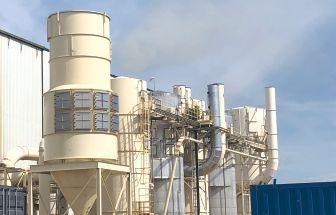
AFS Energy offers a rough mill 65,000 filtered dust collection system, featuring pre-cleaning cyclones with a closed-loop pneumatic material transfer ductwork, spark detection and extinguishing system, and pneumatic material transfer system. The company has installed he system at Peerless Bin, with plant return air ductwork with summer/winter dampers. www.afsenergy.com
2021 PELLET GEAR BUYERS GUIDE
CATEGORIES
DRYERS
Amandus Kahl GMBH & Co. KG (Sarj Equipment, Canada)
Andritz Group
Anhydro Inc. (Spx Flow Technology)
Baker-Rullman
Buettner Energy And Drying Systems North America, LLC
Certified Labs
Dieffenbacher North America, Inc.
Earth Care Products, Inc.
Energy Unlimited Inc.
GEA Canada
Münch-Edelstahl GMBH
Player Design, Inc.
Saimatec Engineering
Siempelkamp Energy Systems GMBH
Silvana Import Trading Inc.
Solagen Inc.
Stela Laxhuber GMBH
Thompson Dehydrating
TSI Dryers
Uzelac Industries Inc.
PNEUMATIC CONVEYING
Allied Blower
Amandus Kahl GMBH & Co. KG (Sarj Equipment, Canada)
Baum Pneumatics Inc.
Certified Labs
Clarke’s Industries, Inc.
Concept-Air
Continental Conveyors
Coperion K-Tron
Fox Venturi
Jeffrey Rader – Terra Source
Koger Air Corporation
Rodrigue Métal Ltée
Silvana Import Trading Inc.
Walinga
HAMMERMILLS
Amandus Kahl GMBH & Co. KG (Sarj Equipment, Canada)
Andritz Group
Bliss Industries, LLC
Bruks Siwertell
Brunette Machinery Company Inc.
Buskirk Engineering
Certified Labs
CPM Global Biomass Group
CSE Bliss Manufacturing LLC
Dieffenbacher North America, Inc.
Gemco Energy
Jeffrey Rader – Terra Source
La Meccanica Srl Di Reffo
Law-Marot-Milpro Inc.
Münch-Edelstahl GMBH
Schutte Hammermill
Silvana Import Trading Inc.
West Salem Machinery Co.
PELLET MILLS
Amandus Kahl GMBH & Co. KG (Sarj Equipment, Canada)
Andritz Group
Astec
Bliss Industries, LLC
Buskirk Engineering
Certified Labs
CPM Global Biomass Group
La Meccanica Srl Di Reffo
Münch-Edelstahl GMBH
Pelleting Technology Netherlands
Salmatec GMBH
Silvana Import Trading Inc.
SCREENS & COOLERS
Amandus Kahl GMBH & Co. KG (Sarj Equipment, Canada)
Andritz Group
Baum Pneumatics Inc.
Bliss Industries, LLC
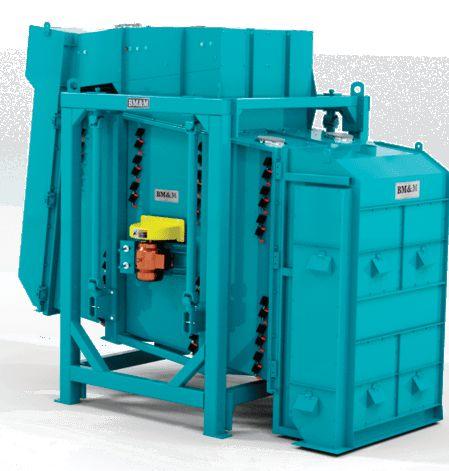
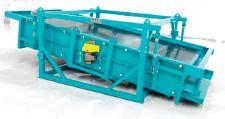
BM&M Screening Solutions
Bruks Siwertell
Brunette Machinery Company Inc.
Buskirk Engineering
Certified Labs
CPM Global Biomass Group
CSE Bliss Manufacturin
Dieffenbacher North America, Inc.
Jeffrey Rader – Terra Source
La Meccanica Srl Di Reffo
Law-Marot-Milpro Inc.
Münch-Edelstahl GMBH
Pelleting Technology Netherlands
Silvana Import Trading Inc.
Vibroscreen
West Salem Machinery Co.
FIRE/SPARK DETECTION & SUPPRESSION
Allied Blower
Amandus Kahl GBMH & Co. KG
(Sarj Equipment, Canada)
Clarke’s Industries, Inc.
Concept-Air
CV Technology, Inc.
Fagus GreCon, Inc.
Fenwal-Iep Technologies
Fike Corporation
Firefly Ab
Flamex, Inc.
Rodrigue Métal Ltée
Silvana Import Trading Inc.
BAGGING & PALLETIZING
Amandus Kahl GMBH & Co. KG (Sarj Equipment, Canada)
Balcan
Bulldog Bag Ltd.
Hamer LLC
Möllers North America Inc.
Polypro Solutions
Premier Tech Chronos
Rethceif Packaging
Silvana Import Trading Inc.
Trinity Packaging
DIES & ROLLS
Amandus Kahl GMBH & Co. KG (Sarj Equipment, Canada)
Bulldog Bag Ltd.
CPM Global Biomass Group
Dorssers Inc.
La Meccanica Srl Di Reffo
Münch-Edelstahl GMBH
Silvana Import Trading Inc.
QUALITY CONTROL EQUIPMENT & SERVICES
Amandus Kahl GMBH & Co. KG (Sarj Equipment, Canada)
BRUNETTE MACHINERY COMPANY INC. www.brunettemc.com 604-522-3977
BULLDOG BAG LTD. www.bulldogbag.com 1-800-665-1944
BUSKIRK ENGINEERING
www.buskirkeng.com 260-622-5550
BUETTNER ENERGY AND DRYING SYSTEMS
NORTH AMERICA, LLC
www.buettner-energy-dryer.com 704-910-0162
Experts in Energy and Drying. Proven, reliable, efficient and at the highest technical level. Single path drum dryers, indirect heated dryers.Energy systems, suspension burners, multi or single fuel.Biomass, pellet and torrefaction applications. German engineered – Made in the USA –Local Service
CERTIFIED LABS
www.certifiedlabs.com 905-691-0492
CLARKE’S INDUSTRIES, INC. www.clarkes-ind.com 541-343-3395
CONCEPT-AIR
www.concept-air.ca 1-866-644-0041
Successful solutions for aspiration systems and industrial processes. Our dust collectors are designed to efficiently treat a variety of particle types. We offer a turnkey service that meets the most demanding standards in the industry!
storage equipment including en-masse chain conveyors, screw conveyors, belt conveyors, disc screens as well as storage and reclaim solutions. Robust designs coupled with over 50 years of wood industry and related experience assures quality conveying systems for pellet, biomass, fuel, and wood processing industries. Contact us to see how we can help you move your bulk materials.
COPERION K-TRON www.coperion.com 785-825-1611
CPM GLOBAL BIOMASS GROUP www.cpm.net 1-800-428-0846
Continental provides a full range of mechanical bulk handling and
COMPANY INFORMATION
EARTH CARE PRODUCTS, INC.
www.ecpisystems.com
620-331-0090
Z8 Rotary Dryer’s patented design achieves uniform dehydration while minimizing VOC emissions. Z8 Rotary Dryer can be designed as a drop-in replacement for existing Single and Triple-Pass Rotary Dryers.
ELECTROMATIC EQUIPMENT COMPANY INC. www.checkline.com
1-800-645-4330
ENERGY UNLIMITED INC. www.energyunlimitedinc.com 608-935-9119
FAGUS GRECON, INC.
www.Fagus-GreCon.us 704-912-0000
FENWAL-IEP TECHNOLOGIES
www.ieptechnologies.com
855-793-8407
FIKE CORPORATION
www.fike.com
816-229-3405
FIREFLY AB
www.firefly.se
+46 (0)8 449 25 00
FLAMEX, INC.
www.sparkdetection.com
336-299-2933
FLAMEX is a leading North American supplier of customized industrial process fire prevention systems and equipment. We have 40 plus years of experience and numerous installations in the wood pellet industry.
FOX VENTURI
www.foxvalve.com 973-328-1011
GEA CANADA
www.gea.com 819-477-7444
GEMCO ENERGY
www.agicogroup.com 0086-372-5965148
HAMER LLC
www.hamerinc.com 763-231-0100
JEFFREY RADER – TERRA SOURCE www.terrasource.com 514-822-2660
KOGER AIR CORPORATION www.kogerair.com 800-368-2096
LA MECCANICA SRL DI REFFO www.lameccanica.it +39-049-941-9000
LAW-MAROT-MILPRO INC. www.lmmequip.com 800-461-6276
MID-SOUTH ENGINEERING STOLBERG GROUP www.mseco.com/stolberg 604-273-1915
MOISTTECH CORP www.moisttech.com 941-727-1800
Insensitive to material variations such as particle size, material height & color, MoistTech moisture sensors provide continuous, reliable readings with zero maintenance and a one-time calibration with a non-drift optical design allowing operational personnel to confidently make immediate process adjustments based on real-time measurements.
MÖLLERS NORTH AMERICA INC. www.mollersna.com 616-942-6504
For almost 50 years, SALMATEC produces and develops cutting edge pelleting equipment. In addition to our MAXIMA pelletizers, we build dies and rollers in any size and configurationall Made in Germany.
SIEMPELKAMP ENERGY SYSTEMS GMBH www.siempelkamp.com 770-424-4141
SILVANA IMPORT TRADING INC.
www.silvanatrading.com 514-939-3523
Silvana is today’s leading importer of forestry and wood & biomass processing, small scale pellet presses equipment to Québec and to provinces across Canada. We promote and distribute solutions from leading Swedish manufacturers of high quality machinery.
STELA LAXHUBER GMBH
www.stela.de
+49(0)8724-899-0
TEWS OF AMERICA CORP. www.tews-of-america.com 919-240-4425
TSI builds machinery for the Wood Processing Industry. This includes Rotary Drum Dryers coupled with Heat Energy systems, Pollution Control equipment and Finishing Lines for Wood Based Panel manufacturing. TSI also offers technology for Torrefaction. Primary clients include manufacturers of OSB, particle board, and wood pellets.
TWIN PORTS TESTING INC.
www.twinportstesting.com 715-392-7114
UZELAC INDUSTRIES INC. www.uzelacind.com 414-529-0240
LMM, a Proudly Canadian OEM:
• Modern manufacturing plant equipped with state-of-the-art machinery
• Satisfied customers from across North America, from sea to sea for over 100 years.
Our DNA:
• High performance process equipment for wood pellet plants
• Heavy duty material handling and storage equipment
• Custom designed security & dust collecting systems
We will support your project needs:
• Feasibility studies: project definition, process optimisation, refined estimation
SINTO is the leader of high-quality lubrication products designed specifically for sawmills and pellets plants. We offer free lubrication process evaluation and then present the projected savings using our products. Our mission: Improve our customers efficiency. Email us at sinto@sinto.ca
SOLAGEN INC.
www.solageninc.com 503-366-4210
VIBROSCREEN www.vibroscreen.ca 819-362-8871
WALINGA
www.walinga.com 519-824-8520
WEST SALEM MACHINERY CO. www.westsalem.com 877-420-3208
WOLF MATERIAL HANDLING SYSTEMS www.wolfmhs.com 763-576-9040
• Engineering: process flow diagram, P&ID, general layout
• OEM: Equipment selection, custom designs
• Installation, start-up, after-sale services and parts
TSuccess stories and aspirations
How using bioheat can help decarbonize the Canadian agriculture and agri-food sector
By Mahmood Ebadian
here are many uses for heat on farms and in other agriculture and agri-food businesses – from space heating in rural households and buildings to horticulture (greenhouses and nurseries), to feed and grain drying. Process heat in the form of steam and hot water is also used to ensure the maximum quality of food and beverage products and adhere to strict regulations for food safety. The biofuel industry also uses process heat to produce biofuels such as ethanol, and pre-treat/refine feedstocks for biodiesel, renewable diesel and biojet production.
Globally, using bioheat from locally produced forest and agricultural biomass has been at the forefront of decreasing the greenhouse gas (GHG) emissions associated with agriculture and agri-food processes and biofuel production. This has largely been accomplished through the adoption of biomass boilers and the rise of anaerobic digestion on farms. There are many successful installations of boilers using local biomass resources to produce heat in modern combustion systems in Europe. As of June 2020, the AgroBioHeat consortium has identified 126 agrobiomass heating facilities all over Europe. Among the European countries, Denmark is recognized as the leader in the production and use of bioenergy from agricultural biomass. In fact, in 2018, straw consumption amounted to 17,606 TJ (more than 1.2 million tons), contributing to 2.25 per cent of Denmark’s gross energy consumption and 10.2 per cent of the renewable energy production (Source: AgroBioHeat, 2020).
In addition to the primary agriculture and agri-food sector, the biofuel industry can benefit from the use of bioheat. Low-carbon fuel standard policies in California and
British Columbia have encouraged biofuel producers to search for low-carbon intensive process heat and steam fuel sources such as dairy biogas/biomethane and agricultural and forest residues. Ethanol plants in the Canadian Prairies would certainly benefit from the use of biomass for process heat – there would be a 20-30 grams of CO2 equivalent per megajoule (gCO2eq/MJ) reduction in the carbon intensity of ethanol production. The under-developed federal Clean Fuel Standard also recognizes actions that reduce the carbon intensity of the fossil fuels throughout its lifecycle to meet the compliance requirements.
Using bioheat can also help agri-food businesses meet their corporate sustainability goals in light of increased customer awareness demanding sustainable food and beverages products. There is increasing recognition that sustainability (and documentation of a sustainable and low-carbon supply chain) can be a competitive advantage, both domestically and internationally.
Bioheat can promote multiple values for farm communities:
1. Hedging against the increasing price of fossil fuels in light of the implementation of policies such as carbon pricing/tax.
2. Maximizing the value derived from forest and agriculture biomass resources by using stranded and underutilized biomass resources.
3. Promoting economic stability in rural communities by generating economic activities and employment in the upstream biomass logistics and technical supports for biomass boiler plants.
Displacing fossil fuel end-use on farms and throughout the agri-food and biofuel industries to produce low-carbon bioheat presents a proven, cost-efficient and low-
risk solution, particularly because local heat demand and feedstocks can be linked. Bioheat can reduce the carbon footprint of food, feed and fuel production while generating socio-economic values for farm and rural communities. Economic stability and an entrepreneurial environment where young people in local communities can see a bright and prosperous future is critical to encourage local talents to contribute to the sustainable development of agriculture and agri-food sector in Canada.
To raise awareness of the potential use of bioheat in rural and farm communities, the Biomass and Bioenergy Research Group (BBRG) at the University of British Columbia (UBC) and Canadian Biomass are teaming up to engage Canadian farmers and the local agri-food businesses and biofuel producers to share their success stories and aspirations on the use of bioheat produced from local biomass resources.
The first success story will be published in the next issue of Canadian Biomass on the displacement of coal with oat hull pellets and wood pellets in a chicken farm near town of Preeceville, Sask.
If you are a crop or animal producer, a food or beverage producer or a biofuel plant and want to share your story about transitioning from fossil fuels to locally produced biomass resources for bioheat generation, we would like to hear from you. Please contact Ellen Cools (ecools@annexbusinessmedia.com) or Mahmood Ebadian (mahmood.ebadian@ubc.ca). •
Mahmood Ebadian, Ph.D., is research associate at Bioenergy & Biomass and Bioenergy Research Group and Forest Products Biotechnology and Bioenergy Research Group at the University of British Columbia.
BIOMASS RECOVERY INTEGRATED HARVESTING OPERATIONS
Integrating biomass recovery operations into traditional forest harvesting activities is critical for successfully implementing a bioventure. A biomass recovery trial was conducted in the La Tuque area in Québec. The study was realized under the BELT project and supported by the Council of the Atikamekw Nation (CNA) and Neste, a global leader in renewable solutions. The trial aimed to measure how much biomass can be extracted by two different harvesting systems including four topping diameter scenarios. It also validated the BiOS model, an FPInnovations tool that predicts the volume and cost of biomass recovery.
Two harvesting systems – full tree (feller-buncher / grapple skidder / roadside stroke delimber) and cut-to-length (harvester and forwarder) – were used in a mixed wood forest. The prescribed silvicultural treatment was harvesting all merchantable stems with protection of advance regeneration, including retention of forest clumps.
Biomass manipulation
The cut-to-length (CTL) harvester operator was asked to position the tops on the side of the trail to avoid running over them and in such a way as to facilitate their recovery by the forwarder. Tops were placed on the opposite side of the roundwood logs to minimize handling. The full tree harvest (FTH) operator was instructed to add the unmerchantable trees to the bunches instead of crushing them to the ground. The remainder of the felling operation was not affected by the different biomass recovery scenarios since the scenarios differed only during roadside delimbing. The delimbing operation was not affected by handling the tops, and all delimbing residues were recovered by the skidder and piled in heaps behind the tree-length piles.
Results
The preliminary results show that biomass recovery is a feasible and viable operation when integrated into roundwood harvesting operations and proper care is taken to ensure that all activities are coordinated. A key component is that both systems provided the necessary ground residues at the stumps to prevent soil degradation. The CTL system has shown great potential to recover biomass, even though handling big tops was more problematic and required more time due to the forwarder’s limitations. Preparing neat roadside residue piles appeared to be more challenging in an FTH system and would require a better operational set-up.
Table 1 shows how topping diameters influenced biomass recovery. More volume per hectare is recovered when the topping diameter is larger. When the topping diameter increased from 10 cm to 14 cm, this trial demonstrated that biomass recovery increased by 74% in the CTL system and by 59% in the FTH system.
Table1:Quantitiesofbiomassavailableatroadsideandleftatthestumpfor the different topping scenarios and comparison with BiOS prediction
1Without biomass recovery.
The results indicated that BiOS predictions underestimated the quantity of residues in the CTL 10-cm scenario sites and that they were quite accurate for the 12-cm and the 14-cm scenarios. The BiOS predictions were quite accurate for the FTH system. This allows the model to be calibrated to reflect reality in future predictions.
“Guidelines for forest fibre collection” is expected to be produced by FPInnovations to support recovery operations in different harvesting systems.
LET’S JOIN FORCES!
Since 1983, Bandit has been providing equipment for a multitude of wood waste processing markets. Our vision since the beginning is to manufacture quality, highly productive, easy to maintain equipment providing years of dependable service. The commitment for quality, innovation and dedication is instilled in every Bandit employee and is one of the main reasons why Bandit became an Employee-Owned Company (ESOP) in 2018. These core values ensure each Bandit machine will leave the factory ready to exceed your expectations.
With the most diverse product line in the industry backed by our extensive parts, sales and service team supporting our highly trained global dealer network consisting of over 235 locations, we are a force to be reckoned with! For those who have joined, we thank you. If you are wondering what this could mean for your business we have one question: