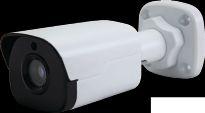
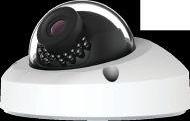
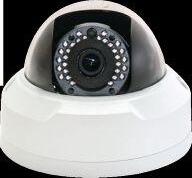
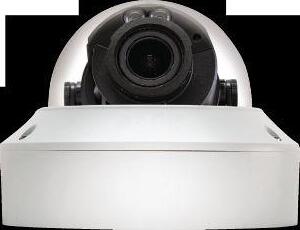
cash crunches require integrators to offer cheaper alternatives without necessarily compromising the final result
By Renée Francoeur
EDITOR’S LETTER
WBy Neil Sutton
Tough choices
hen I get back from ISC West, I sit and write.
There are as many stories at ISC West as there are exhibitors (typically somewhere close to 1,000) — and a lot more besides. Each of the 30,000 attendees could probably share something worthwhile from their experience. So for media covering events like this, it’s a matter of prioritizing what you think will be of the most interest to your readers. You can read coverage from the event in the news pages of this issue, plus a lot more in our digital wrap-up edition. What it ultimately boils down to for you, the reader, is, how much of this matters to you and your business? And that’s the tricky part. Events like ISC West are great for showcasing new and upcoming technology. If you happen to attend, they’re also wonderful opportunities to network, socialize and establish new contacts. But, again, what should you take away from all this? I’ve spoken to attendees in the past who went to the trade show with a game plan. They isolated the 10-15 vendors they wanted to talk to well in advance and went on a mission to find a particular technology or solution. For others, it’s more of a browsing experience. What’s new out there and what can I learn over the next few days? Assessing how important a technology or service is going to be for your business (or your business’ customers) is no easy task. Adopt or recommend technology that’s too far ahead of the curve and you potentially wind up overpaying for something that won’t achieve real currency in the industry for some
time. But neglect a growth technology and you may have missed your window. Security may be one of the toughest businesses to get this balance right.
There are plenty of examples in security where technology has overpromised and under-delivered. Video analytics were considered a hot property several years ago, but arguably, that technology is only beginning to peak now (I would encourage you to read our Q&A with Nvidia in the ISC West wrap-up for insight on how processing power is advancing that technology). On the other end of the spectrum, analogue video has been written off time and time again, yet it still continues to find a home in the market.
Integrators are faced with some tough decisions today. On the one hand, there are changes in the industry that absolutely cannot be ignored. Cyber security (i.e. protecting the integrity of networked security hardware) has become a must. But on the other, do you really need to learn more about drones right now? The answer to that is probably yes as well. Lay the groundwork now, since your customers are going to start asking about it.
Whatever the case, you are probably not running your business the same way you were five years ago, and you certainly won’t be in another five years. Your greatest asset is always going to be information. That’s something that will never change.
Your Partner in Securing Canada Security Products & Technology News is published 8 times in 2017 by Annex Business Media. Its primary purpose is to serve as an information resource to installers, resellers and integrators working within the security and/or related industries. Editorial information is reported in a concise, accurate and unbiased manner on security products, systems and services, as well as on product areas related to the security industry.
Group Publisher, Paul Grossinger pgrossinger@annexweb.com
Publisher, Peter Young pyoung@annexweb.com
National Account Manager, Jennifer Dyer jdyer@annexweb.com
Colin Doe, Veridin Systems Canada Anna Duplicki, Lanvac Victor Harding, Harding Security Services Carl Jorgensen, Titan Products Group Antoinette Modica, Tech Systems of Canada Bob Moore, Axis Communications Roger Miller, Northeastern Protection Service Sam Shalaby, Feenics Inc. 80 Valleybrook Drive Toronto, Ont. M3B 2S9 Canada T: 416-442-5600 F: 416-510-5168
PUBLICATION MAIL AGREEMENT #40065710 Printed in Canada ISSN 1482-3217
Annex Publishing & Printing Inc. disclaims any warranty as to the accuracy, completeness or currency of the contents of this publication and disclaims all liability in respect of the results of any action taken or not taken in reliance upon information in this publication.
LINE CARD
IoT: A double-edged sword?
Manufacturers debate the Internet of Things, Cloud and the future of the industry at ISC West
The Internet of Things is an inevitability, according to a panel of experts, who convened recently at the ISC West security conference, but all parties involved in its evolution — manufacturers, installers, end users — should proceed with caution.
The panel, held on April 5 in Las Vegas as part of ISC West, comprised manufacturers including Hanwha, Altronix and Galaxy Control as well as cyber security firm NTT Security.
“Now is probably the best time to get on board,” argued Rick Caruthers, executive vice-president, Galaxy Control Systems, pointing to the number of RMR opportunities that are springing up around IoT and the Cloud. The latter particularly applies to access control as more customers show willingness to have their systems hosted, managed or monitored via the Cloud.
Tom Cook, senior vice-president of sales, North America, Hanwha Techwin, agreed that the “future is the Cloud. The future of this industry is RMR… It’s a great business model.”
selling,” he said.
Ken LaMarca, vice-president of sales and marketing at OnSSI offered that connectivity is not a new concept. He noted that Leonardo Da Vinci said that everything is connected to everything else back in the 14th century.
He also emphasized the role of video management software in keeping video data secure.
As far as IoT products are concerned, many of them are currently developed for consumer-grade use, however that doesn’t stop them from sometimes making their way into corporate environments, despite the fact that they are not really designed for mission critical applications. “The network is only really as good as your weakest link,” he said.
Home automation may be on the rise, added Don Campbell, vice-president of products, Quantum Secure, but corporate environments still lag behind. “It would be great if you could just do the same thing in an office space, but it’s more complicated.”
However, that is not always the case with IoT devices. Broomhead also noted their potential fallibility when it comes to cyber security.
Video is also playing a major role in the recent trend towards Big Data and can be optimized by applying smart analytics. But, he cautioned, there is still a long way to go in terms of achieving a reasonable comfort level with Cloud-based hosting of video. Cook asked a full room of seminar attendees how many of them are selling Cloud-based video services and only one hand went up. “It’s really about what the customer is comfortable with and what you’re comfortable with
Viakoo’s Bud Broomhead also quoted a well-known futurist and social commentator, Nicholas Negroponte, who observed that everything that can become digital will. “The economics are there,” said Broomhead. He noted that the security industry is moving into an era that was explored by the IT industry more than 30 years ago, when customers began to expect guaranteed uptime (the so-called five 9s — 99.999 per cent availability). “We are entering a period in this industry where [customers] demand it work — and it work all the time.”
Chris Camejo, director of threat intelligence products for NTT, agreed that cyber security is a prominent weakness for IoT products today. A major issue for these products is, while they are as powerful as desktop systems were only a few years ago, they are relatively easy to compromise. He noted the DDOS attack on DNS provider Dyn last October, which affected sites and services like Twitter and Netflix, occurred “all because a bunch of webcams that had default user names and passwords.”
Making today’s products more robust is a step in the right direction, said Camejo, but that doesn’t help older releases that remain open to potential attack. “A five year vulnerability is a great find,” he said. “That’s a field day for an
attacker.” As such, patching old vulnerabilities remains a must.
Camejo also asked the audience to consider the Cloud as a computer physically located in someone else’s space rather than their own. As such, it behooves the customer to ensure their Cloud provider is adhering to high security standards and is able to provide a “gold-plated guarantee” to that effect.
Despite the stern warnings about major security gaps, panellists were generally positive about the future of IoT and the Cloud, particularly as it relates to revenue potential. “As opposed to thinking about it as being scary, think about how it can improve your businesses,” said Broomhead.
— Neil Sutton
For more ISC West coverage, see SP&T News’ digital supplement, ISC West 2017 Wrap-Up Edition, available on www.sptnews.ca.
Tom Cook, Hanwha Techwin
Ken LaMarca, OnSSI
Loma Linda University Medical Center Murrieta, CA
Architect: Davis Stokes Collaborative, PC
LINE CARD
Applications
Indian safe city initiative underway
Navi Mumbai, a planned township established to handle populations overflow from crowded Indian city Mumbai, has implemented Qognify’s Safe City solution.
Established by the City and Industrial Development Corp., the agency that manages the new city, and integrator WIPRO, the solution is designed to help Navi police ensure law and order. Qognify’s Safe City solution utilizes situation management platform Situator as well as the company’s video management solution. Following the implementation, the city has the ability to improve traffic management, deter criminal activity and respond to events.
“The Navi Mumbai security program goes far beyond a CCTV system,” said Soma Vijayakumar, CIDCO.“It is a smart solution that integrates video, emergency response, traffic control, licence plate identification and more.”
Appointments
• Cyrille Becker joins Montrealbased Genetec as general manager, Europe, and will oversee European operations.
• Mike Montgomery has been appointed operations manager for Halifax-based Northeastern Protection Service. Montgomery first joined Northeastern in 2011.
• David Heath has joined
Oslo schools upgrade intercoms
In 2013, the City of Oslo determined that primary, secondary and upper-secondary schools would install an intercom system by 2017. A Zenitel system has been installed which may be utilized to place emergency calls should an event occur.
“I feel very secure knowing that we have this system. The pupils also feel safer due to the systems being installed at their school,” said Torill Røeggen, head teacher at Ullern School in Oslo.
The solution can be integrated with other systems such as access control and video surveillance. The system also supports the SIP protocol. Audio analytics can detect sounds such as breaking glass and provide an alert to security personnel. The system was recently demonstrated to Swedish and Danish companies for possible implementation.
“As a Norwegian company, we are pleased to be able to share our knowledge and experience from Oslo schools with our Scandinavian partners and customers,” said Kenneth Dåstøl, CEO, Zenitel.
Bosch Security Systems as sales district manager for Ontario. Matthew O’Neill also joins Bosch as inside sales representative.
• Sean Donnachie has joined manufacturers’ representative firm Core Products Group Canada as business development manager, Ontario.
• Cindy Svenkeson has joined
Encrypted keys for Sydney complex
A 630-room student accommodation complex in Sydney, Australia, is using mobile access technology to enable easier access for its residents. Urbanest Darling Square (Urbanest) has deployed ASSA ABLOY’s Visionline wireless online solution and VingCard Signature RFID locks. “Our student accommodation concept is based around providing residents with modern rooms and fantastic facilities that offer top technological solutions,” said Matt Fountain, Operations Director for Urbanest. “After months of research, we decided to reach out to ASSA ABLOY Hospitality… We knew the designs they used in combination with their technology would give our rooms the look we desired with the security that our residents need.”
The mobile access technology operates with Seos, collaborating with property management systems to assign encrypted digital keys to each room. Enabled on residents’ smart phones, a swipe gesture transmits the digital key using Bluetooth.
consulting group Final Image as senior advisor, security, emergency and risk management.
• Reed Exhibitions has appointed Will Wise as group vicepresident of its security portfolio. Wise will oversee the ISC West, ISC East, Card Not Present Expo and Cardnotpresent.com.
May 23-25, 2017
Connections San Francisco, Calif. www.parksassociates.com
Security Canada West Richmond, B.C. www.securitycanadaexpo.com
September 13, 2017
Security Canada Atlantic Halifax, Nova Scotia www.securitycanadaexpo.com
September 25-28, 2017
ASIS International Seminar and Exhibits Dallas, Tex. www.asisonline.org
October 4, 2017
Focus On Drones Toronto, Ont. www.focusonseries.ca
October 17, 2017
Central Station Monitoring Symposium Toronto, Ont. www.canasa.org
October 18–19, 2017
Security Canada Central Toronto, Ont. www.securitycanadaexpo.com
Cyrille Becker
Sean Donnachie Mike Montgomery
Cindy Svenkeson David Heath Will Wise
#1 Home Security Company in Canada
125 years of security expertise
Monitoring Centres across Canada
Bilingual Service
LINE CARD
Genetec recognized as top employer
For an 11th consecutive year, Genetec has been named as one of Montreal’s top employers.
The competition, organized by the editors of Canada’s Top 100 Employers, evaluates employers based on criteria such as work atmosphere, community involvement and performance management.
The company stated earlier this year that it will soon employ more
market watch
than 1,000 people globally (more than half of which are in Montreal).
To accommodate growth in its Montreal headquarters, the company is building new dining facilities, a free gym and a redesigned reception area. According to Genetec, it also offers flex-hours, personal development programs and an employee referral plan.
“We are honoured to receive this recognition as a Top Montréal Employer for the 11th year in a row,” said Richard Pailliere, Director of Human Resources at Genetec. “At Genetec, we constantly strive to offer the best working environment for our employees to maximize their creativity, feed their spirit of innovation and assure that they have a rewarding quality of life.”
Industry-Leading Packages for Automatic Doors in Restroom Applications
� ‘Best in Class’ product quality and value
� The widest range of design options:
One-door systems
Two-door (shared use) system
‘Assistance Required’ (healthcare) system
� Featuring new Camden products specifically designed for restroom control
� Everything you need in one package, including controller, activation switches, signage and door contacts
� Special package pricing
ISC West first-timers showcase emergency software
ISC West, the annual Las Vegasbased security trade show, is a showcase of approximately 1,000 exhibitors — 188 of which exhibited for the first time this year.
Two show newcomers, PinPoint Initiative and OneEvent Technologies provided demonstrations of their technology, offering their interpretations of emergency management location-based software and a sensor-based early warning detection system.
PinPoint has its roots in the automotive sector, according to founder and CEO Jana Rankin. The company adapted software that was used as a communication platform to help automotive dealers reach out to prospective clients.
The PinPoint software is able to recognize a smart phone’s MAC address via Wi-Fi. “That cell phone is always sending out a signal; it’s knocking, looking for a Wi-Fi access to connect to,” says Rankin. “We’re just exposing that ‘knock.’ Through Wi-Fi, Bluetooth and cellular, we’re looking for those signals.”
Populations can enrol into the system, making it suitable for campuses. Limited via a geofence, the system is designed to help locate people quickly in emergency situations. The software has built-in chat, will push notification to an app or if the user hasn’t downloaded the app, will push a text or email.
OneEvent Technologies got its start when the company founder was watching a hotel fire on a news broadcast, wishing he could do more
to help. Kurt Wedig established his company soon after, built on the premise that “one event” can change your life. The company’s principal product is OnePrevent, a Cloudbased application that aims to speed up the recognition process of an impending disaster.
The company uses off-the-shelf sensors (smoke, humidity, water,
etc.) and modifies their radios slightly. “Our sensors actually start pinging more often,” explains Avi Rosenthal, a company consultant. “If we see something that is out of the ordinary, we will start to ping every four seconds and flood the system with data so we can see more information.”
Over time, the software learns
what is normal and not normal in a given environment, helping to recognize abnormalities much faster, improving alert times.
— Neil Sutton
For more ISC West coverage, see SP&T News’ digital supplement, ISC West 2017 Wrap-Up Edition, available on www.sptnews.ca.
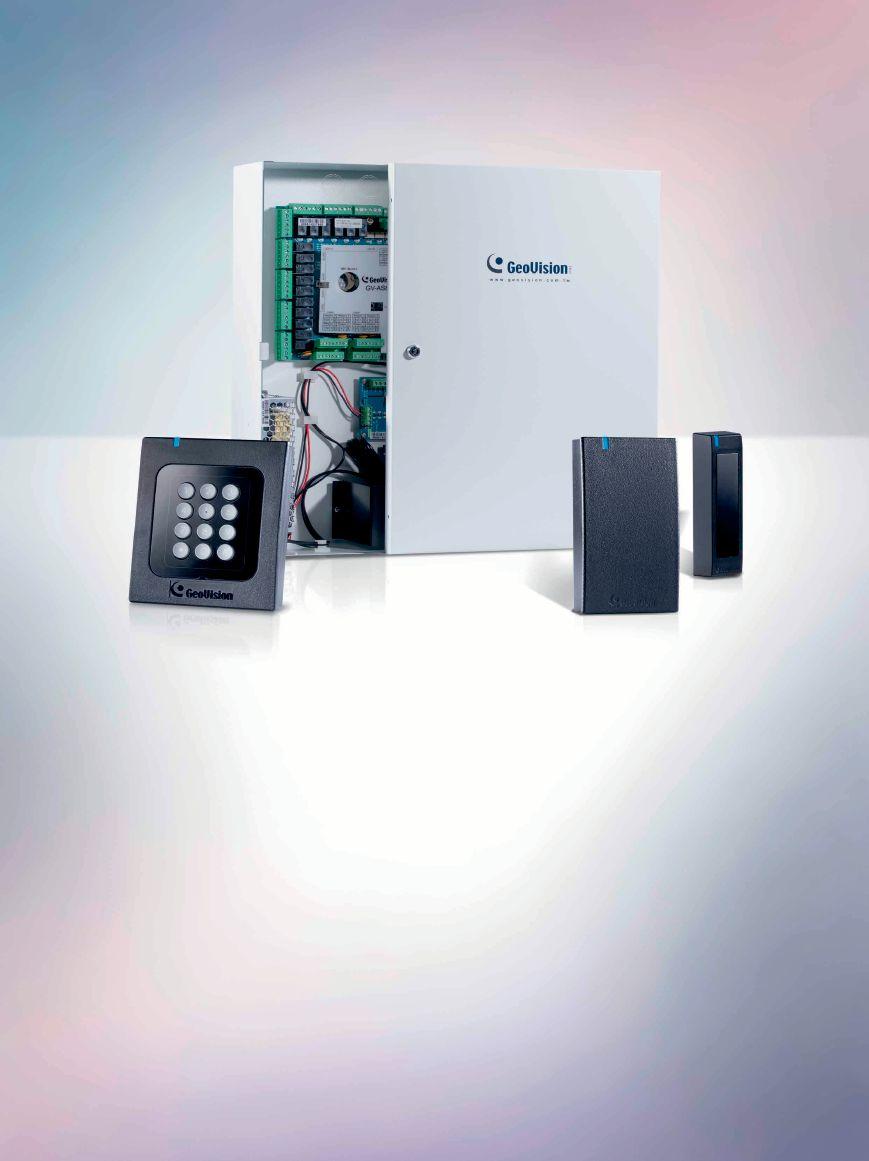
GV-Access Control with the UL Certification
Brings more safety to your
installation
There are thousands of Access Control brands in the market today With Underwriters Laboratories Inc. (UL) certificated, GeoVision Access Control can bring more safety to your installation.
GV-Access Control provides the most advanced full security solution by integrating seamlessly with GeoVision VMS, and IP products, which provides you with easy and safe accesss to both live and recorded video from any access event
LESSONS LEARNED
MBy Victor Harding
Doomed to repeat
For some reason, the security industry continually fails to learn from some of its most common mistakes
any of these points have been mentioned in previous columns but perhaps they need mentioning again.
1. Why do dealers not have their monitored accounts programmed to their own lines? Most dealers have known for years that this will be a big issue when it comes time to sell and still don’t do anything about it.
2. Why do dealers not get signed contracts when they add new monitored accounts? This makes no sense. It is not just that they can guarantee the monitoring for a period. The more important reason is the limitation of liability clause that is on most contracts will help protect you. Also, most buyers insist on contracts.
3. Why does anybody today sell monitoring for less than $20/ month? This makes no sense. Paying $20 to $30 to have someone professional watch over your home or business for burglary, fire, water damage or carbon monoxide for 30 days is a very small amount to pay. The fact that others in your market sell their monitoring for less is no argument. Aside from bringing in less money, dealers with accounts being monitored below $20/ month will get killed when it comes time to sell — at least 3X lower multiple or more.
4. Why do dealers not track their Attrition and Cost to Create? These are the two most important variables in any security alarm business. Very few dealers that I get involved with have good procedures in
“Why are some dealers still invoicing monitoring instead of using preauthorized payment? Almost everybody pays for something by PAP. Why would they not pay for monitoring that way?”
place around either variable. They don’t capture “moves” as well as they could. They don’t know why they are losing accounts. They don’t know what it costs them to create a new account.
5. Why are some dealers still invoicing monitoring instead of using preauthorized payment (PAP)? Almost everybody pays for something by PAP. Why would they not pay for monitoring that way? Getting paid $300 up front is thinking short term. Buyers will pay more for accounts with PAP. Accounts with PAP cancel less.
6. Why do sellers and buyers try to sell or buy security companies on their own without using an intermediary? I see this all the time and almost always there is a glitch down the road. Sellers that do deals on their own, in my experience, almost always leave money on the table, even after factoring in brokerage fees. You simply have to canvas all the potential buyers to get the best price, not talk to just one buyer. On top of this, it takes an enormous amount of time out of your life to do a deal. Finally, sellers tend to ex-
pose themselves to more risk from different terms in the purchase and sale agreement when working on their own. As far as buyers doing deals on their own, the scenario is even worse. Dealers know more about how to sell than buy.
7. Why do so many “small” alarm companies still run their own monitoring stations? There are still dozens of security firms out there using their own monitoring station when it makes no sense to do so. I think dealers that have their own station think they are now a complete/mature/better real alarm dealer. Nonsense. It makes absolutely no financial or technical sense today to have your monitoring station unless you have at least 7,500 accounts and even then, it is doubtful. You will never keep up with the technology of what modern wholesale stations have to offer and the argument that you have better control of your customer’s experience just does not cut it with me.
8. Why don’t those running dealer programs sell their program in the B class cities in Canada? Why do they focus all their attention on the biggest met-
ropolitan area like the GTA and Vancouver? Canada has another 30-40 cities where there are alarm dealers that could use a dealer program even more than in the metropolitan areas.
9. Why don’t the larger buyers in the alarm market today do share deals? They do in the buying of integration businesses but not with alarm accounts. Mostly this is about somebody in the large buyer organization years ago saying that share deals are too complicated and risky to do. Ridiculous. It is easy to mitigate your risk with clauses in the purchase and sale. More important, the tax laws in Canada have changed recently against asset deals such that any smart seller is going to almost insist on doing share deals.
10. Why wouldn’t any active player in the industry join their industry association and go to the trade shows in their area? It is not just the fact that an industry organization like CANASA is a great lobbying and educational resource for the industry. It is also CANASA and the trade shows they put on are the best way I know to stay plugged in to what is going on in your industry. The companies that I have run across that participate with CANASA and what they have to offer are usually better off for it.
I believe if we all did a better job on these 10 issues we would have a better overall industry.
Victor Harding is the principal of Harding Security Services (victor@ hardingsecurity.ca).
CANASA UPDATE
By CANASA staff
Understanding verified response
CANASA is working with numerous jurisdictions to better help our members work with police responders
If a verified response program has not already been implemented by your local police service, then you had best start preparing your staff, clients and the general public you serve.
The London Police Service informed our members that, as of May 29, they will implement a verified response program. As a result, CANASA arranged a member meeting with LPS and several other stakeholders to get a clearer understanding of how this new program will be rolled out and implemented. Other Ontario police services also attended this meeting, including those of Toronto, Kingston, Windsor and Hamilton.
It is CANASA’s position that a version of verified response will be implemented in many more jurisdictions in the very near future as police try to find ways to reduce the number of false alarms they respond to and cut costs. We have also received notice from the RCMP in Kamloops, B.C., that they too are implementing a verified response program as of April 1.
It appears there are two main objectives: cost recovery and limited response (or variations or combinations of the two). The verified response strategy would eliminate police administration costs for registration and tracking of alarms with the hope of reducing resources currently engaged in responding to and managing alarm calls. Under a verified response program, calls would be streamed to the police dispatch with no pre-registration. Based on the information provided on the call such as video/ audio or multiple signals as verification, the operator would determine if the call would be dispatched. Alarm companies would also not need
to manage or track registration and fees.
A fee-based strategy that many jurisdictions already have in place can provide police with recovery funds that may exceed their costs and help with their budgets. For example, if London Police Service were to implement a $24 yearly registration for their 46,000 systems they would generate over $1.1 million to fund the program.
CANASA, along with several industry stakeholders, is working to produce several documents that can be used as a guide and template to work with local police departments to develop a more user-friendly program that will not be as intrusive as some police departments have implemented. We will share these with the industry once they become available.
For more information visit www.canasa.org and click on “Verified Response.”
The Canadian Security Association (CANASA) is a national not-for-profit organization dedicated to advancing the security industry.
CAMERA CORNER
VBy Colin Bodbyl
The search for better software
Improvements in analytics have drastically changed the value of surveillance but there is still room for improvement
ideo surveillance has gone through an enormous transformation over the last decade.
New technology has allowed manufacturers to rapidly improve their products through both hardware and software changes. Hardware innovation has allowed cameras to become smaller, lighter, and easier to install. These same hardware advancements have enabled cameras to be powered solely via PoE and operate in extreme environmental conditions. While hardware innovation continues to drive change in the way we install and operate surveillance systems, some manufacturers have begun shifting their focus to software in order to differentiate themselves from the competition.
“Searching recorded video footage as easily as searching Google is not possible yet, but it’s an exciting concept.”
Historically, one of the most painstaking tasks of using a video surveillance system was searching for recorded footage. Originally, the only way you could search through video surveillance footage was by fast-forwarding through the video until you saw what you were looking for. Once digital video surveillance was introduced, pixel search became the most popular method of speeding up searches by sectioning off part of the scene and only searching for activity in a select area. More recently, new technology has been introduced that allows users to search video in a more efficient manner. Colour, size, direction, and other characteristics are becoming the next trend in search technology. In addition, some platforms allow users to select an object and simply search for other occurrences of that same object. While the technology still has room to grow, it holds a lot of potential. Being able to search recorded video footage as easily as searching Google is not possible yet, but it’s an exciting concept which may someday be reality.
Another area where video surveillance has been desperate for innovation is storage and bandwidth. Hardware is costly, but as camera resolutions have increased, integrators have had no choice but to add additional hardware to
cope with the increased storage requirements. H.264 compression was a tipping point for IP surveillance, which finally made it an affordable alternative to analogue. Unfortunately, little innovation has taken place since then, despite camera resolutions only getting higher. Within the last year, however, several manufacturers have taken steps to combat this challenge. One such technology is best described as dynamic image processing. This technology filters unnecessary information out of the scene and adjusts frame rates in real time to produce high frame rate surveillance footage using a fraction of the bandwidth. Of course, low bandwidth is not only good for remote viewing but also drastically reduces storage costs, which can make a significant difference especially on large projects.
Improved searching capabilities and better compression do require some type of upgrade to existing systems. While some features rest in the camera, many of these features require the right combination of camera and video management system (or VMS). This presents a real ad-
vantage for manufacturers who are attempting to compete with low-cost hardware. To win entire projects that include both the cameras and recorders, manufacturers need to ensure both products have desirable features. More importantly, manufacturers need to ensure the benefits are compounded when using their cameras in combination with their VMS.
Hardware continues to improve and advance at a steady pace, but for manufacturers to stay ahead of the pack, they need to focus on software which can be developed at a much quicker pace and create a far more “sticky” relationship with the customer. Whether searching through hours of recorded footage, or attempting to transmit and store large volumes of data, integrators and end-users still have pain points that could be addressed through software. By targeting these pain points, manufacturers can differentiate themselves and truly separate their products from the competition.
Colin Bodbyl is the chief technology officer for UCIT Online (www.ucitonline.com).
If your customers have questions, you can get answers. Get access to systems specialists, product testing and demonstrations and the one-of-its-kind Infrastructure Solutions LabSM.
For more information, visit anixter.com/security.
LISTEN UP
GBy Peter Janis
Adding acoustic to your security service card
Security technicians can be trained to manage and install audio products, potentially expanding your service offering
rowing a business requires more than hard work; it requires thinking about new business opportunities and leveraging what you already have in place to produce a positive outcome.
There is a book titled “Blue Ocean Strategies” that describes very successful businesses that have combined one business such as security with another, in this case acoustic materials, to create an all new business opportunity.
Consider the following: How often have you gone to a restaurant to enjoy a nice evening with good food, good wine and conversation only to discover the place is so noisy that you cannot sustain a conversation with your friends across the table? Zagat — the restaurant rating people — recently conducted a survey asking patrons what they disliked most about restaurants. Not surprisingly, the No. 1 complaint was poor service. The No. 2 complaint was noise. Yes, noise rated higher than bad food.
“As a security contractor, you bring several key advantages to table.”
By mounting absorptive acoustic panels to the wall surface area, you will significantly reduce the ambient noise to the point where you can turn a loud uncomfortable restaurant into a quiet, enjoyable place to eat. Restaurants are but one of many noisy places that can benefit from noise treatment: offices, call centres, hotel and bank lobbies, ticket counters, 9-1-1 operations, bus stations, boardrooms and video-conferencing facilities are just a small snapshot of the huge market that awaits. And interestingly enough, although acoustic treatment has been around for well over 100 years, only now are folks beginning to appreciate the benefits.
As a security contractor, you bring several key advantages to table. First off, you have a huge customer base that knows and trusts your company. Second, you have a team with strong technical skills who can be trained. Third, you have a qualified field staff that already services the market and can easily add acoustic panel installations to their daily tasks. In other words, you already have all of the tools you need to embark into this new venture, you merely need
to be indoctrinated into the science of acoustics. Sound is made up of vibrations that travel through various mediums such as air, water and walls. When it arrives at our ears, our brain translates these vibrations into codes that our brain deciphers as voice, music and noise. When speaking outside, unless you are in the Grand Canyon, the sound of our voice travels in an outward direction, eventually ending up in space. In an enclosed room, sound reflects off hard surfaces such as the gypsum walls, glass windows, metal ceiling and tiled floor, as it has no place to go. For instance, a loud restaurant does not start out this way. When only a couple of people are in the room, the noise levels are low. But as the room fills, patrons begin to speak louder in order to overcome other voices in the room. The music playback system is turned up, waiters begin to yell out orders, patrons elevate their voices further and noise from all of these sources ricochet back into the room creating a cacophony that self-perpetuates to the point where you cannot sustain a conversation. You eat dinner and on the drive home, vow to never go back again.
Solving the problem is easy. By mounting 2” thick acoustic panels to 15 to 20 per cent of the wall surfaces, you will absorb the excess energy — essentially providing the room with a release valve. The type of panel you mount is important. High performance acoustic panels provide maximum absorption, thus reducing the panel count and subsequent installation cost. They are made from high density 6lb glass wool and fully encapsulated in micromesh with resin hardened edges to eliminate dusting. The panel
is then wrapped in an acoustically transparent polyester tweed fabric to protect the panel from abuse and add a degree of architectural flare. A new generation is now available that allows the acoustic panels to be painted on-site to blend in with the room décor.
You can also transfer digital images to the panels to turn them into art. Sound energy in the form of vibrations enter the panel and cause the minute glass wool fibers to vibrate, essentially turning sound into heat. High density glass wool panels absorb sound energy evenly across the audio spectrum making them effective at controlling noise from the HVAC system, loud voices and music. Placement is not critical as the noise is reflecting off every hard surface.
Mounting panels is as easy as putting up a picture. If wall space is limited, you can suspend baffles from the ceiling using adjustable aircraft cables. These come in a variety of shapes and sizes to address various architectural tastes. Ceiling clouds and baffles are in fact twice as effective as wall panels as they absorb both the direct sound from the patrons on the floor, but also the sound as it reflects off the ceiling.
Care should be taken to avoid conflicts with lights, HVAC ducts and fire sprinklers. Attention should also be given to sourcing products from credible companies. For instance, you want to make sure that you read the acoustic performance tests to ensure that they have been conducted by an independent lab and will in fact work within the frequencies you are looking to absorb. You also want to ensure the panels have been tested to meet ASTM class-A or CAN/ UL-S102 ratings for flame spread and smoke development and are for safe use in public areas. Best of all, when an emergency occurs, and the PA system is being used to communicate orders such as evacuation, the echo in the room will not inhibit the PA system’s ability to perform. The message will come out clearly with maximum intelligibility, thus elevating the safety and security for all of those inside.
Recommending and installing acoustic panels is easy, relatively affordable, and can add a very profitable niche to your existing security business.
Peter Janis is the CEO of Radial Engineering Ltd., based in Port Coquitlam, B.C. (www.radialeng.com).
Smart access begins with end-to-end solutions.
Trust dormakaba for solutions that provide the perfect blend of form, flexibility and function. Our comprehensive line of networked access systems, electronic access controls, wireless and stand-alone access solutions are designed for multihousing, healthcare, financial, retail, transportation and commercial applications with a single goal in mind—making access in life smart and secure.
DORMA and KABA are now dormakaba Visit dormakaba.us
E-Plex Wireless and Stand-alone Access Keyscan Networked Access Systems RCI Electronic Access Controls
DOLLAR THE
Design simplicity, alternatives to IP and Cloud-based options are helping manufacturers and installers meet the needs of end users with a cash crunch
By Renée Francoeur
What’s the best way to stay within a tight budget when it comes to installing new security products and systems? Just keep it simple, according to Peter Dyk with Tyco Integrated Fire & Security Canada.
“It’s when you come in with a long laundry list, that can get you out into some areas that are quite expensive,” says Dyk, the director of engineering and product management. “We’ve got to find products that require less labour to install. I think that’s your biggest savings. There’s a lot of market pressure and competition within the CCTV space, so if you’re going to make it with a customer, it will have to be by putting in a simpler product that takes less labour, but is still high-quality.”
HD over analogue
Seeking alternatives to IP infrastructure is one way of keeping it simple for those with tighter
purse strings.
“When you start putting products into the IP infrastructure, you have all these extra requirements. But if you keep it completely separate and standalone, then you don’t have those pressures,” Dyk says. “It’s not that you can’t use IP; just don’t connect it into the network.”
Mark Espenschied, the director of marketing at Digital Watchdog (DW), elaborates, noting that “everyone needs to do more with less” in these competitive times.
“If you have an existing analogue system, like coax infrastructure, don’t think you have to abandon it to get higher resolution with an IP system,” he stresses.
He recommends snatching new ROI from the existing infrastructure by swapping in an HD recorder and HD cameras.
“A lot of people think the fastest growing segment is in IP,” Espenschied says. “It’s actually
HD analogue. The reason for that is there is so much existing coax cable all over the world.”
He cites the City of London in the U.K. as an example, with its high number of surveillance cameras (the British Security Industry Authority estimated there is about one for every 11 people in the country in 2013), which are all connected by coax.
“The City of London is in no hurry to pull out millions of dollars of coaxial cable and replace it with IP cable. And so they have become the prime type of customer for HD analogue where you just replace the recorders and cameras, and then you have high-resolution over your coax,” Espenschied says. A major theatre chain in Canada, which he could not name, is also following a similar suit to gain new ROI from a previous commitment to coaxial cable.
He adds that it’s been “exciting” to see three different HD analogue standards transpire over such a short time.
“You have a lot of integrators who are comfortable working with coax and their selling point has always been the same, and that is: there’s nothing safer than one cable from one
“You don’t need to buy extremely expensive cameras with all of their extra features because the Cloud system will do that for you.”
— Ken Francis, Eagle Eye Networks
camera to one recorder. No one’s going to break into that closed circuit. They can continue to tell that story but with better resolution.”
Low-cost IP options
If IP is still highly desired by a customer, Espenschied says that can be met in a more economic way, too, with “full-featured, all-in-one” NVR and IP cameras — without going to a higher-end server appliance and separate VMS (which typically means licence fees, he notes).
Additionally, if you’re installing a completely new system, customers can still run a network cable and have it working with something like Tyco’s Holis product, explains Dyk, which ties right into the Holis unit.
“So in fact, it’s not much different than coax,” he notes.
The Holis line for IP video uses Illustra cameras and is the “least expensive” type of solution at the company, according to Dyk, “easily meeting the budgets for small to medium sized businesses.”
When people think of IP, they often think of big installations “where you have a big dedicated server with a lot of hard drives in it, so you’ve got to get Milestone or some big VMS to run it,” says Espenschied. “What people like about their analogue system is you basically have a box that looks like a video recorder and there’s one interface and it’s easy to understand. Well, there are those type of appliances for IP and if you want to make the transition from analogue to IP, you don’t have to go into a big enterprise system.”
Saving money
Whether it’s video surveillance or access control, when the time comes for transitioning and upgrading, end users want to save the coin, contends Iain Morton, executive vice-president of Eastern Canada with Paladin Security.
“Many people transition video systems in five to seven years. Access control is 10-12 and intrusion alarm is 15-20 years, in terms of system conversion,” he explains. “Clients are looking to do this without a full rip-and-replace model. That’s often cited, so it’s an area where we’re paying a lot of attention.”
In the past, a typical situation involved “very expensive head-end software and expensive servers,” Morton says. “We’re approaching that by saying almost every system we sell, we can put into a virtual machine, VMware, on a client server farm and just let it sit there — something else under their IT command control, without separate servers.”
Selling systems with thin clients, which are browser-based, and detaching from a reliance on thick clients, which have their own workstations, is also a way to help clients save.
“Designing systems where we can emulate the same form factor in the communications room that the old system had” is going a long way when it comes to tightening up expenditures, Morton adds, as well as “taking out the board and putting the new one into the same old panel to make it more efficient.”
Cloud options
When asked about the best way to optimize security solution spending, Ken Francis, president of Eagle Eye Networks, offers: “The simple answer is, Cloud is better.”
“When using the Cloud system, a customer can afford to select a quality and economically priced camera because the camera resides on an isolated surveillance network and price-driving features are unnecessary,” Francis says. “You don’t need to buy extremely expensive cameras with all of their extra features because the Cloud system will do that for you. So you really just want to focus on quality of image and durability in an economical camera selection.”
Expanding on that, he says using the Cloud means “substantial savings in post-installation support,” especially when it comes to storage and power requirements for commercial and enterprise customers. While these total savings may be less for a small business application, there are still “incremental features and benefits” (such as easy scalability and high security, according to Francis) from the Cloud system’s “continuous delivery,” he assures.
Cloud-based solutions are changing the security game, echoes Thomas Lynch and Dominic Williams with IHS Markit, as “in one sense, it is expanding the market, as end users that would previously not have considered a security surveillance solution are now adopting — this is the case in the residential market for VSaaS.”
The RMR (recurring monthly revenue) business model that goes along with Cloud surveillance solutions means a reduction in upfront Capex (capital expenditure) costs, and in some cases, an overall reduction in cost of ownership, according to Lynch and Williams — “although this will depend on the use case/end-user,” they note. For example, a commercial VSaaS deployment is going to “cost a fair bit more than a set of cameras purchased from Costco. However, it does provide value elsewhere.”
The cost of hardware is typically included in the ongoing monthly cost, or at least heavily subsidised, Lynch adds. There is no need to purchase a storage device and therefore you see a reduction in maintenance cost. “So price sensitive end users, particularly in SMB and residential markets, will find this attractive.”
Eagle Eye notes its Cloud VMS customers can expand their systems as fixed per camera costs, “alleviating concern over large capital investments as systems grow.”
Customers with high location counts typically “suffer considerable deployment costs of servers, operating systems and servers,” Fran-
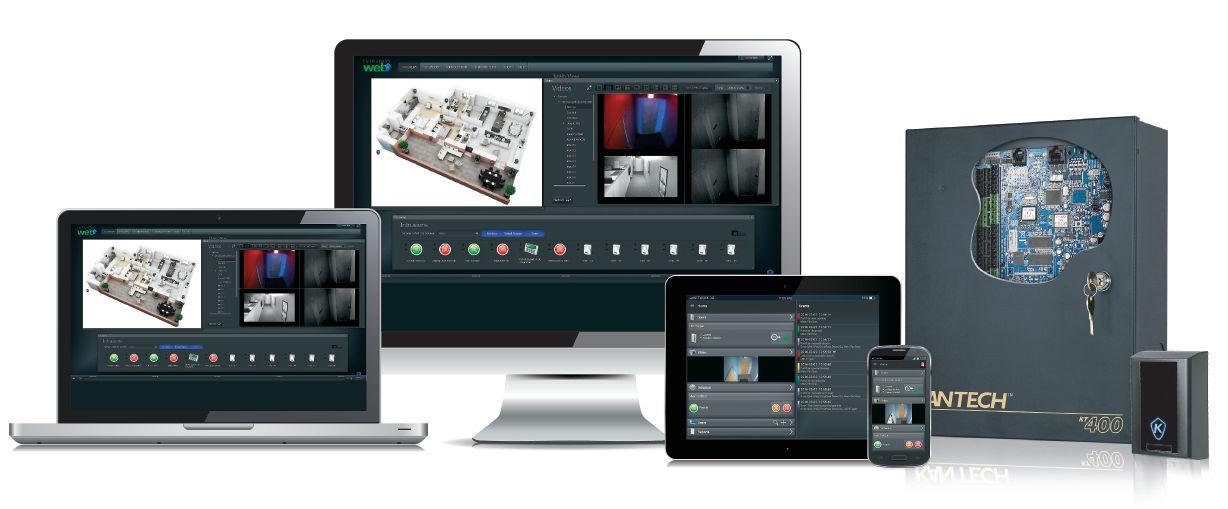
Tyco’s EntraPass access control system from Kantech boasts a Cloud offering, which has been “growing by leaps and bounds”.
Photo courtesy Tyco
cis continues. He says deployment is much less complicated with the Cloud and therefore also usually more affordable.
“It is worth noting that the RMR billing model that comes along with a Cloud solution is attractive to vendors, so this shift is not just end-user driven,” Lynch and Williams point out. “There is a conscious effort on the part of vendors to move to this model.”
Tyco mentions EntraPass — its “cost-conscious” access control system from Kantech — is available as a Cloud offering, which has been “growing by leaps and bounds,” according to Dyk.
“Customers don’t have to buy a server, they just have to buy the controllers,” he notes.
The bottom line, according to Lynch, is “Cloud has the potential to save you money, but much like a cell phone contract, primarily by spreading the cost of the solution out over a period of time.”
Meanwhile, Morton says that cost-savings or not, Cloud feasibility varies from client to client and many of Paladin’s are not entirely comfortable with streaming data to the Cloud just yet.
Cloud is gaining traction, IHS maintains, and many of the historical technological barriers to adoption have become less influential in recent years.
“Bandwidth is still a serious consideration that means Cloud will not be the right solution for a lot of people,” Lynch says. “For example, many retailers’ network infrastructure was installed in order to facilitate credit card validation, and not to support the upload of video to the Cloud.”
That said, Francis sees a rosy future in store for Cloud technology.
“I humbly believe we’re going to see an explosive growth in Cloud system adoption in the security industry,” he says, looking ahead to the next five to 10 years, and pointing out the pervasiveness of Gmail accounts and Google Docs — all in the Cloud.
Free software beware
Leveraging “free software with cameras” is an-
other way many are securing the best bang for their buck but both vendors and integrators urge customers to execute their due diligence with these types of attractive offers.
Tyco, for example, says it offers free software but only after you first buy the hardware — such as with Total Tyco Security bundle.
“Let’s put it this way,” Dyk cautions, “if you download a free app on your iPhone, how much support will you get on that app? You get what you pay for.”
He says the de-monetization trend on the Internet is driving the company to offer more products “that don’t have a cost associated with a particular aspect,” but they still have to have a good business model that allows the company
to provide support.
VMS software and cameras alike are becoming increasingly feature-rich, IHS notes, “integrating suites of analytics algorithms as standard for example, that could save and end user money in licence fees for the additional software and through increasing the effectiveness of the cameras themselves.”
Anecdotal data suggests that these extra features are finding use, Lynch says, but one of the problems is the analytics that are being included generally lack the sophistication of other paid-for analytics. “They are also a bit harder to operate as the end user has to put in more effort actually interpreting the data that gets produced by the algorithms, than they would with a more sophisticated paid-for platform.”
Package deal
It’s not just about the price of an individual product, Dyk reminds us. “It’s the whole package.” This means you can’t work in isolation to just reduce the product price or just the labour — it’s a combined effort.
It’s all too easy to fall into a trap of comparing costs camera to camera, Espenschied adds.
“We ask integrators and customers to consider the cost of the system, not just the cost of the camera, recorder or software,” he says. “When you design a system to take advantage of higher resolution, a product that may seem less expensive may not deliver the expected savings when the whole system cost is compared.”
Likewise, Paladin says it is in the middle of rebranding as Paladin Technologies on its systems side, which will look more deeply at opportunities to bundle technologies together and sit them on the same backbone, to avoid situations where “five or six different contractors are coming in for five or six specialities.” This means structuring cable backbone that can run audio/visual systems as well as telephone, IT network, building controls, etc.
“This is about minimizing the infrastructure in the building to save costs,” Morton says, noting this is especially valuable for the healthcare security sphere. “It’s still emerging and has a long ways to go.”
It pays to plan
While cutting costs is crucial for many working with increasingly shrinking security budgets, everyone mentioned in this article expressed caution when it comes to weighing costs against quality.
“It’s really important the product remains reliable,” Morton says. “A cost-conscious client should really understand licensing and software maintenance agreements and stay away from those systems with recurring annual licences, going with systems, that if they do have a licence structure, it’s an upfront licence so the customer owns it outright, and then they can choose a software maintenance agreement or not.”
Paladin also encourages clients to “do plenty of due diligence” into what products can be reusable down the road, as with the trend of open boards in access control.
DW says it believes it always pays to use professionals to design and install a system. “They will get you the best pricing and design the most efficient system for your need,” Espenschied says.
“A very low price is very attractive but business owners are smart people and we find most are going to do their homework,” he says. “They often find out, something for a couple dollars more is going to give them the confidence they’re looking for...
“It pays to plan and an end user can plan the best system by engaging the professional who does this all the time, who knows the alternatives and can present them at the right moment.”
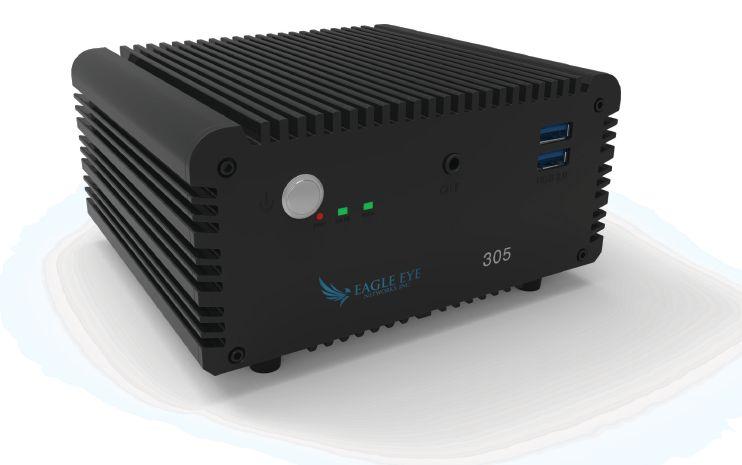
Eagle Eye Bridge 305 was launched this spring and includes four managed PoE ports and has a wide operational temperature range. It is fully managed from the Eagle Eye Security Camera Video Management System.
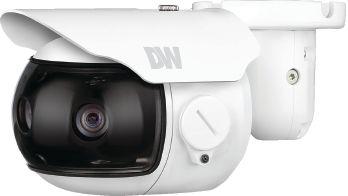
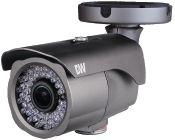
DW offers an analogue solution, VMAX A1 digital video recorders (DVR) and STAR-LIGHT super low-light cameras, which now includes HD video up to 1080p.
Photo courtesy Eagle Eye
Photo courtesy Digital Watchdog
Perimeter protection - Detect, Verify, Act
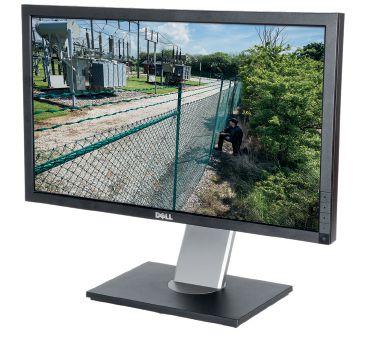
No matter what type of perimeter you are looking to protect, you require a reliable security solution that works around the clock, in any weather and in all lighting conditions.
AXIS Perimeter Defender gives you an edge where security starts – at the perimeter of your facilities. It is a flexible, scalable video analytics application that sits on the edge, requiring no additional servers to run. Together with Axis network cameras, horn speakers, and video management software, AXIS Perimeter Defender completes a comprehensive, video-based perimeter protection solution, to detect, verify and act on a threat.
Detect
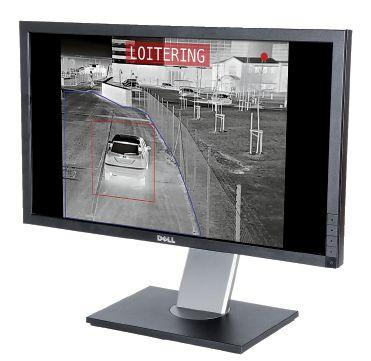
Early and accurate detection is vital to minimizing the impact of any threat. AXIS Q19 series thermal cameras are sensitive and accurate over large areas, even in complete darkness, making them unrivalled when it comes to detection. Activity in the defined perimeter triggers an event, panning the PTZ to the area to give the user a closer, more accurate view of the scene.
AXIS Perimeter Defender is your first line of defense, analyzing detected events, dismissing non-threatening ones and notifying security staff of potentially critical situations.
Verify
Know what you’re looking at with a PTZ (pan/tilt/zoom) camera, no matter where you are. Once a threat is detected, AXIS Q60/61 series cameras’ auto-tracking kicks in to follow the perceived
threat if lighting conditions allow. Operators or security personnel, from a remote location, are able to take control the camera to get a full view of the scene, and zoom in to enhance details with sharp images delivered through an HDTV stream from the camera. Analyze the situation with the most accurate information possible in order to determine if the threat is real, based on the intelligence PTZ cameras provide.
Act
You’ve determined the threat is real, now what? Let them know you see them! AXIS C3003-E Network Horn Speakers are a great weapon in the arsenal of tools you have to fight threats. Using SIP technology, page the scene through an IP-based phone system or through the video management software. Issue a live or recorded verbal warning to let the subject know they’ve been caught.
Get reliable perimeter detection and protection with AXIS Perimeter Defender. Together with Axis network cameras, horn speakers, and video management software, get the peace of mind that comes from perimeter protection that lets your voice be heard and doesn’t leave you in the dark.
For more information, please contact us at 1-800-444-2947 opt 1 or visit us at www.axiscompanion.com.
You can apply to become an AXIS Companion Specialist by visiting us at https://www.axis.com/ca/en/products/axisperimeter-defender
SOLUTIONS CREATIVE
SP&T News’ Editorial Advisory Board assesses the security landscape and comes back with a few answers
Sam Shalaby, CEO, Feenics Inc.
SP&T News asked its new-look Editorial Advisory Board to answer a simple two-part question: What are the biggest challenges currently facing Canada’s security installer community and where do the greatest opportunities for future success lie?
The answers, of course, were anything but simple. Canada’s security industry (indeed, the global security outlook) is undergoing transformation — in some ways radical. What hasn’t really changed is the end goal of serving the customer (although they have changed too). Common themes include the impact of IT in security, challenges in finding and training qualified personnel, and finding new and more effective ways to collaborate with partners throughout the security ecosystem. Read on for more.
The security industry’s evolution to new technology has lagged behind other business sectors, but now it’s gaining speed rapidly. This has security companies and technicians struggling to evolve, while trying to develop and attract talent with skills in information technology, Cloud computing and mobility. Their business models need to change — from project-based to managed service revenues — and for many it’s a formidable challenge and completely different from what they’ve done in the past.
installing companies that can provide new platforms to assist with security and business operations. That’s another challenge and opportunity — to be on the cutting edge and offer services and technologies others aren’t providing. It adds tremendous value and a market differentiator to the installing company.
Because the security industry is primarily comprised of companies with one to 50 employees, they often focus solely on day-to-day operations rather than developing new core competencies. In addition, the end-user has become highly educated on technology and wants
The security industry needs to embrace technology rather than avoid it. Once they have this mindset, they will be able to create new channels of business and client-based services. This fundamental change shift requires a commitment by both manufacturers and dealers. Manufacturers have a responsibility to assist ineducating and training dealers to develop skills for the future, while the installation community needs to align themselves with vendors who want to help them make the transition. Collaboration and partnership between manufacturers and security companies will bring future success.
Bob Moore, Canada Country Manager, Axis Communications
The biggest challenge currently facing the security industry in Canada is education for new employees and existing security professionals. The lack
Antoinette Modica, General Manager, Tech Systems Of Canada Inc.
Meeting clients’ expectations can be a big challenge today because there is no room for error. Because security equipment has become very sophisticated, clients may demand more today than they did previously. Not to mention, due to possible security breaches and threats, the security director has more accountability for the entire security system. Lack of exceptional support can keep any security director up at night.
So, what then is the definition of Exceptional Customer Service? Exceptional Customer Ser-
vice is an extremely critical part of maintaining ongoing client relationships, along with generating referral business, all of which results in increased revenue.
A security integrators’ employees must take ownership — they must adapt quickly to clients’ needs by responding with highly trained and certified team members, no matter where their client resides. An important factor is ensuring employees become empowered to make the right decision for the client, right at the front line. This requires that everyone in the company becomes accountable.
The key is making investments in skills development such as conflict resolution and strong communication. Courtesy and empathy are other important attributes of a successful customer service representative.
of a formal educational system to get our security professionals well versed in the latest technologies and solutions makes it hard for employers to find qualified employees. Finding qualified people who are up-to-date on the latest solutions, and have the talent to hit the ground running, is a constant battle. Finding the right fit, with the right knowledge and skills, means a well-run team and a customer base that is well-served with the best possible solutions for their unique needs.
This reality translates to the biggest opportunity facing us in this industry, which is for us all to remain as flexible and versatile as security, building automation, VoIP, intrusion and other solutions are converging as former analogue driven solutions are completely transitioning to IP. This convergence is creating opportunities for those who master adjacent, new technologies that can widen their business offering to their clients.
Because the security arena is 24/7, it is vital that, when problems arise, clients receive timely responses. Prompt attention is critical to maintaining good relations with the client, which then develops into a reputation for trustworthy and reliable service. This type of Exceptional Customer Service keeps customers coming back.
Roger Miller, President, Northeastern Protection Service Inc.
As security professionals, we want to offer our clients the best solution for their needs, not ours. Because the security industry serves such a diverse client base, it means we have to build relationships with manufacturers, distributors and marketing firms so we are fluent in the products we are offering or installing. Buying “off the shelf” is not that simple anymore.
The continued integration of security and IT infrastructure in commercial environments means that system designers, security installers and sales teams must have an understanding of network systems so we can maintain compliance in an already crowded space. This applies to high-
ly technical commercial installations as well as smaller residential applications. From integrated industrial facilities to smart home installations, almost everything we work with is travelling on an Internet or local network. This consumes more planning time than ever before. Learning about bandwidth, POE capabilities/restrictions, cabling and network traffic takes the traditional installer outside of their traditional role. Finding qualified personnel becomes more difficult as the industry evolves.
The future for success in the security installation sector is finding the right mix of skilled people to work with advanced technology that will have the ability to understand and meet the complex needs of our clients.
Colin Doe, CEO, Veridin Systems
Security technology has evolved dramatically since I joined the security industry in the early 90s. Risks in the past tended to be physical and local in nature and the threats more easily identified. Today, we live and work in a completely connected environment. Dangers exist across town, across the country and globally. The subject of those risks could be a connected “kid” down the street, or a rogue government or terrorist organization halfway around the world. Today, with the proliferation of smart phones, connected devices, networks, IOT (Internet of Things) and more to come, the biggest risks are no longer right next door and they are no longer easy to spot, let alone defend against. Critical infrastructure
such as our power grid, water supply, and communications networks are potentially vulnerable to cyber-terrorist attacks through command and control system vulnerabilities. I think that future technological advances in the security sector will still revolve around connectivity, but manufacturers and security industry personnel will be using AI as a front line defense against as yet-to-be identified threats. New tools with artificial intelligence capabilities will be needed to create the next level of cyber-security. “Next Level” AI capabilities will be able to identify, compartmentalize and respond to threats long before human interaction has even identified an event as a threat. I think that this will be where the next evolution of technological advance will occur to keep us safe.
Product Previews Intrusion Detection
Radar systems
Magos Systems
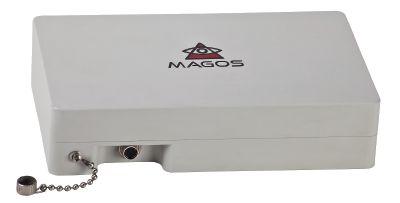
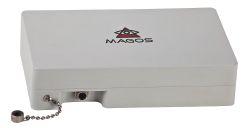
The SR-500 line of radars for critical infrastructure protection is suited for perimeter security of airports, seaports, government facilities, correctional facilities, power sub stations, and more. Magos also offers radar control software (MASS Control Software) that enables plug and play integration with a variety of Video Management Software (Genetec, Avigilon, Milestone, Exacq, etc.) and also enables radar target classification using high-end video analytics at the same cost. Magos SR-500 has a detection range of up to 400m for person and 600m for vehicle or boat and can detect a drone at up to 100m. www.magosys.com
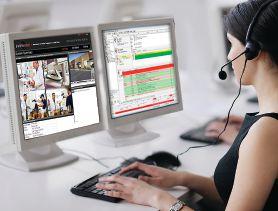
Cloud-based alarm verification
Honeywell
Honeywell has enhanced several products with Cloud-based, video alarm verification (VAV) technology to help verify alarm severity. The company’s AlarmNet communications network has expanded its integration with the patented I-View Now VAV technology through Honeywell’s Performance Series DVRs and NVRs, in addition to other video recording products. The integration can help central station operators gather more information through pre-alarm video footage. www.honeywellvideo.com
LPR camera Digital Watchdog
The new 4 Megapixel License Plate Recognition (LPR) MEGApix camera offers a solution for applications looking to capture licence plates in moving vehicles up to 50 mps. The camera is integrated with DW Spectrum IPVMS. These MEGApix IP cameras deliver clear images at 4MP resolution and real-time 30fps performance. The new 4MP IP LPR camera delivers plate capture both day and night with a 6-50mm P-Iris lens and Smart IR up to 100 feet, capturing images from a range of 13 to 100 feet.
www.digital-watchdog.coms
Dual path alarm communicator
ELK Products
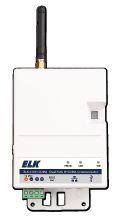
The ELK-C1M1CDMA Dual-Path Alarm Communicator which supports CDMA cellular for areas covered by the Verizon cellular network. C1M1 reduces transmission time of emergency messages. It does not require dial capture or data bus decoding which leads to delays with other communicators. In addition, there is no Cloud server to compromise or delay the communications. C1M1 provides full data communications to central monitoring stations over IP and cellular pathways. Transmissions are automatically directed over the best pathway for quickest communications.
IP call station Talkaphone
www.elkproducts.com
Smart searching tool
Avigilon
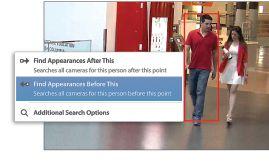
Avigilon Appearance Search technology is now available with Avigilon Control Center (ACC) 6.0 video management software. It is a deep learning artificial in telligence (AI) search engine that sorts through hours of footage, allowing users to quickly locate a specific person of interest across all cameras on an entire site. It intelligently analyzes video data, helping to track a person’s route and identify previous and lastknown locations. The technol ogy is integrated with ACC 6.0 Enterprise edition software, Av igilon cameras with self-learning video analytics and select NVRs. www.avigilon.com
The new Via Series Access and Courtesy Communication Pedestal includes a VOIP-200 series IP call station and has an optional card reader and push plate switch accessories. To add an additional security measure, customers can choose a card reader with a keypad. When used in access installation, the included blue LED light band will change to green when the door is activated through the call station. The included VOIP200 series call stations are constructed of IP66-rated, vandal resistant marine grade stainless steel.
www.talkaphone.com
Illuminated button station STI
Dual-sensor camera FLIR
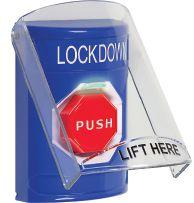
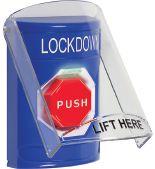
Choose to illuminate the STI Stopper Station as a status light (always on) or select a colour change when activated (i.e. glows green then red when activated). An optional 12-24 volt LED insert illuminates red, green or white. The ADA Compliant, multipurpose Stopper Station push button covers a wide range of applications. Available in red, green, yellow, white or blue, its design helps stop accidental activation. The product is offered with standard or customized labeling (in virtually any language), and switch options include: Momentary, Key-to-Reset, Turn-to-Reset, Pneumatic. www.sti-usa.com
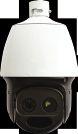
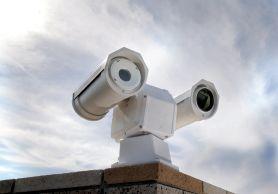
The FLIR PT-Series HD is a dual-sensor camera system that provides long-range perimeter intrusion detection regardless of lighting and environmental conditions. The high-speed, pan-tilt camera provides accurate threat verification. The FLIR PT-Series HD offers either a cooled or uncooled 640x480 resolution thermal camera with a 1080p HD visible camera. Multiple high-performance thermal lenses are available, including optical zoom lenses up to 14X. The HD visible camera also features a 30X optical zoom lens with autofocus and low light capabilities. www.flir.com
JUNE 14-15, 2017 - UNIVERSAL EVENTSPACE • TORONTO
FEATURED SPEAKERS
Keynote: John Mack
GOLD SPONSOR
SILVER SPONSORS
Imperial Capital
Market Forecast: how the financial world views the security industry
Keynote: Veronica Kitchen University of Waterloo
Canadian Security in the Age of Donald Trump
Panelists: Bonnie Butlin Security Partners Forum
Peter Martin
AFIMAC International
Canada’s Threat Landscape
Keynote: Claudiu Popa Informatica Corporation
Cybersecurity PredictionsThe Hits and Misses of 2017
Product Previews
Power solution management
LifeSafety Power
Enhancements to NetLink V8 offer smart monitoring, reporting and management for connected power solutions. New battery management features gives integrators and users predictive tools to automatically manage power solutions and receive alerts in advance of a potential battery issue so they can take preventive actions before an outage occurs. Users enter the system’s required battery backup time and this number is compared to the battery’s actual standby time with regular, automated load tests. www.lifesafetypower.com
Lighting solutions
Raytec
Ethernet switch
Antaira Technologies
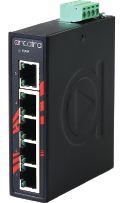
The LNX-C500G series is an IP-30 rated compact 5-port industrial gigabit unmanaged Ethernet switch embedded with five full gigabit Ethernet RJ45 ports. The form factor of this metal casing switch is 30 per cent smaller. It is designed to fulfill industrial applications that have small space requirements and need high bandwidth capabilities such as factory automation, security, ITS transportation, power/utility, and water wastewater treatment plants. This series also works well in any other outdoor application that is susceptible to extreme ambient weather conditions.
www.antaira.com
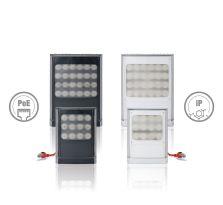
VARIO 2 IP and VARIO 2 PoE provide purpose-built lighting solutions for network applications and sit alongside the existing range of VARIO 2 illuminators. Both new product lines feature the latest Platinum Elite LED technology, delivering up to 200 per cent more power, distances up to 500m from a single LED panel and more light output. VARIO 2 IP can be operated remotely via a user friendly GUI or be fully integrated with third-party platforms or network devices to deliver an automatic lighting response to different events or alarms.
www.rayteccctv.com
In-ceiling speakers
SoundTube Entertainment
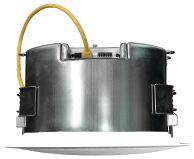
These in-ceiling and surface-mount speakers operate on the Dante networking platform, including unique Master speakers that allow the connection of non-Dante speakers on the network. Four SoundTube IPD in-ceiling models and one surface-mount speaker are now available, along with two Master IPD4 speakers. The system allows individual setup of speakers and provides proprietary 40 watts (with the SoundTube STNet Switch) per channel PoE to any STNet speaker on the system. The speakers can also be connected and powered by PoE. soundtube.mseaudio.com
Mini escutcheon Salto Systems
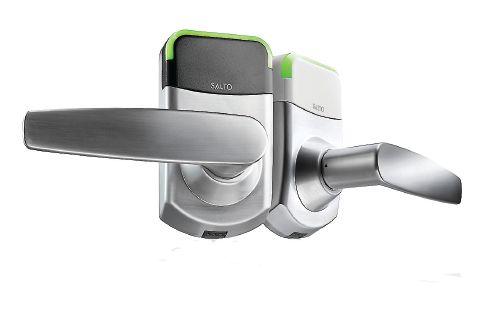
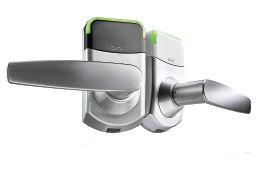
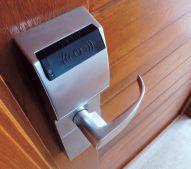
The SALTO XS4 Mini escutcheon’s compact design allows security professionals to upgrade security and replace mechanical-key-operated door locks with the latest electronic access control solution suitable for a wide range of customer applications. Its zinc alloy construction and Mifare-DESFire and BLE (Bluetooth Low Energy) technologies allow it to work with conventional smartcards and/or via SALTO’s JustIN Mobile app. Power is supplied via three AA batteries, with battery life good for up to three years of normal operation. When batteries run low, the XS4 Mini has audible and visual indicators.
www.saltosystems.com
Product Previews The latest in security technology
Sit/stand module Winsted Corp.
The Impulse Linear model of the company’s Impulse Dual Sit/Stand Console product line includes all the features of the original model, but with a straight configuration to make the most of limited space. The Linear model is available in 59” and 83” widths. The Impulse Linear consoles feature two independently adjustable work surfaces that can be raised and lowered to meet the needs of individual operators. Both work surfaces are controlled by two electric-lift legs and adjust from 30” to 46” high. www.winsted.com
Rack-mounted player
Legrand
The Nuvo P4300 Player is the newest rack-mount model added to Legrand’s Player Portfolio line. The model features simplified installation and diagnostics for installations with a backlit touch screen display. Designed by audiophiles for installation by professionals, the three source, three amplifier design enables three independent sources of audio content to be played in three rooms simultaneously. The P4300 allow users to access popular streaming services, including Spotify, iHeartRadio, TuneIn, Napster, Deezer and SiriusXM, as well as content stored on networked computers and iOS and Android devices. www.legrand.ca
Emergency communication OS Code Blue
EmerComm brings intelligence to the edge by giving emergency phones and other communication devices the capabilities of a full computer. This means creating a system that views its platform as an agnostic system of sensors and indicators, with phone functionality just one of the many layers it is capable of managing. Using this new operating system, Code Blue will be able to offer new products that provide a wide range of applications. EmerComm will be available in select models beginning this summer. www.codeblue.com
NAS/VMS solution
Qognify
Physical access reader
Tyco Security Products
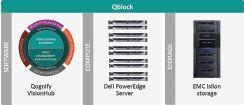
Qblock is a turnkey NAS VMS solution designed for the surveillance industry. Qblock is a unique offering built on industry’s leading technology from Dell EMC, bringing together NAS and VMS technologies to create a solution that addresses today’s and future growing needs. Combining the VisionHub VMS, Dell EMC’s Isilon storage and PowerEdge compute, Qblock features an IT Grade solution with zero data loss, low risk deployment, centralized management, and expansion and scalability without the need for re-architecture. www.Qognify.com
Rugged LCD monitors TRU-Vu Monitors
The new VM-10.1 Series LCD monitors provides image quality and reliability. The IPS panel features 1280 x 800 resolution, produces brilliant colour reproduction and provides 350 nits of brightness. The powder-coated steel enclosure and TRU-Tuff treatment ensures maximum shock and vibration resistance for industrial, mobile, marine, military and transportation applications. The VM-10.1 Series monitors can be customized from a list of options including: Touch Screen; 1,000 nits brightness; Waterproof enclosure; Panel Mount; and Open-frame design. www.tru-vumonitors.com
Wireless controller kit
TRENDnet
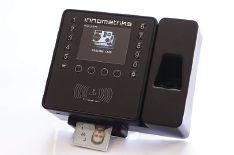
Innometriks’ Cheetah high assurance physical access reader, which is now UL 294 certified, features advanced architecture allowing integration into existing PACS and network environments. Cheetah paves the way for full FIPS-201 deployments, allowing customers to set authentication factors to match the threat. When elevated to a different security threat level, the reader changes to the corresponding authentication mode. Infinitas is a credential validation, registration and authentication suite that offers a turnkey approach to PIV, CAC, and TWIC card validation. www.tycosecurityproducts.com
Millimeter wave wireless solution
Siklu
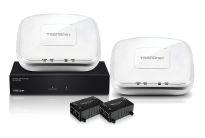
The AC1200 Dual Band Wireless Controller Kit model TEW-821DAP2KAC is designed as a roaming solution for the office or home. The wireless controller kit features TRENDnet’s new wireless hardware controller. In addition to simplified management and setup, the controller introduces next-generation technology to deliver roaming capabilities for users moving from access point to access point on the same network. TRENDnet’s hardware controller utilizes intelligent radio resource management (802.11k), providing a more efficient WiFi roaming environment. www.trendnet.com
The MultiHaul point-to-multipoint millimeter wave wireless solution extends Siklu’s multi-gigabit product line to include an interference-immune, cyber secure solution for high-speed video surveillance networks. Siklu radios leverage narrow beams in the 60-80 GHz millimeter wave spectrum to transmit information. The new MultiHaul utilizes beam-forming technology within a point-to-multipoint network topology. www.siklu.com
Station Video Monitoring Solutions Dealer Enquiries: sales@cmlsecurity.com Phone: 1(877) 525-4109 Website: www.cmlsecurity.com
West 2016: Care and craft over volume and pricing
ISC West 2015 a crowd-pleaser: Exhibitors and attendees deem this year a success based on turnout and technology presented
ISC West back with a bang: The annual Las Vegas security conference and exhibition increased its attendance more than 10 per cent over last year
Go West
Depending on how you look at it, ISC West reflects security trends or helps to create them. This year, the Las Vegas security industry conference and expo comprised three broad areas: drones (thanks to the “Unmanned Security Expo,” a showcase of UAV manufacturers and related providers located on the show floor), artificial intelligence (touted by several manufacturers and showcased by firsttime exhibitor and GPU specialist Nvidia) and the Internet of Things (boosted by the presence of the “Connected Home Pavilion,” a subsection of ISC West populated by home automation vendors).
Looking back a scant 12 months, cyber-security was trending at ISC West 2016 — manufacturers of IP-based devices were quizzed about their ability to resist or repel cyber attacks. IHS analyst Jon Cropley told SP&T News immediately following the 2016 event that “the focus on cyber protection seems to be increasing. I meet lots of vendors at ISC West each year and few of them mentioned cyber protection in 2015. This year, many of them did.”
Microsoft, Siemens to kick off ISC West this year
Security industry must innovate to move forward: Housing slowdown stateside making conditions worse in U.S. than in Canada
In 2015, Will Anderson attended his first ISC West. Anderson was relatively new to the security industry, having just joined incident management firm PPM (now known as Resolver) as its CEO. Anderson observed that there were several drones and robots on display at the 2015 ISC West, but their presence was hardly overwhelming. “I’m going to put a bet on it. Maybe it doubles next year.” (Drones would of course more than double by April 2017.)
Looking back at 2014, CEO of Toronto-based integrator Veridin and SP&T News advisory board member Colin Doe said he attended that particular event in order to research Cloud-based access control systems, commenting that he visited with Avigilon, which had acquired access and identity management firm RedCloud the year previous.
Stepping back to 2013, mobility was a popular topic of conversation as an increasing number of security apps became available for devices. Bosch also previewed its 4K camera, a technology that would become ubiquitous at trade shows by 2014, but perhaps was ahead of its time. Earlier this year, SP&T News ran an article about 4K’s inability to capture the market due to cost concerns — but recent improvements in video compression technology could help 4K enjoy a brighter future.
For more on ISC West, read SP&T’s “Wrap-Up” supplements available at www.sptnews.ca.
Montreal 5800 rue Iberville, Montreal, QC, H2G 2B7
Ottawa 2212 Gladwin Crescent Unit B6, Ottawa, ON, K1B 5N1
Toronto 2863 Kingston Road, Scarborough, ON, M1M 1N3
Vancouver 2830 Douglas Road, Burnaby, BC, V5C 5B7
CONVENIENCE AND SECURITY AT YOUR FINGER TIPS
Weiser’s Home Connect Technology enables your Weiser door lock to wirelessly communicate with other devices in your home. Imagine locking your door from your cell phone or receiving a text message letting you know your child just got home from school. Home Connect Technology has the power to make it happen.