How one installer increased its cybersecurity IQ through training and certification p.6
Managing installs across multiple sites
What to do when security systems begin to diverge over time p.10
When users start to appreciate better technology at home, they may look for it everywhere and start asking more questions p. 18
www.sptnews.ca
Cover Story
14 Street smarts
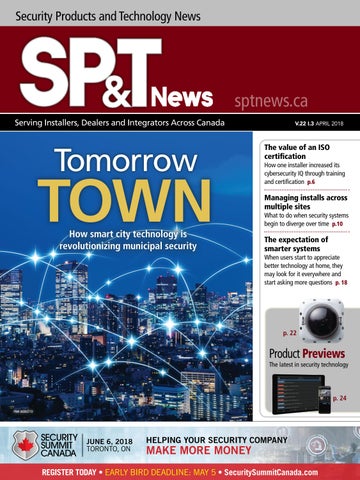
Rapid developments in networking technology, AI and data capture tools are helping to fuel the current trend towards smarter and safer cities.
By Ellen Cools
18 When office meets home
Advances in technology that people use every day at home are changing how they view the office as well.
By Joe Young
6 Line Card
• Integrator earns ISO certification to upskill on cybersecurity
• Start-up rep firm aims high
• Honeywell makes first spin-off appointment
10 Camera Corner
The multiple site conundrum By Colin Bodbyl
11 CANASA Update
Speakers worth your time By Patrick Straw
12 Lessons Learned If I was selling (part 2) By Victor Harding
Video management solution
Honeywell has expanded the equIP Series Cameras line with the 1080p 30x Zoom Explosion-Proof IP PTZ Camera, the Network TDN 8 MP IP Rugged Multi-Imager and the Network TDN Low-Light 6 MP IR Rugged models.
24
Dual path communicator
The B465 Universal Dual Path Communicator from Bosch links a control panel’s digital dialer to an Ethernet connection on a local area or wide area network or to an optional cellular module to send reports to the receiver at the monitoring station.
By Neil Sutton
TWriter’s block
he very last word in this magazine is “blockchain” but it won’t be the last time you read it in SP&T News
Blockchain is transforming transactions of all types and will soon be a commonplace term, assuming it’s not already.
It is featured in the customary “Archive” section of this magazine in reference to an IHS Markit research note published earlier this year. IHS predicts that access management global revenue will rise from US$5.4 billion in 2016 to US$9.6 billion in 2021. Contributors to this trend include the General Data Protection regulation deadline which has “piqued renewed interest in security and identity and access management solutions.” Other factors are the growth of Cloud-based solutions, particularly hybrids (on-prem and off-prem), and the urgent need for better cybersecurity solutions (the “battle with hackers,” according to the IHS note). Both of these are known quantities and, by now, are well-understood in terms of their influence on access control and identity management.
The last item listed by IHS is blockchain. I paused when I read that part. What do I know about blockchain? Not enough. I wouldn’t be surprised if many people share my situation. Experts on the topic, and conferences addressing it, are now rushing to fill that knowledge gap.
Hungry for more information, I turned to the Blockchain Association of Canada (BAC) website and read through a few pages of content. The very first
item you see on the site is a quotation in large print from the association’s executive director, Kyle Kemper: “Blockchain technology is going to transform our civilization.”
The BAC was formerly known as the Bitcoin Alliance of Canada (it changed its name last year). The relationship between bitcoin and blockchain dates back 10 years. A Wikipedia entry indicates that blockchain was invented in 2008 by Satoshi Nakamoto as a transaction ledger for cryptocurrency. That same Wikipedia page also contains phrases like “high Byzantine fault tolerance,” “Merkle tree,” and “cryptographic hash.” It’s no wonder there are experts coming forward to explain the technology in more digestible terms that are relevant to business implementations.
“Blockchain has the potential to introduce improvements that can make security more accessible and budget friendly,” offers the IHS report summary. It also alludes to a “trusted digital identity network,” a “shared, append-only ledger,” “smart contracts,” “trust between known participants to verify transactions” and “privacy and security measures.”
These last two in particular are bound to raise the interest of the security directors and end users you may be dealing with. Assuming Kyle Kemper is right, we’re only now at the tipping point for blockchain. Getting ready for it is going to move to the top of the list.
Your Partner in Securing Canada Security Products & Technology News is published 8 times in 2018 by Annex Business Media. Its primary purpose is to serve as an information resource to installers, resellers and integrators working within the security and/or related industries. Editorial information is reported in a concise, accurate and unbiased manner on security products, systems and services, as well as on product areas related to the security industry.
Group Publisher, Paul Grossinger pgrossinger@annexbusinessmedia.com
Publisher, Peter Young pyoung@annexbusinessmedia.com
Editor, Neil Sutton nsutton@annexbusinessmedia.com
Assistant Editor, Ellen Cools ecools@annexbusinessmedia.com
Art Director, Graham Jeffrey gjeffrey@annexbusinessmedia.com
Account Coordinator, Kim Rossiter krossiter@annexbusinessmedia.com
111 Gordon Baker Rd, Suite 400, Toronto, ON M2H 3R1 T: 416-442-5600 F: 416-442-2230
PUBLICATION MAIL AGREEMENT #40065710 Printed in Canada ISSN 1482-3217
asingh@annexbusinessmedia.com Tel: 416-510-5189 • Fax: 416-510-6875 or 416-442-2191
Mail: 111 Gordon Baker Rd, Suite 400, Toronto, ON M2H 3R1
SUBSCRIPTION RATES: Canada: $42.00 + HST/yr, USA: $74.00/yr and International: $84.50/yr Published 8 times a year
Occasionally, SP&T News will mail information on behalf of industry-related groups whose products and services we believe may be of interest to you. If you prefer not to receive this information, please contact our circulation department in any of the four ways listed above.
Annex Publishing & Printing Inc. disclaims any warranty as to the accuracy, completeness or currency of the contents of this publication and disclaims all liability in respect of the results of any action taken or not taken in reliance upon information in this publication.
INDUSTRY LEADERS SECURING INDUSTRY LEADERS
125 years of experience in putting the security of others first.
We understand you need to protect more than brick-andmortar, which is why ADT does more than monitor. ADT has a wide range of alarm and security options for organizations of any size to help protect people, goods, and data. With 24/7 surveillance, solutions against intrusion and fire, remote monitoring, interactive services and more, ADT has a security solution for your organization. Join those who trust ADT with their livelihoods and protect your business.
SECURITY AND AUTOMATION SOLUTIONS
WHY CHOOSE ADT CANADA?
We are an integrator, meaning we can take over nearly any of the existing security equipment you have on-site.
We are customer-service oriented, innovative and technology savy.
With over 125 years of experience and 15 branches in Canada alone, including four monitoring stations, you can trust the experts.
LINE CARD
Integrator earns ISO certification to upskill on cybersecurity
Tech Systems (TSI) has achieved the ISO 27001 certification, an international standard that comprises best practices for an information security management system (ISMS).
TSI is a Buford, Ga.-based systems integrator that operates across the U.S. and in Canada via a Toronto location. The company’s president Wayne Smith says he set the company on the path to achieving ISO 27001 a little more than two years ago. The physical security industry as a whole has been trending towards IP-based systems for some time, notes Smith.
“The majority of products that we sell, service, deploy today are all IP centric,” he explains. “We work with a lot of Fortune 500 companies. They have some pretty serious demands on their network security.
“The majority of products that we sell, service, deploy today are all IP centric.”
— Wayne Smith,TSI
We felt like, both internally, with all of our IT infrastructure, and all the products that we sell, service, deploy, we needed to have sort of a compliance and process as to how to select those products, how we install them, and how we service them.”
The company earned an ISO 9001 certification — part of a family of ISO standards for quality management — back in 2008. ISO 27001 is a logical progression, says Smith.
The goals are two-fold: maintain an internal organization that adheres to the guidelines set out in
ISO 27001 and improve connections with clients.
The former requires a systematic approach to patching schedules, systems updates, acceptable use polices for technology, as well as training tools. “We do everything from phishing exercises to security tips on how to be more aware of network security pitfalls,” says Smith. And “not just internally… [but for] all our folks out there in the field.”
For client interactions, it’s about managing touchpoints, says Smith. The company maintains its business primarily on installing
Start-up rep firm aims high
Brian St.Onge feels the future coming and he wants to be ready.
A security industry veteran who worked for distribution giant Anixter for 20 years, St.Onge recently started his own manufacturer’s representation firm, St.Onge Technical Services, based in Toronto. His initial client is
Brian St.Onge, St.Onge Technical Services
BCDVideo, U.S.-based makers of surveillance server architecture, and he is currently representing them coast-to-coast across Canada.
He set up the business last December, based on some initial meetings with BCDVideo. “I decided to dive in and go for it. I haven’t looked back since,” he says, adding that “opening up my own business was a learning curve.”
What really interests St.Onge, though, is where the security industry is headed. BCDVideo, for example, “is branching off into products outside the server, with regards to switching technology, wireless technology, UPSes. I’m looking to help bring in my past experience on the engineering side to help customers tie in complete solutions.”
Currently a one-man operation, St.Onge aims to expand and hire on new staff as needed. “There is the
option to grow the business down the road — looking at the market wisely to see what the next trends are and what would be a nice addon to the existing portfolio.”
As such, he’s less interested in the bread and butter of the established security industry — cameras, access control, etc. — and is more focused on where the growth opportunities are. Augmented reality, drone detection, biometrics, analytics, even blockchain; these are all areas that intrigue St.Onge.
“I’m looking at it more from an emerging technologies standpoint. I’m seeing a lot of interest these days in city surveillance [for example] and IoT (Internet of Things) devices going on networks,” he says.
St.Onge may be a veteran of the business, but he acknowledges that some of the best ideas that will shape its future will come from
physical security equipment, but is placing more emphasis on managed services for security controls, either through remote management or remote monitoring.
Smith says his company has fostered relationships with many IT departments that operate within Fortune 500 companies. He says some companies, particularly financial institutions, are now looking for ISO 27001 as a pre-requisite before working with a contractor.
“Certainly, that’s something that I think you’re going to see much, much more of, even within the physical security space,” says Smith. “ISO 27001 started in the European market. It’s becoming more much prominent in the U.S. We’re seeing it in a lot of documents now.”
— Neil Sutton
people who aren’t even working in it yet. The security industry is changing, and will change further as the next generation of professionals bring very different perspectives to the table. These people, who grew up with laptops in front of them or tablets in their hands, will be responsible “for solving problems that we don’t even know exist yet,” he says.
Some of those hallmarks are already present in the security apps that are relatively new or still in development, he says.
“Data acquisition seems to be the name of the game these days — converging everything together, analyzing the data and doing something with it. We’re going to see a lot of emerging products along those lines,” he says. “I’m trying to keep my eyes open.”
— Neil Sutton
Honeywell makes first spin-off appointment
Honeywell announced it will appoint former company executive Roger Fradin as the Chairman of the Board for the Homes and Global Distribution business spinoff announced last year.
Fradin is expected to “start immediately to help Homes transition into a separate, stand-alone business,” according to a company statement.
“In Roger Fradin, we are appointing a terrific leader to act as Chairman of our Homes and Global Distribution business once it separates from Honeywell,” said Honeywell president and CEO Darius Adamczyk. “Over many decades in the industry, Roger has forged an unparalleled track record of performance through his ability to connect with customers, anticipate their needs and drive the rapid introduction of highly desirable products. Roger’s experience, passion, technical knowledge, unwavering focus on serving customers, and ability to attract and motivate a highly talented workforce will ensure the Homes spinoff thrives as an independent company.”
“I am excited to partner with Honeywell once again, and even more excited to help build a fantastic public company that will encompass this well-established and successful product portfolio,” Fradin said. “Honeywell’s Homes and Global Distribution business is uniquely positioned to leverage its wide portfolio of Connected products and highly advanced software capabilities to generate tremendous
innovation within the markets it serves. I have no doubt the new company will be at the forefront as a leading choice for consumers, a great place to work for employees, and an excellent investment for future shareowners.”
Fradin had previously served in a 17-year career with Honeywell, retiring last year. He occupied a
number of senior roles, including president and CEO of Honeywell’s former Automation and Controls Solutions (ACS) business group. He also ran the company’s distribution business, originally as founder in 1976 until its acquisition by Honeywell in 2000. Honeywell will also spin-off its Transportation Systems busi-
ness into another publicly-traded company. Honeywell said a CEO for the new home/distribution spin-off will be named at a later date. In its original communication regarding the spinoff, released in October 2017, Honeywell said it anticipated the transaction will be completed by the end of 2018.
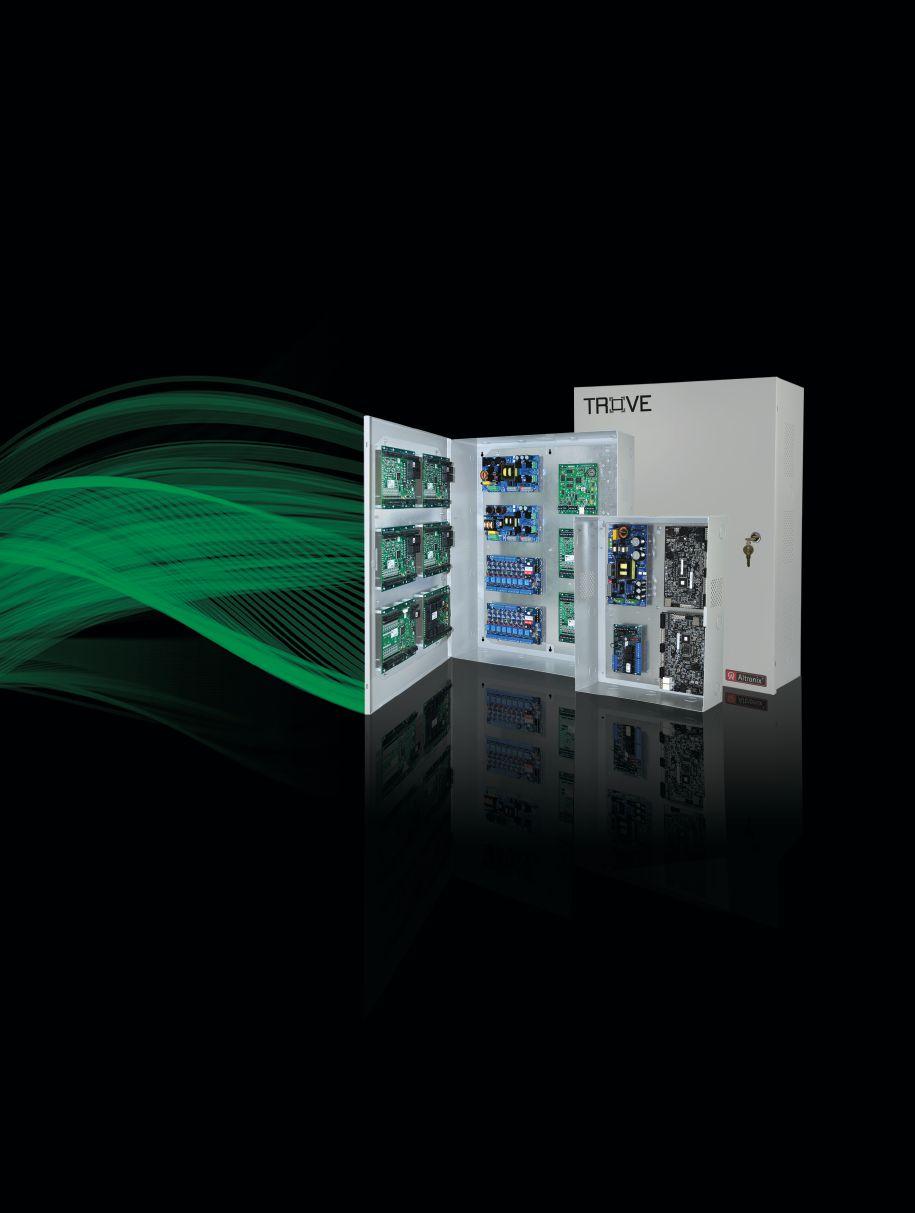
ACCESS & POWER INTEGRATION
– Easily combine Altronix® power and accessories with access controllers from the industry’s leading manufacturers
– Trove enclosures with removable backplanes allow you to configure, layout and test prior to on-site installation
– Efficient, scalable designs for optimum performance and seamless integration
– Pre-assembled kits available in various configurations further reduce overall costs
Roger Fradin, Honeywell
LINE CARD
Improved flow at
Phoenix airport
The Phoenix-Mesa Gateway Airport (AZA) has incorporated dormakaba exit lane technology to improve passenger flow and reduce congestion.
AZA worked with DWL Architects + Planners to develop a plan in order to meet the airport’s requirements.
“A meticulously designed techzone lighting system was incorporated before passengers exit the corridor to instinctively guide [them] through the portal. We implemented an intuitive wayfinding system that made use of every element available, and took advantage of selected materials to create a cohesive design for the new dormakaba unmanned exit lane,” said Sandra Kukla, executive vice-president of DWL Architects.
The dormakaba Exit Lane Breach Control (ELBC) system was selected for the project due to its “smart technology” interface.
Appointments Applications
• Ottawa-based Senstar has named Fabien Haubert as vicepresident, sales, EMEA region.
• The Security Industry Association (SIA) has selected James Marcella, director, industry associations, Axis Communications, as 2017 SIA Committee Chair of the Year for his work with the SIA Education Committee.
Security design for Wash. city hall Spokane Valley, a suburb of Spokane, Wash., incorporated security equipment and design tools from Vicon Industries for its three-storey, 65,712 sq.-ft. City Hall facility.
The facility was designed to accommodate the community’s needs for the next 50-100 years with minimal changes. Security is supported by Valerus Video Management Software, IP megapixel cameras and VAX access control software.
Coffman Engineering, the firm responsible for installing the security elements, used free design software from Vicon to help determine bandwidth and storage requirements for the building’s security system.
“To create the specs in SpecWizard, I just went in and checked the boxes for the cameras, servers and software that I wanted and downloaded the file in Word format,” said Ben Helms, project manager, Coffman Engineering.
• Honeywell recently announced it will appoint Roger Fradin as the chairman of the board for the Homes and Global Distribution business spinoff (see p. 7).
• Boon Edam announced the expansion of its Enterprise Customer Group, adding: Greg Schreiber, senior vice-president of sales; Pierre Bourgeix,
Tanzania partners with HID Global for e-passports
The government of Tanzania has selected HID as its supplier for an endto-end solution for issuing electronic passports.
The new ePassport solution incorporates advanced physical and electronic security features, automated passport verification capabilities and support for international standards. Featuring imagery, such as Mount Kilimanjaro and Zanzibar’s House of Wonders, the Tanzania ePassport contains a contactless chip embedded in its polycarbonate datapage.
HID Global partnered with DLRS Group for the manufacture of the passport booklets incorporating HID’s polycarbonate electronic datapage.
The new ePassport is designed to increase security while making travel easier for the country’s citizens, such as scanning their passports electronically at border control stations.
consulting manager; Joe Seagriff, business development manager; and Dana Cashion, inside sales representative.
• Calian Group recently announced three executive appointments: Jerry Johnston, chief information officer, Lynn Stevens, chief human resources officer and Donald Whitty as vice-president, training.
Calendar
April 24, 2018
ADI Expo Ottawa, Ont. www.adiglobal.ca
April 25, 2018
Security Canada East Laval, Que. www.securitycanadaexpo.com
Global Security Exchange Las Vegas, Nev. www.gsx.org
Fabien Haubert Roger Fradin Greg Schreiber James Marcella
Jerry Johnston Dana Cashion
Anixter, as a Partner, can help you take on bigger, more profitable projects, managing the supply chain so you can focus on fast, streamlined installation.
From large integrator customers working on multi-site complex projects to small-medium installers and residential dealers, we have a full portfolio of products, technical expertise you can rely on, and services designed for your success.
Anixter does business how you want:
CAMERA CORNER
By Colin Bodbyl
The multiple site conundrum
Integrating different video software across a variety of locations remains a complex issue
For end users with multiple locations, managing surveillance systems is complicated.
One end user could have a hundred locations that all require video surveillance systems. Much like other infrastructure, not all locations will have the same age, brand, or type of equipment. Very rarely do businesses overhaul their security platforms across dozens or hundreds of locations at one time. This typically results in disparate systems. Security directors find themselves managing dozens of different VMS’ through different client software, mobile apps and browser interfaces.
may not support the new software. In addition, the cost of purchasing new software licenses for hundreds or thousands of cameras is significant, especially considering the only justification is to create a single standard user interface for otherwise perfectly functional systems.
“One end user could have a hundred locations that all require video surveillance systems.”
To solve this problem, end users could pay to convert all their sites to one new software. This process can lead to serious compatibility issues as older cameras or recorders
Another potential method for solving this dilemma is through third-party or custom built software that could be integrated with each VMS using individual software developer kits (SDKs). Similar to new software licence purchases, SDKs can be expensive and development costs or third-party licensing costs can become substantial.
A lesser known solution is through ONVIF. Most people will know ONVIF from its popular protocol that enables cameras to be viewed and recorded through different VMS platforms. Fewer people
are aware that the same ONVIF protocol could be used to stream video out of VMS software to other platforms. For end users who want to view all of their disparate systems on one client software, this could completely solve their issue. Unfortunately, the vast majority of VMS providers are not adding ONVIF support for streaming video to external software and instead force integrations to be made through complicated and expensive SDKs.
While supporting outbound ONVIF connections on the VMS may seem like a sensible solution from an end user perspective, it poses some complex dilemmas for VMS providers. One concern could be the risk of losing portions of an end-to-end surveillance system because customers would no longer be forced to standardize on one VMS in order to receive one consistent user interface.
As an example, if a customer has two different VMSes on two different sites, their only clear option to view both sites through one
interface is to choose a winning VMS from the two and pay for licences to convert over the losing site. Of course, every VMS provider believes that they would beat out their competition in this scenario and in turn do not believe this is a real threat. Instead, VMS providers consider this an opportunity to generate new sales and eliminate a competitor.
While end users and third-party software providers could benefit substantially from outbound ONVIF support becoming a standard in all VMSes, the competitive advantage of controlling and restricting external integrations will always be more important to VMS providers. For those of us waiting for a simple and free standard for connecting to video through any VMS platform, the ONVIF protocol is unfortunately not going to become that solution.
Colin Bodbyl is the chief technology officer for UCIT Online (www.ucitonline.com).
CANASA UPDATE
By Patrick Straw
Speakers worth your time
CANASA has lined up leading security experts to speak at upcoming events
CANASA’s first quarter of 2018 is flying by with exceptional turnout and support coming from our members at CANASA hosted events. Quality speakers focused on timely topics along with the opportunity to network is a winning formula.
Topics covered to date included Communication Technology in Policing, Cyber Security and Cannabis in the Workplace, which explored the associated health and safety risks for employers. I encourage you to visit www.canasa.org for upcoming events in your area.
spective on the Montreal Airport Authority and its role in the security sector.
Security Canada East will come to a close with Casino Night — one of our signature events of the year. We urge all of our members and guests to attend on the evening of April 25 in Laval.
The CANASA team continues to reach out to relevant and interesting guest speakers across the country. Here are the highlights of upcoming events:
Sylvain Brouillette, Montreal Director of Airport Security, will be the keynote speaker at Security Canada East held in Laval, Que., on April 25. Brouillette will provide a unique per-
David Shipley, CEO of Beauceron Security, is one of Canada’s leading cyber security experts. David is frequently called on to comment through various news organizations and has been a frequent guest on Global News.
He will be speaking at both our Security Canada Show in Ottawa on May 9 and at Security Canada Central in Toronto on Oct. 24, focusing on the rising threat against smart devices, hacking democracy and the critical need for a 21st century Geneva Convention.
Please visit www.securitycanada.com for registration information on these and all six of our Security Canada Trade Shows.
across Canada
Stephen Sayle, CEO of SayleGroup Inc. and SayleSafety Inc., will provide attendees with insight into how his team started a “Safety Culture movement” by launching online Safety Culture training and digital safety apps. Stephen will be speaking to our Atlantic Council in Dartmouth, N.S., on April 18.
And if golf is your game, the CANASA B.C. Regional Council has been hard at work, along with the B.C. ASIS chapter, to organize the first joint golf event in Richmond on June 14. Space is filling up quickly so please visit www.canasa.org for registration information.
Finally, membership in the Canadian Security Association (CANASA) has tremendous benefits from industry education to scholarship programs; from networking opportunities to discounts on a host of services. Join today and help support Canada’s not-forprofit organization dedicated to advancing the Canadian security industry. Please visit www. canasa.org for more information on all the benefits of membership.
Patrick Straw
LESSONS LEARNED
IBy Victor Harding
If I was selling (Part Two)
Picking up where we left off in January, some words of wisdom on closing the deal
n Part One I left off with the dealer or seller having determined that they are financially ready to sell, and at the same time they have determined that this is a good time to sell. With the recent changes to taxation of small businesses, this is even more important today.
The next big step is to decide whether you want to use an intermediary or M&A advisor to help you sell, or if you want to try selling your company yourself. I have an obvious bias towards using an intermediary but I think it is based on some sound reasons:
• It takes a lot of time to sell most companies — more time than a typical owner/operator can take away from running the business.
• Selling a business takes experience in selling businesses.
• A good broker should know two key things — how to value your company and how to find most of the better potential buyers for it.
• It is easier to keep the selling process confidential if all the paperwork and back and forth with buyers is handled off-site at a broker’s office.
• Data shows that owners who use an intermediary have a better chance of getting a deal closed and at a higher price.
The next step is to get a valuation done on your company, whether you use a broker or not. Some small business owners unwisely skip this step and just arrive at a ballpark value as to their worth.
The problem with this is you could be leaving money on the table. A word of caution, however, is also in order for those who seek out a proper third-party valuation. Be careful who you get to value your company. Many Certified Business Valuators whose work I have seen do not do a good job of valuing recurring monthly revenue.
Also, it is important to understand that whoever is valuing your company is only giving you the most probable selling price, not what your business will actually sell for. Overall, valuing small businesses is probably trickier and more imprecise than valuing bigger, more established businesses. Next, you should get an attractive “selling package” done, which can be shown to prospective buyers. This describes the company from the point of view of what a buyer would want to know. These are known as a Confidential Business Review.
Once the selling package is done, it needs to be circulated to prospective buyers. If you want to be sure of getting the best all around deal for your company, again the statistics all show that a “teaser” (usually sent out before the package) has to be shown to several, if not many, potential buyers. From the teaser you hopefully get several worthwhile interested parties who will get the full package on the company for sale. Obviously this “shopping” of the company has to be done carefully and under non-disclosure agreements. I personally like to try to create a “mini-auction.” This auction process does not go on forever. Bids have to be in by a certain date and cover certain important details.
Once the best offer has been chosen — and sometimes this decision is not as easy as you might think — the much preferred route is to get the best bidder to draw up a non binding Letter of Intent (LOI) laying out all the terms they are offering. I have read articles that say a LOI is not necessary in the sale process. I flatly disagree. If the buyer wants the seller to stop negotiating with others then the seller needs a formal LOI.
Once the LOI has been signed, most buyers will want to do some due diligence on the company they are buying. Sellers simply have to be ready for things like:
• Having their financials scrutinized even more carefully.
• Having a legal, background and credit check done on their company.
• Having to turn over accounts receivable aging reports.
• Giving the buyer a breakdown on inventory.
• Disclosing details on leases that their company has for vehicles or anything else.
• Disclosing details on employees — what they are being paid and how long they have been there.
There is also the issue of if and when a seller discloses bad news. Most brokers will suggest it is better to get the bad news out up front. Even if the buyer misses finding the bad news in due diligence, it is likely they will find it sometime after closing and it can destroy good will down the road.
The other issue that often comes up in due diligence is how much of its customer base should the seller disclose. I suggest proceeding with caution and not disclosing too much.
I always advise buyers and sellers that as soon as they start the due diligence phase, they should at the same time get their lawyers working on the Purchase and Sale Agreement and any other closing documents like a Non Competition, Employment or Vendor Take Back agreement. The process of getting agreement on all these documents will likely mean going back and forth between the lawyers for the seller and buyer. The process can take forever. Sometimes it pays to get the buyer and seller together without the lawyers and hammer out the issues on their own.
Believe me when I say in my years doing deals in the security industry, every deal took longer to close than I first thought and certainly longer than most sellers would like.
Overall, as an intermediary, I have learned that closing almost any deal takes persistence, patience and the ability to stay open-minded and flexible.
Victor Harding is the principal of Harding Security Services (victor@hardingsecurity.ca).
STREET SMARTS
The notion of safer cities through technology integration and data sharing is an enticing one, but there are twists and turns to navigate first
By Ellen Cools
The Government of Canada recently launched the Smart Cities Challenge, a pan-Canadian competition that “encourages communities to adopt a smart cities approach.”
A number of Canadian cities across the country are taking part. Evidently, more and more municipalities see the benefit of installing and integrating intelligent sensors to efficiently manage their cities.
This, in turn, means integrators and installers will reap some of the rewards. But in order to benefit, they should know what municipalities are looking for.
Breaking down the concept
To do that, installers and integrators first need to understand what a smart city is, and, by extension, what a safe city is.
According to the participant summary of IHS Markit’s “Safe Cities Report - 2017,” a smart city project is “one that uses an inte-
grated ICT [Information and Communication Technologies] system to improve efficiency, manage complexity and enhance citizens’ quality of life through sustainable improvement in city operations.”
The smart city includes six components: “safe city,” mobility and transport, energy and sustainability, social infrastructure, physical infrastructure, and smart economy.
Additionally, the report says that while a smart city is not always a “safe city,” a safe city uses smart city concepts. A safe city is “a security concept that integrates critical security information from a range of sources onto a consolidated IT platform.”
Those sources include video surveillance cameras, sensors, biometric applications, access control systems, etc.
“You need to have [surveillance] automated, so you’re not stressing out your operators.”
— Alexander Richardson, IHS Markit
tracking down the perpetrators … but it doesn’t always work from a prevention perspective,” he explains.
Kabilan also believes the primary focus for most smart city installations is not surveillance, but “sensing.” For him, surveillance is the observation of a specific group, while sensing is directed at a process. “For example, if you think about sensors in traffic lights, what you’re trying to do is maybe gauge where the traffic is. By that, you may know what cars are around you, where all the traffic is, so you would have some information that might be useful from a surveillance aspect, but it’s more about the sensing aspect.”
Analytics and AI
“Sensors … can be used in conjunction with surveillance systems or camera systems to provide you with additional information on a situation,” he continues. “Combine that with the potential that AI (artificial intelligence) and big data offers, and maybe you could get real-time analysis of images.”
Evidently, analytics and big data will play an important role in smart city projects, particularly because of the sheer number of sensors and cameras required.
For example, “if you’re routing 15 or 20,000 surveillance cameras in a control room, there’s no way that a couple of operators … can sift through all of that data,” says Richardson. “It’s really important to have some kind of analytics program so that you can identify the anomalies.”
Surveillance and sensing
In creating this convergence, it’s important to understand the role of surveillance in smart and safe cities.
“Strong surveillance infrastructure is critical to the success of a safe city, as much of the analytics and operational procedures are driven by the surveillance inputs,” reports IHS Markit.
According to the study, video surveillance equipment and hardware, as well as peripheral services, currently make up approximately 50 per cent of the market.
“A lot of cities already have a good number of surveillance cameras, so it just makes sense to continue to use those in the future,” adds Alexander Richardson, senior research analyst, technology, media and telecom for IHS Markit, and author of the report.
“You can keep adding more cameras on that network and you can add things like analytics, and once you connect with sensors, access control, etc., it [becomes] a lot more efficient,” he continues.
For example, Atlanta, Ga., implemented an initiative called Operation Shield in 2015. The city put together a steering committee to integrate the police and transportation department’s surveillance systems into one command centre, utilizing the pre-existing cameras to make their operations more efficient.
However, Dr. Satyamoorthy Kabilan, director of national security and strategic foresight at the Conference Board of Canada, believes there are a number of misperceptions about how surveillance systems function and affect public safety.
“In most cases, they affect public safety retroactively, i.e., they give us a better chance of
Giovanni Gaccione, justice and public safety practice leader at Genetec, also finds that surveillance will have broader applications through analytics and AI. “Surveillance as a thought is going to be important, but not [only] from a public safety or a policing perspective,” he explains. “It’s going to be for a whole city benefit.”
For instance, cities can use it to monitor traffic and pedestrian flow.
This is especially the case because video analytics are more advanced, which in turn makes cameras more intelligent so “not only can they tell me if traffic is flowing…but with a simple analytic, [they] can say, ‘traffic should always be flowing in this direction,’” he explains.
If a vehicle is going in the wrong direction, for example, an alert can be raised automatically.
Lisa Brown, senior national director of municipal infrastructure and smart cities, North
America, for Johnson Controls has also seen how video analytics have helped city managers.
For example, a city she spoke to had a problem with illegal parking, particularly at city hall. But through licence plate recognition, city managers were able to determine who was parking illegally and who wasn’t.
For municipal managers, she adds, analytics and big data were daunting in the past. Their goal with analytics is to “be able to translate it into … real return on investment or some real tangible results for their citizens.”
The power of data analytics for governments, then, is to make more informed decisions regarding public safety, energy, public health, etc., she explains.
While Kabilan agrees analytics could potentially provide useful insights, he is still concerned about their effectiveness.
“A lot has been said about [video analytics], a lot has been touted by vendors, but as far as I see, the effectiveness has not been quite as good as many have hoped for,” he explains.
“I think really to make the most out of analytics, it’s not going to be video, it’s going to be…marrying all of those other sensing systems,” he continues.
To marry these systems, AI will play a “tremendous” role, especially as it becomes cheaper to install a variety of sensors through IoT.
But the challenge then becomes how to make sense of all the data.
“You need to have [the surveillance system] automated so that you’re not stressing out your operators,” says Richardson. “As you use the system more and more and as you tailor the analytics to each specific application, the system just becomes that much better — it becomes more intelligent.”
But simply gathering the data and finding patterns is not enough, says Gaccione. The footage pushed from cameras has to be interpreted and used correctly.
“As one of our police departments always tells us, ‘You need to tell us what we don’t know,’” Gaccione says. “I think what’s going to be the most important tool of AI, is how can we, with all these different data sets, be able to pick out a trend or an anomaly that a city might not know?”
Privacy and cybersecurity
But Gaccione emphasizes that “the importance isn’t necessarily having a data set, it’s the ability to cross what information can the sanitation department’s data set [for example] help with public safety, or vice versa.”
For Richardson, sharing data is the ultimate goal of safe and smart city initiatives.
“You want to be able to disseminate information, so that especially when you have a large-scale incident, you can have all of the different agencies or stakeholders on the same page,” he shares.
“It would be very interesting to see that happen because it would certainly provide a lot of useful information and insight,” adds Kabilan. “The only thing I would say, of course, is that it
certainly comes at a cost. You have to be able to access the data securely, the provision also has to take into account privacy — who has access to that data and where it goes.”
Consequently, privacy and cybersecurity should be a top priority.
Gaccione says that this is the No. 1 priority for Genetec’s Justice Public Safety team. “It’s the first thing we think about whenever we speak to customers,” he says.
“With IoT, the largest issue is scale,” he continues. “Maybe in the past, for NYC, they have a thousand computers. If they start rolling out cameras and sensors and… IoT, that might go … to 50,000 or to 100,000 units that need to be maintained, monitored and secured.”
“A lot has been said about [video analytics], but as far as I see, the effectiveness has not been quite as good as many have hoped for.”
— Dr. Satyamoorthy Kabilan, Conference Board of Canada
Those devices need to be secure to make sure it’s “easy to keep those IoT devices up-to-date, and ... those IoT devices don’t turn against you and basically act as malicious devices on your network.”
Yet Kabilan says he hasn’t seen a lot of discussion about cybersecurity among municipal managers.
“Sometimes, what I’ve heard in discussions is, ‘Well, you know, it’s just a traffic light sensor, who’s going to want to hack that?’ But it’s an endpoint. It goes back into your system, and if you can hack 100,000 of those … you’ve now got a botnet,” he explains.
The increase in endpoints combined with the lack of concern for cybersecurity and privacy is “creating what could potentailly be a highly critical set of vulnerabilities,” he concludes.
An exploding market
Despite the potential vulnerabilities in smart city projects, it is undeniable that the industry is a growth market for installers and integrators.
“I think this market has been exploding,” says Gaccione.
Case in point, both Genetec and Johnson Controls have benefited from this growth.
“Genetec has been positioned and continues to position itself as a unification platform,” Gaccione says. “We see great benefit because it allows cities to not be locked into a specific technology.”
Likewise, Johnson Controls is “seeing significant growth in the market … because these projects are becoming more holistic,” says Brown.
For example, the company recently helped install a federated surveillance system in Philadelphia, connecting small businesses with universi-
ties, hospitals, police and fire.
“It was very, very interesting in terms of not just the security that it brought, but also the co-operation,” Brown says.
Integrators, she adds, will play a key role in the coming years “because they’re bringing more coalition partners together ... to really bring a bigger and broader offering for smart cities.”
“What I’ve been seeing out in the market is that companies are really aligning and approaching projects as teams, rather than just going it alone.”
Globally, the safe cities market reached total revenue of US$13.1 billion in 2015, reports IHS Markit. By 2020, it is predicted to reach US$20.06 billion.
The fastest growing markets are predicted to be Broadband Enhanced Node Bs (the broadband infrastructure which transmits the signal for connected devices) and PSIM (Physical Security Information Management) software, which integrates video surveillance feeds, sensors, access control systems, etc., explains Richardson.
Video surveillance equipment will account for 8.6 per cent of the compound annual growth rate (CAGR) between 2015 and 2020, while communication and incident management will account for 9.4 per cent, data management 15.7 per cent and analytics 7.0 per cent.
In fact, a new study by IHS Markit, “Video Surveillance & Security Report - Cities,” reveals that “the world market for security equipment in city surveillance has registered robust growth in the past few years, surpassing US$3 billion in 2017.”
Additionally, the global city surveillance market is predicted to grow at an average annual rate of 14.6 per cent from 2016 to 2021.
Evidently, installers and integrators will have plenty of opportunities as the smart and safe cities market evolves.
But Richardson warns there are challenges.
“There aren’t any absolute technology standards,” he explains. “There’s different video standards, there’s different communications standards and cities always have different generations of all these technologies made by different vendors, so it’s really tricky to get a system that can tie all of it together.”
Richardson says that while many PSIM software integrators claim their system can integrate sensors from different companies, that’s not always the case.
“A lot of times, I think there is a disconnect,” he adds. “The vendors will pitch this great system, but ultimately it’s not what their client needs.”
This might be because cities are often behind compared to the technology.
“From a technology side, I think we’re there as an industry,” says Gaccione. But cities have to do more to “wrap their head around … the technologies that are out there.”
Consequently, “discussion and interaction with the end user is a key thing,” concludes Richardson.
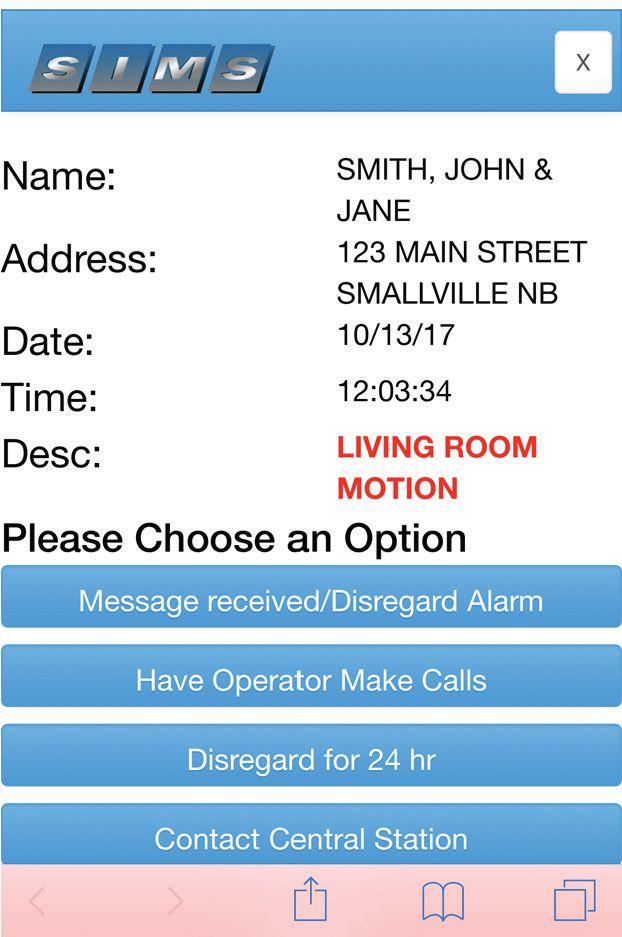
System Text Alarm Notification (STAN)
• No App required.
• Armstrong’s virtual operator (STAN) sends detailed text notification direct to customer.
• Customers can respond to the station immediately with no phone call required.
• Alarm resolution notification to all keyholders simultaneously.
• Convenient, easy to use on a smart phone.
• Fully backed up with central station operator response.
• Customizable by alarm type and/or zone.
OFFICE HOME MEETS WHEN
Advances in video games, cell phones, televisions and more will disrupt commercial security. Learn how you can adapt to be successful
By Joe Young
At home today, your virtual assistant can notify you of today’s weather, top news stories, traffic conditions and the time it will take to get to your first appointment. The assistant opens your blinds, turns on the kitchen lights, sets your thermostat, and plays your morning music playlist throughout the house. You can see the driveway camera on your TV to check if it snowed. When you leave for the day, it sets the daytime temperature of the house, turns off the lights, turns off the TV, disarms the alarm, unlocks the front door, and opens the garage door. As you leave, the front door automatically locks, the alarm is armed and the garage door shuts.
“The critical driver of disruption is the speed at which consumers or businesses adopt a new product or service.”
While this sounds like a state-of-the-art, expensive home automation set-up, it’s the complete opposite. This experience can be built with a simple DIY Apple Home Kit setup with devices purchased at the local electronics store for less than $800.00, and best of all, the Apple Home Kit software is
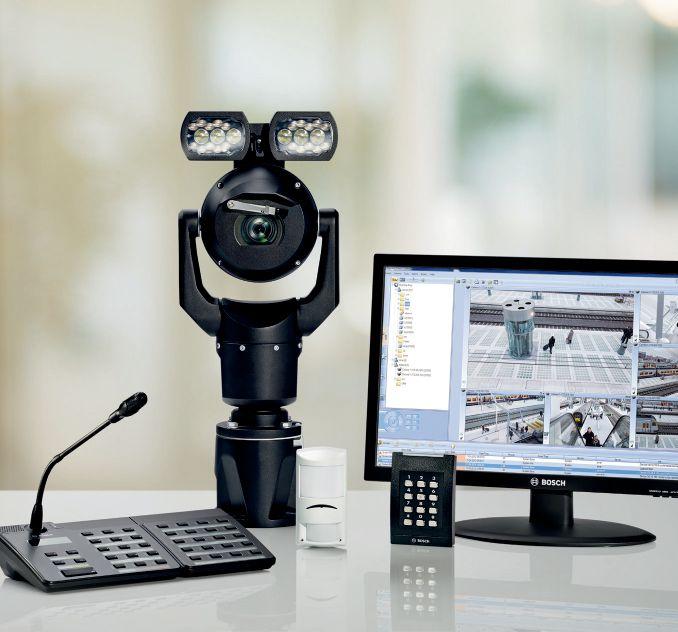
Bosch empowers you to build a safer and more secure world. Our products are designed to work together to maximize facility control, better mitigate risks, and make systems easier to use and manage. Increase security and automate functions for easy operation. Trigger and execute audio announcements based on security events. Manage data with enterprise-wide control of video and security devices. Bosch products integrate seamlessly to help you create complete security solutions. Call us at 1-866-266-9554 to learn more.
free. This seamless experience is controlled by your voice. People are living this life now. When you arrive at your client’s office, it’s like a step back in time. The front door is propped open because everyone forgets their badges at home. In the reception area, there is no receptionist or intercom. A sign asks you to sign the paper visitor logbook and call your host using the lobby phone. When your host arrives, he hands you a badge that has access to all doors throughout the building 24/7. The conference room he brings you to is 10 degrees colder than the rest of the office. Your host leaves and tries to find the thermostat that controls the room, but can’t figure out which one it is.
The next generation of employees are going to expect that they have the same connected experience in the office as at home. And the next generation of Corporate Security Officers will make that a reality. What does this mean for integrators and manufacturers?
Disruptive Technology
The critical driver of disruption is the speed at which consumers or businesses adopt a new product or service. The perfect storm of emerging technology, new business models to distribute it quickly, and subsequent exponential adoption means that organizations must become more agile and be able to respond and anticipate.
As emerging technologies spread into boardrooms, it is not just the technologies themselves that are disruptive; it’s the scaling and adoption of those technologies that are also vulnerable. Artificial intelligence, advanced robotics, augmented reality, Internet of Things and virtual reality have been around since the early 2000’s. What we see now versus then is that our business model enablers have evolved to drive the technology through a business, making the impact of technology truly disruptive on a large scale.
Business model enablers such as Cloud services, miniaturization of sensors, low cost computing, application programming interfaces, crowdfunding, open source and Freemium mean we now have access to the funding, platforms,
processing power, software and data to turn the technology into useful, scalable solutions.
The combination of new technologies, together with these new business model enablers, is resulting in significant change in the adoption rates of new technology enabled companies, products, and services. Technology companies are crossing over into different areas, and getting the right technology at a cheaper price is becoming easier.
“PC usage is down and app usage has soared. Understanding ‘user experience’ is the secret sauce to success.”
The New Normal
People are consuming things differently today. Users want the same content, but in a different way. For example, cable TV users are shifting to streaming. Virtual assistants are the norm at home. How soon until they control security? PC usage is down and app usage has soared. Understanding “user experience” is the secret sauce to success.
The DIY trend tempts the above average user to want to install their own solution. In our “I want it now” culture, integrators and manufacturers need to be nimble and responsive by using the tools end users are accustomed to in their daily lives. In the home automation space, if you have an issue, you can instantly call, find web support, chat, email, voice, etc., and remotely resolve issues. Integrators and manufacturers need to harness the disruptive technology to provide the instant support end users experience in their every day lives.
Internet of Things is one of the biggest disruptors that integrators and manufacturers can use to their advantage. With the ability to self-configure and create automation, end users
can self-customize. Adding devices is simple, and everything is connected. Savvy end users do not want to call a technician every time they want to make a change to their system. End users are taking more control. As the commercial security industry evolves, it is imperative to leverage the trends to bring greater value to customers.
To keep up with the user demand and provide a secure data environment for customers, the industry needs to increase cyber capabilities. End users are increasingly looking for technology with open architecture to meet their desire to self-customize quickly. In the security or commercial space, customers frequently worry about security breaches, and end-to-end encryption must be used for everything along with opt-in models.
Tips to Succeed
In two to five years, what we see today in the consumer space will be the norm. Manufacturers need to balance their core offerings and figure out how to be disruptive.
Bringing innovation to your customers will require you to invest in a diverse team to lead your innovation and technology vision. Hiring talented individuals who live technical lives at home will help your culture change when they bring their experience to work. You must understand generational differences and work to provide a common ground. If you are able, budget for a lab and provide technology allowances for a select team to use technology at home to understand the experience. Leverage everyone in the organization for their thoughts, ideas and experiences.
Listen to and embrace feedback. Create channel communities and hold voice of the customer events to learn what your customers need and want. These events will teach you not only what your customers need, but where you need to get smarter as an organization.
Build systems that are native to the mobile operating system. Be sensitive to privacy issues, and apply encryption to secure your solutions. At the end of the day, it’s all about the user experience.
As commercial technology evolves to the consumer level, you will need to find ways to provide value to end users. Make yourself available to your customer, listen to their needs, and sell value. Use knowledge to become your customer’s trusted advisor. Understand the connected experience and know what your customer will want sooner rather than later. Sell value, not widgets, and sell systems that connect to each other. Creating a vision in partnership with your clients will help you both set up a road map to a future-proof security solution, and will create a relationship that will last for years.
Joe Young is the Senior Director, Cloud & Enterprise Solutions, G4S Secure Integration (www.g4s.ca). Young originally presented this information as a webinar for SP&T News. The webinar is archived and available at www.sptnews.ca.
At Security Summit Canada, you will learn more about: growing your customer base, keeping your customers happy and protecting your business.
Featured Speakers:
Jeffrey Zwirn, President, IDS Research and Development
Jeffrey D. Zwirn is a nationally recognized alarm and security expert who specializes in the forensic study of alarm systems. He has forensically investigated thousands of cases and claims for Plaintiffs and Defendants, both nationally and internationally. With over 40 years of specialized education and experience Jeff has been involved in sales, design, installation, programming, inspection, testing, maintenance and central station monitoring of more than 3,000 security and life safety systems.
John M. Brady, President, TRG Associates
Since its inception, TRG has assisted a wide range of companies, entrepreneurs, lenders, and investors in evaluating and assimilating acquisitions, assisting with the placement of debt and equity, providing expert witness in court and arbitration hearings. John also has extensive experience with some of the larger PERS providers in the US serving in management and advisory roles.
Mike Jagger, Founder and President, Provident Security Corp.
Mike Jagger started his company in 1996 with a $500 limit Mastercard. Now, with offices in Vancouver and Whistler, B.C., Provident has since grown to more than 200 employees and provides installation, service, monitoring and guaranteed five-minute response to clients’ alarm systems.
Presented by
Product Previews CCTV
Panoramic security camera FLIR
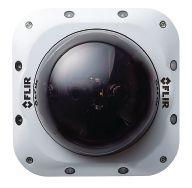
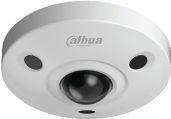
The Quasar 4x2K panoramic camera, featuring four, high-definition visible sensors, produces 4K resolution. The mini-dome camera offers wide area surveillance and interchangeable field-of-view options of 180- and 360-degrees. Consequently, the 4x2K can replace multiple individual cameras. With automatic stitching that combines the four sensors into a 180-degree view, the camera generates an image that eliminates blind spots and scene duplication. Built-in infrared illumination automatically adjusts to the 180- or 360-degree viewing mode. www.flir.com
Smart NVR
LTS
The Platinum Enterprise Level 32 Channel Deep Learning NVR, LTN0732D-R8, features deep learning technology and integrates advanced algorithms for perimeter prevention. The Deep Learning NVR is built with nearly the same precision of a human eye, according to the company, identifying objects versus human intrusion and reducing the number of false alarms. Smart Motion Detection is inspired by the brain’s ability to process data critically and works to understand the human body through enhanced secondary analyses like face detection and object analytics. The Platinum Enterprise Level NVR integrates to existing IP cameras and security infrastructures. www.LTSecurityinc.com
Video appliance 3xLOGIC
VIGIL V500 Hybrids are fully-integrated intelligent video appliances pre-configured with VIGIL Video Management System (VMS) software. The V500 design provides all the network components required to deploy this NVR. Not only are alarm, serial, and audio inputs built in, this hybrid includes 16 embedded PoE ports for IP devices. The V500 also integrates with the full VIGIL suite of products. MULTIVIEW Technology and its RapidStream video compression engine enables users to remotely stream and view high-definition video with minimal impact on bandwidth.
Video management solution
Honeywell
www.3xlogic.com
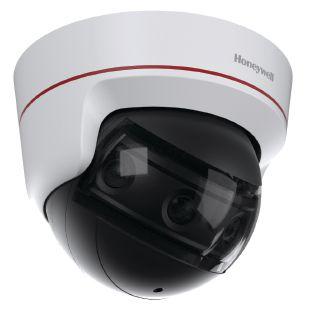
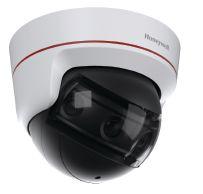
Honeywell has expanded the equIP Series Cameras line with the 1080p 30x Zoom Explosion-Proof IP PTZ Camera, the Network TDN 8 MP IP Rugged Multi-Imager and the Network TDN Low-Light 6 MP IR Rugged models. The line is supported by new versions of the MAXPRO network video recorder (NVR) and video management system (VMS) to offer a complete, integrated video management solu tion. The new multi-imager equIP cameras, available in both dome and bullet models, cover a wider area with fewer cameras, and leverage MAXPRO VMS to combine multiple images into one picture. www.honeywellvideo.com
IP dome camera LILIN
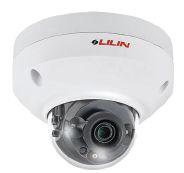
LILIN has added the new MR6342A IR fixed dome IP camera to its M-Series IP network cameras. Equipped with built-in Sense up+ technology, the MR6342A provides video quality in 4MP resolution, and is IK10-rated for protection against vandalism. Intelligent Video Surveillance (IVS) functionality is a cornerstone of the M-Series cameras; the MR6342A IVS analytics include advanced motion detection, object counting and tripwire detection. Outdoor-ready with an IP66 rating for rain and dust resistance, the camera also has 30-meter infrared night vision. www.meritlilin.com
Multi-sensor cameras
Hanwha Techwin America
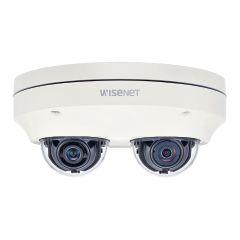
Two new Wisenet multi-sensor cameras include the Wisenet PNM7000VD (2-head) and PNM-9000VQ (4-head). For maximum adaptability, configurable fixed-focus lens/CMOS sensor modules are available in multiple fields of view which can be easily installed onsite. The cameras are equipped with high frame-rates (60/30fps), true WDR (Wide Dynamic Range) and a suite of analytics built in. Utilizing a single IP address over one cat5 cable requires only one VMS license. A suitable solution for hospi tals, schools, and retail, both cameras allow for individual on-screen displays and a full suite of video analytics. www.hanwhasecurity.com
VMS and NVR
Johnson Controls
The victor Video Management System and VideoEdge Network Video Recorders (NVRs) from American Dynamics, version 5.2, is a video management system that provides enhanced video intelligence and analytics. The victor client on VideoEdge hardware platforms allows users to leverage video streaming, audio, motion meta-data and a feature set for improved real-time command and management. The combination of victor and VideoEdge maximizes smart streaming resources to optimize operation of high-resolution cameras and analytics while providing more efficient bandwidth management. www.americandynamics.net
Speco Technologies
These Cloud-enabled IP cameras are designed to record to the Speco Cloud video storage platform. Also launched simultaneously is the Speco Cloud Channel Partner Program that allows dealers to share in recurring monthly revenue. Speco Cloud is a solution for both residential and business applications with its plug-and-play setup and convenient monitoring. It also provides mobile viewing with the Speco Cloud App, available for both iOS and Android devices. These vandal and weather resistant IP cameras are capable of recording video as well as audio.
www.specotech.com
Product Previews The latest in security technology
Push notification feature
3xLOGIC
3xLOGIC has added push notifications to their infinias access control software. Users receive push notifications directly to their mobile device using 3xLOGIC’s Site Access mobile app available for iOS and android devices. Through infinias Push Notification, users can be notified when a door is left open or in an override state, such as lockdown. Users are also notified when there is any activity before or after normal work hours. The infinias rules engine allows the user to program who to notify of activity and what hours of the day to notify them.
www.3xlogic.com
Intelligent laminate TruTag Technologies
SecuriLam is an off-the-shelf, intelligent laminate used for supply chain security and traceability purposes. SecuriLam laminate comes with microscopic encoded silica particles, or “TruTags” pre-embedded into standard adhesive laminate film stock for easy adoption in label, document, and packaging applications. TruTags are programmable, allowing customers to segment their packaging and instantly verify information in the field, such as manufacturing location, product type, or authorized geography to prevent product diversion. SecuriLam laminate can be authenticated instantly.
www.TruTags.com
Clothing tag Evolution Retail
The STPLUS1 Tag has a locking mechanism that requires a bespoke releasing tool, which allows retailers to upgrade current products with minimal outlay and disruption. Available in both AM/RF versions, it can also come with a RFID capability. The company says the tag aims to reduce theft by more than 20 per cent when com pared with other Electronic Article Surveillance (EAS) solutions. www.evoretailuk.com
Dual path communicator Bosch
The B465 Universal Dual Path Communicator links a control panel’s digital dialer to an Ethernet connection on a local area or wide area network or to an optional cellular module to send reports to the receiver at the monitoring station. Dealers and integrators can now remotely program the device via Bosch’s Remote Programming Software (RPS) and have the option to use the Bosch Remote Connect Cloud Service to connect to it. Cloud connectivity to the B465 communicator eliminates the need to change customer router settings, firewall rules or to use Domain Name Service (DNS) to access the device remotely. www.boschsecurity.us
Pivoting wall rack
Middle Atlantic
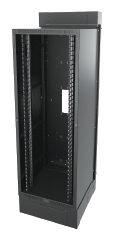
Middle Atlantic Products has expanded its SR Series of Pivoting Wall Racks with a new wider model to provide integrators with more space to manage high-density cable bundles. The new Wider SR Series saves square footage over traditional floor-standing racks in AV, security, and data applications. The wider models include all of the advanced functionality of the SR Series, including a unique pivoting mechanism that opens 90 degrees, simplifying integrators’ access to rear equipment connections. The Wider SR Series is available in 24 RU, 40 RU, and 46 RU options. www.middleatlantic.com
Security management app S2 Security
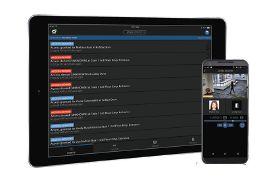
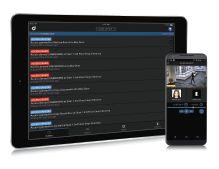
The S2 Mobile Security Professional, a security management app for smartphones and tablets, allows security managers and staff to operate their S2 access control and video management systems remotely. The app features a user-friendly interface that enables users to monitor events and alarms, view live video, review surveillance video, share video snapshots via email or text message, manage evacuations, remotely unlock doors, capture photo IDs and more. S2 Mobile Security Professional is available for Android and iOS devices. s2sys.com
Exit devices
Adams Rite
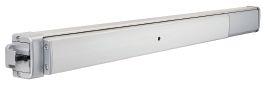
The EX Series Exit Devices series consist of four models. The Interlocking Rim Exit Device has a bolt design that interlocks the door to the frame and is suitable for use on single doors. Meanwhile, the EX89 Pullman Rim Device features a 3/4 in. Pullman latch bolt, compatible with the Adams Rite 74R1 Electric Strike and designed for use on single doors or with mullion on pairs of doors. The Concealed Vertical Rod Exit Device (CVR) features adjustable concealed rods and latching assembly designed for single or pairs of doors. Finally, the Dummy Push Bar is designed for applications that don’t require a latching/ locking life-safety exit device. www.adamsrite.com
Pan and tilt positioner
JETprotect Corp.
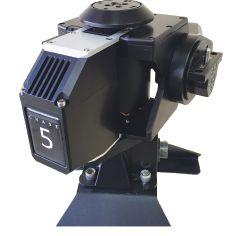
Chase 5 is an outdoor stacking pan and tilt positioner that can accurately point heavy lenses looking miles away. The Chase 5 can aim two 12 Kg cameras and high intensity lights at a speed of 120˚ per second to within .01˚ on an 8” diagonal frame, good for chasing trespassers. Because it is designed for stacking, other 20 Kg devices can also be placed on top. This unit has 12 newton-meters of torque at each axle and 480 W of Power-over-Ethernet for multiple sensors and actuators. www.jet-protect.com
Historical Headlines
Identity management is one of the most important aspects of security. By knowing who all the actors are in a given space, a security department can immediately establish a baseline.
Identity management is also at the crossroads of security systems and technology, from access control to database management to biometrics to visitor management and CCTV to more specific applications like licence plate recognition. Knowing who you’re dealing with is half the battle.
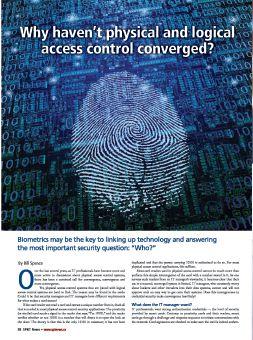
But creating this visibility isn’t always easy. Back in 2012, SP&T News featured an article entitled “Why haven’t physical and logical access control merged yet?” written by Bill Spence, vice-presi-
dent of transactions for Lumidigm (which was acquired by access giant HID Global in 2014). At the time of writing, Spence posited that biometrics might hold the key to better integration between the physical and logical. “There is no meaningful access without first establishing the ‘who’ in transactions,” he wrote. Cards, fobs, even phones, cannot guarantee identity — merely that the holder has a key for access. Biometric verification, however, can help make the ‘who’ more of a certitude.
Identity, of course, is not only a matter of concern for the security or HR department, but for the identity holder themselves. Through technology, identity management can help provide that
Toronto airport deploys ID management, access control: Since initiating the use of SAFE for its identity management and access control security systems, the airport has already realized reductions in credential processing time, along with related cost savings.
2012
Why haven’t physical and logical access control converged?
Biometrics may be the key to linking up technology and answering the most important security question: “Who?”
2013
Banking on biometrics: Brazil, India and South Africa are deploying biometric solutions at ATMs in an effort to ensure customers’ banking security. Should Canadian banks be making the same investments?
2018
Advice for Installers: “An identity management system will help align a business’s security operations with its business operations.” (Jody Ross, Vice President, Global Sales and Business Development, AMAG Technology). 2009
Visitor management revisited
person more options, or at least a more seamless transition across all of life’s roles.
Two years ago, in the Jan/Feb 2016 issue, Rob Martens, futurist for Allegion, took part in a Q&A. When asked to speculate on the identity outlook for the next five or so years, he said, “I fully expect for a couple of things to happen. One is the level of expectation of identity management at work and home is absolutely going to merge. This concept of knowing who I am when I arrive and what I want is going to be in effect.” The most compelling aspect of that is “hoteling” in the workplace. “We believe that will be on steroids,” added Martens. “When you come into the building, depending on what your prefer-
ences are, you’ll have the ability to be assigned a workspace, have everything that is expected of you available, ready and accessible based off of that workstation.... The level of integration is going to increase exponentially.”
The push for better access management is expected to increase spending in the market substantially over the next five years. According to a 2018 IHS Markit report, global revenue is projected to increase from US$5.4 billion in 2016 to US$9.6 billion in 2021. Among those drivers: the availability of hybrid solutions (on-prem and Cloud); the constant battle with hackers creating a more urgent need for better ID management; and blockchain.
Intelligent Solutions for: Retail
Your business is dynamic, and growth is just as critical as protecting what you already have. Utilizing a technology solution that not only protects your store but provides enhanced analysis to help you grow your business. #IntelligentSolutionsForYou
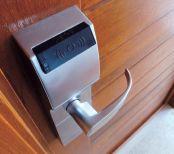
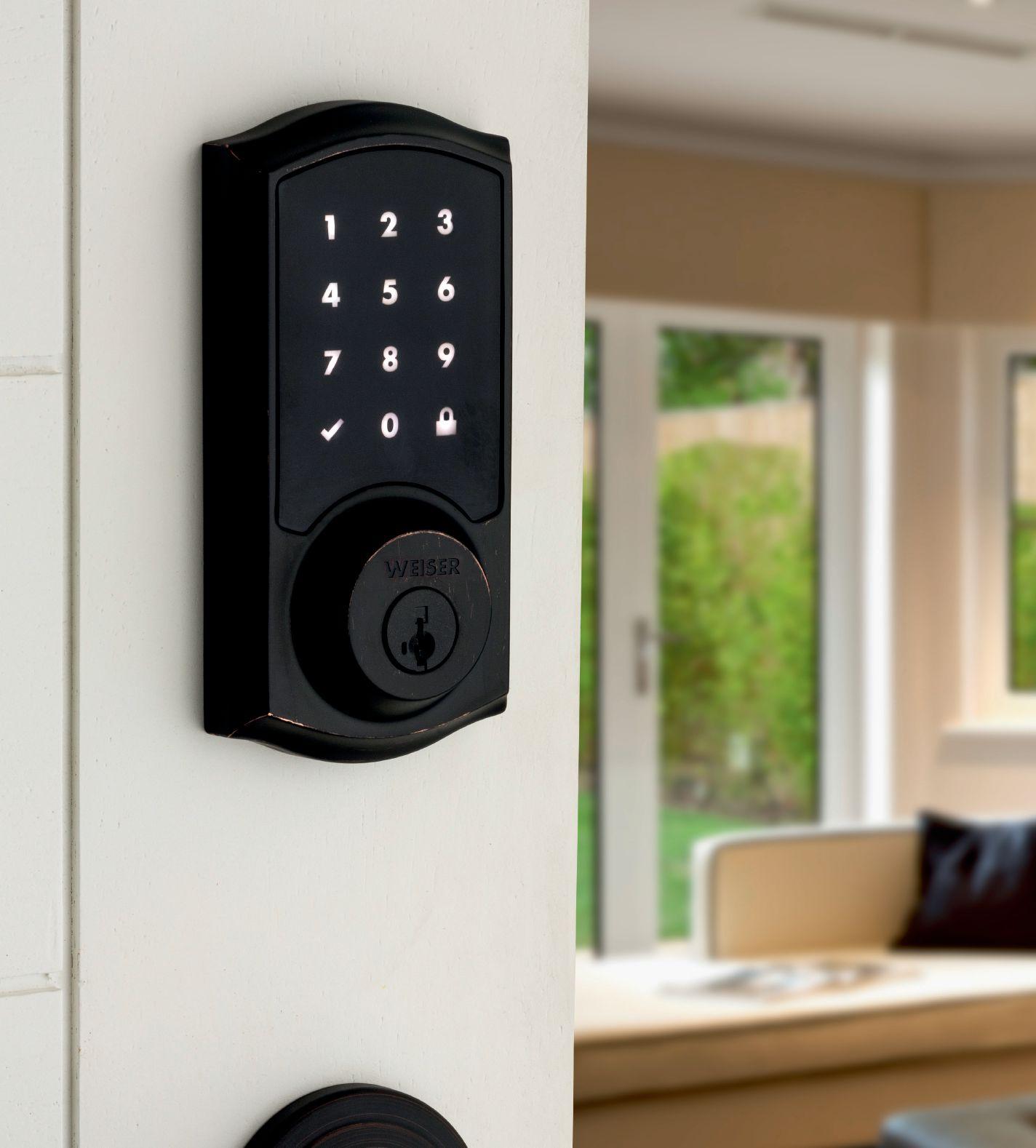
Weiser makes it easy to increase customer loyalty and position yourself as the core provider. If you already install security or home automation systems that are Zigbee or Z-Wave compatible, you’ll appreciate the easy installation and integration of Weiser Home Connect Locks.
Gain momentum in remote access and home automation as homeowners demand more from their primary solution providers.
Grow your business by building upon your existing services with Weiser.