Scott King, silviculture forester with Louisiana-Pacific
September 20-21, 2022 • Vancouver, BC Wood pellets and the bioeconomy

The Wood Pellet Association of Canada Conference and AGM is Canada’s largest gathering of the Canadian wood pellet industry.
Each year, the event attracts hundreds of wood pellet, biomass and bioenergy professionals from across the country, as well the U.S., Europe and Asia, to discuss the issues that are having an impact on the industry here in Canada.
The WPAC Conference and AGM is your opportunity to learn about the most important issues from industry experts around the globe.



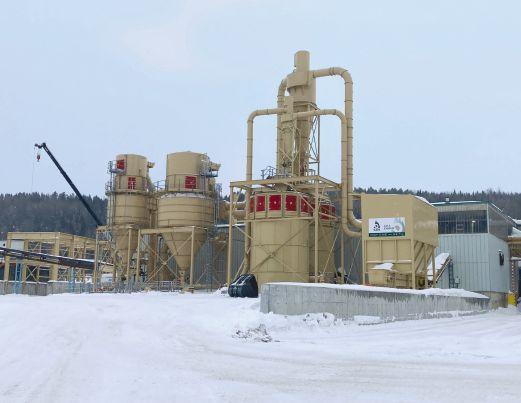
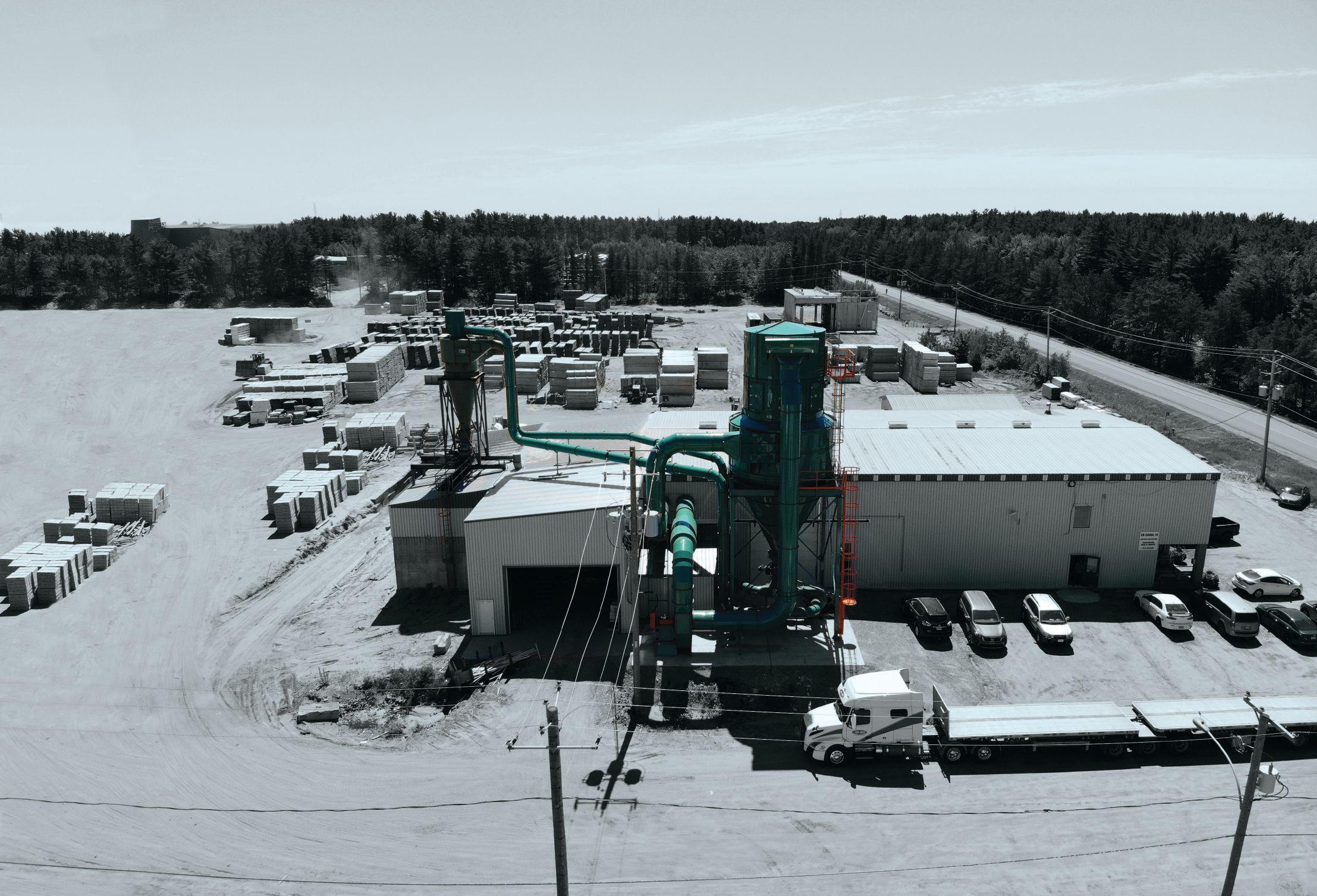
Groupe de Scieries GDS’s new pellet plant in Lac au Saumon, Que., has allowed the company to add value to forest residuals that were previously exported.
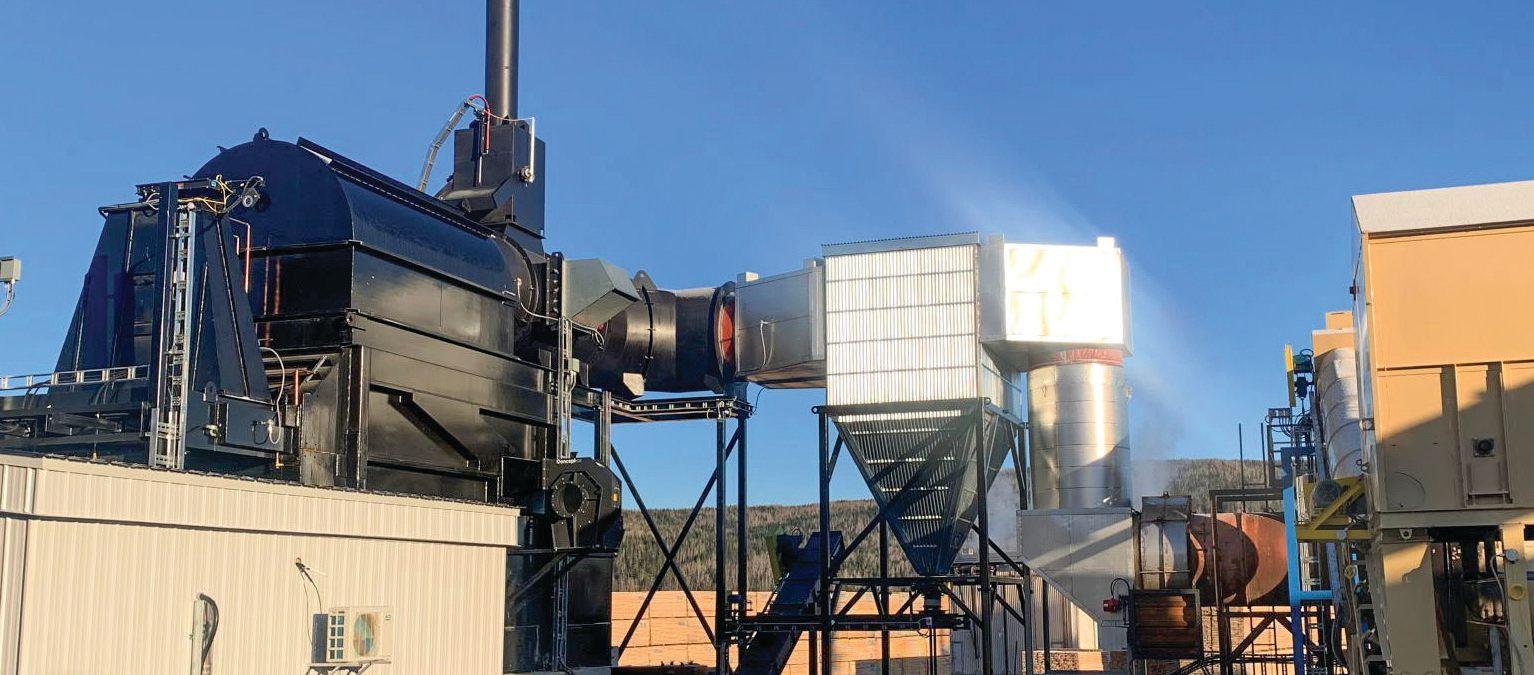
With funding from the Forest Enhancement Society of BC, LP Building Solutions is turning residual wood fibre into clean energy at its Golden, B.C., engineered wood products facility.
A new district energy system in Yellowknife from J&R Mechanical is helping the N.W.T. government reduce its reliance on fossil fuels and lower its carbon footprint.
Jordan Solomon, chairman of the BDO Zone Initiative, explains how the initiative can help expand Canada’s bioeconomy in rural areas by attracting investment.
“The
average design temperature
here is
to -45 C;
we’ve seen
the boiler operate just perfectly in those temperatures.” Read
full story on page 16
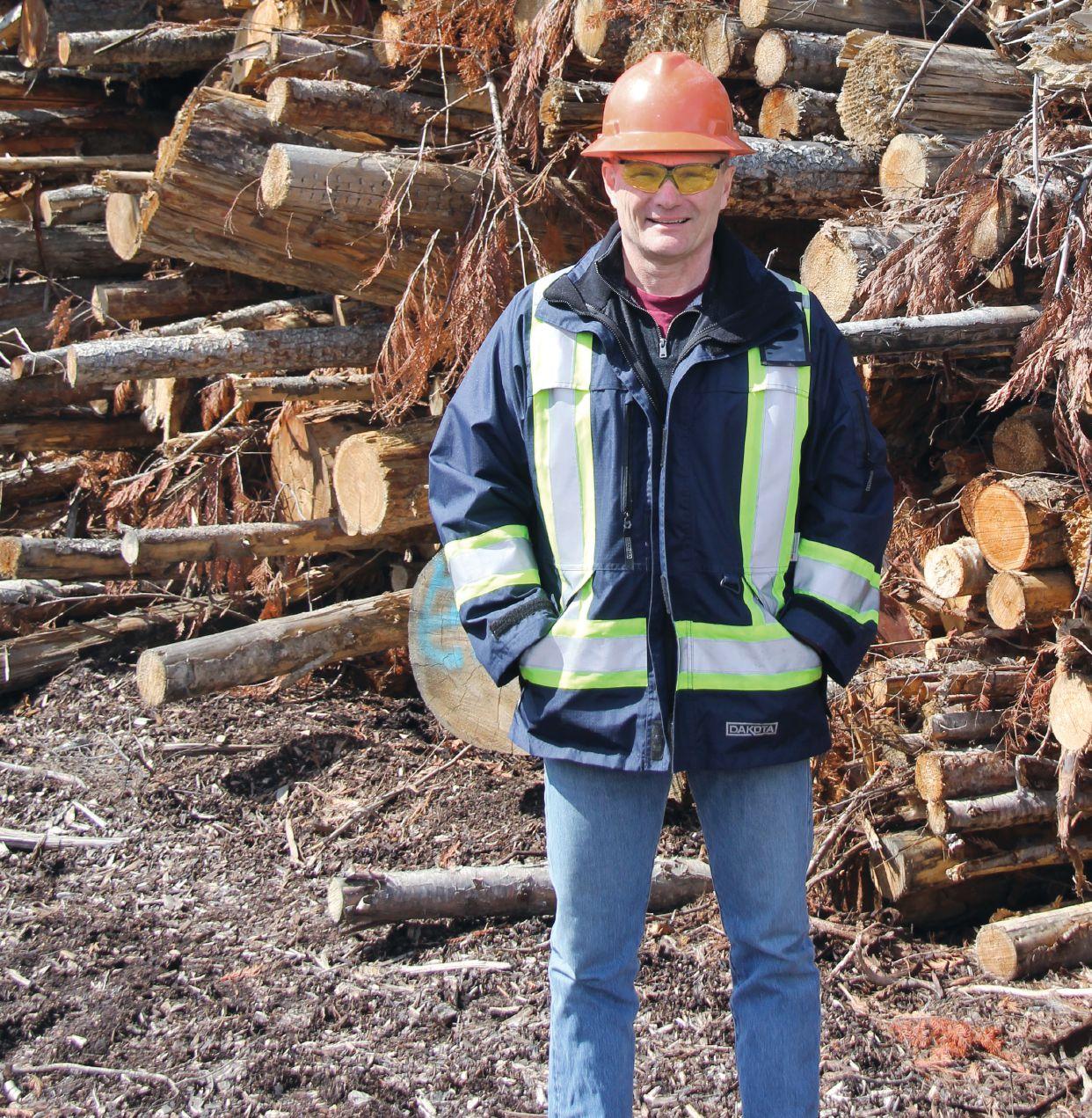
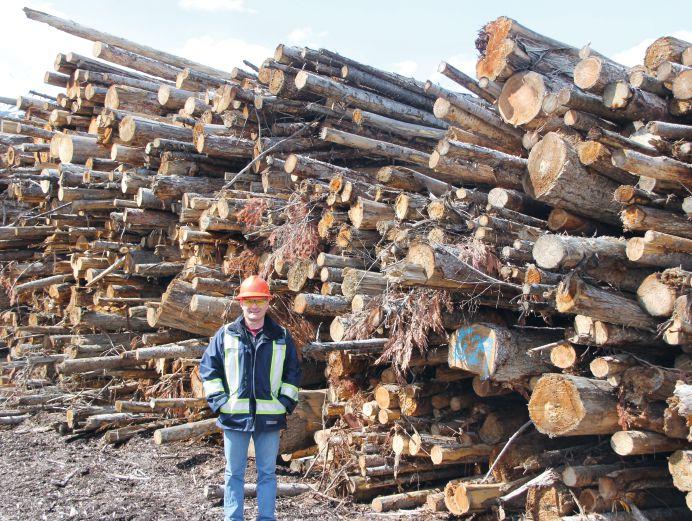
Louisiana-Pacific Building Solutions silviculture forester Scott King in the woodyard at their Golden, B.C., plant where they recently undertook a fibre utilization project. Photo courtesy Louisiana-Pacific Corporation.

n 2017, at 21 years old, I graduated from McGill University and began looking for my first full-time job. I wasn’t really sure what I was looking for. My one requirement was that it needed to involve writing, and when I stumbled across a posting for an assistant editor with Annex Business Media, it seemed perfect. Long story short, I got the job, and thus started my career in trade media.
When I made the move to Canadian Biomass and Canadian Forest Industries in 2018 I knew nothing about the industries, but was promised there would be a lot of travelling and I’d be working with an amazing team. These promises turned out to be true, and in the years since then, I have enjoyed immersing myself in the industries and meeting some amazing people along the way. I have learned more about the different types of biomass, wood pellets, district energy heating systems, etc., than I ever imagined possible.
bioenergy projects are any indication, the industry is just getting started.
Over these four years I have seen how the industries have grown, especially as the public and decision-makers have started to recognize the environmental benefits of bioenergy. I have seen multiple new and innovative biomass projects come to fruition, from district energy systems to bioproducts that can replace single-use plastics and biofuels that can help reduce greenhouse gas emissions. And I have seen how the industry has survived and even thrived during a pandemic that no one saw coming. Some of my favourite projects I’ve written about include the Meadow Lake Tribal Council’s Bioeneregy Centre, the district energy system in Prince George, B.C., and new wood pellet plants that have come online. And if the recent news about investments in new
But, as the saying goes, all good things must come to an end, and I am moving on from Annex Business Media to a new opportunity in the communications world. I want to thank everyone in the industry that I have had the pleasure of meeting and speaking with. There are a few people in particular that I want to acknowledge: Gordon Murray, Karen Brandt, Fahimeh Yazdan Panah with the Wood Pellet Association of Canada for their support on several initiatives, such as the Women in Forestry Virtual Summit; William Strauss with FutureMetrics for always being willing to write an article on the wood pellets market and sharing photos of his donkeys with me; and most importantly, my team – Maria Church, Todd Humber, Josée Crevier and Rebecca Lewis – for their guidance and encouragement over the years as I took on new projects and grew into my role as editor. I would not be where I am today without their help.
And last, but certainly not least, I want to thank all of you, our readers, for your loyal support of the magazine, which I know will continue in the years to come. While I will no longer be directly involved in the biomass and forestry industries, I am still excited to see what’s next. And I will be watching how Canadian Biomass leads the way, providing the most up-to-date information for industry professionals and sharing new projects, technology and more. •
Volume 22 No. 2
Reader Service Print and digital subscription inquiries or changes, please contact Serina Dingeldein, Audience Development Manager Tel: 416-510-5124 Fax: 416-510-6875 email: sdingeldein@annexbusinessmedia.com Mail: 111 Gordon Baker Rd., Suite 400 Toronto, ON M2H 3R1
Editor - Ellen Cools (416) 510-6766 ecools@annexbusinessmedia.com
Managing Editor - Maria Church (226) 931-1396 mchurch@annexbusinessmedia.com
Contributors - Gordon Murray, Guillaume Roy, Peter Diekmeyer, Jordan Solomon, and Karen Brandt
Group Publisher - Todd Humber 416-510-5248 thumber@annexbusinessmedia.com
Account Coordinator - Kristine Deokaran (416) 510-6774 kdeokara@annexbusinessmedia.com
National Sales Manager - Rebecca Lewis Ph: (519) 429-5196 rlewis@annexbusinessmedia.com
Quebec Sales - Josée Crevier Ph: (514) 425-0025 Fax: (514) 425-0068 jcrevier@annexbusinessmedia.com
Western Sales Manager - Tim Shaddick tootall1@shaw.ca Ph: (604) 264-1158 Fax: (604) 264-1367
Media Designer - Lisa Zambri
COO Scott Jamieson
Canadian Biomass is published four times a year: Winter, Spring, Summer and Fall. Published and printed by Annex Business Media.
Publication Mail Agreement # 40065710 Printed in Canada ISSN 2290-3097
Subscription Rates: Canada - 1 Yr $57.00; 2 Yr $102.00 Single Copy - $9.00 (Canadian prices do not include applicable taxes) USA – 1 Yr $121.50 CDN; Foreign – 1 Yr $138.00 CDN
Annex Privacy Officer Privacy@annexbusinessmedia.com Tel: 800-668-2374
Occasionally, Canadian Biomass magazine will mail information on behalf of industry-related groups whose products and services we believe may be of interest to you. If you prefer not to receive this information, please contact our circulation department in any of the four ways listed above. No part of the editorial content of this publication may be reprinted without the publisher’s written permission ©2022 Annex Business Media, All rights reserved. Opinions expressed in this magazine are not necessarily those of the editor or publisher. No liability is assumed for errors or omissions. All advertising is subject to the publisher’s approval. Such approval does not imply any endorsement of the products or services advertised. Publisher reserves the right to refuse advertising that does not meet the standards of the publication. www.canadianbiomassmagazine.ca
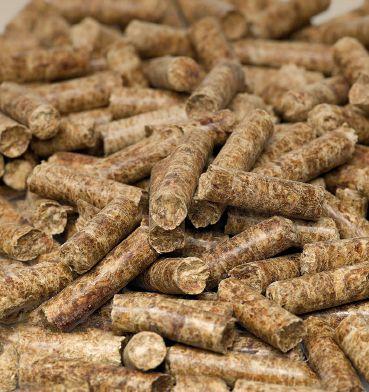
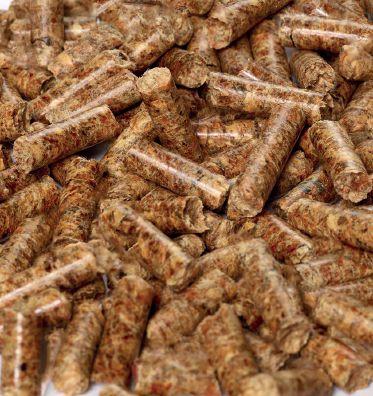
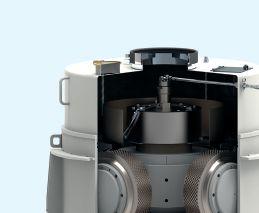
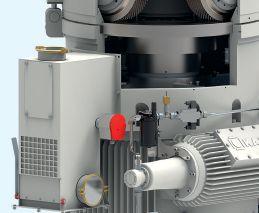
Our pellet mill 65-1500 outperforms the competition: With a throughput of up to 12 t/h, it is currently the largest flat die pellet mill for the wood sector. Worldwide, flat die pellet mills from AMANDUS KAHL produce more than 10 million tons of domestic fuel and industrial pellets from hardwoods and softwoods every year, and the trend is rising.
Scan the QR code and learn more
AMANDUS KAHL GmbH & Co. KG Germany · info@akahl.de shop.akahl.de · akahl.com


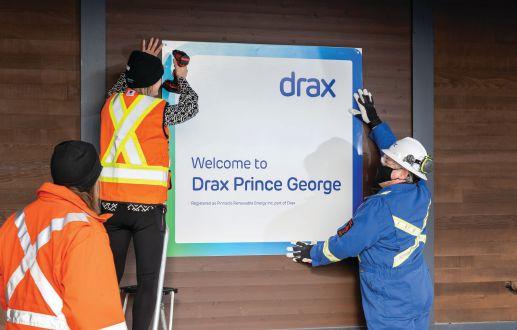
In February, Pinnacle Renewable Energy Inc. and Drax Group’s U.S. pellet business Drax Biomass Inc. announced they rebranded as Drax in a move that supports the group’s growth strategy, climate goals and relationships with people – including colleagues, communities, partners, customers and suppliers.
Drax Group acquired Pinnacle last year. Drax’s existing operations in the U.S. South were known as Drax Biomass.
Drax Group has 17 pellet plants and developments in the U.S. and Canada, which use byproducts from sustainably managed working forests, such as sawmill and forestry residues, for pellet feedstock. The pellets are used at Drax Power Station in England to generate renewable electricity for millions of UK homes and businesses or are sold to customers in Europe and Asia seeking to decarbonize their power sectors to meet their climate commitments.
Drax is also developing a pioneering negative emissions technology – bioenergy with carbon capture and storage (BECCS) which permanently removes millions of tonnes of carbon dioxide from the atmosphere. The world’s leading climate scientists at the UN’s IPCC say BECCS is critical to addressing the climate emergency.
Resolute Forest Products Inc. signed an agreement on Feb. 11 with Boralex for the purchase of a co-generation facility in Senneterre, Que.
“The purchase of the 34.5-megawatt co-generation facility, adjacent to our Senneterre sawmill, builds on our significant investments in the region, including the ongoing project toward a new planer and associated equipment we announced last summer, as well as operational improvements recently completed at our Comtois sawmill,” said Remi G. Lalonde, president and chief executive officer of Resolute.
The co-gen facility will maximize Resolute’s use of biomass from its regional operations, generating green power and providing a platform for future growth and enhanced competitiveness in the Abitibi-Témiscamingue region, Lalonde said.
Resolute will add 30-plus employees of the co-generation facility to its team.
The acquisition is subject to regulatory approvals and certain closing conditions and expected to close in the first half of 2022.
Drax plans to increase its annual pellet production capacity to eight million tonnes by 2030 from around four million tonnes currently and is doubling global pellet sales to four million tonnes by 2030 to meet an expected increase in global demand for the low-carbon fuel.
Nature Energy announced in March it has acquired land in Farnham, Que., to build its first North American biogas plant. The Danish company plans to establish a large-scale facility to convert biomass from local agricultural production, industry and institutions into renewable natural gas (RNG) for the Quebec electricity grid.
Nature Energy said in a news release it looks forward to working with large and small agricultural producers in the region. The use of organic biomass (manure, slurry, etc.) helps reduce greenhouse gas emissions by providing consumers with a clean source of energy.
“We are looking forward to working with Quebec farmers on this circular economy and green transition project,” said Ole Hvelplund, president and CEO of Nature Energy. “Reducing the environmental impacts of human activity requires a global effort and we look forward to helping make a concrete difference in the green transition in Quebec by supplying RNG to the natural gas grid.”
In addition to adding value to biomass produced by agriculture, industries, businesses and institutions, Nature Energy’s project represents an investment of approximately $100 million that will create more than 200 jobs during the plant’s construction phase and 15 permanent jobs once it is in operation.
The company said it plans to establish other biogas plants in Canada.
Enerkem has been selected by an independent panel of international aviation experts as the winner of “The Sky’s the Limit Challenge” hosted by Natural Resources Canada (NRCan), from among the four finalists. This prestigious honour underscores its significant achievement in producing sustainable aviation fuel (SAF) from forest biomass carbon. The resulting biogenic fuel will contribute to a 93 per cent reduction in greenhouse gas emissions from air transport per unit of fossil fuel replaced by SAF.
“The Sky’s the Limit Challenge” is a national competition focused on developing clean, sustainable and economically viable aviation fuel in Canada that allows the commercial aviation sector to reduce its carbon footprint. The prize won by Enerkem constitutes a $5-million grant to continue commercializing its innovative fuel. As a finalist, the company was selected in 2019 to receive $2 million to develop its technology to compete for the grand prize.
Most of the research leading to the production of the sustainable aviation fuel was conducted at Enerkem’s Innovation Centre in Westbury, Que. CRB deconstructed and fractioned the biomass into recoverable intermediaries. Enerkem and CRB conducted the research using these intermediaries, leading to the production of sustainable aviation fuel. Some of the research was carried out in collaboration with the CanmetENERGY research centre in Ottawa. The work was led by Michel Chornet, executive vice-president, engineering, innovation and operations, Enerkem; Stéphane Marie-Rose, director, catalytic processes group, Enerkem; and Esteban Chornet, co-founder of Enerkem and CRB, and scientific director at CRB Innovations.
The aviation sector alone accounts for three per cent of total global GHG emissions, and its carbon footprint seems difficult to reduce. There are currently several sources of exploitable biofuels,
Edgewood Forest Products, based in Carrot River, Sask., is planning to build a biorefinery that will convert sawmill waste into bioproduct such as biochar.
The biorefinery will replace the mill’s beehive burner, and should be fully operational in October 2023. The first phase of construction on the biorefinery is slated to begin May 2022 and will be finished this fall, with a new production line to produce biochar. The biorefinery is expected to create 10 new jobs.
The second phase of construction will see four new production lines added, and is set to begin May 2023 and be completed in October 2023. At that point, an additional five jobs will be added.
Edgewood Forest Products produces 140 million board feet per year of stud lumber and boards. Its parent company, Dunkley Lumber, operates mills in B.C. and Alberta.

including residual lipids such as used cooking oils and vegetable oils, municipal solid waste and CO2 from green power production.
“The research we conducted as part of ‘The Sky’s the Limit Challenge’ allowed us to develop another source, specifically forest biomass. It has often been described as Canada’s ‘green’ edge. It’s affordable and has been used nationally for generations in various applications. The carbon in forest biomass comes from the atmospheric CO2 captured and transformed into constituent molecules through photosynthesis. We were able to recover it by combining the technologies of biomass deconstruction and fractionation (CRB), gasification (Enerkem), oligomer production (Enerkem and CRB) and catalytic hydrocracking by Enerkem, as well as by CRB/ Canmet. As a result, we managed to produce sustainable aviation fuel allowing GHGs from air transportation to be reduced by 93 per cent,” said Chornet.
The Ontario government on March 28 announced a $682,529 investment in six economic development projects in Hearst, Ont., including $35,808 for wood pellet producer I.C.S. (Lacroix) Lumber.
The funds will help I.C.S. (Lacroix) purchase new equipment that will help it increase its production capacity and expand operations.
“Through the collaborative partnerships we are announcing today, our government is ensuring Hearst’s economy continues to grow,” said Greg Rickford, Ontario Minister of Northern Development, Mines, Natural Resources and Forestry, in a statement. “By investing in projects from varied sectors, we are promoting a more diverse, dynamic and innovative economic climate.”
I.C.S. (Lacroix) produces premium wood pellets under the LacWood brand.

AAs the world looks to bioenergy, isn’t it time Canada did the same?
By Gordon Murray
round the world, bioenergy is the leading source of renewable energy. This is the case in the United States and also the European Union where bioenergy is almost 60 per cent of all renewable energy. In fact, over the past 20 years, bioenergy is responsible for the most greenhouse gas (GHG) reductions, much of this is in the form of bioheat, which has a 90 per cent share of the EU renewable heating market.
Bioheat dominates because it is affordable, proven, reliable, and supports the forest sector and local economies. A tonne of delivered wood pellets at $275/tonne is $0.065/kWh for useful heat. Compare this to Canada’s province of New Brunswick, where wood pellets are approximately half the current residential price for electricity. Despite these savings, Atlantic Canada remains heavily dependent on oil-burning home heating systems, and residents of the region experience some of the highest rates of energy poverty in the nation.
In 2016, the New Brunswick government introduced the Climate Change Act and its plan, Transitioning to a Low-Carbon Economy. Today it reports that it has reduced GHG emissions by 38 per cent over 2005 levels. However, much of this can be attributed to industry facility closures and fuel switching from fossil fuels to biomass in the forest products sector. The government recently invited presentations from subject matter experts and First Nations. The Wood Pellet Association of Canada (WPAC) was proud to present at a series of meetings and provide a formal response.

for people like
who is apprenticing as an industrial
We hope to see our recommendations and input reflected in its updated plan to be released later this summer.
Like most regions of the world, New Brunswick is electricity supply-constrained, making up only 21 per cent of energy consumption in the province. New Brunswick also has amongst the largest electricity demand peaks in North America, but lacks the low-carbon dispatchable resources of other jurisdictions.
As a result, the province will need to create a tailored approach that recognizes
“This science shows that when you increase the demand for bioheat, you also contribute to better managed forests.”
its available resources and electricity supply constraints. Today, New Brunswick meets its demand for heat by importing fossil fuels from the United States, Africa and the Middle East, exposing its citizens to volatile energy prices and undermining its own climate change goals.
The fact is, the solution lies in the forests of New Brunswick. The province is home to five wood pellet plants that produce approximately 350,000 tonnes per year. This fuel has an energy content of over six Peta Joules (PJ) and could replace all heating oil and natural gas consumed by commercial and institutional buildings in New Brunswick. However, due to little local demand, over 90 per cent of its wood pellet production is exported. Most of these exports are destined for Europe, where customers value the quality and environmental credential
of these pellets and their role in realizing significant GHG reductions. As a result, the province also forgoes 1.3-1.7 Mt CO2 per year (10-14 per cent of New Brunswick total) in GHG reductions.
The science shows that when you in-
plan, we hope they will take cues from countries like Sweden and see bioenergy for the massive opportunity it is.
You can read our full submission to the government on our website, but in summary we have recommended that the government:
1. Develop a thermal energy (heat) strategy that includes wood pellets
2. Provide consumer capital support based on GHG outcomes, not only electricity-based solutions
3. Accelerate bioheat public procurement as the Government of Prince Edward Island has done
4. Introduce renewable heat incentives like the highly successful program in the United Kingdom
5. Fund a fuel switching feasibility study funding for industry like those available from Efficiency NB for switching from fossil fuels to electricity
6. Fund a district energy feasibility study for municipalities
We applaud the New Brunswick government’s actions to date and their willingness to continually evaluate progress and adapt along the way. We support their call for more emphasis on renewable energy. The magnitude of the opportunity for a dramatic change in energy consumption in New Brunswick is significant and generational.
As the New Brunswick government’s plan reads, “climate change is a shared responsibility,” and WPAC Maritime members remain ready to support their plan and deliver real, tangible benefits to the local communities we serve. Together we will shine a light on the benefits of wood pellets and drive significant environmental benefits, save consumers money, create jobs and support a healthy domestic forest sector. •
Gordon Murray is the executive director of the Wood Pellet Association of Canada.
By Guillaume Roy • Translated by Peter Diekmeyer
For many years, Groupe de Scieries
GDS – a sawmill company in the Lower St. Lawrence and on the Gaspé River in Quebec – had been exporting raw wood by-products from their operations to Turkey and China, due to a lack of local clients.
“There simply wasn’t sufficient consistent demand here,” notes Sylvain Deschênes, president of Groupe de Scieries GDS, which operates three sawmills in the Gaspé region and a planing mill in Matane, Que. “We did not get much money when we sold unprocessed wood residues. But, the small amounts enabled us to continue operations.”
Groupe de Scieries GDS leveraged the services of a wholesaler to export up to five boatloads of 35,000 tonnes of wood residues per year when domestic demand was weakest. Last year, that dropped to two boatloads.
The company also sold its sawmill byproducts to local customers, including F.F. Soucy, a newsprint mill owned by White Birch Paper in Rivière-du-Loup, Que., Twin Rivers Paper Company in New Brunswick, and Resolute Forest Products in Baie-Comeau, Que.
But, GDS’s new pellet plant in Lac-auSaumon, Que., will now enable the com-

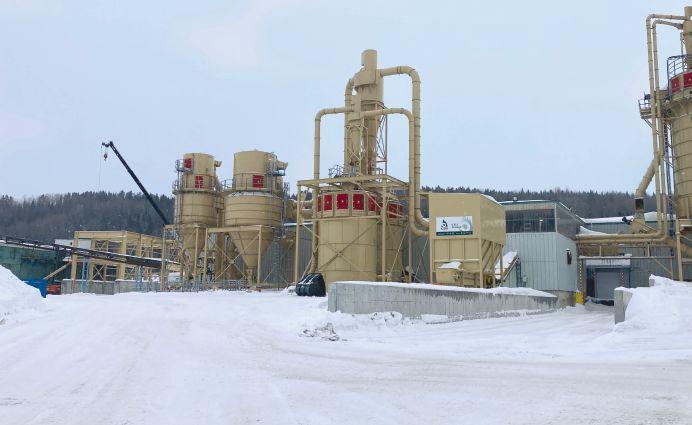
pany to put the raw materials created by their logging operations to better use.
“The facility will provide us security,” Dechêsnes says, “because we now have more choices.”
The new plant will have a production capacity of 100,000 tonnes of pellets per year. These pellets will then go to the Port of Belledune in New Brunswick, to be exported for industrial use in Europe.
GDS admits that investing in a pellet
plant was not their idea originally. Another group of entrepreneurs had set up a plant known as Pure Pellets in Lac-au-Saumon. However, Pure Pellets was forced to close because it could not meet tough CNESST (Commission des normes, de l’équité, de la santé et de la sécurité du travail) safety requirements and was denied a permit from Quebec’s environment ministry.
Groupe de scierie GDS had been analyzing possible opportunities to get into



the pellet market for several years. However, the company did not have the wherewithal to make such an investment. When it became clear that the Pure Pellets facility in Lac-au-Saumon might become available, they seized the opportunity.
“The timing was good,” says Deschênes, noting that presence of an existing building and the electrical infrastructure formed a good foundation. “If we had started from scratch, this project would have cost us $35 to $40 million to start up. But with the existing equipment and infrastructure in place, we only needed an
additional $18 million to get things up to scratch.”
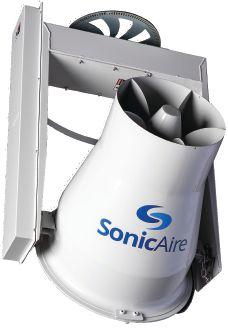
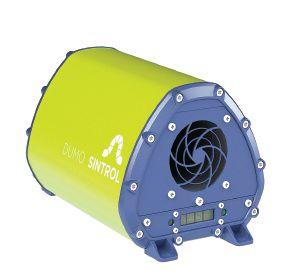
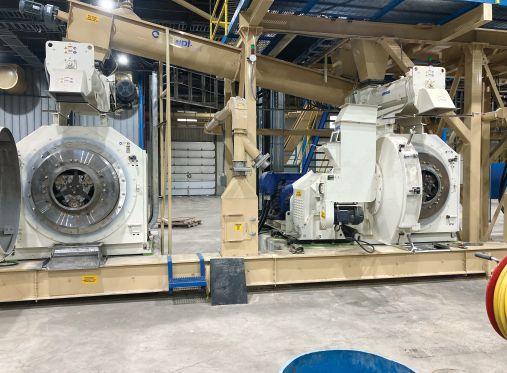
GDS invested in Concept-Air’s handling and storage, dust removal and blower equipment, due to the company’s pellet plant construction expertise. GDS also purchased pellet mills from Andritz as well as a biomass boiler from Wellons to dry the bark. This boiler was key as it enabled the company to make extensive use of the bark, which accumulates rapidly at times.
GDS also called upon some local companies to supply other equipment, including Automation d’Amour to handle programming and controls, André Roy Électrique for the electricity, and TR3E for the engineering. Construction was done by JMR, Construction Audace and Entreprise Lucien Michaud.
“We are now able to add value here in Quebec,” says Georges Deschênes, the company’s vice-president of operations and corporate development. “This is far preferable to sending raw material to Turkey.
“This investment also enables Groupe de Scieries GDS to secure a stable price for its output instead of being subjected to the fluctuating price of raw material residue,” he concludes. •
“If we had started from scratch, this project would have cost $35 to $40 million to start up.”
By Ellen Cools
The concept of using wood waste to power generators is not a new one. In fact, Louisiana-Pacific (LP) Building Solutions’ facility in Golden, B.C., which produces value-added engineered wood products, has been using residuals from its operations to run a generator since the 1960s.
But, as the fibre supply in the province shrinks, the B.C. government has been pushing the forest industry to increase fibre utilization from logging operations and reduce the amount of slash pile burning. Consequently, the company has been looking for new ways to use trees to their fullest potential. In 2011, LP looked into the possibility of using wood waste leftover from their harvesting operations, but found it wasn’t economically viable at the time.
Then, in March 2020, they became aware of the Forest Enhancement Society of BC (FESBC), which provides funding for different fibre utilization projects. LP began considering applying for a grant to give their fibre utilization project another go, conducting an internal economic analysis and meeting with their harvesting contractors, log haulers and the local community to gauge their interest, explains Scott King, RPF, silviculture forester with LP.
“If we were going to do this, from the very beginning we had to have meetings with the log haulers, the operators who do all the cutting in the bush; we had to make sure we had all the trucking components taken care of. We had to meet to discuss what we could learn from the project in 2011 and how we could improve on it,” he explains.
They then submitted a proposal to FESBC, outlining how the company would take leftover wood waste from the bush to their facility, to be used in their Second World War-era generator to create electricity.
According to Gord Pratt, operations
supervisor with FESBC, the proposal met FESBC’s goals in terms of increasing fibre utilization and reducing slash pile burning, thereby lowering greenhouse gas (GHG) emissions.
“There was an opportunity and a demand that we could assist with, and we were happy to assist them with getting this material to their facility,” Pratt says. “At the end of the day, they can learn some efficiencies to expand their economic radius, so this can continue without funding going forward.”
LP initially received a grant of $250,000 and later received additional funding to the tune of $655,000.
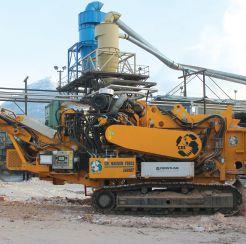
In October 2020, the first loads of fibre from the bush began arriving at LP’s facility in Golden. The company then hired a contractor to grind the fibre in the plant’s log
yard, using a CBI 5800BT horizontal wood grinder.
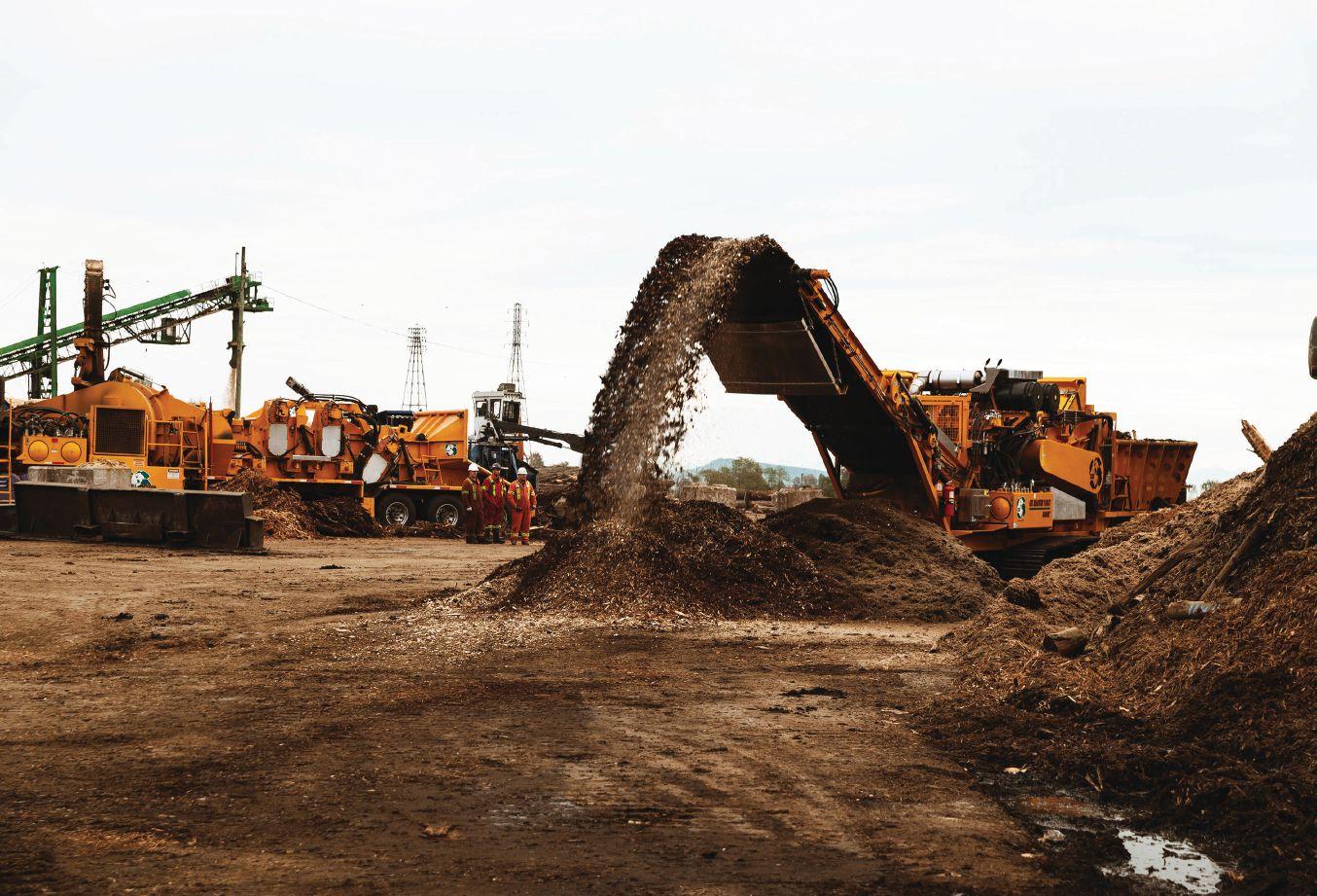
“We had to make sure we had enough fibre to make it economically viable for him, so we had about four months of wood in our log yard before he came in,” King explains. “He came in April 2021, took what we had and ground it all up for the powerhouse to use. The hog fuel produced has been a very good product for power generation.”
The fibre itself is especially clean, which King says is one of the benefits to hauling and grinding it themselves rather than sourcing it from someone else.
“When you’re getting fibre from somebody else, you’ve got to put in a quality check system because you never know if you’re going to get dirt or rock – it’s just the nature of the business,” he shares. “Whereas here, if we do it, everyone has a vested interest to make sure the quality is
very, very good.”
This is because after the fibre is harvested and processed, it is loaded onto a logging truck, minimizing the amount of time the fibre can mix with the soil and become dirty. Once the log yard was empty, LP began building up their stockpile of fibre again.
“The beauty in that is that with the wildfires we had in B.C. last summer, we can control when the hog fuel is produced and thereby try to minimize the possibility that it is going to catch fire. It gives us a lot more control,” King says.
The fibre is used to power a generator that is nearly 80 years old. The generator still works remarkably well, and is “a labour of love,” King says.
“The engineers in the power plant told me the last time they took the generator apart, they did a bridge gauge reading, which measures how far the shaft has changed in relationship to its original position, and that bridge gauge reading had only changed by 0.01 of an inch in 80 years.
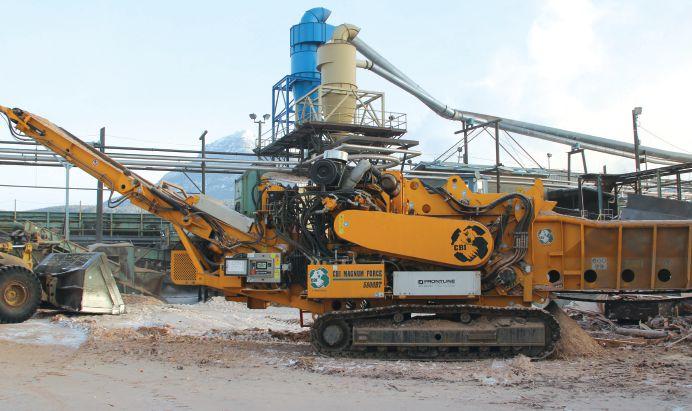
LP hired a contractor to grind the fibre in the plant’s log yard, using a CBI 5800BT horizontal wood grinder.
It’s incredibly solid,” he adds.
With the funding provided by the FESBC, LP ultimately utilized 30,000 cubic metres of residual fibre to generate power – the equivalent of about 750 logging truck loads.
But, it wasn’t all smooth sailing. The company initially tried grinding the leftover fibre in the bush and transporting the wood chips to town using chip trucks, but they


ran into some issues.
“When you live in the mountains like we do, roads go up and down the sides of the mountains, and chip trucks don’t have a lot of clearance, so it’s very difficult for them to travel on a lot of our roads,” King explains.
It was also difficult to get mechanics to the forest if equipment or trucks broke down. As well, the company was worried about the potential of sparking a wildfire while grinding in the bush.
Ultimately, moving their grinding operations to the plant made their operations more efficient and safer. However, this meant the company needed to get new truck configurations to haul shorter logs.
“That, obviously, meant co-operation, discussion and buy-in from our truckers and our loggers,” King says. “But, the response has been really positive.”
Beyond these logistical difficulties, King adds that it’s hard to make people see the benefits of hauling and grinding residual fibre to be used for electricity when it’s cheaper to burn it.
“It’s very challenging to compete with the cost of striking a match. If somebody is typically used to burning, and the economics of burning are cheap, then trying to incentivize other means – in this case, CO2 emissions, smoke and all of that – is always going to be a challenge,” he explains. “It’s thinking outside the box. It’s one of those things that’s as much an education program as anything else.”
Pratt agrees, noting that one of the biggest difficulties that FESBC has seen with all of their incremental haul projects is overcoming the mentality of “this is the way we’ve always done it.”
But, “FESBC’s funding has allowed people to take the risk out of change and to try something different to achieve a common goal,” he says.
And the economic and environmental benefits outweigh the costs.
From an environmental standpoint, decreasing the amount of slash pile burning
reduces the hazards associated with pile burning and improves the quality of the airshed. Burning the fibre in a generator is a cleaner, more controlled burn, since the generator has a scrubber that removes particulates from the air, King says.
Additionally, when slash pile burning is done, venting and indexes – automatic readings produced by Environment Canada –must be followed. According to King, these readings can sometimes be wrong. Grinding the residual fibre instead of burning it also reduces human or computer error.
These types of fibre utilization projects also help to reduce the wildfire risk, which is a big plus for the community.
“What happened in Lytton was devastating, and we don’t want that to happen here,” King says. “So, people are very much on board, and if we can do this, then that is also a huge feather in our cap. When we talk to the B.C. government Wildfire Branch, they’ve always reminded us that you’re going to get smoke – it’s just a matter of how you choose when you’re going to get it. This

is one of the few ways that we can control it by putting it through scrubbers and a burner to create electricity and utilize it.”
Economically, hauling and grinding the fibre allows LP to secure their fibre supply in a different way, which gives the plant more options to stay viable, King explains.
“The pressures of a shrinking fibre source will always be there,” he says. “This increases utilization better, which is also viewed quite positively. And then, of course, there are all the jobs that are associated with this.”
As such, LP has seen a lot of community buy-in from local politicians and the forest industry. Moving forward, King says LP will continue to look at ways to increase their fibre utilization.
“The whole idea of the FESBC funding was to provide seed money so you could try projects like this and see if there was a different way of making something work and helping to streamline the efficiencies, so that when the funding stops, you’re able to learn from all of this and continue on,” he explains. •
Some of the FESBC funding also helped LP test a “proof of concept” project using logs from the Kinbasket Lake (a reservoir created by the Mica Dam) to power their generator. This project was in partnership with BC Hydro, which runs the reservoir.
“Annually, through the raising and lowering of the reservoir as power is used, BC Hydro will collect 20,000-40,000 cubic metres of wood floating on the south end of the reservoir, and then they would burn it,” King says. “Our provincial government has made it well-known that they want to reduce the amount of slash pile burning in the province. So, we thought that we should talk to BC Hydro about the burning and see if we can’t come up with an alternative solution.”
According to King, various companies in the area have tried to do different projects, such as manufacturing different wood products with logs from the lake. But the logs were full of silt, making them difficult
to process and therefore uneconomical for the companies.
“So, what we had to do was figure out a way to try and limit that dirt, to see if we could burn it,” King says.
The company decided to try pulling the logs straight out of the reservoir and onto a truck, to limit the amount of time the wood comes into contact with soil on the bottom of the reservoir or the beach. They then put the wood through a merchandizer, and measured the moisture of the wood.
“It actually ended up burning quite well, and I learned a few things, personally, about the fact that once wood dries out, it doesn’t stay saturated – it can produce a fair amount of heat,” King says. “It was a really interesting project, but it’s BC Hydro’s fibre and ultimately something BC Hydro has to take care of. The point we wanted to make is that it can be utilized.”


By Ellen Cools
As more communities become aware of the benefits of using biomass to heat and power their buildings, more district energy systems are coming online in Canada. Northern, remote areas in particular have recognized the opportunity to use bioenergy to reduce their reliance on fossil fuels and lower their greenhouse gas (GHG) emissions.
J&R Mechanical, a plumbing and heating contractor in Yellowknife, N.W.T., is one of the companies leading the charge. Last year, they began operating a new $1.1-million district energy system, called the Woolgar District Heating System, to provide heat to a government of N.W.T. (GNWT) warehouse and three other private businesses, helping to reduce the government’s reliance on fossil fuels.
This is not the first time that J&R Mechanical has installed a district energy system. According to owner Ken Miller, the company, which was founded in 1977, has been installing biomass boilers for over 12 years. When these types of boilers started becoming popular in the N.W.T., the territorial government embraced the potential environmental benefits of using wood pellets instead of fossil fuels.
Consequently, “our government contracts were specifying installations with biomass – in schools predominantly, at first –and that’s how we got involved in biomass,” Miller says. “In the years after that, when tenders would come out for different systems, we focused on that as part of our regular scope of plumbing and heating. The heating became biomass, and we became a prominent installer of biomass boilers for the government and the private sector.”
Around the same time, J&R Mechanical began installing district heating systems for different government clients. Their first system was for an Indigenous government client in Behchok , N.W.T., installing a plant that provides heat to eight buildings from one biomass boiler.
“As we continued to do more and more of those, we had this opportunity to propose a project that was literally right in our backyard – the Woolgar District Heating System – and the main client is the GNWT warehouse,” Milller says. “They have a list of buildings they wanted to switch to biomass, and this one was on their list.”
The territorial government agreed to their proposal to switch the warehouse over to a district heating system. J&R Mechanical also approached other businesses in the area that could benefit from the system, which led to 30 per cent of the block coming on board.
The project took two years from proposing the idea to completion, including the planning and design, permits and installation. J&R Mechanical ran into a few issues during the construction and installation process, mainly permitting issues, Miller says.
“You can only dig in the summer here, so we started the project too late to get everything – the permits and all of that – on time in the previous summer (2019),” he explains. “Even into the construction season, in the summer of 2020, we were delayed because of permits. We didn’t have everything in place. So, it took us into
the winter, which caused some issues for us and left us with some seasonal deficiencies.”
But, the system officially came online in March 2021, and has since been providing heat to the three businesses, the GNWT warehouse and a GNWT data centre that is connected to the warehouse.
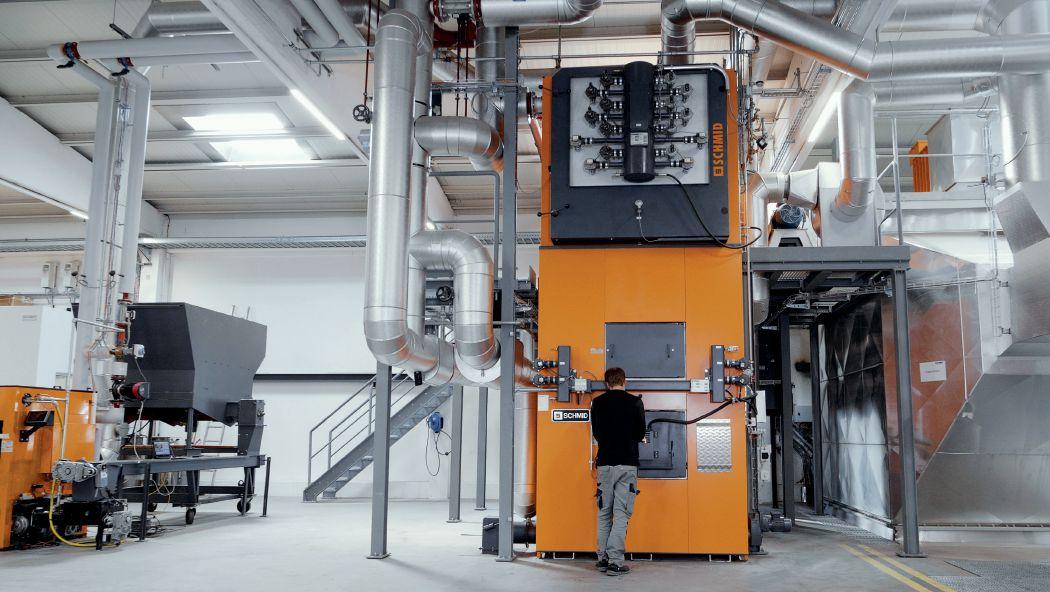
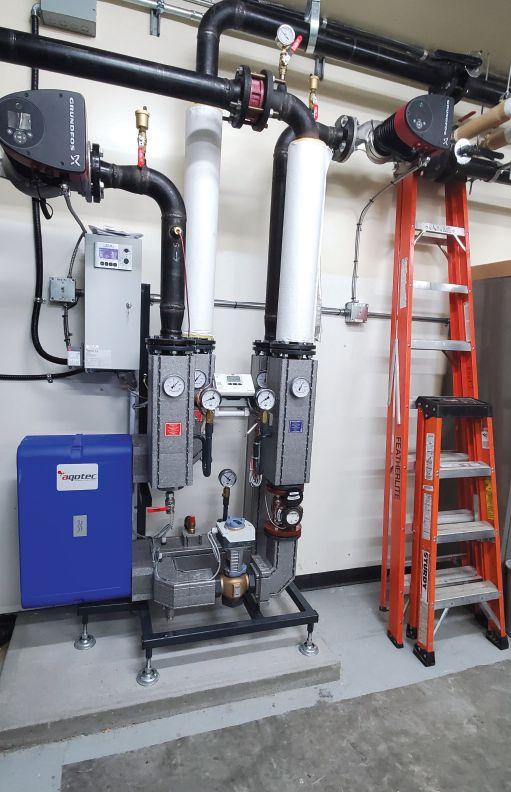
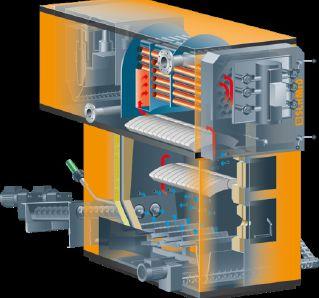
The system itself is fairly simple, with two main components: a container with a 390-kW Viessmann Vitoflex 300-UF boiler, supplied by Enderby, B.C.-based Fink Machine, and a silo to store the wood pellets that the boiler burns.
Fink Machine assembled the boiler in a containerized plant, which was then shipped to J&R Mechanical, who installed it and connected it to their own systems. Meanwhile, the wood pellets came from a pellet plant in Alberta.
According to Miller, the system is very similar to any other hydronic heating system: “you heat water and you transfer the heat to buildings through various different types of heat exchangers, whether it be baseboard radiation or unit heaters, radiant in-floor heaters, radiant panel heating.
“The process of burning wood pellets to create the heat source is the only real difference,” he continues. “We unload and load them, redistribute them to different silos in the community where these pellets are then extracted by augers or different devices to feed the boiler, based on the demand for heat.”
The boiler produces heat, water vapour, carbon dioxide and ash. The heat from the water vapour is transferred to each building’s space heating system through underground pipes, Miller explains.
Yellowknife, of course, is an extremely cold area in the winter, which means the system has to be able to operate in a harsh climate. So far, there have been no issues with the boiler, Miller says.
“The average design temperature here is to -45 C; we’ve seen the boiler operate just perfectly in those temperatures,” he says. “It’s operating as it was designed to operate, with low maintenance
and fairly high efficiencies. It’s worked out well.”
The system has also had a big impact on the N.W.T. government’s fossil fuel use, as it has cut oil use for the warehouse by 92 per cent – from 60,000 litres per year to just 4,800 litres. The system has also reduced the warehouse’s GHG emissions by 145 tonnes of carbon equivalent.
The project, which cost $1.1 million, was a big capital investment for J&R Mechanical. The N.W.T. government gave J&R Mechanical a $274,000 grant for the project, but the company footed the rest of the bill. However, Miller says their business plan calls for paying off that investment in four to five years.
So far, the feedback from the community and the territorial government has been very positive, Miller says. He believes there are opportunities for other northern communities to develop similar district energy systems to reduce their reliance on fossil fuels.
“I think everyone is looking at them as a better solution – looking at biomass boilers to heat buildings – so I think it has been kind of proven that this is a good way to go,” he says.
Nevertheless, there are a few barriers to overcome when installing a system like this. One such challenge is understanding the potential impact on a community’s infrastructure.
“We bury pipes in the ground, and that can be very disruptive,” Miller explains. “There’s other stuff in the ground that you don’t see – power lines, water and sewer pipes, telephone lines and things like that, depending on where you’re trying to install it. So, engineering design can be a bigger challenge.”
However, the benefits far outweigh the costs, and J&R Mechanical is looking at possibly expanding the Woolgar District Heating System.
“If our client base grows – and it potentially will with some new developments next year or the year after – we possibly will have to expand the size of the heating plant to accommodate,” he says.
For now, though, the company is planning to add one or two more buildings to the system and continue running it as is. •

Fink Machine Inc., is very excited to announce that we have added Schmid Energy Solutions boilers to our current product portfolio. Fink’s success is based on Service and we are looking to continue that by adding Schmid boilers to its line of high quality products.
E Canada’s leading supplier of commercial and small industrial heating systems
E ASME and CSA certified
E 100 kW – 12 MW (0.3 MMBTU – 36 MMBTU)
E Over 160 energy efficient systems installed
By Jordan Solomon
One of the biggest challenges facing Canada’s bioeconomy is attracting investment for new bio-based products and manufacturing plants and de-risking that investment. Specifically, rural communities lack the infrastructure and tools to accelerate investment in the bioeconomy.
In an effort to address these issues, in 2019, Ecostrat developed the new Canadian Standards for Biomass Supply Chain Risk (BCSR Standards), and, in 2020, launched the Bioeconomy Development Opportunity (BDO) Zone Initiative. This initiative is an economic development platform that enables local communities to deploy powerful economic development tools – BDO Zone Ratings – to achieve the goal of driving, accelerating and catalyzing bio-based investment and commercial project development in BDO Zone-designated regions for new biofuel, renewable chemical, biogas and bioproduct plants.
The BDO Zone Initiative is a certification and regional risk rating program that accelerates bio-based project development in economically distressed communities. BDO Zone Ratings do this by carrying out credible technical evaluations on feedstock and infrastructure risk, and then enabling communities to effectively and easily signal and promote key feedstock and infrastructure “success” characteristics valued by bio-based developers and investors around the world.
‘AA’ or ‘A’ rated BDO Zones identify the best areas in North America for lowrisk bioeconomy project development. A BDO Zone Rating signals that a region has undergone rigorous and extensive due diligence using over 100 standardized, transparent, and validated risk indicators based on the BSCR Standards for biobased investment.
BDO Zone ratings enable distressed/rural communities to add capacity to support
deployment of innovative technology and infrastructure, and this drives regional economic development to areas where poverty has been persistent for generations, harnessing natural resources to support bio-based manufacturing and renewable energy production.
BDO Zones do three key things very well: they help project developers identify new project locations; they help investors more quickly deploy capital in these regions; and they help communities create new clean energy jobs. Oftentimes, small communities don’t have the platform or the credibility to promote themselves as great areas for future bio-based development. BDO Zone designations change that, and raise the flag over these communities as some of the best areas in the country to build the next bio-based plant.
BDO Zone designations also enable real one-one-one conversations with hundreds of actual bio-based project developers.
The designation and certification of a BDO Zone is just the first step of the process. Once a community is issued an ‘AA’ or ‘A’ BDO Zone Rating, a BDO Zone Local Development Leader (LDL) is appointed to be responsible for the inbound inquiries and deal-flow generated by the designa-
tion. The BDO Zone Rating is then published on bdozone.org. Inbound project development “deal-flow” is generated by promotion of the BDO Zone designation to over 50 industry publications worldwide.
On April 5, 2022, the BDO Zone Initiative officially launched BDO ZoneCONNECT: a powerful market-making platform that puts LDLs in front of hundreds of biomass-based project developers globally. By enabling “real one-one-one conversations with real bio-based project developers,” BDO ZoneCONNECT gives BDO Zone communities the economic development power and reach of major organizations with significant budgets to deploy. It levels the playing field for small rural communities who want to attract a new bio-based manufacturing plant.
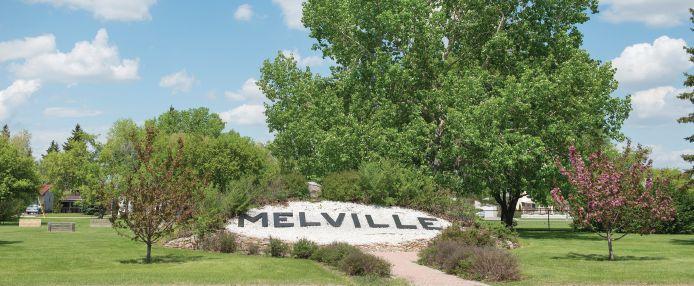
Along with Siloam Springs, Ark., the City of Melville was one of the first BDO Zone communities to be featured on the BDO ZoneCONNECT webinar series.
“When we look at potential industry, we are not interested in industry for the sake of it. We want to match and partner with industries that will achieve a mutually beneficial outcome,” says Ron McCullough, city manager for the City of Melville. “The BDO Zone […] has opened the door to opportunities. The opportunities started with conversations and our network continues
to expand and grow rapidly.”
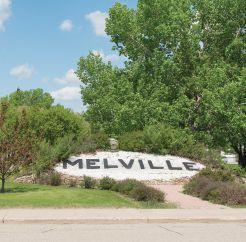
One BDO Zone community that has already seen the benefits of these initiatives is Melville, Sask. Geographically, Melville is located in the east-central portion of Saskatchewan and is about an hour-and-a-half drive northeast from the capital city of Regina. With a population of just over 4,500, Melville is known for its fields of wheat and abundance of wheat straw – the biomass remaining in wheat fields after plowing.
In November 2020, Melville became the first BDO Zone in North America. Prior to this designation, the city was often overlooked as an optimal area in North America for bio-based development due to its lack of credibility and ability to promote itself to developers and investors.
However, the BDO Zone designation has changed that.
“The BDO Zone has expanded our network and created conversation,” says McCullough. “One of the greatest benefits for right now that [The BDO Zone Initiative] has given us is the opportunity to have
conversations that we haven’t had before. Whether it’s wheat or straw, it doesn’t matter. It’s created a conversation.”
Since its designation, Melville has seen over a 1000 per cent increase in deal flow and conversations relating to the BDO Zone.
“The BDO Zone continues to drive new opportunities and conversations for the City of Melville,” states Chris Bruce, director of community services with the City of Melville. “Since obtaining the designation, we have seen sustained development interest in our community.”
The Melville BDO Zone has generated a healthy number of related inquiries since January 2020. They are currently in serious discussions with three prospects that could net upwards of 200 new direct jobs plus additional indirect jobs.
This is just one example of the transformative impact the BDO Zone Initiative can have on a local community. There are hundreds of optimal areas throughout North America that are prime locations for BDO
Zone designations due to their abundance and supply of feedstock, committed anchor suppliers, and strong reliable infrastructure to support an operating plant. The problem is that small communities don’t have the platform or credibility to promote themselves as great areas for future bio-based development. BDO Zone designations change that by raising the flag on these communities as some of the best areas in the country to build the next bio-based plant.
On a micro level, a single new renewable chemical, sustainable aviation and ground transportation fuel, or other bio-based manufacturing plant can support, on average, 321 direct, indirect and induced jobs, and drive more than $29 million into the local economy. With the goal of 100 BDO Zone designations across Canada in four years, the BDO Zone Initiative has the potential to create 16,000 new clean energy jobs and reduce the country’s GHG emissions by two per cent. •
Jordan Solomon is Chairman of the BDO Zone Initiative and president and CEO of Ecostrat, jordan.solomon@ecostrat.com.
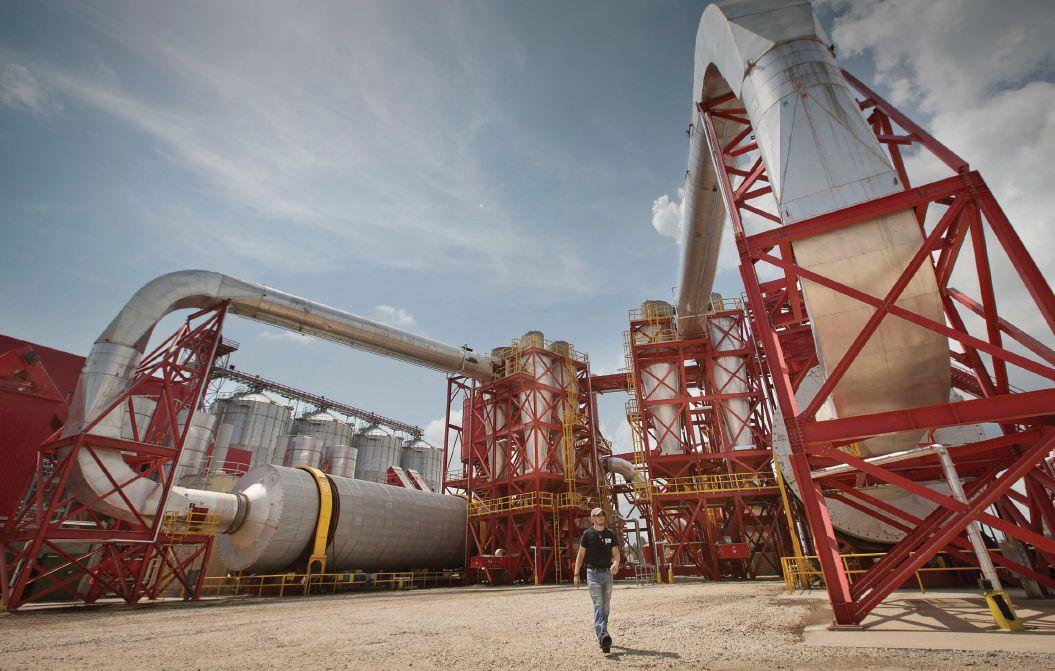
This includes Rotary Drum Dryers coupled with Heat Energy systems; TSI also builds Wet Electrostatic Precipitators when required to meet Client’s emission goals. TSI also offers technology for Torrefaction. TSI machinery is custom designed and ranges from 50,000 tons/year to 450,000 tons/year.

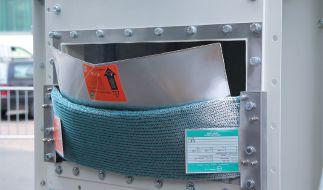
Innovative technology makes it possible to divert combustible dust explosion shock waves and flames in a controlled manner so the required safety area is reduced, valuable usable area is increased and personnel/equipment are protected from the explosion’s effects. Rembe’s Targo-Vent is an opening angle limiter developed especially for Rembe explosion vents. Targo-Vent guides pressure relief into areas where there is no danger to infrastructure or personnel. Targo-Vent absorbs the enormous repulsive forces of explosion energy and guides the flames/shock wave in the desired direction so usable area is increased.

1/9 Spark Detector offers additional protection to industries with new intelligent detection technology (IDT). IDT not only identifies hazardous moving ignition sources before a fire breaks out, but the DLD 1/9 detector is also able to differentiate between dangerous sparks or harmless incidence of extraneous light due to leaky/damaged pipes or an opening of an inspection flap.
www.grecon.us
IEP Technologies has introduced the IV8 Flameless Vent. The IV8 provides an explosion protection solution for process vessels which are located inside a building or other areas where standard explosion venting cannot be safely employed. The IV8 utilizes a stainless steel explosion relief vent and flame arresting mesh enclosed in a durable
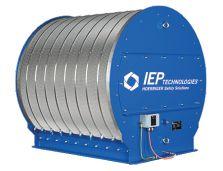
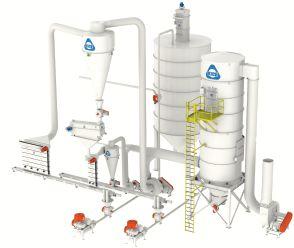
building dust control systems and equipment for over 70 years. When designing a dust control system, one must consider many factors ranging from the amount of dust emissions being created to the overall layout of the plant they are designing the system for. Every application is unique, and so Kice’s dust control systems and industrial air filtration systems are all designed and constructed specifically to meet the needs of clients.
www.kice.com
BOSSTEK

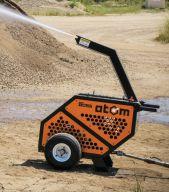
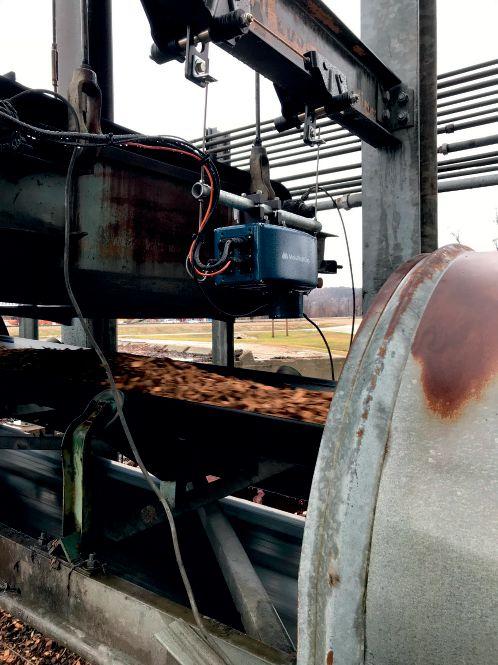

dling, bulk material processing, demolition projects, recycling operations, transfer stations, ports/shipping applications, quarrying/crushing, concrete curing and even indoor operations where significant air movement may be undesirable. www.bosstek.com
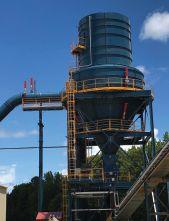
CV Technology’s Interceptor-HRD Chemical Suppression System is capable of protecting very large dust collectors that are common throughout the biomass industry. The controller of this system is called The CONEX and it features the ability to operate up to eight independent operating zones at a time. A user interface is provided by an LCD screen, push button navigation, and signaling lights on the front of the controller enclosure. The interface includes a searchable data log and electrical lockout key switches for each zone. www.cvtechnology.com
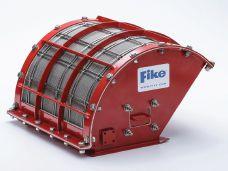
Explosion vents, during a deflagration, open to safely relieve the pressure. However, “free venting” is only possible in outdoor applications. For indoor applications, this form of explosion protection often requires flameless vents. Fike FlamQuench vents feature a variety of shapes and sizes available, minimizing required surface area on equipment; virtually zero safety distance due to effective particulate retention; and performance validated with many dust types, including fine, coarse and fibrous dusts. www.fike.com
Advanced Cyclone Systems works in very close co-operation with its clients in order to design custom made cyclone systems that really solve their unmet needs. ACS became a worldwide reference in cyclones, with over 350 successful installations in 37 countries and with several installations
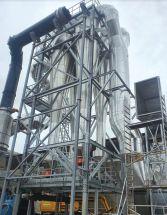
in Canada for biomass boilers applications with companies like KMW Energy, Clermond Hamel, Deltech, Fontaine Lumber, among others.
www.advancedcyclonesystems.com
in measuring dust collector performance: ANSI/ASHRAE Standard 199. This is the first and only standard as it relates to dust collection equipment. www.scientificdustcollectors.com
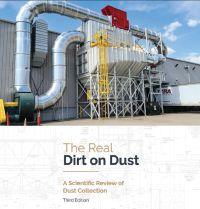
Scientific Dust Collectors offers a free third edition publication on dust collection titled, A Scientific Review of Dust Collection –Third Edition. It reviews the history, theory and application of all types of dust collection equipment. This third edition contains updated information on system design, filter media, explosive dust control and additional information on the new standard
VETS Sheet Metal celebrated a century of business in 2021. Whether make up air or cooling MCC rooms or a specialization in dust collection and pneumatic conveying, every application requires a unique approach. Experienced trades coupled with specialized in-house engineering department can help engineer, design, fabricate and install a system that meets or exceeds comfort, safety and environmental requirements.
www.vetsgroup.com

By Karen Brandt

In 2016, Oxford dictionaries chose “post-truth” as its word of the year. Defined as, “relating to or denoting circumstances in which objective facts are less influential in shaping public opinion than appeals to emotion and personal belief,” it begs the question: Why in the forest sector are we still trying to win people over with facts?
Early in my career, facts were my friend. I loved to ask non-forestry people, “How much of B.C.’s forests do you think are actually logged each year?” And the answer usually made me chuckle. I’d hear anywhere between five and 20 per cent.
You don’t need to drive far on Vancouver Island to see billboards with at least one perspective to that question (0.35 per cent) or to conversely read headlines of campaigning organizations “less than one per cent of B.C.’s old growth remaining … defer all old growth logging before it’s all gone forever!”
The fact is facts aren’t working (or necessarily helping) and here’s a few reasons why and what we can do about it.
We live in an increasingly polarized society. The rural-urban divide is getting wider, and the urban population is growing. We also know that the echo-chamber effect is furthering this divide. Echo chambers are communities where people encounter beliefs or opinions that align with their existing ideas and values and alternative ideas are not even discussed.
The issue is exacerbated by social media. As a community gets larger, the more likely it is that a person can find others who reinforce their beliefs. Many communities grow as a result of filter bulbs and algorithms, used in social media and search engines, which deliberately deliver results
aligned with interests and values.
It’s also important to recognize that every one of us also has our own confirmation bias. This is the tendency to process information by looking for or interpreting information that is consistent with our own beliefs.
So, what can we do?
First, we need to accept that facts and values are interconnected. Dan Kahan, law professor at Yale Law School and member of the Cultural Cognition Project writes, “sometimes when we argue about the facts, we’re not arguing about the facts at all… these are more often disputes over values.”
Secondly, seek out common ground. In their research paper The Moral Roots of Environmental Attitudes, authors Robb Willers and Matthew Feinberg point to the moral foundation’s theory, which maintains that liberal-minded people value equality and protection of the vulnerable, while conservative views support in-group loyalty and moral purity. As a result, Willers asserts, “You’re essentially trying to convince someone who speaks French while speaking German to them.”
Thirdly, listen… and then listen some more. A 2016 study by the Journal of Science found it is possible to reduce prejudice and sway opinions on anti-transgender legislation with one 10-minute conversation. It worked because the canvassers did a simple thing – they listened. Psychologists call this “active processing.” The idea is that people learn lessons more durably when they come to their own conclusion.
Fourth, get uncomfortable. Recognize your echo chamber and listen to other views. Oxan Varol writes in The Next Big
Idea Club, “When your beliefs are entwined with your identity, changing your mind means changing your identity. That’s a really hard sell.”
And lastly, fear doesn’t work. Research has proven that talking about the end of the world, climate disasters or even job losses will not sway opinion. A study by Tyndall Center for Climate Change Research found that “Fearful representations … may initially attract individuals’ attention. However, they can also act to distance and disempower individuals in terms of their sense of personal engagement with the issue.”
The fact is, getting people to understand your position or to work with you to find common ground is going to take some elbow grease. No expensive billboard or social media campaign alone is going to bring people together; in fact, it will have the opposite effect and keep your detractors and challengers more firmly rooted on the other side of the forest.
There is hope. Every day organizations are applying that elbow grease – like the Invasive Species Council of BC, Ducks Unlimited and the Sustainable Forestry Initiative, working with organizations that on the surface have little in common. The one thing they do have in common, however, is a willingness to exit the echo chamber and listen to the other side. •
Karen Brandt is a communications professional with a passion for sustainability and communities. For the past 30 years she has held a number of senior positions in the public and private sectors where she has built common positions and partnerships with First Nations, environmental groups, customers and governments. brandtstrategyinc@outlook.com


· OHS Professional of the Year
· Community Leader Award
· Hall of Fame (3 Inductees to be announced in 2022!)
· OHS Culture Award
· Best Safety Communications Program
· Best Use of Safety Technology
· OHS Team of the Year
OHS Canada is a sister publication to Canadian Biomass that focuses on workplace health and safety.

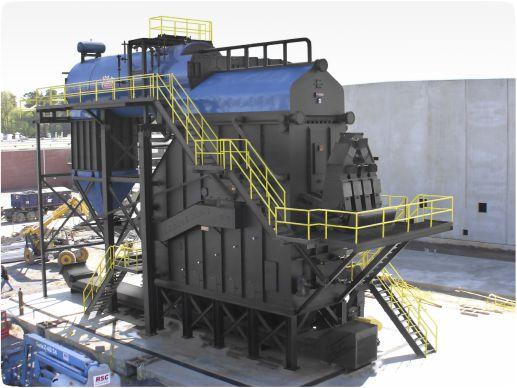
Hurst has just added to its list of accomplishments with the addition of a Fire-tube Boilers Specifications Section in the nation’s top industry specifications system, AIA Product MasterSpec®. Adding this tool to our arsenal of online specification capabilities enables architects and engineers all over the world to access, evaluate and specify our products easily, and save valuable time. Subscribers to MasterSpec® can pick and choose the Basis of Design content and documentation needed for their project and accelerate the process.
In order to help designers with a specification description that fully explains our products and how they should be installed, among other details, Hurst has included complete product specification entries encompassing a broad spectrum of our Fire-tube Boiler Product Line. The Product MasterSpec® section, 235239 Fire-Tube Boilers, will now help designers quickly add necessary descriptions, specs and easily access CAD files and PDF drawings when specifying Hurst’s products, providing them with a tool that saves them time and money. MasterSpec® offers more than 950 copyrighted sections, which allows designers, architects, and engineers to select expertly written specification content for thousands of products without having to waste time writing detailed explanations that already exist.