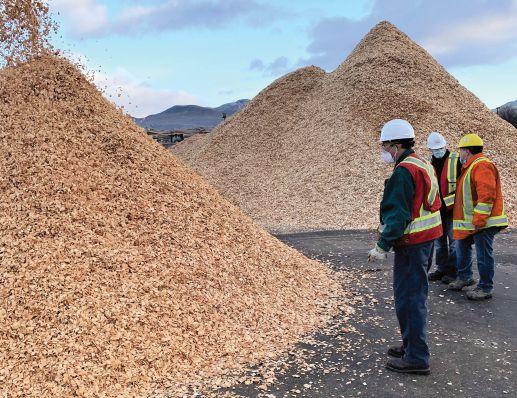
B.C. transportations and logistics company grinds residual wood in community forest, bringing economic and environmental benefits.
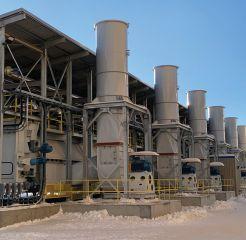
An inside look at Pinnacle and Tolko’s new High Level, Alta., pellet plant.
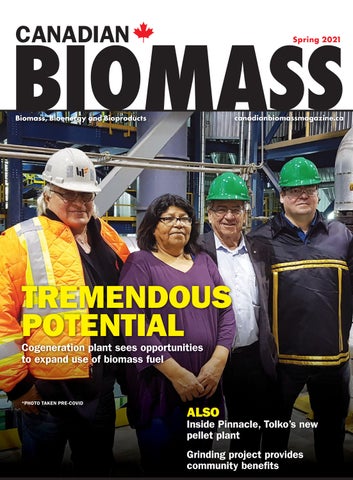
Hornepayne Power, a cogeneration plant in northern Ontario, sees opportunities to expand their use of biomass fuel.
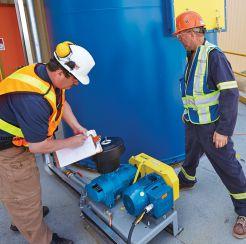
Inside North America’s first generating station to be converted from coal to biomass.
Q&A with safety expert, Kayleigh Rayner Brown, on the Critical Control Management initiative.
“Pellets are a step in our journey toward the way we create energy that’s more sustainable than anything we’ve done in the past.”
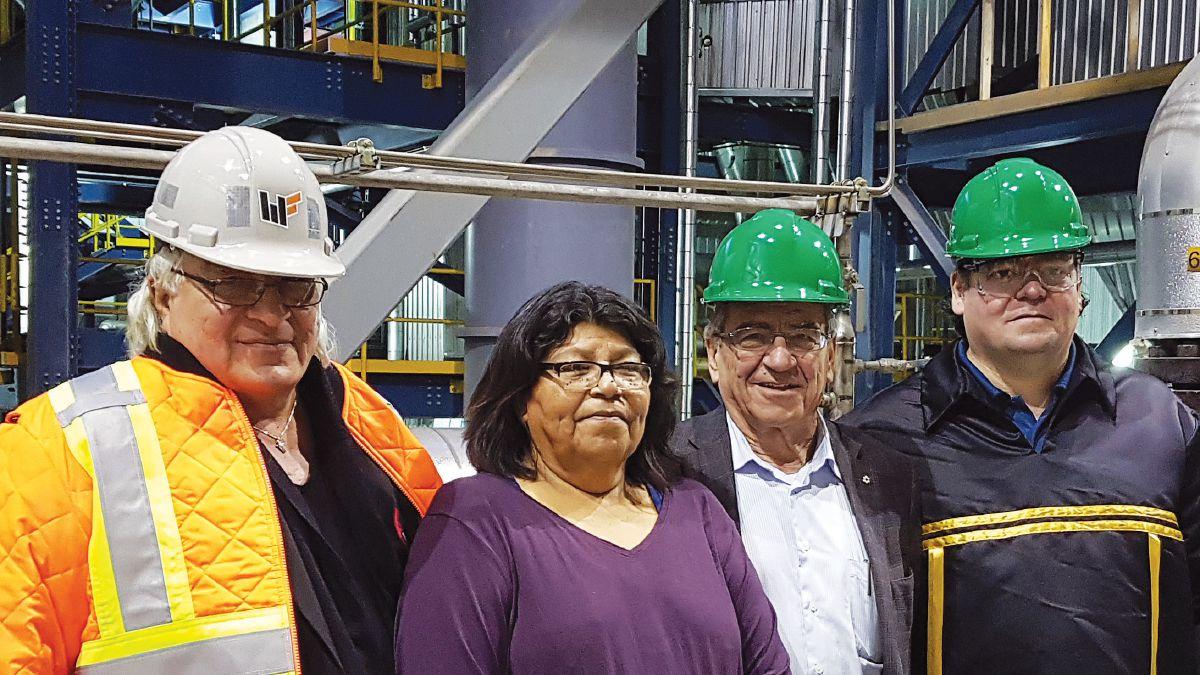
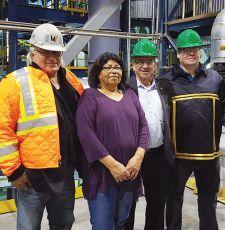
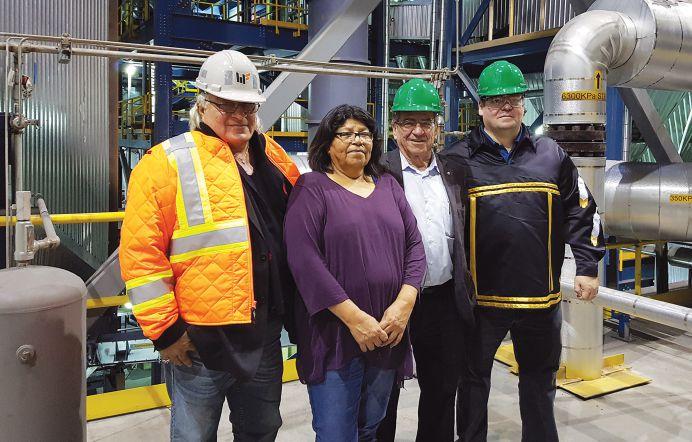
(From left to right) Chief Keith Corston of the Chapleau Cree First Nation, Chief Johanna Desmoulin of the Netamisakomik Anishnabek (Pic Mobert) First Nation, Frank Dottori, CEO, WRC Timber and Chief Jason Gauthier of the Missanabie Cree First Nation, tour the Hornepayne co-gen facility in 2017. Photo courtesy Nadine Robinson.
AIs it time to resolve the catch-22 when it comes to using biomass boilers in Canada?
n article we posted to Canadian Biomass’ website a little while ago made for some interesting reading. Co-written by Wood Pellet Association of Canada (WPAC) executive director Gordon Murray and industry consultant Harry Dresser, it asked why domestically-produced wood pellets aren’t being used to provide clean, responsible energy and heat for industrial, commercial and residential uses right here in this country.
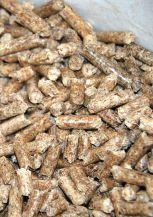
Even though Canada is the world’s second largest pellet producer, almost all pellets produced in the country are exported to Europe and Asia.
Austrian and German-made boilers with output power up to 500 kilowatts are manufactured according to EN 303-5 standards and are recognized as safe and effective almost everywhere in the world withexcept Canada. This presents the catch-22 predicament to which Murray and Dresser alluded – boilers aren’t made in Canada and those that are manufactured elsewhere don’t meet Canadian standards. Therefore, there is little need here at home for the vast quantities of Canadian-produced pellets.
But before getting into that, allow me to introduce myself. My name is Mike Jiggens. For the past 27 years, I’ve been the editor of a sister publication of Canadian Biomass called Turf & Rec, which serves the Canadian turf and grounds maintenance industry. Since late January, I’ve been helping with Canadian Biomass in the absence of one of our team members, who isn’t expected back until October.
CANADIAN BIOMASS
Volume 21 No. 2
Reader Service
Print and digital subscription inquiries or changes, please contact Jay Doshi, Audience Development Manager Tel: (416) 510-5124
Fax: (416) 510-6875
Email: jdoshi@annexbusinessmedia.com
Mail: 111 Gordon Baker Rd., Suite 400, Toronto, ON M2H 3R1
Editor - Ellen Cools (416) 510-6766 ecools@annexbusinessmedia.com
Interim Editor - Mike Jiggens (519) 429-5184 mjiggens@annexbusinessmedia.com
Contributors - Gordon Murray, Rod Badcock
Group Publisher - Todd Humber 416-510-5248 thumber@annexbusinessmedia.com
Account Coordinator - Brooklyn Van Dyk Ph: (416) 510-5229 bvandyk@annexbusinessmedia.com
National Sales Manager - Rebecca Lewis Ph: (519) 400-0332 rlewis@annexbusinessmedia.com
That’s enough about me. Back to the article by Messrs. Murray and Dresser, which was entitled, “Residential use of wood pellets: a missed opportunity in Canada.”
On the surface, it seems incredible that a country that produces three million tonnes of wood pellets annually isn’t using it to provide clean energy and heat for industrial and commercial applications here at home. The answer, it seems, is somewhat political in nature.
Boilers aren’t manufactured in Canada, and those manufactured in Europe don’t meet the global safety and market development standards set out by the Canadian Standards Association (CSA).
Western Sales Manager - Tim Shaddick tootall1@shaw.ca Ph: (604) 264-1158 Fax: (604) 264-1367
Media Designer - Alison Keba COO - Scott Jamieson sjamieson@annexbusinessmedia.com
WPAC, however, is trying to work with the CSA to knock down the existing trade barrier, and ask that small biomass boilers certified to EN 303-5 meet American Society of Mechanical Engineers (ASME) pressure vessel standards. It seems like a reasonable request and one that could open a lot of business doors.
To see Canada participate in the use, importation and manufacture of pellet central heating systems, manufactured to proven EU standards, is WPAC’s objective. It would allow Canada to get more into the game of utilizing clean energy from its own pellets. Perhaps it’s time we stepped away from being observers of working pellet central heating systems in Europe and Asia and see how effective this can be in Canada.
As awareness of the need for cleaner energy heightens throughout the world, perhaps it’s only a matter of time that all players will have their ducks in a row and this matter can finally be resolved.•
Canadian Biomass is published four times a year: Winter, Spring, Summer and Fall. Published and printed by Annex Business Media.
Publication Mail Agreement # 40065710
Printed in Canada ISSN 2290-3097
Subscription Rates: Canada - 1 Yr $57.00; 2 Yr $102.00
All advertising is subject to the publisher’s approval. Such approval does not imply any endorsement of the products or services advertised. Publisher reserves the right to refuse advertising that does not meet the standards of the publication. www.canadianbiomassmagazine.ca
To celebrate International Women’s Day, Canada’s leading forestry media brands teamed up to deliver an exclusive virtual event. You can view the content on-demand, and stay on top of news throughout the year, at womeninforestry.ca
GOLD SPONSORS
SILVER SPONSORS
BRONZE SPONSORS
PRESENTED BY
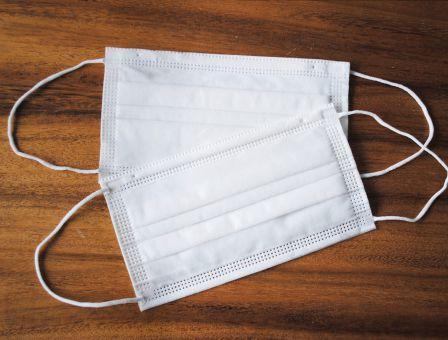
FPINNOVATIONS SUCCESSFULLY DEVELOPS BIODEGRADABLE MASK FOR MANUFACTURE
FPInnovations has successfully developed a biodegradable mask for public use, and it is now ready for commercialization by Canadian manufacturers.
The $3.3-million collaborative research and scientific project between the research organization and its partners allowed for the mask’s development using FPInnovations’ pilot-scale paper-machine.
In addition to the mask filtering materials, FPInnovations has identified and successfully incorporated elastic ear loops and nose pieces that are biodegradable. These mask components can be assembled readily on existing commercial mask-converting machines.
The mask has been assessed by external labs in accordance with inter-
national norms. With its unique product design, FPInnovations has also recently attained the more demanding ASTM standards of filtration efficiency and breathability that are required for procedure masks.
“The development of a biodegradable mask clearly shows that stimulating the bioeconomy can contribute to a cleaner environment in Canada,” said Stéphane Renou, president and chief executive officer of FPInnovations.
“The outstanding collective scientific and technological expertise of the forest sector has been key to the success and speed of this project, and is proof that together, we are capable of bringing eco-friendly bio-sourced products through the pipeline from research to market within just months.”
CANADIAN BIOGAS ASSOCIATION RECEIVES FUNDING TO ACCELERATE SUSTAINABLE
AGRICULTURE
The Canadian Biogas Association (CBA) is receiving upwards of $116,800 in federal funding to accelerate sustainable agricultural development.
With funding of up to $28,800 from the Agricultural Clean Technology Program, the CBA launched a campaign to help farmers learn more about biogas. As part of the campaign, the CBA launched FarmingBiogas.ca, a new website with resources to help farmers evaluate the opportunities of biogas, including a self-assessment tool, answers to key questions, profiles of on-farm biogas plants in Canada and more. It also includes a checklist and links to biogas equipment suppliers and technical advisers, acting as a onestop-shop to help farmers get started.
On-farm biogas systems can help farmers cut greenhouse gas emissions, provide sustainable sources of energy and offer many other environmental advantages. They can also generate additional sources of income and create opportunities for the farm’s next generation.
“There are already 61 farms and agri-food businesses across Canada successfully capturing biogas and turning it into a valuable clean energy resource,” said Jennifer Green, executive director of the CBA. “Studies show that there is the opportunity for much more. With the support of AAFC [Agriculture and Agri-Food Canada], we can accelerate further uptake of farm biogas projects and, in so doing, cut Canada’s carbon emissions and support our agricultural communities.”
Biogas can be captured and purified to create renewable natural gas, which is fully interchangeable to replace conventional natural gas. The CBA also received $88,000 under the Canadian Agricultural Strategic Priorities Program to identify clusters of agricultural resources across Canada and assess the potential for renewable natural gas development by region. The CBA will use this information to create a guide to inform agricultural stakeholders about new and emerging renewable natural gas opportunities, encouraging collaborations to develop more sustainable energy systems in Canada.
A pilot project in Inuvik, N.W.T. has the potential to create new jobs in the area, reduce greenhouse gas emissions and divert cardboard from landfill sites where it can be turned into pellets.
Researchers with Aurora Research Institute are looking at ways to turn waste cardboard into home heating fuel when mixed with wood pellets. About 100 tons of cardboard goes into Inuvik’s landfill every year because the cost of shipping it south to be recycled is too high.
Shredded cardboard particles are heated and compressed which melts the cardboard polymers, allowing the material to be shaped into pellets.
DRAX COMPLETES ACQUISITION OF PINNACLE RENEWABLE ENERGY
Drax Group has completed its acquisition of Pinnacle Renewable Energy Inc. Pinnacle, headquartered in British Columbia, will operate as a subsidiary of Drax. Its workforce of more than 480 employees, including its leadership, have been welcomed into the Drax fold.
As a result of the acquisition, Drax Group, based in the U.K., now owns or has an interest in 17 pellet plants and development projects across Canada and the southern United States. The company has the capacity to produce 4.9 million tonnes of bioenergy wood pellets annually from 2022, with access to four deep water port facilities and three major wood fibre baskets.
Duncan Davies, chief executive officer at Pinnacle, said the transaction marks the beginning of an exciting new future for Pinnacle.
“Drax is a world-class organization with an ambitious vision for sustainable biomass and a willingness to invest in the business,” he said. “As part of Drax, we will continue to build a positive, inclusive and safe workplace and support the communities in which we operate through our partnerships with First Nations and local businesses. Bioenergy has an important role in enhancing forest health, and we look forward to working with the Drax team on our shared commitment to world-leading sustainability standards.”
CANADA’S FIRST BIOMASS GAS-TO-LIQUIDS PLANT GETS ENVIRONMENTAL PERMIT
The Slave Lake, Alta., biomass/gas-to-liquids proposed project has received an environmental permit from Alberta Environment and Parks (AEP) to establish Canada’s first biomass gasto-liquids plant next to Vanderwell’s sawmill site.
Expander Energy Inc. and Vanderwell Contractors (1971) Ltd. are behind the project.
The plant will produce more than 6.5 million litres per year of low-carbon intensity, clean-burning synthetic diesel fuel (trade named SynDiesel) made from sawmill and forestry residuals. The plant will concurrently produce marketable volumes of hydrogen from the process. The AEP permit is the last significant permit required to enable the construction and operation of the project.
The plant will use Expander’s patented process and wood waste from Vanderwell’s operations as feedstock to create a low-carbon diesel fuel.
The project is well under way with construction expected to begin in late 2021. The first phase is a commercial demonstration plant producing 6.5 million litres per year of SynDiesel followed by a commercial expansion to more than 20 million litres per year. The proposed $30-million plant will create local construction jobs as well as permanent operating and maintenance jobs.
SBP PUBLISHES 2020 ANNUAL REVIEW
The Sustainable Biomass Program (SBP) has published its 2020 annual review.
“Despite the challenging times, I am pleased to report that we continued to see growth in our certificate holder base during 2020, an increase of almost 50 per cent on 2019 numbers, and we extended our geographic reach to 31 countries – up six on 2019. The volume of SBP-certified biomass in the market place reached a record high at 14.95 million tonnes, with every tonne produced and sold carrying the promise of good biomass,” said Carsten Huljus, SBP’s chief executive officer.
New to the review, on the theme of data, is an analysis of the feedstock data collected from biomass producers. For 2020, the breakdown of feedstock by type and origin reveals that the vast majority of feedstock used in biomass production came from the stems of trees that were non-merchantable as saw timber, tops and branches, and processing residues.
“We made solid progress in what was the first year of our three-year work plan to deliver our strategy, including our three key priorities for the year of standards development, monitoring and evaluation, and digitalization,” Huljus said.
The standards development process was launched in May 2020, and by the end of the year some 1,500 hours of stakeholder participation had been chalked up through the various working group and sub-group meetings. In support of the process, a series of workshops, attracting more than 650 participants in total, was held to explore the key issues in detail. The process continues and is scheduled to conclude with the publication of a set of revised standards at the end of this year.
“During 2020, we took the first steps to evolve our existing key impacts that we report against into a more sophisticated monitoring and evaluation system commensurate with the certification scheme that we have become,” Huljus said. “And our new audit management platform – the audit portal – was launched in October 2020, representing a significant leap in realizing best practice across our operations. Through digitalizing the routine aspects of certification, in terms of reporting requirements and processes, data entry and collection is much simpler and more robust.”
FEDS SUPPORT WASTETO-BIOMASS PROJECT
The federal government is investing $530,000 to support a project in Banff, Alta., that converts municipal waste to biomass energy.
The town will build a biomass district heating system that will see a reduction of about 6,000 tonnes of greenhouse gas emissions over the lifetime of this project. That is equivalent to removing approximatively 1,800 cars from the road for one year by replacing natural gas with sustainable wood waste to heat four municipal buildings. The $1.3-million biomass system reduces the need to haul waste to the landfill.
“This effort will save costs for our taxpayers, while helping protect the local natural environment that makes Banff so special,” Banff Mayor Karen Sorenson said in a press release. “Locally, this project will grow as private-sector companies join our sustainable district heating system. At the same time, with four million visitors a year to Banff National Park, we believe our small community’s big actions to fight climate change can inspire individuals, organizations and countries around the world.”
AWorking together, the future of Canada’s wood pellet sector is bright
By Gordon Murray
lready, 2021 is shaping up to be an exciting year for Canada’s wood pellet sector, with world markets and domestic opportunities coalescing with global green energy policy to drive strong demand and significant growth forecasts for wood-based bioenergy.
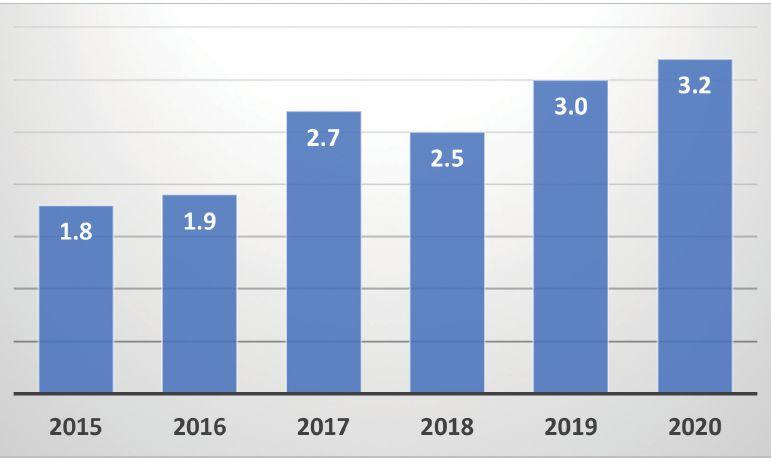
With the tremendous growth seen within our sector over the past five years – with production increasing from 1.9 million tonnes in 2015 to 3.2 million tonnes in 2020 – Canada has become a major player in the global biomass energy trade.
With that expansion has come a higher profile, and higher global stakes in the sustainability credentials of our members. WPAC recognizes the need to demonstrate the strong environmental performance of Canada’s wood pellet sector – that we are committed to directing 100 per cent of harvested trees to their highest and best use, not contributing to deforestation, and supporting a low carbon economy by transforming fibre that was once wasted into responsible, renewable energy.
We are focused on sharing robust, scientific data and research related to the sustainability and climate benefits of wood pellets, and supporting our customers with rigorous, factual information. Our Asian Wood Pellet Conference in February provided an excellent opportunity to do just that – with nearly 300 scientists, energy producers, government regulators and forest managers from across Asia and North America joining the one day event. For those unable to join the conference, the presentations –ranging from market forecast to climate policy and greenhouse gas emissions comparisons – are available at canadianbiomassmagazine.ca/virtual-events/
wpac-asian-wood-pellet-conference.
Looking ahead, with access to global markets on the basis of strong environmental credentials, Canada is well positioned to grow our share of the global demand for pellets. We continue to advocate for policies that recognize the benefits of wood bioenergy, at home and in key export markets. Frustratingly, many of the headwinds we are facing are home-grown, and we have more challenges than we should gaining the Canadian government’s support of our sector, which offers the win-win opportunity to meet our national climate change goals by harnessing the power of domestic green energy.
The Clean Fuel Standard, a regulation under development by Environment and Climate Change Canada, currently does not recognize wood pellets under provisions for end-use fuel switching, despite the fact that doing so offers a cost-effec-
tive and powerful path to de-carbonizing home heating in some of the most energy-poor regions of the country. There is no scientific justification for this omission – rather, we are told that pellets are being excluded as they are too cost-effective a solution. We are working hard to reverse this unfair and damaging policy approach, and encourage bioenergy advocates to add their voice to the call for more reasonable approaches to the Clean Fuel Standard.
Getting these policies right will lay the groundwork to expand domestic markets for our products, while supporting our local forest sectors by improving utilization and reducing waste. Atlantic Canada presents exciting near-term opportunities to reduce reliance on expensive and polluting heating oil. The Maritime Bioheat Conference will take place on June 2, with the theme “Net Zero by 2030: Growing the Region’s Largest
Annual Canadian wood pellet production in millions of tonnes.
Source of Renewable Energy.” I encourage all of you to register for this free three-hour virtual conference, offered with simultaneous French translation, at canadianbiomassmagazine.ca/virtual-events.
This year is also bringing exciting new safety initiatives to the wood pellet sector, including key work on Critical Control Management. (Editor’s note: you can read more about this initiative in the interview with Kayleigh Rayner Brown on page 20.) This work originated from a realization that, despite strong safety performance, pellet plants remained vulnerable to Major Unwanted Events, such as explosions, fires and fatal accidents. This project has the potential to create transformational change in risk management and mitigation, and we look forward to sharing more updates as the work progresses.
I’d also like to invite readers to visit WPAC’s new and improved website, at www.pellet.org. The new site provides an improved user navigation experience and updated information and resources to support members, customers and stakeholders. I welcome your feedback on the new site, and further improvements that could better serve WPAC’s growing community.
The team at WPAC looks forward to continuing to work with sector partners to realize opportunities for Canada’s wood pellets. Working together, the future for our sector is bright and we are excited to harness these opportunities into strong growth, in markets at home and abroad. •
INNOVATION TRAILBLAZER
Fahimeh Yazdan Panah has been the director of research and technical development for the Wood Pellet Association of Canada since 2019. Fahimeh was born and raised in Iran. She did her undergrad in Chemical Engineering at Tehran Polytechnic University before immigrating to Canada where she completed her masters and PhD at UBC.
Fahimeh is excited about pellets as the gateway to producing many different types of high value fuels and biomaterials beyond the traditional heat and electricity applications. There is a lot of waste left over from sawmilling or harvesting that needs a home and the best way to use it is to convert it to a homogenous, dense and clean fuel. “In fact, every common thing in your home that is made from plastic could potentially be made from wood and look the same. We know the theory and chemistry of how to do it. It’s just about making those processes economic and scalable. But it starts with pellets,” she says.
To Fahimeh, her role with WPAC isn’t just a job. “I believe in these environmental issues and we are really contributing and making a difference. There is research that we need, there is policy that we need and technologies that we need. We need to change public perceptions and provide education. Each job I do is working one of those angles. I try to cover and contribute to as much as I can and that makes it really interesting for me.”
GrindingProject
Community forest sees benefits from grinding residual wood fibre
By Mike Jiggens
Aproject in Clearwater, B.C.’s Wells Gray Community Forest (WGCF) has become a homecoming for Greg Kilba, division manager of portable wood processing and log buying at Arrow Transportation Systems Inc. of Kamloops, B.C.
Along with his son, Benton, father, Mike, and others from the Arrow team, Kilba recently completed a project grinding residual wood leftover from earlier logging operations, where four blocks in the community forest were cut in order to resurrect a healthy stand of trees. The residuals left after harvesting usable sawlogs were grinded into hog fuel for sale to Domtar in Kamloops, B.C. Kilba not only grew up in the community, but raised his family there before settling in Kamloops.
“Clearwater is a pristine and beautiful area that I have many fond memories of, and the Wells Gray Community Forest is a gem for the community,” he says.
HARNESSING ENERGY
When the Arrow team first looked at a fibre utilization project in the community forest, they were confronted by several challenges, including wet ground, large road ditches and haul distances to Domtar.
“There was a lot of fibre that could not be utilized by sawmills because of the amount of rotten wood typical of this type of stand,” Kilba explains. “Together (with the community forest group), we figured we could make economic sense of the project if we applied to FESBC (Forest Enhancement Society of BC) for a grant.”
FESBC approved a $720,748 grant, and a project plan for about $307,000 got underway last fall, once the summer months adequately dried out the area. The team from Arrow began harvesting the residual wood in the blocks in mid-October.
The funding made it economically feasible to haul the material, Kilba says. Otherwise, piles of fibre would have been burned on site. The FESBC grant represents the difference between the market rate and the cost of getting the product to his customer, he adds.
“Basically, we come up with all the costs to get the product to Domtar – our local buyer – and all those costs are tallied together, and there is a price that Domtar is willing to pay (the market price),” he elaborates
The funding also assured Arrow that their work was secure. As a result, they invested in new equipment for the project.
“We were able to go out and buy a grinder and make some changes to the trucks that would allow us to get to the bush where they typically wouldn’t go,” Kilba says.
The company bought a horizontal 2020 Peterson 5710D
grinder with a 1050-hp engine and a 2019 Tigercat 875. They used a combination of B-train trailers 53-foot walking floors on Peterbilt trucks.
“We’ve added extra weight to the drives of the trucks so that they have better traction in the bush and can get up these logging roads. We’ve been able to make some of those adjustments that have allowed us to have better access to the fibre in the bush,” Kilba says.
“It was amazing to see trucks in the forest hauling out fibre,” he continues. “Early in my forestry career, I had contracts to burn slash piles like this. We would light up the piles, and there was an amazing amount of energy coming from them. I had always wondered how we could harness that energy instead of wasting it. With the introduction of boilers that use this wood fibre, we now take this fibre we once burned and use it to create electricity.”
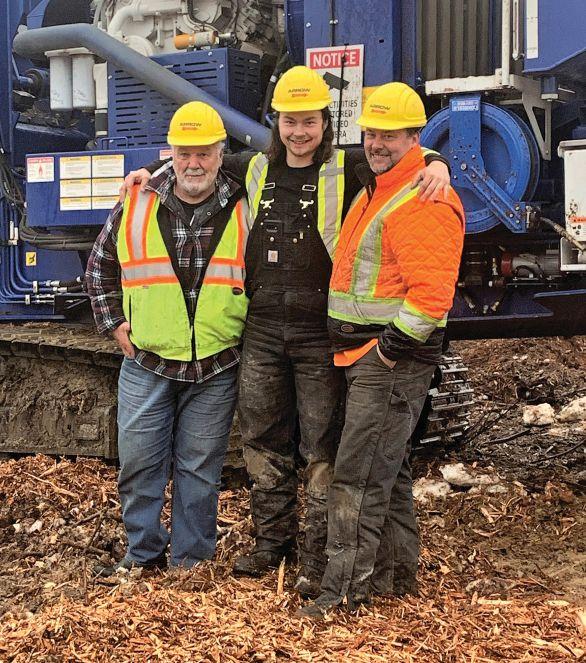
Three generations working in the grinding industry. From left to right: Mike Kilba, Benton Kilba and Greg Kilba. Photo courtesy FESBC.
THE WAY OF THE FUTURE
In total, Arrow ground 18,992 cubic metres of wood fibre, which roughly translates to 350 logging trucks worth of fibre. The groundup fibre was transported to Domtar to generate electricity to run operations, with additional green energy being put back to the grid.
The grinding project not only created an estimated 212 person-days of work, or close to 1,700 employable hours, but, by avoiding the burning of slash piles, the Clearwater airshed was spared smoke from fires – something George Brcko, WGCF general manager, and many Clearwater residents appreciate.
“As a community forest, we can be nimble and innovative in finding ways to be collaborative and get the work done,” Brcko says. “The grinding and hauling of these residuals meant that we didn’t have smoke hanging in our valleys from burning slash.
“Additionally, by removing the leftover wood fibre, this means we lessen the opportunity for a catastrophic wildfire in these areas. Without FESBC filling the gap financially, this project would not have happened. This kind of collaboration and support of community forests is the way of the future, and I believe just the tip of the iceberg in forest stewardship as we all work to do things better.”
The Wells Gray Community Forest has been an asset to the citizens of Clearwater as revenues generated from operations flow directly back into the community. Since 2004, almost $3 million has gone back into community projects such as seniors housing, summer camps for children, and accessibility projects like multi-use pathways, which is a boon to the community, notes Jennifer Gunter,
executive director of the B.C. Community Forest Association.
“As we work to grow the bioeconomy and make our communities and forests more resilient, FESBC is providing the missing link by enabling community forests and local entrepreneurs to partner on innovative projects like this,” she says. “By supporting the utilization of residual fibre, multiple benefits are created for the communities, the forests and the province as a whole.”
Helping to fund and oversee the project on behalf of FESBC is operations manager Dave Conly.
“Arrow, in partnership with Domtar, has been able to develop great solutions with our local community forests, and by using fibre that would otherwise be wasted, they are creating wellpaying jobs and assisting the province in achieving climate goals,” Conly says. “Overall, FESBC projects will have generated 5.3 million tonnes of net carbon benefits which is equivalent to removing 1.1 million cars off the road for a year.”
Conly adds forestry is an ideal way to achieve British Columbia’s and Canada’s climate change targets while at the same time create more jobs in the bioeconomy.
“I absolutely love that Arrow found a way, in partnership with FESBC and our community forest, to utilize residual wood fibre or slash,” Clearwater Mayor Merlin Blackwell says. “Our local Forestry Working Group – a group comprised of city councillors, local government representatives and industry stakeholders –has long advocated for this kind of work to be done because of the countless benefits.” •
Pinnacle, Tolko partner to bring Alberta’s newest pellet plant online
By Mike Jiggens
About 180 kilometres shy of the Northwest Territories border is Pinnacle Renewable Energy’s newest pellet mill in High Level, Alta. – an operation the company shares with Tolko Industries Ltd. in a 50-50 limited partnership.
The operation is the second of Pinnacle’s shared ventures with Tolko. Their Lavington, B.C., shared facility, which was built in 2015, is a 75-25 Pinnacle-Tolko arrangement.
“The fact that the two parties are partnering again is a testament to a great working relationship translated into additional growth,” Scott Bax, Pinnacle’s chief operating officer, tells Canadian Biomass.
Construction on the High Level facility began in June 2019. But, work was paused during the winter months, as construction in a community that realizes an annual average temperature of one degree Celsius was deemed too great a challenge.
The COVID-19 pandemic also slowed things down somewhat, and the necessary health and safety protocols impacted the project’s time and costs, Bax says. But, construction resumed in March 2020, and the plant was successfully completed last November without any health issues arising among its workers.
The first pellets were produced in November, with production beginning in earnest in December.
According to Bax, this timeline is fairly typical for Pinnacle. Commissioning a facility usually takes about a year in order to see how it operates through the different seasons, particularly through the cold of winter, and to ensure cooling systems and other vital aspects of the operation respond accordingly during the warmer seasons.
“We’re right on track for where we’re supposed to be for March,” Bax says. “I’d say we’re probably ahead of where we expected to be.”
The High Level plant is a 200,000-metric-tonnes-per-year facility, ranking it “middle-lower” in size among Pinnacle’s mills in British Columbia and Alberta, Bax says.
The commissioning of the plant, along with another Alabamabased project slated for completion in the second quarter of this year, is expected to increase Pinnacle’s overall production capacity to 2.8 million metric tonnes per year – nearly a 25 per cent increase.
A CLOSE RELATIONSHIP
To produce the pellets in High Level, the plant mainly uses sawmill residuals, about 90 per cent of which comes from the Tolko sawmill next door. The remaining residuals are sourced from various other smaller mills in the area.
The plant’s location close to its biggest fibre supplier is a significant advantage for Pinnacle in its partnership with Tolko, Bax says.
“They’re the ones that have access to the fibre and are really producing the residuals,” he explains. “This is an opportunity for them to sell the residuals in a way that creates confidence long into the future.”
While the price for lumber varies widely, creating a cyclical market, Pinnacle has determined a fixed price for the pellets produced at High Level.
“Our price is set for the next 10 years. Our pellets are forward sold often for more than a decade,” Bax explains. “We’ve committed to supply it, so we put our time and energy in going out and doing that piece of our business. We tend to be a very stable business for people to work at, unlike oil and gas and other industries that are more cyclical. Our employees appreciate that.”
INSIDE THE PLANT
Approximately 30 people operate the plant, providing stable jobs
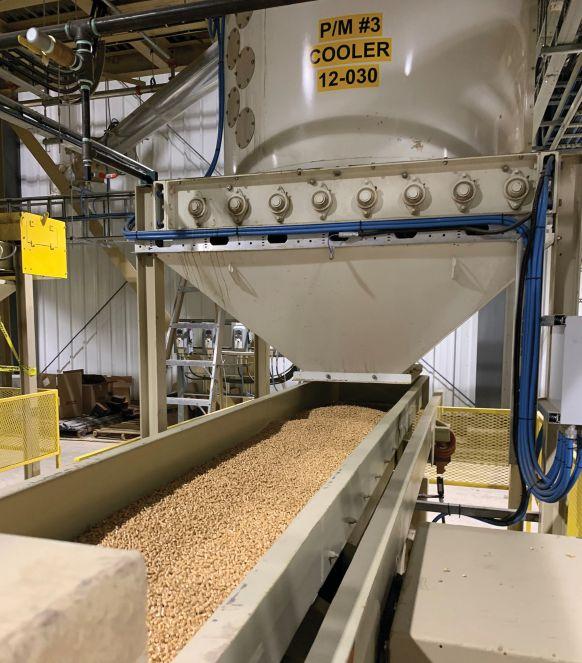
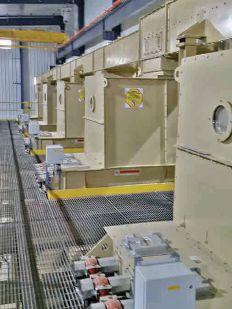
A view of the pellet vibratory conveyor and Bliss cooler. Photo courtesy Pinnacle Renewable Energy.
for Pinnacle’s workforce. The 24-hour operation has employees working four 12-hour shifts in a four-days-on, four-days-off cycle. However, the High Level plant is a largely automated operation.
The first part of the plant houses the fibre breakdown BioSizer machine from Vancouver-based Brunette Machinery. Moving along conveyors from Continental Conveyors, fibre then goes to a bed dryer manufactured by Prodesa, a Spanish company. Akin to a mesh colander, the bed dryer measures six metres wide by 54 metres in length, or “about half a football field,” Bax says. About a 10-centimeter layer of fibre is placed on top, and warm air is pulled through the fibre, drawing out the moisture.
The process also involves two hammer mills from CSE Bliss and six Andritz 26LM-II pellet mills. The plant’s Allied Blower air system from Surrey, B.C., blows out sawdust, shavings and chips.
Once pellets are formed, they go to a cooler, where they are screened and then loaded into rail cars for shipment from FibreCo, located in Vancouver. Pellets produced at the plant are exported to European and Asian customers to be used mainly for industrial power and electricity generation.
Pinnacle also installed a GreCon spark detection safety system to monitor the plant, along with fire and explosion suppression technology systems from CV Technologies.
DRIVING EFFICIENCIES
The High Level plant represents Pinnacle’s first project that incorporates more than just the residual stream from its
partnering mill. It also takes heat energy from Tolko to generate steam from waste wood.
“We really have an opportunity here to take this project where we’re co-located and link ourselves close to the residual stream. We’ve further driven more efficiencies and more sustainability in the business by utilizing the excess heat energy that Tolko’s already creating,” Bax says.
This will help make the industry even more sustainable than it already is, given that the fibre for the pellets is sustainably sourced. The drying energy is a by-product of Tolko’s barkfueled energy system.
“Globally, society is becoming more attuned to not wanting to take sequestered carbon out of the ground in the forms of coal or natural gas and add it to the atmosphere,” Bax says. “Pellets are a step in our journey toward the way we create energy that’s more sustainable than anything we’ve done in the past.”
And Pinnacle’s new owners, Drax Group, are also focused on pushing that sustainability message forward with a zero-carbon, lower-cost energy future. The company was acquired by Drax in February of this year, and the deal closed in April.
“Drax is a world leader in creating meaningful change in the battle against carbon and the battle against climate change. They are already pushing beyond, aiming for a negative carbon future with the implementation of its bio energy carbon capture and storage initiative. It’s pretty exciting for us to be part of that. Any time a customer of yours purchases you as a business, that’s a compliment,” Bax says when asked about the news. •
Continental Bulk Handling
Northern Ontario cogeneration plant sees opportunities to expand use of biomass fuel
By Ellen Cools
Across Canada, the forest industry is facing a problem: what to do with the low-grade fibre left in the forests after harvesting. Cogeneration plants like Hornepayne Power, based in Hornepayne, Ont., offer one solution: using residual fibre to produce electricity and steam.
Hornepayne Power is owned by WRC Timber, an investment firm run by industry veteran Frank Dottori, and three First Nations: the Missanabie Cree, the Chapleau Cree and the Netamisakomik Anishinabek (Pic Mobert) First Nations.
The plant is a subsidiary of Hornepayne Lumber, a random-length dimensional sawmill founded by Olav and Elna Haavldsrud in 1953. The family ran the mill and the cogeneration plant until 2015, when it was shut down.
According to Dottori, the cogeneration plant was built to have a capacity of 18 megawatts (MW) per hour. But, because of transmission issues with Hydro One, and discussions with the Independent Electricity System Operator (IESO), the plant contract was reduced to eight MW per hour. This rendered the plant nonviable, given that the Haavldsruds had invested $45-$50 million into the plant. As a result, the company went into bankruptcy in 2015.
In 2016, WRC Timber, along with its three First Nations partners, bought Hornepayne Lumber and Hornepayne Power. Today, Hornepayne Power runs 24/7 and employs 22 people, and is a major consumer of biomass residuals in the region.
Approximately 70-80,000 green metric tonnes of biomass residuals come from the nearby Hornepayne Lumber sawmill. The plant buys an additional 100,000 green metric tonnes from logging contractors and sawmills in the region, including Rayonier’s Hearst, Ont., mill and White River Forest Products, based in White River, Ont. The residuals include bark and forest biomass, such as leftover tree tops.
PRODUCING POWER
Despite having access to a large fibre supply and an 18 MW per hour capacity, the IESO still restricts the plant to producing 10 MW of electricity per hour, Dottori says.
Hydro One buys electricity from the plant, which goes into the grid. The plant also produces steam, which is used to power Hornepayne Lumber’s dry kiln.
The process for producing the steam and electricity is fairly straightforward.
The sawmill residuals are blown or trucked over to the cogen plant. The biomass from logging contractors usually comes in the form of poplar logs, or from ground-up forest treetops and residues, Jim Graff, boiler and operations consultant for Hornepayne Power, explains. The larger pieces go through a Peterson grinder.
Once the material is processed, it is either stored in the yard or in a large covered storage area, which can hold up to four days of fuel. Then a front-end
loader mixes the fuel into a “recipe” – onepart sawdust, one-part bark, and one-part ground poplar, Graff explains.
The fibre is loaded onto a Continental Conveyor stoker reclaimer, and then onto a Belterra feed belt, which takes it up to a large hopper at the boiler. The boiler is a McBurney boiler capable of producing 150,000 lbs. of steam per hour.
The material is then distributed into three chutes that are fed to the boiler grate, a Detroit vibrating stoker, Graff says.
The boiler produces high-pressure steam which is fed to a General Electric turbine.
The steam turbine is coupled to a General Electric generator and the power produced is then sold to the IESO for distribution by Hydro One.
An extraction valve at the end of the turbine is used to remove 50 pounds per square inch (psig) of steam, which is used for process heating in the kilns at the lumber mill.
The flue gas produced in the process
(From left to right) Chief Keith Corston of the Chapleau Cree First Nation, Chief Johanna Desmoulin of the Netamisakomik Anishinabek (Pic Mobert) First Nation, Frank Dottori, CEO, WRC Timber, and Chief Jason Gauthier of the Missanabie Cree First Nation, tour the Hornepayne co-gen facility in 2017. Photo courtesy Nadine Robinson.
goes through a tubular air heater, where Hornepayne Power can reclaim some of the combustion heat from the exhaust gases. Dust and ash particles are trapped using a PCC precipitator.
“The precipitator charges the particles negatively, and the collecting plates are positive, so they attract each other,” Graff explains. “These plates are hooked up to vibrators, so when the material collects on the plate, the plate vibrates and that material drops down into an ash discharge system.”
Meanwhile, the flue gas goes up the stack. The fly ash is removed from the boiler and goes through a conditioning system, which mixes water and ash together to make a type of dry slurry, which is landfilled in an approved site.
OVERCOMING CHALLENGES
Even with the conditioning system, the PCC precipitator and a dust filtering system, it is a fairly dusty environment, Graff says.
Due to the dust, the plant suffered a major shutdown recently that required a repair and rebuild of the turbine and generator. This shutdown lasted six weeks and cost the company $1.2 million, Graff says, not including what was lost in production.
“So, it was a very, very expensive failure. Now, having gone through the experience, there were a few things that should have been on the generator side of things that were never hooked up by the original owner,” he says. “We’re being proactive and installing some of the indicators that would help us prevent this type of failure. We’ve also cleaned up where the air is allowed to get in for cooling, increased the filtering system and sealed the holes that
were around that area to try to prevent fly ash getting into it.”
“It’s now running beautifully, just purring, which is the way it should be,” Dottori says.
FIGHTING FOR FULL CAPACITY
Now, looking ahead, Hornepayne is focused on getting the plant up to its full capacity of 18 MW per hour. The company has sent a proposal to Hydro One and the IESO to be able to produce 13 MW per hour, with the eventual goal of working up to net 16 MW per hour, Graff says.
“There’s a lot of fuel out there that needs a home; the industry needs a solution for sawmill waste and forest biomass,” he says.
Boosting production capacity at Hornepayne Power would provide a home for these types of fibre.
“The plant could do so much better and be a long-term, profitable unit for the region,” Dottori adds. “But, in addition to the restriction, we also have a time-limited 10-year contract expiring in early 2024. So, we have been negotiating intensely with the IESO and the government to provide an extension on the plant.”
Other cogeneration plants typically get a 15-20-year contract, he says. As such, Hornepayne is looking to extend their contract by at least 10 years.
Given the Ontario government’s recently released forest sector strategy, which aims to prioritize the use of lowgrade fibre for the biomass and pulp and paper industries, Dottori is optimistic that the plant will be given approval to expand capacity and extend their contract.
“We’re hoping the government recognizes that the use of biomass displaces fossil fuels and is good for the regional economy as it creates a lot of
jobs,” he says. “Wind power, sun power –they create some capital, but no ongoing jobs, except for repairs. This plant creates new types of jobs.”
It also has a ripple effect on the regional economy – by purchasing biomass, Hornepayne Power puts $7 million into the local economy, and keeps a lot of people working in the region, Dottori explains.
He hopes that the government will decide on the plant’s capacity and contract extension by the end of the year.
‘TREMENDOUS POTENTIAL’
Hornepayne Power is also looking at two new greenfield projects that will use the energy they produce. One of those is the production of hydrogen at the plant.
“We have signed a non-disclosure agreement with a research company that has some really interesting technology that we think would be really applicable at Hornepayne, to generate hydrogen very efficiently, and we can use up to five MW of our excess power for that,” Dottori explains. “It’s a very exciting project, and we’re working diligently on that. We hope to be able to come to a decision before the end of the year.”
Hornepayne Power is also looking at the possibility of building a greenhouse that would use the clean carbon dioxide and the warm water that the plant produces.
This would be a very economical and environmentally friendly way to grow vegetables for the region, Dottori says. The concept is based on technology currently used at cogeneration plants in Denmark.
“So, there’s tremendous potential if the government agrees to extend and increase our contract,” he says. •
Inside North America’s first generating station to be converted from coal to biomass
By Mike Jiggens
When the Ontario government passed legislation almost 20 years ago to discontinue the use of coal as a generator of electricity, one of Ontario Power Generation (OPG)’s plants was given a new lease on life. Instead of being decommissioned with the other coal-fired plants, in 2014, the Atikokan, Ont., generating station became North America’s first plant to be converted from coal to biomass.
Built in 1985, the plant was still considered fairly new with plenty of service life remaining, prompting the provincial government to recommission it as a provider of an alternative and cleaner power.
“From a climate change perspective, a renewable fuel like biomass just made so much sense,” Darcey Bailey, director of plant operations for Ontario Power Generation’s northwest operations, says.
The changeover, however, was a bit “unsettling,” he says, adding OPG looked to Europe for guidance since a coal-tobiomass conversion had never been done before in North America. Europe was “ahead of the curve,” he says, and had some positive experiences that could be leveraged.
OPG did extensive research into the European example, which “really increased the comfort level of being able to make this happen.”
The renovation work required to convert the plant took less than two years to complete, and the biomass-fueled plant came online on July 24, 2014.
The initial investment for constructing the plant was between $750 million and $850 million (in 1983 dollars), and the renovations cost about $175 million. While there was still significant cost tied to the conversion, “it was a fraction of a new build cost,” Bailey says.
OVERCOMING CHALLENGES
But the project wasn’t without its share of challenges. For example, the plant needed a custom-built solution for the receiving, handling and storage of the especially dry and smallsized biomass pellets. A number of systems within the plant also needed to be reworked, which presented technical challenges.
“It’s not unexpected to run into obstacles, but you learn to innovate and adapt quickly,” Bailey says. “We’ve overcome everything that’s been put in front of us.”
Bailey credits a good team of operations personnel for overcoming these obstacles.
However, the conversion impacted the number of people employed at the plant. The loss of the coal yard meant operations and fuel-handling staff were no longer needed. All fuel-handling, storage and transfer is now done automatically. Now, the plant has 65 direct employees working on a five-shift cycle per week. Operations are 24/7, 365 days a year.
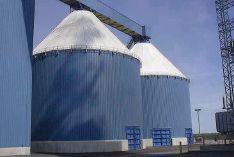
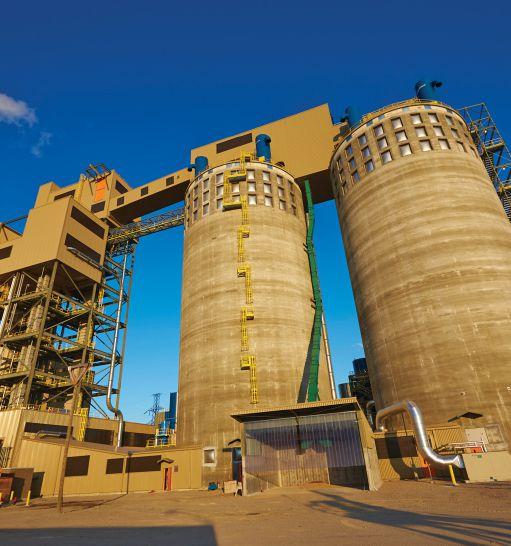
The biomass receiving, handling and storage systems at the Atikokan OPG plant. Explosion vents are visible on each silo, as well as in key locations in the material handling systems. Photo courtesy OPG.
About 90,000 metric tonnes of pellets are used annually to produce between 140 and 150 gigawatt-hours (GWh) of electricity.
FROM PELLETS TO POWER
The wood pellets are acquired from two different suppliers –BioPower in Atikokan and Resolute Forest Products in Thunder Bay, Ont. A third party – Winnipeg-based Gardewine Group Ltd. – is tasked with transporting the pellets to the plant.
Pellets are discharged from the trucks into a receiving hopper before being bucket-elevated onto a couple of conveyors that dump them into one of two silos. The large concrete silos each have a capacity of 5,000 metric tonnes.
Bailey says the plant decides which of the two silos will accommodate the received pellets based on current maintenance practices as well as the age of the pellets already in storage. If maintenance is being done to one silo, the other will be used, or if one silo contains a significant quantity of older pellets, efforts will be made to avoid adding new pellets to them.
Generally, an equal number of pellets is retained in each silo. Such a balance is needed to avoid spontaneous combustion, since biomass decomposes and heats up, Bailey explains.
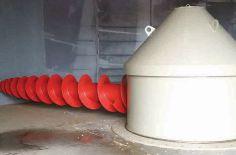
The silos discharge the pellets from the bottom. The plant decides from which quadrant of the silo the pellets are drawn based on temperature profiles. Readouts provide a three-dimensional map of the temperatures inside each silo as a safety measure, allowing the targeted pellets to be drawn based on either a higher raw temperature or a higher rate of rise in a certain area of the silo.
The pellets are sent through another series of conveyor belts and bucket elevators before entering the plant. Inside is a surge storage of pellets of about 50 tonnes per bin which are maintained above each of the feeders leading to the boiler. The pellets entering the plant must be distributed among the five surge bins, each of which sits atop a feeder belt, metering the pellets into a pulverizing system.
At this stage of the process, the pellets are still a standard sixmillimetre industrial wood pellet size, but are then “depelletized” in the pulverizer. The pellets are crushed and returned back to their constituent fibre size. The fibre is then conveyed by primary combustion air systems from B&W and Howden Fans, picking up the wood dust and moving it into the actual burners of the boiler.
Each pulverizer feeds three burners. There are five pulverizers and five ‘sets’ of burners, which can be used to produce power, based on the region’s electricity needs.
The silos were constructed by FWS Group of Winnipeg, a company that works mainly with the grain industry and with products that are combustible and biological. Aecon Industrial was responsible for material handling and storage.
Most of the equipment inside the plant was either already in place or retrofitted, Bailey says.
up to 12 t/h
“Those surge bins were a portion of the same bins we used to store the coal inside the plant with,” he explains.
OPG re-used only 50 tonnes of its 850-tonne bunkers, capping only the bottom cone to serve as the surge bin.
The B&W MPS75 pulverizers and Stock Gravimetric feeders have been retrofitted with different pieces to handle the different material, Bailey says. The burners were replaced with Hitachi DS-W and Doosan models, but the B&W Radiant Tower boiler and other major pieces of equipment remain the same.
’BUMPS AND BRUISES’
Since converting the plant, the most significant change OPG has dealt with is fuel delivery logistics.
“For coal, we would receive a unit train of 10,000 tonnes at a time, and that unit train would unload and be stored on site outside,” Bailey explains. “You’d get one of these deliveries perhaps once a week. We’re now getting 15 to 20 trucks a day of deliveries.
“The other difficulty we had to get around is that the pellets need to constantly arrive and constantly be consumed because we only have 10,000 tonnes of storage and the pellets are arriving every day,” he adds. “So, we have to manage that inventory much tighter than we had ever been accustomed to before.”
Bailey says managing inventory wasn’t a formidable challenge in the days of coal because there was plenty of room for flexibility, but things are tighter with pellets.
“The whole logistics of the pellets’ receipt, storage and overall inventory control was a major challenge to overcome, and that
MORE THAN 10 MILLION TONS. CAN ANYBODY TOP THAT?
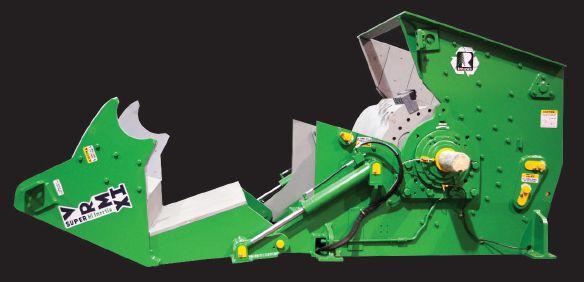
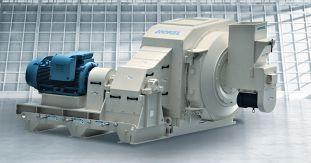
Our pellet mill 65-1500 outperforms the competition: With a throughput of up to 12 t/h, it is currently the largest flat die pellet mill for the wood sector. Worldwide, flat die pellet mills from AMANDUS KAHL produce more than 10 million tons of domestic fuel and industrial pellets from hardwoods and softwoods every year, and the trend is rising.
Scan the QR code and learn more AMANDUS KAHL GmbH & Co. KG Germany · info@akahl.de shop.akahl.de · akahl.com
took a team to work together to figure that out with some bumps and bruises along the way.”
A number of technical concerns also arose from the operations side of things, including understanding how to deal with a new type of ash. To address these issues, several tweaks were made to the plant’s systems, including its ash system. Ash was initially removed by a flapper valve, but OPG found the component had a short lifespan and tended to plug up. It has since been replaced by a more efficient rotary valve.
“We had to learn how to run new equipment for the first time in almost 30 years of operation,” Bailey says. “We had to retrain our staff on how to be resilient and how to identify problems.”
Atikokan is still a suspension-fired boiler system that fires a burning fuel to create steam, but it’s a different fuel with different fuel-to-air ratios and which burns at different radiance, he adds.
He expects there will be other upgrades or sub-system replacements to be addressed within the next 10 to 15 years, including the generator itself, but those are standard for the industry.
A CARBON NEGATIVE FUTURE?
Although the plant officially supports the communities of Northwestern Ontario, it is a part of the province’s overall power grid. Bailey compares the grid to a large bucket being filled by water from several faucets.
“We’re (Atikokan) dumping water into that bucket,” he explains. You can imagine thousands of small holes in the bottom of the bucket as the users of the power grid, he adds. But, “who’s to say that
the water from one tap comes out of a certain hole at the bottom?”
Bailey says Northwestern Ontario is practically a grid of its own because of the distances involved and the small number of tie lines, adding that there is essentially one large 230-kilovolt tie line between Northwestern Ontario and the rest of the province.
“The benefit of this station is fairly regional when it comes to providing the power. It’s essentially here to support the communities of Northwestern Ontario, but at any given time those megawatts may be headed east and south from here,” he explains.
But, currently, securing a future for the Atikokan plant is a priority, Bailey says. OPG is in the midst of a power purchase agreement that began in 2014 and continues to July 2024.
“In order to operate beyond that, we at OPG need to partner and get an agreement with the IESO (Independent Electricity System Operator) to have an operating agreement beyond 2024,” he explains, adding he’s optimistic this will happen.
OPG is also excited about the future of the Atikokan plant and the role it could play in regards to environmental change. The company hopes to make the plant net zero within the next couple of decades, Bailey says.
“I think Atikokan generating station is in a very unique and positive position,” he explains. “It’s the only asset we have in our generation portfolio that could become a negative emitter of carbon because our fuel today is neutral. If we were to incorporate any type of carbon capture or carbon sequestration technologies, this site has the potential to become a carbon negative site. I think that is incredibly exciting.” •
ANDRITZ INTRODUCES NEW PELLET MILLS TO
SERIES
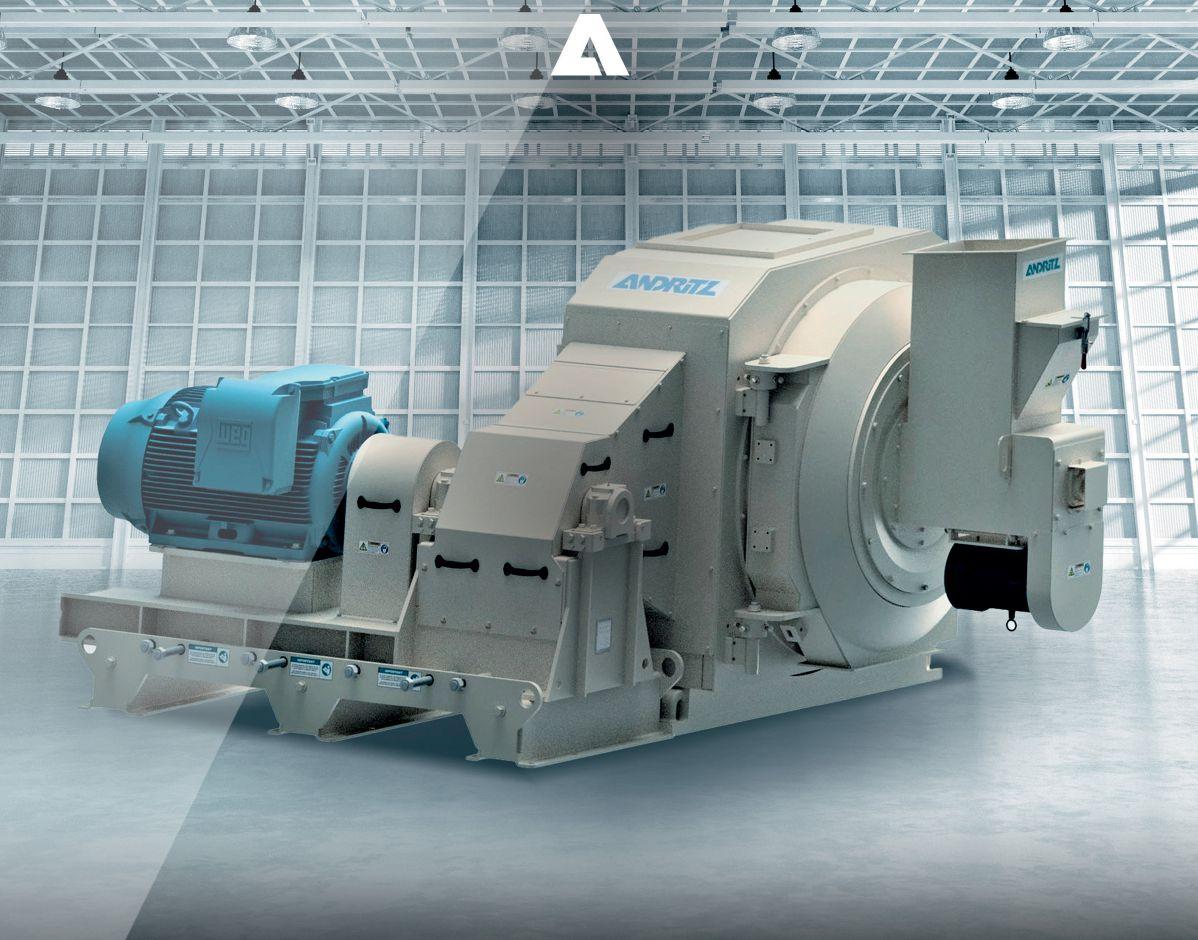
Andritz has introduced two new V-belt-driven pellet mills for the wood pelleting industry – the 26LM3 and the 26WLM3 – reflecting the latest innovations in biofuel processing. Safety, ease of maintenance, and low operating costs were top priorities when designing the mills. This generation of V-belt driven mills has fewer parts but even more capacity, so it runs more smoothly, is quieter, and experiences less wear, even under the harshest conditions. The mill produces pellets at the minimum cost per ton, thus helping customers to reach their economical and sustainability targets. Customers can also choose from additional features and options like the low-density centre feeder, the new jackshaft base, the V-belt tensioning system, as well as patent-pending roll temperature sensor technology. www.andrtiz.com
BOSSTEK INTRODUCES NEW COMPACT DUST SUPPRESSION DESIGN
BossTek’s new mobile dust suppression system, DustBoss Atom, is a fan-less, self-contained design that incorporates remote control and 4G LTE telematics technologies. The compact, diesel-powered unit fits in the back of a pick-up truck, so it can be quickly positioned and relocated to address dust-generating activity directly at the source. It also has fork lift pockets on the front and back. The Atom features a Kohler KD440 power plant – a 9.1-hp air-cooled engine that meets Tier-IV Final emissions standards and complies with California CARB requirements. A unique air filtration system increases performance and lengthens service intervals, even in dusty environments. Its integrated fuel injection system and overhead cam design are coupled with a cast iron cylinder liner for consistent, reliable service. www.bosstek.com
EDGE INNOVATE UNVEILS NEW MOBILE SCREENER
With increased throughput, high efficiency and quality end products, the EDGE SM186 mobile screener incorporates an 18-foot by six-foot two deck screen with interchangeable flip flow and conventional scalper bottom decks. This flexibility combined with numerous screen media options and configurations allows the EDGE SM186 to process a wide range of materials and totackle screening applications that other conventional screens can’t. Design features include a low-level feed hopper designed to accept loads from all three sides without the need of construction ramps, two- or three-way splitting configuration, hydraulic folding discharge conveyors to facilitate the quick transition from operation to transport and a fully integrated power unit with large service access. www.edgeinnovate.com
Q&A with Kayleigh Rayner Brown on process safety
By Gordon Murray
What You Don’t Have, Can’t Leak,” is the title of a 1978 article by Trevor Kletz (1922 - 2013), a pioneer of Inherent Safety Design. He paved the way for a safer industry and for new trailblazers, including people like Kayleigh Rayner Brown, P.Eng., M.A.Sc., a research associate at Dalhousie University in Halifax, N.S. Kayleigh has worked in the nuclear, petroleum and aerospace manufacturing industries and, having completed a Master’s in process safety, is now leading hazard analyses in the pellet sector.
I have the honour of working with Kayleigh on the Critical Control Management (CCM) initiative currently being rolled out across Wood Pellet Association of Canada (WPAC) member facilities in British Columbia, in partnership
with the BC Forest Safety Council (BCFSC). It will be a safety game changer for our industry.
I recently sat down with Kayleigh to learn more about process safety and how we can apply it.
First, let’s start with the obvious; what is Inherently Safer Design (ISD)? ISD is based on four principles: minimization, substitution, moderation and simplification. Basically, it focuses on removing hazards so you don’t need to deal with them in the first place, rather than relying on extra equipment and procedures to be protected.
What’s an example of ISD?
At a pellet plant level, it could be using equipment that contains dust so it can’t escape and accumulate elsewhere. So, it’s really about getting rid of the problem ahead of time.
Why is it important?
Without ISD, we are opening industries to higher frequencies of Major Unwanted Events (MUE). One of the most tragic examples of this is the Bhopal gas tragedy. It happened at a pesticide plant in 1984 and more than half a million people were exposed to methyl isocyanate (MIC) gas and nearly 2,500 people died. It was entirely preventable. They could have used a different manufacturing process or not have stored the chemical. On top of that, the installed safety devices weren’t working properly.
How did you become interested in ISD?
I grew up in a family who owns a fourthgeneration logging business in Nova Scotia, so safety is a core value for us. I became an engineer because I’m interested in learning about why things are the way they are and how to make things better. Engineering makes me feel empowered to make a difference. While my expertise lies in ISD and bow tie analysis, I know that safety is about people as much as it is about science!
So, what’s the connection between ISD and Critical Control Management?
You use your Process Safety Management (PSM) system to manage hazards and implement safeguards and controls.
Inherently safer design is part of PSM and can be used to eliminate the hazards, so you are starting with a safer facility but you can still incorporate ISD in an existing facility by making changes.
Another important component of PSM is CCM, which helps us identify and manage our critical controls. With the CCM in place we can assign accountabilities and a monitoring system to ensure those critical controls are managed.
What is PSM, and why is it important?
It is an organization’s all-encompassing program to ensure that people, property, the environment, and business operations are protected from loss-producing incidents. It includes a broad range of elements, from hazard analysis to safety culture to key performance indicators, which all work together to achieve safer operations, and includes all levels of a plant from leadership to the frontline workers.
How does PSM differ from traditional approaches?
For decades, we relied on the traditional approach to occupational health and safety where it looks at the responsibilities of workers and having a safety program in place. Process safety goes beyond that and tries to anticipate how all the processes interconnect and what could go wrong.
The fact is, you can be as personally safe as you want and wear all your PPE (personal protective equipment), but if the underlying process is not safe, you can still have a disaster like Deepwater Horizon.
Are there opportunities for ISD for the wood pellet industry?
Absolutely! For example, moving dust collectors from inside a building or envelope to the outside. Another good example is, instead of minimizing hot work, what if we avoided it altogether and removed the ignition sources?
Are these types of actions being tracked and reported? Are there any leaders in ISD that stand out for you?
Yes, Contra Costa County in California. First, the Industrial Safety Ordinance (ISO) regulated facilities in the county in 1998. Facilities must communicate how they are incorporating ISD. This reporting is helping to expand our understanding of how ISD is being implemented and gives examples
of how ISD can be applied in operating facilities, which has led to impressive safety improvements in the county.
Since 1998, there has been a downward trend in their loss producing incidents over the past 20 years.
Can you tell me about your current work with the pellet industry?
The project I’m working on, along with Eric Brideau and Dr. Paul Amyotte, is “Inherently Safer Bow Ties for Dust Hazard Analysis,” under an Innovation at Work (IAW) grant funded by WorkSafeBC.
As part of WPAC’s and BCFSC’s Critical Control Management initiative, I am leading bow tie workshops for wood pellet facilities to develop bow ties for the hammer mill, pelletizer, baghouse and silo storage. Now, Eric and I are examining these bow ties and identifying ways to incorporate ISD.
What is a bow tie, and how does it aid our understanding of safety?
It’s basically a visual tool that shows how a hazard could lead to a dangerous event like an explosion or fire. The Major Unwanted Event is the knot in the middle. The rest of the elements of the bow tie aid our understanding of safety because it allows us to assess how dangerous situations may arise and determine what controls we need to have in place in order to manage this risk.
What main areas of the plant are you looking at?
In an example of combustible dust in a hammer mill, which could lead to a dust explosion, we first need to understand how this could happen and how it could be prevented. We consider ignition sources, including prevention barriers such as rock traps and hot work programs.
Next, we think about what the consequences of a dust explosion would be and how they might be mitigated. We consider negative consequences, like harm to people and equipment, and examine mitigation barriers like emergency response plans and water deluge systems.
It’s really important to look at how prevention and mitigation barriers degrade and fail and how we can improve those efforts by practicing emergency drills and scheduling preventative maintenance for safety equipment.
What’s next for the CCM Initiative?
So far, we’ve completed workshops at two facilities. Each workshop is five hours a day for a week. Because of the pandemic, I’ve had to lead them virtually, but the uptake has been great. The workshop teams include people with diverse knowledge bases and across all levels of leadership. BCFSC safety advisors Bill Laturnus and Tyler Bartels provide on-site and online support.
How will you know if CCM has been successful?
I think when organizations are approaching safety with an inherent safety mindset, including when people are building facilities, or looking at management change or doing incident investigations or other opportunities they have to explicitly and routinely incorporate inherent safety design. And, of course, working with the other elements of process safety management, towards the ultimate goal of reducing the frequency of severe incidents. •
Gordon Murray is the executive director of the Wood Pellet Association of Canada.
AHow Nova Scotia’s Innovation Hub is changing the bioeconomy game
By Rod Badcock
s the federal and provincial governments start to shift their focus away from the immediate needs of the pandemic to economic recovery, growing the bioeconomy is a priority. The global bioeconomy is growing at a rapid pace, and Nova Scotia is emerging as a leader.
Nova Scotia’s bioeconomy is a regenerative system of sectors made up of new and innovative organizations developing sustainable uses for bioresources and biotechnology. Together, we are creating value from the province’s underutilized renewable resources from the forestry, agriculture, oceans, and solid waste sectors.
This interconnected, circular economy sources, distributes, uses, reuses and finds new applications for renewable bioresources. The bioeconomy lowers our environmental impact and greenhouse gas emissions, providing Nova Scotia with a unique opportunity to build resilience and drive export growth.
COMPETITIVE ADVANTAGES
We believe that there is no better place to do business than in Nova Scotia.
Nova Scotia is blessed with several competitive advantages that help support the growth of the bioeconomy. First, we are strategically located among major North American, European and Asian markets. Halifax is the closest major port to Europe, and in close proximity to the Great Circle Route.
In addition to access to global container ports, Nova Scotia’s renewable resource sectors represent a significant portion of the provincial economy. The province has a long history of sustainable management in its forest, agriculture, and ocean sectors, balancing the economic, environmental, and social benefits of natural resources.
Nova Scotia boasts a highly educated workforce that feeds into a thriving re-
search and development and technology sector that is fuelling innovation nationally and internationally. This growing innovation ecosystem has attracted interest from existing, like-minded businesses in the province that have the desire and capacity to act as hosts for bioeconomy projects, offering feedstocks, brownfield sites for co-location, financial resources and other valuable synergies.
When you add in competitive business costs and a great quality of life that helps attract key talent, you have the ingredients needed to support growing businesses in the bioeconomy.
HOW WE SUPPORT THE GROWTH OF THE BIOECONOMY
The Nova Scotia Innovation Hub (NSIH) is dedicated to the growth of the bioeconomy in Nova Scotia. We provide a supportive ecosystem, fostering strong collaboration amongst industry, government, and bioeconomy companies.
Simply put, we create and promote best-in-class, investment-ready conditions for a low-carbon bioeconomy.
Here’s how we do it:
• We drive innovation through renewable resources.
The bioeconomy harnesses underutilized, renewable resources to fuel economic growth. We are committed to improving and advancing local resources.
• We are responsible, sustainable, and smart.
This isn’t just about growing the economy – it’s about building a clean economy that is responsible, competitive, and exportable.
• We grow rural economies.
The bioeconomy has tremendous potential to provide economic opportunities in rural areas, while supplying sustainable, low-carbon alternative products to world markets.
GAME-CHANGING WORK
At the Nova Scotia Innovation Hub, we support our clients with detailed business case development, providing in-depth research conducted on feedstock availability, market opportunities and brownfield sites that are potential co-locations for manufacturing operations.
We provide clients with access to our network of feedstock, manufacturing, market, and financial partners interested in collaborating with bioeconomy businesses. We also help build an advocacy community and advance awareness of new projects, collaborations, and the bioeconomy as a whole, through initiatives such as our webinar series “Sustainable Revenues from Sustainable Products.”
Additionally, the NSIH offers financial and in-kind support to help bioeconomy businesses achieve commercialization milestones that are critical to their success and growth.
Some of the game-changing companies in Nova Scotia we work with include Sustane Technologies, which processes municipal waste into value-added energy products; Maskwiomin, which produces birch bark extract-infused creams, lotions and soaps for skin care based on ethically commercialized traditional Mi’kmaq knowledge; Oberland Agriscience, which produces protein using soldier flies that consume organic wastes and by-products; and Outcast Foods, which produces high-value nutritional powders from surplus produce.
To learn more about how the NSIH is helping to develop Nova Scotia’s bioeocnomy, visit us at www.novascotiainnovationhub.com or contact us at info@novascotiainnovationhub.com.•
Rod Badcock is executive director of the Nova Scotia Innovation Hub.
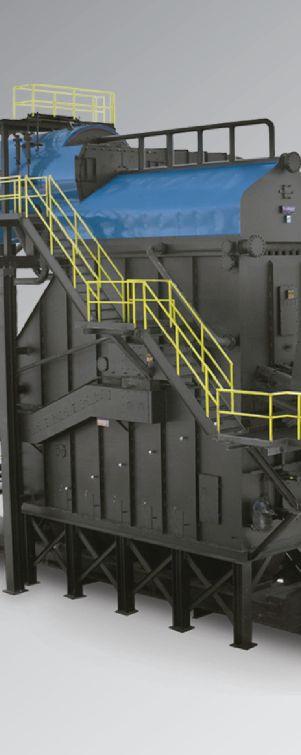
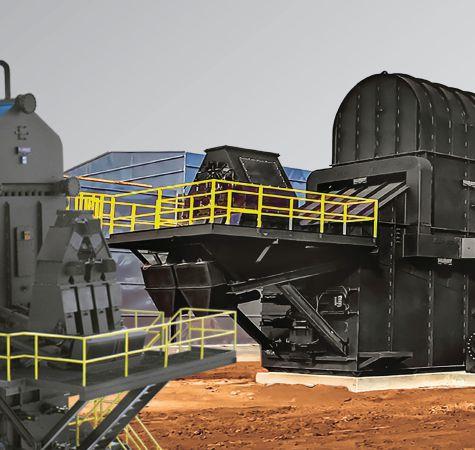
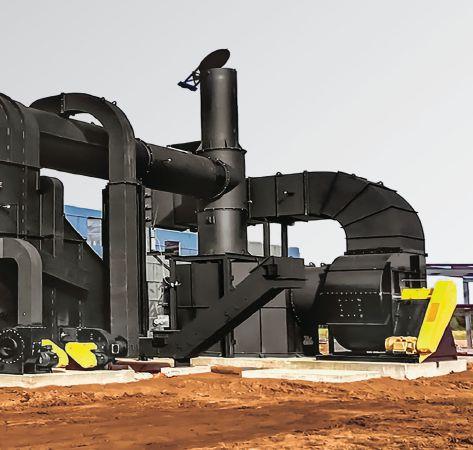
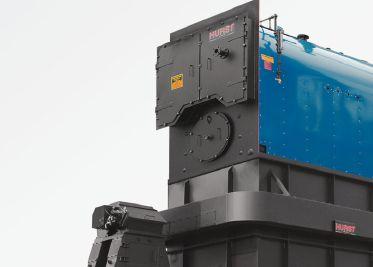
Solid Fuel Combustion
Hurst Boiler on
Hurst Boiler on MasterSpec®
I d h l d h fi d h f ll
In order to help designers with a sp specification description that fully explains our products and how they should ld be installed, among other details, Hurst worked with a Product MasterSpSpec® writer to include complete product speciification entries encompassing a broad s d spectrum of our fire-tube boiler product line. The AIA section, 235239 39 Fire-Tube Boilers, will now help designers quickly add necessar y descrscriptions, specs and easily access CAD files and PD yy F drawings when specifyinying Hurst’s products, providing them with a tool that saves them time and m d money.