RAS - Winter 2021

Page 1


RAS Connector Series: Part

From the editor

An eventful year

Does anyone else feel like this year absolutely flew by? Mentally, I think I’m still living in 2019 (and many of you might feel the same way), as the world still looks to get back to some form of ‘normal’. But will we ever get back to ‘normal’? With so many challenges impacting not just our industry and jobs, but our personal lives as well, many aspects that we once thought were normal, have forever changed. We need to not only continue to adjust to the new normal, but accept it as well.

In the aquaculture industry alone, companies have had to adjust to different working schedules, work around supply chain challenges, and look at how to become sustainable and self-sufficient so that if a global incident ever makes an impact again, there isn’t the need to rely as heavily on external sources and companies can provide food for their local communities.

For RAStech, one major shift has been the production of virtual events. Since the in-person RASTECH Conference needed to be put on hold in 2020, our team has had the opportunity to run the RAS Connector Series, which has seen more than 350 registered attendees during the two virtual events that have taken place.

On Sept. 14, we held the second virtual event in the series, the RAS Roundtable Panels and I had the opportunity to moderate the ‘Technology Meets Biology’ panel. I was (virtually) surrounded by industry experts with different backgrounds and knowledge of the RAS sector, and while we were separated by boarders and time zones, the realization that this day and age allows us to still meet and see each other during a global pandemic, puts me in awe. While we cannot yet meet in person, virtual events have filled a void: connecting with your peers to continue driving the industry forward.

On Nov. 3, we will hold our third and final virtual event in the RAS Connector Series: RAS Virtual Summit, which will consist of several presentation and open-panel sessions, including:

• Blue Ridge’s perspective and experience with ‘Thinking outside the tank’, and moving to vertical integration;

• Q&A on the ‘Future of feed’ with Texas A&M regents professor, Delbert Gatlin III;

• ‘The fish are fine’, which will present evidence-based recommendations for effectively ensuring the optimum environment for fish in land-based, closed containment systems;

• ‘Workplace safety in RAS environments’ and;

• an open-panel Q&A on ‘RAS tech support’.

RAStech looks to continue educating the aquaculture industry through the organization of virtual webinars, to drive the industry toward further growth and innovation. While we were unable to meet in person this year, we look forward to touching on these and several other topics, during the in-person 2022 RASTECH Conference and Trade Fair, which will be held on March 30 and 31 at Westin Hilton Head Island Resort in South Carolina, USA. We hope to see you all there, and be sure to save the date, and check out www.ras-tec.com for updates on the event!

Is there a topic you would like to learn more about, or would like to teach your community about? Feel free to send me an email at cmuia@annexbusinessmedia.com, I would love to hear your feedback and get to know the members of our community. I’m looking forward to meeting and learning from each of you.

With that, I leave you to read, learn, and enjoy the final issue of 2021.

Happy reading!

www.rastechmagazine.com

Reader Service Print and digital subscription inquiries or changes, please contact Urszula Grzyb, Audience Development Manager Tel: (416) 510-5180 Fax: (416) 510-6875

Email: ugrzyb@annexbusinessmedia.com

Mail: 111 Gordon Baker Rd., Suite 400, Toronto, ON M2H 3R1

Editor Catarina Muia 519-410-0600 cmuia@annexbusinessmedia.com

Associate Editor Jean Ko Din 437-990-1107 jkodin@annexbusinessmedia.com

Associate Publisher Jeremy Thain 250-474-3982 jthain@annexbusinessmedia.com

Account Coordinator Morgen Balch 519-429-5183 mbalch@annexbusinessmedia.com

Group Publisher Todd Humber thumber@annexbusinessmedia.com

COO Scott Jamieson sjamieson@annexbusinessmedia.com

Printed in Canada

SUBSCRIPTION

RAStech is published as a supplement to Hatchery International and Aquaculture North America.

Occasionally, RAStech will mail information on behalf of industry related groups whose products and services we believe may be of interest to you. If you prefer not to receive this information, please contact our circulation department in any of the four ways listed above.

Annex Privacy Office privacy@annexbusinessmedia.com Tel: 800.668.2374

No part of the editorial content of this publication may be reprinted without the publisher’s written permission © 2021 Annex Business Media. All rights reserved. Opinions expressed in this magazine are not necessarily those of the editor or the publisher. No liability is assumed for errors or omissions.

All advertising is subject to the publisher’s approval. Such approval does not imply any endorsement of the products or services advertised. Publisher reserves the right to refuse advertising that does not meet the standards of the publication.

Siemens invests in floating RAS technology company

Siemens Project Ventures has made its first direct investment in the seafood sector to land-based aquaculture technology and supplier, Singapore Aquaculture Technologies (SAT).

Through a Series A financing round, Germany-based Siemens brought up the stakes with S $9.2 million (US $5.6 million), making the company the first institutional shareholder in the startup.

Founded in 2012, SAT develops a unique hybrid farming concept: each farm features fully contained land-based recirculating aquaculture system (RAS) tanks on floating platforms. Each tank and floating platform can fully filter and oxygenate incoming seawater. Additionally, each platform is equipped with rainwater collection and solar panels.

In 2015, SAT launched an early small-scale pilot operation. In February 2020, the company launched its first full-scale Smart Floating Fish Farm, in which Siemens lent its automation and smart sensor technology. SAT has announced that two other farms will be launched in September.

Currently, SAT’s pilot farms produce small amounts of red snapper, barramundi, and grouper, but looks to focus on further research and development in predictive analysis and waste mitigation tools for farms.

Pure Salmon to build HQ in Abu Dhabi

Land-based aquaculture company Pure Salmon is set to establish a headquarters in the United Arab Emirates (UAE) capital of Abu Dhabi.

The company’s headquarters will manage Pure Salmon’s facilities in France, Japan, Poland and the United States.

“Setting up Pure Salmon’s global headquarters in Abu Dhabi will enable the growth of a local team that will advance sustainable economic solutions and establish the UAE as an industry leader,” said Stephane Farouze, chairman and founder of 8F Asset Management and the board of Pure Salmon.

Pure Salmon has partnered with Abu Dhabi Investment Office (ADIO) as part of an initiative to boost UAE’s aquaculture technology ecosystem, according to a press release from the company.

The ADIO has an AED 2 billion (US $619 million) innovation program, which aimed to assist companies expand their businesses in Abu Dhabi and help tackle food insecurity.

Nofima looks into RAS diseases

The Norwegian Institute of Food, Fisheries and Aquaculture Research (also known as Nofima) has initiated work at a new research facility that is investigating infectious diseases in recirculating aquaculture system (RAS) environments.

The Norwegian research body is working with Tromsø Aquaculture Research Station and UiT – The Arctic University of Norway. They have decided to conduct their research in a RAS environment because RAS facilities currently dominate salmon production, therefore infection models must be reassessed and adapted to RAS. The RAS facility in Tromsø is the first of its kind, according to Nofima.

“Preliminary results also show that infection trials in RAS facilities can be conducted faster than in flow-through systems,” according to Nofima. “The conclusion after the first experi-

ments is that the infection models worked very well and that the RAS trials can be carried out in less time compared to trials conducted in flow-through systems.”

The research aims to establish disinfection protocol strategies and protocols on how to manage outbreaks.

Nofima explained that many RAS facilities in Norway and North America have disinfection protocols. However, it is uncertain how effective these are if pathogens such as viruses and bacteria enter the system.

“In the RAS trials, we have simulated, among other things, how pathogenic bacteria get into the RAS facilities,” said Carlo C. Lazado, senior scientist at Nofima. “This allows us to study how disease develops in the fish, while at the same time we can investigate how and where the pathogens establish themselves and spread throughout the system.”

Carlo C. Lazado, senior scientist at Nofima, will study how disease develops in the fish.

Study uses RAS waste water to grow salad

The possibility of your next plate of salad coming from a recirculating aquaculture system (RAS) facility, could be a reality sooner than expected.

One of the latest entrants in the aquaponic research arena are European salmon faming company Columbi Salmon, global aquafeeds company BioMar, the Norwegian Institute of Bioeconomy Research (NIBIO) and aquaculture research body, Morefish.

The project was carried out at NIBIO Landvik’s aquaponic plant in Grimstad from December 2020 to May this year. The project uses “fish sludge” and water used in the RAS process.

The experiment was performed with 1,000 salmon, and by cultivating the salad type “Partition”, according to Columbi. Freshwater was used since many plants are sensitive to salt, according to project manager Mari Båtnes

Birkeland of Columbi Salmon.

The next step is develop a full-scale production plant that can grow salad or other vegetables in water coming from onshore fish farming.

“The salad that was grown in the aquaponics system had an impressive growth. In line with our hypotheses, we saw very encouraging results,” said Siv Lene Gangenes Skar, a researcher at NIBIO. “Plant production with RAS means that food production can be multiplied using the same amount of

water. In addition, we promote sustainable usage and protection of water and marine resources in support of the UN sustainability goals.”

Water quality, fish welfare, carbon dioxide, and plant quality, are among the factors that were analysed and carefully assessed throughout the trial period.

BioMar performed a life cycle assessment (LCA) analysis of the feed given to the plant, and NIBIO performed further measurements of the carbon flow throughout the system.

Innovative Oxygen Generating Systems

Designed for Aquaculture Applications

bulk deliveries and storage ●

ozone generator performance

produce highly concentrated

● Reduce operating expenses

Fire destroys stock at Atlantic Sapphire RAS facility in Denmark

A nighttime blaze on Sept. 15 severely damaged fish tanks at the recirculating aquaculture system (RAS) facility of Atlantic Sapphire in Hvide Sande, Denmark.

The Danish aquaculture company reported that all workers at the facility managed to escape to safety without injury and that the fire was under control by 6 a.m. on Sept. 16. The company said it “expects the full Danish facility will be impacted by the fire and that the damages will be material and substantial,” adding that “The standing biomass in the Danish facility is expected to be lost”.

Local news agencies are reporting that damage to the facility has been extensive and that Atlantic Sapphire shares also took a serious blow at the stock exchange. Shares of the company fell by more than 20 per cent after the fire.

The devastation is one of the latest mishaps suffered by Atlantic Sapphire in recent months. The company’s first quarter in 2021 has been dubbed the “lost quarter”.

Atlantic Sapphire is also still reeling

from a massive die-off at its Florida-based RAS facility in March this year.

The company recently recorded that it was looking to source non-medical grade liquid oxygen (LOX). Increasing demand for LOX due to the pandemic has created a shortage of LOX in the United States. Atlantic Sapphire said it reduced oxygen consumption in its facility and searched for alternative supply “in order to avoid putting its biomass health at risk.”

A report from the publication Fisker Forum said that the Hvide Sande facility

Stolt Sea Farm announces Tocha facility’s first sole harvest

Stolt Sea Farm has announced it has hit a milestone with its harvest of sole at its recirculating aquaculture system (RAS) farm, four months ahead of schedule.

The farm, located in Tocha, Portugal, is the second of its kind; after the company’s site in Cervo, Spain which first started harvesting in December 2020. “This is an exciting time for all at Stolt Sea Farm, especially the teams at Cervo and Tocha that have been central to the success of these projects,” said Jordi Trias, Stolt Sea Farm president. “Not only did we build both farms on time and on budget, but we also completed our first harvest well ahead of schedule, as a result of better growth than we had originally modelled.”

At the Tocha farm, the feed conversion ratio levels are said to be the lowest ever achieved for a species; water use is limited, energy is green-certified, and its consumption is optimised. The farm’s design looks to ensure that the fish’s highest level of welfare standards are maintained. Its RAS technology is the result of a 20-year investment in the research and development of the sustainability of farming sole.

was insured for the full value of the plant of about US$33 million. The cause of the fire has not yet been determined.

Thue Holm, Atlantic Sapphire’s Danish director said that employees present during the fire will be provided crisis assistance, the Fisker Forum reported.

“The employees have put both time, blood and energy into this, so it is of course hard to lose almost everything that happened in the fire last night,” he said.

RAS Roundtable recap

Highlights from the RAS Connector Series’ second virtual event

Technology meets biology

New developments and innovations are popping up in the industry constantly.

On Sept. 14, RAStech editor, Catarina Muia, moderated a roundtable discussion with Innovasea VP Greg Beckman; Freshwater Institute (FI) research director Christopher Good; Alpha Aqua COO Ramon Pérez; and AKVA group research and development (R&D) director Siri Tømmerås.

Water quality and biosecurity are among the industry’s most important developments, according to the group. Topics, such as the regulated use of peracetic acid in aquaculture, improved biosecurity protocols and increased automations, have greatly improved RAS operations overall. But panelists agreed, there’s still more learning to do.

“What we’re lacking is the time to develop all these things at the same time,” said Pérez, adding that the industry must prioritize developing R&D rather than rushing to build large facilities throughout.

Beyond the technical advancements in operations, panelists agree that the most valuable resource in RAS facilities are the experienced aquaculturists. In theory, everything can be automated but it can’t replace a pair of eyes from an experienced fish farmer.

Feed challenge

Formulating fish feed that’s both nutritious and safe to use in a RAS tank isn’t easy.

Jason Mann, director of nutrition at Riverence Trout Farms, gets to the meat of the matter with Steven Backman, product manager and veterinarian at Skretting; David Brock, aquaculture nutritionist at Rangen Foods; and Marc Turano, nutrition and technology lead of Cargill Aqua Nutrition - North America. Panelists agreed that RAS feeds optimizing fish nutrition and minimum feed conversion are priorities in developing the right formulation. Turano added that RAS feeds also have to consider

the “second stomach” that is the recirculating system, understanding its interaction with biofilters, piping and other stages in the system. “We can’t afford many failures in these touchy systems,” said Brock.

The biggest challenge of commercial feed production is consistent products. Backman said he puts a lot of pressure on Skretting’s supply chain managers to make sure raw materials are available.

When asked if they see RAS and conventional diets converge, in terms of cost per ton, the panelists remained skeptical. Turano said it’ll always be a challenge, with limited volumes, and to figure out how to navigate the different demands of different farms. “Producers don’t want to hear it and we don’t like to say it but it’s still a niche market.”

Waste management

Ed Aneshansley and Christine Lepine attempt to clean up the misconceptions of waste management at their live roundtable.

Together with moderator, David Kuhn, associate professor of food science and technology at Virginia Tech, the three experts discussed why water treatment shouldn’t be an afterthought in a RAS facility.

“I think if RAS wants to gain the trust of local communities, to expand into areas that have tighter discharge regulations, and even as we see RAS farms get into larger sizes, it’s going to be really important to develop technologies to find best-fit solutions,” said Lepine, research associate at FI.

She indicates that while compost hasn’t been popular in RAS waste removal, there are plenty of potential nutrients to utilize.

When it comes to denitrification, Aneshansley, CTO at HTL Sustainable Foods Inc., was asked if anaeorobic digestion of sludge is part of that process. He replied that anaeorobic digestion is a separate process off-site. “A drum filter’s discharge is relatively low in solids, less than one per cent. Run-

ning this through an anaerobic digester, would require de-watering the sludge stream to 8 to 12 per cent solids. Additional technology must be added to facilities to produce a product suitable for anaerobic digesters.”

The ins and outs of off-flavour Geosimin and methyl-isoborneol (MIB) are well documented as the culprits of off-flavour in RAS fish.

Andrea Dietrich, professor of civil and environmental engineering, and food science and technology at Virginia Tech, explored how the industry is mitigating the musty taste. Panelists included Steve Atkinson, founder of Taste of BC Aquafarms; John Davidson, research scientist at FI; Niels O. G. Jørgensen, associate professor at University of Copenhagen; and Raju Podduturi, research scientist at Atlantic Sapphire.

Davidson shared that one of FI’s recommended depuration standard of procedure is to simplify the design. “You want to have systems that are free of high surface-area aeration media as it can provide excess surface area for these microbial biofilms to accumulate on,” said Davidson.

RAS technology doesn’t currently allow operators to detect and empirically measure off-flavour levels in tanks, so panelists agree that depuration is the most reliable solution.

Podduturi added there are also other compounds that contribute to off-flavour. He said his research has found terpenes in fish feed and aldehydes that may also be contributing to the off-flavour in fish.

Get full access of all sessions and on-demand content on RASConnectorSeries.com.

Power Struggle

Maddi Badiola, PhD, is a RAS engineer, project manager and co-founder of HTH Full Spectrum, (www.HTHaqua.com // https://fullspectrumaquaculture.com) based in Getxo (Basque Country, Spain). Her specialties are project management, energy conservation, lifecycle assessments, and RAS global sustainability assessments. Email Maddi at mbadiolamillate@gmail.com or contact her through LinkedIn, Instagram, and Facebook.

RAS energy efficiency through genetics

Imust admit that at first instance, although many of you may connect the two topics of genetics and energy efficiency quite easily and rapidly, I did not see much of a connection. One of the reasons could have been because I am not very keen on genetics. I have always found them quite complicated and very in-depth. Another reason could be that the association with energy, most of the time, comes with technology, machinery, equipment, and kilowatt (kW) consumption. But the truth is that if you stop for a second and think twice, the linkage is extreme. Let’s start with a bit of a background.

Dolly, the sheep. The first mammal cloned from an adult somatic cell in 1996. Even though I was only 11 years old, not old but not too young either, I remember seeing this on the news. The cloning of this animal proved that a cloned organism could be produced from a mature cell from a specific body part. Nevertheless, the process itself was eclipsed for what all of this involved, for all the controversy that this caused. Many people around the globe began going against this practice, highlighting that the creation of such an “animal” was the beginning of “fake” animals, laboratory created creatures that were all but natural.

Darwin’s theory of evolution states that those individuals most suited to their environment survive and, given enough time, the species will gradually evolve. Looking at the big picture, the laboratory selection accelerates this process by selecting the right gene and thus, enhancing animals’ naturally occurring characteristics; helping them not only to survive, but thrive. With the advent of broodstock genetics in the

aquaculture industry, gains in growth rate of rainbow trout in 10 per cent per generation were achieved in 1977 (Kincaid et al., 1977), 10 per cent in coho salmon in 1990 (Hershberger et al 1990), and 10 to 30 per cent per generation for salmon in 1979 (Gjedrem 1979). More recently, in 2015, the Food and Drug Administration (FDA) approved AquaBounty’s (a well-known biotechnology company in the industry) products in the market and in 2020, the first harvest of their salmon was produced.

Efficiency and environmental benefits

In fish production, especially those carried out in recirculating aquaculture systems (RAS), feed generally represents one of the biggest operational costs, followed by the energy. Thus, if one reduces the lifecycle of the animals

in the tanks, i.e. grow-out duration, those mentioned costs will be reduced. It has been stated that genetically-modified salmon can be raised with 25 per cent less feed, for example. Such reduction relates directly to an improved feed conversion ratio (FCR), as well as overall production costs. In Egypt since 2012, due to selective tilapia broodstock programs and resulting FCR improvements, better growth and profitability rates have been realized. Moreover, all this has tremendous environmental benefits.

Let’s put this in context and use feed and energy as examples. Fish feed is produced with both animal and plant proteins. It is true that lately, the percentage of animal protein has been reduced and thereby alleviates the fisheries, which has been substituted with plant proteins. But, plant production is not the panacea either. It also has lots

of needs, such as space, for example. What about deforestation? Have there not been many forests eliminated, in order to plant more plants? It seems clear that we need feed to grow animals, but it is also true that the animal conversion ratios need to be improved; the same goes for energy. Energy consumption means pollution, more or less, depending on its source, but any activity that requires energy will contaminate. Reducing kWh/kg fish production will intrinsically decrease operational costs and environmental issues, making RAS production even more sustainable.

A controversial but open discussion

I know many of you will be thinking that I am trying to market genetically-modified organism (GMO) products, but this is not my intent. I just want to create a debate that will make us think deeply. Any choice, GMO or not, is as good as the other. The reality is that we are continuously adding more to the planet population and we need to (or at least try to) feed everybody. Additionally, the latest United Nations climate change report has been a slap in the face. We are late in doing our homework. We are destroying our environment, the one we were given for free. Efficiency is a must in any industry and if genetics are one of the solutions (together with others), why not use them? Commercial growers should think of genetic improvement as part of a long-term strategy. Has the chicken industry not seen incredible success? Just

remember that selective breeding has contributed an estimated 86 per cent improvement in weight-at-age in this industry.

Lastly, but not least important, is it not true that genetics are used by the ova producer companies? So, should we say that worldwide salmon production is genetically-modified? Follow me in LinkedIn and Instagram and of course do not hesitate in creating debate and questions around this or any other RAS efficiency topic. I will be happy to participate and give my modest opinion.

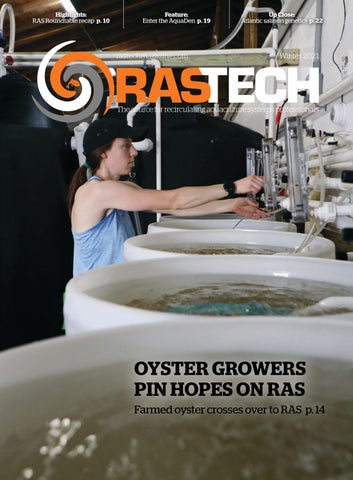
Oyster growers pin hopes on RAS

Research is underway to explore the potential of RAS in climate-proofing oyster culture

Oyster hatcheries up and down the Chesapeake Bay remember 2018 and 2019 as years of record rainfall that drove down the bay’s water salinity to detrimental levels.

The right level of salinity is crucial to oyster reproduction. The severe downpours lowered salinity to less-than-

ideal levels, delaying production of oyster larvae at many hatcheries. But for some, like Oyster Seed Holdings, it was worse.

“We couldn’t even get eggs to fertilize correctly,” recalls Michael Congrove, president and majority shareholder of the hatchery, located in Mathews County, Va. “That year we were only able to produce 50 per cent

of what we would normally produce in a year. It’s not quite half a million dollars that we lost that year because of that type of event.”

Whether it was a blip or a harbinger of things to come, growers and researchers are not taking any chances. As climate change makes seafood farming trickier, studies on how to climate-proof oyster culture are underway in many parts of the United States.

One of them, an exciting, private initiative in Maine, aims to break the dependence of oyster culture on unpredictable seawater quality by growing oysters from seed to market-size in inland facilities using recirculating aquaculture systems (RAS). It has bagged some funding from the United States Department of Agriculture (USDA) and is now past the proofof-concept phase.

Congrove’s effort is arguably more down-to-earth, yet also commendable. He and experts from the Virginia Institute of Marine Science (VIMS) and the Virginia Tech Seafood Agricultural Research and Extension Center have been looking into the potential use of RAS in climate-proofing oyster hatchery culture – but only in the early part of the oyster larvae’s lifecycle.

Flow-through larvae culture tanks for the RAS system, each with roughly 100 litres of water and three million larvae. They have RAS water flowing into and out of them at all times.

“We (Oyster Seed Holdings) have been operating this hatchery for 12 years now and no season is ever perfect. We always deal with some level of water quality issues. In 2019, we were below 10 parts per thousand (ppt) for about six months – almost our entire production season. We were below 7 ppt for about six weeks.

“And just to put a finer point on that, the critical minimum for Crassostrea virginica larvae culture is really about 10 ppt. It gets difficult when it gets to below 12 ppt, but it can be done. But below 10 ppt, it becomes extremely difficult. Really, for that entire season – in our case the most important part of our season, early in the winter – we struggled with production. We were at salinities that were just not conducive to larvae culture at all.”

While oyster hatcheries have become very good at solving water quality issues with the use of traditional single-pass filtration type methods, the low-salinity event in 2019 made them helpless, he says. “We couldn’t adapt a way to put enough salt back into the water to stay at our normal scale of production.” Not to mention all that freshwater brings all kinds of upland runoff and associated pollution into the watershed.

Gaining control over water quality

“It would be ideal to run (the hatchery) on ambient water part of the time and then switch to a recirculating system when that water became subpar for producing larvae,” says Congrove in summarizing the study’s goal. Think of it as having a fan on standby, ready to be put into action to help you cool down when the temperature rises.

“All we’re trying to do is close the loop in the first stage of their life, through the larval cycle, and get them through metamorphosis. If we can do that, then we’ve taken a really critical part of the lifecycle, which from a production standpoint is the most sensitive part of the life cycle, to ‘bulletproof’ status. This way, we’re no longer reliant on the potential variations of ambient water quality, as we can now have a consistent source of quality water.”

It is certainly not the first attempt for Congrove. In 2012, he embarked on a small study that would grow oysters from Day Zero to Day Six in a recirculating system – a crucial period in the bivalve’s life cycle. Those larvae would have then been transferred into a single-pass flow-through larvae culture tank on ambient filtered water.

But he ran into some problems. “We were trying to operate these as independent, continuously recirculating systems, and we weren’t able to grow larvae that small in systems that required continuous recirculating flow.”

Picking up the lessons learned from the 2012 study, Congrove and the team have incorporated a hybrid water-management system into the current RAS design. They have been growing the larvae on recirculated water all the way through the larval cycle, which is from Day Zero to about Day 14.

At this stage, they are now just about ready to set, so they are then transferred into a regular setting system that runs on regular hatchery filtered water.

He is optimistic this one will work. “What we bring to the

table here is a lot of experience in large-scale shellfish larvae culture. By combining our experience in the production side of things with the experience of VIMS and Virginia Tech experts in the water-quality science side of things, I think we put together a really good team.” The study also has the financial backing of the Virginia Sea Grant Fisheries Resource Grant in the amount of $36,000.

He says having a Plan B for instances when ambient water quality become subpar will be transformational for the industry.

“Just for perspective, COVID-19 has been tough on the shellfish culture industry. We’ve certainly absorbed a lot of pain from that too just because our customers, the farmers, have lost their customers – the restaurants. The shellfish industry is taking a real hit from COVID and we felt that here for sure, but it certainly wasn’t as bad of an effect as a long-term, low-salinity event has on us as a hatchery.”

For decades now, RAS has been a proven technology in salmon aquaculture for growing smolt and post-smolt sizes. Congrove says the team borrowed the technology from the sector but adapted it for shellfish larvae culture.

“All the pieces are relatively straightforward; we’re not reinventing the wheel here. What we’re trying to do is to make a wheel that will carry the shellfish cart, not a fish cart. That’s going to take iterations in running a lot of larvae through them and having a good idea of what’s going on in these biofilters and adjusting them accordingly to try to get

the best water quality out of them that we can.”

There are still many unknowns

While salmon farmers already know the weak points in a RAS system and are addressing them, Congrove says there are still many unknowns in using

blutan

the system in oyster larvae culture.

For instance, so far the team has reached only 50 per cent of their target production using RAS, but they still do not know the reason behind the poor survival rate.

“We don’t know the reason yet, in part because right now we really only

have the capabilities of monitoring some relatively simple chemistry: temperature, salinity, pH and nutrient chemistry. That’s really about it. We did some more specific sampling in the startup of the biofilters but we didn’t have funding to continue that sampling throughout the project period.

The new standard in sustainability and durability for RAS tanks

blutanQ coated steel tanks help land‐based aquaculture producers accelerate production and protect yields.

• Unrivalled product portfolio

• Exceptional service levels

• End to end customer support

• Dedicated engineering resource

As a design and manufacturing company we take full responsibility for our products, so you don’t have to deal with intermediaries.

For further information on how to enhance your RAS operations, visit balmoral‐blutanq.com or contact Jonathan Smith directly at jonathan.smith@balmoral.co.uk

“This is what I meant when I said we’re not entirely sure what to be looking for yet,” he continues. “In a finfish recirculating system, for example, one of the biggest drivers of water quality is ammonia and nitrite. There’s a lot of fish in the system, there’s a lot of waste being created – those are the things that you have to design the system around. In the larvae culture system, because biomass is relatively low, that is not a problem and reactors handle any kind of ammonia load with ease. We almost never see any spikes or buildup of ammonia or nitrite. We are starting to see the very smallest buildup of nitrate, which does mean that they are consuming these products –known as being ‘de-nitrified’ – and that’s happening but at orders of magnitude less than you would in a typical fish system, so that’s certainly not the problem. Therefore, we have to dig a little deeper to determine what might be going on and figure out what we need to do to make sure that we’re providing adequate quality water.”

Another unknown is the character of the media beds – what bacteria are on it and how those bacteria films are reacting to the inputs.

Photo shows larvae in one of the flow-through larvae culture tanks. The tank contains about three million, 12-day-old larvae. The blue structure on the left is a bank.
PHOTO: AILEEN DEVLIN VIRGINIA SEA GRANT

“There’s a lot of work to be done there too, and the primary focus of subsequent research in the next couple of years is to better characterize those media beds and the biofilms on them to see how we can perhaps adjust them to make them better at cleaning up the water.”

Virginia Tech has secured a grant of roughly $170,000 from the Saltonstall-Kennedy Program that will support these efforts. That study is scheduled to commence in January 2022.

In trying to find answers, Congrove underscores the importance of collaboration between industry and academics as well as financial support for such transformative initiatives.

LONG-LASTING AQUACULTURE PUMPS

“The good thing about an industry-driven grant program is it reflects how important a research question is to the industry. By taking it from an industry perspective, and an industry member being able to say that this is so important to us, that we’re willing to put together a team, write a grant and do the research, works,” he says.

Having gained the initial funding to kick-start the pilot study from Virginia Sea Grant’s Fisheries Resource Grant (FRG) Program, Congrove hopes Sea Grant in other regions will also adapt the FRG program.

“It’s just really helpful in getting industry-driven research accomplishments. Kudos to VA Sea Grant for maintaining such a program,” he says.

Study team member, Michael Congrove of Oyster Seed Holdings, with the seawater heating system in the background and the RAS continuous flow larvae culture tanks on the lower left. RAS requires much less energy to maintain temperature control than single pass flow-through systems do, even with heat recovery systems, he says.
PHOTO:

Enter the AquaDen –Aquaculture Enterprises

Fleming College makes students face reality with RAS facility pitch project

It’s a daunting task to start a business, create a convincing business plan and pitch it to investors, let alone for an aquaculture venture. Finding funding is an unfortunate reality of starting a business. The Canadian television show Dragon’s Den, (or Shark Tank in the United States), while made for television and filled with sensationalism, gives good insight into how pitches to investors are made, won, and lost. It is upon this model, with a bit less sensationalism, that students studying Fleming College’s post-graduate certificate in sustainable aquaculture in Lindsay, Ont., Canada, tackle their major project in the course; they must enter the AquaDen and face the Dragon Fish.

The Dragon Fish

Chief among the Dragon Fish is aquaculture program coordinator and AquaDen creator, Prof. Jon Carter. “When I took over the aquaculture program in 2014, there was an aquaculture business course that was largely undeveloped, it was a series of unrelated lectures. I redeveloped the entire concept and renamed the class Aquaculture Enterprises. I wanted something engaging and challenging that would get the students to learn about the business and building side of aquaculture but also let their creativity, ingenuity and everything they learned in the program, culminate in one engaging project,” says Carter of the project’s genesis. “It was important to me the project have a recirculating aquaculture system (RAS) focus because of the added complexity. RAS has also become a larger part of the industry and it’s what the

students are used to dealing with [at the college].”

The rules

A daunting task becomes a daunting project. Students are divided into groups of three or four and given the project to come up with an aquaculture facility and business model to pitch the Dragon Fish in the AquaDen, asking for the funding they need to follow through with the idea. The only

stipulation is the facility must be a RAS. Students must find and include the land, development, building (or retrofitting) and operations expenses. A species must be chosen, a production plan and facility layout must be provided as well as an equipment list, the fish and egg sourcing, and all the details needed to operate their business including staffing, sales, marketing, and transportation. Students must also evaluate risk and explain how they are

Students work in the RAS hatchery each day to build their skills and knowledge.
PHOTO: RON HILL

mitigating potential risks and catastrophes.

Students are given some standard numbers and prices for building and equipment. As well, it is assumed that all required permits for land and water use, aquaculture licences and wild collection permits, will be granted.

“I was concerned the students would be reaching out to suppliers and contractors for pricing, so I decided to add some standard costs for things like building, running powerlines, and some basic aquaculture equipment. They can use the basic equipment costs to scale up to larger models, scaling their costs as well,” explains Carter.

“The focus is not on the exact costing, but of the process of budgeting and figuring out what is needed. They need to find a real piece of land that is for sale and evaluate the cost, location, and water source for their project. I wanted this project to give students an appreciation of aquaculture from the investor, owner, and worker point-of-view.”

The goal of the students is to compile all their work into a digestible business plan and presentation. Once all components of the project have been created and compiled by the group, they must enter the AquaDen and present to the Dragon Fish. Students are expected to dress nice as the setting moves from classroom to conference room. The Dragon Fish (professors and guests), listen to the students pitch their business plan, building plan, and facility. Students summarize their presentation by requesting for the financing they need to fund the building and early operations of the farm. At this point, the Dragon Fish begin the questioning processes.

Facing the Dragon Fish

The culmination of the project, when the students must face the Dragon Fish with their completed pitch, is the most difficult part. Their AquaDen presentation represents the lion’s share of the grading for the class as well. All the effort and work from the whole semester comes down to the grade they receive during their presentation, adding to the anxiety.

Hunter Remen faced the Dragon Fish in 2016 with her team and their mega project: “Our idea was the world’s only vertically integrated walleye (Sander vitreus) commercial RAS production facility. Egg through grow out, plus developing and keeping our own broodstock.”

Remen found facing the Dragon Fish a harrowing and humbling experience.

“It was very nerve racking, so much time and effort goes into the project. Our presentation went very well, very smooth and we got everything out there for the panel, but we were still very nervous. We made sure we each knew all the details so we could answer questions. We thought we knew everything, then they started asking questions,” she explained with a sigh. “Then you see all the things you didn’t think about. Lack of redundancy was said a lot to our group.”

The judges scrutinize the ideas thoroughly, making sure the group can answer basic questions about their project but also flushing out the plan and pointing out weaknesses and potential stumbling blocks.

The unprepared should enter the AquaDen wearily as the Dragon Fish’s pointed questions quickly determine how much effort went into the project and can expose those who didn’t contribute.

Passing and winning

Students are both evaluated and judged during the presentation. Students are evaluated with a standard rubric for their project – public speaking, their presentation quality, and the thorough development of their ideas – and receive marks for their project. Students are judged based on the merits of their idea to succeed in the real world and are awarded the requested funding based on merit. Groups can do very well on the project and receive top marks, but still receive no funding because the judges feel the idea isn’t a realistic business or carries too much risk. Any group can receive funding from the Dragon Fish, and many years have multiple winners. There can also be disagreement among the Dragon Fish, with different Dragon Fish funding different projects.

An educational experience

“Someday the students will have to present ideas in the real world, and I want them to be able to take this huge project down to a concise 20-minute pitch of what we need to know. It’s definitely stressful but the students enjoy the project,” Carter explains. “When I started this project, I thought there would be a lot of trout farms because they are familiar to the students, but many students think outside the box, choosing a huge variety of species. We have had more species of fish than I can think of, ornamentals, crabs, sea cucumbers, as well as farms that focus on certain phases or life cycles such as fingerling farms. Small farms to megaprojects and everything in between.”

Felicia Meloche, who works at Manitoulin Trout Farms hatchery in Coldwater Ont., took the aquaculture course in 2019

and remembers the project well. “Our group wanted to choose something outof-the-box, so we chose the Chesapeake Bay blue crab (Callinectes sapidus),” she recalls. “We quickly found out that going out-of-the-box would be tricky. We soon realized that blue crabs are endangered. We decided to locate the facility in Maryland so we could obtain a wild collection permit and start a broodstock. We then learned that the blue crabs only spawn once and therefore, we would have to keep a portion of our stock each year for the next year’s seed. Because the crabs can’t be housed together, we needed to build divided tanks, and then come up with all the costs to build a custom housing facility; it all took a long time. There we so many challenges we hadn’t thought about.”

Despite the challenges, Meloche felt the project was a huge benefit to her aquaculture career. “You really get another layer of skills out of the project and a new level of understanding. It brings up problems that I wouldn’t have considered

just working at a facility. We fought with the spacing of the tanks, trying to get it just right, trying to work out the thousands of dollars worth of piping. It’s such a different perspective when you look at a RAS facility from a build point-of-view.”

Preparing for reality

The Aquaculture Enterprises class forces students to face the financial and engineering considerations that go into RAS systems like no other. Unlike most programs and education in aquaculture, the reality of the financial aspects of farm building and farm operation are driven home, as the students rarely ask the Dragon Fish for less than millions of dollars for their startups. For students, the skills learned in the project through building, budgeting, and planning are practical and transferrable to many applications, while still fueling their interesting and cultivating their knowledge with RAS. As Hunter Remen puts it: “You have to think of everything from how many chairs and pencils you need, to feed forecasting, to redundancy.” This class gives the students an appreciation and respect for the degree of difficultly involved in a RAS startup, the vast amounts of work involved, and above all the huge costs, that many potential RAS builders and farmers would be wise to observe.

www.praqua.com info@praqua.com +1-250-714-0141

All classes, projects and facility visits culminate in the AquaDen project, students must use everything they have learned in the course.

Exploring Atlantic salmon genetics

The recirculating aquaculture system (RAS)-produced Atlantic salmon sector has come a long way since its inception in the late 1990s. According to RAStech’s sister magazine, Hatchery International, the first handful of RAS were effectively used to produce millions of Atlantic salmon smolt in North America and most other major salmon producing countries around the globe. Since then, the industry continues to strive for success, with a handful of companies reporting successful harvests since 2018.

It took time to get the technology there though, with RAS components such as micro-screen drum filters, oxygenation systems, tanks and biofilters evolving greatly in the past 23 years. Today, the industry continues to look at how to improve technology

and RAS facilities to produce high-quality Atlantic salmon. In order to be successful, the industry must pay close attention to the biology of Atlantic salmon as well, focusing on genetic improvements to not only create quality stock but to avoid diseases, mass mortalities, and early maturation. These issues have been experienced less frequently in the past few years, but it must still be addressed in order for the industry to move forward.

Curious to know where the industry is headed in genetic enhancements or modifications for the improvement of RAS-produced Atlantic salmon, in the most recent episode of the RAS Talk podcast, co-host Brian Vinci, director of the Conservation Fund Freshwater Institute and I, sat down with Dr. Jónas Jónasson, production director at BMK Genetics & CEO at Benchmark Genetics Iceland, and Christopher Good,

Innovation Beyond Measure

director of research at the Conservation Fund Freshwater Institute.

A biologist from the University of Iceland, Jónasson acquired his PhD in genetics from the Agricultural University of Ås in Norway and in his current role, is responsible for all production sites across Benchmark Genetics for Atlantic salmon.

As the director of research at the Freshwater Institute in Arlington, Va., Good began working at the institute in 2007 and his research has focused on improving the sustainability of the aquaculture industry through enhanced health and welfare of farmed fish, with a recent emphasis on Atlantic salmon grown to market size in closed containment water recirculation facilities. He is involved in peer-reviewed and industry publications, lectures at conferences and workshops, and has frequent interactions with government, industry, and private non-profit stakeholders. Good has been a diplomate of the American College of Veterinary Preventive Medicine since 2017, and a certified aquatic veterinarian with the World Aquatic Veterinary Medical Association since 2014.

RAS Talk: You both have such an impressive list of credentials and years of experience in the aquaculture industry, could you both talk to me about your journey through the years in the aquaculture industry and what your focus is on today?

Jónas Jónasson: I started my career in 1989, gathering eggs from Norwegian stocks in Iceland to create a base population for salmon genetics in Iceland. Since 1991, we have been doing land-based farming here in Iceland using a flow-through system, which was mainly designed to produce eggs all year long. This is because at that time there was a

RAS_Le Gouessant Aquaculture_Winter21_CSA.indd 1

CM AQUA TECHNOLOGIES A

Water Treatment Company You Need

With more than 30 years of experience in fish farming and water treatment our team, including engineers and biologists, works to ensure the optimal solution for your water treatment. Our services include particle filtration, sludge treatment, disinfection and oxygenation - we are certain that we can deliver the best filtration system made for your needs.

Galaxy Skimmer

With a highly efficient venturis that works both in freshwater and saltwater. This is considered the most cost effective protein skimmer in the market.

CONTACT US NOW! +45 2117 5600 info@cmaqua.dk www.cmaqua.dk

Hex Drumfilter

New X Series is completely rust resistant which is very reliable and need little maintenance.

huge demand for eggs to be imported into Chile and as you may know, they’re off-season from us in Iceland. This is why we came up for the idea of producing eggs all year ‘round. It was successful then, and is still very much a success now. At the same time, being on-land, it is a highly biosecure system as we need to avoid contracting any diseases that can occur in cage farming. Since then, I’ve considered myself very privileged, being involved in such enjoyable work and being part of the industry as it has developed. You can imagine while I was studying in Ås for my PhD, we made dianetic plans for the industry to reach around 100,000 tons. You can imagine now, it’s getting closer to 2.5 million tons, so it has been a journey.

Chris Good: My career in aquaculture started in the late ‘90s. I was a technician at a fish health laboratory in Ontario, Canada, working with the Ontario Ministry of Natural Resources, Fish Culture and Hatchery Systems. We were a diagnostic lab that was screening the fish for pathogens and it was around that time that I became interested in aquaculture in general. I realized that there weren’t many people interested in aquaculture at the time, so I chose that path. I did a concurrent doctor of veterinary medicine (DVM) and PhD, with a career in aquaculture in mind. It was great timing because when I defended my PhD, I did it on a Friday and the Freshwater Institute job came up at the same time. I drove down to Shepherdstown and gave the same talk on Monday. Thankfully, they had me onboard and I’ve been there since 2007. I started off as an aquaculture veterinarian, working primarily on the fish health aspect of our research program. I’m now the director of research at the Institute. It’s a great place to work, it’s all open book where we’re trying to help the

industry expand in a sustainable manner. It’s a great team all around and I feel so privileged to be in that position.

RAS Talk: For those of you who put two and two together, Chris and I both work together at the Freshwater Institute. It’s a pleasure to have you on the podcast, Chris, to talk about some of the research we’re doing at the Institute and specifically, what you are working on. Before we jump in, I’d like to quickly ask Jónas about Benchmark and StofnFiskur. Many of the folks in the salmon farming industry know StofnFiskur as a premier source of Atlantic salmon eggs. Of course, it appears that the name has gone, but all you folks are still around working under the Benchmark umbrella, correct?

JJ: Yes, we changed the name last January from StofnFiskur to Benchmark Genetics Iceland. The strain itself is still called StofnFiskur, so the name is still there. We are going to improve the StofnFiskur strain moving forward and we’ve create production systems in northern Norway, which is in principle, based on information we have in Iceland. We have a year-long surplus of eggs from Norway now. Simultaneously, we are building up our production system in Chile as well, allowing for a biosecure strain, based on our strain from Iceland, to be produced in any season.

RAS Talk: Jónas, what are some of the current genetic improvements needed for RAS-produced Atlantic salmon, in order to eliminate some of the sector’s more pressing challenges? Additionally, how are you actually making these improvements, year over year?

JJ: The most important trait for all aquaculture is to improve growth rate; this is our

main focus. In land-based farming, we have some challenges around maturity, which I will touch on later. But as the industry moves forward, I’m sure we will have other traits to consider, especially if it’s related to health, such as diseases. Moving forward, we have breeding for discolour and fat content, and quality of the flesh. That will be a major focus, but growth rates is the main one.

RAS Talk: How do you acquire the information needed from the growers, then make the improvements from the broodstock you have. What does that process look like?

JJ: We have tested our families with landbased producers before and we are putting on programs in different countries to do that. But we have to remember that since we’ve been land-based in Iceland, we use the information for the growth rate on land in Iceland, for eight generations. During these eight generations, we have doubled the growth rate since we started back in 1991. It’s a continuous process. At the moment, we think we can very easily produce 4 or 5 kilo fish in 20 to 24 months, based on different systems. A continuous selection is going to improve about one week per year, so it’ll just be a continuous process.

RAS Talk: You mentioned maturation earlier. Can you explain how early maturation is taken into consideration when you’re doing your genetic improvements for the Atlantic salmon broodstock?

JJ: In general, maturation isn’t the problem when it comes to maturation in the Northern Hemisphere. We control that in cages with lights and such. When we come on land we have challenges with maturation, especially if we’re in freshwater, this is less of an

issue in saltwater. But in freshwater, especially in higher temperatures, perhaps over 11 or 12 degrees. To overcome this, we have considered just increasing selection on the trait, but moving forward we saw a much simpler method, which was to go on and produce all female stocks.

We have, in-house, all females for all the land-based producers in the world, whenever they need. We created a cryobank so we have a frozen milto to produce all females, whenever needed. Interestingly, we did some research also with Freshwater Institute where they’re using triploids, and we can use those. They’ll never mature, but there is some skepticism of using triploids, but we can do it. In short, the first thing is to have all females, then you can do all female triploids, and later on, we’ll look at what options we will have in the future.

RAS Talk: Chris, what research is currently being done by the Freshwater Institute, to eliminate these challenges experienced in RAS-produced Atlantic salmon. How are you and your team working with breeders like Jónas, to overcome these issues?

CG: There are still plenty of challenges remaining in the RAS production of salmon. It was discussed earlier that early maturation is probably one of the biggest ones and for any listeners wondering how this impacts a farmer: mature fish at harvest are generally a downgraded product. The gonad growth often pulls out pigment from the flesh, so you wind up with a pale fillet, for which you won’t receive a premium price, so a farmer really wants to avoid early maturation. Lately we’ve been assessing the impact of rearing temperature on early maturation in salmon post-smolts and therefore, we’re

actively researching that area.

Another challenge that’s specific to RAS-produced salmon is off-flavour, which is essentially an earthy, musty smell that can be imparted upon fish that are raised in RAS. Fish need to be purged of off-flavour after production. There’s a period of time when they’re in a purge system where they are off feed, receiving water from a system that has been disinfected and doesn’t have the biofilms that produce off-flavour compounds. So, if a farmer was able to avoid that process entirely, that would be a wonderful thing for the industry. We’re actively researching that area. In terms of working with breeders like Jónas, our current United States Department of Agriculture (USDA) five-year project plan is studying two different strains.

We are currently wrapping up one now that’s looking at steelhead and we’re starting our next trial, looking at Atlantic salmon. We’re looking at a range of strains within each of those species, determining which perform best in a RAS environment. These fish have been bred over the years for performance in more traditional systems, so we want to know which of these strains will actually do better in a RAS grow-out. I think the Atlantic salmon study will be very interesting. We’re going to provide Jónas with additional information about the fish that he has provided us. He’ll be able to assess, more in-depth than we can, the genetic variation and the performance of the individual strains within the StofnFiskur strain. That’s where we’re at right now. I’m really hoping we’ll be able to determine which strains work best in a RAS environment, and provide that information to the industry.

RAS Talk: As improvements continue to be made to the genetics of Atlantic salmon,

what are some specific biosecurity measures you feel must be incorporated into a RAS facility, to optimize these strains?

CG: For biosecurity, the biggest one would be selecting strains resistant to specific diseases that you might encounter in RAS; think about opportunistic pathogens. For rainbow trout and Atlantic salmon, the USDA is looking at these things and are trying to breed for disease resistance. I think also, what Jónas was talking about earlier in regard to developing RAS, late maturation and even sterile-type strains will help biosecurity as well. Early maturing fish do have a tendency to be susceptible to opportunistic pathogens, just because it’s a fairly stressful process for them. I think that is part of the parcel with maintaining good biosecurity. I do think there are two parts to your question, and I think the other is bio-containment. If the facility really needs to consider bio-containment, that would depend on where the site is. For example, a large facility in Florida might not have to worry much about bio-containment because escapees simply wouldn’t survive outside of the facility’s environment. However, a similar facility in a place like Maine, for example, this might be a bit more potentially-problematic. It would require some efforts to ensure that escapees wouldn’t be an issue. You need some type of physical exclusion methods to prevent escapes because otherwise, there is the worry that a potential escapee might cause some genetic interference with wild stocks which in Maine, are already endagered.

Listen to the full episode of ‘RAS Talk: Atlantic salmon genetics on rastechmagazine.com/podcast

Showcase

BioMar reports mircoalgae milestone

A fish feed project using microalgae way back in 2013 has resulted in a sustainability milestone of sorts for global feed manufacturer BioMar Global. The company reported that in those eight years, it has produced one million tons of salmon feed from microalgae.

Why is this a big deal? Most fish feed are dependent on marine ingredients, which happen to be a finite resource. Traditional fish feed are made up of fishmeal and fish oil. Fish feed companies that use alternative ingredients such as microalgae in their products help wild fish stocks recover and remain resilient.

“By including microalgae in aquaculture feed diets, we can bypass the wild fish stocks and go straight to the original source of essential omega-3s. This helps to relieve pressure on our oceans while ensuring that the fish are getting the optimal nutrition required”, said Vidar Gundersen, global sustainability director for BioMar Group.

BioMar’s microalgae foray began back in 2013. The company’s AlgaPrime became a commercial salmon feed in 2016. According to BioMar, the first movers were Kvarøy Fiskeoppdrett with Blue Circle and Whole Foods and Scottish Sea Farms with Marks & Spencer.

More than 50 improvements

“Not long after, Ventisqueros in their coho Silverside and Lerøy in their salmon, adopted microalgae in their diets,” the company said.

Microalgae is one of several novel ingredients in the BioMar innovation pipeline. The company recently announced a target of 50 per cent circular and/or restorative ingredients in their aquaculture feed diets by 2030.

www.biomar.com

Commercial Filtration Systems

Customized for your fish farm, hatchery or research operation!

Our Commercial LSS Packages are custom engineered to meet your specific needs.

• Marine and Freshwater

• Mechanical filtration

• Chemical filtration

• Ultraviolet disinfection

• NEMA enclosed controls

• Bio-filter towers

• De-gassing towers

• Wide variety of flow rates

• Flow control valves

• Protein skimmers

• Variable frequency-drive pumps

• Temperature management

ALEC Engineering and MAT Filtration join forces

United Arab Emirates- (UAE-) based ALEC Engineering and Contracting LLC, and Norwegian recirculating aquaculture system (RAS) supplier MAT Filtration Technologies and MAT-KULING are joining forces to grab a piece of the actions in UAE and Saudi Arabia’s growing land-based aquaculture sector.

The exclusive strategic partnership formed by the companies is meant to enable them to provide turnkey solution for several of the region’s upcoming megaprojects. The partnership will leverage MAT-KULING’s RAS offerings, which are especially designed to require less fresh water, a press release said.

“Our partnership with MAT Filtration Technologies and MAT-KULING is a strategic step which will combine the strengths of both companies to provide a cost-effective, state-of-the-art solution for aquaculture, thereby supporting the region’s longer-term, self-sufficiency targets,” according to Kez Taylor, chief executive of ALEC.

Taylor also said his company is “seeking to broaden our scope by looking at future water treatment projects and integrated filtration systems, thanks to MAT-KULING’s diverse range of technological solutions.”

Land-based aquaculture investments in the region have been rising in recent years. Earlier this year, UAE-based Abu Dhabi Catalyst Partners channeled investments in 8F Asset Management’s land-based aquaculture fund, which reached its final close of $358.8 million.

www.alec.ae

New aqua firm launches in Tasmania

IntoAqua is a new aquaculture design, consultancy and equipment specialist firm based in Tasmania, Australia.

Three seasoned aquaculturists, Ross Briggs, Stephen Ley and Guy Westbrook, are combining their expertise in commercial marine and RAS production to help aquaculture businesses in the region build a long-term sustainable business.

“Whether it is for a simple equipment change or a complete system design, we are not bound by supply contracts and therefore, can provide the best options to our clients,” said in a company statement. www.intoaqua.com.au

Want to be featured in Showcase?

Send your company news and press releases to jkodin@annexbusinessmedia.com to be considered in the next issue.

New Oddesse C series in production

The Söffel C-series drainage pump range is in production.

The C-series are single stage centrifugal pumps with an open, multi-blade impeller. These designs can be used for vertical, horizontal or inlined installation.

The double casing is made of aluminum alloy, which guarantees the best cooling of the cotor by circulating the pumped fluid. The pump can be used for continuous working, sipping suction and emerging operation.

The stainless steel impeller and wear-resistant diffuser are designed to ensure a long lifecycle. The motors are designed as three phase AC motors, equipped with a thermal winding protection. www.oddesse.de

WE OFFER A FULL LINE OF OZONE GENERATION EQUIPMENT

Customization available upon request.

see what you need, let us know. There is nothing we can’t source! Subscribe to our newsletter to receive updates.

Fresh Tips

From the experts at the Freshwater Institute

So many strains, so little time

Maintaining broodstock to vertically integrate the source of fish eggs is not always feasible for new or smaller-scale recirculating aquaculture system (RAS) farms. As a result, these RAS farms are reliant on egg or fingerling suppliers to keep facilities stocked and production plans on schedule. RAS producers should familiarize themselves with suppliers and potential strains when evaluating fish stock selection, as there are many strains available with a wide range of attributes.

Supplier

RAS operators should always opt for specific pathogen free (SPF) certified producers when choosing an egg of fingerling supplier. Suppliers should be able to provide SPF certification documents for review. Consider suppliers with a strong reputation and history of successfully supplying the industry. If the supplier is relatively new, ask for customer contact information and follow-up to complete due diligence. Suppliers should be able to answer your questions about available fish strains and growth potential, as well as general questions about their onfarm biosecurity practices and general egg incubation or initial fish acclimation recommendations.

Location of the supplier in relation to the RAS facility can also be an important factor when selecting a fingerling supplier. RAS facilities planning to rely on fingerling fish may need to identify suppliers within range where fish can be delivered or picked-up and hauled safely in a single day. Location is less important when selecting an egg supplier. Eyed eggs are easily shipped in insulated boxes around the world. However, selecting a domestic egg supplier may alleviate some of the extra challenges associated with importation, such as paperwork and inspection by customs agencies, which is required with international shipping.

Availability

RAS facility bioplanning provides an estimate of how many eggs or fingerlings will be needed to meet production goals. Operators should select a supplier or combination of suppliers to create the egg or fingerling supply to meet the farm bioplan. RAS facilities must also identify suppliers whose availability is compatible with the bioplan. Those RAS facilities receiving eggs or fish more frequently may grow smaller cohorts of fish, while those receiving only seasonal shipments may need to ‘cold bank’ portions of larger cohorts to stagger harvest schedules and provide consistent product to customers. RAS facilities with multi-phase construction or expansion plans should communicate future plans to suppliers to allow them to increase their capacity to meet the needs of future growth.

Farm goals and strain attributes

Fish strains with faster growth rates will generally be more profitable for RAS facilities. As a result, growth rate is a primary trait for selective breeding programs. However, there is variation in the growth rate of commercially available strains, making strain selection important for producers. In addition to growth rate, several secondary attributes with genetic components may be of importance to RAS producers. For example, strains with better genetics for disease resistance, improved fillet yield, or low rates of early maturation may be preferred when growth potential is

similar. In some cases, sacrificing some growth potential for preferred secondary attributes may be advantageous.

Monosex and ploidy

Manipulations to produce monosex or triploid fish can also provide advantages for RAS producers. Many tilapia farmers grow all-male populations of fish for improved growth rate while all-female salmon populations are becoming popular to eliminate early male maturation. Additionally, sterile triploid salmon further protect against or eliminate early maturation. However, triploid fish can require specific husbandry conditions and dietary requirements that are not well defined, resulting in reduced growth rates compared to diploid counterparts at larger sizes.

RAS operators should maintain detailed records of supplier and fish strain growth, survival, deformity and downgrade rates, and other important performance metrics. Past data can be used to track performance through the years, identify trends in fish performance by breeding season, or compare strains to inform future selections. Thoughtful, data-based decision making will ensure an adequate supply of fish that perform well and meet the unique end goals of each RAS producer. Developing a good relationship with egg and fingerling suppliers will keep you engaged in the latest improvements through selective breeding, availability of new offerings, and open a discussion for feedback and optimal selection of strains.

Eyed eggs beginning to hatch.

Pure Oxygen

Increase tank capacity and yield with Linde technology for aquaculture. Our SOLVOX® oxygenation products deliver pure oxygen to help ensure an optimal growing environment. The expansive range of dissolution and distribution solutions is designed for high efficiency, excellent utilization, and peak hydrodynamic conditions inside the tank. Linde experts can develop a system customized to meet your specific needs. Contact us today.

lindeus.com/aquaculture

Turn static files into dynamic content formats.

Create a flipbook
Issuu converts static files into: digital portfolios, online yearbooks, online catalogs, digital photo albums and more. Sign up and create your flipbook.