10 | Power Struggle Is RAS still on the right path to energy efficiency? 30 | Fresh Tips Hacks for your RAS operations
Pioneering animal welfare in Chile
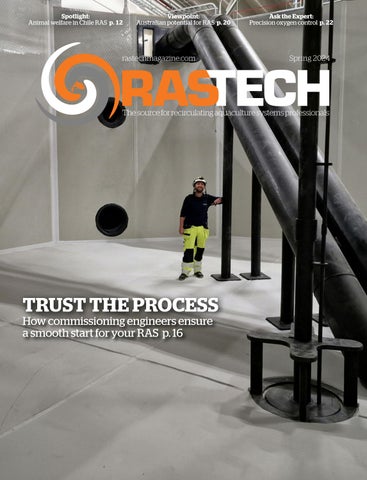
Smolt producer, Lago Sofia, is the first in the country to achieve the highest standards of farmed fish welfare. BY CHRISTIAN PÉREZ-MALLEA 16 COVER STORY Trust the process How commissioning engineers ensure a smooth start for your RAS project BY JAMES TULLER
RAS in Oz
Looking down under to Australia’s potential for recirculating aquaculture BY JOHN MOSIG
A precision oxygen control system for RAS BY SCOTT TSUKADA AND STEVE SUMMERFELT
From the editor
By Jean Ko Din
Best practices
This issue features more opinion and/or single-perspective feature articles than I usually like to have.
As an editorial team, we have a high standard that we follow when featuring stories that are written in a first-person voice or perspective. Before we even agree to allocate pages to these types of stories, I take my journalistic responsibility very seriously to vet and verify the information. I believe that these stories must remain accurate and instructive for industry professionals.
Marketing rhetoric is reserved for a clearly marked Sponsored Content ad.
Our cover story is an essay written by James Tuller, a commissioning manager who represents RAS builder, Pure Salmon Technology in Sandefjord, Norway. In preparation for this piece, I met with Tuller and the Pure Salmon team to emphasize the importance of explaining the role of commissioning engineers.
Though Tuller writes directly of his experience at his company, the essay explains the role he plays in a RAS project’s crucial transition from design to system startup. Like my role as editor of RAStech Magazine , the role of the commissioning engineer is to perform the proper checks and balances for a successful launch. I hope this article helps prompt you to examine your own project management processes with new eyes.
Further into this issue, you’ll find that more opinion and/or single-perspective stories. John Mosig writes about his 43 years watching RAS technology grow in Australia and he reflects on its future potential.
We also have an expert article from
Scott Tsukada and Steve Summerfelt, PhD about some new research that they have been working on to improve oxygen control in a RAS system.
Both these stories offer interesting first-person insight that only their individual expertise could offer.
We give these stories headers like “Viewpoint” or “Ask the Expert” respectively to create a distinct space where they can offer their unique commentary. We include headshots and author biographies to place an author’s voice of authority. It informs the reader of the author’s organization affiliations, as well as his or her qualifications on the subject. We also include contact information or a website available, so that the reader has direct access to more information.
Notice that these additional elements make these stories visually distinct from our feature articles because we want to signal to the reader that it should not be read in the same way as those written by trained journalists.
Speaking of, we also feature a profile story by our seasoned Chilean reporter, Christian Pérez-Mallea. He profiles how Lago Sofia became certified for its animal welfare standards. This is a milestone not only for the company, but for the Chilean RAS industry at large.
As with any RAStech issue I publish, I hope all stories offer valuable information that prompt productive conversations among industry professionals. Sharing best practices is what drives progress.
As always, if you have ideas you’d like to share, or if you’d like to talk about the magazine, you can email me at jkodin@ annexbusinessmedia.com.
www.rastechmagazine.com
Reader Service
Print and digital subscription inquiries or changes, please contact Angelita Potal, Audience Development Manager Tel: 416-510-5113
Email: apotal@annexbusinessmedia.com
Mail: 111 Gordon Baker Rd., Suite 400, Toronto, ON M2H 3R1
Editor Jean Ko Din 437-990-1107 jkodin@annexbusinessmedia.com
Associate Editor Seyitan Moritiwon 519-429-5204
smoritiwon@annexbusinessmedia.com
Associate Publisher Jeremy Thain 250-474-3982 jthain@annexbusinessmedia.com
Canada $37.00, United States – $48.00 CAD, Foreign - $62.00 CAD
All prices are for 1yr subscription and in Cdn funds.
ISSN 2817-7266 - Print
ISSN 2817-7274 - Online
Publications Mail Agreement -#PM40065710
Occasionally, RAStech will mail information on behalf of industry related groups whose products and services we believe may be of interest to you. If you prefer not to receive this information, please contact our circulation department in any of the four ways listed above.
All advertising is subject to the publisher’s approval. Such approval does not imply any endorsement of the products or services advertised. Publisher reserves the right to refuse advertising that does not meet the standards of the publication.
RAS Talk podcast names Justin
Henry as new co-host
RAS Talk podcast is welcoming a new co-host for the new year.
Aquaculture expert, Justin Henry, will be joining the podcast with RAStech Magazine editor, Jean Ko Din. Henry is an aquaculture consultant with more than 30 years of industry experience. He has worked for several companies, including Grieg Seafood BC, Habitat Life and West Coast Salmon.
He now owns his own consultancy firm, Henry Aquaculture Consult Inc. He is also an aquaculture business director and lecturer at the University of British Columbia, where he launched Western Canada’s only graduate-level aquaculture program.
Henry has a background in civil engineering and agriculture. He is also a Registered Professional Biologist. He was a member of an OIE international committee on aquatic animal biosecurity from 2017-2020 to help establish animal health standards for the World Organization of Animal Health.
He serves as head of several organizations, including the Canadian Organic Seafood Association, the Organic Aquaculture Standards Interpretation Committee (Canada), the CGSB Organic Aquaculture Standards Technical Committee and the Pacific Organic Seafood Association.
Henry replaces Ko Din’s former co-host, Brian Vinci, who is the director of the Freshwater Institute. Vinci stepped down from co-hosting in October 2023 to focus on new projects and initiatives. Vinci first launched the RAS Talk podcast with former RAStech editor, Mari-len De Guzman, in January 2020.
Billund and Aquapurna team up to construct Europe’s first shrimp RAS
Billund Aquaculture and Aquapurna are starting construction on the inaugural module of what they claim to be Europe’s first shrimp recirculating aquaculture system (RAS) in January 2024.
The facility is located at the Sigmundshall industrial site, west of the city of Wunstorf, Germany. The choice of site transforms a former mining area into an innovation hub and is located close to one of Europe’s major seafood consumption markets. The facility is also designed to work at large scales and high densities and will serve as a large-scale proof of concept.
The joint venture expects to introduce the first shrimp larvae into the farm by the end of 2024. This specific site offers significant potential for improvement and expansion as six additional modules can be added, bringing the total to seven and covering an area of 30,000 m² (18,000 m² of which are constructible zones).
According to David Gebhard, Aquapurna’s CEO, “If the project proves successful, we expect immediate government approval for these
additional modules, significantly increasing our production capacity.”
“Throughout this period, we have challenged each other, our choices of technology and the pros and cons of different solutions. A lot of work has been done behind the scenes to find the most efficient setup, which has led to many internal discussions and decisions,” said Billund’s chief sales officer, Bjarne Hald Olsen.
One of the aims of this project is the need to address problems with poor shrimp quality and dependence on imported shrimp. Since this technology can be implemented anywhere, similar projects can be developed, thus decreasing food transportation distances and reducing reliance on food imports.
Florian Gösling, Aquapurna’s chief technology officer and co-founder, said, “The synergy between our extensive knowledge in land-based shrimp farming and Billund’s track record in establishing large-scale farms for various species proved to be the ideal fusion for pioneering the first large-scale, state-of-the-art shrimp recirculating aquaculture system.”
PHOTO: BILLUND
PHOTO: JUSTIN HENRY
Start of ground work for the construction of the shrimp farm at the Sigmundshall plant in Wunstorf
Pacifico Aquaculture taps Billund to build first striped bass RAS hatchery in Mexico
Mexican company, Pacifico Aquaculture has contracted Billund Aquaculture to design and implement a recirculating aquaculture system (RAS) project for its new land-based hatchery and nursery for striped bass at scale.
According to a press release by Billund Aquaculture, the facility which will be the first in the world to produce striped bass in RAS. It will be built in the Ensenada Bay area of Baja California, Mexico, in early January 2024 and plans to be in full operation by the end of 2025.
Per-Roar Gjerde, chief executive officer of Pacifico Aquaculture, said the company is happy to be in this partnership with Billund.
“This is the before and after for Pacifico Aquaculture in its growth as a company and in a start of creating a new industry in Baja California Mexico. This project will allow us to build a state-of-the-art hatchery and nursery facility and unlock 20,000 metric tons of annual production capacity to meet the world’s growing demand for healthy, nutritious seafood,” Gjerde said.
Striped bass (Morone saxatilis) is a versatile fish, known on the east coast of the U.S. as a sport fish and for seasonal wild commercial fishing from Virginia to Maine. Although there have been several experiences worldwide of farming hybrid striped bass (Morone chrysops & M. saxatilis) in freshwater RAS, this will be a first for striped bass.
The project consists of a production capacity of eight million 80-gram fish per year. With a total surface area of 9,250 m2 (~2.29 acres) which will include 17 independent intensive-RAS units, based on fix-bed biofilter technology, and contain 10 broodstock systems, two larval systems, two weaning systems and three nursery systems.
The produced 80-gram juveniles will subsequently be transferred to the company’s grow-out sites, located about 20 kilometres from the coast of the Pacific Ocean.
Marcelo Varela, chief executive officer of Billund Aquaculture Chile, said it’s an important project for Billund Aquaculture because “it represents a major step towards diversifying the number of species farmed using RAS.”
Varela said Mexico is a completely new market for Billund and has huge potential because of the diversity of new species that can be farmed, and due to its proximity to the United States.
Per-Roar Gjerde, CEO of Pacifico Aquaculture, and Bjarne Hald Olsen, CSO of Billund Aquaculture
Proximar Seafood transfers first fish to growout, anticipates Q3 harvest
Proximar Seafood has successfully transferred the first set of Atlantic salmon from the nursery to the post-smolt growout facility.
A press release from Proximar states that after construction of the Oyama facility was completed in September 2023, installation and testing of the RAS equipment have progressed in the first module of the facility and installation of RAS equipment in the remaining three modules will continue as planned.
The fish were brought into Proximar’s hatchery in 2022 and have since been through
the first feeding and nursery department before being smoltified and transferred to the first operational module in the facility. They report that the fish have grown well and showed low mortality and will be harvested in the third quarter of 2024.
“It is a great milestone to finally initiate operations in the post-smolt growout facility. We have been waiting with excitement for this day, and I am pleased to see that the move into the new building has been successful. Our team has done a fantastic job in preparing for this transfer,” said Dharma
Rajeswaran, Proximar chief operating officer.
“We are enthusiastic about reaching this phase of the production with top-tier fish from our own smolt production. Given that the facility is based on the same technology as the
nursery, we are confident that we will be able to continue to provide Atlantic salmon with excellent fish welfare and growth conditions going forward,” said CEO Joachim Nielsen.
Proximar recently raised an extra NOK 140 million (US$13.5 million) through a private placement to cover the extra costs associated with constructing its land-based salmon farm. The company has incurred increasing costs due to the construction of its land-based recirculating aquaculture system (RAS) salmon farm near Mount Fuji in Japan.
ECOshrimp completes and stocks industrial RAS prototype
ECOshrimp, a shrimp industrial farming solution company, has announced the successful completion and stocking of its industrialized model. This commercial prototype includes a 100m 3 tank equipped with innovative filtration and life-supporting units.
It marks a step towards advancing sustainable shrimp farming and establishing the first industrial farms in Europe and North America.
According to a press release from the company, “The eight-metre diameter tank is specifically designed for growing shrimp at high densities, boasting a remarkable production capacity of over 15kg/m 3 before harvest.
This achievement is attributed to the incorporation of a proprietary shelving system, enhancing tank surface area, and employing other innovative
mechanisms to efficiently maintain shrimp in high densities.”
Dr. Eran Hadas, ECOshrimp’s chief technology officer, said this development is a significant milestone for the company.
“This achievement not only showcases our dedication to pushing the boundaries of technology in shrimp farming but also positions us for the next crucial step of constructing a full-scale commercial shrimp RAS,” said Hadas.
The operation of the industrialized model shows the company’s progression toward an end-to-end solution for the specific needs of shrimp.
Tank with fish in Proximar Seafood’s post-smolt growout facility
Joachim Nielsen, CEO of Proximar Seafood AS
ECOshrimp’ hopes to use this system as a proof of concept for potential customers.
Atlantic Sapphire aims for recovery in 2024 amidst prior temperature challenges
Atlantic Sapphire is hoping to have a better 2024 after the problems it experienced in 2023 with high water temperatures.
The company experienced high water temperature issues from July to September resulting in slower growth in Q3 2023, with a net biomass gain of approximately 100t RLW and projected that it’ll have about 300 tonnes in the Q4 of 2023.
According to its Q3 operational update, the RAS producer expects to reach an EBITDA (earnings before interest tax depreciation and amortization) break-even point by 2024 summer.
With the temperature issue behind them, the biomass is being monitored but “we continue to expect a material up -
Havida and GroAqua merge to expand aquaculture technology reach
Aquaculture technology companies, Havida and GroAqua, are merging with the aim to strengthen their position in the international market.
Havida has a market presence in North and Central Norway while GroAqua is a contributor to fish farming growth in the North Atlantic region, with operations in Scotland, the Faroe Islands, Denmark, and Poland.
GroAqua CEO, Suni Justinussen, said he is happy to work with Havida.
services, from simple solutions to extensive projects, complete with installation and after-sales service.
Tomas Sund, chief executive officer of Havida applauded the GroAqua team for being a strong one with a commitment to solid work.
tick in biomass gain and harvest volume despite a higher share of the biomass showing signs of maturation now than in September,” according to the Q3 operational update.
The company expects the following improvements in the new year:
• Standing biomass expected to have reached Phase 1 budgeted level.
• Material ramp-up of harvest volumes, supported by growth rates and mortality in line with phase 1 business plan, is expected to significantly reduce cash burn.
• Reaching EBITDA breakeven towards the end of the first half of 2024, assuming biological performance will return to the same level as in June 2023.
“With our broad product portfolio and production capacity, we have positioned ourselves firmly in the international market,” Justinussen said.
The merged entity will deliver a broad set of products and
• Highly digestible and affordable production costs
• Commercial systems for any size farm
• Special salt and special dry food mix available
“They really share our vision. Partnering with GroAqua will help boost our growth, driven by an ambitious expansion strategy in the Norwegian market and will create job opportunities along the coastline,” Sund said.
The management of Havida will become shareholders in GroAqua along with the remaining leadership of GroAqua and the industrial holding company P/F Tjaldur.
NATURE’S PERFECT FISH FOOD
A bird’s eye view of Atlantic Sapphire’s Miami, Fla. facility.
PHOTO: GROAQUA
Power Struggle
By Maddi Badiola
Maddi Badiola, PhD, PM, is a RAS engineer and co-founder of HTH Full Spectrum based in Basque Country, Spain and USA. She is executive director of the Florida Marine Aquaculture Coalition. Her expertise include energy conservation, lifecycle assessments and RAS global sustainability assessments. Email her at mbadiolamillate@gmail.com.
Is RAS still on the right path to energy efficiency?
My industry conversations about the continued evolution of RAS facilities
Over the years the questions remain the same: are RAS efficient and sustainable? Is technology fulfilling the requirements? Should we investigate bigger production systems? Do we really know what we are looking for or understand what fish farming really means?
Two of my peer-reviewed articles – one of them being one of the most downloaded papers of a journal for several years – are based on surveys. I am convinced that this is an important way of knowing the reality of a situation. Questions are made for hands-on people, people who see daily what the issues and the real performance of RAS are. That is why, to answer those questions, I asked different juvenile and grow-out operators in the Atlantic, coho and Steelhead spectrum to help me. (Thank y’all for your insights and time!)
The question that has always been in my mind is if land-based farming is more energy efficient than growing part of the cycle in land and part in cages. Energy usage, not only from an economic perspective but also from an environmental view, is what really concerns me.
Saying that being “local” and “close to the market” are what people focus on. Fish transportation is one of the main issues energy-wise.
As pointed out by André Bravo (COO at Local Coho), the term “local” by USDA definition means production within 400 miles from land to market. As Steve Summerfelt, CSO at Superior Fresh, commented, producing fish next to the market could save lots of energy during transportation when compared to air freight from different continents. And this could make the difference, not considering the significant shipping cost
savings.
John Holder, president at JLH Consulting Inc. and personally one of my designing mentors, pointed out that although this will depend on the system, a RAS (as moving and treating the process water) would not be considered efficient if the power consumption is over five kWh/kg fish produced.
Sea cages are becoming more and more expensive to manage with sea lice and the loss of their social licenses in several regions is just one of the examples. Moreover, RAS hard structures will last over 25 years and more consumable equipment lifetime will be greater than 10 years, most just needing maintenance not replacement.
Thus, talking about maintenance and the main factors driving the energy consumption in RAS – pumping the water to degassing (i.e.
elevated stripping towers), using non-efficient equipment (i.e. equipment selection), mega tanks, small pipes, poor design in water flows, management competence and system design – were mentioned.
Alejandro Rojas, COO at AquaBounty, said something that really caught my attention. He said, “You define your future the day you design and sign for your system.” And such design should be directed towards an adequate footprint, avoid unnecessary expenses, completely energy-efficient building with minimal energy gain or losses. If he had all the money in the world, he would design to preclude the need to heat or cool down the water. If we focus on OpEx we would be using more resources daily and operations.
As such, investors should look more into the CapEx. Investing more at the beginning
PHOTO: JOHN MOSIG
A Tasmanian hatchery and smolt growout
would save resources and money. We cannot investigate the smaller picture. Short-term objectives will give immediate profitability, but this is not compatible with the “green” world.
When designing, energy is to be considered or has been considered. For example, sizing pipes to have the least amount of friction but keep clean, and searching for the use of renewable energies that are available on site. You can always invest in clean energy, but you also have to buy what is available wherever you are planning to build your system. Nevertheless, what is true and now I have proof of something that I have been believing since I started my career, North America and Norway are fortunate to have relatively inexpensive power compared to the EU and southern Norway making energy non-important for the rest RAS aquaculture producers in the world.
RAS can be an efficient technology, especially when systems are designed to produce high biomass levels of fish per unit kW. However, current mega constructions and companies claiming massive productions are having same issues: the expected energy requirement to produce fish reaching the
market is not real and the capital investment must survive on less than half of the revenue which is most of the times insufficient to save the investment.
Thus, if the business fails, what happens with all the energy that went into the construction? It is lost unless the farm can be repurposed, something most of the times impossible due to the mentioned mega tanks and colossal constructions. Again, is bigger the better? Or should we look for smaller but smarter ones?
Overall, I have to say that I am happy to see that all my contributions have responded positively to the question if energy is being monitored in their systems or systems they have built. Via SCADA, BluEdge by Sensaway, with power-logic digital meters at every service entry and whenever the information is available being lowers, drum filters and pumps the main assessed equipment.
Even more some energy audits are being performed to see where the energy peaks happen and thus addressed. Moreover, the use of LED lights is being extended (both because they are energy efficient, and because they release less heat than other types of lighting) as well as high-efficiency pumps and
motors with variable frequency drivers.
There are always two sides of the coin as we say in Spanish. There are always different perspectives to look at things. There is always room to adjust your ideas as you learn. I have been in this industry for the last 13 years, always very focused on how to justify and improve the use of energy in RAS.
I have learned that aquaculture is needed as well as other animal production industries. So, the use of energy will be required no matter what as the world population increases and protein needs to be produced. The energy that pumps, filters and even, lights for an efficient RAS are simply the life support and wastewater treatment burden that we are carrying to protect the environment.
Should U.S. cities, like Tampa or Orlando, turn off their wastewater treatment plants to reduce their energy/carbon footprint? Of course not. During my conversation with Steven Summerfelt he stated that a RAS farm is simply paying to treat the wastewater so that the environment does not have to carry the wastewater/pollution burden while net pen producers do not capture any of the fish wastes, forcing the environment to mitigate these nutrients.
Pioneering animal welfare in Chile
By Christian Pérez-Mallea
After years of refining its land-based farm des ign, promoting animal welfare awareness among its workforce, and honing production processes, Lago Sofia achieved certification on Nov. 21, 2023, in “Animal Welfare in Farming Fish Production Systems.” This makes the company the first animal welfare-certified fish farm in Chile.
The Chilean company reached the pinnacle of compliance in the “WELF
CERT” standard is conferred by certification company, FSTeam and endorsed by the Chilean Animal Welfare Association. The certification is based on local regulations and recommendations of the World Organization for Animal Health (OIE).
The facility
The smolt farm – belonging to Lago Sofía – is a 7,400 cubic metres facility located 12 kilometres south of downtown Puerto Montt, in the Chinquihue area. Those 7,400 cubic metres corres -
pond to 22 tanks of 300 cubic metres and eight tanks of 100 cubic metres, totaling a maximum production capacity of 2,205 tons per year. The facility operates under individual recirculating aquaculture systems (RAS), where each biofilter is tied to just one tank and has been designed to operate with over 350 kilograms of feed per day.
Currently, the company receives Atlantic salmon fry (30+ grams) and delivers smolts, depending on each client, in weights that range between 130 and 250 grams.
General view of the Chinquihue smolt farm.
Smolt producer, Lago Sofia, is the first in the country to achieve the highest standards of farmed fish welfare.
The water intake comes from two wells and a watershed located within the premises. About 40 people work in this freshwater site, which originally opened in the 1980s, making it one of the oldest smolt farms in the region.
The standard
The CEO of FSTeam, Roberto Becerra, explained that the audit process within the WELF CERT certification consists of nine areas for review: administration and managerial commitment; review of quality control policies; the use of prop -
er signage; contractual stipulations that warn workers against animal mistreatment; feed and water checks; and specific fish management and procedures.
Direct assessments of animal welfare must be carried out, where fish samples are taken, anatomical conformations recorded, and checks taken for parasites, diseases, wounds, deformities and so on.
Next, infrastructure is checked including tanks, animal movement lines, loading and unloading. Everything related to the recording of parameters are also reviewed.
Implementation
According to Miguel Portus, CEO of Lago Sofia, the certification process commenced six years ago during the redesign of the smolt farm, integrating animal welfare best practices. Support from Stirling University researcher and animal welfare specialist, Sunil Kadri, PhD, facilitated awareness among employees, emphasizing the significance of animal welfare.
“In the past two years, we worked on procedures, identifying areas for improvement, optimizing processes,
Lago Sofia support manager, Patricio Mancilla, and technical manager, Pablo Carrillo, looking inside one of the tanks
and adjusting specific protocols for feeding and vaccination,” Portus explained. He stressed that responsible and respectful farming is at the core, encompassing factors like cortisone levels, density, feeding practices, management, and the use of additives or
farming products.
Portus also highlighted the advantage of Chinquihue being an individual RAS farm, providing a stable environment crucial for smolt wellbeing.
“Individual RAS farms control variables effectively, with a determined limit
on the number of fish in each unit, facilitating targeted problem-solving without affecting the entire stock,” he said.
“Another significant advantage is that we are located two to three minutes away from the main shipping ports in the region, so, one of the reconfigurations we made five years ago was that 100 per cent of the tanks are loaded by gravity. Therefore, when the truck arrives, we do not use any machine to take the fish out from the truck, which is something that was thought to raise the well-being on arrival, which is already a critical event.”
Costs and advantages
While adherence to the standard is voluntary and not a regulatory requirement, implementation costs play a pivotal role in the decision-making process. Portus acknowledged that costs are substantial but emphasized that it is more cost-effective when incorporating these standards into a new land-based farm rather than adapting existing facilities. He underlined the importance of corporate culture and a commitment from the top for successful implementation.
PHOTOS:
Awarding ceremony of the animal welfare certification
Becerra, veterinarian and CEO of FSTeam, clarified that the WELF CERT certification aims to democratize animal welfare rather than increase product prices.
“FSTeam works to assist producers in enhancing animal welfare, potentially improving productivity and market access,” he said.
The
future of welfare in Chile
As Lago Sofia operates in the initial stage
of farmed salmon production, attention turns to the broader application of this approach in the entire salmon farming industry and at a regulatory level. Portus is optimistic that other salmon producers will follow suit, noting existing projects like Pincoy working towards incorporating animal welfare standards.
Becerra anticipates increasing global regulatory requirements for animal welfare, citing Chilean Law 20.380, which addresses animal welfare in gen -
LONG-LASTING AQUACULTURE PUMPS
eral. Although specific legislation for the aquaculture sector is lacking, he expects evolving concerns from consumers and legislators to lead to additional regulations over time.
In conclusion, Becerra emphasized that animal welfare is not a trend but a moral, productive, and legal obligation. The challenge is to democratize animal welfare and make certified products accessible to everyone without additional costs
Animal welfare signage at Lago Sofia
Trust the process
How commissioning engineers ensure a smooth start for your RAS project
By James Tuller
With aquaculture’s accelerating complexity and technological advancement, the concept of commissioning and how it is managed has become increasingly more important, more relevant, and more sophisticated. Commissioning is a critical link in the chain, where competence and understanding are inserted into the project lifecycle when each project takes its’ first breath and continues into the system’s operational life.
Commissioning must be inserted into the project lifecycle at an early stage. The consequences of not doing so mean all stakeholders can potentially pay the cost at the end of the project, where deadlines or contractual performance requirements cannot be met. This is a culture which needs to be addressed and changed for projects to succeed. Understanding the processes and what they entail, combined with a good systematic structure to follow, allows the commissioning team to work as a unified front and take the project forward, commissioning process by commissioning process in the most efficient manner. Commissioning Discipline Leads must
be involved right at the beginning of the project and continue their involvement in the operational life of the facility.
FOLLOWING A CODE
We should begin with defining what commissioning is so that the understanding of how these commissioning processes should be handled can be better understood. In Pure Salmon Technology we have adopted the CIBSE Commissioning Code M, which is intended to be a benchmark for quality and provide a basis for professional commissioning management. The Code provides a clearly structured understanding of the steps involved in the commissioning process, which enables a clear and systematic breakdown of how management by stages can be applied to control the different stages of commissioning. Systematic understanding of the processes in our projects allows for better control of what we aim to achieve, and how best to achieve it.
As stated by the Code, commis-
sioning is “a process of assuring that a project is planned, programmed, costed, designed, installed, tested and fine-tuned, so it meets specified performance requirements.” This statement alone highlights the challenges faced in promoting how deeply integrated commissioning should be in every project from an early stage.
Commissioning in all types of industries has been a focus too late into the project lifecycle, the end stage where accumulated problems need to be solved at the last minute, leading to frustration, equipment and systems not meeting their specified requirements, which inherently leads to conflict with the customer.
We carry out commissioning in phases. Each commissioning phase grants our project leaders the ability to evaluate and track the progression of each phase closely. Not only does this provide a more realistic assessment of the project status, but it is also a much higher level of quality control. Quality control is paramount for a successful delivery.
For us to achieve our goals, it is important to highlight the challenges that not only we face, but the general aquaculture ecosystem as a whole. In order for us to succeed, our competitors must also succeed, where there is a common understanding of the importance of best aquaculture practices and how they should be most efficiently developed and guided in the future.
THE MULTI-DISCIPLINE APPROACH
It is important to also mention our internal multidiscipline approach at
Commissioning Manager, Pure Salmon Technology
Inside a RAS tank
Pure Salmon Technology and how this plays a critical role in this recipe for success. During the project lifecycle, we have a high focus on customer closeness where there is a multi-discipline approach.
This includes engineering input from the Process, Mechanical, Electric and Automation departments, biological consideration from the fish welfare department, close support and follow-up from the site management team, and bespoke training and development delivered by the Pure Salmon Academy.
This multi-disciplinary approach reduces the overall risks in the project and increases the probability of successful operation of the facility. The whole team ensures that the design and technical layout are according to customer require -
ments where the fish needs are the top priority.
This, in combination with training of the customer personnel by our discipline leads, and training of the facility operators by the commissioning discipline lead, produces a “Ready for Operations” certification from the Commissioning department, stating the department is operationally ready, and a “Ready for Fish” statement, a certificate from our Fish Welfare department stating that the department is ready to receive fish.
PEOPLE AND PROCESSES
Linked to this understanding of the processes we will address the people. The aquaculture industry is a place for people of passion, it attracts uniqueness from all
walks of life. It is this passion which enables us to succeed. You need a team with the proficiency, care, and vigilance to do what is required during the commissioning process. This success is dependent on a common understanding, and the only way to ensure the systems you put in place work is by having a team by your side who shares that understanding and willingness to succeed.
The challenges faced in the industry of the aquaculture commissioning world are both internal and external.
Internal forms the culture that needs to be cultivated within companies with the understanding that commissioning specifications and requirements need to be addressed early on. Most designs are built on a functioning system, but how does one
Too often, commissioning in all types of industries have been a focus too late into a project, when problems need to be solved last minute.
take a concrete building and transform it into the modern, technologically advanced land-based facility that the customer has paid for? Without the critical eye of a well-formulated commissioning team, it can be a challenging job to ensure that the customer gets what they paid for and ensure the system meets the specified performance requirements.
The external challenges are great and varied, they match the internal challenges from a mindset perspective, but we also need to ensure the message and understanding of the importance of commissioning, carried out correctly, is pursued by customers who are aware of
this critical stage in the project.
ADDITIONAL TOOLS
In this modern age, the importance of the tools at our disposal must also be highlighted, as they are just as critical to the success of any project. How can project leaders really know where they are in a project? How can they efficiently track project progress and understand what is missing, and what is affecting the critical path which needs to be addressed immediately?
Understanding the right commissioning software, and the project tools at your disposal, allows for a higher level of control of commissioning in projects,
with full transparency and traceability, which ensures systematic watertight documentation, where the commissioning processes will be executed efficiently at every stage.
Being conscious of the importance of processes and tools and the role they play in the modern aquaculture environment means there is less reliance on the people themselves, which is by no means a negative connotation. Instead, it allows for continuous improvement so that the people themselves have access to and can utilize up-to-date processes and tools to their best advantage.
Project by project, we learn and
James Tuller performing an inspection inside a RAS tank
understand more and more, so that our commissioning team can provide better value for money to the customer and their fish.
In Pure Salmon Technology, our philosophy on commissioning goes beyond what most people understand today, there is a greater need to understand the
different operational interfaces between systems with coordinated efficiency to meet statutory regulations and specified performance requirements.
The Commissioning department’s purpose is to deliver efficiently executed systems which can be a benchmark for quality and provide a basis for the pro -
fessional management of the commissioning process.
Pure Salmon Technology is a RAS solutions provider currently delivering projects in Europe, Asia, and America. For more information on commissioning systems or processes, contact our Sales Manager Jack Tucker (jack. tucker@puresalmontech.com) or Commissioning Manager James Tuller (james.tuller@puresalmontech.com).
and Ian Roberts, Director of Communications at MOWI Canada, Scotland, Ireland
with Mari-Len De Guzman, Aquaculture Writer and Editor
A proficient, vigilant and passionate team is behind every successful RAS project.
By John Mosig
RAS in Oz
John Mosig is considered one of the pioneers of Australian warmwater aquaculture. His 43 years of experience at a commercial level has given him a clear understanding of the economic drivers of the industry. He has served on several sector and industry peak bodies. He has designing and delivering training programs and written two books on the subject, both published by CSIRO Publishing. (mosig@netspace.net.au)
Looking down under to Australia’s potential for recirculating aquaculture
There is no doubt now that climate change is real and has caught many governments and industries off guard. The recent Northern Hemisphere horror summer has driven home the threat to our way of living and the need to future-proof our food supply chains.
Our oceans and freshwater systems, being the sumps for all the water-soluble pollutants of modern living are extremely vulnerable to contamination. Furthermore, they absorb huge amounts of CO2 and energy. This increases their acidity and temperature. Once these two factors reach critical levels, the productivity of aquatic organisms becomes problematic. Data coming through from research sensors stationed around the globe suggest a highly compromised oceanic environment is unavoidable. This puts aquaculture on the frontline of the battle to maintain food supplies for the three billion people who rely on seafood as their major source of protein.
Australia has experienced similar extreme fire and flood events over the last ten years, with the height of the Covid pandemic in the middle of it all. One answer to the looming threat has been around since the 1990s. Recirculating aquaculture systems (RAS) provide biosecurity, a controlled environment and waste recycling capacity. As advantageous as this appears on paper, success has been elusive. The reasons are many.
The first systems came to Australia from Europe. Based on sewerage treatment plants, a lot of the early engineering focussed on treating the water, which in itself is not a bad thing, but the cost of production per kilo was high. Species such as eels (Anguilla sps.), Murray cod (Maccullochella peelii peelii) and barramundi (Lates calcarifer) had a following in the wet markets and proved
to be profitable.
An added advantage was the RAS farms could be strategically situated in an industrial estate close to markets. Furthermore, Fisheries officers, burdened with the permit issues of biosecurity and genetic integrity associated with open systems, embraced the new closed technology because they ticked all the regulatory boxes. It was all systems go. This itself became a problem.
The 1990s were a vibrant time for aquaculture in Australia. Growing fish to replace the regulated harvest from the wild fishery was seem as the future and everyone wanted to get in on the act. Upscaled aquarium systems appeared on the market and were sold to those with insufficient funds to import and operate the commercial scale European models. RAS operations popped up in farm sheds and double garages in suburbia. Extravagant production claims were made to justify the outlay and the running costs. Naïve buyers, caught up in
the gold rush fever of the time, swallowed the “black box” technology and Fisheries departments, spurred on by the flood of annual permit fees and research requirements the influx of foot soldiers stimulated, couldn’t issue the permit’s quick enough.
The RAS kits came with construction and operational manuals but sadly what was missing in the instructions was Aquaculture 101: water is a dynamic and volatile environment. More bells and whistles were added to manage problems as they arose, and to be fair, quite a few operators knuckled down and made them work. But the small-scale systems producing 5-10 tonne of fish a year were never going to be economic outside local outlets or farmers’ markets, and while 20-50 tonne family-run farms were profitably producing fish, any gain was negated by the time involved.
One broiler producer who had invested in RAS said, “There were times when I slept on a bunk in the shed during batch change -
Modern RAS farm is capable of continuous production of a consistent product, and back that up with market. predictability
overs, but you almost needed a permanent bed beside the fish tanks”. One by one, they drifted away from aquaculture, wiser from the experience.
Looking back at today’s RAS sector it’s hard to imagine the magnitude and variations of RAS technology and the aquaculture businesses it spawned back in those times. From hydroponics hybrids to visa application investment schemes, they all had their time in the sun.
Not all the technology was overblown. The European engineering was sound and the understanding of what was required to make the systems fish friendly and risk averse soon began to emerge. Again, looking back, it was well short of what drives the sector today, but it was based in science and biology and considered the economics. It worked.
The premise of RAS is irrefutable. Biosecurity and 24/7 optimum and controllable growing conditions made a highly efficient fish farming environment. Market predictability and traceability attracted professional investors with managed capital and glossy business plans. While some were more gloss than grist, the sector started to stabilise. By the turn of the century, there were several outfits reliably selling 50-100 tonnes of fish into the market, particularly the wet markets that by this time were supplying a strong demand from the growing Asian diaspora.
The margins weren’t high, but they were healthy. On paper. What was high was the risk factor. Water quality is stable until it isn’t. Any operator who failed to read warning trends from the monitored data found themselves facing catastrophe. Worst of all, the most vulnerable tanks tended to be the tanks of the most advanced fish on the farm;
the ones that had eaten the most food and taken the most effort to raise. Not only could growers lose a year’s profit overnight, they had to explain to their customers that there’d be no product for a month or so. One by one, this cohort of RAS farms either closed or sold their marginal systems on until eventually that cohort closed down altogether.
There were two survivors. One, Mark Lee’s Fish Farm, based in Adelaide and one in Melbourne, MainStream Aquaculture. The former’s success was based on the energy and marketing acumen of its founder; the latter on the scientific vision of its founder, Dr. Paul Harrison. Mark grows around 120 tonnes of barramundi in a FishProtech system designed by RAS pioneer Johan Don back in 1997, and supplies wet markets with live fish along the eastern
SECURE - GROW - EVOLVE
seaboard capitals. He and son Jack supplement this income with a wide range of seafood products.
Paul incorporated the new RAS water quality management technology as it became available. These efficiencies allowed him to stabilize production and expand market share. They had their own hatchery and he foresaw the huge potential in improving the performance of the fish they stocked. By removing limiting factors from their system, they were able to monitor and maximize genetic potential. MainStream embarked on a family-based selection program that has them supplying 70 per cent of the local barramundi seedstock requirement and 30 per cent of the global market.
The other major users of RAS technology in Australia are hatchery operators. West Beach Aquaculture rears barramundi fry in the original FishProtech system built in Australia for their flowthrough growout farm using artesian water, and the salmon growers of Tasmania. Being able to condition broodstock and raise smolt under climate-controlled conditions has been a major economic boost to the sector that now produces 86,000 tonnes a year, with its sights on 90,000 tonnes by the end of the decade.
While RAS has reached a level of sophistication far beyond its early days in Australia, its acceptance has been selective. Nearly all the finfish are still produced in open systems. However, this could be about to change. The Leeuwin and East Australian Currents that brush the west and east coasts are both global marine hotspots, and the continent is particularly vulnerable to the ENSO and IOD weather patterns.
If any country should be looking at RAS farming to secure its seafood supplies, it’s Australia.
TEKSET 2024 (NO) 6 – 7 February
Aqua Farm (IT) 14 – 15 February
Aquaculture America (US) 18 – 21 February Scan the QR code for more information www.oxyguard.dk/about/events/
The FishProtech systems, designed by Johan Don, were the first commercial systems built in Australia.
Ask the Expert
By Scott Tsukuda And Steve Summerfelt
Scott Tsukada is director of operations at The Conservation Fund’s Freshwater Institute in Shepherdstown, W. Va. (stsukada@conservationfund.org)
Steve Summerfelt, PhD is chief science officer of Superior Fresh in Hixton, Wis. (steve@superiorfresh.com)
A precision oxygen control system for RAS
Controlling dissolved oxygen using pure oxygen is critical in intensive RAS systems. Published literature indicates that oxygen use can be three to five per cent of overall production costs. As with feed or electricity inputs, it is important to manage this resource efficiently. Yet, oxygen is often managed by setting gas use at fixed levels and then adjusting gas flow based on operator-observed dissolved oxygen (DO) concentration levels and know-how.
RAS systems are dynamic, and oxygen demand changes around planned events such as feeding or harvest or when unplanned events occur, such as equipment failure, power outages, or disease outbreaks.
Operators may manually set a higher-than-needed DO level by increasing oxygen gas flow to account for normal variation throughout the day while relying on a backup oxygenation system with fine bubble diffusers to activate when concentrations drop below a pre-determined level to ensure fish have adequate DO.
This approach is safe because unlike dissolved carbon dioxide or supersaturated nitrogen, higher oxygen levels are not typically a fish health concern. However, maintaining higher-than-needed DO levels is inefficient and can be improved by controlling DO based on real-time data.
Precision oxygen control
This study investigated using a side-stream oxygenation system to provide supplemental oxygenation on demand in a 150 m 3 tank growing rainbow trout ( Oncorhynchus mykiss ).
The side-stream oxygenation system was comprised of a 3-HP centrifugal pump that pulled a side-stream flow of 1,100 L/min (290 gpm) from the fish culture tank and delivered it through a Downflow Bubble Contactor (DBC) operated at approximately 0.7 bar.
The side-stream flow was oxygenated in the DBC and then combined with normally oxygenated water in the primary RAS return flow just before entering the fish culture tank. DO measured at the fish culture tank sidebox provided the data to a PLC that controlled an actuated needle valve to vary the amount of oxygen gas injected at the DBC.
The DBC increased the DO in the side-stream flow, providing sufficient supplemental oxygen for the fish while also
reducing the variability of the DO concentrations in the tank. Most of the oxygen demand of the fish was met by oxygen addition at the RAS low head oxygenation unit (LHO). The combination of DBC and LHO oxygenation allowed a target DO level in the fish culture tank to be maintained at all times, e.g., a setpoint of approximately 110% of dissolved oxygen saturation. Oxygen concentrations were measured at the tank dual-drain sidebox.
DBC oxygenation works by increasing the residence time of oxygen gas in the water column at a pressure of approximately 0.7 bar. The residence time of oxygen gas increases because as water flows down through the cone the cross-sectional area increases and the water velocity slows. The water velocity decreases to the point that it equals the rise velocity of the injected oxygen gas bubbles; at that point, oxygen bubbles are held in position until they dissolve into the water.
DBCs are expected to achieve 80-90% oxygen absorption efficiency at oxygen gas injection rates of 0.5% of the water flow rate. This is slightly better than the 70-90% oxygen transfer efficiency at the LHO and significantly better than the 3-10% oxygen absorption efficiency of fine bubble diffusers expected in our fish culture tank.
Figure 1. Process flow diagram showing the side-stream loop where water was pumped from the fish culture tank, oxygenated in the downflow bubble contractor (DBC) and then returned just before the primary inlet.
Observations
During the course of the study, the combined oxygen gas flow rate to the LHO and DBC varied between 2.3 and 50.4 L/ min. The oxygen injected at the DBC alone ranged between 0 and 17.5 L/min. On a daily average basis, the oxygen gas injected at the DBC was 0-66% of the total oxygen gas added to the system. Daily oxygen addition peaked at 67.5 kg/ day and decreased to 13.0 kg/day as fish were harvested and the tank biomass reduced from 8,450 kg to 3,400 kg.
Dissolved oxygen dips occurred numerous times each day when operating without oxygen control using the DBC. Supplemental oxygen addition at the DBC using Proportional-Integral (PI) control was found to maintain fish tank DO concentrations within acceptable levels over a variety of RAS operating conditions. Once fully implemented, the automatic DO control using the sidestream DBC maintained the target DO of 11 mg/L in the culture tank at all times. System DO concentrations were observed during a harvest event. Harvest events require withholding fish feed for 24 hours or more before the event. Once feeding was stopped, oxygen consumption in the tank decreased. The PI control system responded by reducing and then stopping the addition of oxygen gas
at the DBC.
During the study it was observed that the DO provided at the LHO could be more than needed by the fish, and while no oxygen was supplied via the DBC, some oxygen gas was wasted at the LHO. This wastage could be eliminated by lowering the baseline levels of DO supplied by the LHO, and allowing the control system to manage the oxygen addition using the DBC.
Oxygen efficiency and cost savings
Before starting the study, the tank DO concentration averaged 10.7 mg/L (S.D. 0.38 mg/L) when using the LHO alone to control DO in the fish tank. After the implementation of the side-stream DBC supplemental oxygen system, the tank DO concentration averaged 11.1 mg/L (S.D. 0.22 mg/L).
Between 20 and 60 per cent of oxygen was estimated to be saved each day with the side-stream control strategy while maintaining a higher average dissolved oxygen concentration.
Potential applications
This approach to controlling oxygen could be used in new RAS designs and as a retrofit to existing RAS to improve oxygenation efficiency and decrease operating costs.
At the Freshwater Institute, we have studied maintaining swimming speeds of at least 1 body length per second for post-smolt Atlantic salmon ( Salmo salar ) to improve growth rate and fish health and welfare. Maintaining water velocities for large salmon typically requires the use of a pumped, side-stream velocity assist system.
If a pumped velocity assist system is utilized, a DBC could be integrated and allow optimization of both tank water velocity and oxygenation. This approach would save energy as both the supplemental oxygen and velocity assist would not need to be operated until the biomass and fish required it.
Finally, this type of side-stream oxygenation system could be shared by a group of tanks that have different age fish cohorts, all in a single RAS module. Mounting the side-stream equipment to a moveable pallet or cart would allow the system to be moved from tank to tank as the biomass increases in one tank and is low in others. This further increases the cost efficiency and utility of the equipment.
This work was supported by the United States Department of Agriculture, Agricultural Research Service (USDA-ARS) under grant agreement number 59-1930-1-130.
Figure 2. Downflow Bubble Contactor (DBC); also known as a Speece Cone.
Figure 3. Comparison of fish tank DO concentration between no PLC control (static) and PLC controlled oxygen addition.
Nanobubble tech startup secures first round fund
Irish startup, NanobOx, has secured first-round funding of €900,000 (US$985,293) from a consortium of venture capital investors led by agrifood and aquaculture technology investors, The Yield Lab and DeepIE Ventures and Growing Capital.
This funding will support product development and field trials in aquaculture, to go to market in 2024.
NanobOx says it has developed a novel, patented nanobubble – the smallest possible size of bubbles, having the highest rate of oxygen transfer– aeration technology that generates high concentrations of oxygen-enriched nanobubbles from air with a very low power requirement.
“Our technology uses a low-voltage electric field to generate nanobubbles directly in water, using less power than a lightbulb,” explained John Favier, CEO and co-founder of NanobOx.
Fellow co-founder Mohammad Reza Ghaani is an engin-
eering professor at Trinity College Dublin. He developed the technology while at University College Dublin.
NanobOx currently targets salmon, trout and mollusc farming, land-based and marine, with plans to develop solutions for shrimp and other species.
“Our first-generation products are being designed under exclusive licence from UCD for
Aquasend to join the HATCH Blue Accelerator program
Aquasend, a brand of Precision Measurement Engineering (PME), is announcing its participation in the HATCH Blue Accelerator 6.0 program.
HATCH Blue is an international masterclass designed to scale sustainable solutions in the blue economy for U.S.-based companies. The program is designed to be a global catalyst for a climate-smart, sustainable and just seafood transition.
Participants will visit 12 farm sites across the globe to connect
with industry experts. They will receive an initial investment with the potential for follow-on investment from HATCH Blue, which invested US$300,000 as a pre-seed investment for PME and Aquasend.
“The Aquasend and PME teams are ecstatic to partner with HATCH Blue and join the Accelerator 6.0 program,” said Kristin Elliott said in a press release. Elliott is the CEO of Aquasend, as well as president and CEO of PME.
use in aquaculture,” said Favier. “We aim to radically cut the cost of oxygenation, as well as enhancing animal health and boosting growth rate.”
NanobOx technology also has applications as a chemical-free cleaning and sanitizing system using air or ozone. Enriched oxygen air nanobubbles are oxidative when they break and provide a chemical-free means of suppressing phyto -
plankton, sanitizing pipelines and reducing the microbial loading on seafood to increase its shelf-life.
The much greater numbers and longer lifetime of ozone nanobubbles means they have a much higher intensity of disinfection and will travel further in water handling lines than the larger-sized bubbles used in conventional ozonation.
www.nanobox.ie
“We look forward to better understanding the international needs of aqua farmers and collaborating to define innovative technologies. Our synergistic goal of providing this industry
with real-time water quality monitoring devices and forecasted data analysis is aligned to propel value to our customers and beyond.”
www.aquasend.com
NanobOx has solutions for flowthrough and RAS salmon, trout and shrimp farms
PHOTO: AQUASEND
Kristin Elliott (left) with the Aquasend team
INTRODUCTION TO RAS
2 Modules | Total 3 hours
RAS OPERATIONS
3 Modules | Total 4.5 hours
RAS WATER TREATMENT PROCESS
5 Modules | Total 7.5 hours
Electro-Chemical Devices releases advanced total organic carbon analyzer
Electro-Chemical Devices (ECD) has released an advanced Total Organic Carbon (TOC) Analyzer to accurately measure carbon levels.
With its UV persulfate non-dispersive infrared (NDIR) detection technology, ECD’s TOC Analyzer helps plant engineers and technicians know with confidence that the wastewater treatment process is effective and cost-efficient, and that the job is complete.
Knowing the correct TOC level is important for effectively treating municipal wastewater and stormwater flows before plant effluent release. This prevents the downstream contamination of waterbodies where sensitive wildlife including plants, fish and other aquatic creatures are present.
The TOC Analyzer utilizes the UV persulfate oxidation sensing method, which detects generated CO2 using its highly stable NDIR detector for analysis.
Firstly, it acidifies a water sample and then sparges it to remove inorganic carbon. The remaining liquid is mixed with sodium persulfate and digested by two high-performance
reactors. The resulting CO2 is then stripped from the liquid and, after drying, its concentration is measured by the NDIR analyzer. The analyzer measures TOC levels ranging from 0-5 mg/L to 20,000 mg/L.
It is described as quickly installable and intuitive to use and features a user touchscreen display located on the front of the analyzer.
www.ecdi.com
Electro-Chemical Devices TOC Analyzer
Nofitech and Schneider Electric collaborate on sustainability
Norwegian RAS supplier, Nofitech has expanded its collaboration with Schneider Electric, a supplier of digital automation systems, with a new sustainability strategy.
The companies said in a joint statement that they have developed a delivery and logistics strategy that lowers expenses in the form of standardization and modular thinking in 2023.
Nofitech chief executive officer, Robert Hundstad, said together with Schneider Electric, they have a plan for competence building in hardware and software.
“The aim is to rationalize our programming work, shorten the commissioning time and offer end customers even more energy-efficient solutions,” said Hundstad.
Nofitech has delivered projects in Norway, Scotland, and the Faroe Islands. The company said its investment in energy and resource-efficient solutions led to new business
opportunities in Norway and internationally, including Japan.
“At a facility in the Faroe Islands, we are now delivering for the first time a solution involving heat recovering from blowers and compressors. It will be reused for tempering the process water in the fish tanks,” said Hundstad.
Nofitech also has a system for analysis and prediction which collects, monitors and processes historical facility data and makes predictions about how the facility will perform in terms of water quality. It gives the operators advice and support to maximize production growth, reduce environmental footprint, and minimize risks.
John Hjelset, project manager in the aquaculture department at Schneider Electric, said there’s more to be done in the industry.
“Very few players have adopted the most
advanced software for energy monitoring and analysis,” said Hjelset.
“This provides opportunities to save even more energy. Resource efficiency through digitization is something we have used even internally at Schneider Electric for almost 20 years. In many offices and factories, we have cut material waste and energy costs and achieved operational efficiencies of up to 25 per cent.”
www.nofitech.com
Smarter, stronger, more economical drum filters
The Hydrotech Drum Filter Value series focuses on reduced maintenance, increased component quality and simplified operation – all to give your plant maximum filtration performance at a minimum operational cost.
Let us help you! Call +46 (0)40 42 95 30, or visit www.hydrotech.se
PHOTO:
John Hjelset and Robert Hundstad
Commercial Filtration Systems
Fresh Tips
By Curtis Crouse
Hacks for your RAS operations
Effective operation and management are as critical to the success of a RAS facility as proper design, capital investment, or marketing. Operations and management can include everything from equipment cleaning and maintenance to checking and servicing alarming and backup equipment or ordering, storing, and administering feed. Developing efficient methods and techniques can help keep your RAS facility running effectively. In this article, you can read about a few RAS hacks to help you hack your RAS operations.
Don’t throw disinfectant out with the bath water
Adhering to a sound biosecurity plan reduces the risk of introducing and spreading pathogens in the RAS facility. One important component of a biosecurity plan is equipment disinfecting protocols.
Disinfectants can be expensive and traditional dip baths require large volumes of solution that can be fouled and diluted with repeated use. One technique to get more mileage out of your disinfectant is to mix the solution in a pump sprayer.
By using a fine mist from the pump sprayer to apply disinfectant to the equipment rather than bringing the equipment in contact with a large bath, less volume is required. Additionally, because the pump sprayer is portable, the disinfectant can be transported to where it is needed rather than maintaining a net dip station at each RAS unit. A pump sprayer is also handy for applying disinfectant to the tires and hardto-reach areas of visiting vehicles.
Monitor feed waste in the tank discharge
Feed is the largest contributor to production costs for RAS. Accordingly, proper feeding is critical to achieving good feed conversion without waste from overfeeding.
A well-designed RAS should quickly remove solids, including wasted feed, from the culture tank. A way to instantly check for wasted feed is to capture or monitor the effluent stream from the culture tank during and immediately after a feeding event.
The exact method may vary by RAS design but could include temporarily routing the water through a settling basin, placing a collection basket under a standpipe, or even installing a length of clear piping to allow visual assessment. It is best to set up a collection apparatus just before or at the beginning of a feeding event and remove and quantify the number of uneaten pellets within a few minutes of the end of the feeding event. This gives instant feedback a manager can use to adjust the feed ratio to the RAS.
Locate oxygen gas leaks with your dissolved oxygen probe
Another significant cost for RAS production is oxygen. Leaks in oxygen supply lines and around fittings lead to waste and increased production costs. Every RAS facility should inspect oxygen lines and fittings for leaks at least once a year.
Situations may arise between checks where a suspected oxygen leak is present, but leak detecting solution or equipment is not. In a pinch, a handheld dissolved oxygen probe can be used to locate appreciable oxygen gas leaks. If held close to an oxygen leak, the dissolved oxygen probe will detect a supersaturated environment and can narrow down the search area.
Dissolved oxygen probe on the left is reading near 100% saturation in the ambient environment. The probe on the right is detecting a supersaturated environment when held near a working oxygen diffuser.
Virkon disinfectant solution in a pump sprayer
Curtis Crouse is
A New Dimension of Optimization
Linde can help make the most of your aquaculture process. Our SOLVOX® oxygenation systems work in both saltwater and freshwater to create a healthier environment for growing fish. Our low-maintenance pure oxygen delivery systems provide better efficiency, utilization, and hydrodynamic conditions than traditional air-based systems. Linde experts can develop a system customized to your needs.
Enter a new realm of oxygenation performance. Learn more at lindeus.com/aquaculture