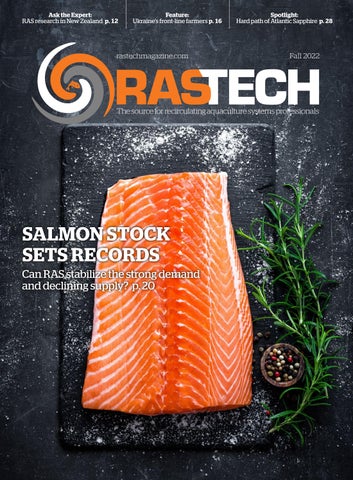

SALMON STOCK SETS RECORDS
Can RAS stabilize the strong demand and declining supply? p. 20


COLUMNS
10 | Power Struggle
How can RAS be truly sustainable?
12 | Ask the Expert RAS is key to New Zealand’s blue economy
Growing RAS in Chile
LYNN FANTOM
BY CHRISTIAN PÉREZ MALLEA
JEAN KO DIN

From the editor
By Jean Ko Din
It’s a global affair
As an international magazine for the recirculating aquaculture industry, we carry a sense of responsibility to look beyond the big players and find new places where this technology is transforming the region’s aquaculture industry.
It can be a challenge for me, as an editor, to look for RAS in places we’ve never written about before. Although we are so lucky to have writers contribute from all around the world, there are still corners that we have yet to crack. But in this issue, we attempt to do just that.
We have a global scope for this issue, starting with the cover story. We look at RAS technology as a solution for the fluctuating market for salmon. When world economies are rattled by supply shortages and natural ecosystems are disrupted by climate change, RAS could be a solution to stabilizing an unsettled food production industry.
The story talks to RAS producers in the United States but the industry knows that the innovation and leadership of these companies could have global industry implications. RAS industry professionals will care about how these big players ride through an unpaved landscape.
Speaking of world economies and supply shortages, we also had to look deeper into Ukraine’s aquaculture industry. In the midst of war, the farmers are unsung heores. The country is challenged to feed its population, let alone its fish. But as the world has learned quickly this year, Ukrainians are a perservering people; determined to preserve their way of life. I know I am not the only one who is inspired
by the sense of responsibility RAS farmers have embraced in a time of such turmoil.
Another corner that we get to explore in this issue is New Zealand. A senior aquaculture technician from the Cawthron Institute gives us a behind-the-scenes look to this science organization’s research facility. RAS technology in a research application has to be resilient, adaptable and reliable. When conducting trials and experiments, these systems are also tested.
Chile knows this well, too. In an effort to expand from its Atlantic salmon and mussels industry, the federal government has been funding several research and development programs to pursue other species in RAS. Universities, research centres and industry leaders are all working together to find new commercial pursuits. This world leader in salmon production could soon position itself as a world leader for more species.
I hope to do more issues like this in the future, where we can show you the different ways that the power of RAS can be harnessed. I want to take the international scope of this brand seriously and find new places that the industry can learn from. If I am to take a page out of Atlantic Sapphire CEO Johan Andreassen’s handbook, I have to take the challenge on boldly. I want to find more stories in Africa, South Asia, the Middle East, the Artic and wherever else we haven’t explored.
Maybe I also look to you, the readers, to reveal corners of the RAS industry that I’ve never looked at deeply before. My inbox continues to remain open, so if you have stories that you want to see told in RAStech Magazine’s pages, please email me at jkodin@annexbusinessmedia.com.
www.rastechmagazine.com
Reader Service
Print and digital subscription inquiries or changes, please contact Angelita Potal, Audience Development Manager Tel: 416-510-5113
Email: apotal@annexbusinessmedia.com
Mail: 111 Gordon Baker Rd., Suite 400, Toronto, ON M2H 3R1
Editor Jean Ko Din 437-990-1107 jkodin@annexbusinessmedia.com
Associate Publisher Jeremy Thain 250-474-3982 jthain@annexbusinessmedia.com
Account Manager Morgen Balch 519-429-5183 mbalch@annexbusinessmedia.com
Group Publisher Todd Humber thumber@annexbusinessmedia.com
Audience Manager Urszula Grzyb 416- 510-5180 ugrzyb@annexbusinessmedia.com
COO Scott Jamieson sjamieson@annexbusinessmedia.com
Printed in Canada
SUBSCRIPTION
RAStech is published as a supplement to Hatchery International and Aquaculture North America.
Occasionally, RAStech will mail information on behalf of industry related groups whose products and services we believe may be of interest to you. If you prefer not to receive this information, please contact our circulation department in any of the four ways listed above.
Annex Privacy Office privacy@annexbusinessmedia.com Tel: 800.668.2374
No part of the editorial content of this publication may be reprinted without the publisher’s written permission © 2022 Annex Business Media. All rights reserved. Opinions expressed in this magazine are not necessarily those of the editor or the publisher. No liability is assumed for errors or omissions.
All advertising is subject to the publisher’s approval. Such approval does not imply any endorsement of the products or services advertised. Publisher reserves the right to refuse advertising that does not meet the standards of the publication.
Made possible with the support of


Blue Star Foods to build soft-shell crab RAS
Blue Star Foods Corp. has selected HTH Engineering & Equipment LLC as its recirculating aquaculture systems (RAS) technology provider for its soft-shell Atlantic crab RAS farm.
The farm will be located in Jasper County, South Carolina and is planned to have an annual capacity of “220,000 dozens a year” of soft-shell Atlantic blue crab. The new facility will replace the existing operational facility in Beaufort County, South Carolina.
“Our existing footprint in Beaufort County has worked for the initial stage of our soft-shell crab RAS business, but it won’t work for us much longer, as we anticipate rapidly expanding this business unit,” said Rodrigo Mezerhane, senior project manager at Blue Star Foods.
Kingfish Company obtains federal permit for Maine facility
The Kingfish Company has received a federal permit from the United States Army Corp. of Engineers for the company’s planned recirculating aquaculture system (RAS) facility in Jonesport, Maine.
The federal permit is needed for the operation to push through. The approval from the U.S. Army Corp. of Engineers follows the state approval Kingfish received last year from the State of Maine.
Kingfish said it is in the final stage of the design phase for what will be the company’s first land-based, fish production facility in the U.S.
Contractor selection is now underway, according to a press release from the company.
Last month, more than 2,000 fingerlings were transported from the Netherlands to the company’s new hatchery facility in Franklin, Maine.


Salmon Evolution launches North American expansion
Norwegian salmon land-based farmer, Salmon Evolution is gunning for a production target of 100,000 tons by 2032 and part of that plan involves expanding its operation in North America.
The company said it has put together a special team made up of both in-house and external experts who will carryout the evaluation of identified potential sites. The site selection process and initial site verification will be conducted throughout 2022.

Salmon Evolution also said that it will establish a U.S. corporate structure under its full ownership.
“Although starting in Norway, Salmon Evolution has always had global ambitions. With the addition of North America into our portfolio, we will have an operating platform on all the three major salmon consuming continents,” said Håkon André Berg, chief executive officer of Salmon Evolution.
A press release from the Salmon Evolution said the company
expects pre-construction phase in the US, including regulatory approval process, will take two to three years.
Under this timeline, construction on the company’s North American site could commence sometime in 2025.
The facility will be patterned after the company’s recirculating aquaculture system (RAS) facility in Indre Harøy, Norway.
“The plan is to build a full scale 31,500 tons HOG ‘Indre Harøy’ facility, drawing on the experiences learned in both Norway and Korea,” the press release said.
“Over the coming 12 months we expect to demonstrate the operational viability of our concept, solidifying Salmon Evolution’s global leadership position within the land-based salmon farming industry,” said Berg.
“Given the long lead times for this industry, we see it as critical for our long-term value creation to build and develop a tangible pipeline of high-quality projects.”
Blue Star Foods Corp. subsidiaries include Taste of BC Aquafarms Inc., Sigma International, John Keeler & Co.
The Kingfish Company’s U.S. facility in Jonesport, Maine.
AquaBioTech is now RAS supplier for Viking Aqua
Viking Aqua AS has contracted AquaBioTech Group of Malta to provide the recirculating aquaculture system (RAS) equipment for the Norwegian landbased salmon farmer’s planned facility in Skipavika, Gulen, Norway.
Viking Aqua aims to leverage partnerships, technology and sustainability strategies to build the “next generation RAS for Atlantic salmon,” according to the company.
Recently, the company also partnered with Magne Hope AS, a local contractor with over 50 years of experience to undertake the groundwork in building the Skipavika facility.
Over the past two years, work has been carried out on blasting and leveling the ground on the 20- acre site of where

the land-based facility will be built, according to Viking Aqua.
The first construction phase is expected to start between the first and second quarters of 2023. The plant is designed for 33,000 tons of biomass at full production, of which 5,600 tons as post-smolt and 27,400 as food fish. Full production is estimated to take place in 2028.

Viking Aqua also signed a partnership agreement with Framo AS. Framo will develop a new and unique pump and water flow technology for the land-based fish farm.
“Viking Aqua has clustered a very strong group of companies with the collective aim of achieving significant breakthroughs in marine RAS development that seek to significantly lower the energy requirement and overall production cost, whilst achieving the highest levels of sustainability and fish welfare standards.,” said Shane A. Hunter, CEO of AquaBioTech Group . “All these objectives will be achieved by utilising the very latest technology, and a number of cutting-edge innovations in smartRAS.”
Girl Power!
Go for all-female populations to reduce maturation and optimize your production output
Check out our product range SalmoRAS4+ and SalmoRAS4+IPN, optimized for full-cycle salmon farming in land-based RAS-system. Both products have All-female (only female populations) as standard and are highly selected for strong growth. Triploid is an additional optional treatment that makes the females sterile, resulting in zero maturation. That is what we call Girl Power!
Find out more at bmkgenetics.com/products/salmoras4 or contact:

Harry
Tziouvas
RAS Sales Manager
+44 (0) 782 337 4568 harry.tziouvas@bmkgenetics.com
Nordic Aquafarms appoints interim CEO
Nordic Aquafarms has tapped its chief financial officer, Brenda Chandler, to be the company’s interim chief executive.
Chandler will split her time between Nordic Aquafarm’s Humboldt, Calif. facility and the corporate office in Portland, Maine. She has served as chief financial officer since March 2019.
This appointment follows after founder and CEO Erik Heim and his wife, Marianne Naess, stepped down from the company. Naess served as executive vice president commercial of the U.S.-based salmon RAS company.
“I am confident that we are only in early beginnings, as far as the potential for aquaculture in the U.S.,” Heim wrote on LinkedIn July 2.
“But there are also challenges to address and much more work left to make that a reality. Therefore, my commitment to furthering food security and industry enablement in the U.S. will continue.”
Heim assured that he and Naess have plans to remain active in the U.S. aquaculture industry, but for now, “summer vacation is now on the menu” for them both.
Nordic Aquafarms has plans for two RAS facilities in Belfast, Maine and Humboldt, California with a combined 33,000 tonnes annual capacity. Neither project has yet to break ground.

UN FAO reports record high aquaculture growth
According to a recent report from the UN Food and Agriculture Organization (FAO), “significant growth” in aquaculture has driven global fisheries and aquaculture production to a record high as aquatic foods make an increasingly critical contribution to food security and nutrition in the 21st century.
The 2022 edition of the State of World Fisheries and Aquaculture (SOFIA) states the growth of aquaculture, particularly in Asia, lifted total production of fisheries and aquaculture to an all-time high of 214 million tonnes in 2020.
Production was 30 per cent higher in 2020 than the average in the 2000s and more than 60 per cent above the average in the 1990s. Record aquaculture output of 87.5 million tonnes of aquatic animals largely drove these outcomes.
As the sector continues to expand, FAO says more targeted changes are needed to achieve a more sustainable, inclusive and equitable fisheries and aquaculture sector.
‘’The growth of fisheries and aquaculture is vital in our efforts to end global hunger and malnutrition but further transformation is needed in the sector to address

the challenges,’’ said QU Dongyu, director general of FAO. Global consumption of aquatic foods (excluding algae) has increased at an average annual rate of 30 per cent since 1961, almost twice that of annual world population growth – reaching 20.2 kg per capita, more than double the consumption in the 1960s. Aquatic foods contribute about 17 per cent of the animal proteins consumed in 2019, reaching 23 per cent in lower-middle-income countries and more than 50 per cent in parts of Asia and Africa. Asian countries were the source of 70 per cent of the world’s fisheries and aquaculture production of aquatic animals in 2020, followed by countries in the Americas, Europe, Africa and Oceania.

Ensure sustainable disinfection that meets the highest standards for your recirculating aquaculture system


Brenda Chandler
Mitsubishi partners with seafood firm in RAS salmon project
Japanese conglomerate Mitsubishi Corp. and seafood company
Maruha Nichiro Corporation are working together on a venture to develop a land-based, salmon production facility using recirculating aquaculture systems (RAS) technology in the coastal city of Toyoma, in Japan’s main island Honshu.
The aim of the project is to create a “local production for local consumption” business model in Japan’s salmon industry.
A recent agreement between the two corporations resulted in the creation of a joint venture company named ATLAND Corporation. The new company
aims to establish a presence in Nyuzen town of Toyama prefecture by October 2022.
The planned land-based aquaculture facility will have a capacity of 2,500 tons (live weight equivalent). Operations in the facility is expected to begin in 2025 and the facility’s first delivery will be in 2027.
Mitsubishi and Maruha Nichiro have been discussing the joint promotion of this project since March 2021. This project is expected to help develop a sustainable and stable land-based production system, efficient digital-tech-based operations, local production for local consumption, and progress in decarbonization.
PUMPS

According to ATLAND, its business model is expected to produce fewer greenhouse gas emissions compared to the practice of importing fresh salmon to Japan by air from salmon-farming countries.
The planned facility will use ground water originating from the Kurobe River and deep seawater from the Toyama Bay. Deep seawater is characterized by its cleanliness and low, stable temperature, which makes it possible to operate the facility by reducing the amount of energy required to create a water environment suitable for land-based production, the company said.


Masaru Ikemi, president CEO Maruha

Power Struggle
By Maddi Badiola
Maddi Badiola, PhD, PM, is a RAS engineer and co-founder of HTH Full Spectrum (fullspectrumaquaculture.com; HTHaqua.com) in Basque Country, Spain. Her expertise include energy conservation, lifecycle assessments and RAS global sustainability assessments. Email her at mbadiolamillate@gmail.com.
How can RAS be truly sustainable?
The United States’ CO2 emissions alone are projected to reach 4,807 million metric tons by 2050, a number high enough to get anyone worried, not only individuals, but major industry players.
However, let’s be realistic. Making our lifestyles more sustainable implies efforts and advanced economical investments to later obtain benefits. It is like installing solar panels in our houses. The initial investment is high but in the mid to long term, economic and environmental benefits compensate it. Thus, why is sustainable technology good for each business and thereafter, better for the industry? Because it makes a difference with others, because it keeps business competitive while helping the environment, remaining compliant with standards, and reducing risk.
When using renewable and biodegradable materials, we are indirectly protecting the ecosystem (and our business) from the negative effects of climate change. Nowadays, many businesses make use of sustainability to improve production and innovation, making it desirable for investors.
So, is Recirculating Aquaculture System (RAS) a truly sustainable technology? Funny that currently I am asking myself such a question. Since I began my aquaculture career around 13 years ago, this technological system has

been described as the most sustainable, green food production system. RAS require less water, has higher yield per square foot, limited water discharges (with even better water quality than the incoming water), and it is usually located near the consumers and thus, able to decrease the transportation impacts.
These are some of the reasons and claims that the industry is making, but are we truly seeing this in the industry’s execution?
That RAS reduces negative environmental impacts in comparison with other technologies is well-known and has been proven. Waste generated by cow or pig production, for example, cannot compare with on-land fish production. There is also the difference in feed requirements. Fish feed conversion ratios can be exceptional in comparison to other protein feed conversion ratios.
What about replacement of
non-renewable resources and energy usage? Is this technology substituting resources and efficiently using them? I am afraid that the answer is no.
The importance of energy sources is a topic of conversation that will continue over the next decades. We are beginning to realize the value of utilizing technologies to promote sustainable energy development, as opposed to obtaining energy from sources that do not naturally regenerate.
The global crisis that we all are suffering is mainly due to power. Which one? The one coming from ambition, money, having more than your opponent, creating the ones with less your slaves, you being the one controlling the situation, the planet. And ironically, this is played with just one card, the other power, the one we need to run our houses, our cars, our businesses. Saying this, could we
say that the planet is run (from all perspectives) by energy? Could we change the world by changing our energy? In this case, the answer is yes.
The RAS industry has the potential to be the Tesla or the Ferrari or the Audi of the food production, but we still need to learn how to drive it. We have in our hands the opportunity to make a change. With a relatively new industry (in comparison with others), the horizon is bright and promising. From a young woman’s industry-passionate eyes, I see it as feasible. Do you?
Spend less and gain more, stay competitive in the market, make profit while helping the planet. Energy is neither generated nor destroyed, it is transformed. As we are modifying our way of living, let’s make a change in such transformation. And do not forget, farmed is the way, RAS the technology.
The RAS industry has in its hands the opportunity to make a change in how it consumes energy.

EWOS TRANSFER CLEAR
Utilizing years of research from our R&D centers along with proof of performance from customers worldwide, EWOS now offers revolutionary RAS hatchery transfer feeds that address water quality, biofilter efficiency, and most importantly, performance.

Ask the Expert
By Gareth Nicholson
RAS is key to New Zealand’s blue economy
Cawthron Institute is New Zealand’s largest independent science organisation. It focuses on world-class science aimed at restoring and protecting the environment and supporting the sustainable development of New Zealand’s blue economy.
The Cawthron Aquaculture Park is situated just outside of Nelson, and acts as a research and technology hub for the aquaculture sector. The Park houses multiple research laboratories and culture systems including micro and macro algae culture facilities, shellfish nurseries, commercial shellfish hatcheries and several recirculating aquaculture systems (RAS) geared toward finfish research.
In 2014, a collaboration between the Cawthron Institute and the New Zealand salmon farming industry was initiated to further understand the largely understudied king salmon and assist with industry advancement.
Chinook or king salmon ( Oncorhynchus tschawytscha ) is currently the only finfish species farmed commercially in New Zealand. The salmon farming industry is comprised of several hatcheries, sea pen farms and freshwater grow out farms, all based in the South Island.
Although small in global

terms, the industry produces more king salmon than anywhere else in the world, and is home to the world’s only freshwater farmed king salmon. These unique industry attributes mean that global research and industry advancement is not always transferable, particularly due to its focus on Atlantic salmon.
The collaboration led to the construction of Cawthron’s first finfish RAS, containing nine 5,000-litre tanks, designed to conduct feed trials and growth performance research. Following the success of this project, the Finfish Research Centre (FRC) was opened in 2018 which houses six additional recirculating systems, designed with research in mind.
The two main FRC trial rooms house eighteen 8,000-litre tanks which can be isolated as four different RAS systems or combined as a single research system. A separate room houses nine
3,000-litre tanks which can be combined or separated into two recirculating systems.
Cawthron’s systems were designed and constructed with the assistance of Australian-based Fresh by Design. Standard RAS technologies that are incorporated into all systems include: Faivre drum filters, RK2 protein fractionators, UltraAqua UV units, customized moving bed bioreactors, degassing columns, oxygen cones and heat pumps capable of maintaining temperatures of from 7 C to 27 C.
Ozone units supply the fractionators and dosing capabilities include pH and oxygen systems. To allow flexibility and to ensure that water quality parameters are maintained to research standards, technology components in these systems have been intentionally oversized. Each system’s volume can be turned over every 25 minutes and filtration components
can handle feed rates of three per cent body weight per day at a biomass of up to 35 kg/ m3.
Culture tanks incorporate a dual drain system and tank side swirl separators for uneaten pellet collection. Uneaten feed recovery allows us to calculate feed conversion data based on what has been consumed rather than what has been fed. This provides valuable insight into overall performance data and biological FCR potential.
What really sets these systems apart is the level of monitoring and control which they incorporate. To conduct word-class aquaculture research, system parameters need to be accurately maintained to fine margins and water chemistry needs to be consistent across all culture units.
OxyGuard probes are installed inline to monitor the return water conditions in each system. Temperature, pH, dissolved oxygen, oxida -
Gareth Nicholson is the senior aquaculutre technician specializing in finfish research at Cawthron Institute in Nelson, New Zealand. The institute (www.cawthron.org.nz) is an independent science organization conducting research in sustainable development.
Aerial view of the Cawthron Institute in Nelson, New Zealand.


tion reduction potential and salinity are monitored through system probes. Data is fed back to a programmable control (PLC) and monitoring system which logs data and allows for parameter adjustment using setpoints and dosing systems. System temperatures
can consistently be maintained within 0.1 C of a setpoint if required.
In individual culture tanks, dissolved oxygen levels are monitored and controlled to account for tank-based differences in oxygen demand. Tank flow rates and current velocity can be ma -
nipulated manually and monitored. Tank room photo period and light intensity is also controlled through the PLC.
A world-class supervisory control and data acquisition system (SCADA) has been developed in-house, allowing us to access real-time or historical system data and adjust remotely. This system also provides alarm capabilities which are linked to all monitored parameters and RAS equipment.
To date, valuable research has been performed using the Cawthron finfish systems that continues to play a key a role in advancing our knowledge of king salmon and its performance in an aquaculture environment. Baseline knowledge has been established about its physiology, health, feeding regimes, feed efficiency and dietary requirements through all life stages, rearing salmon from smolt to harvest size under research conditions.

The tank room at Cawthron Institute’s Finfish Research Centre.
Farm diets have been further optimised for fish performance while improving product quality and feed sustainability. Significant research effort has been focused on understanding the feed efficiency of king salmon in terms of behaviour and performance under different culture conditions.
For instance, how does salmon feed efficiency respond to changes in temperature, salinity, current velocity, with different feeding regimes and feed out practises and at different stages of the growth period or life cycle?
We have also developed a good understanding around which factors affecting efficiency can be genetically attributed or could be altered with improved farming practises.
Cawthron’s finfish systems have highlighted the benefits and reliability of using RAS for aquaculture research. Some of the more important of these being the ability to accurately maintain
system parameters over longer periods of time and expose tanks in the same research systems to different parameters without adversely impacting trial outcomes.
We have successfully run long-term trials, through all ambient seasonal fluctuations without compromising trial parameters, and we have run performance analysis trials using four different temperatures simultaneously, without incurring system effects.
Challenge trials have also been possible on single research systems, testing the exposure limits of king salmon to different temperatures and dissolved oxygen levels. Most recently, we have intentionally introduced potentially harmful biofouling organisms into some culture tanks without affecting others in the same tank room. These studies and levels of control are simply not possible in open or flowthrough research systems.
Along with research benefits, these systems have provided a vital resource in the education and training of many staff and students in the operation of advanced aquaculture systems, and the animal husbandry techniques that are associated with them. These skills are fed directly into the aquaculture industry and are important for growth.
Industry involvement with these systems has allowed aquaculture companies to experience some of the benefits associated with RAS first hand. With a better understanding of the value of these systems, we are beginning to see some of New Zealand’s major salmon production companies look towards RAS as an opportunity for future development and incorporation into current production strategies. With the industry facing growing pressure from environmental variability, future growth in RAS development is expected in New Zealand.


Ukraine’s front-line farmers
Ukrainian aquaculture industry soldiers on as supply disruptions
continue.
By Colin Ley
The war in Ukraine is having a massive impact on the country’s fish farmers with some producers suffering losses running into tens of millions of hryvnias, Ukraine’s currency.
Since the Russian invasion on Feb. 24, the national Methodological and Technological Centre for Aquaculture (MTCA) has gathered information from about 71 fish farms, revealing that 14 production units have been directly affected by the hostilities, mostly in the north and south of Ukraine. While damage levels range from hundreds of thousands to tens of millions of hryvnias across the worst-affected farms, MTCA says that everyone is suffering, primarily due to problems with logistics and a very strong decline in sales.
The most damaged farms (which cover a wide area) are located in the Kharkiv, Donetsk, Luhansk, Mykolaiv, Zaporizhzhya, and Kherson regions, plus the Autonomous Republic of Crimea. Although it has only been possible for MTCA to assess conditions on the 71 farms already contacted, the Centre says there are hundreds of other farms in relatively safer re-
gions for which no live data is available.
MTCA said it was confident that supplies are reaching units but that it wasn’t clear what level of the volumes are arriving.
“Even where supplies are available, however, quality feed is very expensive and most of our aquaculture subjects do not have the financial means to purchase what they need in sufficient quantities,” the MTCA told RAStech Magazine
Farming in wartime
According to Ukrainian Catfish farmer, Oleksandr Novokhatko, managing director of Catfish from Pavlysh (CFP), feed supplies are a long-standing issue in Ukraine.
“Even before the war, foreign feed of good quality was rather expensive and now our industry is faced with the situation where some of our colleagues are having to stop production because of feed issues,” he said, adding that feed was an issue for his own recirculating aquaculture system (RAS) farm.
Novokhatko and his business partner, Artur Cherepanov, started farming in
2016, working initially with two small tanks in an old Soviet building in Pavlysh village. Describing themselves as a couple of “aquaculture lovers” during the early years of their venture, they progressed in 2019 with the launch of CFP, a business which now extends to more than 20 tanks and supports an annual output of about 100 tons of catfish. They also produce freshwater shrimp (Macrobrachium rosenbergii), tilapia and crayfish.
Asked how much the war is damaging fish farming in Ukraine, Novokhatko said internal trading routes had certainly become complicated.
“Since February, our sales have decreased while the cost of production and delivery, if it is possible at all, have increased,” he said. “In addition, we have a major fuel crisis in Ukraine. The Russians have bombed a lot of our oil storage and refinery locations. Another problem is that, prior to the war, we received fuel from Belarus by pipes. Now, we are having to create new routes of fuel delivery from the EU. As a result, prices have increased by at least twice.”
As for longer-term prospects for Ukrainian fish farming, Novokhatko said there
Omel’nychek River runs beside the small village of Pavlysh, Ukraine where catfish RAS farmer, Oleksandr Novokhatko, is struggling with access to quality feed supply.
were so many issues to consider that it was hard to forecast the future, certainly while the war was still raging.
“The EU, USA, Canada, and others say they will help our country to recover,” he said. “We really hope to win the war soon, of course, but it is impossible to predict how much fish farming in Ukraine will be affected until this is all over, and we see what kind of assistance we receive.”
The international community is seeking to provide help. The Norwegian-Ukraine Chamber of Commerce, for example, has already sent NOK 1.6 million (about US$156,000) to support businesses in Ukraine, including fish farmers. The big challenge now, however, is to ensure this money reaches the businesses that need it.
“The Ukrainian government has told us that some grants will be available soon. At present, however, we don’t know the details of their program or how it will be implemented,” said Novokhatko. “The market here has really good growth potential but the aquaculture industry in our country was always suffering from an
absence of money and governmental support. Our company always had a lot of development ideas, for example. Our main problem was the lack of financial assets,” he added.
In the same context, the message from MTCA to international agencies is that the industry’s greatest needs are assistance with fish feed, promotion, and sales. The Centre also urged foreign investors to become involved in Ukraine’s fish farming future, adding that many farms were ready to expand as soon as the opportunity arrives.
International support
Several support plans have been, or are being, put in place to help Ukrainian fish farmers survive the economic impact of the war. One of the first to offer support was Sjømat Norges (Seafood Norway) who announced a member-driven relief effort on March 1, just days after the Russian invasion.
“Many in the Norwegian seafood industry have a close and long-standing collab -

oration with Ukrainian customers and have a strong desire to lend a hand in this critical situation,” said Sjømat Norges, who represent both aquaculture and fishing companies in Norway.
Responding to member demands for an “organised humanitarian relief effort,” Sjømat Norges has subsequently collaborated its response with the Norwegian-Ukrainian Chamber of Commerce (NUUC), of which it was already a member.
The Sjømat Norges board made an initial contribution of NOK 50,000 (US$4,900) while encouraging seafood companies, industry employees, banks, law firms, and all its partners to also contribute.
NUUC also took action, promising “quick and effective support on the ground in Ukraine,” while using its extensive network in Ukraine to help as efficiently as possible across a number of areas of relief and assistance. More recently, NUCC revealed that its fundraising efforts have so far enabled NOK 1.6 million (about

US$157,000) to be donated to Ukrainian organisations, providing “crucial aid to the people of Kyiv, Kharkiv, Odesa, Sumy, and Mykolayiv, to name but a few.”
“All donated funds are sent, in total, to initiatives on the ground in Ukraine,” said NUCC, who are providing their services on an entirely cost-free basis.
Egersund Seafood Ukraine, a Ukrainian company co-owned by NUCC member company Pelagia, is using its seafood shops, restaurants, and kitchens in Kyiv and Lviv to provide help and support to many people.
“When the war started, the company
began its humanitarian efforts by deliveringfree-of-charge food to soldiers, hospitals, and orphanages,” said NUUC. “Food was also sent from border countries, as well as from Norway. Egersund Seafood is now returning to business as usual.”
Renew Europe plan
On a broader geographic basis, Renew Europe, a pro-European and centrist political group in the European parliament, unveiled its own Food Security Plan on July 6. Enshrined in a 15 program proposals, the plan seeks to address the pressure on Ukrainian farmers who are unable to
move livestock to their normal markets or to clear grain stores of last year’s crops. It also seeks to alleviate problems caused in many countries that have depended on Ukrainian supplies for feed and fertilisers.
A core part of the plan (presented by MEP Dacian Ciolo, chair of Renew Europe’s task force on food security) deals with problems in logistics and transportation, the further facilitation of transportation and storage of the Ukrainian products, and the need to address obstacles to agricultural exports.
“These include the refusal of insurance companies to cover transport risks,” said Ciolo. “The need to reduce administrative burden with phytosanitary checks for the products and live animals in transit, and the need to create ‘green corridors’ for the transport of Ukrainian agri-food products.”


Innovation Beyond Measure

When asked how Ukrainian aquaculture might benefit from the plan, Ciolos replied that he didn’t have any specific information on how fish farming was being affected. He did stress, however, that rising input costs would be affecting the fish sector in Ukraine and that financial support would be necessary to deal with the current crisis. He also said that aquaculture has a major role to play globally in addressing food security concerns.
The Renew Action Plan was therefore an efficient, effective and timely response to today’s crisis. For example, by tackling legal barriers to allow the use of organic fertilisers and alternative plant protection products, but also by accelerating the production of protein for animal and fish feed by using innovative techniques.
“This will reduce dependence on Russian gas and fertilisers, and provide alternative options for farmers,” said Ciolos. “We suggest therefore the opening ‘green lanes’ for cereals, simplifying administration for goods in transit and increasing border crossings to facilitate and speed up the export of Ukrainian grains. These are practical solutions that require political will in order to be put in place.”
With the Renew Europe plan marking the organisation’s final press conference before the EU’s annual summer shutdown, however, the closing words “see you in September will not have sounded particularly encouraging to farmers in Ukraine for whom the next six weeks will be anything but a holiday.
Robot Feeder ArvoPRO Cloud Single Feeder

We supply complete piping systems for land-based aquaculture, from design to installation.
SIMONA Stadpipe offers services from the ’post-it note’ phase to completion, and monitors projects from the initial idea to production and the installation of the system at site.


Salmon stock sets records
Strong demand and declining supply have driven up prices, but can RAS stabilize the market — and when?
By Lynn Fantom
The joke about the price of seafood goes like this. A man in a restaurant looks up from his menu and asks the waiter: “The fish — will it be the market price at the time of ordering, the time of eating, or the time of paying?”
Inflation-sensitive salmon lovers may smirk as they read this. Salmon producers themselves may be all smiles after some record-setting prices, but they also know that rising production costs are no joke. These complex sentiments, both negative and positive, reflect the volatile dynamics of pricing and profitability that have characterized global
salmon markets this year. What everyone seems to agree on though, is the need for new technologies, like recirculating aquaculture (RAS), to increase a reliable, predictable supply of Atlantic salmon.
Weakening supply
Prices for farmed salmon hit 40-year highs in early 2022, according to the Food and Agriculture Organization of the United Nations (FAO), with undersupply as a key contributing factor. Production volumes for the first quarter showed supply contracted seven per cent year over year, and Kontali Analyse forecast that global supply would be negative one per cent for the full year, accord-
ing to Mowi’s first quarter earnings report.
Problems for sea farmers worldwide have suppressed supply: algae blooms in Chile, dissolved oxygen drops in Canada, and biological issues like gill health in Scotland. Researchers have also found that treatments for sea lice, particularly non-medicinal ones such as thermal delousing, contribute to mortality.
“The biggest reason why the conventional industry is not growing more is not because there isn’t high enough demand or high enough prices to justify investments. It’s because of biological issues and constraints in farming and in nature,” says Karl Øystein Øyehaug of RAS pioneer At-

lantic Sapphire. “And this is what farming in a RAS system solves. We create the perfect environment without having any negative impacts, either on the fish or on environment around us.”
Alongside the challenges tamping down supply, certain “mega-trends” are driving up demand, according to DNB Seafood. In developed markets, a more educated population is eating healthier, especially as people age. In emerging markets, a growing middle class is demanding more protein, which better


retail grocers are supplying.
“We are very lucky to be salmon producers in the U.S. today because there’s a huge increase in demand for the product,” continues Øyehaug of Atlantic Sapphire which chose Homestead, Fl. for its landbased “Bluehouses.” “If you look at the consumption last year, it increased by, I believe, close to 80,000 tons. To put that into perspective, our whole Phase 1, which we’re currently operating in, is around 10,000 tons.”
Persistent demand
Salmon occupies “a uniquely resilient market segment” in aquaculture because its markets, products, and sales channels
are so diverse, states the FAO, pointing to consumer behaviour during Covid. When establishments in the hotel, restaurant, and catering channel, sometimes known as HORECA, closed almost overnight, consumers turned to retail and then online chefs to perfect preparing salmon at home.
“But what we’re observing now actually is that, as HORECA is opening up and regaining those volumes, the retail volumes seem to be remaining at a sticky level—boosting demand even further post-Covid, which is quite interesting,” says Erik Tveteraas of NuFrontiers, Nutreco’s corporate venture arm.
But, as inflation now pressures these
same consumers and fears of recession loom, will demand drop? Dag Sletmo of DNB, Norway’s largest financial services group, doesn’t think so. “If you look at it the last 15 years, there’s been no correlation between, say, economic growth in Europe and salmon price,” he says, adding that during inflationary periods, people in rich countries might not buy a new car, but they don’t trade down so much in what they eat.
Faltering supply and strong demand may explain why salmon prices are rising, but not how high the jump was in 2022. For that, Sletmo points to the war in Ukraine.
The Anderson Agflation Index, which was at 10 per cent before the invasion in February, surged to nearly 30 per cent in March 2022 versus March 2021. This index reflects prices for commodities such as fuel, fertilizer, and feed—the largest variable cost in salmon farming.
Projections are that agflation is likely to remain high for the rest of 2022—at least.
AquaBounty’s advantage
That’s keeping salmon producers like Sylvia Wulf, CEO of AquaBounty, keenly focused on the costs of operating a RAS facility — which are substantially different from those of ocean farmers. She ticks off line items on the company’s profit and loss statement faster than most people recite their kids’ names.
“When we look at the variable cost to raise salmon to harvest weight, feed is obviously the largest percentage of the variable costs, closely followed by energy. Though we haven’t seen dramatic increases in energy costs, we’re watching that very carefully. Oxygen is another


AquaBounty CEO Sylvia Wulf said higher prices are helping offset higher operational costs.

component of variable cost and that been affected by rising transportation costs,” Wulf says, adding that supply chain pressures have also driven up packaging costs.
But revenue is also up for AquaBounty, which sells on a week-to-week basis, negotiating off of salmon market commodity prices. Higher prices are helping to offset some higher feed and packaging costs, Wulf notes.
AquaBounty, which currently harvests salmon at RAS facilities in Indiana and Prince Edward Island in Canada, continues to receive orders for the entire output of its farms. Though that production is still low (133 tons), it grew 46 per cent in the first quarter versus the previous quarter. Wulf is now deep in pre-construction planning for a new Ohio facility, which will produce 10,000 metric tons. The company is on track to stock salmon eggs in late 2023.
In an inflationary environment, AquaBounty stands to benefit from its genetically-engineered Atlantic salmon: it needs 25 per cent less feed to produce the same harvest weight, according to the company’s website.
Atlantic Sapphire signals price increase
U.S. consumers have been buying Atlantic Sapphire’s Bluehouse salmon since September of 2020, with products now in over 2,000 grocery locations at chains, mostly in the Southeast.
“We’ve actually been selling our premium fish at a very consistent level since we started the harvest,” says Øyehaug. As a typical retail example, he cites US$15 per pound for Bluehouse salmon versus $7 to $13 for what he calls “commodity salmon.”
But now that difference has narrowed and Øyehaug, who serves as Atlantic Sapphire’s chief financing officer and managing director, anticipates a price increase for Bluehouse salmon.
“In the high-inflation environment we’re in, where basically all food is more expensive due to the fact that producing the food is more expensive, we also expect our price achievement will come up by year end,” he says. In addition to increased production costs for feed, power, and labour, he says the company’s budget for capital expenditures is also “under pressure” due to increasing construction costs.
More infrastructure, higher volumes
At both Atlantic Sapphire and AquaBounty, the focus is on increasing production.
“We expect to have a fully stocked farm toward the end of the third quarter, which means in Q4, we should be at full production—and black numbers,” says Øyehaug. “I can say with certainty that every single dollar that Atlantic Sapphire is going to make in the next three years is going to be reinvested into more growth.”
And this resolve does not waver as he acknowledges the production setbacks that Atlantic Sapphire has experienced along the way. “For any salmon farmer, there are always risks of losing fish,” he says. “But the job is to minimize the frequency of events and the consequences.”
To achieve the growth that will fortify global supply, Tveteraas at NuFrontiers also suggests that RAS players take a cue from conventional farmers and share best practices. “It’s one of the things that made the Norwegian aquaculture sector so successful in the first place,” he says. “I think that will benefit the sector as a whole, as opposed to each and every RAS operator guarding best practices as if it’s the Holy Grail.”
During the last three years, NuFrontiers has invested in RAS projects worldwide, including China, Japan, and the US.
While other investors may be waiting for RAS producers to achieve higher volumes, the compelling opportunity now is that the imbalance between supply and demand has only increased over time. That’s likely to continue.
“I would be doubtful to see conventional supply globally go anywhere above two per cent,” says Tveteraas.
“The general view is that demand growth may be, say, five per cent per year. Supply will grow more slowly than demand — at least not faster. And it looks like this will be the situation for the next decade,” says DNB’s Sletmo.
“It is a very robust market and that’s why the prices are so high. And that’s also why the reward for starting a RAS operation will be so high — if people succeed in doing it at a reasonable cost level and in big volumes.”
Salmon prices experienced 40-year highs in early 2022, according to UN FAO data.

It’s like when your kids leave home.
You want to make sure they have been prepared with the skills and tools they need to thrive in the big wide world. That’s how we feel about your fry. Early nutrition is essential for life performance. Skretting’s latest diet for trout ensures that your fry receive optimal nutrition in the early stages to prime for faster growth and better yield, while taking care of your farming system.
Nutra Sprint for trout - setting your fish up for life

Growing RAS in Chile
As a world leader in salmon production, Chile has devised a national plan that gives RAS a decisive role.
By Christian Pérez Mallea
For the past 15 years, the Chilean government has supported the research and development of five aquaculture species. Its aim is to close their life cycles, solve technological barriers and scale-up production.
Chile leads as the second largest producer and exporter of salmon in the world. According to the Chilean Salmon Council, it has exported US$5.2 billion in salmon exports last year. The country’s salmon industry continues to grow strong, but it hadn’t always been the case.
In 2009, a couple of years after the ISA virus decimated most Chilean salmon farms, the government decided not to rely on salmon and mussels as Chile’s only farmed fish species at large-scale.
At first, the country financed R&D programs for four species: Chilean seabass (Dissostichus eleginoides ), Chilean hake (Merluccius gayi gayi), corvina (Cilus gilberti ) and Yellowtail kingfish ( Seriola lalandi). In 2016, Red kingclip (Genypterus chilensis) was included in another publicly financed plan. Unlike salmon, all of these
are endemic species.
About US$35 million has been invested towards the country’s aquaculture diversification. Though the first two programs have since cancelled, the rest have reached significant progress and are currently in their final stages.
Yellowtail kingfish is achieving more progress, probably because that is the most valuable species in the market. However, corvina and Red kingclip seem poised to scale up and became development poles for the country’s economy.
As the country looks to expand its market to produce other species, recirculating aquaculture could be the key to expanding its seafood and aquaculture industry.
CORVINA
Fundación Chile is one of the main business incubators and pioneers of salmon farming in Chile. It is also behind the country’s corvina project in which fish are being reared until juveniles in its Aquaculture Centre Tongoy (CAT), located about 460 kilometres north from the capitol city of Santiago.
Franco Cerda, director at CAT, explains that without recirculating aquaculture systems (RAS) technology, they could not have achieved any progress on the project.
“With the current access limitations to new aquaculture licenses, we could not have done any of this. Besides, RAS technologies have allowed us to increase our production densities while maintaining stable farming conditions,” he said.
At the beginning of the project, only bio-blocks were used at the CAT facility. Subsequently, moving bed biofilters were also integrated due to their low demand of required land, according to Cerda.
Recirculation is used in all corvina’s productive stages, from conditioning of breeders to land-based grow-out. The grow-out stage occurs in sea cages some 1,300 kilometres further north, nearby the city of Iquique. The land-based plant has a nominal capacity to produce about eight tonnes per year. The seawater site has a capacity to produce 35 tonnes per year, but it is expected to increase up to 165 tonnes in early 2023.
“The main benefit of this technology is
Recirculating aquaculutre systems technology is at the centre of Chile’s research and development programs to grow its economy.
its high degree of environmental control with low impact on the environment, especially when it comes to the temperature requirements of this species,” he said.
The RAS technology used in the CAT is of their own manufacturing.
The corvina program is finishing the phase of closing technological gaps and starting to explore the commercial scaleup of the species.
“This program not only seeks to validate technology for sustainable corvina farming, but it also seeks to contribute to the creation of an industry, through the development of responsible aquaculture, while expanding the productive ecosystem in the northern Chilean regions and contributing with jobs and quality life for the surrounding communities,” Cerda said.
YELLOWTAIL KINGFISH
Located close to the city of Caldera, about 870 kilometres north from Santiago, Acuinor is the first Chilean company behind a land-based farming project of yellowtail kingfish. Funded in 2006, the firm expects
to produce around 19 tonnes of harvested biomass this year and increase those numbers up to 200 tonnes by 2023, after the construction of a new grow-out facility.
Muriel Teixido, commercial and projects manager at Acuinor, reveals that their complete production cycle is performed on land – from breeders, weaning, pre-fattening and even grow-out using their own RAS.
“The benefits are many, including savings of water, temperature, and chemicals, mainly related to basification for pH control. RAS also keeps the system much less exposed to external environmental factors and achieves total control of all parameters, providing greater stability to the whole system,” she said.
Teixido believes that her company could have theoretically farmed this species without RAS, in sea cages. However, under a very different production model.
“In Chile, mainly in winter, there are low temperatures. Therefore, growth during the months of May to September would have been very low while the pro-

1:20-2:00
2:00-2:30

duction cycle could have been extended from 16 to about 24 months, which would have required larger cages and land-based facilities to stock fish continuously every year,” she said.
Regarding the success achieved so far by the company, Teixido thinks this is mainly due to three factors: “It is a docile species, easy to handle and usually living in schools from its earliest stage until grow-out, so can be kept at high densities. It is a fast-growing species, so it is profitable to produce them under RAS. And it is a species with a good feed conversion rate and which eats in the entire water column. In short, it is a docile fish, easy to handle and resistant to stress,” she said.
AquaMaof Aquaculture Technologies is specialized in land-based RAS technology. It is currently supporting a Yellowtail kingfish project for the company, Atacama Yellowtail. In its first stage, the goal is to produce 900 tonnes of fish per year.
Roberto Tishler, director of sales at AquaMaof, explains that RAS is probably the most sustainable and successful way to


grow Yellowtail kingfish.
“With the correct RAS design and implementation, farmers can handle all the variables to provide and maintain the required optimal conditions (temperature, pH, salinity, photoperiod, etc.) to ensure an optimal growth environment for the fish,” he said.
“With a completely controlled system and strict biosecurity protocols, our RAS technology delivers a traceable, nutritious, antibiotic-free, fresh, and delicious fish, from farm to market, with the shortest supply chain. This mitigates risks and ensures constant production and premium product, leading to the desired return on investment.”
AquaMaof is working with Innosea, its local agents and partners in Chile, looking
to identify relevant stakeholders, including potential feed suppliers. “Chile is home to major suppliers with experience in different marine species, and they are on board with us in the project,” he said.
RED KINGCLIP
Located nearby the city of Coquimbo, about 460 kilometres north from Santiago, the company Colorado Chile produces Red kingclip in its seawater land-based facility. The project uses moving bed biofilters in all pre-juvenile stages. This firm uses its own RAS designs while receiving technical support from NIVA Norway and NIVA Chile, Aquamiks Italy and Vehice Chile.
The general manager at Colorado Chile, Piero Magnolfi comments that RAS is mainly used to rear a fish more suitable for

the pre-fattening/grow-out stage and with the maximum potential to successfully face stages of frequent handlings.
“Among other things, RAS allows the organism to function better in its ontogenic development, without any need for antibiotics while enhancing beneficial bacterial flora for its better nutritional and enzymatic condition. This also translates into substantial improvements in water quality and survival rate,” he said.
He believes Red kingclip manages very well in RAS modules at the first life stages due to its relatively low O2 requirements, reduced release of nitrogen waste and CO2, and high ability to adapt to high farming densities.
Magnolfi thinks that those life stages could have been reared without RAS, but at a very high and unstable cost, quality and risk. Pre-fattening and grow-out stages are performed in raceway systems with water reuse until harvest.
At this moment, this Red kingclip project is starting to scale up its production.
“We are currently doing a grow-out pilot that represents the design and size to be replicated when commercial scaling,” said Magnolfi.
This industrial pilot looks to harvest 20 tonnes in 2023, with fish weighing between 1.5 to 2.2 kilograms. This product would be used to carry out a market study in the domestic market.
“Meanwhile, the investment and commercial strategies are being evaluated to bring this model to a production of 1,000 tonnes per year, with projections of growth as the market allows it and safeguarding sustainability aspects as a priority,” he said.
Atacama Yellowtail is a new RAS project that is looking to produce 900 tonnes of Yellowtail kingfish per year at its first stage.


The hard path to innovation
By Jean Ko Din
Innovation is an elegant word for a process that takes grit and perseverance. As a veteran in the aquaculture industry, Johan Andreassen knows this concept well. But, even he could not predict the challenges that 2021 brought to Atlantic Sapphire.
Atlantic Sapphire is well-known in the industry for its ambitions to build the largest land-based salmon aquaculture facility in the world. The Danish-based company is working towards an annual capacity of 220,000 metric tons of Atlantic salmon by 2030.
But just after it completed Phase 1 construction of its Miami facility in January 2021, the company suffered a loss of 500 metric tons of biomass in March. The company blamed the loss on a “weakness” in its recirculating aquaculture system (RAS). A month later, the company dropped Billund Aquaculture as its main supplier for the second development of its Miami facility.
In August that same year, the company reported having difficulty obtaining oxygen for its fish tanks due to supply challenges from the pandemic. The company’s share prices plunged 33 per cent, removing about US$250 million off its market capitalization in one day.
Other major land-based farmers followed suit when six of the seven publicly-traded companies listed on the Oslo

Stock Exchange saw its share prices slide in 2021.
In September, the Danish facility experienced an early morning fire that destroyed its fish tanks. No staff were harmed in the incident. The company recently received DKK 180 million (US$25 million) in insurance settlements which will be re-allocated towards its ongoing Miami project.
Despite what he calls Altantic Sapphire’s “annus horibilis,” Andreassen remains bold in his ambitions for the com-
pany. In the latest episode of RAS Talk podcast, co-hosts Jean Ko Din and Brian Vinci sat down with the founder and chief executive to go behind the bad headlines and candidly share details of the his outlook for the company’s future.
RAS Talk: Being the first or being a pioneer for anything is not an easy road and Atlantic Sapphire knows this more than most. So in your own words, Johan, can you tell us about what took place last year in terms of the mass mortalities?
CEO Johan Andreassen talks through Atlantic Sapphire’s “annus horibilis”
Johan Andreassen, co-founder and chief executive officer of Atlantic Sapphire
Johan Andreassen: I think 2021 was an annus horibilis for our company where basically everything that could go wrong, went wrong. First of all, I think the first thing that happened last year was that we lost our chiller plant in the Miami facility. We had a farm full of around 3,000 tons of fish at the time. We hauled in external chillers, trailer chillers, from across America to hook that up to our heat exchangers across the facility. And I think it was quite a miracle that they were able to do that in due time, so that they we can keep the fish alive. So that was the first setback we had. Because of the disruptions related to that event, we had suboptimal conditions, right? Too high temperatures led to increased maturation of the fish.
So then talking about the mass mortalities, we had one large mortality event in March of last year. I was present myself. I’ve seen two or three of those myself from beginning to end, if you will. So it is a very, very sad sight to watch. And I think one of the things that is frustrating, is that you kind of feel you’re not able to do much about it once it starts.
So as a consequence of the first fish dying, we have had very extensive lessons learned and we have done a lot of modifications to our systems to reduce the risk of the root causes happening, but also to better be able to manage what I call the initial mortality.
So, we did some center drain modifications, so that we can have a few tons of dead fish in the tank and still keep the flow going. We have also split our RAS systems. So instead of having six tanks in one water body, we have we have three tanks in one. We have established internally what we call the Facilities Operation board, which basically means that every time we need to do something to our system that is not covered by a standard operating procedure, that board has to do a risk assessment of that activity to reduce the risk of these of these events.
RAS Talk: Emergency response is complicated, as you guys know. You have to have multiple redundancies in place. And it’s a lot different when you’re doing one or two fish tanks than if you have 600 tons of biomass on site and spread over six to 12 tanks. It’s a much more complex beast and I can surely empathize with you on that. We want to draw attention to some of the technical details of the Bluehouse Miami facility. What are the production capacities for Phase 1, Phase 2 and Phase 3?
Andreassen: The Phase 1 is an integrated facility from hatchery in the southeastern corner of the building, and until filet is actually in the southwestern part of the building. So it’s a fully integrated facility designed for approximately 9,500 tons of head-on-gutted weight of salmon a year at approximately three and a half to four kilos.
After the splitting of the grow-out systems that we have done, it actually has 17 independent RAS systems, so it’s basically multiple farms under one roof. And in the design, we also have additional capacity on the freshwater side, meaning that once we bring Phase 2 online – Phase 2 is an incremental
rastechmagazine.com
Commercial Filtration Systems
Customized for your fish farm, hatchery or research operation!
Our Commercial LSS Packages are custom engineered to meet your specific needs.
• Marine and Freshwater
• Mechanical filtration
• Chemical filtration
• Ultraviolet disinfection
• NEMA enclosed controls
• Bio-filter towers
• De-gassing towers

• Wide variety of flow rates
• Flow control valves
• Protein skimmers
• Variable frequency-drive pumps
• Temperature management
and


Your Partner for Ozone and Oxygen Systems


• In-house fabrication allows us to build custom or engineered packages for any size aquaculture application.
• We specialize in turn key solutions, certified to any required global standard.


15,000 tonnes head-on-gutted weight in another 12 RAS systems. So Phase 1 can supply all the smolts needed for Phase 2 as well, and the harvesting and fileting line can also handle the Phase 2 volumes, so a total of 25,000 tons.
As it relates to Phase 3, that is still on the drawing board. And we have not yet decided how big that’s going to be. It’s


purely up to us.
RAS Talk: What do you think is your biggest challenge in managing Phase 1 at that scale?
Andreassen: I think the team formation has been one of the biggest challenges. I mean, the construction process was
painful because we have we have built something at a scale that has never been done before in aquaculture, and we did that in an area where basically no one understands what a large-scale fish farming is.
So and in addition to that, we got Covid on top of it, and we got delays. We have quite a large portion of our technol-
Smarter,
economical drum filters


The Hydrotech Drum Filter Value series focuses on reduced maintenance, increased component quality and simplified operation – all to give your plant maximum filtration performance at a minimum operational cost.
Contact us!
Call +46 (0)40 42 95 30 or visit www.hydrotech.se
Atlantic Sapphire has begun Phase 2 of construction at its Miami Bluehouse facility.


ogy providers that was based overseas. So for multiple months, the supervisors couldn’t come into this country and supervise, get stuff built the way it should be built. So the construction was a big, big challenge for us.
And then, obviously, even though we brought in experts from Norway and Chile, but our ambition has always been to build up local talent and the Bluehouse in Miami is going to be ran by Americans, not by imported people from overseas. So to bring all these people along and to build that this strong fish
farming culture has been tremendous focus for us.
And we are lucky because we have some amazing people here. And we have a lot of interest. When we have positions open in Atlantic Sapphire, we get a lot of good candidates from, not only locally, but from across the U.S.
RAS Talk: So you mentioned cashflow positive this year. That’s great news. Why don’t you tell us a little bit about it?


Johan Andreassen said he is committed to building local talent for its Miami facility and not import staff from Denmark.
Andreassen: Well, not as a full year because we are still losing money until we reach our targeted standing biomass gain. But if you look, if you look on a monthly basis, we have a path to break even and eventually started generating cash from operations in the fourth quarter.
RAS Talk: Why don’t you comment on how you feel the investors, especially as you as you recover from the challenges you’ve had?
Andreassen: I think everyone is still intrigued by the story. And I think everyone agrees that the business case is intact and arguably stronger than ever, for multiple reasons, including what we see in the in the world right now with supply chains and concerns around food security at the center. But what people actually want to see now is they want to see results. They want to see that we actually are able to make money raising salmon in the Bluehouse.
RAS Talk: Do you feel pressure and knowing that so many people are keeping a close eye on the company and the company’s progress?
Andreassen: Yeah, of course, we feel the pressure. But then that was that has always been part of it, right? We knew that

we will have a lot of pressure. I personally like the pressure, so I’m not bothered by that, actually at all. For me, I really want to participate in changing the industry into a better place. As I mentioned earlier, I am a former net pen salmon farmer. I’ve been net pen salmon farming for more than a decade in Norway before I moved over here. So I really think this is a big part of the solution to raise salmon and seafood in controlled environments closer to their markets. And maybe we’ll get there. And I welcome other entries as well. I think there is space for other players both big and large, with different species.
I think in the future, America should also make its own seafood, and then that if you fast forward 15, 20 years from now, I think that’s going to be the case. But it takes time. I think there’s a little bit of over-optimism on how much harvest will come out from land-based in the short and medium term. I actually think it’s not going to be much five years from now but I think further down the road, if you 10 years, 15 years, 20 years down the road, then I think it can be a lot of harvests from land-based.

Listen to the full episode of RAS Talk at: rastechmagazine.com/podcast


BioMar makes net-zero commitment
Global aquafeed maker BioMar said the company has made a commitment to pursue a pursue a net-zero pathway in order to drastically reduce its carbon emission.
A report from the Intergovernmental Panel on Climate Change of the United Nations states that greenhouse gas (GHG) emissions need to halve by 2030

and reach net-zero by 2050 to avoid the worst effects of climate change. To achieve net zero by 2050, private and public entities must follow an alignment of reductions to keep global warming to less than 1.5 C, according to the panel.
According to BioMar, “it is first global aquafeed supplier to adopt the 1.5 C pathway toward net-zero.”
In the company’s Sustainability Report last year, BioMar announced an ambition to reduce GHG emissions by one-third by 2030.
To make this reduction a reality, BioMar has developed a long-term master plan focusing on operations and broader supply chain partners to create innovative solutions that allow us to reach our reduction targets. A new report from the company states that in Scope 1 and 2, a 4.2 per cent year-on-year absolute GHG emissions reduction target will be achieved, while a 30 per cent reduction in Scope 3 is required.
“As aquaculture feed represents around 80 per cent of the carbon footprint of farming, it is essential to our farmers that BioMar makes a strong commitment and accelerates the drive to net-zero,” said Vidar Gunbdersen, global sustainability director for BioMar. “In this year’s Sustainability Report, we lay out in detail our reduction pathway while disclosing where we are today. We thoroughly explain the robust scientific methodologies and reporting systems that we are using.” www.biomar.com

Lingalaks purchases Framo LiftUP’s sludge collection technology
Lingalaks will be the first fish-farming company in Norway to commercially utilize sludge collection technology from Framo LiftUP at its premises.
The sludge collection system is due to be installed in four net pens at Lingalaks’ farming site in Djupevik in the Hardangerfjord. The company trialled the technology on a small scale in 2019, and have now decided to go for more extensive use.
“This waste is a vast unexploited resource, which is why we are investing. We have collected sludge to some extent before, but with the Framo LiftUP technology we have an opportunity to do this on a large scale,” said Kristian Botnen, CEO, Lingalaks. “It currently costs money to dispose of the waste, and we wish to take the lead and create a circular economy. We believe that exploiting these resources is the way forward.”
The technology has been developed in collaboration with environmental organizations, and has recently been trialled as part of a 16-month Innovation Norway funded project at Lerøy Sjøtroll in Osterfjorden; a site that has facilitated pioneering testing of the new sludge collection technology.
Project manager Georg Melcher in Lingalaks points out that the company started using algal oil as a replacement for fish oils in the feed in 2018, and now uses the sustainable product as a standard ingredient in the feed. www.framo.com


ANB’s suite of pH sensors
ANB Sensors offers a suite of pH sensors of varying size and specs for calibration-free monitoring of oceans and water ways. They are solid state, can be stored wet or dry and can be adapted to fit any housing and application.
They come in two lines: calibration-free pH sensor for oceans and coastal monitoring, and calibration-free pH sensor for aquaculture and freshwater monitoring.
They are available in a variety of depth rating housings to be chosen for end user application, and are used as a standalone sensor, for ROV and AUV integration or as part of a multi-sensor array and data logger system.
ANBs pH sensor is suited for today’s AUVs as, as it provides accurate measurements (+/- 0.01 pH units), and is also packaged into a small form factor. www.anbsensors.com

UltraAqua disinfection systems
The Open Channel SS series offers safe, chemical-free disinfection for municipal and industrial wastewater disinfection.
The ULTRATHERM 16 000-hour UV lamps technology with its cross-row layout ensures complete pathogen exposure with market leading energy efficiency.
The robust, modular shell design provides a range of scaling and retrofitting options for existing water treatment infrastructures, such as old chlorination tanks. For further construction versatility, an inclined open channel series is available, which provides up to 30 per cent more depth options. This makes the design scalable and capable of treating flows of virtually any size.

The series features a sealed top compartment where the lamps, quartz sleeves, wiping motor, and UV sensors are easily accessed. This allows for quick, easy and hygienic maintenance procedures while the system is submerged. Additionally, the automated ULTRAWIPER technology ensures clean quartz sleeves with tailored brush heads, ensuring operational efficiency. www.ultraaqua.com
PERMALON® AQUACULTURE LINERS


5
5


5
5
5


Japan’s Marubeni to start selling Proximar RAS salmon in 2024
Marubeni Corp. will begin providing to Japanese consumers Atlantic salmon grown in a recirculating aquaculture system (RAS) by 2024.
Earlier this year, the Tokyo-based conglomerate has signed an agreement with Norway’s Proximar Seafood that will allow Marubeni to exclusively distribute in Japan fish grown in Proximar’s RAS facility at the foot of Mount Fuji, in Oyama.
The agreement covers sales of all volumes produced by Proximar for the Japanese market and has an initial term of 10 years. Both parties will be actively involved in the marketing efforts, with the aim to build a strong premium sustainable seafood brand.
Proximar reported that it just completed a crucial stage in building the RAS facility and that more than 95 per cent of funding for the construction has been assured.
The facility is expected to be competed in 2023. The hatchery will start operation from Q3 2022 and harvest will begin mid-2024. The expected harvested volume is around 2,500 tons (head-on-gutted weight), increasing to targeted 5,300 tons when operating at full capacity in 2027.
The partnership with Marubeni will help Proximar cut business risks.
“The agreement with Marubeni provides Proximar significant resources in terms of sales and marketing, and we share the same views in terms of our products’ attractiveness,” said Joachim Nielsen, chief executive officer of Proximar.
The annual demand for Atlantic salmon in Japan is approximately 60,000 tons.
“Japan’s self-sufficiency rate for fisheries products is only 57 per cent, and securing a stable supply of these products is now a social issue due to the rising consumption of these products overseas and increasing geopolitical risks, like pandemic,” said Kazunari Nakamura, general manager of Marubeni’s fresh food department.
“In this environment, we feel that it is of great social significance to participate in a project to produce Atlantic salmon, which is much preferred by Japanese consumers, here in Japan.” www.marubeni.com
AD INDEX
Adsorptech........................................................
Aquacare
• Recirculation System Design, Supply and Construction.
• Commercial Farms, Hatcheries, Aquaponics, Research Labs, Public Aquariums, Live Holding & Wet Storage Systems.
• Extensive range of components from leading equipment manufacturers.


Fresh Tips
From the experts at the Freshwater Institute
Disinfecting RAS with hydrogen peroxide
Disinfecting procedures for RAS are an important aspect of farm biosecurity plans and a preparation step for successful purging of off-flavour. At the Freshwater Institute, RAS are commonly disinfected with a hydrogen peroxide concentration of 200-300 mg/L held for two hours of contact time.
In a recent survey, considerations of residual chemical were a top-ranked disinfectant selection criteria for RAS facilities in North America. Residual hydrogen peroxide discharged from a disinfected system could be harmful to biofilters if reused in RAS, plants if used for aquaponics, or the receiving environment.
Natural Decay
Hydrogen peroxide dissociates into oxygen and water. However, the rate of dissociation in a clean disinfected system is unknown.
To determine the time needed for hydrogen peroxide residuals to dissociate, an 18 m3 partial reuse purge system was cleaned and disinfected according to Freshwater Institute standard operating procedures. Following disinfection, the partial reuse purge system was run on a 100% recirculating loop for four days and tested for hydrogen peroxide concentration using Hach test kits. Hydrogen peroxide concentrations remaining in the system were approximately 100, 50, and 30 mg/L two-, three-, and four-days following disinfection, respectively (Figure 1).
This relatively long wait time
could make natural decay of hydrogen peroxide unfeasible, in terms of scheduling system restocking and may allow off-flavour producing bacteria to recolonize RAS prior to completing a purge cycle.
Enzymatic Decay
The Freshwater Institute recently completed trials investigating enzymatic decay to neutralize residual hydrogen peroxide with BioRAS Balance catalase.
Twelve 5.4 m3 partial reuse systems were cleaned and disinfected with hydrogen peroxide.
Following disinfection, 1.5,
2.5, 5, and 10 mg/L concentrations of catalase were added to three replicate partial reuse systems. Catalase resulted in rapid decay of 250 mg/L concentrations of hydrogen peroxide and eliminated residual chemical in as little as 20 to 100 minutes (Figure 2).
Decay occurred in a dose response relationship. Effective methods of neutralizing residual hydrogen peroxide could allow for timely release of water from disinfected systems, more rapid preparation of RAS scheduled to receive fish, and mitigate risks associated with residual laden water.
Implications For Therapeutic Treatment
Though an effective treatment for several finfish diseases, hydrogen peroxide can negatively impact nitrifying bacteria populations if added to RAS and lead to toxic total ammonia and nitrite nitrogen concentrations.
Incorporating a biofilter bypass loop could allow an operator to successfully treat a short-cycled RAS or static culture tank with a therapeutic dose of hydrogen peroxide and neutralize residual chemical before returning flow to the biofilter.
This would equip RAS operators with more options for disease treatment. However, this technique would require additional research. Rapid decay of hydrogen peroxide from catalase resulted in dissolved oxygen concentrations exceeding 300% saturation. Temporary exposure to supersaturated water could induce a physiological response depending on fish species, life stage, or duration.
Though shown to have no toxicological effects on aquatic species and already used in food applications, the effect of BioRAS Balance dosed water on biofiltration, fish health, and food safety should be confirmed before use in RAS housing fish.
References:
May, T., Good, C., Redman, N., Vinci, B., Xu, F., Henrick Østergaard, L., Mann, K. (2022) Efficacy of BioRas Balance (an enzyme product) to break down hydrogen peroxide following routine treatment applications in aquaculture. Aquaculture Research
Lazado, C. & Good, C. (2021) Survey findings of disinfection strategies at selected Norwegian and North American land-based RAS facilities: A comparative insight. Aquaculture
Figure 2. Enzymatic Decay of Hydrogen Peroxide
Figure 1. Natural Hydrogen Peroxide Decay


Pure Oxygen
For higher stock densities and optimum growth rates
Increase tank capacity and yield with Linde technology for aquaculture. Our SOLVOX® oxygenation products deliver pure oxygen to help ensure an optimal growing environment. The expansive range of dissolution and distribution solutions is designed for high efficiency, excellent utilization, and peak hydrodynamic conditions inside the tank. Linde experts can develop a system customized to meet your specific needs. Contact us today.
lindeus.com/aquaculture