


More and more companies aim to increase the autonomy of their mill or plant operations. In an autonomous mill or plant, an autonomous system can monitor its own performance, which brings several benefits, like improved safety and efficiency, lower costs and reduced environmental impact. Digitalization and more autonomous operations also mean that there is less need for human intervention. The role of people will continue to be important, evolving towards supervising and ensuring that different process areas perform well together, and towards managing exceptions. Operations and maintenance work will become more collaborative in the future as well.
Whether you are just beginning your digital transformation journey or you’re further along in the process, Valmet’s framework helps you recognize the necessary steps and building blocks. Our experts are there to support you as you move towards more autonomous and optimized operations.
More on valmet.com/autonomousoperations



History remembers visionaries and leaders who have dared to dream and made path-breaking changes that impact the future. In the 120 years that Pulp & Paper Canada has been in existence, it has captured and recorded the efforts of many such individuals who have made their mark in this industry with their exemplary contributions.
J. David McDonald was one such person whose contributions to this industry have shaped the present and influenced the future. McDonald passed away unexpectedly earlier this year. In the short time that I have been an editor of this publication, I have had the immense pleasure of getting his valuable inputs for articles and receiving his insightful articles for our magazine issues. Most recently, he was inducted into our magazine’s Hall of Fame this year. McDonald had agreed to do a video interview later on, to share his experiences and lessons learnt from his long career in pulp and paper. While we will never get to hear what he had to say, all his work throughout his career will continue to inspire generations of workers in this industry. May he rest in peace.

Sukanya Ray Ghosh Editor
Pulp and paper mills today are going the extra mile to adapt to the constantly evolving market demands. Technology can be a great friend in offering that extra support needed to ensure not just the present, but the future is secure as well. This issue takes a look at how some technological innovations are doing that. However, technology is just as good as the people using them. This year’s Top 10 Under 40 winners are the leaders of tomorrow who have already carved a place for themselves. The cover story highlights how they are taking initiative with their future-forward thinking and positive attitude. It is worthwhile to note that we received the highest number of nominations this year, with more than 50 percent of them being of women. The decision to choose the 10 winners was extremely difficult as each nominated candidate is excelling in their roles and raising the bar for their peers every day. I extend my congratulations to the winners and everyone else pushing the limits at their jobs to take the Canadian pulp and paper industry to a resilient and brighter tomorrow.
In the pages of this issue, you will also find the results of our annual Safest Mills in Canada program. Launched in 1926, the contest is a crucial part of this magazine and industry’s history. It is important to take a pause and appreciate the efforts of all Canadian pulp and paper facilities that continue to make the workspace safer for their people. As the scope of health and safety increases every day, the efforts of the mills go a long way in retention of skilled workers. When people feel safe, they are able to innovate and lead confidently. Keep up the great work!
Let’s celebrate the past, present and future of the industry by celebrating the people who are making history here! PPC
READER SERVICE
Print and digital subscription inquires or changes, please contact
Angelita Potal, Customer Service Administrator
Tel: (416) 510-5113 Fax: (416) 510-6875
Email: apotal@annexbusinessmedia.com
Mail: 111 Gordon Baker Rd., Suite 400, Toronto, ON M2H 3R1
Editor
SUKANYA RAY GHOSH 647-203-7031 srayghosh@annexbusinessmedia.com
Brand Sales Manager
SONYA HESSON 416-510-5224 shesson@annexbusinessmedia.com
EDITORIAL/SALES OFFICES
President/COO
SCOTT JAMIESON 519-429-5180 sjamieson@annexbusinessmedia.com
Group Publisher
ANNE BESWICK 416-510-5248 abeswick@annexbusinessmedia.com
111 Gordon Baker Rd., Suite 400, Toronto, ON M2H 3R1 Phone: 416-442-5600
Audience Development Manager Serina Dingeldein 416-510-5124 sdingeldein@annexbusinessmedia.com
Media Designer Emily Sun
Print in Canada
ISSN 0316-4004 (Print) ISSN 1923-3515 (Digital)
Account Coordinator SHANNON DRUMM sdrumm@annexbusinessmedia.com
PUBLICATION MAIL AGREEMENT #40065710
SUBSCRIPTION RATES
Canada $57.50 - 1 year; $92.50 - 2 year
USA $139.00 CDN per year Overseas - $150.00 CDN per year
Occasionally, Pulp and Paper Canada will mail information on behalf of industry related groups whose products and services we believe may be of interest to you. If you prefer not to receive this information, please contact our circulation department in any of the four ways listed above.
Annex Privacy Office privacy@annexbusinessmedia.com Tel: 800-668-2374
The editors have made every reasonable effort to provide accurate and authoritative information but they assume no liability for the accuracy or completeness of the text or its fitness for any particular purpose. All rights reserved. The contents of this publication may not be reproduced in part or in full without the publisher’s written permission © Annex Publishing & Printing Inc.
Sustaining member, Pulp and Paper Technical Association of Canada; Member, Alliance for Audited Media.




By combining chemistry and application expertise, monitoring and control capabilities and predictive analytics, we enable a new, data-driven way to manage and optimize the papermaking process.
Our KemConnect™ services provide the visibility, predictability, and insight that you need for running efficient and sustainable processes, every day of the year
Canada invests $3.6M in filtration tech for International Paper’s Alberta pulp mill
Natural Resources Minister Jonathan Wilkinson has announced funding of over $3.6 million to International Paper Company, in collaboration with Via Separations, for the implementation of a firstof-its-kind filtration technology aimed at reducing the energy intensity and carbon emissions associated with the kraft pulping process. The project is funded through the Investments in Forest Industry Transformation (IFIT) program, which aims to create a more competitive and resilient forest sector focusing on low-carbon projects that result in new or diversified revenue streams.
After successful pilot demonstrations of the technology, International Paper will be the first manufacturer to deploy Via’s Black Liquor Concentration System at a commercial scale. The project will help minimize the mill’s carbon emissions, improve throughput and increase the production of valuable coproducts like converting the black liquor soap into crude tall oil, which can be used in several applications, including as a potential biofuel for transportation.
Deployed in Grande Prairie, Alta., this project demonstrates how pulp mills can implement low-carbon solutions to help move toward net-zero emissions while advancing the competitiveness and efficiency of the forest sector and enabling clean tech innovation through a crossindustry partnership. This breakthrough filtration technology will lead to major environmental benefits and has significant replicability potential, providing valuable revenue diversification opportunities for mills across Canada.
CFO
Twin Rivers Paper Company promoted Tyler Rajeski to the positions of president and chief financial officer.
In the new role, Rajeski will oversee all functions of the business, including finance, procurement, operations, customer supply chain, sales and human resources. Rajeski continues to report to the chief executive officer of Twin Rivers Paper, Debabrata ‘Deba’ Mukherjee.
Industry veteran J. David McDonald no more
J. David McDonald, a trailblazer in Canada’s pulp and paper industry passed away unexpectedly on March 21, 2023, at the age of 72. McDonald spent 45 years in the industry working as a scientist, manager and executive in various roles at AbitibiPrice, Paprican and FPInnovations. He had a physics degree from the University of Toronto (B.Sc.) and from McMaster University (M.Sc.), received under the supervision of the 1994 Nobel Laureate in physics, Bertram Brockhouse.
McDonald was a regular contributor to Pulp & Paper Canada throughout his career. He wrote 87 peer-reviewed publications of which 28 were published in Pulp & Paper Canada. Of those published in P&PC, two have received the I.H. Weldon gold medal for best overall paper, the Jasper Mardon award for the best papermaking paper and the John Bates award for the best paper presented at a branch meeting.
McDonald received the highest technical awards, the John Bates Gold Medal from PAPTAC and, the Gunnar Nicholson Gold Medal from TAPPI, for his major contributions in research and leadership. In addition to being a fellow and life member of both organizations, TAPPI recognized him with the Aiken Prize for outstanding contributions to research and development as well as the Engineering Division Award and Beloit Prize. He was also inducted into Pulp & Paper Canada’s Hall of Fame this year. (Read his award profile in P&PC’s Winter 2023 issue)
McDonald recognized that Canada’s competitive advantage and wealth was tied to its natural resources. His goal throughout his career was to optimize the advantage of the forest resource in a sustainable way.
“Tyler has done a spectacular job leading several significant initiatives for Twin Rivers Paper, including a major refinancing of the business that has provided Twin Rivers with a strong working capital position, and the recent sale of the company’s Plaster Rock softwood lumber operation that benefits Twin with a long-term supply agreement,” said Mukherjee.
Rajeski joined Twin Rivers Paper in April 2022 as vice-president of finance. He was named chief financial officer in August 2022 to lead the company’s finance, accounting, treasury and tax functions. Previously, Rajeski held associate and senior associate positions with private equity firm Atlas Holdings. While at Atlas, Rajeski worked closely with various companies in the Atlas portfolio, including Twin Rivers Paper and Finch Paper.
Resolute opens the doors to its new cellulose filament plant in Quebec
Resolute Forest Products inaugurated its new commercial-scale plant for the production of cellulose filaments at its Kénogami paper mill in Saguenay, Quebec. The new plant is expected to produce up to 21 metric tons of cellulose filaments per day and to create about thirty new jobs, in addition to the approximately 200 existing
jobs at the Kénogami paper mill.
Cellulose filaments, also known as nanofibrillated cellulose, are a novel biomaterial derived from wood fibre, which can be used as a natural additive in many products to improve technical performance. Announced in 2020, the construction of the $27 million facility was part of a $38 million investment project in the company’s Kénogami mill.
Remi G. Lalonde, Resolute’s president and chief executive officer, led the inauguration ceremony. Andrée Laforest, Quebec Minister of Municipal Affairs and Minister Responsible for the SaguenayLac-Saint-Jean region, as well as local officials, dignitaries and Resolute employees were in attendance at the inauguration ceremony.
“I thank our partners for their expertise in research and development as well as their financial support, including the Quebec Ministry of Natural Resources and Forests through its Wood Innovation Program, Investissement Québec and Natural Resources Canada. The cellulose filament plant is the result of our common goal to innovate and explore potential avenues to open new markets for Quebec forest products, and to contribute to the sustainable development of the communities in which we operate,” said Lalonde, at the event.


By Sukanya Ray Ghosh
The next generation of leaders in Canada’s pulp and paper industry are striving hard to build a resilient future. The winners of the 2023 Top 10 Under 40 program are constantly raising the bar for their peers with their forward-thinking initiatives and their zeal to make a lasting difference. The future of the industry is in secure hands of these young professionals who not only take ownership of their responsibilities but contribute beyond what is expected of them. The winners this year work in different roles and capacities within the industry, but share some key characteristics – strong work ethic, commitment to their roles and a desire to innovate and improve. Congratulations to our 2023 winners!

Bleach plant area supervisor, Dryden Fibre Canada, Dryden, Ont. At 29 years old Alex Moline has continually demonstrated that he is a powerhouse within the sector.
Beginning his career as a process engineer in 2017, he learnt mill processes taking on various projects and was entrusted with a rotating “environmental on-call” assignment. In 2019 he was promoted to
supervising 35 employees in the chip handling, yard and reacaustizer areas. Here he supported a project to commission advanced controls and online liquor analysis in the recaustizer area resulting in an improved overall increase in causticizing efficiency of two percent and a large reduction in dead load in the liquor cycle. He oversaw major upgrades to the mill’s chip screening system and the conversion from flip-flow liwell screens to a diamond roll system in the chip handling area. In 2022 Alex was promoted to bleach plant area supervisor overseeing all the chemical handling for and the operations of the chemical plant. He currently supervises 20 people, being responsible for the daily direction of work and the safety and environmental management of the area and workers.
Alex regularly serves
on cross functional teams for continuous improvement initiatives. He is the youngest person to ever be entrusted with on-call leadership responsibilities at the Dryden site, assuming the role of emergency response field manager and acting as the single point of contact during weekends to address any critical management issues.
Alex’s strong focus on safety across the site ensures his team manages its work safely and promptly addresses any safety incidents. He recently received certification as a Process Safety Management Auditor providing the opportunity to conduct compliance audits at other mill sites focusing on effective safety management. He also currently holds a role as the technical program chair with the Energy, Recovery and Recaust Committee, a division within TAPPI.

Que.
Benjamin Phaneuf was recently promoted to the position of senior manager, of engineering at Kruger. In his previous role as project studies manager, Phaneuf led the detailed development and study, including scope, definition and cost estimates, for two of the company’s most important initiatives of the last few years. These are the construction of a tissue paper plant in Sherbrooke, Quebec, and of a packaging plant in Elizabethtown, Kentucky. Phaneuf’s cost estimates for these projects and others are widely recognized inside the company and by outside engineering firms as impressively accurate.
His success in project devel-
opment comes from his passion for details, his thoroughness and his desire to incorporate new technologies. Deemed a great leader by his colleagues, he brings together people from all sectors to collaborate and advance at the same pace so that deliverables are met.
Phaneuf also has a curious mind and constantly seeks out new opportunities to learn. Aside from taking part in PaperWeek Canada and attending numerous trade shows, he is continuously on the lookout for new technologies. He actively seeks out information from manufacturers and vendors. All projects led by Phaneuf which include automation, for example, advanced controls, and autonomous vehicles and palletizers, are designed to be at the forefront of health and safety initiatives.
Being a former operation and maintenance manager at Kruger Energy, Phaneuf actively promotes the use of renewables in Kruger’s pulp and paper projects. This translates into the use of steam, produced from recycled materials in Kruger’s cogeneration facility to replace natural gas in its tissue plant in Sherbrooke.

CHRIS STOICHEFF Senior director, government relations, Paper Excellence Canada, Vancouver, B.C.
Chris Stoicheff is a young leader with a strong reputation in the public affairs field in Canada. He is well respected by his colleagues and the leadership at Paper Excellence where he has excelled in relationship building in the past several years.
Stoicheff took the initiative to create “Forest Saskatchewan,” a new lobby group to represent the Saskatchewan Forestry sector (no association existed previously). It is now a registered legal entity with a paid staff and CEO.
Stoicheff has played a key role at Paper Excellence in Saskatchewan, liaising with the Minister of Energy and Resources, the Minister of SaskPower, and the Minister of Environment. His lobbying efforts led to the creation of the Saskatchewan Technology Fund ($40 million in the fund this year and it will grow immensely over the next few years).
Stoicheff was instrumental to the company’s successful Level of Service (LOS) action for the lack of rail car service at Meadow Lake mill.
He also successfully led the company’s Environmental Assessment (EA) permit approval process for Prince Albert mill. This involved significant leadership to manage numerous players through the process. Stoicheff used his negotiation skills to secure approval with conditions favourable to Paper Excellence. The government responded positively to his efforts – without this permit, construction would have been impeded.
Stoicheff has successfully navigated and managed key stakeholder relationships, creating an appreciation of stakeholder needs by the business and vice versa. He has culti-
vated great stakeholder relationships and been incredibly responsive to external interests, whilst advancing the business needs of Paper Excellence.

Regional operations manager, Cascades Recovery+, Lachine, Que. Relatively new to the industry, Cynthia Larose brought with her 15 years of operations experience in the aeronautics industry. When she joined the pulp and paper industry in a company where most of the plants are managed like medium-sized businesses she realized that she has leverage over a lot of processes that are not so strict and rigorous in comparison. She took her time to learn about the manufacturing process, other processes, the quality aspect, the impact of good quality on the final product, and so on.
When Larose joined Cascades, she noticed that the plant had a lot of equipment and assets in the yard that were no longer being used. Also, the shop itself was not organized in a neat and orderly fashion. So, over the course of a year, she inspired the whole team to join in on cleaning and organizing everything.
Larose constantly supports all her colleagues with her excellent understanding of the company’s internal and
external processes. She doesn’t hesitate, when necessary, to challenge the existing order for the good of all.
Inspired by a ‘Women in Governance’ event, Larose had the idea of replicating the experience with the mostly immigrant and older women who make up her sorting line team.
“I see the need to encourage greater diversity in production and supervisory positions in our plants. With this activity, without which they might not have had the opportunity or the courage to express their desire to progress, I wanted to show these women that they too can advance within the company,” she says.

Associate professor, University of British Columbia, Vancouver, B.C. Dr. Heather Trajano is an associate professor in the department of Chemical and Biological Engineering at UBC, with a research program aimed at the Canadian pulp and paper industry, delivering both millready technologies and highly trained engineers. In the Energy Reduction in Mechanical Pulping Consortium, a university-led collaborative research and development program with 10 industrial partners, she leads a number of projects having a clear path to commercialization.
Her recent accomplishments include the demonstration of highly-alkaline peroxide treatment for strength enhancement of mechanical pulps, valorization of extractives while simultaneously reducing water treatment challenges, and patenting an enzyme-LC refining process for surface treatments of paper. Her work is characterized by the application of fundamental engineering principles and careful experimentation to produce a thorough and definitive understanding.
She positions her research trainees at the forefront of university-industry interactions to aid in attraction and retention to the industry. Dr. Trajano deliberately pursues research strategies to deliver knowledge that the industry can implement on near- to mid-term timelines to enhance current operations and create new value.
Dr. Trajano has adopted a leadership role in the development of EDI policy in the faculty, serving as the benchmark and lens for other units in the university. She has a strong educational portfolio by voluntarily teaching pulp and paper science to new recruits in the industry, as well as the introduction of unit processing in her undergraduate lectures. Nearly a hundred students have participated in her Biomass Fractionation or Sustainable Bioenergy and Biorefinery course offerings.
Dr Trajano supports CPPA activities and has encouraged student participation in the local PACWEST meeting.
Director of operations and sales, ProcessBarronSouthern Field Canada, Toronto, Ont.

With his drive and dedication, Ivan Sretenovic has quickly become the leader of ProcessBarron’s entire Canadian entity.
Chad Snyder, vice-president of ProcessBarron notes that Sretenovic’s knowledge within the pulp and paper industry is unequalled, especially in the area of air pollution control, which is a critical area for the industry at present.
Along with leading the company’s Canadian region, Sretenovic is a global subject matter expert in the Electrostatic Precipitator (ESP) space, delivering countless conference updates and training, as well as authoring multiple pulp and paper industry articles.
Sretenovic is heavily focused on the environment and working with ProcessBarron’s Canadian pulp and paper customers to find ways to reduce emissions, looking at process changes and technology improvements wherever possible. His work has been published in the TAPPI journal and he is a contributor to Chapter 8 of the recently published Kraft Recovery Boilers, Third Edition (TAPPI Press).
Sretenovic’s background in quality management lends itself to a strong focus on continuous improvement and problem-solving efficiencies. He recently presented at the PACWEST conference in Vancouver, Canada, focus -
ing on predictive monitoring technologies that customers can apply to their plant facilities to increase reliability and availability and decrease plant maintenance costs.
Sretenovic has a passion to support and help customers coupled with deep product knowledge and personal drive that continue to deliver results for ProcessBarron’s pulp and paper customers across Canada on a yearly basis.

Corporate human resources director, Cascades, Kingsley Falls, Que.
Marie-Karine Leblanc began her career at Cascades in 2011, 12 years ago. After obtaining a bachelor’s degree in business administration and a master’s in organizational development, Leblanc joined the newly created Cascades Change Management Team to guide the company towards the customer-centric ONE Cascades program supported by a new SAP system. With the team, she developed a structured change management approach specific to Cascades, that remains admired by many companies that want to learn about the methodology.
Intending to transfer knowledge to the company’s managers, Leblanc has travelled across Cascades’ North American facil-
ities and worked extensively to support its plants.
Beyond supporting the different units and being an excellent business partner, Leblanc is always involved in large-scale projects for the organization. She now leads the Workforce Planning project, including the design and implementation of an innovative way to plan Cascades’ workforce linked to the organization’s S&OP process and its strategic plan. This allows the company to have a greater medium- and long-term visibility of its workforce needs in the current context of labour shortages.
Leblanc accepted her current role in February 2022 as corporate human resources director, taking charge of the expertise in recruitment, change management and skills development, while keeping a role in operations to remain connected to the operations’ needs, which has always been one of her greatest strengths. Her commitment also extends to her community, as she has been taking part in the CIBC Charles-Bruneau Tour since 2018 to raise funds for research and projects dedicated to pediatric hematology and oncology.
Environmental technical assistant, Resolute Forest Products, Saint-Félicien, Que.
As an environmental technical assistant at Resolute Forest Products’ Saint-Félicien (Quebec) pulp mill, Myriam Lapierre has demonstrated exceptional dedication and expertise in her field.
Her journey with Resolute began while she was pursuing her undergraduate degree in forensic chemistry at the Université du Québec à Trois-
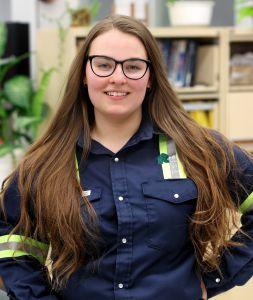
Rivières. She interned for three summers as a technician at the mill, conducting environmental analyses, investigating pollution sources, and assessing production and product chemicals. Her passion for the pulp and paper industry was ignited during this time and she earned a full-time position at the mill upon graduation.
Lapierre’s commitment and competence were further exemplified when she successfully assumed the responsibilities of the manager of technical services and product quality during their two-month absence.
In 2022, she was selected to participate in a one-year project with Resolute’s Emerging Talent Program, a human resources initiative. Lapierre’s team focused on employee recruitment and retention, and she led the efforts in refining their final presentation’s structure and talking points. Her team’s project was recognized as the best in the program and their recommendations related to employee retention were incorporated into the company’s practices.
Currently leading a team of four laboratory technicians, she holds the additional responsibility of supervising compliance, ensuring the retention of lab licenses, and handling regulatory submissions pertaining to environmental analyses for factors such as effluents and
air emissions.
Apart from her technical prowess, Lapierre possesses admirable interpersonal qualities. She communicates effectively, building strong relationships with both internal colleagues and key external stakeholders, such as the Ministry of Environment and Environment & Climate Change Canada.
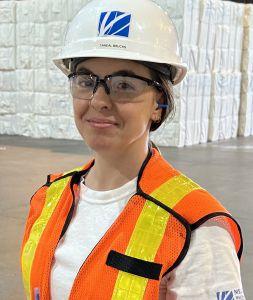
Management systems coordinator, Meadow Lake Pulp, Meadow Lake, Sask Taneal Brucks is known for bringing a creative touch to the meticulous process of auditing, according to her colleagues at Paper Excellence. As the management systems coordinator for Meadow Lake Mechanical Pulp, Brucks’ responsibilities include ensuring the mill maintains ISO certification for quality and environmental processes. In 2022, she was instrumental in the success of a new initiative for a multi-mill FSC/ PEFC certification.
She possesses an innate ability to appreciate and evaluate the creative aspects of a company’s operations, such as design and branding, while also assessing the organization’s adherence to ISO and FSC guidelines, share her colleagues. This duality of skills allows her to evaluate the company’s compliance with standards while considering the
impact on the overall image.
Brucks serves as a catalyst for positive change, which enables the pulp mill to thrive while upholding the highest standards of quality and environmental stewardship. She identifies areas for growth and helps her coworkers think outside the box. She inspires the rest of the company to embrace continuous improvement.
Brucks is also an essential member of the MLMP Community Engagement Team. Her focus is on the non-profit community groups of Meadow Lake. She regularly attends community events that range from the annual rodeo to job fairs.
Brucks is always willing to improve mill communication channels – whether it’s designing slides for the mill-wide television information system or writing an article for the Paper Excellence newsletter. She also completed an internal professional development project on internal communications at the mill.

Environment and continuous improvement manager, Kruger Products, Mississauga, Ont.
Tania Prevost has worked in the pulp and paper industry for the last 10 years as an engineer specializing in continuous improvement and the environment. She joined Kru-
ger Products in 2019 as part of the start-up team for the Sherbrooke, QC TAD Tissue facility.
As a process engineer, she helped establish the operating systems by creating manufacturing procedures, lock-out tagout documents and approval checklists for chemical products. Prevost also conducted risk analyses for health and safety and validated the control loops. She effectively tapped her network, both external and internal, to compile all the required best practices and processes; through working with her colleagues at other plants, she applied their knowledge and experiences to build a Daily Rhythm Board which included Key Performance Indicators (KPI) for each department that was reviewed at daily leadership meetings.
As environment and continuous improvement manager, Prevost has taken the lead to implement the ISO 50001 energy management system at the Sherbrooke TAD facility that will set targets and put in place systematic improvements. Upon joining Kruger Products, she completed the prerequisites to progress from the green belt to the black belt six-sigma certification by successfully implementing KPIs for waste calculations with the converting team.
Prevost is a member of the company’s women’s network development committee which supports women in manufacturing roles. She is generous with her knowledge and expertise with the interns on her team. This year, she has helped form six teams to participate in a fundraising race that supports children in need. Prevost also serves as an ambassador of the Order of Engineers of Quebec. PPC
By Jack Kazmierski
In October 2022 Paper Excellence announced the “indefinite curtailment” of its paper operations at the Catalyst Crofton facility in British Columbia, starting in early December 2022.
Part of the problem is the fact that the paper products the Crofton facility was producing are no longer in demand. “Crofton is an integrated pulp and paper facility, and this mill had a long history of producing newsprint and telephone directories, primarily,” explains Krista Cuddy, deputy general manager at Paper Excellence Canada. The simple fact is that everything has gone online. That’s why Crofton needed to move on from these traditional paper products.
However, in January 2023 Crofton got a new lease on life as Paper Excellence announced an investment of almost $50 million to both upgrade operations, as well as to reduce the facility’s carbon footprint. The Government of Canada contributed $14.3 million through Natural Resources Canada’s Investments in Forest Industry Transformation program, and the Government of British Columbia contributed $4.5 million in provincial funds.
With the investment announced and funding approved, the Crofton team had the green light to jump into this upgrade project and to speed up the transition process they had already started pursuing.
“We began by ordering some of the biggest and longest-lead-delivery items, getting those on order, and on their way,” explains Ryan Russell, project manager, Paper Excellence Canada. “Those have significant delivery lead times, with the
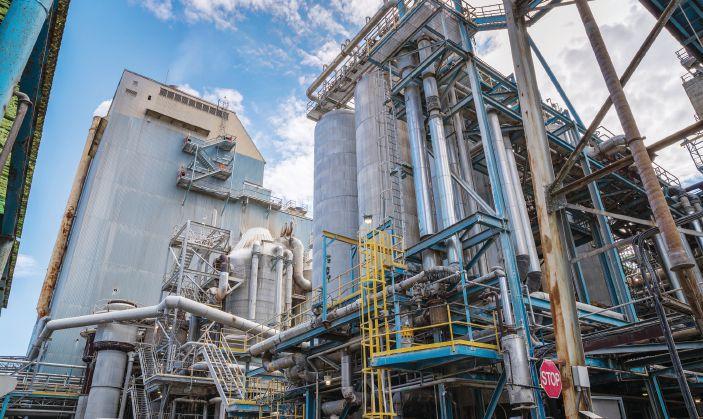
bulk of the items not arriving until the spring of 2024.”
If everything arrives on time, Russel says his team is planning to begin the installation process in the latter half of 2024. “Once everything arrives, we still need to coordinate a suitable shutdown window and adequate notice and planning to have the resources to do the installation,” he adds. “So at the moment, we’re planning the installation for the fall of 2024.”
In the meantime, Russel and his team are working on all the other details. “We’ve got some initial engineering wrapping up at this point,” he says, “and then we’ll transition into extensive and detailed engineering through to the later part of this year. Then we start ordering the rest of our construction materials, which are going to have significant delivery times, given our current global [supply] situation.”
Although the Catalyst Crofton facility team isn’t willing to share details about the equipment they purchased and the modifications they’re making, Cuddy was able to share a few details with Pulp & Paper Canada.
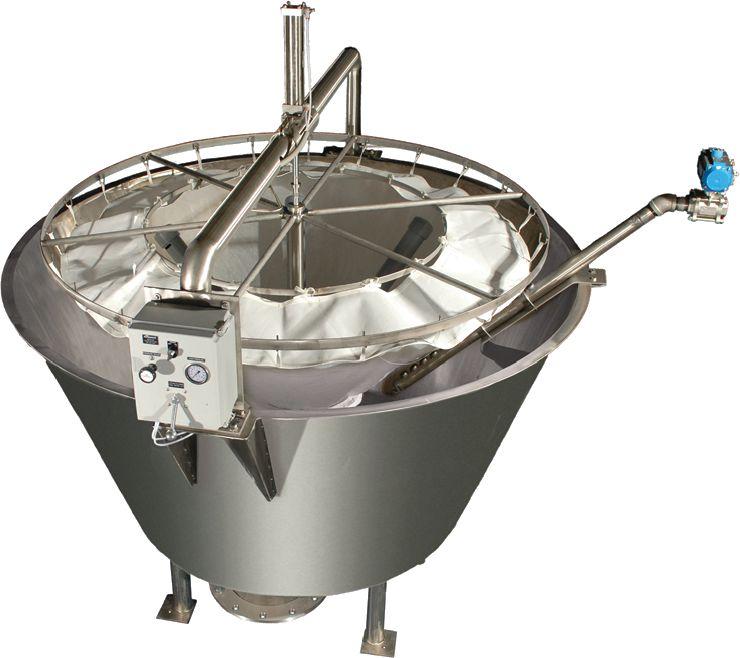
“We’re rebuilding the forming section,” she says. “We’re working with our equipment vendor to supply some new gear, but we are reutilizing whatever we can.”
With future-proofing the facility in mind, Cuddy says the company is modernizing and investing in new technologies. “Our intention is to provide a sustainable paper product that can replace single-use plastics,” she adds. “These have a lot of applications –in food packaging, particularly, where there might be wet or moist products. So, we’re modifying the paper equipment to allow us to incorporate some things that improve its strength when it’s wet.”
This process, however, comes with certain challenges that Cuddy says require further investment in new equipment. In other words, making paper products moisture-resistant, “creates some challenges in terms of reprocessing any of the waste, and so we’re going to be installing some equipment that is relatively new in Canada, but in high use in Europe, to allow us to reprocess waste that contains wet strength material.”
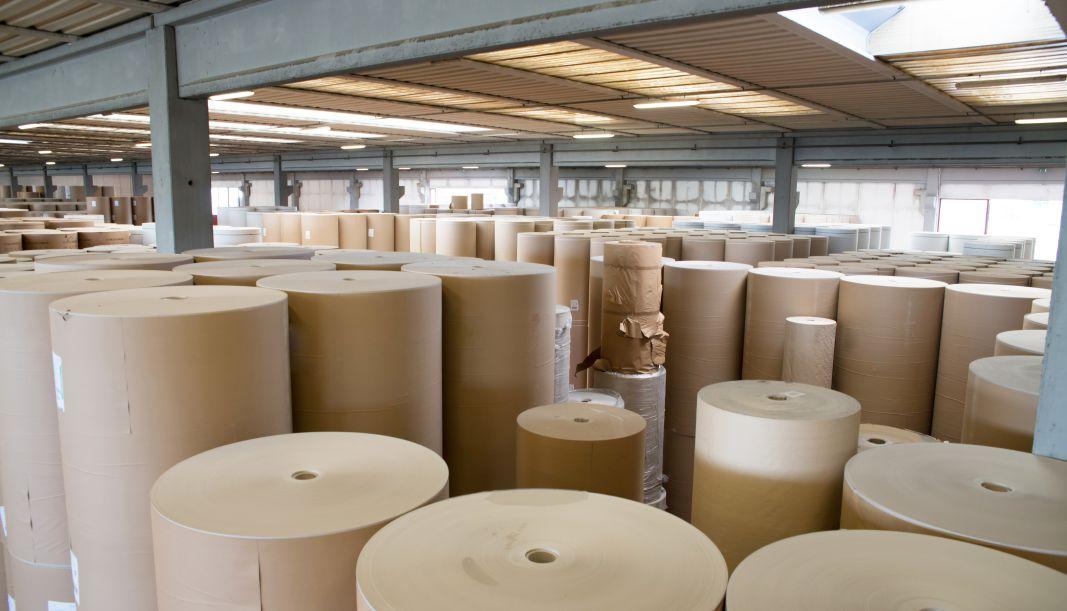
The upgrades to the mill will also allow for the production of new specialty papers. “Newsprint machines are designed to make a certain basis weight,” Cuddy explains. “Traditionally, a newsprint machine was designed to make 48.8 grams per square metre. So this [upgrade], when you think of shopping bags as an example, which are upwards of 110 grams per square metre, you can’t necessarily do that with a traditional printing and writing paper machine. That’s double the thickness, or double the weight of newsprint sheets. And so part of this project is going to allow us to make papers in that higher weight, as well as meet the quality specifications, which are very different for these specialty papers or
craft papers. The modifications and the gear we’re going to put in is going to allow us to achieve those specifications.”
Cuddy explains that the new equipment will allow the facility to produce products for North American food and industrial markets, including takeout bags and food wrap. Padded envelopes, along with other products, are also in the plans.
Crofton is also investing in equipment that will reduce greenhouse gas emissions. “We pay a tax on all the natural gas and fuel oil we consume on site, which certainly reduces our competitiveness out in the market,” Cuddy explains.
The simple solution is biomass fuel, which is readily available at the mill as a byproduct of the forestry industry. Part of the new investment is going to improve the preconditioning of the biomass fuel, drying it so that it can be burned in the boiler. “This will allow us to actually increase the consumption of biomass fuel, as well as offset our natural gas use,” Cuddy says. “So we’ll be able to generate the same amount of steam but with biomass.”
Although bark presses are common, and routinely used to squeeze the water out of the biomass fuel before it’s burned, Cuddy says that they’re working with a supplier who has newer technology that is more efficient and effective at removing the water. “So we’re replacing the existing system we have with new [biomass] presses,” she adds.
Cuddy says that all these upgrades are just the tip of the iceberg when it comes to changes and projects that are on the go at Crofton, with the goal of staying competitive and viable for many years to come.
“We’ve got other projects on the go,” she adds, “focusing on allowing us to support the decarbonization efforts here on site. We’re looking at improving our steam utilization so that we don’t have to generate as much steam, which will reduce our natural gas consumption and significantly improve our competitiveness. And although we can’t go into details at the moment, we’re also looking at our number three paper machine, and how we can repurpose it to produce a different product. This is all part of our long-term vision.” PPC
Pulp & Paper Canada has been benchmarking safety performance of mills since 1926. As the industry worked hard to bounce back in 2022 from the after-effects of the pandemic, safety remained a top priority.
The scope of safety has evolved drastically in recent years. Safety is not limited to working with mill equipment or ensuring that all personnel have the appropriate gear when walking the floor. Mental health is now recognized as a major factor impacting safety of mill personnel.. Mill safety
is key to ensuring the retention of skilled people within this industry.
The annual Safest Mill in Canada contest recognizes the outstanding safety records of participating mills by ranking total recordable incidents (mill frequency) from lowest to highest. In the event of ties, mills are ordered by the most to least worker hours.
Congratulations to all participating mills for achieving their safety goals and taking care of their people.
By Augusto Quinde, ph.d.
The control of the cooking operations on continuous digesters is either by monitoring Kappa numbers (i.e., Kappa target) and/or by controlling digester levels. The most important responsibilities of a digester operator are to produce good pulp quality and to keep the wood chip column moving. Furthermore, the most important obligations for bleaching operators are to selectively remove lignin to produce pulp with optimum strength and brightness at the lowest possible cost. It is common to witness the debates
between the pulping and bleaching areas regarding the different amount of bleaching chemicals when dealing with pulps of the same Kappa number coming from the same digester.
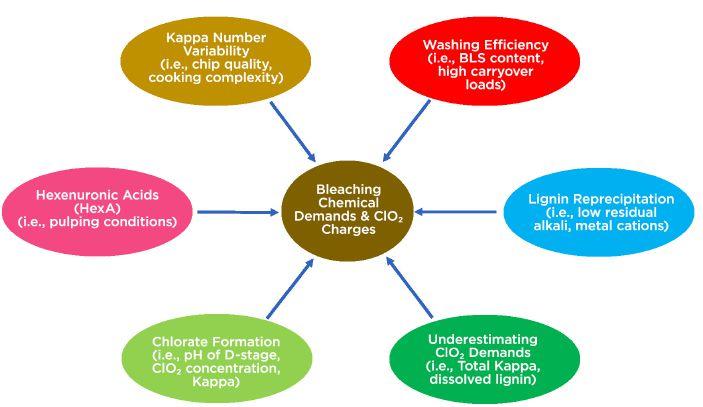
Most of the discrepancies between the chlorine dioxide charges and the measured Kappa numbers seem to be the result of a combination of two or more of the following factors: a) Kappa number variability, b) high loads of black liquor solids due to cooking conditions and brown stock washing efficiency (i.e., high carryover loads), c) lignin reprecipitation onto the fibre in the brown stock washing area (i.e., due to low residual
effective alkali), d) hexenuronic acid (i.e., HexA) levels, e) chlorate formation across bleaching, f) underestimating the total bleaching chemical demands (ClO 2 charge) by ignoring the dissolved lignin (i.e., mismatch of oxygen + ClO 2 usages), etc. See Figure 1.
At present, there are many issues when dealing with the correct bleaching chemical demands and the actual chlorine dioxide (ClO2) charges. In this paper, we will try to understand the current disparities between the observed Kappa numbers and the calculated bleaching chemical charges and review the main factors affecting the above discrepancies.
Kappa number variability is a big concern in the pulp production business and the four main sources of this variability may be: Wood chips quality variability, white liquor variability, cooking conditions complexity and digester disturbances. It is common to find mills cooking softwoods with hourly Kappa number data that show serious variability giving a Kappa number as low as 17 to 20 and as high as 42 to 45. Pulp mills must minimize Kappa number variability and prevent cooking to very low Kappa numbers to avoid excessive pulp degradation that will generate more black liquor solids and more chances for brown stock washer carryover (Quinde 2023).
The residual lignin in pulp is the lignin left in the pulp after kraft pulping that is measured as the Kappa Number of the pulp and it is referred to as the fibre-bound lignin. When determining the bleaching chemical demands it is necessary to consider not only the lignin left in the pulp; but also, the lignin that is dissolved in the pulp slurry.
As per Wilke (2018), the dissolved lignin (i.e., filtrate Kappa number) varies significantly and often more than the fibre-bound lignin (fibre Kappa number).
The residual lignin of high-kappa pulps shows higher content of ß-aryl ether linkages and lower content of condensed structures suggesting that this residual lignin should be more reactive towards chlorine dioxide (ClO2) (Al-Dajani 2001).
Lately, it has been shown that when determining the Kappa number, this test measures not only the “true Lignin” left in the pulp; but also, hexenuronic acid (HexA) and other oxidizable material (i.e., degraded carbohydrates) that are oxidized by KMnO4 used for Kappa number determinations. See equation 1.
Residual Lignin (Kappa Number) = “True Lignin” + Hexenuronic Acids + Other Oxidizables (degraded carbohydrates)
The reprecipitation of lignin on the pulp depends mainly on the residual effective alkali in the black liquor. If the residual effective alkali is too low (i.e., 2.0 to 4.0 g/l as Na2O), then the fragmented lignin re-condenses and re-precipitates onto the fibres (pulp) at the end of cooking (i.e., bottom of the digester) or during the brown stock washing. The negative effects of low residual effective alkali include re-condensation and re-precipitation of lignin onto the pulp, lower bleachability, problems in the liquor recovery cycle, etc. Most of the new bonds of the re-condensed lignin are mainly of the stable C--C type versus the easily broken C--O--C ether bonds. Then, we must avoid the re-condensation of lignin to avoid harder bleaching conditions and prevent problems in the bleaching area (Quinde 2019).
As per Sundin, J. (2000), some metal cations (i.e., Na+, Ca2+, Mg2+, Al3+) precipitate kraft lignin under alkaline conditions at
























pH 9; however, only calcium and magnesium ions cause any noticeable precipitation at pH 11-13. Recirculation of liquors from the bleach plant to the brown stock area might lead to higher concentrations of metal cations (i.e., Ca2+ and Mg2+).
Hexenuronic acids (HexA)
This unsaturated sugar is formed during cooking from 4-O-methylglucuronic acid units on the xylan chain. It is known to increase bleaching chemical consumption, decrease brightness and increase brightness reversion.
In hardwood pulps, the contribution of HexA on the measured kappa number for hardwood pulps is approximately between 15 to 50 percent; however, this contribution on softwood kraft pulps is approximately 10 percent or less. High contents of HexA in the pulp will contribute to the kappa number of the unbleached pulp giving the false impression that the pulp contains more lignin. Furthermore, hexenuronic acids are not removed in considerable amounts during oxygen delignification or peroxide bleaching and these groups contribute to the overall chlorine dioxide (ClO2) consumption during ECF bleaching of hardwood kraft pulps (Brogdon 2009).
As per Colodette et al. (2007), kraft pulps produced by modified kraft pulping processes may contain 60-to-75 mmol/kg of hexenuronic acids (HexA) that would represent 6.0-to-7.5 Kappa units. Furthermore, it was found that HexA do not react with oxygen and only very little of it is removed during oxygen delignification then causing low efficiencies in the range of 25 to 35 percent.
Furthermore, hexenuronic acids can be selectively removed by an acid treatment and reduce the amount of bleaching chemicals (Jiang et al. 2002, Brogdon 2009). Rööst et al. (2000) mentioned that the yellowing tendency of fully bleached pulps increases probably due to a higher hexenuronic acid content in the pulp.
Brown stock washing optimization and black liquor solids (BLS) carryover
Black liquor solids carryover not only affect the organic loads to the effluent treatment plant but also interfere with
the bleaching chemicals charged during bleaching. The black liquor solids carried over the bleaching stages affects the chemical oxygen demands (COD) of the bleach plant effluent and interferes with the efficiency of the bleaching chemicals increasing the bleaching costs. Furthermore, high black liquor carryover increases the levels of salt cake makeup (Bishop 1994).
Brown stock washing optimization can be obtained by implementing a sensor to measure the dissolved lignin content so that the mill can act preventively. This information may help to calculate the desired dilution factor for a specific washer. Furthermore, when the dissolved lignin is low; then, the dilution factor could be decreased thus reducing the water consumption. The dissolved matter in the fibreline must be balanced to get the proper bleaching chemical charge otherwise the consumption of bleaching chemicals by the dissolved matter will cause a reduced delignification or brightness (Wilke 2018).
It is not only imperative to properly monitor the black liquor solids going to the evaporators; but also, to monitor those black liquor solids going with the pulp to the oxygen delignification stage or other bleaching stages.
Oxygen delignification is an important step in between the digester and the bleaching stages and it can be considered
as a continuation of the pulping operations and/or as a preliminary stage for bleaching.
As per Wilke (2018), studies on the impact of the unoxidized and oxidized dissolved matter on the degradation of carbohydrates and lignin, determined that the presence of unoxidized dissolved matter decreases the delignification but increases in the case of oxidized dissolved matter. When comparing oxygen delignification and extended kraft pulping with respect to carbohydrates degradation versus lignin degradation, the oxygen stage is more selective than pulping. Furthermore, it is mentioned that since the pulp is better delignified after an O2-stage than after a cooking stage, then the chemical consumption during bleaching can be reduced by implementing an O2-stage.
In order to optimize the oxygen delignification stage and the production of ECF- or TCF-bleached pulps, a better understanding of the relationship between pulping and bleaching is required.
It has been found that a significant amount of chlorine dioxide (ClO2) charged in pulp bleaching is lost in decomposition reactions (chlorate and chlorite) that result in increased bleaching costs and unwanted effluent load. These reactions are influenced by factors like the pulp type (i.e., kraft, softwood, hardwood), kappa number, hexenuronic acid levels, washing
degree and D-stage operating like temperature, pH and ClO2 concentration. Optimization of chlorine dioxide bleaching stages may save significant amounts of this chemical by avoiding the usage of ClO2 in excess which may end up being converted into chlorate (Sezgi 2015).
Total bleaching chemical demands/ chlorine dioxide charges
Conditions of the kraft cooking affect the bleaching response of the pulp or bleachability and the bleaching chemical demands depend on how the pulping processes have been carried out. As per H. Zou (2002), “the chemical demand required to bleach the pulp to a given brightness value can be different even when the lignin content in the pulp is the same”. There must be a few explanations for this finding and an acceptable one may be related to low residual effective alkali at the bottom of a continuous digester (as explained before). Then, when having two pulps of the same Kappa number there is a need to know their corresponding blowline residual effective alkali at the end of the cook to produce these pulps. Pulps produced at very low residual effective alkali must require higher bleaching chemical consumption.
Laboratory experiments for a chlorine dioxide stage have shown that the presence of dissolved matter reduced the delignification and that the additional chemical demand required to compensate for this reduction was found to be proportional to the amount of dissolved matter. Furthermore, “the total chemical demand was found proportional to the total kappa number of the pulp, that is the sum of the fibre and filtrate kappa numbers” (Wilke 2018).
Most common bleaching operations include calculations of the chlorine dioxide (ClO2) charges based on the Fibre Kappa number without considering the Filtrate Kappa number (i.e., dissolved lignin and other oxidizable compounds) present in the pulp slurry. As per Wilke (2018) the chemical consumption can be reduced by controlling the chemical charge based on the sum of the fibre-bound lignin (i.e., fibre Kappa number) and the dissolved lignin (i.e., filtrate Kappa number). See equation 2.
As per Sezgi et al. (2015), some mod-
Total Kappa Number = Fibre Kappa Number + Filtrate Kappa Number (Total Lignin) (Fibre-bound Lignin) (Dissolved Lignin)
ern mills can reach their brightness targets with ClO2 dosages as low as 8 kg ClO2/ adt; however, it is common to find mills operating with over 20 kg ClO2/adt pulp. These differences in ClO2 consumption derive from several factors being the most significant the carryover loads, the hexenuronic acid (HexA) quantities and the levels of chlorate formation throughout the bleaching stages.
Mathur et al. (2018) wrote “In the absence of carry-over measurement, mills compensate by applying a high operator bias to cover peak carry-over demand, which results in higher bleaching costs.” They also mentioned that in order to overcome this challenge, the pulp industry is transitioning from a fibre kappa number measurement to a new total kappa measurement for chlorine dioxide (ClO 2) charge control.
There is a long list of process variables
that needs a close manipulation to achieve an effective bleach plant control and it is very difficult to optimize each variable to maintain the whole process close to target. It is almost impossible that a human being would be able to control all these variables. Then, a software package (i.e., Advanced Process Control) is necessary to predict and/or to correct and/or control all the bleaching parameters.
The sum measurement of fibre kappa and filtrate kappa (carry-over) that is referred to as Total Kappa can be used as a feed forward control to estimate the chlorine dioxide (ClO2) charge in the Do and D1 stages and optimize the bleaching chemical consumption (Wilke 2016, Mathur 2018). PPC
For the complete list of references for this paper, please look up the online version at www.pulpandpapercanada.com.

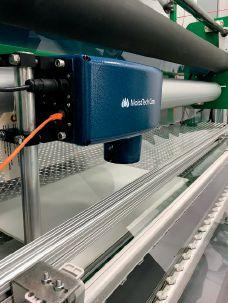
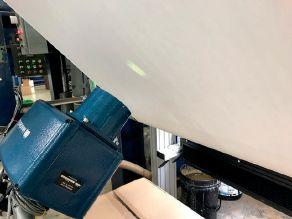
Allows for a constant, non-contact solution to moisture and oil measurement directly on the production line in real time
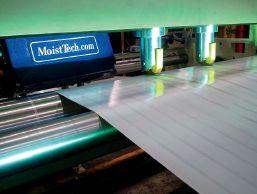
Measuring moisture directly on the production line produced instant, accurate data that can be easily communicated to a PLC - creating a closed loop process
A MoistTech system provides improved product quality, lower waste and energy costs, process optimization, increased plant efficiency, dryer control and reduced downtime

A comparative analysis of fossil fuel and bioenergy emissions in key parts of the forest value chain.
By Luciana Savulescu (corresponding author), Jawad Jeaidi, Adam Rogerson, Bruno Gagnon and Serge Bédard
Canada’s Net-Zero by 2050 commitment will require comprehensive action across all industrial sectors to curb greenhouse gas (GHG) emissions. The Canadian forest sector took early actions in this direction, successfully reducing its GHG emissions by nearly 70 percent since the early 1990s. Achieving this milestone has involved enhancing energy efficiency and transitioning from fossil fuels to bioenergy by utilizing wood processing residues. Additional efforts are now needed to effectively meet Canada’s GHG reduction targets. While it is technically feasible to fully realize the potential of the forest sector to reach net-zero, or even net-negative emissions, substantial invest-
ments in technical and capital resources are indispensable to implement cutting-edge energy-efficient technologies, electrification, bioenergy and carbon capture.
With energy consumption of approximately 600 PJ/year, the manufacturing facilities of the forest sector use more energy than any other major Canadian manufacturing sector, including the iron and steel, cement, oil refineries and petrochemical sectors. However, this sector is unique in that a large part of its energy needs is met by renewable energy. Biomass-based fuels have enabled the industry to reduce its reliance on fossil fuels, helping to lower its net GHG emissions considerably.
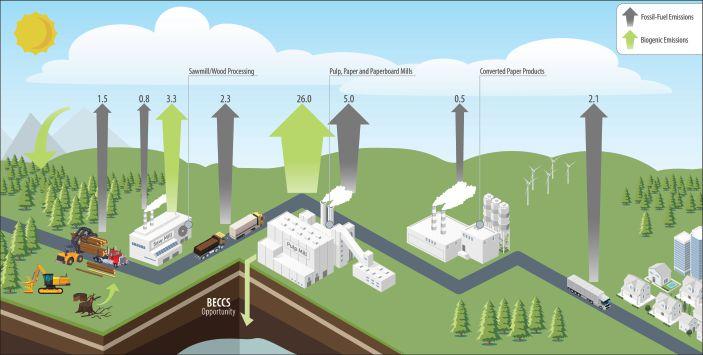
Evaluation of fuel consumption across major steps of the forest sector, from for-
est harvesting to transportation of finished products (Figure 1), has been performed to define the energy profile of the Canadian forest value chain. Data on energy usage and GHG emissions are available through public databases such as the National Energy Use Database launched by Natural Resources Canada in 1991, Canada’s National Inventory Report, and GHG Reporting Program led by Environment and Climate Change Canada. Since these databases focus on energy and GHG data for the pulp and paper sector, information for upstream and downstream operations is less defined. Specific attention was given to estimating diesel consumption.
The results illustrate that energy sources – fossil fuels, bioenergy, electricity – are not equally distributed along the forest value chain. Most of the energy is consumed in wood product manufacturing and pulp and paper mills (20 percent of
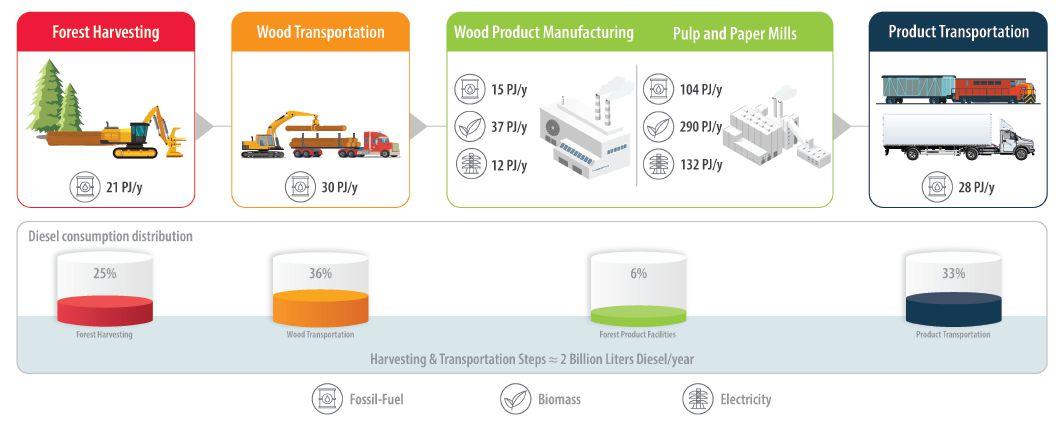
the energy from fossil fuels, 25 percent as electricity and 55 percent from bioenergy). Mills also produce 8950 GWh per year of renewable electricity, of which over 60 percent is coming from cogeneration. Diesel fuel is used for harvesting operations and transportation of logs and wood chips to pulp mills, and shipping final products carried out by truck or rail transport.
Natural gas is the most common fossil fuel in manufacturing facilities, mostly supplied to boilers, lime kilns and internal combustion dryers. Diesel consumption, on the other hand, in sawmills, wood product manufacturing, forest harvesting, wood and product transportation is estimated to be approximately 80 PJ/y or 2.1 BL/y of diesel. Diesel in these processes is used in heavy machinery and is heavily impacted by carbon policies such as Clean Fuel Regulations and the carbon fuel charge.
GHGs emitted from fossil fuels are generally considered to be the primary driver of anthropogenic climate change and are the focus of most carbon reduction policies. Emissions from biogenic sources, however, are considered carbon neutral within the accounting standard put forward by the International Panel on Climate Change. When biomass comes from residual materials generated by sustainable forestry, the biogenic emissions released from its combustion are offset by CO2 captured by forests, with a carbon debt. In that framework, long-term storage of biogenic CO2 is considered a negative emission.
The distribution of energy sources translates to a similar distribution of carbon dioxide equivalent (CO2e) emissions
generated along the forest value chain. In 2020, 10.1 million tonnes (Mt) of fossil fuel based GHG emissions were produced (excluding final product transportation), with around 54 percent (5.5 Mt CO2e) originating from stationary sources within pulp and paper facilities. The production of fossil emissions from stationary equipment is as follows: the power boilers account for about 71percent of fossil fuel emissions (including co-firing in hog fuel boilers), the lime kilns contribute approximately 20 percent and tissue/BCTMP dryers at nine percent. While fossil based emissions through the forest value chain (Figure 2) are notable, they pale in comparison to the biogenic emissions, which amounted to 29.3 Mt CO2e, bringing the sector’s total emissions to approximately 39.4 Mt CO2e when final product transportation is excluded.
The forest sector’s emissions are mostly biogenic and largely concentrated in pulp and paper mills. The biogenic CO2 is emitted from residual pulping liquor burned in recovery boilers in the kraft pulping process (57 percent), from wood-based residues in power boilers (40 percent) and from process emissions in lime kilns (three percent). The wood processing facilities also use a large amount of bioenergy, mostly in boilers, furnaces and dryers. Capturing part of these emissions, especially in kraft mills, and permanently removing them from the atmosphere, would enable the forest sector to become carbon-negative. This could help Canada achieve net-zero industrial emissions by compensating for hard-to-abate industrial sectors. Additionally, it presents a valuable revenue stream for the pulp and paper industry. Carbon
capture from pulp mills has been shown to be feasible but is not currently economically viable at a small scale if no credit is provided for negative emissions or without a market to sell captured CO2. While biogenic emissions are usually reported, they are not priced or subject to regulation under current national carbon policies.
• In its 2030 Emissions Reduction Plan, Canada has committed to exploring the potential for negative-emission technologies in the forest sector, particularly in facilities where biomass is used as an energy source.
• Carbon taxes can be mitigated by lowering GHG emissions at forest products facilities.
• Cost-effective energy efficiency measures are still available if manufacturing facilities to further reduce fossil-fuel utilization, notably using heat recovery systems and advanced controls.
• Increasing carbon prices will likely help improve the collection and utilization of harvesting residues.
• Industry transformation is ongoing as traditional products such as paper and newsprint give way to different new products.
Canada’s forestry sector is a large and energy-intensive industry, occupying a unique position as a predominant consumer of bioenergy. This sector offers promising avenues for reducing fossil fuel consumption and attaining carbon negativity. By integrating additional decarbonization strategies such as enhancing energy efficiency, transitioning to electrification and bioenergy, and implementing carbon capture technologies, the forestry sector can not only thrive but also shape a sustainable, low-carbon future for Canada. PPC © His Majesty the King in Right of Canada, as represented by the Minister of Natural Resources, 2023
Luciana Savulescu (corresponding author), Jawad Jeaidi, Adam Rogerson are from Natural Resources Canada, CanmetENERGY, Industrial System Optimization Group. Bruno Gagnon is from Natural Resources Canada, Canadian Forest Service, Trade, Economics & Industry Branch.
Leveraging latest technologies and innovations to improve quality and reduce costs for a stronger future.
By Martin Fairbank, ph.d.
Low-consistency refining is an important step before chemical, semichemical or recycled pulp is sent to the paper machine. In refining, shear and compressive forces are applied to develop flexibility, increase surface area and ultimately improve pulp strength and smoothness. However, while paper mills today are well equipped with sophisticated measurement systems and multiple closed-loop controls, the control of low-consistency refining is often lowtech, using only periodic manual freeness measurements to adjust the motor load. How can this be improved?
In high-consistency refining for the manufacture of thermomechanical pulp (TMP), which is a much more energyintensive process taking place at 25 to 40 percent consistency, model predictive control (MPC), a form of artificial intelligence, has been successfully applied in closed loop mode for over 20 years. Process variables are used to build a multiple input – multiple output model that controls mainly the pulp consistency and motor load, resulting in the ability to apply a constant specific energy, or tune the specific energy for desired quality parameters. This not only results in reduced quality variation but can enable increased productivity and energy savings. Because of the high amount of specific energy applied in TMP refiners, the energy savings can be significant. For example, if a TMP mill producing 1000 tonnes per day at a total specific energy of 1.5 MWh/tonne is paying 5¢/kWh for electricity, a five percent energy savings is worth about $1.3 million per year.
An important feature of such a con-
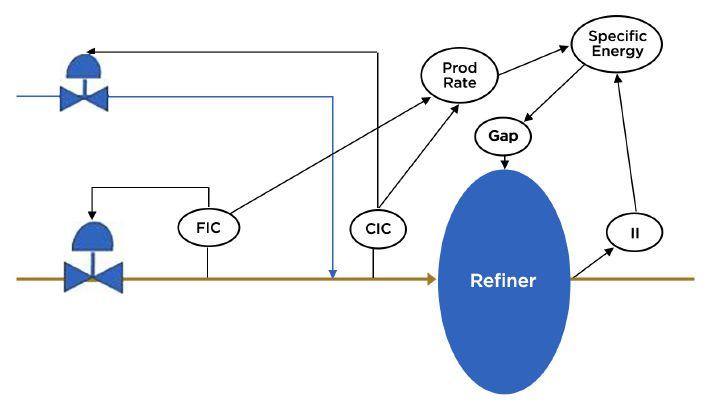
trol strategy is keeping the model up to date. The first TMP mills to implement MPC often had an employee of the MPC software supplier working full-time in the mill to make sure the system was always working optimally and used their expertise combined with machine learning to continuously improve the model and control system. Nowadays, this can be performed remotely, so that one expert can work with several mills at the same time.
Low-consistency refining is typically carried out at three to five percent consistency in several small refiners, and the energy savings from process control are not as attractive as in high-consistency refiners, because the specific energy used is typically less than 10 percent of that in a high-consistency refiner, and there is much less variation in the pulp consistency. There are, however, other incentives for control. Refining is typically controlled to a freeness target by varying the specific
energy, but manual freeness tests are only available every few hours, too infrequent for closed-loop control. Variations in incoming pulp quality, such as wood species mix, pulping conditions, and bleaching parameters, are much faster than this, so refining energy can only be adjusted in response to longer-term trends.
Online freeness testers such as L&W Freeness and PulpEye have been developed in recent years and can provide more frequent freeness results. For example, the FPS Papeles board mill in Chile has been using online freeness measurements taken every six to seven minutes since 2018 to manually adjust their refiner load. This has led to more stable operation, increased production rate, quicker grade changes and less energy consumption, giving them a good payback.
To close the loop on low-consistency refiner control, measurements need to be much more frequent than every few min-
utes. Satron, based in Finland, has developed its “Lumina VCF” optical transmitter, which employs LED-based multi-frequency light scattering measurements that can be calibrated to measure both consistency and freeness every few seconds. At this rate, closed-loop control of freeness for low-consistency refining becomes a possibility.
Freeness control is important for consistent drainage behaviour on the paper machine and machine runnability. Having a stable freeness may allow a paper machine to be sped up while maintaining the dry line where it needs to be. A lower freeness, however, can be produced not only by fibrillation of the fibres to increase their surface area (desirable), but also from higher fines content in the white water used for diluting the pulp or from cutting the fibres (undesirable). Every pulp furnish has its own characteristics, and this is where online measurement of fibre morphology coupled with process models built from multivariable analysis and machine learning can be useful. There are at least two online sampling and measurement systems on the market: the L&W Fiber tester and the PulpEye. These produce measurements that include fibre length, width, shives, fibril area and perimeter, coarseness, and fines content. Like online freeness tests, these results can be obtained every few minutes. Multivariable analysis can then be used to build virtual sensors through machine learning. For instance, fibre characteristics combined with moisture, basis weight and strength tests from each reel can be used to predict the paper strength and the refining conditions (such as the specific energy applied in each refiner) can be controlled to produce different qualities of pulp for different grades of paper while respecting the freeness target. Alternatively, if the mill is using multiple furnishes (such as virgin and recycled pulp, or hardwood and softwood pulp), models can be built to optimize the furnish cost and quality, lower the amount of wet end additives such as starch, or produce faster grade changes.
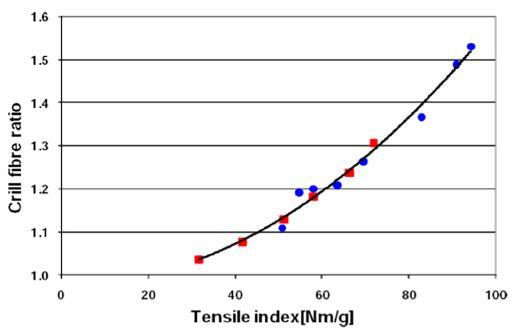
Our understanding of fibre bonding has improved a lot in recent years with the development of an analytical method to detect and characterize “crill”, i.e., small particles in a pulp suspension, which was patented in the 1980s. The method uses light scattering at two different wavelengths in the ultraviolet (365 nm) and infrared (850 nm) regions to measure the crill content,
calculated from the ratio of UV/IR transmission losses. Since the mid-2010s, this method has been used for crill detection in an add-on module for the L&W Fibre Tester, as well as in the “Crill Eye” module offered by PulpEye. Crill measurement can thus be used for monitoring fibrillation by the refining process. Recently published research [Kerekes, R.J., McDonald, J.D. and Meltzer, F.P., External fibrillation of wood pulp, TAPPI J, 22(6) 363(2023).] suggests that there is a critical refining intensity, below which external fibrillation occurs and above which fibrils become detached from the fibre.
In summary, it’s time for paper and board manufacturers to take advantage of modern sensor technology around the stock prep area and apply artificial intelligence and model control techniques to improve paper and board quality and reduce costs. It’s not an easy task, requiring good planning and an experimental approach to build customized tools. Expertise will be required to help facilities along this pathway. Pat Dixon, vice-president of automation at Pulmac, made a presentation based on some of these ideas at PaperWeek Canada 2023 entitled “The Future of Refining” and stated “I’m very optimistic, because we’re getting some orders right now. We’re starting to do this kind of work.”
Martin Fairbank, a PAPTAC Fellow, has worked in the pulp and paper industry for over 35 years and is currently an independent consultant and technical writer.

By John Mullinder
The Canadian public is constantly bombarded with misleading images and information on forest and paper issues. Some of it is pure ignorance but much is downright dishonest, aided and abetted by sloppy journalism. Here are some examples that need to be contested:
Canada’s forest cover is rapidly declining – Rubbish. Canada’s forest cover has remained remarkably stable since 1990 according to Natural Resources Canada, recording a net loss of less than half of one percent. Current (and future) wildfires will certainly have an impact and hamper the natural regeneration process, but Canada’s overall forest area is expected to remain generally stable.
Corporations are “ravaging large swaths of boreal forest” (Natural Resources Defense Council) – Nonsense. What NRDC fails to mention is that the annual boreal harvest represents only 0.15 percent of the boreal. The Canadian boreal is “threatened by industrial logging” that occurs on only 0.15 percent of it? Or a mere two percent over the last 15 years? Strange how the facts give a totally different impression.
“Industrial logging” is the main disturbance impacting Canada’s forests –Not true. Climate change (the use of fossil fuels) is having a far more profound effect on trees and making them more susceptible to insect and beetle infestations and forest fires. In fact, insects and beetles and forest fires damaged, infected, killed or burned more than 22 million hectares of Canada’s forest lands in 2020. That is an area 31 times larger than was logged for lumber and pulp and paper and regenerated afterwards.
Logging is deforestation – No, it is not. The world’s forest scientists (through the United Nations) define deforestation as the conversion of forest land to non-forest
land. Forest land that is regenerated as forest (naturally or through tree planting) is not considered deforestation. It is only when forest land is converted to something else (to agriculture, for example) that it is deforested. The major causes of deforestation in Canada are the conversion of forest land to agriculture, mining, oil and gas projects, urban development and things like ski hills and golf courses.
Canada has “ancient” forests – This is very misleading. The word “ancient” means “old” for most people, as in “really old.” In fact, most Canadian trees are under 100 years old, and only one percent of the boreal makes it to over 200 years old. Certainly, the land on which the trees stand is ancient, but the trees themselves are not. Just like the sea. The sea is ancient, but most of the fish that live in it are not. Tree and fish populations are constantly regenerating themselves.
“Vast amounts of boreal forest (are) pulped for toilet paper” (Suzuki Foundation) – In a word, crap. Only 0.2 percent of the boreal is harvested in an average year, according to a Canadian Forest Service analysis. And according to the Forest Products Association of Canada, less than five percent of Canadian-produced wood pulp, and less than one percent of total harvested wood (not just from the boreal), ends up as toilet paper each year. In addition, by provincial law, any harvested area must be successfully regenerated afterwards.
Most paper boxes are made from virgin market pulp. (Canopy) – This is totally false. In fact, most boxes made in Canada are 100 percent recycled content. They are not made (as Canopy implies) with “the habitat of endangered species such as orangutans or caribou.” They are made from old used boxes collected from the back of Canadian factories and supermarkets, from offices and from Canadian homes. And that has been the case for 30, 40, 50 years or so.

We barely recycle toilet paper, packaging, and other paper products. (Suzuki Foundation) – For toilet paper, this is true (for obvious reasons) although some 60 percent of toilet paper made in Canada is recycled content. But it is ignorantly wrong about other paper and packaging. Paper recovery represents some 35 percent of Canada’s total diversion efforts, according to Statistics Canada. And the most recovered paper material is used packaging, most of which is already 100 percent recycled content.
Blatant hypocrisy – And here is some blatant hypocrisy from NRDC and STAND.earth. These groups claim that “clearcutting decimates the ecosystem.” Yet they support and promote the Forest Stewardship Council (FSC) whose standards allow clearcutting. Huh? How do you square that?
Facts do matter. And it is the industry’s continuing mandate to provide accurate information from credible sources not just to government policy-makers but also to customers, journalists and the general public. Loudly and clearly. The truth is important. PPC
John Mullinder is an author and blogger. Read his content at www.johnmullinder.ca. His most recent book is Little Green Lies and Other BS: From ‘Ancient’ Forests to ‘Zero’ Waste.
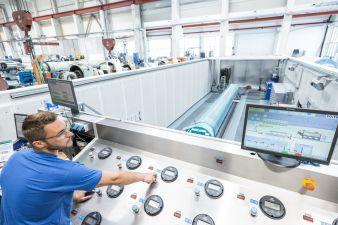
Voith strengthens mechanical roll service with sensor technology and digital upgrades
Voith has a worldwide network of 22 mechanical roll service centres, domain expertise and sophisticated digital solutions. With SealView, for instance, papermakers now have real-time information on the wear status of sealing strips inside suction rolls. The sophisticated sensor system can be installed on any type or brand of suction roll at Voith MRS Centers. Reportedly, the SealView system provides insight into the condition of the seal strips in suction rolls and predicts the remaining seal lifetime. SealView can be accessed by machine operators at the customer site as well as remotely by dedicated Voith service centres.
Such precise information supports data-
driven decision-making, increases safe roll run times and allows the stress-free and timely scheduling of roll change and service with the Voith MRS Centers.
When SealView is combined with HydroSeal, further cost and resource savings are achieved. HydroSeal works with an integrated lubrication system to ensure constant, even and uniform lubrication over the complete width of the suction roll. Furthermore, rewetting is reduced and a more homogenous moisture profile across machine direction can be achieved when running in optimum conditions.
Voith explains in a press statement that a transparent inventory management system is crucial for optimizing maintenance scheduling and visualizing run times. This is provided by Voith’s OnCare.pmPortal, the powerful asset management tool for fabrics, rolls, roll covers and doctor blades. With the OnCare.pmPortal module “ID Tagging” critical products are tagged to support better tracking and inventory management. Depending on the product and machine environment, either a barcode, QR code or RFID/NFC technology is used. In all cases, a scan with a mobile device reveals all the relevant information. voith.com
Valmet releases the sixth generation of its Residual Measurement Valmet released the sixth generation of the Valmet Residual Measurement (Valmet Polarox6). The new features will further optimize the bleaching process by optimizing bleaching chemical addition, protecting process equipment and improving measurement and control accuracy.


The updated Residual Measurement is reportedly equipped with the Valmet Bridge user interface, a touch screen control platform that is today a standard with Valmet sensors.
Valmet Residual Measurement provides information about bleachability when installed before the bleaching tower. It is based on pre-chemical consumption (feed-forward), allowing for a fast response to adjust chemical addition controls. When installed after the bleaching tower, it measures the residual bleaching chemical, providing feedback for chemical dosage control and process equipment protection.
According to Valmet, the sensor improves measurement and control accuracy by eliminating under- or overdosing of bleaching chemicals. It ensures the exact chemical dosage for lignin removal and brightness control. valmet.com
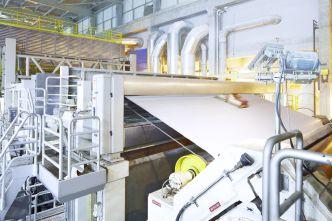
Pulp and paper specific software in ABB’s Automation Software Maintenance program
ABB’s latest Automation Software Maintenance (ASM) lifecycle management program covers the software related to Paper Machine Drives (PMC800) and Pulp and Paper Process Control Library (PPLib800xA). The new service offering is an extension of ABB’s ASM program and complements the Quality Control System (QCS) ASM program that was introduced in January 2023.
ASM tiered subscription options open up the features available as mills go through the upgrade process. Maintain Plus is designed to provide customers with access to incremental updates for PPLib800xA and PM Drives containing fixes and enhancements. Maintain & Evolve includes all the benefits of the Maintain Plus level, with the added ability to upgrade from an older legacy system version to the latest and between system generations.
The program also reportedly gives both PPLib800xA and PM Drives users access to the myABB business portal for program management and premium system documentation. With PPLib800xA ASM, subscription enables an improved human-machine interface (HMI) experience and access to the PPSupport tool, a .Net standalone application that detects unintended changes and aids system engineers in migrating the existing process application libraries to the latest version. The enhanced ASM lifecycle management program for automation and drives is available to customers from June 30, 2023. new.abb.com
The Canadian forest products sector is passionate and devoted – not just to the industry itself, but also to its local communities. Here we share the initiatives of pulp and paper companies working to make positive social, environmental and economic impacts across the country.
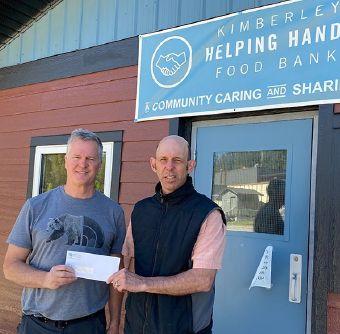
Andrew McCuaig, fibre superintendent and member of Skookumchuck Pulp’s Community Engagement Team, met Thom Tarte, food bank manager to deliver Skookumchuck Pulp’s donation of $1,225.
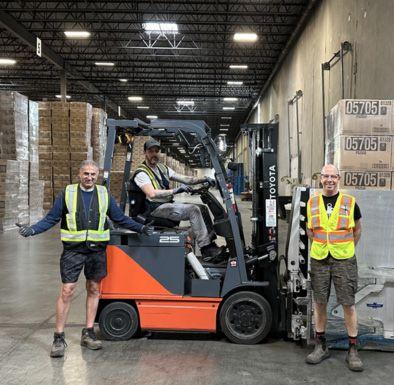
Kruger Products’ mill in New Westminster, B.C., supported the Greater Vancouver Food Bank’s 2023 Mayor’s Food Bank Challenge with a donation of 375 cases of away-from-home and Purex bathroom tissue products.
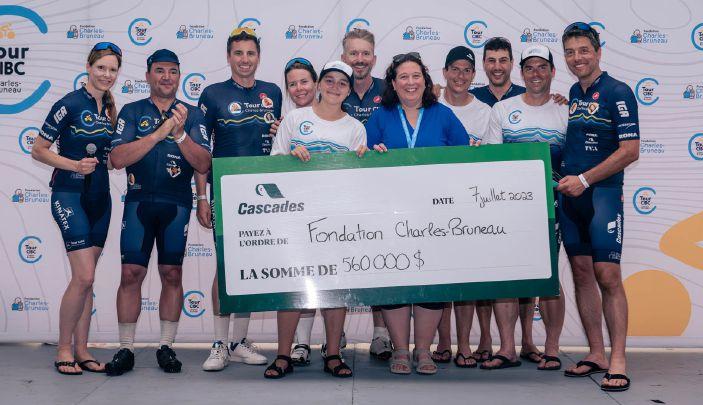
The Cascades team, including its employees, donated $560,000 to Fondation CharlesBruneau this year.

Mercer Peace River and Boucher Bros. Lumber came together in 2022 to make a donation to the deck building project at the Royal Canadian Legion Branch 62 in Peace River. The deck is now complete and being used regularly by the community.

The Alberta-Pacific Forest Industries Inc. team members recently celebrated the National Indigenous Peoples Day to honour the unique heritage, diverse cultures and contributions of First Nations, Inuit, and Métis Peoples across Canada.
Let us help you share your successes. Tag @PulpPaperCanada or use #PPCGivingBack on Facebook or Twitter, or send an email to the editor at srayghosh@annexbusinessmedia.com. We’d love to hear from you!

TAILOR-MADE FOR EACH APPLICATION
It is a credit to the skills of pulp makers across the globe that there are not more accidents reported when carrying out tail threading in the drying process. ANDRITZ has created a full range of solutions for automated tail threading from the wet end to the cutter to avoid exposure to moving parts. The automatic tail threaders have different designs for different
stations along the line, and all are tailored individually to the particular stations. The technology includes various solutions to ensure that tail threading takes place accurately, for example, threading tape, conveyors, a mixture of vacuums, and cushions of air.
ANDRITZ now supplies automatic transfer systems for the complete pulping line that completely eliminate operational risks, providing the
process with reliability and safety. Importantly, the systems also comply with all the latest safety regulations.
CONTACT US: pulpdryinglines@andritz.com