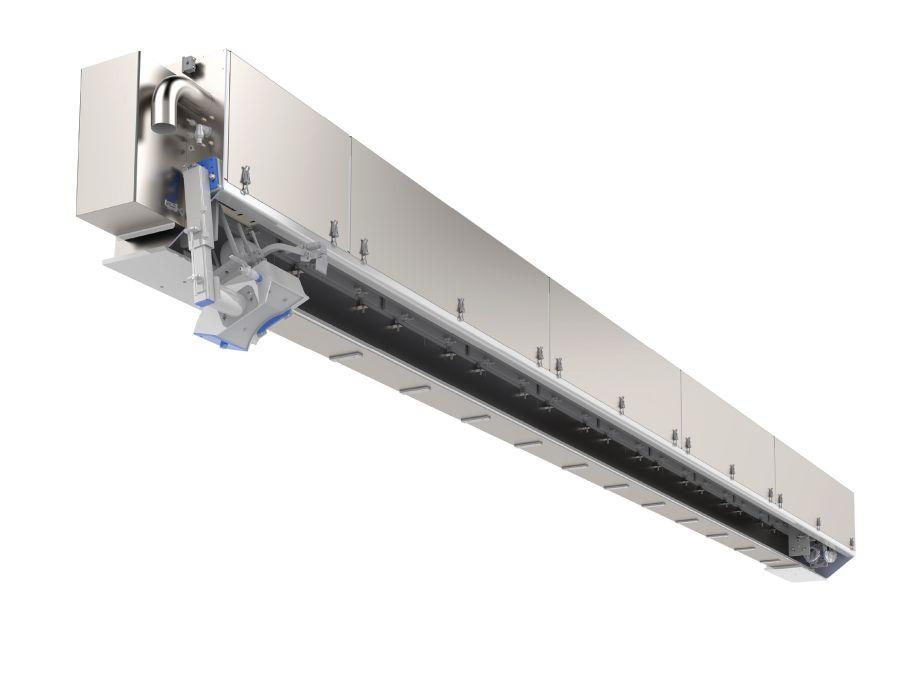
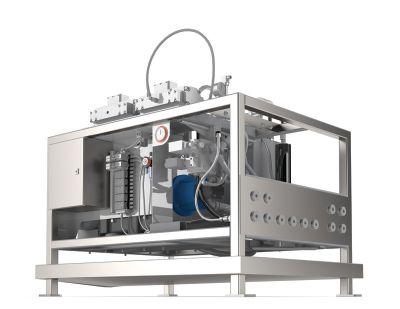
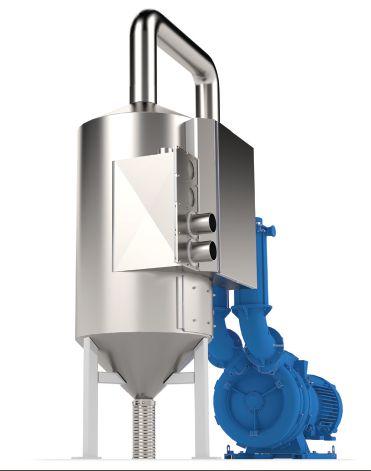
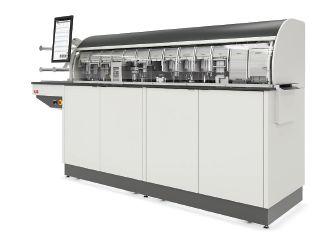
Kadant is a global leader in fabric cleaning with more than 1000 traversing high-pressure cleaning system installations worldwide. The M-clean system uses high-pressure water in combination with an effective evacuation and air knife system. This patented method removes stickies and chemical build up from the fabric’s surface to optimize cleaning, improve operation efficiency, and increase production. ™
Fiber Processing | Doctoring, Cleaning, and Filtration | Drying www.kadant.com
PULP PAPER &
Coronavirus-related curtailments continue
Iwantto begin this note by thanking everyone in the pulp and paper sector for your hard work and dedication during the COVID-19 crisis. We always knew the industry was essential – even before the federal government’s decree in early April – but you have proven that, especially to the public.
Whether it was by pulling out all the stops to get more product onto shelves, or by coming up with innovative ways to aid in the fight against COVID-19, or by taking work-from-home orders and production curtailments in stride – as always, this industry’s workforce did what needed to be done.
And you did all of that while supporting your local communities – something pulp and paper mills have always done on a regular basis, but to still show up when it is most needed, even when there are competing critical priorities? It hasn’t gone unnoticed. (See just a small sample of the generosity in our Community section on p. 30).
Kristina Urquhart Editor
It goes without saying that the coronavirus crisis has had a major impact on how this year is going to shake out. As predicted, global pulp markets have seen weaker prices in 2020 but, with surges in consumer demand for certain products, have still fared relatively well over the past few months. According to a recent report by Wood Resources International, the U.S., Chile and Brazil all increased their wood pulp shipments between 12 and 26 per cent in March over February.
In Canada, however, COVID-related sawmill curtailments are trickling down onto the pulp side, resulting in a lack of fibre availability. At the time of this writing, Madison’s Lumber Report was tracking a rise in softwood lumber prices that may make up some lost ground for sawmills over the summer before seasonal slowdown.
For now, Mercer International has announced its Mercer Celgar pulp mill in B.C. is taking downtime for the month of July (p. 8). Its joint venture with West Fraser, Cariboo Pulp and Paper, took an extended downtime for a month earlier this spring, but is back at full operations again.
On the bright side, coronavirus-related problems are spurring innovation in the industry. Researchers at two Canadian universities are working on all-fibre versions of N95 face respirators. See UBC’s version on p. 11 and learn more about SMU’s plans on p. 20 – that project has an extra challenge, in that they are also working with Port Hawkesbury Paper to potentially turn TMP into a pulp resembling kraft for medical-grade use. (And speaking of innovators, we have some future ones featured this month in our first-ever Top 10 Under 40 contest. Congrats to them – read their stories starting on p. 12.)
We continue to cover the impact of COVID-19 on our new channel, Pulp & Paper Canada: The Podcast. Every month, I’ll be interviewing experts in the industry about trends and technology – and our first episode features Allen Kirkpatrick, executive director of the Canadian Corrugated & Containerboard Association. We discuss how the pandemic has affected the Canadian containerboard market, how the industry has been handling santization and what new technologies converters and roll-stock producers should be aware of. Allen also discussed the role of the association and its member companies in bringing more awareness to Canada’s use of recycled fibre.
“I think maybe the pandemic will heighten that [producers] need to help customers understand why they have selected corrugated cardboard packaging,” he says. “It’s time for them to realize that by the world telling us we’re essential to the essential – well, [let’s] help people understand why.”
If you have a topic you want to see covered in the podcast, let me know at kurquhart@annexbusinessmedia.com. Happy listening! PPC
Mail: 111 Gordon Baker Rd., Suite 400, Toronto, ON M2H 3R1
Printed in Canada ISSN 0316-4004 (Print) ISSN 1923-3515 (Digital)
PUBLICATION MAIL AGREEMENT #40065710
SUBSCRIPTION RATES
Canada $57.50 - 1 year; $92.50 - 2 year USA $139.00 CDN per year Overseas - $150.00 CDN per year
Occasionally, Pulp & Paper Canada will mail information on behalf of industry related groups whose products and services we believe may be of interest to you. If you prefer not to receive this information, please contact our circulation department in any of the four ways listed above.
Sustaining member, Pulp and Paper Technical Association of Canada; Member, Alliance for Audited Media.
Cascades to shutter Ontario containerboard plant
Cascades is closing the Brown Containerboard Packaging facility located in Burlington, Ontario, affecting 45 jobs.
In a statement, the company says the move is part of “continuing optimization initiatives” for its containerboard packaging business, and that production will be integrated into other Ontario plants.
“This decision was necessary to align present production capacities, position our platform for mid- and long-term success, improve productivity, reduce fixed costs and strengthen our service offering for our valued customers,” says Charles Malo, president and chief operating officer of Cascades Containerboard Packaging, in a statement.
The Brown Containerboard Packaging operation will permanently close no later than July 31.
The company says that affected employees will be given the option to transfer to Cascades’ business units in other regions, and that support in finding new work will be provided for employees who do not wish to relocate to other plants.
Canfor Pulp to pause production at two BC pulp mills
Canfor Pulp Products is curtailing production at its Prince George Pulp and Paper and Intercontinental Pulp mills for approximately four weeks starting July 6.
Both mills are located in Prince George, British Columbia.
“We have made the difficult decision to temporarily curtail Prince George Pulp and Paper and Intercontinental Pulp due to the major global economic impacts of the COVID-19 pandemic and the shortage of economically viable fibre in the region,” says Don Kayne, Canfor Pulp’s chief executive officer, in a statement.
The curtailment will reduce Canfor Pulp’s production output by approximately 38,000 tonnes of market kraft pulp and 12,000 tonnes of kraft paper.
Canfor Pulp operates three northern bleached softwood kraft (NBSK) pulp mills, one bleached chemi-thermomechanical pulp (BCTMP) mill, and one kraft paper mill in B.C.
Northern Pulp reviewing terms of reference, says N.S. order could result in odours
Northern Pulp says it is “disappointed” by the province of Nova Scotia’s revised ministerial order that governs the shutdown of the Abercrombie-based mill.
In a statement, Paper Excellence Canada, the mill’s parent company, says the terms of the May 14 order indicate the province does not understand the way effluent treatment facilities operate.
“Since the mill ceased production on January 12, Northern Pulp has worked cooperatively with Nova Scotia Environment on the safe and environmentally sound hibernation of the facility,” the statement says. “It also imposes obligations on Northern Pulp that it is not responsible for and has not agreed to accept.”
The order prohibits the mill from sending clean water into Boat Harbour, which Paper Excellence says could decrease the total amount of water in the lagoons and cause odours.
The company also says that since Boat Harbour is not receiving discharge from the mill, contaminants from outside sources may compromise its ability to comply with the order, which requires the mill to provide a monthly list outlining what activities transpired at the site that could impact the environment.
According to the order, Northern Pulp is responsible for insuring and maintaining the mill and site to ensure the environment is not impacted by the cessation of pulp production.
The province of Nova Scotia is funding half of the cost up to $10 million to fully shut down the Boat Harbour treatment centre.
The funding is being used for removal of the leachate, and the decommission-
Resolute temporarily lays off more than 1,000 workers
Resolute Forest Products has temporarily laid off more than 1,000 employees as a result of the COVID19 crisis.
The employees are mostly located in Quebec. The layoffs have impacted the newsprint, specialized pulp and wood products division, as well as the Montreal head office, says Resolute CEO Yves Laflamme.
Whether the layoffs are extended or not will depend on market conditions, Laflamme says.
Resolute posted its first-quarter results on Apr. 30, citing a US$1 million net loss for the quarter, which was down from net income of $42 million in Q1 2019.
ing of the pipes, ditches, and settling and aeration basins on the site. The shutdown process is expected to be completed by June 30.
Paper Excellence says it is still reviewing the final terms of reference for the province’s required environmental assessment on the company’s proposed effluent treatment facility. After its 2019 government-ordered focus report was deemed by the province to have “insufficient” information, the mill officially closed at the end of January without an approved wastewater treatment plan.
The 29-page terms of reference document, which was released April 29, contains a detailed explanation of all the information required of Northern Pulp to resubmit its proposal, including assessments of adverse effects to the groundwater, surface water, marine water and wetlands, the climate and air quality, ambient noise and light levels and aquaculture.
The company must also explain the proposed treatment facility’s design and impact to the environment, along with planned changes to the mill that may
affect the performance of the effluent treatment facility.
The company has up to two years to submit the report for approval.
Once submitted, Environment Minister Gordon Wilson will decide if the report warrants the appointment of an environmental assessment panel. After the panel reviews the EA report, the minister will either approve the project with or without conditions, or reject it.
The modernization and restart of the mill would re-establish more than 300 direct mill jobs in Pictou County and more than 2,500 forestry sector jobs throughout the province. Northern Pulp has contributed more than $250 million annually into Nova Scotia’s economy since 2011.
Kruger announces indefinite shutdown of paper mill
Kruger Specialty Papers has temporarily shut down its Brompton, Quebec newsprint, specialty papers and biomass facility, affecting 272 jobs.
The shutdown was effective April 3, for an indefinite period of time.
In a statement, the company says the decision is due to unfavourable market conditions hampered by the COVID-19 outbreak, which have affected the mill’s operations and financial performance.
The production of both newsprint and specialty papers for the flexible packaging industry has been curtailed, and the facility’s biomass cogeneration plant has also been shut down.
Demand for specialty papers has decreased during the COVID-19 outbreak.
Cariboo Pulp restarts after extended downtime
Mercer International and West Fraser have announced their joint venture Cariboo Pulp and Paper in Quesnel, British Columbia is back up and running after taking an extended downtime.
The four-week downtime started April 20 and was the result of reduced fibre availability resulting from regional sawmill downtime and other impacts of the COVID-19 pandemic. It was extended slightly to bring forward planned maintenance from the fall.
The curtailment resulted in an approximate reduction of NBSK production of
Sonoco closes Trent Valley paper mill
Sonoco has permanently closed its Trent Valley paper mill in Quinte West, Ontario, affecting 106 jobs.
The mill, which produced recycled uncoated paperboard and recycled linerboard, was set to shut down on June 12.
In a brief statement, the company says the closure is due to market conditions. Those conditions existed before the COVID-19 pandemic, which has further exacerbated the slowing in demand.
Jerry Dias, president of Unifor, the union representing 81 workers at the Trent Valley paper mill, expressed disappointment about the Ontario mill’s closure in a statement.
The union has asked Ontario Premier Doug Ford to create a provincial strategy for the forestry sector.
“Without a strategy to retain key employers and support forestry communities, we could unfortunately see more jobs lost as corporations see Ontario as a less appealing place to operate,” says Dias.
News of the Trent Valley closure came alongside an announcement that Sonoco will invest $83 million to improve its uncoated recycled paperboard (URB) mill system in Hartsville, South Carolina.
The company will transform Hartsville’s No. 10 corrugated medium machine into a URB machine with annual capacity of 180,000 tons.
As a result of the machine conversion, Sonoco will no longer be in the corrugated medium market by the end of 2021. The high-speed fourdinier machine is expected to be online by early 2022.
30,000 tonnes. Both Mercer and West Fraser have shares of 15,000 tonnes.
“For our pulp operations, tissue demand has been strong but the impact of reduced demand for printing and writing applications is starting to materialize,” West Fraser says in a statement.
The cogeneration facility at the Cariboo mill continued operating during the shutdown.
FPAC CEO asks government for short-term support for forestry industry
The president and CEO of the Forest Products Association of Canada (FPAC) has requested support from the Canadian government to get the forestry sector through the COVID-19 crisis.
In April, Derek Nighbor appeared before the House of Commons Standing Committee on Finance to share with MPs how Canada’s forest sector and workers are managing, and to present ideas on how the industry and government can work together to get through the months ahead.
Nighbor noted how the sector has
embraced its role as an essential provider of health, household and industrial products and thanked all workers along the value chain.
“Our workers and partners along the supply chain have been incredible. We can’t say ‘thank you’ enough to our mill workers, further manufacturers, truck drivers, railroaders, and retailers – I could go on,” he said.
The interconnectedness of Canada’s forest sector was central to Nighbor’s remarks to MPs.
While lumber markets have struggled, experiencing a near 40 per cent price drop following the crisis, many sawmills have made the decision to temporarily shut down.
Those closures have not only put thousands out of work, but the impacts have been felt downstream by pulp mill workers and their communities.
“We are a highly integrated sector. Our sawmills are our industry’s heartbeat,” Nighbor said. “We need to find a way now to keep our sawmills operating so chips can continue to feed our pulp and paper mills. If we don’t have chips flowing, our industry’s biggest artery is cut off – and thousands more will be out of work.”
The forest sector has not been able to
Derek Nighbor
tap into the federal government’s wage subsidy program, Nighbor said, because the program’s criteria does not fit with forest sector business models.
Nighbor recommended adjustments such as government considering individual mills or segments, which would allow more operations to qualify for support, and keep more Canadian forestry workers working.
He also suggested that government consider a sliding scale, so that if revenues are down by 10 or 15 per cent, a company could qualify for wage supports at perhaps 50 per cent, instead of 75 per cent.
He also stressed the need for easily accessible supports for the months ahead to help companies manage cash flow challenges. The industry is confident about the future, but needs an immediate boost to get through the next few months.
“On the lumber side, our markets took a massive hit in late 2018. We have been in recovery mode since and just as we were starting to turn the corner, COVID19 hit. We need liquidity supports now,” said Nighbor.
Nighbor clarified that the industry is looking for a short-term solution.
“Our industry is not looking for a bailout, but rather bolstered cash flow supports to keep our businesses operating through these difficult next two to three quarters.”
Harmac Pacific mill doubles down on pulp for medical
supplies
Nanaimo, B.C.’s Harmac Pacific mill has been producing pulp to make medical supplies that are being distributed to hospitals and health care workers fighting the spread of COVID-19.
Harmac Pacific president Levi Sampson says that the mill’s 300 workers are concentrating their production capacity on a blend of kraft pulp made from Western red cedar chips after a client in the United States doubled its orders.
The client blends the wood pulp with synthetics to manufacture medical-grade masks, gowns and other products.
Paper Excellence extends curtailments at two B.C. mills
Paper Excellence Canada will extend the shutdowns at two of its British Columbia paper mills until at least the middle of summer.
Paper operations at Powell River and Crofton, which ceased temporarily on March 1, will continue to be curtailed, with intermittent manufacturing runs in Crofton as opportunities permit.
The Port Alberni mill will continue production with enhanced health and safety protocols as a result of the COVID19 crisis.
In a statement, the company says the confluence of several factors led to the decision, including a lack of wood fibre in B.C., an external malware attack that downed enterprise systems at several mills, and the impact of the COVID-19 crisis on the supply chain.The company discovered the malware attack on Feb. 19 and has been working to bring its enterprise and communications systems fully back online.
Paper Excellence Canada says that the ever-changing situation means timelines for reopening may change.
“We are hopeful that decisions of municipal, provincial and federal governments with respect to mitigation measures offered to help maintain business during the COVID-19 upheaval will provide immediate needed relief for our industry,” the company says.
“These continue to be unprecedented times and we will continue to engage with governments as we seek to chart a path forward for our affected employees and communities hit the hardest by these events.”
Paper Excellence Canada operates nine facilities in Canada and France producing over 3.6 million tonnes annually.
Port Alice pulp mill officially enters bankruptcy proceedings
Neucel Specialty Cellulose’s mothballed pulp mill in Port Alice, British Columbia has entered bankruptcy after failing to pay taxes to the Village of Port Alice.
Neucel owes a total of $272 million to a number of creditors, including at least $1.8 million to Port Alice and $13 million to the province of B.C.
The mill, which once produced sulphite dissolving wood pulp, comprised
70 per cent of Port Alice’s tax base. The amount owing is expected to rise once the mill site is assessed for the 2020 tax year.
Neucel Specialty Cellulose is owned by Fulida Holdings, a textile company based in China.
The mill officially closed in February 2019 after laying off the 20 employees that had been maintaining the site since production idled in 2015.
Alberta Forest Products Association appoints new president and CEO
The Alberta Forest Products Association (AFPA) has appointed Jason Krips as its new president and CEO.
“I am very happy that we were able to attract a candidate of Jason’s pedigree,” says Fred Dzida, chair of the AFPA’s board of directors.
“He has tremendous knowledge of Alberta’s economy and government, coupled with strong relationships throughout Canada and around the world.”
Krips is joining the association after almost 20 years with the Alberta Public Service. He held deputy minister positions with economic development, trade and tourism (EDTT) and agriculture and forestry.
During his tenure with EDTT, Krips oversaw the operational and strategic development of the ministry and played an important role on trade files, including NAFTA/USMCA and softwood lumber.
He also brings a strong background in international relations, previously having oversight of Alberta’s International Office network and overseeing the opening of Alberta international offices in the ASEAN region and South China. He is a lawyer by training.
“I’m looking forward to helping navigate the immediate challenges and solidify Alberta’s position as the best jurisdiction for forestry in the world,” Krips says.
Dzida says having strong leadership is particularly important at this time. “The COVID-19 crisis is having a negative effect on Alberta’s forest industry. At the same time, the government of Alberta and Minister Dreeshen have been especially proactive in their response, helping to protect both the health of Albertans and
Jason Krips
our economy. Leadership within both our association and government will serve our industry well during this difficult time.”
Dzida offered his congratulations to the AFPA’s outgoing president and CEO, Paul Whittaker.
“Paul’s leadership over the past six years has been outstanding. He has grown our membership base and developed a strong organization to advocate on behalf of forest companies and communities.”
Mercer Celgar announces temporary downtime
Mercer International has announced that its Celgar mill in Castlegar, British Columbia will take a month of downtime in July.
In addition to regularly planned maintenance downtime of five days, Mercer Celgar will take approximately 30 days of additional downtime, resulting in a reduction of about 52,000 ADMTs.
In a statement, the company says the additional downtime largely results from reduced fibre availability in the mill’s procurement area as a result of COVID-related sawmill curtailments in British Columbia, the imposition of sawlog equivalent stumpage charges on pulpwood and complex stumpage rules that are resulting in a significant amount of pulpwood already harvested being left to burn in the forest.
Mercer International’s annual production capacity across its Canadian and German operations is 2.2 million tonnes of pulp and 550 million board feet of lumber.
Quebec paper mill now accepting cartons for recycling
Sustana Fiber’s paper mill in Lévis, Quebec is now accepting food and beverage cartons for recycling, the company says in a statement released through the Carton Council Canada (CCC).
According to the CCC, the Lévis facility is the first Canadian mill in 20 years to recycle cartons onsite.
The mill started recycling cartons on May 1 because it needs alternative sources of high-quality fibre due to demand for household paper products, which has surged during COVID-19.
“By recycling alternative fibres, we are proud to enhance our support for a thriving circular economy and help conserve precious resources,” says Michele Bartolini, senior marketing director at Sustana. “We are also keen to do our part, supporting the
supply chain working to make the products people need right now.”
CCC offers resources to MRFs to support their carton-sorting optimizing process.
In 2019, an estimated 33,000 tonnes of cartons were collected for recycling in Canada.
Kimberly-Clark appoints new chief supply chain officer
Kimberly-Clark Corporation has named Gustavo Ghory senior vice-president and chief supply chain officer, effective July 1, 2020.
Ghory will have global responsibilities for procurement, manufacturing, transportation, continuous improvement, sustainability and quality, safety and regulatory operations.
Ghory will report to Mike Hsu, chairman and chief executive officer of Kim-
BC defers stumpage fees for three months to aid sector
The British Columbia government is deferring stumpage fees for three months in response to COVID-19.
The deferral with interest, announced at the end of April, is available to Tree Farm Licence, Replaceable Forest Licence and First Nations’ Woodlands Licence holders who are in good financial standing with the province.
They also must be following through on their reforesting obligations.
The province says the deferral will leave eligible companies with an estimated $80 million so they can pay employees, pay contractors and pay other bills needed to keep their doors open or reopen them faster.
Stumpage is the fee operators pay the province to harvest, buy or sell trees from Crown land, calculated every three months. In B.C, it’s based on volume of timber, species and grade.
“The deferral of stumpage fees is an important short-term measure to help
berly-Clark, and become a member of the company’s executive leadership team.
“Gustavo is an outstanding global leader and I am confident that his extensive experience will help us improve the value we deliver,” says Hsu in a statement.
Ghory joins Kimberly-Clark with more than 35 years of deep experience within the consumer products goods industry, spanning several key senior leadership roles at Procter and Gamble and most recently at SmarterChains, which creates agile manufacturing operations for global companies.
FESBC announces interim board chair
The Forest Enhancement Society of British Columbia (FESBC) has announced an interim chair as Wayne Clogg stepped
alleviate some of the unprecedented financial pressure brought on by the COVID-19 crisis,” says Susan Yurkovich, president and CEO, Council of Forest Industries.
“It will help B.C.’s forest companies put people back to work in communities as markets come back and we move towards economic recovery.”
Major industries, including pulp and paper mills and mines, will also have the opportunity to defer 50 per cent of their BC Hydro bill payments for three months.
Ravi Kahlon, parliamentary secretary for the ministry of forests, lands, natural resource operations and rural development, says that the $69 million fund announced last fall to support the province’s forest workers affected by mill closures and shift reductions in several B.C. Interior communities included new supports for services.
This includes training, work placement and early retirement. It also includes community support grants for communities that have been hit by a mill closure or curtailment.
The government also issued a $1,000 boost to any employee eligible for employment insurance (EI) or the new federal emergency benefits for those who don’t qualify for EI.
down effective May 1, 2020.
Jim Snetsinger will assume the role of interim board chair.
Snetsinger is a former chief forester for B.C. and has been a board member and the vice-chair of FESBC since 2016.
Clogg chaired the society since its inception in 2016 and helped to build FESBC into an organization that delivers funding for forest restoration, wildfire risk reduction, enhanced fibre recovery and greenhouse gas management in B.C.
He will continue as a director with FESBC to provide support and ensure a smooth transition.
On behalf of the board of directors, Steve Kozuki, executive director of FESBC, thanked Clogg for his leadership.
“[We] sincerely thank Wayne for his dedication, hard work and the leadership he has provided in the successful delivery of the Forest Enhancement Society mandate across the province over the past four years,” Kozuki says in a statement.
Performance BioFilaments to research material for N95s
Performance BioFilaments is researching a cellulose-based filtration material for potential use in N95 respirators and surgical masks.
The company, owned by Mercer International and Resolute Forest Products, is among three recipients in a first round of funding from the National Research Council of Canada (NRC) to research and develop alternative methods of filtration material for use in face respirators and masks for front-line health-care workers.
The NRC Industrial Research Assistance Program (NRC IRAP) and Innovative Solutions Canada are investing over $200,000 for the three solutions, which must be able to be sourced and made in Canada.
Performance BioFilaments is receiving $102,524 to develop a filtration material for respirators that are either recyclable or compostable.
Stedfast Inc. is receiving $32,570 to develop washable masks with barrier properties, and a prototype N95 respirator, surgical mask and community mask.
Roswell Downhole Technologies is receiving $70,253 for rapid reconfiguration of plastic extrusion equipment to manufacture N95 filter material.
This funding will help these companies further their research and development to
Canadian Bioeconomy Conference postponed to 2021
Canada’s largest and longest-running conference on the bioeconomy will be postponed for one year because of the
prove the feasibility of their ideas.
The projects will then be evaluated for phase-two funding to develop a working prototype, with the goal of scaling up the production of filtration materials for respirators and masks by late summer.
The NRC IRAP program seeks near-tomarket solutions from small and mediumsized businesses (i.e., fewer than 500 staff) that require financial support to refine and sell their product or solution to meet a COVID-19–related need.
Buckman elects three new members to board
Buckman has elected three members onto its board of directors as the Vancouver, B.C.based James Shepherd retires after 12 years.
The new directors are Robert “Bob” Buckman (Memphis, Tenn.), Jacqueline Welch (Washington, D.C.) and Gregg Sutherland (Denver, Col.).
Bob Buckman‘s career at Buckman spanned nearly 50 years. The son of the company’s founder, Stanley Buckman, he has held many positions at the company including CEO, director and chairman of the board.
He is the author of Building a KnowledgeDriven Organization and has been a longterm board member of the American Productivity & Quality Center (APQC).
Jacqueline Welch is the chief human resource officer (CHRO) and chief diversity officer (CDO) at Freddie Mac, and the first CHRO and CDO to sit on the Buckman board.
She has more than 20 years of experience in HR, inclusion and diversity strategy and execution both as a consultant with Accen-
COVID-19 pandemic.
The Canadian Bioeconomy Conference and Exhibition will now be held June 22-24, 2021 at the Prince George Conference and Civic Centre in B.C.
“The health and wellbeing of our speakers, delegates, exhibitors, partners, staff and volunteers is our number one priority,” says Rob van Adrichem, conference board chair. “We want to ensure our attendees are able to focus all of their efforts on their own health and wellbeing and that of their families, as well as the wellbeing of their businesses and organizations.”
ture and Willis Towers Watson (formerly Towers Perrin) and as a corporate executive at companies such as Turner Broadcasting System and Rock-Tenn Company.
Welch has been recognized nationally with awards including a “CHRO of the Year” by HRO Today, “Diversity Leader of the Year” and “Women Worth Watching” by the Profiles in Diversity Journal, and the “Breakaway Leadership Award” by Evanta, a Gartner Company.
Gregg Sutherland is a recently retired strategy consulting partner with the global advisory firm Ernst & Young. During his 17 years with E&Y, Sutherland assisted clients with the development of growth strategies.
His consulting work encompassed the chemical industry, including extensive work at Dow Chemical, and pulp and paper companies including KimberlyClark and International Paper.
Sutherland has also served in executive roles for product development and strategy, including senior vice-president of strategy at Qwest Communications. He’s also been a board member for Colorado Communications and Technology Professionals and Colorado Audubon Society.
“We are pleased to welcome each of these individuals to our board of directors,” says Phil Shannon, chairman of the board of Bulab Holdings. “[They] each bring to the board unique experiences, skill sets and careers but more importantly they possess the energy, desire and commitment to help Buckman achieve its ambitious goals. Their backgrounds and track records of delivering exceptional results will be invaluable to Buckman’s future successes.”
Solving the riddle of an off-quality paper problem
By Silvia Cademartori
Icanappear before or after printing and converting, or at the end use. I react to moisture changes and can be a seasonal or a regional challenge. I am a well-known issue yet looking for victims. What am I?
If you answered paper curl, you’re right. We’ve all dealt with paper curl at one time. Maybe it was while reading the newspaper or printing from the office printer, or right on the front line at the paper mill or dealing with the curl issue for a customer. Left to be, paper curl will not lie flat and will start winding up in one direction or begin twisting.
FPInnovations and Kruger paper experts recently set the facts straight about paper curl. Frédéric Parent, paper and consumer products manager at FPInnovations, and Javad-Reza Saberian, senior advisor, product diversification at Kruger, presented their combined research and case studies at the 2020 PaperWeek Canada conference in Montreal. They also led a roundtable discussion with industry peers.
Paper curl affects the bottom line of the pulp and paper sector across the value chain from mills and converters to end users, such as printing and writing grades, specialty papers and packaging products. The costs of customer claims, returned inventory and increased transportation add up.
What are the causes of paper curl? Why does it happen?
In general, paper tends to expand or shrink when it absorbs or loses moisture due to changes in ambient humidity or due to converting and printing. If this expansion is different on the top side versus the bottom side of the paper, curl can happen. For example, both photocopy machine paper and newspaper may curl, but due to different reasons: different type of paper, different processes and different causes.
Several factors cause paper curl. How do you identify the cause or origin of the curl?
It is possible to discover the source of the curl when using a proper measur-
ing tool and ambient humidity cycling. Normally with exposure to high ambient humidity, the retained drying stresses in the sheet are released, so we can evaluate the contribution of uneven drying between the top and bottom sides of the sheet.
Through moisture cycling, the potential contribution of structural two-sidedness can also be identified. Structural two-sidedness could be related to a nonuniform distribution of fibre orientation, fines or sheet density in the thickness direction.
Is paper curl preventable?
The curl at the end use is dependent not only on the curl tendency of the paper but also on the converting process and end use. While the mills focus on reducing the curl tendency of their paper, it is good to consider any changes in the customer’s behaviour and operation that could potentially impact the final curl after converting.
Depending on the issue, paper curl can be prevented if we know the mechanisms behind the curl in advance. Some mills have defined appropriate corrective actions based on the different causes. Seasonal factors are the most critical to consider when attempting to prevent curl.
Can paper curl be reversed?
Paper curl are of two types: reversible and irreversible. The reversible curl can be reversed depending on the relative humidity at which the paper is exposed. Too high or too low relative moisture will amplify the issue. As for irreversible curl, as its name suggests, it cannot be remedied or reversed.
Why are some curls irreversible?
The irreversible curl cannot be reversed because it is related to drying stresses that are relaxed when the paper is exposed to excessive relative humidity changes. Once these stresses are relaxed, the paper remains curled. This type of curl is usually more present with singlefelt dryer sections.
How can paper curl be minimized?
If mills can figure out the root cause of paper curl, it becomes easier for them to adjust the corresponding key parameters on the paper machine. Depending on the nature of the curl, some papermaking operations can be modified to reduce curling: Certain changes at the wet-end of the mill can be done to minimize reversible curl, while other changes in the dryer section can be done to reduce irreversible curl.
What is the impact of fixing paper curl issues?
A mill once had a serious curl issue at a pressroom, which put at risk a significant tonnage. By using FPInnovations’ curl test method, we found that the curl was both related to structural two-sidedness and uneven top versus bottom side drying. To understand the origin of structural two-sidedness, we used FPInnovations’ in-house method for sheet splitting and analyzing fibre orientation and fines content. Based on the information obtained, we worked with the mill to optimize the wet-end operation and reduced the curl by roughly 15 per cent. We then focused on optimizing the dryer section to balance the drying of top and bottom sides of the sheet. FPInnovations’ curl test method was used to assess and validate the impact of changes in machine operation. The overall curl reduction at the mill was more than 60 per cent.
In essence, there are three main elements that are critical for solving paper curl issues:
• Proper testing method to quantify the curl and identify the root causes
• Expertise to interpret the result and relate the paper machine operation
• A mill’s willingness to carry out trials and implement the findings
For more information on FPInnovations’ research on paper curl and solutions, please contact Frédéric Parent (frederic.parent@fpinnovations.ca). PPC
FPInnovations is a not-for-profit organization that supports the Canadian forest sector’s global competitiveness. fpinnovations.ca
MAKING A MASK
UBC researchers use all-wood fibre to design prototype for biodegradable, N95-style respirator
By P&PC Staff
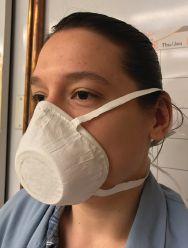
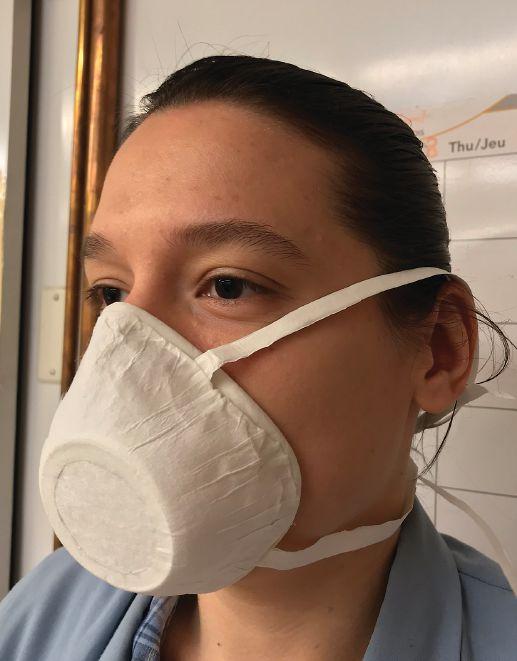
Researchers at the Bioproducts Institute at the University of British Columbia have used wood fibre to design what they say could be the first N95 mask that can be sourced and produced entirely in Canada.
The “Canadian-Mask” – or Can-Mask – is also fully compostable and biodegradable.
“If COVID-19 has taught us anything, it’s how important it is to have a robust supply of protective equipment like N95 respirators and surgical masks,” says chemical and biological engineering professor Orlando Rojas, who is also scientific director of the Bioproducts Institute and a faculty member with UBC’s faculty of forestry, faculty of applied science and faculty of science.
The mask frame is made entirely from B.C. wood fibres from sources such as pine, spruce, cedar and other softwoods.
One prototype uses a commercial N95 filter on the front of the mask, and the other uses a filter specially designed by the UBC team from wood-based products.
Both prototypes are currently being tested to ensure they meet health industry specifications for fit and permeability, with plans to apply for Health Canada certification in the near future.
Cost-effective scaling and production are in the works.
“With escalating tensions during a pandemic, international supply lines for medical masks can break down, creating local
shortages,” says researcher Johan Foster, a chemical and biological engineering associate professor in the faculty of applied science and the NSERC Canfor Industrial Research Chair in Advanced Bioproducts at UBC.
“When we decided to design a mask back in March, we knew early on we wanted a solution that uses local materials, is easy to produce and inexpensive, with the added bonus of being compostable and biodegradable.”
Developing the mask took the combined efforts of a multidisciplinary team that included researchers from the faculties of applied science, forestry and science at UBC.
The researchers believe the mask is a good alternative to the synthetic masks currently in use.
“With millions of disposable masks and gloves already polluting city sidewalks and potentially entering our rivers and oceans, we urgently need a biodegradable option to avoid making a massive impact on our environment,” says Foster.
On the other side of the country, researchers at Saint Mary’s University in Nova Scotia are also looking at the viability of creating a face respirator made from 100 per cent wood pulp. It’s part of a bigger project investigating whether thermomechanical pulp can take on the properties of kraft pulp to make N95 masks – read more about the project in Pulp & Paper Canada’s interview with the lead researcher on p. 20. PPC
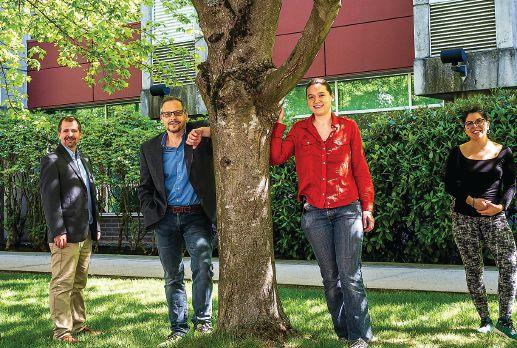
The team behind the compostable mask.
Photos: UBC
TOP 10 UNDER 40
Introducing Pulp & Paper Canada’s inaugural Top 10 Under 40 contest winners
By Kristina Urquhart
Last summer, when Pulp & Paper Canada asked senior-level mill leaders about recruitment and retention practices, 61 per cent said there aren’t enough applicants for new roles. Forty-three per cent said general perceptions about the industry were a challenge in finding new workers.
Several respondents said that promoting pulp and paper sector to young people is key. One way to do that is to showcase successful stories of young professionals already working in the industry. So we’re pleased to present the winners of our firstever Top 10 Under 40 contest!
The people on these pages are our industry’s shining stars. They represent a range of roles, from operations and sales on the mill side to technical support on the vendor side. These leaders-in-the-making all share several things in common: a strong work ethic, initiative and curiosity, and a commitment to training and safety.
Know a future leader? You’ll have the chance to recognize them in the 2021 contest. Nominations will open later this year.
Congratulations to the 2020 crop of winners!
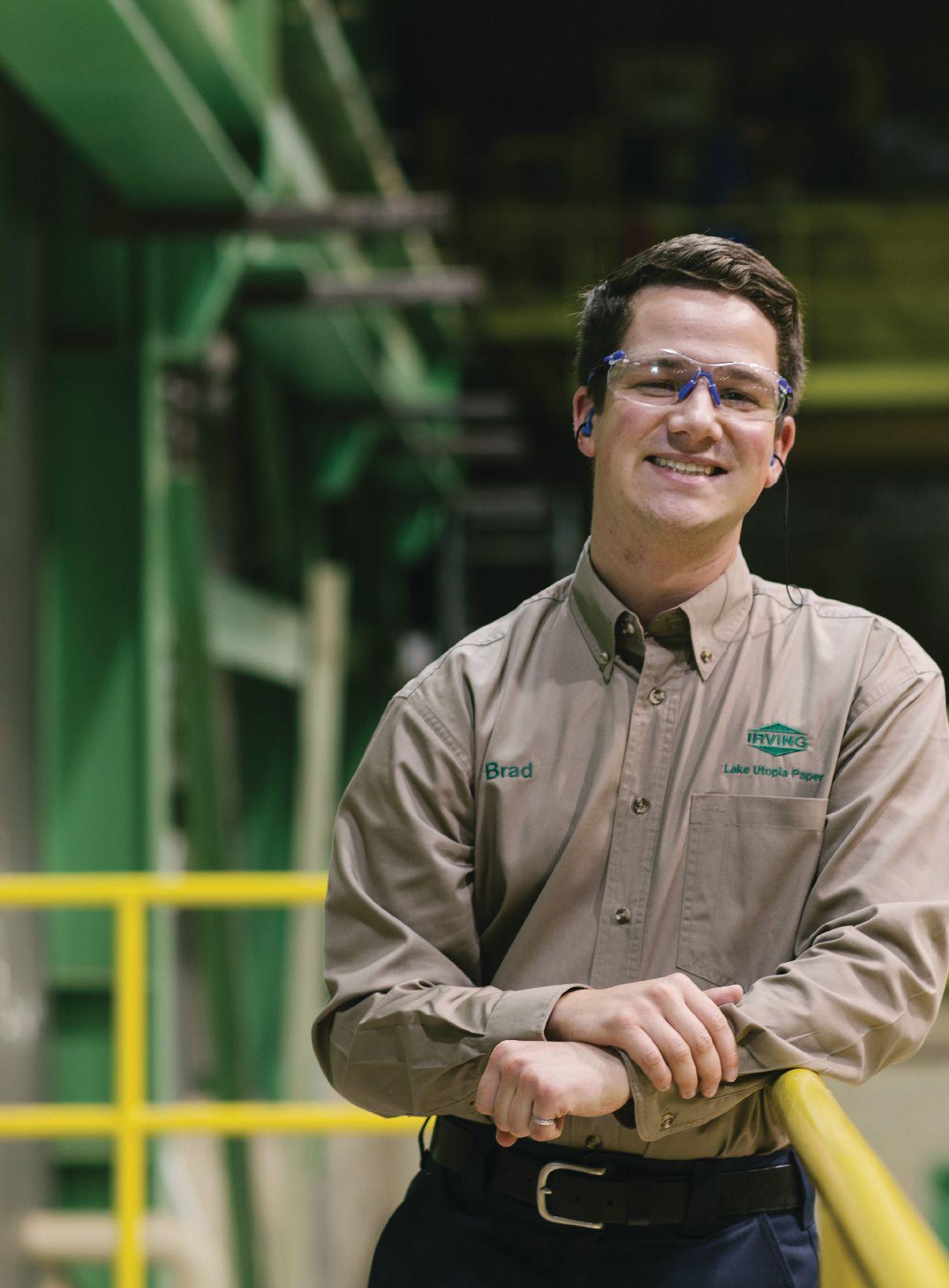
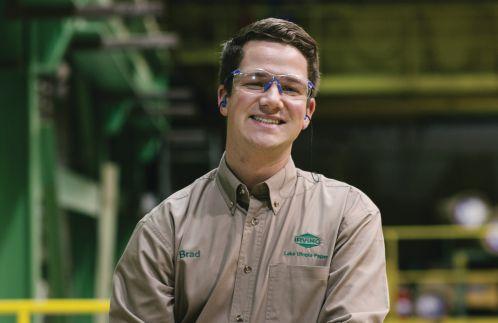
BRAD STODDARD
Associate process engineer, Lake Utopia Paper, J.D. Irving, Ltd., Utopia, NB
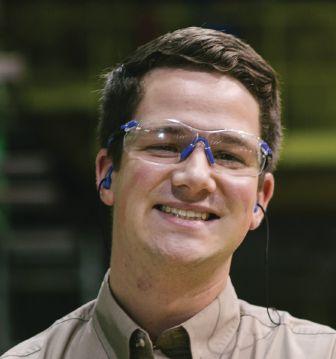
At just 25 years old, Brad Stoddard has already taken on a leadership role at J.D. Irving, Limited’s Lake Utopia Paper. He’s been with the company in a permanent role only two years, and also served four
co-op terms at J.D. Irving while completing his studies in chemical engineering at Dalhousie University.
His manager Rick Wasson reports that Stoddard has acted as technical lead on many projects, including a sulphur burner replacement and making improvements to the bark boiler to reduce fossil fuel use.
“[Stoddard’s] efforts have led to an energy model that allows the mill to be able to optimize fuel choices,” says Wasson. “He has helped to lead efforts to take the mill from 20 to 70 per cent renewables.”
As the mill representative for the PAPTAC Atlantic Branch and a Lean Six Sigma White Belt, “Brad is a serious, committed professional dedicated to driving the mill forward,” says Wasson.
“Whether dealing with technical challenges, helping the operations team to deal with issues, or driving projects, Brad is always advocating to do the right thing.”
JONATHAN PAQUET
Paper machine coordinator, Domtar, Windsor, QC
In pulp and paper, there’s always something new to learn – and Jonathan Paquet is always ready and willing, says a colleague at Domtar Windsor.
That’s only one of the reasons why Paquet deserves a spot in the Top 10 Under 40, says Harshad Pande, Domtar’s director of research and development.
The 38-year-old has been noticed among colleagues as someone who is continually eager to share knowledge or to upgrade his own technical and leadership skills. Over the course of his 12-year career, Paquet has been expanding his expertise on a wide variety of projects ranging from environmental certification and water reduction to sludge dewatering and deinking.
After earning a bachelor’s degree in chemical engineering from Laval University, Paquet spent seven years in production engineering at Cascades before joining Domtar in 2015. He currently helps to produce uncoated freesheet on Paper Machine 8, one of the company’s
biggest paper machines.
Paquet is dedicated to “safe, sustainable and innovative practices while on the job, whether working at the winder section or at the Paper Machine 8,” says Pande.
“His calm and assertive approach to solving challenges in day-to-day operations of the machine has contributed towards improved productivity and a better-quality product.”
EMILY DOU
New product development manager, Domtar, Espanola, ON
In three years with Domtar, Emily Dou has contributed to the development of more than 50 specialty papers, including food packaging and medical papers. In her role as new product development manager for the Espanola mill’s specialty papers area, Dou also supervises 10 technicians on development projects, leads trials on the paper machine and conducts investigations into customer complaints about paper performance.
Dou, 34, graduated from the University of British Columbia in 2016 with a PhD in wood science, writing her thesis specifically on the bioconversion of kraft pulp to dissolving pulp. Previously, she’d earned a Master of Engineering, majoring in pulp and paper making, at the South China University of Technology.
“She is very passionate about product development, performance improvement and meeting customer needs,” says Xuejun Zou, Dou’s frequent colleague at research firm FPInnovations, where Dou participated in a Zero Plastic Waste workshop. Finding alternatives to plastic is important to Dou, who, along with Dom-
“[Jonathan’s] calm approach to solving challenges in day-to-day operations has contributed towards improved productivity and a better-quality product.”
tar’s research team and industry partners, is currently focusing on developing sustainable paper and packaging solutions.
Managing all of this comes naturally to Dou, says Zou. “She has demonstrated strong work ethics, capability for quick learning, willingness to take [on] new challenges and passion for sustainability.”
JEREMY SAUNDERS
Senior key account manager, Solenis, Burlington, ON
“Most readers here will admit that they have had ‘one of those days’ in a paper mill where there are just too many things to do and not enough time to do them. In Jeremy’s case, his first day on the job turned out to be ‘one of those days,’” says Jeremy Saunders’s former colleague Shawn Watkins.
“Jeremy immediately dove into the work within five minutes of starting, and by the end of the very long day, all of us were left with zero doubt that a great hire had been made.”
The 32-year-old Saunders has worked for Solenis for the past six years, bringing what Watkins deems an “unparalleled” technical knowledge of the chemicals and tissue industries to clients in the pulp and paper industry.
“When it comes to mentorship, Jeremy doesn’t try to teach what he knows; instead he listens in order to understand where he can guide and offer assistance to each individual mentee,” says Watkins. “Jeremy will never give you the impression that he knows it all, but he will always share the knowledge.”
An East Coast native, Saunders graduated from the University of New Brunswick with a chemical engineering degree, and is well versed in process optimization, control and engineering.
“His passion for the craft as well as his work ethic will surely carry him toward a career where he will be seen as one of the top tissue experts in the world,” says Watkins.
LAURA PETTIT
Maintenance superintendent, Canadian Kraft Paper, The Pas, MB
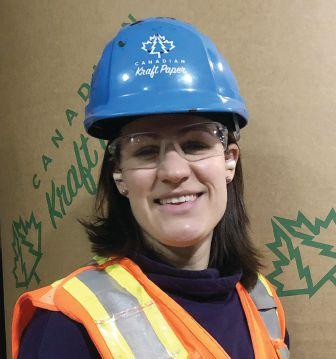
Working in a traditionally male-dominated industry hasn’t been without its challenges for Laura Pettit, but the maintenance superintendent at Canadian Kraft Paper (CKP) has “worked hard over the years to gain the respect of her team and that of her co-workers,” says Andre Murphy, CKP’s mill manager.
“Laura is looked upon as a respected
and trusted leader, and as a technical resource for the entire operation.”
That extends beyond the reliability and maintenance realm to overall health and safety, says Murphy. “She does not hesitate to encourage others to engage in the overall safety focus at the mill site and will often take the time to coach others with a positive and informational approach to achieve results.”
Pettit, 34, comes from a forestry family – her father once worked at CKP when it was owned by Tolko.
She joined CKP in 2007 as a summer intern in the machine room and was recently promoted to maintenance superintendent at CKP after spending 13 years in quality control and reliability engineering. While at the company, Pettit earned her professional engineering designation and completed the 4th class power engineering certification.
Much of her career has been devoted to improving the mill’s quality control program, which Murphy says has translated to benefits in the management and reliability of equipment at the plant.
“Laura has a drive for continuous improvement and her desire to effect and inspire change is evident,” says Murphy. Her commitment to the company’s success has led to her involvement “with the many planned capital improvements, upgrades and maintenance projects that will serve the long-term viability of the mill in northern Manitoba. “
SHANE GRAY
Team lead, woodlands operations, AlbertaPacific Forest Industries Inc., Boyle, AB
“Supportive” was a word that came up several times in Shane Gray’s nomination
“Laura has a drive for continuous improvement and her desire to effect and inspire change is evident,” says CKP’s mill manager.
by fellow colleague Najmus Saqib Khan. Khan says that in Gray’s eight years at Alberta-Pacific Forest Industries (Alpac), he’s proven himself to be a caring leader and a trustworthy employee.
In his role as woodlands team lead, Gray, 29, supports a team of foresters managing Alpac’s forest management agreement (FMA) area. Khan says that Gray’s coordination of the team highlights their strengths to improve overall performance.
“He ensures the team is managed with a coaching approach,” says Khan. “[Shane] is very friendly, inclusive and goes above and beyond for the team whenever a situation arises.”
Gray completed two strategic leadership courses alongside Khan, who witnessed Gray to be dependable and willing to take a stand on principles.
“He has been very much result-oriented and focused on achieving assigned targets in a most efficient and effective manner,” says Khan. “He has proven to be one of the best forestry professionals and with continued [drive] to acquire and learn more.”
ANNIE WANG
Account executive, Canfor Pulp Products, Vancouver, BC
Helping others is second nature for Annie Wang, account executive at Canfor Pulp.
At work, she frequently participates in training new employees and coaching others. Outside of the office, she’s a registered volunteer for the Pacific Blue Cross and helps to raise money for local charities.
Wang’s ability to work with others and her desire to optimize process are what make her excel in her role at Canfor, says her manager Dawning Zhang.
When the pulp group was implementing a new computer system last year, “Annie displayed perseverance and
initiative while collaborating with crossfunctional teams during transition to ensure the customers’ needs [had] been taken care of,” Zhang says.
Wang, 27, joined Canfor Pulp as a global account coordinator in 2017 after graduating from the University of British Columbia with a Bachelor of Science in wood product processing and a minor in commerce – her second in the subject. She also graduated from Beijing Forestry University in 2013 with an undergraduate degree in wood processing and wood products.
In 2019, Wang took on a new role as account executive at Canfor, temporarily moving to the Shanghai office for five months to help implement the new computer system and handle customer needs.
During her time with the company, Wang has handled Canfor Pulp global clients in more than six countries, and does it all with “positive energy and a can-do attitude,” says Zhang.
NICOLAS-PATRICK THÉRIEN
Structural designer, WestRock, Montreal, QC
Though he’s relatively new to WestRock, Nicolas-Patrick Thérien is already making a big impact.
He joined the company in July 2018 as a structural designer after working at Artika as a packaging specialist and at Lovepac as a packaging designer.
Colleague Jean-François Tailly says that Thérien’s positive attitude and willingness to learn about packaging make him a joy to work with. “He is the kind of generous person that you need in your team and who motivates you to work harder every day,” says Tailly. “With only four years of experience in our industry, he is now managing our technical department on his own and does a fantastic job.”
The 29-year-old Thérien graduated from the Université de Montréal in 2014 with a bachelor’s degree in industrial design.
“Nicolas is one of the most dynamic and helpful [people] that I’ve had the chance to work with over the last 25 years,” says Tailly. “His accomplishments are all about the way he acts with his peers, how respectful and helpful he is, no matter the situation.”
VANESSA TERWOORT
Director, environment, Mercer Celgar, Castlegar, BC
Vanessa Terwoort “is an outdoor enthusiast and accomplished mountaineer and environmental sustainability means a lot to [her],” says her colleague Andrew East.
Terwoort found a niche in the pulp and paper industry that allowed her to focus on her passion – after earning her diploma in chemical technology from Northern Alberta Institute of Technology, she was an effluent treatment specialist at Catalyst Paper. She then spent five years working in the mining industry before returning to the pulp and paper industry at Mercer Celgar in 2013 (then Zellstoff Celgar).
Right from when she joined Celgar as environment manager, she started making an impact, helping to improve the way greenhouse gas credits are calculated by Environment Canada and the Forest Products Association (FPAC).
“Since then, Vanessa has partnered with Celgar’s operations team and has pushed for excellence and increased awareness around proper environmental practices in alignment with operations’ productivity, efficiency and cost targets,” says her team members in their nomination.
The 39-year-old Terwoort has taken on increasing responsibility at the mill, becoming environment director in early 2019. Her next steps include mentoring Celgar’s new laboratory supervisor to lead the environmental department.
Her team is looking forward to seeing Terwoort grow and contribute to Mercer
“[Vanessa] is a dedicated and tireless young leader with a passion for the environment, ensuring Celgar leaves as small of a footprint on the world as possible.”
Celgar’s corporate goals.
“She is a dedicated and tireless young leader with a passion for the environment, ensuring Celgar leaves as small of a footprint on the world as possible.”
CHRIS CLARK
Mill manager, Irving Tissue, J.D. Irving, Ltd., Saint John, NB
Whether it’s working full-time at J.D. Irving, Ltd. (JDI), furthering his education or focusing on his family, “Chris Clark is a driven individual, who pours hard work into everything he does,” says his friend Keegan Drummond, account manager at Source Atlantic Limited.
Now a mill manager at Irving Tissue, Clark, 31, got his start with JDI at high school graduation, when the company offered him a scholarship to put toward his studies at New Brunswick Community College (NBCC).
Clark completed two work terms with JDI before obtaining his Power Engineering Technology diploma from NBCC in 2008 and joining the Irving Pulp and Paper Team full time.
While there, Clark spent evenings earning his bachelor’s degree in applied management from the University of New Brunswick. In 2016, he moved on to JDI’s Irving Paper – and began studying again for his Ivey Executive MBA, which he completed in in 2018.
Clark applies the same drive to his extracurricular activities, says Drummond. While studying for his MBA, Clark also trained for the Ironman triathlon and completed it the same month he graduated. “I am truly interested to see where he will go from here,” Drummond says. PPC
MOBILE MAINTENANCE
How Millar Western’s pulp operations employed a mobile oil-cleaning unit to enable online filtration
By Kristina Urquhart
An issue with continuously dirty filters recently led to detailed investigation of an online filtration system at Millar Western’s pulp mill in Whitecourt, Alberta.
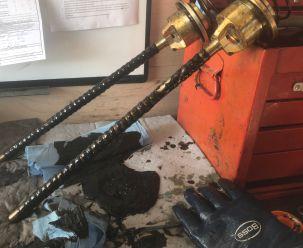
Aaron Chambers, CLS, the conditionbased monitoring (CBM) coordinator at the Whitecourt mill, says that in September 2018, his team discovered the slab press’s hydraulic system had electrostatic discharge occurring as it filtered oil through a machine-mounted kidney loop.
“When the Millar Western maintenance team took the oil canister lid off, the filtered oil on the inside of the filter was blacker than the upstream – nonfiltered – oil around it,” Chambers says. “So, we were going through filters very, very quickly.”
The cost to replace the oil altogether would have been approximately $28,000.
The mill’s mechanical maintenance superintendent was chatting about the issue to a friend, who said that Rotor-Tech – the company he worked for – might have a solution for the problem.
Rotor-Tech, a U.S.-based distributor with Canadian operations in Red Deer, Alberta, had been selling rotary-gear pumps for glycol gas dehydration systems primarily to the oil and gas sector before adding filtration services about four years ago to help preserve the life of its equipment.
Rotor-Tech’s 10- and 25-micron filters during mid-filtration inspection.
The company has since started servicing several other process-based industries, including pulp and paper, with filtration systems including both permanent kidney loops and mobile units.
“We decided that, since we’d be facing a big cost for changing the oil out, it made sense to give Rotor-Tech a go, to see if they could get rid of some of the soot in the oil that was being created by this discharging,” says Chambers.
At the time they made the decision to go ahead, the Whitecourt mill was on a maintenance shutdown. Glenn Gorham, operations lead at Rotor-Tech, arrived in April 2019 with a mobile kidney loop system containing six stages of both magnetic and conventional filtration. The unit,
“When the Millar Western maintenance team took the oil canister lid off, the filtered oil on the inside of the filter was blacker than the upstream oil around it.”
mounted on a trailer, is small enough to get inside the mill, with 50 feet of hoses to allow access to hard-to-reach areas.
Rotor-Tech has assembled its own mobile unit using magnetic filters from One Eye Industries in Calgary. A standard filter “restricts your flow, and it stops a certain size of particulate from going through,” explains George Bachul, general manager at Rotor-Tech. “With a magnetic filter, it actually pulls the particulates out of the fluid, as opposed to stopping it from passing through. That’s how you get sub-micron filtration without any flow restrictions.”
On the first visit to the Whitecourt mill, the Rotor-Tech system removed about 95 per cent of the particulates from the oil.
“It was quite successful, despite the fact that the internal system hadn’t yet been corrected,” says Chambers. “We have since changed to another style of filter to eliminate the issue, and all has been good since.”
In early February 2020, the Millar Western maintenance team discovered that a component on the hydraulic system had failed. After changing parts on the system to rectify the issue, metal particles were
Photos: Rotor-Tech
discovered in the oil. It was cleaner than before the first mobile filtration, but still not at the mill’s set ISO levels.
Rotor-Tech returned at that time to do another pass. Gorham circulated 3,600 litres of oil through the mobile filtration unit for eight hours, with the total cost to the mill being about $2,800 – and since the filtration occurred while the slab press was running, there was no downtime or lost production. The system’s scrubber and dual-stage magnetic filters picked up the fine metal shavings.
Chambers used Millar Western’s inhouse LNF (laser particle counter) to analyze the second-round results. Under ISO 4406 fluid cleanliness standards, which measure particulates per one millilitre, there was an average of 98 per cent less particulates across the 4, 6 and 14µm measurements eight hours after the filtration system had been deployed, compared to a sample from earlier that same day, before the system had been used.
“We started off in a better spot the second time, so the bottom line in our ISO cleanliness was far better than the first time,” says Chambers.
The maintenance team always completes an oil analysis every month to ensure the systems are working properly, and Chambers gets a high-performance test for foam tendency every three months for the larger-capacity oil systems.
Chambers says with the new hydraulic motor components and the new filter in place, the Whitecourt mill shouldn’t need to use the Rotor-Tech mobile filtration unit on the slab press again – but that there
are still opportunities to deploy it in other areas of the mill where oil is used, especially because it allows for online filtration with no shutdown required.
“When our online filtering systems can’t handle what’s going on with the system due to outside influences, then that’s when we would get them back to do extra filtering,” he says.
He points out that there are also environmental benefits to not needing to dispose of used oil. “If the oil is in good shape, there is no need to change
it,” he says.
Millar Western uses about 15 filter carts to process the five types of oil used at the mill. Anything that fails the cleanliness count is re-filtered until it’s at an acceptable level. All equipment on site is sampled at regular intervals.
“We try to keep oil changes down to an absolute minimum,” Chambers says. “Cleaning instead of replacing oil saves us a big expense –and it contributes to the continuous improvement of our environmental performance.” PPC
SAFETY CROSSES ALL BORDERS
▶ Site-Specific Orientation
Develop and deliver customized orientations unique to your facility with verification tools, reporting, and more
▶ Truck Driver Orientation
Develop and deliver site-specific rules/ procedures/hazards; CDL capture, instant verification, and more
▶ GateCheck Application
Smart phone tool captures time stamp, generates reports including mustering, and adds comments for companies| and students
Offered in English/French
Millar Western’s Whitecourt mill
GREEN CHEMISTRY FOR IMPROVED PAPERMAKING
New bio-based papermaking additives show promise
By Martin Fairbank, PhD
At PaperWeek Canada 2020, held in Montreal this past February, there was a common theme to several of the papers presented in the papermaking sessions – papermaking additives based on renewable, bio-based products. It’s said that the easiest place to sell a new product idea is in a market you already know, and that’s certainly the case here –the paper industry already understands bio-based raw materials, and will adopt such a solution rapidly if there are economic or quality benefits as well.
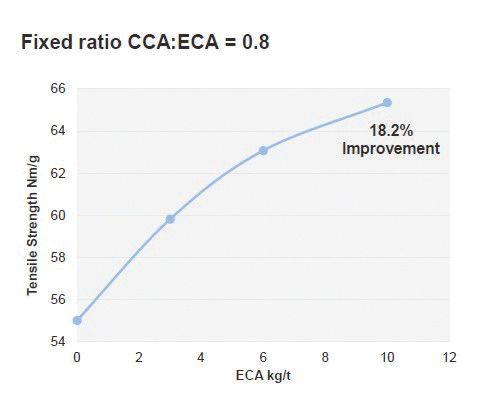
First, a paper presented by Mike Wallace of Kemira discussed a paper drystrength additive called ECA, for engineered cellulose additive. It was first introduced to the market in 2013 by the research labs of AkzoNobel (acquired by Kemira in 2015). This cellulose-based product can replace synthetic polymerbased dry strength additives, which are not only petroleum-derived, but can have a limited shelf life and give variable performance in furnishes with high conductivity or calcium content.
Kemira is offering the product as part of its EcoFill Lite program, which is aimed at reducing basis weight without reducing strength. This program combines the ECA with a cationic polymer or charge control additive (CCA), since the cellulose derivative is anionic in nature. The ECA can be shipped as a stable, dry powder and made down into a pumpable form onsite.
Lab tests showed that the use of 6-10 kg/t of ECA can lead to a 15-18 per cent increase in tensile strength. When the technology was taken to a mill making containerboard grades with high levels of anionic trash, not only was there a 10
per cent improvement in STFI compression and ring crush strength, but drainage and retention improved, and it was possible to decrease basis weight and increase machine speed:
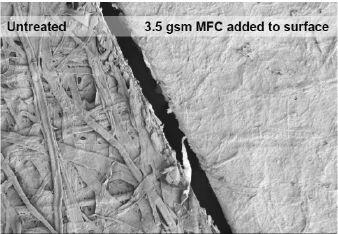
Next, a paper by Marc Foulger of Valmet discussed the addition of microfibrillated cellulose (MFC) on the surface of paper using a curtain coater over the flat boxes of a Fourdrinier machine. The MFC used here is made using an entirely mechanical treatment of cellulose fibres. In both pilot-plant and on-machine trials, MFC has been applied, alone or in combination with fillers, starches, or other additives, at a one to two per cent consistency with the objective of producing 2-8 g/m2 of coating on the surface of paper or board. Due to the very fine cellulose material, significant improvements in surface smoothness and barrier properties of the top side are possible. This could be interesting for several grades including packaging, graphics, release and specialty papers.
Valmet has built one commercial unit that has been running for over a year, and is building a second. It also has two pilot units with widths of two metres and 4.5 metres that can travel to mills for trials complete with pumping systems. For trials in North America, the MFC can be made
at the University of Maine’s pilot plant and shipped at low consistency in a tote bin, but Valmet’s vision is to commercialize the MFC production process so that it can be made onsite at a user’s paper mill.
Because MFC is made of cellulose, this technology could be an interesting way to make greaseproof papers for food packaging grades without using polyfluoroalkyl substances (PFAS), which in recent years have flagged some health concerns. An even better target, if the MFC coating can develop enough gas impermeability, would be to replace poly-coated or laminated food packaging grades, making them not only sustainably sourced, but recyclable:
Next, Lucie Mandanici of Roquette and Gilles Beaulieu of Quadra presented a product based on pea starch that is new to North America. Roquette is a Frenchbased company specializing in plant-based ingredients, especially starch. Roquette has a marketing arrangement with Quadra for its business in Canada.
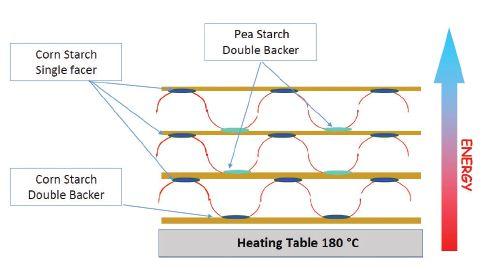
The pea starch is aimed at the niche application of adhesives for double-wall and triple-wall corrugated containers. To understand why this is an appropriate application, a basic understanding of starch chemistry is required. When a starch slurry is heated, it undergoes an extremely rapid increase in viscosity as the starch granules gel and become tacky. The temperature at which this occurs is called the gel point. While the gel point of a corn
starch product is about 55 °C, it is 40 °C for pea starch. This is particularly important for double-wall and triple-wall corrugators because the heat to bond the plies together is applied from the outside surface and is not conducted easily to the inner plies. With the lower gel point of pea starch, bonding is more rapid and complete than with cornstarch:
Pea starch has already been extensively trialed in both Europe and North America, and it has been shown that the lower gel point and faster bonding of pea starch also lead to other advantages, including reduced time before conversion into containers, reduced waste and improved printability. At one North American triple-wall customer, a glue containing pea starch to replace a corn starch formula resulted in a 42 per cent speed increase from 300 to 425 ft/min, and the use of additional resin and bonding in the starch formula could be eliminated, giving a large payback for the slightly higher cost of the pea starch. Other advantages are better penetration of the adhesive into kraft liner with a resulting increase in stiffness and improved water resistance of the bond. Roquette is planning to start producing pea starch in Manitoba, and perhaps the most interesting business aspect of this project is that pea starch is actually considered a residue from the extraction of pea protein, for which there is a growing demand from consumers that want plant-based protein instead of meat-based due to health and global warming concerns.
Elisabeth Lackinger-Csarmann of Kemira gave the final presentation at PaperWeek to fall under the category of green chemistry, on green ASA technology. ASA (alkenyl succinic anhydride), a common internal sizing agent for water resistance of paper and – unlike its rivals rosin sizing from pine trees and AKD from palm oil – is a petroleum-based product. Kemira undertook a research project to find a product similar to ASA, but from renewable materials. An initial scan of vegetable oils led to a particular variety of sunflower oil with high oleic acid content. They call this new product MSOHO, for maleated sunflower oil high oleic, which looks like a branched version of the original ASA molecule.
Lab tests showed that the use of 6-10 kg/t of ECA can lead to a 15-18 per cent increase in tensile strength.
As well as being made from a renewable raw material, MSOHO turns out to be much more stable to hydrolysis. When ASA is re-circulated in white water, it breaks down to the acid form, which can combine with dissolved calcium to produce deposits. Tests show, however, that the MSOHO half-life at 70 °C is 100 min versus 30 min for ASA.
Unfortunately, the initial material is much more viscous than ASA, presenting some challenges for handling. For now, Kemira is marketing a 30/70 mixture of MSOHO/ASA that can be handled with existing ASA equipment. They have obtained approvals for use of MSOHO in food contact paper grades, research is ongoing to reduce viscosity, and equipment is forthcoming to handle sizing at higher temperatures, which will allow easier flow. PPC
Martin Fairbank has worked in the pulp and paper industry for over 30 years and is currently a consultant and technical writer.
TRANSFORMING PULP
Research project will explore if thermomechanical pulp can take on the properties of kraft pulp for face mask production
By Kristina Urquhart
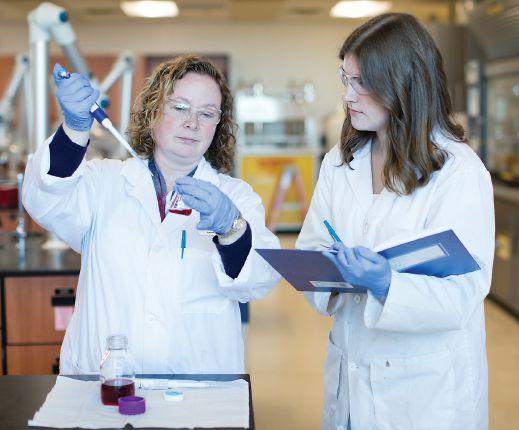
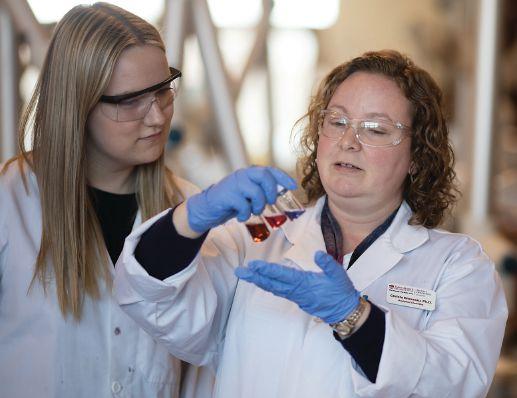
The lead scientist set to research if thermomechanical pulp (TMP) from Nova Scotia can be used in the production of N95 respirators says she is looking forward to getting the project off the ground.
“We’re hoping to be able to innovate in this area,” says Dr. Christa Brosseau, a professor in Saint Mary’s University’s Faculty of Science. “There’s a great global demand right now
and so it’s exciting for us.”
Saint Mary’s University (SMU) recently received a $72,600 grant from the Research Nova Scotia (RNS) COVID-19 Rapid Response program to fund the project, which will establish if TMP from Port Hawkesbury Paper can be turned into medicalgrade pulp using chemical additives and/or alternative treatment options for the long-term production of face masks.
“This has never been something that people have looked at, because it was never a need,” says Brosseau, who is also the Canada Research Chair in sustainable chemistry and materials. “This global supply shortage is forcing us to think [that] maybe with some clever and innovative chemistry, we can get to that point.”
Brosseau, who specializes in analytical chemistry, is leading the seven-person research team alongside her synthetic chemist colleague Dr. Robert Singer. Four student researchers and a full-time research associate will join them.
Port Hawkesbury Paper will provide its pulp for characterization and testing during the project, which officially starts in June.
An innovative idea
Brosseau came up with the idea for the project as she was following the story of Nanaimo, B.C.’s Harmac Pacific mill, which ramped up its production of medical-grade pulp in late March to ship to a client who was blending it with synthetic polymers to make N95 respirators.
Harmac Pacific is currently the only mill in Canada making medical-grade pulp, which is northern bleached softwood kraft (NBSK) made from Western red cedar fibre.
Hearing that Harmac Pacific had difficulty keeping up with demand, Brosseau says she wanted to investigate if medicalgrade pulp could be manufactured in Nova Scotia. With Northern Pulp’s NBSK mill closed, the only other pulp producer in
“What would it take to convert a fir and spruce pulp into a product that would have properties suitable for medical pulp?”
the province is Port Hawkesbury Paper – but it’s not an NBSK mill. It makes TMP using primarily fir and spruce chips.
Twin challenges
Despite all being softwood, “obviously, there’s a big difference between red cedar and fir and spruce,” says Brosseau. “That’s where the research question is – what would it take to convert a fir and spruce pulp into a product that would have properties as such that it would be suitable for medical pulp?”
First, what makes red cedar so suitable for mask making? “It’s a combination of things – including long, soft fibres that make it easy to blend with synthetic polymers like polyester and polypropylene,” explains Brosseau.
“Also it has a low shrinkage factor, which means that when you have an object formed out of medical pulp and it gets wet, it doesn’t lose its shape as much as other forms of pulp.”
Second, because lignin is mechanically extracted from the softwood chips with TMP rather than chemically dissolved like with NBSK, part of the research will be to find ways to get TMP to mimic the properties of NBSK.
The research team will explore how TMP morphology changes when exposed to various chemical additives. Ionic liquids are just one of the more innovative additives on the table, which Brosseau says act as “liquid salts” that dissolve cellulose.
The process
Brosseau’s team will spend the first part of the 10-month project in a discovery phase, characterizing the pulp at its elemental, molecular and morphological levels after each stage of the production process to see where inserting those additives might be successful, and how they affect the fibres.
“Ideally it would be at end-of-line product, but there might be an earlier stage where adding an additive would have a bigger effect,” she says.
Once they have a modified pulp that could be suitable for the end use, the team will use a heat press to turn it into paper so they can evaluate how it will perform at capturing microscopic particles like a virus.
By the end of March 2021, the SMU team hopes to provide Port Hawkesbury Paper with a plan of how the mill might be able to produce medical-grade pulp in the future.
The plan would contain “the ways in which they could go about doing that, being cognizant of the fact that we don’t want to add anything into their stream that would be toxic, for example, or difficult to recover in clean up, or that would be problematic to use at scale.
“One of the issues that might be problematic with ionic
liquids, for example, is they’re very viscous,” Brosseau says. “We don’t want to add too much of a really high-viscosity additive that may gum up the works.”
A secondary goal
The research team will also explore the potential of using allwood pulp to create an N95 mask. (Researchers at the University of British Columbia recently made a prototype of an all-wood fibre face respirator – see p. 11.)
“There’s been really good evidence that nanocellulose, for example, can be good at viral capture,” says Brosseau. “The idea of having an all-wood pulp respirator is really attractive because they’re meant to be disposable.
“That would make [them] more biodegradable and environmentally friendly than the respirators we have now, which are synthetic blends.”
Nanocellulose, however, so far has been difficult to produce at scale. The research team will also use the SMU lab’s milling machine to explore if a combination of chemical additives and high-frequency milling might help scale the technology.
There are other challenges with an all-wood pulp in a respirator application, says Brosseau. When wood pulp gets wet and then dries, the fibres can clump together. “So there can be basically a network of holes and gaps that would allow something to move through,” explains Brosseau. “A virus is really small – like 100 nanometres – so if you’re going to capture viruses, you really can’t have a filter that’s full of large gaps and holes.”
When a face respirator contains a wood pulp layer – not all of them do – it usually only serves to make the mask feel soft against human skin. The tightly meshed synthetic layers are what take care of the viral protection. To mitigate the presence of gaps in an all-wood mask, Brosseau says the SMU team will be researching how to produce a paper material that allows the fibres to dry slowly and avoids clumping.
This is why figuring out how to scale nanocellulose for use in N95 respirators could be a viable option, she says. “The idea is if you can already have the cellulose in a nano-scale form, then you may be able to control the length scale of gaps and defects.” PPC
Dr. Christa Brosseau (right), professor at Saint Mary’s University, will work with student researchers on this project.
SENSOR STRATEGIES
Achieving accuracy with the calibration and correlation of online paper machine sensors
By Martin Fairbank, PhD
Online sensors are important for the modern papermaker because by continuously measuring product properties, they make it possible to react almost instantaneously to process changes, either by operators or by automated process control. While equipping a mill with online sensors requires an initial capital expense, this is usually repaid quickly as off-spec product is reduced and faster grade changes are enabled.
In most cases, online sensors modify the role of lab testing from the primary method of quality assurance to a new responsibility of ensuring that the sensors continuously provide accurate measurements. Key to ensuring that online sensor measurements match offline measurements generated by mills’ quality labs is the practice of dynamic sensor correlation, which is leading many pulp and paper mills to establish a correlation strategy.
Lu Athnos, service account manager for ABB, has more than two decades working directly with papermakers and also currently serves as leader of the TAPPI Common Interest Group on Sensor Correlation. A large part of her role involves helping customers to create a sensor correlation strategy by ensuring their online sensors can produce accurate measurements and that lab measurement methods follow industry standards.
“Calibration requires a comparison between a calibration standard and the measurement made using your instrument,” says Athnos. “Put simply, the calibration process compares an instrument’s output against primary standards and ascertains their relationship.”
As an example, Athnos cites the calibration of an online caliper sensor comparing its response to one or more traceable standards with known thicknesses. “Once the initial calibration is completed, a set of primary standards can be used to verify the stability and repeatability of the sensor,” she says. “Monthly checks are often performed.”
Athnos adds that, importantly, an online sensor needs to be properly correlated with lab measurements over time. This involves comparing online sensor measurements regularly with offline measurements from the quality control lab.
While undertaking sensor correlation, “expected deviation limits” should be established to objectively quantify the control limits between lab and online measurements. “The expected deviation derives from three main sources: sensor accuracy, process variation and lab test accuracy,” says Athnos.
“Sensor accuracy should be specified by the sensor manufacturer. Paper properties vary constantly during manufacturing and therefore, during correlation tests, it is neither possible nor practical to collect a sample from the exact spot the sensor is measuring. The influence of process changes must be considered. Lab influences can include factors such as sampling error, instrument accuracy, instrument sensitivity and sample conditioning errors.”
Various methods exist for sensor correlation. For example, for basis weight, these methods include:
• Roll weight or reel weight: calculating basis weight from the lineal footage, trim width and weight of a reel or a roll and comparing to the basis weight shown on the reel report of the quality control system.
• Single-point dynamic: placing the sensor in single-point mode and comparing results against lab measurement of samples cut from the reel at the same position across the reel.
“It’s important to appreciate that sensor calibration and sensor correlation are different,” says Athnos. “Calibration generates precision and sensor correlation generates accuracy.”
Case study
A U.S. mill specializing in packaging could not achieve repeatable coat-weight correlation results between its lab and online sensors. While operators expected a deviation of up to 0.5 lbs/3,000 ft2, they in fact observed up to 10 times this level. They initially believed that the problem derived from the online sensor, but further research established that the machine’s high process variability and inconsistent lab test results were the root causes.
“It’s important to appreciate that sensor calibration and sensor correlation are different. Calibration generates precision and sensor correlation generates accuracy.”
Process variability
Two online scanners (measuring basis weight before and after coating) were placed in “single-point mode,” following which, basis weight measurements were collected. There was shortterm basis weight variability of approximately 5 lbs/3,000 ft2 between the maximum and minimum values. However, in under a week, having resolved an upstream process issue, the basis weight variability was significantly reduced, down to 1.3 lbs/3,000 ft2. This confirmed that the process variability was affecting the correlation results.
Lab variability
Operators analyzed lab variability by taking cross-direction and machine-direction samples measuring one by three inches and weighing about 13 grams from three locations on the reel: front, middle and back. The intention was to investigate how repeatable the lab results were from these adjacent paper strips. The lab tests showed variation of up to 2 lbs/3,000 ft2 of coat weight between the samples. To decrease variability, larger samples were recommended to reduce the effect of random lab and sampling errors and provide improved accuracy.
Results
The paper manufacturer was surprised to find that responsibility for inconsistent correlation results was not due to its online sensor. Helpfully, the project opened discussions on how to improve machine-direction control for coat weight, subsequently enabling savings in coating usage: if reducing coat weight by 0.5 lbs while maintaining high product quality is possible, the manufacturer could make 4.1 per cent coating material savings.
Some other reasons commonly found for poor correlation between lab and online measurements include not following TAPPI or PAPTAC measurement standards, not protecting paper samples immediately by sealing them in a plastic bag, since paper is hygroscopic, or not measuring the correct side of the paper for measurements that are affected by two-sidedness.
Sensor correlation strategies
Every papermaker using online sensors should have a robust sensor correlation strategy, which should audit the sensor correlation processes and methods in order to improve the accuracy of quality measurements. Correct standard operating procedures should also be established.
Athnos and her team have helped dozens of mills align measurements from online sensors and the quality control lab. As Avery Bolton, quality process engineer at Domtar Hawesville, and a customer of ABB’s Sensor Correlation Service, says, “A strong correlation program […] is critical to operations that trust sensor measurements to make real-time decisions affecting the machines and production. Operators rely on scanner measurements to determine when they are ‘on grade.’ When there is little difference between the scanner and lab results, we can make quick decisions with confidence.”
Using online sensors with proper sensor correlation improves quality measurement accuracy, and can produce significant savings in raw material usage and improved efficiency by reducing off-spec product and energy consumption. A thorough sensor correlation program is essential for all papermakers to ensure product quality and business profitability. PPC
Martin Fairbank has worked in the pulp and paper industry for over 30 years and is currently a consultant and technical writer.
Papermakers using online sensors should have a strategy to correlate sensors.
Coat weight variation before and after correcting an upstream process variability issue.
Coat weight from lab results on cross-direction (CD) and machine direction (MD) paper samples taken from front, middle and back (F, M, B) of paper reel.
FOCUS ON MACHINE CLOTHING
Voith expands tissue press fabric portfolio with UpElement Voith has introduced UpElement to its portfolio of tissue press fabrics as part of its Element-Series of add-on solutions, The felts have a higher saturation capability during startup, which ensures optimal dewatering of the paper web.
UpElement makes startup up to 50 per cent faster compared to standard press fabrics, without compromising operational stability or long-term performance. By reaching full machine speed sig-
nificantly faster, UpElement keeps energy consumption to a minimum and delivers notably higher production output per felt.
Depending on the operating setup, UpElement can increase output by tens of thousands of dollars of saleable product per year. voith.com
Valmet restructures fabrics unit
Valmet is restructuring its fabrics business unit, which the company says will ensure the unit’s profitability and future competitiveness.
Valmet will relocate the dryer fabric and wide filter fabric production from Finland to Portugal, affecting 78 jobs in Tampere, Finland.
In addition, the company says the possibility for temporary lay-offs and part-time work remains if capacity adjustments need to be done later this year. For those affected by the cuts, Valmet
Yamauchi and Heimbach release new Yamabelt
Shoe press belt maker Yamauchi and machine clothing maker Heimbach have collaborated on the Aikido, a new version of the Yamabelt.
Heimbach’s understanding of the efficient dewatering of press felts and Yamauchi’s experience in coating and finishing of roll covers and shoe press belts resulted in the 2010 creation of the Yamabelt.
Yamabelt maintains a high level of void volume while exhibiting a low risk of cracking. The belt consists of a two-ply coating, which allows it to respond to the different demands of both the smooth (shoe-facing) as well as the grooved (felt-facing) sides.
The void volume of Yamabelt must be able to withstand the line load in the nip and remain at a constant level throughout its life. Long service life in particular can lead to reduced void volume due to absorption of process chemicals. The stronger the line loads, the more adversely affected the dimensional stability of the grooves in the nip can be. These effects can reinforce each other and negatively affect dewatering performance.
In early 2015, Heimbach and Yamauchi extended the product range with the Kendo and Judo.
Kendo has been successful in ensuring the further improvement of void volume preservation. Its groove design prevents crack formation and propogation.
The Judo belt is for positions that tend to crack in the area of the shoe edges. Its polyurethane is extremely flexible and therefore able to withstand the highest demands.
With the new Aikido product, the characteristics of Judo and Kendo were combined and enhanced by a newly developed polyurethane formulation. This design specifically meets continually rising demands in terms of mechanical load capacity (line loads of currently up to 1400 kN/m).
heimbach.com
will provide support for education and re-employment.
The fabrics business unit employs altogether approximately 500 persons in Tampere.
The Tampere unit develops and manufactures press felts, shoe press belts, dryer fabrics and wide filter fabrics.
Valmet’s location in Portugal develops and manufactures filter fabrics and other industrial textiles.
valmet.com
Feltest’s fabric puller also acts as clamp
Feltest’s Capto puller can be used as a fabric, felt or canvas puller, or as a canvas or felt clamp.
The aluminum-frame tool is ideal for forming fabrics, press felts and dryer screens.
It has a maximum pulling force of 1,000N (approximately 100 kg or 220 lbs), and its maximum opening is 8 mm (0.3 in). The Capto puller offers a rubber clamping surface of 49 x 125 mm (1.93 x 4.92 in).
feltest.com
ANDRITZ launches MasterDry dryer fabric portfolio
The new ANDRITZ MasterDry dryer fabric portfolio contains woven and spiral fabric technology specifically designed for the broadest range of applications, from the fastest low-caliper, single-tier positions, for high-temperature positions, and for those positions requiring extreme contamination resistance.
It includes specially engineered woven or spiral dryer fabrics to cover an entire paper machine producing paperboard/ packaging and graphical papers, and can also cover pulp machines.
The company says the durability of the fabrics and their seam technology can lead to improved sheet quality. andritz.com
this year’s prize with colleagues Richard H. Waring of Oregon State University and Joseph J. Landsberg of the Commonwealth Scientific and Industrial Research Organization in Australia.
The 2020 prize, which consists of two million Swedish kronor, was awarded to the researchers in recognition for their work on the 3-PG (Physiological Principles Predicting Growth) model developed by Landsberg and Waring, which predicts forest growth and the ability of forests to store carbon.
With Coops’ work on satellite imagery, it is now possible to make these predictions on a much larger scale.
“The Canadian forestry sector continues to be a global leader in innovation,” says Seamus O’Regan, Canada’s minister of natural resources, in a statement. “My sincere congratulations to Dr. Nicholas Coops for this well deserved recognition.”
Landsberg and Waring became pioneers when they presented the 3-PG model in 1997 to predict forest growth under changing environmental conditions. The model is also able to calculate how actions, such as thinning and fertilization, affect
forest growth and development.
Forest growth forecasts have traditionally been based on forest surveys of previous growth without the ability to include changes in silviculture or the surrounding environment. A process-based model such as 3-PG can also include the effects of silviculture and environmental factors and give predictions of current and future forest production.
Coops added satellite imagery analysis to the model to enable large areas of forest to be surveyed.
Now it is possible, among other things, to predict forest growth and carbon storage on a large scale, calculate how diversity of the forest landscape can be developed over time, and assess the risk of outbreaks of insects and large forest fires in inaccessible forest areas.
Coops says that “one of the most exciting things about the honour of receiving the Marcus Wallenberg Prize is how it will inevitably further elevate the utilization of the 3-PG model.
“The 3-PG model is an open-source model, available from UBC, and can be easily used and accessed by graduate students and industry alike. Combining it with analyses from satellite images from space means that today, we can better answer questions such as the trends in the future growth of key forest species such as the Douglas fir in British Columbia.”
The technology is currently in use across Canada. In the B.C. Interior, 3-PG is being used to look at poplar and how the species might be able to fuel bioenergy plants. In Eastern Canada 3-PG is helping researchers to understand how forests are being impacted by drought and fire. Across the country, researchers are employing 3-PG to examine how some species will move across the landscape over time as a result of climate change. Coops’s research has focused on the use of remote sensing techniques to gain an in‐depth knowledge of forest structure, health, biological function and diversity as well as further development and application of the 3-PG model globally. He has published more than 460 scientific articles in joint authorship in scientific journals. ubc.ca
Sonoco announces price hike on paperboard tubes and cores
Sonoco has increased prices for all paperboard tubes and cores sold in Canada and the United States by a minimum of eight per cent.
The price increase was effective with shipments as of May 13.
The increase is the first announced change in nearly two years, says Doug Schwartz, division vice-president and general manager, tubes and cores, U.S. and Canada.
He says the increase is necessary to recover rising costs for recycled paperboard, which is the primary raw material used to produce tubes and cores.
“Along with rising paper prices, we have experienced continued price escalation in other input costs, which are putting cost pressures on Sonoco that we are simply unable to absorb,” Schwartz says.
In Canada, Sonoco operates a paper and recycling mill in Brantford, Ontario.
2020-05-20 11:23
UBC’s Nicolas C. Coops (left) with fellow researchers J. Landsberg and R. Waring.
Photo: Marcus Wallenberg Foundation
FPinnovations calls on forest sector to help with face mask solutions
FPInnovations is actively working with the industry, governments and other stakeholders to identify how the forest sector can contribute to supplying the medical sector with equipment needed for COVID-19.
From a list of vital equipment provided by the medical sector that included products as diverse as ventilators and hand sanitizer, FPInnovations identified protective face masks as a product for which the sector could rapidly offer a viable solution from forest-based resources.
FPInnovations mandated its researchers to develop a project proposal that included a preliminary plan. This process identified major future challenges and developed a potential implementation schedule.
If accepted, this project will be carried out in collaboration with numerous partners from industry, governments and academia and would be delivered on a tight schedule to develop prototypes and provide testing that verifies the effectiveness of the product.
Also, if the project receives the green light, results obtained could lay the foundation for a new area of research for FPInnovations and a community of stakeholders. Contact FPInnovations if you are interested in more information about this project. fpinnovations.ca
Cascades debuts packaging line for e-commerce
Cascades has launched a new product line designed for e-commerce retailers.
The products, grouped together under the banner of “Cascades e-com packaging solutions,” include regular or die-cut e-commerce boxes, insulated boxes and custom mailer boxes.
The line also features protective material made from recycled cardboard. Custom printing options are available, as is right-size packaging.
Shipping tests can be conducted at the new Cascades shipping test laboratory in Kingsey Falls, Quebec, to certify that customers’ products will arrive at their destination in perfect condition.
“With the expansion of online shopping, especially during the pandemic,
Sappi releases new paper line for solvent-free casting systems
Sappi has launched a new textured release paper line made specifically for highfidelity PVC, PU, semi-PU and solvent-free casting systems.
Regulations are going into effect that limit or eliminate solvent-based casting systems in China and the European Union to reduce chemical waste and pollution.
As a result, many of the world’s textile and fashion brands have formed the Zero Discharge of Hazardous Chemicals (ZDHC) Program to implement changes to their value chains that align with the ZDHC’s Manufacturing Restricted Substance List (MRSL).
As these changes continue to be adopted, Sappi has created Ultracast Viva, a high-fidelity casting paper compatible with solvent-free systems.
Ultracast Viva, produced out of the company’s Westbrook Mill in Maine, also offers reduced curl, increased reusability and easier handling with expanded notemperature limits for PVC, semi-PU and 100 per cent PU including aqueous PU chemistry. sappi.com
corrugated packaging needs are growing and changing,” says Charles Malo, president and chief operating officer of Cascades Containerboard Packaging, in a statement. cascades.com
Kadant Johnson expands operations group
Kadant Johnson, a subsidiary of Kadant, has expanded its operations group with two job appointments.
Alan Ives is the new vice-president, operations and Harry Brown is the new director of manufacturing.
The operations group now includes manufacturing, supply chain, quality assurance, EH&S and engineering.
Prior to this appointment, Ives served as the director of engineering and held various technical roles since joining the company in 1993.
Brown formerly served as manufacturing superintendent at Kadant Johnson and prior to that worked in various capacities in manufacturing since joining the company in 1980. kadantjohnson.com
Voith releases TwinDrive double unwind
Voith has introduced the new TwinDrive double unwind to boost winding capacity.
The new TwinDrive double unwind ensures a winding capacity that is up to 20 per cent higher compared to the use of conventional unwinding systems.
This advantage is achieved through the additional unwind position and fully automated jumbo roll changes.
With conventional systems, the winding capacity is limited due to downtimes during jumbo roll changes. The fully automated process of TwinDrive eliminates these downtimes.
Depending on customer requirements, the paper web is connected automatically with a FlyingSplice or ButtSplice system. Depending on production conditions, more jumbo rolls can be processed by the winder.
The system is fully tested before delivery and shipped in three large units. This results in short assembly times on site and a fast start-up curve. voith.com
FITNIR to supply online liquor analyzer to Swedish mill
Canadian company FITNIR Analyzers is supplying a Swedish pulp producer with an online liquor analyzer for a causticizing plant.
FITNIR, based in Vancouver, B.C., is a global supplier of FT-NIR benchtop, kappa and online chip moisture content analyzers.
For this project, FITNIR Online will replace the liquor analyzer in the causticizing plant at Södra’s Värö mill (pictured, next page) to provide data for optimizing process control and automation.
The mill’s main goal is to reduce the need for burnt lime in the causticizing process.
Harry Brown
Alan Ives
The data from FITNIR’s online analyzer will reduce green liquor TTA variations to make correct lime dosing possible.
The impact of reduced lime consumption is far-reaching, including energy and cost savings with the reduction of fuel needed in the lime kiln as well as the ability to produce enough lime for higher overall pulp production.
Moreover, the increased measurement frequency with FITNIR Online opens a new world for recovery boiler optimization and subsequently lower energy consumption.
This is the second time FITNIR is supplying its analyzers to Södra, after completing an initial installation at Södra Cell Mönsterås in 2016. Installation is expected to begin in the summer of 2020. fitnir.com
Voith completes acquisition of Toscotec
The Voith Group has successfully completed its previously announced acquisition of Toscotec (pictured), an Italybased manufacturer of tissue paper and paperboard equipment.
ABB upgrades L&W Autoline paper testing system
ABB has enhanced its L&W Autoline automated paper testing system, scalable to fit any lab.
The solution optimizes quality control for all papermaking operations.
L&W Autoline incorporates a visual touchscreen interface.
Other features include a smooth feeding system that pulls the samples through the machine to minimize jamming, a dual test function to reduce queuing by allowing simultaneous testing, high-volume information storage and real-time visualization.
The system – which can handle everything from sample preparation to the final reel report – reduces dependence on manual testing.
Visualizations are instantly available in real time to operations and engineering personnel both locally and remotely.
L&W Autoline now comes in two different sizes: L&W Autoline S has a
In January, the companies stated Voith would acquire 90 per cent of Toscotec’s shares.
“Toscotec’s acquisition matches Voith’s targets of strategic growth in a perfect way,” says Andreas Endters, president and CEO of Voith Paper, in a statement.
“Toscotec’s range of products and services effectively supports our portfolio and further strengthens our position as a full-line supplier in important areas of the paper industry.”
Toscotec will continue to offer its portfolio and will operate under its name.
In the tissue area, Toscotec will carry out the business with new lines and major rebuilds for the entire Voith Group in the future.
Voith Paper will continue to serve its delivered tissue machines.
All other business activities will remain unaffected, and Voith and Toscotec customers will be able to purchase via their existing sales channels as usual. toscotec.com
reduced footprint for smaller mills and those new to automated testing. L&W Autoline L is a larger unit, designed for more extensive testing requirements.
Both options share the same feature set, including sequential testing coupled with the ability to capture more than 100 quality parameters by CD position, providing a high quantity and quality of information for fast corrective action. new.abb.com
Clyde Industries to supply boiler equipment for pulp mill
Clyde Industries, boiler efficiency solutions specialist, has received an order from ANDRITZ to supply boiler-cleaning equipment for a large pulp mill project.
ANDRITZ will supply equipment and processes for all main process islands in fibre production and chemical recovery.
Clyde Industries, headquartered in Atlanta, Georgia, will supply all sootblowers for the new recovery and power boilers at the mill.
Delivery is planned for November 2020 with a scheduled start-up at the end of 2022. clydeindustries.com
ABB launches colour-coded sensors for pH measurement
ABB has launched a new range of colourcoded sensors for choosing and managing the optimal pH measurement solution.
The application-driven designs are categorized into three groups: the entrylevel 100 series for measurement in general process applications; the highperformance 500 series for harsh industrial applications; and the 700 series for specialist applications.
Digital and analog options are available, with the digital solution offering in-built diagnostics.
ABB’s EZLink plug-and-play technology links any of the new sensors to ABB’s digital transmitter range, including the recently launched AWT420. EZLink pro-
vides access to maintenance data meaning that users can replace sensors at the optimum time.
The new range incorporates ABB’s perpetual impedance diagnostics to detect electrode faults without the need for a solution earth. Another feature is the smart Reference Electrode Monitoring (REM) system, which provides early warning of electrode poisoning.
Optimal temperature compensation is assured by locating the pH electrode, reference electrode, and in-built temperature sensor together at the electrode tip. This provides a faster temperature response and better accuracy during calibration and in-process control applications.
new.abb.com
Stora Enso partners on biobased carbon fibre solutions
Stora Enso and Cordenka are partnering to develop precursors for bio-based carbon fibre that could be used in transportation, construction and power generation.
Stora Enso, a pulp and paper producer based in Finland, has been developing the technology for manufacturing carbon fibre from wood-based raw materials such as dissolving pulp and lignin, at laboratory scale.
The agreement with Cordenka GmbH & Co KG, a producer of industrial viscose fibres, aims at upscaling the precursor development process to pilot-scale operation.
Currently, carbon fibre is made from PAN (polyacrylonitrile), an oil-based raw material. The raw materials for bio-based carbon fibre are cellulose and lignin, which come from trees.
In the bio-based carbon fibre process, cellulose is converted to viscose and mixed with lignin to form the spinning dope. The dope is spun into precursor fibre that is thermally converted to carbon fibre.
TAPPI combining conferences in 2021 TAPPI has announced it will bring the PaperCon, TissueCon, NETInc and Women’s Summit conferences together for one event in 2021.
The conferences are now scheduled for April 25-28, 2021 at the Cobb Galleria Centre in Atlanta, Georgia.
“After much discussion, we know this is the right thing to do for our attendees, exhibitors, speakers, partners and our industry,” says Larry Montague, president and CEO of TAPPI, in a statement.
“It is crucial to focus on your families and helping your companies succeed this year. By co-locating these events, we are creating one, interactive expo for you to connect and find the solutions you need to move your companies forward after this crisis.”
PaperCon is considered the world’s largest technical conference for the paper and packaging industry. TissueCon is a non-commercial, peer-reviewed event for the tissue industry, and NETInc is a nonwovens technical conference developed by engineers and technologists. Women’s Summit addresses key topics integral to women in the industry.
In 2021, PaperCon will continue to present key issues affecting mills, new innovations and opportunities to connect with industry professionals. Attendees can expect a full technical and management program and training opportunities. tappi.com
The precursor development is being carried out with specialized manufacturing spinning equipment at Cordenka’s Obernburg production site in Germany. The venture is supported by BMC, owner of Cordenka, as part of their strategy to extend the reach of Cordenka into new growth markets and Asia.
“It is exciting to partner up with Cordenka to develop bio-based carbon fibre that replaces oil-based raw materials,” says Markus Mannström, executive vice-president of Stora Enso’s biomaterials division.
Call for technical papers
“Our ambition is to provide industrial composite producers with a sustainable, yet cost-competitive, carbon fibre made from renewable and fossil-free materials.” The target of the partnership will be on developing carbon fibre initially for industrial applications requiring low weight and high mechanical performance, such as pultruded laminates used in manufacturing wind energy rotor blades. Today, 20 per cent of the global carbon fibre supply is used by the wind energy industry. storaenso.com
Pulp & Paper Canada is seeking technical papers from industry experts, researchers and suppliers for potential publication in our print and online properties.
Since 1903, Pulp & Paper Canada has been the Canadian media authority on innovations in mill research, technology and management.
Topics for technical papers may include mill operations (safety, maintenance, management, reliability, etc.), new or improved technologies/processes/innovations, or research in pulping, papermaking, tissue, packaging or the bioeconomy.
Abstracts will be accepted for consideration on an ongoing basis and must include as least one image or graphic. Publication is not guaranteed.
Preference will be given to papers authored by industry professionals located in Canada. Papers must be previously unpublished by other media.
Please submit abstracts for technical papers or direct further questions to: kurquhart@annexbusinessmedia.com.
GIVING BACK
The latest community outreach initiatives from the pulp and paper industry
Here we share the initiatives of pulp and paper companies working to make positive social, environmental and economic impacts across the country. Pulp & Paper Canada thanks all of our essential workers across the industry who have helped Canadians navigate the COVID-19 pandemic. We appreciate you!
As part of its #RollingItForward initiative supporting front-line health-care workers, Kruger Products donated personal care packages of tissue products to more than 1,200 staff at L’Hôpital de Gatineau.
Let us help you share your successes. Tag @PulpPaperCanada or use #PPCGivingBack on Facebook, LinkedIn or Twitter, or send an email to the editor at kurquhart@annexbusinessmedia.com. We’d love to hear from you!
J.D. Irving, Ltd.
Facebook
Domtar
Kruger Products
Cascades Facebook
J.D. Irving, Limited, donated $1 million to Food Depot Alimentaire to help with demand on New Brunswick’s 60 food banks during the pandemic.
Employees at Domtar’s Kamloops, B.C. mill donated 9,000 disposable gloves to medical facilities in the region.
The Cascades plant in St. Marys, Ontario, donated $5,000 to the Salvation Army Food Bank at the height of the pandemic.
We’ve launched a podcast! Pulp & Paper Canada: The Podcast delivers engaging conversations on the latest trends and technologies in Canada’s pulp and paper sector. Every month, Kristina Urquhart, editor of Pulp & Paper Canada magazine, interviews industry experts about topics related to the pulp, paper, tissue and packaging sectors.
Topics include:
Market trends
Hiring practices
Safety guidelines
Process control
HAVE AN IDEA FOR A PODCAST EPISODE?
Email Kristina at kurquhart@annexbusinessmedia.com
WANT TO SPONSOR A PODCAST EPISODE?
Email Laura at lgoodwin@annexbusinessmedia.com
Maintenance and equipment
Sustainability
Energy efficiency
And so much more!
Four future scenarios for food packaging
Is the future of food packaging practical, green, individualistic, or regulated?
As part of the fiber-based packaging value chain, we investigated how food and its packaging could change and develop in ten years’ time. Based on the insights from an industry expert panel, four plausible scenarios for the future were identified.
We believe the future will be a story that the entire industry creates together. We hope that these “what if” stories give food for thought for discussion between stakeholders and encourage new, innovative ways of thinking. READ