As every day brings new developments related to COVID-19, we are naviga ng through these uncertain mes and challenging circumstances with the highest priority around the safety of our industry partners, suppliers, sponsors and their spouses.
Global, na onal and local authori es con nue to issue guidance directed at slowing the spread of the virus – minimizing travel; cancelling social gatherings; shu ng down nonessen al businesses; working / schooling from home; and social distancing. In response, we have made the difficult decision to cancel PACWEST Conference 2020 at the Fairmont Jasper Park Lodge.
June 2 to 5 - in Whistler, BC
The Fairmont Chateau Whistler
For ongoing updates visit www.pacwestconference.ca or email us at - info@pacwestconference.ca
PULP PAPER &
Pandemic puts pressure on prices, safety programs
WhenPulp & Paper Canada published our 2020 outlook for the tissue industry in January, we cited overcapacity as the main concern for the year. (One of the experts we consulted also said that using paper products is the best way to complete handwashing and prevent against the spread of viruses, which was oddly prescient given that the article itself was written last November, well before the outbreak of COVID-19.)
What a difference a few months makes. While overcapacity remains a challenge – despite consumer hoarding of bath tissue during the outbreak and a subsequent increase in production, demand is expected to level off by mid-year as new capacity comes online – there are now overarching concerns about what the pandemic’s aftermath will mean for the global economy.
Kristina Urquhart Editor
In Nova Scotia, the forest industry – already upended due to the closure of Northern Pulp – is being walloped again. Port Hawkesbury Paper, the province’s remaining paper mill, has had to claw back on its chip orders and its deliveries due to market conditions. In turn, weaker demand has forced sawmills to pause buying from Nova Scotia’s 30,000 small woodlot owners in order to work through the logs they already have.
On the West Coast, pulp and paper mills in British Columbia have faced difficulties for over a year thanks to fibre shortages and low pulp prices. David Fortin, an analyst with Fastmarkets RISI, told me that further price pressure from the COVID-19 crisis is likely going to lead to some tough decisions for our B.C. mills (p. 12). For more on COVID-19’s potential impact to the industry, see another forecast from Moody’s Investor Service on p. 7.
So far, Canadian mills, which have been named by several provinces as essential services, have been nimble throughout the crisis. At the time of this writing, Resolute, Canfor, Rayonier and West Fraser had all announced measures to adjust production capacity in response to market needs, with more efforts being thrown into pulp and tissue production as they scale back on paper and wood products. Those capacity adjustments have, in some cases, meant downtime and temporary layoffs, like in the case of Kruger Specialty Papers. Where possible, mills have sent employees to work from home, and made shift adjustments to ensure adequate coverage in light of reduced staffing and physical distancing.
Our mills have always prided themselves on safety – so with robust health and safety programs already in place, they were able to mobilize quickly in their response to COVID-19, immediately rolling out measures such as extra sanitizing stations, staggered breaks, split shifts and increased cleaning. One thing that impressed me is that our mills are in constant communication with their staff about the ever-changing situation – many are sending daily updates and encouraging questions. Not every industry is doing the same thing.
When I was gathering the 2019 data for our annual Safest Mill in Canada contest (p. 14) – weeks before combatting coronavirus became our everyday reality – I asked health and safety coordinators to share the biggest lesson their mill has learned about safety.
“Inclusion of the workforce is critical,” the team at Mercer Celgar said. “Building trust and respect through relationships provides the most value from a prevention perspective.”
Employees will remember how their employers treated them during this challenging time. That’s not to say they don’t understand that drastic changes may be necessary – but it’s how those changes are handled that will make the difference in their long-term commitment to the company. PPC
Mail: 111 Gordon Baker Rd., Suite 400, Toronto, ON M2H 3R1
Printed in Canada ISSN 0316-4004 (Print) ISSN 1923-3515 (Digital)
PUBLICATION MAIL AGREEMENT #40065710
SUBSCRIPTION RATES
Canada $57.50 - 1 year; $92.50 - 2 year
USA $139.00 CDN per year Overseas - $150.00 CDN per year
Occasionally, Pulp & Paper Canada will mail information on behalf of industry related groups whose products and services we believe may be of interest to you. If you prefer not to receive this information, please contact our circulation department in any of the four ways listed above.
Sustaining member, Pulp and Paper Technical Association of Canada; Member, Alliance for Audited Media.
STRONGER TOGETHER
The Coronavirus COVID-19 has challenged all of us. At TAPPI, we share in your concerns and remain committed to our industry and to the health and well-being of our members, volunteers, staff and exhibitors. All of which is why we made the difficult decision to reschedule PaperCon and focus on the future. As we emerge from this crisis, let us be better and stronger than ever! Announcing April 25-28, 2021 • Atlanta, GA
Visit papercon.org for details.
Kruger announces temporary shutdown of paper mill
Kruger Specialty Papers will temporarily shut down its Brompton, Quebec facility, affecting 272 jobs.
The shutdown is effective Friday, April 3, for an indefinite period of time.
In a statement, the company says the decision is due to unfavourable market conditions hampered by the COVID-19 outbreak, which have affected the mill’s operations and financial performance.
The production of both newsprint and specialty papers for the flexible packaging industry will be curtailed, and the facility’s biomass cogeneration plant will also be shut down.
West Fraser defers maintenance shutdown at BC pulp mill
West Fraser has announced some production changes at its pulp and paper and lumber mills in response to the COVID19 outbreak.
The scheduled maintenance shut for the company’s jointly owned Cariboo Pulp and Paper mill in Quesnel, British Columbia has been deferred.
“West Fraser has implemented changes to mitigate potential exposure at our worksites, with a focus on thorough cleaning, strict travel limitations, health education and appropriate social and physical distancing at all company sites,” the company says in a statement.
Effective March 23, lumber production was reduced at western Canada sawmills by approximately 18 per cent or 12 million board feet per week and lumber production at the company’s U.S. South sawmills was reduced by about 24 per cent or 15 million board feet per week.
These reductions will be implemented through various means including reduced operating hours, elimination of overtime, elimination of shifts and curtailment of operations. Shipping will be maintained as needed to fulfill order commitments. These temporary reductions are expected to stay in place until at least April 6.
Port Hawkesbury to pause wood buying due to market conditions
Port Hawkesbury Paper in Nova Scotia will stop purchasing wood for the month of April and pull back on scheduled deliveries in May.
The move is mostly in response to the
COVID-19 outbreak and the market conditions following the closure of Northern Pulp earlier this year.
But a spokesperson for the mill says that deliveries are usually soft this year due to ground conditions and spring weight restrictions.
While Port Hawkesbury Paper increased its wood buying after Northern Pulp’s closure, its production remains the same, so it needs to work through its supply.
Kruger Products announces new CMO
Susan Irving, formerly of PepsiCo, became chief marketing officer of Kruger Products on March 1. She takes over from Nancy Marcus, who retired. Marcus joined Kruger Products in 2001 as vicepresident of marketing and focused on building the company’s brand portfolio and marketing capabilities. She was appointed to CMO of North America in May 2018.
Irving is an award-winning senior marketing executive with over two decades of experience leading many successful and well-known brands at Warner Lambert, Coca-Cola and PepsiCo.
“We are very pleased to welcome Susan to the Kruger Products team as chief marketing officer,” says Dino Bianco, CEO of Kruger Products, in a statement. “She has extensive CPG experience and the strategic acumen to lead Kruger Products brands to further growth and connection to our consumers.”
In her new role, Irving will lead the marketing team and be responsible for the vision, strategic direction and performance of all Kruger Products brands and marketing activities in Canada and the United States.
Crofton mill curtails pulp and paper production
Citing a lack of available fibre, Paper Excellence Canada’s pulp and paper mill in Crofton, British Columbia shut down production for the month of March.
The curtailment affected 450 workers.
The mill’s vice-president of operations, Stew Gibson, reported to the Canadian Press that Crofton’s fibre supply has dwin-
Pulp and paper events cancelled due to coronavirus
Several forestry and pulp and paper events in North America have been postponed, cancelled or modified in an effort to stem the spread of COVID19, including:
• The 32nd International Mechanical Pulping Conference: The University of British Columbia was set to host this event June 7-10, 2020, but it has been postponed to 2021, with new dates yet to be announced.
• Tissue World Miami: The 2020 conference has been rescheduled to November 11-13, 2020 in Miami, Florida.
• PaperCon 2020: TAPPI has shelved the April 27-30 conference, and 2021 dates are yet to be announced. For a full list of event changes, visit pulpandpapercanada.com.
dled as a result of B.C. sawmill curtailments and closures, as well as the recently concluded eight-month strike at Western Forest Products, one of the mill’s main fibre suppliers on Vancouver Island.
He indicated that as operations resume at Western Forest Products, supply is expected to improve.
Paper Excellence mills in B.C. hit by malware attack
Paper Excellence Canada is working to fix a malware issue affecting some of its mills in British Columbia.
According to a statement, the company became aware of the hit to its IT systems on the morning of Feb. 19.
Susan Irving
Coronavirus will drive paper, pulp prices lower: Moody’s Moody‘s outlook for the global paper and forest products industry remains negative.
This reflects Moody’s expectation that the industry’s global operating income will decline five to seven per cent over the next 12-18 months.
Declining demand and lower paper packaging (both corrugated and consumer packaging), commodity paper and market pulp prices will be only partially offset by increasing wood product prices and modestly stronger demand for tissue, specialty paper and pulp.
Coronavirus will pressure demand and drive prices lower. The global economic outlook is deteriorating as the outbreak spreads. While logistics disruptions may temporarily slow paper and forest product exports to and from China and other affected areas, such as Korea and Italy, the impact on global demand will likely be far worse than on global production. This will result in oversupply across many regions, which will drive prices for most grades lower.
Paper packaging and tissue – The outlook for the paper packaging and tissue sub-sector remains negative. Lower corrugated and consumer packaging prices, as recent capacity additions cause an oversupply, will be partially offset by lower fibre costs. E-commerce growth and environmental pressures to replace plastic packaging with paperbased alternatives will be partially offset by right-size packaging.
Despite a recent spike of bath tissue and paper towels in reaction to the coronavirus, Moody’s expects demand will normalize during the second half of the year and North American tissue earnings will decline as the ramp up of new capacity causes average prices for the year to fall.
Paper – The company’s outlook for the paper sub-sector remains negative. Secular decline in demand for commodity paper and lower prices will drive paper earnings lower, as consumers continue to turn to digital substitutes like electronic storage and e-books. Paper capacity reductions through mill/ machine closures or conversions will likely fail to keep pace with demand declines, leading to lower prices for most paper grades. Demand for several
specialty paper grades will increase as consumers switch to paper-based substitutes for single use plastics, such as cups and straws.
Market pulp – Moody’s outlook for the market pulp sub-sector remains negative. Although prices for most grades of pulp in 2020 will rebound slightly from the troughs experienced in 2019, average commodity pulp prices this year will be lower than 2019 average prices.
Logistics obstacles and weaker Chinese demand because of the coronavirus will push out the price recovery to the second half of 2020. Pulp supply disruptions coupled with limited new capacity growth until after 2020, should allow market pulp inventory levels to normalize in the second half of 2020.
In March 2019, Moody’s correctly assigned a negative global outlook based on the company’s forecast of a two to four per cent earnings decline. The rated industry’s consolidated operating income declined more than 10 per cent.
Actual earnings were lower than the forecast primarily due to weaker than expected market pulp and wood product prices. This was due to lower demand growth, coupled with fewer supply disruptions. North American lumber and OSB prices were lower than expected in 2019, due to weaker than expected demand from home construction and higher supply levels.
Outlook – Moody’s would change the outlook to stable if they believed that consolidated global operating income would grow between zero and four per cent over the next 12 to 18 months.
This would most likely result from either lower costs or higher prices across several grades and regions due to a tight demand-supply balance or slightly stronger demand from higher-thanexpected housing starts or GDP growth.
Moody’s would change the outlook to positive if they expected consolidated operating income would increase by more than four per cent over the next 12 to 18 months. This would most likely result from a combination of both lower costs and significantly higher prices across several grades and regions or significantly stronger demand from higher-than-expected housing starts or GDP growth.
The malware attack infiltrated Paper Excellence’s enterprise software, which has affected paper production at its Crofton, Port Alberni and Powell River mills.
The malware has also impacted communications at those mills, as well as at the Howe Sound mill and the company headquarters in Richmond.
Paper Excellence noted that certain product deliveries may be impacted as the issue is ongoing.
“The IT systems at each of the company’s facilities have been isolated. Work is currently underway to assess the scope and level of the impact and appropriate next steps to return to full production,” the company says in the statement.
External advisors are working with Paper Excellence to investigate and resolve the issue, which has not affected pulp manufacturing.
Alberta-Pacific joins Alberta Forest Products Association
Alberta-Pacific Forest Industries (Al-Pac) has joined the Alberta Forest Products Association (AFPA).
“We are excited to have Al-Pac join our association,” says Paul Whittaker, AFPA president and CEO.
“Al-Pac is internationally recognized for their state-of-the-art manufacturing process and commitment to leading forest management practices. We look forward to working closely with them to drive Alberta’s forest industry forward.”
Al-Pac’s facility, in Athabasca County, is North America’s largest single-line kraft pulp mill. The mill directly employs 400 people and supports more than 1,000 indirect jobs throughout Alberta.
Al-Pac has been recognized as one of the top employers in both Alberta and Canada. At 5.9 million hectares in land base, Al-Pac manages the largest contiguous third party–certified forest in the world, under Forest Stewardship Council (FSC) certification (FSC C022642).
Each year, Al-Pac produces 620,000
air-dried metric tonnes of kraft pulp.
Last year, Al-Pac produced enough renewable energy to power approximately 15,000 homes in addition to generating enough electricity to run the mill. To do this, they use forest biomass to create renewable energy and are one of the largest bioenergy producers in Alberta.
Ontario invests $83K to redevelop former pulp mill site
The Ontario government is investing $83,000 in two community development projects on the site of the former Resolute Forest Products mill in Fort Frances.
Resolute sold the mothballed mill, which had been idle since 2014, to a subsidiary of brownfield redeveloper Riversedge Developments in July 2019.
The Northern Ontario Heritage Fund Corporation is funding $65,000 for the Town of Fort Frances to create redevelopment plans for two properties, and $18,000 for the Rainy River Future Development Corporation to study the feasibility of developing a modular house manufacturing facility in the region.
“This support will be used to conduct a land use and economic feasibility study for the redevelopment of the Shevlin wood yard and the former nursing station, creating a gateway to the Rainy Lake Market Square,” says Fort Frances Mayor June Caul.
Initially, Caul and the town’s council had advocated for a buyer that would restart the mill and bring jobs back to the region.
However, sale documents prohibited any transfer to a competitor. Resolute holds the forest licence the Crossroute Forest, which is the area’s fibre supply.
N.S. to put $50M for forestry transition into long-term trust
The government of Nova Scotia has announced it is putting the $50-million forestry transition fund it created after Northern Pulp’s closure into trust.
This will allow the money to be used over multiple years, giving time for the industry to diversify.
A total of $13.5 million of the package has been spent so far by the forestry transition team on initiatives tied to securing employment for workers affected by the mill’s closure. The government topped that amount back up to $50 million
BC contractors receive $2.7M to use wood waste for pulp and pellets
Forestry contractors in British Columbia are receiving over $2 million in funding from the province to increase the use of wood fibre waste from slash piles to make pulp products and pellets.
The Forest Enhancement Society of BC (FESBC) is allocating $2,737,764 in grants for four biomass projects:
• $1,080,000 to Taan Forest Products to use material from slash piles to make pulp for use in paper products (about 51,000 cubic metres or 1,020 truckloads) in the Haida Gwaii Natural Resource District.
• $880,000 to Skookumchuck Pulp Inc. to use material from slash piles to make pulp for use in paper products (about 110,000 cubic metres or 2,200 truckloads) in the Rocky Mountain Natural Resource District.
• $369,450 to RPP Holdings Inc. to use material from slash piles to make pulp for use in paper products (about 36,000 cubic metres or 720 truckloads) in the Quesnel Natural Resource District.
• $408,320 to Skeena Bioenergy Ltd. to use material from slash piles to make wood pellets (about 22,000 cubic metres or 440 truckloads) in the Coast Mountains Natural Resource District.
“Assisting the province to reduce greenhouse gases, add value to forest fibre and maintain jobs for workers and communities are some of our key objectives,” says Wayne Clogg, board chair, Forest Enhancement Society of BC, in a statement.
“There are many society-funded projects throughout B.C. that are making a difference right now. The amount of biomass (woody debris) that will not be burned as slash – but instead used this winter season to fuel a greener economy – is expected to exceed 1.6 million cubic metres by March 2020.”
before placing the money in trust.
Lands and Forestry Minister Iain Rankin announced the new trust to about 180 members of the forestry sector Feb. 12 at the Forest Nova Scotia Annual General Meeting in Halifax.
A three-member trustee board will oversee spending decisions and will include one government nominee and two transition team nominees. The trustee members will be announced once appointed.
The transition team will continue to listen to and work with those in the forestry industry to provide their best advice on short-term supports for workers and businesses, and on innovative approaches that support the sector over the long-term.
To date, $7 million has been allocated for silviculture and road work on both Crown land and private lands, $5 million for government to provide a guarantee for the Forestry Contractor Financing program, and $1.5 million to help workers from across the sector connect to customized programming in the skilled trades.
The province has also established
emergency assistance funding for laidoff workers available through local Access Nova Scotia centres.
Northern Pulp closed on Jan. 31 to meet the province’s legislated deadline to stop depositing mill wastewater into Boat Harbour.
A small number of the mill’s 300 workers remain at the mill to complete a winterization process that will last through April, at which point the effluent pipe will be cleaned and capped.
Study: B.C. pulp mills to be hit hardest by low fibre supply
A new report by Fastmarkets RISI benchmarks Canadian pulp mills that are vulnerable to the current decrease in fibre supply.
The “British Columbia Pulp Mill Closure Risk Study” compares five indicators for 15 integrated and market pulp mills in B.C. and another 43 across Canada. Those indicators include cost positioning, market prospects, corporate significance of the mill, exchange rate exposure and regional wood supply.
To arrive at the scores, Fastmarkets
RISI used its timber supply and demand models alongside estimates of demand for roundwood by product sector.
In an October 2019 infographic, the Sweden-based research firm indicated B.C. pulp mills in particular are being challenged by very low pulp prices, limited fibre availability and high fibre costs.
The infographic indicates that 70 per cent of B.C. pulp mills have seen a decrease in chip supply due to sawmill closures and curtailments in the province.
Women in Forestry site launches
Pulp & Paper Canada, Canadian Forest Industries and Canadian Biomass magazines launched a new website last month in time for International Women’s Day on March 8 to celebrate women working in the forestry sector.
WomeninForestry.ca is an online hub with dozens of original interviews, contributed content, videos and a podcast about women across Canada working in the pulp and paper, wood products, logging and biomass industries.
“Forestry is one of the most important sectors in the Canadian economy, and we’re proud to honour and recognize the significant accomplishments of women,” says Todd Humber, group publisher at Annex Business Media, the parent company of P&PC, CFI and CB
“There is intense competition for top talent in every industry in every corner of the country, so it’s important for employers to take time and recognize their teams, celebrate diversity and ensure they are building cultures that attract and retain the best employees.”
The site, sponsored by John Deere, also contains archival editorial content relating to women in the forest products sector from all three magazines.
Canfor, West Fraser land on BC Top Employers list
Two B.C. pulp and paper producers are among the 100 companies selected as part of this year’s annual editorial competition BC’s Top Employers.
Canfor and West Fraser were named among the 2020 winners of the competition, which is in its 15th year.
“Employers in British Columbia are stepping up their efforts to improve their workplaces and human resource policies,” says Richard Yerema, managing editor of the Canada’s Top 100 Employers project.
“British Columbia continues to have the lowest unemployment rate in Canada, which is pushing more organizations to improve their workplaces and create progressive HR policies. It’s difficult to
retain and attract talented employees in B.C. right now if an employer doesn’t pay attention to these things.”
The project lists Canfor’s employee share purchase plan, summer student programs, and bonuses for employees who help recruit candidates, as three reasons for its selection as a top employer.
For West Fraser, the company’s pretax profits to charitable and community giving, open-concept head office, and employee share purchase plan are listed as reasons for the win.
SERVICE 360
installation and repair of your dryer equipment will maximize drying capacity by keeping all the dryers in service. Kadant has the specialized knowledge and experience for safe, reliable, and expert installation of your rotary steam joints, syphons, dryer bars, and related equipment.
Lignin, building block of a low-carbon economy
By Silvia Cademartori, FPInnovations
Scientists cracked the code for kraft lignin made from black liquor in the 1940s, but with global attention on climate change and governments around the world focused on lowering greenhouse gas (GHG) emissions while supporting sustainable economies, efficient lignin production and improved quality have never been hotter topics.
In Canada, the federal government earmarked more than $250 million over three years in its 2019 budget to fund innovation and technology in the forest sector. The investment includes over $90 million for R&D in the bioeconomy. With that funding, forest-research organizations like FPInnovations are spreading the word and developing the science so that large-scale biorefineries from biomass will play a significant role in the transition towards a low-carbon economy.
The global lignin market is expected to reach $1 billion by 2025. In Canada, FPInnovations is the leader in lignin recovery, having led scientific research with partners that resulted in the patenting of both lignin-recovery methods in use in this country – LignoForce System and the up-and-coming TMP-Bio.
At the recent PaperWeek Canada and BIOFOR conference and tradeshow held in Montreal, FPInnovations’ Michael Paleologou, lead scientist, next-generation processes, moderated a panel discussion on lignin-based biorefinery value chains. Participants came from technical research centres in Finland and Belgium, and from West Fraser Timber and Enerlab, a Canadian insulation-products manufacturer.
The consensus among panelists was that a global lignin culture is in the making, which will lead to multiple nontoxic, carbon-neutral and cost-effective products for use in our daily lives.
Lignin is currently used by industry as a component in wood adhesives and foam insulation, as well as a dispersant in the textile and pesticide industries. Applications on the horizon include use as a dispersant in the concrete admixture and drywall industries, as well as a replacement of petroleum-based chemicals in the thermoplastics, asphalt and carbon-fibre industries.
Lignin sources
“Lignosulphonates have been produced in sulphite mills for the past 100 years,” says Paleologou. “However, sulphite mills are no longer being built, so the demand for lignin products has to be addressed with lignin from other sources. The most promising sources are kraft pulp mills and advanced biorefinery processes that use lignocellulosic materials as their feedstock.”
The main commercial processes for kraft lignin use carbon dioxide to acidify black liquor. Paleologou led a team that created a more efficient process to recover kraft lignin from pulping liquor. FPInnovations licensed it to NORAM Engineering, which resulted in the development of the LignoForce System. In this process, the black liquor is oxidized with oxygen before being acidified with carbon dioxide, which has several advantages including:
• Reduced sulphur odour
• Reduction of CO2 use by 20 to 40 per cent
• Heat from the oxidation step is recovered and reused at the mill
• The lignin is purer (less than 0.5 per cent ash content compared to three per cent ash)
Industry is also interested in the TMPBio process because it converts all the biomass into cellulosic sugars, and H-lignin (near-native lignin), as opposed to converting only the black liquor. FPInnovations research scientist Changbin Mao explains, “We created this process from scratch in our lab.”
The TMP-Bio process is in the trial phase with FPInnovations and Resolute Forest Products last year commissioning a new $23-million TMP-Bio pilot plant in
Thunder Bay, Ontario with funding from all levels of government (more on p. 24).
Lignin uses
In 2014, West Fraser Timber began planning the first industrial LignoForce facility in Canada. The plant in Hinton, Alberta can today produce 10,500 tonnes of lignin per year. Initially, West Fraser began producing lignin to use in its plywood mills.
“The availability of commercial-scale material has allowed for a growing range of end-user lignin applications, which will ultimately expand the market for our lignin,” says Eddie Peace, leader of bioproduct market development for West Fraser Canada. “We now better understand the value proposition for our Amallin lignin and what it can do for our customers.”
Enerlab in Beloeil, Quebec replaces more than 20 per cent of the mass of rigid polyurethane foams with lignin. For company president Armand Langlois, it’s a matter of remaining competitive: “The insulation industry is dominated by multinationals, so we decided to stand out among the competition by moving towards bioproducts and at the same time reduce our environmental footprint.”
A solution to potholes?
An emerging use for lignin is as an additive to replace up to half of the bitumen in asphalt, which would reduce GHG emissions and improve the performance of roads at lower temperatures. FPInnovations is working on a demonstration of biosourced asphalt with RISE BioEconomy, a research institute in Sweden.
With the drive for a sustainable biorefinery industry coming from both the forest sector and government, and with continued research and development, the sector can become a pillar in a low-carbon economy with lignin.
For business development information on lignin, please contact Natacha Mongeau at natacha.mongeau@fpinnovations.ca. PPC
FPInnovations is a not-for-profit organization that supports the Canadian forest sector’s global competitiveness. fpinnovations.ca
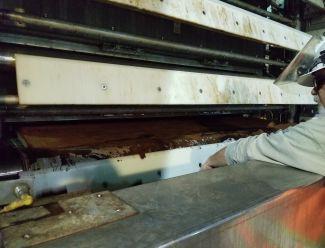
Lignin on a wet press.
Photo: FPInnovations
GOOD HR PRACTICES ARE CRITICAL
IN THE FOREST, ON THE MILL FLOOR OR IN THE OFFICE
Talent Canada, a new information source from the publisher of Pulp & Paper Canada, is designed to provide your senior management team and front-line leaders the information they need to find, keep and engage the best workforce.
Topics covered include:
• Recruitment and retention
• Employment law and compliance
• Employee engagement and productivity
• Mental health in the workplace
• Addition and disability issues
• Return to work and accommodation
• Leadership tips and best practices
• And so much more!
COVID-19: WHAT’S THE IMPACT?
As novel coronavirus continues to spread throughout Canada, a Fastmarkets RISI analyst says the pulp market may continue to see low prices
By Kristina Urquhart
Despite some signs of recovery earlier this year following a challenging 2019, the Canadian pulp and paper market may be in for another hit as a result of the ongoing COVID-19 (novel coronavirus) pandemic, which, at the time of this writing, has affected over 280,000 people worldwide and caused over 12,000 deaths.
Spurred by the outbreak and the resulting oil price war between Saudi Arabia and Russia, stock markets plunged to their lowest levels since 2008 on Mar. 9. By Mar. 12, they had crashed to record lows following U.S. President Donald Trump’s announcement that there would be a 30-day travel ban between Europe and the United States.
Here in Canada, more than 6,000 COVID-19 cases have been reported thus
far and Prime Minister Justin Trudeau has announced $107 billion in funding to help Canadians financially navigate through the next few months.
Public events and conferences are being postponed across industries, including TAPPI’s PaperCon 2020 show, which was set to take place this month in Atlanta, Georgia. And shoppers have been panic buying and hoarding supplies such as toilet paper, setting the country’s tissue manufacturers into overdrive.
Pulp & Paper Canada spoke to David Fortin, VP fibre economic analysis at Fastmarkets RISI, to get his take on how the ripple effects of COVID-19 are affecting the Canadian pulp market – and what the sudden interest in bath tissue has meant for producers.
The current situation
Coming out of 2019, the pulp and paper
market in Canada had been tightening due to unexpected downtime and excess inventories returning to a more balanced level, Fortin says.
B.C. pulp mills in particular have been faced with extremely low pulp prices, limited fibre availability and high fibre costs. Sawmill curtailments throughout 2019 and into 2020 have in turn led to paused production at some pulp mills.
However, pulp prices increased slightly in early 2020, particularly for softwood. This was largely due to Nova Scotia’s Northern Pulp shuttering in January, Paper Excellence taking its Crofton, B.C. mill offline for all of March, and a now-resolved Finnish paper mill strike in February.
“On the supply side, it seemed like one thing after another was lining up to really tighten markets,” Fortin explains.
“Everything was setting itself up to be
a rebound year for pulp if demand held steady or met just modest growth expectations. And by all accounts, in January and early February, while things were seasonally weak, they were okay. Then everything kind of went haywire with the outbreak.”
Pulp piled up at the major ports in China due to supply chain disruptions (more on that below), which completely offset the supply-side curtailments. “The question is, where do we go from here?” Fortin says.
“Do [prices] move much lower from here? That’s a tough question, because we’re already up against cash costs of some of the high-cost producers, but at the same time demand is weak and port inventories are building up again.”
China’s logistical nightmare China, where the COVID-19 outbreak originated, has been slowly getting industrial operations started again after a mandatory quarantine period and travel ban brought the country to a halt.
“Inbound logistics in China have been an absolute mess,” says Fortin.
This has had a trickle-down effect for supply and demand in North America. “We now have higher prices for freight, both inbound and sea,” he says.
As the infections in China spread in late January and early February, the government imposed a 14-day quarantine, which caused delays for people to return to work.
Paper and board mills, tissue mills and pulp mills were all shut down for the twoweek period. During that time, truckers were also unavailable to travel between ports and the mills to deliver containers of pulp imports.
“That backs up through the supply chain where you can’t unload containers that are coming into the major ports. So those containers get backed up,” Fortin explains.
“You have backups of containers [in China], so then we’ve got reports of con-
tainer shortages and issues for suppliers in Canada and Europe.”
It will take a while for pulp movement in China to get back to normal – not to mention that should Canada need to undergo strict quarantining at some point down the road, our logistics market may see similar bottlenecking.
The lockdown in China also inflated corrugated container (OCC) prices within the country. OCC collections ceased during the quarantine – problematic because domestic OCC has become the primary supply base for China’s recycled paper and board production amid strict contaminant regulations on OCC imports.
“I think things are starting to get a bit better [with OCC prices],” notes Fortin. “We have signs currently that China is in the process of steady recovery from this bottom – the new cases are declining every day.
“And on top of that we’ve heard that more and more paper and board mills are back to operating, or operating at a bit higher levels than they were initially. Trucking is starting to come back; the economy seems to be slowly ramping back up. All good signs.”
Tissue trouble?
Especially in North America, consumers have been panic buying and stockpiling household products including bath tissue for weeks, leading to shortages at major retailers like Costco and Walmart. While psychologists call the hoarding ritual in times of crisis natural, it’s led to empty shelves and frustrated shoppers.
Tissue producers are now ramping up to meet the demand – but the extra capacity might be a short-term silver lining.
“The question is then whether or not this is a one-time boost in what would have otherwise been a pretty weak period – or, if that run on tissue means that the supply chain is now completely stripped of the tissue necessary to operate and now the mills are going to have to play catch
“If pulp prices go much lower, it puts an exceeding amount of pressure on those mills in B.C. to really think long and hard about their future.”
up,” Fortin says.
He says he expects the situation to be closer to the latter, whereby demand will be so great that mills will need to turn their immediate focus to filling the supply chain again.
“The other side of that same story though, is if people have been able to purchase more than their near-term needs of tissue due to hoarding, then they’re not going to need to purchase again in the nearterm,” he says. “Once you refill that supply chain, it could be a limited bounce.”
Dino Bianco, CEO of Kruger Products, echoed Fortin’s sentiments in a recent interview with CBC News. “We’re producing it, we’ve got people working overtime, we’re expediting shipments to customers to make sure we continue to service the needs of consumers,” he said. Bianco told the news outlet that he expects a drop in demand to follow. “At the end of the day, you’re only going to use so much tissue.”
What Canadian mills can expect
With the news about COVID-19 changing almost hourly, the markets remain uncertain and difficult to predict, Fortin says.
“This is bound to get worse than it is today, because now outbreak is rapidly spreading outside of China,” he says.
There are currently confirmed cases in every country in the world, with significant outbreaks in the United States, Italy, Germany, South Korea, Iran, Spain, France and the United Kingdom.
“Do we see a similar slowdown and halt for the economy in those markets, kind of offsetting any recovery that comes in China?” says Fortin. “I think things could be lower for longer.”
Canadian pulp and paper mills, especially those in B.C., are particularly challenged during this unprecedented time because of the fibre shortages and very low pulp prices.
“If pulp prices go much lower, it puts an exceeding amount of pressure on those mills in B.C. to really think long and hard about their future,” says Fortin.
“There’s been a bit of a delayed reaction in the western world compared to how China handled the outbreak – the realization [is just happening now] that this is going to impact the entire world,” Fortin says. “It spreads exceptionally fast, and the impact on the economy could be greater than we think.” PPC
SAFEST MILL IN CANADA
ince 1926, Pulp & Paper Canada has benchmarked mills that achieve an outstanding safety record in our annual ranking of the lowest total recordable incident rates (mill frequency). In the event of ties, the mills are ranked by the most to least worker hours. This past year, we had two Category A mills tie for first place in mill frequency – but Domtar’s Windsor, Quebec mill retains our winners’ plaque for having the most hours logged. Congratulations to them and to all of our participating mills for committing to safe practices in 2019!
2019 RESULTS
IDENTIFYING HAZARDS
Irving Tissue uses benchmarking to implement a comprehensive safety program that gets employees engaged
By Kristina Urquhart
In 2018, Irving Tissue in Saint John, New Brunswick had been seeing its recordable incident rate (RIR) fluctuate for several years. In 2013, the mill’s RIR was 3.38, then it dipped down for a couple of years, and by 2016 it had climbed back up to 3.43.
“RIR is just a number, but we were realizing we were sending people home hurt,” says Allison Bent, safety advisor at J.D. Irving, Limited (JDI)’s Irving Tissue.
In a presentation at PAPTAC’s PaperWeek Canada conference this past February, Bent and tissue machine operator Justin Kingston shared how staff worked together to develop and implement a new safety program for Irving Tissue that targeted a RIR of 2.5 or lower.
Defining the process
To start, the health and safety team assembled operators and managers to discuss the mill’s biggest impediments to safety.
“We asked, ‘What is getting in the way of us having a safer day?’” Bent says. The focus group determined that while the workplace culture of the mill and the level of commitment to safety were factors, they were hard things to overhaul right away. Some other identified factors included communication, training and risk management. These factors were easier to change – and once those areas saw improvement, they were likely to lead to positive changes in the workplace culture. From this focus group, the team decided to focus on improving the mill’s approach to risk management.
With an objective to design a program that would offer more leading indicators to head off incidents before they happen, the safety team held a two-day kaizen event to identify gaps in their process.
The team also travelled to other JDI mills in the province to benchmark processes. The year prior, Lake Utopia Paper had implemented a visual, user-friendly system called Hazard Identification, which
assigns codes of varying importance to work orders in the mill’s system. Irving Tissue’s team liked that the Hazard ID program was measureable, but found some work orders had been issued even if the solution was unclear, which led to a bottleneck in the maintenance department.
They also visited JDI’s Atlantic Wallboard facility in Saint John, which was using software to quantify and compare risk, and a team to develop solutions when the risk was unknown. But they weren’t formally logging all hazards.
Developing a new program
Irving Tissue ended up amalgamating the best parts of those two systems, creating a trackable, measureable Hazard ID program that would have a separate category for hazards with unclear solutions. To develop those solutions, the Irving Tissue team employed Atlantic Wallboard’s practice of quantifying risk and addressing hazards when the solution is unknown. Irving Tissue’s system, which encour-
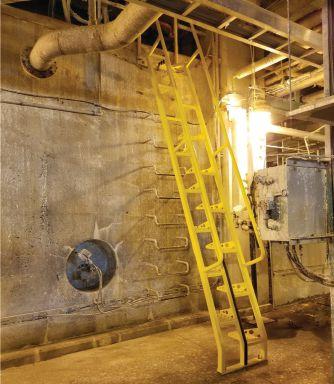
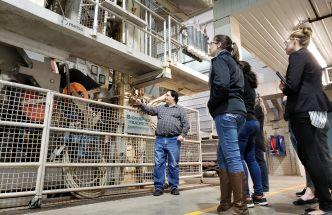
A new staircase replaces a hazardous set.
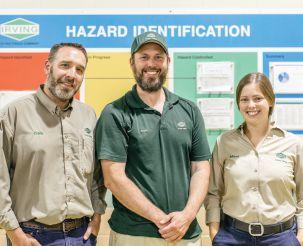
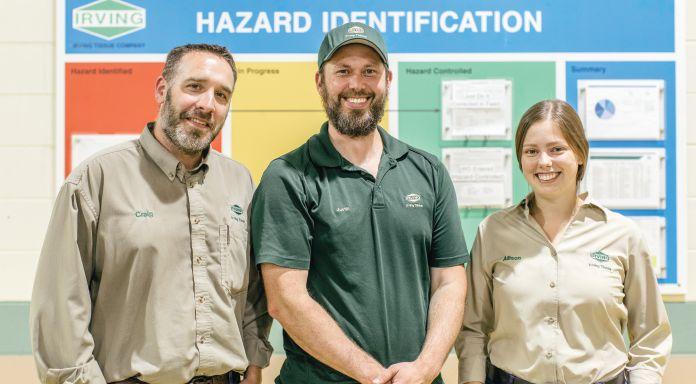
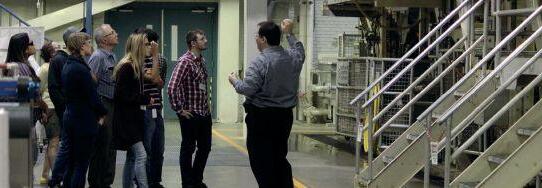
From left: Craig Samson, senior process engineer, Justin Kingston, tissue machine operator and Allison Bent, safety advisor.
Photos: J.D. Irving, Ltd.
ages interaction between operators and supervisors, is predicated on feedback and communication. Hazard ID forms are placed all around the mill, and in common areas such as lunchrooms and control rooms. Employees fill out the top of the form to identify the location of the hazard, what was found, and what has already been done as an initial response to control the hazard. Then they give the bottom of the form to their supervisor, who logs the information in the database.
The form is then filed on the large Hazard ID board at the front of the mill, in the Hazard Identified section. As steps are taken to rectify the issue, the form moves along to the In Progress and finally the Hazard Controlled sections – and any employee can check for progress along the way, either on the board itself or in the database.
Component #1: Hazard IDs
Irving Tissue established three categories for its Hazard IDs at the mill.
• Just Do Its are situations that can be safely handled by an employee, such as a hose lying on the ground. These move quickly from Hazard Identified to Hazard Controlled. Even if minor, the team wants to track all incidents.
• Fix Its, or Corrective Action Known, are work orders where it is clear what needs to be fixed, such as a missing handrail or machine guard. Work orders are further prioritized by what needs to be dealt with right away.
• Risk Assessment Required, or Corrective Action Unknown, is when the solution to a hazard is unknown and the risk teams needs to evaluate the risk. The mill’s cross-functional risk assessment team meets bi-weekly to review.
Component #2: Risk assessment
When a Hazard ID comes in tagged as Risk Assessment Required, the individual members of the risk assessment team complete a Gemba walk and then rank the hazard based on its risk, evaluating the severity, exposure and occurrence. The team meets to compare their individual scores and decides as a group what the final risk score is. Then, they brainstorm solutions and make recommendations to management through an action-priority matrix that ranks ease versus impact. Management reviews the files at the managers’ safety meeting and provides approval or feedback.
Risk assessment in action
An Irving Tissue operator flagged the ladder used to access the top of Tissue Machine 2’s whitewater shower chest as a fall hazard (pictured, opposite). The ladder had smooth rungs made of steel, which were very slippery when operators needed climb to the top of the chest to clean before a shutdown.
The risk assessment team evaluated the issue and implemented a number of shortterm actions, including immediate controls such as grip tape on the ladder rungs and a safety chain at the top of the chest. Operators must now wear hard hats with chinstraps and ensure a second worker is present to supervise trips to the top of the chest.
As a long-term solution, the risk assessment team recommended installing a forward descent ladder, a safety gate at the top of the shower chest, and a hose station for the top as well. All were installed, and a work order to modify the overhead piping was also completed.
Lessons learned
The Hazard ID and risk assessment program
at Irving Tissue enables a proactive approach to safety, opens a new line of communication with employees, creates engagement and trust and offers measureable results. All risk assessments are saved on Sharepoint, the mill’s internal site. Any employee can read parts of the file approved for access, including the logged hazards, their risk rankings and management’s approval notes.
Bent says the mill’s new safety program is successful because it builds employee culture – they want to follow up to see items move from hazards to completion.
“We wanted to empower people so that they feel they have a role in safety at the mill,” she says.
As of June 2019, 110 Hazard IDs had been reported at Irving Tissue with 75 work orders entered. Fifty-six of those work orders have been completed, with communications going out to employees about the longer-term projects. Seventeen hazards went to risk assessment and have been approved by management.
The value of the program is obvious, says Bent. “We now have 110 hazards at the mill that are not going to hurt someone.” PPC
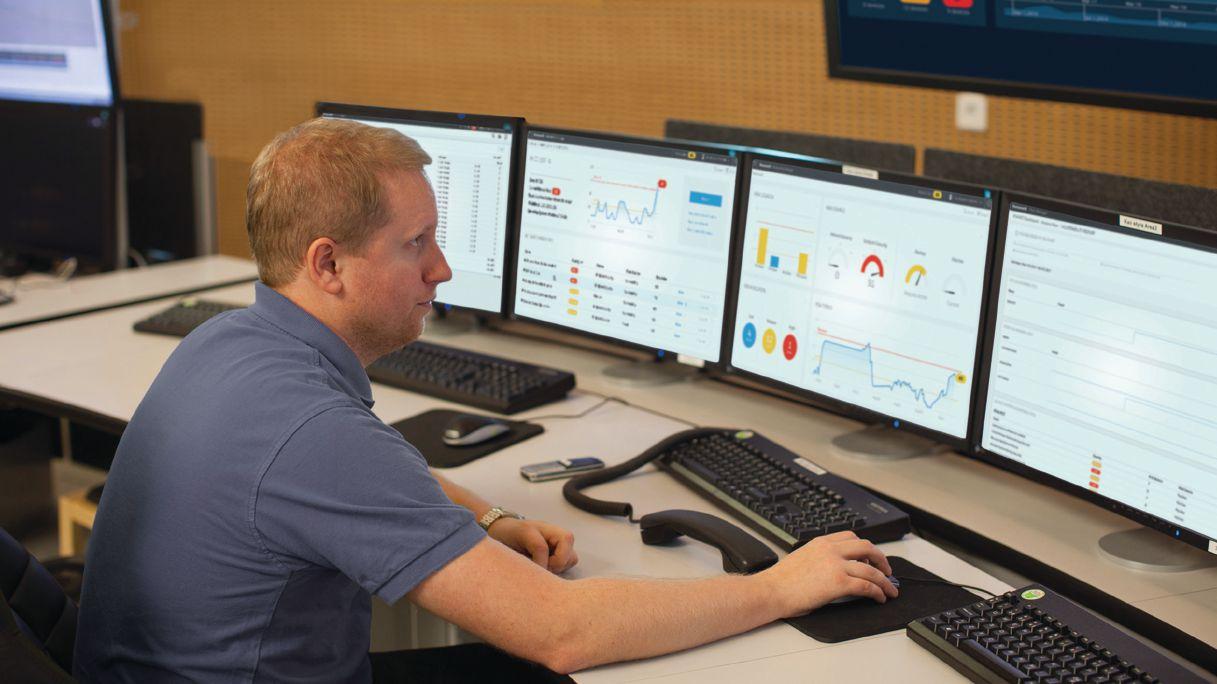
SECURING YOUR CONTROL SYSTEM
A roundup of the best industry advice and some of the latest technologies to optimize cybersecurity at pulp and paper mills, in the context of Industry 4.0
By Treena Hein
As is true for any type of plant, a cybersecurity breach in a pulp or paper mill can bring production to a halt, leading to serious financial losses. It can also cause harm to workers, equipment and the environment, destruction of data and much more, say experts like Michael Lester, director of cybersecurity strategy, governance and architecture at Emerson’s Automation Solutions. Even a minor
security breach, notes Apala Ray, ABB’s global cybersecurity manager for industrial automation process industries, has the potential to affect production for days.
Downtime losses could reach over $150,000 CAD per hour, depending on the specific pulp or paper mill, explains Donovan Tindill, senior industrial cybersecurity expert at Honeywell Connected Cybersecurity. And in addition to these direct losses from a cyberbreach, there are many potential sources of indirect loss.
Some are immediate and others more
long-term, and span from immediate payment of data ransom fees and the effects of uncontained ransomware spreading into more systems to risks to customer relationships. There are also costs associated with validating that systems are back to normal, and there may be consequences related to incorrect regulatory reporting (for example, of emissions data).
To explore today’s cybersecurity threats in the pulp and paper sector, we put important questions to our experts. Here, we’ve collected their responses,
A robust cybersecurity strategy will alleviate downtime and protect your mill’s assets in the event of a data breach.
Photo: Honeywell
which have been edited for length and clarity. Cybersecurity is an enormous topic and the devil in in the details; each company must of course do its own specific due diligence.
Is paper mill cybersecurity different from other sectors?
Ray: There might be subtle differences. For example, quality control systems (QCS) are one of the major systems in a mill and operate like a SCADA system in supervising, monitoring and controlling the physical processes. The process can usually continue to run for short periods if the QCS is offline, but with high risk to product quality and high potential for production loss. Therefore, it is critical to maintain cybersecurity in such systems.
Tindill: The paper mill industry… doesn’t usually have the higher budgets that other industries may spend on their automation systems and staffing. Staff are expected to do more, including cybersecurity tasks, effectively. Alternatively, if the skills do not exist at the mill then there is a higher need for secure remote
access technologies. Remote access has its own challenges, and […] could increase the risk.
Lester: Outdated systems that are not patched or well protected with a defencein-depth approach are most vulnerable. Not all mills make cybersecurity a priority for a project, or often it is an afterthought and hence not funded.
What are the common threats and vulnerabilities in pulp and paper mills?
Tindill: Malware, including ransomware. USB portable memory is one of the leading sources for introducing malware into the control system.
Lester: Mills face various vulnerabili-
ties to attack, including the unintentional behaviours from employees unaware of threats at the plant floor or at their desktop. When cybersecurity is not part of the culture of an organization, its personnel create a significant cyber risk. Upskilling personnel on new technology and related cybersecurity helps to create a “cybersecurity culture.”
Ray: Generic attacks are high in frequency and may have destructive-tocatastrophic impact, but target generic information technology environments that are not specifically tuned to industrial control systems. They usually affect the client/server layer and/or network infrastructure of a control system and are
equally relevant for the paper industry as any other industry.
How do Industry 4.0 technologies help or hinder cybersecurity in mills?
Lester: For mill manufacturers looking to unlock the potential of Industry 4.0, cybersecurity is a chief concern, [but] while the need for effective cybersecurity is well understood, the topic itself is not. Designing and implementing new technical solutions requires new or updated skills, and cybersecurity expertise. While new solutions can be implemented securely, they can also introduce new threat vectors if not implemented and maintained appropriately.
Ray: Industry 4.0 technologies push for enhanced connectivity. When considering a new digital solution, make sure discussions include how to address cybersecurity concerns, and how to ensure multiple layers of defence, will be in place.
Tindill: Industry 4.0 or any technology advancement in general makes cybersecurity more difficult. As each new technology is invented, the cybersecurity controls required often lag. The number of applications and devices is increasing [and] this also broadens the “attack surface.”
What are some new cybersecurity technologies?
Lester: Integrated security technologies that provide secure connectivity, system and user interaction, remote access and visibility to the environment relative to security are key to providing higher levels of security. Modern security technology like web application firewalls, identity services, edge gateways and protocols like AMQPs, MQTTs, OPC-UA and security monitoring systems are crucial to successfully implementing secure solutions, but the most crucial aspect is skilled resources to design, implement and operate the technology effectively.
Ray: New and emerging technologies will have an important role to improve the overall cybersecurity position for mills, and we will need to understand their challenges. The introduction of technology must be matched with operational measures that bring in people and processes. This typically includes defining policies and procedures for utilizing the new technology as well as educating employees accordingly.
Best practices to protect your mill’s control system
We summarize the top advice from our three experts:
Donovan Tindill, Honeywell
• Identify the components and systems that comprise the industrial control system, and an even clearer understanding of the most critical and impactful parts of it.
• Consider the potential impacts of malicious configuration or operation. Group brainstorming helps to identify new and unique attack scenarios, and promotes discussion on the feasibility of detection and protection. What could happen if the wrong person had access, for example? Could we train individuals or implement technology to detect an issue and respond quickly?
• Apply detective and protective controls.
• Plan the next control system design or upgrade well in advance. Making cybersecurity part of the front-end engineering will be significantly more effective and lower cost than to working it in later.
• Over-engineer your cybersecurity to ensure the system is able to withstand both current and future attacks.
Apala Ray, ABB
• Use people, policies and procedures.
• Understand and respect the different cultures and mindsets of people in your organization. The engineering mindset, which keeps safety as a major concern, will look for a deterministic process and system. However, cybersecurity requires processes that are much more dynamic, less deterministic and continuously evolving.
• ABB’s three-stage model is 1) establish a foundational level of technical and organizational security controls to defend against the majority of the generic threats, 2) continuous management and maintenance of these controls and the addition of more sophisticated controls, and 3) a strong collaborative operation of cybersecurity controls with managed security services.
Michael Lester, Emerson
• Get a thorough assessment of your cybersecurity posture to help determine your baseline and identify the biggest potential gaps, then create an actionable plan for a cybersecurity program and a technical-operational cybersecurity roadmap.
• Stay updated on the latest threats. Optimize your threat-detection capabilities and ensure equipment has the latest defence measures.
• Improve your incidence response capabilities, upskill your workforce and do periodic training.
• Cybersecurity, like safety, also requires more than just technology. Both require behaviour and culture change. A deeply rooted understanding of the “why” and “how” that spans everyone in the company is critical to driving meaningful behavioural change in cybersecurity. Treena Hein is an award-winning science and tech writer based in Ontario.
Apala Ray
Donovan Tindill
Mike Lester
ISOLATING POWER, SAFELY
An Ontario machine-building firm has developed the SafeBox, which automates lockout/tagout procedures
By Kristina Urquhart
Anew technology developed by Ionic Mechatronics in Sudbury, Ontario is promising to eliminate hours of downtime spent doing manual lockout/tagout procedures at pulp and paper plants.
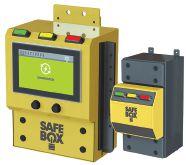
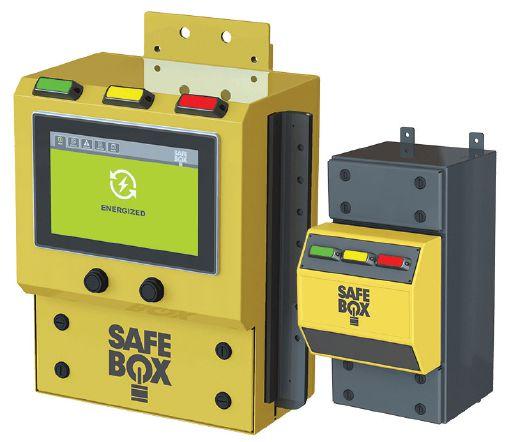
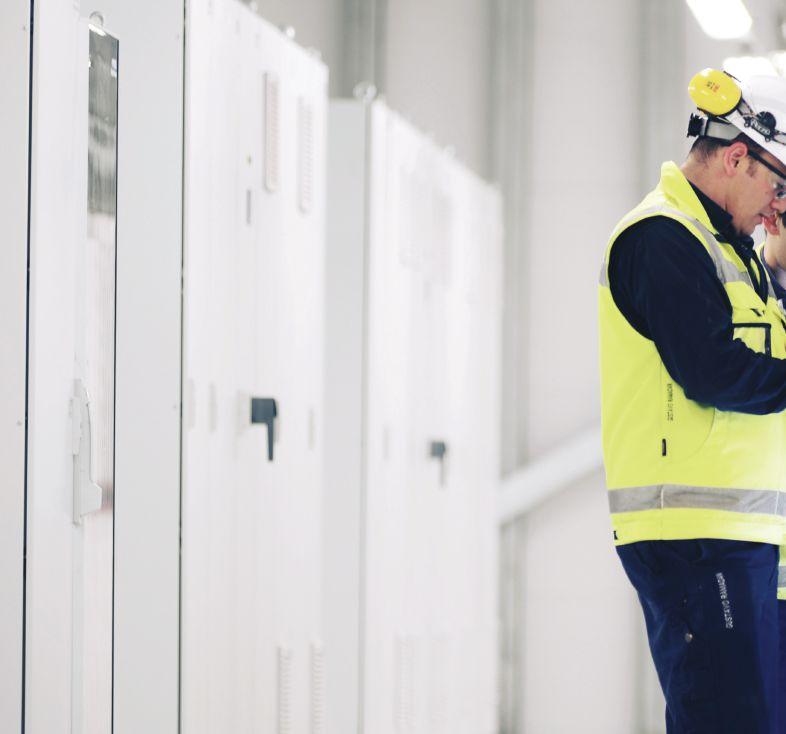
SafeBox is a lockout system for heavy industries that mechanically isolates energy sources from a single lockout point, reducing lockout/tagout time to under two seconds.
The system uses field isolation devices that are connected to hydraulic, pneumatic, electrical AC or electrical DC power sources or motors throughout the plant. Those isolation devices are then connected to a master control device in a central location via safe communications cable such as Ethernet, fibre or wireless. Field units for electrical systems can accommodate up to 15kV, and master units can accommodate up to 250 field isolation devices.
“The manual disconnect process still exists –isolation, disengaging contactors, checking the potential energy – all that’s still occurring mechanically, but it’s happening in these preengineered boxes,” explains Gabriel Janakaraj, business development manager at Ionic Mechatronics. “If your production system is only operating 45 per cent or 65 per cent of the time, where’s your downtime? Half of that is all lockout/tagout.”
The master control box is equipped with a screen to view vitals, a locking bar under the system’s SIL3 raiting, and “Isolate” (power off) and “Energize” (power on) buttons. The system detects if there are any moving parts in the system – even powered off equipment that is winding down.
The SafeBox system uses the same control standards as a robotic cell and includes continuous fault and zero-energy monitoring, which help to eliminate arc flash and shock hazards, as well as welded contact risk.
Janakaraj says it also helps to mitigate human error. “You rely on this person to go into this room where there are hundreds of disconnects and pull down the correct one,” he says. “With our device, everything is tagged and IDed so you know exactly what you’re locking out. You know who’s locking down at what time, and how long it takes.”
When Ionic Mechatronics began developing the SafeBox system in 2015, they had found there are, on average, around 10 lockout/tagout violations per day across all industries. “And you can just imagine how many near-misses there are that haven’t been recorded or spoken about,” says Janakaraj.
In 2010, Ontario’s Workplace Safety and Insurance Board (WSIB) recorded that lost-time injuries stemming from lockout/ tagout were the fourth highest cause of occupational injuries, and that lockout injuries were often more severe than many other types of workplace injuries.
“The big gain outside of safety is return on investment,” Janakaraj says. Half of the 10 case studies Ionic Mechatronics has completed across various industries show an ROI of less than a year.
Janakaraj says that while workers at times have been resistant to the idea of a new lockout/tagout procedure, they quickly realize the increased safety benefits once they get accustomed to the new system.
In a lumber mill application, where profit is calculated on price per inch of wood, Janakaraj says doing a lockout procedure of 15 minutes, 20 to 30 times a day adds up to significant lost production time. “Any kind of production-integral system that requires lockout/tagout – a lot of that downtime can be capitalized on.”
The SafeBox has been recognized as an energy isolation system by the Ontario Ministry of Labour, and Ionic Mechatronics is currently working on meeting regulations in other provinces and countries. The company, which started commercially marketing SafeBox in October 2019, is now quoting larger installations with more complex disconnects, and developing a mobile app for remote monitoring. PPC
ADVANCING AUTONOMOUS CONTROL
An award-winning AI and simulation application has potential in pulp and paper
By Jim Meyers
What if you could run an entire plant autonomously?
ANDRITZ Automation is working toward that goal, and thanks to its progress thus far, the company’s plan is attracting a lot of interest.
ANDRITZ recently won a major award for its pilot project, which involves training an artificial intelligence (AI) controller to run an industrial plant. In addition to AI, the project includes machine learning and ANDRITZ’ own IDEAS processsimulation software. The company says it believes this is the first application of reinforcement learning to control continuous industrial processes.
ANDRITZ Automation is a supplier of machine and plant control systems based in Austria, with four sites in Canada and 110 worldwide. ANDRITZ provides automation services and tools for a wide range of industries, including pulp and paper, mining, lime and cement, hydropower and wastewater.
ANDRITZ’s AI project won the top prize in the 2019 Goldcorp #DisruptMining competition, a public showcase for new technology that focuses on digital transformation of the mining industry to optimize profitability and competitiveness.
“We won the competition, and with that came a CA$1-million opportunity to implement a pilot project at one of Goldcorp’s sites,” says Arthur Gooch, director of innovation for ANDRITZ. “Along with the pilot project, that win showed us –
and our board that had funded us – how appealing this technology is to industry.”
The award-winning project was originally a research and development effort by ANDRITZ. “We’ve used our simulation tools to train plant operators for over 20 years,” says Gooch. “Some of our controls engineers realized that this same technique could be used to train an AI. We applied this concept to a company-wide internal innovation contest. Our executive board selected our proposal for seed funding, which allowed us to develop the technical solution into something we could sell.”
As ANDRITZ is a major supplier of pulp and paper equipment, applicability to pulp processing was one of the deciding factors when the executive board supplied the initial R&D funding. At this point, ANDRITZ is moving forward rapidly. “We’re currently implementing three pilot projects at operational sites,” says Gooch. “Two are in the mining industry and one is in pulp and paper. We’re on track to have all three pilots running by the middle of 2020.”
The application is built on Inductive Automation’s Ignition, an industrial application platform with tools for building solutions in human-machine interface (HMI), supervisory control and data acquisition (SCADA), manufacturing exe-
cution systems (MES), and the Industrial Internet of Things (IIoT).
Because it was an R&D project, ANDRITZ needed a platform that would allow it to create a robust prototype quickly, with minimal cost. Ignition fit the bill. Python code, visualization, historian and reporting capabilities are key aspects of the project.
AI brings benefits
The solution is a combination of modern AI and industrial process simulation. The project trains AI based on a digital twin replica of a plant. In other words, the software learns how to do the plant’s work. It provides autonomous control for an industrial plant the same way a self-driving car can pilot itself. With autonomous control, plants can see more consistent performance, and can respond faster to changing plant conditions – potentially bringing improved productivity, greater efficiency, lower costs and better safety.
It starts with the creation of a realistic model in a simulated environment of the process. The model is deployed in a cloud environment. Then the machine-learning algorithm spends months to years of simulated time exploring and learning every possible way that the system can fail.
Once it’s been trained in a virtual environment, the autonomous controller is
subjected to the same kinds of certification tests a human operator would be expected to pass.
Next comes taking it to the real world. At first, the controller operates in an advisory mode, where it’s making recommendations for operators. Then it’s allowed to pick up more and more direct control. Eventually, it runs in a fully autonomous mode.
“We’re excited about this, because we feel autonomous control is the next logical step for how to run a plant,” says Gooch. He adds that seeing the application running was a big milestone for the company. “Showing that the proof-of-concept actually can control a plant was important,” he says. “The team was confident that our idea was sound, but it’s different to see it actually working in front of you.”
The application could appeal to numerous industries. “If control room operators regularly need to interact with an HMI, this technology can respond to routine events faster and more consistently than a person could,” says Gooch. “Any industry where existing programming methods or control technology can’t deliver a system that runs completely automatically most of the time would benefit significantly from this new system.”
Gooch said it’s particularly suitable to sequential decision problems where an agent must take multiple discrete actions in sequence in order to achieve some target state. That makes it applicable to a wide variety of control tasks that heretofore could only be controlled manually, like plant start-up or upset recovery where the operator must start several motors or swing valves in a particular order defined by current plant conditions.
The artificial intelligence used in the application has also demonstrated itself suitable for continuous optimization problems where a plant might otherwise use model-predictive control or expert systems.
Powerful software
The two ANDRITZ teams working on the project collaborated from Canada and Germany. Using Ignition, they built software that could control the IDEAS software and pass data back and forth between the virtual plant and the AI. Eventually, this same software needed to pass data back and forth with the running plant, using industrial communication protocols.
It also needed to function as an administration interface for training the AI. This new software needed to allow a user to set up training scenarios, like a particular plant malfunction that the AI should learn. The software would then manage the training, recording results to history and reporting on the outcome.
“The industrial customers we’ve talked to so far have been extremely positive,” says Gooch. “Several are paying for pilot installations. There are a lot of control problems that people assume must be managed manually by operators, so the possibility of a software solution is very exciting for these sites.”
Part of the success of this AI project depends upon people being open to AI in general.
“Managing the human reactions to this new technology has required a delicate balance,” says Gooch. “Talking about AI conjures a range of emotions from enthusiasm, to skepticism, to fear. Engineers love to focus on the technical aspects, but understanding what the AI means to people has been more important to making progress in development.”
PPC
Jim Meyers is communications manager for community alliances at Inductive Automation.
ANDRITZ has developed a solution to have artificial intelligence direct industrial control systems in pulp and paper plants.
Photo: ANDRITZ
Ed. note: Resolute Forest Products has been busy in the bioeconomy sector – we’ve rounded up their latest news. Biomaterials plant gets $27M injection
Resolute will spend $27 million to construct a commercial plant specializing in the production of cellulose filaments –specifically nanofibrillated cellulose (NFC) – at the Kénogami paper mill in Quebec.
“Our investment in cellulose filaments represents an opportunity to enter into non-traditional growth markets,” says Yves Laflamme, president and chief executive officer.
Cellulose filaments are derived from wood fibre that is mechanically processed without chemicals or enzymes. They are manufactured from renewable sources, resulting in a low carbon footprint.
Offering a wide variety of uses and a number of benefits, the filaments can be integrated into commercial and consumer
products from many industries, including transportation, construction and energy, increasing the resistance and durability of those products.
The extraction technology was developed by FPInnovations. This is the second time FPInnovations’ cellulose filament production technology has been commercialized – the first being in 2014 at Kruger Biomaterials’ commercial plant in Trois-Rivières, Quebec, which has an annual production capacity of up to 6,000 metric tonnes.
Resolute’s $27-million cellulose filament project will create eight jobs in the startup phase slated for 2021, and a total of 23 jobs once the plant reaches its full production capacity of 21 metric tons per day.
These new jobs will be in addition to the 200 existing positions at the Kénogami paper mill.
The cellulose filaments will be marketed with the help of Performance BioFilaments Inc., a joint venture established in 2014 by Resolute and Mercer International Inc. that is dedicated to the development of non-traditional applications for cellulose filaments.
“The chemical-free refining process results in fibrils of exceptional strength and purity, with an extraordinarily high aspect ratio and surface area not obtainable through currently applied processes,” says Gurminder Minhas, managing director of Performance BioFilaments. “We look forward to working with Resolute on bringing this high-potential biomaterial to global markets.”
Performance BioFilaments will continue with pilot-scale quantities until the new plant is fully operational. This material is currently available for development purposes and initial field trials.
The mill already has a production capacity of 133,000 metric tons of specialty papers per year.
Saipem Canada acquires CO2 unit at Quebec mill
Italian company Saipem S.p.A. and its Canadian arm, Saipem Canada, have acquired the CO2 capture unit formerly owned by CO2 Solutions at Resolute’s Saint-Félicien, Quebec pulp mill.
CO2 Solutions filed its intent to declare bankruptcy in September 2019, six months after commissioning its capture unit at Resolute.
On December 19, 2019, CO2 sold its portfolio of intellectual property to Saipem, which provides engineering, drilling and construction of projects in the energy and infrastructure sectors.
The sale includes about 90 patents, granted or pending, the corporation’s trademarks, the CO2 capture unit located at the Saint-Félicien mill, and related contracts.
The capture unit will continue to operate, with Saipem Canada taking on CO2 Solutions employees to ensure a smooth transition of the R&D and operations.
In a second transaction on January 17, 2020, CO2 Solutions sold its other CO2 capture unit located in MontrealEast, Quebec, to chemical manufacturer Chimie Parachem, which may turn into
a possible resale to a third party once the sale is finalized in coming months.
CO2 Solutions’ proprietary enzymatic process is a CO2 capture technology that does not use or emit toxic products.
It has been demonstrated at scale (30 tonnes/CO2 per day), validated by third parties and attained commercial status (TRL-8).
The technology was developed over the past 20 years by Canadian scientists and engineers, and was directly or indirectly supported by the governments of Canada, Quebec, Alberta, the United States and the European Union.
Resolute wins award for pulp biorefinery project
Resolute recently won a 2020 BIG Innovation Award for a biorefinery project at its pulp and paper mill in Thunder Bay, Ontario.
The Business Intelligence Group (BIG) is a global organization that recognizes business performance. The BIG Innovation Awards are presented annually to honour organizations that make new ideas into reality.
Resolute’s thermomechanical-pulp biorefinery plant, which was commissioned on May 27, 2019, uses the patented TMP-Bio technology developed by FPInnovations.
The process converts cellulosic sugars and H-lignin so they can be used in bioproducts such as wood adhesives, animal feed and composites.
The $23-million biorefinery has 100 metric tons of capacity annually.
“We are thrilled to be honouring Resolute as they are leading by example and making real progress on improving the daily lives of so many,” says Maria Jimenez, chief nominations officer of the Business Intelligence Group.
FOCUS ON SAFETY
Signaling devices for wet, hazardous locations
Rockwell Automation has released AllenBradley 855X Hazardous Location Signaling Devices, which can help industrial operators meet the latest global hazardous-location ratings and certifications.
The devices, which include horns, beacons and combination horn-and-beacon units, are suitable for wet and harsh industrial environments in the paper and wastewater-treatment industries, as well as in oil and gas, food and mining.
In most cases, these new 855X devices (Series B) are drop-in replacements for
COVID-19 safety tips
the original 855X devices (Series A).
They also offer triple certification in a single unit, with cULus, ATEX/IEC EX and Class/Zone, so they can be applied globally.
The new 855X products feature two conduit entry options for flexibility in power connections to suit the application requirements. The beacon’s colour can be changed quickly and easily in the field by simply replacing the beacon lens with the desired colour, without affecting the device’s ingress protection rating.
The new 855X standalone multifunction LED beacon and combination radial sounder/LED beacon feature rugged yet lightweight, corrosion-free construction.
They also have ingress protection certified to UL Type 4/4X/13, IP66/67. rockwellautomation.com
While many businesses are temporarily shuttering across the country, Canada’s forest products sector is busy producing pulp for some of the mission-critical goods necessary to combat COVID-19 – such as medical and personal care supplies – as well as tissue and paper products to ease consumer demand.
Several provincial governments, including Quebec and Ontario, have deemed pulp and paper and associated forest products producers as essential businesses exempt from closures mandated to slow the spread of the coronavirus.
What are pulp and paper producers doing to ensure their workers stay safe from COVID-19 infection while they continue to operate? In the interest of sharing best practices, we’ve rounded up some procedures being implemented by mills across the country.
Shane Bolduc, health and safety manager at Mercer Peace River Pulp (MPR), shares some of the ways MPR is keeping workers safe:
• Posted signs on all conference and boardrooms indicating maximum number of people allowed in the room;
• Encouraging call-in meetings instead of in-person;
• Hand sanitizing stations around the facility with “how to” signage;
• Hygiene signs posted in washrooms, lunchrooms, control rooms, etc.;
• Staggered breaks and lunches;
• Re-assigned the maintenance department: Rather than a 4-10 schedule for all maintenance personnel, is split into two shifts (7 on and 7 off);
• Many staff now working from home;
• Visitors and contractors are to call into MPR prior to accessing the site for COVID-19 self-assessment over the phone;
• Daily update shared with all MPR team members followed with a Q & A document that is up dated daily; and
• Increased the cleaning duties with cleaning staff, with admin handrails, doorknobs, office tables and chairs cleaned twice a day.
“During this period of uncertainty, we are appreciative of the dedication of our teams,” Mercer International says in a statement. See what other mills are doing at pulpandpapercanada.com/topic/operations/health-safety/
Ladder safety gate
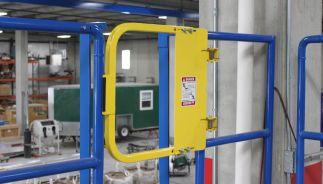
PS Safety Access has a range of safety gates including the OSHA- and ANSIcompliant EdgeHalt Ladder Safety Gate, which minimizes the chances of a fall on elevated platforms or ladderways.
This self-closing swing gate provides 42” top- and mid-rail protection.
The ladder safety gate is available in five finishes: powder coat yellow, hotdipped galvanized, 304 stainless steel, 316L stainless steel and aluminum.
Engineered and tested to comply with ladder safety gate requirements in OSHA 1910.28 and 1910.29, as well as ANSI A1264.1-2007 and A14.3-2008. pssafetyaccess.com
Infrared emitter reduces fire risk
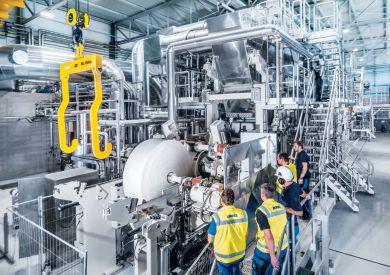
With its new gas-fired HelioX infrared emitter, Voith offers a solution for contactless drying along with low emissions.
The reduced fire risk improves safety in paper production.
The key component of the new HelioX infrared emitter is its incandescent body, which has a highly efficient ceramic structure with a notably large surface area.
The special geometry ensures improved combustion, resulting in both higher drying efficiency and a 50 per cent reduction in nitrogen oxide (NO) and carbon monoxide (CO) emissions. These low emission values are becoming increasingly important as more stringent emission limits may be adopted.
The HelioX infrared emitter is designed for an output of 14 kW. Consequently, it achieves drying efficiency, which enables higher machine speeds and more flexibility to produce different paper grades.
Because of the low mass of the incandescent body, the HelioX infrared emitter has fast heating up and cooling down time. This improves safety in production, as there is a much lower risk of fire in the event of web breaks. voith.com
Cascades’ recyclable cardboard tray wins award
Cascades has received the DUX Grand Prix Award for its 100 per cent recycled and recyclable cardboard tray.
The packaging solution, launched in December 2019, won the Products category at the DUX Grand Prix Awards, which recognize the Canadian food industry’s successes each year.
The Quebec-made fresh food tray is the first in North America to use a waterbased functional barrier that protects it from humidity, thereby enhancing the packaging’s performance without making the cardboard less recyclable.
The patented coating is a recyclable and compostable alternative to the traditional wax or plastic-based applications widely used in cardboard food packaging, which pose some challenges in terms of recyclability.
“Cascades is honoured to receive this award for a product that gives concrete life to the circular economy,” says Luc Langevin, president and chief operating officer of Cascades Specialty Products Group. “Favouring the recyclability of the materials means we can do more with less, which benefits both our customers and the environment.”
The fresh food tray has also earned the Prix Innovation en Alimentation 2019 from the Conseil de la transformation alimentaire du Québec (CTAQ), and the 2019 Gaïa Award in the fruits and vegetables category. cascades.com
Domtar Kamloops using wood waste for renewable power
Domtar’s Kamloops, B.C. mill has partnered with the Forest Enhancement Society of British Columbia (FESBC) to use wood waste from slash piles in order to generate power.
In British Columbia specifically, the wildfires of 2017 and 2018 rendered unusable a lot of high-value wood that would have been used to build homes
New tissue machine for dry crepe tissue
ANDRITZ has released a new tissue machine for the production of dry crepe tissue.
The PrimeLineVRT features a vertical CrescentFormer in the forming section that enhances dewatering of the fibre web. This enables higher dryness right after the press section and an increase in paper caliper.
Depending on the grade and basis weight of the paper produced, between two and four additional percentage points of dryness can be achieved after the press section compared to standard CrescentFormer configurations.
The machine does not require additional fabrics or fabric loops, nor does it require extra space in the basement for installation.
The PrimeLineVRT was developed and extensively tested at the ANDRITZ Tissue Innovation and Application Center in Graz, Austria. andritz.com
and furniture. While the wood wasn’t destroyed, it was no longer considered suitable for high-quality purposes. Now, however, it’s perfect for use as biofuel.
Under the mill’s partnership with FESBC, announced in January, those types of low-value wood – in addition to branches and treetops that were previously discarded into slash piles and burned at logging sites – will instead be chipped and transported to the mill for use generating renewable power.
“We are very pleased to play a role in this project that allows us to access otherwise unused fibre from the forest, and use it to generate green electricity,” says Jean-Claude Allaire, Kamloops mill manager.
A portion of that electricity will power the mill, while the remainder will be pushed to the grid to help power homes in the community. In fact, Allaire notes the mill currently produces about 460,000 megawatts of renewable electricity each year. The mill itself is that power’s largest user. The remaining electricity pushed to the grid is enough to power about half of the homes in Kamloops in a year.
But generating green power for the mill and surrounding community isn’t the only benefit. There are also two greenhouse gas benefits.
First, emissions from burning slash piles contain methane – a very potent greenhouse gas. While incinerating wood produces carbon dioxide, it generates very little methane.
Second, the green electricity produced from woody biomass can potentially displace electricity that otherwise might have been made from fossil fuels in other jurisdictions. domtar.com
Tissue course rescheduled amid COVID-19 concerns
FPInnovations’ Applied Tissue Course, originally scheduled for May 12-13, has been rescheduled to October 27-28 due to public health concerns caused by COVID-19.
The Applied Tissue Course will take place at FPInnovations’ Montreal location. Due to the hands-on demonstrations and workshop nature of the course, FPInnovations decided it would be in the best interest of the health and safety of attendees and instructors to delay the course until the fall.
“We’re very disappointed to have to announce the postponement of the Applied Tissue Course, but it’s the wisest action to take for the sake of all our participants, employees and business partners who will be attending and giving the course,” says Stéphan Larivière,
FPInnovations pulp and paper industry sector leader, in a statement. “We are living through unprecedented times.”
The course will provide a comprehensive understanding of tissue properties and tissue manufacturing. The course is offered in collaboration with tissue partners Cristini, FabioPerini, Kadant, Solenis, and Toscotec.
The course will provide hands-on manufacturing experience with field experts and suppliers on FPInnovations’ pilot tissue machine, the opportunity to test tissue properties in labs and improve tissue performance through optimization, in-depth knowledge of the tissue-making process, fibre physics and tissue performance, and an understanding of the role of pulp furnish in tissue making and how it affects tissue properties.
The Applied Tissue Course also meets the continuous professional development requirement for several professional designations, including engineers. A certificate will be issued to participants who complete the two-day course.
Information on registration, pricing and hotel accommodations is available on the FPInnovations website. tissuecourse.fpinnovations.ca
Cascades named to most sustainable companies list
Cascades has landed on the 2020 list of the Global 100 Most Sustainable Corporations, which recognizes companies for their commitment to environmental, social and governance (ESG) issues.
Toronto-based Corporate Knights, an organization that promotes “clean capitalism,” compiles the annual list, whittled down from over 7,000 international companies with revenues exceeding $1 billion.
Cascades ranked #49 and is one of 12 Canadian businesses on the list. It is the only entry out of 100 in the Containers & Packaging category.
“We have been increasing the number of ESG projects over the years, and our results have been steadily improving,” says Mario Plourde, president and chief executive officer of Cascades.
“We are pleased that our efforts are paying off, and that they are also earning recognition from various third parties and through acknowledgments such as the Global 100 list. We are very proud of this achievement.”
The company has ranked on another Corporate Knights list, the Best 50 Corporate Citizens in Canada, since 2007.
Corporate Knights operates a research division that develops rankings and product ratings based on corporate sustainability. cascades.com
Valmet, Fabio Perini partner on IIoT resource for tissue
Valmet and Fabio Perini are partnering on an Industrial Internet ecosystem for collaboration in the tissue industry.
The system will allow tissue producers and converters to work together more efficiently, and to exchange knowledge and resources.
Voith Paper’s Ontario service centre partners with SKF Canada
Voith Paper’s service centre in Hawkesbury, Ontario is now qualified as an SKF-certified bearing inspection facility.
SKF Canada Limited will supply its expertise, bearings, advanced tools and equipment for repairs to the Hawkesbury rolls facility.
The Voith Paper and SKF partnership focuses on thorough inspections and repairs for maximum service life in the pulp and paper industry.
The SKF Preferred Service Partner program is intended to limit machine variability and ensure consistent specifications and standards are met at the certified facility.
The Hawkesbury location is the second SKF-certified Voith facility in North America. voith.com
The partnership combines data from tissue mills and converting plants alongside Valmet’s tissue-making technology and process optimization with Fabio Perini’s solutions for converting and packaging machines.
The collaboration will create a chain of production data from the tissue machine to the converting line and use artificial intelligence–driven applications in the tissue production process to make the converting operations downstream more efficient. valmet.com
NEW DATE
Applied Tissue Course
October 27 & 28, 2020
Montréal, Quebec, Canada
To register and for more details, visit: tissuecourse.fpinnovations.ca
in collaboration with Cristini, Fabio Perini, Kadant, Solenis, Toscotec presented by
Optical consistency sensors for wet end measurement
ABB has released the KPM KC9 Optical Consistency Transmitter family, a new range of sensors that provide accurate measurement of total and/or ash consistency for better wet end measurement and control in pulp and paper processes.
The sensors are suitable for pulp, paper, board and tissue manufacturers using virgin or recycled raw materials, particularly those using ash fillers, where only optical sensors are effective to measure ash consistency.
Available as either inline or bypass sensors, the entire KPM KC9 Optical Consistency Transmitter family is best suited to measure the lowest consistency ranges. The sensors permit maintenance while processes are running, unlike other consistency sensors which require a shutdown and emptying of the process pipe.
The sensors work in tandem with ABB’s KPM KRA/KRT Retention Measurement System, used to monitor and control paper and board machine retention. Available in two options, the KRA unit measures whitewater total consistency as well as ash consistency. The KRT unit measures total consistency only.
The KPM KC9 inline consistency sensors are developed to measure singlecomponent fibre consistency in liquids from zero to 14 per cent.
The KPM KC9 bypass consistency sensors are developed to measure consistency in liquids from zero to five per cent.
All the new models with updated electrical and software design are evolved from the KPM OC Optical Consistency Transmitters. new.abb.com
TAPPI publishes updated reference books
The Technical Association of the Pulp & Paper Industry (TAPPI) has released two new reference books – one for engineers
working with Yankee dryers and another on kraft recovery boilers.
Guidelines for Safe Assessment and Operation of Yankee Dryers updates and combines the Guidelines for Safety and Condition Assessment (1992) and Guidelines for the Safe Operation of Yankee Dryers (1995), which are the most commonly used references on Yankee safety and operations guidelines in the tissue industry.
The book, completed with colour diagrams and photos, covers both general and specific guidelines for the safe and reliable operation and maintenance of Yankee dryer assets.
The new guide covers inspection techniques, how to organize a Yankee safety program, the applicable ASME codes and how to manage Yankee-related events.
John Holton, a 35-year tissue industry veteran, served as the book’s editor. Jerry Jessick, chair of the TAPPI Yankee Dryer Safety & Reliability Committee, was the book’s technical editor.
Graphics and checklists from both guides have been updated in this latest version.
The other new reference book, Kraft Recovery Boilers, Third Edition, compiles work and research from the past 20 years from organizations such as the Renewable Bioproducts Institute (formerly Institute of Paper Science and Technology), Åbo Akademi University, Aalto University and the University of Toronto into a single, integrated guide to boiler technology.
The third edition is edited by Honghi Tran, Ph.D., a University of Toronto professor in the department of chemical engineering and applied chemistry, the Frank Dottori Chair in pulp and paper engineering, and the director of the Pulp & Paper Centre. Tran has chaired the TAPPI Kraft Recovery Operations Course (KROS) since 2006.
Seven experts who have served alongside Tran as instructors of the course for many years coauthored the book.
Both books are available online. tappi.com
Voith Group to acquire majority stake in Toscotec Voith Group has announced plans to acquire 90 per cent of the shares in the Italy-based paper industry supplier Toscotec S.p.A.
The transaction is expected to close in
Vendors to deliver on-demand steam with Steam-as-aService
Three companies have partnered to deliver “Steam-as-a-Service” to pulp and paper mills, where users can have access to state-of-the-art modular boiler systems, IoT capabilities, and onsite operation and maintenance, all for a monthly fee.
Steam-as-a-Service (SaaS) brings together Miura America, a boiler manufacturer, Armstrong International, a steam plant design, installation, operation and maintenance group, and Hartford Steam Boiler/Munich RE, a provider of equipment insurance, boiler engineering and inspections.
Because the SaaS offering is a modular and scalable steam solution, it can change quickly according to specific business needs and requirements.
Steam-as-a-Service is suited for a range of users, from customers with an aging steam infrastructure that is operating beyond its optimal life span, to new customers, since both can take advantage of the best available technology and system design to future-proof their steam requirements.
The IoT component allows for predictive maintenance and remote troubleshooting. miuraboiler.com
the first half of 2020. The purchase price will not be disclosed.
Toscotec is a global supplier of systems, products and services for the paper industry with headquarters in Lucca, Italy. Its focus is on tissue machines for manufacturing sanitary products such as paper towels, paper napkins and toilet paper.
“Especially in the tissue range, Toscotec is a highly regarded and established company that strengthens our
offering in this important growth area,” says Andreas Endters, president and CEO Group Division Voith Paper, in a statement.
Toscotec has specialized in the manufacturing of machines for the tissue and paper industry since 1948. “We are happy to have gained a renowned partner with Voith that pursues sustainable business activities and a likewise sustainable investment strategy,” says Alessandro Mennucci, CEO at Toscotec.
The company also has locations in China and the U.S. to supply its customers with state-of-the-art technologies and services, from the production line through conversions and rebuilds to individual components. Toscotec employs around 200 people and generates a turnover of approximately 100 million euros.
Voith Group employs more than 19,000 people, with sales of $4.8 billion and locations in over 60 countries worldwide. voith.com
Turbines and pumps for water management
Xylem has expanded its industrial wastewater portfolio to include the e-MP multi-stage ring section pumps, e-XC single stage double suction centrifugal pumps, and larger vertical turbine pumps.
Designed to address the biggest issues in industrial pumping and processes across a range of industries, from pulp and paper to food and beverage, the new additions aim to minimize downtime, costs and environmental impact.
Xylem’s e-MP, e-XC and vertical turbine pumps are customizable to meet the demands of processes from water intake and boosting to wastewater discharge.
The multi-stage ring section e-MP pump (pictured) is ideal for high-pressure applications, such as filtration, reverse osmosis, boiler feed and scrubbers. Versatile mechanical configuration and optimized pump hydraulics enable reduced energy consumption and wear and tear, while intelligent pumping features boost monitoring and control performance with multiple sensor interfaces and options.
The e-XC comes in multiple models, configurations and a wide range of materials to handle aggressive applications. A corrosion-resistant stainless steel impeller and wear rings as standard can reduce downtime and increase efficiency.
The vertical turbine pump is an extension to the existing Xylem vertical turbine product line, scaled with capacities up to 50,000 GPM for the largest industrial fluid needs, including raw water intake and boosting, fluid transfer and machine tool cooling, with bowl efficiencies near 90 per cent and broad hydraulic coverage. xylem.com
ABB to upgrade drive system at WestRock mill
ABB is supplying a new dry-end drive system to WestRock’s Longview, Washington mill.
This includes upgrades to its PM12 paper machine drives, motors and the installation of the ABB Ability System 800xA control system. Installation and commissioning of the project is planned for completion by year-end 2020.
The new ABB drive system will have a smaller footprint and require minimal parts. The modular drives are extremely compact, but with all of the parts easily accessible. The company says this will help to reduce interruption to production for planned and unplanned maintenance, and reduce spare part inventories. new.abb.com
Call for technical papers
Pulp & Paper Canada is seeking technical papers from industry experts, researchers and suppliers for potential publication in our print and online properties.
Since 1903, Pulp & Paper Canada has been the Canadian media authority on innovations in mill research, technology and management.
Topics for technical papers may include mill operations (safety, maintenance, management, reliability, etc.), new or improved technologies/processes/innovations, or research in pulping, papermaking, tissue, packaging or the bioeconomy.
Abstracts will be accepted for consideration on an ongoing basis and must include as least one image or graphic. Publication is not guaranteed.
Preference will be given to papers authored by industry professionals located in Canada. Papers must be previously unpublished by other media.
Please submit abstracts or direct further questions to kurquhart@annexbusinessmedia.com.
HONEYWELL HELPS YOU MAKE BETTER PRODUCTS FASTER. EASIER. SMARTER.
GIVING BACK
The latest community outreach initiatives from the pulp and paper industry
The Canadian forest products sector is passionate and devoted – not just to the industry itself, but also to its local communities. Here we share the initiatives of pulp and paper companies working to make positive social, environmental and economic impacts across the country.
Volunteers from Resolute Forest Products in Thunder Bay, Ont. wait to greet athletes arriving for the 2020 Special Olympics Canada Winter Games in February. The company was a gold sponsor for the event.
Alpac donated 139 boxes of non-perishable food weighing a total of 2,930 pounds to three local food banks.
Employees at J.D. Irving’s head office in Saint John, N.B. raised over $1,500 for the Heart & Stroke Foundation with their Casual for the Community initiative.
Let us help you share your successes. Tag @PulpPaperCanada or use #PPCGivingBack on Facebook, LinkedIn or Twitter, or send an email to the editor at kurquhart@annexbusinessmedia.com. We’d love to hear from you!
Resolute
Products
J.D. Irving, Limited Facebook
Kruger Products’s plant in New Westminster, B.C. donated 100 converting log cores to a Victoria, B.C. elementary school so the students could make Christmas crackers for homeless shelters and community centres.
See the invisible
The world does not need more food packaging. It needs better, renewable ones.
Chemistry plays a key role in increasing sustainability and reducing food waste by enabling safe and functional fiber-based packaging.
But the features that make a food package more sustainable, more durable or smarter are almost always invisible. It’s time to pay attention to the unseen.