Rexroth Sytronix variable-speed pump drives – Powerful, energy-efficient and cost-cutting
With increasing energy prices, cost pressures, strict environmental requirements, Sytronix, the pump with intelligence in the drive, is the ingenious solution for your machines. With demand-based control via the electric motor, you save up to 80% energy and reduce noise by up to 20 dB (A). Sytronix utilizes the unique Rexroth pump range and is the result of many years of application experience combined with our know-how in the integration of hydraulics and electrics. Numerous pre-configured sets with extensive hydraulic control functions help streamline your engineering. The result: tailor-made solutions that are easy to install.
Contact us today and experience for yourself how Sytronix can be exactly the right choice for your application. For service Canada wide call 1-855-REXROTH (739-7684)
Bosch Rexroth Canada
www.boschrexroth.com/sytronix
www.boschrexroth.ca
PULP PAPER &
A time of transformation
It’s the first day of fall as I write this editorial. And although it doesn’t feel like it today — it’s been hitting 30°C-plus all week in Toronto — change is in the air.
According to Peter Berg and Oskar Lingqvist, the forest products industry is going through the most substantial transformation it has seen in decades. Berg and Lingqvist lead McKinsey & Company’s global Paper & Forest Products Practice and in their recent report, Pulp, paper, and packaging in the next decade: Transformational change, suggest several ways companies can stay competitive.
“The paper and forest products industry is not disappearing — far from it. But it is changing, morphing, and developing,” they write. Berg and Lingqvist explain that in order to find value-creating growth, companies must broaden the portfolio around their core businesses to create differentiated customer value propositions. Flip to page 12 to read how one company plans to do so by refocusing its operations.
Alyssa Dalton Editor
As well, the industry has “much to gain” from embracing digital manufacturing, they write, estimating that producers can reduce their total cost base by as much as 15 per cent through developments such as forestry monitoring using drones or remote mill automation. “[These] applications present tremendous opportunities for increased efficiency and cost reductions.
This is also the case in areas where big data can be applied, for instance, to solve variability and throughputrelated issues in each step of the integrated production flow.”
Brad Constantine, a Tolko Industries woodlands summer student, makes an interesting point. “Although the forestry industry was born on the ground, the advancement in technology is a step in the right direction as the demand of forest product has skyrocketed since the origin of industrialized forest management,” according to his Green Dream blog.
Constantine is a University of New Brunswick student pursuing a bachelor of science in forestry and one of this year’s Greenest Workforce Green Dream scholarship recipients. All 10 winners have been learning about the industry firsthand at various forest operations and blog about their experiences.
“From flying drones to do reconnaissance, creating maps using the latest GIS software, to LiDAR calibration plots to increase the accuracy of laser technology. Each piece plays an important role in the progress of allowing timber to come into the mills,” he writes.
As one of Canada’s oldest industries, the forest sector is a cornerstone in our rich history, and is one that is filled with passionate individuals. I am particularly inspired by the enthusiasm of these scholarship recipients.
Change can often present many unknowns but, as Berg and Lingqvist explain, those who are able to navigate through successfully can look forward to an industry that has a new sense of purpose and an increasingly vital role to play. PPC
Editor ALYSSA DALTON
416-510-5225 adalton@annexweb.com
National Accounts Manager
LAURA GOODWIN 289-928-8543 lgoodwin@annexweb.com
Group Publisher/Director of Content and Engagement
SCOTT JAMIESON 519-429-5180 sjamieson@annexweb.com
COO
TED MARKLE tmarkle@annexweb.com
President & CEO MIKE FREDERICKS
EDITORIAL/SALES OFFICES
80 Valleybrook Dr., Toronto, ON M3B 2S9 Phone: 416-442-5600. Toll Free: cda 800-268-7742; usa 800-387-0273
PRODUCTION
Media Designer ALISON KEBA
Circulation Manager
BEATA OLECHNOWICZ bolechnowicz@annexbizmedia.com
Print in Canada
ISSN 0316-4004 (Print)
ISSN 1923-3515 (Digital)
Account Coordinator
STEPHANIE DEFIELDS sdefields@annexweb.com
PUBLICATION MAIL AGREEMENT #40065710
CIRCULATION
email: mchana@annexbizmedia.com
Tel: 416-510-5109
Fax: 416-510-6875 (main) 416-510-5133
Mail: 80 Valleybrook Drive, Toronto, ON M3B 2S9
SUBSCRIPTION RATES
Canada $53,95 - 1 year; $72.95 - 2 year
Outside of Canada - $101.95 per year
Occasionally, Pulp and Paper Canada will mail information on behalf of industry related groups whose products and services we believe may be of interest to you. If you prefer not to receive this information, please contact our circulation department in any of the four ways listed above.
After several months of laboratory work by the research and development team in Bordeaux, France, Tembec says it has developed a very high viscosity cellulose grade.
In August, the production of this new grade, called Biofloc XV20, took place at the Tartas Specialty Cellulose mill in France.
“It is a tremendous success because a new world record for viscosity of a wood pulp was achieved,” said Tembec in a company statement.
Tembec, describing itself as the world leader in specialty cellulose for use in the production of cellulose ethers, says it responded to the needs of its main customers.
“This new product can now compete directly with cotton linter pulp and opens new opportunities for our customers,” said Christian Ribeyrolle, executive vice-president of the Specialty Cellulose Group. “Our customers in this segment needed a replacement for cotton linter pulp by a product which is less affected by market cycles but is of equivalent quality. Biofloc XV20 is now part of our product portfolio.”
Many customers have expressed a strong interest in Biofloc XV20 and the product will be shipped from the Tembec Tartas warehouse shortly, noted the manufacturer.
Canfor Pulp invests in Northwood and Taylor pulp mill energy projects
Canfor Pulp Products plans to undertake capital projects at its Northwood Northern Bleached Softwood Kraft (NBSK) Pulp mill located in Prince George, B.C., and its Bleached Chemi-Thermo Mechanical Pulp (BCTMP) mill located in Taylor, B.C.
The Northwood project will install a new 32 MW condensing turbo-generator for an estimated cost of $65 million, said Canfor Pulp Products, adding that the Taylor BCTMP project will upgrade the refining line for an estimated cost of $40 million.
The Taylor project will be partially funded through BC Hydro’s conservation program incentives.
According to Canfor Pulp, these projects will yield a “significant improvement” in overall mill energy efficiency and will reduce total fuel consumption. The sustaining benefits of the projects will also include reductions in mill water use, steam use per tonne of pulp and natural gas consumption.
“These projects reflect Canfor Pulp’s commitment to sustainable pulp production while continuing to improve the cost competitiveness of our pulp mills,” said Brett Robinson, president Canfor Pulp.
New name, focus for Canada’s longest-running bioenergy event
The International Bioenergy Conference and Exhibition is being reborn as the Canadian Bioeconomy Conference and Exhibition.
The new name reflects a growth in the use of woody biomass from legacy industries such as wood pellet production and cogeneration to a full menu of products such as biofuels, biogas, biochemicals, biopharmaceuticals and other bioproducts.
“The original name and mandate were chosen to focus attention on the emerging bioenergy industry in northern B.C. and on creating a venue for Canadian wood pellet producers to connect and network with their customers and colleagues in other parts of the world,” explained Jim Martin, chair of the board of directors of the conference.
“The bioenergy industry in Canada has grown and matured since we founded the conference in 2004. We felt it was important that, as the leading conference of its
kind in Canada, we should reflect the diversification in the use of woody biomass across the full value chain of bioproducts.”
North-Central British Columbia continues to be the largest producing region in Canada of wood pellets, and one of the largest in the world. It is home to Pinnacle Renewable Energy, Pacific Bioenergy and Premium Pellets, as well as to some of the longest-operating pulp mill cogeneration facilities in North America and a number of district energy systems.
But with projects such as the groundbreaking CanforLicella biofuels project in conference host city Prince George, the industry is now moving quickly toward new technologies and new innovations in wood-based products that are fuelling the new bioeconomy.
The new conference will continue its predecessor’s legacy of excellence in showcasing the innovation of the companies, organizations
and researchers who make Canada a global leader of the bioeconomy.
“The Canadian Bioeconomy Conference and Exhibition will build on the success of the International Bioenergy Conference,” Martin said. “We will continue to bring expertise from around the globe to share knowledge and best practices with Canadian industry members, and to demonstrate Prince George’s and northern B.C.’s leadership role in the Canadian bioeconomy.”
“Prince George is one of the most diversified and important forestry communities in Canada and continued innovation and leadership in this sector is critical to our economic development,” said Prince George Mayor Lyn Hall. “We’re delighted to be hosting the Canadian Bioeconomy Conference and Exhibition next June.”
In addition to being home to numerous pellet
companies, pulp and paper and cogeneration facilities, Prince George is also home to a wood-based district energy system connecting eleven buildings through its downtown, including the conference venue. In addition, bioenergy facilities at the Prince George campus of the University of Northern British Columbia are venues for research and have reduced the University’s consumption of fossil fuels for heating by about 85 per cent.
The new Canadian Bioeconomy Conference and Exhibition will take place in Prince George June 6-8, 2018.
“World’s most modern” tissue R&D centre set to open next year
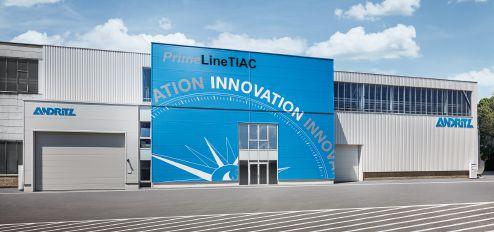
Andritz says it will open the “world’s most modern research and development centre for tissue,” the PrimeLineTIAC Tissue Innovation and Application Center, at its Graz, Austria, location next March.
The research centre boasts a state-of-the-art tissue production line, including laboratory facilities for tests and trials to develop new products and processes in the tissue sector. It is available to tissue producers and to suppliers, research and development companies, and universities.
As well, customers and developers can conduct tests and trials under different conditions, for example to optimize fibres and furnish for a specific product, improve product qualities, increase dryness, and reduce energy consumption. The impact of variables such as stock preparation, chemicals, vacuum, machine clothing, pressing, and drying with hot air and steam can all be measured and evaluated accurately, says the company. Customers can bring along their own team of specialists, or discuss and collaborate with Andritz experts from the R&D, stock preparation, machine design and engineering, automation and pumps departments. According to the company, final test runs for the centre are currently in progress.
of its R&D infrastructure promotion.
Andritz says the PrimeLineTIAC has its own complete stock preparation line together with the approach flow system, and that many different kinds of pulp can be processed in one production line, which is split into a separate short fibre and long fibre line. All units are available in small industrial scale, “creating an excellent environment for best possible fibre treatment and tests according to the individual needs of customers and products,” notes the technology company.
Meanwhile, the tissue production line promises to offer “utmost flexibility” for the production of conventional, textured, and structured (TAD) tissue, featuring eight configurations that are also available on the market as single-machine concepts. Flexible monitoring and controlling of the configurations as well as the stock preparation system, including alarm management, online documentation, and eco-monitoring, are made possible by PrimeControl automation hardware and software, says Andritz.
As a result, customers can run trials with what could potentially be their future machine configurations. With a design speed of 2,500 m/min and a sheet width of 600 mm, the machine can be operated with a suction press roll or a shoe press, a regular CrescentFormer or a vertical CrescentFormer, and with a 16 foot. steel Yankee or two 14 foot. TAD drums.
The various partners for this project include Albany International Corp., Danfoss Drives, Fibria, IBS Paper Performance Group, Nash, Södra, and Solenis. The PrimeLineTIAC is sponsored by the Austrian Research Promotion Agency FFG as part
Fortress Paper’s Yvon Pelletier to retire
After 36 years in the forestry industry, including nearly five years at Fortress Paper, Yvon Pelletier retired from the company on October 1.
Reassuming the role of president and CEO is Chadwick Wasilenkoff, in addition to his current position as chairman of the board. Wasilenkoff is the founder and served as president and CEO from June 2006 to September 2015. He has founded, financed and held executive and board positions with several publicly traded companies in Canada. He also sits on the board of the deans advisory at the University of British Columbia.
“I would like to thank the whole team at Fortress for sharing these past five years of my career with me. With the addition of Giovanni Iadeluca to Thurso’s operations and Mr. Wasilenkoff’s full-time involvement, I am confident that I am leaving the company in good hands for the next stage of improvement and growth,” Pelletier said.
Pelletier was named CEO of Fortress Paper on Oct. 1, 2015. He previously held the position of president of Fortress Specialty Cellulose since February 2013. Prior to joining Fortress Paper, Pelletier was the executive vice-president of Tembec.
The pumping systems are highly automated and are monitored to not only control operations, but also gather and report important process data under different operating conditions, it adds.
New Cascades plant to produce PRO towel, tissue products
Cascades has inaugurated its new 284,000-square-foot tissue converting facility in Scappoose, Ore.
“The Scappoose facility will also allow us to increase our converting capacity and integration rate as we will be using tissue paper produced at our St.-Helens plant located just eight miles away,” said Mario Plourde, Cascades president and CEO.
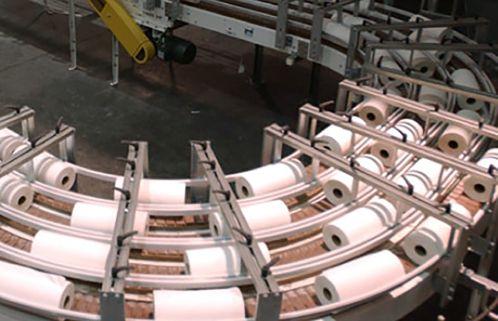
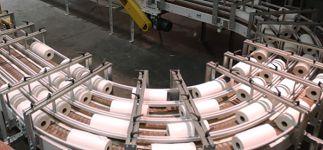
The new US$64-million plant — which manufactures towel and tissue products under the Cascades PRO brand — is equipped with “best-in-class converting lines, high-speed rewinders and folders, and one of the fastest bath lines in the world,” Cascades says.
The line includes hand towels, bathroom tissue, napkins, kitchen roll towels, facial tissue, wipers and dispensers. The plant is estimated to produce nearly six million cases per year of virgin and recycled bathroom tissue products and paper hand towels.
Irving Consumer Products has announced it will expand its United States business operations with the construction of a new US$400-million tissue plant in Macon, Ga.
Expected to create more than 200 jobs, the new plant will allow the company to double its ThruAir Dry capacity, increasing it by 75,000 tonnes, the equivalent of 15 million cases, it says. It will be a total of 700,000 square feet.
“We’re looking forward to building a strong relationship with the wonderful people of this community,” said Robert K. Irving, Irving Consumer Products president. “Selecting Macon for our new facility provides us with an opportunity to establish a footprint in a region that has proven itself as being a strong supporter of business. It will allow us to reach key markets, and will help to continue to drive our growth. This expansion is possible because of the commitment of our employees, customers and suppliers.”
The company says engineering and planning for the facility is well underway. Construction commenced this summer and is scheduled to be completed in 2019, providing roughly 1,000,000 person hours of work. At the height of construction, more than 540 people will be working onsite, says the company.
In November 2016, Irving Consumer Products announced the purchase of a new ThruAir Dry machine, which will be installed at the new facility in Macon.
Part of the J.D. Irving Group of Companies, Irving Consumer Products Ltd. is a manufacturer of premium quality private label and store brand household paper products, baby diapers, and children’s training pants.
Florida mill selected for GeorgiaPacific’s US$400-million investment
Georgia-Pacific has selected its Palatka, Fla., mill for the company’s previously announced investment of more than US$400 million in its GP Consumer (retail) tissue and towel business.
Investments to the Palatka mill include building a new paper machine using through-air-dried (TAD) technology, as well as adding associated converting equipment and infrastructure. Engineering and related work is beginning immediately, and startup of the upgraded operation is scheduled for 2019.
About 80 jobs will be created to operate the new papermaking complex, in addition to the mill’s 850 current employees. An average of 160 construction and contract-related workers are expected to be onsite every day during the project, with a potential peak of 700 contract
workers per day at the height of construction.
The Palatka mill operates two kraft paper machines, three paper machines manufacturing paper for bath tissue and paper towels, and converting operations that produce finished paper products.
The improvements will allow GeorgiaPacific’s current and potential customers to grow their premium private label towel brands, as well as expand the company’s Brawny premium paper towel brand.
“This upgrade to our operations in Florida underscores our long history of investment in the state by GeorgiaPacific and Koch companies,” said Christian Fischer, Georgia-Pacific president and CEO. “We appreciate the ongoing support of the local community, Putnam County and state officials in our efforts to continue making our Palatka mill more competitive for the longterm.”
“This significant investment demonstrates our commitment to GP’s consumer business, our hard-working teams and our current and potential customers,” said Kathy Walters, group president – Georgia-Pacific Consumer Products Group.
NORPAC reorganizes operations in face of Canadian-subsidized competition
In an effort to stay competitive in the face of Canadian governmentsubsidized competition, the North Pacific Paper Company (NORPAC) has announced it will reorganize its operations.
This October, the company plans to reduce its production capacity by idling one of its three paper machines and expanding the remaining capacity to serve customers.
“As we seek to level the playing field under U.S. trade laws to coun teract the dumped and subsidized imports from Canada, NORPAC will become a nimbler, stronger supplier to our customers by reorganizing around our two remaining paper machines,” said Craig Anneberg, CEO of NORPAC. “Our company is con stantly working to improve both our products and operations to remain competitive despite unfair import pricing and Canadian governmentsubsidized competition.”
He explained that NORPAC will use “all the tools at its disposal” under the U.S. trade law to address and counteract the dumped and subsi dized imports from Canada.
The reorganization and expansion of capacity for its remaining paper machines follows NORPAC’s filing on Aug. 9, 2017, of antidumping and countervailing duty petitions with the U.S. government.
“All of our employees have dedi cated their careers to making NOR PAC what it is today — one of the fin est paper mills in the world known for quality, service and innovation. The closure of a paper machine has been a very difficult decision for everyone involved,” Anneberg added. “We will do everything in our power to make sure our teams of employees have a level playing field to compete in the future.
“As we move forward, we will engage our teams in transition planning, which will include transition resources for impacted NORPAC employees.”
Photo: Irving Consumer Products; Georgia-Pacific
Conference: March 20 - 23, 2018 Tradeshow: March 21 - 23, 2018 Miami Beach Convention Center FL, USA
www.tissueworld.com/miami
tissue industry gathering in North America
“Exhibitions play a vital role in our business and we have found that Tissue World provides us the greatest success thanks to its concentration in the tissue industry. The professional staff provides attendees the opportunity to participate in valuable educational seminars with key speakers to gain a further understanding about industry trends. We always look forward to the next show as it keeps getting better and better.”
Edson Packaging Machinery Ltd. Register for your free vistor pass at: www.tissueworld.com/miami/register
Catalyst launches Trident label paper Catalyst Paper, headquartered in Vancouver, B.C., has launched Trident, a wetstrength label paper produced at its Rumford mill in Maine. Trident is a full wet-strength label paper for application on water bottles, craft beer, juice bottles, wine bottles and large format containers.
Available in 47 and 60 pound basis weights (lbs. per 3,300 ft2), Trident is sustainably produced with available chain-of-custody certification under the Forest Stewardship Council (FSC), the Programme for the Endorsement of Forest Certification (PEFC) and Sustainable Forestry Initiative (SFI) standards.
“As we strive to expand our portfolio of value-added, paper-
OPINION
based solutions for our specialty customers, we are excited to introduce Trident, our new wet-strength label paper,” said Brian Boland, vice president, Specialty Papers & New Product Development. “Not only does this launch further demonstrate our commitment to the label market, it offers a durable beverage label with excellent wet opacity, printability and labelling speed that will satisfy the needs of both converters and brand owners.”
The introduction of Trident follows Catalyst’s recent re-launch of Rumford Offset, and additional specialty products including Glide Graphics release liner base papers, the Leap family of lightweight food flexible packaging papers and the Bistro line of food service papers.
Resolute names Patrice Minguez tissue group president
Resolute Forest Products has named Patrice Minguez president of the tissue group.
In this newly created role and as a member of the Resolute executive team, Minguez will oversee all tissue operations as well as sales and marketing functions. This includes the Atlas Tissue operations in Florida and the new tissue and converting facilities at Calhoun, Tenn. He will also be accountable for the Calhoun pulp and paper mill.
Founder and former president of Cellynne Holdings, Minguez has positioned Cellynne as a global independent tissue converter in North America. In addition to his background selling both away-from-home and at-home bath tissue and towel, Minguez has led the installation and start-up of new tissue machines, and managed multiple production locations.
“Patrice Minguez has a strong reputation in the marketplace and a proven track record of success. His knowledge, experience and entrepreneurial background will strengthen Resolute’s presence in the tissue market,” Garneau said. “Patrice will play an important role in the company’s ongoing transformation strategy.
Garneau says Resolute believes the tissue business will be “positioned for sustained growth and performance” under Minguez’s leadership. PPC
The challenge of managing revenues from power exports
Submitted by FPInnovations
Power exports have become a new, complementary source of revenue for many Canadian pulp and paper mills. However, although very attractive, the maximization of profits from power production exports while providing enough steam for internal processes and operations remains a challenge for many of the mills.
Power contracts are complex and electricity prices fluctuate on a regular basis, in addition to being different from one province to the other. It is essential to clearly define and understand the terms of the contract between the producer and the buyer. Energy production strategies should be adjusted according to the constraints of the contract (fuel quantity/ type/level of production), fuel prices, process energy efficiency, and of course, electricity supply. The best operating strategies should also be identified in order to meet internal energy requirements for
the production of paper products while meeting the targets set out in the energy sales agreement.
The addition of power production operations to a pulp and paper mill has led to the need for a new sphere of expertise within the industry. Consequently, FPInnovations and CanmetENERGY have combined their expertise of the pulp and paper processes and their process integration tools and expertise to help plant managers understand the actual costs of power generation, their variability, and that they take full advantage of contractual terms. In most cases, power generation also requires the integration of energy reduction measures throughout the plant; this allows for more flexibility in order to maximize the profitability of the plant.
Revenues from power production exports have become an important component of the financial well-being of pulp
and paper mills. At this time, more than 12 member company mills have already maximized their benefits to up to several million dollars. Ongoing work will enable the industry to further benefit from this new sphere of activity.
To learn more, please contact Douglas Singbeil, research manager of FPInnovations’ Process Engineering group, at douglas.singbeil@fpinnovations.ca. PPC
Powered by green energy
By Treena Hein
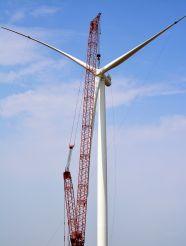
Kimberly-Clark has announced it will annually purchase about 1,000,000 megawatt hours of electricity generated by two new wind power projects in the United States, starting in 2018, to power its North American mills.
Currently under construction, the Rock Falls Wind project developed by EDF Renewables (pictured here) in northern Oklahoma will become operational by the end of the year, and the Santa Rita Wind Energy Center built by Invenergy in West Texas is expected to start up by the second quarter of 2018.
The longterm contracts involve the purchase of 120 MW (almost 80 per cent of the electricity generated) from Rock Falls and 125 MW (42 per cent of the electricity generated) from Santa Rita. Together, this represents about one-third of the electricity needs of Kimberly-Clark’s entire North American manufacturing operations. It will reduce the firm’s greenhouse gas (GHG) emissions by up to 550,000 metric tonnes every year, the equivalent of removing over 116,000 passenger vehicles from the road, enabling the company to surpass its GHG reduction goal four years earlier than anticipated.
“These agreements mark Kimberly-Clark’s first use of utility-scale renewable energy and are a step-change in our energy and climate strategy to reduce climate change impacts, improve operating efficiency and benefit cost savings,” said Lisa Morden, global head of sustainability at Kimberly-Clark, in a statement. “Adding wind-generated electricity to the energy mix will enable the company to achieve more than a 25 per cent reduction in GHG emissions in 2018, which is four years ahead of the original 2022 target to reduce absolute greenhouse gas emissions by 20 per cent from 2005 levels.”
According to Stewart Van Horn, director of global energy solutions at Kimberly-Clark, there will be no impact on the operation of his company’s mills from using wind-generated electricity, in terms of things like potential power fluctuations.
“These are virtual power purchase agreements, sometimes referred to as a contract for differences,” he explains. “KimberlyClark contracts with the wind farm operators to take a portion of the facilities’ generating capacity, the additional energy from these projects is added to the transmission grid, and KimberlyClark receives renewable energy credits to offset emissions from its manufacturing operations.”
Kimberly-Clark has also completed more than 350 other energyconservation initiatives across its operations since 2015. More than 30 of its manufacturing facilities, for example, have adopted LEAN Energy Management.
“[It’s] designed to engage mill employees in a culture of
conservation,” says Van Horn, “to execute process changes which optimize energy efficiency and to deploy real-time visual tools to make energy overconsumption visible and trigger corrective actions.”
He adds that Kimberly-Clark teams across the globe have found new, more efficient ways to generate power using biomass and cogeneration. Recent projects include the startup of a biomass boiler and cogeneration facility at the firm’s Sitio del Niño plant in El Salvador, and a biomass boiler at its Mogi das Cruzes plant in Brazil. In addition, in 2019, Kimberly-Clark will start up its seventh large-scale electricity cogeneration facility, with waste heat being recovered at all of these facilities and used for both the manufacturing process and plant heating.
All the new renewable energy projects and other energy initiatives will put the firm on track to reap savings in the multimillion dollar range by 2022. The recent wind power purchase agreements, for example, have the potential to provide cost benefits and also cost certainty over the 12 to 15 years the agreements are in place, says Van Horn.
“Power generation from renewable sources like wind is not affected by fluctuating costs for fuel such as natural gas,” he notes. “By locking in a price for electricity from a stable, renewable source, these wind power agreements will help reduce Kimberly-Clark’s exposure to future energy cost fluctuations and save money over the longterm. We are hopeful the increased use of renewable energy by Kimberly-Clark will provide a positive differentiation for us in the eyes of our customers and consumers.”
For more information on Kimberly-Clark’s Sustainability 2022 strategy, visit www.sustainability2022.com. PPC
DIVERSIFYING OPERATIONS
Kruger announces plan to diversify two Quebec paper mills into specialty niches
By Alyssa Dalton
It’s something we’ve heard many times before — the global pulp and paper industry is amid great change. In this time of transformation, one way mills can stay innovative is by identifying new markets and product areas to specialize in. Kruger Inc.’s recent announcement of its diversification strategy is an example of how the company plans to adapt to market and customer demands.
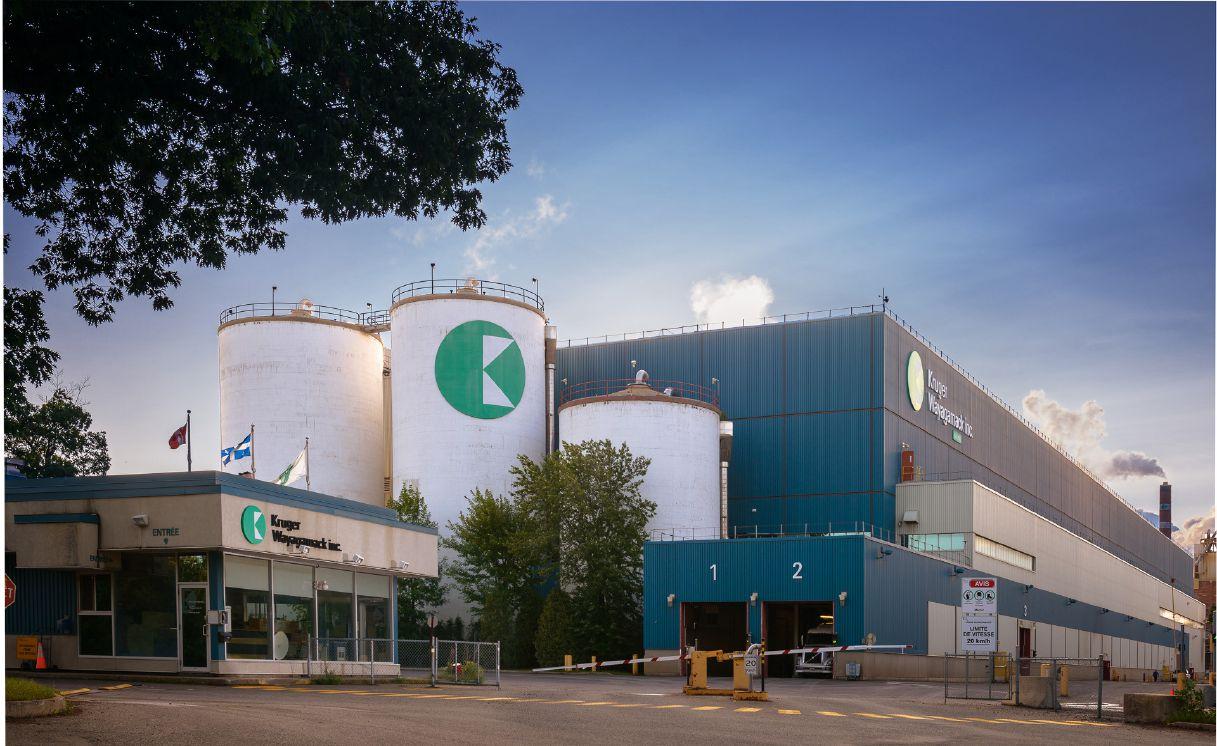
Founded in 1904, Kruger is a producer of tissue products, 100 per cent recycled containerboard products, corrugated packaging, publication and specialty papers, renewable energy, cellulosic biomaterials, and wines and spirits. In early September, it detailed a $377.6-million commitment to diversify
the operations at its Brompton and Wayagamack Mills into specialty niches, such as flexible food packaging, labelling and digital printing.
A new entity
Kruger and the Government of Québec have formed a partnership by which Investissement Québec, acting as the government’s agent, will grant loans and a loan guarantee totalling $59.8 million and acquire an equity participation of 37.5 per cent, or $44.6 million, creating a new entity — Kruger Specialty Papers Holding L.P. — that will comprise the assets of the Brompton and Wayagamack Mills, as well as the Biomass Cogeneration Plant adjacent to the Brompton Mill. The
co-gen plant and the thermomechanical pulp mill at the Trois-Rivières Mill in Quebec will supply Brompton and Wayagamack with raw material.
“There’s a saying that instead of buying energy, the cheapest energy you can buy is efficiency. It’s the energy you’re already buying but are also going to use it to do something else,” says Eric Gingras, senior industrial energy efficiency specialist at Natural Resources Canada, who is responsible for the forestry, pulp and paper sector. “Today, [businesses] are trying to be lean and efficient with everything they do, and being efficient [with their] input is one way.”
The new specialty papers entity, according to Kruger, will supply
Photos: Éric Massicotte / Pierre Charbonneau, Kruger Inc.
products that are in high demand due to changing market trends around the world, specifically increased demand for sustainable packaging and the growing popularity of e-commerce. These new specialty products include food packaging paper, labelling products (backing paper) and coated paper for digital inkjet web presses to print masscirculation catalogues and flyers that can be customized for targeted mailings.
To carry out the diversification project, Kruger Specialty Papers Holding L.P. will invest $107.5 million over the next three years that will enable the Brompton and Wayagamack Mills to gradually reduce the production of some publication paper products that are in decline, such as newsprint and magazine paper, while accessing new markets that are on the rise around the world. The goal is that by the end of the three-year project, the Brompton Mill will focus exclusively on specialty products and will no longer manufacture 200,000 metric tonnes of newsprint annually.
More than 500 jobs in the Mauricie and Estrie regions are expected to be maintained as a result of the project.
The investment — which will help secure new production equipment, as well as modify existing equipment, make technical improvements to boost productivity, and support various energy efficiency measures — will be allocated as follows:
The specialty papers developed by Kruger will include cellulose filament (CF), a bio-based strengthening agent that is extracted from wood pulp fibre using a chemical and enzyme-free process. The engineered biomaterial — and Canadian innovation — is manufactured at the Trois-Rivières demo plant, the first in the world to manufacture this product. Commissioned in June 2014, the demo plant is a collaboration between Kruger and FPInnovations and has a 5-tonne a day production line. CF can be used as a lightweight strengthening additive to produce lower cost commercial
pulps, papers, packaging, tissues and towels. Looking to the future, CF may be combined with many materials to create high-value products ranging from flexible packaging and films to structural and non-structural panels in building construction.
The potential initial market for CF as a strength-reinforcing agent for traditional pulp and paper products is conservatively estimated at 120,000 tonnes per year in North America. In addition, a similarsized, non-traditional market is forecast for thermoplastics, reinforced plastics, thermosets, adhesives, and non-woven fabric and coatings, representing a total revenue potential of $500 million per year for companies that make use of CF.
Critical reinvention
Derek Nighbor, CEO of the Forest Products Association of Canada (FPAC), believes that ongoing partnerships with governments and academia will be “critical as our sector continues to reinvent itself.”
“The future success of the forest products sector in Canada is dependent on a number of things, but at the top of that list would be reliable access to economic fibre and our ability to innovate and continue to transform our businesses,” he says. “Transformation takes many forms from developing new value-added paper products to making biomaterials from wood fibre; from building more in Canada and around the world with wood to having more energy produced from woody biomass.”
It is clear Canada must stay proactive and adapt to changing market demands in order to compete. PPC
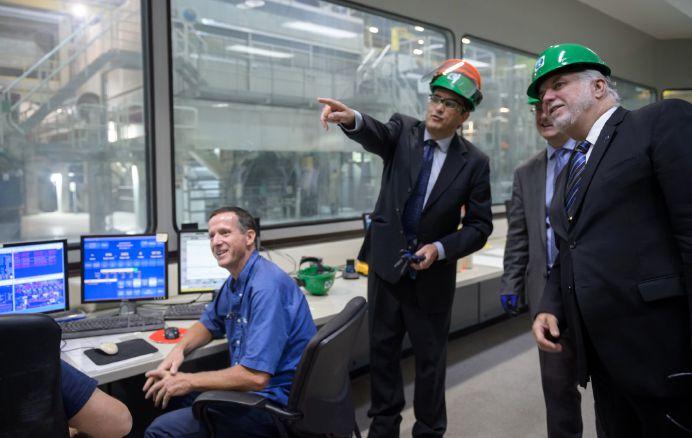
Wayagamack Mill GM Pierre Dallaire (left) with Quebec Premier Philippe Couillard (right).
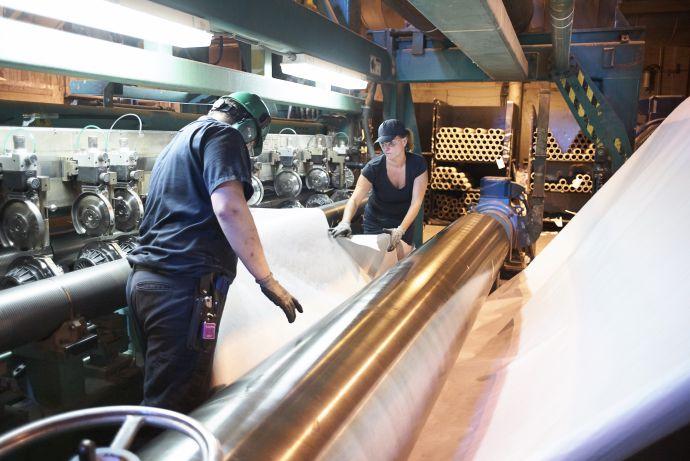
Paper making at the Brompton Mill. Acquired in 1950, the mill is Kruger’s first paper mill.
Packaging has a critical role in protecting products as well as enhancing the brand and product experience. Through innovative chemistry and application expertise, Kemira works together with packaging & board makers to improve desired board properties such as strength and stiffness, weight and volume reduction, printability and functionality, and safety and hygiene for food packaging.
We are committed to the pulp and paper industry, and continue to help you create value through improved process efficiency, productivity and end product quality.
Let’s work together to build value into paper. www.kemira.com
ICE IT OFF
Industrial cleaning with ice offers environmental advances and cost savings
By Victoria Gaitskell
Coulson Ice Blast, a British Columbia startup that launched this February, recently commenced mass production of a new technology using blasted ice for industrial cleaning. It calls its mobile iceblasting machine the IceStorm90 because it produces what looks like a storm of ice pellets that can be focused into a stream as narrow as two inches wide. Although it operates along lines similar to earlier technologies that blast a medium such as pressurized water, sand, sodium bicarbonate, or dry ice pellets onto a soiled or contaminated surface, Coulson Ice Blast vice president Foster Coulson says ice blasting represents a major advance in environmentally friendly cleaning.
“As far as I know, we’re the only ones doing it, and we’ve spent a lot of time and energy filing new patents to protect the technology. It’s something unique and special, and we’re very excited to bring it to market and really try to advance the state of industrial cleaning — which hasn’t really seen any innovation in the last 70 years since dry ice blasting technology was invented in 1947. Over the same time period, environmental regulations have significantly increased, yet innovations in technology have been lacking.”
Coulson says ice blasting technology exceeds almost every environmental regulation that has been set. “It involves no added chemicals, no environmental contaminants, negligible airborne contaminants, and minimal residual water waste. It’s pretty much the most environmentally friendly way you can clean.”
How it works
“On average, our system uses 95 per cent less water than a pressure washer,” he specifies. “By contrast, pressure washing varies with the technology, but it can use up to about 1,200 U.S. gallons of water per hour. Depending on what you’re blasting, trying to treat and dispose of that amount of water can be very costly.”
He explains that the environmental advantages of cleaning with ice derive partly from the fact that it is the only medium that can exist during blasting in all three phases of matter: solid, liquid and gas.
“It hits the surface it’s cleaning as a solid, then half of it turns into a gas which evaporates, and the other half stays in a liquid form which pulls airborne contaminants down to the ground instead of releasing them into the atmosphere.”
By contrast, he says other forms of
chemical, abrasive and dry ice blasting often produce hazardous airborne contaminants, so much so that workers operating these forms of blasting typically require artificial respiration or breathing protection devices.
He says the ice blasting process creates relatively little residual waste. “On average, blasting at three pounds a minute you’ll have around 10 gallons an hour of water residual waste.”
In terms of media costs, ice is also cheaper than, say, dry ice blasting pellets, which cost from 90 cents up to two dollars per pound. According to Coulson, ice costs less than one cent per pound to make or 12 cents per pound when purchased.
Icy advantages
Coulson says other factors that make ice attractive as a cleaning medium are that it is natural and readily available. “For other chemical processes and dry ice blasting, you need to buy artificial media in the form of premade chemicals or dry ice pellets. But ice is natural and barebones basic. If you wanted to, you could make it inexpensively yourself from any type of water source — tap water, for example — and store it indefinitely in a freezer. Contractors often store ice in
Photos: Coulson Ice Blast
300-, 400-, or 500-pound totes where it lasts for four or five days.” As alternatives to making ice yourself, Coulson Ice Blast also sells ice-making machines and offers ice distribution through its partnership with Reddy Ice (U.S.A.), an ice manufacturing company.
He adds that ice is one of the only cleaning media that can turn corners during blasting. “If you needed a cleaning agent that can travel, say, along a 30-foot hose with S-curves and a 90-degree corner, few media could do the job, because most of them lose energy travelling around corners and get stuck. But ice would be able to clean perfectly throughout the whole length of the hose.”
Successes in the industry
Ice blasting is suitable for a range of industries including aerospace, nuclear, petrochemical, plastics, power generation, printing, and pulp and paper.
One example is the AFCO Denso/ Bosch plant in South Carolina, which uses the equipment to deburr copper motor parts. “Since 1995, AFCO has continuously operated an Ice Blast machine to deburr copper motor armature faces for fuel pumps. The use of Ice Blast to deburr has been crucial to producing our high quality fuel pumps...for the North American automotive industry,” wrote AFCO project engineer Jack Engram in a statement. “Ice Blast technology continues to be a
The environmental advantages of cleaning with ice derive partly from the fact that it is the only medium that can exist during blasting in all three phases of matter: solid, liquid and gas.
cost-effective solution for our deburring and precision cleaning needs. Aside from normal maintenance, the Ice Blast equipment has performed reliably for the last 20 years. The ability to rely on this machine eases our minds in production because we are confident that the Ice Blast will achieve the necessary standard of clean every time.”
Meanwhile, the British Columbian branch of Disaster Kleenup International (DKI), a North American disaster restoration contractor with estimated annual revenues in excess of $1.7 billion uses Coulson Ice Blast equipment to remove lead paint from concrete.
Rich Canadian roots
Coulson Ice Blast grew out of a family business started by Coulson’s grandfather, Cliff, when he launched a small logging company in Port Alberni on Vancouver Island in 1960. Coulson’s father, Wayne, subsequently grew the company into The Coulson Group, a conglomerate whose other activities have included manufacturing wood products and aviation. Within the last two years,
they sold off the logging and lumber operations to concentrate on aviation and ice blasting. While Wayne continues as president and CEO of The Coulson Group, Coulson’s brother Britton is vice president of the aviation division, which involves overhauling aircraft components and aerial fire suppression.
The natural surroundings of Port Alberni yield such local attractions as salmon and sport fishing, provincial parks, hiking trails, mountain climbing, Cathedral Grove (an old-growth forest of towering Douglas fir trees, some over 800 years old), and Della Falls (Canada’s highest waterfall). Given this superb environment, it is not surprising that environmental friendliness is a key value underlying The Coulson Group operations.
Its association with ice blasting equipment began in 2012, when it wanted to remove paint from a Martin Mars aircraft it had acquired and repaint the plane in their fleet colours: red and white. The paint removal task raised technical problems, however, since the Martin Mars can only take off on water, it had to stay situated beside a lake. This complication ruled out pressure washing, which requires more water than was available at the plane’s site. Sand blasting was equally impractical, since the Martin Mars is the world’s largest flying water bomber, too big to permit the full containment that sand blasting requires.
Instead, an engineer at The Coulson Group suggested and built an iceblasting machine using technology he learned at a previous job at Universal Ice Blast, an American company that manufactured ice blasting equipment until it went bankrupt in 2001. The Coulson Group was so pleased with the results that they tracked down the former owner of Universal Ice Blast, purchased the technology from him, and have been refining it and planning the future of Coulson Ice Blast ever since. PPC
Vice president Foster Coulson says the system uses 95% less water than a pressure washer.
Maximizing conveyor operation
Understanding how and why belt construction and conveyor drive system affect conveyor performance
By Michael Cremeens and Dick McConnell
Seeing vs. understanding — a common conundrum when it comes to truly understanding challenges.
When applied to conveyor operation, “seeing” is most commonly expressed as, “That’s the way we’ve always done it,” or, “This is the way I was taught.” Not necessarily wrong, but perhaps not completely right either.
In contrast, when we have an “understanding” of the events occurring during effective conveyor operation, maximized performance can be achieved. From belt construction, to structural composition to splicing considerations, having fundamental knowledge (or understanding) can provide enhanced belt performance outcomes.
Getting to know your belt
Belt selection is critical. Knowledge of the workload expected, pulley diameters on
the structure, troughability, load support/ transverse stiffness, impact loads, and rubber compound requirements are but a few of the prerequisites of choosing the right belt. If this sounds a little overwhelming, be advised that you need not worry; every key belt manufacturer representative can walk you through these parameters. The bigger issue, especially in the North American market, is the broad brush of belt specifications.
Understanding belt construction
Key components of a belt include the fabric, skim coats, and adhesions (collectively known as the carcass). This is the backbone of the belt. The carcass does all the work involving carrying the load, cycling from peak to low operational tension, and performance longevity. The other key component is the top and bottom covers. They are there to protect the carcass. Different compounds are available to meet the needs of application.
The North American market unit
of tension is measured in pounds per inch of width (PIW). The plies of fabric, usually made of nylon or polyester, have a rated tension. Common fabric tensions are: 110 lb., 125 lb., 150 lb., and 200 lb. So, adding the number of plies with the rated fabric strength provides the belts rated tension in PIW. For example: three plies of 110 lb. fabric equals a belt rated at 330 PIW. This is the rated tension – a key component in belt selection. But, here’s the issue and one that is recommended to be resolved. The belt also has a safety factor. The service factor of the carcass is directly proportionate with the safety factor. Higher quality belts will have a 10:1 break strength or higher while lower-end belts can be 6:1 or less. Independent pull tests can verify the break strength.
Transitions and your belt
Now that you know belt construction and conveyor drive system affect performance, what other operational considerations are in play? A prominent part
of conveyor design, one for which the conveyor belt is engineered to accommodate, is the transition distance. Located at the load zone, or tail section, and the discharge point, or head section, the transition distance is the dimension from the top of the respective pulley to fully troughed. In other words, the distance from the top of the tail pulley (at the load zone) to the first full troughed idler set (usually 35 degrees or 45 degrees).
Conveyor belts are designed to stretch into these troughed positions while carrying loads. However, meeting or exceeding the recommended distance in this transitioned area is critical to maximizing belt life. Violating this specification will result in premature fatigue. This will be represented in the form of belt cupping (curved belt edges identified on return idlers), wear patterns in top and bottom covers following the load side idler junctions (the space between the flat centre roller and the two canted rollers), and, most damaging, extreme compression folding of the centre of the belt at the transition. All of these preventable events can cause tracking issues, premature splice failure, and will abbreviate belt life.
There is a relationship between the length of transition distance and the percentage of the belt’s rated tension. This means we need to understand the operating tension of the belt. There are several sophisticated ways to calculate the operational tension; your chosen belt manufacturer can make these available. By knowing the percentage of the belt’s rated tension versus the operational tension, belt performance can be maximized once again. Ideally, operating a belt at 50 per cent to 60 per cent of rated tension is desirable.
One quick check method is referred to as the motor horsepower calculation. This presumes 100 per cent of the horsepower on the nameplate of the motor can be engaged in the drive system. As such, this is a conservative means to calculate operational tension.
Operational vs. rated tension
The percentage of operational tension to rated tension affects several key performance characteristics. As mentioned, transition distance recommendation is decreased as the operational percentage is lowered. The same goes with
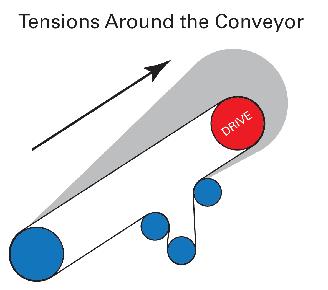
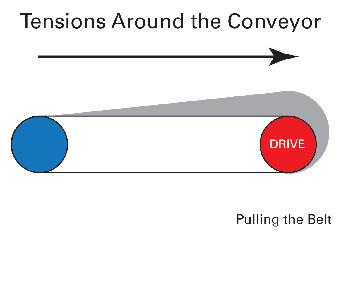
HP = motor horsepower (nameplate)
Cw = drive “wrap factor” (also called “K” factor”)
Note: 33,000 is a constant for one strain of belt.
1 HP = 33,000 ft/lbs per min.
Full Trough Transition Table
NIBA - Minimum Pulley Diameters
recommended minimum pulley diameters. This includes any pulley in the conveyor system having more than 90 degrees of wrap. The head pulley, tail pulley, and gravity take up pulley are included in this consideration. On higher percentage operating PIW belts, especially when inclined, the bottom side bend pulley following the gravity take up system may come into play. Like transition distances, the concern lies not in being too big but rather exceeding minimums.
So far, many critical belt performance considerations have been discussed, but how your belt is held together also needs to be considered. There are several options when it comes to splicing your belt, so make sure the right method and correct tools are chosen for the application. Once the method is selected, make certain the splice is installed at a true 90-degree angle to the travel of the belt. This will equalize the tension across the Full-Motor Method PIW = 33,000 (1+Cw) HP
Is your splice right?
width of the belt, preventing tracking issues once the belt is under tension.
The first consideration in splice choices is vulcanized versus mechanically fastened. Vulcanizing is the process of prepping belt ends with either a “step” style splice of a “finger” style splice. The splice kits for both include the rubber material and solutions necessary to prep the belt prior to “cooking” the belt ends in a vulcanizer. Of the two, step splices are more common. However, the finger style splice is preferred in special weave fabric belts and higher tension applications. In both cases, the splicing personnel need to be very skilled to assure the very best outcome. The result is a seamless splice joint with a rubber chemistry most closely matching that of the belt manufacturing process. In ideal circumstances, that splice could last the life of the conveyor belt.
The second option is a mechanical splice joint. The process for installing these utilizes a plate or hinged style design held in compression on the belt ends with either a bolt, rivet, or screw. Mechanical joints meet operational tension needs, are cost effective, and can be installed very quickly by the conveyor operator. Mechanical fasteners, when properly selected, have a very significant life cycle. Another benefit of the mechanical splice is that when it does fatigue, the wear pattern is evident during routine inspection. This makes it easy to add to a planned maintenance on a conveyor.
Other belt performance considerations
Additional conveyor operation considerations include load zone characteristics and tracking influences. Training for both of these elements can be quite involved. Suffice it to know that the better the product is centred on the receiving belt, the better the chance of keeping the belt tracked. Further, if the product is oriented toward the direction of travel of the receiving belt, at minimum impact, and at similar speed of belt travel, many belt wear issues are minimized. There can be many reasons for belt conveyors to mistrack — structural damage, cambered belt, excessive carryback, over or under tensioned operation — just to name a few. Belts that are not tracking properly will have an adverse effect on performance. Maximizing conveyor performance can be achieved through an understanding of the performance characteristics of the application. Although there
are many reasons why conveyor belt performance may be less than optimal, the solutions are generally common sense once the groundwork is understood. There are also many dependable reference sources to further understand conveyor operations. Two of them would be the Conveyors Equipment Manufacturers Association (CEMA) and the National Industrial Belting Association (NIBA). PPC
Michael Cremeens is the VP training and technical support at Shaw Almex Industries with 39 years of industry experience in a variety of roles ranging from field technician to rubber processing expert. He has authored numerous papers and speaks at many industry gatherings. Dick McConnell is the National Account/OEM Manager at Flexco. His 30 years of troubleshooting conveyor performance in all manner of industries gives him the knowledge and expertise to understand the challenges of both small and large operations, and offer solutions.
Photo: Getty
FOCUS ON PROCESS CONTROL: INTERNET OF THINGS
Multi-parameter transmitter for process applications
Mettler Toledo Process Analytics has launched a new version of its multiparameter M400 transmitter series for process analytics applications. The updated version M400 features a combined touchscreen and tactile soft-key user interface, says Mettler Toledo, adding that the high-contrast screen permits viewing in all light conditions and the soft keys allow operation even if protective gloves are being worn. The series is compatible with analogue sensors and Mettler Toledo’s digital Intelligent Sensor Management (ISM) probes. ISM features boast advanced sensor diagnostic tools that can be displayed on the M400 and accessed remotely via asset management software. The HART communication protocol provides integration of the diagnostics into process control systems. In addition, ISM sensors can be calibrated away from the process in any convenient location, then connected to the M400 which will set itself up appropriately. A software tool supplied with the transmitter enables configuration of the M400 via PC and USB stick. The configuration can then be shared among other M400s. www.mt.com/pro
Industrial IoT Solutions
International technology Group Andritz has combined its Internet of Things (IoT) solutions under the technology brand Metris – Industrial IoT Solutions. Andritz describes Metris technologies as the “very latest state-of-the-art in the IoT/ Industry 4.0 sector” and can be tailored to individual customer requirements. Metris is based on three pillars of technology:
Smart Sensors, Big Data, and Augmented Reality. In addition to the use of conventional Smart Sensor technologies for analysis of measurements and signals, Andritz offers micro and wireless sensors as well. This can be used to optimize operation of the plants or systems by analyzing specific parameters that are freely selected by the customer. In the Big Data sector, Metris products calculate production deviations through simulation processes and use them to derive the control actions required. In this way, for example, production downtime can be avoided or the use of consumables reduced, notes Andritz. With Augmented Reality applications, information is made visible where it is needed, which is on the spot at the plant itself. The technology focuses on showing the information in context so the operator gets the best possible support, particularly for complex control actions.
www.andritz.com
Cloud-based predictive analytics platform
Clockwork Solutions describes its Clockwork Advanced Analytics Platform as incorporating the latest machine learning, artificial intelligence, and advanced analytics techniques to develop repeatable prognostics for use with Condition Based Maintenance (CBM) and Predictive Health Management (PHM) programs.
The platform, according to Clockwork Solutions, provides asset managers with a unified toolset to combine asset information from multiple sources, including real-time sensor data and historical data to create granular long-term predictions on future maintenance requirements and long-term demands on parts, processes, and people. “This new release combines our proven high-fidelity predictive analytics with the ability to ingest, and make sense of, the massive streams of sensor data that these organizations have spent millions of dollars on,” said Eric Newman, CEO of Clockwork. www.clockwork-solutions.com
Wireless e-stop system for emergency shutdowns
Laird says its wireless emergency-stop (e-stop) system – Safe-E-Stop – further enhances on-the-job safety by allowing an individual or group of operators to immediately shutdown a production line without having to run to a hard-wired e-stop station. According to the company, it can be integrated with existing hard-wired emergency stop systems for assembly lines and other production systems.
In some cases, the closest machinemounted e-stop could be in the same danger zone created by the emergency, and rushing to the next available e-stop can also be a hazard — adding precious time to the emergency response time.
The system provides continuous status indicators with LED and LCD displays, and the EtherNet/IP port on the Machine Safety Device (MSD) can be used to report the status of actuated wireless e-stops to operations personnel. Up to five Personal Safety Devices (PSDs) can be simultaneously linked to the MSD, which permits multiple operators to work independently or collaboratively to oversee an operation or solve a problem. If an e-stop on any of the linked PSDs is activated, the MSD commands a stop. All PSDs are immediately notified of the stop condition, the machine is shutdown, and the system identifies the PSD responsible for the stop. www.lairdtech.com
Low-odour XSB dispersion for board, packaging
BASF says its new low-odour binder for paper coatings, which is based on styrene butadiene, is specially designed for odour sensitive applications in the board and packaging market in the Nordic region. Suitable for various printing applications, the new product is particularly suitable for food contact and liquid packaging board, says the company, adding that the XSB binder is characterized by its minimal content of volatile organic compounds (VOCs). It complies with all relevant eco label and food contact requirements, adds BASF. Additionally, BASF is introducing new, high solid binders, which will be manufactured in Hamina, Finland. These binders are characterized by a solid content of up to 55 per cent, which BASF says will help reduce CO2 emissions during transportation of the binder and during drying of the formulated coating colour. As well, the new high solid binders can help to reduce complexity in handling and ordering processes and are suitable for demanding applications with high performance requirements, notes BASF. www.basf.ca
Calender promises to reduce production costs in board manufacturing
Voith ensures its new EcoCal Plus calender will allow papermakers to produce high-grade board products with high stability and lower basis weight; the special thermal smoothing of the EcoCal Plus
allows raw material savings of up to 3.5 per cent, it notes. As well, the process promises to result in an improved surface structure of the paper.
The hard nip calender plays a decisive role in the manufacturing of high-quality, stable board with low basis weight. It smoothes the paper surface and gives the board a uniform surface. This is where the EcoCal Plus comes in. The machine calender used for pre-calendering makes use of the fact that surfaces can be smoothed more easily when moisturized and warm. The EcoCal Plus is equipped with an external induction-heated system that additionally heats the thermo roll to a temperature of up to 260 degrees C –higher than the temperatures of conventional systems with 200 degrees C, says Voith. The EcoCal Plus also has an additional nozzle moisturizer for intensifying the bulk-preserving smoothing effect by regulating the paper web temperature, notes the company. The EcoCal Plus technology allows papermakers to reduce their fibre consumption, which greatly improves the cost efficiency of the plant, says Voith. It says an annual production of 500,000 tonnes with a one-per-cent saving in raw materials use translates into savings of around 250,000 euros per month for the manufacturer. According to Voith, the EcoCal Plus calender can be integrated into existing plants as an upgrade.
www.voith.com
Doctor blade line
Kadant Solutions, a division of Kadant Inc., has launched its Ultimate Blade Line featuring nanotechnology-enhanced composite doctor blades.
The company says the proprietary doctor blade line incorporates nanotechnology-enhanced resins which are manipulated on a molecular scale to provide a composite resin matrix with “increased resistance to chipping, improved inter-laminar bonding, and a lower coefficient of friction compared to conventional blades.”
“The Ultimate Blade Line provides the papermaker with applicationspecific materials to enhance roll surface cleaning, sheet shedding, and significantly extend overall doctor blade life compared to conventional blades. The high-performance doctor blades result in
fewer blade changes and the potential for reduced operating costs while enhancing overall doctoring and machine efficiency,” says Mohan Jayaraman, technical manager for doctor blades.
www.kadant.com
Angle seat valves
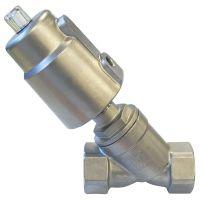
ODE Valve has introduced the new 21IZ1 series of stainless steel pneumatically actuated angle seat valves for the industrial market. The 2/2 way normally open, normally closed or double-acting valves are available from 3/8 to 3-inch sizes with NPT, Welded end, Tri-Clamp or Flanged connections with flow direction above and below the seat including fluid temperature up to 180 degrees C and maximum operating pressure of 230 psi. The valve body is made of corrosionresistant 316 stainless steel with PTFE seal making the 21IZ1 angle seat valve suitable for a range of industrial applications including wood and paper sectors. www.odevalve.com
New pump models
KSB’s Multitec series of high-pressure multi-stage pumps has been expanded with the introduction of two new higher capacity models. The Multitec 200 and 250 models have discharge flange diameters of 200 mm and 250 mm (up from a maximum of 150 mm for previously available models) and boast flow rates of up to 1,500 cubic metres per hour and developed heads as high as 400 m. Like the smaller members of the Multitec family, the new pumps promise to provide reliable, efficient operation and simplified maintenance procedures, says the company. According to KSB, a pressure balance drum reduces axial forces on bearings, while the layout of the pump enables bearing and seal replacement without requiring disassembly of the core hydraulic elements. www.ksb.ca
Next-generation LED area light
Dialight has launched its next-generation Vigilant and SafeSite LED area light, promising to deliver high efficiency along with several new features that make it the “most flexible, functional and durable LED area light” on the market for industrial and hazardous area applications. Dialight says it ramped up the Area Light efficiency to deliver up to 143 lumens per watt and added a new 9,000 lumen option to the product line. Coupled with new features like 0-10V dimming and 80 CRI, the updated fixture qualifies for DLC Premium classification on most models. An updated wide-optic design helps improve lighting footprint, enabling one-for-two fixture replacements in conveyor and walkway applications to help customers reduce fixture count and infrastructure investment, says Dialight. The new LED area light offers: 100–277V AC and 100-277V DC operation; ASTM B117 certification for 3,000 hours of continuous exposure; stainless steel
hardware; and a fully potted and sealed fixture rated to IP66, 67, 69 and NEMA 4X ingress protection. The unit is available in 3K, 4K, 5.5K, 7K and 9K lumens, each available in both glass and polycarbonate lens options.
www.dialight.com
Monitor fibre properties online
ABB has launched L&W Fiber Online, describing it as a reliable, repeatable and cost-effective online system for measuring, monitoring and controlling fibre quality variables in paper stock preparation and pulp production. According to ABB, the system will help pulp and paper customers save production costs by optimizing fibre usage, reduce energy consumption through elimination of over-refining, and to improve quality by generating uniform pulp furnish for the paper, board or tissue machine. The measurements based on fibre images provided by L&W Fiber Online promise to provide more detailed and accurate information on the status of pulp quality. Fibre properties are categorized and presented as mean values and statistical distributions of width, length, shape factor, two classes of fines (P and S) and macro fibrillation.
ABB says L&W Fiber Online mitigates the problem of detecting late in the production process quality issues caused by fibre variations. By discovering variations earlier in the process, and as early as in stock preparation, it becomes feasible to take corrective actions in time to produce paper, board or tissue that meets the specifications, it explains. The system also allows for multiple sampling points with a single instrument, reducing initial investment and ongoing maintenance costs. www.abb.com
New program aims to enhance safety training, communication
Cando Rail Services says its new TrackSmart program is a “major initiative” that will help create an environment which enhances safety training and improves the sharing of safety information and practices at every location.
“TrackSmart was built on extensive employee and industry research. We did a thorough review of our safety practices across the company. We also surveyed our employees who told us where they see opportunities for improvement. We combined that with our executive team’s vision of safety as the way we do things,” said Steve Gallagher, director of corporate safety.
One of the main tenets of the initiative is to continuously improve communications practices throughout the company. TrackSmart will encourage open peer-topeer communications on the job while also enhancing ongoing safety training and awareness across the company.
“Everyone is accountable for safety no matter what job they have. Everyone needs to be aware of their surroundings and to take action when something isn’t right. Every job must be done safely, regardless of how urgent it is,” according to a company statement on the new initiative.
Cando operates at more than 25 locations across Canada and the United States.
TrackSmart will help the company share best practices, while also collectively learning and improving when things go right and when things go wrong. The initiative includes a system where all crews can plug in to share and receive what they’re learning.
“We have always treated safety seriously. Our record has been excellent and we know that our expertise has been a prime driver in our success as a company,” said Brian Cornick, CEO. “What I like most about this initiative is that it is driven as much by our guys on the ground as it is by head office. We all believe safety has to be a prominent and central part of our everyday culture. That message comes straight from our crews.”
www.candorail.com
Program achieves Citrix Ready Verification
Greycon says its Greycon Suite, combining X-Trim, opt-Studio and GreyconMill, has received Citrix Ready Verification. The Citrix Ready designation is awarded to third-party software providers whose products have successfully met test criteria set by Citrix. The program showcases verified products that are trusted to enhance Citrix solutions for mobility, virtualization, networking and Cloud platforms.
Greycon Suite is now compatible with XenAPP and XenDesktop versions 7.0 –7.13. Citrix XenApp and XenDesktop virtualization promises to provide a complete, flexible solution that delivers Windows applications and desktops to users on any device.
www.greycon.com
Hand-held inspection cameras
Ridgid says its latest generation of handheld inspection cameras are purposebuilt to help inspect, locate and diagnose
issues faster than ever. The Micro CA-150 inspection camera has a 3.5-inch colour display to diagnose in tight dark spaces. The camera’s internal memory can save up to 20 images that can be reviewed later, on-screen. Meanwhile, the Micro CA-350 inspection camera, now standard with a 12V rechargeable Li-Ion battery, lasts up to eight hours and takes 45 minutes to recharge, so users can perform more inspections in a shorter period of time, says Ridgid, adding that the camera’s image rotation and digital zoom make capturing still images and videos easier. Both cameras boast a comfortable pistol grip design, LED lights to illuminate dark spaces, and large screens for viewing.
www.ridgid.com
New consolidated website
Fluke Process Instruments has launched a new website, combining its global capabilities in industrial temperature measurement. According to the
company, the website was designed to reflect the company’s core competencies and mission to provide the “most comprehensive infrared temperature measurement and profiling solutions for industrial, maintenance and quality control applications.” By joining three recognized brands – Raytek, Ircon and Datapaq – it offers a line of infrared sensors, linescanners, thermal imagers and profiling systems for use in demanding environments. Content and resources on the site are focused on industry and application-specific requirements, with solutions offered by type of technology. www.flukeprocessinstruments.com
Fibria acquires 18 per cent of Spinnova Fibria, a Brazilian forestry company and producer of eucalyptus pulp from planted forests, has signed an agreement to acquire a minority interest in Finnish-based Spinnova and partner in the development, production and marketing of new materials using its technologies.
Spinnova is a startup that develops “low-cost and environmentally sustainable technologies” for making fabrics. The technologies uses wood fibres to produce filaments and yarns that can replace cotton, viscose and other raw materials in both woven and nonwoven applications.
Fibria will pay five million euros for 18 per cent of Spinnova’s capital. Under the shareholders’ agreement, Fibria will have the right to appoint one member to Spinnova’s board of directors.
“The partnership strengthens Fibria’s positioning for the development of new high-value products that go beyond the commodity concept and complement our global leadership in eucalyptus pulp production. The acquisition of an interest in Spinnova strengthens our portfolio of investments in companies with the capacity to offer solutions for problems related to climate change and the low-carbon economy,” said Fibria CEO, Marcelo Castelli.
“The new partnership with Fibria will help Spinnova grow our business faster and significantly enhance our global competitiveness,” added Janne Poranen, Spinnova CEO and founder. “We value highly this win-win partnership with a lot of strategic level synergies and a shared vision. We have been impressed with Fibria’s ability to work with a small technology company when actively looking for new business opportunities.”
The agreement signed between the Brazilian forestry company and the Finnish startup features a joint investment in the development of a pilot production line for testing the feasibility of Spinnova’s technologies and production on a pre-commercial scale. If the project reaches the commercial phase, the two companies could create a joint venture for producing and marketing products.
“The partnership strengthens our competitive innovation DNA and puts us at the technological forefront in the production of wood-based textile fibres,” said Fibria technology and innovation director Fernando Bertolucci.
BioInnovation Challenge announces semi-finalists
The semi-finalists have been chosen for the 2017 edition of The BioInnovation Challenge (BIC).
Scott Moffitt, managing director of BioNova, the host of BIC, has named the semi-finalists who will take part in the program have been selected. The semi-finalists will receive professional pitch training between now and the semi-final run off, which will be held in Halifax on October 17.
The program is part of a regional collaboration between BioNova, BioNB and PEI BioAlliance, its sister organizations in New Brunswick and Prince Edward Island. The program allows up and coming life sciences companies to compete in the challenge and kick start their success.
“We’re very excited about this year’s BioInnovation Challenge,” said Moffitt. “We have a number of brand new semi-finalists which shows that, year over year, this region is
producing great life science ideas and great innovators.”
Moffitt also notes that, “we are continuing to see exciting, new innovations as the BioInnovation Challenge evolves to offer more and more support for early stage companies.”
The semi-finalists are:
• Tieös Pharmaceuticals Inc. from New Brunswick
• Neck Tronics Inc. from Nova Scotia
• IPSNP Computing Inc. from New Brunswick
• Heterogeneous Nanosystems Ltd. from Nova Scotia
• Zecken Laboratories from New Brunswick
• ADDtext Inc. from Nova Scotia
• Pfera Inc. from New Brunswick
• Canuevo Biotech Inc. from New Brunswick
The winner of the BioInnovation Challenge will receive a $15,000 seed investment and a package of support services and mentoring valued at more than $30,000.
The 2017 BIC is presented by BioNova in partnership with the Atlantic Canada Opportunities Agency, BioNB, Emergence, Dalhousie University Industry Liaison and Innovation, Springboard Atlantic, Jennifer Cameron PR, JLT, Sandler Training and Grant Thornton.
BIC will take place over two days in October. The eight semifinalists will present to a panel of judges on October 17 at the Life Sciences Research Institute. The winner will be announced at the close of BioPort Atlantic on October 18.
Enerlab to produce insulation panels using lignin
An insulation manufacturer based in StMathieu de Beloeil, Que., has received federal funding for its project to replace petroleum-based raw materials with lignin.
Enerlab 2000 plans to use its iso-lignin technology to produce insulating and structural panels made with lignin from pulp and paper processes.
The project is expected to cut Enerlab’s production cost of raw materials by 20 per cent, as well as reduce the company’s environmental footprint.
Natural Resources Canada’s Investments in Forest Industry Transformation (IFIT) program announced $1.34 million in funding to Enerlab 2000 to support the lignin project.
“[This] announcement is a further example of our government’s dedication to supporting renewable resources to further the advancement of clean technology in Canada. By using a waste product of the pulp and paper process in place of petroleum-based raw materials, Enerlab is helping address the challenge of climate change,” Michel Picard, MP for Montarville. The IFIT program was given $55 million over three years on June 1 as part of the $867 million the federal government committed to support workers and communities affected by the U.S. duties on softwood lumber. PPC
Photo: Enerlab 2000
A
paper company that knows how to save. They spend.
A German paper company that uses electric motors every day experienced excessive bearing damage from their previous grease. By switching to a Mobil SH C™ synthetic grease, the company reduced damage, and saved over $145,000 annually.* Energize your business at mobil.ca/industrial
More softness on the machine.
Buckman’s newest on-machine softening technologies can enable you to meet the softness requirements and price points customers demand without sacrificing tissue strength.
Two easy ways to make softness your strong suit.
Wet end lotion technologies
Applying the latest wet end lotion technologies from Buckman can raise TSA softness by as many as 8 points with improved drainage and retention and minimal impact on coatings.
Spray-on applications
Buckman spray-on softness applications have increased the TSA softness of 100% recycled 13.5 gsm tissue from 57.8 to as high as 70.4 with no significant impact on base sheet tensile. Take your tissue to the next level.
To learn more about on-machine softening technologies, contact your Buckman representative, or visit buckman.com.