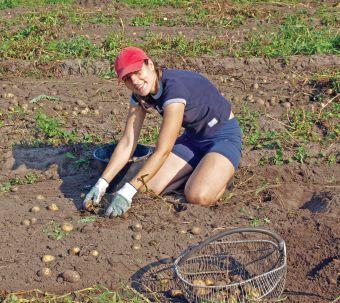
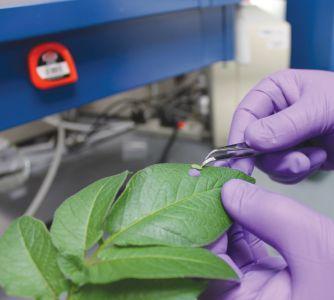
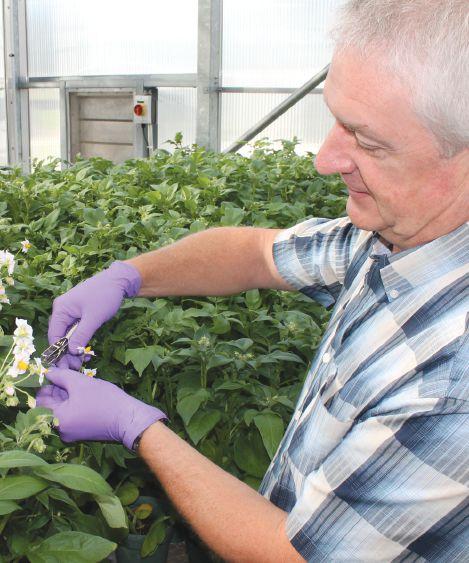
Identifying nitrogen level in a potato plant PG. 12 A COMPLEX CHALLENGE
Managing potato virus Y PG. 6 LABOUR CONCERNS IN CANADA
Examining the impacts of migrant farm workers PG. 10
Protect your potatoes and your wallet with the same active ingredients you’ve come to rely on.
MANA Canada offers four products to protect your potato crop and maximize your production. With MANA Canada, you receive fair pricing and optimum control for grassy weeds and pests like Colorado potato beetles, leafhoppers and aphids.
MANA Canada insecticides, herbicides and fungicides are available from leading retailers. Support choice and fair pricing. Ask for your MANA Canada product by name.
TOP CROP
MANAGER
Rosalie Tennison
Photo
MARGARET LAND | GUEST EDITORIAL
The fuTure of neOniCOtinOiDS
For the past year or so, the pollinator community, chemical companies, special interest groups and researchers have been positively abuzz around the debate of whether neonicotinoid pesticides are playing a role in colony collapse disorder (CCD) in honeybees.
That buzz has hit room-shaking frequency with the recent announcement that the european Union may ban the use of three neonicotinoids – thiamethoxam, clothianidin and imidacloprid – for two years on crops that are attractive to bees, mainly sunflowers, rapeseed, corn and cotton. The move comes after several studies were released, including one from the european Food Safety authority (eFSa) that states “a number of risks [were] posed to bees” by the products.
Bayer CropScience “strongly disagrees” with the eU position, calling it “draconian” and a threat to the future competitiveness of european agriculture.
The eU is not alone in its actions. regulatory agencies in Canada and the U.S. are currently in the midst of “re-evaluations” of the three neonicotinoid products, including uses in soil applications, seed treatments, foliar applications and greenhouses.
“There continues to be emerging science on neonicotinoids and their potential effects on pollinators,” a report from the pest Management regulatory agency (pMra) states. “The pMra is collaborating with international regulatory partners to discuss further data requirements and in the development of enhanced risk assessment methodologies and risk mitigation measures for pollinators.”
What does this mean for potato producers?
For now, it’s business as usual. neonicotinoid products continue to be available for Canadian growers to use – according to the registered label – during the review process. and, based on past research published in the american potato Journal (September 1981), potato flowers don’t appear to be overly popular with honeybees and some bumblebee species. even when baited with honey, neither pollinator was too interested in visiting the flowers.
another study conducted by richard rogers, with Wildwood Labs in Kentville, n.S., and James Kemp, with the University of p e.I., published in the Bulletin of Insectology examined what role imidacloprid use on potatoes might be having on honeybees feeding on rotational crops in. according to the preliminary data of 18 potato rotational fields (planted to clover) monitored, no residue was detectable in the clover flowers, nearby wildflowers, pollen, nectar or the unripe honey the bees had produced.
This doesn’t mean potato growers should be complacent regarding the pMra’s review or even the proposed eU ban. Studies have been conducted what effect neonicotinoids have on wild pollinators, such as flies, butterflies, bumblebees, and the thousands of wild bee species found around the world.
“Limited information [is] available for pollinators other than honeybees,” states the eFSa report. “Therefore the risk to these other pollinators should be further considered.”
What these studies may find remains to be seen. The pMra has stated that if evidence is found “demonstrating reasonable grounds to believe that health or environmental risk of a pesticide are unacceptable, the pMra will take appropriate regulatory action.”
What “reasonable grounds” or “appropriate regulatory action” actually mean isn’t exactly clear but complete de-registration of neonicotinoid pesticides is a possibility.
It’s something currently being promoted in european parliament.
“Banning the use of neonicotinoid pesticides on only honeybee-attractive crops would be a good step forward but would certainly not solve the problem of the loss of pollinators,” says Bart Staes, a member of the european parliament for the greens. “We thus insist that you … totally ban the use of neonicotinoid insecticides.”
It’s uncertain how long the pMra’s review of neonicotinoid insecticides will take. only time will tell if the product will be available to potato producers in the future.
Fredericks mfredericks@annexweb.com
MAIL AGREEMENT #40065710 retUrn UndeliveraBle canadian addresses to circUlation dePt P.O. Box 530, Simcoe, ON N3Y 4N5 e-mail: subscribe@topcropmanager.com Printed in canada ISSN 1717-452X circUlation e-mail:subscribe@topcropmanager.com Tel.: 866.790.6070 ext. 202 Fax: 877.624.1940 Mail: P.O. Box 530, Simcoe, ON N3Y 4N5 sUBscriPtion rates Top Crop Manager West - 8 issuesFebruary, March, Mid-March, April, June, October, November and December - 1 Year - $45.00 cdn plus tax
Top Crop Manager East - 7 issuesFebruary, March, April, August, October, November and December - 1 Year - $45.00 CDN plus tax Specialty
Pests and diseases
M A nAging POtAtO viru S Y
A
complex challenge.
by Carolyn King
Potato virus Y, which used to be called common mosaic virus, has plagued potato growers for many years with its potential to cause severe yield reductions. But in the last two decades the problems caused by pVY have grown due to a combination of factors – including emerging strains that damage tuber quality and make the potatoes unmarketable. These days, managing pVY is more important than ever.
higher virus levels
“recently most of the potato-producing areas in north america have been experiencing high pVY levels for several reasons. one of the most important factors is the emergence of new strains of pVY, which are necrotic strains,” explains Dr. Mathuresh Singh, a potato virologist with the agricultural Certification Services (aCS) in Fredericton, new Brunswick. (aCS is a diagnostic laboratory owned and operated by new Brunswick potato growers; it tests potatoes for various pathogens, including pVY.)
“it
takes about two to three weeks or longer after infection
for the disease to cause foliar symptoms.”
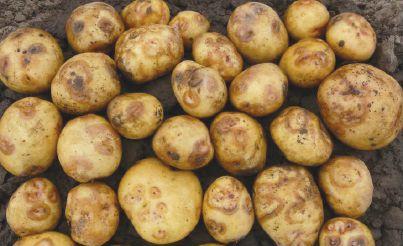
“necrotic” strains are strains that cause dead spots somewhere in the plant. For example, p VYntn causes potato tuber necrotic ringspot disease in susceptible cultivars – the tubers get brownish necrotic rings. This serious problem is compounded by the fact that pVYntn causes only very mild symptoms in the plant’s foliage so that infected plants may go undetected. In contrast, pVYo, which is the “ordinary” strain of pVY, can cause very obvious foliar symptoms in many cultivars, such as mottling, crinkling and dropping of leaves, and stunted plants. This foliar damage can reduce yields, but the obvious symptoms also make it easy for growers to “rogue” (identify and dispose of) infected plants and for seed potato inspectors to visually identify infected plants. a second factor is the introduction and widespread use of several potato
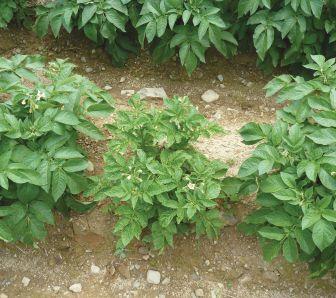
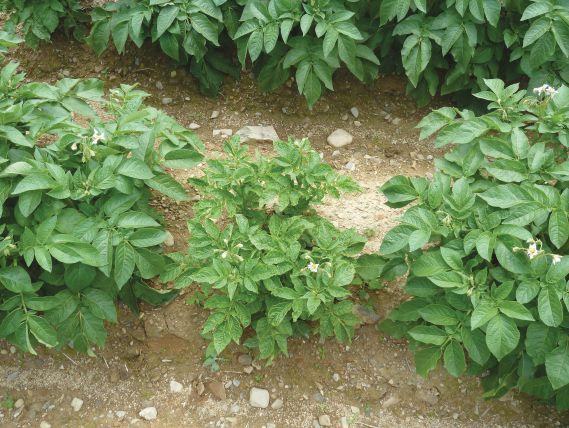
<leFT: a PVy-infected potato plant (centre) with crinkled leaves and stunted growth.
BoTToM: yukon gold is very susceptible to the tuber symptoms caused by PVyntn
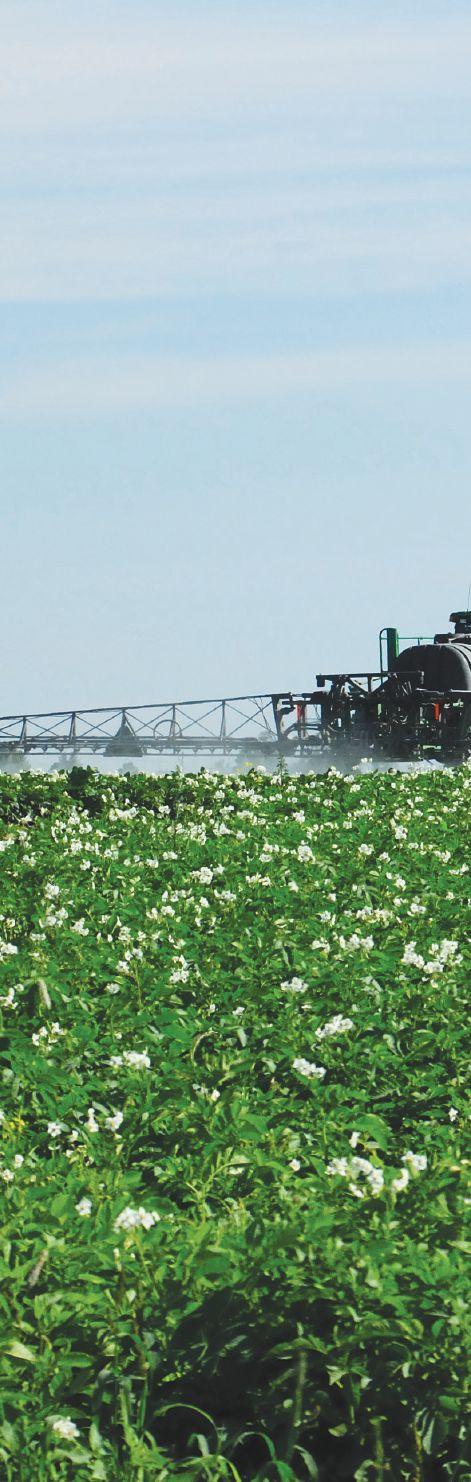
<leFT: spraying a mineral oil (tank mixed with an insecticide and/or a fungicide) to reduce transmission of PVy by aphids.
varieties that exhibit mild or no foliar symptoms when they carry pVYo. Singh explains, “You could call them ‘latent varieties.’ Without clear symptoms, it’s very hard to identify infected plants and take them out of the system.”
another issue that can make it difficult to identify infected plants is if the infection occurs late in the season. “It takes about two to three weeks or longer after infection for the disease to cause foliar symptoms. If the virus is transmitted at about the end of July to the middle of august, then by the time the symptoms would be appearing, the plants are old or the foliage has been top-killed. So you can’t see the foliar symptoms, even though the tubers may be infected,” says Singh.
a fourth factor is an increasing problem with aphids, which are an important vector for pVY – they acquire the virus from infected plants and spread it to other plants. “There’s been more aphid activity in recent years, possibly because of climate change, or new aphid species are coming into the system, or some different aphid species are transmitting the virus,” says Singh.
He adds, “We’re finding that it’s not just potato-colonizing aphids that can carry pVY; most aphid species, whether they are coming from trees or strawberries or other plants, are able to transmit pVY.”
So it has become easier for pVY-infected plants to remain as undetected sources of the virus and easier for the virus to spread. and the potential impacts on potato production have become even more serious.
PVy strains in Canada
“The most recent national survey of pVY in Canada was conducted from 2004 to 2006 in collaboration with the US. It showed that Canada had all the north american pVY strains known at that time. pVYo was still the most predominant strain, comprising about 60 to 80 percent of the population, followed by pVYn:o and pVYntn,” says Singh. pVYn:o is another necrotic strain capable of causing tuber symptoms in susceptible potato varieties.
More recent studies are indicating further changes in pVY, including changes to the proportions of the different strains. Singh notes, “In recent years in the US, they have been finding in some states that most of the pVYo population has been replaced with either pVYn:o or pVYntn. In new Brunswick, in most cases the population is still about 70 or 80 percent pVYo, but the proportion of the other strains is increasing. The trend in north america is similar to what they found in europe, where pVYntn displaced pVYo as the predominant strain during the last two decades.”
Photos by Mathuresh s ingh, acs
In a very recently completed study of p VY strains detected between 2010 and 2012 on prince e dward Island, Canadian researchers found pVYo accounted for only 30 to 40 percent of the total pVY samples, while pVYntn accounted for 30 percent and pVYn:o accounted for about 20 percent. Singh says, “This is what is going to happen in most of the potato-growing areas where pVY is a problem and if not managed properly.”
Post-harvest testing for PVy
a key step in controlling pVY is to accurately detect infected seed potatoes because they can be an important source of the virus in potato fields. “In Canada, our national seed potato certification system is conducted by the Canadian Food Inspection a gency (CFI a ). a ll seed potatoes planted across Canada are visually inspected twice during the growing season for visual symptoms of p VY in the foliage. This system used to work, but it’s not very effective at detecting late infections or infections in latent varieties. To do that, you have to do post-harvest testing of the tubers. at present two provinces – new Brunswick and p e.I. –are doing mandatory post-harvest testing,” explains Singh. (other provinces such as Quebec, alberta, Manitoba and Saskatchewan conduct post-harvest testing but it’s not mandatory.)
In spring 2011, new Brunswick initiated mandatory post-harvest testing of seed potatoes to be planted in the province. “growers have to test their seed for pVY, and the virus level must not exceed a certain number. That number varies from year to year because we look at all the test results for the year to decide what percent of infected seed is appropriate, for example, three percent, five percent, six percent. any seed with a virus level higher than that can’t be planted in new Brunswick, even if it has passed the CFIa’s visual certification system,” says Dr. Khalil al-Mughrabi, potato pathologist with the new Brunswick Department of agriculture, aquaculture and Fisheries.
He adds, “In the beginning, the growers weren’t sure if they wanted mandatory post-harvest testing because it costs money to test and it will cost money if the virus level is high in their seed because they can’t plant it in new Brunswick.
“But the growers concluded that this requirement is to their benefit. It might be hard in the beginning, but at the end of the day, the quality of their seed would be higher and they would be able to compete in the marketplace.”
advice for growers
“potato virus Y is not forgiving. It can reduce yield between 10 and 80 percent, so if the virus level is high the grower loses big time. It’s really important to take steps to manage the virus,” emphasizes al-Mughrabi.
He groups p VY management guidelines into three broad principles: eliminate sources of the virus; prevent aphids from spreading the virus; and use resistant potato varieties. eliminate sources of pVY: “The easiest way to spread pVY is with infected seed, so growers should use certified, disease-free seed. always make sure the seed has been tested for pVY and get the levels of the virus when you get the lab test results,” says al-Mughrabi.
other important practices to eliminate pVY sources include: disinfecting cutting and planting equipment before coming in contact with seed and before going from seedlot to seedlot; controlling volunteer potato plants; eliminating potato cull piles; roguing infected potato plants; and controlling weeds that could host the disease (such as hairy nightshade) and weeds that are aphid hosts (such as wild mustard, wild rose and wild radish).
prevent aphids from spreading pVY: When an aphid probes an infected leaf with its piercing mouthpart, called a stylet, the stylet picks up the virus. Then the aphid transfers the virus to other plants as it probes their foliage with its infected stylet. The aphid can acquire and transmit pVY within seconds.
“The best option is to spray oils registered for this use on potato foliage,” says al-Mughrabi. “When an aphid probes through that film of oil into a leaf, the oil cleans the stylet, and the virus dies on the film of oil.” He advises growers to follow the oil’s label recommendations to ensure effective applications.
Singh has been visiting new Brunswick potato growers to look at what they are doing to control pVY and find out how well it’s working for them. “We recommend to our growers here to apply mineral oil as soon as the potato plants start coming up,” he notes. “We are finding that one of the most effective methods of managing this virus is to apply about 2 to 2.5 litres of mineral oil per acre about every five to six days [until vine-kill] and also add a dose of insecticide to the oil spray about every two to three weeks to keep the aphid population down.”
al-Mughrabi explains that it’s better to use an insecticide in combination with the oil because insecticides alone aren’t very effective at controlling pVY. “an insecticide doesn’t kill instantly, so the aphid will stay alive for a while and probably try to feed until it dies, [and when it feeds, it transmits the virus].”
He also recommends that growers make use of their local aphid alert program, if one is available in their area. ”In new Brunswick, we put aphid traps in the fields of participating growers, and every few days scouts collect the aphids from the traps. We identify the species and their numbers in the various parts of the province. The information goes on our website and our hotline, so growers can find out what’s in their area and whether the threshold for aphid control has been reached.”
That information helps growers make decisions regarding aphid control, for example whether early vine-kill would be a good aphid control option for their situation.
Crop borders are another practice used by some growers. al-Mughrabi says, “a crop border consists of a non-pVY host crop, typically a cereal crop, planted around a small, early-generation seedlot to provide a buffer against aphids flying into the field. aphids usually land on the interface between fallow ground and a
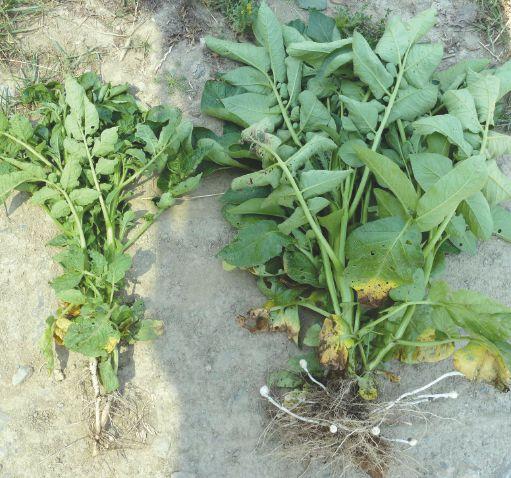
The PVy-infected potato plant on the left has only a few tubers developing, while the healthy plant on the right has lots of developing tubers.
green crop, so in this case they would land on the cereal crop. They probe the cereal plants – pVY doesn’t harm the cereals in any way – and that probing helps clean off their stylets before they enter the potato crop.”
Use pVY-resistant varieties: This sounds simple, but choosing resistant strains has become more complicated with the evolution of pVY. recent research by Singh and his colleagues at agriculture and agri-Food Canada’s potato research Centre in Fredericton showed the impact of pVY varies significantly depending on both the potato cultivar and the virus strain and even the variants within strains.
a p VY website (www.potatovirus.com) sponsored by the United States Department of a griculture lists various potato varieties with their susceptibility to foliar symptoms and to tuber symptoms. For example, Yukon g em shows little or no foliar symptoms of pVY infection, but it is very susceptible to potato tuber necrotic ringspot disease. Yukon gold and Highland russet are also considered very susceptible to tuber necrosis. In contrast russet norkotah, Classic russet and premier russet are considered very resistant to tuber necrosis.
“a lot more research still has to be done because of the new pVY strains. These strains could potentially drive some varieties off the market, like Yukon gold, a very common variety which is very sensitive to tuber damage by pVYntn,” says Singh. In that 2010-12 peI study, over 50% of the tubers from pVYntninfected Yukon gold plants showed symptoms of potato tuber necrotic ringspot disease, with many of them having severe symptoms.
although Canadian researchers have made significant progress in investigating pVY, Singh says more work is needed to improve methods to manage pVY. He cites examples like the need for more information about the symptomology of the various pVY strains in different potato varieties, and about mineral oil applications, including the effects of these oils on potato yields and the most effective application rates and timing.
Singh and his colleagues are hoping to obtain funding for a national study to enable a coordinated effort to learn more about key pVY issues. He emphasizes, “Certainly problems with pVY and its emerging strains will increase if the virus not managed properly.”
L A b Our COnC ern S in C A nADA’ S POtAtO fie LDS – PA rt 1
Examining the impacts of being able to draw workers from dozens of countries, work permit conditions and more.
by Treena Hein
The landscape of the agricultural workforce is changing in Canada, affecting Canadian workers, workers from other countries and employers as well. over 190,000 temporary foreign workers come into Canada each year and about 40,000 of those are employed in the agricultural sector, says Dr. Kerry preibisch, a sociologist in the Department of Sociology and anthropology at the University of guelph.
preibisch’s look at changes in the Canadian farm labour market over the past decade was recently published in the International Journal of Sociology of agriculture and Food – and one major change she has noticed relates to how many countries migrant farm workers now hail from.
“people from an increasingly wide range of countries are finding jobs on temporary visas in Canada’s food system due to government policy changes in 2002,” notes preibisch. Back in 1966, Canada instituted the Seasonal agricultural Workers program (SaWp), a program based on bilateral agreements with 13 different countries, with most from Mexico and Jamaica. Current annual SaWp participation is 27,000.
Since 2002, however, the government has allowed employers who could demonstrate they are facing a labour shortage for any low-skilled occupation – including agriculture – to hire migrants on temporary visas from anywhere in the world. (This 2002 program is now called the “Stream for Low Skilled occupations.”) preibisch notes that by 2008, the Canadian agricultural sector employed foreign workers from almost 80 countries. and the types of work they are hired for, she observes, has also broadened.
However, as unemployment stays high or worsens in some areas of Canada, the question arises as to whether as many migrant workers will be needed in the country’s fields and processing plants. preibisch notes that Canadians avoid many agricultural labour jobs as they are difficult and seasonal. “Many employers do want to hire Canadians, but migrants can become a preferred source of labour,” she notes. “They also find it hard to retain Canadians in some cases.” To be able to hire migrant workers, employers currently have to advertise and show they can’t fill the positions with Canadians (submit an application for a labour market opinion), but preibisch notes that there are ways around this requirement. “The employer might do limited advertising, and it’s also plausible that some Canadians are hired,” she explains, “but the first day of work
is made so hard and unpleasant that they quit, and word spreads.” Kevin MacIsaac, general manager of the United potato growers of Canada (UpgC), says that migrant worker issues are not something that his organization has anything to do with, but offers some personal observations. “Most farms can no longer find Canadians to do menial labour and physical work,” he says. “I have visited farms on p.e.I., in Quebec, in ontario, and in B.C. that were using migrant workers. [The workers] are happy to have a job and don’t
Migrant workers hired on temporary visas to assist with labour shortage for low-skilled occupation in agriculture.
mind doing some of the tasks local residents would hesitate doing.” However, MacIsaac also notes that “these workers are sometimes limited in the level of work they can perform – not much equipment operation or management skills. Translation of operation manuals and tech manuals into their language is still cumbersome. Driver’s licence is oK but things like pesticide applicator’s licences are difficult [for them to obtain].”
Permits and working conditions
as dictated by Human resources and Skills Development Canada (HrSDC), all foreign workers and their employers must sign a contract that (as stated on the HrSDC website) “provides details about the worker’s job and conditions of employment, including the maximum number of hours of work per week, the wage rate for those hours, and the amount of money that will be deducted from the worker’s pay.” The HrSDC website also describes “government liaison officers of source countries,” who are available here to intervene on a foreign worker’s behalf, and “confirm that workers have acceptable housing, ensure [they] have health insurance and Workers’ Compensation coverage, gather details of worker injuries, collect pay records from employers, approve worker transfers, and consult with employers who wish to terminate a worker’s contract.” preibisch notes, however, that while this formal role for representatives of source countries exists under SaWp, that is not the case under the 2002 program.
In addition, work permits given to migrant workers are employer-specific (which means a person coming to Canada is only permitted to work for one employer during that year). preibisch notes that in the eyes of many, this is an urgent issue as this arrangement accords employers disproportionate power. These concerns are echoed by many other academics in a new 2012 book of essays called Legislated Inequality: Temporary Labour Migration in Canada, co-edited by University of ottawa professors patti T. Lenard and Christine Straehle. In an october article on the CBC news website, Lenard said that “the book clearly documents what has long been suspected: temporary workers in Canada are vulnerable to abuse.” This vulnerability is due in part, she says, to sector-specific permits. When workers “are not permitted to change employers, [it] means they are denied one of the main ways in which [they] can protect their rights.”
With the current arrangement, if migrants want to leave their employer for any reason, preibisch says a process does exist whereby they can find a new employer and that person can apply for a labour market opinion, but this may be too time-consuming for most migrant workers, especially if the situation is difficult and the migrant is residing in employer-owned or rented accommodations. “Therefore, some are calling for sector-specific permits,” she notes, “so workers are able to work at any employer in the sector within the time frame of the work permit.”
However, there is also the perspective among Canadian employers in the ag industry and other industries that if employers live up to their commitments to their employees, they do not want them leaving for another employer after they have put in the time and effort to bring them here and train them. Speaking with regard to SaWp, Ken Forth does not support the idea of sector-specific permits. Forth is the president of Foreign agricultural resource Management Services, the non-profit organization that administers some of the SaWp. “The worker has responsibilities and so do the employers,” he says. “The employers have the legal responsibility to provide proper housing, a minimum number of hours of work and so on. The housing is government-inspected and if it fails to meet the standard, the SaWp employer can be kicked out of the program for two years. I have never heard a call for sectorspecific workers from my members, from our government, from the workers or from representatives of foreign governments, and I meet with them all the time. It’s not on the table.” neither the potato growers of alberta (pga) nor the ontario potato Board (opB) would comment on sector-specific permits.
other concerns
preibisch notes that the ability of Canadian employers to pull from a ballooning number of countries hasn’t had a positive impact on temporary workers in many cases. “While workers in some processing plants are in unionized environments with standardized working conditions, overtime pay and so on,” she says, “those on farms are more vulnerable.”
“Simply put, the increased competition from workers from many other countries puts pressure on people to accept unreasonable working conditions,” preibisch says. “If they don’t agree to working longer hours, for example, workers can be threatened with being replaced with those from other places. Many Mexicans are now being replaced with guatemalan people, not so much because they’ll take less pay, but because guatemalans are perceived as willing to work longer hours and work harder in comparison.” although most of Canada’s temporary foreign agricultural workers still come from Mexico followed by Jamaica, guatemala is now in third place, preibisch notes. Migrants from many areas of the globe are more desperate than previous groups of workers, she asserts: “They face less political freedom and more marginalization, and are willing to work very hard here.”
In her study, preibisch also observes a significant lack of regulation and monitoring of migrant recruitment and employment in Canada. “This can and does result in abusive practices by employers, and some conditions which could be considered close to slavery,” she states. although employment standards are provincial, preibisch says, there needs to be more co-operation between federal and provincial labour agencies to ensure all workers are treated according to legal requirements.
See the second part of this article in the next issue.
about 40,000 foreign workers who come to Canada each year are employed in agriculture.
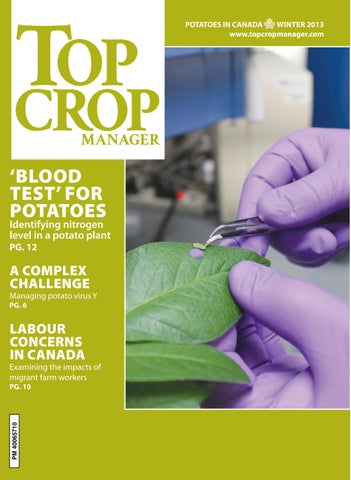
A ‘b LOOD te St’ f Or POtAtOe S
Identifying how much nitrogen is in a plant could answer the “How much do I need?” question.
by rosalie Tennison
Asimple blood test at a medical laboratory can tell your doctor a lot about your health. From the test results, a doctor can suggest ways to improve your overall wellbeing. Human blood tests were the inspiration for agriculture and agri-Food Canada (aaFC) researcher Dr. Helen Tai to consider a test for nitrogen levels in potatoes. She wondered if a test could be developed that would tell potato growers if the amount of nitrogen in their plants is in the right range for a “healthy” plant. She took the idea to Dr. Bernie Zebarth, a soil scientist at aaFC, and the two Fredericton researchers began a collaboration that has resulted in a test. now, they just have to make it accessible for plant “doctors.”
“nitrogen is the most important nutrient for potato production from an economic point of view because an adequate nitrogen supply is needed to achieve high tuber yield,” Zebarth explains. “But, with rising fertilizer costs and possible environmental impacts as well, growers want to be smart about their nitrogen management.” With that in mind, the researchers developed what may turn out to be a smarter way of determining nitrogen levels in a plant that improves upon petiole analysis.
“growers want to provide just as much nitrogen as the plant needs – no more, no less,” he continues. “now, nitrogen is put on early and then a petiole analysis is taken and more nitrogen is added, if needed. But, ours is a new approach. We are looking at gene expression, which is more like going to the source. We are asking the plant if it is short of nitrogen.”
The researchers were fortunate to identify an ammonium transport gene and they are now perfecting a test that will, like a human blood test, identify if the plant is low in nutrition. The fact that Tai and Zebarth have found a gene that expresses nitrogen status in potatoes is more astounding when it is understood they have identified something that is unique in the world, as no other test based on gene expression has been developed for nutrient management of any crop.
“although other researchers have been working on screening genes, which may be used to test for nitrogen in rice and corn, we are the first to have a field-validated gene expression indicator,” comments Tai.
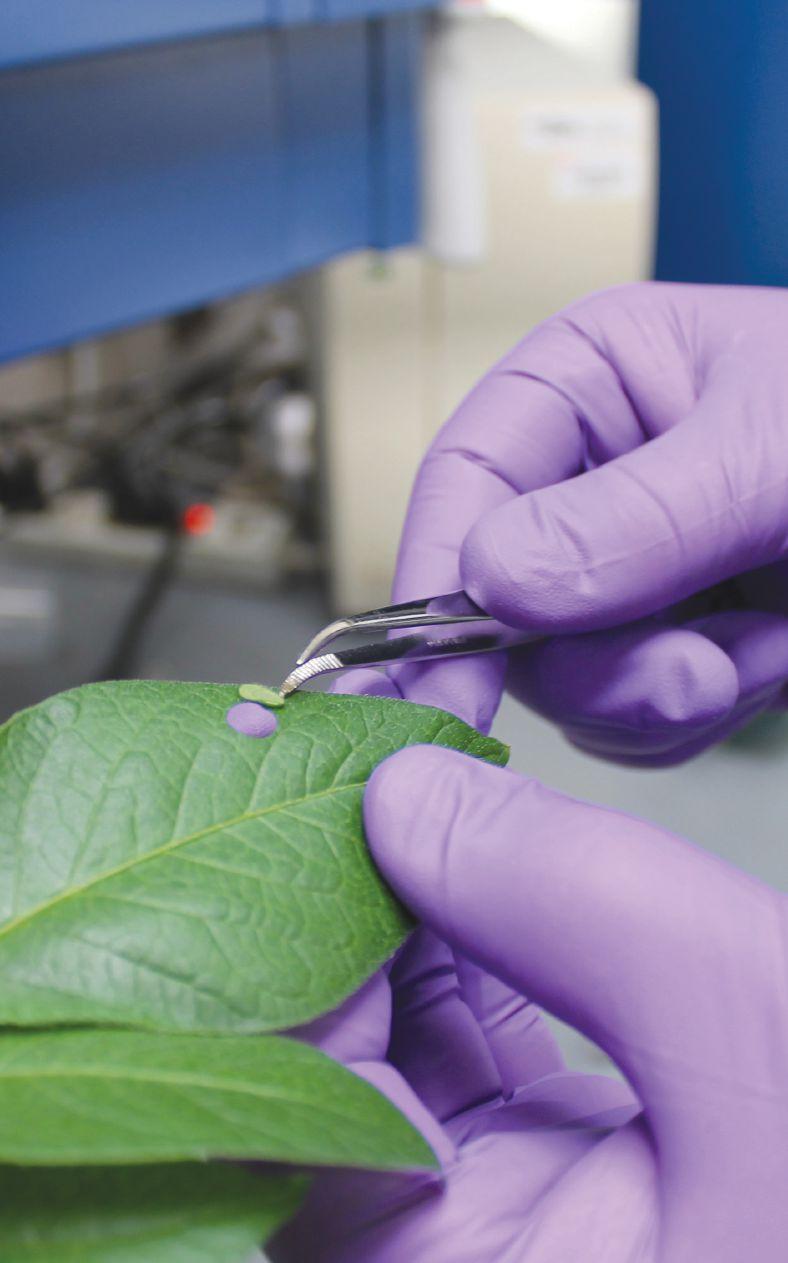
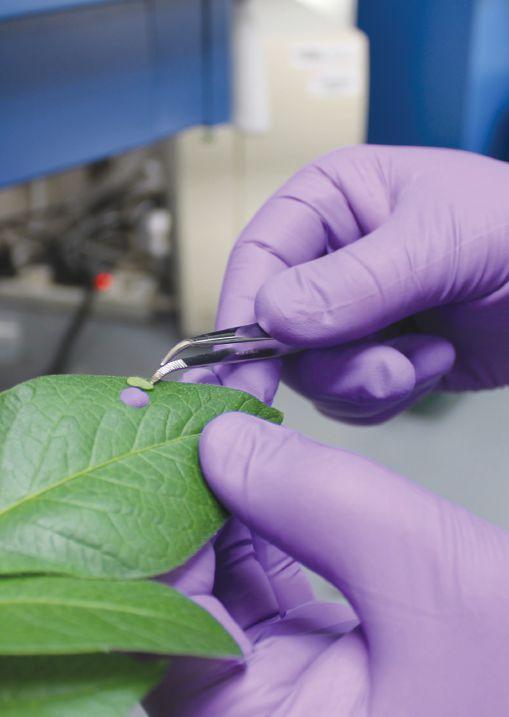
The process is simple – a standard one-hole punch is used to extract a number of small discs of plant tissue from a leaf and then it is
Punching a sample for testing.
frozen to preserve the rna. once at the laboratory, the sample is reduced to its genetic components and analyzed. If the plant is low in nitrogen, the gene shows greater activity to get the plant to produce the proteins needed to get more nitrogen. If the plant has the nitrogen it needs, the gene is less active. The researchers are now perfecting the test to see if it is valid across potato varieties, fertilizer nitrogen sources and different timing of spring fertilizer applications.
ConTinued on Page 15
Photo by b ernie Zebarth.
Canadian potato growers want more. at dupont, we’re doing more.
DuPont is taking potato crop protection far beyond our traditional strengths, with innovative chemistries found in new products like DuPontTM VertisanTM fungicide: the new and highly potent fungicide that provides excellent protection against early blight, grey mould and rhizoctonia. VertisanTM is a new Group 7 fungicide, making it a valuable resistance management tool. Still, this is just one of the high-performing potato product solutions coming your way from DuPont.
Here are our other trusted potato solutions designed for today’s potato farming needs:
DuPontTM Assail® insecticide: This trusted product’s systemic, translaminar and residual action gives you up to three solid weeks of control on Colorado potato beetle.
DuPontTM Coragen® insecticide: This innovative insecticide delivers extended residual control of European corn borer.
DuPontTM Curzate® fungicide: The preventative, post-infection and antisporulant activity of Curzate® make it the heart of an effective late blight management program.
DuPontTM Tanos® fungicide: Delivers superior protection against early blight and late blight, rain or shine.
DuPontTM Prism® SG herbicide: For excellent post-emergent control of quackgrass, redroot pigweed, triazine-resistant hairy nightshade, lamb’s-quarters and annual grasses, Prism® SG has you covered. For more information on DuPont potato solutions, please visit cropprotection.dupont.ca or call 1-800-667-3925.
C Onne C ting W ith grOW er S A n D
ex Pert S – On L ine
Taking a close look at Internet use and social media tools being used by growers now, and in the potato fields of the future.
by Treena Hein
The Internet is an incredibly powerful tool for accomplishing all kinds of tasks, not least among them connecting with colleagues and experts in your field. Tools such as Twitter, Facebook and blogs are being used by farmers to find and share answers, but also to do things like alert other growers in the area about a pest outbreak, or even notify neighbours about spraying.
one avenue for connection is an Internet forum, like the one the oregon-based potato Variety Management Institute (pVMI) launched in February 2011. “It’s a place to post questions and respond to the queries and comments of others,” says pVMI web manager John guerin. “The initial launch looked promising and the community is slowly growing.” Between Jan. 1 and Sept. 10, 2012, there were 1500 visits to the forum from about 750 different visitors, and 27,202 page total hits (an average of about 18 individual page hits per visit).
The forum was promoted through the pVMI website, in newsletters, at trade shows and during presentations at events. “The topics were very numerous at the start, but we pared down the list to what was most industry-specific and what people needed information about,” says guerin. The eight topics right now are Business, Marketing (two conversation “threads”), Crop Talk, Seed Talk (eight conversation “threads,” most with over 300 hits each), Variety Talk (two threads), Storage Talk, Computers & More, and Machinery & equipment. pVMI also offers the chance to “blog” (writing posts on a particular topic in a “weblog”), but no one has responded to the offer so far. guerin says, “We have also secured pVMI accounts on Twitter and Facebook, but we haven’t put them to use yet.”
Dr. ataharul Chowdhury has found that Twitter and Facebook are the most used social media tools/platforms in Canada’s agriculture industry, with YouTube and blogs the next most-used tools; he has catalogued about 300 in total. Chowdhury is a postdoctoral research fellow in the University of guelph’s School of environmental Design & rural Development studying agricultural social media use in Canada and beyond. “The use of tools has increased dramatically, perhaps, in the last year or two,” he says. He has found that the use of these tools is mostly used for farmers to receive disseminated information, but he’s also studying platforms and tools (such as forums) where dialogue and interaction is the focus.
growers now have smart phones and are beginning to use some of the apps to access weather and commodity price updates.
What’s available to potato growers?
The agriculture and agri-Food Canada (aaFC) “potato research Centre” in Fredericton, new Brunswick has offered up-to-date online information on the aaFC potato selections release process, as well as the descriptions of advanced selections available to growers for commercial evaluation at the website www.agr.gc.ca/potato-cultivars. aaFC potato breeder Dr. Benoit Bizimungu says, “We are also looking into using other web-based tools and social media – for example, to cover our annual ‘potato Selection release open House’ event.”
prince edward Island’s potato industry co-ordinator, Brian Beaton, says, “We e-mail out our IpM updates and use the web for lots of meeting and other updates. I also ‘text’ a number of growers, which is a fast way to get information out. So far we don’t use Twitter a lot, but I know there are some farm sectors that do. I think that things like Twitter will get more popular.” Beaton notes that the growth of social media use will be driven more and more by younger farmers. In addition to planting and harvest reports, a seed directory and an industry calendar, the potato growers of alberta (pga) website features a newsletter (written by an american consultant) that is only available online. However, pga executive director Helmut Leili notes that all of this information is already known by growers, and that the website only receives about 200 hits per month. “person-toperson communication is still very important in potato farming,” he notes. “The average age of a Canadian potato grower is about 55, and when they can pick up the phone and talk to each other, agronomists, suppliers and so on, they don’t see the need for much Internet-based communication. They already have their ways of getting and sharing information, and it works well for them.” pga has no plans to add more features to its site or to use social media tools at this point.
ontario potato Board (opB) manager Don Brubacher and ontario agriculture, Food and rural affairs (oMaFra) potato specialist eugenia Banks say that ontario potato growers do use the Internet like everyone else to access information about farming, and that seems to suffice. “There are excellent websites with good up-to-date information on most potato topics,” says Banks. “ontario potato growers usually do not use forums or Twitter. They get the latest potato information by using the avenues the potato Board and oMaFra offer.”
These include the ontario potato Field Day every august, the ontario potato Conference held in March (speakers from Canada, the United States and europe provide info on the latest research and new technologies), the annual opB meeting and the oMaFra potato Update, which is faxed to readers every week during the growing season.
Charlottetown, p e.I.-based United potato growers of Canada updated their website in august 2012, and are just beginning to track hits. The site features a blog covering topics such as the drought of 2012, potato planting acreage, and potato storage holdings. UpgC general manager Kevin MacIsaac says he’s not sure where Canadian potato growers are with wanting or needing more Internet-based communication. “There’s always the possibility of adding a Twitter feed, Youtube video links or other web-based tools to help growers get answers and/or connect with each other, but it takes time to get things like that going,” he says.
“one possibility that stands out is smartphone apps. The US potato Board has one so that growers can easily access market prices. The potato industry is a little behind in doing things like using apps, but we’ll catch up. other sectors such as grains and oilseeds are quite savvy with that.”
In Kenya, several apps are used by many of the 790,000 potato farmers. To avoid middlemen who offer them poor prices, about 2000 farmers in the nairobi area are using an app to directly contact hotel and restaurant owners, access daily commodity prices and more. US development agency USaID is providing funding. other ag-related apps being used in Kenya include M-Farm (information about retail food prices), iCow (cattle information), M-Shamba (best cropping practices), and Farmpal (farming trends and methods).
Beaton notes that many p.e.I. growers now have smartphones and are beginning to use some of the apps to access weather and commodity price updates. “In the near future, social media may become more popular among provincial growers,” says Banks. “Time will tell.”
A ‘bLOOD teSt’ fOr
POtAtOeS
ConTinued FRoM Page 12
“We did a greenhouse test comparing nitrogen sources and the gene was not affected, so the test only indicates the plant is lacking nitrogen and not what the source of the nutrient is,” Zebarth explains. at this point, the test cannot indicate how much nitrogen would need to be added to ensure the health of the plant, but it is still “early days” for this research.
The researchers are not limiting their research to nitrogen because the economic feasibility is not there, so they are working on a combination approach. “If we were just interested in nitrogen, it wouldn’t make sense,” Zebarth admits. But, the team believes the test could be used to measure a number of plant stresses, from nitrogen deficiency to drought stress to potassium and phosphate shortages. They have been focusing on nitrogen because there is no definitive test for nitrogen in eastern Canada and the soil tests used in Western Canada are not always accurate.
Zebarth believes they might have an on-farm test perfected in about five years, so growers could work with a crop consultant to take samples and deliver them to a laboratory for analysis. Before that can happen, the method needs to be honed from determining when to take a sample to understanding how the results are interpreted. The researchers’ understanding of how gene expression can be used to assist potato growers produce their crops more efficiently and economically is only the first step. The fact that they have already identified the gene is making Tai’s idea of creating a blood test for plants closer to a reality.
Bernie Zebarth using the leaf punch testing method.
Photo by b ernie Zebarth.
SeriOu S Di Se ASe On T he horizon?
Canada is free of zebra chip, but potato growers need to be watchful.
by Carolyn King
Zebra chip is an emerging disease that kills potato plants, severely reduces yields and makes the tubers unsellable.
This devastating disease hasn’t reached Canadian potato fields, but growers here need to keep an eye out for zebra chip and for the tiny insect that transmits it, the potato psyllid.
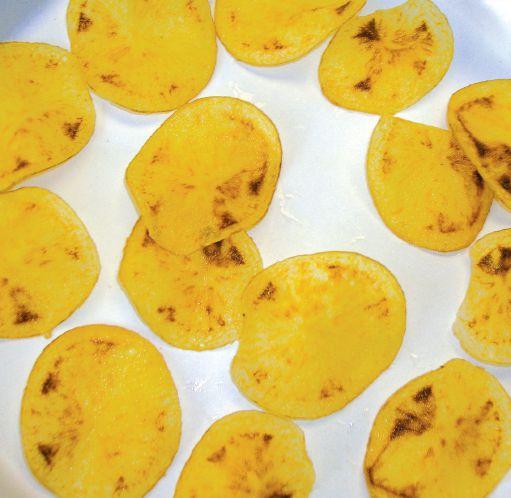
The name of the disease comes from the distinctive discoloration of the tubers. “The disease causes a higher than normal sugar concentration in the tubers. When fried, the sugar caramelizes, resulting in off flavours and dark brown ‘zebra’ stripes. This defect is harmless to consumers, but it renders the tubers unmarketable, affecting both the processing and fresh market crops,” explains Dr. eugenia Banks, potato specialist with the ontario Ministry of agriculture, Food and rural affairs (oMaFra).
expanding disease range
The pathogen causing zebra chip is a bacterium called Candidatus Liberibacter solanacearum. It is causing millions of dollars of losses to the potato industry in affected areas.
“The disease was first found in grower fields near Saltillo, Mex-
ico, in 1994. potato growers there noticed unusual defects in the raw tubers. Five or six years later, the same defect started to show up in Texas,” says Dr. Don Henne, an entomologist at the Texas a&M agriLife research and extension Center in Welasco, Texas. He is the co-principal investigator of the Speciality Crops research Initiative Zebra Chip project and is involved in many aspects of zebra chip and potato psyllid research.
Starting in about 2004, the disease began to appear in other south-central and southwestern states; it has been reported in California, arizona, Colorado, nebraska, Kansas, new Mexico, nevada and Wyoming. Then in 2011, it occurred in the pacific northwest (Washington, oregon and Idaho), and caused significant losses in this major potato-growing region.
Henne notes, “The disease has also spread south into guatemala, Honduras, el Salvador and nicaragua. There is concern that it will soon be in Costa rica and panama, and possibly spread into South america.”
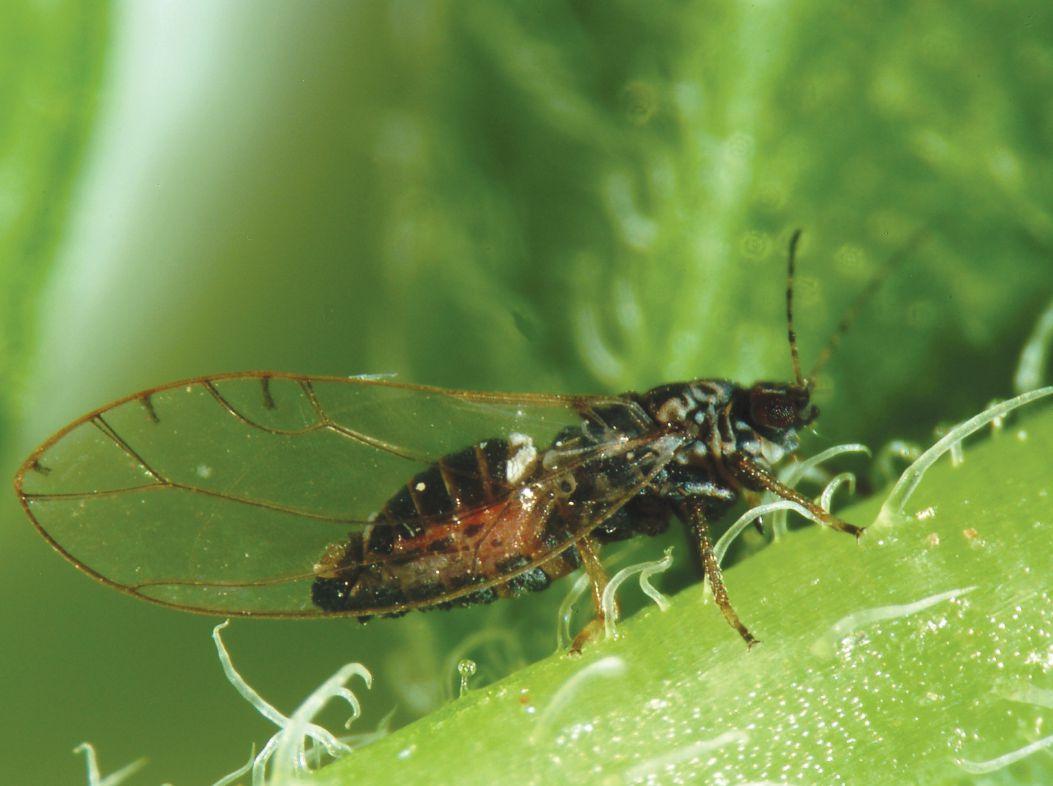
aBoVe: Potato psyllids are tiny insects; the adults are only about two millimetres long.
Photo
Zebra chip has spread to new Zealand as well. “It’s thought that the disease arrived there in about 2002 or 2003. It has now spread through the north and South Islands, and is causing very serious problems. potato psyllids with the disease were probably introduced to new Zealand on infested nursery stock, like an ornamental pepper plant,” says Henne.
The potato psyllid Bactericera cockerelli is key to the spread of zebra chip. also known as the tomato psyllid or potato-tomato psyllid, this small flying insect prefers to feed and lay its eggs on plants in the nightshade family, including potatoes, tomatoes, peppers, eggplants, and wild species such as hairy nightshade. When potato psyllids carrying the zebra chip bacterium feed on these plants, they infect the plants, impacting crop yield and quality in many of the crops in this family.
only a small percentage of the potato psyllids in the United States carries the bacterium, but that small percentage can cause a lot of zebra chip.
The disease is new, not the insect
In the United States, potato psyllids have been found for decades in many south-central and southwestern states. The insects prefer areas with less than about 22 inches (560 millimetres) of precipitation annually, so they aren’t typically found east of the Mississippi river. However, winds occasionally carry them farther east. The optimal temperature range for the psyllid is between 20 and 28 C; temperatures above 32 C harm the eggs.
Henne co-ordinates a multi-state program to track the potato psyllid population east of the rockies, monitoring their distribution and infection levels. His lab processes samples from growers in Texas, Colorado, nebraska, Kansas, north Dakota, Minnesota and Wisconsin. This psyllid population appears to migrate from Mexico into southern Texas in the fall. The insects stay in south Texas, building up their numbers, from about november to May, which is also the region’s potato-growing season. Then in april or May, when temperatures start to rise above about 32 C, the insects migrate to cooler areas, either higher up the mountains or farther north.
The potato psyllid’s overwintering range seems to be expanding. For instance, the insects used to occur only sporadically in California, but in recent years they appear to be remaining there all year, resulting in earlier infection of plants and greater crop impacts.
although potato psyllids are able to survive temperatures well below freezing, they don’t overwinter in Canada. However, they do occasionally come into Canada during their summer migration. For instance, in 2012, two were found near Carberry, Manitoba.
“as part of a north american survey in 2012, two potato psyllids were trapped from a commercial field in Manitoba. The potato psyllids were identified and tested at the Texas a&M lab and found to be free from zebra chip bacteria,” explains Dr. John gavloski, extension entomologist with Manitoba agriculture, Food and rural Initiatives (MaFrI).
“Identification of the species of psyllid is important, as over 100 species of psyllids are known from Canada. From the surveys in 2012 conducted by Dr. Vikram Bisht, MaFrI’s potato pest management specialist, other species of psyllids, which are not capable of spreading zebra chip, were found in other commercial potato fields in Manitoba. Similar surveys of potato fields will be organized by Bisht in 2013.”
gavloski adds, “potato psyllids are not an insect we would normally see in Manitoba, so it is somewhat unusual but, given the proper weather conditions, not impossible.” He reports that the entomology museum at the University of Manitoba has only one previous record of potato psyllids collected in Manitoba in its collection; that specimen was collected from potatoes at Brandon in august 1946.
There are also records of potato psyllids occasionally occurring in British Columbia, alberta, Saskatchewan and ontario, sometimes in greenhouses. “potato psyllids were detected in one ontario greenhouse in 2001. It is thought that they arrived on imported crates. effective sanitation eliminated the psyllids very quickly. Since then, there have been no further reports of psyllids in greenhouses in ontario,” says Banks. “There are also occasional reports of potato psyllids from B.C. greenhouses.”
The potato psyllid can damage potato plants even if the insect does not carry the zebra chip bacterium. Banks explains, “They inject toxins with their saliva that can cause leaf curling, yellowing or purpling, and small, misshapen tubers. This condition, called ‘psyllid yellows’, is generally less damaging than zebra chip.”
infected psyllids
“potato psyllids acquire the zebra chip bacterium when feeding on infected plants. once the psyllids acquire the pathogen, they will always carry it. even eggs laid by infected adults are carriers,” notes Banks.
In the population that Henne monitors, there is a very pronounced northward decline in the percentage of psyllid adults carrying the pathogen. “This past winter, for example, 10 percent of the potato psyllids in the Lower rio grande Valley tested positive,” he says. “In the San antonio area, which is about 200 miles north, it declined to five percent. In the Lubbock area of the Texas panhandle, it was less than one percent. north of that, it was virtually undetectable. So the disease was confined almost entirely to Texas this year, although the insects were collected as far north as Manitoba and as far east as Wisconsin.”
Henne adds, “Just because we haven’t seen zebra chip in north Dakota, Wisconsin or Minnesota, doesn’t mean it won’t happen next year. The lesson learned from the pacific northwest is that typically you start to see the insect in your area for several years and then the disease shows up.”
once infected potato psyllids arrive in a potato field, they can spread the disease very quickly. “Less than an hour or two of feeding on a potato plant is sufficient to infect the plant and then there is no hope – the plant will die in two or three weeks,” notes Henne.
dark brown patches appear when tubers affected by zebra chip are fried. Photo by
“potato psyllids are very active, and one insect can infect multiple plants, if the psyllids are not controlled quickly. as well, they can have a minimum of two or three generations in a potato field if they are not controlled, so you can get a rapid buildup of populations and damage.”
Some countries have banned potato imports from regions with zebra chip. However, Henne and other researchers have determined the risk of disease transmission on the tubers is very low. He says, “Some of the tubers with this disease will sprout and produce plants, but the majority of these plants are very weak and stunted, and most do not even carry the pathogen. Furthermore, the disease cannot spread without the psyllid. If infected potatoes end up in an area where the potato psyllid does not occur, then it’s unlikely to be an issue.”
Tips for Canadian growers
“Zebra chip is on the doorstep, but whether it will become an issue in Canada in years to come remains to be seen. However, we’re seeing a trend in recent years for this disease to move into areas where we’ve never seen it before. The impacts of climate change seem to be happening quite rapidly, with insects and diseases spreading to areas where we’ve never seen them before,” says Henne.
He advises Canadian potato growers to work with entomologists and potato specialists to monitor for potato psyllids and zebra chip. He also recommends keeping an eye on potato psyllid patterns in the United States to get an early warning of the risk level. For interested growers, he issues a weekly report on potato psyllid numbers and infection levels from his monitoring program.
Various strategies can be used to monitor for potato psyllids such as using yellow sticky traps or sweep nets for adults, and leaf sampling for eggs, nymphs and adults.
“Correct identification of all life stages of psyllids is extremely important for effective and successful monitoring,” notes Banks.
“growers, scouts, crop consultants and extension personnel should be trained so that identification is done correctly. a magnifying lens is essential because psyllids are very small: the adults are about two millimetres long, which is the size of a comma of a computer keyboard.
“The eggs are yellow to orange and football-shaped. The nymphs are flat, with a fringe of short spines, and they change in colour from pale brown to green as they get older. The adults resemble small cicadas, with clear wings resting roof-like over the body. Their colour changes from light yellow to pale green at emergence, to brown or green two or three days later, then grey or black with white markings when they are five days old. They jump and fly readily when disturbed.”
She emphasizes, “Since not all potato psyllids carry zebra chip and some symptoms of the disease may be confused with other potato diseases, testing psyllids for the presence of Liberibacter is the only way to determine if zebra chip is infecting the crop.”
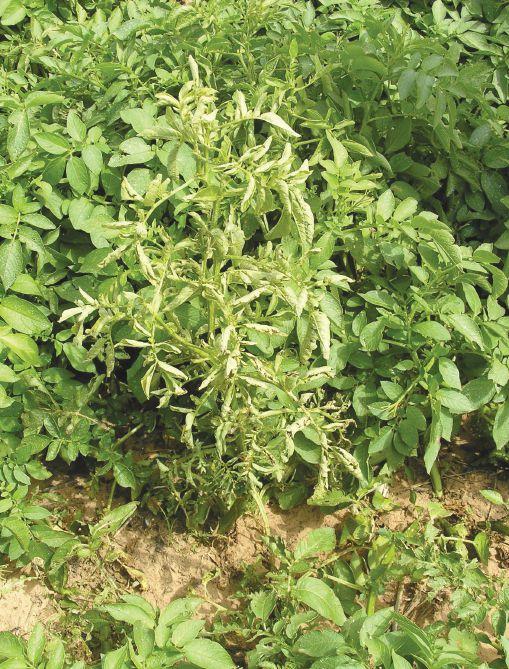
Infected potato plants show a number of above-ground symptoms such as stunting, zigzag stems, and misshapen and discoloured leaves. “They look similar to plants with purple top, another disease of potatoes. affected plants are usually scattered throughout the field. They sometimes appear as clusters of collapsing plants that die early,” says Banks.
Tuber symptoms include enlarged lenticels, collapsed stolons, and brown flecking and streaking that may be confused with tuber net necrosis caused by the leaf roll virus. The key symptom that distinguishes zebra chip from other potato diseases is that the streaking becomes much darker with frying. The symptoms can affect the entire tuber.
“at present, detection of potato psyllids at any level, in any life stage, is the threshold for action. There are insecticides registered in Canada that control psyllids, but unfortunately psyllids do not appear on the label except for Movento,” says Banks. “Jim Chaput, oMaFra’s Minor Use co-ordinator, is working on submissions for adding psyllids to the label of some insecticides.”
In the United States, various insecticides are registered for potato psyllid control. “Control of the disease right now requires controlling the psyllid. There are a lot of good [insecticide] products that work very well,” says Henne. “However, we need better knowledge of which ones work more quickly, without having adverse effects on natural enemies – without quick control of the psyllids, the disease can spread rapidly.”
Henne and other researchers are working on a variety of integrated pest management strategies to improve control of the insect and the disease. “all of our potato cultivars are susceptible to this disease, as are tomatoes and peppers, but there are some good advances recently in the breeding area and the management area. We’re constantly evaluating new insecticide chemistries. We’re also trying to better understand the biology and behaviour of the potato psyllid; for instance, some of the work in my lab is trying to identify plant species that the potato psyllid would prefer rather than potato, so we can use those as trap crops or to divert the psyllids from potato crops.”
In 2013, Banks will be monitoring for psyllids in ontario. If she or an ontario potato grower finds any potato psyllids, she’ll send the samples to Henne’s lab to determine if the insects carry the bacterium.
She adds, “Let’s hope our cold Canadian winters keep the psyllids away from our potato fields!”
Plants infected with zebra chip show above-ground symptoms such as misshapen leaves and stunting.
Photo by d on
With the highest performance and lowest environmental impact, Delegate™ WG insecticide is the new standard for potatoes. It delivers superior, fast-acting control of Colorado potato beetle, European corn borer – and many other chewing pests. Call our Solutions Center at 1.800.667.3852 or visit dowagro.ca today.
tW e A king ferti L it Y
Tips for improving fertility to create gains in yield, health and quality.
by rosalie Tennison
Adjusting fertility programs by the tiniest increment could net a yield increase. all that might be required is better understanding the soil’s needs or choosing nutrient materials that will work more effectively in particular soil profiles. Three top potato experts share their tips for tweaking fertility that are valid for any potato operation. While most of the recommendations are not new, they may be getting overlooked or they may need to be combined with others in order to get better results.
Dr. Bernie Zebarth, a research scientist with agriculture and agri-Food Canada (aaFC), is an advocate of the 4r approach to fertility. “You need to use the right source, the right rate, apply at the right time and in the right place,” he explains. “growers generally use the right source, but in areas where there is a problem with leaching, those growers may want to consider switching to a controlled release fertilizer, like eSn, for their nitrogen source. Using the right rate is the most critical, but also the toughest. In Western Canada, nitrate remains in the soil, so a residual soil nitrogen test can be used. But, in eastern Canada, rainfall washes the residual nitrogen away and there isn’t a nitrogen test yet.” He says a new nitrogen test for this circumstance is being developed to measure how much nitrogen is released from the soil organic matter but, until it is available, growers have to rely on petiole nitrate testing to manage their crop. He adds that potato growers tend to put on the rate that will be good in any year, but, he hopes, the new nitrogen test can identify when growers can cut back without hurting the crop.
as for putting fertilizer on at the right time, Zebarth says split applications are only useful if there is a problem with leaching, so timing application correctly will depend on weather and planting. For placement, when the choice is between broadcasting or banding, he believes banding is more efficient because the nutrients are placed at the roots. However, in Western Canada, where nutrients do not move as much in the soil, both methods are acceptable.
“I think there should be a fifth ‘r’,” he adds, “and that is the ‘right cropping system.’ The four rs are about fertility, but growers also need to maintain soil, rotate crops to minimize disease and insect pressure, and maintain soil organic matter.”
ontario potato specialist Dr. eugenia Banks agrees with Zebarth’s idea about adding another r to the list, but she sees that fifth r as part of maintaining good fertility in a well-rounded production plan. “In order to ensure any fertility program is successful there are nine areas that are important,” she says. Her list includes
crop rotation and cover crops, soil tests, petiole analysis, adequate irrigation, drainage improvement, organic matter level above three per cent, reduced compaction, keeping pH within the 6 to 7.5 range, and doing soil preparation for tillage operations when the soil is not wet.
“Crop rotation maintains soil fertility,” Banks explains. “It will also reduce soil erosion, insect pressure, and soil-borne diseases.” She recommends including rye in a rotation with potatoes because it does not need high pH and is competitive with weeds, which, in turn, compete for nutrition. She adds that rye is one of the best crops to prevent nitrate leaching in the fall and it will withstand low winter temperatures.
“growers need to maintain soil, rotate crops to minimize disease and insect pressure, and maintain soil organic matter.”
For any crop in any region, soil tests are always recommended. Banks says soil tests provide the best information for predicting how the crop will respond to applied fertilizer. The tests will indicate if minor nutrients are needed and the recommendations could be different for each one depending on whether soils are sandy or heavier. More than any other tip, Banks believes growers should always start with a soil test and then tweak the fertility program to the desired results in combination with all the other requirements for successful crop production.
“nitrogen is usually the nutrient that is most limiting in potato production systems,” comments Dr. Carl rosen, a nutrient management specialist for horticultural crops at the University of Minnesota in St. paul. “potash and potassium can be accurately identified with a soil test and they don’t move in the soil like nitrogen. The mobility of nitrogen in soil and the lack of a reliable nitrogen soil test make managing this nutrient more of a challenge, especially in regions with high rainfall. as noted above, soil nitrogen tests can be useful in dry climates to help adjust nitrogen fertilizer recommendations. Make sure you have a soil test calibrated to local conditions and keep an eye on pH levels.” He suggests putting lime on in a rotation year, if scab is a problem.
PrOM i Sing n eW P OtAtO vA rietie S
Microclimate and soil types may play a factor from area to area.
by eugenia Banks, potato specialist, oMaFra
Selecting suitable varieties is an essential first step in any successful potato operation. Varieties not only must suit the intended market but must also be well adapted to local growing conditions. Hundreds of varieties are available to potato growers, but as few as 10 account for approximately 90 percent of the ontario acreage.
The goal of potato breeders is to develop new varieties that are attractive, high yielding and pest resistant in the traditional classes: table-stock, processing and/or specialty markets.
This is no small task and involves the following strategies:
• Use improved potato germplasm to reduce the impact of economically important potato pests
• evaluate advance breeding lines for yield, quality and pest resistance at multiple locations
• Conduct commercial trials of advanced potato breeding lines to facilitate the adoption of new varieties
• provide relevant information on the performance of new potato varieties to potato growers, crop consultants and extension personnel
It usually takes plant breeders 12 to 15 years to develop, evaluate and release a new potato variety.
Variety trials in growers’ fields are extremely important for
breeders and growers. It is the final test for a variety. new varieties may perform very well in a certain production area but they might not do well in a neighbouring area due to different growing conditions such as microclimate and soil type. This is the case with
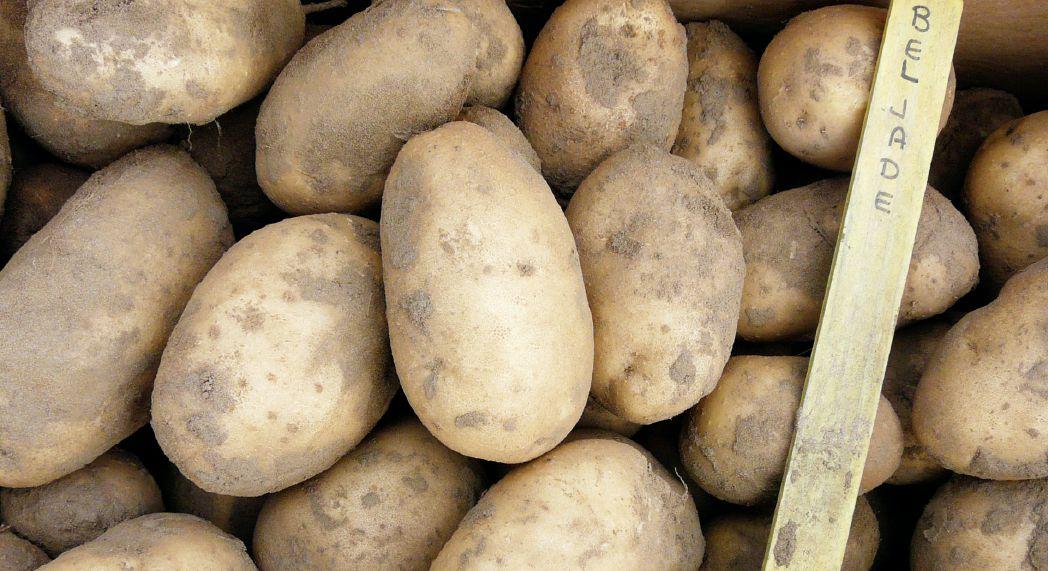
ToP: The Beljade variety was outstanding in the grand Bend, ontario, area.
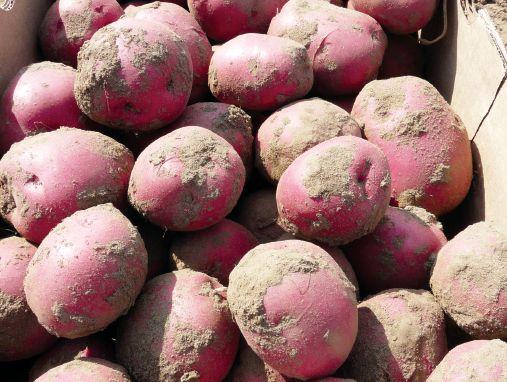
Middle: The nd8555-8R variety did very well in the delhi area of ontario.
Photos by e ugenia
the variety called Shepody that grew very well in the Shelburne area but did very poorly in the alliston area. The distance between these two areas is only 30 kilometres.
In 2012, new varieties released by several breeding programs were evaluated in trials conducted in growers’ fields in Shelburne, Delhi and grand Bend, ontario. Many of these new varieties did not perform well, but a few received good reviews by growers based on their yield and appearance. This past season was tough, due to the hot and dry weather. Varieties that performed well are good candidates to become commercial releases in ontario.
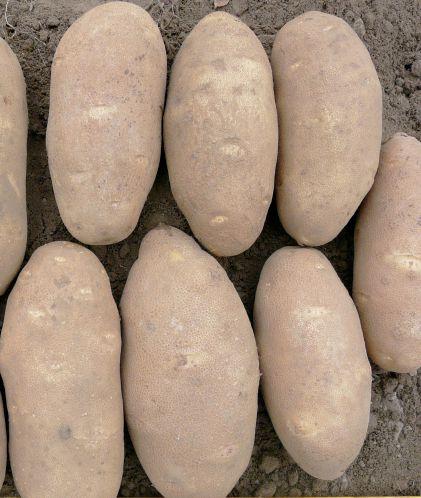
In the Shelburne area, Clearwater russet was the best performer. The yield was close to 300 cwt. It is a medium-late variety with oblong to long tubers that have medium russet skin and shallow eyes. It sets eight to nine tubers per hill and is resistant to scab. according to the potato Variety Management Institute, which is the agent for this variety, the tubers exhibit excellent fry colour out of storage and their attractiveness make this variety suitable for both processing and fresh market usage.
medium to full season. The SimcoeDelhi area was hit hard by the hot, dry weather this past summer. a potato selection that performs well and does not develop off-shaped tubers, growth cracks or second growths is very promising for that area. Unfortunately, it is susceptible to scab.
I have grown nD 8555-r for three years now and it stores very well. Skinning is not a problem as long as it is not dug for at least 14 days after top killing.
nD 8555-8r was developed in north Dakota. It appeared in the 2012 list of seed potatoes certified in Maine. Therefore, seed should be available for the 2013 season.
In the grand Bend area, Beljade, a high yielding, oblong, white variety, was outstanding. It did not develop off-shaped tubers, second growth or growth cracks. It has some tolerance to scab. Storability and after-cooking darkening are factors to be determined. This variety has been available from La patate Lac St. Jean since this past spring.
Clearwater russet is also notable for having higher protein content than standard potato varieties, and has 38 percent higher protein content than the russet Burbank.
once a variety performs well in the field, it needs to be evaluated in storage to complete the variety profile. at this point, I can say Clearwater looks promising for the ontario market.
In the Delhi area, the potato selection nD 8555-8r, a round, red-skinned selection with white flesh, did very well. Maturity is
tWeAking fertiLit Y
ConTinued FRoM Page 20
rosen is an advocate of a petiole analysis as well because it is a good guide for nutrition within the plant. “petiole analysis is just another tool to help guide in-season nitrogen applications and assess the nutritional status of the crop. It is important to interpret the results carefully along with other indicators, such as plant vigour, tuber bulking conditions and canopy colour,” he cautions. “We are currently looking at chlorophyll meters as well as other reflectance measurements to assist with identifying stress and determining the need for supplemental nitrogen applications.”
getting nutrition right isn’t just about the amount of each product applied, according to Zebarth. “good agronomy, such as planting at the right time, planting into good soil, and using good seed, can have an effect on the success of a fertility
Know. Grow. www.topcropmanager.com
program. You could have two fields side by side and one has not been managed well and the other has been well maintained and they both have the same nitrogen program and the result will be like night and day!”
Whether the approach is the four – or five – rs or Banks’ top nine tips for ensuring success with a fertility program, there is more to getting success from a program than just applying according to the soil test. In order to get the best result, extra steps may need to be taken in the management of the crop to ensure the fertility program has the opportunity to be effective. Until researchers perfect tests that can provide more definitive recommendations regarding nitrogen, in particular, managing all aspects of crop production is the number one tip for getting top results from a fertility program. The rest is up to the weather.
The Beljade variety was outstanding in the grand Bend, ontario area.
Photo by e
When it comes to protecting your high-value potato crop, you shouldn’t settle for anything but the best. Vertisan™ – a powerful new fungicide for managing rhizoctonia and early blight in potato crops. Start your crop strong with an effective in-furrow application of Vertisan™ to guard against early rhizoctonia infections which can often lead to lower potato yield and quality. Vertisan™ is also a powerful new tool against sclerotinia and other yield robbing diseases in canola, pulses and sunflowers. No matter what the season brings, you can count on Vertisan to deliver high yielding, high quality crops.
Vertisan™. Higher yield. Higher quality. Higher standards. Questions? Ask your retailer, call 1-800-667-3925 or visit vertisan.dupont.ca.
Only one of these potato seed-pieces is protected from the broadest spectrum of insects and diseases. Only one is safeguarded with two new fungicides. Only one takes fusarium protection to the max — even against resistant strains. And only one is covered with Titan™ Emesto™, the first and only coloured liquid seed-piece treatment. It’s easy to use and even easier to see the difference it makes. And you’ve never seen anything like this before. Learn