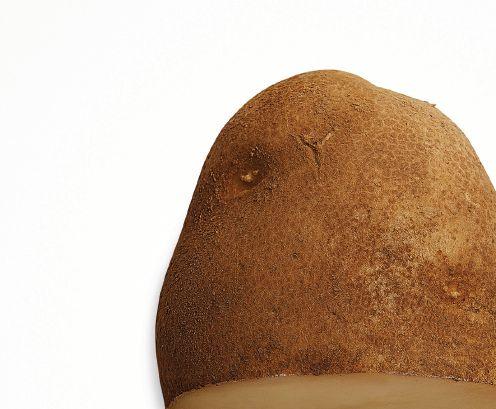
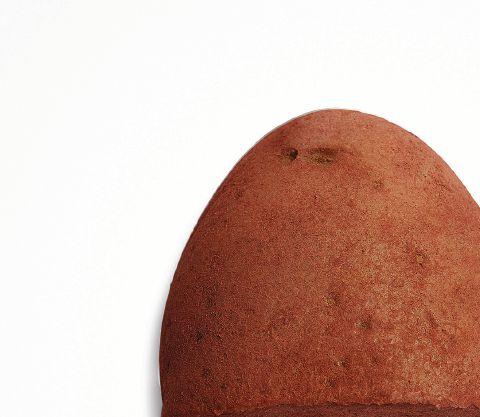
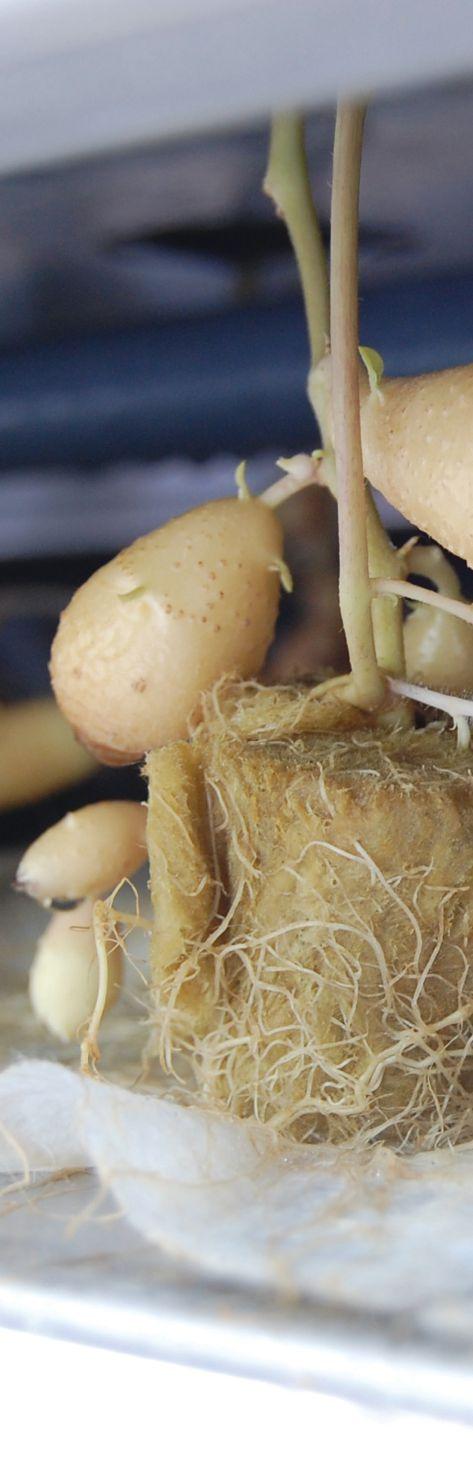
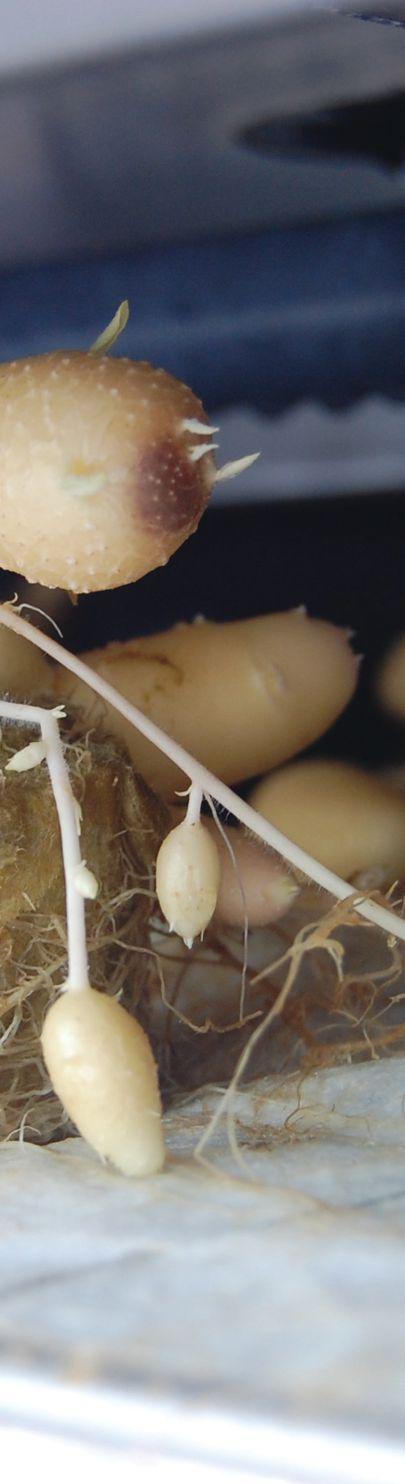
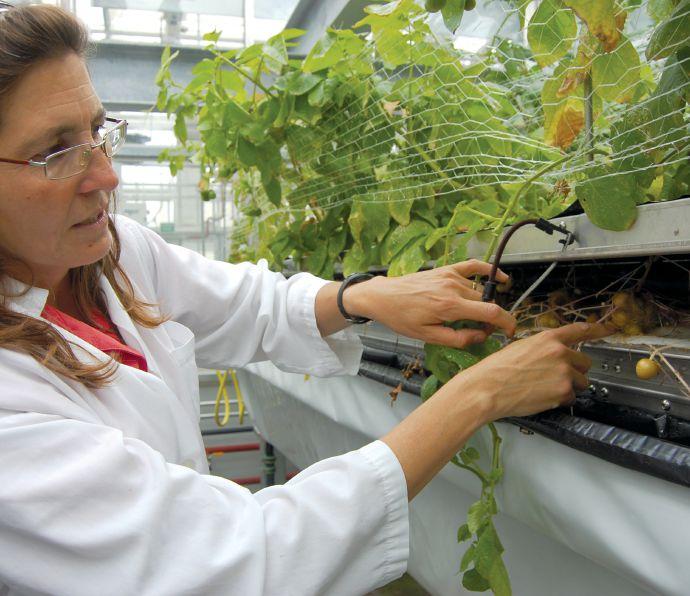
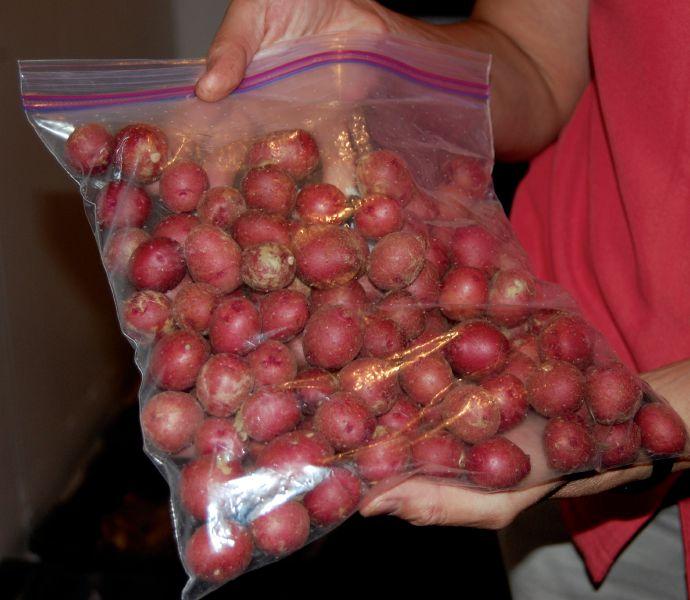
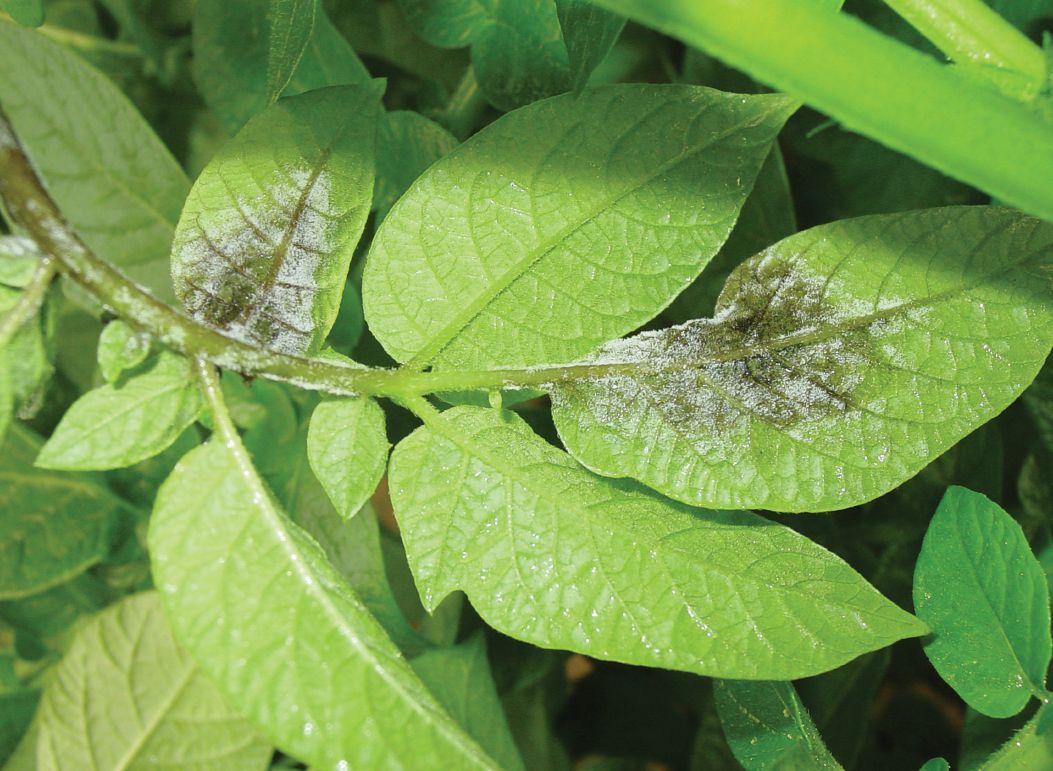
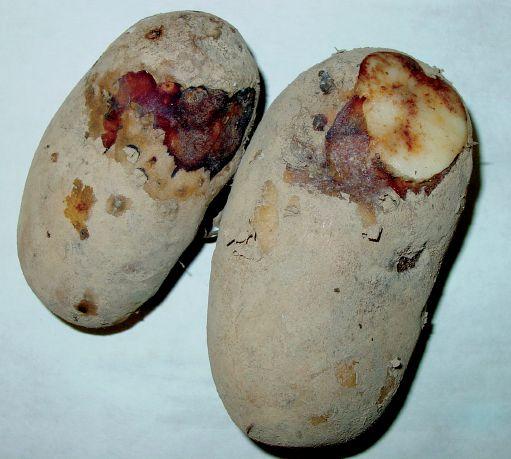
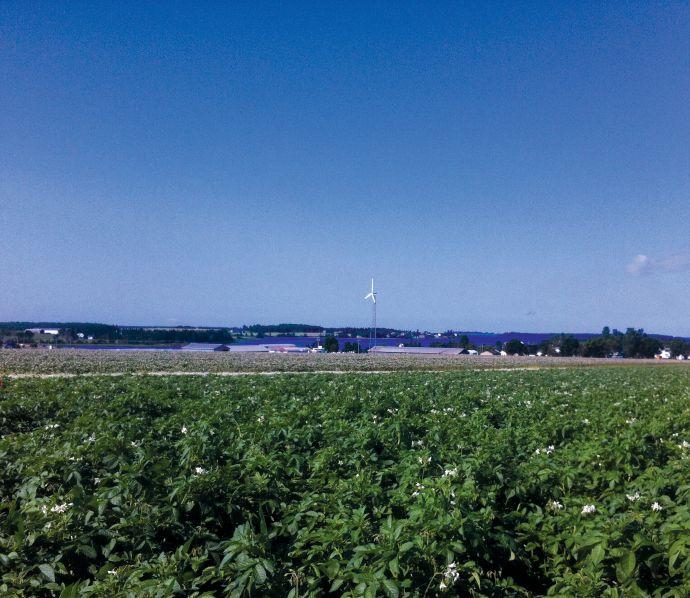
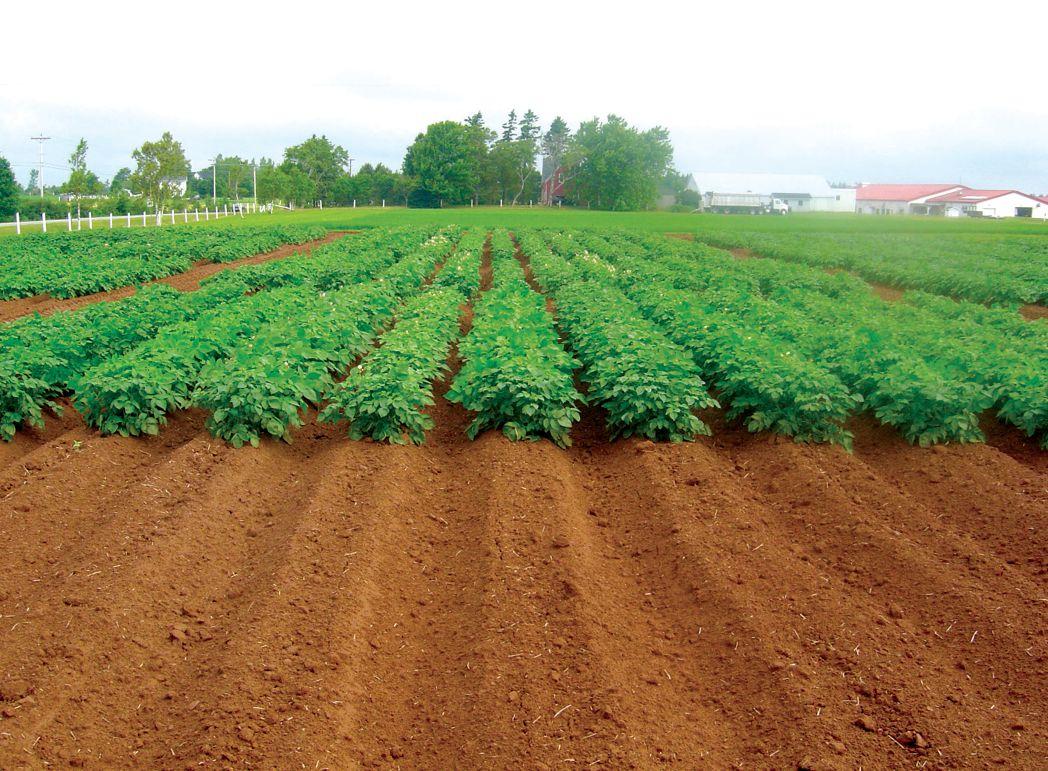
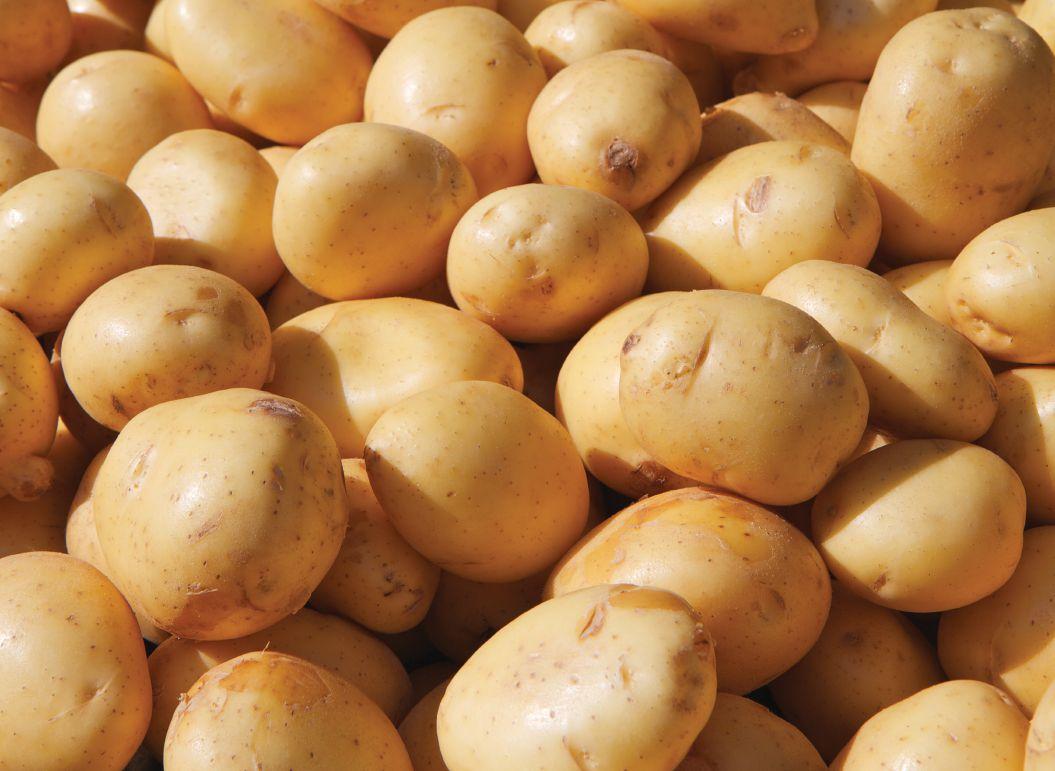
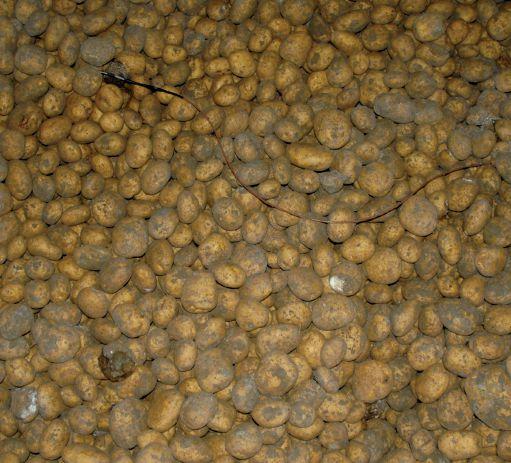
Peel up the tabs below the potato seed-pieces to see what you’ve been missing.
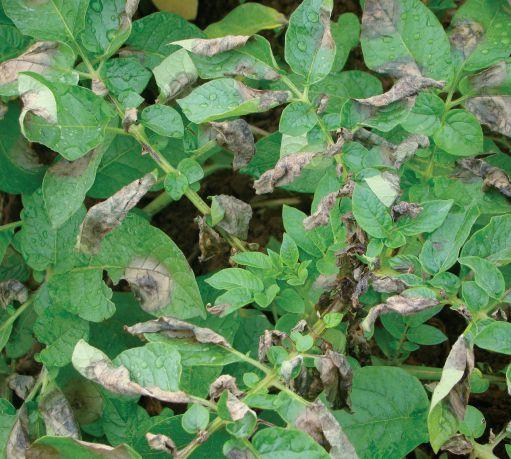
Your liquid potato seed-piece treatment shouldn’t leave you guessing. With the exclusive red coverage of Titan™ Emesto™, a quick glance is all you need to be 100% sure that your seed-pieces are fully protected. And Titan Emesto protects your crop against the broadest spectrum of insects and major seed-borne diseases, including rhizoctonia, silver scurf and fusarium – even current resistant strains through the use of two new modes of action. Your potato crop is too important for guesswork. Be absolutely sure you’re getting complete protection.
Visit BayerCropScience.ca/TitanEmesto to see Titan Emesto in action.
BayerCropScience.ca or 1 888-283-6847 or contact your Bayer CropScience representative. Always read and follow label directions. Titan™ and Emesto™ are trademarks of the Bayer Group. Bayer CropScience is a member of CropLife Canada.
TOP CROP
MANAGER
Treena Hein
Tony Kryzanowski
| Taking the time to get it right Spraying on a schedule may be convenient, but it might not be the most effective way to control weeds. By
Rosalie I. Tennison
Stefanie Croley,
Stefanie Croley | eDitor
Th E TI m ES , T h Ey ARE A- C hANGIN’
The imminent arrival of spring brings a refreshing feeling of renewal, which is the perfect sentiment to kick off our first issue of 2014.
Canada’s potato industry celebrated noteworthy successes last year. recent numbers from Statistics Canada indicate that the potato is still a valuable crop for Canadian farmers, and planted potato acreage in Canada reached 361,600 acres in 2013. Several provinces showed excellent numbers last year, with Manitoba reporting 72,000 seeded acres, p e.I. reporting 89,500 seeded acres and new Brunswick reporting 53,500 seeded acres. Quebec showed the largest increase in seeded area in 2013, up 3.1 per cent from 2010 to 43,600 acres.
on paper, these numbers don’t look too staggering, but at Potatoes in Canada, we have recognized their significance. More acreage demands more resources, and that’s where we come in. as potato research and production technology continues to advance and help the industry grow, we must adapt and do our part to foster and share more innovation and development. These rising numbers, combined with feedback from readers and industry professionals, have sparked some significant changes at Potatoes in Canada
The fresh look we’re sporting, which you may have noticed when this issue landed in your mailbox, is the first transformation. Potatoes in Canada has always had its place under the Top Crop Manager umbrella, and when Top Crop Manager was redesigned in october 2011, Potatoes in Canada adopted the same look. But as the industry continues to develop, we’ve recognized that we must do the same, and as such, we’ve revamped Potatoes in Canada’s look to help it stand out as a trusted resource.
There is a vast amount of research underway across the country to help the potato industry grow and thrive. You’ll find some updates in this issue, and you’ll soon be receiving more information than ever before. along with a new appearance, we’re increasing our publishing frequency to four issues per year: Spring, Summer, Fall and Winter. Watch for the next three editions in late May, late august and mid-December.
Finally, you know as well as I do that keeping up with technology is important, whether you’re in the field or sitting at a desk. The Internet provides a wealth of information at your fingertips, and we’ve decided to join in by offering our own useful website for you to bookmark. Be sure to visit www.potatoesincanada.com, where you can find the latest industry news and new products, digital archives, research updates, and more.
With all of these changes – changes we believe will help us serve you better – one thing remains the same. our mandate at Potatoes in Canada is to be a resource for potato production and technology. We will continue to offer insights and in-depth information on plant breeding, research and development, trends and technologies, and other agronomic topics. Meantime, if there is anything you would like to read about in our pages, I would love to hear from you. I will be travelling and attending industry events in the coming months, so be sure to say hello and share what’s happening in your part of the country. after all, no one knows what goes on in a farmer’s field better than a farmer.
grOUP PUBLISHEr Diane Kleer dkleer@annexweb.com EASTErN
SALES ASSISTANT Alice Chen • 905.713.4369 achen@annexweb.com
MEDIA DESIgNEr Katerina Maevska PrESIDENT Michael Fredericks mfredericks@annexweb.com
PUBLICATION MAIL AGREEMENT #40065710 rETUrN UNDELIVErABLE CANADIAN ADDRESSES TO CIRCULATION DEPT. P.O. Box 530, Simcoe, ON N3Y 4N5 e-mail: subscribe@topcropmanager.com
Printed in Canada ISSN 1717-452X
CIrCULATION e-mail: subscribe@topcropmanager.com Tel.: 866.790.6070 ext. 202 Fax: 877.624.1940 Mail: P.O. Box 530, Simcoe, ON N3Y 4N5 SUBSCrIPTION rATES Top Crop Manager West - 8 issuesFebruary, March, Mid-March, April, June, October, November and December - 1 Year - $45.00 Cdn. plus tax
Top Crop Manager East - 7 issuesFebruary, March, April, August, October, November and December - 1 Year - $45.00 Cdn. plus tax
Potatoes in Canada - 4 issues - Spring, Summer, Fall and Winter 1 Year - $16 CDN plus tax
All advertising is subject to the publisher’s approval. Such approval does not imply any endorsement of the products or services advertised. Publisher reserves the right to refuse advertising that does not meet the standards of the publication. www.topcropmanager.com
A fu NCTIONA l f EEDlOT
Compost from cattle manure has found a home in Alberta potato production.
by Tony Kryzanowski
Southern alberta is well known as cattle country, but the region also is home to significant commercial potato production. now, a partnership between a potato grower and cattle producer has proven to be a fortuitous – albeit rather unorthodox – opportunity to unite the two industries for mutual benefit.
Harold and Chris perry are co-owners of the Kasko Cattle Company, with feedlot owner ryan Kasko, on 10 quartersections of land surrounding the Kasko Cattle Company feedlot east of Taber, alta. Kasko owns and operates the feedlot itself, which raises about 14,000 head of cattle annually. Harold perry says they partnered with Kasko in the recent purchase of the land surrounding the feedlot partially because it provided them with a ready supply of manure that they could convert to compost for use in their potato production.
The potato producer benefits primarily from the nutrient and micronutrient value delivered by the feedlot’s manure when it is applied on potato cropland in the form of compost,
while the feedlot has a handy place to dispose of its significant accumulation of manure right nearby. The feedlot owner delivers the raw manure to a dedicated composting site with good drainage control where the potato producer converts it to compost. It is land applied in o ctober and worked in before the potato hills are created for next year’s planting.
The perry family’s expertise, which includes Harold and Chris’ father, g erald, is in producing crops such as potatoes, sunflowers and peas on a total of 4,600 owned and rented acres. Their business is headquartered close to the town of Chin, about 40 kilometres from the feedlot – a typically hot, dry climate requiring irrigation, with plenty of frost-free days. The perrys have a contract to produce 13,500 tonnes of potatoes for Frito Lay and 8,500 tonnes of potatoes for McCain Foods on about
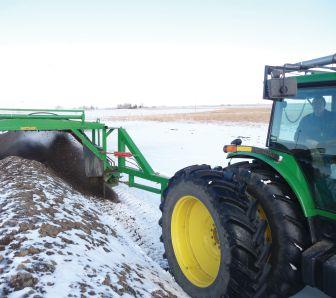
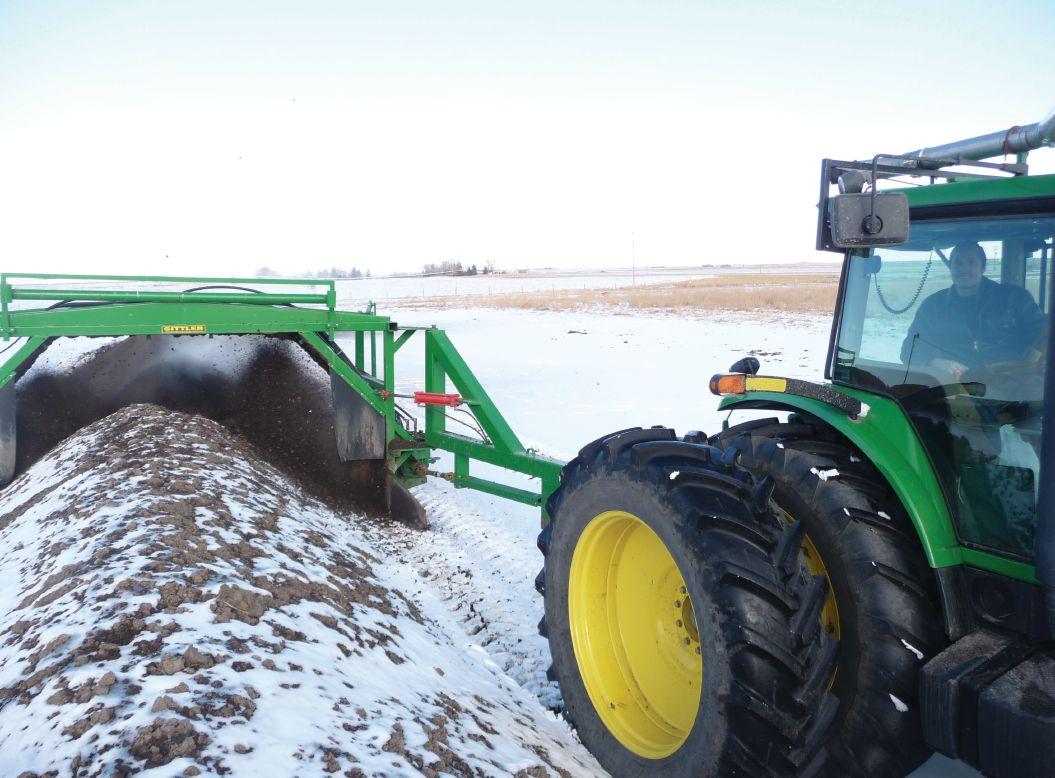
ABOVE: Harold Perry propels a Sittler compost turner through the CKP Farms’ compost heap to ensure even and balanced conversion of raw cattle manure to compost.
Photo courtesy of h arol D Perry.
cultivation previously in a four-year potato crop rotation that there was a dropoff in potato production on soil where potatoes had been grown in the past. They discovered that using compost on the potato rotation land not only provided organic fertilizer to the crop but also worked as an excellent soil amendment, adding many micronutrient and biological unknowns to the overall quality of potato-growing land that really made a difference in commercial potato production.
“We wanted to try compost because that is the natural way that things work,” says perry. “When the buffalo were here, they ate and manured the grass at the same time, and that’s how the natural cycle worked. Fertilizer prices have also helped because compost makes sense if you go strictly by dollars. The cost of putting the amount of nutrients you put on your soil using compost is less than if you were to purchase that at a fertilizer dealership.”
Composting the manure deals with that issue, and it is also more economical to transport nutrients in this form than as raw manure. The perrys can attest to that fact.
“g ood compost has about 60 per cent of the weight of raw manure,” says perry. “So if you get too far away from the feedlot, then the trucking just kills you.”
research being conducted by a griculture and a gri-Food Canada, specifically in Summerland, B.C., also is showing that the addition of compost could help in the prevention of verticillium wilt, also known as early dying syndrome.
potato crops infected with this pathogen will typically see the tops of potato plants die off between early august and September, which can have a devastating impact on potato production in the case of a bad outbreak. The pathogen enters the plant through root lesions. The root lesions are caused by nematodes that live in the soil and feed on the roots.
1,300 acres that are under irrigation for that purpose.
For the past decade, the perrys have used cattle manure compost as fertilizer in their potato-growing operation
because of the nutrient and microbial benefits they’ve realized from using it.
Harold perry says they observed with growing potatoes on virgin potato growing soil versus soil that had been under
So far, what the B.C. research has shown is that the addition of compost enhances the presence of a fungus that feeds on the nematodes, thus reducing the amount of root lesions and closing the pathway for the verticillium wilt pathogen to enter the plant. results so far have been promising, although the theory hasn’t quite been proven yet, according to Dr. Frank Larney, research scientist in the area of soil conservation with
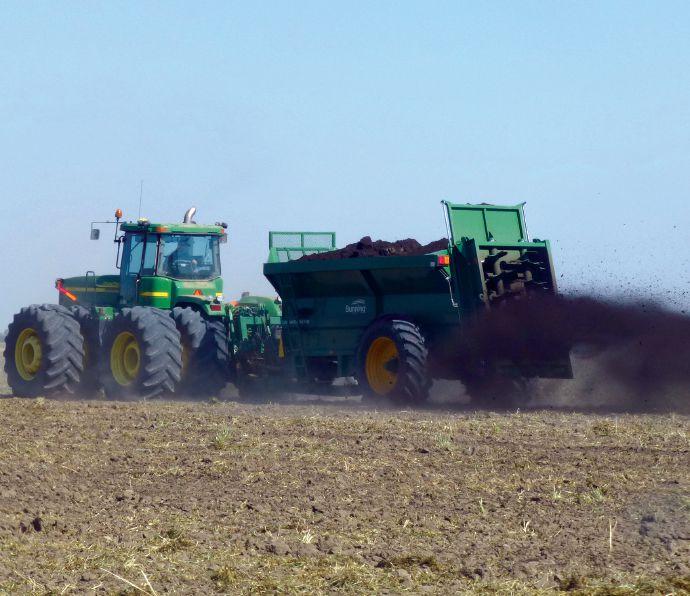
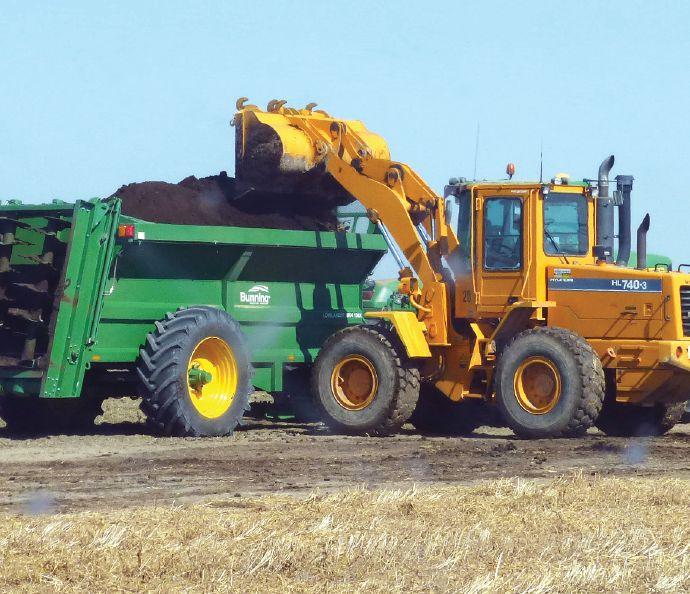
Potato producer CKP Farms uses a Bunning compost spreader to apply compost to their potato crop land as both an organic fertilizer and a soil conditioner.
CKP Farms near Chin, Alta., converts cattle manure from area feedlots into compost and applies it to farmland that has been used previously in potato crop rotation to help revitalize the soil’s nutrients.
Photos courtesy of h arol D Perry.
a griculture and a gri-Food Canada ( aa FC) at the Lethbridge research Centre in alberta.
Before the perrys became partners in the feedlot, they were purchasing their compost from a commercial supplier. It was partially because of compost quality issues that they agreed to invest in land surrounding the Taber area feedlot with ryan Kasko so they could acquire their own supply of raw cattle manure to manufacture compost. The Taber feedlot and surrounding land were also near their potato growing operations, so all the pieces conveniently fell into place.
Harold perry is in charge of compost production. “If I have a goal, it’s to have healthier soils, for healthier crops, for a healthier population,” he says.
The perrys pay Kasko for the cattle manure, and he in turn hires a custom contractor to deliver the raw manure to the compost production site. The custom manure hauler creates the windrows needed to produce compost. During the first year of compost production, the feedlot delivered about 9,000 tonnes of manure to the site. Delivery of the manure resulted in four windrows measuring a distance of about half a kilometre each.
Using compost on the potato rotation land not only provided organic fertilizer to the crop but also worked as an excellent
soil amendment.
o nce the windrows were created, perry began monitoring the conversion process and used his compost-turning equipment as needed. He acknowledges feeling a bit anxious about delving into compost production because of the science required to ensure that the biological organisms have a healthy environment to carry out the conversion process but adds that learning to compost has been an enjoyable experience. To prepare himself, he took a composting course offered by Midwest BioSystems. The conversion process takes from July to mid- o ctober.
To turn the compost, perry purchased a 14-foot wide, pulltype, Sittler compost turner, which retails for about $45,000. He was able to recoup about half the cost by applying to a government program called the g rowing Forward Manure Management program. He checked the heat and moisture content in the composting windrows regularly to ensure that the organisms were working in an optimum environment. He also purchased a Sittler water wagon that can be towed along with the compost turner so that moisture can be applied to the windrows as needed. perry says he turned the compost six or seven times with the main determining factor being when the temperature in the compost heap reached 160 F. at the beginning, the turning was done every four or five days because of the strong biological activity underway. Ideally, the conversion process should take 10 weeks, but perry says he prefers to wait 16 to 20 weeks. a s part of the perrys’ adventure into composting, they hired an agriculture consultant from Sunrise a g in Taber to soil sample and develop topography maps to help determine how much compost should be applied at various points on their cropland. The consultant developed maps showing six zones where the compost should be applied to a lesser or greater extent to achieve ideal growing potential.
To spread the compost, perry purchased a Bunning compost spreader with vertical beaters, which he pulls using a John Deere 8430 tractor equipped with hydrostatic drive. perry recommends a tractor in the 180- to 200-horsepower range. The tractor moves at about 16 kilometres per hour, and the spreader broadcasts the compost over a width of about 40 feet. This results in an application rate of about four tonnes per acre. Increasing or decreasing tractor speed based upon the zone mapping displayed in the cab will increase or decrease the application rate.
Larney says he is not surprised by the results witnessed by the perrys. He says using compost in the lighter, sandier soils under irrigation in southern alberta delivers “a better bang for your buck” than perhaps it would in the soils where seed potatoes are grown in central alberta. These soils typically contain more organic material. g iven the amount of row crop type production in southern alberta and because these crops do not return organic matter to the soil, Larney says, “the addition of compost is a very good way of replenishing soil organic matter . . . it’s the quickest way.”
He adds that compost also delivers other benefits, such as the addition of micronutrients not present in commercial fertilizer, and also improves the soil’s water holding capacity, making it more resilient to both wind and water erosion.
given how close together both cattle and potato production are in southern alberta, he says their co-operation is a natural fit.
“It kind of makes sense that it (manure) should end up on potato land,” says Larney. He is noticing more feedlot operators moving in the direction of composting the manure in advance versus simply land applying raw manure.
“I think a lot of feedlots are now realizing that they should look at composting because you can only rely on your neighbours for so long to take raw manure,” he says. “With the buildup of phosphorus levels in particular close to feedlots, I think the onus is on the feedlot owners to hopefully ensure that these nutrients are spread out over a wider area so that we are not getting high nutrient loading on land close to the feedlot.”
For more on potato production, visit www.potatoesincanada.com.
Alb ERTA’ S AEROPONIC POTATO PROj ECT
Evaluating new seed potato production technology.
by Treena Hein
It’s a first in Canada: the evaluation of a commercial aeroponic production system for seed potatoes. “We need to reduce the costs of production to remain competitive in the north american seed potato industry, and this technology has the potential to do that,” says Michele Konschuh, a research scientist at alberta agriculture and rural Development’s Crop Diversification Centre South in Brooks, alta., who led the technology evaluation project.
The technology under scrutiny is called Vital Farms potato Incubator pIp200, an aeroponic seed potato production system from northBright Technologies designed to optimize the yield and quality of seed potato mini-tubers. “We wanted to evaluate this system and its costs, and also determine the effect of light, potato variety and nutrient solution on the yield of mini-tubers,” Konschuh says. “We are just completing the last round of evaluations. over one dozen varieties have been grown in the system.” The effects of the time of year and tuber size at harvest have been documented, but the configuration of their system did not allow for comparison of nutrient solutions.
Funding and support for the project was provided through the alberta Crop Industry Development Fund, the agriculture and Food Council of alberta (a nonprofit organization comprising representatives from across alberta’s agri-food industry), potato growers of alberta and several industry stakeholders.
getting started
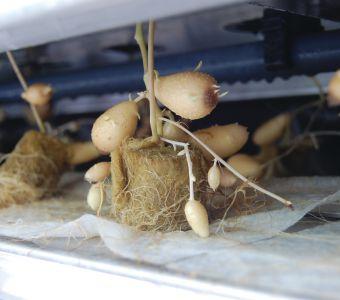
The pIp-200 arrived in Brooks in august 2012, and Konschuh and her team were soon hard at work on installation. “We got the frame assembled within two days, but overall installation proved to be much more time-consuming than expected,” she remembers. “We spent almost two weeks turning wrenches, running a rivet gun and installing the plastic ‘root bags’ that house the roots and return flow to the system.” When installation was complete in october 2012, a total of 17 hanging gutters were installed, each with room for 71 plantlets.
In the first trial, 14 varieties of seed potato plantlets were planted into 17 gutters. “In this trial, we were able to evaluate variety responses to the system,” Konschuh explains. “With the duplicated varieties, we evaluated the effect of harvesting two sizes of tubers (Shepody), the effect of insufficient humidity during plantlet establishment (Sangre), and the effect of delayed transfer to the system
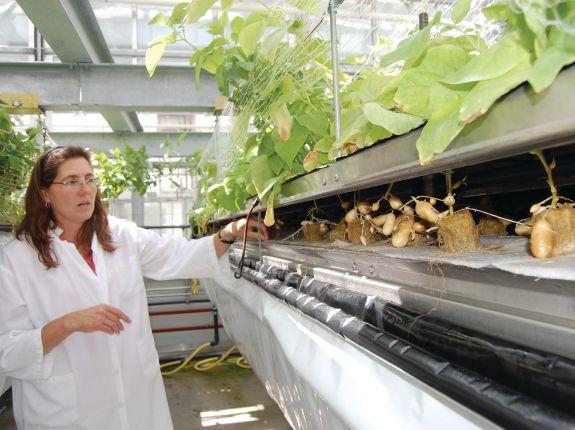
<LEFT: Konschuh tested several irrigation schedules and greenhouse settings during each phase of the project.
<LEFT: Konschuh has found aeroponic mini-tubers compared favourably with conventionally grown mini-tubers.
(russet Burbank).” Harvesting of tubers began in november 2012 for the earliest varieties and continued at four- to seven-day intervals until mid-February 2013.
Konschuh found that plantlet survival was less than ideal for several varieties. “We think this may have been related to the type of fabric supplied to separate the root chamber from the tuber chamber, as well as to not optimizing the irrigation schedule for each variety,” she says. “There was only one zone supplied with the pIp-200, so all varieties were irrigated on the same schedule and got the same nutrients, so a comparison that way was not possible.” exposing plantlets to low humidity prior to planting into the system had a negative effect. approximately 30 per cent fewer tubers of marketable size were harvested from plantlets exposed to sub-lethal low humidity.
Konschuh and her team also found that harvesting larger tubers (25 millimetres rather than 20 millimetres in diameter) resulted in a reduction by about half of final tuber count. “as mini-tubers are sold by count rather than by weight, this is a significant finding,” she says. “We need more study to establish relevant pricing for different size classes on minitubers.” Delaying planting into the pIp-200 had no significant effect on the final number of tubers harvested.
Yield ranged from three to 10 tubers per plant in the first round. although Konschuh says this is a good yield compared to current mini-tuber production levels in conventional potting mix, a yield of 10 to 30 tubers per plant was expected. (The company claims that the pIp-200 achieves tuber production more than 10 times greater than traditional methods and provides significantly larger tubers than generally available through alternative technologies.) To try to boost this, modifications to the fabric and the irrigation schedule were made for the second round of evaluation.
an open house for potato producers and other industry stakeholders was hosted Dec. 11, 2012. “We had about three dozen key industry people and feedback was generally positive,” Konschuh says. “Many people recognized that we would not meet the production targets proposed by the distributors. It was a good opportunity for people to evaluate the potential of this type of cultivation and comprehend some of the challenges.” She adds that others who couldn’t make the open house arranged to tour the facility at alternative times. “With this being the first of its kind operating in Canada, there is a high level of curiosity about the project.”
a sample of tubers from the first round of evaluation were planted in the spring of 2013 along with conventionally produced tubers to determine whether or not there were
Photo s by s tefanie c roley.
Konschuh tested several irrigation schedules and greenhouse settings during each phase of the project.
differences in field vigour.
Konschuh says the aeroponic minitubers compared favourably with conventionally grown mini-tubers, although some dormancy issues were evident as a result of the project timelines. a field day in
august allowed growers to view the daughter tubers first hand.
Rounds two and three
Meanwhile, back in the lab in late February 2013, the pIp-200 was emptied, cleaned
and disinfected for the second evaluation. “We set up the system again with fresh plastic and a lighter-weight fabric, with 12 varieties,” says Konschuh. “Several varieties were included in more than one gutter, allowing us to compare planting methods for root establishment and the effect of harvesting tubers at different sizes.”
planting was completed in mid-april 2013, and Konschuh says both plant survival and root establishment were better than before. Yield ranged from six to 17 tubers per plant (surviving) in the second round. “although this is a good yield compared to current mini-tuber production levels (one to five) in conventional potting mix, it still fell short of the 10 to 30 tubers per plant that was expected,” she says. Modifications to the greenhouse settings and the irrigation schedule were made for the third round of evaluation. as of December 2013, Konschuh and her team were finishing third round harvesting, a trial that included the use of integrated pest management and more nutrient adjustment. She says plant survival was again better than before.
Challenges
In the first round, some technical installation issues resulted in an unexpected number of alarms, but most have been sorted out. In the second round, some plants showed signs of stress and plant survival was still less than the 99 per cent expected. “In round three, we improved our pest management strategies and nutrients were being more closely monitored,” Konschuh says.
on top of the evaluations, Konschuh and her team also worked with the Canadian Food Inspection agency to ensure that seed produced in the pIp200 was certified. In addition, Konschuh developed a Quality Control Manual for the facility, which will be shared with interested growers to facilitate their adoption of this new seed potato production system.
overall, Konschuh stresses the significant learning curve that’s present when one moves from a potting-mix-based production system to an aeroponic one. She calls her learning experience “humbling” and cautions growers to “allow for some growing pains and significant hands-on monitoring of the crop.”
Yield ranged from three to 10 tubers per plant in the first round of the trial, and from six to 17 tubers per plant the second round.
Photo s by s tefanie c roley.
lATE bl IG h T u PDATE
Proactive management may help growers get a handle on late blight next year.
by Julienne Isaacs
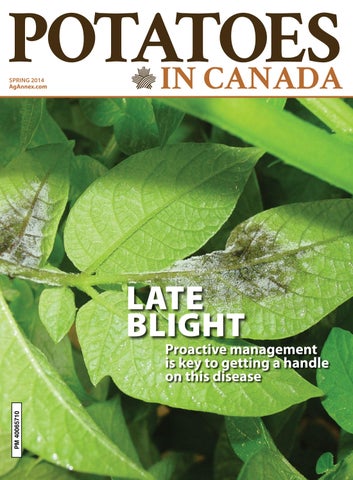
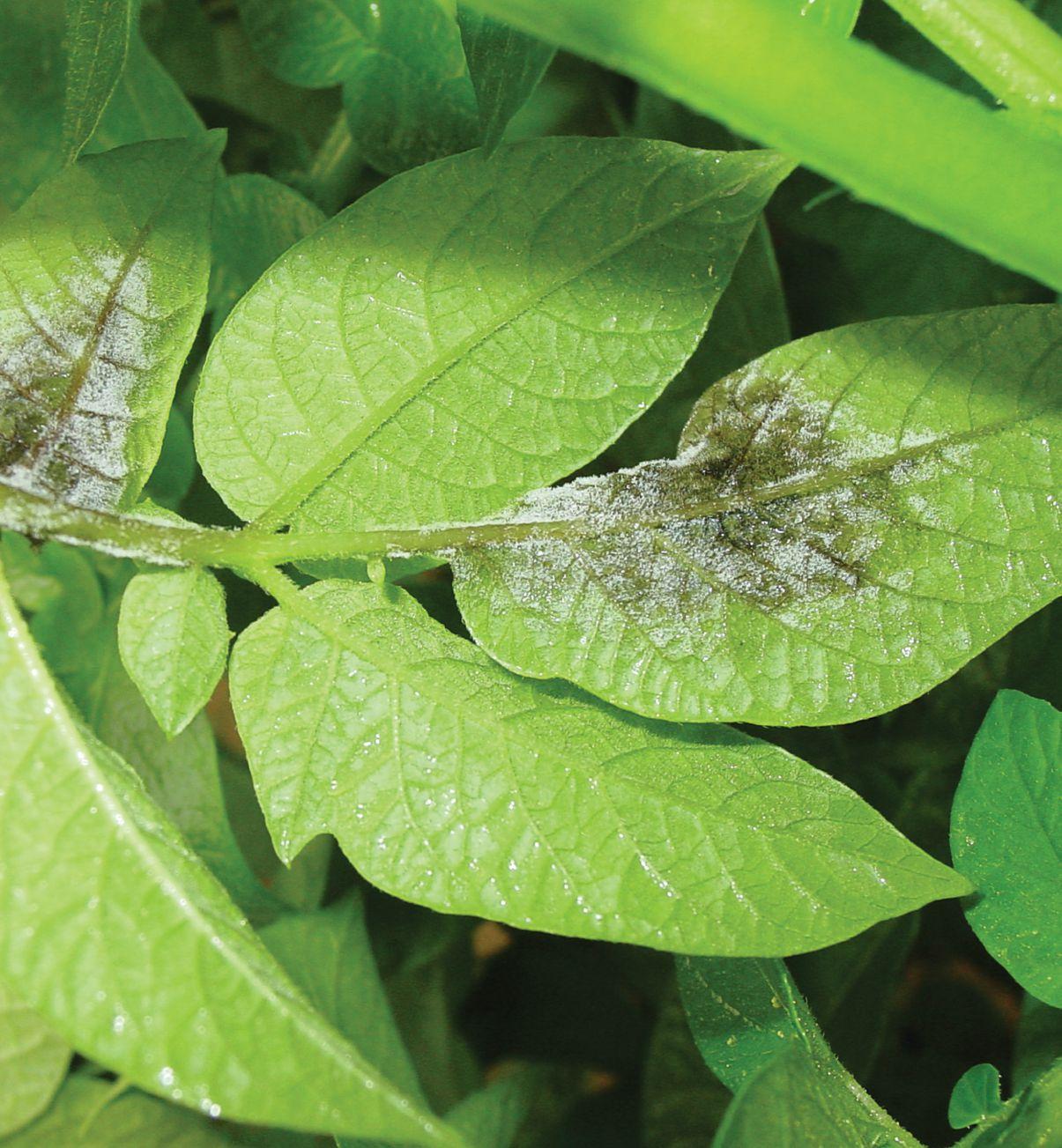
Growers across Canada are resigned to tackling late blight every year, and most follow strong management programs to ensure the potato’s oldest fungal nemesis doesn’t gain a foothold in their fields. However, research into late blight is ongoing: each year, the national Late Blight Working group gathers and quantifies data on strains of late blight fungus in tubers from across the country. This information helps researchers keep abreast of changes in late blight pathogen populations, which in turn helps them make management recommendations to growers.
In 2013, the dominant strain present in growers’ fields across Canada was US-23, although results from the 2013 national late blight strain identification survey are still being tabulated, according to Khalil al-Mughrabi, pathologist with the potato Development Centre, new Brunswick Department of agriculture, aquaculture and Fisheries, and chairman of the national Late Blight Working group.
The research team comprises al-Mughrabi, Larry Kawchuk (agriculture and agri-Food Canada, Lethbridge, alta.), rick
peters (aaFC, Charlottetown, p e.I.) and Fouad Daayf (University of Manitoba), along with their staff. Together, these researchers actively promote the survey, receive samples, purify the pathogen, and perform the required testing for strain identification and sensitivity to metalaxyl, the systemic phenylamide fungicide used where necessary to control late blight. each year, the survey results show changes in genotypes. Late blight pathogens are notoriously difficult to pin down, as the movement of new strains into Canada can happen via infected seed, tomato transplants and wind-blown spores, and the pathogen movement occurs within Canada as well, says al-Mughrabi. This year, the team noted some differences in sources of late blight contamination. “We are noticing backyard tomatoes contributing to the epidemic potential, likely due to the new US-23 strain, which is aggressive on both tomatoes and potatoes, compared to the older US-8 strain, which is more aggressive on
ABOVE: Once late blight is spotted on foliage, Al-mughrabi recommends top-killing the infected area or removing the plant.
potatoes,” says al-Mughrabi.
as an alternative to growing late blight susceptible tomato varieties, al-Mughrabi and his team recommend planting late blight resistant varieties such as Mountain Magic and Defiant.
al-Mughrabi advises that material infected with late blight should be left in the sun for a week, then bagged in black garbage bags and discarded. additionally, the research team has offered to look at any backyard samples.
management and control
While breeding for late blight resistance is promising, and work in this area is ongoing, growers must still employ a rigorous set of management practices in order to keep the disease in check.
Several fungicides are commonly used to control late blight, but growers’ options are changing. on prince edward Island, the fungicide mancozeb is up for re-evaluation by Health Canada’s pest Management regulatory agency (pMra), which means that its future as a control option may be limited.
But al-Mughrabi says there are other chemical control options available to growers, including phosphite fungicides (Confine, phostrol and rampart). “In recent years, the benefits of phosphites as part of a comprehensive integrated pest management program, particularly to help with tuber blight management, have been promoted,” says al-Mughrabi.
“Studies on the fungicides registered for late blight control in Canada are being conducted in order to assess their efficacy on the newly emerged strains of the pathogens, [but] the results have not been finalized yet,” he says.
regardless of the late blight strain present in a particular region, however, al-Mughrabi recommends a variety of management practices that can help growers manage late blight risk in their fields.
Key among these is prevention, in the form of planting disease-free seed. as soon as potato seed is delivered, growers should inspect the seed and cut samples to ensure there are no signs of late blight tuber rot.
once the tubers have been cut prior to planting, any infected segments should be buried, and any abnormal plants either treated with a herbicide or discarded.
If any samples of suspected late blight are discovered, these
should be immediately sent for analysis. “Strain characteristics such as sensitivity to fungicides, aggressiveness and host preference can impact control strategies,” says al-Mughrabi. Incidences of late blight should also be reported to nearby agricultural centres or extension specialists.
Monitoring is also an important aspect of late blight control, says al-Mughrabi. If late blight appears on the plant foliage, tuber infection is likely. once late blight has been spotted in the field, the infected area should be top-killed or the plants removed. “Maintain vigilance in scouting your fields for late blight,” he says. “Scout early, scout often.” as well, fungicide application should always be done in accordance with label directions for maximum efficacy.
Two weeks prior to harvest, growers should top-kill the crop, which allows time for the diseased tubers to rot and the healthy tubers to harden. potential problem areas such as sprayer rows and low areas should be harvested last and the tubers stored separately to prevent possible cross-contamination.
“Late blight is a ‘community disease’ that does not go away,” says al-Mughrabi. “Inform the Department of agriculture and your neighbours. Send samples for strain identification, and follow up with the extension specialist in your area on the latest information and recommendations for managing this disease.”
For more on diseases, visit www.potatoesincanada.com.
Khalil Al-mughrabi, pathologist with the Potato Development Centre in New Brunswick, advises sending any suspected samples of late blight in for inspection.
Late blight spreads easily – be sure to warn your neighbours if you spot it in your fields.
I T ’ S SOm ET h ING IN T h E wATER
Magnetic “energizer” improves water quality in irrigation and spray systems.
by rosalie I. Tennison
Managing resources is becoming more and more important as reserves diminish around the world. Meanwhile, agriculture is expected to feed a population of nine billion by 2015 using those diminishing resources. Identifying tools that help manage resources in a costeffective and constructive way is equally challenging. a water management system introduced to Canada a couple of years ago is proving to be a successful way to use the resource more effectively even though research has been sporadic to prove how or why it works.
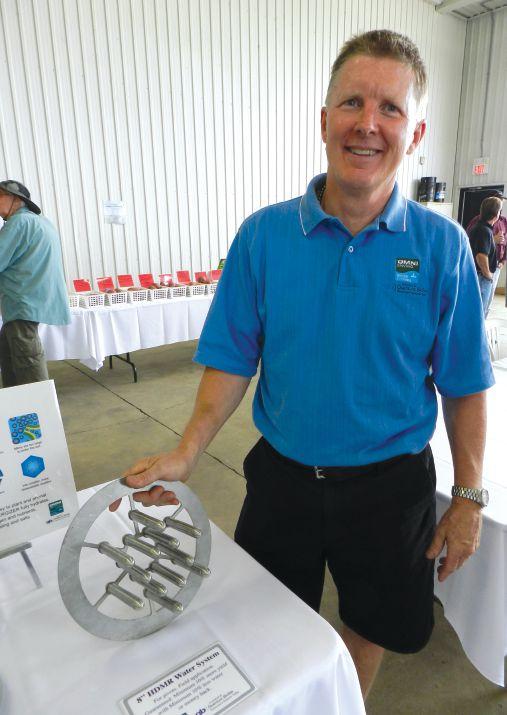
The omni enviro Water System claims to improve crops using magnetized water and anecdotal evidence is showing the company’s claims are valid. Based on the principles of molecular physics that say water molecules will bond together creating clusters that are too large to be absorbed by plant cells, the omni enviro system breaks up the clusters using magnetic fields and makes them smaller and more easily absorbed by the soil and the plant.
“It certainly does something, but I can’t say how,” admits Wayne Baerg, a crop consultant from Winkler, Man., who suggested three of his clients try the system in irrigation systems for potatoes or in a sprayer. “I did talk to growers in the United States before I recommended it.” now that he has seen the system work over a couple years, Baerg says he would suggest growers try it, but they will have to determine whether it is cost effective for their operation.
The system requires a magnetic unit be installed on the water line and, according to garry Fenton, the Canadian president of omni enviro, the magnetic field breaks down the water molecule clusters that will then permeate the soil better. “We have typically seen a minimum of 10 per cent improvement in water usage,” Fenton says. “The plants become more hydrated, hard water is broken down to micronutrients more available to the crop, which cuts down on the need to add micronutrients in the fertility program and, ultimately, it will improve the condition of the soil.”
Baerg says he saw an improvement in the soil at one client’s farm. Faced with high salinity, the grower decided to try omni enviro on his irrigation pivot. The grower left a wedge-shaped check in the pivot’s revolution and Baerg says the difference in the soil quality was measurable.
“We also found the crop didn’t use as much water with this
gary Fenton holds a magnetic unit that would fit on an irrigation pivot.
system,” Baerg continues, “which can be a cost saving. In fact, you may need to learn to use less water.” another of Baerg’s clients used a two-inch-diameter omni enviro unit on a sprayer and discovered that his herbicides were more effective. The grower saw weeds controlled that were not on the herbicide’s label and those that were on the label had a higher control than normal. “It was dramatic,” admits Baerg.
Photo by
Pu Sh ING Ou T P OTATO V IRu S y
Why does mineral oil prevent PVY from migrating into the plant once aphids are present?
by rosalie I. Tennison
Seed potato growers wage a continuous battle against potato Virus Y (pVY) both economically and physically. The most effective way to control the virus is to plant pVY-free seed, but the challenge for seed growers is keeping the virus from infecting the crop. Spread by aphids, it can take only minutes for a plant to become infected once an aphid lands on it and probes it to see if it is a suitable host.
While planting clean seed is the best way to prevent the spread of the virus, other cultural practices, such as crop rotation, will minimize infection. However, another somewhat expensive but effective means of controlling pVY is to keep the crop coated with mineral oil. a method used mostly by seed growers, spraying the oil reduces the spread of pVY. Scientists don’t know why or how mineral oil works, but they are working to find out.
Dr. Sebastien Boquel, a research scientist from Comité nord Des producteurs de pommes de Terre (an association of seed potato growers from France) posted at agriculture and agri-Food Canada (aaFC) in Fredericton, n.B., has launched a study to explain why the oil works and to determine if there is a more economical means of using it. He explains that most research on the use of mineral oil proves that it works, but the reason why the strategy is effective is unknown. It is possible the oil affects the aphids similar to an insecticide or that the oil modifies aphid behaviour, reducing the ability of the insects to transfer the
ABOVE: Researchers know that keeping crops coated in a mineral oil solution reduces the spread of PVY, but why it works is another question that Dr. Sebastien Boquel is working to answer. TOP: In this experiment, Boquel mixed mineral oil with dye and viewed the plant under a UV light to research how mineral oil penetrates the plant.
C O - ORDINATING C Oll A b ORATION
Community/group rotation is a smart practice that pays off.
by Treena Hein
Group rotation – also called community rotation – is the practice of potato farmers working with their neighbouring growers to rotate their crops so their potato fields don’t come in contact with one another, or come in contact less often, helping keep disease and pests under better control. It also includes co-ordinating rotation so that planting of potatoes right next to neighbours’ fields where potatoes were just harvested is avoided.
With regard to some insect pests, Dr. Christine noronha says that even planting potatoes a few hundred metres from where potatoes were last harvested can make a difference in their management. “The further you put a food source away from the pest’s stronghold, the more you will reduce the pest population,” observes the pest management scientist at the agriculture and agri-Food Canada Crops and Livestock research Centre (aaFC CLrC) in Charlottetown, p e.I. However, for this strategy to really be effective, she says, area-wide collaboration is needed. group rotation is a concept worth looking at further, agrees
Dr. Vernon rodd, a soil and water management scientist at aaFC CLrC. “If you had a field with a pest like wireworms, it would be a good idea to tell your neighbours so that they can mitigate accordingly,” he says. rodd adds that because some potato pests are on the rise, group rotation discussions may become increasingly important in the future.
Discussions occurring?
Brian Beaton, the department of agriculture and forestry potato co-ordinator for prince edward Island, has not yet heard of any group rotation on a whole community basis. “Here on p e.I.,” he says, “we have so many fields that are smaller fields and are farmed by different growers, and it is difficult to co-ordinate on a community basis.”
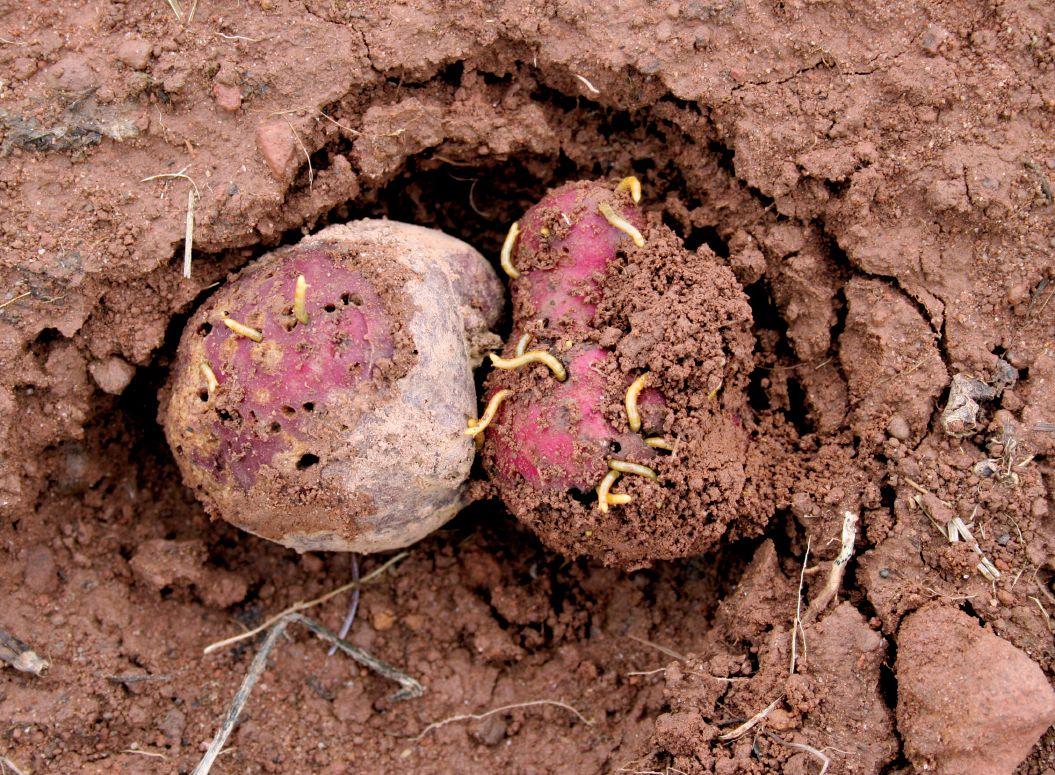
ABOVE: As potato pests, such as wireworms, become more common, group rotation discussions are becoming more and more important.
With a unique mode of action, pests can’t escape the crosshairs of Closer™ insecticide. Not only does it control aphids in vegetable, fruit and potato crops, but other sap-feeding insects as well. Try Closer first in your IPM program and see for yourself. Visit dowagro.ca.
Kevin MacIsaac, general manager of the United potato growers of Canada, says he has heard of some producers on p e.I. doing group rotation with seed potatoes, and that it’s actually fairly common in seed-growing areas. Dave Francis and his neighbours in the area of Lady Fane are among those who try to co-ordinate with one another. Francis grows about 70 per cent seed potatoes, with the rest being a small chip contract. “We have a lot of unofficial meetings,” he notes. “We try, so that if someone is planting a processing variety, [we] look after our neighbours who are seed growers in terms of [helping control the] common mosaic virus. In this area, in most cases, we grow both processing and seed potatoes and are very concerned about seed. We try to produce the very best we can.” He says in an area like p.e.I., where potato growing is so concentrated, working together is the best thing.
rodd says that while he hasn’t heard of group rotation discussions among commercial potato producers, he has heard of some among organic growers. Dr. eugenia Banks, potato specialist with the ontario Ministry of agriculture of Food (oMaF) and Ministry of rural affairs (Mra), says it would be of particular benefit to both
types of growers to rotate their fields so that organic and conventional fields are not planted close by. “This is very important to reduce the risk of late blight,” Banks says. “Late blight is a community disease because spores are spread from field to field by the wind. organic potato growers have access to only a limited number of crop protection materials under organic production regulations. There are, in contrast, several fungicides that conventional potato growers can use that will reduce the incidence of late blight with timely applications.”
mandatory rotation and erosion control
on p e.I., where potato growing is very concentrated, the Department of agriculture and Forestry recommends that potatoes be grown no more frequently than one year in three, unless the producer has an alternative plan that will maintain soil quality, and that such a plan be approved by a qualified government soil engineer. In other areas of the country, where potato production is usually not as concentrated, there is not as much need for, or discussion of, recommending mandatory rotation. MacIsaac confirms this, as does Don Brubacher, general manager of
the ontario potato Board. “nothing mandatory at this time and there has been no discussion regarding this,” Brubacher says. “My perception is that growers are doing a pretty good job.”
Banks says a one-year-in-two rotation is practised by most commercial ontario potato growers. “To maintain/ improve soil quality, farmers seed a rotational crop immediately after harvest,” she notes. “grains such as rye and wheat are the most common rotational crops. rye has been the most popular cover or rotation crop for potatoes, especially for light soils.” Banks explains that rye, unlike legumes, does not need a high pH and is very competitive with weeds. “It is one of the best plants to prevent nitrate leaching in the fall and it is a good source of organic matter,” she says. “rye is also very tolerant of low winter temperatures.”
There is also restriction on p.e.I. concerning growing potatoes on field inclines above a specific grade. “It causes too much erosion,” says MacIsaac. Beaton adds “We have provincial legislation that states regulated crops cannot be planted on a slope over nine per cent that is one hectare or greater in size. In order to minimize soil erosion, there are many factors that come into play, and every field is different.”
MacIsaac is surprised that, given the steeper sloped ground in new Brunswick, they have no such restrictions in that province. Valerie Kilfoil, director of communications at new Brunswick’s Department of agriculture, aquaculture and Fisheries, confirms that there are no regulations to that effect at this point. She notes that best management practices relating to erosion are encouraged, including terraces. Funding for terraces in new Brunswick has been available for some time under growing Forward I and II funding schemes.
For more on agronomy, visit www.potatoesincanada.com
group rotation (or community rotation) can be difficult to co-ordinate, says P.E.I. potato specialist Brian Beaton, but the strategy is most effective when the entire community collaborates.
Photo
TA k ING T h E TI m E TO GET IT RIG h T
Spraying on a schedule may be convenient, but it might not be the most effective way to control weeds.
by rosalie I. Tennison
Growing potatoes is an intensive business. With so many variables to control to ensure crop success, it may seem simpler to keep a schedule; for example, spraying for all weeds when they are at an average stage of development and then spraying for disease every Monday. But, according to a weed management specialist with ontario Ministry of agriculture and Food (oMaF) and the Ministry of rural affairs (Mra), this is not the best way to control weeds effectively – and maybe not even economically.
Kristen obeid’s strategy on enhanced weed management offers a step beyond what has often been referred to as “integrated” weed management, as she demonstrated at the ontario potato Conference in March 2013.
obeid says she is called to farms to help growers understand why their herbicides fail. She says it is usually not the fault of the product, but rather a lack of understanding on the part of growers of how to make the best use of the herbicide. “For example,” she says, “hilled potatoes mean there is in an increase in the area that has to be touched by the herbicide.” She explains that weeds
grow up the sides of the hills and growers don’t adjust the height of their sprayer to accommodate the increased area. Some have the booms set to spray a flat field, but a hilled field is not flat and the boom should be raised. In addition, the hills create a larger surface area to spray. This is something growers don’t often take into account, and they instead compensate by increasing the amount of spray needed. In a simple example, across a 12-acre field, the hills might increase the actual surface area that needs to be sprayed by 33 per cent, so a grower would need enough spray for 16 acres.
But, increasing the amount of herbicide for an increased surface area is not enough, according to obeid. She says if she could encourage growers to take the time to do one operation well, it would be to maintain the sprayer every year. “Sprayers need to be calibrated every year,” she says. “growers also need to use the
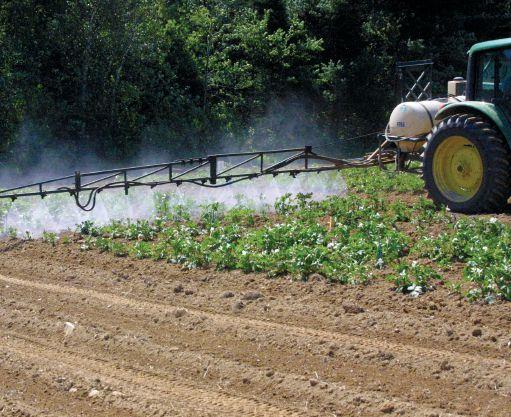
ABOVE: A hilled potato field, as shown above at the Agriculture and Agri-Food Canada research farm in Harrington, P.E.I., creates a larger surface area that requires spraying.
Photo
Nightshade, black
Nightshade, hairy
Purslane, common
Ragweed, common
Bindweed, field (seedling)
Bindweed, field (perennial)
Nutsedge, yellow
Thistle, Canada
** Control or partial control on US labels
Ratings Legend C = Control; P = Partial Control; N = No Control; - = No Information Herbicide Legend
GLY = glyphosate (Roundup) PAR = paraquat (Gramoxone)
correct water volumes for every product. I see some growers using the same calibration for every product, but each label has specific water volumes for that product and what it will control.”
Herbicides aren’t the answer to all weed problems, obeid admits. Herbicide resistance is a constant issue facing potato growers, but just rotating herbicides to minimize development of herbicide resistance isn’t the only solution. She says growers need to do what they can to ensure the health of the entire system from soil to crop.
“Scout fields regularly and identify all the weeds present so you can use the right control for the weeds that are present,” obeid advises. “You have to actually walk into the field and have a look at what weeds are there and correctly identify them. Then, you need to practise good rotation to break up the weed cycle, which could help minimize what herbicides need to be used. Unless you know what you have, it’s hard to manage it.”
obeid says the resistance problem will continue to increase because current chemistries available for use in potatoes have only a few modes of action, increasing the selection pressure on weeds, which eventually results in resistance development. With no new products expected in the near future, managing the ones that are available now increases in importance.
“Weeds grow quickly and you have to stay on top of it,” obeid says. “You need to know the stage they are at in order to plan control, and waiting until you appear to have an average stage of weed development and do one pass may not be wise. Saving passes over the field may end up costing you money in yield.”
Weed management is a complicated process, according to obeid, but it can be done by focusing on it and developing an
= pendimethalin (Prowl)
effective plan. obeid’s steps include scouting each field, identifying each weed in that field and noting what stage they are at, determining if pressure is great enough to warrant herbicide action, choosing a herbicide, ensuring the water volume is correct for the actual surface that has to be covered, using the correct water volume for the product chosen and calibrating the sprayer. When a plan is developed, it is much easier to follow from year to year and it becomes a habit to do everything right, ultimately leading to successful crop development, reduction of potential resistance development and protection of the environment.
“Farmers are the smartest people on the planet,” obeid says. “They know chemistry, biology, engineering, mathematics, so they can do all this.” But, she adds, some think they just can’t spare the time to set up an enhanced weed control system and then stick with it. If they did, they would be improving crop success and, perhaps, saving money.
P OST-hARVEST STORING STRATEGIES
The ins and outs of potato storage.
by Melanie epp
Post-harvest potato storage expert Todd Forbush of Techmark Inc. in Lansing, Mich., says quality potato storage requires just two things: quality storage facilities and quality potatoes to store.
“ neither will meet their potential without both working successfully together,” he says.
The first step is to evaluate your existing facility to decide if it needs just an upgrade or something different entirely. When evaluating an existing structure, you need to look at its location, the structure itself, its insulation system, its ventilation systems and the controls.
From a location perspective, your operation should be situated near the production point to minimize transport costs, preferably on a road that has 12-month access. also, it should be located where there is sufficient electrical power supply, specifically three-phase power, which Forbush says is an important piece of the puzzle.
In terms of size, you need enough rooms to hold each variety. The rooms should also consider the climate that you’re
harvesting from, and the timeline you’re working with. “We want one variety in there, we want to fill that bin in three days’ time, and we want to be able to sell that crop in less than three weeks,” says Forbush.
“If it takes you too long to fill that bin of potatoes, you’re going to have a lot of diversity as far as the harvest conditions that you went through and those are going to come back and cause losses in storage. and losses in storage are losses right across the bottom line.”
When it comes to potato storage, insulation requirements say that you should have an r-value of 45-60 in the ceiling, an r-value of 35 to 40 for the sidewalls, and high to low-density materials from the inside out.
“You don’t want to trap moisture in those walls,” says Forbush. “So what happens is we’ve got a moist, warm environment inside the building. If you let that moisture get into the insulation
ABOVE: Variety of potato, harvest and management practices and the environment all play a role in storage performance.
system it’s going to condense at some point after. If it condenses near structural material, it can compromise it. It’s important that once that moisture moves into the wall it can move out.”
Ventilation 101
“Why is it that we have a ventilation system in potato storage?” Forbush asks.
a ventilation system in the storage system is imperative for creating a uniform environment, while at the same time maintaining proper potato temperature. providing oxygen is necessary for respiration and removing carbon dioxide from respiration.
a poorly designed ventilation system can cause air to be pulled from and directed to the wrong places in your bin. The result is non-uniform ventilation. There are industry-accepted standards for designing and evaluating ventilation system performance in potato storage. air takes the path of least resistance, Forbush says. If you’re not sure whether or not your air is going where you want it to go, measure it. remember, your ventilation system’s airflow is a function of its design. By quantifying the flow of air through your bin you’ll know just where your system needs improvement.
according to Forbush, a well-designed ventilation system includes these attributes:
• adequate airflow 1.25 to 1.5 cfm/cwt for table stock and process potatoes (25 to 30 cfm/ton)
• inlet and exhaust max of 1,400 ft./min.
• main air plenum maximum of900 ft./min.
• lateral duct maximum of 1,000 ft./min.
• slot duct max of 1,200 ft./min.
To calculate where the air is going in your storage space, collect the following information to determine airflow: fan size, horsepower and manufacturer; bin capacity (L x W x potato pile height); plenum area (the chamber prior to the potatoes); fresh air, return air, exhaust air and humicell area; duct area (pipe or flume size and quantity); and slot area (type of slot guarded or not).
Here are example calculations of a well-balanced bin:
• Bin size: length = 200ft; width = 50 ft.; pile height = 16 ft.
• 200 x 50 x 16/2.5 = 64,000 - (factor for pile slope) = 60,000 cwt storage
• Fans: Two to 48-inch;15 hp aerovent = 78,000 cfm
• airflow equals cfm/cwt:
• 78,000/60,000 = 1.30 cfm
“The most important thing is to make sure that your air system in your potato storage has even airflow throughout the entire storage,” says Forbush. “The most common mistake would be in the sizing of air ducts and slots – the entry point for the air system into the potato pile. The most commonly missed number is the number that determines that the air’s moving at the correct speed going into the pile.”
“The key for slot design is the slot design provides that back pressure, which then gives you uniform airflow,” he continues. “So if you don’t have uniform back pressure, you don’t have uniform airflow.”
If the slot area is pipe, measure the size, number of rows and distance of holes drilled in the pipe to determine the slot area. If flumes are used, measure the board width and amount of open space between each board.
“ poor slot design can cause a defect called pressure bruise, which is excessive evaporation,” says Forbush. “and even with a proper humidification system, if the slot is designed incorrectly, the air can’t carry that water into the potato pile. So poor slot design can also lead to this pressure bruise issue, even with good humidification equipment.”
Creating the perfect potato
The potato itself is the second part of a quality potato storage equation. Several factors affect storage performance, including environment, agronomy, varietal traits, disease and harvest and management practices. But the most important factor in determining storage performance is variety.
“Varietal traits give us a starting point for understanding the strengths and weaknesses of the crop going into storage,” says Forbush. When choosing a variety, look for such traits as yield, specific gravity, sugar profile in storage, bruise resistance and disease resistance.
Weather also plays an important role in storage performance. g rowers may not be able to control the environment, but soil conditions and agronomy are controllable.
“[These factors] come together to create the fingerprint or the way the genetics are expressed for that potato,” says Forbush. “g iven those four things, you’re then going to determine how those impacted each other, and you do that with what’s called pre-harvest sampling.”
pre-harvest data is a valuable piece of the “complete picture” of your tubers’ maturity and storability.
“Determine how those four main pieces come together in any given season and then determine what the best storage practices are, given the way those four variables impacted the crop’s genetic expression.” For more on agronomy, visit www.potatoesincanada.com
The sensor shown above monitors temperature and humidity in the storage facility – one storage factor growers can control.
Photo by Janet Kanters.
IT ’S SOm ET h ING IN T h E wATER
Continued from page 16
“The unit paid for itself more than once after one season of use in the reduction of chemical needed.”
“Using a unit on a sprayer cuts down on the amount of water needed,” Fenton adds. “We have also seen that treated seed has improved emergence and yield.”
omni enviro units are sold according to the diameter of the plumbing with the cost starting at $400. a sprayer may need a two-inch unit, while an irrigation pivot may require a six-inch or eight-inch unit. The units will fit any irrigation or spray system.
There is ongoing research on the value of using magnetic fields to improve water for crops, but much of it is being done in europe. So far, there has not been much recently published research in north america. However, as Baerg reports, his clients who have used the system are seeing a difference and they believe in it without the empirical evidence to prove that what they are seeing makes scientific sense.
“We didn’t really see any significant yield improvements from using the units, but the improvement in the soil
and the effectiveness of the herbicide application made a difference in the crop,” says Baerg.
after being impressed by what he saw in cornfields during a trip to Kansas, Fenton decided to introduce omni enviro to Canadian growers. “a corn farmer in Kansas with 10 irrigation pivots put a unit on his worst field and saw a yield increase of 34 bushels per acre.”
Vegetable growers across the United States have given testimonials to the value of using omni enviro, so it may be one of those tools that science has yet to fully explain. It could be similar to grandpa complaining that his lumbago acts up every time it rains: there is no scientific evidence to prove a connection, but who is going to argue with grandpa? If omni enviro does, in fact, improve water usage, it could be another step towards successful management of a diminishing resource.
PuShING OuT POTATO VIRuS y
CONTINUED FROm PAgE 17
virus into the plant. another possibility is that the oil reduces the ability of aphids to acquire the virus from an infected plant. It is also speculated that the oil inhibits the movement of the virus into the plant. Boquel believes that, if he can determine how the oil works, he may be able to recommend more economical ways to use the oil while getting the same effectiveness.
“We are trying to determine the mode of action of the oil and explain how it works,” Boquel says. “We know that within one week of spraying the oil, there is pVY control, but we don’t know how it works on the plant to reduce the transmission.”
Boquel is also working to determine how much oil is needed and at what concentration to get good control, which could reduce the costs to seed growers. There has been concern that even though the mineral oil is food grade, it could be toxic for plants. In his research, Boquel deliberately sprayed the crop with high concentrations of oil to try to learn at what point toxicity became an issue.
“We tested the phytotoxicity and proved the oil can be used safely,” he reports. “We sprayed at 160 l/ha in an attempt to deliberately kill the plants and they still produced tubers and did not die.” It is recommended that growers spray mineral oil at 10 l/ha, which has no phytotoxicity at all.
Some growers try to cut back on the amount of oil used to economize. But, Boquel says, not using the oil is not an option and seed growers need to keep the plants coated throughout the growing season in order to ensure the virus is not transmitted or at least transmitted to a lesser degree. He also considered modifying the amount of oil used at various times
of the growing season.
“We studied increasing the amount of spray early in the season and then modulating the concentration across the remainder of the season,” Boquel explains. “Within the first four weeks, spray at 15 l/ha and the following three weeks spray at 10 l/ha, and then continue to the end of the season spraying five l/ha. The same amount of oil is used during the season but at different concentrations. The high concentration is needed at the beginning of the season because the plants are growing fast and applying a higher concentration might insure good control of the virus.”
Meanwhile, Boquel continues to study mineral oil in an attempt to determine just how it works to prevent the spread of pVY. If he can identify the mechanism that is working to prevent the virus from transferring into the plant or moving to the tuber, it could be possible to formulate other means of using that mechanism in the future that might not require the intense spray schedule. as well, knowing the mode of action of the oil could prompt an update of the current recommendations given to growers, which may result in a more economical way of using it. He expects to have more answers within a couple more years.
“Mineral oil is a very important tool for seed potato growers because they need to have pure seed to sell,” Boquel says. Therefore, understanding how it works could be a major breakthrough in pVY control. even though mineral oil has been used to minimize pVY infection by aphids since the 1970s in France, identifying its mode of action could give growers the opportunity to use it even more effectively.
PILE UP YOUR PROFITS
Protect your potatoes AND your profits.
MANA Canada offers four products to protect your potato crop and maximize your production, utilizing the same actives that you already rely on. MANA Canada is the right choice for providing optimum control of grassy weeds and pests like Colorado potato beetles, leafhoppers and aphids.
Support choice: ask for MANA Canada products by name.