K-Mag® fertilizer has been responsible for higher crop yields and paying dividends for more than 70 years. It’s a unique 3-in-1 fertilizer that combines potassium, magnesium and sulfur, to provide performance with payback. It’s in the sulfate form so the nutrients are readily available when crops need them. This means better quality and superior performance at harvest time, because crops have an advantage right from the start. Ask for K-Mag. The trusted 3-in-1 fertilizer.
TOP CROP MANAGER
18 | An adaptable crop may be put to the test
As the climate changes, scientists suggest potatoes will thrive in northern climates. By Rosalie I. Tennison
PESTS AND DISEASES
A little mist goes a long way By Rosalie I. Tennison
FERTILITY AND NUTRIENTS
Biomarkers for crop stress By Rosalie I. Tennison
20 | What ever happened to Lady Christl? Why are some varieties more acceptable than others?
By Rosalie I. Tennison
Gold: The potato that keeps on going
Genetic diversity: better potatoes By Rosalie I. Tennison
BLACK DOT IS A COMMON DISEASE in potatoes. It is most often found on tubers but can affect all parts of the plant. Syngenta Canada Inc. is pleased to announce that Quadris Fungicide has added it to its label for use on potatoes. www.topcropmanager.com
23 | Predicting rot can save the crop and money
A simple test can identify potential risk of storage disease. By Rosalie I. Tennison
CROP MANAGEMENT
Back to the basics: Paying heed to essentials By Treena Hein
FROM THE EDITOR
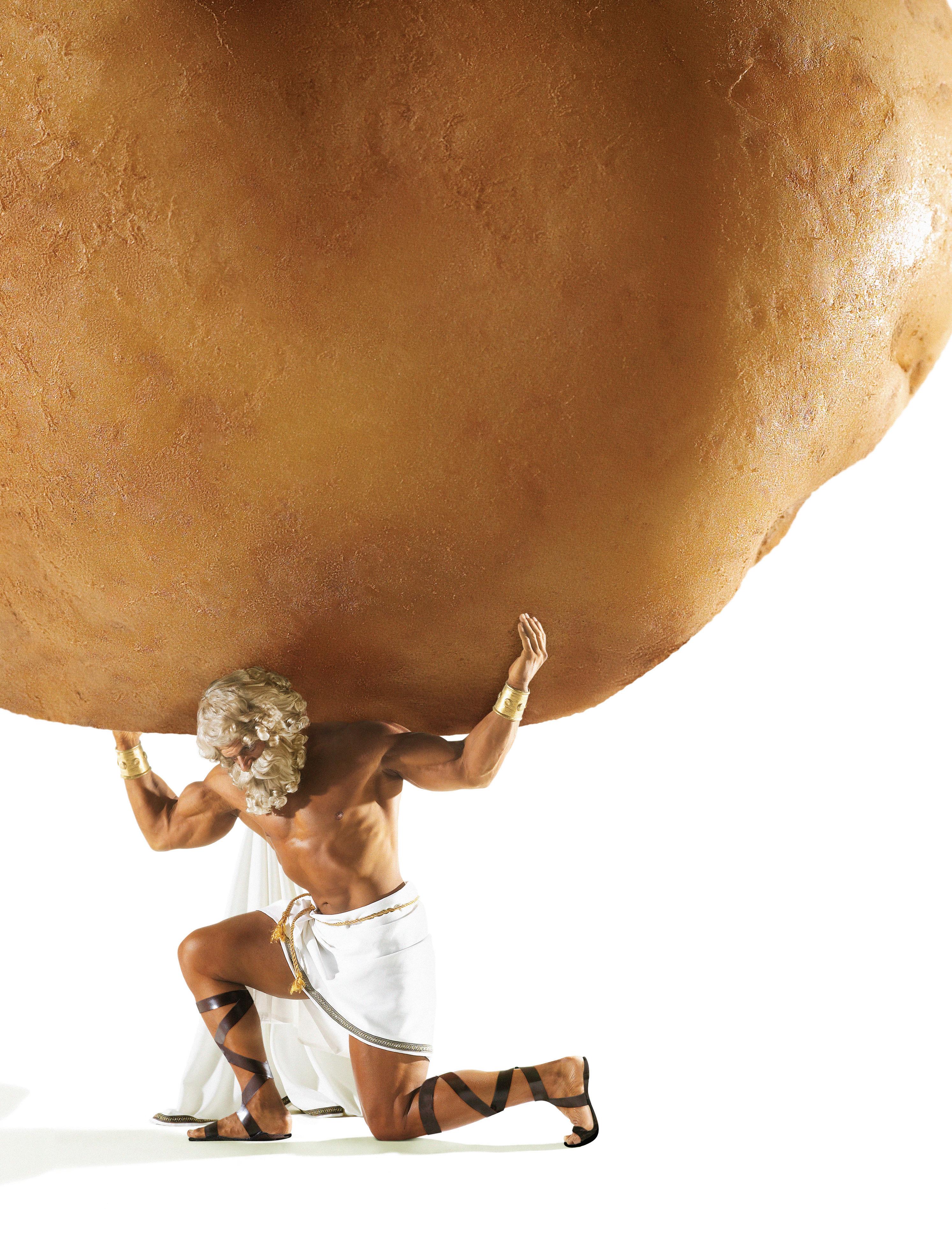
Potato misinformation continues By Margaret Land
MARGARET LAND | GUEST EDITORIAL
POTATO MISINFORMATION CONTINUES
Potato producers might have thought they’d finally beaten the anti-potato movement with the decrease in hype over the Atkins diet, that “avoid carbohydrates” fad weight-loss method of the mid-2000s. But it would appear the bull’s-eye continues to be pointed at the humble table tuber.
While the U.S. government has required action from the Senate to protect the white potato from being banned from school lunches across the U.S., here in Canada criticism of the starchy vegetable has been pretty quiet. Until now…
At the start of the school year in 2011, school officials at Sir Charles Tupper Elementary School decided they’d seen enough of the tasty tubers in school lunches. CBC News heard of the issue in early 2012 and, according to the resulting article, the south-end Halifax public school sent home a list of “unwelcome” food items, explaining that these foods could cause life-threatening allergic reactions to some of the students attending the school. While that might make sense for peanuts, tree nuts and eggs, potato and potato products such as potato chips, potato salad, hash browns, fries and mashed potatoes – all included on the list – seemed a bit far-fetched.
A Toronto Star reporter obviously felt so too and decided to contact the school. According to principal Paula Hoyt, a student at the school is allergic to “any type of potato vapour.”
According to the CBC article, Dr. Sandy Kapur, a pediatrician with the Halifax Allergy and Asthma Associates, said it’s very rare for a child to have an allergy to cooked potatoes. While raw potato allergies make sense – potatoes are related in part to grass pollens –allergic reactions to cooked potatoes do not.
So how rare is it to be allergic to cooked potatoes, especially vapours? According to the Annals of Allergy, Asthma and Immunology – which describe research on a possible allergic reaction to hotdog “vapour” – “asthma induced by the inhalation of food vapours is unusual and indicative of extreme allergy.”
And according to other allergy experts, it is usually found in people allergic to seafood, not potatoes.
Anyway, I digress. What this example shows and what potato producers have been noticing for years is there’s a lot of misinformation in the public about the potato and backlash against the vegetable. As Rosalie Tennison outlines in her article “Stepping up to the plate,” which appears in this issue, “there is a general feeling that better consumer education is needed to keep potatoes on the plates of consumers and make them mindful that potatoes are a healthy food choice. Through no fault of theirs, growers have to fight the perception that potatoes are high in carbohydrates and that french fries are greasy and unhealthy.”
And now they have to fight the perception that potato vapour is dangerous to elementary school children. How did the human race ever survive up to now?
MANAGER
POTATOES IN CANADA FEBRUARY 2012, VOL. 38, NO. 2
GROUP PUBLISHER Diane Kleer dkleer@annexweb.com
EASTERN SALES MANAGER smccabe@annexweb.com
WESTERN SALES MANAGER kyaworsky@annexweb.com
SALES ASSISTANT
mburnie@annexweb.com
PRODUCTION ARTIST Kelli Kramer
GROUP PUBLISHER Diane Kleer dkleer@annexweb.com
PRESIDENT Michael Fredericks mfredericks@annexweb.com
CIRCULATION
e-mail: subscribe@topcropmanager.com Printed in Canada
CIRCULATION e-mail: subscribe@topcropmanager.com
A LITTLE MIST GOES A LONG WAY
A system new to Canada saves potatoes in storage.
by Rosalie I. Tennison
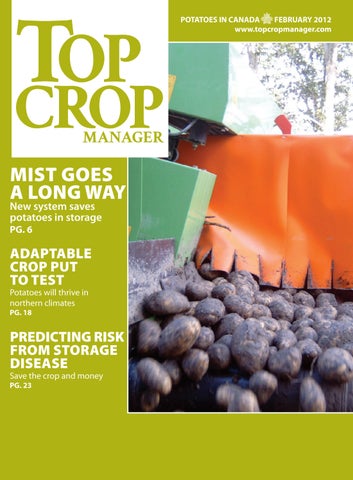
Ever have a bin where, despite your best efforts to prevent rot, all you see are spoiled potatoes when you open the hatch? Applying fungicides or sprout inhibitors as the potatoes are placed in storage are obvious solutions, but what if the problem is the application or amount of the used product? Despite growers’ expertise, the method used for applying products as the tubers are placed into storage may be the problem.
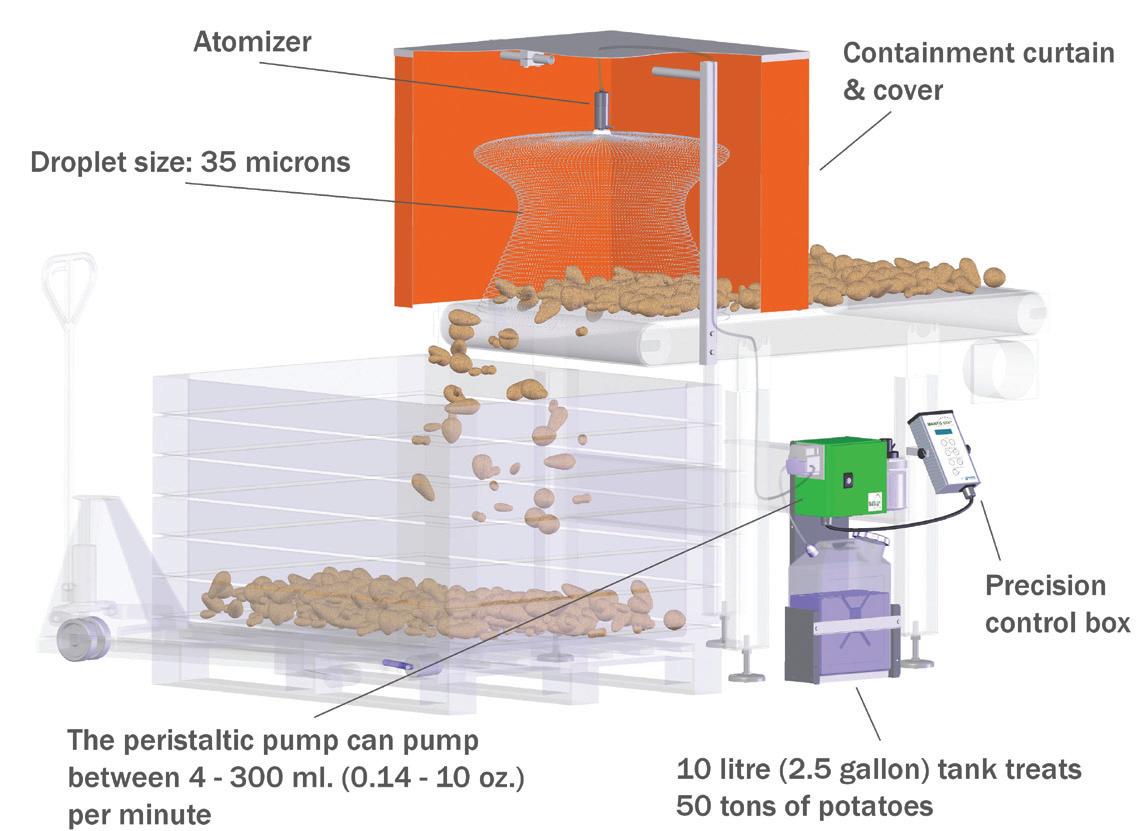
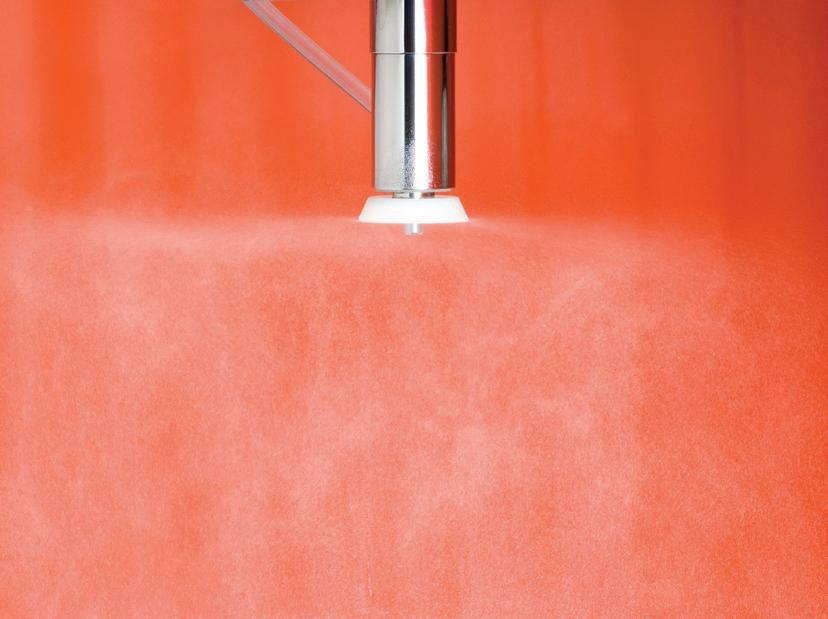
In 2010, Mankar Distributing Inc. in Woodstock, Ontario, introduced the Mafex ULV Fine Spray Unit to potato growers. Designed to apply liquid pesticides and sprout inhibitors in a fine, almost invisible mist, the easy-to-use system has been widely tested in other potato-producing countries for more than 30 years. The volume applied by the system (ULV stands for Ultra Low Volume) is so low that one grower who used it in fall 2011 was concerned about coverage.
“It is portable and adjustable and we can regulate how much product is going on. It provides such a fine mist that the potatoes don’t get wet.”
“It puts on such a low rate that the potatoes don’t look wet going into storage,” comments Ruth Ploeg, a potato producer near Alliston, Ontario. She says that once her company, Sunrise Potato Storage Ltd., began applying fungicide with the Mafex system, they were not sure that the product was actually on the potatoes because the potatoes still looked dry. This is the first year that Sunrise used the Mafex system, and they are waiting to see how the potatoes fare through the winter in storage.
“The main benefit to growers is the more uniform coverage in terms of treating the whole potato and the reduced amount of moisture being put on the potato,” explains Nick Stam of Mankar Distributing Inc., the company that introduced Mafex to Canada. “There is less waste using this system because there is no runoff due to using a higher volume of water mixed with
<LEFT: “There is a lot less waste using this system, which offsets the initial set-up cost because product will be going on the potatoes and not running off,” explains Nick Stam of Mankar Distributing Inc.
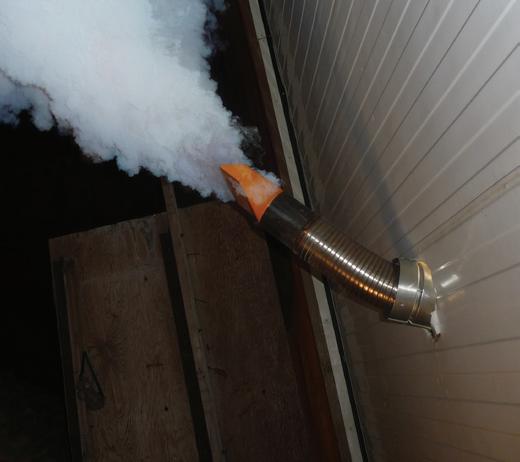
BOTTOM: The Mafex ULV Fine Spray Unit can apply liquid pesticides and sprout inhibitors in a fine, almost invisible mist.
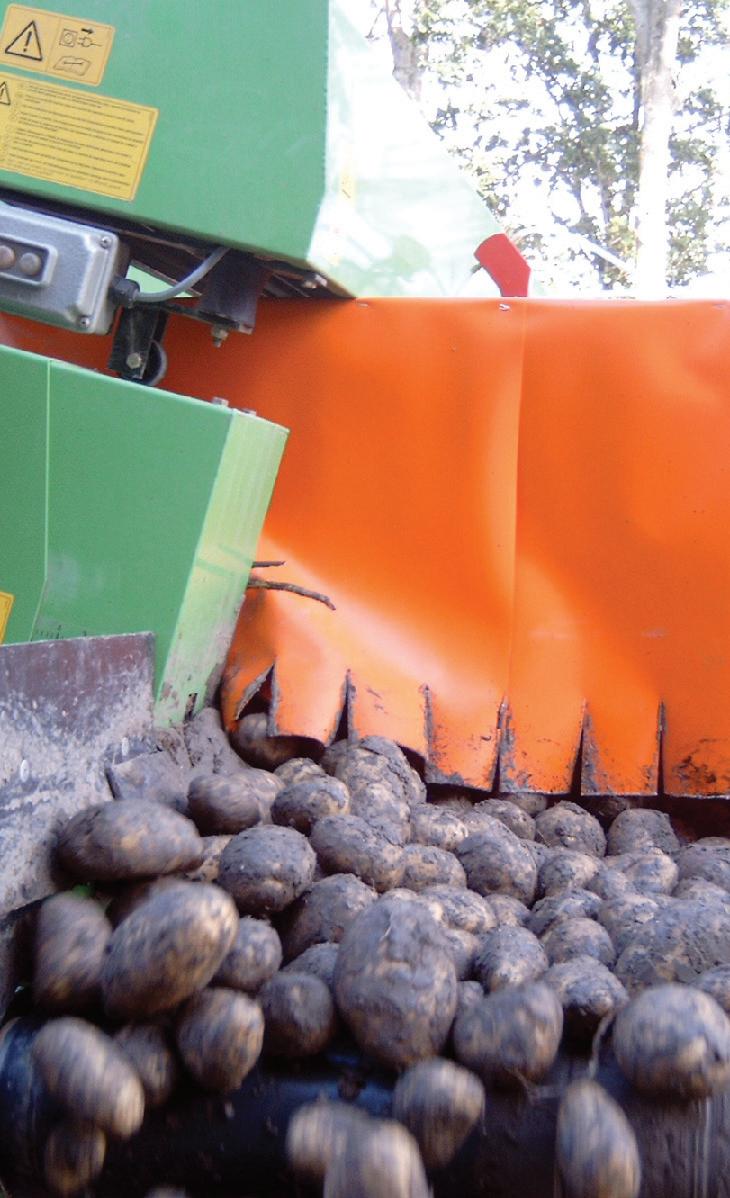
<LEFT: The Mafex system sprays such fine droplets that some farmers have raised concerns about the potatoes not being adequately covered with product.
the product. Growers can safely use the label recommendations for their product of choice and still get good coverage without the added moisture that is common with other systems.”
Neil Kitchen, a grower near Delhi, Ontario, uses the Mafex system to apply sprout inhibitor on his tablestock potatoes going into storage and during packaging. Kitchen says very little sprout inhibitor is needed and spreading 900 millilitres of product across 2,200 pounds of potatoes in a short time can be challenging. “It’s a versatile little machine,” he says. “It is portable and adjustable and we can regulate how much product is going on. It provides such a fine mist that the potatoes don’t get wet.”
The Mafex operates on a system of centrifugal force using a rotation disc that distributes roughly 30 million droplets per millilitre of liquid. The droplets are deposited uniformly through a vertical air stream, the workings of the disc and the movement of the potatoes on the belt.
Ploeg says the unit was easy to install and was used on half the company’s crop of processing potatoes. “It just hooks up and you press two buttons to get started,” she says. “The unit also gives a warning if the spray stops to prevent an insufficient amount of product from going on the crop.”
The system includes a computer that allows the operator to control the volume of product being applied and to monitor the action of the atomizer.
“Moisture is such a big issue in this industry and we think we have a solution,” comments Stam. “There is a lot less waste using this system, which offsets the initial set-up cost because product will be going on the potatoes and not running off.” He says potato producers can expect to pay between $4,000 and $4,500 for an initial system.
Kitchen says he was interested in this technology and had been researching it. He is happy it is now available in Canada, and it turns out it is “perfect” for his small operation. “We need smaller, regulated amounts of product, and this works for us,” he explains.
Growers storing potatoes over the winter, who worry about sprouting and rot, will find the Mafex gives them more confidence the crop will survive the long months of storage. By storing drier potatoes, risk is reduced along with the normal problems of storage.
In this case, a little mist goes a long way to protect a valuable crop.
BIOMARKERS FOR CROP STRESS
National research is examining gene expression as a tool for identification of nitrogen or water deficiency.
by Rosalie I. Tennison
Potato research in Canada is a mixture of puzzle pieces with each project aimed at defining one puzzle unit. An Agriculture and Agri-Food Canada (AAFC) scientist is taking all the pieces and fitting them together to address crop stress. The objective is to develop tools for identifying sources of crop stress that will guide in-season management of potatoes. The research targets detection of nitrogen and water deficiency to give growers the ability to adjust inputs to the crop.
Using research results gathered from AAFC Research Centres across Canada and from partners at the University of Saskatchewan and the International Potato Centre in Peru, Dr. Helen Tai and a team of researchers are developing a tool that identifies what is causing the stress. The tool will also assist breeders to develop breeds that are nitrogen efficient.
“There are economic and environmental issues surrounding nitrogen management in potatoes,” Dr. Tai explains. “Fertilizer use presents an additional input cost for growers. Nitrate leaching and nitrous oxide emissions resulting from excess nitrate fertilizer use are an environmental problem.” An additional complication occurs under drought conditions because plants will undergo nitrogen deficiency even if sufficient quantities of nitrate is present in the soil since there is no water to solubilise it. So, indicators of both nitrogen and water use stress in potatoes are being developed.
“We are trying to develop a gene expression diagnostic tool that will help us measure the stress in a plant and, eventually, in a field that will help growers use water and nitrogen more efficiently,” Dr. Tai continues. Gene expression diagnostic tools are currently being used in medicine and adopting these technologies for agriculture is part of Dr. Tai’s research. The team is conducting field studies in Alberta, Saskatchewan, Manitoba, Quebec, New Brunswick, and Peru. These studies will examine the performance of the gene expression diagnostic across conditions of drought, variable nitrogen
sources, and different potato varieties.
“We hope to demonstrate the utility of gene expression diagnostic biomarkers for crop management by the end of the project in 2013, but it will be longer than that before growers will be able to access the test themselves,” admits Dr. Tai. “What gene expression diagnostic offers is the potential to test for multiple stresses in one go. For example, drought, nitrogen and disease testing can be done all at once to allow growers to make better management decisions.” Stress can be caused by many factors, she explains, but, if growers can have more accurate determinations of what is causing it, they could make corrections before crop development is affected.
Dr. Tai admits that the tool will not solve all problems, but it is a step towards developing more efficient use of fertilizer inputs that can reduce the environmental impact of potato production. She suggests that growers can use the diagnostic tools to optimize use of fertilizer to plant needs rather than by scheduled applications.
The development of this molecular tool will give other researchers assistance with their research and what has been learned during its development can be used in other applications as well. Dr. Tai says work being done at Outlook, Saskatchewan, is focussing on varieties that are tolerant to lower levels of nitrogen and comparing them to varieties that require higher levels. The gene expression diagnostic tool is being developed for indication of nitrogen use efficiency at this site and will be used to assist breeders in selection of high performance varieties.
“The research is advancing in part because of recent developments in the field of genomics,” Dr. Tai says. “The test we developed is very promising, and we are looking into ways to make it accessible to growers.” By combining puzzle pieces, Dr. Tai and the team are able to make progress on gene expression diagnostic markers and are looking forward to bringing the tool to other researchers, breeders, and to growers in the near future.
Protect your potatoes and your wallet with the same active ingredients you’ve come to rely on.
MANA offers four products to protect your potato crop and maximize your production. With MANA, you receive fair pricing and optimum control for grassy weeds and pests like Colorado Potato beetles, leafhoppers and aphids.
MANA insecticides, herbicides and fungicides are available from leading retailers. Support choice and fair pricing. Ask for your MANA product by name.
YOU KNOW
Quick insect knockdown. Wide range of control. Low-impact mode of action. DelegateTM WG insecticide is the new standard for potatoes.
HIGHEST PERFORMANCE, LOWEST IMPACT. Only Group 5 Delegate WG delivers superior control of Colorado potato beetle, European corn borer – and many other foliage feeding pests. Accomplish more. Call our Solutions Center at 1.800.667.3852 or visit dowagro.ca today.
BRUISE REDUCTION BASICS
Bruises can occur in many areas of potato handling, but potential for bruising is greatest during harvest.
by Rosalie I. Tennison
What potato grower wouldn’t want to add dollars to their bottom line? By reducing the bruising that occurs during harvest by one percent, thousands of dollars could be added to the bank, according to research completed at the University of Maine. The solution is to minimize the potential for bruising before the harvester enters the field, but growers in a hurry often overlook this most basic crop management rule.
“Without a doubt the part of any potato operation that causes the most damage is the harvesting equipment,” says Dr. William Bohl, a University of Idaho extension educator and author of several papers on harvest management and bruise prevention. “Even with new machinery, you may have to make adjustments.”
According to Dr. Bohl, bruised tubers can result in shrinkage during storage, disease introduction to the pile, less consumer appeal and loss of product. All of these factors can lead to lowered prices and rejected loads, which can equate to a loss of income. Therefore, it is worth taking time before entering the field to ensure the harvester is in optimum condition and the operator is trained properly.
There are tools available to help growers calibrate their harvesting equipment, but there are a few basics that every grower should know, such as beginning with clean, well-maintained equipment with no loose parts that might impede the safe and uninterrupted delivery of the potatoes to the truck. Secondly, ensure operators are properly trained on the operation of the equipment so they understand the importance of bruise prevention and careful handling. A properly maintained harvester operated by a diligent operator will deliver the crop to storage with minimal bruising.
Beyond those basics, understanding how the parts of the harvester work together and making adjustments will ensure efficiency. Generally, potatoes bumping into potatoes will not cause bruising, but stones and chunks of hard soil bumping into potatoes will. Ideally, a conveyor filled to capacity, leaving no room for potatoes to bounce, roll around or hit harder objects, will minimize problems.
“Run your harvester full, really full, because potatoes are safer if they move in a huge mass,” says Steve Johnson, a crop specialist at the University of Maine. Johnson is publisher of a fact sheet that is widely used in eastern Canada and the United States that instructs growers on how to calibrate their equipment for top efficiency.
“Properly adjusted harvester conveyor speeds are based on
harvesting ground speed,” adds Dr. Bohl. “To adjust conveyor speeds, harvesting ground speed must first be determined.”
Once the calibrations are made to match the chosen ground speed, all operators must be instructed to maintain that speed. Dr. Bohl used research from Washington State University to design a “Harvester Adjustment Worksheet” that assists growers to make and record their equipment calibration.
In addition to ensuring the conveyor speed works with the ground speed, other adjustments that should be made to reduce bruising at harvest include: blade position, primary and secondary conveyors, conveyor chain, rollers and deviner. Adjustments to any or all of these can effectively reduce bruising overall.
Dr. Bohl says to position the blade and primary nose cone rollers so the potatoes flow onto the upper surface of the conveyor rather than bumping into the front. “Blade designs should be matched to the soil type, soil condition, the presence of other plant roots and the depth of the tubers,” he explains. “When choosing a conveyor chain, choose one that suits your soil and operating conditions.” He says belted chains cause the least damage, but they eliminate less soil than other chains.
“Roller size and mounting location should be such that humps in the conveyor bed are minimized to prevent tuber rollback,” Dr. Bohl continues. “Be sure to replace worn rollers as needed.” On the primary conveyor, he suggests covering the centre support bars with padding and replacing it often because it will frequently wear out.
Bruising often occurs on harvesters and windrowers when tubers strike the links of the deviner chain, Dr. Bohl continues. He suggests covering the deviner chain links with cushioning material.
“To reduce bruising, the rear crossover chain should be covered to provide maximum cushioning,” advises Dr. Bohl.
“A big issue is how the potato drops,” says Dr. Johnson. Therefore, minimizing the length of the drop and ensuring the landing is soft can do a lot to reduce bruising during harvest, he says. “It’s worth the time to get your calibrations and timing correct.” He says that some processors are now insisting on daily checks on equipment as part of their contractual agreement with growers.
“Making sure every aspect of tuber handling is done correctly is an economic value to growers,” Dr. Johnson states. He says there are many tools available to help growers manage their harvesting equipment to minimize bruising and, considering to the significant economic impact of having too many bruised potatoes in a load;
Harvester conveyor speeds are based on harvester ground speed so this step must be performed.
Worksheet for determining harvester ground speed.
Measured distance (feet):
Tractor Engine Speed for Harvesting (rpm)
1 (Distance in feet ÷ Time in seconds) × 60 = feet per minute
2 Divide the answer in the above equation by 88 to get mph. Harvester speed should be 2 mph or more.
(mph)2
Worksheet for determining conveyor speeds. Machine Identification: ___________________
Harvester Make:Model:Number of Rows:
Conveyor (Use numbers in parentheses to determine desired conveyor speed.)1,4 Conveyor Pitch (inches)2
Primary (Sand: 100-120%)1 (Heavy: 120-150 %)1
Secondary6 (65 %)1
Rear-Cross
(50-70%: See table below)1,7
Elevator (50-70%: See table below)1,7
Boom
(50-70%: See table below)1,7
Sprocket (number of teeth)
Sprocket (number of teeth) New Driver Sprocket (number of teeth)5
1 Numbers are a percentage of ground speed. When using table below, percentage to use is based on the actual amount of harvested tubers going through the harvester. That is, if you are windrowing 4 rows into a 4-row harvester, you would double the field average yield.
2 To convert chain pitch in millimeters (mm) to inches, use this formula: mm ÷ 25.4 = inches.
3 (Conveyor pitch in inches × Number of teeth in head sprocket × Head shaft rpm) ÷ 12 = Conveyor speed in ft./min.
4 Desired conveyor speed is a target speed based on a percentage of harvester ground speed. Use percentages in the first column of this table or the table below. To calculate desired speed, use the following equation: (Percentage of ground speed × Ground speed in ft./min.) = Desired conveyor speed in ft./min.
5 When changing the driver sprocket, use the following equation to calculate the number of teeth on the new sprocket: (Desired speed conveyor speed ÷ Current conveyor speed) × Number of teeth in current sprocket = Number of teeth in new sprocket When changing the driven sprocket, use the following equation to calculate the number of teeth on the new sprocket: (Current conveyor speed ÷ Desired conveyor speed) × Number of teeth in current sprocket = Number of teeth in new sprocket
6 The secondary and deviner conveyors should run at the same speed.
7 These conveyors should not travel less than 100 ft./min.
Chain speeds as a percentage of ground speed based on yield going through the harvester. Yield (cwt/acre) Rear-Cross and Elevator Boom
a Information on harvester timing adapted from: Hyde, G.M., R.E. Thornton. J.A. Francis, and R.E. Hermanson. 1990. Potato Harvester Chain Speed Adjustment. Washington State University. EB1558. (8/28/2001)
The Potato Harvester Adjustment Worksheet was developed by Dr. William Bohl of the University of Idaho and, if properly used, can significantly decrease bruising of the product.
growers should be taking advantage of them.
Finally, Dr. Bohl reminds growers to ensure all employees who operate equipment or are involved in the harvesting operation are properly trained and aware of bruise reduction strategies. Harvester operators and others should be continually on the lookout for equipment problems that may be damaging tubers. “Ideally, growers should
implement a bruise management program that encompasses all aspects of potato production from planting through harvest,” he says.
The goal of potato harvest is always to deliver a bruise-free crop to customers and, by taking a day to calibrate and adjust all parts of the harvester, that one day of salary could multiply into thousands more dollars on your bottom line.
PLANT BREEDING
YUKON GOLD: THE POTATO THAT KEEPS ON GOING
Potato wins Seed of the Year award.
by Carolyn King
Many potato growers – and potato lovers – will recognize Yukon Gold. The tasty and versatile yellowfleshed potato bred by the late Garnet (Gary) Johnston, a well-known Canadian breeder, has had many accolades since it was registered in 1980. But is has recently received another to add to its resumé: it is one of the 2011 winners of the Seed of the Year awards.
“Yukon Gold is a good choice for the award because year in, year out, all these years later since its release, it is still really popular. It’s grown all over the world. And for a long time it was the only variety marketed by name in Canada. There are others now, but it really set the standard and started a trend in marketing by name of potatoes,” says Vanessa Currie, potato research technician with the Potato Research Program at the University of Guelph.
Over the years, Yukon Gold has caught the attention of growers, consumers and chefs for its distinctive flavour, buttery colour, attractive shape and good growing performance. Magazine and news articles have
extolled its virtues, such as its suitability for roasting, baking, mashing and boiling, and its “very light, clean, sweet taste” and “silky texture.”
Starting in 1953, Johnston led the federally funded potato-breeding program at the University of Guelph. He was involved in the development of 16 potato varieties, some of which are still grown today. He retired in 1980, but remained active in potato breeding for the rest of his life until he died in 2000.
Yukon Gold is one of Johnston’s most popular varieties. In a letter available on the University of Guelph’s website, he described its development.
In the mid-1900s, European immigrants to southern Ontario had asked for breeding and licensing of a yellow-fleshed potato variety, like the potatoes they had grown in Europe, rather than the white-fleshed
CONTINUED ON PAGE 24
TOP: Yukon Gold, a well-known, tasty tuber, has won a 2011 Seed of the Year award.
GENETIC DIVERSITY: BETTER POTATOES
Identifying the beneficial genes in wild species from south of the Equator could improve the quality of potatoes in the north.
by Rosalie I. Tennison
“Making steady progress” is how researcher Dr. David De Koeyer describes his work on identifying genes from South American wild and landrace potatoes. The genetic material he studies could improve varieties grown in Canada, in particular, better resistance to diseases and pests and enhanced nutrition.
After spending several months in Peru examining some of the improved potato germplasm at the International Potato Center (CIP) in Lima, Dr. De Koeyer is now back in Canada at the Potato Research
Centre in Fredericton examining the genes he identified for their usefulness in Canadian breeding programs. Meanwhile, his Peruvian colleagues are continuing some of the research he initiated to provide additional agronomic data for the study.
“The material we are most interested in exists in Peru where there is a vast array of diversity, but transferring what we have identified to northern climates is difficult,” Dr. De Koeyer explains. Potato varieties from the tropical climates grow under shorter daylight periods, he explains, and when they are transferred to Canada to longday conditions, the tropical varieties rarely set tubers. However, these varieties have a wealth of genetic material that could enhance northern breeds.
Dr. De Koeyer is taking two approaches to the research. Firstly, he is attempting to identify late blight resistance in the South American varieties that can be transferred into Canadian breeding material quicker. Secondly, he is hoping to identify other traits that are desirable in Canadian varieties and select them while eliminating any negative genes.
Field plots at the International Potato Center in Lima, Peru with lights to extend daylength.
New DMN Products Extend Natural Dormancy of Potatoes
1,4-DMN potato dormancy enhancers registered for Canada.
THREE PRODUCTS THAT ENHANCE the natural dormancy of stored potatoes are now registered for use in Canada. Following years of research and use by growers and shippers, these 1,4-DMN based products have proven to be successful in controlling of potatoes. Two of the products, 1,4SIGHT®and 1,4SEED® are in-store treatments while the third, 1,4SHIP®, is applied directly in the shipping container.
“We have used 1,4GROUP’s DMN products for several years. We apply 1,4SIGHT® shortly after we place our potatoes into storage. It helps control sprouts and extends dormancy, safeguarding the potato quality into late summer. 1,4SEED® is applied to our seed potatoes when sprouting gets out of control. It works great.”
Doug John, Field Manager, Potandon Produce, LLC
What is 1,4-DMN?
1,4-DMN is a naturally occurring plant substance found in potatoes that is associated with the dormancy of potatoes. As early as 1952, scientists in the UK observed that stored potatoes contain “volatile
Since then, several naturally occurring volatile chempotatoes and evaluated for their ability to suppress as one of the most potent sprout suppressants. When potato will remain in a non-sprouted dormant state.
For information on any of the 1,4-DMN products call Bill Orr at 1,4GROUP CANADA (708) 218-7810 or borr@14group.ca.
From the harvest of your crop to your customer’s dock...
...we have a complete family of storage products that provide sprout and peep control, extending the natural dormancy and field freshness of your potatoes.
“1,4 GROUP’s DMN products have been a long time component of our storage treatment plans. Spuds treated with 1,4SIGHT® in combination with CIPC® result in better sprout control and improved quality out of storage. I apply it in the fall or early spring in storage, depending on the natural dormancy of the variety. They hold better and seem firmer with fewer sprouting problems.”
“We also use 1,4SHIP®, an in-transit sprout treatment, to extend dormancy and aid the appearance of shipped potatoes.”
-Kent Peterson, Kemco/Wada Farms
“We have used 1,4GROUP’s DMN products for several years. We apply 1,4SIGHT® shortly after we place our potatoes into storage. It helps control sprouts and extends dormancy, safeguarding the potato quality into late summer. 1,4SEED® is applied to our seed potatoes when sprouting gets out of control. It works great.”
Doug John, Field Manager Potandon Produce, LLC
AN ADAPTABLE CROP MAY BE PUT TO THE TEST
As the climate changes, scientists suggest potatoes will thrive in northern climates.
by Rosalie I. Tennison
Amid the doom and gloom about how global warming will change the way people live and the way food is produced, potatoes are seen as the one crop that is most adaptable to whatever changes occur. This is good news for growers who may find themselves in a position to provide potatoes to a wider world market. “My feeling is that potatoes are very adaptable because they originally came from the mountainous areas of Peru and Bolivia, which makes them a very tough plant,” comments Dr. Alan McKeown, a researcher in the Department of Plant Agriculture at the University of Guelph. “Climate change will affect yields, so in hotter areas south of Canada, cool season crops, such as potato, will see yield decreases. Rainfall is also a factor, not just temperature change. So, heat and drought will cause a “double whammy,” which will cause potato production to be driven north and to higher elevations.”
Assuming, he adds, there is suitable soil and access to water through rainfall or irrigation in these areas. He points out that much of Canada is Canadian Shield and tundra, which “are not very conducive” to crop production.
An international expert on climate issues, McKeown suggests Russia and Canada could become the world’s leading producers of potatoes if or when climate change exhibits its full impact on the world’s premier agricultural areas. Dr. Jim Salinger of the University of Auckland, in New Zealand, concurs that potatoes could be one of the foods of the future, and he echoes the “growing them at higher latitudes and farther north” notion. “The northern climates in Canada and Russia are well suited for future potato production because the cooler temperatures, combined with the long days, provide a good environment for increasing yields,” Salinger explains. “As long as the optimum temperature is between 16 and 19 degrees C, with temperatures not falling below -2 degrees C in the growing season, then production will be possible in these climates as long as the water requirements of 500 to 600 millimetres (20 to 24 inches) during the growing season are fulfilled.”
McKeown says the nature of the potato plant is what makes it so adaptable. “The soil protects the storage organs and having them below ground protects against frost,” he explains. Emphasis will be placed on varieties that withstand erratic climatic
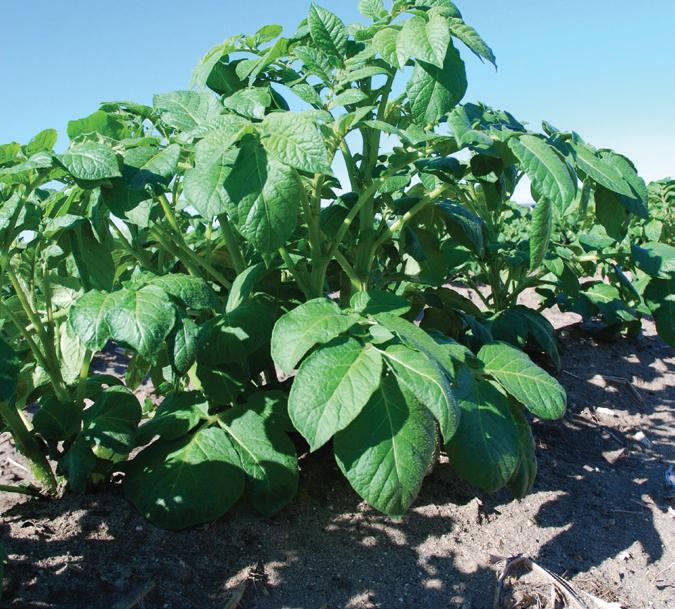
Potatoes are highly adaptable, yet still require 20 to 24 inches of rainfall during the course of a growing season.
conditions such as inconsistent temperatures and moisture issues. “We’ll have to look for varieties that do well under increasingly variable conditions.”
In fact, heritage varieties might make a comeback or become the breeding stock for developing new “climate-tolerant” varieties. “Heritage varieties have a wider tolerance of the range of environmental conditions, and also have a higher resistance to pests and diseases,” adds Salinger. “These could be made as a tradeoff with higher yields.”
PHOTO BY RALPH PEARCE
McKeown sees heritage varieties as a good source of germplasm for desired characteristics, but does not believe they will be adequate for commercial production.
Although there are still some who do not believe that climate change is really occurring, McKeown says weather changes are happening, but it may be a long time before the full impact of them is known. He points out that variable weather is an issue now and always has been, and that will not likely change. It is possible the variability may become more extreme. “If extreme variability becomes the norm globally, we will have some problems,” he says.
Both McKeown and Salinger see agronomic research and variety development as key if northern climes are to become the potato producers for the entire planet. “Certainly, agronomic research will have to keep up,” comments McKeown. “The World Bank reports that agronomic research has been declining. If we don’t put resources into studying the agronomic changes that might occur due to climate change, it will be harder for growers to adapt. Research is the cornerstone of food security.
“Breeding programs will need to shift into those areas where potential new cultivars can be raised because of the shift in the photoperiod (the length of day/night),” adds Salinger.
New territory for various reasons
Of course, continues McKeown, the world is entering unknown territory with climate change while experiencing an increase in carbon dioxide. “All our plant physiology and field work is done in an area of about 330 to 340 ppm (parts per million) of carbon dioxide and we are now approaching 380 ppm. How will this change the applications we developed in the 1950s and 1960s? At what point will an increase in carbon dioxide change the applicability of our past research?”
Salinger suggests more modelling needs to be done in Canada and Russia to determine how climate change is affecting the way crops are developed and grown. Then, he says, the models need to be applied to potatoes.
Disease pressure may change as well, because, suggests Salinger, if the air becomes more humid, there will be more pathogens. But, if the air becomes dryer, there will be less disease pressure. The former scenario may require more emphasis to be placed on developing varieties with disease tolerance. “The weed spectrum may change as well,” adds McKeown. Certainly, if potatoes grow well at cooler, higher latitudes, then the weeds will likely also adapt and the products that are used for weed control now may no longer be effective. “Everything will likely change from weeds to diseases and maybe the nutritional needs of the crop will change.”
McKeown says these changes could lead to great opportunities for Canadian growers, and he suggests science could help them prepare by continuing classic agronomic work on crop developments and adaptability. “As humans, if we put the effort into solving the problem, we can,” he reasons.
While some see the future of the world in a dim light, potato producers could be facing a brighter outlook because they are experts at growing a crop that is adaptable and will most likely be a sought-after food source. The challenge will be based on agronomics and choosing varieties that will not be affected by temperature changes and increased levels of carbon dioxide. The concern is yields may decline. In the end, climate change could prove what growers have always known: the potato is a versatile crop that can help feed a changing world.
Three Superior Products = ONE UNBEATABLE RESULT
Using liquid seed treatment? Use Sta Dry to dry your seed, keep your planter cups dry and provide added protection to keep plant vigour when it’s most needed!
Power Start is a phosphate activator that enhances plant vigour. It ramps up plant metabolism and boosts root development, tuber initiation and retention. Best of all Power Start reduces application rates through better placement and more efficient conversion of phosphates.
Pivot Power provides early prevention of root diseases, increases nutrient absorption, and encourages abundant root growth. This product offers flexibility in application - at planting, with sidedressed N and through pivot irrigation. Pivot Power is proven to increase vigour and stress tolerance, decrease incidence of “early die syndrome,” and increase quaility and storability.
For better marketable yield, with QUANTITY AND QUALITY, follow the formula EASY AS 1-2-3!
CAN GROW Crop Solutions, Inc
Jacco deLange Vision Agronomics
Utopia, Ontario
705-333-1231
vision@cangrow.com
Ray McDonald Can Grow Alvinston, Ontario 519-847-5748 spuds@cangrow.com
Hal Reed JEM Holding Taber, Alberta 403-634-1671 jem@cangrow.com
PLANT BREEDING
WHAT EVER HAPPENED TO LADY CHRISTL?
Why are some varieties more acceptable than others?
by Rosalie I. Tennison
The quest for the perfect potato never ends for breeders. The numerous traits that must be combined into a single clone are a challenge. When breeders find a promising potato clone, they look for growers and researchers who are willing to evaluate the potential variety in plots; the more variable the growing conditions, the better. Sadly, some very promising varieties never make it to market, and the explanation as to why they don’t is complicated.
According to Ontario potato specialist Eugenia Banks, very few clones are given a name and released as a variety for commercial production. There are growers who are interested in trying new varieties, she says, particularly if they think the variety will solve a problem such as scab. But, they also need to know how the variety will perform in different soils, its resistance/susceptibility to diseases and herbicides, its response to fertilizer and its maturity. Banks believes breeders should provide this information when they introduce a new variety, which, while more costly, would
facilitate the adoption of promising new varieties rather than having them end up on a growing pile of rejects.
“When breeders create a variety, they try to make it unique with special benchmarks, but these varieties end up as all other varieties in the market,” explains Frederic Tremblay of La Patate Lac-Saint Jean in Quebec. “For example, a breeder creates a really nice red variety with a very good taste that is easy to grow in the field with good yields and quality, and they name the variety to distinguish it from others. But, in the store, the variety appears in a bag just like all the other reds.”
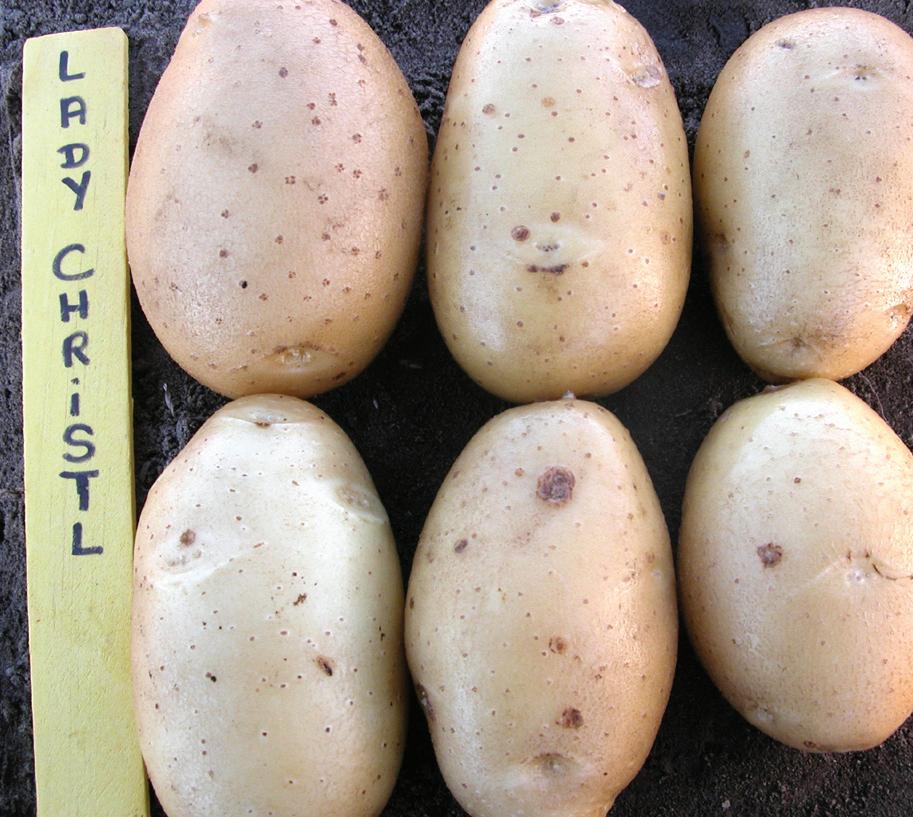
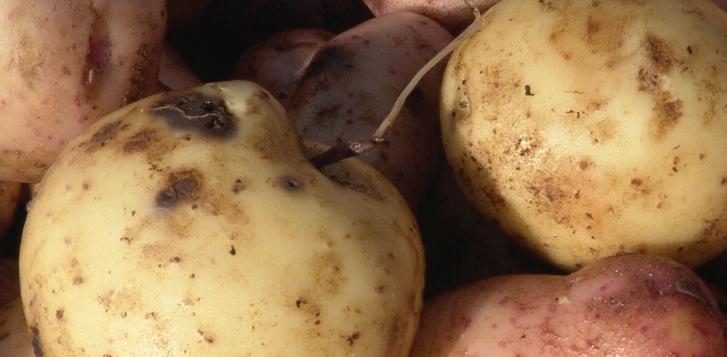
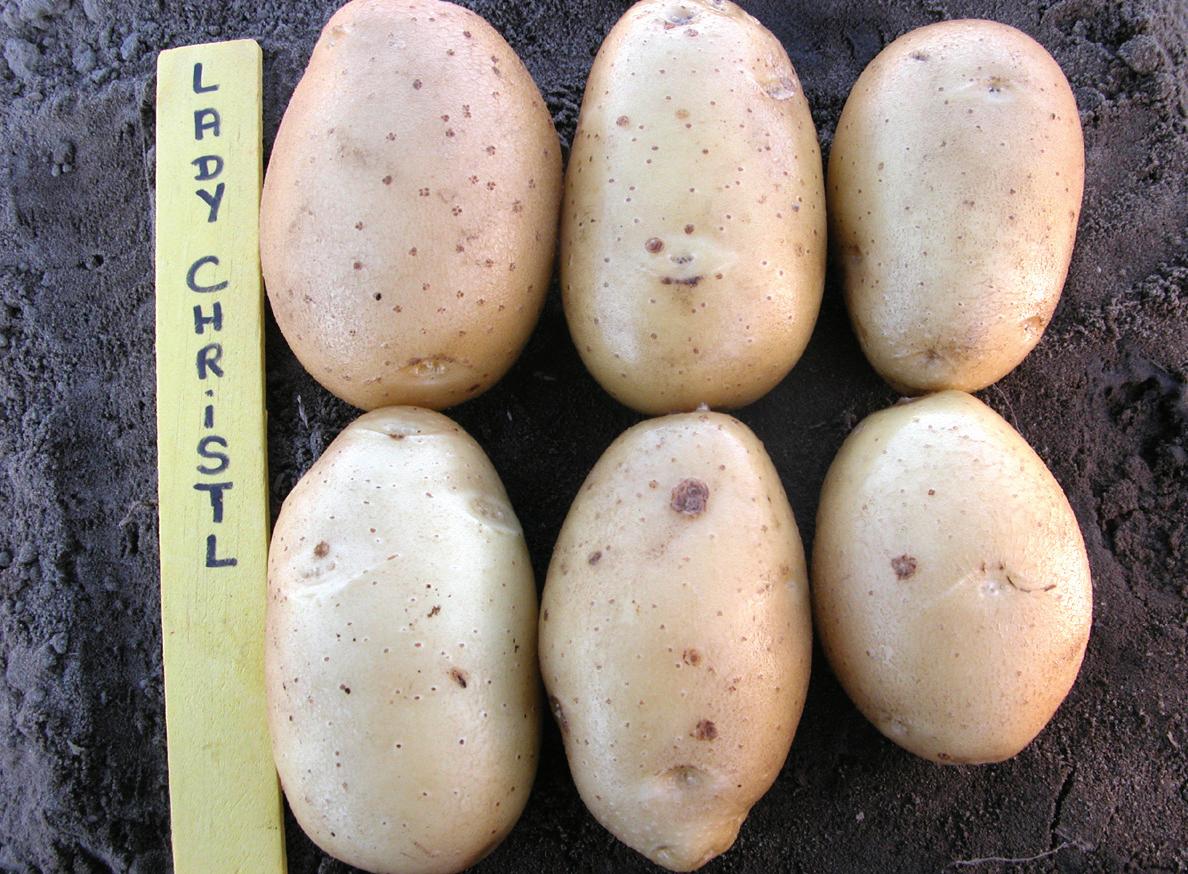
As a result, growers will produce the varieties they are comfortable with and may not try a new one because it may require slightly different management, he suggests. The solution would be to link the breeder with the consumer, as happens in Europe, where consumers taste new varieties before seed is provided and commercial TOP: Lady Christl grown in a heavily scab infested plot with no irrigation. The crop was practically scab-free.
PHOTO
DuPont™
Curzate® fungicide
Don’t wait. Curzate
® .
Curzate® delivers multi-level control of late blight, no matter when it strikes.
Grower experience and research prove it: the way to control late blight in potatoes is to hit it early, hit it hard and hit it with DuPont™ Curzate® fungicide.
Its preventative, post-infection and antisporulant activity protects your crop better than any other potato fungicide.
Curzate® delivers unique kick-back action to control disease at the point of infection and it inhibits all stages of the pathogen life cycle. Locally systemic activity rapidly penetrates foliage and stem surfaces to deliver fast-acting, long-lasting control. Curzate® should always be tank-mixed with Manzate® Pro-Stick™
Don’t wait for late blight to arrive. Get ahead of it with Curzate®.
Questions? Ask
production begins.
Banks is famous for testing as many new varieties as possible in Ontario field trials, but often some of the varieties that show promise are never adopted by growers. Take Lady Christl, a strain that Banks believed was “a great variety.”
“I thought Lady Christl would be the solution to growers’ problems,” she recalls. “Lady Christl resists scab, has smooth skin, an even set, and yields well.”
Few varieties come close to that ideal
One Ontario producer grew a couple acres of Lady Christl to “give it a try,” reports Banks, which is the first step in the adoption of a new variety. Unfortunately, Lady Christl developed internal brown spots, rendering the crop unmarketable.
Banks says the variety is grown in Mexico, but she doesn’t know if the internal brown spot problem occurs there or if the variety developed the spots under the unique growing conditions that occurred in Ontario.
“Companies marketing seed potatoes introduce new varieties slowly for this reason,” explains Banks. “There can be surprises when a new variety is grown in another area where the soils and weather are different.”
Another example of a promising variety is Altitude
Introduced as a round, white potato with high yield suitable for the fresh market and good for french fries, Altitude appeared to be the greatest variety since Superior. But, in Quebec, Altitude disappeared from the fields within a season of its promising launch.
“I wouldn’t say Quebec growers didn’t like Altitude,” comments Tremblay. “But, if you want a variety to take over the market of another, it has to surpass other varieties of the same category on at least one of these points: yield, appearance and resistance to disease.”
However, it appears that Altitude’s major downfall was its slow emergence, despite its many good attributes, and Quebec growers were put off. According to Banks, there is no perfect potato. Growers need to know the strengths and weaknesses of a variety to avoid costly mistakes. “For example, the fresh market wants an early white potato and a breeder develops one, but it is susceptible
GENETIC DIVERSITY
to scab,” she explains. “That means growers cannot grow the variety in a scab-infested field, so the variety is never accepted unless it can be grown in fields that are scab-free.” Another common problem is getting the fertility right, she says. Some potato varieties need more nitrogen, and poor yield may be due to not top-dressing when it was needed.
Potato production is a high-stakes game
Canada has Plant Breeders’ Rights and breeders from around the world are interested in introducing new varieties to the Canadian market. But, varieties come and go quickly and many never make it to the field. If a new variety doesn’t perform to expectations or live up to its advance publicity, growers won’t grow it a second season.
“When growers have success with an old variety, they don’t want to change,” comments Tremblay. He suggests that if consumers could choose only the varieties they like with variety identification, growers might be more willing to give newer breeds a chance.
So, growers stick with what they know and forgive the occasional problems from the old varieties, comments Banks. New varieties are not so easily forgiven.
“Superior has been around for 40 years and is scab resistant, is early, and has nice white flesh, but it doesn’t have smooth skin and yet it remains in the market,” says Banks. “One year Superior developed pink eye, which is a physiological problem, and the crop had to be sold for processing,” she continues. “If that had happened to a new variety it would never be grown again even though under different conditions the following year, that grower might have a great crop.”
Plant breeders solve problems, but introducing a new variety, finding where it is adapted and evaluating how to grow it to get the best yield and quality, requires finesse. Many good varieties have been rejected because of false steps along the way.
Perhaps growers feel they cannot afford to have failures and thus stick to what they know, but with this hesitancy to try something new, they might truly be missing the greatest variety since Superior.
CONTINUED FROM PAGE 16
“We will be able to improve our varieties faster, if we can isolate the genetic material that we want to use,” explains Dr. De Koeyer. “In the long term we want to develop varieties that will be disease resistant and have good agronomic values. The knowledge we are gaining from this research will speed up our breeding process.”
The challenge is finding the desired genes without also transferring the genetic material that affects maturity. Certainly, Canadian growers want to take advantage of long day conditions, but they want the tubers to set within the short Canadian growing season.
“We have one of the shortest growing seasons for potato production in the world,” Dr. De Koeyer admits. Therefore, identifying useful traits and getting them into germplasm suited to the Canadian growing season is his main objective. “My goal is to create a faster process of potato improvement. My hope is that this research into the potato genome will be embraced by growers and
industry once we have developed the tools to make the breeding process faster while adding beneficial traits.”
Dr. De Koeyer’s research will have benefits reaching beyond Canada’s borders. By identifying the genes for improved quality and performance, the breeding process can be faster and some of the genetic material that is identified can be used to improve potato varieties in other parts of the world. According to Dr. De Koeyer, his department’s collaborative efforts with CIP will lead to development of varieties based on physiological and DNA marker selection that could improve the food supply in the developing world.
Genetic diversity is the key to variety development to express specific traits in potatoes from improving quality to ensuring timely maturity. Dr. De Koeyer’s work to identify the genes that control performance of varieties and those that effect quality will result in growers having some of the best varieties in the world growing successfully under Canadian conditions.
STORAGE
PREDICTING ROT CAN SAVE THE CROP AND MONEY
A simple test can identify potential risk of storage disease.
by Rosalie I. Tennison
Just because a disease cannot be seen on a potato does not mean it is not there. It is the unseen spores that can cause havoc in long-term storage and require early shipping or the worst-case scenario: the loss of the entire bin. What if a test could be done that would predict the potential for disease in a crop? There is such a test and it can assist growers to make management decisions regarding their crops.
Developed by researchers at the University of Wisconsin, the test can predict the level of multiple pathogens within a crop. The research was initiated after several seasons of disease-ravaged crops in the state and the resulting test is now marketed under the name Storecast by Pest Pros Inc. of Plainfield, Wisconsin. “We always do a good job of taking care of the crop in the field, but something happens in storage where the conditions are conducive to disease,” comments Dr. Zahi Atallah, who, along with Dr. Walt Stevenson, developed the test. “It’s not enough to look at disease after it has developed; growers need to pre-empt the problems. They need the ability to forecast what will happen down the road after the crop has been in storage for a few months.”
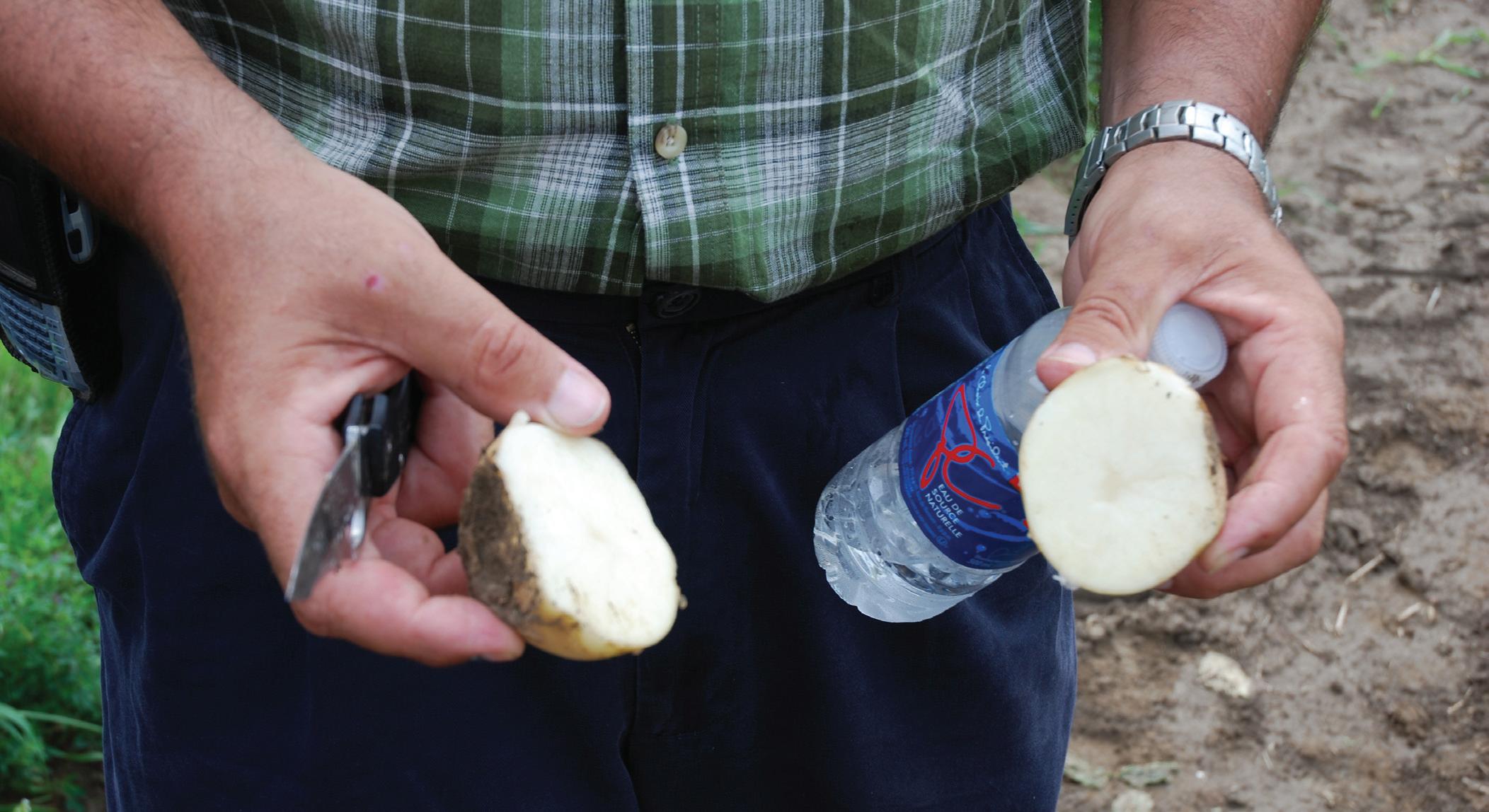
Using molecular methods, the researchers developed a means to quantify the number of pathogens present and identify them simultaneously. DNA is extracted from tubers collected to represent an entire field. The tubers are washed and then a slice is taken from each tuber to be tested. The tissue matter is juiced and combined with a fluorescent dye that increases in intensity depending on the level of the pathogen’s DNA that is present in the sample. A camera captures the fluorescence
BOTTOM: Determining the risks of a pathogen’s presence in a crop in September could spell an early harvest, and avoid disease damage in a stored crop during the winter months.
PHOTO BY RALPH PEARCE
PHOTO BY RALPH PEARCE
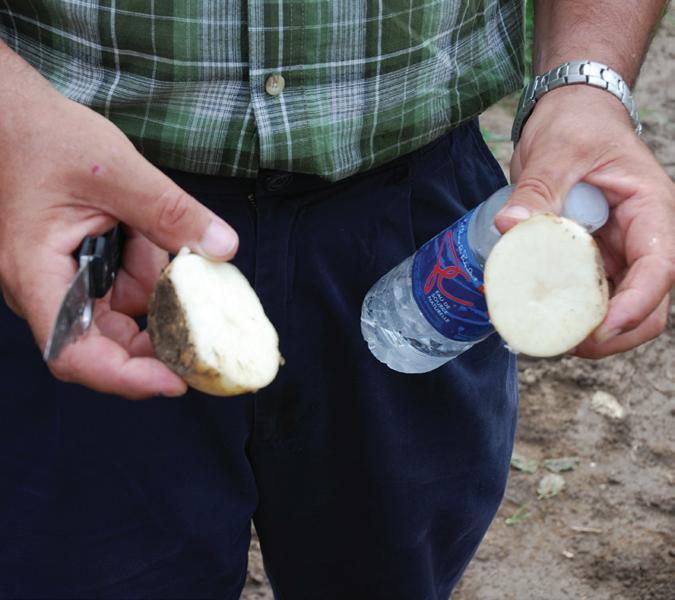
TOP: Using the Storecast system, a grower is able to sample and juice the potato, then submit that sample for detection of any potential plant pathogens.
and provides a value. Then, using mathematical formulae, a prediction of storage rot potential is made. Currently, the test can assess late blight, pink rot, pythium leak, bacterial infections, Fusarium and soft rot.
It may sound complicated, but Pest Pros founder Randy Van Haren says his company took the technology developed by Drs. Stevenson and Atallah and brought it into an agricultural setting that can be accessed by potato growers. “This is a management tool that can help growers manage storage,” he says. “Clients can pull their own sample, juice it and then submit it to us for analysis. We then send them the results that tell them if the crop is at risk. It costs about as much to do this as using in-storage fungicide and, in the long run, the test could be safer because there is no product being put on the crop.”
Some growers use an in-storage fungicide as a precaution, which can be costly, but by doing a Storecast test, no fungicide may be needed or, if disease is predicted, the crop could be shipped earlier.
A potato grower in Wisconsin who has used Storecast admits he was skeptical at first, but has found it to be “very reliable.” Steve Diercks of Coloma Farms Inc in Coloma, Wisconsin, says the information gleaned from Storecast has made it possible for him to manage his storage more effectively. “We schedule harvest and storage of our fields at different times because of the information we get,” Diercks explains. “We are now trying to put some economics to it and we think we might also be able to tie it into crop insurance. Right now we can’t put a dollar value on how helpful the test is, but we know it works.”
He says the insurance angle would work similarly to getting a break on house insurance if you have a smoke alarm or security system.
Early detection, early harvest and better results
The year 2010 was a tough year for storing potatoes in Wisconsin because the area had a lot of rainfall, but Storecast made it possible for Diercks to manage his storage without losing too much of the crop. “If you know in September or October the risk of disease is low, you know you can store longer and save that bin to ship in February,” he explains.
“There is an element to Storecast that acts as an insurance policy against losing a crop,” continues Van Haren. “We can do the test for about $11 per acre, which could be inexpensive insurance against
YUKON GOLD
having problems in storage.”
By identifying problems before the crop even leaves the field, Dr. Atallah suggests growers could have a strategy in place for managing them when it gets into storage. “If a grower knows there is a problem, they may choose to cool the crop quicker or ship the contents of a bin sooner,” he explains. “Or, if the problem could become severe, the crop could be shipped directly from the field.”
The year 2010 was a tough year for storing potatoes in Wisconsin because the area had a lot of rainfall, but Storecast made it possible for Diercks to manage his storage without losing too much of the crop.
“There is an element to Storecast that acts as an insurance policy against losing a crop,” continues Van Haren. “We can do the test for about $11 per acre, which could be inexpensive insurance against having problems in storage.”
By identifying problems before the crop even leaves the field, Dr. Atallah suggests growers could have a strategy in place for managing it when it gets into storage. “If a grower knows there is a problem, they may choose to cool the crop quicker or ship the contents of a bin sooner,” he explains. “Or, if the problem could become severe, the crop could be shipped directly from the field.”
Diercks shares the information he receives in his Storecast report with his processor because that load may need to be processed sooner than other loads in the system.
Van Haren says his small company is gradually introducing the test in other potato-growing areas and he would like to get the test to Canadian growers. He says it does not take long to get the samples and he believes he could sample many fields in a few days during a trip to Canada, but he thinks a network of consultants trained to take the samples and submit them to Pest Pros would be more feasible in serving Canada’s growers.
For potato growers with large storage facilities or a staggered shipping schedule, knowing the risks of pathogens that may be present on the crop could lead to better management and a cost saving if an “atrisk” bin can be shipped prior to disease problems occurring. As Dr. Atallah suggests, the test he developed could save a crop from turning to “mush” and prevent the resulting financial loss.
CONTINUED FROM PAGE 14
potatoes common to North America. In the late 1950s, one of Johnston’s graduate students brought him some small, roughly shaped, yellow-fleshed tubers of a potato grown by indigenous communities in Peru. These tasty tubers sparked Johnston’s interest. He asked Roman Ross of the Wisconsin Potato Introduction Station about yellow Peruvian potato varieties, and Ross provided Johnston with several hybrids. One of those was W5289-4, a cross between a yellow Peruvian potato called Yema de huevo (which means “egg yolk”) and a white US variety called Katahdin.
W5289-4 had small, rough-shaped, yellow-fleshed tubers, so Johnston crossed it with Norgleam, an early maturing white potato from North Dakota with a good shape, larger size and attractive appearance. After many tries, the 66th cross in 1966 resulted in true seed, and the start of the breeding line called G6666. That was followed by years of trials and testing that eventually resulted in Yukon Gold.
Johnston named the variety after the Yukon River with its link to the Klondike Gold Rush.
The Seed of the Year awards started in 2005. They were created by the University of Guelph and SeCan to recognize publicly developed field crop, forage, fruit, vegetable or herb varieties and to honour public plant breeders. It is now a national competition with separate awards for Eastern and Western Canada.
Yukon Gold is a great example of what public breeding programs can accomplish. Currie says, “I think the importance of public breeding programs is that they are accessible to everybody and that they strengthen the competitiveness and profitability of the whole industry to the exclusion of nobody.”
Currie was lucky enough to be trained under Johnston from 1990 to 1992, when he was called out of retirement to fill in while the search was on for a new potato breeder for the University of Guelph program. She says, “That gave me the chance to learn from the great master, and it was a great experience.”
She adds, “It’s nice for Gary to have this recognition after all these years, and that Yukon Gold is still appreciated by consumers and the potato industry – after all these years it still keeps on going!”
Outback®
RTK Unleashed
Outback® S3™ + AC110™ GPS with Auto and Section Rate Control
· Now features 10 section automated rate control
· Single product, liquid, constant rate control
· Offers straight, contour, circle pivot, and A+ direction guidance modes
T
For an RTK System to be complete, it must have an autoturn solution. The Outback® eDriveX™ with eTurns is the industry’s only aftermarket RTK system with a proven autoturn solution.
· Centimeter level autosteer system with slow speed control (0.25 mph) reverse operation
· Season-after-season repeatability for nutrient placement
· Over 310 vehicle kits now available
Outback® A320™/A321™ Dual Frequency GPS/GLONASS RTK
· Features Eclipse II GPS/GLONASS technology
· High-precision positioning in RTK, OmniSTAR HP/XP and SBAS/DGPS modes
· 8.4” high-resolution color touch screen ge RTK up to 15 miles ation
Scan the QR Code to the left to be linked directly to the Current Outback Specials page on our website.
· Full long-range RTK functionality up to 15 miles from base station
Without eTurns, your RTK System isn’t complete. Watch eTurns video now by visiting www.edrivex.com and register to win.
BACK TO THE BASICS: PAYING HEED TO ESSENTIALS
Agronomic principles to follow through on every year.
by Treena Hein
Talking about basic agronomy can seem passé, but for growers, making sure they are paying attention to fundamental principles is critical to maximize their operation’s profits.
For example, in jurisdictions where rotation is not mandated, growers should be doing it nonetheless. “It’s legally mandated in Prince Edward Island, but in Ontario growers are not forced to do it, says Ontario Ministry of Agriculture, Food and Rural Affairs potato specialist Dr. Eugenia Banks. “However, potato farmers practise crop rotation,” she notes. “A one-year rotation with cereals is common, but unfortunately, land is a limited resource and longer rotations are rare in Ontario.”
A grower usually has one field heavily infected with common scab, Banks continues. One practice she therefore thinks growers should never forget is to plant resistant varieties in fields infested with it. “At the present time, there’s no reliable control method to control scab except the use of resistant/ tolerant varieties,” she explains.
These include Superior and GoldRush for the fresh market, Pike for chipping, Norland, a red-skinned variety, also for the fresh market, and Mozart, a gourmet variety.
Growers may hear about new varieties rated as resistant to scab in Europe, but Banks says these varieties might be susceptible to the different strains of scab that prevail here in North America. “It’s therefore important for growers to do their homework and check with potato specialists and other extension personnel about susceptibility or tolerance,” says Banks. “Each season I evaluate numerous new varieties.”
Beyond variety selection
Keeping up with other new trait offerings should be something every grower does diligently, stresses Rainer Borgmann, the CEO of Spudnik Equipment Company LLC in Blackfoot, Indiana. “Seed traits are very important factors in increasing yield and quality,” he says.
Another agronomic basic to be practised diligently is field scouting on a regular basis to better time pesticide applications and manage potential problems. “Field scouting allows growers to use pesticides only when necessary, which saves time and money,” Banks asserts. “On wet, cool seasons, late blight is a potential problem, but if it’s detected early, when there are only one or two small hot spots, these areas can be top-killed to eliminate sources of infection and reduce the rate of infection in the entire field.”
Field scouting also helps to detect insecticide resistance, a very serious problem. “For instance, if a neonicotinoid is applied at planting and Colorado Potato beetles are infesting a field before the neonicotinoid has lost its activity, there’s a good reason to suspect insecticide resistance,” Banks says. “Field scouting sounds the alarm.”
Proper storage and cutting of seed potatoes is another very important basic that is often neglected when farmers are in a hurry. “Paying more for quality seed only to store it in less than ideal conditions or cutting seeds in a sloppy manner are wasteful but common mistakes,” notes Borgmann.
The proper use of seed-cutting equipment requires experience and constant monitoring to ensure a good cut is being achieved, he says. “Seed cutters are not something that you can ‘set and forget’,” Borgmann adds. “A skilled employee, farm manager, or the farm owner should monitor seed cutting equipment throughout the day and make adjustments where needed to correct for inconsistencies or changes in seed lots.”
Another basic, proper seed planting, is among the most important things a grower will do in a season, Borgmann adds. “There’s no quicker way to hurt yield, size profile, and quality than to use a seed spacing that’s too narrow or too wide for your variety, soil, and climate,” he says. “Planting depth and accuracy are also crucial.”
Operators should check depth, spacing, and consistency hourly because planting depth will vary with seed cut and soil conditions. “Planters should also be operated at a proper speed to obtain skip-free accuracy,” says Borgmann. “The best planters on the market have fantastic accuracy at three to threeand-a-half miles per hour, but will lose significant accuracy as they’re pulled faster.”
“You have to take the time or make the time to properly train your equipment operators,” he adds. “If operators understand the importance of proper techniques and have been properly trained, they will do a much better job.”
Lastly, Borgmann urges farmers to keep abreast of new treatments and chemical technologies. “I would argue that adopting the new best practices and technology will always help the bottom line of any farm,” he says. “However, this is only true as long farmers do not begin to neglect important basic practices. If farmers believe new technology is a replacement for careful planting and proper crop management, they are spending money for improvements they cannot fully benefit from.”
Protect with the power of Titan.
Keep your potatoes’ potential at full strength with TitanTM, the broadest spectrum insecticide available. It gives you everything you need to produce stronger plants and higher yields year after year. Titan overpowers all major aboveground pests while reducing damage caused by wireworm.