Metroland details the ins and outs of manufacturing community newspapers and flyers in Ontario
20 DRIVING
DOTS
As inkjet printing systems become mainstream, vendors are pushing new application powers through print head advances
DEPARTMENTS
GAMUT
5 News, People, Calendar, Installs, Globe, Archive
TECH REPORT
26 Graph Expo Preview
System options, applications, software and consumables continue to grow and will be on full display this September at Graph Expo in Orlando
MARKETPLACE
33 Industry classifieds
SPOTLIGHT
34 Q&A with Jason Alderman, Regional Vice President, Veritiv
COLUMNS
FROM THE EDITOR
4 Jon Robinson
drupa effect in check
Maintaining a realistic outlook on the future in the face of quarterly reports
TECHNOLOGY
9 Paul Smith
Canadian materials innovation Xerox Research Centre of Canada is helping to ensure product authenticity
ENVIRONMENT
10 Neva Murtha
Canada’s global forest legacy
Working with printing to find an inspiring difference between the trees and forests
DEVELOPMENT
11 Dave Fellman
Communication failures
Why is it always the seller’s responsibility to communicate with the buyer
CHRONICLE
12 Nick Howard
An ever widening circle
Eager to find new revenue streams, print pushes its expertise forward 20 14 34 26
drupa effect in check
There is little doubt drupa 2016 was the most positive trade show, perhaps outside of the specialized large-format exhibitions, the printing industry has seen in more than a decade. The energy at the German show was noticeable from both exhibitors and attendees alike, which is reflected in many recent quarterly reports.
The economy is the main concern of printing companies according to a new quarterly report by Semper International. 32%
KBA, for example, released its second quarter results for 2016 noting it will raise revenue and earnings targets for the full fiscal year. The positive financial expectations, according to the German press maker, are backed by what it describes as a successful drupa and a high order intake of €352.5 million in its second quarter. Group order intake from April to June was up 17.2 percent yearon-year, although the KBA’s figures for this quarter only contain around a third of orders placed at the drupa trade show which were in the triple-digit million euro range.
A week earlier, EFI released results for its second quarter of 2016, ended June 30, 2016, with a record second quarter revenue of US$245.7 million – up 21 percent compared to the second quarter of 2015. “EFI’s market position at the drupa tradeshow validated both our strategy and product roadmap, and we’re particularly encouraged by the exceptional reception to our new Nozomi platform,” said Guy Gecht, CEO of EFI, pointing to the company’s drupa innovations as a main reason why it is standing by the goal of hitting $1 billion in revenues for the year.
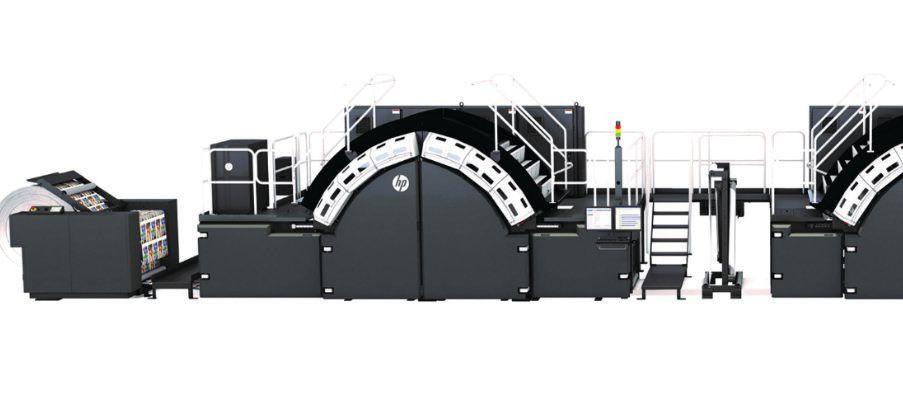
“drupa 2016 has been a landmark show for HP. It is clear that digital has arrived as mainstream, with HP experiencing the best attendance at any drupa ever and with sales not only surpassing 2012 results by 20 percent, but exceeding our 2016 ambitious goals by 25 percent overall,” said Francois Martin, Worldwide Marketing Director, Graphics Solutions Business, HP Inc.
Jeppe Frandsen, VP of Canon Europe, noted, “Customer investment was 30 percent up on the figure for drupa 2012. The decisive factor for many of Canon’s customers here at drupa 2016 was ideas from the live print demonstrations – so much so, that this drupa will go down in history as the ‘applications drupa.’”
It is important, however, despite the positive drupa show, for printing companies to not become sidetracked by the new cycle of industry innovations. In July, Semper International, a human resources organization dedicated to the printing, pre-media and marketing industries, released its Third Quarter Economic Insight Report, which found a stark slowdown in overall industry profits and sales
forecasts. Perhaps most interestingly, Semper stated in its report, that across the industry, digital print overtook traditional print as the industry’s primary profit centre for the first time in the history of the survey.
Since February 2003, Semper has provided a quarterly survey with estimates of trends in the printing and graphics industries. Survey participants include a cross section of large, mid-size and small commercial printers, advertising agencies and media companies; both clients and prospects of Semper. Participants provide data on revenue and hiring as well as estimated outlooks on future trends.
The economy, according to the most recent Semper report, returned to the forefront of industry threats in its survey, with 32 percent of companies indicating this was their main concern. Semper explains firms are beginning to drop into survival mode, with hiring forecasts down and diversification rates declining 12 percent over the course of the quarter. While firms have not yet reported these economic pressures have crossed the line into staff reduction mode, Semper explains the survey finds companies continue to struggle with the same profitability pressures since the third quarter of 2015.
“For this quarter’s report, economic fortunes have turned a bit. The data we see from respondents today is significantly different than what we experienced last quarter, and for the most part reflects a fundamental slowing in the economy,” said Semper CEO and report author David Regan. “Based on these indicators, we feel that we are once again at an inflection point where companies are straining to protect staffing levels and profitability, but that the clock is running. If we don’t see an increase in aggregate demand soon, we may see some cutbacks as companies are forced to tighten their belts.”
The most recent Semper report also found that 70 percent of companies logged profits in this cycle, down one percentage point from the prior quarter, and significantly less than the 80 percent or higher levels reported last year at this time. Sixty-six percent of companies say they will not hire new talent this quarter, according to Semper, while growth expectations stabilized from their recent declines – just 42 percent of companies expect sales growth in the next three months.
Editor Jon Robinson jrobinson@annexweb.com 905-713-4302
Contributing writers
Zac Bolan, Wayne Collins, Peter Ebner, Steve Falk, Victoria Gaitskell, Martin Habekost, Nick Howard, Neva Murtha, Abhay Sharma, Publisher Paul Grossinger pgrossinger@annexweb.com 905-713-4387
Associate Publisher Stephen Longmire slongmire@annexweb.com 905-713-4300
Director of Soul/COO Sue Fredericks
Media Designer Lisa Zambri
Circulation Manager Barbara Adelt badelt@annexbizmedia.com
Customer Service Angie Potal apotal@annexbizmedia.com Tel: 416-510-5113
Fax: 416-510-5170
Mail: 80 Valleybrook Drive, Toronto, ON, M3B 2S9
Subscription rates
For a 1 year monthly subscription (12 issues): Canada — $40.95 Canada 2 year— $66.95 United States — CN$71.95 Other foreign — CN$140.00
Mailing address
Annex Business Media 222 Edward Street Aurora, ON, L4G 1W6 printaction.com Tel: 905-727-0077 Fax: 905-727-0017
CALENDAR
Fujifilm is now running its primary facility in Tilburg, The Netherlands, with 100 percent wind energy. The plant makes printing plates and had been partially powered by wind since 2011. The turbines, located on-site and in nearby Zeeland, generated 100 gigawatt hours of energy for the facility, enough to power 30,000 homes. Fujifilm and energy supplier Eneco are investigating bio-mass steam for use in Tilburg.
Sun Chemical moved to acquire Flint Group’s publication gravure ink business in Europe, pending approval. A member of the DIC Group, Sun Chemical also last month opened a new coatings lab at its New Jersey headquarters. The lab is the fourth of its kind in the world for studying migration, adhesion, permeability, and other performance-related coating phenomena.
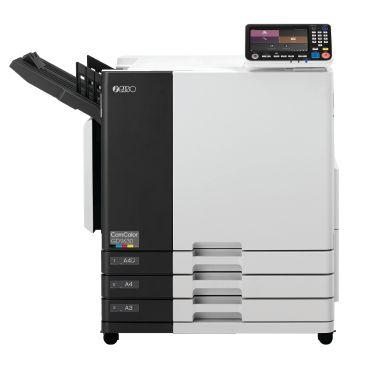
Insource Corp. hosted two seminars in Toronto focused on the new RISO ComColor FW5230 – a fifth generation inkjet system – aimed at corporate offices where departments incur heavy print volumes. It is also suitable for facilities like in-plant
graphics departments based on its printing speed of 120 pages per minute in full colour.
Flint Group is introducing a new UV lamp retrofit conversion program called VANTAGE LED aimed at sheetfed printers. The program consists of pre-conversion consulting and training, LED inks and coatings, matching pressroom chemicals and blankets, as well as service. At the heart of the VANTAGE LED program, according to Flint, are EcoLUX LED lamps supplied by Air Motion Systems.
Graphics Canada, which next takes place from April 6 to 8, 2017, at the International Centre in Mississauga, Ont., is to host a new feature called intelliPACK, a collaboration between the associations of PAC and CPEIA. intelliPACK workshops are to focus on smart packaging systems and printed electronics.
Boston Globe Media Partners sold its current headquarters for its Boston Globe newspaper operations, which have been housed for 58 years in Dorchester, Massachu-
setts. Editorial and business departments will move to an office complex less than a mile from the publisher’s founding location on Newspaper Row (1872). In 2015, the Globe purchased a building in a Taunton industrial park for just over US$20 million that will serve as its newspaper printing plant starting in early 2017.
Sappi committed to a $25 million project to update its Somerset Mill, which the company describes as the largest U.S.based paper mill, to modernize the wood debarking, chipping and chip distribution systems. Commissioning of the new system is to be complete by November 2017.
Koenig & Bauer Group raised its revenue targets for 2016 after reporting its half-year results. At €352.5 million, group order intake from April to June was up 17.2 percent year-on-year, although the group’s figures for this quarter only contain around a third of orders placed at the drupa trade show which were in the triple-digit million euro range.
Electronics For Imaging results for its second quarter of 2016, ended June 30, 2016, included revenue of US$245.7 million, up 21 percent compared to second quarter 2015 revenue. CEO Guy Gecht explained the drupa momentum is feeding into EFI’s industrial inkjet and productivity software segments, helping its goal to reach $1 billion in revenues for the year.
Avery Products Canada, a division of Whitby-based CCL Industries, is providing 7,500 school kits to students in under-resourced classrooms across Canada. The campaign is being produced in partnership with The Michael “Pinball” Clemons Foundation and change maker Hannah Alper.
U.S. Postal Service reported its third quarter results with a net loss of US$1.6 billion despite what the organization describes as doubledigit growth in revenue and volume in its Shipping and Packages business, which alone saw revenue growth of US$645 million, or 18 percent.
September 21
OPIA London Golf Classic Pine Knot Golf and Country Club
September 23-24, 2016
Sign Expo Canada International Centre, Mississauga, ON
September 25-28, 2016
Graph Expo 2016 Orange County Center, Orlando, FL
September 27, 2016 PAC Golf Tournament Niagara-on-the-Lake, ON
September 28-29, 2016 PAC Conference Niagara Falls, ON
October 4-5, 2016
ERP Vendor Congress
Fourpoints Sheraton Meadowvale, Mississauga, ON
October 18-22, 2016
All in Print China
International Expo Center, Shanghai
October 19, 2016
OPIA, Captain of Industry Dinner, Phil Crawley, The Globe St. Georges Golf, Etobicoke, ON
November 3-4, 2016
RDG Designthinkers
Sony Centre, Toronto, ON
November 10, 2016
Canadian Printing Awards Gala Palais Royale, Toronto, ON
November 25, 2016
CMA Awards Show Westin Harbour, Toronto, ON
January 17-20, 2017
EFI Connect The Wynn, Las Vegas, NV
April 6-8, 2017
Graphics Canada International Centre, Mississauga, ON
May 11, 2017
35th annual Gala Gutenberg Montreal Science Centre, QC
May 12-13, 2017
grafik art Montreal Place Bonaventure, Montreal, QC
October 4-7, 2016
GMC Inspire Days Americas Marco Island Resort, Florida
October 31-November 3, 2017
IPEX 2017
NEC, Birmingham, UK
Peter Struik, Fujifilm (left), and Marc van der Linden, Eneco Group.
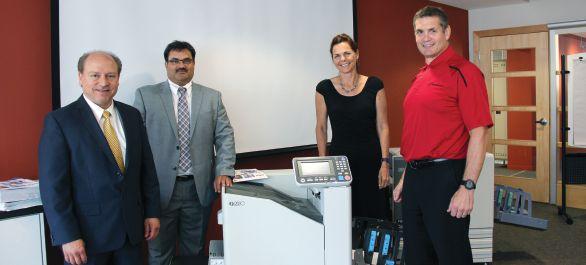
With the new RISO FW5230 are (left to right): RISO Canada’s Andre D’Urbano National Sales Manager, and Romuald Michael, Business Development Manager, with Insource Corp.’s Suzanne and Tim Wakefield.
Mark Gardner, President and CEO, Sappi North America.
INSTALLS
Dr. Gerold Linzbach, Chairman of the Management Board of Heidelberger Druckmaschinen AG, will not be extending his contract which expires in August 2017. Linzbach succeeded Bernhard Schreier as Heidelberg’s CEO at the start of 2013. Schreier had led Heidelberg for 13 years. The Supervisory Board of Heidelberg noted Linzbach’s intensive work in connection with the restructuring of the German press maker.
Stephen Feldman joins Toronto MIS developer Avanti Computer Systems as Director of Product Management. He most recently served as Director of Product Management for Unify (formerly Siemens). Feldman previously managed 350 channel partners for IT services provider Acrodex in addition to roles with Microsoft Canada, Platform Computing, Hummingbird, Cybermation, ATI Technologies and Toshiba.
Rekha Ratnam becomes the Managing Director of PRIMIR, the Print Industries Market Information and Research Organization, which is the research unit of NPES, led by President Thayer Long.
Dr. Mark Bohan becomes Director of Prinect and CTP for Heidelberg USA, which he joined last November as a business consultant. In his new role, Bohan will report directly to Andy Rae, Senior Vice President of Equipment and Marketing. Prior to joining Heidelberg, Bohan served for 11 years as Vice President, Technology and Research, at Printing Industries of America, the world’s largest graphic arts trade association.
Joe Varone and Paulo Monteiro have been promoted to serve as President and Vice President of Sales, respectively, at GMG Americas, subsidiary of Germany-based colour-management-systems developer GMG. Varone had been leading the sales organization of GMG Americas in addition to undertaking general management responsibilities. With his new position, Varone will yield his day-to-day sales activities to Monteiro, who previously served as Business Director, Latin America, GMG Americas, and has been an executive with the company for nearly 10 years.
Andrew Oransky becomes President of Roland DGA, headquartered in Irvine, California, which primarily supplies wide-format-imaging systems. Oransky previously served as Roland DGA’s VP of Sales and Marketing, and prior to that was Director of Marketing and Product Management. Before joining Roland in 2008, Oransky served as Sales Director, Specialty Paper, and as Product Manager and Sales Manager, Supplies, for Encad.
David Paterson has retired as the Chairman of the Board and CEO of Verso Corporation, which continues its search for a new leader. With Paterson’s pending departure, Adam St. John has been promoted to Senior VP of Manufacturing and Robert Amen is to become Chairman of the Board. Verso, headquartered in Memphis as a producer of printing and specialty papers and pulp, completed a US$1.4 billion acquisition of NewPage Holdings in January 2015.
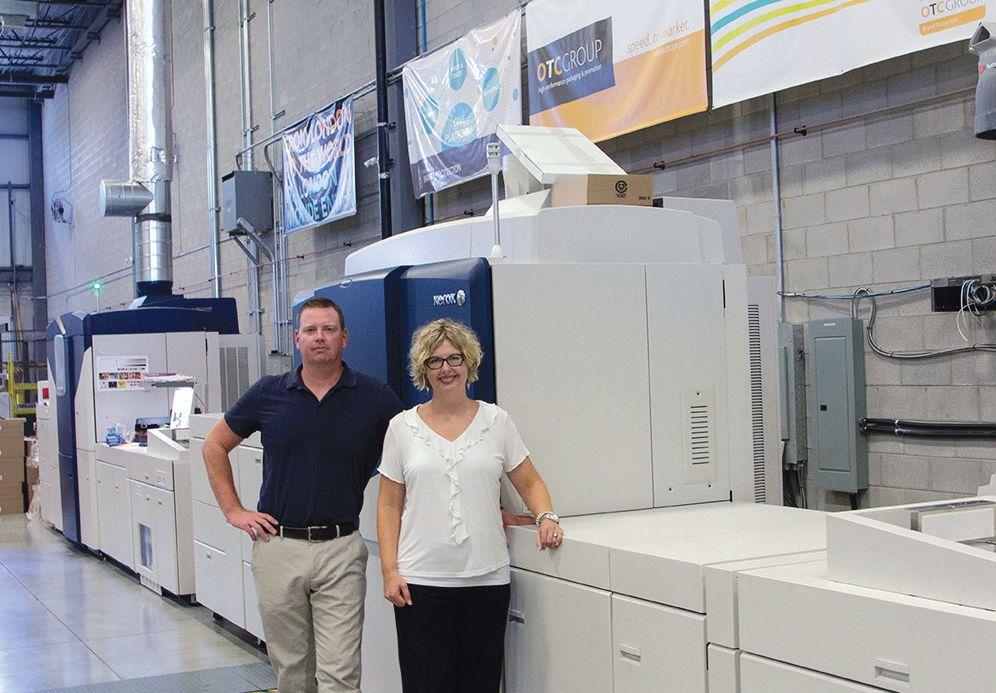
OTC Group, to expand its folding-carton capacity, acquired three Xerox iGen 5 presses to be installed at its Michigan location and its primary plant in London, Ont., pictured with OTC VP Adam Egan and Creative Director Dana Noble. OTC also recently added Xerox’s XMPie and FreeFlow Core to its workflow.
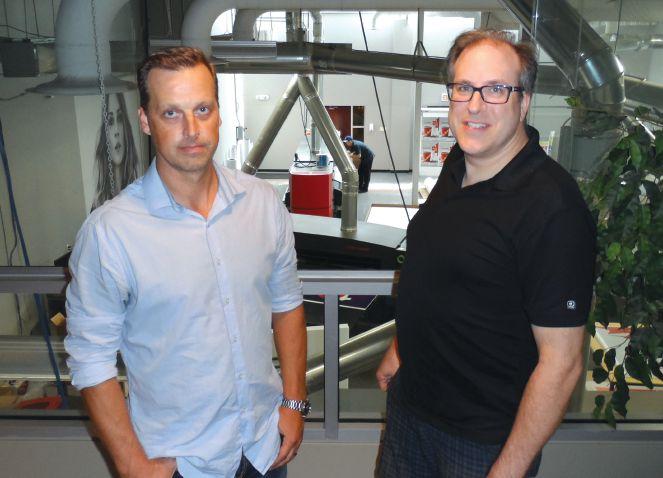
Category 5 Imaging of Burlington, Ont., added Esko’s Automation Engine for its large-format production, led by Greg Priede (left) and Dave LePoidevin. Housed in a 20,000-squarefoot facility, the company’s 30 employees operate EFI VUTEk systems and provide creative, prepress and fulfillment services.
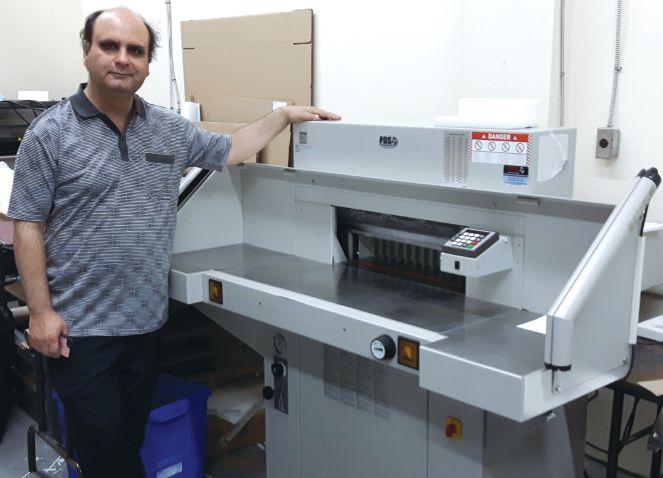
Minuteman Press, located in Mississauga, Ont., installed a Triumph TR5551-EP cutter, purchased from Print Digital Solutions. Pictured with George Stern, the hydraulic cutter features a programmable EP back gauge control module and can store up to 99 programs. Up to nine repeat cuts can be applied in a single step.
50
Number of customers in the orthopedic sector alone that are now being served by Millstone Medical Outsourcing’s new Epson ColorWorks C7500G printer to create high-quality colour and black-and-white packaging labels.
Riegel increases productivity by 70 percent in New Jersey
Riegel Communications Group of Ewing, New Jersey, recently installed a Heidelberg Speedmaster XL 106-6+L with extended delivery to replace two older Heidelberg presses. The new machine runs alongside an existing Speedmaster SM 52 and CD 102.
“We’ve increased our productivity by 70 percent and improved our makeready times by 60 percent,” said Kathy Atkins, President and CEO of Riegel Communications. “This press will easily grow our volume by 40 percent, which is exactly where we want to be as a business.”
The Speedmaster XL 106 is a 70 x 100-format press with maximum production speeds of 18,000 sheets per hour. The machine’s record for annual production is currently at 90 million, according to Heidelberg, while a typical annual impression count comes in at more than 50 million.
“In addition to increased efficiencies, we can now estimate more aggressively due to the increased running speeds,” said Atkins. Since purchasing its first Heidelberg press in 1986, Riegel Communications Group has remained an exclusive Heidelberg shop.
company’s new six-colour Speedmaster XL plus coater press.
DOME goes super-wide with VUTEk in Sacramento
DOME Print and Marketing Solutions, which is one of Northern California’s largest independent commercial printing businesses, has upgraded its super-wide-format inkjet operations by becoming one of the first facilities on the West Coast to install an EFI VUTEk HS125 Pro hybrid roll/flatbed inkjet press, in addition to a VUTEk LX3 Pro hybrid LED inkjet printer.
Based in Sacramento, DOME is a family-owned business and plans to use the new EFI VUTEk installations for more indoor signage with tight turnaround times. “Our single largest growth area is in retail,” said Bob Poole, DOME’s Chief Marketing Officer. “And our technology investment with the new VUTEk printer purchases is driving a lot of that growth because it helps us print better-quality work at faster speeds.”
The two new 3.2-metre-wide VUTEk production devices replace a pair of older generation VUTEk systems used at DOME. The company’s new VUTEk HS125 Pro is the most-productive VUTEk press ever developed, according to EFI, and prints 25 percent faster than the previous-model
Comet retrofit in PA
The Times News in Lehighton, PA, this summer is to begin a retrofit/rebuild upgrade on the control system of its Comet web offset press. The contract calls for KBA to replace and improve upon existing computers and software, as well as other enhancements to the press. “We run a 24/ 7 printing operation to handle our own daily newspaper, our eight weekly newspapers and a full schedule of commercial printing, which includes another daily newspaper,” said Fred Masenheimer, Publisher of the Times News, noting the importance of having as little interruption as possible during the retrofit.
The Times News traces its history back 120 years to the Mauch Chunk Daily Times established in 1883, which later became the Jim Thorpe Times News from 1951 until 1967, when it was purchased by Pencor Services Inc. In 1968, Pencor purchased the Lansford Record and in 1971 acquired the circulation of the Evening Courier published in Tamaqua.
The combined newspapers published under the banner of the Times News Record and Courier until 1971 when the name was changed to the Times News. In September 1987, the Times News entered the weekly newspaper business when it purchased the East Penn Free Press published in Emmaus. Through the next two decades more weekly newspapers started serving school districts in the Allentown and Bethlehem areas. These newspapers, as well as the Times News, are printed at the TN Printing complex four miles West of Lehighton.
DOME’s new VUTEk LX3 Pro printer, replacing a 3.2-metre VUTEk GS series, features LED imaging technology.
VUTEk HS series machine. The HS125 Pro press delivers high-quality, variable gloss output with unique UV/LED Pin & Cure imaging technology. The new system also includes a range of automated material handling options to accommodate high-volume throughput.
Riegel Communications’ Wayne Yeager, Press Operator, and Kathy Atkins, President and CEO, pictured with the
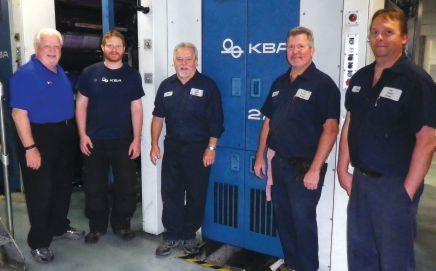
Len Alabovitz (left), Lehigton plant manager, with the company’s press operators and Claus Jaeger of KBA in front of the KBA Comet printing towers.
ARCHIVE
45 years ago
Punch Card Exposures:
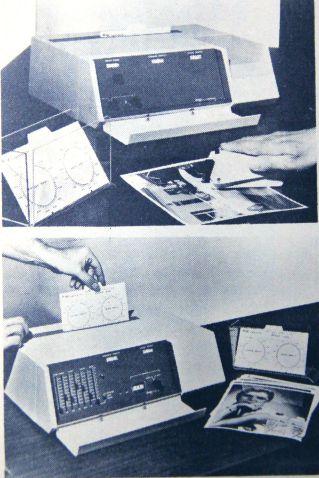
LogE has a punch card exposure control system for use with process cameras. The cameraman first reads the original copy with a LogEbrator copy reader, which automatically punches a copy card for reading in the LogEbrator programmer. The copy card contains two holes that are punched in numbered dials that record minimum density and excess density, both in relation to the screen to be used.
35 years ago
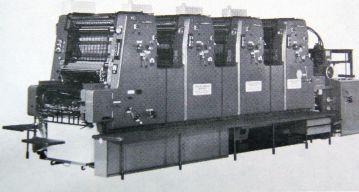
First Time Shown in the World: At Graphic Trade 81` in Toronto, Sears will showcase the new Heidelberg MOVP 4-colour perfector offset press. This 19 x 25-inch press has all the capabilities of the singleand two-colour versions and includes standard features like blanket washers, a sheet decurler, stream feeder, vacuum slow down and new delivery controls. The Heidelberg M-Offset opens up a wide range of creative possibilities that can be economically realized.
30 years ago
Canadian Press First to Use
EPD for Satellite Photo
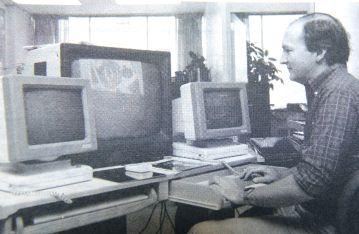
Transmission: The Crosfield Electronic Picture Desk provides visual display presentation and computer processing of picture data, reducing the time and cost of editing continuous tone photographs and graphics. Interfaced to a dial-up telephone system, EPD simultaneously works with up to 10 wire photo channels.
Sears is to showcase the new Heidelberg M-Offset at Graphic Trade 81.
$40K
Advertised price in PrintAction’s 2006 classifieds for a used 2-colour Heidelberg PM 46 press (circa 2000) with upgrades like autoplate, numbering and perforation.
25 years ago
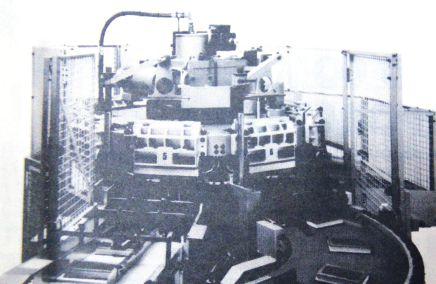
Books Pressed and Formed in Record Time: A machine capable of producing 50 books per minute while running at a mechanical speed of 25 cycles per minute has been developed by the Stahl company. The Model EP 509 is said to operate differently from other machines currently on the market. Following the casing process, the books are delivered onto the conveyor at the rate of 50 cycles per minute. The conveyor, which has been modified to function as a two-track system, loads two books simultaneously – from both upper and lower levels. The books are then sent to the individual loading clamps which run clockwise for three cycles, until they are positioned directly above the two unloading stations.
10 years ago
Consolidated Graphics Builds Local Capital: Consolidated Graphics, for the first time since going public in 1994 is moving into Canada with the purchase of Mississauga’s Annan & Bird Lithographers. In 2006, Annan became the first company in Canada to purchase a large-format KBA Rapida 205 press – with an 81-inch format.
$45
Advertised price in PrintAction’s 1971 classifieds for a library size 1970 edition of a brand new, still in the box Webster Dictionary.
“The average pipeline of opportunity is over $450 million,” said Chris Colville, CFO of Consolidated, discussing the M&A possibilities out in the market. “We will not buy all of those companies, but I think we will buy quite a few of them.” In the past 18 months, Consolidated has bought nine printers. The company had sales growth of 13 percent in 2006, of which around 10 percent of the increase was directly related to acquisitions. “If the industry is growing at two, three or four percent then we want to grow at four, six or eight percent.”
LogEbrator copy reader (top photo) and LogEbrator programmer (bottom).
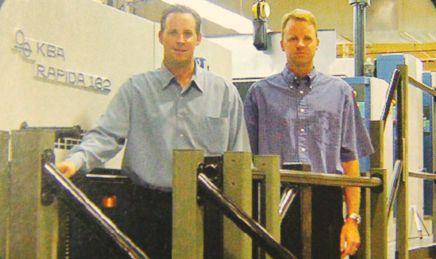
John and Dave Bird of Annan & Bird made a substantial investment in 2004 by installing a 6-colour, 64-inch KBA Rapida press.
Stahl’s EP 509 simultaneously loads two books for processing.
CP Photo Editor Julien LeBourdais watches as a photo sent via telephone line begins to appear on the display monitor.
Canadian materials innovation
Security innovations at Xerox Research Centre of Canada are helping companies ensure product authenticity and consumer safety
By Paul Smith
Deep in a state-of-the-art lab in Mississauga, Ont., researchers are tackling problems that cost businesses around the world billions of dollars every year.
The engineers and scientists at the Xerox Research Centre of Canada (XRCC) spend much of their time helping companies come up with innovative security solutions to battle counterfeits and protect their brands against pirates – an enormous challenge with an annual global price tag of $1.7 trillion, according to the Organization for Economic Development.
It may be surprising at first for some to learn that Xerox – a company that made a name for itself by inventing the photocopier – is so heavily invested in developing security materials. But the work is a natural extension of the innovative research and development we have carried out for decades.
For more than 40 years, XRCC developed new materials like inks, toners and photoreceptors for the Xerox’s own purposes. As the primary materials research and development centre for Xerox’s operations around the globe, virtually every Xerox product in market today has been influenced in some way by the research team in Mississauga. Within its 120,000 square feet, including a 27,000-square-foot Pilot Plant, XRCC has produced more than 1,500 patents.
But over the past five years, we have opened the doors to our labs so we can put our experience and expertise to work for other companies, collaborating with them to develop custom high-tech security solutions and bring them to market.
Not only do we have state-of-the-art facilities and equipment to handle R&D for just about any security materials challenge, we also have a world-class team of more than 60 chemical engineers, physicists and scientists who understand the importance of getting products to market quickly.
Materials leader
Our researchers have also demonstrated particular expertise for developing materials that enable security features, including fluorescence, colour shifts, metallic finishes, and electronic properties. These materials can be incorporated directly or indirectly into life-critical products like medicines, food, toys, cosmetics, fertilizers, aircraft and car parts.
To illustrate how the process works, consider a recent example of a client who came to us with a unique security challenge that required a creative solution. We were approached by a company that delivers fuel across the globe who needed to guarantee that their product was genuine and had not been diluted or tampered with in any way.
Working closely with the client, our scientists began to develop and test a series of chemical markers that could be added to the fuel to show a specific response when exposed to a stimulus. One of the many challenges during the research and testing phase was trying to
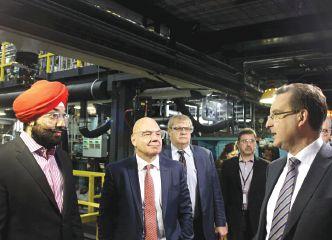
The Xerox Research Centre of Canada is one of the world’s leading facilities for materials development and analogue security technologies. Left: Federal Minister Navdeep Bains visits XRCC at the start of 2016.
$25M
Last summer the National Research Council of Canada announced it would invest $25 million to co-locate the new Advanced Materials Manufacturing Centre at the XRCC in Mississauga and collaborate with Xerox on bringing these materials to market.
come up with an additive that could survive the complex chemical environment of liquid fuel for its lifetime.
Once our team formulated a marker that met all of the client’s goals, we were able to begin manufacturing large batches of the additive in our Scale-Up Engineering Pilot Plant, which is outfitted with chemical reactors capable of producing anywhere from two to 2,000 litres of material at a time.
Innovation is a critical success factor for Canada’s long-term economic resilience. Our vision is to help drive innovation in Canada and to help businesses grow through the commercialization of break through materials, technologies and services.
As we look to the future, we envision that the XRCC will continue to invent and develop new materials plat forms, explore ways to incorporate materials into functional prototypes, and push the limits of materials and device performance to impact business across markets in Canada.
DR. PAUL SMITH is the Vice President and Centre Manager of the Mississauga-based Xerox Research Centre of Canada (XRCC), home to a world-class team of scientists and engineers with broad expertise in materials chemistry, formulation design, prototyping, testing, and chemical process engineering.
Canada’s global forest legacy
Working with the printing industry to see an inspiring difference between the trees and forests
By Neva Murtha
We often hear reports that there are more trees in the North America today than there were 100 years ago.
We are lucky in Canada to not have the deforestation and forest loss seen in tropical regions such as Indonesia, the Amazon and the Congo.
Before we get too smug and comfortable, however, we must step back and take a moment to see the forest through all our Canadian trees.
Impacts and fragmentation of natural forests and healthy ecosystems in northern forests can be just as profound as deforestation in tropical forests. This is especially true in forests like the Canadian Boreal where it is very accurate that when logged the forests are not often converted to other uses, but the impacts of ecosystem degradation are accumulating at an alarming rate.
Canada’s Boreal comprises about one third of the circumpolar Boreal Forest that rings the Northern Hemisphere, according to the Canadian Forest Service. Russia, the United States (Alaska) Sweden, Finland, and Norway also hold Boreal Forest.
By the numbers
Canada has an annual deforestation rate of .02 percent, but this small number is misleading. Fragmentation and degradation of intact forests (areas never logged before) in Canada represent 21 percent of the entire global total. Some estimates suggest that degradation-related carbon emissions can even exceed those of deforestation. One study noted, “Boreal forests account for 43 percent of carbon sequestered in all forests and their soils worldwide.” Logging and other industrial activity releases carbon stored in the forests and soils, carbon that cannot be recaptured in a short period of time by replanting.
In 2014, the World Resources Institute and its partner organizations used satellite imagery to assess forest degradation around the globe. Unfortunately, Canada leads the world – we are number one in degradation, fragmentation and loss of Intact Forest Landscapes. This loss, in our Boreal Forests in particular, is attributable to logging, road building, industrial and
urban development and, increasingly, larger and more frequent forest fires related to climate change.
Plantations and ecosystems
There are stark differences between new plantation tree cover and a healthy native forest ecosystem. When intact and natural forests are logged and replanted, a conversation of natural forest to managed forest impacts biodiversity, affects soil and water quality, and leads to the loss of threatened and endangered species habitat, decreased forest structure such as the reduction in undergrowth, lowered productivity of wood and non-timber products and reduced carbon storage capability. This in turn impacts the livelihoods, food security and traditions of indigenous and local communities.
The precedent-setting Great Bear Rainforest Agreement, which was completed on February 1, 2016. The historic Canadian agreements are the result of work by First Nations, British Columbia’s provincial government, environmental groups, including Vancouver’s Canopy, and forestry companies. The Great Bear Rainforest is comprised of 6.4 million hectares of which 85 percent is now off limits to logging as a result of the Agreements. Printers also played a significant role in helping to secure the Great Bear Agreement, which serves as proof that large-scale protection, healthy northern communities and economic and supply chain certainty is achievable. Canopy continues to work with forest
Strips of clear cutting on mountains and hills on Vancouver Island, which can be seen in other areas across the country, show the fragmentation of natural forests and healthy ecosystems.
products customers, including mills and printers to advance conservations solutions in the world’s ancient and endangered forests. Many printers are partnering with Canopy and encouraging others to join us in securing a conservation legacy in Quebec’s Broadback Forest, a jewel in Canada’s Boreal. A thriving ecosystem of lakes, rivers and old growth spruce and pine forests, the Broadback Forest covers more than 3.2 million acres. Home to First Nations communities, threatened caribou herds and numerous forest-dependent species, the Broadback could be described as one of the last frontiers of intact Boreal Forest in the province.
Boreal forests account for 43% of carbon sequestered in all forests and their soils worldwide. 43%
Together we will turn this around. Printers and your customers wanting to source paper that reverse Canada’s forest degradation trends can choose papers with maximized recycled content, wheat straw residue as it becomes available, and where virgin fibre is required, source FSC certified in areas where meaningful conservation planning is in place.
These three approaches to responsible purchasing will see Canada lead the world, not in forest degradation, but innovative solutions forwarding strong communities, healthy forests and leading innovative Canadian businesses.
NEVA MURTHA works with Canada’s magazine publishers and printers to develop visionary procurement policies. neva@canopyplanet.org
GARTH
LENZ
Communication failures
Why it is always the responsibility of the seller to effectively communicate benefits with the buyer
By David Fellman
m an American. I think you talk a little bit funny, and I have no doubt that you feel the same way about me. We both speak English, but it’s not quite the same English, is it? Whenever a Canadian and an American speak, there is potential for miscommunication.
The same is true whenever a print seller and a print buyer speak, regardless of what language they’re speaking. And miscommunication has probably killed more sales – and more buyer/seller relationships! – than any other factor. Fundamental Sales Wisdom: It is never the buyer’s responsibility to communicate with the seller. It is always the seller’s responsibility.
Professionals and civilians
Here’s one-third of what that means. Most print buyers are civilians. That’s my term for people who don’t have professional knowledge of our industry. The normal opposite of professional would be amateur, of course, but I think civilian represents a more respectful term for our customers and prospects.
The point is this, because they are civilians, we have to help them to understand – we have to make sure they understand! If there’s any ambiguity, it’s the seller’s responsibility to sort it out. In my experience, most of the problems that occur between printing firms and their customers come from a miscommunication of specifications, instructions or expectations. The question the seller should always be asking is am I sure we all know exactly what we’re doing here?
Sales jargon
Another miscommunication issue is salespeople who speak fluent jargon, or who seek to impress buyers with big words – often misused – when smaller words would make for more effective communication. Last month, I made four sales calls with a salesperson who used the word “facilitate” so many times during the first call that I consciously counted the number of times he used it on the
BUYERS WANT TO HEAR ABOUT MORE THAN FEATURES
Providers focus too much on their product features and technology, rather than the benefits those features provide.
Customer stories and case studies are the best way that providers can communicate differentiation that I trust.
Providers do a good job of communicating to the business value out comes that their technology and services provide.
Strongly disagree
next three – 16 times! At one point, he said: “I want to facilitate a dynamic process of making it productive for you to order all of your image-dependent printing from me.” Here’s what I think he meant: “I think I can make your life a little easier – at least the part where you’re involved with printing and printers – and I hope that will earn me a large share of your business, especially the jobs that have to be done right the first time.”
Which one of those statements makes the most sense – or has the most appeal – to you? Do you sometimes wonder what the salespeople who call on you are actually trying to say? How many times in the last six months have you heard some variation of: “Our digital workflow/document handling/paper ordering/production tracking/ employee benefits solution will foster an improved business model and enable greater profitability.” Does that make you want to buy it, or call for help?
Staying in touch
The final third of today’s discussion is simply about staying in touch with your customers, because it is your responsibility. But there’s more to this than calling at some regular or irregular interval to see if they need anything. Think of it this way, calling to ask if they need anything is mostly about you – because you’re hoping to get or at least compete for an order. Sure, there’s an element of customers service in such a call, because you’re calling them rather than requiring them to call you, but there’s also a risk that you’ll cross the line
74%
Percentage of executive buyers surveyed by Gartner who said that salespeople focus too much on their product, and only 34% felt salespeople did a good job communicating the business value. Gartner Inc.’s 2013 report describes what customers want to hear beyond features, such as case studies, benefits, and business outcomes.
from good customer service to being a pest. A better strategy would be to make your calls mostly about them, and that could range from a simple thank-you call to an opportunity to educate. Yes, it takes some creativity to come up with a series of good reasons to call, but in my experience, that creativity will be rewarded. The key element is to communicate that you value the customer’s business. If you accomplish that, on a regular enough basis, I’m pretty sure they’ll always call you when they have something for you to quote on. A final thought: For every customer and/or prospect, there’s a correct interval – some number of weeks that you should never let go by without either you hearing from them, or them hearing from you. Sticking to that interval is a very good way to eliminate this particular type of communication failure. And by eliminating the jargon and sorting out the ambiguities, you’ll go a long way toward removing any miscommunication risk.
DAVE FELLMAN is the President of David Fellman & Associates, a graphic arts industry consulting firm based in Cary, North Carolina. He is a popular speaker who has delivered keynotes and seminars at industry events across the United States, Canada, England, Ireland and Australia. He is the author of Sell More Printing (2009) and Listen To The Dinosaur (2010). Visit his website at davefellman.com.
An ever-widening circle
The printing industry, eager to keep pace with advancing technologies, is a quiet force of innovation
By Nick Howard
If there is but one certainty in the development of technology it’s that whenever some new way of doing things arrives all types of allied industries join in and keep improving on it. The massive drupa trade fair in Dusseldorf, Germany, has historically proven this certainty for the print industry, as vendors today are chasing after inkjet systems for packaging applications. Every four years, drupa provides a visible technology trend that often brings in new players with their own slice of expertise within the next great industrial process.
There is nothing new in man’s constant forward-thinking plans. As I discussed before, lithographic offset machinery had its own difficulties when it first appeared en masse in 1906. Those with foresight could imagine the prospects and potential riches with the elimination of old hot metal. But there was simply not enough know-how in other areas (of offset), at first. Few allied industries were involved during the period of 1906 to 1940 and that made offset a very difficult and expensive proposition.
It wasn’t until Kalle & Company of Germany finally invented the presensitized printing plate (just prior to WW II) that things started moving. Kalle, which was then part of the giant Hoechst Chemical Group, still exists today in the sausage wrap business. After WW II, Kalle entered into an agreement with Azoplate Corporation and finally offset had some real chemists at work. It did not take long for other companies like 3M (with its “R” plate), ENCO and Polychrome to join in. With all the new resources the presensitized plate (PS) continued to be refined and many lawsuits were filed as some very large companies, patents in hand, protected their turf.
The Diazo PS plate was a major
achievement and a building block for offset. A huge new industry sprung up overnight – plates! Not just bi-metal or deep etch by already coated, cut to size, packed in cartons ready to burn plates. Then naturally adding chemistry to process these plates was needed. Only now these were pre-mixed and in one or two parts. Every plate company had its own formulas so you had to use their stuff. Annuities and bundling were now a reality. When plate processors became common in the mid 1950s, this was the start of another highly profitable business. To this day processors can be rolled into your CTP plate contracts – and plate suppliers sure do love plate contracts.
From plates to LED
Today the plate business is still very much part of our consumables cost. Only now with slight alterations for exposing CTP plates, there are suppliers all over the world and prices continue to fall. The Chinese have figured out how to make plates and guess what? For the most part in general they are as good as plates made in the United States and Europe. With so much competition some plates now sell for only a fraction over their aluminum scrap value. If it had not been for offset then PS plates would not have been invented. In other facets of the mammoth printing industry one key development or discovery attracts others to push it along. Bindery is no different. As books and magazines could be printed cheaper each year so bindery manufacturers needed to be able to keep up with new tools. During the period of 1925 to 1955 stitching and covering machinery had not advanced very much. These machines made by companies such as Juengst, Dexter and
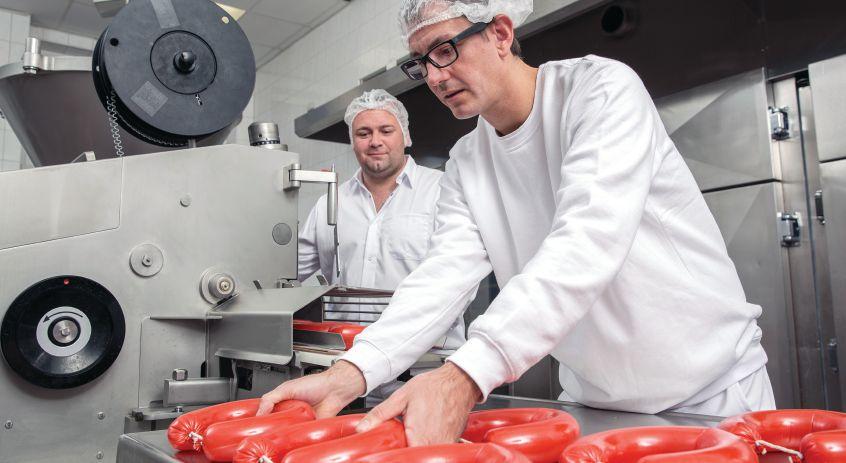
Kalle, once a dominant printing plate manufacturer, is now heavily involved with the sausage-wrap sector.
$100M
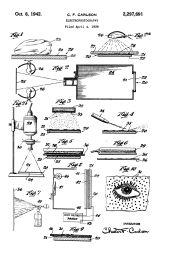
Chester Carlson’s original patent application material was submitted in 1934 and would eventually give rise to the digital printing process, including the critical Xerox 914 device in 1959, which exceeded $100 million in sales three years after its release.
Sheridan were massive cumbersome contraptions. Very little effort and resources were put into making faster more efficient equipment. It took a very small company in Zofingen, Switzerland, by the name of Hans Müller AG to turn the stitching industry upside down. Today known as Müller Martini, they asked a question: Why does one need to be able to open such a wide array of signatures? Why not make a simple machine that has fewer adjustments and, therefore, be easier to run? Müller did just that and although it was fight (especially in North America) the Swiss stitchers relegated monstrous clumsy Sheridans et al to only those titles with massive runs.
The end of WW II freed researchers to focus solely on industry and the world responded. Plastics and other chemically created materials opened up new markets. Ultraviolet (UV) printing was a by-product of the question: How do we dry inks printed on plastic? Early UV drying lamps were horrible. No one could measure light levels properly and inks with early photoinitiators were unstable. To add to the misery the lamps drew massive amounts of power and were so hot they damaged presses and caused fires.
Move to LED
Early setbacks didn’t stop both the lamp suppliers and ink manufacturers from improving the process. Prices came down drastically in the early 1990s and both inks and other chemistries took giant leaps forward. The offset press could now do more creative work than just ink on paper or board. Even though water base coatings had taken a large bite out of old fashioned varnish, UV continued to be creative and as we see today bulb technology is making room for new curing
sources such as LED.
With all these small steps, offset presses gained market share and could prosper for another hundred years except today we have another more interesting technology in digital printing. I use a very wide brush for the term “digital” as it relates to three distinct platforms: dry toner, liquid toner and inkjet. These processes can move our industry into the next chapter and continue to widen the circle because offset in all its forms cannot reconfigure itself to fit in the hundreds of new cracks like digital can.
Landa Digital made a tremendous splash at drupa 2012. Everyone was talking about the possibilities of an ink particle slapped onto a blanket at speeds of up to 13,000 sheets per hour. I could ask the question: How many are in the field making money for their owners? But maybe that’s not quite fair. Since 2012 the Landa press bore very little resemblance to the 2016 models. Indigo, Landa’s earlier brainchild, started the same way in 1993.That was an even harder mountain to climb. Other than a few dry toner manufacturers essentially trying to get a foothold in the B/W business, few had a clue where a liquid toner machine even fit. Just take a look at the thousands of HP Indigos in shops today and still being sold. Is there really any difference between a company like Landa and a company like Harris in 1906? I think there is to a point. Harris was a machine builder. That’s all they started out being. Landa wants to sell you ink. Ink is the major jewel in the crown for anyone selling digital equipment. These new technologies beg for more minds to join in. Just as it has always been when one new discovery finds itself lacking in symbiotic help from others.
New discoveries
With such dire news surrounding the world of print we sometimes fail to see what is really going on. Print shops of 2016 bear almost no resemblance to even 10 years ago. Certainly there are all sorts of statistics that can testify to say a 70 percent collapse in newspapers or continual migration of printed goods to your smart phone. But take a look around you. In the last 10 years while we lost a big chunk of print we also gained a great deal too. UV or Low-E and LED has shifted to other types of print. We may not buy offset presses like we used to, but printing plants are now full of everything from really wide inkjet, rigid material hybrid inkjet and over 20 major manufac-
turers of toner based print engines.
George de Mestral, a Swiss electrical engineer went for walk with his dog in 1941 Switzerland. He noticed the burrs from Burdock weeds constantly attached themselves to his dog as well as his own trousers. He thought. . . . What if burrs could be useful? In 1948 de Mestral had patented his invention and called it VELCRO. The word comes from the French words Velours (Velvet) and Crochet (Hook). A new industry was born. I’m pretty sure it wasn’t that easy to get the know-how and tools to make Velcro but everyone everywhere uses or has used Velcro. The dawning of a new period of technological growth in the giant printing industry is really just another chapter in man’s Velcro moments. Just like accidental discoveries such as de Mistral’s walk in the woods so we are living through constant new discoveries in print.
By the mid 1960s Xerox had started to gain mass appeal in the offices of North America. The breakthrough model 914 was being eclipsed by an even faster version and rabbit pelts – used to wipe toner of the selenium drum was not going to keep up with demand. A Xerox engineer noticing a shoeshine cloth in his hotel room came upon a solution: synthetic material. Although Xerox did provide plenty of notice, the French pelt buyer who had stock piled pelts, assumed his business was ruined and committed suicide. This man sadly is a footnote of industry today.
For tomorrow there will be even more newly discovered products created in the minds of young people who grew up with smart phones and graduate each year from places like Ryerson University and RIT. As they develop and conceptualize so shall we see our print shops evolve again and again. The evolution of print is constant. No one will remember the struggles and changes in technology. Few will care, beyond those making small steps forward.
This past week I spent hours pulling weeds and plenty of Burdocks off my socks, too, with little more than a thought – genius remains in limited supply, but it still finds its way into print.
NICK HOWARD, a partner in Howard Graphic Equipment and Howard Iron Works, is a printing historian, consultant and Certified Appraiser of capital equipment.
nick@howardgraphicequipment.com
HYPERLOCAL PRINT MEDIA
Metroland Media details the ins and outs of manufacturing community newspapers and distributing flyers in Ontario, using a range of tools to measure its market penetration
By Victoria Gaitskell
Probably Metroland Media, owned by Torstar Corporation, which also owns Canada’s largest daily print newspaper, the Toronto Star, is best known for publishing over 100 community newspapers. Geographically the circulations of these papers span the province of Ontario, from London in the west to Parry Sound in the north to Ottawa in the east, with predictably the densest concentration in the Greater Toronto Area. Most of Metroland’s newspapers are distributed weekly, some twice a week, and two – the Hamilton Spectator and Waterloo Region Record – are dailies. Annually, the company also distributes four billion advertising flyers – partly printed by themselves but mostly printed by others – door to door to households in
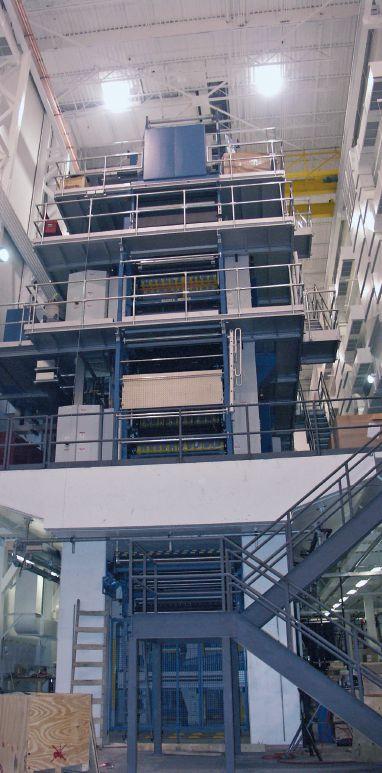
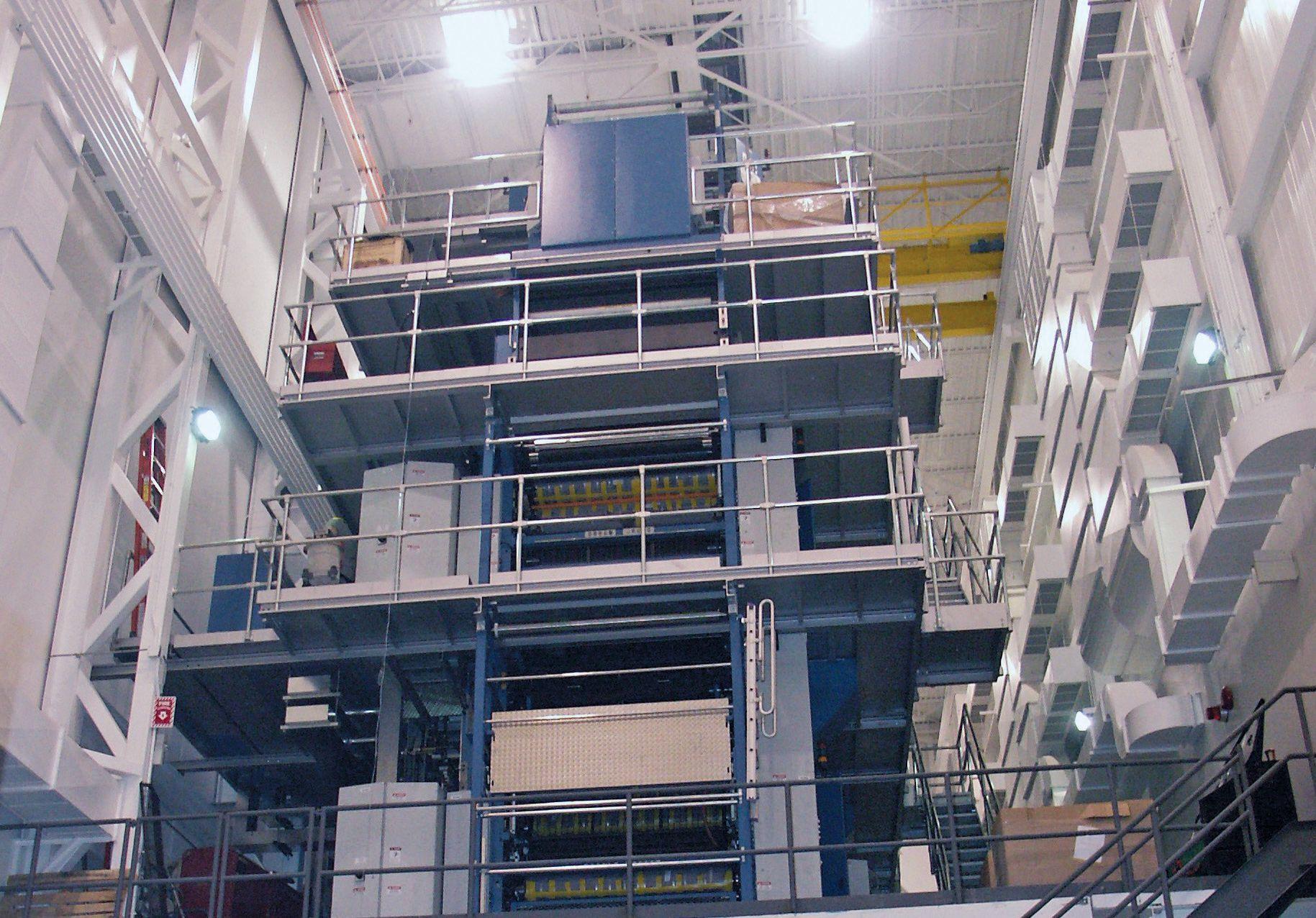
Metroland’s massive KBA Colora web press is located in Torstar’s second-largest and most modern plant, located on Tempo Avenue in Toronto.
its newspaper-circulation areas.
This year, in partnership with BrandSpark International, Metroland completed a study of its community news readership, comprising over 13,000 online and telephone surveys of adults in Metroland’s circulation areas. The study shows that 90 percent of respondents use either Metroland’s printed community newspapers or flyers for local news or shopping information. Recently, I asked Michelle Digulla, Vice President, Marketing, Metroland Media, and Dean Zavarise, Executive VP and General Manager, Torstar Printing Group, who oversees Metroland’s printing activities, for details on how Metroland maintains this high degree of market penetration in Canada’s most populous province. Digulla and Zavarise also discuss the future of Metroland’s community newspaper and flyer businesses, and how these fit with corporate strategy.
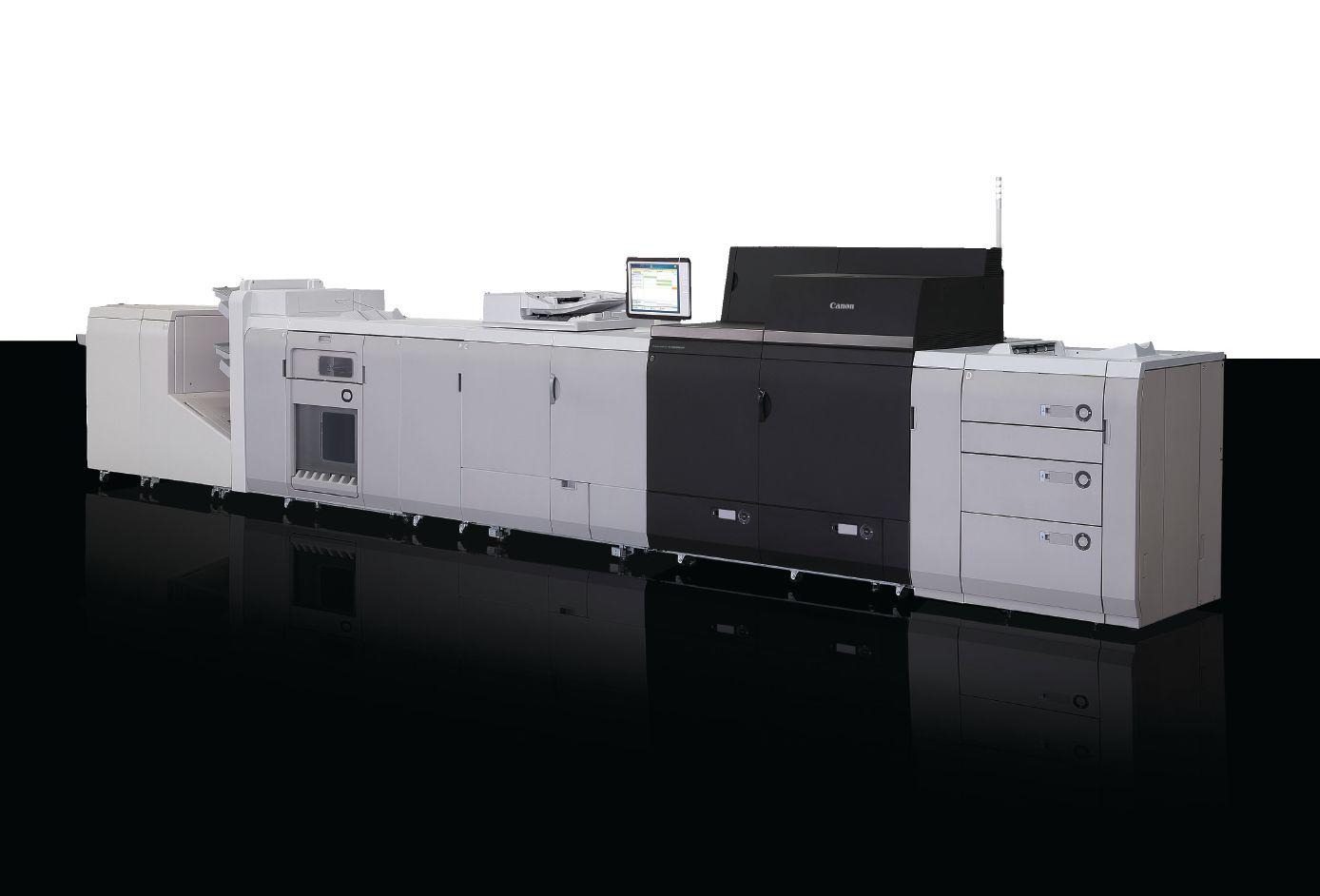
Setting New Standards for Speed, Reliability & High-Quality Output*
» 100 ppm / 80 ppm
» 60gsm to 350gsm
» Rated speed regardless of media weight (up to 350 gsm**)
» Robust in-line finishing
» Highly accurate front-to-back registration
» Impressive productivity and reliability
» Outstanding and consistent colour output *Compared to previous imagePRESS devices. **Based on 8.5”x11” paper size.
Metroland’s portfolio
73%
Percentage of people within Metroland’s entire footprint read at least one of the last four Metroland community
Readership is particularly strong in the GTA(including Durham, Halton, Peel, and York) with 84% readership.
Digulla says, that besides their community newspapers and flyers, Metroland Media is one of the largest direct-mail distributors in Ontario, to the tune of four billion pieces a year that reach about 84 percent of Ontario households each week. In addition to the digital assets associated with its community newspapers, Metroland also operates other major online community news sites that Digulla says are one of its fastest growing businesses, currently experiencing double-digit growth.
The company also publishes printed magazines and organizes experiential consumer marketing shows in such categories as bridal, food and wine, travel and most recently a video-gaming show called EGLX, by far its largest expo, that premiered in Toronto in April.
Digulla explains: “Our biggest assets are WagJag.com, a group-purchase Website where Canadian consumers can buy discounted products and services, and Save.ca, the largest digital flyer and coupon company in Canada. We dabble in other interests, but the ones I’ve mentioned are the biggest buckets.”
Hyperlocal media
Digulla says one of the main reasons behind Metroland’s strength in community newspapers is the company’s longstanding connections to the communities it serves: “Hyperlocal content really matters to the members of a community. Two-thirds of our online traffic comes from search and social media, where we find many people sharing our local content because of its uniqueness. They can’t find it anywhere else.
“Our staff who produce the community newspapers live in those communities, so we know the people intimately, what topics interest them, what causes a stir, and whom to call for the inside story. These relationships give us the right balance between the ability to act locally and be part of the community versus the large scale of a big company that enables us to do our job efficiently.”
Zavarise explains: “To maximize efficiencies across our entire platform,Torstar Printing Group operates as a network of printing plants and has downsized or consolidated plants as needed. In the last three years we have closed three plants.” In July 2016, this included Metroland’s Vaughan plant with printing of the Toronto Star outsourced to TC Transcontinental.
Zavarise lists the six plants Torstar Printing Group currently operates across Ontario, all with mainly cold-set web newspaper-printing capabilities: Ranked by number of staff, the largest is the Hamilton Spectator plant (in Hamilton), where they print Metroland’s two dailies on three large double-width Goss presses and perform offline packaging work for the Toronto Star. Besides printing and distributing its own properties, Torstar also prints and/ or distributes newspapers published by competitors; for example, just recently it signed a contract to print Postmedia’s London Free Press (published six days a week) in Hamilton starting in October.
Torstar’s second-largest and most modern plant, located on Tempo Avenue in
Toronto, is equipped with a KBA Colora press and two lines of community-style single-width presses. Largely the Tempo plant prints bigger community newspapers, and also Metro Toronto, the free daily owned by Metroland’s sister corporation Star Media Group, also a subsidiary of Torstar. Zavarise says the Tempo plant’s production consists of about 85 percent work for their own or affiliated companies and 15 percent general commercial work for third parties.
“At Tempo we are just starting up a new, relatively small heat-set single web installation – our first foray into this type of equipment after many years. Its purpose is to print small to medium runs of flyers and other marketing materials, which we see as an opportunity to grow our already strong relationships with many flyer advertisers by offering them more services,” explains Zavarise.
A third plant, Central Ontario Web in Barrie, with two community newspaper press lines, is used to print Metroland’s assets including its many newspapers circulated in northern communities like Barrie and Muskoka. At a fourth facility, Hamilton Web Printing in Stoney Creek, a single line community press prints newspapers and third-party commercial work. Thuroweb Printing, a small fifth facility in Durham, near Owen Sound, produces newspapers for southwestern Ontario communities such as Fergus, Mount Forest and Elmira.
Zavarise says Torstar’s sixth facility, Performance Printing in Smith Falls, a suburb of Ottawa, is the company’s most commercial-style plant, providing both newspaper printing (including Metro Ottawa) and full-service printing capabilities for the Ottawa area. Its equipment includes two cold-set community press lines (one tower with UV), sheetfed presses, bindery, an inserting facility, and a digital lettershop operation for direct mail.
Commercial third-party printing
Zavarise explains: “Our jobs for Metroland and Torstar are a captive business. Generally they are fairly routine and fall into the same slots each week. But our commercial printing is more opportunistic, and we’re always glad to take on more commercial work.” He adds that the schedule at each of Torstar’s six plants is overseen internally by each location’s operations manager, but when major changes are requested by publishers and third-party commercial customers, a central planning team figures out where they can best schedule the work to ensure efficiencies and that customer requirements can be consistently met. Since the busiest production days tend to be Tuesdays,Wednesday and Thursdays for community newspapers and Mondays and Fridays for flyers, he says commercial work is often scheduled in between these crunch times to maximize use of resources. “And if necessary, we also maintain rela-
Torstar has a network of six printing plants, including its second-largest and most-modern located on Tempo Avenue in Toronto.
Dean Zavarise, Executive VP and General Manager, Torstar Printing Group.
newspapers.
Sun Chemical has been developing, testing and promoting the use of technology and products for low migration packaging for decades. Our patented SunPak™ LMQ inks provide the lowest odor and migration possible to ensure you can confidently address the most demanding product safety requirements.
Count on Sun Chemical to help lead the way in low migration packaging solutions.
We help them determine which zones have the right demographics
tionships with other companies who can do our overflow printing.”
22 Min.
Readers are spending an average of 22 minutes reading the newspaper, according to a Metroland study, including over six minutes reading the inserted flyers.
Zavarise continues: “In the last three months, we started Metrolandprinting.com, a do-it-yourself Web storefront offering our advertisers and other clients and the general public the ability to order a large gamut of printed products from us directly online. This portal was the brainchild of Nathan Matheson [Director of Business Development and Administration for Metroland Media and Torstar Printing Group], who thought, that instead of just selling what our plants can do, we should facilitate all forms of printing for our customers. This strategy enables us to build on our existing relationships and make things easier for our clients by offering them one-stop shopping.” The Website’s current
online offerings include business cards, stationery, postcards, brochures, door hangers, greeting cards, tear cards, tent cards, magnets, labels and large-format signs.
Flyer fine points
Zavarise explains: “Our distribution business is a very solid, reliable process, audited by the Flyer Distribution Standards Association. It is a sophisticated operation involving not a few guys in a back room, but hundreds of people working in massive facilities of 10,000 to 80,000 square feet with one to four inserting machines. Across our footprint, we operate 14 such large regional distribution centres, most with machine-inserting capabilities.”
He says all their distribution facilities share a common software management system to track the week’s flyer placements and delivery destinations. This system records which zones each flyer needs to reach and downloads the information to the inserting machines at each facility. Each facility waits for the printing plants to deliver the week’s flyers before they can start building packages. Typically they start on Friday for a Thursday delivery and work around the clock and through the weekend, depending on the size of the packages to be assembled for individual homes. For one community newspaper, a typical package can contain 30 or 40 different flyers, says Zavarise. Once packaging is completed, contractors transport the bundles of flyers to carriers’ homes along with the printed newspaper for their community. Usually a Metroland newspaper and one or more packages of flyers are delivered separately to each carrier, who assembles them into a single package and delivers it door to door.
“Occasionally we use Canada Post, but in many markets we still distribute flyers in packages via youth carriers, each delivering to as few as 50 or 60 households,” Zavarise continues. “That’s where the complexity lies. Advertisers can narrowly target where their flyer lands.We can help them determine which zones have the right demographics to match their target market.”
Digulla comments: “No one else in Ontario is large enough to afford or warrant the type of work we do for major clients in targeting flyers to specific locations based on point-of-service customer data collected by the clients. Our team includes a specialist with a Masters degree in Geographical Informa-
tion Systems who can calculate very narrowly targeted deliveries to as few as, say, 60 homes based on factors such as demographics, income, purchasing behaviour, lifestyle, or psychological profile.”
Zavarise says that advertisers often use this targeting service on simpler terms by choosing to distribute their flyer to one specific portion of a community rather than the community as a whole: “For example, although a big grocery store chain might want their flyer to reach every household, a small laundromat might only want their flyer to go to the 1,000 homes located closest to the laundromat. We have the capability of doing that.
“And if 20 other types of businesses are doing the same thing,” adds Zavarise, “an individual carrier might end up with a unique set of flyers that is quite different from the package delivered by the carrier on the next block.”
Future Geo-demographics
In the next three to five years, Digulla expects to see much more interest and business activity from clients based on point-of-service data and geo-demographics. She also anticipates that Metroland will be doing more to expand and leverage its growing digital properties.
Both Digulla and Zavarise say, that although in general the Canadian newspaper business is being severely challenged by the movement of advertising dollars from print to digital media, Metroland’s study indicates consumers’ receptiveness to printed community newspapers and printed flyers delivered door to door remains high. Consequently, they feel optimistic about Metroland’s ability to continue attracting advertisers to sustain these businesses into the future.
Additionally, Zavarise predicts, that although at present, relatively speaking, they do not print a lot of variable data for their flyer advertisers, the demand for this service may grow in the future. For example, right now they print and circulate multiple versions of Niagara This Week in six different zones. Some content is common to all six, but other content is limited to certain zones. Similarly, Digulla says a grocer who has great take-up on particular products in a specific area may customize their flyer for that specific area and request a special drop.
In the future, advertisers may start exploiting these types of possibilities more often. “It all depends on them,” says Zavarise. “We’ll stay open to whatever they need.”
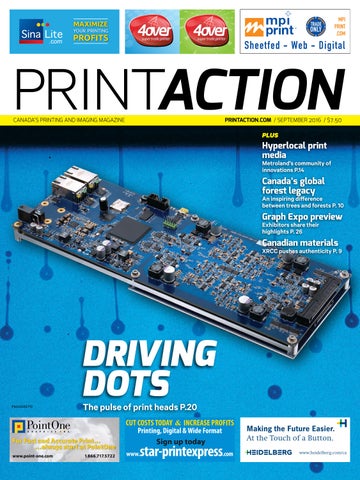
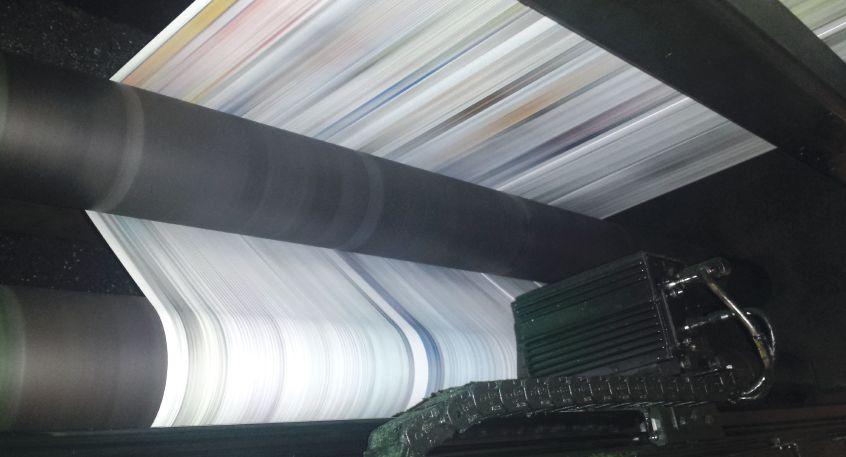
Moving beyond wide-format and forms production, the manufacturing of print heads is helping to evolve production inkjet presses for commercial printing.
DRIVING DOTS
Part II of The pulse of print heads focuses on the advances of manufacturing piezo and thermal systems for use in inkjet presses taking greater aim at commercial printing and packaging
By Jon Robinson
With the growing range of investment options, PrintAction is producing a series of articles, called
The pulse of
print heads, to better understand one of the most-critical components of any production inkjet press. In Part 1, last month, we took a look at the relatively simple discussion of drop size, primarily because print head R&D and inkjet messaging for more than a decade focused on printing ever smaller drops of ink with the goal of improving overall inkjet quality, even as some commercial settings may require larger drops for higher volume work
This month, Part II of The pulse of print heads focuses on the manufacture of print
heads and how it relates to the adoption of inkjet presses for a wider range of commercial-printing applications. When a production inkjet system requires dozens of print heads each costing a few thousands dollars, for example, the manufacture of print heads also relates to the initial purchase price of inkjet systems and subsequent print head replacement costs.
Crystals, diaphragms and heat
The past few years have seen the rise of two important technical terms in relation to the key piece of hardware – print heads – of production inkjet presses: Nanotechnology and MEMS. Print head makers and their press-building OEM partners –if not one and the same – have put both nanotechnology and MEMS into play for decades now. Short for Microelectromechanical Systems, MEMS basically describes any type of microscopic device,
VERITIV LETS YOU DISTINGUISH YOURSELF FROM THE CROWD.
THE JUDGES HAVE DONE THEIR PART. SEE THE 2016 WINNERS IN OUR FIVE -CITY TRAVELLING EXHIBIT AND WINNERS’ CATALOGUE THIS FALL.
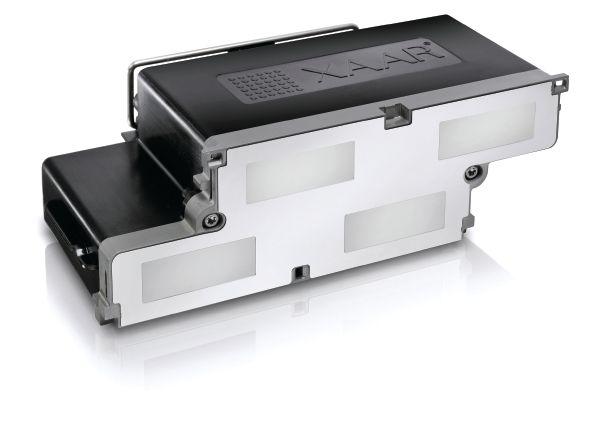
Xaar’s new Z pattern print head (right) provides a smaller print zone.
Far right: HP’s PageWide Web Presses feature print heads with 2,400 nozzles per linear inch.
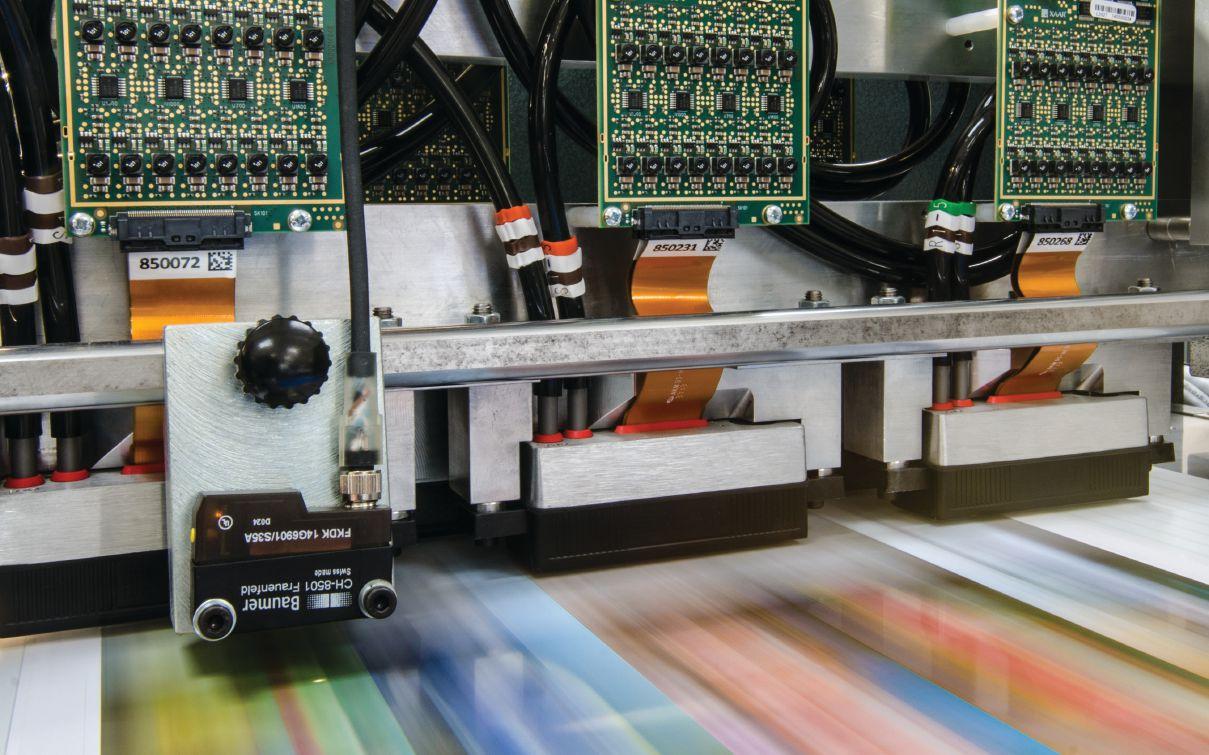
Aligning print heads in high-resolution applications has always been a challenge
42K
HP PageWide Pro desktop printers have more than 42,000 nozzles on the 4-colour, 8.5-inch print head, drops.
particularly devices with moving parts. MEMS manufacturing, therefore, relates more directly to piezo print heads that eject ink with moving mechanical elements, walls or diaphragms. Thermal print head manufacturing is experiencing similarly important advances, albeit with different process definitions, as developers of both print head types absorb massive upfront factory costs to propel the printing industry’s adoption of inkjet.
“When we talk about MEMS, Xaar talks very holistically about our whole product portfolio – older [print heads]
and new stuff. The difference being that we now use silicon MEMS, as well,” says Jason Remnant, Product Line Manager with Xaar, which has built inkjet print heads since 1990. He explains silicon is more or less used to form the base of the print head, providing it with fluidic chambers before a film is applied with PZT (piezoelectric pumping components).
Xaar’s older generation print heads were built with what the company refers to as Bulk PZT that would be cut down to make the actuator ejection device, with control signals and a source of energy.The
advances in silicon PZT manufacturing provides print-head makers with scalability and accuracy, resulting in an ability to fit more nozzles onto the given size of a print-head plate, with corresponding drivers, at less cost – even if the head may not be as durable as a Bulk PZT build.
In 2007, Xaar started working toward silicon-based MEMS production and in May 2016 introduced its next-generation 5601 print, which is also built with what manufacturers describe as Thin Film technology for holding PZT components. “It has to be biggest thing to come along from Xaar in a decade,” says Remnant. Over the past decade, print head developments ensured the mass adoption of wide-format inkjet for commercial work, as well as ceramics printing and print products with lower quality requirements like the inner pages of books, statements and forms. The commercial printing industry – with its many applications and
Bring the power of performance to your postpress feeding and finishing with Standard/Horizon automated die cutters, folders, binders, trimmers, and saddlestitchers – winning customers with professional results and document integrity for inkjet, digital, and offset print applications.
Epson’s PrecisionCore platform, such as this print bar for the SurePress, was first introduced in late 2013.
PERSONALIZATION FASTER, EASIER, BETTER
HP thermal inkjet print heads are essentially integrated circuits that eject ink
quality demands – requires a printhead evolution that is well under way.
“The 5601 is a new platform of print heads that will absolutely drive the opportunity to digitize more print in the world,” says Remnant. In addition to reaching higher manufacturing levels at smaller micro-scales (nanotechnology), the new generation of print heads for commercial work, packaging and laminates, need to jet fluids other than solvent and UV. Remnant explains the 5601 can jet low-viscosity fluids, including aqueous and latextype inks, which also opens up inkjet to the world of textiles.
To deploy the 5601, Xaar is working closely with Ricoh, which holds significant press interests in commercial and high-speed printing markets. “Past print heads have included silicon MEMS techniques and now new designs are being developed. MEMS and thin-film technology are not changing Ricoh’s print head position, but rather, these two technologies are enhancing and expanding Ricoh’s inkjet print head capabilities,” says Joseph Ryan, Director Business Development, Ricoh Printing Systems America.
developed for manufacturing integrated circuits like computer chips. HP’s MicroElectroFluidic advances resulted in the launch of its Scalable Printing Technology (SPT) around a decade ago. Allen explains SPT enables fine structures, both electronic and fluidic, to be defined, precision-aligned and built on a silicon substrate.
Just as Xaar faced limitations producing Bulk PZT, HP also previously faced manufacturing challenges with its original thermal heads because they employed separately fabricated nozzle plates that had to be mechanically aligned and adhered to a silicon substrate with fluidic channels and chambers. Allen explains more complexity came from the use of different material properties, such as thermal expansion between an electroformed nickel nozzle plate and the silicon (polymer) component.
The most-advanced print head manufacturing models today integrate components to create more of a print chip than a print head. “MEMS is a bit of a misnomer for HP thermal inkjet technology,” says Ross Allen, Senior Technical Specialist, HP Inkjet Technology Platform, who first joined the company as an engineer in 1981. “There are no moving mechanical elements in an HP print head.The ink is the only moving part. So, HP thermal inkjet is a MicroElectroFluidic System, and that term is not in common use.”
HP builds its newest generation of print heads with silicon and photolithographic polymer technologies. Allen explains this allows the entire print head, including onboard electronics, to be built with technologies that were originally
“By building fluidic – ink – chambers, passages, and nozzle plates out of the same photo-imageable polymer in layers up from the surface of a silicon wafer – with its electronic circuits – larger and more complex print heads may be produced,” says Allen. “HP thermal inkjet print heads are essentially integrated circuits that eject ink.”
Like Xaar’s 5601, Epson’s PrecisionCore and Fujifilm Dimatix’ Samba technology, HP SPT is print head platform, meaning it continues to receive R&D dollars to include what Allen describes as smaller fluidic structures: Smaller drop generator chambers, ink passages, nozzles and built-in filters that catch particles in the ink.
“This means that current generations of an HP print head chip – typically about an inch long – can have thousands of identical nozzles and deliver two or four different colours of ink. These chips are placed end-toend, staggered – and with a small overlap – to build print heads that are 4.25- and 8.5-inches wide.”
Compact nozzles and zones
The ability to design nozzle-dense print heads – and manufacture them on a grand scale – is critical for inkjet-press adoption in commercial printing for a number of reasons from quality to cost. Technically, nozzle-dense heads allow press makers to build larger format presses with smaller print zones. Xaar’s 5601 is built in a Z-pattern to interlace the print heads and reduce the printing area of – ideally – a single-pass inkjet press built by one of its partners. A smaller print zone reduces potential printing complications with fast moving paper. “Being able to assemble a number of print heads into large arrays allows large systems to be assembled,” says Ryan. “Aligning print heads, especially in high-resolution printing applications, has always been a challenge to system designers. Almost all print heads have alignment techniques using precision locating pins, flat control surfaces, and incorporating physical configurations, such as Z forms and trapezoidal configurations for interlocking and alignment.”
Employing traditional print heads in a single-pass production inkjet press, explains Xaar’s Jason Remnant, typically required staggering the print heads on a print bar to address issues like number of applicable colours and redundancy, particularly as press format sizes increased. Staggering heads can equate to deeper print bars, which in turn increases the print zone. “A small print zone is really critical because it has a [reduced] cost on the build of your machine and it also has a big influence on the print quality of your output,” explains Remnant. “If you are making a huge single-pass printer and it turns out that your print zone is two-metres wide, you have to control your substrates [to] get them from the first colour all the way to the nozzles of the last colour – and [the paper must] be where you expect it to be, so the drops end up where you want them.”
Challenges of running a larger print zone are exacerbated, explains Remnant, because it allows for more swelling when paper is hit with fluids, particularly if absorbing water. “Part of the design of this [5601] head was to allow the OEM to make a very compact print zone and, in fact, the concept for a
four-colour system with our print speed would actually mean you are printing quicker than the swelling of the paper.”
The application of staggered print head bars, of course, becomes efficient when building integrated print chips with super-packed nozzles. For the first generation of print heads used in the HP PageWide Web Presses, Allen explains nozzles were spaced in two offset columns of 600 nozzles per inch to print at 1,200 dpi across the web. “The newest generation of HP print heads, called High Definition Nozzle Architecture, places small drop weight nozzles between the original high drop weight nozzles for dual drop weight printing. Across each ink feed slot – a slot through the silicon chip that supplies ink to the fluidics layer –these print heads feature 2,400 nozzles per linear inch,” says Allen. “A low drop weight nozzle prints in the same dot row as a high drop weight nozzle across the ink feed slot, so the printing resolution is still 1,200 dpi across the web.”
HP’s print head build with integrated circuit technologies means many hundreds of its print head chips can be made on one silicon wafer. “This leads to large economies of scale in manufacturing,” says Allen, “where many different print head series can be built in the same HP factory.” Economies of scale provided by today’s printhead manufacturing results in lower-cost products that will ultimately affect the price of production inkjet presses and introduce a wider range of lower-cost, smaller-format systems for commercial printing. With growing use of total-cost-of-ownership investment models, printers should also consider the cost of replacing silicon-based print heads.
“I don’t see any breakthroughs coming in any inkjet technology that could be considered a dramatic reduction in replacement cost. HP SPT already delivers manufacturing economies of scale that are reflected in print head price,” says Allen. “What could happen to reduce effective print head cost-toprint is longer print head life, which drives down cost per square metre. Of course, HP and others are always working to develop longer life, more reliable print heads, but lower prices will be evolutionary and not a dramatic breakthrough.”
Graph Expo
Exhibitors provide highlights of their 2016 Graph Expo booths, featuring a range of technologies three months after drupa debuts
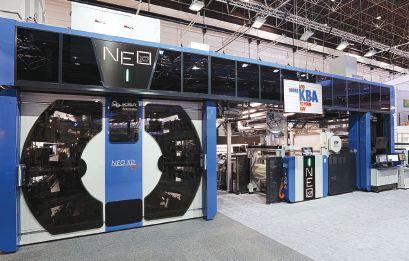
KBA NEO XD
Introduced in May 2016, the NEO XD LR, according to KBA-Flexotecnica, is the first fully hybrid CI press for printing with solvent and water-based inks, either as single printing process or as a multi-process combination. The press also runs with a range of curing systems like UV-LED and EB, to meet various production demands in flexible packaging. The press can hold up to 12 colours and has a cut-off from 400 to 1,200 mm, a maximum web width of 1,650 mm, and a maximum printing speed of up to 500 metres per minute (mpm).
The NEO XD, according to KBA, features a new ultra-stiff printing unit to minimize vibration and plate bounce. It also includes new wrap-up safety covers with protective glass doors for operator safety, as well as a newly designed system for extraction of the inter-colour dryers and a new access door on the top of the central drum printing group frame.
Konica bizhub PRESS C71cf
Introduced in mid-2016, the bizhub PRESS C71cf is a 4-colour, roll-to-roll label press aimed at mid-sized printers. Representing Konica Minolta’s first foray into the label market, the press uses drytoner electrophotography, prints CMYK, and supports 1,200 x 1,200-dpi resolution at 8-bit gradation. It has a maximum printing size of 47 x 12.5 inches, support a maximum paper width of 320 mm (ap-
proximately 13 inches). Gloss and matte papers, as well as synthetic, polypropylene, polyester and BOPP substrates, are supported giving the user a range of applications and markets they can pursue.
Feeding speeds will range from 62 feet per minute to 31 feet per minute depending on the paper type and options selected. The main print engine used in the configuration is based on the existing bizhub PRESS C1070 engine. Konica Minolta has partnered with Miyakoshi which will supply the un-wind and rewind devices. The digital front end (DFE) driving the C71cf will be Konica Minolta’s own embedded controller. Variable data printing is supported and both the PPML and PDF/VT formats are included (PDF/VT requires an available APPE option).
Xerox Brenva HD
Released in North America in September 2016, the Xerox Brenva HD Production Inkjet Press targets the space – dubbed by InfoTrends as the Zone of Disruption – that sits between high-end toner and low-end inkjet presses. The Brenva press is the first in a platform series of cutsheet inkjet offerings that, according to Xerox, combines the cost effectiveness of inkjet with the flexibilities of cutsheet to address the needs of print providers in the light direct mail, transactional and book markets. Brenva HD combines many of Xerox’s best-in-breed components from the popular iGen press series, including its frame, paper-path, output module and print server. The Brenva also incorporates the production stacker from the flagship Xerox Nuvera family.
Canon Océ VarioPrint i300
Released in September 2015, the Océ VarioPrint i300 provides what Canon describes as cost efficiency due to its advanced inkjet technology, with the media and application flexibility of cutsheet production. The Océ VarioPrint i300, explains Canon, allows users to meet the growing demands of customers who require short turnaround times. Its input
and output technologies enable a whitesheet-in, finished-application-out workflow. The VarioPrint i300 is equipped to enhance uptime with automated maintenance routines which help secure uninterrupted production, and its PRISMAsync controller allows users to process large files with variable data. To improve uptime, which Canon states to reach at least 90 percent, the VarioPrint i300 is a self-contained system, meaning it is temperature and humidity controlled, and all external elements have been eliminated. Even the input trays of the i300 are sealed for temperature control.
RISO ComColor GD Series
As a tech preview at Graph Expo, the RISO ComColor GD Series (9630 and 7330 models) is slated to be released for sale in North America by January 2017. The ComColor GD Series of production devices hold full-colour cutsheet inkjet printers that delivers prints at speeds of up to 160 pages per minute. The GD utilizes five inks – cyan, magenta, yellow, black and gray – to produce grayscale output and lower printing costs. Newly formulated inks offers a high density black and more vibrant colours. The machine comes with an embedded GDI or two optional RIPs. The embedded optional Adobe PostScript RIP supports Mac/Linux, PDF direct printing, and remote printing from most mobile devices. The optional production
Konica Minolta AccurioJet KM-1.
The cutsheet Xerox Brenva HD inkjet system targets a production gap between higher-end toner and lower-end inkjet devices.
Canon Océ’s VarioPrint i300.
KBA-Flexotecnica’s NEO XD LR can feature up to 12 colours.
RIP is equipped with a Fiery Digital Front End developed by EFI. This image processor maximizes the ComColor GD series to meet the demands of variable data printing operations for direct-mail or transactional printing, and delivers high-speed data processing for large-volume, complex document data. The ComColor GD Series handles a range of paper, card stock and envelopes from 3 x 5 inches to 11 x 17 inches with weights ranging from 46 gsm to 210 gsm (12-lb bond to 56-lb bond).
Mutoh ValueJet 1638UH
Released in April 2016, the 64-inch ValueJet 1638UH hybrid printer, priced around US$59,995, is based UV-LED production. It features a staggered dual print head design, along with dual UV lamps, on either side of the print heads, to provide fast cure times. The ValueJet 1638UH hybrid system, it not only gives you the ability to print on rigid substrates, it also gives you the flexibility to print on roll media as well. Print on material up to a
half inch thick and save valuable floor space with its dual function and multiple application design. The CMYK plus white and varnish ink options are ideal for printing packaging prototypes, POP displays and indoor signage. The VJ1638UH also comes with Mutoh’s VSM (ValueJet Status Monitor) app for remote printer management and offers an optional SpectroVUE VM-10 spectrophotometer for colour management.
Ricoh Pro C7110X
The Ricoh Pro C7110X five-colour production class digital printer prints at speeds up to 90 ppm and at 1,200 x 4,800dpi with a fifth colour option, allowing for what the company describes as near offset quality. The Ricoh Pro C9110 is described as a high-speed, heavy segment production colour printer, that prints at speeds up to 130 ppm and supports paper weights of up to 400 gsm in simplex and duplex.
The Ricoh Pro L4160 wide format colour printer is capable of producing print quality and colour matching for signs, banners, wall coverings, wraps and more for indoor and outdoor point-of-
sale displays. The Ricoh TotalFlow suite, consisting of vendor agnostic workflow solutions, drives efficiencies and improves profitability through intelligent adjustments in workflow, monitoring and management capabilities.
Canon Océ Arizona 6100 Series
Released in October 2014 as a new platform, the Océ Arizona 6100 Series is optimized for high-speed production of rigid medias, including odd-shaped, heavy, smooth or pre-cut rigid media; double-sided prints. Pneumatic registration pins help ensure a quick, repeatable, easy loading of rigid media every time. With automated media loading, a single operator can simultaneously print and load/unload for non-stop printing, on two machines producing almost 50 boards per hour in Production Mode. Designed as a dedicated flatbed system, the series features an extra-large 2.5 x 3.05 metre vacuum table to keep media and objects stationary during printing for optimal print quality and rigid media application versatility. A newly designed Automated Printhead Maintenance System provides completely automated, hands-free print head cleaning. Employing the same Océ VariaDot printing technology as all other Arizona Series printers, the Océ Arizona 6100 Series offers the same near-photographic print quality, while using light inks for reliable printing in even the fastest production modes.
Konica
Minolta AccurioJet
KM-1 For high-end commercial printers, the Konica Minolta AccurioJet KM-1 high speed cutsheet inkjet press will help with commercial printing and light folding carton packaging applications. The Konica Minolta UV ink technology and larger than B2 size sheet format, will allow for
RISO ComColor GD Series.
Ricoh Pro C7110X.
Mutoh ValueJet 1638UH
Canon Océ Arizona 6100 Series.
new applications with a range for substrates, according to the company, that cannot be reached with toner-based technologies.
The need to expand to larger digital formats with variable data printing allows applications that cannot be done with most traditional offset presses. AccurioPro is the brand name of a series of digital printing solutions and services offered by Konica Minolta to promote automation of printing tasks with a view to improve work efficiency, reducing production time and ensuring effective quality control. The company is showcasing two collaborative software products: AccurioPro Conductor, which enables operation of multiple presses at a higher efficiency, and AccurioPro Flux, which split print jobs automatically between different printers according to the chosen criteria and import and convert data in one step.
Konica Minolta MGI JV 3DW
To compliment the label printing process, the MGI JV 3DW digital finisher will add spot UV, 2D/3D, and Hot Foil enhancements in a 100 percent digital format to printed rolls of labels. No dies or screens to setup, just all digital workflow. This will provides converters and brand owners
with unique applications like variable data foil labels or spot varnished labels.
Konica Minolta will also showcase its flagship product from the MGI JETVarnish series for various segments. The JETVarnish 3DW is a technology that takes print to the next level by adding more value to printed documents. It is designed and manufactured by MGI with Konica Minolta to help printers expand their services offerings. This includes new spot UV and 3D tactile varnishing capabilities. The MGI’s JETvarnish 3DW can convert regular printed output into high-margin spot UV printed sheets, or even higher margin 3D embossed jobs with up to 100 microns of varnish.
Prinova Messagepoint
Messagepoint is a hybrid cloud-based
content management platform that enables service providers to meet the customer communications management needs of enterprise customers. It provides a secure environment for business users to directly own and control touchpoint messaging content and business rules driving the pace of change for customer-facing print and digital communications.
With Messagepoint, business users can create, modify and approve customer messaging content and targeting rules in customer communications touchpoints across all channels. Clients can preview, approve and test their content before it goes into production. A full trackable audit ensures business users know exactly who made what changes, when and why they were made. Unit and regression testing time is reduced because only the content is updated and composition templates and production parameters remain untouched.
Mutoh ValueJet 1938TX
Released April 2016, the ValueJet 1938TX, priced at around US$39,995, is a 75-inch wide direct-to-textile printer for creating customized fashion apparel, upholstery, interior decor, scarves, swimsuits, trade show graphics, soft signage, flags, sports-
MGI JV 3DW digital finisher.
RS SuperiorSuperior Binder y
wear and more. Print designs and photographic art work directly onto a variety of fabrics including closed, open non-stretch, face-in and faceout roll media.The ValueJet 1938TX employs two heads for fast print speeds up to 914 sqft/hr and 8-channel piezo print head technology helps make the images stand out.
Canon Océ ColorWave 910
Released in December 2015, the Océ ColorWave 910 large format colour printer is designed to produce a range of display graphics such as point-of-sale posters, materials for tradeshows, counter and floor displays, and technical drawings in record time.
The Océ Colorwave 910 also offers a fully integrated digital workflow with various finishing options and an easy to use interface panel to increase efficiency. Monitor print status, edit jobs, manage print job queues, and address different folding requirements conveniently right from the printer.
Scodix UltraPro with Foil
Scodix is exhibiting the Scodix UltraPro with Foil, released at GraphExpo 2015, which is an optional module, that runs in-line with the Scodix Ultra Pro Digital Press, delivering unmatched foil enhancement capabilities, including high gloss, embossed, variety of densities for short to medium runs, using an
efficient digital process. Scodix Foil is suited for commercial printers, coping with short to medium runs, who today have to outsource the foil application or have to use an expensive makeready process with molds and dies, as well as for converters doing high-end short to medium runs.
Eagle Systems Cold Foil
Eagle Systems explains offset sheet fed Cold Foiling on uncoated stock has never been done before. Due to characteristics of uncoated stocks (being porous and variables in the surface from coated stocks), previous iterations were never capable of 100 percent coverage. Now, with an Eagle Cold Foil system and Eagle consumables (available directly from Eagle), offset sheetfed cold foiling on uncoated stock becomes a reality.
Currently, there is only one press set up to do this in the world. Eagle has retrofit a manroland press at the The Matlet Group’s Packaging Graphics in Providence, Rhode Island, a manufacturer of high-end consumer packaging products. In the works for more than six years as an R&D project, Cold Foil on uncoated stock is now a sellable solution, with 100 percent coverage capabilities.
The company explains this technology is applicable for service providers of greeting cards, food
1. ONE-STOP SHOP — Die Cutting, Bindery, Data & Lettershop.
2. SUPERIOR TECHNOLOGY — Die crease without a die, then fold and even glue all on the same machine, up to 30 pt.
3. INTEGRATED MODULAR UNITS — Combined in-line finishing: crease, fold, glue, tipping, envelope inserting, ink jetting (Duplex), clip seal (3 sides), mail prep.
4. SAVE ON POSTAGE COSTS
As a Certified Canada Post Direct Marketing Specialist, we get contract pricing reductions.
5. RETURN MAIL PRODUCTS — Customized “Return Mailers” created in-line with “U” or “BOX-shape” remoistenable glue, time perfed applications and envelope formation.
6. MINI-BOOKLETS — Saddle-stitch and trim 2-up booklets in-line to the size of a business card. No need to trim off-line, or do 2 passes.
7. HIGH SPEED EQUIPMENT — High speed Tipping, Folding, Saddle-stitching and soft folding ensuring on time delivery.
The Scodix UltraPro system can now include a foil option.
Over 75,000 sq ft plant housing state-of-the-art nishing and bindery
Personalized account management and complete control over production
24/7 Production with fully automated and barcode controlled plant
FSC / PEFC / SFI certi ed
packaging, pocket folders, and wine labels, as well as beer and soda carriers. Eagle Systems is highlighting proprietary samples at Graph Expo.
Standard Horizon SmartSlitter
Released in February 2016, the Standard Horizon SmartSlitter is an all-in-one sheet processing system that can slit, gutter cut, edge trim, cross-cut, perforate, and crease all in one pass.
The skip perforation feature can produce T- and L-perfs suited for coupons, tickets, and business reply cards. The system is also capable of both matrix and rotary creasing, and for accordion fold applications or perfect bound books, up and down creasing can be performed in one pass. Print mark registration adjusts for image shift from sheet to sheet.
Xerox FreeFlow Core
Released in July 2016, Xerox FreeFlow Core is an intelligent automation platform that streamlines prepress activities to increase productivity and reduce costs. The solution automates print operations by allowing you to easily build workflows that eliminate costly file preparation touch points. This frees up company resources, diverting them away from repetitive tasks and allowing them to target higher value jobs. As a modular platform, Free-
Flow Core offers the affordability and flexibility to grow along with your organization. A recently announced new cloud configuration for FreeFlow Core means it is now available in two cloud configurations: base cloud and advanced cloud.
DocketManager Version 3.0
For Graph Expo 2016, DocketManager Inc. is unveiling its DocketManager Version 3.0. The company explains DocketManager v3.0 has a completely redesigned, modern and user-friendly interface making it easier than ever to use. Equipped with hundreds of new features, DocketManager v3.0 described by the company as simple to use technology for efficiency gains.
MPI Print
MPI Print Inc., in business for more than 20 years, describes itself as a one stop shop for all aspects of printing from high volume to short run and custom projects. The company provides trade printing throughout North America featuring its 32-page KBA heat-set press with inline colour and cutoff control. The company also has a sheetfed division with one of the largest trade binderies in the country. MPI Print now runs two facilities.
Ultimate AutoNesting
Impostrip Automation v.10 brings
Standard Horizon’s SmartSlitter can produce T- and L-perfs.
new optimization capability for true shape nesting in a fully automated mode for just-in-time print production.
Easily connecting to a cloud or onsite workflow or storefront, AutoNesting streamlines the intelligent placement of shapes on a sheet or a roll. It’s unique template-less approach allows for greater flexibility and productivity.
GTI Remote Director Bundle
In July 2016, GTI Graphic Technology, a manufacturer of lighting systems for critical colour viewing, colour communication, and colour match assessment, teamed with Cardiff by the Sea, CA based Remote Director LLC, to offer a series of soft proofing solutions.
Remote Director is the recognized leader in colour accurate monitor-based proofing, explains GTI. Soft proofing allows the user to view an accurate representation of what a final print will look like on their monitor.
KBA VariJET
German press maker KBA has worked with Xerox to develop a new B1 sheetfed press, called the KBA VariJET 106, aimed at folding-carton printing. There are currently two such presses being developed at KBA’s German facilities and the company describes the program’s progress as being in the final stages of development. VariJET 106 combines offset printing and finishing technology with inkjet technologies, the latter developed by Xerox, in a highly modular system that can be tailored for customer requirements, including optimized inline processes.
Standard Horizon RD-4055
Released in May 2016, the Standard Horizon RD-4055 Rotary Die Cutter, with Dual Magnetic Cylinder, is designed to meet the growing demand for short-run die-cut product, with the ability to die-cut, crease, perforate, slit, hole punch, and round corner in one process for both digital and offset printed sheets.
RISO SF Series
To be released in the US/Canada September 2016, the RISO SF Series of digital duplicator features a redesigned, customer friendly, colour LCD panel, and an increased speed from 130 to 150 pages per minute. The SF Series now delivers a true dpi of 600 x 600, an improvement over the previous model which delivered a 300 x 600 dpi. Its master-making time has been improved by 10 percent over previous digital duplicator models.
Xerox iGen 5
Released July 2015, the Xerox iGen 5 is the next-generation platform of the iGen Digital Press family with offerings at 90 ppm, 120 ppm, and 150 ppm. Built-in automation enables predictable, efficient operations and easy attainment of excellent and consistently repeatable color. The press features the first optional fifth color unit, which increases the ability
GTI Remote Director Bundle includes a range of available viewing stations.
to match a larger gamut of Pantone colours or add specialty effects using new Clear Dry Ink. Orange, green or blue options supplement CMYK and can accurately hit distinctive colours without moving short runs to offset.
Colter & Peterson Prism 73E
Colter & Peterson is exhibiting both new and existing paper cutters from its Prism line, as well as three versions of the Microcut retrofit systems for paper cutters and the new Microcut Cutter Control System. Joining the 31.5-inch Prism P80 is the brand new Prism 28-inch 73E. The Prism P80 features Microcut colour touch screen computer and reliable performance. The new 73E comes equipped with a Mitsubishi computer control package and electro mechanical clamp/knife drives. Priced at under $20,000, it is designed for companies that need a machine for lighter duty applications.
At Graph Expo, C&P is also featuring the Microcut COLOR, Microcut JR and Microcut PLUS WS retrofit kits. These programs have different benefits but each memorizes the cutting sequences so the back gauge can automatically move into position to deliver a precise trim within 1/64 inches.
RISO ComColor FW Series
Released for sale in the US/Canada Market in June 2016, the ComColor FW Series (FW5230, FW5231, FW5000) is the company’s fifth generation cutsheet, colour inkjet printer. The FW series is 33 percent slimmer than previous models due to an integrated face-down tray, and it has a newly redesigned full-colour touch panel that is adjustable and customizable. The output of the FW series is 120 pages per minute in full colour and it handles a range of paper/card stock and envelopes from 3 x 5 inches to 11 x 17 inches.
Standard Hunkeler WI6
Released in May 2016, Hunkeler’s enhanced WI6 system provides inspection and tracking software for error-free print quality through continuous monitoring of the printed web for quality-related checks such as colour registration, front-to-back registration, variable content, print marks, logos, pictures, and jet-outs. At the show, WI6 is running on Standard’s continuous-feed saddlestitching solution, a roll-to-booklet configuration that pairs the StitchLiner 6000 and UW6 unwinder and CS6 rotary cutter.
RISO ComColor FW Series.
CUSTOMER SERVICE REP
We are seeking a full time Customer Service Representative who has a drive for excellence and the ability to thrive in a fast-paced environment. The successful applicant is responsible for interaction with multiple clients and managing day-to-day workflow.
Experience as a CSR in the print industry is preferred but not required. Must have excellent communications skills, both written and verbal. Must be skilled at working with MS Office Suite. Experience with Google docs is an asset. Only the candidates selected for an interview will be contacted.
Contact: HR Manager
Email resume to HR@pbiinc.ca
Phone: 905-563-1537
Website: www.pbiinc.ca
HIGH-SPEED INSERTER OPERATOR
Operators required for a W+D BB700 high-speed inserter in a very busy and modern shop. Flexible work shifts available. Experience on servo-driven inserters with camera inspection systems preferred, but will train the right
candidate. Located in London, just south of the 401. Competitive pay with great benefits. OTC Group is a well established and growing company serving a diverse client base across Canada and America.
Email resume to:
inserter-position@otc7.com
Phone: 888-438-1682 ext 707
Website: www.otcgc.com
SALES ACCOUNT DEVELOPMENT MANAGER (PRINT PACKAGING)
Aggressive growth has created an opening for a Sales Account Development Manager with “hunter” instincts and personality and 3-7 years’ experience selling print packaging (printed folded cartons). If you are that person we have an opportunity for you to leverage your experience in a customer focused environment.
Initial responsibilities will focus on the development of accounts in pharmaceutical, cosmetic and food industries primarily through enlisting new accounts. Working from an established client list you will be expected to develop new client relationships and build sales in these markets for our
organization.
Goldrich Printpak is a well-established family owned folding carton manufacturer providing full print packaging service primarily to the pharmaceutical, cosmetic and food industries.
Email resume to: adele@goldpak.com
CONTENTS OF SMALL PRINT SHOP FOR SALE
AB Dick 9800 swing away unit 2 colour, Heidelberg 10x15 letter press, plate burner nuarc table top shrink wrap with heat gun, jogger table top, ink scales, stitcher and wire, Challenge 3 hole hydraulic drill, one single head nygrn dahly, light table, and padding rack.
All machinery well maintained and in great working condition. Owner retired.
Contact Clay at 905-922-1355
Email: barronshylo@yahoo.ca
FOR SALE KLUGE COMFOLD FOLDER GLUE 2009
The unit consists of a basic Comfold section plus a right-angle turn table
and an additional 9 foot folding section. Many option installed. For detailed specification, please contact Nikolai Nikolaev at 416-427-5915. Email: sales@printingequipment.ca
PREPRESS OPERATOR
Position requires motivated, ready to learn and adapt. Extensive knowledge of Adobe Acrobat and Adobe CC within Mac environment. Understanding of PDF files, PDF editing ability using PitStop Pro. Experience with imposition. Day or afternoon shifts available. Email resumes to fayaz@west-star. com or fax to 416-201-8885.
PREPRESS OPERATOR
We are a high end printing company looking for an experienced prepress operator. The ideal candidate will have 5-10 years of experience in Agaf system, imposition, assembling/formatting files, and colour correction for high quality production. Please submit your resume and we will contact the selected candidates.
Sakurai: 1, 2 or 4 colours and any size (newer model)
Polar: any size/older or newer models (66/72/76/78/82/90/92/107/115)
Horizon-BQ: 220/240/260/440/460
Jason Alderman / Regional Vice President / Veritiv Corporation / Mississauga, Ont.
In August, Veritiv Corp. held a groundbreaking ceremony in Mississauga to celebrate the ongoing construction of a 450,000-square-foot facility that will become the company’s new Canadian headquarters. Mary Laschinger, Chairman and CEO of Veritiv based in Atlanta, attended the event along with the city’s Mayor, Bonnie Crombie.
Located just off highway 401 at Hurontario, in the growing business area of Courtney Park, now home to some of Canada’s largest industrial facilities, the new Veritiv building is scheduled to be complete by around April 2017. It will amalgamate Veritiv’s three existing facilities in the Greater Toronto Area, bringing together some 350 employees.The project was led by Jason Alderman, who became Veritiv’s leader in Canada when the company was formed in 2014 after a merger between xpedx and Unisource.
Alderman has been with Veritiv for 11 years after leading the company’s facilities supply business, which accounts for 55 percent of revenue generation in Canada, for a couple of years. He previously held various sales and production management roles, primarily in Canada’s Western region. Alderman sat down with PrintAction at the groundbreaking ceremony to discuss the Fortune 500 company’s growing influence in Canadian printing.
Why is this project described as an $70 million investment?
JA: The first year we are looking at about $8 or $9 million in some CapX to get this building up and going, and obviously the rent side of it to start. And then over the 15-year term, that we have taken out for this facility, it is $70 to $80 million investment overall.
What does this building say about Veritiv’s commitment to Canada?
JA: We are committed to growth is really what it means. We have an opportunity here to expand on our existing business which is already $106 million as it stands today. And we will have growth in all three core segments of our business: Commercial print, packaging and facilities. If we weren’t committed to Canada, we would not be making this investment today.
How will the new building change
Veritiv’s footprint in Canada?
JA: About 1/3 of our sales will be sold and distributed out of this location once we move in. When we move in we will still have about 20 percent room for growth overall and it also helps us provide some new services that we are thinking of getting into for all three segments of the business. It really is an opportunity to expand the
bundle that we already provide to our existing and new customers.
What are some of these new services?
From Veritiv’s $106 million in revenues generated out of Canada, its traditional print business currently accounts for 25 percent of its business. 25%
JA: On the packaging side, we are going to have a little more room to showcase some of the packaging equipment that we previously did not have an opportunity to do. It also gives us an opportunity to bring in a little more inventory to support some of the investments, to support an expansion into the wide-format space, which is a growth media on the print side of the business. We are a little condensed right now in the facility we are at.
Which core business will grow most?
JA: This year we expect growth in all three segments. I know a lot of people are surprised by the fact that we are expecting growth in print. We believe that we continue to take share in the marketplace over the next four or five years to get ourselves up into the lead position in Canada from a share perspective.
We were not a packaging company in Canada if you look back over the past 10 years. In the last two years, we have really accelerated the growth there and we really believe that is where our greatest opportunity for accelerated growth is. But that also
relates back to the print business where there is becoming a blurred line between what was traditional commercial print and now those printers are looking to get into some form of packaging world.
What will the facility in the GTA mean for the rest of country?
JA: We are making some minor changes such as moving out of our existing Ottawa facility, which is a bit older, into a brand new one to improve operational efficiencies and workflow, which keeps costs under control. We are going to continue to look at our real estate portfolio that we have today and see if we need to make changes. But most of those changes are around upgrading facilities. We are not looking to close any facilities or reduce the footprint we have. We are going to continue on with the footprint we have today. We need it to continue to be a national provider to the print, packaging and facilities supply markets in Canada.
Is this your first major project since taking on Veritiv’s lead for Canada?
JA: There will not be bigger real estate project than this in Canada in the foreseeable future. It has been very rewarding for all of us and me personally.
SHOP ANYTIME ANYWHERE GOSPICERS.CA
FAST, EASY & CONVENIENT
Access Product Information 24/7
View Up-to-Date Pricing
Download our Latest Price Book
Check Available Inventory
Improve Purchasing Efficiencies
Order from Order History
Shop Securely Anytime
Streamlined Shopping Experience from Login to Checkout
Get product information and view up-to-date inventory and pricing. Streamline your procurement by creating customized shopping lists, view order status and order history with a click of the mouse.
Visit GOspicers.ca to request a login, or contact your local branch for more information. 877 790 2335
Faster start. Better finish.
With millions of impressions produced, the 2nd generation J Press 720S is the proven digital inkjet press solution to compete for more of your customers’ brand business.
You’ll appreciate how fast the J Press 720S gets out of the blocks. No plates and virtually no makereadies to slow you down. No wasted sheets or time in running up to color either. Just send the PDF file to the press and instantly print litho-quality images on standard offset coated and uncoated sheets.
Our prints finish strong too, with flexibility designed to take full advantage of your existing finishing equipment. J Press 720S sheets can handle lamination and coatings for high end jobs like photo books, calendars, and brochures. And, the J Press 720S is the first production inkjet press to be certified by Idealliance to GRACol 2013 standards.
Seeing is believing. Visit fujifilminkjet.com today.