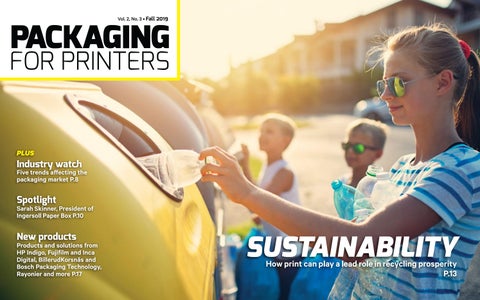
PA - Packaging for Printers Fall 2019

Page 1


PLUS

Industry watch

Five trends affecting the packaging market P.8 Spotlight

Sarah Skinner, President of Ingersoll Paper Box P.10

New products

Products and solutions from HP Indigo, Fujifilm and Inca

Digital, BillerudKorsnäs and Bosch Packaging Technology, Rayonier and more P.17

Editor

Alyssa Dalton

adalton@annexbusinessmedia.com

416-510-5225

Associate Publisher

Stephen Longmire

slongmire@annexbusinessmedia.com

416-510-5246

Media Designer - Team Lead

Lisa Zambri lzambri@annexbusinessmedia.com

Account Coordinator

Alice Chen

achen@annexbusinessmedia.com

416-510-5217

Circulation Manager

Beata Olechnowicz

bolechnowicz@annexbusinessmedia.com 416-442-5600 ext. 3543

Circulation

apotal@annexbusinessmedia.com

Tel: 416-510-5113

Fax: 416-510-6875 or 416-442-2191

Mail: 111 Gordon Baker Rd., Suite 400, Toronto, ON M2H 3R1

Group Publisher

Diane Kleer

dkleer@annexbusinessmedia.com

COO

Scott Jamieson

sjamieson@annexbusinessmedia.com

FEATURES

Annex Business Media

111 Gordon Baker Rd., Suite 400, Toronto, ON M2H 3R1 printaction.com

Tel: 416-442-5600 • Fax: 416-442-2230

Five trends affecting the packaging market

Sarah Skinner, President, Ingersoll Paper Box

Print can play a lead role in recycling prosperity

DEPARTMENTS

3 TC Transcontinental acquires majority stock in Ecuador-based Trilex, Mike Haws named President and CEO of Sappi North America, North American study shows growing public support for paper, and more

INSTALLS

6 Ellis Paper Box, MPI Print and Quadriscan

17 Latest packaging products and solutions from HP Indigo, Fujifilm and Inca Digital, BillerudKorsnäs and Bosch Packaging Technology, Sakurai, Rayonier, UPM Raflatac, Herma US, and Sappi

TC Transcontinental has acquired a 60-percent participation in Industrial y Commercial Trilex C.A., a plastic packaging supplier located in Guayaquil, Ecuador. Trilex specializes in the production and sale of packaging materials and banana farm plastics for protection and pest control. “Thanks to Trilex, we will bolster our product offering for the agricultural market, namely with banana tree bags and box liners, and strengthen our position as a key supplier to the banana industry in Latin Americas,” Thomas Morin, President of TC Transcontinental Packaging, says. “This market is the perfect example of how active ingredients in films can lead to better harvests and how important food protection is to extend product shelf life for export.” This is

TC Transcontinental’s eighth flexible packaging acquisition since entering the industry in 2014.

Sixty-eight new and returning students at five Canadian post-secondary institutions have been selected by Canadian Print Scholarships to re-

ceive national scholarships for the 2019/2020 academic year. Ranging from British Columbia Institute of Technology, Manitoba Institute of Trades and Technology, Nova Scotia Community College, Ryerson University and Southern Alberta Institute of Technology, the students will each receive a $1,500 scholarship to help support their studies in graphic communications.

The students, Canadian Print Scholarships explains, meet the academic requirements necessary to qualify for the awards in either their first or subsequent years in one of the approved university or college programs.

Sappi, a supplier of dissolving wood pulp as well as graphic, packaging and specialty papers, has appointed Michael (Mike) G. Haws as President and CEO of Sappi North America, effective October 1. Haws was previously Vice-President Manufacturing at Sappi North America. He will succeed Mark Gard-

ner, a 38-year veteran of Sappi in North America, who has been President and CEO of Sappi North America for 12 years, as he retires at the end of September. Haws joined Sappi in 2012 as Managing Director of the Somerset Mill before being promoted to Vice-President Manufacturing in October 2015 with responsibility for the Somerset, Westbrook and Cloquet mills, the Allentown sheeting facility, and the safety, research and development, and customer care segments.

Andre Blake has joined the AlliedFlex Technologies sales and marketing team as Regional Sales Manager, Canada. He is described as bringing years

Michael (Mike) G. Haws

of packaging equipment and automation sales experience to his new position with AlliedFlex Technologies, having worked in domestic and international sales positions. He will be based locally in Scarborough, Ont. Based in Sarasota, Fla., AlliedFlex is a North American supplier of stand-up pouch packaging machinery.

The results of a recent survey commissioned by paper advocacy group Two Sides reveal that the North American public largely believes in the use of paper products, but that it has some misconceptions about print and the paper industry. The study was conducted by independent research com-

pany Toluna, who surveyed consumers from across the U.S. (2,094 respondents) and Canada (1,044 respondents) on environmental topics and preferences relating to paper and print. The survey indicates consumers are concerned about the environment, but there are some gaps between consumer environmental perceptions and facts. According to Two Sides, this is particularly evident for questions related to forest management and recycling. Fifteen percent of Americans and 21 percent of Canadians think the paper recovery rate exceeds 60 percent. The paper recovery rate is over 68 percent in the U.S. and 70 percent in Can-

ada. Out of six choices, Americans and Canadians rank urban development first, construction second, and pulp and paper third as having the most impact on global deforestation. Agriculture was ranked as having the least impact. However, according to Two Sides, agriculture is the top cause of global deforestation and, in most developed countries such as the U.S. and Canada, pulp and paper is not a cause of forest loss due to government regulations, sustainable forestry practices and forest certification programs. When it comes to paper purchasing behaviour, 70 percent of Americans and Canadians believe it is important to use paper products from sustainably managed forests. However, only 22 to 27 percent pay attention to forest certification labels when purchasing paper. Out of eight common materials and products, wood is considered the most environmentally friendly material, followed by paper and glass. Plastic and electronic devices are considered the least environmentally friendly. Further to print being the preferred medium for reading, the digital push by many corporate service providers (for ex -

ample banks, telecoms, utilities and insurance) appears to be unpopular with many consumers. Eighty-two percent of Canadians and 86 percent of Americans believe they should have the right to choose how they receive their communications (electronically or printed), and a further 66 percent (Canada) to 74 percent (U.S.) agree they should not be charged to receive paper statements.

Andre
Blake

MPI Print has acquired an Agfa Tauro large-format press and an Esko fully automated C64 digital cutter for its Concord, Ont., plant.

Over the next year, the trade printer plans to introduce several other machines to help supplement its expansion in the large-format and packaging markets.

“As the largest trade printer in Canada, we could not enter the market as an entry level company with so many daily trade clients. So we did this the only way we know how — go big or go Home,” MPI explains. “Look no further than MPI for all your large-format needs. As the newest player in the large-format business, we are bringing so many door crash deals and incentives for our trade clients.”

This spring Ellis Paper Box installed a new Koenig & Bauer Duran Omega Allpro 90 folder gluer – the first in North America – in its postpress department at its 60,000-square-foot Mississauga, Ont., facility.

Dave Ellis, President, says he was interested in the Omega Allpro because the folder gluers are designed to handle a range of substrates from cartonboard to corrugated, and are capable of producing various carton styles. Allpro folder gluers produce straight line, double wall, crash lock and optional four- and six-corner with single finger servo fold as well as inner partition, Z-fold, conical crash lock and CD boxes at a maximum belt speed of 400 m/min.

“In search to replace some of our older equipment, we still can’t believe how HP is still ahead and technology leader of this industry. We have been looking at other digital solution to take the business to the next level, but HP is one of its kind,” said Roger Blanchette, President of Quadriscan.

In addition to the two new 7900 installed in July, Quadriscan owns an HP Indigo 12000 B2 size format. The two presses are equipped with a range of capabilities, including special effects printing with raised and textured print, HP Indigo One Shot printing on synthetic substrates, and seven ink stations to support Pantone gamut and special spot colours such as white, silver, florescent and security inks.

– Zünd Board-Handling System BHS150 for industrial-level automation – Ultimate non-stop productivity with 1.5m stack height, automatic job retrieval, D3 dual-beam production capacity – Find out more at www.zund.com/en/bhs

m

Five trends affecting the packaging market

Packaging solutions have delivered greater value over the past five years, indicates a new research study by research and consulting firm McKinsey & Company. The packaging sector is currently being disrupted by five trends that are affecting the bottom line:

performance against all dimensions of quality of revenue and drive the next wave of operational efficiency,” says Nick Santhanam, McKinsey senior partner and leader of the Industrials Practice in North America, in a release.

Turning a profit

• The growth of the e-commerce market

• A shift toward sustainable materials

• Changing consumer preferences

• Disruptive technologies

• Greater margin pressure on retail and consumer packaged goods

“These trends will create new opportunities for companies to improve their

Since 2013, packaging solutions companies have generated profits, closing the gap with the industrial sector as a whole.

McKinsey found that after more than a decade lagging the industrial sector, packaging solutions improved operational performance with a two percent EBITDA margin expansion. Companies used capital more effi-

ciently and realized higher revenue growth, which contributed to a 2.2 percent compound annual growth rate from 2013 through 2017. The industrial sector declined 1.4 percent in the same period.

Asia-Pacific demand

Packaging companies have a strong

global presence, though demand patterns are shifting. The Asia-Pacific region accounts for about 43 percent of total demand, followed by North America with 24 percent and Western Europe with 18 percent.

Between 2017 and 2022, about 70 percent of packaging growth will come from emerging markets. Annual

growth is forecast to be highest in China (5.2 percent) and India (5.8 percent) during this six-year period.

To understand these numbers in context, consider that North America is expected to see only 1.2 percent annual growth.

Proof point: China’s online retail market accounts for 80 percent more internet sales than the U.S., even with the growth of targeted efforts like Amazon Prime days.

Fragmentation and consolidation

Packaging generates about $900 billion in annual revenues worldwide. But the sector is highly fragmented and extremely competitive. Its businesses measure 0.002 on a scale of 0 to 1 in relation to their industry typical size based on the Herfindahl-Hirschman index.

The top 25 to 30 companies account for less than 25 percent of the total market. More than a thousand small,

private companies that serve mostly local customers account for the bottom 25 percent. Between these groups lie more than 500 small-tomidsize companies.

Many packaging companies are using acquisitions to gain scale and acquiring technologies in search of an advantage.

In the past decade, most packaging innovation typically originated with consumer products good brand owners or raw material suppliers. An analysis of 45 large packaging companies showed an average of more than three technology-targeted acquisitions per company over the past five years. The targets are typically small companies. The median transaction value is about $70 million.

“We need to focus on innovation,” says Ted Doheny, president and CEO of Sealed Air, a food and product packaging company. “And if we’re not moving fast enough, that’s when we should think about M&A to fill the gap

and drive more growth.”

Quality of revenue

Improving Quality of Revenue (QoR)

is key to driving sustained value creation in packaging, says the report.

QoR is a measure of market and customer attractiveness with the strength of product offerings and business model.

How a company improves its QoR depends on its strengths and current position. For most companies, it will require considering where the market is today and where it is headed. This article was originally published by Pulp & Paper Canada, a sister publication of PrintAction.

Sarah Skinner / President / Ingersoll Paper Box

Established in 1922, Ingersoll Paper Box Co. Ltd. is a familyowned folding-carton manufacturer based in Ingersoll, Ont., with 85,000 square feet of manufacturing space including a 38,000 square feet of warehousing space. The newest addition to its postpress department is a new high-speed Koenig & Bauer-Iberica Optima 106K die-cutter, which went operational in January. The purchase follows IPB’s 2014 installation of a Koenig & Bauer Rapida 106 41-inch, seven-colour sheetfed press built for full UV production, described as the first of its kind in North America. PrintAction chats with Sarah Skinner, IPB’s fourth-generation leader.

PA: How has Ingersoll Paper Box stayed competitive after nearly 100 years of business?

SS: Ingersoll Paper Box is a fourth-generation family-owned business that prides itself on providing the highest quality cartons, innovation and customer satisfaction. IPB’s business philosophy is centred on trust, reliability, quality and innovation, all of which have served us well for almost 100 years. We continuously invest in state-of-the-art technology to ensure we can serve our customers, providing them with the highest quality product. All our employees know that providing the best customer service and the highest quality folding carton is paramount. We know, just as they

did in 1922, that our customers are depending on us. Our business has grown over the decades through the success of our customers.

PA: What does the new installation of the Iberica mean for Ingersoll Paper Box?

SS: The new Iberica die-cutter with

blanking capabilities is another investment in our capital purchases that support our strategic growth plan. This capital investment adds more capabilities, faster speeds and increased capacities, all of which benefit our customers with highest quality and fast turnaround times. It is the continuous investment in our technology and employees that has allowed us to grow and continue to grow.

This year marks Ingersoll Paper Box’s 97th year of service as a Canadian family-owned, folding-carton manufacturer.

PA: What packaging trends do you see in the industry right now?

SS:Sustainability is one of the most prevalent trends in our industry. If you look at all the plastic polluting our oceans, it should influence consumers to buy paperboard packaging whenever possible, as it has the least harmful impact on our planet’s health. Many of our customers, established

brands and new brands (such as licensed cannabis producers), are looking for environmentally friendly options. This is driven by their own environmentally conscious brands and policies as well as being consumer driven. According to the North American industry trade association Paperboard Packaging Council (PPC), 77 percent of all consumers prefer to buy a product from a company that uses recycled paperboard packaging over other forms of less sustainable packaging.

IPB is extremely environmentally conscious in our business practices and in what we offer to our customers.

I think it’s important to debunk myths about paperboard not being environmentally friendly. We must do a better job of educating the public on what our industry has known for generations — that paperboard packaging,

unlike fossil fuel-based plastic packaging, is made from a renewable resource, is recyclable, and is the best choice for the environmentally conscious consumer. According to the PPC, virtually all paperboard consumed in North America today comes from farms where trees are planted, harvested and replaced specifically to be converted into paperboard. Five trees are planted for every one harvested for paper, and the young trees planted soak up more carbon dioxide than older ones. Also, whatever wood waste isn’t used to make paperboard is converted into power, saving energy costs and reducing reliance on non-renewable fossil fuels.

PA:

What’s next for Ingersoll Paper Box?

SS: Seventy-five percent of consumer decisions are made at the point of sale in less than 10 seconds; this means that packaging must cut through the

clutter on store shelves and communicate value to consumers. This continues to be our challenge — to offer our customer endless ways to cut through the clutter and attract a buyer’s attention, thus reinforcing their brand. What’s next for IPB is to continue to meet this challenge.

PA: You said packaging must “cut the clutter” and communicate value. What are some elements of effective packaging?

SS: The most important element of effective packaging is that it is able to attract the consumer’s eye. That is the combination of graphic design and structural design. Graphically, this would entail colours and finishes, such as embossing, light catching foil or spot coating. Structurally, for example, could mean that a box is in the shape of a triangle. The structural design allows for the graphics to be optimized for consumer impact.

M o re p ro fi t f ro m your cur rent fl ex o p ress ?

We kn ow i t ’s ha rd to believe . It really is as amazing as it sounds. The Illumina UV-LED retrofit curing system from Fujifilm expands production capabilities while reducing energy costs up to 94% – all on your existing flexo press. With the rapidly growing number of installations, the system has increased running speeds up to 70%. And, when paired with Fujifilm 300 Series inks, Illumina enables you to print on vir tually any substrate without ever worr ying about adhesion issues.

The world’s struggle with waste

Print can play a lead role in recycling prosperity

Standing outside my local coffee shop, I’m staring at a row of trash bins, each emblazoned with signs. One reads garbage, another, recycle, while a third says paper. Just as millions of people, I struggle to figure out which bin or bins my lunch packaging should go into. Even more annoying, some of my

Finding a way to manufacture a box of plastic wrap without a metal serration strip is just one of many obstacles we will have to find a solution for.

trash is made up of a combination of materials.

I feel like a picker at Amazon, ripping apart various bits of my packaging and tossing it into various orifices. This is just stupid.

Recycling is in the cross hairs today and, over the last 12 months, has been heating up to a point where climate change shares top billing with our growing trash problem. Mountains of articles with a governmental focus are picking up steam, looking for a solution. The answer seems rather

obvious from where I stand. Yes, the use of single-use plastics is a concern but banning straws is only a small part of a larger problem.

Paper, as all printers know, has an easy way to be reused. Mixed (coated or other processes such as glue) are sorted and separated from uncoated, and the filled bins can be routinely hauled away by paper recyclers. Because these are already pre-separated, the process is easy. Glass and metals have the same easy process of being returning to recyclers who

have a simple task of crushing the glass or filtering the various metals. Nothing can be as simple as isolating steel cans from aluminum — besides there is a ready buyer for these materials. The common sense approach to plastic should be made the same. The problem is, a good many packaging products are made up of a combination of paper, plastic and metals. This can be fixed by encouraging the printing industry to develop new cellulose materials that can make packaging homogeneous.

Since plastics were invented back in 1862, we sought a way to produce a product that could outlast everything else found in nature. There remains good reasons for this. If you live near bodies of water or in a four-seasons climate, having window frames that don’t rot or rust makes a good deal of sense. Plastic piping, such as ABS, is lighter and is used for everything from high voltage wires to drain and water

pipes — none of these do you want to habitually replace. But currently there is no incentive for plastics to be recycled the same way as paper, metal and glass.

Billions, if not trillions, of tax dollars are spent trying to get a grip on the ever-expanding piles of single-use plastic. Canada recently followed the EU in banning various one-time-use plastics by 2021. Does that solve our problems? I don’t think so. There are much easier and less bureaucratic ways of reducing waste and giving it another life. Current recycling programs are simply wasteful as loads of quasi-sorted materials end up at monstrous locations where someone gets the crappy job of rifling through conveyors of household waste looking for the good bits. No wonder it’s a rotten job. But not everything is as simple as a paper cup and a paper lid.

Finding a way to manufacture a box of plastic wrap without a metal serration

strip is just one of many obstacles we will have to find a solution for.

Years ago we were in Germany and walking through a quiet neighbourhood one evening. We came across a very large dumpster-like container with two small round holes at shoulder height. One sign read glassklar (clear glass), the other read glasfarben (coloured glass). What a common sense, easy way to return single-use glassware to be used again. But here in Canada we don’t do that. Yes, we can return wine and spirits bottles to the store or we can throw them, along with other so-called recyclable products, in a blue bin for someone else to sort them out. There is no reason why the public can’t do the sorting themselves and deposit base recyclables into large containers that a recycler can then pick up and not have to re-sort. Too many trash cans are part of the problem

Try and find a trash can in Japan. I

once grew annoyed when I simply could not find a container on a busy street in Tokyo to toss a coffee cup.

That is, until I realized the less trash cans there are, the more effort we put into finding a proper place to dispose of refuse. This is unlike Canada where some communities go out of their way to spread millions of containers all over our cities and towns — and to great taxpayer expense. These containers are jammed full of everything from waste paper to dog feces, and someone has to sort it. Tax dollars spent picking up all over the place and sorting materials is a waste of our hard-earned money. Countries such as Japan are excellent examples of intelligent management.

There is money in trash, and not just picking up and filling our landfills or reaping subsidies to sort through the stuff. Look at metals, cars and smaller items, such as batteries. All have value with simple routes back to

The print industry has been handed an opportunity to show how the use of 100-percent paper-based packaging makes good sense for the planet.

the industry. Not so with plastic. Can-

adian firm EPI has developed an OXO-Biodegradable compound called TDPA™ (Totally Degradable Plastic Additive). This compound is now being used in shopping bags and based on a modified formula called Polyactide Aliphatic Copolymer. The bag is designed to biodegrade in weeks. Soon, materials of this type will be used in other products. Another product is CPLA, which features a sugar such as corn- or beet-based renewable bio-waste polylactic acid,

that is now being used to manufacture lids and cups. These are good things no doubt, and there is the additional benefit to homogeneous packaging that can also be printed. Biodegradable anything is part of the recycling solution too.

Our industry has a golden opportunity to encourage the use of paper. Although there are new sources of natural, fast-growing trees, printers have already had to struggle and adjust to shorter fibre-recycled papers. We can ensure the packaging we

make is made only with single-stream materials and discourage the use of compounded products, such as a cardboard box with a plastic lid. Perhaps our associations will take a leadership position to encourage the adoption of simplified recycling programs, such as the German glass bottle bins. If we can do this, then more of the materials will be reused again and again, and we can diminish the huge cost of sorting or ambivalence by the public that it is someone else’s problem. Had the EU not banned straws, there would be no push to make them any differently. If every straw went to the right place, there wouldn’t be a “straw” problem or a need for paper straws either. Just because we don’t have an answer to aluminum serration strips in the same material as the cardboard box, doesn’t mean we won’t find one. Some suggestions

• Mandate single-use packaging to

be made with singular ingredients. This includes metallized foil and plastic labels.

• Develop a simple recycling program for plastics and encourage polymer industries to develop ways of reusing all forms of plastic.

• Standardize large community recycle containers for base materials: Paper, plastic, metal, glass and corrugated packaging.

• Centralize recycle deposit containers by working with independent recyclers and make them easy to access, and large enough to reduce pick-ups.

• Reduce the quantities of generic trash cans and raise fines for littering, thereby encouraging the public to return packaging to a source that will reuse it. Change is always the most difficult, but the sense is that most of us want to play a bigger role as long as it doesn’t cost us more money.

• Eliminate the home recycling con-

tainer. Too many recyclables end up in these and must be sorted again at a depot. Eliminate the need for the public and industry to do the same job twice.

• Continue using environmentally friendly inks and coatings to encourage manufacturers that printers can provide a stunning package even with a single component. As long as we do this, no one needs to cut corners on creativity or the amount of packaging used.

The missing link in recycling is plastic. Photos that show oceans and rivers full of plastic bottles and non-biodegradable trash scream now is the time to make it easy to return plastic to be recycled, ground up and used again. If we do that and not use our tax dollars to pay a subsidized sorter, not only can the world eradicate plastic waste, we can also reduce our dependence on plastic’s main ingredient — oil. The print industry has been handed a golden opportunity to showcase how the use of 100-percent paper-based packaging makes good sense for the planet.

I don’t want to stand there stripping bits of my trash to be placed in a jumble of bins. A coffee cup and lid should match! The landfill only gets biodegradable organic waste. As kids, we would rummage through ditches and parks looking for glass soda bottles because they had a cash return credit. With metals – especially aluminum cans – inner-city poor still collect and return these to a metal recycler for cash. That’s because metal has value. Now it is plastic’s turn to be easily recycled. Meanwhile packaging designers should see a problem for which they can devise a solution.

HP Indigo inks

HP says HP Indigo digital printing inks are now certified for compostability. This latest sustainable initiative is designed to allow converters and brands print smaller quantities, while reducing inventory waste and improve their overall environmental impact. HP Indigo supports packaging printing with its portfolio of presses including the HP Indigo 20000 Digital Press, HP Indigo 8000 and HP Indigo 6900 for flexible packaging. “Demand for sustainable packaging solutions is driving converters to digital printing, allowing converters and brands to help significantly lower the environmental impact of printing,” says Alon Bar-Shany, general manager, HP Indigo.

Sakurai Screen Foil LQM 105

Sakurai, a provider of sheetfed screen printing technology, will introduce the LQM 105 in-line hot foil stamper to the North American market in booth 1420 at Printing United 19. The ScreenFoil LQM 105 aims to bring a “new level of flexibility, quality and performance” when combined with any size or vintage Sakurai screen press, the company explains, and is designed for PSP, folders, leaflets, business cards, loyalty cards, magazines, book covers, packaging, promotional items, labels, roll-to-roll, greeting card, automotive, appliance and plastic card applications. The featured Sakurai Maestro MS-102AX is a suitable screen press for a myriad of specialty finishing applications such as specialty effects foil, glitter, soft touch, flood, soft spot coating and more, it adds. The 29 5/8” x 41 1/2” MS-102AX operates at speeds up to 4,000 IPH and accepts stock from .003” to .032” thick. The Maestro is capable of printing on a range of substrates, such as plastic film for electronic applications, membrane switches, and display panels, touch screens as well as paper, board and foil.

by 2024.

Rayonier Kallima

The paperboard division of Rayonier Advanced Materials has launched a new folding grade Kallima box, describing it as the only folding boxboard (FBB) grade manufactured in North America. Designed to be a foldable, printable, boxable solution for packaging, cartons and POP displays, the new FBB grade Kallima is coated one side and is available in 14 pt, 16 pt and 18 pt. The offering, boasting consistent printability and reliability on press, is available in sheets and rolls, FDA-compliant for dry food contact and FSC-certified upon request. The Kallima paperboard brand is produced in the Rayonier Advanced Materials mill located in Temiscaming, Que.

UPM Raflatac Forest Film

UPM Raflatac says it is the first label material producer to bring a new wood-based polypropylene film material into the market. The UPM Raflatac Forest Film label material was developed in collaboration with UPM Biofuels using UPM BioVerno naphtha, a 100-percent wood-based solution originating from sustainably managed forests, it explains. The film, it says, will answer brand owners’ needs to replace traditional fossil-based virgin materials with renewable ones, offering companies a way to “reach beyond their sustainability goals without compromising on product performance.”

The label material is a 100-percent wood-based solution originating from sustainably managed forests, UPM Raflatac says.

Grandview Market research finds the green packaging market is poised to reach US$237.8 billion

Herma 500 label applicator

Herma US Inc. has introduced the Herma 500 label applicator, an IoT-enabled machine that leverages real-time metrics to help optimize production efficiency and consistency in a multi-factory setting. Capable of achieving labelling speeds up to 200 m/min, the Herma 500 can handle label widths between 80 to 320 mm and roll diameters from 300 to 600 mm. Since launching its North American operations in 2016, Herma says it has sold more than 4,000 Herma 400 label applicators in 2018, half of which were provided to original equipment manufacturers. The Herma 500 reaches a maximum speed 70 ft/min higher than the H400. According to Herma, a maximum speed of 650 ft/ min can be achieved.

OnsetX HS UV inkjet flatbed series

Fujifilm and Inca Digital have introduced a new addition to the OnsetX UV flatbed series – the OnsetX HS (High Speed) range. Featuring two new machines, the Onset X2 HS and the Onset X3 HS, the new range can print up to 15,597 square feet per hour, utilizing a new single cycle mode. Compatible with Inca’s range of application specific robotic handling systems, and incorporating ‘30 second’ job set up and ‘single cycle’ printing mode, the new HS range is said to deliver a ‘step change’ in inkjet printing. The OnsetX HS launch is partnered with a new Fujifilm inkjet range, Uvijet OX. Uvijet OX features a new ink technology developed and manufactured at Fujifilm Speciality Ink Systems, designed for the Onset family of printers to print on rigid plastic media. The new range can print at speeds up to 15,597 square feet per hour.

BillerudKorsnäs-Bosch Pearl

The material is processed on machinery from Bosch Packaging Technology.

BillerudKorsnäs and Bosch Packaging Technology are releasing a new sustainable paper-based packaging solution as part of their ongoing partnership. The concept is called Pearl, and aims to show how specially formed and correctly sized small packages – called shaped paper pods – can contribute to a more sustainable future by using the formability of a 3D, formable paper patented by BillerudKorsnäs called FibreForm. In industries such as beauty and personal care, bread spreads, savoury and confectionery, single-use plastic packaging is widespread.

“The goal is to support these industries with a sustainable packaging system and replace plastic in product samples, inserts, refills, portion packs and disposable packaging,” says Simon Johansson, project manager at Packaging Solutions BillerudKorsnäs.

Sappi Proto, Spectro paperboard products

Sappi’s new Proto and Spectro paperboard products are now available globally. Proto C1S is described as a sturdy SBS for everyday applications, including magazine and book covers, shopping bags, POS materials, direct mail and consumer packaging. Spectro C1S is a single-ply SBS for high-quality packaging and graphic applications. Whether using UV, aqueous or specialty coatings, hot foil stamping, embossing, special effects or varnishes, the line aims to bring a “substantial feel at a lighter weight with enhanced optics.”

Herma 500 can
The new series is distributed exclusively in North America by Fujifilm.

Turn static files into dynamic content formats.

Create a flipbook
Issuu converts static files into: digital portfolios, online yearbooks, online catalogs, digital photo albums and more. Sign up and create your flipbook.