The 5th drupa Global Trends Report finds surveyed printers are encouraged
SALES
10 Dave Fellman
Getting involved in the plan
How to become an integral part of your client’s marketing plan and budget
TECHNOLOGY
11 Jennifer Rideout
Leveraging supply chain data
Collecting data from every step of the manufacturing process
ENVIRONMENT
12 Neva Murtha
Lifecycles and luxury labels
A positive mood in print
At the end of April, Messe Düsseldorf released its 5th drupa Global Trends Report , based on a survey of approximately 1,000 senior managers across the printing world. Specifically, this includes 708 printers with the majority from Europe, 421, and rest of the world represented in all regions by 287 respondents. On the supplier side there were 234 participants, of which 160 reported on Europe.
a ‘good’ economic state and nine percent described it as ‘poor’ (the balance answered ‘satisfactory’). This gives a positive net balance of 31 percent and it is that net balance (plus or minus) that makes up the Printer Barometer numbers.
Editor Jon Robinson jrobinson@annexbusinessmedia.com
Contributing writers
Zac Bolan, Wayne Collins, David Fellman, Victoria Gaitskell, Martin Habekost, Nick Howard, Neva Murtha, Abhay Sharma
A highlight of the 5th drupa Global Trends Report found the past year to hold a surge in sales of core equipment/ software/ materials, with a +29 percent net balance. All supplier revenue streams, according to the report, showed their best-ever net positive balance.
The survey was run by Printfuture of the UK and Wissler & Partner of Switzerland. The report’s authors and drupa organizers both concluded this is the most encouraging report since the annual survey was first published in 2013. drupa explains it reflects a positive mood in the overall printing industry, illustrating a slow but steady global economic recovery from the 2008 recession.
“Both printers and suppliers clearly understand the strategic challenges that print faces. However, there is increasing confidence in a strong future for printers in most markets and regions, as long as they analyze their target markets carefully and make suitable innovations to meet the future needs of their clients’ customers,” concluded Richard Gray, Operations Director at Printfuture.
The drupa Trends Report also found that suppliers from the majority of market sectors reported growing confidence in their company’s economic performance. The survey results show there is a surge in sales of core equipment/software/ materials, with a +29 percent net balance over previous years, explains drupa, as all supplier revenue streams showed their best ever net positive balance.
Packaging remains the most buoyant market, according to the report, and there has been a steady improvement in confidence over the past five years amongst commercial printers and functional printers. Publishing printers, according to the report, face the most challenging strategic changes and there is a decline in assurance this year, despite a reduced threat from e-books.
In the report’s Printer Barometer for economic confidence, as it relates to the past five years, from when the report started in 2013, North American participants scored the highest percentage positive net balance among all other regions. Survey participants were asked, “How do you rate the current economic situation of your company and what are your expectations of your company’s economic situation for the next 12 months?”
In 2017, 40 percent of all printers surveyed described their company as in
North American printers were at more than a +45 percent actual for economic confidence in 2017, while the region’s 2018 forecast was at +78 percent. Europe was second in economic confidence at around 38 percent for 2017 actual, followed by South and Central America at around 24 percent.
Very interesting statistics emerged from the report’s survey of key financial measures for printers, particularly around revenues and prices. Approximately 44 percent of surveyed printers reported their revenues increased and 20 percent reported that their revenues had declined. These statistics buck common wisdom when considering that only 20 percent reported an increase in prices for their print, and 30 percent reported a decrease in prices. Margins also dropped significantly with 38 percent of printers reporting a decrease and only 20 percent reporting an increase in margins.
Clearly, a key driver to the significant increase in revenues, again with 44 percent reporting a rise, is a result of major cost cutting taking place at printing operations around the world. The report found that 46 percent of surveyed printers saw an increase in utilization while only 19 percent found a decrease in utilization.
On the supplier side, revenues also increased according to 48 percent of respondents, with 14 percent reporting a decrease in revenues. In terms of prices, 21 percent saw an increase and 27 percent of suppliers saw a decrease, while margins rose for 13 percent of surveyed suppliers and 33 of these respondents saw a decrease in margins.
Globally, 33 percent more printers reported an increase in capital expenditure than those reporting a fall, with North America most positive at +51 percent and Australia/Oceania the lowest region at +18 percent. Packaging printers reported the biggest positive net balance at +45 percent, functional at +42 percent, commercial at +30 percent and publishing at +20 percent. Finishing is the most popular focus for investment for the second year running, followed by print technology and then prepress/workflow/MIS. Web-to-print was still relatively weak, which speaks to potential increased utilization in the future.
JON ROBINSON, editor jrobinson@annexbusinessmedia.com
Publisher Paul Grossinger pgrossinger@annexbusinessmedia.com 416-510-5240
Associate Publisher Stephen Longmire slongmire@annexbusinessmedia.com 416-510-5246
Media Designer Lisa Zambri lzambri@annexbusinessmedia.com
PrintAction is printed by Annex Printing on Creator Gloss 80lb text and Creator Silk 70lb text available from Spicers Canada.
ISSN 1481 9287 Mail Agreement No. 40065710
ICON Digital Productions of Markham, ON, hosted a fundraising dinner in early April and raised a total of $35,000 for the Geneva Centre for Autism (GCA) programs and services. The ICON event brought together more than 100 business leaders, philanthropists, community members and autism advocates from across Toronto. GCA is described as an international leader in the development and delivery of clinical intervention services and training. As a full service agency, Geneva Centre for Autism offers personalized, strength-based programming for over 3,000 individuals and families in Toronto. It’s Training Institute and International Autism Symposium build professional capacity worldwide to empower all individuals with autism spectrum disorder (ASD) to reach their full potential.
Xerox Research Centre of Canada (XRCC) reached an innovation milestone receiving its 2,500th U.S. patent, entitled Silver Nanoparticle-Sulfonated Polyester Composite Powders and Methods of Making the Same. The patent was invented by senior research scientists Valerie Farrugia and
Transcontinental.
TC Transcontinental’s seventh flexible packaging acquisition, including its March 2018 purchase of Multifilm Packaging. As of December 31, 2017, Coveris operated 21 production facilities worldwide, primarily in the Americas, the UK and Australasia. Coveris has more than 3,100 employees and generated US$966 million in revenues over its most recent fiscal year.
venturing into new market segments. Kevin Ray will serve as the company’s R&D lead, based out of a 125,000-squarefoot building in Enfield, CT. Verico is headquartered in Nashua, NH, with offices in the UK and Germany. Karol Wolnikowski will serve as Verico’s Sales Director for the EAME region.
Barkev Keoshkerian. XRCC explains the process uses an environmentally friendly approach to create silver-polymeric nanoparticles that can be built up for use in 3D printing. XRCC explains applications that can benefit from these composite powders include a range of antibacterial applications for customizable medical devices, textiles, smart coatings, kitchen tools, toys and household items.
Flint Group’s Paper & Board business entered a new partnership with X-Rite to distribute and support a colour-management solution, called VIVO Colour Solutions, that leverages the X-Rite eXact and NetProfiler for the package printing supply chain. Flint describes VIVO Colour Solutions as a colour communication and service platform supported by its centralized colour service provider, the Global Colour Centre (GCC).
FPInnovations, a not-for-profit organization that supports Canadian forest sectors, welcomed the Quebec government’s latest economic plan, économique du Québec, which provides for an additional $6.5 million in forest-sector workforce training. The organization said the move helps Quebec’s hardwood forests, and particularly in southern Quebec. FPInnovations also points to the injection of nearly $127 million to bolster the forest sector across a range of initiatives.
Transcontinental reached an agreement to acquire Coveris Americas for $1.72 billion. Since entering the market in 2014, this is
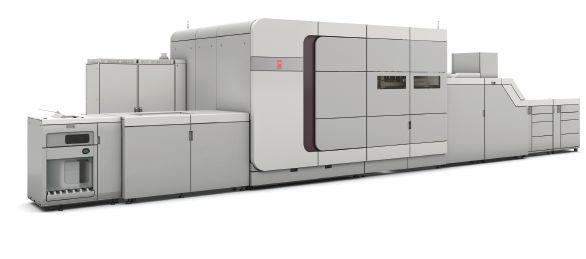
HP in mid-April introduced its Piazza book printing service, which the company describes as a set of independent and interlocking cloud-based book manufacturing and distribution services for publishers. HP explains Piazza allows publishers to build a virtual warehouse for the management, automation, distribution, print, and direct fulfillment of book orders, while holding zero inventory. Designed to connect through its PrintOS SiteFlow technology, HP explains Piazza provides accurate, transparent SLA management, quick time to market and reduced waste.
Mark Andy, which develops technologies for the label and packaging industries, has acquired Presstek, a global supplier of DI (direct imaging) offset plates and presses, and CTP solutions. With the Presstek acquisition, Mark Andy explains it now serves as one of the only full-complement solutions providers to the global graphic arts and print industry. Presstek’s Zahara waterless plates division, which is not being acquired by Mark Andy, will be spun into a new company, Verico Technology.
Verico Technology is to be led by former Presstek CEO Yuval Dubois. The company will focus on expanding its market share for cut sheet aluminum waterless plates and coating technologies in the printing industry, as well as
Webcom of Toronto signed an agreement – expected to close in late April – to acquire York Bookbinders, a 34-year-old business specializing in hardcover book-bindery services. It will add 7.5-million hardcover books per year to Webcom’s manufacturing capacity. Webcom explains the acquisition boosts its digital book manufacturing investments, which it pegs at $30 million over the past few years. Webcom explains the purchase reconfirms its commitment to meet a growing publisher demand for unique casebinding capabilities.
This is Webcom’s second expansion of its casebinding services in 2018, following the investment in digital casebinding systems from GP2 Technologies.
Eastman Kodak reported financial results for the fourth quarter and its 2017 fiscal year. Revenues for the full year were US$1.5 billion, down seven percent (or US$112 million) from 2016. The revenue decline, explains Kodak, was driven by volume and pricing declines within the company’s commercial print business and volume declines in the company’s consumer inkjet and industrial film and chemicals businesses. Kodak explains key product lines achieved strong year-over-year growth for the full year 2017, including: Volume for Flexcel NX plates grew by 17 percent, volume for Sonora process-free plates grew by 21 percent; and annuity revenues for the Prosper inkjet platform grew by 13 percent. Kodak ended the year with a cash balance of US$344 million.
ICON co-founder Peter Evans; Abe Evreniadis, CEO of Geneva Centre; Alex Christopoulos, CFO of ICON; and Juan Lau, CEO and co-founder of ICON.
Isabelle Marcoux, Chair of the Board,
Yuval Dubois, CEO, Verico.
Mike Collinge, President and CEO, Webcom.
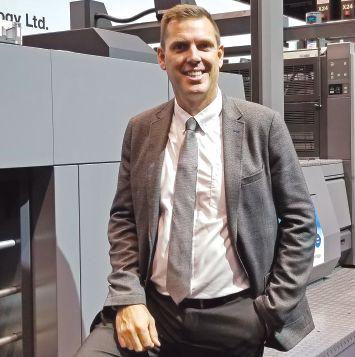
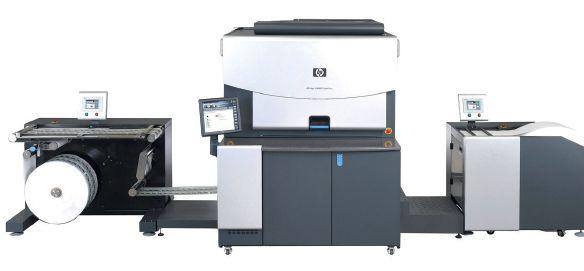
Eric Wiesner, GM, HP PageWide Industrial.
XRCC scientists Barkev Keoshkerian and Valerie Farrugia.
INSTALLS
Greg Running joins the General Commercial Sales team of HP Canada, responsible for the full HP Indigo press line in Western Canada, as well as HP PageWide web press solutions. Running brings HP Canada more than 25 years of printing-industry experience, having most recently worked with Kodak Canada for the past 11 years, including almost six years as that company’s Canadian Sales Director.
Jason Lisi is to become the next Chair of Ryerson University’s School of Graphic Communications Management (GCM), starting July 1, 2018. Ian Baitz, the outgoing Chair who began his tenure in 2009, will continue as a full-time professor in the GCM program, based in Toronto. GCM is the largest graphic communications school in North America with 640 full-time students. Lisi started teaching at Ryerson in 2003. He is active in the development of industry standards and specifications, currently serving as the Canadian Head of Delegation for ISO TC 130 and Documentation Officer for Ghent Work Group.
Heidelberg Canada expanded its national support team with a range of hires over the past few weeks, including Shane Thurston as a Press Mechanic for Western Canada. The company added the service resources of Frank Tesch, a press electrician based in Toronto and Mohamed Gasmi, a mechatronic technician based in Montreal. Heidelberg also recently signed an agreement with JTT Pressworks to provide service for its equipment in Greater Toronto. Danna Senger has also been hired as a Consumables Sales Representative in Calgary, following the retirement of Rita Cooper.
John O’Grady becomes President of Eastman Kodak’s Print Systems Division, having most recently served as President of the company’s Consumer and Film Division. He also previously served as Kodak’s General Manager of Worldwide Sales for Print Systems. O’Grady is replacing Brad Kruchten who is retiring after 36 years with Kodak. Jeff Clarke, CEO of Kodak, will lead the Consumer and Film Division on an interim basis.
Ondrej Kruk, who has helped lead Danaher’s Alltec operation for the past three years, becomes President of X-Rite and Pantone, which are also owned by Danaher. He has also held management roles at Danaher’s Videojet operation, which focuses on developing coding, marking and variable data printing.
Joji Tokunaga becomes President and CEO of Ricoh Americas. Glenn Laverty remains Senior VP of Ricoh Americas, Marketing, and also President and CEO of Ricoh Canada. A graduate of the University of Delaware, Tokunaga has been with Ricoh for more than 30 years. Most recently, Tokunaga served as Executive VP and GM of Shared Services within Ricoh Americas where he oversaw human resources, finance, legal, supply chain, and customer administration.
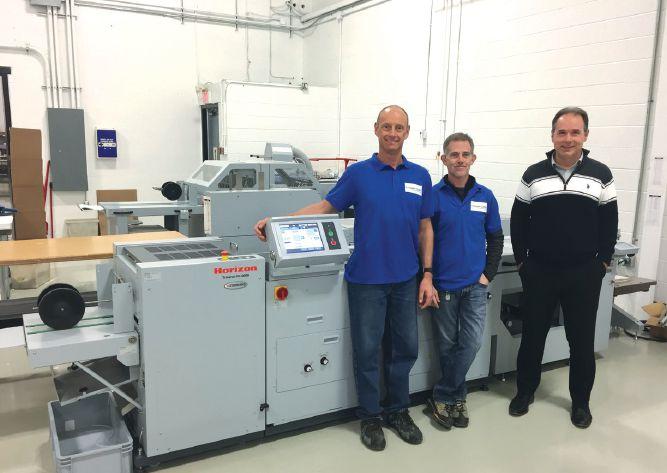
InvestorCOM headquartered in Brantford, Ont., installed a Standard/ Horizon HOF-400 with SPF/FC-200A sheet feeder and booklet-making system, purchased from KBR Graphics, pictured with Warren Bryant and Dane Edgley and KBR’s Steve Klaric. This is InvestorCOM’s second Standard/Horizon install since 2014.
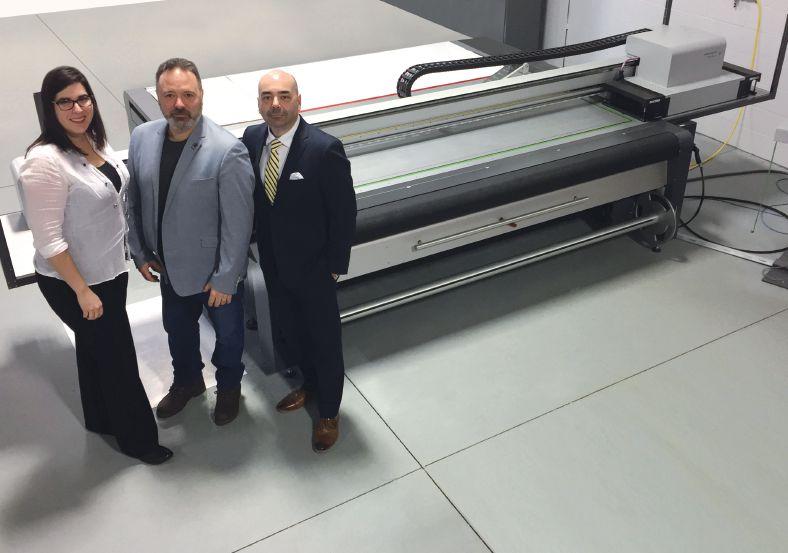
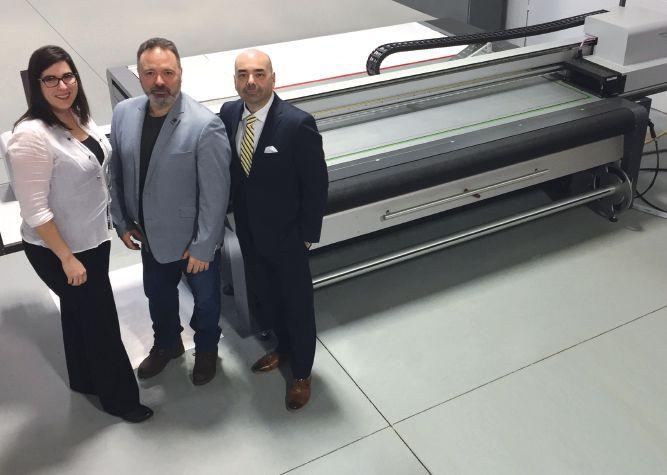
Nouveaux Concepts of Montreal, which recently moved into a new location, installed a SwissQPrint IMPALA 2 through Cansel, pictured with Marie-Eve Bégin, Operations Manager, Steve Daigle of Cansel, and Benoit Toupin, Owner of Nouveaux Concepts. The printer also runs an EFI 1625 LED and two HP Latex 570s.
Jet Label &
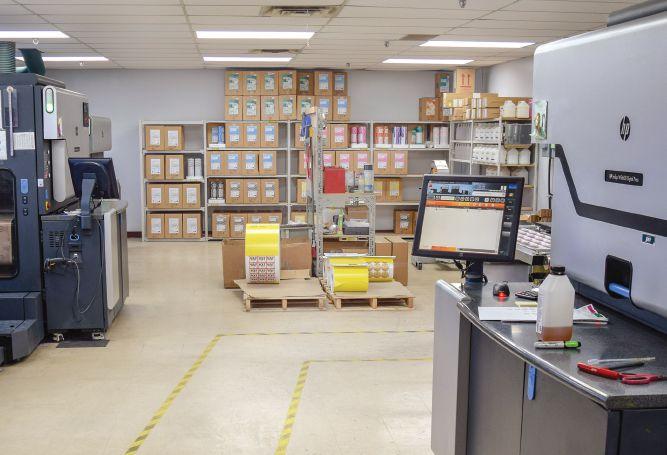
Packaging, described as Western Canada’s largest producer of labels and printed tape, has acquired duplicates of critical machinery for its primary facility in Edmonton. The redundancy includes twin HP Indigo presses, Delta die cutters, eight-colour flexo presses and their rewinders.
Ten-colour Rapida in Berkshire Mountains
Based in the Berkshire Mountains of Connecticut, Curtis Packaging has invested in a 41-inch, 10-colour Koenig & Bauer Rapida 106 double coater press, scheduled to arrive this spring. The 150,000-square-foot facility in Sandy Hook already includes two 51-inch Koenig & Bauer Rapida 130 large-format presses. A third Rapida 130 will be removed for the new press installation.
“It will be a key press for us, dedicated to short-run, fast changeover jobs,” said Kerry Brown,Vice President of Operations at Curtis. “We have completely customized its capabilities with a unique double coater formation and other exclusive configurations. Once it begins operation this spring, we’re projecting a 60 percent improvement in makeready and a 40 percent improvement in run rates.”
Curtis chose to have its new Rapida 106 specified with Koenig & Bauer’s inline QualiTronic Color Control capability and System Brunner Instrument Flight, which emphasizes colour balance and gray balance, taking into account more than 30 process variables.
“Having this 41-inch press specified in this unique configuration of a double coater lets us print in one pass rather than two,” said Brown. “It makes us more efficient and more innovative. It distinguishes us from our competitors.” The performance data of the new Rapida 106 will be captured LogoTronic Professional.
Kerry Brown, Vice President of Operations, and Don Droppo, President of Curtis Packaging.
Durst Delta in Austria
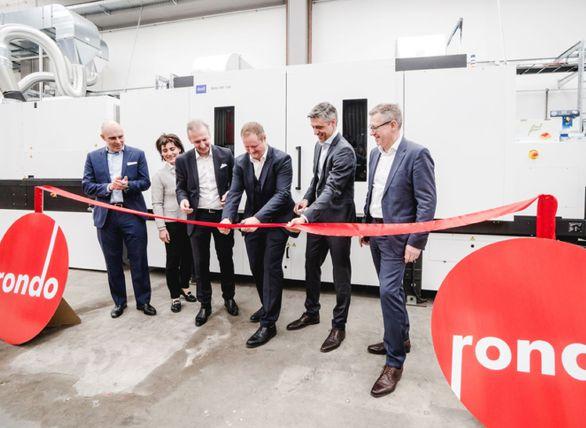
Rondo Ganahl AG is one of the Austria’s leading corrugated board manufacturers, producing packaging and displays with offset and flexo technologies at six locations. The company is setting up a digital centre at its St. Ruprecht/Raab facility, featuring a Durst Corrugated flagship Delta SPC 130, which achieves print speeds of up to 100,640 square feet per hour (9,350 m2/h) based on Durst single-pass printing technology and, in combination with Durst Water Technology, enables what the company describes as sustainable and odourless packaging products.
With this investment, Rondo explains it is responding to changing demands in the corrugated board market that requires rapid and flexible solutions for the sampling, versioning and personalization of promotional activities. In particular, Rondo says trade and brand manufacturers are also looking for partners to support them with seasonal promotions, special editions and individual products in a timely and high-quality manner. Durst explains other print providers in Austria have recognized this trend and invested in Durst Delta WT Corrugated Multi-Pass printing systems, while Rondo currently unique in the country with its industrial scale Delta SPC 130 press technology.
“We’re delighted that our digital Durst Delta SPC 130 high-performance printing system, that we produce for the corrugated board industry from our location in Lienz, East Tyrol, has also impressed Rondo,” said Christoph Gamper of Durst.
Second SurePress at SixB in Dallas
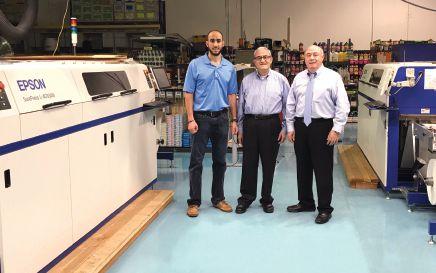
SixB Labels, a printer of labels, decals and barcodes based in Dallas, Texas, installed its second Epson SurePress L-4033AW inkjet label press to expand its short-run label printing services. The company explains the press will be used to meet a growing demand for its semi-gloss and BOPP labels.
SixB’s new SurePress L-4033AW is a seven-colour (cyan, magenta, yellow, black, orange, green and white) system running water-based inks to produce high-quality labels. Epson explains it runs a range of standard, off-the-shelf materials like gloss, semi-gloss, matte, film, clear, and metallic substrates,.
“The amount of detail on the labels printed by the SurePress was tremendous,” said President Fari Bakhshian, describing the company’s recent Hibiscus Mint award-winning project. “The Hibiscus Mint was also only the beginning, as the project lent itself to multiple label variations created on the SurePress – House Black, Mango and Texas Gold Iced Teas – with labels including clear and colourful imagery of ingredients.”
10amp
Beau Label LLC, a 51-year-old, third-generation, family-owned printer based in New Jersey is leveraging Fujifilm’s Illumina LED-UV retrofit system. It is designed for converting any traditional UV or water-based flexo press to LED-UV curing. “Prior to our conversion, we were running 110 or 120 amps of 480 volt service to a press to run the UVs,” said Vincent Melapioni, President, Beau Label, “and with Illumina, we are now running 10 amps of 480 volt service. That’s a significant savings.”
An open house celebration was held for Rondo Ganahl’s new digital centre built a round a Durst Corrugated flagship Delta SPC 130 press.
SixB Labels received a Premier Print Award from Printing Industries of America for labels created on its first SurePress L-4033AW.
CALENDAR
May 23 – 24, 2018
CPES2018
Centennial College Conference Centre, Toronto, ON
Toronto Craftsmen present 43rd annual awards
The Toronto Club of Printing House Craftsmen Awards Dinner took place on April 11 at the Duncan House, Don Mills, ON, led by master of ceremonies Ralph Pike and association President Bill Kidd.
Leading graphic communications students from the Greater Toronto area received awards in two distinct programs, including the Tai Chi Awards, which considers academic standing, and the Graphic Challenge Awards, which evaluates graphic design applied in print projects.
Now in its 43rd year, both Toronto Craftsmen programs provide scholastic funding to the students. This year’s recipients include:
Chai Tse Award recipients
Ivory Garlock
Centennial College, The Centre for Creative Communication
George Papadopol, Central Technical Secondary School
Stefany Bakelaar
George Brown College, School of Design
Calla Simpson
George Brown College, School of Design
Tanja Schnell
Georgian College, Design and Visual Arts
Aamer Seth
Gordon Graydon Memorial Secondary School
Aaron Inocencio
Humber College, Graphic Design Program
Carman Fan
Ryerson University, School of Graphic Management
Michael Membreno
Seneca College, School of Creative Arts and Animation
Graphic Challenge Award recipients
POST SECONDARY
Cherina Entena Seneca College, School of Creative Arts and Animation
Michelle Paquot
Humber College, Graphic Design Program
SECONDARY SCHOOLS
Stephan Giczey
Central Technical Secondary School
Vianna Chow
Gordon Graydon Memorial Secondary School
Tianqing (Toby) Li
Gordon Graydon Memorial Secondary School
Top: Aaron Inocencio of Humber College’s Graphic Design Program receives a Chai Tse Award.
Middle: Cherina Entena of Seneca College’s School of Creative Arts and Animation receives the top Post Secondary award in the Graphic Challenge program.
Bottom: Stefany Bakelaar and Calla Simpson of George Brown College’s School of Design receive their Chai Tse Awards.
June 6, 2018
PrintForum Trade Show & Conference
The International Centre, Mississauga, ON
June 11-13, 2018
Eskoworld 2018
Hyatt Regency, San Antonio, TX
June 14, 2018
DIA Golf Tournament
St. Andrews Valley Golf Club, Aurora, ON
June 19-20, 2018
Print & Packaging Legislative Summit
Washington, DC
June 20, 2018
OPIA SWOB Golf Tournament
Rockway Golf Club, Kitchener, ON
August 9, 2018
OPIA Toronto Golf Classic Tournament
Angus Glen Golf Club, Markham, ON
September 26-27, 2018 Label Expo
Donald E Stephens Convention Center, Chicago, IL
September 30-October 3, 2018
PRINT 18
McCormick Place South, Chicago, IL
October 18-20, 2018 SGIA Expo
Las Vegas Convention Center, Las Vegas, NV
October 24-28, 2018
All in Print China
Shanghai, China
November 8, 2018
Canadian Printing Awards
Palais Royale, Toronto, ON
November 12 – 16, 2018
IS&T Color and Imaging Conference
Vancouver, BC
April 11-13, 2019
Graphics Canada
The International Centre, Mississauga, ON
June 16-26, 2020
drupa 2020
Dusseldorf, Germany
25 years ago
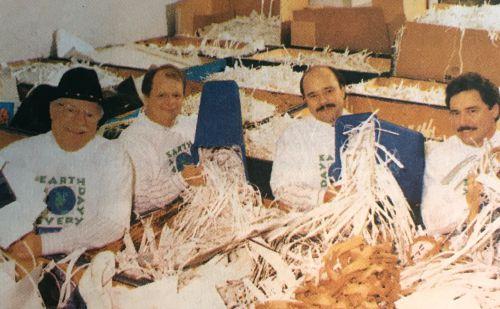
International Earth Week: To draw attention to International Earth Week (April 19 to 25) and Earth Day (April 22), Matthews Ingram and Lake Inc. (MI&L) of Toronto decided to gather in one sport all of the waste paper it collected over a 24-hour period. At final weigh-in, more than 6,8000 pounds of waste paper had been collected – it was all sent for recycling. Pitching in are (left to right): Jack Crawford, CEO of MI&L, John Kerr, MI&L purchasing manager, Paul Jablonski, waste management consultant, Metro Waste Paper Recovery Inc., and Wayne Moir, vice president, sales & marketing, MI&L.
20 years ago
Seybold PDF: Adobe increased the importance of PDF by confirming feature sets for Postscript 3 that further support PDF workflows. Postscript 3 is the new official name for technology that will see production-ready printing devices soon. Many of us speculate, however, that Postscript 3 is simply the wooden horse, in which you will find the PDF Trojans. Consider the fact that all Postscript 3 printers will be Internet-ready: a distribute and print model that is tailor-made for PDFs.
Any TCP/IP addressable printing device will become a de facto fax address. In fact, fax machines will be rendered obsolete. You will receive documents, newsletters, subscriptions, documentation, and remote faxes directly to your LAN or desktop printer in full colour and without intermediate processing.
$3.5K
For sale (1998 classified): Laser printer 11 x 17, 1200
DPI postscript GCC Select press 24MB
RAM $3,500. Collator
24 Bin Ordidel 11 x 17, excellent condition $2,500.
15 years ago
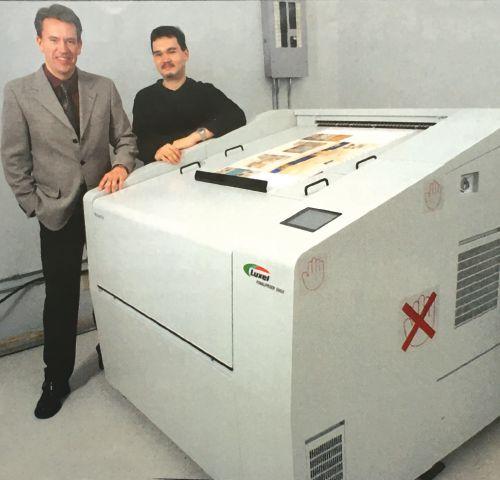
Just Installed: PointOne Graphics Inc. recently acquired the new Fuji Luxel Proof 5600 to further improve the trade shop’s varied services, which includes file assembly, prepress, high-resolution drum scanning, colour correction, CTP imagesetting, sheetfed litho print and bindery. Standing with the machine in Etobicoke, Ontario are John Dunnill of Fuji Graphic Systems Canada (left) and Dennis Low of PointOne Graphics.
$14K
For sale (1992 classified): Dupont
37C Rapid access film processor, water temperature filter control $14,000. nuArc light table $750. 25KV 3-Phase Transformer $800.
Team members from Matthews Ingram and Lake with 24 hours worth of waste paper set for recycling on Earth Day.
Tim Gill, chairman of Quark Inc., moderated Seybold’s keynote panel, which included Apple VP of Advanced Technology, Ellen Hancock (right).
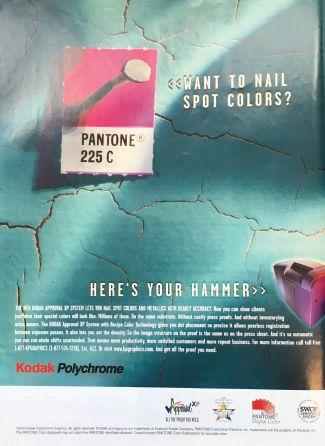
Historic technology advertisements that appeared in issues of PrintAction, including Kodak Polychrome (1998) and First Forms (1993).
Getting involved in the plan
How
to make sure you become an integral part of your client’s marketing plan and budget
By David Fellman
In last month’s column, I wrote that you should be talking with your customers right now about their goals for the year ahead, because those goals are the starting point for their eventual marketing plan – and you want to be part of that plan.
“Eventual” is the key word here, because it’s been my experience that lots of business people talk about creating a marketing plan, but few of them actually follow through on it. So this is an area where a print salesperson serving as a marketing consultant can be of great value.
Please note I used the lower case on those two words. I’m not suggesting that marketing consultant becomes your title. I am suggesting, however, that marketing consultant becomes part of your role as a print salesperson or Marketing Services Provider.
Building a plan
Okay – Why is there so much more talk than action when it comes to creating a marketing plan? I’ve actually asked many small- to medium-sized business owners and managers that very question, and the answers have been pretty consistent. I hear variation of the same refrain, “it’s hard to find the time” or “I don’t know where to start.”
I think a print salesperson can bring value to clients by reinforcing the importance of making the time to do things that are really important. But you might bring even more value by saying, “I can help you to get started.” And here’s how you do that. Simply explain that a marketing plan is really only finding the answers to three key questions: (1) Where are we now? (2) Where do we want to be? And (3) How will we get there?
Situation analysis
The first question calls for a situation analysis. Where are we now, in terms of what the company sells, who it sells it to, trends in the marketplace, strengths and weaknesses and competitive issues. As a marketing consultant (lower case), you do not
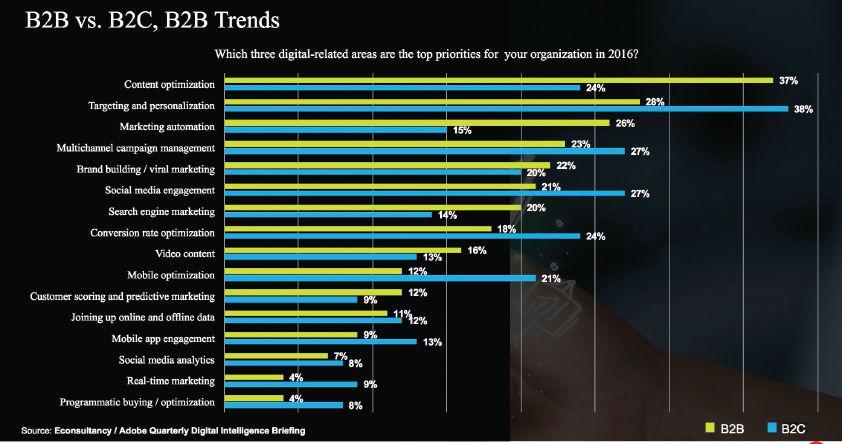
Adobe and Econsultancy’s second Annual Survey of B2B Digital Trends found that all the major B2B sectors that were included in this study prioritized content optimization. (Illustration produced by Adobe Systems.)
need to know those things.You just have to lead the conversation. And that’s a key point. If you’re capable of leading this discussion – by just asking the right questions – you will probably sound like you know what you’re talking about. That becomes especially important when you get to the third stage of the conversation.
But still in the first stage, I hope you’ll see how this conversation might progress. You ask: “What do you sell?” They answer: “We sell widgets.” You ask: “Do you fit a specific niche within the widget universe?” They answer: “We sell mostly mediumsized widgets to doctors’ offices.”
You may well have ideas on how to improve the performance of a customer’s direct mail, better design, better messaging and or a better mailing list.
You ask: “Could you also manufacture or source small widgets and large widgets?”
your marketing plan. The better I understand where you are and where you want to be, the more likely it is that I can help you to get there.”
How to get there
I bet you already have some thoughts on how a typical customer might generate more revenue. Direct mail is a common strategy, with proven results in everything from fundraising to increasing retail or commercial sales to membership development and retention. And you may well have ideas on how to improve the performance of a customer’s direct mail, ranging from better design to a better message to a better mailing list.
These are things that print salespeople have talked about for years, although they barely scratch at the surface of the broad range of marketing services you might eventually provide.
When asked to identify their strategic priorities for 2016, more organizations chose data-driven marketing with their top vote (53%) than any other, according to an Adobe Systems survey on marketing trends. 53%
The answer: “Yes.” You ask: “For example, could you also sell the medium-sized widgets to dentists and veterinarians?”
They say: “We never have, but we probably could.”
You say: “That gives us some things to talk about when we get to the next stage of this plan, but let’s keep talking about what, who, etc. What sort of trends are you seeing in the marketplace for medium-sized widgets?”
It may be helpful to start this conversation by telling your customer that you’re going to ask some very basic questions, including some that you think you know the answers to. “I want to hear your thoughts,” you might say, “on the most basic issues, because we’re building
Depending on how long you’re planning on staying in the printing industry, becoming a marketing consultant is somewhere between an opportunity and a necessity. Actually, I should probably say that a bit differently: It all depends on how long you’ll be staying in the communications industry, because that’s where we are. Think of it as the print segment of the communications industry, and you’ll have it exactly right.
DAVE FELLMAN is the president of David Fellman & Associates, a graphic arts industry consulting firm based in Raleigh, NC, USA. He is a popular speaker who has delivered keynotes and seminars at industry events across the United States, Canada, England, Ireland and Australia. He is the author of “Sell More Printing” and “Listen To The Dinosaur.” Visit his website at www. davefellman.com.
Leveraging supply chain data
Harnessing
the power of supply chain data begins with collecting data from every step of the manufacturing process
By Jennifer Rideout
Delivering better, more personalized experiences –that’s what customers, all customers, expect. Whether products leave your factory ready for consumers or ready for the next step in production, your customers expect a high level of service. And that includes an experience that leaves them thinking favourably about your brand so they come back again and again.
It is here – the customer experience –where your supply chain plays an integral, and perhaps surprising, role. Your experiences as a customer are based on a combination of interactions with a company, for example, how long it took to order and receive a purchase, as well as experiences based on direct interactions. As customer expectations increase, a premium is placed on product customization, nextday delivery and quality.
The ability for manufacturers to execute on these expectations relies on the integrity and accuracy of their data. In fact, the goal must now be to delight customers as they order, customize, receive and use your products – from beginning to end of your supply chain.
To quote KPMG’s 2017 Global Consumer Executive Top of Mind Survey : “Companies are making customer service and brand loyalty a priority but many of them aren’t recognizing the part that supply chains can play in that.”
Leveraging data to improve performance across the supply chain is not a new concept for professionals in the field. According to the SCM World Future of Supply Chain Survey 2016, 81 percent of professionals listed Big Data analytics as disruptive and important to their company. What is less clear for factory professionals is how they can get there.
Start at the beginning
Harnessing the power of supply chain data begins with collecting data from every step of the manufacturing process. The manufacturing industry produces
more data than any other in the U.S., so from planning to distribution, manufacturers have the ability to collect data through sensors, RFID tracking and software programs, and use that data to their advantage.
To do this, manufacturers need to consolidate data from multiple software systems, suppliers and factories to get a full view of their supply chain.
This data must then be analyzed so that meaningful actions can be taken to improve planning, production efficiency, and the customer experience.
Identify the opportunity
According to the SCM World Future of Supply Chain Survey 2016, 81 percent of professionals listed Big Data analytics as disruptive and important to their company. 81%
Before deploying a new technology, assess your current supply chain data. What does it tell you? What does it not tell you? What could you do better, faster and more accurately if you had additional insights?
Consider also what data you are collecting from equipment on your factory floor, and whether you are consolidating and analyzing it to improve production efficiency. These answers will help identify a specific application within your supply chain for better data visibility and analysis, allowing you to gather insights to solve that challenge in a smarter, more efficient way.
For example, an assessment of data collected in your factory may reveal a gap in your visibility from when products leave the line until they arrive at their destination.
While this may not seem like an im-
mediate concern, having visibility into your products during this stage could ensure proper product handling, assist with fleet optimization, and enhance forecast and demand planning.
Use the right technology
Once an optimization project is identified, manufacturers must deploy the right solutions to get the data they require. If your challenge is to better manage inventory and demand purchasing, this might require an investment in additional Enterprise Resource Planning (ERP) software capabilities and wireless asset tracking to keep abreast of warehouse stock.
If your challenge is your factory’s efficiency score, the right technology could include edge computing and collaboration endpoints to speed up machine troubleshooting and decrease unplanned downtime.
Evaluate and refine
As new solutions are deployed and your supply chain visibility increases, it’s important to evaluate and review the success of each project.
What new opportunities and challenges did it create? What feedback are you receiving from employees, suppliers and customers? Did the project achieve its objectives and goals? Or, to reference my example above, did adding visibility into your product warehousing and shipping status identify opportunities for faster, more accurate deliveries?
Remember that while it’s important for manufacturers to increase visibility into their supply chain, it should not come at the expense of other elements of your business; before moving onto a new project, always review the impact and outcomes delivered.
The manufacturing industry is in the middle of a transformation. As customers expect increased personalization, product quality and next-day delivery, the traditional supply chain is no longer enough.
To deliver a better customer experience and increase profits, manufacturers need to improve visibility across their supply chain – from planning to purchasing, fabrication to delivery. Where will you start?
Jennifer Rideout is the manufacturing marketing manager for Cisco Canada. She is responsible for developing go-to-market strategies for the manufacturing sector in Canada, including channel alignment and content development. She can be contacted at jerideou@cisco.com.
Lifecycles and luxury labels
A new study confirms why next-generation solutions must be focus on sustainability when it comes to growth in consumer consumption
By Neva Murtha
It was once said, “Don’t reinvent the wheel – just realign it.” As print customers increasingly seek to improve their environmental footprint and their company’s social responsibility ranking, relevant information can be gleaned from other sectors’ sustainability efforts.
A plethora of business publications have touted the value of being a copy cat, drawing on the experiences and innovation of other businesses to realign your own. As it happens, recent research undertaken by a fashion industry leader offers valuable insights that can help realign the sustainability of the printing sector.
Like paper, manmade cellulosic fibres (MMCF), such as viscose and rayon, and trademarked fabrics, such as Tencel, are all derived from forests, including the Canadian Boreal and the Indonesian rainforest. More than 150 million trees are logged every year and turned into cellulosic fabric
As purchasers of MMCF, fashion leaders – including those involved in the CanopyStyle initiative – are very attuned to their sustainability performance. In the last four years, 125 of the world’s most
Luxury and eco
Luxury fashion label Stella McCartney is one brand that is deeply committed to sustainability and to that end, commissioned SCS Global Services to undertake a truly groundbreaking Life Cycle Assessment (LCA) of the impact of sourcing MMCF. The findings paint a very interesting picture for the Canadian print industry.
The LCA compared the environmental performance of 10 different raw material sources of manmade cellulosic fibres, examining a broad range of environmental issues from fibre derived from forests and agricultural operations right through to the production of viscose/rayon or their equivalents made with flax.
This LCA sets the bar for studies of this kind, factoring in critical yet previously omitted categories, such as climate hot spot impacts, ocean acidification, terrestrial and freshwater ecosystem impacts, forest disturbance and key species
Like paper, manmade cellulosic fibres, such as viscose and rayon, and trademarked fabrics, such as Tencel, are all derived from forests, including the Canadian Boreal.
recognized brands, including H&M, Zara/ Inditex, Lululemon, and The Gap have turned their attention to ensuring their viscose fabrics, and in many cases, their packaging and printed materials, do not originate from the world’s ancient and endangered forests.
loss. Land use conversion and species impacts were analyzed across global fibre sources including the Canadian Boreal forest.
Lifecycle work
While focused on the production of cellulosic fibre for clothing, the LCA’s findings
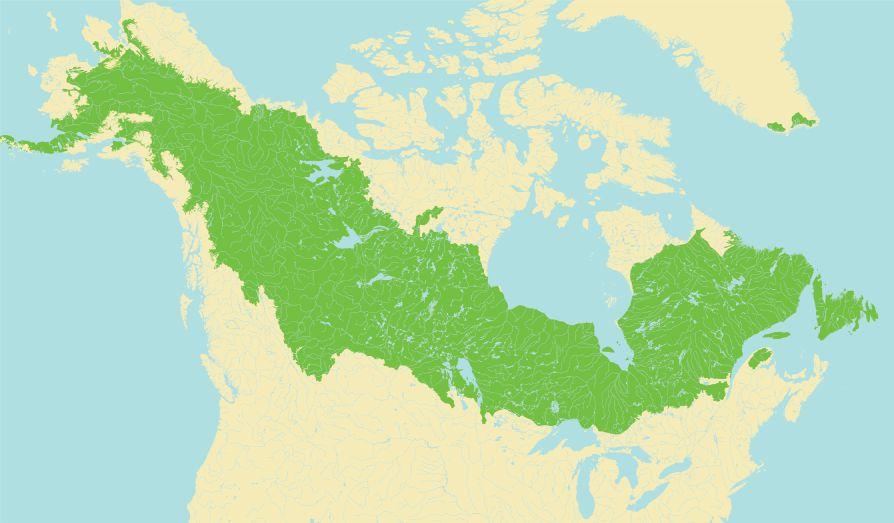
Because a large portion of the world’s boreal zone lies in Canada (28 percent or 552 million hectares), the country’s boreal forest affects the health of the environment worldwide. (Image credit: Natural Resources Canada)
are worthy of close examination by all types of forest product customers as the results revealed the impacts of extraction across a wide range of forest ecosystems. Pulp derived from Canada’s Boreal Forests registered some of the heaviest environmental footprints. Canadian Boreal forest pulp was the second worst performer for global climate change, faring only marginally better than Indonesian rainforest pulp where carbon loss is calculated as very high.
In the last four years, 125 leading brands like H&M, Zara, Lululemon, and The Gap have turned their attention to ensuring their viscose fabrics, and often their packaging and printed materials, do not originate from endangered forests.
As the CanopyStyle Fourth Anniversary Report states, “Canopy-Style brands and viscose producers are bringing their influential voices to advancing conservation across Canada’s carbon-rich Boreal forests. Participating brands are also engaging to make the finalization of the Broadback Forest protected area a reality. Additionally, leading viscose producer Aditya Birla has a moratorium maintaining 1.1 million hectares of intact caribou habitat in another part of Canada’s vast Boreal Forest, creating the space for the development of land use plans that include large-scale protected areas and First Nations free, prior and informed consent.”
Of all the specific forest regions analyzed in this LCA, the Canadian Boreal and Indonesian rainforest were the areas identified where the depletion of valuable wood resources is occurring, leading to the clear conclusion that these two fibre and pulp sources were the worst performing sources of MMCF assessed. In contrast Belgian Flax and recycled textile pulps presented favourably across the majority of the performance categories. Of interest to paper users, these results
The CanopyStyle program was launched in 2013 and has grown significantly over the past five years, with more than 125 brands now involved.
Canada’s boreal forest, consisting of 270 million hectares, stores carbon, purifies the air and water, and regulates the climate.
echo three different life cycle studies done for copy paper or tissue, including the Kimberly Clark LCA on Alternative Natural Fibers. All of these studies previously showed recycled paper pulp and wheat straw pulp to have lower impacts than virgin fibre.
In the future
This growing body of in-depth analysis provides clear guidance to fibre purchasers and all suppliers committed to improving the sustainability performance of the paper, packaging and viscose supply chains. As Canopy Executive Director, Nicole Rycroft noted, “These findings reinforce the need to prioritize and advance commercial-scale production of pulp, paper and packaging made from closedloop solutions such as agriculture residues and recycled paper.”
Although next generation solutions are not yet a commercial reality, lower footprint papers are available. The great news with paper is that you can help your clients hit their sustainability targets today.
NEVA MURTHA works with Canada’s magazine publishers and printers to develop visionary procurement policies. neva@canopyplanet.org
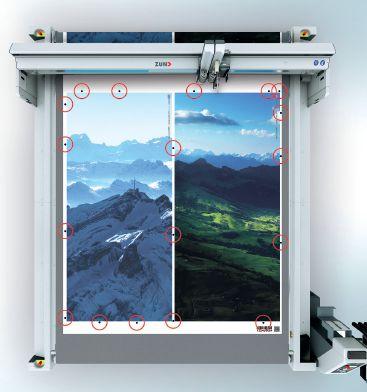
– New Over Cutter Camera OCC captures all register marks at once – Laser Module LM 100W: perfect cuts, sealed edges, all in one process – Powerful 3.6 kW RM-L router for exceptional productivity
CALLING ALL PRINTERS
INNOVATION IS STRONG IN PRINT
TAGA highlights advancements in print from sheetfed offset and inkjet to colour tools and printed electronics, as well as deep technical dives into topics like SCTV, LEDs, spectral data and security enhancements
By Martin Habekost
The middle of March is the traditional time for the annual conference of the Technical Association of the Graphic Arts (TAGA). This organization is still going strong since its inception in the 1940s. TAGA was founded by Mike Bruno, who is also the father of densitometry, hinting at its highly technical nature. Many technologies that are now an integral part of the print industry were presented first at a TAGA conference.
Out of this tradition, a number of PIA’s Intertech Award winners were given the chance to present their award-winning innovations at the TAGA conference. The group of conference attendees was a mix of researchers, people
from industry and students from seven universities with curriculum for the graphic communications area. The students came from Canada, France and the United States. Students from five universities competed for the prestigious Kipphan Cup for the best student journal. These journals contain research work done by students at their respective university. This year’s winner was Ryerson University, bringing the cup back to Toronto after it resided for one year at the California Polytechnic University. This is now the sixth time that Ryerson University has won the cup!
Four keynotes
The conference always starts with four keynote sessions. The first keynote was given by Dr. Joe Webb. He talked about the third wave, that is the third wave of
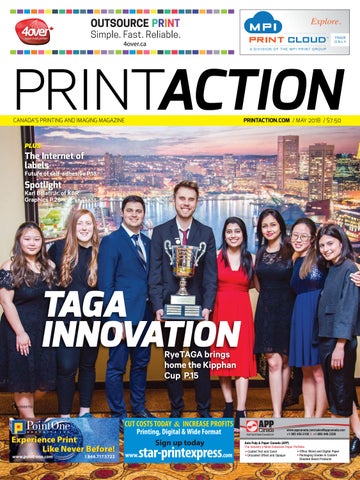
RyeTAGA celebrates their Kipphan Cup win in Nashville with team members (left to right) Cindy Trenh, Julia Forrester, Aidan Kahane, Antek Krystecki, Arianna Kennedy, Nidhi Khatri, Jessica Tam and Masumi Rodriguez (missing are Trung Nguyen and Jeremy Page).
The Helmut Kipphan Cup is awarded for the best student produced and written journal.
RyeTAGA’s team worked closely with industry on its 2018 journal, printed on paper from Spicers at Flash Reproductions, featuring digital embellishments from Konica Minolta with Smyth sewn and button and tie finishing at Specialties Graphic Finishers. It also features the Zappar AR platform.
“The textured inspiration drawing from both Western and Eastern traditions can be observed throughout the journal from design and layout to substrate and binding,” explains Jessica Tam, Production Director, RyeTAGA.
“You’ll notice that the inside pages are centred towards the spine of the book, an intentional decision to stand out and show that RyeTAGA continues to be on the cutting edge of innovation.”
changes that are hitting the print industry. Webb first talked about the fact that the industry went from a craft to computerized production with shorter turnaround times and make-readies and more predictable print quality. I think everyone is very well aware of this. One of the statements from Webb was in regards to the
ed by outsiders who use new technologies that others won’t. Inefficient businesses close.
Another important aspect that business have to assess is the market life of their equipment and make purchases accordingly. He explains a new business structure and relationship model is
SCTV may gradually replace density-based TVI, because it aligns well with the visual impression of spot colour tone values.
most used tools in industry. He explains the most used software is WordPress and not Adobe Creative Cloud. The output path of choice is the smartphone and not printing devices. The most photography is done with the smartphone and not a professional camera and the most content is delivered with the help of electrons and not with trucks.
Webb also talked about the fact that new businesses in the industry are creat-
needed in the industry in the form of alliances. Print businesses need to become involved with the end-user and find out what they want to do. Knowing why often has more value than knowing how. The market place is rewarding fluency in different media.
The three waves that Webb was talking about all have to do with electronic media. The first wave happened when consumers learned to use the Internet. The
second wave came in 2007 with the introduction of the iPhone, and the third wave is that mobile technologies are becoming smart, presumably relating to artificial intelligence.
Mainstream printing is dead explained Webb. What is still happening are specialty applications, shorter runs, transactional printing, event-related printing and behaviour-triggered printing. Packaging has increasing demand due to the fact of population growth and an increased overall lifespan. Webb gave a few recommendations for staying in business.
This included focusing on client objectives and their market place; change is so constant that there is never a perfect time; be flexible and scalable; always keep learning; do not accept common wisdom; and common sense is never out of date.
Colour reproduction
The next keynote was given by Ken Fleischer of the National Gallery of Art in Washington. The title of his keynote was The misguided pursuit of accurate colour reproduction. His talk was about the reproduction of art pieces and how do you approach their reproduction. It all starts with the illumination that you pick for the art piece. The illumination can dramatically change how an art piece is perceived by the viewer.
One has to ask oneself: “Under what illumination did the artist intend his picture to be viewed?” In the keynote it was stated that high colour accuracy is needed regardless of the material that was used for the artwork.
The National Gallery has an ongoing project and wants to capture the experience of seeing into one’s true nature by using spectrally assisted colour measurements. It uses colour matching functions with the response from the camera sensor. The outcome of this project is to be able to reproduce art as true as possible to the artists’ intent.
The third keynote was given by Kate Smith, a colour consultant. She spoke about how to use colour to evoke feelings and impact sales. She used an example of her company logo, explaining when looking at it, we, as humans, detect motion, edges of shapes, contours, contrasts and the colours that are there. Colour can improve brand recognition by up to 80 percent. Colour can increase attention span and recall by 82 percent, colour motivates purchase behaviour by as much as 85 percent and colour instantly communicates meaning.
Seeing these statistics, one can understand clearly why it is very important to chose the correct colours for a company logo and any market the message that needs to be relayed. Colour taps into your heart, mind and body. Her advice when using colour to communicate is to be relevant by going beyond the initial meaning of the colour that you are intending to use,
This is the fourth time RyeTAGA has won the Helmut Kipphan Cup in the past five years, and the sixth time students from the Ryerson University GCM program has won the award since the competition was established in 1993.
be timely and also timeless with the chosen colour and tell a story with colour.
Printed electronics and more
The fourth keynote was given by Tim Luong from MGI Teardrop, focusing on printed electronics. Today’s trends in printed electronics are OLED, QDOTS, smart textiles (wearables with embedded sensors, diagnostics) and printed sensors for fluid levels and gas detection. Luong said that his company is working to continuously improve the functional inks in terms of performance, shelf life and scale up. They are using inkjet and aerosol jet for the digital deposition of the functional inks. The use of aerosol inkjet printing allows for the deposit of smaller circuits and rapid prototyping.
After these four interesting keynotes the next two days brought a wide array of presentation from researchers and PIA Intertech award winners. I will not go over each presentation but pick a few presentations out that were noteworthy.
One of the first presentations was about SCTV. Well SCTV is not Second City Television, but spot colour tone value measurement. SCTV is based on colorimetry and not densitometry. If you have an X-Rite eXact or a Techkon Spectrodens you can perform a firmware up-
date to add this functionality to your measurement device. The presenter predicted that SCTV will gradually replace density-based TVI, because SCTV aligns very well with the visual impression of spot colour tone values. The SCTV method is also described in the ISO 20654 standard.
Another presenter talked about the challenges of building a lightbooth with LED lighting, since the LEDs need to be tuned to give the correct colour rendering so the light booth can conform to ISO 3664:2009. One presenter talked about creating, analyzing and optimizing measurement data for ICC profiles.You might say, ‘Well, that’s an old hat,’ but the approach taken is quite unique. They have developed a tool that allows for preserving the spectral data of the ICC profile and has the profile match G7. Their whole approach is based on spectral data.
A young researcher from Wuppertal, Germany, gave a presentation about molecular switches that can be printed with inkjet technology. He described how he modified existing screen-printing inks that are hydrochromic and others that are thermochromic to make them suitable for inkjet printing. He was able to realize switchable inks and these inks show also anti-counterfeiting properties.
One of the Intertech Award presentations was from Komori and its Impremia IS29. This machine can print on a wide-variety of substrates from 40-lb offset to 24-pt board. Since it uses UVLED inkjet inks, the sheets are dry when they come out of the machine. This machine uses the offset perfecting mechanism from Komori, guaranteeing perfect sheet handling.
Other topics that were covered at the 70th TAGA conference covered the topics of: The incorporation of NFCs into smart packaging; The simplification of producing colour accurate packaging prototypes; A new anti-alteration ink that can show evidence of chemical tampering; The simplification of flexo colour separations through in-RIP processing; Successful expanded gamut separations; the mass production of micro LEDs through flexo print techniques; Optimal tone-reproduction curves for colour printing. From these topics you can see that the many developments are happening in the print industry. Some might take longer to become mainstream, others might become your everyday tool relatively soon. The TAGA conference is always very interesting and gives one new perspectives of what is happening on the forefront of the print industry.
FlexPack
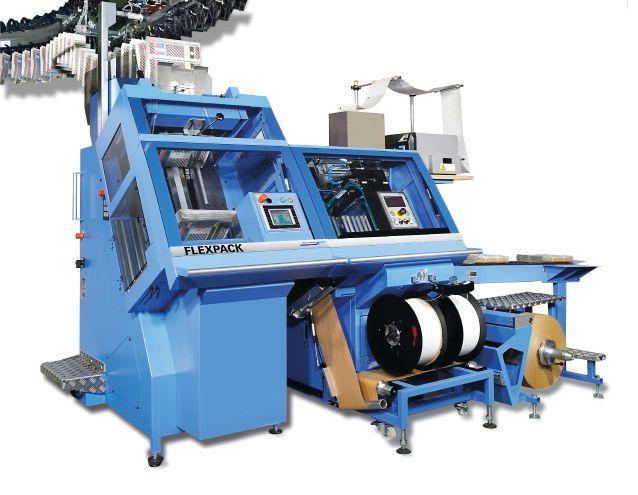
The bundle building system that does it all. Newspaper publishing and commercial printing companies are achieving new revenue sources through innovative inserts. But the proficient processing of these highly diverse and regionalized products has always been a formidable challenge. Until now. Muller Martini’s user-friendly FlexPack not only optimizes your mailroom space, but efficiently processes numerous inserts and newspaper sections by combining stacking, strapping, bottom wrap and top sheet application functions into one single, compact machine. Traditional bundle building procedures can have a negative impact not only on production output, but bundle quality. FlexPack ensures smooth production without jams, resulting in compact, accurate bundles. Muller Martini – your strong partner. www.mullermartiniusa.com
THE INTERNET OF LABELS
Views from the 2018 FINAT technical seminar illustrate the future of self-adhesive labels
By Ann Hirst-Smith
The unusually extended supply chain for the self-adhesive label industry always makes the biennial FINAT Technical Seminar an interesting event in many ways. It brings together a diverse community – all of whom have a strong interest in technical advances that will impact labelling and packaging.This year’s event, held in Barcelona for the sixth time, was no exception. Over two days, March 7 to 9, the seminar combined networking and exploring and evaluating the “challenges in the label market.”
The seminar’s keynote speaker, Andy Hobsbawm, co-founder and CMO of leading Internet of Things smart products platform EVRYTHNG, set the tone for the event. He discussed the way in which the Internet of Things (IoT) and its key advantage – data – have enabled smart products to transform brand relation-
ships, customer interactions, product authentication and brand security, business management, and service experiences – a vast arena where labels on packaging can play a number of key roles.
IoT is in its infancy, he explained, but growing fast – particularly in such areas as serialization and on-pack augmented reality devices. In fact, said Hobsbawm, “99 percent of things will become part of a connected network.” The benefit of onpack ‘communicators’ for brand owners is, of course, the huge source of data received as a result. It can deliver end-toend visibility across a product’s lifecycle, enhance business efficiency, and help to secure the supply chain. Hobsbawm adjured seminar participants to actively exploit these opportunities and “transform your products into smart digital assets.”
As if in answer to this plea, Günther Dieroff, Sales and Marketing Manager of Swedish label printers Beneli, which already has a reputation in smart labels, went on to discuss in detail the sheer scope of the customer engagement market, which is “everywhere from childhood to retirement,” particularly in partnership with mobile devices. Dieroff led the audience along the NFC digital corridors that can deliver successful business results for brands and retailers, as well as successful purchasing and brand engagement for consumers. On-pack promotions and
invitations to connect with a product are creating increased consumer engagement. However, he said, QR codes are not the route to follow. “Only 15 percent of smart device users know how to scan properly,” he said, and “they are ugly.” He showed that there are plenty of other creative communication solutions for NFC scanning.
Do things differently
The complex business of making ready the production process is today much simplified and quickened by the linking of front-end activities via digital workflows, as Xeikon’s Director, Product Management, Jeroen van Bauwel, showed. Particularly in light of today’s customer demands for shorter print runs and shorter lead times, “make-ready time becomes a major bottleneck.” Digitizing the production process can, he showed, not only reduce the costs of print job preparation, prepress, and manufacturing time (by over 20 percent), but it also creates additional production capacity, reduces onpress waste, and can improve all-round quality. A no-paper workflow from order entry to invoicing is a prime benefit of digital production, coupled with optimized colour management; substrate standardization and order grouping based on substrate; plus the addition of separator labels for better integration with on-press finishing systems.
More than 100 people from across Europe attended FINAT’s technical update on flexography trends, which this year focused on trends like peel-and-stick labels, UV and EB curing, foiling and the Internet of Things.
The principles of workflow automation were then addressed in depth, appropriately, by Esko’s Director, Solutions Marketing, Geert de Proost, who described his paper as “automation myths debunked.” In a world where speed to market is the desire of product manufacturers and their customers alike, “great packaging” is also a key requirement. There is one way that the label converter can make this dream come true, said de Proost: “digitize, automate, connect.”
He detailed the ways in which production can be streamlined, so that label converters can better meet the requirements of their brand owner customers.
“All of a sudden, your bottleneck is not the printing machine,” said Daragh Whelan, Process Manager at Bobst, who discussed digital automation for flexography.
Revenue generated from the Internet of Things and Big Data services is set to exceed €300 billion by 2020.
Bobst is a member of the REVO Partnership formed with other leading industry suppliers to provide full-circle digital flexo and he showed how, with digital UV flexo, the REVO solution delivers wide graphic flexibility in terms of extended colour gamut technology. It also offers significant improvements over conventional flexo in terms of both minimal process waste and make-ready time, which is reduced from a total of three hours for conventional flexo to 10 minutes with digital flexo.
Accept, create, invest
MPS Systems’ Global Marketing Manager, Marjolein Ekkelboom, was uncompromising in telling seminar participants to “accept, create, invest” in the benefits of connectivity. The hardware and software are ready, as prior speakers had shown, and can deliver multiple core business rewards in terms of a successful business future.
Indeed, she underlined that revenue generated from IoT and Big Data services is set to exceed €300 billion by 2020 – and that is just the beginning.
The afternoon session consisted two parallel interactive troubleshooting workshops for delegates, based label converting scenarios. John Hammond, Sales Director of Nilpeter UK, led the workshop on self-adhesive multi-layer peeland-read labels and their construction. As a result of increasingly strict regulatory requirements in terms of the provision of more in-depth product information in the field of pharmaceuticals and OTC medicines, as well as a general desire to place just “one label” on a product, peel-and-read labels now represent a strong opportunity arena for label converters. Hammond said, “You just took away all the brand owners’ problems with a single solution.” He explained in depth both the single-web and dual-web production options, and concluded that one-pass production of peel-and-read labels would additionally give label converters “the opportunity to bring that advantage to the market.”
It makes sense
Nanette Thomas, CEO and founder of Synthogra, led a very lively and positive workshop about going into flexible packaging and sleeves on narrow-web presses, alongside traditional self-adhesive labels. She encouraged participants to look at the process of starting up such a process, including the practical production challenges and pitfalls, brand owners’ buying behaviour, and the implications of food safety regulations. She showed, for label converters today, flexible packaging and sleeve label production represent a genuine opportunity to gain additional market share with existing brand owner customers, as well as increased profitability.
As moderator Paul de Ruijter commented, “Flexible packaging is very important for the label industry in terms of increasing its role with the brand owners… and it can really raise the bar for the industry, taking it from secondary pack-
aging print into the realms of primary packaging production.” FINAT’s role in enabling such industry evolution is of course key, he underlined.
Inks and surface decoration
Next morning, inks and decoration were the focus of the presentations. Opening the program, Bo Meyer of UEI Falcontec looked at non-ink-based label surface enhancement in the form of hot or cold foiling, embossing, or texturing. This is today a popular choice for adding onshelf value to labels on consumer products like wines, he said, as well as for micro-embossing in product authentication applications. He laid out the technical parameters for hot foiling, including controlling heat dwell time, pressure, temperature, machine speed, and heat conduction in the foiling tool – and for cold foiling, primarily featuring metallized foils, which may be overprinted to achieve the required colour.
Then Dr Heinz Schweiger of Zeller+Gmelin talked about the way in which, in label converting, the issue of ink migration into foods from labels and packaging can be addressed. He showed how the company’s proprietary DirectCure (curing technology for special UV inks employing a reduced number of photoinitiators) can cost-effectively replace EB curing n such applications.
Sun Chemical’s Jonathan Sexton explored the characteristics of all the key ink drying methods in use today, with a particular focus on UV and EB curing. “Substrate isn’t really important,” he stated, but emphasized that the choice of a drying system must satisfy multiple criteria for both analogue and digital print, if optimal results in process optimization and final print quality are to be achieved.
It was time, then, to look at varnishes, which perform a variety of functions, from surface protection to the visual enhancement of print. Volker Michel, Pulse Roll Label Products, discussed their chemistry, manufacture and applications. He looked at overcoming common challenges, including the requirements of digital print; special finishes such as rough texture; print-to-cure dwell times; and possible contamination of the cationic systems used for peel-and-read labels. The key to a successful end result is, he said, collaboration between ink and varnish supplier, anilox supplier, repro company, and printer to identify the right formulation.
Closing the program and thanking all involved in creating the event, Chairman of the FINAT Technical Seminar Subcommitte, Alex Knott of Dow Silicones, summed up the event in one statement: “I think we’ve learnt a lot about significant changes in our industry” – a statement which drew enthusiastic agreement from the seminar participants.
NEW PRODUCTS
Detailing new technologies from Agfa, Aleyant, Canon,
GMG, HP, Koenig & Bauer, Konica Minolta and Ricoh
Epson SureColor F2100
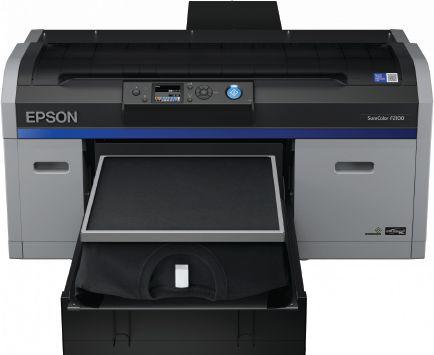
In March, Epson released its new SureColor F2100 direct-to-garment system, leveraging its PrecisionCore TFP print head and Epson UltraChrome DG garment ink technology, the SureColor F2100 achieves up to twice the speed of the company’s previous generation DTG printer – the SureColor F2000. The SureColor F2100 (MSRP US$17,995) offers four colour ink technology, plus White ink. Additional improvements on the new SureColor F2100 include a quick-load platen, Epson Garment Creator Software, all-new integrated self-cleaning system for less downtime, and newly developed print modes including Light Garment Mode and Highlight White. Epson explains these new modes provide for more consistent print quality.
In terms of the new integrated inline self-cleaning system, the SureColor F2100 transports cleaning solution through the printhead, allowing the printer to perform daily maintenance to reduce downtime. In addition, White ink is triple filtered before reaching the printhead, designed to help reduce White ink nozzle clogging for greater up-time.
Canon iQuarius MX inks
Canon introduced new iQuarius MX inks for the Océ VarioPrint i-series of sheetfed inkjet presses. Scheduled to be available from April 2018, these third-generation inks for the VarioPrint i-series have been specifically developed to meet the needs of working with offset coated papers for high-quality printing.
The new Océ iQuarius MX inks, explains Canon, enable the application of higher ink coverage on a range of offset coated stocks, which in turn extends the platform’s range to more demanding applications like higher quality books, manuals and direct mail. iQuarius MX inks are used in combination with the company’s ColorGrip inline paper conditioning technology to optimize ink adhesion and absorption.
The original iQuarius ink for the Océ VarioPrint i-series will now be branded as Océ iQuarius MP ink (Multi Purpose), to distinguish it from the new iQuarius MX (Media Extended) version, allowing customers to choose the appropriate level of ink performance. For current VarioPrint i-series users, MX upgrades will be made available.
Epson’s Highlight White mode achieves brighter White ink output by applying a second coat of White ink.
The Océ VarioPrint i300 press with iQuarius MX inks has achieved Fogra 51 certification.
RS SuperiorSuperior Binder y Ser vices Inc.
TECHNOLOGY — Die crease without a die, then fold and even glue all on the same machine, up to 30 pt. 3. INTEGRATED MODULAR UNITS — Combined in-line finishing: crease, fold, glue, tipping, envelope inserting, ink jetting (Duplex), clip seal (3 sides), mail prep. 4. SAVE ON POSTAGE COSTS
As a Certified Canada Post Direct Marketing Specialist, we get contract pricing reductions.
RETURN MAIL PRODUCTS — Customized “Return Mailers” created in-line with “U” or “BOX-shape” remoistenable glue, time perfed applications and envelope formation.
MINI-BOOKLETS — Saddle-stitch and trim 2-up booklets in-line to the size of a business card. No need to trim off-line, or do 2 passes.
HIGH SPEED EQUIPMENT — High speed Tipping, Folding, Saddle-stitching and soft folding ensuring on time delivery.
HP PrintOS Marketplace
In April, HP unveiled its PrintOS Marketplace, described by the company as a new solutions community for the HP PrintOS cloud-based print production operating system. Designed to provide tools for printers using HP technologies, Marketplace will offer production and design tools and services from both HP and third parties. Opening this summer, Marketplace will be open to any vendor to offer subscription-based apps for PrintOS members that help HP customers automate production, expand offerings and grow business. Today, PrintOS has 5,400 printing providers subscribed to the system, including owners of HP Indigo, HP PageWide Industrial and HP Scitex presses.
Agfa Adamas plates
Agfa Graphics this spring is set to launch a new chemical-free plate line called Adamas. The company states Adamas will be the most durable chem-free plate available on the market, in terms of plate throughput and run length. Agfa states the plate system will require zero water and provide up to 75 percent less waste when compared to similar products.
Adamas leverages new Agfa-patented ThermoLink technology, which, according to the company,
provides run lengths as long as 350,000 copies. Adamas can be used in a variety of print environments like sheetfed and cold-set to heatset printing. The plate is compatible with low-power curing UV inks. Agfa explains the plates provide increased durability, enhanced performance and responses to the biggest market trends, such as low-power curing inks. The highly sensitive plate Adamas was designed for use with Agfa Graphics’ dedicated Adamas clean-out units, which can be cleaned with pH-neutral clean-out solution and zero water.
Zünd Over Cutter Camera OCC
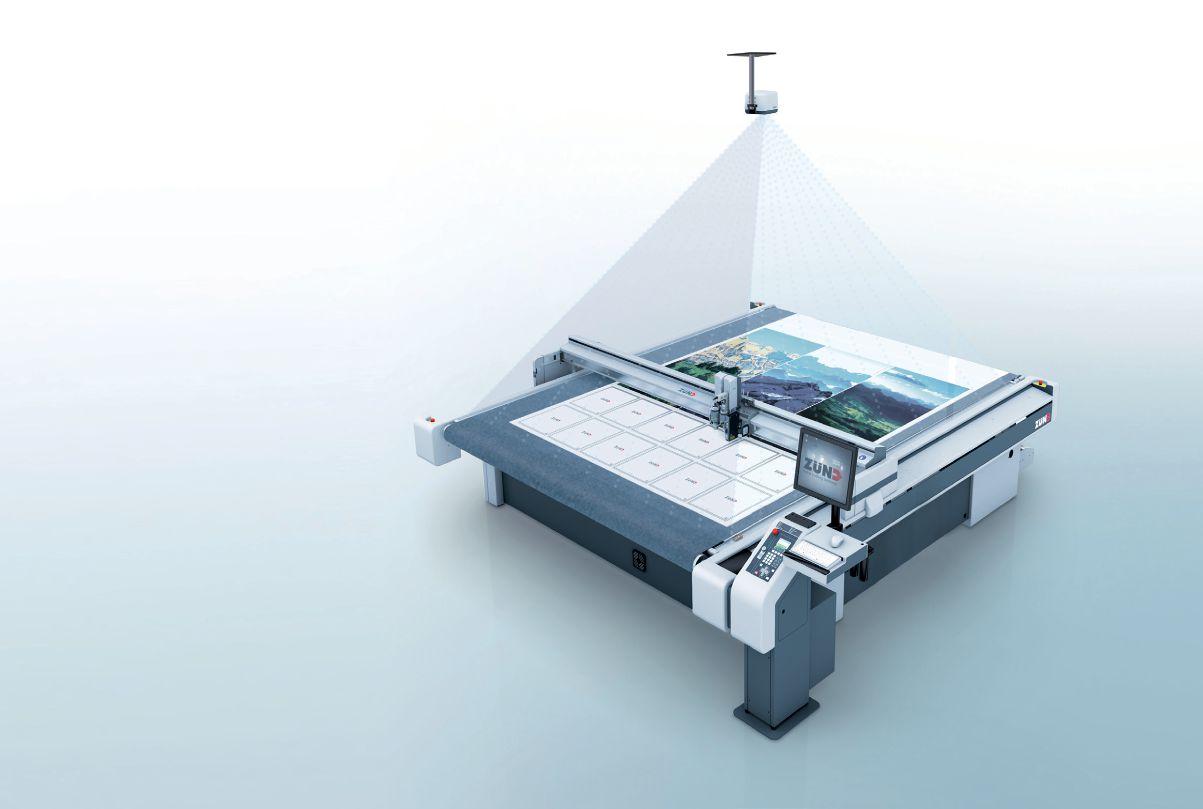
In April, Zünd displayed its new Over Cutter Camera OCC, which allows the company’s cutting systems to more quickly process printed materials. Zünd explains the automated OCC takes a single shot to capture all register marks at once, in a matter of seconds. The Over Cutter Camera OCC captures all points in a maximum area of 3.2 x 3.2 metres (126 x 126 inches) and can be added to any Zünd G3 cutting system.
With the Over Cutter Camera OCC, Zünd is providing what it describes as an expansion to the traditional method of sequential register-mark capture with an ICC camera. Sequentially capturing register marks to determine position and possible distortions of printed graphics is time consuming, explains Zünd, particularly in applications that require a lot of them. The OCC system is powered by Zünd Cut Center ZCC and takes one image to register all marks visible in the working area.
Zünd’s Over Cutter Camera OCC captures all points in a maximum area of 3.2 x 3.2 metres.
PrintOS Marketplace is aimed at a range of presses like HP Indigo, HP PageWide and HP Scitex.
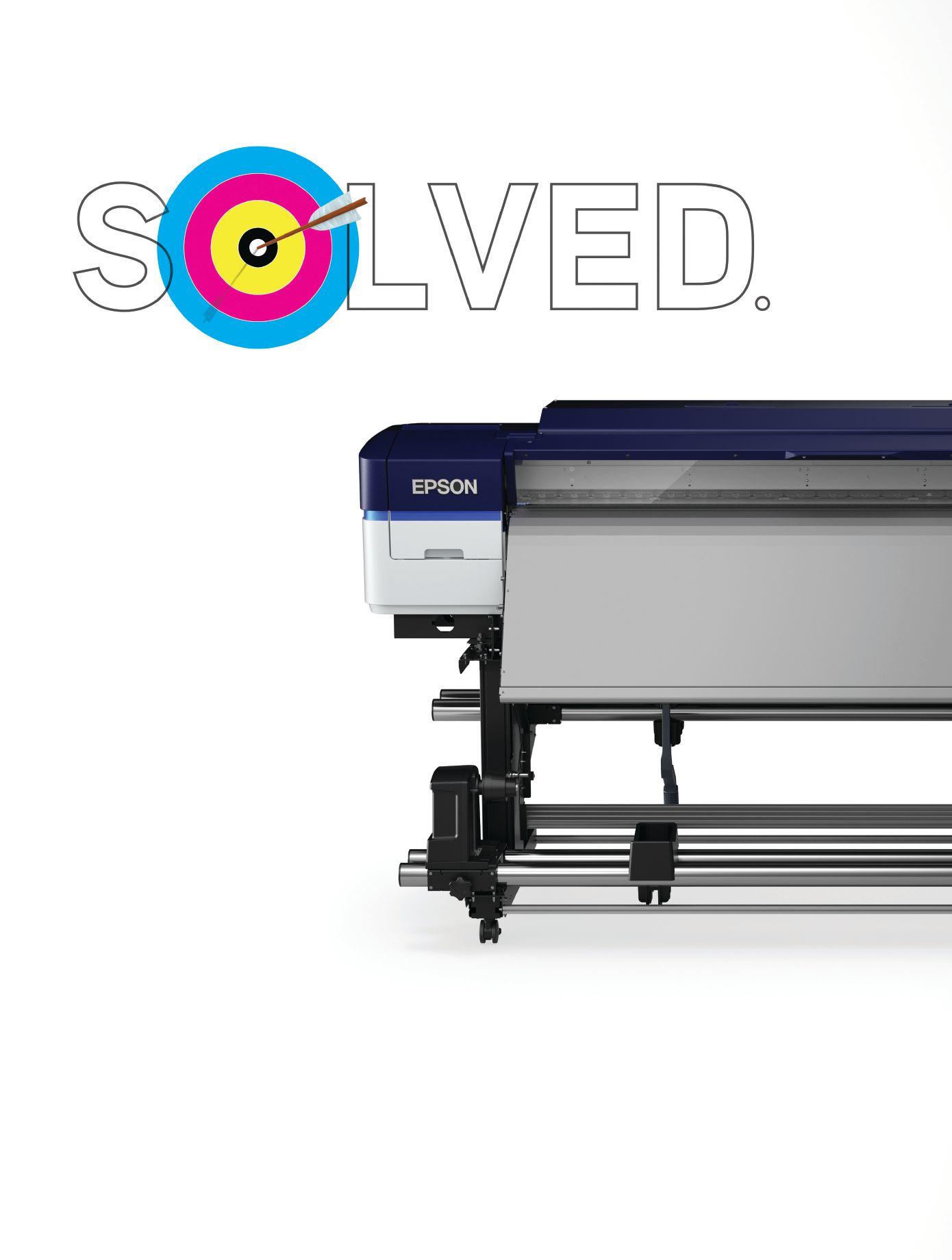
SOLVENT PRINTING.
PRODUCTIVITY.
Introducing the all-new SureColor S-Series family of sign printers. We set our sights on creating a new line of sign printers that significantly outperforms anything that has come before them.
Learn how we hit the bull’s-eye at epson.ca/solventprintingsolved
Solutions for the Printing Industry
Graphics Manager
KBA Idealliance certification
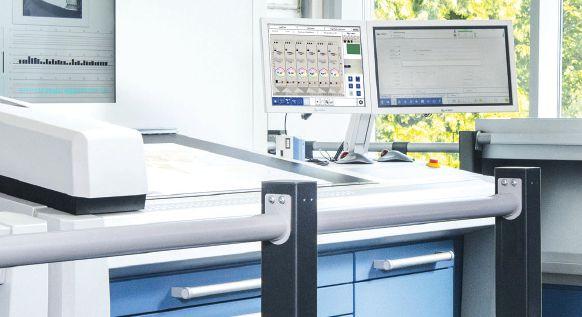
In March, Idealliance awarded G7 System Certification and G7 Press Control System Certification to two Koenig & Bauer colour control and colour reporting systems: Instrument Flight Color Control by System Brunner and the newest version of its QualityPass software for sheetfed presses. Koenig & Bauer explains it is now the only press manufacturer to hold two G7 System Certifications.
Last fall, the Idealliance G7 Press Control System Certification program confirmed that Koenig & Bauer’s Instrument Flight Control technology by System Brunner can monitor and control a production press run according to G7 gray balance and tonality specifications. Koenig & Bauer explains its Instrument Flight Control technology by System Brunner is the world’s first press control system to elevate G7 from a calibration procedure to a complete process control system from prepress to pressroom. In addition to G7 metrics, Instrument Flight also monitors and controls TVI (dot gain) in the individual colours, the spread of TVI, solid ink densities, L*a*b* colorimetric targets and more of a reference print condition or standard such as GRACoL, ISO 12647-2, the System Brunner Globalstandard or any specific company targets. Instrument Flight is able to prioritize the different metrics according to different requirements, such as G7 settings.
Konica Minolta WEBjet 200D
In April, Konica Minolta introduced the WEBjet 200D and WEBjet100D continuous feed inkjet presses. The company explains the printing systems are the result of a three-way marketing, distribution and servicing partnership between itself, Super Web and Memjet. The presses will be offi-
cially launched later in the spring of 2018.
Aleyant tFLOW 9
In April, Aleyant introduced its tFLOW 9 software for digital workflow automation and customer service for commercial, large format, label, and specialty graphics.Version 9 of tFLOW now includes the ability to send customizable welcome emails for new user creation to enable them to easily view and approve jobs within tFLOW. In addition, Version 9 features tab-managed links that give users smarter access with public and private login links. tFLOW automatically recognizes which users have private and public access.
Ricoh VC60000 inks
In April, Ricoh unveiled what it describes as enhanced inks for the Pro VC60000 platform, which also includes the recently introduced Pro VC40000 model, within its continuous-feed inkjet portfolio. The company explains this ink introduction “greatly expands” the range of media that can be used on these VC-branded inkjet systems. The new Ricoh Pro VC60000 inks, explains the company, are designed to streamline printing directly to traditional offset coated papers, making the entire production system more versatile and economical.
GMG ColorPlugin 1.3
In March, GMG expanded its ColorPlugin for Adobe Photoshop in Version 1.3. Now colour accurate separations from RGB into Multicolor colour spaces are possible with up to seven colours. This is based on GMG OpenColor separation profiles. The conversion can be switched on or off at any stage during image processing. This way the final result can be directly simulate at any stage of processing. The new ColorBoost function makes images more saturated and vivid.
KBA’s QualiTronic QualityPass measurement reports to document ink densities, spectral values and dot gain.
WANTED URGENTLY FOR EXPORT, USED OFFSET PRESSES
Kord 64, Sordz, SM 74-2, Komori L-426. We buy:
Heidelberg: K-Line/S-Line/Speedmaster/GTO/MO
Komori: 1, 2,4 or 5 colours & any size
Adast: 714/715/724/725
Mitsubishi: Any model
Ryobi: 2800CD/3200CD-MCD/640K
Itek: 960/975/985
Hamada: 600/700/800/E47/RS34
Shinohara/Fuji: 66/65 1,2 or 4 colours
Sakurai: 1,2, or 4 colours and any size (newer model)
Polar: any size/older or newer models
Horizon-BQ: 220/240/260/440/460
Any model surplus printing machines, paper cutters & bindery equipment.
IMMEDIATE DECISION
WE BUY ONE PIECE/ENTIRE PLANT
$$$ TOP PRICES PAID $$$
Cell: 416-824-0236
Office: 647-835-6224
Contact name: Ramesh. Email: gr_trade@hotmail.com
OWNER/MANAGER
Print Shop Closing – Package deal on 4 pieces of Finishing Equipment – all in working condition. Not certain of age. Challenge – 31” programmable Cutter with air bed, Heidelberg Letterpress Red Ball Windmill, Stahl Folder with Right Angle, Damark Tunnel Shrinkwrap Machine. Would like to sell altogether$6,000 or best offer.
Feeder required full-time by busy West End sheetfed printer for Komori Lithrome S40. The ideal candidate should have a minimum of 3 years printing experience, and strong technical skills are an asset.
Monday – Friday shifts (days or afternoons available). Generous wages and Benefits. Required language: English. Contact: Gottfried at 416-249-1961. Fax: 416-249-3415.
Manroland is a leading manufacturer of state of the art high technology Sheetfed printing press equipment and is seeking to fill the position of Mechanical Service Technician. The position may be located within an hour of any major city airport.
The primary role will be to provide onsite service support to customers in the areas of installation, warranty, and maintenance service work through scheduled and emergency onsite repairs of Manroland Printing Presses. The ideal candidate will be a High School graduate with formal college or trade school being a plus. 3-5 years’ experience supporting large electro-mechanical equipment with a preference to experience on printing press equipment. Must be willing to travel extensively to customer sites.
Commercial printing operation for sale in vibrant Northern British Columbia community. Offset, letterpress, digital, wide format. Good client base, steady income.
Contact Anthony at 250-787-7677 or email cliffsideprinting@telus.net
Sakurai: 1, 2 or 4 colours and any size (newer model)
Polar: any size/older or newer models (66/72/76/78/82/90/92/107/115)
Horizon-BQ: 220/240/260/440/460
Karl Belafi Jr. / Vice President / KBR Graphics Canada / Laval, Québec
KBR Graphics in mid-2016 moved its primary operations into a new modern facility in Laval, Quebec. The move came as the company was celebrating its 40th year in business, as one of Canada’s most respected and important technology distributors.
The new Laval facility not only signals KBR’s growing presence in Quebec but its expanding national footprint, highlighted by new technicians and sales reps, as well as a new agreement to distribute RYOBI MHI Graphic Technology (RMGT) sheetfed presses across the country. KBR has also been growing its presence in Ontario with a range of notable postpress installations – leveraging its Standard/Horizon relationship. PrintAction asked KBR VP Karl Belafi for his insight on Quebec’s printing community and technological trends in the industry.
Why is print still a good industry to be in?
KB: Print is an ever-evolving industry. It will always be the most trustworthy form of marketing, and with all the new available technologies, marketing professionals can easily find new and untraditional ways to get noticed. Looking towards the future, we are so excited to see the beginnings of so many new innovations that will continue to drive the industry forward.
How is Quebec’s printing market unique?
KB: Boldness, creativity and an innovative spirit are the hallmarks of Quebec and proves to be an interesting market. Quebecers are forward thinkers who are keen on evolving. We noticed that our Quebec clients look for innovative technologies and are open to trying new things.
What is the greatest strength of Quebec’s printing community?
KB: The relationships in the Quebec printing community are remarkable. What’s especially distinct is how different printers regularly assemble and take pride to come together for the greater good of the industry. Some of the events include the Gutenberg Gala, the Association québécoise de l’industrie de l’imprimé : AQII and the Institut des communications graphiques et de l’imprimabilité, ICI.
How has your move to Laval helped?
KB: KBR’s expansion and move to a new high-tech facility in Laval in 2016 has definitely improved our position in the industry. Our greater visibility to the public, bright new showroom, and larger space has helped enhance our brand.
What type of capital equipment investment is taking place in Quebec?
KB: Automation and ease of operation have
become critical to the bottom line of printers. We have seen in Quebec a rise in the investment of automated finishing equipment as well as multi-function systems such as slitter/cutter/creasers.
Why is offset still an important?
KBR Graphics is now in its 42nd year of business, as it grows a national footprint with RMGT and Standard/ Horizon partnerships, among others.
KB: The sale of offset presses is once again on the rise. With the introduction of automated LED-UV equipped presses, today’s printers are taking advantage of instant curing for finish-ready prints, low energy cost savings and ultra-fast make-readies, in order to close the gap between digital and offset - much better profit margins.
What new tech impresses you most?
KB: The most impressive technology for us comes in the finishing department. Standard/Horizon, whom KBR has been representing for the past 30 years, has in recent years introduced a dual cylinder rotary die-cutter. The RD-4055 is designed to meet the growing demand for short-run die-cut product, with the ability to die-cut, crease, perforate, slit, hole punch, and round corner in one process for digital and offset sheets... it can easily produce a range of finishing, especially short-run packaging.
What key new partnerships are important for KBR?
KB: Our new partnership with RMGT has been especially important for our growth in Canada. Specifically, RMGT’s 9 series offset presses that have continued to expand in the world’s market share. In recent years, there has been over 50 RMGT 9 series presses installed in North America as well as more than 700 installed worldwide. Here in Quebec, we were the first in North America to install an LED-UV press. In 2018, KBR has already sold three new RMGT 9 series presses that will be installed in the coming months.
How much has KBR grown over the past few years, in Quebec but also nationally?
KB: KBR has been one of the leading suppliers of print and print finishing solutions in Quebec for 40 years. Over the past 10 years, we have expanded our reach to the Ontario markets with the addition of a sales and technical service team. Today, KBR holds exclusive rights for many top brands for the entire country. We are now in the process of expanding our reach by implementing sales and service teams in most major Canadian cities in order to offer local and quick service.
Introducing the new OnsetM
Fujifilm is setting the industry on fire with the new OnsetM. This new B1 format inkjet printer is robustly designed to produce a high quality, short run solution for the offset, screen, and industrial print markets.
Jetting 7 picoliter droplets of Fujifilm Uvijet inks through FUJIFILM Dimatix printheads, the OnsetM produces vibrant colours, smooth gradients, and fine text that rivals an offset print. And with a throughput of up to 200 B1 boards/sheets per hour of everything from paper to plastic, the OnsetM can give you the edge you need to take on jobs you never thought possible.