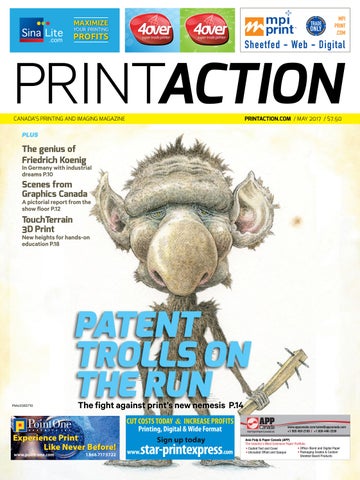
The genius of Friedrich Koenig In Germany with industrial dreams P.10
Scenes from Graphics Canada
A pictorial report from the show floor P.12
TouchTerrain
3D Print
New heights for hands-on education P.18
Cover illustration by John Burgoyne, who is a member of the New York Society of Illustrators and an alumni of Massachusetts College of Art. johntburgoyneillustration.com
A pictorial report of Canada’s biannual printing trade show in Toronto
14 Patent trolls on the run
A case study of patent abuse shows print is winning battles against a new nemesis
16 Print innovation is happening
Four keynote sessions at TAGA highlight the direction of printing development
18 TouchTerrain hands-on 3D print
A research team in Iowa is taking 3D printing to new heights with a Web app
DEPARTMENTS
GAMUT
5 News, People, Calendar, Installs, Globe, Archive
TECH REPORT
19 Wide-format systems
Backed by textile growth, wide-format opportunities continue to emerge
MARKETPLACE
25 Industry classifieds
SPOTLIGHT
26 Ray Fagan, Product Manager, Heidelberg Canada, discusses Push to Stop and automation in print
COLUMNS
FROM THE EDITOR
4 Jon Robinson
Geomapping and print
M&A moves into mailing and fulfillment can push printers into marketing services
DEVELOPMENT
9 David Fellman
Get Your Act! Together
Moving past simple to-do lists, software tools for salespeople to manage time
CHRONICLE
10 Nick Howard
The genius of Friedrich Koenig One of the world’s most influential inventors establishes KBA
Geomarketing and print
Through the first half of this decade, commercial printers in Canada have focused on three types of mergers and acquisitions in an effort to differentiate themselves from offset overcapacity. The primary type of M&A is to take advantage of the heavy-iron overcapacity and purchase struggling competitors who do not have the ability to invest in new levels of automation to drive cost out of margin-tight operations.
Hemlock Harling provides an example of moving much deeper in a new direction through M&A activity than buying a struggling competitor. Hemlock had long been involved in the mailing and fulfillment space, installing a new VeraCore system in early 2016 to manage its fulfillment operations for clients around both print and non-print collateral materials. Hemlock also manages magazine subscription fulfillment programs for several of its publishing clients.
Editor Jon Robinson jrobinson@annexweb.com
Contributing writers
Zac Bolan, Wayne Collins, David Fellman, Victoria Gaitskell, Martin Habekost, Nick Howard, Scout McCraw, Neva Murtha, Abhay Sharma
Publisher Paul Grossinger pgrossinger@annexweb.com 416-510-5240
According to an Adobe-sponsored study in 2016, 53% of their respondents said that data-driven marketing was a strategic priority in 2016. (Source InfoTrends March 2017).
The second type of M&A in Canadian commercial printing revolves around large-format imaging services. This move is notably different than picking up a struggling competitor, because its ultimate goal reaches beyond adding book of business. In purchasing large-format shops, commercial printers were interested in purchasing new expertise and services, which they can then leverage with a vaster customer base.
The third type of M&A prevalent in Canadian printing since the start of the decade revolves around the purchase of mailing and fulfillment services. A completely different business than what printers are used to, even if it is part of their complete supply chain, expertise again is the primary target asset, as well as longer shelf-life equipment. This M&A move, however, is better served as a marketing play for print than a pure mailing-and-fulfillment push.
A recent example of the move to acquire mailing and fulfillment services can be found in one of Canada’s largest private printing operations, Hemlock Printers of Burnaby, BC. In December 2016, Hemlock created a new entity called Hemlock Harling Distribution Inc., which is described as a company dedicated to providing data-driven marketing, postal and third-party distribution services to customers throughout North America. The venture is an equal partnership between Hemlock and Harling Direct, a marketing-support company.
Hemlock Harling officially opened its doors in February 2017 coinciding with the acquisition of Kirk Marketing, a 60-year-old full-service print, mailing and fulfillment services company in nearby Richmond, BC. Operating from Kirk’s existing 40,000-square-foot facility, Hemlock Harling, in addition to serving its established customer base, will also support Hemlock Printers and Harling Direct clients – significantly expanding the capabilities of both organizations. Then in March 2017, Hemlock Harling acquired PDQ Post Group based in Surrey, BC, with more than 25 years of experience in data, mail and lettershop print solutions. All PDQ operations were to shift to Hemlock Harling’s facility.
The recent M&A moves by Hemlock is clearly to build itself more as a marketing services company to capture new revenue by leveraging its existing services like offset and digital printing, online solutions, digital photography, bindery, mailing and warehousing. Hemlock Harling illustrates complete commitment to a space that can leverage print through powerful new technologies tied to today’s Big Data push.
A March 2017 white paper by Infotrends, called Meeting Clients’ Needs with Geomarketing, provides the vision for the returning value of marketing services tied to print: “Marketers everywhere have been under pressure to deliver faster, more impressive results to justify their marketing spend. For the last decade that trend drove many marketers to adopt more online and mobile solutions in the belief that electronic marketing cost less.
“As a result, these marketers often reduced spending on print and mail to save money. What these marketers learned was that they often paid for that decision with poorer results. Today, the evolving best practice for marketers is to return to print, bolstered with data, to launch effective campaigns that drive the fastest and most effective responses.”
Pat McGrew of InfoTrends, author of the study, said, “Using location-based data to connect with consumers is one of the hottest trends in marketing communication. But all too often, print and marketing service providers don’t leverage that data because they think it is too complex or time-consuming.” McGrew explains location mapping can serve as the most important differentiator for how it improves the results of clients’ campaigns. Commercial printers who provide these services, by combining print expertise with the localization needs of clients, can find a differentiator for their future in print.
JON ROBINSON, editor jrobinson@annexweb.com
Associate Publisher Stephen Longmire slongmire@annexweb.com 416-510-5246
Media Designer Lisa Zambri
Circulation Manager Barbara Adelt badelt@annexbizmedia.com
Customer Service Angie Potal apotal@annexbizmedia.com Tel: 416-510-5113 Fax: 416-510-5170
Mail: 80 Valleybrook Drive, Toronto, ON, M3B 2S9
COO
Ted Markle tmarkle@annexweb.com
President & CEO
Mike Fredericks
Subscription rates
For a 1 year monthly subscription (12 issues): Canada — $40.95 Canada 2 year— $66.95 United States — CN$71.95 Other foreign — CN$140.00
Mailing address Annex Business Media 80 Valleybrook Drive Toronto, ON, M3B 2S9 printaction.com Tel: 416-442-5600 Fax: 416-442-2230
PrintAction
SaltWire Network, a newly created media group that already controlled The Chronicle Herald’s seven publications in Nova Scotia, acquired four printing plants and 27 newspapers owned by Transcontinental in Atlantic Canada. The sale includes 28 brands and Transcontinental’s Media Sector commercial printing activities in Newfoundland and Labrador, as well as distribution activities in Atlantic Canada. Including the 650 Transcontinental employees affected by the purchase, SaltWire now has around 950 employees and, according to the company, can provide advertisers with access 71 percent of the region’s newspaper readers.
hubergroup acquired substantially all of the assets of Alden & Ott Printing Inks for an undisclosed price. hubergroup expects to retain virtually all employees and the management team of Alden & Ott to continue operations in the Midwest and Northeast U.S. Alden & Ott develops custom solutions for both the offset and flexo printing. hubergroup, comprising 40 companies, generated sales of approximately $885 million in 2016.
CALENDAR
May 12-13, 2017
Grafik’ Art Place Bonaventure, Montreal, QC
May 21-24, 2017
National Postal Forum Convention Center, Baltimore, MD
May 23-26, 2017
PACKEX Toronto Congress Centre, Toronto, ON
May 21-26, 2017
Display Week 2017 Convention Center, Los Angeles, CA
Landa Group announced the final 2017 beta customer line-up around its S10 Nanographic press, with the first shipment scheduled to take place July 2017 to Graphica Bezalel, an Israel-based folding carton, packaging and label convertor. In November 2017, Landa plans to ship North America’s first S10 press to U.S.-based Imagine!, which focuses on point-of-purchase printing. In December 2017, Germany’s Edelmann, with sales exceeding 300 million euros (producing more than 5.5 billion packages and leaflets per year) is scheduled to become the first European beta customer for the Landa S10.
Toronto Club of Printing House Craftsmen , for the 42nd annual year, recognized local printers for their award-winning work in the IAPHC Gallery of Superb Printing competition, including C.J. Graphics (15 gold, 12 silver, 4 bronze); Avant Imaging & Integrated Media (5 gold, 4 silver, 1 bronze); Colour Innovations (3 gold, 3 silver and 2 bronze); Polytainers (1 gold, 1 silver, 1 bronze); and Wellington Printworks (1 gold and 2 silver). A range of Craftsmen scholarships, including the Chai Tse Award, were presented to secondary and post-secondary students.
Tip Top Bindery , a wholly owned company of The AdMill Group in Scarborough, Ontario, made a share purchase of B.C.W. Bindery Services Ltd. Located in Markham, since 1992, B.C.W. provides perfect binding, mechanical binding, gluing and specialty folding (including mini and map) services. B.C.W. Bindery co-owners Blair Wilson and Irv Brown are joining the Tip Top management team. Established in 1986, Tip Top Bindery operates out of a 65,000-square-foot production and warehousing facility.
Eastman Kodak in early April announced it plans to retain its Prosper inkjet business after initially planning to sell these assets in March 2016. Kodak will begin delivering evaluation kits for Ultrastream inkjet to 17 companies, including Fuji Kikai, Goss China, Matti, Mitsubishi and Uteco. Kodak expects Ultrastream technology to reach market in 2019.
Koenig & Bauer AG in mid-March started construction on a new digital and flexographic press demo centre in Würzburg, Germany. The centre will have a usable area of around 2,100 square metres, modernized premises of 21,164 square metres and was an investment of $8.7 million. It will feature a RotaJET digital printing press for commercial, publication and decor printing, a flexo rotary press for flexible packaging and a sheetfed flexo press for direct printing on corrugated cardboard.
Cansel acquired the Canadian wide format printing supplies division of Midland Paper Packaging & Supplies, which held warehouses in Toronto and Calgary. Midland previously had 20 distribution centres throughout the U.S. and Canada.
May 23, 2017
Avanti User Group Conference Grand Hyatt, Denver, CO
May 31-June 2, 2017
BookExpo America Javits Center, New York, NY
June 1, 2017
Gutenberg Gala Marché Bonsecours, Montreal, QC
June 1-3, 2017
Goss Metro Production Conference Saddlebrook Center, Tampa, FL
June 14, 2017
PrintForum West Delta Burnaby, Burnaby, BC
July 16-20, 2017
95th Annual GCEA Conference, Woman in Print
Ryerson GCM, Toronto, ON
September 10-14, 2017
Print 17
McCormick Center, Chicago, IL
September 25-27, 2017
Pack Expo Las Vegas Las Vegas, NV
September 25-28, 2017
Label Expo Europe Brussels Expo, Brussels, Belgium
September 27-29, 2017
SFI Conference
The Westin, Ottawa, ON
October 10-12, 2017
SGIA Expo 2017
New Orleans, LA
October 23-25, 2017
Digital Packaging Summit 2017
Ponte Vedra Beach, FL
October 31-November 3, 2017
IPEX 2017
Birmingham, UK
November 9, 2017
Canadian Printing Awards Palais Royale, Toronto, ON
Mark Lever, President and CEO of SaltWire Network.
Tom Alden of Alden & Ott (left) and Derek McFarland, President of hubergroup USA.
Mario and Frank Giorgio receive awards from Craftsmen Club President Bill Kidd (middle).
Benoit Chatelard becomes President & CEO of Flint Group’s Digital Solutions. He will also be proposed as CEO of Xeikon (to be confirmed at Xeikon’s shareholders meeting). Chatelard most recently served as VP, Production Printing Business Group, for Ricoh Europe. His digital production printing career began in 2002 when he led the IBM Printing Systems Division for France, Belgium and Luxembourg. With the creation of the InfoPrint Solutions Company in 2007, a joint venture between Ricoh and IBM, Chatelard was appointed VP and GM for the Asia Pacific region.
Jeffrey Dietz becomes Vice President of KBA North America’s Web and Specialty Press division. In this role, Dietz will assume complete responsibility for the Flexotecnica CI presses, RotaJET digital inkjet web presses, newspaper presses, metal print presses, and the new corrugated packaging product lines. He will be responsible for sales, parts and service in each of these areas. Dietz most recently served as the VP of Sales for a European-based anilox roller manufacturer serving all of KBA’s critical target industries.
Chris Kyger at the start of May 2017 became President of SUN Automation following the retirement of Ron Diedeman. Kyger joined SUN more than a decade ago and has over 25 years in the corrugated industry having also worked for Langston, Staley and United Container Machinery. He has worked in the areas of sales, parts, service and rebuilds. Paul Aliprando has also joined SUN as Vice President of Digital Technologies. He formerly served as Vice President of Sales and Marketing for Mitsubishi Heavy Industries where he led North American initiatives for the global company.
Jim Maffeo becomes Eastern and Canadian Sales Engineer for
Mutoh America, a manufacturer of wide-format printers and cutters. Most recently, he spent 13 years with Mimaki as a Senior Applications Specialist. Reporting to Director of Sales and Marketing, David Conrad, Maffeo’s main responsibilities will be managing the Boston learning facility and working with the regional sales managers, Mike Gorczak and Matt Bartlett. He will also have sales engineer support responsibility for Mutoh Canada and will work with Mutoh’s dealers both in the Eastern U.S. and Canadian regions.
Daniel Chevalier becomes Vice President of Sales for Ironsides Technology following what the company describes as producing record sales for its Automated Production Tracking systems. Chevalier recently served as Executive Director of Sales with Bell and Howell and has extensive experience in the print and mailing industries. Ironsides provides production tracking systems for the printing, mailing, fulfillment and packaging industries.
Steve Ball is promoted to Director of Strategic Business Development for SA International (SAi), following his previous role as Director of Sales for North America, SAi, which is now filled by Mark Stevens. SAi provides software for the professional sign-making, wide-format digital printing and CAD/CAM for CNC machining industries. Stevens has been with the company for more than six years and serves as Sales Manager for North America where he founded the Direct Sales Department.
Mark Lewis , Content Strategist on Quark’s Professional Services team, becomes a Society of Technical Communication (STC) Fellow. Nominated by STC Fellows and elected by a STC Board, the rank of Fellow is the highest honour bestowed by the Society upon members who have made exemplary contributions to the organization and profession. Lewis authored DITA Metrics 101, published by The Rockley Group, which serves as a model for the content analysis and design required to reach automation.
SinaLite.com, the online division of Sina Printing based in Markham, Ontario, concluded a multiple press integration of Digital Information’s InkZone colour management technology, sold and installed by CMYK Distributors. The installation of InkZone CIP data, ink presets and closed-loop technology was applied on three of SinaLite’s 40-inch Heidelberg presses.
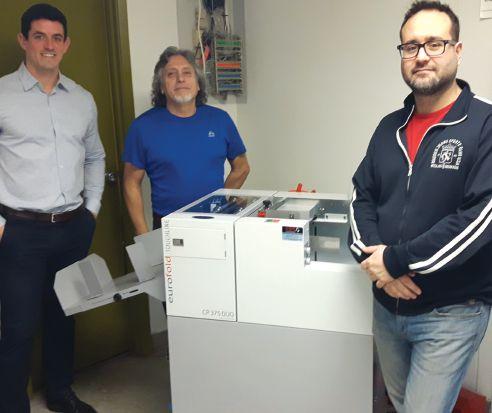
Imageworks Print & Prepress of Richmond Hill, Ontario, installed a Multigraf CP375 Duo Touchline, pictured with Brett Kisiloski of PDS (left to right), Imageworks’ Carm Macchione and Anthony Orsi. The CP375 DUO includes two creasing tools and a cross perforating tool.
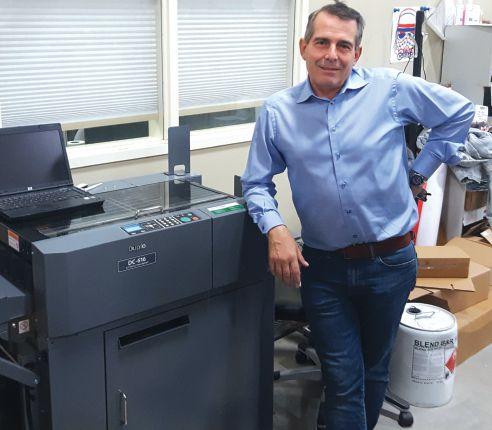
Digital Edge installed a Duplo DC-616 PRO, pictured with President Bob Shea, into its Mississauga, Ontario, facility. Purchased through Sydney Stone, the DC-616 PRO slitter/cutter/ creaser is aimed at short-run print work and can process up to six slits, 25 cuts and 20 creases in a single pass.
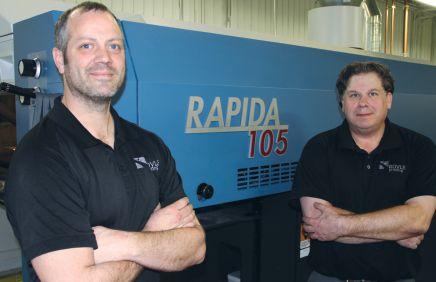
Royle leverages Rapida 105 in Sun Prairie
Royle Printing for more than 65 years has been focused on building a culture of craftsmanship to produce highquality web printing of catalogues, magazines and corporate collateral. The company employs approximately 250 staff members at its facility in Sun Prairie, Wisconsin. Royle Printing recently made the decision to add a new five-colour KBA Rapida 105 press.
“Our sharp growth is indicative of the great care we take in serving our customers, their work, and our associates,” said Chris Carpenter, Royle’s President. “Our success rests on one word – culture – and how we deliver value and service to our clients.”
Royle is currently constructing a 60,000-square-foot warehouse facility for storage, alleviating the space constraints in its existing location. The new KBA Rapida 105 comes in the wake of the firm’s purchase of its third high-speed web press and a new perfect binder. Carpenter acknowledges that the firm wanted to update its sheetfed capabilities and add capacity due to growth, noting that it’s a good problem to have. The new KBA Rapida press will primarily produce covers with both aqueous and LED-UV coatings.
“Our customers continue to believe in print,” said Carpenter. “Whether you are a publisher or a cataloguer, print plays an essential role in our customers marketing and communication mix.”
Esko Crystal drives UV flexo milestone in Bregenz
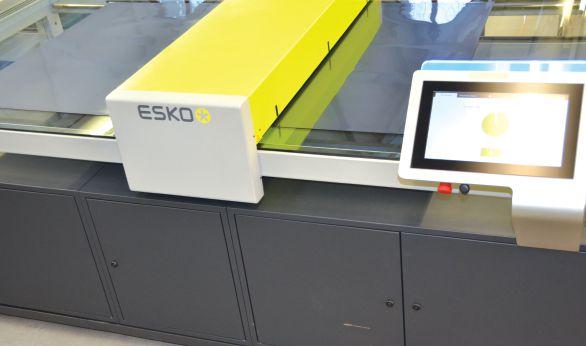
Austrian prepress company Glatz Klischee GmbH installed Esko’s new XPS Crystal 5080 system, which delivers main and back exposure in one step in plate manufacturing. Glatz Klischee is a prepress service provider in the city of Bregenz. It prides itself on its high-quality production of flexography plates by regularly reaching up to 100-line screen. In investing in the new XPS Crystal 5080 system, Glatz Klischee explains that UV plate exposure was a weak link in its process and that traditional light tube exposure units have reached their quality limits.
Glatz Klischee investigated Esko’s LED exposure as early as 2010. Since then the trade shop has gained experience with several generations of inline UV exposure and worked with prototypes of the XPS Crystal 5080. “In our opinion, UV main and back exposure in one unit represents a milestone in flexographic plate making. It improves plate exposure quality and ensures extremely consistent flexographic plates,” said Manfred Schrattenthaler, Managing Director of Glatz Klischee.
Glatz Klischee has been working with the new XPS Crystal 5080 from Esko for about six months now. “Thanks to this technology, we now are able to supply our clients with standard screens [54 and 60-line], up to the absolute premium range with 250 lpi. We can deliver the best possible plate quality with the highest level of consistency and repeatability that we have not experienced to date,” said Schrattenthaler.
Established in 1931, Glatz started out in the stamping and engraving field. Sign making and plate making were added later. The third-generation family business has five locations. Since 1999, Glatz Klischee has been an independent company in the Glatz Group. At the Bregenz site, there are 40 employees. Glatz specializes in flexible packaging and corrugated cardboard in Austria, South Germany and Switzerland.
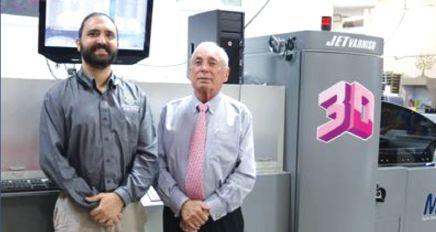
SunDance with JETvarnish 3D power
SunDance Marketing Solutions of Orlando, Florida, provides design, print and mailing fulfillment services to a range of corporate brands and entertainment companies. The company is now leveraging MGI’s JETvarnish 3D system. MGI VP Kevin Abergel described the SunDance JETvarnish 3D acquisition as “an ideal convergence of print marketing strategy and digital embellishment technology.” The company is using the JETvarnish 3D across a range of print product delivery channels, from classic promotional tools like business cards and brochures to retail display signage, folding carton box packages and sheetfed labels.
“We’ve built our business on solid print skills with both traditional offset presses and newer digital solutions. However, to provide a truly full-service marketing infrastructure to our clients for the future, we need to add value to their applications,” said SunDance’s JohnHenry Ruggieri. “Now, we can inject even more dynamic visual and tactile excitement into some of the most celebrated brand logos and iconic corporate images in the world.”
Trade printer 4over has purchased three new Komori Lithrone machines. Established in California in 2001, the company now has 18 locations across North America based on triple-digit growth annually. 4over has always invested in Komori presses.
Two press operators at Royle Printing anticipate the new KBA Rapida 105 five-colour press being installed at the firm’s Sun Prairie facility.
SunDance Managing Director, JohnHenry Ruggieri (left), and Board Chairman, John Ruggieri.
Introduced at drupa 2016, the new XPS Crystal 5080 system delivers main and back UV exposure in one step.
ARCHIVE
25 years ago
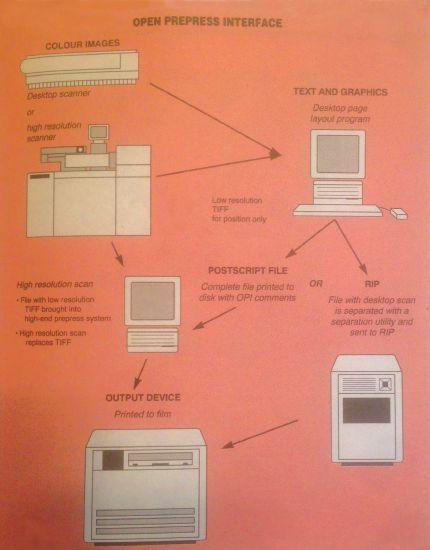
Linking the Desktop with High-end Colour Prepress: Despite the fact that over 99 percent of business documents are currently produced in black and white, there has recently been an explosion in the use of colour for all kinds of business communications. The emergence of colour publishing will result in some truly hideous colour documents, as novice users ignore or mishandle the controls for colour calibration, correction and trapping. To perform the separation process from the desktop, a variety of components are needed, including: A scanner for slides, transparencies or page-size originals; software to control scan acquisition, compression and storage; software to colour correct images; software to separate the final corrected image; a colour proofing printer; and an imagesetter or film recorder to produce the final colour separated film.
20 years ago
PLM Entering Full Web Market: The rapid growth of PLM Group Ltd. has taken yet another leap forward following the announcement that the company has placed orders for two 16-page MAN Roland Rotoman Power Pack heaset web offset presses. The news follows the group’s November purchase of a MAN Roland 29 x 40-inch 707LVT+P press, a first of its kind in North America. Founded in 1987, PLM increased sales in its first seven years from $5.4 million to $21.8 million. In 1996, PLM acquired five associated companies and achieved sales exceeding $50 million.
$14K
For sale (1992 classified): Dupont 37C Rapid access film processor, water temperature filter control $14,000. nuArc light table $750. 25KV 3-phase Transformer $800.
$3.5K
For sale (1997 classified): Laser printer 11 x 17, 1200 dpi
Postscript GCC Select press 24MB RAM
$3,500. Collator 24 bin Orbidel 11 x 17 excellent condition $2,500.
15 years ago
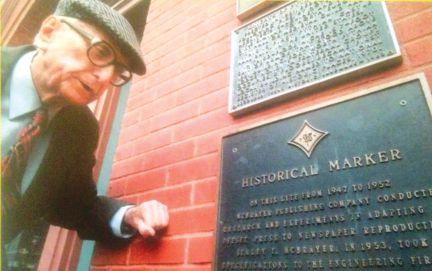
Printing Pioneer Passes Away: At the age of 92, Staley McBrayer passes away after building a legacy that many point to as the introduction of the first commercial offset press. In 1957, McBrayer, printer Herbert Killickand and engineer Grant Ghormly introduced the prototype Vanguard printing press. The press made it financially feasible for suburban newspapers to exist and began to make a significant impact on the running of hot-metal linotype presses. In 1962, McBrayer sold the Vanguard to Harris Intertype, which began mass production of the press. As the 1980s approached, more than 72 percent of newspapers in the United States were printed by offset technology.
An example workflow for high-end colour prepress driven from the desktop.
Staley McBrayer visits a placard noting the location and day in 1954 when he first made the Vanguard work.
Gerald Clark, VP of Sales Commercial Web Presses at MAN Roland (left to right); Barry Pike, Chairman and CEO of PLM; Helgi Schmidt-Leirmann, Co-CEO of MAN Roland; and Bob Flynn, President of PLM Web.
Get Your Act! Together
Moving past writing simple to-do lists, new software tools can help any sales person effectively manage their time
By David M. Fellman
At the end of last month’s column, I promised to write more about how I use Act! as my primary time management and organization tool. I started using Act! more than two years ago, and I often tell people that I couldn’t run my life without it, let alone my business.
I also know people who are similarly dependent on Outlook, SalesNet or Salesforce.com. The point here is that it’s not the specific product, but rather the capability that is so important to printing salespeople.
Follow-up machine
I received some strange looks from attendees at a recent seminar when I told them that they’d never gain new customers from prospecting – this coming right after an hour-long segment on prospecting strategy and technique.
“If you really think about it, you don’t gain new customers from prospecting, you gain them from follow-up, and the reason for prospecting in the first place is to find people and companies that are worth following up on,” I told the crowd. “It takes time and effective follow-up to build the kind of relationship that leads to success in printing sales.”
Act! – or Outlook, or SalesNet or Salesforce.com – can be your follow-up machine. These software companies are always innovating for their users, such as the recently introduced Act! Connect, which helps Act! users to connect with popular third-party tools directly from the Act! software.
As I wrote last month, I’ve set up a database record in Act! for everyone I do business with or hope to do business with. And in that record, I store everything from names, addresses, phone numbers and email addresses to the notes I take during every call or contact.
I also send emails from Act! and store them in the database record, and I attach quotes, artwork, and various other digital
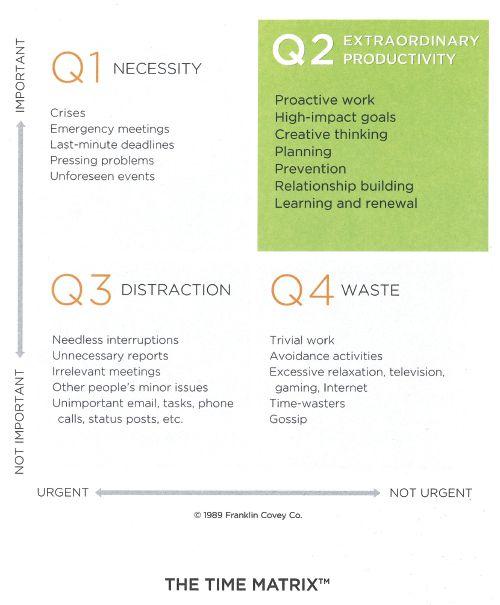
Stephen Covey’s Time Management Matrix focuses on the effective and serves as a guiding force for any individual who wishes to manage their time more effectively.
Brian Tracy in his seminal time management book Eat That Frog explains 10 to 12 minutes invested in daily planning will save at least two hours of wasted time and effort throughout the day.
files. Most importantly, I also schedule my follow-up activities after each contact with a prospect.
Keep it simple
The process I use to follow-up is pretty simple. After each and every contact with one of my suspects, prospects or customers, I ask myself two questions. First, what should I do next to follow-up on what happened today?
Second, when should I do it? From there, it’s just a couple of mouse clicks and a little bit of typing to put the next stage of my marketing plan for that suspect, prospect or customer into Act!. Once I put it in and assign it a date, Act! will remind me on that date. Like I said, it’s a pretty simple process.
However, here’s where it can breakdown. It’s not enough to schedule your activities into your Contact Manager, you have to be in it every day to get real value out of it. I start every day by calling up my calendar and task list in Act!, so I can see what I’ve put on my plate for that day. My next step is to prioritize all of my tasks, and that can be an adventure.
Yesterday was a good example. My list contained 37 tasks: Four meetings, five to-do’s and 28 phone calls. In Act!’s daily calendar view, I had the meetings blocked out with the amount of time I expected them to take. From there, I started blocking in the rest of my tasks.
My basic thought process was this: How can I jam all of these tasks into the hours of this day?
On this particular Monday, I could see right away that was not going to happen. Too many tasks, too little time!
So now my thought process was: “Which of these tasks are the most important ones?” In other words, the ones most likely to put money in my pocket!
Okay, I realize that you may not be motivated totally by money, but I hope you’ll recognize that making money is the end result of doing everything right in a sales job. That means everything from prospecting effectively to making great presentations to managing your time effectively to closing the sale.
Consider this, too; if you’re an employee, making money is the end result of doing what your boss wants you to do, and what your co-workers depend on you to do. Even if you don’t want or need the money, don’t forget your obligation to others and your company.
Finding time for hard work
A hard-working salesperson will always have more tasks than time. That’s perfectly okay, as long as prioritization takes place and the most important tasks are completed.
That’s the most important of the many things Act! does for me. Sadly, I think most printing salespeople end their days with low priorities completed and high priorities left undone. Those salespeople make less money than the ones who end their days the other way around.
Now the big question for today: Which of those salespeople do you want to be? I think I know the answer, and I think Act! or Outlook or SalesNet or Salesforce. com could be as helpful to you as Act! is to me. And if I were you, I’d schedule some time to look into those products, and decide which one is best for you. Most software tools these days provide free access to trial versions, which may or may not include all of the features, over a predetermined time – typically a month for software trials.
A few weeks of time management exploration might very well bring new levels of sales success for years to come.
DAVE FELLMAN is the President of David Fellman & Associates, a graphic arts industry consulting firm based in Cary, North Carolina. He is a popular speaker who has delivered keynotes and seminars at industry events across the United States, Canada, England, Ireland and Australia. He is the author of Sell More Printing (2009) and Listen To The Dinosaur (2010). Visit his website at davefellman.com.
The genius of Friedrich Koenig
Back to Germany, Part II of how one of the world’s most influential inventors created a leading press manufacturer 200 years ago
By Nick Howard
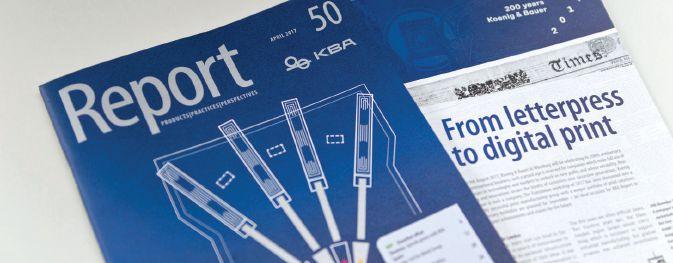
The 50th issue of KBA Report, the customer magazine of press manufacturer Koenig & Bauer AG (KBA), was recently published just before the company celebrates the 200th anniversary of its founding on August 9, 2017. The 52-page magazine is packed with articles covering the varied market segments and business philosophies of printing companies around the world. The topics range from LED-UV technology, via double coating and inline foil application for the finishing of high-quality packaging in sheetfed offset, through to new investments in digital and newspaper printing.
In his editorial, KBA CEO Claus Bolza-Schünemann looks at the press maker’s 2016 business year, which produced the highest group profit in the 200-year history of the company. Important milestones from the long history of the world’s oldest printing press manufacturer are recalled in a commemorative supplement enclosed in the customer magazine. Bolza-Schünemann: “We will be celebrating our proud company anniversary in fitting manner in September. Our founders taught us to be ready to venture new paths of technical innovation, and to be guided by the needs and wishes of our customers. We see it as our obligation to uphold their legacy.”
The early days prior to the founding of KBA were highlighted last month in PrintAction around the steam-powered The Times press developed by Friedrich Koenig and Andres Bauer. In 1813, John Walter Jr. owner of the The Times in London, England, walked into the newspaper’s pressroom holding up a copy of the paper to stunned pressman. He shouted out this now famous line,“The Times is already printed – by Steam!” The lead story was of the new press, developed by Friedrich Koenig and Andres Bauer,
describing how it would forever change the course of printing and indeed society. It mentioned the achievements of both Koenig and Bauer by name.
Various revisions of the original contract to use The Times press culminated with terms that would ultimately seal Koenig’s fate in England and usher forth competition from English engineers. In essence, the revised November 19, 1816, agreement lifted all restrictions upon Walter to use anyone he wished to work on or repair the Koenig presses. The revision restricted the patentees from selling similar machines to any morning papers for less than £1,000 each.
In Part II of this article series about the formation of KBA 200 years ago, we look at how these roadblocks would lead to Koenig and Bauer’s return to Germany, where they would begin to establish the new roots for modern printing.
Back to Germany
There was seemingly nothing more the two Germans could do in England. Totally dejected, on August 9, 1817, Koenig and Bauer while still in London, put pen to paper and formalized their partnership establishing a new company: Koenig & Bauer.
The very next day Koenig left England for good and settled in an unused Monastery in Oberzell just outside Würzburg in Bavaria. Less than a year later, Bauer would join him bringing along two English lathes, some tools and an English mechanic-fitter.
Of course, Bensley (an initial development partner of Koenig introduced in Part 1) now had the opportunity to take all the credit as well as profit by selling his
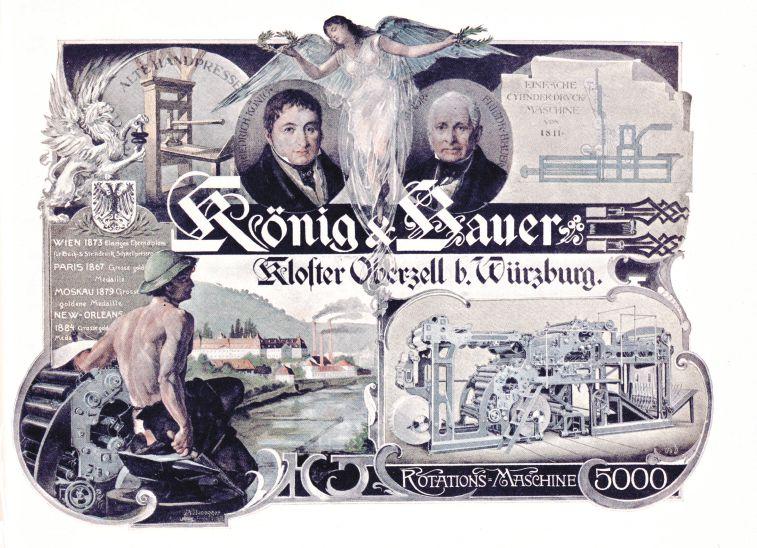
A
Koenig & Bauer advertisement from 1896 illustrates the long innovation behind the modern German press giant.
Two hundred years after its founding, KBA-Sheetfed Solutions reports, since the initial launch of a wholly redesigned Rapida large-format generation in 1995, a total of 1,500 large-format presses have left the KBA factory in Radebeul. That equates to well over 6,000 printing units.
direct copy of Koenig’s press. In an article of the Literary Gazette and Journal of the Belles Lettres, dated January 3, 1818, the editors wrote: “It may also be interesting to our readers to know, that, commencing with the present number, this Journal will be printed by Messrs. Bensley’s patent machine, an inventive improvement in the art of printing, which reflects honour on the present age, and exhibits a proof of the progress of the art of ingenious mechanism in this country”
Establishing the new factory in southern Germany became an exhausting undertaking for not only was Koenig & Bauer the first Saxon printing machinery manufacturer but also the very first machine factory in Bavaria. It is said that most raw materials still had to be imported from England and there was virtually no skilled labour. Koenig wrote Walter in December 1818 and complained about the difficulties in finding talent and materials to supply Walter’s spares requirements. He also wrote about his troubles with Bensley: “My way goes up hill, owing principally to Bensley, who has bilked me completely.Yet, I am gaining grounds, and perhaps, I may still have the sad satisfaction of dying rich, after having lived poor.”
The problems of re-starting their business in what was then an emerging industrial country opened the door for Walter to seek help from others. William Cowper and his brother-in-law Ambrose Applegath would benefit the most by Koenig’s genius.The two took out patents citing another Englishman: William Nicholson’s never realized patent to skirt Koenig’s own patents, and in the same year brought forth an improved version of Koenig’s press while ushering in a new age
of the British steam-powered printing press. Nicholson has often been referenced as a “father” of the drum and bed concept. In 1790, he had applied and received a British patent but never acted on or applied it. Nicholson was ignored and certainly Koenig had never gleaned any concepts he later put in place. British historian James Moran described the Nicholson ideas as “insufficient and superficial.”
By 1827, Cowper and Applegath, constructed a new “Multiple Machine with Four Cylinders” which was delivering an astounding 4,000 sheets per hour at The Times of London. The ideas on which they based their press were Koenig’s and not Nicholson’s. This deliberate slight in not citing a previous art (Koenig’s) was a sad testament to Koenig’s brilliance and may have even hastened his death at only 59. After all Koenig was a German. There was little respect by the English for anyone who wasn’t English. Through all of this Koenig & Bauer never brought suit from the English courts. Had they done so perhaps justice would have prevailed. Koenig and Bauer went on to great things as we know. The German factory continued developments and concentrated sales all over Europe. They continued to invent and bring new presses to market.
Issue 50 of the customer magazine KBA Report contains an indepth supplement on the 200-year history of the German press maker.
But the deceit and difficulties in England would never be forgotten by either partner. The injustice was so acute that even by 1851, when Britain held its “Great Exhibition” at London’s famed Crystal Palace, Andreas Bauer refused to attend and display his machinery. Koenig is credited with three milestone technologies: Connecting a printing press to a steam engine, using tapes to feed a sheet to the cylinder, and finally using a cylinder instead of a platen. Koenig subsequently modified his press further with an additional cylinder to be the first to “perfect” or print both sides of the sheet in one printing.
In the monumental first edition of The Times printed on Koenig’s press, there was some solace in the following passage: “So
is the best tribute of praise, which we are capable of offering to the inventor of the printing machine, comprised in the preceding description, which we have feebly sketched, of the powers and utility of his invention. It must suffice to say farther, that he is a Saxon by birth; that his name is Koenig; and that the invention has been executed under the direction of his friend and countryman Bauer.”
NICK HOWARD, a partner in Howard Graphic Equipment and Howard Iron Works, is a printing historian, consultant and Certified Appraiser of capital equipment. nick@howardgraphicequipment.com
SCENES FROM GRAPHICS CANADA 2017
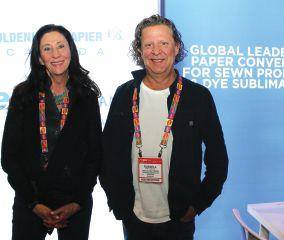
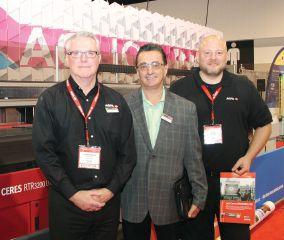
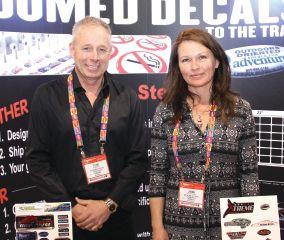
Printers and suppliers attended the country’s largest trade show Graphics Canada from April 6 to 8 at the Toronto International Centre. In addition to dozens of exhibitors, the three-day event also included a range of educational sessions and workshops. The following photo gallery provides some of the highlights from this year’s show.
Belmont’s Paul Schaeffer discusses the acquisition of North America’s first 40-inch MGI Evolution.
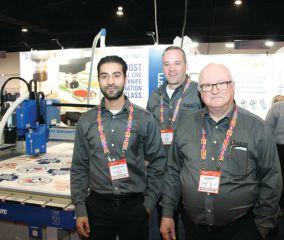
Abdullah Umair, Todd Hamilton and Gilbert Cloutier of AXYZ International.
Chris D’Souza of Access Imaging discusses large-format technology.
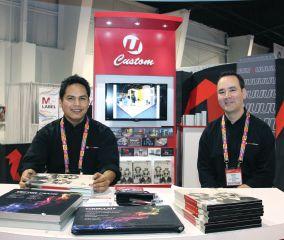
Ultima Displays Canada’s Edward Gravador and Bert Dubuc.
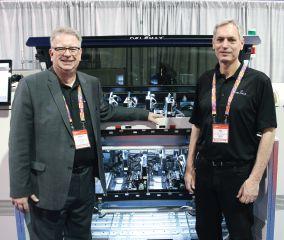
Grant Robinson and Ted Bellisario of Delphax with the Elan 500.
Allen Steip and Vivy Dacosta of hubergroup Canada.
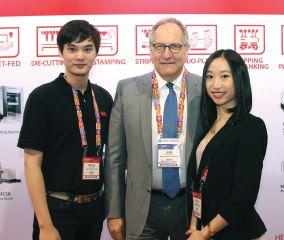
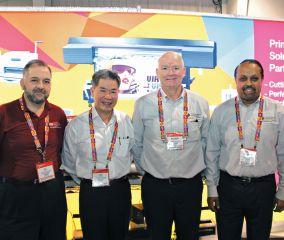
Wayne Zheng, Masterwork USA, Don Robinson, Heidelberg Canada, and Bella Hong, Masterwork USA.
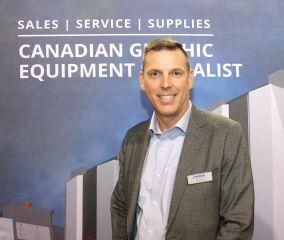
Karl Belafi Jr., Vice President, KBR Graphics.
Virgilio Santos of Insource Corp.
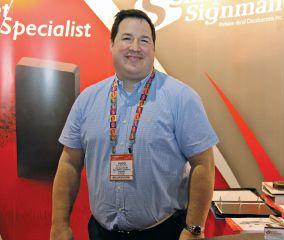
Hugo Beauregard of Simple Signman.
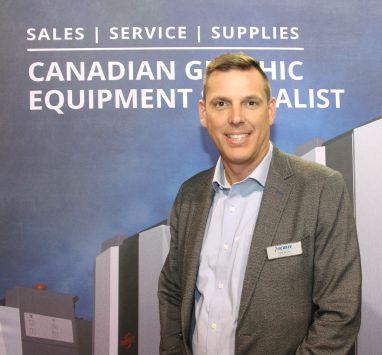
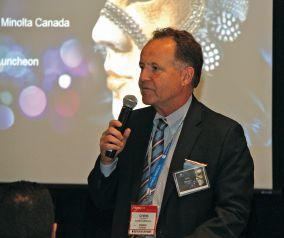
Chris Dewart, President and CEO of Konica Minolta Business Solutions Canada.
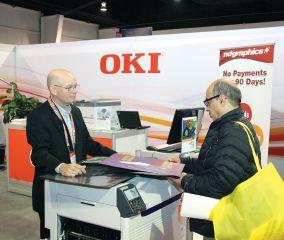
Owen Macpherson of Oki Data Americas.
Veritiv’s Nick Vittel and Enzo Iannuzzi.
Yvette and Russell Pritchard of Pritchard Paper Products Co.
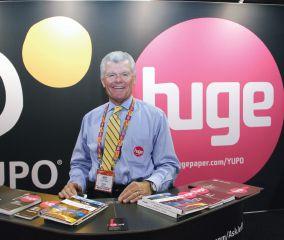
Jeff Tapping of Huge with the company’s four new sample books.
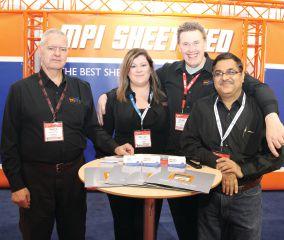
Team members from MPI Group, which holds locations in Concord and Mississauga.
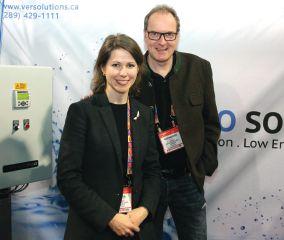
Nadiia Tuzova and Bernhard Bopp of Verso Solutions.
Bob Van Gieson and Ed Robeznieks of Ricoh Canada.
Lawrence Robinson, Rubin Silva and Bill Brouhle of Agfa.
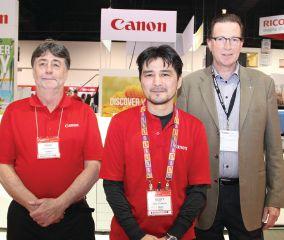
Doug Reid, Scott Leef and Alex Couckuyt of Canon Canada.
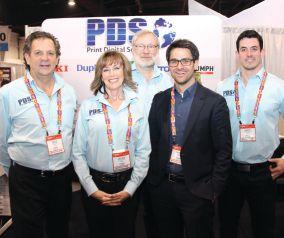
PDS’ Dave Kisiloski, Jackie Kisiloski, Mark Flannigan, Patric Lerch (Multigraf) and Brett Kisiloski.
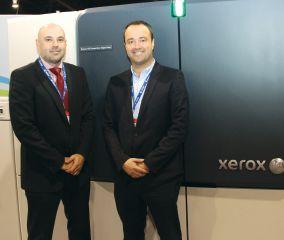
Brent Ashmore and Andrew Gunn of Xerox Canada.
Tom Morris and Jodi McIntosh of Xtreme Digital Graphics.
Dylan Westgate of Sydney Stone.
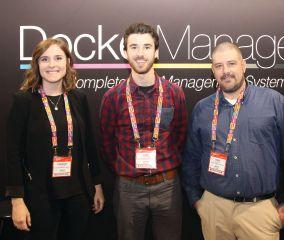
Breanne Darling, Tory Thompson and Troy Goodhue of Dockemanager.
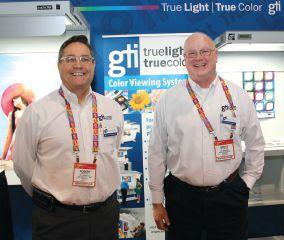
Robert McCurdy and Bruce Sparrow, GTI Graphic Technology.
Team members of Printers Parts & Equipment.
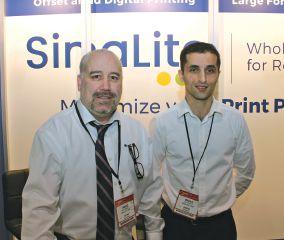
Marc Arsenault and Brian Meshkati of SinaLite.
Team members from 4over, now with 18 North American locations, including Mississauga.
Linda Nutbrown and Stephen Bard of Bard Business Solutions.
After the recent dismissal of two imaging related lawsuits, two new patent cases affecting the printing industry have emerged, Shipping & Transit LLC and Freeny Brothers.
PATENT TROLLS ON THE RUN
A case study of patent abuse by the former department head of Graphic Communications at Cal Poly State University shows printing is winning key battles against a new nemesis
By Harvey R. Levenson
This is a follow-up to my July 2016 report entitled, A Case Study of Patent Abuse: Printing Industry Faces New Nemesis Impacting Growth and Employment –Patent Trolls. That White Paper received enormous industry press coverage, and to my understanding was used as part of court proceedings resulting in the dismissal of two long and visible printing industry cases brought on by patent trolls, CTP Innovations (CTP) and High Quality Printing Innovations (HQPI).
Since then, however, two new cases emerged by patent trolls attempting to threaten and extort funds from printing industry companies and Original Equipment Manufacturers (OEMs) using standard technology common for doing day-to-day business in printing and related industries.
This report reviews the outcome of the previous cases and presents a heads-up regarding two new plaintiffs: Shipping & Transit LLC and the Freeny Brothers. My advice regarding the two new cases, and patent trolls in general, are: Do not respond to demands or threats from either of these two patent trolls. Do not make any payments. Continue doing business as usual. Band together as a team to pursue dismissal by the courts.
Building a case
Preceding my original case study were three articles published in the industry press that informed the printing industry about the growing extortionist threats of patent trolls, and what to do about them. The industry has responded to the advice provided, and the patent trolls are on the run. Patent trolls are the epitome of greed, thoughtlessness, and unethical behaviour, and are impacting the survival, growth,
$60B
A study from Boston University estimates that patent litigation destroys more than $60 billion in firm wealth each year, which does not factor in ancillary effects like curbed innovation due to decreased amounts of venture investing.
(Source techcrunch. com, 2016)
and development of printing and related companies. Even those users of our industry’s OEM technology that may not even be part of our industry are affected.
In last year’s report, I noted: “The printing industry in the United States has been in a state of decline over the past 20 years (from approximately 55,000 companies to under 30,000 today). Traditionally a low-profit industry, printing companies and their suppliers are trying to find ways of increasing products and services focusing on digital technologies and related applications in order to increase profits and to save jobs. Patent trolls are inhibiting such growth and are causing companies to consider closing, downsizing, and laying off employees because they cannot afford to absorb the huge fees being demanded by the trolls, while also maintaining or growing business.The trolls are equivalent to extortionists with no sense of business morals and ethics, or of the nation’s push to grow companies, produce jobs, and keep or bring back as much business as possible to the United States.”
I advised that companies and individuals faced with the threat of patent troll litigation should not settle by paying license fees, “but should partner in pooling resources to pursue invalidation of the patents in question. Such challenges are often won, and between 35 percent and 85 percent of patents being invalid has been reported.”
I concluded by advising that printing and related companies, or individuals, sued by patent trolls should not settle by paying the fees requested and should not enter into a single-company litigation that can cost more than a settlement. “Giving in to patent troll license fees or other demands will exacerbate the problem and encourage additional intimidating and threatening lawsuits in an attempt to extort funds from companies [and individuals] doing honest and legal business, working hard to survive and grow, and providing employment opportunities for skilled staff members. A solution is bringing together all of the companies named in a suit that has been filed by patent trolls, and to work as a unit in bringing the matter of alleged patent infringements before the US Patent & Trademark Office (USPTO) for invalidity hearings.”
Well, a lot has happened over the past two years that has transformed the defendants to be the aggressors, and the plaintiff trolls to be the losers. But, to keep this up, we must continue our industry position of not being intimidated and of not responding directly to requests or any communication from attorneys representing shell companies (the trolls), or individuals claiming to own patents teaching technologies that are allegedly being infringed.
Dismissals and heroes among us
Two highly visible printing industry troll
cases of the past few years have been dismissed by the courts, freeing up numerous innocent graphic arts companies, large and small, and many of our industry’s OEMs, from the torment and anxieties caused by patent trolls. The two cases are: CPT Innovations v. [76 Defendants] and High Quality Printing Innovations (HQPI) v. [37 defendants]
Unfortunately, prior to the dismissal of these cases several companies gave into the troll demands and paid huge “license fees” out of fear of being forced out of business if they did not. However, most of the defendants in these two cases did not give in, and unified under the advice of a law firm and attorneys dedicated to exterminating such trolls. This resulted in the legal teams, and the shell companies they represented, the loss of huge amounts of time and money. This is an example that should be held up for all other patent trolls wanting to exploit the printing industry and its OEMs, and for the lawyers and companies supporting those trolls to take notice.
Our industry owes gratitude to two individuals: Joyce Vogt and Nate St. Clair II. Vogt is one of the inventors named on the two CTP patents: Patent No. U.S. Patent No. 6,738,155 System and Method of Providing Publishing and Printing Services via Communications Network (filed on July 30, 1999) and Patent No. U.S. Patent No. 6,611,349, System and Method of Generating a Printing Plate File in Real Time Using a Communication Network (same filing date as previous).
Both patents were assigned to the Banta Corporation, where Vogt was employed as an engineer. The patents then became the intellectual property of RR Donnelley & Sons who acquired Banta. The law firm Baker Donelson set up a recorded parent company, Media Innovations, LLC, and then a shell company, CTP Innovations, listed as the plaintiff. The parent and shell companies are the trolls.
The Baker Donelson attorneys wanted Vogt to commit to supporting its infringement lawsuits as a plaintiff against the 76 defendants. If Vogt accepted, the attorneys would have the legal right to claim that they represented her, as one of the inventors named on the patents, and claim that Vogt supported their infringement claims. Not knowing the CTP history,Vogt wisely further explored the matter and came upon my first White Paper, contacted me and, hence, became aware of the background. Upon learning that CTP was a troll supported by the law firm Baker Donelson, Vogt became upset at the immorality of her patents being used to extort funds from innocent users of the technology that she taught through her patent. She decided to discontinue any relationship or communication with Baker Donelson, and to come out against the law firm and the trolls that it repre-
sented. Vogt is a hero of the printing industry and should be applauded as such. The HQPI patent was also originally issued to Moore Business Forms and, hence, also became the intellectual property of RR Donnelley & Sons: Patent No. US 6012070 A Digital Design Station Procedure. This patent was filed on November 15, 1996.
Interestingly, Baker Donelson was also the law firm representing the plaintiff troll. In this case the recorded parent company was Modern Universal Printing, LLC, and the shell company, listed as the plaintiff, was HQPI.
As noted in my first White Paper, “Patent trolls are often disguised as shell companies. Shell companies have registered names but no employees and no physical address ascribed to them. They are intentionally invisible with only a law firm as a point of contact; typically the law firm that registered the ‘shell’ name for the patent troll.”
Nate St. Clair is an Intellectual Property litigator, counsellor, and Partner for the law firm Jackson Walker in Dallas, Texas. He counsels and represents clients in a range of Intellectual Property matters, with an emphasis on patent litigation, and patent portfolio licensing and management. St. Clair has counseled clients in numerous technology areas including digital imaging and commercial printing. St. Clair has embraced the plight of printing industry companies, including OEMs, in the fight against patent trolls with defenses to discredit and eliminate them. He is one of the key litigators instrumental in the resulting dismissals of the CTP and HQPI cases. As a result of his firm’s efforts, all of the CTP and HQPI suits have been dismissed, and Baker Donelson has withdrawn its representation of the plaintiffs.
The battle continues
Two new cases have emerged: Shipping & Transit LLC v. [Multiple printers] and Freeny Brothers v. [Multiple printer OEMs]. In relation to Shipping & Transit, printing industry companies and OEMs have recently received a robot-generated letter indicating that a “patent holder” believes that they are in violation of three patents, and is asking for $30,000 to settle the matter within 30 days. The patents in question cover basic functions such as notifying customers that they have an incoming shipment via email.
The patent troll owner is called Shipping & Transit LLC and considered to be a highly aggressive troll with over 100 defendants. Patent infringement allegations by the Freeny Brothers were filed against six OEMs, and more are likely to follow. Jackson Walker has had substantial experience against the Freeny Brothers, and will again be leading the charge to protect the interests of the printing industry and its OEMs.
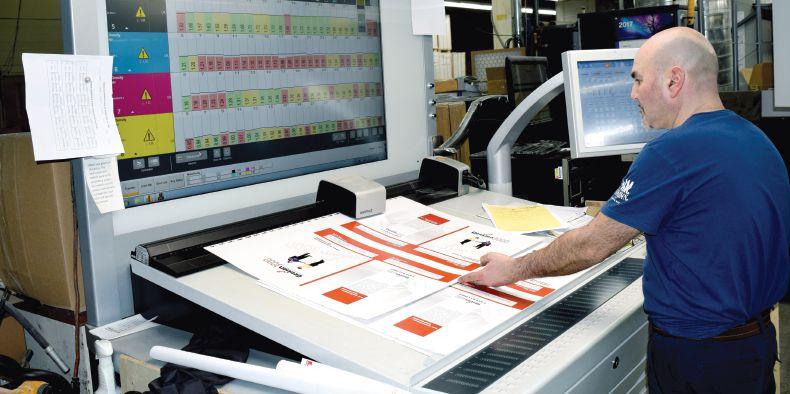
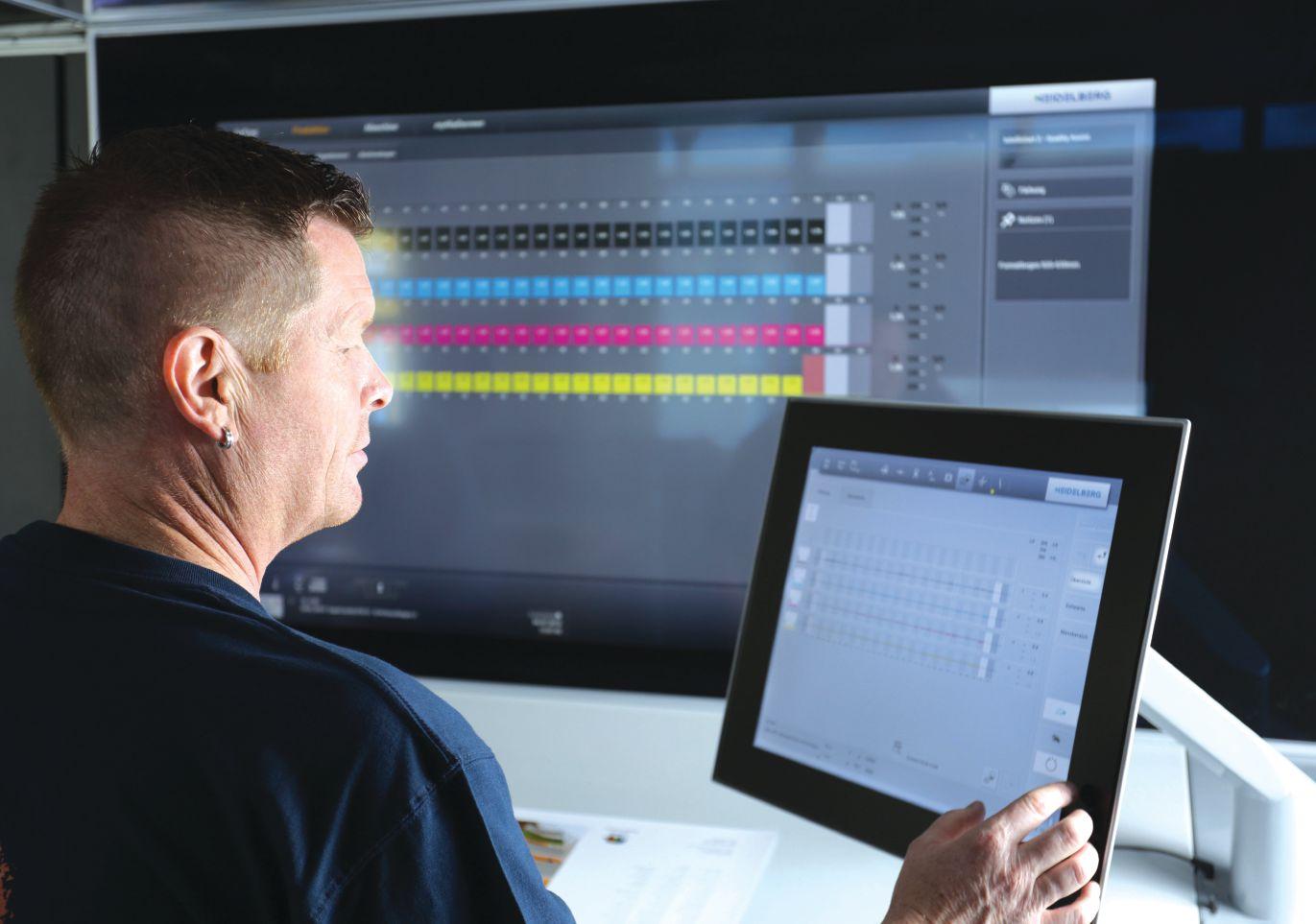
Using Prinect Press Center XL 2 with Intellistart 2, commercial printers working through standardized jobs with numerous changes can now achieve autonomous printing, including an overview of processes to guide through the respective job change by Intellistart 2.
PRINT INNOVATION IS HAPPENING
Four keynote sessions at this year’s TAGA conference in late March illustrate the continuing promise for printing in terms of automation, colour control and 3D printing, in addition to new findings for proofing and UV
By Martin Habekost
Every year in March, the Technical Association of the Graphic Arts hosts a conference to highlight some of the deepest research and development in the field of printing. This year’s conference took place in Houston, Texas, and kicked off with four keynotes focused on the direction of printing.
The first keynote was given by Anthony Thirlby, General Manager for Prinect at Heidelberg, who spoke about the benefits of workflow automation because there are still too many manual steps involved in the production of a print job. He spoke about Heidelberg’s new Push-tostop operating philosophy, which means that the press is running all the time and ideally the operator is there only to stop the press, not to start it. This concept was
shown at drupa 2016, where a press operator focused on pre-loading plates for the automatic plate change so the press could start the next job without interruption. The main idea behind this concept is to increase overall equipment effectiveness through automation, inline colour measurement and control, as well as a thorough understanding of scheduling, estimating, substrate and consumable performance and colour consistency.
The second keynote was given by Steve Smiley of SmileyColor & Associates, who spoke about the use of standards in the print industry. He went through a range of standards including a few I think will have a major impact. The first is PDF X/4 (2010) which will allow the inclusion of fonts, ICC colour aims and CxF data for spot colours. ISO 12647-7 in regards to contract proofing with spot colour requirements and DE2000 data for the spot
colour are also vital. A new ISO standard in regards to colour profiling will come into effect soon. The ISO number is 20677 and is about ICCMax. This standard and new colour profiling technology were developed for packaging.
The third keynote was given by John Seymour from John the Math Guy LLC. The keynote started out by asking if someone could patent a colour and the answer was, after a short excursion into the world of patents, simply no. Seymour then focused on the development of expanded gamut printing throughout the years (see PrintAction April 2017, Mappiing orange, green and violet).
The last keynote was given by Gary Dispoto from HP, who talked about the company’s efforts in 3D printing. HP’s 3D printers use a different approach than most because of a manufacturing bed, where you can 3D print one large piece that will fill the whole bed, or a number of elements that will fit on this bed. The material is deposited first and then bonding and fusing agents are deposited with a bed-wide print head, then heat is applied and the nylon particles are fused together. It is also possible to apply colouring agents. HP is going after the 3D for production market.
Beyond the keynotes, an interesting
presentation focused on the use of FTIR (Fourier transform infrared spectroscopy) in regards to analyzing the cure rate of UV and EB coatings. Another presentation in this regard was about the use of UV/VIS spectroscopy to analyze the state of UV curing during print production. Both of these presentations were about the inline analysis of UV-curing during the press run.
Two other presentations dealt with the influence of optical brighteners (OBA) on proofs. One presenter suggested that their research into OBA’s allows them to turn any proofing paper without OBAs into a paper with OBAs, mimicking the influence OBAs have on the printed job when a press sheet with OBA’s is used on the printed job. The secret to this work is that OBAs get printed on the proofing paper first, before the coloured proof is being printed. The research in this subject matter is not ready for an introduction to the market, but it is a very interesting and promising approach to solve the discrepancy between proof and press sheet, when the press sheet contains OBAs.
A presentation by my colleague Chris Smyth focused on work the OBA working group of the Print Properties Committee has done. Proofs were made on proofing papers that contained no OBAs, some
and a lot of OBAs. Industry experts were asked to evaluate the proofs and the press sheets for visual differences. The interesting outcome is that when proofing paper and press sheet contained the same amount of OBAs, a larger difference was perceived as when the proofing paper contained less OBAs than the press sheet. Another presentation focused on better expanded gamut matching on a Kodak digital Prosper press. The interesting outcome from this work that the Green and Blue used on the digital press are not single pigmented inks. The green contains a bit of yellow and the blue is a mixture of violet, green and blue. Another outcome from this research is that the ideal colour sequence on the Prosper press is KGCBMOY. The colour gamut volume with 4C on this press is 536,000, while the expanded gamut volume is 813,000.
I also gave a presentation at the conference about the use of the M3 measurement mode for controlling metallic inks on press. This measurement condition eliminates the strong reflections coming of metallic inks through the use of polarization filters. It was proven that the M3 measurement condition can be used to track changes in the printed ink film thickness of metallic inks.
UV solutions
like no other.
From tabletop to oversized flatbeds and super-wide roll-to-roll models, Mimaki offers UV printing solutions to suit nearly any application need.
Contact us to schedule a visit to our Toronto branch to learn how utilizing wide format UV printing from Mimaki can boost your bottom line.
Toronto Office | 905-738-3913
mimakiusa.com/canada
TouchTerrain hands-on 3D print
A research team in Iowa is taking 3D print to new heights with an educational online application
By Scout McCraw
Have you ever wondered what it looks like at the top of Mount Everest or at the bottom of the Grand Canyon? Well, Chris Harding and his colleagues can’t take you there, but thanks to their innovative work and the advancements of 3D printing, you can hold the natural wonders of the world in your hands.
Harding, an Associate Professor of geological and atmospheric sciences, is part of a research team at Iowa State University and together they have created TouchTerrain.
Essentially, TouchTerrain is a Web application that allows users to print 3D models of any place on Earth. So, instead of relying on a flat map or screen, instead of relying on 2D depictions of real terrain (like those lines which get closer together indicating a higher altitude), you can actually study 3D representations of mountains, canyons, the ocean floor and the Canadian Shield, among any geological feature, with a hands-on model.
In the TouchTerrain program, you just select a rectangular section on a map and enter in your 3D printer’s parameters (Harding and his team have used a Makerbot Replicator 2x and Flashforge Creator Pro). Then the server downloads the elevation and terrain data through Google Earth Engine and downloadable STL files of that area are created.
The project started in late 2014, Harding says, when his colleague in the department of geological and atmospheric sciences, Franek Hasiuk, got some experience working with the Makerbot Replicator 2x 3D printer in his lab and mentioned the idea casually.
“I think he said ‘wouldn’t it be cool if everybody could 3D print the landscape they live in and hold it in their hands?’” Harding says.
Harding and Hasiuk launched TouchTerrain with the help of Levi Barber, the IT wiz instrumental in the coding of the project and Alex Renner, a Ph.D. student in mechanical engineering. Harding says Renner was a “big help” in teaching him how to create 3D models reliably and efficiently on low-cost printers.
Since the program went public in midMarch, Harding says TouchTerrain had over 2000 3D terrain model downloads in the first two weeks. The team has also received a lot of positive feedback and interest from high school teachers, university professors, museum curators and geoscientists.
“They see value in using 3D-printed terrain models in an educational setting,” Harding says.
In addition to producing 3D models of the wonders of our world, Harding has also experimented with those of other worlds, such as the Moon and Mars. He recently received a request from a teacher at a school in California which caters to visually impaired students.
“Besides giving them the ability to touch the shape of the Grand Canyon,” Harding says. “I also hand created a 3D model for the hugely impressive Valles Marineris, which he printed and gave to his students to explore.”
The TouchTerrain team is currently in the process of expanding. The project is growing faster than they can keep up with and Harding says they have already begun to experience issues with scalability when many users are trying to access the system. They are hoping other programmers will provide feedback to improve the codebase and are searching for the funding required to bring a Web programmer in on the project.
“In addition to better scalability, we
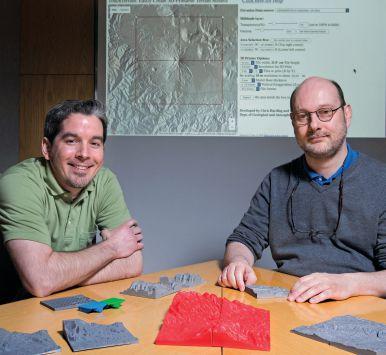
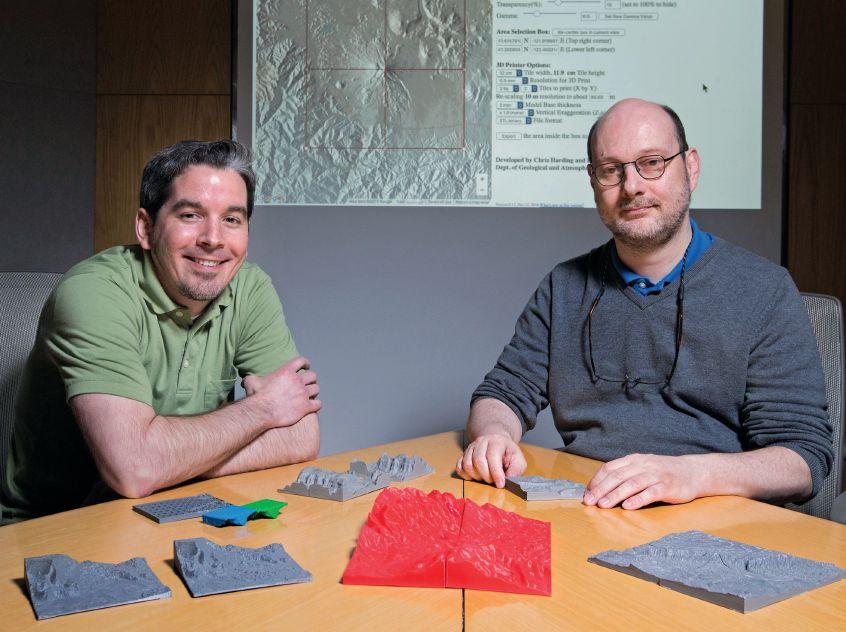
Alex Renner (left) and Chris Harding and on the screen behind them, their free, open-source Web application, TouchTerrain, for 3D printing any landscape.
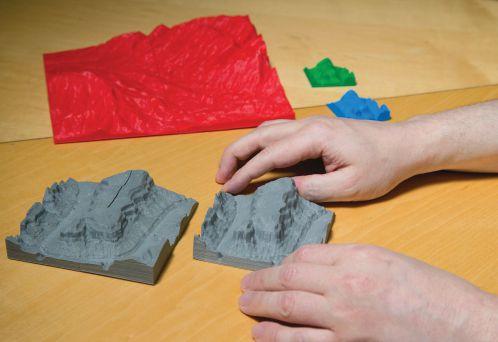
3D-printed samples from TouchTerrain, perfect for a handson lesson about geography or geology.
have a whole list of improvements we would like to see based on user requests,” Harding says.
TouchTerrain is an open source project hosted at GitHub which provides code for the Apache server run at Iowa State and a standalone version. You can access the TouchTerrain code at https:// github.com/ChHarding/TouchTerrain_ for_CAGEO or check out the server version in action at http://touchterrain. geol.iastate.edu/. Harding and his partners provide the service to educators and the general public free of charge.
“We hope that printing out these models and using them in a teaching context means that ideally more people become aware of 3D printing and how useful and affordable it can be,” Harding says.
Wide-format systems
Backed by the growth in new robust textile printing systems, wide-format-imaging opportunities continue to be one of the most engaging sectors of the industry for commercial printing operations
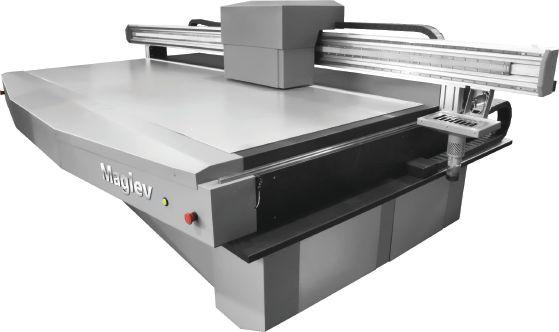
The Maglev 1228 can accommodate heavy materials up to 400 kg, including stone, marble and glass.
IQDEMY Maglev 1228 UV-LED
IQDEMY Holding’s recently introduced Maglev 1228 UV-LED printer features a print table of 1.2 x 2.8 metres and can accommodate heavy materials up to 400 kg, including stone, marble and glass. Its honeycomb table is divided into six vacuum zones operated independently to help reduce power consumption when only some parts of the table are used. The UV-LED printer is equipped with levitation technology, which enables printing without noise, according to IQDEMY. The printing system uses eight different dot sizes achievable via a combination of Variable Dot technology and Technology of Invisible Dots. Able to print with eight colours (CMYK+W+LM+LC+V) the Maglev also has a white ink recirculation system and 10 tanks for ink supply featuring ink level sensors. Its LEDs, according to the company, can operate for up to 10,000 hours without having to be replaced. The printer comes with a warranty for up to five years.
Another feature of the Maglev 1228 is its ability to produce layered printing. This is sometimes also referred to as 3D-print in the large-format sector, as different amounts of ink layers enable a haptic feeling, thus images and prints, for example wood reproduction.
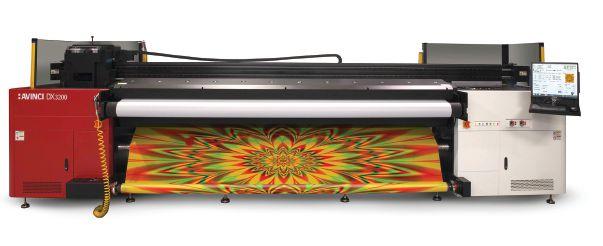
Agfa Avinci DX3200
Introduced in April 2017, Agfa Graphics’ Avinci DX3200 dye sublimation printer for soft signage is a dedicated engine designed to provide high print quality on polyester-based fabrics. The Avinci DX3200 engine allows users to create soft signage prints of up to 3.2 metres wide, at a resolution of up to 1,440 x 540 dpi.
WEDNESDAY, JUNE 14, 2017
BURNABY / BURNABY, BRITISH COLUMBIA
PrintForum West, presented by PrintAction magazine, is the only trade show and conference for printing and imaging professionals in Western Canada. Designed to build thought leadership in business strategy and technological innovation, PrintForum West is a one-day event featuring educational sessions, networking and exhibits of new industry technology.
For Sponsorship and Exhibit Opportunities: Stephen Longmire, Associate Publisher 905-713-4300 / slongmire@annexweb.com
RS SuperiorSuperior Binder y Ser
The engine features six colours (CMYKLcLm) at a droplet size of 14 picoliters. Avinci DX3200 offers different quality modes, with a speed of up to 173m2/h depending on the application.
Avinci DX3200 comes with Agfa Graphics’ Asanti software designed to automate all preparation, production and finishing steps of signage products. The core includes automation, colour management, job pre-flighting, and templates. Asanti also includes features for soft signage printers like Integration with Storefront (Agfa’s tools for the automated management of Web-toprint and Web shops) automated positioning of grommets on banners, and the design of canvas extensions (like air pockets) for flags.
Asanti also recently introduced integrated tiling so that oversized banners or billboards that extend beyond the maximum printing width can be produced on Avinci DX3200. Asanti creates mounting instructions and adds the necessary marks to the tiled prints to help the operator mount them. With a textile-dedicated media transport system and is also compatible with most off-line calendering solutions on the market, explains Agfa, which fix the colours deeply into the structure of polyester-based fabrics.
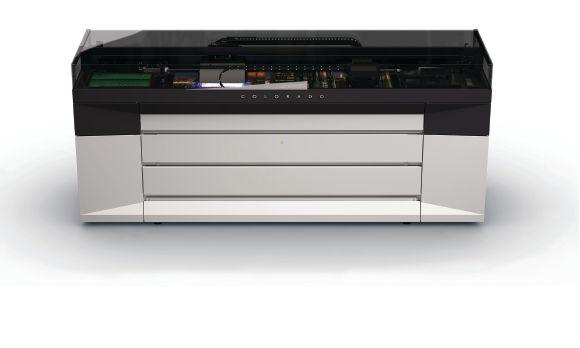
Canon Océ Colorado 1640
In March, Canon Canada introduced its first UVgel-enabled Canon system is the 64-inch Océ Colorado 1640, a roll-to-roll inkjet
printer for producing both indoor and outdoor graphics. At the heart of the Océ Colorado 1640 is Canon’s recently unveiled UVgel technology. The company describes the Océ Colorado 1640 as the fastest 64-inch printer on the market, with a top speed of 1,710 square feet per hour and another setting to produce high-quality, point-of-purchase prints at 430 square feet per hour. Canon explains UVgel combines a radically new Canon UV curable ink that instantly gels on contact with the media, advanced self-aware piezoelectric printhead technology, an LED-based UV system that cures without adding any damaging heat to the media, and continuous printhead nozzle monitoring and performance compensation. As UVgel ink instantly gels on contact with media, Canon explains this results in precise dot gain and positional control, repeatable images, and instantly cured, durable prints. The system’s low temperature LED-UV curing technology moves independently from the printing carriage to help establish uniform post-print UV curing that contributes to print speed and quality.
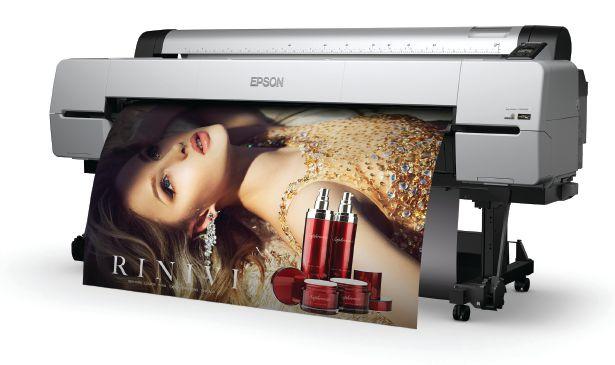
Epson SureColor P20000
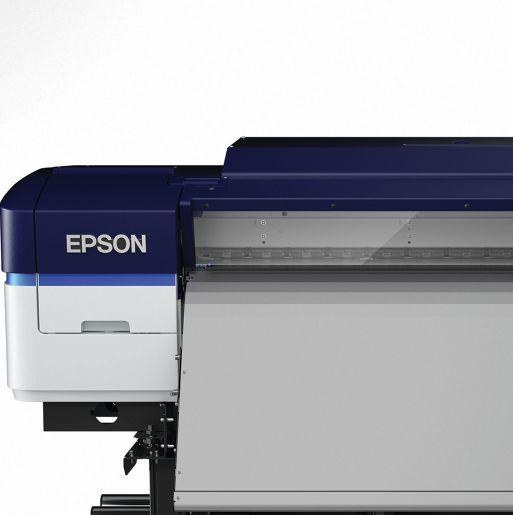
The Epson SureColor P20000 is a professional 64-inch photographic printer with high-performance 9-colour archival pigment for high-volume photographic printing environments. It uses the new PrecisionCore MicroTFP print head utilizing 8000 nozzles, for print
Avinci DX3200 is a dye sublimation printer that brings vibrant colours to indoor and outdoor soft signage.
speeds up to twice as fast as the previous generation. Epson UltraChrome PRO archival ink technology produces strong colour prints that last up to 200 years, along with four levels of gray for accurate transitions with very low grain, even at the fastest print modes.
Mimaki TX500P-3200DS
In April, Mimaki commercially released its TX500P-3200DS machine, described by the company as a complete digital fabric printing system. The 3.2-metre-wide direct-to-textile printer features an inline colour fixation unit for soft signage, exhibit graphics, and décor applications. The TX500P-3200DS printer was on display at the International Sign Expo, that ran from April 20-22, in Las Vegas.
Direct to fabric dye sublimation printing requires fixation of inks through a dry heat process, a step that is traditionally performed separately. The TX500P-3200DS printer, explains Mimaki, utilizes an inline colour fixation unit to optimize the printing and finishing process by enabling simultaneous printing and colour fixation, thereby
reducing two steps to one in a single device. Additionally, the TX500P3200DS printer provides efficient finishing by linking the printer and the heater units. This enables synchronization, explains Mimaki, so that the printer is initiated when the heater reaches the optimum fixation temperature. Mimaki states this feature helps to control cost by reducing production time, labour, and transfer-related waste.
The TX500P-3200DS printer includes new print heads that enable printing directly onto various types of textiles. The high gap setting, explains Mimaki, gives users the ability to print on thin and thick textiles, plus woven patterns or raised fiber surfaces. The 12 print heads are arranged in a staggered array and provide a range of printing modes from high-speed draft (1,399 square feet per hour) to high quality (538 square feet per hour). An Auto Media Feeder (AMF) and a pulling roller provide consistent feeding of fabric by automatically applying the appropriate tension to the fabric during conveyance.
Agfa Jeti Ceres RTR3200 LED
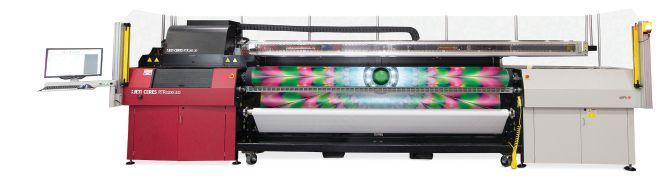
Launched at the beginning of 2017, the Jeti Ceres RTR3200 LED is a roll-to-roll printer for what the company describes as mid- to highend applications. The new engine can include a combination of optional white printing and primer for producing higher-end image quality and durability. The engine pre-
Jeti Ceres, leveraging Agfa’s UV LED inks and thin ink layer technology, is a dedicated 3.2-metre roll-to-roll printer.
Mimaki’s TX500P-3200DS.
SureColor P20000 uses the new PrecisionCore MicroTFP print head.
prints a layer of primer automatically before depositing ink, preparing the top layer for surface tension to better receive ink. The Jeti Ceres, leveraging Agfa’s UV LED inks and thin ink layer technology, is a dedicated 3.2-metre roll-to-roll printer capable of printing on single- and dual-roll medias at speeds of up to 186 square metres per hour. The Ceres can print on heat-sensitive medias like self-adhesive sheets and PVC without warping or wrinkling.
Roland ErgoSoft RIP
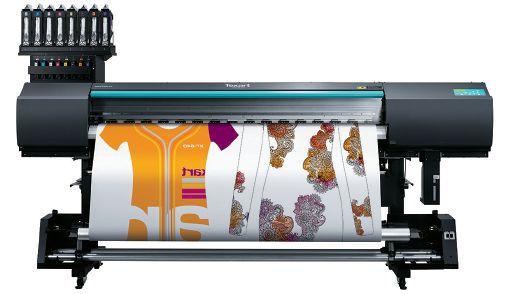
In March, Roland DG released the ErgoSoft Roland Edition 2 RIP software for its Texart dye-sublimation transfer printers. ErgoSoft has developed the RIP specifically for the Texart XT-640 and RT-640 to support high-fidelity digital textile printing of sports and fashion apparel, soft signs such as polyester banners and flags, curtains and other interior décor, as well as promotional goods and personalized gifts.
ErgoSoft Roland Edition 2, according to Roland, includes more than 40 new features and enhancements. A new dithering method increases rasterization speed and improves dot placement accuracy resulting in what the company describes as 40 percent faster RIP times and smoother gradients. Roland explains a new PDF engine displays colour-accurate previews of PDF files. The RIP also includes up to eight simultaneous RIP Servers to reduce processing time when working with high-capacity data or multiple print jobs. A new Printer Pool feature allows the same file to
be sent easily to multiple devices and a Hot Folder feature is aimed at batch printing of images with the same specific print settings.
EFI VUTEk 3r and 5r
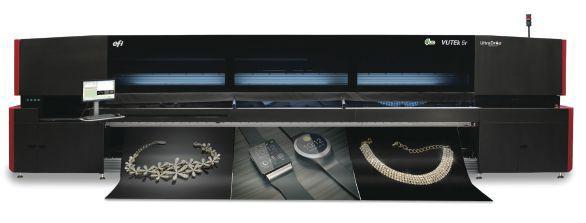
Electronics For Imaging is launching into the commercial market two new high-volume, roll-to-roll UV LED inkjet printers in the VUTEk 5r and VUTEk 3r. The company first introduced the systems back in January 2017 and has already installed 3r and 5r printers with customers in North America, Europe and the Middle East. Sandy Alexander of Clifton, New Jersey, became the first company in North America to install the VUTEk 5r back in February 2017.
The 3-metre-wide VUTEk 3r reaches speeds up to 3,715 square feet per hour and the 5-metre 5r reaches speeds up to 4,896 square feet per hour. In addition to LED curing, the new printers feature resolutions up to 1,200 dpi and EFI UItraDrop technology leveraging seven-picoliter print heads with multi-drop addressability. This system uses a colour distribution algorithm aimed at providing economic advantages with ink usage, explains EFI, whereby one litre of ink can cover up to 1,600 square feet, on average, across all print modes.
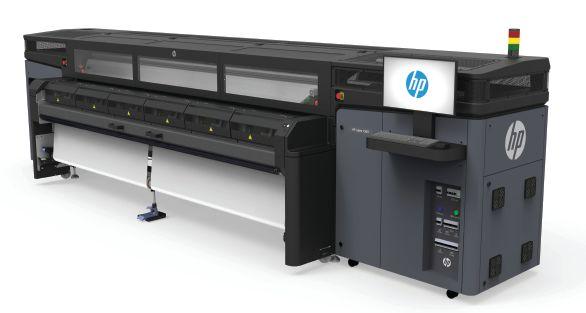
HP Latex 1500
The HP Latex 1500 builds on the success of the proven HP Latex 3000 Printer series, the 126-inch (3.2-meter) HP Latex 1500 Printer offers a robust, affordable superwide printing solution, providing
EFI’s 5-metre 5r reaches speeds up to 4,896 square feet per hour.
Roland’s 64-inch Texart XT-640 was introduced in late 2015.
mode.
fast turnarounds on a broad range of indoor and outdoor applications, including PVC banners, self-adhesive vinyl, textiles and double-sided prints. Printing at speeds up to 74 sqm/hour (800 sqft/hr) in outdoor production mode and up to 45 sqm/ hour (480 sqft/hour) in indoor mode.
Epson 3M Ultrachrome
In April, Epson began shipping a new series of co-branded inks called Epson-3M UltraChrome GS3 Inks designed for use in Epson’s SureColor S-Series roll-to-roll solvent printers, including the SC-S40600, SC-S60600 and SC-S80600. The premium inks provide signmakers and print service providers (PSPs) a 3M MCS Warranty for finished graphics created using supported 3M films, clears, overlaminates, and application tapes once they have completed the 3M certification process. The Epson-3M UltraChrome GS3 inks are available in CMYK, Light Magenta, Light Cyan, and Light Black.
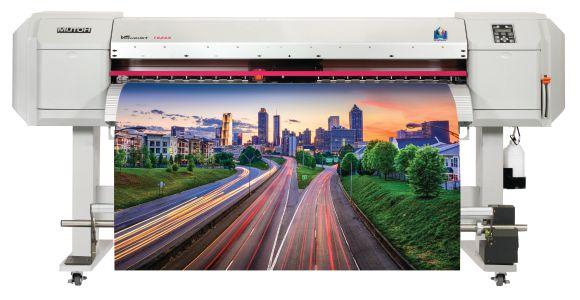
Mutoh-VJ-1624
Targeted at the sign and display market, Mutoh’s 64-inch ValueJet 1624X printer includes features like automatic sheet-off mechanism, an anti-cockling feature, a smart endof-media-roll feature and a tiltable ink cassette holder. The machine
utilizes Mutoh Eco Ultra and UMS inks. Featuring the latest piezo inkjet head technology and a high-precision mechanical design, ValueJet 1624X is Mutoh’s fourth generation 64-inch wide single head sign and display printer. It reaches production speeds up to 20.5 square metres per hour and includes Mu toh’s Intelligent Interweaving (i²) and DropMaster technology.
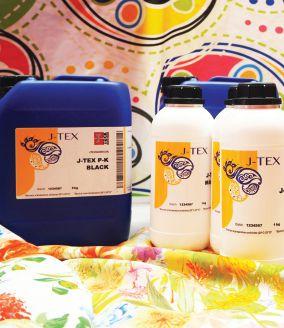
J-Teck3 J-TEX Pigment
In April, J-Teck3 launched a new series of J-TEX textile pigment inks for Epson and Kyocera print heads. J-TEX are water based pigment inks designed to work in printers
HP Latex 1500 reaches speeds of up to 800 square feet per
with piezo-electric printheads. They are designed for direct printing on a variety of fabrics among which cotton, cotton/poly blends, synthetic fabrics and viscose. The most common applications are fabrics for fashion and home furnishings (cloths, sofa covering, cushions, curtains). J-TEX pigments are manufactured in nine colours containing a specific binder which enables strong printability, wash and rub fastness. The use of a specific pre-treatment will increase the printing results allowing for more brilliant colours, higher definition and adhesion to the fabric. re metres) per hour.
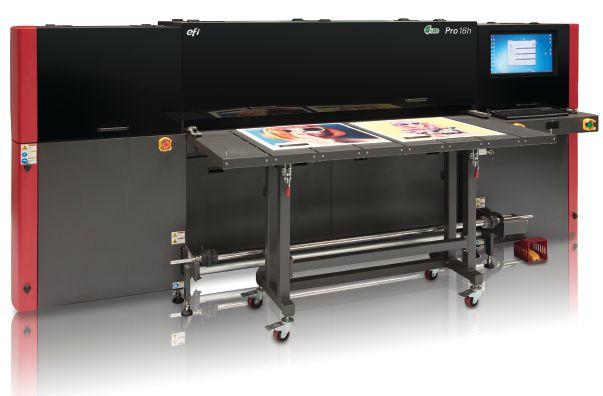
EFI Pro 16h LED UV
Making its North American debut in April, the EFI Pro 16h is positioned as an entry-level hybrid roll/ flatbed LED printer. The new Fiery Driven printer includes white ink and on a new platform with some print modes offering up to 30 percent greater throughput compared with other EFI entry-level hybrid production systems. The Pro 16h LED UV prints flexible and rigid
substrates up to 65 inches (165 cm) wide and two inches (5.08 cm) thick.
It produces up to 1,200 x 1,200 dpi and near-photographic images, saturated colours, and smooth gradations with four-level, variable-drop greyscale print capability. Its production quality printing mode reaches speeds of up to 476 square feet (44 square metres) per hour. Its express printing mode reaches speeds of up to 976 square feet (90.7 square metres) per hour, while high quality printing mode reaches speeds of up to 119 square feet (11 squa
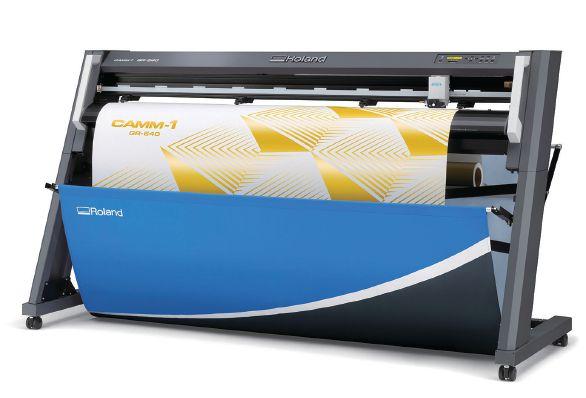
Roland CAMM-1 GR
In April, Roland DGA launched its new CAMM-1 GR large-format cutters, available in 64-, 54- and 42-inch cutting widths, including an “L-shaped” integrated machine and stand design that provides stability even when cutting at speeds of up to 58.5 inches per second (1,485 millimetres per second). The printer provides cutting with up to 600 gf of down force.
The Roland CAMM-1 GR series includes a built-in media basket
EQUIPMENT
Xerox iGen4 in perfect condition with low impression clicks. Freeflow print server. Media sizes 7” x 7” – 14.33” x 20.5” and weights of 16lbs to 130 lbs (coated, gloss, text, silk, perforated, tabs, transparencies, labels). Asking $80,000 – Contact Craig 1.866.467.5391
Looking for dynamic individual who will prospect new potential customers through research, cold calls, going to meet with prospects. Make contact
and create interest in the full range of offerings of The Communication Alliance Inc. as well as educate prospects on the services, and expanded services of the company. Looking for someone who can successfully handle and overcome objections. Must track and document potential client contact and results on an ongoing basis. The successful candidate will learn the company, take initiative, and look to advance within the organization.
Experience in developing, creating, executing marketing campaigns across multiple channels including preparing budgets, adhering to timelines as well as developing marketing/ sales materials to differentiate com-
pany from competitors is an asset. Develop specific account sales and marketing plans. Please forward resume to resumes@taylor-demers.com
Qualifications:
Experience: Minimum 3 years’ experience in digital print/advertising/marketing sales
• Previous experience cold calling/ prospecting
• A competitive attitude
• Strong presentation skills
• Fast & independent learner
• Team player who is self-motivated
• Enthusiastic and energetic, great relationship building abilities
• Proven success at a small/mid-size, fast-growing company before
• Excellent communication and English language skills (oral and written)
Email: resumes@taylor-demers.com
MOVE TO BEAUTIFUL VANCOUVER ISLAND
Owner wanting to retire. Small Digital + Offset Printing and Copying shop. Located in Nanaimo, Vancouver Islands second largest city since 1979. Sales between $320,000 to $400,000. Included in the price of $895,000 (share sale) is a 4,000 sq. ft. commercial property located in the heart of the downtown on the Main Road directly across the street from The Nanaimo Convention Centre, Great Canadian Casino, The Port Theatre and Port Place Mall and a two minute walk to the waterfront. The lower level of the property is leased out for additional revenue or take it over and expand or run a second business. Make the move to great weather and affordable housing with all the major links to Vancouver close by.
Sakurai: 1, 2 or 4 colours and any size (newer model)
Polar: any size/older or newer models (66/72/76/78/82/90/92/107/115)
Horizon-BQ: 220/240/260/440/460
Ray Fagan / Product Manager / Heidelberg Canada / Mississauga, ON
At drupa 2016, Heidelberger Druckmaschinen AG unveiled a new operating philosophy called Push to Stop, also referred to by the press maker as autonomous printing. It basically applies a true manufacturing approach to printing in that operators only push a button to stop the press, rather than the traditional approach of pushing a button to activate jobs.
The concept is to have the press initiate a series of print jobs that are properly queued up by Heidelberg’s Prinect software, depending on ink layout down and imposition, and then run consistently without operator intervention. Ultimately, the technology platform can also leverage colour management tools to reach pre-specified Delta e levels and a tagging system in the press delivery. PrintAction spoke with Heidelberg’s Ray Fagan about Push to Stop and automation in the printing industry.
What is the state of automation in the printing industry?
RF: I would say in general print shops are behind other industries in automating their processes. There is a trend toward getting away from the craft of printing more toward the manufacturing of printing. And that is a bitter pill to swallow for a lot of printers, more so for the commercial companies than in packaging. Packaging companies have been in a manufacturing mindset for a longer period of time, because of the nature of what they print.
Are printers ready for Push to Stop?
RF: We are learning very quickly that most companies are not in a position to take advantage of Push to Stop automation. The press ends up waiting. There is a fellow who has joined Heidelberg by the name of Anthony Thirlby and he is head of Prinect now, driving some of these processes... He estimates 55 percent of the time a job is in a printing company is before it even gets to the CTP. It’s in estimating, job costing and prepress – 55 percent of the time before it is even plated and on the press. So if an average job time takes three days to get out the door, one and a half of those days is spent just getting the job ready to be plated.
How does Push to Stop look beyond just the printing component?
RF: Push to Stop is part of what we call the Smart Print Shop, which is more holistic in the approach, where Push to Stop is the print processing element of it. To have a Smart Print Shop, you need to think about how do I align my jobs so that I can truly manufacture at an acceptable operating equipment efficiency or an OEE number for a new press? How do I justify putting this
piece of equipment on the floor?
What is Heidelberg’s answer for creating an OEE number for a capital investment?
RF: You should only think in terms of throughput and you should only measure, in our opinion, cost per thousand sheets. What is the cost of running a thousand sheets for my company?
Why has Heidelberg focused on cost-perthousand-sheet manufacturing?
you can try to remove the emotional element and just focus on what is happening. It is interesting to see the look on a customer’s face when you tell them their overall operating efficiency [OEE] is 18 percent or 23 percent. They have these big pockets of unexplained time.
How common is it for printers to have an OEE number well below 40 percent?
Heidelberg estimates 55% of a total print job’s time in the plant is spent before it is even being plated for the CTP system.
RF: We are launching a big data platform this year in a couple of satellite plants as a beta test. We are going to be collecting every single piece of information from the press and any other automation that is in front of, or behind, the press that can provide data. Then you can start to do a few things like intensify your colour management, streamline your stock purchasing by big data analysis. You can determine a lot to drive your cost per thousand sheets down. But it is not only based on capacity. If you can make every thousand sheets more profitable, a three-shift printer can become a two-shift printer and be more profitable even if they do not see an increase in print volumes coming.
What is big data telling you about print?
RF: There are so many decisions now where
RF: Most are below 40 percent for sure. And in fairness, a lot of people are getting hung up on overall operating efficiency. You can be the most efficient printer in the world but if you are a really short-run printer your [OEE] is not going to reflect how efficient you are just based on your total volume.
Why is Push to Stop a new operating philosophy for printing?
RF: I do not think anybody has ever gone from makeready to good sheet before without having a physical interference. To be able to process multiple jobs in sequence without interruption of a person has never been done before and now we have the capability to do it at a press level. What is new I would have to say is the ability to queue up multiple jobs from the prepress department into the queue of the press, all ready to go.
SHOP ANYTIME, ANYWHERE GOSPICERS.CA
FAST, EASY & CONVENIENT
Access product information and view up-to-date inventory and pricing 24/7. Streamline your procurement by creating customized shopping lists, view order status and order history with a click of the mouse.
Browse Our Product Catalogues
Perform searches using keywords, product catalogues and product codes.
View Our Inventory GOspicers shows how much inventory is available so you can plan your production with certainty.
Streamline Your Purchases
Create and organize My List with commonly purchased products to streamline and improve efficiency.
Spicers is a leading distributor of commercial print and business papers, specialty products, graphic solutions, sign and display media and industrial packaging supplies with distribution centres strategically located across Canada. 877 790 2335 | shop online at gospicers.ca
Check Out Securely
Your GOspicers order will be processed in the same timely and thorough manner that you’ve come to expect from Spicers.
Track Your Orders GOspicers indicates date entered, estimated shipping date and current status.