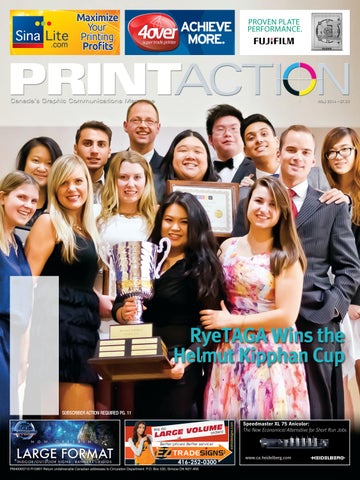
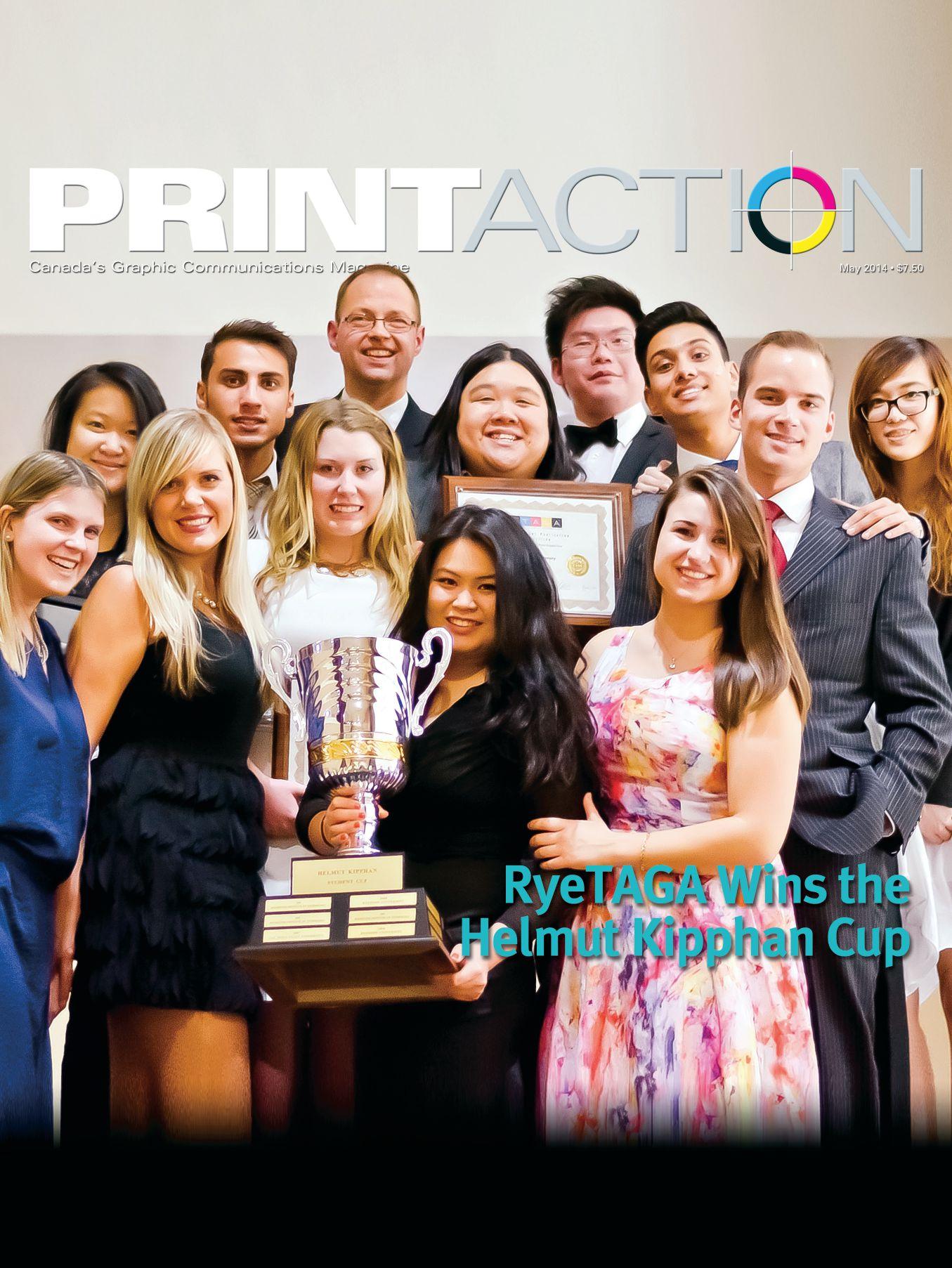
The executive team of Ryerson GCM’s RyeTAGA initiative describe how they won the Kipphan Cup for the third time in six years at TAGA’s 66th technical conference
TAGA Shows Print is Alive
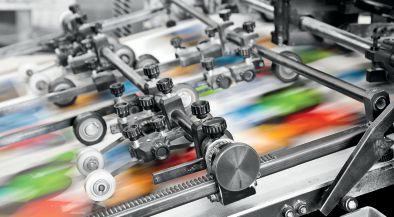
Dr. Martin Habekost takes in four TAGA keynote addresses about how conventional printing technologies are still producing innovative products
Past, Present and Future
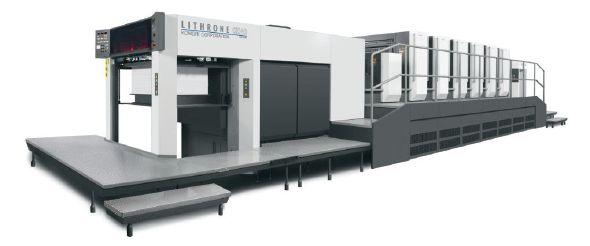
Manufacturers and distributors describe their most-impactful sheetfed-offset technologies introduced over the past five years, in the current market, and for the future 13 21 16
Technology Report: Ipex 2014
In March, more than 20,000 attendees, including 46 percent from outside the U.K., visited London’s biannual exhibition of new printing technologies
ZAC BOLAN
6
NEWS
Pierre Karl Péladeau becomes a frontrunner for PQ leadership after winning a seat in Saint-Jérôme, Goldman Sachs moves to buy Flint, and remembering Malcolm Dowdle
MARKET & INSTALLATIONS
7
Toronto Craftsmen present awards to printers and students, Xeikon hosts Canadian Olympian Alex Bilodeau in Montreal, and Distributech installs a Horizon StitchLiner
8
CALENdAR
DIA hosts Daniel Dejan of Sappi speaking about Augmented Reality, Sydney Stone takes eQuip to Richmond Hill, and Proveer hosts a car-wrapping workshop in Dartmouth
Indesign and Illustrator Evolve in the Creative Cloud
How Adobe is targeting electronic publishing with InDesign CC and using customer feedback to teach an old vector editor new tricks
30
May 1984
The Soviet Union boycotts the 1984 Summer Olympics in LA, Oilers beat the Islanders to win the Stanley Cup, and Color Craft stays ahead with Dupont Chromacheck
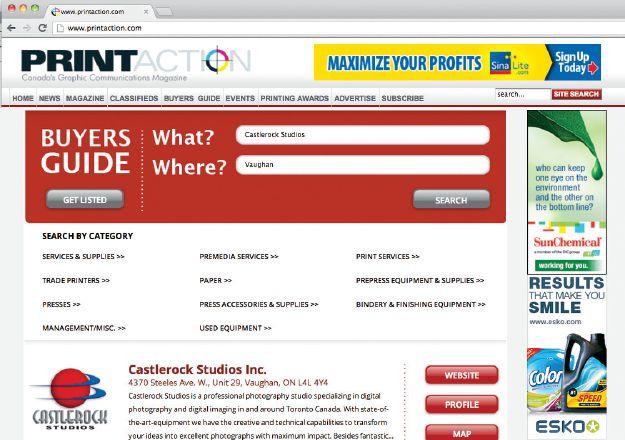
BUYERS GUIDE
PrintAction’s annual Buyers Guide is an invaluable industry resource that connects your company to new customers.
With PrintAction Buyers Guide your company receives daily exposure and access to potential clients and partners in both print and online.
From a Bronze Listing to a Gold Listing, you can choose the option that best suits your company’s budget and marketing strategy. Reserve your ad by August 13th.
Canadian Print SuperBuild
At the turn of the new millennium, The Honorable Jim Flaherty began one of his most ambitious projects in politics: the SuperBuild Corporation, a unique partnership between the private and public sectors to rebuild crumbling infrastructure in Ontario’s urban centres. SuperBuild’s greatest legacy is its $1.5 billion investment in more than 40 provincial colleges and universities (around 60 projects in total) to create more than 73,000 new student spaces – in large part to handle a pending enrollment spike when Ontario’s secondary school system eliminated grade 13.
The success of SuperBuild helped propel Flaherty, then serving as Ontario’s Finance Minister, to become Canada’s Federal Minister of Finance in 2006, a position he held until March 2014, stepping down from the post on St. Patrick’s Day only a few weeks before his passing on April 10. The Canadian printing industry was a true beneficiary of SuperBuild and Flaherty’s pragmatic approach to do what was necessary.
After years of campaigning to build a dedicated facility for Ryerson University’s Graphic Communications Management (GCM) program, SuperBuild provided a financial backbone for the new $10.61 million building. Flaherty himself attended the groundbreaking ceremony in downtown Toronto.
Since opening in 2002, GCM’s four-storey building has fostered a unique culture of students working together for the greater good of their careers. It also provides a platform for Canada’s only degree-level printing program to engage the industry. This environment is exemplified by the success of RyeTAGA, which has won the Helmut Kipphan Cup three times in the past six years.
Established in the early 1970s, Ryerson’s GCM program, which had 570 full-time students this year, making it North America’s largest graphic-communications undergraduate program, provides talented youth for the future management of Canada’s aging printing sector. The human resource challenges of the industry, however, are far from saved by Ryerson’s GCM pipeline. The hyper-transactional manufacturing needs of printing require a varied skill set in every facility regardless of whether it is a family-run business, a medium-size shop pulling in $10 million, or Transcontinental. Skilled technicians are just as vital to the health of a printing operation as are its management visionaries. It is often the skilled technicians who ultimately provide the path forward.
Printing, unfortunately, will not have a presence at this June’s Skills Canada competition, which celebrates technical achievement, in downtown Toronto. The Canadian printing community cannot take GCM or any of the country’s postsecondary printing programs for granted. The industry needs to take a page from Flaherty’s SuperBuild book to do what is necessary today to prepare for the immediate future. Establishing a printing presence at Skills Canada 2015 is a realistic goal to be shared by both public and private sectors.
Jon Robinson, Editor
Canada’s Graphic Communications Magazine. Proudly published for two generations. Editor Jon Robinson • 905.713.4302 • jrobinson@annexweb.com
Contributing Writers Zac Bolan, Peter Ebner, Chris Fraser, Victoria Gaitskell, Dr. Martin Habekost, Nick Howard, Thad McIlroy, Nicole Rycroft, Dr. Abhay Sharma, Trish Witkowski
Publisher Sara Young • 905.726.5444 • syoung@annexweb.com
Associate Publisher Stephen Longmire • 905.713.4300 • slongmire@annexweb.com
Group Publisher Paul Grossinger • 905.713.4387 • pgrossinger@annexweb.com
Advertising Sales Sara Young • 905.726.5444 • syoung@annexweb.com Stephen Longmire • 905.713.4300 • slongmire@annexweb.com
Art Director Clive Chan • 905.713.4301 • cchan@annexweb.com
piErrE Karl pélaDEau was elected to Québec’s National Assembly on April 7 by winning a Parti Quebecois (PQ) seat in the riding of Saint-Jérôme. In early March, Péladeau resigned from his leadership of Quebecor Inc. to become a PQ candidate and promote the sovereignty of Quebec. The Liberal party’s overwhelming victory in the provincial election resulted in Pauline Marois stepping down as PQ leader, with Péladeau (age 52) being noted as a possible successor. He took over the reins at Quebecor after the 1997 death of his father, Pierre Péladeau, who also publicly pushed for Quebec’s independence.
victoria GaitsKEll, a columnist for PrintAction magazine, becomes Managing Director for PrintLink’s Canadian office located in Oakville, Ontario. Established in 1994, PrintLink, headquartered in Rochester, is a placement agency specializing in the printing industry. Gaitskell had previously worked with PrintLink just over four years ago. “Victoria’s knowledge of recruiting and business strategy will build on PrintLink’s two decades of partnering with printing companies to help them hire qualified staff. Her return ensures a seamless transition,” stated Arnold Kahn, President of PrintLink. Gaitskell is replacing Carol McLeod, who previously worked with Heidelberg Canada and planned to retire at the end of March.
GorDon GrayDon MEMorial sEconDary school placed first and second in the annual Phoenix Challenge International Flexographic Skills Competition held in North Carolina. Among 19 competing teams from across North America, the Gordon Graydon duo of Martin Jeung and Humaira Imtiyaz placed first in the competition, while the Gordon Graydon team of Luvit Chumber and Vishal Monteiro placed second. Third place went to students from Asheville High School, Noah Seidenburg and Andrew Fox. Peter Belanger, an instructor for Gordon Graydon, was recognized for his contributions with the Diann Teague Award.
JiM waslowsKi, President of Flex Essentials Inc., becomes a new Canadian sales agent for Flexotecnica, an Italian manufacturer of CI flexo presses that was purchased by KBA Group in mid-2013. The German press maker then established KBA-Flexotecnica, with KBA North America overseeing North American distribution channels. Waslowski formed Flex Essentials 11 years ago. He previously spent nearly 20 years in the plastics industry at Brampton Engineering, where he primarily focused on machine design before moving into the sales arena, ultimately becoming Vice President of Sales.
Dr. Eva FrEuDEnthalEr becomes Vice President of Marketing and Technology Flexographic Products for Flint Group, following the departing Dr. Uwe Stebani. Freudenthaler began her professional career in 1997, as R&D Manager at BASF Aktiengesellschaft. In 2003, she moved to the former BASF Printing Systems business and was initially in charge of global marketing management and controlling of the printing plates business unit. Since the formation of Flint Group, she has held various positions, including Vice President Marketing and Technology Flint Group Packaging and Narrow Web. She most recently served as Flint’s VP of Strategic Development.
Flint Group is to be sold, based on successful regulatory approval, to an new partnership formed by Goldman Sachs Merchant Banking Division and Koch Equity Development LLC, a subsidiary of Koch Industries Inc. The group will acquire 100 percent of Flint shares, which are currently held in a series of funds controlled CVC Capital Partners. “We believe Flint Group is uniquely positioned to capture growth in its attractive printed packaging markets while at the same time continuing to benefit from strong and resilient performance of its print media business,” stated Matthias Hieber, Head of Corporate Equity Investing for Goldman Sachs.
Dr. Martin hoyos is to become Chairman of Koenig & Bauer’s Supervisory Board, following the resignation of Heinz-Joachim Neubürger, if confirmed at the German press maker’s annual general meeting on May 28. Hoyos of Vienna was originally placed on the supervisory board in October 2013 following the resignation of Dieter Rampl. Dr. Andreas Plesske on May 1 was set to also become a member of KBA’s management board to oversee the German press maker’s restructuring efforts.
Manitoba print inDustry association (MPIA) becomes the third Canadian provincial affiliate of the Printing Industries of America (PIA), joining earlier moves by the OPIA and BCPIA. MPIA’s executive includes President Rob Young of Pollard Banknote, and VP Gord Boultbee and Past President Glenn Buffie, both of Derksen Printers. MPIA directors include Mark Davis of Corporate Source, Bob Harvie of The Prolific Group, Tony Kasdorf of The Standard Press, Jon Leech of Harris Printing, Andrea Read of Transcontinental LGM-Coronet, Herb Vielhaber of Cascades Boxboard Winnipeg, Jim Macklin of Winpak, and Greg Ward of Ward’s Printing Services.
Graphics canaDa, a national printing tradeshow traditionally held every two years during late-fall in the Greater Toronto Area, is to next take place in the spring of 2015. The three-day event will be held at the International Centre from April 16 to 18 next year. “Toronto and Graphics Canada can definitely be a more attractive destination especially for visitors from outside the province in spring versus lateNovember,” stated Dan Mustata, Graphics Canada Show Manager. He explains the decision to move Graphics Canada to the springtime is largely based on concerns about butting up against the raft of printing tradeshows held every fall in the United States.
MalcolM DowDlE, who had a long, successful career in Canada’s printing industry, passed away at age 70 in Guelph in mid-March. Dowdle began his career as an apprentice at Canadian Linotype and then gained his expertise in printing technology with Louson-Desonite and Komori Canada. He then spent 20 years as President of his own company, MJD Graphics Inc. Dowdle is survived by his wife of 44 years, Julie, two daughters and four grandchildren.
JiM putnEy of Sun Chemical received the 2014 National Association of Print Ink Manufacturers (NAPIM) Pioneer Award. Responsible for a technical service team of close to 50 people, Putney is credited with creating Sun Chemical’s performance management system to measure CTS value, in addition to his work on colour management, ink dispensing technology and pressroom consumables at Sun Chemical. Putney holds three U.S. patents on colour communication that now form part of the backbone for PantoneLIVE and Sun Chemical’s Global Shade Library.
JoEl QuaDracci, President and CEO of Quad/Graphics, one of the largest printing companies in North America, signed an agreement to acquire Brown Printing for approximately $100 million. With manufacturing facilities in Waseca (MN), Woodstock (IL), and East Greenville (PA), Brown provides printing and distribution services for publishers and catalogers. Brown is wholly owned by Gruner + Jahr of Hamburg, Germany, a member of the Bertelsmann Media Worldwide family of companies, which also owns RTL Group, Random House and Arvato. Brown forecasts approximately $350 million in revenues during fiscal year 2014. The transaction is expected to close in the second half of 2014.
svEn MichaEl becomes CEO of KBA-MePrint AG in Veitshöchheim, succeeding the departing Axel Thien. A subsidiary of Koenig & Bauer, KBA-MePrint develops offset systems for waterless UV printing on materials like film, smart cards and data storage devices. Michael (45) joined Koenig & Bauer in 2012 as a project manager for its digital printing segment. He previously spent 12 years at Heidelberger Druckmaschinen, including six years as head of business operations and consumables for its Linoprint division. KBA-MePrint AG shares facilities with KBA-Metronic, which produces digital and analogue coding and marking systems.
Toronto Craftsmen Recognize Printers and Students
In early April, the Toronto Club of Printing House Craftsmen (TCPHC) held its 39th annual awards dinner at the Duncan House. Four printing companies from the area were acknowledged for their winning projects in both the national and international Gallery of Superb Printing competitions.
Colour Innovations received Best of Show, sponsored by Heidelberg Canada, for its production of The Gates of Chinatown Collection, while C.J. Graphics won Best Use of Ink for its Canadian Club Premium project and The Lowe-Martin Group won Best Use of Ink for Air Optix Aqua Leave Behind. Polytainers Inc., a producer of rigid packaging printed products was the fourth TCPHC win-
ner. C.J. Graphics took home the most combined national and international awards at 107, including 50 Gold, 33 Silver, 20 Bronze and four Honourable Mentions.
The night concluded with Bill Kidd, Educational Director for the TCPHC, presenting awards and scholarship funding to 12 students focused on developing a career in graphic communications at secondary and post-secondary schools. Eight students with the highest grade point averages in their respective programs received the Chai Tse Award, named after a Ryerson student who passed away nearly 10 years ago. The Challenge Award Winners beat out more than 80 project submissions, which doubled last year’s total entries.
Olympian Xeikon Café in Montreal
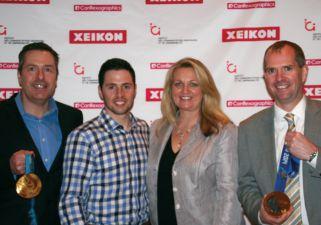
Canadian Olympian Alex Bilodeau, who won two gold medals in moguls over the two previous Olympic Winter Games, provided a luncheon speech during a Xeikon Café held in Montreal. At the Vancouver Games in 2010, Bilodeau became the first Canadian athlete to win an Olympic gold medal on home soil, followed by his Sochi 2014 performance as the first Olympian in history to defend a gold medal in any freestyle skiing event.
Xeikon and its distribution partner Canflexographics Ltd. hosted the daylong event at the Institut des Communications Graphiques et de l’Imprimabilité. After an educational session by Robert Leahey, Associate Director of InfoTrends, two printing companies leveraging Xeikon presses, Jean-Marie Peters of Label’Or S.A. in Belgium and Mark Tangry of Lake Graphics Label & Sign, described their work with label and packaging projects.
The technical and business presentations throughout the day hit on applications like in-plant pharmaceutical label production, extended booklet labels, highly embellished wine labels, in-mold labels for thin and thick walled plastic, promotional heat transfer labels, industrial heat transfer labels, folding carton boxes and carton drinking cups.
Toronto Craftsmen
Student Chai Tse Awards
Joel Nash
Centennial College: The Centre for Creative Communication
Simon Yan
Central Technical Secondary School
James Waters
George Brown College School of Design
Carly Hoffman Georgian College Design and Visual Arts
Humaira Imtiyaz
Gordon Graydon Memorial Secondary School
Edward Viveiros
Humber College
Advertising & Graphic Design
Tabeau Lemcke
Ryerson University School of Graphic Communications Management
Brian Carvalho
Seneca College School of Creative Arts and Animation
Graphic Challenge Awards
Post Secondary: Diondra Filicetti
Ryerson University School of Graphic Management
Runner Up: Aaron Tansil
George Brown College School of Design
Secondary Schools: Helen Zhou
Central Technical Secondary School
Runner Up: Vishal Monteiro
Gordon Graydon Memorial Secondary School
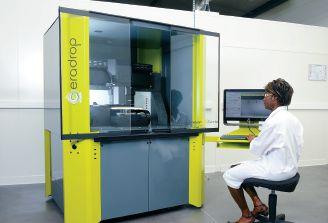
Ceradrop Research in Waterloo
The University of Waterloo will add a Ceradrop L-Series inkjet system to its nano-electronics laboratory for research into the fields of manufacturing thin film transistors, the formulation of electronic inks, and the printing of electronic components over large areas. “Our configuration is unique and we will achieve, with a single machine, something that other research institutions in the world have to do using multiple systems,” stated William Wong, Director of the university’s Giga-to-Nano-Electronics Centre.
The Ceradrop range of inkjet systems are suitable for fields like electronic materials, organic photovoltaics, OLED lighting, smart cards, antennas, intelligent systems and various 3D printing applications.
The University of Waterloo purchase was one of three orders – collectively worth just over $1 million – for Ceradrop printing systems, which is a division controlled by MGI Digital Graphic Technology of France.
The Federal Polytechnic School of Lausanne in Switzerland acquired a Ceradrop X-Series printer for its Physics and Analytical Electrochemistry Laboratory research in micro-fabrication of electrochemical systems (sensors, batteries, fuel cells). The Imperial College London also acquired a Ceradrop X-Series for its electrochemistry lab research in the manufacturing of 3D components for storage and energy conversion.
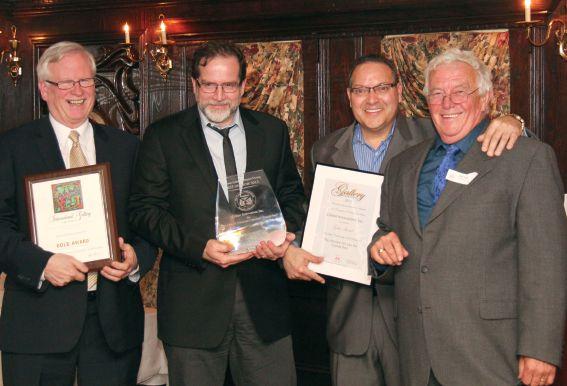
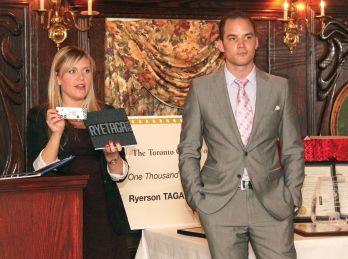
Clockwise from top: Dennis Leggett (left to right), James Bailey and Matthew Alexander receive their Best of Show Award from Bill Kidd. James Waters (centre) of George Brown College School of Design receives the Chai Tse Award, with wife Max Waters by his side. Stephanie Murray and Mark Brejnik describe RyeTAGA’s award-winning journal to the Craftsmen crowd.
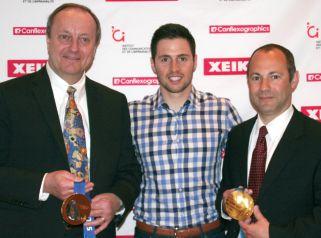
From top: Xeikon Café guest speaker Alex Bilodeau (middle), two-time Olympic Gold Medal Winner, with Xeikon’s Thierry Barbeau (left), Regional Sales Manager, and Todd Blumsack, Vice President of Sales; Alexandre Bilodeau poses for photos with Canflexographics Pascal Ross, Christine Roberts and Kelly Roberts.
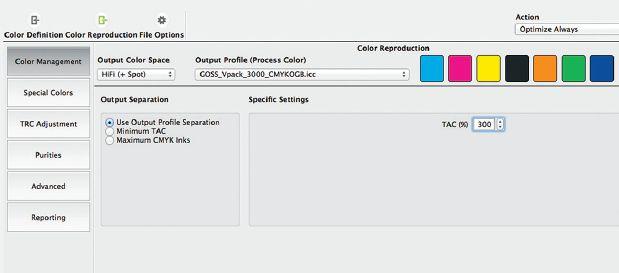
Goss Opens Packaging Technology Center
Goss International officially opened its new 7,000-square-foot Packaging Technology Center in Durham, New Hampshire. The star attraction of the new centre is a Goss Vpak 500 press with seven web offset units, as well as EB and UV curing and flexo coating capabilities. The system prints on film substrates from nine to 75 microns thick and board substrates as thick as 100 GSM. The press works with web widths of up to 850 mm (33.5 inches) and a repeat range from 406 to 812 mm (16 to 32 inches).
The new facility is to focus on providing packaging press demonstrations, testing and the development of advanced printing concepts. It will also serve as a controlled site for suppliers interested in testing inks, chemicals and aux-
iliary technologies for web offset production. Goss plans to bring converters, brand owners and suppliers together to jointly explore market requirements and new print production ideas. Educational programs for converters and brand owners will begin later this spring.
In related news, Fujifilm North America in late March began construction to more than double the size of its current Technology Center in Hanover Park. The new 20,000-square-foot facility will hold technologies like Brillia HD plates and platesetters, sheet-fed and roll-fed J Press inkjet systems, a Graphium UV inkjet web press, Xerox presses and a range of wide-format inkjet systems like Inca Onset, Uvistar and Acuity Advance. The renovations are expected to be complete later this summer.
May 21
Digital Imaging Association presents: Sappi’s Daniel Dejan on Augmented Reality Konica Minolta offices, Mississauga, Ontario.
May 27–30
Avanti User Group Conference Park Hyatt Toronto, Toronto, Ontario. $800*
BookExpo America Javits Center, New York, New York.
May 29–31
May 29–31
Goss, Metro Users Group Conference Saddlebrook Conference Center, Tampa, Florida.
June 3–6
MagNet 2014
Courtyard Toronto Downtown. $225 per session*
Digital Imaging Association, Annual golf tournament
June 5
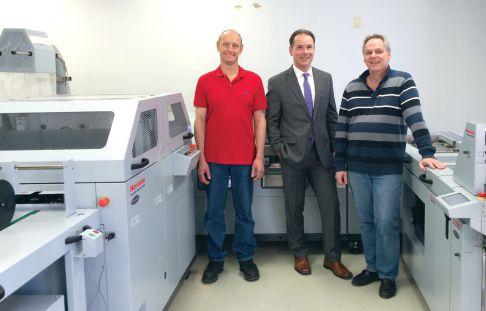
Distributech Installs
Standard Horizon StitchLiner
Distributech, which provides communications services primarily for financial, healthcare, consumer brand and association sectors, added a new Standard Horizon StitchLiner in its Brantford, Ontario, facility. Founded in 1992, Distributech operates a second location in Toronto and currently employs around 75 people.
Purchased through KBR Graphics, the new Standard Horizon StitchLiner can run 12 x 18-inch sheets without the need of pre-trimming. In relation to its new installation, Distributech noted it has seen an increase in saddle-stitched book volume and, therefore, required a system capable of processing variable sheet count books at a high rate of speed.
St. Andrew’s Golf Course, Aurora, Ontario. $210
Sydney Stone eQuip Roadshow Hilton Garden Inn Richmond Hill, Ontario. Free
June 10
June 9–11
66th World Advertising Forum, Newspaper Congress and Editors Forum Lingotto Conference Centre, Torino, Italy.
June 15–18
Esko, Eskoworld 2014 Walt Disney World, Orlando, Florida. $695*
Proveer/Avery Dennison, car wrap workshop
June 19–21
Proveer facility, Dartmouth, Nova Scotia. $999*
August 14
OPIA Toronto Golf Classic Angus Glen Golf Club and Conference Centre Markham, Ontario.
Goss staff celebrate the opening of the Packaging Technology Center in front of a seven-unit Vpak 500 press.
Warren Bryant (left to right), Senior Digital Operator at Distributech; Steve Klaric of KBR Graphics; and Mike Lestage, Distributech’s Director of Print Services.
Sun Chemical has been developing, testing and promoting the use of technology and products for low migration packaging for decades. Our patented SunPak™ LMQ inks provide the lowest odor and migration possible to ensure you can confidently address the most demanding product safety requirements.
Count on Sun Chemical to help lead the way in low migration packaging solutions.
InDesign and Illustrator Evolve in the Creative Cloud
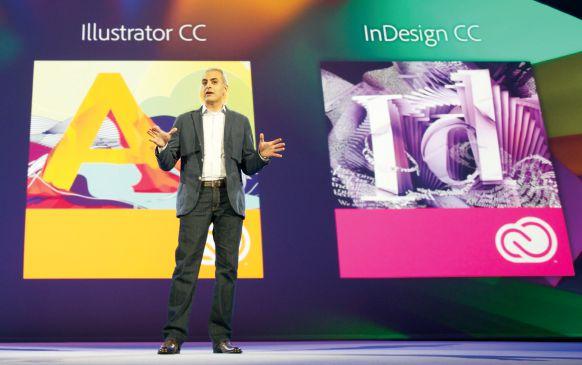
Earlier this year, Adobe unleashed the first major upgrade to its Creative Cloud applications since the Suite launched in May 2013. While Photoshop CC enhancements such as support for 3D printing, perspective warp tools and linked smart objects grabbed the spotlight; new features were also added to both Illustrator and InDesign applications.
Illustrator has been around forever, at least when measuring time on the digital design and prepress scale. Since version 1.0, Illustrator has nudged virtually all competitors to the sidelines, claiming the de-facto crown of vector editing applications. If you peel away all the fancy Adobe branding, the latest Illustrator iteration stands at version 17.1 – truly venerable in the here-today, gone-tomorrow world of software. So after 16 major upgrades, what could be left for Adobe to improve?
Illustrator CC
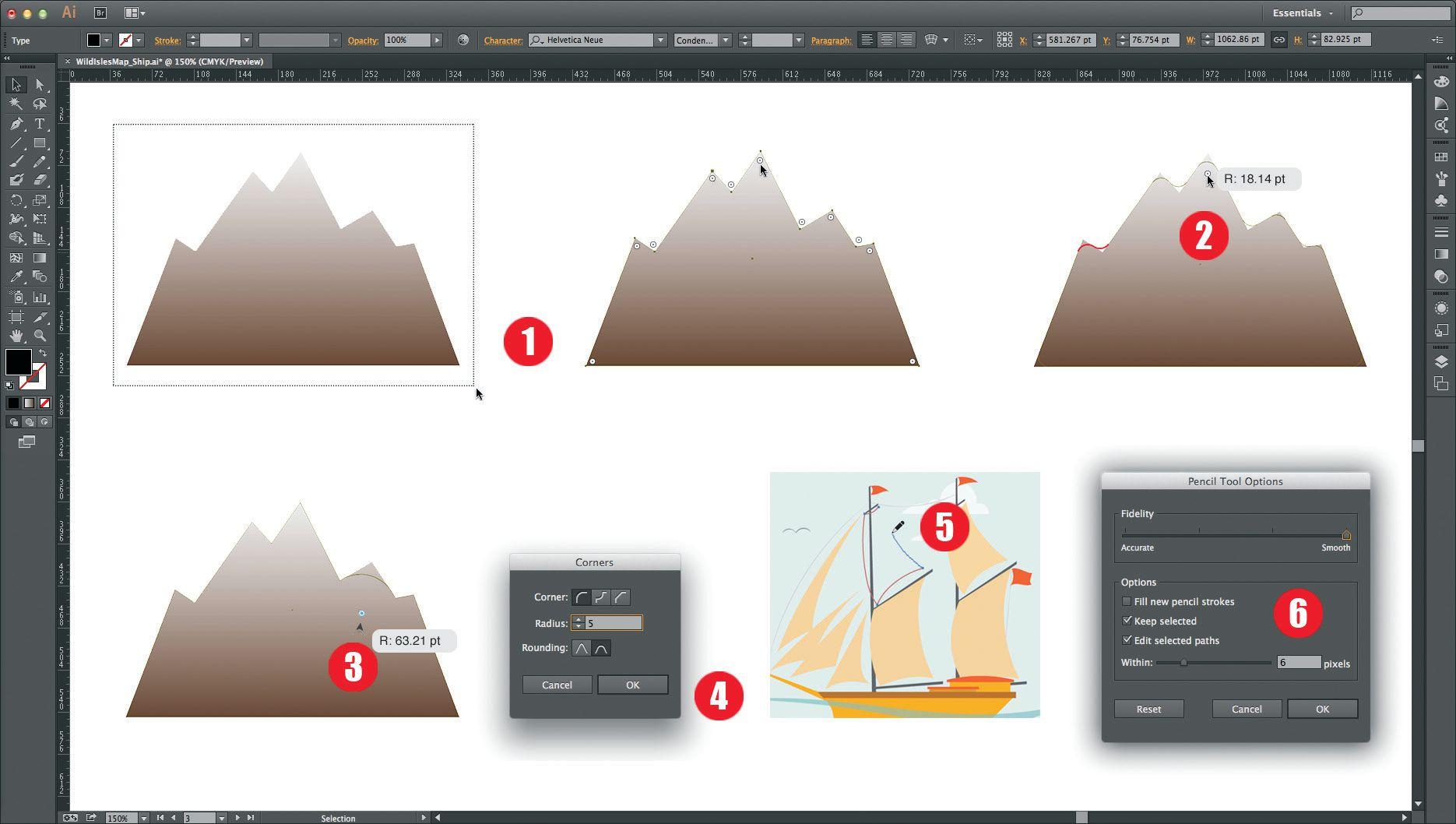
Apparently, Adobe can teach an old vector editor a few new tricks! According to Adobe, the latest Illustrator brings new features derived from user feedback and requests. The new Live Corners feature enables designers to significantly alter corners of both paths and closed shapes either by adjusting a Live Corners widget or entering values into the Corners dia-
When selecting a corner point with the direct selection tool in Illustrator CC, users now see what looks like a small radio button just below the selected corner. This is the Live Corners widget and when dragged away from the corner adds curvature to the angle. Users can also click and drag over a range of corners or an entire closed shape, click any of the Live Corner widgets and apply curvature to all the selected corners at once.
q Using the selection tool, select a shape or path and apply curvature to all points simultaneously.
w When dragging the Live Corners widget, the radius of the new corner curve is displayed. The red line indicates the maximum curve radius for the shape has been reached.
e By selecting a single point, users can drag and curve just one corner of the shape.
r Shapes and the radius value can be entered in the Corners dialogue.
t The new Pencil tool draws accurate lines, or automatically smooths while creating the path.
y The Pencil Tool Options dialogue offers relatively few parameters to change.
Double-clicking any of the widgets brings up the Corner dialogue where specific corner treatments, rounding styles and radius settings can be entered. The new Live Corner tool works so intuitively and effortlessly that any level Illustrator buff should be able to master it in minutes.
Adobe introduces a completely re-vamped Pencil Tool in the latest Illustrator CC that enables freehand sketchers to draw better paths with smooth curves and straight lines using either mouse, track-pad or drawing tablet. First of all, let me say that I’m no artist, but after adjusting the Pencil Tool Options I was able to use a Wacom tablet and stylus to draw smooth two-point curves and trace relatively complex shapes. There are not many settings in the Pencil Tool Options dialogue: Users can adjust a slider to make the Pencil more accurate to the path drawn or smoothed by Illustrator’s graphics engine – that’s it.
The Pencil Tool, however, does allow the user to intuitively continue paths by hovering over an endpoint before drawing, or closing a path by drawing near the starting point, then releasing the mouse button. The new Path Segment Reshape tool enables users to easily reshape any path without selecting it first or
logue box.
RyeTAGA Wins Helmut Kipphan Cup
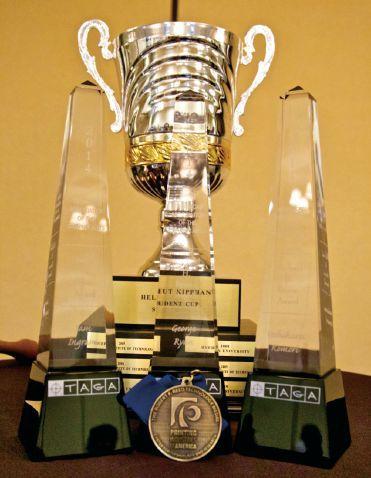
Agroup of 12 industrious students from Ryerson University’s Graphic Communications Management program in Toronto, operating under their RyeTAGA banner, won the coveted Helmut Kipphan Cup at the 66th-annual Technical Association of the Graphic Arts (TAGA) conference held late March in Fort Worth, Texas.
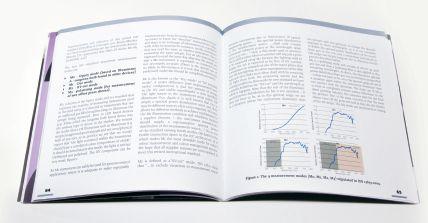
Word of RyeTAGA’s win came on March 25 after its 100 percent self-produced – written, designed and printed – research journal was scrutinized over three days by a group of 12 independent judges, comprised of industry veterans who serve on TAGA’s board.
Post-secondary printing programs from across North America, as part of the TAGA Student Chapter initiative established in 1985, compete in this annual journal competition – one of the world’s most robust such printing competitions. The Kipphan Cup is ultimately awarded to the student research publication excelling in technical content, print quality and design. The Cup is now displayed in the lobby of Ryerson’s School of Graphic Communications Management building in downtown Toronto.
RyeTAGA’s Co-Presidents, Alyssa Szeto and Mark Brejnik, began to organize the group, ultimately including an eight-member executive team and a handful of supportive Graphic Communications Management (GCM) students referred to as General Members, back in September 2013. “Each year we are more and more impressed with the number of students who are interested in getting experience with the production of the journal,” says Brejnik, who has been involved with the RyeTAGA program for the past four school years.
Dr. Martin Habekost, professor and Associate Chair of the GCM program, served as Faculty Advisor for the Toronto students’ Quest for the Cup. After graduating from the University of Hannover, Germany, in 1995 with a doctorate in Analytical Chemistry, Habekost spent a decade in the research and development
of ink technology before joining GCM in 2005. He has worked with Ryerson’s TAGA student chapter since 2006.
The win in Texas marks the third time in six years that RyeTAGA has been awarded the Kipphan Cup, having also won it in 2010 and 2008. In this time, RyeTAGA journals have also earned Best Journal Design, Best Production, and Best Overall Quality awards. “The greatest thing about RyeTAGA’s achievements this year is the resilience of the executive team,” says Alyssa Szeto. “It was a difficult path from point A to B, with the unfortunate circumstances of machine failure and pushed back schedules. But in the end, the whole team came together to work towards a common goal to bring home the Cup.”
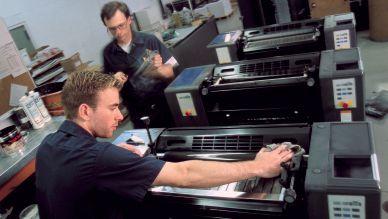
During Ryerson’s winter Study Week in late-February, the RyeTAGA team converged in the basement of GCM’s dedicated Heidelberg Centre building. The journal was imposed, proofed, printed and finished over a string of student vacation days. TAGA added a new category to the competition this year, based on how much of the journal was created in-house.
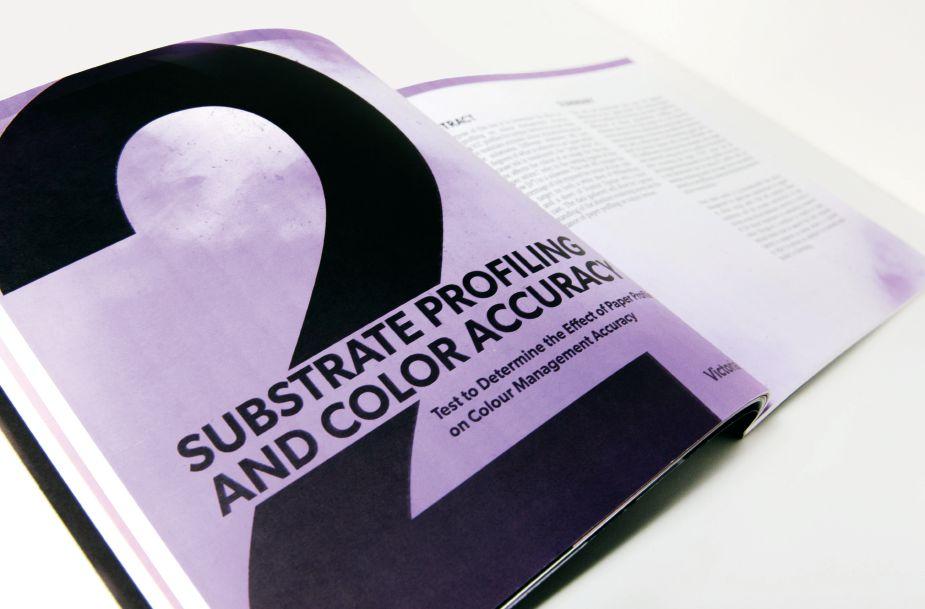
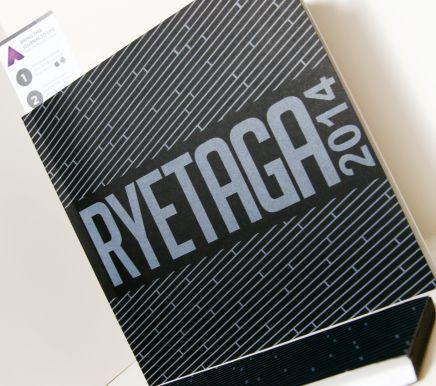
“Our focus this year was to use as many pieces of equipment that we had access to at Ryerson,” says Brejnik. “What stood out most was the combination of our digitally printed content pages which were then offset printed with seven different metallic ink bars and folios throughout.” The inside pages of the 2014 RyeTAGA journal were printed with a Xerox 700. A Heidelberg Quickmaster 46 was used to apply metallic inks on the top of each page and the cover was printed on a Heidelberg Printmaster 74, before the project was perfect bound on a Muller Martini Amigo.
“We also wanted to add a cross-media aspect to the journal,” explains Brejnik. “To do this, we used Augmented Reality to display our production video on the front cover of the journal. We also included interviews with each of the six authors, which are triggered by the title pages of their papers.”
The 12 GCM students who travelled to Texas for the conference included the eight RyeTAGA executives and four General Members. One of the General Members, Emily Wong, was also at TAGA to present her paper on G7 calibration methodology, co-authored by Lisa Carley, after the two students were named Harvey Levenson Award Recipients.
PrintAction asked members of RyeTAGA’s team to share their experiences of producing the award-winning journal and attending the Texas conference. Dr. Martin Habekost, in the article Print Is Alive, (beginning opposite page) shares his perspective on TAGA’s traditional four opening keynotes.
– Jon Robinson
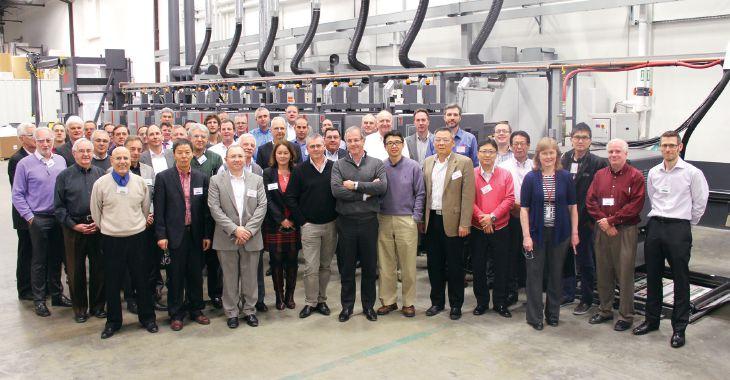
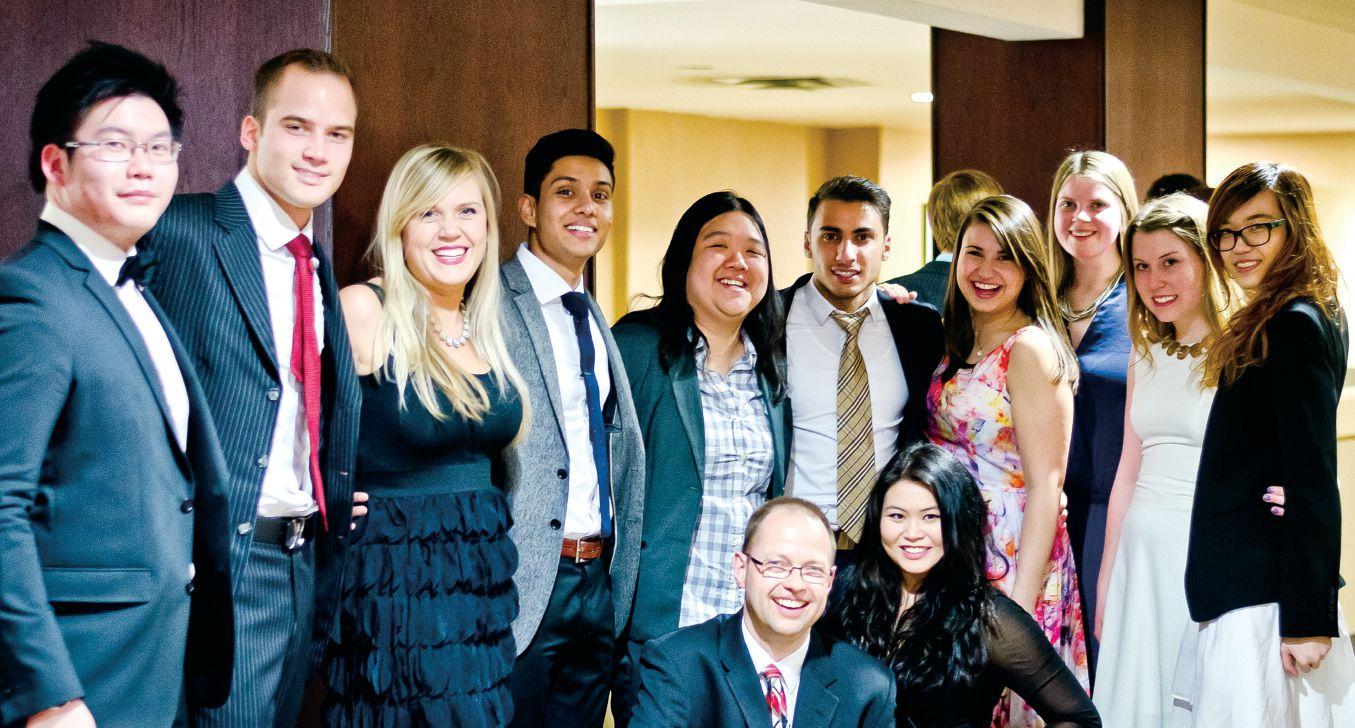
RyeTAGA’s Texan contingent includes (Main row, left to right): TakPo Chu, Mark Brejnik, Stephanie Murray, AFM Rupal, Alyssa Szeto, Faris-Abu Kwiek, Ellie Voutsinas, Alina Gula, Traci Philips and Erin Luu. Kneeling: Dr. Martin Habekost and Anjelica Tizon (Absent: Emily Wong).
TAGA Conference
TAGA’s 66th annual Technical Conference in Fort Worth, Texas, was a huge hit and success for RyeTAGA. Ryerson’s student chapter of the Technical Association of the Graphic Arts traveled to Texas this March to compete against six other schools with their student-produced technical journal. The journal was judged on production quality, technical writing, publication design, electronic publication, and student involvement and all of RyeTAGA’s hard work earned us the greatest honour: The Helmut Kipphan Cup, beating California Polytechnic State University by a slim margin.
At the conference, Ryerson students sat in on keynotes from Daniel Dejan, Sappi Fine Paper, and Ian Hole, Esko, as well as sessions on scientific and technical innovations produced by TAGA’s industry members. There were opportunities to learn and network, and also to have a little fun.
Fort Worth is one of two locations where U.S. currency is printed, and a plant tour was offered to all conference attendees. Fort Worth is also home to Billy Bob’s, the World’s Largest Honky Tonk, where all 12 students took in a cattle drive, a bull-riding exhibition, two-stepping and fried chicken.
There were no shortages of laughs, achievements, and good food in Fort Worth, and RyeTAGA is looking forward to next year’s conference in Albuquerque, New Mexico.
– Stephanie Murray, Finance Director
Technical Association of the Graphic Arts
The Technical Association of the Graphic Arts (TAGA) is an organization founded in 1948 in Chicago, Illinois. First known as the Technical Association of the Lithographic Industry (TALI), the organization was re-branded as TAGA in 1951. The organization works with student chapters around the world to publish research about the graphic arts industry.
TAGA concentrates on the discussion of topics such as software, computer technology and systems for the graphic arts. The traditional ideals of press operation, ink and paper properties are studied and discussed.
Student chapters started in 1985 and today there are 15 such chapters around the globe.
Source: Wikipedia
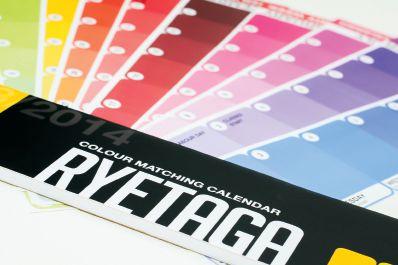
Marketing and Fundraising RyeTAGA was very successful with marketing its brand through social media networks, such as Facebook (facebook.com/RyeTAGA), Instagram and Twitter (@ryetaga) and various social events. Our goal was to rebrand our logo and initiatives to help support our journal production, as it was a huge success in the previous year. The swatch-book calendars were recreated and produced to sell to the student body, as well as to industry. In addition, RyeTAGA introduced desk pad calendars that were very popular amongst the students at Ryerson University.
This year’s fundraising efforts included events such as a Back to School Pub Night, Graffiti Night and Student Choice Awards. Many of our pub nights were thanks to the community’s generosity in providing venues to host our events. RyeTAGA also hosted its second fashion show this winter, one of the
largest fundraisers of the school year, at the Virgin Mobile Mod Club. This year’s fashion show garnered sponsors from prominent local businesses and corporations, including generous donations from Revlon Canada, Stars for Men and Motives Cosmetics. This year’s success can be attributed to the talented students who lent us their time and skills to make our events possible.
– Alina Gula, Fundraising Director, and AFM Rupal, Marketing Director
Bureau of Engraving Plant Tour
On the second last day of our trip in Fort Worth, Texas, we were given the opportunity to take a tour through the Bureau of Engraving and Printing. The tour began with a short video explaining the steps the plant goes through in order to produce the high-quality and high-security currency. We were able to see the presses used in the process of printing U.S. currency from a suspended walkway, through the plant. Afterwards students were able to explore the Visitor Center and the Moneyfactory Gift Shop – some of us purchased press sheets of bills!
– Traci Phillips, General Member
RyeTAGA Sponsors
The following organizations played a large part in the success of RyeTAGA and we are continuously grateful to them:
P-FACS
Ryerson Communication and Design Society
Spicers
Wikoff
IAPHC Toronto
Craftsmen Club
Graphics Canada
School of Graphic Communications Management
Faculty of Communication and Design
Cascades
RP Graphics
Williamson Print Materials
Our sponsors provide us with financial support as well as production capabilities. If your company is interested in getting involved or learning more, please contact us through www.RyeTAGA.com.
– Mark Brejnik and Alyssa Szeto, Co-Presidents
TAGA Shows Print is Alive
By Dr. Martin Habekost
Like many of the 65 annual conferences before it, this year’s technical conference of Technical Association of the Graphic Arts (TAGA) began with four keynote presentations to set the tone for the entire four-day event in Texas.
This year’s high-profile industry speakers illustrated why traditional print is definitely not dead, including two separate reports indicating that only one percent of all worldwide printed pieces are produced with digital presses. The vast majority of world’s print is manufactured with what many of us today refer to as traditional printing technologies like offset and flexography.
Four days of TAGA, a conference built for the research and discussion of advanced printing technologies, proved these traditional machines are still producing innovative products. All four of the opening keynote speakers provided examples of the possibilities for a healthy future in print.
Print power in a digital world
The keynote by Daniel Dejan, North American ETC Print and Creative Manager for Sappi Fine Paper, focused on research indicating how information is better retained by humans when reading it from a printed piece and not a computer screen. Dejan described many of the special treatments that can be done with modern offset presses to enhance the quality of the printed piece, such as raised enhancements or textured UV coatings. He referred to Heidelberg’s print enhancement gallery, which I wrote about in my drupa 2012 report (PrintAction, June 2012).
Even for young people in the age groups of 12 to 17 and 18 to 24, the printed media is still preferred.
Dejan describes the paper industry as the barometer of the print industry. If the paper industry is doing well, or sees an improvement in the economic outlook, the print industry often sees a corresponding improvement.
During his TAGA keynote, Dejan states that even for young people in the age groups of 12 to 17 and 18 to 24 the printed media is still preferred, because it has more permanence than any other media and because the people in these age groups are starting to realize that in the online world there are no checks and balances. A printed piece went through many hands and has been checked multiple times before it is printed and sent to customers.
One of the interesting statements from Dejan is that 65 percent of social media companies used print to start up their business, but after their initial success went back to online only. The salient point is how print was used as leverage to bring new companies respectability and ultimately growth. In other words, print at the end of the day is trusted more than online communications.
Dejan then turned his attention toward magazine publishing. There are more titles than ever available, he explained, but their volumes are lower than what they were previously. The biggest challenge to magazine publishers is to cater to the shorter attention spans of people, who everyday are bombarded with 3,500 marketing messages. From this mass of messages, Dejan reports we acknowledge 60 and remember but three.
Journal Production
The 2014 RyeTAGA student journal was constructed completely in house, utilizing almost all of the equipment available at the School of Graphic Communications Management. The inside pages were printed on Enviro 100 Satin Text substrate, which was 100 percent recycled, while the cover is a Classic Crest – two-colour stock. The inks used for this production include Hostmann-Steinberg process colours, Colmar Matte Varnish and Wikoff metallic inks. The inside pages were printed using a Xerox 700.
To add intriguing features of visual design, a metallic bar was printed on the top of each page using a Heidelberg Quickmaster 46. Each chapter was represented by a different metallic colour. The cover stock is printed with a Heidelberg Printmaster 74, using a matte varnish, opaque white, and a pearlescent metallic white. The pages of the journal were hand folded due to unforeseen events, and trimmed on a Polar 78 cutter. The slip that holds the journal was hand scored and assembled. The journal was finally perfect-bound on a Muller Martini Amigo and trimmed one last time to the appropriate size.
– TakPo Chu, Editorial and Production Director
Augmented Reality
This year an extra feature added to the journal was the element of Augmented Reality. A small team of students worked rigorously to create various short videos that were used both in the journal as well as for promotional purposes to advertise for RyeTAGA. The majority of the footage was filmed during the winter reading week to show all of the production, binding and finishing requirements that took part in making the journal. Other videos in the journal include interviews with the authors of the research papers and a full description of the production process. Augmented Reality was achieved by using the Aurasma app, available for iPhones, iPads and high-powered Android devices.
– Ellie Voutsinas,
General Member
Continued from previous page
Print is a key component of a successful integrated campaign, because of the high retention of information when it is read with ink on paper. Print promotes comprehension of the information retention in comparison to reading on screen, for which people have a more superficial reading style.
Print is an important tool to establish brand loyalty. Brand loyalty actually doubles if the brand can be experienced with several senses. Dejan reports that over 69 percent of 18 to 24 year olds prefer print and paper communication to readying off a screen. The biggest returns in a marketing campaign occur when print and online components are synchronized into a single marketing campaign. About 84 percent of catalogue recipients feel it is easier to shop online with a catalogue in hand.
To sum up Dejan’s keynote into a single sentence: Printing is alive but the business environment has changed and, therefore, the industry needs to adapt and change and make every product more unique than ever. Print is still a vital part in many peoples lives and will remain that way.
Packaging and brand management
The next keynote was by Ian Hole, Vice President of Marketing at Esko. His keynote focused on the impli-
cations of packaging in an economic, socio-cultural and a science and technological sense. One of his bold statements was that the world is moving into localization. This means that global brands have to adapt to local markets to be more successful. In other words, it is sometimes more important to localize the packaging and sacrifice the brand name on the package, because people recognize the unique shape or colour of the brand. Hole showed multiple examples from Coca-Cola, Absolut Vodka and Nutella with localized versions of the global brand.
All this can be done through targeted marketing by global brands but with the use of local execution. The automation of workflow and online editing through 24/7 Web-enabled IT platforms makes this all possible. This turns chaos into structure. Cloud-based asset brand management with prepress automation will be the key to this future localization. Hole explains there are five key elements needed to do this.
These five elements are: Workflow automation, meaning total automation;
prepress editing;
quality (always); doing it on the Web; and leveraging IT as enabler for all of the above. Recently introduced software solutions from Esko allow for a 3D preview of not only the product, but also of a product on a virtual store shelf. Automation of the prepress process and the automation of the flexo plate making process will
smart
Mark Brejnik (left), Co-President of RyeTAGA’s 2014 initiative, and TakPo Chu, Editorial and Production Director, describe features of their research journal, loaded with metallic inks and Augmented Reality triggers, to one of the competition’s veteran judges.
The inside pages of RyeTAGA’s journal were produced on a Xerox 700, while its cover (with pearlescent metallic white, ran on a Heidelberg PM 74.
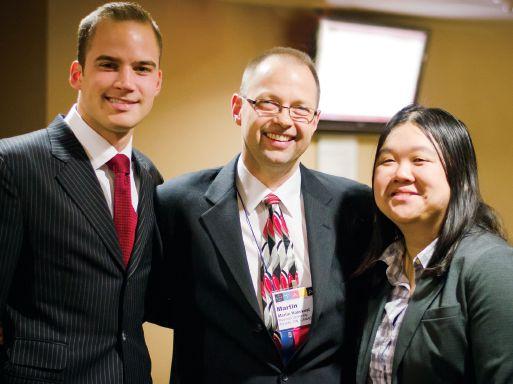
Habekost (middle) with RyeTAGA Co-Presidents Mark Brejnik and Alyssa Szeto.
PAST & PRESENTFUTURE
Manufacturers and distributors describe their most-impactful sheetfed-offset technologies
PrintAction magazine contacted leading suppliers involved with the manufacturing or distribution of sheetfed-offset presses, as well as consumable suppliers for the sector, to better understand how technology is shaping the direction of this resilient production process.
We asked a leader from each company the same three questions (right) to describe the past, present and future of the sector, ultimately covering a decade of innovation in the printing industry.
– Jon Robinson
Heidelberg Canada
InPress Control
Ray Fagan, Heidelberg Canada’s Product Manager for Sheetfed & Digital, points to InPress Control as a highly productive tool for customers. First introduced at drupa 2008, Inpress Control is mounted inside the press to measure colour, using spectrophotometry, and register during both start-up and the press run.
“Over 80 percent of our sheetfed presses are now equipped with Inpress Control, proof that valuable savings can be realized,” says Fagan. “It has been a key driver in press purchase decisions for customers looking at the latest technology to reduce manufacturing costs.”
XL 75 Anicolor
Heidelberg released its XL 75 Anicolor technology at drupa 2012, after the flexo/offset printing concept was originally developed for its smaller SM 52 platform. In March 2014, Heidelberg commercially released the 29-inch Speedmaster XL 75 Anicolor in North America. Heidelberg states the press is capable of producing up to 12 jobs per hour of 300 sheets, with as little 10 sheets of waste per job.
“The zone-less inking system is the key to production,” says Fagan. “A confirmed ROI calculator constructed by PIA shows XL 75 Anicolor to be more cost effective than digital solutions at as little as 300 sheets.” Fagan explains how this job-change flexability is combined with traditional XL 75 attributes to reach speeds of up to 15,000 sheets per hour, while handling medias from lightweight stocks up to .032-point carton.
Heidelberg/Fujifilm inkjet press development
Fagan makes note of Heidelberg Canada’s current toner-press distribution partnership with Ricoh, but ultimately points to inkjet press development in relation to the future for sheetfed printers.
“We are partnering with Fuji to develop class-leading products using the best technologies,” says Fagan. He explains how Heidelberg’s knowledge in paper handling and duplexing can be integrated into an upcoming inkjet press platform – presumably with target dates for drupa 2016.
“These goals are considered near term-projects meaning that they will come to reality in an accelerated fashion.”
Past: What do you consider as your company’s most-important sheetfed-offset technology over the past five years?
Present: What sheetfed-offset technology recently released by your company (within the past 12 months) can have the most immediate impact on today’s commercial printing company?
Future: What printing technology or process will most drastically effect the direction of sheetfed-offset commercial printing companies within the next five years?
Sun Chemical Canada
GFI Mx12 Ink Dispenser Program
Sun Chemical in 2010 began its unique dispenser program, based on technology from GFI Innovations, for printers to mix ink in-house. The program provides access to more than 100,000 colours in Sun’s Global Shade Library.
“The problem for commercial printers today is that they have way too much inventory in their ink room,” says Steve Marshall of Sun Chemical Canada. “The other big part is savings from the actual cost of the inks.” He notes printers must commit to around $100,000 in annual ink purchases to qualify for the dispenser program, but that audits indicate savings come in at around 35 percent on average.
SunInspire specialty coatings
For printers willing to experiment with equipment configurations, SunInspire specialty coatings add value and product differentiation. “Sheetfed presses are now coming with coaters at the beginning, coaters in the middle, multi coaters at the end,” says Derrick Hemmings of Sun. “So they can do a multitude of different effects, reticulated, embossed, all of these different things to make their products stand out.”
The SunInspire series includes thermochromic coatings for printing hidden messages in promotional items; photochromic coatings for colours to appear when exposed to UV light; and textured coatings called Reticulating, Embossing, Sany Feel and Soft Touch. A partnership with ScentSational Technologies provides water-based coatings for printing microencapsulated scents.
SunLit Triumph Max
Scheduled for a Spring 2014 launch, SunLit Triumph Max inks are designed for production with reduced ink film-weight or increased print density. “It is a compiled effort from our European and North American research and development,” says Sun’s Blake Greenwood. “[Triumph Max] is a versatile set of products designed for high-speed and high-quality printing.”
The ink is formulated to provide wide water (fount) tolerance, fast setting, and quick to colour at start-up, and low to no mist at high print speeds. The ISO 2846:1 colour compliant inks are low VOC (less than two percent), mineral oil free, cobalt free, as well as Swiss Ordinance and Nestle compliant.
manroland Sheetfed Canada
manroland Direct Drive
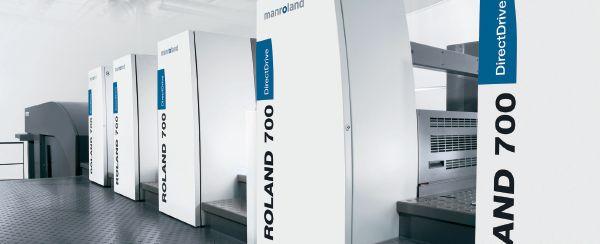
Sean Springett, Canadian Sales Manager for manroland Sheetfed points to Direct Drive (introduced at drupa 2004) to reduce make-ready by up to 60 percent. Direct Drive provides simultaneous function for loading ink profiles, ink train wash-up, blanket cylinder wash-up, impression cylinder wash-up, plate change and coating form change. “A focal advantage with manroland’s Direct Drive is the ability to correct print length on-the-fly,” says Springett. “This exclusive feature begins by having the plate cylinder driven by a separate servo-motor effectively allowing print length correction, while in production, at full operational speed.”
InlineColorPilot with Inline Register
Springett points to InlineColorPilot to detect and correct colour variations on press. A key feature of InlineColorPilot, Inline Register is a colour bar that includes register marks for the control of circumferential, lateral and diagonal register.
“The uniqueness of manroland’s system is its accuracy and speed providing up to seven colours read simultaneously and within a staggering three sheets for a full measurement,” says Springett. “This type of measurement capability ensures a printer is minimizing their start-up waste and balancing the press performance.”
KBA North America
QualiTronic Inline Color Control
“The KBA QualiTronic inline color control console is, without a doubt, the most important sheetfed technology feature for our company over the last five years,” says Chris Travis, KBA Director of Technology. First launched at drupa 2008, the QualiTronic measuring system, explains Travis, scans each sheet and measures densities on each sheet at maximum production speed and compares it to target densities and then makes the necessary adjustments to all ink fountains. This significantly reduces start-up waste and helps to provide minimum variation of colour on the printed product.
DriveTronic Sensoric Infeed System
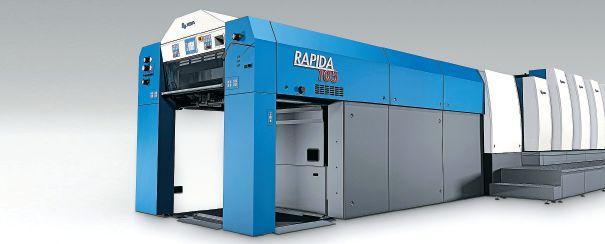
Travis points to KBA’s Sensoric Infeed System (SIS), which, as of this year, is now standard on all KBA Rapida 106 presses. “These 41-inch presses are now able to run at a blazing fast speed of 20,000 sheets per hour – significantly in part due to the SIS,” he says.
A DriveTronic SIS sensor determines the lateral position of the sheet on the feeder board, explains Travis. As the sheet approaches the transfer point to the first printing unit, the gripper on the transfer drum aligns the sheet with the side position specified at the console. “Another feature is Flying Job Change that allows instant job switching within a few seconds.”
K-NORTH SERVICES, Komori Press Distributor
H-UV curing system
Steve Ranson, President of K-North Services, explains Komori H-UV has been a technology readily embraced by printers. “The H-UV curing system allows printers with the use on just one low-energy UV bulb to print and dry both inks and coatings inline on their press,” he explains. “This allows printers to offer both special effects and coatings that previously could only be done on UV presses, as well as a completely dried product being delivered every time on every job. It also allows for printing on offset stock with a vibrant effect and punchy colour.”
GLX-40
“The next 12 months will be a very exciting time for Komori with the release of the all new Komori GLX-40,” says Ranson. “It will be released for the first time in May in Japan and will be the benchmark machines will be measured by in the future.”
The 29 x 41-inch format press is rated to run at 18,000 sheets per hour. Ranson points to some of the GLX-40’s technologies like I-Plate A-APC plate changers, PQA-S in-press sheet defect and colour correction, and a new KHS-AI press console.
Inkjet press technology
“The shifting relative costs of offset versus digital will remain interesting for some time and a driving force towards new technologies in sheetfed offset, with the anticipation of Nanography and B1 format, as well as B2 format inkjet presses or, as we call them, half-size 29,” says Springett. “The future trends in sheetfed offset presses will be to continue technological developments in make-ready reduction and continued partnerships for digital implementations to traditional offset presses.”
LED-UV curing
Travis describes LED-UV curing as the most-exciting emerging technology for sheetfed commercial and packaging printers: “It is a ground-breaking process that will be heavily used in the future. Currently, we are the only large-format press manufacturer that can offer LED-ready hybrid presses with both traditional UV and LED-UV.”
KBA offers LED-UV-ready dryers that are preconfigured for the future addition of LED-UV modules, allowing customers to switch between traditional UV and LED-UV. “The light-emitting diodes can be actuated according to the print format,” he explains.
IS-29 Nanographic technology
Ranson points to Landa’s Nanographic technology first introduced at drupa 2012. In November 2013, Landa announced Komori would provide all sheetfed platforms for the inkjet presses, while Komori-branded IS-29 web and sheetfed presses will use Landa NanoInk Colorants.
“Nanography is currently in its infancy stage, but it is marked for release in the near future and Komori is poised as a leading partner with Landa to supply possibly the greatest breakthrough in printing since offset took over from letterpress,” says Ranson.
27% reduc TI on I n m A kere A dy TI me
27% reduc TI on I n TI me To co Lour on P re SS
Proven P LAT e Per F orm A nce.
Fujifilm’s market leading LH-PJ plate delivers exceptional high quality, consistency and proven value to your business. It was the focus of a recent white paper from noted industry writer John Zarwan who interviewed 25 printers who switched to Fujifilm plates. In the printer’s own words, they highlight the positive impact switching to Fujifilm had in makeready time, makeready waste, reduction in time to colour, run length durability, run waste on restart, and savings in labour, ink, water and fountain solution use.
Fujifilm can deliver proven performance for your business, download John Zarwan’s latest White Paper “Plates in the Pressroom: The Fujifilm Advantage” at www.fujifilm.ca/zarwanpdf to learn for yourself how much of a difference it can make for you.
We Can Help.
Fujifilm is a direct-from-the-manufacturer supplier of Graphic Arts solutions in canada. We stock over 1,000,000 printing plates in canada. We offer local sales and technical service with personnel who live and work in your community across canada. our products are backed by canada’s largest technical support team.
Speak to us at 1-800-263-5018, gsmarketing@fujifilm.com or visit us at www.fujifilm.ca/graphics
32% reduc TI on I n mA kere A dy WAST e
LOOK AGAIN
CPIA delivers unprecedented value to PRINT Executives and Leaders across Canada. The CPIA has listened to its members and the industry in renewing its mandate to support and actively promote Print as a versatile, effective and powerful means of marketing and communication. Join CPIA today in support of the value of PRINT and our FOCUS to purge misconceptions associated with our Industry.
GOVERNMENT AFFAIRS
PRINT ADVOCACY
HUMAN RESOURCE MANAGEMENT
CPIA members are collectively engaged in legitimate and meaningful lobbying efforts with the Federal Government for the benefit and advancement of PRINT. Together, we are the voice of the INDUSTRY!
As a member, you will benefit from the expertise and services of Two Sides, a globally recognized non-profit organization that specializes in promoting the sustainability of print and paper CPIA and Two Sides in partnership, provide verifiable information that supports print on paper as an attractive, economical and sustainable communications medium. We support effective campaigns to challenge and remove “anti-paper” greenwashing claims that damage demand for responsibly manufactured printed products.
Included in your membership, CPIA’s Human Resource Toolkit is a must for today’s print executive Loaded with the most significant and relevant functional management strategies and highly adaptable templates, it is one of CPIA’s greatest values of membership The Toolkit is your guide to better managing employees – as authored by the Canadian Printing Industries Sector Council.
RISKS
Members receive confidential weekly DEROGATORY EVENT reporting on up to 30 of their selected customers. Credit Reporting, Risk Assessment Score, and effective Collection Services are available to all members at CPIA partner rates
CPIA members enjoy the privileges of a Premium-Level Membership with WhatTheyThink.com. Your password-protected access allows you and your assigned employees comprehensive printing industry news and market intelligence – updated on a daily basis. CPIA members are provided with key industry performance data on a regular basis
Ipex 2014
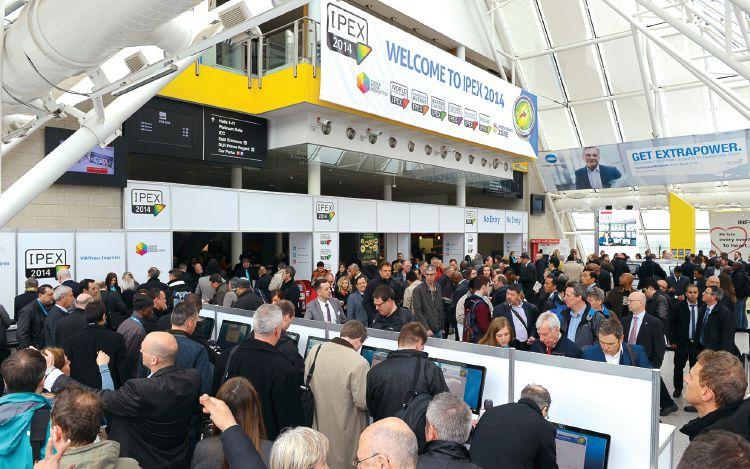
At the International Printing Equipment Exhibition (Ipex) 2014, held late March in London, England, more than 3,500 exhibitors presented their newest technologies to more than 22,000 attendees, including 46 percent of people who came from outside the United Kingdom.
Watkiss PowerSquare 224 / BookMaster Pro 30
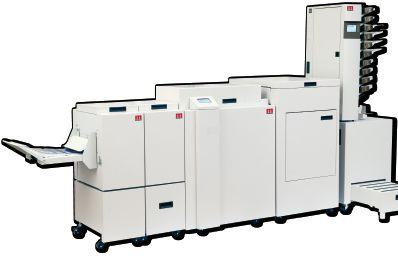
Watkiss, a UK manufacturer of finishing equipment, launched its new PowerSquare 224 booklet-making system, designed to produce stitched square-back books of up to 224 pages thick. The machine features a new auto-adjustment system for uninterrupted running when streaming jobs. It can be fitted with OCR for variable content documents with different page counts.
Watkiss also showed its new BookMaster Pro 30 booklet maker which produces booklets up to 120 pages. It features a new Android-based touchscreen interface and an increased stapling capacity. Options for the BookMaster Pro 30 include a face-trimmer and a Watkiss SpineMaster to convert the booklets to square-back books. The company also showcased its new CuceA3 entry-level booklet maker, which processes sheets from A5 to A3+ with standard or loop staples into booklets or edge-stapled sets.
Technologies Featured
• Accura EDocBuilder
• Alwan McDowell Suite
• CHILI Publisher 4.0
• Colter & Peterson Microcut COLOR WS/Microtrack II
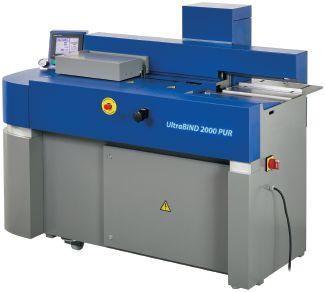
• Duplo UltraBIND 2000 PUR
• EIS Blanket Renewal Program
• Fujifilm Uvijet KV
• Konica Minolta KM1
• MB Bäuerle prestigeFOLD NET 52
• MGI DP8700 XL+
Fujifilm Uvijet KV
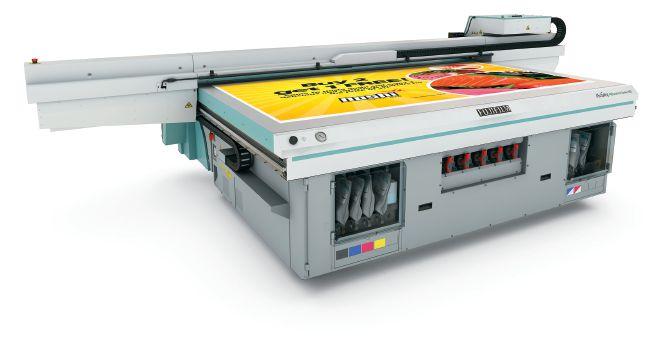
Fujifilm’s new Uvijet KV, which has been released in the UK, but not yet in North America, is a thermoforming UV-cured inkjet ink specifically designed for use with the company’s mid-range flatbed inkjet systems, such as the Acuity Advance Select. The new CMYK ink set, which is manufactured at Fujifilm’s Broadstairs facility in the UK, is noted for its ability to heat and cool without cracking or flaking. The thermoforming ink is applied to flat plastic sheeting, which is then removed and placed in a mould that is heated up so the ink takes the shape of the mould before being cooled. It has elongation properties of 300 to 400 percent when heated, before returning to its normal state once cooled. Fujifilm also highlighted its J Press 720 B2-size sheetfed press, J Press 540W web press, and the new Graphium label press.
• Morgana Digifold Pro-500/ Autocreaser Pro-500
• OKI ES9541
• Profold Linx Pro+ tabbing machine
• Scodix Ultra
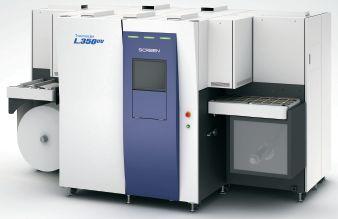
• Screen Truepress Jet L350UV
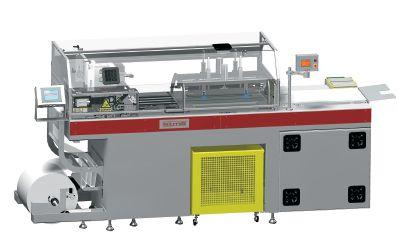
• Sitma WM10/WM30
• Taopix Online
• Ultimate Technographics Impostrip
• Zünd S3 with sheet feeder
CHILI Publisher 4.0
CHILI Publish introduced its Publisher 4.0 software with new functionality for online editing, which moves beyond its traditional commercial printing use into sectors like packaging, toner printing, and signage and display. CHILI Publisher 4.0 supports a range of environments like Flash and HTML5. Publisher 4.0’s 3D visualization tool allows users to present personalized documents in 3D environments, such as a personalized sign visualized on a street-level bus stop shelter. CHILI Publish technology can be integrated with software like Agfa Apogee Storefront, DirectSmile, ePrint Skyline, Enfocus, Esko Switch, WebCenter, Tharstern e4print Pro, and North Plains.
Fujifilm’s new Uvijet KV thermoforming inks are used on the company’s Acuity Advance Select systems.
Watkiss PowerSquare 224
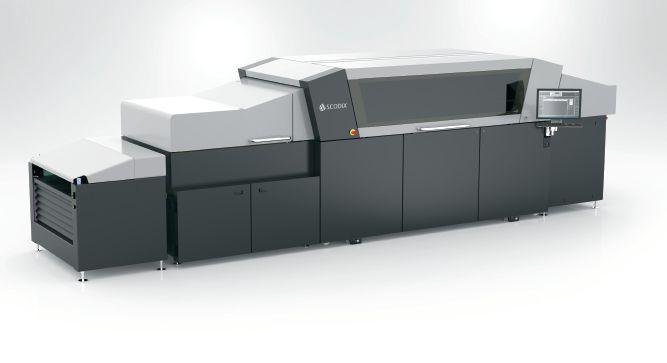
Scodix Ultra
Scodix launched its Ultra Digital Enhancement Press (UDE) at Ipex 2014, which is capable of producing 1,250 B2+ (21.5 x 31.0 inches) size sheets per hour. The UDE press is based on SENSE technology, which includes: Scodix RSP for positioning and registration; Scodix High Impact; Scodix 99 GU for the application of gloss; and Scodix Variable Density, which accounts for different polymer thicknesses. The Scodix UDE supports applications including stationery, business cards, book covers, premium packaging, marketing and promotional tools, greeting cards, and photo albums.
Profold Linx Pro+ tabbing machine
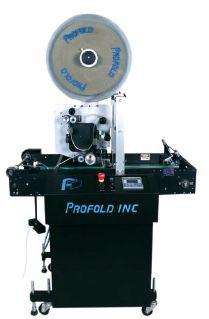
Profold, a Florida-based systems integrator of mail- and card-finishing equipment, exhibited its new generation Linx Pro+ Tabber. The company explains this new technology is well suited for sorting unwrapped magazines for the postal system. It uses a single 19-inch spool, with web threading, and a patented twist-belt sealing assembly. The machine can place one to four tabs in a single pass, applying a single tab to products at speeds of up to 30,000 per hour. With an optional 4.5-inch label kit, the Linx Pro+ can apply Post-it Notes.
EIS Blanket Renewal Program
Enviro Image Solutions of Vancouver showcased its industry-unique Blanket Renewal Program (BRP), which was established to refurbish spent press blankets primarily used within a UV curing process. UV curing relies on aggressive chemicals that greatly increase the need to replace damaged blankets. EIS states there is a common misperception across the printing world that blankets are a one-time use item. The company explains BRP can help printers save up to a 60 percent of their annual blanket costs, while diverting thousands of tons of blanket waste from landfills. EIS currently works with Chesapeake, one of the U.K. largest and best known printing operations, but wanted to expand its overseas reach.
Taopix Online
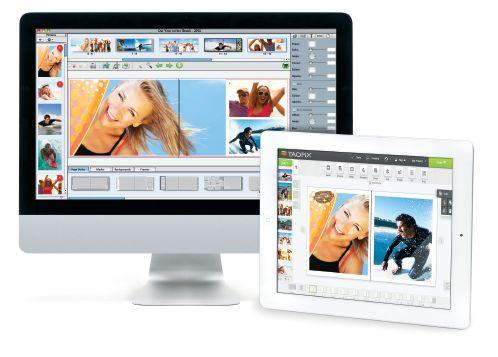
Taopix highlighted its new HTML5-based online design tool for photobook and photo gifts, which is driven through the company’s new Taopix Online entity. The move to HTML5 includes a new user interface, which works well across a range of devices, including iPad and Android. The update includes a new tool bar called the S.T.U. bar, which stands for the Simple To Use tool bar. It appears prominently within the designer, presenting the user with a small selection of features, represented by icons. The features dynamically change according to where they are in the designer and what the user is currently focusing on. In addition to the new user interface, Taopix Online provides flight check and a shopping-cart e-commerce platform.
MGI DP8700 XL+
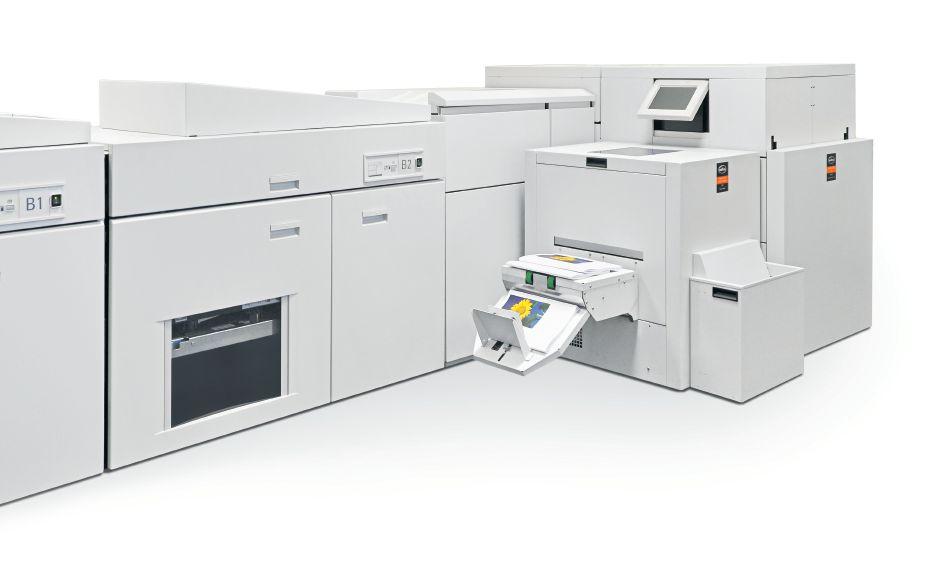
MGI showcased its fifth generation Meteor press series with model DP8700 XL+, scheduled for a 2014 third-quarter launch. It is rated for speeds of up to 4,260 A4-size sheets per hour. Capable of printing up to 1,200 mm (47 inches) long in format size, the Meteor DP8700 XL+ allows for the creation of up to 5.7 A4-size jobs on one single sheet. This press can print on material thicknesses ranging up to 400 GSM and 450 microns, which includes plastic substrates. When duplexing, the DP8700 XL+ works with a thickness of up to 300 GSM. The Meteor DP8700 XL+ also integrates a new Automatic Skew and Centering Adjustment (ASCA) system on the duplex system, as well as a DF Pro finishing option with cutting and trimming, selective bi-directional perforation.
Zünd S3 with sheet feeder
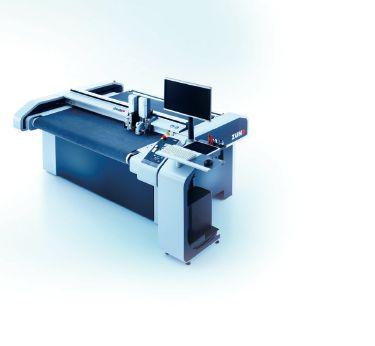
Zünd showcased its S3 modular cutting system with new options, including its integration with an automatic sheet feeder, tandem vacuum, and a new oscillating tool. The system for handling sheeted materials is organized by loading, advancing and off-loading functions, with users able to choose different levels of automation. Zünd also showed a new tandem vacuum system, which enables loading/unloading of materials on one side of the cutter while production continues on the other side. The new Electric Oscillating Tool- EOT 250 is designed for applications like sandwich board/ honeycomb materials and cardboard. With an extended 2.5 mm stroke and high oscillating frequency, the air-cooled EOT-250 is capable of managing materials at high speeds. The S3 cutting system processes materials up to 25 mm (one-inch) thick.
Morgana Digifold Pro-500/ Autocreaser Pro-500
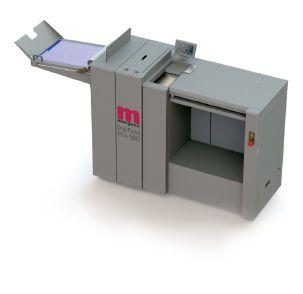
Morgana unveiled its new Digifold Pro500 and Autocreaser Pro-500 as what the company refers to as next generation models in both the folder and creaser lines. Digifold Pro-500 is rated to operate at 6,000 A4 sheets per hour (sph). Using a new high capacity vacuum top feeder, the Pro-500 holds much larger sheet piles, relative to its predecessor, of up to 500 millimeters. It also handles paper stocks up to 400 gsm. Other new features include dual creasing blades, which can be set for up or down creasing profiles, as well as different creasing thicknesses and automatic set up of folding rollers, previously set manually. The Autocreaser Pro-500 also features a new high capacity vacuum top feeder. It operates at 8,500 sph and features a new dual-creasing-blade design to handle varied stocks – allowing for fewer blade changes. The system is suited for perfect-binding work based on new profile settings for both hinge and spine creasing. Both systems will begin hitting the market in mid-2014.
Colter & Peterson Microcut
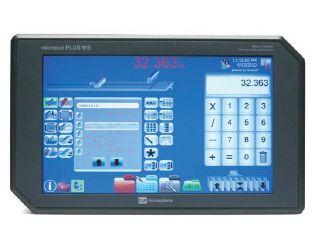
Colter & Peterson showcased two new versions of its Microcut automated back-gauge control system, available for paper cutters between 20 to 150 inches in width, including the Microcut COLOR WS and Microtrack II. All Microcut systems are designed to memorize cutting sequences, allowing the back-gauge to automatically position itself to deliver a cut within 1/64 of an inch. The new Microcut COLOR WS, using an 8-inch-wide touchscreen control, is designed to guide the correct position movement faster and more accurately using a computer guidance system. The new Microtrack II is a digital display and programming guide designed to increase the accuracy and productivity of manually operated paper cutters. Manual, Program and Automatic options provide a visual alert to make the operator aware of when the back-gauge is properly positioned. At Ipex, C&P also highlighted its Microcut PLUS WS system, with microcip and microfacts features, and the Microcut JR system for cutters of up to 37 inches in width.
7 Ways RS Superior Saves You Time and Money
1. ONE-STOP SHOP
Die Cutting, Bindery, Data & Lettershop –all under one roof.
2. ONGOING INVESTMENT IN SUPERIOR TECHNOLOGY
Die crease without a die, then fold and even glue all on the same machine, up to 30 pt.
3. INTEGRATED MODULAR UNITS
Combined in-line finishing: crease, fold, glue, tipping, envelope inserting, ink jetting (Duplex), clip seal (3 sides), mail prep.
4. SAVE ON POSTAGE COSTS
As a Certified Canada Post Direct Marketing Specialist, we get contract pricing reductions.
5. RETURN MAIL PRODUCTS
Customized “Return Mailers” created in-line with “U” or “BOX-shape” remoistenable glue, time perfed applications and envelope formation.
6. MINI-BOOKLETS
We can saddle-stitch and trim 2-up booklets in-line to the size of a business card. No need to trim off-line, or do 2 passes.
7. HIGH SPEED EQUIPMENT
High speed Tipping, Folding, Saddle-stitching and soft folding ensuring on time delivery.
MB Bäuerle prestigeFOLD NET 52
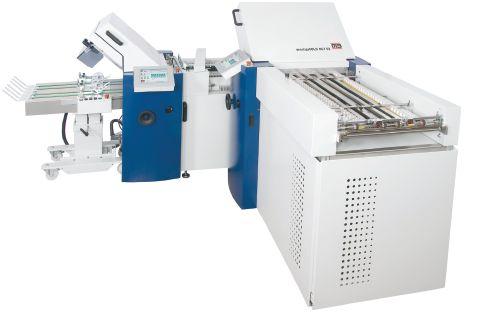
MB Bäuerle of Germany highlighted its prestigeFOLD NET 52 featuring a double alignment table (DAT 24). The system was connected to a Pit Stop DH Speed Creaser and hot-melt unit to demonstrate self-mailer production. The creased sheets, for example, are transported onto prestigeFOLD NET 52’s alignment table for further processing in a single pass, reducing the risk of markings or scratches. A feature of the double alignment table, explains MB Bäuerle, is the choice between producing one- or two-up applications by entering the required information via the touchscreen of the folding machine. All further settings at the DAT are then made automatically. If producing a one-up product, the alignment rail that is not needed moves automatically to the side. prestigeFOLD NET 52 is pre-programmed with 20 standards folds and can set data of more than 200 jobs.
OKI ES9541
D&K Europa PB/EL
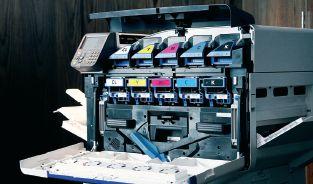
OKI Systems previewed its new ES9541 and ES9431 printers, which the company describes as the industry’s first five-colour LED A3-size printers. In addition to traditional CMYK, the ES9541 can apply a fifth spot colour, white or clear. The C931 is a four-colour LED A3 printer. It is based on OKI’s Multi-Level ProQ technology, combined with the company’s single-pass LED approach. The C931 features print speeds of up to 50 pages per minute and consumables capacity of up to 38,000 pages. The C931 can handle media of up to 360 GSM (single sided) or 320 GSM (duplex).
Sitma of Italy launched its new WM30 paper wrapping system, which like other Sitma products, allows for making envelopes from a paper reel. The WM30 is aimed at high-volume direct mail and door drop manufacturing. It can create envelopes with dimensions from C6 up to C4 with a mechanical speed of up to 30,000 cycles per hour. This machine can be supplied inline with paper reel, with cut-sheet or with double infeed system from paper reel and cut sheet to match different documents.
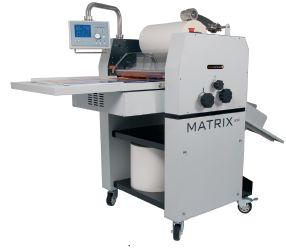
D&K Group, an Illinois manufacturer of equipment and films for mounting, laminating and encapsulating, featured new versions of its Europa B2-size laminator that was first introduced in 2010. This includes the launch of Europa PB as a new double-sided system, which is well suited for photo-book applications. It features two laminating stations, each with metal laminating roller and rubber nip roller, and can be used for B2-sizes or with feeder lengths of 880 mm, 950 mm and 1050 mm. The new Europa EL system has a standard laminating head and a further station for embossing or, potentially, higher pressure laminating, to allow for either conventional single-sided lamination or laminating and embossing in a single pass. D&K also manufactures a range of films in OPP, Polyester, Nylon and PVC based on both thermal and pressure-sensitive adhesion.
Sitma also debuted its new WM10 machine for making plastic covers (with two pockets) meant to protect books. The dimensions of the books (and covers) can be entered into the machine manually, via company network or with
an optional system that automatically recognizes the dimensions of the book to be protected. Each cover for the softback or hardback book can be personalized with individual data, such as name, class, logo, book title or price, by means of a thermal printer installed on the WM10. The WM10 runs at speeds of up to 1,000 books per hour.
Sitma WM10 / WM30
Sitma WM10
Alwan McDowell Suite
Alwan Color Expertise named its new HiFi Color Suite v5.0 the McDowell Suite in honour of Dave McDowell, who was instrumental in developing ISO printing standards. Alwan states the McDowell Suite is designed to embrace two new colour standards, including the soon-to-be-published ISO 15339 standard, which enables colour management and matching across printing processes, and ISO 17972-4, which defines CxF/X-4 format for describing spot colours accurately, thus enabling brand owners to transmit the colours they expect from their printers in a standardized way Print buyers, for example, can choose printing targets from ISO’s 15339 seven standard Color Reference Printing Conditions and then also choose job tolerances based on three levels of conformance – stringent (level A), normal (level B) or relaxed (level C). These printing aims and tolerances are then applied within Alwan’s ColorHub X 5.0, PrintStandardizer X 5.0 and PrintVerifier X 3.0 software, which comprise the McDowell Suite. In addition, the McDowell Suite is also designed to colour manage and control printing processes that exceed conventional CMYK colour printing such as extended gamut and Hexachrome printing processes.
Screen Truepress Jet L350UV
Screen highlighted its inkjet-based Truepress Jet systems at Ipex, including the recently released Truepress Jet L350UV for label production. This system, described by the company as an easy-to-use inkjet label press, prints widths of up to 322 mm (12.6 inches) and reaches a top speed of 50 metres (164 feet). The Truepress Jet L350UV reaches a 600 x 600-dpi resolution using Screen’s UV inks with optional opaque white ink. Screen also highlighted its B2-size Truepress JetSX inkjet press and the Truepress Jet 520 with a top speed of up to 220 metres per minute and a maximum imaging resolution of 720 x 720 dpi.
Duplo UltraBIND 2000 PUR
Duplo launched the single-clamp UltraBIND 2000 PUR perfect binder as what the company describes as the world’s smallest closed-tank PUR system. Using its patented Orbital PUR system, Duplo rates the UltraBIND 2000 PUR with a cycling speed is 290 per hour and the start-up time less than 20 minutes. Duplo also states the system can be cleaned in less than five minutes. During Ipex, Duplo also highlighted its recently launched (January 2014) DC-646 slitter/ cutter/creaser to handle work primarily produced on toner presses. The DC-646 can produce up to eight slits, 25 cuts and 20 creases in a single pass, while also providing full bleed to eliminate white borders and preventing toner cracking on fold lines of up to 30 sheets per minute.
Management Software
❏ One program manages entire company
❏ Enter data once and use it many times
❏ Enhances client service
❏ Work smart, work efficiently
❏ Increases speed - accuracy from estimates to invoices
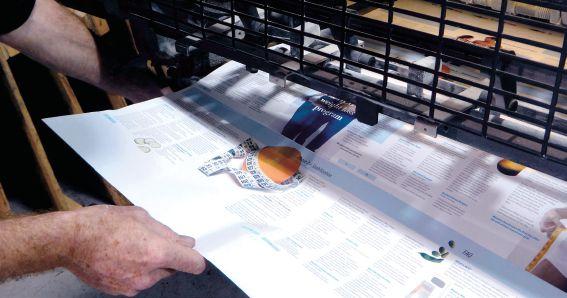
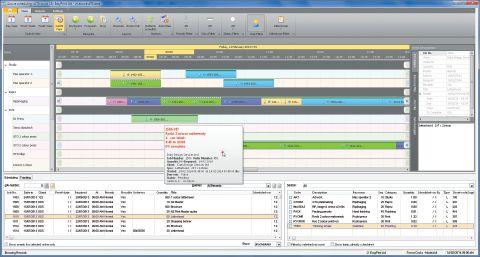
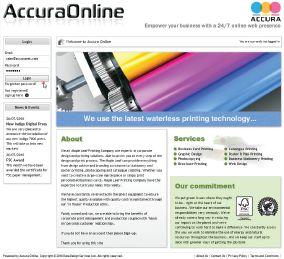
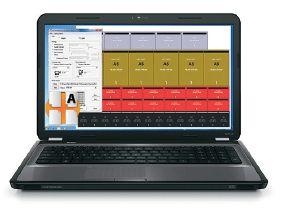
Accura of the United Kingdom introduced new features for its Management Information System platform, including scheduling and online functions. The new EDocBuilder Interactive Designer, which is part of the existing EDocBuilder web2print engine hosted by AccuraOnline, is a drag-and-drop tool for user artwork design with consumer-based products like greetings cards and promotional products. Accura has also introduced a new Production Scheduling module, which includes a resource level planning board, tracking and RDC integration. New features for the Time & Attendance module, a bolt-on to the RDC module and gives you accurate paid/unpaid hours and payroll reporting, will soon be released. Accura has also introduced courier API integration capabilities.
Ultimate Technographics Impostrip
Ultimate Technographics of Montreal partnered with Transeo Media at Ipex 2014 to highlight new features in its Impostrip and Absolutely Imposing software. Working to automate imposition for both toner and offset processes, with its ability to impose JPEG, PDF, Optimized PDF and PDF-VT files, Impostrip offers control over page position, bleeds, page spread, page scaling, relative marks and margins to produce brochures, books and cards in many finishing fashions including lay-flat. Absolutely Imposing, powered by Impostrip, is a new Acrobat plug-in with a simplified process to help designers and entry-level prepress operators quickly impose any type of printing job. It includes features like Best Fit option in which the software finds the best template for a job.
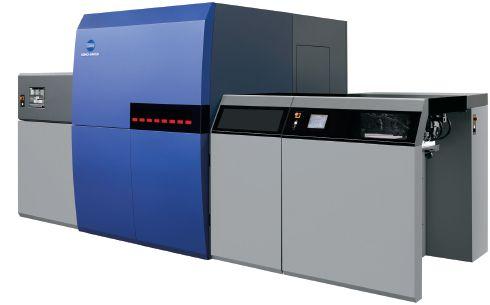
Konica Minolta, the single-largest exhibitor at Ipex with a 1,200-squaremetre booth, used the event to highlight progress with its B2-size sheetfed inkjet press, called the KM1, first introduced at drupa. Konica Minolta Business Solutions launched (February 2014) an enhanced line of toner presses, including the bizhub PRESS C1070/ C1070P/C1060/C1060L models. The new bizhub PRESS presses feature what Konica describes as its fourth generation of Simitri HDE toner, as well as ScreenEnhancing Active Digital (SEAD IV) processing. The bizhub PRESS C1070 runs at 70 pages per
minute in both colour and black-andwhite, while the C1060 versions hit 60 pages per minute. The series includes a new paper handling system with airassisted paper feeder options (PF-602, LU-202) that feature two variable-speed blowers on front and back of their trays to reduce paper jams, as well as an optional air-suction paper-feed unit (PF-707) traditionally found on higheroutput devices. Konica Minolta, at Ipex, also introduced its new Digital1234 business-building program for existing customers.
Konica Minolta KM1
manipulating Bezier handles. Just choose the Anchor Point Tool (a part of the Pen Tool subset) and hover over any path segment – the Anchor Point cursor becomes the Path Segment Reshape cursor and the user clicks and drags to bend or reshape any path segment. Moreover, Illustrator CC sports perspective-drawing improvements enabling designers to easily adjust the vanishing point and horizon line of a drawing by manipulating the underlying grid.
Rounding out the new enhancements, Adobe finally gives designers the ability to build custom tool panels and save a backup copy of preferences, workspaces and presets that can be shared with other Illustrator users within a workgroup – a long-overdue enhancement in my opinion.
Indesign CC
Many of the aforementioned Illustrator amendments can benefit both print designers and prepress pros, however, virtually all of the updates to InDesign are targeting the ePublisher whether they build EPUB, interactive PDF or Adobe Digital Publishing Suite (DPS) projects. For example, InDesign CC offers bespoke tools for creating, editing and managing hyperlinks in an interactive document–to the point of creating character styles to accommodate them! Hyperlinks can be applied to both text and images and validated through the Hyperlinks panel. The new InDesign also supports EPUB 3.0 features such as pop-up footnotes, better hyperlink management and improved multi-lingual support.
Another new InDesign function facilitates automatic access to Adobe Typekit fonts – when opening a document using fonts not active in your system, the user is immediately offered the option of accessing fonts from the Typekit collection. While this feature might benefit designers with small font collections, it could cause problems for prepress operators who generally only use fonts provided by their customer when working on files.
Typekit fonts are available within all Creative Cloud applications: When opening a document using fonts not active in your system, the user is immediately offered the option of accessing fonts from the Typekit collection through a Web portal.
I have been working with InDesign CC since initial launch and really appreciate the ability to set the interface colour theme to match other CC applications such as Photoshop. However, I’ve noticed a few problems when working with legacy files created in older versions of InDesign. For example, I have seen spot colours created in InDesign CS5.5 mysteriously change their overprint settings when opened with InDesign CC – the result not showing up until inkjet proofing, or worse, on press! Hopefully this and other bugs have been addressed in this latest update.
All the rest
Adobe augments other Creative Cloud applications in this update including Muse, its approachable Web design tool aimed at Illustrator and InDesign users. Muse differs from Adobe Dreamweaver in that it enables visual designers to build attractive websites within a familiar interface and without learning to write code. This makes Muse invaluable for print designers looking to expand their services; however, the short learning curve Muse provides comes at a price. Sites built with Muse cannot be directly imported into Dreamweaver when more powerful Website architecture is needed.
Adobe has done a great job of eliminating the upgrade dilemma for many users because Creative Cloud is only available on a subscription basis. However, while CC customers no longer need to weigh new features against the cost of upgrading, Adobe is leaving many legacy CS6 license owners behind. Not everyone can justify the ongoing expense for a vast suite of software they will never own just to access one or two applications they actually need to generate revenue. I suspect many will stick with the CS6 they own until Adobe offers a wider range of licensing alternatives.
Bolan’s blog: blog.softcircus.com
PRESENTATION FOLDERS
enhance the entire prepress workflow. So-called lights-out production is part of the entire equation. Fully automatic flexo plate making, explains Hole, will be available in the very near future.
Hole’s keynote echoed, albeit in a different manner, takeaways from the previous keynote in stating the printing industry is changing and that there are many tools available to help businesses make a successful transition.
Complex and functional printing
The third TAGA keynote was given by professor Tim Claypole from Swansea University in Swansea, Wales. The thesis of his presentation states that print is happening, but not in the way that we know it. Printing is becoming more complex due to the availability of new materials, more demanding customers, functional materials and its economic and environmental impacts.
We all know why printing is an additive process and great at volume production. This relates to not only printing on conventional substrates, but also for the printing of electronic components. Screen printing is the most versatile process for printing electronics, but flexographic printing is a low-cost process with a soft printing impression. Fine resolution and tight register control is needed for printing electronics. A lot of research still has to be done in this emerging field, but manufacturing techniques for printed electronics are improving. It is now possible to print see-through RFID tags and TFT (thin film transistors) using flexography.
capabilities to enable the application of texture and smell to a printed product. Other product innovations that can be applied through offset printing include metallic effects, pearlescent and cold foil. These effects are not totally new, but the extent of what can be done in this regard has significantly improved.
Printing will be more efficient if systems are tied together and automatic set up of the press, automated colour control and direct drive technologies enable a faster changeover of jobs. New camerabased control systems monitor the entire sheet and, in relation to register and colour, facilitate the elimination of colour bars, increasing the available print size per press sheet.
Modern web presses also allow variable cut-off lengths, which enables more flexibility in regards to the jobs that can be printed on press. Hybrid printing of offset and high-speed inkjet also enables more flexibility in regards to what products can be printed on such a press.
The printing of electronic circuits means that there is also an energy source required to power these products. Varta, a European battery manufacturer, has partnered with Swansea University and the Stuttgart Media University to develop a printed battery. The most successful printed electronic to date is the glucose metering strip for home testing of the blood sugar level for people with diabetes. Professor Claypole foresees that photovoltaics can and will be printed reducing the costs of these elements and making them more readily available.
Professor Claypole’s keynote echoed the IARIGAI conference that was held in September 2013 in Chemnitz, Germany. Printed electronics was a main topic of this conference and the University in Chemnitz is conducting substantial research in this area. Again his presentation is in line with the previous keynotes indicating that print is here to stay, but what is being printed will ultimately change.
Modern press innovation
The final keynote of Day 1 at TAGA was a team effort by Dr. Mark Bohan, Vice President of Research at Printing Industries of America, and Paul Cousineau from DowJones. Their address showed the conference participants what can be done today with modern printing equipment. Modern offset printing presses can combine print with in-line finishing
Web-fed production inkjet can currently print at 2,000 feet per minute and most likely the speed will increase in the future. The enhancement of printed material through raised coatings, metallic effects, scented coatings, 3D texture through inkjet, embedded triggers for augmented reality apps like Layar or Aurasma are just a few examples of what can be done today.
After TAGA’s keynote sessions, the conference moved into presentations by academics and industry researchers. Their topics ranged from research into inter-instrument agreeability, printed electronics using screen printing, improvements to the deinking process using a modified soybean oil, a special paper for printing electronics, the influence of the RIP software on printed quality, the advances done to deploy the HP Indigo 10000 press in a B2 format, how to improve the quality of toner-based prints and HD flexo technology.
The first few hours of TAGA alone shows how much innovation can be achieved these days with currently available printing technology, but one has to find which special applications make their products stand out from the competition. There are also many things that still need to be investigated to advance the knowledge in printing and print related fields. As one of the keynotes began: “It’s printing Jim, but not as we know it.”
Martin Habekost is Associate Chair of Ryerson University’s Graphic Communications Management program and can be reached at mhabekos@ryerson.ca
It’s now possible to print see-through RFID tags using flexography.
OFFER NEW PRODUCTS
Offer new products, increase your profits! Cheques Plus will print and ship 100% CPA compliant computer and manual business cheques to your clients with your branding. Call 877.888.7163 x107, email corporate@chequesplus.com or visit www.chequesplus.com
MERGER OR ACQUISITION
We are looking to acquire or merge with a printer that has 40” capabilities in the GTA. We have an established client base. Contact searching40@hotmail.com
PRODUCTION PRINT
CONSULTANT - GTA
The Production Print Consultant has the responsibility for successfully leading sales engagements and negotiating complex business relationships for Xerox Digital Press, Inkjet technology and associated third-party finishing, integrated software and workflow solutions. The Consultant will lead the building of a healthy pipeline of close-able business to grow revenue. The Production Print Consultant will need to collaborate with multiple sales resources to ensure a successful close of the sales cycle and solution implementation.
MAJOR RESPONSIBILITIES
• Minimum 100% achievement of Total Sales Revenue Plan
• Thought leadership and sought out by clients for business advice
• Leads sales cycles into larger commercial print, trade print, and packaging accounts and must have expert understanding of the supported products and lines of business
• Expert knowledge of industry trends, competitive landscape, workflows (from pre-press, plate business and MIS solutions), and in the utilization of the relevant Xerox tools
• Leads qualified opportunities from development to delivery following the key steps of the sales cycle such as executive presentations, customer workflow studies, assessments of the customer business with their recommendations
• Knowledge transfer, coaching and support of assigned Sales Team(s) QUALIFICATIONS
• University Degree, MBA preferred
• 8+ years experience in a business development or sales role in Graphic Communications
• Consistent performer at or above business plan in a sales position
• Able to teach and coach sales reps Go to printaction.com/marketplace for more details. Send resume to employmentopps@xerox.com
PRODUCTION SUPERVISOR REQUIRED
Production Supervisor required for our Printing Services Group which specializes in the production of photo gifts including photobooks, calendars and cards. Reporting to the Production Manager, this position will plan production operations and co-ordinate the activities of employees engaged in the manufacturing of our products. For additional details and to apply, visit www.fujifilm.ca and click on “Careers.”
PRODUCTION SUPERVISOR AND PRODUCTION COORDINATOR
Requirements: Strong knowledge of sheetfed & web printing process, computer skills in print MIS software.
• Schedule and coordinate the flow of work between Prepress, Printing and Finishing departments to ensure delivery dates are met and production time is maximized.
• Communicate with customers. Take orders
• Review Work Orders before releasing to Production and revise schedule according to Work Order specifications, established priorities and availability of workers, material and equipment. Actively contribute in carrying out the daily functions of Printing and Finishing departments as required based on workload, holidays, etc.
• Act as an internal technical resource for product applications and ideas.
• Provide leadership and guidance to other Plant employees and offer advice for process improvements. Email resumes to hrdept@west-star.com or Fax (416) 201-0920
EMPLOYMENT OPPORTUNITY
Print Finishing Estimator required. Markham, Ontario. Full time position. Experience and understanding of print finishing (mounting, die-cutting and finishing) is an asset. Position available immediately. Salary to be negotiated. Veda@lamacutting.com
BINDERY OPERATOR WANTED
Commercial printing company is currently seeking experienced full time folder operator. Experience on other bindery equipment an asset. Email resume to email@battlefieldgraphics.com
BUSINESS WANTED
Company with 22 operations looking to merge, partner, or buy a printing company with a 40” press workflow. Interested parties please respond by email to: barnes578@rogers.com
ESTIMATOR WANTED
Experience in estimating/print production/ customer service for sheetfed and web printing. Computer skills in print costing software, excellent communication skills. Print management degree an asset. Email resumes to hrdept@west-star.com or Fax (416) 201-0920
BROKERAGE FOR SALE
Would you like to expand to Quebec? Need representation? Brokerage since 1990 for sale. Bilingual services and established volume up for discussion. Contact Carol: 6388216@gmail.com
BUSINESS FOR SALE
Well established digital print shop located on the busy Danforth excellent opportunity for new or existing operator. Rent $1,975 plus hydro asking $79,000. Contact Shane: 416-703-6621 ext 244 Shane.jamieson@metcomrealty.com
DIGITAL OPERATOR REQUIRED IN NORTH ETOBICOKE
Working with Xerox equipment. Some experience preferred. Day shift, however hours flexible including some weekends. Send resumes to: hr@harmonyprinting.com
Somerset Graphics, located at 370 Brunel Road, Mississauga, Ontario, seeks full-time permanent offset press operator.
Wage $24.00 per hour plus group insurance and possibility of bonus.
Location: Mississauga.
Some high school required as well as five years of experience, including apprenticeship.
Essential skills include: Reading text, Document use, Numeracy, Writing, Oral communication, Working with others, Problem solving, Decision making, Critical thinking, Job task planning and organizing, Finding information, Computer use, Continuous learning. Duties include: Mount plates or cylinders and make necessary adjustments, Fill ink fountains and control colour and viscosity, Set up press and operate at slow speed to check samples, Monitor regular press run for quality using computer control console, Remove and clean plates and cylinders at end of press run, Set up and adjust in-line binding and finishing equipment, Direct press crew to set up, operate and shut down press. Send resume by email to jobs@somersetgraphics.com
We Buy
Heidelberg: K-Line/S-Line/ Speedmaster/GTO/MO
Komori: 1,2,4 or 5 colours & an Adast : 714/715/724/725
Mitsubishi: Any model
Ryobi: : 2800CD/3200CD Itek: 960/975/985
Hamada: 500/600/700/800
Polar: 72/82/90/92/107/115 CM
Horizon-BQ: 220/240/260/440/460
May 1984
The Soviet Union announces it will boycott the 1984 Summer Olympics in Los Angeles; the $1 coin is introduced in Australia; South African prisoner Nelson Mandela sees his wife for first time in 22 years; and the Edmonton Oilers beat the New York Islanders four games to one to win the Stanley Cup
Color Craft Litho Stays Ahead with dupont Chromacheck
When Andre Hamel and Carlos Barrot visited Vancouver over four years ago, they felt there was the potential for a fifth colour separation house in the city. The two partners have over 40 years of industry experience between them: Hamel as a stripper and Barrot as a cameraman and scanner operator. Color Craft became the only colour separation house in the city strictly oriented to the trade litho shop, although advertising agencies make up about 40 percent of the company’s business.
Color Craft has been innovative in the area of colour proofing, first by introducing the Cromalin proofing system to a reluctant Vancouver marketplace. “There has been a reluctance on the part of the customers to pay the extra cost, but we have proven to them that it shows better how the colour will reproduce in printing. The printer doesn’t have to interpret to his customer the tone and shadow areas.”
When Hamel was then shown the Dupont Chromacheck dry overlay proofing system, he was willing to give it a try. The dry peel-apart film requires no chemicals or processing. Error in overall processing is virtually eliminated, because the exposure time for each colour is the same. After exposing each of the four process-colour films through the appropriate negative using standard UV light, the imaged top layer is peeled off and the four layers registered.
Registering of imaged overlays is fast and accurate because the thick backing on the Chromacheck film permits register to be punched before exposure. Most four-colour proofs can be made in less than five minutes because all can be mounted and exposed in the vacuum frame at one time.
Satellite delivery of Newspaper Ads on the Way
A year from now, Wold and Mitsui will test market Ad/Sat, a system for delivering camera-ready advertising materials to newspapers. “It’s using satellite freight-forwarding in a broadcast mode to replace the hand-carried system that newspapers and agencies have been using for the last 100 years,” said Robert Wold, Founder and Chairman. The field and market tests are planned for a May 1, 1985, start at nine major newspapers which are still to be determined.
If it works, the Ad/Sat system will be rolled out to a network of 500 daily newspapers as early as January 1, 1986. By 1988, planners envision annual revenues of $20 million… from two revenues streams. The larger stream would come from advertising through their agencies. Other revenue would come from the newspapers, which will need to commit $7,500 a year for five years, or a total of $37,500 to join the network. On top of the annual membership fee, newspapers will pay $25 an ad.
INK PROFILE
Perfecting
Gloss
Rub Resistance
Setting
Postprint finishing
Dot definition
• Excellent rub resistance
• Particularly suitable for printing on critical paper grade