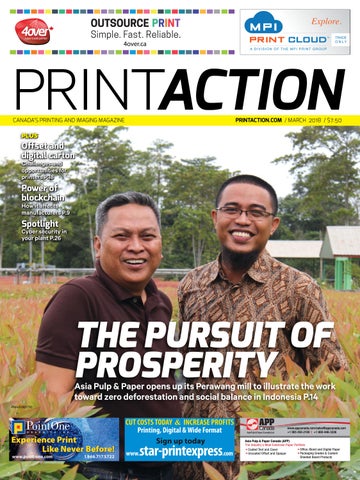
Asia Pulp & Paper opens up its Perawang Mill to illustrate the work to become a progressive paper producer with interests rooted in its concession communities
18 Offset and digital trends for carton
A look at movements in the folding carton world as advances in digital and offset presses create new opportunities for commercial printing companies
DEPARTMENTS
GAMUT
5 News, People, Calendar, Installs, Globe, Archive
Technology Report
23 Colour tools
New products for colour management continue to provide automation
MARKETPLACE
25 Industry classifieds
SPOTLIGHT
26 Craig Barretto, President of Nexgen Security, discusses critical cybersecurity issues for manufacturers
COLUMNS
FROM THE EDITOR
4 Jon Robinson
Five forces of packaging
How packaging printers will evolve over five years of market growth
DEVELOPMENT
9 Jennifer Rideout
The incorruptible power of blockchain
Facing time constraints, how to focus on the signs of good print prospecting 14 6 5 9
How one of the business world’s newest digital tools affects manufacturing
TECHNOLOGY
10 Martin Habekost
Connecting to corrugated
More than 1,200 print professionals gather in Las Vegas at EFI Connect
SALES
12 Dave Fellman
Buying signals
Five forces of packaging
Smithers Pira in mid-January 2018 published a study called The Future of Global Packaging to 2022, which estimates packaging demand will grow steadily at 2.9 percent to reach $1.3 trillion in 2022 (all figures converted into Canadian funds), starting from $1.1 billion in 2017. The report looks at current and future figures for packaging in 17 major and 33 minor national markets.
Board and paperboard (corrugated, folding carton stock and liquid paperboard) is the largest packaging material type covered in a new Smithers Pira study. It accounted for 35.7 percent of world packaging consumption in 2016, followed by flexible packaging (plastic, paper and foil) with 23.3 percent, rigid plastic packaging with 18.2 percent, and metal with 12.2 percent.
Smithers explains the evolution of packaging companies over the next five years will be driven by five primary forces. Because e-commerce provides a near unlimited product range and transparency for consumers, Smithers predicts it will change the way in which brand owners interact with consumers, which will ultimately affect packaging producers. The report describes the demand for packaging in retail outlets as steady but unspectacular when compared to growth in e-commerce. This has certainly been boosted by Amazon’s maturing online platform as competitors try to keep up with its disruptive distribution model.
The value of packaging demand in the e-commerce sales channel, according to Smithers, was $36 billion in 2017 and will more than double by 2023. Smithers found that more than 75 percent of this demand is for corrugated formats.
Secondly, Smithers points to digital printing as a maturing technology that will impact packaging producers. The sheetfed-offset dominated space of folding carton has only just begun its transition to digital press technology, which allows for new entrants to produce specialized or short-run work. The HP Indigo 30000 series, a 29-inch format press aimed at folding carton, has seen growing market penetration. Landa’s B1-format S10 press began beta testing in Israel in April 2017. Late 2017 saw shipments begin for Heidelberg’s Primefire digital packaging press with series production set for the beginning of 2018. Fujifilm’s J Press 720 suddenly has more than 100 worldwide installations and can be easily converted to produce up to 24-point carton work. Looking at entities like Heidelberg and Fujifilm, as well as the inkjet developments of Komori and Koenig & Bauer, these traditional suppliers touch the vast majority of offset-based printers and are motived by their own heavy investments to drive digital technology into packaging.
Smart and intelligent packaging is the third major evolution driver for packaging producers, according to Smithers, because it opens new possibilities for converters and brand owners. Contract
packaging is by far the largest segment, explains Smithers, creating around 70 percent of the industry’s overall value. While it is not a new concept, Smithers describes contract packaging as the fourth primary force of evolution because “it fits well with deeper collaboration across the value chain, and can deliver major cost savings.” To this end, packaging companies are expected to take on more services, such as design and traceability. Smithers estimates packaging services will grow at 9.5 percent, beginning at $44 billion in 2017 and reaching $65 billion by 2022.
The final two forces of packaging evolution truly fit together as Industry 4.0 and Big Data. By their nature of producing longer and more consistent print runs, offset-driven packaging producers have a relatively high Overall Operating Efficiency when compared to commercial printers, but it will still be critical for packaging producers to embrace Industry 4.0 strategies like automation, data exchange and IoT. Smithers also points to investments in communicating robots on the factory floor and in distribution chains. Smithers explains analyzing Big Data, such as sensor data for temperature, vibration and rotation speed, will allow packaging companies to improve and rationalize; as well as implement predictive maintenance. Leveraging Big Data for clearer production transparency will also drive packaging growth.
These five evolutionary forces outlined by Smithers will create new business models and ultimately greater vertical integration, which the packaging world has been seeing for a number of years. “The continuing trend towards large-scale mergers and acquisitions – for example the creation of WestRock from MeadWestVaco and RockTenn – is testament to the relative maturity of the packaging industry in developed world regions, like North America and Western Europe.” Smithers indicates that emerging and developing economies will contribute more than 70 percent of world packaging consumption growth from 2017 to 2022.
Smithers describes Asia as the largest market accounting for 42.1 percent of world packaging consumption in 2016. North America is second accounting for 24.3 percent, ahead of Western Europe with 18.4 percent. Despite the West’s packaging maturity, these five forces of evolution create significant opportunities for innovation in North America’s printing and packaging industries.
Editor Jon Robinson jrobinson@annexbusinessmedia.com
Contributing Writers
Zac Bolan, Wayne Collins, David Fellman, Victoria Gaitskell, Martin Habekost, Nick Howard, Neva Murtha, Abhay Sharma
Publisher Paul Grossinger pgrossinger@annexbusinessmedia.com 416-510-5240
Associate Publisher Stephen Longmire slongmire@annexbusinessmedia.com 416-510-5246
Media Designer Lisa Zambri lzambri@annexbusinessmedia.com
PrintAction is printed by Annex Printing on Creator Gloss 80lb text and Creator Silk 70lb text available from Spicers Canada. ISSN 1481 9287 Mail Agreement No. 40065710
JON ROBINSON, editor jrobinson@annexbusinessmedia.com
Built around two Speedmaster XL 106 presses, folding-carton producer FK Fürther Kartonagen (a WEIG operation) of Germany is one of the first companies to leverage Heidelberg’s new Subscription model.
Heidelberg launched its new Subscription model, in which customers only pay for the number of sheets printed. With Heidelberg’s new model, all equipment, required consumables – like printing plates, inks, coatings, wash-up solutions and blankets – and services are included in the price per sheet to be charged. Heidelberg explains this new approach differs from the clickcharge model previously introduced by digital press suppliers, based on its approach with the customer’s business model.
York, White Plains, which includes its domestic subsidiaries. The company states the move, which does not include its foreign entities, will increase its financial flexibility by reducing debt and obtaining new financing. Cenveo has negotiated agreements with certain existing lenders that will allow it to access up to US$100 million in incremental liquidity during the Chapter 11 case.
Friesens will install an Evolution R708P featuring LED technology, marking the company’s first foray into offset-UV technology. This is Friesens’ second major Manroland Sheetfed investment in the past three years, after installing what was the world’s largest perfecting press at 73-inches in mid-2015. The company’s Evolution press will be equipped with SAPL automatic makeready, InlineColorPilot and LED UV. In late 2017, Friesens also added a Heidelberg Speedmaster XL-75, its first mid-size press.
Electronics For Imaging donate Pace MIS software to Ryerson’s School of Graphic Communications Management (GCM) with a full-time enrollment of 660 students. The donation includes licenses for 75 concurrent users. EFI was already a key piece of infrastructure at GCM with its Fiery DFE’s helping to drive the Toronto school’s digital press and proofers. Students also work on EFI Metrix imposition software.
Fujifilm Holdings of Japan on January 31 entered into an agreement to own 50.1 percent of Xerox Corp. shares. This end result would follow other agreements involving Fuji Xerox, which was formed in 1962 with 75 percent capital invested by the Fujifilm and 25 percent by Xerox. Fujifilm explains it would rename Xerox as Fuji Xerox, which would become the largest document solutions company in the world by revenue. Jeff Jacobson, current CEO of Xerox, would lead the new Fuji Xerox entity. The pending acquisition was facing litigation from some of Xerox’ largest shareholders.
Cenveo filed a plan of reorganization, under U.S. bankruptcy code 11, in the Southern District of New
Printer Gateway, a trade printing operation in the Greater Toronto Area, has been closed to the market by Supremex, which purchasd the company on December 23, 2016. Based in LaSalle, Quebec, Supremex is one of North American’s largest envelope manufacturers, in addition to its growing interesting in packaging and specialty products.
Minuteman Press Penticton was a sponsor of the 2018 Scotties Tournament of Hearts Canadian Curling Championships, won by Team Manitoba skipped by Jennifer Jones. It was Jones’ first win at the Scotties since 2015 as she tied Colleen Jones for the all-time tournament record with six victories. Andre Martin and Barbara Jenic, co-owners of the Minuteman Press in Penticton, attended the nine-day event, held at the South Okanagan Events Centre in Penticton, BC.
Friesens of Altona, Manitoba, purchased Canada’s first Manroland Sheetfed Evolution press, scheduled to be delivered this spring. One of North America’s leading book manufacturers,
HP announced its largest-ever packaging press deal with ePac Flexible Packaging, a converter with six planned locations in the United States. Quadrupling its production capacity, ePac purchased 10 additional HP Indigo 20000 presses to expand operations through mid-2019. ePac launched 18 months ago with one HP unit and currently runs three Indigo 20000 presses in Madison and Boulder, with the 10 new units to be deployed at new facilities in Los Angeles, Houston, Chicago and Miami.
Koenig & Bauer is planning for price increase of 3.7 percent with effect from April 1, 2018, for its entire product portfolio. The moderate price increase, explains the company, will enable further innovation in automation and inline processes for its presses.
Webcom of Toronto, Ontario, invested in short-run casebinding machinery from GP2 Technologies, as the publishing printer continues to expand its core inkjet production capabilities built around HP presses. Webcom’s new casebinding solution targets short-run hardcover orders, primarily for book sizes from 5 1/2 x 8 1/2 inches to 8 1/2 x 11 inches. In the first phase of the project, Webcom will produce flat-back hardcover books with optional hard or flexible spines. Four-colour covers will be produced using 100-lb gloss offset paper with Mylar film lamination.
Farnell Packaging of Dartmouth, Nova Scotia, achieved certification by the Sustainable Green Printing Partnership (SGP). Established in 1961, Farnell is family-owned and focuses on high-quality, flexible packaging. Nearly two-thirds of its work is for the food industry with the balance applied in markets for tissue, personal care, horticulture and other industrial applications. Farnell’s recent sustainability efforts reduecd its annual electrical consumption by more than 156,00 kWh.
Langley Holdings, owners of Manroland Sheetfed, published its financial results for the year ended December 31, 2017, with profits before tax for its entire industrial group up by 7 percent over the previous year. The company stated Manroland, although profitable and having returned Langley’s initial 2012 purchase investment in 2017, was “below par” with its contribution. Headquartered in Offenbach, Germany, Manroland in 2017 generated revenue of €286.3 million (CDN$442 million), employing 1,545 people.
CRON Machinery & Electronics, a CTP manufacturer, is forming a new business unit to serve the global flexo industry. It will be called the CRON-ECRM Flexo Business Unit (FBU). CRON first entered the North American market in 2014. The new unit will be led by Alex Lee, as GM and Global Sales Director, and Marshall Hogenson, VP Americas. CRON FBU will also focus on China, Asia, and EMEA (Europe, Middle East and Africa).
Friesens’ Evolution R708P features LED UV.
Bill Morash, CEO, Farnell Packaging.
Jeff Jacobson, CEO, Xerox.
Mike Collinge, President and CEO, Webcom.
INSTALLS
Pierre Marcoux becomes President of TC Transcontinental’s media sector, TC Media, with business, finance and construction brands, as well as event planning. TC Media is Canada’s largest publisher of French-language educational resources. Marcoux joined Transcontinental in 2000 as a journalist, before serving in various executive roles.
Steve Bennett becomes VP, Packaging Solutions, for Fujifilm North America’s Graphic Systems Division, where he previously worked for nine years (2000 to 2008) in VP roles for its wide-format and marketing teams. Before rejoining Fujifilm, Bennett worked with Esko for nine years, first as VP of Digital Finishing and then as VP of Sales.
Jürgen Gruber becomes Digital & Web Service National Sales Manager for KBA North America. In this newly created role, he will oversee sales of the RotaJET press, as well as sales and support for the web service group. He will report to Jeff Dietz,VP of Web and Specialty Presses. Gruber brings both a sales and engineering background to his new position.
Dirk De Man is scheduled to become CFO of Agfa-Gevaert Group on May 9, 2018, after the company’s General Assembly of Shareholders. He will replace Kris Hoornaert who decided to leave the company after heading its finance for more than 10 years.
Dr. Mark Bohan, Director of Prinect and CtP at Heidelberg USA, received the 2018 TAGA Michael H. Bruno Award, presented by the Printing Industries of America. Bohan began in his current role in August 2016 and has been with Heidelberg since November 2015 when he started as a business consultant. He currently serves on the Board of Directors at TAGA. For the past 20 years, he has been involved in the development of graphic arts ISO standards, ISO TC130, and CIP4.
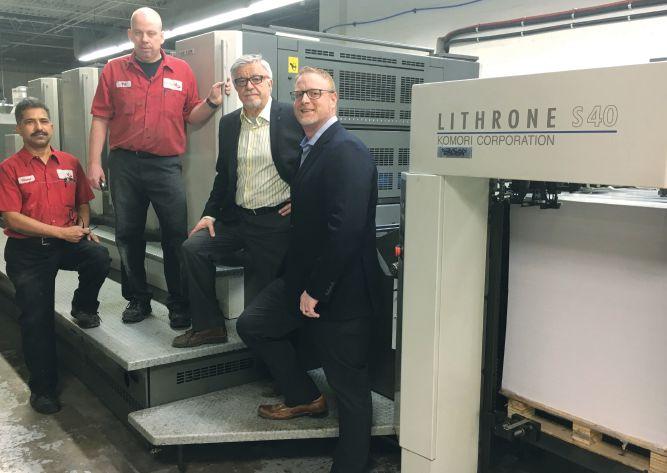
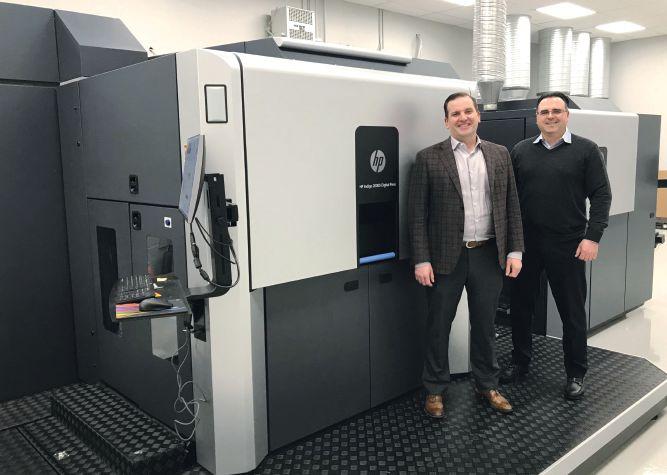
Swiss Print International of Etobicoke, Ontario, acquired a Komori LS 440 press with tower coater and extended delivery. Swiss Print runs two existing 40-inch presses, pictured with operators Mohamed Pasha and Will Hagen; Gottfried Hildenbrand, founder of Swiss Print; and Komcan’s Brett Rogers.
Associated Labels and Packaging of Coquitlam, British Columbia, a premium label printing and flexible packaging printer, added an HP Indigo 20000 press pictured with Jay Ashworth and Shaun Ashworth. The company, which also runs two HP Indigo WS6800 presses, operates out of a 100,000-squarefoot facility.
Steve Lynn joins Durst North America as Packaging Manager. He previously spent six years with Fujifilm’s Graphic Systems Division, including the past two years as National Sales Manager, Inkjet. From 2002 to 2011, Lynn led support in the United States for Inca Digital Printers, after spending close to seven years as a Support Engineer with Domino Printing Sciences in the United Kingdom. Lynn also served as an electronics engineer with the Royal Air Force for six years.
Brent Murray becomes National Account Manager, Newspapers, at Agfa Graphics, a new position created to serve what the company describes as a growing customer base. Most recently, Murray was Regional Sales Manager at Southern Lithoplate, focusing on no-process thermal plate technology. He also previously served as Director of Strategic Client Development at Konica Minolta.
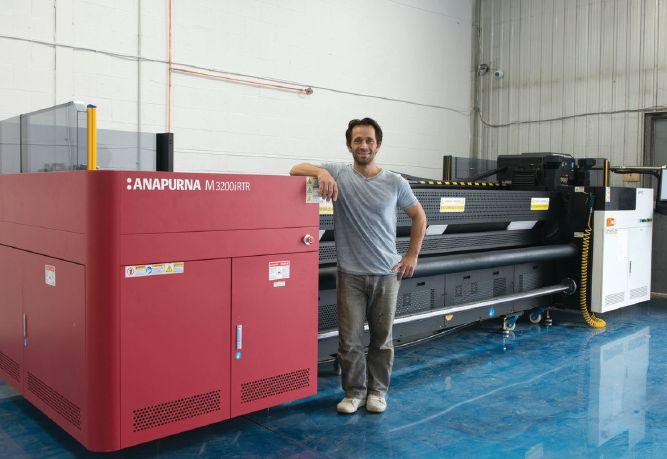
Groupe Lettra of Boisbriand, Québec, installed an Agfa Anapurna
M3200i RTR, a 3.2-metre wide roll-to-roll UV inkjet printer. Founded in 2000, Groupe Lettra today specializes in all types of vehicle lettering and large-format printing on both rigid and flexible medias, as well as the printing of commercial stickers.
GLOBE
Two Acuity presses in Rockville
Established in 1992, Signs By Tomorrow of Rockville, Maryland, is a family-owned operation based in a 14,000-square-foot facility. The company recently added a second Fujifilm Acuity F, doubling its production capacity for clients in state and local government, and transportation department entities throughout Maryland. Signs By Tomorrow is also involved in the real estate market, managing a print work for a company with offices in Virginia, Maryland, and Washington D.C., with over 300 agents.
This second 8 x 10-foot Acuity F makes Signs By Tomorrow the only centre in North America with this capacity, which includes white ink.
“We print on acrylic, and other hard substrates, and we often print white ink down on clear decals or clear vinyl; having that ability helps us stand out from the crowd,” said Lori Garber, Operations Manager. The Acuity F has a maximum print speed of more than 1,600 square feet per hour.
Mary Lou Goehrung, President, with her two sons Glenn Goehrung, VP and COO, and Scott Goehrung, VP and CTO (right to left).
Bartaman brings a CROMOMAN to India
Based in Kolkata, India, Bartaman Patrika, one of the leading Bengali language newspapers coming out of the eastern part of the country, has purchased a three-tower CROMOMAN 4-1 press from manroland web systems. The press has been sold with a Service Level Agreement and is the second CROMOMAN 4-1 to be installed in eastern India.
Founded in 1984, Bartaman is published daily and the second-most widely circulated Bengali newspaper in India. Apart from the Kolkata edition, the newspaper has three other simultaneous editions, published daily from three major towns of West Bengal – Siliguri, Burdwan and Midnapore.
This deal signals manroland web’s entry into the flourishing Indian language newspaper market. “The Indian language newspaper market is growing at a CAGR of more than 8 percent,” said Sudeep Bhattacharjee, MD, manroland India. “Today, 9 out of 10 top dailies in India are players in the regional space.”
Designed for the requirements of the Indian market, including newsprint used in the country, this CROMOMAN 4-1 is a modular double-width press that can cater to average run lengths of between 250,000 to 400,000 copies per night. It requires no air conditioning and offers web width variability with ability to print 24-pages or 16-pages plus 8 pages. The press is also equipped with automation systems like PECOM-X.
Danish label converter Color Label, which supplies self-adhesive labels for the food and chemical industries, has invested in its 10th Nilpeter flexo press with the purchase of a refurbished FA-2500. The company’s work ranges from classic labels to film and from flexible to carton packaging.
March 18-21, 2018
TAGA Conference
Sheraton Inner Habour Hotel, Baltimore, MD
March 22-24, 2018
Sign Expo 2018
Orlando Convention Center, FL
April 11-12, 2018
X-Rite Fundamentals Series Toronto, ON
April 18, 2018
Focus on Manufacturing Security
The International Centre, Mississauga, ON
May 1-2, 2018
InPrint USA
Palmer House Hilton, Chicago, IL
May 15-18,
FESPA 2018 Global Print Expo Messe Berlin, Germany
June 6, 2018
PrintForum Trade Show & Conference
The International Centre, Mississauga, ON
June 14, 2018
DIA Golf Tournament
St. Andrews Valley Golf Club, Aurora, ON
June 19-20, 2018
2018 Print & Packaging
Legislative Summit Washington, DC
September 26-27, 2018
Label Expo
Donald E Stephens Convention Center, Chicago, IL
September 30-October 3, 2018
PRINT 18
McCormick Place South, Chicago, IL
October 18-20, 2018
SGIA Expo
Las Vegas Convention Center, NV
EVO in Kuala Lumpur
Interpress Printers, which focuses on the printing of fast-food packaging from its headquarters in Kuala Lumpur, recently expanded into new premises in the Malaysian capital. The company opted for a new flexo printing line from KBA-Flexotecnica, a subsidiary of Koenig & Bauer AG. The EVO XD press is scheduled to come on stream by the end of the year. Interpress was founded almost 10 years ago and already has almost 200 employees. In late January 2018, SCGP Solutions of Singapore, which belongs to the Siam Cement Public Co., acquired a majority stake in IPP.
Its new EVO XD, with its eight printing units, a new dryer generation and a newly developed coating unit, includes the fully automatic impression control system A.I.F.
October 24-28, 2018
All in Print China
Shanghai, China
November 8, 2018
Canadian Printing Awards
Palais Royale, Toronto, ON
April 11-13, 2019
Graphics Canada
The International Centre, Mississauga, ON
June 16-26, 2020
drupa 2020 Dusseldorf, Germany
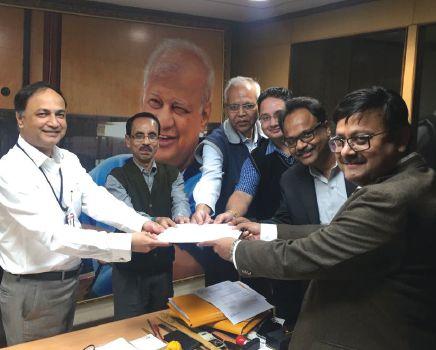
At the contract signing (left to right) Abhijeet Bhattacharjee, MD Bartaman; Amal Roy, Senior Manager Maintenance; Amit Roy, Finance Director; Subhojit Kr. Datta, AGM &CS; Subir Paul, GM Sales, manroland India; and Sudeep Bhattacharjee, MD, manroland India.
After signing the contract (left to right): Ratha Kerisnan, Managing Director IPP; Andrea Dallavalla, KBA-Flexotecnica; and Andreas Friedrich, Managing Director, KBA Asia-Pacific.
2018
25 years ago
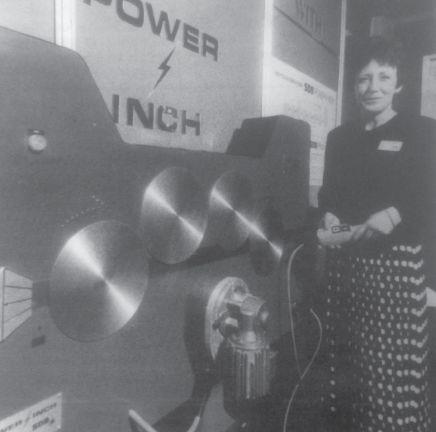
Web Units Can be Inched Over: A British company has patented a system which makes it possible for work to be carried out on temporarily idle units of a web offset press while the machine is actually in production, reducing downtime and increasing output. The Power Inch system from S.D.B. Engineering allows such unused units to be inched over, so that maintenance work or makeready for subsequent jobs can be done.
The Power Inch system consists of three units: an electromechanical drive, incorporating its own clutch and reversible drive motor, powers the printing unit when it is not connected to the main drive. This is tailored to the construction of the individual machine by a mechanical interface, which renders the system suitable for any type of make of press.
$45K
For sale (2003 classified): Quickmaster 2 colour 1997 2.8 million impressions powder spray auto plate and blanket wash Super Blue II. $45,000.
15 years ago
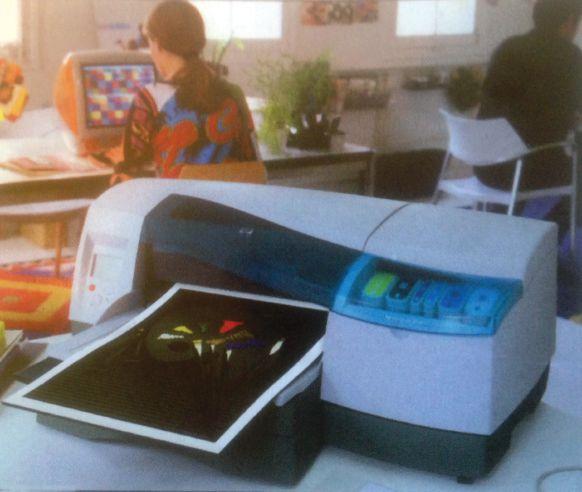
Digital Proofing: The digital revolution is generating far-reaching and strategic changes in print production processes and workflow, particularly in the area of proofing. This trend is clearly indicated in a recent GATF survey in which 88.1 percent of the 109 respondents (printers and prepress providers) anticipated growth in digital proofing over the next 12 months. The movement is linked to the dramatic increase in Internet access and associated trends in the industry. This includes an increased use of Portable Document Format (PDF) files for soft proofing, as well as the movement of proofing downstream because of the desktop publishing tools used by content creators. Another important trend is the increased use of inkjet as digital proofing technology, which includes leveraging the Specifications for Web Offset Publications (SWOP) standard. Inkjet serves many purposes in a computer-to-plate environment, where it can be used by almost every group in the print production process.
$7.3K
For sale (1993 classified): Multi 1250WL with Thistle System, T-Head bareback and swing away and powdair spray. $7,300.
20 years ago
Grand Opening: DATA Business Forms officially opened its new Brampton stock forms plant in February. The relocated plant, the newest of 12 manufacturing plants across Canada, manufactures, customized and stocks continuous computer paper and laser sheetfed products.
Participating in the ribbon-cutting ceremony were (left to right): Paul Normandeau, Vice President of Operations, DATA; Tony Clement, MPP Brampton South; Brampton Mayor Peter Robinson; Steve Stumpacher, Operations Manager, DATA stock forms plant; and John Conway, President and CEO, DATA Business Forms.
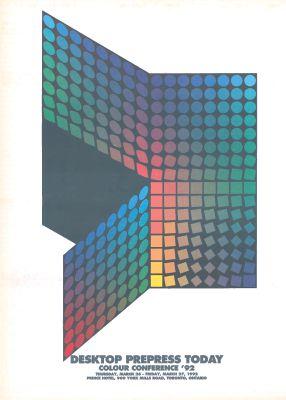
Industry conference advertisements from 1993 (left) and 2003 (above) illustrate the technological trends of the day.
Incorruptible blockchain power
Why an emerging digital transition can affect and drive the manufacturing world
By Jennifer Rideout
he blockchain is an incorruptible digital ledger of economic transactions that can be programmed to record not just financial transactions but virtually everything of value.”
This is how blockchain technology is defined by Don and Alex Tapscott, authors of the 2016 book, Blockchain Revolution. It’s an accurate definition, but not necessarily one that is easily understood. So… just what is blockchain, anyway?
A blockchain is a continuously growing list of records or transactions between peers that are linked together sequentially in ‘blocks.’ Each block in the link (or chain) contains a cryptographic hash for the previous block, a timestamp and transaction data. Blocks include a record of every transaction that occurred on the network during that period, and every transaction is validated to guarantee accuracy.
Blockchain data is secured using cryptography. It is also stored across the blockchain network in a decentralized system, meaning that every node on the network stores the entire chain. This means the data being recorded is transparent to all nodes on the chain — albeit encrypted so only the persons involved in a given transaction can access their digital assets.
What makes blockchain technology appealing is that it guarantees trust in peer-to-peer transactions, limiting the need for intermediaries like banks, car dealerships or retailers.
To put into context how secure blockchains are, consider that provider Ethereum has 25,000 nodes across the world on its network. In order for a hacker to steal or modify data on the chain, they would need to find a way to do so on every node at the same time.
They would then need to repeat this for every subsequent block in the chain, forever. Therefore, data contained within a blockchain is considered incorruptible.
Put another way, let’s say you created a blockchain network (or leveraged an ex-
Blockchains are attractive to businesses based on the incorruptible nature of the data being recorded.
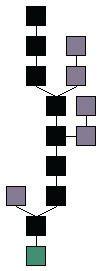
Invented 10 years ago for bitcoin, a blockchain is a growing list of records. The main chain (black) holds the longest series from genesis (green). Orphan blocks (purple) exist outside of the main chain. Source: Bitcoin Wiki.
isting one) to track products across your supply chain. Because of the incorruptible nature of the data being recorded, you would never need to worry that shipment times, environmental conditions, or a slew of other recordable data points were modified or inaccurate.
But isn’t blockchain just bitcoin?
No. Blockchain is a network framework that enables secure digital transactions between peers while bitcoin is a digital currency.
Although bitcoin is transacted through blockchains, the flexibility of blockchains can transact far more information types.
Why care about blockchain?
First, blockchain presents incredible opportunities for data security. As mentioned above, the only way to falsify data is to falsify it on every node in the chain and in every block created since the initial validation. How would you like to have data that you absolutely know you can trust?
Second, when leveraged appropriately, blockchain technology can save organizations a lot of time and money. ‘Smart contracts’ are possible with blockchain technology, which can automate actions and transactions between parties. For example, a smart contract can be created that only allows payment, or acceptance of delivery, if products are kept at a certain temperature during travel. If environmental sensors detect that the temperature went outside the acceptable range,
the contract is not completed.
Last, although blockchain is seen by many as impacting only the financial industry, the technology is gaining ground in virtually every sector. In fact, the possibilities are nearly endless: Blockchain in the real estate industry can help record, track and transfer land titles, property deeds and more, and ensure every document is accurate.
Blockchain technology could mean healthcare providers finally have a way to share data across hospitals, doctors, patients and other parties without compromising data security or integrity.
For those who donate to charity, blockchain technology makes it possible to see exactly where your donations go, and how those funds were used. It also makes it impossible for organizations to misrepresent how many donations they received and how they were spent.
And for retailers, blockchain can provide an irrefutable product history that verifies where, when, how and by whom their products were made.There is already work being done in this area by international coffee providers.
How will blockchain affect manufacturers?
In the near term, the biggest impact of blockchain for manufacturers is in the supply chain.
I’ve provided some examples already, but the data accuracy and automation that smart contracts offer make it ideal for use across production and distribution. The ability, for example, to guarantee product quality can improve brand loyalty and make manufacturers more desirable to customers and consumers alike.
Blockchain also goes hand-in-hand with another network-based technology — the Industrial Internet of Things (IIoT). Manufacturers should know that the more data being captured across their supply chain, the better results they will receive from blockchain technology. For example, the smart contract scenario outlined above is only possible if environmental sensors are deployed in delivery trucks and send data to the network to report on conditions.
Like other technologies before, we are still discovering how blockchain will impact organizations. But as the use and use cases of blockchain expand, it will become increasingly difficult for manufacturers to ignore the possibilities of this new technology.
Jennifer Rideout is the manufacturing marketing manager for Cisco Canada. She is responsible for developing go-to-market strategies for the manufacturing sector in Canada. jerideou@cisco.com
Connecting to corrugated
More than 1,200 print professionals gather in Las Vegas to see the direction of digital packaging and more
By Martin Habekost
EFI held its annual Connect conference from January 23 to 26, 2018, at the Wynn Hotel in Las Vegas. On the first day of Connect, the CEO of EFI, Guy Gecht, hosted a fireside chat with two European customers who are the first to install a Nozomi C18000 digital UV LED inkjet press. This machine is intended for corrugated packaging, corrugated display and independent converters. It can be run in single-lane mode where the corrugated board is as wide as the feeder of the press or in dual-lane mode, which prints the corrugated pieces side-by-side in one pass. In this dual-lane mode, the print speed is up to 6,600 sheets per hour.
The first customer Gecht spoke with was Eric Barcourt, CEO of Hinojosa Packaging Solutions, with 12 production sites in Spain. It uses offset, flexo and gravure to service the middle-market to the small customer. One important statement was that big customers do not require value-added production of their packaging products. Hinojosa started out by serving the shoe and textile industry in Spain printing simple, single colour boxes. This is now changing with the outside of packaging products becoming more colourful and individualized.
In the past, some of Hinojosa’s customers transferred their packaging printing to low-cost countries to save money, but now they are bringing business back to Spain, because of relatively short delivery times. In Europe, the market is consolidating and production and shipping costs need to be reduced. Barcourt pointed out that the Nozomi C18000 offers the best image quality for the substrates the company uses and it also allows them to print on substrates that are not always 100 percent flat, while providing more individualized solutions.
Beyond EFI’s notable achievement in developing its dual-lane mode, the Nozomi prints CMYK with the ability to add Orange and Violet for extended gamut coverage. Supporting full variable data printing, there are currently installations in North America, Europe and Asia.
At Connect, EFI is also highlighted its inkjet textile printing with the Reggiani line of fabric printers. EFI acquired Reggiani in July 2015. The target for these machines is in fast fashion sold in stores like H&M. These fast fashion stores don’t have four fashion seasons, explains EFI, they have 12. Every month new designs and patterns are revealed and the Reggiani machines can supply these fast fashion chains with necessary prints.
On this note, EFI launched the Optitex 3D Design Illustrator to validate and customize 3D garments in Adobe Illustrator. This is a plug-in tool allowing designers to create and view garments in 3D. The visualization is accurate in proportion and scaling. The Illustrator plug-in allows users to customize the fabric, texture, print patterns and graphic placement without the need for a printed sample. This reduces the amount of physical prototypes in the design process, allowing for shorter design cycles.
Another key emerging market for EFI is in printed ceramics. The Cretaprint line of printers offer various print widths and special effects that can be applied to ceramic tiles. These machines allow for total custom production of ceramic tiles.
The Vutek line of inkjet printers offers a variety of applications particularly with Super Draw inks that can be used for thermoforming of printed plastic substrates. It was mind-boggling for me to see what can be done these days with inkjet printing. The possibilities are almost endless.
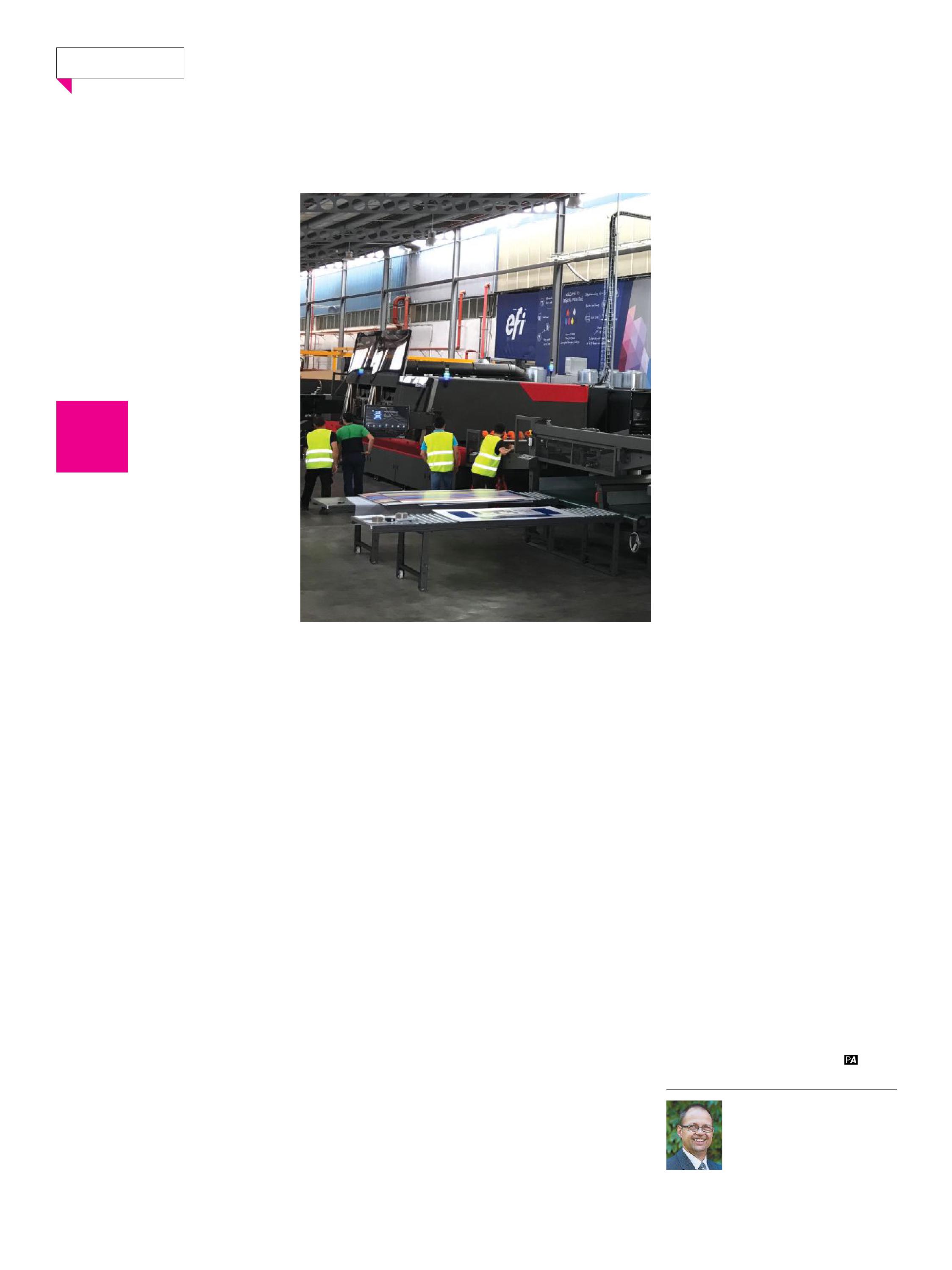
The first two installations of the EFI Nozomi C18000 press were at Hinojosa Group in Spain (pictured) and McGowarns Print in Ireland.
The Nozomi press aims to provide corrugated manufacturers and brands access a wide colour gamut and broader design options in corrugated board work. The press can print up to 246 linear feet (75 linear metres) per minute, producing up to 77,200 square feet (7,224 square metres) per hour.
At the conference, Xerox and EFI announced a new Fiery-powered DFE for Xerox engines. Xerox in February 2017 sold its line of FreeFlow print servers to EFI. The new DFE combines unique features of the FreeFlow print server and the EFI Fiery line of DFEs. This new DFE offers the support of the application of metallic toner-based inks. I had the opportunity to see a Xerox press with six print stations that could apply silver toner in the first print station, followed by CMYK, and the option to apply opaque white or gold in the sixth print station. This type of technology is definitely interesting for the custom packaging print market, where metallic inks can convey high quality and exclusivity.
EFI also unveiled its MarketDirect Customer Engagement Platform at Connect. It has been developed out of the DirectSmile’s VDP solution, which EFI acquired in 2014 and has now integrated into its productivity suites. This allows users to build and execute personalized communication and marketing programs for Web, email, print, mobile and social media. The user interface is HTML5-based. The software can be purchased and hosted on a local server or purchased as SaaS (Software as a service) hosted on an EFI server. You might be tempted to say, “Well, this is great, but I will use MailChimp for my email campaigns.” Programs like MailChimp offer you landing pages as well, but the MarketDirect suite allows you to combine electronic and print communications. Its use appears to be quite intuitive by simply selecting options like email blasts, PURLs, and printed materials.
A user just clicks on the check-boxes for the various features they want to leverage in a marketing campaign. Another great feature is that MarketDirect’s user interface can be customized and it comes with built-in theme templates. Among the many announcements at Connect, the one that struck a chord with me, presented by Gabriel Matsliach, was the use of a common interface for all EFI software. I found this very important, since it gives customers a common look and feel for all of EFI’s solutions. This might seem like a cosmetic change, but it allows users to become comfortable with different EFI software products, which continue to expand every year.
MARTIN HABEKOST received his Ph.D. in Analytical Chemistry from Universität Hannover. He is Associate Chair for Ryerson University’s School of Graphic Communications Management. mhabekos@ryerson.ca
CALLING ALL PRINTERS
Buying signals
When faced with time constraints, should salespeople worry about signals like body language
By David Fellman
Alot has been written about selling strategy and technique over the years, much of it contradictory and some of it downright confusing. One of the things that has always confused me is the emphasis on the body language of the prospect. I remember a training program back in my early days where the trainer demonstrated several examples of “I’m ready to buy!” body language. To me, it just looked like he had too much coffee that morning.
I don’t reject the idea of buying signals, it’s just that I’ve found them to be more audible and behavioural than visual in printing sales. In my experience, the importance of body language is more related to “not-buying” signals. For example, when the person you’re trying to sell to starts looking at his watch, or playing with papers on her desk, that’s a pretty good sign that you’ve lost the initiative.
A good attitude
My approach to prospecting is always to look for people with a good attitude. That includes things like taking my phone calls, giving me cooperative and honest answers to my questions, and giving me the opportunity to build the sort of relationship I’m looking for – one that’s based on value rather than price. Those attitude and behavioural characteristics are the early buying signals that I’m looking for. When I run into someone who shows me a bad attitude, I make myself sell myself on the idea that he/she is worth pursuing.
This is important! Most of the salespeople I work with have time constraints. There’s a lot more work in their typical day than there is time to do it. The less time you have, the more important it is that you use your time wisely. That means spending it on people who are likely to provide a solid return on investment.
I’ve written before that my definition of a real prospect includes three criteria. The first is that they buy exactly the kind of printing you’re best equipped to sell. Second is that they buy enough of it to make your pursuit worthwhile. Third is that they show some interest in buying
from you. What would make a “suspect” who fails that third test worth pursuing? Only the knowledge that he/she passes the first two tests with flying colours. In other words, someone who buys a lot of the printing you’re best equipped to sell. Think of it this way, people who buy just a little bit of printing are a dime a dozen. That means it’s only worth a little bit of effort to convince them to buy it from you. If a person with low volume potential shows me a bad attitude, my first impulse is to move on to the next suspect. Once I determine that someone is a marginal prospect in terms of their volume potential, it’s a very tough sell to get me to continue the pursuit.
On the other side of that coin, when I determine someone has large volume potential, I’ll hang in for a long time in an effort to develop some interest in buying from me. That can take time and there’s no guarantee of success. Maybe the best way to look at this is to understand that in the prospecting stages, you’re looking for small customers and large prospects. If they’re small, they need to become customers fast, with minimum effort on your part. If they’re large, they’re worth some developmental time and effort.
Problems and opportunities
The best buying signal in printing sales is when the buyer expresses some level of dissatisfaction with his/her current printer. Just remember that you still bear the burden of providing a solution to the problem and relief for the pain! Most salespeople seem to address this oppor-
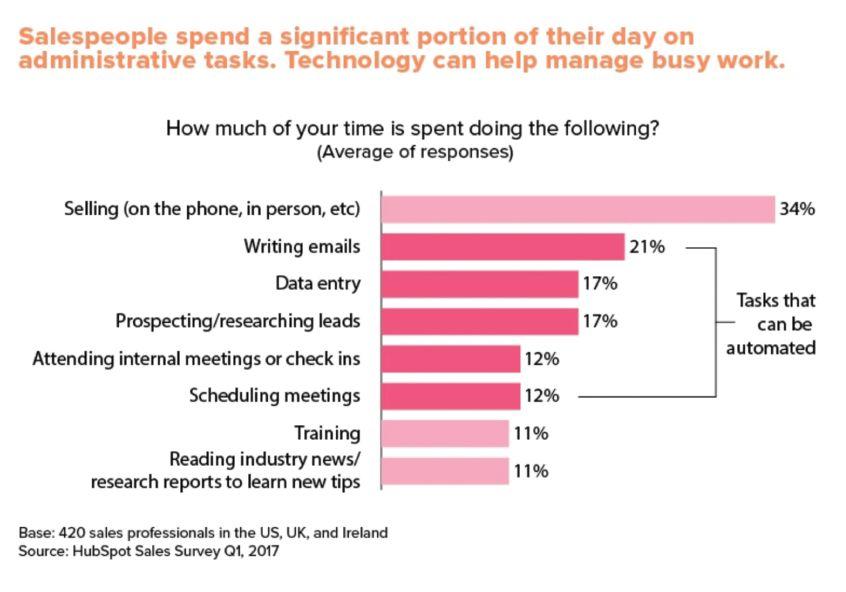
Hubspot surveyed 420 salespeople in the U.S., UK, and Ireland and found they spend a significant amount of their time tackling administrative work. Writing emails, prospecting leads, data entry, and scheduling meetings are all tasks that can be automated so that salespeople can spend more time doing what they were hired to do.
tunity by “presenting” and then hoping for the best. I can’t tell you how many times I’ve heard some variation of “We had a great conversation” or “He seemed really interested.” These are viewed as buying signals, perhaps, but they’re not tangible enough for me. I’d rather see you flat-out ask your prospect how you did. “Does my proposal make sense to you?” or perhaps “Does it seem like a good solution to your problem? Do you think it will provide relief for your pain? Are you sold on the idea of buying from me?”
That takes us to the bottom line for today. The whole idea of buying signals”is pretty interesting, but great printing salespeople don’t put much stock in a strategy that might fail because a signal was misinterpreted. Great printing salespeople ask direct questions, and they usually profit from the answers – even when the answer is “No, I’m not convinced yet.” So, let’s be concerned less with interpreting buying signals and more with making the sale.
Salespeople, according to a Hubspot survey in 2017, spend one-third of their day talking to prospects and 21 percent of their day writing emails. 21%
DAVE FELLMAN is the president of David Fellman & Associates, a graphic arts industry consulting firm based in Raleigh, NC, USA. He is a popular speaker who has delivered keynotes and seminars at industry events across the United States, Canada, England, Ireland and Australia. He is the author of “Sell More Printing” and “Listen To The Dinosaur.” Visit his website at www. davefellman.com.
THE PURSUIT OF PROSPERITY
Asia Pulp & Paper opens up its Indah Kiat Perawang mill to illustrate five years of work to become a progressive paper producer with interests rooted in its concession communities
By Jon Robinson
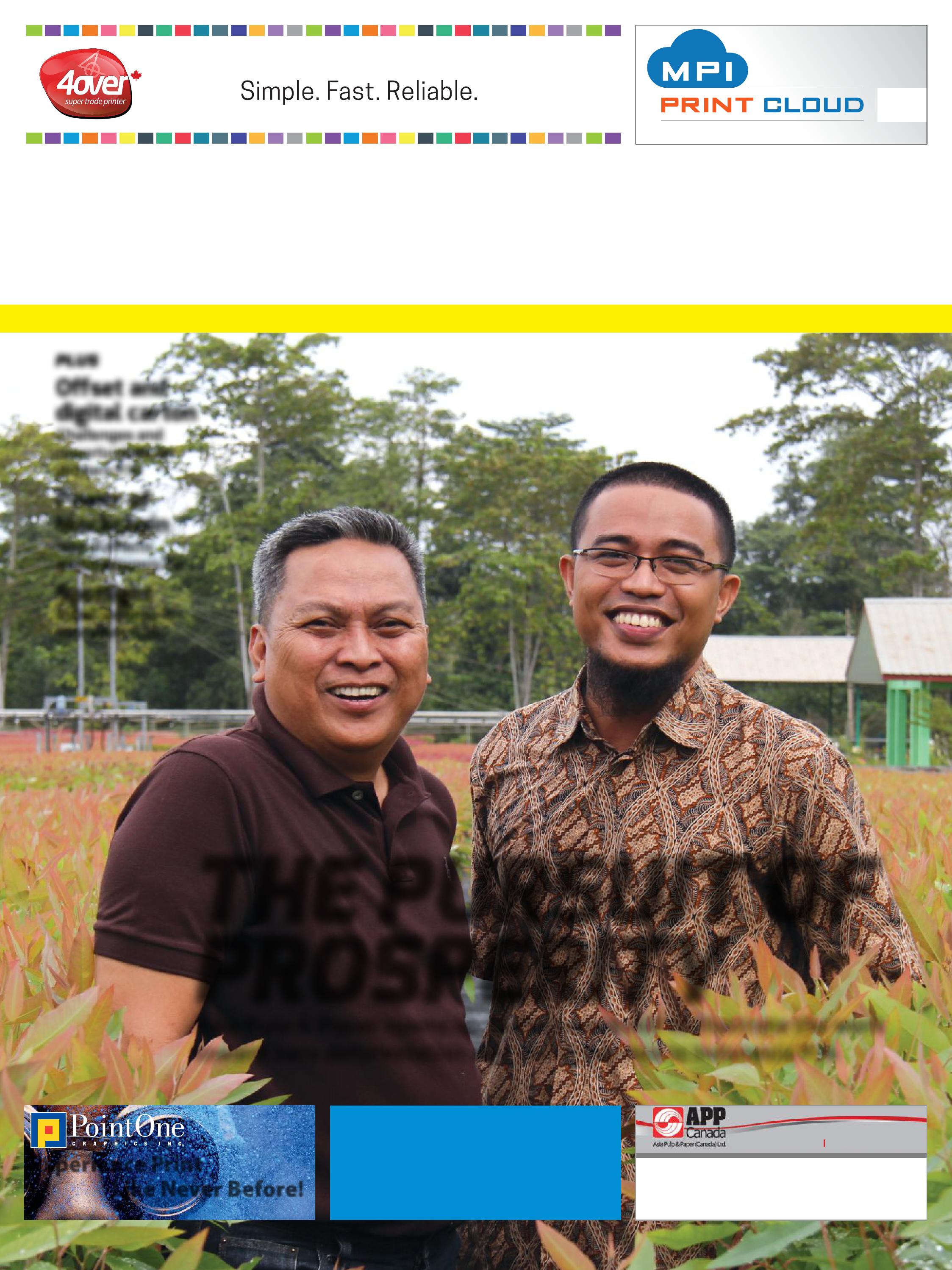
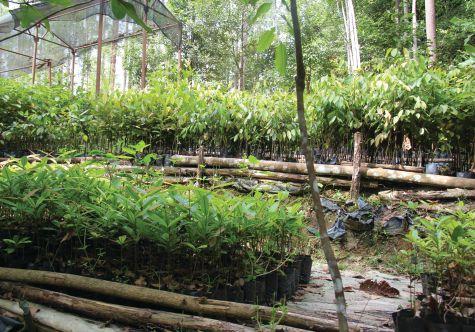
1 Heading toward the Bukit Batu Biopshere reserve, designated with APP as Core Area rainforest. 2 Fachri Irawan, Head of Tissue Culture Laboratory, and Yodim Kusuma, Seed Development, within a Eucalyptus nursery at APP’s Perawang Mill.
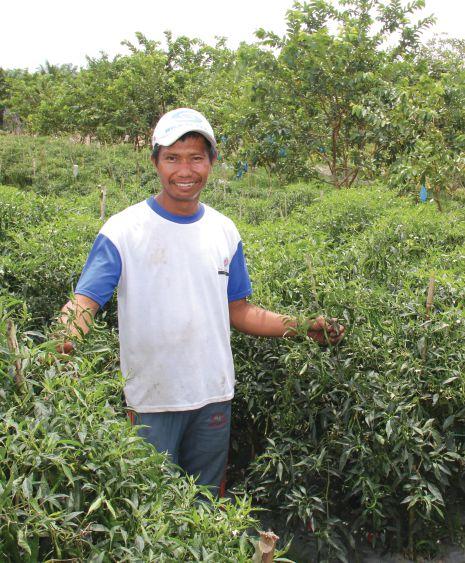
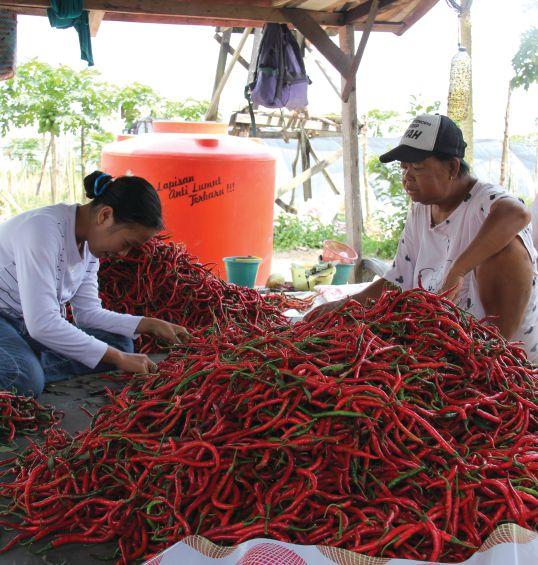
3 Suryono, owner of an IFFS partner farm which now generates around 500 million rupiah (50,000 in Canadian funds), as opposed to 5 million rupiah just a few years ago. 4 Johannes Koto, who helps lead APP’s Forest Conservation Section, with Eucalyptus plantation trees in the background. 5 IFFS has been rolled out in 189 villages, benefiting more than 13,800 households. 6 An endangered species towers in the Bukit Batu reserve. 7 APP’s arboretum is a protected area where natural species of the forest are cared for as they naturally produce more than 2,500 seeds every month. 8 APP currently helps protect six elephants, including the male Nando, who roam the arboretum corridor. 9 More than 500,000 plantlets can be generated per month in APP’s Perawang lab, with an 85 percent success rate.
Asia Pulp & Paper in February 2018 reached the five-year anniversary of its seminal Forest Conservation Policy, which set into motion a series of massive and aggressive initiatives to transform one of the world’s largest integrated pulp and paper corporations. Its decision to place sustainability at the heart of its operations was actually formalized a year earlier in its Sustainability Roadmap Vision 2020, when Asia Pulp & Paper (APP) committed to zero deforestation. This commitment was then formalized in the Forest Conservation Policy (FCP) based on APP developing a plantation-driven business model and putting an immediate end to sourcing pulpwood materials from suppliers involved with natural forest clearance
Today, all 38 of its external wood suppliers are evaluated for FCP compliance and the company explains, that outside of two minor breaches that were quickly resolved, it has maintained its FCP commitments. “Five years ago we turned our company around and it has been a good story of change,” says Ian Lifshitz, VP of Sustainability & Stakeholder Relations, Americas, APP. “We have really seen a shift in our organization in the way we approach the community, forest conservation and zero deforestation. The key thing is five years later the FCP is holding.We have not broken our policy. We continue to maintain and evolve.”
FCP commitments are rigorously re-
viewed every six months at an APP-hosted forum with environmental stakeholders like Greenpeace, which years earlier targeted APP’s practices through highly public campaigns. Greenpeace and similar NGO stakeholders, as well as government agencies, engaged in the FCP process are now commending APP for its progress and work on the ground, which has since moved well beyond forestry protection into a holistic approach to help develop prosperity for Indonesia.
Opportunities of the forest
According to 2017 numbers provided by the Indonesian Ministry of Environment and Forestry, 27.8 million Indonesians live in poverty and 36.7 percent, or 10.2 million people in the country, are below the poverty line in rural areas where forestry and/or agriculture are the main source of economic livelihood. Indonesia’s forest area comprises 126.1 million hectares, equivalent to 66.9 percent of the country’s total landmass. Some 1.3 million jobs –directly and indirectly – are created by the pulp and paper industry.
“It is important for us to put our industry in the context of the most critical issue facing Indonesia today, which is poverty,” says Veronika Renyaan, Sustainability and Stakeholder Engagement, APP Indonesia. She explains APP now invests more than $13 million annually in community development programs, including the company’s unique Integrated Forestry and Farming System introduced in 2015 with its own investment budget of $10 million until 2020.
Under Indonesian regulations every
2.5K
Asia Pulp & Paper’s arboretum is a protected area where natural species of the forest are cared for. Every month, the nursery is able to produce 2,500 seeds from sources in the arboretum area.
forest concession holder must set aside 20 percent of the land for community use and 10 percent for conservation. APP is currently operating beyond these marks providing 22 percent of its concessions for community use and 21 percent for conservation, with the remaining 57 percent being used as plantation forest. The Integrated Forestry and Farming System (IFFS) is a key driver of these percentages in APP’s effort to support the economic development of 500 villages in landscapes surrounding its concessions.
“There are 180 villages within our concessions, but we also map out villages outside of our concession areas to a radius of 10 kilometres,” says Neglasari Martini, Head of Sustainability and Stakeholder Engagement, APP, noting this accounts for 799 villages, which may hold anywhere from around 100 people to larger size communities of more than 1,000.
Martini explains the 500 chosen villages are based first on the approximate 200 touching APP’s concessions and the other 300 are based on social mapping, in terms of location, land conflicts and potential threats to APP’s forest concessions, which constantly face illegal logging and the potential for third-party fires being started in, or crossing over into, its concessions.
“Fire is a very complex issue in Indonesia… often it is because of land disputes. People may want to claim land so they burn it and then plant palm oil. It is very complex to pinpoint,” explains Martini. APP has invested more than $103 million
since 2015 on forest fire management. It began working with British Columbia’s TREK Wildland Services and Working on Fire from South Africa to help train its fire teams, build fire towers and to establish better hotspot detection for real-time monitoring, understanding this is a critical issue for APP’s efforts to work with communities.
Before the IFFS program begins within a community, a business plan must be put together to understand how the land will be used, which typically involves planting vegetables or fruit, managing cows, or developing more schooling or housing. The program also requires the establishment of a village institution to manage the money within a cooperative model.
“It is like micro-financing and they need an evolving fund, so some of their profit returns to the institutions for the other villagers to use the money,” says Martini.
This approach not only improves farming yields and the development of more skills and services for the village as a whole, it also provides forest protection and conservation. A facilitator is based in the village to help implement the program.
“The HR manager [from APP’s Indah Kiat Perawang mill] runs a farming community program,” says Lifshitz, “so there is crossover from employees at the mill who actually work on the program, directly impacting them.”
Perawang pulp and paper
The Indah Kiat Perawang mill is enor-
mous covering a square footage area of more than 2,400 hectares, holding nine paper machines, four pulp lines and six large-size tissue lines in addition to smaller machines. When last checked, more than 40 kilometres of pipe – often of large diametre – is used to feed and relieve the mill’s operations. One of the mill’s current capital investment projects focuses on updating its power cycle, which has an install capacity of 1,000 megawatts.
The project will also help power local communities, which is an existing APP initiative. “Sometimes the government power supply is not enough and we always have spare capacity that we can sell,” says Sufianto Alfian, Head of BU Commodity Division at Indah Kiat Pulp & Paper Perawang. “But we are not making profit from it, rather creating a good relationship with the community.”
The Perawang mill has a pulp capacity of around 8,000 metric tonnes per day, about 50 percent of which is used for paper production, with its own output of 3,000 to 4,000 metric tonnes per day. This equates to anywhere from 100,000 to 120,000 metric tonnes of paper produced per month. The mill’s Paper Machine 3 (PM3), as an example, has a target running speed of 1,350 metres per minute and an average uptime operating efficiency of between 85 and 90 percent. PM3 typically runs 24/7 for about 40 days before shutting down for a day of maintenance. It takes about one hour for PM3 to produce what the team refers to as a
1 British Columbia-based TREK Wildland was contracted by APP to help train more than 400 members of its fire team and to also establish fire monitoring.
2 Sheets of pulp are produced on APP’s massive, Canadian-built Lamb system.
3 APP Perawang’s Paper Machine 3 produces 50-tonne rolls.
jumbo roll – 50 tonnes – and around 1,200 tonnes per day.
Hinting at the scale of Perawang’s vertical integration, which includes a new Bielomatik-driven converting plant, its pulp production is fueled by around 50 percent of APP’s wood supply (creating black liquor), with the other half converted into usable fibre. Alfian explains, “The integration is quite extensive here, from the seedlings that turn into fibre production and even the final products going to customers – all of it from seeds.”
APP started its forestry research program at Perawang in 1990, which was then replicated in Jambi province in 1995, followed by three other regional research centres in 2005. The company develops Eucalyptus and Acacia for its commercial plantations. “We need to find the best quality of wood to fulfill the needs of our mill,” says Yodim Kusuma, who leads Seed Development, in the Perawang mill’s research facility.
The company’s research facilities face
Consumables
more pressure since the beginning of FCP and its zero deforestation pillar, as APP must focus more on growth and yield assessments to determine if there will be enough wood supply for its mills. Its first projections done in 2013, to the year 2020, identified a small gap in 2019, but it will be easily overcome with improvements in yield and other operational efficiencies. Updated projections in 2015, looking toward 2025, also indicate there will be enough wood supply in APP’s plantation model.
Previously, APP harvested its trees in eight-year cycles at the high end, but the work of the research team allows for harvesting more often after just five years. “Only after five years will the eucalyptus properties meet the criteria of the mill, because they have wood density, the hardness of the wood, and also cellulose content and lignin content criteria,” explains Kusuma. “After two years, the wood is not hard enough so the wood consumption is still low. But after five to eight years, it will be too hard and it will
be difficult for the wood-chipping process.”
Using a spacing of three by two metres, Kusuma explains the company can grow 1,666 trees per hectare, which creates an ultimate yield target of 225 cubic metres per hectare. The operation is currently hitting 150 cubic metres per hectare, with a survival rate of between 70 and 80 percent. Perawang’s research team continues to work with Eucalyptus hybrid clones – without DNA manipulation as regulated by the government – to develop what it describes as plus trees.
“When we find a plus tree, we will multiple it on a large scale,” says Kusuma. “For Eucalyptus, we can produce by cutting, but for Acacia we use seeds because we have not optimized our cutting production for Acacia.” The Eucalyptus clones are created from cuttings after about three months of various quality control and fertilization stages in the lab. They are then placed in the nursery and ultimately back into the plantation to restart tree growth for the future.
sells a wide range of consumables for the Flexo market.
Offset and digital advances in the folding-carton sector provide new opportunities and challenges for commercial printers looking to capitalize on specialized and short-run folding-carton work
By Jon Robinson
By most accounts, packaging is a stable future market relatively untouched by digital printing technologies, making it a logical direction for high-end commercial printers, even if they move slowly with primary clients into relatively low-cost label printing or specialized short-run folding carton work. Flexography remains a unique process and long-run carton will continue to be dominated by established players, but new digital – toner and inkjet – press technologies provide more packaging opportunity for commercial printers. The continuing automation of 40-inch offset presses also provides short-run packaging opportunities, as newer generation digital presses in the space mature in performance and price
Offset carton opportunities
40%
Testing offset carton work in Wiesloch, Heidelberg entered 2018 ready to begin series production of its Primefire press for carton, illustrating a key connection between offset-minded press makers and commercial printers.
Percentage of the packaging sector’s most widely used printing process, flexography, in the current global printed packaging market, which accounts for a value worth approximately $340 billion per year.
Press manufacturers like Manroland Sheetfed, Heidelberg, Koenig & Bauer and Komori hold strong positions in offset carton work, with the latter three deep into the development and installation of inkjet systems, while Manroland is actively working on the technology. These press makers will be key facilitators of packaging adoption by offset-driven commercial printers. “Sixty-eight percent of all of our [offset] press sales are going into packaging and the remainder are going into high-end commercial,” says Sean Springett, CEO of Manroland Sheetfed North America. “In most cases where I
see [a commercial printer] making a move into packaging, they have done it through acquisition... It doesn’t seem to be very organic in nature unless they have found their way into [with an existing customer].”
Springett explains the space needed to hold one truckload of coated text or cover versus carton stock as one common challenge facing commercial printers transitioning toward long-run packaging. “Just looking at skids of paper, say 100-lb coated, you might have a truck load that would be 80,000 to 90,000 sheets,” he says. “If you do the same truckload with 24-point board it’s 32,000 sheets… a lot of commercial printers do not have that kind of space.”
Springett sees potential in 40-inch packaging based on the advances of offset presses. “Since about the middle half of [2016] and through [2017] there has been more demand for specialized packaging and that generally is dedicated to the B1 or 40-inch-press format. You can do a lot more with a 40-inch press than you can on a larger format.” He sees specialized carton work growing in markets like convenience products for food, cosmetics and pharmaceutical. “They are all trending back to the 40-inch specialized luxury aspects of print added to the package.”
Around 80 percent of the Manroland presses sold into packaging are now 40inch machines, explains Springett, whereas the previous eight years hovered around a 50/50 split between large-format and 40-inch machines. This movement toward 40-inch for luxury packaging falls in line with Manroland’s new 40-inch Evolution
Counterfeiting is a global problem. In your world, that means thieves are trying to steal your most prized possession — your reputation. Fortunately, Sun Chemical has the anti-counterfeiting technology you need to protect your brand and reputation. From infant formula to adult beverages and more, it’s just one more way Sun Chemical helps you go securely from concept to consumer — all from a single, trusted source.
Request your copy of our white paper, Anti-counterfeiting Technologies for Packaging, at www.sunchemical.com/ anticounterfeiting or call 1-708-236-3798. working for you.
Digital systems provide the ability for carton produces to apply simple and complex variable data inline, increasing turnaround times (Photo courtesy of Koenig & Bauer).
press, introduced in 2016 with new levels of automation. “The lines were getting a little more blurred in 2017, because what was not typically considered feasible in 2012/2013 with an offset press is now very feasible. Some companies do it all day long – run lengths of 900 to 1,000.”
As more printers define their production platform in terms of Overall Operating Efficiency, which might hover around 35 percent for a typical company, press suppliers are moving quickly to provide even greater press-production transparency for clients.
Digital carton opportunities
Transparency in press production – fitting the Industry 4.0 movement – is an advantage for production inkjet, as this technology was developed in line with the use of Big Data analytics. Inkjet press makers are focused on proving the value of capital investments applied to an individual facility’s production. By consulting with customers, typically on a print-application level, there has been significant growth in the adoption of inkjet presses.
colour, repeatability, and the use of aqueous pigment inks, which are favourable in commercial cutting, creasing and folding. This allows inkjet presses, explains Pierce, to more easily fit into a commercial printer’s existing post-press operations – “You do not have to retool.”
Features of the press alone are less interesting to a printer.
“A strength of the supplier is being able to provide that information, but more importantly is being able to disseminate it and intelligently communicate it to the printer,” says Springett. “The biggest element we see in the ideology of selling a printing press is that features of the press alone are less interesting to a printer [than] the ability for them to have transparency in understanding the production going on with the press.”
Ed Pierce, Fujifilm’s J Press Product Marketing Manager, saw major growth in J Press 720 installs over the past 12 to 18 months. The J Press blazed a trail for cutsheet inkjet engines with its introduction at drupa 2008.The first-generation J Press debuted in 2011 and the next generation – producing quality offset work – reached the market in mid-2015. “We are shipping our 31st in North America and we have a population of over 100, globally,” says Pierce. “We have been seeing a growing install base in the folding carton market as well. In the early days, that was not an area we focused on because we wanted to first gain traction in the commercial space, but we have a lot of flexibility to address the folding-carton market.”
Pierce describes this flexibility in nextgen developments like higher fidelity in
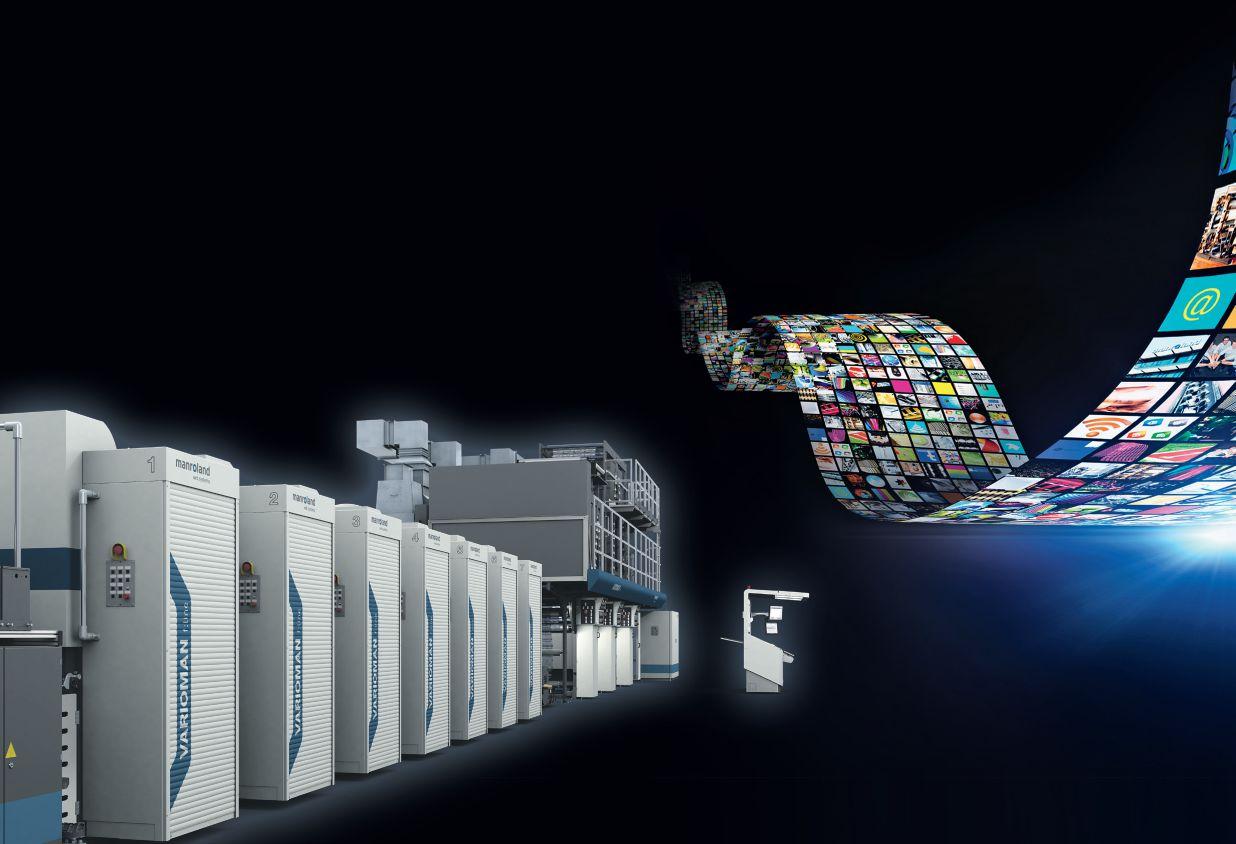
VARIOMAN – Boost Quality – Cut Costs
A new dimension for flexible packaging printing: VARIOMAN is the new technology platform for modern flexible packaging printing. The market demand is a press that offers brand differentiation, increased comfort and additional packaging sizes. This is given by the extraordinarily designed VARIOMAN. As offset hybrid press, it bypasses weak points of other technologies. In combination with gravure-, inkjet- or flexo printing units, the VARIOMAN covers production gaps at medium print runs with excellent offset printing quality. manroland web systems GmbH
The Fujifilm’s J Press 720S for commercial work is able to run 3-point to 14-point stock, but with the addition of a couple of parts – in about an hour – allows the press to become the F version printing 8-point to 24-point stock. “We see a lot of 18 to 20 point and have some customers with dedicated presses for folding carton working with 20 to 24 point,” says Pierce. “We also have some who switch back and forth.” He shares an example of a customer running an average run length of 1,300 folding cartons for pasta, but with 156 different SKUs based on printing a different brand name on the box.This is an extreme example of how commercial printers might benefit from packaging in a growing short-run carton market.
“I believe in digital and it will be a growth aspect of the industry, but I would say that there are just as many pitfalls in digital inkjet as there are in traditional offset,” says Springett. “It is just different scales of economies, productivity and throughput.”
In an ever increasingly competitive world, you need the highest performing, most cost effective equipment to minimize costs and grow sales. In a neutral data study, all three Heidelberg 40" platforms outperformed all of the competitor machines in the market. When linked with color management and industry leading color control systems, on a cost per sheet basis, these presses are simply unbeatable.
INFORM INSTRUCT INSPIRE
Industrial inkjet technology is disrupting virtually every manufacturing industry – from flooring to fashion, automotive to electronics, sporting goods to packaging, and everything in between. The INPRINT INDUSTRIAL INKJET CONFERENCE is your opportunity to get the latest insights into industrial printing. Attend our 2-day program to discover new production possibilities available with digital inkjet technology and network with the experts that can take your print idea from concept to reality.
You will experience:
• The latest trends in inkjet for decorative, functional, and packaging applications
• Technical and creative applications tracks
• Interactive roundtable discussions and case studies
• Opportunities to network and learn from peers and industry leaders
Register today at inprin t usa con ference.com to save 25% on your conference pass.
May 1-2, 2018
Palmer House Hilton Chicago, IL
Platinum Sponsors
Colour tools
Kodak Proofing Connectivity
In January 2018, Kodak announced upgrades to its Kodak Proofing Software, which allows users to proof spot colours with higher accuracy based on new support for violet-ink proofers in the Epson SC-P7000 and SC-P9000 family.
Sun Chemical SunColorBox
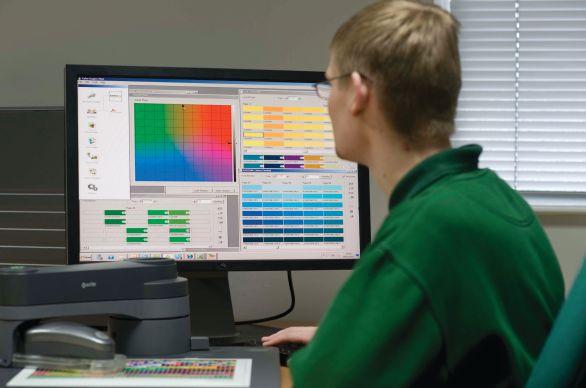
Launched in mid-2017, Sun Chemical’s newest version of SunColorBox is an end-to-end digital colour management solution designed to ensure brand colours are reproduced consistently and efficiently. The company describes SunColorBox as a fully optimized toolkit of digital applications and services to achieve precise colour at every stage of the print production cycle. The latest version incorporates four important new features including: Private Cloud, as well as expanded SunConsulting and process printing through SunCMYK and SunECG. Private Cloud utilizes a cloud-based solution to manage converters’ private databases of bespoke spot colours and make them available digitally throughout the supply chain and production cycle. This enables their unique colours to be accurately communicated privately, explains Sun, alongside PantoneLIVE references, across the entire packaging workflow to their selected partners, from design concept to retail store shelves. Sun explains the expansion of SunConsulting involves onsite audits and consultations resulting in a proposed digital colour workflow implementation plan.
The new upgrade also better meets print buyer expectations, explains Kodak, by achieving standard targets based on ISO 12647, GRACoL, and SWOP with Certified Proofing for Color Confirmation. The software also provides better management of colours and pairing with some of the features already in the software, including supporting custom media and scheduled calibration. This allows printers to calibrate after hours, meeting print buyer specifications and maintaining industry standards.
GMG CoZone 2.2
Introduced in January 2018, GMG CoZone 2.2 allows users to approve content and images via the cloud, while also integrating soft and hard proofing within an optimized workflow. The maximum image resolution has been increased to 7,000 pixels and can go even finer: If users need to go deep into detail or work with large formats, they can display image data at an ultra-high resolution of 15,000 pixels. In addition, the zoom extends to 500 percent.
SoftProofing Agent is a locally installable tool, with which a user can log in via the cloud. At the same time, the date of the last screen calibration is automatically recorded in the background and passed on to GMG CoZone. A coloured
TECHNOLOGY — Die crease without a die, then fold and even glue all on the same machine, up to
INTEGRATED MODULAR UNITS — Combined in-line finishing: crease, fold, glue, tipping, envelope inserting, ink jetting (Duplex), clip seal (3 sides), mail prep.
SAVE ON POSTAGE COSTS —As a Certified Canada Post Direct Marketing Specialist, we get contract pricing reductions.
RETURN MAIL PRODUCTS — Customized “Return Mailers” created in-line with “U” or “BOX-shape” remoistenable glue, time perfed applications and envelope formation.
MINI-BOOKLETS — Saddle-stitch and trim 2-up booklets in-line to the size of a business card. No need to trim off-line, or do 2 passes.
HIGH SPEED EQUIPMENT — High speed Tipping, Folding, Saddle-stitching and soft folding ensuring on time delivery.
Sun Chemical’s SunColorBox shows how one ink can appear on many different substrates.
symbol then shows up in the “ProofStudio” review area to tell the user whether the calibration is still valid or must be renewed.
Techkon ChromaQA
In late 2017, Techkon launched a completely new version of its ChromaQA software (version 3.0), which pairs with the SpectroDens spectro-densitometer. This forms a pressroom colour solution that allows packaging and commercial printers to monitor the quality of jobs on press. Techkon explains the spectro-densitometers have settings on them for Measurement Condition (M0, M1, M2, & M3), Illuminant, Observer, Density Filter, among others.
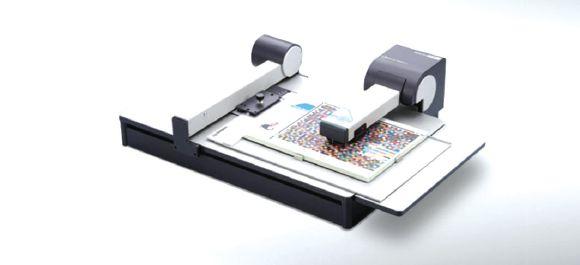
Beta Presto Spectro
In January 2018, Beta added the new Presto Spectro product to its line of colour densitometers and spectro-densitometers, aimed at both multiple colour offset or flexo presses. It can measure offset plates as well as print. It features what the company describes as Red (Stop) and Green (Go) traffic light indicators to show printers whether colour is correct and within their specified working tolerances as set by the user.
The unit sells for approximately US$3,499. The Presto Spectro measures density, dot gain, dot area, gray balance, trapping order, L*A*B*, Lch, Delta E, and opacity. It also includes a new feature called Spot Color Tone Value (SCTV), which the company describes as especially useful for flexographic spot colour tone matching.
X-Rite eXact for SCTV
In December 2017, X-Rite introduced an eXact update that now includes a Spot Color Tone Value (SCTV) feature to support the latest ISO 20654 standard. The eXact SCTV configuration allows commercial and packaging printers to verify tone value for spot colours that correlate well with visual appearance. With this latest firmware
update to the eXact family, X-Rite explains printers will be able to more easily verify both spot and process colours that brands specify using the new standard.
The software update to eXact enables users to separately configure the tone value formula for spot colours as well as CMYK. Configurations are available for Tone Value, Tone Value Increase (TVI) or dot gain, TVI Table and Print Characteristics. This makes it easier for printers when measuring both spot colours and the process colours used in extended colour gamut printing.
Color-Logic Touch7 Photo
In 2017, Color-Logic introduced Touch7 Photo for Neon, a plug-in for Adobe Creative Cloud which enables graphic designers to add neon into images with a click of a mouse. The new plug-in, like the Touch7 Photo Extended Color Gamut plug-in, eliminates the need for manual masking, explains Color-Logic, thereby creating in seconds what might otherwise require hours and several attempts.
Barbieri Spectro LFP
Barbieri in late 2017 released a new measuring device for colour management in the field of digital large-format printing. The Spectro LFP qb provides a range of features and also supports the M1 measurement mode. The Spectro LFP qb spectrophotometer from Barbieri comprises three components.
First, the Spectro LFP platform is the measuring stage with an enhanced clamping system and integrated M1 backlighting (for transmitted light measurement). The spectral unit (measuring head) incorporates the latest qb technology and comprises what the company describes as the high-precision spectral core, three light sources for uniform illumination of the media surface from three different angles, and seven LEDs to guarantee real M1 daylight illumination pursuant to the standard.
SERVICE TECHNICIAN-MECHANIC
The Service Technician-Mechanic interacts daily with the customer assessing their needs through asking probing questions in preparation for the installation or service call and must be able to effectively communicate technical information and resolutions to customers with varying degrees of technical knowledge and abilities.
Their Service Technician-Mechanic must come up with a plan of action to address the customers issues with an emphasis on quality work and efficiency to minimize or downtime and to control cost.
Email resume to: alicia.allen@ koenig-bauer.com
HEIDELBERG, ROLAND 2 COLOURS WITH CTP
2006 HEIDELBERG PROSETTER 52CTP, autoloader, full RIP and software and on-line punching.
Well established digital print and large format business for sale including building – 2100 sq ft printshop and 2100 sq ft 3 bedroom apartment.
Excellent location on busy street. Print shop has been here for 12 years with current owners plus 24 years with previous owners. Asking price $575,000.
Serious inquiries please call 905-741-0884 or email: info@wilsonbusiness.ca
SLITTING/PERFING
Service Bureau, looking for P/T help. Shift involves slitting/packing printed job, 10-12 hours every week (overnight
Wednesday shift) with opportunities for extra hours. Experience with Rollem Champion Perfer/Slitter a plus!
Send your resume to kwatts@in-store. net. This email address is being protected from spambots. You need JavaScript enabled to view it. Tel: 416-609-9226
DIE CUTTING – EMBOSSING – FOIL STAMPING BUSINESS FOR SALE
Well established, 20-year turnkey company, GTA based. One owner. Asking price $599,000. Contact David Butler, Sales Representative, Royal
Sakurai: 1, 2 or 4 colours and any size (newer model)
Polar: any size/older or newer models (66/72/76/78/82/90/92/107/115)
Horizon-BQ: 220/240/260/440/460
Craig Barretto / President / Nexgen Security Inc. / Toronto, Ontario
Cyber security is becoming a critical issue for manufacturers as attackers move their financial interests away from ransomware in favour of methods that can compromise corporate infrastructures. Craig Barretto understands how cyber threats can affect printing operations better than most, having spent more than three years as a security specialist for Symcor. Two years ago, he became President of Nexgen Security, which specializes in infrastructure vulnerability assessment. In mid-February, Barretto spoke to a group of printers at DIA’s monthly meeting, sharing some of the following key points about cyber security.
What is trending in today’s attacks?
CB: I am sure everyone has heard about a lot of breaches over the past five years. Last month, Tesla was hacked... their cloud infrastructure. Someone installed a crypto-miner. Essentially, they were using CPU power to do computations for crypto and making money. I made this prediction last year... that hackers are going to start moving away from ransomware, because it is very abrupt. Everyone notices and some people might pay but others won’t.
When you move toward crypto-mining, you can fly under the radar. People might notice a little bit of a slow down, but on an enterprise system with about 1,000 hosts and you drop a crypto-miner on each one of those hosts, I estimate you can make about $720,000 a year and nobody would notice. Anti-virus software wouldn’t pick it up. That is not to say anti-virus software isn’t required, it should always be there, but people can create malware to avoid it.
What attitudes exist when a company thinks it has never been hacked before?
CB: When clients start looking at their infrastructure some of the common things that I see, or attitudes, that I run into are things like, ‘We haven’t been hacked before… so we do not need security.’ Security is a cost centre, same as IT, because from a security standpoint we do not bring in money – we spend it. [Upper management] may ask, ‘Why should we implement this technology that is going to cost us five or six figures to mitigate this risk.’
My counter argument to that is, ‘Well prove it.’ Hacks can come in many different forms. It is not like all of your systems are gone and people are leaking your information. Hacking can easily be done when someone steals all of your customer information.
Why would an attacker target a company?
CB: Even for organizations that might not have sensitive [Intellectual Property], you
do have employee records. Their information is also very sensitive: SIN numbers, addresses, [Personal Identifiable Information]. Those things can be used by an attacker – they pull that information. A good example is Ashley Madison. Really, the information they had was just names, but then those people were targeted.
The Locky ransomware ramped up in a big way in Q3 2017 with three new campaigns. Roughly 10 percent of firms reported it, which may not seem like much until you realize that percentage spans tens of thousands of organizations. All told, 22 percent detected some type of ransomware in Q3.
I had a client and, in September, they really didn’t get hacked, but essentially they were phished. One of their executives was taking a flight between England and Spain. They jumped on Wi-Fi, got an email from someone and entered his credentials, got nothing, closed his laptop, and away he went. By the time he landed in Spain, his email account had sent over 40,000 emails to customers – 40,000 customers got an email that said, ‘Please click this link.’
Who is going to attack you?
CB: Nation states, maybe. Unless you have something of extreme value, IP mainly, nation states might not always be knocking on your door – same thing with APTs. You have to have something of value for them. Advanced Persistent Threats generally are groups that will get in, dig deep, and just hide until there is something they need or they start extracting data slowly… they are
going to try to spread across an organization and dig deep and try to stay in it. Nation states and APTs are looking for IP. Hackers, hacker groups and script kiddies generally are financially motivated. Today, one credit number is about a dollar.
Healthcare records are a lot more. My stats are a little old, but about two years ago it was $1,000 for a healthcare record.
How much weight should companies put into being compliant?
CB: A good example is Password1. That meets all of the requirements for CIP compliance, uppercase and lowercase letters, a number. It is deemed a strong password by Microsoft standards. It means compliance but it doesn’t mean security.
What does Verizon’s Breach Report show?
CB: The Verizon Data Breach Report is a great read if you are interested. They look at about 2,000 breaches that occurred, how they happened, who was responsible, what techniques were used and what was stolen. Seventy-five percent of the [attacks] originated from outside of the organization and over half included malware... Installing malware, and delivering it through phishing campaigns.
Independently driven presses
Independently driven printers
Our new generation of 29”, 41”, 57”, and 64” presses are chosen by industry leaders around the world. Koenig & Bauer’s leading knowledge and support paired with autonomous printing technology increases profitability for the highest return on investment.
Contact us to learn more. KBA North America +1 (800) 522-7521 na-marketing@koenig-bauer.com koenig-bauer.com