Expanded gamut printing continues to grow in popularity, but does this reemerging press process to exclude spot colours hold the staying power for printing companies to invest
20 Graphics Canada
2017 preview
12 Things can always be better Determining what and how to create the ideal sales conversation to become a preferred printing supplier 14 20 10 8
Exhibitors of the upcoming trade show, running from April 6 to 8 at the Toronto International Centre, were asked to provide up to three booth highlights attendees should focus on
DEPARTMENTS
GAMUT
5 News, People, Calendar, Dots, Installs, Globe, Archive
NEW PRODUCTS
34 Detailing the newest technologies from Canon, Drytac, Duplo, EFI, HP, Kodak, Konica Minolta, Objectif Lune, Ricoh, Xaar and Xitron
MARKETPLACE
37 Industry classifieds
SPOTLIGHT
38 Jean Deschamps, President and COO, Deschamps Impressions, Quebec City, Quebec
COLUMNS
FROM THE EDITOR
4 Jon Robinson
Notably Canadian Viola Desmond becomes the first Canadian woman to have their portrait featured on a regularly circulating note
CHRONICLE
10 Nick Howard
The great disrupter
How the Trump administration can affect North American trade and Canada’s printing industry
DEVELOPMENT
Notably Canadian T
A formal survey of 2,011 Canadians showed that 82 percent of respondents agreed that other great Canadians, such as Viola Desmond, whose image will grace the country’s new $10 note, from fields other than politics, should be featured on future bank notes. 82%
he Bank of Canada will soon make a commemorative bank note available to mark this year’s 150th anniversary of confederation for the country, which has only seen three other such commemorative notes since the Bank was founded. In honour of the 100th anniversary of Confederation, a modified version of the 1954 $1 note was issued, bearing the date 1967. The centennial logo was added to the front of the note and a view of Canada’s original Parliament Buildings, destroyed by fire in 1916, was substituted for the prairie landscape that appeared on the original 1954 $1 note.
A commemorative $25 note bearing the date May 6, 1935, was issued in honour of the Silver Jubilee of King George V. Similar to the 1935 series. This denomination was available in either French or English. And finally, the Bank issued a commemorative bank note that is a variation of the existing $20 note in the Polymer series in late 2015 to recognize Queen Elizabeth II, whose image adorns the popular note, becoming the longest-reigning sovereign in Canada’s modern era.
Commemorative notes provide welcome press time for the Bank’s print suppliers and related service providers and the new 150th anniversary $10 note will soon be superseded by a new national milestone note in 2018. On International Women’s Day, March 8, 2016, Prime Minister Justin Trudeau launched a process for Canadians to help select who would become the first Canadian woman to have their portrait featured on a regularly circulating Bank of Canada note. The Twitter-fuelled #bankNOTEable campaign launched by the Bank yielded more than 26,300 submissions by April 15, 2016.
The #bankNOTEable push resulted in 461 eligible candidates, who had Canadian citizenship and had been dead for at least 25 years. An independent Advisory Council composed of Canadian academic, sport, cultural and thought leaders narrowed down the list to five candidates for consideration by the Minister of Finance.
In December 2016, Bank of Canada Governor Stephen Poloz announced that Viola Desmond will be featured on a new $10 note, expected in late 2018. Desmond, an icon of the human rights and freedoms movement in Canada, was selected from a short list of five iconic Canadian women by Minister of Finance Bill Morneau, in accordance with the Bank of Canada Act. A successful Nova Scotia businesswoman, Viola is known for defiantly refusing to leave a
whites-only area of a movie theatre in 1946. She was subsequently jailed, convicted and fined. Her court case was the first known legal challenge against racial segregation brought forth by a Black woman in Canada.
The other short-listed women included Pauline Johnson, daughter of a Mohawk Chief and an Englishwoman, best know for the poetry she wrote celebrating her Aboriginal heritage; Elizabeth MacGill, the first woman in Canada to receive a bachelor’s degree in electrical engineering (University of Toronto, 1927) and a master’s degree in aeronautical engineering (University of Michigan, 1929); Fanny Rosenfeld, who held Canadian records in the running and standing broad jump and in the discus; Idola Saint-Jean, primarily known as a feminist and pioneer in the fight for suffrage in Quebec; and Pitseolak Ashoona, an Inuit graphic artist known for prints and drawings showing.
“Many extraordinary women could have been on this next bank note, and the search and decision-making process were extremely thorough,” said Minister of Status of Women Patty Hajdu. “The choice of Viola Desmond reminds us that Canada is a diverse country where everyone deserves equality and respect.”
Minister Morneau said, “Viola Desmond’s own story reminds all of us that big change can start with moments of dignity and bravery. She represents courage, strength and determination—qualities we should all aspire to every day.”
This new Viola Desmond $10 note, explains the Bank of Canada, reflects the broader themes of social justice and the struggle for rights and freedoms. It will be the first note in the next series. To continue to celebrate more iconic Canadians, the next $5 note will also feature a new Bank NOTE-able Canadian, launching another consultation process to seek input from Canadians.
Canada’s first Prime Minister, Sir John A. Macdonald, and our first francophone Prime Minister, Sir Wilfrid Laurier, will be honoured on Canada’s higher-value bank notes.This change will take place when the higher-value notes are redesigned for the next series. These changes mean that former prime ministers William Lyon Mackenzie King and Sir Robert Borden will no longer be portrayed on bank notes. The $20 denomination will continue to feature the reigning monarch. journalism.
Editor Jon Robinson jrobinson@annexweb.com 905-713-4302
Contributing writers Zac Bolan, Wayne Collins, David Fellman, Victoria Gaitskell, Martin Habekost, Nick Howard, Neva Murtha, Abhay Sharma
Publisher Paul Grossinger pgrossinger@annexweb.com 905-713-4387
Associate Publisher Stephen Longmire slongmire@annexweb.com 905-713-4300
Media Designer Lisa Zambri
Circulation Manager Barbara Adelt badelt@annexbizmedia.com
Customer Service Angie Potal apotal@annexbizmedia.com
Tel: 416-510-5113
Fax: 416-510-5170
Mail: 80 Valleybrook Drive, Toronto, ON, M3B 2S9
COO Ted Markle tmarkle@annexweb.com
President & CEO Mike Fredericks
Subscription rates
For a 1 year monthly subscription (12 issues): Canada — $40.95 Canada 2 year— $66.95 United States — CN$71.95 Other foreign — CN$140.00
Mailing address Annex Business Media 222 Edward Street Aurora, ON, L4G 1W6 printaction.com Tel: 905-727-0077
Fax: 905-727-0017
PrintAction
JON ROBINSON, editor jrobinson@annexweb.com
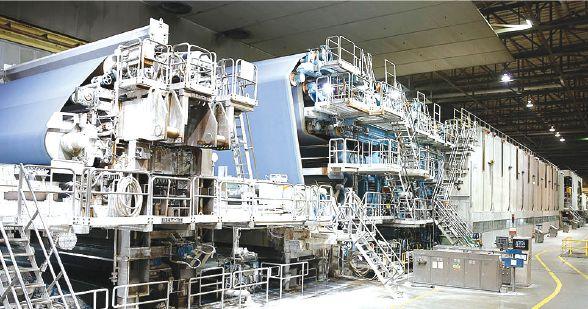
Sappi Limited approved a range of projects in Europe and the United States, including a US$165 million capital project to expand its North American manufacturing capabilities. The purpose of this investment on Paper Machine No. 1 at its Somerset Mill in Skowhegan, Maine, is to provide flexibility in the production of paper-based packaging products and to also maintain its position in the graphic paper market, increasing annual production capacity at this mill to almost one million tons. The Paper Machine No. 1 project, scheduled to come online in early in 2018, will provide an increase of 180,000 metric tons. Headquartered in Johannesburg, South Africa, Sappi has more than 13,000 employees and manufacturing operations on three continents in seven countries and group sales of US$6 billion.
Somerset Graphics of Mississauga, Ontario, closed its doors on January 31 and entered receivership. The high-end commercial printing operation, well known across the Greater Toronto Area, was running out of a 20,000-square-foot facility, built by Jack and Beth Youngberg 37 years ago. Their two sons, Chris and Jeff, had been involved with the company for 21 and 17 years, respectively. Somerset’s 29-inch, 6-colour Kormori HUV press, which was installed in mid-2013, has been sold to an undisclosed printer. Jack Youngberg explains they did not sell Somerset’s book of business, providing each account representative with the opportunity to maintain their current accounts.
DATA Communications Management entered into separate agreements to acquire Eclipse Colour & Imaging, located in Burlington, Ontario, and Thistle Printing, located in Toronto.
DATA will acquire substantially all of the assets of Eclipse for a net price of approximately $8.8 million. The company will acquire the common shares of Thistle for a net price of approximately $6.1 million. Eclipse specializes in large-format and point-of-purchase printing with approximately 100 employees operating in an 80,000-square-foot facility. Upon completion of this transaction, DATA intends to relocate its current wide format capabilities from its Mississauga facility to Calgary. Eclipse generated approximately $21.3 million in revenues (unaudited) for the fiscal year ended November 30, 2016. With approximately 65 employees operating in a 42,000-square-foot facility, Thistle generated approximately $16.4 million in revenues (audited) for the fiscal year ended October 31, 2016. DATA CEO Michael Sifton explains Thistle provides the company with meaningful commercial print capabilities in Eastern Canada.
Solisco of Montreal, Quebec, announced a partnership with Trade Secret Web Printing, a Toronto printing company focused on pro-
viding trade services. Solisco explains the partnership will give customers access to more extensive equipment in two different regions of Canada. Alain Jacques, President of Solisc0, explains Solisco has worked closely with Trade Secret for some time and wanted to take their business relationship further. Solisco, now in its 25th year of operation, has more than 400 employees and provides a range of printing and communications services primarily for publishers and retailers across North America.
Heidelberger Druckmaschinen released its third quarter results, stating it is still on course to increase its annual profit. After nine months, Heidelberg’s current fiscal sales of €1.7 billion were slightly below the previous year’s levels of €1.8 billion, as it expected, also stating a large number of orders placed at drupa, with longer delivery times, will be supplied on schedule in the fourth quarter. Over the same period, incoming orders at €1.99 billion were approximately 4.5 percent higher than the previous year’s value (€1.90 billion). At €739 million, the order backlog was around 26 percent up on the previous year’s figure (€586 million). As a result, Heidelberg explains it has a good platform for achieving the significant sales growth planned in the fourth quarter.
Multi-Bookbinding purchased the assets of Quebec City’s Spiraplast, a producer of high-quality PVC wire for spiral binding. Founded in 1988 by André Primeau, Spiraplast has a fleet of equipment which includes a Deltaplast D45 extruder line and four spiral forming machines from Renz and Bomco. This equipment has now been integrated into the company’s 57,000-square-foot plant in
Shawinigan, Quebec. Multi-Bookbinding, with 60 employees, is one of the largest case binderies in Canada and is a large producer of perfect binding, creating more than six million bound units a year.
Xerox Corp. sold its FreeFlow Print Server DFE business to Electronics For Imaging as the companies entered a new strategic partnership to develop a next-generation digital front end to drive Xerox production presses. Xerox functionality from FFPS is to be integrated with EFI’s Fiery product. Most recently, Xerox collaborated with EFI to develop a new print server, the Xerox IJ Print Server powered by Fiery, to drive the recently introduced Xerox Trivor 2400 inkjet press. The agreement is for FFPS only and does not impact the Xerox workflow solutions that carry a FreeFlow sub-brand name (FreeFlow Core, FreeFlow VI Suite, FreeFlow Makeready and FreeFlow Digital Publisher).
Electronics For Imaging released results for its fourth quarter, ending December 31, 2016, with what the company describes as record fourth quarter revenue of $266.7 million (all figures in US dollars), up four percent compared to fourth quarter 2015 revenue of $256.5 million. GAAP net income was $20.5 million, up 99 percent compared to $10.3 million for the same period in 2015. Cash flow from operating activities was $65.2 million, up 141 percent compared to $27.1 million during the same period in 2015. For the year ended December 31, 2016, the company reported revenue of $992.1 million, up 12 percent yearover-year compared to $882.5 million for the same period in 2015.
Informco of Scarborough, Ontario, is one of eight printing operations from around the world chosen by Kodak to receive its 2016 Sonora Plate Green Leaf Award. The program, which first launched in 2014, recognizes customers who have demonstrated outstanding efforts to reduce their environmental impact through a variety of initiatives and best practices. All of the printers are users of Kodak Sonora process-free plates, which hold a range of environmentally progressive benefits. Kodak predicts that 30 percent of its plate volume will be process-free by 2019.
Sappi’s massive paper machine at its Somerset Mill in Maine.
Alain Jacques, President, Solisco.
Rainer Hundsdörfer, CEO, Heidelberg.
Michael Sifton, CEO, DATA.
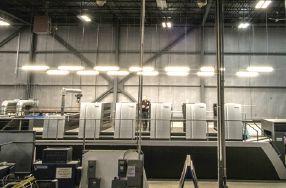
Eclipse Imaging installed a large-format Heidelberg press in 2013.
Jeff Jacobson, CEO, Xerox.
Yvon Sauvageau, President, Multi-Bookbinding.
John Corley becomes President of Xerox Canada, returning home after recently serving as President of the company’s global Channel Partner Operations and as Vice President for Xerox Corporation in the United States. A 22-year Xerox veteran, Corley had previously served as Vice President of Canadian operations, after joining Xerox in 1994 as a Sales Representative in Toronto. He was named one of Canada’s Top 40 Under 40 in 2008. Corley succeeds Al Varney who will take on a new role as President of Northern, Southern and Central European Operations.
INSTALLS
Gurshawn Hansi becomes National Account Manager, Wide-Format Media and Applications, for Agfa Graphics’ Canadian sales team. Rick Gar -
gano also joins the company as Account Manager servicing the Ontario province, responsible for the entire Agfa commercial portfolio. He has been in the graphic arts industry for 33 years, spending most of his time with Fujifilm Canada and McCutcheon Graphics. Hansi served as a Sales Representative for Transilwrap Co., a manufacturer and converter of printable plastic materials.
Ted Markle becomes Chief Operating Officer of Annex Printing & Publishing, the parent company of PrintAction magazine operating under the company’s Annex Business Media arm, which is Canada’s largest business-to-business publishing group. Markle spent the previous 17 years with TC Transcontinental, Canada’s largest printing and publishing operation generating more than $2 billion in annual revenues, including his most recent role as President of Transcontinental Media from 2013 to 2016 and before that as Senior VP, Content Solutions, for TC Media beginning in 2011. Markle also gained extensive printing-industry experience with TC Transcontinental, including seven years in various executive roles, primarily helping to lead the company’s newspaper operations.
LasX Laser Digital Finishing Installation Expands Toronto
ST. PAUL, Minn., February 10, 2017 – LasX Industries, Inc., an industry leader in high performance, production class laser processing systems and services, recently installed a twin STP400 digital laser finishing system at Sherwood Printers, a leading trade printer in Toronto, Canada. Sherwood provides a varied range of commercial and corporate printing services and is always searching for innovative printing solutions to better serve its growing customer base, especially solutions that improve quality, optimize cost effectiveness and reduce turnaround times. Sherwood’s LasX STP400 system with the robotic stripping system meets all those criteria and more
Payam Baroudi becomes Technical Sales Manager for Drytac’s Canadian office, where he is responsible for expanding Drytac’s custom and contract adhesive coating business in the packaging, construction, medical, automotive, label, and industrial markets. Baroudi holds a Master’s degree in chemical engineering and previously worked for companies like BASF and Henkel. Over the course of his career, he has worked in Iran, Turkey, Switzerland, and Germany. He now resides in Toronto, Canada.
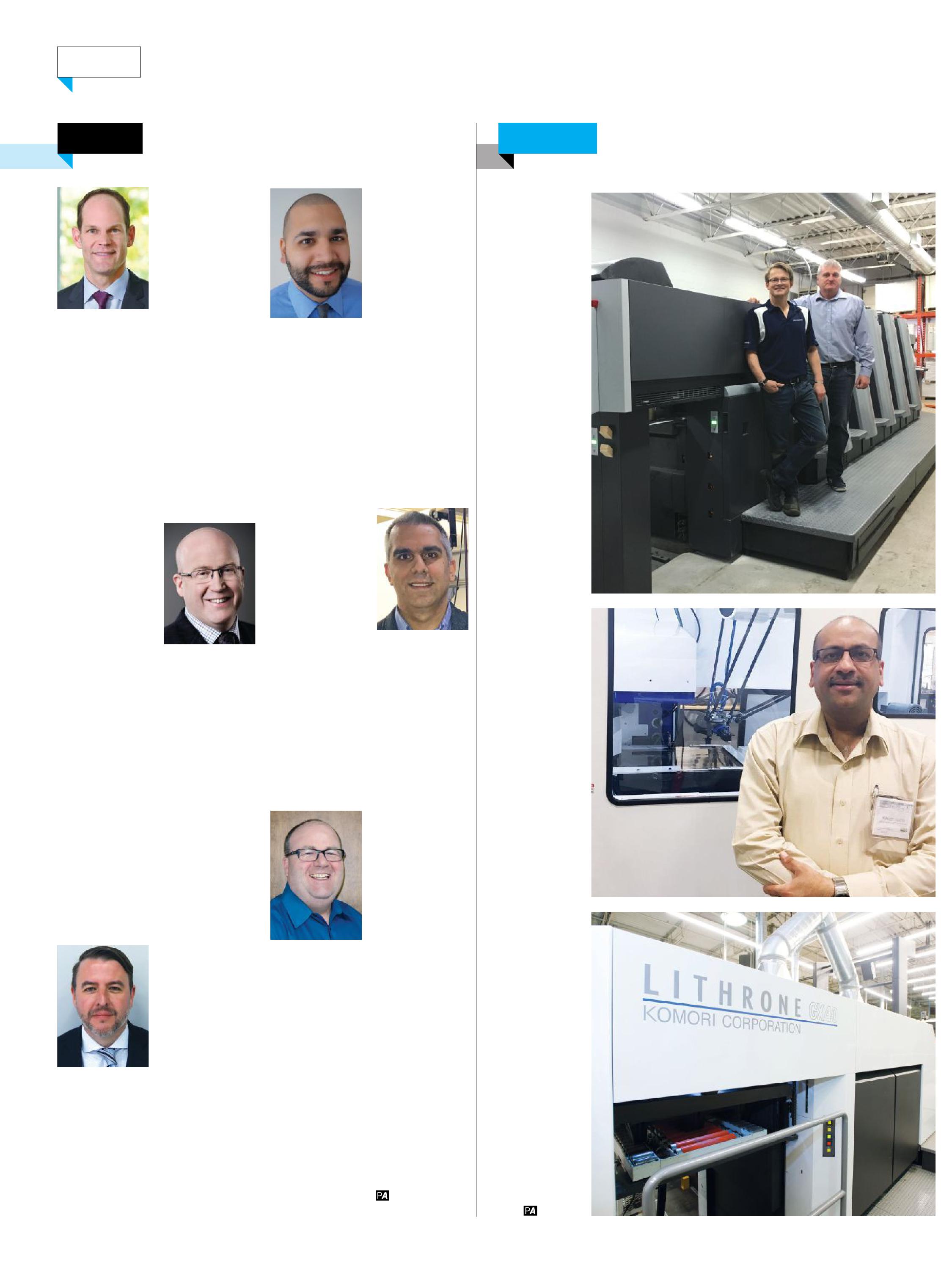
Pinnacle Litho of Stoney Creek, Ontario, installed a Heidelberg Speedmaster XL-75-4+L press, pictured with owner Chris Fillingham (right) and operator Jens Hansen. Pinnacle’s XL-75 includes AutoPlate Pro, Inpress Control, Press Center with Intellistart, and an Anilox Coating system. The press can output a new job of 1,000 sheets in a third of the time of Pinnacle’s previous press.
Sherwood Printers’ facility located in Mississauga, ON is the central production hub where all in-house and trade work is produced. Sherwood Printers finishes orders from each of Sherwood’s 14 copy shop s in the Greater Toronto Area (GTA), as well as a long and growing list of graphic designers, print brokers and advertising agencies.
Manoj Sheth, President & CEO of Sherwood Printers says, “We are located in one of North America’s most competitive print markets and this LasX twin laser and robot system will nicely complement our digital and litho print capabilities. The highly automated LasX digital laser system provides our trade clients and our copy shop customers all the benefits of digital processing – fast and efficient turnaround from one central facility for printing, laser processing and shipping. Today, designs are limited only by an artist’s imagination and these designs can be incredibly intricate. Our LasX systems allows us to produce runs of 2 pieces up to medium and long runs all at very competitive prices.”
Phil Hampson becomes National Sales Manager, Canada, for the Graphic Systems Division of Fujifilm North America. With over 20 years in the graphics industry, Hampson will oversee the sales of Fujifilm’s portfolio of imaging and printing systems throughout all provinces in Canada, from the West Coast to the East Coast. Angus Pady has also joined Fujifilm Canada in the role of Professional Service Consultant serving the central Ontario region.
Quality
Tom Molamphy joins Agfa Graphics North America as Business Development Manager for the company’s Industrial Inkjet Ink Division, centred around UV ink for piezo printheads, and is focused on generating new business relationships in the United States and Canada. He will work closely with suppliers of inkjet print engines as well as integrators of industrial inkjet applications such as décor, labels, coding and marking.
Sherwood Printers, a trade printer based in Mississauga, Ontario, has installed a twin LasX STP400 laser finishing system, which includes a robotic stripping system, pictured with CEO Manoj Sheth. Sherwood finishes orders from each of its 14 copy shops in the Greater Toronto Area.
Ellis Packaging
Manoj Sheth adds that LasX and Sherwood Printers will offer factory tours and bespoke show samples during the upcoming Graphics Canada show at the International Centre in early April where LasX will exhibit its Manoj Sheth, Managing Director of Sherwood Printers. technology and solutions.
Creates intricate, laser-perfect details traditional die cutters simply cannot match – designs are limited only by the imagination.
Cost effective
Jon Surch becomes Managing Director for Eltosch Grafix America, an international manufacturer of industrial curing technologies with a strong position in the sheetfed offset printing segment. Surch previously served as Vice President of Operations at manroland North America.
“Run of One” – First processed page is as perfect as all the following pages with no adjustments required.
Laser finishing and automation substantially reduces labor and other production costs.
West, one of three primary facilities of The Ellis Group, purchased a 41-inch, seven-colour Komori GLX press through Komcan. Scheduled for a March install in Guelph, this is the third new generation Komori press The Ellis Group has installed across its three Ontario plants.
Eliminates costly tooling, set-up, make-ready and work-in-process inventories, ideal for the quick -turn, short-run and variable-content applications printers encounter every day.
Half-format KBA for pharma in Vienna
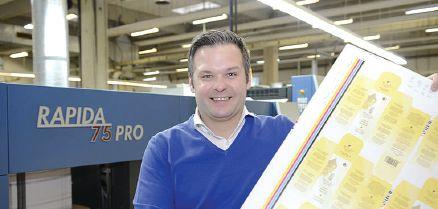
A KBA Rapida 75 went into production at Eberle Druck, a subsidiary of the Rattpack group, back in 2011, running around the clock in up to four shifts. Rattpack has around 500 employees, generating approximately €90 million in annual revenues, at eight locations in Austria and Germany. Eberle’s job changeovers on the 2011 Rapida 75 were proving too long for the short-run pharmaceuticals market, however, so the company recently turned to KBA’s more automated Rapida 75 PRO successor press launched at drupa 2016.
Eberle’s new six-colour Rapida 75 PRO with coater and extended delivery was commissioned in June 2016. It features 225-mm-raised foundations to enable higher piles, an enlarged sheet format of 605 x 750 mm, central format setting, fully automatic FAPC plate changers, CleanTronic Synchro for parallel washing processes, QualiTronic ColorControl for inline colour measurement, and extensive preset capabilities. After eight months, the company states its makeready times average five minutes compared to 15 to 20 minutes with its 2011 Rapida, boosting productivity by around 30 percent.
Eberle explains the Rapida 75 PRO’s larger sheet format can accommodate twice as many blanks on sheet. QualiTronic ColorControl is being leveraged to reduce waste on repeat jobs. The new Rapida 75 PRO is typically set up to run spot colours, which KBA explains account for up to 60 percent of inks used in pharma packaging. Eberle decommissioned its original Rapida 75 and a second press, moving all of the work onto the Rapida 75 PRO.
2.5D
The Space Technologies Lab in Switzerland, which is involved in research for smart microsystems, foil and elastomeric sensors and actuators, installed a new CeraPrinter F-Serie, developed by MGI Digital. This includes inkjet and aerosol jet printing. This materials range provides the flexibility to achieve high resolution and 2.5D printing on objects with topography for making functional and smart 3D printed components. The F-Serie will also produce 2D printing of electronic and sensing components.
J Press lands in LA
Acuprint of Los Angeles, California, specializes in the short-run printing of catalogues, pocket folders, display signage, commercial marketing collateral and booklets. The company recently installed Fujifilm’s second generation J Press 720S, which runs a 29.6-inch x 20.9-inch sheet at speeds of up to 2,700 sheets per hour.
“Our jobs on litho would involve hours of colour matching, along with averaging thousands of dollars in labour and make-ready waste,” said Sam Sowlaty, owner, Acuprint, about the costs of running short-run work on their offset presses. Sowlaty has been involved in print since 1982. “With the J Press 720S there is no need for that extra overhead. It’s a gamechanger.”
Xeikon Plus coming to New Delhi
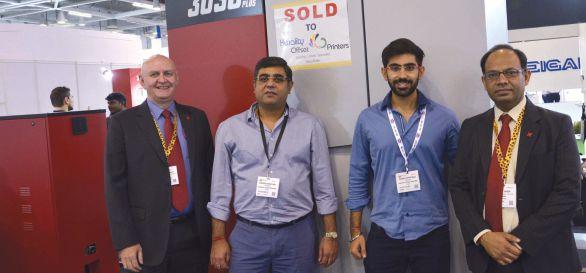
Indian label manufacturer Kwality Offset Printers expects to increase turnover by up to 15 percent following its installation of a Xeikon 3030 Plus press at the end of 2017. The New Delhi offset and flexo operation caters mainly to the liquor, food and healthcare sectors, including well-known brands like Pernod Ricard, Nestle, Radico Khaitan, GlaxoSmithKline, Dabur, Heinz, Wrigleys, Perfetti, Cargill and the DS Group.
Rajeev Chhatwal, co-owner of Kwality, explains the Xeikon investment was made because run lengths for these clients now vary greatly: “We are seeing a number of flexo jobs that are 1,000 metres, 2,000 metres and even as low as 500 metres in length. These take up a significant amount of time with conventional production technologies.
“By moving these jobs to digital production,” continues Chhatwal, “we are able to free up production on our flexo and litho presses for the longer runs for which they are better suited.”
Kwality been offering label printing services in the region for more than 50 years and the Xeikon 3030 Plus will be its first toner press. “For the first three or four months, we will be learning about digital technology so that everyone on our team is confident as we move in this new direction,” says Chhatwal. “We will also educate existing customers on the benefits of digital printing. Then next year, we expect to add five or six customers and grow our US$6 million turnover by 12 to 15 percent.”
For the last six or seven months, Chhatwal explains customers have been requesting shorter runs and variable print. “These are not the kind of jobs we can do on our flexo press,” he says. “We have had conversations in the past about offering these services, but those conversations never matured since we didn’t have the capabilities.”
The Xeikon 3030 Plus has a variable web width from 200 mm up to 330 mm, producing at top resolution of 1,200 dpi at a top speed of 15 metres per minute, handling substrates without a specific pre-treatment. “This means we can take advantage of our normal inventory to produce these shorter runs,” says Chhatwal, in relation to running work without the need to first apply a treatment to the stock. Xeikon states the Xeikon 3030 Plus emits no VOCs and has high light-fastness.
To maximize colour fidelity and repeatability, Acuprint developed custom profiles on its J Press 720S for colour matching with its offset work. Sam Sowlaty, owner of Acuprint, with the J Press 720S.
Marco Resch, Plant Manager for Ratt in Dornbirn and Eberle in Vienna, is leveraging the model-independent operating concept of KBA Rapida presses.
(From left to right): Bent Serritslev, Xeikon’s Managing Director Asia Pacific, Rajeev Chhatwal, partner Kwality offset Printers India, Krish Chhatwal, partner Kwality offset Printers India, and Neeraj Jagga, Xeikon’s Sales Channel Manager Asia Pacific.
CALENDAR
DOTS
Créme egg season
Just two sentences are needed on the dedicated homepage for Cadbury’s dedicated Creme Egg Website, fitting for one of the world’s most beloved treats heading into Easter: Cadbury Creme Eggs, a milk chocolate candy containing white and yellow fondant filling, are only around to release their goo during the Creme Egg season between January and April.
The story of Cadbury traces back to 1824, when John Cadbury opened a grocer’s shop at 93 Bull Street, Birmingham. Among other things, he sold cocoa and drinking chocolate, which he prepared himself using a pestle and mortar. While filled eggs were first manufactured by the Cadbury Brothers in 1923, the Creme Egg in its current form was introduced in 1963, initially sold as Fry’s Creme Eggs, until being renamed Cadbury’s Creme Eggs in 1971.
Creme Eggs are produced by Cadbury UK in the United Kingdom and by Cadbury Adams in Canada. They are sold by Mondelēz International in all markets except the United States, where the Hershey Company has the local marketing rights. As one of the most iconic chocolate confectionery treats around the world, packaging plays a huge role in the popularity of these pieces.
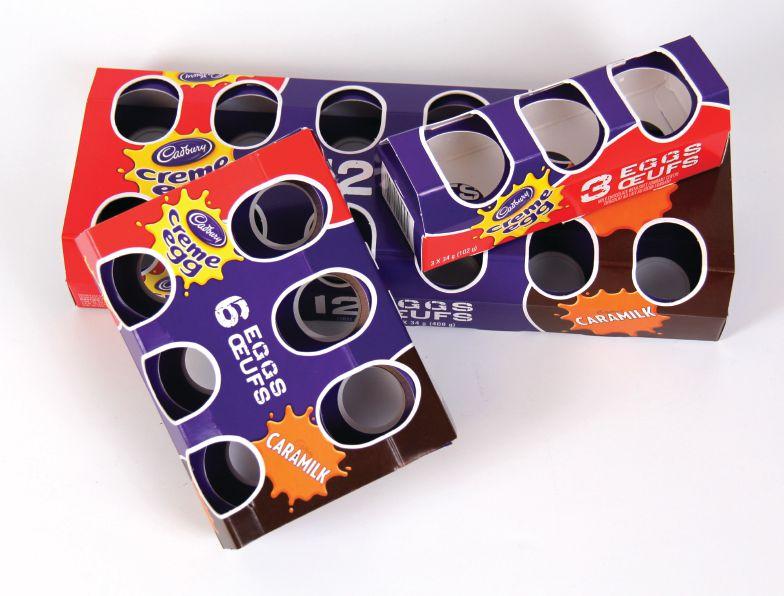
Canada’s The Ellis Group has played a major role in the development of Cadbury Crème Egg carton packaging. The company won a 2015 PPC Eco Award for its production of these cartons, by substituting plastic trays and shrinkwrap sleeves with renewable, recyclable
paperboard. The judges said this new design is more environmentally friendly than its predecessor and allows more of the eggs’ primary packaging to show through. Furthermore, die-cuts in the bottom and top of the pack allow the cartons to nest, thus optimizing both pallet and shelf configuration.
Ellis explains the carton packaging was structurally innovative in that while the relatively thin walled plastic eggs, the shell is supported and protected and most importantly highly visible. It is also innovative in that it allows the product to protrude from the top of the carton while at the same time allowing the carton to nest and no weight born by the product. Ellis continues to explains it brings all count-lines into alignment visually allowing for a consistent look and fell for all secondary package sizes. The packaging is a visually impactful shape that differentiates the product on shelf, allowing large, more consistent graphics areas.
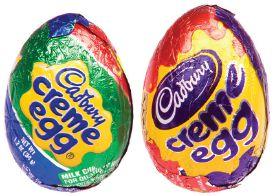
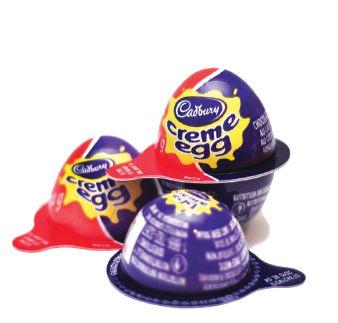
At Easter 2015, Cadbury (Mondelez) introduced a completely different and innovative primary packaging system for its well-known 34g Crème, Fudgeeo and Caramilk Easter Eggs. The shift from foil wrapped eggs to eggs encased in a peel apart two-part shell accommodated better freshness, traceability and loss due to crush, leakage, exposed chocolate areas, and better UPS scanning, among other benefits. The brand and marketing challenge was to showcase the new plastic eggshell while keeping the traditional brand equities in place.
Cadbury’s older primary foil packaging (left) and new primary packaging (right) with a two-part plastic egg shell.
March 19-22, 2017
TAGA Annual Technical Conference Houston, TX
March 19-24, 2017
IPEX London, UK
March 23, 2017
Ryerson GCM Job Fair Mattamy Centre, Toronto, ON
April 6-8, 2017
Graphics Canada International Centre, Mississauga, ON
April 19-22, 2017
ISA International Sign Expo Mandalay Bay Convention Center, Las Vegas, NV
April 30-May 3, 2017
FTA 2017 INFO*FLEX Phoenix, AZ
May 9-11, 2017
EskoWorld Charlotte, North Carolina
May 9-13, 2017
China Print 2017
New China International Exhibition Center, Beijing
May 12-13, 2017
Grafik’ Art Place Bonaventure, Montreal, QC
May 23-26, 2017
PACKEX Toronto Toronto Congress Centre, Toronto, ON
May 23, 2017
Avanti User Group Conference Grand Hyatt, Denver, Colorado
June 1, 2017
Gutenberg Gala Marché Bonsecours, Montreal, QC
June 14, 2017
PrintForum West
Delta Burnaby, Burnaby, BC
July 16-20, 2017
95th Annual GCEA Conference, Woman in Print
Ryerson GCM, Toronto, ON
September 10-14, 2017
Print 17
McCormick Center, Chicago, IL
October 10-12, 2017
SGIA Expo 2017
New Orleans, LA
November 9, 2017
Canadian Printing Awards
Palais Royale, Toronto, ON
ARCHIVE
25 years ago
Kodak’s High-speed Electronic Publishing Systems are Part of a New Trend: At Graphic Trade ’91, Kodak Canada displayed a range of products… Two systems, the Lionheart electronic publishing system and the Prophecy electronic colour prepress systems (CEPS), were especially noteworthy in that they are part of two rapidly unfolding new trends. Like Xerox’s DocuTech system, the Lionheart is based on a high-speed electronic printer whose printing technology is essentially the same a standalone copier duplicator. However, rather than photographically copying an image on a glass plate, the images come from digital files. The Lionheart can accept files from any content creation program that creates PostScript files.
20 years ago
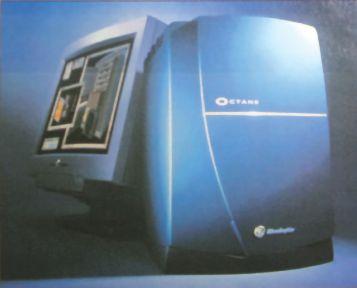
High-powered Workstations Introduced: Silicon Graphics Inc. has announced the release of a new power desktop line of computer workstations called OCTANE, which features high-performance graphics, symmetric multiprocessing and a pure 64-bit computing environment to manage the demands of future applications. OCTANE employs a seven-port crossbar switch in lieu of conventional shared bus architecture. With a system bandwidth of 1.6 gigabytes per second per port, the crossbar switch provides as much as 10 times the conventional bandwidth. The system includes built in 10MB/100 MB ethernet. All OCTANE systems come standard with 64MB or 128MB of memory, 2GB or 4GB of disk, a 10-inch monitor and one of three graphics options. The OCTANE system pricing starts at $38,073 with dual processing versions starting at $53,300.
In March 1997, Silicon Graphics’ introduces its new OCTANE computers with 64-bit processing power, and 10-inch screens, costing well over $53,000.
36%
In a March 2002 survey of 300 print purchasers, 36 percent had not heard of digital printing and 82 percent of those surveyed were not yet using digital printing services.
10 years ago
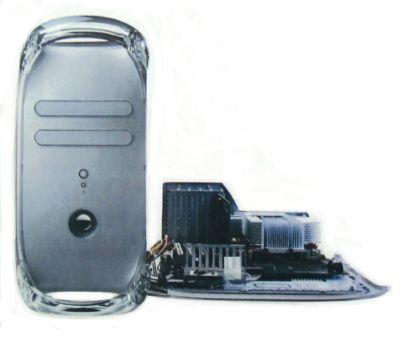
More bite from Apple: Apple has announced that the world’s fastest graphics processor, NVIDIA’s new GeForce4 Titanium, will be available in the world’s fastest personal computer, the Power Mac G4. The GeForce4 Titanium processes 87 million triangles per second and 4.9 billion textured pixels per second to perform over 1.23 trillion operations per second. Suggested retail prices for the Power Mac G4 systems are $4,700 for the dual 1-GHz model, $3,699 for the 933-MHz model, and $2,549 for the 800-Mhz model.
5 years ago
$5K
For sale, 1992 classified: AM Varityper 6200/6400 digital typesetter, 45 fonts, digital preview, dual drive, A/T Rules Plus, AIS/Plus, extended font memory, large screen. $5,000 or best offer.
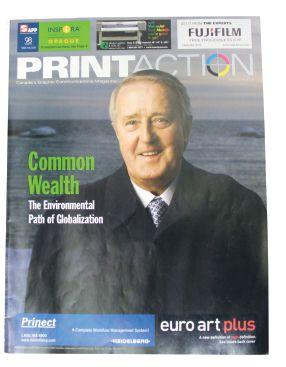
Common Wealth, The Environmental Path of Globalization: Former Canadian Prime Minister Brian Mulroney provides a keynote at the second annual Environmental Printing Awards, presented by PrintAction magazine. When he became Canada’s 18th leader in 1984, Apartheid in South Africa was entering its most violet year. Nelson Mandela was the majestic symbol of the African National Congress’s armed fight for freedom and the movement was a centerpiece of talks at the 1987 Commonwealth Summit in Vancouver, chaired by Mulroney, who insisted Britain budged on the issue.
“The fight at the time was between myself and Margaret Thatcher because Mrs. Thatcher was very opposed to the manner in which I proposed to lead The Commonwealth.”
Mulroney also rebuked sanctions supported by Ronald Reagan of the United States.
“It was pretty serious. We punched very much above our weight in those circumstances.” Mulroney was also Canada’s figurehead behind NAFTA, which became a boon for the country based on the consumer demands of its powerful neighbour to the south. Quietly, Mulroney also led a major change in the environmental policies of the Federal government, helping to foster a new awareness across the country.
The great disrupter
How the Trump administration might affect trade across North
American and Canadian printing
By Nick Howard
Decades ago an older gentleman wandered into the foyer of a five-star hotel. He was carrying a shopping bag and dressed in less than appropriate garb for such an establishment. He asked for a room. The front desk clerk, assuming him he was a bum, suggested he try another hotel down the street. The bum, however, owned the hotel property. Looks can be
key brethren of real estate, President Trump enjoys the limelight. He craves attention and respect. There also seems to be zero commonality between himself and the average American $24 per hour factory worker and, as surprising as it seems on the surface, these workers were one of the key reasons Trump now holds one of the most powerful positions in the world.
It is difficult, if not impossible, to explain what drives Trump, and even harder to support his many rigid viewpoints, except to say that some of it has to do with his involvement in the construction industry in New York City. Sitting across from mid-level bureaucrats that have the ultimate power over what can or cannot be built plays a role in his aggressive behaviour. Having his own name attached to properties belays a need to protect it. One assumes Trump blows himself a kiss each morning when he shaves.
In a surprise November 2016 election victory against Democratic candidate Hillary Clinton, Donald Trump, age 70, was inaugurated as the 45th President of the United States in January 2017, becoming the oldest and wealthiest person (with a net worth of US$4.5 billion, March 2016) to assume the powerful post.
deceiving. Some of the richest people in both Canada and the United States are seldom seen or heard.
They do not make anything, build our roads or habituate the world of graphic communications. But they do rent space to those who manufacture or sell products and services. Somewhat likened to an iceberg, most of the wealthy exist below the waterline of awareness. Hundreds of millions of square feet hardly noticed and owned by this group of the faceless wealthy. Then there’s Donald Trump.
The results of the Bataan death march referred to as the never-ending U.S. election, shocked a great many people. Lots of hand wringing and mea culpa moments ensued. But it was too late. America had in fact elected Trump as its 45th President. He had campaigned on a clever platform: The world is falling apart and dragging America down with it. Too many immigrants from the wrong countries, unfair lopsided trading practices that put American industry at risk, and so on. The plan worked and America found itself at war – with itself.
Unlike his often silent, low-
It can be said that Trump’s business views have changed very little since he pushed himself into the limelight of the highest office in the land. The books he is said to have written are nothing more than grandstanding and one fears Trump himself believes every word of it. “I alone can fix it” summarizes extreme narcissism and bills him as a neo-fascist.
Trump sees government agencies as wasteful and incompetent – getting in the way of free enterprise. He did build his own brand, however, and brought up his children to business leaders in their own right, and all the while being mostly alienated from the aristocrats and oldmoney movers and shakers. Few wanted anything to do with a brash newbie with such radical views of society. This is why his campaign was so amazing. Trump created a crisis and drew lower- to middle-class white males and small business owners into his web.
Recent gaffs such as the ban on seven select Muslim-majority countries from entering the United States plays to the right-wing hardliners who are also among his strongest supporters. Trump’s position is nothing more than a red herring and he knows it. There are many faiths within Islam. Ismailis for one are an excellent example of why Obama’s separation of extremists and terrorism is so important. One needs only to recall the bloodbath in Northern Ireland, between Catholics and Protestant, to know that wars are primarily caused by two factors – economics and religion. Man’s character cannot be justified by religion: we are all capable of doing bad things. God has been just a good excuse for war.
If we elect people solely on character,
The first commandment of free enterprise speaks of making products cheaper.
legislatures would be virtually empty. But President Trump with all his obvious flaws has one attribute that may pan out especially for manufacturers. I’ve spoken to quite a few American printers – from all regions. The majority suggest the same thing. They support Trump because he will disrupt the status quo of government and be a pro-business President. You cannot argue with that even though some realities of bringing manufacturing back to America may mean they will be buying $10,000 refrigerators and paying much higher costs for labour-intensive products.
The Trump message to industry is quite clear. Cut out the red tape, impose tariffs on a variety of imported products, all to make America great again. U.S. printers can buy into that because if the plan actually works the result will be more printing being produced in America. The Mexican upheaval is really a US., Japanese and Korean manufacturer’s issue more than it is a Mexican one. Goods assembled or made in Mexico are for non-Mexican corporations – with a majority being American. In the 1980 movie The Formula, a film about a secret synthetic fuel that would render oil obsolete, there is a scene between two oil company executives: Arthur Clements: [proposing that Titan Oil can raise its gasoline prices] the people will accept the 12 cents now because we can blame it on the Arabs. Adam Steiffel: Ah, Arthur, you’re missing the point, we are the Arabs.
The largest U.S. corporations are global. The movie showcased what we all sort of know. America Inc. is the puppeteer. Mexico (the country) is the one taking all the flack. The first commandment of free enterprise speaks of making products cheaper. Countries like Mexico are essential to maintaining a low-cost environment. Jobs are disappearing simply because of technology and both Canada and America need a low-cost producer in their own back yard, just as the rest of the world’s continents have access to such countries.
The printing industry on both sides of the 48th parallel can benefit from Trump’s hacking away at red tape and forcing
$17T
Today NAFTA covers a North American economy with a combined output of US$17.0 trillion. The NAFTA region is home to 444.1 million people, 33.3 million of whom live in Canada, 304.1 million in the United States, and 106.7 million in Mexico.
more factories to open up in the USA. Tariffs alone, if implemented by Congress, could invigorate rustbelt towns all over the United States. But there will be losers and Canada will have to work hard to keep itself out of Trump’s crosshairs.
If Trump has his way in removing the so-called tax imposed on manufactured goods made and exported from America, this could cause severe indigestion for, among others, Canadian printers. We faced difficulties like this in the late 1960s and early 1970s. After all, Canadians enjoy exemptions on exported items so the likelihood of the Republicans agreeing on similar schemes is not a stretch.
In 1994, when NAFTA was enacted, there were many Canadian naysayers warning of impending doom to the Canadian Auto industry. The previous 1965 AUTOPACT agreement had proven to be a Godsend for Canada and its replacement? Well who really knew how that would play out? Quite wonderfully actually. But now NAFTA is under attack and if our government cannot negotiate favourable terms our print industry could find itself back in the 1960s – shut out of tariff-free trade with our largest trading partner. For us in Canada? We can only hope that we don’t catch a cold.
Only a fool believes our large oil reserves serve a single purpose of providing energy and powering our vehicles. Oil is so much more important and used in everything from food to plastics. But paper is another story all together. Especially in coated cut sheet, Canada and America work somewhat differently. This can be seen by visiting any cross border print shop. Southeast Asian and Chinese paper suppliers enjoy a major slice of a Canadian printer’s buy. Not as much in America, where they have always been aggressive in slapping on anti-dumping and countervailing duties. With current zero duties on Canadian printed materials (to the U.S.), Trump could alter any perceived advantages save for our weaker dollar.
A bull in a china shop, Trump, while upending the way things have been, could either draw Canada closer economically
or create huge difficulties. His reckless tweets and simplistic sound bites could not be more different from his predecessor. Obama’s speeches make Trump’s sound like he’s in a primary school debate. This does not change Trump’s forward trajectory as he stumbles through his first year.
America’s small business owners will, however, applaud him if he does make it easier for them to expand and run their businesses. The Environmental Protection Agency (EPA), for one, has made it extremely hard for web printers. The EPA imposes harsh rules for exhausting of airborne effluents and in some states like California the paperwork alone kills the majority of a dwindling industry.
Battles have not begun yet between the Republican majority Congress and the President. But they will. In two years, Congress has an election. A massive problem will unfold soon between the two for its possible that the GOP will (if they completely side with Trump) lose their majority and make Trump a lame duck. Congress representatives from States that do a lot of business with Canada will be hard pressed to support schemes that restrict trade between the two countries. Let the knives come out.
For the U.S. printing industry they hope Trump will not do anything really stupid to upend the economy. These folks are willing to hold their nose and pray that Trump stays on message to effect legislation that can benefit U.S. manufacturing. Canada’s printing industry needs a strong voice in Washington now more than ever. Do we have it? Time will tell. The one argument President Trump can make that will hold water is trade. The rest of his ideas are another matter but let’s hope it’s not too late to take the car keys back.
NICK HOWARD, a partner in Howard Graphic Equipment and Howard Iron Works, is a printing historian, consultant and Certified Appraiser of capital equipment. nick@howardgraphicequipment.com
Things can always be better
Determining what and how to create the ideal sales conversation to become a preferred printing supplier
By David M. Fellman
Isaw an interesting commercial on TV over the weekend, from Honda.
The theme was that “things can always be better.” It’s in praise of people who are never satisfied with “good” and always searching for “better” – which, of course, is what Honda believes its 2017 Civic to be.
Good vs. better is a situation that printing salespeople have to deal with too, and this is a reflection of one of the basic realities of printing sales – that everyone already has a print supplier. It’s either you already, or else someone else is getting the orders that you’d like to be getting!
Now, I’ll grant you that there are new businesses starting all the time, and they can provide an opportunity which doesn’t require the displacement of a current supplier. But I hope you’ll grant me that the people who start those businesses often have relationships with printing companies through their previous work or experience.
And I hope we can also agree that the people who buy a lot of printing for established companies already have at least one, and probably more than one, current supplier. The bottom line is this: If you want or need to displace a current supplier, you have convince the buyer that you’re better.
Solids, liquids and gases
In one of my first columns for PrintAction, I wrote that all printing buyers will fit into one of five categories: Solids, Liquids, Gases, Players and Price Monsters. Solids are happy with their current supplier and they’re not going to change. Liquids are happy with their current supplier too, but they’ll talk with you. Players are the people who split their work among multiple suppliers, and they can be either solids or liquids.
The key, of course, is whether they’ll talk with you or not. But the bigger key may be whether you talk with them or at them when you get the chance. Sadly, most printing salespeople seem to be guilty of talking at, which is why their selling efforts are so often unsuccessful.
SEVEN KEYS FOR GREAT SALES CONVERSATION
If you want to improve your sales conversations, RAIN Group suggests paying attention to these seven key ideas, as outlined at rainsalestraining.com.
1. Build rapport: Before you ask questions to get the buyer to open up or talk about how you can help, you have to build rapport.
2. Uncover aspirations and afflictions. If you’ve ever read any piece of sales advice, you know you need to ask questions to uncover the prospect’s pain.
3. Make the impact clear. If you don’t make the business case, you won’t make the sale.
4. Paint a picture of the new reality. This goes hand in hand with points 2 and 3. Once you know the prospect’s needs and goals and the tangible impact of alleviating these pains or attaining their goals, you must paint a picture of what their new world will look like.
5. Balance advocacy and inquiry. Sales conversations require give and take. You have to get the prospect talking so you can fully understand their situation.
6. Build on the foundation of trust. Trust is the foundation of sales success. A buyer will not open up and share their needs if they don’t trust you.
7. Plan to succeed. Set the table for success by going into each sales conversation with a plan. Do your homework and know what you want to get out of the conversation.
Presentation vs. conversation
“I want to work on a ‘killer’ presentation,” a salesperson recently told me.
“I don’t,” I replied. “Let’s work on a conversation instead. Let’s build a model for the ideal printing sales conversation, which would focus first on learning about the customer, identifying problems and/ or opportunities to position yourself and your company as a better way of doing whatever it is that they’re doing.”
Please understand that a presentation is mostly about you, while their buying decision is mostly about them. Doesn’t it make sense to learn about them before you start telling them what you can do for them? And doesn’t it make sense to find out if they have problems before you start talking about solutions?
Problems are good
If I’m right about everyone already having a print supplier, it’s a logical next step to understand that the decision to start buying from you must either be accompanied by, or preceded by, the decision to stop buying from someone else.
Why would a prospect make that decision? The most likely reason, I think, is if they have some level of dissatisfaction with the current supplier, or with any other element of the status quo. It could be the quality of the printing. It could be the service they’re getting – or not getting! It could be the performance of the printing, whether it works as well as it needs to in communicating the prospect’s message to their own customers and
Headquartered in Boston, RAIN Group has offices in London, Geneva, Johannesburg, Mumbai, Sydney and Toronto. It was named as to Selling Power’s 2016 Top Sales Training Companies list.
prospects. The point is this, you won’t identify buyers’ hot buttons by talking at them.
It’s much better strategy to engage them in conversation. And if you find that they do have problems, that’s a reason to get excited. Problem with print suppliers generally cause pain, and pain is a pivot point. It makes people think about changing suppliers.
If you could change anything
I think the ideal printing sales conversation should be built around a single question. If you could change anything about your printing or your dealings with your printing supplier(s), what would it be? I’m not sure you can walk in, sit down, and ask that question without creating an environment that will get you an honest answer, but that’s a topic for another day.
For today, I’ll be satisfied if I’ve convinced you that your greatest selling challenge is getting from good to better.
DAVE FELLMAN is the President of David Fellman & Associates, a graphic arts industry consulting firm based in Cary, North Carolina. He is a popular speaker who has delivered keynotes and seminars at industry events across the United States, Canada, England, Ireland and Australia. He is the author of Sell More Printing (2009) and Listen To The Dinosaur (2010). Visit his website at davefellman.com.
SOLVENT PRINTING.
Expanded gamut printing traces its roots back to the early 1960s and laid dormant until 1994 when five key patents were introduced over a year to kick start what is a potential money-saving option for commercial printers.
MAPPING ORANGE, GREEN AND VIOLET
Expanded gamut printing continues to grow in popularity, but does this process to exclude spot colours have long-term staying power for commercial printers to invest
By Jon Robinson
Expanded gamut is an idea tracing back to 1960 when the printing process was first applied to the production of Hallmark Cards, many of which used pastel pinks and blues found on the extreme edges of the CMYK gamut. The card company developed a scheme where it added a light blue and a light pink, as well as some fluorescents to some of the inks, and created its trademarked BigBox Color system. Today, 57 years later, the money-saving potential of expanded gamut printing is on the minds of thousands of printers around the world. Applied mathematician and colour scientist John Seymour, speaking at Ryerson University’s Graphic Communications
Management 2017 Colloquium, called SPECTRUM+ by its student organizers, describes the Hallmark Card scenario as the first-known example of expanded gamut work. Seymour began his career in advanced product development in 1992 for QuadTech, working with instruments for improving the measurement and control of colour in print manufacturing. He is one of three speakers to discuss the opportunities of expanded gamut at the February SPECTRUM+ event, in addition to Kyle McVey, Director of Client Services, Jones Packaging, and Nawar Mahfooth, Chief Science Officer, ColorXTC. McVey described three days of recently completed expanded gamut trails undertaken by Jones, one of North America’s most-prominent packaging printers, and Mahfooth focused on
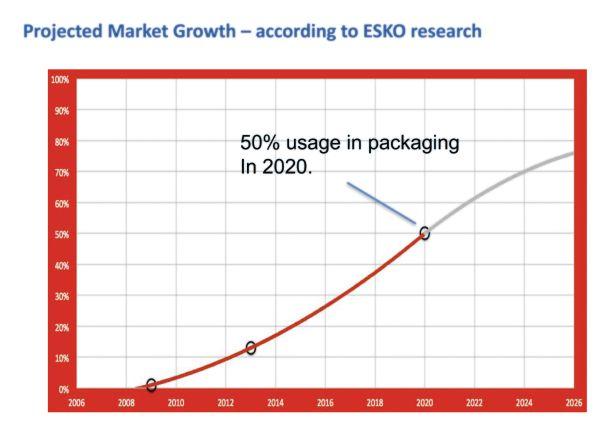
According to Esko research, 50 percent of packaging in 2020 will be produced with some form of expanded gamut technology, versus today’s utilization rate of around 25 percent.
ColorXTC’s Dynamic Press Profiling (DPP) technology, a remote offset press profiling service to provide press characterization data without the expense of dedicated runs. Instead of running more than 1,600 patches in testing, DPP applies proprietary algorithms to a smaller profiling target (150 patches) gathered in an regular production run. Seymour’s presentation, entitled When an Idea’s Time Has Come, focused on the maturation of expanded gamut and the opportunities it provides for printing companies. He contends the new awakening of expanded gamut (EG) revolves almost exclusively around saving money –not building a better mousetrap, but rather a cheaper mousetrap.
Building mousetraps
It took eight years after Hallmark Cards’ 1960 BigBox Color system, Seymour explains, for an expanded gamut patent to be filed in 1968 by Dainippon Screen, whose patent abstract explains, “[printing plates] are produced for reproducing colour images with inks other than the standard inks.” The year 1985 brought the next major EG patent filed by Harald Kueppers, whose work, Seymour explains, did not go far because it was manually intensive to go beyond four process colours, making separations.
Kueppers’ work, however, is recognized as a foundation of EG development, as described by his patent abstract: “Whereby the elemental surfaces which form the chromatic component are printed with a maximum of two of six chromatic printing inks, yellow, magenta-red, violet-blue, cyan blue, green and black.” A range of base ink colours, of course, can be added to traditional CMYK to expand a gamut for a reoccurring printing process, but the prevailing model is most likely to be determined
by the sector’s colour power of the day. “In expanded gamut printing, we move from four-colour printing to seven-colour printing and our base set of process colourants is now seven colour, which can be different for different systems,” writes Dr. Abhay Sharma, one of the world’s foremost colour experts and professor with Ryerson University. “For example, the new Pantone+ Extended Gamut swatch book is printed using CMYK plus Orange, Green and Violet (OGV)... The swatch book is available as a traditional swatch book as well as in software – Pantone Color Manager – and shows how spot colours would be reproduced in seven colours, CMYK + OGV.”
Seymour explains Pantone filed a significant EG patent in November 1994, part of a one-year period the colour scientist refers to as the heyday of expanded gamut printing patents. Invented by Richard Herbert, son of Pantone’s founder, this work became known as Hexachrome based on the use of six extra-pure inks (CMYK + OG), some containing fluorescent components. Hexachrome books were around for 20 years before fading away.
From March 1994 to March 1995, ink and imaging scientists with Pantone, Du Pont, Kodak, Barco Graphics, Opaltone and Linotype-Hell developed a range of EG innovations. Du Pont’s work was led by Don Hutcheson, well known for the G7 calibration process and GRACoL, who is now a driver behind Idealliance’s newly minted XCMYK methodology for EG printing. XCMYK remains a four-colour CMYK process but uses inks that are blended to be much purer than regular inks. Promoting the idea that more ink means more colour, leveraging FM screening, the XCMYK dataset and profiles can reproduce a larger gamut than that of GRACoL. Idealliance
At the intersection of materials, forms, fonts, lighting and technology – discover GEMINI – North America’s leading wholesale manufacturer of custom dimensional letters, logos and architectural plaques. To discuss your advanced design requirements or program deployments contact
Day in the life of an 8 unit press
Day in the life of an EG press
John Seymour created a simple illustration to show the money-saving potential of expanded gamut printing in a typical 8-colour press, where operators would need to wash up after each spot-colour run (above) versus continued operation in an EG-enabled press (below)
emphasizes XCMYK is not a replacement for GRACoL but rather an alternative colour space.
“FM screening actually gives you a bigger profile, a bigger gamut, not because the solids are pushed up,” says Seymour. “Obviously, FM screening doesn’t make the solids any richer, but it bows your profile up so you pick up more of the pastels.”
Colour improves brand recognition by up to 80 percent, according to Kodak’s chief colour scientist William Li, who also noted colour makes an impression that is 40 percent more memorable.
Opaltone, also patented during the mid-90s EG heyday, is still being used today primarily in toner-based printing. None of these heyday patents attempted to encapsulate the entire concept of EG, but rather coincided with a significant printing evolution. “Patents are almost always for incremental processes, small improvements on what is already there,” says Seymour, who himself has 22 patents. “So we have five patents and they may overlap a little bit,
but they are all distinctly different.”
Seymour explains the EG heyday patents arrived during the widespread adoption of digital prepress technologies, bolstered by a matured desktop publishing sector. “Innovation happens when you have a need that also needs technology,” he says. “You finally have the digital technologies to allow you do to the [EG] separations – that is when innovation becomes possible.”
In reference to the need itself, Seymour points to the desire for the printing industry at large to create better quality pictures within an expanded gamut process. “You do get more colour.You can get more gamut out of it when you have those additional inks,” he says. This colour-punch need reverberates with designers and consumers. On the pressroom floor, however, the potential benefits of EG are measured in time and resources – dollars – saved.
Seymour relates the awakening of EG directly to the printing industry’s need to increase margins in a market of overcapacity and technological innovation. “The market for a better mousetrap is pretty small because if [the current trap] already catches most of your mice, are you going to spend a lot of money getting a new one, a better one – I don’t think so,” he says. “How about getting a cheaper mousetrap – yeah, there is a market for that. This is a large market.”
There are enormous cost savings available to a printer who can regularly run an EG gamut – without the need to wash-up after each run – on press to reproduce or closely simulate a range of brand colours, which
have traditionally been printed with special spot colours poured into the fifth-plus press unit, which needs to be cleaned up when the run is done. The ability to simulate brand colours without press wash-up is the main draw of EG printing. It relates to decreasing the need to buy spot colour inks and hold inventory. Running an EG process with a consistent larger gamut also holds the potential to gang-run more high-value work up on a sheet, instead of low-margin CMYK jobs – often holding less than four process colours.
“The driving force of expanded gamut is not so much the ability to make pretty pictures. It is about saving money, that is the whole reason why we are trying to get into it,” says Seymour. “That is why you are spending so much money for those three days on press, pulling out your hair, trying to figure out how to make this happen… trying to save money.”
Expanded gamut trials
McVey began working at Jones Packaging of London, Ontario, in 2003 as a graphic designer, after graduating from Fanshawe College, and showed an affinity for learning about the printing process, working in prepress design and structural packaging. In addition to printing, Jones’ two other divisions include contract packaging services (bulk handling of pharmaceuticals) and a health-care division working directly with hospitals and pharmacies across North America and into Spain and the United Kingdom. Taking on a managerial position, McVey then began working in Jones’ plate room and consulted with the pressroom on technical issues – a liaison between sales and production, running both litho and flexo presses.
A year and a half ago, McVey began working with Jones’ pressroom supervisor on a three-day trial of expanded gamut printing. A prospective client, described as very large with product across North America, approached Jones and other existing print suppliers, with a desire to run EG for packaging. EG is primarily applied in commercial print today, but beginning to find its way into the packaging sector where brand owners relish the pop of colour available in an expanded gamut, for example, to make flowers vibrant or people look less washed out – often accomplished today with expensive ink modifications or second hits of the same colour.
Moving to EG printing, however, would mean forgoing the power of brand-specific inks, which is the
Nawar Mahfooth, Chief Science Officer at ColorXTC (left to right), colour scientist and consultant John Seymour, and Kyle McVey, Director of Client Services, Jones Packaging.
Differentiate your products with the help of Sun Chemical’s full range of coating solutions. Our coatings are designed with just the right finish or resistance to optimize your application. You can also enhance your image with our specialty coatings that engage the senses or provide a functional barrier.
All that with the same high quality, service and innovation you’ve come to expect from Sun Chemical — your single source for inks and coatings.
Request your copy of our white paper, How a Full Lineup of Coatings Can Transform Packaging, at www.sunchemical.com/coatingslineup or contact us at 1-708-236-3798.
SEYMOUR’S KEY ADVANTAGES OF EXTENDED GAMUT
• More colourful graphics
• More spot colours in gamut
• Less spot colour inks/ plates/inventory
• Less wash up time
• Ganging up jobs
• Better control on press
entry
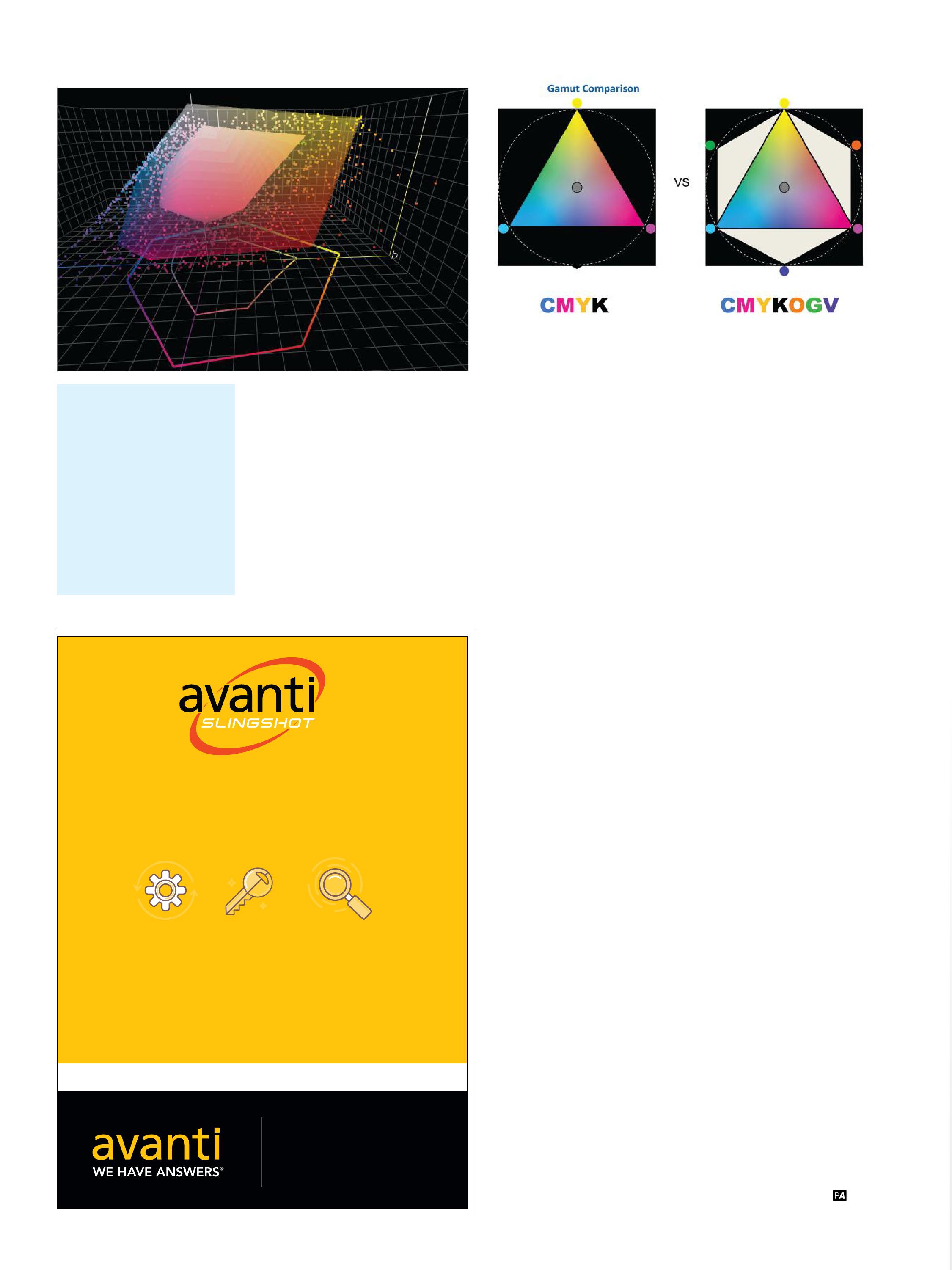
The small squares generated in this colour gamut by Ryerson’s Abhay Sharma are the 1,729 spot colours of the new PANTONE+ Extended Gamut swatch book. A CMYK+OGV and a CMYK gamut are simulated by the larger and smaller volumes in this L*a*b* diagram. It is clear that a CMYK+OGV process can simulate many more spot colours using seven inks, and for the majority of spot colours contained within the volume there would never be the need to make a separate spot colour plate.
CMYK-plus-spot environment in which McVey developed his career, witnessing firsthand the pressure it puts on the prepress world. The prospective EG client ask involved CMYK + OG, not the full Orange, Green, Violet Pantone EG spectrum.
Jones would trial the work on its six-colour Heidelberg Speedmaster press, with coater. The client wanted the print suppliers to produce 10 of its leading brand packages using six-colour process expanded gamut print. Each package was identified and measured using two brand colour patches, which were Pantone EG matches of their brand colours. “L*a*b* values, ink densities, and tonal value increases were supplied to us through a Kodak proof… and for each brand defined target patch there was a request that it did not exceed 2.5 delta E,” says McVey, “which I think is being pushed as a kind of industry standard. This is where printers are going to have a problem with expanded gamut.”
Jones’ EG testing applied conventional CMYK + OG water-based inks and coatings across all products, running on coated recycled board, as opposed to preferred SPS board, the latter of which accounts for more than 90 percent of Jones’ substrate usage. The artwork separation was done by a prepress house using Esko software to create a Euclidean dot. McVey explains the ink sequence on press was Green KCMY and Orange, based on the fact that Jones currently runs the Heidelberg’s centre four units as KCMY – acknowledging an ongoing debate in packaging, where a majority of shops run a more traditional CMYK sequence. “We chose to put green at the front of the press because it had the least impact on all of the brands that we were printing,” says McVey, “so the dot gain would be minimized on that specific colour and we put orange at the end.”
McVey explains Jones ran 12 press tests, purposely changing conditions, to adjust their plate curves and create a solid linear set for approximately 20 brands colours on the press form, aiming to get as many of those brand
colours under 2.5 delta E as possible. L*a*b* values built from the perfect the dots and laydown of the Kodak proof presented an immediate challenge. “There may be some colours that were already at a 2 delta E just on the Kodak alone, so we basically had a 0.5 delta E to work with printing on a press, with all of the variables.”
Among common press issues like registration, ink density and ink trapping ink, the latter variable would prove to be most challenging in the EG tests. Jones produced the full range of 20 brand colours at under 2.5 delta E using EG, but not without some fixes. “At about 75 percent of a colour with certain blends, specifically cyan and magenta, we were seeing a lot of ink-trapping issues,” says McVey, noting how conventional water-based inks have a tendency to blend on a litho press. “Printing cyan and magenta [at] 100-100 laydown is not predictable and due to that, due to the ink trap of those two values, this was our hardest colour to try and match, to keep under 2.5.”
Jones’ production team was able to average 2.3 delta E in its cyan-magenta tests, but they had to actually reduce the magenta ink. “This is not what you want to do in expanded gamut. It is not consistent throughout the jobs… now you have a different ink and you might as well [put] a spot colour in there,” says McVey, noting this information was passed on to the client. Understanding the importance of setting expanded gamut expectations, Jones provided the client with a long list of recommendations, such as the challenges of working with perfect Kodak proofs, the importance of ink sequence and tight press controls, and ultimately the consulting of print expertise in addition to a prepress house.
“Expanded gamut printing is just one tool in the printing industry’s massive tool box,” says McVey. “Really take it upon yourself when you are in a discussion about expanded gamut to actually learn about what is necessary to make it successful for that application.”
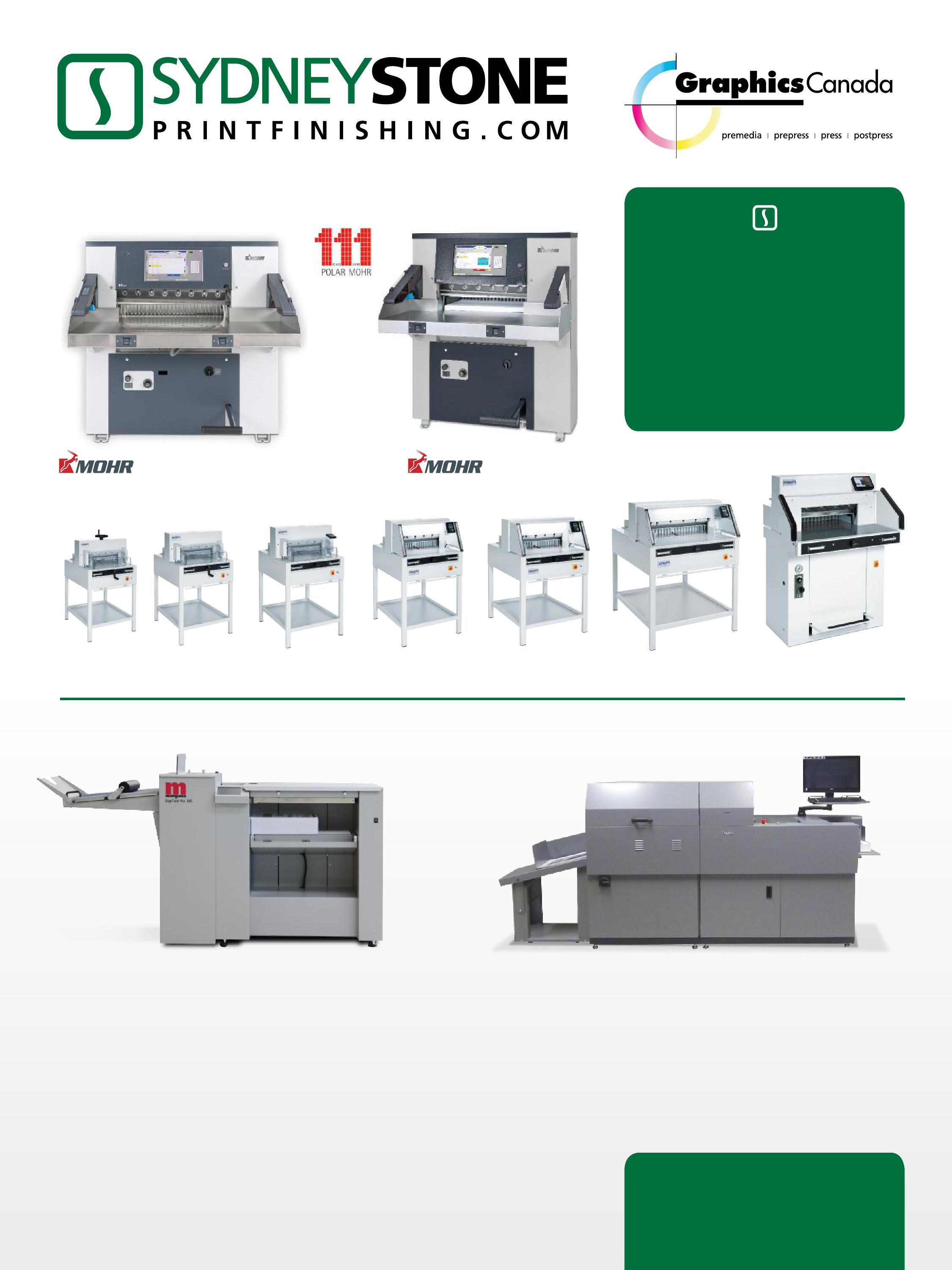
PRO 385 • Deep pile feeder • Fully automated setup • Dual creasing matrix
The NEW DigFold Pro 385, high Speed Creaser Folder with fully automatic setup and deep pile feeder is the latest addition the the Morgana range of folder/creasers. The DigiFold Pro 385 is the latest, fourth generation of the DigiFold series, offering further levels of automation to meet today’s demanding applications. It is specifically designed for digital and litho printers who have a need to crease and fold digitally printed, heavy weight or cross grained stock. The DigiFold Pro 385 is equipped with the very latest in technology to enable automatic set up of jobs, including setting of all feeder functions and fold roller settings, by selecting just a few simple parameters on the Morgana SmartScreen touch screen control. The new deep pile feeder allows stacking of up to 17.72” of paper to enable longer runs and is equipped with a SmartStep table drop for fast loading of shorter run jobs.
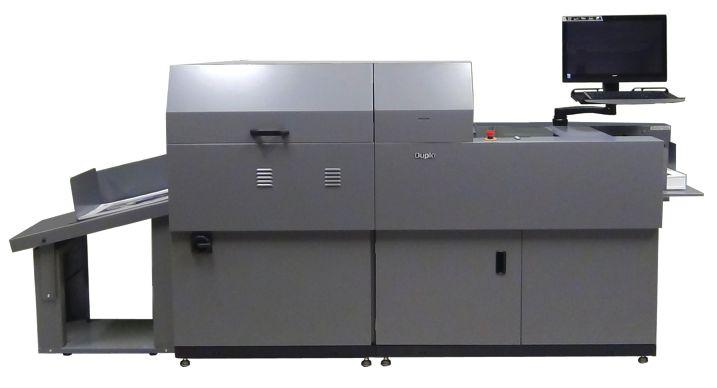
SPOT UV COATER Create Embellishments • Raised spot coated • Full sheet registration • Lower capital cost than current market options
Utilizing ink jet technology, the Duplo Digital Spot UV Coater applies a gloss finish to defined areas of the substrate giving images a raised effect with texture and depth. Its CCD camera recognition system ensures image-to-image registration and its PC Controller software offers an easy-to-use operation. Designed for short run applications, the Duplo Digital Spot UV Coater can process up to 21 sheets per minute (A3), UV thickness from 20 to 80 microns, and paper weights from 157 to 450 gsm (coated paper). “There is a lot of excitement building up around the new Duplo Digital Spot UV Coater and we are excited to open doors to new opportunities for those printers who have wanted to add elevated spot UV embellishment to their products,” comments Anthony Gandara, product manager at Duplo USA. “The DDC-810 is an affordable solution that will allow them to creatively add impact and enhance the value of their printed merchandise.”
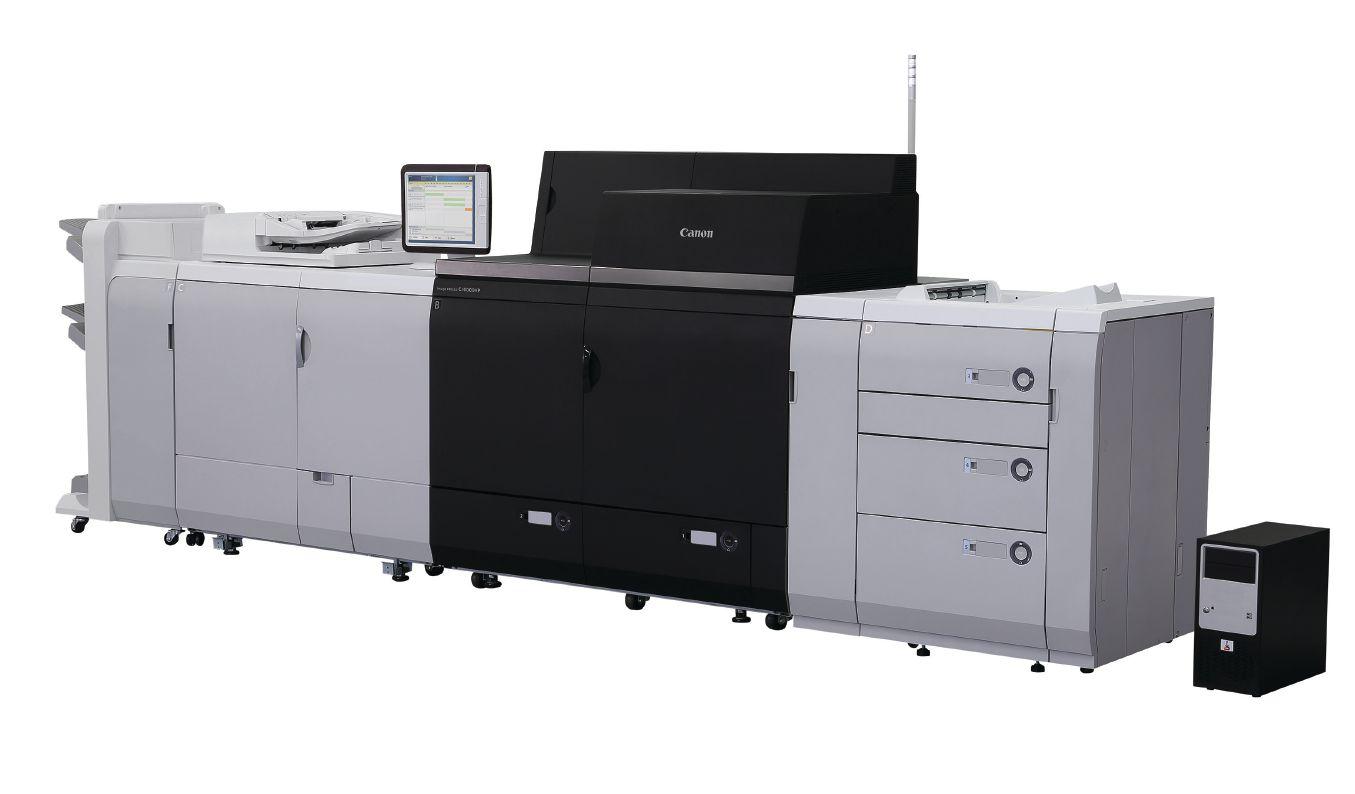
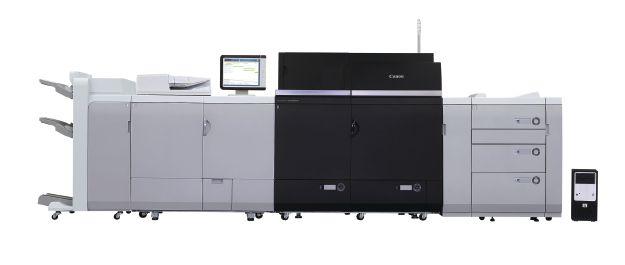
Canon rates its imagePRESS C10000VP Series for a monthly duty cycle of up to 1.5 million letter-size images, which can be reproduced at speeds of up to 100 per minute.
GRAPHICS CANADA 2017 PREVIEW
Exhibitors of the upcoming national trade show provide up to three of their best booth highlights for attendees to focus on
Organizers of Graphics Canada 2017, a biannual trade show aimed at the printing industry, will host dozens of exhibitors and various educational sessions from April 6 to 8 at the Toronto International Centre in Mississauga. The educational sessions include free sessions at the Innovations Theatre led by Deborah Corn of Print Media Centr, as well as a track of SGIA specialty graphics panel discussions.
More educational sessions highlighted by Graphics Canada’s organizers include a range of association meetings, InterlliPACK workshops on smart and intelligent packaging, Idealliance G7 Summit on colour management, Label Forum, Sales Training Days and a keynote by Frank Romano, professor emeritus at the Rochester Institute of Technology.
4over
Suede Cards, explains 4over, are a unique and textured printing option, featuring a soft velvet laminate, to create a distinct marketing project. Printed on 16-pt stock, the company’s Suede Family – starting at quantities of 500 – include products like greeting cards and postcards, in addition to business cards.
4over’s also points to its full-colour Roll Labels, which use a permanent adhesive to stick on most any surface. The company explains its Rolls Labels finishes include clear and white BOPP, semi-loss, bright silver metallic and 70-lb eggshell, which are available in a variety of shapes for applying to a range of packaging or event materials.
Digital Envelopes, as branded 4over, are available as 4/4, 4/0 and 0/4 in a range of colourful or more simple first-class mail options. The envelopes, which the company describes as pre-converted and produced with digital-printing equipment, come with or without a window.
Agfa
The Jeti Ceres RTR3200 LED, launched at the beginning of 2017, is a roll-to-roll inkjet printer for what Agfa describes as mid- to high-end applications. The new engine can include a combination of optional white printing and primer for producing higher image quality and to provide output durability. Leveraging UV LED inks and what Agfa describes as thin-ink layer technology, the Jeti Ceres is a dedicated 3.2-metre machine capable of printing on single- and dual-roll medias at speeds of up to 186 square metres per hour.
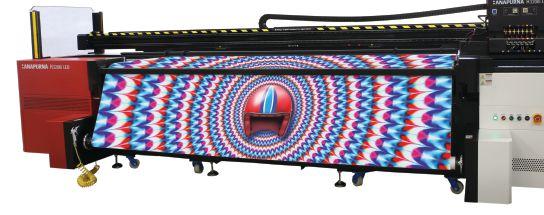
The Anapurna H3200i LED is a recently introduced 3.2-metre-wide inkjet system, also available 2.05-, 2.5- and 3.2-metre versions. Anapurna i printers, explains Agfa, use aircooled LED UV curing for printing on a range of medias and saving energy. The Anapurna H3200i LED includes what Agfa describes as a white ink function for producing pre-, post-, spot and sandwich white.
Amazing Print Tech
Web-to-Print provider Amazing Print Tech is showcasing a range of online storefront technologies for areas the company describes as business-to-consumer, Retail, business-to-business, corporate, websites, estimators and content management system plug-in technologies.
In addition to create new Websites, Amazing Print Tech states it offers the largest library of premade templates, which can be embedded into existing Websites.
Amplis
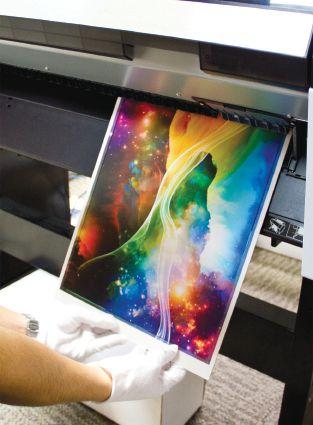
Amplis is highlighting ILFORD’s GALERIE Prestige Gold Fibre Gloss, which in April 2016 received the Technical Imaging Press Association (TIPA) Award in the category of Best Inkjet Photo Paper. Amplis explains the substrate is designed to match the look and feel of traditional fibre-based darkroom paper. The company explains GALERIE Prestige Gold Fibre Gloss provides an ideal surface for reproducing black-and-white images, as well colour images.
Amplis is also highlighting Allure Photo Panels by Breathing Color, which won a 2016 SGIA Product of the Year (Rigid Media) award. The system uses pigmented inks for what Amplis describes as increased longevity and perceived value, lamination (required, not included) to achieve different finishes like matte, satin and gloss. The material is designed to provide a similar thickness (.045 inches) and overall feel of dye sub aluminum prints. Amplis explains Allure Photo Panels also holds sharper resolution when compared to dye sub aluminum prints.
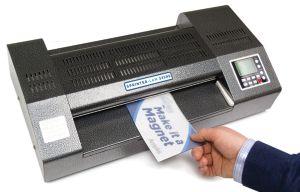
MagnetPouch, according to Amplis, is an industry-unique produce to create laminated magnets in matter of seconds. The company explains this may include customized magnets for business cards, vehicle graphics, photographs and advertising products. Available to create a high gloss or a soft touch matte finish, MagnetPouch systems work by placing a printed image inside to run through a pouch laminator.
Avanti
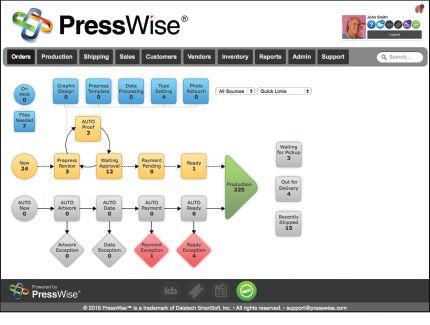
Avanti is highlighting its Slingshot management information system, which is described as the only JDF-certified, cloud-based Print MIS in the market. The software provides From order entry through to production and billing, Avanti Slingshot enables you to work more efficiently, control your costs and move jobs through the shop.
Ricoh acquired MarcomCentral (formerly known as PTI Marketing Technologies Inc.), in December 2014. The acquisition has successfully enhanced the value of Ricoh’s Web to Print, Marketing Asset Management, and Variable Data Printing offerings. With the addition of Avanti, the Ricoh portfolio is now able to cover the entire production workflow, including Print MIS.
Thank you for helping to make the world greener.
When it comes to the environment, some of the most progressive printers in the world are Kodak customers. Please join us in congratulating two of our 2016 Kodak sponsored SONORA Plate Green Leaf Award winners— Canadian based Informco and U.S. based Reynolds & Reynolds —being recognized for their outstanding environmental practices.
2017. Kodak, Sonora and the Kodak logo are trademarks of Kodak.
FEATURED EXHIBITORS
4over
Agfa
Amazing Print Tech
Amplis
Avanti
AXYZ International
Bard Business Solutions
C.P. Bourg
Canon Canada
Daly Digital Group
Delphax Technologies
Depositphotos
Dolphies Promo
Epson Canada
Esko
GMG
GTI Graphic Technology
Hans Shinohara
Hiker Enterprises
HP
Insource
Konica Minolta Business Solutions
MPI Group
Multiple Pakfold Business Forms
National Research Council
PDS
Primera Technology
Ricoh Canada
Roland DGA
RS International
Sign Assoc. of Canada
SmartSoft
Southwest Bindings
Sydney Stone
Unibind
Value-Rite Business Products
Veritiv
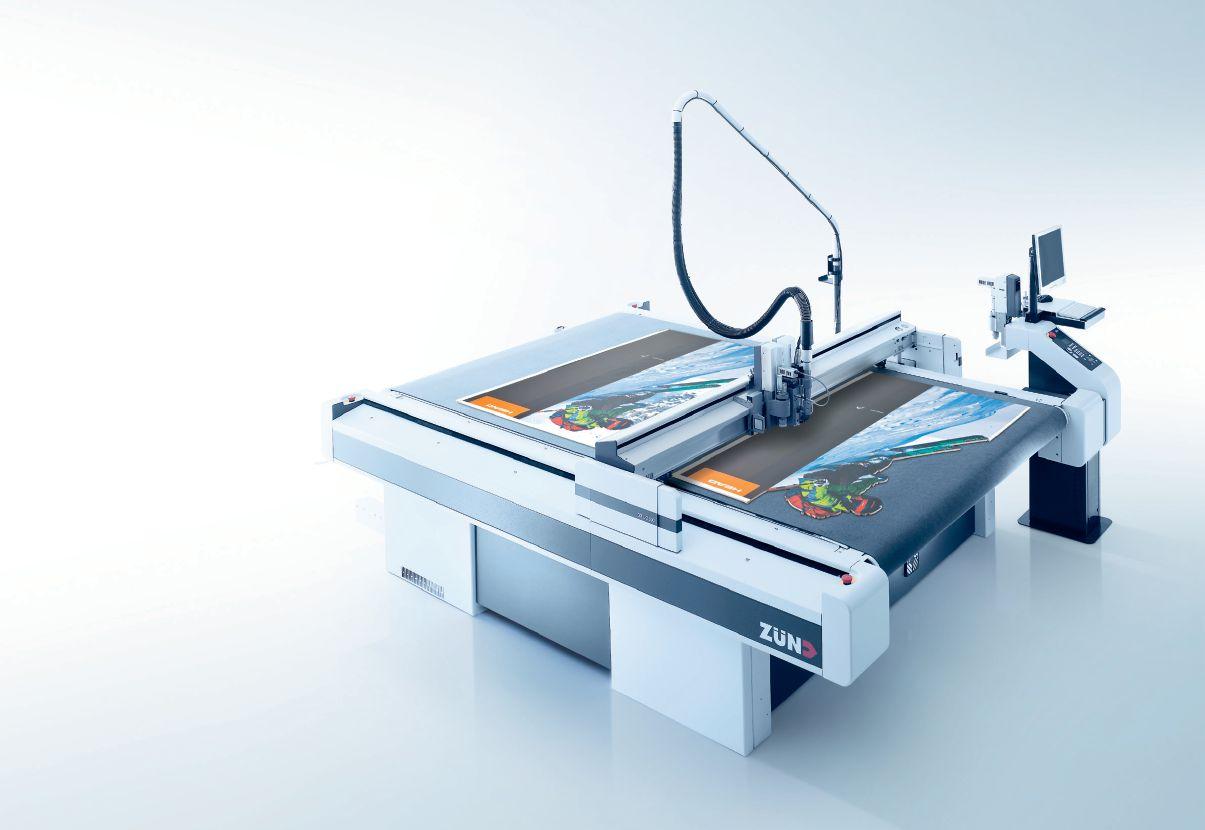
Zünd
Bard Business Solutions
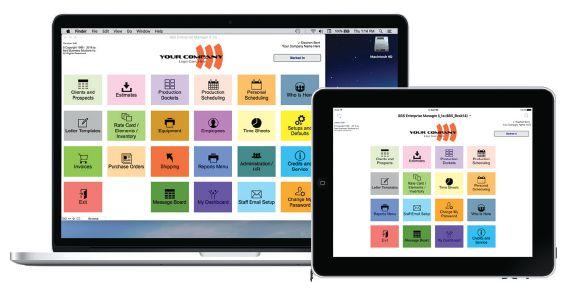
Graphics Manager, Enterprise Manager and Digital Print Manager are software products designed to maintain data on clients, rates, estimates, production dockets, production scheduling, costs, purchase orders, shipping and invoices. Bard explains this applications are designed with a philosophy to enter data once and use it many times. The company explains each software program allows users to organize and manage their company process, to keep in touch with clients and attract new business. The software, according to Bard, allows users to create quick and accuracy estimates to produce competitive quotes.
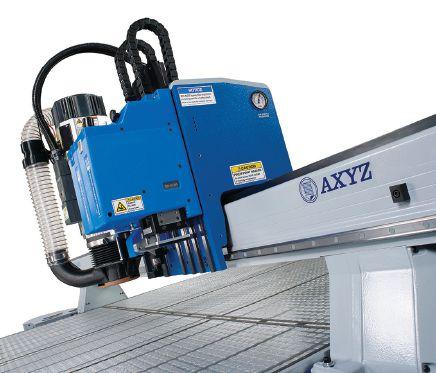
AXYZ International Trident, explains AXYZ, is an innovative hybrid CNC production system combining heavy-duty routing with fast knife cutting for processing the broadest range of materials in all print finishing, signmaking, foam and graphics applications. Popular applications include: Graphics and Print Finishing - Cut-to-print using multiple tools for all materials; Signmaking - All types of 2D and 3D signs in woods, metals and plastics; Foam Packaging - 2D and 3D processing with router and knife tools; and Point of Purchase.
Axyz Series is one of the most versatile CNC router systems in the industry. AXYZ Series CNC Routers are available with an extensive choice of process areas, a variety of head and tooling configurations, and the most diverse combination of productivity options in the industry. They are suitable for use in many different application areas and for processing all types of woods, plastics and non-ferrous metals. It is available in widths from 28 to 128 inches.
Pacer is a heavy-duty CNC router when manufacturers are looking for precision, reliability and high-quality machining need look no further than the Pacer CNC router. Its robust construction, overwhelming standard specification and endless list of options are normally only found on much more expensive machines. The Pacer Series offers the perfect blend of high quality and affordability.
C.P. Bourg
The recently launched Bourg Preparation Module, according to C.P. Bourg, provides intervention-free book making and binding. The company states its Bourg Preparation Module (BPM) is the industry’s first scalable sheet preparation module, designed to simplify and automate the production of books and booklets providing a streamlined workflow and shorter turnaround.
The Bourg Binder BB3002 family of products are designed to create a range of on-demand perfect-bound books ranging from 1 mm up to 60 mm, with up to 13 positive or negative knife creases, using EVA/hot melt or PUR-C adhesive systems. The company states its BB3002 is easy to maintain and set up for integration with existing workflow. The BB3002 can be upgraded with a Bourg Book Loader to create the BB3102 system.
The Booklet Maker ExPress with the Bourg Sheet Feeder option is described by the company as a BSF + BCM-e + BM-e configuration. It is based on production model that C.P. Bourg describes as dual-mode finishing with the combination of off-line and in-line finishing. The configuration, according to the company, allows multiple printing systems to share one finishing device.
Canon Canada
The Océ Arizona 2200 series includes flatbed-based UV-curable printing systems designed for producing both rigid and flexible work. Building from an existing Arizona platform, the newest Océ Arizona series, according to Canon, are designed as versatile and high-quality imaging systems for mid-volume print producers.
The imagePRESS C10000VP Series is designed for high-volume digital printing, running a range of media types, with what Canon rates as a monthly duty cycle of up to 1.5 million letter-size images. The imagePRESS C10000VP Series reaches print speeds of up to 100 letter images per minute with the C10000VP model and 80 letter images per minute with the C8000VP model, with both systems supporting media weights of up to 350 gsm. The imagePRESS C10000VP Series produces a resolution of up to 2,400 x 2,400 dpi with automatic colour control and adjustment.
The Canon imagePROGRAF 60-inch PRO-6000S and 44-inch PRO4000S large-format printers using an 8-colour LUCIA PRO ink system designed for applications like production signage, commercial photography and proofing. The LUCIA PRO ink set adopts newly formulated, micro-encapsulated pigment inks for what the company describes as strong colour reproduction, image clarity and fine lines. Canon explains these reproduction characteristics are well suited for creating posters and advertising displays.
Daly Digital Group
Daly Digital Group is a Roland Authorized Dealer specializing in inkjet and UV printers. It is featuring the Roland LEF-300 benchtop UV Flatbed printer, which allows users to print on a range of substrates like PET, ABS and polycarbonate, soft materials like TPU and leather.
Roland explains the LEF-300’s built-in vacuum table helps hold thin and soft materials. The system is also designed to print on three-dimensional items like smartphone cases and laptop covers, signs, giftware and promotional items.
Daly will also highlight the VersaUV LEC Series LEC-540. With the 30-inch and 54-inch VersaUV LEC printer/cutters, Roland explians users can easily create vibrant prototypes and short runs on a variety of actual press substrates. Users can produce such work in one seamless workflow, explalins Roland.This inclues flexible bag media, folding cartons and pressure-sensitive labels, as well as clear film, CMYK, white, varnish, emboss, crease and cntour cut with a single device.
Delphax Technologies
The Delphax elan 500 is a colour sheetfed inkjet press with the ability to produce up to 500 duplex letter images per minute or 3,750 SRA2 (450 x 640 mm) sheets per hour. The press is driven by Memjet print-head technology, whereby every stationary print-head on the elan 500 has 70,400 jets that produce up to 700-million drops of ink per second. The press delivers full CMYK colour and 1,600-dpi print resolution.
The elan 500 allows for printing on a range of substrates from weights of 20 to 130 Ibs (60 to 350 gsm) and formats of up to 8 x 8 to 18 x 25.2 inches (203 x 203 mm to 450 x 640 mm). Duplex printing is performed at full speed, explains Delphax, with no degradation due to the press’ SST paper path.
Engineered for a low capital acquisition and on-going running cost, Delphax explains the elan 500 combination of Memjet’s print heads and its own high-speed paper-handling technology is a production class sheetfed printing system.
Depositphotos
Depositphotos’ Enterprise service provides what the company describes as millions of authentic, vivid images from photographers, illustrators and videographers in various regions of the world. Depositphotos Enterprise provides unwatermarked hi-resolution images, allowing users to work with such images free of charge. Users only for the images after they have been licensed. Depositphotos explains its search tools, including novel image criteria, allow for images to be found faster, with workflow tools to organize and manage images.
Dolphies Promo Group Canada
The new Modular Hybrid Trade Show Booth, available in 10-, 20- or 30-foot versions, combine what Dolphies describes as a flexible user-friendly system with a durable and sleek frame design. The booths can be fitted with custom printed dye-sublimation graphics. The new Promo Table DPT2 (North American XL Version), explains the company, is 12 inches higher than its other Promo Table models to suit a range of promotional-counter requirements. The company’s EXTRA Durable and Portable Pop Up Tent with Custom Dye-Sublimation Graphics is a heavy duty hex leg canopy that uses a nylon-composite fitting. Dolphies explains this system provides for unhindered action and a smooth motion.
Epson Canada
ColorWorks C7500, according to Epson, features a rugged design for minimal maintenance and a low overall cost of ownership. The printing system is designed for on-demand printing of labels with variable data at speeds of up to 11.8 inches per second. Epson states ColorWorks C7500, in the production of high-quality, durability colour labels, allows for up to 50 percent lower printing costs than with laser and thermal transfer printers. It uses PrecisionCore inkjet technology and UltraChrome DL inks developed by Epson to produce vibrant colours, smooth gradations, precise barcodes and sharp text, according to the company.
The 17-inch 10-colour SureColor P5000 is a professional-level desktop inkjet printer for the production of high-quality photography, fine art, graphic design, and proofing work. Leveraging the Epson PrecisionCore TFP printhead and UltraChome HDX 10-colour pigment ink set, the SureColor P5000 holds what Epson describes as an increased colour gamut, higher-density blacks and twice the print permanence than the previous generation.
The SureColor P20000 is a professional-level 64-inch photographic printer that runs 9-colour archival pigment for high-volume photographic printing environments. It uses the new PrecisionCore MicroTFP printhead utilizing 8000 nozzles for what the company describes as print speeds that are up to twice as fast as Epson’s previous generation. Epson UltraChrome PRO archival ink technology produces output rated to last up to 200 years, along with four levels of grey for what Epson describes as accurate transitions with very low grain, at the fast print speeds.
DISCOVER THE LIMITLESS PRINT SOLUTIONS OF CANON CANADA
Discover our diverse portfolio of professional printing solutions for graphic applications, such as, marketing communications, signage, packaging, books, and more.
Visit our massive 4,500 ft2 booth at Graphics Canada 2017 and discover the true meaning of big, vibrant, easy, and fast. Meet our colour experts, application specialists, workflow solution and support teams for onsite demos and to learn about our latest innovations.
Register today at graphicscanada.com with the code CANONGC17 for free entry to the show to discover more.
REMAINING EXHIBITORS
(as of February 13)
3 L Display
A + A Graphics Canada
Aberdeen Fabrics
ACCO Brands Canada
ADMACO
Announcement Converters
ATS - Tanner Banding Systems
B & R Moll
Banner Ups / E. L. Hatton Sales
Cambridge Label
Color Dec North America
Comhan Canada
CP Office Solution
Customized Mats
Decalcorama/ Simple Signman
DFS
DocketManager
Duroflex Specialty Papers
EOS Trading
Epilog Laser
Ernest Green & Son
Exhibition Printing Solutions
EZ Trade Signs
Factor Forms & Labels
Flagship Courier Solutions
Forte Labels and Shrink Sleeves Inc.
Gemini
Grand Valley-Direct
Graphic Arts Magazine
Greenflow Environmental Services Inc.
GRIMCO
ILLU Display
J & J Manufacturing
Jelly Labels
KIP America
LasX Industries
LogoJET
Macaron
Masterwork USA
Matchking Printing
Maxmedia Graphic Supplies
Mimaki USA
Miralupa
MPI Print
Multi Color Tech
Mutoh America
New Magway
Okidata Americas
OMET Americas
Outdoor Media Zone
Prime Lightboxes
Prime UV-IR Systems
PrintAction Magazine
Printer Gateway
Printer’s Parts & Equipment
Pritchard Paper Products Co
RISO
Rubenstein RB Digital
Sinalite.com
Sinclair Computer Forms
Stahls’ Canada
STM
Stuebing Automatic Machine
Teckmark Label
TG Graphics
The Drafting Clinic Canada
THERM-OTYPE
Tiimports
TMAX Images
Treck Hall Wide Format
Trotec Laser Canada
Ultima Displays Canada
Web to Print Shop
Xerox Canada
Yupo
Esko
The Kongsberg C with Lubri-Cool is part of a line of cutting, creasing and milling tables that leverage a collection of software tools. To develop the Kongsberg C, Esko explains it engaged customers and non-customers involved in the short-run finishing market primarily focused on sign making, displays and paperboard packaging converting.
Device Manager for flexo plate making, explains Esko, is designed to bridge the gap between the prepress department and the plate room. Esko explains the software pushes operational control upstream to the prepress department, which allows imaging devices to be better balance workloads. The software tracks jobs, monitors machine status, merges plate production, reports on utilization and planning, and provides machine visibility on workload.
Automation Engine 16 is the newest version of Esko’s portfolio of integrated software products for design, prepress, workflow automation, colour management and supply-chain collaboration for the print production of packaging, labels, displays and signs.
GMG
Designed for colour separation, the newest OpenColor version 2.0.6, according to GMG, holds the ability to dynamically create high-quality separation and preview profiles for Adobe Photoshop and HYBRID PACKZ software. For existing customers of OpenColor, the latest version offers a new function to calculate separations in a more flexible and convenient way via rules that can be applied to entire spot-colour libraries.
GMG OpenColor can connect to PACKZ, a PDF-based prepress software suite for professional package and label production, in order to bring dynamically created GMG profiles into other software. PACKZ, with OpenColor profiles, can re-separate jobs to reduce or optimize the number of plates used on press (replacing magenta with a spot colour or separate spot colours and overprints to a 7-color extended gamut printing process).
GMG ColorServer prepares data for a range of printing processes. It transforms fully automatically RGB, CMYK and mixed data to a single colour by means of separation, reseparation or colour conversion. The DeviceLink approach, according to GMG, avoids known drawbacks of ICC technology, such as reseparation of the black channel.
GTI Graphic Technology
GTI, a manufacturer of lighting systems for critical colour viewing, colour communication and colour match assessment, has introduced a new Vertical Wall Viewing System. GTI’s new Vertical Wall Systems – a combination of overhead luminaires, viewing lamps, and accessories (wall panels, neutral gray paint, mounting options) –are ISO 3664:2009 D50-compliant for large-format vertical viewing. GTI’s Graphiclite luminaires feature what the company describes as a parabolic lens design.
Hans Shinohara
Hans Shinohara describes itself as a general dealer that supplies printing equipment made in China and Japan to North America commercial printers. In recent years, explains the company, printing has to meet the market need of short run, customs shape, short delivery, which is why last year it introduced new digital finishing solutions to Canada.
At Graphics Canada Hans Shinohara plans to highlight a laser die cutter with samples, as well as a PUR perfect binder and a hardcover book equipment package. The finishing will be focused on markets for labels, packaging, cards, engraving gifts and book publishing.
Hiker Enterprises
The HM308HN Dual Fit Grommet Press, according to Hike, has one of the most trouble-free feeding systems in the market. The machine is aimed at companies that insert less than 50,000 grommets per month. It is available with a static clutch (stationary foot pedal), or magnetic clutch (moveable foot pedal). The HM308HN feeds both grommet and washer. It uses self-piercing grommets and Hiker explains that having the grommets cut their own holes, leveraging a forcefull flywheel, eliminates the extra cost of purchasing and maintaining a separate hole-punch. A laser pointer is included with the HM308HN.
Hiker also explains the use of self-piercing grommets also means tips of the barrels on each grommet are sharper and the material is more rigid, which allows the grommets to cut their perfect sized holes, which provides the framework for a quality grommet setting with each insertion.
HP
The PageWide XL 8000 portfolio prints at speeds of up to 30 D/A1 pages per minute in both monochrome and colour. HP states the system allows for the production of monochrome and colour printing at up to 60 percent faster than the fastest monochrome LED printer. The company continues to explain mixed monochrome and colour sets can be created in 50 percent of the time with a consolidated workflow. It allows for the production of colour GIS maps, high-quality point-of-sale poster applications, and durable technical documents.
HP Latex 1500 builds on the existing HP Latex 3000 printer series. The 126-inch (3.2-metre) HP Latex 1500 printers is a super-wide printing technology aimed at a range of indoor and outdoor applications, including work produced on PVC banners, self-adhesive vinyl, textiles and double-sided prints. It prints at speeds of up to 74 square metres per hour (800 sqft/hour) in outdoor production mode and up to 45 sqm/hour (480 sqft/ hour) in indoor mode.
Insource
Insource is highlighting its customized Visions Systems approach for all types of equipment, such as a Norpak high speed inserter with KR319 inkjet system, to improve the automated processing of unique identifiers/personalization.
The Kirk Rudy Phoenix is described by Insource as leveraging fast, high-resolution inkjet print-head technology. Insource explains Phoenix meets the rigorous demands for printing variable addresses, graphics, dates, times, barcodes, serial numbers, and texts on coated and uncoated substrates. The Kirk-Rudy 535 tabbing system has production rates in excess of 40,000 tabs per hour combined with a roll capacity of nearly 50,000 tabs, while also being engineered to perform with less operator training and setup time. All major types of tabs as well as pressure sensitive stamps and labels of various shapes and sizes can be placed on a wide variety of products.
Multiple Pakfold Business Forms
Multiple Pakfold Business Forms, MP Short Run and MP Label are highlighting their short-, medium- and long-run forms, cheques and labels. The company will also be highlighting its new digital label capabilities.
MPI Group
Petratto Metro is a system for line-folding and gluing that can be applied to applications like packaging and direct mail, among others. It is possible to customize a machine to suit individual needs by adding modules like feeders, folding sections and turning devices, in which several units can be connected to produce complex applications, or work independently.
MPI Print is a trade printing operation based out of Concord, Ontario. The company specializes in high-volume sheetfed and web printing in addition to digital print capabilities. In December 2016, MPI Print installed a new Konica Minolta bizhub PRESS C1100, which also included an inline SD506 Booklet Maker. The colour toner press is integrated with the IC-310 Fiery RIP with Graphics Arts Package, Impose & Compose, Konica Minolta Color Care Software with FD-Auto Scanner, and an HM-101 inline humidifier.
MPI Print describes itself as a one-stop shop for printing services, explaining it holds one of the largest trade sheetfed divisions in Canada. in 2014 MPI invested $12 million in a second print facility in Mississauga, Ontario. This facility houses a fully automated KBA 32pg web press as well as its newest sheetfed press, a 40-inch Mitsubishi UV machine. MPI Print also explains it holds one of the largest trade binderies in the country.
Konica Minolta Business Solutions
The AccurioJet KM-1 is a new B2-size high-speed inkjet printing system, which Konica Minolta describes as combining the speed and flexibility of offset presses with the benefits of variable data printing. It prints on 23 x 29.5-inch sheets, which Konica Minolta describes as the largest sheet size in its class, allowing for 6-up letter-size printing. The machine is rated to run at up to 3,000 sheets per hour, producing 1,200 x 1,200-dpi resolution.
The bizhub PRESSC71cf is described as a four-colour, roll-to-roll label press aimed at the mid-sized printing companies. The bizhub PRESS C71cf is specifically designed for narrow web applications.
The MGI JETvarnish 3DS with iFOIL provides what Konica Minolta describes as digital embossing. The system is designed for precise spot coating, according to the company, with an ability to handle both digital or offset originals in long or short runs. It allows users to vary the thickness of the coating to create tangible depth in the printing project.
National Research Council
NRC is highlighting its passive components/devices such as printed conductive lines/connections, resistors, capacitors, and inductors that are basic building blocks in any electronic circuits. Using screen printing, flexo printing and inkjet printing processes, NRC has developed a suite of high conductivity metal lines/connections, precision resistors, UV-curable dielectrics. It can be used for printing high conductivity Ag-based HF RFID antennas in ID card/passport applications.
NRC is also highlighting its hybrid solution circuits, using both silicon ships and printed electronic components to form functional electronic circuits/systems – maximizing the benefit of Si-based electronic circuits (fast, high integration density) and printed components.
NRC is also highlighting its active components in the field of organic photovoltaic solar cells through the development of flexible electroluminescent lamps, using screen printing. The cells/detectors are stable more than two years under ambient condition without encapsulation.
PDS
PDS is displaying the OKI 900 series of printing systems, including the Xpress 942 with single pass, CMYK + White printing, as well as 1,200 x 1,200 LED print-heads that handle a range of media stocks of up to 52 inches. The system, according to PDS, prints vibrant full colour on dark coloured and transparent medias. An optional envelope feeder and conveyor can be added for full envelope production.
The Duplo DC616Pro is a finishing system for short-run and on demand printing. It is designed to eliminate white borders and prevent toner cracking on colour documents. The all-in-one DC616Pro systems can process up to six slits, 25 cuts and 20 creases in a single pass. Providing fully automatic setup and quick changeovers, the DC-616 & DC-616 PRO can finish different applications.
PDS is also displaying a range of creasing, folding and controlled perforating systems from MultiGraf AG. The standalone or combined machines in the MultiGraf Touchline series include the CF375 folder, creaser CP Mono controlled perforation and creasing, CP 375 Duo to crease up and down, two folds, and have controlled perforation in both directions. This system works in one pass with speeds up to 6,000 sheets per hour.
Primera Technology
CX1200 Digital Color Label Press features print speeds of up to 16.5 feet per minute and a maximum print width of 8.25 inches. It is designed to produce short-run, full-colour label printing.
The company’s FX1200 finishing system is designed to laminate and die-cut any shape or size label of up to 8.25-inch wide. The system also removes waste and allows for slitting up to seven rolls and rewinds. Primera describes the FX1200s as an all-in-one off-line solution that produces rolls of finished labels.
The LX2000 colour label printer is Primera’s newest and fastest pigment inkjet label printer. The LX2000, according to the company, represents a new product class in desktop label printing. It features large, separate ink cartridges for cyan, magenta, yellow, and black, which Primera explains helps keep cost per label low. The LX2000 can print at speeds of up to six inches per second. Printed labels can include photos, graphics, illustrations and text, as well as high-resolution linear or two-dimensional barcodes.
Ricoh Canada
The new Pro C5200s and Pro C5210s produce colour and black-and-white documents at up to 65 and 80 ppm, respectively, reaching VCSEL resolutions of up to 1,200 x 4,800-dpi. Along with optional oversized media support, the Pro C5200s works with medias of up to 360 gsm simplex and 300 gsm duplex at 13 x 19.2 inch standard format. The optional oversized media support provides a 13 x 27.5 inch format.
The Pro C7100 X Series is a 5-station toner-based colour production print system with the ability to print using Clear, White, and now Neon Yellow Toner, which further expands the press’ application range.
The Pro 8200 Series includes black-and-white multi-function production systems to provide best-in-class image quality at reliable high speeds. Ricoh explains the systems provide sharp output with high registration across a range of media. The company describes the Pro 8200 Series as an end-to-end document production system for high volumes, available with a full suite of finishing options. The Pro 8200 Series can print up to 96 pages per minute.
Roland DGA
The Texart XT-640 is described as a high-volume dye-sublimation printer available in 64-inch and 54-inch models. The Texart XT-640 inkjet printer/ cutters are designed to produce work like decals and labels, banners, signs, vehicle graphics and posters. Because we know you need to be able to produce it all – on demand. More efficiently and productively than ever.
The VersaUV LEF-300 benchtop UV flatbed printer can handle a range of substrates like PET, ABS and polycarbonate, soft materials such as TPU and leather, as well as three-dimensional items ranging from smart phone cases and laptop covers to signs, giftware and promotional items. Roland explains the LEF-300’s built-in vacuum table helps hold thin and soft materials in place, allowing for easier job setup and eliminating errors.
The TrueVIS VG-640 large-format inkjet printer/cutter uses TrueVIS INK, which Roland describes as being more vibrant and cost-effective than earlier models. It also features new cutting technology that increases accuracy relative to older generation systems, as well as technology to communicate with existing phones and tablets. TrueVIS VG Series inkjet printer/ cutters are available in 64-inch and 54-inch models.
From tabletop to oversized flatbeds and super-wide roll-to-roll models, Mimaki offers UV printing solutions to suit nearly any application need.
Stop by our demo booth #5168 at GRAPHICS CANADA to learn how utilizing wide format UV printing from Mimaki can boost your bottom line.
mimakiusa.com/GraphicsCanada
RS International Canada
PX-181 is described by RS International as a high-quality affordable calender heat transfer system specifically designed for sign and print shops seeking to expand their product offerings. By adding on the optional work table, users can transition between roll-to-roll production and per-piece production.
The PX-181 features what the company describes as a heavy-duty steel frame construction. It also leverages infrared heating technology as a transfer system.
The BMA-160/350LH multi-applicator features full LED illumination and height adjustable. The company describes it as a fast and efficient system for laminating, mounting and pre-masking needs.
The Bobis 3.5 metre (138 inch) multi-applicatoris is a flatbed application table that RS International describes as simple to install.
Sign Association of Canada
Since 1955 the Sign Association of Canada (SACACE) has focused on promoting the welfare of the sign industry, with the goal of improving the status of its members in the community. However, the Sign Association of Canada explains that the traditional boundaries of the sign industry have expanded due to the rapidly changing level of technology and the evolution of the commercial marketplace.
SmartSoft
PressWise is an end-to-end SaaS-based MIS and Print Workflow Automation solution that comes complete with features like unlimited Web storefronts, estimating, quoting, order processing, complete shipping integration, fulfillment and the ability to integrate with most third-party storefronts and existing back-end accounting systems.
Frameworks Canada is what the company describes as a cutting-edge SERP recognized Address Accuracy and Postal Presorting product. Frameworks Canada Mailers Edition is a fully-featured, all-in-one SERP Recognized postal software solution, designed to save the user time and maximize postal discounts by presorting your mail to Canada Post specifications.
Southwest Bindings
ALM 3230 Mini is the next generation, fully automated one- to two-sided print laminator that can work with up to 13 x 19-inch sheets. The machine, according to Southwest Bindings, features ultra quick warm up and automatically feeds up to 100 sheets – and with laminate and trim in one pass. Available film for the system includes 1.2-, 1.5-, 3- and 5-mil thickness.
The Koilmatic Auto Inserter and Crimper is an affordable fully electric tabletop automatic coil inserter designed to bin up to 450 books per hour.The company explains no tools are required for basic setup and change, with an LCD screen guiding operators through setup and operation. Having a vertical book placement can accommodate tabs or wider covers. Southwest Bindings explains the system provides consistent simultaneous crimping on both coil ends and a low maintenance design.
Sydney Stone
Duplo Spot UV Coater produce raised and dimensional UV effects digitally with the Duplo Spot UV Coater. Inclusive of an automatic air feeder, sheet sizes up to 14.33 x 29.13 inches. Sydney Stone explains the Duplo Spot UV Coater operates a lower capital cost and lower consumable cost that current competitors.
Morgana DigiFold PRO 385 is a high-speed creaser folder with fully automatic setup and deep pile feeder. It is the newest addition to the Morgana range of folder/creasers. The DigiFold Pro 385 is the fourth generation of the DigiFold series, offering new levels of automation to meet range of printed applications. It is specifically designed for digital and litho printers who have a need to crease and fold digitally printed, heavy weight or cross grained stock. instaFOIL is a new product to create short run spot foil for digital printers. instaFoil is used in conjunction with a laminator in order to apply foil in house. The product is available in nine colours including Gold, Silver, Gloss, Green, Red, Matte Gold, Medium Blue, Dark Blue, Pink and Red. Sydney Stone is providing swatch books for instaFOIL at Graphics Canada.
Unibind
CM750 UniFoil Printer allows users to personalize books, notebooks, agenda, contracts. The UniFoil Printer is a digital printer that prints foil directly from a digital file on any flat surface. The company explains users can create personalize products in-house with the product by connecting the UniFoilPrinter to a computer, downloading the software and start printing. The CaseMaker 650 is the perfect case making solution for short-run personalized cases. It allows users to create a hard cover, ringbinder or display in what Unibind describes as an easy and maintenance-free way with the Unibind CasePlanos. An easy and error free case making process, thanks to the premade CasePlanos. Cost-efficient: The CasePlanos machine can be operated by a minimal trained operator, according to the company, as it does not require setup and change-over time. Unibind explains it only takes a few minutes to produce a personalized hard cover with the technology.
Value-Rite
Value-Rite is showcasing what the company describe as a complete integration of technology to custom decorate fabric, metal, plastic, glass, vinyl, and ceramics
Using Sublimation, UV printing, Solvent, transfers. Value-Rite represents Epson, Mimaki, Okidata, Sawgrass, Forever, Chromaluxe and Implusa.
This includes the all-new Epson SureColor F9200 which is described as a fast, economical medium- tolarge volume dye-sublimation transfer printer. It runs at speeds up to 1,044 square feet per hour and widths of up to 64-inches. The printing systems includes Epson’s PrecisionCore TFP print heads, an integrated roll-toroll media support system with high accuracy winding, and new dye-sublimation ink technology - Epson UltraChrome DS with High Density Black.
Veritiv
AlumiGraphics aluminum based foil decal print media, exclusive to Veritiv Canada, is for package printers and converters in VOC- and CO2-reducing technology, according to Veritiv, due to increased environmental and safety concerns, as well as regulatory requirements. The company explains demand is particularly strong in North American and European markets, where flexo inks based on solvent materials are mainstream technologies.
General Formulations CONCEPT
790AE Light Etch Air-Egress Polymeric Etched Vinyl, Permanent Adhesive, offers 12 of the 14 major benefits available in arifiQ’s high-end solution, arifiQ PRO. The salesperson or other professional uses arifiQ Entry to access the printer’s estimating server from anywhere, at anytime, using any internet connection.
Ultraflex Systems’ UltraMesh Blockout is designed to represent desired Master Standards in these cases, and are the Pantone-approved best match to the Master standards. With PantoneLIVE Visualizer, users can now visually compare and assess colour selections in a variety of production scenarios. Results from Visualizer can be exported into print-ready PDF documents that can be shared across the supply chain to better communicate design intent.
Zünd
Zünd Cut Center ZCC is an Adobe Illustrator plug-in to create three-dimensional designs for packaging and displays. Zünd Design Center provides a library of templated designs in folding carton and corrugated cardboard. The software includes a 3D preview tool to consider measurements, logos, patterns and other graphic elements. Zünd also showcasing its M-2500 cutting system, but its primary focus will be on workflow andsoftware.
Zünd Design Center ZDC we will be cutting one (or more) job/s with boxes or displays available in Zünd Design Center and nested with Prep Center. The company explains it will show visitors how easy these production process are, from prepress to finished product. Zünd will also show how they are subsequently handled in Zünd Cut Center – with QR-code capture and all the other features, including flip&cut, when using a Zünd cutting system.
1. ONE-STOP SHOP — Die Cutting, Bindery, Data & Lettershop.
2. SUPERIOR TECHNOLOGY — Die crease without a die, then fold and even glue all on the same machine, up to 30 pt.
3. INTEGRATED MODULAR UNITS — Combined in-line finishing: crease, fold, glue, tipping, envelope inserting, ink jetting (Duplex), clip seal (3 sides), mail prep.
4. SAVE ON POSTAGE COSTS
—As a Certified Canada Post Direct Marketing Specialist, we get contract pricing reductions.
5. RETURN MAIL PRODUCTS — Customized “Return Mailers” created in-line with “U” or “BOX-shape” remoistenable glue, time perfed applications and envelope formation.
6. MINI-BOOKLETS — Saddle-stitch and trim 2-up booklets in-line to the size of a business card. No need to trim off-line, or do 2 passes.
7. HIGH SPEED EQUIPMENT — High speed Tipping, Folding, Saddle-stitching and soft folding ensuring on time delivery.
Detailing the newest technologies from Canon, Drytac, Duplo, EFI, HP, Kodak, Konica Minolta, Objectif Lune, Ricoh,
Over 75,000 sq ft plant housing state-of-the-art nishing and bindery
Personalized account management and complete control over production
24/7 Production with fully automated and barcode controlled plant
FSC / PEFC / SFI certi ed
HP PageWide Web Press T235 HD
In February, HP introduced its new PageWide Web Press T235 HD, part of the T200 HD Color series. The company explains this new entrylevel continuous-feed inkjet web press provides commercial printers with an economical entry point into production-strength inkjet printing. The T235 HD platform, explains HP, is targeted for publishing, production mail and commercial print needs. It can be upgraded to the HP PageWide Web Press T240 HD for increased productivity.
Using HP’s High Definition Nozzle Architecture (HDNA) with a native resolution of 2,400 nozzles per inch, the duplex HP PageWide Web Press T235 HD runs at 400 feet per minute (122 metres per minute) in Performance Mode, using single drop weight printing. It is capable of producing 200 feet per minute (61 mpm) in Quality Mode, using dual drop weight printing with seven levels of half-toning per colour, and finer grain printing for smoother skin tones, gradients and secondary colour solid fills.
Canon Océ ProStream
Canon unveiled its new Océ ProStream series, which the company describes as a revolutionary new
approach to inkjet printing for further adoption into the mainstream of commercial printing.The Océ ProStream prints uncoated, inkjet-optimized, gloss and matte-coated papers at a rate of 80 metres per minute or 1,076 A4 sheets per minute.
The Océ ProStream, according to Canon, combines several completely new core technologies for continuous feed inkjet, and builds on a decade of experience in inkjet with the Océ JetStream, Océ ColorStream and Océ VarioPrint i300. The latest piezo drop-on-demand inkjet print head generation, explains Canon, is leveraged with Océ Multilevel technology for sharper details, smoother half tones and economized ink usage. An Océ-developed set of ColorGrip and polymer pigment inks creates strong colours – on uncoated, inkjet-optimized and gloss and matte-coated offset papers.
The new press series uses a sensitive floatation air dryer in which the printed paper is not touched until the print images are fully robust – there are no scratches or changes to gloss levels and minimal paper stress for maximum quality, explains Canon. The Océ ProStream is describes as a heavy-duty production engine with a resolution of 1,200 dpi and multilevel dot modulation at full 1,076 A4 per minute productivity.
HP describes its PageWide Web Press T235 HD as entry-level system aimed at commercial printers.
Canon’s Océ ProStream can run at of 80 metres per minute.
Kodak Prinergy Cloud
In February, Kodak unveiled Prinergy Cloud, an analytics-enabled cloud platform that offers printers what the company describes as new industry-first solutions to minimize cost and risk. Prinergy Cloud harnesses production data and turns it into dashboard reports of actionable information allowing informed decision making in real-time. Customers can integrate all Prinergy Cloud services with existing on-premise Kodak workflow software, and lower operating costs by reducing hardware and administrative overheads.
Prinergy Cloud is hosted on the Microsoft Azure platform, which provides fast and secure cloud delivery. Kodak customers will benefit from the 24/7 cloud service monitoring, delivering security and availability. Developed in partnership with Yellowfin, Prinergy Cloud’s Decision Analytics offers PSPs the print industry’s first analytics enabled workflow. This new capability delivers intuitive dashboards that provide visibility into production costs and system performance by continuously collecting data from operations. All new Prinergy Cloud services are Decision Analytics-enabled. This includes the System Performance Service for print production reporting, and File Archive and Backup for protection against data loss and automated archiving for higher levels of efficiency and security.
EFI Konica Fiery DFEs
In February, Electronics For Imaging launched two new EFI Fiery digital front ends (DFEs) designed to drive the AccurioPress C2070/ C2070P/C2060 and AccurioPrint C2060L presses from Konica Minolta. Running on the latest Fiery FS200/FS200 Pro platform, the Fiery IC-313 external server and the Fiery IC-417 embedded server provide unsurpassed centralized job and colour management. As with all Fiery DFEs, they include Fiery Command WorkStation to
manage multiple printers or an entire shop from a single point. The embedded Fiery IC-417 server gives mid-volume print operations the ability to quickly streamline and improve their digital print production operations. The new Fiery DFEs integrate into existing production workflows for digital colour and offset printing through JDF implementation managed by MIS and web-to-print products like EFI PrintSmith, Premium Pace and Enterprise Pace bundles for Konica Minolta.
Xitron Inkjet Direct
In February, Xitron introduced a new 64-bit version of its Inkjet Direct plugin available for version 11 of the Navigator RIP, which supports Epson T-Series systems. The new 64-bit version of Inkjet Direct (IJD) is designed for users wanting to output film or printing plates on inkjet devices. The IJD plug-in builds on a foundation first introduced five years ago. The new IJD plug-in supports the Epson SureColor T-Series, including the T3000, T3270, T5000, T5270, T7000, and T7270.
Xaar Midas Ink Supply
In February, Xaar introduced the Midas Ink Supply System as a compact, reliable ink and fluid supply ink system for Original Equipment Manufacturers looking for a fast time-to-market and therefore lower development costs. Robust and easy to integrate, it is ideal for full production as well as prototype systems. Xaar explains it has a compact and light design, easiness to mount and install and small ink tank capacity; it also has an optional degasser and remote heater units. In addition, as the Xaar Midas has a modular design, it is suitable for a range of applications and is able to run multiple printheads out of the box as standard.
Ease of use is guaranteed by the Xaar Midas’s rapid start up time of less than 15 minutes and almost instant shutdown time of under five
EFI’s new Fiery for Konica’s AccurioPress includes JobFlow Base for automation of job preparation.
❏
Solutions for the Printing Industry
❏ Increases
Graphics Manager
seconds. In addition, changing fluids takes less than 30 minutes via the software, and the system can be positioned up to 5 meters away from the printhead using a remote manifold. Ink temperature can be controlled up to 65°C and ink is recirculated within the angled tank to avoid settling. This is particularly useful for heavily pigmented inks.
Ricoh Pro VC40000
In February, Ricoh Europe introduced the new Pro VC40000 next generation continuous feed inkjet platform designed to empower transactional and direct mail clients to deliver high quality output with enhanced productivity features. This newest addition to Ricoh’s market-leading inkjet portfolio complements the unmatched quality and application flexibility of the Pro VC60000 and the proven performance of the InfoPrint 5000.
The Pro VC40000 features a powerful combination of speed, resolution and ease of use. At the heart of this solution lies the Ricoh TotalFlow Print Server R600A, its high performance digital front end (DFE) that has been optimized to deliver advanced workflow management and to make the production of complex, data-driven direct mail and transactional output even easier than before.
The Ricoh Pro VC40000 operates at speeds up to 120 meters/ minute, making it capable of producing more than 100,000 A4 images
per hour, offering the productivity and quality needed in today’s production print environments. With paper support from 40 to 250 gsm, application possibilities range from lightweight books to high coverage postcards.
Objectif Lune OL Connect
In February, Objectif Lune launched its OL Connect 1.6 software. The main new functionality is a driver, OL Connect Send. With this driver that teams up with OL Connect, allowing users to introduce new applications such as ad hoc print and mail consolidation.
Objectif Lune was aware that the cost of ad hoc mail is overlooked in most organizations and wanted to help organizations save considerable costs through consolidation, automation and postal discounts. With this new application, ad hoc print job submissions are collected via an intuitive Web interface available 24/7, aggregated, and produced automatically, centrally. The solution can initiate document printing on a pre-established automated workflow. The printed material is then inserted into envelopes and mailed.
Drytac Anti-Bacterial film
In February, introduced its new Protac Anti-Bacterial film. This 150µ (6 mil) textured polyester laminating film has a durable antibacterial additive which offers reliable protection from mould growth and bacterial contamination such as MRSA, Streptococcus, E.coli, Salmonella and more. The reverse side is coated with a pressure-sensitive, solvent acrylic adhesive, protected with a siliconised polyester release liner.
Duplo DDC-810 UV Coater
In February, Duplo introduced its new DDC-810 Digital Spot UV Coater, which is expected to be officially released in May 2017. Utilizing ink jet technology, the DDC-810 applies a gloss finish to defined areas of the substrate giving images a raised effect with texture and depth.
Its CCD camera recognition system ensures image-to-image registration and its PC Controller software offers an easy-to-use operation. Designed for short run applications, the DDC-810 can process up to 21 sheets per minute (A3), UV thickness from 20 to 80 microns, and paper weights from 157 to 450 gsm (coated paper).
Xaar’s Midas Ink Supply is light and easy to integrate.
Ricoh’s
FOLDER OPERATOR
Folder Operator required. Day shift, Monday through Friday. 5+ years experience preferred with STAHL folders. Cutting and stitching experience an asset. Must be able to read and interpret docket instructions, set up and operate bindery equipment efficiently, monitor work to ensure quality control and troubleshoot. Attention to detail required. Markham location. Qualified candidates should email resume to careers@parkerpad.com or fax to 905294-9595. Tel: 905-294-7997 Website: www.parkerpad.com
XEROX IGEN4
Xerox iGen4 in perfect condition with low impression clicks. Freeflow print server.
Media sizes 7”x 7” – 14.33” x 20.5” and weights of 16lbs to 130lbs (coated, gloss, text, silk, perforated, tabs, transparencies, labels). Asking $125,000 –Contact Craig at 1-866-467-5391 Website: www.ncogrenville.com
Contact email: c.wharton@ncogrenville.com
PRINT ESTIMATOR
Well established trade printer looking for an estimator. Must work well in a busy environment, be able to multi task. Knowledge of sheetfed and web printing process. Computer skills in print costing software. Excellent communication skills. Analyze quotes and recommend further efficiencies. Print management degree an asset. Email resume to: hrdept@west-star.com
INKJET SALES MANAGER
This position is responsible for performing a broad range of sales management functions to identify and
evaluate specific account opportunities develop and execute strategies and plans to penetrate the markets for wide format inkjet equipment, and achieve or exceed segment sales and profit objectives for their assigned geographic area. The ideal candidate will have 6-8 years of sales experience working within the Graphics industry, as well as a solid understanding of printing ink products, applications, equipment, technologies, processes, markets, and competition with specific emphasis on wide and grand format digital printing platforms. Interested candidates can apply for this position by visiting www.fujifilm.ca and clicking on “ Careers”.
Website: www.fujifilm.ca
PRINT ESTIMATOR
Leading Print Manufacturer has an opening for a Print Estimator in its large fast paced print facility. The ideal applicant will have at least 3-5 years’ experience estimating on all print technological solutions.
Must be efficient and highly detail-oriented being able to prioritize, meet changing deadlines, communicate effectively verbally and electronically with coworkers and clients. Receives request for quotations from sales, returns complete estimated cost calculation as required or as soon as possible. Maintains contact with outside suppliers concerning capabilities, service, product pricing and availability.
Requirements:
• Must have 3-5 years print estimating experience
• Must have excellent communication skills
• Must have excellent organizational skills, detail oriented
• High school Graduate, required
• Post-Secondary Education/Training,
• Preferred but not required
Position Includes: Competitive Salary, Benefits
Please send your resume confidentially to aschofield@deangroup.ca
CUSTOM LABEL BUSINESS DEVELOPMENT SPECIALIST
Leading Custom Label Print Manufacture has an opportunity available for a Business Development Specialist. This role will be responsible for finding, developing, and growing accounts for a prominent Label Printer.
Position Outline:
• Prospecting and sourcing customers;
• Ensuring progressive sales growth;
• Establishing and maintaining excellent customer relations;
• Managing ongoing client accounts.
• Proven ability to meet sales and productivity goals and expectations
• Strong analytical and customer service skills.
• Ability to problem-solve and provide solutions.
• Highly detail oriented with strong time management skills.
• Ability to multi-task several projects at one time.
Please send your resume confidentially to: aschofield@deangroup.ca
Sakurai: 1, 2 or 4 colours and any size (newer model)
Polar: any size/older or newer models (66/72/76/78/82/90/92/107/115)
Horizon-BQ: 220/240/260/440/460
Jean Deschamps / President and Chief Operating Officer / Deschamps Impression
/ Québec City, Québec
Deschamps Impression of Québec City, Québec, began the New Year with the acquisition of another of the province’s bestknown commercial printing operations in Imprimerie Litho Chic. With this acquisition, Deschamps will have more than 200 employees and increase its annual sales to more than $33 million.
The Litho Chic acquisition compliments a year of capital-equipment investment by Deschamps. In May 2016, the printing company bought a new Xerox iGen5 press, as well as binding and finishing equipment for its Montreal plant. In December 2016, Deschamps Impression expanded its Québec City facility by almost 5,000 square feet. In January 2017, the company is installing a brand new 5-colour Heidelberg CX-102 press in its’ Quebec City facility.
Founded in 1987, Imprimerie Litho Chic specializes in commercial work with both offset and digital printing systems. Jean Bilodeau and Michel Leclerc of Litho Chic will continue to play key roles within the Deschamps Impression organization. On top of high-end commercial printing, Deschamps Impression focuses on providing clients with prepress services, security and digital printing, as well as pharmaceutical and cosmetic folding-carton and box printing, in addition to bindery and finishing services. PrintAction spoke with President Jean Deschamps about the company’s most recent acquisition.
What is the status of the acquisition?
JD: We are planning to complete the merger of the two companies by mid-March. We acquired them in December and we are going to move staff and part of the equipment in February. They are going to be consolidated in our main plant in Quebec City.
Was this a share purchase, rather than an asset purchase?
JD: Yes it was – We were looking to increase our sales volume and with this acquisition we have gained almost $5 million in additional sales which is very interesting.
Does Litho Chic provide a different sales base for you?
JD: I would say it is complimentary because a good portion of their customer base is close to Montreal rather than Quebec City where we are based but with our manufacturing site in Montreal we are able to integrate the additional volume across our platform. This is one of the major interests we had at that time because if they had exactly the same customer as us, we would not have bought the company of course.
10m
Deschamps’ new Heidelberg CX press, replacing a 2005 machine, make readies in about 10 minutes.
What else attracted you to Litho Chic?
JD: The customer base, as I mentioned, as well as the craftsmen who were working in the facility. We are transferring more people who are very talented, people who have a lot of experience in the printing industry as there are not a lot of new people who are coming into our industry.
What Litho Chic assets are you taking in?
JD: We will be transferring mainly finishing equipment. The presses and prepress/ platemaking equipment are going to be sold because we just bought a brand new Heidelberg CX Speedmaster [being installed at the time of the interview]. That press is going to increase our productivity by about 40 percent more than the old CDs that we had. We are going to be able to take all of Litho Chic’s $5 million in sales on this equipment.
Why were you attracted to Heidelberg’s CX press?
JD: It is a 40-inch CX with great new technology. It runs 16,500 sheets per hour easily with the Autoplate, auto-register and all of the new features we wanted for its’ efficiencies. Make readies take about 10 minutes compared to the 2005 press that we moved out, so we increased our productivity significantly with this press and we are going to be able to take in all of the additional sales that are coming from Litho Chic. We are going to add other shifts on the other presses, so with that we should easily cover the entire new customer base that we are getting.
Why did you recently put in a Xerox iGen 5?
JD: We bought the press in May 2016 and it was installed in our digital facility which is part of our manufacturing site in Montreal. The press fills a short run gap and has incredible flexibility with its 14 X 26 format as well as a print finish almost identical to offset technology.
Will the CX be used more for packaging?
JD: We are moving forward also in the packaging industry. We are doing a lot of packaging, a lot of gluing, inside of our facility in Quebec City and that was part of the purpose of buying that press. Now we have three five-colour CDs that are fully equipped. The oldest press that we now run is a 2010 and our equipment, all Heidelberg, runs right up to our new 2017.
When did you start focusing on pharmaceutical and cosmetic folding-carton printing?
JD: It is relatively new – I would say maybe four or five years now and we are increasing our market share steadily through our qualified and knowledgeable sales force. We hope to make an acquisition in this market segment within the next two years.
Why does Deschamps Impression have a significant position in security printing?
JD: We are positioned as one of the oldest family-owned security printing companies in Canada, with 90 years this year. We do birth certificates, lottery games, gift certificates, as well as manufacture cheques. We are one of only two printers with a federal security classification. Security printing is the foundation of our company as we only began commercial printing in the 1980s. We do a lot of security documents that are produced for different countries as well as in Canada.
When did you take over the company’s leadership?
JD: I am the third generation and we have owned the company for 35 years now. I took over in 1995 as the President. But we took over the company, by acquiring our uncles’ shares, with my two brothers and my father and I, in 1980 which was when the third generation bought the company.
How significant was this acquisition compared to other moves?
JD: This is the seventh or eighth acquisition that we have made since the third generation bought the company. When we bought the company in 1980 we were doing about $2 million in sales. Now we are budgeting for $34 million sales next year. Every acquisition we have made was strategic, either to gain expertise in a given market or to grow our sales.
Why is Deschamps Impression a unique printing company in the region?
JD: We are the only one doing packaging, security printing and we also do a lot of commercial printing, of course. We have a unique digital printing facility in Montreal. We completely finish about 95 percent of what we print. We manufacture in our facility in Montreal and Quebec City, so we are completely unique. We are one of the largest independent printers in the province of Quebec. We are also the only printer with a complete mirror plant which allows us to guarantee continuous service in case of a force majeure.
Why are you so confident in the future based on all of the investment made over the past year?
JD: We are very confident in the future and we will make other acquisitions as I said before. This has been part of our growth strategy and we are going to make additional acquisitions in the future.
We are already in the process of talking with other printers who are more in the packaging market, as well as commercial printing, in the Montreal region. We are a 90-year-old company and we are looking forward to going over 100 years.