One of the most important metrics for both a printer and their customers is taking hold in all facets of business
CHrOnICLe
10 nick Howard
Making sense of a weak dollar
Breaking down one of the most significant operational issues Canadian printers will face in 2016 and beyond enVIrOnment
12 neva murtha
Printers and Spirit Bears
After 16 years of negotiations, the Great Bear Rainforest Agreements are done for the benefit of all of Canada
Cost per customer
the Economist’s current subscription drive holds the moniker Turn Over a New Leaf,Then Keep Turning, pointing to the media organization’s unrivalled reportage into the near future of the worldwide business and political environment. The insight is presented as long-form analysis by insiders, so called stringers, who, in addition to about 20 dedicated staff spread across the world, forgo bylines in favour of the brand’s trusted anonymity built for decades by print.
600K
Number of downloads of The Economist’s new Espresso mobile app in the first week after it was launched, to provide a daily briefing from one of the world’s most powerful print newspapers, as it navigates digital migration.
The media organization, held by The Economist Group and independent investors, explains the main reason for anonymity in The Economist is a belief that what is written is more important than who writes it. It is hard to argue with the formula, because The Economist must be considered as one of the most successful print-based magazine properties transitioning into digital media realm. In fact, The Economist Group actually positions its main property as a newspaper, most of which – largely based on the arrival of free content provided by online-only media start-ups like Huffington Post , Engagdet and Reddit , among dozens of others – are far from holding the influence they once did last decade.
Incredibly, The Economist continues to go to press every Thursday for simultaneous printing in six countries and it is available in most of the world’s main cities the following day or soon after. Today, the newspaper’s circulation is over 1.4 million readers, more than four fifths of which are outside of its home base in Britain, with American circulation accounting for over half of the total.
A mid-February article by Lucinda Southern of Digiday.com, a New Yorkbased online outfit focused on the media and marketing industries, reports The Economist plans to double its circulation profits in the next five years, according to its CMO and Managing Director of Circulation, Michael Brunt, instead of relying on advertising growth. Southern explains The Economist Group reported total revenue of nearly £330 million ($497 million Canadian) at the end of 2015, with profit margins between 18 and 20 percent for the last five years.
Recent circulation audit figures from Southern’s article indicate, that in the last year, the global digital circulation for The Economist has grown by 30.8 percent to just over 303,500. This is peanuts for the media property, which stands to capitalize on its growing bundle approach of providing print and digital subscriptions within existing mature markets, while reaching new ground in emerging economic powerhouses like Asia and India. Southern points out that The
Economist only has 0.2 percent penetration in Asia and still only 1.5 percent penetration in the United States.
The Economist’s existing circulation success and ambitious circulation-driven revenue plans support a key trend that commercial printers should consider when thinking about the future interaction of print and digital. First, by bundling its properties – much like telecom giants coerce you into buying TV, Internet and mobile services in a cheaper bundle package – The Economist Group is not only aiming to reduce its cost of print but also its cost per customer acquisition – via online properties.
Consider, for example, the meteoric growth of Vistaprint over the past decade and its cost per customer acquisition –driven through online properties – relative to what a more traditional commercial printing company might spend. Certainly the growth of U.S. trade-printing-giant 4over speaks to this same metric of leveraging online portals to have an exceptionally low cost per customer acquisition compared to the rest of the industry. This is particularly important in a manufacturing industry that is driven by daily transactions, as opposed to long contractual agreements.
At the very least, printers should become more familiar with the ability to discuss cost per customer acquisition when it comes to providing a range of media services for clients. For most printing companies, this likely relates to their ability to produce targeted print, which considers a customer’s investment via toner or inkjet, in combination with offset, and ultimately tied to networked distribution. For more media-advanced printers, this cost per customer acquisition might relate to providing both print and online products, such as building client portals to drive their print investment, still via finely tuned distribution.
The future of cost per customer acquisition and media bundling was described by The Economist’s Deputy Editor Tom Standage, in an April 2015 Neiman Lab article. “A print subscription in the U.S. is $130. Digital is $130.You get both for $165. Let’s say you pay $165 and get both. How much are you paying for digital? It’s completely arbitrary. That’s our bundling model. So you could say, well, I’m only paying $35 for digital and I’m really paying all that money for print – or you could do it the other way. This isn’t an either/or world.”
Editor Jon Robinson jrobinson@annexweb.com 905-713-4302
Contributing writers
Zac Bolan, Wayne Collins, Peter Ebner, Steve Falk, Victoria Gaitskell, Martin Habekost, Nick Howard, Neva Murtha, Abhay Sharma, Trish Witkowski
Publisher Paul Grossinger pgrossinger@annexweb.com 905-713-4387
Associate Publisher Stephen Longmire slongmire@annexweb.com 905-713-4300
Director of Soul/COO Sue Fredericks
National Advertising Manager Danielle Labrie dlabrie@annexweb.com 888-599-2228 ext 245
Media Designer Lisa Zambri lzambri@annexbizmedia.com
Circulation apotal@annexbizmedia.com
Tel: 416-510-5113
Fax: 416-510-5170
Mail: 80 Valleybrook Drive, Toronto, ON, M3B 2S9
Subscription rates
For a 1 year monthly subscription (12 issues): Canada — $40.95 United States — CN$71.95 Other foreign — CN$140.00
Mailing address
Annex Business Media 222 Edward Street Aurora, ON, L4G 1W6 printaction.com Tel: 905-727-0077 Fax: 905-727-0017 PrintAction
KBA Rapida 130A Wide Format
13,000 Sheets Per Hour
8 Colour Perfector
Maximum Sheet Size 51” x 38“
ACR Auto Register Control
Auto Colour Control
Grafech E-Cut Roll to Sheet
Heidelberg XL 106
15,000 Sheets Per Hour
8 Colour Perfector w/Coater
Heidelberg XL 106
18,000 Sheets Per Hour
8 Colour Perfector
InPress Control
Heidelberg XL 105
18,000 Sheets Per Hour
6 Colour w/Coater
Ricoh 901, 901+ & 7110x
Stitch, Perfect Bind w/3 Side Trim
Maximum Sheet Size 27” x 13”
MAN Roland N Web
65,000 Sheets Per Hour
5 Unit Web
Inline Patern Perf, re-moist Glue, 4 Side Trim and Sheeter
Equipment For Today’s Printing
At PointOne quality is never sacrificed. We offer competitive trade prices and first class service while also keeping the environment in mind. We have leading edge technology to keep cost and quality in line. Come work with us to make your next print job a work of art.
5 printing units with remoistenable gluer, pattern perf, spine paster, inline folding and sheeting capabilities. Computer Assisted Colour and Register System
8 Color perfecter w/Aquaous Coater 29.5” x 41.7” with roll to sheet, 15,000 Sheets Per Hour
8 Color perfecter 29.5” x 41.7” with roll to sheet, InPress auto colour and registration system, 18,000 Sheets Per Hour
6 Color w/Aquaous Coater 29.5” x 41.7” with roll to sheet, Up to 40pt sheet thickness 18,000 Sheets Per Hour
with Twin-lay production and MWS inline knife trimming unit 38”x 52” max sheet with skid/pallet feeder
8 Pockets + 2 Cover Feeders + Tip Gluer In + Blow In 13,000 Books Per Hour One Up
Full Colour with saddle stitching and perfect binding, 3 side trimming, scoring and folding 90 pages per minute flat sheets White and Clear toner available GRACoL Colour Certified
Duplo, Mutoh and Oki, in addition to continuing its agreements with Triumph and Ryobi, among others.
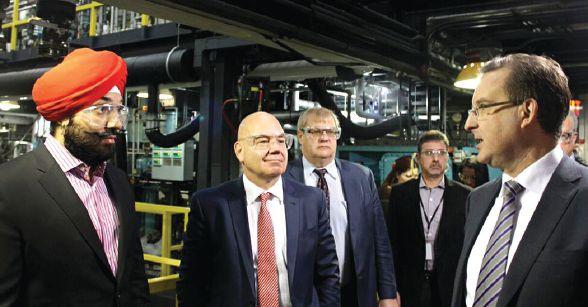
navdeep bains, Canadian Minister of Innovation, Science and Economic Development, spent a January afternoon touring the Xerox Research Centre of Canada (XRCC), which is the company’s global hub for advanced materials research and development. In July 2015, the National Research Council of Canada announced plans to invest $25 million to build a new Advanced Materials Manufacturing Centre in Mississauga on the XRCC campus. Xerox is to collaborate with the NRCC to bring the centre’s advanced material developments to market, primarily focusing on the manufacturing industry that employs approximately 1.7-million Canadians.
Holland & Crosby Ltd. of Mississauga, Ont., on January 1 purchased of the assets of screen printer Colormark Ltd., a familyrun business for more than 40 years. Holland & Crosby is moving into a new 70,000-square-foot facility, which will house a range of new technologies, including two Inca Onset systems and two new Esko Kongsberg C Series tables.
the Lowe-martin Group, led by CEO Ward Griffin, acquired RP Graphics Group, which operates a 60,000-squarefoot facility in Mississauga, Ont., focused on sheetfed offset, inkjet and toner printing.
RP Graphics’ CEO George Mazzaferro
joins Lowe-Martin’s executive team and President Marc Fortier is now managing Lowe-Martin’s business in Toronto.
Xerox plans to separate into two independent publicly traded companies, Document Technology and Business Process Outsourcing, by the end of 2016.
The Document Technology company, including Graphic Communications, alone would have generated approximately US$11 billion in 2015 revenue. The BPO entity would have generated around US$7 billion in 2015. Xerox notes more than 90 percent of the BPO revenue to be annuity based. Xerox also announced a new three-year strategic transformation program targeting a cumulative US$2.4 billion savings across all segments.
pressdown services Inc., known as PDS in Canada’s printing community, has changed its name to Print Digital Solutions and will continue to brand itself by the initials PDS. Founded in 1984, PDS initially positioned itself by servicing offset presses. Over the past several months, PDS has signed on new distribution and service agreements with technology players
Langley Holdings plc, the engineering and industrial group that controls manroland Sheetfed, released its annual results, ended 31 December, 2015. The group reported a pre-tax profit of €106.7 million ($167 million Canadian) on revenues of €874.5 million ($1.37 billion Canadian). Langley Holdings also reported it had zero debt and close to €330 million of cash reserves at yearend. During his Chairman’s Review, Tony Langley noted manroland Sheetfed, the largest of the group’s five divisions, in revenue and employee terms, was in positive territory for the fourth year in succession, since acquiring the press builder in early 2012.
rochester Institute of technology received a $500,000 grant from New York State to construct a new 3,200-square-foot home for the university’s AMPrint Center for Advanced Technology, a research facility developing next-generation 3D print materials and applications.
tC transcontinental is transferring its marketing product printing activities from Transcontinental Québec to other plants in its network, principally to Transcontinental Interglobe in Beauce, Quebec. The reorganization is to result in the closure of the Transcontinental Québec plant located in Quebec City by April 30, 2016, resulting in approximately 140 layoffs. Transcontinental currently has over 8,000 employees, generating $2.0 billion in revenue.
torstar plans to shutter its Vaughan, Ont., printing plant, which will affect 220 full-time employees and 65 part-time staff. Transcontinental Inc. signed a deal to print Torstar’s Toronto Star daily newspaper for five years, beginning July 2016, at its Vaughan facility. Torstar’s Vaughan plant opened its doors in November 1992 and last year the Torstar Printing Group generated revenues of more than $150 million for the company.
Fastsigns International of Texas surpassed its 600th-franchise-location milestone before the end of 2015. The company states that over the past 12 months it signed more than 50 franchise agreements, opened more than 40 units and reached global revenues of US$400 million.
CaLenDar
March 20-23, 2016
taGa technical Conference sheraton Downtown, Memphis, TN
April 14, 2016
pDs OKI Open House okI canada headquarters Mississauga, oN
April 14-16, 2016
Dscoop11 san Antonio, TX
April 20, 2016
Digital Imaging association seminar series TI group, Toronto, oN
April 20-23, 2016 sign expo
orange county convention center orlando, FL
May 12, 2016
Gutenberg Gala Montreal science centre, Qc
May 16-18, 2016 epicomm annual Conference hyatt Regency, savannah, gA
May 31-June 10, 2016 drupa
Düsseldorf Fairgrounds, germany
June 7, 2016
Canadian packaging, top 50 packaging Ideas Mississauga convention centre, oN
June 16, 2016
DIa Golf tournament st. Andrews, Aurora, oN
June 22, 2016
printaction printForum Mississauga convention centre, oN
september 14-16, 2016
sGIa expo Las vegas convention center, Nv
september 23-24, 2016 COnsaC International centre, Mississauga, oN
september 25-28, 2016 Graph expo 2016 orange county center, orlando, FL
september 28-29, 2016 paC Conference Niagara Falls, oN
october 18-22, 2016 all in print China
New International expo center, shanghai
Federal Minister Navdeep Bains (left) tours the Xerox Research Centre of Canada with Al Varney, President and CEO, Xerox Canada (centre left) and Dr. Paul Smith, VP, XRCC (far right).
George Mazzaferro joins Lowe-Martin’s executive team.
Ursala Burns, CEO, Xerox.
PDS President Dave Kisiloski.
InstaLLs
mike Vail joins Quark as vice President of s ales, responsible for managing Quark’s enterprise sales teams for the Americas and Asia Pacific. vail previously served as vP of sales for Arbortext where he led its enterprise publishing sales leading up to the acquisition of Arbortext by PTc he continued with PTc managing its global sales teams, but most recently managed global sales for gPsL, a Quark content automation solutions partner.
Craig Hath becomes President of Infigo software’s new North American operations, to capitalize on the uk company’s expansion to the u s. and canada. based in greater san Diego, hath joins the company after seven years as Managing Director at Z u ZA Marketing Asset Management, where he worked with Infigo’s catfish software. hath co-chairs the Dscoop conference education committee and is a member of Dscoop’s conference committee.
bill Owens joins the color Management group in a management position after selling his company, elevated color, to the consortium of consultant-based resellers. The color Management group (cMg ) offers four primary services: Product sales; technical service, training and support; marketing services; and back office services. owens founded elevated color in 2008 and had been an active member of cMg, helping print providers calibrate their facilities to industry standards like gRAcoL and sWoP.
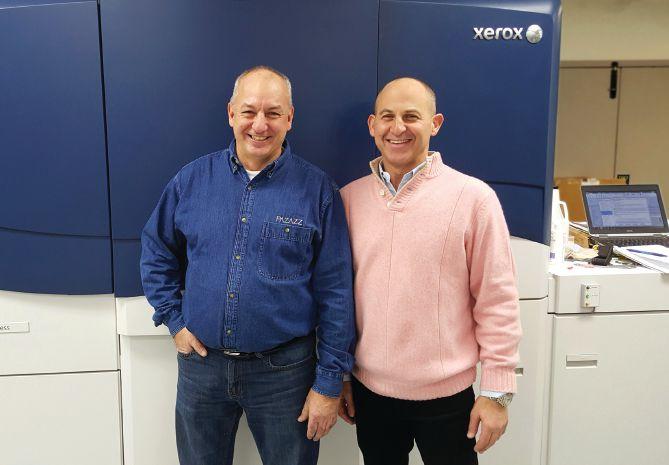
pazazz printing installed the first Xerox igen 5 press, pictured with gM Denis beauchamp and founder Warren Werbitt, to be equipped with both the optional extended colour gamut and the capability to print on thicker stocks. Montreal-based Pazazz plans to focus the press on short-run packaging.
andrew mcneill becomes President of Arlon graphics, brining more than 25 years of industry experience having previously served as President and coo of Reflexite c orporation for several years and as ceo of orafol Americas, formerly Reflexite. During his tenure with Reflexite and orafol, he led its global growth in reflective materials and solar lenses. McNeil has also served as a consultant for clients in the medical device, industrial safety products, chemical distribution, aerospace, financial compliance, steel erection and multi-family housing sectors.
David steinhardt is to become President and ceo of the new association formed by the planned merger of epicomm and Idealliance, which was approved by members in late February. steinhardt previously served as President and ceo of Idealliance, best known for its control of the g7 colour calibration model. epicomm is a not-for-profit association created in 2014 after the merger of the Association of Marketing service Providers and the National Association for Printing Leadership (NAPL)/National Association of Quick Printers.
roberta Ghilardi becomes a Managing Director of goebeL IMs, one of the world’s largest providers of slitter rewinders for converting paper and board, overseeing Administration and Finance. hans-Peter bauer becomes Managing Director operations (engineering and Production) and harald knechtel becomes Managing Director for the company’s worldwide sales and marketing activities.
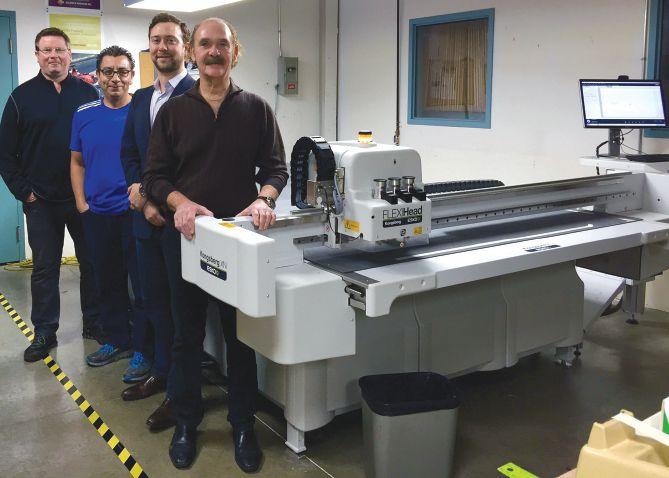
Goldrich printpak, a Toronto company specializing in folding-box manufacturing, installed an esko kongsberg XN24 finishing system, shown with (L to R) simo Molkanen, Litho supervisor; Marcelo Quinteros, senior cAD Designer; AJ goldberg, vP, New business Development; and ceo Leslie goldberg.
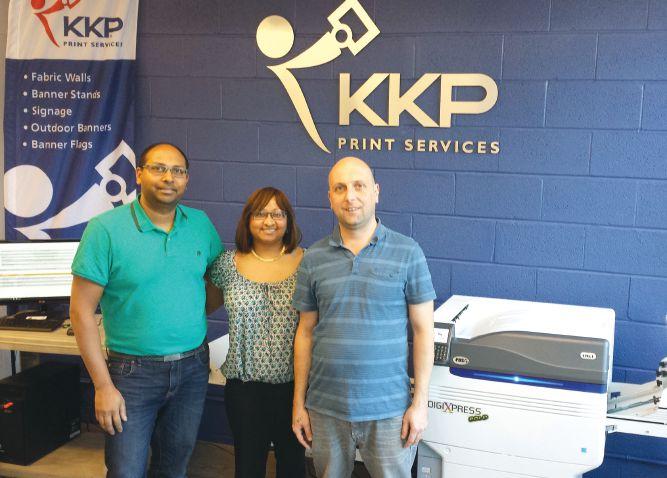
Kwik Kopy on sherbourne street in Toronto purchased a Digixpress bold, pictured with (L to R) Warren D’silva, veronica D’silva, and Dale gardner. Purchased from PDs, the Digixpress bold reaches print speeds of up to 50 pages per minute in both colour and monochrome, while providing a resolution of 1,200 dpi.
UPBX adds KBA in City of Industry
Ultimate Paper Box, a custom packaging manufacturer located in City of Industry, California, installed a new seven-colour, 57-inch KBA Rapida 145 with full UV, marking the company’s third large-format press from KBA.
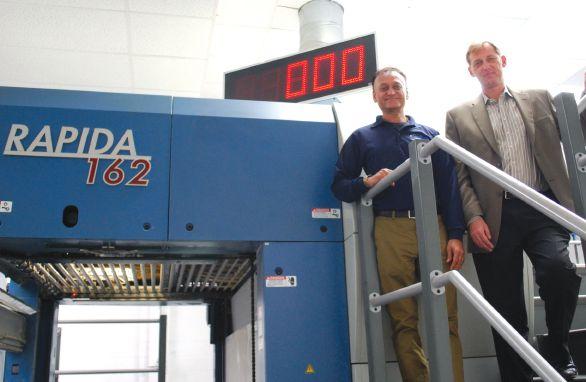
Currently, the firm – focused on high volume production – is operating a 64-inch, six-colour KBA Rapida 162a press with coater and double extended delivery, which increased its production capability by 40 percent. A 56-inch KBA Rapida 142 press with UV has been removed to make way for the new Rapida 145 press, which Ultimate Paper Box (UPBX) owner Janak Patel says he has been eyeing since the press’ debut at drupa 2012.
Ultimate Paper Box Company was established in 1995 with four people working in a 2,000-square-foot warehouse. Today, the firm caters to the electronic, retail, food, cosmetic, and pharmaceutical packaging markets and is headquartered in a modern 40,000-square-foot production facility near a separate AIB Certified flexible packaging division established three years ago. Ultimate Paper Box has achieved G7 Master Qualification and is FSC/SFI certified. Collectively, the two firms employ 120 and post more than $32 million in sales.
Ranger runs SurePress in Mississippi
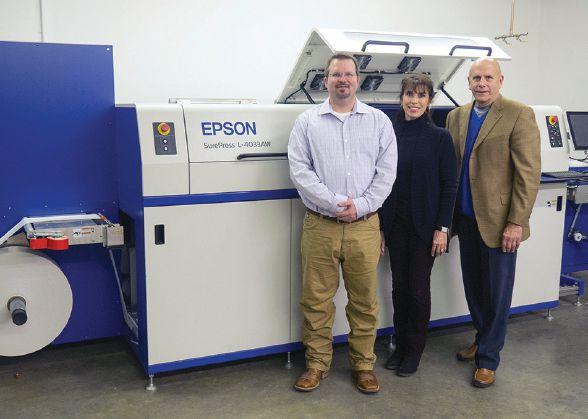
Ranger Label, a Mississippi-based label converter, installed a new Epson SurePress L-4033AW for printing pressure-sensitive, short-run product labels. Designed for prime label converters and commercial printers, the Epson SurePress L-4033AW is a seven-colour inkjet press with a white ink channel for printing on clear and metallic substrates, as well as off-the-shelf gloss, semigloss, matte and film materials. It leverages Epson’s MicroPiezo inkjet technology and a Wasatch RIP.
“Upon purchasing the SurePress, we were told that it had the capability to run after hours without an operator and that has proved to be a valuable feature,” said Bob Anger, founder of Ranger Label. “During our initial setup of the SurePress, we immediately started running production and actually shipped finished labels out the door that same day.”
Eticom expands with Xeikon in mexico
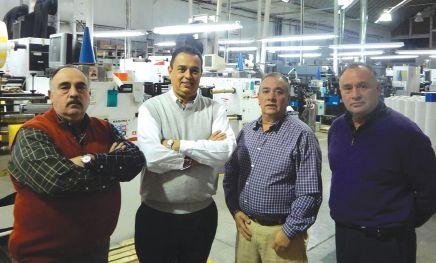
Mexican self-adhesive label printer Eticom is a familyowned business and was founded in 2000 by Jesus Ramirez and his brothers Francisco, Luis and Hugo Ramirez. The company manufactures specialist labels for the food and beverage, pharmaceutical and other industries that require high-quality self-adhesive labels at sites in Mexico City and Monterrey.
The company has now added a Xeikon 3300 narrow-web label press to its extensive production platform that also consists of two HP Indigo presses and 16 flexo presses. Eticom explains the new Xeikon 3300, with a variable web width ranging from 200 mm up to 330 mm, will offer size and format capabilities that are not available with Eticom’s current presses.
“[The Xeikon presses are relatively new in the Mexican market, so that alone sets us apart,” said Jesus Ramirez. “In addition, this new press gives us the ability to take advantage of a wider web width and larger format size with a virtually unlimited repeat length. It requires no priming and can print on a broader range of substrates than our existing digital presses.”
25%
Increase in productivity K&H Integrated Print Solutions expects based on its new implementation of EFI Monarch print MIS/ERP technology, with 95 percent of everything K&H produces enters the mail stream. The shipping component of Monarch will connect with K&H’s existing mail and data processing systems .
$70m
Millions of dollars in revenue generated by 65-year-old Japanese company Shimazu Printing, based in Niigata prefecture, which is now leveraging MGI’s JETvarnish 3D and iFOIL technology. With more than 300 employees, Shimazu constitutes a corporate portfolio of five different print-related firms.
GLObe
Janak Patel (left), owner of Ultimate Paper Box, and Marcus Schoen, KBA Sales Manager, stand atop the firm’s current 64-inch six-colour press with coater and double extended delivery.
Francisco Ramirez, Jesus Ramirez, Hugo Ramirez and Luis Ramirez, brothers and owners of Eticom.
Ranger Label’s Daniel Deweese (L to R), Carol Anger and Bob Anger.
arCHIVe
10 years ago
vancouver-based Markets Initiative (now canopy) secures Ancient Forest Friendly paper-sourcing commitments from 85 of canada’s leading publishers and imprints, with another 80 signing on in the united states. The commitments involve eliminating the use of endangered fibres within the next three to five years. Four years earlier, the not-for-profit organization rose to prominence after being the driving force to have 80 percent of the hugely popular Harry Potter book reprints produced on Ancient Forest Friendly (AFF) approved papers. by J.k. Rowling’s third book, Harry Potter, The Order of the Phoenix, publishers in eight countries had moved the printing of the book completely to Markets Initiative’s AFF stock.
TOTAL AUTOMATION
59,000
Number of customers that 4over states to be working with five years ago, which is just 10 years after beginning its trade-printing operation as 1-877-78cards. com. In March 2011, the company has a facility in seven American states and officially opens up 4over Canada in Mississauga.
20 years ago
After receiving purchase orders worth $80 million in 1995, seeing its number of employees increase to 560 and moving into a new 140,000-square-foot facility, creo is reaping the benefits of being the only company in the world dedicated to the manufacture of computer-to-plate technology. The new facility allows creo for the first time to produce very Large Format platesetters, with the first beta unit able to handle 58 x 80-inch plates going to R.R. Donnelley’s plant in crawfordsville, Tennessee.
– NEW: Router with automatic bit changer
– Automatic QR-code capture
– Tandem operation, semi and fully automated material handling
Creo’s new 140,000-square-foot facility, its second in Vancouver, BC.
Nicole Rycroft founded Markets Initiative (now Canopy) in 1999.
thurSday, november 10, 2016 the palaiS royale ballroom, toronto, ont.
Making sense of a weak dollar
Breaking down one of the most-significant
operational issues canadian printers will face in 2016
By Nick Howard
Bck in the spring of 2011 Canada’s dollar was flying high. It hit a level of almost five cents above the American greenback. As experts pointed to the advantages of Canada’s banking regulations, the Great White North was outpacing the United States coming out of the 2008 worldwide recession. The purchasing power of Canada’s printing industry was fantastic. Machinery was at an all-time low – as much as 40 percent less than 2003 levels. It was never going to last, however, and today we face US$30-per-barrel oil, metal prices spiraling to near historic lows and our dollar is trading in the 70-cent range relative to the once again mighty U.S. buck (USD).
There are serious implications for domestic manufacturers facing a low Canadian dollar. First and foremost are the wild swings occurring as the Loonie bobs about finding its true value. This is our most difficult issue. If the Loonie would just park itself somewhere we might be able to cope, adjust. But fast moving exchange rates bring chaos to budgets and quotations.
Very few businesses can benefit like billionaire George Soros has amid these FX swings. Besides machinery, a great deal of materials and consumables are priced in USD. Printers quoting work –even a few weeks ahead are now finding it difficult to hold firm prices. The Bank of Canada’s Stephen Poloz opined that it could be two years before we see the fallout (both good and bad) from the recent and drastic decline in our currency.
It is not a simple remedy to buy Canadian products or to create an artificially lower exchange rate in-house. Behind the scenes, financial markets and a global community are going to close the door. Products made in Canada will always be valued not so much on their cost but on their value in USD. Almost everything made here has some element of American content. If by chance they do not have U.S. content, it still will not matter and prices will rise just because they can! This effect will be best exemplified by paper, an everyday ingredient of printing, re -
Number of deals in 2015 that U.S. investors participated in with Canadian companies, according to PitchBook, which tracks startups globally. These 2015 deals accounted for more than $1.2 billion, compared to just 46 deals in 2010, accounting for $373.7 million in investment.
gardless of whether it is produced in Canada, Asia, Europe or the United States. Paper is a worldwide commodity and even if it left the factory in Indonesia it will be priced in USD. Canadian paper, with whatever portion of American value added, will rise to reflect a world value and not a Canadian value. You cannot escape the future higher costs of anything you purchase.
Machinery, the most expensive product printer’s purchase, will see prices rise dramatically in the next few months. Whether these machines come from Germany, Japan, China or the U.S., they are usually imported by American companies first and converted into USD. With machine inventories mostly American held, you will pay accordingly. Meanwhile, China’s Yuan currency rides the USD and Chinese manufacturers price their products in USD.
It is not just our Loonie that has been seeing declines. The Euro has dropped substantially in 2015 versus the USD. Companies like Heidelberg have the ability to play the FX markets and it’s possible they are able to sell their machinery in Canadian dollars exchanged against the Euro. Japan’s manufacturers work through their American subsidiaries or dealers and while the machinery may leave Japan in Yen it’s bought with USD in a sometimes forward contract.
Realities of the negative exchange facing Canadian printers can hit home hardest when it comes to obtaining needed parts for their machines. This
revenue stream becomes particularly important for Canadian dealers if the sale of large machinery declines.
There is a general assumption around the world that if a country’s currency tumbles then it becomes a great place to shop. This is largely untrue, especially with equipment. Everyone wants and expects a world price. Press makers will not sell any cheaper in Canada than they do anywhere else. If this were the case then we could assume all of us Canadians would be paying even less to for oil and gas, which is unlikely to ever happen.
Besides labour, occupancy costs and taxes are safe from a falling dollar. Little else is and Canada continually faces another major issue, competitiveness. In 1998, when our dollar started to fall, Canadian printers like most other manufacturers used it like a golf handicap. Great – we just got some free strokes! The lower dollar maintained our historical position as faux Americans.
The appetite to compete has been at the centre of Canadiana since confederation and why, even in 2016, we find ourselves not able to keep up with U.S. entrepreneurship. The immense size of the U.S. absorbs much of what it produces. Canada is a nation with risk adverse businesses, conservative banking and a labour pool that demands a social net.
Inflation is a by-product of a low dollar, which may not be as negative as it sounds. Large printers who do business in the U.S. can shield themselves from some of the risk by offsetting their materials purchases against sales made, both in USD. This leaves truly Canadian costs (labour) to be more profitable. The dwindling middle class of print – companies with limited sales reach – will face more systemic challenges.
As printers wait for calmness in the big-ticket market, the best thing they can do is sell products in the U.S. This alone will not only dampen the effect of bad rates but help us all in Canada to be more competitive as we go head to head with some of the best businesses in the world.
The low Loonie may not be forever. Oil will shoot back up eventually and China will hopefully resume its bullishness for Canadian raw materials. When this happens our dollar will strengthen. Not because of our small manufacturing base, but because of what we draw out of the ground.
nICK HOWarD, a partner in howard graphic equipment and howard Iron Works, is a printing historian, consultant and certified Appraiser of capital equipment. nick@howardgraphicequipment.com
Pho
Dr. Martin Habekost Associate Professor and Associate Chair, School of Graphic Communications Management, Ryerson University
Session: Is It All Digital Now, A Report from drupa
Nick Howard President, Howard Graphic Equipment Session: Capital Investment for Printers
Rob McLean Vice President of Commercial Banking, BMO Financial Group Session: Secrets to Access Financing
Jon Robinson Editor, PrintAction Sessions: Impressions from drupa Moderator: drupa for Canadian Printers
Printers and Spirit Bears
after 16 years of negotiating, the great Bear agreements are a beacon of canadian business progress
By Neva Murtha
if you ever needed an example of the marketplace as a force for change in the world, with the power to help create legacies for our children’s children, the Great Bear Rainforest Agreements stand as a shining illustration of positive business influence in action.
As the first of its kind and a precedent setting process, it took 16 years and tremendous effort by a host of governments, stakeholders and forest product customers, yet the Agreements on Canada’s west coast have now come to fruition.
The most innovative and ecologically sensitive logging regulations in North America are being implemented in parts of the landscape approved for ongoing fibre supply, guaranteeing sustainable papers and forest products.
First Nations and community well-being has been adopted as a central tenant of the Agreements.
A total of $120 million in conservation financing, from Federal and Provincial governments, individuals and foundations has been secured to foster a sustainable economic base for the region and to develop new business opportunities.
And 85 percent of this rare and irreplaceable ancient rainforest is now totally off-limits to industrial logging. Together with our market partners, Canopy has witnessed the evolution from conflict, blockades and the so-called ‘War in the Woods’ to negotiation, collaboration and a win-win outcome. An outcome that would have been much harder, if not impossible to achieve without the ongoing engagement of British Columbian forest product customers from around the world.
Canopy is proud to have played a role in fostering the corporate engagement that has helped keep the negotiations and the drive for success on track. With so much at stake, with so many parties involved in the negotiations from First Nation, Federal and Provincial governments to scientists, environmental groups, communities, unions and logging companies, the dialogue did encounter rough
and stormy waters over the years. But all parties in the negotiations knew the world was watching. And forest product buyers, in particular, were keeping a close eye on progress. The expectations of the marketplace were made clear, time and time again.
By participating in Canopy-sponsored Round Table discussions, writing letters to government and industry, and letting their voices be heard when it mattered most, leading customers, including some of North America’s largest printers, sent a strong and consistent signal: they had a vested interest in an agreement that would provide certainty, significant conservation, better harvesting practices and a stable supply of more sustainable fibre. Thanks to the commitment of market leaders such as TC Transcontinental, EarthColor and many others, along with the dedication and hard work of all parties in the negotiation, the Great Bear Rainforest Agreements have achieved that success. Below are just some of the many direct, positive outcomes:
• The largest remaining intact tract of coastal temperate rainforest on earth is guaranteed meaningful protection;
• The white spirit bear, grizzlies, black bears and wolves, salmon and eagles will have a healthy ecosystem in which to thrive for generations to come;
• First Nations have far greater certainty and a stronger say in the future of their traditional territories;
• Innovative and stringent logging regu-
lations will provide assurance to forest product customers that fibre purchases from the region are sustainable and conflict free;
• Risk to reputational capital has been largely eliminated and customers rewarded for their patience and persistence; and
• The forest product customers who made their voices heard, who played an active part in advancing conservation of this magnificent landscape, can tell their children they were part of creating a legacy for the world.
Rick Jeffery, President and CEO of the Coast Forest Products Association, reinforced this in The Globe and Mail on February 1, 2016, stating: “What we have learned from our customers was, we could have all the explanations and facts and figures to tell them what we were doing was okay, but if there was conflict associated with our products, they could get those products somewhere else. Now we have a forest industry that will provide jobs and sustainable, climate-friendly products.”
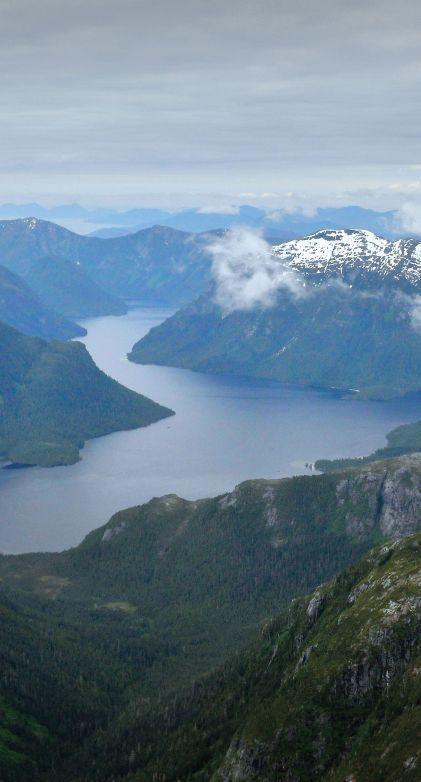
The Kermode bear, also known as the Spirit Bear, is a subspecies of the American black bear living in the Central and North Coast regions of British Columbia, where it is the official provincial mammal. Their range is now home to the most innovative and ecologically sensitive logging regulations in North America (Photo by A.S. Wright).
6.4
Millions of hectares that make up The Great Bear Rainforest primarily located in British Columbia, which has been a flash point for environmental and corporate concern for close to two decades.
The Agreements have set a precedent that can serve as a model in many other endangered forest ecosystems the world over, including Canada’s own Boreal Forest. As has been the case in the Great Bear Rainforest, printers and other leading forest-product customers can play a vital role in developing solutions.
To have a better understanding of the impact of these Agreements, consider some of these incredible numbers about the Great Bear Rainforest that printers have helped to protect for generations: 6.4 million, number of hectares that make up the Great Bear Rainforest; 2.4 million, hectares formally protected in the Great Bear Rainforest; 28, number of First Nations that have traditional territory in the Great Bear Rainforest; 1,000, tonnes of carbon stored in a single hectare of coastal temperate rainforest, much of it accumulated over thousands of years; 25, percentage of original coastal temperate rainforests that remain on the planet today; 1000, age in years of many Western Red Cedars found in the Great Bear Rainforest; 400, number of Spirit Bears living the Great Bear Rainforest.
Agreements like this are critical to continue to help stabilize our climate, ensure the survival of endangered species, avoid risks to product sales and reputational capital, and to ensure a stable supply of sustainable fibre.
neVa mUrtHa works with canada’s magazine publishers and printers to develop visionary procurement policies. neva@canopyplanet.org
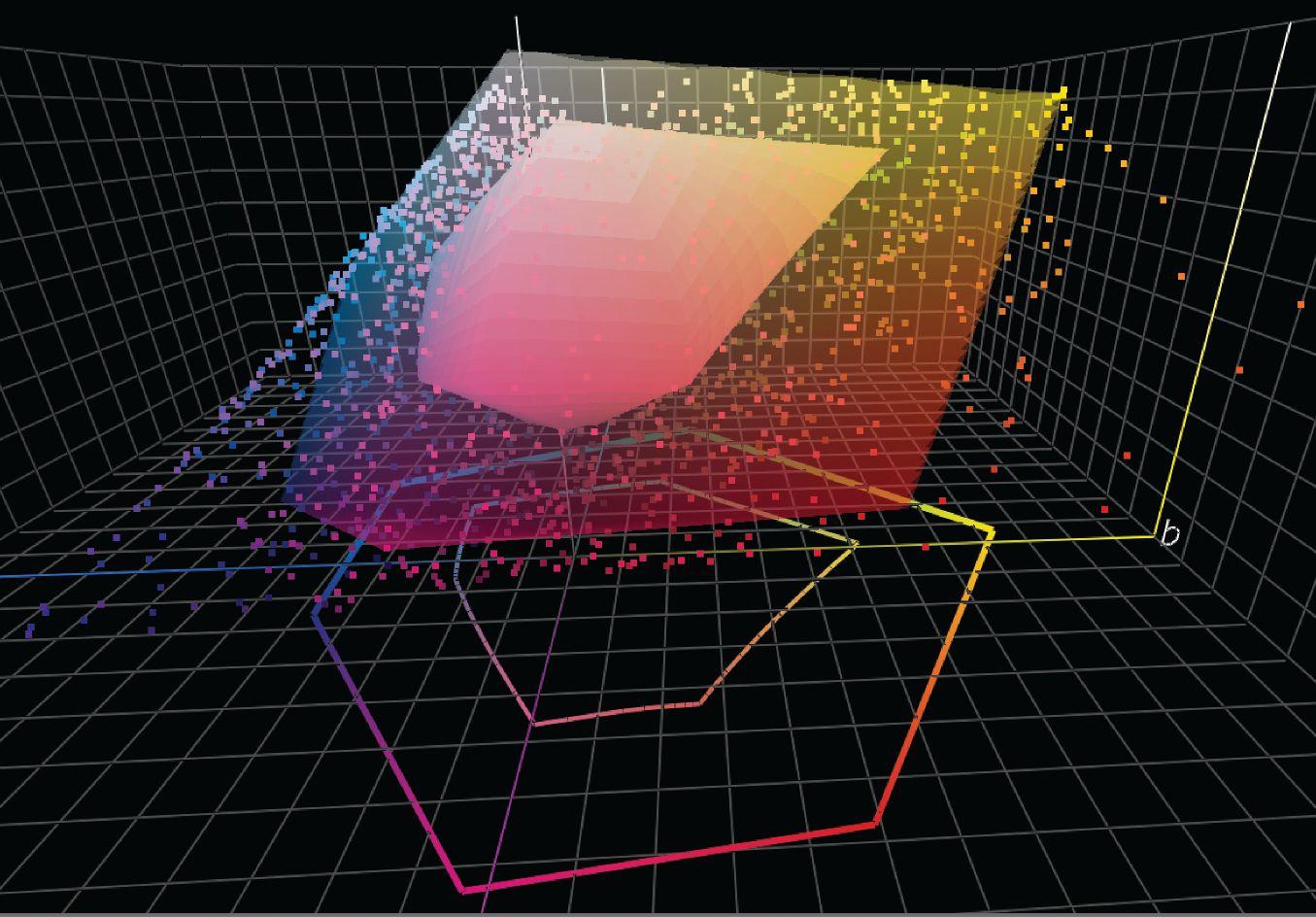
The small squares generated in this colour gamut by the author are the 1,729 spot colours of the new PANTONE+ Extended Gamut swatch book. A CMYK+OGV and a CMYK gamut are simulated by the larger and smaller volumes in this L*a*b* diagram. It is clear that a CMYK+OGV process can simulate many more spot colours using seven inks, and for the majority of spot colours contained within the volume there would never be the need to make a separate spot colour plate.
ExpandEd Gamut printinG
On sabbatical to research and write the second edition of Wiley’s Understanding Color Management, the author provides a synopsis of an emerging model and how to apply it for everyday use
By Abhay Sharma
the Color Conference, held this past December in Phoenix, was an orgy of expanded gamut software, tools and technologies. In sunny Arizona there were solutions for expanded gamut printing from Heidelberg, Esko, Xerox, GMG, CGS and PANTONE. It is now important for commercial printers to understand this new revolution in expanded gamut printing, as more of the industry’s biggest technology providers are developing substantial products in this area.
In general, we have printed for a long time using four process colours – CMYK – and when a customer needed something more colourful we created a separate spot channel plate and ordered ink or requisi-
tioned the ink from the in-house mixing lab. This is the way we have worked for many years in offset and flexography. Digital devices, such as the HP Indigo, are also able to print with extra colour units and Indigo customers throughout North America order their spot colour toner from a lab in Rochester. In this type of usage, the spot colour channels did not expand the overall gamut per se, they just sent some colours to the separate plates or printing units.
Colour paradigm shift
Expanded or extended gamut printing is a paradigm shift in terms of colour and colour gamut. In expanded gamut printing, we move from four-colour printing to seven-colour printing and our base set of process colourants is now seven colour, which can be different for different sys-
Spot Colours
CMYK
THE BRIGHTEST IDEA IN CHANNEL
tems. For example, the new PANTONE+ Extended Gamut swatch book is printed using CMYK plus Orange, Green and Violet (OGV). The Xerox iGen5 has a 5th toner station and can extend the colour gamut with CMYK plus Orange, Green or Blue (OGB). The swatch book is available as a traditional swatch book as well as in software – PANTONE Color Manager – and shows how spot colours would be reproduced in seven colours (CMYK+ OGV).
We can create an ICC colour profile for this extended gamut process and analyze the extent of the expanded gamut using colour management tools. One indicator of the increase in gamut size and volume is to assess how many more spot colours can now be accurately reproduced by mix of the CMYK+OGV ink set. The big advantage is that we can reproduce many more spot colours without using separate spot colour printing! In other words, we do not need to make spot colour plates and order spot colour inks to accurately reproduce many spot colours.
Estimated percentage by which Extended Gamut printing provides a larger palette of colours for reproduction than you can get from CMYK alone.
In addition, we have the benefit of just keeping the press running with this expanded colourant set and no press wash-ups. Only the most colourful of spot colours with the most exacting and high-paying client would now warrant traditional spot colour treatment in making a separate plate and ordering a spot colour ink.
In an extended gamut printing process, many more spot colours will now be in gamut of a seven-colour process. An important new requirement is that software tools need to give you an indication of the accuracy with which the process can reproduce any given spot colour. Every colour management vendor at the Phoenix conference was showing new software that enabled users to gauge their seven-colour-process ability.
Proof is in the pudding
The new world of expanded gamut printing also needs to consider proofing. We still may need to create inkjet proofs for the customer. The inkjet proofer must be able to accurately proof the CMYK+OGV press sheet. An inkjet proofer does not need to have exactly the same OGV colourants as a press, but it does need to have the ability to print the increased gamut, so typically the Epson Stylus Pro 7900 has CMYK + OG, while the Epson Stylus Pro 11880 has Vivid Magenta to try and keep up with a CMYK+OGV press. It may be non-intuitive, but there is no requirement for the inkjet proofer to have cartridges that match the units on the press it is trying to simulate. An inkjet proofer can use any inks as long as it can create a sufficient colour gamut to proof the press colours.
There are pressures on commercial printing today to increase colour gamut and reduce costs. Using an expanded gamut set meets both of these requirements. It is more economical to use an expanded gamut ink set rather than wash up of spot colours for individual jobs.
We are likely to see increased use of expanded gamut tools and printing in all areas of commercial offset and flexo package printing. We have already seen installations of digital presses with an expanded gamut toner ability. Based on the tools and technologies coming to market, from all the major companies, expanded gamut printing is here today and growing tomorrow.
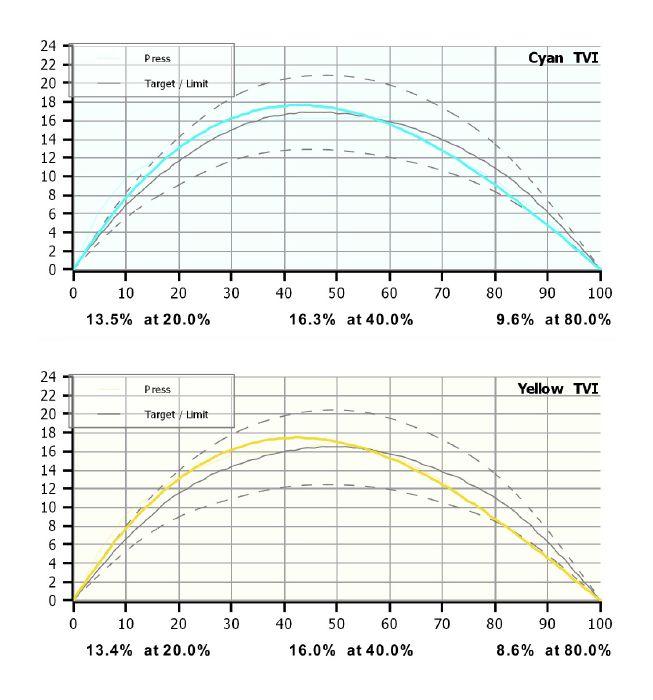
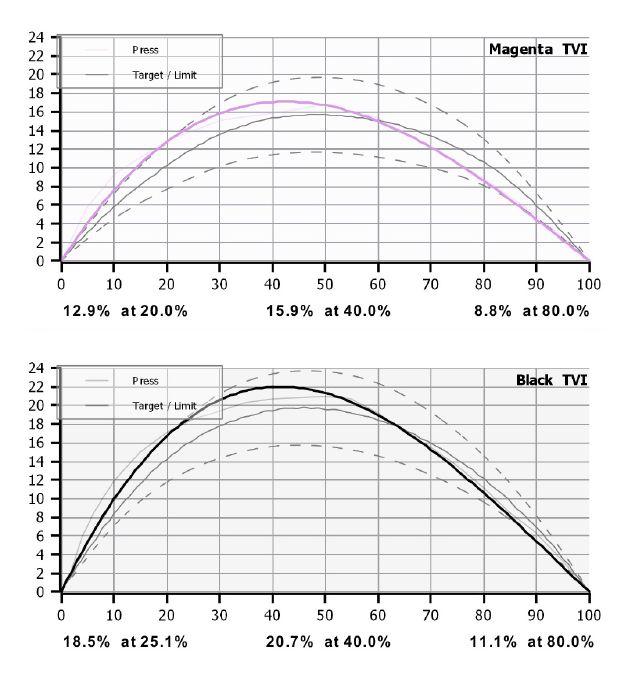
Figure 1: Testing a ISO 100-lb coated sheet with linear plates (without G7 curves)results in tight tone-value curves between CMY colours – less than one percent difference, almost in perfect balance.
twEnty-FivE ShadES oF GrEy
a technical look at the implementation of g7 methodology and other colour management tribulations in the pressroom
By Peter Hedgecock
the adjustment for grey balance, also called colour balance, in photography is a necessary step to achieve good picture quality. The human eye can detect very subtle hue differences in neutral tones, making it important to balance out these colour anomalies, ideally at image capture. This fine-tuning adjustment is fixed permanently in a photograph, but in halftone lithography grey balance is very susceptible to cyan, magenta and yellow colour shifts on press.
The G7 claim that a “common or shared appearance” can be achieved across various printing types and presses would be nearly impossible unless extremely tight process controls, and tolerances are in place. Press operators should always strive
to achieve good grey balance but this does not guarantee a visual match across presses.
The G7 method takes the photographic principle and extends it to offset printing via plate curves, and that’s the challenge. Just because curves can be applied at the plate RIP does not mean it is an ideal approach. In fact, applying curves can be a difficult manufacturing practice. The efficacy of G7 plate curves is debatable and they can cause other printing troubles. Curves calculated by G7 software can be too small to have any effect because inherent variation in the printing process exceeds the curve amount. For example, a two percent curve may have little effect shortly after it is applied due to the natural variation in the printing process. Conversely, applying an overly aggressive curve on one plate will create printing distortions. A five percent curve, for example, will change
90%
Percentage of colour variation imaging pioneer Felix Brunner once said to be process inherent, suggesting many printers are paying to certify the other 10%.
the relationship between CMY ink densities and distort wet-ink trapping.
Press variation is not often well measured or its root causes not well identified in many pressrooms. So it makes little sense to apply plate curves after a single press test even if several sheets have been averaged to generate the curves.
Process Inks are designed to run in a sweet spot for optimal press performance so they must be set at the correct level first. It is important to understand that the relationship between ink density and dot gain is very strong, statistically speaking there is a high correlation. That is, increase ink levels and dot gain goes up, decrease it and there will be less dot gain. Ink film thickness is the number one source of dot gain variation on a properly running press (i.e. assuming no mechanical or emulsification dot gain). This relationship matters because plate curves change it and that could impede the ability to match a proofing standard and cause other press problems (piling, ink and water instability) and change ink consumption as well.
It is important to understand that any press can be grey balanced without using the G7 method. It was done back in the film days when there were no CTP systems. However, one must start with an educated definition of grey balance in offset halftone printing. Simply put, it is the ability of the press operator to print proper solids (not all solids are alike) at the right density and ink-trapping levels with dot gain closely balanced among the cyan, magenta and yellow separations. (Obviously ink opacity and hue need to be correct among other factors). Pressrooms that adhere to sound press fundamentals will pass industry grey-balance tolerances with flying colours. Figure 1 on page 15 shows a press sheet on ISO 100-lb coated paper that would have passed G7 certification testing with linear plates, without using G7 curves.
Notice how tight the tone-value (TV) curves are between the CM&Y colours –less than one percent difference. Almost in perfect balance. Hence, the definition of colour balance in offset halftone printing and the reason the press passed certification without curves. Now imagine if the TV curves were opposite – sharper at the quartertone and fuller at the three-quarter tone. The press sheet would still pass grey certification because dot gain is extremely balanced but the overall visual appearance would look different due to different dot gain characteristic curves.
Felix Brunner, the oracle of print quality, taught the industry the right way to measure and colour balance a press over 30 years ago and registered a patent for controlling it in 1985. For operators, this relates to colour balancing a press through proper setup, sound process control fundamentals and measurement.
Every time a press is calibrated using the G7 method different plate curves will be generated – they can be quite dissimilar
from a previous calibration due to press variation and other factors at the time. These changing plate curves will make it more difficult to match a previously printed press run. Images with little grey information will suffer the most such as corporate logos. The goal should be to keep plates linear and only apply curves if there is a systemic problem with a press or inputs vary too far from an industry printing specification or standard. However, even here printers need to be careful about indiscriminately adjusting curves to meet a standard or match a proof. It is a classic case of so-called “re-calibrating” in place of sound process control.
True ROI for printers comes from sound process control and applying solid fundamentals. Felix Brunner said that, “90 percent of all colour variation is process inherent,” so why would a printer pay to certify the 10 percent. Most press operators are likely to opine print buyers don’t seem to care much about running to grey balance, and instead change colour at press approvals to their desired preference. They do not understand how even small changes in solid ink density levels shift grey balance.
G7 also puts the responsibility for grey balance on the shoulders of prepress and not the pressroom. This is a mistake if printers do not have proper technical coordination between the two departments to achieve optimal results. Many prepress and G7 implementers lack a true understanding of offset press fundamentals and variables. On the flipside, pressrooms seldom understand what changes are going on in prepress to know why things are not correctly working on press. The industry would be better served with process quality engineers not grey-balance specialists.
Colour management challenges
These G7 examples indicate the immense challenges of colour management in the pressroom as an ongoing, decades-long battle. On-press spectrophotometry is another tool growing in prominence. It is important to understand that spectrophotometry’s output on a press is the same as densitometry – both open and close ink fountain keys to allow more or less ink to be applied to the press sheet. Some presses are equipped solely with this technology but it is not a pressroom panacea.
For starters, spectrophotometry is a derivative measurement in process printing. That is, it does not read directly the most important elements that affect visual appearance and quality in offset printing, such as dot gain and wet-ink trapping percentage. It is useful only for assessing a visual match if these and other underlying printing characteristics remain constant from one day to the next. The knock on densitometry is that it cannot “see” colour since, for example, dot gain tells us nothing about the colour being achieved at, say, a 50 percent screen. In fact, the opposite is also true: spectrophotometry tells us noth-
ing about changes in dot gain and trapping percentages relative to solids.
To illustrate this challenge, imagine two one-colour presses that run to the exact same solid magenta L* a* b* values (i.e. zero dE difference).The visual appearance of the halftones in the print, however, could be significantly different due to dot gain variation between the presses. Therefore, the press operator must control dot gain to attain an overall visual match not just the solid colorimetric values. But understand, if the press operator instead attempted to target the colorimetric value of the halftone, they would do so at the expense of the solid magenta appearance, it would be lighter or darker depending on the dot gain. To drive the point home let’s look at one more example. Say the press operator targets the specific L* a* b* values of a solid magenta-yellow overprint (red). The first time the job ran with poor wet-ink trap. In the second printing the trap value is better. The spectrophotometer cannot know this but it attempts to achieve the same red as the first run by adjusting the press keys of the magenta and yellow solids up or down, as the case may be to achieve the red overprint colour. Again, it would sacrifice the single-colour yellow and magenta solid appearance to do so. Many in-line and off-line scanning spectrophotometers only read the solid CMYK patches and not the two-colour overprints, but even if they did the outcome would be the same and a visual mismatch would occur.
Spectrophotometers that read the actual image would do no better because the same situation would occur. To achieve consistent visual appearance from press run to press run, the press operator must measure and control core printing fundamentals. This has not changed since the first offset press was introduced over 100 years ago. Fortunately, there are some very good process control solutions on the market that measure dot gain, colour balance, overprint trapping and ink transparency. Controlling these attributes and other key parameters that influence process print quality will truly help the press operator achieve consistent results.
It should be obvious that colorimetric data alone is not the answer to consistent visual quality or every press around the globe could run to the same solid L* a* b* values and the results would be identical. Offset presses are not like continuous-tone digital proofing devices where solids, tone values, hues and overprints can be adjusted individually almost patch by patch via colorimetric data and RIP technology to achieve the desired results.
Colour is a very technical issue and many printers may end up disappointed with colour management promises due to raised expectations or when quality complaints come rolling in. A critical success factor in colour management is knowing how to implement it effectively as that alone will make or break an investment.
Looking good on paper matters. ColorLok® Technology gives paper more vivid colors, bolder blacks, and faster drying times.* Learn more at colorlok.com VIVID COLORS BOLDER BLACKS FASTER DRYING
Domtar EarthChoice® Office Paper is a great-looking, everyday paper that represents your commitment to environmental responsibility. Featuring ColorLok ® Technology, it is designed to provide optimal printing results. To learn more visit www.egpaper.com or domtar.com.
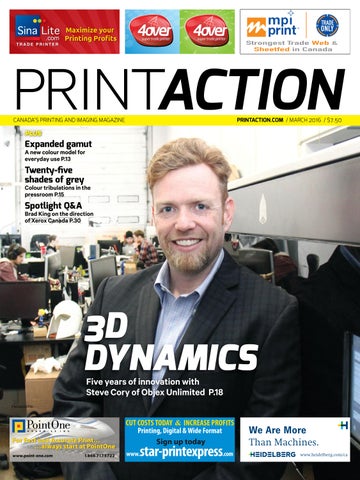
3d dynamicS
steve cory of Objex Unlimited shares insight he has gained from almost five years of innovative 3d printing, which stands to revolutionize a range of industries
By Jon Robinson
Just as most people might be shocked by the invention age of inkjet printing (1951), toner printing (1959), and laser printing (1969), the birth of 3D printing traces back to 1983 despite its new stature as the beginning of a third industrial revolution, opined by futurist Jeremy Rifkin three years ago. Today’s potential of 3D printing, also commonly referred to as additive manufacturing, is based on its sudden widespread accessibility, akin to the consumer-level arrival of the Internet in the late-1990s despite its 1969 roots laid down by ARPANET.
The availability of mature 3D printing technology now falls into the hands of revolutionary business leaders who take enormous risks to disrupt legacy markets and to ultimately generate new revenue models. In the west end of Toronto, Steve
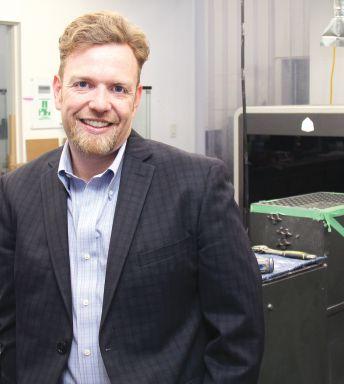
Steve Cory began Objex Unlimited five years ago after reading a lifechanging article in The Economist Today, he stands as one of Canada’s 3D printing pioneers.
Cory, President of Objex Unlimited, is one such entrepreneur who has been exploring the possibilities of 3D printing since 2011. He has built a worldwide name for Objex developing innovative scanning booths, unrivalled 3D figurines, creative and industrial prototypes, and by diving headfirst into any potential 3D arena his team of young engineers, artists, programmers and writers can imagine.
Growth of Objex Unlimited
Cory found his way into 3D printing after reading what he describes as one of those big-future articles in The Economist, highlighting a 3D-printed chainmail glove and working clock. He became obsessed with the implications of additive manufacturing and for six months researched the sector, attending a handful of local 3D-printing enthusiast meetings. In mid-2011, Cory, at age 35, had been
Packaging needs to grab consumers’ attention — to jump off the shelf.
With HD plates, the benefits are clear: a better quality of prints to make graphics pop.
Sun Chemical brings you from concept to shelf with pre-press, color management, plates and ink — all from one single source. We also provide the technical resources and support you can’t get anywhere else.
See our HD plates video and get more information at www.sunchemical.com/HDplates or contact us at 1-708-236-3798.
$21B
According to Wohlers Report 2014, the worldwide 3D printing industry is expected to grow from $3.07 billion in revenue in 2013 to $12.8 billion by 2018, and exceed $21 billion in worldwide revenue by 2020.
between $20,000 and $50,000 is really a starting point to figure out how 3D works.
“A good 3D printer is $100,000 and they go up from there – it is capital intensive,” he says, reinforcing the need to take a long-term approach. Objex Unlimited itself – albeit on a unique path of 3D discover – is only now beginning to realize meaningful return on its investments, expecting to generate anywhere from $5 to $6 million in revenue by the end of its current fiscal year.
70%
By 2017, Deloitte predicts 70 percent of 3D printing units will be sold to consumers with relatively limited capabilities, while dollar value and usage will be heavily skewed to the enterprise market.
running his own consulting business for more than a year. A problem solver at heart and a trained mathematician, he had built a successful career by leveraging Information Technology to manage production, including a 100-person plant making sprockets and roller chain; catering facilities at Pearson Airport; and with the document-destruction company Shred-it.
“I was always a good manager because I had better information than anybody else,” Cory says. “I would go get it myself, because I was really good at understanding ERP systems, pulling the data – optimizing it.” Computer Integrated Manufacturing exploded across the business world in the 2000s and Cory in 2009, with the recent arrival of two young children, decided to use his attractive skill set to branch out on his own. He became bored, however, with the tedious routine of sitting around the kitchen table and developing process solutions in Excel.
very proud of the jobs that we have created here… 26, 27 jobs and probably 15 of these people would not have jobs like this,” Cory says. “They are extremely intelligent and talented, but maybe they didn’t go to the right school or maybe they are a little too wacky to survive in a normal working environment.” Cory prides himself on the creative atmosphere at Objex, which, to take from his own long-term business mantra, is very likely fostering future leaders of Canada’s 3D printing industry.
Exploring the future
Objex Unlimited today primarily uses Multijet Modelling, Fused Deposition Modelling, Stereolithography and 3D inkjet technologies, in addition to a range of ancillary equipment, to meet almost any non-metallic prototyping or modeling needs. This includes printing with carbon fibre and Kevlar additives.
Cory explains the growth of 3D-print portals, driven by machine utilization, ganging jobs on a printer bed via online templates, presents significant challenges. “I really feel, that in some ways, 3D printed parts are disregarded by people because they have had bad experiences with them – poor quality, bad results, because everybody is chasing that low cost and lowest cost is not the right way to do it.”
He describes building an aluminum extrusion for a window, as an example. It might take three hours to print the part upwards on the Z-axis, but it can be easily snapped. If the window part was instead built lying down, this would require filling its negative space with support materials (later torn away or dissolved) and it might take seven hours to print, but the part actually bends because its lines are built horizontally on the X and Y axes.
Leading the way
$1.6B
Deloitte predicts, in line with the industry consensus, that in 2015 nearly 220,000 3D printers will have be sold worldwide, with a dollar value of $1.6 billion, representing 100 percent unit growth and no more than 80 percent growth in dollars versus 2014.
Cory in September 2011 made a seminal decision to invest around $100,000 to purchase a used 3D colour printer and to lease a 3D plastic printer, followed three months later by his first scanner. “It took three months to complete my first order, which was $200,” he says, “and it took me another two months to sell a $50 order to a guy who still buys from me all the time.” Cory also began to serve as a distributor of 3D technologies to sustain his more inventive plans for 3D printing. As fate would have it, the second handheld scanner he sold was to an influential Toronto businessman who would soon become a silent partner in Objex Unlimited.
“I wasn’t really looking for a cash infusion at that point,” Cory says. “I was ready to muddle through for the next coupe of years and grow slowly as revenue permitted, because I knew it would take time.” The cash infusion, however, allowed Cory to dream even bigger, broaden Objex Unlimited’s 3D printing assets, and begin to hire and train a unique collective of employees to push the frontiers of commercializing 3D applications.
“My business partner feels a big responsibility to give back and we are both
“Prototyping is the reason 3D printing exists, because there is nothing better to make one-offs [particularly] if it is a small part with high detail,” Cory says. “When I started Objex there were three or four other 3D printing companies in Toronto all very strong in the automotive industry.”
Understanding it would be difficult to push his way into auto-part prototyping, where engineers supply great geometries but are naturally picky, Cory instead took a risk to focus on more creative 3D printing. As a result, Objex Unlimited is likely the most diverse 3D printing operation in Greater Toronto, probably Canada, running 14 machines. It affords Cory an unprecedented perspective – as both manufacturer and distributor – for what the 3D market can bare.
“There is a lot of really good marketing out there that makes it look like you can get a $1,000 printer and make parts for the Space Station,” he says, adding most people entering 3D simply do not understand its many critical manufacturing nuances, such as how difficult geometries are to reproduce, working with negative space and support materials, or why Z-axis builds provide little product strength. Cory explains any 3D printer
Cory and his team are now a few months into an ambitious project to produce thousands of 3D figurines. Selftraits is an Objex-owned storefront studio on Queen St. West in downtown Toronto selling 3D selfies starting at $120 each. Selftraits leverages one of Objex Unlimited’s key R&D programs, a 3D scanning booth that employs 140 synchronized SLR cameras and vast amounts of intellectual property, from electronics and lighting to focusing tools and data transfer. The system was built by two 24-year-old Objex employees, who are now working on a fourth iteration of the machine, which Cory calls The Cobra and will sell for around $250,000.
“Everybody tells me our photo booth is overkill: ‘Why would you use 140 cameras when 60 is fine.’ It is to reduce the digital sculpting time,” Cory explains.The Queen St. store opened on December 10 and scanned about 300 people to make 5-inchhigh figurines before Christmas. “I don’t think anybody in the world could have done that – not just scanned but delivered.” Cory hopes Selftraits will be scanning 500 to 700 people per month this summer. “It is both exciting and scary because we are proving a business model that you can have a free-standing store to make [3D] selfies and actually make money.”
Objex is now working on a mobile booth to scan dozens of people per hour at major events, in addition to high-profile art installations, which will place the Toronto company onto an even bigger 3D world stage.
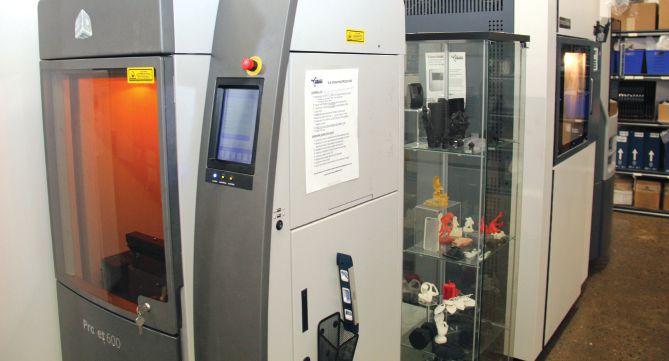
Objex Unlimited is unique in the 3D printing sector for running 14 machines, including industrial-strength 3D Systems Projet 6000 SLA and Stratasys Fortus 360 FDM.
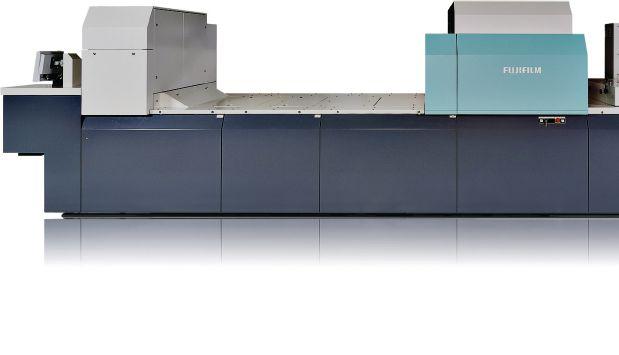
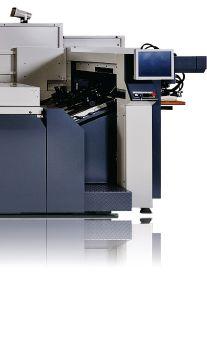
With millions of impressions produced, the 2nd generation J Press 720S is the proven digital inkjet press solution to compete for more of your customers’ brand business.
You’ll appreciate how fast the J Press 720S gets out of the blocks. No plates and virtually no make-readies to slow you down. No wasted sheets or time in running up to color either. Just send the PDF file to the press and instantly print litho-quality images on standard offset coated and uncoated sheets.
Our prints finish strong too, with flexibility designed to take full advantage of your existing finishing equipment. J Press 720S sheets can handle lamination and coatings for high end jobs like photo books, calendars, and brochures.
Seeing is believing. Visit fujifilminkjet.com today.
Wide format inkjet
the breadth of inkjet system options, new applications, software and consumables continue to grow at a quickening pace
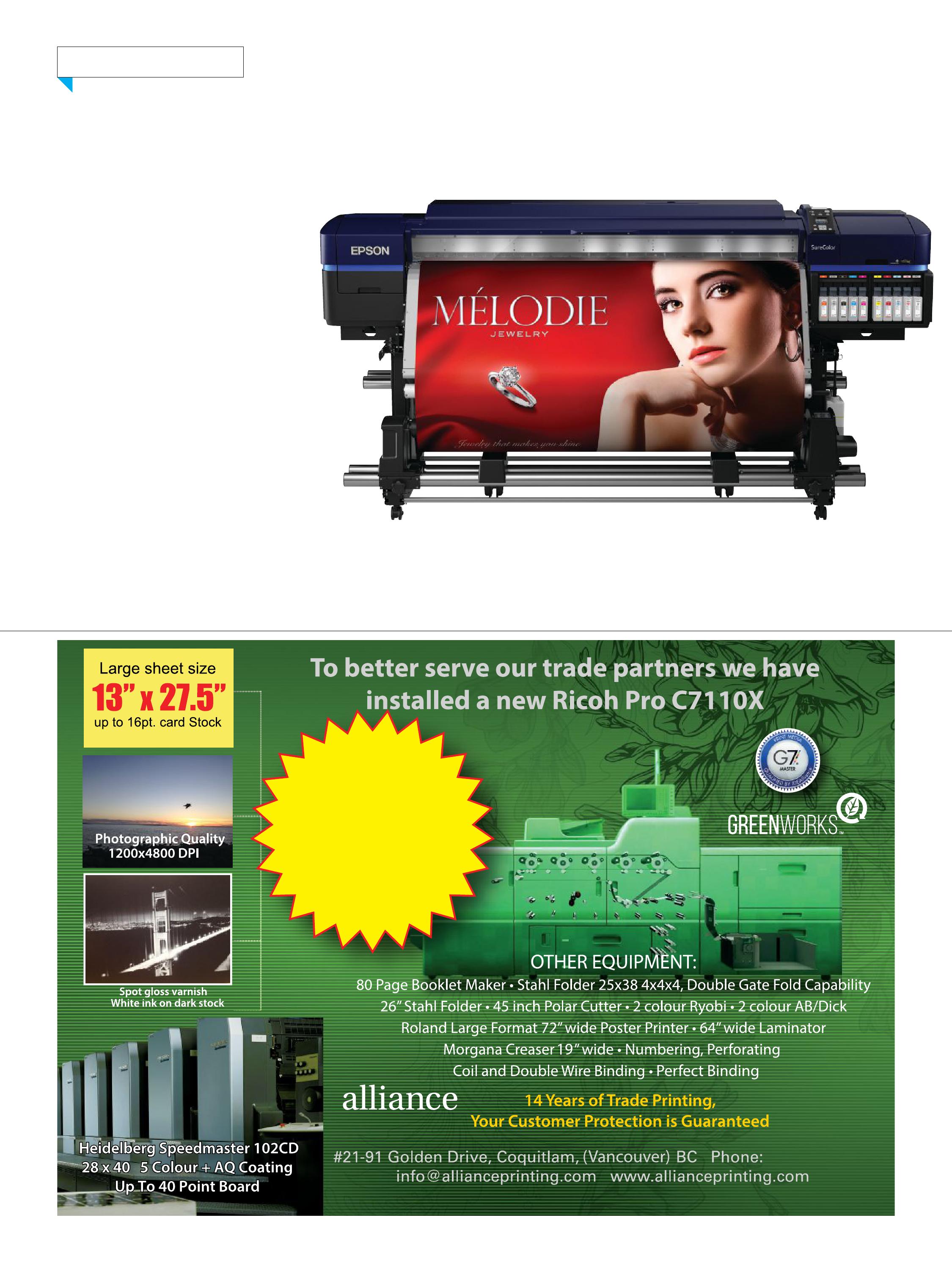
Epson SureColor S-Series
In January 2016, Epson launched its most-advanced line of SureColor S-Series roll-to-roll solvent printers – the 64inch SureColor S40600, S60600 and S80600. The new series leverages fourth-generation Epson UltraChrome GS3 solvent inks, an all-new media-feeding system, and what the company brands as Dual-Array PrecisionCore TFP print heads – aimed at signage, vehicle graphics and fine-art reproduction markets. Developed over a four-year period, the
SureColor S-Series’s GS3 solvent inks are formulated for fast-drying. The SureColor S80600 inks a new GS3 Red ink, as well as optional White or Silver ink.
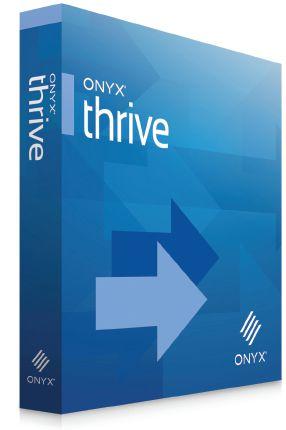
ONYX Graphics Thrive
ONYX Graphics recently released version 12 of Thrive, which the company describes as a full featured, scalable
The new SureColor S-Series use UltraChrome GS3 solvent ink.
RS SuperiorSuperior Binder y Ser vices Inc.
Your Superior choice for Print Finishing and Lettershop Ser vices
Heavy boards, plastics, laminations or digitally printed works up to 30 pt can now die crease, fold and even glue in-line.
Q-Class print heads and Fujifilm Uvijet inks. The eight-channel configurations delivers CMYK, Lc, Lm, Lk and orange inks. A nine channel configuration is available to add white ink.
The Versa-Drop technology of the Dimatix Q-Class print heads allow the press to image in greyscale with droplet sizes ranging from 10 to 30 picoliters. The Uvistar Hybrid 320 also leverages what Fujifilm describes as a patented tri-lobal belt and six-zone vacuum system. Additionally, Fujifilm explains a dancer bar with spreaders keeps difficult roll media from wrinkling before entering the imaging area. Rear pinch rollers engage as rigid material transitions from the print area on to the exit tables. The Uvistar Hybrid 320 also features continuous board capability.
2. SUPERIOR TECHNOLOGY — Die crease without a die, then fold and even glue all on the same machine, up to 30 pt.
3. INTEGRATED MODULAR UNITS — Combined in-line finishing: crease, fold, glue, tipping, envelope inserting, ink jetting (Duplex), clip seal (3 sides), mail prep.
4. SAVE ON POSTAGE COSTS —As a Certified Canada Post Direct Marketing Specialist, we get contract pricing reductions.
5. RETURN MAIL PRODUCTS — Customized “Return Mailers” created in-line with “U” or “BOX-shape” remoistenable glue, time perfed applications and envelope formation.
6. MINI-BOOKLETS — Saddle-stitch and trim 2-up booklets in-line to the size of a business card. No need to trim off-line, or do 2 passes.
7. HIGH SPEED EQUIPMENT — High speed Tipping, Folding, Saddle-stitching and soft folding ensuring on time delivery.
workflow based on the Adobe PDF Print Engine. Thrive v12 provides automation with what ONYX brands as Quick Sets, designed to eliminate manual steps. Also included is Thrive Production Manager, which provides a real-time, browser-based dashboard into print production from any location. ONYX Connect, a JDF-based interface, is available as an optional module for Thrive. The open system provides what the company describes as a simple developer interface to connect current business workflow to ONYX software. It also includes the ability to automate job submission through JDF and hot folders.
Canon Océ Arizona 1200 Series
In January 2016, Canon launched the 4th generation of its Océ Arizona Series UV flatbed printer for mid-volume print producers. Since the launch of the Océ Arizona 250 GT in 2007, more than 5,000 Océ Arizona printers have been sold by Canon Group companies worldwide. Canon explains the new series of printers have been designed for sign and display graphics, supporting a range of rigid and flexible medias. The series handles rigid media and objects up to two inches thick and as large as 8 x 10 feet. It also features Océ VariaDot greyscale piezoelectric printing.
Fujifilm Uvistar Hybrid 320 UV
In November 2015, Fujifilm debuted its new Uvistar Hybrid 320 UV press, which is a 3.2-metre combination flatbed and roll printer, capable of producing output at speeds of up to 2,100 square feet per hour.The inkjet system uses Fujifilm Dimatix
Mutoh ValueJet 1628X and 628X
In October 2015, Mutoh released its new X series of ValueJet printers, including the 54-inch ValueJet 1324X, 64-inch 1624X, and 104inch 2638X to expand its current Eco-Ultra line of printers. Denoted by the letter W in the model number, ValueJet 1624WX and 2638WX also expand the company’s dye-sublimation line.
The new X series of printers all include Mutoh’s newest Smart Printing Technology, DropMaster, designed for dot placement accuracy. DropMaster also eliminates the need for individual head adjustments per individual media type. The new Eco-Ultra branded printers are aimed at vehicle wraps, labels, decals, stickers, banners, trade show graphics, while the dye-sublimation models produce soft signage, flags, custom apparel and interior design products.
Roland VersaUV LEF-300
In January 2016, Roland DGA introduced the new and larger VersaUV LEF-300 to its line of benchtop UV-LED flatbed printers, which also includes the existing LEF-12 and LEF-20 models. To accommodate greater quantities and larger-sized items, the LEF300’s printing area has been expanded to 30 inches wide by 13 inches long, which equates to an imaging area 50 percent larger than the LEF-20. With four print heads and two UV-LED lamps, the LEF300 enables bidirectional printing approximately 60 percent faster than the LEF-20. As well, the number of LEF-300 White and Clear (gloss) ink nozzles have been doubled for faster printing, in -
ONYX features a JDF-based module for API connection.
creased density and opacity, and faster build-up of multiple layers for three-dimensional textures.
HP Latex 3500 Printer
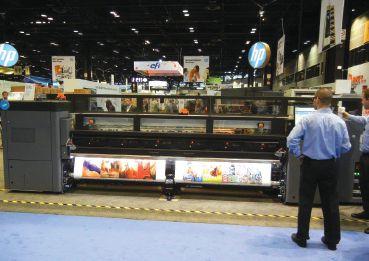
Released in August 2015, the new generation of HP Latex 3500 printers is described as being ideal for standardized workflows. The Latex 3500 printer handles high-volume production. With heavy-duty roll handling of up to 300 kg (660 lbs) and 10-litre ink supplies, the printer allows for more unattended operation such as overnight printing. Additionally, dual-roll split spindles offer what HP describes as easier, safer handling of oversized rolls. In-line slitters reduce bottlenecks in finishing and built-in LED lights support on-the-fly proofing.
head adjustments per media type. It can be can be equipped with the SpectroVue VM-10 spectrophotometer for profile making and users can monitor the printer’s performance through the new smart phone ValueJet Status Monitor app.
Inca Digital Onset X Series
Agfa Anapurna M2540i FB
In October 2015, Agfa Graphics introduced the new Anapurna M2540i FB as a 6-colour plus white UV-curable flatbed system. It reaches printing speeds of up to 93 m2/h (1,001 ft2/hr). Agfa explains the M2540i, with its moving gantry flatbed, is well suited for both stepand-repeat work and for printing on a range of media sizes at one time. This can include indoor and outdoor medias, as well as uncoated rigid media like corrugated boards, plastics, Plexiglass, mirrors, exhibition panels, wood, aluminum, MDF, stage graphics, and advertising panels.
PDS, Mutoh VJ1324X
PDS in June 2015 became a distributor of Mutoh wide-format inkjet systems, and currently holds the new ValueJet 1324X in its Toronto showroom. The four-colour, 54inch ValueJet 1324X is branded as an Eco-Ultra printer that utilizes new print heads to reach speeds of up to 565 square feet per hour. Hitting a maximum resolution of 1,440 dpi, the system uses what Mutoh brands as DropMaster ink technology for dot placement accuracy and eliminating individual
In October 2015, Inca Digital unveiled the new Onset X Series of large-format flatbed inkjet printing systems, sold globally by Fujifilm. The Onset X Series is described as Inca’s fastest-ever printer, reaching speeds of up to 900 m2/hr (9,687 f2/ hr). The systems also leverage a 25zone vacuum table and UV control to help eliminate masking, and a carriage that can incorporate up to 14 ink channels. Users can start out with the Onset X1, which runs at up to 560 m2/hr (6,027 f2/hr), producing 112 full-bed sheets per hour. The high-end Onset X3 runs at 900 m2/ hr produces up to 180 beds per hour. The Series handles substrates in sizes up to 3.22 metres (126 inches) x 1.6 metres (63 inches) and thicknesses up to 50 mm.
Gandy Gladi8tor
In mid-2015, Gandy Digital of Mississauga launched its Gladi8tor UV flatbed inkjet printer, featuring what the company refers to as an inline 8-blade print head configuration, which allows for a double CMYK set-up to deliver twice the speed –up to 240 m2/hr – relative to the company’s Domin8tor and Pred8tor models.The Gladi8tor provides double white inking to address density issues on transparent or non-white substrates. It also offers a new layered print option for the production of multi-layered colour images and white. Gandy explains the Gladi8tor’s ability to sandwich white or doubled-sided banners with white and black between images, allows for the production of new applications like backlit jobs.
Mohawk Inkjet Portfolio
In January, Mohawk introduced a major expansion of its wide format inkjet portfolio, which previously consisted of six items. The new portfolio expands to 112 items, with 32 different product lines like backlit, lightblock, black polyester, adhesive, Dupont Tyvek and tear-resistant fabric. Mohawk’s portfolio now handles aqueous inks, Memjet inks, solvent or eco-solvent inks, latex inks and UV-cured inks.
The HP Latex 3500 is for high-volume production.
Detailing new technologies from Canon Oce, Drytac, Flint Group, Global Vision, Infigo, Kodak, Rotoflex and Xitron
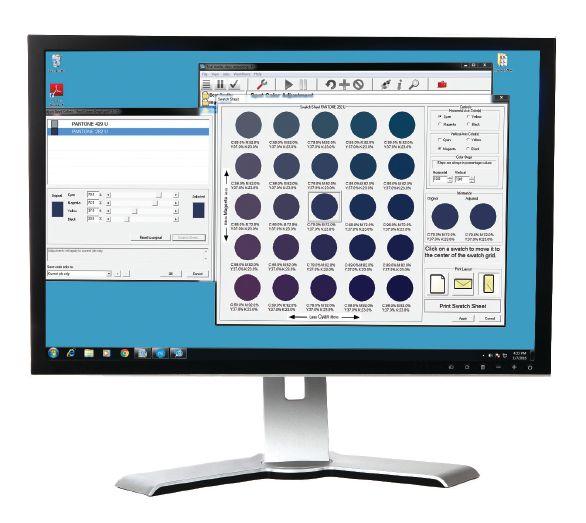
Northstar combines the Harlequin RIP with Xitron’s colour transform technology.
Xitron Navigator Northstar
In February, Xitron of Ann Arbor, Michigan, released Navigator Northstar (sold through its worldwide dealer network) aimed at inkjet systems using Memjet Northstar print heads. Navigator Northstar, according to Xitron, improves the colour accuracy of Astrojet M1/ M2 printers as well as the Colordyne 1600 (C & S), RTI-Digital Vortex 850/851, Trojan One, and Formax Colormax (among others), all of which use the Memjet Northstar print head. Designed for the desktop envelope, flyer, and label market, Navigator Northstar includes Navigator RIP version 10.1r2, Navigator Color Matching Workflow, and the Northstar connectivity plug-in. The system is multi-platform compatible.
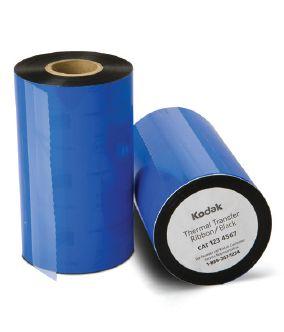
Kodak Thermal Transfer Ribbon
In February, Kodak expanded its line of brand-protection products, primarily aimed at thwarted counterfeiting, to include Thermal Transfer Ribbon (TTR) printing with its Traceless Anywhere System and Traceless Ultracovert System. Kodak explains it allows for deploying Thermal Transfer Printers that companies already use to print barcode and product identification labels. This drop-in solution only
Kodak Traceless TTR is a simple switch from regular Thermal Transfer Ribbon-enabled printers.
requires switching from current TTR to Kodak Traceless TTR, which creates the same look but results can then be detected – separating counterfeit from authentic product – through the use of the pocket-sized Traceless Anywhere Reader. Kodak explains its Anywhere Solution has the advantage of requiring a lighter, smaller, and less expensive Reader than the existing Ultracovert System, while still providing covert protection against duplication by counterfeiters. Kodak TTR are, according to the company, super-premium resin-based for maximum durability. Sample ribbons for conducting print trials are available at no charge.
Navigator
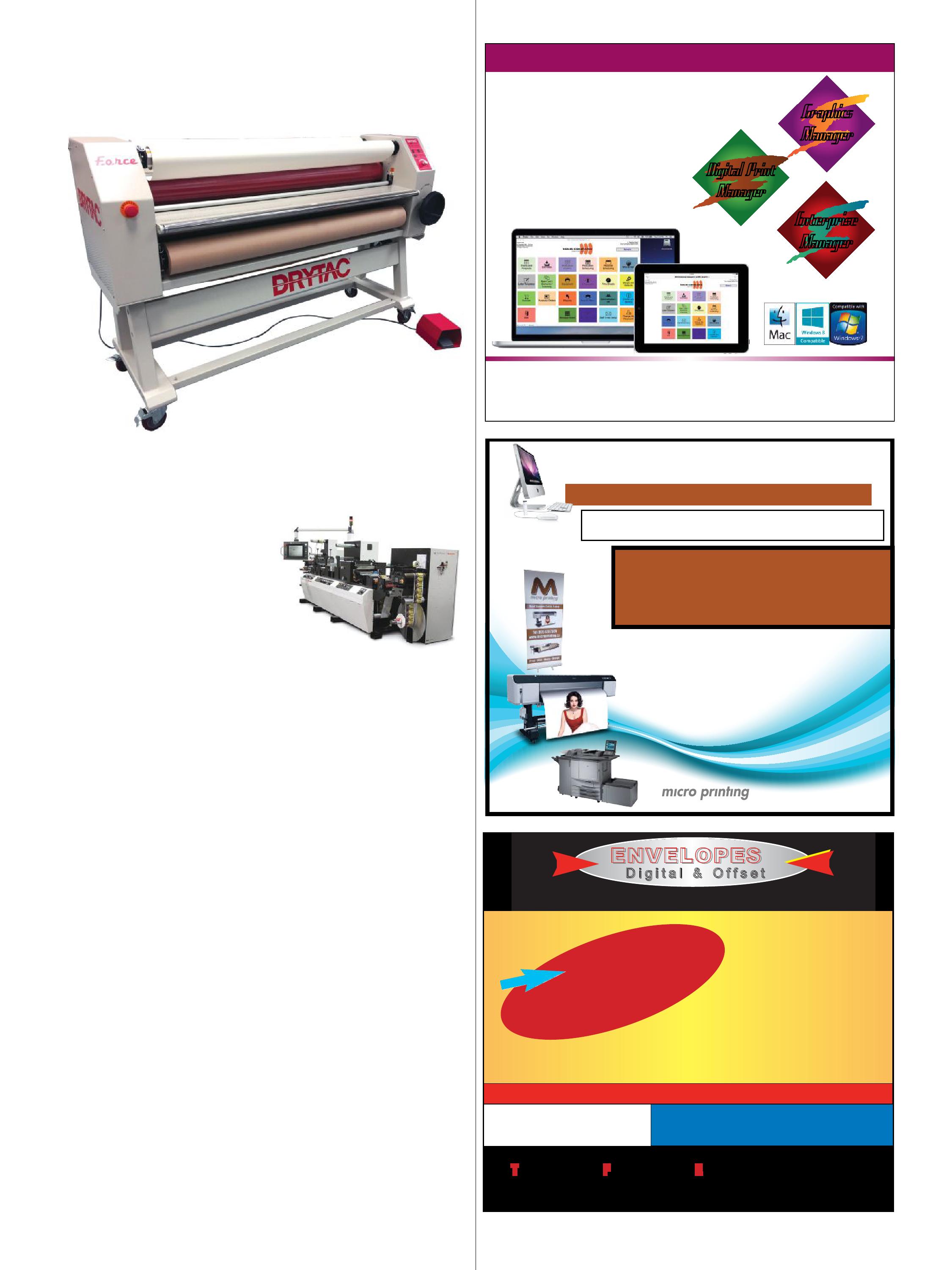
Force is designed for shops that need an inexpensive heavy-duty machine.
Drytac JM55 Force
In January, Drytac introduced its JM55 Force as part of its new JetMounter model of wide-format roller laminators. Described as a heavy-duty, entry-level laminator, Drytac explains JM55 Force is designed for users who require durability and functionality over the long term. JM55 Force has a maximum laminating width of 55 inches (1,397 mm) and is described as being well suited for mounting, laminating and decaling pressure-sensitive materials. It features large 4.7 inch (119.4 mm) diameter non-stick rollers; speed control up to 20 feet (six metres) per minute; a maximum nip opening of 1 inch (25 mm); top and bottom auto-grip supply shafts with brake tension control on the operator side; single mechanical height/pressure adjustment; and an interchangeable 110V or 220V electrical configuration.
Rotoflex Vericut3
In January, Rotoflex released Vericut3 described as its next generation of its premier offline finishing systems for digital and conventional narrow web sectors. With a completely redesigned platform, Vericut3 is 100 percent servo-driven for what the company describes as precise tension control and flexibility; from unwind to rewind and all print and die cut units in between, including the matrix removal unit. The system features motorized roll lift, URC 2.0 proprietary control system with a Report Management System, and biometric login. In addition, Vericut3 features a what the company describes as an efficient web-path for reduced set up
Rotoflex Vericut3 includes a motorized roll-lift system.
waste and a motorized capstan. The new design of Vericut3 is said to reduce material waste through the automated die cutter and flexo unit set up. A variety of optional processes can be configured into Vericut3 such as lamination, hot and cold foil, screen and coatings.
Global Vision Proofware 2.0
In January, Global Vision of Montreal, which develops proofreading technologies, released its Webbased, all-in-one suite called Proofware 2.0, which provides tools focused on delivering accuracy and traceability for Quality Control, ultimately reducing artwork rework cycles and cost.
The new features of Proofware 2.0 include a redesigned user interface, with new keyboard shortcuts and multi-monitor support. New cropping features provide an ability to crop multiple pages of all sizes, resize the crop area, and auto crop to the artwork area, while new verification features, specifically, Braille and barcode verification, is now integrated into Global Vision’s ArtProof and DocuProof applications. Proofware 2.0 also includes new Adobe Illustrator support features,
JM55
•
•
•
•
•
•
•
♦
The UV-A output of the high definition lamps increases by up to 15 percent compared to standard UV-A 10R lamps.
specifically AI file support, allowing users to open Adobe Illustrator files directly (.ai files).
Version 2.0 of Proofware also includes more complex layout handling, such as automatic processing of QRD templates for fast comparison to artwork. A new annotation checklist allows for quick review of changes and call-outs to ensure all the right corrections are made. Global Vision explains its technologies have been integrated into the packaging workflows of consumer packaged goods companies, printing firms and over 72 percent of the major pharmaceutical industry worldwide.
Flint Group UV-A Exposures
In February, Flint Group Flexographic Products began to equip all of its flexographic and letterpress platemaking exposure units with high intensity UV-A lamps. The UV-A output of the high definition lamps increases by up to 15 percent compared to standard UV-A 10R lamps. This makes them suitable for the reproduction of high definition halftones and high-end images in flexo form processing. The new lamps have an initial UV-A intensity of over 20 mW/cm2. This allows, according to Flint, users to exploit the potential of the latest generation of flexo plates, such as the nyloflex FTF, a flexo plate with inherently flat top dots and a textured plate surface.
Infigo HP SmartStream
In February, Infigo Software Limited, which recently opened a North American operation, became a member of the HP SmartStream Solution Partner Program, joining 139 HP partners worldwide. Infigo is one of 14 partners in the Web-to-
print category. This relationship comes after a rigorous application process, testing the quality of Infigo’s Web-to-print software such as Catfish and MegaEdit, as well as its cross-media marketing solution, Symphony.
Canon uniFLOW 5.1
In February, Canon released uniFLOW Version 5.1 print management software, designed to consolidate enterprise output management in a single, unified platform including device management, print management and scanning while expanding uniFLOW’s capabilities to smartphones, tablets and other mobile devices. Canon explains uniFLOW v5.1 eliminates the need for customers to use multiple tools to maximize output management capabilities, while enhancing device management and information security capabilities to streamline Managed Document Services. The software enables businesses to link mobile workers, contractors and guests within a print network. With an increased emphasis on mobile printing, uniFLOW v5.1 offers support for Internet-enabled mobile devices allowing jobs to be printed from smartphones and tablets via multifunction products (MFPs) and single-function printers. As a result, employees, guests and mobile staff can use uniFLOW to print directly from their mobile devices while controlling the release of the print output to networked devices. This level of functionality is enabled as part of an organization’s managed print infrastructure, allowing for the retention of full cost-control, print and network security while also facilitating the creation of potential revenue-making opportunities.
pressrOOm HeLper
Quality printer requires a Pressroom helper to provide general assistance to the press crew. Job includes extensive paper handling. Previous pressroom experience is an asset. email resume to kent@colourinnovations.com
press FeeDer
Quality printer requires Press Feeder. Ideal candidate will have a minimum 5-years experience operating 40-inch offset sheet-fed presses. h eidelberg or Mitsubishi experience an asset. continental shift work required. email resume to kent@colourinnovations.com
prInt/sIGn sHOp FOr saLe
Well established (since 1974) profitable Print/sign shop for sale in Toronto. Turn key operation – Low Rent 1,500-square-foot shop, positive
Production Scheduler
The responsibilities will include scheduling all equipment, load balancing all equipment, interplant co-ordination of jobs, production reviews of jobs to ensure on time delivery and equipment efficiencies, creation and generation of various reports including daily schedules experience:
Must have a minimum of 3 years in the Graphics Arts Industry. Previous production scheduling or production co-ordination is considered an asset
Abilities:
• Strong computer skills a must
• Strong communication skills; verbal and written
• Attention to detail
• Excellent organizational skills
• Ability to work individually and as a team member
Large format operators or apprentices for afternoons. very good working environment with full benefits. secure employment – we never send anyone home! Always 40 hours per week through the year.
c ontact Paul k ett 647-938-9578, paulk@4over.com
KOmOrI FeeDer, aFternOOns Or nIGHts
komori press feeders for afternoons or nights. e xperience with chamber coating and the gLX line is an asset. very good working environment with full benefits. secure employment – we never send anyone home! Always 40 hours per week through the year.
Lane Burlington, ON L7S 1W3
Phone: (800) 547-8848 Fax: (800) 705-9881
Superior Service
Progressive Technology
FREE Daily pick up & delivery in the Western G.T.A. Visit www.petersdies.com to learn more!
• Ability to handle a high intensity production environmen
Knowledge:
Minimum Post Secondary Education, college/university degree in Graphic Arts or Related areas of studies.
Industry experience minimum of 3 years
Scheduling Systems software are considered an asset (EFI Printflow, Avanti, etc)
The Lowe-Martin Group is proud to be an equal opportunity employer. We are committed to providing accessible employment practices that are in compliance with the Accessibility for Ontarians with Disabilities Act. Let us know how we can accommodate you to participate in the recruitment process.
c ontact Paul k ett 647-938-9578, paulk@4over.com
CUtter, aFternOOns
c utters for afternoons. e xperience with Polar line is an asset. very good working environment with full benefits. s ecure employment – we never send anyone home! Always 40 hours per week through the year.
c ontact Paul k ett 647-938-9578, paulk@40ver.com
VIVID UV COater FOr saLe
A vivid uv coater in mint condition is available for purchase. The system coats 80lb up to 1/4 rigid stock. Max sheet 21.5 x 26 inches. c omes with feeder 5,000 sph. h and feed 3,500 sph. oFF LINe . Will train, runs great! Paid $27,000, selling for $15,000 obo contact Jamal, jamal@mrprinter.ca
Die Cutter
The Die Cutter will be responsible for safely setting-up die cutting machines based on docket specifications, operating the press to produce good quality product, and maintaining a safe work area. This position will operate PHP, semi-automatic, and push board machines, as well as, perform routine maintenance. This role requires heavy lifting and a rotating shift schedule.
Printer
Supremex is Canada’s largest provider of stock and custom manufactured envelopes. We are currently looking to add a Printer to our team. The Printer is responsible for setting-up, operating, and maintaining a Halm 4-colour jet press.
Just days after Xerox introduced a plan to separate into two public companies, Brad King was named Vice President of Xerox Canada’s Graphic Communications organization. King was previously Xerox Canada’s VP of Central Operations, responsible for sales and marketing of Xerox’s portfolio of office and graphic communications (GC) products. PrintAction spoke with King, a member of Canada’s 1992 Olympic Alpine Team, about his key objectives leading one of Canada’s most powerful printing and imaging technology companies.
How large is the graphic communications market in Canada as it relates to Xerox?
bk: From a graphics communications [gc] canadian perspective… we are seeing it at about a $400+ million business in the areas we serve. you have to take litho out and other areas that we do not play in, but it is a fairly significant market space. And we have roughly a 40 to 50 percent part of that today; and we are looking to build upon it. What is your main priority in this new role?
bk: My biggest priority is to get some energy and excitement in this sector… There are great opportunities. There is four-plus percent cAgR expected over the next four years in the digital space. Inkjet is really interesting technology that we are diving into wholeheartedly and, internally, I am looking to create some energy, excitement and focus.
externally, I have been out chatting with customers and they are quite excited about seeing what Xerox is going to do in the gc space here in canada and that we`re increasing our efforts to energize this space. How will Xerox splitting into two separate companies affect the GC space?
bk: For us in the graphics space, there really is no course change, no effect at all on our go-to-market. We are in the Document Technology company and then the other will be a business Process services outsourcing company. Why is Impika important for Xerox?
bk: We acquired the Impika business in 2013. globally, we saw inkjet as a great opportunity and so we made an acquisition to accelerate that and we are investing heavily from an R&D standpoint – and have been since we acquired Impika, because this is really where we are seeing big growth over the next four years. What interest in inkjet are you seeing from commercial printers?
bk: This really is a great space for the whole industry as inkjet technology expands, meaning you can print on more substrates and you have different inks to produce quality finishes. We can print on high gloss paper, for example, or gloss paper, which you couldn’t do four or five
years ago with inkjet technology... [Inkjet] is a lower cost model in the colour space, which then opens up entirely new lines of opportunities when our printers are talking to their customers. black-and-white print is in decline – it is very old technology. People are not looking to spend money there, but they are excited about colour.
What is Xerox’ greatest advantage in a competitive toner press market?
Approximate graphic communications market share controlled by Xerox Canada in the areas it serves. 45%
bk: our big leverage point is really our workflow. Most people are happy with the colour output that the top manufacturers can produce, pretty pictures on pages, but that is not what the marketplace is looking for because it is now a given.
What our customers are looking for is how do we lean out their shops, how do we make them efficient, how do we make sure that they have great Web solutions set up for their customers. how do we make sure they are adding value in the solutions that they are offering. And that is really where Xerox has some great competitive knowledge beyond just putting some pretty pictures on the paper.
What advice do you have for printers who are now facing a lower Canadian dollar?
bk: you hope that somebody gets the benefit out of this low canadian dollar… I think where it really helps graphic printers,
and especially ones that may have some presence in the u s., is they are looking to leverage that dollar difference in their sales. I have been talking with many print owners and there seems to be a good up-tick in the last three to six months in volumes and some of that is attributed to the opportunities south of the border.
How will Xerox Graphic Communications leverage XRCC moving forward?
bk: It is a very special spot for us. We are very proud to have a research centre in canada and it is unique in the business that we play in. We employ over one 100 people there and they produced 153 u.s. patents last year alone.. It is a very interesting place and it is all focused around really what we end up selling to the market place. Printed electronics is a really intriguing new area and there is a lot of effort around there today… printed electronics on all kinds of different substrates that are flexible – it’s very exciting.
What can you share about Xerox’ upcoming drupa plans?
bk: I would love to be able to tell you what’s cooking, but, as I’m sure you understand, I can’t just yet… If I was to encapsulate what to look forward to there will be a big emphasis on inkjet. This is where the majority of the focus is going to be.
PAPER PRODUCTS
BANNER & FILM
PRESSURE SENSITIVE ADHESIVES
LAMINATES
TEXTILE
RIGID BOARD
Sign
At
Delivering
A CONCISE RANGE OF MEDIA FOR QUALITY INKJET PRINTING.