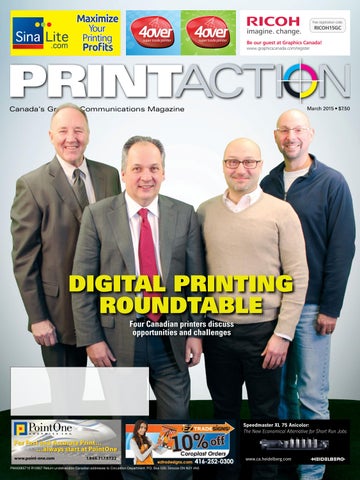
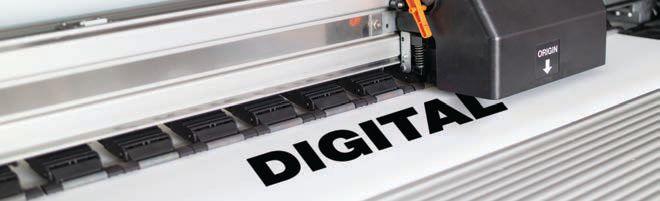
PrintAction brings together four printers to discuss opportunities and challenges in today’s digital printing market, focusing on issues like Web-to-print, sales, emerging applications and technology investment.
20
Graphics Canada show Preview
With Canada’s largest printing trade show just days away, exhibitors share details about the key technologies to be highlighted on their booths over three days at the International Centre.
5
News
Allegra picks Avanti for its North American network, RockTenn and MeadWestvaco agree to create a $16 billion packaging giant, and Central National-Gottesman moves to add Spicers Canada to its merchant mix.
6
Market
Surrey newspaper plant for The Province and Vancouver Sun officially stops the presses, Unisource presents its Design and Print Excellence Awards in Toronto, and Annex and Newcom purchase Glacier media assets.
NiCk howarD spoiled For Choice
Two key pieces of investment rationale rise to the top after wading through the technological advances implemented by printing’s big-four offset press makers.
Neva Murtha transparency in environmental Printing Claims
As more RFQs are requiring printing companies to disclose their environmental position, there is a growing downturn in pubic presentation and accountability.
30
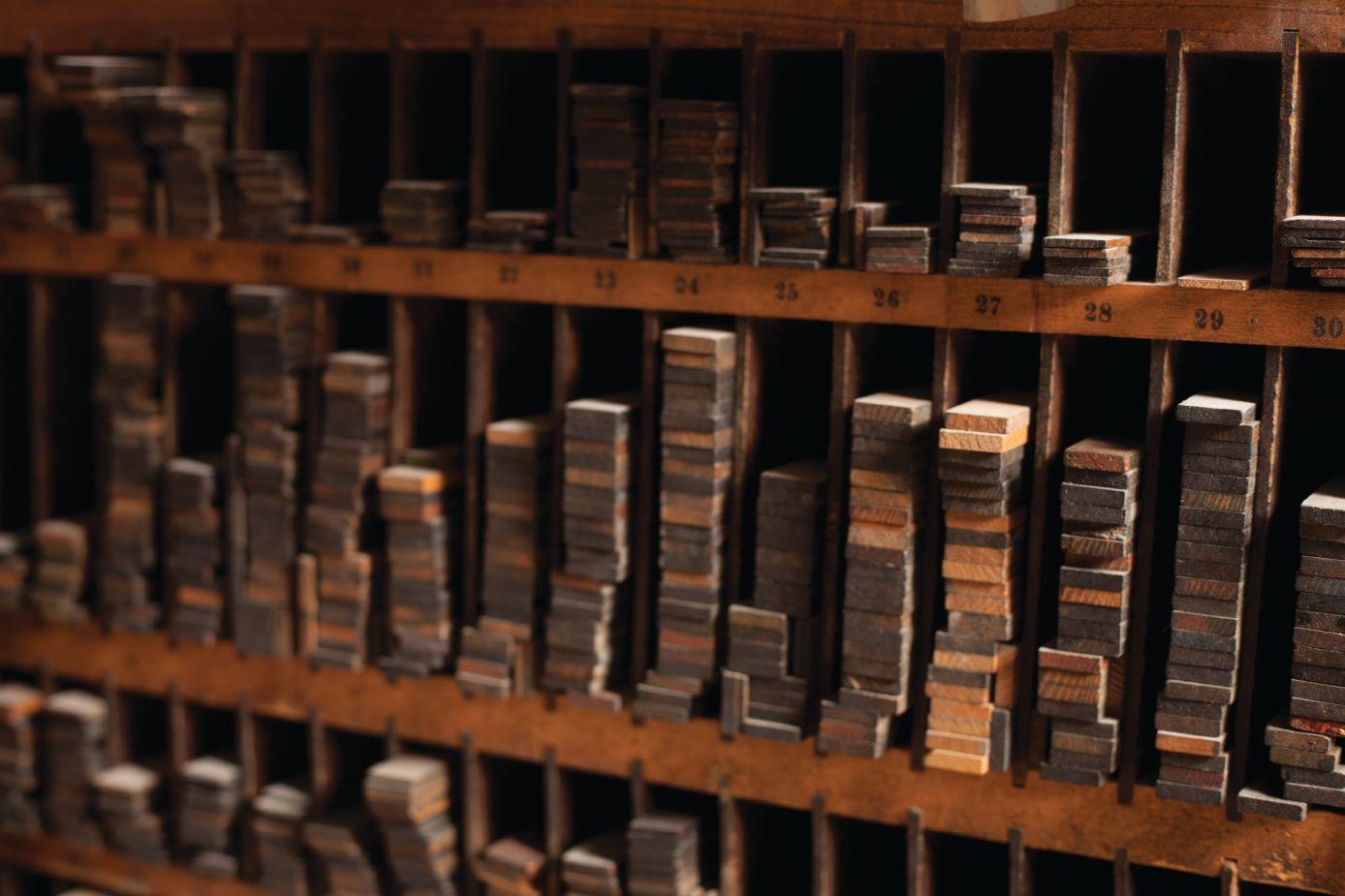
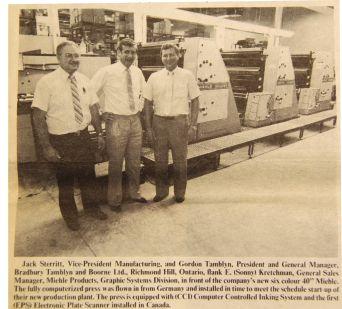
March 1985
Virtual ban on leaded gas ordered by EPA; The first Internet domain name is registered, symbolics.com; and HostmannSteinberg moves into a new 26,000-squarefoot manufacturing plant.
Jeti Titan S/HS makes a splash in wide format printing.
The new Jeti Titan S and HS is the next generation of the industry-leading true flatbed at an unequalled price/ productivity ratio. They incorporate the latest Ricoh Gen 5 print heads. These 6-color & white flatbed UV-inkjet printers bring high quality and speed at the sharpest price producing top quality indoor and outdoor print work.
Jeti Titan S and HS come with the revolutionary Asanti wide format workflow. As well as reducing costs and time, the complexity of the pre-press operation is diminished significantly, with the elimination of errors and eradication of reworked jobs. Take a dive into some quality print work with the Jeti Titan S and HS. www.agfagraphics.com
Counting on Catalogues
In late-January, The New York Times published an encouraging 1,500-article called Catalogs, After Years of Decline, Are Revamped for Changing Times. Anyone hooked into Twitter’s printing realm would have seen links to the The Times article on their screen countless times.
The article included many interesting and positive facts, beginning with J. C. Penney’s January announcement it would revive a home-goods catalogue in March, three years after the retailer discontinued such mailings. Referencing Direct Marketing Association (DMA) statistics, The NY Times points to how the number of catalogues mailed in the United States indeed increased by a few percentage points to 11.9 billion in 2013.
This is a welcome signal for commercial printers producing catalogues, but The New York Times article, particularly how it spread across Twitter as a rebirth for print, reminded me of the hope for an earlier report by Scientific American. That report, called The Reading Brain in the Digital Age, surmised the brain prefers reading from paper before the computer screen. It was hailed as a scientific success by the printing industry. Research one day might also reveal how the brain prefers a long bath instead of a five-minute shower.
The Times article on the revamped catalogues, understandably, fails to delve into what will truly be the most-significant factor for printers wanting to develop such business in the future. Whereas the article states, “Retailers are seeking to make their catalogues more of an experience, and celebrating print as something retro,” printers must move their clients’ buying decisions away from print.
It is not easy for printers to adopt a strategy that ultimately means trying to sell less print to be more successful, but this was one of the biggest takeaways from PrintAction’s recent Digital Printing Roundtable, featured on this issue’s cover. The 90-minute discussion among four digitally savvy printers illustrates why a more agency-like approach with customers is the way forward, leveraging production knowledge to develop creative solutions.
In many cases, certainly, production creativity for clients can be found in the form of spectacular printing. This too involves an agency-like process of educating clients about modern printing techniques, which speaks to the current rebound of print catalogues, primarily used to drive both in-store and online purchases. It is dangerous, however, to believe catalogues will stand on their own to drive future press impressions. As The Times article points out, DMA statistics also show the total 2013 catalogue mailings is only about 60 percent of what it was in 2007.
Jon Robinson, Editor
Canada’s Graphic Communications Magazine. Proudly published for two generations. Editor Jon Robinson • 905.713.4302 • jrobinson@annexweb.com
Contributing Writers Zac Bolan, Peter Ebner, Chris Fraser, Victoria Gaitskell, Dr. Martin Habekost, Nick Howard, Thad McIlroy, Nicole Rycroft, Dr. Abhay Sharma, Trish Witkowski
Publisher Paul Grossinger • 905.713.4387 • pgrossinger@annexweb.com
Associate Publisher Stephen Longmire • 905.713.4300 • slongmire@annexweb.com
PrintAction is printed by Annex Printing on Creator Gloss 80lb text and Creator Silk 70lb text available from Spicers Canada.
PrintAction Magazine 222 Edward Street, Aurora, ON, L4G 1W6 www.printaction.com • Tel: 905.727.0077 • Fax: 905.727.0017
Publications Mail Agreement Number 40065710 • ISSN 1481-9287 Return undeliverable Canadian addresses to Circulation Department: P.O. Box 530, Simcoe ON N3Y 4N5; Email: ncuerrier@annexweb.com We acknowledge the [financial] support of the Government of Canada.
PRINT NEWS
RockTenn and MeadWestvaco agree to merge and create a nearly US$16 billion packaging company focused on consumer and food-product containers, supported by a network of forest resources, mills and printing facilities. Headquartered in Norcross, Georgia, RockTenn has around 27,000 employees throughout the U.S., Canada, Mexico, Chile, Argentina and China. The company is involved with corrugated and consumer packaging, merchandising displays and related recycling. MeadWestvaco, operating in the healthcare, beauty and personal care, food, beverage, home and garden, tobacco, and agricultural industries, has a network of 125 facilities and 15,000 employees in North America, South America, Europe and Asia.
Asia Pulp & Paper’s Aida Greenbury, Managing Director of Sustainability, led the company’s engagement with the Rainforest Alliance to provide an independent evaluation of its Forest Conservation Policy (FCP), which was first announced in February 2013. Rainforest Alliance stated key steps had been taken, such as APP halting the clearance of natural forest by its suppliers, but encouraged the paper maker to continue on its FCP path. APP runs operations across Indonesia and China with an annual combined pulp, paper, packaging product and converting capacity of over 19-million tons per year.
Allegra Network LLC plans to leverage Avanti Slingshot as the core of WorkStream, a Web storefront to MIS platform used by the company’s North American base of 270 marketing and print communications franchises. The move to Avanti Slingshot was led by Ricoh Americas, one of Allegra’s key
printing technology providers, which made a multi-million-dollar investment in Avanti Computer Systems back in July 2013. In December 2014, Ricoh acquired PTI Marketing Technologies, described as a software-as-a-service asset management and marketing solutions provider. This latter move builds on a preexisting technology partnership between itself, Avanti and PTI.
Central National-Gottesman (CNG), a U.S.-based distributor of pulp, paper and forestry products, moved to purchase Spicers Canada, a subsidiary of Australia’s PaperlinX Ltd. Spicers Canada is one of the country’s largest distributors of fine paper, sign and display media, industrial packaging and graphic arts supplies. It operates 15 warehouse locations throughout Canada and CNG expects the purchase will add approximately US$400 million in annual sales. Spicers Canada joins CNG merchants Lindenmeyr Munroe, Spicers Paper (U.S.) and Kelly Paper in the company’s distribution group. CNG generates around US$5 billion in annual revenues.
Brian Gibson joins Drytac Canada, a manufacturer of adhesive-coated products, in the role of Technical Services Manager. He holds a degree in marketing and sales from Humber College and has more than 25 years of experience in the printing industry. Prior to joining Drytac, Gibson worked for Seal as a technical service and applications specialist. His industry knowledge spans areas like workflow training, equipment service support, product management, account management, and sales-force development.
Matt Bartlett becomes Mutoh America’s Regional Manager for Canada. Reporting to Mutoh’s Director of Sales, Gary Rudnick, Bartlett’s main responsibilities will be growing sales and brand awareness throughout the Canadian market, as well as developing relationships with the Mutoh distribution network. Bartlett has been in the wide-format industry for more than 20 years. He previously worked for Unisource as a Customer Business Manager, where he focused on expanding its large-format-printing portfolio in commercial printing.
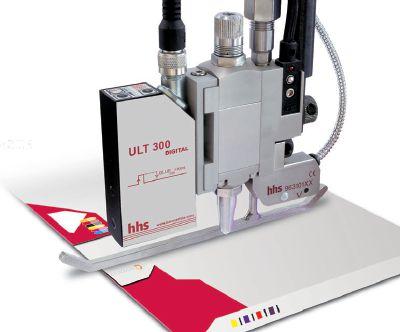
Chris Raney becomes President of Baumer hhs in Dayton, Ohio, which manufacturers systems for value-added-gluing, camera-verification and quality-assurance applications that are used in a range of industrial sectors like corrugated and folding-carton packaging, commercial printing and woodworking. Raney, who most recently served as VP of Packaging for Heidelberg USA Inc., brings over 25 years of industry experience to his new role, including more than 10 years in North America’s folding-carton market. He worked for Bobst in various roles in the United Kingdom, Switzerland and in the United States, where in June 2002 he was named Vice President of the company’s folding-carton business.
Caroline Andrews, VP and Chief Publishing Officer of Yellow Pages Limited, announced plans to phase out doorstep distribution of the Yellow Pages print directory in select Canadian neighbourhoods, beginning with Brampton, Mississauga and Oakville, Ontario. The directory instead is to be made available at various distribution points, in many cases alongside the company’s existing real estate publications found in street-level boxes and distribution racks at public areas like grocery stores and pharmacies across Canada.
Scott Morris becomes President and CEO of Illinois-based Weber Packaging Solutions, a global manufacturer and supplier of pressure-sensitive labels and labeling systems with more than 1,000 employees. Morris previously served as VP and GM at Mississauga’s Weber Canada operation, which is a role taken over by Michael Brown. With more than 20 years of experience in industrial printing, Brown previously held key positions at inkjet developer Domino Printing Sciences. He served as President of Domino Canada and in 2007 was named Domino’s President for North America.
Karla Wood becomes a Customer Satisfaction Specialist with FLXON Inc., a North Carolina-based provider of SWEDCUT doctor blades for flexographic and rotogravure printing. A graduate of Liberty University in Virginia, Wood will provide support
for FLXON’s operations in Canada, the United States and Latin America.
HP launched a new High Definition Nozzle Architecture for print heads used on its T Series of inkjet web presses. The new architecture doubles the native print resolution of current print heads from 10,560 to 21,120 nozzles, delivering 2,400 nozzles per inch. It allows the high-end HP T400 press, with a web width of up to 42 inches, to run at a printing speed of up to 800 feet per minute in monochrome or at up to 400 feet per minute in colour. HP reports that its T Series customers have printed more than 90-billion A4 equivalent pages since 2009.
MacDermid was awarded $27 million in punitive damages in its lawsuit brought against Cortron Corporation back in 2008. The order from the court states: “It is hard to imagine a clearer case of willful and malicious misuse of another company’s trade secrets. The record establishes, and the jury’s verdict reflects, that management at Cortron deliberately delivered copies of MacDermid’s customer list and technical drawings to DuPont, MacDermid’s rival, and then destroyed the electronic versions of the drawings, knowing full well that Cortron had a duty to keep that information confidential, and intending to harm MacDermid’s business and promote Cortron’s and DuPont’s business.” Cortron had been MacDermid’s sole supplier of its LAVA thermal plate processing systems.
Menasha Corp. of Wisconsin acquired family-owned PearceWellwood Inc. of Brampton, Ontario, which is to operate as Menasha Packaging Company LLC. PearceWellwood designs and manufactures corrugated displays for the retail industry and offers fulfillment and distribution services. In a related transaction, Menasha also acquired an ownership interest in Tencorr Packaging, a corrugated sheet manufacturer with plants in Brampton and Mississauga, Ontario, from PearceWellwood’s parent company, Pearce Group. Purchased in 1852 by Elisha D. Smith, Menasha is a family-owned company with over 4,900 employees and annual sales in excess of US$1.5 billion.
PRINT MARKET
Unisource Presents its Design and Excellence Awards
The Toronto-area stage of the 2014 Uvu Unisource Design and Print Excellence Awards, which is a national traveling exhibit of high-end Canadian printing, took place in early February at the Arcadian Loft.
The submitted entries, fitting into 17 categories, must be printed on paper purchased from Unisource Canada in full or in major part between June 17,
Best of show
Project: Vancouver House
Printed by: Metropolitan Fine Printers
Designed by: Zacharko Design
Project: STAPLE-Calgary
Society for People with Disabilities
Printed by: Blanchette Press
Designed by: WAX Design
JuDges’ ChoiCe AwArDs
Project: Nike Fleece Tech Pack
Case Bound Book
Printed by: Metropolitan Fine Printers
Designed by: Nike Brand Design
Project: Nelson Mandela Limited Edition Print
Printed by: Flash Reproductions
Designed by: Wilson Duong
Project: Peter Munk, A Canadian Story
Printed by: Andora Graphics
Designed by: Underline Studio Design
2013 and June 21, 2014. The entries were reviewed by a panel of five judges based on design excellence, communication strategy, print quality and appropriateness of paper, use of photography, illustration and typography.
The five judges from the design industry included Dave Watson, Creative Director Design, North America, TAXI, Toronto; Claude Auchu, Partner, VP,
and Stan
of Andora Graphics.
Project: Klauss Boehler Brochure
Printed by: Quadriscan Printers
Designed by: Ig2boutique
Project: Banque Alimentaires Quebec
Printed by: Imprimerie L’Empreinte
Designed by: Ig2boutique
Printing AwArD winners
Business Cards
Project: BOSS Supplements
Printed by: Somerset Graphics
Designed by: CINDERBLOC
wide format
Project: Rogers in Store Wide Format
Printed by: Transcontinental PLM
Designed by: Periscope
Brochures
Project: Trump Book and Envelope
Printed by: Metropolitan Fine Printers
Designed by: Letterbox Design
Creative Director Design, Lg2boutique, Montreal; Kim Ridgewell, Senior Designer, 123West, Vancouver; Rod Roodenburg, Partner, Ion Branding Design, Vancouver; and Rod Honig, Creative Director, Trigger, Calgary.
Unisource’s Uvu program celebrates both printing and design achievement. The following list focuses on the winners of Uvu print categories, including:
Brochures
Project: GESAMTKUNSTWERK
Printed by: Metropolitan Fine Printers
Designed by: Zacharko Design
Magazines
Project: Canadian Fabric
Printed by: Flash Reproductions
Designed by: Parcel Design
Digital
Project: Lint and Honey LookBook and Art Prints
Printed by: DT Print Solutions
Designed by: Andrea Shum
Brand identity
Project: Secrets From Your Sister
Printed by: Flash Reproductions
Designed by: Blok Design
Dave Jackson of Unisource (left to right), Jessica Meneguzzi and Parry Nitchos of Mi5 Print, and Carrie Martin of Applied Arts.
The Uvu traveling exhibit visits the cities of Toronto, Montreal, Calgary and Vancouver.
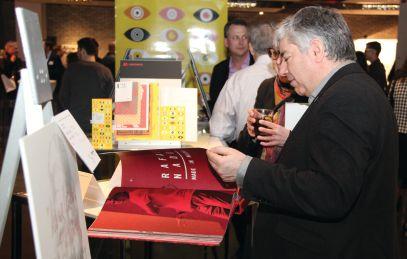
Looking over a Judges’ Choice Award winner, Nike Fleece Tech Pack Case Bound Book, by MET Printers.
Designer Lauren Wickware
Morantz
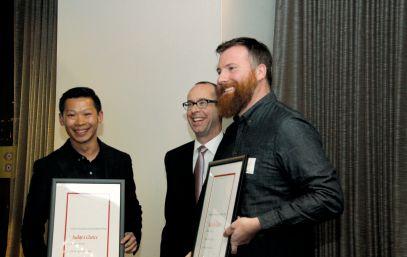
Designer Wilson Duong (left to right), Stéphane Dagenais of Unisource, and Rich Pauptit of Flash Reproductions celebrate a Judges’ Choice Award.
Dave Jackson of Unisource (left to right), Shawn Irvine of DT Print Solutions, and Andrea Shum of LINT and HONEY.
PRINT MARKET
Vancouver Newspaper Plant Officially Stops the Presses
The Kennedy Heights printing plant of Surrey, British Columbia, which opened in 1997 at a cost of around $150 million to print the Vancouver Sun and The Province newspapers, shuttered its operation on the last day of January.
Assets of the 200,000-square-foot plant, which had press capability to operate at speeds of up to 80,000 copies an hour and with up to 160 pages in 10 sections, were to be auctioned on February 19. All of the equipment is scheduled to be removed from the facility by March 13. This includes a line composed of four interlinked double-wide, 50-inch Man Roland Colorman S presses initially installed for more than $80 million.
In addition to dozens of reels and stackers, and a significant amount of postpress equipment, the facility’s complete stores and spare parts inventory, such as bearings, motors and drives, is valued at more than $1.5 million.
As previously announced, the Vancouver Sun is now being printed by TC Transcontinental Printing’s Vancouver-area facility. This agreement spans five years and, according to Transcontinental, does not require any further capital investments. In late 2013, Transcontinental also reached an agreement with Postmedia Network Corporation to print the Calgary Herald newspaper. Postmedia at the time announced plans to sell two of its real estate holdings responsible for producing three of its newspapers: Calgary Herald, The Province and Vancouver Sun. According to Global News, The Province will now be printed by Black Press Group Ltd.
In May 2014, Transcontinental Printing also an-
nounced a multi-year agreement with Postmedia Network to print The Gazette newspaper, which is published Monday to Saturday, primarily for the Montreal market.
“We continue to benefit from our outsourcing offering as publishers express interest in our solution. We are actively pursuing additional outsourcing opportunities in the Canadian market,” stated Brian Reid, President of TC Transcontinental Printing, at the time of The Gazette contract agreement.
Global News produced a video report about Kennedy Heights plant shut down, detailing the final time that the Vancouver Sun and The Province were printed in the facility. Global News reports the shutdown results in the loss of 220 jobs.
CALENDAR
March 22 – 25, 2015
67th Annual TAGA Technical Conference
Hotel Albuquerque, Albuquerque, New Mexico
April 8 – 11, 2015
Sign Expo 2015
Mandalay Bay Convention Center, Las Vegas, NV
April 14 – 16, 2015
Xploration 15
Wyndham Orlando Resort, Orlando, Florida
April 16 – 18, 2015
Graphics Canada International Centre, Toronto, ON
May 5, 2015
PrintAction Education Series, Colour of Printing
Delta Markham Hotel, Markham, ON
May 7 – 9, 2015
Grafik Art Montreal 2015
Place Bonaventure, Montréal, QC
June 10 - 11, 2015
Pacwest Conference Whistler, BC
June 11, 2015
DIA Annual Golf Tournament
St. Andrews Valley GC, Aurora, ON
June 16 – 18, 2015
Annex Business Media, which owns PrintAction magazine, has teamed up with Newcom Business Media to acquire 67 trade-publishing brands from Vancouver’s Glacier Media Inc., a deal worth $19.7 million. Among the 67 brands purchased, some of the media properties will immediately become part of Annex’ or Newcom’s existing companies.
A new company called the Annex Newcom Limited Partnership has been formed as a joint venture to control the remaining assets not immediately taken on by either Annex or Newcom. “Theses are some of the best titles in B2B publishing in Canada that were developed over decades of publishing leadership in Canada by companies like MacLean Hunter and Southam,” said Mike Fredericks, President and CEO of Annex Business Media, noting the deal also includes Scott’s Directories. “Annex believes in Canadian B2B markets and providing highquality content to business communities whether in print, digital or live events.”
The vast majority of the B2B titles purchased
by Annex and Newcom are published as print magazines, in addition to their online properties and industry conferences or trade shows. Annex also takes over the online titles of Frasers.com and Canadianmanufacturing.com , including Cleantech. Holding more than 40 B2B brands before the acquisition, Annex Business Media prints all of its magazines at its Simcoe, Ontario, facility, on a 29-inch Heidelberg SM74 press.
Fredericks explains, that once the current printing arrangements are completed, production of the newly purchased titles will transition over to the Simcoe plant. Annex is currently reviewing presses to replace the SM74. Newcom Business Media is based on Toronto with an office in Montreal.
The acquisition by Annex and Newcom includes approximately 230 employees in editorial, sales, circulation, production, digital, and administration positions. The purchased Glacier Media properties are to continue operating out of their Toronto location for the foreseeable future.
PACEX
Toronto Congress Centre, Toronto, ON
June 24, 2015
Annual IAPHC Golf Tournament
Wooden Sticks Golf Course, Uxbridge, ON
June 23, 2015
PrintAction Education Series, Craft of Printing
Delta Markham Hotel, Markham, ON
September 13 – 16, 2015
Graph Expo 2015
McCormick Place, Chicago, IL
September 25 – 26
Consac Imagemakers
International Centre, Mississauga, ON
October 28, 2015
PrintAction Education Series, Business of Printing
Delta Markham Hotel, Markham, ON
November 4-6, 2015
2015 SGIA Expo Atlanta, GA
Annex and Newcom Purchase Trade Media Assets of Glacier
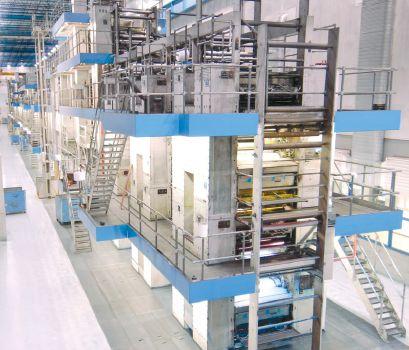
The Surrey plant, opened in 1997, featured a 50-inch Man Roland Colorman S press line that was initially installed for more than $80 million.
Spoiled For Choice
It is somewhat confusing these days when every press manufacturer throws out facts and figures to tilt stories away from the hardships they face, generally making it difficult for printers to understand what is relevant. It is an environment created by all types of press makers, sheetfed and web offset, high-speed inkjet, toner, wide-format inkjet and so on. There is a myriad of communications platforms these days on which to spin credible information into trivial commercial positions.
In today’s printing environment, high-speed inkjet press developers want you to believe their technology has arrived and is ready to replace offset. There is truth in this position if you are producing books or transactional statements, for example, but there is still much more development and market trial needed for high-speed inkjet to make a true impact on commercial printing.
Litho continues to dominate page production across the printing world, but it is certainly a mature technology on most industry lifecycle charts, typically defined by introduction, growth, maturity, and decline. The mature position of litho is defined by having passed both its emerging and growth phases, as earnings and sales slow relative to other printing sectors. It is understandably hard for many in the industry to admit, but litho is teetering on decline.
When it comes making million-dollar-press invest-
ments, it becomes important to not only properly compare each press maker’s technology platform, but to also look beyond the feeds and speeds to understand what factors will truly impact your daily business operation.
Press innovations and development
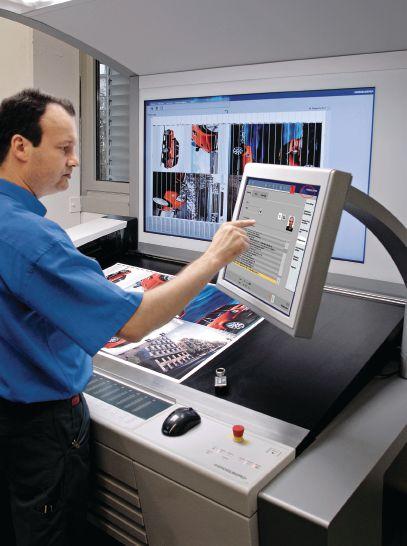
The major offset press suppliers, Heidelberg, Manroland, Komori and KBA, can boast about many of the same features today, even if innovation paths began in different areas. With its sheetfed size and scope, Heidelberg has been a press innovation leader, but Manroland would win the award for the most inventions. Vacuum feed tables, pneumatic side guides, declutching plate cylinders, next-generation delivery design, closed-loop colour control, all came about from the research-and-development of Manroland. These once unique production features can now be found on the presses of all major vendors.
Heidelberg can be credited with many of its own inventions, Prinect Inpress and Easycontrol being two major accomplishments in recent years. Seemingly less important features like the Wallscreen Console or dedicated die-cutting units can be considered as designed by Heidelberg.
KBA established itself as a web offset press manufacturer and transported many of its innovations into
The Future of Flexo.TODAY
The Flexo industry is evolving. Do you have the right partners to take your business into the future?
Packaging and great printing influence consumers when purchasing products. At Anderson & Vreeland, we understand this process and apply our experience, knowledge and best-in-class products to create custom solutions for flexographers. Our sales and technology consultants focus on understanding printer’s individual needs so your shop has the right technology for your
specific business, including CTP, color matching, digital printing on demand and more.
The flexo market is rapidly changing to meet increasing demands of the consumer package goods market. Finding the right partners today is key to building a print shop that’ll meet demands of the future.
Heidelberger Druckmaschinen AG last month noted the 10-year anniversary of its Remote Service support. After decades of narrowing the competitive gap in litho press innovation, price and support are today’s dominant investment factors for commercial printers.
BINDERY & FINISHING
Transparency in Environmental Printing
Sustainability reporting for a growing number of companies has become an integral part of building brand value and communicating to customers. It is an important way for all of us to assess a corporation’s commitment to social and environmental issues and help us make choices that match our own values.
Canopy, an environmental not-for-profit organization based out of Vancouver, has now collaborated with more than 750 companies involved with the printing supply chain. During our discussions, primarily working with these firms to establish environmentally sound purchasing and business policies, their committees always express a desire – and ever more regularly an RFQ requirement – to source forest fibre from non-controversial sources. Our corporate partners prefer that their printed products be produced on recycled and forest-certified papers and, importantly, that their printer has a finger on the pulse of sustainability issues.
“Online or offline claims by printers that are not readily available, verifiable and focused on these performance indicators, mean customers with credible sustainability targets risk building their efforts on a shaky foundation.”
This growing business need for environmentally responsible sourcing of print, however, is still far out of equilibrium because too many printers do not publicly report on sustainability indicators. Readily available, transparent information is crucial to any buyer in today’s market place, regardless of the product or service they are searching for. When an aware consumer is shopping for a can of soup, they look to the label for information on additives, nutrition content and other relevant facts. If there is none, that can is more likely to go back on the shelf in favour of a product that readily displays desired information.
The ingredient list on a can of soup, of course, is not quite the same as a sustainability report for a printer. These reports, often referred to as Corporate Sustainability Reports (CSRs), are macro versions of a product ingredient list, reflecting a printer’s philosophy, goals, objectives and honest tracking of efforts to achieve those outcomes. What a company chooses to publicly report on – or not report on – is now an immediate reflection of the depth of their commitment to sustainability.
As Canopy works with our corporate partners to help them realize their vision of sustainability, we witness a growing frustration with the lack of transparency around critical issues. Supply chain analysis becomes impossible when the ingredients of products or the sustainability vision, goals and achievements are not disclosed. Unanswered questions plague consumers, whether shopping for soup or for printers to produce their catalogue or annual report. Non-disclosure by suppliers, or worse yet the disclosure of anecdotal efforts, broad generalizations and aspirational goals with no tracking of actual outcomes leads to a buyer-beware situation that stymies customers’ efforts to realize their sustainability objectives.
Given that up to 80 percent of a printers’ carbon footprint is attributable to the papers they use, Canopy recommends that companies require their printers and paper suppliers to report transparently on the following key indicators:
• Pre- and post-consumer recycled content;
• Use of non-wood and straw content in papers;
• Virgin wood fibre from non-controversial forest regions that are FSC certified;
• Engagement on meaningful conservation initiatives that help advance the protection of endangered forests; and
• Support for the commercial scale development of sustainable paper alternatives such as papers with high recycled content, straw fibre or FSC virgin fibre content.
adopt the precautionary principle even when caution might not be necessary if there was more robust disclosure. Consequently, a printer’s lack of transparency on the key indicators noted earlier may lead to lost business. Often a printing company will not even be aware of losing this business, because in today’s market, consumers are having initial one-way conversations with a supplier’s Website.
Online or offline claims by printers that are not readily available, verifiable and focused on these performance indicators, mean customers with credible sustainability targets risk building their efforts on a shaky foundation. Extending transparency across all sustainability reporting platforms has become an essential customer service for companies like Levi’s, Disney, BestBuy and Staples which are generally unwilling to risk carefully built brand equity without concrete assurances.
We do hear concerns that by publishing goals, targets and progress on sustainability objectives a company might expose itself to criticism. For Canopy and many of our partner brands, however, public reporting of sustainability efforts is the first indicator of corporate integrity, especially around environmental and forest conservation issues. Even criticism provides an opportunity to learn where improvement is needed and what customers feel is important.
Companies have a responsibility to their customers to be open and honest on issues of sustainability. In return, choosing transparency can help build a strong relationship with clients, enhance a brand’s goodwill and create a value proposition that distinguishes a company from its competitors. Most of all, transparency helps reduce risk for business, for customers and for the ecosystems that sustain us all.
Canopy focuses on creating economic and environmental balance through collaboration within industries that purchase the largest volumes of pulp and paper products. neva@ canopyplanet.org
“Being web-based gave our entire sales team the ability to get out of the shop and where I want them - in front of their customer.”
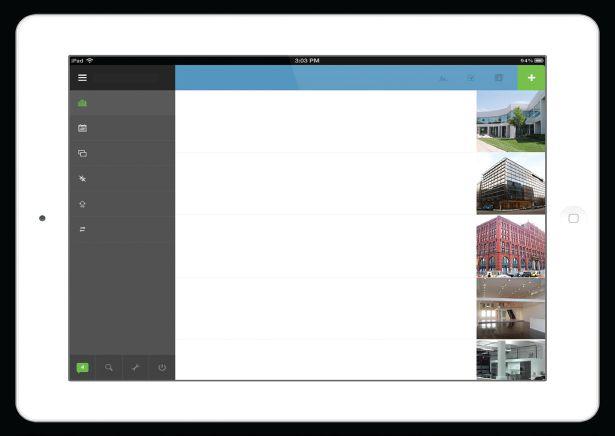
Avanti Slingshot incorporates business intelligence, production planning, fulfillment, shipping and billing into one easy-to-use and easy-to-implement cloud-based print MIS platform.
Digital Roundtable
In early-February, PrintAction brought together four printers to discuss the opportunities and challenges in today’s digital printing market, including two of Canada’s digital printing pioneers, John Roger and Marc Fortier, a trade printer in Dino Siriopoulos, and a digital printing entrepreneur in Seth Rodness, who is now helping to drive what is recognized as one of Canada’s fastest growing printing companies. The open, hour-and-a-half roundtable discussion primarily focuses on issues in liquid and dry toner press production, including topics like Web-to-print, sales, emerging applications, technology investment and developing internal resources. The group naturally ventured into areas like wide-format and high-speed inkjet printing, as well as the position of offset technology, to address the past, present and future of digital printing.
by Jon robinson
by
Photo
Katerina Maevska
John rogerS
executive Director, Dscoop founder, Dots &
Pixels
John Rogers is one of the founders of what most describe as Canada’s first digital printing company, Dots & Pixels. This position places him as one the country’s digital printing pioneers, working through the trials and tribulations of the initial Indigo press technology, which was eventually purchased by HP for more than $800 million in 2001. Today, Rogers continues to consult within the Canadian printing industry and in December 2014 was named as the Executive Director of Dscoop, which is the printing world’s most powerful user group focusing on HP printing technology.
Marc Fortier President, rP graphics group
Marc Fortier is widely recognized as one of North America’s most-influential digital printing executives, driving modern technology platforms into companies like Yorkville, Transcontinental, PLM Group, TI Group and now RP Graphics Group, which is a 60,000-square-foot facility in Mississauga, Ontario. RP Graphics was one of the first companies in Canada to install Xerox iGen technology and it continues to push this technology through Web-to-print and specialty finishing applications in combination with its offset and wide-format-inkjet printing power.
Seth roDneSS Digital Division Manger, Mi5 Print & Digital Communications
Seth Rodness has been involved with digital printing for three decades. After operating his own Print Three location for around 25 years, Rodness came to Mi5 five years ago to help with the company’s move into digital printing. Today, Mi5’s digital printing division runs two Xerox iGen4s, a Konica Minolta press, and four monochrome machines. For the past six years, Mi5 has been recognized as one of the fastest growing printing companies in Canada, which has been aided by its growing digital printing division.
Dino SirioPouloS President, tower Litho
Tower Litho is a Markham-based trade printing operation rooted in half and full-size sheetfed offset production. Around three and a half years ago, Tower Litho decided to move into digital printing with an HP Indigo 7500. The company differentiates itself by focusing on higher-quality printing for the trade rather than being a volume producer. Tower litho continues to emphasis printing on its four Heidelberg presses, including three 40-inch machines and one 29-inch.
how important is digital printing to your business?
Marc fortier: Our company derives 60 percent of its revenue from non-litho activities, which includes digital… many of the businesses that we serve, such as direct mail or Web-to-print platforms, fulfillment, print-on-demand, are all digitally based, so for us it really is a core part of our business, also with the expanding large-format digital business, which for us is part of the digital context… [Digital] is where we make the bulk of our investment both on the preprint and in terms of workflows and software and the post-print aspect; finishing, folding, gluing and specialty finishing. So it is a big part of company now and a big part of the future.
Dino siriopoulos: It is huge. We were very reluctant to get into it because we are doing a lot of print for other digital shops who have iGens and I am doing their offset. So we were debating, “should I get into digital or not”... All of the brokers that I work with essentially were pushing me in that direction… My clients have iGens, so we went with the HP [Indigo] which we felt best suited our business model... more of the fussy premium work; not necessarily generic, commoditystyle business. The HP fit well. We colour calibrate it and we use it every day. It runs 10 hours a day.
Sometimes [we] run the 40s based on the proofs from the HP, because everyone is trying to bring costs down… It is a fantastic device. The colour is sharp and some of the things that we can do: We are turning books around inside of 48 hours with tabs, perfect-bound and sometimes we will have a little bit of gold-foil lamination… so it is a nice compliment to the sheetfed.
s eth r odness: When I came [Mi5] had one small box, which I think was primarily used for internal documentation… After that first year we have gone from that small Xerox 700 to three high-speed black-and-white machines, one iGen4 and another Konica Minolta colour machine, so we grew quite rapidly… It enables us to offer a complete all-around service with litho components, digital component and with our wide-format capabilities. We can really present an entire solution to all of our clients now. It has really boosted the opportunities that were out there – tremendously.
We are offering Web-to print storefronts… a lot of our clients have offices all across the country. It is very easy from them all to get in and to order something that is standardized… It gets to the point where they do not care what they are paying. When their branding is that important to them, it becomes a situation where we can actually make some really good money off of it.
John r ogers: I know a fellow running Indigo technologies, very high-end Indigo technologies within a hybrid application… and his responsibility for this one application is 250-million pieces – it is not small potatoes… I remember being asked one time to give my thoughts on what the industry is going to look like five years hence and I flat out said, “[It] has nothing to do with the box.” It has so little to do with the box. It is all about information management be it Web-to-print or VDP or in conjunction with social-media applications. [A digital press] is an output device for the management of information and we all have to face up with that. And with things continually become more and more personalized you have to be in the business.
Are you purposing trying to shift offset pages onto your digital presses?
fortier: No, not for us… When we have that [offset to digital] conversation we really have to be specific about short-run digital toner or liquid-based technology. When we get to some of the new inkjet technologies that are being introduced right now, then we enter a different realm. That is where I believe you will see cannibalizing of the litho market both from a sheetfed and a web standpoint. Some of the big webs that are coming out of HP on the inkjet side, the 30inch webs, these beasts can produce 20-, 30-million impressions a month and definitely can claw away at [publication work], books, magazines and even on the commercial printing side. But for a commercial business like ours, we see [toner press] technology as a complement…. [For example], we produce 20 samples on our short-run digital ahead of the print run in order to get them to a sales meeting or something like that. So it is really a complementary technology for us, not a lot of cannibalizing going on, off of our 40.
siriopoulos: I agree – you hit it right on the head: It is a tool. It is just a tool
like everything else, so the job has to go through the appropriate device, whether it be a press, a digital device, large format, it doesn’t matter. As long as it colour calibrated, it looks good.
Being on time is one of the most-important things… [With digital] you can produce things on demand and, as long as it is calibrated, that is all the clients want. And most people purchasing print are a lot younger now. So seeing digital for them is the norm. I think calibration is one of the big elements. As long as your are colour calibrated to the GRACoL standard, that is key
rodness: We are actually finding that we are able to take some impressions off of our litho equipment, primarily off of our GTO especially with the 26-inch iGen4 that we have. We can run 6-panel or 6-page brochures that we have tons of; 500, 400, [digital] allows us to run them and run them profitably.
fortier: Definitely – if you have small-format offset, then that is a good point. We do not have small-format offset... but, that is true, [for small-format, digital printing] becomes a perfect substitute.
r odness: There are definitely some applications that allow us to move the impressions into a more profitable situation. I just ran two jobs, yesterday… there were two different versions, totaling 1,100… they were 4/4, so the cost to run that on the GTO would have been… we wouldn’t of had the work, put it that way… and this related to $2,500, $3,000 worth of revenue just going through digital.
r ogers: I think there are a lot of pages moving off of traditional technologies onto the digital platforms, because they are getting wider and faster and much less expensive to run. The break-even proposition is much different than what it used to be… Look at the photo books, for instance. That is a new application that couldn’t have been done five years ago… it is the new applications that I think are going to take up space.
I just think this trend will continue I think it is moving faster today than it has ever moved before, from offset to digital, but a lot of it is the new digital. It is the new applications that are driving this business when you can do things like Web to print – or Web to print with VDP jobs – where you are collecting data and driving
Konica Minolta continues to be your production printing solution when running high volume digital jobs that need to look great and be delivered on-time. Our latest digital press fleet outputs high-performance colour, accuracy, uniformity and stability — thanks, in part, to our G7 System Certification. Information management is critical in today’s fast-paced production printing environment.
Count on Konica Minolta as your business’ information management solution. To learn more, visit us at www.KonicaMinolta.ca
it to a press; All personalized in sort order for mail systems and so on. That is the real value going forward.
siriopoulos: And that is profitable… You run personalization on a small digital device, in a small format, on a machine that costs half a million versus a $3, $4, $5 million press. It is a completely different business model.
how important is finishing to a digital printing business model?
siriopoulos: I think you have to offer a nice breadth of finishing capabilities, at least stitching and perfect binding for the everyday items that are going to be coming off those machines. I do not think there is any point in not being able to finish it properly... You do not want to be sending things out to the binderies afterwards.
We also have an offline UV coater which allows us to give it more of a litho look on smaller runs and that really helps sell the job depending on the buyer, whether it is a newer buyer or older buyer. A UV finish on a small book is something that is really going to attract an older buyer to something that is a little more traditional.
rogers: Take photo books for instance: The bindery has to be an integral part of the entire production line. If it is not, you will not be in the business. I remember producing photo books 15 years ago; Very rudimentary, but somebody would bring in their photos… and you could sell it for a lot of money. When photo books became popular you could actually sell them for $30. Today, from a production standpoint, you have to be at $8, $9, $10 for a 24-page book. You need to have your costs taken out of the process.
f ortier: I think the equation here that everyone is referring to is value added; How much value do you add to the paper. If you look at VDP solutions, you have the front-end data, forms work and all of the requirements in order to deliver that variable piece, which is all value added to the print product… [It is] the same way with finishing. As John [Rogers] was saying, you are not in the game if you cannot finish the job, because you have to get it out the next day. Developing these capabilities on the finishing side allows you to become more efficient and take cost out of the process and add more value to the piece of paper… Which drives your profitability ultimately in terms of the amount of cash that you are generating in the organization. Where you would have had limited margin on a component of the process, you are now taking that margin over several processes and it becomes a more attractive piece of business.
is this why rP graphics focuses on developing specialty finishing for digital printing?
fortier: It becomes a little bit of a different mousetrap and [digital is] such a broad market… I believe companies like ours have to decide which areas of this market they are going to become very, very good at. So for us, the aspect of specialty finishing and fulfillment applications is a natural migration… we are more into tipping, folding and gluing, self-mailers… it is a lot of hybrid between our litho application and our digital application.
how difficult is it for a trade printer to stay as a trade printer when running digital, because it requires so many daily transactions?
siriopoulos: It is tough in trade because the work has to come to you. You really do not go out and push or drive a client in certain directions… For example, with Web-to-print I will set up a storefront for my client with their logo. We are invisible. We work in the background on it, but this is the value added part of the service that we are doing…
We were not specialists in digital printing. It is something that we learned as we went along. A lot of it was through HP and there are a lot of truths to what they were saying... but, in the end, I have a 5-colour 52 Speedmaster as well. If I factor in plates, labour, etcetera, I can be up and running in under $50, so I can still make more profit running it on the 52 than on whipping it over to the Indigo. The Indigo is faster. I can do more jobs per day and there are enormous amounts of efficiencies, [but] you have to put it on the right tool…
I still have to maintain my integrity – that I am not going to go after your clients. That is critical. I have to be true to who I am and who I represent. I almost feel like when I say, “I am trade,” that it takes away from something we are offering people…
I do not consider ourselves using [the] volume gang-run business model, but I do deal with brokers so that makes me a trade printer – that is the differentiating factor. I think we are giving a higher level of service, or I hope we are, and I hope we are giving a lot of value added.
how has Mi5 differentiated itself with digital?
rodness: I totally agree with what everybody is saying: You cannot be everything to everybody. You have to pick and chose what you do well and exceed at it… We consider ourselves to be a high-end, quality shop and we need to have our digital, both wide- and small-format, match what we can do in litho.
We are a very innovative company. Within the last three years, our upper management team developed print systems through our litho division and there isn’t anybody else, we believe in the world, that can match what we are doing on press with our Pro-Brite series and our MetalMaX series and so on.
With the Pro-Brite colours that we have developed, we can even do that in our wide-format department… that is where we are gearing all of our production through on the higher end. It has been successful for us and it has really helped us grow.
“The scope of service may go as far as providing support with design and things of that nature, but I do not think it would be in the nature of a printer to become a true agency…”
- Marc Fortier
how does a digital pioneer view differentiation in today’s market?
rogers: It depends a great deal on focus. Like the fellas are saying, pick and chose what you are good at, where you can add more value. Whether it is customer relationships, whether it is data management; Each one of these things takes a significant amount of investment as well.
I found in my own business if you can find a way to manage costs more effectively, provide data services more effectively, because that is what digital is all about now: Management of customer relationships, make it a seamless process. Those to me are the real things that can differentiate you. It ultimately saves in cost, but also from a service perspective that is more important than finding a particular product and going after it. I think it is [about] developing a solution approach to virtually everything you do. And then you can find value.
how can a digitally savvy printer become more of an agency, adding value, without stepping on the toes of your agency customers?
fortier: I think we just reframe that statement a little bit, in terms of trying to pitch it… I think that printers have to become more solutions oriented; to become consultative with their clients and define what challenges they are faced with and how the printer can assemble the tools to be able to overcome that problem… Printers have to bring more resources to the table than just, “Can I quote this job.” I think even for a trade printer, when we talk about Web platforms to support his clients… that is the type of service or solution that will differentiate printers moving forward.
The scope of service may go as far as providing support with design and things of that nature, but I do not think it would be in the nature of a printer to become a true agency… printers will become more solutions providers assembling the resources in which print becomes a component of the solution… our clients have to do more with less. Therefore, they are putting more of an onus on us to come up with solutions for them.
rogers: I remember knocking on doors of the agencies in the early days of digital and they didn’t have a clue… They really didn’t see that as part of their repertoire because it was all big-volume stuff… even personalization back then was black and
Just like the industrious honeybee, Canon understands that true productivity means thousands of parts working seamlessly together. At Graphics Canada 2015 we’re all about productivity, filling our 3,000 ft2 booth with the latest in technology from the industry’s most comprehensive portfolio of wide format and production printers. Whether it’s high quality printing on heavy, coated, or textured media, laminate flooring, packaging, or wallpaper, one thing is for sure, with the right equipment and software anything is possible.
Register with the code CANON15GC for free entry to the show and visit us at booth #1240 to find out more.
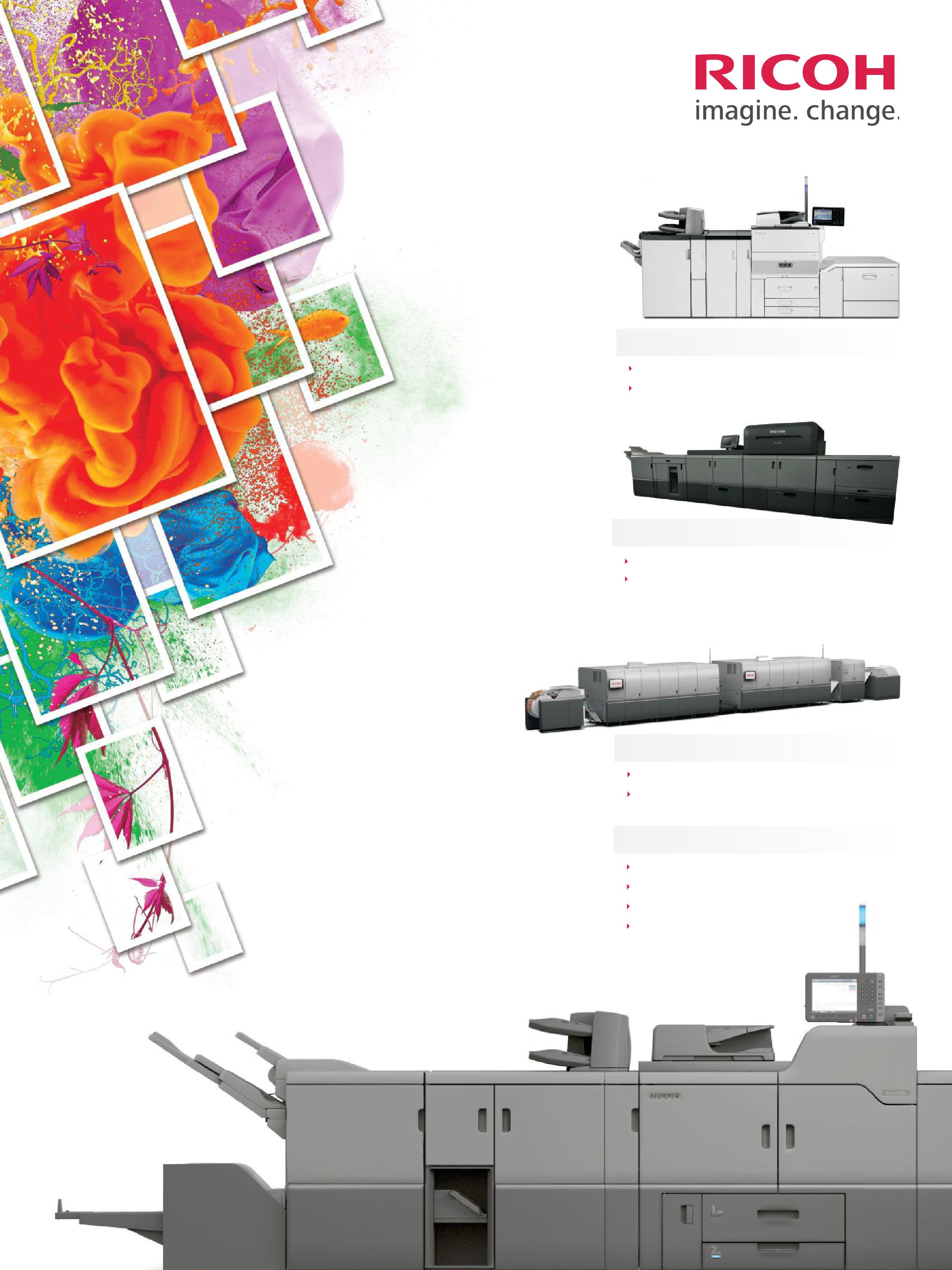
Invigorate your print operations with Ricoh’s ultra-reliable production printing systems and market leading service & support. Our cutting edge technology delivers outstanding colour consistency, quality and speed so you can handle the big jobs and quick turnarounds with precision. And with a wide range of size, media as well as our market leading service and support team, Ricoh has the machine you need to meet your printing demands – and grow your business.
For more information, talk to a Ricoh printing systems representative today.
Pro C5100S Series
High productivity and image quality
Versatile
Pro C9100 Series
Exceptional print quality and outstanding reliability
Best in Class Media Handling
Pro VC60000
High productivity, image quality and durability
Next-Gen Continuous Feed Inkjet
Pro C7100X Series
High productivity and image quality
Expanded application support Best in Class Media Handling
5th colour station for Clear & White Toner
white to them, your name and address on a communication vehicle… Today, the digital printer actually knows more than the agency and I say that in all honesty. I believe, as a digital printer, if you understand the application of information onto a printed document, or how it can be combined with a variety of other things, you become an agency – even to an agency… help them to be able to understand how to better utilize what they are doing for their clients.
Once with the publisher of Home Depot magazine… I use a Home Depot credit card… I went and bought a bunch of flowers for my daughter’s wedding… I said to them, “Why didn’t you start talking to me about that shift in what I was doing, my buying patterns.” They didn’t understand what I was talking about. And I said, “Think about it – now you can talk to me about something totally different.” Those are the kinds of things where a digital printer can really add value in a discussion with agencies or their customers themselves. Bring the agency in to do the creative, but it is the idea.
siriopoulos: I think the production is dictating creativity… people are going to [printers] and asking, “How do I do this, because I have to go to my client with something new and I do not know how to do it.” Since 2007/2008, all of us have had to get more creative and we have learned digital. We have learned large format. We have learned mailing. We have learned bindery. Historically, it has been put ink on paper and that is it… But now they are coming to us for these answers.
is there money to be made by investing in data management?
rodness: Absolutely there is money to be made. It is one of the leading areas where you can make money. It is not a commodity. It is not something that everybody can do. As with everybody at this table, it is one of the things that we do well and there is a price to pay for that. If they are not willing to pay the price then, “Well, you are free to go off and do it on your own, but you are not going to get the results.” There is a tremendous amount of money to be made.
siriopoulos: It is why there are so many printers who are changing their name to so-and-so media… because they are trying to say, “Okay, I am doing more than just ink on paper, what do you need.” And managing the data is critical.
fortier: John [Rogers] was touching on the issue when we talked about cannibalizing… or migrating, if you want to use a word that is not as offensive... I think the true attraction of digital in our market place right now is the new applications. [Some] are coming of age in the marketplace that present new opportunities. They can be captured through digital printing and or be serviced through digital printing…
From a technology standpoint… All of the true investment in new technology that is coming out in the next three, five, 10 years is all going to be digitally based. So, in the context of a printer not being active in the digital arena, and/or trying
to ignore that segment of the market as part of their business, it is going to leave them wanting.
It is not going to happen overnight. The ratio is still 90 percent offset to 10 percent digital, in terms of the volumes of pages, but digital is growing at a fast pace and there is absolutely no growth on the offset side. So overtime it is going to become the dominant technology in printing. And if you are not in, then you are going to be left behind.
how important has the advance in processing power been for digital printing?
r ogers: Doing a brochure, I think this was in 1996 and we were doing I am sure it was less than 100 and it was for Dodge, the auto manufacturer, and there was something like 15 or 16 different vehicles that had a number of variables, colours, seats that matched and so on… for less than 100 pieces. To process them, we would leave it running overnight, whereas this stuff today is phenomenal. It is beyond comprehension. Think about producing 30,000 photo book orders over a weekend – 30,000 over a weekend. The amount of horsepower that is required to process that blows me away.
“You have to be thinking about the world that you are playing in... If you look at how people want to be marketed to today, you have to be thinking digital.”
- John Rogers
fortier: It has made a significant impact. Technology is driving a lot of change… The challenge I believe we still face in the industry, that is still present right now, that is preventing us from moving forward with some of these applications, is the readiness or the commitment that the end-user companies have to their marketing efforts – the rigor that they need to implement and support a true variable application.
This technology will allow us to build a real strong relationship with our client… the tools are there to deliver this now [but clients] have to commit to it and stay with it, because if you do it for a month, the investment in the infrastructure will not provide you for a return. It needs to be done over 1-year, 2-year campaigns with adjustments and retooling. We talk about having to educate the clients and that is still very much a part of the game today.
what have you learned in terms of compensating salespeople for digital printing?
fortier: For me the biggest challenge would not be compensation, per say… Yes – you have a longer cycle but now you have a repeatable, sustainable sale as part of your portfolio, so the investment in time justifies the effort. I think the biggest challenge we face with the sales force is knowledge, especially with the part of a sales force that may have grown up on the offset side of the business.
We have overcome that through training and also by introducing something that is a relatively new concept for printers: A product specialist or product managers, people who are really industry-focused experts that act in support of our sales force and move the sales cycle forward.
with enough available resources, what printing technology would you invest in today: toner, inkjet or offset?
rodness: That can be a difficult question and I think we may all have different answers, because our clients are driving a lot of those decisions… it is really about buying the right equipment that is going to serve our clients properly and you do not want to buy a piece of equipment just because it has clear toner in it [unless] a client is requesting spot clear coat on the front of covers of all of their books, that is going to be driving impressions all day long… I see us increasing the better quality digital toner, potentially enlarging mailing… being able to fulfill from concept to Canada Post is a growing part of our business.
s iriopoulos: I would definitely get another Indigo again. I am happy with the product, but really what I would invest in is in people in the front-end to drive that business; To drive the Web-to-print, to have a series of specialists who can set up the portals through MIS efficiency, online advertising using Google analytics, and try to bring in work to the existing equipment or possibly new equipment.
fortier: You say our answers could be different, but I think they are very similar… I think faster and better is going to be the investment… Those are the technologies that I believe the printers on the digital side are going to continue to integrate. For some, it may mean a leap into highspeed inkjet to open new market opportunities. I do not think that will be for our company, but faster, better, creating efficiency, getting knowledge, making sure that we are very good at the applications that we support and, in that context, also effecting speed to market – being able to do it faster.
There are some challenges with toner-based technology in terms of our accelerating a particle beyond the speeds that we are experiencing now. There are some technical issues that may drive one away from toner-based to liquid-based type technologies, but I think faster, better will be the modus operandi for most printers who are committed to digital.
w hat advice would you share with for your fellow printers when it comes to digital printing?
r ogers: You have to be thinking about the world that you are playing in... If you look at how people want to be marketed to today, you have to be thinking digital. I am not saying that offset is going to go the way of the Dodo bird, but if you look at the largest player at drupa next year: The most space in that enormous facility there is being taken up by HP and Xerox will be closely behind. It is not the big-iron guys.
If you look at the number of PSPs in North America... in 2002 there were 50,000 print service providers. Today there are 20,000 and that is going out of business or being gobbled up by the big guys... If you want the latter, then make sure your business is really, really profitable, so you can sell if for a good buck. You have to be thinking digital.
fortier: Printers have to recognize the fact that [digital] has to be supported by knowledge. You need to have Web programmers, data programmers... workflow specialists... if someone has an engineering background, when
you look at automating workflows and things of that nature, it helps in a big way. You need computer specialists now to maintain your presses, but I think that is something escaping a lot of printers. Those who make a commitment to digital get it because you immediately understand it is going to be a knowledge-based business as we move forward.
r odness: We are all in agreement that [digital] is crucial… you have to get in quick or else you will not be around. My advice would be to do your homework, make sure you understand your business and clients’ requirements – what equipment is going to suit you to serve your clients best, initially,
and then grow from there. You can get into it on a small scale... but definitely do your homework.
s iriopoulos: We got in on a small scale. We didn’t bring in a specialist. We learned the hard way. If I were to go back, I would have had a bit more courage to say, “You know what, I want to bring in somebody who has already created it to run this department and really go for it.” Because I can see with every year [in digital] we could have progressed more. We are at a very good level now, but we could have gotten there a little bit quicker. But you have to have digital. It is not even a discussion. It has to be a part of your mix.
SHOW PREVIEW
Toronto International Centre Toronto, ON - April 16-18, 2015
Graphics Canada, taking place for the first time in spring, provides a new business approach at one of North America’s largest trade shows dedicated to the printing and imaging industry. This year’s show at the International Centre in Mississauga is to include three exhibit halls containing more than 200 exhibitors focused on providing technologies and services for the Canadian marketplace. The three-day event also includes a range of conferences, workshops and networking opportunities.
Exhibitor List
APRIL 16 - 18, 2015
Exhibitor list as of February 10th
Company
Flagship Courier Solutions 3919
Flyers4trade.com
(Canada’s Pride Printing Co.) ........................ 3120
Macaron Inc. .................................................... 2605
Magnum Magnetics 3413
Masterwork USA INC. 3119
Maxmedia Graphic Supplies Inc. 1215
Millenium Printing Inc. 1201
Mimaki USA ...................................................... 3319
Multi Color Tech Inc. 1068
Multiple Pakfold Business Forms 1229
Mutoh America Inc. ........................................ 3507
Neopost Canada 1058
New Magway Ltd. 2214
Outdoor Media Zone Inc................................ 2313
Outlet Tags Canopy Company Ltd. 2625
Packsize
PA152
GRAPHICS CANADA PREVIEW
PrintAction magazine asked exhibitors of the upcoming Graphics Canada trade show, running from April 16 to 18 at Mississauga’s International Centre, to provide details about the technologies and services to be highlighted on their booths.
Fujifilm North America
Fujifilm plans to run live demos of the Acuity LED 1600 and the Acuity Advance Select HS wide-format-inkjet systems. The Acuity Select HS flatbed has up to six channels offering extended colour, white and clear ink options. The Acuity LED 1600, with low-energy curing, is designed for companies new to wide-format-inkjet printing. Fujifilm is also setting up offset printing workflow stations running XMF workflow tools, including ColorPath, as well as ColorGATE software for wideformat. The booth will also include printed samples from Fujifilm’s Uvistar Pro-8 series and the Inca Onset UV.
Hans Shinohara Canada
Hans Shinohara Canada plans to highlight three primary systems, including a 5-colour Shinohara S75VHP offset press. The company will also highlight its new PUR perfect binder called Explore and the Hans Gronhi MQ 330 laser die-cutting system.
Insource
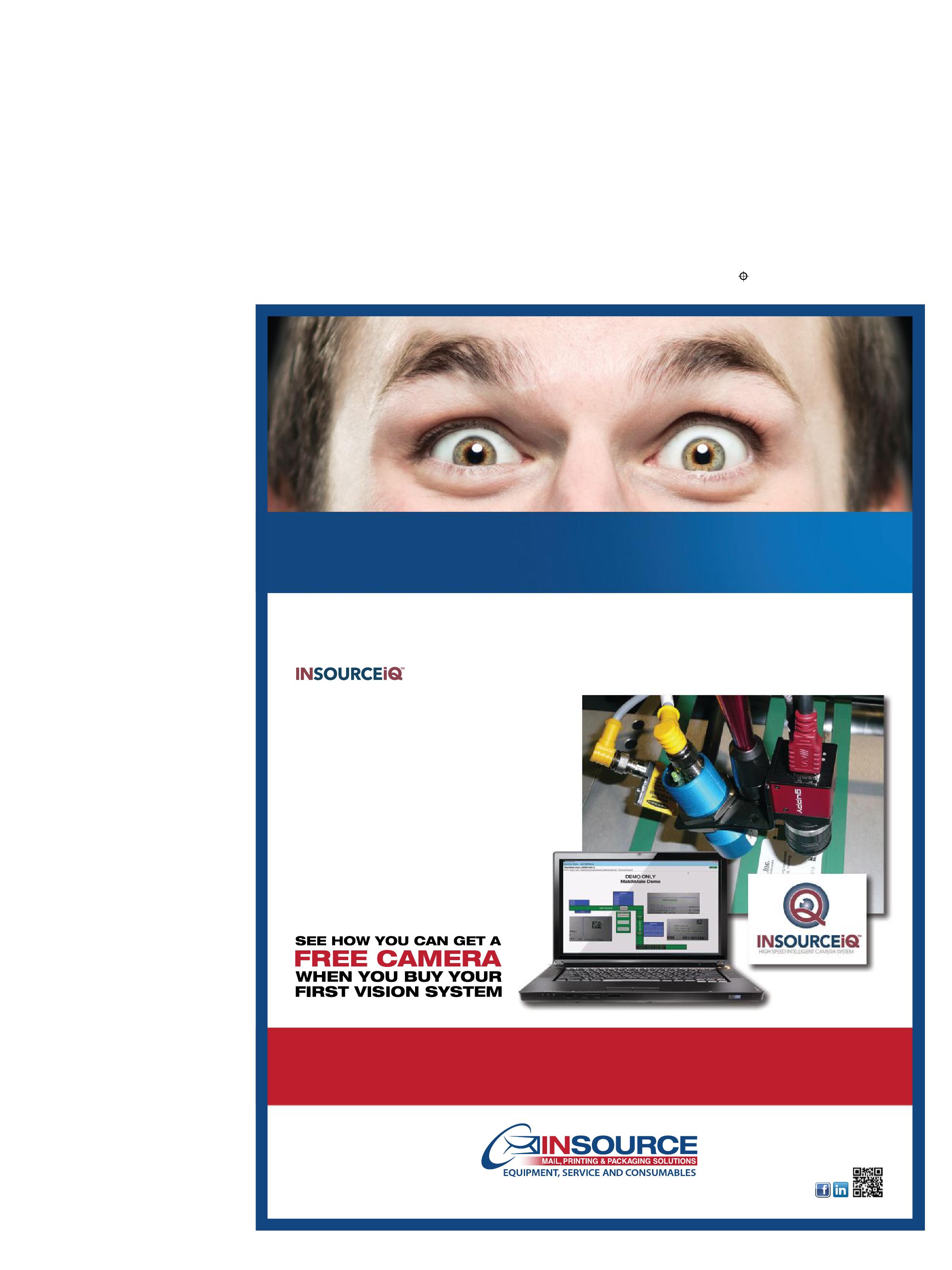
Insource provides technology, service and consultation primarily in the industrial segments of paper/card handling, packaging/fulfillment and mailing. The company plans to run daily demonstrations of the Insource IQ camera system, designed with verification, read & print, matching, association, intelligent feeder control, duplex printing, pattern recognition, selective inserting, and reprint queue. Insource also plans to provide an informal Insource Learning Centre environment with its business development personnel on the booth, discussing added value, diversity and profit opportunities, as well as educational videos featuring Insourcedistributed products.
Toronto Craftsmen’s Club
The Craftsmen’s Club is again providing its booth for the RyeTAGA initiative led by students of Ryerson’s Graphic Communications Management program. Students will be on hand to raise funds, discuss corporate sponsorship opportunities, and provide details about their annual research journal production for the Helmut Kipphan Cup competition at March’s 67th Annual TAGA Conference in Albuquerque.
Hans Shinohara’s new Explore binder.
Acuity LED 1600.
Tiimports
Tiimports, through its FancyPaper.ca and EnvelopesCanada.ca domains, is a wholesale provider of fine stationery and envelopes, as well as specialty papers, cut stock and folio that are made for inkjet, laser and HP printers.
SmartSoft
SmartSoft plans to demonstrate its PressWise software for Web-toPrint, MIS and workflow automation. These include enhancements to PressWise’s Job Scheduling functionality and the addition of new customized reporting tools, allowing staff and management to gather insight important to their roles and responsibilities.
Southwest Bindings
Southwest Bindings plans to demonstrate its ALM 3222 automatic laminator as a portable system handling 13x19, 12x18, 11x17, 8.5x11-inch sheet sizes. It features warm up of less than five minutes, automatic flush or sealed-edge trim, and 115 Volt, 15-amp service on economy mode. The ALM 3222 automatically feeds up to 200 sheets and laminates papers as heavy as 130-lb cover stock.
Magnum Magnetics
Magnum Magnetics, which provides direct-printable flexible magnets in rolls or cut sheets, plans to highlight its DigiMag brand printable media. Magnum will have product development experts on its Graphics Canada booth.
Zünd
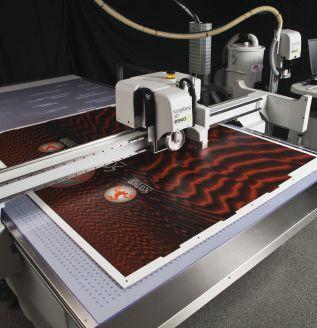
Zünd plans to highlight its Total QR-Code Automation system, which is driven
through the Zünd Cut Center (ZCC). In a static-bed, tandem vacuum setup or fully automated, with automatic sheet-/roll-feed and integrated robotic off-load, Zünd cutters using QR-Code Automation have the ability to run without interruption. This is possible, according to Zünd, regardless of whether the graphics are nested, or of what sequence single or multiple stacks of printed sheets are fed onto the cutting table. ZCC automatically captures the embedded QR-codes, retrieves the corresponding cut files and keeps cutting.
Konica Minolta
Konica Minolta will demonstrate its bizhub PRESS C1100 and bizhub PRESS C1060/C1070 production systems on its booth. The bizhub PRESS C1060/C1070 features up to 70ppm output speeds, PC-like operation with handheld mouse, and image density and colour density control sensors. The system has a 7,500-sheet paper capacity and auto duplexing of up to 300 gsm. It can handle 100-sheet stapling, 200-page booklets and 600-page bound books. The bizhub PRESS C1100 features 100-ppm speed, in both colour and monochrome, Enhanced Simitri HDE toner, and 1200 x 1200 dpi resolution with 8-bit processing. The C1100 has a 13,890-sheet capacity, handling weights from 55 to 350 gsm.
Epson SureColor F7170
Epson plans to highlight its SureColor F7170, SureColor F2000 and SureColor
S3 - Now with Total Automation
PressWise launched in Canada in late-2014.
QR-Code Automation reduces stoppages.
Inside the bizhub PRESS C1060.
T5270 printing systems. The F7170 roll-to-roll dye-sublimation transfer printer is for polyester-based textile manufacturing or soft-signage applications. It features a 64-inch-wide media feed and take-up system and new Epson PrecisionCore TFP print heads for use with UltraChrome DS inks. The SureColor F2000 Series marks Epson’s entrance into the direct-to-garment market with two inkjet printers. The SureColor T5270 is a large-format colour imaging system designed for producing technical drawings, graphic posters, and retail signage at high speeds.
Sydney Stone
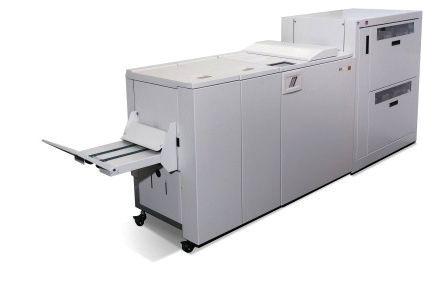
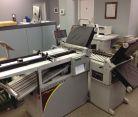
Sydney Stone is exhibiting, for the first time in North America, the new Morgana 350 and 500 booklet-making systems. As either a handfed offline unit or a near-line fully auto-feed system, the Morgana BM 350/500 will staple and fold up to 35/50 sheets with optional face trimming and spine squaring inline. It is designed to produce booklets on all types of coated and art-quality paper.
Multiple Pakfold Business Forms
Multiple Pakfold Business Forms, established in Canada in 1952, will be promoting its short, medium and long-run forms, cheques and labels.
4over
Trade printer 4over is highlighting new packaging and promotional product capabilities, such as signage, 80-lb gloss flyers and booklets, as well as a new Every Door Direct Mail (EDDM) solution available through 4over.com. The company’s growing packaging focus includes a Custom Box quoting tool for most any dimensional box. Con4rm is a drag-and-drop online tool developed by 4over to inspect artwork files.
Sihl
Sihl, which primarily develops unique medias and coatings for wide-format production, is highlighting its 3275 TexBanner Xtrem white 145. This 100 percent synthetic, non-woven banner features a water-fast inkjet coating, developed as an alternative to Tyvek. Sihl is also highlighting its 3550 ClearSol Wet Cling film 125: This cling film – using an ink receptive layer with a water-activated composition – was designed for window advertising but can also be used as a normal clear film. Sihl also plans to showcase 3241 DisplayPRO designed for HP latex printers.
CMD Insight
CMD Insight, the exclusive distributor of LasX Industries, plans to focus on the STS250 250W CO2 entry model with single laser (future expansion possible), as well as the LasX STS400 CO2 model with one or two lasers. The STS product handles sheets on the infeed section and the finished sheet on the output. Each model has the option of scaling from one to two lasers depending on needs of the user.
Treckhall
Treckhall plans to exhibit its new XMR 2.0 Magnetic Receptive Media, described as an environmentally progressive product available as 8-mil and 13-mil 100 percent opaque, 2-sided synthetic (non PVC) material. The company is also highlighting its Umbra Display Materials, InView line of Nano Grip non-adhesive white and clear
The STS400 can include two lasers.
Sihl produces a range of coated materials for wide-format inkjet
Morgana BM 350/500.
products, Ritrama adhesive vinyls, window films and lamination/mounting products. Treckhall also plans to showcase Magic Inks for HP Latex, Canon, Epson, Roland and Mimaki printers.
Roland DGA
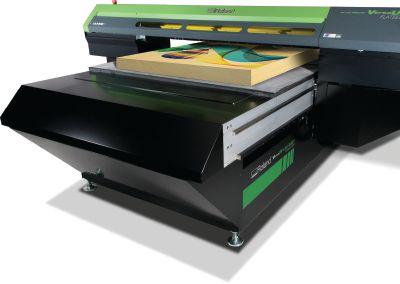
Roland plans to showcase its new VersaUV LEJ-640FT flatbed UV printer, designed to handle a range of substrates, including heavy, rigid materials up to six inches thick and weighing as much as 220 pounds. The VersaUV LEJ-640FT uses Roland’s CMYK, White and Clear Coat ECO-UV inks to produce POP displays, interior design, art, promotional products and 2-sided signs incorporating unique dimensional effects. Other LEJ-640FT features include a zoned vacuum system for holding difficult materials flat, a low-heat UV-LED curing system, and a handheld control unit.
Drytac
Drytac plans to showcase its WipeOut substrate, released April 2014. It is described as a premium, dry erase, hard coat laminate with a chemical and scratch-resistant gloss surface. It can be paired with graphics printed on ReTac Wall, released December 2013, as an adhesive matte PVC film to create removable wall graphics with most solvent, UV and latex printers. Drytac is also highlighting its Interlam Pro laminating films and various adhesive-coated products manufactured in Canada.
Esko
Esko plans to showcase its Suite 14 software, with a focus on ArtiosCAD, as well as i-cut Suite, Automation Engine for signage production, and the Kongsberg XP24. With a maximum working area of 70 x 141 inches and a top speed of 66 inches per second, the Kongsberg XP24 can convert a range of board, sheet and roll materials. An optional conveyor extension is available that can work with rolls or sheets/boards with an Auto-Feeder with scissor-lift and transfer cart system, expanding the quantity of print runs that can be pre-stacked.
Rollem
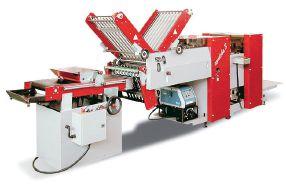
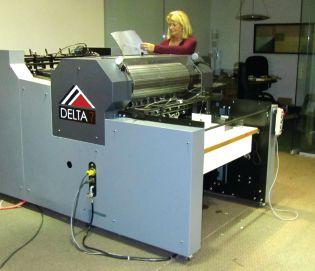
Rollem plans to highlight its new line of Delta die cutters at Graphics Canada. The rotary sheetfed flexo-magnetic systems feature what the company describes as a small footprint, quick changeover and economical price point aimed at the digital print market. Delta can produce work like shaped cards, decals and labels, presentation folders, door hangers, bottle-neckers, and folded cartons. Handling sheet sizes
Esko’s Kongsberg XP24.
Rollem’s Delta die cutter.
Rollem’s Delta die cutter.
from 20x15 up to 24x30 inches, it can include provide complete box production with an optional inline folder/gluer unit. The models can also handle 20-lb paper up to .022-inch board.
Primera
Primera plans to highlight its CX 1200 label press and FX1200 finishing system, LX900 label printer and AP362 label applicator. The CX1200 delivers full-colour label printing, utilizing what the company describes as one of the fastest and highest-resolution colour laser engines available. It can be integrated with the FX1200 finishing system to provide an all-in-one offline solution to cut, label, rewind and laminate.
Announcement Converters
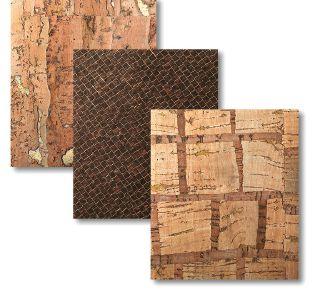
Announcement Converters plans to exhibit a range of its unique substrates for marketing materials, including Gmund Urban (four colours in three finishes), Corkskin (actual cork veneer laminated to paper that is printable), Wood (actual Birch and Cherry wood veneer that is laminated to paper and is printable), AVEO (tree-free paper made from the waste of sugarcane with some waste products from linen and hemp), Crane’s Crest envelopes, Gmund Cotton Max White paper and envelopes, Savoy Grey paper and envelopes, MirriSparkle, Colorplan 260# cover, and Enclosure/Escort cards, folders and envelopes.
Ricoh
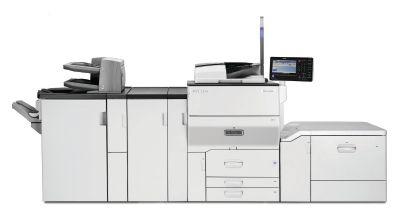
Ricoh plans to demonstrate its Pro C7100 and Pro C5100 Series presses on its booth. Released in September 2014, the Pro C7100 Series features print speeds of
up to 90 ppm and supports media up to 360 gsm. Image quality up to 1,200 x 4,800 dpi is achieved with Ricoh’s enhanced Vertical Cavity Surface Emitting Laser (VCSEL) technology. It supports a range of media, including new textured media technology, as well as varying applications like light packaging, demo packaging, direct mail, books, brochures and business cards. The Pro C7100 Series features a fifth colour station allowing for clear gloss or white applications. Ricoh will also highlight its Pro VC60000 and the Pro C9100 systems, which will not be on the booth.
Racad Tech
Racad Tech is a Canadian developer of modular Web-to-print technology. This includes its Web to Print Shop product that will be highlighted at Graphics Canada. Web to Print Shop provides individual modules for printers to use with their existing solutions or a full suite of corporate portals and retail Websites using a browser-based template builder called uDraw. It can create products like business cards, invitations, signs/banners, t-shirts, flyers and other miscellaneous items. Racad also recently launched Online Sign Studio, which offers Web-to-print tools for wide-format printing.
GTI Graphic Technology
GTI plans to discuss its Soft View SOFV-1xiQ, EVS Executive Viewing Stations, PDV Professional Desktop Viewers, Color Rendition Demonstrator, and Vertical Wall Viewing Systems. Soft View SOFV-1xiQ is a desktop soft proofing system that provides colour comparisons between hardcopy prints and computer monitors. The SOFV-1xiQ includes a viewing station and the wireless iQ sensor.
Ricoh’s Pro C5100 Series.
Corkskin paper.
The system enables lighting uniformity with a small desktop footprint that meets ISO 3664:2009 D50 light quality for strong colour rendition. The EVS D50 viewing stations combine electronic ballasts with Graphiclite T8 fluorescent lamps to produce light evenness, rear wall illumination, and energy efficiency.
Mutoh
Mutoh plans to showcase its 64inch ValueJet 1624 eco-solvent printer and the ValueJet 426UF. The company refers to the ValueJet 1624 as “The Wrapper’s Choice” printer. The ValueJet 426UF is tabletop UV-LED printer. It carries a 19x13-inch format for printing on virtually any item up to 2.75-inches thick. Mutoh explains the 426UF is designed to produce customized promotional items like pens, phone cases, golf balls and hockey pucks.
RISO
RISO plans to demonstrate one standalone model, the ComColor X1 9150 inkjet printer, as well as a digital duplicator (model not yet determined) and the RISO Print To Mail Solution. The Print To Mail system takes electronic files and outputs completed, ready-to-mail direct mail pieces, fully printed, addressed, folded, stuffed, sealed, and ready to go – all inline. RISO explains the unique system as a full direct mail house in a box.
Afinia
Afinia Label plans to highlight its L801 Memjet-powered desktop label printer, as well as the DLP-2000 Memjet-powered label press and the DLF-1000 label finisher.
EZ Trade Signs
EZ Trade Signs is making available the new 2015 version of the EZ Trade Signs Retail Catalogue. The company designed the catalogue to serve as a sales tool for small- to medium-sized print shops. The catalogue includes product descriptions, illustrations and pricing for a range of sign products. EZ Trade Signs is also highlighting its revamped Website with features to get quotes, place orders or check on the progress of existing orders.
Xerox
Xerox plans to exhibit its new Xerox Versant 80 press in addition to the existing Versant 2100 model, as well as the Xerox Color 1000i press and Color C60/C70 systems. The 1000i press is to be configured with 2-tray oversized high-capacity feeder, GBC AdvancedPunch and Booklet Maker Finisher with the Xerox SquareFold Trimmer Module, and EFI EX Print Server. The Versant 2100 is to be shown with 2-tray oversized high-capacity feeder, Standard Finisher Plus with Plockmatic Pro 50/35 booklet maker (with Rotate Crease and Bleed Trimmer), and EFI EX Print Server. Offline systems at the booth are to include the CP Bourg BSFEx and Duplo DC-646. Software highlights include FreeFlow Core, FreeFlow Digital Publisher, XMPie StoreFlow, and Prisme PrintSys Web-to-print software.
BCT Mississauga
BCT Mississauga, the largest BCT franchise in Canada, a part of a network of more than 35 locations in North America, is highlighting its specialization in short- to medium-run printing of stationery products in spot colour (flat or raised thermography ink) or four-colour process, either offset or digital. BCT is also introducing its new line of laminated products like business cards and menus.
30 years experience working on offset presses Specializing in the box board industry Service offerS include:
RISO Print To Mail system.
ValueJet 426UF.
Solutions for the Printing Industry
❏ One program manages entire company
❏ Enter data once and use it many times
❏ Enhances client service
❏ Work smart, work efficiently
❏ Increases speed - accuracy from estimates to invoices
❏ Eliminates duplication of effort
❏ Saves time and resources
Graphics Manager
ForOffset,LargeFormat&DigitalPrinters
Online tours: www.bardsolutions.com
email: info@bardsolutions.com
tel: 416-410-BARD (2273)
Nick Howard, Continued from page 8
sheetfed machines. Planeta, which Koenig & Bauer fully acquired by 1994 after years of increasing ownership, gave KBA the market to build major business around folding carton. Although KBA has supplied long perfectors for years now, the press maker has benefited most from its carton business. Gravuflow, the Anilox inker concept, was first developed by KBA. It is Heidelberg, however, that now exerts the most impact through this inking concept. Branded as Anicolor, Heidelberg has made the Anilox system available on 20- and 29- presses, soon possibly 40-inch machines.
Komori is the world’s dominant Japanese press supplier. The country is well known for taking a methodical approach in technology development, rarely first to market but often improving upon or perfecting innovation. Komori receives credit for automating plate changing and on-press camera inspection systems (PQA) and regularly illustrates one needs not to be first if you get it right.
quickly. LED is a curing concept made by several manufacturers beyond Panasonic. Logistics have been commonplace for many years. Heidelberg has been instrumental in designs to feed and remove pallets. KBA has many installations of this kind, as does Manroland. Komori is just starting to enter this sector. Logistics are mostly limited to those operations with longer runs like carton printers.
Competitors like to suggest Komori presses are less comparable to their own press developments, but this is not true. All of the inventions that originally came out of Germany are available on today’s Komori machines. In fact, it is likely this methodical Japanese development that allows Komori to avoid major catastrophes in printing press introductions. There is a great deal of synergy to all Japanese machines whether made by Komori, Ryobi, Mitsubishi or Akiyama. Drives tend to be the same, electronics and lubrication systems are made in Japan. It can be difficult to source parts in Japan, but the major strength of Komori and all Japanese machinery is world-class engineering. This means less need for spares and support once machines are settled in.
Press automation and logistics
When it comes to speeds of make-ready and colour control, all sheetfed press manufacturers offer essentially the same benefits today. Technically, each can boast reduced waste, faster up to density times, faster changeovers and reduced power consumption.
Drying systems are mostly made by third parties and can vary. Komori teamed up with Iwasaki Electric (EYE) to modify a conventional UV bulb by eradicating the IR generation. In so doing, they have branded the system as HUV, which is now marketed extensively. The advantage of this curing process, however, has all but dissipated as all manufacturers have similar low-energy curing systems or can install them. Specific inks are required, but suppliers are expanding
Lubrication systems vary. Recently Komori announced it can run vegetable or food-grade oils. This sounds terrific if you are in the foodstuffs- or pharma-printing sectors, but it is meaningless for the vast majority of printers. Food-grade lubricants have been around for years. Packaging lines use them extensively and they are specially designed and usually odourless. The advantages of this technology can also be easily lost as oils mix with ferrite, graphite and perlite not to mention all of the other wear and tear metals that exist in every printing press. In terms of looking for the lowest average cost of ownership, Komori takes first place. Almost every key press invention that has moved the offset process forward, however, came from either the United States or Germany.
Many in the industry mocked Heidelberg’s Autoplate introduction as slow and operator intensive, but it worked –and worked well. Earlier fully automatic designs by Komori and Mitsubishi were complex and, as they aged, became a major source of expense. Manroland had the best system when in 1992 PPL and Benderless simple plate change was introduced on its 700 Series. Today, every one of the manufacturers has a lightning fast plate-change system.
With this balance of press innovation among competitors, price and support become the two key factors of determining what new press to buy. Price is always the number-one consideration, but support has a powerful role to play. How many technicians are available? Are they based in all major print centres or do they have to be dispatched at big expense? How do prices for parts and consumables compare? Is there a 1-day availability of parts?
Heidelberg, Manroland, KBA and Komori are historically sound companies and can each claim to have the best modern press features. Some may run a little faster or have unique secondary tools, but each press maker has a solid flagship machine. They all make-ready very fast, control colour well, and print amazing work. Sheetfed innovations are so close today that ultimately price and support will determine what you consider to be the best new machine for plant.
Your Printing Experts
DigitAL Print oPerAtor wAnteD
FT experienced digital print operator required in Brantford, Ontario. Operating Xerox iGen and Nuvera printers with FreeFlow software and related bindery operations include cutting, folding, saddle stitching, scoring, stapling, perfect binding, Plastickoil binding. Hours 8:30 –5:00 Monday through Friday. Additional hours may periodically be required. send resume to careers@distributech.ca
estiMAtor wAnteD
Experience in estimating/print production/customer service for sheetfed and web printing. Computer skills in print costing software, excellent communication skills. Print management degree an asset.
email resumes to hrdept@west-star. com or fax (416) 201-0920
for sALe: Used 40” offset printing presses: Heidelberg CD102-6LX 2002
• Challenge 3 hole hydraulic Paper drill - $2,095.00
• GBC PF 3200 Perfect Binding machine - $2,500.00
• Baum Folder Bell & Howell pile feed 17.5” X 22.5” - $1,500.00
• Heidelberg wind mill 10 X 15 red ball - $2,500.00
• Heidelberg wind mill 10 X 15 red ball - $2,500.00
• Original Heidelberg Cylinder die
cutter SGB 22 X 30.25” - $19,000.00
• Dick Moll Folder gluer straight line & presentation folder attachment - $23,000.00
• Baum System 310 booklet maker - $2,900.00
• Konica Minolta 6500 colour - $9,900.00
• Konica Minolta 1050 pro fully loaded - $12,000.00
• Canon image runner 7095 black / white - $3,900.00
• Canon image runner 7095 black / white - $3,900.00
• Bostitch 4 Head Stitcher - $1,750.00
• Stahl Folder with right angle$4,500.00
• Steel rule die maker complete tools sets - $2,500.00
• Dock Plate - $125.00
• Letter press furniture’s - $100.00
• 3 - Mini hand foil press - $125.00
• Brand new skid banding machinecomplete sets still in box $ 275.00
• Paper drill single head $ 150.00. All type of tools and counters. Entire Print & Print finishing shop can be move, it comes with $ sales make an offer. All machines are under powered and can be tested reasonable offers will be accepted. Please call at anytime 1 416 605 7214 Alam. prestigeprintfinishers@yahoo.ca
wAnteD: Schematics for a 1986 Schneider Senator 76 SC Cutter. We are not sure of the serial numbers but this is what is on the back of the machine. NASCH NR 81134 or SCHOLBILD NR 01-51.650… Contact: (306) 782-8211 – steveParkland Printers Ltd. or email: parklandprinters@sasktel.net
Heidelberg: K-Line/S-Line/ Speedmaster/GTO/MO
Komori: 1,2,4 or 5 colours & an Adast : 714/715/724/725
Mitsubishi: Any model Ryobi: : 2800CD/3200CD Itek: 960/975/985
Hamada: 500/600/700/800
Polar: 72/82/90/92/107/115 CM
Horizon-BQ: 220/240/260/440/460
March 1985
Virtual ban on leaded gas is ordered by EPA; The first Internet domain name is registered, symbolics.com; IBM-PC DOS Version 3.1 is released; and WrestleMania I sees Hulk Hogan and Mr. T beat Rowdy Roddy Piper and Paul Orndorff.
New head office and Plant for hostmann-steinberg
Hostmann-Steinberg Printing Inks moved into a new 26,000-square-foot manufacturing plant and corporate North American head office in Scarborough. Hostmann-Steinberg produces all web heat-set and coldset, sheetfed and letterpress inks, ink additives and foundation solution concentrates for the North American market in Canada. The number of high performance computer-controlled bead mills, so called COBRAs, has been increased to four.
the Price of a sales Call in 1984
According to the Laboratory of Advertising Performance, based on McGraw-Hill Research’s biennial survey, the average industrial sales call cost a whopping $204.40 last year. That is 15.1 percent higher than 1981 and 2,177 percent above the $9.02 it cost to make a call in 1942.
The real kicker comes when you compare the rise in the cost of a sales call to the rise in the cost of living. According to the U.S. Department of Labor, an item that cost $1.00 in 1942 costs $6.47 today. That’s a 637 percent increase in the cost of living, which leads us to the disturbing observation that the cost of a sales call has risen 3.3 times the rate of inflation.
richmond hill Printer expands with Fourth Miehle rolland
A new Miehle Rolland press was installed to meet the scheduled start-up of Bradbury Tamblyn and Boorne Ltd.’s new plant in Richmond Hill, Ontario. The company’s fourth Miehle Rolland is a fully computerized six-colour, 40-inch model. It is equipped with the latest in electronic controls including the Computer Controlled Inking System (CCI) and the new Electronic Plate Scanner (EPS). The six-colour machine allows the company to offer clients additional colours, which are being requested more and more frequently in the Toronto market.
typesetting terminal introduced by howson-algraphy
PRO-PRINT TypeCount is a microcomputer-based phototypesetting terminal that provides tools like foreground justification and foreground hyphenation with driver programs for the Linotype range of phototypesetters. Other TypeCount facilities include: background communication, complete emulation of the host typesetter keyboard, full editing, high text storage capacity, disc-to-disc options on CRTronic equipment, and a single terminal for full business applications like estimating, word processing translation programs, databases, and communications software.
Operating one of Hostmann’s new COBRA bead mills.
PAPER PRODUCTS
BANNER & FILM
PRESSURE SENSITIVE ADHESIVES
LAMINATES
TEXTILES
RIGID BOARD
Delivering
A CONCISE RANGE OF MEDIA FOR QUALITY INKJET PRINTING.