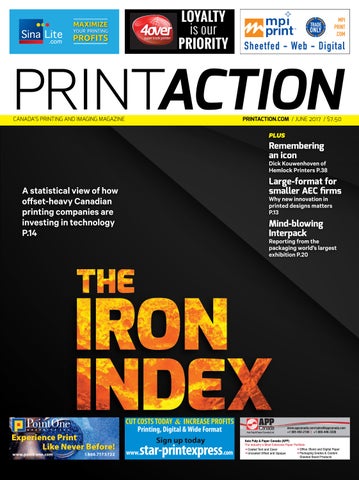
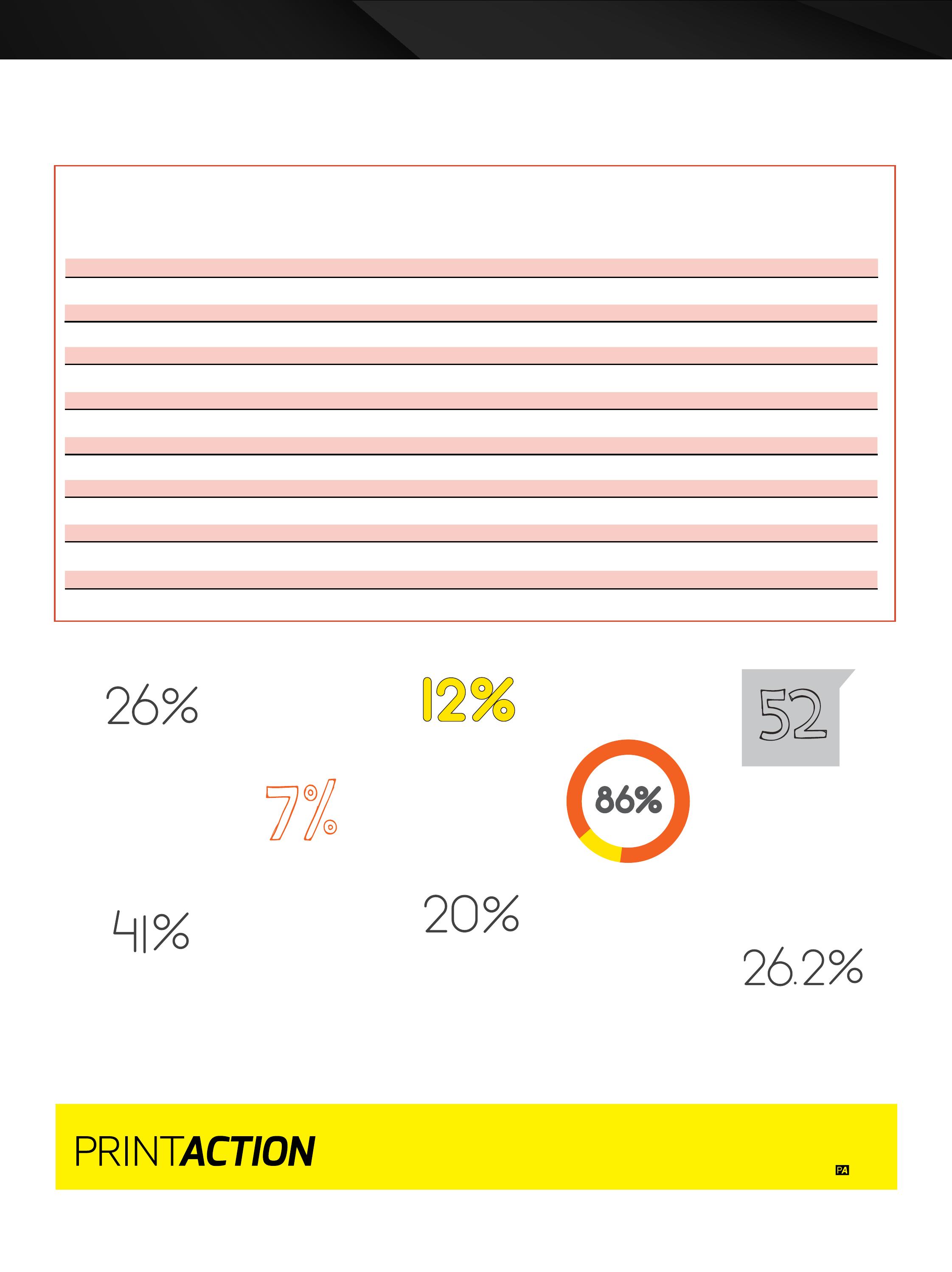
A snapshot of inkjet, toner and offset investments of commercial printing companies across Canada
20 A mind-blowing Interpack
Reporting from the floor of the packaging world’s largest trade show with a record 2,865 companies and countless innovations
22 Packaging simplified
A technology update from the floor of EskoWorld, hosted by one of the industry’s most powerful packaging suppliers
DEPARTMENTS
GAMUT
5 News, People, Calendar, Dots, Installs, Globe, Archive
TECH REPORT
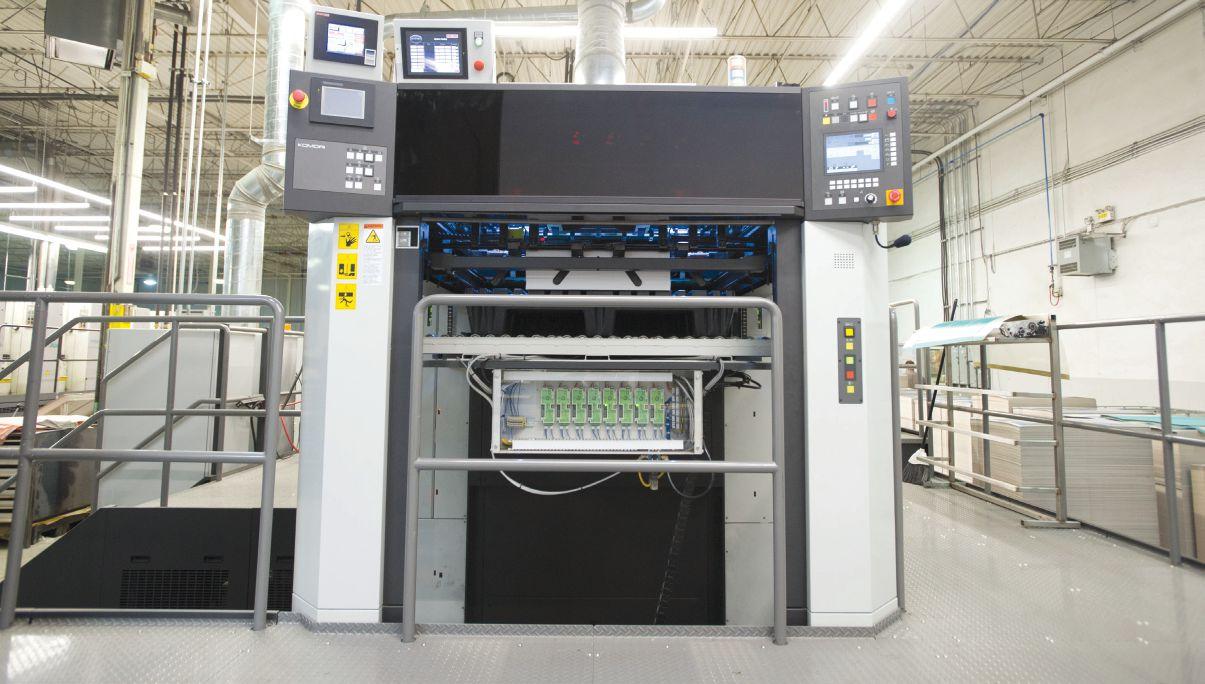
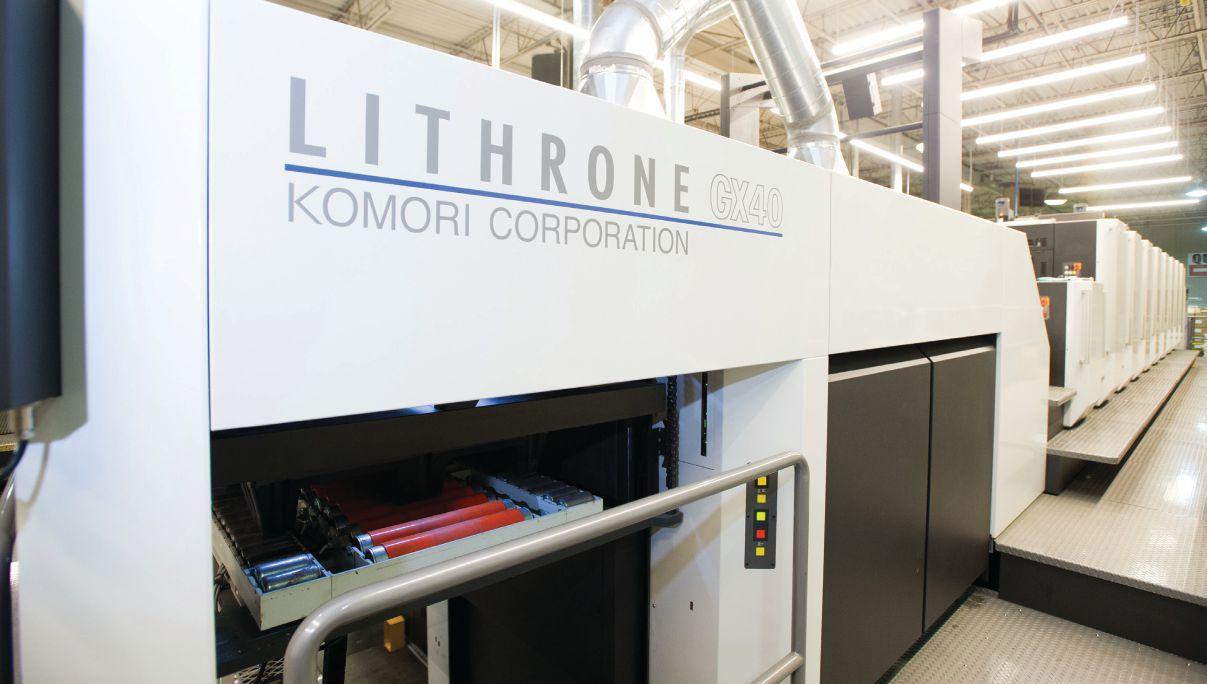
25 Advances in sheetfed offset Sheetfed offset forges ahead with new cost-saving features and innovations
NEW PRODUCTS
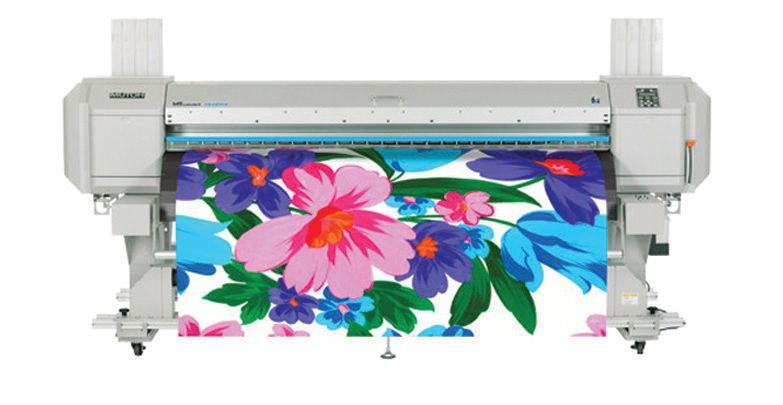
30 Detailing the newest technologies from Agfa, AstroNova, Avanti, Drytac, EFI, Enfocus, Esko, HP, Mutoh, Mimaki and Schreiner ProTech
MARKETPLACE
37 Industry classifieds
SPOTLIGHT
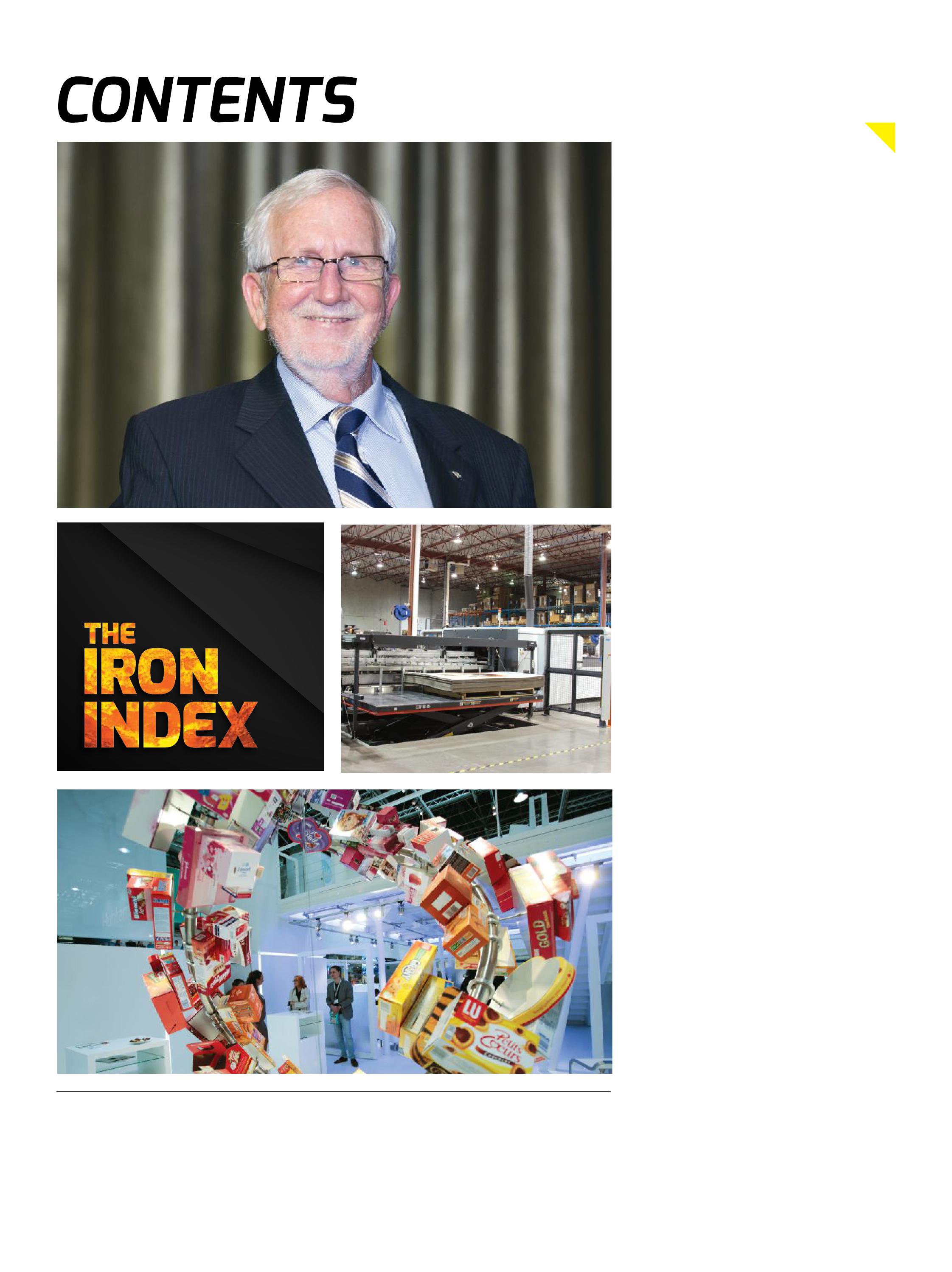
38 Dick Kouwenhoven, Chairman of Hemlock Printers in Burnaby, BC
COLUMNS
FROM THE EDITOR
4 Jon Robinson
Dynamic digital labels
Future Market Insights finds toner and labels are creating a new opportunity
ENVIRONMENT
10 NEVA MURTHA
One of these things is not like the other
The difference between endangered and second growth forests in relation to print
DEVELOPMENT
12 David Fellman
Orphans in the marketplace
A sixth potential new print customer is becoming more prevalent
TECHNOLOGY
13 Danny Ionescu
Large-format for small AEC
Print progress for Canadian architecture, engineering and construction firms
Dynamic digital labels
Anew report by Future Market Insights estimates the demand for digital printing in packaging will grow at 15.3 percent to surpass US$52 billion in revenues by 2026. This growth figure is based on what the research organization estimates the current demand for digital printing in packaging to be, valued at over US$11 billion in 2016.
According to Future Market Insights digital printing in packaging will grow at 15.3 percent to surpass US$52 billion in revenues by 2026.. 15%
According to the report, the key factors fuelling demand for digital printing in packaging include growing preference for conventional/analogue plates and their application in printing jobs of shorter run lengths. Adoption of digital printing in packaging, explains Future Market Insights, is also growing on account of its convenience, to reduce turnaround time, over conventional presses.
The shifting preference from conventional printing is also fuelled by variable data printing and personalized printing. Leading packaging companies are adopting variable data printing, explains the organization, owing to its use in direct marketing.While Future Market Insights maintains a positive outlook on the global digital printing in packaging market, it is of the opinion that high variable costs and limited opportunities in indirect sales channels can impede widespread adoption.
Production by electrophotography (digital toner presses) is the largest segment, accounting for over half of revenue share by technology type. In terms of revenues, this segment was valued at just over US$6 billion in 2016. FMI projects it to grow at 16.6 percent CAGR and surpass US$32 billion in revenues by 2027.
By product type, labels is the largest segment, accounting for over US$7.1 billion in revenues in 2016. Future Market Insights estimates demand for labels to increase at 16.7 percent CAGR to reach US$38.4 billion in revenues.
By product type, the other key segments for digital printing in packaging include: films and wraps, bags and sacks, boxes, folding cartons, bottles, cans; and pouches and sachets.
Considering that electrophotography and labels are currently driving the highgrowth sector of digital packaging, which has been much slower to move away from traditional processes than in commercial printing, HP is clearly leading the charge.
In fact, HP at the end of 2016 explained that labels and packaging represent the company’s fastest-growing graphics segment worldwide, with both digital label and packaging production projected to grow at double-digit percent. According to HP, Indigo labels and packaging financial projections, L&P hard-
ware and supplies revenues have grown by double-digit percentages since its 2015 fiscal year and the company projects this to continue into 2017.
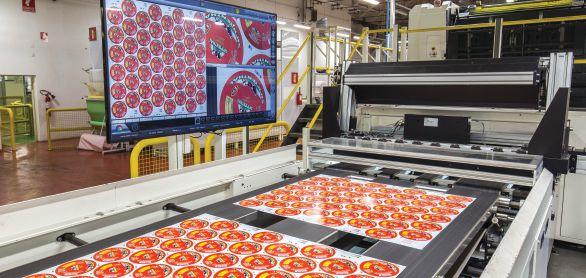
HP has long established presses in this space with fourth generation machines in the Indigo 8000 and WS6800, in addition to the new 20000 and 30000 machines which provide a larger format size. At drupa 2016, the company also introduced an HP Indigo Digital Combination Press demonstration of fully integrated, single-pass digital embellishment printing, which will target longer run label production.
Today HP Indigo customers generate about 70 percent of the revenue from all digitally-printed pressure-sensitive labels produced worldwide, according to HP internal competitive hardware value market share data, and that percentage is projected to increase as more converters adopt HP Indigo 8000 presses to gain new game-changing efficiencies and capabilities.The HP Indigo 8000 doubles the production speeds of current narrow-web digital presses.
“As brands, converters and print providers reevaluate their business models to adapt to changing market conditions, demand for digital labels and packaging solutions is rising, and HP is addressing this demand today by ramping manufacturing and delivering production-ready presses at customer sites worldwide,” said Alon Bar-Shany, general manager, Indigo division, HP. “Leveraging HP Indigo’s continuous innovation, our labels and packaging customers are providing world-class brands unprecedented solutions to improve margins, while growing their own businesses by more than 25 percent per year, and driving a fundamental shift in how the printing industry does business.”
The labels segment by product type, according to Future Market Insights, is estimated to hold the highest market share by the end of the projected period, accounting for more than 70 percent of the global market share by the end of 2027, up from 64.1 percent in 2016. The segment is anticipated to register highest market attractiveness followed by the folding cartons segment. These segments together accounted for close to 75 percent of the market value share in 2016 and are forecast to account for more than 80 percent of the global market share by the end of the anticipated period.
Editor Jon Robinson jrobinson@annexweb.com
Contributing writers
Zac Bolan, Wayne Collins, David Fellman, Victoria Gaitskell, Martin Habekost, Nick Howard, Neva Murtha, Abhay Sharma
Publisher Paul Grossinger pgrossinger@annexweb.com 416-510-5240
Associate Publisher Stephen Longmire slongmire@annexweb.com 416-510-5246
Media Designer
Lisa Zambri
Circulation Manager
Barbara Adelt badelt@annexbizmedia.com
Customer Service
Angie Potal apotal@annexbizmedia.com
Tel: 416-510-5113
Fax: 416-510-5170
Mail: 80 Valleybrook Drive, Toronto, ON, M3B 2S9
COO
Ted Markle tmarkle@annexweb.com
President & CEO Mike Fredericks
Subscription rates
For a 1 year monthly subscription (12 issues): Canada — $40.95 Canada 2 year— $66.95 United States — CN$71.95 Other foreign — CN$140.00
Mailing address
Annex Business Media 80 Valleybrook Drive Toronto, ON, M3B 2S9 printaction.com Tel: 416-442-5600 Fax: 416-442-2230
JON ROBINSON, editor jrobinson@annexweb.com
Heidelberg in the final quarter of its financial year 2016/2017 (January 1 to March 31, 2017) recorded what it describes as its best sales and result since 2008. Sales after 12 months were slightly up at €2.524 billion (previous year: €2.512 billion). In the final quarter alone, sales increased by just under 20 percent to €845 million (previous year: €710 million). In the period under review, Heidelberg states incoming orders of €2.593 billion bucked the industry trend, up significantly up from the previous year’s level (€2.492 billion). Heidelberg also saw an improvement of nearly €60 million in the free cash flow to €24 million. At the beginning of February 2017, the company established its new Heidelberg Digital Technology (HDT) and Heidelberg Digital Business & Services (HDB) segments.
TC Transcontinental launched a process to sell all of its newspapers in Quebec and Ontario, which are controlled under the Montreal company’s TC Media operation. The sale process, which Transcontinental expects to span several months, involves 93 publications. The move came just days after the company sold its publication portfolio in Nova Scotia, Prince Edward Island, Newfoundland and Labrador, and New Brunswick to SaltWire Network Inc. That transaction included the sale of 28 brands and four printing plants. In June 2016,
Transcontinental sold its publishing assets in the province of Saskatchewan (13 newspapers) to Star News Publishing.
Printing For Realtors, an online printing service aimed at helping realtors, launched Printingforrealtors.ca last month to focus on the Greater Toronto Area’s booming housing market, as well as Ontario’s. It is described as a printing company located in Toronto that specializes in providing business cards and direct-mail postcards. “We believe that our unique focus on realtors allows us to provide the best service for anyone looking to sell houses,” said Raymond Wali, CEO of parent company The World Is Global, which hopes to expand past the market in Ontario into other provinces.
Sun Chemical entered into an agreement with HP Indigo to develop coatings to help drive digital printing in the packaging industry. “Printers and converters have already invested in digital presses and need specialist coatings and varnishes that would enable packaging applications to be printed digitally according to market requirements and standards,” said Felipe Mellado, CMO, Sun Chemical. The digital coatings will include overprint varnishes and adhesives.
Electronics For Imaging of Fremont, California, acquired privately held CRC Information Systems, a Reynolds and Reynolds
company. Based in Scottsdale, Arizona, CRC is a provider of business management information systems (MIS) for commercial printers and packaging label and forms printers throughout the United States and Canada.
Kodak’s manufacturing facility in Yamanashi, Japan. The $15 million project represents one of the company’s largest capital investments since 2000. Kodak explains its Flexcel NX plate sales volume grew 16 percent in 2016 compared to the prior year, a rate four times the projected growth rate of the flexible packaging market itself, according to Smithers Pira. The new Oklahoma flexo plate line is expected to be in full production by early 2019 and will initially focus on supply of Flexcel NX plates to customers in the U.S., Canada and Latin America.
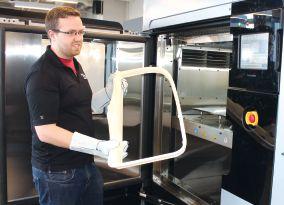
Niagara College installed a Fortus 900mc Gen. 2 to become Canada’s only material beta testing facility for Stratasys 3D printers. The college’s advanced manufacturing division acquired the new printer with funding support from the Federal Economic Development Agency for Southern Ontario. It is housed at the Walker Advanced Manufacturing Centre at Niagara College’s Welland campus. The Fortus 900mc is described as an advanced FDM (Fused Deposition Modeling) system, capable of printing objects that measure more than 36 x 24 x 36 inches and providing an unlimited materials selection including highly specialized materials for medical, dental, aerospace, automotive, food production and general manufacturing. The college is well known for its metrological inspection capabilities.
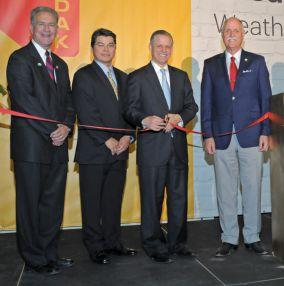
Kodak in late April held a ground-breaking ceremony in Weatherford, Oklahoma, to celebrate a $15 million capital investment to accommodate a new flexo plate line for Flexcel NX plates. The new Weatherford plant line will be a sister operation to
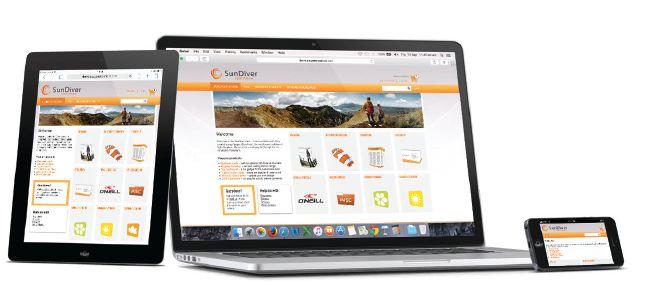
Rainbow Printing of Sussex, New Brunswick, launched a new Web-to-print platform based on the work by Eden Advertising & Interactive and Racad Tech Inc. Rainbow opened in 1995 and today provides security and commercial offset printing services. Eden of Toronto managed the Website front end and Racad Tech implemented its Web-to-print tools, including uDraw, Web to Print Cloud, and Web to Print Shop.
Xitron, a developer of RIP and workflow products has shipped more than 4,500 units of its Screen interface kit, which allows computer-to-plate devices to be driven with any RIP or workflow, according to the company. The Screen interface kit is capable of driving platesetters from Agfa, ECRM, Creo, Kodak, Presstek, Heidelberg, Fujifilm and Screen.
Goss International of Durham, New Hampshire, acquired Loudon Machine of Illinois in an asset transaction. “This is our second acquisition in 2017 to help grow our aftermarket business and enhance our product offerings,” said Stan Blakney, COO of Goss. “This purchase focuses on the post-press segment of the market, and enables us to enhance our bindery products and service - parts capabilities.”
Mohit Uberoi, CEO and President, Goss.
Loudon Machine specializes in the worldwide supply of new and refurbished bindery equipment, parts and service, with a product line extending from saddle stitchers, feeders to shuttle hoppers, test stands and trimmers.
Kodak CEO Jeff Clarke cuts the ribbon in Weatherford.
A Niagara College student works on the very first Fortus 900mc project in Canada.
François Olivier, President and CEO, Transcontinental.
INSTALLS
Koenig & Bauer AG appointed Ralf Sammeck (pictured) and Christoph Müller to its Executive Board.
Sammeck currently leads KBA’s Sheetfed division and Müller the company’s Digital & Web division.
Sammeck has now taken over the coordination of global equipment sales and Müller is responsible for KBA Services.
KBA set a target in revenue share generated by Services to be 30 percent by 2021, which is also a target year for the company to reach an annual organic growth rate of around four percent and an EBIT margin of between four percent and nine percent. Of the targeted €70 million increase in earnings, approximately €20 million in either case is to be generated through service growth and the optimization of KBA’s security printing business. To focus on its security printing business, KBA delegated Dr. Andreas Pleßke to the Executive Board for a period of one year.
Tom Dack is to lead Huge Paper Inc.’s expansion into southwestern Ontario, which is to service the area from Kitchener west along the highway 401 corridor to Windsor, and north to Sarnia. “Growing demand from that part of the province warrants a Huge presence on the ground to provide our digital printing products locally and deliver our legendary customer service,” said Jeff Tapping, President of Huge. Based in Bayfield, Ontario, Dack has more than 30 years of experience in printing .
Clark Scherer was promoted to Director of National Account Sales by Komori America, while also maintaining responsibility for his currentMidwest sales territory. Scherer joined Komori in 2006 as a Special Programs Sales Associate. He was promoted to District Sales Manager in 2007. Prior to joining Komori, he held the position of Sales Manager at Webpro, a company that specializes in new and used web presses and services.
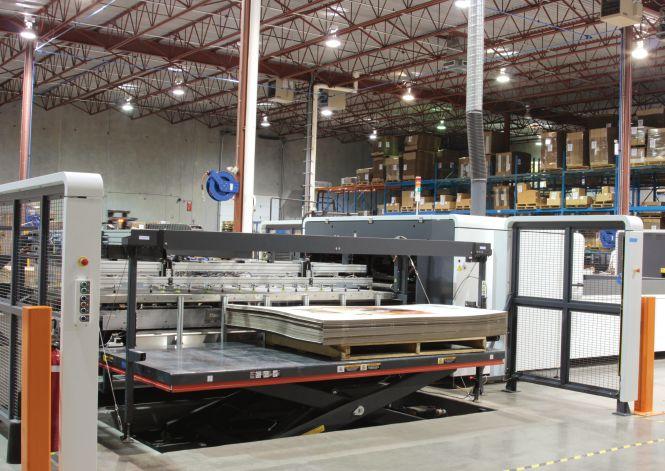
Ideon Packaging of Richmond, BC, is leveraging a new HP Scitex 15500 corrugated press primarily to create point of purchase displays. The company, which has been in the packaging industry for more than 15 years, rolled out the HP Scitex 15500 press as an upgrade from a previous HP large-format printer installed in 2012.
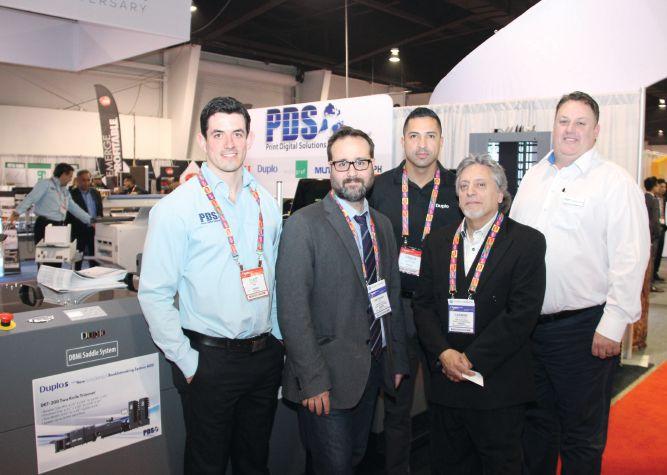
Imageworks Print & Prepress of Richmond Hill, Ontario, acquired a new Duplo 600i booklet system through PDS. Celebrating the purchase at Graphics Canada are Brett Kisiloski of PDS, Antony Orsi of Imageworks, Carlos Lara of Duplo, Carmine Machhione of Imageworks, and Danny Grant of Duplo.
Christian Duyckaerts becomes President of FESPA, self-described as the global federation of associations for the wide-format printing community. He is FESPA’s 17th President, and will be supported during his term by VP Christophe Aussenac. Duyckaerts joined the Board of FESPA in 2002, representing the Belgian printing trade association Febelgra, where he presides over the screen and digital workgroup.
Dick Ryan, VP of Sales & Marketing for Publishers Press, has been elected Chairman of the Idealliance Board of Directors, which includes: Tom Glassman of Wilen Direct; Edward Jansen of Canon; Todd Maute of CBX; Catherine Monson of FASTSIGNS; Brenda Pang of Idealliance China; Anita Pursley of LSC Communications; and Frank Tueckmantel of EFI. Warren Werbitt, CEO, of Montreal’s Pazazz, continues as a member of the Idealliance board.
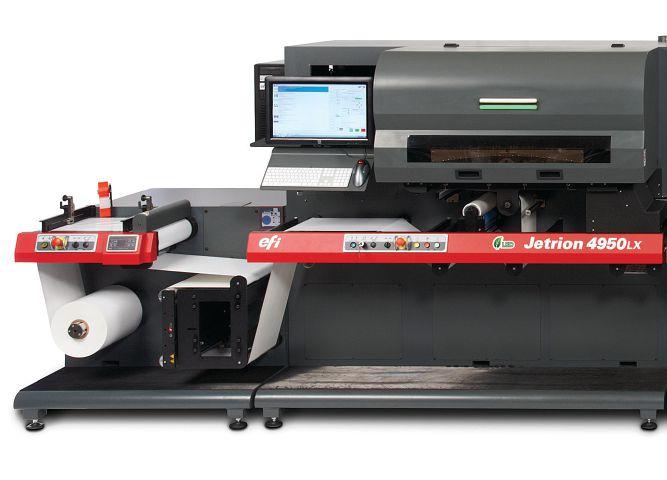
Allegra South Burnaby, in British Columbia, installed a 13-inch EFI Jetrion 4950LX LED inkjet label press, with an EFI Fiery front end. The Jetrion is a four-colour plus white model with inline laser die cutting, varnish and lamination, configurable with up to 16 blades, back-scoring and dual-spindle rewinding.
GLOBE
KBA Rapida in Kuwait
Jassim Mubarak Al-Jassim founded Al-Resala Printing Press in Kuwait back in 1968. He had been working as a journalist and felt an entrepreneurial drive to establish the company as the first printing operation in the area to produce modern, high-quality publications, based upon the principle of customer proximity.
The social impact of media transformation continues to be felt in Kuwait and by Al-Resala. The company was forced to decommission one of its two web-offset presses. In the sheetfed sector, on the other hand, Al-Resala still sees growing demand in the market and decided to invest accordingly in the future. General manager Marzouq Al-Jassim explains, “We considered all the possible scenarios and analyzed corresponding press types and configurations. And we came to the conclusion that the Rapida 105 is currently the best choice for us... and could well imagine an investment in another press from the Rapida series as the next step.”
The company has worked with KBA presses from the outset and relies on servicing by the Al-Kharafi Group. Its new Rapida 105, a five-colour with coater and extended delivery, entered production at the beginning of the year. “For us, it is not maximum automation which counts, but rather the mature technical basis of the press – things like the excellent paper travel, the perfect interaction of the inking and dampening units, and the ease of operation,” said Adel Al-Salem, Press Manager at Al-Resala Printing.
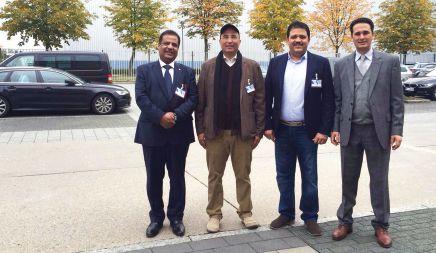
and Noureddine Amalou, Sales Manager, MENA, KBA-Sheetfed Solutions at KBA’s facility in Radebeul, Germany.
Fleetwood adds Evolution in City of Industry
Fleetwood-Fibre Packaging & Graphics of City of Industry, California, works closely with brand owners to create unique package designs and high-end printing. Founded in 1952, Fleetwood-Fibre today services a range of packaging markets like folding cartons, corrugated box and display, rigid set-up cartons, thermoforming and contract packaging work.
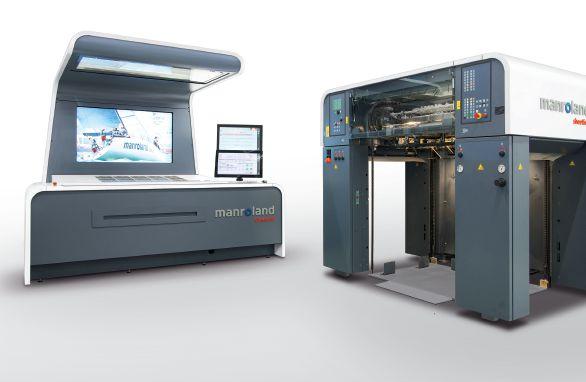
The newest technology addition to its Folding Division is the first Manroland Sheetfed R707LV Evolution press to be installed in North America (excluding Mexico, which is not overseen by the same Manroland division). Fleetwood-Fibre’s press is equipped with seven units plus an inline tower coater and fitted to run both conventional and UV inks.
The 700 Evolution platform, unveiled in 2014 to supersede both the Roland 700 HS and 700 Direct Drive, includes developments like a redesigned central console with touch-screen control. The 18,000-sph Evolution features a new feeder pile transport, Manroland’s new suction belt sheet handling technology for a more even pile contour, all-new dampening units in the press, bearings that significantly reduce vibration and software for practice-oriented roller washing cycles.
“Deciding factors for us were the functionality of the make-ready automation, coupled with Manroland Sheetfed’s Inline ColorPilot and System Brunner’s Instrument Flight systems. The ability to make-ready simultaneously in mere minutes is impressive, but the colour control capability in a closed-loop system providing grey balance and tonality control in production is fantastic,” said Mark White, Senior Vice President of Manufacturing at Fleetwood-Fibre.
Crown inspects with AVT in Italy
Crown Imballaggi Italia – part of Crown Holdings Inc., one of the world’s largest food metal packaging suppliers – recently installed a new AVT Titan inspection system at its Calerno, Italy, plant. Designed to meet the specific needs of metal printing and decoration, AVT’s Titan provides 100 percent inspection and traceability of every printed metal sheet.
Titan detects a spectrum of typical print defects like colour variations, mis-registration (including varnish mis-registration), misprints, spots, text, streaks, scratches, splashes, scumming, edges and bends. “AVT’s Titan was an essential complementary element to the [Calerno] installation of our KBA 6-colour printing press for metal packaging... among the most important for our company. Our customers are among the best-known brands in retail distribution. Quality is not a prerogative here, it is imperative,” said Ugo Manghi, MPC Manager of the Food Division, Crown.
Inland Packaging, a 73-year-old company focused on label and packaging, makes its first digital press acquisition with the HP Indigo 20000. The new press was installed at its facility in Neenah, Wisconsin.
Left to right: Magdy Gomaa Ahmed, Senior Sales manager, Kharafi; Marzouq Al-Jassim, GM, Al-Resala; Adel Al-Salem, Press Manager, Al-Resala;
Fleetwood-Fibre’s new R707Lv Evolution press is a first install for Manroland Sheetfed North America.
Ugo Manghi, MPC Manager at Crown Imballaggi Italia, explains 10 percent detection of print defects by AVT’s Titan enables company to significantly improve printing quality.
ARCHIVE
25 years ago
Printed in Canada: Canada’s $331 million printing trade deficit with the United States was a matter of great concern for the CPIA delegation.
International Trade Minister Michael Wilson was told the U.S. trade regulations regarding imported printed matter are much stricter than in Canada. He made a commitment to raise the issue in the upcoming NAFTA negotiations with the U.S., Canada and Mexico.
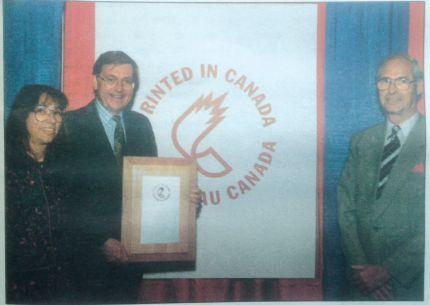
To counteract the country-of-origin marking regulations in the U.S., the CPIA unveiled a new Printed in Canada logo. As many as 4,000 Canadian printing firms are expected to use the logo as part of an industry-sponsored Buy Canadian initiative. The bold new logo is expected to appear on millions of printed pieces every year.
20 years ago
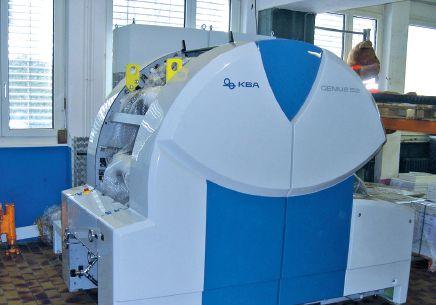
News from Imprinta: KBA-Planeta and Scitex Corp. have introduced the 74 Karat digital offset press. Being developed jointly by the two companies, the 74 Karat is optimized for short- and medium-run printing jobs (up to 20,000 sheets). It’s a four colour 20.5 x 29-inch waterless offset press with a running speed of up to 10,000 sheets per hour.
In other news, Heidelberger Druckmaschinen AG and Creo Products Inc. have announced a far-reaching agreement in principle for a partnership in the area of computer to plate systems. The agreement encompasses joint development, production and marketing of co-branded CTP solutions for the printing industry.
$22.5K
For sale (2001 classified): Screen 20-inch Capstan Imagesetter, Harlequin RIP, Agfa processor for $22,500. Scitex Dolev 400 Imagestter, Dual PS2 RIPs, Trapping, Fuji processor $22,500.
15 years ago
$40k
For sale (1992 classified): Heidelberg letterpress SBDZ 24 1/4 x 35 1/8 2-colour or Print or Diecut. Excellent condition and under power $40,000.
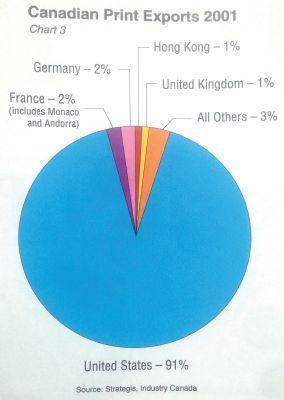
Canadian Print Exports: Not surprisingly, the vast majority of Canadian print exports go to the United States. What is interesting is how quickly exports are becoming an important part of total output. In 1994, Canadian printers exported 7.12 percent of all the goods they produced. By 2001 that amount
had doubled to 15.59 percent of total shipments. Last year (2001), Canadian printers exported $1.8 billion of printed material, with 91 percent of it going to the United States.
Canadian print exports in 2001 based on data from Strategis, Industry Canada.
Unveiling the official new Printed In Canada logo in Ottawa are (l to r): CPIA President Willy Cooper, Industry Science and Technology Minister Tom Hockin, and CPIA Chairman Warren Wilkens.
A Genius 52 at Zurich-based Feldegg, installed in 2005, which was also the first printing house in Switzerland to install a 74 Karat waterless, keyless DI offset press.
DOTS
Amarula is made with sugar, cream and the fruit of the African marula tree, the latter of which is enjoyed by elephants. This association creates an important tie between the distiller and the some 400,000 African elephants remaining alive in the wild, which is why Amarula is creating the same number of unique bottle labels.
17%
The Amarula spirit was launched in 1983 and, with an alcohol content of 17% by volume, holds the taste of slightly fruity caramel.
Amarula’s 400,000 unique elephants
Amarula, the South African producer of cream liqueur, is now releasing a special edition of 400,000 bottles with its well-known elephant branding individualized by HP Indigo digital printing. The goal of the project is to raise global awareness for the remaining 400,000 African elephants, where are endangered. The African elephant has been the icon of Amarula Cream Liqueur since its inception. This limited edition of Amarula Cream Liqueur is an added dimension to the brand’s Name Them, Save Them African elephant conservation project.
In collaboration with HP, SA Litho, a Cape Town-based premium label producer, transformed Amarula’s Cream liqueur bottles into unique pieces using an HP Indigo WS6800 press with HP SmartStream Mosaic variable design technology. Established in 1903, SA Litho is locally and internationally recognized for producing premium quality sheetfed and reelfed labels for a variety of market leaders in various industry sectors.
“Individualizing Amarula bottles is a powerful way to reinforce the message that every elephant is an individual with a unique personality,” said Saramien Dekker, Global Marketing Manager for Amarula. “We have always had a special bond with these magnificent creatures. This campaign is about creating a connection between humans and elephants, and becoming actively involved in raising awareness and saving our elephants.”
In the first stage of the elephant conservation campaign, people could go to the
Amarula Website to design, name and share a virtual African elephant, as a way to increase awareness of the danger facing these animals from ivory poachers, explains the company. Each of the bottle labels features an elephant with a completely unique graphic design together with its name. The number of bottles corresponds to the latest census estimation of African elephants remaining alive in the wild. The cream liqueur is produced from the fruit of the African marula tree, explains Amarula, which only grows on the sub-equatorial plains of Africa. The fruit is uncultivated, organic and consumed by elephants.
The production of the one-of-a-kind labels was made with HP SmartStream Mosaic, using two seed patterns in a variable design software algorithm, and the Indigo WS6800 press. In less than a week, HP explains SA Litho completed the printing of the 400,000 labels, produced on a metallic substrate using HP Indigo ElectroInk CMYK and white.
“HP SmartStream Mosaic is yet another way we add value through innovation. We brought this technology to South Africa in early 2015, and employed a brand and communications manager the same year to drive Mosaic and digital printing in Africa,” said Leon Witbooi, Managing Director, CTP Packaging Western Cape. “Months were spent researching strong, proudly South African brands that could use our technology in a way that would add value to the marketplace. This approach was strongly supported by HP Indigo and local supply partner, Kemtek.”
CALENDAR
June 14, 2017
PrintForum West
Delta Hotel, Burnaby, BC
June 15, 2017
DIA Golf Tournament
St. Andrew’s Valley, Aurora, ON
July 16-20, 2017
95th Annual GCEA Conference, Woman in Print
Ryerson GCM, Toronto, ON
August 4, 2017
Canadian Printing Awards
Entry Deadline
Canadianprintingawards.com
August 10, 2017
OPIA Toronto Golf Classic
Angus Glen, Markham, ON
September 10-14, 2017
Print 17
McCormick Center, Chicago, IL
September 20-23, 2017
Pack Print International Bangkok, Thailand
September 25, 2017
Pack Expo Las Vegas Las Vegas, NV
September 25-28, 2017
Label Expo Europe Brussels Expo, Brussels, Belgium
September 27-29, 2017
SFI Conference
The Westin, Ottawa, ON
October 4-6, 2017
PSDA 2017 P2P Technology + Innovation Summit 2017 Sheraton Hotel, New Orleans, LA
October 10-12, 2017
SGIA Expo 2017
New Orleans, LA
October 23-25, 2017
Digital Packaging
Summit 2017
Ponte Vedra Beach, FL
October 31-November 3, 2017
IPEX 2017
Birmingham, UK
November 9, 2017
Canadian Printing Awards
Palais Royale, Toronto, ON
May 15-18, 2018
FESPA 2018 Global Print Expo
Messe Berlin, Germany
One is not like the other
A printing executive tours the old and second growth forests of BC
By Neva Murtha
he light! The light is incredible!” – Words uttered in awe by a senior printing company executive as we walked with him into the depths of the ancient temperate rainforest on Canada’s west coast.
Sunlight filtered down through multiple layers of green, from the canopy of towering old growth cedars and spruce, through the understory of middle-aged and young trees growing amongst the thousand-year-old giants.
The light dappled the ferns, salal, moss and lichen close to the forest floor. It is a light that has to be experienced to be truly understood, but it strikes our senses the way entering a cathedral with sunlight filtering through magnificent stained glass windows can affect people. The beauty of this natural forest cathedral generates a state of wonder.
The rich smells of the forest permeate the senses. Fallen trees decomposing and
decaying into soil serve as ‘nurse logs’ to support the growth of new saplings. The pungent smell of skunk cabbage, the damp air clinging to moss and ferns – the forest is ripe and alive with the scents and sounds of the living earth.
Our printing industry guest couldn’t resist – he hugged a tree. Just joking, of course, but there was no doubt the spell cast by the old-growth forest had touched something in him. It touches us all. Then we went to look at a second growth forest.
Second growth tour
The difference is stark. When an ancient
ENDANGERED FORESTS OF THE WORLD
1. Canadian Boreal Forest
The Boreal Forest stretches across Northern Canada. It contains seven of the 10 largest intact forests left on earth. It holds the largest unfrozen freshwater supply on the planet, and plays a vital role in stabilizing our climate. Focusing on meaningful ecological outcomes, the best available science suggests 50 to 70 percent in protection is required for ecosystem integrity.
2. Broadback Valley, Quebec
The Broadback River Valley in the Nord-du-Québec region of Canada’s Boreal Forest is one of the last great intact forests in Quebec. It is an ecologically rich area that the Cree First Nations and its allies are working to protect.
3. Temperate Rainforests: The Great Bear Rainforest and Beyond Coastal temperate rainforests are essential to stabilizing our climate, and feature some of the highest carbon storage densities on the planet. They are home to ancient and biologically rich ecosystems of towering red cedars, hemlock and spruce, where eagles soar and rivers teem with salmon. Today, less than 25 percent of this forest type remains worldwide.
4. Indonesia’s Rainforests
Indonesia is home to some of the most ecologically diverse stands of tropical rainforest in the world. From orangutans and tigers to rhinos and elephants, these endangered forests have everything but protection.
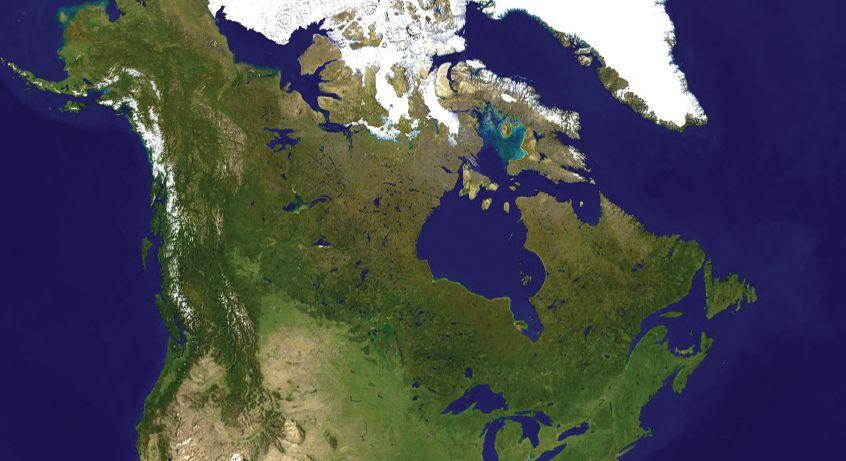
The Boreal Forest is visible in satellite imagery as a broad green band stretching from coast to coast between the northern tundra and southern temperate forests and grasslands.
5. Russia’s Taiga
forest is cut and the land replanted, the trees that grow are all the same age, growing at about the same rate. The result is an even-aged canopy that closes in as the tops of virtually all the trees mesh, blocking out the sunlight.
With little light filtering down through the dense, interlocked canopy, the forest floor is virtually barren. There are no berry bushes ripe for picking, no medicinal plants, and no food for deer or bear. It is a tree farm, plain and simple.
And while logged forests should be replanted – a tree farm is simply not a natural forest unless it is left for a few
The Taiga – Russia and Siberia’s Boreal forests – provide crucial intact habitat for a variety of plants and animals, including tigers, leopards and brown bears along with many species found nowhere else in the world. The Taiga is a carbon sink for 15 percent of global carbon emissions, but illegal and unsustainable logging continues to threaten this pristine region.
6. Democratic Republic of Congo, Africa
Covering 145 million hectares, the world’s second largest tropical rainforest is situated in the Democratic Republic of the Congo (DRC). It plays an important role in both biodiversity protection and global climate stability. These rainforests are a critical habitat for the endangered bonobo and other threatened species including forest elephants and hippopotamus – and also provide livelihoods for 40 million people. Relative stability has returned to the DRC, however, uncontrolled industrial logging plagued by corruption and flawed law enforcement threaten the rainforest.
7. Amazon Basin, South America
The Amazon is the largest tropical rainforest in the world, and the source of nearly one-fifth of all freshwater on our planet – stretching to eight South American countries. The Amazon rainforests contain more than 40,000 plant species; sustain the world’s richest diversity of birds, butterflies and fish; serve as one of the world’s last refuges for jaguars, Amazon River dolphins and harpy eagles; and is home to over 30 million people and over 300 distinct indigenous groups. At current rates, it is estimated that 55 percent of the rainforests could be gone by 2030.
hundred or even a thousand years. The differences are unmistakable – and that’s before we factor in the ecological services ancient forests contribute to our world.
The planet’s ancient forests and forest soils store massive amounts of carbon, preventing its release into the atmosphere and the exacerbation of climate change.
They provide a rich and abundant habitat for a wide variety of species that form key links in the chain of life and predator-prey interactions. Countless human communities depend on healthy, natural forests for food, warmth, shelter, medicinal plants, clothing and livelihoods.
Furthermore, the benefits people derive from forest ecosystems – ‘natural services’ such as water filtration, air purification, pollination and much more – have real value.
It’s estimated, for example, that the carbon stored in the forests, peat and soils of North America’s Boreal Forest alone, combined with other values such as the lakes and rivers that make it the largest source of unfrozen fresh water on Earth, provide the equivalent of $700 billion per
year in natural services. 2
Road building, logging and replanting monoculture even-aged tree farms simply can’t replace the multitude of services offered by ancient, natural forests.
Yes, when we harvest trees we should replant – that’s a given. But when we look at statistics or maps showing the expanding ‘forest’ cover in North America or other parts of the world, it’s important we acknowledge the vast gulf between simple tree cover and ancient forests.
As Sesame Street taught us, one of these things is not like the other. Which is why it’s so vitally important to plan, with the future of forests, people and species in mind, before we cut.
Canopy and our hundreds of corporate partners are working collaboratively for the implementation of this critical planning step in all the world’s last remaining ancient and endangered forests. It is essential to determine what needs to be conserved in order to ensure the continued health, vigour, diversity and resiliency of ancient and endangered forests and all the communities that de-
pend on them for survival.
Only then, once scientifically rigorous conservation planning, guided by local knowledge and community and indigenous rights is completed, should logging or other industrial development activity proceed.
We are constantly taught the importance of planning in our daily lives. Develop a savings plan, an investment plan, plan for our children’s college education, plan for our retirement, and the list goes on. Shouldn’t it be just as important to plan for the future of the planet that we depend on for our very survival?
Your business can develop a plan that minimizes your impact on the world’s remaining ancient and endangered forests while securing business stability and certainty of sustainable supply.
NEVA MURTHA works with Canada’s magazine publishers and printers to develop visionary procurement policies. neva@canopyplanet.org
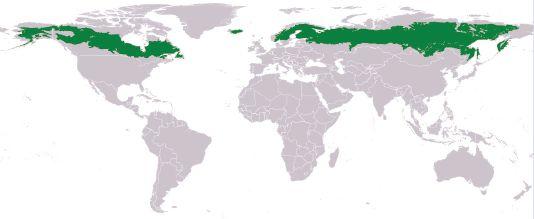
Boreal Forests occur in the more southern parts of the Taiga ecoregion that spreads across the northern parts of the world.
$700B
North America’s Boreal Forest alone, combined with other values such as the lakes and rivers that make it the largest source of unfrozen fresh water on Earth, provide the equivalent of $700 billion per year in natural services.
Orphans in the marketplace
Another type of print customer is becoming more prevalent in printing as suppliers consolidate or go out of business
By David Fellman
Ihave written in the past that all printing buyers will fit into one of just five categories: solids, liquids, gases, players and price monsters. Solids are happy with their current supplier and they’re not going to change. Liquids are generally happy with their current supplier, but they’ll talk to you, and they might buy from you if you convince them that you’re better than what they have now. Gases are unhappy with their current supplier, and most of them have already made the decision to try a new printer the next time around. Players spread their work around, and they’re price sensitive to the degree that they’ll usually give the order to the printer in their “stable” who quotes the lowest price on any given project. They won’t have the cheapest printer in town in that group, though, because that would make them price monsters—people who make all their decisions based strictly and only on price.
It turns out that there’s a sixth category: orphans. These are the people whose printer has gone out of business. There are solids, liquids, players and price monsters among the orphans, but they all have at least one gaseous characteristic now – they have to try a new printer the next time around.
Reviewing the players
Let’s start with your current customers. Hopefully you have lots of solids, but it’s dangerous to assume that. A better strategy would be to simply ask them! I’ve had a lot of success asking my customers to gauge the temperature of our relationship. A temperature of 37 would mean a strong and healthy relationship, while 34 might indicate some weakness. Think of it this way. A customer who gauges the temperature of your relationship at 37 is a solid. A customer who places the temperature at 34 is probably a liquid. Here’s another way to look at this. A solid tells your competitors “I’m happy with my current
Fellman expects at least a few companies to give you the names of multiple buyers and multiple suppliers.
Beyond
that, he would still expect the overall success rate of this strategy to be around 70%.
printer.” A liquid says “sure, let’s talk.”
Now, how about gases, players and price monsters among your current customers? There’s probably not much you can do with the gases, unless you can identify their dissatisfaction issues immediately and do something about them. With the players, you must consider whether you’re happy with the share of their business you’re getting. The key here is to maintain a profitable share.You can probably get more business from players by lowering your prices, but I want you to question whether that’s the best strategy. I’d much rather see you win a smaller share of profitable business from 10-12 individual players than win a larger share of less profitable business from just one or two. In other words, be looking for more good customers rather than settling for marginal ones.
That takes us to price monsters, who are marginal customers at best, and usually just bad ones. I suggest that you let the bad customers weaken your competitors.
Orphan identification
OK, how do you know who these orphans are? Maybe I should be asking a different question: Do you know who any of your competitors’ best customers are? Obviously, any high volume printing buyer who’s not buying from you must be buying from one of them, but can you match the buyer to the printer?
If you can’t, it might be a good idea to do a little research. Start by making a list of 100 companies that you think buy enough printing to get excited about. Next, get on the telephone and call each of those companies, and ask whoever answers the phone two questions: Who orders the printing for your company, and who do they order it from? I would expect that you’ll end up with the names of 80plus printing buyers and 80-plus printing companies.
(If that sounds high, it might be because I’d expect a least a few companies to give you the names of multiple buyers and multiple suppliers. Beyond that, though, I would still expect the overall success rate of this strategy to be around 70%.)
Here’s something else I would expect. If you have had a competitor go out of business recently, you’ll probably identify at least a couple of companies who’ve been buying from that printer. And if nothing else, identifying the buyers at 100 companies can be the first step toward developing some new customers for yourself, regardless of whether they’re orphans or not. If I were you, I’d be actively calling on these people with both a short-term and a longer-term
goal in mind.
In the short term, I’d want to find out if they’re liquids or gases with immediate potential. In the longer-term, I’d want to get on their radar just in case their current printer is the next one to fail. Think about that. If you’d already accomplished that goal with the last printer to fail, we wouldn’t be having this discussion!
Identifying the buyers at 100 companies can be the first step toward developing some new customers
Go to the source
The idea for this column came from an email I received last week. “I have had a competitor go out of business,” it read. “What would be the best steps to reach their customers?” When I called to follow up, I learned that the open printer had no idea who the closed printer’s customers were.
“Do you know who the owner was?” I asked. “The first thing I’d recommend is to call them and see if you can make some kind of a deal to acquire the customer list. And if that doesn’t work, see if you can track down some of their former employees. They’re probably looking for work, and they might bring two levels of value to your company—individual talent and customer relationships.”
Here’s a final thought for today. You probably don’t want to capture all of a failed printer’s customers. Whenever a printer goes out of business, all of that printer’s work needs a new home, and in far too many cases, it was the work – high volume but low margin – that put the printer out of business in the first place. That low margin work is usually connected to a price monster customer, and as I’ve written before, some of those customers are like serial killers. They hurt every printer they buy from. You don’t want them to hurt you.
DAVE FELLMAN is the President of David Fellman & Associates, a graphic arts industry consulting firm based in Cary, North Carolina. He is a popular speaker who has delivered keynotes and seminars at industry events across the United States, Canada, England, Ireland and Australia. He is the author of Sell More Printing (2009) and Listen To The Dinosaur (2010). Visit his website at davefellman.com.
Large-format for small AEC
New innovations in printed designs for Canadian AEC firms provide opportunity
By Danny Ionescu
The demise of printed designs in the Canadian architecture, engineering and construction (AEC) industry may have been greatly exaggerated.
With the sector rather stagnant, increasing numbers of AEC firms are now looking to print for its potential value to their businesses as opposed to a troublesome cost centre that needs to be reduced or eliminated. Indeed, a recent ARC Document Solutions study found that only 38 percent of AEC firms plan to go paperless.
What’s behind the surprising fondness for hard copy design drawings? It turns out that recent large-format printing innovations are making it possible for AEC firms in Canada – especially SMBs – to efficiently and cost-effectively churn out high-quality printed materials that differentiate them in the market. At the same time, these new innovations are bringing the costs down when those firms turn to their local print service providers.
In fact, according to the recently released 2015-2020 Wide Format Forecast from InfoTrends, media revenue in North America is now growing at a compound annual rate of 12.8 percent compared to 10.1 percent for the rest of the world.
There are some key reasons why many smaller Canadian AEC firms are turning to large format printers. While larger enterprises have entire departments responsible for managing and maintaining large-format printers, many smaller and midsized AEC shops haven’t traditionally been able to afford that. The costs of acquiring printers, maintaining them and training staffs would simply be too high –especially where colour was involved.
Smaller firms often leaned on print shops for every single geographic information systems (GIS) map, drawings and rendering they needed to produce.
Today, however, more options are available. Prices for large-format printers
New
generation large-format inkjet systems
are allowing
printers to
apply new colour for AEC needs and to break out of the monochrome margin malaise.
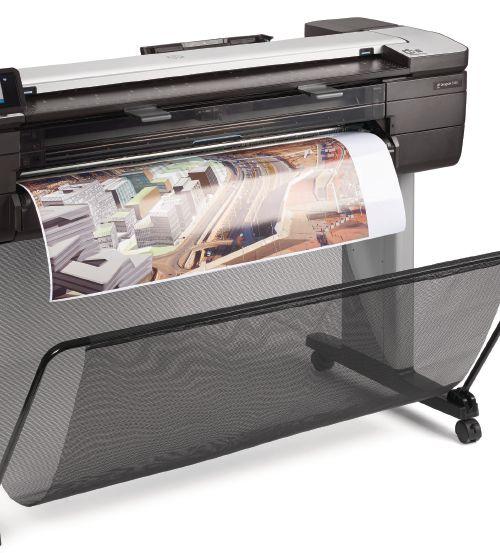
have dropped considerably, making them much more affordable options for the average AEC firm looking to reduce their outsourcing spend. At the same time, savvy large-format print shops are enabling AEC companies to produce high-quality black-and-white and colour jobs at a faster speed from a single printer. Previously, companies had to buy both monochrome and colour printers to accomplish the same task or work with a print shop that had multiple devices.
And this capability is particularly important to AEC firms today as many Canadian municipalities require design drawings to be submitted in colour.These regulatory requirements underscore where the industry is headed, as AEC firms are designing in colour. Keeping these details and documentation in colour lets designers move this knowledge through colour coding from their screens right into the field.
We’re seeing AEC firms across the globe purchasing wide-format colour multi-function printers over monochrome-only solutions and Canada is certainly no exception.
printers. New workflow software for managing the print process from end to end makes large-format printing much more efficient. For example, such software allows AEC shops to spontaneously detect and correct corrupted PDFs, automatically switch between small- and large-format pages, and enable on-screen document proofing. Coupled with the speed of the new printers, this can significantly enhance efficiency.
This improved efficiency also contributes to a lowered cost, which is an increasingly important factor for the many AEC firms operating in slowed down economies such as Alberta’s oil sector, for example.
In terms of quality, large-format printing is not the same as making office copies. Control over quality is key because the large-format documents that an AEC firm must produce are mission-critical. For example, customers often assume they’ll be able to receive brilliant, colourful printed materials because powerful computer-aided design (CAD) software has made that so commonplace. These designs are also incredibly complex. For AEC firms to compete in this environment, they must have the ability to deliver on that expectation.
Fortunately, an emerging generation of large-format printers excel at producing colour documents with crisp lines, fine detail and smooth grayscales that are arguably superior to LED prints. Newer pigments also provide dark blacks, vivid colours, and moisture and fade resistance – even on uncoated bond paper at high speeds.
For Canadian AEC firms to compete in these challenging economic times, they need to be focused on producing the highest quality printed materials as efficiently and cost-effectively as possible. The ability to do that has never been greater.
Small and midsized AEC firms no longer have to invest in huge fleets of printers to keep pace with larger competitors.
According to the “2015-2020 Wide Format Forecast” from InfoTrends, media revenue in North America is now growing at a compound annual rate of 12.8 percent compared to 10.1 percent for the rest of the world.
Another key reason for the AEC adoption of large-format is simply for faster turnaround times. Canadian AEC companies are increasingly required to turn around designs and blueprints on the fly – both at their offices and on job sites. Modern wide-format printers are faster than previous generations – up to 60 percent faster in some cases – and are suitable for use in the field and office.
Additionally, a broad range of applications and technological innovations that expedite workflow are now available for use in conjunction with the wide-format
So, paper lives on as an important instrument in their tool belts – now and for the foreseeable future.
DANNY IONESCU is the North America Technical Segment Sales Director for HP Inc., where he has provided thought leadership in print for more than 20 years. He currently manages a North American team of large format printing specialists focused on sales, strategic planning, and development of go to market initiatives for HP’s Designjet and PageWide XL technologies.
A statistical view of how offset-heavy printing companies have invested in technology over the past year
By Jon Robinson
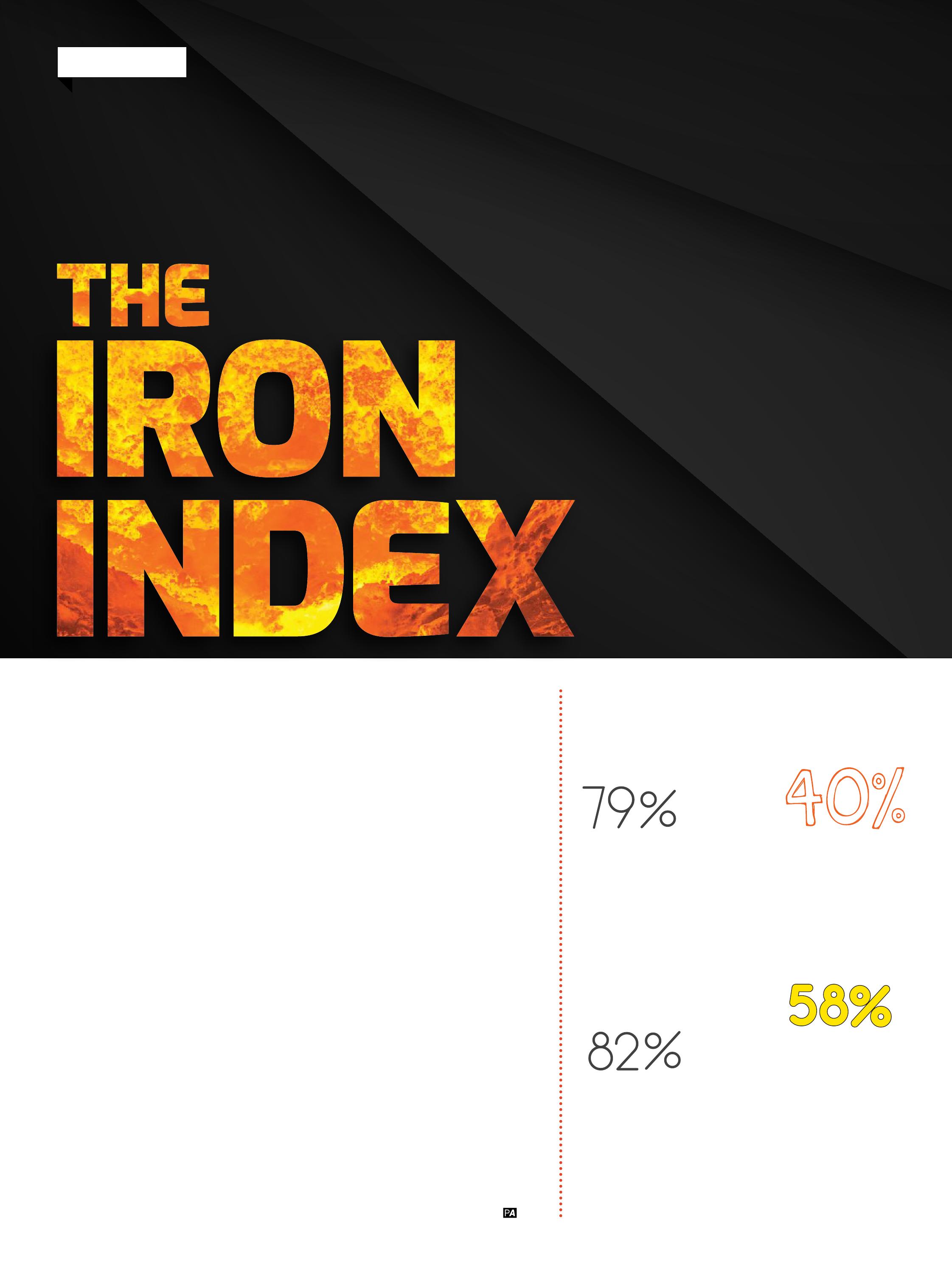
Following last year’s 10year review of The Iron Index, this 2017 report on PrintAction’s annual survey compares current production trends to an historical benchmark of capital investments made by Canadian printers. The facts throughout the article relate 2017 numbers to our 2015 survey results, providing a look at a two-year cycle of investment and shifting production between toner, inkjet and offset processes.
Last year’s 10-year compilation of data is significant because it provided a benchmark based on when PrintAction began to survey offset-heavy printers about their toner-based presses. The Iron Index itself actually began 20 years ago when PrintAction magazine began tracking the arrival of computer-to-plate-imaging systems in Canada.
What began as PrintAction’s short, but important list of innovative commercial printers in 1996 to first install computer-to-plate technology, grew exponentially after the turn of the millennium, as sheetfed and web offset printers across the world began to abandon film-based workflows. Interestingly, signifying that rapid technological change continues to take place in the printing industry, CTP systems are now barely a concern for tuned in commercial printers who are
instead focused on the direction of inkjet printing. Based on 2017 numbers, however, toner printing has made significant inroads over the past two years as almost three quarters of all surveyed printers are now producing at least 10 percent of their work with digital presses.
A year after toner presses were added to our statistics, PrintAction’s technology survey in 2007 was rebranded as The Iron Index, because it began to track a key metric among leading commercial printers: Their offset to toner to inkjet production ratio, which describes the printer’s estimated percentage of how their print work is generated among the three primary printing processes.
The purpose of The Iron Index is to track the production-technology investment trends of leading offset-based printing companies across Canada. This includes tracking the offset (by model, number of units, and format size), toner and inkjet press specifications of participants, as well as employee levels, revenue, front-end technologies, MIS and certifications.
The following 2017 statistics provide insight into what is going on with the direction of production ratios. The key statistics describe how the landscape is changing in terms of long and short runs, as well as the work of 29- and 40-inch printers, and how they are shaping their companies and Canadian printing.
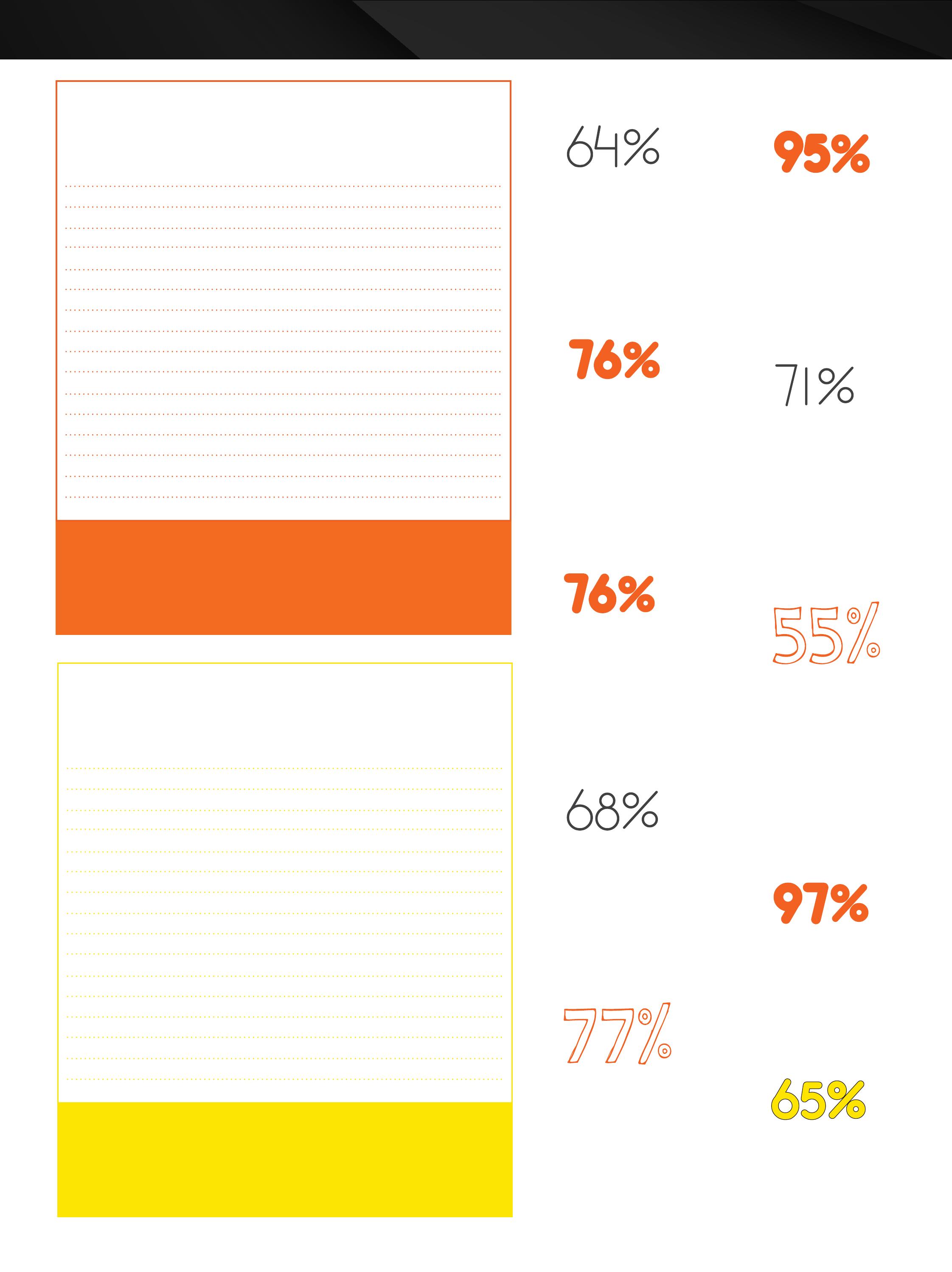
Percentage of 40-inch printers surveyed in 2017 producing at least 70 percent of their work with offset, indicating litho remains vital in Canadian printing.
Percentage of 29-inch printers surveyed in 2017 producing work with all three processes (offset, toner, inkjet).
Percentage of 40-inch printers surveyed in 2017 producing work with all three processes (offset, toner, inkjet).
Percentage of all printers (29- and 40- inch) surveyed in 2017 producing work with all three processes (offset, toner, inkjet), which is an increase from 50 percent in 2015.
STATISTICS FROM 2017 IRON INDEX
40-INCH PRINTERS
The following statistics apply to Canadian printing companies with at least one 40-inch sheetfed press, based on their participation in The Iron Index surveys.
Key 40-inch printer findings in 2017: The Iron Index survey indicates that offset remains a key revenue generator for 40-inch printers, with more than 75 percent generating at least 10 percent of their work via litho, but more than 60 percent are now generating at least 10 percent of their work via digital (versus 49 percent for the same level in 2015). Inkjet has also jumped for 40-inch printers, primarily around large-format work, as opposed to production-strength inkjet installations.
29-INCH PRINTERS
The following statistics apply to Canadian printing companies with at least one 29-inch offset press (or of smaller format), based on The Iron Index surveys.
Key 29-inch printer findings in 2017: The Iron Index survey indicates offset is losing momentum in the 29-inch market. Only a couple of printers are generating more than 90 percent of their work via offset, while more than 95 percent are generating at least 10 percent of their work via toner. Large-format inkjet has also made a significant jump for 29-inch printers with more than 40 percent of them generating at least 10 percent of their work this way.
Percentage of 40-inch printers surveyed in 2017 producing at least 10 percent of their work with toner, a significant increase versus 49 percent in 2015.
Percentage of 29-inch printers surveyed in 2017 producing at least 10 percent of their work with toner, a seemingly small but important jump from 90 percent in 2015.
Percentage of all printers (29- and 40- inch) surveyed in 2017 producing at least 10 percent of their work with toner, which is an increase from 66 percent in 2015.
Percentage of 40-inch printers surveyed in 2017 with at least one toner printing system, a level comparable to 2015.
Percentage of 29-inch printers surveyed in 2017 producing at least 20 percent of their work with toner, a seemingly small but important jump from 62 percent in 2015.
Percentage of 40-inch printers surveyed in 2017 with at least two toner printing systems, up from 47 percent in 2015, helping to account for a rise in toner work.
Percentage of all printers (29- and 40- inch) surveyed in 2017 with at least one toner printing system, versus 63 percent in 2015.
Percentage of 29-inch printers surveyed in 2017 with at least one toner printing system, versus 93 percent in 2015.
Percentage of 29-inch printers surveyed in 2017 with at least two toner printing systems, versus 64 percent in 2015.
Percentage of all printers (29- and 40- inch) surveyed in 2017 with at least two toner printing systems.
COMPLETE IRON INDEX PARTICIPANTS BY YEAR
The following percentages are derived from more than 100 Canadian printing companies that have consistently participated in The Iron Index survey, never missing more than consecutive one year of reporting statistics.
Percentage of 40-inch printers surveyed in 2017 producing at least 10 percent of their work with inkjet, a significant increase versus 8 percent in 2015.
Percentage of 29-inch printers surveyed in 2017 producing at least 10 percent of their work with inkjet, a jump from 20 percent in 2015.
Percentage of 40-inch printers surveyed in 2017 producing at least 20 percent of their work with inkjet, suggesting production inkjet has not yet greatly impacted the market.
Percentage of 29-inch printers surveyed in 2017 producing at least 20 percent of their work with inkjet, a jump from 8 percent in 2015.
Number of printing companies founded 50 or more years ago on the Iron Index.
Percentage of facilities with an environmental designation in 2017.
Percentage of all printers (29- and 40- inch) surveyed in 2017 producing at least 10 percent of their work with inkjet, which is an increase from 13 percent in 2015.
Average age of printing companies on the 2017 Iron Index.
PrintAction would like to thank all of the companies that have participated in The Iron Index, its 20-year history to enable these statistics to be generated. PrintAction plans to continue to provide further analysis of this data in the coming months. To learn more about our future plans with The Iron Index please contact Jon Robinson, Editor, PrintAction (jrobinson@annexweb.com).
In an ever increasingly competitive world, you need the highest performing, most cost effective equipment to minimize costs and grow sales. In a neutral data study, all three Heidelberg 40" platforms outperformed all of the competitor machines in the market. When linked with color management and industry leading color control systems, on a cost per sheet basis, these presses are simply unbeatable.
Speedmaster CD 102
Million Annual Impressions
A MIND-BLOWING PACKAGING SHOW
Reporting from the floor of the packaging world’s largest show with a record 2,865 companies and countless innovations
By Martin Habekost
Interpack 2017 took place this year from May 4 to 10, 2017, at the Düsseldorf, Germany fairgrounds, familiar to so many of Canada’s commercial printers as the home of the quadrennial drupa trade show. Interpack has a repeat cycle of every three years instead of drupa’s every four years. In the year 2020, both trade shows will take place in the same year, Interpack in May and drupa at the end of June.
Anyone who has been to a drupa trade show knows the sheer size of the fairgrounds in Düsseldorf. Interpack is in no way smaller. All 18 halls were filled with exhibitors and their products. On top of the 18 regular halls, there were also two special exhibits put up in tents, resulting basically in 20 halls and all were in relation to packaging. Although I set foot in every hall, it is impossible to give a com-
plete overview of the trade show.
Interpack had 170,500 visitors to the trade show and approximately 75 percent came from abroad and three-quarters of them were decision-makers. Visitors came from a total of 168 countries. The official survey conducted with visitors at the show gave a 98 percent scoring of satisfied and very satisfied. This is a new record for Interpack in regards to the number of visitors and the satisfaction the visitors felt with attending the show. From the dizzying array of exhibitors and products, a few topics stood out at the show, including: Industry 4.0 and digitalization, traceability of products, sustainability, and customization.
What is industry 4.0?
Industry 4.0 is about the connectivity of machines among each other, in the whole production line and also back to the
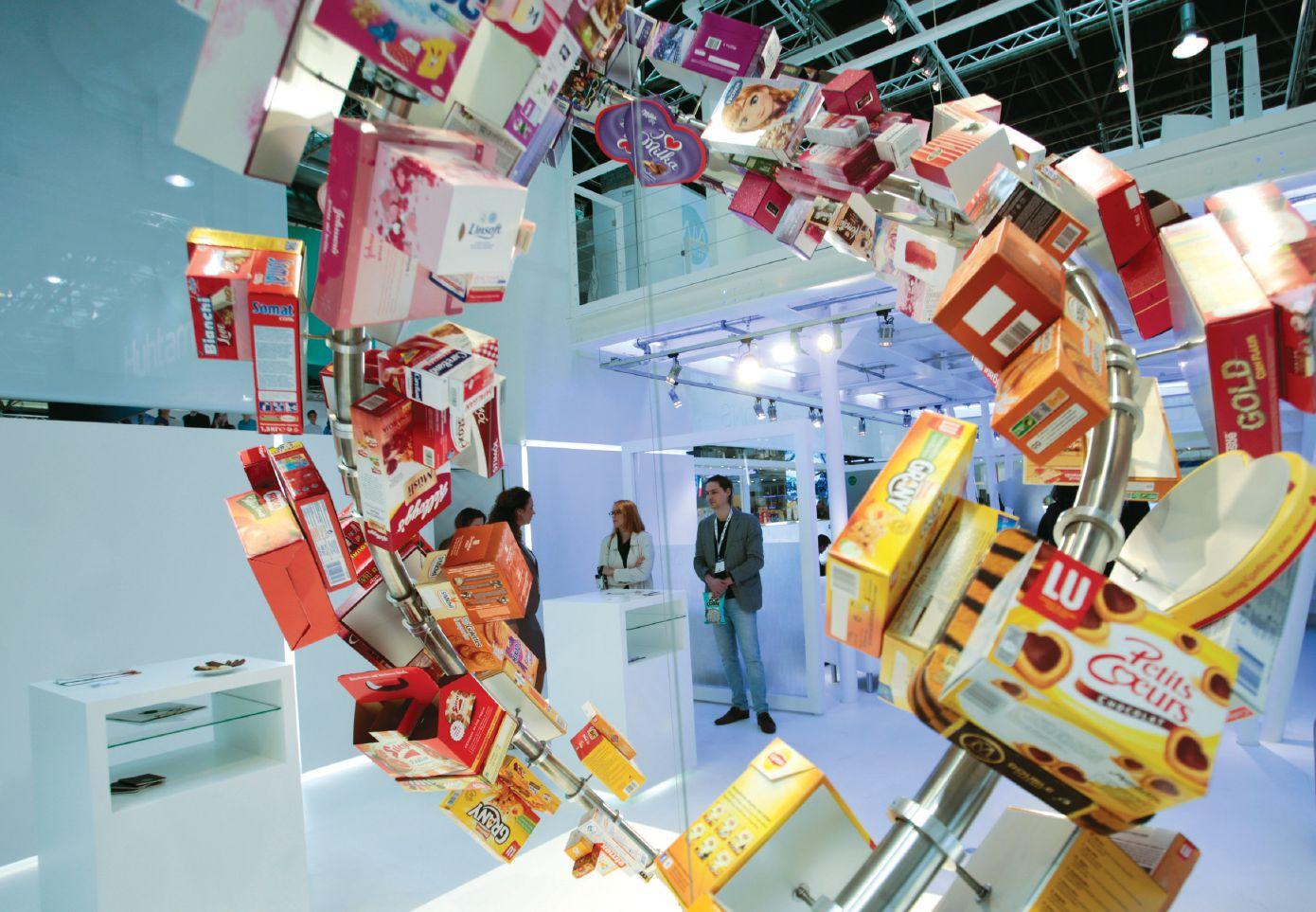
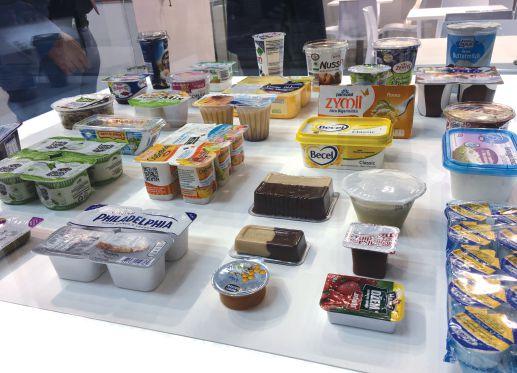
Some of the thousands of innovative packaging samples on display at Interpack 2017.
manufacturer of the machine(s). Industry 4.0 is also about the full automation of a production process. The human operator is used only to stop the machine if the need arises. Industry 4.0 is about the Internet of Things (IoT), the smart factory and cloud computing. Through the connection of machines, work pieces and systems intelligent networks are created. These networks exist through the entire value chain and these networks can control each other autonomously. Come to think of it, that sounds a bit ominous, but this is a discussion for a different time.
The question for today remains, how does the packaging industry benefit from Industry 4.0? Industry 4.0 will lead to faster, more accurate production of any type of packaging. The number of defective items that won’t make it to the customer will be reduced even more. Systems will be able to self-diagnose and initiate any maintenance that needs to be done. Intelligent systems will allow for more accurate scheduling of production, so clients can be more informed in regards to arrival time of their order. The smart networks in Industry 4.0 will also go beyond a single factory. As I mentioned earlier, these networks will be across the entire value chain, breaking down the barrier of the closed factory.
Traceability of products
verified by the end consumer, but development is being done, so that the consumer can also test a product for it’s validity. Different avenues are currently being tested. Again big data and cloud computing come into play, when the customer will be able to verify a product for being genuine. Maybe this can be done through a phone app, but it remains to be seen what the future will bring.
Sustainability
After my first visit to Interpack in 2011, I wrote in PrintAction about the strides that have been made in regards to using plantbased materials for packaging materials and the use of bioplastics. This trend continued at Interpack 2014 and now at this year’s Interpack. Personally, I was very happy to see that a company has come up with a Stryofoam-type material that is made from plant-based materials and has very similar insulating properties. This material can rot in a commercial composting facility in 90 days, which is the criteria for compostability.
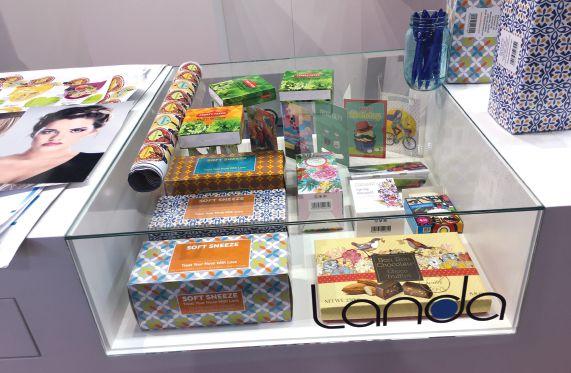
was doing at Interpack and he told me that they had teamed up with the largest folding carton printer in Germany to have an exhibit at Interpack. The print company is one of the beta sites for the Landa S10 machines. After seeing Tzori, I went to the hall where Landa had its exhibit. I talked to one of their representatives and I was able to get some packaging examples that had been printed on an S10 machine, the same machine that will be used by a folding carton printer in Germany. Personally, I was excited to see that Landa presses are making their way into commercial press rooms. I was also told that Landa is planning to roll out the W10, the roll-to-roll printing machine, before the 2020 drupa trade show.
Packaging trends
There were 170,500 visitors to Interpack 2017, according to show organizers, and approximately 75 percent came from abroad and threequarters of them were decision-makers. 75%
The traceability of products was also a big topic at the show. The digital integration of production lines together with marking equipment (laser-etching, ink-jetting batch number, serial number, unique ID numbers), allows for the creation of very traceable products. Quite a number of companies showed very visible ID codes, especially in the pharmaceutical sector, while others showcased ways of giving unique IDs to every single package that came off a production line that were not very visible or only readable with a special reading device. One could ask oneself, why is this all necessary?
The answer is simple. More and more products are getting counterfeited these days and it gets harder and harder to differentiate between the original and the counterfeit product. Being able to produce not only unique batch numbers and lot numbers, but also unique ID numbers for each package produces a new level of product security. Since such a large number of unique ID numbers are created, big data and cloud computing capacities come into play to manage these vast amounts of data. At the moment, most of these unique ID numbers cannot be
I also talked to a Chinese company that makes plastics based mainly on PLA (Polylactic acid). The representative I talked to said that there is quite the demand for PLA-based plastics. If a Chinese company is getting into this business, it means they have found a way to make this a cost-effective process and they have enough raw materials available to produce in substantial quantities.
Many other companies have shown how they could manufacture their products using less raw materials and less energy and, therefore, lower their overall environmental impact. A lot of packaging material is still petroleum-based. These materials have great barrier properties, are lightweight and can be formed into all kinds of shapes. This is all very good, but what can happen with the plastic waste? One possibility would be the incineration of this type of garbage for the generating of heat and electricity, but that is not always the best solution. One innovative company showed how to transfer plastic film-type garbage into a material that is shaped into 2×4 type planks, that can be used to build tables and park benches. This material is actually quite strong and not very susceptible to breakdown by outdoor elements.
Surprise of the show
As I was walking through the halls. I ran into Gilad Tzori from Landa. I wrote about Landa in PrintAction in June 2016 in my drupa report. I asked Gilad what he
A trend that was already emerging at drupa continued at Interpack. This trend was shorter run lengths for a certain SKU, more individualization of packaging and custom ordered packaging. All this is only possible with the use of digital printing technologies. Digital print technologies in combination with different finishing technologies were exhibited. The combination of digital printing technologies with finishing technologies like cold foiling were also shown. One well-known ink company showcased a collection of tools that will help with achieving a custom colour on a specific substrate a lot faster than how it is currently being done. Through colour measurement, profiling and inkjet proofing and printing of the colour sample, it is possible to cut down on the time that is needed to achieve a good colour match. This ink company is using colour technology hard- and software from world leaders to reach this goal. Overall, the printed packaging is going to be more colourful, feature more special effect inks, and will react very quickly to market trends and marketing campaigns. All this is done in the name of catching the customer’s attention to sell more of your own product in comparison to the competitor.
My view of Interpack was more through the glasses of a packaging print company than a person interested in robotics, filling lines and sorting equipment. I am well aware that a lot more than that was shown at Interpack, but every visitor came to the show with their own perspective. It was definitely worth going and if you have the chance to go, just go. Attending the Interpack trade show gives you quite a perspective on how large the packaging sector is worldwide.
PACKAGING SIMPLIFIED
A technology update from the floor of EskoWorld, hosted by one of the world’s most powerful suppliers in the packaging world
By Abhay Sharma
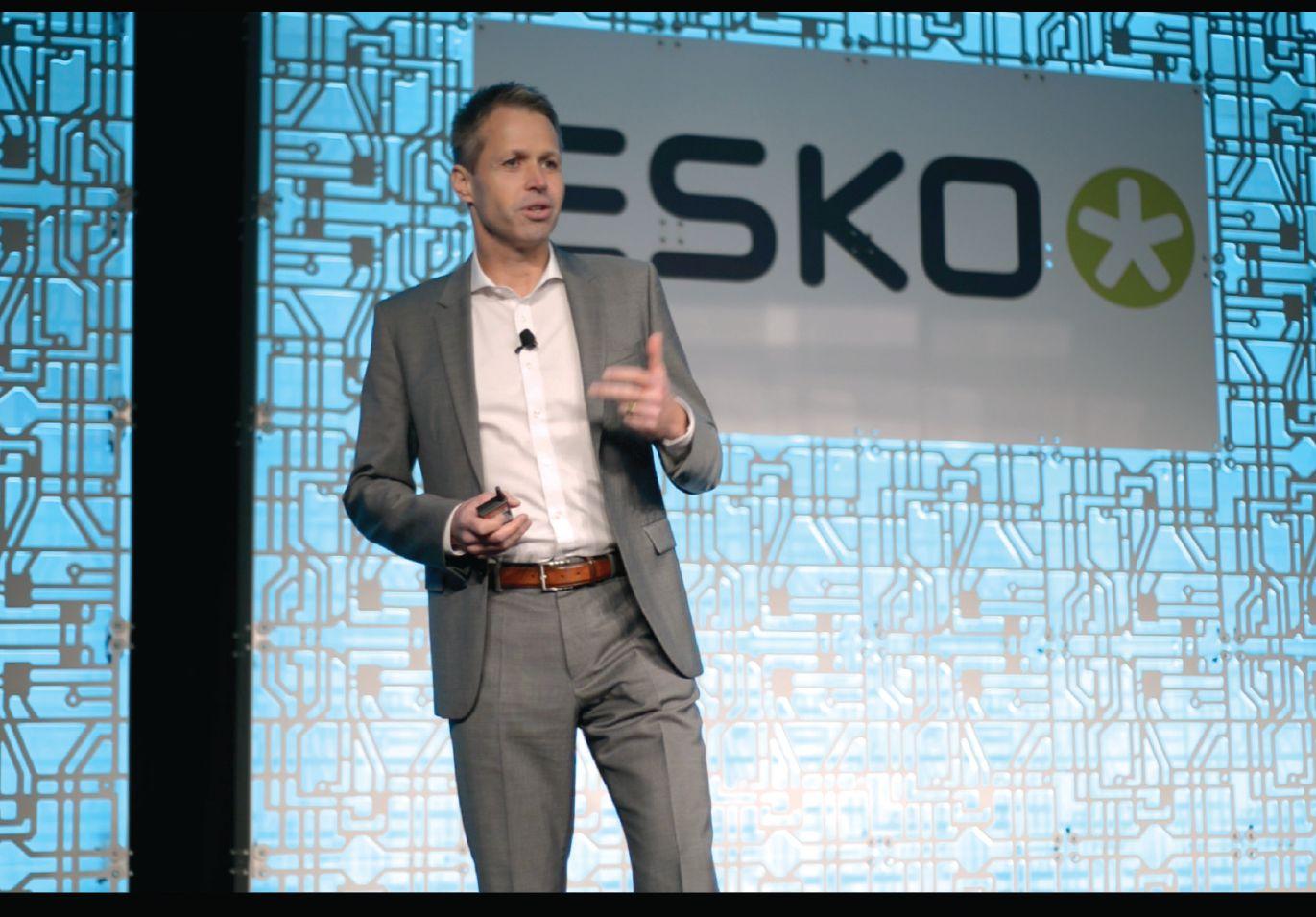
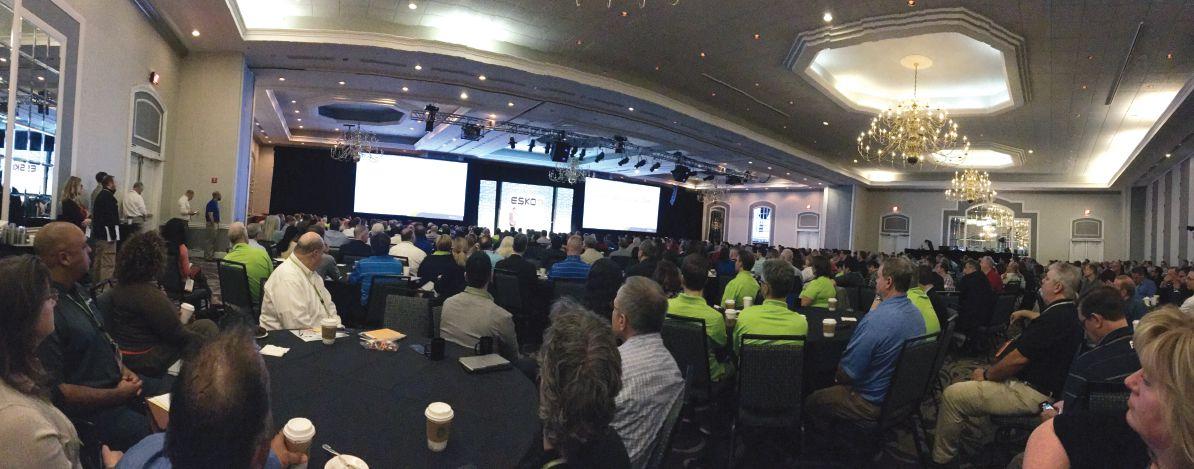
EskoWorld is Esko’s annual user conference, this year held in the NASCAR hometown of Charlotte, North Carolina, from May 9 to 11, 2017. Esko executives, product managers, and support engineers mingled with more than 500 technology users from across the United States and Canada.
Packaging printers and converters attended in a cavernous hotel ballroom and smaller break-out sessions in Mac and PC computer labs. Several partners including DuPont, EFI, MacDermid, were on-hand to support product integrations and assist with purchasing decisions.
Esko’s product portfolio stretches from structural design in packaging (ArtiosCAD, CAPE, Plato) to visualization and design software (DeskPack,
Store Visualizer) to colour in brand packaging (Equinox, Color Engine).
Flexo plate making is core to Esko with the CDI plate makers and Kongsberg cutting tables. One of the main areas of interest amongst Canadian attendees (apart from seeking warmer weather, which they got!) was updates in auto mation (WebCenter, Automation En gine).
Esko’s core workflow tool at the heart of their workflows is Automation Engine (AE), which is updated every alternate year at EskoWorld. In 2017 the new re lease is AE version 16.1.
Automation Engine 16 gets a new look
Automation Engine is one of the most powerful “kitchen sinks” for label con verters and flexo prepress, allowing everything from PDF processing to
Since it launched in 2007, the multi-award winning Océ Arizona Series has driven the wide format digital revolution, uncovering creative opportunities for signage and graphics businesses of all sizes. With over a decade of continuous innovation in the Arizona Series, Canon has enabled thousands of customers worldwide to expand their graphics capabilities, extend their production scope to meet evolving customer needs and truly transform their business.
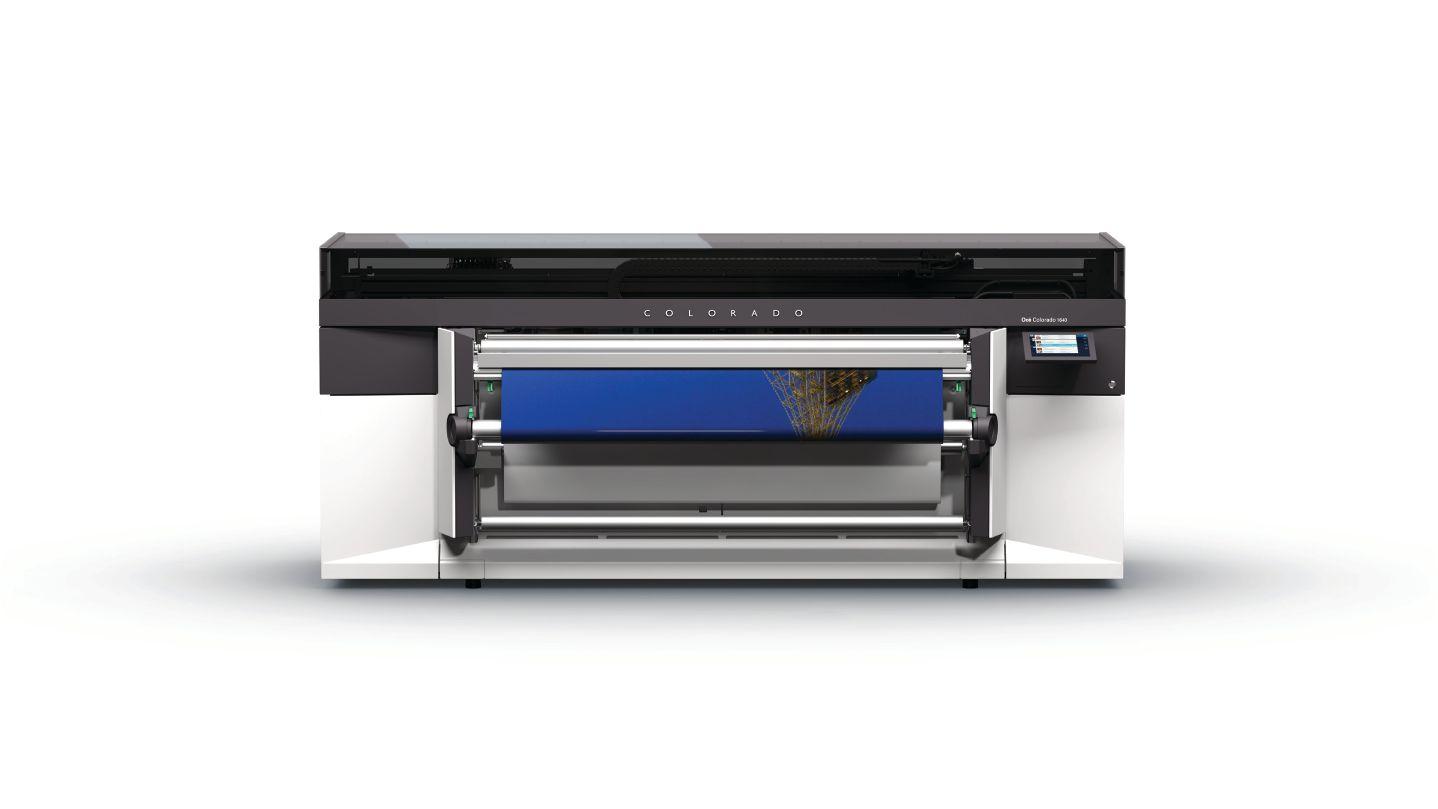
Canon continues to push the boundaries of print with the new Océ Colorado 1640. As the world’s first 64" roll-to-roll printer with UVgel technology, the Océ Colorado redefines wide format printing with its ground-breaking productivity, never before seen automation, and diverse application capabilities. 1-800-668-1945
trapping and step and repeat operations.
New improvements to the UI are a simplified HTML5 browser interface code named “UX”. Another significant development is DeviceManager that connects AE to the CDI plate setter, the Kongsberg table and HP Indigo digital presses.
“We are seeking to integration AE with WebCenter for every task in our shop that an employee can do,” says Anthony Memme, Atlantic Packaging, Scarborough.
Enhanced packaging
Esko’s Studio Store Visualizer allows a user to walk through a store and pick up items. 3D design in product packaging is an area seeing new products and visualization tools. The store shelf is being replaced with Amazon purchases via an iPhone.
Designers and brand owners were offered tools including augmented reality virtual walkthrough of a department store where they could pick up and hold and rotate products to view the label. With compliance and regulatory requirements in a global product development life cycle of brand development, these tools are essential for brand owners and agencies.
Marriott Winchester, President, sgsco Americas, says, “We have a new digital
store shelf and our large team here at EskoWorld is strongly involved in tools to create the enhanced pack shot and buyer experience.”
CDI goes flat screen
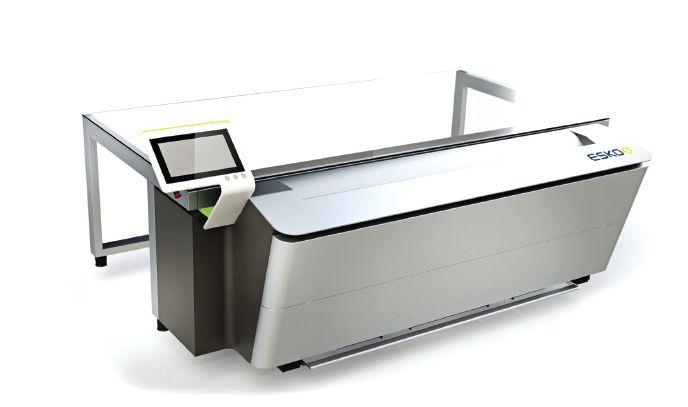
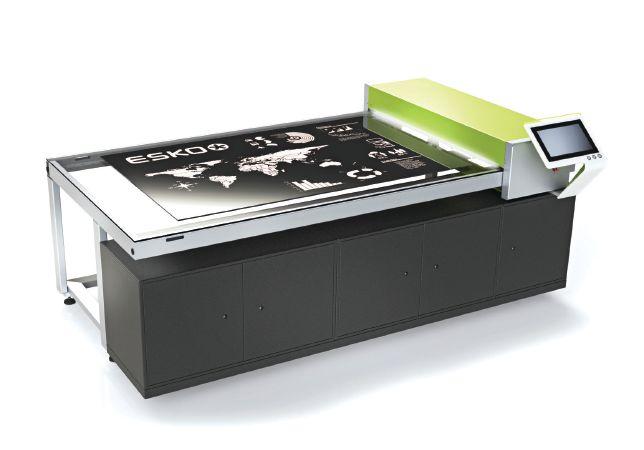
In a radical departure from the rotary, drum mounting of flexo plate expose units, Esko launched a flat-bed, LED expose unit called Crystal XPS. Esko’s plate making devices have evolved from CTP plate imaging using traditional CDI to Flexo HD (High Definition) and now to Crystal XPS.
The new design is a flat-bed device with a bank of UV LED sources that expose the back creating a plate floor, and another row on the top creating the plate exposure and raised relief.
In normal plate making, the back exposure is done separately and while operators are aware that the photoinitiated polymerization is affected by the time between the front and back exposure, this is rarely controlled.
In the new Crystal XPS series, the front and back exposure can be set to be simultaneous or with a minimum time lag. Photopolymer plates are laid flat on the table, and along with time improvements, the new imaging configuration creates greatly improved flat-top dots.
All brands of photopolymer plates are supported and in use in the 20 companies
today. The CDI goes flat in the new Crystal XPS device, allowing simultaneous front and back exposure that creates cleaner, better shaped dots.
Esko acquires MediaBeacon
At EskoWorld a press announcement revealed that Esko acquires MediaBeacon for digital asset management and stock libraries.
MediaBeacon helps in the publication of content for digital and physical channels and social media and integrated marketing.
Allison Hunter, Jones Packaging, London, says that “pharmaceuticals, life sciences, retail, can all benefit from marketing asset management tools that can help in omnichannel marketing.”
Buckle up for NASCAR
A large number of Canadian packaging printers, designers and converters from Vancouver to Montreal, travelled to the United States for packed presentations and roadmaps from senior Esko executives.
On the social calendar, a closed private evening at the NASCAR Hall of Fame, allowed brave printers to practice being a pit stop crew. If you are into packaging, put next year’s users conference on your calendar. EskoWorld 2018 takes place in New Orleans, June 4 to 6, 2018.
With the CDI Crystal 5080 XPS (left), making flexo plates becomes a coordinated, linear process.
The XPS Crystal 5080 exposure unit (right) won the 2017 FTA Technical Innovation Award.
Combining the CDI Crystal 5080 with the new XPS Crystal 5080, according to Esko, offers the following benefits: Reduce manual steps by 50%, reduce errors by 50% (less plate waste), and reduce operator time by 73%.
Advances in sheetfed offset
WWhile digital presses, both inkjet and toner based, continue to receive the majority of innovation attention, sheetfed offset forges ahead with new cost-saving advances, including some of these recent introductions.
Heidelberg Push to Stop
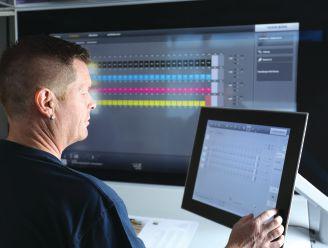
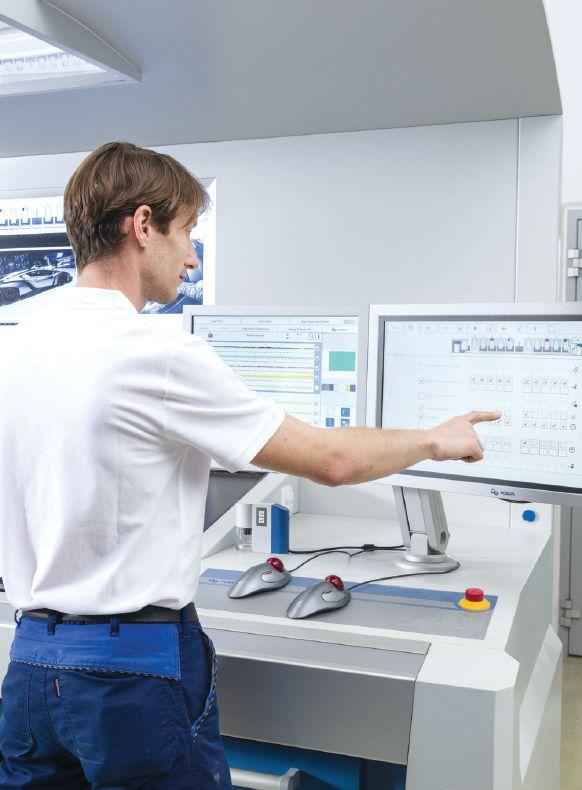
With Heidelberg’s breakthrough Push to Stop technology, jobs can be autonomously changed over on a Speedmaster press. It takes all job parameters into account, presets all functions of the press, initiates the run, adjusts registration, colour, and even starts the good sheet counter while inserting a tab into the pile – all while continuing to print unless the operator steps in to interrupt.
Using Prinect as the key integration component that ties multiple production process together (i.e. MIS, workflow, ink key data, substrates specs, and press setting together within the Press Center XL 2 console or more specifically, the Intellistart 2 program), Push to Stop executes the fastest changeover sequence possible. With manufacturing this close to seamless, job throughput is dramatically improved.
What makes Push to Stop possible is Intellistart 2, a new and unique integrated software system for effective job preparation, which reduces the number of operating steps during changeover by approximately 70 percent. The systematic elimination of time on every job change leads to consistent savings and increased efficiency. Intellistart 2 functions like an automobile navigation system as it maps a makeready route, embarks the press upon it, and keeps the operator posted about where the process is headed next. The Wallscreen XL display animates everything that is happening with read-
outs like Intelliguide, a moving green bar that tracks makeready progress, along with the countdown in time to complete process.
KBA Colour Management Solutions
QualiTronic ColorControl is an inline colour measuring system. A highly specialized optical colour measurement device is integrated directly into the press together with an LED illumination and permits fully automatic measurements in control strips. The control strips can be positioned either at the front or up to center of the sheet. As soon as printing starts, the control strips are scanned directly in the press and the solid densities are presented on the screen in a live graphic display. The measurements are used as a basis for fast, dynamic inline colour correction. It is furthermore possible to create inline measurement reports in PDF format. After the measuring system is set up, all measuring patches are scanned on every printed sheet, right up to maximum production speed. The first setting corrections are realized immediately after the job start; once in production, a control cycle of 10 sheets is effective.
QualiTronic/ErgoTronic Instrument
Flight as the top KBA solution is based on the proven multidimensional System Brunner colour/grey balance control strategy that has been continually refined and, with its indirect image control, provides the highest level of colour consistency. It takes into account more than 30 print-influencing variables in every ink slide zone. Five different Balance Control Priorities can be selected. It also ensures flexibility and compliance with international standards and methods like Globalstandard, ISO/PSO, G7, etc. The heart of the application is innovative and sophisticated software that is the result of more than 30 years of practical experience with printing process control.
manroland Sheetfed Evolution
manroland Sheetfed’s new Evolution 700 printing press, introduced in November 2014, is designed from the ground up and incorporates what the company describes as a futuristic look and new technological developments. Its newly designed central console, for example, replaces buttons with touchscreen panels that provide detailed graphical information – with options for left- and right-handed operation, as well as customization for different
With KBA colour management controls it is possible to create inline measurement reports in PDF format.
operator body heights.
The Evolution press’ new feeder pile transport is designed to provide an upward motion of the pile-carrying plate and improved sheet travel from the feeder to delivery. This leads to fewer interruptions, according to manroland, less startup waste and reduced walking distances to the feeder. The company also explains solid fixing of the suction head reduces vibration and wear, while ensuring safer sheet separation and higher average printing speeds.
manroland’s Evolution press features a new chambered doctor blade system for producing gloss effects.
The press also includes completely redesigned cylinder-roller bearings, while separate bearings for radial and axial rotation provide better absorption of vibrations with fewer doubling effects and, manroland explains, longer bearing life and significant improvements in print quality. All-new dampening units in the Evolution press bring greater solidity with fewer roller vibrations during passing of the plate cylinder channel and fewer stripes. manroland also points to new software for practice-oriented roller washing cycles to further reduce downtime with more precise dosage of the
Heidelberg’s new Wallscreen XL display animates everything that is happening with the press.
dampening solution over the entire width, reducing the possibility of skewing the dampening dosage roller.
RMGT 9 Series
The RMGT 9 series of A1-size offset presses enable 8-up printing of A4-size. Two model types are available, 940 models with a maximum sheet width of 940 mm and 920 models with a maximum sheet width of 920 mm. The company explains features such as a maximum printing speed of 16,200 sph and high printing quality make these presses suitable for companies seeking lower costs, high quality, and high productivity.
The 920 models are capable of 8-up printing of international A4 size or letter size. RMGT explains this results in significantly lower printing plate costs, power consumption, and space requirements than a B1-size press. Installation of one LED-UV (or UV) curing unit over the perfecting device and another over the delivery section enables one-pass instant-curing perfecting (920 models only).
Inline coating system adds value to printed work (920 models only). It holds many of the same features as the flagship RMGT 10, including sheet transfer technology and a function for quickly checking the roller nip. A newly developed press information display with a large 55-inch screen enables the operator to easily monitor printing quality and operating status in real time from the delivery section (optional).
Komori Lithrone G Series
The newly developed Lithrone G26/G29 sheetfed offset press, explains Komori, is designed to provide high print quality and productivity, ease of use, maintainability and environmental considerations such as power and materials saving.
The company explains the press provides a maximum printing speed of 16,500 sph with high-speed stability even on heavy stock. In mature markets, Komori explains the Lithrone G26/G29 reduces job turnaround time and paper
models
waste and creates added value.
The press is designed to meet the needs of small lot and short turnaround production for on-demand printing. The Lithrone G26/G29, in addition to the short makeready performance enabled by advanced Komori technology, the press provides a 12,000 sph high-speed print start-up, in addition to its 16,500 sph maximum printing speed.
The full-APC Fully Automatic Plate Changer, according to Komori, changes four plates in about two minutes 30 seconds. Also, blanket washing and impression cylinder and ink roller cleaning are all automatically at just the touch of a button by the operator.
KBA Rapida 106
The Rapida 106, described as the fastest sheetfed press in the printing industry, produces at 20,000 IPH. The Rapida 106 can produce 10 percent more sellable sheets over any other midsize sheetfed offset printing press, claims the company.
KBA Rapida presses uses servo drive technology and has no disruptive manufacturing issues in the field. The benefits of using servo drive technology is to allow the Rapida presses to be more user friendly; provide less operator intervention during the make-ready process; and less operator intervention during the production run.
KBA Rapida presses use an independent servo drive to run the entire stock range. Rapida presses automatically adjust feeder timing when running the entire stock range. Light weight stocks run
The Rapida press has two methods for sensing pile height, so the Rapida feeder head can accommodate stock with a major up curl or down curl.
Flint VANTAGE LED
Flint Group introduced a new UV lamp retrofit conversion program called VANTAGE LED aimed at sheetfed printers.
The full suite of products and services included in the retrofit program consists of pre-conversion consulting and training, LED inks and coatings, matching pressroom chemicals and blankets, as well as service support during and after conversion.
At the heart of the VANTAGE LED program, according to Flint, are EcoLUX LED lamps supplied by Air Motion Systems, which develops LED UV technology often applied in the sheetfed offset industry.
Flint explains VANTAGE LED is geared toward users of legacy UV methods and for those printers who have had no exposure to UV curing methods but are now investigating LED technologies. Flint explains VANTAGE LED has been developed to ensure those wishing to convert to LED curing can do so with confidence in a very short space of time.
hubergroup UV offset Inks
With the relocation of its UV ink production from Lachen, Switzerland, to its primary plant in Kirchheim, Germany, i hubergroup updated many of its products for the UV offset segment.
Following a test phase, these upgrades have now reached full market-readiness.
slower down the feed board vs. thicker substrates that run faster down the feed board. No operator intervention required.
A KBA Rapida press monitors the pile either at the lead edge or tail of the substrate. However, KBA designed the feeder head to float up to six inches to manage the feeder pile when to stock has an upcurl or down curl using the pile height sensing devices. If the pile is not absolutely flat and instead slopes down towards the edges, any height differences are automatically compensated by the feeder head. If necessary, the height control can also be switched to front edge sensing without interrupting production.
While the brand names of the NewV series have been retained, a new product line has been created for LED-curing products.
hubergroup explains these emerging UV technologies in particular, such as printing with LED lamps or iron-doped lamps, demand inks and lacquers with new characteristics. The potential of LED printing systems is limited by the currently available inks and coatings, but will continue to gain more R&D focus from ink manufacturers. In addition, hubergroup has also revised its ink series for conventional UV printing using standard UV mercury lamps.
KBA received a GATF Intertech award for the development of the Rapida’s Sensoric Infeed System.
RMGT 920
are capable of 8-up printing of international A4 size or letter size.
Komori’s Lithrone G Series provides a 12,000 sph highspeed print start-up.
Be a star producer with the most complete line of innovative coatings from Sun Chemical. Our full cast of special effects includes scented, tactile, glitter, thermochromic and so much more. It’s everything you need to make your product pop on the shelf. Count on high-quality service and innovation from a single source for inks and coatings — Sun Chemical.
To learn more, visit our website at www.sunchemical.com/naicoatings or contact
Detailing the newest technologies from Agfa, AstroNova, Avanti, Drytac, EFI, Enfocus, Esko, HP, Mutoh, Mimaki, and Schreiner ProTech
HP Latex 3600/3200 Printers
In May, at Fespa 2017, HP introduced the new HP Latex 3600 and 3200 printers. Introduced in 2009, water-based HP Latex technology now has more than 40,000 Latex printers installed worldwide. The 3.2 meter HP Latex 3600 and HP Latex 3200 printers support higher volume printing and an improved monthly duty cycle. The HP Latex 3200 is geared toward PSPs that want to produce a range of applications with high productivity, in high quality for retail/outdoor advertising, events/exhibitions, vehicle graphics, and interior décor.
The HP Latex 3600 is designed for even larger PSPs needing longrun, uninterrupted printing. It can handle production peaks of up to 35,000 square metres per month and is well suited for dedicated application production, such as banners, backlits, wallcoverings, and retail or event signage. The new HP Latex 3600 and HP Latex 3200 printers offer a special tiling mode, with an improved colour consistency; reduced media waste, saving up to one linear meter per roll, using the HP Latex Media Saver;
and lower labour costs, a single operator can manage up to four printers simultaneously.
Mutoh’s New 75-inch ValueJet
In May, Mutoh America Inc. introduced its new 75-inch, four-head, dye-sublimation printer, the ValueJet 1948WX with print speeds up to 2,199 square feet per hour and dual heaters for fast dry times. The VJ1948WX also comes with adjustable pressure rollers, 4- or 8-colour ink capabilities, and automatic sheet off. It is equipped with Intelligent Interweave printing technique, DropMaster ink technology and ValueJet Status Monitor for smart printing.
Agfa StoreFront 4.0
In April, Agfa Graphics released the next generation of its StoreFront, version 4.0, which now features what Agfa describes as responsive stores for optimal ease of use, a ‘save for quote’ functionality for pricing information, and new packaging algorithms for cost-effective shipping. The new StoreFront version is optimized to be viewed on smaller screens and large desktop monitors,
as store pages automatically adapt to any device.
Another addition to StoreFront 4.0 is the ‘save for quote’ functionality. It allows resellers and agencies to get instant pricing information for an entire product bundle, including shipping costs. In StoreFront 4.0, the shipping module is completely reworked with new packaging algorithms for the grouping of order items and for calculating the optimal number of boxes needed for shipping. Also a new packaging type has been introduced for posters, banners and similar types of signage. These products can now be combined on a single packaging roll.
Heidelberg Promatrix 106 FC die cutter
In May, Heidelberg introduced three new machines, including the new Promatrix 106 FC die cutter with hot-foil embossing, the new Promatrix 106 CSB die cutter with inline blanking, as well as the new Diana Easy 115 folder. The Promatrix 106 CSB die cutter with inline blanking is a new addition to the Promatrix series. The die cutter, explains Heidelberg, eliminates the need for costly and wasteful hand-stripping of carton blanks.
The new Promatrix 106 FC features automatic foil control and 20 individually controlled heating zones and the ability to foil in the transverse direction. The new Diana Easy 115 folder gluer, featuring four- and six-corner box capacity includes functions from the top-ofthe-range Diana X as well as a throughput of up to 350 metres per minute.
The new systems are the result of the partnership agreement signed by Heidelberg and MK Masterwork to work together to develop and distribute postpress machines for packaging customers. Heidelberg explains it has achieved its best sales ever in die cutters over the last 12 months. MK Masterwork is described as the largest manufacturer
of die cutters and hot foil machines in the Asian region.
Enfocus Switch
In May, after debuting the product at drupa 2016, Enfocus released a new PDF approval technology for its Switch automation software. Based on PitStop, Enfocus’ other technology for the preflight, correction and editing of PDF files, the PDF Review Module allows users to review and approve or reject native PDF files. The tool has been pilot tested by 50 customers and 40 partners since drupa, some using it in full production. The goal of the solution, explains Enfocus, is to replace manual email soft proofing and to overcome the problems and inadequacies with that process.
The PDF Review Module is provided as an app for Switch and as an external web server application. The app is installed in Switch and can be added to any Switch flow. The Web-based server can be installed either locally or externally in a customer’s DMZ, in a data centre or on a cloud server. The PDF Review Module sends an email to a single customer, which can be designed in HTML and branded, and which will include a link. When the link is clicked, the customer’s default browser opens and the high resolution PDF file is loaded. Crucial for the customer is that nothing else needs to be downloaded or installed, nor is a user name or password required. The interface is dynamic supporting different designs for tablet and desktop viewing.
With PDF Review Module, users have the ability to look at the individual colour separations, check for ink coverage, and add annotations. A densitometer tool is available, as is a wireframe view. Document information can be seen, and when an object in the PDF is selected, then they can see the attributes of that object just as they can in the PitStop Pro Inspector. The approval options for the PDF Review Module are
The HP Latex 3600 can handle production peaks of up to 35,000 square metres per month.
The ValueJet 1948WX has print speeds of up to 2,199 square feet per hour.
StoreFront 4.0 is optimized to be viewed on smaller screens and large desktop monitors.
RS SuperiorSuperior Binder y Ser vices Inc.
also completely customizable. They are based on the Switch flow. The number of approval options and the approval terminology and language used can vary from Switch flow to Switch flow. The PDF Review Module requires the Switch Core Engine 13 update 1 and above. For maximum automation and efficiency, it is recommended to include the Switch Metadata Module to the Switch configuration.
The PDF Review module is currently available in 17 languages, including: Chinese, Danish, Dutch, English, Finnish, French, German, Hindi, Italian, Japanese, Korean, Norwegian, Polish, Portuguese (Brazilian), Spanish, Swedish and Russian; other languages will follow. The PDF Review Module includes five concurrent clients and costs $3,600 for the license plus mandatory first year maintenance of $720. Additional client packs are also available.
3. INTEGRATED MODULAR UNITS — Combined in-line finishing: crease, fold, glue, tipping, envelope inserting, ink jetting (Duplex), clip seal (3 sides), mail prep.
4. SAVE ON POSTAGE COSTS —As a Certified Canada Post Direct Marketing Specialist, we get contract pricing reductions.
5. RETURN MAIL PRODUCTS — Customized “Return Mailers” created in-line with “U” or “BOX-shape” remoistenable glue, time perfed applications and envelope formation.
6. MINI-BOOKLETS — Saddle-stitch and trim 2-up booklets in-line to the size of a business card. No need to trim off-line, or do 2 passes.
7. HIGH SPEED EQUIPMENT — High speed Tipping, Folding, Saddle-stitching and soft folding ensuring on time delivery.
ECO PASSPORT is a mechanism by which textile chemical suppliers demonstrate that their products can be used in sustainable textile production. It authenticates the safety of chemicals used during the production of textile dyes, pigments and finishing agents. OEKO-TEX is the first system proving the safety of textiles in Europe, and Nissenken is the exclusive certification authority in Japan. Certifications cover each stage of raw materials, product and company environment. The STANDARD 100 by OEKO-TEX product certification history spans
more than 20 years, and boasts more than 150,000 recipients in the world. The ECO PASSPORT mechanism was established in 1992 by the OEKO-TEX international association headquartered in Switzerland and was the first certification process to validate the safety of textiles.
Safety certification of raw materials for the Mimaki original dye sublimation inks was achieved through the Nissenken Quality Evaluation Centre. The certification validates OEKO-TEX STANDARD 100 compliance, a worldwide consistent, independent testing and certification system for raw, semi-finished, and finished textile products at all processing levels, as well as accessory materials used. This authentication is very strict and only applies to products that meet more than 300 requirements of relevant harmful substances.
This certification, explains the company, reinforces Mimaki’s approach to developing ink, inkjet systems and reducing overall environmental impact. This is especially the case with sublimation printing, as this environmentally conscious print system does not use chemicals such as emulsion and does not require steaming and washing processes after printing, further adding to reduced environmental footprint as compared to other textile printing systems such as screen printing.
EFI Fiery E-44B DFE
In late March, Electronics For Imaging introduced two new digital front ends (DFEs), the embedded Fiery E-24B DFE and external
Fiery E-44B DFE. The new DFEs are based on the latest Fiery FS200 Pro platform and were launched to drive Ricoh’s print engines, the Ricoh Pro C5200s and C5210s.
The DFEs can process graphically complex files with EFI’s Fiery SmartRIP technology and streamline production with the Fiery Command WorkStation interface. Optional add-ons such as Fiery Impose and Fiery JobMaster or the premium edition of the Fiery Graphic Arts Package allow users to access visual preview and advanced make-ready capabilities or troubleshoot digital designs before printing, respectively.
Schreiner ProTech
Schreiner ProTech, a German-based global leader in developing and manufacturing innovative functional labels with value-added benefits for engineering-based industries, has introduced a new quality assurance process for its pressure compensation seals (PCS). The company will now subject the entire membrane of certain PCS materials to a full-surface inspection for the critical characteristics of hydrophobicity (water tightness) and airflow (gas permeability). Schreiner ProTech is the only company that applies such thorough inspection techniques to materials in its PCS production practices.
Testing of materials comprising pressure compensation seals is important, as each year several million PCS units are shipped to high-profile customers in the automotive and electronics industries. These seals use a fine-pored membrane to compensate for pressure differences, and to ensure that water, oil or fuel cannot enter the housing from the outside. All PCS products are checked for water entry point, airflow, hydrophobicity, material thickness, material cohesion, shape, clearances, dimensions and dispensability. In addition, all materials are submitted to camera inspection to detect dirt, stains and residues.
Esko Luxion KeyShot Integration
In May, Esko announced that its Studio software will include integration with the 3D real-time rendering application KeyShot from Luxion. This solution provides the best of both worlds for brand owners and pre-media: print modeling plus realistic, high-resolution rendering, in a short amount of time. All print modeling is done by Studio, while KeyShot handles non-printable materials and final renderings. Studio includes patented print modeling technology directly within Adobe Illustrator, making it easy to quickly decide on any number of print and finishing effects and packaging specific substrates. KeyShot provides drag-and-drop material, environment and lighting capabilities in a real-time interface to create high-quality visuals extremely fast for throughout the package development process.
Luxion is a leading developer of advanced 3D rendering and lighting technology including applications such as KeyShot and the Velux Daylighting Visualizer. KeyShot is the first real-time ray tracing application that uses a physically correct render engine based on scientific research in global illumination and material appearance. With a focus on making the creation of high-quality visuals from 3D data as simple as
Esko and Luxion make print modeling realistic.
Schreiner ProTech manufactures innovative functional labels with value-added benefits for engineering-based industries.
Over 75,000 sq ft plant housing state-of-the-art nishing and bindery
Personalized account management and complete control over production
24/7 Production with fully automated and barcode controlled plant
FSC / PEFC / SFI certi ed
taking a photograph, KeyShot is recognized as the standard visualization tool for industrial designers and marketing professionals worldwide. Luxion’s customer list includes many of the Fortune 1000 and major industrial design companies including Chrysler, Fossil, Microsoft, Philips, Specialized, Whirlpool, and IDEO.
HP Indigo Pack Ready Laminator
In May, HP unveiled the Indigo Pack Ready Laminator commercial model, optimized for the HP Indigo 20000 press, allowing immediate time-to-market for flexible packaging. Now commercially designed, the laminating system will be manufactured and supplied by Karlville. Customer beta testing of the laminator is scheduled for this summer. First units are to ship by the end of the year. The HP Indigo Pack Ready Lamination is new machinery created with thermal lamination as part of the HP Indigo Pack Ready. It is targeted at the digitally printed flexible packaging market.
HP also recently announced new substrates for the HP Indigo 20000 and 30000 presses, as well as new white ink offerings for the HP In-
digo labels and packaging press portfolio, for expanded possibilities and higher performance. The 762 mm HP Indigo 20000 Digital Press for flexible packaging, labels and shrink sleeves now supports printing on aluminum and polyethylene, new substrates that expand packaging solution offerings.
Xaar FFEI Collaboration
Xaar, a world leader in industrial inkjet technology, has established a collaboration with FFEI, the global developer of award-winning digital imaging solutions, in order to drive the Go To Market plan for the Xaar Print Bar System and provide a seamless one-stop-shop for Original Equipment Manufacturers (OEMs). The Xaar Print Bar System is a highly flexible and complete inkjet system that can be integrated with a wide variety of analogue and digital presses and converting equipment to add single-pass digital printing capability. By using the Xaar 1002 family of industrial printheads with TF Technology, the Xaar Print Bar System can handle a wide range of inks and fluids, including spot colours (K or CMY), protective lacquers, high-build spot and tactile varnish, heavily pigmented
The HP Indigo 20000 for flexible packaging now supports printing on aluminum and polyethylene.
Xaar Print Bar System is a highly flexible and complete inkjet system.
high-opacity over- and under- whites and cold foil adhesives.
With the Xaar Print Bar System, users have a choice of Xaar 1002 printheads (GS6, GS12 or GS40 depending on the application). An ink supply system and full print management and workflow capabilities ensure precise and total control of the print process. The Xaar Print Bar System is available in print widths of 140 mm to 560 mm and prints at speeds of up to 75 m/min (depending on the application). It can handle a range of UV inks and fluids from selected approved ink partners.
Avanti JobDirect Integration
In April, Avanti Computer Systems announced that its award-winning Avanti Slingshot is the first print MIS to integrate with MarcomCentral JobDirect Plus. MarcomCentral’s SaaS-based JobDirect Plus offers an online portal which allows customers to engage with print providers, build orders, customize features and finishing options, preview submissions and submit through almost any application.
The integration with Avanti Slingshot manages backend processes such as reporting, estimating, imposition, inventory management, scheduling, shipping, billing and more. The combination of the JobDirect Plus and Slingshot makes workflow automation for print jobs easy, efficient and cost effective.
AstroNova QL-240 Tabletop Printer
In May, AstroNova introduced its new QL-240 within the QuickLabel family of tabletop color label printers. Starting at US$4,995, the QL240 is suited for label printing
within the facilities of brand owners, print shops or manufacturers. The new printer was introduced in Dusseldorf, Germany at Interpack 2017. Key features of the QL-240 include an easy to use design, with minimal training and set-up time, as well as a unique airflow ventilation system prevents ink build up.
The system’s software enables users to manage up to five printers simultaneously. It is made with stainless steel and aluminum with industrial-grade ruggedness. Features include print widths from two to 8.77 inches, resolution up to 1,600 dpi and print speeds up to 12 inches per second.
Drytac SynPaper for HP PageWide XL
Drytac, an international manufacturer of self-adhesive materials for the print, label and industrial markets, has announced SpotOn SynPaper for HP PageWide XL printers. The new introduction is a 120µ (4.8 mil) white matte polypropylene film, coated on one side with a dot pattern printed pressure-sensitive polyacrylate adhesive.
The high-quality ink-receptive white synthetic paper has been designed specifically for printing with HP PageWide technology, although other technologies – such as aqueous and UV inkjet – also give excellent results.
SpotOn SynPaper for HP PageWide XL is ideal for the printing of vibrant graphics for multiple indoor applications, such as those required for trade shows, seasonal sales, Point of Sale, and more. It can be hand applied – bubble-free – for window, wall and panel applications. It is removable up to six months and residue free.
Sun Chemical SunBar
Sun Chemical’s recently introduced SunBar (Aerobloc) oxygen barrier coatings are aimed at converters to provide durable and sustainable films that support lighter weight packaging. It creates a homogeneous, pinhole-free, and flexible gas barrier layer that can be easily overprinted, explains Sun Chemical, with inks and laminated to a variety of secondary films.
SunBar Aerobloc is compostable, chlorine- and metal-free alternative that can be applied with few changes to current equipment.
Through its partnership with acpo ltd., Sun Chemical can also deliver SunBar (Aerobloc) pre-coated films to converters to have alternative barrier films with improved barrier protection without needing to make capital investments in a
The AstroNova QL-240 is made with stainless steel and aluminum.
coating unit. SunBar(Aerobloc) coated films from acpo are well suited for clear high barrier flexible packaging structures and also for ultra-high barrier metalized film structures.
swissQprint Impala LED and Nyala LED
In May, swissQprint introduced two updated large format printer models with new curing options in the Impala LED and Nyala LED. The company explains there are also a range of mechanical improvements in Impala LED and Nyala LED. Two examples: the beam architecture has been reworked for even better stability, and swissQprint has ensured that the flatbed is indeed perfectly flat over its entire surface – 3.2 × 2 metres with Nyala LED and 2.5 × 2 metres with Impala LED.
The Nyala LED achieves a maximum of 206 square metres per hour, Impala LED 180 square metres. Impala LED and Nyala LED are flatbed printers, expandable with options as required. There is a roll to roll option. swissQprint
launched what the company calls a 4×4 version of its existing Impala and Nyala series in early 2017. Impala LED and Nyala LED are optionally available in this version as well, meaning that they come configured with quadruple CMYK at high printing speed.
Epson SurePress L-6034VW
In May, Epson introduced its new SurePress L-6034VW, a UV-based label press for short- to mid-run jobs. The SurePress L-6034VW is Epson’s first single-pass industrial press, the first to use Epson’s PrecisionCore linehead technology, and the first to use Epson’s low migration LED UV curing ink.
The company explains the L-6034VW is suitable across a range of industries, including health and beauty, nutraceuticals, and food and beverage, as well as standard consumer packaged goods. The SurePress L-4033AW is designed for prime label converters and commercial printers. It is a seven-colour inkjet digital label press with white ink for working with clear and metallic substrates.
Epson’s SurePress L-6034VW is aimed at short- to mid-run label jobs.
KONICA MINOLTA BIZHUB C6501 FOR SALE
Konica Minolta C6501 for sale, good operating conditions, Creo printserver included, saddle stitcher included, 2 high capacity document feed drawers included. Asking $15,000, call Bruce at 416-493-8900.
Email: salesinfo@superlinkcanada.com
MACHINE OPERATOR
Require Machine Operator who can do all setups for Didde Horizon Collators, Wire-o-Equipment and assist Cutter Operator.
Must have a minimum 3 years’ experience. Please call 416-701-1673, fax resume to 416-701-9961 or email resume to estimates.fortescue@bellnet.ca Website: www.fortescuebindery.com
DIE CUTTER OPERATOR
Die Cutter Operator required for BOBST Speria 106E and HEIDELBERG Cylinder Press for Scarborough Bindery/Diecutting Company. Must have 3 years’ experience. Please call 416-701-1673, email at estimates.fortescue@bellnet.ca or fax resume to 416-701-9961.
PRINTING EQUIPMENT FOR SALE
Multilith 2 colour press 11 x 17 inches, 2 color with Mona numbering and per-
foration system.
Kompac, bareback water system, # machine and spare rollers.
Paper cutter 42 inch Harris Seybold
Citation with 3 blades Gergek System
Six plus, Heidelberg platen 13 x 18, all roller, lead, perf and score rules, hot stamping unit, Vivid UV Coater #530 Micro, GBC Magnapunch, Coil matic, Challenge floor punch drill 1 head Bostitch N7 floor stapler, Thermal Roll 25” Laminator.
Contact: Yvan Saulnier
Email: info@lithographiesb.com
Website: www.lithographiesb.com
PRESS ASSISTANT
The primary focus of this role is to support press operations, the successful candidate will be looking for an entry level position supporting press operators with the long term objective of becoming a press operator in the
future. This position starts at $16.50/ hr. and offers benefits and a pension plan.
Requirements:
• Ability to work independently in a fast-paced work environment
• Ability to communicate and relate well with others
• Reliability and enthusiasm
• Good multi-tasking skills with ability to prioritize
• Basic math skills
• Available to work 3 rotating shifts (Days/Afternoons/Midnights)
• Available to work overtime on short notice
• Ability to lift up to 30-40 pounds
Contact: Bob Griffen
Email resume to: bgriffen@multiple. com
Tel: 905-678-2351 ext 224
Website: www.multiple.com
PRINT SALES EXECUTIVE NORTH
GTA LOCATION (LITHO & DIGITAL) LARGE FORMAT
Leading Print Manufacture is looking for a Print Sales Executive. North GTA Location.
Your role will be responsible for calling on accounts, upselling, finding new business and growing the business moving forward.
To be successful in this position you must have professional sales experience, proven presentation skills, excellent communication and interpersonal skills and the ability to research new business opportunities.
Print Services Available: (Litho & Digital) Large Format
Position offers:
Competitive Base Salary, plus commission/bonus, Expenses, Benefits, Auto Allowance, Leading edge technology, to be competitive in the industry.
Please send your resume to aschofield@deangroup.ca
Sakurai: 1, 2 or 4 colours and any size (newer model)
Polar: any size/older or newer models (66/72/76/78/82/90/92/107/115)
Horizon-BQ: 220/240/260/440/460
Dick Kouwenhoven / Chairman and CEO / Hemlock Printers Limited / Burnaby, British Columbia
One of the icons of Canadian printing, Dick Kouwenhoven passed away on April 25. He was the Founder, Chairman and CEO of Hemlock Printers Ltd., one of the most highly revered commercial printing operations in North America and indeed known throughout the printing world for its industry leadership. The following excerpts are from Kouwenhoven’s speech in December 2015, when he received PrintAction’s Lifetime Achievement Award, answering questions he was often asked about his life in print:
How did you get into the printing trade?
DK: I was born in the Netherlands, in a beautiful old city named Delft. My hometown became a city in 1246, about 250 years before Columbus ran into North America, on his way to Asia. In the 17th century, Delft was famous for brewing the best beer, in numerous small breweries, but also for printing beautiful bibles. It is said that the number of breweries were equal to the number of churches in the city.
I was born during the Second World War, as the ninth child of what would become a family of 12 children... My father was a contractor/builder; second generation, continuing in his dad’s footsteps. We had an impressive carpentry workshop behind the house, and as small kids we managed to get into the shop frequently. They made beautiful wooden windows and doors, heavy, structural stuff. We knew the craftsmen by name.
I knew at an early age that I wanted to work with my hands, creating beautiful stuff. My dad did carpentry work for a local printer occasionally, and he was always fascinated by what he saw there. When I started to miss my marks in high school, he encouraged me to take a look at the printing trade, and arranged an interview. I learned about the practical combination of four days at work and one day at school, with a diploma after five years. So I became an apprentice compositor, signing my life away with a 6-year employment contract.
When and why did you immigrate to Canada?
DK: After eight years of learning and working in the trade in the Netherlands, I took the step (together with my brother John) to immigrate to Canada. We already had three brothers who were established in Vancouver. Much to my surprise, I found employment the day after I arrived in Vancouver, and started work on the following Monday. Too fast, I found, but they needed a typesetter desperately.
When did you start Hemlock Printers?
DK: About six months after my arrival, I was approached by a gentleman who had just
a small storefront printery by the name of
79k
Hemlock is one of the largest commercial printers in the Pacific Northwest with a 79,000 square foot facility employing over 170 people, in addition to its recently opened Hemlock Harling Distribution facility.
He had no previous experience in printing, but he had great contacts in the business community, and could fill that little place with orders, no problem. All he needed was an all-round typesetter/printer who could make things happen in the shop. So I accepted, and worked hard to keep him and his clients happy. He learned about selling print, and I learned about managing expectations, and deliver nicely printed letterheads, envelopes, business cards and wedding invitations, etcetera, on time.
In fairly rapid succession, I invested some money and became a 50/50 partner. I learned that a partnership is a poor ship to sail on, and I bought my partner out in 1968, incorporated the little company, borrowed some money, installed some better presses, hired staff, and moved to larger premises.
What were the major events that put Hemlock on a path of growth?
DK: We again faced a move from about 15,000 overused square feet in 1986. This time there were installations of some new and bigger presses involved and a big prepress department to feed a total of 17 Heidelberg Speedmaster units. We were fortunate to find just the right place just a block away. It was big. Too big at first glance. At 54,000 square feet, it looked like an airplane hangar. “We’ll never grow out of this one” was the conclusion of our staff. And they were right. We are still there after nearly 30 years. Coinciding with an economic boom in Vancouver just before and after Expo 86, Hemlock experienced more than 20 percent growth per year in succession. With this growth in business,
our team, our capacity and our capabilities expanded with the demands of the local market we served.
What are some things that make you proud of Hemlock’s success?
DK: During the 47 years since 1968, we were fortunate to make so many friends in the industry and to build lasting relationships with customers, suppliers, employees and the larger community. The quality of our work and service standards make us proud, every day. In my daily walk through the plant, I am in awe of the dedication of our staff to serving our clients to the best of their ability. Our clients know it. There is a passion to excel that you can see and feel. We have adopted and refined our environmental and social sustainability commitments, and shared our programs and practices freely, to help us all towards a better tomorrow. I am also proud of the contributions of my family who have played such an important role in Hemlock’s success. Clara, my sweet wife of 48 years, my dear brother and business partner John, who passed away in 1997, dynamic brother Frits, selling up a storm in the U.S., Richard, responsible for day-to-day from the corner office, and all others who support our efforts.
What does the future hold for Hemlock?
DK: Under Richard’s leadership, we will be expanding our online presence and facilities. Our well-oiled fulfillment centre will expand in response to increasing demands. And always stay the course with our employees and all our stakeholders to maintain Hemlock’s values and principles, which are pivotal to its continued success.
purchased
Hemlock Printers.
DRIVEN TO DELIVER
Backed by a fifth-generation family-owned company, Spicers Canada is a leading distributor of commercial print and business papers, specialty products, graphic solutions, sign & display media, and industrial packaging supplies. Partnering with trusted global manufacturers, we source, stock, market and distribute a diverse range of quality products while adding value to our customers through an efficient supply chain.
Established in 1904, we’re proud to carry on a tradition of exceptional products and friendly expertise.
We’ve invested in decentralized leadership that empowers our 15 regional units to respond quickly to customers’ unique needs with tailor-made solutions.
With over 175 sales professionals, we’re passionate about adding value to our customers and committed to being a dependable partner. Vancouver / Edmonton / Calgary / Saskatoon / Regina / Winnipeg / Toronto / Sudbury / Kitchener / Belleville / Ottawa / Montreal / Quebec / Dartmouth / Mt. Pearl 877 790 2335 | shop online at gospicers.ca