A snapshot of the technological movement of leading offset-based Canadian printers over the past decade
26 Digital drupa hardware
Zac Bolan looks at tech gains made in digital print, VLF inkjet and finishing to produce a wider range of products
Departments
GamUt
5 News, People, Calendar, Installs, Globe, Archive
neW prODUCts
32 Detailing new tech from Alwan, Agfa, Atlas, DALIM, Durst, GMG, HYBRID, Masterworks, Roland, PCO, Printgraph, Scodix, Toyo Ink, W+D, X-Rite and Xitron
marKetpLaCe
37 Industry classifieds
spOtLIGHt
38 Alain Jacques, President of Solisco Printers of Scott, Quebec
COLUmns
FrOm tHe eDItOr
4 Jon robinson
Printing money
The power of the banknote continues to drive economies in the digital age
CHrOnICLe
10 nick Howard
The terror of Zumanjaro
A necessary part of the print business, how insurance claims can hurt you too
DeVeLOpment
12 steve Falk
Internal CRM
How to bind your print sales and production teams with CRM and VOIP enVIrOnment
14 neva murtha
Hidden in tall prairie grass
How print can initiate a new green revolution in graphic communications
Printing money
currency is one of the most intriguing aspects of today’s world, which continues to rely on banknotes to assess the value of national economies and ultimately the transfer of wealth between them, even as fewer people actually handle paper money – or most likely polymer – on a daily basis.
Number of new banknotes released worldwide in 2015, among which New Zealand’s $5 note, designed and printed by Canadian Bank Note of Ottawa, won the IBNS Banknote of the Year Award..
$1,000
Denomination of the most recent note withdrawn from circulation by Bank of Canada, in 2000, shortly after $1 and $2 bills were eliminated in 1987 and 1996, respectively.
There are more than 2,000 publicly traded companies in the world with sales of $1 billion or more, not accounting for hundreds of private firms topping this mark, and certainly there is not enough precious metal on the plant to adhere to the gold standard on which the banknote system was built. As of May 2016, no country has an enforceable gold or silver standard currency system.
The term currency today then relates to monetary units, which often seem to only exist in the ether of corporate valuations and common transactions. Banknotes, however, continue to play a critical role driving economies, from the hypersensitive effects of foreign exchange rates to the thousands of jobs directly tied to a special few intaglio printing presses – primarily produced by KBA.
Last month, Canadian Bank Note Co. of Ottawa, Ont., received national attention for its design and production of the International Bank Note Society’s 2015 Banknote of theYear Award, presented to the Reserve Bank of New Zealand for its new $5 polymer note. The face of the note features legendary New Zealand mountain climber Sir Edmund Hillary and South Island’s Mount Cook (Aoraki). A colour-changing, yellow-eyed Hoiho penguin completes the face design. The New Zealand $5 is slightly smaller than U.S. banknotes but almost identical to the 20 Euro.
The International Bank Note Society (IBNS) was founded in 1961 to operate as a non-profit educational organization to stimulate and advance the study and knowledge of worldwide banknotes and paper currencies. The IBNS currently has over 2,000 members in more than 90 countries. The 2015 Banknote of the Year Award was determined by its voting membership, who were able to consider around three dozen notes – from a record 20 countries – nominated for the award.
Canada’s $20 note actually won Banknote of The Year back in 2005, beating out 10 other nominations, in IBNS’ inaugural awards competition. IBNS explained the image of Queen Elizabeth II used on Canada’s award-winning 20-dollar note is “probably the finest portrait of the mature monarch to appear on any banknote, and the quality of the portrait is one of the reasons the note was well regarded by the judges.” At the time,
the $20 note also carried the world’s most-modern security features, with an advanced holographic stripe, a high quality watermark, a colour-shifting security thread, and highly developed fluorescent features, amongst other lesser tools.
This 2004 $20 note loaded with security features arrived as the number of counterfeit notes passed annually in Canada peaked in 2004, when 553,000 counterfeit notes were passed. Counterfeiting has decreased annually since that peak, with only 53,536 notes passed in 2010. A new $20 Canadian note was issued in 2012, as part of the Frontier Series, using a pure polymer substrate instead of weaving it into the fabric.
The production of a polymer note typically costs just under 20 cents to produce, compared to just under 10 cents for a typical cotton-paper note, but the continuing importance of banknotes to any country justifies added cost. As of 2014, Canada new Frontier Series of polymer notes constituted some 75 percent of all notes in circulation –$70,023,500, according to the Bank of Canada’s 2014 annual report. There was around $1.45 trillion in U.S. notes in circulation as of April 6, 2016.
The amount of banknotes in circulation also accounts for a high percentage of a country’s annual Gross Domestic Product. Consider India, for example, where in 2015 Prime Minister Narendra Modi exhorted that the paper and ink used to print the Indian Rupee (Rs) be made in India. There was Rs 14.3 trillion in currency notes in circulation in March, 2015, according to the Reserve Bank of India, accounting for 12.3 percent of the country’s GDP.
The primary concern with printing money, of course, is that it is a powerful trigger for inflation. There are countless examples of desperate countries, often trying to work outside of the International Monetary Fund’s hardline rescue conditions, printing more money only to plunge into deeper crisis.
Canadians should hold a great sense of pride that our national currency, even if it is not backed by gold or held daily by most, is largely produced domestically –in addition to Giesecke & Devrient of Germany – by one of the world’s most-innovative banknote producers. A new series of Canadian banknotes, according to March 2016 report by CTV News, will be issued by 2018.
editor Jon Robinson jrobinson@annexweb.com 905-713-4302
Contributing writers
Zac Bolan, Wayne Collins, Peter Ebner, Victoria Gaitskell, Martin Habekost, Nick Howard, Nicole Rycroft, Abhay Sharma, Trish Witkowski
Publisher Paul Grossinger pgrossinger@annexweb.com 905-713-4387
Associate Publisher Stephen Longmire slongmire@annexweb.com 905-713-4300
director of Soul/COO Sue Fredericks
Media designer Lisa Zambri
Circulation Manager Barbara Adelt badelt@annexbizmedia.com
Customer Service Angie Potal apotal@annexbizmedia.com Tel: 416-510-5113
Fax: 416-510-5170
Mail: 80 Valleybrook Drive, Toronto, ON, M3B 2S9
Subscription rates
For a 1 year monthly subscription (12 issues): Canada — $40.95 Canada 2 year— $66.95 United States — CN$71.95 Other foreign — CN$140.00
Mailing address
Annex Business Media 222 Edward Street Aurora, ON, L4G 1W6 printaction.com Tel: 905-727-0077
Fax: 905-727-0017
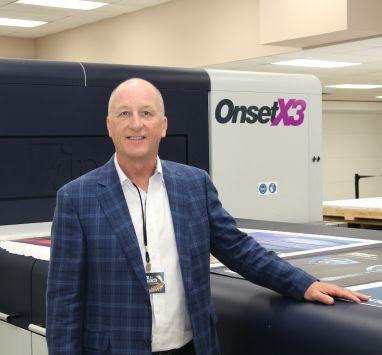
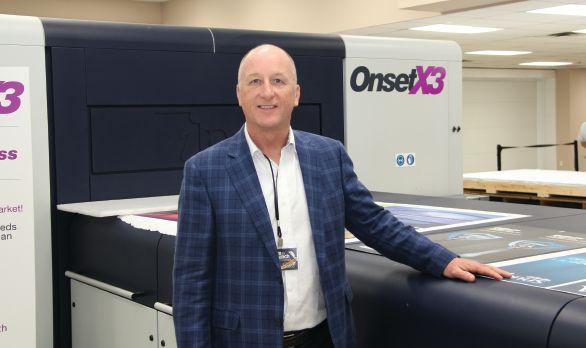
Holland & Crosby Limited, one of Canada’s leading manufacturers of display graphics, held an open house to showcase its new 71,000-square-foot facility in Mississauga, Ont. The company, which specializes in Point of Purchase retail signage programs (for some 80 years), began to operate out of its new facility in January 2016 shortly after completing its purchase of Colormark. The plant is driven by two new Inca inkjet presses purchased through Fujifilm, including the all-new Onset X3, which runs at speeds of up to 9,688 square feet per hour (180 beds), and an Onset X1. Holland & Crosby also installed two massive Esko Kongsberg cutting systems to accommodate the size and throughput of its new inkjet engines.
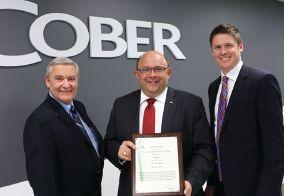
Cober evolving solutions celebrated its 100-year anniversary at 86,000-square-foot facility in Kitchener, Ont. Cober has evolved into one of North America’s most-advanced printing and media companies, producing a range of content through print, digital, interactive and integrated services.
p DI Group of Kirkland, Quebec, through its wholly owned subsidiary Trans-Optique Inc. (purchased in
facturers the Knifeless Tape installation tool for adhesive films used in display graphics and vehicle wraps. Knifeless Technology has patents for this technology in the U.S., Australia, Europe, South Africa, Japan and China, with more pending in Canada, China, Brazil, South Africa, Europe and Japan.
Hemlock printers of Burnaby, BC, installed VeraCore to manage its fulfillment operations, which involves both print and non-print collateral materials. Hemlock also manages magazine subscription fulfillment programs for several of its clients.
CaLenDar
June 22, 2016
printaction printForum
Mississauga Convention Centre, ON
August 11, 2016
OpIa toronto Golf Classic Angus Glen, Markham, ON
September 14, 2016 toronto Craftsmen Golf tournament
Royal Woodbine, Toronto, ON
September 14-16, 2016 sGIa expo Las Vegas Convention Center, NV
late-2014), agreed to merge its large-format-printing operations with both Imagerie DB Inc. and LVP.ca Inc. The three companies plan to begin working together in a dedicated facility this summer under the name PDI Large Format Solutions Inc.
b obst Group sa and WIFAGPolytype Group, both of Switzerland, entered into what the companies describe as exclusive negotiations with regard to Bobst acquiring WIFAG’s coating technology business. Founded in 1890, Bobst generated around $1.8 billion in revenues in its most recent fiscal year and has a presence in more than 50 countries, runs 12 production facilities in eight countries and employs close to 5,000 people.
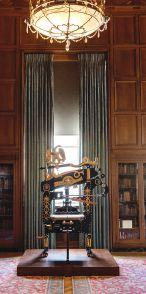
University of michigan’s William L. Clements Library, with more than 80,000 books and 30,000 maps, recently reopened after 2 1/2 years of renovation. The $17 million renovation included installing an 1851 George Clymer Columbian press refurbished by Mississauga’s Howard Iron Works. The landmark Clements Library, located next door to the school’s President’s house, holds one of the most-comprehensive collections of early American history in the world.
3 m acquired Knifeless Technology Systems Inc. of Vernon, BC, which manu -
Fastsigns International, with more than 600 global franchises, entered a new partnership agreement to offer all of its locations the new Epson SureColor S60600 roll-to-roll inkjet solvent printer. Currently, three Fastsigns locations have the new printer installed, with 33 new Fastsigns centres expected to open this year.
reserve bank of new Zealand won the International Bank Note Society’s 2015 Banknote of the Year Award based on its new $5 polymer note designed and printed by Ottawa’s Canadian Bank Note Company. The award was voted on by IBNS membership, which includes some 2,000 members in more than 90 countries. Among 150 new banknotes released worldwide in 2015, members were considered around three-dozen nominated notes from a record 20 countries –nominated for the award. The IBNS states that New Zealand’s $5 polymer note, featuring New Zealand mountain climber Sir Edmund Hillary, was a clear winner.
Konica minolta Canada relocated its headquarters to Airport Corporate Centre in Mississauga, Ont., with a dedicated area to demonstrate hardware and IT products. The building features a white reflective roof membrane and native, drought-tolerant plants that depend only on rainwater.
b LU e s oftware of Chicago, developers of the BLUE lifecycle management software-as-a-service, purchased Eastman Kodak’s Design2Launch software and services business. BLUE, which in January 2016 purchased Viki Solutions of Victoria, BC, states its SaaS platform is employed by more than 81,000 users and 3,100 companies worldwide.
September 23-24, 2016 COnsaC International Centre, Mississauga, ON
September 25-28, 2016 Graph expo 2016 Orange County Center, Orlando, FL
September 27, 2016 paC Golf tournament Niagara-on-the-lake, ON
September 28-29, 2016 paC Conference Niagara Falls, ON
October 17-20, 2016
aICC/tappI superCorrexpo 2016 Westin Harbour, Toronto, ON
October 18-22, 2016 all in print China New International Expo Center, Shanghai
November 3-4, 2016 rDG Designthinkers Sony Centre, Toronto, ON
November 10, 2016 Canadian printing awards Palais Royale, Toronto, ON
November 19-21, 2016 print World 2016 Enercare Centre, Toronto, ON
November 25, 2016 Cma awards show Westin Harbour, Toronto, ON
April 6-8, 2017 Graphics Canada International Centre, Mississauga, ON
May 7-9, 2017
Grafik’ art Place Bonaventure, Montreal, QC
May 11, 2017
Gala Gutenberg Montreal Science Centre, QC
Scott Crosby, VP and co-owner, Holland & Crosby.
President Peter Cober, Berry Vrbanovic, Mayor of Kitchener, and VP Todd Cober.
Clement Library’s new Columbian.
InstaLLs
Lucien rolland, who led Rolland Enterprises in St-Jérôme, Quebec, as President from 1952 to 1992, passed away at age 99. He was the company’s last President to bear the Rolland family name. In 1952, the fourth generation of the family, Lucien and its brother, Lantier, began to manage the company and In 1955 Lucien convinced the Board of Directors to complete the first step of a vast modernization and expansion program, via the installation of a paper machine in St-Jérôme that was 145 inches wide and operating at 1,200 feet per minute. The $4.6 million project would increase capacity from 27,000 to 57,000 tonnes per year and move Rolland into the future.
a l George , one of Canadian printing’s most-influential business leaders through the 1980s and 1990s, passed away in early May at age 73. George was best known for his leadership of McLaren Morris and Todd, founded in 1958 and well known for its production of Hallmark Cards and the Trivial Pursuit board game. MM&T began to shift its primary focus onto the production of labels as the company was purchased by Al George and John Morris in 1993, setting a foundation for one of North America’s leading label-printing operations. George remained with the organization until retiring in September 2002.
Larry stewart becomes Regional Sales Manager for KBR Graphics of Montreal. With more than 28 years of experience, Stewart is responsible for the eastern portion of Greater Toronto and parts of Ontario. Steve Klaric, Regional Sales Manager continues in his sales role for the western part of Greater Toronto and Ontario.
Utsab mukerji joins Mitchell Press of Burnaby, BC, as its Customer Service Lead. Mukerji has worked with some of the industry’s highest profile organizations, including as a plant manager with Vancouver’s Metropolitan Fine Printers, Hemlock Printers, and St. Joseph Print Group.
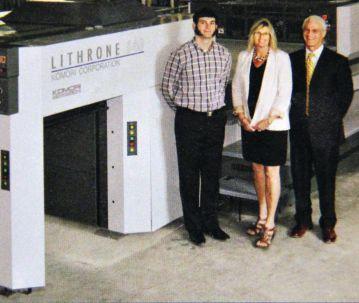
Harry Vinson becomes Executive VP of Komori America with overall responsibilities for the company’s sales, marketing and service organizations. Vinson has more than 25 years of experience primarily at Cenveo where he most recently served as President of the company’s commercial print, global packaging and envelope operations. He also previously held the position of General Manager, Sheetfed Operations Central Region, for MAN Roland Inc., and served as Senior Vice President, Technical Publications Group at Moore Wallace North America. Vinson began his printing career as Vice President of Sales for Quebecor World.
alexis aubre becomes an Account Manager for Agfa Canada in Quebec and the Atlantic Provinces, where he is responsible for the entire Agfa Graphics product portfolio. Prior to joining Agfa, Aubre held several key sales positions for various companies in the printing industry, including Canon Océ’s Professional Printing Solutions Group, Nustream Graphic and Xeikon.
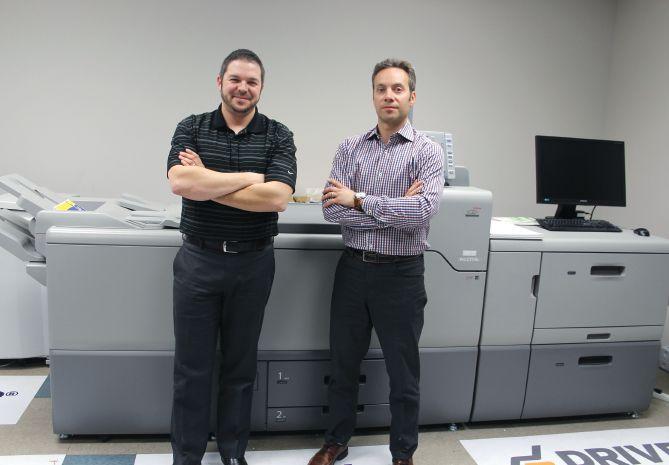
Drive products added a Ricoh Pro C7110X, pictured with Paul Weatherbie (left), Marketing Manager, and Michael Edmonds, CIO, to produce in-house sales materials. Founded in 1983, Drive Products is a national specialty vehicle systems integrator that distributes, installs and maintains a range of vehicle-mounted equipment.
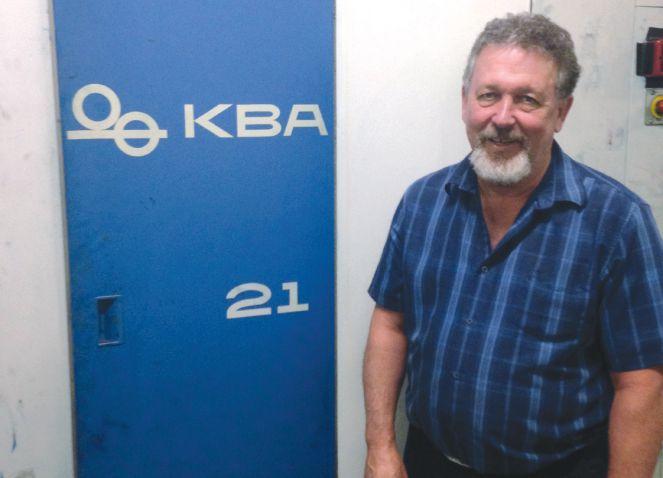
metroland media worked with KBA for a month to retrofit two reelstands, in addition to the motion control and drives in one of four printing towers, pictured with Wayne Savage, Maintenance Supervisor. Metroland prints over 100 community newspapers with over 125 editions spanning from London to Ottawa, Ont.
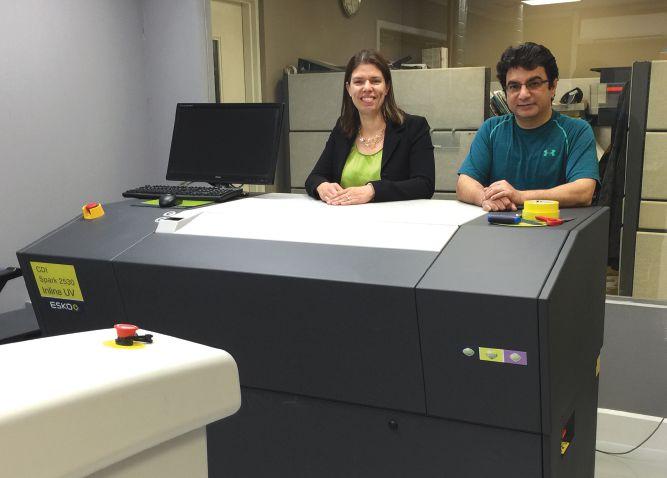
Design Label systems of Mississauga installed an Esko CDI 2530 plate imager with Full HD Flexo, the first such system sold in Ontario, pictured with Andrea Moore and Imran Faruqui. The 27-year-old company also added the Esko Automation Engine to leverage its LabelTraxx.
35m
The current annual impression count of Villanti Printers, described as Vermont’s largest sheetfed operation. The company plans to increase its impressions with the installation of a new Heidelberg Speedmaster XL 106 press.
Royalty starts up a manroland Web in Nairobi
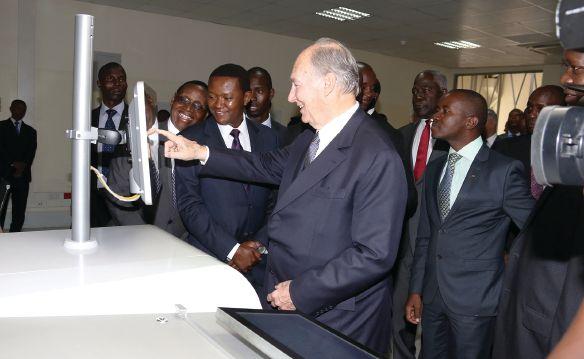
Nation Media Group in Nairobi, Kenya, started up its new manroland web systems COLORMAN e:line press with a celebration in March 2016 in a new building. Fifty-six years ago, His Highness The Aga Khan founded the Nation Media Group (NMG), the largest independent media company in East and Central Africa. Since then, the company has carried a mandate to provide citizens with what NMG describes as “serious, reliable information allowing them to form their own opinions.”
Every day, Nation Media Group prints thousands of copies of the Daily Nation, Business Daily, and the Taifa Leo newspapers, as well as the weekly The EastAfrican. In the future, they will all be produced using the COLORMAN e:line. In its 4-1 configuration, the new press can print up to 86,000 newspaper issues an hour. NMG explains its COLORMAN e:line has reduced its production time by 65 percent, which means it can produce the same print run in two and a half hours, a venture that would have taken six hours before.The company also projects waste savings of up to eight million Kenyan shilling annually.
In addition to His Highness The Aga Khan, the newspaper system was officially put into operation in front of Dr. Alfred Mutua, Governor of Machakos County, Nation Media Group CEO Joe Muganda, and Chairman Wilfred Kiboro. manroland web systems was represented by project manager Dr. Ralf Schädlich as well as Wolfgang Hiesinger, project manager for newspaper printing systems, who both arrived from Germany. The entire event was broadcast on African television, including live interviews.
Tasveer adds
20-inch Xeikon in India
Tasveer Digital Press of Surat, Gujarat, India, has chosen to expand is portfolio of creative services with a Xeikon 8500 press, which offers a 20-inch printing width. The press will be focused on segments like commercial printing, graphics, wedding materials, oversized photo albums, photo-books and corporate marketing materials like posters, catalogues and magazines.
“We have been operating in the digital CMYK segment for the past six years and we have always thought out of the box in terms of expanding our business,” said Timir Naik, owner of Tasveer. “The Xeikon 8500 press is a great addition to our production portfolio with its width of 20 inches and unlimited print length.” Naik continued to explain.
Tasveer Kendra, a name that has been synonymous with photography for a long time, was founded by Kanti Naik in 1948. Tasveer became a household name in Surat following an award-winning legendary documentary on India’s 1959 floods. His son, Krushan and Kavin Naik, joined the business in 1979 handling numerous videography and photography orders across Western India. As the first lab owner to be a photographer and videographer, Timir launched lab services in 1990 with Tasveer Digital Color Lab. In 2000, anticipating the changes of emerging digital technology, a second location in Adajan, Surat, was launched.
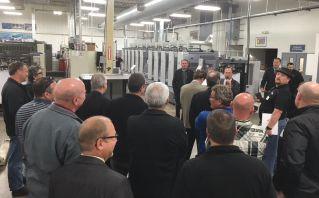
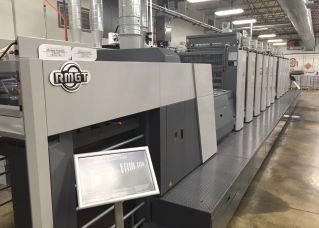
Metzgers Printing + Mailing of Toledo, Ohio, held an open house in May to showcase North America’s first RMGT 9 Series, 10-colour perfecting press with LED-UV capability. Installed in November 2015, the press is also equipped with a RPC fully automatic sequential plate changer.
“This investment in one-pass printing will springboard even further growth and makes a strong statement about our commitment to leadership in the Midwest print market,” said Tom Metzger, Chairman and CEO of Metzgers, who also noted the press will be focused on the label, packaging, and plastics markets.
Founded in 1976 as a small typesetting and dark-room business and within 10 years added a colour copy centre. Metzgers added its first perfecting press in the 1990s after moving into a larger printing facility. Today, the third-generation family company provides toner and offset printing, wide-format and display printing, specialized fulfillment services and Web-to-print storefronts from its 140,000-square-foot facility. The new RMGT Ryobi press also fits Metzgers’ branded Green Printing Initiative. In 2010, more than 10,000 square feet of solar panels were installed on the rooftops of two of the three Metzgers buildings. This solar array now generates over 144,000 kilowatt hours annually and produces over 35 percent of the new press’ energy requirements.
demonstrated its 10-colour rMGT 9 press with Led-UV curing to a group of printing-industry professionals from Canada, U.S. and Japan.
GLObe
His Highness The Aga Khan hits the start button on a COLOrMAn e:line press in the presence of (from left) Wilfred Kiboro, Alfred Mutua, Joe Muganda, Gideon Aswani (covered), and Joe Mucheru.
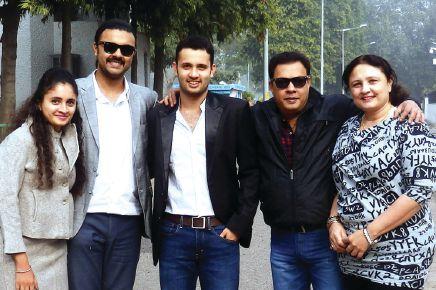
The Color Lab family (left to right): Karishma, Krushan, Kavin, Timir naik (owner), and Madhvi naik.
Metzgers
arCHIVe
5 years ago
The Aylmer Express celebrated the purchase of a new 6-colour, 40-inch Komori LS640 installed at the company’s Barney Printing facility in Woodstock, Ont. The fourth-generation family-owned printing operation is based in Aylmer, Ont. Both of The Aylmer Express’ facilities feature print, mailing and fulfillment facilities. The new press is equipped with an anilox coater, as well as PDC-SII closed-loop colour control, KHS-AI self-learning inking system, fully automatic plate changers and Komori’s Automatic Make Ready System.
10 years ago
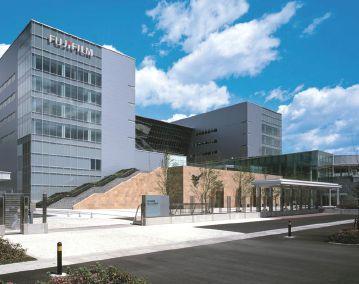
In 2006, Fuji Photo Film opened a new research lab in Kanagawa, Japan, built with the concept of “intelligent fusion” to integrate technologies and researchers from three existing corporate labs. More than 600 members will now work to complete cross-disciplinary research in the fields of chemistry, physics, optics, electronics and software. Researches come from Fuji Hunt (pressroom chemistries), Fujifilm Electronic Imaging (CTP technology), Fuji Xerox Co. (digital printing) and Fujinon Corporation, among other company facilities. The Kanagawa facility would become Fujifilm’s core research lab and help develop technologies like the Jet Press inkjet system.
400
Number of pages of a unique print project, Rush, The Complete Tours Book (19772004) printed by Battlefield Graphics in 2006 on its recently installed 12-colour Heidelberg SM102, leveraging the press makers’ Image Control System.
PrintAction in 2011 profiles the Twitter persona @Prepresshulk, who writes in ALL CAPS in fury over naive customer files: HULK SMASH IDIOT CUSTOMER!! SENDS LOGO AS LOGO.DOCX!, He sometimes shows a softer side: PRINERGY SOFTWARE SAYS “DESTROY” JOB. NOT WIMPY “DELETE.” HULK LIKE.
$14,500
Asking price in a June 1986 classified ad for a Ludlow model M #17333, new condition, with cabinet, 28 fonts and deepcast matts. The same ad is selling Hamilton cabinet & 45 fonts, deepcast ITF type for $4,450.
30 years ago
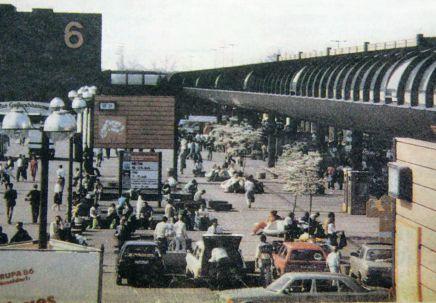
DRUPA 1986 in Dusseldorf, Germany, defied description, as the world’s largest graphic arts show featuring 1,449 exhibits stretching over 122,766 square metres of space, as well as 348,000 visitors from 154 countries. One of the featured technologies at the show includes a prototype multi-insert turret from Didde Graphics, designed for the business forms, commercial and direct-mail markets. The propriety unit does away with interchanging cylinders by incorporating three sizes of cylinders per turret. By simply pressing a button, the turret rotates and locks the appropriate cylinder in place. Slated for realize in early 1987, the variable offset unit can be retrofit to existing Didde presses.
40 years ago
The New York Times will change its format on September 7, 1976, to a six-column news page and nine columns for display advertisements from eight columns. The change will give the reader a more open, easier-to-read format, will conserve newsprint, lower costs and minimize future advertising-rate increases. The new format will permit the company to reduce the size of an 88-page paper to 84 pages without any reduction in content. The change, coupled with other changes made last year, will result in a savings of about five percent of newsprint a year. The present printed column width of 1 3/4 inches for ads will be reduced to 1 1/2 inches. For news, the column size increases to 2 1/4 inches.
Brett, Karen and John Hueston of The Aylmer express.
Fuji Photo Film’s new Advanced research Lab in Kanagawa, Japan.
The terror of Zumanjaro
tips on preparing your business for loss before having to turn unprepared to an insurance claim
By Nick Howard
think taking a terror-filled ride on Zumanjaro is the ultimate scariest you could possibly feel? Then you probably have not been through the life-changing horror of a major insurance claim. No doubt about it, the Six Flags Great Adventure ride in New Jersey is sure to suck the life out of you with its 415-foot drop reaching 90 miles per hour in just 10 seconds. Getting a phone call explaining that your building is on fire or the roof collapsed, however, will overcome any fears of Zumanjaro.
There are so many angles to an insurance claim that it is virtually impossible to write a guidance manual on what to do, how to do it, or – even more importantly – how to avoid the possibility of seeing your hard-earned work collapse in rubble. But there are ways and means to help prevent insurance catastrophes and I’d like to share some with you.
Protecting your investment
Every establishment has some type of insurance policy, but coverage is such a boring and mundane topic most of us do not dwell on it and quickly file documents away once established. Business interruption coverage is very common, but if a claim is made there is plenty of work the insured must do to prove the loss and this may come as a surprise to some. First suggestion: Keep good records and keep those records updated and in a safe place.
Over the years, I have worked on both sides of an insurance claim. I’ve been hired by insurance firms, adjusters, forensic investigators, public adjusters, as well as the insured themselves. Having seen both sides of the equation, it becomes quite clear how much knowledge and communication is lacking.
A good example is a file on which I was engaged by the insured. This company runs a profitable and well-organized business. A major weather-related structural failure in part of the company’s plant caused half of its machinery to become involved in a serious claim due to water and falling infrastructure. Months later, I was called to come and access some of the
damaged machinery. The claim had gone nowhere and, as is quite typical, the insured called in a public adjuster. Public adjusters are firms that work specifically for the insured and not the insurance company. This happens quite often when things get testy between parties. They are well versed on the protocols of a claim and the mechanics required to settle one. Public adjusters typically work for a percentage of the claim and this comes out of the insured’s settlement. In this case, the machinery sat exposed and rusting in the elements. To make matters worse, the surrounding areas were dangerous and essentially off limits.
At the on-site meeting about the accident, you could cut the tension and anger with a knife. Adjusters are firms that are hired by insurance companies to access and recommend needed steps to get the insured back up and running. Although the majority of adjusters are competent, as with any industry, there are also some disappointments and blow-hards that work to grind the claim process to a virtual halt. Obviously, insurance companies know they have responsibilities but they also want to mitigate the claims and pay out as little as they can. The word mitigate is important here, because it is not as well discussed that the insured must also try to mitigate their claim too, taking any steps to preserve or reduce damage to equipment and furnishings.
In this case, we had a disturbing adjuster who seemed to relish his role and enjoy the fact he was being paid handsomely to
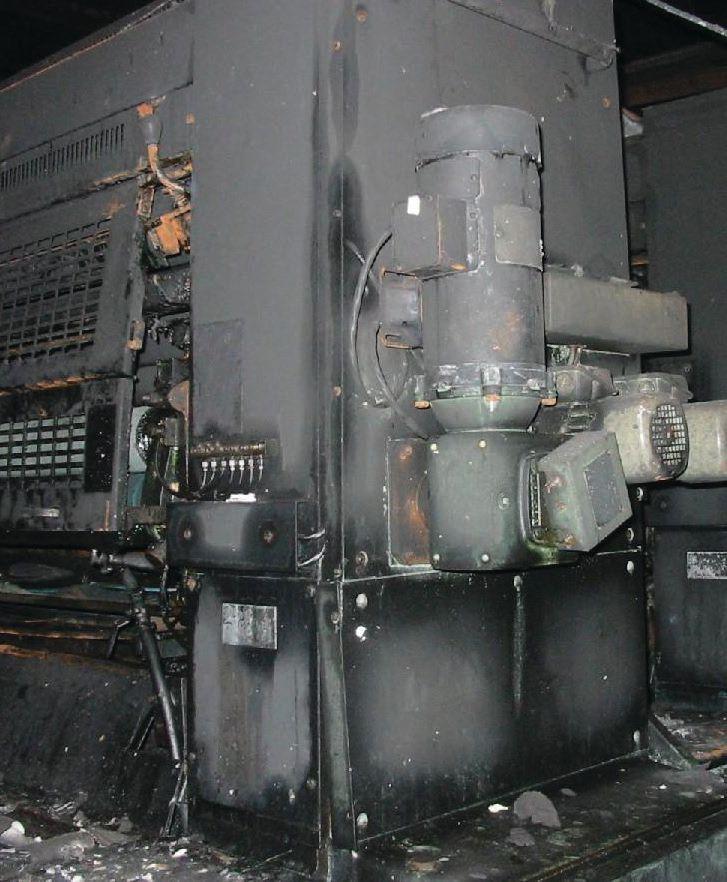
Fire can ravage a printing operation and it is critical to set a regular schedule to ensure your insurance is in good standing.
travel across the country, write reports, argue the merits of visible damage and drive just about everyone – especially the insured – to look for sharp objects.
Dealing with claims
After months of deadlock, thousands of dollars spent to argue the claim, total disruption of their scheduling, lack of key machinery. which in this case was very specific and hard to replace, it came down to total anger. Usually a competent adjuster can come up with a good plan. He or she knows, that when it comes to machinery, the best the manufacturer can do is provide a ballpark repair quote and a new replacement price. But what happens when the repair comes without a firm warranty? In almost all cases, it does not. And so the claim discussion moves forward around getting new replacement machinery, which is a significant discussion point to understand.
Talk to your agent and tell them you wish to be covered for full new replacement. If not, the claim continues down a rabbit hole: “The press is 12 years old? Then we need to value such an asset prior to the claim.” This is the essential problem and an active files quickly becomes a bickering and depressing period that can take years to settle and will in the end, probably – surely – mean you will come out of the whole ordeal worse off than you were before. Even with various opinions and quotations (for repairs), if the adjuster is lacking in specific knowledge and does not go out and seek someone who can provide this, then it may be impossible for both the insurer and the insured to agree on a fair settlement.
$6.4B
Net written premiums for commercial property in Canada in 2013, according to the Insurance Bureau of Canada, with $4.7 billion net claims in the same year.
There is, of course, another side to the insurance business in faulty claims or at the very least a case of very suspicious origins. We were called in by an insurance company over a claim to do with one machine – almost brand new. The story was an apparent break-in and vandalism on the press. Rags and paper were set alight placed on various parts of the press and a few control cabinets were tipped over.The heat activated the sprinklers which then put out the fire but drenched everything in the plant including offices.
There was something wrong here. I felt it and was rather surprised when I discussed my thoughts with the insurance rep. He didn’t much care really. He told me that the integrity of the insured really didn’t matter much. Insurance had to quantify the claim and close the file. But this was an exception and it should be noted, having worked many times on the insurance side, very little is left unknown when investigators get to work. They will know where the “oven” is, which is the term used by insurers in reference to the
initial location of a fire.They will also be able to track the damage and spot oddities like accelerants. Forensic work like finding out about the financial wellbeing of a claimant is the norm not the exception. In the end, this printer was forced to close.
When there was still a very healthy business climate for printing machinery, we regularly bought and rebuilt countless machines. I remember one purchase vividly from in 1994, shortly after southern California had a major earthquake. Bridges collapsed, buildings were damaged, and all sorts of businesses had claims. One damaged printer had two 40-inch presses – a 6-colour and a 5-colour.The claim was settled before we were involved and I went to look at the machinery, which was now dismantled and sitting outside in a temporary tent.
The manufacturer’s service manager was there and he tried to explain to me that the earthquake had uplifted the machine from its leveling feet and somehow twisted the frames. His evidence was one elongated hole which was part of six holes on each unit that were bolt holes for assembly. One hole? Clearly whoever had taken apart the press had a whole lot of trouble getting one bolt out! There was obviously no damage to the frames – it was all nonsense. But the printer did get new machines and we did bring both machines back to life and eventually resold them. Some common sense could have saved somebody a lot of money.
Many damaged machines came through our plant: Lightning strikes, floods, transit (by water or road), but the most damage by far was caused by fire. Delivery fires are common –caused by filthy deliveries with lots of spray powder. Dropped sheets mixed with very hot infrared or UV lamps can cause tremendous damage. Overheated motors such as ring blowers near the delivery, are another common reason. An obvious remedy is to keep machinery clean and free of debris. Another suggestion few think about is to have plenty of fire extinguishers around and know how to use them.This last one would have helped a UK company after its 6-colour double coater and double dryer (LYYLX) was set alight via a dropped sheet and interdeck UV lamp. That press took us over 6,000 man-hours to restore.
Insurance common sense
Over the years, we must have been involved in over 30 substantial rebuilding projects. Almost all were equipment that we purchased when a claim was settled. I learned to
quantify costs of repairs using some basic grade-nine chemistry, calculating what temperatures were reached, how it affected the guts and understanding how cast iron has a memory. Heat-twisted cast iron will return to its original position with re-heating. Fires that occur near melted polyethylene and polypropylene (plastic skids for example), produce toxic gases and when mixed with water become an acid that will attack bare steel and cast iron.
I still see a great deal of waste within the insurance claim process when the wrong so-called experts are in a position to determine repairs. A good talker can needlessly cost both sides a lot of money.
So far I’ve yet to meet any insured who felt that they came out ahead after a claim. This should be a warning to everyone, that even though we have insurance, in the end, after all the pain and disruption, you will often wish you did not file a claim. Insurance is important and can save a business, but do not assume you’ll finally get rid of that old machine or upgrade your whole plant simply because you have business disruption coverage and replacement coverage. Take steps to protect your investments now. Do simple things like buy more fire extinguishers, improve your housekeeping, and update your records.
If a disaster happens, take steps to reduce your claim and get solid advice from a professional. Be completely honest and upfront. Do not try and pile-on things that will be spotted as marginal by a good adjuster. One final suggestion: consider increasing your deductible. You should be trying to prevent a life changing moment not small repairs like as a bolt going through a press. Raising your deductible can lower your premiums and even afford you the budget to increase your protection if and when the big claim hits.
That’s about all you can do and it’s really important that you do it now before something horrible happens. Zumanjaro is nicknamed the Drop of Doom. But you know that when you buckle in. Insurance claims can have the same moniker but be even more terrifying and without warning.
nICK HOWarD, a partner in Howard Graphic Equipment and Howard Iron Works, is a printing historian, consultant and Certified Appraiser of capital equipment. nick@howardgraphicequipment.com
Wednesday,
June 22, 2016
mississauga Convention Centre
PrintForum, presented by PrintAction magazine, is a conference for printing and imaging professionals from across Canada. Designed to build thought leadership in business strategy and technological innovation, PrintFroum is a one-day event featuring educational sessions, networking and exhibits of new industry technologies.
Sponsored by
Internal CRM
Leveraging customer relationship management and Voice Over protocol tools to bind your print sales and production teams
By Steve Falk
What can Buddy Guy’s blues band teach us about collaboration? Buddy Guy, the Chicago blues guitarist whom Eric Clapton once called “the best guitarist alive”, is still touring with his Damn Right Blues Band at 79 years of age. I’m a fan and play a bit of music each week because it feels so good to get together with friends and jam. A live blues band is an improvisational exercise in collaboration and innovation. Could that be an analogy for the printing business these days?
I drove down to Buffalo with a fellow blues/jazz fan to see Buddy last month.We both love live music. Buddy opened by telling the adoring crowd, “I’m not sure what’s going to happen tonight. It keeps my band on their toes. There will be some surprises.” And that, in a nutshell, is why I love live blues and jazz music. It is spontaneous and, to do it well, all the players must effectively communicate what’s going on in the moment, where the tune is going and who’s going to take the lead and when. The skill with which a great band navigates this tricky live improvisational experience is what I admire most.
The key is clear communications and exchange of information among the players. The drummer gets a cue to end a song from the subtle lifting of the guitar neck, a slight nod signals a soloist to begin, a hand in the air telegraphs the bridge and a tap on the head means take it to the top. Hold up three fingers at the start of a song and you signal the three flats in the key of E.
Enough riffing on the music, this brings me to how we manage internal business communications, which is increasingly becoming an experience of working inthe-moment. Sharing, collaborating and being prepared for improvising in new business situations has never been easier. Customer Relationship Management (CRM) tools are the foundation of great customer experiences, because they allow for the easy sharing of information among your team about the customer’s contact
information, the stage in the sales pipeline and recent communications with them. Most high-end Management Information Systems today have integrated dashboards for sales reps to help manage clients, but CRM is well supported by tools such as VOIP phones, chat tools and video conferencing. There are so many channels to engage with a customer and also to exchange information amongst your employees to make great music together. I have worked with several of these CRM and VOIP tools that have proved beneficial in the fast-paced printing business.
CRM tools
Let’s start with the CRM tools. These are basically the recent digital take on the paper Rolodex or address book. When all of your company can share addresses and contact information, you will be a stronger organization for it. Best of all, most are in the cloud, so they are scalable, mobile friendly and available wherever your team works. There will be no more time wasted searching out the right contact name for a customer or wondering who is the main contact, who pays the invoices or who has left the operation. Our CRM also keeps a log of all email back and forth between clients and the company. It simplifies understanding the state of a project and acts as a record of past exchanges. CRM is often associated with tracking the sales pipeline. This simply means that “opportunities” are logged in this central repository and this makes it possible to see how sales targets are being met, where
700M
Approximate number of new Messenger users over the past two years, bringing the total to 900 million, as the service’s owner, Facebook, pushes the platform as new business tool.
leads are coming from and who is cultivating them at what stage – all great information to help you understand how your sales efforts are progressing.You can even automate some steps. For instance, when a new client is added or a sale completed, the sales manager can receive an email notification alert (the CRM equivalent of a guitar neck lift to signal the end of a song). The latest twist on this is the link between online forms, social media follows and your CRM. In other words, every point where a customer interacts with your company can be tracked and managed from the best CRM tools. It is now easy to compare different CRM tools functionality and an extra hour of research will find the best tool (at the right cost) for your employees. It’s like the whole band is facing each other, has eye contact and can see where the improvised tune is headed. Companies just perform better when they can collaborate easily.
Even vendor information can be kept on the CRM, so nobody at your firm is scrambling trying to find the name of that special source for cartons, blade sharpening or specialty ink. Once you add a vendor name, the best practice is to add a few searchable keywords to make finding them easy. We add “plumber”, “electrician” and so on to our vendor names. You can even decide to rate your vendors so that others at the firm know if your electrician arrived late, charged too much or was the friendliest one you’d ever met. This just makes it easier to manage vendors of services, ink, paper,
whatever else you purchase in the course of business.
But the communication exchange can also benefit from new channels available at low cost. Some we are familiar with, and some we do not associate with business. Nearly all of us send SMS text messages these days. Our mobile devices help us connect with family and friends and increasingly with work. Having an internal chat tool (Google for Work has one built in) can mean time savings when quick answers are required. Messenger, now part of Facebook, is a growing tool for chat and even has a phone/video feature. You may be wondering why you’d use a Facebook tool in your print business, but you only have to ask the 900 million users (up 700 million in two years) about the benefits, or listen to Mark Zuckerberg’s latest 10-year plan to use Messenger in new ways in our business life.
VOIP tools
I’m also a fan of VOIP phones as they help make collaboration easier. We once thought it was good enough to have a toll-free number, but nowadays you want to be able to have your calls follow your employees to their mobile devices, and offer easy conferencing and transferring, even if they are working from home or from a mobile device. VOIP seems to offer the widest number of op-
tions for making phone communications more effective at work.
But don’t think that just having tools will make the whole thing gel. Your band of employees have to rehearse. By this I mean that they need to be trained and work out the new etiquette for these channels of communication. When should they choose Chat over an email and when should I invite a colleague to join me on a call or share a video of a bindery process with a repairman so they can see what is acting up in the plant? Without having some policies and sharing best practices among your team, however, you’ll have a train wreck (that’s band talk for a song gone off the rails).
These channels are constantly evolving.You cannot wait for it to all settle and then make your move. Start tuning up your internal and customer communications today and you’ll all make pretty music together, and maybe a bit more money too, as the experience improves and your costs to manage collaboration reduce.
steVe FaLK is President of Prime Data and holds extensive knowledge about the intersection between digital technologies and print media. Data-driven marketing strategies are his primary focus. sfalk@primedata.ca
A future hidden in prairie grass
a revolution in paper production driven by agricultural-residue pulp mills is on canada’s horizon
By Neva Murtha
the potential impact of papers made from agricultural residue is becoming an exciting new sector to watch in Canada. Canopy has just launched its “Say Yes!” project across the North American wheat, rye and sorghum belt. Dubbed YIMBY! – Yes In My BackYard! – This innovative enterprise is reaching out to agricultural communities asking if they have the straw supply, town infrastructure and other qualities necessary to become a candidate site for a new, green-job-creating straw pulp mills.
The Canadian Prairies are being hit hard right now, with economic downturns in Saskatchewan and Alberta taking a toll on jobs and regional stability. New opportunities for rural communities across the Prairies, adding value to agricultural residues typically treated as ‘waste’ products could bring new hope and green jobs to a hard hit part of the country.
The Federal government made bold commitments in at the 2015 UN Conference in Paris to seriously tackle climate change. Intact forest landscapes and their significant contribution to carbon storage are bound to come to the forefront as a means to reduce Canadian greenhouse gas (GHG) emissions and contribute to climate stabilization. Canopy expects this to inevitably lead to greater protection of the boreal forest and a concurrent push to develop alternative fibre sources. The future of straw paper just keeps getting brighter.
Some Canadian printers are early adopters of wheat straw-based papers.The Printing House, Hemlock Printers and MET Fine Printers, for example, offer uncoated free sheet wheat straw-based paper and more printers are bound to join the ranks of these forward-thinking businesses.
Since before Canadian Geographic and Dollco (purchased by Lowe-Martin in 2012) worked with Canopy in 2008 to print a magazine issue on wheat straw-based paper, Canopy has been growing the market for straw-based papers to facilitate the development of agricultural residue pulping capacity.
To date we have identified 1.3 million tons of unmet annual demand for printing and writing grade papers made with straw. That market keeps growing as more print users look to improve their standing on sustainability issues. Now we just need the supply – and it’s looking promising.
Following the launch of YIMBY!, the response from farming communities has been immediate and enthusiastic. Within 24 hours of launching the campaign, Canopy was receiving applications from interested districts. Our detailed questionnaire will delve into the viability of each of these applicants. Do they have a high enough volume of straw available within a set radius? Do they have the water, road and power infrastructure needed to support a pulp mill? Is the work force available?
We’ve done the research, established the criteria with the advice and assistance of experts in the field, and we know the potential exists for many straw pulp mills to be built.
At the same time, we are liaising with entrepreneurs and investors, filling them in on the immense market demand for strawbased papers we have already quantified, the viable community opportunities for mill construction and the green-tech revolution that is ready to launch.
Through our ongoing Second Harvest work, we’ve been privileged to be given confidential access to some of the latest developments and innovations. The revolution is truly gaining momentum.
As new scientific research highlights the critical importance of forests in stabilizing
In 2008, Canadian Geographic became the first magazine in north America to be produced with the wheat sheet.
1.3M
Number of tons of unmet annual demand for printing and writing grade papers, as identified by Canopy Planet in a recent study.
the global climate and mitigating the impacts of climate change, more and more governments will be forced to take action to protect high carbon value ancient forests. And more and more print customers will be looking to avoid contentious forest fibre and seeking viable alternatives to tree paper.
Straw papers will be a game-changer for the availability of publication grade eco-papers and lighten the footprint of print materials.
The future of straw can revolutionize the printing industry. Are you ready?
neVa mUrtHa works with Canada’s magazine publishers and printers to develop visionary procurement policies. neva@canopyplanet.org
Ten years inside The iron index
a statistical view of how leading offset-based printing companies have invested in technology
By Jon Robinson
Key STATISTICS fROM The IRON INDeX DeSCRIbING TeCh ADVANCeS IN CANADA
172
Number of new CTP systems installed in Canada between 2005 and 2006, which represents 35% of the total 491 CTP systems at 350 plants listed on The Iron Index. This was a peak for CTP installs in Canada.
142 Toronto alone represented 29.4% of the total number of CTP devices in Canada between 2005 and 2006.
12
The number of printers in Canada working in some way with 10 micron screening in 2004, as CTP leaders began to leverage second-generation machines for high-fidelity work.
this 10-year view inside PrintAction magazine’s most-recent annual technology, The Iron Index, is significant because it marks an anniversary. For the first time 10 years ago, PrintAction began to ask offset-heavy printers about their toner-based colour presses. The Iron Index itself actually began 20 years again when PrintAction began tracking the arrival of computer-to-plate-imaging systems in Canada.
The Iron Index is unique in the printing world and its origin is largely the result of national pride, as Canada watched Vancouver-based Creo Inc. revolutionize the world of production printing with digital imaging systems – at a time when most of commercial print made healthier margins.
What began as PrintAction’s short, important list of innovative commercial printers in 1996, who installed first generation computer-to-late (CTP) technology, grew exponentially after the turn of the millennium as sheetfed and web-offset printers across the world began to abandon film-based workflows. Commercial printers built new workflow often from the ground up, true digital infrastructure, committing to a communications revolution created a few years earlier by the GUI-driven personal computer.
In 1995, four Canadian printers had installed a CTP device. The number jumped dramatically to 32 new CTP installation by 1998 and then 62 completely new CTP purchases by 2000. An interesting statistic from a survey in 2001 indicates, that, while all CTP users indicated the systems installed had met or exceeding expectations (with quality of work reaching the best satisfaction at 40 percent), 33 percent indicated the ease of installation did not meet expectations.
As the 2000s moved forward, CTP imaging systems became more robust and mature as new generations were introduced, pushing speed, quality and ease of use. One of the most interesting statistics to look back on occurred in 2005 when participants of PrintAction’s CTP survey were asked to provide their typical linescreen level (recorded as lines per inch, lpi). There was a clear push toward higher fidelity everywhere in the communications market, and primarily aided in printing by advances in CTP hardware and more stable stochastic dot control – certainly aided by an symbiotic jump in offset press control. Earlier generational jumps from 133 to 150 lpi, were resting at 175 lpi in the mid-2000s, but set to be pushed by more than a handful of supreme-dot printers. By 2006, it was time to add toner presses into PrintAction’s technology survey, as leading printers across the country were
Number of printers working consistently above 175 line screen in 2005 as the industry pushes print quality to new levels based on mature CTP and software, as well as a new era of modern press technology.
The number of Creo imaging systems listed on The Iron Index in 2005, which is the most of any vendor. This was the year Kodak purchased Vancouver-based Creo for close to $1 billion.
The amount of facilities on The Iron Index producing some level of work with all three printing processes (offset, toner, inkjet) by 2014.
investing heavily in production-strength colour machines – driven in Canada primarily by Xerox, Canon and HP, the latter of which had bought Indigo five years earlier. It was a significant arrival for the toner-printing process (liquid and dry), as printers across the world quickly adopted the term digital printing.
A year later, in 2007, PrintAction’s technology survey was rebranded as The Iron Index, because the listing was built around litho printers, even as we tracked toner and inkjet investments. The survey also included for the first time a key new metric: Offset to toner to inkjet production ratio, which describes a printer’s estimated percentage for how their print is manufactured.
The purpose of The Iron Index is to track the production-technology investment trends of leading offset-based print-
Icon alpha
ing companies across Canada. This includes tracking offset press by model, number of units, and format size, toner and inkjet press specifications, which have been traditionally displayed as supplier icons to reflect supplier penetration.
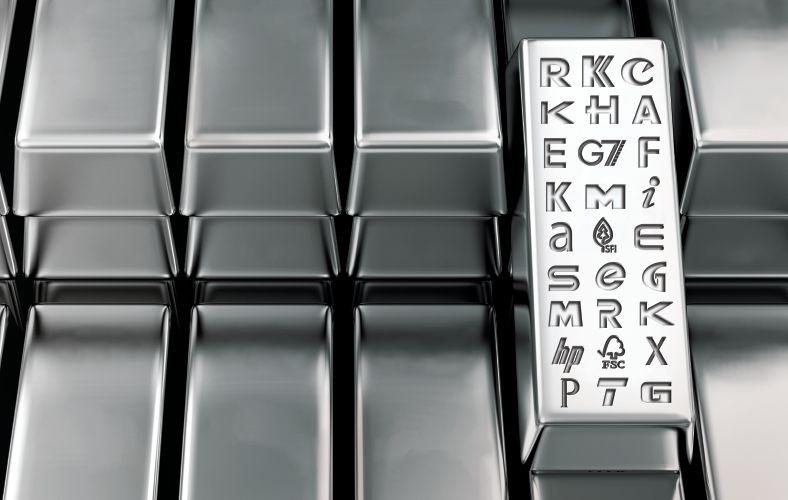
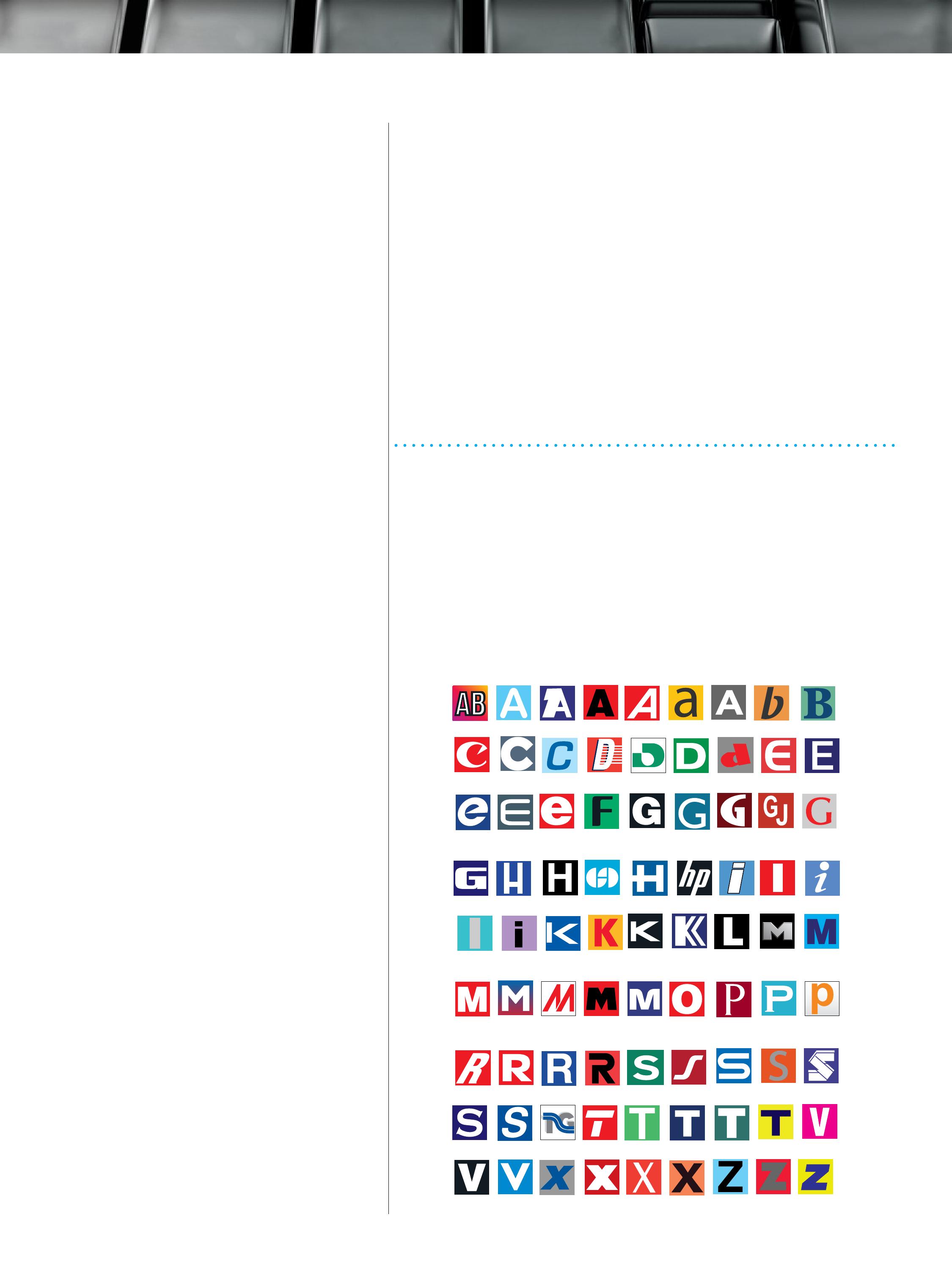
These supplier icons visually describe the offset, toner and inkjet presses driving more than 200 leading companies in Canada, as well as their traditional front-end software and imaging systems. The Iron Index provides an unparalleled view of Canada’s printing infrastructure and, more importantly, how companies rooted in offset production are evolving to new market demands.
The following statistics have been gleaned from the most recent 10 years of data supplied through hundreds of survey participants.
The number of CTP devices installed in both Prince Edward Island and Northwest Territories for the first time in 2004. The farthest distance between two CTP devices in Canada measures 6,228 km.
Number of Xerox presses listed on The Iron Index in 2006, out of a total 70 toner presses, as the vendor drives digital printing adoption in Canadian printing.
The Iron Index is rooted with several leading printing technology suppliers, ranging from CTP hardware, prepress software, Management Information Systems, offset presses, toner presses, inkjet systems and certification schemes.
The Iron Index’ iconic design approach was devised to illustrate which printing-technology suppliers have the most impact amongst Canada’s leading offset-based commercial printing companies. This icon system was first used in 2007. As a result, some important tech companies are not represented on the following list, because of preceding M&A activity – Kodak buying Creo for $980 million in 2005, for example. The following suppliers, however, have been a part of the fabric of Canadian printing since PrintAction began tracking offset presses in 2004. 49
Increase in the price of primary aluminum from January 2003 to January 2006, while the price of silver increased 52% in this time period, and oil 48%, as margins began to be greatly affected by inputs.
Number of Agfa chemistry-free plate users in Canada, in 2006, as a new era of progressive industrial imaging begins to take hold in the pirnting industry..
Number of offset-based printing facilities running a digital colour press listed on The Iron Index in 2007, as the toner printing process becomes a significant source of revenue.
40-InCH prInters
The following statistics apply to 75 Canadian printing companies, with at least one 40-inch sheetfed press, chosen based on their consistent participation in The Iron Index surveys since 2006 (see page 22 for company listing).
Percentage of all facilities listed on The Iron Index in 2014 who are running a
81% 77%
Average employee size of commercial printers who participate in The Iron Index over the past 10 years. Minimum years of business of operation amongst all companies represented on The Iron Index since this statistic was first tracked in 2008 (approximately 85% of companies provided year founded in the first couple of years).
Amount of all printers on The Iron Index in 2015 who are producing at least 70 percent of their work with offset.
Speedmaster. Get Inspired.
Speedmaster. Get Inspired. The key to our customers’ success lies in the perfect interplay between people, machines, materials, and processes. Speedmaster technology creates impressive business models that in turn yield a crucial competitive edge.
the opportunities the Speedmaster offers and let yourself be inspired!
14%
Number of printing companies founded 50 or more years ago on the Iron Index.
24%
Percentage of facilities that added a new or replacement inkjet system between 2013 and 2014, as new generation devices came on board to eliminate banding and provide more speed.
Amount of facilities that estimate their inkjet production to be at least 10 percent of their overall production mix in 2014.
52 88%
The amount of facilities on The Iron Index with an environmental designation as of 2015.
32% 45%
Percentage of Iron Index participants who are running a branded Management Information System, as Canadian software developer Avanti leads a new charge in integrated manufacturing.
87%
Percentage of companies on The Iron Index running a colour toner press in 2015 versus just 12.9 percent in 2006 when the statistic was first tracked.
Amount of facilities running with an FSC designation by 2015 which is the largest certification amongst all printers listed on The Iron Index.
130 Companies of The Iron Index
To compile the statistics in this year’s report, Ten years inside The Iron Index, PrintAction focused on commercial printing operations that were part of the annual technology survey in 2006, when tracking of digital presses began. These companies continued to participate in the annual technology survey until 2015, with more than 90 percent providing updates each year, establishing a benchmark for year over year analysis. The companies are divided into 40-inch (or above) facilities and 29-inch (or below) facilities (at time of survey) for more comparable results.
40-InCH prInters (75)
Accent Impression, QC
Advance Printing, ON Advocate Printing, NS Advertek, ON AIIM Group, ON Allen Print, NS Annan & Sons, ON Aulward Graphics, ON Au Point Repotech, QC Battlefield Graphics, ON Beresford Box, ON Best Color Press, BC Boehmer Box, ON BOSS Logo, ON C.J. Graphics, ON CCT Printing, ON Cober Evolving Solutions, ON Curtis-JK Printing, ON Eclipse Imaging, ON Ellis Group, ON Esdale Printing, MB Flash Reproduction, ON Friesens, MB Generation Printing, BC
29-inch printers (55)
58%
Percentage of facilities running more than one toner press as of 2015.
A & F Printing, BC
Acorn Graphics, AB
Allan Graphics, ON
Annex Publishing, ON
APD Printing, ON
Aupel Printing, QC
Beatty Printing, ON
Blyth Printing, ON
Bounty Print, NS
BroMoc Print, NS
Capital Colour Graphics, ON
Century Printing, ON
City Press, MB
City Printers, NS
Continental Press, ON
Custom Printers (IDP Group), ON
Emerson Clarke, AB
Fraser Valley Custom, BC
Gilmore Printing, ON Glenmore Printing, BC
Graphic Dimensions, ON Hebdo Litho, QC Hemlock Printers, BC Houghton-Boston, SK Impressions De Beauce, QC Imprimerie F. L. Chicoine, QC Imprimerie L’empreinte Imprimerie Maska, QC J.B. Deschamps, QC Kayjon Graphiques, QC KT Web, ON Produlith, QC Litho Chic, QC Litho Mille Iles, QC Litho Quebec JGB, QC Maracle Press, ON Marquis Imprimeur, QC McCallum Printing, AB McLaren Press, ON MET Fine Printers, BC Mi5 Print, ON Millenium (MPI Print), ON MM&T, ON
Graphcom Printers, AB H&E Copy, ON Henderson Printing, ON Highspeed Printing, AB Impact Printers, SK Impressions Printing, ON Imprimerie Contact, QC Imprimerie For, QC Imprimerie Plantagenet, QC Imprimerie Vincent, QC Lakehead Printing, ON Leech Printing, MB Le Groupe Chagui, QC Litho Rosemont, QC Marine Printers, BC Marquardt Printing, ON Mister Print (PrintWest), SK Moveable, ON Newcastle Print, NB
Motion Creative Printing, ON Offset Beauce, QC
P-Tech Print, ON Pazazz Printing, QC
PDI Group, QC
PointOne Graphics, ON Premier Printing, MB
Prodigy Graphics, ON Rayment & Collins, ON RP Graphics (Lowe-Martin), ON Shorewood Packaging, ON Simpson Screen Print, ON Sina Printing, ON Smart Lazer Grafix, ON SNR Printing, ON St. Joseph Print, ON Stuart Packaging, QC
The Incredible Printing Co., ON The Lowe-Martin Group, ON Toronto Trade Printers, ON Tower Litho, ON Trade Secret, ON Tri-Tech Canada, ON Western Litho, SK Weststar, ON
Nova Printing, ON Oil City Press, AB Parfield Printing, ON Parker Pad, ON Pinnacle Litho, ON Print Preview, ON Printworks, AB Priority Printing, AB Pristine Printing, ON Productions Alter Ego, QC Taylor Printing, NB The Printer, NS Thunderbird Press, BC Twin City Dwyer, ON Ultra Print, SK Waterloo Printing, ON Wayside Printers, BC Winchester Print, ON
OUTDOOR A P PLICATIONS
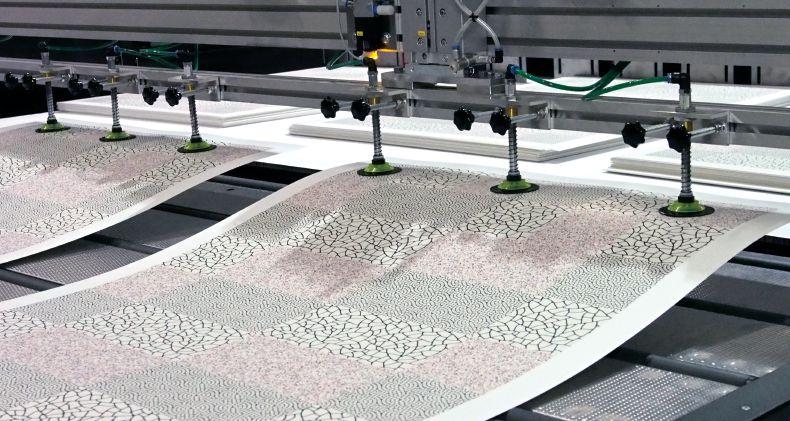
The new Océ Arizona® 1200 series are high-quality printing systems with a mission! They have been designed for even greater image quality, versatility, and ease of use. New features include a choice of light cyan and light magenta inks for enhanced highlight and quartertone reproduction, enabling you to produce higher quality products and fine art applications with ease.
This new technology can allow you to grow your business by producing a broad range of higher-margin custom applications, including textile, flooring, wallpaper, stained glass, paneling, furniture, and even ceiling tiles, including traditional markets such as POP displays and more.
CanaDIan traDe prInters
The following statistics apply to 12 Canadian companies (among the 130 used in this specific report) that provide trade services based on their consecutive participation in The Iron Index surveys since 2006.
29-InCH prInters
The following statistics apply to 55 Canadian printing companies, with at least one 29-inch offset press (or of smaller format), chosen based on their consistent participation in The Iron Index surveys since 2006.
PrintAction would like to thank all of the companies that have participated in The Iron Index over its 20-year history to enable these statistics to be generated. PrintAction plans to continue to provide further analysis of this data in the coming months. To learn more about future plans for The Iron Index, please contact Jon Robinson, Editor, PrintAction (jrobinson@annexweb.com).
With over 130,000 paper cutters built, Adolf Mohr knows how to build a quality paper cutter! Reliable, fully automated and available in 26" and 31" widths.
Contact us for a demo today!
Multiloft ® Sheets + Inserts
Do you have copier? ... Do you have a paper cutter? ...
... Then, you can make a card 24pt or thicker without any glue or backing sheets. Simply print and cut!
Contact us today for a FREE sample pack!
X-rite’s new generation IntelliTrax2 supports M1 conditions and thicker substrates for the packaging world.
digiTal drupa hardware
tech giants make relatively small but important gains in toner, inkjet and wide-format hardware to enable printing companies with a growing need to produce a larger range of print products with a single investment
By Zac Bolan
advances in automation and digital print technology are driving the innovations being showcased on the drupa 2016 exhibition floor. While conventional offset technology perseveres in most high-volume print environments, significant gains are being made in digital print, large-format inkjet and digital finishing technologies. giving printers the ability to produce a wider range of products for their customers.
Xeikon’s missing link
Since acquiring Xeikon late in 2015, the Flint Group has put the company at the heart of its recently formed Digital Printing Solutions division to expand its corporate focus into this burgeoning market.
With the acquisition, Flint expands its portfolio of digital printing solutions through a combined offering of hardware, consumables and services across its global markets. In its first major show since the acquisition, Xeikon has a major presence at drupa 2016 showcasing its first digital printing press using unique liquid toner technology.
The Trillium liquid toner printing process, debuted by Xeikon at drupa 2012, has been integrated into the Trillium One digital four-colour web press being demonstrated at this year’s show. The Trillium One is the product of a joint venture between Xeikon and Miyakoshi, a leading Japanese press manufacturer. The new press is capable of running at 60 metres per minute at a resolution of 1,200 dpi across a 500-mm web. All print can be fully variable, and is dry to the touch and ready for post-press production as soon
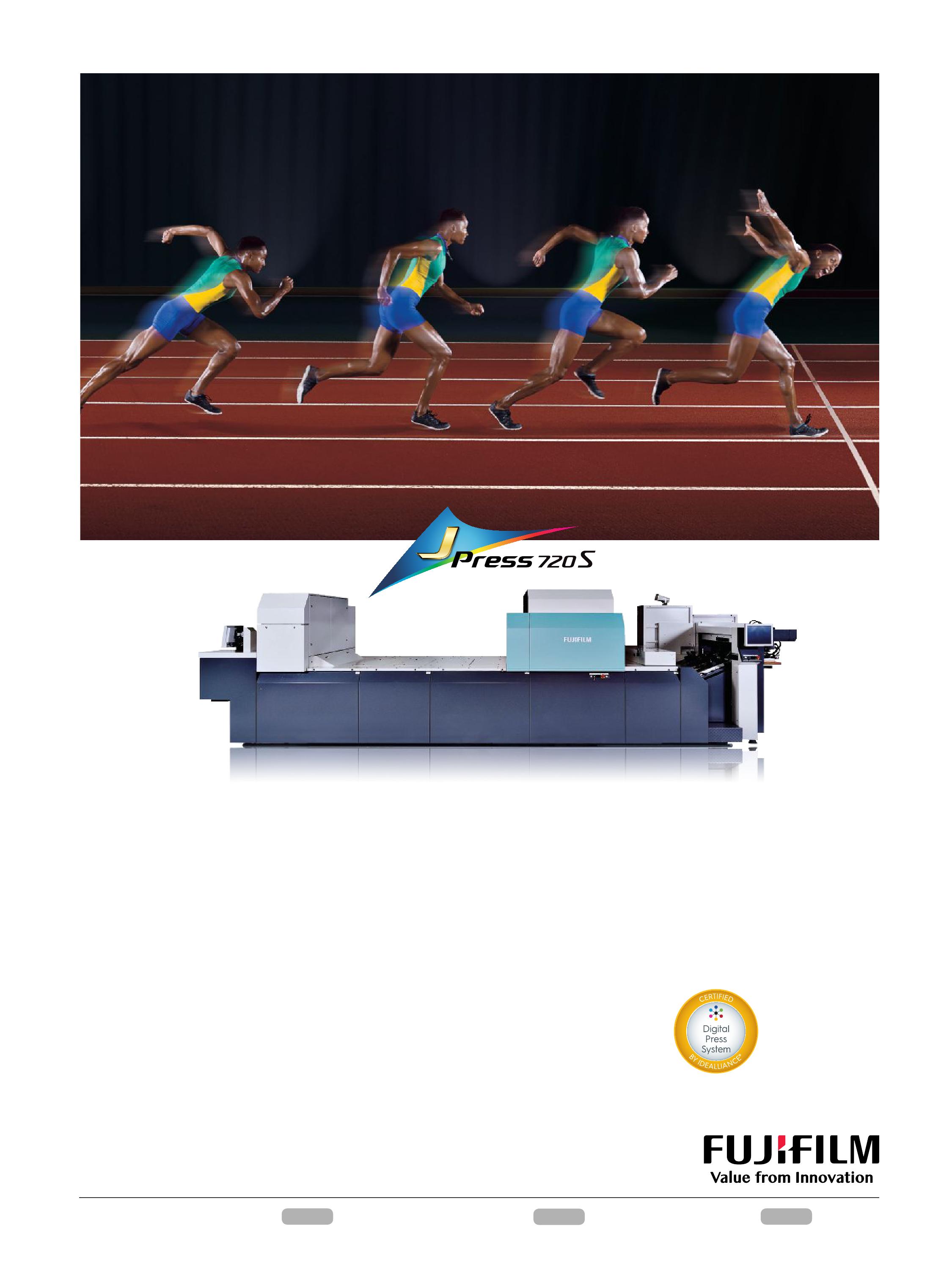
With millions of impressions produced, the 2nd generation J Press 720S is the proven digital inkjet press solution to compete for more of your customers’ brand business.
You’ll appreciate how fast the J Press 720S gets out of the blocks. No plates and virtually no makereadies to slow you down. No wasted sheets or time in running up to color either. Just send the PDF file to the press and instantly print litho-quality images on standard offset coated and uncoated sheets.
Our prints finish strong too, with flexibility designed to take full advantage of your existing finishing equipment. J Press 720S sheets can handle lamination and coatings for high end jobs like photo books, calendars, and brochures. And, the J Press 720S is the first production inkjet press to be certified by Idealliance to GRACol 2013 standards.
Seeing is believing. Visit fujifilminkjet.com today.
as it feeds onto the take-up spool.
To achieve this, the Trillium One relies on Xeikon’s Tonnik, a liquid toner that combines the advantages of a dry toner (economical and efficient) with imaging quality that, according to the company, compares favourably to conventional offset technologies. Tonnik consists of very small toner particles (less than two microns) suspended in a high-viscosity carrier liquid derived from bio-materials. The press mechanically recycles the liquid while the toner particle accurately transfers from roller to substrate at very high speeds.
Xeikon is positioning the Trillium One to compete with the economy of offset litho for longer runs while offering all the advantages of digital printing such as variable print. The first Trillium One presses will ship from Q2 2017.
The company is also showing Fusion at drupa 2016 – another potentially game-changing digital imaging technology. First demonstrated at Labelexpo last September, Fusion is aimed at the high-end label and packaging market. Xeikon’s Fusion Technology will be implemented through a number of modules released over time that add digital embellishing capabilities to a Xeikon press. Fusion Technology will combine four-colour printing with a number of digitally rendered effects potentially including: hot or cold foiling; matte or gloss, spot or flood varnishes; and digital Braille. The advantages of producing these effects digitally through integrated embellishing modules include a high degree of automation and
content variability – something unheard of with conventional finishing. While Fusion is initially targeting the label and packaging industry, it could really shake things up in the commercial print world.
esko
on the cutting edge
Esko proclaimed its ‘Packaging Simplified’ mantra at a pre-drupa press conference held in Bruges, Belgium this past March (PrintAction, May 2016) as the company rolled out its latest software solutions. Now Esko is following through with some significant updates to its digital finishing workflow as well as Kongsberg cutting, creasing and milling table portfolio. By introducing the latest version of its i-Cut software suite for artwork preparation along with enhancements to Automation Engine and ArtiosCAD, Esko promises users greater throughput with significantly less operator intervention and a 50 percent reduction in training time.
Meanwhile, the Kongsberg table collection has been simplified into two lines – Kongsberg X and Kongsberg C. The Kongsberg X product family is aimed at the prototyping market, and users requiring a great deal of creative control over the products they cut. The X tables come in a variety of configurations and offer the user an ability to add a range of creasing, cutting and milling tools to meet the needs of a growing business.
While the Kongsberg C line of tables is well known to existing packaging shops, Esko has extended the family to include a smaller table
Number of square feet of Agfa’s manufacturing plant in Mississauga, which produces the Belgian company’s Jeti Mira and Jeti Tauro for the global printing market, which were highlights of the company’s booth at drupa 2016
sizes aimed serving short run packaging and signage production needs. Wisely, Esko has configured an entry-level table for each line with as an upgrade path to reduce the
Agfa’s Tauro engine can include a ¾ automation package with board feeder and unloading unit.
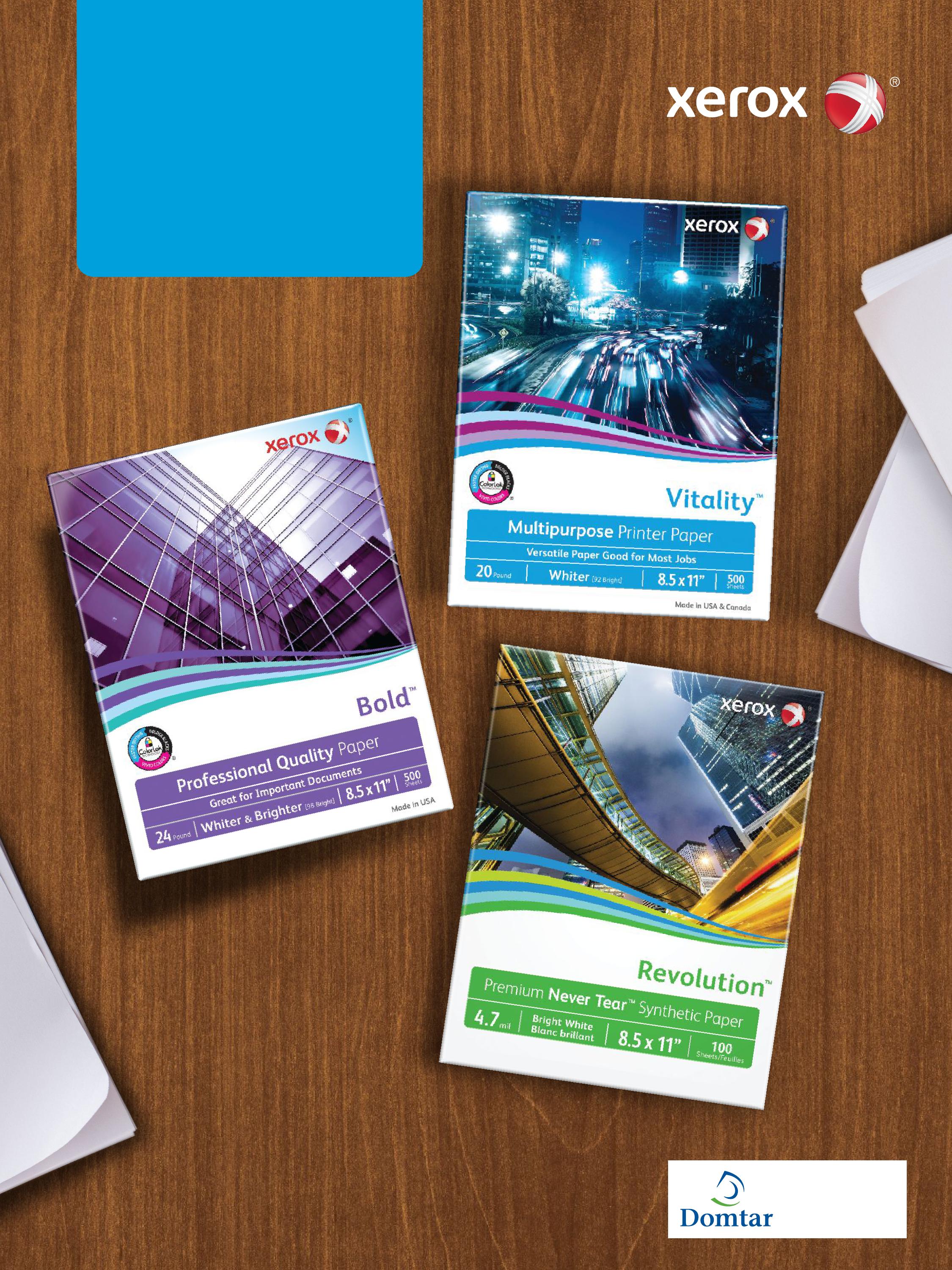
Looking good on paper matters. ColorLok® Technology gives paper more vivid colors, bolder blacks, and faster drying times.* Learn more at colorlok.com
Domtar EarthChoice® Office Paper is a great-looking, everyday paper that represents your commitment to environmental responsibility. Featuring ColorLok ® Technology, it is designed to provide optimal printing results. To learn more visit www.egpaper.com or domtar.com.
capex for new players in the hot packaging industry.
A big problem with elaborate prototyping and production tables is the extensive amount of time needed to setup for a job. To address this, the new Kongsberg tables feature an Auto Adjust Tool with camera inspection that adjusts tools at the start of each project and memorizes the settings for individual substrates in a comprehensive materials database. When changing configurations, the Auto Adjust Tool recalls and automates the setting for the new substrate – saving operator time and reducing spoilage. And according to Esko, new operators benefit by getting expert ‘advice’ from the Kongsberg system on how to setup the job and which tools to use, enabling efficient setups and changeovers.
Agfa automates VLf
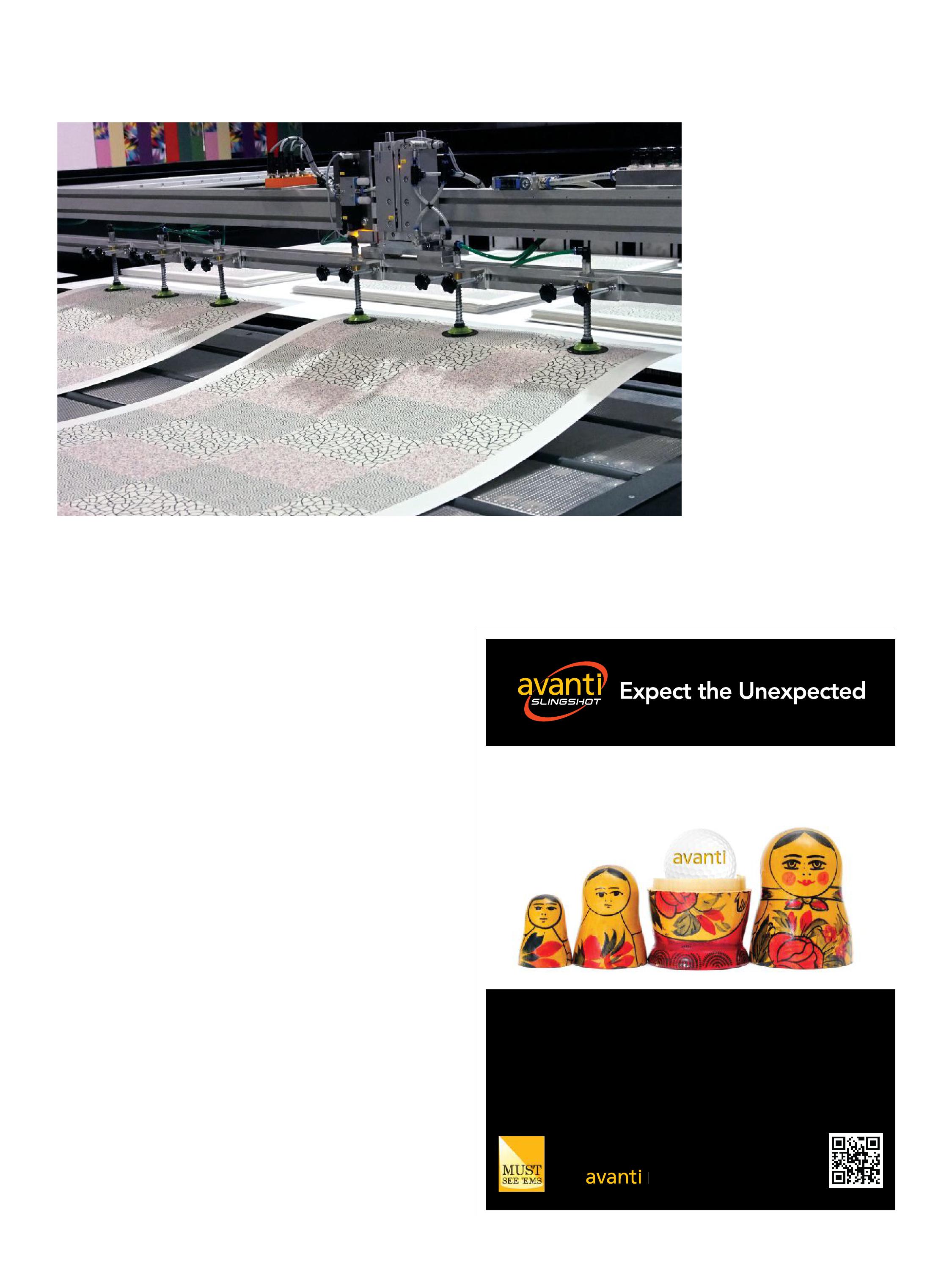
Agfa’s Jeti and Anapurna solutions are well known in the wide-format and very-large-format world of industrial inkjet printing. However, automation has always been a challenge, especially when dealing with printing on rigid substrates such as gator board. At drupa 2016, Agfa introduces the latest iteration of the VLF production workhorse – The Jeti Tauro, a six-colour UV inkjet printer sporting an elaborate ¾ automation package including a board feeder and unloading unit. Seeing the automated Jeti Tauro in action is like watching a mechanical chorus line. A single operator can feed multiple boards onto the 2.5-metre-wide table where they automatically align before going under the inking print heads and coming out dry on the other side. The unloading table is equipped with multiple suction arms that lift the finished boards and stack them neatly offline.
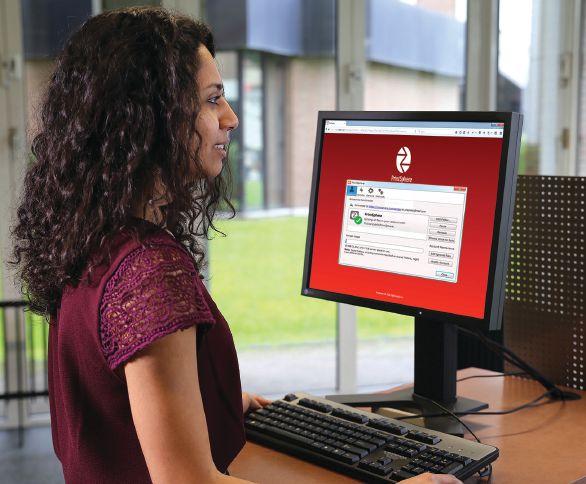
Besides automating VLF, Agfa is moving online with the announcement of PrintSphere, its take on a cloud solution. In addition to standardizing data exchange, PrintSphere is being positioned as an answer for users needing secure back-ups of production databases for their Asanti, Arkitex and Apogee workflows – a necessity in this cloud-based world we live in!
Agfa also introduced its ECO3 initiative at drupa, which stands for “Eco-friendly, Economic and Extremely convenient.” Agfa has gone to great lengths to expand and improve its chemistry-free printing-plate applications with some new clean-out units for its VCF plates, and brand new Azura TU VLF chem-free plates for very large
offset presses. On the thermal CTP side of the fence, Agfa launched its new Energy Elite Eco no-bake positive thermal plates promising extended run lengths for both sheetfed and heatset web use.
X-Rite marks the spot
In late May (just in time for drupa), X-Rite announced the next-generation of its non-contact, automated colour measurement solution – the IntelliTrax2. This new device still meets the demands of the sheetfed printer, but also has added capabilities to appeal to folding carton converters. The IntelliTrax2 now supports M1 measurement illumination conditions – in plain speak that means it can accurately measure colour on substrates containing optical brighteners, or printed with fluorescent inks. The system includes an integrated lookahead sensor that automatically adjusts the scanning head to locate colour bars as small as two millimetres
In a nod to the burgeoning packaging printing and converting industry, the IntelliTrax2 can scan much thicker materials than its predecessor – up to one millimetre – and supports all the latest measurement standards in case your shop runs to G7 or FOGRA standards. According to X-Rite, the IntelliTrax2 can automatically scan a typical colour bar in less than 15 seconds while effectively measuring Pantone colours, PantoneLIVE colours, paper colour and, of course, process colours.
Married to offset
The potential to leverage Xeikon’s Fusion technology and print variable data in foil or varnishes in a commercial print environment will be too good to pass up for many still married to offset. And with the high-level of automation and ease of training promised under Esko’s Packaging Simplified mandate, the knowledge barrier is being lowered for adventurous commercial printers wanting to test the waters of the lucrative label and packaging industry.
Although legacy sheetfed and web offset configurations continue to dominate the commercial printing world – especially in large-volume and high-quality print and finishing applications – economical digital print and custom digital finishing technologies are moving to the forefront of the label and packaging stage. It won’t be long before these technologies find their way into commercial print and start eroding offset’s dominance.
Agfa Graphics in May launched a cloud-based data exchange service called PrintSphere as a standardized way to send and receive files within an existing Agfa workflow. This Software as a Service also provides Customer Service Reps with a dashboard to manage their customers and offers an overview of active jobs. When integrated with Apogee Prepress or Asanti, prepress operators can assign users to specific jobs. An automated messaging system invites these assigned parties to deliver files for a particular job.
PrintSphere can also be used to create archives of previous jobs, available to select customers. PrintSphere is accessible through its official Website Printsphere.com or via client applications for Windows, Mac and mobile. Uploaded data automatically synchronizes with local folders, making files available on-site as well.
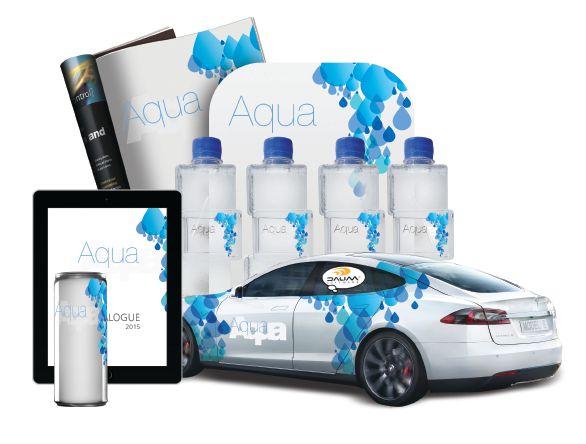
DALIM eS 5
DALIM calls the DALIM ES 5 tool as its most-significant upgrade to date. ES (Enterprise Solution) is an integrated media production platform for the management of media services, regardless of final output – print, packaging, large-format, web, e-book, video, and more. As part its collaborative brand management capabilities, DALIM ES now offers the concept of Desktops, a
plates. Finito Gold is a special blanket to give more brightness and precision to hot stamping units. Finito Dress is a self-adhesive transparent film to dress and protect printing machines – offset, digital, and flexo – from ink or glue stain.
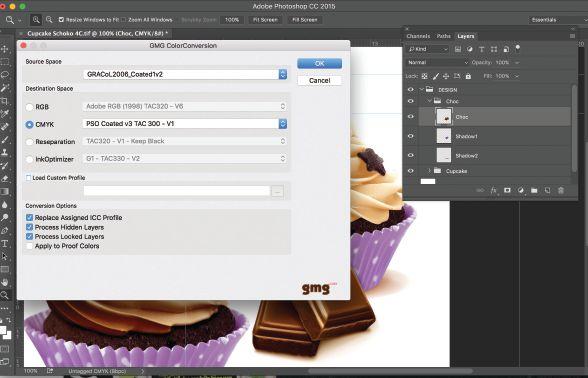
GMG OpenColor 2.0.4
fully customizable, branded Web portal. A new set of triggers and actions are available in DALIM ES including watermarking, to protect assets through a pattern overlay.
Plug-ins for integration into Adobe Creative Cloud add to enhancements such as digital rights management and a check in/check out file sharing concept. A new DALIM ES 3D media viewer interface mirrors that of the DALIM DIALOGUE Engine.
SCODIX e106
Scodix introduced its new E106 enhancement press for the folding carton producers and converters. Offered in a B1 (1,060 x 760 mm) format and enabling production of up to 4,000 sph, the press is aimed at medium to short run lengths. The Scodix E106 press delivers effects including Scodix Sense, Scodix Spot, Scodix Braille, Scodix Digital Embossing, Scodix Variable Data finishes and Scodix Foil, all in a single press. The E106 foil system was developed for Scodix by Compact Foilers Ltd.
Printgraph finito
Printgraph and PCO introduced a new range of Finito products, underpacking for offset presses.
Finito No Stop is a new blanket designed to reduce down time.
Finito No Stick is a full range of versatile and ready-to-use coating
In May 2016, GMG released version 2.0.4 of its multichannel profiling software called OpenColor. The highlight of GMG OpenColor 2.0.4 is the ability to create separation profiles which can be exported to other applications. Following shortly afterwards, GMG OpenColor 2.0.5 offers dot proof profiles for GMG proofing solutions. The variety of printing technologies, spot colours, substrates and inks provide challenges for proofing, GMG explains, especially with overprinting behaviour and the interplay of inks. To make proofing simpler, OpenColor calculates high-precision profiles and then transfers them to GMG ColorProof for printing.
Until this newest version arrived, the only way OpenColor profiles could be used was by creating proofs in GMG ColorProof. However, GMG now offers separation profiles from OpenColor 2.0.4 that can be used in a number of places: within GMG ColorServer, Adobe Photoshop, and within packaging software. For example, users of GMG ColorServer will be able to use more sophisticated profiles to convert RGB or CMYK images to CMYK with OpenColor separation profiles. GMG has concurrently introduced a plug-in that allows GMG separation profiles to be imported directly into Adobe Photoshop: GMG. With it, users can utilize GMG’s MX4 colour separation technology, including re-separation and ink optimization profiles, on the desktop rather than in a server based environment.
Sibress fC3D
In May, Sibress of Germany introduced its enhanced FC3D system,
Agfa’s PrintSphere technology includes dashboards for sales reps.
GMG OpenColor creates separation
applications.
dALIM eS 5 has a host of new features.
which is a 3D measuring instrument for flexo plates. The MD3Dqc (white light interferometer), for measuring anilox or gravure cylinders and gravure plates, has also been enhanced with new software. Sibress is the producer of SibScope, a microscope with 2D and 3D measurement functions for examining objects such as anilox or gravure cylinders and gravure plates and analyzing flexo plates. Sibress also unveiled its new, compact PIT II inspection tool with measurement software to check printed materials.
Roland TrueVIS
In May, Roland DG launched what the company describes as its most advanced printer/cutter ever in the TrueVIS VG-640 and VG-540. These printer/cutters are equipped with four newly developed Roland DG FlexFire print heads to deliver droplet placement in three sizes and a 25 percent wider print swath compared to previous models. The combination of the new FlexFire
native PDF editing software. PACKZ has more than 400 licenses sold during the first two years after its introduction. The new feature of PACKZ RoundTrip creates a twoway link between native Adobe Illustrator files and the industry-standard native PDF format. Using PACKZ RoundTrip, HYBRID explains even Illustrator files that are not saved with PDF compatibility can be opened and edited in PACKZ, then returned to the brand owner as a native Illustrator file containing all of the production features added using PACKZ, such as trapping, extended gamut colour mapping, step & repeat, barcodes, live or vectorized text, etc.
PCO Dyna Concept
PCO, a manufacturer and supplier of printing chemicals, launched a range of new Dyna products: Dyna Concept, a highly concentrated fount to maximize transport efficiencies and reduce waste; DynaCol AC304 ME, IPA-eliminating sheet-
head and new TrueVIS INK provides print speeds of up to 34.8 m2 per hour on banner in dual CMYK ink configuration. Available in 64inch and 54-inch models, TrueVIS VG Series ink comes in 500-cc pouches that fit into reusable cartridges, sliding into a hidden ink bay for clean operation with less waste. In dual CMYK configuration, up to one litre of ink can be loaded for each colour for high-volume, unattended production. A new, Bluetooth-enabled Roland DG Mobile Panel allows users to remotely perform control panel functions with smartphones or tablets with iOS or Android operating systems. This innovative new feature provides a rich interface either directly on, or remotely in range of the VG.
hybRID PACKZ RoundTrip
In May, HYBRID Software introduced its new PACKZ RoundTrip, which is based on the company’s
fed fount, corrosion inhibited and UV/UV-LED compatible; DynaCol AC350, easy working IPA-eliminating heatset fount, corrosion inhibited; and Dyna Kure, a full range of multipurpose UV curable coatings and brightening solutions for UV finishing.
W+D 410 easy enveloper
W+D has launched a new envelope converting and finishing machine for commercial printers and mailers to convert short-run offset or digitally printed rectangular sheets into finished direct-mail envelopes. The 410 Easy Enveloper can produce 30,000 finished #10 envelopes with a window per hour (max. 500 epm). It can be driven with one operator, according to W+D, with no previous special envelope converting skills. Users can make a size change on jobs in 30 minutes or less. It features a compact layout (approx. 23 feet in length) with all machine utilities
2. SUPERIOR TECHNOLOGY — Die crease without a die, then fold and even glue all on the same machine, up to 30 pt.
3. INTEGRATED MODULAR UNITS — Combined in-line finishing: crease, fold, glue, tipping, envelope inserting, ink jetting (Duplex), clip seal (3 sides), mail prep.
4. SAVE ON POSTAGE COSTS As a Certified Canada Post Direct Marketing Specialist, we get contract pricing reductions.
5. RETURN MAIL PRODUCTS — Customized “Return Mailers” created in-line with “U” or “BOX-shape” remoistenable glue, time perfed applications and envelope formation.
6. MINI-BOOKLETS — Saddle-stitch and trim 2-up booklets in-line to the size of a business card. No need to trim off-line, or do 2 passes.
HIGH SPEED EQUIPMENT — High speed Tipping, Folding, Saddle-stitching and soft folding ensuring on time delivery.
TrueVIS VG Series ink comes in 500cc pouches.
internally integrated, as well as inline finishing capabilities. It allows for automatically inserting RFID tags into the inside of an envelope as part of the inline converting workflow and to produce special shape envelopes with front and back windows or foil enhancements, all in line with no secondary finishing processes. Easy Enveloper is the first product in over 10 years from W+D that addresses this issue, as well as the complexity of traditional envelope making.
Atlas Titan SR800
Atlas Converting Equipment released its new Titan SR800 Series slitting & rewinding technology.The Titan SR800 Series is described as having both higher productivity and more flexibility for slitting and rewinding. In the development of the SR800, Atlas focused its product development on achieving significant reductions in machine downtime, including reduced set change time, lower operator intervention and also reduction of costly waste materials. The new system’s design
is also focused on improvements in the quality of the final slit.
The Titan range includes the ER610, the SR9-DS and SR9-DT. The ER610 is a compact slitter rewinder with no hydraulics, meaning lower power consumption and risk of contamination. The SR9 series of slitter rewinders leverages Atlas’ linear tracking slitter section which maintains a constant minimum distance between knives and rewind shafts for better control of the slit webs and high side-wall quality.
AVT iCenter
AVT introduced its new iCenter Platform as cloud-based technology for quality-control automation and production performance insight. With the iCenter platform, printers can offer brand owners around the globe consistent quality as well as production reports showcasing these heightened quality standards. The iCenter platform provides solutions to set cross-site quality standards, auto-analyze PDF files for inspection, and extract business intelligence from the production
W+d’s new 410 easy enveloper.
Atlas Titan Sr800 Series slitter rewinder.
floor with connectivity to MIS and prepress tools.
AVT also introduced its new JetIQ as a closed-loop tool for inkjet presses. Installed on digital presses from Heidelberg, Landa and other vendors, Jet-IQ works in synergy with press controllers to maintain print quality.
Toyo fL Kaleido
Toyo Ink has released its flash-dry FL Kaleido series of UV-curable flexo inks. The product, according to Toyo, is ideal for the design demands of tag and label printing, especially when used in combination with Toyo’s expanded-gamut pigments and unique color management system, which were tailormade for this specialty ink. The company also introduced its new its Lioflex Aqua Liona NFQD series of flexo inks for producing waterbased products. Once considered impossible to achieve using waterbased inks, explains Toyo, its newly developed flexo ink series enables high-speed printing at a maximum speed of 500 metres per minute.
Alwan Color Suite v6
Alwan released version 6 of its Color Suite, which includes ColorHub, PrintStandardizer and PrintVerifier – for brand owners and designers to define and then check their colours and quality expectations to print service providers. The suite can create spot-colour CxF/X-4 files, proof them, store them on the cloud, and retrieve them for design or printing purposes. As well, CxF files are used to communicate colour data between measurement devices and third-party software. CxF/X-4 has been designed to define spot colours accurately by measuring and storing spectral information of ink solids and tints, on substrate and process black.
Durst UV Ink
Durst North America and 3M have created new premium, co-branded inks, called Durst Rho Roll 3M Premium UV Ink Series. The inks
(available in C,M,Y,K,Lc,Lm) are formulated specifically for use on the Rho 512R and 312R UV roll-toroll platforms. The Durst Rho 512R and 312R achieve print speeds in excess of 3,000 square feet per hour by leveraging proprietary 12-picoliter Quadro Array print-head technology.
SeI Laser PaperOne
SEI Laser’s new PaperOne, developed in cooperation with HP, is a modular finishing and converting platform, featuring laser technology. It can handle complex die-cutting and finishing of packaging, greeting cards, books, leaflets, posters, and envelopes. It can process up to 2,500 sheets per hour and has an automatic pallet loading and unloading system. Its feeder can handle sizes of up to 53 x 75 cm, and thicknesses from 150 μm to 600 μm. It die-cuts, micro-perforates, pierces, engraves and marks paper, corrugated board and adhesive-coated stocks, as well as PP, BOPP and PET. It is a match for the HP Indigo 10000, 12000 and 30000 presses.
Xitron Navigator Northstar
Xitron’s new RIP and workflow versions. Featured prominently will be Navigator 11, the latest Harlequin RIP release, which includes several speed, memory, and live transparency improvements. Navigator 11 is the core RIP product in Xitron’s Navigator Northstar and Navigator OKI workflows, which include color matching software for use with Memjet Northstar printers from AstroJet, Colordyne, and Neopost as well as OKI 900 series printers.
X-Rite eXact Xp
X-Rite introduced the eXact Xp as a new option in its eXact spectrophotometer platform. eXact Xp is designed to help package printers and converters more accurately measure colour on flexible film materials. Printers, ink and premedia suppliers, and brands can use this new handheld device to better understand, control, and manage colours on flexible film materials across the entire supply chain.
With the eXact Xp users can consistently measure on a variety of film substrates, including lamination materials and base structures. The X-Rite eXact Xp supports the measurement modes M0, M1, M2 and includes all of the same features as the other devices in the eXact family of spectrophotometers, including X-Rite eXact Scan. It fully
AVT’s iCenter Platform.
PRINTING LTD.
supports ISO colour measurement standards and measurements are compatible with common measurement modes of the standard eXact on printed materials.
Agfa Arziro Design
Agfa Graphics released Arziro Design 2.0 and several new software additions as an end-to-end workflow for general security printing. This ecosystem consists of security design software, additional design modules and an authentication solution. Arziro Design enables the creation of unique, complex and hard-to-copy designs that discourage forgers from attacking a brand. It runs as a plug-in for Adobe Illustrator on Mac and PC, allowing for creativity in a known working environment. The 2.0-version now offers extra features like live variable line widths and additional guilloches, and new functions such as Smart Selection, which helps designers select subsets of complex elements automatically. The optional Arziro Anti-Copy module produces custom-made, copy-proof patterns that expose counterfeits and thus adds more security to the design of documents.
D.W. flexPlateCleaner
D.W. Renzman introduced its FlexPlateCleaner which cleans and dries flexo plates using a highly automated process. The plates are transported automatically into the cleaner, where the cleaning process is initiated by photoelectric cells. FlexPlateCleaner comes with a patented transport system that allows the speed of the plates to be regulated individually via a manual potentiometer. After cleaning and drying at a temperature of 70 °C max., the flexo plates are immediately ready for reuse or storage.
In the standard version of the FlexPlateCleaner, a transverse brush and a rotating brush work together to thoroughly clean the plates. It automatically adjusts the contact pressure of the washing
rollers to the thickness of the plate.
Masterwork Duopress 106fCSb
Masterwork’s new Duopress 106FCSB offers six processes in one pass: foil stamping, embossing, die cutting, stripping, blank separation, and product collection. The Duopress 106FCSB features improved foil control systems that have been designed to ensure accurate foil feeding and greater foil savings. In addition, the new Duopress 106FCSB stacks the finished products in a pile, which prevents the products from being damaged, and saves employee time.
The new Diana Eye 55 automatic sheet inspection system holds a maximum working speed of 200 to 300 metres per minute with a maximum sheet size of 550 x 500 mm and a stock range of 90-650 gms cardboard. Masterwork explains Diana Eye is unique in that it features an adjustable camera light source for multi-process inspection and complex processes like holograms and foil stamping can be inspected.
Xitron Raster blaster
4.0
In May, Xitron introduced Raster Blaster 4.0, described by the company as its next-generation TIFF Catcher technology. Raster Blaster 4.0 acts as a bridge between workflows like Fujifilm XMF, Kodak Prinergy, Agfa Apogee, or FFEI RealPro, and the various CTP devices they drive. Raster Blaster 4.0 is compatible with nearly 100 CTP models. Beyond supplying raster data to the CTP unit, Raster Blaster combines archiving and job search with plate-usage reporting, production and waste analytics, automated re-plate sequencing, image prioritization, and remote operator control. A standard browser interface supplies real-time data to all operators on the network and enables control through mobile devices as well, typically without the need for a host PC.
stItCHer OperatOr
Full-time stitcher operator position is available on the day shift, from 8:00 am to 4:3 0pm. Qualified candidate must have minimum 5 years experience. Please call 416-701-1673 or fax resume to 416-701-9961.
Contact: Diane Fortescue Gale
Email: estimates.fortescue@bellnet.ca
GrapHIC DesIGner, prInt
prODUCtIOn speCIaLIst
Responsibilities include operating large format printers, laminators, plotters and cutters. Providing graphic design for digital signage jobs, various displays and vehicle graphics. Additional core responsibilities include all graphic finishing, equipment maintenance, and preparation of daily shipments. Inspecting client files for problem areas, including fonts, image resolution and image registration.
Print shop or sign shop experience is required (minimum 1 year). Proficiency in Adobe illustrator and In-Design & Photoshop. Print production experience on large format and digital sign equipment is a plus. Compensation is negotiable depending upon experience
and qualifications.
Contact: Jamal at 416-252-0300
Email: jamal@mrprinter.ca
GeneraL manaGer, Jay-LIne
DJB HR Advisory Services is looking on behalf of our client, J & J Manufacturing (known as Jay-Line), for an experienced General Manager to join their Niagara-based team.
Reporting to the President and Controller, the role of the General Manager is to oversee the marketing and sales functions as well as the day-to-day operations of the business. The General Manager plans and maintains systems and procedures for
operating efficiency and manages staff for optimum performance; and is responsible for establishing and accomplishing business objectives and meeting financial and operational goals.
Knowledge and skills should include: Performance Management, Staffing, Management Proficiency, Coordination, Coaching, Developing Standards, Financial Planning and Strategy, Process Improvement, Decision Making, Strategic Planning, Quality Management
For the complete job listing please go to www.printaction.com
To apply online go to https://www.fitzii. com/apply/5628
prOJeCt CLIent serVICes rep Cober Evolving Solutions of Kitchener, ON, is hiring a full-time Project Manager of Client Services responsible for monitoring, tracking, controlling project progress and successful delivery of client business requirements. The Project Manager will work on designated accounts in collaboration with the Sales, Creative and Production teams overseeing the complete process and will deal with any client requests or concerns.
Send CV and Resume to Human Resource Manager, Marg Gallinger at marg.gallinger@cobersolutions.com
Heidelberg: K-Line/S-Line/Speedmaster/GTO/MO
Komori: 1, 2, 4 or 5 colours & any size
Adast: 714/715/724/725
Mitsubishi: Any model
Ryobi: 2800CD/3200CD-MCD/640K
Itek: 960/975/985
Hamada: 600/700/800/E47/RS34
Shinohara/Fuji: 66/65 1,2 or 4 colours
Sakurai: 1, 2 or 4 colours and any size (newer model)
Polar: any size/older or newer models
(66/72/76/78/82/90/92/107/115)
Horizon-BQ: 220/240/260/440/460
Alain Jacques / President / Solisco Printers / Scott, Quebec
this past May, Solisco Printers marked its 25-year anniversary after the company was founded in 1991 by Alain Jacques and Jean Grégoire. The company initially focused on the publishing market, which remains a core business generating around 35 percent of its annual revenues, and more recently has expanded into the retail industry with the goal of serving niche vertical markets with catalogues and a range of related services from digital adaptations to distribution.
In 2011, Solisco initiated a new phase of investment with the installation of a Goss Sunday 3000 web press, which is now the cornerstone technology for the 400-employee company, headquartered in a 200,000-square-foot plant. PrintAction spoke with Jacques about the past 25 years and what the future holds for Solisco.
What is solisco’s market position today?
AJ: We used to only mainly focus on magazines. Now we want grow the retail and catalogue side of our business, because newsstand sales today have been suffering. It is not a growing market, but there is still a huge market for magazines all across the U.S., so we want to offer the best services for high-end magazine and catalogue clients for the next few years. With competition you have to offer a bunch of services around the product. You have to be aware of the strategies of our clients and be a lot more involved.
What is solisco’s key tech advantage?
AJ: Three years ago we invested in a Goss Sunday 3000. It was a risk but it has been a good reward for us, because it is a high-productivity piece of equipment... In our printing market, you must be a low-cost producer. In Canada, in general over the past few years, we have not invested in equipment as much as the U.S. has.
How does solisco attract talent to scott?
AJ: We do not have a lot of population around but people come from Quebec and we also do a lot of training with our people. We have a school inside Solisco. We have classes and train our people who earn a diploma. We have been one of only a few producers to do this and every session we have about 10 or 15 new diplomas.
What new markets are you focused on?
AJ: To print more jewelry catalogues, for example, we are going to go to all of the jewelry shows and directly show how we are going to be able to service that sector. We try to go vertical on specialty niches, so we do not go after big, big retailers or publishers… more emphasis is put on the manufacturers of products.
How do you approach niche markets?
AJ: We have subject-matter experts so whatever the client needs they are going to have the right person to answer their questions. Our sales reps know about the print itself, but when it comes to mailing and distribution or developing content for example, you need internal expertise.
How important is distribution for publication printers?
20%
Minimum amount of business Solisco currently generates out of the U.S., which is also on a growth trajectory.
AJ: We do a lot of publishing in the U.S. and it is quite different than Canada with all of the co-mailing that exists. We have developed some expertise with geo-localization to get the best return on your investment. You have to offer services to go beyond just the cost of the transportation.
What is your primary objective moving solisco forward?
AJ: Our tagline at Solisco is Experts with Character – innovation is the key. Innovation in everything: Research and development, on new types of products, adding equipment, whatever it is that is going to help clients sell more. Innovation is my key word for the next few years.
What is solisco’s investment plan for the near future?
AJ: We are working on a major retooling to
have all new equipment and get rid of the older equipment, adding capacity to our facility. This is a major tenant that we have for the next couple of years. I would like to put in another [Sunday] 3000... We are working on the project right now. You need the right balance between signing contracts with major clients and having productivity gain. That is a risk that I am willing to take right now in the next two to four years. We will also be investing in new bindery equipment, so it is part of a pretty big project… we are talking about $20 million over the next four or five years, minimum… I believe print is going to be there for the next several years.
What excites you most about the future for print?
AJ: Canadian Tire just put out 12-million copies of a catalogue, last month. For me that is a game changer. They are going back to print. We see a lot of clients going back to print because it works. You have credibility in print that gives a client an edge over others that do not use print. I do not have any apprehension about the future with printing. Even if it is going to slow down for the next few years there is so much consolidation that there are a lot of possibilities, but you have to keep your eyes open.