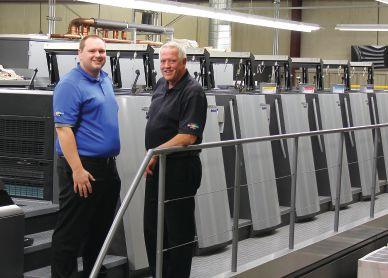
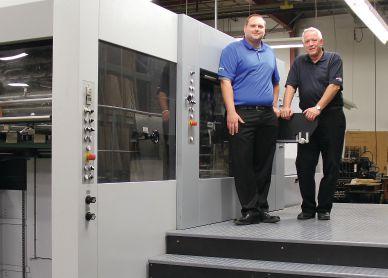
The evolution of ICON Digital positions a large-format pioneer as one of North America’s most powerful visual communications companies
18 The printing power of UV
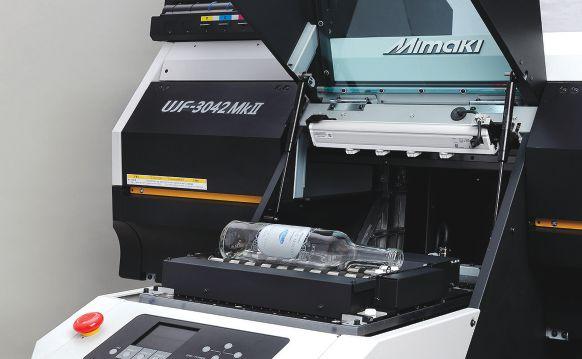
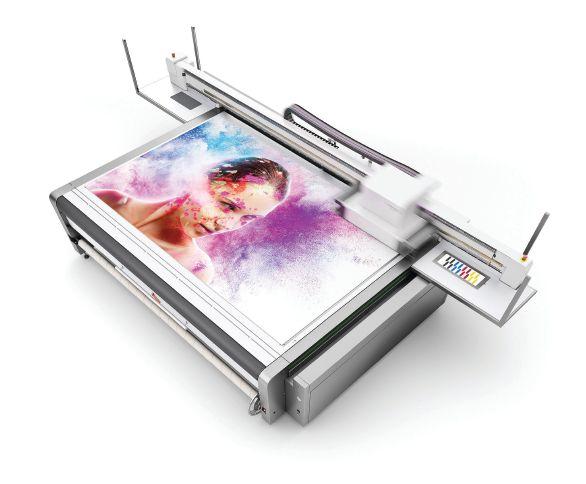
Ultraviolet technologies have played a major role in shaping the printing industry over the past decade and will become more impactful for sheetfed work
DEPARTMENTS
GAMUT
5 News, People, Calendar, Dots, Installs, Globe, Archive
Ways to overcome the different stages of rejection when trying to land a new printing prospect 12 5 18 20
NEW PRODUCTS
20 Detailing the newest printing technologies from Agfa, Appvion, Epson, Komori, iSys Label, Mimaki, Ricoh, Roland, Solimar and swissQprint
MARKETPLACE
25 Industry classifieds
SPOTLIGHT
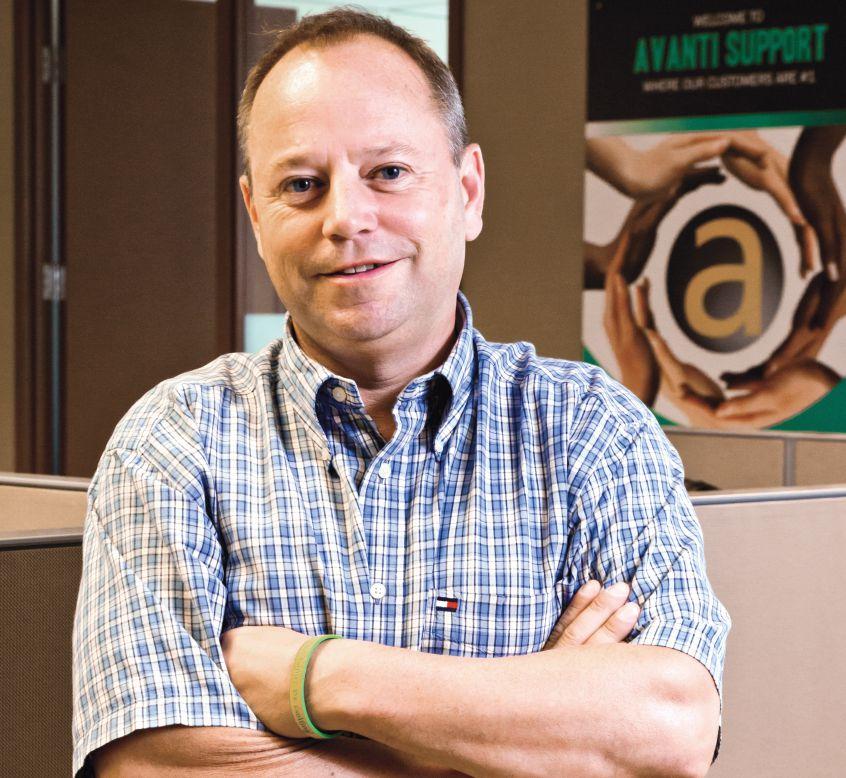
26 Patrick Bolan, President, Avanti, Toronto, Ontario
COLUMNS
FROM THE EDITOR
4 Jon Robinson
The shattered mirror
A new think-tank study outlines the challenges of Canadian journalism and newspapers in the digital age
CHRONICLE
9 Nick Howard
Birth and death of a press
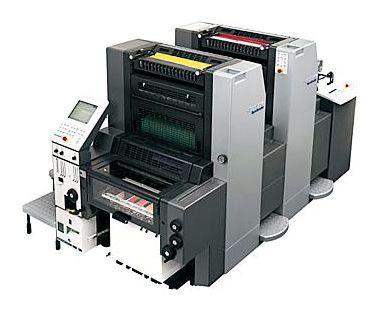
How the Iron Curtain brought forth a revolution in printing technologies that shapes today’s offset market
DEVELOPMENT
11 Dave Fellman
More value, less rejection
The shattered mirror
AIn 1995, reliable classified advertising in newspapers began a major decline as the World Wide Web began to penetrate everyday life and Canadian household newspaper penetration dropped below 50 percent.
new think-tank report called The Shattered Mirror, News, Democracy and Trust in the Digital Age, authored by veteran journalist Ed Greenspon and released in January 2017 by the Public Policy Forum, concludes Canada’s media industry needs help to survive in the digital era of journalism. The report looks closely at Canada’s struggling newspaper industry beginning under a subhead that reads, For Print,The End May Be In Site. The section begins by describing the newspaper as the commercial foundation of the news industry and how it served as the spine of daily journalism even after the arrival of television.
Introducing his report via The Globe and Mail’s Website, Greenspon writes, “Eight in 10 say they follow the news. Often they do so on Facebook, but when something they consider really important is happening, they turn to established media. Regardless of age, they trust newspaper and television organizations far more than social media... Their reverence is such they can’t imagine government propping up the news media. For them, it would undermine the very purpose of journalism.”
Greenspon in his report accordingly includes a range of possible solutions to help the prosperity of Canadian media without leaning too heavily on direct Federal support. As described by The Star’s Bruce Campion-Smith and Alex Ballingall, “The report’s main recommendations focus on changes to tax legislation. Currently, advertisements bought on foreign-owned Websites like Google, Facebook and The New York Times are tax deductible. The report recommends changing that section so that foreign-owned sites that don’t meet certain conditions – a majority of payroll going to Canadian employees, and at least five percent of Canadian revenue spent on editorial operations – will have a 10 percent levy on their advertisement purchases.”
This would include applying HST and GST on digital news subscriptions that do not meet Canadian content rules, while providing rebates for those that do. The report recommends using revenues from these taxes, along with some Federal seed money, to establish an annual $400 million fund to support Canadian media. This is one of the most-visible ideas for media support in the report, which outlines 12 primary recommendations, ranging from Income Tax and Copyright Act reform to removing obstacles to philanthropic financing.
The Shattered Mirror paints a bleak picture of the newspaper industry, where
Greenspon has spent the majority of his career. In the early 1950s, according to the report, there were more papers sold every day than the country had households. But by 1995, just as Internet access began to become commercially available, household penetration had dropped below 50 percent. “Today, fewer than one in five households pays for newspapers. This inexorable decline presages a time when printing will no longer make economic sense, something Winnipeg-based media economist Ken Goldstein estimates may occur within the next six years.”
In line with the 50 percent drop household penetration by 1995, the report points to the dramatic decline of classified adverting in newspapers just as vehicles like Craigslist came online. Between 2000 and 2008, according to Greenspon, classified advertising earned Canada’s daily newspaper industry more than $800 million a year, reaching a historic high of $875 million in 2005 – the year Kijiji started in Canada. By 2015, that figure had dropped to $119 million and the report explains the trend is toward zero. “Three-quarters of a billion dollars a year in reliable revenue vaporized in a decade.”
In 2006, display advertising, wrapped around the news and service sections, accounted for almost $1.8 billion in revenue for the daily newspaper industry, according to Greenspon. By 2015, that figure had dropped to $907 million, almost cut in half within a decade and the report explains that figure is still going down by double-digit percentages every year.
“Community newspapers, perhaps closer to their advertisers, earned more than $1.2 billion a year in total advertising revenue well into the 21st century. Since 2012, though, local ads have begun to decay along with national advertising, cutting this revenue by about 10 percent a year, down to $881 million in 2015.”
Greenspon reports that from 2006 to 2015, Canadian daily newspapers lost 40 percent of their revenues. There may be salvation in newspapers through the use of emerging content-advertising vehicles, risky per-click guarantee campaigns and ultimately paywalls that monetize valuable content – info about your money and wealth. It is clear, however, that Greenspon finds newspapers are facing a daunting task over the next few years to provide critical journalism.
JON ROBINSON, editor jrobinson@annexweb.com
Editor Jon Robinson jrobinson@annexweb.com 905-713-4302
Contributing writers Zac Bolan, Wayne Collins, David Fellman, Victoria Gaitskell, Martin Habekost, Nick Howard, Neva Murtha, Abhay Sharma
Publisher Paul Grossinger pgrossinger@annexweb.com 905-713-4387
Associate Publisher Stephen Longmire slongmire@annexweb.com 905-713-4300
Media Designer Lisa Zambri
Circulation Manager Barbara Adelt badelt@annexbizmedia.com
Customer Service Angie Potal apotal@annexbizmedia.com
Tel: 416-510-5113
Fax: 416-510-5170
Mail: 80 Valleybrook Drive, Toronto, ON, M3B 2S9
COO Ted Markle tmarkle@annexweb.com
President & CEO Mike Fredericks
Subscription rates
For a 1 year monthly subscription (12 issues): Canada — $40.95 Canada 2 year— $66.95 United States — CN$71.95 Other foreign — CN$140.00
Mailing address Annex Business Media 222 Edward Street Aurora, ON, L4G 1W6 printaction.com Tel: 905-727-0077
Fax: 905-727-0017
PrintAction
CALENDAR
Xerox executives in early January gathered to ring the opening bell at the New York Stock Exchange to celebrate the company’s successful completion of separating into two publicly traded, Fortune 500 companies, a move first announced in early 2016 during the Connecticut company’s year-end public financial presentations. The printing technology company retains the Xerox name and the new Business Process Outsourcing entity now operates under the name Conduent.The new Xerox entity accounted for approximately US$11 billion in 2015 revenue and 39,000 employees. Led by CEO Ashok Vemuri, Conduent accounted for US$7 billion in 2015 revenue.
Canadian Printing Industries Association added four officers to its Board of Directors, describing the move as a new approach to revitalize a national voice for Canada’s printing industry. Richard Kouwenhoven, President and COO of Hemlock Printers, was elected to the position of Chair of the CPIA. Mike McInnes, Senior Vice President, Ontario, Transcontinental Inc., was elected to the position of Secretary/ Treasurer. Loris Pavan, Regional Director Business Development & Strategic Solutions at RR Donnelley (British Columbia), and Dave Potje, VP at Twin City Dwyer Printing, were also elected to CPIA’s board. Kouwenhoven and Pavan are representatives of the PrintForward Printing and Imaging Association, which was formerly the British Col-
umbia Printing Industries Association (BCPIA). McInnes and Potje are representatives of the Ontario Printing and Imaging Association (OPIA). The CPIA explains PrintForward and the OPIA will form new board leadership, manage the administrative functions of the CPIA, and lead its direction moving forward.
CCL Industries , headquartered in Toronto, Ontario, reached an agreement to acquire the UK-based Innovia Group of companies – consisting of three divisions noted as Films, Security and Systems – for approximately $1.13 billion. The transaction – involving a consortium of private equity investors managed by The Smithfield Group LLP – is expected to close by the end of CCL’s first quarter 2017.
For 2017, Innovia is expected to generate net revenue of approximately $570 million as a global producer of multi-layer, surface-engineered BOPP films for label, packaging and security applications. The business has film extrusion, coating and metallizing facilities across the U.K., Belgium and Australia, as well as specialized polymer banknote operations in the U.K., Australia and Mexico with 1,200 employees and sales offices in 16 countries around the world.
The C.J. Group of Companies in mid-January concluded the sale of its three existing buildings totaling approximately 125,000 square feet and 4.5 acres in Etobicoke. The company has purchased the Veritiv facility near Cawthra and
Dundas Streets in Mississauga, just west of the Etobicoke border. The new location holds eight acres, two floors and approximately 230,000 square feet of space. After taking possession this May, all of C.J. Group’s printing operations are scheduled to be moved into the facility by this October, which the company describes as a $25 million investment, including the addition of a new sheetfed and digital presses, among other equipment.
Koda k in late December announced it was still in talks to sell its Prosper commercial inkjet business, a process that began in March 2016.The Prosper business placed 12 presses over the first nine months of 2016, while also generating a 41 percent increase in annuity revenues in the third quarter. Kodak is refocusing its inkjet interest around new Ultrastream technology introduced in mid-2016.
KBA North America became the exclusive continental distributor for the Barcelona-based medium- and large-format flatbed diecutter manufacturer Iberica AG S.A., which was purchased in May 2016 by the press maker’s German parent company. KBA describes its new subsidiary, KBA-Iberica Die Cutters S.A., with around 60 employees, as the world’s second largest manufacturer of die-cutting and creasing machines.
Xaar of Cambridge, United Kingdom, reached an agreement with Xerox to develop bulk piezoelectric inkjet print heads. The partnership, according to Xaar, will leverage both companies’ technologies and allow them to provide customers with a broader range of piezo print heads.
Deschamps Impression of Québec City, Québec, acquired another of the province’s best-known commercial printing operations in Imprimerie Litho Chic. With this acquisition, Deschamps will have more than 200 employees and increase its annual sales to over $33 million.
February 20-23, 2017
Hunkeler Innovationdays
Lucerne, Switzerland
March 1-4, 2017
Dscoop Phoenix, AZ
March 19-22, 2017
TAGA Annual Technical Conference Houston, TX
March 19-24, 2017
IPEX London, UK
March 23, 2017
Ryerson GCM Job Fair
Mattamy Centre, Toronto, ON
April 6-8, 2017
Graphics Canada International Centre, Mississauga, ON
April 19-22, 2017
ISA International Sign Expo
Mandalay Bay Convention Center, Las Vegas, NV
April 24-26, 2017
Inkjet Summit Ponte Vedra Inn, Ponte Vedra, FL
April 30-May 3, 2017
FTA 2017 INFO*FLEX Phoenix, AZ
May 9-13, 2017
China Print 2017
New China International Exhibition Center, Beijing
May 12-13, 2017
Grafik’ Art
Place Bonaventure, Montreal, QC
May 23-26, 2017
PACKEX Toronto Toronto Congress Centre, Toronto, ON
May 23, 2017
Avanti User Group Conference Grand Hyatt, Denver, Colorado
June 1, 2017
Gutenberg Gala
Marché Bonsecours, Montreal, QC
July 16-20, 2017
95th Annual GCEA Conference, Woman in Print
Ryerson GCM, Toronto, ON
September 10-14, 2017
Print 17
McCormick Center, Chicago, IL
October 10-12, 2017
SGIA Expo 2017
New Orleans, LA
Jeff Jacobson, CEO of Xerox, rings the NY Stock Exchange’s opening bell.
Hemlock’s Richard Kouwenhoven, Chair, CPIA.
Doug Edwards, CEO of Xaar.
Jay Mandarino, CEO, C.J. Group.
Philip Cullimoreleads Kodak’s Enterprise Inkjet division
INSTALLS
Digital Imaging Association introduced its new Officers and Directors for 2017 with George Sittlinger of Maracle Press in Oshawa named President. Paul Tarvydas of Tsus4 Inc. in Toronto will serve as the DIA First Vice-President and Jason Hamilton of TI Group, also in Toronto, as 2nd Vice-President. Mark Norlock of KBA Canada Inc. will serve as the DIA’s Secretary/Treasurer for the 2017 year, while the remaining officers include Past President Dino Sinnathurai of Kitchener’s Cober and Association Manager Marg Macleod of Friesens.
DIA Directors for 2017 include Ray Fagan of Heidelberg Canada, Steve Fournier of Agfa Canada, Ryan Harper of Xerox Canada, Andrea Leven-Marcon of Spicers Canada, Stephen Longmire of PrintAction, Paul McCarthy of Konica Minolta Business Solutions Canada, Mike Millard of Ellis Packaging, Randall Stevenson, Larry Stewart of KBR and Bob Weller. Karl Schmed is the Director Emeritus of the Digital Imaging Association.
Sean Springett becomes Chief Executive Officer of Manroland Sheetfed GmbH’s North American subsidiaries, based in Chicago, IL, and Vaughan, Ontario. Springett, age 42, joined Manroland Sheetfed in 2008 and most recently served as its VP of Sales & Marketing. His appointment follows the October 19 passing of Mike Mugavaro, who led the press maker’s North American operation since 2012. Rafael Penuela-Torres, CEO of Manroland Sheetfed GmbH, said Springett was a natural choice to lead the North American operation based on his four years of VP experience and a career spanning more than 20 years.
Sam Pernice, at the beginning of 2017, took on the newly created position of Director, Sales and Service, KBA-Me -
talPrint Products, for KBA North America. For the past four years, Pernice held dual roles as a sales representative in the company’s web offset division and working to build customers within the KBA-MetalPrint division. KBA North America became an agent for the metal decorating operation at the start of the New Year. Prior to joining KBA in 2013, Pernice spent more than a quarter century involved in the domestic and international sale, customer support and service of newspaper printing equipment and services.
Jim Boyden becomes Sales Manager for CRONECRM LLC, responsible for managing and coordinating the company’s sales and dealer channel activities for North America. CRONECRM is the master distributor in North America for CRON CTP systems (commercial, web and flexography) and Blackwood printing plates. Boyden has more than 20 years of experience in sales in the graphic arts industry, having previously worked with Kodak, Agfa and Southern Litho.
Tim Upton, who passed away in October 2015 at age 83 after a storied career as one of Canadian printing’s best-known technology leaders, was recognized for his contributions when Howard Iron Works named its museum library after him. The museum focuses on the preservation and history of the printing industry, restoring and showcasing machinery with a specific focus on the years 1830 to 1950. The Upton Library is the centre point of the facility and holds over 1,000 books dedicated to the printing art and its technology.
Upton spent his working life in the graphic arts. In 1959, he emigrated from Britain to Canada and went to work for Sears Ltd., which represented several leading printing and bindery brands with offices across Canada. After arriving in Toronto as VP of Sales for Sears, Upton in 1984 continued his career with the newly minted Heidelberg Canada in the role of Senior VP of Sales, where he remained until 1994, before spending his final 10 working years with Howard Graphic.
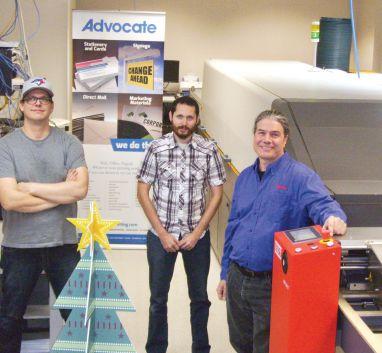
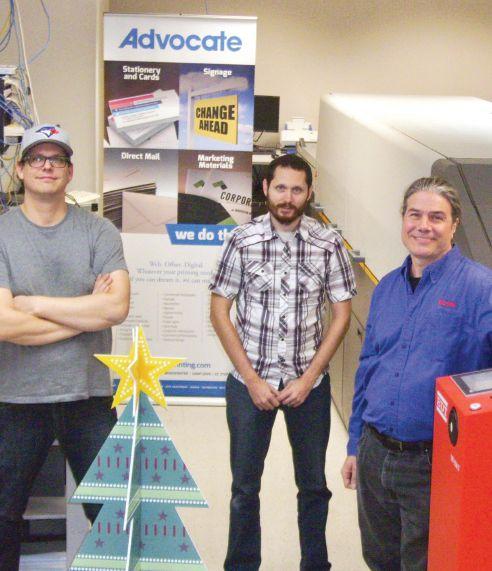
Advocate Printing’s operation in Dieppe, New Brunswick, installed Canada’s first Kodak NexPress ZX3300 press, in December 2016. The press, pictured with Advocate’s Mike Caissie, Prepress Supervisor, Jean-Francois Doucet, Operator, and Kodak’s Paul Perry, features Kodak’s Fifth Imaging Unit for applying dimensional clear, gold, clear and light black colours.
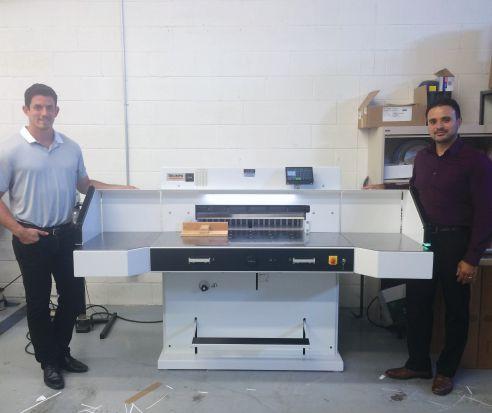
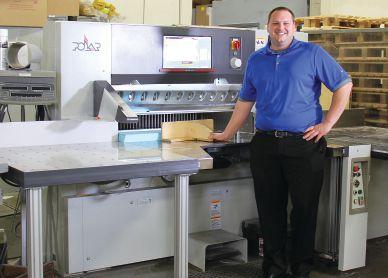
SOHO Printing of Markham, Ontario, installed a Triumph 7260 cutting system purchased through PDS. The 28-inch programmable cutter, pictured with PDS’ Brett Kisiloski (left) and Hasanain Abbas of SOHO, features EASY CUT blade activation bars for two-handed operation
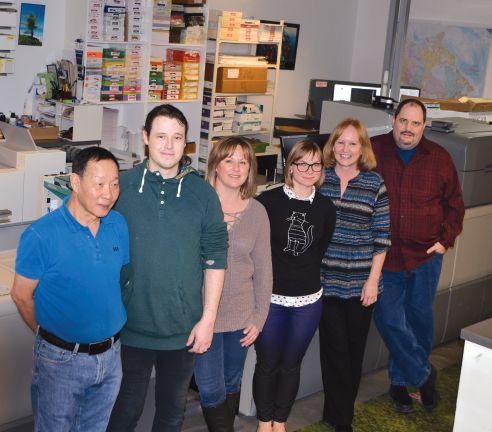
Print Three’s franchise operation in Calgary, Alberta, installed a Ricoh Pro C9110 press, pictured with staff members and GM Mark Eisan (far right). The Pro C9110 runs media stocks from 52 to 400 gsm, with duplex printing, and reaches speeds of up to 130 pages per minute.
DIA’s new board gathers at The Boulevard Club in Toronto.
23
Min.
With 15 employees, Creative Labels of Troy, Ohio, recently replaced its flexo imaging system with an Esko CDI 2420 flexo plate imager, for its seven-inch eight-colour to thirteen-inch 10-colour Mark Andy flexo presses. The new system images a full size 24 x 20-inch plate in 23 minutes.
First KBA 105 placed in Morocco
Fleximat S.A., one of Morocco’s flagship packaging printing companies, recently took delivery of the first medium-format press of the new KBA Rapida 105 PRO series to be installed in Africa. The company uses both gravure and offset printing.
The new six-colour 105 press, with coater, stands on a 450-mm raised foundation to accommodate the higher piles which are typical in packaging printing, and is now producing alongside two further Rapida presses in the recently built print centre in Mohammedia, approximately 40 km from Casablanca.
“The market launch of this new press came at the perfect time for us,” said Abdelaziz Benchekroun, Directeur Général of Fleximat. “Our decision in favour of the Rapida 105 PRO was carried by the confidence that, even without exceeding our investment budget, we would be able to incorporate a number of interesting technical solutions which are otherwise only available in the highly automated Rapida 106.”
KBA explains the emerging North African markets are characterized by high price sensitivity. As economic prosperity increases, fixed costs increase to a similar extent – and print production in the region is no exception. When planning long-term investments like a printing press, continues KBA, the technical features and automation must secure competitiveness not only today, but also in the foreseeable future. “It was against this background that we chose to integrate fully automatic plate changing, facilities for non-stop pile changing at the feeder and delivery, and the energy-saving VariDryBlue dryer technology, for example,” said Fleximat CEO Mehdi Benchekroun.
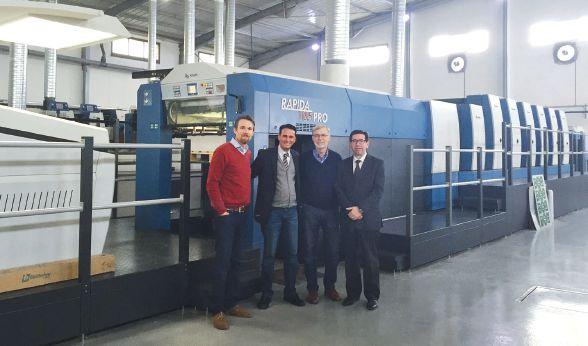
In front of the new KBA Rapida 105 PRO (l-r): Mehdi Benchekroun, CEO, Noureddine Amalou, Sales Manager KBA-Sheetfed Solutions, Abdelaziz Benchekroun, President, and Pierre Monopoli, Graphic Evolution.
Excelsus adds Jeti Mira LED first
Excelsus Solutions LLC of Rochester, NY, became the first printer in North America to purchase Agfa Graphics’ newest LED engine, the Jeti Mira LED, produced in Mississauga, Ontario. The Jeti Mira LED is a moving-gantry flatbed printer that delivers prints up to 106 inches wide, featuring print and prepare functionality, a dockable roll-to-roll option, two table sizes and printing speeds up to 2,486 square feet per hour. It is a six-colour plus white system leveraging two rows of Ricoh print heads.
“The Jeti Mira LED thus far has amazed us with its throughput, speed and, quality levels. With the cold cure of the LED lights, we’ve eliminated warping of substrates due to extreme heat,” said Excelsus Solutions VP of Operations, David Laniak. “This press has replaced three aging pieces of equipment with just this one flatbed.”
Established in 2005, Excelsus specializes in point-of-purchase displays, in-store signage, and other high-value graphics. “We pride ourselves on our ability to always be looking for better ways to help our customers further their business, whether that is through pricing, quality, innovative ideas and service,” said Laniak.
Xaar tile printing in Modena
Modena is an area recognized around the world as the ceramic tile manufacturing region of Italy and home to Century, a company with a reputation for producing extremely high quality floor tiles. The company is well known for working with designs inspired by the latest décor fashions and architectural trends. Century is part of the Fincibec Group of companies.
In addition to its high-end work, Fincibec itself is well known for the eco-sustainability of its entire industrial production process. This manufacturing involves continually striving to use raw materials with low environmental impact, limiting the consumption of natural resources and dramatically reducing emissions.
As part of an improvement project, Factory Director Alberto Corradini, together with the Glazing Line Manager Emanuele Farrarini, were looking to enhance the print uniformity of their digital printers specifically with the print bars using blue and brown inks. They consulted TecnoFerrari, manufacturer of their Vivajet printer, which recommended the installation of the Xaar 1003 GS12C printheads into these two print bars.
“We use these print bars to print the blue and brown colours which are needed in many of the high-quality granite and concrete tile designs for which we are wellknown,” said Alberto Corradini. “Previously, print uniformity had been difficult to achieve but with the changeover to the Xaar 1003 GS12C printheads, we can see that it has significantly improved.”
Tile samples produced Century using Xaar 1003 printheads.
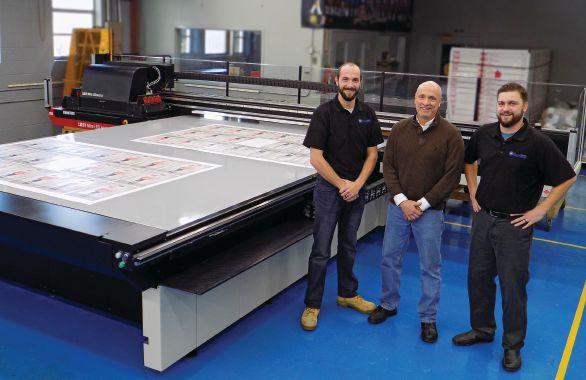
From left to right: Chris Laniak, Production Manager; Mark Laniak, CEO; and David Laniak, Vice President of Operations, Excelsus Solutions, LLC.
40 years ago
Toronto Men Purchase Canadian Bank Note Co.: Toronto businessmen have purchased the controlling interest in Canadian Bank Note Co. Ltd. of Ottawa from the company’s Chief Executive Officer, C.R. Worthen, for “a little more” than $7 million. The new owners are W.F. Mitchell, G.F. Plummer and Douglas Arends, partners in Mitchell, Plummer and Co. Ltd. of Toronto.
Canadian Bank Note is one of two companies in Canada that specialize in producing bank notes, bond and share certificates, postage and revenue stamps, cheques, drafts and passports. Its sales are estimated at about $11 million per year. “We have been interested in the company for three or four years and it’s something we’ve wanted to be able to build,” said Arends. “Canadian Bank Note is a real growth company and has been experiencing higher sales in the recent inflationary period.”
1982
35 years ago
Courts clarify narrow issue on use of photo typesetting keyboards, uphold claims: An eight-day trial was conducted recently in the Provincial Court, Toronto, between the Crown and AM International, under the Combines Investment Act. AM International was charged with issuing advertisements of a false and misleading nature. The claims were laid by a user group of trade typesetting shops based in Toronto, which objected to the suggestion contained in the advertisement – “A typist can usually learn to set type in just one day.” The case was dismissed by His Honour Judge Vanek with the final words, “I hold that the Crown has not provide beyond a reasonable doubt that the advertisement in this regard was false or misleading.”
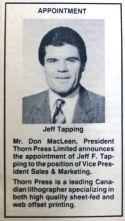
Jeff Tapping is appointed as Vice President of Sales and Marketing for Thorn Press Limited, led by Don MacLean. Thorn Press is a leading Canadian lithographer specializing in both high-quality sheetfed and web offset printing.
20 years ago
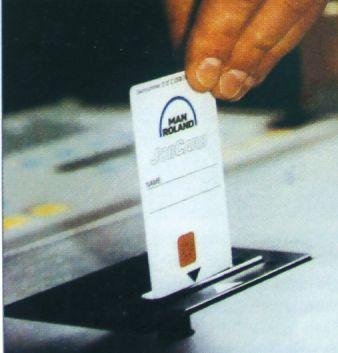
Electronic Jobcard Replaces Cassette: MAN Roland has introduced the Jobcard, a new plastic card storage medium, and Jobcard Reader, which replaces the cassette tape storage system on the new MAN Roland presses.
The credit-card size Jobcard has an embedded foil storage chip with a 100,000 count read/write cycle. Job data can be stored and retrieved more economically than with cassette systems. A complete job, including printed area coverage from electronic plate scanner (EPS), ink slide settings, vibrator stripe width, and vibrator stroke can be stored on each Jobcard.
10 years ago
Jobcard Readers are now standard on all Roland 200, 300, 700 and 900 presses configured with Technical Press Preparation.
Big Blue Reality for Ricoh: Ricoh announces plans to gain a 51 percent controlling interest in IBM’s printing division at a US$725 cash price tag, which includes a 3-year term for Ricoh to buy the remaining shares of the company, called InfoPrint Solutions. The hitting of profits and loss targets will determine how the deal is finalized in three years. It is expected, however, that Roch will indeed take full ownership of InfoPrint, bringing a new player into the production printing space.
“For Ricoh, it signals the beginning of a new stage in our strategy for global growth,” says Masamitsu Sakurai. “Traditionally, the office world has been our domain… in order to expand further we have aggressively set our sights on penetrating the production printing market… I believe we are poised to take a sizable share of this market.” Founded in 1936, Ricoh now enjoys a top-tier market share around the world. With more than 7,900 employees in 100 countries, Ricoh generated US$16.4 billion in revenues last year.
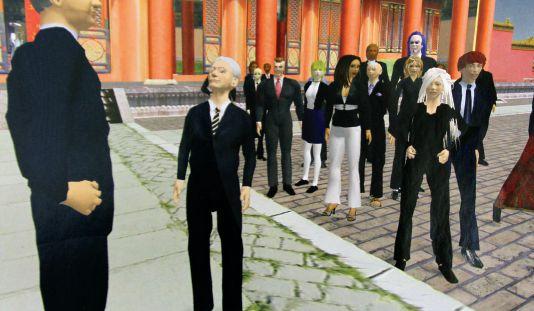
IBM CEO Sameul Palmisano (left avatar) visits IBM employees in a virtual world replica of China’s Forbidden City in the Second Life phenomenon, to discuss the company’s new direction, well beyond print.
Birth and death of a press
How the Iron Curtain ushered in the halfsize web in the face of large-format offset to forever change print
By Nick Howard
If you were born in the 1950s and chose printing as an occupation, then you already know most of this story. Pressrooms of larger commercial printers typically employed huge sheetfed machines –sheet sizes of 60- and 77-inch monsters. They were the epitome of highly successful businesses. The bigger the press, the more likely you were to be among the top 10 percent in the industry. Only heatset web offset plants were more substantial.
Such large format sheetfed printers existed because, as the amount of printing increased from the 1920s to 1970s, the only logical way to gain an advantage was to print more on a single sheet.Web offset was a much more segregated sector with different customers and very few web printers owned a sheetfed press.
Sixty-four-page signatures were common especially if you produced books and short-run magazines. Massive size sheets meant tremendous hurdles in handling and re-stacking or even turning over to print the back sides. Several machine makers developed blanket-to-blanket presses for one-over-one printing. George Mann and Crabtree cornered this market with presses in the 56- and 65-inch sheet size.The French company Marinoni made similar machines and was eventually bought by Harris.
None of these presses were easy to run. Older Manns required the plate clamps be removed and placed on a table whereby the plate was mounted. Then, along with the heavy clamps, hoisted back into the machine. But for one-colour book work like school books these presses saved a lot of time with a single pass through.
The binderies of the day faced just as many issues. Sheets – anywhere from 35 by 45 inches to 52 by 72 inches – would arrive and need to be folded. Dexter’s Quad folders were often used (all knife folds). If there were size changes it could take days to set up. Baum made monsters too, albeit not as large. These were all-buckle and, as with all folders of the time, had a very high
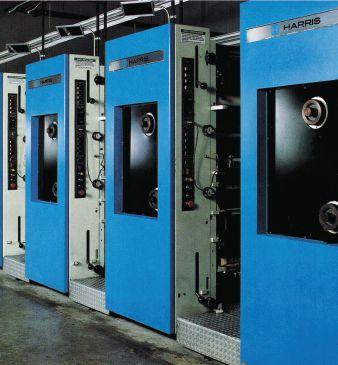
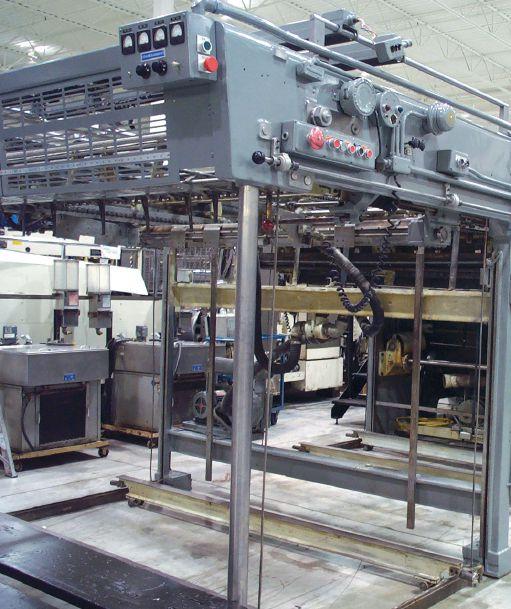
Historic, game changing presses (clockwise from top left): A 1988 Zirkon FORTA 660-II (Royal Zenith 420); 1967 four-colour Harris LXS (54 x 77 inches); and a 1982 Harris M-90.
feed table. I often joked that you needed oxygen to operate them. The biggest challenge was again in paper handling. Reams had to be hoisted by hand to load the feeders!
The industry of its day seemed content to follow the maxim of larger (sheet size) was better even though that meant everything else in a supporting role had to be huge. It seemed nothing else would give a printer a technical advantage over another. Web was an old-boys club few sheetfed printers would dare enter – even if they could scrape up enough cash to do so. In Canada, companies like Ronald’s, Maclean Hunter, Southams, Lawsons and Richardson Bond & Wright (RBW) held the keys to a door few would dare cross.
Quiet leap forward with GDR
If you visit Berlin take a stroll through the DDR Museum situated in the former East Berlin sector, just a short walk from the Brandenburg Gates. Inside you will see an interactive display of life in East Germany after the Second World War and up to 1989, when The Wall fell. Nearby a display of wooden hand grenades, which were given to children so they could practice chucking them over the wall when the decadent westerners invaded, there is a plaque that helps to define the miserable life that existed then. The East Germans provided the Eastern Bloc with the majority of hard currency by exporting the lion’s share of what they produced. Rejects were kept for the locals.
As the Iron Curtain fell upon Eastern
Europe after WWII, many German businesses found themselves trapped in the wrong place and at the wrong time. One such firm, known today as ZIRKON, had a storied past going back to 1819. Originally known as J.F. Schelter & Giesecke they started out as type founders. By 1827 they started building printing machines. The now famous PHÖNIX art platen was well received all over Europe and sold well into the early 20th century. In 1952 Schelter & Giesecke, along with about 80 percent of the East German industry, found themselves reorganized into the new Volkseigner Betrieb (VEB) state-owned structures.The company was renamed VEB Druckereimaschinenwerk-Universal Leipzig. Already having been involved with small reel-to-sheet machines before the war, they had designed and built a rather novel little web press known as the RZO. This was an offset press with three cylinders (plate, blanket and impression) and a sheeter, too. Various stories exist on just how and why this VEB came up with such a concept. Rumours suggested because these machines were so small (they had a web width of 24 ½ inches and a cut-off off 17 3/8 inches) that the whole press could be loaded on a truck and driven all over the Eastern Bloc to print newspapers and propaganda. During 1952 they manufactured the RZO with only two units so only one-over-one printing was possible. By the next year, VEB expanded the line with the RZO II. It could run with four units and at speeds of only 8,000 iph. A folder was added that could be dollied into position in
front of the sheeter. However, the small press had only two ink forme rollers, but this was fine for groundwood newspaper stock and limited coverage only. Newspapers and flyers fit the bill.
By the time 1957 rolled around, a small New York company called Zarkin Machine Co. caught wind of the RZO. Zarkin, incorporated back in 1928, was into all sorts of things and not just printing. After the war they were building plate whirlers and graining machines and it is suggested that two of the owners, Charles Zarkin and Jerome Reinitz, had in 1949 financed the rebuilding of a bombed out printing press factory in Berlin. This may have been the firm KiekeBusch for shortly after a new company Royal Zenith appeared in the US and the Kiekebusch sheetfed was marketed under the name of the Royal Zenith Jobber. The KiekeBusch was an odd little press with a Spiess feeder and made entirely of either aluminum or the new Suluminum alloy created by the Nazis during the war. Zarkin and Royal Zenith were both connected to each other. One hundred and thirty five RZO II’s were bought by Royal Ze-
nith and sold into the US market by 1957 and a new chapter of printing was about to be written.
In 1963, a revamped model of the RZO was designed. This press continued with the 3-cylinder principle but was faster and more refined. Called the Ultraset Junior RO62, it quickly found homes in both America and Canada. Marketed first as the Webmatic and then the Rubin 90, the press gained from Royal Zenith’s upgrades and demands to drastically change the printing landscape. A major incentive for anyone dealing with the East Germans was hard currency. The powerful US dollar was so desperately needed in the GDR that these machines were sold for ridiculously low money.
The mighty Harris Intertype Corporation was starting to take notice. Harris was the industry leader in sheetfed especially 60 and 78 presses. Back in 1953 Harris had already decided to enter the web business and purchased Dallas-based Cottrell Company. With Harris’s knowledge of offset and Cottrell’s letterpress web skills, it soon blossomed and a wide range of Harris-Cottrell web presses in all sorts of sizes from 16pp
to 64pp took hold of the North American market. But Harris didn’t have a small half-size web and they could see clearly how Royal Zenith had created a brand new business of turning large format sheetfed printers into 8pp web shops. This was causing havoc with Harris sheetfed sales!
The argument was compelling for Royal Zenith. Paper would be cheaper, the press could eliminate folding in the bindery, fewer operators and most importantly faster speeds. No more monstrous platemakers or folding machines and paper cutters. No heavy handling of stock, perfecting was as simple as a turn-bar and machine footprint was not much more than a 38-inch sheetfed.
continually brought new technologies to the half web market. In 1978, VEB Polygraph launched the much improved FORTA 660 (or RZ420). The press ran 40,000 iph and was equally matched by Harris’s M 110 B. Royal Zenith must have made a fortune on the VEB Polygraph association. They certainly did with its Planeta business as well as representing other Eastern Bloc combines like Brehmer, Perfecta and KOVO-Romayor. By the time of reunification (1990), Royal Zenith saw its advantage evaporate overnight and sold its interest to the newly formed and privatized Planeta. Planeta continued for a short time to represent the newly named VEB Polygraph (ZIRKON) but with virtually no cash and still bloated with too many employees, too much inventory and no cash, were gobbled up by KBA.
1995
Drupa 1995 was a significant event as a new round of automation found its way into amazing sheetfed technologies, particularly for perfecting 4 over 4, putting an end to the growth in half-size web machines.
By 1963, Harris bought a successful forms press manufacturer by the name of Schriber. Out of this, on the commercial side, came the revamped M-90 long grain web press and shortly after a new short grain M-110.The big advantage of the M 110 was that it was a 4-cylinder blanket-to-blanket design – just like the bigger commercial presses. So now instead of turn bars, a 4-unit press prints four colours on both sides at the same time. Add a dryer and some chill rollers and Voila! – the perfect tool to decimate the large sheetfeds completely. This M 110 entry may have hastened Harris`s resolve to drop the complete sheetfed program in an extraordinary 1975 decision.
Not to be outdone, especially in a market they themselves had single handily created, VEB Polygraph/ Royal Zenith had another press to launch in 1968. The ZIRKON 66 appeared (referred to in North America as the Royal Zenith 300) and it had all the same attributes as the Harris M 110 plus one very big advantage: Price! VEB Polygraph had come up with a press with some warts, but still able to produce high quality printing equal to sheetfed.
Over the next 15 years, Harris and VEB Polygraph/Royal Zenith would battle it out for market share while at the same time destroying forever the very large format sheetfed industry. By 1982, there were seven more competitors in this segment. Albert Frankenthal (now KBA) with its A 101, Miller Johannisberg with the CW68 and Webb 66 (a licenced copy of the Zirkon Forta 660), Komori with the System 20 (long grain), MAN with the Octoman, Heidelberg with the Web-8 (long grain), Hitachi 440 and 660, and Solna with its C-50. These were all similar 8pp presses and now marketed the same way.The age of the half-web was here to stay.
Both Harris and VEB Polygraph
ZIRKON continues today in Leipzig as a privately held GmbH and has made forays into 16pp webs as it continues trading. The beginning of the end of the half-web happened slowly. And by 1995 drupa, new sheetfed technologies for perfecting 4 over 4 put a lid on its coffin. The advantage the half web once held over larger sheetfeds was eroded by the declining run lengths, lower waste (of new perfecting sheetfeds) and more efficient make-readies of 16pp page webs. The larger webs could, by the mid 1990s, easily compete with what had been an exclusive segment held by the little 8pp webs.
In the early days of half web, printers also started to realize that they could print new work like business forms, newsletters and direct mail, opening up more revenue streams for a press that was first idealized to print propaganda on bad paper.
Today manufacturers face a new challenge in keeping even the 40inch press viable in the face of newer digital presses. This threat is real and the main impediments are the costs of such new (digital) technologies.
Currently there is severe sticker shock and something that is completely inverse to the story of the half web versus large sheetfed. Half webs can today be bought for less than the value of their metal. It is a reminder of how quickly printing technology changes today.
NICK HOWARD, a partner in Howard Graphic Equipment and Howard Iron Works, is a printing historian, consultant and Certified Appraiser of capital equipment. nick@howardgraphicequipment.com
More value, less rejection
How to overcome the different stages of rejection when trying to land a new printing prospect
By David Fellman
went out on a sales call with one of my clients the other week. We met with the purchasing manager of a large hospital, critical to the area.
The hospital’s purchasing manager had an interesting item on the wall behind his desk, a framed graphic which read: “Rejection – Get Used To It.”
The print prospect offered us coffee, then stepped out of his office to ask his assistant to get it. My client – the owner of a small printing firm who doesn’t really want to be a salesperson, but needs to be – pointed to the graphic and said, “Right, as if I’m not intimidated enough as it is.”
“Don’t sweat it,” I said. “He’s just pointing out a fundamental truth. In fact, he’s giving you good advice. Rejection is part of the game,” I continued to explain to my client. “And it may hurt your feelings, but you won’t die from it.
“Remember, if 99 out of 100 prospects reject you but the other one becomes a good customer, you can still reach your sales goals, and that’s what really matters.”
Early-stage rejection
I also pointed out that the hospital’s purchasing manager had agreed to meet with him, which is more than most of his prospects had done so far.
It’s another fundamental truth that most of the rejection in printing sales happens at the very early stages, with buyers refusing to respond to phone calls or e-mails or other attempts at making the initial contact.
And it’s been my experience that most of that is not really rejection, at least not in the personal sense. Rejection is just a reflection of three elements of human nature:
(1) resistance to change,
(2) further resistance to the idea of adding anything more to what’s probably already a heavy workload, and
(3) a general distrust of salespeople.
In the real world of printing sales, the
How quickly salespeople give up according to a 2015 survey by Marketing Wisdom.
odds are stacked against you when you make that initial attempt.
The chances of rejection are much greater than the chances of acceptance on any individual prospecting call, but it’s usually no more personal than having a traffic light turn red as your car approaches an intersection.
No big deal, right?
Later-stage rejection
It’s a different story when you have met and talked with a prospect, and especially when you have actively competed for some of that prospect’s work. It may actually be personal at that point.
I have certainly decided not to buy from certain salespeople because I just plain didn’t like them. But again, it’s been my experience that most of the laterstages rejection is not like-related but rather value-related.
Let me put it this way, if you bring value to the relationship, you’ll be rejected far less often. That includes price-value, which starts with the lowest price but continues through the whole competitive-price range.
more than one loser.)
More than anything else, though, value can be defined as “getting I what I want.” And that can range from “I want to avoid the sort of problems I’ve had in the past” to “I want to reduce my cost” to “I want to market my business more effectively” to “I want lots of progress detail all the way through the project” to “I want to place the order and then not hear anything from the salesperson until it’s delivered on time and done right.”
Key takeaways
Here’s the key point. Value is in the eye of the beholder. The great salespeople find out exactly what the word means to their prospects and customers, and then they base their strategy around providing and maintaining it.
I hear too many salespeople talking about features (we have a state-of-the-art digital press) and not enough time looking for problems (we do lots of multi-version projects, and our current supplier hasn’t been meeting our turnaround expectations) and connecting the two in the form of a value statement — “I have the solution to that problem. We have a stateof-the-art digital press that is perfectly suited to that kind of production.”
Please understand that it’s the connection to the “I want” that creates the value. And the more value you create, the less rejection you’ll suffer.
SEVEN RULES FOR COPING WITH SALES REJECTION
Jane Porter of Entrepreneur.com shares some of the best ways to deal with sales rejection for small businesses:
• Set long-term goals
• Don’t take it personally
• Get into a routine
• Build relationships
• Talk to other entrepreneurs
• Know your sales ratio According to a 2015 survey by Marking Wisdom, 92 percent of salespeople give up after four rejections, while almost half, 44 percent, give up after just one no.
It also includes the “like factor” – but just as rejection isn’t always like-related, winning the business isn’t either. The proof of that statement lies in situations where the buyer likes both salespeople, but only buys from one of them. (Obviously some buyers spread their work around among salespeople they like, but the point here is that every individual print order has just one winner, and often
• Acknowledge your accomplishments
DAVE FELLMAN is the President of David Fellman & Associates, a graphic arts industry consulting firm based in Cary, North Carolina. He is a popular speaker who has delivered keynotes and seminars at industry events across the United States, Canada, England, Ireland and Australia. He is the author of Sell More Printing (2009) and Listen To The Dinosaur (2010). Visit his website at davefellman.com.
ALL THINGS VISUAL
The evolution and rebranding of ICON Digital Productions positions a large-format-imaging pioneer as one of North America’s most unique and powerful visual communications companies
By Jon Robinson
On the top floor of ICON Digital Productions’ 90,000square-foot manufacturing facility, tucked into a dimmed backroom, three technicians sit in front of a dozen screens grouped together on the wall like the Network Operations Centre of a cable news network. They are monitoring some of the highest profile static print and dynamic digital signs controlled by ICON’s newly minted Media division, including all the visuals hanging in Toronto’s Dundas Square and way-finding screens directing passengers at Pearson Airport.
Responsible for thousands of digital signs across Canada for Blue Chip clients like Shoppers Drug Mart, ICON Media
illustrates the reach behind one of the country’s most unique visual communications companies. Designed to deploy national signage networks by procuring all of the necessary hardware, developing business plans and ultimately managing ever-changing content for clients, ICON Media is well-positioned to take advantage of an evolving wireless world. It provides the company with an irresistible vehicle for C-suite strategy discussions with clients. The bedrock of the parent company, however, is formed by ICON Visual with one of Canada’s most powerful technological infrastructures for large-format imaging.
ICON Visual dominates the company’s Markham, Ontario, facility, which any grizzled graphics pro would recognize by its curved-glass façade as the former home of Apple Canada. This division generates more than half of the parent company’s
ICON Digital’s Chief Financial Officer
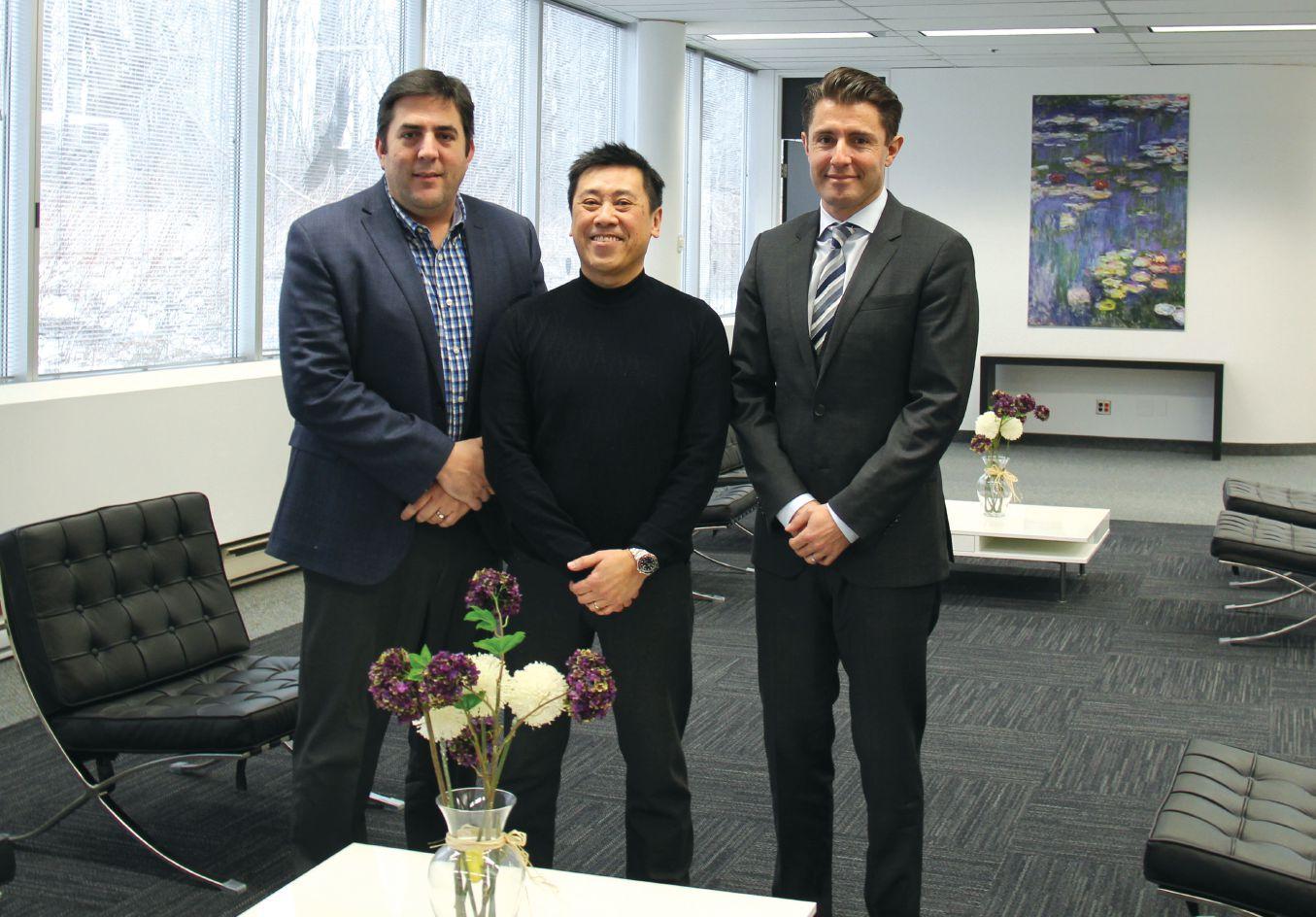
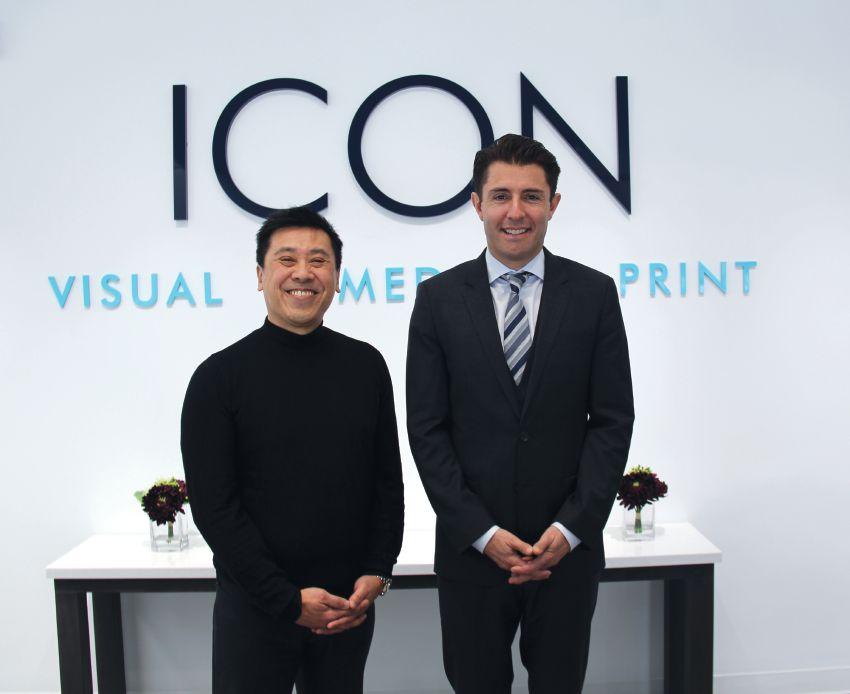
Alex Christopoulos (left to right) with ICON Digital’s cofounders Juan Lau and Peter Evans.
Juan Lau and Peter Evans in ICON Digital’s lobby which is newly branded for the company’s All Things Visual mantra, focused around Print, Media and Visual divisions.
annual revenue, which in its most recent fiscal year amounted to just under $40 million, by pumping out static display graphics with print qualities demanded by the likes of Fortune 500 cosmetic and fragrance clients, Hudson’s Bay Company and Maple Leaf Sports and Entertainment.
ICON Print is the third pillar of the company’s All Things Visual strategy, developed through a divisional rebrand in December 2016. After years of outsourcing the production of offset-print jobs for its Blue Chip clients, ICON in January acquired Toronto Trade Printing, bringing decades of 40-inch-offset expertise inhouse. The move creates a multifaceted communications manufacturing company powered by ICON Media, ICON Visual and ICON Print.
was focused on finding the best lithographic-manufacturing fit for its existing AAA client base. Lau explains his priority was to purchase a well-established printer to immediately provide the offset knowledge ICON lacks after two decades of building a roll-fed digital printing operation.
one day when a radio host referred to Madonna or Michael Jackson, he cannot recall which, as the Icon of Pop.
Prior to opening ICON, Lau was running a photo-enlargement company producing monochrome engineering drawings and architectural blueprints, generating slim margins, pennies per sheet. Lau describes his large-format eureka moment arriving in the early 1990s after seeing new colour imaging technologies at a tradeshow: “The idea of taking a file and outputting larger-thanlife graphics on just about any surface, whether it is vinyl or textiles, or what have you, nobody was really doing it.”
ICON’s first large-format machine was a Xerox electrostatic printer and, Lau explains, he and Evans decided to put a stake in the ground as a new type of printing operation. “We printed on sheets alright, but we printed it to transfer media and that allowed us to, with lamination, transfer it directly onto any substrate.”
ICON Digital Productions is projecting a growth rate of at least 10 percent after the purchase of Toronto Trade Printing to push its annual revenues toward $50 million. 10%
Visual evolution
Last year alone, ICON oversaw the printing of more than 20-million direct-mail pieces in addition to a range of offset-produced marketing collateral.The company’s executive team has spent the past several months looking at both commercial and trade printing operations to purchase in the Greater Toronto Area. “We look at print not so much as old technology. We look at it as just another communications medium. In fact, our numbers tell us there is a lot of growth in print still,” says Juan Lau, President of ICON Digital, who co-founded the company in 1995 with Peter Evans and Peter Yeung. “The last three or four years we kept looking at our financial statements and, ironically, the fastest growing service sector was commercial printing – and we were not even trying.”
Without a direct need to acquire book of business from a commercial shop, which is the primary M&A driver in today’s printing market, ICON’s executive team
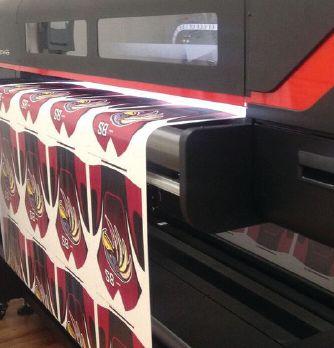
Approximately 80 percent of what ICON Visual now prints is produced with Durst roll-fed machines. Lau describes this as a key differentiator for ICON because its production has been built around a square-metre pricing model, driven as much by finishing and fabrication as by print production. “From a pricing model we are able to get more yield [using] rolls – just a pricing thing. We can get that buttoned down pretty quick. Printers getting into our space still go off the rate-card mentality,” says Lau, describing what he sees as traditional offset pricing based on number of sheets produced.
“We know a lot of commercial printers are trying to get into our space now,” says Lau. “To get into our line of work, they are going to blow their minds out on the finishing end… anyone can print, but it is the finishing that really makes or breaks a project.” Most commercial printers getting into large-format imaging also turn to flatbed machines, continuing to focus on cost-per-sheet pricing models.
Lau explains he never set out to build ICON as a traditional printing operation when the partners founded the company. In 1995, the Internet had not yet penetrated the minds of most people, fax machines and phones were the dominate business tools of the day, and modems were limited to speeds of under 20k. Still, Lau wanted the company name to hold the word digital, as well as production, because he initially wanted to start a video-production company. The key word ICON came to him
The technology was slow, outputting two or three posters per hour, and not a realistic investment choice for offset-based commercial printers. Lau explains he was driven to own the market that ICON would serve, akin to McDonalds being synonymous with burgers, Coke with soda, and Rolex with watches. Advertising agencies were immediately drawn to the new output possibilities ICON could provide with one-off large-format printing, even if they would often turn to offset or screen technologies for longer runs. “We started to establish a name in the business to do mockups, ideas, innovative stuff,” says Lau, noting ICON initially produced a lot of tradeshow graphics ideal for one-offs.
“What we were bringing on was really, by today’s standards, considered disruptive technology,” Lau says. “We didn’t know it at the time, but I think we were disruptors.” He explains it took about a decade after ICON’s founding for large-format imaging technologies, shifting from heavy solvents to UV, to evolve into a viable printing process for new entrants. “We went through a metamorphosis ourselves around 2005,” Lau says. “A key turning point in our company because it allowed me to do what I do best and that is go downstairs and take care of the operations, because our sales had never declined since 2005.”
Lau was trained as a programmer and holds great affinity for taking a process-minded approach to business. He felt ICON’s challenge was not about topline sales and he began to search for more efficiencies in the facility. “Once I got my hands on the operations side, the process and all of that – [we previously had the] same level of sales, $10 million, for a while – our bottom line increased tremendously.”
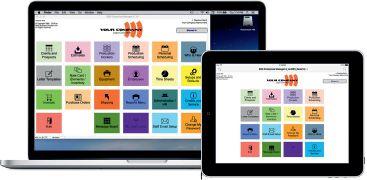
ICON brought on a new customized ERP system, internally branded as Cyrious, and a much-needed scheduling system for what had become a very busy large-format shop. ICON also brought in a new Chief
Features and Pavilions
• Dye Sublimation Pavilion
• Label Forum Canada
• IntelliPACK Zone & Workshops
• IdeAlliance G7 Color Management Summit
• Printing Sales Training Days
• Innovations Theatre
• Graphics Canada Seminar Series
• Materials/Substrates Zone
April 6 - 8, 2017
The International Centre (Hall 5), 6900 Airport Road, Toronto, Ontario www.GraphicsCanada.com SHOW HOURS
Thursday, April 6th - 10:00 a m to 5:00 p m
• Friday, April 7th - 10:00 a m to 5:00 p m Saturday, April 8th - 10:00 a m to 4:00 p m
Juan Lau has positioned ICON as a unique large-format display manufacturer based on the use of roll-fed imaging systems, primarily around Durst inkjet technologies.
Financial Officer, Alex Christopoulos, who Lau credits with greatly improving cash flow and the company’s overall financial health.
Media evolution
Lau describes the years from 2005 to 2008 as a “pivotal time” for ICON as he and Evans also decided to stop producing trade work for other printers and instead sell direct into the commercial market. “Part of the improvement on our bottom line was we made a conscious decision to shift and go after end-user markets,” explains Lau. “If we look back right now, we could have a few chuckles over that. It was one of the best decisions we could have made.”
ing budgets, Lau points to the significance of another technological marvel on ICON’s future. “2007 was a pivotal year from a technology standpoint, because when the iPhone came out [it] launched wireless technology in my opinion,” he says. “With all of the apps, [Apple] launched a whole slew of development in wireless technology.”
through ICON’s customer base, we actually changed [it] into a consulting model.”
Multifaceted evolution
The Gridcast division, rebranded in December 2016 as ICON Media, has been a significant driver for the company. “Our business in Media is an annuity. We will charge you a three-year management deal,” says Christopoulos, as an example of how the company can work with a client to finance a network of in-store screens, while ICON is truly interested in ongoing content management services.
Christopoulos explains the company, to a much lesser extent, hopes to take the same approach with some of ICON Visual’s work, where they might provide a client with a free banner stand with a commitment to print work to cover it –ideally, changing out the print regularly –over the next several months.With The Bay, ICON Visual is also starting to print on magnetic sheets that can be applied to painted walls, speaking to the division’s growing attention on developing repeatable visual systems with clients. The continuing innovation in both ICON Visual and Media have developed a strong reputation south of the border, where the company now produces around seven percent of its work.
$40M
ICON Digital Productions has grown from a small two-person operation into what is now a $40 million imaging giant with a strong industry position.
Around the same time, ICON’s future would be influenced by the arrival of significant developments in large-format digital imaging technologies with a new wave of UV-based inkjet systems. ICON threw out all of its older-generation, heavy-solvent inefficiencies and made significant investments in UV technology, which Lau also credits with improving the company’s bottom line. ICON’s attention to the bottom line through the latter half of the decade would soon prove critical as The Great Recession of 2008 fast approached, all but strangling print sales for months.
A year before the printing industry plunged into the throes of frozen market-
The economic ecosystem that quickly developed around wireless technologies would serve as a catalyst for the growth in screen-based digital signage. Lau explains wireless technologies broke down barriers that had been fortified for years by the need to run so much cable and obtrusive hardware. Less than two years after the arrival of Apple’s iPhone, ICON purchased a two-person AV company called Gridcast in 2009, when digital signage was still very much in its infancy. ICON had previously worked with Gridcast on a project for the Bank of Montreal, which wanted to integrate a digital projection within a large banner with a cutout. “It went really well and that was another eureka moment with Gridcast,” recalls Lau, describing ICON’s first project to integrate both print and digital mediums.
“Gridcast was very AV-oriented – hangand-bang hardware.We saw very quickly in the first year that the model wasn’t really going to be a sustainable model,” says Lau. “Not only did we develop it by feeding it
“Because they want to do new things with digital, they are very open-minded to talk about the other print things we offer.”
“[It isn’t] so much because we are a better printer. They have local guys down there. It was actually our Media division because they are a lot more proactive when it comes to new innovations,” says Lau. “Because they want to do new things with digital, they are very open-minded to talk about the other print things we offer. So that is how we have been using digital media, more as a way to penetrate organizations from the top down, as opposed to starting with procurement and working our way up.” ICON Media has been using Virtual Reality for almost two years to show clients, like Sport Chek’s CMO for example, what their stores will look like with large-format print.
As ICON Print is developed, the company plans to leverage strong C-Suite relationships to drive work onto litho presses. In fact, Lau envisions an emerging media procurement approach that will benefit the rebranded position of ICON’s three divisions: “I am hoping as more Millennials get into positions of power and decision-making, they are going to say, ‘Why do we need a separate print budget. This is a media budget. We need to line up all of our marketing together.’ I think those budgets are going to change. We are kind of placing a little bit of a bet that way.”
Under ICON’s new multifaceted media vision, Lau explains it is important to hold a true offset-printing presence beyond outsourcing. “We have only touched the surface of the excitement the Media division is going bring,” says Lau. “It is huge. The ICON rebranding of All Things Visual is going to take us to the next level.”
The Sun is the greatest source of ultraviolet radiation, providing a full electromagnetic spectrum, including wavelengths employed in print like ultraviolet light, visible light and infrared light. UV wavelengths measured in nanometers, as used in print, mark the difference between LED and conventional UV systems.
(PHOTO
THE PRINTING POWER OF UV
Ultraviolet has sparked the printing industry over the past decade and will continue to drive work onto a range of imaging machines from sheetfed to large-format inkjet
By Jon Robinson
The a pplication of ultraviolet light in printing is undergoing a significant transition in the sheetfed-offset sector. Technologies to employ UV in print have been around for decades with packaging representing the most historically consistent sector to employ UV technologies. The entire printing industry recently came to appreciate the power of UV through its overnight domination in large-format printing, when in the late-2000s companies began to abandon solvent inkjet systems in favour of the quality, speed and versatility provided by flatbed UV inkjet systems. Also critical to its growth, UV inkjet technology is suitable for outdoor applications, durable with an ability to eliminate expensive and time-consuming pro-
tective coating and lamination processes. In 2013, the large-format inkjet market reached volumes of around 60,000 metric tonnes of ink, in addition to 82,000 metric tonnes of coatings, according to Smithers Pira research, which also noted this still represents a small fraction of the total 3.2 million metric tonnes consumed that year. Relating overall UV growth, Smithers Pira concluded inkjet printing was the fastest growing sector for UV, with the market for UV inkjet printed products increasing from $3.9 billion in 2008 to $6.7 billion in 2012 and is forecast to reach $15.9 billion in real constant value terms by 2018.
Smithers Pira continues to predict that by 2018 the print volume of UV inkjet is forecast to rise by 535 percent from the 2008 volume, ahead of the value growth. The research organization explains this means the average unit cost of all UV
BY NASA)
inkjet is declining, which will reduce the cost of equipment even as it becomes more productive and, as a result, the higher margins once available in the signage market will also fall in relation to the overall market. As the UV inkjet market reaches quick saturation, which resembles the quick-adoption environment of toner-based printing through the 2000s, the application of UV printing through sheetfed offset presses positions an older printing process in a new light.
Based on the entries into PrintAction’s most recent Canadian Printing Awards program, it is easy to conclude a great majority of today’s highest-end printing projects contain vital UV-built components. Several project were printed in 4-colour process with UV metallic inks or featured ultra-gloss UV coatings. In one project, a printing company laid down UV coating at seven to 10 times the normal thickness to create a relief feel, done by calculating image distortion as it relates to flexo plates, while employing custom pumping equipment and specific coating formulations.
A project for sporting tickets combined high quality UV offset print and UV effects with variable information produced with UV inkjet print to enhance both appearance and security – all done on a 41-inch Heidelberg press, adding texture to the piece with strikethrough reticulating varnish and high gloss spot varnish. For even more security, the tickets were then imprinted with invisible UV ink, which is only visible under a black light UV lamp. The tickets were then placed in a folder using the same UV inks and effects as the ticket with the addition of UV sandpaper texture to create a tactile experience of a leather football. Before manufacturing began, the company explains it had to undergo rigorous testing of inks and coatings to determine which effect to use, and the specific placement of the effect on each ticket. For example, this included high gloss UV on the player picture with reticulated varnish around the player. Additionally, the company had to ensure that the application of UV effects did not interfere with the variable information added by UV inkjet printing.
The use of UV curing is certainly not new to the sheetfed-offset world. It is a process backed by a huge range of ink sets, coatings, blankets and a myriad of press configurations. What has changed in the past few years, however, is the fact that
almost every new 40-inch press leaving their manufacturing plants is at very least prepped for UV and the vast majority of new presses sold, well over 70 percent, are equipped to run UV when they hit the pressroom floor.
There have also been critical changes in the availability of different forms of UV curing, which ultimately boil down to a matter of electrostatic frequency based on energy source. The wide swath of traditional UV in the marketplace, which has been around for decades in the form of mercury vapour bulbs, is now shifting to tighter and more powerful frequencies with optimized UV and the intriguing arrival of Light Emitting Diodes (LED). The optimized UV curing process (designated as H-UV by Komori, LE-UV by Heidelberg, LEC-UV by Manroland and HRUV by KBA) continues to rely on mercury vapour bulbs, but they are infused with dopants, which amounts to adding metals (primarily iron) to the mercury inside of a curing bulb to increase intensities in some parts of the UV spectrum.
All three of these processes –traditional UV, optimized UV and LED UV – are being used in the marketplace. There is, however, a growing demand in the market to replace legacy mercury-based lamps with LED technology for improving performance and lowering lifecycle system costs. Which frequency a printer invests in will ultimately be determined by a range of advantages and disadvantages, including the fact that LED UV systems do not have the same robust consumables support of conventional UV, which also boosts optimized UV offerings.
The cost of LED UV, however, will continue to decline as more emitting diodes are developed on mass scales for use in a range of industrial applications, well beyond printing. Eventually, LED UV will become the mainstay of curing technologies in the printing industry and currently optimized UV is a more viable option for a majority of commercial printers waiting for the costs and support structure of LED UV to become more feasible.
LED UV technology is currently being most often applied to long perfecting presses, because it makes marking a non-issue while also allowing these productive presses to run at full speed. The application of optimized UV and LED on a perfecting press means a solid-coverage sheet is completely dry on the backside before turning toward the
delivery. These newer forms of curing, which also provide a more glossy print than traditional UV perfecting, also help eliminate the need for ceramic jackets in perfecting, which might cost upwards of $8,000 each.
One of the disadvantages of LED UV curing can include the need for baked plates on long runs, while the ink water window is also much more narrow with LED UV. As a result, conventional UV is more suitable for stochastic production. Power savings, of course, are a main draw of newer UV curing systems. With conventional UV printing on a 6-colour press, for example, the line would require three interdecks, plus two end-of-press lamps, while an optimized UV or LED press can run six colours and coating with one lamp.
Pioneering LED UV provider Phoseon Technology, which has been working in the industrial UV arena since 2002, provides a more technical look at the differences in UV curing systems. The majority of standard UV curing happens in a narrow emission range, according Phoseon, with the remainder of the
spectral output generating unneeded and potentially harmful UV-C and infrared emissions. LED UV lights provide this narrow emission range. UV LED curing light sources, explains Phoseon, efficiently converts 20 to 40 of the input electrical power into usable UV light with no harmful UV-C or infrared exposure. Phoseon explains that efficiency translates into approximately 80 percent power and heat savings over mercury-based lamps.
“There are substantial benefits to be gained with UV LED in curing systems, whether retrofit or new designs. Achieving the maximum ROI requires understanding the clients’ system requirements and determining the best UV LED lamp product type and configuration to achieve the optimum UV irradiance and dosage requirements,” said Mike Fusco, Co-founder of LED Specialists, which now works with Phoseon for LED UV integration. “In addition, mechanical installation of the new LED lamps, wiring and controls must be designed in a manner that allows retrofit while minimizing downtime of the client’s production line.”
2017 GCEA Annual Conference
April Burke, Lowe-Martin Group
Angela Stone, Canadian Tire Retail
Dawn Nye, Konica Minolta
Erin Nuss, SGIA
Trish Witkowski, Foldfactory.com
Nancy Sobhy, Veritiv Corporation
Jeff Uzbalis, 3M Commercial Graphics
Detailing the newest printing technologies from Agfa, Appvion, Epson, Komori, Lectra, iSys Label, Mimaki,
Ricoh, Roland, Solimar and swissQprint
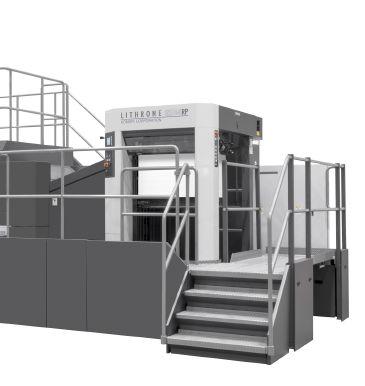
Komori Lithrone GX44RP
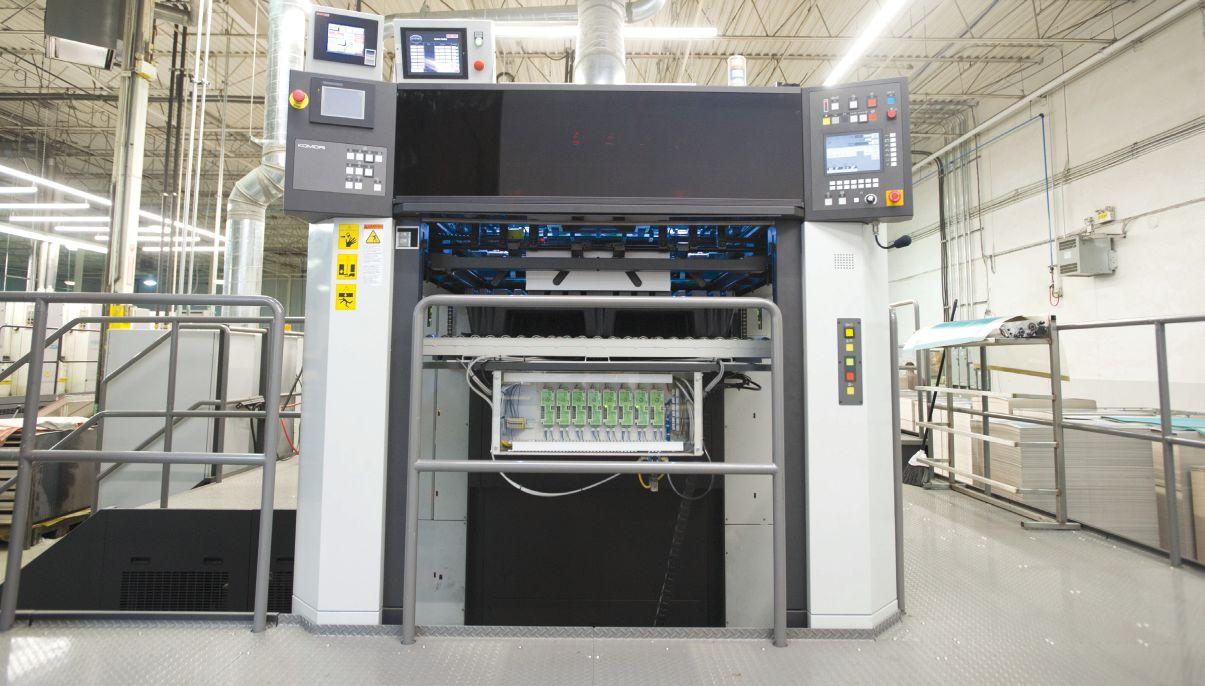
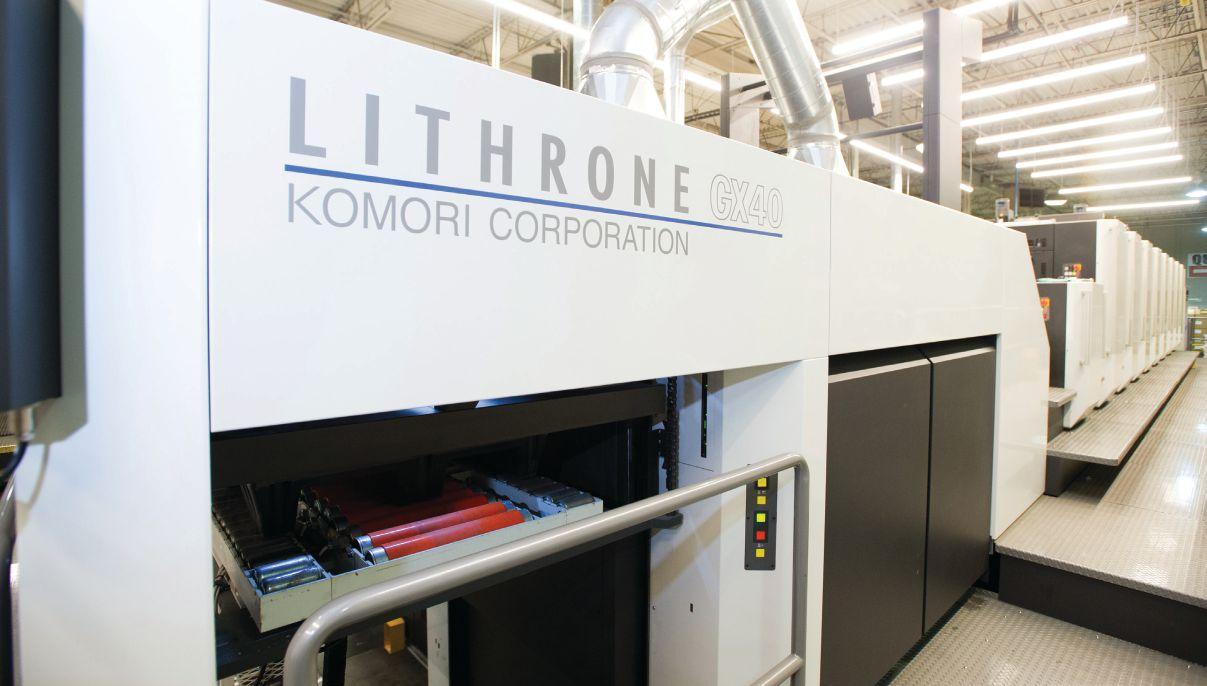
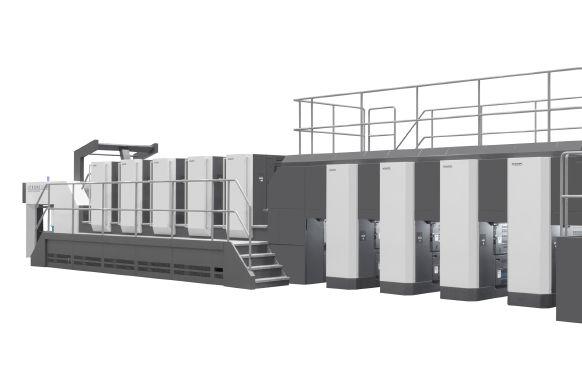
In January, Komori Corporation added a new press to its Lithrone G Series, the Lithrone GX44RP offset press, describing the system as the ultimate in one-pass double-sided printing. The 44-inch Lithrone GX44RP is equipped with H-UV technology to deliver high quality, high productivity and short turnaround stability for double-sided printing. Komori describes the press as being well suited for applications like publication printing, magazines and books, and duplex package printing. Key features of the new press include single-edge gripping, which makes the margin on the tail edge of the sheets unnecessary. This enables paper costs to be cut by minimizing the sheet size.
The Lithrone GX44RP also employs four double-size transfer cylinders, which eliminates sheet reversal and to help provide stable sheet transport for handling either light or heavy stocks through. Additionally, front/back plate imaging is in the same direction, (just as with single-sided presses) increasing efficiency in prepress. Supported by the KHS-AI integrated control system, benderless FullAPC and the H-UV curing system, the Lithrone GX44RP provides short makeready and powderless instant drying to accommodate fast turnarounds. Options that can be included with the press are the A-APC Asynchronous Automatic Plate Changer, the PDC-SX Spectral Print Density Control SX and the PQA-S Print Quality Assessment System.
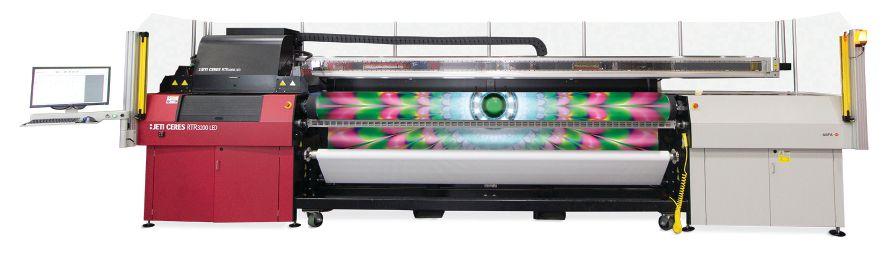
Agfa Jeti Ceres RTR3200 UV LED
In January, Agfa Graphics launched its Jeti Ceres RTR3200 UV LED roll-to-roll printer for what the company describes as mid- to high-end applications. The new
engine can include a combination of optional white printing and primer for producing higher-end image quality and durability. The Jeti Ceres, leveraging Agfa’s UV LED inks and thin ink layer technology, is a dedicated 3.2-metre roll-to-roll printer capable of printing on single- and dual-roll medias at speeds of up to 186 square metres per hour.
The Jeti Ceres can print on heat-sensitive medias like self-adhesive sheets and PVC without warping or wrinkling them, which opens up new opportunities and allows printers to reduce the costs. The new printer is equipped with white ink circulation that extends along the entire ink line. Agfa Graphics’ Jeti Ceres also adds a primer option for durability when printing on unusual or difficult roll-based media. The engine pre-prints a layer of primer automatically before depositing ink, preparing the top layer for surface tension to better receive ink. Asanti, Agfa’s wide-format printing workflow software, comes with the Jeti Ceres system, which also makes it compatible with Agfa’s cloud-based PrintSphere for flow of information between customers, colleagues, freelancers, departments and other Agfa printing solutions.
iSys Label LUNA 850
In January, iSys Label introduced the LUNA 850 as a high-end desktop label printer designed specifically for the wine and beverage market. The LUNA 850 is a digital label printing solution that provides 600 x 1,200 dpi for creating high resolution graphics, photos and labels. Labels printed on the LUNA 850, according to iSys, are highly durable, lightfast, water resistant and scratch proof. The cut-sheet printer works with 8.5 x 11-inch (215 x 279.4 mm) sheets of diecut wine label material.
Komori’s Lithrone GX44RP employs four double-size transfer cylinders.
Solimar Print Director Enterprise 8.3
In January Solimar Systems of San Diego, California, which focused on both production printing and secure document delivery technology, released version 8.3 of its Solimar Print Director Enterprise (SPDE) software. SPDE is designed to provide data stream conversions and output management control for high volume transactional printing environments. This latest version of Solimar’s print transform and workflow management product contains new operator efficiency features and production control enhancements.
SPDE 8.3 contains several user enhancements to organize and manage configurations and to customize operator interfaces. A new job activity view provides a simplified display of the status of processing and completed jobs for administrators and operators. These enhancements enable users to more effectively manage their print data workflows and configurations. SPDE 8.3 includes additional control options for specifying page range reprints for various print data formats. The new page range options provide users with additional flexibility for managing and executing precise reprint operations that reduces paper waste.
A new IPDS module allows users to selectively route a spooled IPDS print job to available cutsheet devices with the transform automatically changing the tray selection commands to match the configuration of the printer. Solimar products enable thousands of organizations around the world to expand and control their enterprise output management processes through robust data transforms, device optimizations, document reengineering, e-presentment and workflow tracking.
Appvion Ricoh Pro VC60000 Qualification
In January, substrate manufacturer Appvion Inc. announced that its line of Triumph High-Speed Inkjet Papers is now qualified on Ricoh’s Pro VC60000 Press. Appvion explains it has designed its portfolio of Triumph papers to keep pace with the advancing capabilities of high-performance presses like the Ricoh Pro VC60000 that delivers 1,200 x 1,200 resolution at speeds of up to 164 feet per minute.
Agfa’s Jeti Ceres can print on heat-sensitive medias like self-adhesive sheets and PVC without warping.
Appvion explains Triumph papers are designed to deliver vibrant colour reproduction, uniform print density, and sharp lines and even solids when matched with the Ricoh Pro VC60000. In particular, the company points to the performance of Triumph Coated Ultra BriteMatte on the Pro VC60000. In addition to Ricoh, Triumph papers are qualified on presses from Canon, HP, Kodak, Pitney Bowes, Screen and other original equipment manufacturers. All Triumph High-Speed Inkjet Papers, available in a range of basis weights and sizes, are made in the United States.
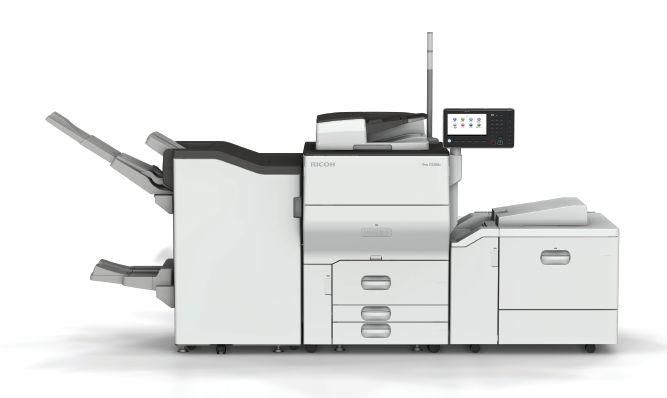
Ricoh Pro C5200 Series
In January, Ricoh unveiled its Pro C5200s series, a toner-based colour production printer aimed at inhouse print centres, corporate reprographics departments, print-forpay and commercial printers. The new Ricoh Pro C5200s and Pro C5210s produce colour and blackand-white documents at up to 65 and 80 ppm, respectively, reaching VCSEL resolutions of up to 1,200 x 4,800-dpi. Along with optional oversized media support, the Pro C5200s works with medias of up to 360 gsm simplex and 300 gsm duplex at 13 x 19.2 inch standard for-
mat. The optional oversized media support provides a 13 x 27.5 inch format.
The system has a total paper capacity of up to 8,250 sheets and four paper trays available as standard. This feature combines with the series’ saddle-stitching, embedded paper library, and folding capabilities to make the Pro C5200s devices suited for booklet production. Optional Cover Interposers and Booklet Finishers are available. The new systems leverage Ricoh’s optional Smart Operation Panel for workflow automation, as well as a variety of scan-to options, including Scan-to-URL, Scan-to-Directory, Scan-to-USB and Scan-to-SD.
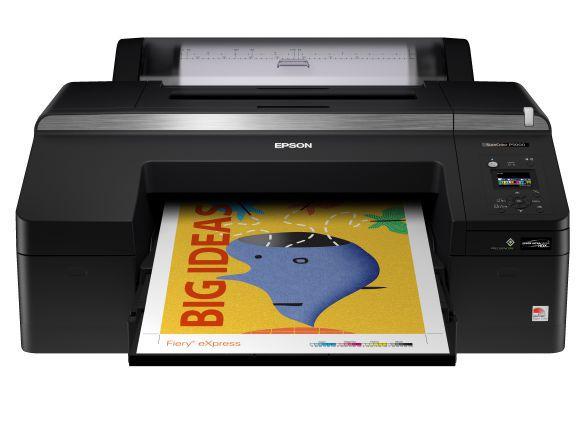
Epson SureColor P5000
In January, Epson introduced its 17-inch SureColor P5000 printer, as a replacement to the Stylus Pro 4900, featuring the company’s PrecisionCore TFP print head technology and its UltraChome HDX 10-colour pigment ink set. Epson explains the SureColor P5000 is a dramatically redefined printer design that includes improved dust and static control for reduced maintenance and increased durability and reliability for the desktop photography, fine art, graphic design, and proofing markets. Leveraging PrecisionCore TFP and UltraChome HDX, the SureColor P5000 provides an increased colour gamut, higher-density blacks and twice the print permanence than the previous Stylus Pro generation. Epson explains the SureColor P5000 brings all of the SureColor printing technology into a 17-inch desktop model.
The SureColor P5000 employs 200 mL UltraChrome HDX ink cartridges utilizing newly developed
Your Superior choice for Print Finishing and Lettershop Ser vices
then fold and even glue all on the same machine, up to 30 pt.
3. INTEGRATED MODULAR UNITS — Combined in-line finishing: crease, fold, glue, tipping, envelope inserting, ink jetting (Duplex), clip seal (3 sides), mail prep.
4. SAVE ON POSTAGE COSTS As a Certified Canada Post Direct Marketing Specialist, we get contract pricing reductions. 5. RETURN MAIL PRODUCTS — Customized “Return Mailers” created in-line with “U” or “BOX-shape” remoistenable glue, time perfed applications and envelope formation.
6. MINI-BOOKLETS — Saddle-stitch and trim 2-up booklets in-line to the size of a business card. No need to trim off-line, or do 2 passes.
7. HIGH SPEED EQUIPMENT — High speed Tipping, Folding, Saddle-stitching and soft folding ensuring on time delivery.
The Ricoh Pro C5200s and Pro C5210s run at up to 65 and 80 ppm, respectively.
core pigments, including new Orange and Green inks, as well as Black inks that are 1.5 times denser than the previous generation, delivering a wider contrast ratio and improved resin encapsulation technology for superior gloss uniformity and optically clearer, sharper images. Touting a refined design, the SureColor P5000 supports a 10-channel PrecisionCore TFP print head that includes a new ink-repellant surface coating, along with improved dust and static control for reduced nozzle clogging and maintenance, and supports printless nozzle checks for time, production and resource efficiency.
The SureColor P5000 can support two different ink configurations. The SureColor P5000 Standard and Designer editions leverage Light Light Black ink for twice the overall print permanence, smooth and neutral tonal transitions and support of the Epson Advanced Black and White print mode, ideal for photography, fine art and graphic design applications. The Commercial Edition includes Violet ink, in place of Light Light Black, for an expanded color gamut, to deliver an industry-best 99 percent PANTONE PLUS FORMULA GUIDE solid-coated colour matching.
Roland LEF-200 UV
In January, Roland DGA introduced the VersaUV LEF-200 flatbed printer for producing small-lot customization of a range of items, objects and accessories. The UVLED-based system, which includes Roland’s VersaWorks Dual RIP software, holds greater media compatibility from previous versions, running CMYK, white and clear ECO-UV inks. The LEF-200 leverages a print bed of 508 x 330 mm (20 x 13 inches) to work with three-dimensional items up to 100 mm (four inches) thick.
The LEF-200 features a new onboard primer ink option for conveniently priming objects. Clear ink can be printed for spot gloss or matte finishes, as well as embossing effects. White ink can be printed as a spot colour or behind CMYK on dark backgrounds or clear materials. To meet individual business requirements, users can choose from three ink configurations: CMYK+White+ Primer, CMYK+White+Clear, and CMYK+White+White. VersaWorks Dual enables users to work not only with PostScript files, but also allows for native processing of PDF files to ensure transparency effects are processed accurately. In addition, white or clear ink data can be generated in
Epson’s SureColor P5000 prints on sheets from 8 x 10 inches up to 17 x 22 inches.
Roland’s LEF-200 allows white ink to be printed as a spot colour or behind CMYK on dark backgrounds or clear materials.
the RIP, for use in producing transparent personalized accessories with special effects.
In addition to unveiling the new LEF-200, Roland also introduced its new VersaUV LEF-12i flatbed printer, an upgraded version of the 12-inch LEF-12. The LEF-12i comes bundled with VersaWorks Dual RIP software, which holds a new core engine for faster previewing times and improved handling of PDF and PostScript files, including files with transparencies.
Techkon SpectroDRIVE
In January, Techkon introduced its new auto-scanning spectrophotometre called SpectroDRIVE, which scans press sheet colour bars and simultaneously sends spectral and density measurement data to computing systems running Techkon Expresso software. Users can scan a 40-inch press sheet, according to the company, in less than eight seconds.
The new generation SpectroDRIVE, explains Techkon, features an aluminum-clad measurement head and wireless charging. The optical engine now supports multiple measurement modes (M0, M1, M2, and M3) for compliance with G7 and new ISO standards. A laser guide makes it easier to align colour bars with the scanner. The new generation measurement head also integrates a screen to display colour and density values, battery and wireless status, and to also show current measurement conditions.
The SpectroDRIVE uses G7 functionality with recommended ink-key-specific adjustments of C,M,Y densities to obtain neutral values according to the G7 specification. Also, an Ink Zone Control Strip can be printed and measured anywhere on the press sheet.
Mimaki Kebab
In December, Mimaki introduced two new Kebab options for printing on cylindrical objects. These Kebab options can be deployed using Mi maki’s UJF -7151 plus or the new UJF MkII Series printers, which are based on UV-LED inking sys tems. The application of UV inks and curing allows inkjet-based systems to print directly onto a growing range of substrates and objects.
Mimaki explains the Kebab op tion for UJF Series printers has the ability to print on cylindrical ob jects like stainless steel tumblers, bottles, cans, vases, packaging and candle holders. All Kebab devices offer 360-degree direct printing on a range of material sizes. These new options can be mounted to the printer’s flatbed table, specifically with the UJF-3042 MkII printer, and the Kebab MkII L device for the UJF-6042 MkII and the UJF7151 plus printers. They function via Mimaki’s RasterLink6 software.
swissQprint 4×4 Nyala
In January, swissQprint launched two new large format printers with 4×4 models of its Nyala 2 and Im pala 2 series, which means the inkjet printing systems are configured with quadruple CMYK for high printing speeds. The 4×4 model in the swissQprint Nyala 2 series, printing in quality mode, runs at 100 metres square per hour – producing 57 square metres of print in an hour.
The colour configuration can be supplemented with an optional white or varnish channel. Both UV printers can be equipped with a rollto-roll option, or a board option capable of handling medias of up to four metres long, which is twice the print bed depth. The printers can be fed by swissQprint’s Rob system for
Mimaki’s Kebab devices offer 360-degree direct printing on a range of material sizes.
Solutions for the Printing Industry
❏ One program manages entire company
❏ Enter data once and use it many times
❏ Enhances client service
❏ Work smart, work efficiently
❏ Increases speed - accuracy from estimates to invoices
handling longer print runs. The robot loads and unloads rigid media onto the printer.
Kyocera DMConnect Pro
bacteria and thereby extend shelf-life. Conventional “pasteurization” uses high temperatures, which degrade the taste and nutritional value of foods and beverages.
In January, Kyocera Document Solutions introduced DMConnect Pro as a capture-and-distribution business application to provide information-capture from paper documents and 2D barcode scanning. DMConnect Pro uses OCR and Forms Recognition technology to interpret and extract information from scanned documents. Data from paper documents can be captured, processed, and routed to any system or database, anywhere in an enterprise. The application automatically applies customizable templates for different document types, and allows users to correct, add, and search for specific data –all through a drag-and-drop user-interface on the MFP control panel.
With the addition of Kyocera’s Card Authentication kit, DMConnect Pro can integrate with active directory to further increase security. Employees can use their existing HID proximity cards to establish their access credentials with a single swipe.
CTI Packaging Ink
In January, Chromatic Technologies Inc. introduced the development of a patent-pending, high-pressure indicator “ink” applied to a food package that provides visual inspection showing that High Pressure Pasteurization (HPP) has been applied to the food product(s). The launch by CTI is a first for the inks and food industries worldwide.
Also known as High Pressure Processing, HPP treatment is used within the food and beverage industries. The HPP machines are specially designed to inactivate pathogenic
One of HPP’s great advantages is that the product subjected to HPP looks identical to products that have not undergone HPP treatment. This is also one of its great weaknesses: it is impossible to know by visual inspection, whether or not a product has been HPP-treated. HPP is approved by the U.S. Food and Drug Administration and the U.S. Department of Agriculture.
Mark Andy, Color-Logic Certification
In January, Color-Logic achieved certification of Mark Andy Digital Series hybrid presses for use with the Color-Logic process. Mark Andy Digital Series CMYK plus White inks enable printers to produce 250 metallic colours and an unlimited number of decorative effects on silver metallic stock.
Lecta Metalvac
In January, Lecta, a manufacturer of metallized papers, completed its move to introduce a new coating and lacquering line made by the Swiss manufacturer Polytype.
The company explains it is necessary to apply specific coatings to ensure paper quality: first a proper fixing of the aluminum on the paper and then optimum printability of the metallized coat. The new coating and lacquering machine incorporates the latest technical developments in the application of these coatings to guarantee the highest quality. The new machine has a width of 2,450 mm and a speed of 800 m/min. This will allow for increasing the production capacity of metallized papers at the Leitza mill from 25,000 to 40,000 tons.
swissQprint Nyala 2 can now include quadruple CMYK for higher printing speeds.
SALES REPRESENTATIVE
Printer’s Parts & Equipment, established 1973, is looking for a results-driven sales representative to actively seek out and engage customer prospects. PP&E has an extensive product line that makes it easy for representatives to perform and maximize revenues. Industry experience, and car is required to visit prospects and customers. Please apply in confidence to info@printersparts.com
Email résumé to: info@printersparts.com
FUJIFILM SALES MANAGER, METRO TORONTO REGION
This position is responsible for growing profitable sales and ensuring business plan targets are achieved in your accounts through the implementation of effective and efficient sales strategies and tactics. The ideal candidate
PRESENTATION FOLDERS
will have 6-8 years of sales experience working within the Graphics industry, including experience with commercial print and packaging. Interested candidates can apply for this position by visiting www.fujifilm.ca and clicking on “Careers”.
PRODUCTION MANAGER
Do you have the drive and initiative to manage and control production with this small but fast paced manufacturing company?
Roles include: quality control, scheduling, production, overseeing employees etc.
Email cover letter, resume and salary expectation to: joinourteam@promotionalproduct.net
SHIPPER/RECEIVER
Well established book manufacturing facility looking for someone to fill the
position of shipper/receiver. Will need to be a certified forklift operator, have computer skills and be willing to work long hours when necessary. Competitive wages and benefit package. Email resume to: Melissa@yorkbook. com
Tel: 416-496-1000
Website: www.yorkbook.com
ESTIMATOR
Well established book manufacturing
facility looking for an estimator. Must work well in a busy environment, be able to multi task and be proficient with Excel and Word Suite. Knowledge of the industry an asset. Email resume to: Melissa@yorkbook. com
Sakurai: 1, 2 or 4 colours and any size (newer model)
Polar: any size/older or newer models (66/72/76/78/82/90/92/107/115)
Horizon-BQ: 220/240/260/440/460
Patrick Bolan / President / Avanti / Toronto, Ontario
In January, Ricoh acquired Toronto-based Avanti Computer Systems, which has been a leading developer of Management Information Systems dedicated to the printing industry for more than three decades. The software company was founded in 1984 by MIT graduate Dr. Richard Wallin, after a friend described the difficulties of putting an accurate job estimate together. In 2004, Patrick Bolan and Stephen McWilliam took an ownership position in the company and began to develop a business model that would sustain consistent growth to place Avanti MIS as a North American ERP printing power.
In July 2013, Ricoh made an initial strategic investment in Avanti as the MIS developer was preparing to launch its new generation Avanti Slingshot solution, which was released in the fall of that year at Graph Expo. One of the most-advanced MIS products in today’s print market, Avanti’s new Slingshot platform was built around a completely new coding infrastructure and the MIS sector’s highest level of JDF certification for automation.
With the full acquisition by a world-imaging giant in Ricoh, Avanti now holds the potential to become a true global power by leveraging Avanti Slingshot as an MIS newly built for today’s multifaceted business of print. PrintAction spoke with Bolan just days after the Ricoh purchase for his take on what the future holds for one of Canada’s most dynamic software developers for printing.
What attracted Ricoh to acquire Avanti?
PB: I think Avanti Slingshot is a big attraction. We have the best MIS system in North America, if not the world. From Ricoh’s standpoint, it acquired has MarcomCentral, which they bought just fully about two years ago... So they have the Web-to-print piece and now they have the MIS piece. They already have the production workflow piece, which is their TotalFlow product, so they have a complete workflow for a printer. I think it is a brilliant strategy on their part.
Why is Slingshot an outstanding product?
PB: The biggest thing is that the market has changed. Most MIS systems, including our legacy product Avanti Classic, were written 20-plus years ago. Back then offset was the primary focus. There was no or very little digital. The market has changed to where most of our customers are working in multiple lines of business. They offer digital, offset, large-format print, mail, fulfillment, data-management and even Web services for their customers.
Most older systems do not handle those
multiple lines of business. Meanwhile, Slingshot was written from the ground up to do just that. Number two is that Avanti Slingshot can be run on premise or in the cloud. And number three, Slingshot was written to be an open platform.
How critical is Avanti Slingshot’s high level of JDF certification?
PB: It opens a lot of doors. It is a key requirement for printers replacing an older MIS. They want connectivity. They want those islands of automation connected together and so absolutely it is definitely paying off.
What allows Avanti to keep pushing MIS?
Number of Slingshot installs since the platform launched in late 2013.
PB: We have the experts on staff. You need an experienced team of product managers and implementation specialists, who are entrenched in MIS every day, to guide the product development process. We also have a strategic partners program of 10 or more customers who we bounce ideas off of.
How much has your team grown since Slingshot launched?
PB: Since Avanti Slingshot launched in 2013, we have more than doubled and maybe even a little closer to tripled – Definitely more than doubled.
How much business has Slingshot generated for Avanti?
PB: It drives a lot of the revenue for Avanti and, last year [ended August 31], we had a record year… We still have a really solid support base on Avanti Classic and continue to offer support and provide enhancements for Classic. We are up to around 100 Avanti Slingshot installs now.
How will Avanti operate following Ricoh’s acquisition?
PB: It’s really business as usual. There are no staff changes planned, so the great thing for customers is that they will still deal with the same people that they have grown to count on. I am staying. Stephen is staying, everyone is staying. I am sure that one of the reasons Ricoh acquired us is because of the subject-matter expertise of our team. Our team literally has hundreds of years of collective knowledge in MIS and it is impossible to replace.
How will this Avanti’s global position?
PB: This is one of the reasons we started discussions originally with Ricoh. They made it clear, from the initial investment three years ago, that they wanted our product to be a global product and that is exciting for us.
Battlefield Graphics: Poised for the New Printing Market
Since 1964, Battlefield Graphics has been servicing the Graphic Arts Industry with leading edge technology from the Burlington Ontario region.
Specializing in “high end” Commercial projects for key customer accounts and agencies, Battlefield Graphics has always prided itself in helping their Customers realize the potential of print.
Jerry Theoret, President and CEO of the firm states: “Our clients are our Partners. That is what we value, that is what we do! We spend many hours helping our clients determine the final product.”
Jerry goes on to explain, “In today’s industry, not all commercial jobs are simple print cut and fold. We are now geared to enable design, print and finish of any job. The more we can “touch the job” the better we serve our client. We are not in the commodity print business.”
Long perfecting and UV printing has been a staple of the Battlefield offerings for many years. They were the first in North America to own a Heidelberg Speedmaster SM-102-12P in 2004, printing high end 6/6 colour catalogues for automotive and other industries. That machine joined a CD-102-6+L with UV, as they were early adaptors of printing high end products with UV techniques such as opaque whites, spot gloss effects and on many occasions, using unusual substrates such as metallic and clear poly sheets.“ We certainly learned things the hard way back then, but it was an invaluable experience for us and our clients” says Jerry.
Battlefield had lots of capacity heading into the 2008 economic set back, and like many, made the best of a bad situation. Today, currently employing 60 people in two locations, and experiencing high growth in the last two years Battlefield has undergone a multi-million dollar infusion of new equipment. “We had to become more competitive” says Jerry, and now we are fully positioned for the future of the print industry”.
Central to this investment is the installation of a Heidelberg Speedmaster XL-106-7+L Press outfitted with a full array of IST UV equipment, Inpress Control automated colour and register system, fully automated plate change system: AutoPlate Pro and the Prinect Press Center featuring Intellistart operating System, capable of producing conventional and UV print jobs at 18,000 impressions per hour.
Matt Theoret, Jerry’s son and Production Manager states “UV printing is a very important part of our business, therefore we needed to produce UV faster, and complete more tasks in one pass, and decrease our turnaround times to our customers. This press can output highly critical mutli-colour and specialized jobs as it were a simple 4-colour process job.”
Jerry adds: “Unique finishing requirements are the next logical step to these special products that we are producing”. Therefore we decided to add a Heidelberg Promatrix 106 CS Die Cutting solution. We can provide so much more with this machine, regardless of the substrate we are working with. It is a whole new offering for us”.
Along with a new Polar System 2 cutting system and their Stahl folding systems, the finishing capabilities are endless. “We are a true full service provider” says Matt.
Rounding out the latest investments, Battlefield installed a Heidelberg Versafire CV digital press capable of printing 90ppm with the special offering of a 5th colour clear or opaque white application to the digitally printed sheets. Jerry laughs and says, “If we were to offer digital going forward, we may as well have specialty options on that as well. In the end, it will be our client’s expectation.”
“We are also using it for proofing”, says Matt “The Versafire is part of the Prinect workflow, utilizing the DFE Rip from Heidelberg, and colour management to our offset operation is really accurate and easy for our prepress to work with.
Battlefield is not always the first to brag about their accomplishments, they believe their client’s satisfaction is all that is required. However, recently the were awarded the prestigious “SAPPI – Printer of the Year award for 2016” for their book “Art of Rush” a beautiful piece featuring more than 40 years of artwork by the Canadian Rock band.
https://www.sappi.com/2016-printer-year-winner
“We are very proud of that one” says Jerry, “we tried lots of tricky stuff and they were great to work with.”
“All these new products from Heidelberg have greatly increased our ability to serve our clients. I can’t believe how versatile and quick to respond we are now” says Jerry, “We are adjusting our business to maximize the capabilities of the equipment.”
The future is looking bright (UV Bright) at Battlefield Graphics. “We bring uniqueness to our
customer’s, provide an alternative” states Jerry, “Many Customers don’t realize what is possible with UV. The biggest compliment I can get is when a client says “how did you do that?”
And at Heidelberg, we are happy to watch Battlefield Graphics just do that!
The key to our customers’ success lies in the perfect interplay between people, machines, materials, and processes. Heidelberg combine prepress, press and postpress expertise with consumables, services, and consulting. This integrated solution portfolio has already gained the company 40 percent of the global packaging printing market.
Discover the opportunities the Speedmaster offers and let yourself be inspired! www.SpeedmasterGetInspired.com