How to leverage the best software upgrades to boost your premedia and prepress productivity in 2016
20 Industrial inkjet transformation
From specialty effects and decorative print to 3D and Augmented Reality, breaking down modern industrial printing
Departments
GamUt
5 News, People, Calendar, Installs, Dots, Globe, Archive
teCH repOrt
24 Sheetfed offset advances
Specialty inks and coatings, press controls, imaging systems and plates
neW prODUCts
28 Detailing technologies from Anvil, Drytac, EFI, Goss, HP, KBA, Roland, Tilia Labs, Vortec and Vycom
marKetpLaCe
33 Industry classifieds
spOtLIGHt
34 John Fulena, VP, Production Print Business Group, Ricoh Americas
COLUmns
FrOm tHe eDItOr
4 Jon robinson
Software transformation
A new report pegs packaging software to already be a $1 billion business
CHrOnICLe
10 nick Howard
Breakthroughs in offset
Unsung inventors and technologies responsible for today’s print market
marKetInG
13 steve Falk
My big marketing mistake
So many channels fuel DM that it is easy to forget a vital component – print
enVIrOnment
14 neva murtha
How LCAs can drive print
New reports on paper to improve your customer service and bottom line 16 10 20 24
Software transformation
o23%
Percentage of respondents, according to InfoTrends, who indicate a typical lead time of between one and two weeks from the time a label or packaging is ordered and then having it ready for use.
ne of the most significant changes within the technological power of the printing industry began about a decade ago, but it was not until January 2011 when its true potential impact began to take shape. This is when the United States-based industrial conglomerate Danaher signed a Share Purchase Agreement for 100 percent ownership of EskoArtwork, owned by Danish investment group Axcel – a deal worth approximately €350 million. Danaher, at the time, had 47,000 employees generating around US$11 billion of revenue.The EskoArtwork purchase added approximately 1,050 people worldwide and €184.1 million in revenue (2010).
A little over a year later, Danaher, which already owned UK-based inkjet-technology developer Videojet, then moved to acquire X-Rite for an enterprise value of US$625 million. X-Rite itself had recently completed the purchase of Pantone Inc. for a purchase price of US$180 million back in 2007. X-Rite’s move, to build one of the world’s most-dominant colour technology bases followed the Michigan company’s 2006 purchase of colour-measurement instrumentation maker Gretag McBeth for approximately US$280 million.
These massive print-tech mergers and acquisitions, ultimately positioned under the Danaher umbrella, signaled the beginnings of a power never before seen in the printing industry. The potential heft of Danaher becomes exponential when considering its new control over not only industrial colour technologies but also packaging, which most see as the most stable of future printing markets.
The ambitions of PantoneLIVE, a cloud-based service providing access to data housed as a digital Master Standard library for colour, derived from spectral data, has not yet come to full fruition, but it is likely to hold an ever growing influence across a range of industries well beyond printing, particularly because it reaches out to the brand sensitivities of the world’s largest product owners (Proctor & Gamble being one of the first such giants to sign on in 2013) and pulls their suppliers – printers – along for the ride.
The influence of PantoneLIVE will first be felt in the packaging world, where the initial digital colour libraries are being developed, called PantoneLIVE Dependent Standards, for a range of specific individual printing processes. This technological initiative fits squarely with Danaher’s control of Esko, which is arguably the world’s most-dominant packaging software developer.
In January 2016, Infotrends, a U.S.based global analyst and strategic con-
sulting firm, released a new report called The Future of Digital Packaging Workflows, which speaks to the coming might of Danaher. To conduct its research, InfoTrends surveyed and interviewed more than 300 companies worldwide, half converters and half brand owners, about both digital and analogue printing and converting, and about digital transformation of packaging production.
One of the most interesting statistics presented by the report indicates, taking in account all relevant software segments, global sales of workflow software for packaging topped US$1 billion worldwide in 2015. This is an incredible number, particularly when considering how much digital-imaging adoption can still take place in the segment, certainly relative to the commercial printing world that was forced into non-analogue efficiencies back in the late-1990s.
“There’s a lot going on in terms of workflow for packaging and a big future for tools that enhance it,” said Robert Leahey, Associate Director at InfoTrends and a senior advisor for the new research. He cited the trend among brands in all regions to order packaging more frequently and in smaller amounts, to customize marketing, in turn making workflow more challenging.
Digital printing is also a factor, explained Leahey, describing it as well established in label converting and just starting in folding cartons, flexible packaging and corrugated. “Timeliness is a goal for all brands and all converters.” When 177 brand owners were asked what is their typical lead time between ordering labels or packaging to having it available for use in their own manufacturing, the mean result was 14.9 days.
InfoTrends states this US$1 billion of sales in packaging software is climbing steadily in all regions. It is fascinating that an industrial conglomerate, which has been focused on the printing industry for no more than a decade, will likely be the key benefactor of this growth.
Today, Danaher has more than 71,000 associates, ranked #149 on the most recent Fortune 500 list, and in 2014 generated US$19.9 billion in revenue from its five reporting segments: Test & Measurement, Environmental, Dental, Life Sciences & Diagnostics and Industrial Technologies. Its interests in packaging and printing hold the potential to drive Danaher to be among the world’s elite technology companies.
Editor Jon Robinson jrobinson@annexweb.com 905-713-4302
Contributing writers
Zac Bolan, Wayne Collins, Peter Ebner, Victoria Gaitskell, Martin Habekost, Nick Howard, Angus Pady, Nicole Rycroft, Abhay Sharma, Trish Witkowski
Publisher Paul Grossinger pgrossinger@annexweb.com 905-713-4387
Associate Publisher Stephen Longmire slongmire@annexweb.com 905-713-4300
National Advertising Manager Danielle Labrie dlabrie@annexweb.com 888-599-2228 ext 245
Director of Soul/COO Sue Fredericks
Media Designer Lisa Zambri lzambri@annexbizmedia.com
Circulation apotal@annexbizmedia.com
Tel: 416-510-5113 Fax: 416-510-5170
Mail: 80 Valleybrook Drive, Toronto, ON, M3B 2S9
Subscription rates
For a 1 year monthly subscription (12 issues): Canada — $40.95 United States — CN$71.95 Other foreign — CN$140.00
Mailing address
Annex Business Media 222 Edward Street Aurora, ON, L4G 1W6 printaction.com Tel: 905-727-0077 Fax: 905-727-0017
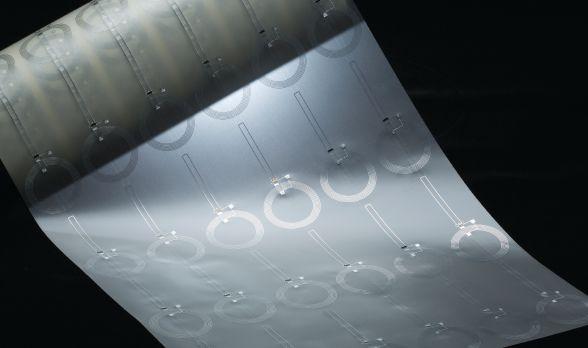
Jones is working to integrate Thinfilm’s NFC OpenSense tags with ferrite shield labels to function on metallized blisters for cold/flu medication.
Jones Packaging, headquartered in London, Ont., as a global provider of packaging solutions for healthcare and consumer brands, entered into a commercial partnership with Norway’s Thin Film Electronics ASA (Thinfilm), which develops printed electronics and smart systems, including technologies for Near Field Communications (NFC). Together the two companies will integrate Thinfilm’s recently branded NFC OpenSense technology into paperboard pharmaceutical packaging and, at the same time, develop what Jones describes as key manufacturing processes for its high-speed production lines. The Jones/Thinfilm smart packaging collaboration will be funded, in part, by grants from both the Swedish and Canadian governments.
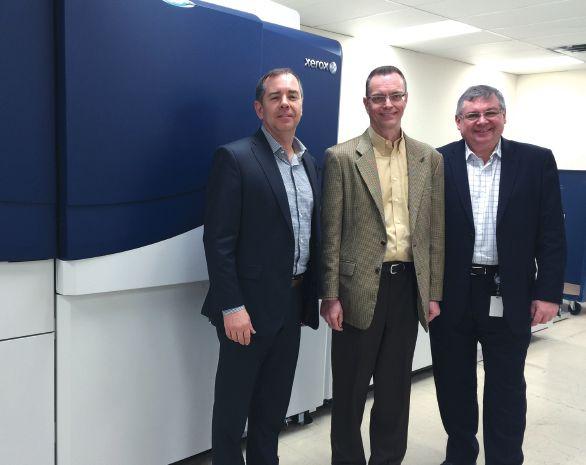
DATA Group , headquartered in Brampton, Ont., invested $6.7 million to acquire multiple new Xerox presses, which Xerox describes as one of the single largest toner-production upgrades by a Canadian printing company in 2015. Installations of the new Xerox equipment, which are to be used across DATA’s nine production facilities in Canada and Chicago, began in December 2015. The DATA Group has approximately 1,400 employees and generates around $313 million in annual revenue. In addition to the iGens, DATA Group acquired the following Xerox printing systems: Versant 80 Press, Color C75 Press, DocuPrint180MX Enterprise Printing System, D125 Copier/Printer, D136 Printer, inline/near-line C. P.
Bourg booklet making solution, and several Xerox workflow products, including FreeFlow Core and the FreeFlow Print Server.
Ricoh Company of Tokyo reached an agreement to buy AnaJet, with around 50 employees based in Costa Mesa, California. AnaJet, to become a wholly owned subsidiary of Ricoh Printing Systems America, was founded in 2006 to develop and manufacture direct-to-garment printing systems – one of the first companies to do so on an industrial scale. The majority of AnaJet products available today use Ricoh’s inkjet print heads.
Chemical.
Sun Chemical entered into an agreement to acquire certain assets – customer lists, contracts, and finished inventory – and liabilities of Colmar Inks Corp. of Toronto, which primarily manufacturers inks and coatings for the corrugated and paper packaging market, as well as specialty inks for rod coatings. Owned and managed by Ralph Marshall, Colmar described itself as Ontario’s leading supplier of water-based inks to the post-print corrugated box market, holding a market share of more than 50 percent in the sector. The transaction is expected to close during the first quarter of 2016. Colmar Ink and Chemical was formed in 1984 to acquire and operate Hendershot Inks Company, which itself had operated in the Ontario and Quebec markets for 40 years.
impact on its 164 employees and members of the Málaga family are to remain active in the company, founded back in the 1960s. AR Metallizing produces coated metallized paper for flexible packaging and labels (wet glue, pressure sensitive, general and in-mold) and has existing facilities in Belgium, Italy and the United States.
Toyo Ink SC Holdings of Japan, in an effort to expand its inks and coatings for the packaging market, signed a share purchase agreement with Yasar Holding Anonim Sirketi, located in Izmir, Turkey, to acquire 75 percent of outstanding shares of the ink company DYO Matbaa Mürekkepleri Sanayi ve Ticaret Anonim Sirketi (DYO Printing Inks), a subsidiary ofYasar. Toyo has been accelerating global expansion in China and Southeast Asia; and by setting up new manufacturing plants in India and Brazil. The DYO purchase also opens up markets in the Middle East, North Africa, Central Asia, and Eastern Europe.
Viki Solutions of Victoria, BC, has been purchased by Chicago’s BLUE Software, which develops SaaS technologies for Brand Lifecycle Management, primarily used within packaging sectors – by, according to BLUE, more than 81,000 users and 3,100 companies worldwide. Viki develops online proofing and collaboration software. BLUE states the acquisition opens up its products to more premedia and creative agencies, DAM providers, digital and print publications. Afshin Mirmotahari, former CEO of Viki, becomes CTO of BLUE Software.
AFPC.
Advanced Function Presentation Consortium secured ISO certification for its AFP Archive standard (AFP/A) for longterm preservation and faithful reproduction of original AFP jobs, primarily leveraged through inkjet and toner presses. The ISO technical committee for document management applications (TC171) embarked on ISO standardization of AFP/A in May 2012.
AR Metallizing Group acquired Brazil’s Málaga Produtos Metalizados Ltda, which is said to have no
WestRock Company entered into a definitive agreement worth approximately US$105 million to acquire Cenveo Packaging, which focuses on producing folded carton and litho display packaging. The deal involves six Cenveo facilities located in North America (U.S., Canada and Dominican Republic), which generated more than US$190 million in revenue over the past 12 months. Cenveo Packaging’s most prominent Canadian facility, Cenveo MM&T, is located in Mississauga (PrintAction May 2015), following the facility’s installation of a massive 14-unit Heidelberg press. WestRock was formed after the July 2015 merger of MeadWestvaco Corp. and Rock-Tenn Co., which made WestRock one of the world’s largest paper and packaging companies with US$15 billion in annual revenue and 42,000 employees in 30 countries.
Charles Murray, CEO, Sun
Harry Lewis, President,
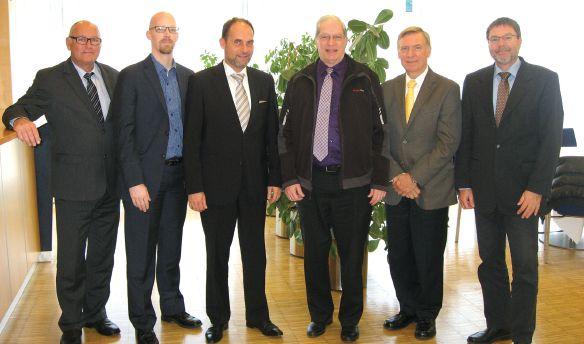
DATA Group’s (left to right) Steve Wittal, Senior Vice President, Sales; Leigh Busch, Vice President Commercial & ODS Operations; and Alan Roberts, Senior Vice President, Operations.
m ary a nn Yule becomes Managing Director of HP Canada Co., responsible for all aspects of HP operations in Canada, succeeding Lloyd Bryant, who retired as President and CEO of HP Canada in December 2015. Yule joins HP Inc. from CDW Canada where most recently she served as VP and GM since 2008. Prior to joining CDW Canada, Yule served in management and marketing positions at Toshiba of Canada and Tech Data Canada.
for Presstek, transitions over to a newly created Central Region territory for the company, which includes responsibilities for the provinces of Ontario and Manitoba. Langford Meredith continues to focus on sales in Quebec for Presstek.
CaLenDar
February 29, 2016 b3, better b2b marketing Conference International Centre, Mississauga, ON
March 8-11, 2016
neil Hopkinson, in March 2016, takes on a new role as Director of 3D Printing for Xaar plc, which develops industrial inkjet technologies – primarily print heads. Professor Hopkinson is the original inventor of the transformational High Speed Sintering (HSS) technology. He holds 19 years of experience in additive manufacturing technology gained at the University of Sheffield, Loughborough University, De Montfort University, 3D Systems and the University of Nottingham.
sheri rhodes, in December 2015, became Chief Information Officer for Electronics for Imaging. She holds an extensive range of experience, building on her executive career with Silicon Valley-based companies involved in financial, security software and information management. Rhodes joins EFI from Symantec, where as VP of Global Applications, she most recently managed the separating of IT applications ahead of Symantec’s scheduled divestiture of Veritas.
Karen Keller joins PrintLink, a provider of executive search and professional placement for the printing and packaging industries, as an Executive Recruiter. Prior to joining PrintLink, Keller was an Account Manager with InfoTrends and she previously worked as Director of Business Development for Printing Industries of America. She has also served as VP of a placement company and as production manager for a southern California commercial printer.
David Wilkins joins Xeikon as Vice President, Sales and Marketing, U.S. and Canada. He most recently served as VP of JV Imaging Solutions, which distributes technologies for digital imaging, solvent processing, and photopolymer plates aimed at the web and mid-web flexographic printing market. Wilkins also previously worked as National Sales Manager for MacDermid Printing Solutions and District Manager/Vice President of Sales for The Pitman Company.
Fespa Digital RAI Exhibition Center, Amsterdam
March 14-16, 2016
High security printing europe 2016 Bucharest, Romania
March 20-23, 2016 taGa technical Conference Sheraton Downtown, Memphis, TN
April 14-16, 2016
Dscoop11
San Antonio, TX
April 20, 2016
Digital Imaging association seminar
TI Group, Toronto, ON
Gregg Lindsay becomes North American Service Manager for MPS Systems North America Inc. (MPS). With more than 20 years of printing industry experience, Lindsay will be based in Green Bay, Wis., and lead MPS’ with on-site installations and integrations, as well as press troubleshooting. His hire coincides with what MPS describes as an expansion of its North American service offerings, including a local spare parts program, on-call local service technicians, a 24/7 service help line and training programs.
April 20-23, 2016 sign expo
Orange County Convention Center Orlando, FL
May 12, 2016 Gutenberg Gala Montreal Science Centre, Quebec
May 31-June 10, 2016 drupa Düsseldorf Fairgrounds, Germany
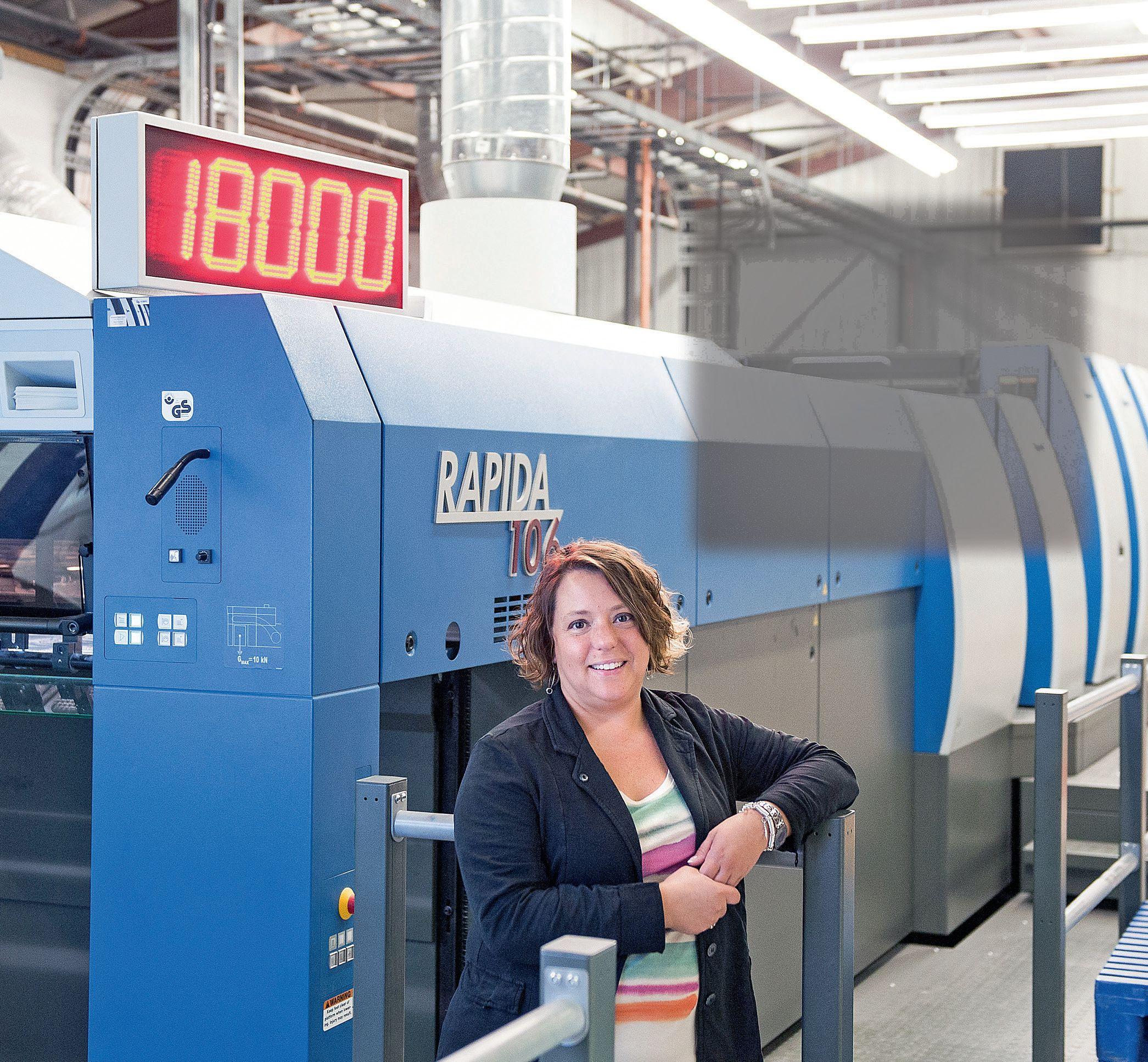
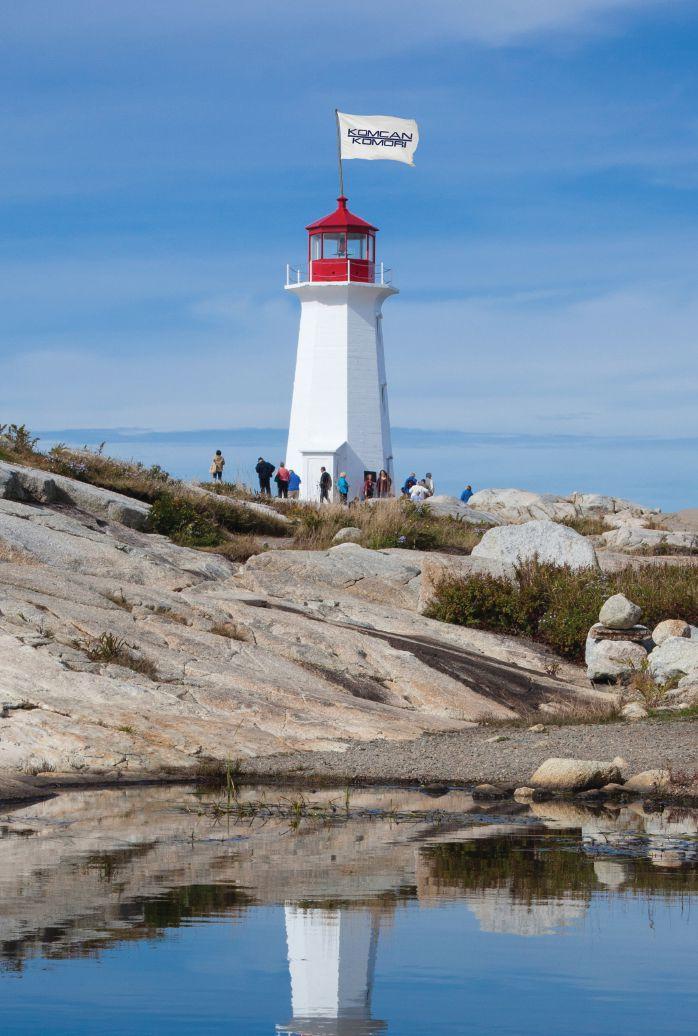
thierry barbeau becomes Sales Manager for Komcan in Eastern Canada after news that Komcan is to represent Komori America in Quebec and Eastern Canada, adding to its existing press-distribution agreements with the Japanese press maker in Ontario and Western Canada. Daniela Mihalachi also joins Komcan’s head office in Georgetown, Ont., to help lead customer service. Barbeau most recently sold Xeikon technologies, and previously worked with manroland and Heidelberg.
Gerold Linzbach, at the beginning of 2016, returned to his duties as Chairman of the Management Board and Chief Human Resources Officer of Heidelberger Druckmaschinen AG, as planned. Linzbach, who holds a Ph.D in chemical engineering from the University of Dortmund, replaced Bernhard Schreier as CEO in December 2012.
Donn Goldstick joins Presstek as its new Western Region Sales Manager for Digital Printing Systems, which includes responsibilities for the provinces of British Columbia, Alberta and Saskatchewan. Prior to joining Presstek, Goldstick held positions of Regional VP of Heidelberg and more recently Regional Sales Manager with Xerox and Ricoh. Steve Chmielewski, who formerly managed the Western Region
Cory sawatzki becomes Director of Digital Print Technology for the North American operations of CGS to focus on developing field operations for ORIS Press Matcher // Web and ORIS Lynx with OEM partners and managed facilities. He has more than 10 years of experience working directly with CGS technologies. Prior to joining CGS, Sawatzki worked with the Consolidated Graphics setting up operations in plants around the world.
James m artin becomes CEO and President of the annual Graphics of the Americas Conference & Expo, as well as the Printing Association of Florida, succeeding the retiring George Ryan who served in these capacities for nine years. Martin previously worked with Heidelberg and Unisource Worldwide and has held board positions at both the NPES and PIA. He sits on the advisory board of Cal Poly and is Chairman of Clemson’s Sonoco Institute of Packaging Design and Graphics.
Gary pawlaczyk joins the Epicomm association as Vice President and as a member of its Business Advisory Group. A 30-year industry veteran and graduate of Rochester Institute of Technology, Pawlaczyk most recently served as Chief Content Officer/Chief Marketing Officer and Executive Vice President of Sales at Cenveo, where he managed more than 2,000 employees worldwide.
June 16, 2016
DIa Golf tournament St. Andrews, Aurora, ON
June 22, 2016 printaction printForum Mississauga Convention Centre, ON
September 14-16, 2016 sGIa expo
Las Vegas Convention Center, NV
September 23-24, 2016 COnsaC International Centre, Mississauga, ON
September 25-28, 2016
Graph expo 2016 Orange County Center, Orlando, FL
September 28-29, 2016 paC Conference Niagara Falls, ON
October 18-22, 2016 all in print China
New International Expo Center, Shanghai
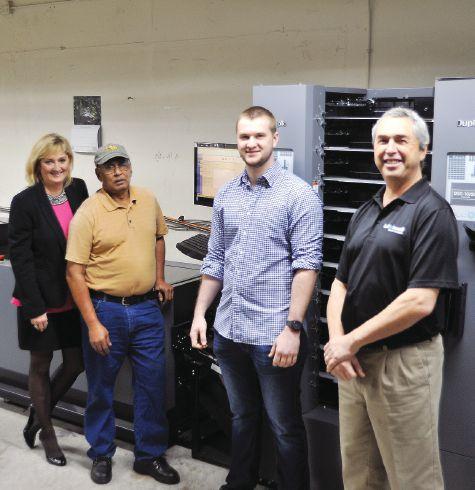
Clean Edge Bindery of Vancouver, BC, added Canada’s first Duplo 600i Booklet System, pictured with Bell & Howell Sales Representative Jacquie McBain; Clean Edge owner Raj Chandra, Chief Operator Taj Lovett, and Bell Service Manager Terry Goebel. Clean Edge’s Duplo 600i includes four stitch heads and square-back finishing.
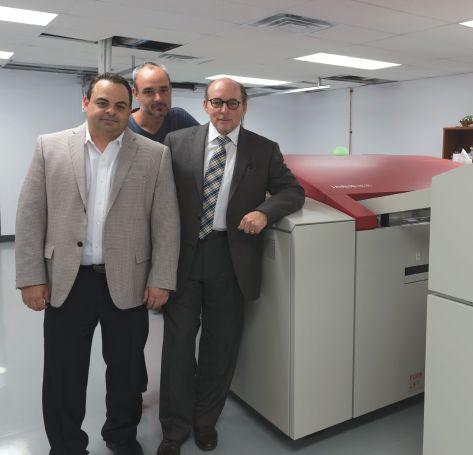
Impression Paragraph of Saint Laurent, Quebec, installed an Agfa Avalon N8-80 CTP system, pictured with Bruno Laplante, Agfa Graphics, and Paragraph’s Frédéric Beauchamp, Prepress Supervisor, and Richard Lapointe, Senior VP. The company runs six sheetfed presses, as well as toner and inkjet.
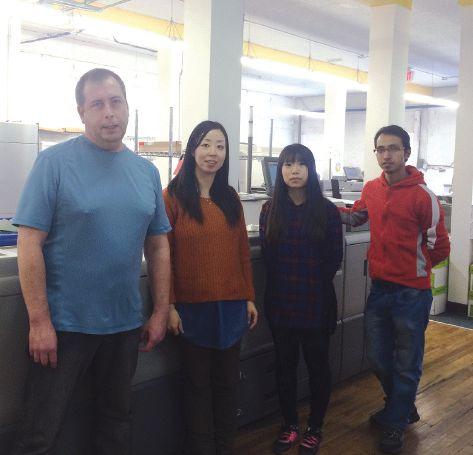
First on Colour of Calgary added a Ricoh Pro C7110x press with a fifth station, allowing for the printing of clear and white toner, pictured with Marc Stothart, Ayako Plante, Summer Xia and Suren Pandey. Founded more than 20 years ago, First on Colour produces toner, sheetfed offset, design and finishing.
Album influence
£62,400
The price paid for the original artwork of Blur’s Think Tank album cover, designed by Banksy, according to Norvic Philatelics.
The January 2016 passing of musical genius David Bowie created a raft of Internet chatter surrounding the influence of some of his greatest works. The majority of legitimate music critics, including Rolling Stone magazine, ultimately recognize Bowie’s greatest work as the 1972 album The Rise and Fall of Ziggy Stardust and the Spiders from Mars, which exerted untold influence on a generation inspired at the time by a new age of experimental music, packaged in album sleeves that served as canvases for some of the world’s most prominent graphic artists.
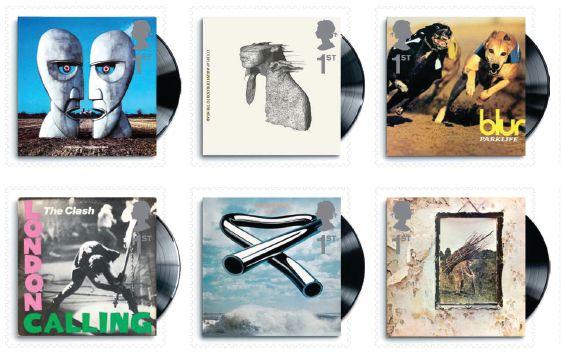
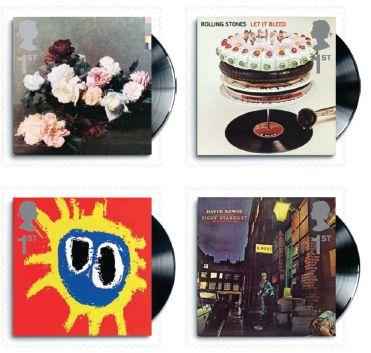
In 2010, the Royal Mail issued a unique stamp set to recognize the influence of 10 iconic album covers produced over the preceding 40 years. Norvic Philatelics explains the Royal Mail asked the editors of three of the UK’s most influential music publications, together with a number of graphic designers and design writers, to independently arrive at the 10 most significant album sleeve artwork used on records by British artists.
As detailed by Norvic Philatelics, the stamps and souvenir sheet were designed by Studio Dempsey using photography by Andy Seymour. The sheet stamps, measuring 223 x 188 mm (8.8 x 7.4 inches), were printed by De La Rue Security Print in gravure.
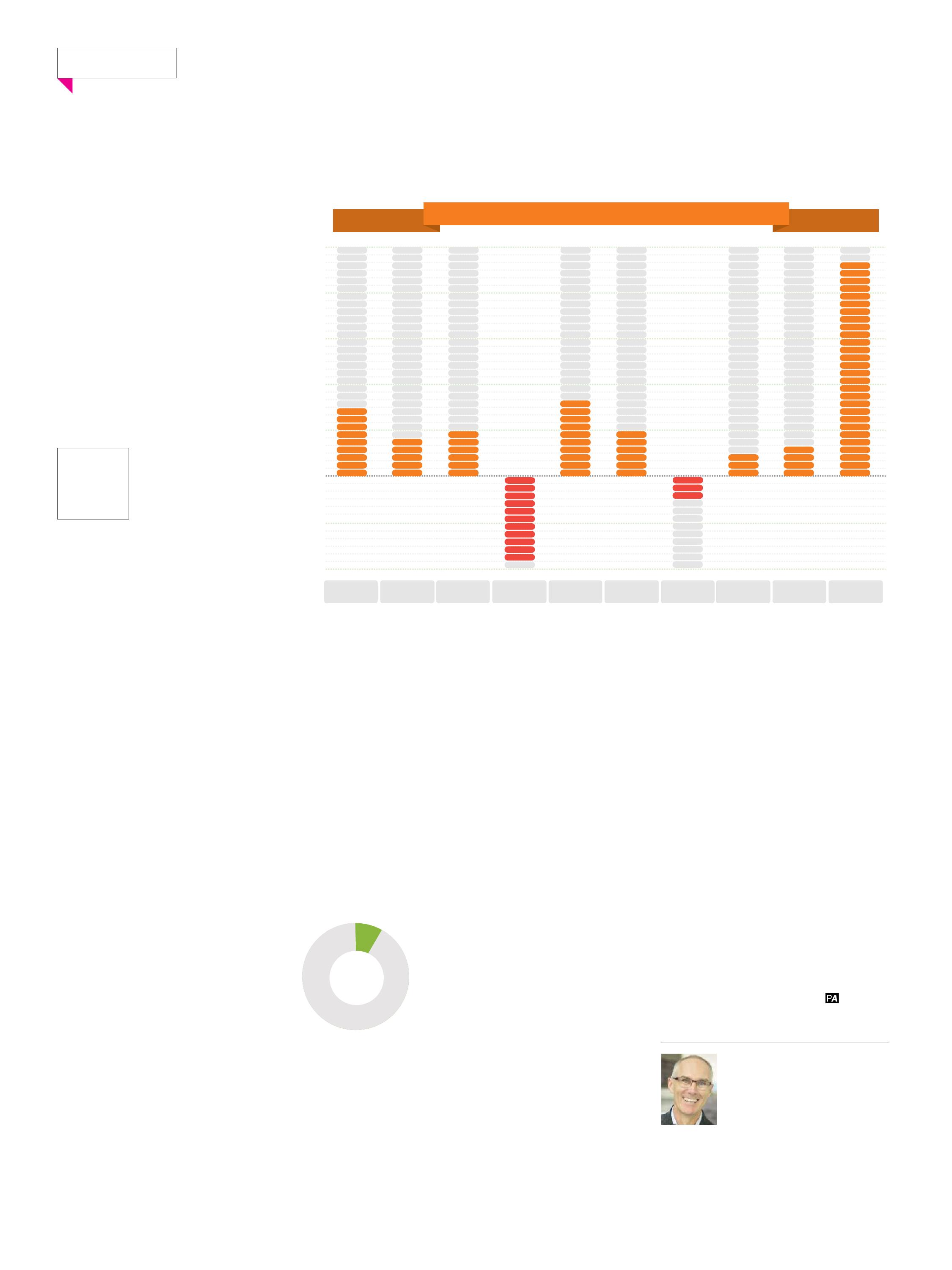
britain’s 10 most influential album covers
(in order of appearance above)
The Division Bell, Pink Floyd 1994
A Rush of Blood to the Head, Coldplay 2002
Parklife, Blur 1994
Power Corruption and Lies, New Order 1983
Let It Bleed, The Rolling Stones 1969
London Calling, The Clash 1979
Tubular Bells, Mike Oldfield 1973
IV, Led Zeppelin 1971
Screamadelica, Primal Scream 1991
The Rise and Fall of Ziggy Stardust and the Spiders from Mars, David Bowie 1972
Freeport selects LITHOMAN for new Ohio plant
Number of years of the technology partnership between DuMont Media Group and KBA, which continues as DuMont signed a deal to add a KBA Commander CL newspaper press to its printing operation MZ Druckereigesellschaft in Halle, Germany. With a max web width of 1,400 mm and a cylinder circumference of 1,020 mm, the new four-high KBA Commander CL can print up to 45,000 full-colour newspapers per hour with 32 pages in Rhine format or 64 pages tabloid.
Freeport Press signed a deal to add a 4-unit, 64-page manroland web LITHOMAN press to its plant in Ohio. Established in 1880 as a weekly newspaper, Freeport today is a manufacturer of high-end magazines, catalogues, and commercial products. The LITHOMAN, with a web width of 75 inches and two folders, will be the platform for Freeport’s new publications plant in New Philadelphia, Ohio, which provides the company with more than 250,000 additional square feet for its expanding operation.
“Our current pressroom has beaten all industry standards in low makeready waste and high-quality production on our short- to medium-run magazine and catalogue presses equipped with extremely high levels of automation,” explained David Pilcher, CEO and owner of Freeport Press. “No option has ever been left off a piece of new equipment that we have purchased, if it would save time or eliminate waste in the manufacturing process.”
manroland developed what it describes as a custom auto-print package for Freeport Press that includes InlineCutoff Control Dynamic, InlineRegistration Control with Color Balance Control, InlineFanout Control, InlineDensity Control, AutoJobChange, and WasteGate Control. Freeport’s LITHOMAN will also include temperature-controlled blanket cylinders, described as a requirement when running constantly at 3,160 feet per minute. The press produces up to 50,000 64-page signatures per hour.
TCG installs first Heidelberg Linoprint in United States
TCG Legacy of North Carolina has added a new Linoprint CP from Heidelberg, which is the first such press to be sold in the United States. In business for more than 25 years,TCG Legacy is a long-standing Heidelberg offset press customer.
Relating its new installation to its most recent digital-press purchase, TCG states it is anticipating a 20 percent increase in uptime with the Linoprint machine, which runs a 13 x 27.5-inch format at 130 pages per minute.
“We have a lot less restrictions with this machine,” said Jeff Majewski, VP of Administration, TCG. “We went from only printing up to 14-point thickness on our old machine to running 18-point thickness with the Linoprint. We now also have the capability to digitally print six-panel brochures, four-colour envelopes, and run a wider range of synthetics.”
Bischof hits 50,000 in Switzerland
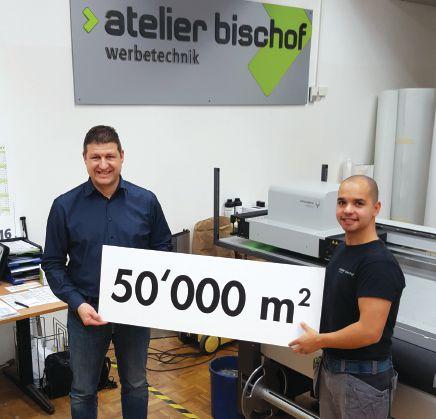
Atelier Bischof AG of Tübach, Switzerland, reached the 50,000-square-metre mark for total area printed with its swissQprint Nyala 2 large-format machine, which has been in operation since February 2015. Typically running two shifts a day, the milestone was reached in December 2015, just 10 months after commissioning the machine.
“That is quite an achievement,” said Maurus Zeller, Product Manager at swissQprint. “All models considered – Nyala 2 being the most productive – an average customer gets to around one-third of this output per year.”
Atelier Bischof’s Nyala 2 also happened to be the 500th machine to leave the swissQprint factory. The printer allows Bischof to run a range of work from rigid foam panels to a series of A4 acrylic glass or roll printing work. Bischof explains how one brand owner recently ordered a large print-run of display stands for placing in pharmacy shop windows, using acrylic panels with an optical 3D effect. The Nyala 2 uses varnish to deposit lenses responsible for producing the droptix effect.
Timothy Ruth, VP Sales, manroland GmbH (L to R); James Pilcher, VP Manufacturing, Freeport; Joern Gossé, Managing Director, manroland GmbH; David Pilcher, CEO, Freeport; Roland Ortbach, VP Sales, manroland North America; and Roman Herold, Deputy VP Sales, manroland GmbH.
Roger Neff (left) and Inti Willmer of Atelier Bischof AG.
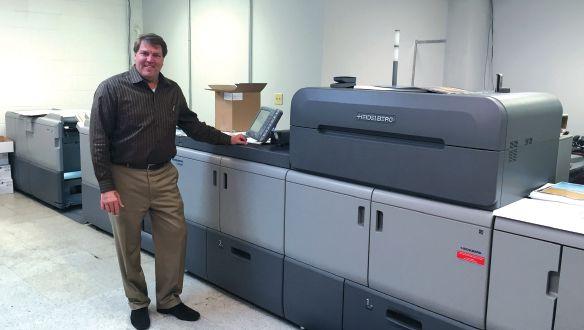
Jeff Majewski, Vice President of Administration, TCG Legacy.
arCHIVe
5 years ago
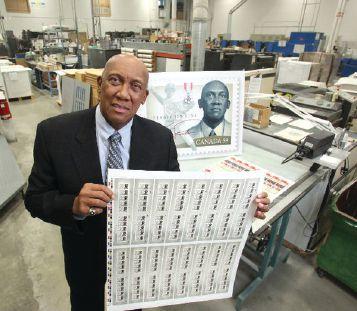
Fergie Jenkins, the only Canadian honoured in the National Baseball Hall of Fame in Cooperstown, NY, is honoured with his own Canada Post stamp (59 cents). From his 19-year playing career, Jenkins won the NL Cy Young in 1971 and holds the 12th highest strikeout total in history.
10 years ago
VistaPrint North America installs a third ROLAND 700 into its Windsor, Ont., plant which opened up as a 68,000-square-foot facility just six months earlier. The company now runs a total of five 41-inch presses from MAN Roland, two of which have been operating in VistaPrint’s facility in Venlo, The Netherlands, for more than a year.
In its most recent fiscal year (2015), VistaPrint’s parent company, Cimpress N.V., generated more than US$380.5 million in revenues.
139
Number of fully variable colour impressions that can be printed per minute on IBM’s new Infoprint Color 130 Plus system, according to a report in PrintAction’s February 2001 issue (15 years ago), which leverages a new imaging protocol called Advanced Function Presention (AFP).
20 years ago
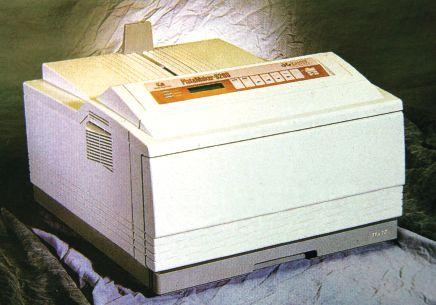
Xante’s new PlateMaker 8200 serves as both a desktop platemaker and a laser printer that can produce single- or spot-colour pages at 120 lines per inch. Its base price of $5,495 comes with 600 x 600-dpi platemaking resolution and 16MB of RAM. It can be upgraded to produce 1,200-dpi resolution, producing 311,688,000 pixels on 11.7 x 18.5-inch media, but each page produced requires more than 38MB of memory. Beyond that, you need memory for downloading fonts, the PostScript command stack and data buffering, as well as workspace for the interpreter.
25 years ago
$125,000
Asking price for a 2-colour, 19 x 25-inch Heidelberg SORKZ as detailed in a 1991 PrintAction classified ad.
15 years ago
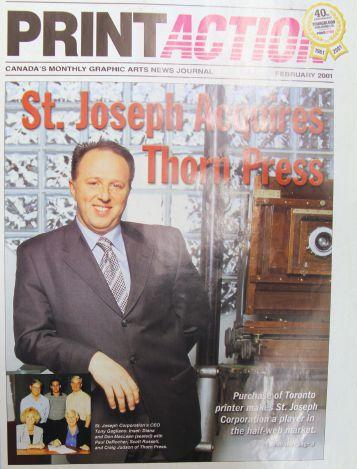
St. Joseph Corp. agrees to purchase Thorn Press, a Toronto-area commercial printer with sheetfed, half-web and full-web presses. The move gives St. Joseph its first presence in the half-web market, which is to be primarily aimed at direct marketing. Thorn Press has been around since the 1930s and in 2000 generated sales of more around $35 million.
8
Pages printed per minute by the Apple LaserWriter released in 1985. Laser printing was invented in 1969 by Xerox.
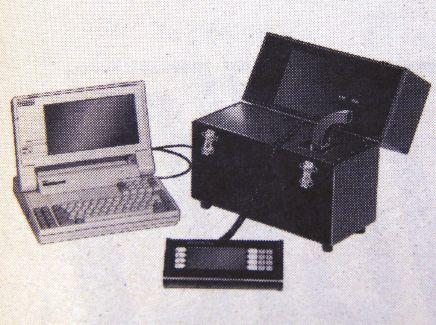
Hyphen Inc. introduces a new interface for its MacRIP software, which is already interfaced to the PageScan 3 (18 x 24-inch format) and Panasonic (PC interfaced) plain paper printers. The new Dash 600 interface provides Hyphen with a 11 x 17-inch Mac-based printer that produces text and graphics at 600 x 600-dpi resolution, outputting A4-size pages at 12 per minute. Six years earlier, in 1985, Apple Computer introduced the LaserWriter as one of the first laser printers available to the mass market. For a retail price of $6,995, the Apple LaserWriter — a key component of the desktop-publishing revolution — included 512kb of RAM and a built-in PostScript interpreter.
Fergie Jenkins’ stamp (4 million issued) was printed by The Lowe-Martin Group in a 7-colour plus varnish process.
Tony Gagliano, CEO of St. Joseph Corp.
Breakthroughs in offset
the meteoric rise of modern offset printing over the past century has many unsung inventors responsible for today’s print market
By Nick Howard
he invention year for offset printing traces back to 1904. Fast forward 100 years to 2004 and I doubt anyone realized (or possibly cared) that we had passed such a significant societal milestone, in terms of economics, further democratization of knowledge, and overall improvements in standard of living. In 1904, Ira Rubel and the Harris Brothers, Charles and Albert, took us from direct zinc lithography to the offset-printing process.The old axiom “Today’s peacock is tomorrow’s feather duster” doesn’t seem to apply – even in 2016.
It took quite some time still to get the technology to a point where its quality (offset still has no equal) and efficiencies turned heads. Key companies and individuals modified and altered offset presses to arrive at where we find ourselves today and I would like to give credit to some of the most important steps made along the way.
Dahlgren Manufacturing Company, USA
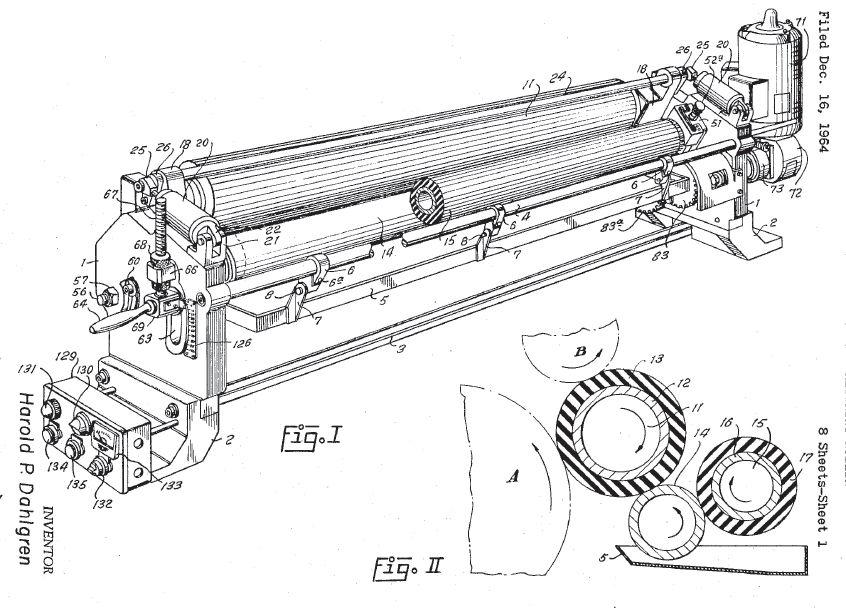
Harold Dahlgren was a Texas inventor. Among his dozens of patented printing innovations, his key invention must be considered as one of the most significant advances made to offset presses. For it was Dahlgren, while reportedly sitting at a bar one night, held two drink cans in his hands and finally solved the riddle of a metering dampening solution. His eureka moment was the “skew”. Simply by moving one roller off its axis Dahlgren was able to control the amount of water and, thereby, made his earlier continuous bareback roller system work. In one moment of genius, Dahlgren forever altered the way printing presses would be built and made life so much easier for the press operator. Every press manufacturer eventually caught on and Dahlgren’s genius survives still today.
The official diagram relating to Texas inventor Harold Dahlgren’s 1967 patent for lithographic dampener with skewed metering roller.
Number of inches provided by the Rolandmatic system which allowed Roland to basically corner the carton sector.
Offset had its struggles to find acceptance in the first half of the 20th century. The Americans, who invented it, pushed hard to export their machinery. Countries like Japan were early pioneers of Harris machines but Europe, other than the George Mann Company in England, was slow to accept offset. The exception was Roland. Not only did Roland build machinery, but in the subsequent decades since World War II made major inroads in design enhancements. Along with Mabeg, Roland developed the first centre separation feeder head. This is the basis of all feeders today and improved drastically the older feeders such as HTB and Dexter. Roland was the first to factory-build Dahlgren`s continuous dampener in the Rolandmatic. Roland cornered the carton sector all the way to 63 inches and also made the vacuum feedboard and side-guide a standard feature on all presses. Closed-loop colour densitometry was a Roland first, too. Roland has more offset inventions than any other manufacturer and they have been at it the longest.
Planeta (now KBA), Germany
Look at the Variant model when it was launched in 1965. What you see is a peak into the future of offset. Here languishing behind the iron curtain was Planeta. A very old builder of printing machines. First it was letterpress, then offset. But the Variant shattered all conventional thinking. Here was a machine that was
unitized – every unit the same. It had a double-sized impression and transfer cylinder! These two inventions have finally been copied by every press manufacturer in the world – and with great success.
Lester Ink & Coatings Co (now Flint Ink), Canada
There was a time the only way to get gloss – or to seal a sheet – was with varnish or some offline solvent roller coater. Lester changed all that. They invented a roller coater that was placed on a printing unit and applied a new technology called aqueous coating. Similar to floor polish, the coating was metered through rollers and applied directly onto a blanket cylinder. This was a marvelous invention and hastened press design changes at every manufacturer. First there was assemblies made by Rapidac in the U.S., followed by others. Finally press builders modified their printing units, removing the inker and plate cylinder and voila! A tower coater. All of this started in Canada.
Harold Gegenheimer & Miller Printing Machinery (now manroland), USA
In 1956, Harold Gegenheimer did something never thought possible: Flip a sheet of paper from the lead edge to the tail, between two printing units and then print the back side of the sheet – all in one pass! It was an extraordinary feat and one that has been replicated by every major manufacturer since. Prior to what we now call perfecting, the only way to print both
sides was by running the sheet through again or by a dedicated perfector – with a printing unit underneath. George Mann and Crabtree were leaders in that type of technology, mainly for the book market, but this reversal of the sheet while in transit was amazing.
Heidelberger Druckmaschinen, Germany
One might say Heidelberg is to offset what Mercedes Benz is to cars – possibly. But the main reason for inclusion on this list is more for what Heidelberg has done in developing a simplified easy to operate machinery. They made running a press easier: improved in-feed, automating and streamlining devices, as well as improving the crude ink-control console – first developed by Harris – for every print shop in the world (CPC). Heidelberg made us comfortable with advancing press technology and allowed us to glide gracefully from a smaller machine like the GTO to its flagship Speedmaster. All with familiarity, as they were smart enough to use the same operational features across the board. Even today Heidelberg is the benchmark which all others seek to eclipse.
Komori, Japan
From history we can see how almost all
major press builders grew offset from letterpress platforms. Komori didn’t, and the press maker was far from the prying eyes of the established Germans and conducted most of its research in an almost secretive environment. In 1923 –when Komori was formed – the company paid attention to the printing world. Early Harris presses had caught on in Japan and this drove Komori to be an early adaptor of the offset process. In fact, one of the world’s pioneers.
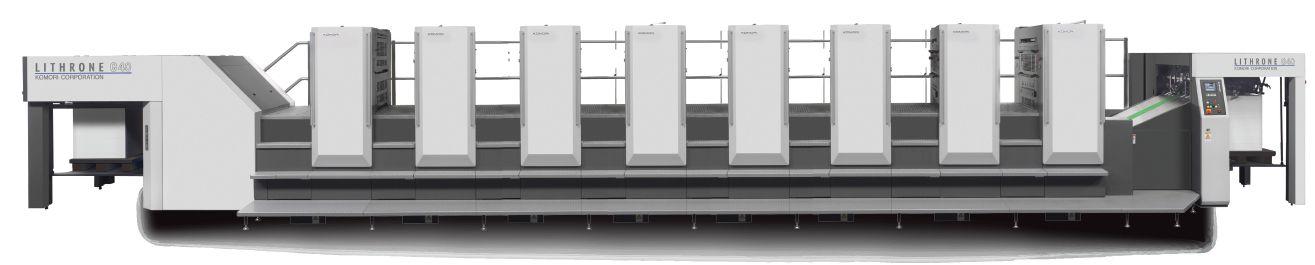
The American and German inventions were embraced and out of this came the Lithrone (1981). The Lithrone had it all – and it was superbly built, too. Planeta’s double-sized cylinders, Roland’s Mabeg style feeder head, were all expanded on and improved. Harold Dahlgren’s continuous flow dampener was re-worked with a reverse nip direction and made standard. All these innovations came well before Heidelberg. Komori earns a spot on the list by being a very good engineering company that makes presses easy to run and with a low cost of ownership.
IST Metz, Germany
The process of curing inks and coating with ultraviolet light has been around since the 1950s. IST is not the originator of this process but a key developer and promoter.
Toda, there is a rich cluster of excellent manufacturers dealing in UV or LE (low energy) UV technology. IST, however, must be given credit for what it has done to integrate UV into the printing press. Such ideas as combining its systems into the press (Heidelberg being a good example), have catapulted IST into a leadership position. It may have been Iwasaki-Eye who along with Komori invented the doped IR reduced bulb (HUV), but IST was not far behind with its own similar system. As most press makers are now deep into UV or LED systems, IST has been the leader in simplifying inter-deck drying, combining UV with IR and WA (heated air) and in modules that are easy to install – even easier to remove and service.
Together these fine companies from around the world represent the key building blocks of the modern offset press. They are a major reason why offset has not yet become a feather duster.
nick@howardgraphicequipment.com
Wednesday, June 22, 2016
Mississauga Convention Centre
PrintForum, presented by PrintAction magazine, is a national conference for printing and imaging professionals from across Canada. Designed to build thought leadership in business strategy and technological innovation, PrintForum is a one-day event featuring educational sessions, networking and exhibits of new industry technology.
For sponsorship and exhibitor information, please contact Danielle Labrie, National Advertising Manager, 1-888-599-2228 ext 245 Stephen Longmire, Associate Publisher, 905-713-4300
nICK HOWarD, a partner in Howard Graphic Equipment and Howard Iron Works, is a printing historian, consultant and Certified Appraiser of capital equipment.
In an effort to provide the most useful data for organizations in the education field, Blackbaud has split the Education sector into two groups. The Higher Education sector now tracks fundraising revenue for universities, undergraduate colleges, two-year colleges, and other educational institutions, while the K–12 Education sector tracks fundraising revenue for independent schools that provide a formal education for children and adolescents in kindergarten or first grade through grade twelve.
My big marketing mistake
modern dm is fueled by so many accessible media channels it is easy to lose sight of one of its most effective
By Steve Falk
goofed! – My ironic (moronic) use of digital to promote direct mail fundraising Mea Culpa.
I’m guilty of being a bit blind to the obvious. In my excitement to share a catchy marketing pitch, I forgot the very principles that were expounded in the nifty short video we produced to promote a charity public relations day called Giving Tuesday back on December 1.
Here’s how it played out and why this story should give a chuckle to most printers. I had read, via a Blackbaud study called 2014 Charitable Giving Report, that only seven percent of individual donations in North America are given online, despite nearly 20 years of digital marketing advancement.This seemed like good news for our company that produces a lot of direct mail for fundraisers. I was not that surprised by the seemingly low online figure – we have been part of direct mail fundraising for all those years.We know, that despite the growing number of valuable digital opportunities for sharing the stories of notfor-profits and online-only campaigns, like the growing Movember movement, there is still strong evidence that direct mail (DM) drives good ROI over the long term. And online giving is often inspired by well-written, personalized letters and choice photos delivered via direct mail.
In almost every single case new digital channels are more effective when used in concert with DM, phone and other channels. Canada Post recently re-engaged in the DM space with its Smartmail Marketing branding, making the case for the appropriate and highly successful use of direct mail. If you have not seen that promotion, I recommend that you look it up and see some of the neuroscience research Canada Post sponsored that helps explain why printed promotions move people to action more successfully than digital ones.
So, back to my mistake… with Giving Tuesday presenting itself as an excuse, I decided to make a short one-minute video
The 2014 Charitable Giving Report by Blackbaud indicates which verticals to target with non-profit direct mail. The report is based on 24 months of overall giving data from 4,798 non-profit organizations representing more than $16.2 billion in total fundraising.
2014 OVERALL GIVING TRENDS BY SECTOR
Amount that online giving grew in 2014, according to Blackbaud, indicating a significant shift in direct marketing when considering overall giving increased by 2.1 percent. 8.9%
(How You and the Post Office Change the World on Giving Tuesday, posted on Youtube), reminding people of the importance of the lowly envelope in supporting organizations that work with the challenges of poverty, disaster, education, the arts, etcetera. My slogan: “On GivingTuesday, open your heart, an envelope and your cheque book”.
I had imagined modest interest in the video, not viral exactly, but a rising Giving Tuesday re-awakening of the importance of DM to fundraisers. After all, I’m connected with hundreds of people whose livelihood is dependent upon envelope production, printing, writing, art, design, strategy and delivery of direct mail. On top of that, the many not-for-profits that I’m connected with might just be keen on this friendly supportive fundraising message, too.
Bright and early on Giving Tuesday, we started by posting the video on selected social media, sharing it by email and through LinkedIn messages to a very select group, including our staff.We personalized the shares and invited people to view and share the video. By noon only a few dozen people had viewed it. Five days later one hundred or so views were recorded. I was bereft! We had shared this quirky, short and relevant message but nobody was watching it.
The penny dropped at my 3 p.m. conference call with about 10 members of our own team – just hours after we had released the video into the wild. It was a coaching meeting to our Customer Experience Group. I asked who had viewed the video I
4
shared in the morning by email to them. The phone line hung there… almost completely silent. People were just too busy to open that email, and, my own staff included, had prioritized their email and put my message low on the list.
I had made the crazy mistake of thinking that email and digital was the best way to get my message out. The very same lesson that I was trying to make in the video – that digital is not the answer for all marketing problems – had come back to bite me on the mouse finger.
Next year, I’ll be preparing a short note, printing it, personalizing it and dropping it in the mail a week or so ahead of Giving Tuesday. The irony of receiving an invitation by paper mail to watch a shortYoutube video will not be lost on those who open it. What I learned won’t stop me from tweeting and sharing this as a blog post. But having it printed in ink on real paper in PrintAction is certainly on message in this case. These things all work together in an ecosystem of storytelling.
steVe FaLK is President of Prime Data and holds extensive knowledge about the intersection between digital technologies and print media. Data-driven marketing strategies are his primary focus for large hospitals, environmental groups, animal protection organizations, healthcare, auto, and eCommerce retailers. sfalk@primedata.ca
How LCAs can drive print
new lifecycle analysis reports about paper supply can be used to build your customer service and bottom line
By Neva Murtha
Looking to offer your customers a little something extra? Printers wanting to show clients that they are doing their part to lessen their carbon footprint –and that customers can do the same –have a new study to back up their choice of 100 percent recycled paper as a low carbon alternative. It helps reinforce your position as a sustainability leader, as well as offers marketing backup for customers in choosing 100 percent recycled papers for their printed materials.
We all know that consumer products including paper have a footprint. A lifecycle analysis (LCA) is one popular and respected way to establish the scale and scope of that footprint relative to other products. Although their effectiveness also depends on transparency and rigour.
In an ever more competitive market, it is not surprising that pulp and paper producers are publishing lifecycle studies or analyses in a bid to favourably position their products. But as with many things in the world, the devil is in the details. In today’s context, a leading LCA of paper or packaging should build on traditional LCA scope to capture not only cutting-edge climate accounting (that includes scope 3 impacts and biogenic carbon) but also biodiversity impacts.
Then and now
I’ve heard it said that the Paper Task Force Report, a voluntary and private sector initiative, conducted in the 1990s by Duke University, Environmental Defense Fund, Johnson & Johnson, McDonald’s,The Prudential Insurance Company of America and Time Inc. was 15 years ahead of its time. It continues to be one of the most thorough, comprehensive and transparent LCAs conducted for paper products in North America given its scope and process. At the time, however, people were not thinking about climate and biodiversity in the way we do now. Fast forward to this decade. I know of
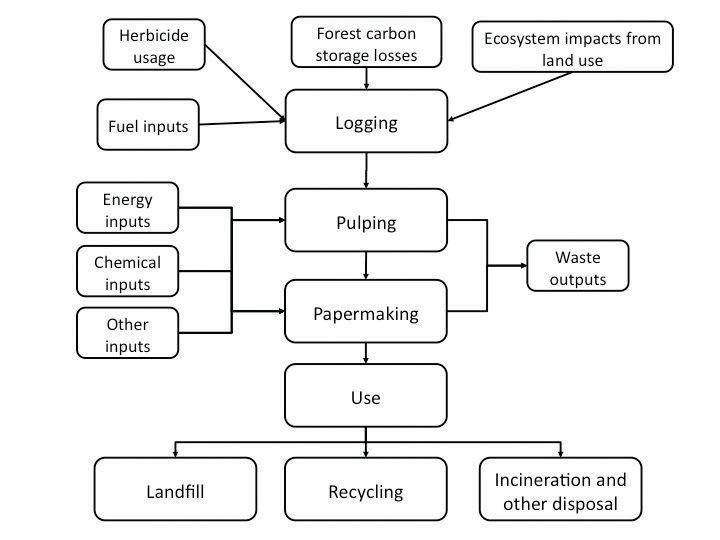
A diagram showing the stages for the full lifecycle of paper produced from virgin wood sources. Logging contributes to forest carbon storage losses and ecosystem impacts from land use, but also requires fuel inputs to operate machinery. For most types of forest management, herbicides are also widely used.
12,000
Minimum number of acres of multiple forest types that are not harvested based on a lifecycle analysis conducted on the impact of 2,500 tons of New Leaf Reincarnation paper versus virgin coated paper.
four paper-focused lifecycle studies or full LCAs conducted in North America over the past few years that have made significant effort to incorporate input from multiple stakeholders, including the environmental community. All of these studies include leading carbon science (scope 3 biogenic carbon accounting), making their conclusions the most robust on the market at this point.
These recent studies include three where Canopy sat on the critical review panel: Two Offsetters studies for Step Forward Paper and the Georgia Tech LCA for Kimberly Clark. These studies, like the Paper Task Force Report, all show the benefits of 100 percent recycled paper and the significant land and carbon impacts of virgin paper, even though the methodology in each varied.
Now and the future
The latest paper lifecycle analysis released in October 2015 by SCS sets a new bar in transparency for paper-focused LCAs, using a new standardized LCA framework. It is a great tool to highlight all of the different impacts one needs to be aware of when it comes to the environmental footprint of paper. This LCA clearly demonstrates that all virgin and recycled papers are not environmentally equal by assessing their impacts in a host of areas, including land use change, biodiversity, climate and more. It shows that 100 percent post consumer waste recycled coated paper made in a North American mill has a 100 times lower impact on the
global climate than 100 percent virgin papers also made in North American mills.
This most recent study builds on a growing body of scientifically rigorous analyses and, once again, verifies that 100 percent recycled paper is better for forests, species, freshwater systems and the climate. That’s good news for printers that want leading science to help support them as they engage their customers about why using 100 percent recycled paper is preferable than paper made with pulp from carbon rich intact forests. Companies around the globe are facing increasing expectations that Annual Reports and performance assessments will include triple bottom line reporting. Their customers and shareholders are demanding a thorough accounting of financial, social and environmental performance. The need for your customers to demonstrate improved CSR performance provides an opening for upping sales in recycled paper product, as well as being a preferred supplier.
Now, the new paper LCAs give you and your customers a solid, scientific base on which to build claims of improved sustainability performance through the most environmentally responsible paper choices. That’s customer service!
neVa mUrtHa works with Canada’s magazine publishers and printers to develop visionary procurement policies. neva@canopyplanet.org
aDVertIser
Utilizing up to 10 colours, including Metallic and White, the Epson SureColor S70675 is the most photographic solvent printer ever developed. For print shops looking to provide the highest print quality possible, nothing else even comes close. True photographic solvent printing – the SureColor S70675 redefines image quality, while delivering unmatched value for any size print shop. To learn more about SureColor S-Series signage printers, visit EPSON.CA/SOLVENTPRINTER
Hack Your ProductivitY
Whether your goal is to gain competitive advantage or simply spend less time in the cubicle, hacking productivity is the new transformative mantra in the graphic arts. software still drives this change including my best low-cost upgrades for 2016
By Zac Bolan
premedia and prepress technicians, as well as graphic designers, are looking for ways to increase efficiency and reduce their time to market to better compete in today’s challenging print marketplace. While hardware innovation seemed to have plateaued in 2015, notable releases from Adobe and Serif Software, in addition to a myriad of frontend updates from MIS suppliers and traditional printing software giants, formed the foundation of more productive workflows. With the release of Creative Cloud 2015, Adobe made good on its promise of adding powerful new features to its iconic software suite on a regular basis. In Creative Cloud Watershed ( PrintAction August
2015), I tested the latest enhancements to Photoshop, Illustrator and InDesign that prove valuable to those working in print. Meanwhile on the other side of the pond, UK-based Serif software made waves by introducing low-cost, high-quality Affinity Designer and Affinity Photo to the marketplace – directly competing with Adobe in the vector-graphic and pixel-editing markets. The new Affinity products brought excitement back to the Mac desktop, as well as providing some much needed competition for the Creative Cloud hegemony.
But there’s more to being productive than creating images with Affinity or Adobe tools. Much of the premedia and prepress workflow can revolve around improving and enhancing images – tasks On1 Software has excelled at for more than a decade.
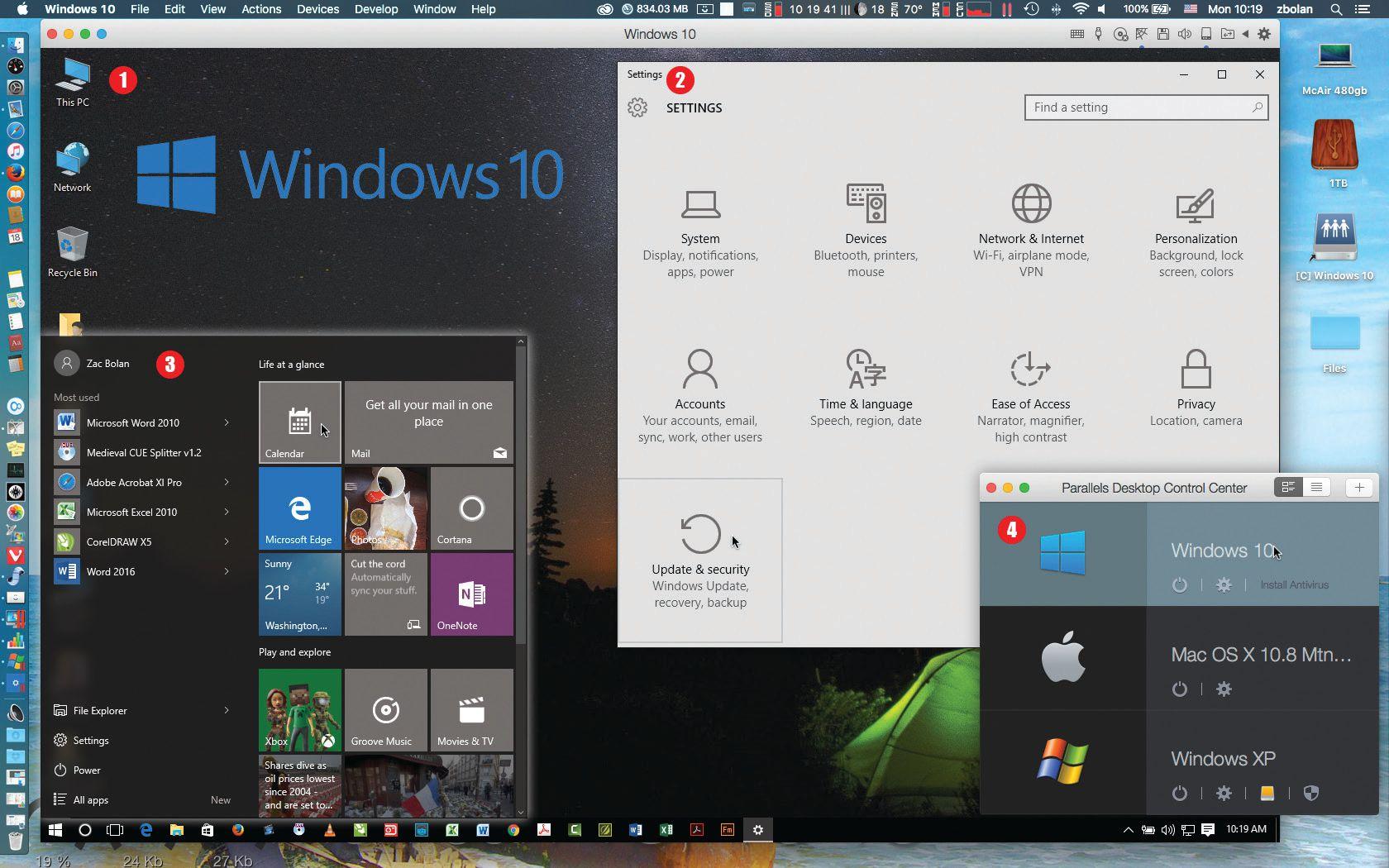
Parallels & Windows 10 together provide a productivity powerhouse for Mac users by combining snappy performance with full access to the newest Windows applications.
1 Windows 10 running in a Parallels Desktop 11 for Mac virtual machine. The latest version of Microsoft’s flagship product has seen enthusiastic adoption due to its stable and functional performance. Being free doesn’t hurt either!
2 All the settings for Windows 10 are finally in one convenient place.
3 Popular demand brought the Start Menu back to Windows 10.
4 The Parallels Desktop Control Center accesses all the settings and parameters for your collection of virtual machines.
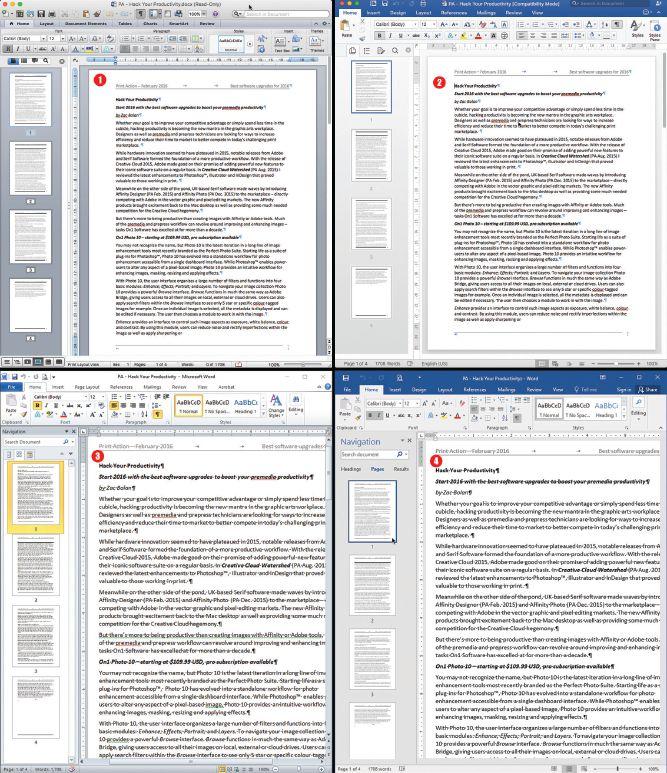
The four faces of Word: 1 Mac OS Word 2011 sported a cartoonish interface that bore little resemblance to its Windows counterpart. 2 Mac OS Word 2016 appears to be visually and functionally identical to the Windows version.
3 Windows Word 2010 is widely considered to be the benchmark for business and technical word processing.
4 Windows Word 2016 is a logical iteration for Microsoft, which wisely chose to maintain much of the 2010 user interface.
On1 Photo 10 – US$109.99, pro subscription available
You may not recognize the name, but Photo 10 is the latest iteration in a long line of image enhancement tools most recently branded as the Perfect Photo Suite. Starting life as a suite of plug-ins for Photoshop, Photo 10 has evolved into a standalone workflow for photo enhancement accessible from a single dashboard interface. While Photoshop enables power-users to alter any aspect of a pixel-based image, Photo 10 provides an intuitive workflow for enhancing images, masking, resizing and applying effects.
With Photo 10, the user interface organizes a large number of filters and functions into five basic modules: Browse; Enhance; Effects; Portrait; and Layers. To navigate your image the powerful Browse interface functions in much the same way as Adobe Bridge, giving users access to all their images on local, external or cloud drives. Users can also apply search filters within Browse to see only 5-star or specific colour-tagged images, for example. Once an individual image is selected, all the metadata is displayed and can be edited if necessary.The user then chooses a module to work in with the image.
Enhance provides an interface to control image aspects like exposure, white balance, colour and contrast. By employing this module, users can reduce noise and rectify imperfections within the image and apply sharpening or vignettes. One of the strengths of Photo 10 is the large number of presets included within the application. Users can either create and save their own Enhance presets or select from a variety of pre-defined presets such as HDR Look and High Contrast. Enhance also includes a number of editing tools such as Crop, Perfect Eraser, Retouch Brush and Red Eye Removal.
The Effects module contains a wide variety of filters that can be applied independently to an image or combined with other filters in a stack, then saved as a preset. As with Enhance, Effects includes several presets that can be applied to your image, and each filter within the preset adjusted independently to allow for full customization. For example, there are more than 30 monochrome presets that combine vignettes, glows, film grains and tones to create a myriad of black & white effects. Effects also includes a full set of precise masking tools that make short work of isolating your subject or eliminating backgrounds.
As its name implies, Portrait simplifies retouching faces within images. When launched, the module automatically identifies faces in the image and highlights each with a box. The user can click the facial selection to zoom in, then identify the eyes and mouth before applying skin retouching, colour correction, as well as eye and mouth adjustments in the
retouching pane. Portrait also automatically creates a mask for the skin portion of the face that can be tweaked by the user, then used to protect non-skin areas from adjustment. Users can then use the content-aware Perfect Eraser or Retouch Brush to smooth skin and remove imperfections.
The Layers module provides far more capabilities than simply adding layers to an image. This module enables users to build complex layered and composite images, mask, apply textures and add borders or backgrounds to their image. Additionally, Photo 10 provides presets for automated sharing of your image to a variety of social media channels such as Facebook and Twitter.
Perhaps the most powerful aspect of Photo 10 is its ability to resize images. This capability evolved from a Photoshop plug-in called Genuine Fractals, acquired by On1 Software in 2005. Later rebranded as Perfect Resize, the plug-in enabled the enlargement of images to massive dimensions without the loss of detail common to interpolated enlargements within Photoshop, for example. For some reason this amazing utility is hidden away in the Export settings, although still fully functional within Photo 10. If you need to enlarge images for large-format output, this capability alone is worth the price of the software!
Of course, there is more to productivity than just enhancing images…
Parallels Desktop 11 for Mac –starting at US$79.99, pro subscription available When it comes to efficiency it is no secret that I’m a big fan of virtual machines. I’ve been using Parallels Desktop to build and run my VMs on a daily basis for more than a decade. The latest version is the Parallels IP Holdings’ fastest iteration ever, and its most stable version as well. I use a number of virtual machines to access current and legacy versions of software or workflows that run best in older x86-based operating systems such as Windows XP, Windows 7, and prior versions of Mac OS X. For example, I run Adobe Creative Suite 6 in a Mac OS X 10.8 VM – the operating system CS6 was originally developed for. Keeping legacy software alive for customer file compatibility is key in many prepress environments.
Desktop 11 is available in a standalone Standard version, as well as an annual subscription model for Pro or Business versions. These versions include more features such as support for the MS Visual Studio Plug-in, development and testing tools, advanced networking tools, business cloud services and centralized administration. Most users will find the
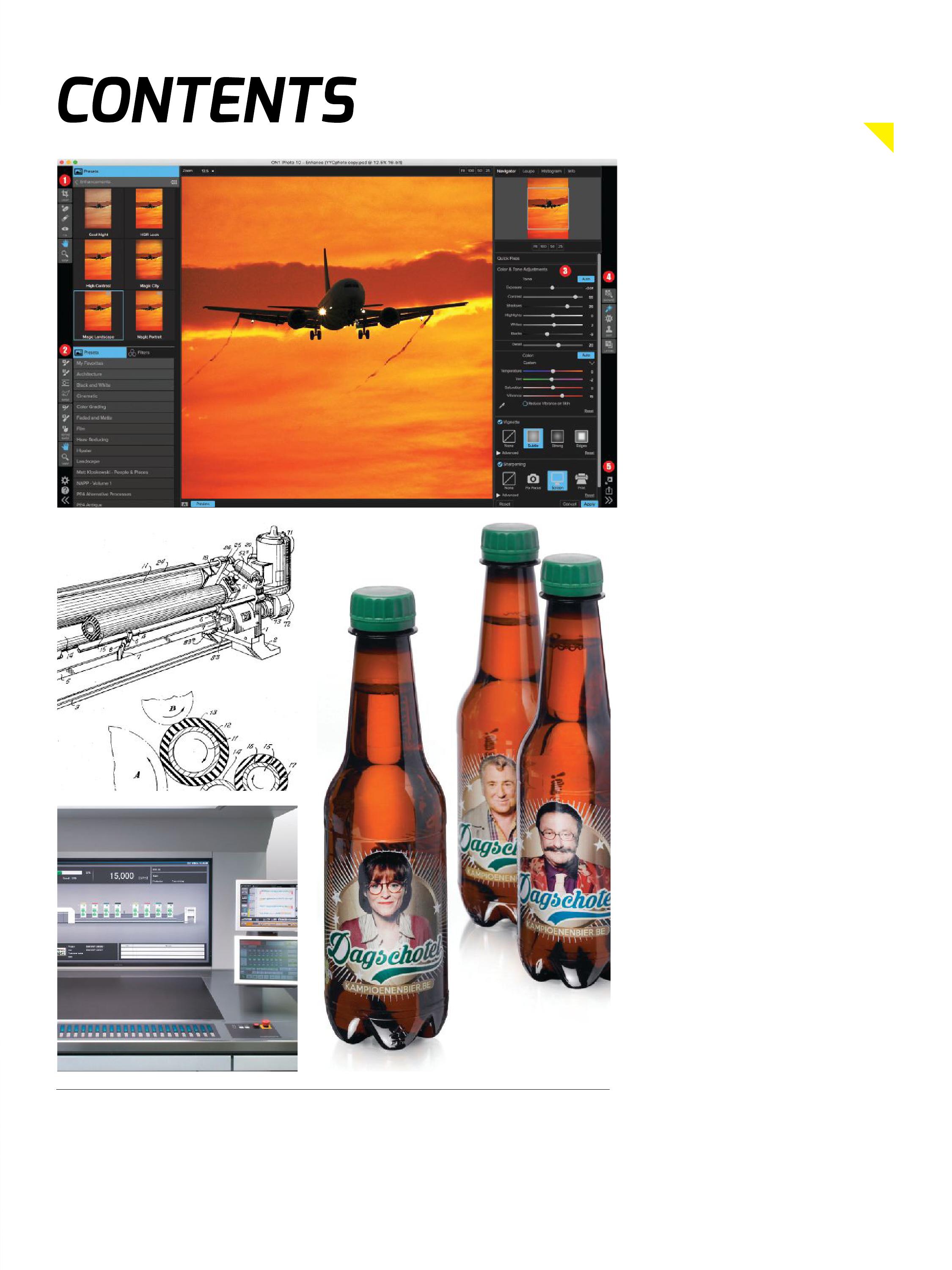
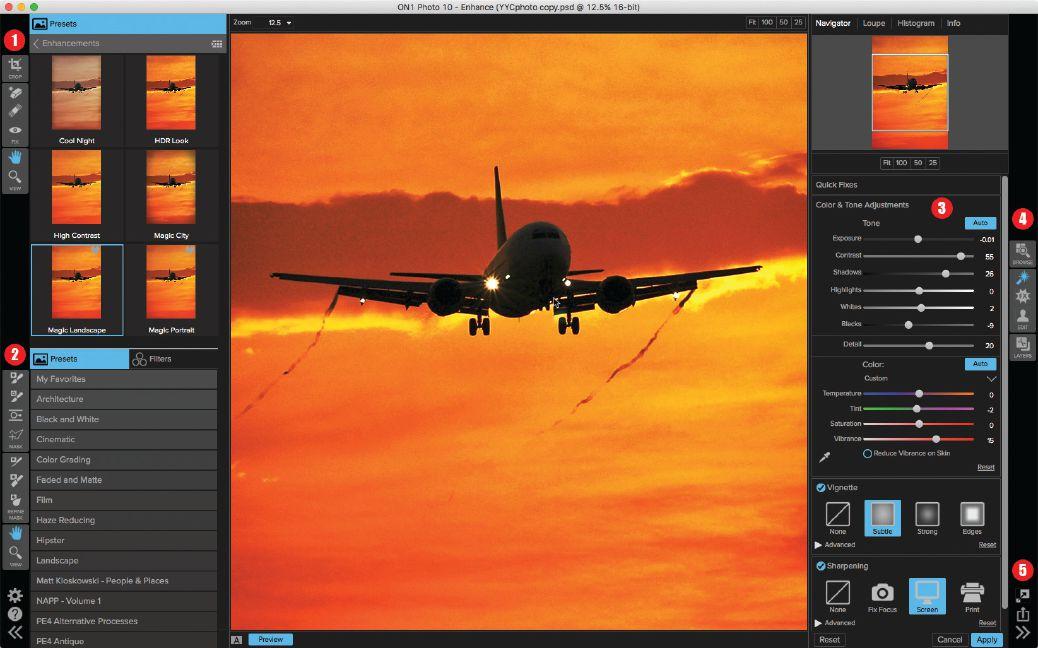
On1 Photo encompasses five individual modules within one application window: Browse; Enhance; Effects; Portrait; and Layers. The left panel houses included presets, as well as user-created, in addition to the tool bar. The centre panel is the preview area. The right panel displays the user-adjustable settings for each filter or preset.
1 Enhances toolbar and a few of the many presets.
2 Effects toolbar with presets and filters under different tabs.
3 User adjustable settings for the selected preset or filter. 4 Select the desired module from this panel.
5 Two very powerful features hidden away in the corner: Perfect resize enables the enlargement of images to massive dimensions without the loss of detail; Sharing provides easy presets for emailing images or uploading to social media channels.
standard edition more than adequate for their daily needs.
In addition to older operating systems, Parallels Desktop 11 for Mac is compatible with Microsoft’s latest release…
Windows 10 – free upgrade from Vista and Windows 7
I admit reluctance when Windows 7 first prompted me to install the free upgrade to Windows 10. After all, after Vista, Windows 7 and Windows 8, Microsoft did not have the best reputation for painless migration between operating systems. Eventually, I did succumb to the offer and I’m glad. My migration from Windows 7 to Windows 10 was straightforward and effortless. Everything I had installed to run in Windows 7 worked perfectly right out of the gate after the upgrade to Windows 10, including an older version of Corel Draw I still use and an ancient Outlook email archive. Windows 10 is intuitive, easy to use and includes a replacement for Microsoft’s buggy and insecure Internet Explorer browser called Microsoft Edge. The OS runs smoothly both natively and in a virtual machine and includes an App Store full of downloadable applications
you can buy. The welcome return of the Start menu and a re-vamped File Explorer make this the most-productive version of Windows since Windows NT. Definitely worth the price of admission!
Office 2016 – home & student edition $149.00, or Office 365 subscription
You might not consider MS Office to be an essential productivity tool for a contemporary printing enterprise. Yet, day after day many printers find themselves immersed in responding to complex Request for Proposal documents in Word and wading through pricing matrices in Excel just to get work in the door.
Also, much administrative work in printing is done on repurposed hand-medown Macs from the prepress department. The fact that Microsoft continually failed to achieve feature-parity between Windows and Mac versions of Office has caused a love/hate relationship with the ubiquitous productivity suite for many Mac users.
I’m happy to say that with Office 2016, Microsoft has finally produced a software suite that seems functionally identical regardless of your platform of choice! All the Windows-centric features that made Office the essential tool for business are now available to Mac users. And in line with the current software-as-a-service trend, Microsoft offers its products as part of the Office 365 subscription as well as standalone purchase.
Shape of things to come
While these applications help to ensure a
productive start to the year, more exciting developments are anticipated for 2016. So far Serif Software has taken on Adobe in the vector and pixel arenas with its Affinity applications – could page layout be its next target? Also, Adobe seems on track to deliver a new version of its Creative Cloud apps on an annual basis, ensuring a place of dominance in professional design, premedia and prepress circles.
With a few notable exceptions, software developers are increasingly gravitating to the subscription model of distribution. The initial outrage directed at Adobe for eliminating perpetual licensing with Creative Cloud has diminished as users get used to paying the annual bill. While currently offering standalone licensing for their products On1, Parallels and Microsoft are all moving towards subscriptions rather than direct sales.
On the other hand, Apple and now Microsoft (for the time being) are giving new versions of their operating systems to users at no cost, ensuring a healthy adoption rate for their latest technologies. Also, according to Microsoft’s Windows Experience blog, “Going forward, as new silicon generations are introduced, they will require the latest Windows platform at that time for support.” Clearly, Microsoft has learned lessons from the dogged legacy of Windows XP.
Look for the next generation of productivity hacks for prepress and premedia professionals to come from operating system advancements and greater integration of cloud storage and collaboration into the OS.
Sarah Skinner, Managing Director at Ingersoll Paper Box Co.
KBA Equals Trust.
Whether you are in the packaging, commercial, or specialty market place, KBA presses are the most trusted in the industry. The top performing companies look to KBA for the highest return on investment, greatest flexibility and industry leading knowledge and support.
Call us to learn more.
KBA North America, Toronto, Canada phone: 800-522-7521, na-marketing@kba.com, www.kba.com
“Our new KBA press has fueled our growth into new market segments due to its diverse capabilities. The term partnership goes to a new level with the tremendous support teams that have enabled Ingersoll to grow. ”
KBA’s recently introduced RotaJET inkjet technology is being leveraged to run décor paper for the laminate industry.
industrial inkjet transformation
From specialty effects and decorative print to 3d and Augmented Reality, the drupa
Expert Article series looks at some of today’s most-impactful industrial printing sectors
By Ron Gilboa
over the past two decades, surging technological developments in materials and printheads have yielded a crop of products that have effectively transformed industry dynamics to enable mass-customization of graphic arts products using inkjet technology. These changes are quickly expanding into industrial manufacturing as well.
In a market where printing requires less make-ready and inventories are significantly reduced, brand owners and designers are now free to explore new products, materials, and manufacturing technologies that do not require as high an investment as mass-produced products. Fueled by the Internet, these products generate demand for a range of applications that were previously unavailable to consumers and businesses. Compounded with the operational
benefits, these market-driven opportunities can spell profitable growth for companies of all sizes.
Packaging
Packaging is a massive industry and InfoTrends’ industry assessments estimate that it accounted for over US$400 billion in related revenues on a global basis in 2014. Over the past few years, digital colour technology has established a critical base of electrophotographic (toner) and inkjet solutions. These accounted for about 1 billion square metres in 2014 and are projected to reach 2 billion square metres in 2019, representing a compound annual growth rate of 23 percent. Thanks to a new generation of inkjet presses, this market is now reaching folding cartons, flexible packaging, direct-to-shape, and corrugated printing.
Your Komori dealer from the Rockies to the Atlantic Ocean
On January 1st of 2016 KOMCAN Inc. grew again to include Quebec and Eastern Canada. With that we have added more sales staff, bilingual customer service staff in our Toronto office, as well as a local Montreal office to service our customers’ needs. In addition, we are bringing to our customers local authorized Komori electrical and mechanical technicians. We want to make a difference for Eastern Canadian printers and we will do all we can to earn your business!
KOMCAN Inc.
Depuis le 1er janvier 2016, KOMCAN Inc. a grandi pour inclure dans ses rangs le Québec et l’est du Canada. De ce fait, notre personnel de vente a augmenté, le service à la clientèle de notre bureau de Toronto est maintenant bilingue et un bureau est également ouvert à Montréal, afin de mieux servir les besoins de nos clients. De plus, nous offrons à nos clients les services des techniciens électriques et mécaniques locaux autorisés Komori. Nous voulons nous démarquer chez les imprimeurs de l’est du Canada et nous ferons tout ce qui est possible pour rendre votre entreprise rentable!
55 Sinclair Ave. Unit 9, Georgetown, ON, L7G 4X4 • P: 905-873-7070 F: 905-873-7870 115 Gaston-Dumoulin Suite 106, Blainville, QC, J7C 6B4 • P: 514-375-7070 F: 905-873-7870 www.komcan.com
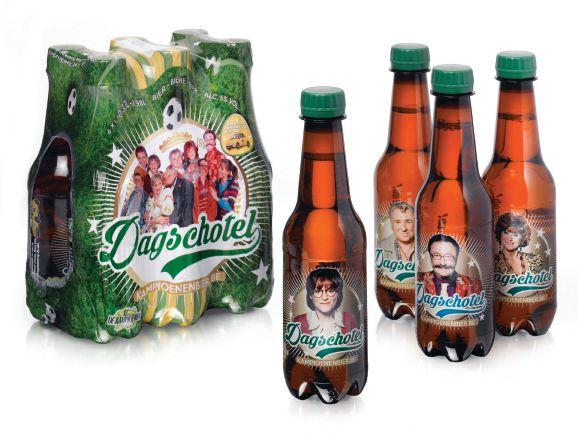
Belgium brewery Martens Brouwerij introduced its new Dagschotel beer with an Augmented Reality app featuring of some of the country’s best-known TV actors who star in F.C. Kampioenen. The PET bottle graphics, printed with the KHS system, comes to life when a smartphone app is pointed at them.
Solutions that are targeted toward corrugated liner manufacturing or sheetfed printing of corrugated boxes/displays are now available from key industry suppliers with print speeds exceeding 200 metres per minute.
Direct-to-shape is another example of an emerging category where graphic arts, technologies, and industry-specific suppliers have come together to meet the demand for customized printing like never before. Examples include a major brand that is now offering digitally printed beer bottles that are fully customized and linked to an augmented reality campaign. This isn’t a completely new concept, except that it is now being done on an industrial scale by a mainstream manufacturer.
Ceramics
23%
CAGR in the use of electrophotographic and inkjet imaging technologies, as predicted by an InfoTrends report, from producing 1 billion square metres of print in 2014 to 2 billion by 2019.
The market for ceramic tile is huge, with over 12 billion square metres of tile manufactured worldwide in 2014 based on an InfoTile report. This industry segment traditionally used rotary presses to deposit decorative ceramic inks onto tiles ahead of the firing process, resulting in a cost-effective product that rivalled the permanency of natural stone. At the same time, however, using rotary print cylinders has its drawbacks – pattern repeats are limited and require costly changeovers. Because digital printing has dramatically improved time-to-market, enabled design changes, and reduced make-ready, it now captures the majority of tile manufacturing in Europe and is gaining a rapidly-growing share in China. Moreover, digital technology offers dimensional printing in later firings to add texture in addition to the decorative layer.
Textiles
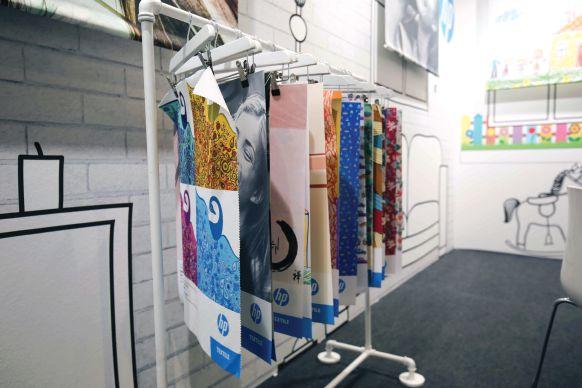
Textile printing is a far-reaching industry with a deep-rooted heritage in countries like Italy, Turkey, India, Japan, Korea, and China. Based on InfoTrends’ Digital Textile Forecast, printed fabrics accounted for over 35 billion square meters in 2014 – and 800 million of this volume was digital. Although most of these fabrics are produced using silk screens or rotary presses, the use of digital printers
is rapidly increasing. This unique industry has been creating dazzling designs since wood-carved blocks were used to stamp fabrics. Great strides have been made since that time, and the prevailing technology for high-volume fabric manufacturing is now rotary screen printing. Now that specialty inks can be used with a wide range of man made and natural fibres, it is possible to create cost-effective finished products with bright colors and bold designs.
InfoTrends’ Digital Textile Forecast projects that digital textile fabric printing will demonstrate a CAGR of over 30 percent, surpassing 3.2 billion square metres by 2019.
Laminates and wood
Within the construction and furniture industries, woodworking products have been making use of printed decorative papers and laminates for decades. With a wide range of designs that mimic natural wood grains, stone and graphic patterns, laminates are a cost-effective substitute for natural materials. In some cases, laminates are actually preferred because they are more durable. Typically produced using gravure presses, decorative papers are converted to laminates using a range of processes. This industry produced over 300 million digital square metres in 2014, based on InfoTrends’ report Profiting from Digital Printing in the Décor Marketplace. The pressure to develop short-run or custom laminates is driving an increased demand for midrange as well as industrial products that rival the printing volumes of traditional gravure presses.
Emerging on the heels of laminate solutions are a range of direct printing solutions produced on a variety of wood products such as Medium Fibre Board (MDF), plywood, and natural wood. These do not require lamination and are used for adding a decorative surface to residential and commercial applications.
Wallcoverings
Wallcoverings have been in existence since the ancient Chinese decorated their palace walls. More recently, King Louis XI of France ordered wallpaper for his royal dwellings in 1481. Creator Jean Bourdichon painted 50 rolls of paper with angels on a blue background because King Louis found it necessary to move frequently from castle to castle. Wallcoverings have made great strides since that time, and they are now readily available to everyday residences and commercial buildings. Technologies such as surface printing, offset, flexography, and gravure printing have been widely used to produce standard wallpapers, with volumes estimated at 52 million square metres annually in 2014 based on InfoTrends’ Profiting from Digital Printing in the Décor Marketplace
Digital wide format printing solutions ushered in generations of innovative graphic communication solutions for the plethora of industries that have been migrating to the wallcovering segment. Advancements in digital printing inks (latex and flexible UV inks) now enable printing on standard industry media that complies with health and safety codes. Applications such as murals and graphically rich wallpaper rolls are becoming increasingly common and are now available from a number of suppliers.
Glass
Decorative glass has been adorning cathedrals, palaces, and a range of public and private buildings for millennia. Applications span from leaded stained glass to screen-printed glass panes, and these items have been used to reinforce branding, promote artistic expression, or create simple signage. According to the Global Flat Glass Industry Trend, Forecast and Opportunity Analysis by Lucintel, the flat glass market is expected to surpass US$66 billion by 2019 and is starting to adopt digital printing as a means of expanding its reach. With the development of inkjet printheads that are capable of printing ceramic inks onto glass, a number of industries are using digital printing technology to produce long-life decorated glass that is suitable for architectural and industrial uses.
Membrane switches
Printing technologies are regularly used in the production of the graphic overlays as well as the some of the circuitry where conductive inks are used. Advancements in digital UV printing technology, including flexible inks and Light Emitting Diode (LED) curing, are expanding the range of membrane switch applications and carrier materials to include flexible substrates that can be cured with less energy and heat. In certain higher-volume applications, curing using EB (Electron Beam) technology enables deposition and curing on sensitive materials. In all of these cases, short-run of customized print can take the place of screen or flexographic printing technology.
3D printing
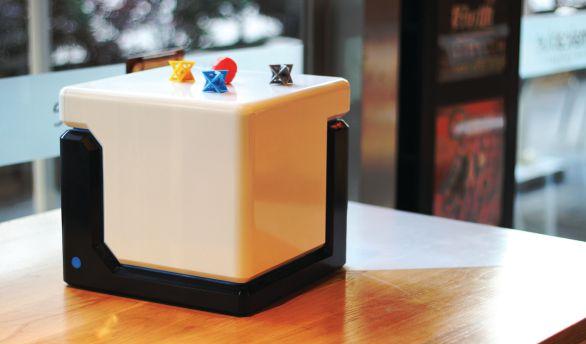
Typical applications created on 3D printers include prototypes, molds & dyes, and end-use products. These applications are being used by almost all industries to create a variety of products from nanosized research products to airplane parts. This segment is evolving rapidly, and hardly a day passes when we don’t hear about a new innovation that enables another compelling application. The attraction in 3D printing is its additive nature— waste is limited, time-to-market is shortened, and custom designs are possible.
The key to our customers’ success lies in the perfect interplay between people,machines, materials, and processes. Heidelberg combine prepress, press and postpress expertise with consumables, services, and consulting. This integrated solution portfolio has already gained the company 40 percent of the global packaging printing market.
Discover the opportunities the Speedmaster offers and let yourself be inspired! www.SpeedmasterGetInspired.com
Sheetfed offset
Advances in printing’s dominant process
X-Rite IntelliTrax
Digital processes are having positive impacts on commercial printing, but advancing analogue technologies – infused with their own digital progress – keep sheetfed offset at the forefront of innovation, from inks and coatings, substrates and plates, to press controls and imaging systems.
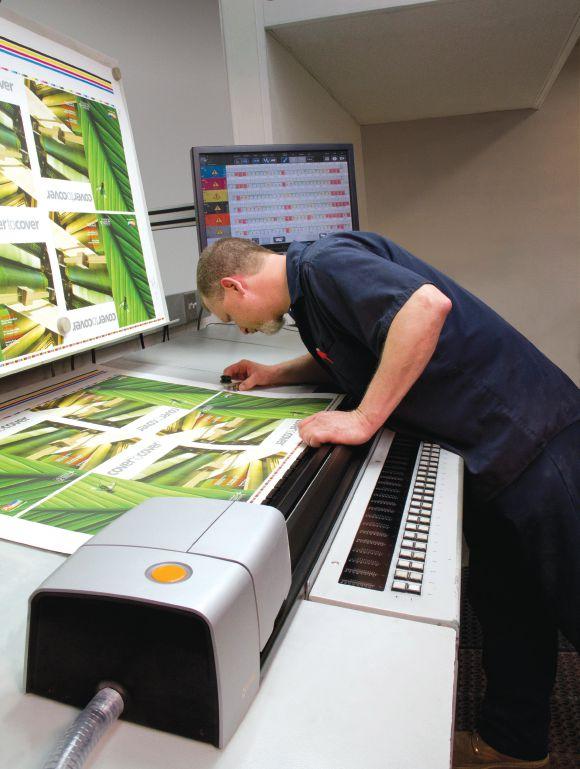
Introduced in mid-2015, X-Rite IntelliTrax provides automated colour measurement aimed at sheetfed printers and folding-carton converters. IntelliTrax automatically scans the colour bar of a typical press sheet in less than 15 seconds, measuring special colours, PANTONE colours, non-process colours and paper colour.
2 | Using Specialty Coatings to Help Packaging Stand Out in the Grocery
Aisle
Sun Chemical SunInspire
Sun Chemical’s line SunInspire specialty coatings, designed to provide a range of special effects, can be used with web offset, sheetfed offset, flexographic, gravure and screen applications. SunInspire Metallics is for producing unique metallic tones like mirror-like silver and gold coatings, in addition to SunInspire Cold Foil Adhesive.
For additional closed-loop colour control, IntelliTrax works with IntelliLoop from Rutherford Graphic Products, which allow for reading ink key openings and sweeps immediately following scans, assuring effective key moves that get to color quickly. There is also a “roll-back” feature permitting key-openings and sweep settings from any previous scan to be automatically loaded.
Magnum MessageMag
Sun Chemical’s SunInspire™ specialty coatings can add value to the finished package, booklet, report or sales item by providing a differentiating property. There is no doubt that for consumer items, these specialty coatings will entice interest and lead to increased sales if printers are willing to experiment with their equipment configurations.
The SunInspire Color Shift comes in a range of colours from blue to green or yellow to orange shifting. SunInspire Glitter, which incorporate small holographic bits of glitter, are best applied with a roll coater and most pronounced over dark colours. SunInspire Glossback creates a pronounced contrast between the glossy UV coating and the smooth matte appearance where the spot overprint varnish is under the coating. SunInspire UV Pearl can mute an image when applied over or under an ink. The line also includes SunInspire UV Reticulating, Emboss, Sandy Feel, and Soft Touch, as well as thermochromic coatings and SunScent water-based coatings based on a recent partnership with ScentSational.
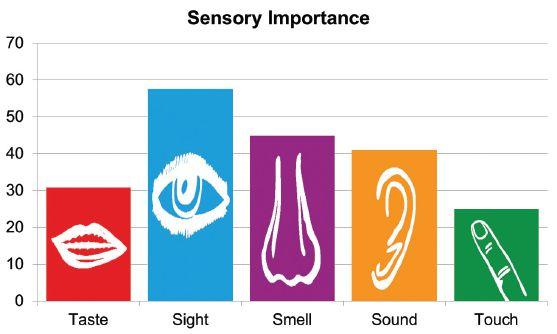
The Importance of Sensory Branding
According to Martin Lindstrom’s groundbreaking research in his book “Brand Sense,” he states that “83 percent of all commercial communication appeals only to one sense—our eyes, leaving a paltry 17 percent to cater for the other four senses.” The book goes on to explain how the most successful brand owners use strategies to integrate packaging that appeals to all five of the senses—touch, taste, smell, sight and sound.
Magnum Magnetics has improved its offset-printable magnetic sheeting to make it easier for sheetfed printers to use, print, and process true magnetic media. MessageMag is thin, printable magnetic sheeting that works for both offset and flexo printing presses, and can be perforated and die cut.With a new patent-pending magnetization method applied during the manufacturing process, Magnum Magnetics explains the product offers smoother feeding and jogging, while maintaining good ink adhesion and image quality. Standard sizes are stocked with normal or premium gloss or matte paper.
Eagle Systems CFM 145
According to the book, sight is still the most important, but smell and sound are not far behind (Figure 2). It is also a fact, according to POPAI, that 70 percent of packages that are picked up are purchased, so it is impossible to minimize the importance of the sense of touch.
Eagle Systems machines can now offer 24-inch foil rolls, allowing for less foil change times. Its latest machine, CFM 145, was recently installed on a 56-inch offset press and accommodates – new or older – presses from 28 to 80 inches. The system is fully automatic – no operator console – eliminating programing and
Sun Chemical’s SunInspire specialty coatings utilize sensory special effects to engage the senses of sight, touch, and aroma to help packaging stand out on store shelves.
Visual Effects Coatings
IntelliTrax uses G7 process and reporting for operators to measure the P2P target.
wasted product caused by improper tension and foil pressures, according to Eagle. It is able to run single or multiple combinations of foil webs on one shaft from two inches to full press width. Installation can be done usually within three days.
Komori Printing Task Optimization
Sun Chemical’s wide range of SunInspire specialty coatings offers a variety of visual special effects that help packages stand out on the shelves, including high-luster metallic, fluorescent, glitter, pearlescent, iridescent, frosted, and gloss.
Historically, the use of metallic coatings on packaging has been limited, and therefore is not commonly seen on store shelves. Sun Chemical can change that for a printer with SunInspire Metallics, a wide range of coatings that can take on unique metallic tones. Using bright mirror-like silver and gold coatings and effects, for example, can separate a package from the competition on the shelves.
Percentage of shoppers who purchase something they did not plan to, according to a study by the Point of Purchase Advertising Industry featured in a new Sun Chemical white paper about the use of extra sensory inks like SunInspire. 58%
Komori’s Printing Task Optimization with KHS-AI is part of the core Komori PQA-S with PDF comparator and inspection systems. The PDF comparator reads the printed image for comparison with the originating PDF file data and may be specified with PDC-SX. This allows the operator to check for missing or added characters in the initial printing stages. Using a high-precision CCD camera and lens, the system provides inline quality control by inspecting all sheets according to the same criteria. The system checks for smears, ink splashes, water drops, oil spots, hickeys and colour irregularities and also prevents unacceptable sheets from continuing to be printed during the run and with good sheets that are sent to postpress.
SunInspire Cold Foil Adhesive (Figure 3) is another special-effect coating that can help products pop off the shelf. Designed for flexographic or litho applications, the coating system allows for simpler foil stamping; can be used on paper, paperboard and various plastic substrates; and yields economical replacements for metalized and holographic substrates.
White Paper
Figure 2 According to “Brand Sense” by Martin Lindstrom, successful brands use strategies to integrate packaging that appeals to all five of the senses.
Brand Sense by Martin Lindstrom finds successful brands integrate packaging that appeals to a majority of the senses, possible with Sun’s SunInspire inks.
Komori KHS-AI digitizes and automates control of colours that were previously adjusted by the operator.
Heidelberg DryStar UV LED
With 15 installations worldwide to date, Heidelberg’s DryStar UV LED provides lower energy consumption than conventional UV dryers with UV lamps. Like LE UV curing, Heidelberg explains LED technology also delivers the lowest energy usage available, although LED UV light sources emit radiation in a narrower range (385 nanometer) than LE UV (250-400 nanometer) lamps. Applications range from commercial printing without or without coating, to thin metallized foil and distortion-free plastic foil printing at speeds to 18,000 sheets per hour. Application success, explains Heidelberg, is tied to the consumables and LED lamps being matched for the same wavelength. Depending on a system’s capacity utilization, Heidelberg explains UV LEDs are projected to last for 20,000 hours. DryStar UV LED can be used in the delivery and/or as an interdeck dryer for maximum flexibility.
hubergroup RESISTA
As part of the !NKREDIBLE ink series, which includes 39 products available in the Canadian market, hubergruop’s RESISTA line of rub resistant inks feature strong stay-open formulations. The process series is designed for high mechanical stress, with matte coated or uncoated stocks (with and without aqueous coating), to provide extra safety in post-print when working with sensitive substrates.
The !NKREDIBLE line also include products like ULTIMA, also for fast postprint finishing. REFLECTA inks with hard-dry properties (good oxidative drying) are for maximum gloss and strong colour reproduction. This includes high fountain solution tolerance, ideally suited to perfecting presses. MAXXIMA all-purpose inks are for covering the broadest spectrum of applications, minimizing wash-ups and press down times. RAPIDA stay-open printing inks have fast physical drying properties for immediate work-and-turn and rapid postprint finishing.
KBA Rapida 105 PRO
The Rapida 105 PRO is a new medium-format sheetfed offset press launched by KBA in 2015. At 17,000 sph, the press runs a standard sheet format of
29.13 x 41.33 inches. One of the Rapida 105 PRO’s key features, according to KBA, is its full preset capabilities from the feeder through the printing units to delivery. All of the settings at the feeder and delivery can be stored according to job type. The Rapida 105 PRO handles a wide substrate range of thicknesses from 0.04 mm to 1.6 mm. KBA explains its gripper systems do not need adjusting even when making extreme substrate changes. It can also include a reel-tosheet unit, perforation and numbering unit, iris printing device or the KBA ColdFoiler, make the Rapida 105 PRO an extremely flexible, universal machine.
Ryobi SMART-RPC
The recently introduced SMART-RPC plate changer is available for the Ryobi 9, 7 and 6 Series presses as an option. It allows users to shorten plate-changing delays and significantly reduce operator workload, providing support for frequent changeovers and diverse small-lot printing. SMART-RPC switches the phase of all plate cylinders to the same position, and then changes the plates simultaneously on all printing units.
Agfa Azura TE
Azura TE, introduced in December 2014, is Agfa Graphics’ chemistry-free Directon-Press plate for commercial printers. Based on ThermoFuse technology, Agfa explains Azura TE eliminates chemical processing, maintenance, gum and waste from the plate-making process. Azura TE coating consists of latex particles which fuse together and to the aluminum substrate during exposure. After imaging, the
Azura TE plates are cleaned out on-press, With Agfa’s patented Thermochromatic dye technology, Azura TE offers daylight stability up to 24 hours.
Hans Shionohara 75VH
In January 2015, Hans Shinohara Canada introduced the Shionohara 75VH press with available LED UV options. More options for the press include AQ coating and perfecting versions. The five-colour press has a maximum paper format of 23 x 29.5 inches (minimum 10.23 x 15.74 inches), which relates to a maximum printing area of 21.45 x 29.1 inches, while handling stock thicknesses of between 0.04 to 0.6 mm. The Shionohara 75VH also features high-pile feeding capabilities of up to 35.4 inches, as well as a delivery pile height of 28.7 inches. The press includes automatic washer ink rollers and CIP3, SCCS and SPIS features.
Kodak Electra Max
In September 2015, Kodak introduced its new Electra Max thermal plates, which the company describes as satisfying the requirements of commercial and packaging printers looking for UV solvent resistance, 10-micron FM screening capability, long unbaked run lengths, fast imaging and processing speeds and extremely low chemistry usage. Also introduced in September 2015, the new Kodak Trendsetter Q2400/Q3600 platesetter, featuring Squarespot Imaging, can image plates from 394 x 394 mm up to 1,600 x 2,083 mm. It handles a variety of applications such as packaging, directories and other large format applications.
DryStar UV LED can be used in the delivery and/or as an interdeck dryer.
The Rapida 105 PRO is available with up to 10 units, perfecting, and single and multiple coating.
Eagle Systems’ CFM 145 accommodates presses from 28 inches to 80 inches. hubergroup’s ink profile of RESISTA.
Visit us at INFO*FLEX booth #301
Be a star producer with the most complete line of innovative coatings from Sun Chemical. Our full cast of special effects includes scented, tactile, glitter, thermochromic and so much more. It’s everything you need to make your product pop on the shelf. Count on high-quality service and innovation from a single source for inks and coatings — Sun Chemical.
To learn more, visit our website at www.sunchemical.com/naicoatings or contact us at 1-708-236-3798.
boards, plastics, laminations or digitally printed works up to 30 pt can now die crease, fold and even glue in-line.
even glue all on the same machine, up to 30 pt.
3. INTEGRATED MODULAR UNITS — Combined in-line finishing: crease, fold, glue, tipping, envelope inserting, ink jetting (Duplex), clip seal (3 sides), mail prep.
4. SAVE ON POSTAGE COSTS —As a Certified Canada Post Direct Marketing Specialist, we get contract pricing reductions.
5. RETURN MAIL PRODUCTS — Customized “Return Mailers” created in-line with “U” or “BOX-shape” remoistenable glue, time perfed applications and envelope formation.
6. MINI-BOOKLETS — Saddle-stitch and trim 2-up booklets in-line to the size of a business card. No need to trim off-line, or do 2 passes.
7. HIGH SPEED EQUIPMENT — High speed Tipping, Folding, Saddle-stitching and soft folding ensuring on time delivery.
Roland VersaUV LEF-300
In January, Roland DGA introduced a new and larger VersaUV LEF-300 to its line of benchtop UV-LED flatbed printers, which also includes the existing LEF-12 and LEF-20 models. To accommodate greater quantities and larger-sized items, the LEF-300’s printing area has been expanded to 30 inches wide by 13 inches long, which equates to an imaging area 50 percent larger than the LEF-20. With four print heads and two UVLED lamps, the LEF-300 enables bidirectional printing approximately 60 percent faster than the LEF20.
As well, the number of LEF-300 White and Clear (gloss) ink nozzles has been doubled for faster printing, increased density and opacity, and faster build-up of multiple layers for three-dimensional textures. A new draft print mode improves overall efficiency for users in need of quick prototype prints. Users can print on a range of substrates like PET, ABS and polycarbonate, soft materials such as TPU and leather, as well as three-dimensional items ranging from smart phone cases and laptop
covers to signs, giftware and promotional items. Roland explains the LEF-300’s built-in vacuum table helps hold thin and soft materials in place, allowing for easier job setup and eliminating errors. The system also includes the BOFA air filtration system, which provides for ventilation while also serving as a stand and storage unit for fixtures and supplies.
The LEF-300 comes equipped with Roland’s new VersaWorks Dual software RIP, which supports native PostScript and PDF files. VersaWorks Dual features such as offset, positioning, rotation, registration of ink layers, and automatic creation of White and Clear ink effects can also be handled directly in the RIP. The LEF-300 uses new EUV4 ink, which is Roland’s proprietary CMYK, White and Clear ECO-UV inks, which are said to reduce odour and the shrinking of thin film materials like BOPP, PE and PET when curing.
HP WallArt Suite
In January, HP Inc. introduced its next generation HP WallArt Suite as a Web-to-print tool designed to help small- to medium-sized printing
VersaUV LEF-300 has an imaging area 50 percent larger than the LEF-20.
companies involved in the decoration space. The technology was created exclusively for HP’s line of Latex printers. It features what HP describes as an improved interface, updated dashboard design to better manage customer orders, easier Web integration, four free HP Wall decoration web apps, and access to different content sources like Fotolia, Pattern Design, Instagram and Dropbox. The HP Latex 310 and Latex 360 printers include third-generation HP Latex technology for proofing interior decoration applications like home textiles, while the recently introduced HP Latex 3500 Printer allows for unattended operation with heavy-duty roll-handling and 10-liter ink cartridges.
Anvil 3D Printer
In January, at CES, Anvil introduced its compact, cubeshaped 3D printer with an enclosed print area – with tempered glass in the front – primarily aimed at 3D modeling. The machine uses an auto-loading process that eliminates the need to manually insert feedstock into the printer. The system leverages what Anvil describes as Lego-like software and a mobile
app to ease the process of modeling, as well as a remote printing. The Fused Deposition Modeling-style printer measures 312 mm on all for sides, with a print size of 6.5 to 6.98 inches. It provides five layer resolutions, including 20, 50, 100, 200 or 300 microns. It has a printing speed of up to 90 mm per second.
KBA Performance Report
In January, KBA introduced a new Service Select product known as Performance Report, designed to ensure a customer’s press is running at peak performance to help reduce waste and production costs. More specifically, KBA targets the following benefits: Print performance, optimized print quality, boosted machine capacity, enriched optimization potential, minimized machine downtime, and reduced costs via less waste sheets. KBA experts evaluate on-site by observing the physical condition of the press, and then interviewing the press crew, pressroom management, as well as maintenance personnel. Findings are then presented to the management team with recommendations, suggestions, and any other actions to move forward.
The Anvil 3D printer sells for an US$299.
HP WallArt Suite now connects with the likes of Fotolia, Pattern Design, Instagram and Dropbox.
Drytac JetMounter Guide
In November, Drytac introduced a Media Guide for its JetMounter electric tabletop laminators. The guide, which is now sold as standard on the systems, is designed to keep lamination hands-free by holding an image over the roller as the machine laminates the print. The JetMounter JM34 is a motorized tabletop laminator operated by a foot switch, leaving both hands free to handle the work being processed. This particular model is designed for mounting and laminating inkjet outputs, but Drytac explains it is equally capable of handling photographic or any printed media. This model also includes a supply shaft and self-checking photo cells for finger protection.
Vortec Ionizing Air Knives
In December, Vortec introduced new Ionizing Air Knives to neutralize static that can attract dust and contaminants, and stop static discharges that can damage electronic equipment and shock personnel.
The technology is designed for moving webs, film, sheets, strips, auto bodies and other large assemblies and objects.
Vortec explains a static neutralizing bar generates positively and negatively charged ions that are carried to the target by a uniform sheet of amplified air. Vortec air amplifiers use a small amount of filtered compressed air to deliver a high velocity sheet of laminar air over wide areas. The company states its technology increases thrust and velocity, while reducing noise. Depending upon the number of ionizing bars needed, two or four cable models are available. All Vortec power supplies are rated at 115V, 50/60 Hz input, 7.5 kV output.
Vycom Celtec Vivid White
In December, Vycom, a division of CPG International, introduced Vivid White as a new printable substrate material from the Celtec expanded PVC product line. Celtec Vivid White, according to Vycom, provides a bright white option for wide-format
The new Media Guide allows for true hands-free lamination.
Vortec’s Ionizing Air Knives increase thrust and velocity.
printing when wanting cooler colours to pop with vivid colour. Celtec Standard White is an option for warmer colour imagery and fleshtones. Vycom’s Celtec Expanded PVC line now includes Celtec Standard White, Celtec Ultra White for added UV protection and new Vivid White.
Goss Omnicolor II
In November, Goss launched a colour control upgrade for the 16page M-600 press, which the company describes as a way to help eliminate potential obsolescence issues for the press model. The benefits of the new automated Omnicolor II press controls, according to Goss, include start-up waste lowered by anywhere from 20 to 50 percent, as well as significant reductions in turnaround time.
Features of the Omnicolor II upgrade include the ability to automate press setting direct from CIP3 data to reduce what Goss describes as a three-stage process down to a single step, which also helps eliminate error potential. More waste reduction improvements include what
the company explains as quicker reaction of the ink keys and repetitive positioning; an ability to move all ink keys simultaneously; and the selection of up to 10 papers and inks, to optimize the presetting.
New functionality like Ink Tracking and Color Boost are designed to enable the fastest possible process to achieve good copies. New auto learning, by saving all running job settings, job after job, allows Omnicolor II to fine tune the presetting by taking into account ink, paper and coverage specifications for optimum results. Following a one-day press audit, Goss engineers require full press access for between two and four days to install the upgrade on existing M-600 systems.
Paradigm WideTek 25 Scanner
Paradigm Imaging Group has introduced a new Backlight Option for the WideTek 25, which is a colour flatbed scanner for formats up to 25 x 18.5 inches.The CCD system is housed in a hermetically sealed camera box, ensuring dust-free operation. Using
❏ Eliminates duplication of effort
Vycom expanded its Celtec PVC line for large-format imaging.
The Goss M-600 Folio system.
F: 1-800-837-8683 or 905-681-7072 quotes@teckmark.com • www.teckmark.com
a patented stitching process, the WideTEK 25 delivers a maximum resolution of 1,200 dpi and can scan an A2-sized document in three seconds (at 300 dpi).
The WideTEK 25 now comes with an optional backlight unit for digitizing film footage, X-rays, and other transparent material. The backlight option is integrated in the scanner lid and can be installed by the user, enabling both normal and transparent source material to be scanned. The backlight unit can scan both reflective originals as well as transparent material in the same resolution of up to 1,200 dpi optical and using 3D surface scanning techniques if desired.
EFI Fiery v6.2
In November, EFI introduced new version 6.2 upgrades to its Fiery software and Fiery proServer frontends for wide-format inkjet printing, including what the company describes as major improvements in processing speeds for EFI VUTEk printers. EFI states the new Fiery software and Fiery proServer 6.2 provide average speed improvements of over 60 percent for EFI VUTEk users, compared to previous versions. The software upgrade is combined with EFI-developed FAST RIP technology.
New printer drivers are also available for Agfa, Canon, EFI, Epson, HP, Mimaki and OKI systems in
these latest Fiery product releases, which increases the supported printers in EFI’s Fiery offering to more than 700 wide-format printer models. As well, EFI is noting new finishing enhancements that provide smoother integration for cutters, as well as faster and more flexible file processing on jobs that feature cut paths. A bidirectional Job Definition Format (JDF) link included in these upgraded products provides information about the printer status, job status and consumables usage to EFI’s mid-market Productivity Suite MIS workflow, as well as to EFI Digital StoreFront Web-to-print software.
Tilia Phoenix Plan Configurator
In January,Tilia Labs introduced the new Phoenix Plan Configurator for Enfocus Switch aimed at printers active in offset, toner, and large-format markets. Phoenix Plan Configurator, designed to find savings in both materials and time, works by collecting individual orders coming in to Enfocus Switch, along with their associated metadata information like quantities, stock, grain and spacing. The files are then sent to Phoenix, which goes to work searching what Tilia Labs describes as millions of combinations, across available presses and stocks, to find the most cost effective ganged layouts.
prInt/sIGn sHOp FOr saLe
Well-established (since 1974) profitable Print/Sign Shop for sale in Toronto. Turn Key operation – Low Rent 1,500-square-foot shop, positive cash flow, loyal repeat customers, owner retiring. Asking $360K. E-mail: firestoneprinting@rogers.com
sHeetFeD press OperatOr
Press operator wanted, Scarborough location. Komori Lithrone 4/C part time afternoons and weekends.
Please call Phil @ 416-561-4304
prInt sHOp manaGer
Eva’s provides services to homeless and at risk youth. We seek a Print Shop Manager to lead the business operations of our social enterprise, the Phoenix Print Shop.
This position is responsible for the daily operation and overall management of the print shop, including building the customer base, maintaining quality of service, and ensuring business financial
sustainability. This position is the anchor for all print jobs with skills to ensure timely estimating, docket management, production, and invoicing. A strong understanding of the industry and excellent business skills are required. The ideal candidate will have a minimum of seven years print management experience, as well as a minimum of 3 to 5 years sales experience with demonstrated results.
A team player, the Manager will supervise Print Shop staff and ensure targets are met or exceeded to support the operations of the Fundamentals of
Print Training Program for homeless and at risk youth. This is a highly responsible position which requires an organized and resourceful person equipped with the ability to deal with a wide range of issues and tasks proactively and simultaneously.
The Print Shop Manager is also responsible for working collaboratively with the Phoenix Leadership team in the creation and maintenance of a positive and productive workplace environment that is free of harassment and discrimination, and where the worth of all employees is acknowledged, their contributions
• Multilith 2 color press
• #1: 11 X 17 inches, 2 color with Mona numbering and perforaton system Kompac and bareback water system
• #2: 10 X 15 inch, 2 color, Kompac and Bareback water system, Heidelberg Platen press 10 X 15, Paper cutter 42 inch Harris Seybold Citation with 3 blades, Gergek System Six plus, Tally continuous form matrix commercial printer
• Business form M3410 Moore commercial detacher
• Nita Vacuum plate burner frame 56 X 43 inch (inside window), With Olite AL-53 power supply and Olec lamp head model LT1
• Henning light table model 4050OL, Xanté Plate maker, vertical camera Auto Companica model C650C
• Lift truc, Allis Chalmers Propane And many more Yvan Saulnier lithographie SB inc. T. : 450-667-6247 • F. : 450-662-6247 C : 514- 978-5707 • info@lithographiesb.com
Heidelberg: K-Line/S-Line/Speedmaster/GTO/MO
Komori: 1, 2, 4 or 5 colours & any size
Adast: 714/715/724/725
Mitsubishi: Any model
Ryobi: 2800CD/3200CD-MCD/640K
Itek: 960/975/985
Hamada: 600/700/800/E47/RS34
Shinohara/Fuji: 66/65 1,2 or 4 colours
Sakurai: 1, 2 or 4 colours and any size (newer model)
Polar: any size/older or newer models (66/72/76/78/82/90/92/107/115)
Horizon-BQ: 220/240/260/440/460
John Fulena / Vice President / Production Print Business Group / Ricoh Americas / West Cadwell, NJ
it has been just under a decade since Japanese imaging giant Ricoh made the bold decision to move beyond the office environment into the world of production printing, which was already saturated with several large, established press makers. John Fulena, who has been involved in digital printing since the early days of Indigo (1996, as a regional sales manager, before working with the likes of Agfa, Oce and Kodak), has witnessed first hand Ricoh’s aggressive pursuit of toner and inkjet page volume. One significant statement came in 2007 when Ricoh acquired 51 percent of IBM’s Printing Systems Division, forming a partnership called InfoPrint
In June 2010, Ricoh purchased IBM’s remaining interest in InfoPrint and the company is now the number-one player in continuous-feed inkjet. As it cemented its inkjet position, bolstered by printhead power from the 2004 purchase of Hitachi Printing Solutions, Ricoh purposely built its toner-press assets toward million-impression duty cycles. The company also invested in front-end systems with the purchase of PTI (now MarcomCentral) and a multi-million-dollar investment in Toronto’s Avanti Computer Systems. PrintAction spoke with Fulena about Ricoh’s aggressive 10year plan to become a technology leader in production print.
Where is Ricoh’s press technology today?
JF: We introduced three products last year that really transformed our product line: Ricoh Pro C7100, Pro C9100 and the Pro VC60000. The 7100 and 9100 are tonerbased devices. VC60000 is a second-generation inkjet device. The existing continuous feed inkjet, the InfoPrint 5000, historically has been a workhorse for us geared toward the transactional space, where we hold a number-one market share of about 60 percent. The VC60000 on the other hand is geared toward commercial print with the ability to use inkjet technology on offset coated stocks.
How are the new presses being received?
JF: We have our first three installations of the VC60000, which was officially launched in August [2015]... The Ricoh Pro 7100 is really taking off – it has exploded quite frankly. It is a 80 and 90 page per minute device with five-colour capability to do either clear or white.
Why has the 7100 been successful?
JF: There are two really key things to the success of that product. We put it in the market at a price point [never seen before] in that space. I have worked for Kodak, Indigo, and I’ve been through the five- and six-colour launches before; two issues pop up, initially. The first is cost. So if I really
want to do five- and six-colour printing then I have to buy a NexPress, an Indigo, or an iGen and you are talking a lot of money. This product is not a lot of money.
How did ricoh ensure the fifth-colour station will be utilized?
JF: When we knew this product was coming out, we started a project where we designed a 5th Color Kit. We put samples in there that were produced on the machine. I wanted practical applications that I could put down in front of a printer… applications like business cards or tri-fold brochures.
We use 36 examples and show them in InDesign, Illustrator, Photoshop, the actual screenshots of what you need to do and the instructions to create these documents. There are also two- to three-minute instructional videos… This, coupled with the price point, is helping the 7100 to take off.
Why is the 5th Color Kit a differentiator?
JF: A lot of [press] manufacturers do not want to be bothered with Illustrator, Photoshop, InDesign. They leave that to the customers, but you have to give them a little bit of instruction, because if they struggle with how to do it they are not going to use it.
And what ends up happening is you get someone who is very technical trying to explain to a designer how to make a file. That can be a disaster, so we have tried to simplify this
process and the way we have priced it is also pretty simple – you pay for the toner. We haven’t incorporated the click charge, so the white and the clear are separate. The customer pays, I think, it is around $500 per bottle and they charge what they want for it.
Why introduce the pro 9100 model?
JF: The 9100 is four-colour only and it fits into an arena for a million a month plus [impressions] and we never had a device there before. And that is really getting into the meat of the commercial print market space. It prints 100, 110 and 130 pages per minute.
Is ricoh is taking an aggressive position?
JF: I hope so, because we are deeply committed to the production print space and we are not going anywhere... Our financial targets were very high and we reached them in record time. We always saw there was light at the end of the tunnel and these products today are what we were shooting for. I think we have caught some of these guys that have been around for a long time by surprise, because I do not think anybody took us seriously.
I love it – because to me we want to be aggressive. We have the number-one market share in cut-sheet colour, cut-sheet black-andwhite continuous feed. It is kind of hard to believe when you think nine years ago we had zero market share
Ricoh’s 5th Color Station Kit includes 36 different samples from magnetic and synthetic substrates to oversized applications, with clear and white toner.
Discover the Possibilities
Spicers and hubergroup offer a product portfolio of printing inks and overprint varnishes focused on quality, consistency and productivity.
Commercial Inks
Packaging Inks
Pantone & Process Inks
Corporate & Special Inks
Coatings & Varnishes .
Setting a new standard in printing ink technology.
Whether it is commercial or packaging, problematic substrate or time sensitive, hubergroup has developed an ink series that will exceed your requirements. To learn more about hubergroup and their family of products, contact your Spicers Sales Consultant. 877 790 2335 spicers.ca
Go Whole Hog on Inkjet in 2016
Just as the passion to ride unites Harley enthusiasts, offset printers everywhere are rallying around Fujifilm’s J Press 720S as the highest quality and most cost-effective way to handle short run print work.
No make-readies or plates to slow you down. No wasted sheets in running up to color. Just send the PDF, print and experience standard coated and uncoated offset stocks transformed to litho-quality images ready for finishing. With spot-on color consistency first sheet to last, reprint after reprint.
Seeing is believing. Visit fujifilminkjet.com today to learn more and order your 2016 Fujifilm calendar, printed on the J Press 720S.
Order your FREE Fujifilm calendar today. The helmet is on you.