the intrigue of global finance in 2015, despite only being halfway through the calendar year, is arguably best highlighted by the turbulence between Greece and the International Monetary Fund or perhaps China’s stock-market rollercoaster. Under infamous IMF constraints it will likely take several generations before Greece finds its own financial footing again.
largely in place” and continue to effect the loonie. BMO predicts Canadian currency will reach around 75 cents (or lower) by the fall, as the country is determining its next leader in a Federal election, and average little better than 78 cents for all of 2016. BMO’s mediumterm predication for the dollar sits at around 80 cents, roughly 15 percent below the median of the past 10 years.
Editor Jon Robinson jrobinson@annexweb.com 905-713-4302
Contributing writers Zac Bolan, Wayne Collins, Peter Ebner, Victoria Gaitskell, Martin Habekost, Nick Howard, Angus Pady, Nicole Rycroft, Abhay Sharma, Trish Witkowski
23%
Amount the Canadian dollar has dropped relative to the United States dollar since Valentine’s Day 2013, when it was last above parity.
In a June 30 article by Peter Cai of the China Spectator, one of China’s most influential economists, Wu Jingliang, compares the Chinese stock market to a casino without rules. Pointing to wildly irrational behaviour, China’s stock market, Cai explains, has doubled in the past year despite the latest crash during a time when the economy was growing at its slowest pace since the 1980s.
Influences of the global economy hit home for Canadians in late-July when the loonie reached a 10-year low at 76.45 cents relative to the U.S. dollar. Canada has enjoyed a relatively stable economy over the past decade, despite what turns out to be an aggressive depreciation in the dollar. A July 24 report called Lower Loonie, for Better or Worse. by Douglas Porter, Chief Economist of the Bank of Montreal, and two senior economist colleagues, states the loonie has dropped more than 23 percent in less than two and half years. This rate is measured against when the Canadian dollar was last above parity with the U.S. dollar on Valentine’s Day 2013.
The sudden dollar drop may indeed give many Canadian printers romantic ideas about exporting more of their work into the United States. The Lower Loonie, for Better or Worse. report explains why it will remain difficult for manufacturers to automatically reap reward from exporting print south of the border.
Porter points to three fundamental factors that have undercut Canada’s currency. First, the sustained pullback in commodity prices amid what he describes as a cool-down in China. He acknowledges the 50 percent drop in oil prices, but also that non-energy commodity prices have gone down more than 17 percent since the 2013 dollar parity. Second, Porter looks at sustained strength in the U.S. dollar. The third factor weighing on the Canadian dollar, according to Porter, has been the notable shift in monetary policy in the past two years: “Canada has quickly gone from being the first major central bank to tighten in the recovery to possibly the last to ease.”
Among the three fundamental factors, Porter believes the strong U.S. dollar and Bank of Canada policy will “remain
“A weaker loonie is commonly touted as an economic positive, by providing a lift to exporters,” Porter writes, “While there’s no denying that fact, it’s not completely cut and dried.” Canadian printers can cut their prices for U.S. clients, because they receive more Canadian dollars. (The opposite effect, of course, comes into play when Canadian printers purchase capital equipment outside of the country.)
Porter believes, alone, the 75- to 78cent dollar is not low enough to attract significant new investment out of the U.S: “The notable lack of traction in non-resource exports is a key risk to the outlook, and implies that stronger U.S. economic growth will not provide the same torque for Canada as in the past. Indeed, we are now expecting the biggest underperformance in Canadian GDP growth versus the U.S. for 2015 in almost 20 years, despite the lower Canadian dollar.”
The BMO report also points to the fact that many Canadian exports contain high import content, which in the domestic printing market often relates to key consumables like paper, plates and ink, as well as per-hour press costs. A lower Canadian dollar, of course, also tends to depress consumer spending, based on loss in buying power. “Ironically, a weak currency is probably a bigger risk to Canadian consumers than the perennial bogeyman of record household debt,” writes Porter.
It’s a good bet, that as the Conservative party have been attacking Liberal leader Justin Trudeau’s lack of experience for months, both the Liberals and NDP have been quietly amassing economic rationale for why Stephen Harper should not be reelected. The economic prosperity of Canada will become a hot-button election issue and it is important for business owners to remain committed to a long-term outlook, even if they are flexible enough to export print into the U.S. for the current short-term.
Publisher Paul Grossinger pgrossinger@annexweb.com 905-713-4387
Associate Publisher Stephen Longmire slongmire@annexweb.com 905-713-4300
Director of Soul/COO Sue Fredericks
National Advertising manager Danielle Labrie dlabrie@annexweb.com 888-599-2228 ext 245
For a 1 year monthly subscription (12 issues): Canada — $39.99 ($35.39 + $4.60 HST) United States — CN$69.99 Other foreign — CN$139.99 mailing address
Annex Business Media 222 Edward Street Aurora, ON, L4G 1W6 printaction.com
Tel: 905-727-0077
Fax: 905-727-0017
PrintAction is printed by Annex Printing on Creator Gloss 80lb text and Creator Silk 70lb text available from Spicers Canada. We acknowledge the
CalenDar
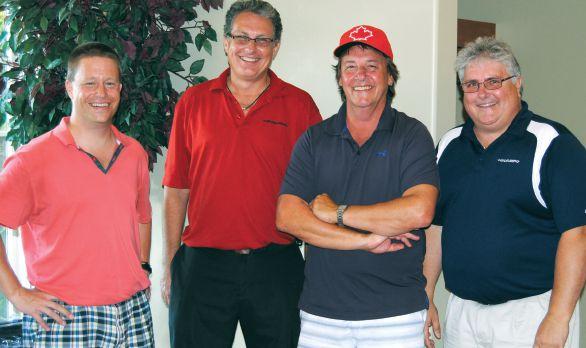
toronto Chapter of printing House Craftsmen (iapHC) held its annual fundraising golf tournament, which was won by a foursome from Heidelberg Canada at Wooden Sticks in Uxbridge. The main purpose of the tournament is to support the Toronto Craftsmen scholarship program (last year providing $10,000) for secondary and post-secondary students pursing a career in the graphic arts.
tapp label of Napa, California, purchased Metro Label, headquartered in Toronto with locations also in Napa and Vancouver. This is the fourth acquisition in less than a year for Tapp Label, led by David Bowyer, CEO and owner, which has more than 300 employees. Founded in 1974, Metro Label specializes in decoration label, shrink/sleeve and flexible packaging markets for clients in markets like wine, spirits, pharmaceutical, health and beauty.
sylvia ma of Ryerson University, after months of problem solving through the sheetfed Sinapse SHOTS simulator, won the 2015 North American Print Skills Competition. In the head-to-head finals, projected live in front of participants of the International Circle Conference at California Polytechnic State University, Ma bettered her opponent from Appalachian State University by a score of three to one. Each competitor was given 10 minutes to solve four unique and progressively harder printing problems.
J. F. moore lithographers of Scarborough, Ont., filed a Notice of Intention to Make a Proposal within the Bankruptcy and
Insolvency Act, and received a mid-August extension with the intention of restructuring the company. A report submitted by J.F. Moore’s trustee on May 13 includes a creditors’ list owed approximately $3.31 million, but the majority, $3.12 million, was primarily held by the ownership group.
Grimco, a distributor of printing systems and medias for the signage industry, continues its investment in the Canadian market with purchase of the Access Imaging, a division of Access Group, which took place in April 2015. Based in St. Louis, Missouri, Grimco made a significant move into the marketplace one year ago, in July 2014, purchasing the Canadian operations of Proveer Sign and Graphics.
rJ multi litho of Oakville, Ont., hosted the first event of Agfa Graphics’ 10-year anniversary celebration of Azura chemistry-free plate technology. Agfa plans to hold such celebrations with printing customers around the world. RJ Multi Litho has been using Azura TS plates for more than seven years.
Guy Gecht, CEO of EFI, led the purchase of two companies to extend EFI’s inkjet-printing interests, including Matan Digital Printers of Israel, which focuses on grand-format printing, and Reggiani Macchine of Italy, which focuses on textiles. Collectively, the purchases are worth more than $100 million and fill technology gaps in EFI’s inkjet portfolio.
ernest Green & son becomes a distributor of GMG’s complete portfolio of colour management products throughout Canada. Ernest Green explains its primary focus for GMG products, such as ColorProof, FlexoProof, OpenColor and ColorServer, will be with packaging and commercial printing, as well as large format.
taylor Corp. of Minnesota, one of the largest private printers in North America, moved to acquire the assets of Dayton, Ohio-based Standard Register Co., during a successful bid during a bankruptcy auction. Standard filed for Chapter 11 in March. With the acquisition, Taylor would add more than 3,000 employees from Standard locations around the United States and Mexico.
swissQprint opened the doors of its new facility in Kriessern, Switzerland, where it develops large-format printing systems. The facility more than doubles its working area to 4,700 square metres, which now holds 56 employees.
our Daily bread ministries, a non-profit, global ministry, is now leveraging Avanti Slingshot MIS for its direct mail. Our Daily Bread of Michigan per year generates 62 million booklets in more than 10 languages. Its Akiyama litho press consumes 11 million sheets of paper, and its HP7000 and HP5500 presses consume six million sheets of paper.
August 31
Canadian printing award entry Deadline PrintAction.com/CPA
September 13-16
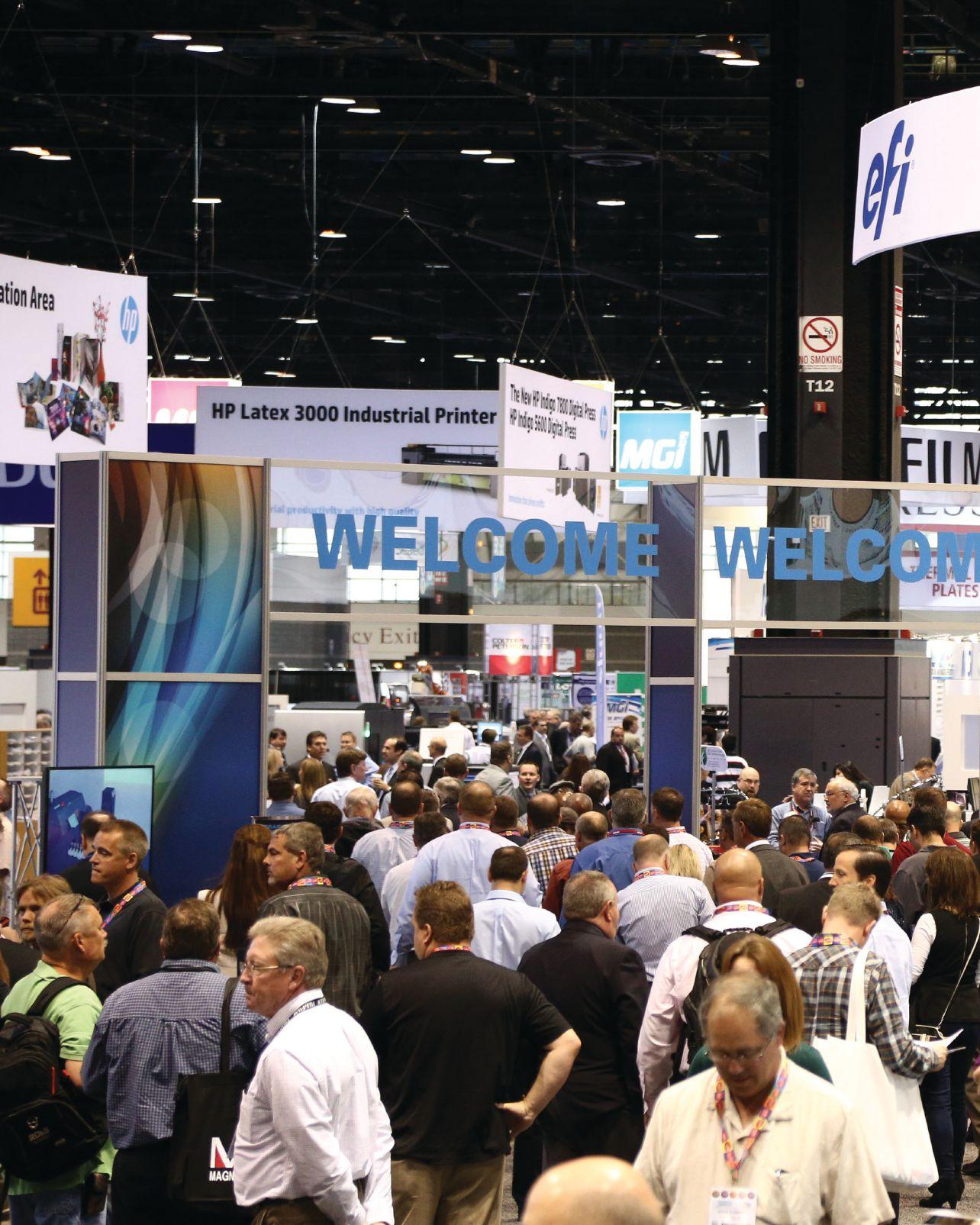
Graph expo 2015 Chicago, IL
September 16-19 sign China Shanghai, China
September 23 opia london Golf Classic Pine Knot, Dorchester, ON
September 25-26
Consac imagemakers International Centre, Mississauga, ON
September 28-30
packexpo Las Vegas, NV
October 7
printaction education series: business of printing Delta Markham, Markham, ON
October 8-10
aiGa Design Conference New Orleans, LA
November 4-6 sGia expo Atlanta, GA
November 8-10
bmi annual Conference Boca Raton, FL
November 12
Canadian printing award Gala The Grand Luxe, Toronto, ON
December 4
mutoh rip software Workshop series, Flexi Los Angeles, LA
December 9- 12
pamex 2015 Mumbai, India
May 31-June 10, 2016 drupa Dusseldorf, Germany
September 25-28, 2016 Graph expo 2016 Orlando, FL
April 7-8, 2017
Grafik’ art Montreal, QC
March 19-24, 2018 ipeX 2018 London, UK
Heidelberg team of Jason Roth, Bill Wilson, Jim Theakston and Glen Kimber.
michael Bolinger, Grimco’s VP in Canada.
RJ multi Litho co-owners Rajee Vikaran muthuraman (left) and Frank Barbosa.
Guy Gecht, EFI.
CEO Reto Eicher (second from left) opens swissQprint’s new home.
installs
, a former business leader within Canada’s printing industry passed away in June. He was the second-generation owner of Parker Pad & Printing Ltd. in Markham, Ont., and well known for his integrity and lifelong relationships with clients. The company was established in 1946 with a single letterpress by Frank Parker Sr., whose granddaughter, Janis Parker, continues to lead the well-
peter bourgeois joins Agfa Canada as an Account Manager covering the Western region from Manitoba to British Columbia, focusing on the company’s complete product portfolio. Prior to Agfa, Bourgeois was Customer Business Manager at Unisource in Calgary. He previously worked for Ernest Green & Son and Mondrian-Hall Inc.
Jay lalonde becomes Canadian Territory Manager for Zund America Inc., a division of the Swiss developer of cutting tables. Lalonde brings more than 25 years of printing industry experience, including seven years he recently spent with Fujifilm’s Canadian operation. He also previously held positions with Boehmer Box, Beresford Box, Pfizer and Sunlife.
s teven s chnoll becomes CEO and President of SiHL Inc.’s North American operations based in Fiskeville, Rhode Island. The company is part of SiHL Group, a global manufacturer of medias for digital printing, with production facilities also in Germany, Italy, France and Switzerland. SiHL is controlled by parent company Diatec Holdings.
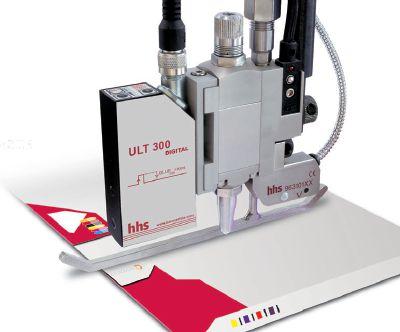
Don stitt becomes Canadian Sales Manager for Baumer hhs, which is part of a global manufacturer of industrial gluing systems, headquartered in Germany, as well as quality-assurance and camera-verification technologies. Stitt is responsible for sales in Canada and the Upper Northeastern United States. He is to focus on both the corrugated and folding-carton industries.
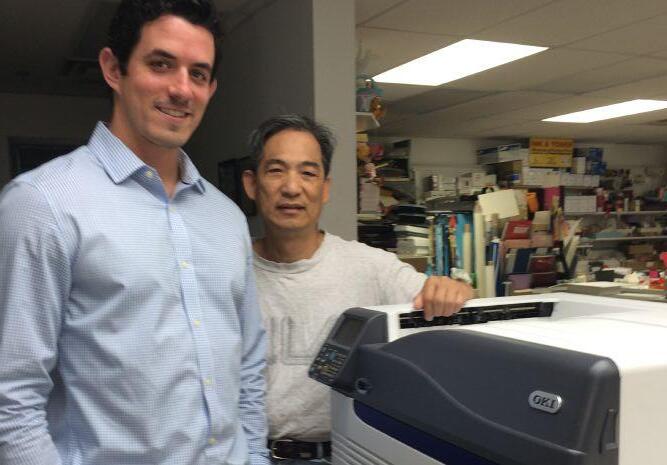
paperland Canada inc. of Markham, Ont., adds a DigiXpress Hybrid system, pictured with Brett Kisiloski (left) of distributor PDS and Paperland’s Paul Ngan. The DigiXpress hits 50 pages per minute and includes white and clear colour channels.
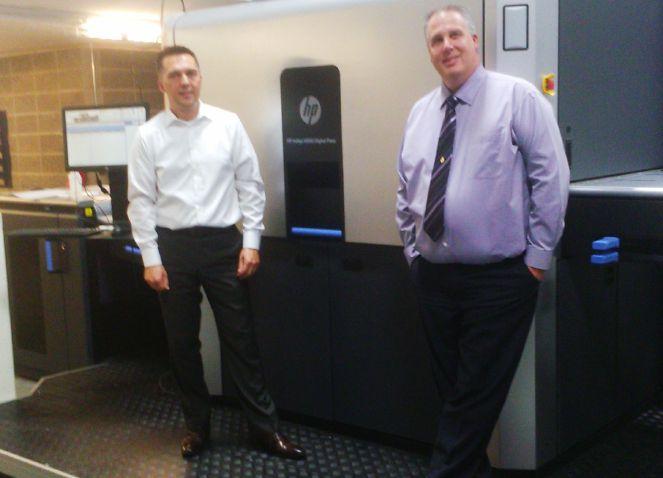
apache superior printing ltd. of Calgary, Alta., installs Canada’s second HP Indigo 10000 press, pictured with HP’s Aad Melser (left) and Dave Gordon-Cooper, CEO, Apache Superior Printing. This is the first Indigo 10000 to be installed in Western Canada.
Don Whaley becomes Director of Sales, Xaar Americas, based out of a new office in Texas. He joins Xaar from Piksel Inc., a provider of SaaS-based video platforms, where he was Vice President, Global Channels. Whaley also held a variety of senior sales management, business development and marketing positions with The Wind Group and Kodak. A year ago, Xaar launched its 1002 GS6 print-head (featuring 1,000 nozzles) designed to jet high-opacity white inks, as well as high-viscosity varnishes, which is enabled by Xaar’s patented TF Technology for ink recirculation and the Hybrid Side-Shooter architecture.
seydaco packaging of Mississauga, Ont., led by President David Seychell, purchased an 8-colour KBA Flexotecnica EVO XD press with gearless, sleeved, and central impression flexo printing, as well as double roll stands with auto splicer and a flatbed diecutter.
Maximize Your Possibilities
At the 2015 SGIA Expo in Atlanta — you’ll see all the possibilities and newest equipment, applications and trends for growing your specialty imaging business, including: high-speed roll-to-rolls, flatbeds, hybrids, installation, finishing and so much more.
Extreme Opportunities
Digital Imaging
Screen Printing Digital Signage
Finishing Pad Printing Graphics
Textiles Point of Purchase
Decals Signs
Outdoor Advertising Transit Advertising
Fleet & Vehicle Graphics
Advertising Specialties
Environmental Graphics
Fine Art
Printed
Electronics
Membrane
Switch
x p o . gro
2010
Advertek building new facility
In June of this year, business partners Joe Montalbano and Simon Spina began construction on a new 30,000-squarefoot home in Vaughan, Ont., for their 14-year-old commercial printing company, Advertek. The plant is being customized to fulfill their printing vision, which includes doubling Advertek’s current annual revenues of $9 million over the next five years. When Montalbano and Spina took over Advertek three years after its 1996 founding, the 8-person shop was running a vintage 4-colour, 25-inch Solna press out of a North York industrial building. The company was turning over about $800,000 in sales every year.
1995
The impact of two major trends identified at drupa 95 are being felt in Canada. Creo Products and Eastman Kodak announced a joint development alliance for thermal plate systems. Creo, which sold the first CTP system in Canada to Scarborough’s Webcom, will now install two 3244 platesetters in Toronto this February, one each with St. Joseph Printing and McLaren, Morris and Todd.
1980
Four-colour inserts to be used in national newspapers in 1981
The Toronto Star, and some papers in the Southam and Thomson chains, will distribute three million “free-standing inserts” on six occasions over a year starting November 19, 1981. A free-standing insert is a four-colour ad section used by packaged goods manufacturers. McIntyre and Dodd will organize, print and prepare the sections.
Inserts are a major force in U.S. marketing, representing 14 percent of coupons distributed, appearing up to 40 times a year and growing very quickly. Direct mail will account for about 30 percent of the coupons distributed in 1980 and 40 percent of redemptions, but “the market has topped out.” Total coupons distributed increased to 1.5 billion last year from 520 million in 1972. Of all insert coupons that are redeemed, 71 percent are redeemed in the first six months after distribution, compared with 45 percent for direct mail coupons.
1985
Changes in Copyright Act to have devastating effects on printing industry
Pitfalls in proposed changes to the Copyright Act that would have devastating effects in the printing industry were pointed out at a special hearing held in Toronto, June 10. Douglas Scott, Chairman of the Board of Graphic Arts Industries Association, who is also President of Southam Printing Ltd., told reform subcommittee members that a proposal to put the responsibility on the printer for determining the copyright status of submitted material would create an impossible situation.
He points out that even the smallest companies in the graphic arts industries in Canada manufacture literally dozens of different printing jobs every week. It would not be possible for the printer, prior to typesetting work, to determine that every piece of material was original and not taken from copyrighted sources. “Really it is the responsibility of the person who ultimately supplied the printer with the raw text.” Scott also cautioned the subcommittee against adopting a proposal that would do away with the concept of Innocent Infringement whereby a printer under the current legislation is assumed to be innocent of copyright infringement if he prints material supplied to him by a client.
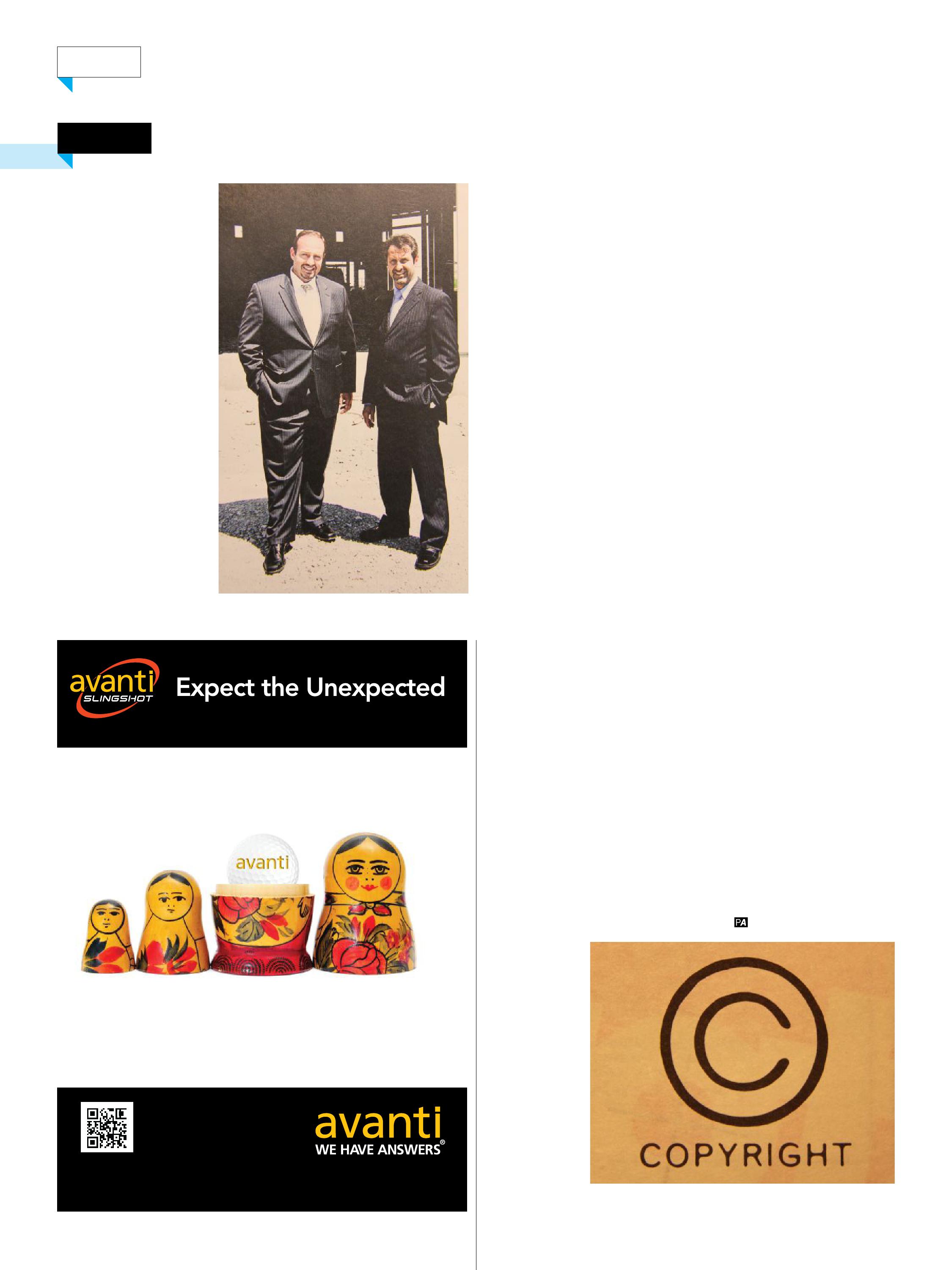
Advertek partners Joe montalbano (left) and Simon Spina.
Copyright reform also looked at the impunity with which copyright material can be placed onto a computer.
The discovery of offset
How offset sprung to life amid printing syndicates and press innovation
By Nick Howard
a
s if a floodgate opened, 111 years ago the offset process was born. Perhaps that’s not completely correct.
Planographic printing from a stone was an already mature industry for metal decorating, maps and posters. Metal decorating refers to an image printed onto a sheet of steel. Variants of this process also included the printing of gelatinous transfer materials used as decals for products that were not flat. Stone printing was invented or discovered by Alois Senefelder, a German, in 1796. Crude as it was the possibilities of using limestone as the “plate” excited a lot of people. Doing the work, however, was difficult and lithography remained a very limited pastime until 1875.
In 1904, Ira Rubel of Tenafly, New Jersey, ran a small print shop and discovered a missing sheet while his zinc press was on impression. Zinc printing process technology used a plate (Zinc or possibly aluminum) with an image that was transferred directly onto paper. Rubel noticed the “wrong reading” image transferred to the subsequent sheet, was much sharper that directly from his plate – Eureka! Why had no one seen such an obvious thing before? It’s said that about the same year The Harris Brothers of Niles, Ohio, who had already revolutionized the letterpress world with a 15,000-per-hour machine called the E 1, came upon the same discovery.
Rubel then partnered with another man, Ike Sherwood, forming what was called the Sherbel Syndicate to make and sell his press. One went to Chicago and one to the J.C. Hall Co. in San Francisco just after the 1906 earthquake. Price of this press: $11,000. The others stayed in the east and the syndicate only allowed a few chosen printers the chance to own one. The idea of controlling a new technology proved to be a big mistake. This particularly riled Charles Goes of Chicago’s Goes Lithographing as he was locked out by the syndicate and he so desperately wanted in. Goes, which continues to this day, was a major producer of stock certificates and posters. All printed lithographically and with a stone. Goes knew
the magic and possibilities of offset, how it worked and the fantastic advantages to his company.
The Sherbel Syndicate was already falling apart two years later when Rubel left for England. There he contracted Bentley & Jackson Engineers to fabricate his design. But death soon followed in 1906 as did the demise of The Sherbel Syndicate. George Mann Engineers in Leeds got a hold of some of Rubel’s print samples that were left at De La Rue & Sons which spawned the British entry into offset in 1906. Restricted trade practices, hidden deals and lots of deceit were the unfortunate consequences of the earliest days of offset. The Premier-Potter Printing Press Co, later to be acquired by Harris in 1927, made all but one of Rubel’s machines and continued on their own after the collapse of Sherbel and death of Rubel. Kellogg was the other builder who like Potter started with Rubel’s crude press design.
The real winner was the Harris Automatic Press Co. Charles Goes was so upset he caught the ear of Charles Harris. Now it should be said that Alfred Harris had come about the same epiphany much earlier. In fact, in 1898 at the offices of the Enterprise Printing Co. in Cleveland. While installing an E1 press Alfred is said to have heard foul language coming from a pressman and directed at a girl who had missed feeding a sheet. Wondering what the commotion was about Alfred came upon the same deduction as Rubel did years later. But Harris never acted upon it. Charlie Goes provided the fuel. He knew exactly what he wanted: a rotary press with three cylinders using a rubber
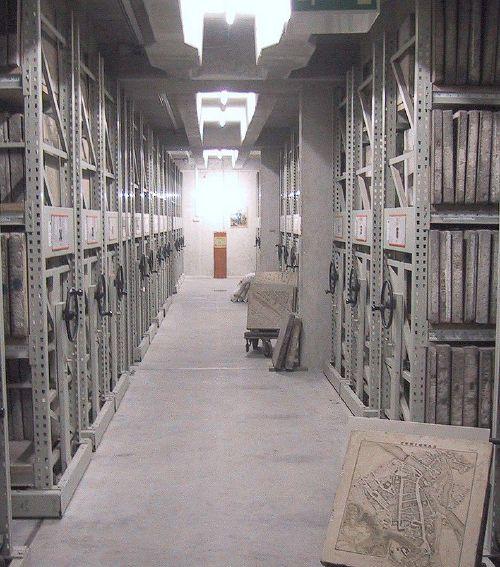
Archive of the Landesamt für Vermessung und Geoinformation in munich, Germany, containing a couple of hundred tons of stone lithography plates, including a map of Bavaria in the foreground.
(Photo by Chris73, Wikimedia Commons).
blanket and a zinc plate. Harris struggled and tried to sell Goes a curved stone press, by Charlie said no, it wasn’t going to work. So Harris took a model S4 letterpress (22 x 30 inches) added a cylinder, modified it and came up with their first offset press! This press designated the S4-L was sold in 1906 to Republic Bank Note in Pittsburgh and now resides at the Smithsonian Museum. Goes received the next presses (possibly two) of the earliest design.
A string of presses followed and placed Harris as the undisputed leader in offset. Printers from far and wide started reading about this amazing new technology that used a zinc plate, rubber blanket and impression cylinder. No type, no forms, faster speeds!
Things got tougher, on two fronts. Firstly, the industry long known for conservative thinking, rebuffed offset as trash printing. Huge armies of letterpress suppliers ganged up on the fledgling offset makers to disprove the technology. Secondly, the early days of lithographic printing was horrible. Heavy zinc plates, big investments in ancillary machinery such as plate grainers, whirlers, cameras, chemicals, and expensive pressroom supplies were squeezing the most progressive offset printer.
Even the Miehle Printing Press Company (the leader in letterpress machines) wanted no part of offset. It was not until 1922 that Miehle finally built one. Harris became not only a trailblazing offset pioneer but also provided substantial money to advertise what offset could do.
Major segments of the letterpress era started to disappear by the 1960s as more printers sought out the benefits of the offset process. One should remember that prior to phototypesetting, copy was actually letterpress proofed and then shot on a camera.With constant new technologies in the prepress segment, electronics provided the final nail in letterpress’s coffin.
The year one of North America’s first web offset presses was installed at Federated Press in Montreal.
As we all know, however, offset’s early days meant incredible skills of the operator dealing with new problems such as paper stretch, static electricity, constant re-packing of “hard” blankets and the still mysterious concept of using water and ink at the same time. This created new divisions within the printing community. There surfaced the “fine lithographers,” those pushing the envelope on quality, and the rest who struggled with even rudimentary techniques such as duotones and pleasing colour.
niCK HoWarD, a partner in Howard Graphic Equipment and Howard Iron Works, is a printing historian, consultant and Certified Appraiser of capital equipment.
nick@howardgraphicequipment.com
GraphExpo.com
SEPT. 13-16, 2015
McCormick Place | Chicago, IL | USA
meet the Production and Profitability experts — 500+ exhibitors
network with peers in focused co-located industry events
engage in hot new seminars to gain immediate “take-home” expertise
learn multi-channel success strategies in the PRINTERVERSE Theater discover new ways for your company to Adapt, Expand and GROW!
Why specifications are vital
in
today’s printing arena, understanding colour is crucial for business success
By Angus Pady
there are a myriad of questions knowledgeable brand owners may start asking their printer about colour: Can you show me how closely you are to hitting a print specification? Can you generate a report from the most recent print run to validate how accurately you matched my brand colour? How do you calculate dry back of the inks? Are you visually matching Pantone colours or can you verify the match colourimetrically? Can you match my brand colour within 3 Delta e? Can you match between your digital and offset presses?
Currently, Microsoft requires its print providers to be G7 certified. Coca-Cola requires its print providers to adhere to a specific colour tolerance when matching Coke Red and requires the print providers purchase specific software to validate the colour. HH Global requires printers to purchase specific software and to measure a colour bar every 500 sheets and send that to a cloud-based server to validate the colour.
Brand owners have always wanted their colours to match but in the past the tools did not exist to make this an easy task. Two things have happened that are making this shift easier for brand owners and for printers. First, data can now be stored on a cloud-based solution that can be shared and accessed from multiple locations/plants and measurement devices are becoming significantly more affordable. Let’s break down the pieces into the parts we deal with everyday.
During the course of setting up your shop to ISO, GRACoL or SWOP a critical part of the process involves inks. During this process you will be looking at the solid ink densities and the two colour traps to ensure they are within spec. Your ink target should be ISO 2846-1. Ask your ink vendor if they are ISO 2846-1 compliant. A full list of compliant ink vendors can be found at printing.org/iso2846inks. One of the challenges when measuring ink is that a densitometer can only see ink film thickness and not colour. But your inks needs to be a specific L*a.b. colour to match the specification. In this case you need to find a way to analyze your
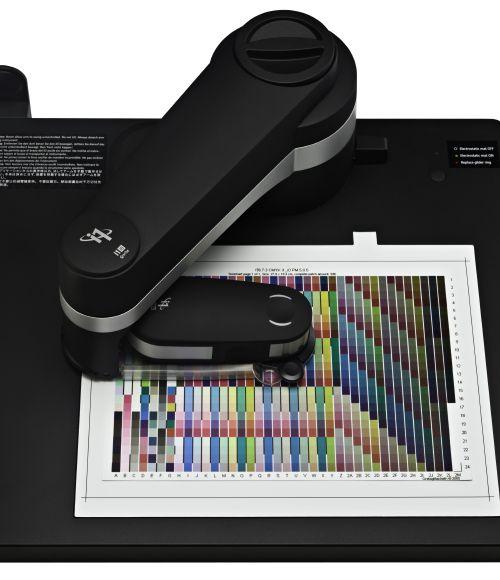
X-Rite’s i1 Basic Pro 2 is one of the best tools to analyze inks colorimetrically.
inks colorimetrically. To do this you need a spectrophotometer and specific software. One of the best tools I have come across is the i1 Basic Pro 2 and software called SpotOn! ANALYZE. This package can quickly identify inks that are not in conformance and you don’t need to be an engineer or press expert to understand the charts.
Tone Value Increase: TVI, or what was called dot gain, is one of the most important variables and in offset printing but also one of the more time consuming steps to change. Because of this I find that shops are not updating their curves to reflect changes in equipment aging or upgrades. Again, SpotOn! ANALYZE can tell you how your curves are performing and if they are within spec to a standard with a quick colour bar scan with the i1 device. Speaking of devices what measurement condition are you using?
Measurement and the M factor
From a purely technical point of view, the MO legacy mode is an obsolete measurement mode that was created because there are many different sources used in older instruments and they were not characterized for their UV output. Historically instruments used in the graphic arts industry did not use a light source with a defined and/or stable UV content. Described in non-tech-speak, these older instruments (and probably what you are using now) could not necessarily measure and detect the UV content in the same way between instruments.
This is why the standard says “if you are exchanging data with M0 devices they
need to be the same model.” More and more papers used today have UV/fluorescence content. This is due to optical brighteners that are used in many papers. But this blue component is not visibly excited by UV light and cannot be properly measured or qualified when using the M0 Measurement mode. Bottom line is that M0 devices can continued to be used for basic QA uses but new papers and print standards require new instrumentation.
Measurement illumination condition
M1 was defined to reduce variations in measurement results between instruments due to when fluorescence, either by optical brighteners in paper or fluorescence of the imaging colorants or proofing colorants is part of the equation. This mode is further broken down into two parts, including Part 1, which covers both ink and papers with OBAs and that fluoresce, and Part 2, which covers only papers with OBAs and that fluoresce only.
The measurement mode M2 was created in order to reflect mimic conditions that are free of any UV excitation such as in a media for museum prints or where the fluorescence may be a desirable property but interferes with proper characterization like photographic prints. Thus it is often referred to as “UV-Cut.” In the past spectrophotometers equipped were called UV cut and came equipped with a filter to ignore the effect of optical brighteners. It was thought this would make the calculation of ICC profiles easier as UV-introduced metamerism did not effect measurements.
Used to remove or minimize first surface reflections by adding polarization, the M3 mode is used in some workflows to minimize the effect of dry back on measurement results. Not used in current specifications but can be used on very reflective or shinny inks. M3 is considered a special use case from the perspective of most standards, though is used commonly in some workflows.
The key here is if you are going to transfer measurement data from one location to another you must be aware of any print requirements decided and use the same measurement condition. M0 is the current industry de facto standard because your legacy devices used this mode, but all new print specifications either require or prefer M1 data.
What standards to use
If can be daunting and difficult to assess what standards to use, but there are some recommendations for deciding where to commit your resources. If you are printing to an IOS standard or industry Specification (i.e. ISO 12647-2, FOGRA 39, GRACoL 2013) follow the guidelines set up by that standard or specification. If you do not know, remember that
IG Go
KBA Rapida 130a
8 Colour Perfecter (4/4)
38” x 51” Max Sheet Size
12,000 Sheets Per Hour
ACR Auto Register Control Grafech E-Cut Roll to Sheet
Ricoh Pro c7110X
5 Colour (Varnish & White)
13” x 27” Max Sheet Size
90 Pages Per Minute
350 GSM Max Thickness
EQUIPMENT FOR TODAY’S PRINTING
At PointOne there are no sacrifices for quality. We offer trade competitive prices without going over your budget, while still keeping the environment in mind. We have leading edge technology to keep our cost and our quality in line. Come in and work with us to make your print job a work of art.
2007 MAN Roland Rotoman
5 printing units with remoistenable gluer, pattern perf, spine paster, inline folding and sheeting capabilities. Computer Assisted Colour and Register System
2014 Heidelberg XL 106
8 Colour perfecter w/Aquaous Coater 29.5”x 41.7”with roll to sheet, 15,000 Sheets Per Hour
2014 Heidelberg XL 106
8 Colour perfecter 29.5”x 41.7”with roll to sheet, InPress auto colour and registaion system, 18,000 Sheets Per Hour
2010 Heidelberg XL 105
6 Colour w/Aquaous Coater 29.5”x 41.7”with roll to sheet, Up to 40pt sheet thickness 18,000 Sheets Per Hour
2007 Heidelberg SM 52
4 Color perfecter 14”x 20” 13,000 Sheets Per Hour
2012 Heidelberg ST 450
8 Pockets + 2 Cover Feeders + Tip Gluer In + Blow In 13,000 Books Per Hour One Up
8 Amrys Pockets w/6 Stream Feeders + Cover Feeder 14,000 Books Per Hour One Up
2013 Ricoh 901s w/E81 Fiery RIP
2014 Ricoh 901s Plus w/E82 Fiery RIP
COMING SOON
2015 Heidelberg TH94
TH Folding Machine with Twin-lay attachment 38”x 52”delivers top productivity and flexibility in professional folding
Ricoh Pro c7110X
Five Colour Printing with perfect binding Produces up to 90 color pages per minute
KBA Rapida 130a
12,000 Sheets Per Hour
8 Colour perfecter 38”x 51”with roll to sheet
Full Colour with saddle stitching and perfect binding, 3 side trimming, scoring and folding 90 pages per minute flat sheets
GRACoL Certified Colour
historically M0 is the default condition but may result in a mismatch between proof and print if you are using brightened printing papers. Unless all members of your workflow can measure and so support the use of M1 you should continue to use M0.You may avoid issues by using non-brightened stock or by compensating for brighteners by using UV filtered measurements. Whenever you are exchanging data, make sure to indicate what measurement mode you used.
Current GRACoL characterization data (2013) is based on M01 measurements. For use matching GRACoL 2013 characterization data we recommend that you use M1 data at this time. If you have all M0 devices continue to use the GRACoL 2006 data set.
If a vendor or workflow has developed a GRACoL compliant workflow using M1 data you may choose to use M1.If you are trying to create a GRACoL paper relative calibration on a brightened stock you may need to use M1. (Be aware the visual match with non-brightened substrates may vary in non-controlled lighting.)
In terms of lighting conditions, it is critical that your lighting adhere to the standards and this is especially important if your papers or inks fluoresce and have optical brighteners. Are your lights at the press console and on your viewing booth still the original bulbs or worse have they been replaced with standard florescent bulbs? In many of the shops I go into the press console is using standard office lights. Lighting plays a huge role in how we perceive colour. I’ve seen shifts in colour as high as 15 percent when a proof is viewed in the incorrect lighting. Check your bulbs and call GTI or Just and get new ones if they are out of date or not the correct bulbs.
G7 is a method of calibrating a press that targets the reproduction to a grey balanced state. This concept is not new and was what I used back in the days of drum scanning. If an image is neutral then chances are the other colour parts of the image will fall in line. Other criteria also need to be met such as paper colour and specific Lab values for the CMYK and RGB colours.
I like the concept of G7 but I find the implementation to be somewhat complicated. The other issue I have is that to be a G7 Master facility simply means you were able to get three sheets to pass the criteria. This is not an indication of how you print a
production job that only allows for 500 sheets of make ready. I have certified a lot of printers and it usually takes a lot more than 500 sheets to get the golden sheets needed to send in for certification. But when properly implemented and the process is well monitored, this system is valid.
Another key standards issue to resolve comes when evaluating the approach of G7 Master Printer versus GRACoL or G7 Certified, particularly because it is critical to first realize if you are using the correct terminology. Note that there is no such thing as a ‘G7 Certified’ or ‘GRACoL Certified’ printer. The printers receive a certificate qualifying their facility as a G7 Master facility.
GRACoL 7 is the current version of the GRACoL Publication created on 2007. The GRACoL 6 Guidelines was previously published in 2002. GRACoL 7 is not referencing G7, which I know is confusing – but is not related. The 7 refers to the version of the publication.
The International Standards Organization (ISO) national bodies works to create international standards. The standard that is most useful for this discussion is the 12647-2 for Separation, Proof and Print in offset printing. This specification is the collective initiative of FOGRA, bvdm supported by Adobe and many proofing vendors.
Ultimately the goal standards implementation is reaching an efficient quality control approach for print. Specifications and standards are useless if you do not continue to measure and validate that you have not drifted from your baseline. I am a huge advocate for collecting data and learning where things go astray and the best way to do this is to install a scanning system on your press and software that will continually collect data about the press runs. From this data you can easily show your customers that yes you did match their brand colour, you did match the print specification X and here is a report to prove it. Offering that information to your clients is a huge value-add.
anGUs paDY is President of ColourManagement.ca of Toronto, providing products and technical support. Angus@ ColourManagement.ca
RS SuperiorSuperior Binder y Ser vices Inc.
Your Superior choice for Print Finishing and Lettershop Ser vices
Heavy boards, plastics, laminations or digitally printed works up to 30 pt can now die crease, fold and even glue in-line.
1. ONE-STOP SHOP — Die Cutting, Bindery, Data & Lettershop.
2. SUPERIOR TECHNOLOGY — Die crease without a die, then fold and even glue all on the same machine, up to 30 pt.
3. INTEGRATED MODULAR UNITS — Combined in-line finishing: crease, fold, glue, tipping, envelope inserting, ink jetting (Duplex), clip seal (3 sides), mail prep.
4. SAVE ON POSTAGE COSTS As a Certified Canada Post Direct Marketing Specialist, we get contract pricing reductions.
5. RETURN MAIL PRODUCTS — Customized “Return Mailers” created in-line with “U” or “BOX-shape” remoistenable glue, time perfed applications and envelope formation.
6. MINI-BOOKLETS — Saddle-stitch and trim 2-up booklets in-line to the size of a business card. No need to trim off-line, or do 2 passes.
7. HIGH SPEED EQUIPMENT — High speed Tipping, Folding, Saddle-stitching and soft folding ensuring on time delivery.
Creative Cloud Watershed
Taking Adobe’s new creative cloud 2015 for a test drive to see if it finally brings excitement back for prepress operators
By Zac Bolan
Adobe recently launched Creative Cloud 2015 with much fanfare,claiming it represents a “milestone” in the development of its expansive suite of tools and services. To
me, a milestone should mark a significant change or stage in software development. I have to admit being more than a little skeptical after the 2012 Creative Cloud launch and subsequent lackluster iterations.
After all, Adobe and I go way back – it was 1992 when I first worked with Adobe Photoshop v2.0 on a Mac Quadra 700. I was sitting in a room with the ‘colour guy’ at my local colour separation house and he was running a fancy high-end image editor the size of a grand piano, and priced
about the same. He gloated as he dragged a clipping path around an image while I sat in a dark corner and mimicked his every move in Photoshop. I knew then that Adobe was on to something.
As the years progressed, Adobe’s disparate applications melded into the powerful Creative Suite that redefined and dominated the graphic arts industry. When Adobe moved from the 18-24 month perpetual license upgrade cycle to its current subscription based Creative Cloud, I was certain this would culminate in the death of innovation. After all, steady money can make a developer lazy, right? And although Adobe has made modest improvements to the Creative Cloud on an annual basis as promised, many in the design and print world felt overlooked –CC 2014 just didn’t sizzle for many users. Fortunately, it looks like Creative Cloud 2015 is bringing the sizzle back!
Adobe celebrated the 25th anniversary of Photoshop this year, bringing back memories of the iconic image John Knoll took of his girlfriend (now wife) on a secluded beach in 1987. Jennifer in Paradise was the first colour test image for a piece of software being developed by his brother, Thomas Knoll, that would become Adobe Photoshop.
WhAT’s neW in CreATive Cloud 2015?
More significant than any individual feature upgrade in CC 2015, the introduction of CreativeSync has the potential to streamline the way creative, premedia and prepress users work, whether solo or collaborating. Simply put, CreativeSync allows users to organize and synchronize all their creative assets across the full range of CC 2015 desktop, mobile and web apps.
CreativeSync isn’t a new CC app, but rather an enabling technology that affects virtually every aspect of CC 2015. Thanks
Photoshop made out like a bandit with some major enhancements.
members can update it within their Photoshop, Illustrator or InDesign projects. Entire CC Libraries or individual assets can be shared to suit various collaborative environments whether users are sitting in the same room or on different
always gets my first click after a CC upgrade! When compared to the modest feature bumps made across the rest of CC 2015, Photoshop made out like a bandit with some major enhancements. Let’s start with Artboards: A feature
When every impression counts, you can count on Ricoh.
Invigorate your print operations with Ricoh’s ultra-reliable production printing systems and market leading service & support. Our cutting edge technology delivers outstanding colour consistency, quality and speed so you can handle the big jobs and quick turnarounds with precision. And with a wide range of size, media as well as our market leading service and support team, Ricoh has the machine you need to meet your printing demands – and grow your business.
For more information, talk to a Ricoh printing systems representative today. Expand your production printing horizons.
ricoh.ca/production
Each Artboard can have its own unique layers and effects while allowing the user to change the size and orientation of the Artboard by dragging handles or adjusting the Artboard properties. Users can quickly export individual Artboards or multiple Artboards to different formats simultaneously. For example, you might want to export Artboard 1 as a JPEG file, Artboard 2 as a PNG and so on. PS 2015 can also export multiple Artboards as a multi-page PDF file with each Artboard on an individual page – useful for peer review of several images. Prepress users might benefit from opening multiple images on unique Artboards within a single PS document then colour correcting them individually, or in groups while seeing all the images concurrently for better consistency.
And while we’re on the topic of exporting images, PS 2015 features a new Quick Export function available through the Layer menu or simple key command. Out of the box, Quick Export produces a PNG file, but users can choose from a variety of export formats including JPEG and SVG to set as the Quick Export default. This can be a real time saver when working with and exporting multiple Artboards or Layers.
Other less dramatic tweaks to PS 2015 will appeal to artists and photographers wanting to bring a more realistic look to their images. While intriguing to work with, Blur Gallery effects can sometimes look a little synthetic once applied. PS 2015 introduces the ability to add monochromatic or colour noise to any effect, simulating grain that can make a rendered image less jarring to the natural eye.
Designers will enjoy being able to apply multiple instances of some effects in the Layer Style dialogue to a single layer. Have you ever wanted your Drop Shadow to be more shadowy? Well, now you can make it shadowy-y-y-y – up to 10 instances. Effects that can be multiplied are identified with a small + icon beside the name in the Effect menu.
And not to be overlooked, some commonly used Photoshop tools gain a significant performance boost from Adobe’s Mercury Graphics Engine (a technology that leverages the power of your computer’s graphics card), first introduced in Photoshop CS6. The Patch Tool, Healing Brush and Spot Healing Brush yield results up to 120 times faster than CS6 according to Adobe. I don’t know about the numbers, but these tools certainly feel faster running on my aging 2012 MacBook Air. Additionally, a few noteworthy improvements have been made for Camera Raw users including a nice de-haze filter and the ability to produce both Panoramic and HDR images in Raw mode. The addition of automated Content Aware Fill to Panoramic images is another thoughtful touch.
indesign & illusTrATor MAinTAin sTATus quo (More quiCkly)
Though Photoshop brings the lion’s share of new features to CC 2015, both InDesign and Illustrator have been fine-tuned to enhance the user experience. Both benefit from support for the Mercury Graphics Engine which translates to greatly improved operating speed and screen redraw – especially noticeable when zooming or scrolling through complex documents or refreshing thumbnails. Adobe claims up to 10x performance and my initial impressions leave little doubt.
Although InDesign 2014 already included practically everything a print designer might want, Adobe has managed to squeak in a few more useful
The Graphical user Interface of Adobe’s Photoshop Artboards tool.
features into CC 2015 such as paragraph shading – the ability to add a colour block to a paragraph that flows with the text; and the ability to place images in table cells which could be very useful for catalogue work. Also the PDF export dialogue has a full range of view and layout options that can be applied with writing a PDF file. Illustrator gets a few minor feature enhancements as well, such as: improved Curvature and Pen Tools with independent parameters and more path options; free-form mode for the Shape Builder Tool; and Pencil Tool improvements. Perhaps the most significant new Illustrator features are ones I had already assumed were there – Safe Mode and Data Recovery. Safe Mode will let you open a ‘bad’ Illustrator file without crashing the application, then diagnose and repair the problem. As for Data Recovery, everyone’s spent hours on a file, forgotten to save, then crashed – am I right? Illustrator 2015 now offers the ability to restore that file when restarting, just like Microsoft Word!
CreATive Cloud on The go
Since moving to the Creative Cloud, Adobe demonstrated its commitment to mobile users through the aggressive development of a wide range of iOS companion Apps. Over time Adobe’s stable has grown to more than a dozen Apps including: Shape CC; Photoshop Mix; Brush CC; and Color CC. With CC 2015 Adobe is now showing Android users some love with versions of the aforementioned now available in the Google Play Store.
noT every CreATive Cloud hAs A silver lining
While there is certainly a great deal to like about Creative Cloud 2015, there are few things users might want to be wary of. For example, the update process removes older CC versions by default, so be sure to uncheck “remove old versions” when installing CC 2015 if you need to keep your workflow backwards compatible. You’ll be glad you did especially when you learn that the InDesign file format has changed again between CC 2014 and CC 2015.
When opening an InDesign CC 2014 file in the latest version, no warning is given – instead users are forced to Save As, then choose from CC 2015 document/template or IDML file. This could be problematic when returning post-production files to clients. For that reason, most premedia and prepress users might want to work on a customer’s file in the version of InDesign it was created in whenever possible.
I’ve experienced a minor problem with the Creative Cloud desktop app, which launches when starting your computer and runs in the background continuously. This app is used to manage Creative Cloud installation, updates, assets and Adobe Stock as well as access the Adobe community. I run Creative Cloud on a laptop – which means I’m mobile, and not always connected to the Internet when using CC apps.
Often when booting my Macbook away from the office, Adobe pesters me to log into the Creative Cloud, not recognizing that I was logged into CC the last time I was online. When the Creative Cloud rental model was introduced back in 2012 Adobe placated mobile users by assuring us that our CC apps only needed to check in with the mothership once a month! Being pestered to log into CC when I boot my Macbook Air in Starbucks is very annoying!
This leads to the greater concern of deeply embedding your workflow in the cloud through the use of shared Libraries, Linked Assets, Adobe Typekit fonts and Adobe Stock images – what happens when there is no cloud? Will I still be able to get my work done? Give me a standalone workflow with optional cloud access any day. However, aside from the occasional nagging to ‘log in’, to Adobe’s credit I’ve enjoyed a fairly smooth ride in the Creative Cloud thus far. As Bruce Springsteen once wrote in Straight time, “You get used to anything, sooner or later it just becomes your life.”
I’ve never been a fan of software-as-a-service, but I have to admit I’m getting used to working in the Creative Cloud. Adobe got off to a slow start innovation-wise with CC 2014, but the latest iteration of the Creative Cloud has made up for lost time. Also, CC 2015 includes some impressive technology previews of features coming in future versions, so it looks like innovation is here to stay.
Don’t get me wrong, I’d still prefer to own my software – but the generous Mercury speed boost across the suite combined with workflow and collaborative benefits gained from the robust implementation of CreativeSync and CC Libraries could be just enough to finally turn the heads of CS6 holdouts. You might even want to call Creative Cloud 2015 a watershed moment.
alWays in beta
After 15 years of managing data, prime data moves deeper into full marketing automation by leveraging print with one of the world’s first canadian-built delphax Elan inkjet presses
By Jon Robinson
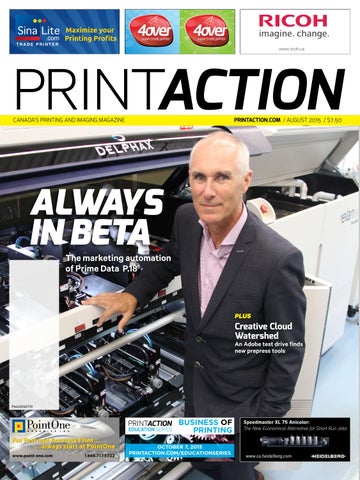
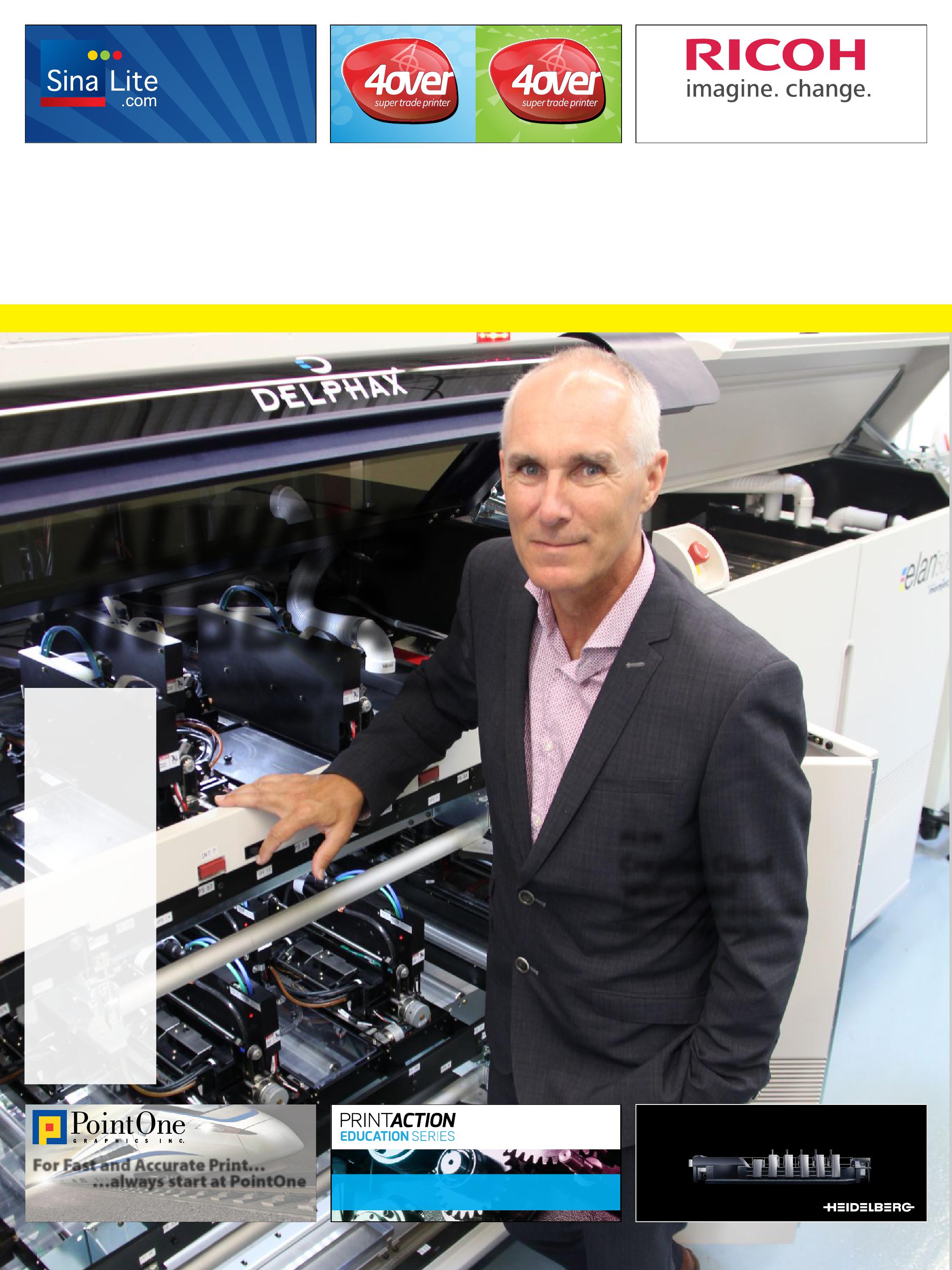
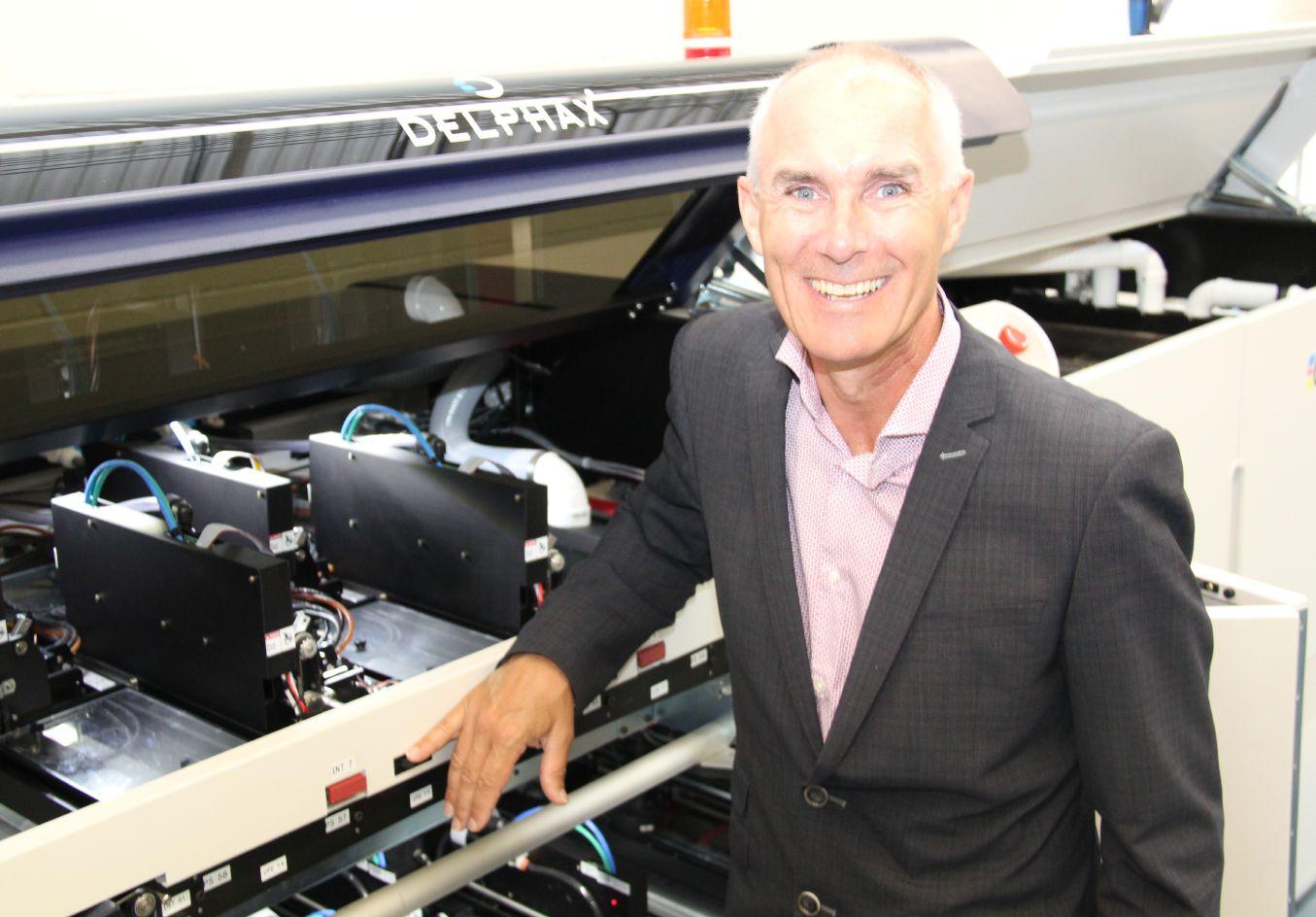
in early 2015, Prime Data of Aurora, Ont., became the third company in North America to install a Delphax Technologies Elan 500 press, built in nearby Mississauga using a sheetfed inkjet architecture with Memjet Waterfall print heads and a transparent Mylar substrate transport system.
Supplying data-driven marketing services for more than 15 years, Prime Data’s initial goal with the Delphax system was to reduce inefficiencies associated with printing offset shells for post variable imaging
Prime Data’s Elan 500 installation is unique because it is producing variable colour marketing materials, whereas the other two Elan systems are primarily printing monochrome collection notices (California) and government forms (Quebec). With its world-first printing position, Prime Data has been trans-
forming itself to operate more like a tech startup to mirror a growing shift toward marketing automation.
“We have a mantra around here, everything is always in beta… to have a tech startup mentality and keep that in the place to make everyone feel comfortable with change,” says Steve Falk, owner and President of Prime Data.
Over the past couple of years, Falk has instituted several initiatives to embrace print, which currently accounts for approximately 30 percent of his company’s revenues. These strategies range from investing tens of thousands of dollars in security measures to new CSR tools and from cross-media consulting to variable full colour printing with sheefed inkjet.
inkjeT
innovATion
The Memjet print heads employed by the Elan have 70,400 jets that fire up to
Steve Falk, President of Prime Data, with the Delphax Elan 500.
Looking good on paper matters. ColorLok® Technology gives paper more vivid colors, bolder blacks, and faster drying times.* Learn more at colorlok.com
700-million drops of ink per second, hitting resolutions of up to 1,600 dpi, on a range of coated and uncoated substrates with weights from 60 to 350 gsm and format sizes from 8 x 8 to 18 x 25.2 inches. This translates into printing up to 500 A4 images per minute.
“The biggest thing [the Elan] did was simplify the process of doing batch-run direct mail, so we did not have to worry about offset shells… being able to roll it into one process where you go straight to colour imaging at an affordable price,” says Falk. Prime Data continues to leverage both colour and monochrome Konica Minolta systems for shorter-run applications. Falk explains, however, today’s highest-end toner presses produce upwards of 150 colour sheets per minute in simplex mode and are not fast enough for Prime Data’s larger variable runs. It would require multiple million-dollar toner machines to eliminate offset shells.
“There is only one sheetfed inkjet printer right now and it is the Canadian-made Delphax Elan,” says Falk, noting roll-fed inkjet options from companies like Canon Océ
and Ricoh do not fit with his current client base. “For our marketplace, [with a need] to change stocks and sizes several times a day, for the run sizes, sheetfed inkjet is perfect.” Falk explains the Elan produces full variable colour at around the same price as printing offset shells for variable imaging; while also reducing workflow issues by a factor of days. “This business is also big on testing,” he says, which is cost prohibitive when printing offset shells to reach segmentations of 1,000 households.
The ability for Prime Data to leverage data expertise through responsive print helps mitigate the risk of being the world’s first Elan user for variable colour DM. “You should not be looking only at print quality, which is what people once cared about, but you should be focusing on the quality of the print message and how it is responding to [consumers],” Falk says. “The quality of responsiveness to the person you are talking with is what gets you better sales.”
hAndling dATA
Prime Data has developed propri-
etary tables and subroutines for cleaning up client data, sweeping vast fields to find potential VDP campaign disasters. “Data can be a nightmare and it can be a relationship killer if you do it wrong.” Falk estimates Prime Data might spend as much as four times the effort relative to competitors when working with customer information –and charges accordingly.
The data-sensitive marketplace led Falk to make large investments in securing Prime Data’s processes over the past two years. This involves measures like building and testing firewall security, entrance swipe cards, non-disclosure agreements, destroying computer and printer hard drives, and chain-ofcustody procedures for overprint and setup sheets. The growth in marketing automation also relies on securing data transfers with tech-savvy clientele.
“What you want to do if you are a [printer] is think about how you can interact with how your clients are saving their data,” says Falk, “so communications back and forth, grabbing data at certain milestones in its lifetime.” This environment
also pushed Prime Data to establish a CSR-driven customer tracking system to respond to issues immediately, which also helps to drive the company’s always-in-beta mentality. Employees are always improving their internal systems.
Falk feels the new emphasis on online data collection has hurt print, as agencies try to hold on to as much marketing budget as possible, running email and social media campaigns. “Even though this sector has been active for over a decade online, and tried all kinds of things, they can only close 10 percent of their deals online.” He is seeing more interplay of print and online marketing automation.
“For the first time, I had a couple of people come to us and say, ‘ We are missing part of the puzzle and it looks like you guys can help us.You can talk our language, take our digital world and add a print piece to it,’” says Falk, stressing the fit of the Elan press. “We are going to grow with this new piece of equipment. We would like to see two of these in here. With the trajectory we are on right now, we will probably make that happen pretty fast.”
Web-to-print
new online platforms for driving business
oftware developers working within one of printing’s most dynamic sectors provide a glimpse at new product releases or upgrades they have made in the past six months. The push into Internet-driven print continues to bring more robust features for printers to leverage in terms of syncing their workflow to the desktop.
ible with XMPie’s suite of tools for personalization and multichannel communications, and it opens doors to the world of higher-value services, such as creating and managing marketing portals. StoreFlow Cloud allows visitors to upload their documents, or select a template from a catalogue and customize/ personalize it, price the job, and submit it for processing and handling. StoreFlow Cloud leverages Xerox FreeFlow Core technology to streamline and automate prepress functions and other print fulfillment workflows.
eFi digital storeFront version 8
ultimate Printsys
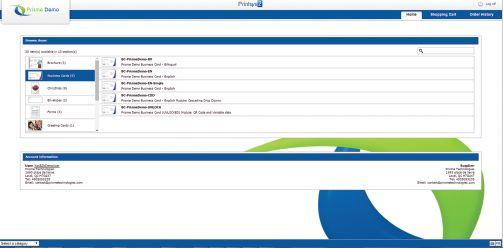
The new Ultimate PrintSys (introduced in July 2015) is based on a technology development partnership between two Montreal companies, Ultimate TechnoGraphics and Prisme Technologies. The companies focused on developing what they refer to as an affordable Compact Workflow solution to automate the process of online orders to finishing.
Ultimate PrintSys provides an online catalogue through a hosted Website and a back-end production system with billing, reporting and tracking of orders. The technology can integrate with accounting software tools like Excel, CSV or XML Export. PrintSys is a based on a PDF workflow with preview for approval, basic job status for production, routing jobs to different Digital Front Ends, and dynamic imposition for press and paper optimization.
XMPie storeFlow Cloud
The new StoreFlow Cloud (released July 2015) from XMPie, a division of Xerox, is subscription-based technology for creating Web-to-print portals. Subscription plans start at $799 per month. The company explains it is designed for needing little or no IT investment, lowering the barriers to entry for deploying Web-toprint. StoreFlow Cloud is fully compat-
EFI’s new Digital StoreFront software (released April 2015) is designed to extend end-to-end workflow management capabilities through the certified integrations of EFI’s Productivity Suite. This upgraded version of EFI’s Web-to-print technology includes new EFI DirectSmile options that extend the types of variable-data and personalized direct mail campaigns corporations can create
With the Web-to-print software’s new Enterprise Model, print providers can subdivide a client’s single Digital StoreFront license into different interfaces to serve different franchises or subsidiaries within the client’s organization. A new marketplace sales tool can incorporate content partners such as copywriters, photographers and graphic designers, in a single online ordering interface.
infigo Catfish Megaedit
Infigo Software, based out of the UK, introduced MegaEdit into the North American market in March 2015. MegaEdit is publishing software designed for printing companies wanting to offer enterprise-level production of photo books and photo gifts. It can be used on its own or in combination with other Catfish Web-to-Print features to have an all-encompassing system for variable data, email marketing and SMS. Catfish provides for business-to-business production as well as consumer–ready ecommerce.
Agfa storefront version 3.0
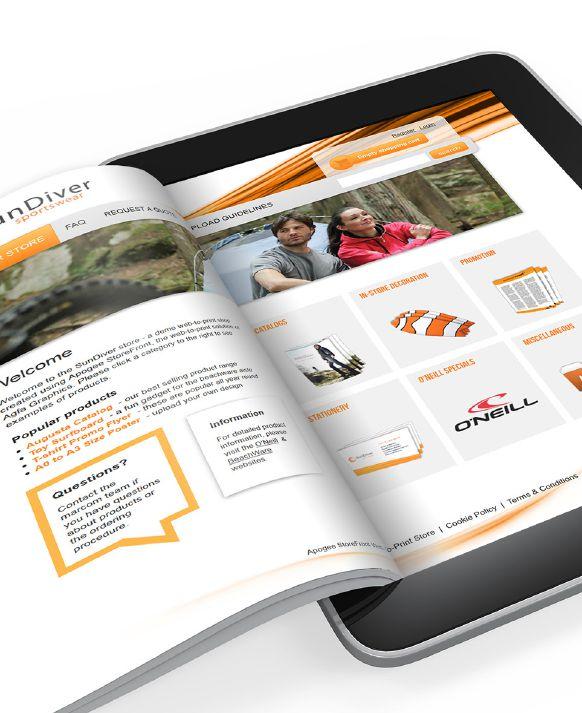
Agfa Graphics updated its Cloud-based Web-to-print Storefront software to Ver sion 3.0 (unveiled July 2015) to focus on providing simpler online creation and management. StoreFront 3.0 is designed for integrating with Apogee (commercial printing (Apogee) and Asanti (display and signage) software.
Agfa’s StoreFront 3.0 integrates with either Apogee or Asanti.
for shop owners to leverage the technology for marketing, providing information to shoppers or promote specific products or services. Agfa explains the HTML5 banners are easy to set up and properly display on mobile devices. The footer function can be used to add contact data or payment and shipping information on store pages.
heidelberg Web-to-Print v.16
Millions of dollars by which research group Global Industry Analysts predicts the Web-to-print market will reach by 2017.
In June, Heidelberg launched version 16 of its Prinect Web-to-Print Manager in European markets, with a North American launch planned for this Fall. It includes more comprehensive user administration with ordering processes, freely definable work steps enable individual customer processes. Documents can be adapted by the customer and extended offering with editable printing templates for business cards or business documents. Prinect Web-to-Print Manager adds another print media industry growth segment to the Prinect print shop workflow - online shop systems. As an integral part of this workflow, it can be used for a whole host of tasks.
Aleyant Pressero version 6
One of the new StoreFront 3.0 features is for the use of animated carousel banners and custom footer function on store pages. This provides the capability
Version 6 of Aleyant Pressero focuses on scalability, responsive design and future proofing. 895
Aleyant has completely redesigned its Web-to-print platform, Pressero, to improve scalability and reliability for what the company defines as both a B2B and B2C solution. It is built as Software-as-aService (SaaS) technology. Pressero Version 6 is scheduled for an August 2015 launch. The company explains it rewrote thousands of lines of code with scalability, ease of distribution and reliability in mind, building on its claim of being one of the first to support responsive design for print buyer-facing B2C and B2B storefronts. Aleyant’s responsive design allows print buyers to use a phone, tablet or desktop to place orders.
ultimate PrintSys’ B2B catalogue interface.
detailing
the
newest printing technologies
from duplo, serif, heidelberg, Flint, Agfa, hP, Xerox, sydney stone, eFi, Mimaki and Color-logic
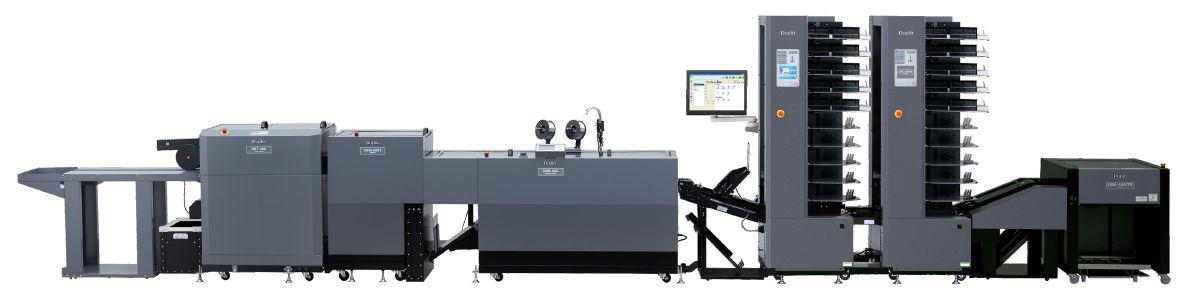
duplo 600i Booklet system
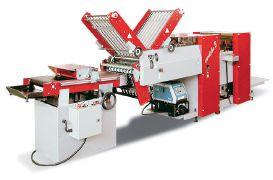
In July, Duplo released the 600i Booklet System as its new high-end collating and booklet-making equipment. The 600i integrates the fully automatic DBM-600 Bookletmaker with high-speed DSC-10/60i suction collators, producing saddle, side, or corner-stitched booklets, as well as letter landscape applications. The 600i Booklet System can produce up to 5,200 booklets per hour or collate up to 10,000 sets per hour into a stacker.
The 600i features the PC Con-
troller software, which enables users to operate the entire system from a PC, for creating and saving a large number of jobs onto the hard drive for faster changeovers. The PC controller software also allows for developing custom feed applications using the standard Intelligent Multi-Bin Feeding (IMBF) feature. Users can also customize the 600i system with a variety of options like the DKT-200 two-knife trimmer and gutter cutter for three-side trimming capabilities and 2-up processing.
serif Affinity Photo
In July, Serif Software, after five years of development, launched its Affinity Photo image-editing application on the Mac App Store. This is the second application in an allnew suite of professional creative software for the Mac being developed by Serif. The first, Affinity Designer, was launched in October last year. Affinity Photo was originally launched as a public beta in February (culminating in over 230,000 downloads), including capabilities such as RAW processing, PSD import and export, 16-bits per channel editing, and ICC colour management.
The release version of the app features a full set of tools for professional processing, including camera lens and exposure corrections, accurate adjustments, live filter layers, controls for channels and masks, advanced layer handling, and builtin frequency separation editing. Serif also promotes its speed, explaining whether working on a 100-megapixel image or a complex composition with thousands of layers, a user can still pan and zoom at 60 fps and see live views of all adjustments, brushes, blend modes and filters with no compromise.
Xerox igen 5
In July, Xerox introduced its new iGen 5 press platform which includes the 150 press (150 ppm), iGen 5 120 press (120 ppm) and iGen 5 90 press (90 ppm). The
company is also introducing a new scalable press architecture, which allows users to upgrade iGen 5 speeds. The iGen 5 150 and EFI Print Server are available immediately worldwide, while the iGen 5 120, iGen 5 90 and FreeFlow Print Server will be available in September. Xerox released U.S. list prices for the machines, including the iGen 5 150 four-colour base configuration starting at $752,000 and the iGen 5 150 five-colour base configuration with a price of $849,000.
The iGen 5 platform provides 2,400 x 2,400-dpi imaging, as well as what the company labels as Object Oriented Halftoning, Xerox Confident Colour and Auto Density Control. For the optional fifth colour unit, providing a larger gamut of Pantone colours or unknown spot colours, orange, green or blue options supplement the standard CMYK model. The iGen 5 line also offers gloss or matte dry ink options and a 26-inch sheet size option to enable applications like six-panel brochures, gatefold pamphlets, pocket folders and direct-mail campaigns.
ricoh Processdirector/ infoPrint Manager
In July, Ricoh introduced enhancements to ProcessDirector and InfoPrint Manager software, which fit into its Critical Communications portfolio. ProcessDirector can now integrate multi-channel capabilities, such as email and electronic presentment, while InfoPrint Manager adds Linux support. ProcessDirector users can send customers all or part of a job’s documents via email. Emailed documents can be set to dynamically pull key information into subject lines, arranging the message in the manner most useful to the reader. Users can set separate versions for different audiences, such as internal help desk and external customers, with different kinds of information available.The system
Duplo’s 600i can produce up to 5,200 booklets per hour.
Affinity Photo is Serif’s second professional imaging app.
utilizes preset AFP forms that are dynamically filled in at time of printing, so users no longer have to store preprinted forms.
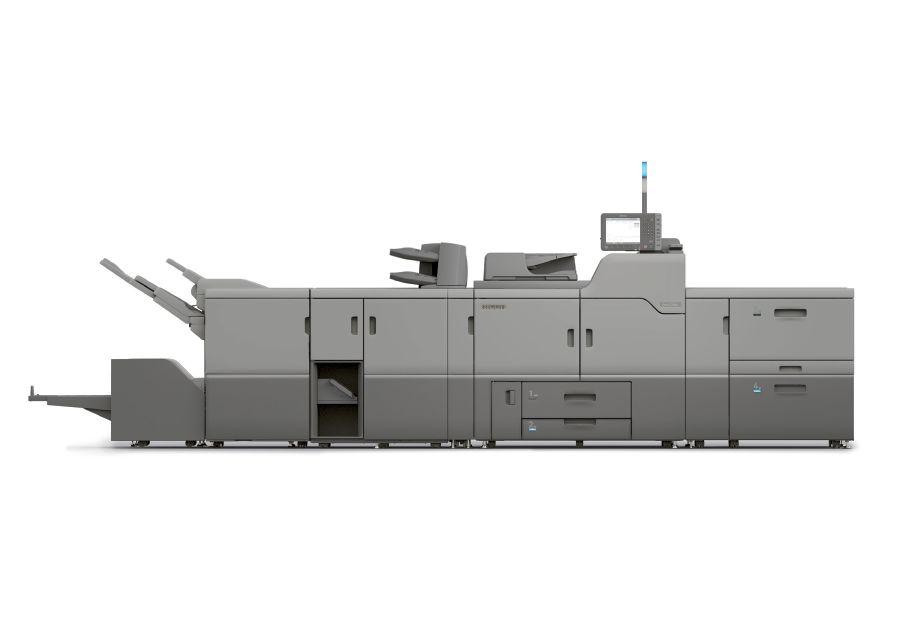
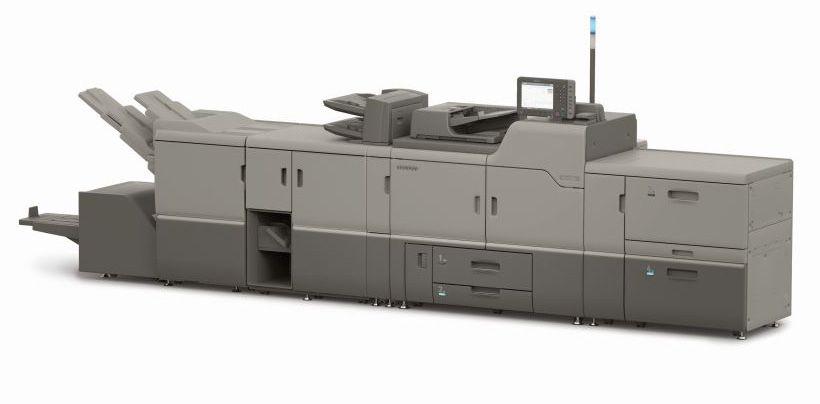
Ricoh, in July, also announced the availability of the Pro C7100 press line, which was unveiled in September 2014. The four-colour Pro C7100, available in both printer/scanner and printer-only configurations, features an AC-transfer system and elastic fusing belt technology to enhance output on heavily textured media like vellum and linen. The press reaches speeds of up to 90 pages per minute, handling a maximum sheet size of 13 x 19.2 inches, with a monthly volume of 240,000 based on A4. Using Ricoh’s new vacuum feed LCT, the press has an option for oversized prints of up to 27.5 inches in length. The press also features a sheet-to-sheet mechanical registration system that squares the sheet prior to imaging, adjustable from the user interface. It also holds a media library that allows users to adjust and associate different parameters per substrate to help ensure IQ and reliability. A self-contained liquid cooling system that keeps the developer at a constant temperature and minimizes disruptions in extended production runs.
heidelberg Prinect image Control
In June, Heidelberg released an updated version of its Prinect Image Control colour measurement system, which provides for the ability to eliminate print control strips and increase material savings. Using CIP4-PPF data, measurement is now possible by using nothing more than full tones and CMYK images on the printed sheet. The Proof Match option in Heidelberg’s updated Prinect Image Control software is designed to optimize the uniformity of repeats on print sheets and matching of proof and print. A new and unique feature, it is now also possible to use digital proofs as colour samples and set up the press
according to the proof’s colour information.The updated version also provides for direct control of opaque white inks on metallic and transparent substrates.
The new software can be retrofitted on all IPEX 2010 generation Prinect Image Control systems, of which more than 2,000 have been installed since the market launch of Prinect Image Control in 1998. Prinect Image Control can be connected to between one and four presses, including all Speedmaster presses in the 52, 74, 75, 102, and 106 series.
Flint PremoCup
In June, Flint Group released PremoCup as its next generation of packaging inks for the North American paper cups market, including polycoated and paperboard substrates. PremoCup, according to Flint, delivers wet and dry rub resistance without affecting print quality, utilizing the company’s building block formulating technology. The ink also holds what Flint describes as a wide operating that reduces the variation in print quality caused by inconsistent coating weights. PremoCup inks can be prepared to match accepted colour standards as a finished ink, or supplied as PremoNova dispersions and extenders for use in an ink dispensing system.
Agfa graphics Arziro
In June, Agfa released its Arziro Design tool for the general security printing market. The plugin for Adobe Illustrator focuses on personalization and anti-counterfeit applications. It builds from the company’s existing Fortuna application for higher end security. Arziro Design, Agfa explains, can create very complex, security patterns in seconds running on a standard Adobe Illustrator CC 2014 system for Mac and Windows.
Arziro Design is suited for applications like packaging and labels, tickets and coupons, tax stamps,
Ricoh’s four-colour Pro C7100 press hits 90 pages per minute.
post stamps, company access cards, bankcards, and general document security such as breeder documents, certificates or diplomas. The software allows for enriching existing creations with security design elements from Arziro or to modify the Arziro creations by altering the pre-defined design parameters in the plug-in.
hP latex 110 Printer
In June, HP introduced the new HP Latex 110 as an entry-level system for large-format printing. The 54-inch printer is designed for low-volume production of indoor and outdoor large-format applications, such as vinyl, stickers, posters, canvas and point-of-purchase signage.
Building from what HP defines as the third generation of Latex technology, the new printer provides up to 1,200 x 1,200 dpi with user-replaceable, 6-colour ink cartridges, as well as intuitive operation without the need for specialized systems knowledge. This includes automatic maintenance, front-loading, online learning tools and software assistance.
sydney stone, Formax ColourMax 7
In July, Sydney Stone began to distribute the Formax ColorMax 7 printer based on Memjet inkjet technology. The system’s Memjet print heads hold 70,400 ink nozzles and no moving parts, which provides high speeds and low ink and maintenance costs, as well as less noise. It is able to print on a range of materials like letterhead, invitations, postage and barcodes, window/non-windowed envelopes and invoices.
Sydney Stone also begins distribution of the recently introduced Formax FC 6204 Series with folding and inserting technology aimed at the office environment.
eFi Fiery Fs200 Pro
In June, EFI launched its newest Fiery digital front end (DFE) for digital printing systems, called Fiery FS200 Pro, which began integration with press partners in Q3. The new DFE platform is powered by EFI’s proprietary ASIC (application specific integrated circuit) with RIPChip technology for fast file processing. Fiery FS200 Pro includes Fiery HyperRIP that can RIP up to four jobs simultaneously. It also features the new Rush RIP mode that opens up a fifth RIP to process rush jobs when all four main parallel processors are busy.
Fiery FS200 Pro also improves colour management with the introduction of a CMYK+ feature set for incorporating expanded gamut imaging, moving beyond standard four-colour process. EFI explains that CMYK+ opens the door to a range of inkjet press technologies that may be capable of incorporating five-, six-, or eight-colour process imaging. EFI has also released
EFI’s Fiery FS200 Pro DFE features four parallel RIPs, plus a fifth Rush RIP to move urgent jobs ahead in the production queue.
colour correction and process control improvements to the Fiery Graphic Arts Package, Premium Edition, including:
New features in Fiery ImageViewer for greater consistency (automated colour adjustment between similar jobs using custom color curves) and a WYSIWYG interface to edit control bars.
Mimaki sb54/sb310 inks
Mimaki released new high-density Sb54 and Sb310 dye sublimation inks for use in the company’s wide-format printers for transfer to textile or hard surface applications. Mimaki explains the Sb54 and Sb310 inks offer higher density printing that produces more vivid colour results than preceding Sb53 and Sb300 inks, respectively. The new inks also provide what the company describes as enhanced resolvability, improving the print production yield with more stable ink jetting. Output consistency is improved, continues Mimaki, minimizing agglutination after fixing to prevent colour migration and lower vapour emissions during the transfer process.
Flint hydrokett Zen
In July, Flint Group launched Hydrokett ZEN in North America. It is a new water-based ink system for paper and film flexographic applications. The company states it developed the inks by using Kaizen concepts, resulting in near-zero maintenance and wide job latitude. It is described as a robust ink with adhesion to many substrates. Available in a 4-colour process set and the full Pantone colour range, Hydrokett ZEN can be provided in a finished ink system or in a blend vehicle for dispensing.
prepress teCHniCian/XeroX operator
We are an expanding company and are looking for a motivated, energetic individual to work in the prepress department.
The candidate we’re looking for must have these qualification(s):
• Mac operation is a must
• Preps imposition software
• Prinergy or apogee
• Xerox digital press operation with finishing
• CTP operation Maintenance
Required experience:
• Mac Operation: 3 years
Email resume to: peterm@barriepress.com
CUstomer serViCe representatiVe
Mississauga printing company located in the area of Southdown Road/Royal Windsor Drive has an upcoming opening for an experienced Customer Service Representative for a 4-month contract starting in 2nd week of September. Salary depends on experience. Applicants must meet the following requirements:
• Ability to communicate well in a fast-paced and creative environment.
• The ability to work well within a team environment.
• Available Monday through Friday, from 8:30 am to 5:00 pm.
• Must be extremely detail oriented, very well organized and able to prioritize tasks.
• Must have a minimum of 2 years office experience, specifically in customer service and/or sales in the quick print industry.
• Must be personable, outgoing and able to respond to customer calls and e-mails in an enthusiastic and professional manner.
• Must have strong communication skills with an emphasis on proper e-mail correspondence.
• Knowledge of Word or MS-Excel would be an asset.
• Experience in the promotional products industry would be an asset. Email resume to: george.stern@minutemanpress.com
DIRECTOR OF OPERATIONS
The Director, Operations, role is ideal for someone who is a strong and developed leader, and has a focus on production improvement, people development, and success. Webcom is looking for someone with 10 years of management/executive level experience in a print production environment. He/she will be accountable to oversee a management team of 5 people while indirectly leading 100+ production employees and supervisors. The Director, Operations reports directly to the President, manages all production operations, and is a key member of the executive team. This person must have a strong “end user” or customer mindset. He/she will ensure the quality delivery of products and services, in a timely and cost efficient manner. Webcom’s Director, Operations must be enthusiastic and have a strong ability to mentor, coach, and develop staff on production processes and best practices.
Required Skills & Experience:
• University Degree in Engineering, Graphic Communications Management, or related field of study
• 10-15 years related print manufacturing and plant management experience
• Depth of knowledge and skill in the print industry including Digital Print, Web Offset, and Bindery
• General exposure to PrePress including, forms design, data processing and programming
Please submit your cover letter and resume to human.resources@webcomlink.com noting the job title. Only those selected for interviews will be contacted.
Heidelberg: K-Line/S-Line/Speedmaster/GTO/MO
Komori: 1, 2, 4 or 5 colours & any size
Adast: 714/715/724/725
Mitsubishi: Any model
Ryobi: 2800CD/3200CD-MCD/640K
Itek: 960/975/985
Hamada: 600/700/800/E47/RS34
Shinohara/Fuji: 66/65 1,2 or 4 colours
Sakurai: 1, 2 or 4 colours and any size (newer model)
Polar: any size/older or newer models (66/72/76/78/82/90/92/107/115)
Horizon-BQ: 220/240/260/440/460
Mark nixon / Vp north america / Scodix / new Jersey and London / Interviewed
by Jon Robinson
When Scodix introduced the printing world to its unique imaging system in 2012, based on applying polymers to printed sheets, its term Digital Enhancement Technology spoke to an industry trying to break free of depressed product pricing.
After taking on the challenge of introducing Scodix systems in the UK, through his distribution company called Conversion, Mark Nixon this June took on an executive roll with Scodix to push its technology, now with more than 200 global installs, into North America. He has extensive litho experience, spending almost a decade with KBA UK, and previously directing sales for both Creo and Scitex in the region. PrintAction spoke with Nixon to better understand the allure of Scodix print enhancement.
How many Scodix machines have you sold in the uK?
MN: Thirteen in about 18 months... the map is there and it is going to continue to grow. Digital is print’s biggest growing sector without doubt, [but] when it comes to finishing there is very little digital out there. How can Scodix move digital print beyond its own commodity trap?
MN: If your quality is the same and you offer the same service, because it is all quick turnaround... suddenly price becomes the top issue because it is the only discernible factor that can differentiate you. What we try to do is give printers technology that is different, so clients say, ‘I want to talk to you. I want you to do special pieces for me.’ Why does Scodix trumpet the term print enhancement?
MN: Scodix is 100 percent into print enhancement. Everything we do from the minute we wake up to the minute we go to sleep is about print enhancement... We are developing new polymers that go into the same machines to give end users more uniqueness. It gives them more relevance and a reason to go back to print. How does the Scodix polymer work?
MN: The key is the polymer. You are imaging the polymer. It is a very timed process. You have to drop the polymer and, like any UV [process], it has to relax just for a fraction of a second to give it that shine And, of course, it cannot be too liquid, because it would just drop completely. The measure of it is in the clarity. It is the sheer clarity of the lens; and we purposely call it a lens because we have some fantastic results on the magnification of colour. Why is the polymer described as a lens?
MN: We have actually done some very interesting lenticular projects as well. This is a super lens. We image very, very cleverly to create some wonderful results on different mediums. We are just at the
beginning of it. The [Scodix] engine is like an iPhone... without the apps it is pretty one-dimensional. The polymer will be the apps. The polymer will unlock many different markets and sectors. How is the technology applied in design?
Number of microns of polymer that can be applied to a substrate, in terms of height, making the Israelibuilt Scodix unique in the imaging world.
MN: The difference is in the fifth layer, the fifth plate, and that is basically a Photoshop or Illustrator drop-down Scodix menu. When you import an image, you can then start to play with what you want the fifth layer to be, whether you want it at five percent or at 100 percent. So you get grayscale within that fifth plate and you then start using the masking tools and clipping tools and everything else. How does Scodix provide image-to-image registration?
MN: There are four dots and it is important for the cameras to read all four dots, because you cannot have register to two sides and not the back edge. Digital print is synonymous with shifting around in a big heat process. The heat is drying the paper and the image starts to buckle and move. By reading all four dots, we know exactly where that image has gone on the sheet. We then use algorithms that match our fifth layer to that buckle and bend. The register is hugely important... It is fundamental. How much does the polymer cost?
It is a misleader because printers are governed to think by consumable cost. I was in it 25 years ago, selling plates, and printers were saying, ‘If I could just get 5 pence off a pack of plates.’ You are looking at the wrong mathematics… sell print at higher prices.
What about the capital investment cost?
MN: From $250,000, in U.S. dollars, and the top end would be around $556,000. What types of printers are using Scodix?
MN: Scodix for the past six or seven years has been focused on a value proposition. Everything about this is value. Screen print will get around 15 microns [of raised effect] maximum, if you run it through two or three times. Litho will only get you around four microns. [Scodix] is immediately one pass 70 microns, so there is value in it, pure value. You need earlier adopters to sell the value. The early majority is the next band of printers. They understand the value, but do not really sell it… they are printers at the end of the day and they do their job very well, but do not have the early adopters’ vision. What they do have, however, are lots and lots of spot UV. This becomes a replacement market [based on Scodix’ new two-reservoir system]… now they can put polymer down much more cost effectively as spot UV.
Counterfeiting is a global problem. In your world, that means thieves are trying to steal your most prized possession — your reputation. Fortunately, Sun Chemical has the anti-counterfeiting technology you need to protect your brand and reputation. From infant formula to adult beverages and more, it’s just one more way Sun Chemical helps you go securely from concept to consumer — all from a single, trusted source.
us at
Request your copy of our white paper, Anti-counterfeiting Technologies for Packaging, at www.sunchemical.com/ anticounterfeiting or call 1-708-236-3798. working for you.