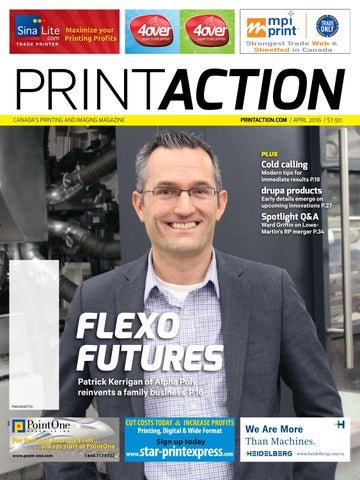
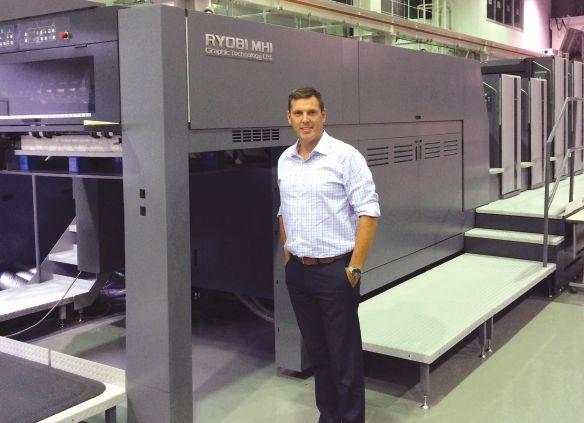
Patrick Kerrigan points Alpha Poly of Brampton in new directions with prime press and laminating investments
18 Cold calling for more print sales
Wendy Weiss, The Queen of Cold Calling, combines sales insight with years of print experience for tips on lead generation
22 Digital versus traditional
Exploring one of the greatest shifts in printing, from the power of inkjet to growing UV applications
Departments
GamUt
5 News, People, Calendar, Installs, Dots, Globe, Archive
teCH repOrt
25 Advances in flexography
Packaging suppliers continue to move with the sector’s powerful brands
neW prODUCts
27 Detailing the newest tech from Agfa, Canon, Durst, Epson, Fujifilm, HP, Heidelberg, Kodak, Xerox and more
marKetpLaCe
33 Industry classifieds
spOtLIGHt
34 Ward Griffin, CEO, Lowe-Martin
COLUmns
FrOm tHe eDItOr
4 Jon robinson
Digital drivers
A new Xerox study illustrates major corporate shifts in the use of print
CHrOnICLe
10 nick Howard
Boris and his type
The search for new sheetfed tools is now being led by software and UV
teCHnOLOGY
12 steve Falk
Smartsheet print projects
Driving innovation and progress with smart, inexpensive software
DeVeLOpment
14 Wayne Collins
Setting a drupa agenda
Preparation is key for getting the most out of print’s biggest tech show
Digital drivers
in March a new report called Digitization at Work produced by Xerox describes why Canadian companies are ahead of their global counterparts in digitizing key business processes. The report is based on a survey of 600 IT decision-makers in large U.S., Canadian and Western European organizations. A key finding from the report shows IT executives believe that less than 10 percent of their business processes will rely on paper by the year 2018.
42%
Cost and security concerns, both reaching 42 percent among survey respondents, were a major primary issue about the use of paperbased processes, which represents a significant shift in favour of digital.
The study was produced in the second half of 2015 by Coleman Parkes Research. Industries covered were public sector, financial services and corporate enterprise. Xerox explains the research was designed to understand their attitudes, challenges and initiatives in relations to digital transformation and paper-intensive processes.
Xerox, of course, has a natural bias in digitizing corporate IT structures through its business process outsourcing (BPO) arm. By the end of 2016, this will become an even more pressing issue when the company plans to separate into two entities based on its BPO arm, which was ramped up a little more than five years ago, and its traditional print-focused technology entity. Still, it is hard to argue with the one of the report’s primary conclusions that data is the lifeblood of business today and it is not easy digging through it to uncover insightful, actionable intelligence. Xerox states the Digitization at Work report shows the move from paper to digital processes is nearly upon us, even if many survey respondents admit they may not be ready for it.
This environment of digitization can also be a major area of growth for companies like Xerox if they push harder to leverage a vast network of customers through distributed print models. There is little doubt that distributed print networks, where digital infrastructure and process becomes more important than the output, will become a redefining trend for print. It is the micro-economic driver within corporations, supported by the Digitization at Work report, and only a matter of time before it takes on a macro-economic mind for the entire printing industry.
The Digitization at Work report found broad concern over paper-based processes, with cost (42 percent) and security (42 percent) cited as primary issues. In terms of digitization drivers, 40 percent of Canadian respondents said cost reduction was the prime reason for digitization followed by improved data collection at 33 percent. Survey respondents predicted an average of only nine percent of key business operation processes will run on paper in the next two years.
But more than half (55 percent) of the respondents admit their organizations’ processes are still largely or entirely paper-based, and about one third (29 percent) are still communicating with end customers via paper, rather than email or social channels. This is despite the fact that 41 percent agree moving to digital workflows will cut organizational costs, and 87 percent appear to have the skill sets available to make this happen.
The survey showed that Canadian companies are generally ahead of their global counterparts in digitizing processes in the areas of invoicing, contracts, customer engagement, HR on-boarding, new product development, and vertical and operational processes. Forty-four percent of Canadian respondents said they will have all seven digitized in two years – the highest across all countries surveyed.
“Organizations foresee a lean and agile digital future, but current business processes are still weighed down by paper,” said Andy Jones, VP, Workflow Automation, Large Enterprise Operations, Xerox. “The disconnect between an organization’s vision and the steps required to achieve successful digital transformation has stalled the promise of digitization.”
When it comes to automating processes, almost three quarters of respondents said they already have identified areas for automation. More specifically, they cite accounting (38 percent), expense reporting (37 percent), accounts payable (36 percent) and customer care (35 percent) as the most likely functions to become fully automated within the enterprise. The report also identified a number of basics that many enterprises have yet to address to better leverage automation and digital workflows. According to the organizations surveyed: 40 percent have not yet implemented solutions for the mobile workforce, 47 percent have not yet added or improved cloud services, and 45 percent have not yet incorporated or improved predictive analysis through big data.
The report also found that 90 percent of respondents said they have good tools to analyze employee print habits, but only half of them (45 percent) are using those tools to their full extent. In Canada, 86 percent of respondents said they have these tools but a third do not use them fully, in favour of hard copy reference, signatures and sharing with print.
Editor Jon Robinson jrobinson@annexweb.com 905-713-4302
Contributing writers
Zac Bolan, Wayne Collins, Peter Ebner, Victoria Gaitskell, Martin Habekost, Nick Howard, Angus Pady, Nicole Rycroft, Abhay Sharma, Trish Witkowski
Publisher Paul Grossinger pgrossinger@annexweb.com 905-713-4387
Associate Publisher Stephen Longmire slongmire@annexweb.com 905-713-4300
Director of Soul/COO
Sue Fredericks
National Advertising Manager Danielle Labrie dlabrie@annexweb.com 888-599-2228 ext 245
Media Designer Lisa Zambri
Circulation Manager Barbara Adelt badelt@annexbizmedia.com
Customer Service Angie Potal apotal@annexbizmedia.com
Tel: 416-510-5113
Fax: 416-510-5170
Mail: 80 Valleybrook Drive, Toronto, ON, M3B 2S9
Subscription rates
For a 1 year monthly subscription (12 issues): Canada — $40.95 Canada 2 year— $66.95 United States — CN$71.95 Other foreign — CN$140.00
Mailing address
Annex Business Media 222 Edward Street Aurora, ON, L4G 1W6 printaction.com Tel: 905-727-0077 Fax: 905-727-0017
rm m achinery Inc. , the exclusive distributor of RMGT 10 and RMGT 11 series sheetfed presses in the United States, is now a distributor of these specific presses in the Canadian market, as appointed by Ryobi MHI Graphic Technology (RMGT). KBR Graphics continues as the exclusive distributor of RMGT Series 5, 7 and 9 offset presses for Eastern Canada (Quebec and Ontario) and the company now has a strategic partnership with RM Machinery for representation of the RMGT 10 and 11 series presses in Quebec. Established in 2013 and based in New Jersey, RM Machinery is also the exclusive U.S. distributor of web offset and newspaper presses manufactured by Mitsubishi Heavy Industries.
paul t heoret , who helped build Battlefield Press in Burlington, Ont., passed away on March 2 at the
age of 67. Battlefield has been one of Greater Toronto’s most-dominant family-run printing businesses for decades after opening up in Stoney Creek, Ont., in 1964. In 1995, Battlefield expanded by approximately 40 percent to provide space for three new Heidelberg presses: A 2-colour 29-inch press, a 6-colour 29-inch press, and an
employees.
presstek LLC reached an agreement to acquire the business and operations of Anocoil Corp. Anocoil, founded in 1958, is one of North America’s largest independent producers of offset printing plates for the newspaper- and commercial-printing markets. The company explains its development strength is focused in the areas of aluminum substrate and coating technologies.
ColorMax 7, an envelope inkjet printing system with a duty cycle of up to 500,000 envelopes per month.
8-colour 40-inch perfecting press. In 2005, Battlefield installed one of Canada’s largest sheetfed machines in a 12-colour Heidelberg Speedmaster SM102 perfecting press.
Heidelberger Druckmaschinen aG ended its most recent quarter with a positive net result after taxes. Its net result before taxes after nine months (April 1 to December 31, 2015) reached a break-even point. Group sales were 16 percent up from the equivalent nine months of the previous year at €1.802 billion (previous year: €1.552 billion). At a regional level, Heidelberg states sales were well up in North America and Europe, while Eastern Europe and Latin America remained stable, and there was a fall in orders from China. Total incoming orders in the reporting period of €1.904 billion were higher than in the previous year, €1.780 billion.
International Paper of Memphis entered into an agreement to sell its corrugated packaging business in China and Southeast Asia to Xiamen Bridge Hexing Equity Investment Partnership Enterprise for approximately US$150 million, including the buyer’s assumption of the liability for loans of approximately US$50 million to be paid within six months of closing. International Paper’s corrugated packaging business in Asia has 18 plants and a workforce of approximately 3,000
manroland web systems of Augsburg, Germany, released its 2015 year-end results (December 31, 2015), which the company states as holding a significant increase in profit and market share.With a profit margin of around three percent, the printing press manufacturer’s result increased to €6.2 million ($9.6 million Canadian). The incoming orders taken by manroland web grew by more than 10 percent to around €260 million in comparison to 2014. The global market share for new web offset printing presses is around 45 percent (36 percent previous year). The company had a total staff of 1,200 worldwide, 1,068 of which are at the Augsburg site.
Di-Cut Industries Ltd. of Scarborough, Ont., filed an assignment in bankruptcy in mid-February under Canada Bankruptcy and Insolvency Act. Approximately $234,000 was owed to unsecured creditors, while the remaining unsecured claims rest with three entities sharing Di-Cut’s address in Scarborough, including Messaging Science Inc. and two numbered Ontario companies. An auction of Di-Cut’s equipment was planned
Konica minolta business s olutions Canada reached an exclusive agreement to distribute the printing and finishing product lines of MGI Digital Graphic Technology. Konica Minolta and MGI have several existing distribution programs in place globally and the two companies have worked together for nearly two decades. The master distributor agreement extends to the full spectrum of MGI products, such as Meteor presses, JETvarnish 3D line, and other finishing products.
Flint Group made a binding offer to acquire Siegwerk’s web-offset business, including the transfer of all technical expertise and product portfolios relating to Siegwerk’s heatset and news-ink product lines. Siegwerk explains the decision to sell its web-offset assets is in line with a strategy to focus on its core business in packaging; and to further build its market share in inks and coatings for labels and flexography. The Siegwerk publication gravure business, which manufactures printing inks for highend magazines, catalogues and commercials, will be continued.
m esse D ü sseldorf released its new exhibition song, drupa is in town again , a long-standing tradition of the German trade show. The song was written by Düsseldorf-based musician Dieter Falk, who has five ECHO nominations, and performed by soul singer Bonita Niessen. drupa is in town again was initially posted online through Soundcloud.
for March 17. Di-Cut Industries had been in business for over 40 years focusing on finishing and promotional tools for printing.
sydney stone has been recognized with the Elite Dealer Award from Formax, which designs and manufactures pressure seal, mailing, data destruction, and short-run finishing equipment. Formax also builds the
eFI acquired Rialco Ltd., described as one of Europe’s leading suppliers of dye powders and colour products for printing and industrial manufacturing industries. Based in Bradford, UK, Rialco will now operate as part of EFI’s industrial inkjet business as the California company plans to expand its inkjet portfolio with Rialco’s ink component capabilities.
Karl Belafi Jr., VP, KBR Graphics.
Jerry, Frank and Paul Theoret (left to right) of Battlefield Graphics.
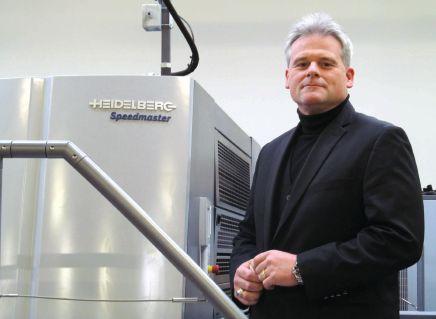
Gerold Linzbach, CEO, Heidelberg.
Sabine Geldermann, Director, drupa.
Antoine Fady, CEO, Flint Group.
Michael Steele (left), Managing Director of Sydney Stone, and Brennan Wright, Senior Sales Representative.
CaLenDar
bill Organ was celebrated for his 55-year printing career at Allen Print Limited of Dartmouth, Nova Scotia. Describing Organ’s influence, the company explains: “Bill’s expertise and loyalty helped Allen Print grow to be one of the premier print companies in Atlantic Canada. Bill’s dedication and knowledge of the print industry has been invaluable to the success of the business.” Established in 1944, and owned by the Struthers family since 1970, Allen Print is now in its second family generation. Current owner, Cameron Struthers, began working in the business when he was 15 years old and continues to emphasis his father George’s vision for the company and its community.
try. Bean, a field marketing manager of energy curing at Sun Chemical, first joined the company in 1969 and has held various positions that cover all phases of the inks group at Sun Chemical, including R&D, manufacturing, technical support, sales and marketing. He holds three patents in energy curing and is the author of four books.
April 14, 2016 pDs OKI Open House OKI Canada Headquarters, Mississauga, ON
April 14-16, 2016 Dscoop11
San Antonio, TX
April 20, 2016 Digital Imaging association seminar TI Group, Toronto, ON
April 20-23, 2016 sign expo
Orange County Convention Center, Orlando, FL
May 12, 2016
Gutenberg Gala Montreal Science Centre, QC
May 16-18, 2016 epicomm annual Conference Hyatt Regency, Savannah, GA
Larry D’amico, involved with wide-format imaging for more than 20 years, joins Durst North America as Director of Sales. Based in New Jersey, he oversees all aspects of sales in the U.S. and Canada for Durst’s lines of Rho large-format and Rhotex textile inkjet printers, as well as the company’s new Alpha Series of multi-pass textile printers. For the last five years, D’Amico served as VP, Digital Imaging, for Agfa Graphics in North America. He has also worked for Pitman Co. and Linotype-Hell.
ramage Zaki , a fourth year student with Ryerson University’s Graphic Communications Management program in Toronto, is the 2015/2016 recipient of the Delvinia Digital Innovation and Entrepreneurship Award. Delvinia, founded in 1998 by Adam Froman, is self-described as a digital innovation company offering a range of services and products to help marketers and researchers transform their organizations. Delvinia owns and operates a portfolio of digitally focused businesses, including: Delvinia Consulting Group, AskingCanadians, AskingAmericans, and Methodify.
tony bean of Sun Chemical has been honoured by the Technical Association of the Graphic Arts (TAGA) as a recipient of the Michael H. Bruno Award. Now in its 40th year, the Bruno Award singles out professionals with distinguished careers in the international advancement of the graphic arts indus-
Greg Jones becomes Director of Sales and Marketing for SUN Automation Group, a global provider of corrugated equipment, continuing to lead SUN’s domestic sales group and serving as the new head of the company’s international sales operation. David President also joins SUN’s sales force as the Central Region Territory Manager. He served as a field service technician with the company since 2008. Paul Flitcraft becomes Western Region Territory Manager having recently spent seven years with SmurfitStone/Rock-Tenn.
thayer Long on April 28 is to become the new President of NPES, The Association for Suppliers of Printing, Publishing and Converting Technologies, which oversees the Graphic Arts Show Company responsible for the annual Graph Expo trade show. Long succeeds Ralph Nappi who led NPES for the last 11 years and announced his retirement at the October 2015 Board of Directors Meeting. In addition to leading NPES and GASC, Long will also serve as President of the Graphic Arts Education and Research Foundation (GAERF). He has nearly 20 years of association experience serving most recently as Executive VP and CEO of the Independent Electrical Contractors, and prior to that as President and CEO of the Manufactured Housing Institute.
randy seberg, former CEO of Direct Mail Holdings, joins the Board of Directors of Ironsides Technology, which develops production tracking systems for the printing and packaging sectors. Under Seberg’s leadership, DMH grew from a single facility operation of 100 employees into a multi-facility firm with more than 800 employees. He will work closely with Ironsides’ sales and management team on a consulting basis. Ironsides is currently developing tools to extract data directly from production inkjet presses into a usable data set to analyze costs and profitability.
May 31-June 10, 2016 drupa
Düsseldorf Fairgrounds, Germany
June 7, 2016
Canadian packaging, top 50 packaging Ideas
Mississauga Convention Centre, ON
June 16, 2016 DIa Golf tournament
St. Andrews, Aurora, ON
June 22, 2016 printaction printForum Mississauga Convention Centre, ON
September 14-16, 2016 Craftsmen Golf tournament Royal Woodbine, Etobicoke, ON
September 14-16, 2016 sGIa expo
Las Vegas Convention Center, NV
September 23-24, 2016 COnsaC International Centre, Mississauga, ON
September 25-28, 2016 Graph expo 2016 Orange County Center, Orlando, FL
September 28-29, 2016 paC Conference Niagara Falls, ON
October 18-22, 2016 all in print China
New International Expo Center, Shanghai
Cameron Struthers, owner of Allen Print, and print veteran Bill Organ during a surprise celebration attended by suppliers, clients, staff and family.
Tom Deighton (pictured from top to bottom), of Veritiv addresses the uVU crowd.
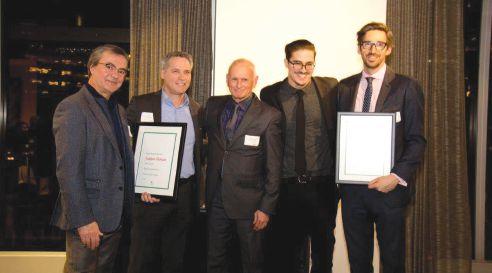
Toronto’s design and print communities gathered at The Arcadian Loft, on the first stop of uVU’s cross-Canada tour. Andora Graphics Inc. accepts its Judges’ Choice Award for production of the Union Station Manual.
uVU print across canada
MET Fine Printers of Vancouver, BC, won Best of Show, Print, in Veritiv’s annual uVU awards competition for its production of Nike Young Athlete Book,You Can Even Ask My Dad project, produced on a Man Roland 700 UV press at 240 lpi. The Award of Excellence for both design and print went to the project Empowering Global Citizenship Book, designed by Circo De Bakuza and printed by Imprimerie l’Empreinte of Laval, Quebec.
Results from the uVU competition travel across the country to recognize leading print and design projects produced by Veritiv customers. Judges’ Choices Awards taken from print-based submissions were received by Unicom Graphics (two awards) of Calgary; Andora Graphics of Toronto; and Flash Reproductions of Toronto. The judging panel consisted of five creative directors from four of Canada’s largest cities – Vancouver, Montreal, Calgary and Toronto.
The remaining 2016 printing category winners in Veritiv’s uVU competition includes: Imagination Ink Ltd. of Regina for Wide Format; Hemlock Printers of Burnaby for Brochures (two awards); C.J. Graphics of Toronto for Brochures (two awards); C.J. Graphics for Catalogues; Hemlock Printers for Magazines; Flash Reproductions for Note Cards and Invitations; C.J. Graphics for Note Cards and Invitations; Kallen Printing of Calgary for Books; Somerset Graphics of Toronto for Books; MET Fine Printers for Books; Emerson Clarke Printing of Calgary for Digital; and MET Fine Printers for Packaging.
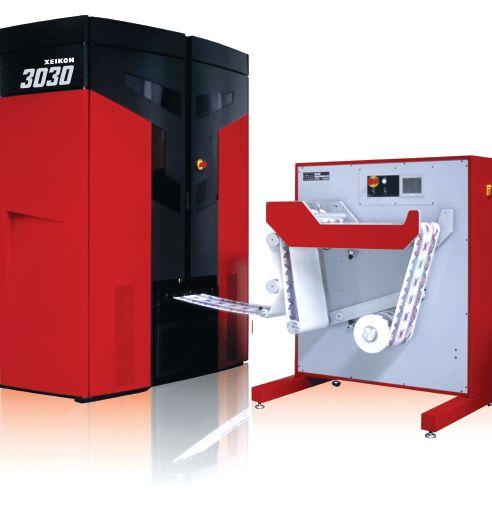
access Labels Inc. of Amherst, Nova Scotia, owned by Paul Carr, has installed a Xeikon 3030 press to supplement its flexo equipment and expand into new prime label markets. Founded in 1993, Access Labels has evolved to become a full-service label printer servicing customers in a range of markets and regions with a specific focus on food and beverage producers.
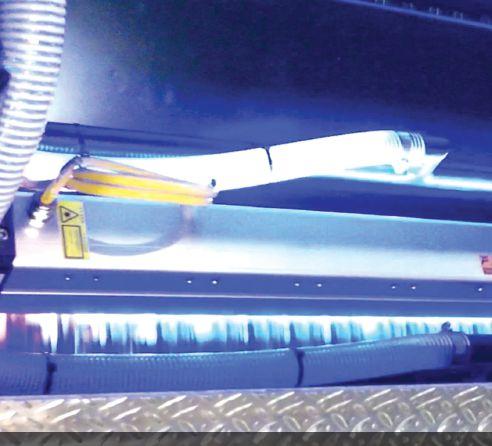
prolific Group of Winnipeg, Man., installed an AMS LED-UV system, acquired through Komcan Inc. of Georgetown, Ont., on its 10-colour Komori LS 40 perfector. Prolific is one of Western Canada’s largest printers with a range of sheetfed, web and digital presses, as well as bindery, direct mail and fulfillment.
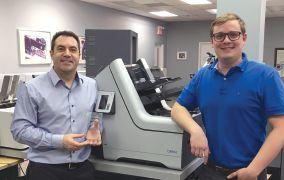
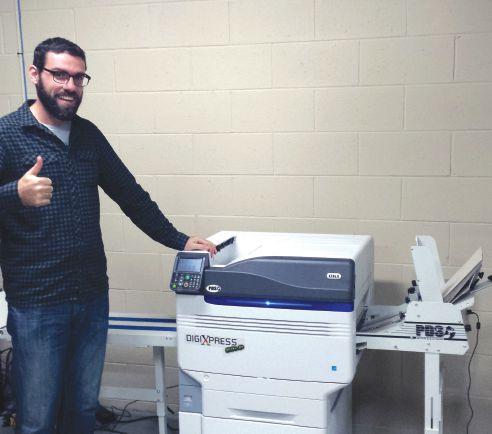
encore print solutions of Kitchener, Ont., installed a DigiXpress Bold Envelope system, pictured with Angus Fraser, purchased from PDS. In addition to its digital printing capabilities, Encore provides wide-format and a range of finishing services.
Herff Jones aims Heidelberg at yearbooks
With over 100 years of experience, yearbook manufacturer Herff Jones serves the education market from kindergarten to college and beyond by promoting personal, school and community pride through customizable print and related programs. Operating out of three plants, the company produces approximately four million yearbooks annually with average runs of 525 copies. In mid-2015, Herff Jones installed an 8-colour Speedmaster XL 106 perfector.
“This press exceeds our expectations on a daily basis,” said Doug McWilliams, Vice President of Operations. “The XL 106 came on-site during last year’s peak production season, and it continues to carry the load during non-peak production months. Put it this way, the XL 106 produces the combined volume of three other presses each shift.”
Clarence Penge, Vice President, Sheetfed Product Management explains the XL 106 at Herff Jones is capable of regularly producing more than 100 four-overfour signatures in an eight hour shift in what Herff Jones describes an extremely short-run environment. To aid the throughput of the new press, the company also invested in a Stahlfolder KH 82 and a POLAR skid turner to keep pace with the production of the XL 106.
Fedopress adds Xeikon for Belgian duty stamps
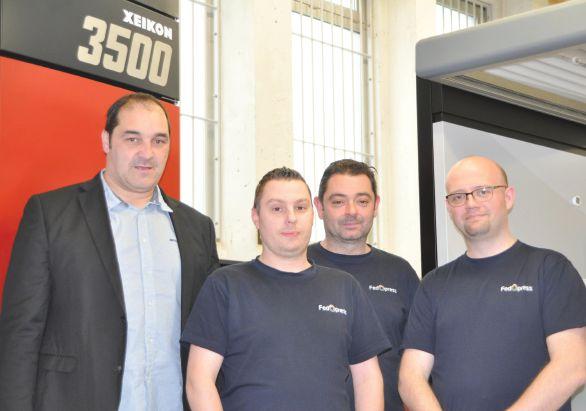
Fedopress, the official print supplier to the Belgian Federal Public Finance Service, has taken its previously outsourced services in-house following the installation of a five-colour Xeikon 3500 toner-based press and a Xeikon X-800 digital front-end.
Fedopress’s core business is the production of transactional documents, providing 25 million dispatches per year, as well as a range of printed products like manuals, forms and brochures for various Belgian Ministeries and government institutions. The printing operation, which was first announced in 2010 and completed by 2012, runs a range of offset, cutsheet and high-volume inkjet continuous feed systems.
Prior to investing in the Xeikon equipment, Fedopress was outsourcing the production of fiscal stamps, which was often a time-consuming and costly process. “The stamps used to be printed on a relief printing machine, using six colours and four different paper formats,” explains Bart Vanwijnsberghe, Director of Fedopress. “Any minor change imposed by customs or the tobacco manufacturer effectively resulted in the need to produce a new set of plates. In addition, more stamps than necessary were printed, resulting in an accumulation of stock.”
Fedopress opted to switch to toner-based printing in order to produce stamps entirely on-demand, printing only the exact quantity of stamps requested, and issued a public tender ultimately leading to the investment in Xeikon technology, which is developed and manufactured in Lier, Belgium. “Xeikon offered the most secure solution and the highest quality for the best price,”Vanwijnsberghe says, “and scored highly in terms of response-time and service.”
Danish BESTSELLER runs with Jeti
Taxes generated from products like duty stamps represent about 30 percent of the Belgian government’s income, amounting to €2.26 billion in 2015. It is vital that the stamps are impossible to forge, as this would result in significant lost income for the country.
10%
Productivity increase cited by Joe Dellamano, VP of Operations at Patsons Press in Sunnyvale, CA, based on the installation of a Heidelberg Suprasetter A106 CTP system running ND 100 plates.
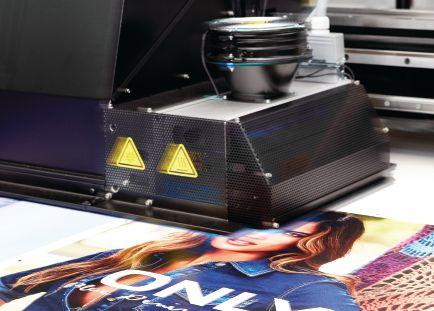
After installing two Agfa Anapurna UV-inkjet printers in 2014, Danish clothing company BESTSELLER A/S has now invested in the Canadian-built Agfa Jeti Mira system to increase capacity for printing its marketing materials in-house. BESTSELLER is a family-owned clothing and accessories company founded in Denmark in 1975 and now holds more than 20 fashion brands like Jack & Jones, Name It, Only, Vero Moda, Pieces and Vila Clothes. The company employs more than 15,000 people and sells its products in 70 markets across most of Europe, the Middle East, India and Canada.
BESTSELLER acquired the Anapurnas for its expansion to two printing shifts. “This investment has given us the possibility to do larger poster jobs, to optimize our time-to-market and to achieve greater flexibility,” says Henrik Dencker, Manager BESTSELLER Printhouse. “We use these printers for tasks that were previously outsourced, [primarily] to Poland.”
The Jeti Mira was installed in December 2015 for more capacity and to insource more board-printing work. “On top of that, we can produce more for our external B2B customers,” Dencker says, “The Jeti Mira enables us to offer a complete solution; whether it is printing foils, posters or plates, we can solve it. Also, we love being able to do specialties, such as printing with white ink or varnish.”
Bart Van Wijnsberghe (left) and Fedopress operators with the Xeikon 3500.
Doug McWilliams, Vice President of Operations, Herff Jones.
Danish clothing company BESTSELLER explains it is experiencing savings of up to 40 percent on ink, based on high-pigmented Anuvia ink used on the Jeti Mira.
5
years ago
Church of Scientology’s 121-tonne Goss press uses 10-mile-long paper rolls and can print 55,000 pages per hour.
The centerpiece of the Church of Scientology’s new 185,000-square-foot Dissemination and Distribution Center in Los Angeles is a 6-colour Goss Sunday 2000 press, equipped with two auto-transfer print units, GMI closed-loop colour control, a PCF folder, Muller Martini’s Vivo delivery system and inline rotary trimmers. Its other primary new presses include a 5-colour Heidelberg XL 105 with coater and an HP Scitex XL1500 inkjet system. In construction for more than a year, this is the only such facility owned by the Church with web and sheetfed offset presses, while it also houses tonerbased presses at its 274,000-square-foot Bridge Publications location in Los Angeles. Together the facilities have the ability to print the full Scientology Scripture, much of it in 50 languages, in up to 500,000 books per week (26 million per year) and 925,000 CDs per week (48.1 million per year).
10 years ago
Research in Motion CEO Jim Balsillie, entangled in a four-year patent battle, has settled with holding company NTP for US$612.5 million, averting a shutdown of service for its estimated 3.2 billion Blackberry users in the United States.
Based in Waterloo, Ont., Research in Motion (RIM), according to several analysts, faced a potential settlement as high as US$1.5 billion. RIM’s BlackBerry has captured 70 percent of the mobile email device market.
15 years ago
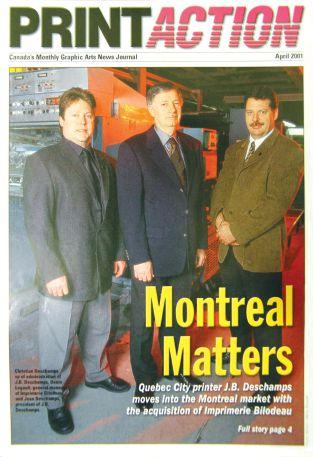
Quebec City printer J.B. Deschamps acquires Imprimerie Bilodeau, a 15-employee, 40-inch-format commercial printer based in the Montreal suburb of Anjou. With sales in the $2.5 million range, Imprimerie Bilodeau is significantly smaller than Deschamps’ 165-employee Quebec plant generating around $20 million in annual sales.
The purchase, however, allows Deschamps, which has a major presence in security printing, to reach further into Canada’s second-largest commercial printing market. The Quebec City printer was founded in 1926 by Jean-Baptiste Deschamps and continues as a family-owned business.
J.B. Deschamps VP Christian Deschamps, Denis Legault, GM of Imprimerie Bilodeau, and Jean Deschamps, President of J.B. Deschamps.
57%
Increase in the price of primary aluminum, used in printing plates, in the three years from 2003 to 2006.
25 years ago
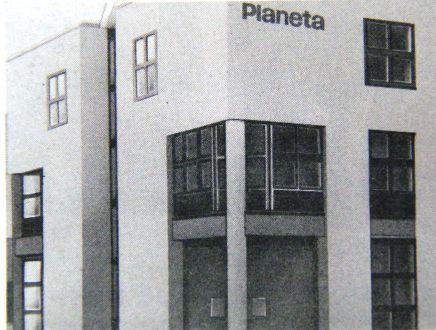
Koenig & Bauer AG finalized its acquisition of 75.1 percent of share capital in the Planeta printing press company. The remaining shares will continue to be owned by the Treuhandanstalt in Berlin, the previous sole shareholder. The new firm is to be known as KBA-Planeta AG. The 90-year-old Planeta operation, located near Dresden in what was formerly East Germany, specializes in the production of sheetfed offset presses in medium to large formats, with a workforce of 3,800. Planeta is credited with introducing the world’s first perfecting press in 1924.
30 years ago
$35M
Dollar value of Quebecor Inc. stock being sold in 1991 by Bell Canada, which owns 21 percent of the Montreal printing giant.
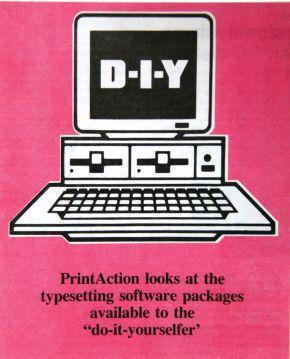
The do-it-yourself craze these days seems to be in typesetting, being pushed by the proliferation of PCs and assorted software packages which give just about anybody the capability to output data that not too long ago could only be provided by the professional typographer with sophisticated front-end equipment.
A range of new programs give the PC user the capability of multi-column page layouts, varied typefaces and line spacing, justification and hyphenation, among other key layout features.
PageMaker from Aldus Corp., for example, operates on a 512K Macintosh, documents up to 16 pages, can import MacWrite or Wordtext, MacPaint or MacDraw graphics and supports the Macintosh clipboard. Kearning and automatic hyphenation are not yet available, but operators can view and work on pages in five sizes up to 200 percent of actual.
Boris and his type
a continuing search for new tools in sheetfed offset is now being led by new printing powers
By Nick
Howard
on a typical cold winter Saturday, Boris walked in to our shop after quite a journey – coming by bus from the city of St Catharines to Mississauga. He was big with huge hands and a strong Eastern European accent. A 13-year-old kid like me would need to recognize how diverse Canada really was.
I was busy cleaning up the shop while Boris and my father sorted type drawers and worked out a deal. It took almost all day, but finally Boris started packing up all of his new type, mostly sourced from newspaper plants. Each compartment was emptied and the lead type wrapped up into little packets. It was now dark outside and my dad loaded up the car to take Boris to a bus stop beside a convenience store.
Boris lifted the heavy satchel from the trunk and asked my dad to wait before closing the trunk. Boris dashed inside the store and returned with a chocolate bar for me and a book of matches to comb through the trunk and make sure no type had fallen out of the bag. I remember this seemingly insignificant event as if it was yesterday.
I learned printers needed type; and the more the better.Type offered the chance to offer a wider variety of print, often also giving printers an option to keep forms together for repeat work like tickets and standard documents. Type was power.
The only ingredient needed was time, which, if you were starting out, was most likely never charged for at a reasonable rate. In the early 1970s you didn’t need much capital, as long as you were willing to work, which is how a great many of today’s top Canadian printers started out, humbly and working hard.
Faster, cheaper, better
With the passage of time, new technologies and strategies have retired ideas and methods that were once status quo. In the burgeoning days of litho we searched for new offset ideas and tools to help us put ink on paper. Each new development in modern machinery and consumables was em-
braced only if it made printers do things faster, better and – most importantly –cheaper. We took pride in building our print businesses often based on what we managed to buy. Printing presses, just like type, were a great source of pride. We also felt immune to outside forces that would come to wreak havoc on our industry.
Martha Hall-Findley, former Conservative MP and now an Executive Fellow at the School of Public Policy at the University of Calgary, recently wrote about the small town of Ravenna, Ont., situated 10 kilometres from the south shore of Georgian Bay. She describes how sometimes you should not fight disruptive technology.
In early 20th century, Ravenna was ideally situated as a crossroads between Barrie and Owen Sound, attracting many travellers and businesses, Blacksmiths, Trade Goods, Hotels. Then someone invented the automobile and, with proper roads, suddenly nobody needed to stop in Ravenna. The town’s economy started to dry up, but as Hall-Findlay asks, should we have raised a fuss and subsidized Ravenna? The answer is certainly no and analogous for the printing industry’s need to embrace new disruptive technologies or become irrelevant ourselves.
Printing will never be irrelevant. Just one look at the checkout counter of any store brings out this obvious fact.What has changed enormously is how we produce our work. With run lengths reducing and entire print sectors disappearing, we must continually re-invent what we do often by leveraging technologies that didn’t even exist 25 years ago. Consider how easily wide-format inkjet can now produce pointof-purchase displays, relative to VLF offset or silk screen.
We can learn from our history when applying smart strategies. Successful enter-
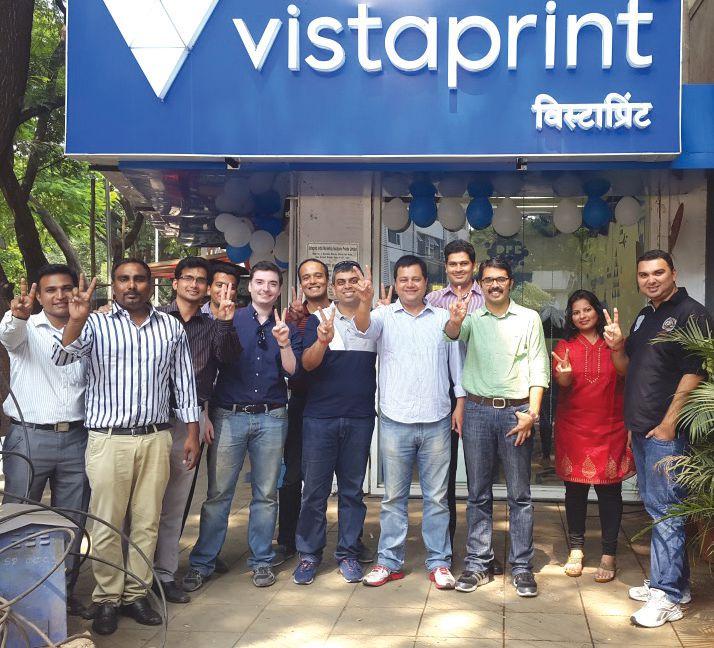
At the start of 2015, Vistaprint continued to expand its innovative business model by opening up its first ever Vistaprint retail store located in India to cater to a market dominated by offline customers. It allows Vistaprint customers in the Pune area to have a high touch, personal experience when purchasing customized print products.
prises today focus on the exclusivity of printed matter, as demonstrated by the rapid growth of UV and all its variants like low-energy and LED curing. It might surprise some to know that any offset press can be retrofitted with UV lamps, young or old it doesn’t matter. Traditional UV makes any older press print better too.
Looking ahead
Successful printing companies push hard into new territories looking for work, driven by creative uses that were not previously available. Just as Ravenna became a footnote in history, so will any one of us who tries to see the future based on how they did things in the past. Hindsight is only a valuable tool when we study how the industry adapted when faced with change.
Trade printers were once few and far between. In Toronto, one of the earliest adopters was a firm called Laplante Litho. Trade-only was a unique business and full of controversy. Could a trade printer be trusted? Were they really trade or just clamouring for your customers? Laplante closed the doors but others filled the void. Then the Internet arrived and suddenly the trade-only mindset changed into an ever more powerful beast. Any printer could sell their wares over the Internet. The largest of all is Vistaprint, which has been a sterling example of print adaptation for more than a decade. The idea of filling a blank sheet with a variety of jobs is not new. Ashton Potter, a former well-respected Toronto printer that ran 54 x 78-inch offset presses, ganged jobs when they printed soup labels.
Number of square feet of Vistaprint’s Windsor, Ont., facility which helped propel the New Age printing operation into the world spotlight for an innovative business model that largely remains unrivaled.
Nowadays the Internet has created a new group of saavy printers like 4over and ZOO. Orders are done online with templated software, which automatically delivers hundreds of small print jobs to be ganged up for printing at satellite plants spread around North America. Print delivery costs are massively reduced and gang run work is now so organized even 500 offset-produced business cards become profitable work. All of these businesses could not have existed before the Internet and yes, they are printers. At the expense of more traditional outfits, these new players have not only shown the world the relevance of print but also the potential profitability of our industry when it embraces change.
nICK HOWarD, a partner in Howard Graphic Equipment and Howard Iron Works, is a printing historian, consultant and Certified Appraiser of capital equipment. nick@howardgraphicequipment.com
Dr. Martin Habekost Associate Professor and Associate Chair, School of Graphic Communications Management, Ryerson University
Session: Is It All Digital Now, A Report from drupa
Nick Howard President, Howard Graphic Equipment Session: Capital Investment for Printers
Rob McLean Vice President of Commercial Banking, BMO Financial Group Session: Secrets to Access Financing
Jon Robinson Editor, PrintAction Sessions: Impressions from drupa Moderator: drupa for Canadian Printers
Smartsheet print projects
powerful, inexpensive software tools to manage projects and ultimately drive business innovation
By Steve Falk
there is a lot of speculation about the future of self-driving cars. It still sounds a bit like science fiction considering how complex and unpredictable the road can be – I had a friend hit by a right-turning car, on his bike, just this week. Unfortunately he’s going to be hobbling around with a broken knee for the next couple of months. But that’s a story for another day.
Given the chaotic mess on our roads it’s hard to imagine that there might actually be a technology to solve all our problems. But for me, you can pass the Grey Poupon because I’ll choose a highly skilled driver over a micro-chip, thank you very much. Maybe it’s vanity or just the idea of having the support of another competent individual whose job it is to make my life and business easier to manage. I’m fairly certain there’s no chauffeur in my immediate future. But that doesn’t mean I’m not always on the lookout for ways to make my life run a bit more smoothly.
Like the self-driving car, these potential solutions often come through technology. And sometimes the data and print businesses can seem every bit as chaotic as the highway during rush hour – or it seems more and more all hours of the day.
changing the roadmap
Print is a unique manufacturing industry in terms of its high number of weekly transactions. We are constantly navigating timelines and projects that involve multiple stakeholder and milestones. And I don’t care how well your work-back schedule is there will be unexpected bumps in the road that were not accounted for on the original roadmap.
Who hasn’t experienced traffic jams in the production facility, corrupted digital files or crazy weather events that delay delivery of basic materials. In the end we track hours on press, time in post production and bindery, the weight of ink and the volume of paper and then magically turn this all into a profitable business... if the stars align.
Over the next few issues of PrintAction I’ll be sharing some of the ways that we’ve
found to map out the road to profitability here at Prime Data. Our corporate goal is to help our client’s be more effective in reaching their sales, marketing and fundraising goals. To do this we execute data-driven strategies with print. Variable data printing is our “thing.” And our best work is demonstrated when every printed piece that leaves our facility is unique and customized. To do this we use a lot of data. And this means we are more akin to a technology company that prints – rather than a printer.
Given that we put tech to bear on our variable data print output, it makes sense that we turn to tech solutions to assist us with day-to-day activities. If you think about it for a minute, all printers today are tech companies. Given the digital artwork, platemaking, file transfer and ERP systems we use, it is not a stretch to think of this sector as a tech sector whose final output happens to be paper and ink.
So here’s my first recommendation, a handy cloud-based spreadsheet-like organizer on steroids called Smartsheet.com. There are three primary reasons why we use Smartsheet: It will save you time; It help you remember things in a busy environment; and It allows you to easily share project information with others. You can share it inside your company or outside to clients just as easily and with very rewarding results.
If you are ready to bail on this article now because I’m all keen about techie solutions, you’re not that different than some of our staff and clients. When we first introduce solutions like this, the natural reaction, except for the extremely curious, is something like, “Are you trying to suggest that I learn something new? I bet it will
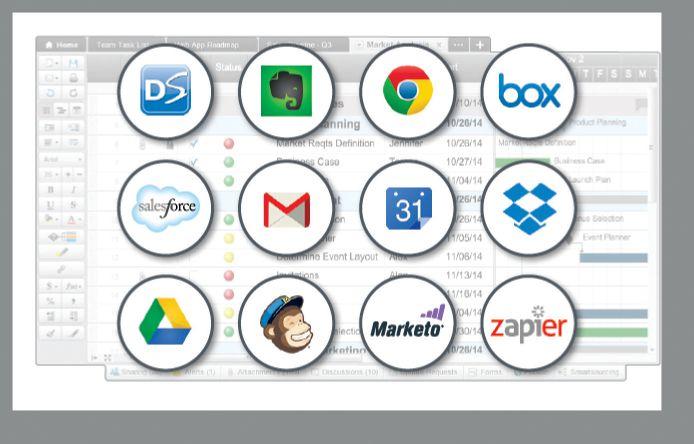
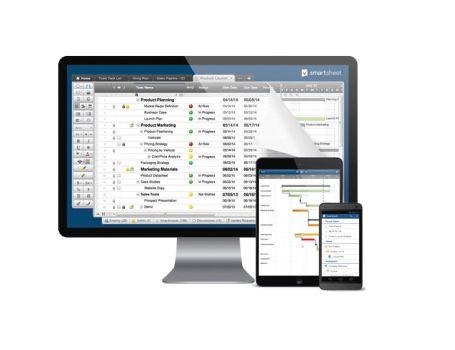
Smartsheet holds hundreds of templates for handling almost any project. The technology also integrates with many of today’s project-enabling applications.
Usually, after the benefits become clear, the rewards outweigh the cost of learning and our staff and clients are grateful for the introduction. I’m hoping you’ll hold on and get there, too, because software is one of the most powerful and cost-effective tools you can leverage in any business.
Smartsheet is laid out like a spreadsheet but it is just smarter. You’ll find columns with heading names that you can customize and then type in information to fill the cells. The biggest benefit is that you can share it with others, inside and outside of your company. Unlike an Excel sheet, everyone will always have access to the most recent version. You won’t have to worry that someone has it open and is making changes that overwrite yours. You can watch others work on it while you do and even collaborate on it while on a phone call together like a screen share.
Hours per week saved by Centric Digital, a transformation company that provides solutions to revive traditional business models for the digital age, after employing Smartsheet’s spreadsheet-based collaborative work management platform – equating to $132,000 in savings a year.
You can attach images to the cells and link it to calendars and other docs in your Office365 or Google for Work world if that is your main calendar and event environment. If you work from a tablet or phone, then there is an app for that and the Smartsheet information is portable and manageable from these other devices too. Below are a few typical ways we take advantage of Smartsheet.
Project management
We use it to help us manage long, involved projects, like the installation of a piece of equipment. It’s not only a handy calendar and Gantt chart, you can even program it to email the participants when their parts of the project are coming up. This is a great way to share upcoming
milestones with the staff and suppliers across multiple locations.
Job progress tracking
We track job progress with Smartsheet and share that with our clients, too. When a job repeats itself at regular intervals and there is a need for ongoing updating between several production players and the client, a Smartsheet will handle that repetition well, gather all the information, timelines and quantities, etc., and alert all the shared users about changes, upcoming “due” events and keep a record for future reference.
If you have a project management system already in place but would like to get the benefit from a boost in productivity and oversight from multiple players, inside and outside your organization, then Smartsheet is your kind of tool.
Here is a great example. Let’s say you have a job where every month you need to print enough flyers for the 35 locations of a business. Each location needs unique artwork and has to decide on quantities each month. You can share the sheet with the parties involved, the art can be shared with Dropbox, the timelines and quantities adjusted each month, and reminders sent to all involved that you need the information by the 15th or else they will miss deadlines.
When we have shared this type of information with clients the usual reaction is really favourable and if your competition is not using these collaboration tools, then you have given your client one more reason that price is not the only dimension upon which to assess your worthiness as a vendor.
Collecting Web form input
You have all entered information into a form on the Web. Smartsheet will let you create one in less than five minutes – that collects data to a spreadsheet. You can then embed this form in an email, on your Website, or share it with staff for quick data collection.
You might want to use this for a committee that needs members to select tasks or contributions for an upcoming event. You need tables and chairs, someone responsible for drinks, another snacks, another for setting up the AV equipment, another to find an offsite room to meet in. You can set up a Web form, design a pull-down menu with those items and email the link to the form to the committee. Your team members can sign up for their chosen tasks and share all the information so that each knows who is responsible for what.
An event leader can even set dates
for each item in case some of them needed to be sourced well before the date. Then reminder emails will be sent automatically to those individuals responsible for those tasks. One less thing to remember to do while planning. You can have tick boxes in the cells that each member ticks as they complete their tasks and the whole committee can get a morning email anytime there is an update to the sheet. Quite handy.
We’ve also used it as a cheap and cheerful Web-to-print portal. The Web form can gather order information and we can ship the printed items as the orders populate the spreadsheet. This is useful for prepaid print that might be part of a marketing campaign with a “request your free copies of the sell sheets” offer, or to re-supply marketing materials that you have shipped out in a bulk order but may run short. An example might be an auto dealer who needs to replenish flyers.
Sharing lists and documents
This is almost too obvious but I like to have meeting agendas, the company phone directory and “to-do” lists available in the cloud for easy access. If there is a team or individual working on some specialty project, they can record their daily progress and check off the to-do list as they go, while I get daily updates on progress. If you need to join a meeting by phone, it is just a click away from the agenda if it is in a sheet.
There is a free highly functional 30-day trial that makes it easy to test Smartsheet, but be sure to register once the trial is up so as not to lose your hard work.
You will find your own special uses for Smartsheet. Everyone has their own way to navigate work and having another handy tool in the belt will serve you well somewhere along the road.
Showing this technology to someone who is younger than 30 has it’s own special pleasure. They generally see the value immediately. You have staff, under 30 or not, who are itching for these kinds of tools and the faster you introduce them to your company, the faster they will find ways to make your life a bit more relaxing… think chauffeur.
steVe FaLK is President of Prime Data and holds extensive knowledge about the intersection between digital technologies and print media. Data-driven marketing strategies are his primary focus. sfalk@primedata.ca
thurSday, november 10, 2016 the palaiS royale ballroom, toronto, ont.
Setting a drupa agenda
preparation is key to get the most out of printing’s great technology adventure in germany
By Wayne Collins
ihave a good buddy whose camaraderie and friendship I truly treasure. Our friendship goes back to public school, so we have lots of glory days to rehash and make each other laugh. We dream up wild weekend-warrior adventures and he is always the one that wants to set off into the wilderness without a map. On our canoe trips he wants to run the rapids without first taking a good look. So we spend most of our weekends finding our way home after getting horribly lost, or drying our camping gear out after dumping the canoe. Our wives eventually get wind of our debacles and have labelled my friend as the Master of Disaster. I have encountered business leaders in our community who hold a Master of Disaster approach to guiding their enterprises.
One of the people I respect the most in our Vancouver community has been acquiring businesses like crazy over the past few years. I asked him recently if he was going to attend drupa this year. He told me he was far too busy to see this worldclass exposition. That seems like false logic to me: It is at the times when your business is moving way too fast, that you might want to consider pulling into shore to scout the rapids ahead. I think drupa is the best way to see what is coming down the pipe in the printing and imaging industries – on a global level.
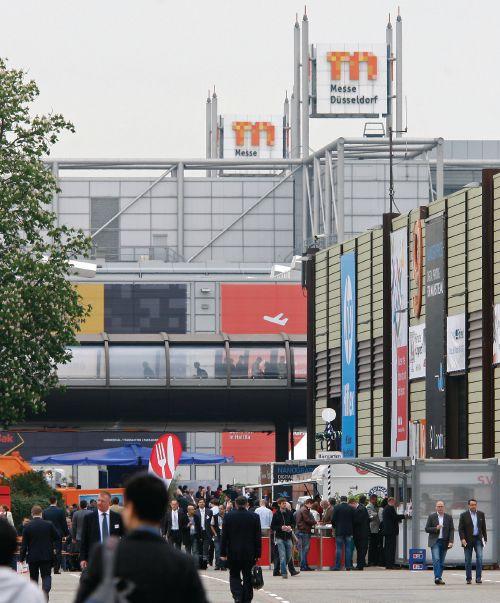
drupa, beginning in Dusseldorf on May 31, is a chance to see the entire world of print and cross-media in 19 trade fair halls, with 1,650 exhibitors from over 50 countries. The exposition will let you see emerging technologies first hand, and meet other leaders to talk about how they might be deployed.
The drupa organization also distills developments from the worldwide print sector – such as financial conditions, business climate and global investment plans. Recent drupa reports show that our graphics industry is on an up swing. Sales for print service providers continue to rise, while margins for print service providers continue to fall. Almost half of the print service providers surveyed
globally in a drupa report demonstrate falling margins. The last drupa report shows digital print is growing fast but is still a small percentage of gross annual sales for most printers. Services outside the print sector are often recommended as a new business area, but few print providers surveyed achieved more than 10 percent of their sales with such services.
Here are some of the highlights of drupa 2016 that I am trying to keep abreast of. The exposition will highlight developments in 3D printing demonstrating that, as technologies and materials get better, more opportunities for starting a 3D printing business will arise.
Drupa also highlights technology innovators like Paul Chiarot, an assistant professor of mechanical engineering at Binghamton University in upstate New York. Chiarot’s current research focus is on electrospray printing of nanoparticle inks. He demonstrates how his research will lead to the creation of a scalable manufacturing process which could fundamentally change the way electronic devices are produced.
Key industry sectors will show ground breaking new technologies. In the packaging sector, predictions from the European Bioplastics show the market for bioplastics will increase from around 1.6 million tons in 2013 to approximately 6.7 million tons in 2018. While these numbers are impressive, the Body Shop is taking the concept one step further. The company is working together with Newlight Technologies, a California-based
Attendees at drupa 2016, running under the motto Touch the Future, will experience what Chairman Claus Bolza-Schünemann, who also leads KBA, describes as the Print 4.0 mega trend based on the digital networking of machines and systems.
firm that is turning methane-based carbon emissions into plastic pellets for packaging, among other uses.
DIP, the Drupa Innovation Park, will explore combinations of Print, Video, Digital Publishing, Design, Multisensory Content, Smart Data and Printing Technologies to demonstrate how technologies and techniques can be used to create relevant and interactive print products. The European Specialist Printing Manufacturers Association will be present in two pavilions at drupa 2016. They will host Color Passport, who will present its revolutionary approach to colour management and reproduction on different substrates. Other experts in colour management, ColorGate, come to the show with state-of-the-art RIP technology in inkjet technologies. Companies like Intrinsic Materials, a specialist in nano-materials, will show its achievements in conductive inks and printed electronics components.
Sabine Geldermann, Director of drupa, states “The focus of drupa cube, with its international conference and event program… is also designed to bridge the knowledge gap about the relevancy and functionality of print that often exists between printing professionals and their creative agency, marketing, and brand owner clients across a variety of vertical markets.”
For the next few months, just keeping track of all that is happening at drupa will help inspire us all. One could argue that the online media coverage is enough guidance to see future trends. You might consider, however, the missed opportunities in making personal connections, and hearing first hand how other business owners will create new revenue streams.
Consider drupa a first-hand look at the rapid changes that are on the horizon for our industry. This exposure will certainly garner some business opportunities you may never have dreamt of. More importantly it will also warn of some pitfalls in the road ahead.
My weekend-warrior buddy usually argues he reviewed the online videos of the rapids we will encounter on our trip, and that he doesn’t want to waste time pulling into shore for a first-hand look. Typically, it is not until we are huddled over a campfire drying out after a near fatal plunge, that the Master of Disaster reflects that a first-hand look at that sweeper might have been prudent.
WaYne COLLIns is the program head of BCIT’s Graphic Communications Technology program and has more than 25 years of industry experience. wayne_collins@bcit.ca
Looking good on paper matters. ColorLok® Technology gives paper more vivid colors, bolder blacks, and faster drying times.* Learn more at colorlok.com VIVID COLORS BOLDER BLACKS FASTER DRYING
Domtar EarthChoice® Office Paper is a great-looking, everyday paper that represents your commitment to environmental responsibility. Featuring ColorLok ® Technology, it is designed to provide optimal printing results. To learn more visit www.egpaper.com or domtar.com.
Flexo Futures
second-generation leader patrick Kerrigan points alpha poly packaging in a new direction with a range of people, press and lamination investments
By Jon Robinson
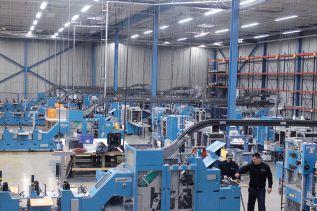
alpha Poly Packaging Solutions of Brampton, Ont., for more than two decades primarily focused on the print production of polyethylene plastic bags, originally garbage bags before quickly moving into higher value food-service products, the latter of which was buoyed by an acquisition that basically doubled its size overnight. Alpha Poly’s February 2016 acquisition of Mikia Printing, a specialty flexible-packaging converter, however, speaks more to the company’s future.
The Mikia purchase is the most-recent example of a range of strategic investments led by Alpha Poly President Patrick Kerrigan, who took over leadership of the 50,000-square-foot operation in 2012, succeeding his father, Paul, who founded Alpha Poly in 1989. Kerrigan has been
shifting Alpha Poly’s business approach since leading a lean-manufacturing audit in 2009, followed by a branding change, a new sales approach, and ultimately a multi-million-dollar capital equipment investment.
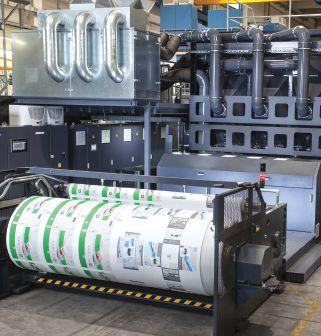
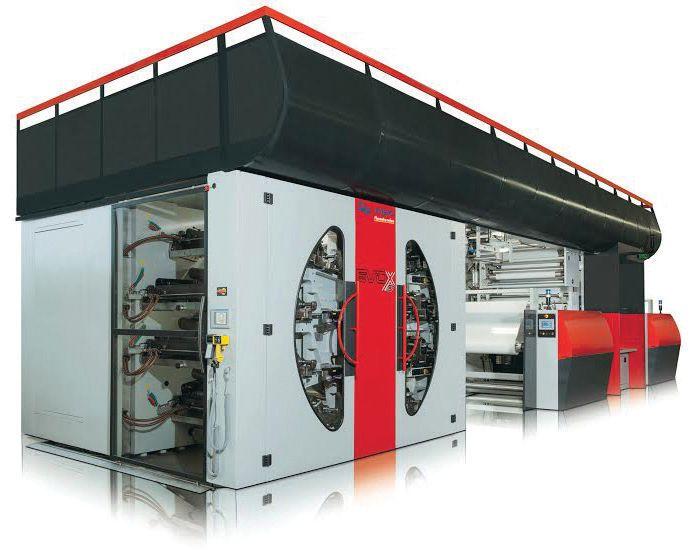
In 2013, Alpha Poly installed a massive 8-colour MIRAFLEX AM from Windmoeller & Hoelscher to produce higher-end process print jobs. This investment was followed by a decisive push to capture the growth in multi-laminates with a Nordmeccanica Super Simplex SL laminator. With the support of family members holding key leadership roles, including Matthew Kerrigan, Stephanie Kerrigan and Martin Boeykens, Alpha Poly is positioning itself as one of Canada’s leading independent companies in the robust flexography sector. Kerrigan worked outside of the family business for 15 years after going to school
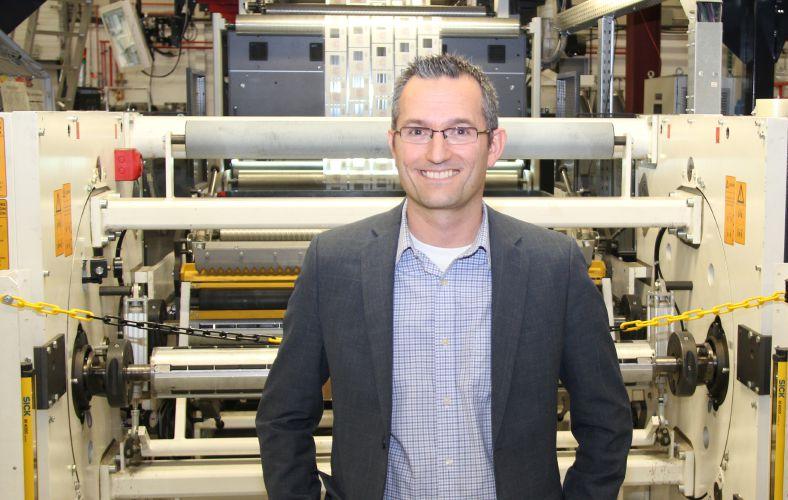
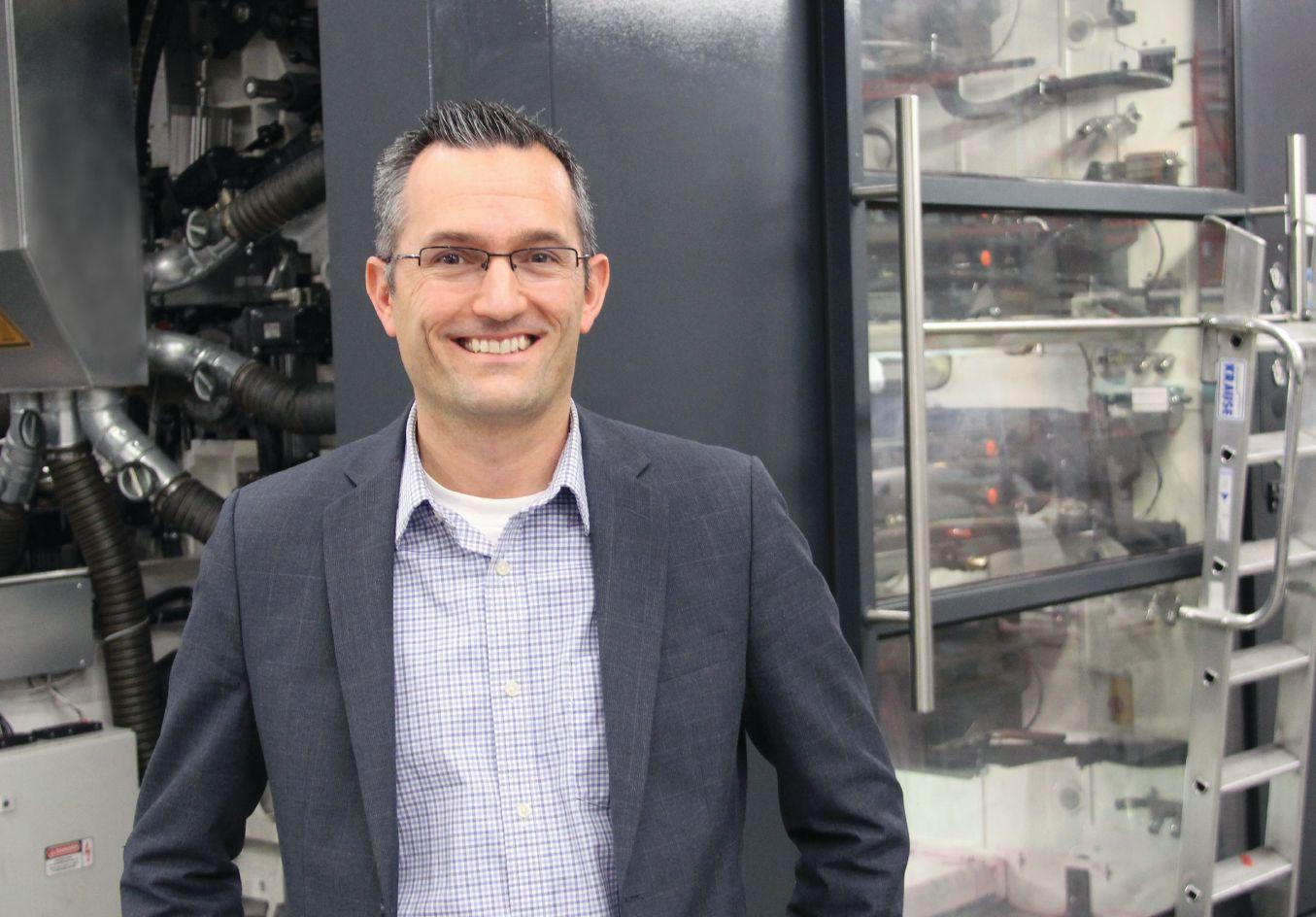
Patrick Kerrigan, President of Alpha Poly Packaging Solutions, has led the Brampton company since 2012.
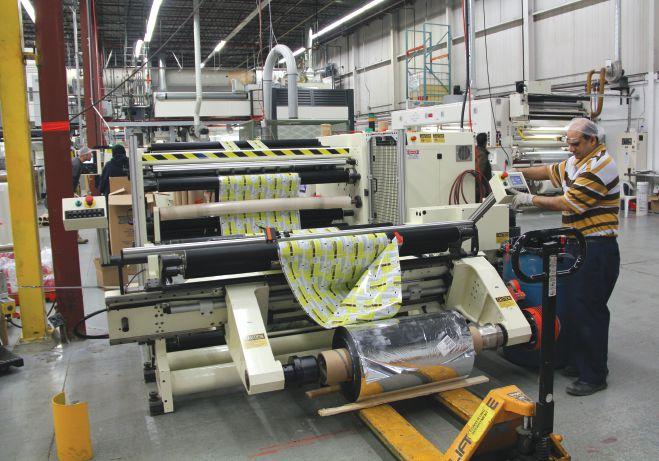
Right: Alpha Poly’s Deacro 610 slitter provides a new range of applications.
In its most recent fiscal year, Alpha Poly experienced revenue growth of slightly more than 20 percent, after installing Salesforce.com.
for broadcast journalism at Mohawk College in Hamilton, Ont., which ultimately led to a career in post-production for television and movies. Kerrigan explains this experience allowed him to learn about his own approach in the business world before joining Alpha Poly. “I love to work with people and to mentor,” he says. “It is exciting to watch people grow – helping their families grow.”
Manufacturing measures
When Kerrigan led the lean audit for Alpha Poly in 2009, he faced difficult decisions of managing a manufacturing business, particularly one that has worked to foster a family-like atmosphere across the entire operation. Following the audit, Kerrigan estimates Alpha Poly reduced its labour by 30 percent and increased its output by 80 percent. “The return on investment was paid back in a year,” he says, noting how much discipline it took to institute the changes; for example, having one operator work two packing machines instead of a traditional one-to-one ratio.
Just prior to the lean-manufacturing audit, Alpha Poly had purchased the assets of a struggling London, Ont., operation that had succumbed to selling work below cost, an easy trap to fall into in any printing sector. “You need to know and understand your costs,” says Kerrigan, who was preparing to have the same lean analyst return in February to reset Alpha Poly’s base after the past three years of change management to branding and sales.
“It is great to see things moving ahead,” says Paul Kerrigan, who continues to attend major management meetings. “Patrick is driving the ship. We have a lot of good workers and that is a big part of making your business successful. It is exciting to come in and hear about all of the things going on.”
As he began to transition into leading Alpha Poly, Kerrigan leveraged years of broadcasting experi-
ence to evaluate the company’s brand position, which lacked a concrete marketing plan. Alpha Poly’s eight-year-old Website was in need of a revamp to better support the sales structure and any future manufacturing investments.
“When people heard about us, because our name used to be Alpha Polybag, the first thing was ‘Oh, you do the shopping bags for the grocery stores,’” Kerrigan says, noting the company had also been printing roll stock for a long time, as well as reverse printing on polyesters. “We re-launched our name to let people know we are not just a bag manufacturer.
“At that time, I knew the next phase of the company was to get into multi-laminates because you could see back then it was a growing market,” Kerrigan says, recalling reports that indicated multi-laminates would experience eight or nine percent worldwide growth year over year. “Everything is moving from rigids like plastic clamshells and jars to stand-up pouches, so I knew it was a market you wanted to be in.”
Developing new markets
Kerrigan explains a key driver of Alpha Poly’s strategy began to unfold in late-2012 when he crossed paths with David Mailman, who was helping to lead packaging manufacturer Multipak Ltd., which was in the process of shuttering its operation.
The high-end flexo knowledge of Mailman fit perfectly with Kerrigan’s plans to move Alpha Poly into new markets, which would require investing in the new press. “The stars aligned,” Kerrigan says. Mailman arrived in early 2013 to take over Kerrigan’s role as Plant Manager and to help direct the company’s capital investment.
This allowed Kerrigan to focus on melding Alpha Poly’s rebrand with a new sales approach. “I kept feeling that every time we came into our monthly management meetings we were always looking in the rear-
view mirror – what happened in the month before,” Kerrigan says.
He brought in an outside firm to review the sales strategy and a decision was made to implement the Salesforce.com CRM tool. At the time, Kerrigan explains Alpha Poly was generating healthy but flat annual revenue growth of around six percent. “We started setting targets for everybody and measuring,” he says. “People want to do better, but if you do not have anything to measure you do not know how well you are doing.” A sales roadmap was put in place to steer away from a shotgun approach and instead focus on what constitutes an ideal Alpha Poly customer.
In its most recent fiscal year, Alpha Poly experienced year over year revenue growth of slightly more than 20 percent. “We know where we are going because we can see everything in our pipeline,” Kerrigan says. “We can do accurate budgeting now… plus you have metrics that everybody is looking at.” The reinvigorated sales structure is also supported by a new business-development approach led by Kate Davis and former HP Canada trailblazer Debra Swift.
The February 2016 arrival of Vaughan Campbell, former owner of Mikia, who takes on a prominent technical sales role with Alpha Poly, helps establish one of the strongest senior leadership teams in Canadian flexography, with a technical and strategic ability to reach into completely new flexo markets. One of the most promising aspects of Alpha Poly’s new direction is that it currently only generates around five percent of its business from the United States.
With all of the investments in people and technologies, Kerrigan continues to focus on bottom-line growth. “We have to keep this cog going and we have really invested in this team to help us,” he says. “Our next goal… I would like to see in the next couple of years a 10-colour press in here.”
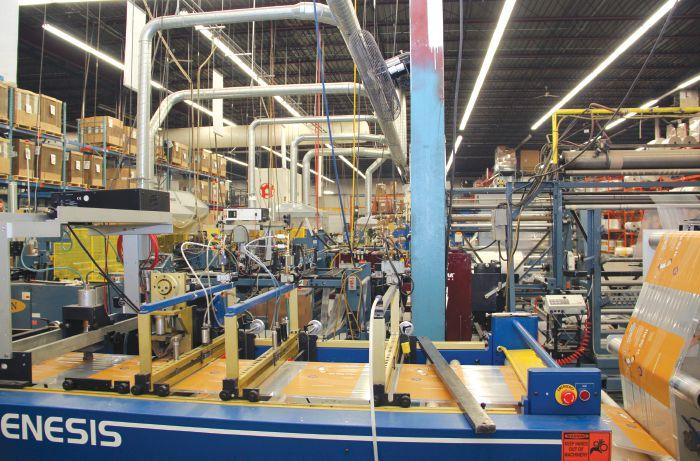
Above: The heart of Alpha Poly’s polyethylene plastic bag operation, which the company was built on in 1989.
Companies typically spend more than two years salary on a new salesperson before truly understanding if they can do the job.
Cold Calling For print sales
Wendy Weiss, the Queen of cold calling, combines sales insight and print experience to describe how to leverage one of the most important, yet vanishing, skills of lead generation
By Victoria Gaitskell
What do ballet dancing and print sales have in common: Wendy Weiss, a.k.a. The Queen of Cold Calling, a widely quoted
New-York-City-based sales training and coaching consultant specializing in lead generation and business development.
“I cut my teeth doing new business development in the print and graphic arts industry. Many of my clients are still printers and graphic artists,” says Weiss, who was preparing to present four sales seminars at the National Print Owners Association’s April conference in Texas.
“I was never supposed to be The Queen of Cold Calling. I was supposed to be a ballerina,”Weiss laughs. As a teenager, she
moved from Pennsylvania to New York City to dance. She needed a day job and, tired of waiting on tables, landed a telemarketing position setting up B2B appointments.The telemarketing company did not have enough work for her, but, after discovered she was good at prospecting, print broker friend soon hired Weiss to set appointments. She then worked in sales for a number of NewYork printers, one of whom nicknamed her The Queen of Cold Calling.
“A big mistake people make when prospecting by phone is talking too much about what they do. Typically printers talk too much about their equipment,” she says. “But I didn’t know any of that stuff back then. I just got on the phone and talked about what a great printer I was setting appointments for... That’s how my sales career started – totally by accident.”
Weiss continued to dance and prospect for businesses for a while, but ultimately
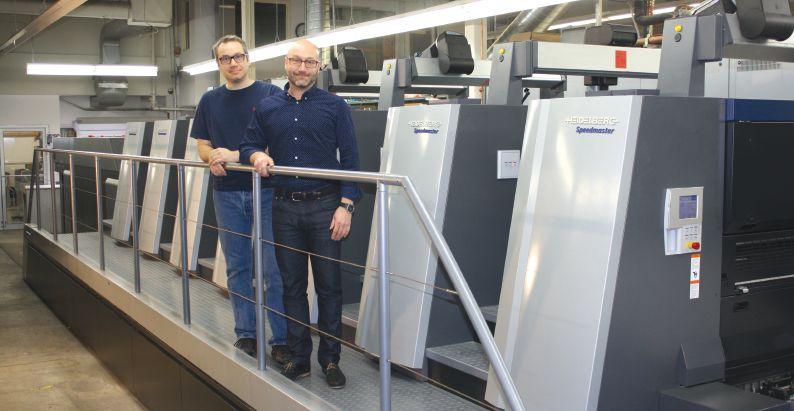
Quality is Inherited at Tower Litho with the addition of a Speedmaster XL-106-6+L –UV from Heidelberg
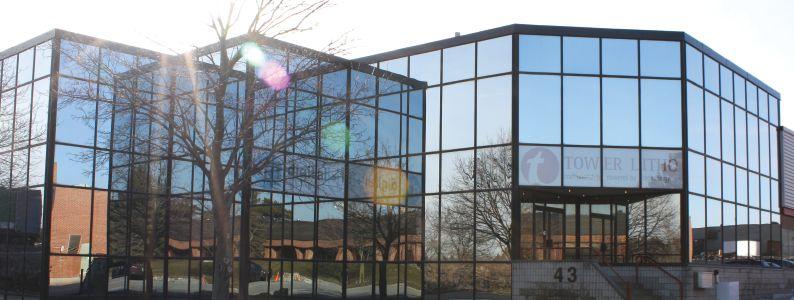
Tower Litho is a “Trade Printer” in the GTA that appears more like a commercial printer and has for many years. The team at Tower strive to put “quality first” in a market that is often driven by price and turnaround time.
“Quality and Trade have not always necessarily gone hand in hand” states Dino Siriopoulos, Co-owner of Tower Litho. “You come here, you are going to get a good quality job and we will deliver on time.”
To meet all of those objectives, Tower Litho has recently installed a Heidelberg Speedmaster XL-1066+L press with as much automation as can be added in this format class, including a robust UV system allowing Tower Litho to offer an entire new range of applications.
Why such a bold move? For that answer, you have to understand the company’s past and its vision for the future.
Brothers Dino and Paul Siriopoulos took over the business operations of Tower Litho around 2001 while the original founder, dad: Tassos Siriopoulos mentored in the background.
Tower Litho was established in 1971 in the Danforth area of the City by Tassos Siriopoulos a recent immigrant from Greece. It was an “All in the Family” affair recalls Dino. “That was how we got to spend time with our dad in those days. My mother worked in the office as well. We had ten employees by the mid-eighties and eight were family.”
The business moved to their current Scarborough location in the early 1990’s and for the first few years, suffered through the high interest financial crises. By 1995, Tower Litho had developed a reputation for providing quality products and being a financially sound partner to the industry.
The first multi-colour press arrived in 1996: a Heidelberg MOVP at 20 x 28 inches. With the learned lessons of the early 1990’s and a keen eye on where the future was heading, the next investment was CTP in 2001 (an early adopter). Add to that their first 40 inch press: a Heidelberg Speedmaster CD 102-5+L (with Coating)
Tower Litho had evolved from its humble beginnings and had officially entered the “big leagues”. Sound business decisions, satisfied Customers and a growing client base that required more and more capacity resulted in the addition a Heidelberg Speedmaster SM-102-8P+L in 2008. Next, a Speedmaster SM-52-5P+L in 2009 rounded out the press portfolio. At this point, the Company was well equipped to handle the wide variety of jobs with the quality and turnaround time required of the “trade market”.
As the industry continued to change post 2008, Paul and Dino invested in digital, created a new area of business and again serviced the needs of their clients. The big question became: “Where do we go next?”
Paul Siriopoulos explains: “We are 100% broker based, we listen to our clients! We treat our brokers like we treat our employees. We help them grow their business, and we develop a partnership that allows for long term relationships. It’s about trust”.
Listening resulted in the latest installation, the Heidelberg Speedmaster XL 106-6+L-X3 with UV and is capable of running at 18,000 Sheets per hour.
“This press can print UV jobs on an array of substrates that we simply could not do before!” Dino adds.
“As well we can quickly convert back to conventional printing and produce quality products much faster than previously.”
That is due to Heidelberg’s patented Prinect Inpress Control, the device that allows colour and register to be controlled fully automatically inline without stopping the press. “Truly amazing technology” adds Dino. “We do client press approvals every day, (which is highly unusual for a trade printer). With Inpress Control, the client quickly comes to understand the level of assurance we can provide and that the job is done to his signed off approval.”
AutoPlate Pro: fully automatic plate changing, Press Center with “Intellistart” operating system, and DryStar drying technology completely automates the “job change” process, allowing operators to focus further on quality of product. “Our turnaround times have decreased dramatically as well with this machine” Dino continues, “and we have increased our capacity once again. We can reach new markets and get into bigger projects with this press! Come and have a look, our doors are open” laughs Dino!
Talking with Dino and Paul, you can’t help but notice that they are very humble regarding their achievements in this rough and tumble business. “The company is always first” Paul comments, “All our decisions are based on that. We have 38 Employees, most long term. We have virtually zero turn-over and we have experienced 10% growth in each of the past three years! That says it all!”
And about the latest investment, The Speedmaster XL-106-6+L: “No regrets!! Bring us your business!”
The key to our customers’ success lies in the perfect interplay between people, machines, materials, and processes. Heidelberg combine prepress, press and postpress expertise with consumables, services, and consulting. This integrated solution portfolio has already gained the company 40 percent of the global packaging printing market.
Discover the opportunities the Speedmaster offers and let yourself be inspired! www.SpeedmasterGetInspired.com
Wendy Weiss, who began her sales career within the printing industry, has been dubbed The Cold Calling Queen for her effective approach to prospecting and lead generation.
84%
turned toward training salespeople, sales managers, and business owners.
gression of what needs to be done to get where you want to be.” To teach clients the nuts and bolts of cold calling, Weiss uses a performance model based on her former career as a dancer. The first step in her model is warming up: “When you’re a dancer, warming up is the first thing you do so you don’t hurt yourself,” she explains. “And as a second step, you always rehearse, because that’s how you create the muscle memory that makes your performance automatic. After you have warmed up and rehearsed, then and only then do you pick up the phone.”
block but a negotiation.”
If a prospects responds with, “I already have a vendor I’m happy with,” Weiss suggests focusing on the fact that this automatically places them in the desirable qualified-prospect category.
Amount of B2B decision makers who kick off their buying processes with referrals, according to OpenView Labs.
100x
Salespeople that reach out within five minutes, according to OpenView Labs, are 100 times more likely to qualify the prospect.
Cold calling is indispensable
Weiss believes cold calling is more critical than ever in today’s marketplace. In an interview on the BizTalk Radio Show (one of many free resources archived on her Website), she explains ultimately you can only generate a sales lead four ways: Through marketing; referrals; networking; and cold calling (targeting and telephoning a prospect with whom you have had little or no previous contact).
Weiss explains the first three methods are all essentially passive, because you have to wait for somebody else to act. With marketing, you have to wait for prospects to contact you. With referrals, you have to wait for others to facilitate introductions. With networking, you rarely meet the prospect, only the person who knows them.
“[Cold calling] is actually the only appointment-generating or opportunity-generating activity that is directly under your control, and it’s the only way to make up the difference between the number of leads or opportunities that you are finding through marketing, referrals, and networking, and the number of leads or opportunities that you actually need to hit whatever revenue number you’re looking to hit,” she says. “So the issue today is not that cold calling is outmoded... it has changed and most people do it really badly.”
56%
Amount your sales team has a chance to reach quota by engaging buyers before they contact a seller.
Weiss says email and social media channels lead some sales professionals to conclude incorrectly that they do not need telephone skills: “What if somebody calls you and you blow the conversation? You’re not going to get the customer. It’s also a fallacy that you can use social media as the main driver and not have to talk to people. For our clients to be effective in today’s environment, we teach them to reach out to prospects strategically and consistently over time, using the phone along with other types of communication and software to track their progress.”
Weiss emphasizes that cold calling is a communications skill that can be improved on, but also, “This is not something that you can just wing. There is a certain pro-
In Weiss’s model, warming up means compiling a highly targeted list of the people who are most likely to need what you’re selling: “In the old days we didn’t have a lot of information about prospects, but today a wealth of information about them is available to help you decide who might possibly buy something from you, who are most likely to buy from you, and who are most likely to come back and buy a whole lot more.” Her warm up also requires determining what messaging to use when you get prospects on the phone, as well as in your email and voice-mail messages. “The rule of thumb is that nobody cares what you do, so the words matter.
“Do you have an attention-grabbing introduction, do your voice-mail messages get people to call back, do your emails get people to respond? If someone you talk to says, ‘I’m not interested,’ it means you’re not saying anything interesting. So you need to do some up-front work to figure out what words will be compelling to the market that you’re talking to and make people want to engage with you.”
Changing thoughts and processes
Besides instilling skills, Weiss also helps people who dread cold calling change the way they think about it. She says these clients are prone to counterproductive mind-reading or fortune-telling.
“Cold calling isn’t an emotional experience. It’s marketing,” she insists. “The opposite of hating cold calling is not that you love it. It’s that you’re neutral, which is the mindset you want to maintain. You can’t function if you’re hysterical.” Weiss diffuses fear by pointing out that telephone prospecting, especially appointment setting, is highly predictable – most prospects will respond in only a few different ways.
One typical response is, “Send me information.” Weiss explains this usually means a prospect has not read the information sent, because either you have not said anything compelling or the prospect is too busy. If it is the latter, and since your goal is to set up a meeting, Weiss suggests focusing on the fact that they have not said no.
“Find a way to make the prospects right or agree with them by countering with something like, ‘I understand you are very busy, but I only need 10 or 15 minutes. When would work for you?’ Many times prospects’ responses are not a stumbling
Weiss describes another scenario in which a printer asked her to help hire a salesperson. When she asked him what procedures were in place for the salesperson, he lapsed into an uncomfortable silence. “A big mistake printers make is to hire someone, teach him or her everything about printing, and then tell them to go and sell with no source of qualified leads and no process to follow. Generally speaking, companies seem to have processes in place for everything except prospecting.
“Yet as managers or business owners, if we lay out a process with steps for our sales reps to follow, it makes things so much easier, and they are so much more likely to succeed, especially inexperienced new hires or somebody who is struggling.”
Although the attrition rate for new hires can be as high as 50 percent,Weiss explains companies usually pay new sales hires up to two-and-a-half years’ salary before deciding to replace them via a corporate hiring cycle that typically costs another two times the salesperson’s annual salary.
“To avoid these mistakes, the advice I would give the head of a company is to put in place a comprehensive process, including things like a targeted list, messaging, skills training for your people, and software that tracks and measures what they are doing so you know what is actually working. If any of these essential elements are missing from your process, your telephone-prospecting campaigns are not going to work well,” she says.
Weiss explains setting appointments should be the first step of staff training: “They don’t have to know every single thing about printing. You can easily teach them how to make appointments, then use software to track what they’re doing, so you know how to coach them appropriately and have some measure of their progress... If they can’t set appointments, they’re probably not going to sell a lot, so you don’t need to wait a full two years before deciding whether or not to keep them.”
Weiss says many printers experience a boom-bust cycle (a busy month followed by an insufficient number of orders the next month) and the bust is frequently the result of not having enough prospects. Her antidote is to prospect every day. “It’s a very common scenario that owners don’t prospect regularly because they get busy doing other stuff. Lots of entrepreneurs also have only one or two really big clients, and if they lose their business, they’re screwed. While it’s a myth in cold calling that you have to do hundreds of dials every day, you still have to do some.You need to take action every day and keep looking for opportunities to move your business forward.”
Announced at drupa 2012, Bobst’s digital packaging press, installed at a Swiss beta site, has been shrouded in secrecy for three years and will debut at drupa 2016.
digital versus traditional
Exploring one of the strongest shifts in printing, this month’s drupa Expert series article looks at how emerging inkjet, UV, and toner technologies are pushing packaging growth
By Michael Seidl
the volume of the worldwide print market is set to grow to € 420 billion by 2020 from a current level of around € 407 billion, following the significant sharp decline in the years between 2008 and 2010 from €438 billion to €407 billion. Within the global print market, packaging print is the only area that will grow significantly, with an increase of 3.3 percent per year, for a share of the overall market of €141 billion by the year 2020.This includes folding boxes, labels and flexible packaging. In terms of specific printing processes, flexo printing is projected to see 2.6 percent growth, and digital printing eight percent. Today, only seven percent of packaging is printed digitally. For packaging converters, digital printing can be a logical adjunct to analogue printing and
simultaneously allow them to develop new applications.
“Just how much digital print technologies will impact production depends on how quickly digital printing presses for the industrial production of packaging are developed,” says Hubert Marte of the Austrian Corrugated Cardboard Forum.
“A further – very important – factor is the cost of procurement, maintenance and repair, as well as the cost of the printing inks. In addition, it has not yet been possible to achieve all Pantone colours with digital printing. Printing onto coated papers and the drying [required] also remains a serious challenge.”
The Future of Package Printing to 2019 report by Vlad Savinov, Smithers Pira, 2014, anticipates an annual growth of 17 percent for digital printing. This makes it the fastest growing technology within packaging print, projected to reach a vol-
The HP T1100S developed with KBA is now in production, while digital printing will soon push folding-carton work in more creative options like the process already has with labels.
$634B
Projected dollar value the global print market is expected to reach by 2020 from its current level of around $600 billion.
ume of US$19 billion by 2019. The packaging market can essentially be divided into four sectors: labels, flexible packaging, folding cartons and corrugated. The label market was the first to recognize the benefits of digital printing. The other markets are now following suit, but not at the same speed or via the same route. The label market has a 10- to 12-year head start on corrugated in terms of digital printing.
Digital labels
HP has now installed more than 1,000 digital presses in the market, and considers that digital printing has become mainstream.
Xeikon has well over 300 systems installed, and more than 50 percent of its sales now come from the packaging industry. Traditional companies such as Heidelberger Druckmaschinen have gone down the digital path via Gallus, and since Labelexpo 2015 are fully on-board with digital.
The Gallus DCS 340 converting system, developed in a joint project by Heidelberg and Fujifilm, is equipped with the latest generation of inkjet print heads and prints at a quality level that was previously only achievable in offset printing. It delivers high-end UV inkjet print quality with a native resolution of 1,200 dpi at a speed of 50 metres per minute, combining the benefits of digital printing with flexo printing. Also unique to this solution is the integration of inline finishing modules. The Gallus DCS 340 prints digitally from roll to the finished die-cut label; all in one pass. French company Autajon bought and tested the first system, and has now ordered three additional systems.
Label print shops increasingly recognize that digital printing can be used as a logical adjunct to the long print runs in flexo or offset printing. Designs can also be changed rapidly. It’s almost as if label design is turning into fashion design. Some wine bottles are becoming style icons as a result. Flexible packaging, folding cartons and corrugated applications will also be riding this tide.
Flexible packaging growth
The market for flexible packaging will continue to develop digitally in the com-
ing five years, but it is also subject to social change (primarily due to external mobility). People eat and drink on the move (nomadic mobility). Flexible packs are gaining popularity and increasingly replacing fixed packaging. Digital printing provides manufacturers of flexible packaging the opportunity to grow their businesses.
The formula is a simple one: high quality packaging, produced digitally, with just-in-time delivery. This is why the technology is currently gaining ground, supported by presses such as the HP Indigo 20000 that issued a clear signal to the packaging market with its launch.
Swiss firm O. Kleiner KG was the first company in the world to install an Indigo 20000 to specialize in the production of flexible packaging using flexo, gravure and digital printing. “The HP Indigo 20000 introduced a quantum leap in digital production of flexible packaging and opens up many new opportunities for flexible packaging print with its printing width of 736 millimetres,” says CEO Martin Kleiner.
O. Kleiner KG has leveraged its HP Indigo 20000 to produce small runs as add-ons and to provide new options for customers in the smaller run sector. A good example of this is closures for small jam jars. As flavours such as strawberry are produced in large runs, other flavours like raspberry have smaller batch sizes that in the future can be produced using digital printing. Further applications include test packages or personalized packaging.
Colourful folding cartons
Digital printing is still relatively new in the folding-carton sector even though there are now several excellent examples of applications here. This sector tends to use the technology for small and differentiated runs; print runs before or at the end of large, conventional runs are another application. Digital folding carton printing is still e in the early adopter stage as new users develop the first applications.
Peter Sommer from Elanders in Germany, together with Ritter Sport chocolate, provides one such fascinating example. A special Website was set up where consumers were able to order personalized packaging for their Ritter Sport chocolate. Customers were willing to pay considerably more for this chocolate. There are now a growing number of projects of this nature as brand owners recognize the potential and savvy print shops are helping them to realize creative ideas.
To date firms processing corrugated have been slow to adopt digital printing technologies, with the exception of those using flatbed systems like HP Scitex, Durst, Mimaki, swissQprint. However, this is more due to the fact that until now there had not been many systems available on the market that could be used for corrugated. But this will be changing relative-
ly quickly due to providers such as Bobst or the HP/KBA joint venture.
Colossus in pre-print
Following barely two years of development, HP and KBA presented the world’s first HP PageWide Web Press T1100S to a group of visitors in Würzburg in November 2015. This gigantic inkjet rotation with a web width of 2.80 metres and with digital pre-printing of the top layer is opening up new options for the flexible production of corrugated packaging in different sizes and run lengths that were not economically feasible before.
“Finishers and their customers need to develop both customer-appropriate and effective packaging whilst reducing costs,” says Eric Wiesner, GM of HP’s PageWide Web Press Division. “With the combined expertise of HP and KBA, we have now launched the world’s most-productive roll printing press for corrugated. The HP PageWide Web Press T1100S allows finishers in the high-end sector to offer added value by combining pre-print and digital printing in one machine.
The first customer for the HP T1100S was DS Smith Packaging, which sought greater productivity and flexibility with small- and medium-sized runs. Thanks to its high productivity of over 30,000 square metres of printed area per hour, the press can also be cost effective for large runs. The Brits are clearly taking the project very seriously as they have been experimenting for a year with the T400 system purchased specifically for this purpose.
Another current example in the corrugated card market comes from Bobst, which announced it was developing a digital printing system at drupa 2012. The project, shrouded in secrecy, is now in use with beta testers a little over three years later, specifically at Model in Switzerland and at Schumacher in Germany. This industrial digital solution for printing packaging and displays made from corrugated material uses Kodak’s Stream Inkjet technology and offers not only intense colour reproduction and one of the highest print resolutions available, but also functions with food-compatible printing inks.
The digital sheet press designed for four-colour printing on a range of uncoated and coated corrugated permits the personalization of runs large and small of packaging and displays at high speeds. At an outstanding speed of up to 200 metres a minute, the new press delivers high quality on sheets up to a maximum size of 1.3 x 2.1 metres.
drupa 2016 will be full of demonstrations about the implementation of digital technologies packaging. Benny Landa’s Nanotechnology will be shown with a complete system for packaging production. It is a fascinating sector that will be stimulated by all of these developments. And above all this is a growth market –good news for the industry.
Advances in Flexo
Flexography continues to attract massive r&d spend, as suppliers and distributors move with the sector’s powerful brand owners turning to flexible structures for sales growth
X-rite eXact Xp spectrophotometer
To be made commercially available this May, X-Rite’s eXact Xp is a new option in the company’s eXact Family of spectrophotometers. The eXact Xp is designed, explains X-Rite, to help package printers and converters more accurately measure colour on flexible film materials. eXact Xp is designed to eliminate the measurement variations associated with the orientation of an instrument relative to the film’s extrusion direction, which can impact results. Special enhancements to eXact Xp help users accurately and consistently measure on a variety of film substrates, including lamination materials and base structures. As a result, printers, ink and premedia suppliers, and brands can to use this new handheld device to better understand, control, and manage colours on flexible film materials across the entire packaging supply chain.
KBA-Flexotecnica XD
The KBA-Flexotecnica EVO XD press, explains KBA, is designed for short-runs
and to meet highest demands in terms of quality with a high web speed of 500 metres per minute (1,641 feet per minute). It is available with eight or 10 print decks and a printing width up to 1,600 mm (63 inches). KBA explains a key unique feature of the EVO XD, when compared to competing presses, is its highly efficient drying system co-developed with experts from Milan University. This new drying system for the final bridge dryer allows efficient print production with maximum energy savings. Its compact design reduces down-time for job changeovers and notably increases the efficiency of the printing process. KBA explains its operating concept facilitates minimal start-up times when changing jobs. The patented auto impression (AIF) and user-friendly register control keep start-up waste to a minimum.
Fujifilm EUcon
In February, Fujifilm introduced its next generation 54-cm-wide LED-UV inkjet press, built around the company’s new EUCON technology, for flexible packaging. Fujifilm explains EUCON (Enhanced Under Coating and Nitrogen purging technology) is ideally suited for printing on the underside of flexible packaging. The proprietary EUCON technology in the new press is composed of three core components: a newly developed, high performance UV ink; a unique undercoating technology used to prevent ink bleed; and a Nitrogen purge technology, which is used to significantly reduce the characteristic odour of UV ink.
Fujifilm’s new LED-UV inkjet press is currently working with productivity of up to 50 metres per minute using CMYK + White ink channels. LED-UV curing reduces the heat applied to flexible substrates. The ink used in the new LED-UV press takes advantage of technologies developed for Fujifilm’s wide format applications, with enhanced adhesive strength for film that prevents peeling or cracking of the ink even when the print surface is
The KBA-Flexotecnica EVO XD press features a new compact drying system designed for efficient job changeover and energy use.
The new eXact Xp option is designed for measuring the colour of film substrates, including lamination materials and base structures.
heated. EUCON applies a new primer as an undercoat before depositing the CMYKW ink, which reduces ink bleed and better enables colour reproduction.
Hamillroad Bellissima DMS
In March, Hamillroad Software debuted its Bellissima Digitally Modulated Screening (DMS) technology for improved flexography quality. Bellissima screening has been tested at Syreline in South Africa for the last two years and recently won several FTA awards including Gold in both the Flexible Packaging Narrow Web Process Category and Flexible Packaging Wide Web Process Category. Hamillroad explains, with Bellissima, the effective lpi of flexo has dramatically increased from 150 to 175 lpi to more than 300 lpi, which results in high detail and flat tints that are very smooth, with brighter colours. Hamillroad’s Bellissima DMSi s in pre-release production testing and is scheduled for a late-2016 release.
Effective lpi of Bellissima screening, which pushes well beyond typical 150 to 175 levels.
In March, TRESU Group introduced a system built from a lightweight, corrosion-resistant Carbon Fiber Chamber (CFC) doctor blade with its F10 iCon ink supply system. Together,TRESU explains these two products provide a fully automated, closed-loop ink supply system for a range of wide-web printing work done in widths of up to 236.2 inches (6,000 mm), based on the maximum CFC width – starting from a 63-inch (1,600-mm) minimum. TRESU states the F10 iCon’s ability to return inks for reuse can cut ink waste by as much as 110 kg on a six-colour job.
TRESU’s CFC doctor blade is designed to provide protection against potentially corrosive ink, coating media and detergents up to pH12, ideally within water-based flexo applications, including corrugated board, flexible packaging, tissue, non-woven textile and industrial.
rotoflex Security Series
In February, Rotoflex released its Security Series for label inspection for areas like pharmaceutical compliance and high-security packaging. The modules integrate with Rotoflex’ VSI, HSI and VLI product lines and can be retrofit on existing equipment. Security Series options include bar-code reading and variable-data, braille and high-resolution inspection. Built with Rotoflex’ URC control and eDrive web transport, the Security Series also features new biometric (fingerprint) authentication for secure operator access, integrated inkjet and
lamination and non-lamination, surface or reverse printing, were designed to perform at high printing speeds surpassing 2,000 feet per minute, while continuing to provide strong colour density and property performance. It is ideally designed for applications that require high printing speeds with fine anilox selections for process printing.
Seigwerk explains chemistries within the ink systems support improved ink transfer and superior levelling, which results in achievement of high colour densities. Lamination ink performance encompasses a variety of possible print structures and differing lamination processes, which are essential for meeting the needs of the flexible packaging market. These are commercial solutions, printed on a range of structures, for both adhesive and extrusion lamination process types, with an array of end-use applications.
Lüscher XPose!
bar-coding, and back-numbering. The Security Series detects missing labels, remaining matrix, splices, flags, spots, fading or missing colour, text defects, and registration.
mark andy praxair
In February, Mark Andy became a North American distributor of Praxair Surface Technologies’ Proline and Novaline ceramic anilox rolls for narrow web presses. Praxair explains its ceramic coatings – holding an average hardness of 1300 Vickers, on of the hardest coatings in the industry – are made of 99 percent chrome oxide for porosity, bond strength and density. Praxair also laser engraves its rolls, producing what the company describes as proper cell volume and structure critical for accurate colour reproduction and consistent ink release.
Siegwerk High Speed ink
Seigwerk’s recently introduced High Speed Ink Systems, usable for
explains Lüscher, almost any printing forms such as rotary screens, letterpress, flexo and offset printing plates, flat screens and aluminium and copper plates can be exposed.
Flint nyloflex FTF
The Flint nyloflex FTF Digital flexo plate, commercially released in July 2015 to produce flat-top dots on
Lüscher Technologies AG in May 2016 will introduce a new model of its XPose! product line: XPose! FlexLine 330L for 42 x 60-inch formats. The imagesetter combines new dual optics with 5,080/2,540 dpi with what the company describes as a unique patented inside drum system. The company also plans to introduce an enhanced version of its established MultiDX! 220 CTP system, called the MultiDX! 320. The new 320 line is equipped with autofocus technology that automatically adjusts any unevenness of the plate material of up to 0.5 mm during the exposure. Furthermore, MultiDX! 320 can be equipped with up to 128 laser diodes to allow processing of larger screen frames. With this universal system,
flexo printing plates, recently received the 2016 FTA Technical Innovation Award in the Prepress Graphics category. Described by Flint as the first commercially available plate of its kind, the nyloflex FTF Digital plate offers flat top dots and a unique micro-textured surface without the need for additional processing steps or digital surface screening.
PantoneLIVE Private Cloud
In March, expanding on its PantoneLIVE ecosystem, X-Rite unveiled PantoneLIVE Private Cloud for packaging converters and commercial printers to store and share existing proprietary colour libraries across the colour supply chain. The new offering is part of the PantoneLIVE ecosystem designed to digitally communicate colour, including the universal Pantone Color language, accurately between brand owners, designers, premedia, ink suppliers and pressroom.
Siegwerk 2K Ink
2K ink technology from Seigwerk is described as a high-performance alternative to traditional ink chemistry, with key properties like heat resistance, chemical resistance, rub resistance and mechanical resistance. 2K systems are available in rotogravure or flexographic formulation types, unpigmented (primer, lacquer) and pigmented (white, colours) systems. Seigwerk explains 2K ink or lacquer can serve as a functional barrier against aggressive filling goods like essential oils, preservatives, and spice. 2K systems can also provide strong visual effects through high gloss or matte appearances.
TRESU’s F10 automates ink flow and cleaning in flexo presses, while the Carbon Fiber Chamber Doctor Blade offers corrosion resistance and improved handling.
Rotoflex Security Series VLI with optional waste wind-up and top/ bottom inkjet printing module.
Siegwerk High Speed Ink systems are designed to perform at speeds surpassing 2,000 feet per minute for productive flexo presses.
Lüscher’s XPose! imaging system holds new dual optics.
Detailing new technologies from Agfa, Canon, Coveris, Drytac, Durst, Epson, Fujifilm, Global Graphics, Global Vision, Heidelberg, HP, Kodak, SPGPrints, Sihl, Xerox and Xitron
Heidelberg’s new B1-format Heidelberg Primefire 106 inkjet press developed in partnership with Fujifilm.
Heidelberg Primefire 106
In February, Heidelberger Druckmaschinen AG announced it is extending its digital printing portfolio for drupa 2016 with a world premiere of B1-format, inkjet-based system called Primefire 106. The inkjet technology was built leveraging Heidelberg’s offset technology and the inkjet developments of Fujifilm. Heidelberg explains its core competencies of technologies like non-contacting paper sheet guide, feeder and delivery are incorporated into the system. Primefire 106 is aimed at short to medium production runs.
As of drupa 2016, Heidelberg will introduce its entire digital printing portfolio under a standardized product line name, called Fire. As a result, the Heidelberg digital printing portfolio will have the following structure as of drupa 2016: Primefire 106; Versafire CP/CV is the new name for the existing Linoprint CP/ CV digital printing systems (launched in cooperation Ricoh in 2011); Gallus Labelfire 340 is the new product name for the former Gallus DCS 340 for digital label
printing; and Omnifire 250/1000 is the new name for Heidelberg’s 4D printing systems, replacing the former name Heidelberg Jetmaster Dimension 250/1000.
Xerox Brenva and Trivor 2400
In May, Xerox plans to introduce two new inkjet presses, including the Xerox Brenva HD Production Inkjet Press and the Xerox Trivor 2400 Inkjet Press. Targeting a production gap between high-end toner and low-end inkjet presses, the Xerox Brenva is a cut-sheet inkjet press that Xerox initially expects to disrupt light direct mail, transactional and book markets. The Brenva is to incorporate many of the paper-path components of the Xerox iGen press line, as well as an inline spectrophotometer to assist with calibration and profiling; object-oriented colour management to distinguish text, graphics and images; and a K-only mode to run as a cost-effective monochrome press.
The Xerox Trivor 2400 is a scalable continuous inkjet press initially targeting speeds of up to 551 feet
(168 metres) per minute in colour and 656 feet (200 metres) per minute in monochrome. The small-footprint press will initially be targeted at catalogues, magazines and colour books. A new print server developed in partnership with EFI, the Xerox IJ Print Server powered by Fiery, will handle multiple data streams for various application types. Availability and list price for the Xerox Trivor 2400 with the Xerox IJ Print Server will be revealed at drupa. The Xerox Brenva HD will be available in Europe in May 2016 and in North America in September 2016. Shipments will begin in June 2016.
Kodak Ultrastream
Kodak at drupa 2016 plans to debut a range of new technologies, including its next generation inkjet platform called Ultrastream, a new NexPress ZX3900 press, cloud-based software packages, and new Sonora offset printing plates, among other technologies. Ultrastream, built on Kodak’s continuous inkjet Stream technology, is aimed at moving production inkjet into the mainstream of commercial and packaging printing. It will be showcased for the first time at drupa 2016, in an 8-inch configuration for label production, and feature what Kodak describes as a smaller drop size and precise placement accuracy for higher resolution, clean lines and additional detailed definition.
Ultrastream’s writing system includes a modular print head that can be implemented in varying widths ranging from eight inches up to 97 inches to suit different applications. Kodak explains it produces 600 x 1,800-dpi resolution at speeds of up to 150 meters per minute (500 feet per minute) on a variety of paper and plastic substrates. Ultrastream technology, with a planned launch for early 2017, will co-exist in the market along with Stream Technology to offer different platform options.
At drupa 2015, Kodak, for the first time, will also showcase a new cloud-based software approach under the banner of Unified Work-
flow Solutions, which includes Kodak Prinergy, Insite Prepress Portal, Colorflow, Pandora Step-and-Repeat Software, and Preps imposition software. The new NexPress ZX3900 toner-based press will also be running at drupa, with a delivery date aimed for early 2017. It supports thicker paper and the use of synthetic substrates, which can be leveraged for short-run packaging applications like labels, tags and small folding cartons, as well as differentiated commercial and publishing products. At drupa 2016, Kodak will also announce a new Sonora process-free plate that can be used for UV printing. Kodak will also showcase its new Aqua-Image Pressroom Chemicals at drupa 2016, which is to include over 20 press washes, plate cleaners, ink roller maintenance chemicals and storage gums.
Agfa Avalon N4-30
Agfa Graphics has added a new 4-up system, called the Avalon N430, to its thermal platesetter line. The new model for the 4-up CTP market comes in three speed options (E, S and XT) with the fastest XT version produces up to 33 plates per hour. The imaging technology is based on the Agfa’s fibre-coupled LD (laser diode) recording head known from the Avalon N8-24 series. All the Avalon N4-30 models, explains Agfa, reduce power consumption thanks to the automatic Eco Mode in idle time and are available with manual and automatic plate loading. The Avalon N4-30 system images plates from 324 x 330 mm to 830 x 660 mm.
Kodak’s NexPress ZX3900 supports thicker paper and the use of synthetic substrates.
Inline press punching is optional for Agfa’s Avalon N4-30.
RS SuperiorSuperior Binder y Ser vices Inc.
Your Superior choice for Print Finishing and Lettershop Ser vices
Heavy boards, plastics, laminations or digitally printed works up to 30 pt can now die crease, fold and even glue in-line.
Epson SureColor P10000
2. SUPERIOR TECHNOLOGY — Die crease without a die, then fold and even glue all on the same machine, up to 30 pt.
3. INTEGRATED MODULAR UNITS — Combined in-line finishing: crease, fold, glue, tipping, envelope inserting, ink jetting (Duplex), clip seal (3 sides), mail prep.
4. SAVE ON POSTAGE COSTS
—As a Certified Canada Post Direct Marketing Specialist, we get contract pricing reductions.
5. RETURN MAIL PRODUCTS — Customized “Return Mailers” created in-line with “U” or “BOX-shape” remoistenable glue, time perfed applications and envelope formation.
6. MINI-BOOKLETS — Saddle-stitch and trim 2-up booklets in-line to the size of a business card. No need to trim off-line, or do 2 passes.
7. HIGH SPEED EQUIPMENT — High speed Tipping, Folding, Saddle-stitching and soft folding ensuring on time delivery.
In February, Epson introduced its new 44-inch SureColor P10000 inkjet system, to be made available in Spring 2016, aimed at the upscale retail display graphics market and fine art photography printing. Joining the 64-inch SC-P20000, the new SC-P10000 leverages an 8,000 nozzle PrecisionCore MicroTFP print head, a new media feeding system, and a reformulated Epson UltraChrome PRO nine-colour pigment ink system. The company explains, when compared with other Epson systems on the market, the new SureColor P10000 is capable of producing quality output up to 2.8 times faster.
The SureColor P10000 utilizes an all-new 2.6-inch-tall 10-channel PrecisionCore MicroTFP print head capable of printing output at high resolutions of up to 2,400 x 1,200 dpi. Epson explains, when this print-head capability is combined with the new Epson UltraChrome PRO nine-colour pigment ink system, the SureColor P10000 provides strong colour and black density. Epson continues to explain UltraChrome PRO is the first pigment ink set to feature four-levels of grey ink technology, including Gray, Light Gray, Dark Gray, and Black pigments. In addition, the SureColor P10000 utilizes improved Resin Encapsulation Technology for output with strong gloss uniformity, and overall contrast ratio and clarity.
HP PrintOS
In late-February, HP Inc., previewing its plans for drupa 2016,
unveiled its new HP PrintOS technology as a cloud-based operating system to manage print production. HP explains PrintOS is an open, secure and integrated platform aimed at printers of all segments and sizes for use with HP Indigo, PageWide Web Press, Scitex and Latex printing technologies. HP Indigo and PageWide Web Press customers can begin using PrintOS on May 31, 2016, after it debuts at drupa 2016 in Germany. PrintOS features what HP describes as a suite of Web-based and mobile applications with cloud connectivity for customers to monitor print status remotely as well as track and improve production performance over time. PrintOS applications include Box, a tool simplifying job onboarding through non-automated channels like email and file transfer services. Box is designed to reduce upfront overhead, increasing capacity and improving profitability. The Site Flow application combines automated order submission, pre-press and shop floor management capabilities to, according to HP, fulfill hundreds, thousands or tens of thousands of individual, personalized print orders every day, including direct shipment to end customers.
Canon Océ ColorStream 6000 Chroma
At drupa 2016, Canon plans to highlight its new continuous feed inkjet press Océ ColorStream 6000 Chroma, aimed at commercial printing, which features the company’s new Chromera ink set for stronger colour fidelity, wider gamut
and higher optical densities. The high pigment load of the Chromera inks, explains Canon, extends the application range of the press to lighter weight media with reduced ink show-through, and allows for printing higher quality documents on uncoated or inkjet treated papers.
The new press builds on Canon’s ColorStream 3000 and ColorStream 3000 Z printing systems, which the company describes as holding paper waste-free print start and pause and a smart post-processing interface for the printing of short-run books with variable page lengths without rebooting. Océ HeadSafe technology allows for switching between mono and full-colour printing. A new ‘pre-fire’ function on the ColorStream 6000 Chroma press is designed to provide consistent droplet size and positioning, ultimately leading to smooth ink coverage for large areas of dense colour. Canon explains this technology makes the press suitable for demanding commercial print applications. The ColorStream 6000 Chroma model offers running speeds from 48 metres per minutes to 127 metres per minute in full colour mode. For monochrome work, there is an optional maximum speed of 150 metres per minute.
SPGPrints Nebula Sublimation Ink
In March, SPGPrints launched its new Nebula sublimation inks aimed at high-quality textile printing –with a wider colour gamut. SPGPrints explains there is now a growing movement in textile printing for fashion applications, based on improvements in inks and polyester fabrics. The Nebula ink set, according to SPGPrints, combines bright, sparkling colours with the best deep black available in the market. The new sublimation inks add to the Nebula range that includes Nebula Direct Disperse inks
and Nebula Reactive HD inks. Formulated for use with Kyocera print heads, SPGPrints’ Nebula range enables printers using any equipment with those heads to benefit from the gamut, vibrance, image quality, runnability and productivity made possible by the latest ink technologies.
Global Vision Proofware 2.0
Global Vision of Montreal, which develops proofreading technologies, has released its Web-based, all-inone suite called Proofware 2.0, which provides tools focused on delivering accuracy and traceability for Quality Control, ultimately reducing artwork rework cycles and cost. The new features of Proofware 2.0 include a redesigned user interface, with new keyboard shortcuts and multi-monitor support. New cropping features provide an ability to crop multiple pages of all sizes, resize the crop area, and auto crop to the artwork area, while new verification features, specifically, Braille and barcode verification, is now integrated into Global Vision’s ArtProof and DocuProof applications. Proofware 2.0 also includes new Adobe Illustrator support features, specifically AI file support, allowing users to open Adobe Illustrator files directly (.ai files). Version 2.0 of Proofware also includes more complex layout handling, such as automatic processing of QRD templates for fast comparison to artwork. A new annotation checklist allows for quick review of changes and callouts to insure all the right corrections are made.
Drytac Scrimless Banner
In March, Drytac released its Scrimless Banner product, a 15-mil smooth, double-sided PVC/PET blockout banner media for use with interior and exterior short-term graphic applications. Drytac explains the product is primarily suited for retail environments where
SPGPrints expanded its Nebula range with Sublimation, joining Reactive HD, and Disperse textile inks.
sturdy, professional signage is required, adding that Scrimless Banner is dimensionally stable and has high tensile strength to keep graphics straight and taut. Its lay-flat, non-curl characteristics, explains Drytac, prevent graphics from looking wrinkled or worn, making it suitable for hanging banners or banner stand graphics.
Drytac also explains Scrimless Banner, available in roll widths up to 63 inches, has a bright white surface that can handle heavy ink saturation for superior print results. The media can be printed single or double-sided and is compatible with solvent, UV and latex print technologies.
Xitron Navigator RIP v11
In March, Xitron introduced version 11 of its Navigator RIP software. Navigator 11, according to Xitron, provides improvements in speed, memory usage, and screening for flexographic printing as well as functional enhancements such as better handling of poorly formed PDF files, specific use of PDF/VT hints, and export of die-line separations when used in package printing environments. For high-speed inkjet applications, Navigator 11 introduces features to improve speed on image-heavy jobs, increasing productivity so that pages are fed more quickly to the press. Any customer purchasing a version 10 Navigator RIP will be entitled to receive Navigator 11 at no charge when shipments begin.
Fujifilm Acuity Select 20
In March, Fujifilm launched its new Acuity Select 20 Series of wide-format systems as a replacement line for the existing Acuity Advance Select series. The new UV flatbed printer series reaches print speeds of up to 362 square feet per hour (33.6 square metres) working with substrates of up to 2 inches thick (50.8 mm). Acuity Select 20 Series also now includes the option of using light cyan and light magenta, aimed at reproducing fine art or photographic images. As well, Fujifilm explains the addition of a pneumatic pin registration system delivers easier media loading, while new UV lamp technology allows for thinner media to be printed.
The Select 20 Series is also available with an optional automated printhead maintenance system. Acuity Select 20 Series now features what Fujifilm describes as an improved high-pressure vacuum system, designed to reduce the need for masking of the bed for easy loading of media. It will also be available in both the standard 98.4 x 49.2 inch (2.5 x 1.25 metre) and X2, 98.4 x 121.3 inches (2.5 x 3.08 metre) print-bed sizes, with a roll option available for both.
Durst Alpha 190
In March, Durst unveiled its “Durst Water Technology” and its new WT printer class, which starts with the Rho WT 250 HS for advertising media and POS displays. The company also introduced the Rhotex 500, its first 5-metre dye-sublima-
tion printing system designed for seamless and extra-wide soft-signage/fabric applications. Durst’s new Alpha 190 multi-pass machine, described as a new printing system from its traditional textile printing segment, provides one-step pigment inks and automatic material pretreatment to the production of home textiles, clothing and upholstery coverings. The company also introduced its new Rho 1312 AF UV flatbed printer featuring high-automation, high-productivity feeder, alignment and stacking units developed exclusively by Durst.
Sihl 3699 TriSolv PhotoArt
In February, Sihl released a new gloss photopaper designed for imaging on an HP 300 series Latex printer or similar eco-solvent systems. The newest addition to Sihl’s TriSolv family of imaging papers, TriSolv PhotoArt is designed to consistently deliver a wide colour gamut with fast dry time. It is also compatible with solvent, eco-solvent, and UV curable inkjet printers. As with other members of the TriSolv family, 3699 TriSolv PhotoArt can be used for indoor or outdoor graphics. As an outdoor durable paper it will last up to 3 months under normal weather conditions.
Heidelberg Anicolor 2
In May 2016, Heidelberg plans to present three key new innovations for its Speedmaster XL 75 Anicolor 2 short inking technology, applied to both commercial and packaging printing. The first of three Anicolor 2 innovations highlighted by Heidelberg is the Anicolor Booster, which can be activated at the push of a button on the Prinect Press Center and permits a wider use of inks based on a new setting range for ink density on different printing stocks.
Heidelberg explains, in most cases, Anicolor Booster does away with the need to change the ink chamber as was previously required with very absorbent printing stocks, adding this shortens the setup time in commercial printing since both coated and uncoated paper can now be processed with the same ink series. Heidelberg states this benefit is even more pronounced in packaging printing, with its everchanging spot colours – up to 15 minutes can be saved here by not having to change the screen roller, which is mostly only required for orders involving the application of opaque white, gold, or silver.
The second innovation of Ani-
Anicolor 2 with a new design, new feeder, and the new Prinect Press Center XL 2 will be available as standard in November 2016.
color 2 highlighted by Heidelberg is a faster wash-up program that provides for faster ink changes and, therefore, shorter setup times based on 9,000 revolutions per hour instead of the previous 7,000. As a result, Heidelberg explains the changing colour shades can now be achieved up to a minute faster. The third innovation of Anicolor 2 highlighted by Heidelberg is a new function allowing the operator to choose between “standard,” “short,” or “none” for the ink shutoff time, depending on the colour assignment from one job to the next. The shortened ink shut-off, according to Heidelberg, saves another 20 seconds, while eliminating it altogether reduces the setup time by 40 seconds.The option of “none” is suited for successive orders of the same type.
Coveris Magic WRAPIT
In March, Coveris Advanced Coatings Digital Imaging division introduced its Magic WRAPIT wrapping paper. WRAPIT is a 5.8-mil heavy duty, durable, digital inkjet printable wrapping paper with a luster surface that is compatible with solvent, UV cure and latex printers. It is designed for producing custom or personalized gift wrap. The company explains the product is strong, flexible and easy to fold and wrap around gifts.
Global Graphics Harlequin Multi-Level Digital Screening Engine
In March, Global Graphics announced the arrival of its new Harlequin Multi-Level Digital Screening Engine, designed for single-pass inkjet presses to achieve significantly better print quality. The Harle-
multi-level print heads, and substrate. The Digital Print Quality Optimizer allows the Harlequin Multi-Level Digital Screen to be fine-tuned for particular press/substrate combinations, with particular regard to controlling the overlap between different drop sizes as they are used to build up tones from light to dark.
HP Scitex 9000
Ink drops should ideally form a regular grid on the media, but they usually do not, which Global Graphics addresses with its new Navigator Screening Engine.
quin Multi-Level Digital Screening Engine (HMDSE), explains Global Graphics, varies the amount of ink delivered from the inkjet head in any one location on any type of media to overcome common problems such as streaking and mottling.
be
In March, HP Inc. unveiled the new Scitex 9000 Industrial Press, which is scheduled to be commercially available beginning June 1, 2016. The press is rated to produce up to 90 beds per hour with full automation, while operator-dependent manual media handling is targeted at around 60 beds per hour. This relates to a 500,000 m2 per year duty cycle for a range of applications like point-of-purchase signs and displays. Additionally, the Scitex 9000 press is upgradeable, allowing customers to scale production according to their quality and productivity needs.
Larger image printing
• High Resolution
HMDSE is part of a new service Global Graphics will introduce to inkjet developers at drupa, that sees technicians measure test prints from single-pass greyscale presses, and process the results through Global Graphics’ new Digital Print Quality Optimizer tool. This calculates optimized patterning and overlaps for the various ink drop sizes available, to overcome common high-speed inkjet press problems such as streaking and mottling. The Digital Print Quality Optimizer calculates the optimum drop sizes and screen pattern for particular combinations of press, greyscale/
HP also unveiled new HDR245 Scitex Inks designed to work on flexible, rigid and select plastic medias, providing what HP describes as higher quality work at faster speeds, with up to 86 percent Pantone coverage and print longevity of up to two years outdoors.
* Image should be within 1”x3
Larger image printing avaiable
Virant Colours • Crisp & Clean
• High Resolution
• Virant Colours
• Crisp & Clean
sizes availabl
#8 - #9
Invitation
Square
SPGPrints JAVELIN
• 2 days delivery Many sizes available
2 days delivery
• #8 - #9 • 9x12 - 10x13 • Invitation
• Square • Coin
Check our web site for prices and other services
Coin
In June 2016, SPGPrints will launch its new JAVELIN designed as an entry level textile printing system for production of up to two million metres per year, as opposed to its existing PIKE printer (launched in 2015) rated to produce up to 13 million square metres per year with an array of 43 Fujifilm Samba print heads. PIKE holds an 1,850-mm print width delivering variable dot sizes (from two to 10 pl) at a resolution of 1,200 x 1,200 dpi.
SPGPrints JAVELIN Printer is an entry-level system for high-end textile printing.
WanteD UrGentLY FOr expOrt, UseD OFFset presses
Kord 64, Sordz, SM 74-2, Komori L-426.
We buy:
Heidelberg: K-Line/S-Line/Speedmaster/GTO/MO
Komori: 1, 2, 4 or 5 colours & any size
Adast: 714/715/724/725
Mitsubishi: Any model
Ryobi: 2800CD/3200CD-MCD/640K Itek: 960/975/985
Hamada: 600/700/800/E47/RS34
Shinohara/Fuji: 66/65 1, 2 or 4 colours
Sakurai: 1, 2, or 4 colours and any size (newer model)
Polar: any size/older or newer models
Horizon-BQ: 220/240/260/440/460
Any model surplus printing machines, paper cutters & bindery equipment.
function is to organize workflow for production to ensure accurate and efficient processing for all prepress, print and fulfillment projects. Requires thorough knowledge of graphic arts processes including electronic prepress, printing and finishing. Must be solution-oriented and team-focused and possess excellent English and organization skills. Email: kent@colourinnovations.com
Heidelberg: K-Line/S-Line/Speedmaster/GTO/MO
Komori: 1, 2, 4 or 5 colours & any size
Adast: 714/715/724/725
Mitsubishi: Any model
Ryobi: 2800CD/3200CD-MCD/640K
Itek: 960/975/985
Hamada: 600/700/800/E47/RS34
Shinohara/Fuji: 66/65 1,2 or 4 colours
Sakurai: 1, 2 or 4 colours and any size (newer model)
Polar: any size/older or newer models (66/72/76/78/82/90/92/107/115)
Horizon-BQ: 220/240/260/440/460
Ward Griffin / President and Chief Executive Officer / The Lowe-Martin Group / Ottawa, Ontario
the Lowe-Martin Group in February completed its acquisition of RP Graphics Group of Mississauga, Ont. The move follows Lowe-Martin’s mid-2012 purchase of Dollco Printing in Ottawa, where Lowe-Martin itself has been based since 1908. The company is now poised to generate more than $100 million in annual sales and inherently lead the direction of Canadian printing as one of its largest independent operations.
At the beginning of 2014, RP Graphics, led for more than three decades by CEO George Mazzaferro, was putting the final touches on a full-scale reorganization of its production floor, based on a range of M&As and major equipment purchases. The reorganization was led by Marc Fortier, who joined RP as President in mid-2012 and will now manage Lowe-Martin’s business in Toronto. Mazzaferro also joins Lowe-Martin’s executive team. PrintAction spoke with Ward Griffin, CEO of Lowe-Martin, about this growing print powerhouse.
Why did Lowe-Martin buy RP Graphics?
WG: We have been looking at acquisitions [in Toronto] for a number of years. When we made the Dollco acquisition, I was pretty active in the Toronto market at that time, but obviously the Dollco acquisition was fairly large so we had to integrate that before getting back into the acquisition game too quickly. But I never lost my strategy of wanting to grow the company and RP is a very good fit in terms of location and culture.
We were at a point where we were looking at making some investments in our Toronto business as the next step. We have grown a lot over the past 10 to 15 years and so we were going to make some investments to take it to the next level and, basically, by acquiring RP we do that automatically, because they have made quite a few investments themselves.
Will the RP and Lowe-Martin facilities continue to exist in Toronto?
WG: The two companies all together had four facilities in Toronto – RP had two, Lowe-Martin had two – and we are keeping the two largest facilities, so we will have 110,000 square feet and we will be getting rid of about 40,000 square feet.
What specific aspect of RP’s production was most attractive to your team?
WG: It wasn’t any one singular part. They have UV capabilities which is new for us in Toronto… They also have really good large-format capabilities with very high productivity and quality. We just made another investment so we can print better on fabrics. This combination also makes us stronger in direct-mail and on the digital
side we now have some pretty good horsepower here in Toronto.
What is Lowe Martin’s potential revenue generation now?
WG: We can do any customer’s work with the size that we are now, no matter how large the customer, so it does put us in that realm. We were there before the RP purchase but this solidifies it. We will be over $100 million in sales.
Is your Toronto operation now larger than Ottawa?
$100M
Approximate annual revenue generation of The Lowe-Martin Group following its acquisitions of Dollco Printing in 2012 and RP Graphics in February 2016.
WG: It is hard to say because in Ottawa we have our main web-printing facilities, which was formerly Dollco, but overall we have good capability in both Ottawa and Toronto. We sell across Canada and into the northeastern U.S., but Toronto is our largest market.
Are you generating more business in the U.S. with the low Canadian dollar?
WG:: A lot of the inputs that we use in the printing industry, including paper, are not necessarily made in Canada anymore. Many of our inputs are bought with the U.S. dollar, so your competitive advantage is maybe less than it might have been 30 or 20 years ago when the dollar was lower. We have
grown in the U.S. and have benefited from the lower dollar, but we also want to be developing long-term relationships so the [exchange rate] is not the only part of our U.S. strategy.
How well will the two companies mesh?
WG: I have been really impressed with RP’s staff. Sometimes it is hard to find skilled individuals to come into our industry, so we are benefiting from combining the talent of both RP and Lowe-Martin. Another reason for the acquisition is it gives us an opportunity of size where, as we grow in the future, we are really looking to attract top talent. We want to be a destination for people in all areas.
Do you envision any further acquisitions in the near future?
WG: It depends on what your definition of near future is. We are in the process of integrating the two companies here in Toronto and we will not let down any customers… By the end of March, we will pretty much done with the integration except for fine-tuning little things. Once we get a few months under out belt, acquisitions will still be part of our future, but it could be smaller ones or for different lines of business.