

FLOOD PROTECTION Project
Waterfront Toronto revitalization of the Port Lands

WHAT’S INSIDE
Features
4 From the editor
Welcome to 2025! by
Michelle Malcolm-Francis
5 The first word
OACETT certification title and name change possibly on the horizon by Christopher van Dop, C.E.T.
24 Learning curve
Algonquin College student receives $1,500 Colleges and Institutes Canada climate leader bursary by Sara-Lynne Levine
25 Sign of the times
Change in the skies by Peter
Saunders
Departments
6 OACETT in action
Sharing the latest news, happenings and announcements from your professional association and more!
39 New members
Recognizing new and certified members
43 Chapters at work
Events and news from OACETT’s regions and chapters

26 COVER Flood Protection Project hits major milestone
Waterfront Toronto revitalization of the Port Lands paves the way for enhanced flood safety and a new vibrant community by Kristen Frisa
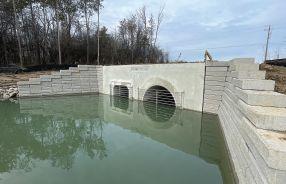
32 34 Lake Gibson headwall rebuild advances Thorold’s new subdivision construction by Yide Cao, C.E.T.
Are you ready for electrification?
OACETT members weigh in on the pace of electrification in Ontario by Kathy Lerette, C.E.T., Fellow OACETT

Welcome to 2025!
is here! Can you believe it?
Honestly, 2024 whizzed by so quickly—like a spacecraft soaring at breakneck speed to reach its destination high above the sky. And like NASA rockets, we’re moving faster than ever before. Maybe that’s why our obsession with taking photos and videos to capture memories has become increasingly popular and almost necessary to reminisce on the best and not-so-good times of the year past. Speaking of fast, did you know Mercury is the fastest planet in our solar system, and the Peregrine Falcon is the fastest bird in the sky, stooping or diving at speeds greater than 83.3 m/s (186 mph)? And on land, the Cheetah is the fastest animal. These are just a few examples of the many things constantly moving quickly in our world. But, just like Mercury, the Falcon and the Cheetah, technological advancements are moving rapidly, setting new records of what humanity can achieve in short windows of time. Hopefully, in 2025, as technology propels us to new heights, we will celebrate this achievement while simultaneously slowing down a bit to embrace them, too.
Another thing happening fast and furiously is catastrophic weather events like floods, fires, tornadoes, and hurricanes, courtesy of climate change. Take Los Angeles, for example, which suffered a wildfire in January that forced over 200,000 people to evacuate, and at the time of writing this piece, at least 12,401 structures were destroyed or damaged.
Last summer, Toronto had record rainfall, with nearly 10 centimetres of rain falling in three hours. This led to massive flooding across the city, putting the cost of the flood


at over $1 billion in insurable losses. With floods causing unprecedented destruction in Toronto, the city and other organizations have prioritized flood protection. On page 26, our cover story, “Flood protection project hits major milestones,” discusses how Waterfront Toronto’s revitalization of the Port Lands has paved the way for enhanced flood safety and a new vibrant community— a good example of how Toronto is taking action to protect its residents and businesses. As usual, this issue has much more to keep you informed, including OACETT’s new strategic plan, the introduction of NEAT Week, and OACETT’s survey on electrification. Plus, read about the safety of drones in our skies and how Lake Gibson’s headwall rebuild advances Thorold’s new subdivision construction.
Also, this year, due to rising paper/postage costs and a call for a refresh, The Ontario Technologist magazine is undergoing a redesign to offer a new modern look and deliver a more prominent publication to you seasonally – digitally and in print. The magazine will now be offered quarterly, with winter, spring, summer, and fall editions. In this case, less does mean more. Expect more pages per issue and more impactful issues with the good stuff you need to keep you in the loop on OACETT’s happenings, business matters, technical information, emerging technologies, and much more. We know how important the print issue is to you, so let’s embrace this opportunity to renovate house and tighten the belt on excessive cost.
Enjoy this issue and exciting things to come in 2025!

OACETT is dedicated to excellence in the engineering and applied science technology profession in a manner that serves and protects the public interest.
The Ontario Technologist is published bi-monthly by:
The Ontario Association of Certified Engineering Technicians and Technologists (OACETT) 10 Four Seasons Place, Suite 700 Etobicoke, Ontario, Canada M9B 6H7 Tel: (416) 621-9621 • Fax: (416) 621-8694 www.oacett.org
Please direct all inquiries, submissions and subscription requests to OACETT at the above address.
The Ontario Technologist is published in conjunction with:
Annex Business Media
111 Gordon Baker Road, Suite 400 Toronto, ON M2H 3R1 Tel: (416) 442-5600 • Fax: (416) 442-2230
EDITOR
Michelle Malcolm-Francis editor@oacett.org
ART DIRECTION Svetlana Avrutin
ACCOUNT COORDINATOR Cheryl Fisher
SALES CONTACT OTads@oacett.org
Subscriptions:
One year: $24 (Canada), $48 (U.S.A.), $96 (International). Please add 13% HST. HST Registration #107796658
©2025. The opinions expressed in this publication are not necessarily those of the Association. Neither The Ontario Technologist nor OACETT assumes any responsibility or liability for damages arising from any error or omission or from the use of any information or advice printed in this publication.
Letters regarding the journal should be addressed to the Editor at the Association’s address. Letters regarding the Association and other related subjects may also be addressed to the Editor for forwarding.
International Standard Serial Number (ISSN) 0380-1969. Publications Mail Agreement #40062764.
Return undeliverable Canadian address to: Circulation Department, 10 Four Seasons Place, Suite 404, Etobicoke, ON M9B 6H7.

The Ontario Association of Certified Engineering Technicians and Technologists, a self-governing, non-profit organization, maintains standards of excellence in the practice of engineering and appliedscience technology in Ontario. Founded in 1957, the Association became provincially legislated in 1984, and has statutory powers and responsibilities.
PRESIDENT
Micheal Mooney, C.E.T.
PRESIDENT-ELECT
Christopher van Dop, C.E.T.
PAST-PRESIDENT
Rosanna Tyrer, C.E.T., rcji, CAPM
CENTRAL REGION
Governance, Strategy and Policy Committee
Norman Sandberg, C.E.T.
EASTERN REGION
Finance and Audit Committee Chair
Brian Raymond, C.E.T.
HORSESHOE REGION
Diversity, Equity and Inclusion Committee Chair
Shelley Parker, A.Sc.T.
NORTHERN REGION
Registration and Professional Practice Committee Chair
Stephanie Pesheau, C.E.T.
TORONTO REGION
Member Engagement and Services Committee Chair
Roy Sue-Wah-Sing, C.E.T.
WESTERN REGION
Human Resources Committee
Member-At-Large
Samuel Nammari, C.E.T., P.Eng.
Young Professionals Committee Chair
Mladen Ivankovic, C.E.T.
Student Representative
Liam Croft
APPOINTEES
Daniel Liao
Heads of Technology Representative
Alex Lusty, LLB
Public Representative
EX-OFFICIO MEMBER
Cheryl Farrow, MBA, CAE
OACETT Chief Executive Officer
DIRECTOR, FINANCE AND CORPORATE SERVICES
Lily Rudeychuk, CPA
DIRECTOR, REGISTRATION AND PROFESSIONAL PRACTICE
Barry Billing
DIRECTOR, MEMBER ENGAGEMENT, SERVICES AND GOVERNMENT RELATIONS
David Terlizzi

AOACETT certification title and name change possibly on the horizon
t the time of writing this article, President Mooney was on leave, so I am sitting in as a guest columnist, getting my feet wet for one of the new duties that will come my way as of the Annual General Meeting (AGM) in June 2025, when our bi-annual governance transition will take place.
I’ve decided to take this opportunity to reflect on one of the hot topics of the day – the potential to change the title of our technologist certification from Certified Engineering Technologist (C.E.T.) to Professional Technologist (P.Tech.) and possibly change the name of our organization at the same time.
Over 7,800 members or 39 per cent of the membership responded to the survey that we issued to gather members’ sentiments. That level of response is kind of unheard of in associations and I consider it a very good sign of our Association’s health.
However, the survey didn’t provide very clear direction, as about a third of respondents expressed support for a change of title, a third were neutral, and a third were opposed. The survey results for the name change were almost identical. The full survey results are accessible on the OACETT Member Portal.
The process to date has also identified some potential misinformation or incomplete information in circulation, which I will try to address briefly here:
• Not all provinces are currently using P.Tech. However, the members of Technology Professionals Canada (TPC) agreed to undertake this consultation at this time. We will share with members the outcomes of the other consultations, and any vote within OACETT will be conditional on the agreement of all nine provinces to move to P.Tech.
Over 7,800 members or 39 per cent of the membership responded to the survey that we issued to gather members’ sentiments.
• The OACETT board of directors has not made a decision and will not make the decision. The Board will continue to consult and share information with members. You, the members, will make the decision at either an AGM or a special meeting properly constituted for that purpose.
• The Board has determined that if approved, the costs of rebranding and marketing will be covered by the reserves that the Association has accumulated for this type of broad, one-time initiative— an increase in member dues or a special levy will not fund it.
• In the event of an approved change, the C.E.T. title would be grandfathered, and members who have earned it will be welcome to continue to use it. It would just no longer be conferred.
• This is not the first time that OACETT has made changes to the titles it confers (C.E.T. used to be for technicians, for example) and has successfully managed past rebranding within the market. All members are encouraged to keep an open mind on this issue and to carefully consider additional information as it is shared. Dialogue should be respectful, as there are merits to both sides of this issue. The bottom line is that this will be a decision of the members.
If you were unable to share your thoughts in the survey, you are invited to contact me on this or any other matter at presidentelect@oacett.org.
Christopher van Dop, C.E.T., is currently president-elect of OACETT.
New strategic plan puts members first
OACETT has unveiled a new three-year strategic plan for 2025-2027 that embraces organizational values reflective of how the Association aspires to perform and how its members strive to excel in their diverse and critical roles.
In July 2024, the OACETT Board of Directors convened to discuss the organization’s future strategic direction and objectives. During this session, the Board reviewed insights from member surveys and chapter focus groups to assess the organization’s strengths, weaknesses, opportunities, and threats. Additionally, OACETT’s vision and mission were reviewed to ensure alignment with what became the new strategic pillars: expand recognition, grow membership, enhance services and emerging technologies.
The four outcome-driven strategic pillars identify the actions and measures required to achieve the Association’s goals over the next three years. It also outlines OACETT’s commitment to advancing the expertise of OACETT professionals and supporting their contributions to employers, communities, and Ontario. Each pillar has a unique role in evolving the profession and leading OACETT members to a successful future.
Here is a closer look at what each pillar will strive to accomplish.
Strategic pillar #1: Expand recognition
Promote the awareness and recognition of our members’ professionalism
OACETT will enhance the visibility and acknowledgment of members’ professionalism by strategically promoting their expertise to key stakeholders. This targeted outreach is vital for reinforcing the value of our members’ contributions across diverse sectors and ensuring their professional achievements are recognized on a broader scale.
Actions to take:
• Support members in promoting OACETT.
• Provide support to members to take on external leadership positions to further recognition for OACETT.
• Collaborate with other organizations on advocacy, event cross-promotion, and professional development to enhance collective impact.
• Launch public relations campaigns and continue government relations campaigns to raise public, employer and government awareness of the profession and the importance of certification.
Measures of success include the following: Survey of employers, tracking OACETT in media (against a benchmark), incidents of misuse of titles, track C.E.T. and C.Tech. appearance in job ads, and instances of certified members recognized as qualified persons in legislation.
Strategic pillar #2: Grow membership
Build on strategies to attract and retain members
OACETT will achieve greater diversity in its membership through demonstrating its value to individuals from differing backgrounds and stages within their careers.
Actions to take:
• Enhance existing strategies and implement new approaches to better recruit internationally educated professionals.
• Expand current disciplines of registration.
• Continue to enhance recruitment through employer engagement.
• Develop new approaches with colleges to better attract student members and incorporate the Professional Practice Exam (PPE).
• Explore ways to better leverage chapters.
Measures of success include the following: Total membership growth and specifically growth in internationally educated professionals and students members, implementation of a Diversity, Equity and Inclusion (DEI) strategy, and the number of student members and associates who write the exam.
Strategic pillar #3: Enhance services
Enhance processes and offerings
In response to members’ feedback, OACETT will take action to enhance their programs, processes and services across all departments and offerings.
Actions to take:
• Continue to enhance Continuous Professional Development (CPD) options for members.
• Investigate further opportunities to streamline certification processes.
• Continue to investigate new strategies to streamline and enhance communication and engagement.
• Identify and implement opportunities to improve the user experience with the member portal and website.
Measures of success include the following: Member satisfaction survey, Fireside Chat feedback, number of CPD offerings, process mapping to determine efficiencies against a baseline, and journey mapping of member experience.
Strategic pillar #4: Emerging technologies
Anticipate changes in technology trends
Anticipating rapid changes in technology advancements, OACETT will work with partners in academia and industry on a range of actions to support the development of well-rounded members and graduates.
Actions to take:
• Identify emerging technologies and the ways in which they should inform certification standards, training needs and other programs and services.
• Develop strategic partnerships around emerging technologies.
• Leverage technology advancements operationally.
Measures of success include the following: Partnerships entered into, report on the Board’s Emerging Technologies initiative, report on contribution of OACETT members to college Program Advisory Committees (PACs), and reporting on operational adoption of technologies and impact.
Priority actions
Priorities Actions
Priority A (Immediate priority)
Priority B (Secondary priority or needs a ‘Priority A’ action to be completed first before it can be launched.)
Priority C (Longer term priority that requires at least some Priority A and B actions to be completed.)
• Identify emerging technologies and the ways in which they should inform certification standards, training needs and other programs and services.
• Enhance existing strategies and implement new approaches to better recruit internationally educated professionals.
• Launch public relations campaigns and continue government relations campaigns to raise awareness of the profession and importance of certification.
• Continue to investigate new strategies to streamline and enhance communication and engagement.
• Develop new approaches with colleges to better attract student members and incorporate the Professional Practice Exam (PPE).
• Investigate further opportunities to streamline certification processes.
• Develop strategic partnerships around emerging technologies.
• Support members in promoting OACETT.
• Expand current disciplines of registration.
• Continue to enhance recruitment through employer engagement.
• Leverage technology advancements operationally.
• Identify and implement opportunities to improve the user experience with the member portal and website.
• Continue to enhance Continuous Professional Development (CPD) options.
• Explore ways to better leverage chapters.
• Collaborate with other organizations on advocacy, event cross-promotion, and professional development to enhance collective impact.
• Provide support to members to take on external leadership positions to further recognition for OACETT.
Over the next three years, OACETT looks forward to meeting the objectives of these strategic pillars and will provide progress reports on our implementation every year.

Members on the move
Alex Ethier, C.E.T., recently joined the Ministry of Transportation of Ontario as a maintenance coordinator. In this role, Ethier oversees the contract administration of the Ministry’s highway maintenance contract for the Cochrane district. This area spans nearly 800 km of primary and secondary highways, from Iroquois Falls to 120 km west of Hearst along Highway 11. His responsibilities include ensuring compliance with maintenance contracts, which involves extensive travel across the district. Ethier previously worked as an engineering technician with the City of Timmins’ engineering department and brings nearly a decade of experience in civil and construction settings to his new position.
Rhina Evangelista has joined Aquatech Solutions as a junior project coordinator. In this role, she supports the project man-
ager by coordinating various project activities, conducting detailed reviews of PACP, LACP, and MACP inspection videos to ensure they meet quality standards before client submission and participating in weekly project meetings. Previously, Evangelista worked for Peto MacCallum as a civil engineering technician. She holds various certifications from NASSCO’s Pipeline, Lateral, and Manhole Assessment Certification Programs (LACP®, PACP, and MACP®), which are trusted sources for assessment condition coding.
Steven Gore, C.Tech., began his new role as an industrial hygiene specialist with Workplace Safety North last fall and is loving the experience so far. With 10 years in the profession, including seven in occupational health and safety consulting and three in the mining in-
dustry, Gore brings a wealth of expertise to his new position. His previous roles include being an occupational hygienist at BluMetric Environmental and a health and safety specialist at TULLOCH. Gore is actively involved in the professional community, serving as vicechair of the Education Committee with the Ontario Industrial Hygiene Association and on the Executive Committee for the CIM Northern Gateway Branch. He looks forward to engaging more with OACETT as his career progresses.
What’s new? We want to hear from other members who have recently changed jobs, received a promotion or an award, or completed an educational program. Make sure your fellow OACETT members read about it in The Ontario Technologist. Promote your success – send your submissions to the editor at editor@oacett.org.
Save the date
THE PROVINCE’S BLUEPRINT FOR SUCCESS
JUNE 13-15, 2025, CAESARS WINDSOR HOTEL & CASINO
• It’s all about networking
• Expand your knowledge
• Discover the latest trends
• Meet our 2025 awardees
• Level up your CV
Celebrating 25, 40 and 50 years of membership!
This listing represents those who reached their milestone between October 14 – December 5, 2024.
25-year members
Julie Chatten, C.E.T.
John P. Flagello, C.E.T., rcji
Lorne Franklin, C.E.T., rcca
Mathieu Fraser, A.Sc.T.
Vladimir Kobelev, A.Sc.T.
Nataliia Kourys, C.E.T.
Kristine McNamara, A.Sc.T.
Joel Melburn, C.E.T.
P Wade Mooney, C.E.T.
Cain Positano, C.E.T.
Thouth (Tee) Say, C.E.T.
Keith Snider, C.E.T.
Prasad Thatte, A.Sc.T., rcca
Michelle Van der Wal, C.Tech.
40-year members
George Atikian, C.E.T.
David Falagario, C.E.T.
Daniel Grignon, C.E.T.
Lawrie Hemington, C.E.T.
Mark Hilash, C.E.T.
Anthony Ijzerman, C.E.T.
Albert Lux, C.E.T.
Edward Melcarek, C.E.T.
David Opara, C.E.T.
Michael Piett, C.E.T.
Gary Riedel, C.E.T.
Keith Rodel, C.E.T.
Mark Rosehart, C.E.T.
Owen Saffrey, C.E.T.
Norman Sandberg, C.E.T.
James Sarcevich, C.E.T.
Glenn Scanlan, C.E.T.
James Sinclair, C.E.T.
Domenic Somma, C.Tech.
Adrian St Kitts, C.E.T.
Natalino Traverso, C.E.T.
50-year members
Joseph Davies, C.E.T.
Hsing-Yu Hs, C.E.T.
James McMaster, C.E.T.
John Newbold, C.E.T.
Christopher Radley, C.E.T.
John Shadley, C.E.T.
Kenneth Smith, C.E.T.

GUESTS

HOST
Louis Savard, C.Tech., conducts thought-provoking interviews with industry leaders, government officials, academia and influencers on hot topics relevant to the engineering and applied science profession.
Claude Gauthier, C.Tech., rcsi, mii civil engineering technician, Region of Peel

Carol Warner, C.Tech. deputy registrar, OACETT
EPISODE 12 Enhancing Ontario’s Infrastructure: OACETT’s New Municipal Designations
In this episode of Tech Takes, host Louis Savard, C.Tech., explores the new Municipal Infrastructure Designations Program from OACETT. This program aims to improve the quality and value of non-transportation infrastructure in Ontario, focusing on the Municipal Infrastructure Inspector (mii) and Municipal Infrastructure Contract Administrator (mica) designations.
Joined by Claude Gauthier, C.Tech., rcsi, mii, a civil engineering technician from the Region of Peel, and Carol Warner, C.Tech., OACETT’s deputy registrar, the discussion covers the importance of these designations for ensuring safe and reliable municipal infrastructure, including major projects like the Region of Peel’s Wastewater Expansion.
Why become a licensed engineering technologist?
by Marika Bigongiari
In one word: opportunity. The licensed engineering technologist (LET) designation is a distinct type of limited licence offered by Professional Engineers Ontario (PEO) to qualified certified engineering technologists (C.E.T.s).
The term “limited” in limited licence denotes the specific scope of professional engineering that holders can practise. Contrary to its name, this licence class empowers holders to do more, like approve their engineering work. This broadens their professional responsibilities and creates opportunities for career advancement.
That’s been the experience of Kimberley Pickett, C.E.T., LET, a past president of the Ontario Association of Certified Engineering Technicians and Technologists (OACETT), which licenses C.E.T.s. Pickett explains she couldn’t stamp Phase One and Phase Two environmental site assessments as a qualified person (QP) without the LET. Under the Environmental Protection Act, a QP must be a licensed engineer or geoscientist. “The LET has meaningfully impacted projects where I can be a ‘qualified person,’” says Pickett. “Without the LET, I could not call myself a QP.” Pickett notes numerous additional benefits: “The LET designation has significantly enhanced my ability to contribute to engineering projects by providing a structured framework for professional development, deepening technical expertise and reinforcing my ability to work effectively within multidisciplinary teams.”
Specialized licence for C.E.T.s
Like the P.Eng. for professional engineers, LET is a protected title in Ontario. LET holders are recognized as trusted professionals who can deliver specialized solutions tailored to their expertise. “PEO’s LET designation recognizes that some C.E.T.s
“The
LET designation has significantly enhanced my ability to contribute to engineering projects by providing a structured framework for professional development.”
– Kimberley Pickett, C.E.T., LET
have the qualifications to practise professional engineering,” says José Vera, director of licensing at PEO. “It acknowledges specialized skills, allowing C.E.T.s to practise independently within a designated field or area of expertise authorized by their licence.”
LET holders are issued a distinctive seal highlighting their status and scope of practice, allowing them to approve engineering work within their practice area. They can assume responsibility for engineering services offered to the public, either as employees of firms holding a certificate of authorization (C of A) or by obtaining their own. Holding a C of A allows firms to provide engineering services to the public, ensuring oversight by qualified professionals.
Eligibility and requirements
Earning the LET licence involves stringent requirements, ensuring only qualified applicants receive the designation. In addition to passing the National Professional Practice Exam and demonstrating good character, C.E.T.s must meet specific criteria that set the LET apart from other licence types, as outlined below:
Academics
C.E.T.s must have a three-year degree or diploma in technology, science, engineering or equivalent educational qualifications. The unique targeting of applicants educated in technology or other science-related undergraduate fields distinguishes the LET from
P.Eng. criteria emphasizing engineering-specific bachelor’s degrees.
Experience
All applicants undergo a competencybased assessment of their experience. LETs need at least eight years of engineering experience, including six years related to the intended practice area.
Scope of services
C.E.T.s must submit a concise scope of services defined by function, product and application to ensure they practise within their expertise. The approved wording appears in PEO’s public directory, on the licence certificate and on the professional seal. A P.Eng. registered in Canada must endorse the engineering work described in the scope.
Professional certification
Applicants must maintain good standing as C.E.T.s with OACETT, which validates C.E.T. status annually.
Unlocked potential
The LET signifies specialized knowledge and experience. It connects C.E.T.s with professional engineers, equips them to bridge gaps in engineering teams, and positions them in leadership roles in vital areas like sustainable design, industrial automation or public infrastructure projects. Empowering C.E.T.s with the LET benefits everyone by allowing C.E.T.s to contribute authoritatively to projects, ensuring engineering work meets high standards and serves public needs. To those considering the LET, Pickett advises, “Submit your application.”
To learn more about the LET, visit www. peo.on.ca/apply/limited-licence.
Marika Bigongiari is the communication specialist at Professional Engineers Ontario.
Fireside chat updates OACETT members on happenings
by Cheryl Farrow, MBA, CAE
In November, OACETT hosted its popular semi-annual fireside chat, updating members on what is currently happening in the Association, and opening the conversation for members to ask questions or make comments on what was presented in the introduction, or any other matter of interest.
Three main items were covered in the introductory remarks from presidentelect Christopher van Dop, C.E.T., as president Micheal Mooney, C.E.T., was unable to participate. First, an introduction was provided to OACETT’s new strategic plan for 2025-2027. The main updates include a change to the vision to be more focused on our members than the Association; the creation of corporate values (Professionalism, Growth, Recognition, Relevance, Belonging); and the establishment of four new strategic pillars: Expand Recognition; Grow Membership; Enhance Services; Emerging Technologies. Each strategic pillar has a set of actions and key performance indicators to inform annual action plans and reporting.
The second item reviewed the survey results to gather members’ sentiments


about possibly changing the title of our technologist certification from C.E.T. to Professional Technologists or P.Tech. (with a goal of arriving at a common national certification, the same as we have with C.Tech. for technicians) and to consider changing the name of the organization at the same time. A remarkable 7820 or 39 per cent of OACETT’s membership participated in the survey, which is an excellent level of engagement. The results were almost evenly split on both the title change and the organizational name change, with approximately a third of members in favour, a third neutral and a third opposed. Most of the questions and discussions during the balance of the webinar focused on this item, and there will be ongoing discussions and consultations with members before the members
are asked to vote. The full survey results and list of pros and cons are available on the OACETT Member Portal.
The final item was to advise members that OACETT is taking legal action to protect our Certified Technician title. Periodically, issues of misuse arise, particularly in the automotive service sector, and to date, OACETT has been fortunate to reach settlements following the issuance of a cease-and-desist letter. However, a settlement was not achieved in this most recent instance, and OACETT has, therefore, decided to file an injunction against the party making unauthorized use of the title. We will keep members posted on the outcome.
Interested in viewing the fireside chat’s Q&As? Visit the News and Announcements section of the OACETT website.
Fletcher Foundation introduces monthly donation option
by Michelle Malcolm-Francis
There are so many ways to give to the Fletcher Foundation in 2025.
One way the Fletcher Foundation accepts donations is through PayPal. With PayPal, you can make a one-time donation or donate when you want. However, did you know you can click the check box to give monthly donations? We wanted to highlight this feature for those interested in giving monthly contributions.
There is also the new round-up donation feature on OACETT’s member portal, which provides OACETT members with a convenient option to round up their annual dues’ renewal payment to the nearest ten dollars, giving a generous gift to the Foundation.
Another way to donate is to mail a cheque, payable to the Carole and George Fletcher Foundation, to OACETT, 10 Four Seasons Place, Suite 700, Toronto, ON M9B 6H7.
Please join the growing number of Fletcher donors who pledge to change student lives by choosing one of these three convenient ways to give.
Every dollar counts when you want to elevate the educational experiences of engineering technology and applied science students. With your support of this new initiative, we can build more funds to
We thank you in advance for your support of the Fletcher Foundation.
support academic projects and programs that advance the training and skillfulness of students.

For more information on giving to the Fletcher Foundation, visit the Foundation’s page on the OACETT website at www. oacett.org/about-us/fletcher-foundation. If you have any questions, please email fletcherfoundation@oacett.org.
Fletcher Foundation holds successful virtual holiday silent auction
In November 2024, OACETT members showed how much they care about technology students by participating in the Fletcher Foundation’s third Virtual Silent Auction.
From Toronto Maple Leaf tickets to gift cards from big box stores, members basked in the fun of bidding on their favourite items to raise support for innovative programs that enhance students’ experience and broaden their access to engineering technology and applied science programs in Ontario colleges.
From November 13 to 24, 2024, the Fletcher Foundation’s auction on the Bidding Owl platform received close to 600 bids and raised over $4,000, close to its fundraising goal of $5,000.
“We are thrilled that our virtual holiday silent auction was once again a huge success,” said Fletcher Foundation chair Bob Jameson, C.E.T., Fellow OACETT. “OACETT members and partners who either participated in the auction or donated prizes have demonstrated what we can achieve when we work together for a significant goal like advancing the learning outcomes for the next generation of engineering technology professionals. Thank you!”
Congratulations to all the auction winners! We look forward to your ongoing support of the Fletcher Foundation in 2025. Each donation makes a difference!
Make the monthly donation HERE
is in
The week of November 25 marked Canada’s first National Engineering and Applied Science Technology (NEAT) Week, with a number of well-attended events across the country.
Ontario’s own Vikram Pandey and Hughroy Staple from Sheridan College won the first National Capstone Competition for their “Hydrothermal Carbonization (HTC) of Plastic Waste” project and will share the grand prize of $1,500. Congratulations! Over 400 registrants nationwide cheered on the finalists and selected the winner.
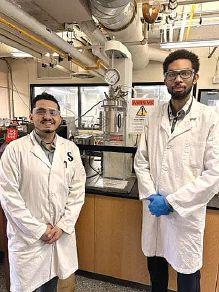
Sheridan College’s Vikram Pandey and Hughroy Staple are the winners of NEAT Week’s first national capstone competition.
On the Thursday of NEAT Week, Ontario once again contributed to a national webinar on the Role of AI in Engineering Technology, hosted by Michael Carter, professor of Applied Science and Computing at St. Lawrence College and a LinkedIn Top Voice on artificial intelligence. There were 770 registrants nationally who enjoyed the benefit of Carter’s insights into the theory of AI, some very practical technological and personal applications, and an exploration of the ethics.
We hosted a third NEAT Week webinar for Ontario members on the Future of Electrification in Canada, hosted by Kathy Lerette, C.E.T., Fellow OACETT, and informed by survey data from over 120 OACETT members working in utilities and hydro companies across the province.
Recordings of all the webinars are available on OACETT’s website: https://oacett.org/about-us/nationalaffiliations/neat-week.
Chapters were encouraged to align fall activities with NEAT week as well, like the Mentoring and Q&A session hosted by the Grand Valley Chapter executive on November 26 and the Niagara Chapter’s WIT event on November 28 on Regional Drainage Challenges and Innovative Solutions in Urban Cities, hosted by Noor Sayhon, C.E.T.
NEAT week is anticipated to become an annual event in the last week of November. Chapters are encouraged to consider the timing when planning and budgeting for 2025, and OACETT hopes to ramp up the participation of our college partners in the Capstone Competition as well!

engineering technicians and technologists since 1965.
about the designations and how they can enhance your credentials.
certify@oacett.org
www.oacett.org
Honouring excellence: OACETT recognized at Queen’s Park during NEAT Week
by David Terlizzi
The inaugural National Engineering and Applied Science Technology (NEAT) Week, this past November, was a success by any measure and, to add to this success, MPP Patrice Barnes, Member for Ajax and Parliamentary Assistant to the Minister of Labour, Immigration, Training, and Skills Development, at Queen’s Park, that same week, delivered an inspiring statement recognizing OACETT and its members in driving Ontario’s economy and supporting communities across the province.
NEAT Week spotlighted the pioneering ideas and solutions college students in engineering technology programs applied to their capstone projects. It highlighted their contributions to using science and engineering principles to create novel products, solve problems, or improve processes. Sheridan College capstone project came out on top in the provincial and national capstone project competition, and we are so proud of their deserving achievement.
Topping off the NEAT Week excitement, MPP Barnes, in her statement at Queen’s Park, highlighted the incredible impact of OACETT’s more than 21,000 members who work across diverse sectors. She emphasized your expertise and dedication to advanced technology, robotics, design, project management, and infrastructure maintenance. She also acknowledged your contributions as small business owners and entrepreneurs, demonstrating the versatility and importance of OACETT members in Ontario’s economic landscape.
MPP Barnes proudly recognized the 175 OACETT members residing in Ajax who are part of OACETT’s Durham Chapter. Many of these professionals work with advanced manufacturing companies. Their work ensures that
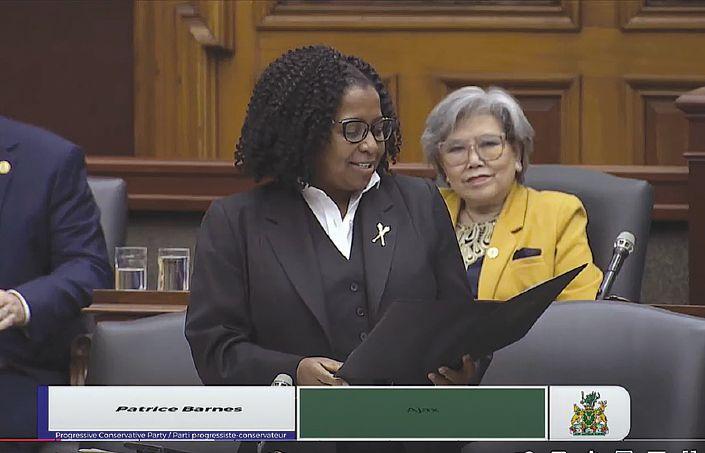
Topping off the NEAT Week excitement, MPP Barnes, in her statement at Queen’s Park, highlighted the incredible impact of OACETT’s more than 21,000 members who work across diverse sectors.
cutting-edge innovation and robust engineering practices remain at the forefront of Ontario’s manufacturing sector.
OACETT’s commitment to inclusivity and professional recognition for internationally educated professionals was another focal point of MPP Barnes’ address. By providing pathways for certification, OACETT helps skilled workers continue their careers in Ontario, ensuring their talents are fully utilized while they build a better future for their families. This forward-thinking approach strengthens Ontario’s skilled workforce and supports the province’s economic growth.
Also, this recognition underscores OACETT’s advocacy in highlighting the profession and our membership’s economic contribution. There is no silver bullet for OACETT advocacy. It is more like a buckshot. To this end, this recognition at Queen’s Park is one of many opportunities to make the provincial government aware of your great work. You matter. Period!
Thank you, MPP Barnes, for your acknowledgment and support. Thank you to all OACETT members who tirelessly contribute to making Ontario a leader in engineering technology.
One last thing to remember: nothing we do on our end can compare to the time and expertise you can provide for your Association and profession. If you are aware of any proposed changes to legislation that may affect your qualified person status or any opportunities that may benefit your discipline, please contact us at govrelations@oacett.org.
David Terlizzi is director of member engagement and services and government relations at OACETT.
Former Georgian College student gives back to her professional community
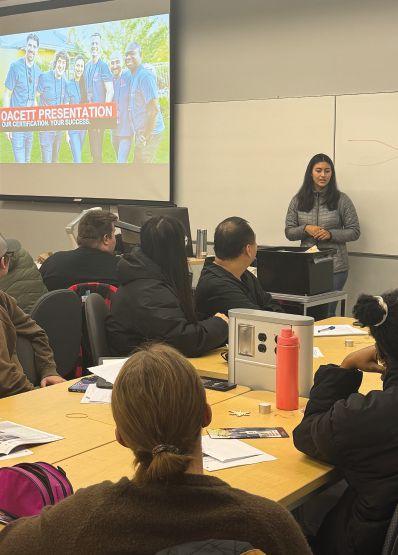
OACETT had a full circle moment last fall when Amy Mejia, C.E.T., rcji, a previous Georgian College student who joined OACETT as a student member, delivered a passionate presentation to engineering technology students on the value and benefits of OACETT membership. After graduating from Georgian’s civil engineering program, Mejia became the face of OACETT membership on many of its marketing materials following her participation and volunteer work at the Association’s conference. Over the past five years, she has enjoyed a budding career as a civil engineering technologist, most recently with the Town of Wasaga Beach. Thank you to Mejia and other members for your support, encouragement, and promotion to the next generation of engineering technologists and technicians and for showing the difference membership with OACETT makes.









OACETT CPD program changes, new guidelines and their impact
by Barry Billing
There has been increasing need for the OACETT Continuing Professional Development (CPD) program to keep pace with evolving industry standards, changing workplace demands and rapid technological advancements. As a result, a CPD subcommittee and task force of OACETT members were created to review the current CPD program to ensure that professionals remain competent, adaptable, and ready to meet the challenges in modern engineering and applied science environments.
Based on member feedback from OACETT’s fireside chats and chapter discussions, uncertainty around which CPD category to use, activities vs. hours, and acceptable vs. unacceptable CPD items were investigated.
This resulted in the following changes to the CPD program, which were approved by the OACETT Board of Directors and implemented in January 2025.
Category reduction
The current four categories are being removed and replaced with two new categories (Active Learning and Passive Learning).
• Active Learning involves engaging with technical subject matter through various participatory methods. Active CPD learning is about actively interacting with the material and requires participation in activities and discussions. Research shows that active engagement enhances long-term retention of information.
* Passive Learning refers to professional development activities that do not involve participant interaction and can be completed independently at one’s own pace. These activities consist of absorbing information
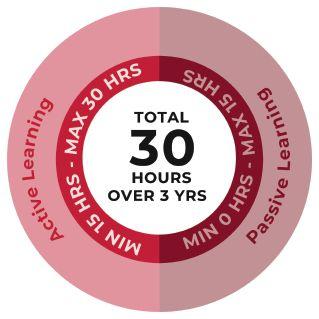
Active learning will be a mandatory requirement of at least 15 hours and can be used towards all your 30 hours (or 50 per cent to 100 per cent of overall CPD).
without direct engagement with others or active participation. This is also the category where OACETT volunteer activities would fall.
One unit of measurement
Activities are being removed to eliminate ambiguity about what is considered an activity. CPD will now be measured using hours, reducing confusion and aligning with many other professions.
Creation of a CPD guidebook
A guidebook will be available on the OACETT website to assist members with what is acceptable and unacceptable for CPD hours and whether it is active or passive learning. The guidebook will be continuously updated as further comments and activities related to the program are realized.
30 hours of CPD over three years
One of the more significant changes to the CPD program is establishing a set number of hours required over a three-
year period. This breaks down to ten hours a year, which the subcommittee felt was manageable.
CPD program changes also include a growing emphasis on flexibility in learning. Within the 30 hours required, there is recognition that some learners prefer to learn through passive learning, such as staying updated on industry developments through forums, books, and articles, whether in print or online, podcasts, and webinars. This will now be acceptable for a maximum of 15 hours (or 50 per cent of overall CPD).
Active learning will be a mandatory requirement of at least 15 hours and can be used towards all your 30 hours (or 50 per cent to 100 per cent of overall CPD). In summary, any combination of acceptable active and passive hours equalling 30 hours will be satisfactory as long as 15 hours from the total are active learning.
Lastly, the evolution of the Continuing Professional Development program reflects a broader shift toward more personalized, flexible, and outcomedriven learning. These changes are designed to ensure that professionals stay updated with the latest industry trends and enhance their broader skills and well-being. By embracing technological innovation, acknowledging informal learning, and placing greater emphasis on competencies and soft skills, the updated CPD program is better suited for the dynamic and ever-changing demands of today’s professionals.
For more information, visit www. oacett.org/professional-development/ mandatory-cpd-information.
Barry Billing is director of registration and professional practice and the OACETT registrar.
Updated MEA/ACEC-Ontario Standard Agreement enhances project excellence
by Michelle West
The Association of Consulting Engineering Companies-Ontario (ACEC-Ontario) and the Municipal Engineers Association (MEA) have unveiled the latest version of the MEA/ ACEC-Ontario Standard Agreement for Engineering Services. This revamped agreement, which results from extensive collaboration among municipal engineers, consulting engineering firms, legal experts, and insurance professionals, aims to streamline the delivery of municipal infrastructure projects.
Members of OACETT will find the MEA/ACEC-Ontario Standard Agreement to be invaluable for efficient project execution, as it explicitly itemizes the required project deliverables, identifies the roles and responsibilities of the owner and consultant, clarifies risk parameters, and sets out the schedule and budget expectations, thereby creating a path to ensuring client satisfaction.
The MEA/ACEC-Ontario Standard Agreement has long been a trusted resource, offering a balanced and consistent framework to define roles, clarify responsibilities, and establish fair risk allocation. By addressing commercial considerations with transparency, the agreement fosters trust and paves the way for more effective partnerships between municipalities and consulting engineering firms.
Andrew Hurd, the executive director of ACEC-Ontario, emphasized the significance of the agreement, “The staff of consulting engineering firms are dedicated professionals committed to designing and supporting the delivery of critical infrastructure in our communities that impacts Ontarians. By leveraging this agreement, both parties can ensure consistency, helping achieve better project outcomes.
The new revision reflects our ongoing commitment to fostering best practices and achieving engineering excellence across Ontario.”
This Agreement is expected to be a key tool for municipalities across the province as they navigate the complexities of engineering projects. It considers fair and reasonable terms in the contracting process and reinforces a commitment to efficiency in the delivery of infrastructure projects that directly impact Ontarians’ daily lives.
To help municipalities and consulting engineering firms understand how to use the revised agreement, MEA
and ACEC-Ontario hosted a webinar on January 30. The recorded webinar can be found on ACECOntario.ca.
Members of OACETT are encouraged to explore the updated Agreement and User Guide (available at ACECOntario.ca) and promote its adoption in municipalities across the province. Together, we can deliver successful projects for the benefit of all Ontarians.
Michelle West is director of membership, marketing and communications at Association of Consulting Engineering Companies Ontario.
Quinn Truong: Succeeding by building on her foreign credentials
by Dennis Furlan
When Quinn Truong, C.E.T., rcsi, came to Canada in 2015, her initial experience was similar to many others with foreign credentials. She had the knowledge and the experience but had difficulty breaking into her field. So, she eventually found a solution involving education, OACETT credentials, and perseverance.
Her story starts back in Vietnam, where she received a Bachelor of Architecture at the University of Architecture of Ho Chi Minh City. Her husband, David, is a Canadian who worked in Vietnam for over 20 years. That’s where the two met and got married. But a family crisis posed a challenge for the couple.
Adapting to crisis
Truong explains: “David’s mother in Northern Ontario was starting to suffer from dementia and needed more personal attention. Because family is very important in Vietnam, I felt supporting David in his desire to take care of his mother was necessary. So, we moved.”
However the move was not easy for Truong, both professionally and culturally. She says, “I couldn’t find a job. Not only did I struggle with the language; I found it very hard for someone to land work in Canada with foreign credentials.”
And Truong adds that her situation made things even harder than for many others with foreign credentials. She says, “Because I came to Canada following my husband, I could not get a skilled worker visa. Even though I had ample experience in civil engineering and road construction in Vietnam, I had to figure things out on my own in Canada.”

And that’s what she did. She decided to go back to school in 2018 to study civil engineering at Northern College in Timmins. She says, “It was one of the best things I did. I already knew a lot about the subject matter, but being in the program for a few years allowed me to learn the language and interact better with people here. I recommend it for any foreigner trying to seek work in Canada.”
Getting the right credentials
The next step in her development was obtaining the C.E.T. certification and rcsi (Road Construction Senior Inspector) designation with OACETT. She says, “When you’re a foreigner, employers doubt your job ability. But employers have more confidence that you can do the job when you have credentials from a reputable organization such as OACETT.”
Currently, Truong has two jobs. First, she works as part of LEA Consulting’s contract administration team, where she has used her project management skills to help oversee the building of
eight bridges and three highways (and counting) for the Ministry of Transportation in Northeastern Ontario.
She says, “This is the kind of work I did in Vietnam. It’s very rewarding to do such work again in ways that reflect my skills and impact the community positively.”
Her second job is as a professor at Northern College. She says, “It allows me to not only pass on my knowledge in civil engineering and road construction, but it also allows me to use my own experiences adapting to Canada in ways that can help my students, too.”
Dennis Furlan is a contributor with The Ontario Technologist.
Calendar of Events
March 30 - April 2
Good Roads Conference
Fairmont Royal York Hotel, Toronto goodroads.ca/conference/
March 31 – April 2
Ontario Transportation Expo
Delta Marriott Toronto Airport, Toronto ote.ca
April 16 – 17
TECHSPO Technology Expo
Toronto Marriott Downtown Eaton Centre Hotel, Toronto techspotoronto.ca
June 3 – 4
The Canadian Telecom Summit Metro Toronto Convention Centre, Toronto www.telecomsummit.com
Building bridges for internationally educated professionals
by Julia Farner, CAE
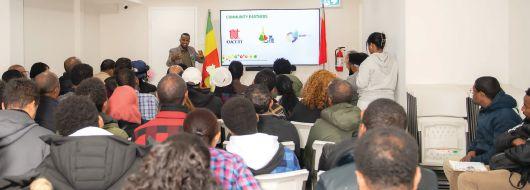
On December 14, 2024, the Ethiopian Technologist Network (ETN), a new organization, hosted its inaugural event in partnership with OACETT and the Ethiopian Association in the Greater Toronto Area (GTA).
The half-day event at the Ethiopian Association’s headquarters featured sessions and networking opportunities, followed by a traditional Ethiopian lunch. Over 40 attendees from the engineering technology community gathered to learn about ETN’s mission, OACETT’s certification benefits, and services provided by the Ethiopian Association in the GTA. Attendees, including newcomers and those who had been in Canada for years, left with a stronger sense of community and a deeper understanding of the resources available to help them succeed professionally.
Despite the monumental progress made with the passing of the Working for Workers Act, 2024, which bans Canadian work experience requirements in job postings, many internationally educated professionals still face difficulty landing that crucial first career opportunity in their new home.
As an organization that certifies many internationally educated professionals, OACETT understands career struggles. This is why the association launched a career event for internationally educated professionals (IEP) in the engineering technology field. This annual event includes a day of virtual sessions followed by an in-person professional networking event, providing an opportunity for OACETT members and IEPs to connect.
At this year’s event, OACETT was fortunate to meet Dejene Gizaw and Teshome Sidamo, newcomers from Ethiopia with backgrounds in engineering technology. Both were eager to become certified members of OACETT and make meaningful connections to help them land their first professional jobs in Canada.
Beyond the invaluable networking opportunities, the event inspired Gizaw and Sidamo (who was featured on the November/December 2024 cover of The Ontario Technologist magazine) to team up with their friend, Kibreab Wordofa, to establish ETN, their own professional cultural community organization — within a few weeks of OACETT’s IEP career event.
The ETN’s mission is to create a network of STEM professionals from Ethiopia dedicated to connecting, developing, and engaging Ethiopian technologists in Canada.
The success of ETN’s first event can be attributed to two key factors. First, the partnerships forged between ETN, the Ethiopian Association in the GTA, and OACETT were criti-
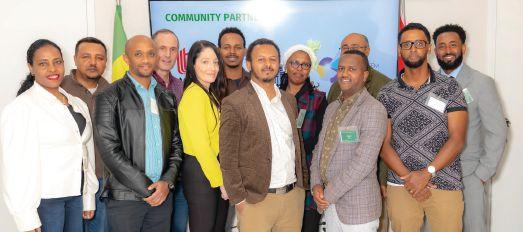
Technology Network event attendees with OACETT staff Julia Farner, CAE (marketing and communications manager) in the front row, third from the left, and David Terlizzi (director of member engagement and services and government relations), back row, second to the left.
cal in expanding the event’s impact. Partnerships between organizations are essential for resource sharing, knowledge collaboration, idea generation, and enhancing credibility with stakeholders. They also provide a stronger collective voice when applying for grants and advocating.
Second, while there is no single solution to ensure career success for every individual, the overarching support communities provide is invaluable. Whether it’s a professional network like OACETT, a cultural community like the Ethiopian Association in the GTA, or a combination of both (i.e. the ETN), these communities offer networking and collaboration, mentorship, access to resources, knowledge sharing and the opportunity for career advancement.
If you’re interested in hosting an OACETT event for internationally educated professionals in your area, please contact events@oacett.org.
Julia Farner is manager of marketing and communications at OACETT.
Ethiopian
Dejene Gizaw (standing) speaks to newcomers from Ethiopia about the new organization he helped to establish (with the support of OACETT) called Ethiopian Technology Network (ETN).
Supporting our college partners
In April 2024, the Government of Canada announced new limitations on international student visas, and more recently, there were changes to eligibility for work permits for international students in many programs. These have significantly impacted Ontario’s post-secondary institutions, including publicly funded colleges, which appear to be disproportionately impacted by these policy changes.
Recently, it came to OACETT’s attention that in determining which programs are eligible for international students to obtain Post Graduate Work Permits (PGWP), Immigration, Refugees and Citizenship Canada (IRCC) omitted a number of key engineering and applied science technician and technologist programs by not including the Classification of Instructional Programs (CIP) code that applied to those programs.
With the dual impact of reduced international student intake and courses no longer being eligible for a PGWP (and therefore not attractive to those international students still eligible to apply), college engineering and applied science programs are scrambling. International students represent
10 – 40 per cent of students in many of these comprehensive programs. Students and graduates in these programs are not looking for a quick route to a work permit but a rigorous path to build a career and a life in Ontario. Without sufficient enrollment, programs will not be sustainable, reducing access for domestic students. We are already seeing the results. On November 27, Sheridan College announced its intent to cancel 40 programs – 12 of which were technician and technologist programs – because of the new restrictions. We anticipate that this is the first of many such announcements across the province.
These programs represent the primary pipeline for new engineering technicians and technologists in Ontario. Without them and the skilled graduates they produce, OACETT is concerned that Ontario will not be able to achieve its ambitious infrastructure and energy goals. Therefore, OACETT has partnered with the Ontario Heads of Technology (HOT) to send letters of support to the Ontario Ministry of Colleges and Universities and to IRCC on the need to address this oversight. This includes providing a specific list of CIP

W E B I NA R S
ROAD TO CERTIFICATION
Join OACETT for a webinar on the benefits of becoming a Certified Engineering Technologist (C.E.T.) and Certified Technician (C.Tech.).
WHY ATTEND?
• Learn how OACETT certification can boost your career — higher salary, networking, and marketability.
• Learn about CTEN.ca, OACETT's career site.
• Learn about OACETT certification requirements.
To register for a webinar, visit: Students: www.oacett.org/student-road-to-certification
Internationally Educated Professionals: www.oacett.org/iep-road-to-certification QUESTIONS? Contact Trishia at ttedoldi@oacett.org.
WEBINARS DATES AT A GLANCE
COLLEGE STUDENTS: Monday, March 3, 17, 31 @ 12:00 p.m.
Monday, April 14, 28 @ 12:00 p.m.
INTERNATIONALLY EDUCATED PROFESSIONALS:
Thursday, March 6, 20 @ 1:00 p.m.
Thursday, April 10, 24 @ 1:00 p.m.
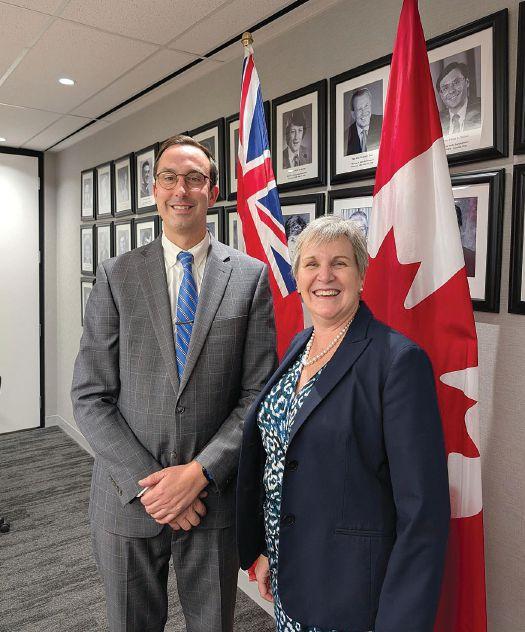
MPP Nolan Quinn, Minister of Colleges and Universities, visits with OACETT CEO Cheryl Farrow, MBA, CAE, on November 27, to discuss the engineering technology profession in Ontario, your Association and the changes at the colleges impacting engineering technology programs.
codes that the Deans of Technology have identified as missing from the IRCC’s list of programs eligible for a PGWP and integral to ensuring a sustainable pipeline of new engineering technologist and technician graduates.
CEO Cheryl Farrow had the opportunity to meet with the Minister of Colleges and Universities (MCU), Nolan Quinn, on November 27 as part of the government relations outreach planned around National Engineering and Applied Science Technology (NEAT) Week and personally requested the Minister’s support. It is our understanding that MCU has submitted to IRCC a carefully considered list of CIPs that should be added back to the eligibility list in recognition of Ontario’s strategic labour market priorities. We are confident that all the CIP codes submitted as part of OACETT’s advocacy will be included. Our attention has now turned to IRCC and its response to the Ontario Government’s recommendation.
OACETT has also shared our work with our counterparts across the country, hoping a national advocacy effort will have a greater impact. HOT members have expressed their appreciation for OACETT’s involvement, and we will continue to provide support as this issue evolves.

YPC announces 2024/2025 scholarship winners
by Ana Sierra, CAE
The Young Professionals Committee (YPC) is excited to announce that Chrispin Ajedipe and Alexander Littleton are the winners of their 2024/2025 scholarship.
Now in its second year, this initiative is one of many ways YPC engages with students and young professionals, providing resources to empower them and support the engineering technology profession.
Commenting on the scholarship’s positive impact on students and their communities, Mladen Ivankovic, C.E.T., chair of YPC, said: “We want to support the next generation of industry leaders and help them unlock their full potential. Our greatest hope is to inspire more student members to go out into the world, dare to make a difference, and bring recognition to OACETT and the engineering technology field.”
The YPC scholarship is open to all OACETT student members and provides a $500 bursary to up to three OACETT student members pursuing studies in an engineering technology discipline.
The winners are chosen based on exceptional volunteerism with OACETT, their college, a company or a community organization. Applicants must also submit a short essay and reference letters.
Please join us in congratulating the scholarship winners! Learn more about their volunteer service and what the scholarship means to them.
Chrispin Ajedipe Centennial College
Environmental technology student, Year two

“Nothing can express how joyful I am to receive the YPC scholarship. I literally screamed out loud!”
Chrispin Ajedipe is a second-year student in Centennial College’s Environmental Technology program. Ajedipe brings a wealth of knowledge to his
studies thanks to over four years of hands-on experience in various fields, such as landfill engineering, solid waste planning, wastewater design, and environmental remediation in Ghana. He serves as the college liaison for OACETT’s Toronto East Chapter and participated as a student volunteer at OACETT’s 2024 conference. Ajedipe is also the president of the Environmental Student Society at Centennial College.
His dedication to environmental preservation is further exemplified by his volunteer work with the Toronto and Region Conservation Authority, where he participates in ecosystem preservation and sustainability initiatives, including tree planting activities.
Ajedipe enjoys hiking, playing tennis, exploring nature, and engaging in volunteer work outside his academic and professional endeavours.
Alexander Littleton Durham College
Mechanical engineering student, Year two
Littleton enrolled in the Electromechanical Engineering Technology program at Durham College as a sec-

“Thank you so much for the wonderful news! I am truly honoured to be a recipient of the YPC Scholarship.”
ond career, inspired by his interest in manufacturing and product development from working at a motorcycle dealership. After his first two semesters, he secured a part-time internship at Woodland Mills, where he currently works on developing electric assist options and testing new products, applying his classroom knowledge to realworld tasks.
In addition to his studies, Littleton volunteers as a peer tutor and lab assistant, supporting students in various engineering programs. He shared his sentiments on his volunteering experience: “Tutoring expanded my social network and deepened my understanding of classroom material.”
He enjoys working on his VW Golf R and KTM 790, playing in bands, modifying musical equipment, and relaxing with his cats. Recently, he discovered a passion for woodworking and plans to build a custom guitar using wood milled during Woodland Mills product testing.
Grateful for the support of his professors and mentors, he acknowledges Paul Wraight for recognizing his tutoring potential and Neil Bramley and Josh Malcolm for their guidance during his internship. He believes the YPC scholarship will help him focus on his studies and advance him toward de -
signing innovative electromechanical systems in the forestry sector.
About the YPC scholarship
The YPC scholarship is a $500 award open to OACETT student members of any age who are enrolled in full-time studies in an engineering technology or applied science program at one of the twenty-four colleges in Ontario and who meet the following criteria:
• Have successfully completed their first year of studies.
• Are dedicated volunteers with OACETT, their college, a company or a community organization. They must list their volunteer activities and have at least one letter of reference from OACETTcertified members, college faculty and staff, or representatives from the company or community organization where they volunteer.
• Write a 300–500-word essay on why they deserve to receive the scholarship.
How to apply
The scholarship applications open in September 2025. For more information about the YPC Scholarship, visit https://www.oacett.org/members-area/young-professionals-committee or contact ypc@oacett.org.
Ana Sierra, CAE, is the marketing specialist at OACETT.
Algonquin College student receives $1,500 Colleges and Institutes Canada climate leader bursary
In December 2024, Algonquin College announced that environmental technician student McKenzie Mitchell was awarded a $1,500 Colleges and Institutes Canada (CICan) ImpAct Climate Challenge bursary for his efforts as a student climate leader.
Mitchell’s project, establishing a Miyawaki Forest at the Pembroke Campus, is based on the Miyawaki method, which originated in Japan. This focuses on afforestation in urban spaces using native trees and plant species in dense plantings to maximize growth and carbon sequestration.
CICan ImpAct Climate Challenge bursaries recognize exceptional student climate action leaders and award $1,500 to student climate action leaders.
Earlier this year, CICan held its ImpAct Climate Challenge, where college students across Canada participated in various online learning challenges. Based on the level of participation, Algonquin College received an institutional award to support a student climate leader. Mitchell is the recipient of that award.
“Supporting wildlife is my passion, and a collective action project in our ‘backyard’ was exactly the kind of project I was hoping to be involved in when coming to Algonquin,” said Mitchell. “I would love to take everything I’ve learned during my diploma and participation in the Miyawaki project and apply it in many different spaces around the province or even further. The phrase ‘think global, act local’ has always been a personal motto of mine that’s stuck with me throughout the years. I look forward to the day I can (return) and visit the forest and see how (much) it’s grown.”
“It was truly rewarding to be part of his vision and, along with other faculty
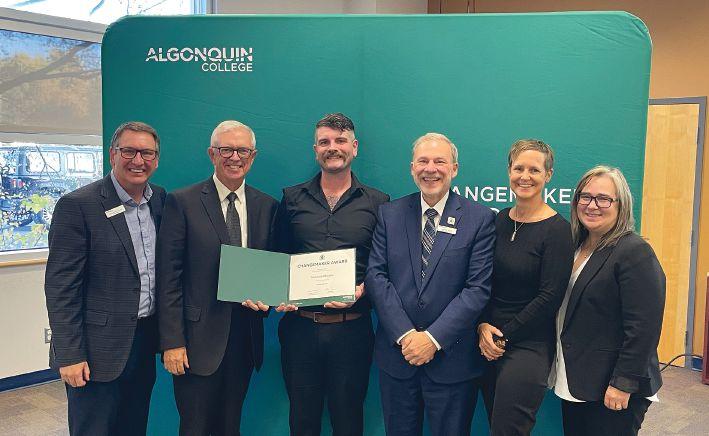
from left to right: Jamie Bramburger, interim dean, Pembroke campus, James G. McCracken, chair of Algonquin College’s Board of Governors, McKenzie Mitchell, environmental technician student and CICan ImpAct Climate Challenge bursary recipient, Claude Brulé, president and CEO of Algonquin College, Bobbie Gormley, chair of Business, Technology and Outdoor Training at the Pembroke campus and Kristi Beatty, coordinator of the Environmental Technician Program at Pembroke campus.
“Supporting wildlife is my passion, and a collective action project in our ‘backyard’ was exactly the kind of project I was hoping to be involved in when coming to Algonquin”
– McKenzie Mitchell
and students, to help him see it to fruition,” said environmental technician program coordinator Kristi Beatty.
“It’s a great feeling to be part of such a grass-roots initiative. Especially one that has such potential longevity and local impact! McKenzie deserves every bit of recognition he has received – he was the main driver in obtaining the
grant funds and planting materials, organizing the public meeting, and laying out the planting concept – and he was there for every bit of the ‘getting dirty’ part too!”
About the Miyawaki Forest at the Pembroke Campus
The Algonquin College Miyawaki Garden is the first afforestation project of its kind in Renfrew County. Its success has sparked discussions with the City of Pembroke for additional Miyawaki spaces. This potential collaboration would allow environmental technician students to work on high-profile, environmentally sustainable projects alongside the local community.
Sara-Lynne Levine is a communications officer at Algonquin College.
Pictured
Change in the skies
Air traffic management has always been complex, but the advent of unmanned aircraft or ‘drones’— which could revolutionize everything from inspecting infrastructure to delivering medical supplies—has posed new challenges. Compared to planes and helicopters, drones are designed to travel through densely populated areas to hard-to-reach destinations.
Hence, Transport Canada and Nav Canada are overseeing remotely piloted aircraft system (RPAS) traffic management trials to ensure any scaled-up use of drones in the future will be safe and efficient.
I interviewed Richard Brown, COO of Variable Pitch, an aviation consulting firm recently selected to participate in the second phase of these trials, focusing on ‘beyond visual line of sight’ (BVLOS) operations. The firm, along with a consortium of partners from Canada and around the world, will conduct the trials.
Q: What technology is needed for BVLOS operations?
A: Remote flight control system (RFCS) software allows the pilot to ‘fly’ the drone from a computer or even a tablet. Command and control (C2) communications transmit instructions to the drone’s autopilot via a cellular, radiofrequency (RF) mesh and/or satellite network. ‘Detect and avoid’ technology alerts the pilot to manned aircraft operating in the same space.
As with crewed aircraft, weather also affects a drone’s performance and operating range. Access to data on these conditions along flight paths assures operators their drones and payloads will safely complete their flight plans— or they can divert or cancel a flight.
Many of our consortium participants already supply aviation and drone technologies to their customers. Variable Pitch is leading the integration

“Capabilities and benefits may best be demonstrated in complex, highly regulated airspace.” – Richard Brown, COO, Variable Pitch
of these technologies to enable RPAS traffic management (RTM) operations consistent with the trials.
Q: What will happen in the second phase of the trials?
A: Transport Canada and Nav Canada have invited companies to demonstrate how a traffic management system will operate. After seeing each demonstration, they will be better able to evaluate how planned regulation changes may best align with existing technologies. The capabilities and benefits of the consortium’s technologies may best be demonstrated by conducting the trial in complex and highly regulated airspace.
Q: What opportunities will this mean for Ontario’s engineering technicians and technologists?
A: As with other technology platforms, commercially viable use cases will emerge in parallel with breakthroughs in hardware and software.
Opportunities to improve the operating characteristics of a BVLOS drone could include noise reduction, as most commercially available rotors are noisy; weatherproofing, so as to operate safely and reliably when winds are strong, temperatures are low, or rain or snow is forecasted along the planned flight path, and combining lighter construction with better power sources to extend drones’ operating radius with heavier payloads.
Opportunities for engineering technicians and technologists will arise from changes in Transport Canada and Nav Canada’s regulatory environment, drone operators’ successful commercialization of new use cases, the resulting increased demand for the design and manufacture of new and advanced BVLOS drones and, finally, increased demand for inspection and maintenance.
Peter Saunders is a regular contributor to The Ontario Technologist.

FLOOD PROTECTION
BY KRISTEN FRISA
Waterfront Toronto revitalization of the Port Lands paves the way for enhanced flood safety and a new vibrant community

In November 2024, Waterfront Toronto reached a key milestone by completing a new mouth for the Don River and creating a new island – two significant steps in safeguarding Toronto residents and businesses from severe flooding and turning land with so much potential into a vital community.
Several years ago, Waterfront Toronto began working on this massive project, known as Port Lands Flood Protection Project, to improve flood protection, revitalize natural habitats, and enhance the usability of surrounding lands at the base of the Don River. Eventually, the area will be opened for residential development.
The whole push for this project started with The Task Force to Bring Back the Don – a citizen advisory committee that advised the Toronto City Council on issues concerning the Don River and its watershed – which released a 1991 report called Bringing Back the Don that argued for the recreation of a natural mouth for the Don River.
ALL PHOTOS: WATERFRONT TORONTO / VID INGELEVICS / RYAN WALKER




Since 2018, the project has gained more ground, with engineering teams breaking ground to excavate a new river valley. The recent removal of the North Plug, an underground wall that connects the Don River to the newly built river valley through the Port Lands, is the last step towards taking a wide swath of southeast Toronto off the floodplain map, enabling future development for housing units within the 19 hectares of developable land and 20 hectares of new parkland and greenspace, allowing one of the last undeveloped areas steps from Toronto’s downtown to transform into a chic, livable, and nature lovers’ neighbourhood.
Although the project is large and complex and serves multiple purposes, its primary driver is flood protection,
The new bridge at Commissioners Street opened in January of 2024. This view shows one of the new wetlands, the new river, and a recreational trail, looking east from the new Ookwemin Minising island.
Fully intact north plug before removal.
Removal of north plug in progress.
focusing on areas bordered by the Inner Harbour, Leslie Street, Lake Shore Boulevard, and Outer Harbour.
The Port Lands was created in the early 20th Century when the city filled in Ashbridges Bay Marsh to create an industrial area to support the city. The process involved dumping infill into the wetland and diverting the outlet of the Don River into a channel at a 90-degree angle. The channelization and creation of the Keating Channel created a flood risk for the surrounding area in the event of a major storm.
Managing flood waters
The Port Lands Flood Protection Project’s massive effort to give flood waters a better outlet into the lake created a naturalized river that runs through the Port Lands to convey floodwater safely into Lake Ontario via three separate outlets: the first two consist of the existing Keating Channel, which is the outlet for stormwater, and a new naturalized river valley through the Port Lands and then directly south of the existing mouth of the river.
The third outlet consists of wetlands south of the westerly bend in the Don River. In the event of a significant flooding event, excess water can flow over the levee into the wetland and through to the shipping channel.
Along with the three outlets for stormwater, the project allowed for an earthen berm that ties into Lake Shore Boulevard all the way under the newly constructed Don Roadway to an area south of Commissioners, preventing water from getting under or over it or eroding it away over time. Together, these protections offer enough security from floods so that the area will no longer be considered part of the floodplain. Don Forbes, a project director of the Portland Flood Protection Project, Waterfront Toronto, says revitalizing the underused land area could have a big impact on the city.

“This is a huge landmass compared to the rest of downtown Toronto. People call it a new neighbourhood, but it’s really more like a new district,” Forbes said. “The potential there is massive.”
Geotechnical challenges
A project of the magnitude of building a new riverbed is complex, to begin with, but the nature of the land made it even more challenging for the team tasked with stabilizing the area. When the Port Lands was created, the city used low-quality fill to cover up the existing wetlands. Wetlands are made up of a lot of peats and highly organic deposits, so the fill tends to continue to sink in farther and farther as these rich soils compress down, leading to an unstable geotechnical landscape for the structures on top along with any infrastructure built into it, like pipes.
Engineers aiming to create a more stable substrate had to find a way to improve the ground without simply excavating these layers of soil and fill. They also had to work around a great deal of soil contamination from the land’s previous industrial usage, including coal and oil storage facilities. “What we ended up with was highly heterogeneous, very poor geotechnical conditions, as well as significant amounts of soil and groundwater contamination,” Forbes said.
“Another challenging factor was the water table,” Forbes said. Building right beside a lake, the engineering team had to deal with water that filled up any area the team dug.
“People call it a new neighbourhood, but it’s really more like a new district, the potential there is massive.”

Building a new river valley
The team now had a slew of challenging factors to manage all at once as they attempted to dig and rebuild a brand-new riverbed. Their method was to control the environment as best they could while rebuilding a stable base for the river. “We built about two and a half kilometres of structural secant pile walls,” Forbes said. “That allowed us to create vertical sidewalls that allowed for really tight excavation all the way down to the bedrock, about 25 to 45 meters below the ground surface.”

Once at excavation depth, the team installed underdrains consisting of granular filled trenches and sump pumps periodically placed to pump out any water that seeped in. The water coming in was contaminated, so it couldn’t just be pumped into the lake. Instead, the engineering team set up an on-site groundwater treatment plant capable of treating 2.5 million litres of water per day to provincial water quality standards before it was discharged into the shipping channel.
Next, the team installed an environmental barrier system made of a geosynthetic clay liner followed by a plastic poly membrane and topped with a reactive treatment layer (made up of a combination of granular activated carbon and bentonite) along the entire river valley to prevent contaminated waters from making it into the river waters from below.
Two areas of the river at the “North Plug” and the “West Plug,” structures that separated the riverbed from Lake Ontario, proved too difficult to dewater, so the team had to find a way to construct a riverbed from finishes that could be applied in a saturated environment: in this case, heavy armour stone. The stones serve a dual purpose—along with creating a stable river profile, they also offer protection from ice for the river below.
Limestone blocks, the size of dining room tables, were used to create the river profile. Now that they’re in place, any ice that comes down the river will stack up on the banks of stone instead of flowing to the rest of the river valley where it would damage all the natural finishes. “The whole system is engineered to be very, very resilient,” Forbes said.
An excavator using a grinder attachment removing the north plug.
The Cherry Street South Bridge, where the new mouth of the Don River flows out into Lake Ontario, is surrounded by newly-planted wetland vegetation, which has already become home to wildlife.

The new environment
In addition to flood protection, the revitalization of the Port Lands include the creation of Biidaasige Park and walking and bike trails. By raising the soil grade and creating the new riverbed, the area has breathed new life into what was once known as Villiers Island, now known as Ookwemin Minising. Across the Eastern Waterfront, the land unlocked by this flood protection project will house more than 100,000 people.
The team constructed four new bridges across three locations to connect the island to the rest of Toronto—two cross
at Cherry Street North: a vehicular bridge and a bridge for future light rail use. The bridge at Commissioners Street connects the island to the rest of the Port Lands. A fourth bridge connects Cherry Street South across the mouth of the new riverbed.
“This is a really massive project – we’re talking $1.4 billion in a lot of years,” Forbes said. “It takes the term interdisciplinary to a whole other level. It’s amazing how all of these different technical disciplines have collectively worked together to solve all kinds of interesting problems and come up with really innovative solutions,” Forbes said.

The reaching ‘racoon,’ one of the play structures that is part of parkland under construction on the north side of the river.
ALL PHOTOS: WATERFRONT TORONTO / VID INGELEVICS / RYAN WALKER
Lake Gibson headwall rebuild advances Thorold’s new subdivision construction

BY YIDE CAO, C.E.T.
In 2021, R.V. Anderson Associates Limited (RVA) commenced with the detailed design of a 269-lot residential subdivision for DG Group in the City of Thorold.
The design included an external trunk storm sewer and an outlet with a headwall into Lake Gibson within an existing 7.63m wide easement containing a 2100mm concrete storm sewer and headwall. Lake Gibson is man-made and created as a reservoir for the nearby hydroelectric dams. Because of this, the lake’s water level fluctuates constantly.
Some key design considerations for the new outlet and headwall at Lake Gibson included fitting the headwall and large trunk sewer into the original easement while maintaining the integrity of the existing sewer and headwall and minimizing disturbances to the lands owned by Ontario Power Generation (OPG). With those parameters, RVA elected to investigate using a precast concrete box culvert instead of a circular concrete pipe. Box culverts were chosen to reduce the width and size of the new infrastructure.
Early in the design process, RVA contacted Condrain, the general contractor, and Concast, the precast supplier, to discuss constructability issues and design constraints, refine the design, and arrive at a preferred solution. Key issues included water works, the close proximity of an existing large-
diameter storm sewer, and the narrow construction limits.
The contractor and supplier appreciated the early discussion during the design stage, which resulted in a successful project for all involved. Early in the project, these discussions made the construction process seamless, with no modifications or site alterations.
The RVA project team also reviewed precast vs. cast-inplace headwall options. They ultimately determined that replacing the existing headwall with precast would be preferred due to Lake Gibson’s fluctuating water levels and the proximity of the existing active storm sewer. A new combined precast headwall for the existing and new storm sewer outfalls would also allow for the new storm sewers to be constructed closer together within the easement.
As the working area was within Niagara Peninsula Conservation Authority (NPCA) regulated lands, detailed erosion and sediment control plans during and after construction were required to obtain approvals for the proposed works. Erosion and sediment controls included double-row silt fence, 200mm SiltSoxx, rock check dams, silt bags, meter bags, and coir logs.
Early in the design phase, discussions with OPG and the City of Thorold took place to permit the construction of the

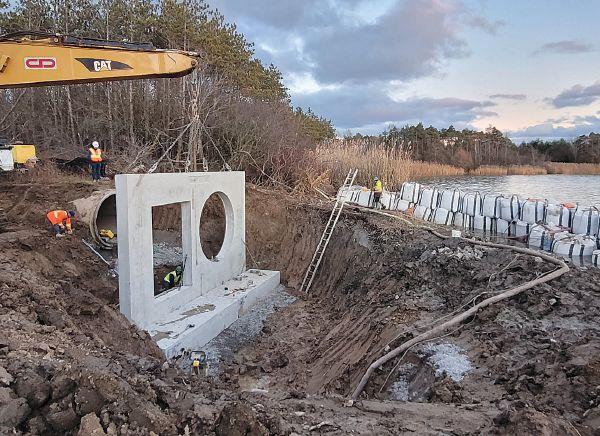
sewer and headwall in the existing easement through their lands. These discussions resulted in OPG approving the new outlet and granting a 20m temporary construction easement. All the proposed erosion and sediment control measures, culverts, headwall pieces, and other miscellaneous materials and equipment were stored and installed within the construction easement.
The new outfall sewer consisted of a 1500mm wide x 2400mm tall precast concrete box culvert and a 7.4m wide precast concrete headwall complete with energy dissipation blocks and grating.
Due to the size of the precast headwall, Condrain, the site contractor, had to cast it into four pieces to allow for easier transportation and installation. The installation was completed in multiple phases due to the constraints onsite. With Lake Gibson having a high-water level, the team placed a two-metre-high metre bag wall wrapped in a sheet of polyethylene (approximately 10m away from the headwall) to isolate the working area, which was then de-watered using multiple submersible pumps to silt bags within the construction area. They then removed the existing headwall and one full length of pipe to make way for the new precast headwall.

Final installation of the headwall and pre-cast concrete block wing walls prior to the installation of chain-link fence. Note the highwater level (OPG controlled) compared to the face of the headwall.
Once a layer of 300mm thick 50mm clearstone bedding was placed and compacted, the headwall footings were placed along with the face of the headwall. These two components were then tied together using rebar and cast-in-place concrete. Lastly, the energy dissipation block slab was placed on a concrete bed above the front of the footings. Large diameter rip-raps laid atop filter fabric were then placed past this to reduce velocities and minimize the potential for scouring of the lake bed. After completion of the remaining sewer system, meter bags were removed and the easement’s final grading, landscape plantings, and seeding were completed in September 2024. With the headwall now complete, construction of new homes in the Confederation Heights subdivision for the growing community of Thorold can now commence. Ultimately, decisions and coordination during the design phase resulted in an efficient construction process whilst working in a difficult environment. R.V. Anderson Associates Limited, Concast, Condrain and DG Group effectively collaborated and delivered this project with minimal disruption to the surrounding area while satisfying the requirements of OPG, NPCA and the City of Thorold.
Yide Cao, C.E.T., is an engineering designer with RVA.
Overview of the working area in Lake Gibson during the construction of the headwall.
Condrain installing pre-cast components of the headwall on the shoreline of Lake Gibson.
ARE YOU READY FOR ELECTRIFICATION?
OACETT members weigh in on the pace of electrification in Ontario
BY KATHY LERETTE, C.E.T., FELLOW OACETT
According to the Ontario government’s Powering Ontario’s Growth, Ontario’s Plan for a Clean Energy Future report, the government is planning and building electricity infrastructure for a more electrified Ontario by 2050.
The push is in response to increased demand on the grid caused by economic growth (EV battery and component manufacturing, green steel investments, electrification of light duty and public transportation systems and population growth).
Ontario’s Independent Electricity System Operator (IESO) created a report for the Ministry of Energy to evaluate a moratorium on new natural gas generation in Ontario and to develop a path-
way to zero emissions in the electricity sector by 2050. The IESO forecasts that bulk electricity demand could more than double by 2050, at a cost of $400B over the next two and a half decades.
For this scenario to be achievable, the risks/challenges around innovation, policy certainty, and regulatory streamlining must be addressed. Other challenges include the uncertainty around available land, indigenous partnerships, and a need to increase the labour force by a six-fold measure to build bulk power system assets.
How Ontario’s future supply mix evolves will depend on future research, analysis, consumer preferences, and ultimately policy and investment decisions.
The impact at the distribution level (which is not addressed in the IESO report) is that Local Distribution Companies’ (LDCs) capital additions may need to double by the mid 2040s and increase from the current levels by 130 per cent by 2050 to address growing demand says the Electricity Distributors Association’s Solving Grid-Lock, EDA Vision paper.
Distribution companies will also be challenged to modernize the grid to manage bi-directional power flow, facilitate the connections of Distributed Energy Resources (DERs), and maintain reliability. Customers will always be concerned with affordability and reliability.
OACETT SURVEY ON ELECTRICITY DEMAND AND IMPLICATIONS
OACETT launched a survey to draw insights from OACETT members and industry experts about the projected massive increase in electricity demand and the resulting implications for the electrification of our energy grid.
Through the survey, 122 respondents weighed in on the impacts of the accelerated pace of electrification. During a webinar occurring as part of NEAT week events on November 27, more than 300 member attendees were asked for their insights.
The survey highlights some common themes regarding OACETT members’ concerns with the pace of electrification in Ontario, including:
• Affordability to end users.
• Feasibility of the planned increase, considering existing struggles to replace and maintain aging infrastructure.
• Scepticism about EV adoption.
• The need for policy and regulatory changes to realize the government’s plan.
SYSTEM CAPACITY TODAY
42.000 MW
NATURAL GAS
PATHWAY TO DECARBONIZATION 2050 SCENARIO
88,000 MW NUCLEAR HYDRO
ACTIONS TO ADVANCE ELECTRIFICATION
MANAGE COST
$400 billion over 2.5 decades
PREPARE FOR SITING AND LAND USE
Siting requirements 14 times the size of Toronto
FOCUS ON INDIGENOUS PARTNERSHIP
Increased role beyond current 20% participation rate in electricity projects
DEVELOP CAPITAL/ LABOUR RESOURCES
A protential six-field increase in existing workforce to build projects
FOCUS ON INNOVATION
New technologies to drive new supply such as 15,000 MW of hydrogen capacity
INCREASE POLICY CERTAINTY
Near and long-term certainty to drive private sector investment in infrastructure and technology
STREAMLINE REGULATORY PROCESSES
Streamlined siting and regulatory processes keeping the local perspective at the core
THE ELECTRIFICATION SURVEY RESULTS
Is the pace of electrification realistic for LDCs to plan, finance, and build the infrastructure required to meet the Ontario government’s timelines?
Respondents who said ‘no’ to the question, the timelines are not realistic, told us why.
• Timelines unrealistic
• Cost prohibitive for customers
• Limited resources to do the work
• Supply chain issues are still present since the pandemic
• Pace of the plan is not clear
• Utilities can’t keep up with aging infrastructure now
• Regulatory roadblocks are an issue now and will get worse
Those who felt the government’s timelines were realistic cited the 25-plus year bases for LDCs, and the fact that the issue has already been on the radar for years. There is also growing scepticism about EV penetration levels. Respondents were pleased with progress on generation upgrades, and many believe that the grid is overbuilt and not yet at full capacity.
What’s needed to make the plan work?
Survey respondents suggested how LDCs can create partnerships to assist with the rising pace of infrastructure investment, and the new technologies needed to manage a two-way power grid. Here are some of their recommendations.
• All levels of government need to work together to a common goal.
• Outdated Ontario Energy Board (OEB) investment models should address funding for new/green technologies necessary for decarbonization.
• Partnerships with other LDCs for better planning and standardization.
• Suppliers and contractors must address the ramp up in construction.
• First Nations/local communities must address impacts.
• Home builders to look at more sustainable homes.
• Large customers are a key partner, and some have large impacts on GHGs.
30% of respondents say
In addition to partnerships, how are industry sectors coming together as the pace of electrification advances?
Almost 70 per cent of respondents say they do see industry sectors coming together through the following ways:
• LDCs actively collaborate through working groups
• Mergers and acquisitions
• Third party support such as Utilities Standards Forum, Grid Smart City and the Electricity Distributors Association were all mentioned
• Transportation
• Green/Sustainability Investors
Do you feel your current skills align with the future technologies that electrification will introduce?
Members are confident that their current skills will suffice for future needs, but labour market information shows a massive need for technical and trades employees in the energy sector. This is a massive opportunity for OACETT members.
Have you considered or participated in any of the following to acquire or upgrade skills or credentials?
Although 20 per cent of respondents have considered returning to college or university, most considered upskilling through web-based training or work integrated learning. Others considered learning through involvement with global companies, career relocations, conferences and speaker series, and in-house training.
LABOUR MARKET INSIGHTS
Electricity Human Resources Canada (EHRC) Electricity in Demand: Labour Market Insights 2023 – 2028, labour market analysis indicates the need for 28,000 new electricity sector employees by 2028, representing 25 per cent of the current workforce.
Extending this forecast indicates 130,000 more job openings materializing between 2028-2050. Between 2018 and 2022, job postings containing words “renewable energy,” “solar power,” and “wind generation” increased 56 per cent, while information and communications technology occupations numbers increased 364 per cent.
As the grid is modernized, and DER penetration grows, are you concerned about cyber security and customer data protection?
What skills do you consider critical to keep pace with new technologies?
Respondents listed the following skills as critical for the future, listed in order of popularity:
• Artificial Intelligence
• Skilled trades
• Project management
• New technologies, automation, power distribution
• Cyber security
• Critical thinking
• Computer applications/data analytics
• Risk management
• SCADA
• Change management
• Problem solving
As the grid is modernized, and DER penetration grows, are you concerned about cyber security and customer data protection? Respondents overwhelmingly stated ‘yes’ citing the following:
• Greater connectivity to customers raises cybersecurity risks
• Varied vendors/equipment complicate cybersecurity management
• Threats are becoming more sophisticated and frequent
• Who is taking care of our personal data? A lot of unknowns as to who owns and protects personal data
• Growing issue for decades
• Reliance on foreign solutions raises security concerns
Those who stated ‘no’ feel the systems are in place and improving all the time.
What are you hearing about the efforts to convert Ontario’s predominantly natural gas heating to electricity and hybrid solutions?
OACETT members report hearing that conversions will be too expensive for customers, and government incentives are inadequate to encourage customers to adopt electrical solutions. The government should focus on energy diversity because power grid capacity won’t be adequate for a complete switch.
Biggest risks to achieving net-zero emissions
by 2050
Survey respondents named cost, grid capacity constraints, capacity limits, and the lack of policy and regulatory frameworks to enable investment in grid expansion as the biggest risks to conversion, along with consumers’ unwillingness to change.
Energy affordability
Affordability is the number one concern, overshadowing climate goals.
Is energy affordability going to dampen customers’ desire to meet Ontario’s climate goal to acheive net-zero emissions by 2050? What do you consider the three biggest risks to achieving net-zero emissions by 2050?
Biggest opportunities to achieving net-zero emissions by 2050
Opportunities with this plan are plentiful, and include improved grid reliability and resilience, decarbonization and reduction of greenhouse gases, job creation and greater electrification and integration of Distributed Energy Resources (DERs).
What do you consider the three biggest opportunities to achieving net-zero emissions by 2050?
63% Improved Grid Reliability and Resilience
50% Decarbonization/Reduction of GHGs
50% Creation of New Jobs
45% Enable Electrification and Integration of DERs
28% Enhanced Economic Competitiveness
22% Avoided Energy Costs
16% Other
12% Improved Safety and Cyber Security
11% Avoided Capacity Costs
ELECTRIC VEHICLES FACTS AND STATS
Environment and Climate Change Canada’s Electric Vehicle Availability Standard (regulated targets for zero-emission vehicles) report has committed to achieve 100 per cent zero emission light-duty vehicle sales by 2035.
Today, there are more than 118,000 EV/PHEVs registered in Ontario. By 2030, there are expected to be more than one million EV/PHEVs. Electricity demand from transportation is forecasted to grow at an average annual growth rate of 17 per cent. And according to the Ministry of Transportation (October 2024), there are more than 2,900 public charging stations with over 8,000 charging ports in Ontario today. Level two chargers comprise of 80 per cent of these chargers.
OACETT WEBINAR FINDINGS
During the November 27 webinar during NEAT Week, OACETT asked attendees some additional questions to get a sense on their personal views. There were over 275 responses. Here are some the questions and the responses.
Do you currently own or lease an EV or Hybrid vehicle?
Considering the increased emphasis on the conversion of Ontario’s predominantly natural gas heating to electricity and hybrid solutions, what actions are you taking for your home or business?
I am interested, and I have done all I plan to do 6%
What would you consider the most important to you when you think about electrification?
Do you think there are sufficient EV chargers in Ontario?
The plan for a decarbonized electricity system is complex and faces many challenges. The energy sector is fully engaged and working on digitization, de-centralization, and de-carbonization of the grid, but this takes time. Judging by survey results, OACETT members’ thoughts and concerns align with challenges identified by industry experts. OACETT members are well informed and well positioned to take on opportunities as they arise to help shape the future.
The full presentation and questions and answers from the webinar can be found on the OACETT website.
Kathy Lerette, C.E.T., Fellow OACETT, is an Enova Power Corporation board member and business consultant in the energy sector.
NEW MEMBERS
October 2024
Certified Engineering Technologists
Ivan Aguilar, C.E.T.
Nirvaan Bhagwandass, C.E.T.
Gregory Borisko, C.E.T.
Benoit Desrosiers, C.E.T.
Onoriode Eka, C.E.T.
Sahil Gaind, C.E.T.
Aaron Gregorio, C.E.T.
Ali Hamza, C.E.T.
Alexandra Lee-Bun, C.E.T.
Julian Mongillo, C.E.T.
Dave Pawelko, C.E.T.
Angela Peck, C.E.T.
Phillip Pesek, C.E.T.
Andrea Saltos, C.E.T.
Syed Shah, C.E.T.
Nirodha Silva, C.E.T.
Corey Smith, C.E.T.
Julian Wiesner, C.E.T.
Certified Technicians
Taylor Akimov, C.Tech.
Andrii Andrieiev, C.Tech.
Marissa Jocel Balbuena, C.Tech.
Subhesh Baral, C.Tech.
Graham Brice, C.Tech.
Arnel Caburnay, C.Tech.
Andrew Campbell, C.Tech.
Alyssa Carr, C.Tech.
Abdullah Dar, C.Tech.
Anamika Desai, C.Tech.
Michael Dhanraj, C.Tech.
Joel Diotte, C.Tech.
Elise Donohue, C.Tech.
Laura Dwyer, C.Tech.
Kathleen Farrow, C.Tech.
Colin Fowler, C.Tech.
Mark Fox, C.Tech.
Nathan Francis, C.Tech.
Mario Gaxiola Carrazco, C.Tech.
Chenoa Hill, C.Tech.
Andrew Holmes, C.Tech.
Matthew Houle, C.Tech.
Haesun Jung, C.Tech.
Md Kabir, C.Tech.
Mitesh Kachhadiya, C.Tech.
Rijan Kafle, C.Tech.
Cole Kaschahub, C.Tech.
Parveen Kaur, C.Tech.
Raymond King, C.Tech.
Oliver Kurz, C.Tech.
Christopher Laird, C.Tech.
Branden Lavallee, C.Tech.
Sieun Lee, C.Tech.
Sanith Leng, C.Tech.
Filip Leszczynski, C.Tech.
Tianyu Liu, C.Tech.
Jake McGowan, C.Tech.
Daniel Morris, C.Tech.
Collin Mowers, C.Tech.
Changhyun Nam, C.Tech.
Cong Nguyen, C.Tech.
William Perkins, C.Tech.
Stephan Philippot, C.Tech.
Leonel Pida, C.Tech.
Cherie Pounder, C.Tech.
Alhussein Robah, C.Tech.
Filipe Rodovalho de Castro, C.Tech.
Mark Rozhko, C.Tech.
Karanbir Saini, C.Tech.
Lucas Sandberg, C.Tech.
Brian Sanders, C.Tech.
Balraj Singh, C.Tech.
Manreet Singh, C.Tech.
Michael Smirnov, C.Tech.
Bradley Smith, C.Tech.
Jeremy St.Clair, C.Tech.
Brenda Taggart, C.Tech.
Patrick Sergio Tatchemeu, C.Tech.
Ojas Thakur, C.Tech.
Kelly Van Bakel, C.Tech.
Feiyu Wang, C.Tech.
Trevor Woods, C.Tech.
Associate Members
Alexandre Acosta
Kirtan Adhikari
Wasiu Azeez
Hamza Bajwa
Christina Barone
Rehman Basil
Dylan Beirnes
Sunieti Bhandari
Michael Bickers
Mary Boakye
Piere Bordeaux
Marcus Botham
Riisa Boutin
Stephen Kwabena Bremang
Minal Sharma Burgus
Rui Cheng
Kenneth Colborne
Regina Corpuz
Maya Dauth
Khanh Dinh
Samuel Durosaro
Kalpit Vinodbhai Gaudani
Jingyuan Guo
Jim Hegadorn
Joshua Henry
Ioana Iliescu
Adebukola Ishola
Antoniy Ivtiminov
Jemish Kalathiya
Umang Kapadia
Slavica Kikic
Konstantin Kuznetsov
Pyae P Kyaw
Ankit Lad
Hamza Naeem Latif
Zhiming Liang
Guanjun Liu
Yunzi Liu
Tyler Lunau
Gowrangan Mahanathan
Breanna Meyers
Brian Mustard
Michael Navalta
Hadi Niaei
Mohammadiman Ojani
Andrea Oliver
Raj Pandya
Arpankumar Patel
Meet Patel
Ravi Patel
Safvan Patel
Viral Pathak
Marc Philip Pico
Adrian Pintilie-Rafiroiu
Ilia Povarenkin
Farrukh Qureshi
Konstadinos Rorras
Jagvir Sadiora
Taemoor Sajid
Rohullah Salehi
Elham Shamss
Sahil Singh Sidhu
Bhupinder Singh
Inderjit Singh
Jugraj Singh
Mihaela Sluka
Sukhdeep Sohal
Sanjay Sreenarayanan
Corey Stage
Jan Andrew Sy
Shade Thomas
Anugraha Udas
Gurnoor Virk
Parwiz Wazin
Matthew Wiffen
Ali Zohaib
Student Members
Dare Abiola
Adebowale Adeoye
Bishnu Adhikari
Ashwanthram Agraharam
Mohanasuntharam
Anil Akbas
Alysha Anderson
Kervin King Baddo
Juan David Barba Echavarria
Banveer Bhatia
Lekhdip Bhatia
NEW MEMBERS
RECOGNIZING NEW AND CERTIFIED TECHNICIANS AND TECHNOLOGISTS
Dylan Boodram
Ngoc Bui
Natalie Carlson
Curtis Chamber
Kalim Clarke
Anthony Coleman
Jennifer Delgadillo Garay
Yuanbo Gan
Logan Gill
Adem Hajdarevic
Vasil Haq
Doug Hatton
Harrison Howe
Chris Jeni
Rabindra Joshi
Mohammed Sabith
Karekulangara
Ejiroghene Kekeke
Mitesh Kotadiya
Ashley Koza
Ho Chuen Lam
Himanshu Lnu
Suwethika Loganathan
Kendel Nealey
Minh Nguyen Pham Ngoc
Rodel Ocab
Abigail Ojeabulu
Chima Okoriji
Shrey Patel
Sulav Paudel
Ani Pearn
Monali Prajapati
Parth Roy
Mohammedtalha Shaikh
Mustafa Soltany
Jeyakanan Sritharan
Sattra Suwannawong
Lucas Wright
Existing Members in Road
Construction
Certified Engineering
Technologist
Peter Nielson, C.E.T.
Certified Technicians
Fiore Sarro, C.Tech.
Joshua Ritchie, C.Tech., rcsi
Associate Members
Zabi Sultanpoory, rcsi
Nijesh Kumar, rcji
Shubh Patel, rcji
Alwin Puthusserychamakkala
George, rcji
Savansinh Rajpurohit, rcji
Ranjit Singh, rcji
Existing Members in Municipal Infrastructure
Municipal Infrastructure
Contract Administrator
Tyler Hume, C.Tech., rcca, mica
Adam Paquette, C.Tech., mica
November 2024
Certified Engineering Technologists
Oluwatobi Aro-Gordon, C.E.T.
Divyalakshmi Ayyalusamy, C.E.T.
Christine Anne Bactol, C.E.T.
Kasey Conlon, C.E.T.
Catherine Cook, C.E.T.
Bryce Ernst, C.E.T.
Mihindukulasuriya Fernando, C.E.T.
Andrew Galway, C.E.T., rcji
Jim Hegadorn, C.E.T.
Slavica Kikic, C.E.T.
Peter Koutroulis, C.E.T.
Jose Kuan-Veng, C.E.T.
Cody May, C.E.T.
Danny Medeiros, C.E.T.
David Niemand, C.E.T.
Sumant Patel, C.E.T., mii
Jesse Ross, C.E.T.
Nicolas Rusnak, C.E.T.
Derek Sanderson, C.E.T.
Ranjith Siyon, C.E.T.
Mohammad Taha, C.E.T.
Bhim Tiwari, C.E.T.
Tiffany Waters, C.E.T.
Liam Wilson, C.E.T.
Jean-Loup Yale, C.E.T.
Arash YoosefDoost, C.E.T.
Certified Technicians
Vardan Abrol, C.Tech.
Tariq Alhayek, C.Tech., rcsi
Scott Avis, C.Tech.
Jodie Ball, C.Tech.
Curtis Bettiol, C.Tech., rcji
Ranvir Bhullar, C.Tech.
Moksh Bhuri, C.Tech.
Roberto Biagi, C.Tech.
Midhun Roy Bimal Roy, C.Tech.
Michael Bogul, C.Tech.
Avelino Bondad, C.Tech.
Cameron Brockwell, C.Tech.
Zachary Carrier, C.Tech.
Man Hung Chung, C.Tech.
James Clarke, C.Tech.
Alexandre Cloutier, C.Tech.
Oscar Danieli, C.Tech.
Jeith Diga, C.Tech.
Dishantkumar Dudhat, C.Tech.
Brandon Fudge, C.Tech.
Chaeha Gim, C.Tech.
Trupal Goswami, C.Tech.
Eloy Govea Rodriguez, C.Tech.
Drew Gross, C.Tech.
Martin Hepburn, C.Tech.
Pablo Hernandez, C.Tech.
Shane Hutterer, C.Tech.
Haris Kapo, C.Tech.
Sheldon Keats, C.Tech.
Muhammad Awais Khan, C.Tech., rcji
Numan Khan, C.Tech.
N’Dri Joseph Kouame, C.Tech.
Tejas Lukhi, C.Tech.
Tyler Lunau, C.Tech.
Gurujot Marzara, C.Tech., rcji
Krunalkumar Mavani, C.Tech.
Hasib Moeen, C.Tech.
Julian Muir, C.Tech.
Nilay Parmar, C.Tech.
Chanakya Sunilbhai Patel, C.Tech.
Steve Persaud, C.Tech.
Ryan Piche, C.Tech.
Jasmin Radadiya, C.Tech.
Connor Reece, C.Tech.
German Rios, C.Tech.
David Romanchik, C.Tech.
Leon Saul, C.Tech.
Divya Shah, C.Tech.
Danis Thomson, C.Tech.
Shannon Tweedle, C.Tech. Patrick Cris Valenzuela, C.Tech.
Phillip Vermeeren, C.Tech.
Isabel Viaje, C.Tech.
Sanikumar Virani, C.Tech.
Donald Watra, C.Tech.
Tunahan Yuzgyur, C.Tech.
Juan Zhang, C.Tech.
Associate Members
Sandani Abeywickrama
Ankush Arora
Mohamad Awdi
Sainithish Bandaru
Paul Barnes
Andrew Bellamy
James Bertram
Sheena Briggs
Franklib Castellanos
Kevin Cavite
Tinaben Chaudhary
Ganesh Chaulagain
Ozioma Chukwunenye
Tyrone Cordovillla
Joey Crispo
Ahmad Dahleh
Braedon Dane
Christine Demers
Nicole Di Filippo
NEW MEMBERS
RECOGNIZING NEW AND CERTIFIED TECHNICIANS AND TECHNOLOGISTS
Clinton Ede
Matthew Emburgh
Ayoub Fraitlis
Devon Francis
Travis French
Zuriel Garcia
Kyle Gardner
Keith Gargalicano
Royce Gaw
Madineh Ghazili
Liam Goncalves
Mitchell Hickey
Jarett Hoglund
Drew Hutchison
Alex Jevremovic
Keyur Joshi
Krutik Kansara
Peter Karanopoulos
Sunkyong Kim
Jonathan Kostevski
Thomas Kozachenko
James Kretz
William Lachapelle
Daneep Lahl
Don Landry
Lane Lefor
Clayton Lent
Andrew Lytle
Narendra Kumaran
Manivasagam
Mehrnaz Mansouri Moghadam
Steven Marin
Rachel Martin
Amanjyot Marwaha
Tyler McKay
Shah Miral Kalpeshbhai
Zeeshan Farooqui Mohammad
Taqui Uddin Mohammed
Mehul More
Xavier Morin-Tanguay
Abed Moussa
Joseph Mule
Ravin Musai
Soath Karime Parra Cortes
Shireen Pasaya
Deep Patel
Kishan Patel
Mustak Abdulbhai Patel
Vivek Patil
Lekhanath Paudel
Connor Payne
Broderrick Pemberton
Edsel Pena
Dayne Perry
Anh Khoa Pham
James Pham
Ajeesh Fredy Pious
Darren Porter
Hardik Ramani
Charlotte Roach
Maria Ninoshka Rodrigues
Brandon Rogers
Odas Sano
Jerry Santos
Jilesh Shah
Paras Sharma
Agboola Shonekan
Neven Skipina
Todd Sommer
Lesley Turner
Adithya Vijay
Brendan Vipond
Zachary Wilson
Evgeniya Yapparova
Masoud Zahedi Vahid
Student Members
Mamata Adhikari
Mohak Adhikari
Damilola Amoo
Varun Arunaambiha Subash
Elsie Baatnes
Khagendra Batsa
Nikhila Chacko
Sarath Chandran
Jazzphaer Companion
Kamil Debline
John Ivan Dela Torre
Karan Veer Singh Deol
Olivera Dragojevic
Adrian Ferrer Berenguer
Aidan Gardiner
Harmander Gill
Aayush Grover
Owen Hall Durocher
Michael Hawken
Bradley Hewett
Rain Hooper
Jayden Hunt
Leah Kloepfer
Abby Lise
Jordan Mac
Olivia Menegotto
Erylle Zyla Miguel
Pratik Mistry
Om Nayak
John Paul Angelo Nocedo
Charmaine Nonesa
Olumide Oshikoya
Brijesh Panchal
Deepkumar Parekh
Akshar Patel
Krisha Patel
Daniel Podgorny
Darshan Prajapati
Arianna Provost
Luca Pugliese
Moiz Qadir
Anthony Sabanal
Precious Helen Sarvida
Huiming Shi
Jaskaran Singh
Garrett Wright
Patel Yashkumar
Existing Members in Road Construction
Certified Engineering Technologists
Robert Baxter, C.E.T., rcsi
Pushpdeep Bhatt, C.E.T., rcca
Robert Lambert, C.E.T., rcji
Amy Mejia, C.E.T., rcji
Certified Technicians
Tariq Alhayek, C.Tech., rcsi
Kevin Brake, C.Tech., rcji
Janine De Leon, C.Tech, rcsi
Cadden Martins, C.Tech., rcji
Carrie Nissen, C.Tech., rcca
Adam Paquette, C.Tech., rcji
Edward Saunders, C.Tech., rcca
Existing Members in Municipal Infrastructure
Municipal Infrastructure Inspectors
Clayton Nadeau, C.Tech., mii
Stephen Turnbull, C.Tech., mii
Municipal Infrastructure
Contract Administrator
Michelle Mathies, C.E.T., mica
Associate Members
Nilay Dhorajia, rcji
Ryan Horvath, rcji
Mohammad Nekounam, rcji
Meet Patel, rcji
Md Mostafizur Rahman, rcji
Konstadinos Rorras, rcji
Jaydeep Shah, rcji
In Memoriam
Staff and members of OACETT send their sincere condolences to the family and friends of the following members. They are remembered.
David Wolff, C.E.T.
Marc St-Jean, C.Tech.
Harold Tipler, CST
Gordon Hildreth, C.Tech.
Michael Yoshimoto, C.E.T.
Dallas Rostad, C.E.T.
Donald Adams, C.Tech.
Volunteer of the Month
Angelo
Dela Pena,
C.Tech. York Chapter, College Liaison
Q: Tell us about yourself.
A: I am an internationally educated professional with a Bachelor of Science degree in mechanical engineering, earned from Colegio San AgustinBacolod in the Philippines. In addition, I completed a two-year HVAC Technician Program at George Brown College in 2019. Currently, I serve as a lead hand in the testing department at Engineered Air, a company specializing in the design, manufacture, and sale of heating, ventilating, and air conditioning (HVAC) systems. I have
Sebastien Gervais, C.E.T. Cornwall Chapter, Secretary
Q: Tell us about yourself.
A: In 2002, I graduated in technologie du génie informatique (computer engineering technology) from Collège La Cité in Ottawa. Currently, I am a manager in charge of overseeing the IT security compliance team for a Government of Canada agency.
Q: When did you begin volunteering?
been a dedicated member of the organization for five years, contributing to its commitment to quality and innovation in the HVAC industry.

Q: When did you begin volunteering?
A: I began volunteering with OACETT after chapter chair Phelia Kung, C.E.T., appointed me to the college liaison position at the York Chapter’s Annual Chapter Meeting in 2023.
Q: What volunteer roles have you fulfilled?
A: I’ve been the chapter college liaison for two years.
A: I joined OACETT in 2021 and have volunteered with my chapter since 2023. However, my volunteering adventures go back to when I lived in Gatineau, Quebec. I volunteered with Operation Red Nose from 2001 to 2013.
Q: What volunteer role was the most rewarding? And why?
A: My current volunteer role as a college liaison has been gratifying. I focus a lot on connecting with college students in York Region while actively working on acquiring college partnerships for our chapter.
Q: What do you enjoy most about being an OACETT volunteer?
A: Volunteering is a rewarding experience, offering the opportunity to connect with members from diverse disciplines, fostering relationships that can grow into lasting professional or personal connections.

Q: What volunteer roles have you fulfilled?
A: In addition to volunteering with my chapter and Operation Red Nose, I was an accreditation auditor with the Canadian Technology Accreditation Board for four years. Since 2021, I have served as the lead auditor with Technology Accreditation Canada.
Q: What do you enjoy most about being an OACETT volunteer?
A: I enjoy contributing ideas to help improve the Chapter’s standing, speaking positively about OACETT’s activities, and pollinating best practices in other areas, whether during the accreditation audits I conduct or when liaising with my peers in other Canadian provincial professional associations.
Q: What is your most significant personal or professional achievement?
A: One of my significant professional achievements
Q: What is your most significant personal or professional achievement?
A: My most significant personal and professional achievement is maintaining five years of continuous employment with the same company and advancing to a management role as lead hand.
Q: What advice would you give a prospective member and/or volunteer?
A: My advice to prospective members and volunteers is to continue supporting the association as it offers a rewarding experience and an opportunity to showcase their talents and skills.
is being the lead auditor for the first accreditation audit conducted in French by Technology Accreditations Canada for a program of study offered at Collège communautaire du Nouveau-Brunswick.
Q: What advice would you give a prospective member and/or volunteer?
A: When you join, make yourself heard! Especially if you are a member of an underrepresented category or discipline. You may reap the rewards at the most unexpected moment.
WIT representative
Noor Sahyon delivers presentation on urban drainage challenges and solutions
On November 28, Noor Sahyon, C.E.T., delivered an insightful presentation on integrating hydrologic concepts and techniques into sustainable urban drainage design to tackle regional drainage challenges.
She explored many compelling topics, including an introduction to the Experiential Learning Drainage Project in Downtown St. Catharines and an in-depth discussion on the drainage challenges facing urban areas in the Niagara Region.
The presentation highlighted key issues like altering grades and drainage systems on private properties, the negative impacts of these alterations on neighbouring properties, and innovative strategies to address these problems. Noor also shared practical tips for improving drainage on private properties while adhering to drainage laws. The audience was highly engaged, offering thoughtful questions and enthusiastic feedback, praising the presentation for its clarity and depth of insight.
The Ontario Technologist asked Noor a few questions about the presentation. Here is what she had to say.
Q: Why did you select this topic to present to Niagara Chapter members?
A: Since I moved to the Niagara Region over four years ago, I noticed, as many residents have, the impacts of climate change, including increased frequency and high intensity of extreme rainfall events, which, based on statistics, was not the case in the past.
In my current role at the City of Welland, I assist with drainage issues due to grade alterations. I have worked on drainage complaints for some time, so I decided to put a presentation together to discuss people’s concerns, highlight facts, and bring awareness to the public.
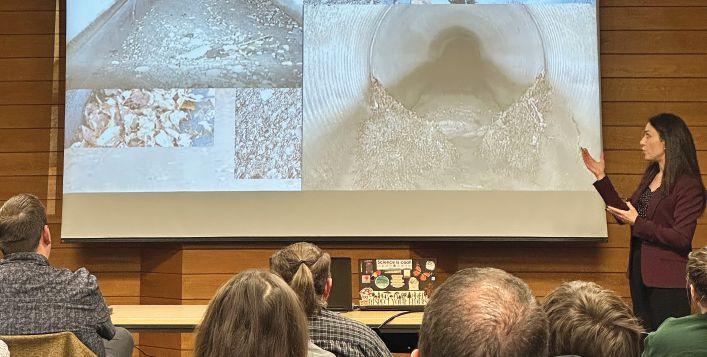
Noor Sahyon, C.E.T., is a civil technologist with nine years of professional experience. Before transitioning to the municipal sector, she specialized in designing and drafting stormwater and water system designs, road layouts, and estimating capital construction costs. She is currently employed by the City of Welland as the infrastructure asset technologist and drainage superintendent.
Q: What were some of the highlights of the presentation?
A: The presentation highlighted the following:
• Drainage challenges during high rainfall seasons.
• Innovative solutions that residents can utilize in their property.
• Grade and site alteration bylaws and policies that some municipalities have in place and that residents should be aware of to alleviate drainage back ups.
• Flooding and tips to improve drainage issues on private properties.
Q: How did your chapter members respond to the presentation?
A: OACETT Niagara Chapter was pleased with the presentation’s contents, especially since this is a pressing topic for many residents within the region. Some of them found it insightful.
Q: This presentation was three years in the making. Please explain.
A: Three years ago, I joined the City of
Welland. Part of my role was to track and calculate combined sewer overflows due to extreme weather events and report to the ministry, where I realized in those years that the high intensity of weather events based on the collected data is during the summer and spring seasons.
I also worked on drainage complaints during the spring seasons of 2023 and 2024, where there was a high volume of standing water and flooding complaints throughout the city, especially in established areas where the infrastructure is 30-50 years old and even older in some areas. Most of those complaints were due to grade alterations that adjacent properties have made throughout the years, adversely affecting the neighbouring properties and due to the limited capacity of the existing storm system, as typical rainfall at the time was shorter in duration and lower in volume. I felt compelled to shine the light on the rules and the bylaws that are in place, which many residents are unaware of.
Cornwall Chapter members tour Forest Hill Passive House
On November 24, 2024, Brock Wilson, C.E.T., CPHD, and Jerimiah Point, P.Eng., CPHD, co-hosted a technical tour of the Forest Hill Passive House, a 1,830 ft2 (170 m2) single-family dwelling in Long Sault within the Township of South Stormont, Ontario.
Proud homeowners and guests, a member of Ordre des technologues professionnels du Québec and MP Eric Duncan, MP for Stormont-DundasSouth Glengarry, joined Cornwall Chapter members on the tour. A captivating PowerPoint presentation, followed by a live blower door test at the house’s front door, resulted in an additional hour of Q&As regarding the design, equipment, and construction methods.
This single-family dwelling is a single-storey slab-on-grade building containing two bedrooms, two washrooms, a flex room, a pantry, a combined mudroom/laundry, a utility room, an open-concept living, dining and kitchen. The home is Long Sault’s first passive house to achieve the passive house performance levels, equivalent to a low energy certification with a heating demand of 27 kWh/m2/yr and an air tightness rate of 0.3 air changes per hour (ACH) @ 50Pa. The building is comprised of multiple passive housecertified and high-efficiency products.
The slab-on-grade is a Legalett Geo Passive certified slab-on-grade with an effective thermal resistance of U-0.09 (R-63).
The exterior walls consist of a combination of two products, including the airtight layer. The main structural component of our exterior wall is an insulated exterior wall from OSBlock, which provides an EPS insulation layer on an OSB core’s interior and exterior. In addition to the OSBlock wall, an Omega panel (an exterior EPS panel with integral strapping from Nudura)

is provided for additional insulation.
The entire wall assembly provides an effective thermal resistance of U-0.134 (R-42), used in combination with continuous SIGA Majvest 200 airtight, vapour-permeable air barrier membrane, which contributed to a 0.3 ACH at 50Pa air tightness rate.
The exterior windows and doors are NZP Fenestration cool temperate passive house certified, with an overall thermal resistance value of U-0.80 (R-7).
The roof construction is a traditional ventilated attic roof with 30” (762mm) of blown-in cellulose, providing a thermal resistance of U-0.051 (R-110). The underside of the roof is provided with three-quarter-inch plywood sheathing, with all seams taped (SIGA Rissan 60 high-performance tape) to provide a continuous airtight layer.
The mechanical systems include a combination of a Mitsubishi M-Series mini-split with 14,000 BTU cooling and 12,000 BTU heating. A Zehnder Q450 passive house certified ERV equipped
with a 2.2kW preheater and 2.5kW post heater provides continuous 24/7 ventilation. Based on the Passive House Planning Package (PHPP), the heating load for this dwelling is 17 W/m2, for a total required heating demand of 2.9kW.
Some of the unquantifiable benefits of this passive house are extreme thermal comfort, high-quality indoor air quality, and sound attenuation from the exterior.
This single-family dwelling passive house certification is a cornerstone achievement for the Township of South Stormont, setting precedence for the future of highly efficient buildings.
The passive house was designed by Wilson Architectural Design Inc. (WAD), an architectural design firm specializing in passive house designs. Founder Brock Wilson, C.E.T., is a Certified Engineering Technologist with OACETT, a Certified Passive House designer with Passive House Institute, and LEED Green Associate with U.S. Green Building Council.
Western Region
Chatham-Kent Chapter
On October 17, the Chatham-Kent Chapter gathered at Glass Town Brewery for an evening of professional development and social engagement. The event featured a guided brewery tour, offering attendees an in-depth look at the beermaking process.
Members delved into the brewery’s rich history and gained valuable insights into brewing techniques and quality control measures. The tour also showcased the sophisticated equipment integral to the process, including piping infrastructure, process control systems, canning machinery, and SCADA systems.
This hands-on experience provided a unique opportunity for members to explore the intersection of engineering technology and brewing. The evening was interactive and educational, fostering connections among members while highlighting the systems behind one of the world’s oldest crafts.
Marco Fernandes, C.E.T., is ChathamKent Chapter chair: chathamkent-chapter@oacett.org.
Grand Valley Chapter
Members kicked off the fall season by attending a technical symposium organized by the local PEO chapter. This CPD-approved event featured insightful technical presentations and was a valuable chance to network with PEO and OACETT members. A big thank you to PEO for hosting our members at this enriching event.
The chapter also organized a group outing to a trivia night at Royal City Brewing, where attendees enjoyed an evening of fun, camaraderie, and friendly competition.
On November 13, the Grand Valley Chapter represented OACETT at the “Your Future, Your Choice” career education event, hosted by the Career Edu-
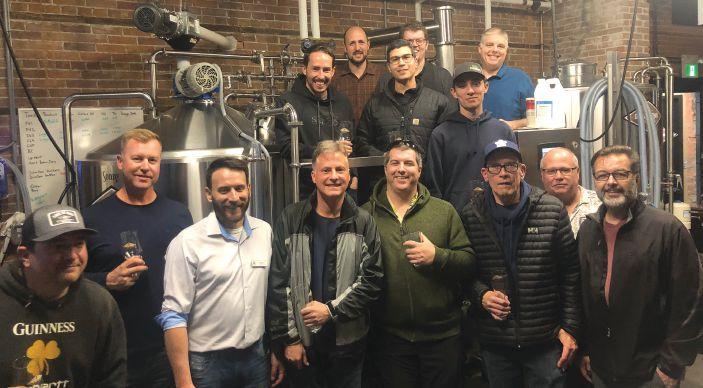
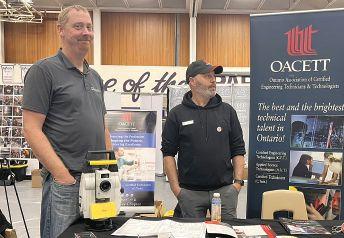
Grey-Bruce Chapter
cation Council in Guelph. The event, tailored for students from grades 8 to 12 in the Guelph-Wellington area, was a fantastic opportunity to raise awareness about OACETT certification and its value for aspiring engineering and applied science professionals. Through these initiatives, the Grand Valley Chapter continues to foster community connections while promoting the benefits of certification to future generations.
Michael Luyckx, C.E.T., is Grand Valley Chapter chair: grandvalley-chapter@ oacett.org.

Grey-Bruce Chapter members attend a junior hockey game at P & H Centre in Hanover. The game was close, but in the end, the Hanover Barons won 4-3 over the visiting Wingham Ironmen. Special thanks to local executive members Paul Hinsperger, C.E.T., rcsi, Rose Lauder, C.E.T., rcji, and Steven Sek, C.Tech., for being a part of the event’s welcoming committee.
Matthew Aston, C.E.T., is Grey Bruce Chapter chair: greybruce-chapter@ oacett.org.
Pictured from (left to right): Bryan Moreland, Sean Vanderveeken, Marco Fernandes, C.E.T., Mark Ceppi, C.Tech., Matt Vyskocil, C.E.T., Barry Sullivan, C.E.T., Jason Cikatracis, C.E.T., Jerry Corso, C.E.T., Patrick Ansell, Mark Hill, Nico Cariati, C.Tech., Alexander Bultje, C.E.T., Spencer Westerberg, C.Tech., Andrew Morrison, C.Tech.
John Vleeming, C.E.T., and Martin Roberts, C.Tech., at the Your Future, Your Choice event in Guelph.
Eastern Region
Lanark, Leeds and Grenville Chapter
micro-organisms
down waste
On a chilly November morning, the Lanark, Leeds, Grenville Chapter got a fascinating behind-the-scenes look at how wastewater is treated in the City of Brockville. The three-hour tour, hosted by chapter member Yanick Beaudin, C.E.T., and City of Brockville employee Brian Felhaber, unravelled the intricate processes that ensure wastewater is safely returned to the river.
Participants journeyed through the wastewater process, from the flush of a toilet through pumps, digesters, and metering equipment to its final treatment. A highlight of the tour was the introduction to “water bears,” tiny micro-organisms that play a critical role in breaking down waste. For many attendees, this was their first encounter with these fascinating creatures, viewed under a microscope during the tour.
The group left with a newfound appreciation for the engineering, calculations, and technology involved in wastewater management. To express their gratitude, Rob Wright, C.Tech., presented tokens of appreciation to Brian Felhaber and event host Yanick Beaudin, C.E.T.
Robert Wright, C.Tech., is Lanark, Leeds and Grenville Chapter chair: leeds-chapter@oacett.org.
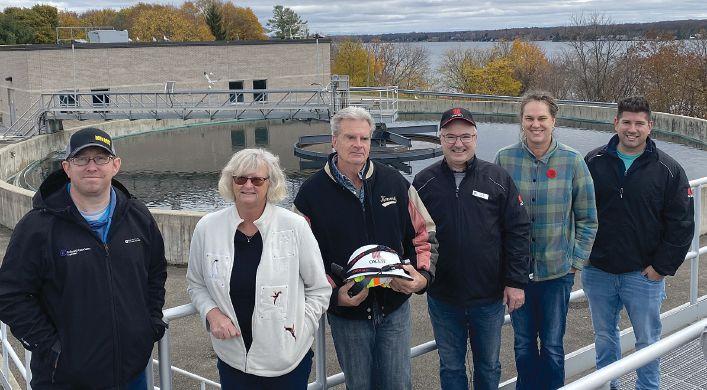
Kingston Chapter
On October 10, the Chapter’s Women in Technology (WIT) representative, Caroline Kirkwood, C.E.T., organized a Women in STEM panel discussion sponsored by the Kingston Chapter and held at Modern Niagara’s newly renovated low-carbon building. Heather Roberts, C.E.T., director of water and wastewater services at the City of Kingston, moderated the informative and inspiring discussion to a sizable audience during the inaugural Kingston Climate Expo. Chapter chair Bruce Fudger, C.E.T., Fellow OACETT, and executive Joe D’Agostino, C.E.T., were also in attendance.
Later in the month, the chapter hosted its monthly meeting at St. Lawrence College’s Davies Hall. An impressive number of students were eager to learn about OACETT and the role of student representative. Fudger’s presentation on the position sparked great interest, and several attendees showed enthusiasm for the role.
On November 21, the Annual Milestone Awards Dinner celebrated members who marked their 10, 25, 40, and 50-year milestones with OACETT at Greektown Restaurant. The evening was filled with camaraderie, storytelling,

Annual Milestone Awards Dinner on November 21.
and congratulations, with special recognition for Fred Butz, C.E.T., celebrating an impressive 50 years of membership.
The chapter’s final event of the year was the Kingston Frontenac’s Hockey Meet and Greet on December 6. Looking ahead, the chapter plans to attend the Annual St. Lawrence College Bridge Busting Competition and host a potential Billiards Night in early 2025.
Bruce Fudger, C.E.T., Fellow OACETT, is Kingston Chapter chair: kingstonchapter@oacett.org.
From left to right: Paul Villeneuve, C.E.T., Vanessa Bernicky, C.E.T., Al Billiald, C.E.T., Rob Wright, C.Tech, Kathryn Reinlander, C.E.T., and Yanick Beaudin, C.Tech., at the City of Brockville’s wastewater facility.
Brian Felhaber (left) and Yanick Beaudin, C.Tech. (right) look at
that break
at the City of Brockville’s wastewater facility.
From left to right: Bruce Fudger, C.E.T., Fellow OACETT, Linda Fudger, Caroline Kirkwood, C.E.T., Christina Klein, P.Eng., Ryan Klein C.E.T., Richard Cork C.Tech., and Fred Butz C.E.T. at the Kingston Chapter’s
Peterborough Chapter

Nicole Cameron, C.E.T., hitting the mark with confidence at the recent WIT Axe Throwing event held by the Peterborough Chapter.
James Myles, C.E.T., is Peterborough Chapter chair: peterborough-chapter@ oacett.org.
Renfrew County Chapter
The inaugural liaison event between the Renfrew Chapter and three new college programs at Algonquin College’s Pembroke campus was a resounding success. Faculty and students from the Computer Engineering Technology, Environmental Technology, and Radiation Safety Technology programs gathered to explore valuable career development resources. Topics included OACETT certification, student membership, and pregraduation registration. Sukhraj Singh, Richard Bolduc, A.Sc.T., and Larry McHenry, C.E.T., highlighted how OACETT certification and mentorship can significantly enhance job search prospects and provide access to valuable employment opportunities. We also discussed salary trends, shared key insights from recent surveys, and presented helpful resources, including PowerPoint slides and videos provided
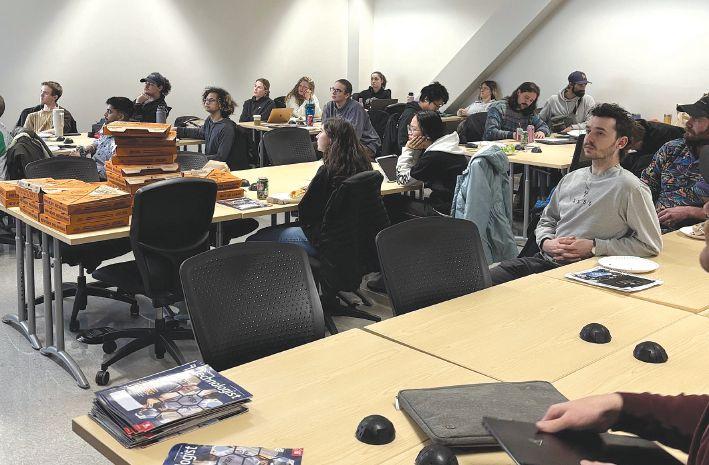
Engaged minds and full stomachs – students learn about career opportunities while enjoying a slice of pizza at Algonquin College’s OACETT liaison event.
by
Trishia Tedoldi, manager of college partnerships at OACETT.
Additionally, I shared insights into how evolving environmental legislation, including EU ROHS, REACH, US EPA TSCA, and the forthcoming PFAS chemical ban, can create opportunities for Environmental Technology graduates in the electronics and production materials fields. It was an exciting and informative session, setting the stage for future collaborations and career growth in these dynamic industries.
Larry McHenry, C.E.T., is Renfrew County Chapter chair: renfrewcountychapter@oacett.org.
Ottawa Chapter
The Ottawa Chapter organized an incredible event at the OPG Saunders Hydro Dam in Cornwall. Attendees from the Eastern Region were treated to a truly engaging experience. This unique tour provided an up-close look at a cornerstone of Ontario’s clean energy infrastructure.
Since opening in 1958, the Saunders Hydro Dam has generated enough elec-
Ottawa Chapter members from across the regions come together for a behindthe-scenes look at the OPG Saunders Hydro Dam, witnessing the future of clean energy.
tricity to power nearly a million homes. Now, it’s undergoing a significant 16-year upgrade. Each of the dam’s 16 turbines is being revitalized, ensuring that it will continue to provide reliable energy for decades to come.
For over 65 years, the dam has been essential in stabilizing Ontario’s power grid, delivering baseload generation to support the growing demand for clean energy. It was inspiring to see how this crucial energy asset is evolving, and we’re grateful to everyone who attended and made the event such a success.
Nick Cousins, C.E.T., is Ottawa Chapter chair: ottawa-chapter@oacett.org.
Northern Region
Near North Chapter
The Near North Chapter recently hosted many noteworthy events, starting with an October tour of North Bay’s Wastewater Treatment Plant. Built in 1961 and upgraded multiple times, the facility processes up to 54,500 cubic meters of wastewater daily during peak seasons. The plant uses advanced treatment stages, including preliminary screening, chemical clarification, and aeration with clay tile diffusers, ensuring safe water return to Lake Nipissing. Methane produced during digestion heats the facility, with plans to integrate propane for improved efficiency. Since 2011, treated sludge has been sent to the Merrick Landfill. Proceeds from the tour were donated to the North Bay and District Humane Society.
The chapter joined the North Bay PEO Student Night at the Davedi Club in November. This annual event connects high school students with professionals to discuss post-secondary education and career pathways. Over 70 students attended, engaging in presentations by industry speakers and exploring career possibilities.
The Near North Chapter’s executive committee held its first in-person meeting since 2019, marking a significant milestone after years of virtual gatherings. This meeting provided an excellent opportunity to reconnect, exchange ideas, and set plans into motion for the future.
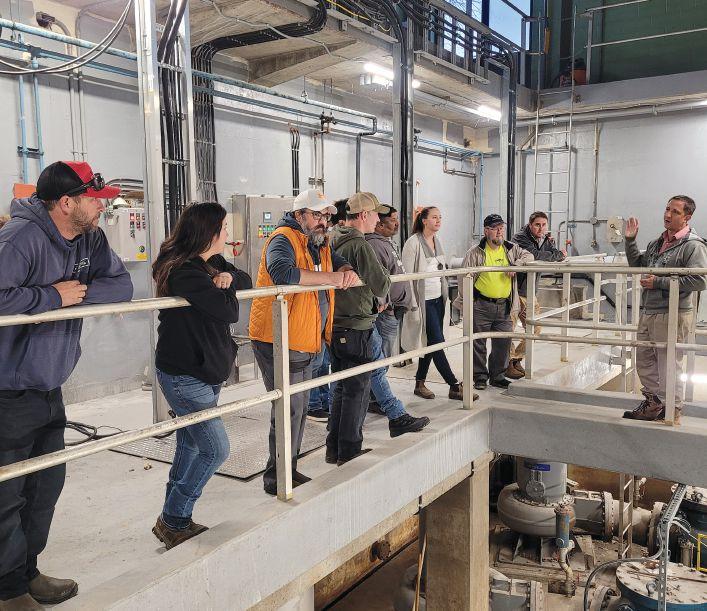
North Chapter members engaged in an informative sewer treatment
The evening concluded with a thrilling demonstration by Team 1305 Robotics, inspiring students to consider opportunities in technology and engineering. OACETT’s participation, prompted by growing interest in college-level education, added valuable perspectives to the event.
Julie Beaudry, C.Tech., is Near North Chapter chair: nearnorth-chapter@ oacett.org.
Horseshoe Region
Peel Chapter
The Peel Chapter recently organized two insightful events showcasing technological advancements and career development.
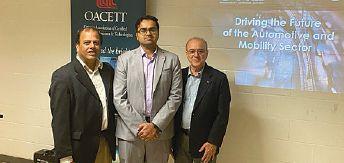
Pictured from (left to right): Anil Kolassery, C.E.T., John George, P.Eng. (speaker), and Rasheed Khan, A.Sc.T. at the Ontario Vehicle Innovation Network’s seminar on zero-emission vehicles.
The first event, hosted jointly by the Women in Technology (WIT) webinar and Women in BIM (WIB), featured Abarna Krishnakumar, C.Tech., who shared her inspiring journey from a BIM (Building Information Modelling) modeller to a VCD project manager. She highlighted the challenges of being the only woman on her team throughout her career and emphasized the need for more women professionals in BIM.
Near
plant tour.
Krishnakumar provided insights into BIM’s applications across commercial, residential, and infrastructure industries, and chatted about different tools, including AutoCAD, Revit, and Civil3D. She also encouraged aspiring professionals to pursue formal education in the field and emphasized the importance of building a strong network. Key advice for mentees included being proactive, setting clear goals, and acting on feedback.
The second seminar featured John George, P.Eng., who introduced the Ontario Vehicle Innovation Network (OVIN) and its role in advancing smart mobility technology in Ontario. He discussed the province’s initiatives in electric vehicles (EVs), hydrogen fuel cells, and infrastructure for battery recharging.
The presentation showcased Project Arrow, Canada’s first all-Canadian zero-emission vehicle (ZEV), developed by the Automotive Parts Manufacturers Association (APMA) and OVIN. The $20 million project, supported by $8.2 million in government funding, brought together 60 partners to design, engineer, and build this ground-breaking vehicle,
which has been showcased globally in five countries.
The Peel Chapter thanks volunteers Dev Harripersad, C.Tech., Peter Huang, C.Tech., Rasheed Khan, A.Sc.T., and
Niagara Chapter
Eajaz Zaheer, C.E.T., for their contributions to these successful events.
Anil Kevin Kolassery, C.E.T., is Peel Chapter chair: peel-chapter@oacett.org.

Kevan Peters, C.E.T., is Niagara Chapter chair: niagara-chapter@oacett.org.

Families and friends enjoy a memorable evening of strikes and laughter at the OACETT Niagara Chapter’s bowling event on December 7 at the popular Parkway Social in St. Catharines.
Toronto Region
Toronto Central Chapter
On October 24, seven enthusiastic attendees participated in the CPD-approved Highland Creek Treatment Plant tour. Rob and Russell, from the Toronto Water municipal division of the City of Toronto, led the tour and provided in-depth information about the biological treatment process. With a couple of the tanks undergoing maintenance, attendees had the unique opportunity to see the full size of a tank with all its mechanical components exposed. This view is typically hidden below the liquid level. The experience sparked numerous insightful questions and a high level of engagement from all. Thank you to Kevin Lima, C.E.T., for organizing such a memorable event.
Looking ahead, TCC is planning its Annual Chapter Meeting (ACM) for March 19, 2025, and members will again volunteer as judges at the Toronto Science Fair on March 29. Registration for the fair closes on March 15.
Shalevia Briscoe, C.Tech., is Toronto Central Chapter chair: torontocentralchapter@oacett.org.
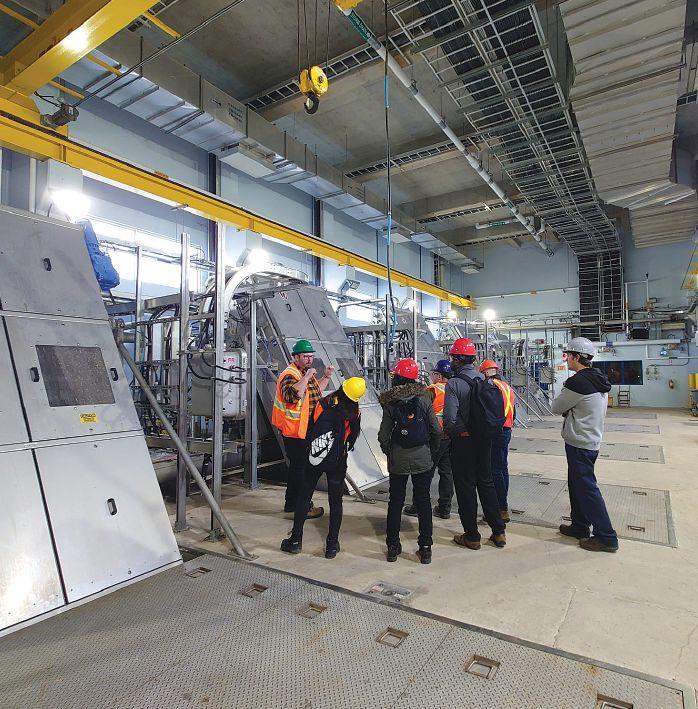
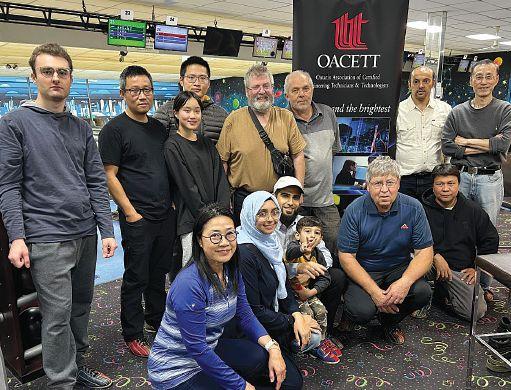
Central Region
York Chapter
The York Chapter held a successful networking bowling event. The chapter executives enjoyed quality time mingling with members and their families. Throughout the event, chapter executives gathered valuable feedback from members on membership, the certification process, job searching, and any other questions or concerns.
Although, this was the final event for 2024, the chapter is excited to announce new networking opportunities in 2025, inspired by the chapter’s survey results. This York Chapter looks forward to further fostering its connections with members and strengthening its community this year..
Phelia Kung, C.E.T., is York Chapter chair: york-chapter@ oacett.org.
Toronto Central Chapter members at Highland Creek Treatment Plant immersed in the fascinating details from the informative plant tour.
York Chapter members sharing strikes and smiles at the chapter’s successful networking bowling event.
JUNE 7, 2025