


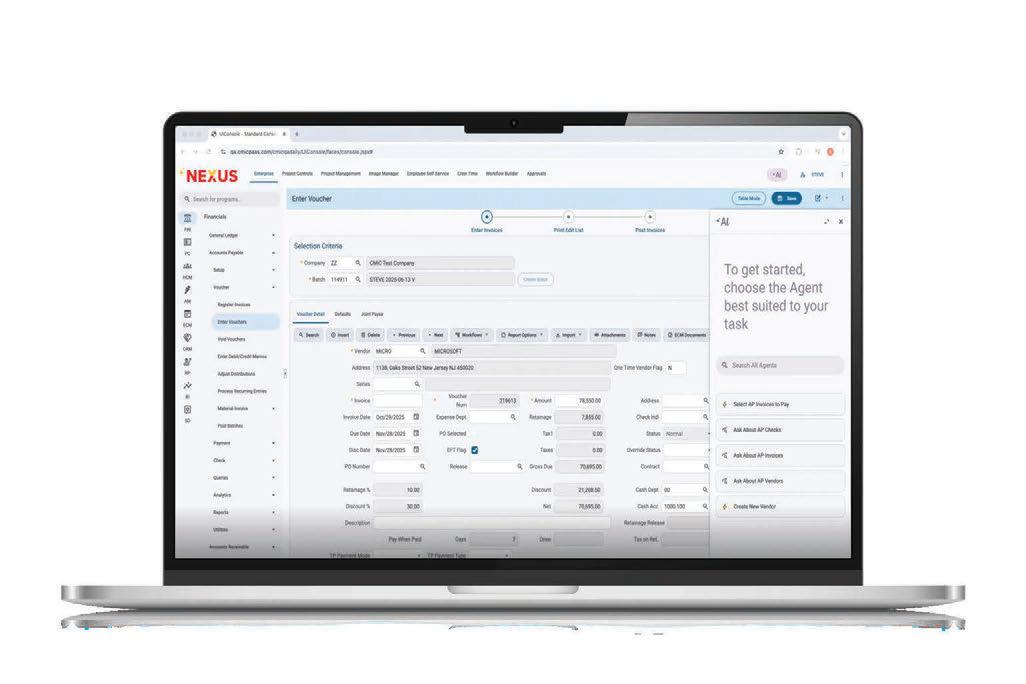

As labour tightens and project complexity grows, AI agents are being deployed as digital crew members to protect schedules, margins and safety.
BY SEAN TARRY




The Canadian construction industry is no stranger to pressure. Labour shortages persist. Project values continue to climb into the billions. Construction projects are more complex, more regulated and more schedule-driven than ever before. At the same time, owners, insurers and financiers are demanding unprecedented levels of transparency, reporting and predictability.
Against that backdrop, artificial intelligence - long discussed in abstract or experimental terms - is beginning to move out of the lab and onto the jobsite.
That shift was the focus of a recent industry webinar hosted by On-Site Maga-
zine, bringing together technology leaders and practitioners to explore a fast-emerging concept: AI agents, also known as agentic AI.
Moderated by David Bowcott, Executive Vice President at PLATFORM Insurance, the panel featured Nolan Frazier, Head of Sales for Procore Canada; Jeff Weiss, Chief Revenue Officer at CMiC; and Nick Thompson, Chief Estimator (Calgary Area) at EllisDon.
While much of the industry conversation to date has centred on generative AI - tools that summarize, draft or answer questions - the panel argued that AI agents represent something fundamentally different: a new layer of digital labour that actively executes work inside real construction workflows.
For contractors delivering complex projects, that distinction matters.
Bowcott opened the discussion by grounding the conversation in a reality most contractors recognize immediately: modern jobsites generate enormous volumes of data.
Project management platforms, BIM models, schedules, IoT sensors, reality capture, supply chain systems, safety reports, quality documentation, emails, drawings and risk data now form a sprawling digital footprint around every project. Over the past two decades, construction has
steadily digitized but has struggled to fully capitalize on that data.
“We don’t have a knowledge problem,” Bowcott observed. “We have a capacity and consistency problem.”
Despite having access to more information than ever, project teams remain overwhelmed by administrative work: chasing RFIs, updating logs, reconciling cost and schedule data, producing reports and managing compliance. The result is not a lack of insight, but a lack of time to act on it.
This is where AI agents enter the picture.
Frazier drew a clear line between today’s most common AI tools and what comes next.
“Most of the AI we see in construction today is generative,” he said. “It summarizes information, drafts content or answers questions. That’s useful - but it’s passive.”
Generative AI still relies on people to prompt it, interpret outputs and follow up. AI agents, by contrast, are continuous, task-oriented and proactive.
“Agentic AI monitors workflows, enforces follow-through, escalates risk and takes routine execution work off people’s plates,” Frazier explained. “Generative AI helps people think. Agentic AI helps people work.”
For contractors managing concrete pours, lift sequencing, inspections and coordination
embedded inside construction operations.
“The opportunity isn’t AI as a chatbot,” Weiss said. “It’s AI as a role-based digital staff member - project controls assistants, cost analysts, safety monitors - working alongside people.”
Unlike traditional analytics tools, these agents don’t just surface insights; they take action. They reconcile data, flag deviations, update forecasts and escalate issues when thresholds are crossed.
For construction projects, where sequencing, material availability, curing windows and inspection timing are tightly interdependent, this capability directly impacts productivity and risk.
“What contractors are asking for isn’t smarter dashboards,” Weiss noted. “They want fewer surprises, better predictability and protected margins.”
In that sense, AI agents function less like software and more like a dependable junior team member - one that never forgets to follow up.
The timing of agentic AI is not accidental. As the panel emphasized, Canadian construction faces structural constraints that cannot be solved by hiring alone. “More projects. More regulation. Fewer
“We’ve deployed automated HSE trend analysis, carbon reporting tools, emissions classification engines and we’re working on predictive cost forecasting, too.”
- Nick Thompson, EllisDon
across dozens of subcontractors, this distinction is critical. Delays and cost overruns rarely stem from one catastrophic event; they accumulate through dozens of small, missed follow-ups.
AI agents are designed to prevent that bleed.
Jeff Weiss framed AI agents not as features or dashboards, but as digital employees
experienced people,” Frazier said. “You can’t scale execution by scaling headcount anymore.”
And as projects become more complex, this challenge is magified. They’re labour-intensive, schedule-sensitive and unforgiving of coordination failures. Agentic AI offers a means by which to scale execution capacity without scaling workforce size, by absorbing administrative and coordination tasks that consume experienced supervisors’ time.
Nick Thompson underscored that this shift is already underway at EllisDon.
“AI in construction is finally operational rather than experimental,” he said. “These aren’t pilots. These are functioning agentic tools we’re using across the business.”
EllisDon’s approach highlights a core theme repeated throughout the discussion - AI agents are only as powerful as the data foundation beneath them.
Over several years, EllisDon has invested heavily in modernizing its data environment, building what Thompson describes as a unified ontology - a structured way of connecting safety, schedule, estimating, cost, logistics and field data into a single operational view.
That foundation, built using Palantir Foundry, enables AI agents to operate across traditionally siloed systems.
“We’ve deployed automated HSE trend analysis, carbon reporting tools, emissions classification engines and we’re working on predictive cost forecasting, too,” Thompson said. “The productivity gains have been significant.”
For the purposes of estimating, Thompson outlined a powerful emerging use case involving AI agents that are trained to analyze historical project benchmarks and generate conceptual estimates and preliminary schedules using high-level project parameters.
“The agent can find the most comparable projects, apply real ratios and statistics and produce an early-stage estimate,” he explained. “From there, it can generate scopes of work and risk registers.”
The implication is not replacing estimators but dramatically accelerating early decision-making.
Across the panel, there was strong consensus on where contractors see the fastest, most tangible returns from AI agents today.
The answer: repetitive, time-sensitive and high-risk processes.
RFIs and submittals were cited repeatedly. Projects rarely fail because of one major unresolved RFI; they suffer through dozens of late or forgotten ones. AI agents can monitor aging, identify critical-path impacts, and escalate issues automatically.
Other high-value areas include:
• Daily field logs and reporting
• QA/QC inspections
• Materials and logistics coordination
• Schedule and cost reconciliation
• Compliance documentation
On concrete projects, Weiss noted, agents can be especially effective at monitoring pour readiness, sequencing risks and dependency conflicts - areas where delays cascade quickly.
“The productivity loss isn’t in the pour itself,” he said. “It’s managing everything around it.”
Safety was another recurring theme during the discussion, particularly given the risks inherent in construction operations involving lifting, traffic management and changing site conditions.
The panel was unanimous in suggesting that AI should never replace human accountability for safety. However, AI agents can play a powerful advisory role.
“Most incidents aren’t sudden,” Frazier said. “They’re the result of pressure and inconsistency over time.”
AI agents excel at monitoring adherence to safety processes, detecting early warning signals and escalating concerns sooner. They can analyze patterns across incidents, nearmisses and site conditions - something no individual supervisor can do continuously.
Thompson emphasized that EllisDon views AI as a safety partner, not a decision-maker.
“Site leaders must retain full responsibility,” he said. “But predictive models are incredibly valuable.”
Technology adoption has long been a challenge in construction, particularly in the field. The panel stressed that AI agents will
“People don’t resist technology, They resist friction.” - Nolan Frazier, Procore
fail if they feel like “one more tool to manage.”
“People don’t resist technology,” Frazier said. “They resist friction.”
Successful adoption starts with a clear strategy, focused use cases and early wins that visibly reduce workload. Crucially, AI agents must give value back to the field - not just to head office.
Weiss noted a key shift. For years, site teams were asked to enter data primarily so management could extract insights. AI agents reverse that equation by turning good data entry into immediate, tangible benefits for the people doing the work.
“That’s the ROI finally coming home to roost,” he said.
One of the most pointed questions about the use of AI in construction addressed the fact that many organizations lack the data foundations required for AI success. The panel did not hesitate with their answer.
“Data, data, data,” Thompson said. “Structure and consistency matter.”
However, the panelists, including Thompson, pushed back on the idea that data must be perfect. Contractors don’t need to standardize every workflow; they need enough guardrails to create usable, comparable information across core processes.
Summary-level data, such as work hours per million dollars, general conditions percentages or productivity ratios, can deliver significant value even when granular data remains messy.
Standing still, the panel agreed, is the bigger risk.
Unlike large ERP implementations, AI agents are expected to demonstrate ROI quickly, often within weeks or months.
“If AI doesn’t show up in margin fast, it won’t survive,” Weiss said.
Labour hours saved, reduced rework, improved forecast accuracy and fewer latestage surprises are the metrics contractors are watching. Importantly, agents can be tested, refined or abandoned with relatively low cost to the business, supporting a “fail fast” approach.
However, the panelists all caution that even while considering the immense potential that AI poses in becoming a significant decision-maker for the business, leaders must maintain focus and control. On the issue of accountability, the answer was unanimous - humans remain very much responsible for outcomes.
AI agents support decisions; they do not make them. Contractors must audit outputs, maintain human oversight and treat AI as a tool, not an authority.
As the discussion concluded, one theme stood out - the fact that agentic AI is not a future concept, it’s an operational reality for leading contractors today.
For Canada’s construction builders, the opportunity presnted by AI is not about replacing skilled trades or automating physical work. It’s about protecting time, preserving experience and scaling execution in an industry that cannot hire its way out of constraint.
To help achieve these gains, AI agents are emerging as a new kind of crew member - digital, tireless and increasingly indispensable. And the contractors who invest now in ensuring clean data, stable workflows and thoughtful adoption may find themselves with a decisive advantage in fewer surprises, safer sites and projects delivered with greater confidence in an increasingly unforgiving environment.
As Bowcott summarized, productivity is no longer optional. It is the only lever left. And AI agents may be the strongest hand the industry has yet been dealt.
As
BY SEAN TARRY
On any major Canadian project, whether it’s a downtown high-rise, a transit expansion, or a remote industrial facility, concrete work sets the tone. Once it’s poured, embedded, or enclosed, mistakes become expensive lessons. For decades, contractors relied on drawings, site walks and fragmented photo records to track progress and verify conditions. Today, that reality is changing fast.
Reality capture and visual intelligence technologies are transforming how jobsites are documented, understood and managed. What began as a way to take better photos has evolved into something much more powerful - a data-rich, spatially aware view of construction that supports real decision-making in real time.
“Nothing is more valuable than real reality information about what’s actually happening on your jobsite,” says Michael

Fleischman, Co-Founder and CTO of OpenSpace. “But the future isn’t just capturing data - it’s helping teams act on it.”
For Canadian contractors facing tight schedules, labour constraints and weather-driven disruptions, that evolution is arriving at a critical moment.
The origin of OpenSpace – one of the leaders in the development of reality capture and visual intelligence platforms - starts far from construction. Fleischman’s background is in cognitive science and artificial intelligence, with earlier work spanning machine learning, computer vision and social media analytics. The spark for OpenSpace came from a simple frustration - trying to understand a physical space remotely.
That challenge turned into a realization
once OpenSpace’s founders began testing their technology on construction sites.
“It became very apparent eaerly on that this technology fit a real need in construction, arguably more than anywhere else,” Fleischman says.
The company’s early focus was straightforward reality capture - using 360-degree cameras to create walkable, time-stamped visual records of a jobsite. But as adoption grew, so did expectations.
“We’ve transitioned from a point solution into what we call a field-focused visual intelligence platform,” Fleischman says.
And it’s a shift, he goes on to explain, that rests on three pillars:
Richer data capture – expanding beyond 360-degree cameras to include drone imagery and, increasingly, mobile phone photos that would otherwise live briefly in text messages before disappearing.

Deep integrations – connecting visual data into systems contractors already rely on, such as Procore and Autodesk, to support a single source of truth.
AI-driven analysis – turning images into insights, such as automated progress tracking and early detection of issues.
OpenSpace’s acquisition of progress-tracking firm Disperse accelerated that last pillar, enabling the company to quantify work in place - how much drywall is installed, how zones are advancing - and connect that intelligence to scheduling, quality and payment workflows.
Canada’s construction environment amplifies the true value of visual intelligence. Projects across the country are often remote, weather-exposed and spread across vast geogra-
phies. Travel to sites can be costly, slow, or unsafe, especially during winter shutdowns or seasonal transitions.
“In many ways, remote access is core to what we do,” Fleischman says. “OpenSpace really came of age during the pandemic, when suddenly every jobsite needed to be remotely accessible. That same value applies to inclement weather or isolated regions.”
By creating a continuously updated visual record, contractors can review conditions, verify installations and resolve questions without putting boots on the ground. That capability is particularly valuable for concrete-intensive work that often involves inspections, embeds and sequencing decisions requiring multiple stakeholders to weigh in.
OpenSpace’s global footprint, now spanning more than 80,000 projects across
125 countries, has proven the technology’s resilience.
“We’re used everywhere from high deserts to Antarctica,” Fleischman asserts. “That range of weather forces the platform to work and perform under extreme conditions.”
At PCL Construction, one of Canada’s largest contractors, reality capture isn’t treated as a single technology but as a spectrum of tools. Marcelo Borges, ICT Manager for Construction Engineering at the company, is clear that value depends on alignment.
“Reality capture is a broad term - it can mean everything from a simple mobile photo to drone flights or full 360-degree video,” Borges says. “Each approach has a different purpose, and each delivers value in different ways depending on the problem we’re trying to solve.”
For PCL, tangible ROI shows up in several key areas:
Earthworks validation/logistics planning - Drone imagery provides near-real-time snapshots of excavation progress, helping teams plan staging, layouts and sequences with confidence.
High-fidelity building scans - Creating detailed digital records of completed buildings delivers long-term value for owners, supporting maintenance and future renovations.
Cultural and specialty project - Even niche applications such as scanning sculptural elements demonstrate how these tools preserve detail and document conditions accurately.
Borges, however, is equally clear about where reality capture doesn’t necessarily deliver value.
“Problems arise when the wrong tool is applied to the wrong task,” he says.
Under-delivery, he explains, leads to missing information; over-delivery creates data waste that teams can’t realistically use.
The lesson, he notes, is right-sizing. Visual intelligence works best when workflows are designed intentionally, not when technology is layered on without purpose.
The real shift happens when contractors move from basic documentation to AI-driven visual intelligence. For PCL’s concrete- and steel-intensive projects, that shift has significantly changed daily decision-making.
“What used to be hundreds of unstructured photos is now a consistent, walkable capture of the entire site,” Borges says, explaining that teams no longer waste time searching for images or re-walking areas to confirm conditions.
The impact shows up in three practical ways:
Faster coordination - Stakeholders can review the same verified visuals remotely, reducing site visits and accelerating RFIs.
Earlier issue detection - Comparing reality capture against 3D models flags problems before they turn into rework.
New habits - Superintendents, coordinators and inspectors increasingly check conditions virtually first, using visual data as a shared source of truth.
“Those behaviours weren’t part of the original plan,” Borges admits, “but they’ve become some of the most valuable outcomes.”
Both Fleischman and Borges emphasize that visual intelligence only delivers full value when it integrates seamlessly with existing systems. Contractors don’t want another silo - they want clarity.
“No one wants double entry,” Fleischman says. “If something

happens in OpenSpace, it needs to be reflected in Procore, Autodesk or whatever system is managing the project.”
Progress tracking data tied directly to schedules, ERP systems or payment workflows opens the door to faster updates and fewer disputes. Borges echoes that sentiment from the contractor’s side.
“Data delivers the most value when everyone is using the same information,” he says. “If only the GC uses it, it becomes a silo. When trades, inspectors and owners rely on it, too, coordination improves dramatically.”
Despite the sophistication of today’s platforms, however, both Fleischman and Borges point to the same conclusion – the fact that technology is the easy part and that a company’s culture is what ultimately determines success.
For PCL, adoption improves when reality capture is treated as part of the workflow, not an added task. Transparency must be framed as a strength, not a threat, and teams need to trust that visibility will be used for improvement rather than blame.
“You don’t need everyone on day one,” Borges says. “A few champions drive adoption faster than any mandate.”
Fleischman agrees, adding that AI should be seen as an amplifier, not a replacement, framing it with a pop-culture analogy.
“AI in construction is much more Iron Man than Terminator,” he says. “It’s about giving people superpowers - helping them do more than they could do before - not taking them out of the equation.”
Looking ahead, both see visual intelligence becoming more proactive and more embedded in daily work. Progress tracking will become faster and more granular. AI agents will operate in the background, automatically locating issues, creating records and surfacing justin-time insights. And wearable technologies, such as smart glasses, could further reduce friction, capturing images hands-free and feeding spatial data directly into project systems.
For Canadian contractors managing complex scopes under intense pressure, the promise is compelling - fewer surprises, faster decisions and a clearer picture of reality, no matter where the jobsite sits on the map. And as visual intelligence continues to mature, it’s becoming clear that the most competitive builders won’t just operate efficiently - they’ll see, understand and act on their jobsites with unprecedented clarity.

Protect the Fee: Median 4% increase in profit margins.
Defend Cash Flow: Automate “Proper Invoice” compliance.
Beat the Weather: 83% reduction in project delays.

Looking back at KPMG Canada’s digital maturity report, the industry’s early bets on technology now read as a necessary response to pressures and rising complexity, signalling where construction is headed.
BY SEAN TARRY
When KPMG Canada in collaboration with the Canadian Construction Association released its digital maturity report in Summer 2025, it landed at a moment of reckoning for the construction sector. Labour shortages were acute, supply chains were unstable, and productivity gains were elusive, all while the demand for housing and infrastructure was accelerating.
Looking back now, the report reads less like a snapshot of disruption and more like an early signal of a structural shift still unfolding. The findings captured an industry beginning to accept a hard truth - without technology, Canadian construction will struggle to keep up with the work ahead.
Nowhere is that sentiment more evident than on large projects, where sequencing errors, labour constraints and rework risk compound quickly. As a result, the industry is moving rapidly toward technology as a means to address these pressures. As the report documents, Canadian construction is no longer dabbling in digital tools but preparing to depend on them.
At the time of the report, construction leaders were already feeling squeezed by labour availability, rising material costs, tighter schedules and heightened expectations from

owners and regulators. What stood out was how decisively attitudes toward technology had shifted.
Fully 90 per cent of construction leaders agreed that digital tools, ranging from BIM and analytics to AI and digital twins, were essential to boosting productivity and labour effectiveness, up from 86 per cent just two years earlier. The increase signalled a move away from debate and toward execution.
For contractors delivering complex jobs involving embeds, logistics, curing cycles and inspection readiness that leave little room for error, this consensus marked an inflection point. The industry was no longer asking if technology mattered, but how quickly it could be scaled.
Labour has been the clearest recent accelerant of digital adoption. The report found that 78 per cent of construction companies were experiencing skilled labour shortages, down from 90 per cent in 2024, but still critically high.
Nearly 73 per cent of leaders anticipate that meeting demand will become even more difficult over the next five to ten years as retirements begin to outpace recruitment. Further, an overwhelming 70 per cent stated that shortages were already affecting their ability to bid on work or meet deadlines.
What the report made clear, however, is that technology adoption has never been about replacing workers. It is about extending their reach, enabling fewer people to manage more scope with greater confidence and less rework.
One of the report’s most consequential findings - the fact that technology investment has already been delivering returns - has aged quite well. Eighty-one per cent of construction companies reported that recent digital investments had improved labour productivity and efficiency.
For construction projects, these gains tend to surface in practical ways:
• More accurate quantity tracking and progress verification
• Fewer site revisits and manual measurements
• Earlier identification of issues before they are buried in concrete
• Improved coordination between field teams, consultants and owners
The message from the report was clear then, and it remains so today - that when technology is implemented by organizations with intent and integrated into workflows, it pays off.

The report also captured an industry grappling with supply chain instability. Concrete, steel and critical materials have been subject to recent delays, pricing swings and unpredictable availability constraints that traditional planning methods struggle to absorb.
In response, 56 per cent of respondents identified demanddriven supply chain innovation as their top technology priority for 2026, reinforcing the need for tools that align procurement with real-time project needs.
Recent subsequent shocks, from geopolitical instability to trade friction, have only reinforced the logic behind that investment. On larger projects, where pour schedules and staging constraints often amplify risk, predictability has become as valuable as efficiency.
Rather than chasing a single solution, contractors are spreading investments across multiple technologies. Fifty-three per cent ranked prefabrication and modularization as a top priority, while the same percentage prioritized AI-driven software. Forty per cent are exploring robotics and drones.
For most construction projects, prefabrication stands out as a practical lever to reduce site labour, improve quality and compress schedules.
The report also acknowledged the fact that technology adoption depends heavily on procurement. Encouragingly, 78 per cent of respondents stated that procurement processes were beginning to change in ways that support greater innovation, while 43 per cent identified clients as being highly influential with respect to their technology decisions.
Even as technology advances, the report highlighted a structural issue that digital tools alone cannot solve. A striking 84 per cent of construction leaders across the country called for the elimination of interprovincial trade barriers as quickly as possible as a means to ensure their competitiveness.
Operating under multiple provincial regimes adds friction, cost and delay, particularly for national contractors delivering large, complex infrastructure and institutional projects. While technology can be leveraged to mitigate some of the inefficiencies, the report made clear that policy reform is a necessary companion to digital progress.
With the luxury of hindsight, it’s clear to see that the KPMG report captured a sector crossing an important threshold, with 87 per cent of leaders agreeing that advanced technologies are essential tools to be used in order to meet rising demand. But it also offered a caution of sorts - that investment in technology is only the beginning.
Real returns depend on integration, change management and upskilling. As Canada enters a new era of nation-building, one conclusion stands out - the fact that the future of construction will be shaped not only by concrete and steel, but by data, digital tools and smarter ways of working.

At the same time, the persistence of lowest-price procurement was flagged by the majority of respondents as a limiting factor and one that continues to challenge contractors’ ability to invest confidently in digital capabilities.

By Jacob Stoller

Accurately representing the dynamic complexity of a construction site has been perhaps the greatest challenge for construction technology. New developments in AI show potential to make that easier.
n his keynote in January at the 2026 Consumer Electronics Show (CES) in Las Vegas, NVIDIA CEO Jensen Huang heralded a new era in AI comparable to the release of ChatGPT.
“The ChatGPT moment for robotics is here,” he said. “Breakthroughs in physical AI - models that understand the real world, reason and plan actions - are unlocking entirely new applications.”
While the emphasis at CES was on humanoid robots, the trend toward an AI that understands the physical world will almost certainly have an impact on construction technology.
Physical AI, often referred to as spatial AI or world models, adds intelligence to AI models based on the laws that govern the physical world. A program powered by spatial AI will be able to “see” a point cloud in the context of how physical reality behaves in 3D.
The trend is being accelerated by the defection of AI pioneers such as Yann LeCun, who argue that the lack of world models in mainstream LLM technology is holding back the evolution of AI.
Progress has been rapid and the introduction in January of World Model APIs makes the technology readily available to software developers to incorporate the power of spatial AI into their products.
“World Model APIs have just come out which bring the technology into commercial use,” says Rishi Midha, Manager, Program, AI Insights & Analytics at EllisDon. “That will accelerate the development of construction apps as the user base and funding grow.”
This promises to significantly enrich VDC models, and any other software that relies on an accurate depiction of the evolution of a construction site in real time.
“I’m very excited, because now I have software that understands the concepts of projections, real world geometry, physics and how objects move in space, not just in a theoretical model, but in a live construction scenario such as the building of a bridge,” says Midha.
The likely outcome of this, however, is not the emergence of a killer app, but the improvement of a very diverse portfolio of software products that support construction.
“Every construction company manages a set of business processes, whether it’s scheduling, budgeting, estimating, QA/QC management, coordination of trades, safety or as-built construction,” says Thomas Strong, Senior Vice President who leads Technology and Innovation for the Construction and Infrastructure Group of MFP - a risk capital and human capital advisory firm which supports complex capital projects, “and those fundamentals are points of responsibility in the construction process. A lot of technology fits
into those buckets. The role of AI has been to enhance that technology in order to better support the existing business processes.”
While the new technology is developing at lightning speed, integrating new functionality into existing products faces many barriers.
“Software companies are built around the demand for a product or a problem that they’re going to solve,” says Strong. “So, there’s got to be a business case for those software companies to use AI.”
While it’s still early days, spatial AI clearly strikes at the heart of construction technology – the VDC model. Use cases are likely to emerge in areas where faster and more accurate models can have immediate impact on existing processes.
One emerging area is augmented reality (AR). Because location systems rely on satellite-powered GPS systems, they don’t work indoors. A worker using AR within a building, therefore, has got to scan a preplaced survey marker or manually register their location.
“The lack of GPS and the lack of tight control over where you are within a building disrupts the ability to use augmented reality, or at least complicates it” says Sean Zook, VDC Manager at PCL Construction. “So, some of the software vendors that we use are working to leverage spatial AI to bring, essentially, GPS indoors.”
Safety is another area where improvements can be made.
“Looking at a photograph and making an objective decision whether or not the fencing signage meets the safety requirements is a hard thing for a human to do at scale,” says Strong. “Whereas you could drop in a photo database and spatial AI can immediately identify unprotected openings or workers that aren’t tied off.”
AI adoption, however, requires companies to understand where AI can bring value, and be willing to experiment.
“The direction from our CEO, which I strongly agree with, is that to use AI, you really have to know what its boundaries and capabilities are,” says Zook. “So, I would encourage people to not just read or listen to what others have said, but to explore it themselves and find out what the capabilities are.”
As spatial AI matures, its greatest impact on construction may be quiet but profound - making digital models more faithful to physical reality and everyday workflows more intelligent. Rather than replacing existing tools, AI that understands space and physics will steadily enhance how projects are planned, built and managed.
Jacob Stoller is Principal of StollerStrategies. Send comments to editor@on-sitemag.com




By David

Moving from backoffice tools to frontline digital employees, AI agents raise critical liability questions for contractors, owners and insurers.
On January 22, 2026, I moderated the On-Site webinar titled AI Agents – The Dawn of the Digital Employee Workforce, which included Nolan Frazier (Procore), Jeff Weiss (CMiC) and Nick Thompson (EllisDon). The discussion was refreshingly practical. No one questioned whether AI agents are coming into construction operations – they’ve already entered. What generated the most interest was something more fundamental: as AI agents begin to behave like digital employees, how do we assign responsibility when their decisions contribute to cost overruns, delays, safety incidents or claims?
For decades, construction risk followed a familiar and defensible structure. Humans made decisions. Companies established procedures and supervision. Contracts and insurance policies allocated responsibility accordingly. Software supported judgment but rarely replaced it. AI agents disrupt this model because they don’t just inform - they increasingly act.
Today’s agents can prioritize work, flag safety risks, approve workflows, optimize schedules and trigger actions across connected systems. In many cases, they operate continuously and at a scale no human team could match. The result is a subtle but important shift: decision-making authority is no longer exclusively human, even if accountability remains so.
At first glance, liability appears straightforward. The company deploying the AI agent owns the risk. The agent is a tool, much like a project management platform or the Internet itself. Management remains responsible for outcomes. This assumption is likely where courts and insurers will land - but it understates the complexity contractors are beginning to face.
Unlike traditional software, AI agents are designed to reason, adapt and optimize toward objectives. Their behaviour reflects not only the intentions of the contractor using them, but also the design choices of software vendors, the assumptions that have been embedded in training data and the governance controls, or lack thereof, surrounding deployment. When something goes wrong, responsibility may be legally clear but operationally diffused.
Consider a simple scenario. An AI agent reprioritizes subcontractor access to improve schedule efficiency. A trade is delayed, temporary conditions change and a safety incident follows. The contractor may ultimately bear liability, but the decision emerged from a system involving algorithms, historical data, configuration settings and automation rules. This is a new kind of risk environment - one where accountability is centralized but causality is distributed.
For construction firms, the takeaway is not at all to avoid the
use of AI agents, but to ensure that they are governed deliberately.
First, define decision boundaries. Contractors should clearly articulate which decisions AI agents are permitted to execute autonomously, and which require human approval. High impact, irreversible decisions, particularly those affecting safety, structural integrity and regulatory compliance, should remain human-gated, even if AI accelerates analysis.
Second, assign operational ownership. Every AI agent should have a clearly designated owner responsible for its behaviour, performance and escalation. “Human-in-the-loop” oversightinvolving the continuous monitoring by a human with the authority to intervene - is more realistic than expecting humans to review every recommendation.
Third, treat data governance as risk governance. AI agents trained on biased, outdated or incomplete data will reliably produce flawed decisions. Training datasets, prompts and feedback loops should be versioned, auditable and periodically stress-tested. In many future claims, the root cause will not be faulty code, but poor data hygiene.
Fourth, expand incident response planning. When an AI agent contributes to a loss event, firms should be able to reconstruct why the agent acted, what information it relied on and how its authority was defined. Explainability is not theoretical - it is essential for claims management and defence.
Finally, your risk finance partners (insurers) will increasingly look beyond whether AI is used and focus instead on how it is governed by your organization. Professional liability and technology E&O policies were not built with autonomous digital workers in mind. Firms that can demonstrate disciplined controls, clear accountability and mature oversight frameworks will be better positioned as improved covers come to market and underwriting standards evolve.
In the end, AI agents do not remove responsibility from construction companies - they concentrate it. And the firms that succeed in this new reality will be those that approach the use of AI agents not as shortcuts for delegation, but as powerful digital employees that require clear rules, supervision and thoughtful risk design.
The future of AI in construction is not just about contractor capability. It’s about stewardship and owning the risk that comes with it.
David Bowcott is the Executive Vice-President Construction Industry Group at PLATFORM Insurance Management. Please send comments to editor@on-sitemag.com.