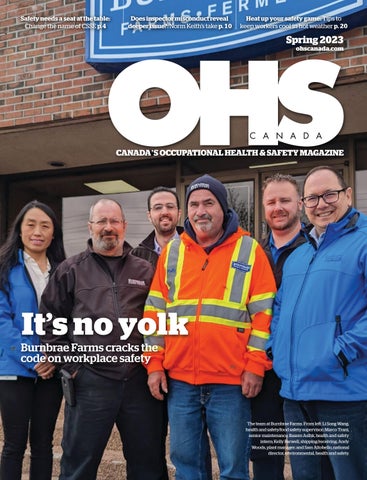
The team at Burnbrae Farms. From left: Li Song Wang, health and safety/food safety supervisor; Marco Trani, senior maintenance; Basem Asihk, health and safety intern; Kelly Farwell, shipping/receiving; Andy Woods, plant manager; and Sam Altobello, national director, environmental, health and safety.
DEPARTMENTS
04 | From the Editor
Understanding and supporting
workers
27 | Quarterly Check-in
CSA Group's Worker and Public Safety team has a full agenda 30 | Time Out
Hiring a hitman, stuck in a claw machine and naked landlords
From the Editor
By Todd Humber, Senior Editor
It’s time to elevate safety: Change the name of CSSE
Safety needs a seat at the boardroom table. And before HR puts up their hands, let me rephrase that: Safety needs its own seat at the table.
No offence to our human resources friends, but the CHRO is already wearing enough hats — and they’re all pretty critical. The safety one should be removed and passed over to the professional sitting in the shiny new chair you just rolled up to the table.
A chief safety officer (CSO) is still a relatively scarce role. To put some random numbers around it, a Google search on that term brings up 165,000 results. For CHRO, that number is more than four million. CFO? 56.8 million.
Workplace health and safety needs a senior level voice to champion it, someone with the word “safety” engraved on their office door. It’s the same debate that enveloped the HR world about 20 years ago when it struggled for respect and recognition.
But occupational health and safety also needs a bit of a rebrand. The Canadian Society for Safety Engineering (CSSE) is currently kicking around the idea of a name change. It’s
EDITORIAL ADVISORY BOARD
time. CSSE has always been a confusing moniker, especially for those outside the profession — is it for engineers? Is it about the business of engineering safety? Does it have anything to do with workplaces?
A name change would go a long way to giving the profession more profile. The moniker it’s reportedly considering is Health and Safety Professionals Canada (HSPC). Perfect — that eliminates any confusion on its mandate.
S outh of the border, the similarly named American Society of Safety Engineering (ASSE) changed its name in 2017. It opted for a more subtle one-word shift, settling on American Society of Safety Professionals (ASSP). It’s a good moniker, but HSPC is better. Why?
The word “health.” Modern safety professionals have embraced total wellness when it comes to keeping workers safe. It wasn’t that long ago mental health was laughed out of the room.
“I can help you not to break your arm or your back, but what’s going on in your head is really not my concern,” says my fictional safety professional from the 1970s. But now, there is a real understanding
Paula Campkin: chief safety officer, Energy Safety Canada
Marty Dol: president and founder, HASCO Health & Safety Canada
Uyen Vu: Institute of Work & Health
Natalie Oree: prevention consultant, SAFE Work Manitoba
Norm Keith: partner, KPMG Law LLP
that everything a worker brings with them to your worksite can impact their safety and that of colleagues.
Distracted employees are not safe employees. Adding the word “health” into the name of a major association recognizes the important role health plays in ensuring everyone goes home safe at the end of the day.
The profession has embraced that change, and it’s time for associations to rebrand and reflect that reality. Is there a better name than Health and Safety Professionals Canada? It’s tough to think of one.
It’s simple, straightforward and won’t confuse anyone.
Turning to another topic, I’d like to extend my thanks to Sam Altobello and the team at Burnbrae Farms for opening their doors to OHS Canada for this issue’s cover story. Sam reached out, unprompted, to tell his story.
The team gave us access, at every level, and made people available to talk about the good, the bad, and the ugly when it comes to workplace safety. It’s this type of co-operation and sharing that helps us all learn and make this profession remarkable.
Richard Quenneville: senior director of corporate services, T. Harris Environmental Management
Maureen Shaw: lecturer and presenter
Dylan Short: managing director, The Redlands Group
Spring 2023 Vol. 39, No. 2 ohscanada.com
READER SERVICE
Print and digital subscription inquiries or changes, please contact Angelita Potal Tel: 416-510-5113
Fax: 416-510-6875
email: apotal@annexbusinessmedia.com
Mail: 111 Gordon Baker Rd., Suite 400, Toronto, ON M2H 3R1
SENIOR PUBLISHER Paul Burton 416-997-0377 pburton@annexbusinessmedia.com
COO/ GROUP PUBLISHER Scott Jamieson sjamieson@annexbusinessmedia.com
Printed in Canada ISSN 0827-4576 (Print) ISSN 1923-4279 (Digital) PUBLICATION MAIL AGREEMENT #40065710
SUBSCRIPTION RATES
Published four times per year WINTER, SPRING, SUMMER, FALL Canada $100/yr plus tax USA $130/yr (100 USD) Foreign $214/yr ($164.50 USD)
Occasionally, OHS Canada will mail information on behalf of industry related groups whose products and services we believe may be of interest to you. If you prefer not to receive this information, please contact our circulation department in any of the four ways listed above.
Annex Business Media Privacy Office privacy@annexbusinessmedia.com Tel: 800-668-2374
All advertising is subject to the publisher’s approval. Such approval does not imply any endorsement of the products or services advertised. Publisher reserves the right to refuse advertising that does not meet the standards of the publication.
In the News
CSSE mulling name change to HSPC
The Canadian Society of Safety Engineering (CSSE) is considering changing its name to Health and Safety Professionals Canada.
In a LinkedIn post, the CSSE Edmonton Community encouraged members to vote for the change.
“The world around us is changing, and our organization needs to evolve along with it. The current name of our organization, the Canadian Society of Safety Engineering, no longer accurately represents who we are as a professional association,” read the open letter to Edmonton chapter members. “Our members come from various backgrounds and industries, and we need a name that reflects our commitment to being a modern and inclusive organization.”
It said the word “engineering” in the title has created confusion about the organization’s purpose. The post argued the new name is “inclusive to anyone working in health and safety, regardless of their professional designations or certifications, because it emphasizes the importance of professionalism, expertise, and a shared commitment to promoting health and safety in Canada.”
Amazon worker injuries dip, but still higher than 2020
Amazon’s total injury rate for warehouse workers took a dip last year, but injuries were still worse than they were in 2020, according to an analysis by a coalition of labour unions.
The report, which was compiled by the Strategic Organizing Center and examines data Amazon has submitted to the Occupational Safety and Health Administration, said the company’s injury rate was 6.9% in 2022, compared to 7.9% the year before. In 2020, that number was 6.6%.
$325K
The amount General Motors of Canada has been fined, plus a victim surcharge, after one of its workers was killed in a fall at its plant in St. Catharines, Ont.
Maple Leaf Foods wins four workplace safety awards from North American Meat Institute
Maple Leaf Foods has won workplace safety awards for four of its processing facilities in Canada.
It received the awards from the North American Meat Institute (NAMI) during its Environmental, Labor and Safety+ conference in Carlsbad, Calif.
The company received NAMI’s highest award — the Award of Honor — for worker safety achievements at three facilities: its pork processing facility in Brandon, Man.; its meat canning operation in Mississauga, Ont.; and its Courtney Park manufacturing operation in Mississauga, Ont.
Maple Leaf Foods was also recognized with an Award of Merit for its Parma prepared meats
facility in Laval, Quebec. It also won the inaugural Diversity, Equity and Inclusion Award from NAMI along with an environmental recognition award.
“We are humbled to receive the Institute’s awards because they directly connect to our vision to be the most sustainable protein company on earth,” said Curtis Frank, president and chief operating officer of Maple Leaf Foods.
“Creating an inclusive, safe work environment where all of our teammates can deliver their personal best all while protecting our planet reflects Maple Leaf’s Leadership Values, and that makes these awards deeply meaningful to us.”
and safety-related news, columns and analysis from across Canada on our website! ohscanada.com
In the News
Anne Tennier reappointed as president, CEO of CCOHS
The federal government has reappointed Anne Tennier to be the president and CEO of the Canadian Centre for Occupational Health and Safety (CCOHS) for a five-year term.
“Anne Tennier led the CCOHS through the toughest days of the pandemic,” said Minister of Labour Seamus O’Regan Jr. “Her expertise and leadership will help keep workers safe and healthy for years to come.”
Tennier has been leading CCOHS and chairing the executive board as president and chief executive officer since April 2018. She brings more than 35 years of experience in environmental and safety management, community engagement, and government relations to her role with CCOHS.
Suit: Chocolate factory in U.S. ignored warning before deadly blast
(AP) — A Pennsylvania candy-maker ignored warnings of a gas leak at its chocolate factory and bears responsibility for a subsequent explosion that killed seven workers and injured several others, according to a lawsuit filed in April.
The family of Judith “Judy” LopezMoran, a 55-year-old mother of three, filed what their lawyers called the first wrongful-death suit against R.M. Palmer Co. after the March 24 blast.
Workers smelled gas that day and notified Palmer, but the 75-year-old, family-owned company “did nothing,” the lawsuit said.
“The gas leak at the factory and the horrific explosion it caused was foreseeable, predictable, and preventable,” the suit said. “Tragically, Judith Lopez-Moran’s death and suffering were preventable.”
Alberta extends pilot project to allow flashing blue lights on snowplows, tow trucks 10
Age, in years, of two children found working as late as 2 a.m. at a McDonald's restaurant in Kentucky. The U.S. Department of Labor found more than 300 children were working long hours and performing prohibited tasks at McDonald's owned by three separate franchisees in four states. "Under no circumstances should there ever be a 10-year-old child working in a fast-food kitchen around hot grills, ovens and deep fryers," said Karen Garnett-Civils, wage and hour district director in Louisville, Kentucky.
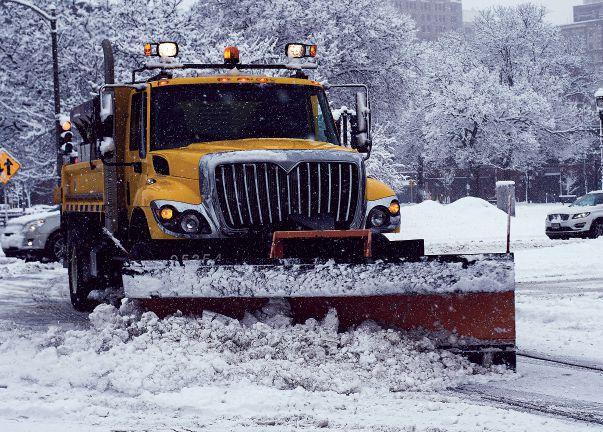
Alberta is extending a pilot project that allows the use of flashing blue lights on snowplows, tow trucks and highway maintenance vehicles contracted to the province to increase their visibility and safety while working on highways.
The province initiated a small trial in 2022 and, based on feedback, is extending the exemption for another five years.
“The original pilot projects were brought to increase visibility and improve safety of those working on our highways,” said Devin
Dreeshen, Minister of Transportation and Economic Corridors. “We are extending these projects to make sure these important safety measures remain in place so those who work on our highways can go home safely to their families at the end of their shifts.”
These changes are in addition to new rules under the Traffic Safety Amendment Act, which come into effect Sept. 1, requiring drivers to slow down and move over when passing highway workers.
B.C. overhauling road safety
British Columbia is proposing a number of changes to its Motor Vehicle Act in an effort to improve safety, including minimum safe-passing distances around pedestrians and cyclists and the use of speed limiters on heavy-duty commercial vehicles.
Rob Fleming, B.C. Minister of Transportation and Infrastructure, said new and emerging technology is changing the way people and goods move around cities and towns.
“This legislation requires drivers to use appropriate care around pedestrians and cyclists, supports enforcement of regulations, and sets a strong foundation for testing and evaluating new technology and policies as we shift to a net-zero future in B.C.,” said Fleming.
Saskatchewan’s ‘Second strategy’ to continue work in reducing fatalities, injuries
In 2019, WorkSafe Saskatchewan, a partnership between the Saskatchewan Workers’ Compensation Board (WCB) and the Ministry of Labour Relations and Workplace Safety, launched the first three-year Fatalities and Serious Injuries Strategy to help eliminate workplace fatalities and serious injuries.
In March, it announced a new five-year strategy focused on two key streams of work that will be undertaken to reduce injuries and fatalities — a regulatory and enforcement stream, and a prevention and learning stream.
“Workplace safety is everyone’s responsibility,” Labour Relations and Workplace Safety Minister Don Morgan said.
“This new strategy continues to make working with stakeholders to eliminate workplace injuries and fatalities in our
province a priority. Everyone deserves to come home safely at the end of the day.”
“Collaboration with stakeholders is critical to bringing our injury rate down,” WCB Board Chair Gord Dobrowolsky said. “Building on the work of the last strategy, we will continue to engage workers and employers in finding ways to keep all workers safe on the job.”
Under this strategy, the three main priority workplace sectors of focus are:
• Health care
• Transportation
• Construction
These industries were chosen due to their high-risk nature, it said, noting about 2,400 workers are seriously injured each year in the province.
Mustapha Abdulsalam CRSP
Oluwafemi Matthew Adebayo CRSP
Jamal Cyprian Alexander CRSP
Roba Alshaer CRSP
Williams Amadi CRSP
Naveed Ahmed Arain CRSP
Michael Steven Arndt CRSP
Justin Stuart Batke CRSP
Nusiba Omar Bengezi CRSP
Kabir Bhagaria CRSP
Nicole Christine Boeder CRSP
Perry Eddison Bowen CRSP
Sherissa Rhea Cartier CRSP
Arun Kumar Chaturvedi CRSP
Hanchen Chen CRSP
Chinweike Samuel Chike CRSP
Vicki Choy CRSP
Ada Chung CRSP
Amanda Collee CRSP
Steevie Dhesi CRSP
Kelvin Asifamabia Dick CRSP
Neil Dockree CRSP
Richard Doherty CRSP
Kristina Dorosario CRSP
Gillian M Elias CRSP
Gwendellyn Julian Espedido Ho CRSP
Anushaluxmy Eswarapatham CRSP
Saqib Farooq CRSP
Caitlin Fettback CRSP
Linda Fieldsend CRSP
Robert Alexander Gale CRSP
Kyle David Geertsen CRSP
Michael Ovwakporaye Golah-Ebue CRSP
Ryan Grant CRSP
Diqing Han CRSP
Rabindranath Heeralal CRSP
William Heller CRSP
Bronson Hidber CRSP
Victoria Hui CRSP
Brett James Humphrey CRSP
Adeboye Ige CRSP
Viktor Ignatiev CRSP
Emma Louise Irvin CRSP
Shalini James Vempenickal CRSP
Debasish Kakoty CRSP
Danielle Klaver CRSP
Danielle Lynn Kowal CRSP
Atul Kumar CRSP
Rana Labban CRSP
Brian Lai CRSP
Matthew Lavery CRSP
Bashir Lawal CRSP
Emilie Lebel CRSP
Shane Robert Meecham Lee CRSP
Changouk Lee CRSP
Daniel Leung CRSP
Craig Lovell CRSP
Yasir Mahmood CRSP
Sana Mahmood CRSP
Emal Maiwand CRSP
Sabrina Marback CRSP
Ana Marques CRSP
Tyler Martin CRSP
Stacey Lee Meston CRSP
Aram Mohammed Tahir CRSP
Meaghan Morrissey CRSP
Zainab Nelson CRSP
Gerald Bradley Neufeld CRSP
Heather Lynn Noseworthy CRSP
Jodi Nypuik CRSP
Olushola Adekunle Oladeinde CRSP
Ajibola Osunmakinwa CRSP
Choi Ling Pang CRSP
Ashleen Patrick CRSP
Stephen James Powers CRSP
Pradeesh Prabhakaran CRSP
Lisa Holly Quirk CRSP
Sandra Marie Rachuk CRSP
Lisa Marie Rantucci CRSP
Baisha Ren CRSP
Christopher Reynolds CRSP
Maryna Daria Rolland CRSP
Jeffrey Sabine CRSP
Jatinder Singh Sandhu CRSP
Ashis Sarker CRSP
Mark J Sherwood CRSP
Marc-Daniel Siméon CRSP
Manroop Singh CRSP
Braden Hendrik Smit CRSP
Hae Young Song CRSP
Taiwo Subuloluwa CRSP
Steven Donald Sweeney CRSP
Shayne Taylor CRSP
Phillip E. Thompson CRSP
Lesley Anne Thornton CRSP
Tolga Tugrul CRSP
Adrian Sousa Varao CRSP
Paulina Vargas CRSP
Kieu Anh Vuong CRSP
Alana Elise Wetering CRSP
Steve A Wilson CRSP
Allison Marie Wilson CRSP
Board of Canadian Registered Safety Professionals
Conseil Canadien Des Professionnels En Sécurité Agréés
Ontario lowering OELs for diesel exhaust in mines, will allow robots
Ontario is introducing new rules for mines that call for increased ventilation and lower exposure to diesel exhaust.
It said the new limits will be the “most protective” in North America, noting that long-term exposure to diesel exhaust can be a significant cause of lung cancer in miners.
Effective Sept. 1, 2023, the new exposure limit will be a time-weighted average exposure to elemental carbon of not more than 0.12 milligrams per cubic metre of air, instead of 0.4 milligrams per cubic metre of air based on total carbon.
The province is also allowing track-mounted robots to be used in mines to increase safety, it said. These specialized machines with a high-definition camera will be controlled by an operator to identify loose rocks, misfired explosives and other safety hazards, while keeping workers out of danger.
Construction Safety Coalition to tackle surge in time-loss claims related to falls in Nova Scotia
The number of time-loss claims from construction workers due to falls in Nova Scotia has jumped by 50 per cent in one year. To address this issue, 14 organizations making up the Construction Safety Coalition have launched a new fall protection awareness campaign aimed at employers and workers, who both have a responsibility in making sure people are working safe at heights.
“I am tired of driving by sites and seeing workers with their safety harnesses on but not tied off. There’s just no excuse,” said MJ MacDonald, CEO of Construction Safety Nova Scotia.
10x
The Workers Health and Safety Centre (WHSC) said the number of workers who died because of there jobs in Ontario is 10 times higher than the official number from the Workplace Safety and Insurance Board (WSIB). It said more than 2,000 workers died in 2022 as a result of traumatic incidents and hazardous exposures at work, much higher than the 220 recognized by the WSIB.
Questions raised after remote Blue Jays’ radio announcers don’t leave booth during fire alarm
A fire alarm was to blame for 10 minutes of beeping noises that could be heard during Sportsnet’s remote call of the Toronto Blue Jays-St. Louis Cardinals radio broadcast in April.
Blue Jays voice Ben Wagner, who describes the action by watching TV screens when the team is on the road, paused briefly when the alarm started before resuming his call.
“We had a fire alarm at the studio,” Jason Jackson, Rogers Sports & Media’s senior manager of communications, said Monday in an email.
“It was a false alarm — all is OK,” he added.
It wasn’t immediately clear why staffers in the studio area did not leave the building when the alarm sounded on Saturday afternoon. Sportsnet declined requests to interview Wagner and broadcast/ operations managers.
Sportsnet returned to pandemicstyle remote radio coverage for road games this season. The L.A. Angels are the only other MLB team that doesn’t have a flagship radio crew on the road and instead uses a remote setup.
Quebec children under 14 to be banned from working most jobs
Quebec has tabled a bill that would prevent children under the age of 14 from working most jobs. Labour Minister Jean Boulet said Bill 19 is the result of a recommendation from a legislature committee and on recent reports noting a rise in workplace injuries among children.
It would ban people under the age of 14 from the workforce except for certain jobs, including newspaper delivery, day camp monitoring and tutoring. It would also prohibit children age 14 to 16 from working more than 17 hours a week during the school year, including no more than 10 hours between Monday and Friday, except during holidays or spring break.
Cones of shame: Montreal vows to end ubiquitous use of unofficial symbol
(CP) — Along a downtown Montreal street, in sight of city hall, orange-and-whitestriped traffic cones stand in a row on the sidewalk. A few metres away, more cones mark off construction sites, while a solitary cone is perched atop a blue bollard separating the street from a bike lane.
Montreal’s ubiquitous traffic cones have become an unofficial symbol of the city: miniature versions are sold as souvenirs and toys, residents dress up as cones for Halloween, and a local artist has transformed one into a comic book hero.
But while some Montrealers have embraced the symbol, the city’s chamber
of commerce says the cones — and the road closures that often, but not always, accompany them — are a source of frustration. The cones have become so common drivers no longer interpret them as a warning, Michel Leblanc, the president and CEO of the Chamber of Commerce of Metropolitan Montreal, said in an interview Tuesday.
“People are desensitized, drivers are desensitized, it creates a risk,” he said.
“It’s not necessarily about reputation, it’s about the fact that we’ve become a city where cones are everywhere, and we don’t pay that much attention, unless
Dupont ordered to pay $16 million U.S. in death of four workers in Texas
(AP) — A chemical company was ordered to pay $16 million U,S, and sentenced to two years of probation for its role in a poisonous gas leak that killed four workers at a Houston-area plant nearly a decade ago, federal prosecutors announced.
The employees at the now-closed DuPont chemical plant in LaPorte, Texas, died in November 2014 when a chemical used in the manufacturing of insecticide and fungicide, methyl mercaptan, was released.
U.S. Attorney Alamdar S. Hamdani, who is based in Houston, said the deaths were the result of “DuPont’s criminal negligence.”
“The sentence imposed today sends a clear message of my office’s dedication to holding managers at industrial facilities, and the corporations that own and operate those facilities, accountable for violations of … laws meant to protect the safety of workers and nearby communities,” Hamdani said.
During a court hearing Monday, DuPont, along with Kenneth Sandel, who ran the unit at the plant where the employees who died worked, each pleaded guilty to one count of a negligent release of an extremely hazardous substance.
U.S. District Judge Lee Rosenthal ordered DuPont to serve the two years of probation, which means that federal officials will have full access to all of the company’s operating locations. DuPont was also ordered to pay a $12 million criminal penalty and make a $4 million community service payment to the National Fish and Wildlife Foundation.
Sandel was ordered to serve one year of probation.
we’re very frustrated because it’s blocking the way where we want to go.”
Leblanc said he’s pleased with recent announcements by the city and Quebec’s transport minister to make cones less visible.
Transport Minister Genevieve Guilbault said her department would reduce the number of cones tied to roadwork managed by her department — an announcement that came less than two weeks after Montreal’s La Presse newspaper reported that a row of orange cones had sat along the on-ramp to a tunnel in the city’s downtown for at least 16 years.
Montreal, meanwhile, recently announced plans to limit the use of cones and traffic-detour signs.
23_002267_CN_OH_n_S_SPR_CN Mod: March 22, 2023 9:44 AM Print: 04/12/23 1:45:01 PM page 1 v7
Legal View
By Norm Keith
Does OHS inspector misconduct in Ontario reveal deeper problems?
Recent reports of misconduct by Occupational Health and Safety (OHS) inspectors in Ontario have garnered national attention
News sources as diverse as the Toronto Star, trade media and the Toronto Sun have covered reports of the investigation and termination of anywhere from 22 to 50 OHS inspectors in Ontario for just cause.
This recent rash of revelations of misconduct largely, but not exclusively, stem from the assignment of OHS inspectors to police the “underground economy” in Ontario. While the misconduct and termination of OHS inspectors is nothing new, the sheer size of the recent wave of misconduct is staggering.
Further, the misconduct may reveal a deeper problem at the Ministry of Labour, Immigration, Training, and Skills Development (MLITSD).
Unprecedented wave
This recent wave of internal investigations, suspensions, terminations and resignations in Ontario is unprecedented. Most stem from the involvement of OHS inspectors in the provincial underground economy initiative to find businesses and contractors who were not remitting tax revenue to the province.
The underground economy blitz involved assigning MLITSD inspectors to work overtime to visit employers who may be subjecting workers in vulnerable populations to unsafe conditions and paying them less than minimum wage. It has been reported that, by using vehicle tracking technology, the MLITSD compared overtime records to work actually
done, and large numbers of OHS inspectors were determined to have violated internal codes of conduct and public servant legislation.
Our insight and experience tell us there are at least three issues at play: Lack of oversight, underfunding and mission creep.
There have been, from time to time, other examples of OHS inspectors “gone bad” in Ontario. One industrial inspector was charged by Toronto police with extortion, breach of trust, and accepting money in a “cash for clean inspections” scam.
The inspector conducted safety audits of industrial businesses and promised to look the other way when finding safety infractions if the business owner gave him cash. This fraud was revealed when the business refused to pay and called police, resulting in criminal charges.
Code of conduct
OHS inspectors must comply with the MLITSD Mission Statement, the Regulator’s Code of Conduct and the public service standards legislation.
The Ministry’s Mission Statement reads as follows: “We protect workers, help people get training and jobs, help employers find and develop skilled
employees, and contribute to a prosperous and stable economy”.
The Regulator’s Code of Practice, issued in 2020, makes a public commitment to perform activities in a professional manner to help businesses and other regulated entities to comply and succeed with “honesty and integrity … (and)… respect”. OHS inspectors are also required to comply with the ethical requirements of the Ontario Public Service.
The key takeaways are that the public must be able to rely upon those in positions of authority and trust to behave and conduct themselves properly. But given the sheer size of the number of OHS inspectors engaging in this type of activity and misconduct, does this mean there is a bigger problem at the MLITSD?
Perhaps this recent spate of internal investigations, suspensions and terminations of inspectors is part of a larger problem at the top.
Three key issues
Our insight and experience tells us that there are at least three issues at play: lack of oversight, underfunding, and mission creep.
Lack of effective oversight of OHS inspectors has allowed this problem to exist and be so widespread over the last several years. Inspectors report to program managers and the program managers report to an area director. Managers are not required to be in the field with OHS inspectors and they do most of their work unsupervised. Some of the managers have no field experience or background as inspectors and therefore are ill equipped to perform their supervisory function. Area directors are responsible for all
Continued on page 28
Norm Keith is partner, employment and labour law, at KPMG Law LLP in Toronto.
Enhance your safety, productivity, efficiency, and confidence on the job with Brandt Operator Safety Training.
FORKLIFT
Learn how to load handle, drive & maintain a range of forklift types.
CRANE & RIGGING
Gain an understanding of how to inspect & safely operate overhead & truck-mounted cranes.
SKID STEER
Get certified in a day with our all-inclusive skid steer course.
TELEHANDLER
Understand all aspects of telehandler operation, from start up to shut down procedures.
TRAIN THE TRAINER
EXCAVATOR
Take our full-day excavator course & get certified.
MOTOR GRADER
Industry-leading training on motor grader handling, safety & operations.
FRONT END LOADER
Industry-leading training on wheel loader handling, safety & operations.
MEWP
Gain skills in maneuvering and operating an Mobile Elevated Work Platform safely onsite.
Get certified for in-house training with our 2-day course.
Safety Leadership
By Lisa McGuire
Preparing for tomorrow’s health and safety landscape
As leaders, we are encouraged to be resilient and adaptable. To be nimble and quick in responding to an everchanging landscape and accelerating technological advances. Businesses have had to shift quickly to meet situations that are new and demanding, in health and safety and in almost every other part of their operations.
Achieving this level of agility requires a deep understanding of workforce and culture. Effective leaders begin by understanding their teams’ composition and diversity in generations, ethnicity, and gender; and considering the skills and education employees bring to the job. They find ways to build trust with team members and take the time to establish and reinforce a consistent vision — valuing the input, opinions, and contribution of the team to the business.
In a keynote at our Make It Safe conference last fall, Catherine Roome, cofounder of Pulse Technologies, reminded us that skills can be learned, and that engaged workers who are invested in company success and willing to adapt are key to helping businesses thrive.
Business leaders can grow their teams’ skills and expertise by providing opportunities, encouraging ongoing training, and coaching experienced employees to mentor younger team members. The continued practice of applying existing knowledge and expertise to new situations helps everyone on the team learn to pivot and adapt faster to change.
The growing needs and skills for manufacturers
The future of manufacturing is in technology, in strategic operations and — from an OHS perspective — in applying these strategies to eliminate high-risk tasks and retrain teams to perform work that re -
quires more skill and less physical risk.
O n average, 34 per cent of all WorkSafeBC claims result from musculoskeletal injuries — from lifting, twisting, and repetitive motion. To decrease the number of MSI injuries, many manufacturers have already incorporated robotics and automation. However, beyond fewer MSI injuries, what does this mean for manufacturers? How will this shift in needs change the future skills required by our teams and our OHS professionals? And how will this impact your workforce culture?
Artificial intelligence (AI) is changing our world quickly. In manufacturing, the need is growing for new technical skills and a re-training of existing employees both to use new technologies and to understand the associated risks and benefits.
Beyond information security, cybersecurity also has implications for operational safety. When performing a comprehensive risk assessment, OHS professionals need to consider cyberthreats and other new safety risks. One of the most critical issues we face in the OHS profession today is the need to prepare safety practitioners to understand, assess, and effectively
manage and control these evolving risks.
Identifying experts in new technologies and the health and safety impacts is critical to ensure that we can make the best possible decisions for the businesses we lead.
Every business is different
These are just a few of many considerations that business leaders and owners wrestle with as we look into the future. Taking time now to ask questions will help us map the best way forward.
As leaders, we feel the weight of competing priorities. We routinely have to expand our own knowledge to understand the potential risk and opportunity for our businesses and ensure that our teams and businesses are protected. Successful leaders listen and reflect to identify needs and take action.
The road may be unclear, but by working transparently alongside our teams, we can build a sustainable culture where people feel supported and empowered. Together, we can refine our plans to reimagine a healthier, safer, and more sustainable workplace.
Lisa McGuire is the CEO of the Manufacturing Safety Alliance in Chilliwack, B.C.
Crack proof: Inside Burnbrae Farms ’ journey to a safety milestone
By Todd Humber
Aworker at Burnbrae Farms’ grading facility in Mississauga, Ont., was regularly sprinting across a busy road at the end of her shift at 3:30 p.m. to catch a bus.
“ You can imagine the amount of traffic out here,” said Andy Woods,
plant manager, motioning to the four-lane thoroughfare in front of the plant.
Her co-workers pleaded with her to stop, but she wasn’t listening. They approached Woods to see if he could intervene. Not wanting to single her out, he brought the issue up at an all-employee meeting.
“ We said, listen, nobody can be
"What we always tell them is that the way you come in is the way we want you to go home. We don't need anyone getting hurt. They're only eggs."
doing this,” said Woods. “What we always tell them is that the way you come in is the way we want you to go home. We don’t need anyone getting hurt — they’re only eggs. We can fix the eggs, but we can’t fix you.”
Burnbrae Farms recently invited OHS Canada into its grading facility on Tomken Road to crack open its
secret to workplace safety. That culture, which was strong enough to encourage staff to speak up about dangerous behaviour happening after hours and outside the workplace, was the first sign the company is on the right track.
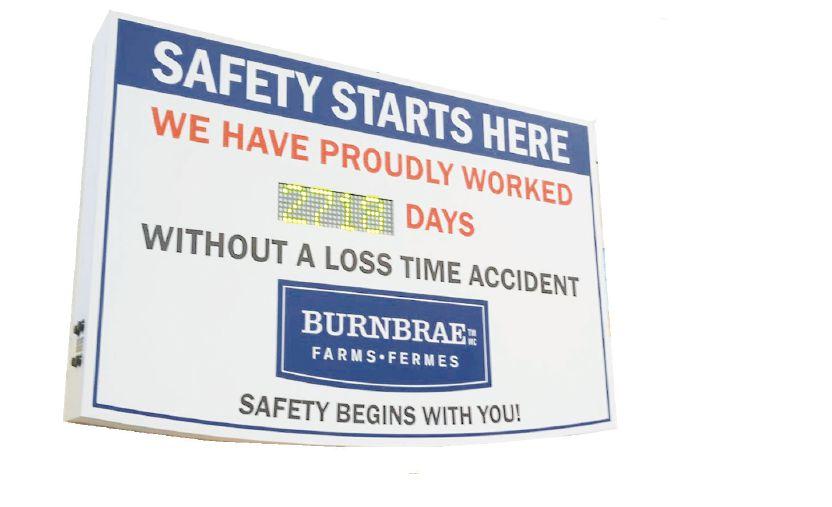
The second sign was a literal one, a glowing green beacon on the wall
proclaiming — as of April 19, 2023
— that “We have proudly worked 2,718 days without a loss time accident.” That’s nearly seven-and-ahalf years without an incident.
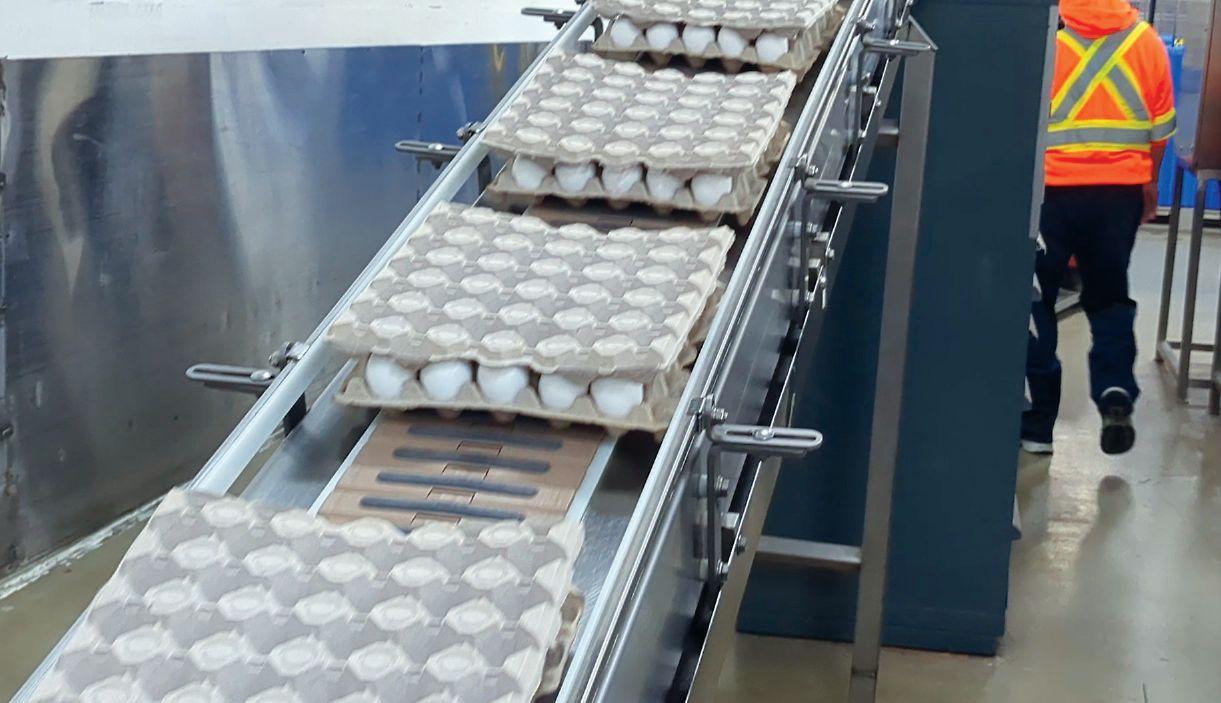
It’s no small feat for the bustling 50,000-square-foot plant which has a carefully choreographed flow of workers, machinery and forklifts.
And that’s before you get outside into the yard with a constant stream of trucks and trailers making deliveries and carting off the final product from the loading docks.
“ The joke is that chickens don’t stop laying eggs,” said Woods. “In some industries, you can turn off the materials that are coming in or
"They've all started on the floor. The've kind of come up the ranks and they take employee health and safety to heart."
slow them down. We can’t do that. We have to be continually running.”
About 120 workers are employed at the facility, a union shop represented by the United Food and Commercial Workers (UFCW), that processes more than 450 million eggs annually.
Culture of engagement
S am Altobello, national director, environmental, health and safety at Burnbrae Farms — which has about
1,600 workers across Canada — said the safety culture can be summed up in one word: Engagement.
“ That’s full engagement by management and the employees. And what I mean about engagement is they’re proactive when it comes to health and safety. They’re not reactive,” he said.
And not only do staff have “no problems” bringing issues forward, but they often come armed with solutions as well, he said. While it’s
“They’re proactive when it comes to health and safety. They’re not reactive.”
Sam Altobello, national director, environmental, health and safety
cliché, he credits the success to a top-down approach to safety — with a bit of a twist. That’s because many of the people in leadership roles have been with the company a long time and understand the jobs.
“A lot of the people in leadership roles here have grown with the company. They’ve all started on the floor,” he said. “They’ve kind of come up the ranks and they take employee health and safety to heart.”
New hires and orientation
Woods is a prime example of that — he started with Burnbrae at the age of 17 and has been with the company for 28 years. He knows every nook and cranny of the plant he manages and has a simple message for every new hire: “Don’t touch anything.”
"Whenever there is an accident, it's normally because someone is cutting corners."
“ You’re going to be trained, but don’t touch anything unless you know what you’re doing,” he said. “Until you’re trained on it, don’t touch it.”
O ne of the biggest issues with new hires is that their mind is often focused on doing the job well and making a good impression with their new boss — and not necessarily on safety.
T he message needs to come through, loud and clear, that it’s OK to take the time and do the job safely, he said.
“ Whenever there’s an accident, it’s normally because someone is cutting corners. Like, ‘I was trying to rush through the work,’” said Woods. “We’ll use those insights and say, so what if it takes an extra five minutes to get the work done? You’re going to get it done safely, right? In all honesty, it’s difficult to slow people down. We’ve had employees that we’ve had to take in and almost reprimand because they just won’t slow down.”
Altobello, who has been in his role at Burnbrae for two years, saw an opportunity to improve how orientation was being conducted.
“ Each plant was doing it differently, so we looked at a program that could be standardized.”
Biggest risk areas
The risks on the shop floor at Burnbrae are similar to other manufacturing facilities, said Altobello. High on his agenda are repetitive
The view from the top
The word “family” is tossed around a lot at Burnbrae Farms. You hear it from nearly every employee, and many credit the culture the business has created around family as a reason for its success in keeping workers safe.
“We’re a family business, and it’s my family that owns Burnbrae,” said Margaret Hudson, president and CEO, Burnbrae Farms. “You never want to think that anybody comes to work and leaves having an injury that could have been preventable with better safety standards.”
She pointed out that the company’s quarterly town hall “literally starts with our safety moment and our people moment.”
Instilling a sense of family among the workforce is important to her, because “people in families don’t feel afraid to speak up.”
She regularly gets notes, letters and emails from workers — about safety and other issues — and she encourages that communication and open culture.
Trevor Chang, Burnbrae’s vice-president of operations, said the company purposely creates both an “occasion and opportunity” for workers to talk safety. He oversees the OHS portfolio, and Sam Altobello reports directly to him.
“We always start our meetings with health and safety, and just making sure that we’re creating the occasion for people to talk about it,” he said. “It’s not something that’s just rushed through.”
But the C-suite leadership at Burnbrae kept passing the credit for the success of programs back to Altobello and the front-line leaders on the floor.
Murray McLean, director of national grading operations, said Andy Woods — the plant manager at the grading facility in Mississauga, Ont. — has the respect of employees and is open to talk to anyone.
“Being on the floor gives people the opportunity to reach out to them,” he said. “If they don’t see you, they don’t know you and they don’t feel you’re approachable. That goes a long way, and it’s not easy.”
Chang said Altobello goes above and beyond to really “get into the weeds” at the different sites. The internal safety audits he has been working on have been revealing. The first year of the audit revealed some “low-hanging fruit” that was pretty simple to address and improve.
“The things that Sam has done over the last few years, it’s been pivotal.”
Trevor Chang, vice-president of operations at Burnbrae Farms
“Now we’re into year three of continuing to do these all over the network, and we’re starting to get into things we wouldn’t have ever dreamed about tackling,” said Chang. “But we’re getting to that level of sophistication where we can have these conversations. It’s an evolution.”
Burnbrae would not be where it is today on the safety front without Altobello’s work, which speaks to the importance of having a qualified safety professional on the payroll.
“The things that Sam has done over the last few years, it’s been pivotal,” he said. “We’ve always invested in health and safety but having the right person focus on some key things is critically important. You really see it in your results and engagement.”
McLean said it’s no different than having a specialist in any other area.
“We were all good at grading eggs and doing lots of things under the roof,” he said. “But we don’t know everything about everything. And that’s where the specialists, whether it’s food safety or health and safety, lead us in the right direction.”
That expertise also helps the company with its long term-vision in deciding where to invest and what equipment to purchase.
“If we’re going to be investing in new equipment, how does that impact our operators and the people who use that equipment? Whether it be from an ergonomic standpoint or guarding. We’re putting health and safety on the table when we’re making some of these larger decisions.”
From Hudson’s seat, she said there is a lot to think about for any organization when it comes to safety.
“I think it’s important that your people leading the safety function are there working with your teams,” she said. “That they’re there to support and guide and convince.”
That’s more effective than trying to simply police workers, though sometimes you need to trade the carrot in for the stick, she said.
“If you can really work with the teams, your impact are going to be bigger than if you’re just running around telling them what you’re doing wrong,” she said. “Because we’ve had a little bit of both, and we’ve definitely found the style of support is more impactful than the style of police.”
Marco Trani, who runs maintenance at the Mississauga, Ont., plant, has been with the company for almost 27 years.
He has a simple philosophy when it comes to workplace safety: “I want to go home with 10 fingers and 10 toes, right?”
The safety success at Burnbrae is largely because management is supportive and has a true open-door policy, he said.
“They’re very approachable, even if it’s the smallest safety issue,” he said. “All the management, from Andy (plant manger) all the way up to Margaret (CEO). You can approach them and talk to them without feeling nervous or feeling like a lesser person. They don’t see it that way.”
Trani said every worker has a role to play in safety, even if they don’t have something OHS-related in their title. He’s currently training a maintenance worker, and he told the story about asking him to cut a piece of stainless steel. The worker retrieved a grinder with a cutting disc — but didn’t grab any PPE.
“I’m like, ‘Where’s your safety? You’re not going to do it until you have a face shield on because if a chunk of that stainless steel comes off and hits you in the eye, it’s gonna hurt,’” he said.
Spending a few minutes to retrieve the right PPE might slow the worker down, but not nearly as much as having to go to the hospital, said Trani.
Ensuring employees feel comfortable speaking up is another way to ensure the workplace remains safe. For example, he said a piece of equipment the workers handling the eggs use might have a sharp edge. It’s an easy fix to file it down and make it smooth, but unless the workers doing the job say something he won’t know the problem exists.
Kelon Dabreo, a production worker who has been with Burnbrae Farms for nine years, said he feels completely safe working at the company.
“This is a safety-first company, and they make sure we get proper training,” he said.
Workers also care about each other and watch out for one another on the plant floor.
“When we’re driving the power cart, we treat every intersection like a stop sign,” he said. “We stop, we look before we drive. We’re
Repetitive strain injuries (RSIs) and ergonomics are high-risk areas.
strain injuries (RSIs) and ergonomics.
“Now we’re looking at how do we implement new equipment, new automation, to mitigate a lot of these risks?” the company is installing a spin dryer that will eliminate a repetitious bendForklifts are another high-risk area, it ramped up its training program and implemented infraction policies for workers operating equipment unsafely.
Learning from other sites
urnbrae has multiple locathe same work, which means other facilities are using similar processes
The logic is pretty simple. If somebody gets hurt at an-
other grading station or breaking station, there’s a good chance to get hurt at this one,” said Woods.
W hen that happens, they send out safety alerts to staff and ensure everyone learns from the incident.
And while nobody wants to be the one to knock the losstime accident number down to zero, there is no fear about reporting injuries or flagging concerns, said Woods.
“I’m on the floor, but I’m not on the floor all the time,” he said. “They live on the floor. So if there’s anything out there, if anything is unsafe, we’ll get it fixed for them.”
Safety on the docks
Woods called the loading docks a “scary” place for safety risks.
The view from the floor
Kelon Dabreo.
Marco Trani
“Anyone who’s worked around docks and trailers know some of the horror stories that have happened,” he said.
Burnbrae upped its safety protocols around the docks, installing traffic lights and a Glad Hand Lock Station to prevent trailers from being driven away accidentally.
“That’s just to make sure that when someone’s backed in our docks, they’re not accidentally pulling out because we’ve all seen what happens — there’s forklifts turned over and all kinds of bad stuff,” he said.
Airing dirty laundry
And while he’s proud of the green number on the sign, he doesn’t talk about it much.
“Thank goodness it’s counting up and not down, so we’re going in the right direction, but we don’t chat about that number a lot,” he said. “That’s because, to us, it’s just a representation of the
hard work that we put in.”
He noted that, more than seven years ago, the counter made it to the four-and-a-half year mark with no injuries—and then an incident happened.
“ That was bad because the employee that got hurt, he got hurt really bad,” said Woods. “It was one of those things we looked at and said, ‘How did we let this happen?’ Like, we observed this, but we didn’t stop it. We don’t know why we didn’t stop it.”
In the past, issues might be flagged during a health and safety walkaround, and they would get documented and discussed later in the boardroom. Now, the attitude has changed — issues are dealt with immediately, he said.
“There’s no tolerance for anything unsafe in the plant. If you see it, fix it right away.”
Altobello said employers and leaders can’t be afraid to “air out your dirty laundry.”
“You have to come forward and you have to raise the concerns that employees are seeing — whether it’s a risk, whether it’s a hazard… employees need to feel comfortable that they can approach anyone on the team in the plant leadership and raise concerns,” he said.
The second piece to that puzzle is ensuring information is acted upon.
“It’s really important that when the employees raise a concern, we deal with the concern and we followup with that employee,” said Altobello. “When people see action, they realize that the company is serious about health and safety.”
Heat up your safety game: Tips to keep cool in the summer sun
By Anna Shoultz
With warmer weather arriving across Canada, we’ll soon be in the thick of summer heat. That means employers, and workers, need to prepare to avoid heat-related illnesses in the workplace.
While this is no surprise, it is worth mentioning that heat-related hazards can, and do, pop up much more unexpectedly than many of the predictable occupational hazards that are seen year-round.
MJ MacDonald, CEO of Construction Safety Nova Scotia (CSNS), said that — compared to other hazards in construction such as speeding drivers — heat is something that we tend to be less aware of as a risk.
Creating a plan to address heat can make a big difference when it comes to safety and there is a need for employers to step in and monitor conditions closely.
Top safety hazards related to temperature
“As we look at safety hazards related to temperature, heat-related illness is the biggest safety concern
to workers being exposed to high temperature,” said Kristin Onorato, Specialized Services Lead with Workplace Safety & Prevention Services (WSPS) in Ontario.
Some workers may also have certain health conditions and medications that increase their susceptibility to heat-related illness. Workers should be aware if they are at higher risk and make sure they are monitoring symptoms closely.
Summer is a busy period in construction, as weather begins to taper out into warmer, drier days. However, as temperatures change quickly, it can be quite difficult for workers to acclimate.
Depending on which part of the country workers are in, these hazards may shift as well. For example, working in southern Ontario — where temperatures are fickler — is quite different than working in the more moderate climates like British Columbia and Nova Scotia, both indoors or outdoors.
Injury prevention
The awareness that heat stress is completely preventable is important to remember.
“Start the workday with a ‘safe
work plan’ that considers the impacts of heat, or the potential impacts of heat,” said Suzana Prpic, senior manager of prevention field services at WorkSafeBC.
Employers should have specific, documented, hot weather policies in place, which address responses if certain issues arise, such as a ventilation system failure, a heat wave, or sudden increased humidity.
“We should always consider the hierarchy of controls (elimination/ substitution, engineering, administration, awareness, and, as a last resort, PPE) when trying to protect workers from any type of hazard at the workplace,” said Onorato.
Building awareness
Because heat is often overlooked as a risk factor, building awareness that it poses a threat is a good way to empower workers, said MacDonald.
It may not be as visible as things like trip and fall risks, or working at heights, but it can cause significant injury and should be monitored in every industry.
In Ontario, Onorato noted that there are no specific laws in the Occupational Health and Safety Act (OHSA) or regulations related to
“Always consider the hierarchy of controls when trying to protect workers from any type of hazard.”
heat. But the “general duty” clause to take every precaution reasonable in the circumstance always applies.
“The MLITSD also has a heat stress guideline. Guideline No. 33: Working In Extreme Temperature Conditions, that all employers are encouraged to read and follow,” she said.
WorkSafeBC has regulations specifically addressing heat stress. Part 7, and sections 7.27 through 7.32 outline the regulatory requirements for protecting workers.
MacDonald noted that her organization developed an app in concert with the Canadian Centre for Occupational Health and Safety (CCOHS) dealing with heat stress.
Avoiding heat stress: Proper nourishment and hydration
Workers looking out for one another is a crucial means of support.
Employers should ensure workers can take appropriate cooling breaks to allow their core body temperature to go back to normal range.
Proper nourishment and hydration are also crucial in regulating the core body temperature.
Prpic noted, “(WorkSafeBC) had 81 claims accepted for heat stress in 2022 — 58 of those were for outdoor workers and 23 for indoor workers, which is good news over 2021, but still an increase over the last few years.”
Being aware of the symptoms surrounding heat stress, including excess sweating, dizziness, fainting, and muscle cramps, can help prevent heat stroke.
If that sets in, there may be continuous sweating, an increased breathing rate, confusion, seizures, and even cardiac arrest.
Evolving hazards: Avoid hottest part of day
As with any other hazard that is present at a worksite, it is important to be prepared and adjust for changes to the risk, which may occur throughout the day. These risks don’t only go along
with outdoor construction roles, though, as Prpic also noted, “Over the last few years (WorkSafeBC) has seen more and more claims and concerns relating to workers working indoors in a restaurant in a hot restaurant setting or in a factory or a manufacturing plant.”
The idea that temperature can, and likely will, change is important when staying on top of the risks surrounding it.
Especially without adequate HVAC systems to mitigate sustained heat, work schedules in the summer should be more fluid, so that workers are doing hard physical work during the coolest part of the day: before 11 a.m. or after 3 p.m.
Tips for keeping cool
Light, breathable summer clothing should not only be allowed but encouraged, as well as head coverings in direct light. Pairing proper attire with hydration, rest breaks, and communication between employees and supervisors is the best way to ensure that your team stays not only productive but also safe and healthy.
“(WorkSafe BC) had 81 claims accepted for heat stress in 2022 — 58 of those were for outdoor workers.”
Suzana Prpic, WorkSafeBC
A rough guideline for hydration is to drink one glass of water every 20 minutes.
Workers returning from an absence should have adjusted expectations to allow for a potentially weakened response to heat, and all workers should be trained in proper first aid techniques not only for the industry, but for heat-related illness.
Wrapping up
It may be easy to get complacent and think that, if nothing bad has happened yet, nothing bad will happen. Heat, extreme or otherwise, poses a serious hazard in the workplace and should be monitored to mitigate risk for workers.
Anna Shoultz is a freelance journalist.
Ill-fitting PPE for women creates safety hazards, leaves workers feeling excluded: Panel
By Todd Humber
There is one simple way to understand the issues facing women when it comes to finding properly fitting personal protective equipment (PPE), according to Lora McMillan, director of special projects at Ledcor Construction.
“ I feel that maybe a lot of men haven’t tried on women’s clothing,” she said. “Not to knock it or judge it — and maybe there’s people that have — but I’d encourage you to go put on clothing that maybe doesn’t fit with the gender you identify.”
That’s something women have been doing for a long time in the workplace when it comes to PPE, said McMillan. In her industry, construction, only about four per cent of site roles are occupied by women, which means the issue hasn’t necessarily received the attention it deserved in the past.
“ That’s not a lot of people saying, ‘Hey, this is not fitting me.’ Sometimes, depending on the person, they may just feel ‘Okay, well, I can deal with this,’” she said. “Maybe we just need to be louder, a little bit more obvious about saying this does not fit me and these are the reasons why.”
McMillan was part of panel discussions during OHS Canada’s PPE for Women event, which attracted nearly 900 professionals from across the country. The first panel broke down and identified some of the problems with poorly designed and ill-fitting gear in the workplace.
Issues in policing
Nicole Wetsch, manager of the occupational health and safety section for the Edmonton Police Service (EPS), said nearly all the equipment officers use is designed for men.
The most important item — body armour — has been around since the 1970s, but it’s only in the last decade that manufacturers started developing body armour specifically for women.
“And that was geared towards the military,” said
Wetsch. “What that translates to for our female members is a lot of ergonomic injury. It’s not uncommon to see consistent bruising that doesn’t go away for them… because they’re wearing it 12 hours a day.”
“What that translates to for our female members is a lot of ergonomic injury.”
Nicole Wetsch, Edmonton Police Service
Women tend to have wider hips, but most body armour panels are cut in a rectangle. “ When they sit in their vehicle, that’s digging in to their hips,” she said.
Body armour can also be less effective for women because of their breasts, said Wetsch.
“If they happen to be someone with larger breasts, it creates a gap behind the panel,” she said, meaning it can be penetrated in some cases in a way that wouldn’t happen for men.
The shape of women’s bodies can also change, through things like childbirth and menopause, which also alters how equipment fits, said Wetsch. “We have to look at different replacement schedules (for women).”
Issues in oil and gas
Karen Mosca, senior manager of operations at Pembina Pipeline Corporation, highlighted the issue of poorly fitting coveralls for women on job sites.
“ The PPE, my coveralls, were hanging down to — I don’t know what better word to use — but the crotch is hanging down to my knees,” she said. “It just kind of restricts how you can move, and it is quite dangerous. Like, going upstairs, you can get caught on it.”
During her first site visit, she had to use electrical tape to wrap the coveralls around her ankles just so she wouldn’t trip.
“ With our chest and hips, we tend to have to go larger men’s sizes. And by doing that, it just throws other parts of the coveralls off,” said Mosca. “You have to almost pick — so they’re either too loose or they’re too tight.”
Paula Campkin of Energy Safety Canada, who moderated the first panel discussion, noted that nearly any woman on a worksite could relate to the unique issues of cumbersome safety gear and using a washroom.
“A teeny, tiny porta potty and minus 30C and having to take off our coveralls, and it’s definitely a very uncomfortable thing to have to do,” said Campkin.
Campkin also fielded a comment from an attendee, and noted that women will often avoid going to the bathroom because of the hassle — which can lead to urinary tract infections — and have even more problems than usual when menstruating.
“It just leads to all kinds of questions, and the clothes that you’re wearing makes such a big impact to those types of issues,” said Campkin.
The bathroom issues resonated with Mosca. “I’ve done that so many times, where I’m tying the arms around my waist just so they don’t touch the floor in the bathroom,” she said.
Fall protection was also an area of concern for her because the harnesses often don’t fit women properly.
“If you were to actually fall, you could injure your pelvic area because they’re loose (and) they’re trying their best to make it fit,” said Mosca. “The list goes on and on.”
Off the rack items
The panelists spent some time discussing the issues of off-therack items for visitors, and even for women who wear something slightly different on a certain day under their gear.
At EPS, Wetsch said members are issued body armour personally — but they have stock equipment for people who are doing things like ride-a-longs with officers that doesn’t always fit properly. Even something as minor as wearing a different bra can alter the fit of PPE for women, she said.
Mosca said they try and keep all shapes and sizes of PPE in stock, but some particular sizes — like smaller gloves — tend to run out quicker or don’t get restocked.
Real-world implications
Mosca shared the story of a “high potential near miss” that happened to a worker she knows at a different company. The woman, a welder, was wearing big and baggy coveralls.
“One day, when she was buffing off welds, the grinder kicked
back and the buffing wheel got caught up in her loose clothing,” she said. The wheel quickly wrapped tightly into the loose fabric.
“Luckily, it only knocked the wind out of her and she did not get seriously injured,” said Mosca. After that incident she opted for tighter, albeit more uncomfortable, overalls.
That choice, between selecting gear that is effective and gear that is comfortable and possible to work in, is the crux of the issue.
“ The thing that makes me most uncomfortable with loose clothing is rotating equipment,” said Mosca. “If she was to get caught into that, it’s not going to let her go.”
Feeling included
McMillan said it’s not just the gear that needs to be addressed — but also the attitudes — to create a welcoming environment.
Not having the right gear, or feeling like an afterthought in the workplace, can affect the way people do their jobs and how they feel they’re being perceived, she said.
“Almost everywhere you turn, say the washroom, say the personal protective equipment, (sends a message that) you’re kind of just not considered in the industry,” said McMillan.
When you don’t see yourself reflected in the industry — or even nomenclature like “man hoist” and “manpower” — it’s tiny, constant reminders that you’re not a priority, she said.
“Everybody’s talking about the pink tax, and everybody’s talking about the increasing costs, but it’s not really about that, right?”
Instead, it should be viewed as “maybe a little bit of an extra cost for safety” that has the potential to improve the industry as a whole, said McMillan.
Visibility and leadership
Wetsch said visibility is critical for women, adding that eight or nine years ago all of the safety professionals at EPS were men. As a result, the issues facing women weren’t being brought up.
“Over time, just with natural attrition, we’ve switched to a more female-centred team,” she said. “We’ve, in that timeframe, also had more females rise into leadership positions with the organization. And these conversations are happening a lot more and the people experiencing the issues feel a lot more comfortable bringing it forward, because they see that representation.”
Mosca noted that not every woman in your workplace will feel comfortable speaking up. When she started, and went out to job sites, she was more focused on keeping her head up and making sure she didn’t look intimidated. Leaders need to be allies to young workers, and other women not comfortable speaking up, and be their voice.
“ Then maybe, slowly, they’ll build their own voice,” she said. “And then they can do that for the next generation. So it’s just kind of organic change — like it’s happening — but it’s sometimes not happening quick enough.”
Todd
The Canadian Centre for Occupational Health and Safety
The Canadian Centre for Occupational Health and Safety (CCOHS) promotes the total well-being — physical, psychosocial, and mental health — of workers in Canada by providing information, advice, education, and management systems and solutions that support the prevention of injury and illness. Visit www.ccohs.ca for more safety tips.
Understanding and supporting neurodivergent workers
Karima is a new hire on the health and safety team at a large company. Although traditional interview settings are challenging for her, she made a great impression on the interview panel with her unique approach to problem solving and her extensive technical knowledge. When asked if there was anything else she wanted the hiring team to know, Karima hesitated. Would disclosing her attention deficit hyperactivity disorder (ADHD) and autism put off the hiring manager? She decided to let them know.
“ Thank you for sharing that,” her manager, Marisol said. “We actually pride ourselves on being a neurodiverse organization.”
A week into her new position, Karima is feeling welcomed by her new co-workers, yet overstimulated by the open work environment. Her manager is quick to check in and address her concerns.
Our collective understanding of what it means to be neurodivergent is growing. Employers are recognizing that a neurodiverse workforce can improve workplace productivity and profitability if they take the time to address specific needs and set workers up for success.
What is neurodiversity?
T he term neurodiversity was coined in 1998 by Judy Singer, an Australian sociologist, to reflect that being neuro-atypical is simply a reflection of the natural variations of the human genome. These variations should be understood and accommodated.
In general terms, a neurodivergent worker is one whose brain functions
differently than a neurotypical person. Neurodiversity encompasses several conditions but those most often included are autism spectrum disorder, ADHD, Tourette syndrome, dyslexia (challenges with reading and spelling), dyscalculia (challenges with numbers) or dyspraxia (challenges coordinating physical movements, including those required for speech).
What does neurodiversity look like in the workplace?
It can vary, but often workers on the autism spectrum may be sensitive to light or noise and have difficulty connecting with colleagues and managers. ADHD can present physically, such as fidgeting or an inability to sit still, and mentally, in the form of overthinking or impostor syndrome (a belief someone holds that they are not deserving of achievements or roles they have earned). People with attention deficit disorder
can have trouble with time management and concentration. They can also be impulsive and have trouble with working memory.
Despite these challenges, neurodiverse workers have unique talents that may give their organizations a competitive advantage. Workers with ADHD may struggle with organization but are often creative and collegial, coming up with innovative ideas and bringing positive energy to a brainstorm session. Many can hyperfocus on projects they’re passionate about but need explicit deadlines for when each aspect of the work should be completed. Workers on the autism spectrum sometimes struggle with eye contact or communication but may be meticulous with details
Setting neurodiverse workers up for success
A growing number of multinational corporations and tech companies
Neurodiverse workers have unique talents that may give their organizations a competitive advantage.
are recognizing the unique talents of neurodivergent workers, with some organizations creating dedicated programs to hire them.
To help make your workplace more inclusive and welcoming, and to challenge stereotypes, start by learning about the different types of neurodiversity and what they look like on a spectrum.
Consult with your HR department to discuss how you can encourage success among neurodivergent applicants and workers. One way is to review your hiring process.
Are you unintentionally excluding candidates based only on an evaluation of their interpersonal or communication skills? Assess whether there are any barriers in your hiring process that may deter qualified candidates from applying.
Some companies are working to remove barriers by focusing on competency rather than scenario and behaviour-based questions.
Promote diversity and inclusion
Spreading awareness and normalizing the conversation around neurodiversity can help prevent adversity and stigma in the workplace.
Share information about what it means to be neurodivergent, how these workers can be supported, and the steps you are taking to commit to being a workplace that values and leverages differences in abilities, experiences and perspectives.
Bringing in professionals to help educate workers and managers helps to ensure neurodivergent workers have understanding and support from their colleagues.
When it comes to open work environments, having a dedicated quiet space with natural light for focused work can give a neurodivergent worker some refuge from the sensory overload they may feel in their noisy desk area. Employers can also provide technological aids, tools or assis-
A workplace that is supportive of everyone's mental and physical health will help foster an environment where workers feel encouraged and safe to express their needs.
tive devices such as noise cancelling headphones, software to assist with scheduling and task management and speech-to-text or voice recognition software. When possible, hybrid work options can also be beneficial, balancing time in the workplace to collaborate and foster community with time at home to focus without bright lights, scents, and noise.
Support a psychologically safe and inclusive work environment
Having a comprehensive workplace health and safety program in place is one way to protect psychological well-being.
Review or develop policies, initiatives and activities included in this program to ensure they reflect and accommodate neurodiversity. Your program activities should be designed to continually improve the physical, psychosocial, organizational, and economic aspects of the work environment and to increase empowerment and growth. When developing or reviewing your plan, ask yourself: Is the physical workplace safe? Is the culture positive and based on respect, equity, appreciation, and trust? Are workloads manageable and designed to fit workers’ unique interpersonal and emotional competencies, capabilities, and job skills? Are wellness programs available, including mental health support?
Workers who are neurodivergent, whether existing workers or new hires, may be more comfortable reaching out to trusted co-workers
or managers in an inclusive and respectful workplace with these policies and procedures in place to support their needs.
After all, a workplace that is supportive of everyone’s mental and physical health will help foster an environment where workers feel encouraged and safe to express their needs. Check in with those who have self-identified as being neurodivergent to help determine any challenges they may be experiencing.
E ncourage them to seek help when needed and offer support through an EAP or other resources if available. Inform workers and applicants about your diversity, inclusion, and accessibility policies and encourage them to specify whether they require any accommodations at work or during the interview and recruitment process.
No two workers are the same. Be proactive in asking and listening to workers about how create an environment for their success.
No two neurodivergent workers are the same. Be proactive in asking and listening to workers about how to create an environment for their success. Understanding neurodiversity, reviewing practices and policies, and leveraging workers’ unique capabilities are important steps in fostering an inclusive and supportive environment that is responsive to their needs.
Back at the open office, Karima takes a long sip of her water and responds.
“ Hi Marisol, I’m feeling good, thanks for asking! I am loving the community feel here in the office, and everyone has been welcoming and kind. But I’m a bit overwhelmed by the noise and lights. Is there a quieter spot I can work in when I need to focus?”
“Ah, I understand. There are a few, I can show you. If it helps you, we can also look at setting you up to work remotely for a couple days each week. Think about what would work best for you and we can discuss options after lunch.”
CSA Group
CSA Group is a global organization dedicated to safety, social good and sustainability. It is a leader in standards development and in testing, inspection and certification around the world, including Canada, the U.S.A., Europe and Asia. CSA Group’s mandate is to hold the future to a higher standard.
Q&A: CSA Group’s Worker and Public Safety team has a full safety agenda
CSA Group’s Candace Sellar shares what the team has in store for 2023
During COVID-19, CSA Group focused on several high-profile projects to support the response to the pandemic including development of a new National Standard of Canada, CSA Z94.4.1:21, Performance standard for filtering respirators
This focus on worker and public safety has been a constant for CSA Group’s Standards Development organization. Its Worker and Public Safety team is focused on the development of standards, research, and tools across several important areas including PPE, work disability management, fall protection, impairment, and extreme conditions.
Candace Sellar, Program Manager for Worker and Public Safety Standards shares what the team has in store for 2023.
What are the key priorities for CSA Group’s Worker and Public Safety team in 2023?
2023 is already shaping up to be a busy year for CSA Group’s Worker and Public Safety
team and our many expert members who volunteer their time to the standard development process.
This spring, CSA Group will publish the fourth edition of CSA Z432, Safeguarding of machinery
We will also kick off the 60-day public review process for several standards including CSA Z797, Code of practice for access scaffold (New Edition), CSA A344, User guide for steel storage racks (New Edition), CSA Z259.20, Horizontal rigid rail anchorage systems for fall protection (New Standard), CAN/CGSB/CSAZ1610, Protection of first responders from chemical, biological, radiological, and nuclear (CBRN) events (New Edition), and CSA Z94.4-18, Selection, care, and use of respirators (New Edition).
H elping to support and inform our standards development work, CSA Group’s research team is working on several papers, including one focused on Employees’ Perceived Psychological
Health and Safety Experience During COVID-19 Through an Inclusion Lens which I think will be of particular interest to this community.
As Canadians learn to live with COVID-19 and fewer Canadians are choosing or are required to wear masks or respirators in the workplace, will CSA Group move away from investing time and resources into standards focused on masks and respirators?
CSA Group will continue to invest time and resources into developing and updating standards for respiratory protection. We learned many lessons from COVID-19 and preceding events such as SARS, but it is important to note that respiratory PPE has also been and will continue to be a control to manage hazards in the workplace and beyond.
C SA Group’s expert volunteer members are also committed to exploring
As no work environment is static, it is important that employers focus on up-to-date hazard identification and elimination and risk assessment and control.
how equity-related concerns can be better addressed in CSA’s PPE standards, including the new edition of CSA Z94.4-18, Selection, care, and use of respirators, which is currently under development.
B eyond standards development and research, we have been working on ways to make our standards more accessible and easier to apply.
We recently launched a series of new free OHS Standards Support Tools, including a Respirator Selection Tool based on CAN/CSA-Z94.4-18, Selection, use, and care of respirators
Why did CSA Group decide to develop a Respirator Selection Tool? How does it work? Who is it intended for?
T his web-based tool was developed to assist users in translating the technical requirements of CAN/CSA-Z94.4-18, Selection, use, and care of respirators. It is intended to help qualified individuals responsible for selecting respirators to protect their workforce from bioaerosols.
U sed in conjunction with CAN/ CSA-Z94.4-18 and following the application of established OHS principles and an assessment of the specific exposure situations in their environment, the tool walks users through a series of steps to gather information focused on workplace environment, risk group, generation level and control (ventilation level) respirator recommendations. Following this, the user is provided with respirator recommendations, and they are also given the option to receive a report for future reference.
D oes CSA Group’s Worker and Public Safety team offer other tools? Yes, CSA Group offers quite a few free Occupational Health and Safety Standards support tools. Our offering is robust in-
cluding short self-paced learning modules, tracking sheets, infographics, templates, checklists, posters, printable forms, and handouts, etc. We currently have tools available for the following standards:
• CSA Z45001:19, Occupational health and safety management systems –Requirements with guidance for use
• CSA Z1220-17 (R2021), First aid kits for the workplace
• CSA Z412-17, Office ergonomics – An application standard for workplace ergonomics
• CAN/CSA-Z1001-18 (R2022), Occupational health and safety training
• CSA Z1005:21, Workplace incident investigation
• CSA Z1008:21, Management of impairment in the workplace
• CSA Z1011:20, Work disability management system
• CSA Z1010-18, Management of work in extreme conditions
T he tool focused on management of work in extreme conditions seems especially relevant at this time of year. As more workers head outside, are there specific topics that you recommend OHS professionals and employers refresh themselves on?
In general, the climate is seeing more extremes, be it extreme heat or cold, higher intensity wind, and storm events. With the warmer months approaching, more workers will be working outside, working alone, and possibly working in more remote locations.
As no work environment is static, it is important that employers focus on up-todate hazard identification and elimination, and risk assessment and control. It can be dangerous to assume that the hazards have not changed since previous seasons. Our CSA Z1002:12 (R2022), Occupational
health and safety – Hazard identification and elimination and risk assessment and control standard can be helpful for this.
I would also encourage employers to review CSA Z1010-18, Management of work in extreme conditions. The purpose of this standard is to address the application of OHS management systems to plans for work performed under heightened-risk conditions presented by extreme environmental temperatures, severe weather, low or high atmospheric pressure, and poor air quality (causing impairment of breathing or visibility).
I n late 2022, CSA Group published a report focused on highlighting the experiences of Canadian women and PPE, which made quite a splash in the industry. Can Canada ’s OHS community expect more on this topic from CSA Group in the future?
P ublication of our research report, Canadian Women’s Experiences with Personal Protective Equipment in the Workplace was one step on a larger journey. CSA Group continues to have important conversations with key stakeholders (e.g., regulators, academic community, manufacturers) about the report recommendations, and potential next steps in moving forward towards solutions.
We are actively working with our committees to determine where changes can be made to CSA Group’s PPE standards and where evidence exists to support changes. We are also determining what additional research may need to be undertaken to answer key questions and address data gaps on a standard-by-standard basis.
How can someone stay up to speed with what your team is working on, including new publications and tool?
The best way to stay informed is to join CSA Communities and follow the OHS Community (https://community.csagroup. org/community/ohs). CSA Communities connect our members, stakeholders, and users of standards in an open, collaborative online environment.
Legal View
By Norm Keith
from page 10
the programs under the MLTSD, not just OHS compliance. Directors deal with employment standards, consumer protection, OHS compliance and enforcement, and now have an “immigration” responsibility added to the identity of their government Ministry.
Underfunding may also be part of the problem. As inflation continues at 40 year historic levels, wages for OHS inspectors have not kept up with increases in the private sector.
For years, OHS inspectors have complained about being paid less than industry professionals. This may give rise to resentment, greed, and eventual self-justification of cheating on overtime claims and fraudulent field reports to justify the overtime.
Mission creep has also been taking place at the MLITSD. Although the MLITSD has a clear mission
statement, it is often overridden by political goals and ad hoc workplace blitzes based on flavour of the month priorities.
Many OHS inspectors joined the MLITSD with the goal of preventing accidents and protecting workers.
However, with a quota of 240 field visits per year, and an over emphasis on prosecutions, inspectors have been pushed into acting as high-volume OHS cops who gather revenue for safety violations.
From ticketing workers who do not have their hard hat on to complex prosecutions with multi-million dollars fines at stake, prevention is the last thing the OHS inspectors have time for.
So when inspectors were assigned to do overtime to spy and report back on the underground economy for
provincial finance interests, have they been given a collection agency role for the government? The mission has been confused, and contradiction and mission creep has allegedly undermined their morale.
The bottom line is MLITSD has a serious internal ethical problem that has occupied a great deal of time, attention and taxpayers’ money.
The long-term damage to the reputation of honest OHS inspectors will linger for years. Perhaps it is time for MLTSD leadership to not only address this accountability problem and improve oversight, but also deal with the broader issues discussed above.
Finally, this crisis is an opportunity for a mission reorientation for inspectors from being OHS police to the more worthy goal of improving workplace safety for workers.
Air purifying or air supplying: Choosing the right escape respirator for industrial use
By Todd Humber
There are two common escape respirators used in most industrial settings — air purifying and air supplying.
Air purifying respirators use a combination filtering cartridge to remove contaminants from the air as the worker breathes through it, said David McPherson, global application engineering senior specialist with 3M Scott Fire and Safety in London, Ont.
Air supplying respirators, on the other hand, typically include a hood that’s designed to cover the worker’s entire head or have a tight-fitting full facepiece. Air is then fed into it from a small cylinder, he said. They’re also known as emergency escape breathing devices (EEBD).
Choosing the right device
McPherson said most professionals are familiar with the “old standby” — the air purifying ones with a filter, cartridge and tube that you “just stick in your mouth and you clamp down.” They usually come with a nose plug to help workers avoid breathing through their nose.
Employers should be focusing on the unknown atmospheres that might pose an immediately danger to life and health (IDLH). “ IDLH conditions exist if the airborne concentration of the contaminant exceeds the concentration that’s been determined to be immediately dangerous to life and health,” he said.
It can often be impossible to determine the level of contamination in the air, which means you can’t calculate how much protection you need, said McPherson.
“And that’s when you go to an air sup -
plying type of emergency escape respirator,” he said. “There are so many variables — what is being leaked? How’s it being leaked? Where is it being leaked from?”
Taking all those things into account makes it difficult to calculate the maximum concentration that might exist on the escape route, he said.
The bottom line is air purifying respirators cannot be used in IDLH atmospheres, he said.
“ That’s a hard stop there,” he said. “If you don’t know it’s there, or you’ve got that high concentration, you’ve really got to default to the air supply type.”
Different industries
Air purifying respirators have traditionally been used broadly in places like pulp and paper mills. But in many sectors, there is a move towards engineering controls to prevent problems in the first place — and then use an EEBD if something goes awry.
For example, workplaces that use refrigeration systems with ammonia — including hockey rinks, cold storage facilities and food processing plants — would tend to use an EEBD to protect workers in the case of a leak.
There are also things that can be highly irritating that aren’t necessarily IDLH situations where EEBDs can be useful — like working with spices in food processing.
“You can imagine what it’d be like if you get a cloud of particulate that’s a spice. It could be very irritating to the eyes, very irritating to the nose and throat and potentially dangerous,” he said. And there are other dangers, such as ethylene oxide — used for spice sterilization.
In some case, workers will need to carry the escape respirators with them while working. In other cases, it might be appropriate to store them around the worksite for access in case something goes wrong.
For example, in a warehouse it would make sense to place them strategically around the building.
“ You would look at where the hazard is and the escape route that you’ve planned,” he said. “You’d need to make sure the EEBD was convenient to the worker where they would need to use it, grab it and then wear it on their way out of the building.”
Maintenance and training
McPherson said it’s common to inspect the PPE on a monthly basis.
“ That’s a visual inspection and the air inside of them must be changed once a year,” he said.
The need to drain and change the air also provides a perfect training opportunity — workers can put them on and test how to use them so they know what to do in case of an emergency, he said.
“ We need to think about what happens to us as humans when we get into an emergency situation,” said McPherson. “We start to lose find motor skills and our reasoning, so it’s important that we be familiar with the escape plans and the escape devices we have. Why not put on the gear and try it?”
Most EEBDs provide in the range of five to 10 minutes of air. To pick the one you need for your operation, it’s critical to walk the escape route and measure how much time it takes, he said.
Boy claws his way into trouble
(AP) — A 13-year-old boy had to be freed from a claw machine after he climbed inside hoping to score a prize, according to an official at a North Carolina amusement park.
Carowinds officials were alerted that the boy was inside the Cosmic XL Bonus Game, which contained plush prizes, according to Courtney C. McGarry Weber, a spokesperson for the park south of Charlotte.
The medical response team unlocked the machine and the boy was able to get out, she said. He was treated and released from first aid to his guardian. The boy has been banned from the park for one year for attempted theft, Weber said.
Landlord bears it all, tenants rent remains the same
(AP) — A German court said a landlord sunbathing naked in the courtyard of his building wasn’t a reason for his tenants to reduce their rental payments.
The case involved a building in an upmarket residential district of Frankfurt, which included an office floor, rented by a HR company. The company withheld rent because it objected, among other things, to the landlord’s naked sunbathing.
The Frankfurt state court rejected the company’s reasoning, finding that “the usability of the rented property was not impaired by the plaintiff sunning himself naked in the courtyard.”
It said in a statement that it couldn’t see an “inadmissible, deliberately improper effect on the property. Judges were ruling on an appeal against a lower court decision that went in the landlord’s favour, and the tenant had only limited success overall. They found it had been entitled to reduce rental payments for three months only because of noisy construction work.
500 days
Climber emerges from underground cave
A Spanish mountain climber emerged from a cave 70 meters (230 feet) underground where she spent 500 days isolated from the outside world.
Beatriz Flamini, 50, of Madrid, left the cave in southern Spain shortly after 9 a.m. after being told by supporters that she had completed the feat she set out to accomplish on Nov. 21, 2021.
Spanish media said the spell underground set a new world record, but the claim could not be immediately confirmed.
The Spanish state news agency Efe later reported Flamini as saying she was obliged to temporarily halt the challenge after some 300 days and leave the cave for eight days because of a technical problem.
A collection of weird and wild workplace health and safety headlines from Canada and across the world.
Applicant for fake ‘Rent-aHitman’ arrested by FBI
(AP) — A Tennessee Air National Guardsman was arrested after federal agents said he responded to an online ad for a hitman through a parody website that he thought was real. Josiah Garcia told an undercover FBI agent that he needed money and thought he would be good at killing people because of his military experience.
Garcia said he came across the website RentAHitman.com while searching the internet for contract mercenary jobs at the suggestion of a guard coworker. The site was originally created in 2005 to advertise a cybersecurity company that never took off. However, it received many inquiries over the years about murder-for-hire services, according to the affidavit. Eventually, the site administrator turned it into a parody site.
Garcia submitted an employment application Feb. 16 and sent several follow-up emails. In one follow-up he added a section on “Why I want this Job,” according to the affidavit. “Im looking for a job, that pays well, related to my military experience (Shooting and Killing the marked target) so I can support my kid on the way. What can I say, I enjoy doing what I do.”
‘I’ll be back’ – to fill a pothole
(AP) — The “giant pothole” that Arnold Schwarzenegger said he recently filled on a street in his Los Angeles neighborhood was actually a trench that had been dug for utility work, according to the city.
After months of heavy rains that have turned roads into tire-popping swiss cheese for many commuters, Schwarzenegger struck a chord when he released a video of himself and a crew filling a depression on a street with packaged asphalt patch.
“Today, after the whole neighborhood has been upset about this giant pothole that’s been screwing up cars and bicycles for weeks, I went out with my team and fixed it,” he wrote on Twitter. “I always say, let’s not complain, let’s do something about it. Here you go.”
WORKPLACE SAFETY EXCELLENCE AT OHS HONOURS CELEBRATE
AWARD CATEGORIES
› INDIVIDUAL AWARDS
• OHS Professional of the Year
• Community Leader Award
• OHS Rising Star Award
• OHS Lawyer of the Year
• Hall of Fame (3 inductees to be announced in 2023)
› TEAM AWARDS
• OHS Culture Award
• Best Safety Communications Program
• Best Use of Safety Technology
• OHS Team of the Year
• Best Hand Protection Program
• Psychologically Safe Workplace Award
• Best Ergonomics Program
OHS Canada is proud to present OHS Honours, recognizing individual and team achievements in occupational health and safety. Join professionals across the country as we recognize and honour those who have gone above-and-beyond to create safe working environments.
SAVE THE DATE!
Award winners will be celebrated at a gala dinner on Sept. 21, 2023, at the Palais Royale in Toronto.
Bonus: Join OHS Canada for a special half-day conference on workplace safety immediately before the celebrations.