WHAT’S NEW FLUID POWER LASER ALIGNMENT CHAINS BEARINGS
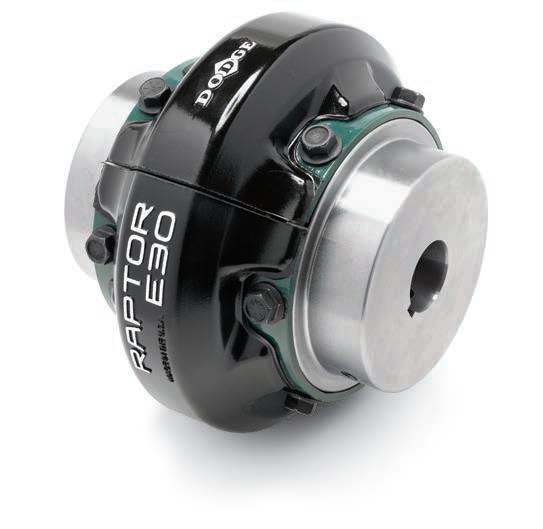
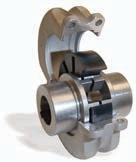
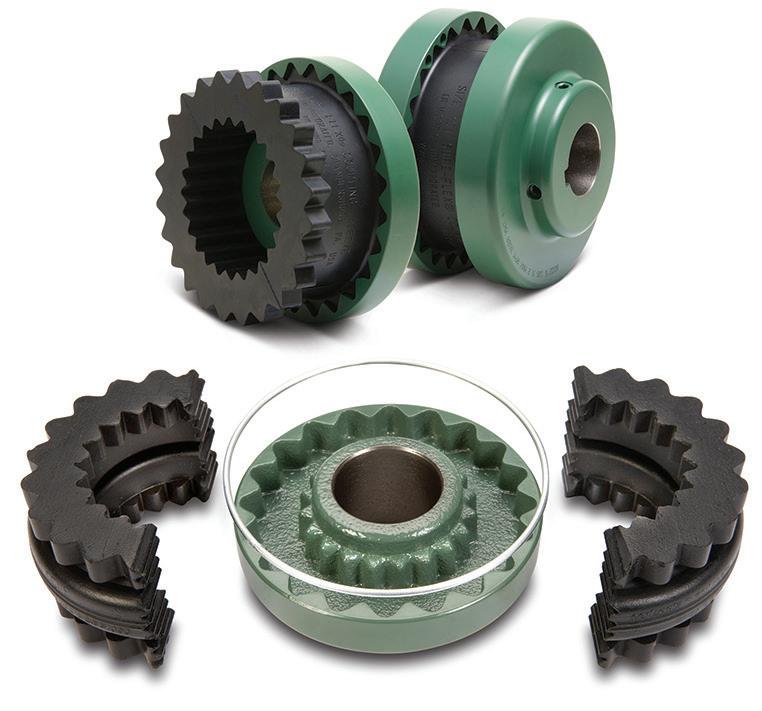
The Only Coupling To Earn Its Wings
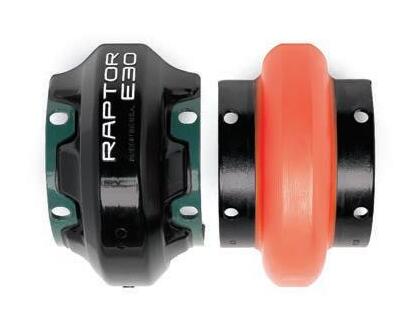
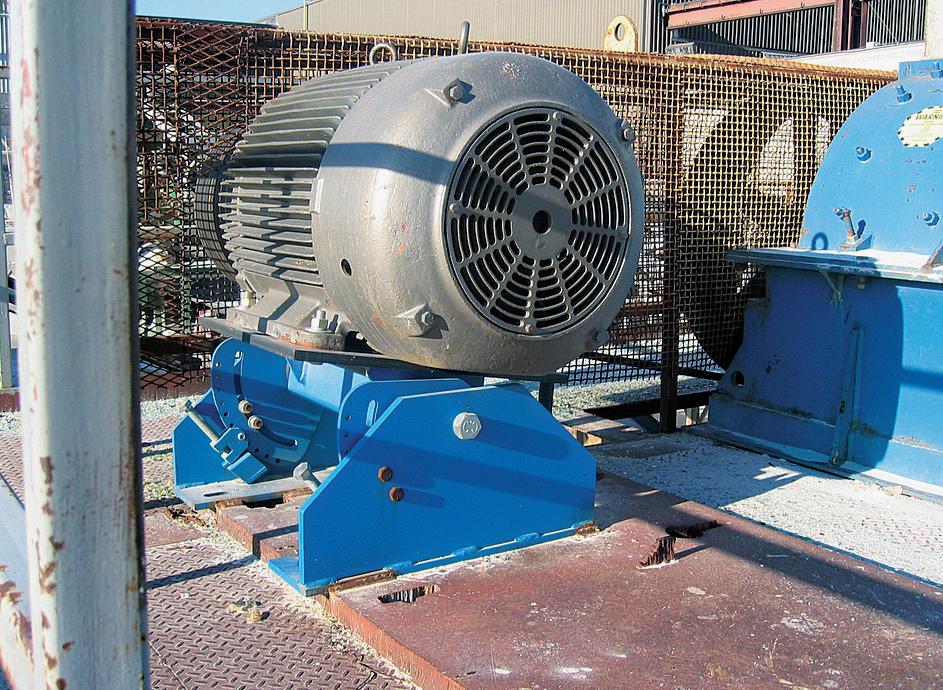
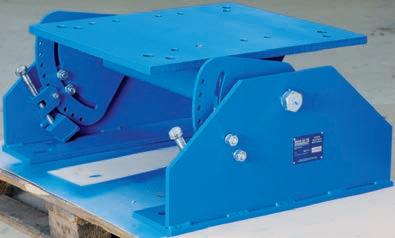
The NEW patented Baldor•Dodge® Raptor takes coupling innovation to greater heights. Utilizing a patented winged element design for higher bond strength and improved fatigue resistance, the Raptor delivers:
• Longer driven equipment life and increased reliability
• Easier installation and reduced maintenance
• Drop-in interchangeability
The Raptor is backed by over 50 years of natural rubber expertise and an industry leading 5-year warranty. Expect a higher level of reliability with the new Baldor•Dodge Raptor coupling. baldor.com 479-646-4711
clearance
installation than competitive designs.
Raptor’s slotted clamp rings offer more
at the bolt holes for an easier
MACHINERY AND EQUIPMENT
JUNE 2016
Volume 32, No. 3
Established 1985 www.mromagazine.com www.twitter.com/mromagazine
Tim Dimopoulos, Vice-President Annex Business Media tdimopoulos@canadianmanufacturing.com
Mike Fredericks, President & CEO Annex Business Media
Machinery & Equipment MRO is published by Annex Business Media Inc., 80 Valleybrook Dr., Toronto, ON Canada M3B 2S9; Tel. 416-442-5600, Fax 416-510-5140. Toll-free: 1-800-268-7742 in Canada, 1-800-387-0273 in the USA.
Subscription rates. Canada: 1 year $61.50, 2 years $97.95. United States: 1 year $105. Elsewhere: 1 year $120. Single copies $10 (Canada), $16.50 (U.S.), $21.50 (other). Add applicable taxes to all rates. On occasion, our subscription list is made available to organizations whose products or services may be of interest to our readers. If you would prefer not to receive such information, please contact us via one of the following methods – phone: 1-800-668-2374, e-mail: privacyofficer@businessinformationgroup.ca, fax: 416-442-2191, mail to Privacy Officer, 80 Valleybrook Dr., Toronto, ON Canada M3B 2S9.
The demand for rich information to provide data-driven insights – through benchmarking and analytics – is a channel not only for helping companies uncover and address challenges, but also for determining whether operations and maintenance are contributing to the company’s competitive advantage.
The right data can inform us about operational effectiveness and supply chain/ operations complexity; it can provide answers to whether or not we’re delivering products on time, whether we’re managing SKUs and supply costs, whether inventory is being managed and whether equipment is maintained in a way that increases working capital.
Demand for rich data is hardly a novel idea. Organizations have been experimenting with the systematic measurement of performance well before Frederick Winslow Taylor (1856–1915) tinkered with ways to improve industrial efficiency by using a stopwatch to identify the smallest inefficiencies, or W. Edward Deming (1900 – 1993) brought his continuous improvement process to the United States after figuring it out in Japan.
Back then, top-performing operations and maintenance managers in industrial manufacturing environments were required to be forward-thinking, innovative individuals.
That’s not any different from today. But nowadays operations and maintenance leads are required to respond to the rapid pace of changing global markets, cost structures, new technologies and innovation. The challenge now is to achieve top results by proving that optimal value has been achieved.
In this issue, we provide plant-level perspective on the use of data as an instructive tool for operations and maintenance.
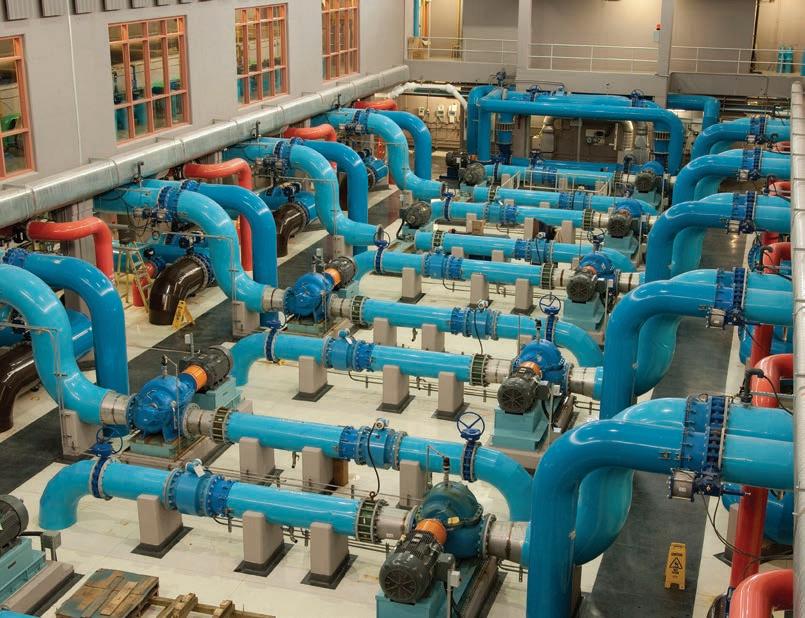
In “Pump Patrol” (page 10), we learn how the Ontario Clean Water Agency takes a bespoke approach to maintaining 8,442 pumps using a work management system. Nigel D’Souza, manager, Asset & Maintenance Management Group, OCWA, has tremendous confidence in the way the WMS drives data-based maintenance practices, such as tracking corrective maintenance, failure types and what can be gleaned from statistical modelling.
And, starting with this issue, contributor Peter Phillips (“The ERP Challenge–Part 1,” page 42) will walk us through a yearlong contract with a building materials manufacturer, where he leads the implementation of an ERP/MRP system. His client has outgrown its standalone CMMS and would like to move to a single, integrated database for housing maintenance costs, production planning, raw materials, employee hours and accounting practices. We invite you to follow along as the project progresses and to learn how to avoid information logjams, how to make better decisions and free up time to work on high-value tasks.
Given the unsettling Canadian economic ebb and flow, it may not be possible to avoid the turmoil, but we can certainly try to succeed in spite of it.
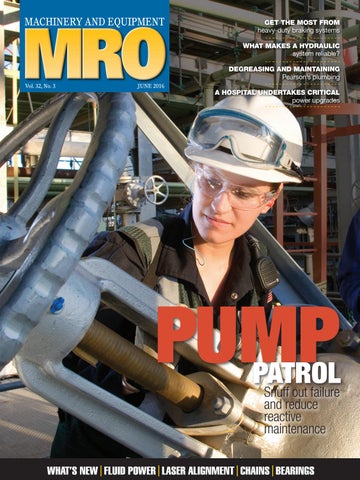
COVER
STORY – Pump Patrol
The Ontario Clean Water Agency uses a bespoke work management system to maintain 8,442 pumps. Take tips from their best practices.
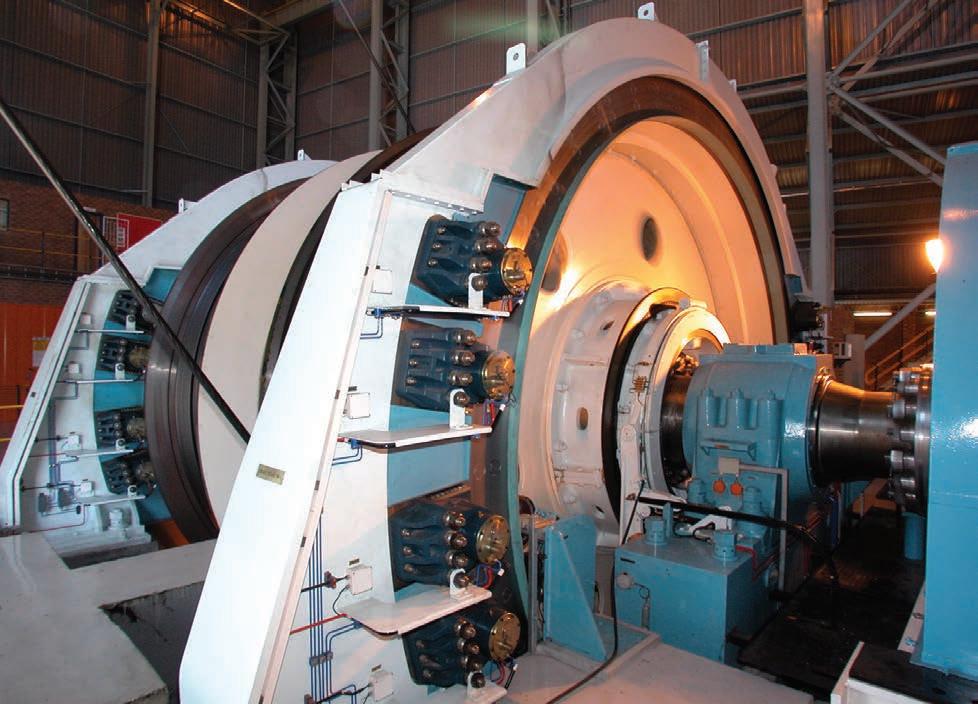
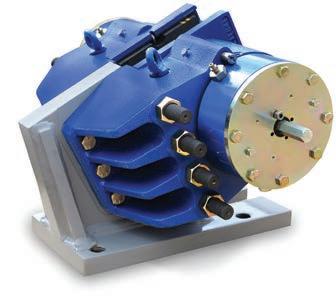
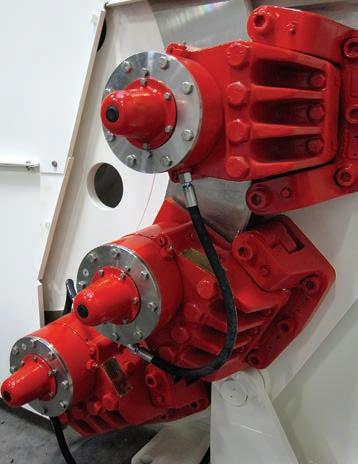
Tough Brakes / 14
Improve the reliability of the breaking system with correct installation and maintenance.
What makes a hydraulic system reliable? / 26
Smith & Barnes differ on what it takes to create a trouble-free hydraulic system.
Power Renewal / 20
Upgrading a critical facility’s generating plant while maintaining the power supply.
Pearson’s Plumbing / 30
The GTAA tackles grease in Pearson’s airport plumbing lines.
Full Service / 32
Ensure peak performance with highperformance lubrication and services.
Lube Audit / 36
A two-step approach to developing centralized lube systems.
Chains Drive Your Process / 40
Choosing the ideal attachment chain can make a difference to the process.
Departments
Editor’s Notebook / 3
Industry Newswatch / 6
Business Briefs / 9
Maintenance 101 / 42
What’s Up Doug? / 46
Spare Parts / 46
Mr. O, the Practical Problem Solver / 54
Product News
What’s New in Fluid Power / 48
Product Spotlight / 52
Business confidence falls to lowest levels since 2009
Ottawa – The Conference Board of Canada’s business confidence index edged down to 86 – marking the fourth consecutive quarter of declines and hitting a 27-quarter low.
“The results suggest that Canadian business leaders continue to feel the pressure of chilling headwinds from global commodities markets,” said Matthew Stewart, associate director, National Forecast. “However, it appears firms are growing more optimistic about the future and believe that the economy may be turning a corner.”
Among firms surveyed, 91 per cent said they believe that economic conditions in Canada will remain stable or improve over the next six months, compared with only 56 per cent in the previous survey.
However, firms remain pessimistic about their financial position. At the end of 2015, corporate profits at the national level had fallen to two-thirds of their pre-recession level. Reflective of the current climate, 54 per cent of firms expect their financial position to worsen over the next six months and only 26 per cent of firms expect profitability to improve in the next two quarters.
With favourable financing conditions persisting and prime lending rates stable at near-record lows, Canadian businesses plan to invest for future productivity. Nearly 44 per cent of firms surveyed plan to expand plant facilities and/or boost machinery and equipment purchases, compared with 35 per cent in the last survey. In addition, the share of business leaders who expect their firms to cut investment over the next two quarters fell to 20 per cent, a significant improvement from the nearly 30 per cent that responded similarly to a survey conducted in Autumn 2015.
For more information, visit conferenceboard.ca.
MAC CONTRIBUTES TO FORT MCMURRAY RELIEF
Ottawa – The Mining Association of Canada, representing mining operations active in almost every Canadian jurisdiction, is making a contribution of $50,000 to the Red Cross in Alberta to support the families devastated by the wildfire
that has ravaged Fort McMurray and surrounding areas.
“Fort McMurray is a major Canadian mining town. MAC members, several of which are active in the oilsands mining industry, wanted the Association to make this gesture of support. Doubtless countless Canadians and Canadian businesses will be doing the same over the coming days and weeks to help the individuals and families who have lost their homes,” stated Pierre Gratton, MAC’s President and CEO.
The Red Cross has launched the Alberta Fires Appeal for those wishing to make a financial donation at www.redcross.ca/albertafires.
For more information, visit www.mining.ca.
HANNOVER MESSE 2016 ELEVATES DIGITAL MANUFACTURING
After five action-packed days and with a significant upswing in attendance, Hannover Messe 2016 drew to a close in Hannover, Germany, on April 29. With its keynote theme of “Integrated Industry – Discover Solutions” and the U.S. as its official Partner Country, the 2016 edition of the world’s leading trade fair for industrial technology reverberated around the world.
This year’s Hannover Messe attracted over 190,000 visitors (up from 175,000 in 2014 as the last event of comparable scope) intent on futureproofing their operations and investing in state-ofthe-art technology. More than 50,000 of them came from abroad – an increase of some 25 per cent over 2014.
The trade fair’s keynote theme, “Industrie 4.0 Meets the Industrial Internet,” made Industrie 4.0 a tangible experience by unveiling real-world smart technology scenarios and innovations. The solutions on display ranged from retrofits of individual machines to full production-line integration, complete with data capture and analysis in the cloud. “This marks the breakthrough for Industrie 4.0,” said Dr. Jochen Köckler, member of the Managing Board at Deutsche Messe. “Next on the agenda is the commercialization phase. The technology is ready to roll, and about to make its way onto the factory floor.”
MACHINE, MOULD, TOOL & DIE AND TRAINING
Windsor, Ont. – The Canadian Tooling & Machining Association (CTMA) is continuing the innovative Introductory Trades Training Program to help employers create more than 100 new positions for youth (ages 18-29) who are residents of Ontario and have the right attitude and aptitude to work in the MTDM industry. This year, the program will feature a new 42-week earn-while-you-learn stream. The program provides youth participants with an opportunity to gain hands-on experience and receive an hourly wage while they are training. Four additional intakes are being offered that start in February, June, September and December.
Selected youth will receive a minimum of $12.00 per hour for 40 hours per week while they train for 42 weeks in Windsor, Ont. Graduates earn a Certificate of Completion and are offered assistance in finding fulltime employment. The program starts June.
For information, visit ctma.com.
Another keynote theme, “Integrated Energy – the Energy System of the Future,” covered the complete supply chain in the energy industry – from generation, transmission, distribution and storage to alternative mobility solutions.
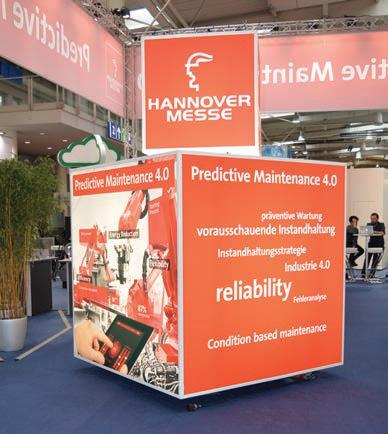
A dedicated a group pavilion, known as “Predictive Maintenance 4.0,” showcased predictive maintenance applications. Participants witnessed continuous machine data capture, processing and anal-
ysis in action and learned how PdM can give factory operators real, useable information on the condition of their systems, machines and machine components. Pneumatics specialist Aventics, the Schaeffler Group, ZF Friedrichshafen telematics subsidiary Openmatics and Bosch Rexroth were among presenters at this showcase.
The Industrial Supply show confirmed that Indus-
trie 4.0 is also becoming a routine requirement for today’s industrial suppliers. Other key themes in this category included new materials and lightweight design. Trade visitors were treated to a wide range of design ideas and lightweight design components made out of plastic, composites or steel.
The next Hannover Messe will be staged from April 24 - 28, 2017, with Poland to be
featured as its official Partner Country.
UPCOMING HEALTH & SAFETY BLITZES
The Ontario Ministry of Labour co-ordinates a proactive enforcement blitz and initiative schedule for its Occupational Health and Safety Program and the Employment Standards Program. These programs underscore the importance the
ministry places on protecting workers’ rights under both the Occupational Health and Safety Act (OHSA) and the Employment Standards Act (ESA), and enhancing employers’ awareness of their responsibilities. Findings are generally reported soon after completion. The ministry tracks each sector to determine if there are long-lasting improvements in compliance and fewer injuries and fewer contraventions of employment standards.
Upcoming health & safety blitzes include:
• Safe Material Tramming Underground and Surface, Mining (September 1 – October 31, 2016)
• Chemical Handling, Industrial (September 19, 2016 –October 31, 2016)
• Processing – Safe Work Practices – Mine Plants, Mining (February 1 – March 31, 2017) For a complete list, visit www. labour.gov.on.ca.
DISTRIBUTOR ADDS OIL AND FUEL FILTRATION SYSTEMS TO PORTFOLIO
Montreal – Wajax, a leading Canadian industrial products distributor and service provider, announced the addition of Oil Filtration Systems, Inc. to its filtration portfolio. Oil Filtration Systems manufactures a comprehensive line of oil purification equipment that is designed to remove contamination (water, particulate and varnish) from a variety of fluids, including lube oil, hydraulic oil, transformer oil and diesel fuel. Oil Filtration Systems, like Wajax, serves a variety of markets, including power generation, mining, oil and gas, pulp and paper, and other industries. The Oil Filtration Systems product line ranges from vacuum dehydrators, varnish removal systems and high-flow flushing skids, to high-vacuum transformer purification systems.
Business Briefs
News and views about companies, people, product lines and more.
• Calgary – Innova Global Limited (Innova), a full service engineering, fabrication, procurement and construction company, has been selected as the new name for ATCO Emissions Management to better reflect the company’s innovative approach to providing industry leading solutions and services to clients. Innova rolls together previous operating entities
of ATCO Emissions Management, ATCO Noise Management and Higgott-Kane.
• Paris – Trescal, the international specialist in calibration services, expands its footprint to Mexico with the acquisition of Kalibrixcal, the Mexican subsidiary of its recent acquisition in Germany, Kalibrix GmbH.
• Washington – U.S. manufacturing expanded in April for
• Ottawa – Canada’s oil and natural gas extraction industries are expected to be in the red again this year, according to The Conference Board of Canada’s latest outlooks for the industries. Following a record pre-tax loss of more than $7 billion last year, Canada’s oil extraction industry is expected to post losses of over $3 billion in 2016. Meanwhile, Canadian natural gas producers losses are expected to total $1 billion in 2016.
the second straight month, suggesting that factories are adapting to a strong dollar and economic weakness overseas, according to a private survey. The Institute for Supply Management said that its manufacturing index came in at 50.8 last month, down from March’s 51.8 reading but above the 50 threshold that signals growth. Export orders grew faster in April. Still, the index came in below economists’ expectations, and new orders and production grew more slowly in April than in March. A measure of employment fell, suggesting factories are cutting workers.
• Utah – West Valley Citybased Mountain Regional Equipment Solutions, Inc. has been awarded Groeneveld Distributor of the Year 2015.
M.R.E.S. founder and owner Bup Minardi received the award during a celebration in Utah from Groeneveld presi-
• Milwaukee – Rockwell Automation announced that its board of directors has elected Blake D. Moret, a 30-year veteran of the company, as president and chief executive officer, effective July 1, 2016. At that time, Keith D. Nosbusch, 65, who has been president and chief executive officer since 2004, will transition from those roles while continuing as chairman of the board. Moret, 53, is currently senior vice president of the Company’s Control Products & Solutions segment.
dent & CEO Henk Groeneveld. The professionalism of the team of Mountain Regional Equipment Solutions, and the drive to offer the customer the best lubrication and safety solutions, has resulted in double-digit sales growth in the past few years.
100 YEARS OF INNOVATION.
For 100 years NSK has been proudly designing motion and control products that not only help increase productivity but also help make the world a more safe, reliable and comfortable place. Here’s to celebrating the past, innovating in the present and setting the future in motion.
877.994.6675 www.nskamericas.com
Pump Patrol
The Ontario Clean Water Agency shares tactics on pump maintenance
BY CARROLL MCCORMICK
With thousands of pumps under its care, the Ontario Clean Water Agency (OCWA) has experience, and great confidence, in maintenance methods that range from keeping work areas clean, to data collection and statistical modelling.
OCWA is a financially self-sufficient crown agency that acts as a clean water services provider to more than 180 clients in Ontario, including municipalities, institutions, business and First Nations communities.
“We are primarily known for our operations and maintenance services, and also highly regarded for maintenance program services, energy efficiency, capital delivery, project management, design/ build and training for operators,” says Nigel D’Souza, Manager, Asset & Maintenance Management Group, OCWA.
D’Souza has agreed to share some of the agency’s methods for monitoring, maintaining and otherwise caring for the pumps in the facilities owned by OCWA’s clients.
First, OCWA uses a Work Management System (WMS), which is all that
a Computerised Maintenance Management System is, and more. “We not only manage maintenance. We manage all of our work [on WMS]. We use it for maintenance, processes, due diligence and to drive future decisions,” D’Souza says.
The WMS is also integrated with business databases, for integrating recorded time on work orders (timesheets) and purchases (POs in the financial system).
OCWA uses the WMS to drive several data -based practices, D’Souza says. “We use WMS to reduce costly repairs. We track corrective maintenance, failure types and learn from experience from what is recorded by way of statistical models.”
For example, OCWA has used the data it collects on the pumps in the WMS to determine that corrective work is more expensive than planned work. That said, OCWA does not take a cookie-cutter approach to pump maintenance; e.g., field personnel identify best practices employed locally.
Take, for instance, pumps that perform less critical duties. They may not justify the additional cost of certain maintenance techniques, such as vibration analysis. But for pumps with a lower tol-
erance for failure, OCWA has proven the value of additional, costlier preventative maintenance procedures.
“We establish a baseline program for maintenance, assess risk and criticality. We want to demonstrate what is the most efficient and reap the benefits,” D’Souza says. Properly assessing the tolerance for the failure of a particular pump lessens the likelihood of having to do reactive maintenance.
“Say there is a high-risk, but not critical pump. It will likely fail, but its impact is low. We typically won’t employ a rigorous vibration analysis program on it. You can also have low-risk and high-criticality. In this case you would want to monitor it more closely by identifying the tactics that will identify impending failure as early as possible,” D’Souza says. And the most effective way to sniff out an impending failure, he says? “Vibration analysis, in my opinion.”
Awareness of this risk/criticality dichotomy is one thing. Facing it head on is another matter. “I think people do make the distinction, but I think that most haven’t successfully deployed the tactics to deal with it … we have a risk
criticality model that we apply to the entire pump skid. We evaluate the risk and if it is critical, we drill further down to the components. We prioritize how we prepare for, or mitigate the likelihood of failure,” D’Souza explains.
OCWA collects and monitors a lot of information on its clients’ hardware. Some provide early warning so clients can react quickly to problems. Four core pump monitoring functions it can perform remotely are: on-screen and real-time monitoring; failure situations; alarm settings and control; such as acknowledge alarms and turning pumps on or off.
“We can notify people by phone, pagers, SMS and email. We need this because facilities are often not manned 24 hours a day, but they operate 24 hours a day with on-call staff for off hours,” D’Souza says.
A Data Historian, in the wide area Supervisory Control And Data Acquisition (SCADA) collects trending and historical data. “All that information is recorded, pinged [from once] every few minutes to seconds. Data Historian stores everything since it starts recording [for the first time with a piece of equipment]. In
our highly regulated industry we need to be able to prove start and stop times; for example, show correlations between pump starts and stops and tank levels.
“Another thing in the SCADA program is reporting and calculations. We use SQL, which is a type of database for reporting. On pumps we leverage data such as run times, average run times, cycle times and calculated values on a monthly or yearly scale. This way, we can understand what the best maintenance is,” D’Souza explains.
Data help in performing Root Cause Failure Analyses, or identifying preventative maintenance issues. Data help OCWA staff understand emergency failures after the fact, and to develop correct procedures for dealing with breakdowns.
OCWA pays careful attention to equipment warranties and performing the recommended maintenance procedures to comply with them. “We are usually provided the commissioning date as the start date of the warranty. [Our] work orders align with manufacturers’ specifications, and we use WMS to justify warranty claims. We don’t want to do what the manufacturer does not [recommend], make a claim and have it denied,” D’Souza says.
While methods extracted from data analysis can be powerful aids to a successful maintenance program, some are only accessible to the better-bankrolled maintenance departments. In fact, OCWA has methods it rarely uses, because of their cost. “We have the ability to employ remote monitoring of bearing temperatures and vibration, but it is cost prohibitive in many cases,” D’Souza says. “Maintenance practices beyond basic care are really defined by our clients’ needs.”
OCWA uses several straightforward techniques it knows offers attractive return on investment (ROI). They include vibration analysis, thermogra-
phy, auto-greasing and laser alignment technologies. Take ultrasonic greasing, which can be easily and inexpensively done on greasing routes. “As you grease the bearing you listen to it through an ultrasonic device. This is done manually on the greasing routes. The benefits of ultrasonic greasing include only using the grease that is required, and avoiding over-greasing, which can cause damage,” D’Souza says. Still, he notes, “It is not standard everywhere.”
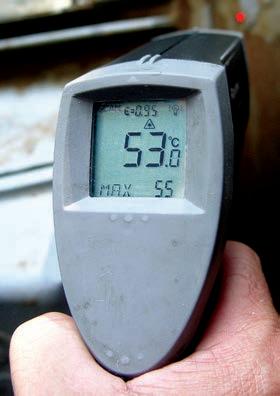
D’Souza also mentions thermal stickers – handy and inexpensive. Slap one on a pump bearing housing and temperature-sensitive dots on the sticker will permanently change colour to record temperature changes.
OCWA uses calendar-based maintenance, augmented by operator inspections. “We have 8,442 pumps in our WMS. They range from diaphragm pumps on up. There are 3,461 centrifugal pumps, which are the most common pumps for more rigorous maintenance tactics. These are the typical ones with greasable bearings and packable glands. The rest are less maintainable,” D’Souza says. “If operators discover an anomaly, we schedule corrective work or reschedule to have the preventive work on that pump start sooner.”
Inaccessible or hard-to-repair diaphragm pumps may be run to failure, then pulled and repaired (while making sure that spares are available).
OCWA has begun investigating pump duty cycles more strategically to avoid balancing operating hours over all of the pumps at a specific point in a process. The objective is to have a pump that is as close as possible to being on duty standby, to avoid finding oneself doing maintenance on all of the pumps in a set at once.
“It is not only the maintenance that happens at the same time, but [also the] failures. We are looking at scenarios in
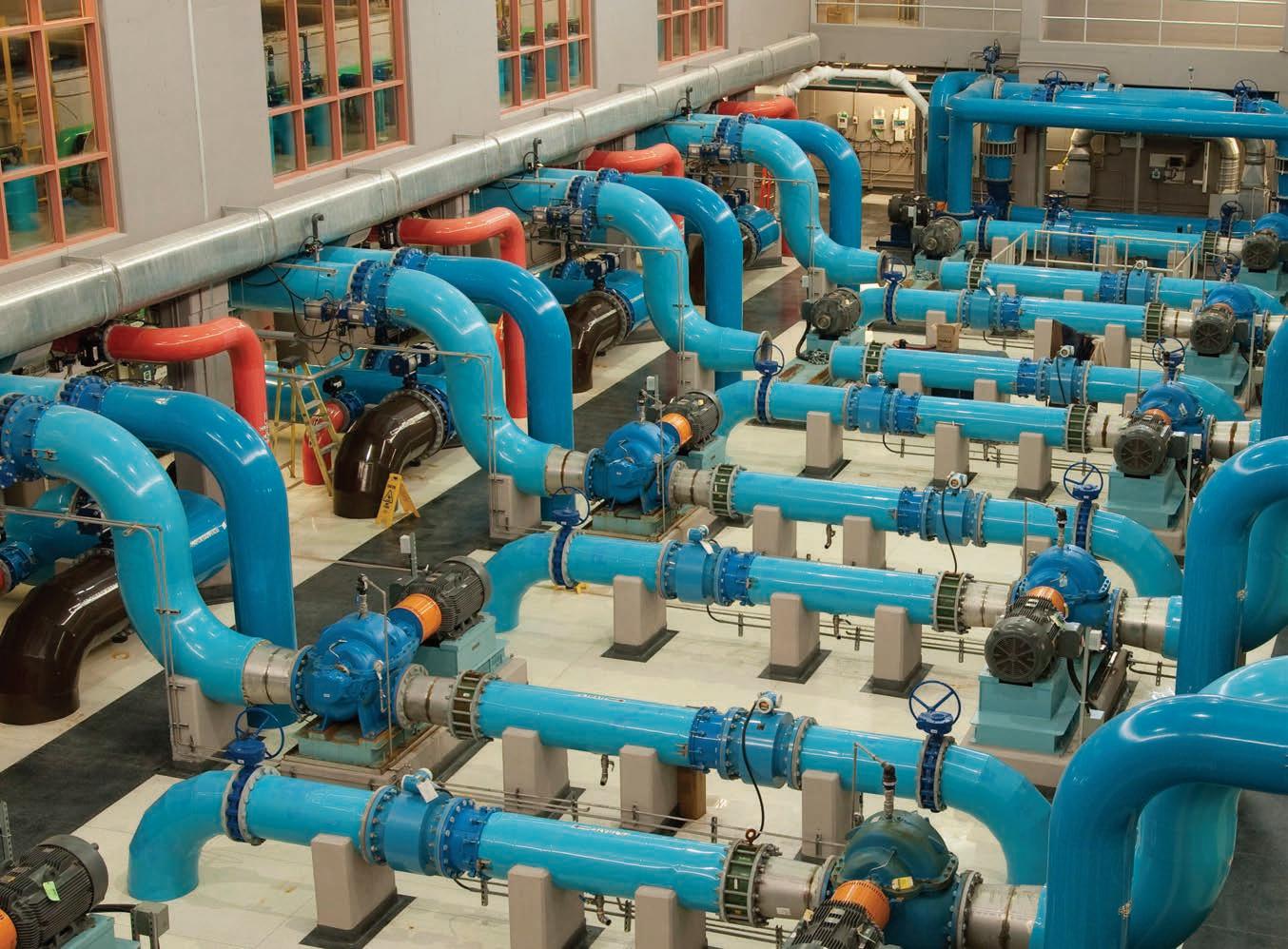
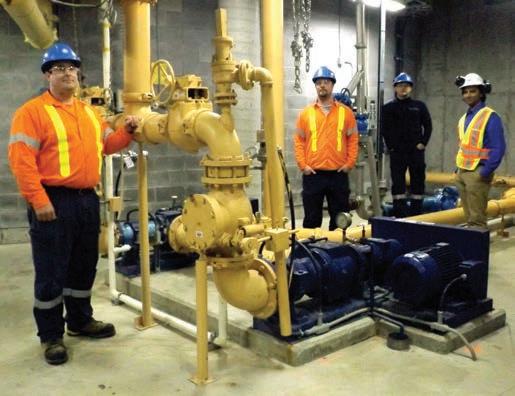
The Ontario Clean Water Agency maintains 8,442 pumps. Photo by OCWA
place with three pumps: switching to 80/80/40 per cent, or 100/100/0 per cent,” D’Souza explains. “I believe it provides an ROI, or balancing of costs and the deferring of capital to further down the road.”
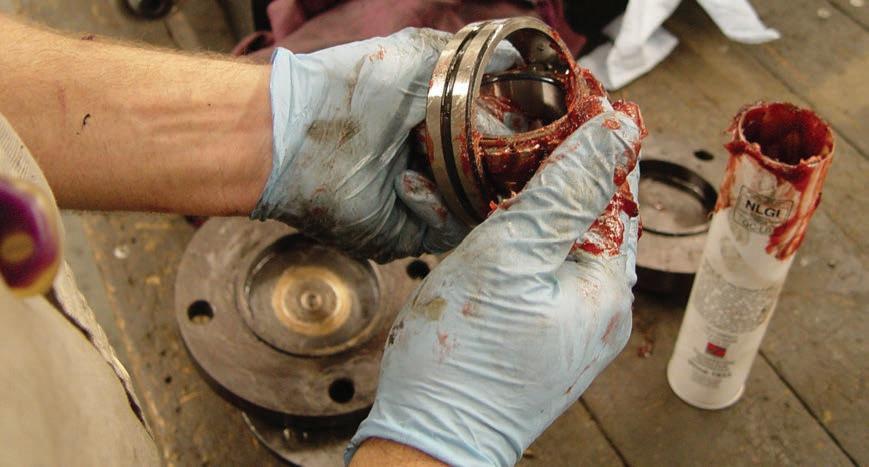
D’Souza also strongly believes in keeping a firm grip on some basic practices that any maintenance team can do. “I think a lot of focus is put on performing maintenance activities, but less focus put on the tools and materials to do the maintenance activities. For example, lubrication main-
tenance, [like] buckets of oil and grease just sitting there with the lid off.
“Where we do need improvement is with things that are not quite as visible, like lubrication maintenance programs –lubricant management is an area where you can get a quick win – and parts programs, so you know what you need and when, so you don’t overstock.”
Or take laser alignment, which can be used to minimize shaft deflection and vibration. If you have equipment down or on standby, take the opportunity to
do laser alignment. “Laser alignment, in general, is something that is a quick win, something you can do to avoid problems down the road, primarily with vibration and shaft deflection,” D’Souza counsels.
“In terms of your basic care program, you are looking at lubrication, alignment, tightening; in other words, packing, casing, as well as structural or support integrity, inspection and the cleanliness of the operating and work area. Where you are performing maintenance is the perfect area to get dirt and contamination into the pump,” D’Souza says.
Oh, cleanliness. “I think that everyone is aware of it,” D’Souza says, “but there are places where everyone is in firefighting mode: production versus maintenance. Where the focus is keeping the plant running and maintaining production within the chaos, we sometimes lose this in the everyday. We need more reinforcement. Championing programs is quite important.
“A lot of times people focus on the latest technology, and ignore the simple things. The key is empowering people to take ownership of the plant and maintenance.” MRO
Temperature readings help assess pump condition.
Photo by Carroll McCormick
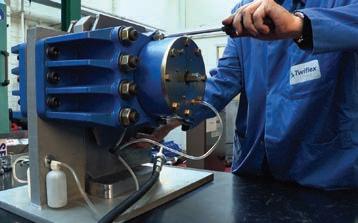
Having correctly assembled and installed the braking system, it is important to carefully follow the initial running-in procedure as it can have a significant impact on the overall performance of the braking system.
ToughBrakes
Getting the most from heavy-duty braking systems.
BY STEVE POWELL
Heavy-duty braking system designs are as diverse as the different industries in which they are employed. From marine and mining to metal working and paper processing, systems are required to perform static, dynamic and emergency braking with precise controlled force. Quality is of the utmost importance in these products as the cost of a short service life can often be extremely high for the end-user. However, as with all things mechanical, it is possible to improve the reliability and lifespan of all braking designs with good specification, correct installation and correct maintenance procedures.
Some tasks require standard braking systems. Others are highly specific and require a bespoke approach to installation.
If the brake is to be used for static holding then bedding in may not be possible, so engineers should allow for reduced friction potential in the original design.
der to neutralize the braking torque reaction forces on the shaft bearings. Sufficient space should also be allowed for access to the callipers for routine inspection and maintenance as well as for pad renewal.
Braking systems perform a crucial role in many industrial processes and the variety of their design bears out the huge number of applications they are involved in. Due to the individual nature of many applications both designers and manufacturers are also able to adapt standard designs to suit some tasks while others require a completely bespoke approach.
Firstly, once a system is in place it is essential that the operating loads and conditions that are specified by the manufacturer are not exceeded. The process of selecting a suitable product for a particular application forms the basis of this requirement and it is advisable that experienced
applications engineers are consulted for guidance. Typically, manufacturers offer this consultancy service as standard to make sure that the right brake system is designed and specified.
Correct installation
Having specified the required design, getting the installation correct is essential if the braking components are going to deliver the expected long service life. In many cases it can be advisable to make use of the expertise and experience of the installation engineers available from the manufacturer.
Ideally, heavy-duty braking systems should be designed with two callipers on each disc, mounted diametrically opposite to each other, in or-
Following expert advice from the manufacturer is crucial, especially on topics such as hydraulic fluid, which should be checked for compatibility with the seals in the system. Using the incorrect grade of oil can cause seals to swell, which may result in reduced braking efficiency. Alternatively, the oil seals may break down prematurely and cause a loss of oil pressure.
Twiflex, a heavy duty brakes manufacturer with a global footprint, is able to offer assistance, advice and training both remotely and on site. Based on the size, complexity and importance of many heavy-duty braking systems, it is often a cost effective option to make use of these services.
Running-in procedure
Having correctly assembled and installed the braking system, it is important to carefully follow the initial running-in procedure as it can have a significant impact on the overall performance of the braking system. The usual procedure consists of two phases: the
service, it is important that a regular maintenance inspection programme is carried out.
bedding-in of the pads on the disc and the pad conditioning. The former maximizes the area of contact between the pads and the disc, while the latter involves a gradual increase in heat generation that creates changes in the pad material and which is necessary to develop the full braking potential.
Although procedures will vary between individual applications, the principle
during this period is to work the brake lightly at first to remove any pad high spots and so achieve something approaching 100 per cent pad contact with the disc. After this, progressively heavier braking can be applied until the full rated duty is achieved. It is important to monitor the disc temperature throughout the bedding-in process and allow sufficient cooling time to prevent overheating.
In most cases 250°C is a safe peak braking path temperature, but this can be difficult to measure. In emergency brake applications much higher temperatures can be required, but they should be allowed to cool down to near ambient temperature before re-testing.
Of course the procedures described so far involve dynamic braking systems, but if the brake is only to be used for static holding duties it is not practicable to operate it with the disc in motion. In these situations the pad/disc interface will rarely develop even 50 per cent of its friction potential; often less. However, as this can be anticipated during specification it should have been allowed for in the original design.
In general, some improvements can be made to the braking efficiency by removing the high spots on the pads to improve the total area of contact. However, if sufficient braking force is still not generated, there are some further options to consider. Firstly, it may be advisable to change pad material to a more efficient variety. Secondly, it is possible to adjust the air gap in spring-applied units or increase the hydraulic pressure in direct-acting components.
Smooth operation
Once the new braking system has been properly bedded in and conditioned it can be commissioned and operated on a full-time basis. During the first week of normal operations it is important that a number of regular maintenance checks are made to ensure that there is no unexpected fluid leakage and that brake operation is smooth.
Having completed the running-in period, the security of all bolted connections and pipe connections should be checked, while the calliper mounting bolts should also be paint marked to provide a visual check of any movement.
Twiflex offers a “parked off” feature, which removes potential energy from the brake during maintenance and allows for brake force to be easily adjusted.
Regular maintenance
With all of the checks and certifications in place the braking system finally enters regular service. From this point on, in addition to any statutory requirements, follow a regular maintenance inspection programme as stipulated by the manufacturer.
accordingly. In some components additional monitoring equipment can be installed to provide warnings about friction pad wear and adjustment. When the brake pad is nearing end of service life it will need to be replaced and the procedure for this will depend on the design installed.
er solutions in that it actively removes the spring force from the brake while it’s powered off, and there is no force acting on the pad that could lead to unexpected closures.
With hydraulic pressure applied, maintenance engineers can unwind an adjusting spindle, which releases the spring pack. When the hydraulic pressure is removed the springs extend without acting on the brake. At this point the spring load and hydraulic pressure are both zero and the brake has no stored energy.
One source: your partner for pumps, valves and service
KSB is your single source for all pumping needs. Our pump experts help ensure the best possible solution for every job, no matter if it’s selecting a new pump, stocking up on spare parts, or remanufacturing a long-service veteran. Ask us how you can bene t from our exceptional products, advice and service on your next project.
KSB Pumps Inc.
info@ksbcanada.com • www.ksb.ca
You can also visit us at: www.ksb.com/socialmedia
Our technology. Your success. Pumps Valves ■ Service
The parked-off feature has a number of benefits. First, basic maintenance such as brake pad replacement can be carried out quickly and with a reduced risk of unexpected closure when compared to conventional brake designs. Second, the brake force can be easily adjusted by setting the brake to “parked off” and adjusting the number of shims from the end cover. Finally, installation is made easier and the brake can be installed without the need for hydraulic pressure.
Replacement parts
Manufacturers of braking systems have designed the components to work together within strict tolerances so that they meet the required specification, including a sufficient safety margin. It is therefore advisable to replace any parts with those prescribed by the manufacturer in order to ensure continued reliable service.
By ensuring that the correct installation and maintenance procedures are followed, and working with the original manufacturer, operators of industrial equipment can deliver long-term cost savings to their operation. MRO
This article was submitted by Steve Powell, product manager at Twiflex, a recognized heavy-duty brake brands and part of the global Altra Industrial Motion group. For more information, visit www.twiflex.com.
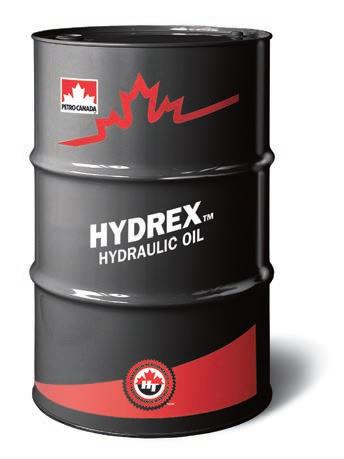
HYDRAULIC OIL
EXPECT TO REALIZE MORE WITH HYDREXTM AW
Taking your hydraulic system off-line to change the oil costs money. HYDREX is the one brand of hydraulic oil you can always count on for up to 2x better wear protection*. With HYDREX AW, you can also expect to extend your drain intervals with up to 3x longer oil life*. By ultimately cutting unnecessary downtime, you’ll realize significant savings in your overall manufacturing costs. Help your business realize more. Visit TryHYDREX.com
*Measured against leading North American hydraulic oil brands.
POWER RENEWAL
A hospital undertakes critical electrical infrastructure upgrades without compromising backup power.
BY PHILIP CHOW
Critical facilities, spanning a variety of industries, share a common operational mandate: power interruptions cannot be tolerated. Recognizing that a utility power supply can be interrupted from time to time, onsite standby generation is installed to provide backup power to critical systems. Often coupled with stored energy systems (uninterruptible power supplies), onsite standby generation will keep critical electrical loads operational for a prolonged period of time in the event of an extended utility power outage. Plant managers are faced with concerns when standby
generation needs to be upgraded. Sunnybrook Health Sciences Centre faced these challenges when they undertook a project to replace their emergency power generating plant in its entirety.
Central utility plant
Sunnybrook is a full-service, 1,100-patient bed hospital, located in mid-town Toronto.
With an aggregate campus area of about three million square feet, Sunnybrook is the largest regional trauma centre in Canada, the largest maternity hospital in Canada and boasts 1.2 million patient visits each year. Sunnybrook relies on its central utility plant to distribute emergen-
cy (backup) power, heating and cooling services throughout its campus. The hospital’s emergency power network is divided into two standalone systems: a 4160V generation/ distribution system, which provides power to approximately 20 electrical substations throughout the campus and a 600V generation/ distribution system, which provides power to the hospital’s central utility plant, and in turn powers ancillary systems that serve the 4,160V system. The existing generating plant consisted of five 4,160V standby diesel generators and two 600V standby diesel generators, with aggregate capacities of 4.3MW at 4160V and 1MW at 600V.
Load management
The existing 4,160V generators powered medium voltage paralleling switchgear, which operated under a dead bus logic: in the event of a utility power outage all generators are signalled to start, the first generator to reach rated voltage and frequency closes onto the dead bus and the remaining generators synchronize and close to the bus. To ensure the first generator online and subsequent
synchronized generators are not overloaded with the campus’ entire emergency power load, an existing Allen Bradley PLC5 load management system was given control over downstream loads, via a campus-wide fibre optic communications loop. The load management system had the ability to add or shed loads via a prescribed priority sequence, which was dependent on available generating capacity. With existing infrastructure dating back to the 1970s and approaching end of life conditions, Sunnybrook was faced with the challenge of undergoing infrastructure upgrades, while maintaining the functionality and reliability of their emergency power distribution system. Michael McRitchie, director of Plant Operations & Maintenance, notes, “Sunnybrook’s emergency power distribution system is critical in ensuring important hospital functions remain operational during utility power outages and in maintaining patient, staff and visitor safety.”
Project constraints
Key design criteria were established for an infrastructure renewal project: replace obsolete equipment, increase available capacity of emergency power systems and provide opportunities for reducing annual operating costs. The project was constrained to building within the footprint of the existing central utility plant and constructing new, occupiable
The project was constrained to the footprint of the existing central utility plant.
Sunnybrook’s existing generator sets and equipment dated back to the 1970s.
Phased construction required a temporary portable generator and temporary 4.16kV switchgear.
WORK SA FE R AND M OR E EFFI C IE NTLY with the ne w FLIR ® C M174 cl am p mete r wi th bu il t- in the r ma l i mag i ng camera. Featuring Infrared Guided Measurement (IGM) te chno logy, the CM174 visua lly points you to the pre cise location of potential electrical issues. You’ll find problems faste r, get mo re done, an d boost you r cre dibility .
TO SEE IGM I N ACTI ON G O TO WW W.FLIR.CA/C M1 74
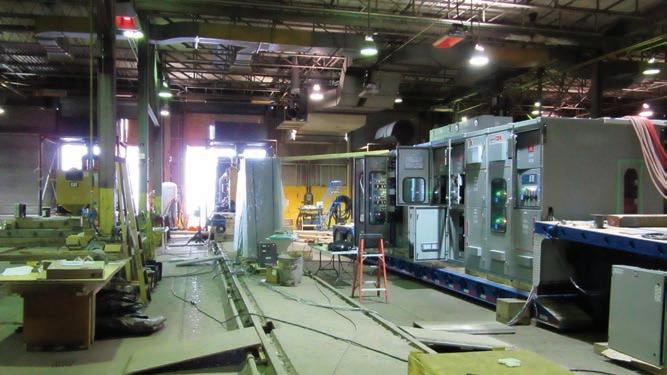
space was not an option. Creating a construction phasing sequence that would facilitate infrastructure renewal and implement design requirements, while maintaining reliable emergency power to the hospital was a significant challenge. A detailed site review confirmed that an upgrade project could be completed in two phases. Under the first phase, a portion of the existing paralleling switchgear could be removed to facilitate the removal of three existing generators and associated infrastructure. This would clear up physical space in the existing plant and would allow for half of the existing building to undergo structural upgrades and general trades work to accommodate larger replacement generators. Under the second phase the remaining three existing generators and paralleling switchgear would be replaced. This would free up the other half of the existing building to undergo structural modifications that would accomodate additional
larger replacement generators.
Temporary fuel supply
To maintain a reliable emergency power supply to critical processes around the campus, a number of temporary provisions and enabling work were required. As the existing generator capacity was diminished with the removal of existing generators under Phase 1 of the project, a temporary portable generator was required to supplement generating capacity and existing 4.16kV campus distribution circuits would have to be temporarily powered from the portable generator. This resulted in the need to provide temporary 4.16kV switchgear complete with automatic transfer functionality, provisions to receive incoming utility power and power from the portable generator, and provisions to feed distribution circuits that were affected by Phase 1 construction. The temporary switchgear would serve a similar function under Phase 2 of the
project by backing up the corresponding distribution circuits affected by Phase 2 construction. Additionally, since the incoming fuel oil supply to the generator plant was to be upgraded, the portion of the existing generator plant (which remained operational under the first phase of the project) would require a temporary fuel oil supply, while the main fuel oil system was upgraded. To facilitate construction, a temporary fuel supply line, complete with its own independent valving arrangement, was run from Sunnybrook’s independent heating oil supply.
Equipment package
After creating a project concept that established construction and design goals, the next challenge was implementing the design. As the majority of the equipment associated with the emergency power system would have interrelated functions, it made sense that one supplier should provide the major equipment and assume responsibility for co-ordinating with associated sub-suppliers. Detailed engineered drawings and specifications
were prepared for an equipment package which consisted of: four 2MW - 4.16kV generators, one 750kW - 600V generator, paralleling and synchronization controls, 4.16kV automatic transfer and distribution switchgear, diesel emissions reduction systems (DERS) for each generator and a new Allen Bradley Controllogix PLC load management system. Generator suppliers evaluated for conformance to RFP requirements and the equipment supply package was awarded to Toromont CAT. “The RFP process was instrumental in giving Sunnybrook’s Plant Operations and Corporate Planning groups direct input into the equipment selection process, says McRitchie. The construction of the new generating plant and equipment installation was tendered to a group of pre-qualified contractors. But given the substantial scope of electrical work associated with the project, the successful electrical contractor (Ontario Electrical Construction Company Ltd.) would assume the role of the prime contractor for the project and would be responsible for co-ordinating other trades on the project. The equipment package would be assigned directly to the successful electrical contractor, to ensure delivery and scheduling would coincide with the construction schedule. The preliminary enabling works were completed, and the temporary switchgear and rental generator were
The emergency power system was shipped for off-site testing.
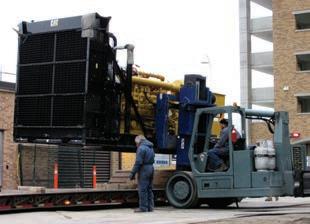
A new 2MW, 4160V diesel generator is being installed during Phase 1.
New 4160V distribution switchgear was installed.
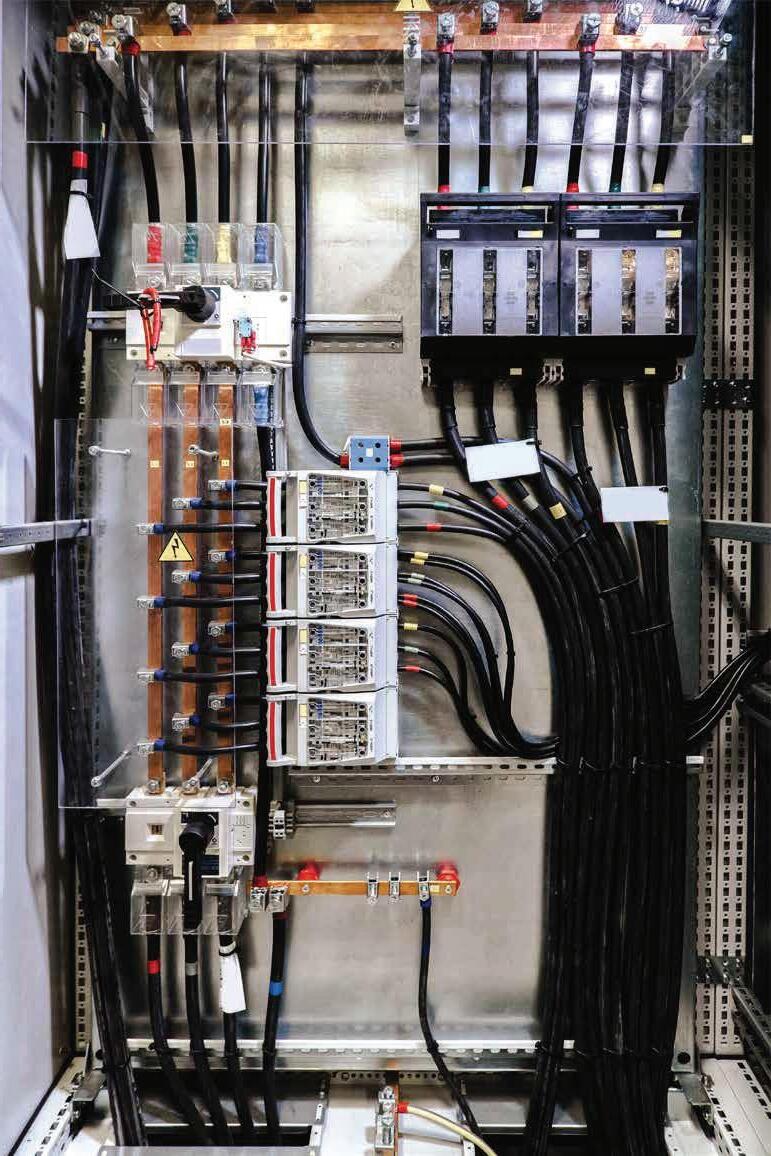
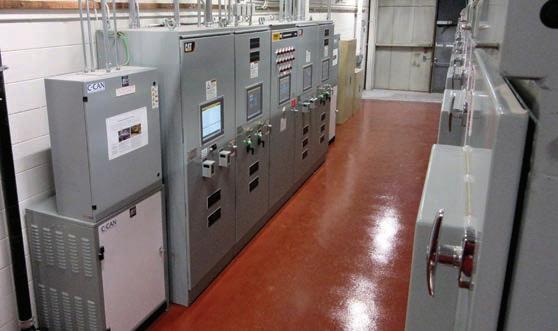
New generator controls and load management system controls.
installed for the first phase. Existing 4.16kV distribution circuits were spliced and refed from the temporary distribution system, allowing a portion of the existing plant to be taken off-line.
Offsite testing
With the hospital’s critical loads being supported by temporary infrastructure, half of the existing generator plant was decommissioned and the existing diesel generators, ancillary equipment and paralleling switchgear were removed from site. A new floor slab was poured complete with structurally reinforced bases for the new generator sets. The building’s structure was reinforced and new structural steel was installed for an air intake plenum expansion and exhaust plenum expansion. While construction was progressing on site, major equipment items were manufactured and underwent rigorous factory acceptance testing procedures. The entire emergency power system lineup (generators, switchgear and control panels) was shipped to an offsite testing facility and assembled to undergo integrated system testing, which included testing automatic transfer functions, paralleling and system controls with portable load banks. This process helped identify operational issues before the equipment was shipped to site. The new system was subjected to additional pre-service testing, to test the site-specific installation. Final functional testing was performed with Sunnybrook’s critical loads and the first phase of the installation was placed into service. The process is being repeated with the second half of the existing generator plant; the remaining components of the existing plant were decommissioned and construction of the second phase is ongoing.
Innovative design
Undertaking infrastructure
renewal allowed for a number of innovative features to be included with the equipment upgrades. Each of the new diesel generators was equipped with a diesel emissions reduction system (DERS), which reduced emissions and pollutants from standard U.S. Environmental Protection Agency (EPA) Tier 2 levels to Tier 4 levels (reducing pollutant levels, such as NOx, by as much as 95 per cent). DERS modules con-
We see the whole picture.
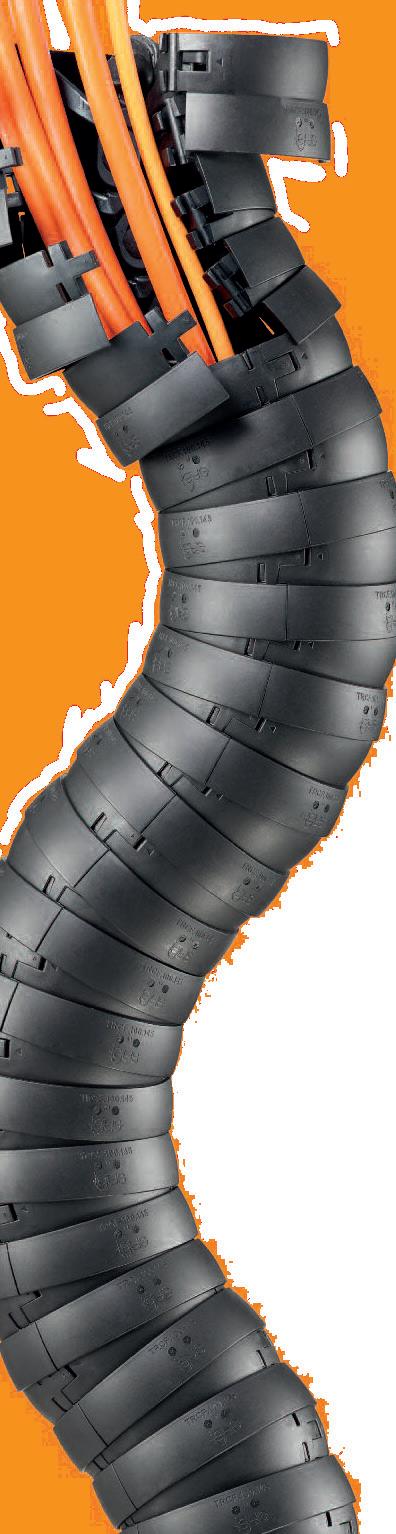
Not every application can be solved with plastic cable carriers! Whatever the application, we have a solution. Presenting plastic and steel cable and hose carriers populated with continuous bending high flex cables from Kabelschlepp. Cable and hose carriers are the lifeblood and backbone of countless modern machinery. Based on their importance, it only makes sense to trust the industry leader. One supplier, one quick lead time, guaranteed quality. It doesn’t get easier than that!
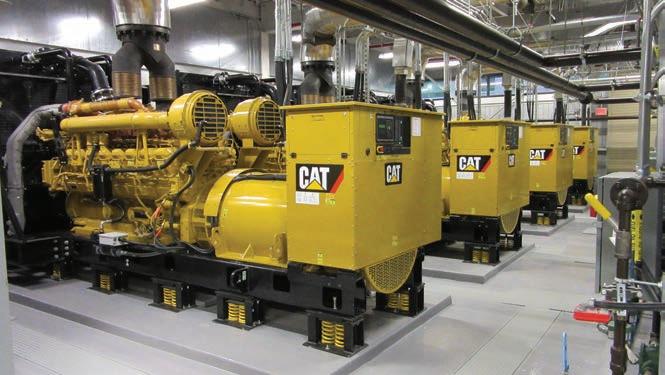
Four 2MW, 4160V and one 750kW, 600V diesel generators were installed.
sisted of a particulate filter, selective catalytic reduction system, sound attenuation system (deleting the requirement for a separate muffler) and a dosing system, whereby an external supply of urea, water and compressed air is injected into the exhaust stream to catalyze the nitrous oxide (NOx) emissions. The new 4.16kV switchgear and automatic transfer controls were equipped with closed-transition transfer logic, enabling the distribution system to momentarily parallel utility power with generator power. This mode of operation is important in reducing disruption to hospital operations during weekly generator tests, as generator power is momentarily paralleled with utility power when critical loads are transferred between sources. By incorporating both of these innovative design features into the project, Sunnybrook should be able to utilize their standby generators to offset electrical demand load from the utility grid during peak conditions and reduce their global adjustment costs (a utility charge that is levied to large facilities with a peak electrical demand load in excess of 5MW during peak electrical demand conditions, in the Province of Ontario).
McRitchie says that incorporating emissions reduction technology and closed-transition transfer controls will give Sunnybrook the ability to transfer hospital loads to generator power seamlessly. “By displacing hospital loads for approximately 60 hours or more during summer months, Sunnybrook should be able to reduce utility costs significantly,” he says.
System reliability
Replacing critical electrical infrastructure can be a daunting task, when faced with requirements for maintaining uptime, physical space constraints and budgetary constraints. Upgrading critical electrical infrastructure is a sure way
to help improve overall system reliability and reduce system operating costs. As demonstrated by the innovative project at Sunnybrook Health Sciences Centre, a three-million square foot campus was able to replace its entire generating plant within an existing building footprint, while simultaneously maintaining an emergency power supply to its critical loads. Furthermore, Sunnybrook increased its aggregate generating capacity by a factor of 1.76 (4.3MW to 8MW at 4160V and 1MW to 1.35MW at 600V), increased its generator response time from having 800kW available within 10 seconds to having 4MW available within 10 seconds and was able to incorporate a number of innovative features in the project that significantly reduce operating costs. MRO
Philip Chow, P.Eng., P.E. is the lead electrical engineer on the Sunnybrook High Voltage Emergency Power Renewal project and is a project manager at H.H. Angus & Associates Ltd. Consulting Engineers. He can be reached at Philip.Chow@hhangus.com.
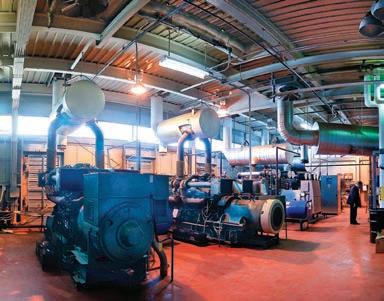
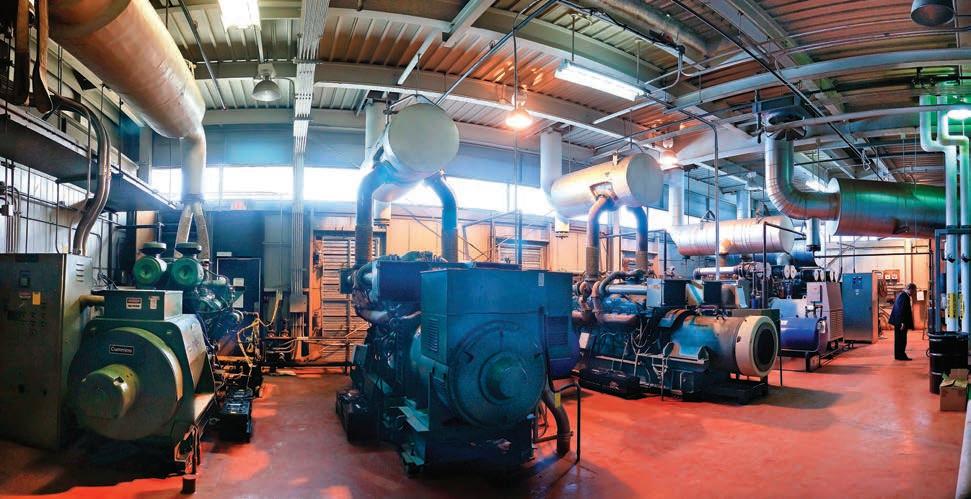
Interior of new generating plant near completion.
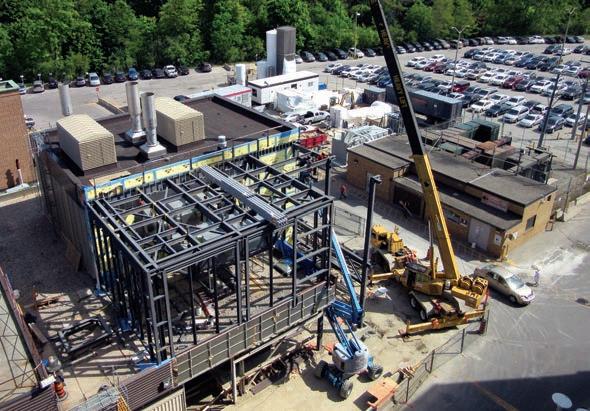
Exterior of Sunnybrook’s new generating plant near completion.
We Create Real Innovation
With a full line of power transmission drive systems, Continental ContiTech strives for industry-leading innovations to provide you with the most advanced solutions available.
What makes a hydraulic system reliable?
BY MARK BARNES AND JEFF SMITH
Fluid power is an effective way of producing, transferring and controlling energy to produce lateral or rotary motion. This could be subcategorized into hydraulics and pneumatics. In some organizations hydraulic systems are cursed as unreliable and troublesome, in others they are a non-issue. Some systems are clean, dry and trouble-free, some are sprinklers and high-volume parts consumers. In this instalment of Counterpoint, Smith and Barnes share their perspectives on what is required to create a trouble-free system, whether mobile or stationary.
Jeff Smith:
Poorly designed fluid power systems lead to poor maintenance practices.
There are three key factors that enable reliability in fluid power systems: design, system tuning and corrective maintenance. Having investigated multiple failures and conducted failure analysis on many hydraulic issues, three common causes seem to arise. Poorly designed systems often lead to excessive heat, shock-loaded functions, lack of ingress control and unmanaged ingress (contamination) and egress (leakage). Poor design is also compounded by improper setup and poor post-failure maintenance practices.
System design is often centered on basic functionality and developed by matching the requirements to Pascal’s law.
Pressure = force/area
Area = pressure/force
Force = pressure x area
Flow rate requirements are calculated (Cyl. Area x Stroke/time).
Power requirements are determined KW = (LPMxPressure)/600).
Motor speed requirements are aligned Motor Speed = (LPM/ cc per Rev. of pump).
So, although most hydraulic systems are mathematically correct, the application fails to deliver the required reliability.
Why?
System design: Most hydraulic systems engineered fail to evaluate the consequences of component failure and the system degradation that will occur. One example of this is on haul trucks where I have seen one manufacturer use the hydraulic system for braking. When a wheel bearing fails, a massive amount of metal contamination dumps into the system. This has resulted in the aftermarket coming up with rare earth magnets and other
solutions for an issue that could have been resolved in the design stage. To emphasize the number of design issues just consider the aftermarket products sold: desiccant filters, advanced filtration, contamination control fill ports, sample ports, coolers, cylinder rod protection, etc. If any of the items listed are installed and add value, why were they not in the initial design? I believe that equipment manufacturers should utilize RCM design. If you follow the aviation world, you realize that plane maintenance centres do not use RCM (MSG-3); that is in the hands of the equipment manufacturers. They apply manufacturer-developed programs to assets that have had the failure modes considered at the design phase.
Optimal design of hydraulic systems considers operational, shock and environmental loading and protects against cascading damage.
System tuning: Have you ever listened to a band and heard a random note or an out-of-tune instrument. Regardless of the song played, the result is painful. Hydraulic systems should be tuned like a guitar; everything must interact correctly to protect the system or function. Optimal design and contamination control will do nothing if a relief valve is set below system pressure. The heat generated will bake the oil and cascade the damage throughout the system. Another example is a cross line relief system. Its purpose is to cushion against shock loading, and this can be the difference between smooth operation and an operator bouncing around in an excavator cab every time he stops a swing. If your current practices are to only address setup when there is a failure, you are ignoring the natural degradation of the system components. If you are profiling your hydraulic system (trending pressure over time) you can easily find and resolve slight tuning issues.
Post-failure maintenance: Having watched organizations replace components only to have the next downstream component fail far too many times, I struggle to understand why we wouldn’t clean the system as part of the repair. The saying, “We don’t have time to do it right, but we have time to do it over,” comes to mind. I have also seen the other extremes where even unrelated systems are taken apart and inspected. Assuming there is a pre-planned work order for the task of replacing a failed component, it should
Jeff Smith Acuren
include the associated tasks for system cleaning or even validation of the requirement for cleaning. Failed parts bring havoc to a system as they travel through and lodge themselves in the most inconvenient places.
Post-failure maintenance can also apply to external components, hose length and placement. In organizations with poor practices, equipment will function well when new, but slight placement issues and disregarded clamp and retainers soon produce and fountain-like structure that hardly resembles the original asset. Quality maintenance practices cannot be overstated.
Mark Barnes:
Fluid power system reliability is supported by the health of hydraulic fluid.
While there are many things that go into ensuring hydraulic system reliability, for me there’s no greater contributing factor than the health and cleanliness of the hydraulic fluid. The hydraulic oil is the “lifeblood” of the system and plays a massive role in system performance.
Unlike other lubricated components, the fluid in a hydraulic system plays a dual role. Not only does it provide lubrication to the rotating and reciprocating components (pump, valves, actuators, etc.), it is also the medium that provides hydraulic force, such that useful work can be done. The condition of the fluid impacts not just its lubricating properties, but also the fluid’s ability to do useful work; something that’s related to the oil’s bulk modulus or lack of compressibility. Any contaminant, such as moisture or air, not only influences lubrication, but it changes the oil’s compressibility – something that can impact system performance and fine motion control.
When it comes to contamination, most experts agree that for hydraulic systems that include contamination-sensitive components, such as vane or piston pumps and servo hydraulic controls, contamination is responsible for as many as 70 - 90 per cent of all mechanical issues. Particles that enter the system cause abrasive wear, particularly in tight clearances found in pumps and valves and can cause the valve to “lock up” – something referred as silt lock. But what many people fail to recognize is that it is particles around the same size as pollen, bacteria or red blood cells (1-10 microns) that cause most of the problems since these particles are around the same size as the dynamic clearances in critical pumps and valves. Where poor quality oil filters are used, many of these silt-sized particles pass straight through the filter since they’re smaller than the micron rating of the filter.
Water is also an issue. Free or emulsified water can cause overall poor lubrication conditions as well as rust and corrosion to occur. When water passes through pumps, the rapid cycling from low to high pressure can cause microscopic implosions to occur within the pump, resulting in a condition known as vaporous cavitation. Vaporous cavitation can cause pump failure in short order if left unchecked.
Aeration can cause spongy or erratic operation, pump cavitation or micro-dieseling to occur and can increase the rate of oxidation rapidly. Aeration is usually caused by other contaminants, poor system design (such as too small a reservoir or low oil level), suction line leaks or incorrect operation – for example, leaving a relief valve open and continually dumping oil back to the tank.
Fluid health also plays an important role in overall reliability. With lower quality oils, or oil that has been left in services for too long, “sticky” sludge and varnish deposits can form due to oxidative and thermal failure. This material can often be found coating the inside of the tank forming a “bathtub” ring, as well as inside heat exchangers and water coolers. Sludge and varnish will also form within control valves, laying down a layer of “flypaper” that serves to trap small particles within the spool to bore clearance. In fact, studies have shown that the combination of degraded fluid and contaminants can result in electronic failures in electro-hydraulic control valves as the servo has to work harder to overcome the “stickiness” inside, as small particles and varnish work together to lock-up the valves.
While the impact of fluid condition and contamination on hydraulic system reliability is ubiquitous, a few simple measures such as good reservoir seals, proper desiccant air breathers and good filtration including, where necessary, kidney loop filtration, can easily keep the oil free of contaminants and operating reliably. Oil analysis is also an important tool to ensure the fluid is clean and that it has not degraded to the point where deposits start to form.
So while it’s true to say that not all hydraulic system problems are fluid-related, a large majority are, making this easy, low-hanging fruit for improving performance.
Smith – Rebuttal
Mark makes a great point about contamination, though various systems have varying levels of sensitivity. (My father’s farm tractors come to mind.) I believe that system contamination is a symptom of poor design or poor maintenance practices. Contamination is also the result of internal failures so the best ingress control will not address internal contamination. Oil degradation is often the result of poor system tuning (heat generation) or lack of ingress control. Egress control is also critical as it is a lot easier to control contamination when a system is not being constantly topped up. Design the system properly, keep it tuned, correctly address failures and do what Mark said.
Barnes – Rebuttal
Jeff, I agree that unless you have good system design, it doesn’t matter how good the lubricant or the contamination control measures you put in place. System design and optimization is fundamental; just like exercise, diet and modern medicine can’t overcome genetic predisposition to disease in the human body. Having said that, for systems that are designed properly and have been optimally “tuned,” making sure that the system has clean, dry, “healthy” fluid is critical. Statistically speaking, someone whose design (genetics) is good, living a clean, dry (or maybe the occasional beer or glass of wine!), healthy life is the key to a happy old age. Machines are no different – good design, good operation and a “healthy” lifestyle all contribute to a happy, reliable hydraulic system. MRO
Mark Barnes, PhD, CMRP, is vice president of Reliability Services at Des-Case Corporation. Barnes has published more than 100 articles and several book chapters on lubrication and oil analysis. His PhD is in analytical chemistry. Reach him at mark.barnes@descase.com.
Jeff Smith is the reliability subject matter expert for Acuren. He has served as senior advisor for the Association for Maintenance Professionals (AMP) and also served on the U.S. tag for ISO 55000. Reach him at jsmith@acuren.com.
Mark Barnes Des-Case Corp.
PEARSON’S PLUMBING
An ongoing overhaul at Canada’s largest airport makes life better for maintenance crews, vendors, passengers and the environment.
BY TREENA HEIN
As Canada’s largest airport, Toronto Pearson is a busy place –and getting busier all the time. In 2015, 41 million passengers passed through the facility (that’s well over 100,000 a day), a six per cent increase over 2014. By 2032, the facility will handle an estimated 60 million passengers. Toronto Pearson supports 40,000 employees, and overall water consumption is over one-billion litres a year. It’s a destination in itself with a wide variety of things to do and places to eat and shop.
With a facility of this magnitude, all systems – from baggage handling to parking – must work and work well. That’s the focus of Clarence Walters, manager, Mechanical Systems at the Greater Toronto Airport Authority (GTAA). It’s his job to ensure all mechanical systems impact customer service in positive ways, but two years ago, it became apparent that one system in particular was a very large threat to that service. At that point, Walters began root cause analysis (RCA) to get to the bottom of what was up with Pearson’s plumbing.
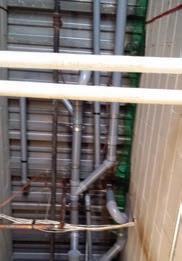
Simply put, the existing system (more on that later) was allowing a substantial amount of grease and oil from Pearson’s 70+ dining venues to make its way into the plumbing lines. This material congealed over time, mixed with biosolids and turned acidic, wearing away at the existing cast-iron pipes and causing them to fail prematurely. This meant downtime and high maintenance costs.
If that weren’t bad enough, the excess weight of grease buildups was causing the joints between drainage pipes to come apart, which again meant downtime for vendors, lots of breakdown maintenance for Walters’ crews and some significant safety issues. The odour of the decaying grease, particularly where it leaked from broken joints,
was also attracting insects and rodents – the last thing you want at a worldclass facility. “The grease blockages were decreasing pipe capacity and in some cases entirely blocking pipes,” Walters explains. “This required regular maintenance with pressurized water jetting, which is time-consuming and costly. We had a pump or two requiring maintenance every year mostly due to grease issues, but also due to other issues like paper towels in toilets.”
It was clear that plumbing system maintenance was really amounting to an attempt to avoid failure. And besides headaches for the plumbing maintenance team, the situation was really hard for vendors. “It meant working in short intervals through the early hours of the morning or partially interfering with regular operations,” Walters notes. “Restaurants run about 20 hours a day in this facility, from before the first flight to after the last, and that’s a very short window of opportunity to do maintenance.”
How were food establishments dealing with grease, you ask? They had the typical “passive” grease traps/interceptors in place. These systems collect grease from sink water and store it in tanks, but they are inefficient, and their efficiency is reduced to almost nothing as the tank approaches capacity. There is no way to know how much room is left in one of these tanks because they are
sealed. While each food establishment had a schedule where an outside company would come and pump out the tank, the intervals in some cases were too long. Tanks were overflowing regularly, with the grease going the only place it could – into the plumbing. And to top the situation off, water from dishwashers (which can also contain a high volume of grease and bio solids) was going directly into main drain lines without being run through any type of grease trap (this is because dishwasher wastewater is relatively high in temperature and that’s counterproductive to the operation of a grease interceptor). The system clearly needed to change.
All this became clear throughout 2014 to Walters and his team. “We used our own internal RCA templates,” he explains. “There are a lot of ways of diagraming RCA and ours is similar to the PEMAC [Plant Engineering and Maintenance Association of Canada] model.”
However, moving everyone over to a new system wouldn’t be simple. “Because of the complexity of this facility, any work you do usually impacts other operations, for example passenger and baggage screening,” Walters explains. “We can’t just go in and replace equipment or infrastructure. We have a lot of partners that we need to engage prior to making changes…[and] we need to consider the people that work in each area and ensure they have access to continue to do their work, and that we do our work in a safe, efficient and effective way. It’s all about finding effective work solutions. In some cases that means using scaffolding, or single-man lifts, and in others, it might mean carrying out work in stages. Everyone’s role is important, so working together is essential.”
Not only would the changeover affect vendors, but it would require them to be active in their own grease management.
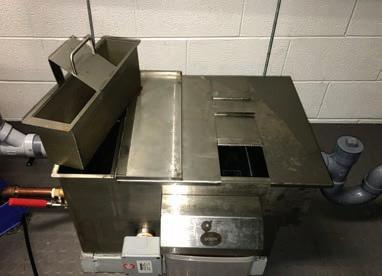
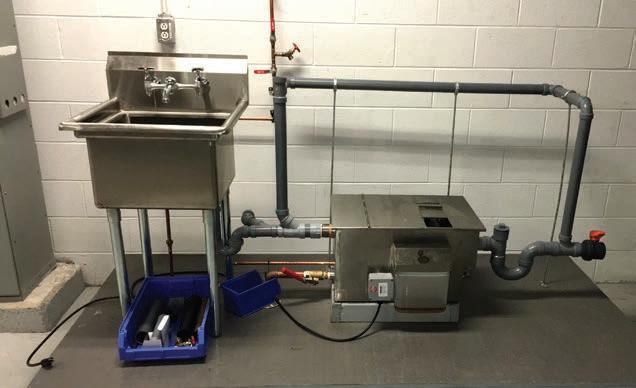
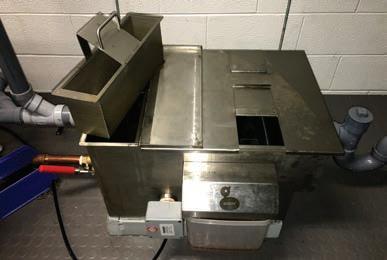
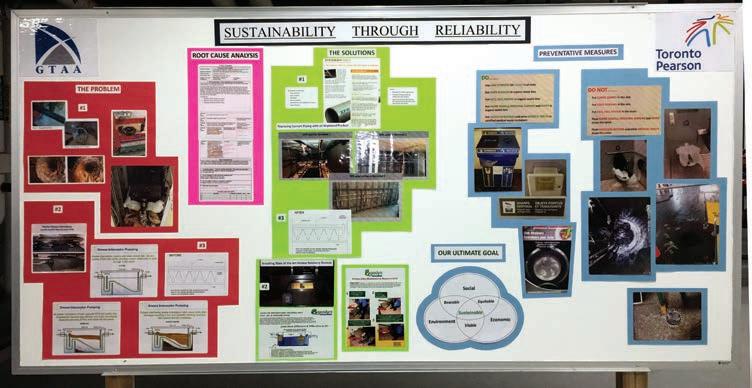
Before we get to how Walters won partner support on that score, let’s take a look at the new system. It has two parts, a strainer basket which catches organic matter and a small grease interceptor which channels grease and oils into an outer storage cassette. Restaurant workers in each establishment clean out the basket and the cassette when needed, emptying the contents into an organic waste bin or a sealed grease container. Since there is nothing stored in the unit, there is no odour. Walters is working (with the Toronto Pearson corporate sustainability and business group) towards a unified fat, oil and grease recovery/recycling program, and it may be that one central company will take away all the organic matter and grease for reuse in products like animal feed or bio-diesel.
“Selling” the new system
it’s there on demand.”
Face-to-face visits are also key. “I drop by different locations and inquire how the unit is functioning, and occasionally people have concerns and questions on what they need to do,” Walters says. “Since we’re changing the technology, it was important to us to take responsibility and educate tenants and their frontline staff.”
Walters used a multi-pronged approach to engage food establishment owners and workers. He requested that the grease interceptor manufacturer (Gosslyn) provide a unit so he could develop a working model and demonstrate the step-by-step maintenance required by kitchen staff in each establishment. Walters also created a poster board explaining the pain-points of the plumbing system and how the new system mitigates the problems. In addition, he felt it crucial to create a short training program with a simple take-away document outlining dos and don’ts.
“Managers book time and send their employees for training when they can, in twos or threes. We have to be flexible for them. Going forward, we are planning to make a video so that
Tenant design standards have been changed for new food establishments, and existing tenants will convert to new wastewater systems by the end of 2016 or early 2017. Meanwhile, maintenance crews are doing a phased replacement of old pipes with PVC. “Pressure jetting and drainage line maintenance won’t go away,” Walters notes, “but main drain lines will now be easily accessible through cleanouts in the floor spaces. The restaurants are spread out so we will complete the pipe replacement in phases as opportunity arises.” Most tenants will see a return on investment within about two years.
Maintenance time and costs associated with rectifying severe problems is being slashed steadily month-bymonth, but Walters is quick to point out the big picture benefits – that Toronto Pearson will be able to handle expected growth and continue to provide good passenger experiences. As with any change, it’s all about the people. “People are your biggest resource,” he says. “If they understand the underlying issues, you can collaborate and find the best solutions together.” MRO
Treena Hein is an award-winning freelance writer based in Pembroke, Ont. Reach her at treenahein@outlook.com.
FULL
Does your oil & lubrication program ensure your equipment is running at its best?
BY ALAN SUAN
ost plant managers ask themselves how they can extract every ounce of productivity from their equipment to ensure that the plant is as efficient, safe and profitable as possible.
The answer: Doing as much as you can to protect your equipment.
It is true that nearly all industrial operations already have formalized maintenance programs in place for their equipment. But these operations are becoming increasingly large and complex, utilizing dozens of different pieces of industrial equipment. Further, equipment technology is advancing at a rapid pace while energy efficiency regulations are becoming more stringent.
Simple maintenance approaches of the past, such as those designed around individual pieces of equipment or those that rely solely on guidance provided by equipment builders, no longer suffice. Similarly, approaches that only consider lubricant products and not associated technical services result in missed opportunities to maximize equipment efficiency.
And so, in this environment, plant managers must look at their maintenance approach and determine whether their
maintenance programs are robust enough to properly protect their equipment.
To help ensure that equipment is performing at its best, look beyond individual pieces of equipment and look toward the core productivity challenges facing the operation. Once one understands the problems that need to be solved, one can develop a tailored maintenance program that closes any existing productivity gaps and optimizes the performance of each piece of equipment.
This approach can help minimize unscheduled equipment downtime and enhance equipment performance, thus helping you better achieve your productivity, safety and environmental care goals.
Let’s take a closer look at how these end-to-end programs are developed. There are two key pillars of any successful maintenance program – high performance lubricant products and expert technical services. A best practice approach will bring these individual components together into a cohesive program that addresses the specific productivity gaps in an operation.
High performance lubricants
The first pillar of any successful maintenance strategy is selecting the right lubricants. Today’s advanced equipment requires high-performance lubricant technologies that can help protect machinery from extreme operating conditions often found in industrial operations.
While there is a wide range of lubricant technologies available to equipment owners, synthetic lubricants are ideally suited for most advanced equipment as they can offer significant advantages over conventional, mineral-based lubricants. Take, for example, hydraulic systems. Hydraulic equipment is often subject to pump wear, deposits, and varnish, and these challenges will prevent the systems from operating at their rated performance level, often resulting in decreased speed and pressure. But, utilizing premium or synthetic hydraulic oils can help address these challenges, as they have been prov-
Hydraulic systems can be prone to pump wear and deposits.
en to offer outstanding contamination control, exceptional wear protection, and cleanliness that lasts.
Similarly, malfunctioning ejector pins can cause parts to stick inside the mould, sending them to the scrap heap for regrinding. Poor hydraulic clamping pressure can have the same effect, but by converting operations to high quality grease, operators can potentially reduce ejector pin wear, reducing instances of quality loss.
Thus, understanding the benefits of various types of oils –particularly synthetic oils – can help deliver significant performance benefits for equipment. And to choose the right product, plant operators must consider the specific performance and productivity needs of their operation. The table below
Type of Synthetic Key Properties
Polyalphaolefins (PAOs)
Polyalkylene Glycol Oils (PAGs)
Esters
Silicone Base Oils
• Most common type of synthetic base oil
• Used in nearly every type of industrial equipment
• Miscible with mineral oils
• Exhibit good demulsibility properties
• Exhibit limited demulsibility with mineral oils
• Don’t form deposits as the oil breaks down
• Help with additive solubility
• Remain fluid at low temperatures due to a high viscosity index and low pour point
• Offer some of the highest levels of thermal and oxidative stability
• Used in high heat applications
• Chemically inert, making it difficult to blend additives into them and still have them remain in solution
outlines various types of synthetic oils and the distinguishing properties of each.
Note that it can often be helpful to work with a lubricant supplier to identify the best product mix for the operation.
Expert technical services
In addition to selecting the right products, plant operators must also take advantage of expert technical services to ensure that their equipment is performing at its best.
Services are sometimes underutilized in maintenance programs, but they are an important part of making sure the equipment is running well. For this reason, many leading lubricant suppliers offer a range of data-based services that can help operators improve the effectiveness of their lubrication programs.
For example, oil analysis programs – a more commonly used service – can help optimize equipment performance by providing the data needed to maximize the life of equipment and ensure that it is maintained properly.
However, more advanced oil analysis platforms can provide even more helpful insights, including reviews and documentation to validate used oil analysis results. They can also help
Many firms choose to outsource oil and lube maintenance and remediation.
explain and guide implementation of necessary remediation steps, ensuring customers fully understand the used oil analysis and can take proper actions to keep their operation safe and productive.
Finally, the most advanced used oil analysis platforms can help customers identify high-level trends not typically seen when viewing individual sample reports, with summaries that help customers understand the health of their equipment detailed by alarm, equipment type, products in use, application and operation.
These are just a few examples of services that can provide plant operators with a comprehensive, application-specific solution to address their productivity challenges and ensure that their efforts to boost productivity are continuously supported.
Building a maintenance plan to suit your needs
Selecting the right mix of products and services is critical to the success of any maintenance plan, but understanding how to build that plan based on your productivity gaps requires extensive application expertise.
Plant operators understand the specifics of their operation and its challenges better than anyone else, but to best understand equipment performance, it can often be helpful to work with maintenance partners such as lubricant suppliers, as they can provide invaluable insight into today’s equipment maintenance needs and help identify the tools to help support those needs. Sometimes, this insight comes from firsthand experience working with equipment builders.
In general, however, building an effective maintenance program that addresses the productivity gaps facing the entire operation involves four main steps:
1. Understand the business goals: The first step to developing a comprehensive lubrication program is to identify core business goals. For example, what are the safety, sustainability and productivity goals for the operation? How will their success be measured? What is the timeline to accomplish these goals? These are important questions to consider before designing
Self-tensioning ROSTA-motor mounts for friction belt drives
A lubricant supplier can provide firsthand insights and access to resources.
a maintenance program, as they will influence the tactics used in the final approach. Once the goals are set, one can develop a roadmap to achieve them.
2. Evaluate existing maintenance and lubrication practices to identify gaps: With the goals defined, the next step is to evaluate existing maintenance and lubrication practices. Often, the lubricant supplier’s insight can prove helpful here, as they will be able to provide the tools and resources needed to accurately evaluate existing practices, such as on-site inspections or used oil analysis platforms.
This process will enable one to identify any productivity gaps in the operation. For example, one can determine if the plant is experiencing more unscheduled downtime than it should be, or one can evaluate if equipment oil drain intervals are shorter than they should be. These insights will guide the next step in the process.
3. Develop an end-to-end maintenance program: After assessing the current state of the existing program, one should have the insights needed to develop a predictive maintenance program that closes existing productivity gaps and delivers optimal protection for the equipment.
Collaborating with a lubricant supplier is recommended for this step. As discussed previously, there is a wide range of tools and machinery involved in industrial operations, including compressors, pumps, gearboxes and generators.
The lubricant supplier has likely worked closely with Original Equipment Manufacturers (OEMs) on developing tailored lubrication strategies for each of those pieces of equipment. With that experience, they can help develop a plan that includes the best fit-for-purpose lubricant technologies and expert technical services that are needed to optimize the performance of all equipment within the operation. In sum, they can help greatly simplify an often complex issue.
4. Implement and monitor the tailored maintenance program: The final step is to implement the tailored maintenance plan. But, ensuring the plant operates at optimal productivity does not end with implementation alone. It is important to continually monitor the condition of equipment and the success of the maintenance program, using some of the technical services referenced above to ensure the equipment is performing at its best.
Developing an effective maintenance plan is an intensive process, but working with relevant partners – who have the appropriate application expertise – can help make this process simpler and more efficient.
Maintenance critical to profitability
The link between productivity and profitability has been well defined, and in today’s environment, when stakeholders are facing increasing costs and thinning margins, every gain in productivity is critical to ensuring success.
While proper maintenance strategies are already a core part of any industrial operation, their importance cannot be overlooked when it comes to advancing productivity. In fact, previous studies have demonstrated that in large operations, reducing maintenance expenditure by $1 million can impact profitability as much as increasing sales by $3 million.
As a result, it is imperative that plant operators dedicate the necessary resources and effort to optimize equipment performance. Taking a careful approach to developing a mainte -
nance plan – one that starts by identifying productivity gaps before considering equipment maintenance – is an effective way to optimize the productivity of the operation. And most importantly, plant operators should leverage as much application expertise as possible when developing their maintenance plan.
Utilizing this approach, plant operators can help mitigate the impact of industry challenges and optimize their operation’s performance to help achieve their productivity, safety and business goals. MRO
Alan Suan is industrial marketing advisor at ExxonMobil Fuels & Lubricants. For more information, visit www.mobilindustrial.com.
LUBE AUDIT
Perfect your lubrication plan in just two steps.
BY MIKE DECKERT AND GABRIEL LOPEZ
The unfortunate reality for most companies today is that the current in-plant lube program is not something that was proactively planned out and implemented. Instead, it was a piecemeal process, developed over many years over the life of the company through the addition of new equipment, processes and personnel. As a result, any number of problems can occur:
• A large inventory of multiple lubricants each specified for an individual application or piece of equipment.
• Loss of in-stock product and supplies (lubricant, grease guns, oil cans or fittings) due to improper handling.
• New machine warranties tied to using specific lubricants.
• Arrival of new machines that have different Automatic Lubrication Systems (ALS) already installed. They may work on a completely different operating
principle from those you currently use. For example, if you had a single-line parallel system, and you fitted it with a pump designed for a single-line progressive system, it wouldn’t work and you would lose bearings. Also, different systems require training and different spare parts in inventory.
• Implementation of an ALS that is different due to specific objectives or results required.
• Lubrication schedules may be known by key lube personnel but there is no one single location where all critical information is documented.
• No “ownership” of systems, equipment or processes due to lack of training, which ultimately means it doesn’t get done.
What are the objectives of a lube audit?
All hope is not lost for the maintenance professional, however. A lube audit can help,
whether it’s conducted for an entire plant, certain locations or processes within the plant or just on specific machines.
Step 1: Identify that there is in fact a need for an audit and the desired results or specific objectives for the audit.
Some of the objectives by which an audit can be measured include:
• Reduce the types/brands in stock – lower your MRO inventory investment, increase buyer power, reduce wastage and lubricant loss.
• Reduce items in stock – less shelf space and housekeeping required, easier handling of lubricants and movement of stock.
• Longer time intervals between lubricating – reduced opportunities for accidents, improved worker safety and increased production.
• Better quality of lubricant – prolonged intervals between re-lubrication, lower labour costs and less downtime.
• Identify areas where training is required – develop a more proactive form of maintenance, as opposed to reactive, and achieve longterm gain with increased production.
Step 2: Develop a scope of work that the lube audit should include.
The scope of work is defined by the objectives or benefits you identified in Step 1. Some tasks in the scope of work could be:
• Review all your lubricants and identify where, when and on what pieces of equipment they are used.
• Examine the lubricant handling procedures and inventory control system already in place.
• Review key production machinery with existing ALS.
PROTECT YOUR INVESTMENT
COUPLING PLATING
When hydraulic fittings rust, the base metal is eaten away by oxidation, eventually damaging the hydraulic system, contaminating fluids, compromising fittings and adjacent components, and creating leak paths.
72
If there is no ALS installed, review all the lube points and lube requirements for each piece of equipment.
• If there is an ALS installed, review all the related documentation, layout drawings and service manuals for the major components.
• Work with the key lubricators/personnel to review the processes, procedures and supporting documentation.
• Review all existing training
guidelines, processes or requirements and any related documentation.
• Work with key lubricators to determine potential service schedules (based on OEM recommendations and production schedules), and time allocations required to complete the lubrication tasks (safety consideration, equipment needed and is there guarding to be removed).
What results can you expect from a lube audit?
Time will be required to consolidate all the information received and to develop a comprehensive plan on what needs to be done – the larger the audit (plant versus specific machine) the more time generally required. Depending upon the objectives and the scope of work, results can include:
• Identify duplication of lu-
bricants and create a standardized procedure.
• Learn about the hidden costs of lubrication, such as storage, handling, improper lubrication, wastage and rush deliveries.
• Learn about potential safety and environmental issues, including spillage and lube disposal.
• Cost out return on investment (ROI) of automating some of the critical production equipment, that is, lubricating while the equipment is operating is a more efficient method with potential energy savings and increased production.
• Update manuals as required for your current lubrication methods, ALS and processes.
Can your CAD do this?
Automate the most time-consuming tasks of electrical engineering like wire-numbering, device-tagging, cross-referencing, and errorchecking, even prevent you from making errors?
Let you create and store unlimited simple, complex, even scalable macros with ease? And update them automatically?
Search more than 600,000 components from over 135 leading manufacturers to find the one you need in seconds, then create the data set for it?
With EPLAN Electric P8, the leader in electrical design automation, you can accomplish in a day what takes a week or more using CAD tools. Request your 30-day free trial at eplanusa.com
• Develop a customized plan of action listing the opportunities in a priority sequence.
The ultimate result would be a formalized, central lubrication program that would address every aspect of a successful lubrication process, such as safety, environmental conditions, energy usage, labour and productivity. This formal lubrication program would include training and would ensure consistency over the complete process, better access to information and increased ownership.
Simply stated, the clear benefit of going through the process of conducting an audit is that it moves your company closer towards implementing a proactive, fully integrated plan for reducing cost and improving productivity and safety. MRO
Mike Deckert is vice president and Gabriel Lopez is marketing specialist at FLO Components Ltd. Based in Mississauga, Ont., FLO Components is a lubrication systems specialist and supplier of Total Lube Solutions for major construction, road building, aggregate and mining companies and manufacturers in Ontario. For more information, visit www. flocomponents.com.
WHERE SAFETY WORKS
At Mark’s Commercial, safety is our business. You’ll get the right manufacturing workwear and safety gear sent to the right place at the right time.
In manufacturing, safety is paramount. Although you can’t always prevent accidents, you can minimize work-related injuries with CSA-approved hi-vis and flame resistant (FR) clothing and equipment. Mark’s Commercial provides head-to-toe industrial safety wear and PPE so you can protect your workers while maximizing their safety and performance.
Talk to us about setting up an uninterrupted supply of critical workwear and safety equipment for your crew. Corporate wholesale supply programs, online ordering, direct delivery and a dedicated Client Services Team make Mark’s Commercial the only wholesale workwear supplier you’ll need when safety matters most. Make safety work for you, visit markscommercial.ca
CHAINS DRIVE YOUR PROCESS
Every process has unique requirements that could make choosing the right chain a mission-critical exercise.
BY RAY HENSLEY
When manufacturers need to create a versatile high-speed process, they often use high quality attachment chain to move products along the line. Choosing the right chain and getting it fast can be critical; if the line stops due to a chain failure, so do profits and delivery schedules.
Attachment chain is used in many processes and diverse industries, including food and beverage, pharmaceutical, packaging, printing, lumber and plywood production. Each of these operations uses custom attachment chain that is engineered to meet the rigours of the specific industry and process. Custom attachments and pins can be configured to form the backbone of the process required.
Custom chain manufacturer, Renold Canada, provides many custom attachment options and capabilities, including bends, chamfered edges, grooves, mounted special rollers, pushers, support rollers, rocker arm attachments, serrations, stickers, supporting brackets, tabs featuring slopes and curves, wings and many other custom features. The chain manufacturer provides several custom pin options and capabilities, such as holes, shoulders and cut-ins, extensions and threading.
Many of these popular made-to-order custom attachment chains have no additional tooling costs as well:
• Single-Pitch Chain: Nos. 40, 50, 60, 80, and 100
The chain manufacturer often receives queries on what the lead-time is for custom attachment chain. Relative to other chain suppliers, the lead time for custom orders is reduced. Typical delivery time for “in-stock” chain from Europe is about 12 weeks. Some chain manufacturers have standard lead times for custom attachment chain that are eight to 12 weeks. That’s a long wait for a process you have to get up and rolling as soon as possible.
But since Renold manufactures attachment chain in North America, the chain is made, shipped and transported much faster, a customer can expect a four-week lead time on custom attachment chain orders. The company has the goal of delivering custom chain within two to three weeks by October 2016.
Operating Conditions
Another point to consider is the environment in which the chain will oper-
ate. Many processes with high moisture content during production can corrode a carbon steel chain in a few days. This will dramatically shorten the life of the chain and ultimately lead to a chain failure if not taken into account.
Renold Hydro-Service chains protect an operation in these corrosive environments. These strong, longlasting chains are mechanically treated and stand up to wet, humid and even saltwater operations. They last up to 30 times longer than conventionally coated chains without the risk of hydrogen embrittlement, and are as strong as conventional carbon steel chains. The Hydro-Service chains are also more economical as compared to stainless steel systems.
All components of Hydro-Service chains are mechanically treated prior to assembly. This provides complete coverage and protection to all vital surfaces, including the critical pin/bushing interface. Mechanical plating maintains the integrity of the chain without risking the embrittlement that conventional plating can cause. Unlike conventional zinc or nickel plating, Hydro-Service coating will not chip or peel under even the toughest conditions. Plus, Hydro-Service chain contains no hexavalent chromium, a known carcinogen.
Hydro-Service versus Nickel Plated and Carbon Steel
For many applications a self-lubricating chain makes more sense. In these cases a traditionally lubricated chain can harbour foreign materials within the lube or sling the lubricant during operation. This can contaminate or stain the end product, in creasing waste in the process.
Renold Syno chain sets a new bench mark for sanitary chain applications. Syno Chain is a maintenance-free, nickel-plated chain that provides uncompromised per formance with no additional lubrication required. Available in both small and large pitch sizes, it can run anywhere a standard chain can, which makes it suitable for a wide range of applications.
Syno Small Pitch is the chain you would choose for sanitary applications or when con tamination from lube must not occur. Both the captive lubricant (USDA H-1 approved) within the sintered bushing and the coating on the roller are food-industry approved so no additional lube is needed. And the nickel plating on the side plates won’t chip or peel, making it ideal for food production.
Syno Large Pitch is engineered for heavi er loads with a highly durable and wear-re sistant polymer developed specifically for Renold. A polymer sleeve between the pin and bushing, combined with a polymer roll er, allow it to operate completely lube free. And due to its proven impact resistance, load capabilities, and corrosion-resistant surface, Syno Large Pitch can stand up to almost any high-load environment like automotive
Many industries utilize self-lubricating Syno chain due to the nature of the products being produced. Here are a few of the most common applications:
Automobile Assembly: Vehicle panels and interiors are prime examples of assembly line products that must not be contaminated by lubrication.
Bottling: Chain used in bottling applications must cope with spillage. Corrosion resistance and lube considerations are key.
Food: Cleanliness is critical in all food processing environments.
Packaging: Since first impressions are paramount to product image, packaging must come off the line free of contamination.
Paper: Paper mills go to great lengths to ensure their output is protected from grease and dirt.
Sawmills: Lubrication attracts the grime and debris inherent in a sawmill, causing a dramatically shortened working life under such heavy loads.
Textiles: Chain lube can create stains on textile lines.
After 60 days in an unprotected outdoor environment, Renold Hydro-Service shows no signs of corrosion as compared to carbon steel and nickel plating.
After 14 days in and out of 5% saltwater solution (seawater), Hydro-Service clearly outlasts nickel plated and carbon steel chain.
assembly, steel mills, forestry, sawmills, paper mills, mixers and textile plants.
Syno chain also provides excellent wear and fatigue resistance, far outlasting other low-lube or no-lube chains. If your process must operate lube free but can’t compromise on performance, Syno chain can boost your productivity and reduce downtime. Whether your process dictates an attachment chain with a
Online
Online Ultrasound & Vibration Monitoring
Online4US is a modular system configured to meet your unique requirements.
• Premanently mounted sensors
• Real-time data collection
• Custom alarm levels
• Wired/Wireless communication
The ERP Challenge –
In the first of a series of articles, Peter Phillips walks readers through an ERP/MRP implementation at an international building material manufacturer.
BY PETER PHILLIPS
In the articles ahead I am going to write about a yearlong contract we were recently awarded. The project will lead a building material manufacturer, one of our international clients, from their current standalone CMMS to an ERP/ MRP system. Many companies are transitioning from their typical maintenance software to a more accounting-based system. Typically, these are medium to large companies that may have multiple sites over several physical locations. They have outgrown their CMMS to a point where they want everything in one software package – everything from maintenance costs, production planning, raw materials, employee hours and accounting practices in one giant database.
So what is an ERP or MRP?
An Enterprise Resource Planning (ERP) is a category of business-management software – typically a suite of integrated applications – that an organization can use to collect, store, manage and interpret data from many business activities, including product planning, purchasing, manufacturing or service delivery. Some ERP systems have an MRP module but it is possible to just use MRP software.
Material Requirements Planning (MRP) is a production planning, scheduling and inventory control system used to manage manufacturing processes. This also includes all the company’s maintenance activities, including inventory control, equipment tracking and preventive maintenance. The MRP can also be a component of an ERP.
Why move to an ERP or MRP system?
Because every company is unique, there’s no single indicator that says, “You need ERP or MRP now!” However, companies that would benefit most from ERP software often face similar problems and frustrations. Following are the top five signs that a company is ready for ERP or MRP.
Part 1
1. Your company has lots of different software for different processes
When various front- and back-end systems run separately, it can wreak havoc on the processes that are meant to ensure the company is running smoothly. Without accurate data from sales, inventory management may suffer, while not having the latest information from accounting can trigger a ripple effect on everything from marketing budgets to payroll. ERP software integrates these systems so that every business function relies on a single database. With one source of information that contains accurate, real-time data, an ERP solution breaks up information logjams, helps staff make better decisions more quickly and frees up their time to work on more high-value exercises, such as helping the business grow even faster.
2. You don’t have easy access to information about your business
The pace of business is faster than ever before, which means employees across the company need immediate access to key data. With an ERP solution, executives can get a holistic view of business operations at any time, while other staff can get the information they need to do their jobs more effectively. For example, sales representatives should be able to view a customer’s full transaction history and more proactively improve renewal rates while increasing upsell and cross-sell opportunities.
3. Accounting takes longer and is more difficult
With all financials in a single database, accounting staff won’t have to spend hours cross-posting information, rekeying numbers or reconciling data manually. Accounting staff will be more productive, freeing them to deliver critical reports without delays and frustration.
Eaton’s Diamond Advantage hydraulic hose series is engineered to optimize pressure, temperature and abrasion while maintaining hose flexibility, fluid compatibility and ease of hose assembly. Pairing Eaton’s Diamond Advantage hoses with over 550 Eaton Z-Series hose fittings make it an excellent choice for your engineered hose assembly needs.
And, you can find Eaton Diamond Advantage hydraulic hoses at your local Motion Canada location. Our local sales and service specialists are experts in application and technical support, providing the parts and the know-how you need to stay up and running.
4. Sales and the customer experience are suffering
With an ERP system staff in every department will have access to the same, up-to-the-minute information. Customer -facing reps should be able to answer customers’ questions about order and shipping status, payment status, service issues, etc., without having to hang up the phone and check with another department.
5. Your IT is too complex and time-consuming
One of the biggest downsides of having multiple systems across your business is that IT management can become a nightmare. Customizing these systems, integrating them and maintaining them with patches and upgrades can be complex, costly and sap critical time and resources. Rather than adding more software – and complexity – to an already ineffective system, ERP technology can give you the agility to respond to changing business needs rapidly.
Systems overhaul
Over the next few months this column will be dedicated to following the steps that the company will take to transition from their current maintenance software to their new ERP. Some basic groundwork was set several months ago. The implementation will be done in phases and the Go Live date is spring 2017. The 26 plants will have many months of pre-work to do before that date arrives. Every plant will need to develop a specific plan for their site and identify the resources they will need for each phase. Plant project co-ordinators will need to be selected and trained. In many cases they will need to be released from their current responsibilities and people will
need to be trained and even hired to fill their old positions.
To say the least, there is much to do and corporate teams will need to develop and deliver a great deal of information to the plants in order to guide them successfully through the phases of implementation. The plans will need to be very detailed so every plant understands what they must do to prepare inventory, equipment and preventive maintenance data and documents.
Work packages
We will take on the role of Project Lead for six plants in Canada. We will be fully engaged in the design of the work packages for the plants and assisting them to prepare the data. We will also be involved in the design of the ERP maintenance module to ensure it fulfills the needs of their current maintenance practices and programs.
Several divisions of the company have already gone live with the software. We are currently visiting these plants and learning from their challenges and how we can address or even circumvent those issues in our implementation.
The sheer magnitude of this project will be overwhelming unless every plant has a strong team that follows the work packages and dedicate the resources to meet the deadline for every phase. The plant teams will need to stay focused on their plan and manage the many vendors and manufacturers that will be providing assistance to provide information on maintenance parts and equipment preventive maintenance specifications.
Maintenance data
We have had several organizational planning meetings in the past few weeks to prepare the plants for the work ahead and to assess their current state and to identify gaps at every plant. We have analyzed their current CMMS to determine if the data is in a suitable format to be used in the implementation process. To date only a couple of the plants can use their maintenance data from the current CMMS. Other plants will need to reformat their data for the ERP. Every plant will have their unique challenges and we will need to be ready to help them solve their issues.
Our gap analysis, when complete, will identify the needs of every plant from which we will create a specific plan to ensure a successful journey through the implementation phases.
Direct communication
Our work packages will be presented directly to the plants’ ERP teams. We will not be delivering them through emails and phone calls. We do not want any miscommunication. We want everyone to understand and have the opportunity to ask questions about the work packages. We want them to know what is expected from them and the deadlines they must meet.
In upcoming articles we will lead readers through each phase of the implementation process. Follow the process and learn as we learn.
Hopefully, our documentation of the process will help your company should you decide to upgrade from your current system to an ERP or MRP. MRO
Phillips of Trailwalk Holdings, a Nova Scotia-based maintenance consulting and training company, can be reached at 902-798-3601 or by email at peter@trailwalk.ca.
ROLLING ELEMENT BEARINGS FLUID POWER &
BY DOUGLAS MARTIN
There are a number of ways that rolling element bearings and fluid power are related. Fluid power is used for installation of rolling bearings, removal of rolling bearings and lubrication of rolling bearings.
In many cases, the oil used in a hydraulic system is also used as a bearing lubricant. As a general rule, the needs of the hydraulic system are more stringent than the needs of the bearing. One case of interest is when the (lack of) health of the hydraulic system’s oil causes bearing failure, not from a bearing lubrication issue, but rather that the preload that was supposed to be applied to the bearing by the hydraulic system was not applied due to failure of hydraulic valves from dirt in the hydraulic oil.
Bearing removal
The removal of bearings from their seating is a timesaver for maintenance departments. There are two classes of bearing seats – tapered and straight. For straight bearing seats (shaft and housing), pre-drilled channels and passages allow one to apply a film of oil under high pressure, between the bearing surface and its seat. This high-pressure film, expands or compresses the bearing ring and eliminates the interference between the two surfaces, allowing a lower force to be used to axially pull or push the surfaces apart.
But what is required for this? The shaft and housing have to have these hydraulic passages designed into the equipment when it is originally designed and manufactured. This can be a problem as it means a greater expense to the original equipment when it is made. While the cost of the piece of equipment, when new, generally comes from the capital budget of the project, the cost savings made from the quick bearing removal of the bearing comes from the maintenance or operating budget. So as a
general rule, the features required for quick hydraulic removal on a straight fit are not found in most machines as the extra cost is often vetoed at the time of the project build.
Standard features
However, some traditional industries have established that these features provide enough benefit that they are “standard” features. As an example, the rolls and housings of many paper machines have hydraulic removal features on their rolls, shells and journals. Since these rolls are designed to be re-covered on a regular basis, these features have become a “standard” feature in a roll or shell design to allow the bearings to be easily removed and reused.
For bearings with tapered bearing bores, the tapered journal or tapered sleeve can have the hydraulic channels included. By applying hydraulic pressure, the bearings will essentially “pop” off the shaft. As noted for straight shafts, tapered journal shafts are most often associated with paper making and are expected in their designs.
Adapter sleeves
In terms of hydraulic features on adapter sleeves, the additional cost of the hydraulic sleeves are about four times the cost and, as noted above, this cost does not represent a return on investment in the capital budget and therefore they are not selected on the original design.
Withdrawal sleeves
A hydraulic nut is essentially an annular hydraulic piston that pulls the sleeve from under the bearing. The downside to withdrawal sleeve is that it generally requires a more complex shaft design than with an adapter sleeve (extra capital cost). The tools used to install the bearing are also different than the tools used to install the bearings, which is an additional cost.
Hydraulic nuts
For installation, hydraulics are most often used with hydraulic nuts. A hydraulic nut is essentially an annular piston. The hydraulic pressure is used to push the bearing up a set distance to achieve an interference fit. That distance is measured either by the measurement of the change of clearance (how much you have stretched the inner ring) or how much you have pushed it up a set taper angle.
For tapered bore bearings over about 100mm (4"), the only effective manner to install a bearing is with a hydraulic nut.
Withdrawal sleeves, in which the sleeve is pulled from underneath the bearing for removal, a hydraulic nut can be used.
Within the past few years, hydraulics have also been used to more accurately install bearings. A low hydraulic pressure is applied to the bearing with a tapered bore to establish a starting point for drive up. Once this “known” starting point is established, hydraulic pressure is used to drive the bearing up a specific distance, applying a more accurate interference than the traditional drive up or clearance reduction method.
Fluid power can play an important role in the installation and removal of bearings. The use of fluid power can save significant time in the installation and removal of bearings. In addition, it can avoid the dangers of open flame and sparks that often require additional work permits to a job. With the use of the correct fluid power equipment, time and money can be saved. MRO
Douglas Martin is a heavy-duty machinery engineer based in Vancouver. He specializes in the design of rotating equipment, failure analysis and lubrication. Reach him by email at mro.whats.up.doug@gmail.com.
TB Wood’s new Sure-Flex® Plus elastomeric sleeves provide higher performance and enhanced durability due to recent improvements in its proprietary EPDM and Neoprene materials. With a 30% torque rating increase, Sure-Flex Plus sleeves allow many applications to use a smaller size coupling, while providing a more rugged replacement sleeve for couplings currently in service.
And, you can find TB Wood’s Sure-Flex Plus elastomeric sleeves at your local Motion Canada location. Our local sales and service specialists are experts in application and technical support, providing the parts and the know-how you need to stay up and running.
What’s new in fluid power
Up to two times better wear
protection
Petro-Canada Lubricants has reformulated its Hydrex line of hydraulic fluids. Engineered on a foundation of ultra-pure, high Viscosity Index base oils, Hydrex is able to respond to extreme operating conditions to generate hydraulic pump and system efficiencies. This results in highly responsive performance, with field trials demonstrating 5 per cent fuel savings in mobile equipment when compared against leading North American monograde hydraulic fluids. lubricants.petro-canada.com
Hydraulic motion control
The new Hydraulic Motion Control HMC from Rexroth offers decentralized intelligence by using open communications interfaces and a migration from hydraulic functions into the software. The future-proof 1-axis controller for hydraulic drives with multi-Ethernet and multi-encoder interfaces as well as PLC programming in accordance with IEC 61131-3 dovetails a wide variety of concepts. The HMC’s multi Ethernet interface supports all standard protocols on one single piece of hardware: the automation bus Sercos, Ethernet/IP, PROFINET RT as well as EtherCAT and PROFIBUS. The HMC merges an IEC 61131-3-compliant programming language with a powerful motion control for hydraulic drives. www.boschrexroth.com
High-capacity hydraulic gantry
Enerpac’s SBL900 hydraulic gantry is a folding boom hydraulic gantry that is equipped with two-stage lifting cylinders. The SBL900 lifts up to 37 feet and can handle up to 667 tons at the top of the second stage. Designed to meet stringent safety requirements, the SBL900 complies with the safety standards set by ASME B30.1-2015. To ensure quality performance, each gantry is tested to 120 per cent of capacity at full extension and witness tested by a qualified third party organization. The SBL900 is also CE compliant.
enerpac.com
Groundbreaking pneumatic breaker
Atlas Copco’s RTEX pneumatic breaker offers a cost-effective solution for demolition projects. The RTEX requires just 37 cfm to operate, about 50 per cent less air energy than conventional breakers in the same weight class. The RTEX has the breaking capacity of a 66-pound breaker or greater, but weighs only 55 pounds. Minimal vibrations minimize stress on internal components, which means fewer spare parts replacements.
www.atlascopco.us
LUBRICATION
PERMA AUTOMATIC LUBRICATORS PRE-FILLED
Perma automatic lubricators provide clean, safe, reliable and consistent machinery lubrication every day around the clock. They are fully programmable and deliver the right amount of lubricant consistently, day after day, week after week. A wide range of types and sizes are available to meet your exact needs. All come ready to install pre-filled, available with a wide variety of Lubriplate Quality Greases and Oils. They save time, lower maintenance costs and improve workplace safety.
Permas Prevent Breakdowns & Downtime
• They Provide Consistent Lubrication To Critical Machine Components. Permas Are
Victaulic’s Series 795 Knife Gate Valve is the first inline maintenance knife gate valve in the industry. This valve is ideal for fluid lines containing solids or abrasive materials common in wastewater treatment and hydroelectric power generation, and other applications such as lines for slurry and tailings or cyclones. It alleviates a longstanding industry pain point: the labour-intensive process of removing the entire valve from the pipeline to facilitate maintenance and repair.
www.victaulic.com
At Atlas Copco we tailor our warranties to meet your needs, from the Air end and main motor to the entire unit itself for the next 5 years, 10 years or as long as you own your unit.
For more information about the industry’s leading warranty, please contact us at 1-855-462-8537 or email us: compressors.canada@ca.atlascopco.com Atlas Copco Compressor Canada
Hydra-Cell D10 sealless pumps
Wanner Engineering, Inc. has upgraded its Hydra-Cell D10 Series seal-less pumps. Previously rated at 1,000 psi (69 bar) maximum discharge pressure, the new models with metallic pump heads can operate at up to 1,500 psi (103 bar) discharge pressure. The seal-less design of HydraCell D10 pumps means that there are no mechanical seals, cups, or packing to leak, wear or replace.
www.Hydra-Cell.com
Spool valves with high flow rates
Asco has introduced its Asco 362 and 562 series of brass and stainless steel spool valves in ¾-inch and 1-inch sizes featuring the industry’s highest flow rates. Using ASCO’s proven solenoid technology, these new sizes provide new solutions for control valve automation in the oil and gas markets.
www.asco.com
The Plant Engineering & Maintenance Association of Canada invites you to its national conference - MainTrain
Find sustainable, effective and evolving maintenance, reliability and asset management strategies for your organization at PEMAC’s 18th MainTrain conference.
• Great source of world class development and networking for professionals in every industry, both public and private sectors, that invest capital in equipment and facilities.
• Learn from leading experts from across Canada and around the world with over 40 workshops, sessions and offsite tours to select from.
Guest speakers include: Ramesh Gulati, author of Maintenance and Reliability Best Practices
Cliff Williams, author of People: A Reliability Success Story
James Reyes-Picknell author of Uptime - Strategies for Excellence in Maintenance Management (3rd Edition)
Variable speed control
American Control Electronics (ACE) introduces the DCR Series, a lowvoltage, four-quadrant drive that provides control of PMDC motors in a variety of applications. The DCR series is able to maintain variable speed control while batteries discharge, delivering an increased run time for battery-powered devices. A wide power range – 1/100 HP to 7.5 HP – makes the DCR Series ideal for mobile equipment and linear actuators. www.americancontrolelectronics.com
Laser shaft alignment tool
All rotating machinery are susceptible to misalignment. Laser shaft alignment is both the quickest and the most precise way to ensure that a pump and drive motor are properly aligned. Don’t feed bearings, seals and excess energy into your pumps: use a laser alignment tool such as the Fluke 830 for fast, accurate and actionable results. www.fluke.com
Heavyduty shaftmounted gearboxes
Renold Gears’ SMX range of heavy-duty shaft-mounted gearboxes are perfect for arduous applications in mines and quarries and are available off the shelf as part of the company’s Rapid Response service. The SMX gearboxes are manufactured with hardened and profile-ground helical gears for maximum power transmission. High capacity, heavy-duty roller bearings ensure problem-free operation and maximum load carrying capacity for heavy duty, arduous applications. Gearbox casings are manufactured from close grain cast iron for robust strength and quiet, vibration free operation.
www.renold.com
EPLAN data portal
The EPLAN Data Portal is a fast and easily searchable, cloud-based platform, accessible from within EPLAN engineering software, via a web browser or the EPLAN Data Portal App. Users are provided with real-time access to valuable parts and device data. The data sets for these components are validated and presented in a standardized format, so users can drag and drop them from a portal search right into EPLAN programs, automatically creating master data sets.
www.eplanusa.com
Reversible hard jaws
Reversible hard jaws from Dillon Manufacturing, Inc., which are suitable for ID and OD workholding, are manufactured of 8620 steel, case hardened, with ground locating surfaces, and black oxide coated for corrosion resistance. The jaws are available in serrated, Acme Key, square key, and tongue-and-groove styles to fit all brands of chucks.
www.dillonmfg.com
Compaction system
Atlas Copco’s easy-to-use intelligent compaction system gives contractors real-time material stiffness readings to ensure superior soil and asphalt compaction. Dyn@Lyzer uses a global navigation satellite system, such as GPS, to track the number of completed passes and the precise position of the roller at all times. The unit’s drummounted accelerometer measures the surface’s relative material stiffness and uses Evib readings to give operators immediate material stiffness results from within the cab.
www.atlascopco.us
Thermal Multimeter
Fluke’s 279 FC TRMS Thermal Multimeter is the first test tool to integrate a full-featured true RMS (TRMS) digital multimeter (DMM) with a thermal camera in one device to speed troubleshooting. The 279 FC allows technicians to quickly and safely check for hot spots in fuses, wires, insulators, connectors, splices and switches with the imager and then troubleshoot and analyze issues with the DMM. www.fluke.com
Crane scale
The Alliance/CAS IE Series Crane Scale is a fully portable, selfcontained crane scale and has a sturdy aluminum die-cast case, rugged hooks and shackles and operates up to 50 hours on a 9V battery. Available from Alliance Scale, Inc., this versatile crane scale features a wireless remote control and easy to read 1.1” 5-digit LCD or LED displays. www.alliancescale.com
Is systems integration the key to long-term planning?
If interconnecting things, services and people via the Internet improves data analysis, boosts productivity, enhances reliability, saves energy and costs and generates new revenue opportunities, then the answer is a resounding, yes, according to a global survey of leading utilities.
More than 200 executives at electricity, gas and water utilities increasingly believe that information technology (IT) and operational technology (OT) integration is a key component of any effective asset management strategy. Some 80 per cent held IT-OT integration for asset management as valuable, while 58 per cent of respondents either have, or are planning to have, a strategy leveraging the Internet of Things (IoT) for asset management and 55 per cent reported the importance of asset management has increased over the past 12 months.
The findings, published in a report, “Bridging IT and OT for the Connected Asset Lifecycle Management Era,” was conducted by ABB, in collaboration with Microsoft Corp. and market research firm Zpryme.
Source: www.abb.ca
Futureproof skills
Advances in technology are rapidly reshaping the world of work. The World Economic Forum warns that artificial intelligence, machine-learning, robotics, biotechnology, nanotechnology and 3-D printing are just a few advancements that will cause widespread disruption to business models and labour markets over the next five years. In its report, The Future of Jobs, the WEF says that we can expect a net loss of over 5 million jobs in 15 major developed and emerging economies by 2020. The WEF estimates that 7.1 million jobs could be lost through redundancy, automation or disintermediation, while the creation of 2.1 million new jobs, mainly in computing, math, architecture and engineering, could partially offset some of the losses. Without significant re- and upskilling, workers in lower-skilled roles, such as office, administrative, manufacturing and production, are especially at risk for redundancy.
Source: Future of Jobs Report, World Economic Forum. Download the whitepaper at www.pemac.org.
Mr. 0, The Practical Problem Solver
Scheduling is a great first step
Planning describes what, scheduling describes when. Scheduling is dependent on planning for success but you can schedule with minimal plans. High schedule success (compliance) gives operations confidence in your ability to deliver work as promised. If operations uses a lot of emergency or urgent work priorities, then confidence is low because you’ve failed to deliver on past schedules.
To fix this, you need to know how long jobs will take, who is needed and that equipment will be available. Building the schedule with this information in mind will start a virtuous cycle leading to improved performance and credibility.
Dedicate part of your workforce to genuine emergencies. How much depends on how much emergency work you truly have, not on job priorities. For the rest of your crews, schedule 100 per cent of their time. Assign “best guess” estimates of duration and always include PM work on the schedule. Publish your schedule and track how much gets done weekly. Do it visually – check off completed jobs so everyone in shops and operations can see. Those checks show schedule success.
Your crews will want to improve their success (more green checkmarks) now that you are measuring. It will begin to improve. As PMs get done, failures drop. As planning improves, so do schedules. Gradually move workers from emergency crews to scheduled work. Operations will notice progress and failures dropping – credibility improves. Gradually you can enforce work priority assignment, work crews will be better utilized and emergency work will be down.
James Reyes-Picknell is the president and co-founder of Conscious Asset, specializing in the management of maintenance and physical assets, and the author of Uptime: Strategies for Excellence in Maintenance Management (CRC Press, 2015). Contact him at james@consciousasset.com or visit www.consciousasset.com
Photo:
From farm to table...
Whether your equipment is in the field or factory, you need the right bearings to keep things moving
NTN has the perfect bearing for every application in agriculture and food processing
Thanks to superfinished raceway surfaces that ensure smooth, uniform running characteristics, maximum load capacity and superior rigidity, the operating life of Schaeffler’s X-life bearings is considerably longer than standard bearings under identical operating conditions. Alternatively, higher loads can be applied while maintaining the same rating life values.
Need more details?
Contact a Schaeffler design engineer at 803-548-8552 or info.ca@schaeffler.com www.schaeffler.ca