Tim Dimopoulos, Vice-President Annex Business Media tdimopoulos@canadianmanufacturing.com
Mike Fredericks, President & CEO Annex Business Media
Machinery & Equipment MRO is published by Annex Business Media Inc., 80 Valleybrook Dr., Toronto, ON Canada M3B 2S9; Tel. 416-442-5600, Fax 416-510-5140. Toll-free: 1-800-268-7742 in Canada, 1-800-387-0273 in the USA.
Subscription rates. Canada: 1 year $61.50, 2 years $97.95. United States: 1 year $105. Elsewhere: 1 year $120. Single copies $10 (Canada), $16.50 (U.S.), $21.50 (other). Add applicable taxes to all rates. On occasion, our subscription list is made available to organizations whose products or services may be of interest to our readers. If you would prefer not to receive such information, please contact us via one of the following methods – phone: 1-800-668-2374, e-mail: privacyofficer@businessinformationgroup.ca, fax: 416-442-2191, mail to Privacy Officer, 80 Valleybrook Dr., Toronto, ON Canada M3B 2S9.
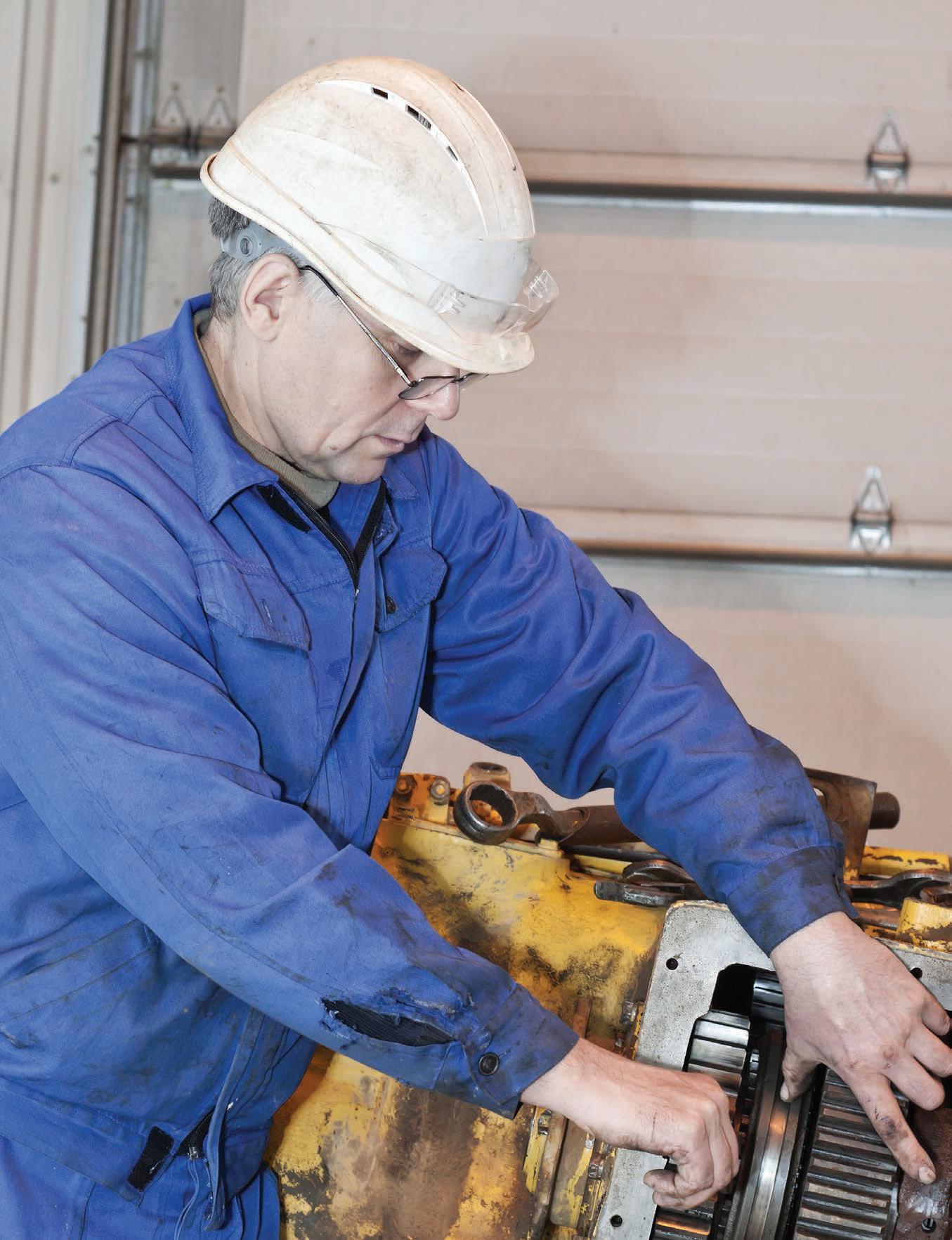
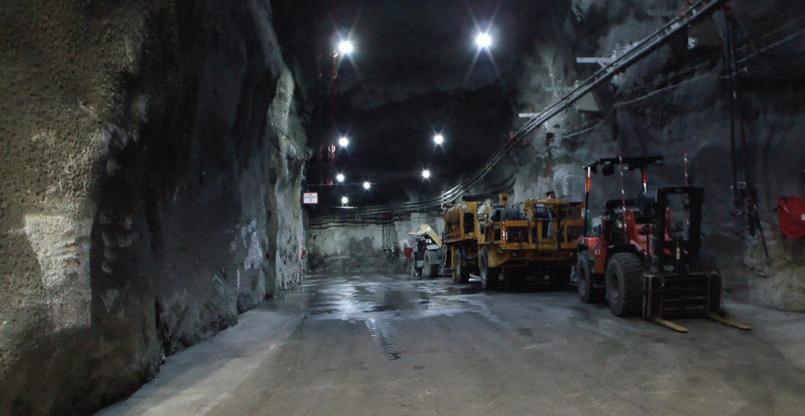
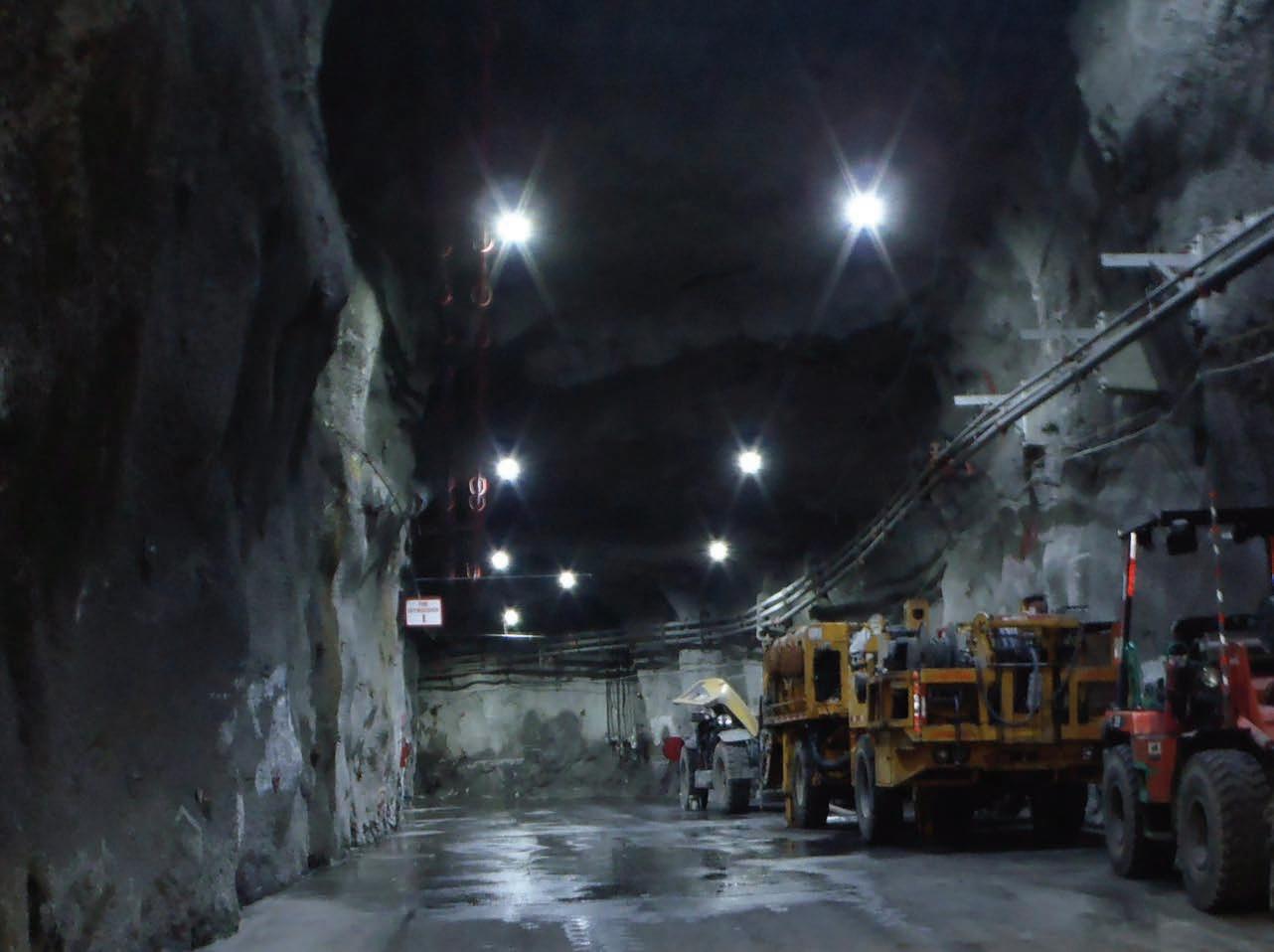
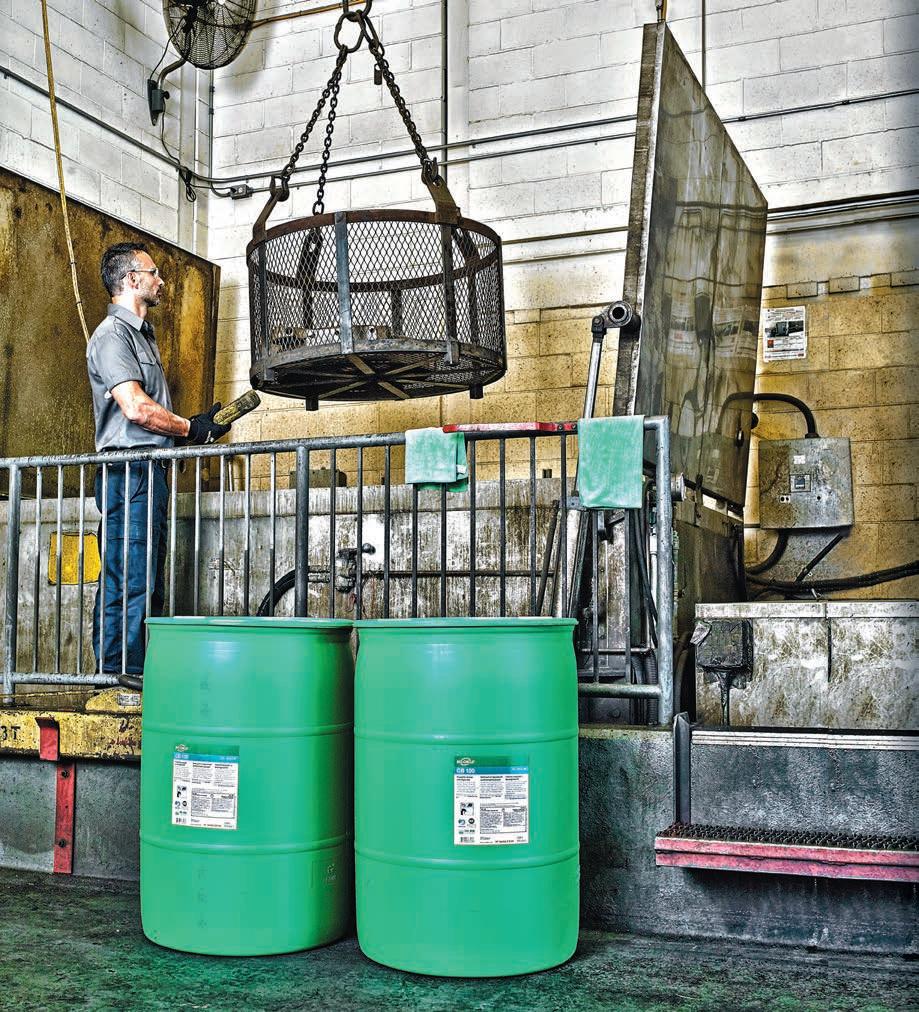
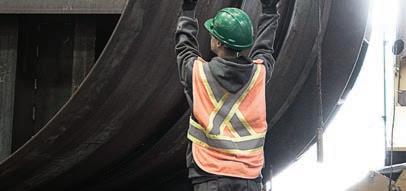
Several years ago I visited Glencore’s Nickel Rim South mine in Sudbury, Ont. The image used to illustrate our cleaning and degreasing story, “Squeaky Clean,” on page 12, is a memento of my visit and depicts the mine’s wash bay, located 1,480 metres below the surface.
The wash bay is part of a US$10.3-million world-class underground maintenance stope that was ergonomically designed by taking maintenance tasks into account.
Since the mine’s defined lifecycle is around 2022, the maintenance team is tasked with getting the most out of its fleet. Underground loaders, underground articulated trucks, backhoe loaders, scoop trams, boom trucks, scissor-lift trucks, shotcrete haulers, motor graders and telehandlers are only a partial list of the mobile fleet used to produce the mine’s primary metals – nickel and copper. Weighing the cost of maintenance against changing out equipment, depreciation and reliability is an integral part of the job.
This is where I learned to take mobile maintenance seriously.
The focus on safety and a culture that supports proactive maintenance is immediately evident. In the workshop, workbenches were eliminated and the space is kitted instead with service pits, drive-on ramps and a crane that hangs from the back of the shop to keep the floor area clean. Hand tools are stored in a designated area to eliminate the need for each mechanic to have his own toolbox. The introduction of a formal tracking process has spawned a habit whereby tradesmen cut open filters to examine the contents, fluids are routinely analyzed and component life is monitored.
While the reliability, safety and financial benefits are incontrovertible, the ingenuity that their maintenance and operations teams demonstrate in a harsh environment is remarkable.
Their challenge to benefit from new possibilities is made clear in following example: The walls of the Nickel Rim South mine are reinforced with shotcrete. As a result, sludge or residue may leech into components, which in turn affects the lifespan of equipment. Radiators, for instance, should run for about 4,000 hours according to the manufacturer’s projected lifecycle. However, mine planners at the site found that the radiators failed at about 1,000 hours.
The maintenance team had a simple solution: keep the radiators clean. According to the maintenance foreman, they sourced a baking soda wash for cleaning heavy-duty industrial equipment. Radiator component life now runs to over 8,000 hours. He further estimated that with each shift that LHD (load-hauldump) is down, the site loses $35,000 in deferred revenue.
If parts degreasing and surface cleaning still seem like mundane tasks, challenge your team to document efficiencies and calculate gains.
Meanwhile, encourage them to read our cover story. Contributor Jeff Smith scrapes beneath the surface to demonstrate that an alarming amount of equipment is impacted when we underestimate the significance of the cleaning task. Along the way, you’ll pick up practical tips for getting things done the right way.
Rehana Begg Editor
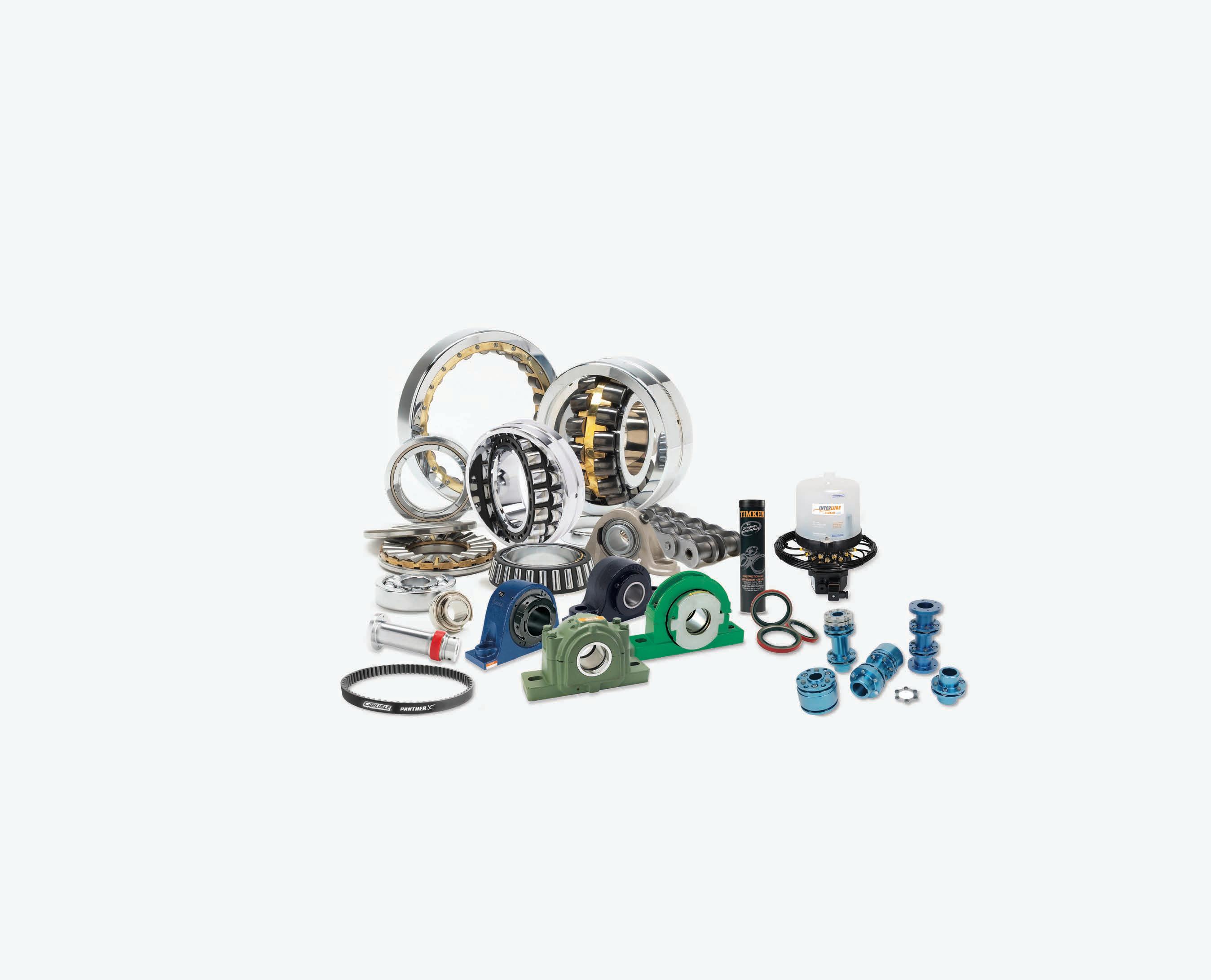
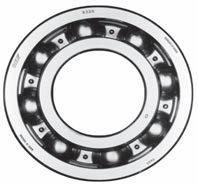
Extending the Bearing Life Cycle
Help your bearings and machines achieve maximum service life
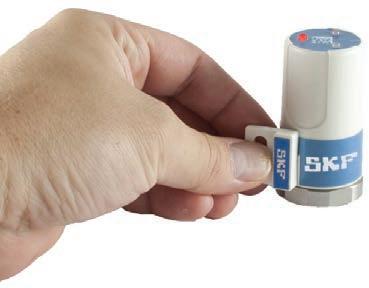
» SKF Machine Condition Indicator
This is a robust, battery-powered machine vibration/temperature monitoring device that reliably warns about impending machine failures, without the need for expensive hard wiring and electrical power supply.
goo.gl/dHD18U
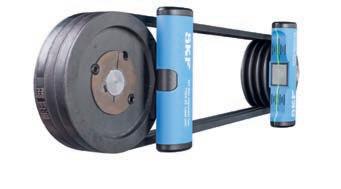
» SKF Belt Alignment Tools TKBA series
Belt–driven machinery downtime caused by misalignment is a thing of the past .
The series allows pulleys and sprockets to be aligned on the side face. The unit magnetically attaches to the inside or outside face of almost any belt pulley or chain sprocket and has no small parts or targets that can get lost.
goo.gl/ogWG6U
Talk to your SKF
Authorized Distributor for more details and pricing.
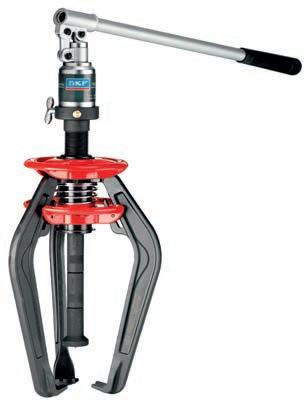
» SKF EasyPull mechanical puller TMMA series
Equipped with spring-operated arms and a solid design, the patented SKF EasyPull is one of the most user-friendly and safe tools on the market.
Ergonomically designed, the spring-operated arms enable the user to position the puller behind the component with just one movement.
goo.gl/2zzfEP
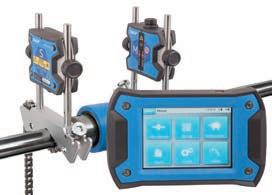
» Shaft Alignment Tool TKSA Series
The TKSA Series are easy to use laser alignment solutions for achieving accurate shaft alignments. With two wireless measurement units, large sized detectors and powerful lasers, the instrument performs in even the most challenging conditions.
goo.gl/zw7223
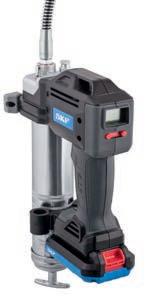
» New! Battery driven grease gun TLGB 20 TLGB 20 includes an integrated grease meter to help prevent over- and under-lubrication. This unique tool features a durable, ergonomic design with a threepoint stand for operator comfort and convenience and a 20-volt, lithium-ion battery.
goo.gl/AOWzgs
By applying the right maintenance practices and using the correct tools in all stages of the bearing life cycle, you can considerably extend your bearing’s service life and thereby increase plant productivity and efficiency.
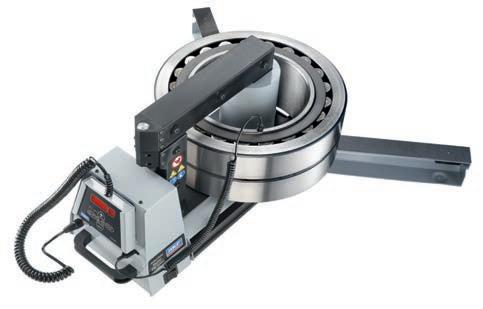
» Portable Induction Heater TIH030m
The heater combines high heating capacity with portability. Placing the induction coil outside the heater’s housing allows the heating of bearings weighing up to 40 kg. The heater is available in a variety of sizes.
goo.gl/TOSupQ
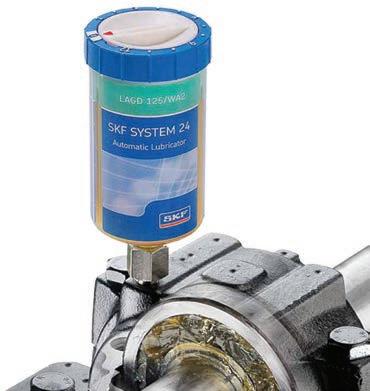
» SKF SYSTEM 24 Single Point Automatic Lubrication
Continuously delivers precisely measured amounts of lubricant to desired points via a gas-driven pump. It is ideal for lubrication points difficult to reach manually, or where there are a large number of lubrication points where manual greasing would be less effective.
goo.gl/1gpzZZ
COVER STORY – Squeaky Clean
Contributor Jeff Smith explores common mistakes and good practices, as well as how to leverage your cleaning program to optimize asset inspections.
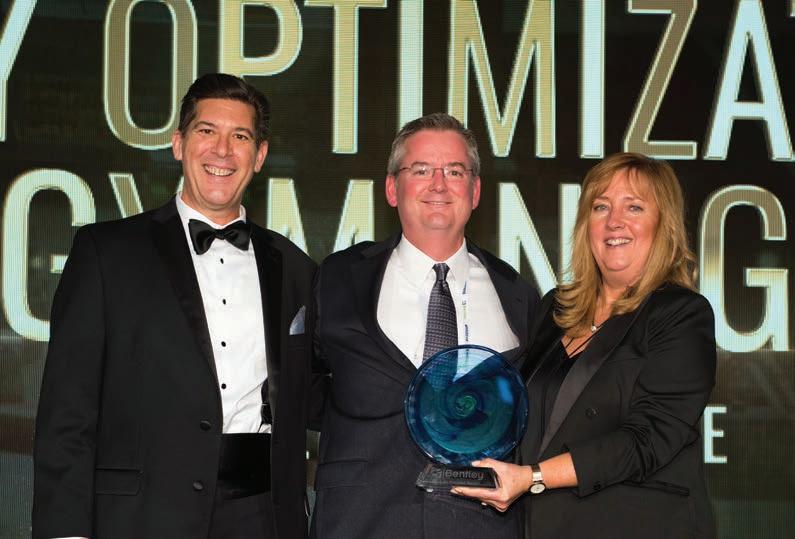
Danfoss wins innovation in asset performance award
Danfoss, a leading manufacturer of high-efficiency components and controls for air-conditioning, heating, refrigeration, industrial and water systems, has been named a winner in the 2016 Be Inspired Awards for its Danfoss Enterprise Services platform. Bentley Systems, a leading global provider of comprehensive software solutions for advancing infrastructure, hosted its annual Be Inspired Awards to honour the extraordinary work of Bentley users advancing infrastructure design, construction and operations throughout the world.
Awarded for “Innovation in Asset Performance,” Danfoss Enterprise Services is a cloud-based service delivery platform tailored to supermarket and other food-retail applications that collects a range of data points from connected devices to provide powerful insight into nearly every aspect of HVACR operations, energy management and food safety.
Danfoss Enterprise Services provides real-time, actionable information to monitor equipment alarms, compressor
status, refrigerant levels and leaks and food temperatures.
The 18 Be Inspired Award winners were named during Bentley’s Year in Infrastructure 2016 Conference in London. Winners were chosen by an indepen-
HIGH-PRECISION COMPONENTS MANUFACTURER STEPS UP COST REDUCTION MEASURES
As a result of a continued weak economic market environment and of the unsatisfactory business results achieved by Schaeffler AG’s industrial division in the first nine months of 2016, the global integrated automotive and industrial supplier has decided to step up efficiency improvement measures in order to revitalize its industrial business.
Having completed most of the cost reduction measures of the first wave of program CORE with a focus on Germany, a second wave of measures is being initiated which will also cover the regions outside of Germany as well as functional areas not directly part of the Industrial division.
The target of the additional measures is to further implement leaner structures in the industrial business, reduce production and administrative costs and sustainably improve the financial results of the industrial division.
MARKET SNAPSHOT – NATURAL GAS INDUSTRY TO LOOK INWARD
Based on seasonal fluctuations, low oil and natural gas prices have caused western Canada’s rig activity to fall sig-
dent panel of 10 jurors, comprising distinguished industry experts. There were more than 300 nominations by organizations in 80 countries.
For more information, visit www.danfoss.us.
It is planned to consolidate the plant capacities in the regions Europe and Americas and to reduce the workforce in industrial business related administrative areas. As part of the second wave, Schaeffler AG expects to reduce about 500 jobs.
The proposed measures are expected to result in a sustainable improvement of the division’s financial result by approximately EUR 60 million over the next three years.
The Industrial Division currently employs about 6,700 people. In addition to seven factories dedicated to the division, there are 36 Bearing & Components Technologies factories acting as internal suppliers to the Industrial business. The Bearing & Components Technologies unit bundles the majority of the roller bearing production in the Schaeffler Group and supplies both the automotive as well as the industrial division with bearing products. In addition, a major portion of services and support tasks used by the division are being provided by internal departments not directly part of the industrial Division.
For more information, visit www.schaeffler.us.
nificantly over the past two years, according to the National Energy Board’s “Market Snapshot: Western Canadian drilling activity falls more than 75% from two years ago.”
The NEB reports that during the sum-
mer of 2016, the number of rigs drilling wells had fallen 50 per cent from 2015 summer levels, and more than 60 per cent from 2014 summer levels.
Access the report at www.neb-one. gc.ca.
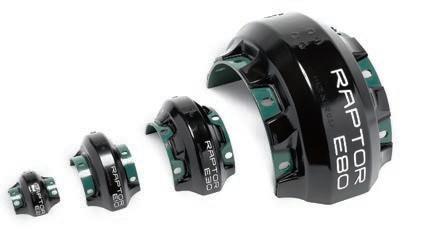
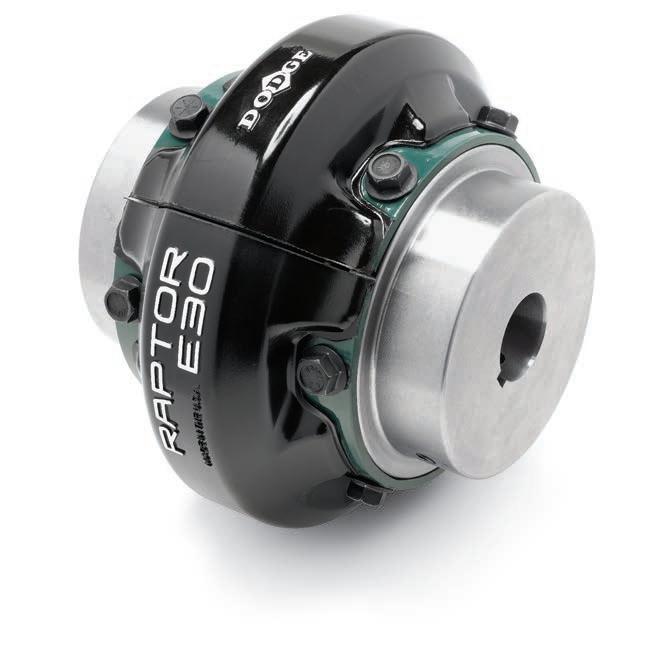
The Only Coupling To Earn Its Wings
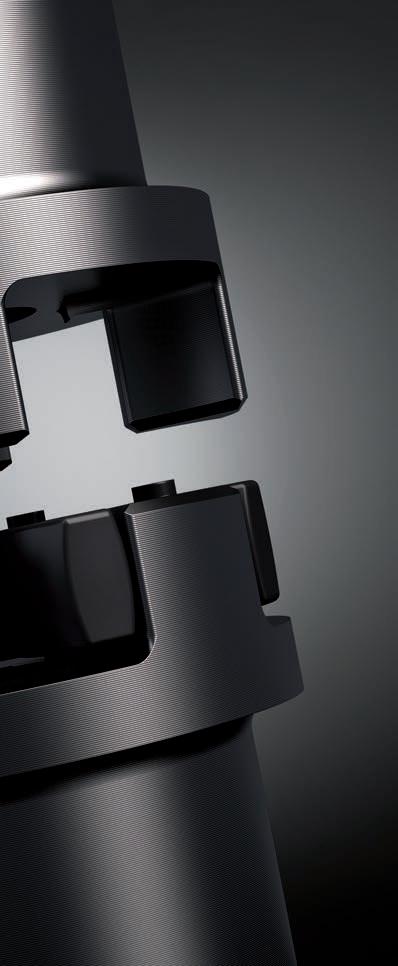
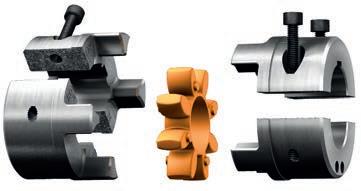
The NEW patented Baldor•Dodge® Raptor takes coupling innovation to greater heights. Utilizing a patented winged element design for higher bond strength and improved fatigue resistance, the Raptor delivers:
• Longer driven equipment life and increased reliability
• Easier installation and reduced maintenance
• Drop-in interchangeability
The Raptor is backed by over 50 years of natural rubber expertise and an industry leading 5-year warranty. Expect a higher level of reliability with the new Baldor•Dodge Raptor coupling. baldor.com 479-646-4711
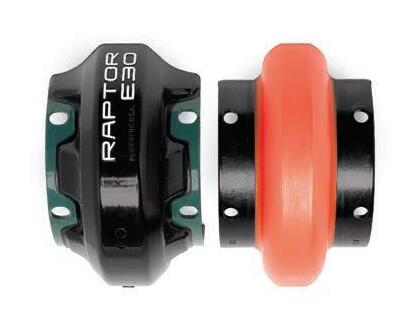
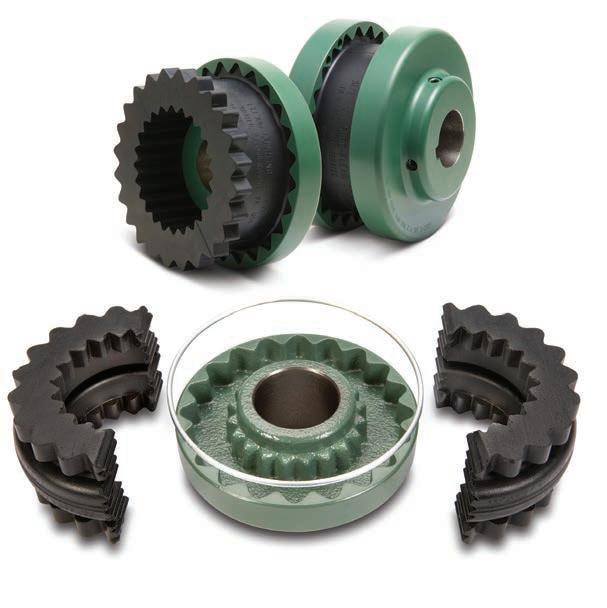
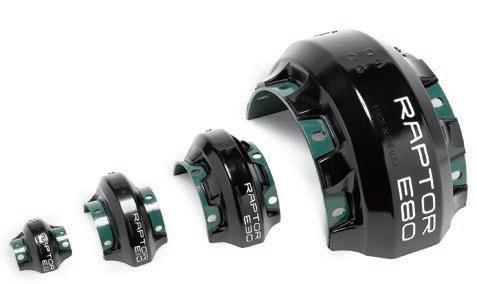
Raptor’s slotted clamp rings offer more clearance at the bolt holes for an easier installation than competitive designs.
LOW PRICES, SECURITY CONCERNS PUSH NATURAL GAS INDUSTRY TO LOOK INWARD
Emerging global markets, liquefied natural gas (LNG) projects and increased coal plant retirements repre -
& Veatch’s just-released 2016 Strategic Directions: Natural Gas Industry Report, reflects widely varying market outlooks for the upstream, midstream and downstream segments. Yet, after a challenging two-year period, optimism remains strong as organiza-
management services and a greater focus on efficiency and maintenance to wring as much revenue from operations as possible in a down market. Safety, including physical and cybersecurity, was identified by 70 per cent of survey respondents as
ciencies without sacrificing safety and reliability,” said John Chevrette, President of Black & Veatch management consulting. “Safety’s intersection with cybersecurity and physical security at the distribution level must also be carefully evaluated as technology is increasingly used to boost system performance.”
Download the Black & Veatch report at www.bv.com/
EXPLORING GROWTH OPPORTUNITIES TOP PRIORITY FOR CANADIAN MANUFACTURERS
According to KPMG’s Canadian Manufacturing Outlook released on September 29, Canada’s manufacturing sector has the skills, confidence, and tools for growth, but there is concern around economic risks and volatility of foreign exchange rates. There is also a strong need for increased innovation, collaboration, and a greater appetite for opportunities beyond the United States in order to stay
More than half (57 per cent) of Canadian manufacturers indicated they have made exploiting opportunities for growth a top strategic priority. In contrast, global manufacturers are eyeing a more aggressive approach to growth within new markets and sectors, stronger plays for innovation and exhibit higher tolerance for risks than Canadians.
CANADIAN MANUFACTURERS & EXPORTERS RELEASES RESEARCH REPORT
The Canadian Manufacturers & Exporters (CME) has released findings of its year-long research aimed at growing manufacturing and exporting in Canada. The research report contains recommendations for industry and government and was unveiled at CME’s Industrie 2030 National Manufacturing Summit held in Ottawa on October 18-19, 2016.
The Industrie 2030 Action Plan and its recommendations stem directly from the input of more than 1,250 Canadian manufacturers and exporters of all sizes from all corners of the country.
CME’s research resulted in the following reports:
• Industrie 2030 Action Plan: Manufacturing Growth, Innovation and Prosperity for Canada;
• Management Issues Survey 2016;
• A National Strategy for Canadian Manufacturing in the Digital Age; and,
• Economic Impact: Manufacturing and Exporting in Canada.
For more information, visit www.cme-mec.ca.
PTDA 2016 INDUSTRY SUMMIT HIGHLIGHTS
Seven hundred and fifty people from the power transmission/motion control (PT/MC) industry, including nearly 590 delegates, came together October 19-22 in San Diego, Calif., where tools and information were delivered through presentations, the latest in business and market information, under the theme, “Lead in Disruptive Times.”
“Participation in the PTDA Industry Summit is the most effective way to build relationships and make connections in the power transmission/motion control
industry. Coupling the networking opportunities with the inspiring IML Talks and Deeper Dives as well as the economic outlook from Alan Beaulieu makes this meeting a business requirement,” said LeRoy Burcroff, VP sales, Bearing Service Inc., Livonia, Mich., who is the outgoing president for the association.
The PTDA elected its 2017 Board of Directors and Manufacturer Council at the summit. Thomas R. Clawser, director reliability services, Brown Transmission & Bearing Co. Delta Reliability Div. (Lancaster, Pa.) will become PTDA’s president in 2017. He succeeds LeRoy Burcroff, vice president sales, Bearing Service Inc. (Livonia, Mich.). Clawser has been active in PTDA since 2005, serving as a member of the former Technical Education committee and as a Trustee on the PTDA Foundation Board. Clawser has been a member of the PTDA Board of Directors since 2012.
Industry Summit Highlights included:
• The prestigious Warren Pike Award was presented by PTDA to Keith Nowak, president, MPT Drives, Inc., Madison Heights, Mich.
• The Wendy B. McDonald Award was presented by the PTDA Foundation to Linda Miller, VP IT & HR, B & D Industrial, Macon, Ga.
• Alan Beaulieu of ITR Eco-
nomics provided industry-specific management objectives and accompanying recommendations to guide PTDA members through the next few years.
• MD-IDEX was well attended with over 612 pre-scheduled meetings during the four-hour formal networking program and countless unscheduled and impromptu meet-ups.
The format of IML Talks with Deeper Dives allowed participants to hear three powerful presentations. Mark “The Sales Hunter” Hunter delivered compelling reasons why every member of the team needs to see themselves as a leader. A panel discussion with Jeff Cloud, VP marketing, IBT Industrial Solutions; Ellen Holladay, SVP CIO OE officer, Motion Industries Inc. and Kristin Jennings, director marketing, Climax Metal Products Company challenged members to consider the ramifications of having five generations working side-by-side for the first time in history. Follow-up Deeper Dive sessions were moderated by industry veteran Tribby Warfield, Sr. VP & GM automation control & energy, Kaman Industrial Technologies Corporation, which allowed delegates to talk through the issues faced in their organizations and share their findings and best practices. Michael Abrashoff, the former commander of the U.S.S. Benfold, impressed
participants with his stories of transforming the lowest performing crew in the Pacific Fleet to the best and translated how his lessons-learned also applied to leading an industrial company.
The NIBA/PTDA Joint Industry Summit will be held September 27-30, 2017, at The Diplomat Beach Resort, Hollywood, Fla.
For more information, visit ptda.org.
SERVO MOTORS AND DRIVES MARKET
A new report published by MarketsandMarkets forecasts that the servo motors and drives market is expected to grow from USD 10.26 Billion in 2015 to USD 15.92 Billion by 2022, at a CAGR of 6.25% between 2016 and 2022. The report, “Servo Motors and Drives Market by Offering (Motor & Drive Component, Software & Service), Type (AC/ DC, Linear Servo Motor, Adjustable Speed Drives), Voltage Range, MoC, Communication Protocol, Industry, and Geography – Global Forecast to 2022,” says that advancement and rapid growth in automation and adoption of energy-efficient international standards are some of the significant growth drivers for the servo motors and drives market. The packaging industry is expected to grow at the highest rate during the forecast period due to a growing need and use of automated, accurate and faster machines.
For more information, visit www.marketsandmarkets. com. MRO
Industry Newswatch is written and edited by Rehana Begg. Visit www.mromagazine.com for the latest news and longer versions of items here.
Business Briefs
• Oakville, Ont. – Siemens is filling an order from Burns & McDonnell Canada to deliver a gas turbine, a steam turbine, generators and related electrical equipment for installation at SaskPower’s planned Chinook Power Station – a 350 megawatt (MW) natural gas-fired power plant to be located near Swift Current, Sask. The facility, slated for operation in the fourth quarter of 2019, will be able to power about 300,000 homes.
• Montreal – SNC-Lavalin Group Inc. is looking to sell its 21-floor downtown Montreal building and adjacent land and then lease back office space as part of its drive to cut costs. SNC-Lavalin has trimmed $95.3 million in costs over nine months of the year, near its $100-million goal for the entire year. But while it has made progress on costs, the company
said its earnings plummeted in the third quarter due to unfavourable conditions at two oil and gas projects in the Middle East that the company has previously warned would hurt its 2016 results.
• Long Beach, Calif. – DENSO Products and Services Americas, Inc., a subsidiary of leading global automotive supplier DENSO Corp., has named Daniel Muramoto marketing manager of the company’s aftermarket automotive products and services, as well as its MovinCool, Robotics and ADC divisions.
• Fort Mill, SC – In recognition of its exceptional on-time supply of parts and 100 per cent defect-free deliveries to four North American manufacturing locations, Schaeffler was awarded the prestigious Hyster-Yale Group “Certificate of Merit” and designated as a “Preferred
Supplier.” Hyster-Yale Group, the Cleveland, Ohio-based materials handling company, honoured Schaeffler for its outstanding quality and on-time delivery performance in 2015. Schaeffler delivered at least 98.99% of parts on time and also delivered 100% defect-free parts to four different North American Hyster-Yale manufacturing locations in 2015.
• Birmingham, Ala. – Motion Industries, Inc., a subsidiary of Genuine Parts Company, has acquired Braas Company, a distributor of products and services for industrial automation and control.
• Foxboro, Mass. – Schneider Electric, the global specialist in energy management and automation, has acquired Applied Instrument Technologies, Inc., a leading provider of online process analyzers for the hydrocarbon, petrochemical, chemical, pharmaceutical and steel-making industries. The acquisition adds to Schneider Electric’s process automation portfolio that already includes Foxboro plant instrumentation, Foxboro and PlantStruxure PES process automation systems, Modicon PAC systems and Triconex safety systems.
SQUEAKY CLEAN
Master the basics of cleaning and improve asset inspections.
BY JEFF SMITH
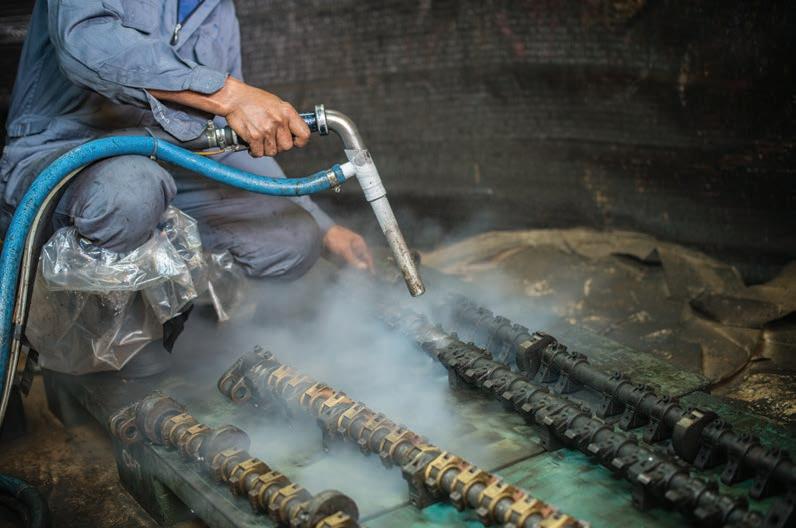
Throughout my career I often found the lack of applied basic practices to be the root cause of many issues. Equipment cleaning and degreasing seems at first glance hardly worthy of consideration. Find the least senior worker and send him to clean. What could go wrong?
Let’s explore the common mistakes and good practices as well as how to leverage your cleaning program to optimize your asset inspections.
FLEET WASHING
Consider the mobile equipment world. In many organizations we simply have a scheduled PM program that requires a clean asset. The “new guy” dons the PPE and is told how to start the pressure washer, how not to grab the metal end of the wand when it’s hot (normally related to a story about his predecessor). The asset is parked in the wash bay and the following instructions are given: “Blow the
big stuff off with the fire hose and then clean it with the power washer.”
Since the new guy is keen to progress with his new job, he quickly grabs the fire hose and starts blasting the still hot asset, admiring the force water pressure produces. He lets the unit have it.
Once everything is dripping he fires up the pressure washer, cranks on the soap and proceeds to spray every little item, including electrical panels, breathers and hydraulic cylinders. All greasy spots are thoroughly cleaned, blasting high pressure soapy water into every pin bore and seal he can find. What could go wrong?
Common mistakes for mobile equipment cleaning include:
• Flooding of electrical cabinets, water ingress in electrical connectors
• Spraying seals can result in ingress of material and soaps into wheel bearings, pins, engines, hydraulic systems and air systems.
• Flooding or spraying vents can result in ingress to reservoirs, fuel tanks and gearboxes. Flooding or spraying air filter housings can result in wet filters that quickly clog in service.
• High pressures can damage some components.
• Inadequate cleaning can result in rock or debris jammed in cable or hose runs introducing wear points.
• Inadequate cleaning facilities often have improper collection of water and contaminates, resulting in ground pollution.
• Harsh or incompatible soaps and harsh solvents can result in seal swelling, hose degradation and plastic embrittlement.
It turns out there are a number of things that can be impacted by underestimating the criticality of the cleaning task. So what would be different in an organization that uses good practices? The “new guy” enters the wash bay
having had adequate time to review the cleaning procedure with a qualified staff member. The qualified staff is with the new guy for his first wash to provide cognitive instruction and task certify the person to the asset type in question.
How would this wash differ from the previous one?
The initial steps would include bagging any ingress points, wrapping any key electrical connecting points and covering any water-sensitive cabinets or zones. This would include a checklist itemizing the controls needed to ensure all safeguards are addressed. The wet down of the asset would target zones impervious to flooding as noted in the washdown procedure. Implements would be in the optimal positions (box up, for example). The asset would have been given adequate time to cool to reduce thermal shock to materials. The wash procedure would be executed step
by step without damaging the asset. The now qualified wash bay attendant would have a clear understanding of acceptable quality for a “clean” asset.
Good practices (best practices should be a moving target, so I use “good practices”) for Mobile equipment washing:
• Have qualified personnel develop and optimize a detailed cleaning procedure.
• Ensure wash-bay personnel are trained and task qualified.
• Utilize visual aids (posters) to reinforce procedures.
• Utilize good cleanliness practices for the wash bay itself.
• Ensure cleaning equipment is in good order and functional.
• Identify moisture-sensitive zones and develop controls.
• Identify pressure-sensitive zones and develop controls.
• Control potential ingress points (if you use desiccant breathers, bag them anyway as a cost-control measure).
• Ensure there is adequate time in the cleaning schedule for temperature reduction.
• Ensure trapped debris is removed (some things don’t just spray away).
• Hand wipe excess grease from pins and bushings, or if spray-cleaned ensure the grease system is cycled a sufficient number of times to purge contaminated grease.
• Ensure soap is rinsed from asset.
• Ensure the contaminated water is recovered; be environmentally conscientious.
The utilization of good practices will ensure the wash itself does not damage the asset. Though this is a great start, the fact that the personnel washing the asset is required to look at virtually every point on the asset provides a great opportunity for inspection of the asset. In most cases all the wash bay attendant requires is a method of reporting his observations. If he sees a crack for example, you may require him to mark the spot and report it. In some organizations the wash inspection utilizes handheld computers to inspect, report and photograph the findings. This ensures the emergent findings will be incorporated into the PM work package or deferred until the next PM cycle.
Some items wash bay attendants may observe include:
• Missing/loose hose and piping retainers
• Worn, cut or abraded hoses
• Cracks and dents
• Loose and missing bolts
• Cuts or abnormal tire wear
• Leaks
Many of the types of issues observed in a wash bay, if addressed, will minimize the cascading damage and have the potential to impact the reliability of your organization.
CARING FOR COMPONENTS
While the mobile equipment washing covers basics for many assets, let’s consider more targeted equipment cleaning practices. In one industrial facility it was noted that water ingress in pump
bearing elements was a substantial issue resulting in a large volume of work. This work included oil changes and dehydration system utilization. As this was a pulp mill the pumps were inside the building and the only source of water was the washdown.
So what are good practices for cleaning an industrial centrifugal pump? For this discussion let’s break the unit into its components: motor, coupling and pump.
MOTOR
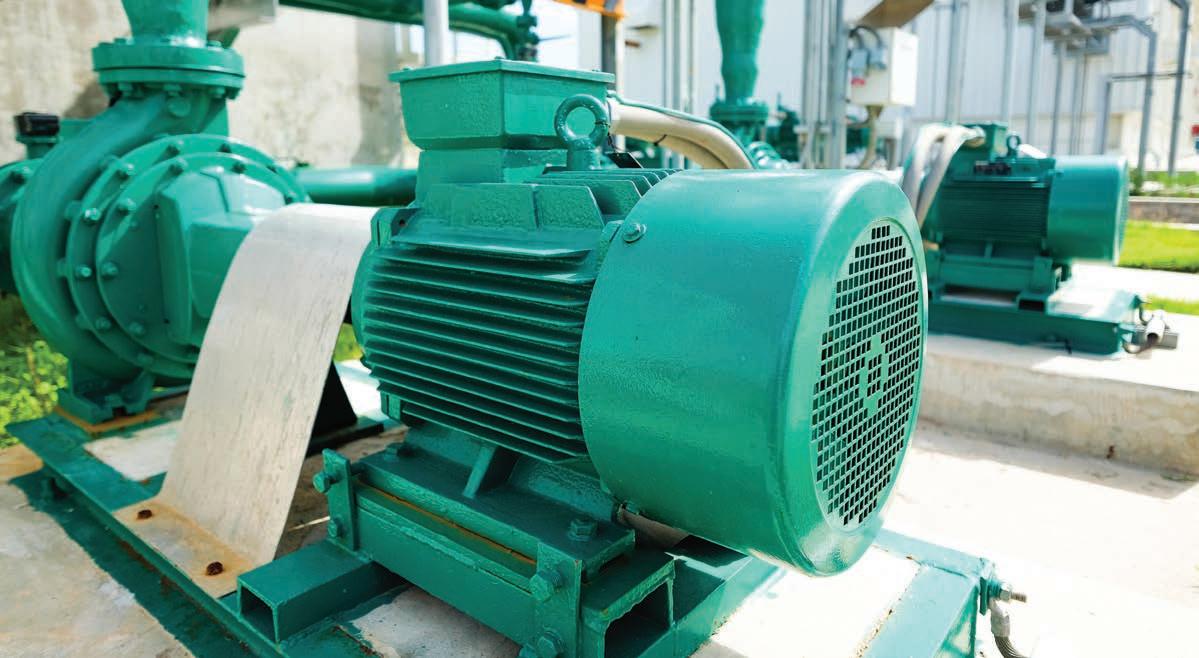
The life of an electric motor can be correlated to the amount of heat it is exposed to. Motors cannot shed heat if the cooling fins and air fan inlet are covered with dirt and debris, so they should be clean. There are some basic things that should be considered for external motor washing.
Is the motor in question immersible? Prior to blasting an electric motor with water it is imperative to know the unit is powered down, locked out and can be sprayed. Most industrial facilities use immersible motors; they are designed to run in dry environments that may be subject to flooding. Submersible motors are sealed and designed to run submerged. If the motor in question is neither immersible nor submersible, do not spray it with water.
How is the motor lubricated? It is good practice to lubricate a motor post washing if it is a greased motor and does not have sealed bearings. If the motor has
oil lubricated bearings, the vent caps should be covered.
Is the junction box well sealed? Visually check that the junction box is well sealed and in place. This logic also applies to any electrical controls or components in the vicinity of the motor that may be subject to overspray.
If the motor is immersible it can be power washed. For most basic motors the cover over the cooling fan should be removed to ensure it is clean. Spraying through the cover may miss portions of the buildup resulting in an imbalance condition. If the motor is not immersible the motor should be hand cleaned or dry ice blasted.
As with any cleaning, motor cleaning provides an opportunity to inspect for base degradation, loose or missing shims and physical damage.
Coupling
There are multiple types of couplings that are used on motor pump combinations. In most cases they are covered with guards but there are some things to consider by the various coupling types.
Elastomeric: Will the cleaning solution utilized degrade the elastomeric material utilized in the coupling? Will the wash water temperatures impact the material?
Grid or gear type: If washed, ensure that the coupling is re-greased; if this is not possible, use water-resistant grease.
Belt drive: If washed there is a high
likelihood that the belts will slip on startup, inducing wear; try to ensure they are dry and free of any soap residue.
Chain drive: If the chain drive is washed it should be relubricated (if externally lubricated) or re-waxed.
Pump
For the purpose of this article let’s just consider a basic bearing element centrifugal pump. There are two areas of concern – the breather and the shaft seal.
Breather: The breather (regardless if it is desiccant or not) should be covered to limit ingress. If the pump is subject to frequent washes, consider piping the breather to a remote location.
Shaft seal: In most sealing arrangements that flush with seal water the washing should have no impact; if it is a greased, packing regressing will be required. Considerations for washing complex sealing arrangements, such as nitrogen seals, should be discussed with your vendor.
Regardless of the asset type, a cleaning procedure should be developed and utilized. Your cleaning personnel should understand and apply all aspects of the procedure. MRO
Jeff Smith is a reliability subject matter expert. He has served as senior advisor to the Association for Maintenance Professionals (AMP) and has served on the U.S. tag for ISO 55000. Reach him at jsmith@acuren.com.
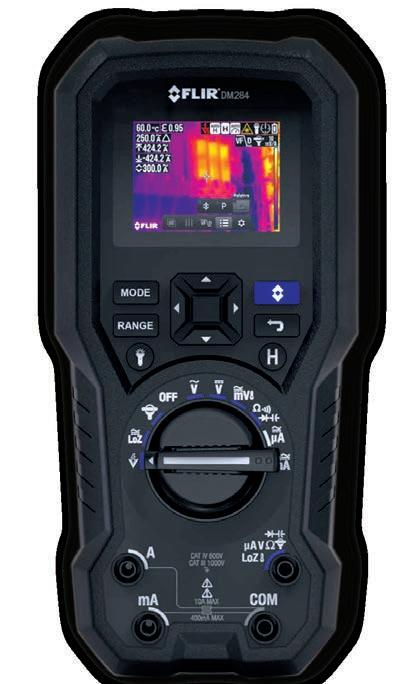
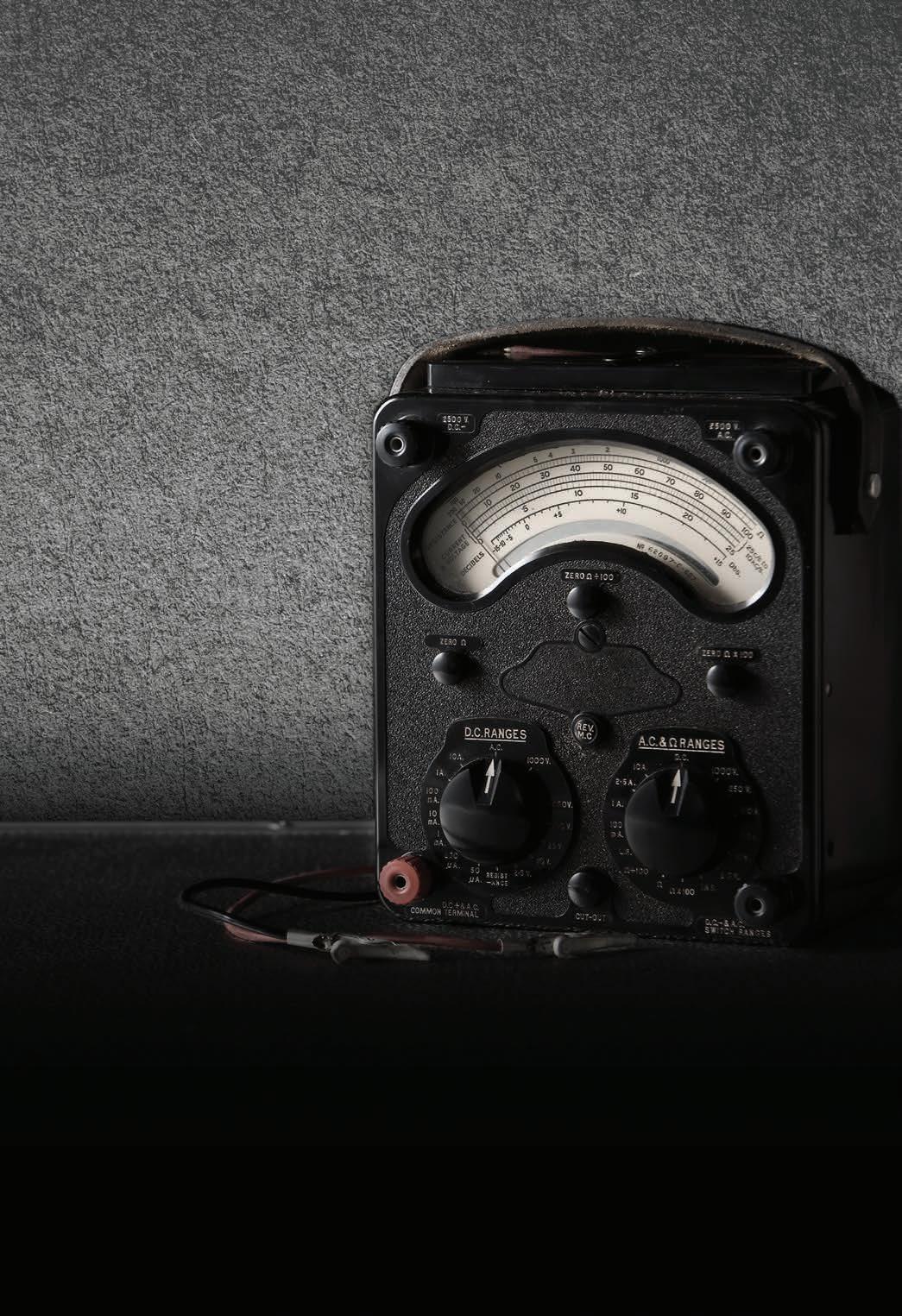
THIS AIN’T YOUR GRANDADDY’S MULTIMETER
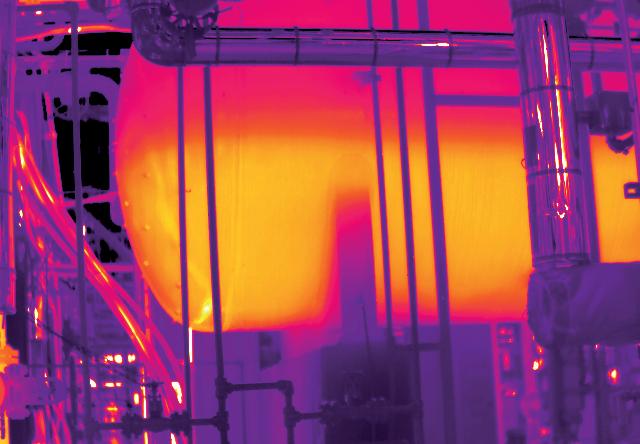
Introducing the DM284, an all-in-one True RMS digital multimeter and thermal imager that show you exactly where an electrical problem is to speed up troubleshooting.
Infrared Guided Measurement (IGM™) is the future of instrument and tool technology. Plain and simple. And for the hardworking professionals in the building and electrical industries, it’s the perfect addition to the toolbox. By helping you identify and verify problems invisible to the naked eye, you’ll save time, money, and maybe even lives.
Request a demo from participating distributors at FLIR.ca/DM284
· THERMAL IMAGING AT YOUR FINGERTIPS
· CONVENIENT, ALL-IN-ONE TOOL
· PINPOINT PROBLEMS QUICKLY
MAKING THE
MOVE
An in-plant expansion in 2009, followed by a move into a new, world-class seaweed processing facility, have increased the capacity of a Nova Scotia seaweed processing plant by nearly three times. The maintenance team, in addition to its role in making the move possible, has acquired many new skills.
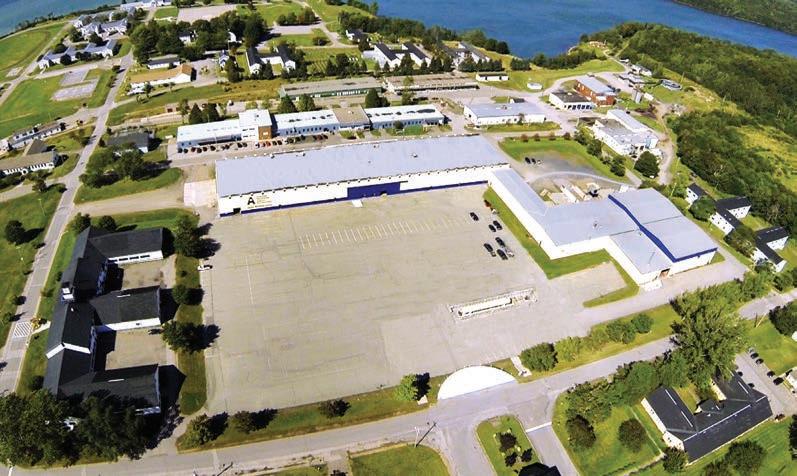
The 105,000 square-foot plant, located in a business park in Cornwallis, Nova Scotia, churns out millions of pounds a year of extract produced from a seaweed known locally as Rockweed, but more specifically tagged Ascophyllum nodosum. It is used in the formulation of bio-stimulant and bio-nutritional products for global agricultural and horticultural uses.
Formerly an IKEA factory, and before that, a drill hall, arena and other buildings belonging to the long-closed Canadian Forces Base Cornwallis, it is located 300 feet away – just across the street –from the old 20,000 square-foot plant. Over the course of the three-year move, between 2011 and 2014, the company did not lose a single day of production.
Central to achieving this was a bundle of seven pipes the Acadian engineers designed to move liquid product from the old to the new facility to facilitate pro-
Maintenance has
evolved
as Acadian Seaplants expands.
BY CARROLL MCCORMICK
cessing. “For a time we were leapfrogging: put one piece of equipment into the new plant, then take the old one out of commission. It was interesting, but very challenging,” says Wade Hazel, engineering manager, Acadian Seaplants.
One example of this was a 250-Hp boiler the company had purchased and stored in 2008 in anticipation of the move. Crews installed it in the new plant while the old 400-Hp boiler continued to do its job in the old plant. Once the new
boiler was up and running, the old boiler could be moved over to its new digs.
The maintenance team played many roles as the new facility filled up with equipment. Keeping the equipment running in two plants at the same time certainly kept the team on their toes. “With this dual-site operation, we had production going on in these two facilities simultaneously. During that transition period, when we had processing equipment operating on both sides, maintenance was
Aerial photo of Acadian Seaplants’ new processing facility.
Photo: Carroll McCormick
responsible for maintaining everything in two physically separate places. Keeping track of where people were scheduled to work, where parts were stored, and the need to double the maintenance required, persisted for over two years. We kept maintenance in the loop with new equipment installations too,” Hazel adds. “Maintenance did a lot of running back and forth. We ended up keeping a shop in the old building so the guys would have easier access to their tools.”
The maintenance team was also involved in safely moving equipment into
the new facility, Hazel explains. “The maintenance team supported us in specific jobs where they had specific expertise; for example, unloading and erecting large pieces of equipment. They are very good at that, and well-versed in our safety culture and managing high-risk activities.”
The maintenance team had already learned to work on some new hardware during the 2009 expansion, skills they immediately applied to the new plant. There is a lot of familiar machinery, but the new plant is automated to a degree that simply didn’t exist in the old plant.
“This is the flagship facility in Acadian Seaplants. It is a state-of-the-art, worldclass seaweed processing facility. This plant is fully automated, in terms of the processes being instrumented and monitored, PLC, touchscreens – a lot of real-time information is now available,” Hazel says.
The company hired an industrial electrician who maintains the electrical and automation systems, and a maintenance and reliability manager. His jobs include designing and running a computerized maintenance management program
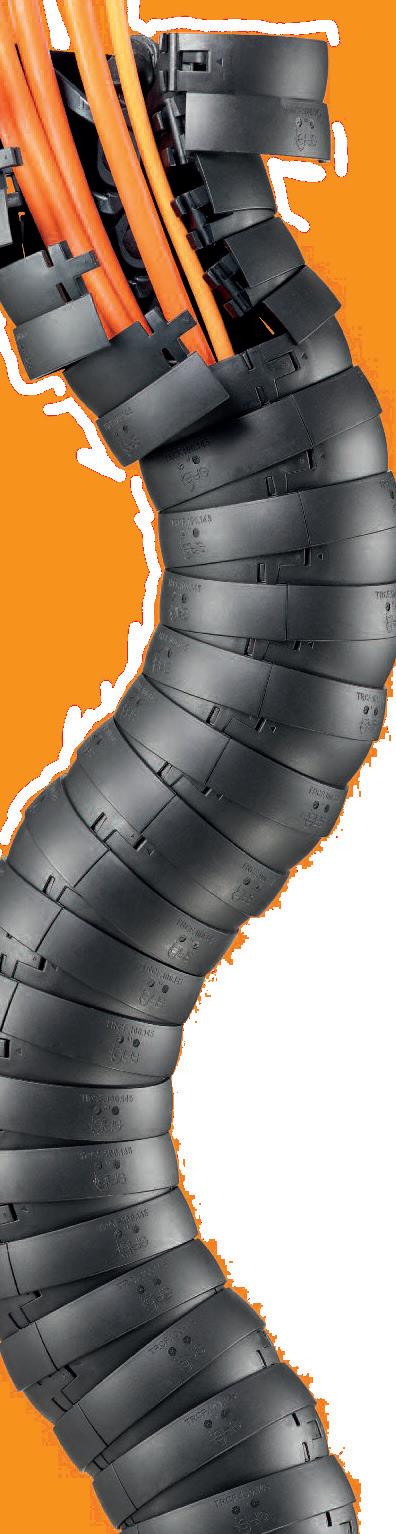
We see the whole picture. Not every application can be solved with plastic cable carriers! Whatever the application, we have a solution.
Presenting plastic and steel cable and hose carriers populated with continuous bending high flex cables from Kabelschlepp. Cable and hose carriers are the lifeblood and backbone of countless modern machinery. Based on their importance, it only makes sense to trust the industry leader. One supplier, one quick lead time, guaranteed quality. It doesn’t get easier than that!
Feeding the Seaweed
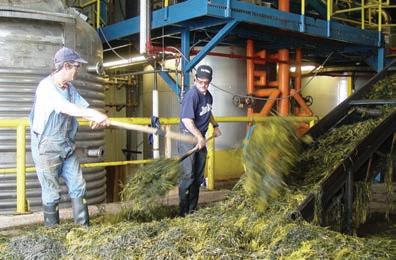
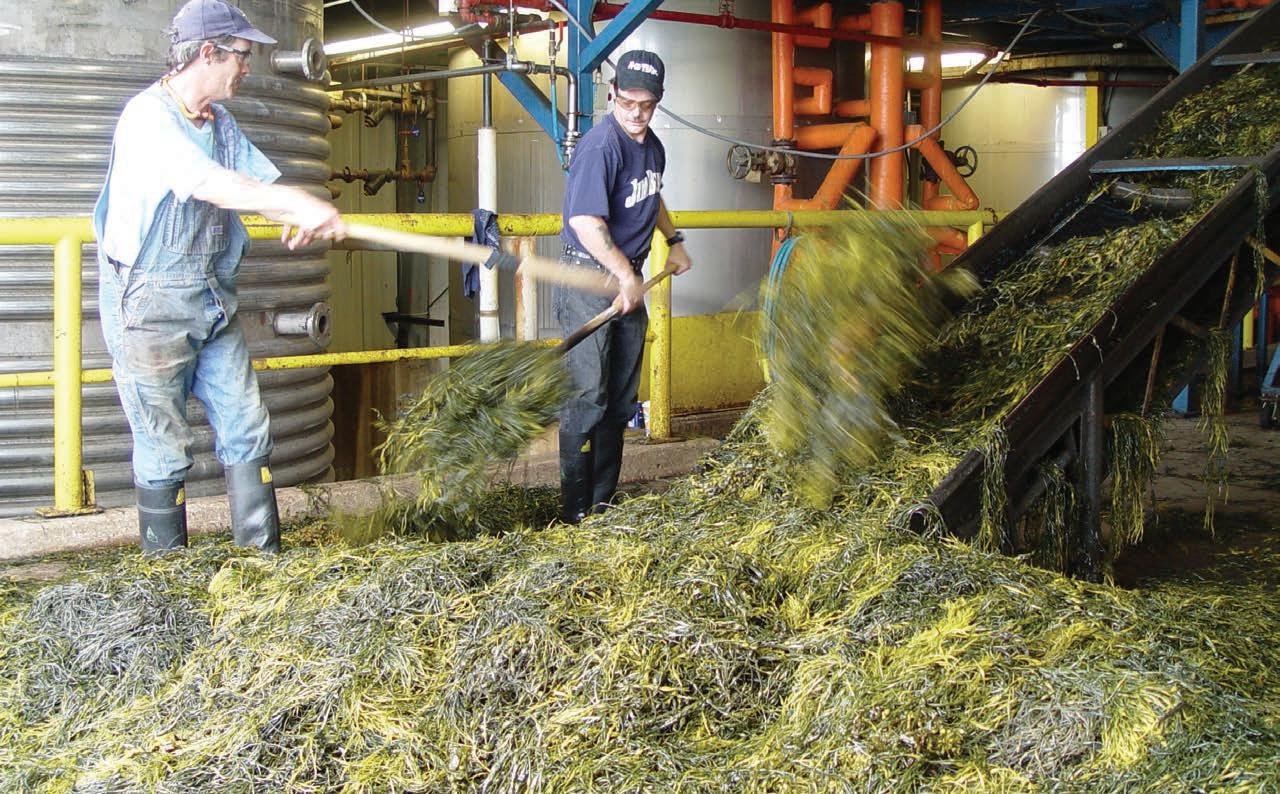
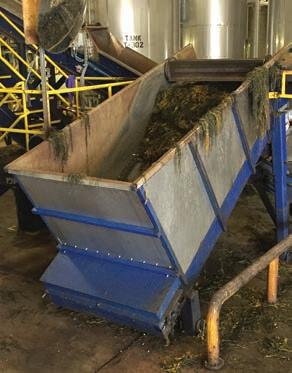
It’s unpretentious-looking, but the seaweed feeder in the new Acadian Seaplants processing plant is the product of years of development. In the old plant, workers on the “exercise shift” pitchforked slippery Rockweed onto a conveyor belt. Devising the automated feeder was a collaboration between the plant engineers and the maintenance crew, which has always been very resourceful in adapting equipment that was originally built for other purposes, to processing Rockweed.
Rockweed grows in long strands and can clump up into balls. No off-the-shelf equipment existed that could feed it onto a conveyor. But once the team at the plant hit on the idea to try modifying an old Massy-Ferguson manure spreader, the experimenting began. “We tinkered with the design for a year and a half,” says engineering manager Wade Hazel. “We got it right. When we moved into the new facility we took what we had designed and built a more rugged version –a spin on the old manure spreader. No more pitchforks.”
is driving limitless innovation
Today’s growing cities demand both efficiency and reliability in the pursuit of a sustainable future, and Danfoss has been providing innovative solutions to Canada for 65 years. In water and wastewater facilities — a municipality’s largest energy consumer, Danfoss variable frequency drives not only improve energy use, they minimize water loss. For industries like marine, mining, and food and beverage manufacturing, Danfoss technologies provide reliable, intelligent process controls that are making industrial solutions smarter and more efficient.
Discover how we’re Engineering Tomorrow at danfoss.ca
60h
savings in global energy consumption from today’s installed drives by 2025
(CMMP) inventory control, the maintenance budget and maintenance scheduling.
The company chose a CMMP module from Interal. “We already had it in place to manage our finished goods. They offered a maintenance module, which we purchased. It interfaces nicely with the rest of the business. It seems to have all the capabilities we require,” Hazel says.
The maintenance team is growing into its CMMP. There are now 238 parent assets logged into it. Many have accompanying photos, equipment manuals, exploded diagrams, parts lists and other associated information. Each has numerous children.
The transition from “blackboard” maintenance planning to the CMMP is coming along well, says Garry Vinje, Maintenance & Reliability Manager. “Purchase orders are now functional and doing well. Preventative maintenance work orders are running well and are being used to schedule weekly work.”
Hazel adds, “We are moving from old ways of doing things.”
Also flagged for improvement was the management of spares. “We created a stockroom in the new facility, identified a number of common components we would need in both facilities. We hired a stock clerk, who doles out supplies, replenishes depleted stock like piping, bolts, nuts, hardware, electric motors, fittings and the like,” Hazel says.
“The stores inventory has a master catalogue of 3,885 items, with roughly 20 per cent having min max set, with a focus on the critical assets,” Vinje notes.
Perhaps most exciting was the chance to be part of laying out the production equipment in a logical and more main-
tenance-friendly way. “In the old plant it was kind of a patchwork design. But because of the ways that expansion occurred in the old plant, it didn’t permit us to grow in a nice, logical fashion. The new plant is all on one elevation – a real bonus for moving product around and for doing maintenance.
“We had the once-in-a-lifetime chance to design a new facility, looking at the old facility and seeing how we could improve its functionality and flow. The new layout is logical, in terms of raw material coming in one end of the facility and moving through the processing steps. It is like a classical assembly line process,” Hazel explains.
This works to the benefit of the maintenance crew. “In the old plant most of our equipment was shoehorned in where we could, with limited access for maintenance. We did better in the new plant to make sure the equipment and layout provided improved access for maintenance. We’ve struck a pretty good balance between the functional use of space and access for maintenance,” Hazel says.
Other things have also been introduced to make maintenance easier. “For some pieces of heavy equipment we are designing lifting beams permanently installed over the equipment where the removal of heavy components for maintenance is required. In general, we are trying to provide appropriate space and access to make maintenance easier,” Hazel says.
One nice example of the advantages gained by incorporating new equipment, and which also demonstrates the maturing of the production methods employed at Acadian Seaplants, is a huge new hydrocyclone. Whereas in
Maintenance personnel applied
the old plant rocks and seashells stuck to the seaweed would contribute to the wear and tear of production equipment, the 15-inch hydrocyclone removes most of this abrasive foreign matter. “Keeping out all the rocks and shells has improved maintenance and reliability. It reduces wear and tear of, and the accumulations that caused blockages,” Hazel explains.
As new equipment and technologies have been added, supplier representatives and subject matter experts have visited the plant to train the maintenance crew. Maintenance has also added to its safety skill sets, including taking fall arrest and confined spaces training, hazard assessment and fire response instruction. For some, training companies have come on site. For other courses, staff have trained offsite.
The team has also picked up some handy new gear, which also makes life easier and safer. “We now own one 45foot gas-powered boom lift, a 30-foot boom lift and a scissor lift. We find it reassuring to have them on site all the time. The facilities are tall and open. The valves, piping, etcetera, require a lot of work at height,” Hazel says.
Because of all the automation, lockout/tag out procedures are being improved. “Now that we have this huge plant, with all this automation, one of our major focuses is on developing adequate lockout/tag out practices,” Hazel says.
Overall, Hazel summarises, “We have a well-path and we are progressing down the path.” MRO
Montreal-based Carroll McCormick is the award-winning senior contributing editor for Machinery and Equipment MRO
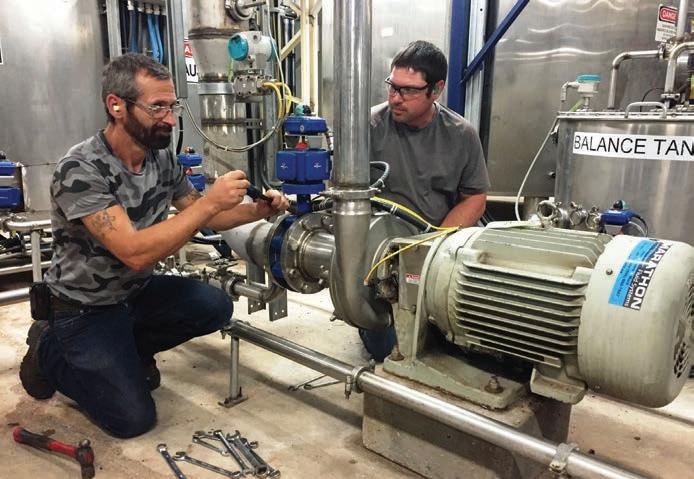
From left, maintenance technicians Brent Everett and Chad Stewart work on an evaporator system pump.
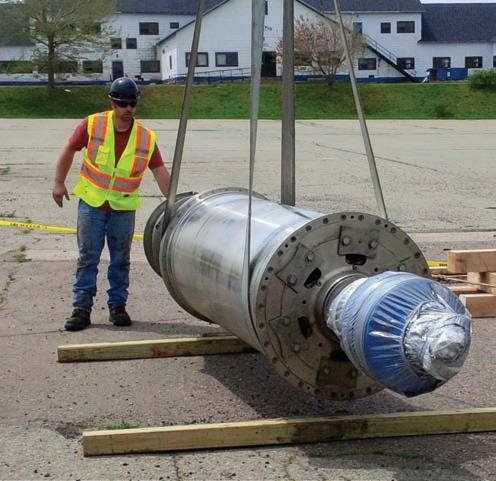
their skills to safely move heavy gear into the new plant.
TB Wood’s new Sure-Flex® Plus elastomeric sleeves provide higher performance and enhanced durability due to recent improvements in its proprietary EPDM and Neoprene materials. With a 30% torque rating increase, Sure-Flex Plus sleeves allow many applications to use a smaller size coupling, while providing a more rugged replacement sleeve for couplings currently in service.
And, you can find TB Wood’s Sure-Flex Plus elastomeric sleeves at your local Motion Canada branch. Our sales and service specialists are experts in providing application and technical solutions, with the choices and expertise you need to stay up and running.
STAND UP TO CORROSION
The latest in automated lubrication systems ensure optimum equipment performance – even in harsh pulp & paper plant environments – and reduced unscheduled maintenance.
Corrosive plant environments are among the most serious threats to the pulp & paper industry, contributing to production downtime and exorbitant maintenance costs. Assets are allowed to operate to failure before repairs are planned. In many instances, bearing maintenance is performed using reactive maintenance – after bearings have incurred serious damage or have failed.
According to the most recent NACE (National Association of Corrosion Engineers) study, the harsh processing environments of facilities in the pulp, paper and allied products sector make corrosion control especially costly and challenging. The direct annual cost is over $6 billion.
Among the most devastating effects of corrosion is its destructive impact on the load-bearing surfaces of plant equipment, which are supported by many types of bearing components such as rollers, spines, gears, ball bearings or other moving parts. Unless these components are provided proper lubrication, they will be subjected to excessive heat and wear, leading to premature failure.
buildup, and ensures longer operating life.” For that reason many manufacturers are opting for automating their lubrication systems.
The multi-point challenge
When paper mills roll emulsion, it can travel through progressive rollers on a machine that is perhaps 200 ft. (61 metres) in length. During that process there is considerable caustic water and glue that is squeezed from the final product and flows all over the machine. When the equipment is washed down with high-pressure hoses, the lubrication oil or grease often gets blown out of the lube points and has to be replaced.
With today’s equipment running at higher speeds and longer periods, it is more important than ever to ensure that lubrication systems are providing bearing devices with efficient, timely applications of lubricating oil or grease in order to ensure wear life, safe operation, reduced unscheduled downtime of processing machinery and more economical operating costs.
“More frequent delivery of smaller amounts of lubricant is particularly important to bearing points on highspeed equipment,” says Richard Hanley, president of Lubrication Scientifics, Irvine, Calif. “This prevents overheating the bearings due to excessive lubricant
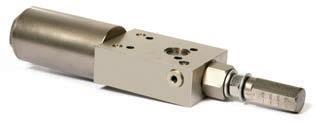
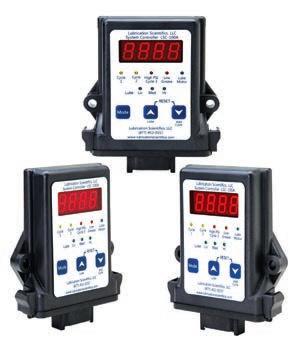
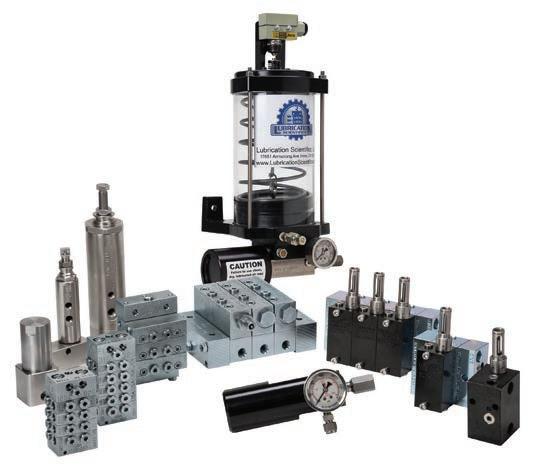
tomated lubrication systems, but a typical system consists of controller/timer, pump with reservoir, supply line, metering valves and feed lines.
Whatever the design, automated lubrication system metering valves – the valves that dispense oil or grease in controlled proportions to each connected lube point – must stand up to the rigours of harsh plant environments.
“Re-lubricating all of the hundreds or sometimes thousands of points manually is a very difficult and time-consuming job that will create substantial, unnecessary downtime for the paper mill resulting in a huge expense that any company would want to avoid,” says Hanley.
Although automatic lubrication systems have been around for decades, it is estimated that 80 per cent of all lube points are manually lubricated.
From an economic point of view, automatic lubrication systems provide users with very quick return on investment. In addition to reducing grease consumption up to 33 per cent, optimum lubrication reduces energy consumption, maintenance intervals, waste disposal and unplanned downtime. In some cases, engineered lubrication systems with advanced monitoring capabilities can easily save elaborate processes millions of dollars in operating costs per year.
Automated system basics
There are several different types of au-
One of the most common lubrication systems is the Single-Line Parallel, which is also referred to as the injector-type of lubrication delivery methodology. This system is known for its ease of installation, adjustable metering of valves (or injectors) and applicability to a minimum of one and maximum of six lube points per device. Lubrication points may be added or removed without redesign of the system. On the downside, it is difficult to verify that each lubrication point is constantly being serviced.
Another common system is the Dual-Line Parallel. This system is also easy to install and features adjustable metering valves. With this type of system a minimum of one and maximum of eight lube points may be serviced from each device, and lubrication points may be added or subtracted. Also, heavy greases may be delivered over very long distances. However, with this system it is difficult to verify that each lubrication point is constantly being serviced.
A third type of automated system, the Single-Line Progressive System (a.k.a. the Divider Valve System), is precisely engineered to deliver exact lubricant requirements to each point. However, with this system lubrication amounts and points may not be altered, and initial installation costs are higher than with other systems. An advantage of these systems is that system performance can be easily and inexpensively monitored to verify that each lube point is constantly being serviced.
In order to overcome the various threats of corrosive and caustic environments, Lubrication Scientifics makes all three types of system and components available in 303 and 316 stainless
The revolution is here.
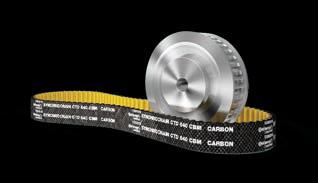
Take on the most demanding applications with CONTI® SYNCHROCHAIN CARBON heavy-duty timing belts. Our technology combines light but durable polyurethane teeth with high tensile carbon reinforcement to deliver up to 15% more horsepower. Contact Continental for a complimentary drive analysis. We o er complete drive solutions, including belts, metal, and a team ready to help you get the most from your drives.
steel, most of which are available within days rather than months.
Verifiable advantages
Plants that have the verifiable automated system normally have the need to deliver precise amounts of lubrication to many points. This requirement is so stringent that it is critical that workers could not normally adjust the amount or type of lubricant being delivered to the equipment.
that every lubrication point is monitored, ensuring that each point is receiving the proper lubrication, thereby maximizing production uptime.
In addition, this type of system prevents unauthorized interference with system settings, so that workers cannot inadvertently change the precise amounts and intervals of lubrication sent to various points.
posed to some of the harshest environmental factors, including the washdown procedures that occur at frequent intervals. Corrosive damage from exposure to caustic emulsions and washdown fluids can severely compromise the performance and service life of lubricating-system metering valves. These are often constructed of zinc- or nickel-plated carbon steel.
The biggest advantage of the Single-Line Progressive type of system is
Avoiding failure
Pulp & paper industry plants are ex-
“In such an environment, the corrosion-resistant life of a plated carbon steel metering valve or system component will only be weeks to months,” Hanley says. “Although the initial corrosion will look much like rust, it will eventually cause the lubrication metering valve to lose its effectiveness.”
One answer to preventing corrosion damage is the use of stainless steel. However, as a broad offering of stainless steel metering valves has not been readily available, the only effective anti-corrosion solution for automatic lubrication system components has been to enclose the plated carbon steel metering valves into stainless steel enclosures. Including the cost of the enclosure, the bulkhead fittings, and the installation labour, it is easy to spend $2,000 to protect a $500 hundred dollar plated carbon-steel metering valve.
Lubrication Scientifics produces and stocks stainless steel metering devices and accessories, for every type of lubrication delivery system. The company has a full offering of metering devices, specifically designed to meet the reliability and cost needs of the paper and pulp industry. These metering devices can be directly mounted onto the equipment being lubricated and all critical points can be economically monitored. If corrosion and improper lubrication are hurting your bottom line, stainless steel lubrication systems is the answer to the problem. MRO
This article was submitted by Lubrication Scientifics, LLC. For more information, Lubrication Scientifics, LLC., visit www.lubricationscientifics.com.
Efficiency FIRST
The case for embracing a systems philosophy to energy efficiency.
BY DOUG BACKMAN
In the united effort to preserve global security of energy supply and protect the climate, the industrial sector is justifiably under intense scrutiny as a significant energy consumer. A focus on energy consumption, and therefore energy efficiency, is inextricably bound to energy security. Energy consumption can be significantly reduced by looking beyond improvements in components efficiency to a systems approach to efficiency.
“Efficiency First,” energy saved is an energy source in itself
Reducing consumption has just as great a role to play in ensuring a sustainable energy supply in the future as converting from fossil fuel to renewable energy sources or expanding energy supply capacity. Energy efficiency is not only crucial in reducing CO2 emissions and production costs; it is also a key enabler in ensuring a stable supply, because it reduces the need to expand the grid or build new power plants. What is not consumed is not transported, saving on expansion and maintenance of the associated grid infrastructure. Improving energy efficiency does require an upfront investment. However, in many cases this investment is more cost-effective or valuable than the equivalent supply-side resources. For example, an installation of variable speed drives at Holcim Cement slashed utility bills so
significantly that the project payback period was less than two years.
It makes sense to talk about energy efficiency as an energy source – and the first source.
Some of the key ways in which “Efficiency First” can contribute to more cost-effective, competitive energy choices are:
• Enabling efficiency investments to compete on a level playing field with energy supply investments, in the national energy markets
• Removing barriers to investments in efficiency
• Taking account of energy efficiency in policy development and planning, and avoiding unnecessary investments in fossil fuel infrastructure
When the capacity of industrial facilities is upgraded through an “efficiency first” approach, system efficiency optimization becomes the first alternative in sourcing energy. Incentive and motivation to optimize system efficiency will decouple increased capacity from increased energy consumption. In many countries the link between increased GDP and increased energy consumption has already been broken.
To achieve the best possible results, the prerequisites are:
• Benchmarking tools to compare the efficiencies of different systems and solutions
• Motor and control system independence of the AC drives, ensuring the freedom to achieve the best possible combination of components for optimal system efficiency
A component versus system approach
Within the industrial sector, the largest consumer of electricity, electric motor systems, accounts for the majority of the electricity demand, which creates a strong case for optimizing electric motor systems – for instance, through variable speed drives, or AC drives, which the International Energy Agency (IEA) suggests should be made mandatory.
Electric motor-driven systems consume 45 per cent of global end-use electricity
Typically, the electric motor is a component in a motor system, responsible for the conversion of electrical power into mechanical power. In turn, this mechanical power drives equipment such as fans, pumps or compressors. Analysis by the IEA shows that electric motor-driven systems consume at least 7,000 TWh/ year globally, which is roughly equivalent to 45 per cent of worldwide enduse electricity consumption. Electric motor-driven systems are therefore the largest single consumer of end-use electricity and a prime target for co-ordinated government policies on a global scale.
PROTECT YOUR INVESTMENT
COUPLING PLATING
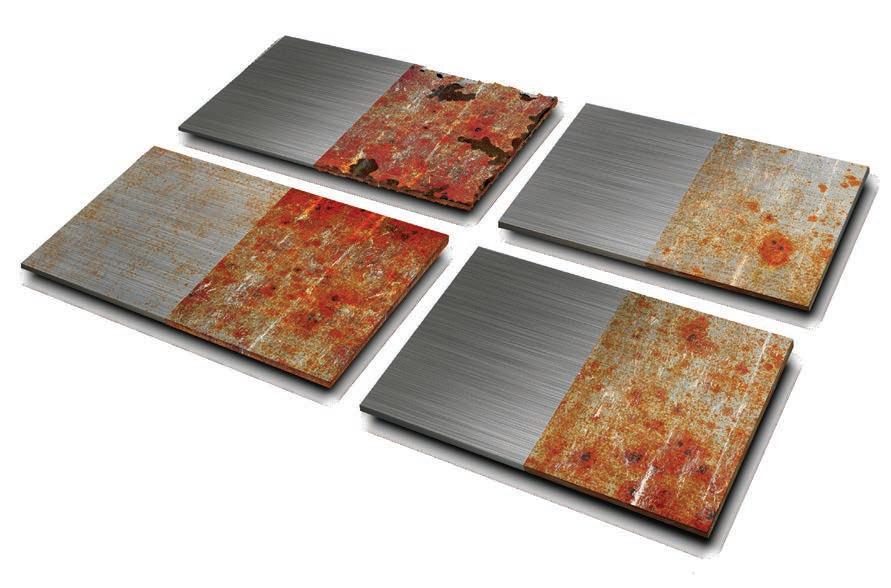
When hydraulic fittings rust, the base metal is eaten away by oxidation, eventually damaging the hydraulic system, contaminating fluids, compromising fittings and adjacent components, and creating leak paths.
72
Moving energy made easy
Guide and protect cables and hoses in robotic applications with Triflex® R three dimensional cable carriers and retraction systems. Available from stock. Ask us for a free sample!
www.igus.ca/TriflexR
To date, political regulation of industrial energy consumption has only partly addressed the energy efficiency and energy-saving potential of motor driven systems. Existing initiatives address efficiency at the component level, setting minimum performance levels for motors, pumps, fans and other single pieces of equipment.
According to ZVEI, the German Electrical and Electronic Manufacturers’ Association, efficiency improvement at the component level can address about 10 per cent of the total savings potential. Using variable speed in applications with pumps, fans and compressors can address about 30 per cent
Extended product approach
of the total savings potential. However, the largest potential for energy savings lies in system level optimization, where 60 per cent of the total savings potential can be addressed.
A large untapped potential for energy saving can be harvested through energy-efficiency regulations that incentivize system-based optimization rather than just optimization at the component level.
Potential of the systems approach
The wide range of energy-reduction strategies fall into three general categories, with differing values. As stated above, the total energy reduction poten-
Product
Equipment
Motor Starter (Variable Speed drive)
Figure 3: Scope of the Extended Product
Figure 1: Energy Savings Potential, industrial terminology
Figure 2: Energy Savings Potential, legislation and standardization terminology
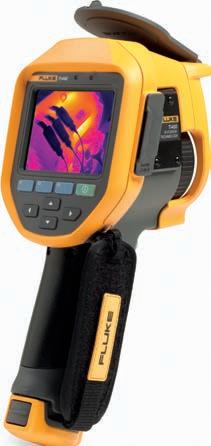
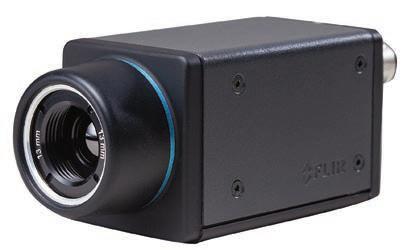
Stunning 640 x 480 resolution
Surprising affordability
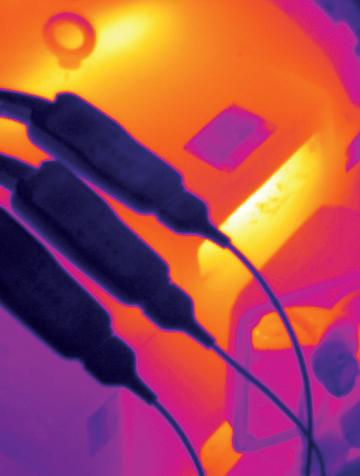
• Experience 4-times the resolution power in an “everyday” rugged camera
• Detect small temperature differences critical to troubleshooting— leading to more accurate problem identification
tial is split into three categories, which will now be addressed in more detail:
• 10 per cent by improving efficiency of components, such as motors, fans, and pumps
• 30 per cent by using speed control with AC drives, adapting to the variable load
• 60 per cent by optimizing the remaining system, such as piping and valves in a pumping station
The origins of energy savings potential in electric motor driven systems: An EU pump study under Ecodesign Lot 29 demonstrates that efficiency regulation based on the extended product approach has an energy savings potential seven to nine times greater than component efficiency regulation.
Overall system optimization comprises a multitude of different energy-saving approaches. All these factors influence the overall system efficiency:
• Analysis of the system layout
• The energy sources used
• Central or decentral control
• Degree of partial loading
• Actions which can reduce energy consumption
When choosing which combination of approaches to apply, it is vital to act on the basis of cost-effectiveness over the lifetime of the facility.
Partial load
In particular, partial loading is a critical issue addressed in system optimization but not in component-level optimization. Component efficiency measurements are based on full load. In reality, however, systems operate at varying partial loads where the efficiency levels of the components drop dramatically; this decrease in efficiency is addressed in measures for system optimization.
Even though system-level optimization offers the highest energy-saving potential, it is important that improving component efficiency not be overlooked. Efficient components will aid in providing motivation to improve the extended product efficiency and the system efficiency, and in achieving the greatest gains for the global energy supply.
How can we promote the extended product and system efficiency approaches? If businesses, trade organizations, and policymakers can agree on a universal benchmarking standard that takes partial loading into account, it will be easier to compare and assess the efficiencies of different system solutions.
System efficiency as market differentiator
In the U.S., pumping system operators will soon be motivated to optimize pump system efficiency by a voluntary labelling scheme. The Hydraulic Institute, a non-profit trade association of pump manufacturers and suppliers, is planning to introduce a voluntary labelling program that enables benchmarking of pump systems.
Using a standardized testing system, manufacturers can differentiate themselves by demonstrating the superior efficiency of their pump systems in terms that are comparable with competing systems. In this way, pumping industry suppliers are effectively motivated to optimize pump system energy efficiency ratings, without the need for government regulation.
In contrast to the Hydraulic Institute’s voluntary labelling program, The Energy Conservation Standards for Pumps uses a mandatory approach. Implementation of this regulation is predicted to reduce U.S. electricity consumption by 1 per cent in the period 2020-2045, due to pump system optimization alone. The standard states: The cumulative reduction in CO 2 emissions through 2030 amounts to 2.7 Mt, which is equivalent to the emissions resulting from the annual electricity use of more than 0.37 million homes.
Challenge to legislators and regulators
Common wisdom among leading authorities within research and regulation says that effective regulation has to come in a well-defined order:
1. Component efficiency regulation
2. Once this is in place and completed, the extended product approach (the AC drive, motor and driven machine) is implemented
3. Finally, the system approach can be implemented.
However, this approach does not address the “low-hanging fruit” first, although it seems easy from a regulatory point of view. Rather, all three areas should be addressed in parallel, using well-defined and suitable tools in each area.
System level optimization can without a doubt deliver the greatest energy savings. Therefore, the focus should not only be on optimizing component efficiency, but also on increasingly improving efficiency at the system level by applying the “extended product approach,” addressing the variable speed drive, the motor, the driven application, and its variable load. MRO
Douglas K. Backman is the vice president of Canada at Danfoss Drives. He is responsible for sales, service and operations, and also has P&L responsibility for Danfoss Drives in Canada. For more information, visit www.danfoss.us.
100 YEARS OF INNOVATION.
For 100 years NSK has been proudly designing motion and control products that not only help increase productivity but also help make the world a more safe, reliable and comfortable place. Here’s to celebrating the past, innovating in the present and setting the future in motion.
877.994.6675 www.nskamericas.com
WORKHORSE THE
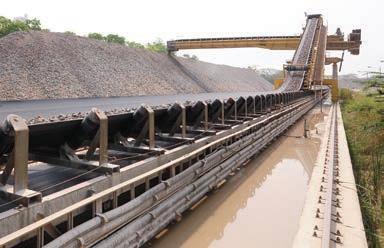
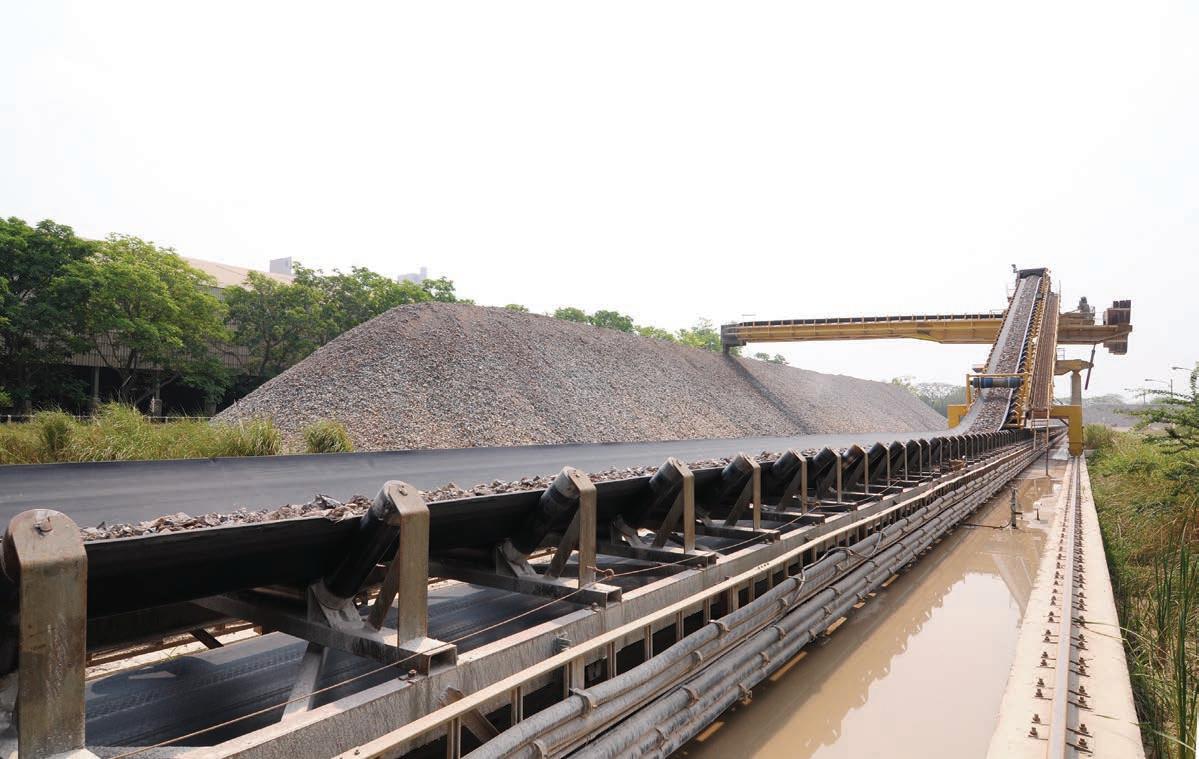
Belt conveyors are the backbone of material handling systems. In this article we discuss technical requirements of belt conveyors with a focus on drive systems and power transmission.
BY AMIN ALMASI
There are many design parameters and variables for belt conveyors such as the details of belts, length of conveyor, drive system, power transmission, speed of conveyor or incline angle. Appropriate selection of these parameters and variables are important for overall performance, operation and reliability of material handling systems.
Belt conveyors
Belt conveyors are main work forces for transferring materials across equipment or from one processing facility to another. A belt conveyor fault can directly influence daily production, and it is why correct design, installation and operation of conveyors are important.
In simple terms, a belt conveyor consists of a closed belt that is driven by two (or more) drums known as pulleys. The belt is a sophisticated layer of materials selected and stacked carefully from different strengths and protecting layers. Middle layers should bear the tensions and forces; therefore they are fabricated of strong plastic composite or steel cord layers.
The selection and specifications of the top cover layer should be suitable for handled materials. It should withstand corrosion, erosion, impact, thermal effects and generally any abuse of handled materials. It should protect tension-bearing layers from all these effects and abuses related to handled material and environments. If the top cover is weak or when it is removed, the tension-bearing layers can be easily damaged by impact, wear, erosion or corrosion received from handled
materials. The top cover layer may be a carefully selected layer (6 mm - 12 mm) with the expected lifespan of more than 1015 years under the worst possible cases. As an indication, the maximum installation angle to the horizontal plane should not exceed 13° for conventional belt conveyors. The distance of the belt line, including pulleys from the supporting floor, should be wide enough for easy maintenance. A minimum clearance of 850 mm is often needed below the return side of the belt for maintenance, inspection and operation.
Optimum speed should be selected for conveyors; this is critical as slow speed conveyors are neither optimal, nor cost effective. On the flip side, high speeds may also present operational problems and reliability issues. Conveyor belt speed is normally between 2 and 3.5 m/s. Over the past two decades, speeds a bit above 3 m/s have been specified and used for many applications; many modern belt conveyors use a range between 3 – 3.5 m/s. For modern, reliable belt conveyors, even higher speeds beyond the commonly used range may be used in special cases.
There have been many options for changing the direction and orientation of belt conveyors. A common method for changing the direction and orientation of travel of a conveyer belt system is using transfer points. In this option, materials discharge from the end of a conveyor and fall directly onto a second one, set at the required angle, often 90°. For controlled transfer of materials, especially at high speed, the correct design and details of the transfer point and the chute, in particular, are important.
Driver systems and MVSDs
Modern belt conveyors are usually driven by an electric motor through a soft start and controlling mechanism. Generally, the drive and transmission system is an important part of any conveyor. Using dynamic analysis on a conveyor’s drive and transmission system will provide an understanding of the system’s performance, as well as the basis for optimization, improvements and reliability.
For many large belt conveyors, variable speed drives (VSDs) are often used. For medium-size conveyors, mechanical variable speed drive (MVSD) systems are usually used, as these are cost effective and more suitable for so-called medium range (roughly between 60 kW to 1 MW). There have been many variants of such mechanical systems (MVSDs); a well-established one is a delayed filled fluid coupling (also known as “fluid coupling”) designed to limit starting torque and generally softening the torque transmitted in any transient situation such as sudden load changes, or start-up at full load. As a rough indication, starting torque averages 120 - 130 per cent of the normal torque, peaking up to 140 - 150 per cent of nor-
mal. Starting times greater than 40 seconds are not common; many conveyors have starting times of around 25 seconds or even less. During overload conditions, the torque transmitted by fluid coupling is usually high but below of 150 per cent. The torque applied for the startup, due to massive inertia and at low speeds, would be very high and it reduces only due to softening effects of MVSD (fluid coupling); therefore torque would be practically as high as MVSD might transmit. For design purposes of sizing or strength review of conveyor’s components, the torque transmitted in worse possible cases might be assumed to reach 210 per cent of the motor’s full torque load of the motor.
With the rapid development of conveyors towards high power, long conveying distance, high adaptability, high durability, high reliability, the problems of dynamic performance prediction, parameters matching of components and reliability analysis of the key parts are becoming more challenging. Therefore, dynamic simulations and studies should be done for all possible normal and transient cases, such as normal startup, fully loaded startup, trip, or emergency trip, to make sure the drive system and all conveyor components are sized and designed properly.
Gear units
Gear reducer units are needed to reduce the speed of electric motors to drive conveyors. Gears are designed for infinite life with power rating equal to the full motor rated power, multiplied by the relevant service and safety factors, often above 1.3 or 1.4. Usually ample margins should be considered for all aspects of mechanical, thermal, loading lubrication oil and others. The design of each gear reducer unit should prevent the temperature of the lubricating oil from rising above a certain level (as an indication 80°C) and this is particularly important in warm environments.
Equipment and units in material handling systems, such as belt conveyors, need large speed ratios (inlet speed/outset speed); gear ratios in the range of 30 – 150 (sometimes even 200) have been used in these systems. In addition, lightweight gear units are needed to limit overall weight. All these favour plan-
etary gear units. A planetary gear system consists of one or more outer gears, or planet gears, revolving around a central or sun gear. These gearing systems also incorporate the use of an outer ring gear (annulus), which meshes with the planet gears.
Planetary gear units provide high power density in comparison to standard parallel axis gear trains. They provide a reduction volume, multiple kinematic combinations, purely torsional reactions and coaxial shafting. The load in a planetary gear unit is shared among multiple planets; therefore, torque capability is greatly increased. Disadvantages include high bearing loads, more dependency on lubrication oil, some inaccessibility issues and design complexity. All these disadvantages can be dealt with in good gear package design and manufacturing. A higher reduction ratio can be achieved by doubling the multiple-staged gears and planetary gears. As an indication, the efficiency loss in a planetary gear train is around 2 - 4 per cent per stage.
Bevel-helical compound planetary gear units have been used in material handling systems and belt conveyors, with typical gear ratio range and power range between 50 – 200 and 70 kW – 1 MW respectively. Relatively heavy lubrication oils, such as ISO VG 320, have been used for these heavy-duty gear units.
Conveyor brakes
Another important component in the drive and transmission system of a conveyor is the brake. A brake is often installed in the opposite side of driver unit and connected to the same pulley. High reliability in design and fabrication is important; as with any brake system, a conveyor brake is a critical component with high expected reliability. Brake linkages and pins should be stainless steel, usually running in self-lubricated bushed bearings. The failsafe aspect is the key for successful brake design and selection. The size of each brake unit should be adequate for the duty applicable to the particular conveyor. The function of the brake is dependent on the layout and design of each conveyor and all possible operating modes and circumstances should be taken into account when ascertaining the size of the brake and the time delays required for the application or release of the brake. Provision should be made for the adjustment of applied brake torque from 40 to 100 per cent of full torque. The rate of application of the brake should also be adjusted to allow a time delay – often between 0.5 and 5 seconds.
Backstop devices
Backstop devices (also known as holdback) are needed for many conveyors to prevent reverse movement due to the material weight in the event of a malfunction or accident, such as sudden power failure. A backstop device is usually fitted to the drive pulley. Backstops (holdbacks) should have a capacity to hold as a static load 100 per cent of the stalled torque of the electric motor, on which will be applied a service factor (often 1.5 or 1.6). MRO
Amin Almasi is a rotating equipment consultant. As a chartered professional engineer, he specializes in rotating machines, including centrifugal, screw and reciprocating compressors, gas turbines, steam turbines, engines, pumps, subsea, offshore rotating machines, LNG units, condition monitoring and reliability. Reach him at amin.almasi@ymail.com.
What are the benefits of providing training to maintenance personnel?
BY MARK BARNES AND JEFF SMITH
Employees at world-class organizations spend as much as 10 per cent of their time engaged in training and education. But in a recessionary environment, training is often one of the first activities to be cut. Jeff Smith and Mark Barnes have distinct points of view on the benefits of training and why companies should invest in employees.
Jeff Smith
In many industries I see training for the sake of training – for meeting key performance indicators (KPI) so we can retain our training budget. The training provided in this environment is often aligned with what the most convincing salesman has to provide. So, before I discuss the virtue of training, I would like to emphasize that it should be the right training.
The correct training for maintenance personnel is not only machine/tool specific but also meets the objectives of the organization. When hiring a new tradesman who has a trades ticket from a governing body, one assumes he has basic skills. Then, as a world-class organization you do the following:
1. Conduct a skills gap analysis to identify the training program required for his/her individual skillset.
2. Design a development program to ensure their skills will be enhanced over time.
3. Train them in the workflow business processes, including work-order feedback.
4. Teach them the expectations of your site’s safety, environmental and health programs.
5. Train them in your frontline reliability expectations, including preservation of evidence, five why and short interval control.
6. Ensure they understand your failure registry program (FRACAS).
Now if your organization lacks maturity in the reliability world, for example, you have poor work packages with little follow-up, then you need this new tradesperson to be a true master craftsman to be successful. If you lack targeted training and supporting systems you are people dependant. If you run a people-dependant organization you need great people. Even great people leave your organization, so you need succession planning, which puts us back to training.
Sustainability is only attained by transferring skills. This requires a focused competency-based learning program. To
attain competency requires three phases of learning: educational, cognitive and experiential.
Educational: The educational component is the point most companies deliver with the assumption that the learnings are retained. Various studies have shown that in a classroom environment students will only retain from five to 25 per cent of the content covered and this is influenced by the type of learner they are. The three learning types are:
• Auditory learners (hear) – They prefer to listen to explanations.
• Visual Learners (see) – They learn best by looking at examples or demonstrations.
• Kinesthetic learners (touch) – They process information through hands-on experiences.
All people tend to have a combination of the three types of learning. Optimized educational training attempts to address the three learning types to maximize the knowledge retention from the educational component of training.
Cognitive: Though the educational part of learning is foundational, the majority of skills development happens in the cognitive phase of learning. This is the point at which the student is actually conducting the skill and an experienced person is mentoring them through the tasks. This component of skills development covers around 70 per cent of the learning and is essential to skills retention. There are multiple methods to provide cognitive mentoring from onsite partnering, in-house transfers (the trainee is reassigned to work under a competent mentor) or remote monitoring (work is remotely peer reviewed and guidance provided).
Experiential: The experiential component of training is a product of application of the skills. There will be a point where the student has applied the skill a multitude of times and may have developed an individual approach or solved unique challenges. This is the point at which the student has developed the skills to become a subject matter expert and has earned the knowledge to become a trainer.
Barnes – rebuttal
Jeff, I think you’re absolutely right. Too many companies provide training to simply “check a box” without making it part of a strategic initiatives. Particularly with today’s generation who tend to learn more by “doing” than “listening,” the importance of the cognitive and experiential components to training will become increasingly important.
Jeff Smith Reliability Expert
CANADA’S MOST COMPREHENSIVE WORKWEAR & PPE SUPPLIER
Improve your supply-chain efficiency and positively influence your bottom line with an uninterrupted supply of head-to-toe workwear and PPE from Mark’s Commercial.
We are your source for bulk wholesale order fulfillment and managed supply solutions for the manufacturing industry. Benefit from our product sourcing, safety compliance awareness and streamlined purchasing to ensure you always have the right products delivered to the right place at the right time. We know that manufacturing work never stops, so always be ready with durable, comfortable footwear, workwear and safety PPE for your workers from Mark’s Commercial.
We are your one-stop, bulk wholesale supplier. As the direct sales arm for Mark’s we are Canada’s largest supplier of bulk wholesale industrial and corporate workwear and footwear, as well as PPE and uniforms. Count on us to meet all your manufacturing workwear needs.
Your workers’ safety comes first. Mark’s Commercial supplies top safety workwear brands through apparel programs to thousands of Canadian businesses. Corporate wholesale integrated apparel programs, online ordering, direct delivery and a dedicated Client Services Team make Mark’s Commercial the only wholesale workwear supplier you’ll need when safety matters most.
Mark Barnes
While it’s hard to argue that training employees isn’t a good thing, I think we need to draw a distinction between training and education. In my mind, training is about teaching someone how to perform a specific task or use a specific tool or instrument. For example, if your organization has invested in a new laser alignment tool or ultrasonic leak detector, training a mechanic or millwright how to properly use the tool to achieve the desired result is of paramount importance. Where most companies go wrong in my opinion is with basic education. Whereas training provides the “how,” education provides the “why” and done incorrectly, education can actually have the opposite effect from what was intended. To illustrate my point, we need to understand how training and education plays into overall organizational change (Figure 1). When companies embark on a new business process, companies transition through four distinct phases of organizational learning. At the beginning, most organizations exist in a state of “unconscious incompetence.” Unconscious incompetence simply means that people within the organizations are behaving in a certain way, not because they are consciously thinking about their actions, but are simply doing their job the way they were told or trained to do so, often based on tribal knowledge.
they now know they’re doing it wrong! Conscious incompetence is a difficult place to be. While some take it as a rallying cry – a call to action – others let it consume them, feeling blamed for things that are truly beyond their control.
When organizations fail to recognize the danger of conscious incompetence, eventually they slip back into the same old “business as usual” but now they often adopt an air of cynicism. I’ve lost count of the number of times I’ve heard: “my boss needs to hear this” or “things will never change around here.” In my experience over 50 per cent of companies that conduct educational sessions fall into this category, never executing on the changes necessary to move on from being consciously incompetent. For some employees, the response is to adopt a “punch the clock” mentality with poor drive and motivation. But for those that take this to heart, it’s a dangerous situation for any employer. Frustrated by knowing they’re performing sub-optimally without being given the tool and support necessary to make effective change, driven employees may in fact elect to find new career opportunities where their dedication and new-found expertise are better appreciated. In this case, education has had the opposite effect. Organizations that truly manage to effect lasting change use education to motivate leaders at all levels of the organization to be a part of solution. Through hard work, commitment and most importantly management support to provide the financial and human resources to effect change, companies that have truly embraced the need for change ultimately get to a point where they are consciously competent, we’re still having to think hard but have sufficient resources in places that things are starting to get done to right way across the organizations. Once conscious incompetence is reached, it’s a short downhill ride to unconscious competence. In essence we’re doing things the right way, but not having to work or think harder. In fact, oftentimes the new business as usual is easier, which is a key component in making to new practices sustainable over the long haul. Organizational change such as that illustrated in Figure 1 cannot occur without education. By the same token, it needs to be part of a bigger strategy, otherwise it’s of little value. Good education is invaluable but needs to be almost evangelical in nature: inspiring and motivational, not just death by PowerPoint.
Smith – rebuttal
Geoff Parcell, Capstone Publishing, 2001).
Often as a result of crisis (a catastrophic failure), an epiphany (for example, attending a conference and hearing a particularly inspirational speaker) or a corporate mandate to lower costs, training (or, more correctly, education) is scheduled to bring awareness to the situation. I’ve presented countless educational classes where my mandate was in essence to tell a group of hardworking millwrights that everything they’ve been doing for the past 20-30 years is wrong! It’s about taking a group of individuals who are unconsciously incompetent and helping them get to the point of conscious incompetence! Conscious incompetence simply means that people are now aware that certain practices or processes are sub-optimal. But the day they exit the classroom, usually nothing has changed. The plant is still performing the same tasks poorly, using the wrong tools and the wrong procedures. The only difference is
Many of the issues Mark mentions are related to executive sponsorship. The training logic required for maintenance is no different than the training required for a new VP. What skills does he have, what skills are required for the role, and how do we address the gaps? Training in maintenance and reliability practices needs to start with the C-suite and be understood by the whole organization. Lack of understanding leads to lack of sponsorship, and once again, the right training/education is the answer.
MRO
Mark Barnes, PhD, CMRP, is vice president of Reliability Services at Des-Case Corporation. Barnes has published more than 100 articles and several book chapters on lubrication and oil analysis. His PhD is in analytical chemistry. Reach him at mark.barnes@descase.com.
Jeff Smith is a reliability subject matter expert. Smith has served as senior advisor for the Association for Maintenance Professionals (AMP) and served on the U.S. tag for ISO 55000. Reach him at jsmith@ acuren.com.
Figure 1: States of Organizational Learning. (Ref: Learning to Fly, by Chris Collison &
Mark Barnes Des-Case Corp.
POWERFULIDEAS
If you’re seeking new methods and solutions to increase efficiency, contain costs, and improve the overall performance of your hydraulic and pneumatic systems, then the forward-looking educational program at IFPE 2017 will bring you up to speed. Gain the latest technical knowledge and insights into engineering advances at a powerful array of half-day college-level courses and the co-located Energy Efficient Hydraulics & Pneumatics Conference. Explore new ideas and solutions to enhance the quality of your design so that they become leaner, cleaner, greener and more cost-effective.
The ERP Challenge
Preparing the equipment list.
BY PETER PHILLIPS
– Part 4
This month we are back at the building manufacturer in Canada still busy with implementing a new ERP system.
There are three major pieces of Master Data needed to implement a module of any CMMS or ERP. In the November issue I wrote about the largest piece of master data – the spare part inventory. In this issue, we focus on the second piece of Master Data, the Equipment List. The size of the equipment list will vary depending on the size of the facility. Medium size plants will have between 600-1,000 individual pieces of machinery. Every plant needs to document all the equipment in the plant including equipment in the following areas:
• Production equipment – all equipment used in the production
• Mobile equipment – forklifts, floor sweepers, loaders, trucks
• EHS equipment – Environmental, Health and Safety
• Auxiliary equipment – Compressors, air dryers, heating plant
• HVAC systems – Heating, ventilation and air conditioning
• Warehouses – Roll-up doors, packaging equipment
• Buildings and grounds – Exterior building components
The list should encompass all the equipment that is connected to operating the facility. In our ERP system we want to write a work order for anything that needs to be repaired in the plant. Remember that an ERP is primarily a finance system. All repair costs associated with the equipment and building envelope need to be captured.
Define the parts
A critical part in formulating the equipment list is the nomenclatures used for the equipment numbering and their corresponding descriptions.
Before we started our list we determined the definition of a piece of equipment. Some people tend to include replacement parts in their equipment list. These replacement parts are captured by the spare parts list and will be part
of the BOM (bill of materials) for that equipment. They do not need to be in the equipment list.
Let’s look at the difference between a piece equipment and a spare part. Equipment is an item that will be maintained, repaired/rebuilt and put back into service, and given preventive maintenance procedures. Another definition states: “Equipment is defined as a machine with a single discrete function related to the manufacturing process.”
Spare Part is defined as: Parts will be replaced and thrown away or repaired and put back on the stores shelf.
Use a standard naming convention
Now that we know what constitutes a piece of equipment we need to develop equipment numbering and description nomenclatures.
There are several reasons to use standard nomenclatures
1. After the ERP goes live, staff will have a standard to follow for years to come.
2. Navigating the equipment list in the ERP will be much easier
3. Searching and adding equipment to ERP work orders will be easier for maintenance staff
4. The equipment list will look neat and tidy when you view them in the ERP
ERPs can be programmed to number the equipment automatically or allow the user to assign their own equipment numbers. In our case we chose to develop our own equipment list. We had to contend with both the equipment numbering and description nomenclatures.
Here are some standards we used.
Example:
Equipment # - LINE1-P15-E010
LINE 1 = Process Line 1
P15 = (P15) Process Step Shaker System
E010 = Shaker Feed Conveyor ( E010 - Is the first piece of equipment in this step)
Equipment Description – SHAKER, FEED CONVEYOR
You may enhance your equipment list by further breaking it down into sub-assemblies.
Example:
Equipment # - LINE1-P15-E010-S010
LINE 1 = Process Line 1
P15 = (P15) Process Step Shaker System
E010 = Shaker Feed Conveyor ( E010 - Is the first piece of equipment in this step)
S010 = Drive System
Equipment Description – SHAKER, FEED CONVEYOR DRIVE SYSTEM
Sub-assemblies allow you to write work orders to the part of equipment that need repairs. When this method is used, breakdown analysis and trending can be done through ERP reports and Key Performance Indicators. We wanted this feature available, so we used sub-assemblies for complex equipment.
The next step is to gather equipment-specific data. This includes the manufacturer, serial and model numbers, etc. After this is complete the BOM (Bill of Material) list can be developed.
The last leg in sight
To say the least, developing a complete equipment list is another large task. We will spend about two months putting the list together from our six plants. After the lists are completed and copied into templates, there is much more to do.
Every part of Master Data takes time and it is so important to have teams of people at every plant working together to provide the information needed to complete the data-gathering process. So far we have met the deadlines provided to us by the central ERP implementation team.
Next month I am going to move into the last piece of Master Data, which are the Preventive Maintenance Procedures and Schedules.
Peter Phillips of Trailwalk Holdings, a Nova Scotia-based maintenance consulting and training company, can be reached at 902-7983601 or by email at peter@trailwalk.ca.
High vibration levels – the hidden killer of bearings
BY DOUGLAS MARTIN
High vibration is vibration that is synchronous (integer multiples such as 1x, 2x) with the shaft Rpm. The most common method of measuring this level of vibration is a velocity measurement (vibration is typically measured in velocity, for low frequencies, and acceleration, for high frequencies).
A typical cause of vibrations is imbalance of the rotating assembly or a bent shaft or a misalignment within the system. Since these are often present from the start, the levels of vibration are assumed to be “normal” as they may be integrated into the baseline vibration levels assumed to be acceptable running. In one case, the fan was sped up to near its critical speed (unknowingly) and despite it being balanced to “normal” allowances, it still behaved as an “unbalanced” fan.
This is often accepted as the machine is “just running rough.” One day, however, when there is a catastrophic failure of the bearing, everyone will wonder why there was no pre-warning about an imminent bearing failure. When summoned, the vibration techs may say that there were no bearing indications (inner ring, roller or outer ring fault frequencies), and this is absolutely true.
Looking for bearing damage
Look for bearing damage in the higher frequency, non-synchronous frequencies (frequencies that are non-integer multiples (1x, 2x, etc.) of the shaft speed. As well, these indications are searched for in acceleration as opposed to velocity. It is for these two reasons that high vibration is a bearing killer.
Effects of high machine vibration
It tends to put a much higher demand on the cage/roller/race contact surfaces to keep the cage running concentrically. When the cage contacts these surfaces, it is with siding contact and thus causes adhesive wear, especially if the lubricant is marginal.
Consider the condition of the race
They are smooth with no anomalies that would trigger a high acceleration reading (fault frequency).
If you were focused on looking for bearing fault frequencies (race or roller), then this progressing damage would be missed.
What else can happen?
Fretting Corrosion: Machine vibration can cause fretting corrosion between stationary components. Fretting corrosion generates iron-oxide, which has two effects:
1 – It is an abrasive
2 – It draws oil out of the grease soap causing it to “dry up.”
Effects on grease: Firstly, it disrupts the grease reservoir. Grease lubricates the bearing by sitting on the cage and gradually seeping onto the rolling surfaces. When there is higher machine vibration, this reservoir is unstable and tends to disperse faster than it can be replenished. Eventually the grease is no longer on the cage and therefore not lubricating the bearing. Secondly, grease subjected to vibration tends to separate into oil and its base soap. With the oil being fluid, it escapes the bearing cavity leaving behind “dried” grease and a bearing without lubrication.
What can be done?
An effective way to prevent early bearing failure due to excessive machine vibration is to eliminate the source of that vibration. This means proper balancing, proper alignment and proper machine.
Alternatively, mitigate the damage to the bearing by increasing the grease replenishment, selecting tight housing fits (and the correct bearings to accommodate a tight fit) and selecting bearings with appropriate design features that tolerate excessive vibration such as ring-guided cage (with the appropriate lubricant for this design of cage).
Douglas Martin is a heavy-duty machinery engineer based in Vancouver. Reach him by email at mro.whats.up.doug@gmail.com.
Hand Tool Report
Hand-tool makers are putting an emphasis on safety and ergonomics.
BY TOM VENETIS
When it comes to hand tools the focus needs to be on safety and ergonomics.
Hand tools will be used for long hours in hazardous conditions and often in remote work areas where, if a tool is forgotten or lost, a replacement can’t simply be found by nipping down the hall or to the van and getting another.
Take the example for working at heights at an oil and gas refinery or on a wind turbine. Once a maintenance team goes up onto a wind turbine or a refinery’s vacuum distillation tower, workers need to be able to account for every tool and to make sure no tool is lost or falls.
“Safety today is a big factor, especially here in Ontario with the mandated Working at Heights [requirements],” says Laurette Blake, commercialization manager for Proto and Mechanical tools at Stanley Black & Decker Canada, GTS Group. “Although tools are not mandated to be tethered, people are mandated to be tethered when working at heights and to be aware of what the issues are.”
One of the key issues is ensuring that tools being used are secure and all steps are taken to prevent a tool from being lost or dropped from a height during maintenance and service work. That seems obvious to many. However, it is quite easy for a tool to slip from one’s grasp when one is either switching between tools or looking for one in a tool bag. Because of this possibility, toolmakers are now looking for ways to give maintenance workers a way to tether tools to themselves while allowing workers to retain freedom of movement and ease of access to tools, especially when working at heights.
Blake says the company’s SkyHook Tether & Transfer System addresses those issues. It is designed to give positive tool
control where foreign material exclusion (FME) is needed. It comes with a switch connector that is attached to a lanyard that is rated for up to 6-lb loads. The tethers can then be attached to an anchor worn on the body or by a series of docks with the Skyhook connector, and to the tools needed for work with small carabiners.
Blake says that the system allows for workers to have complete accountability of all their tools, so none are ever left behind on a site, left unattended or dropped. “This is immensely important as a safety factor,” says Blake. “If a tool is not on your wrist, it is either on the [anchor station] or on your belt. This helps prevent the possibility of the tool being dropped in a hazardous environment from a height. It also allows someone to make sure that all the tools are accounted for so nothing is misplaced or forgotten.”
Another important aspect of safety on a jobsite is ergonomics. Tools are often used for long periods of time in environments that can be hard on a person’s body. Used continuously over several hours, a grinder’s vibration, for example, can cause a worker to suffer from what is known a “white finger/muscle disease,” better known as carpal tunnel syndrome. That is why ergonomics is now a key consideration both in deciding which tools workers will use and how toolmakers go about designing tools. The emphasis today by toolmakers, especially those who make electric and pneumatic tools, is on designing tools that can be used for long periods of time while reducing such issues as vibration to minimize damage to a person’s body.
“Ergonomic acceptance by users is directly related to several factors,” says Jim Bohn, director, strategic development, Robert Bosch Tool Corporation. “How big is the gear/motor housing? That is a key area that affects the ability to get into tight areas
and the weight factor [of the tool]. Another, is the balance of the tool for longterm use, and the battery size.”
Bohn says some things people should be looking for in a power tool is the use of EC or brushless motors, gear systems that are compact and efficient, and a balanced overall industrial design that places ergonomics top-of-mind. Another is battery life and how the tool handles heat when used over long periods of time. Heat will impact a battery’s life, so how a tool handles the heat is important. Many of these tools are being used on worksites where it is not possible for a worker to easily go and get another battery if the one they are using runs out of power. Protection from stray electrical discharge is something else to keep in mind, especially if the tool is to be used in hazardous environments where an accidental electrical discharge can trigger an explosion causing injury to workers and damage to surrounding machinery and equipment.
“The battery is not only the cordless power tool’s power source, but also a critical factor in the performance and runtime users require to have trust in cordless power tools,” Bohn says. “Therefore, the lifespan of a battery is one of those important factors for a reliable battery system.” What should be looked for is how well the tool draws heat away from the power cells and how well it manages battery performance. Stray electrical discharge can be managed through electronics and making sure the tool has the correct insulation, Bohn adds.
Much of the focus in the power tool industry has also been on improving the performance values of cordless power tools with more advanced and compact brushless motors and improved electronics for better power management, says Bohn.
“Brushless motors provide [better] tool life, more torque performance and a smaller compact motor, which results in a more compact and more ergonomic power tool. The electronics maximizes the performance of the motor and the power required from the battery system. The value of these power tool advances to users working on complex machines or systems is increased power, longer runtime and a compact tool that can complete any application required. Having a reliable and high-performance cordless power tool, not having to change batteries or find another power tool for various maintenance operations is a time saver, a money saver.”
Randy McDonald, national product manager with FEIN Canada, says that another safety feature to consider in hand tools is overload production, especially in grinders. “If someone is using the grinder for heavy grinding work or cutting thick material, and if the operator jams or twists the wheel, there should be overload protection to protect the motor from burning out.”
McDonald says many grinders on the market still use a mechanical clutch to reduce the changes of overload the motor. While a mechanical clutch system works well, there are problems with such systems with prolonged use. “A mechanical clutch has a problem in that it is has mechanical parts and if the grinder is jammed multiple times, the mechanical clutch can have its parts wear out. Electronic systems are just that, electronic, so there are no mechanical parts to wear out.” MRO
Tom Venetis is a Toronto-based freelance writer. Reach him at venetis@ rogers.com.
Intelligent Motors and Actuators
Precision, control and the ability to work in harsh environments comes to motors and actuators.
BY TOM VENETIS
Mechanical power transmission technologies are getting smaller and coming with new safety features and intelligence, making them indispensable in such market segments as the food and beverage industry.
Jeff Moore, vice-president of marketing, mechanical, with Baldor Electric Co., says makers of motors and other mechanical power transmission technologies are finding a growing market for their wares in the food and beverage industry, but only if the technologies meet certain conditions.
“Safety is a primary focus in specific industries, such as the food and beverage industry,” Moore says. “We have all seen companies have recalls, such a Blue Bell Ice Cream, which recently had the issue of listeria. So, what we are seeing are companies looking at technologies that use stainless steel and moving to the use of synthetic lubricants.”
The food and beverage industry needs a wide array of motors and mechanical power transmission technologies, products that can perform with a high degree of reliability but can also work safely in processing environments where risks of contamination to food or beverages need to be eliminated.
Metal-Detectable End Covers
Motors, as one example, need to meet certain safety and contamination prevention requirements. These include being able to withstand the daily washdowns that happen in food processing and beverage making operations. These washdowns happen frequently with high-pressure hoses and the use of special cleaning agents to destroy potentially harmful bacteria. Motors and other systems need to have an IP65 and above rating for washdown protection. The Ingress Protection (IP) rating system is a classification system showing the degrees of protection from solid objects and liquids. Motors should also have high efficiency gearing and couplings and sheaves, and bushings that operate in both wet and dry applications. A stainless-steel design is now expected to further reduce the chances of bacterial contamination.
Baldor Dodge Metal Detectable End Covers are designed to provide a safe solution for food processing facilities. Food safety end covers are constructed of a durable, high-density polyethylene (HDPE) material containing stainless steel particles. This material allows the end covers to be detected by X-ray equipment and metal detectors used in the food and beverage industry, ensuring that if it falls into the food, it will be found. Snap-on style providing easy installation and rigid performance in washdown applications and fit all Baldor Dodge E-Z Kleen and Ultra Kleen mounted ball bearings. Includes a drain hole to prevent moisture from collecting inside the cover. www.baldor.com
“When it comes to food producers and mechanical power transmission products, they have specific questions and needs,” Moore explains. “They will ask, ‘How do I know that these products coming into my plant are designed to withstand Clean-In-Place processes? Are the products watertights and can they be used during high-pressure washdown procedures involving high pressures and high temperatures, and
Mounted Ball Bearings
Baldor’s Dodge Ultra Kleen mounted ball bearings are ideal for washdown applications. The stainless-steel set screw insert is deployed in either a polymer or stainless steel housing. The QuadGuard triple lip seal with rubberized flinger provides protection against contaminants while the MaxLife cage retains lubricant. Stainless steel housings feature a solid base, with no cavities or fillings to trap contaminants. The product comes with H1 registered food grade lubricant. Food-grade lubrication is standard.
www.baldor.com
done at close range? We also see that covers are important in the food industry and we introduced a metal-detectable end-cover specific to the food industry.”
These end-covers that Baldor makes available are constructed from a high-density polyethylene (HDPE) material that is embedded with stainless steel particles. This allows the end covers to be detected by X-ray equipment and metal detectors used in the food and beverage industry to detect metal materials that may have fallen into the foods or beverages being prepared. The metal in the end covers will ensure that if one falls into the food preparation process it will be found by the detectors and removed.
Niklas Sjostrum, the product line manager for Thomson Industries says that his company’s liner motion systems and precision linear actuators are made to work in food and beverage processing and packaging plants, and are rated at IP65 in order to meet the washdown requirements needed for such environments.
“Not only with water, but with detergents as well,” adds Sjostrum. “Material selection is key as is the ability to clean it down without too many pockets that can let bacteria hide away and which can cause bacterial growth later. That is a major challenge for technologies to work in these kinds of environments.”
Sjostrum gives the example of the company’s PC-Series Precision Linear Actuators: “The outer design is sleek and clean with no slots for other peripheral attachments. The components are made from stainless steel and the rod is completely stainless steel, and there are seals between each compartment, such as the bearing house, so nothing can come out of the unit and nothing can come into the unit. We also added a sophisticated motor mounting system with the sealing seal going all the way back to the motor. We seal off every different compartment so there is no chance for leakage or for anything to penetrate the unit.”
Another feature companies are looking for with actuators is for the actuators to be “smarter.” Many actuators are what might be termed “dumb,” meaning they only do one thing and have no means by which they can be managed and operated
Linear Actuator
Thomson Linear’s PCSeries Precision Linear electric actuators are made to deliver high repeatability and positioning accuracy in a design is the energy efficient, smooth and quiet. It is customizable offering operations some of the longest stroke lengths available in the industry, and utilize a plug and play mounting solution that accommodates more than 600 motor types and sizes. Features include high side load capability, built-in anti-rotational rod end and is suitable for heavy loads and harsh environments. It is ideal for food and beverage manufacturing and packaging environments as the actuators have no collection points making them ideal for washdown environments and come with an IP65 rating. www.thomsonlinear.com
in more subtle ways. Think of such “dumb” systems as a light switch that only has one function, to turn a light “On” or “Off.” Such switches offer no means to control the electrical flow to a light so it may be dimmed, for example. These switches can only turn the light “On” or “Off” and the light stays at one level of brightness at all times. “Smart” actuators can be likened to switches that allow a user to dim that light to the level of brightness desired.
“Our customers are asking for a little bit more intelligence in the actuator, such as position feedback, low-level switching, the ability to use low-power wires to plug into a PLC for greater control, as opposed to a double-pole, double-throw switch and BUS technology as well, mainly on the J1939 CAN BUS and LIN BUS,” says Chard Carlberg, product line manager, industrial linear actuators with Thomson Industries.
“Intelligence allows people to use the actuators in environments where they would not have been able to use them before,” adds Travis Gilmer, product line manager with Thomson Industries. “With intelligence, it allows you to have [the actuator] move to an exact point and to tell you when it has reached that point, for example. With basic actuators, you don’t have that ability. The people who are using these kinds of actuators are using them in machines where it will be communicating with other moving parts in a system that the actuator has to interface with.”
MRO
Tom Venetis is a Toronto-based freelance writer. Reach him at venetis@ rogers.com.
What’s New in Power Transmission...
Variable Frequency Drives
Eaton’s PowerXL Series Power management company
Eaton has expanded its line of PowerXL Series DG1 variable frequency drives to include a more powerful Frame 6 option. Designed for global commercial, industrial and original equipment manufacturer (OEM) customers, the Eaton engineered drive increases available power from 150 to 250 horsepower (hp), affording customers greater agility, reliability and safety for their applications.
www.easton.com
Current Loop Calibrator
The REED VC05 Current Loop Calibrator features mA sourcing, simulation and measurement. It has a 24V loop power supply and selectable step or ramp outputs. Loop Calibrators are essential for troubleshooting and calibrating processes involving a 4-20 mA current loop. The VC05 can be used to setup and configure valves and vfds. www.REEDInstruments.com
Compact 1 to 1 Ratio Right Angle Gearboxes
Tolomatic’s compact 1 to 1 Slide-Rite right angle gearbox offers a small package but can deliver up to 588 in-lbs (66.4 nm) of torque depending on input RPMs. It comes with a high torque ball bearing design, solid one-piece aluminum housing seals gears from outside contaminants for smooth operation, right-or-lefthand rotation to convert power either direction, easily slides axially along the drive or driven shaft for flexible positioning, is leakproof and comes with alloy steel helical gears for high performance. www.tolomatic.com
White Washdown Duty Motors
Baldor’s Super White Washdown Duty Motors 1-20 Hp 56C thru 256TC are made for food and beverage processing plants and are specially designed for humid and moist environments where the motors receive sanitary washdowns on a regular basis. Key features include: A labyrinth seal on each end of the motor to protect bearings, same size and sealed ball bearings on each end, moisture resistant insulation, a white epoxy finish that is resistant to corrosion and chipping, and easily removable condensation drain plugs.
www.baldor.com
Asynchronous Self-Braking Three-phase Motor
MDA Controls is offering the Coel Asynchronous SelfBraking Three-phase Motor (FK - FKL Type) are closed and externally ventilated. The brake is supplied DC with rectifier. FK motors can be driven by inverter, but in such cases, it is necessary to supply the brake separately from the motor. The cases are in die pressed aluminum and braking surfaces are in cast iron. Shafts are fitted with an hexagon on the back side for the manual rotation of the shaft. A hand release option for the brake is available on request. FK motors are compact and light and are available with a wide range of options. Standard features include: Disk brake without axial sliding off the shaft, electromagnets encapsulated in resin with IP66 protection, adjustment of braking torque within very large values and DC electromagnet as standard.
www.mdacontrols.com
Thermal Camera
ITM Instruments’ thermal imaging cameras produce high quality thermal images that can show temperature differences as small as 50 mK. The A35 FOV 48 generates 320 x 256 pixel thermal images allowing one to easily track temperature changes. Non-contact temperature measurement is possible with the 14-bit temperature linear output within any third-party software. Very affordable and compact and it can synchronize to other cameras simplifying applications where more than one camera is needed. www.itm.com
Hygienic Electric Cylinder delivers more force, longer service life
ERD Hygienic Electric Actuators
Tolomatic’s line of hygienically designed all stainless steel electric actuators offer up to 7868 lbf (35 kN) and they are the perfect solution for food and beverage applications where higher forces are required for pressing, pumping, cutting or slicing. The actuators come in three body sizes, have stroke lengths up to 39.4 inches (1 m), are IP69K with all stainless steel construction and meet USDA and 3A (#14159-1-2010) approved hygienic option for over food operation.
www.tolomatic.com
Drop-In Gearmotor
Falk Ultramite gearmotors come in a compact size that are a perfect fit for the .19 kW/.25 hp through 37 kW/100 hp power range. One can choose a standard plug-in high-efficiency National Electrical Manufacturing Association (NEMA)/ International Electrotechnical Commission (IEC) motor from stock for an easy bolt-up mounting to the gear drive. Add positive torque transfer without corrosion or fretting, energy efficiency over worm gear drives. An innovative motor bushing eliminates fretting between motor and gear drive and delivers positive torque transfer. This patented design offers easy installation and allows quick, trouble-free changeout even after years of hard, continuous use. www.rexnord.com
The Tolomatic ERD hygienic all-stainless-steel electric cylinder features a new roller screw option that increases the maximum thrust to 7868 lbf (35.6 kN) for expanded cylinder life and improved performance in high duty cycles over ball screw models. Available with strokes up to 16 inches (406 mm) and speeds up to 22 inches (559 mm)/sec., the IP69k-rated ERD hygienic cylinders are ideal for clean-in-place operation; they can withstand high-temperature and high-pressure washdowns. The smooth-body hygienic design eliminates the need for actuator guarding fixtures, which simplifies machine design and lowers costs. Optional USDA and 3A-approved models meet requirements for over-food production and meat (livestock), poultry and dairy processing. Roller screws are now available in all three sizes of Tolomatic ERD hygienic electric cylinders.
www.tolomatic.com
Brushless Hammer Drill/Driver
The Bosch HDS183-02 18V EC Brushless Compact Tough 1/2 In. Hammer Drill/ Driver features KickBack Control, Bosch’s integrated acceleration sensor that automatically shuts the tool down when a potentially dangerous rotational torque reaction occurs in a bind-up scenario. This reduces the risk of sudden tool reactions in binding conditions. The tool is engineered with an upgraded, heavy-duty all-metal chuck that allows for increased robustness and torque transfer. The tool provides an ergonomic grip zone and Bosch’s Electronic Motor Protection and Electronic Cell Protection, to protect the tool and batteries from overload and overheating. www.boschtools.com
Wire Stripper
Ideal Industries (Canada) Corp.’s Red, White and Blue Wire Stripper offers 6/32 and 8/32 self-chasing screw-cutting holes, an ergonomic design with curved handles help reduce wrist fatigue and textured sleeves with extra cushioning for added comfort.
www.idealindustries.ca
Coupling Covering
The Baldor-Dodge Raptor utilizes a patented finite-element optimized winged elastomeric element design. This WingLock technology increases surface area in the most critical regions of the element, resulting in higher bond strength, improved fatigue resistance, and longer life versus competitive designs. Designed to be a drop-in interchange, the Raptor meets or exceeds torque, bore, and speed ratings for these styles of commonly used couplings. All Raptor components can be used in existing applications without any modifications.
www.baldor.com
Festo EGC Electric Linear Axis
Festo’s electric linear axis EGC delivers high dynamic response and speed with newly defined rigidity along with high load bearing capacity. Festo offers 54 different EGC configurations. The EGC can be configured as an electric tooth belt drive, spindle drive or driveless guide axis and comes in standard or heavyduty variants. There are extended slide, second slide and protected slide configurations and Festo also offers matched motors and controllers, and safety monitoring systems. All variants feature aluminum profiles with an optimized crosssection that give maximum rigidity to absorb very high torques and forces with maximum load capacity. The heavy-duty variants offer very high load-bearing capacity laterally to axis Mx with factor of 2 compared to the standard axis.
www.festo.com
Variable Frequency Drive
The EFC 3600 variable frequency drive (VFD) by Bosch Rexroth complements the existing product portfolio including the Fe and Fv frequency converters as well as the highly dynamic IndraDrive platform. The EFC 3600 improves the process control through integrated PID controllers as well as through a sequence control system with eight steps. The settings enable an energy efficient operation of equipment and machines at their optimal operating point. Due to its high intermittent overload capacity of up to 200 per cent as well as the high initial torque of up to 150 per cent, the EFC 3600 can be used for a wide range of applications with the most varying requirements. The freely scalable V/Hz characteristic allows load-dependent adjustment of the voltage/frequency curve, which ensures a longer motor service life.
www.bosch.com
Linear Actuator with Flexible Onboard Controls
The Electrak HD from Thomson Linear is an electric linear actuator platform with onboard electronics which can eliminate the need for standalone controls. Higher power opens a wider range of hydraulic applications to electric conversion. And, it meets the most OEM component environmental acceptance tests, including IP69K. The Electrak HD can handle load ranges up to 10 kN (2,250 lbs) making it ideal for hydraulic to electric conversion applications. Stroke lengths up to 1,000 mm (39 in). Built-in J1939 CAN bus option enhances controllability, can eliminate individual controls and simplifies OEM machine design. Electronic trip point calibration ensures consistent overload protection. www.thomsonlinear.com
Cordless 60V Grinder
Tethered Tools System
For high power cutting and grinding of structural steel, metal pipe, rebar, steel plates, and concrete the DEWALT 60V MAX 4.5” to 6” Grinder features a brushless motor that maximizes runtime for demanding applications allowing for up to 126 cuts of 1/2” rebar on a single charge using a FLEXVOLT battery and 6” FLEXVOLT cutting wheel. The Grinder is also a Perform & Protect tool, designed to provide a high level of tool control without sacrificing performance. Key features of the DEWALT 60V MAX 4.5” to 6” Grinder include its Kickback Brake which automatically shuts down and slows the wheel to a stop when a wheel pinch is detected. It has power equivalent to 13 Amps or 1700 MWO and a brake with less than two second stop time that slows the wheel when the trigger is released. www.dewalt.com
Industrial Four Speed Magnetic Drill
Hougen Manufacturing has released a portable magnetic drill, the HMD934. This new model offers increased power and performance for demanding hole-making in industrial applications. The HMD934 has a improved power to weight ratio by giving metal fabricators more strength and torque to drill large deep holes in steel, holes up to 4” deep and up to 3-1/16” in diameter. The HMD934 has several features that provide convenience and ease of use for the operator. The mag drill pilot light is a LED light built into the base of the magnet that allows the operator to more efficiently and quickly line up the pilot with the hole’s centre location in all lighting conditions. A guide rail feed system maximizes cutter stability and rigidity. Powering the drill is a proprietary high torque two speed Hougen motor.
www.hougen.com
PROTO’s industrial tethered tools and accessories includes the SkyHook Tether & Transfer System as well as tether ready tools and attachments. The SkyHook system helps end users in the oil and gas, energy, aerospace, wind, and construction industries comply with drop prevention practices, fulfill safety requirements, and work productively while at height. The Skyhook System offers safer tool transfer at height, a light and tight tether system, natural freedom of motion and tool accountability. The Skyhook was designed to be used with tools up to 6lbs.
www.protoindustrial.com
Custom Shaft Collars
Stafford Custom Shaft Collars come with minor modifications to their standard parts such as slots, flats, through-holes, and threaded holes to complete custom designs with cams, levers, mounting holes, hinges, and more. Typically combining multiple functions to eliminate extra parts and improve mechanical efficiency and structural integrity, they can enhance drive system performance and add mounting or system integration capabilities. Supplied in prototype through production quantities, Stafford Custom Shaft Collars can be machined from alloy steels, stainless alloys, titanium, aluminum with anodizing in bright colours, brass, bronze, Teflon, Delrin, nylon and other materials. Ranging from 1/8” to 10” I.D. with round, square and other bore styles, dimensional tolerances of < 0.001” and < 0.001” T.I.R. concentricity can be achieved, depending upon configuration.
www.staffordmfg.com
QA &
Where do you draw line between Maintenance and Physical Asset Management?
Physical Asset Management has received a lot of attention in recent years within asset intensive industries, such as oil & gas, energy, utilities, process and manufacturing.
On one hand, the release of PAS 55 (the British Standards Institution’s Publicly Available Specification for the optimized management of physical assets) and its subsequent follow-up, ISO 55000, has brought physical asset management within the limelight. On the other hand, it has created ambiguity for many maintenance practitioners.
Before going into the differences between maintenance and asset management, let’s first define some key terminologies:
· Asset: item, thing or entity that has potential or actual value to an organization (ISO 55000-1)
· Asset Management: co-ordinated activity of an organization to realize value from assets (ISO 55000-1)
· (Asset) Life Cycle: stages involved in the management of an asset (ISO 55000-1)
· Maintenance: the upkeep of industrial facilities and equipment (Dictionary of Engineering, McGraw Hill, Second Edition, 2003)
In essence, asset management is a
ON
THE LOOKOUT
conscious, systematic and co-ordinated effort towards realizing value from an asset or a portfolio of assets in a sustainable way throughout their lifecycle.
The lifecycle of an asset can be illustrated as follows:
The “asset management” function is primarily focused on reducing and optimizing asset lifecycle costs through all the stages, while the “maintenance” function is responsible for ensuring that the asset keeps on performing its intended functions in a reliable and efficient manner.
Therefore, maintenance is an integral part of asset management. This, however, should not limit the maintenance function only to one lifecycle stage as it has important linkages with other stages as well.
Proper involvement and participation of the maintenance function during the following activities is essential for the suc-
ISSUE: By 2020, companies will have shifted the majority of their R&D spending away from product-based offerings to software and service offerings, according to the 2016 Global Innovation 1000 Study from Strategy&, PwC’s strategy consulting business. That’s because they need to stay competitive.
EFFECT: Companies will recruit less mechanical engineers and more data and software engineers to build their capabilities. By 2020, the number of companies reporting that electrical engineers are their top employed engineering specialty will fall by 35 per cent and the proportion of companies who expect that data engineers will represent their largest group of employed engineers will double from eight per cent to 16 per cent.
ADVICE: Pay attention to the shift and ramp up for change.
To learn more, visit www.strategyand.pwc.com/innovation1000.
cess of any asset management system:
1. Acquisition:
• Specification development
• Technical evaluation for procurement
2. Commission:
• Installation review
• Testing (FAT/SAT) and commissioning activities
• Handover
3. Dispose:
• Decommissioning and disposal planning
Asset Management requires good co-ordination among various organizational functions such as Project Management, Engineering/Design, Operations, Maintenance, Finance, Procurement, Health/Safety/Environment (HSE) and Sales in order to ensure thorough implementation of asset management.
Many organizations are already practicing asset management in some form or another. However, ISO 55000 aims to ensure a holistic approach towards asset management. With further adoption of the standard and newer regulations, organizational structures are already adopting strategic asset management to improve their organizational efficiency.
Usman Mustafa Syed is an experienced maintenance professional who is based in Kuala Lumpur, Malaysia. His experience includes more than 12 years in operations and maintenance management and project management within the oil, gas and energy sectors. Reach him at umsyed@engineer.com.
Perfect planning
Focus more on the planning of all the work rather on than the perfection of individual job plans. Running planning as a “Deming Cycle” of improvement requires planning nearly all the work. Bogging the planners down on individual jobs trying to make them “right the first time” means that all the plans cannot improve. Perfection comes over time by continually and forever soliciting and including actual job feedback as we go forward.
This issue’s tip came from Richard (Doc) Palmer, PE, MBA, CMRP, author of Maintenance Planning and Scheduling Handbook (McGraw-Hill McGraw-Hill Education, third edition, 2012). Reach him at docpalmer@palmerplanning.com.
Mr. 0, The Practical Problem Solver
From farm to table...
Whether your equipment is in the field or factory, you need the right bearings to keep things moving
NTN has the perfect bearing for every application in agriculture and food processing
Need more details?
Please contact us at 803-396-3644 or info.ca@schaeffler.com
www.schaeffler.ca
X-life products from Schaeffler feature optimized roller geometries and raceway finishes that are so precise, their service life far exceeds the conventional standard — as much as 70% in the case of our cylindrical and spherical roller bearings.