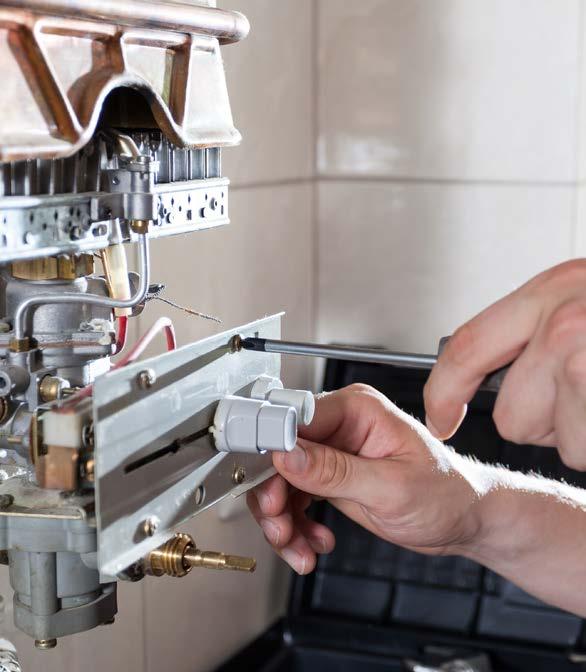
WATER HEATERS Installation
and Troubleshooting Pointers





20 HYDRONICS
APPROACHING PERFECTION…
Although certain “ideals” can never be achieved, they should still be considered. By John Siegenthaler
By Dave Demma


44 PLUMBING WHEN TECHNOLOGY AND SUSTAINABILITY MEET
How advancements are helping commercial bathrooms go greener. By David Scelsi
48 TECHNOLOGY
TOWARD THE ON-DEMAND REVOLUTION
Canada is the perfect market for this residential indoor air quality trend. By Aaron Engel
50 MOTORS WHAT YOU NEED TO KNOW ABOUT THE INDUSTRY WORKHORSES By Ian
McTeer
54 ON THE JOBSITE
OPTIMIZE PRODUCTIVITY AND WORKER SAFETY
How to pick a low-level scissor lift that fits your project. By Justin Kissinger
58 CONFERENCE REPORT CHANGE IS IN THE AIR
HRAI president Warren Heeley announces retirement, while Bruce Passmore becomes new chair, at AGM in Quebec City. By Michael Power 74 PREVENTIVE MAINTENANCE A COMPREHENSIVE APPROACH
A great preventive maintenance program will partner with end users over the entire life of a unit. By Jonathan Mosterd

TAXING TIMES
AT PRESS TIME MORE THAN 75 ORGANIZATIONS FROM ACROSS THE COUNTRY HAD RALLIED TO FORM THE COALITION FOR SMALL BUSINESS TAX FAIRNESS — a unified voice to oppose the federal government’s tax proposals that are expected to dramatically change the way incorporated small businesses are taxed in Canada.
Measures have been put in place over the years to limit the scope of some of the tax planning arrangements that the government identified as enabling some owners of private corporations to gain unfair tax advantages. Since such measures have not always been fully effective, the government proposed the following:
• Proposed rules to distinguish income sprinkling from reasonable compensation for family members. The rules would help to determine whether compensation is reasonable, based on the family member’s contribution of value and financial resources to the private corporation.
• The government sought input on possible approaches to neutralize the tax-assisted financial advantages of investing passively through a private corporation. Modifications to the current system will be designed to preserve the growth objectives of the lower taxes on active business income earned by corporations. The government will continue to review this issue and, following consultations, will develop concrete legislative proposals.
• The government is proposing changes to tax rules to prevent the surplus income of a private corporation from being converted to a lower-taxed capital gain, and stripped from the corporation. Detailed legislative proposals to implement the changes are being released for comment in conjunction with this paper. The government invited views and ideas on whether, and if so how, it would be possible to better accommodate genuine intergenerational business transfers in the Income Tax Act while still protecting the fairness of the tax system.
The coalition takes a different view, “These changes, announced in July 2017, would impose strict new regulations on tax measures that allow small business owners to invest in their business, save for retirement and support their families.”
The coalition stated that “This is an unfair attack on Canada’s middle class. Professionals in nearly every sector, from agriculture to manufacturing to healthcare, could be hurt by these changes. The coalition’s representation from all sectors, and our growth to more than 70 members in just a few weeks, demonstrate how devastating these tax changes could be to Canadians.”
The Heating, Refrigeration and Air Conditioning Institute of Canada, the Canadian Institute of Plumbing & Heating, and Mechanical Contractors of Canada have joined the coalition.
Consultation on the proposed changes ended at the beginning of the month. With the level of pushback from all sectors it will be interesting to see how the government proceeds. It is fair to say that not everyone will be happy with the result.

Editor
EDITOR
CONTRIBUTING EDITOR
ASSOCIATE PUBLISHER
ACCOUNT MANAGER
MEDIA DESIGNER
ACCOUNT COORDINATOR
CIRCULATION MANAGER
PUBLISHER
VICE PRESIDENT
COO
PRESIDENT & CEO
Kerry Turner (416) 510-5218 KTurner@hpacmag.com
Michael Power mpower@hpacmag.com
David Skene (416) 510-6884
DSkene@hpacmag.com
Stephen Kranabetter (416) 510-6791 skranabetter@hpacmag.com
Emily Sun esun@annexweb.com
Kim Rossiter (416) 510-6794 krossiter@annexbizmedia.com
Urszula Grzyb (416) 442-5600 ext. 3537 ugrzyb@annexbizmedia.com
Peter Leonard (416) 510-6847 PLeonard@hpacmag.com
Tim Dimopoulos (416) 510-5100 tdimopoulos@annexbizmedia.com
Ted Markle tmarkle@annexweb.com
Mike Fredericks
PUBLICATIONS MAIL AGREEMENT NO. 40065710
Heating Plumbing Air Conditioning (established 1925) is published 7 times per year by Annex Publishing & Printing Inc. HPAC Magazine is the leading Canadian business publication for the owner/manager of mechanical contracting businesses and their supply partners.
ISSN: 0017-9418 (Print) ISSN 2371-8536 (Online)
Contents Copyright © 2017 by Annex Publishing & Printing Inc. may not be reprinted without permission.
SUBSCRIBER SERVICES: To subscribe, renew your subscription or to change your address or information please visit us at www.hpacmag.com.
Subscription Price per year: $41.95 (plus tax) CDN; Outside Canada per year: $81.95 US; Elsewhere: 1 year $89.95; Single copy Canada: $5.00 CDN. Heating Plumbing Air Conditioning is published 7 times per year except for occasional combined, expanded or premium issues, which count as two subscription issues.
MAIL PREFERENCES: From time to time we make our subscription list available to select companies and organizations whose product or service may interest you. If you do not wish your contact information to be made available, please contact us via one of the following methods: Tel: 800.387.0273, Fax: 416.442.2191; E-mail: vmoore@ annexnewcom.ca; or by mail: Privacy Office, 80 Valleybrook Dr., Toronto, ON M3B 2S9.
HPAC Magazine receives unsolicited materials (including letters to the editor, press releases, promotional items and images) from time to time. HPAC Magazine, its affiliates and assignees may use, reproduce, publish, re-publish, distribute, store and archive such unsolicited submissions in whole or in part in any form or medium whatsoever, without compensation of any sort.
NOTICE: HPAC Magazine, Annex Publishing & Printing Inc., their staff, officers, directors and shareholders (hence known as the “Publisher”) assume no liability, obligations, or responsibility for claims arising from advertised products. The Publisher also reserves the right to limit liability for editorial errors, omissions and oversights to a printed correction in a subsequent issue. HPAC Magazine’s editorial is written for management level mechanical industry personnel who have documented training in the mechanical fields in which they work. Manufacturers’ printed instructions, datasheets and notices always take precedence to published editorial statements.
Proud member of: HPAC MAGAZINE 80 Valleybrook Drive, Toronto, ON M3B 2S9 TEL: 416.442.5600 FAX: 416.510.5140 www.hpacmag.com






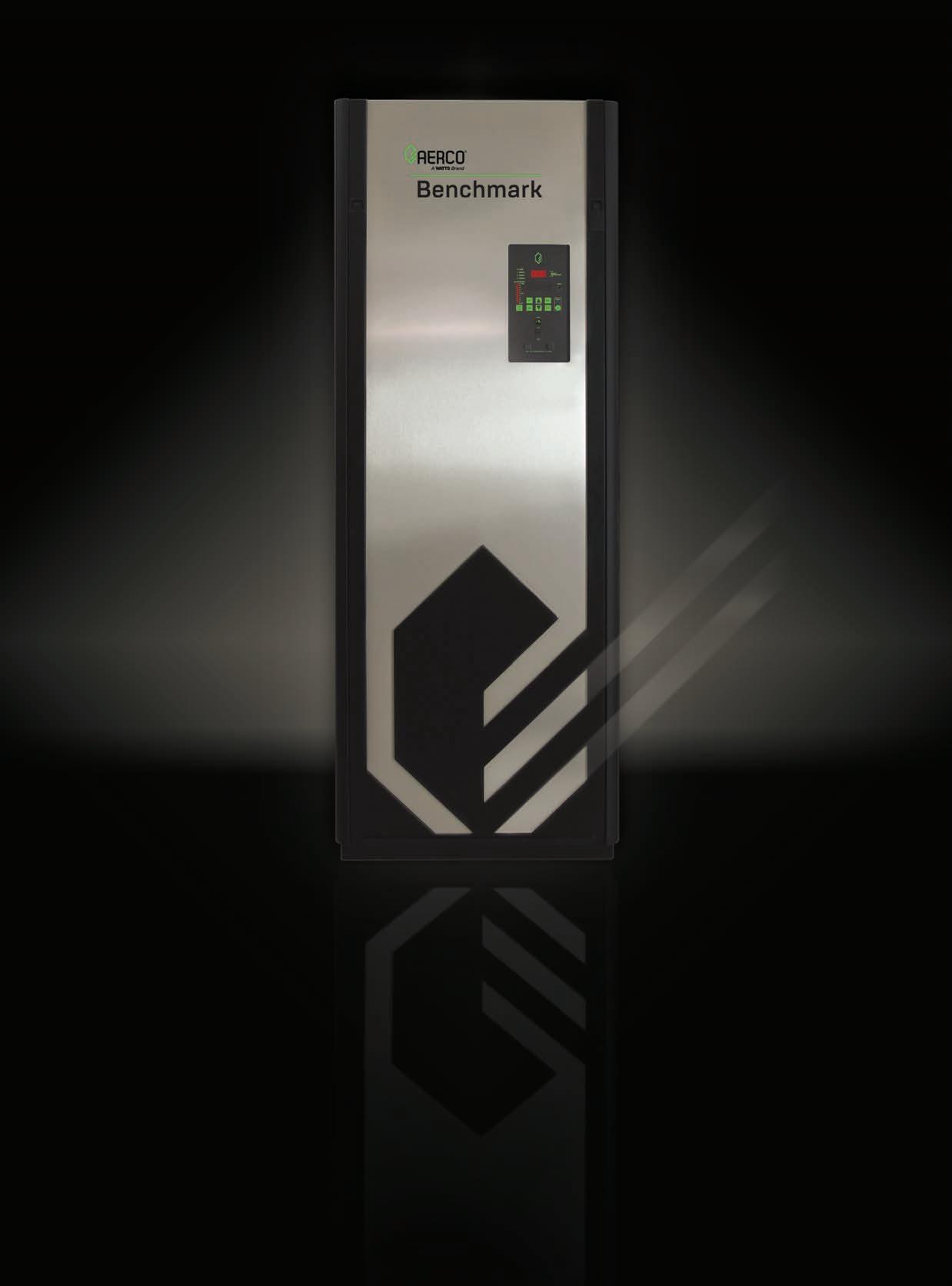
Benchmark® Platinum
Optimize Your Hydronic System for Maximum Efficiency and Savings
AERtrim
Peak Performance
AERCO’s patented O2 Trim technology self-adjusts the combustion process to deliver optimal O2 levels keeping your boiler operating smoothly at peak performance.
Dual Returns
Maximum Efficiency
Enables design and application flexibility — increases efficiency up to an additional 7%.
onAER
Predictive Maintenance
A pro-active tool detailing comprehensive unit performance so you can ensure your system operates optimally reducing costly unscheduled maintenance.
NEWS FEATURE COMPETITION BOOSTS PROFILE OF SKILLED TRADES
Canadians among the winners at the Annual UA Competition.
Over half of America’s skilled trade employees are nearing retirement age and fewer men and women are being prepared to take their places. To address the shortage of skilled labourers, the Copper Development Association (CDA) sponsored the copper piping portion of the annual United Association (UA) Competition and Instructor Training Program in Ann Arbor, MI on August 13 to August 18. Two Canadians were among the five winners: Christian Pierog, who is from Markham, ON LU 853, won in the Sprinkler Fitter category and Andrew Portelli of Ottawa, ON LU 787 won in the service technician category.
The annual competition featured apprentices from the UA’s six North American districts and Australia who had won local and state events. The
week-long event included a series of tests in each field – plumbing, pipefitting, sprinkler fitting, mechanical service and welding – that required apprentices to apply the on-the-job skills and knowledge they have gathered at local union halls. The four-hour copper component of the competition included nearly every type of joining technique for piping systems.
“This competition has given me the opportunity to work on many different things I’ve never worked on before,” said service technician apprentice Portelli. “Pushing me to a do a project like this has really forced me to learn.”
CDA donated copper materials for the competition and was responsible for designing and judging the projects. Awards were presented to the winners representing each of the five field specialties.
“It’s always interesting to watch the approach that a thoughtful, skilled mechanic brings to a project with no stepby-step instructions,” said Andy Kireta, Jr. who is vice president of CDA. “They each choose where to start and how to proceed. It’s a good thing for many that copper is so forgiving, easy to work with and join that minor mistakes can be fixed without scrapping the whole system.”
CDA also taught courses as part of the UA’s Instructor Training Program. The courses focused on copper techniques and applications, including standards, soldering and brazing, dissimilar metal joining, alternate no-
flame joining, joint analysis, corrosion causes and prevention for long-term performance.
“With fewer young men and women looking to join the industry, it is crucial that instructors properly educate our limited workforce,” said Dale Powell of CDA. “Year after year, I see instructors incorrectly perform basic soldering and brazing techniques. Through the training program, CDA is able to help correct these techniques and ensure that proper skills are passed on to future generations.”
The week concluded with the Instructor Training Program graduation ceremony and the announcement of the winners for the apprenticeship competition for each particular discipline. In addition to a commemorative copper trophy, the winners of the copper portion of the contest each received a $1,000 prize from CDA.
“Becoming a tradesmen is a very, very rewarding career,” said Portelli. “You get to learn something new every day. If you want a job where you’re just going to show up and go home, this is not the job for you. It pushes you to better yourself all the time.”
www.copperdevelopment.org
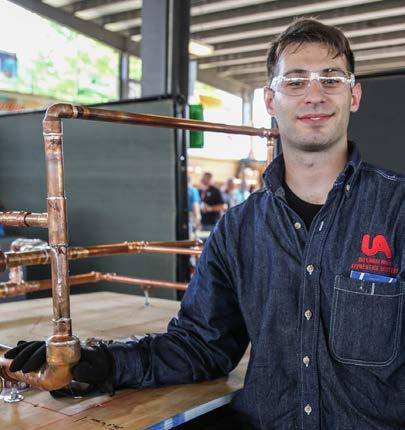
Andrew Portelli, Service Technician from UA Local 787 in Ottawa, ON.
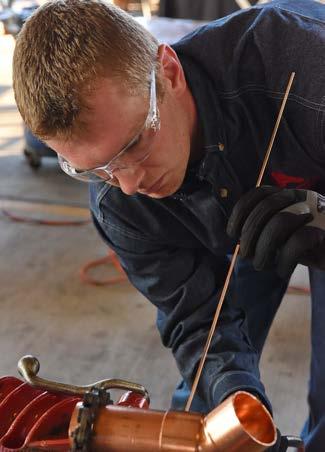
Christian Pierog, Sprinkler Fitter, from UA Local 853 in Markham, ON.

INDUSTRY NEWS
LOCALS GET PEEK AT CONSTRUCTION OF TIGNISH DISTRICT HEATING SYSTEM
Local residents were recently able to attend an information session and behind-the-scenes look into the Tignish District Heating Project in Prince Edward Island. The under-construction heating system will use a hot water boiler, fueled by wood chips, along with underground piping, valves, heat exchangers and energy meters to generate and deliver heat for 10 commercial buildings in the core of Tignish, which is the northwestern most town in PE.
The system will include a new boiler house and an underground hot water piping network coupled together with a stateof-the-art control system. The technology will heat water in a central plant with

locally sourced woodchips to heat local commercial buildings. Roughly 500 tonnes of locally harvested woodchips will


replace 200,000 litres of furnace oil each heating season. The project is the first of

Our new 6EC and 10EC Series sump and effluent pumps are built on the shoulders of 75 years of pure grit and determination. These rugged and efficient workhorses feature cast iron covers and bases*, upper and lower ball bearings, and larger intakes to reduce clogs... all while pumping up to 67 gpm.
* Propylene base options available.
Pipe burial near Heritage Inn.
Pipe coupling.
Workers connect heating lines to boiler house. Continued on
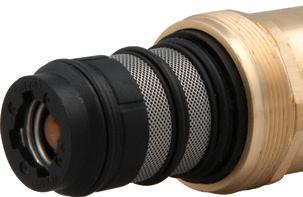
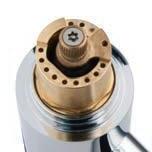
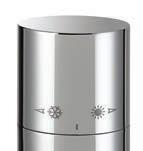
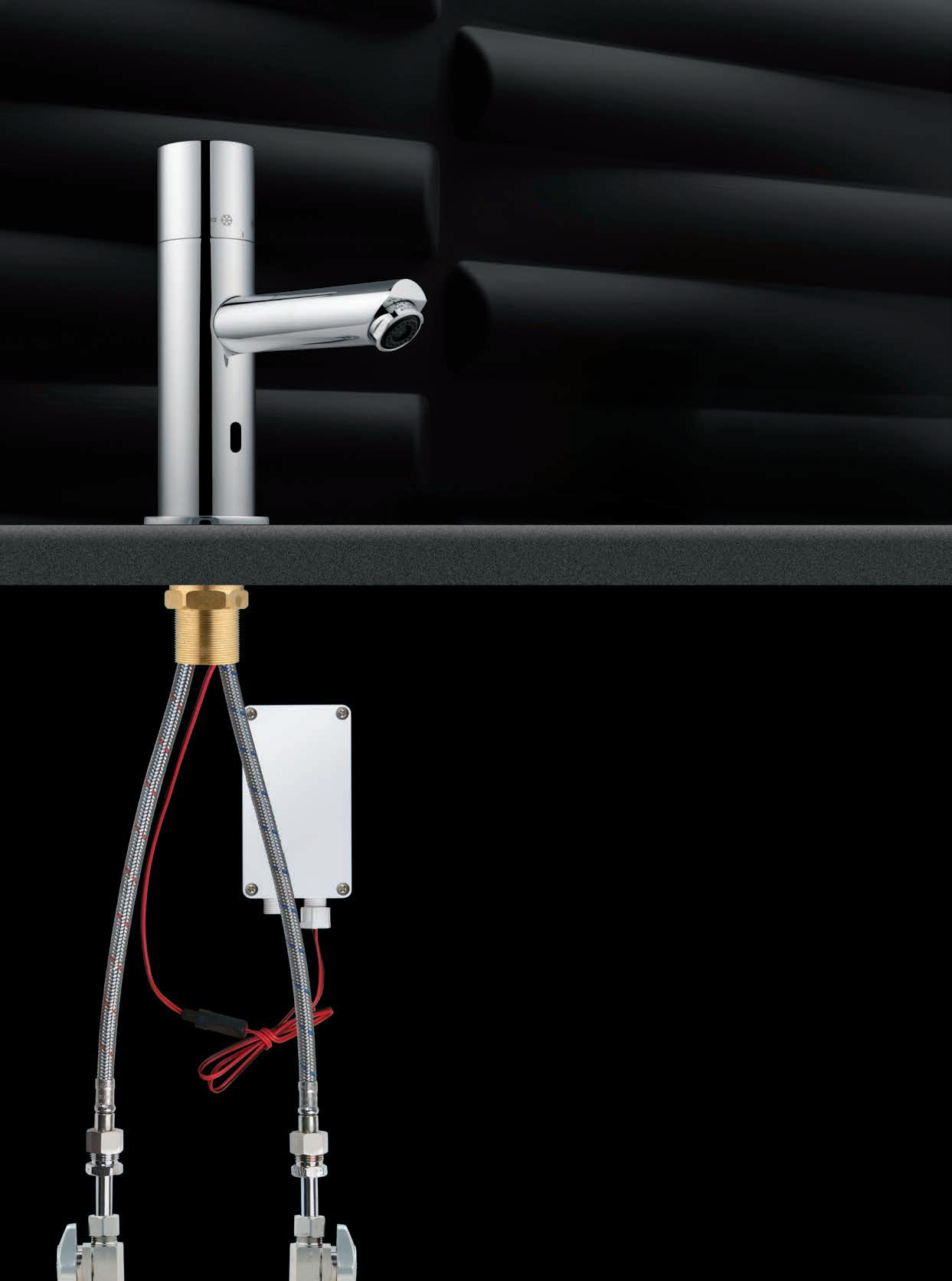
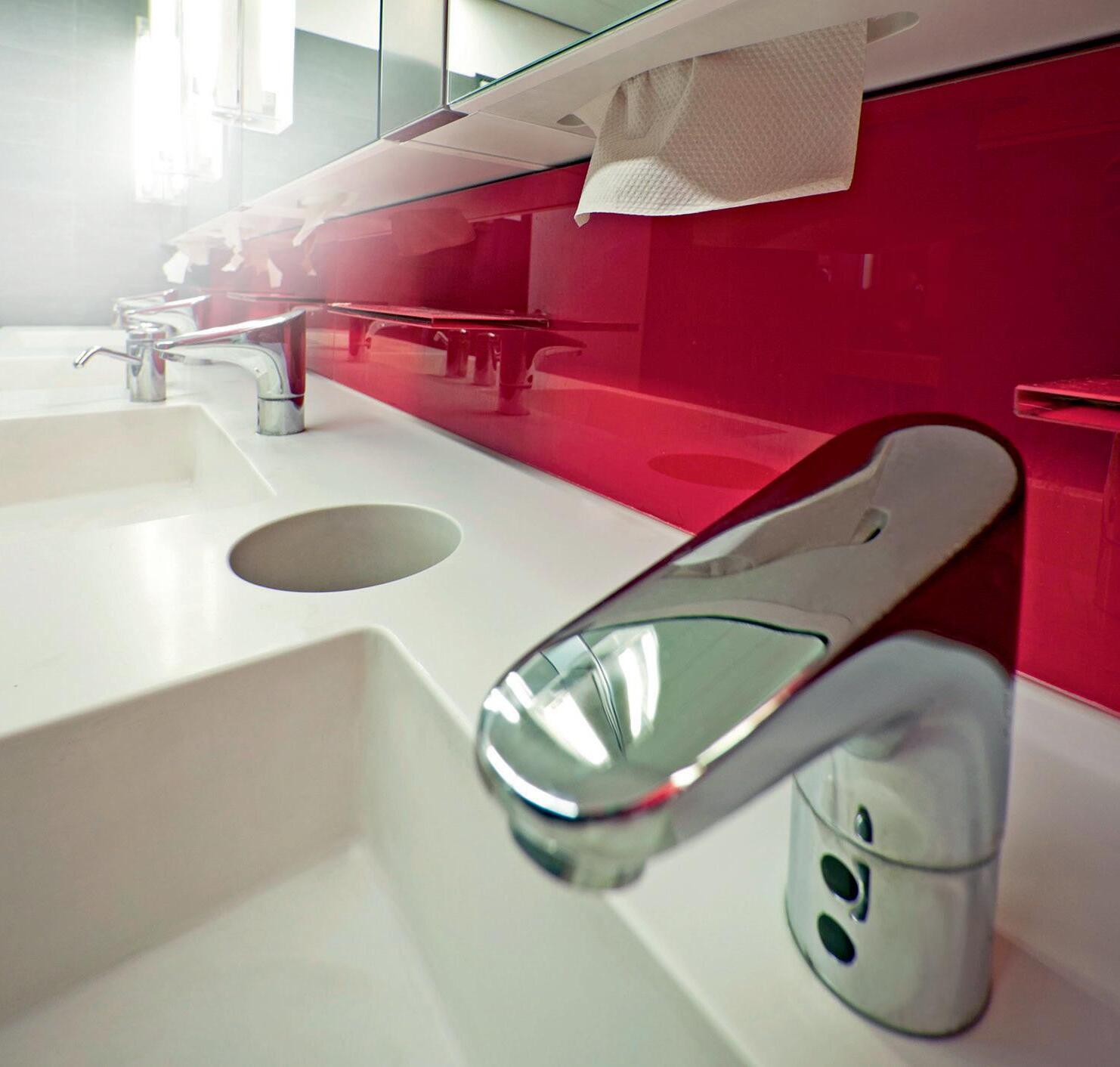
The new Delta hands-free thermostatic lavatory faucet is the smart choice for applications requiring thermostatic temperature regulation. The mixing valve and solenoid are contained within the body of the faucet and the supply lines are factory-installed, making installation quick and simple, thus saving you time and money. Outlet temperature limits can be set easily from above the deck by the installer and a top mixer allows the user to adjust the water temperature to comfort. Now that’s smart.
Backed by an exceptional 5-year limited warranty. deltacommercialfaucets.com
INDUSTRY NEWS
its kind on the island and is expected to reduce the region’s carbon footprint and help to build a cleaner energy supply that generates sustainable economic development for the community. www.infrastructure.gc.ca
CALL FOR PLUMBING PAPERS

MCA Canada has launched the group insurance captive initiative, which the company says is similar to an insurance company but owned by an organization to insure its own risk. MCA Canada will hold a special information session at its 76th National Conference in Maui, HI, November 6 to 9. The company’s captive partner, Aon, has also been holding a series of information sessions at locations across Canada. https://mcac.ca
Organizers of the Emerging Water Technology Symposium (EWTS) have issued a call for abstracts. The symposium in Ontario, CA, May 15 and 16, 2018, is for those who work or are interested in the fields of safe plumbing, water distribution and water efficiency. Attendees learn about new products and installation practices along with industry trends. Participants can hear ideas and approaches about emerging technologies; learn green plumbing and mechanical concepts; attend presentations and panel discussions; and more.
Fields represented include: water, sanitation and health; water and energy efficiency; addressing aging water infrastructure; mitigating opportunistic pathogens; plumbing research initiatives; laws, regulations and policy development; and more. The event is organized by the American Society of Plumbing Engineers; the Alliance for Water Efficiency; the International Association of Plumbing and Mechanical Officials; and Plumbing Manufacturers International, in cooperation with the World Plumbing Council).
The deadline to submit an abstract is January 15, 2018. www.iapmo.org





When your reputation matters, you can’t be too capable, too powerful or too smart. That’s the all-new 2017 Super Duty® Dig deeper with best-in-class towing and payload**. Outthink every challenge with available class-exclusive innovations such as blind spots sensors that cover your truck and trailer and
They’re at your service to help you manoeuvre your trailer, avoid
Smartest and toughest Super Duty ®. Undisputed.
and

INDUSTRY NEWS
INTERVAL DATA OPTIMIZATION RESEARCH RESULTS RELEASED
Research from the Canada Mortgage and Housing Corporation examined the application of a new approach that uses the feedback from interval data to optimize building heating system performance of seven multi-unit residential buildings with central, natural gas-fired, space heating boiler systems. The study involved assessing the interval data from the natural gas meters, modifying and changing the boiler control strategy (some distribution pipe changes were sometimes required within the boiler room) and examining the climate normalized natural gas consumption before and after the retrofit.
Given the costs and savings resulting from the seven projects in the study, buildings that are identified as good candidates for interval data optimization (IDO) can be expected to achieve a simple payback period of less than two years. This makes investment in IDO at these buildings very attractive and no additional financial incentives should be required to promote uptake of the technology. Instead, a change in approach is needed, with an emphasis on measurement and continual optimization.
The research demonstrates that significant energy and cost savings can be had in older gas heated buildings with relatively little disruption to the building users and modest costs to the building managers/owners. www.cmhc-schl.gc.ca/ odpub/pdf/69146pdf?fr=1502734368973
SEE HVAC/R INNOVATIONS AT 2018 AHR EXPO IN CHICAGO
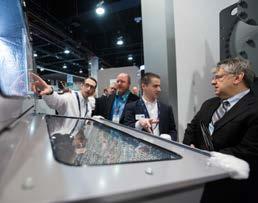
The future of HVAC/R will be on display when hundreds of new and upgraded products and technologies for the HVAC/R industry are featured at the 2018 AHR Expo (International Air-Conditioning, Heating, Refrigerating Exposition) at the McCormick Place in Chicago, which is slated for January 22 to 24.
Exhibitors will display HVAC/R-related products, systems and technologies across every facet of the industry. With 2,000-plus exhibitors, over 100 seminars and product presentations and more than 65,000 attendees, the show allows the industry to come together and share ideas, discover new products and find solutions. www.ahrexpo.com
NEW TSSA.ORG WEBSITE ON THE WAY
The website of the Technical Standards & Safety Authority (TSSA) at tssa.org is transforming. The authority audited the site, which highlighted opportunities to revitalize the digital space to make site use easier. The transformation will see the site become more user friendly, easier to navigate and less vulnerable to hackers and cyber-attacks. New features will include keyword search, frequently searched items list, dropdown menu and search as well as Z-to-Z topic listing. The authority says that the new site will also feature a clean look, responsive design and user-friendly navigation. The new site is set to launch this September. www.tssa.org
THE BUILDINGS SHOW ADDRESSES BUILT ENVIRONMENT CHALLENGES
The Building Show, a networking and educational event for design, architecture, construction and real estate industries, returns to the Metro Toronto Convention Centre (MTCC) November 29 to December 1, 2017, while IIDEXCanada takes place November 29 and 30.
The show addresses challenges including evolving client expectations surrounding housing, commercial spaces, hospitality and workplace design and urban planning solutions.
More than 30,500 professionals visit the show to connect with 1,600 Canadian, U.S. and international exhibitors in the MTCC’s South and North buildings.
Through demonstrations, in-booth engagements and display features, attendees can explore the latest industry products. Delegates can partake in roundtables, seminars and demonstrations. This year’s PM Executive Roundtable tackles how successful organizations achieve operational excellence through resource and talent management. New features include Prototypa, a prototyping workshop led by Stockholmbased Form Us With Love; Boutique Design Pavilion, dedicated to the hospitality sector; and an exhibition from OCADU.
Returning this year are the Passive House and AWMAC pavilions, the fifth-annual IIDEX Woodshop, THINK: Material, Canadian Interiors’ Best of Canada Awards and Canadian Architect’s Awards of Excellence presentation and reception, site tours and parties including the opening night party.
The Building Show offers over 350 seminars and demonstrations with over 500 speakers. Attendees can customize their education selection on topics related to architecture; interior; residential and retail design; building codes; accessibility; safety; sustainability and more.
Be sure to visit the HPAC team at booth #341. www.thebuildingsshow.com
Continued on p14

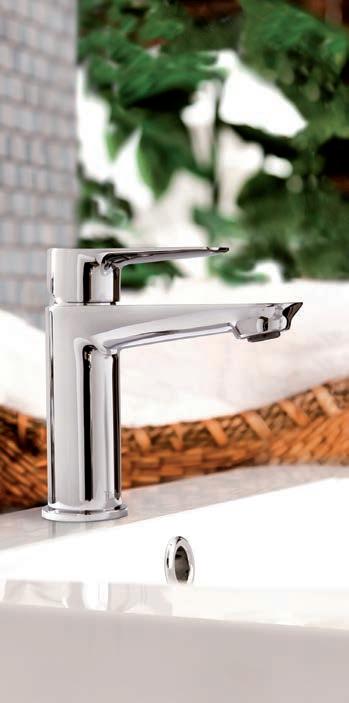






Designed for plumbers Loved by designers!








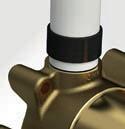
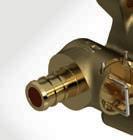


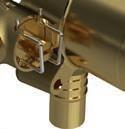






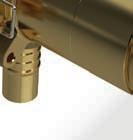


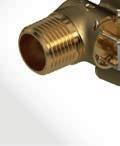










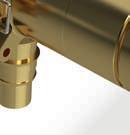
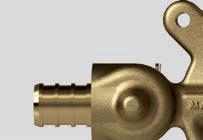
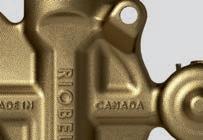
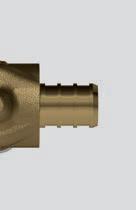
ALL OUR VALVES COME WITH THREE TYPES OF CONNECTION NPT, PEX , and Expansion PEX . The latter two are quicker to install.
OUR (T/P) VALVES OFFER THE BEST OF BOTH WORLDS: Our thermostatic/pressure balance valves (T/P) stabilize water pressure for steady temperature performance even in the event of a 50% drop in pressure!
Valve roughs are now MADE IN CANADA!


















INDUSTRY NEWS
2017 BAD AND UGLY CONTEST HIGHLIGHTS CROSS CONNECTION GAFFES
In the world of potable water protection and backflow prevention, a certified specialist tester or inspector will find cross connections that are controlled and in too many cases, a bad cross connection with no control. The
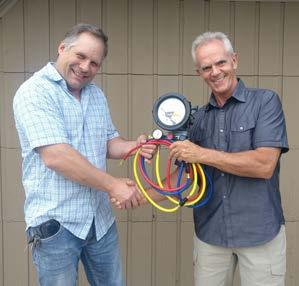
WCSAWWA National 2017 Bad and Ugly Cross Connection Control (CCC) contest winners submitted installations that illustrate the need for cross connection education and awareness. Two prizes are awarded, one to an active tester in the field and one to a CCC inspector/regulator.
Inspector Sylvain Boudrias of Darpsec in Brossard, QC, received a gift certificate from backflow manufacturer representatives on the WCSAWWA CCC committee for his entry. During a building audit, he found a backflow prevention device installed just slightly below the ceiling in the mechanical room. It had an ingenious mechanism under the relief valve; if the relief valve was leaking, the technician was closing the valve underneath, noted Boudrias. Although it was a functioning device, the installation was definitely noncompliant, reported Boudrias.
Journeyman plumber and cross connection specialist Glen Borth works in Southern Alberta. He discovered a commercial air compressor chiller tied into the potable water supply and a descaling chemical added without a RP.
“Our water industry representatives, inspectors, plumbers, and testers all share a responsibility to protect our water supplies. Cross connections do exist and are a potential to contaminate or pollute our potable water. Let’s do our best to find and correct these cross connections before the damage is done. We are looking forward to another year of “bad and ugly” photo submissions in 2018,” said Danny Wilson.
A panel of Cross Connection Control educators and regulators from the Western Canada Section AWWA Cross Connection Control Committee judged the cross connection photos. The contest promotes cross connection control awareness. Backflow manufacturers Zurn, Watts and Conbraco provided the contest prizes. www.wcsawwa.net
MARINE INSTITUTE LANDS WATER WISE AWARD
The Marine Institute of Memorial University in St. John’s, NL, has won the Canadian Institute of Plumbing and Heating’s (CIPH) Water Wise Award. Created in 2016, the award recognizes efforts of those outside of the CIPH membership working towards water conservation, stewardship, education and so on. Initially named the College of Fisheries, Navigation, Marine Engineering and Electronics, it was established in 1964 and focuses on education, training, research and industrial support for ocean industries.
Students and faculty of the Marine Institute observe and study oceans and fisheries with a focus on their long-term health and sustainability. Their approach includes academic study and industry programs to educate businesses and develop technologies to help preserve oceans. CIPH chairman of the board Joe Senese presented the award to Kimberly Roberston of the Marine Institute on September 20 in St. John’s. www.mi.mun.ca https://ciph.site-ym.com/
HRAI SHARES CONCERNS OVER SMART THERMOSTAT PROGRAM
The Heating, Refrigeration and Air Conditioning Institute of Canada (HRAI) issued a statement in early September regarding GreenON as well as the Direct Install program for adaptive (smart) thermostats. HRAI noted that if the benefits of the technology are to be realized, products of this type must be installed by properly trained professionals. The organization urged GreenON to ensure that delivery partners responsible for the installation of eligible products meet the same quality standard, as its members.
The $40-million GreenON Installations Program includes the installation of a smart thermostat for free in 100,000 households. Residents living in multi-residential buildings are not eligible to take part and existing smart thermostats cannot be replaced through this program.
Installations will begin in 2018. In addition to doing the installation, program representatives will show homeowners how to use the thermostat. He or she will also provide customized low carbon, energy-saving solutions for the home.
Registrations in some areas of the province had reached capacity shortly after the program was announced. The program offers three different smart thermostat brands: Honeywell, Ecobee and Nest.
The GreenON Installations program is being delivered by the Independent Electricity System Operator (IESO). https://greenon.ca www.hrai.ca
Glen Borth (l) receives his pressure differential gauge (Conbraco) from Danny Wilson, member of the WCSAWWA cross connection control committee.
Top quality and attractive price…
The newest version of our most popular boiler series ever!
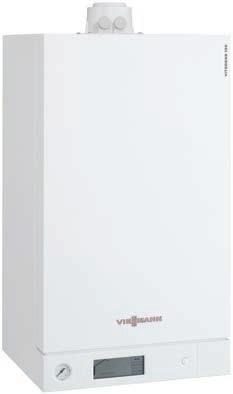
VITODENS 100-W, B1HA
gas condensing boiler
Heating input: 21 to 125 MBH
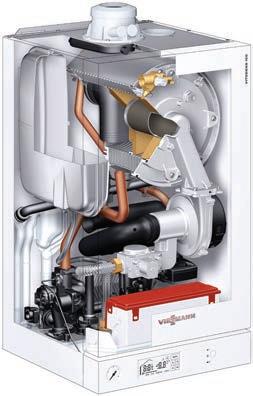
VITODENS 100-W, B1KA
gas condensing Combi boiler
Heating input: 21 to 125 MBH
DHW max. input: 149 MBH
Lasting performance
Quality workmanship you can trust with new Viessmann-made SA240 S43932 stainless steel Inox-Radial self-cleaning heat exchanger and new factory-calibrated, fully-modulating stainless steel MatriX cylinder gas burner.
User-friendly control
New backlit LCD touchscreen control with enhanced programming interfaces with a variety of external control devices to provide comfortable and reliable energy-saving space and DHW heating.
Outstanding versatility
NG or LP fuel compatible “out-of-the-box” with bottom pipe connections and front access to all serviceable components plus multiple venting options for easy installation service and maintenance - all in a compact wall-mount design.
On-demand DHW (combi model only)
Built-in DHW unit includes stainless steel plate heat exchanger, 3-speed pump, diverting, pressure bypass and pressure relief valves, water hammer arrester & sensors - conforms to NSF/ANSI 372 for “lead free” plumbing products.
< WATER HEATERS
Common installation errors and how to solve them
BY ROBERT WATERS
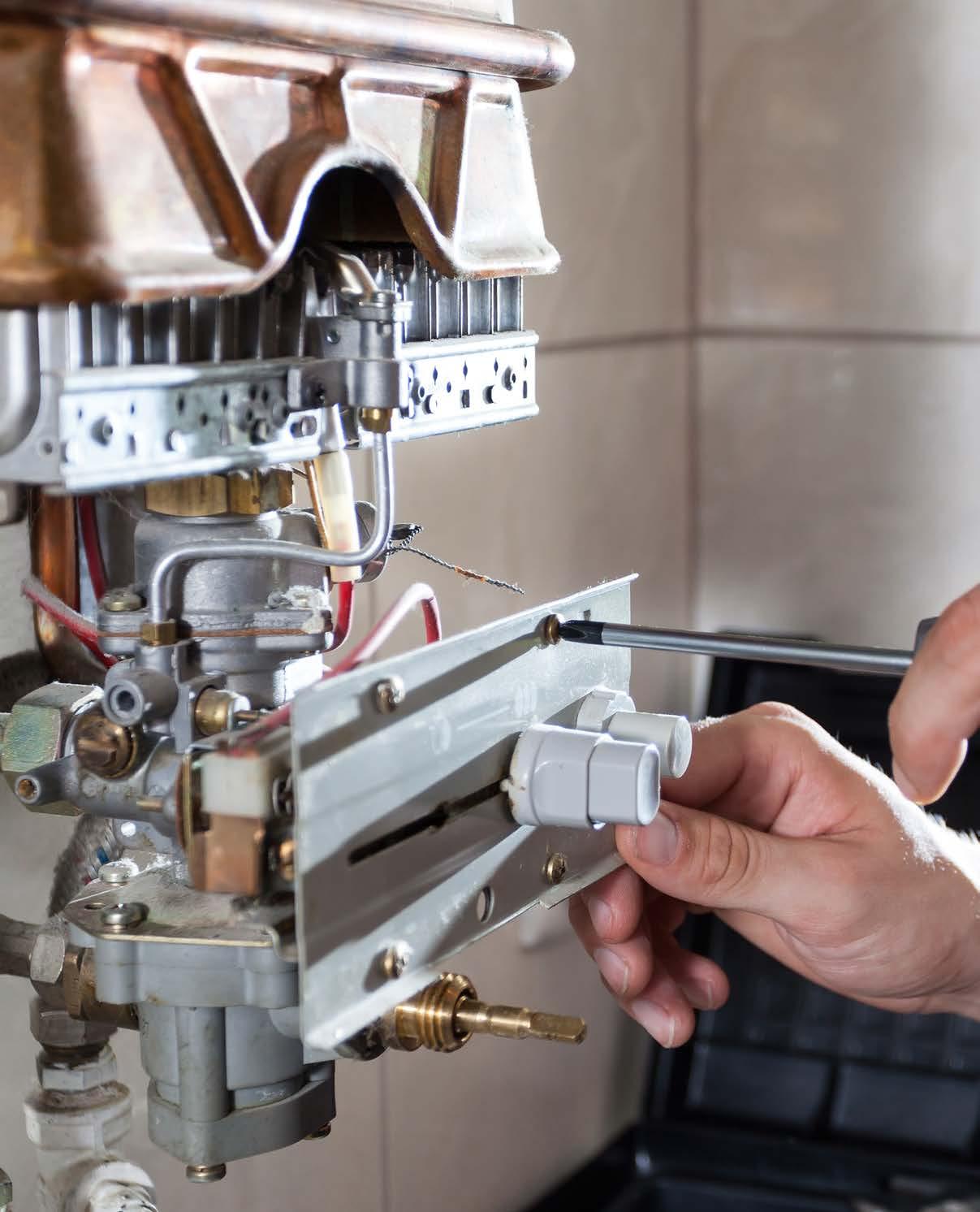
Installed in every building, water heaters are one of the most common mechanical appliances, with thousands installed every day in Canada. Installations are done by anyone from skilled mechanical contractors, to do-it-yourselfers, and anyone in between. In most cases a water heater installation is a fairly straightforward job, however as Murphy’s Law has taught us, things do not always go the way they are intended.
Modern water heaters have also added additional complications to the installation process, as water heating appliances are not nearly as simple as they once were. Condensing appliances, power burners, tankless water heaters, and plastic venting are all fairly recent changes to the water heating industry, which have brought on many new installation demands and issues that were not seen in the past. The big box store has also now put these modern water heating appliances into the hands of homeowners, many of whom do not have the necessary knowledge and skills to install the appliance correctly.
There are several common installation errors that are often seen by industry insiders; knowledgeable installers with the proper skills and tools can easily solve all of these.
One of the main problems seen in water heater tank installations has to do with thermal expansion tanks. The expansion tank is designed to alleviate the excessive pressure that can build up in the plumbing system when the water in
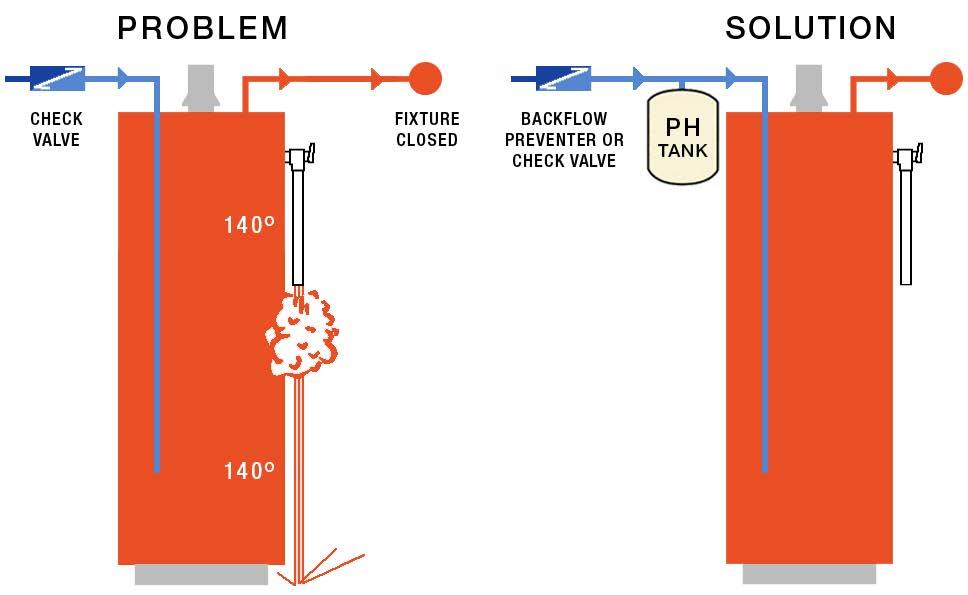
the tank is heated and expands. Most plumbing codes now require a potable water expansion tank to be installed as part of the hot water system.
The thermal expansion tank should be installed on the cold water line above the water heater. In the past, expansion in the plumbing system was very rarely ever a problem, but the introduction of the backflow preventer has changed that. Backflow preventers are now required by many plumbing codes to be installed in the cold water supply line from the street. Before the days of backflow preventers, the expanding water in the hot water tank could push backwards into the main water supply. Now the backflow preventer does not allow that to happen and the expanding water has nowhere to go, in effect creating a “closed system.”
Water is non-compressible, so if it cannot expand when it is heated it will cause the pressure in the tank to rise, in some cases to the point where the pressure relief valve can discharge excessively, which can cause danger to occupants and water damage. Excessive water pressure can also put undue pressure on the tank heat exchanger, and can possibly crack the glass liner, which may lead to premature tank failure.
According to Brian McCabe, district sales manager for A.O. Smith Enterprises Ltd., “Expansion tanks are a huge problem in the industry. Expansion tank issues are primarily related to under sizing, and lack of set-up.” He claims that “many installers do not properly size the expansion tank, so it is often not capable of doing the job.
“Expansion tanks are often installed
Backflow preventers are now required by many plumbing codes.
without any attention paid to the set-up requirements. “The expansion tank should be set-up when it is installed to ensure it is pressurized properly to match the system. This set up is often not done by the installer,” adds McCabe. The pre-charge pressure of the tank should equal the incoming water pressure. Tanks are typically factory pre-charged to 40 PSI, so if a different pressure is required, use a bicycle pump or air compressor to add air to the tank via the charging valve.
With the rising popularity of tankless instantaneous water heaters, another installation problem that is often seen is undersized natural gas pipe line sizing. According to Leo Vaillancourt, a former trainer with Navien, “The most popular sizes of tankless units are in the 180 to 199 MBH size range. With these sizes of units the customer can get the three to four gpm of DHW flow rate that is required for most modern homes.”
In the retrofit market, the tankless unit is often replacing a 40 or 50 gallon storage tank that had a 36 to 48 MBH capacity.
“This high BTU output requirement for the tankless means that a much bigger gas line is now required to satisfy the unit. There are many instances where the existing gas line is left in place, which is simply not big enough for the new tankless unit,” says Vaillancourt. In most cases a new bigger gas line
must be installed to ensure that the tankless will operate properly. Vaillancourt says that “some new tankless units utilize negative pressure gas valves, which allow them to operate with gas pressures as low as three inches w.c.” This feature can help to alleviate some minor undersizing issues, however it still does not solve all problems and will often not be enough to overcome a severely undersized NG pipe.
Modern tank type and tankless water heaters also suffer another common problem related to the lack of proper burner set up. Power burners that require precise gas-air ratios are the norm for many units now. According to Vaillancourt, tankless units are now “finely-tuned machines that require some basic set up or they won’t run properly.”
“Many tanks now have power burners, which are a lot less forgiving than the old units with atmospheric burners. If not set up correctly the result can be hard starts, burner lift-off, and noisy operation,” says McCabe. If left unchecked, these issues can result in more stress on heat exchanger and shorter lifespan.
Both Vaillancourt and McCabe say that it is not uncommon for the installer to install the unit, then fire it up and walk away. As long as the unit is running, they will not do any further checks. Both agree that a few basic calibrations are essential to ensure a problem free operation of the unit. These include check-
ing the incoming gas pressure with a manometer to ensure it is in the proper range specified by the manufacturer, and measuring the flue gases with a combustion analyser to check the CO2 percentage. With these checks problems can be detected and adjustments made to correct burner issues before they cause operational issues.
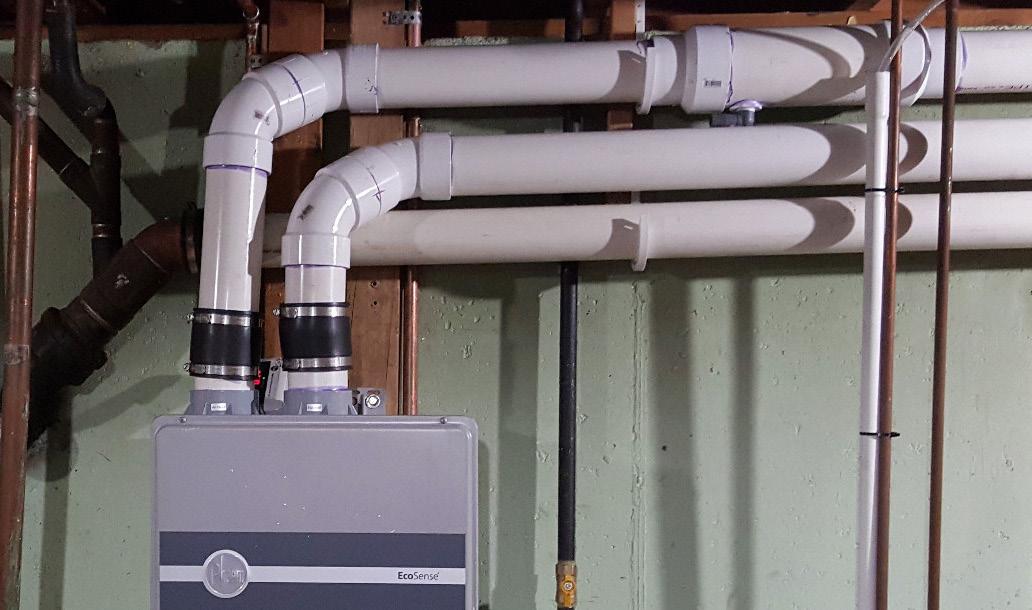
High efficiency condensing water heaters now use special high temperature plastics for venting, and are commonly exhausting flue gases through the side wall of the building. Venting installation errors are frequently seen which cause some serious operating issues. In Vaillancourt’s experience “It’s amazing how many things can get messed up with the vent!”
Every water heater manufacturer publishes the maximum equivalent vent length that can be used with their equipment. This length is primarily based on the capacity of burner fan motor to overcome resistance from the venting, and from external wind forces. It is not uncommon to see installers put in vents that are too long or have too many elbows.
When stuck with the choice of moving the water heater to a new location to accommodate the vent limitations, or stretching the vent length a few more feet, installers often take the easy way out and just add more vent pipe. Surely a couple of extra feet won’t be a problem! This is often a bad choice.
Extra venting adds extra resistance that the blower may not be able to overcome. This often causes the burner to shut down or lock out, with the problem sometimes not showing up until a very windy day.
Another common venting issue is improper venting slope. A vent pipe should always slope backwards towards the appliance so that any condensate liquid can drain back to the unit and be disposed through the unit’s condensate drain line. A vent that is not properly sloped can create a trap where condensate can build up and Continued on p18
< WATER HEATERS
block the vent. Any condensate sloped towards the outdoors can cause ice formation problems.
This lack of proper slope can be caused by not paying enough attention during installation, or from improper or broken pipe supports. Either way a blockage can occur, resulting in another burner lockout and another service call.
Soldering directly to fittings on a water heater is another error that can cause some serious problems. Damage to plastic components of the unit can result, especially to plastic dip tubes on many tank type heaters. Instead of soldering directly to the unit, prep the fittings on the floor or a fireproof level surface. Allow fittings to cool before making the remaining solder connections further from the unit. It can also help to wrap a cold wet rag around the copper pipe you are soldering to prevent heat from conducting to the unit.
Premature activation of electric elements or gas burners prior to completely filling a tank is probably the final issue to avoid. Whether done accidentally or because someone was in a rush to finish up, a dry fired tank can result in serious
“It is not uncommon to see installers put in vents that are too long or have too many elbows.”
damage to electric elements or possibly cracking the glass lining of the tank. Make sure all the air is completely purged from the tank by opening a faucet and running the water until all the air is gone.
With government efficiency requirements climbing all the time for new water heaters, we can expect water
heating appliances to continue to change and evolve. Taking the time to learn about the installation requirements for new equipment will always pay dividends for contractors by reducing installation problems and service calls. Attention to detail during the installation of a water heater will always result in more efficient operation, fewer nuisance callbacks, longer service life, and more satisfied customers.

Robert Waters is president of Solar Water Services Inc., which provides training, education and support services to the hydronic industry. He is a mechanical engineering technologist graduate of Humber College and has over 30 years experience in hydronic and solar water heating. He can be reached at solwatservices@gmail.com.
A trusted brand. Innovation and comfort at your fingertips.

•Simply
•Simply
•Simply
•Simply
APPROACHING PERFECTION…
Although certain “ideals” can never be achieved, they should still be considered.
BY JOHN SIEGENTHALER
We live in a world where, for the most part, theoretical ideals can only be approached rather than fully realized. For example, imagine a building with heat loss characteristics such that the rate of heat loss always matched the rate of internal heat generation from sunlight, people, and equipment. Such a building would not require any heating system. If all buildings could achieve this condition there would be no need of the H in HVAC.
Even though most theoretical ideals cannot be fully achieved, it is helpful to think about them, and drive our designs toward them. Such an approach encourages the industry to strive for continuous improvement, higher efficiencies, improved reliability, and smoother system operation.
Let’s take a look at several theoretical ideals, as well as design practices that move the systems we create toward them.
ZERO ∆T
Let’s start with heat exchangers. The ideal heat exchanger would have enough internal surface area to create a condition where the temperature of the heated fluid leaving the heat exchanger is exactly the same as the temperature of the entering heating fluid.
For example, imagine an antifreeze solution coming from a solar collector at 140F. It enters a heat exchanger and transfers heat to a stream of water. The water leaves this ideal heat exchanger at 140F. Not 139.9F, but 140F. Such a heat exchanger would have a 0F approach temperature difference (e.g., the difference in temperature between the entering heating fluid, and the existing heated fluid).
All heat that could possibly be transferred from the antifreeze solution to the water would do so in this scenario. The bad news is that this would require a heat exchanger with infinite internal surface area and that is going to be really expensive!
Fortunately, it is now relatively easy to select heat exchangers using online software provided by heat exchanger manufacturers. Heat exchangers with approach temperature differences of 5F or less can be selected based on known
flow rates and entering fluid temperatures. The smaller the approach temperature difference between the incoming heating fluid and leaving heated fluid, the larger the heat exchanger has to be, and bigger heat exchangers cost more. When selecting heat exchangers, designers should evaluate performance gains versus higher cost over the full life cycle of the system. It often makes sense to go with a larger exchanger where the incrementally better performance results in the useful capture of millions, or even billions, of Btus over many years of operation.
By the way, an ideal heat exchanger would also have to operate with zero pressure drop on both sides, and remain free of any scaling or other fouling conditions that could degrade its thermal performance. Designers should approach these ideals by selecting heat exchangers for minimal pressure
Figure 1 The pressure drop within the copper basketball header would be very low, but not quite zero. If this header were well insulated it could also provide very low (but not zero) heat loss.

< HYDRONICS
drop, and operate them with proper ancillary details such as demineralized water and devices that provide effective upstream dirt separation.
SHORT / FAT HEADERS
Here is a question that probably has not kept you awake at night: What is an ideal hydronic header? The answer is pretty simple: One that splits up the entering flow into the necessary branches while producing zero pressure drop and zero heat loss.
Imagine a “copper basketball” with tubing supplying several branch circuits sticking out of it in several directions. A single larger tube carries heated water into the copper basketball header. The concept is shown twodimensionally, in Figure 1.
The pressure drop within the copper basketball header would be very low, but not quite zero. If this header were well insulated it could also provide very low (but not zero) heat loss.
Now, imagine how difficult it would be to install such a header in a typical mechanical room. Think about what it would cost to manufacturer and ship such a header to a job site. Although its hydraulic and thermal performance would be very good, this concept does not pass the practicality test.
The next best thing that would pass the practicality test is a “short/fat” header; one that minimizes rather than
eliminates pressure drop and one that arranges the branch circuit connections in a row or two to make them compatible with typical piping layouts. The concept is shown in Figure 2.
How do you create a short fat header? My suggestion is to select a pipe size that yields a flow velocity of only two feet per second at the entrance of the header when all branch circuits are operating at full flow rate.
Selecting the header size based on this criterion might earn you some weird looks from installers who are less concerned about approaching ideal conditions, or more concerned about tradition. But be assured that you are providing a detail that conserves pumping power and even helps contribute to good hydraulic separation of multiple circulators supplied from that header.
COMPLETE SEPARATION
Speaking of hydraulic separation, it is a desirable trait in any hydronic system having multiple circulators that can operate at the same time. It is also a pretty straightforward concept that we have discussed in several previous HPAC articles.
Good hydraulic separation is achieved by keeping the pressure drop in “common piping” that is shared by two or more circuits, each having its own circulator, as low as possible. The
common piping could be a pipe, a tank, a heat source, a pair of closely spaced tees, a collection of piping components, or, not surprisingly, a device called a hydraulic separator.
Perfect hydraulic separation would require zero pressure drop though the common piping, with all circulators running. It is impossible to create such perfections. Fortunately, when it comes to hydraulic separation, almost perfect is good enough. Just identify the component(s) that will be included in the common piping and make selections that keep the pressure drop through this portion of the system as low as possible. A ballpark estimate is to keep the pressure drop through the common piping to less than one per cent of that along any circuit connected to the common piping.
“TREAT YOUR HEAT LIKE YOUR LIGHTS…”
The suggestion that heat be treated like our lights was offered by Richard Watson at a Radiant Panel Association conference held many years ago. He was describing the ability of very low thermal mass “ENERJOY” electric radiant panels, manufactured by Solid State Heating Corporation, to begin releasing radiant heat almost the same moment they were supplied with electricity, just like most light bulbs emit
Figure 2
Figure








< HYDRONICS
“Fortunately, when it comes to hydraulic separation, almost perfect is good enough.”
light the moment they are energized. It is a simple but profound concept. One that arguably favours a very low thermal mass electrically heated panel versus a typical current-generation hydronic radiant panel.
Imagine not having to maintain each room in a building at a normal comfort temperature just so you could be instantly comfortable if you happened to enter that room. If an instant output radiant panel could be created, the room could be maintained at a lower temperature when unoccupied, with comfort instantly restored when someone entered that room. This would reduce its rate of heat loss, and thus reduce the seasonal heating energy use.
A hypothetical hydronic heat emitter with zero thermal mass could begin emitting radiant and convective heat the moment heated water passed into it. Such a panel could adjust its heat output to moment-by-moment changes in internal heat gains from sunlight, people and equipment. It would store very little heat when it is time to put the space it heats into temperature setback. When the setback period ended, comfort could be instantly restored.
Again, we may never see a hydronic radiant with zero thermal mass, but there are currently available panel radiators that have less than one per cent of the thermal mass of a four-inch thick, heated concrete floor slab. They contain minimal amounts of water and metal relative to their heat emitting potential. Such panels can thermally accelerate and decelerate very quickly to compensate for changes in internal heat gains. They are an excellent choice in modern highly insulated buildings that are subject to variable internal heat gains.
BOILER PERFECTION
There are hundreds, perhaps even thousands, of different boilers now available for hydronic systems. They range from traditional high thermal
mass cast-iron sectional designs, to those with compact stainless steel heat exchangers that hold less than one gallon of water.
So, which end of this boiler spectrum is ideal? The answer is neither.
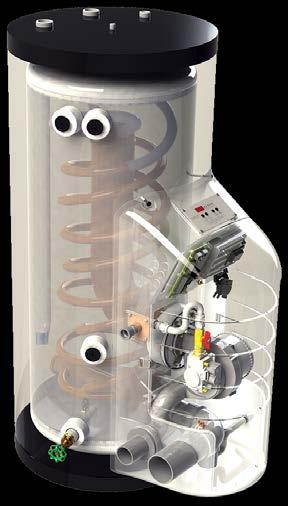
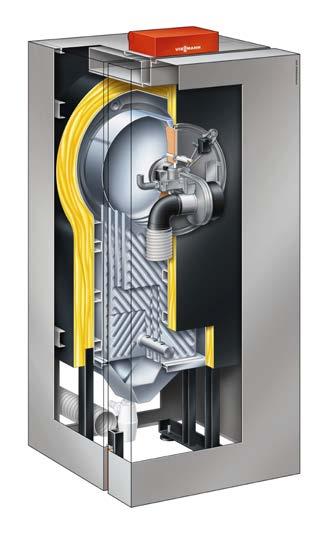
In my opinion, the ideal hydronic boiler would have a zero thermal mass combustion system combined with a thermally isolated volume of water that could eliminate the need of a separate buffer tank. This combination would also have zero pressure drop and zero rate of heat loss to its surroundings.
About now you are probably thinking that imaging such a boiler is a waste of time. But instead of dismissing what is arguably impossible, think instead about approaching these ideal characteristics.
It certainly is possible to build a device that holds several gallons of water in a very well insulated enclosure. It is also possible to build a combustion assembly/heat exchanger that has relatively low mass. Put them together into a marketable product and you will be close to that theoretical ideal. Such products do exist in both Europe and North America. Figures 4 and 5 show a couple of examples.
INSTANT SOLAR
A few years ago we installed a grid-connect solar photovoltaic system at our house. I am inspired by how rapidly the output wattage of this array changes as the array goes into and out of shading by a cloud. For all practical purposes the array responds instantly to changing solar radiation conditions.
This is not the case with solar thermal collectors. There are definitely times when a solar thermal system fails to turn on to grab what might only be a few seconds worth of available solar radiation shining down between passing clouds.
This happens because the collector’s metal absorber plate, and any
Continued on p26
Figure 4
Figure 5

< HYDRONICS
fluid it contains, represents thermal mass that cannot be sufficiently warmed by a few seconds of solar radiation, at least to the point of activating a differential temperature controller.
But what if it could? What if someone created a solar thermal collector with an absorber plate having an extremely small thermal mass? Perhaps it would be built using carbon nano -
tubes, or some other synthetic material that hasn’t yet migrated from the laboratory to the production line. What if the enclosure around that absorber plate approached zero heat loss, and the glazing above the absorbed plate approached a perfect transmissivity of 1.00?
Such a collector could grab short bursts of solar radiation and instantly
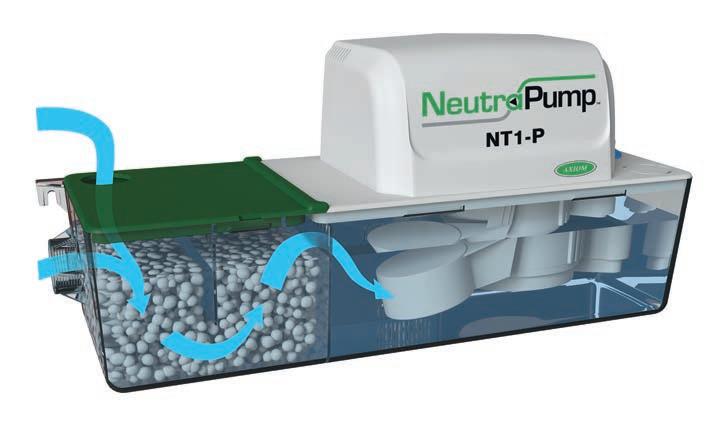
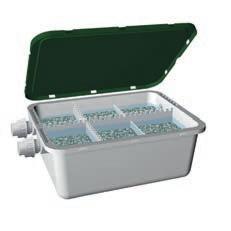
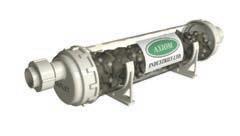
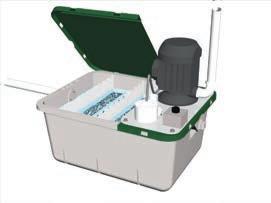
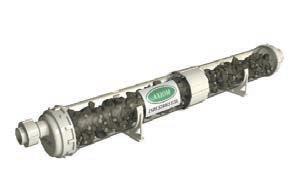
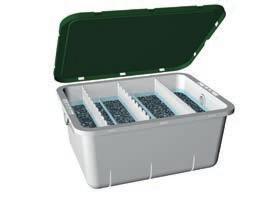
Another innovative new product from Axiom
transfer it to a fluid stream.
As with the perfect boiler, the ideal solar thermal collector cannot be built, at least not with the materials and technology currently available. However, the concept should give us pause to consider how changes to current collector designs might provide benefits. For example, could we build a collector absorber plate with less material, or with far less internal fluid volume? If we could, that collector’s ability to capture short pulses of solar radiation between passing clouds would improve. A better-insulated enclosure would complement such an absorber.
DREAM ON
Imagine if no one thought that the Wright Brothers’ first airplane could be improved upon, or if it would be impossible to have a computer on a desktop much less on our wrist? What if no one in the early 1900s had envisioned an electrically-powered circulator to move water through a hot water heating system, or had totally dismissed the future of hydronic radiant heating because some systems using metal piping embedded in concrete had sprung leaks?
The quest to achieving the ideal starts by conceptualizing it and moving toward it, often in small steps. It is my hope that future practitioners of hydronic heating and cooling will look back on what we do today as, acceptable for the time, but far from the state of the art at that future time.
Continue to strive for the ideals.

John Siegenthaler, P.E., is a mechanical engineering graduate of Rensselaer Polytechnic Institute and a licensed professional engineer. He has over 34 years experience in designing modern hydronic heating systems. Siegenthaler’s latest book, Heating with Renewable Energy, was released recently (see www.hydronicpros. com for more information).
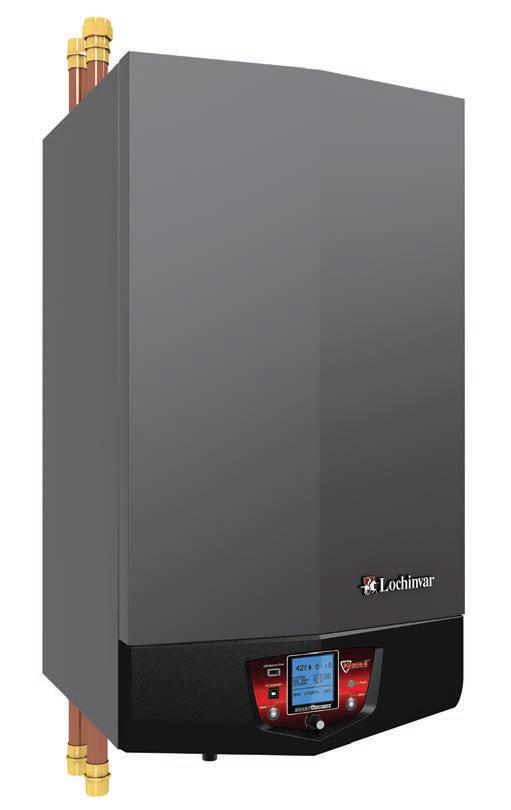
Our NEW KNIGHT wall mount fire tube boiler includes these outstanding features:
10:1 Modulation Turndown*
Top AND Bottom Water Connections for Installation Flexibility*
Updated Smart System® Control
CON·X·US® Remote Connect Capable 95% AFUE*
15-Year Limited Heat Exchanger Warranty

Consistency runs in the family.
Greater installation flexibility, efficient operation, common features, components and controls...Sound familiar?
This consistency in features and benefits across the Knight fire tube boiler family makes it easier to install and service Knight boilers no matter what model you choose
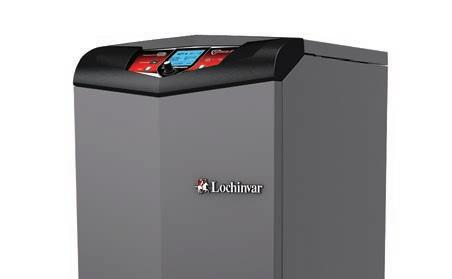
KNIGHT Fire Tube Floor Mount Boilers (6 Models 55,000-285,000 Btu/hr)
NEW KNIGHT Fire Tube Wall Mount Boilers (7 Models 55,000-399,000 Btu/hr) *See product literature for specific model information.
HYDRONIC PRODUCTS
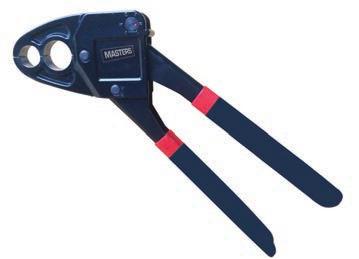
The newly redesigned Pex Ring Crimpers from MASTERS are offset and compact one-handed crimpers. They are designed to fit into tight spaces and are light for overhead use. Each pair is adjustable for wear and come with a precision gauge to check the crimp. The design requires less force to crimp with. The new Combination Crimper combines ½ in. and ¾ in. in a single-handed offset design. Its one-in. model is designed as a twostroke crimper.www.gfthompson.com
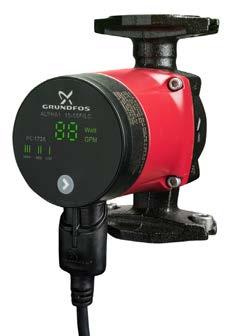
Grundfos is expanding its line of ALPHA circulator pumps with the variable-speed ALPHA1. It has a high torque rating and powerful start feature and offers three constant-pressure modes. ALPHA1 is available in cast iron and stain and stainless steel models, as well as standard and rotated flange pump housing configurations. It’s also available in either linecord or terminal box electrical connections. The ALPHA1 has an ECM motor featuring a magnetized rotor to avoid motor-slippage. ALPHA1 offers a flow range of 0 to 19 GPM (0 to 72 litres per minute) and a head range from 0 to 19 ft. (0 to 5.8 metres). It can handle fluid temperatures from 36F to 230F (2.2C to 110C) with a maximum working pressure of 150 psi. ca.grundfos.com
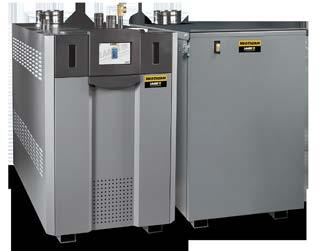
The Outdoor NeoTherm from Laars is a direct-vent, sealed-combustion, condensing boiler or volume water heater for outdoor installations. It features an ASME stainless steel heat exchanger, direct spark ignition system and low NOx emissions and modulation with a 5:1 turndown. The boiler is built standard with the upgraded Laars integrated control system. The PID control integrates with building automation systems and can become part of multiple boiler sequencing, including a cascading feature that rotates load for up to eight NeoTherms. www.Laars.com
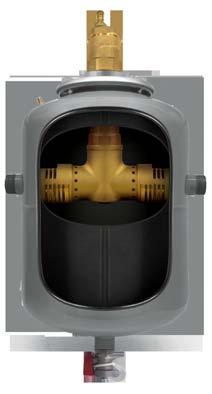
From Calefactio Solutions comes The ONE expansion tank, a device combining three plumbing functions: an expansion tank, air and dirt separation and deaeration. The ONE has an EPDM bladder that protects the shell from contact with heating fluid. Its bladder is replaceable and is equipped with a drain valve. The high efficiency air and dirt separator reduces fluid velocity while the coalescent media offers a vast contact area. The automatic air vent has an oversized chamber allowing a greater amount of air to be liberated. The ONE is available in 2.1 and 4.8 gallons versions. www.calefactio.com
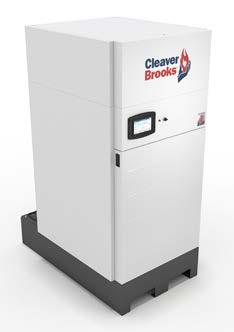
Cleaver-Brooks has launched the ClearFire-CE (CFC-E) condensing boiler, with up to 99-percent efficiency through its AluFer firetube heat exchanger and dual temperature returns. The CFC-E has a large-watervolume pressure vessel with low pressure drop. A low-emissions premix burner is built into the CFC-E, which also features the CleaverBrooks Falcon control that can control lead-lag, outdoor air reset, automatic isolation valves, primary pumps and BMS integration. Constructed of duplex stainless steel, the CFC-E has corrosion resistance and can withstand thermal shock. The side casings can be removed and multiple units can be mounted side-by-side. www.cleaverbrooks.com
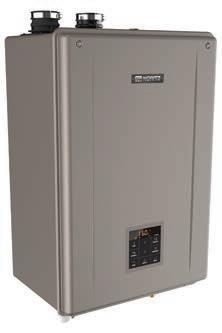
From Noritz comes the Noritz Residential Combination Boiler (NRCB), which allows simultaneous residential domestic hot water and space heating. The NRCB uses 316L copper primary and secondary heat exchangers for corrosion resistance. A third flat plate heat exchanger for domestic water heating is made of stainless steel. The NRCB comes in two models. The NRCB180DV has a maximum gas input Btuh of 180,000 for hot water and 100,000 Btuh for space heating. Its maximum flow rate is 9.8 gallons per minute (gpm). The NRCB199DV has a maximum gas input Btuh of 199,000 for hot water and 120,000 Btuh for space heating. Its maximum flow rate is 11.1 gpm. On the space heating side, the NRCB has a temperature range of 27C to 82C. The domestic hot water range is 32C to 60C. www.noritz.com
Consider using Uponor PEX-a for your next Hydronic Piping project.
Sponsored Case Study Profile
Engineers and contractors are recognizing PEX as a technology that retains all the advantages of traditional piping materials, while adding unmatched flexibility and strength.
If you’ve been on a commercial jobsite recently, you may have seen an opaque white pipe being used for the potable-plumbing system. This pipe, called PEX — an acronym for crosslinked polyethylene — is quickly gaining popularity in the engineering and trades sectors due to its flexibility, durability, stable material costs and performance. And now that the commercial plumbing industry has gotten on the PEX bandwagon, hydronic piping professionals are starting to look at it as well.
From an application standpoint using Uponor’s Wirsbo hePEX™ can work with any terminal unit in a hydronic heating system — fan-coil units, baseboards, radiators, chilled beams, VAV (variable air volume) reheat terminal units, radiant manifolds, etc. Also, because of its copper tube size (CTS)-controlled outside diameter, switching to PEX-a piping involves minimal process change. All the hangers, pipe supports, insulation, etc. can be the same, offthe-shelf components used in a copper piping system. Uponor complements the full offering of product with extensive design services to make this switch a reality.

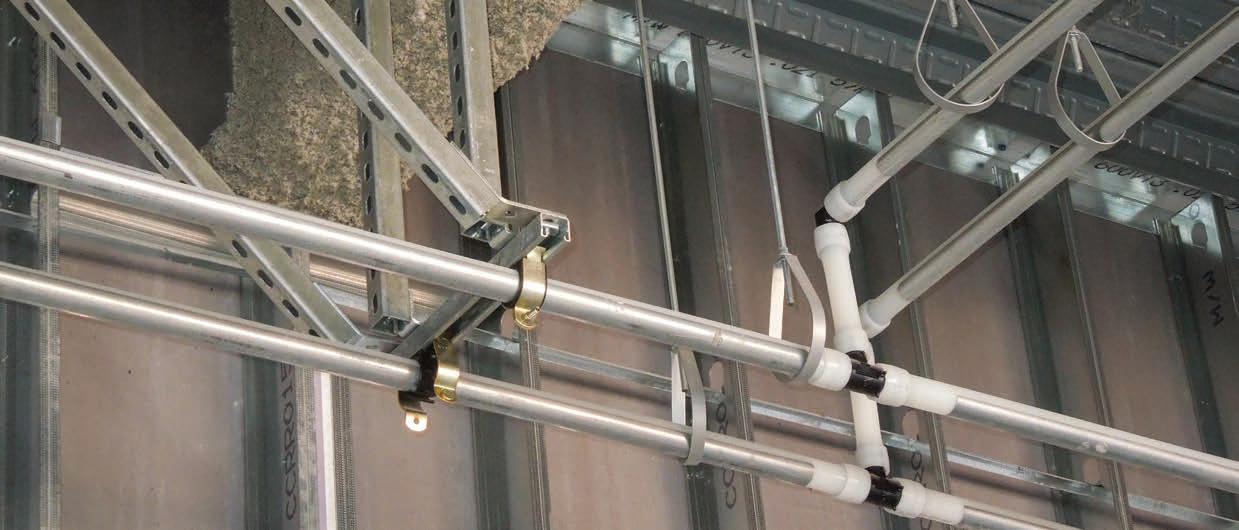
piping applications. The use of Uponor PEX pipe supports permits hanger spacing that is similar to copper pipe, so it reduces the required amount of hangers by half. And since fewer hangers mean lower material and labor costs, Uponor PEX pipe
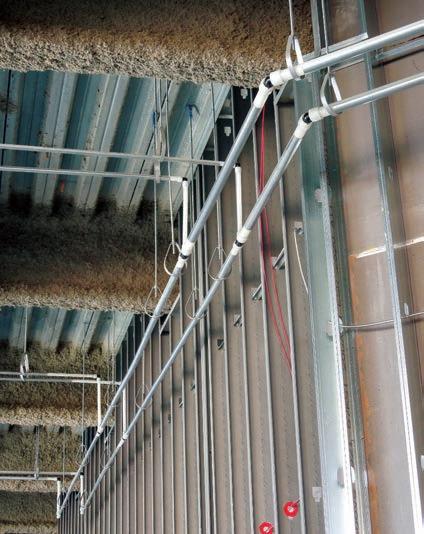
Bridging the differences between Wirsbo hePEX pipe and copper in most applications is the Uponor PEX pipe support, a galvanized steel channel providing continuous support in suspended
Want to learn more?
support results in a less-expensive installation.
A major criticism of — and misconception regarding — PEX-a in commercial piping applications is its perceived lack of visual appeal. Con-
For more information on using PEX-a piping for your next Hydronic project or to get a copy of Uponor’s Guide for Hydronic Piping email Jason Smith at jason.smith@uponor.com
tractors and building owners typically expect long, evenly spaced, rigid pipelines running through a building. It’s a look of solidity and durability that many associate with copper and believe PEX-a lacks. Fortunately, Uponor PEX pipe supports reinforce and cover the pipe, negating any aesthetic criticisms. Uponor PEX pipe supports also allow Wirsbo hePEX pipe to be run inside a plenum without spacing limitations between the horizontal runs.
But perhaps the most critical feature of Uponor PEX pipe support is its ability to control the natural expansion and contraction that occurs as the piping heats and cools. Installing anchors and using Uponor PEX pipe supports allow the piping system to function much like a copper system.
This ability to control PEX’s expansion and contraction is critical to allowing for a minimum redesign on a piping system when switching from copper. Thus, Uponor’s PEX pipe supports allow designers to leverage similar design schemes using Uponor PEX as they would for copper.
Engineers can be assured that, although Uponor PEX-a may still be new to them, it has been reviewed and approved as a reliable means of hydronic piping for more than 40 years. With its flexibility, durability and — in conjunction with Uponor PEX pipe supports — its ability to mimic copper’s rigid properties while offering several revolutionary improvements. The common hassles and uncertainties of switching from copper are completely alleviated, allowing the benefits of an improved piping system to stand out.
Another blockbuster Modern Hydronics Summit
Gathering presents prime opportunity for networking and learning.
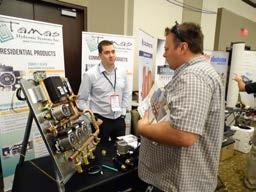
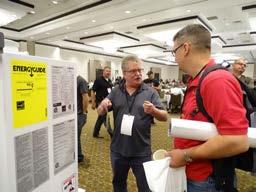
More than 350 industry personnel gathered at the International Centre in Mississauga, ON for the third Modern Hydronics Summit on September 14. Over 50 exhibitors were on hand to share information and answer questions about their equipment and services. Between the trade show time and breaks for food and drink, attendees had many opportunities to network with other hydronics enthusiasts.
A new show feature was a by-invitation builder breakfast hosted by HPAC. Speaker Robert Bean of Indoor Climate Consultants Inc. presented a session with a hydronics 101 approach to introduce the crowd to the world of hydronics.
The formal speaker program opened with the popular hydronics duo of John Siegenthaler of Appropriate Designs and Bean. In their session titled 20/20 Hydronics Hindsight, they each identified three things they would do differently based on their experiences.
Single source responsibility for HVAC system installation, paying attention to building details and avoiding change for the sake of change have prompted a change in Bean’s outlook. Siegenthaler identified moving beyond primary/secondary piping, proper system documentation and series baseboard systems as things he would approach differently today.
Mike Miller of Taco and Steve Goldie of Next Supply teamed up once again for a session titled Controls for the Future.

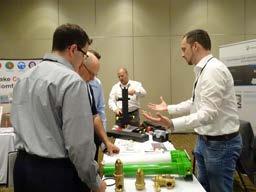
Robert Bean later highlighted free online design tools and their importance in wooing architects, engineers and clients to the world of hydronics.
Attendees warmed up to the idea of snow and ice melting sessions as Lance MacNevin of the Plastic Pipe Institute made a convincing case for this application of hydronics. “In congested cities with outdoor public surfaces, and with aging populations in private homes, the safety, convenience and savings provided by a hydronic SIM system are more beneficial than ever, especially as changing weather patterns increase snowfall in many regions,” noted MacNevin.
In his keynote address Siegenthaler expanded on distribution efficiency and the virtues of delivering thermal energy using water rather than air. He noted that water has a “huge” and irrefutable advantage. “It is an often “untold” story that should be at the forefront of efforts to promote hydronics, especially to those interested in low-energy themed buildings,” said Siegenthaler.
He discussed the science of water-based thermal energy delivery, compared it to forced air and showed attendees how to improve it. Siegenthaler also pointed out ways it can be inadvertently squandered.
The event wrapped up with more trade show and networking time, and a dinner. The next Summit will be in 2019–details to come at www.hpacmag.com.
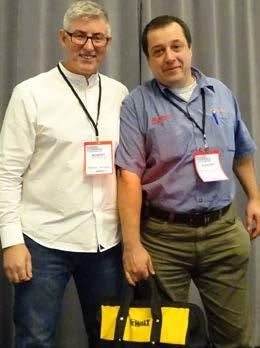
Bogdan Lupasco (r) of Bosanac Heating winner of the DeWalt 1/2″ VSR Stud and Joist Drill with Robert Bean.
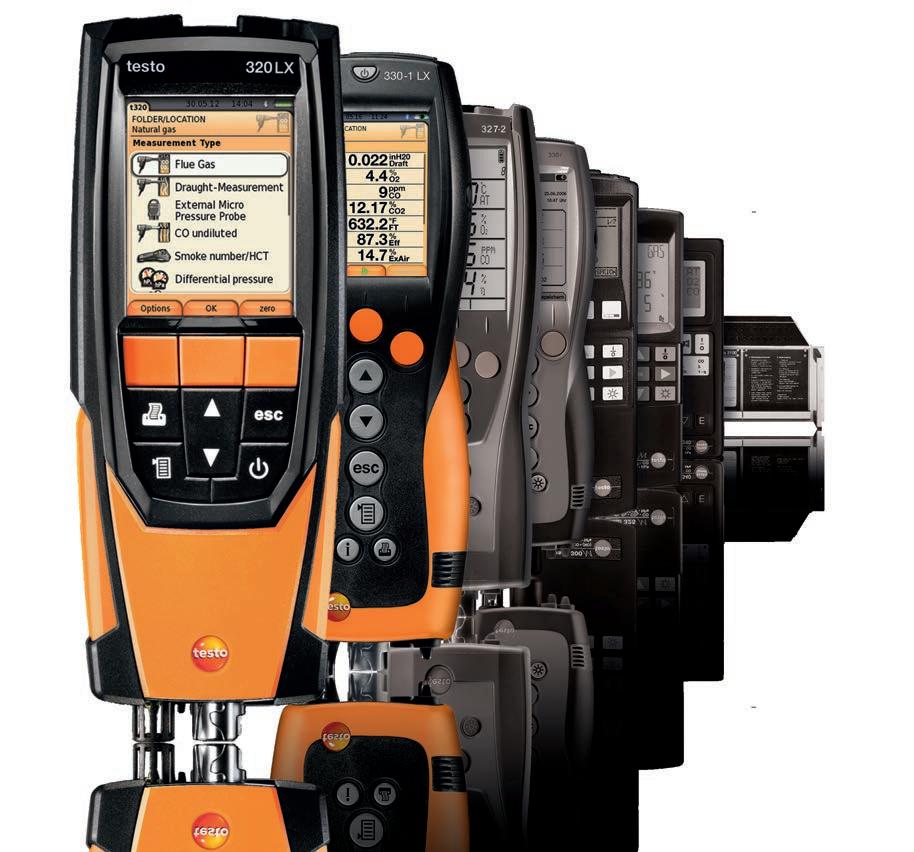
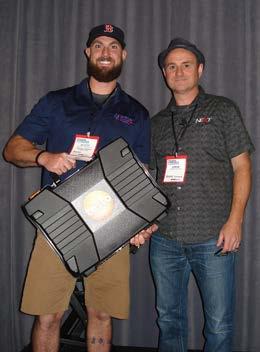
Scott Howard of British Empire Fuels, winner of a testo 320 flue gas analyzer, is shown here with speaker Steve Goldie.
Over 50 exhibitors were on hand to share information and answer questions about their equipment and services.
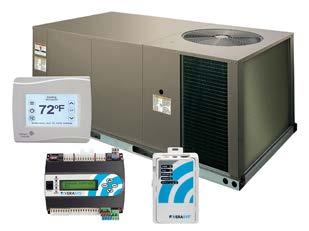
Verasys is a plug-and-play controls system integrating HVAC/R equipment and controls. Suitable for single- or multi-zone applications, it connects to mechanical and electrical equipment, controls and sensors using wireless configurations. Configurable controllers provide simple settings for implementation but defaults can be changed. Verasys integrates with Metasys or any third-party BACnet system. www.verasyscontrols.com


The AC Leak Freeze PRO is an applicator for applying RectorSeal’s AC Leak Freeze refrigerant leak sealant into commercial and residential air conditioning and refrigeration systems. It does not require an R-410A system pump down and withstands typical refrigerant pressures. The Magic Frost portion of the sealant formula is a lubricant additive designed to extend compressor lifecycles. www.rectorseal.com
Nu-Calgon has launched a pressurized spray version of its Cal-Blue Plus micro leak detector. The non-aerosol pressurized spray has no gas or chemical propellants, while new technology uses air in the canister to propel the spray on pipes, tubing, fittings, coils and other surfaces for micro leak detection. Its high-viscosity formula provides long-lasting bubbles so it can stay in contact with the surface for an extended time to detect small leaks. The pressurized container can be sprayed from any angle. Suitable for detecting leaks of refrigerants, natural gas and oxygen, Cal-Blue Plus is non-corrosive to metals and will not affect ultraviolet lights. It is freezeprotected to 5F. www.nucalgon.com
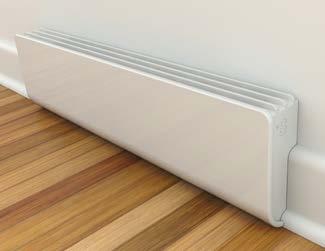
Stelpro’s high-end Bella baseboard has a unique design with a sturdy and rust-resistant facade made of aluminium extrusion for strength against bumps and kicks. The baseboard comes in a choice of two densities of 150 watts or 250 watts per linear foot and is suitable for heating any residential or commercial space.www.stelpro.com
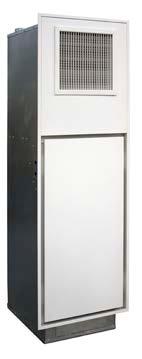
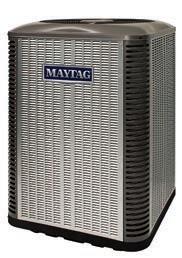
Maytag Heating and Air Conditioning offers a one-piece jacket design for its split-system air conditioners and heat pumps. A panelized design allows for access to interior components. The system exterior features access panels and a redesigned top crown pan and corner posts. It has extruded screw holes that hold the panels in place and prevents screw stripping. Extra holes in the base pan provide drainage. www.maytaghvac.com
The Whalen Company, a manufacturer of HVAC vertical stack riser heat-exchanger fan coil units and water-source heat pumps, has launched the Whispertherm Integrated Thermal Recovery unit with energy recovery module. The unit introduces outdoor air into the occupied space. Rather than directly discarding exhaust air, the energy is transferred to the incoming fresh air. As a result, less energy is required to bring fresh air to the indoor conditions. Whalen designed the unit for new construction and retrofit applications in low and high-rise buildings. The Whispertherm unit may be applied to several building designs. https://whalencompany.com

From Bramec comes the Universal Cool-Run Capacitor, a patented technology that replaces over 200 single and dual value capacitors. It has a jumper system for correct capacitance in seconds and cool running for extended capacitor life. The capacitor replaces hard-to-find and obsolete capacitors. https://bramec.com
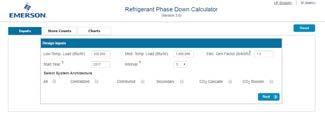
Emerson has a refrigerant calculator for retailers to forecast the impacts of phasing down higher-GWP systems and phasing in new refrigerant architectures. The web-based app helps to project the lifecycle climate performance (LCCP) of a franchise or store based on preferred refrigeration architectures and refrigerants. Users can calculate the phase-down impacts and download charts. Downloadable charts include total LCCP per franchise, total LCCP per store, weighted GWP per ted GWP per store and total weighted GWP. www.emerson.com/en-us continued on p34


Bosch Thermotechnology has released the Bosch Connected Control (BCC100, a full-colour, five-inch, touchscreen thermostat that, through Wi-Fi connectivity, allows remote monitoring and control of home HVAC systems. Users can follow factory-loaded presets or create personalized schedules. Its scheduling menu has a dedicated terminal for humidifying or dehumidifying functions. The app allows users to connect to an unlimited number of thermostats and manage up to four schedules per thermostat. The thermostat is Wi-Fi accessible but also provides offline access. www.boschheatingandcooling.com
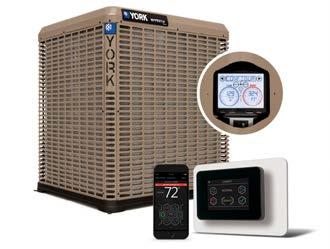
York Affinity Variable Capacity residential systems feature inverter-driven variable capacity technology. The systems are ENERGY STAR Most Efficient qualified. Matched and communicating indoor equipment, coils and air handlers integrate with the Wi-Fi-enabled YORK Affinity Hx Thermostat. Communicating indoor and outdoor units enable a self-monitoring feature that lets contractors identify and diagnose system issues. Built-in Charge Assurance monitoring gives a readout of high and low system pressures, and suction and liquid line temperatures while calculating system superheat and sub-cooling. www.johnsoncontrols.com
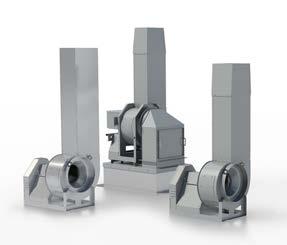
Greenheck’s FumeJet pre-engineered and installation-ready centrifugal exhaust fan package is designed to remove and disperse contaminated air in commercial, institutional or industrial applications. The product features accessories with inlet and outlet performance corrections for faster installation and configurable mounting options for different building layouts. The product has a maximum exhaust volume of 15,000 cfm and up to 8 in. wg (1250 Pa) plus multiple levels of construction. the FumeJet fan package provides an alternative to a field built-up system. www.greenheck.com continued on p36



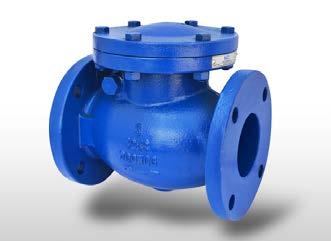
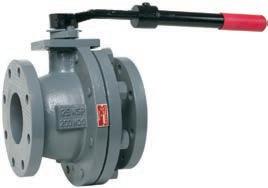
NCI Canada Inc. has launched a line of commercial iron body valves including iron body butterfly, gate, globe and check valves (shown here). These products meet all industry standards and are registered with a Canadian Registration Number (CRN). NCI’s iron body line of commercial check valves provide moderate pressure resistance and suit fluid, gas and steam handling within commercial and industrial applications. All NCI Canada iron body check valves have a bolted bonnet and are bronze mounted with renewable disc and seat, and upgraded graphite packing and body gasket, sizes ranging from 2 to 12 in. www.check-valves.ca
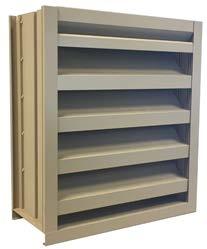
Ruskin, a manufacturer of air control solutions, has introduced the EME720 seven-inch horizontal louvre. The product features 56-per cent free area and combines a continuous-blade architectural appearance. Its architectural mullion is recessed, notched in the blade and uses drain pockets so water drains away while contributing to an appearance of one continuous louvre. Closely-spaced horizontal blades minimize the penetration of wind-driven rain. The louvre is available in single sections as large as 90 x 120 in. and can be ordered with several anodized and painted finishes. www.ruskin.com
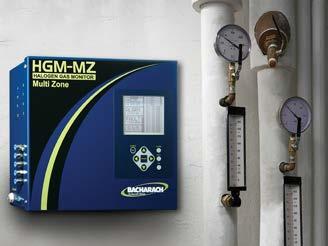
Bacharach has reduced the default low leak alarm level on its revised HGM-MZ (Halogen monitor multi-zone) while extending the default sample line length on this active continuous refrigerant monitor. The upgrade reduces the leak alarm default value level to 10 ppm and extends sample line lengths per zone to 450 ft. The MZ will detect refrigerant leaks as low as 1 ppm and will monitor over 16 sampling points, with the possibility for extending that to 48. The reduced low leak alarm setting helps to detect leaks early with factory settings, reduce refrigerant loss and GHG emissions. www.mybacharach.com

CONTEMPLATING A CHILLER REPLACEMENT?
In the interest of curtailing expenses it bears an in depth look to investigate more efficient options.
BY DAVE DEMMA
When I was in high school, the cost of gasoline was seldom of concern. I drove a 1957 Chevy Bel Air, with a modified 409 engine in it, and I do not think I ever thought to check what the gas mileage was. Premium grade gas was a measly $0.25/gallon. Using a trusty inflation calculator, I discovered that something that cost $0.25 in 1970 would cost 532.8 per cent more in 2017; meaning that a gallon of gas should now cost $1.58/gallon ($0.42/litre).
Unfortunately, the increase in the price of gasoline has far outpaced the rate of inflation. For that reason, there has been a great deal of investment in research and production of hybrid (gas/electric) and electric cars. While there is no need to name names, in my ever so humble opinion I find most of the electric or hybrid cars to be completely unattractive. In fact, there seems to be an inversely proportional relationship between fuel efficiency and curb appeal.
Just to prove that I am not just being biased, I will admit that Tesla has managed to combine the best of both worlds…efficiency and style. Of course, the price tag will reflect that fact. Electric car fuel efficiency ratings translate the fuel economy from kWh/100 miles to an equivalent MPG. The efficiency of some of these cars is astounding–in the over 100 MPG range.
How is this relevant to our industry?
Well, there have been similar, if not quite so drastic, improvements in HVAC equipment efficiency. Not only do the efficiency increases warrant equipment replacement, but when you add energy rebates to the yearly reduction in electrical consumption, this becomes the perfect motivation for considering an equipment upgrade/retrofit.
There’s no disputing the fact that chillers are high priced items. They are the most expensive piece of equipment in an office building, and likely are responsible for a large percentage of the building’s electrical consumption.
But, should the fact that a chiller is operating trouble free be the determining factor in whether a chiller is under consideration for replacement?
Let’s take another look at that 1957 Bel Air for some perspective. Suppose I still owned it (I wish), and had taken great care of it over the last 47 years. With regular oil changes at 3,000 miles, regular tune ups, continuing to use supreme grade gasoline, periodic flushing of the cooling system along with replacing the coolant at the recommended intervals and an engine overhaul at 100,000 mile intervals that beast would still be a fun ride, but it would also still
“In my ever so humble opinion I find most of the electric or hybrid cars to be completely unattractive.”
There is no question that chillers are big-ticket items. In many facilities, it could be the most expensive piece of equipment onsite. However; there are many factors that would be cause for putting off replacing a chiller: the replacement cost; relatively long service life of a chiller; the potential difficulty in replacing a chiller (depending on where it’s located in the building); and downtime during the replacement.
Another possible deterrent to chiller replacement could simply be the fact that it is still providing the required capacity to maintain comfort in the building, and providing that comfort relatively trouble free. The trouble free part would likely be the result of using a competent contractor combined with a regular and thorough maintenance program.
be getting about 10 mpg. A well maintained inefficient piece of nostalgia.
In addition to the inefficiency aspect, there have been so many other improvements in automotive technology since 1957; comfort, suspension, computer control, handling and audio. There are so many reasons to consider upgrading to a new model.
The same thing applies to chillers. Advances in chiller technology in the last 20 years have resulted in substantial increases in efficiency.
• 20 years ago, typical chiller efficiency ratings would have been in the 0.85 to 1.00 kW per ton range.
• 10 years ago, typical chiller efficiency ratings would have been in the 0.7 to 0.85 kW per ton range.





































The KeepRite® ProComfort™ Deluxe 19 Air Conditioner and ProComfort™ Deluxe 18 Heat Pump with SmartSense™ Technology quietly deliver steady comfort, higher efficiency, and savings in a more compact design, thanks to the variable-speed inverter. The air conditioner delivers a superior rating of up to 19 SEER and the heat pump features ratings up to 19 SEER and 11 HSPF for optimal home comfort levels. They are easier to sell, easier to service, and easier to install.
< REFRIGERATION
• Today’s most efficient centrifugal chillers can operate in the 0.50 kW per ton range (with some approaching 0.40 kW per ton).
That is up to a potential 40 per cent decrease in electrical consumption with a new high efficient chiller. And considering the fact that a 20+ year-old chiller is likely not operating at the same level of efficiency it did when installed, that decrease might be even greater. These savings, combined with any available energy company rebates, can go a long way to offset the price of that new chiller.
Note: In most applications, chillers will operate at a fully loaded condition for only a small percentage of total run time. Full load ratings can still be used to illustrate the magnitude of savings that might be realized through chiller replacement. A moderate improvement in equipment efficiency can produce significant savings, especially in larger tonnage applications, which require that the chiller operates more than 2000 hours per year.
In addition to operating at higher efficiency at full load conditions, today’s chillers have higher part-load efficiencies than older chillers. Given that most chillers operate most of the time at less than fullload conditions, improved full-load and part-load operating efficiencies translate into significant energy cost savings.
An accurate estimate of energy savings realized by a chiller replacement must be made to determine the viability of such an undertaking. A load profile must be developed, which identifies the existing chiller’s energy use in kW/ton over the entire operating range for the existing chiller in the facility under consideration, from full-load to the minimum load the chiller experiences. This information will allow for a comparison between the current chiller’s load profile with the manufacturer’s load profile for the replacement chiller under consideration. By knowing the number of hours a chiller operates at each load, it will be a relatively simple matter to quantify the resulting
energy savings, and make a determination as to whether to proceed or not.
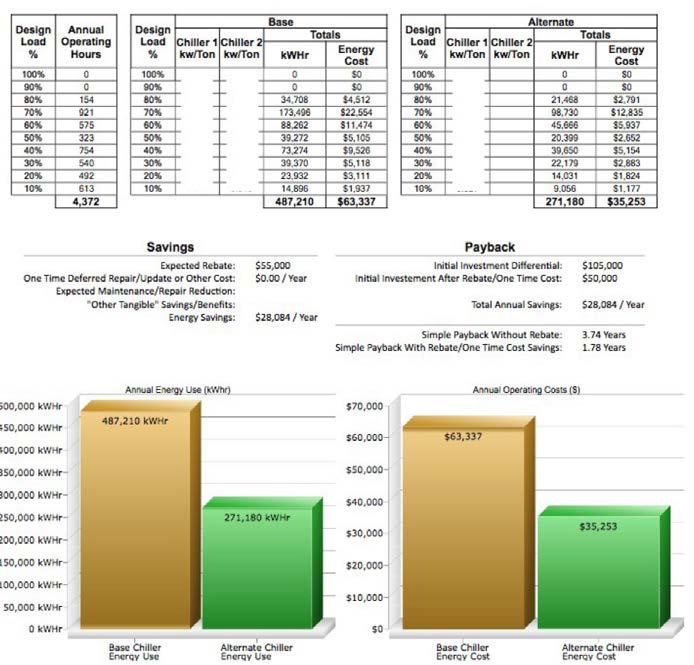
Figure 1 is an example of such a load profile for an application utilizing a 450 ton chiller, with an electric rate of $0.13/ kWhr. The electrical savings, based upon this profile, amount to approximately $28,000 per year. The payback for the invested capital to replace/upgrade the chiller is 3.74 years. Now, factor in the expected increases in electric rates during the next 3+ years, and that payback becomes even better.
But, that’s not the entire story. This particular chiller replacement was also able to participate in a rebate from the local electric utility. The amount of this rebate amounted to a whopping $50,000, lowering the payback on investment to 1.78 years.
Now, these rebates certainly can vary in value, and are completely dependent on what the electric utility is offering at any given time. One factor to consider in
when to replace is the rebate. However, it must be assumed that at some point, as efficiency standards become adopted and required, there might not be any incentive for utilities to continue to offer rebates on efficiency standards that are required.
To summarize yes, the 1957 Bel Air, with its feel or raw horsepower, was a blast to drive. But technology have changed dramatically in the last several decades, and in the interest of curtailing expenses it bears an in depth look to investigate more efficient options.

Dave Demma holds a degree in refrigeration engineering and worked as a journeyman refrigeration technician before moving into the manufacturing sector where he regularly trains contractor and engineering groups. He can be reached at ddemma@uri.com.
Figure 1 Energy analysis showing energy savings, rebate and simple ROI of two potential chiller systems
energy saving potential in today’s buildings and industrial processes

is realizing a more energy efficient city infrastructure
Canadian infrastructure investments are on the rise, and with ambitious climate and energy targets in place, Danfoss has been helping make Canadian cities more efficient and sustainable for 65 years. Heating and cooling consume as much as 40 percent of a building’s total energy use. Danfoss solutions like AC drives, variable speed compressors and hydronic control valves help cut energy consumption and improve comfort and control. City-wide, Danfoss’ innovative district heating solutions amplify efficiencies — cost-effectively boosting energy productivity, minimizing environmental impacts and helping cities plan for a sustainable future. With Danfoss, our cities can get more out of less without sacrificing performance or reliability.
Discover how we’re Engineering Tomorrow at danfoss.ca
9 TOP TRENDS IN BATHROOM DESIGN
When you are involved in a bathroom renovation, you are not just creating a practical bathing space. For most people, the bathroom has become a personal sanctuary. It is not just a place to wash off the grit. It is a personal spa, where clients can relieve the stress of the day and relax. Every aspect and component has to come together towards this goal, while also meeting the practical needs of bathing.
Whether it be new construction or a renovation, the following list of the hottest upcoming bathroom design trends should help you to address customer needs.
1. THE BATHROOM IS GETTING EFFICIENTLY SMALL
For many homeowners, luxe magazine pictures that feature enormous double tubs, his and her cabinetry sides and expansive marble flooring inspire their dream bathroom. But in recent times, some have discovered that smaller bathrooms can be just as great.
The secret to making small bathrooms comfortable, and not cramped, is efficient use of available real estate. Every inch must be put to good use. You will see freestanding single-person tubs starting to get more popular. Smaller but artfully designed toilets and smaller uniquely designed sink bowls will also begin to make a presence in the bathroom.
Other companions to scaled down bathrooms include space-saving walkin showers, more shelving instead of cabinets and large floating vanities to increase perception of space. As with
large bathrooms, small bathrooms can also be decked out in wall patterns or interesting floor graphics especially those that make the room feel bigger.
Homeowners with smaller spaces do not have to miss out on the magazine bathroom.
2. TOILETS GO HIGH TECH
For years, Japan has been the undisputed leader in high tech toilets with other countries seemingly OK with retaining the same mechanism for decades. But homeowners are starting to get interested in a bit of tech in their toilets.
The high tech toilet will see things such as seat warmers, automatic lid openers and slow close features, an adjustable air dryer, built-in deodorizers, and so on. Another feature available, that I bet you never thought of; is a wireless music player that automati -
cally turns on when the lid is opened. It shuts off when the lid is put back down. The jazz and nature tunes are a good alternative for those who do not carry books (or phones) into the bathroom.
It is not just the toilet that is going high tech. The entire bathroom will see a few innovations. Smart showers are available that automatically know the user’s preferred temperature and turns on their favourite tunes during shower time. A small fridge can be added within the bathroom cabinetry to keep medicine and drinks cool. Hands-free faucets are an increasingly popular choice.
3. BRASS AND GOLD TONE FIXTURES ARE MAKING A COMEBACK
Erase the memories of your grandparent’s bathroom brass faucet, because lovely new warm toned gold plumbing

The current bathroom interior design trend is towards smaller bathrooms with a focus on efficiency and small-scale luxury.
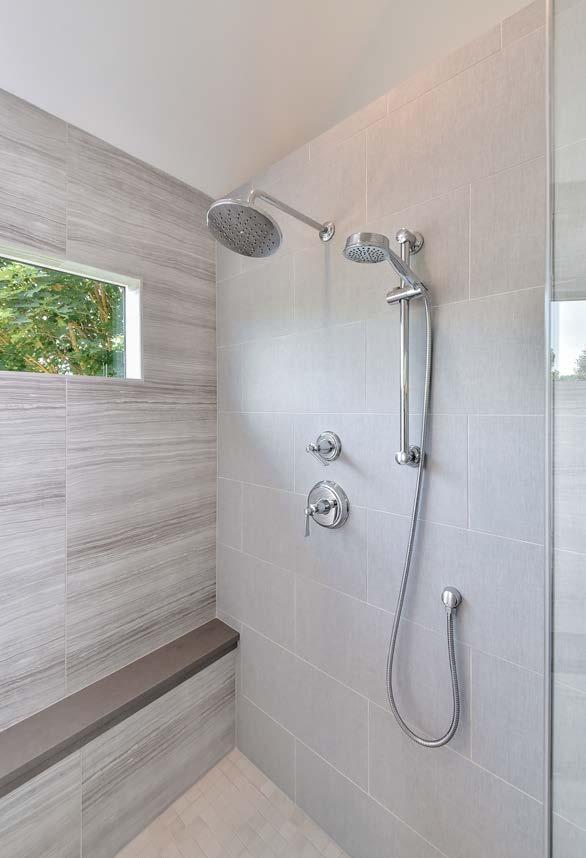
fixtures will become the new go to. This new tone twist is the perfect compliment to the cooler gray paint colors that have become extremely popular in recent years. The warm gold tone adds just the right amount of depth, dimension, and luxury feel to any space.
Homeowners love the change to warmer accents with the brass/gold toned bathroom fixtures versus the traditional shiny polished chrome, which conveys a more cool, modern, and sleek feel. Offered in new finish options like in satin, matte, and spun gold this subtle change is just what was needed to add that classic traditional element to any space with the added bonus of keeping fingerprints and water spots hidden. This warmer tone has become the accent pieces of a room, with complimenting hardware, light fixtures, and mirrors as well.
Look around and you will find more gold tone items than you think. The reason for the comeback–it just looks great in so many different style settings.
4. VANITY LIGHTING
The bathroom vanity usually consists of a cabinet, countertop and mirror. This area is important to the function of the
bathroom. Using lighting strategically can also make it an important area to the style and look of the bathroom. To highlight this mostly functional space, homeowners are using creative lighting techniques, fixtures, and dimmers to create a luxury and relaxing feeling.
There are many lighting styles you can use for the vanity area including light bars, wall sconces and small pendants. For larger bathrooms, it is not uncommon to see a chandelier above the whirpool or centred in the space to create a dramatic effect. Lighting not only helps with makeup application, it creates better bathroom aesthetics.
5. UNDERFLOOR HEATING SYSTEMS AND UNDER COUNTER APPLIANCES
Rather than wear a pair of slippers just to escape the cold sensation on the bottom of their feet while walking across the bathroom floor suggest to your client that is might be a good investment for them to consider adding a heating system under the floor. Underfloor heating can be used with a variety of flooring options including tile, concrete, vinyl and wood, to name a few. But in a bathroom, the cold tile can transform into a beautiful soothing warm floor. These systems not only provide heat, but they can also reduce noise levels and reduce airborne dust.
More and more technology is being included in bathrooms, which means more small appliances are being integrated. For instance, some luxury bathroom designs now feature a beverage center or under counter refrigerators near the makeup area or vanity for medicines or organic facial remedies. Or you may find some home bathroom designs featuring warming drawers for linens and robes. Aside from the traditional dryers in the makeup area, you can also have wireless music systems, televisions, cooling or warming systems, and so on.
The bathroom used to be the place where electric appliances were a no-no. Now, it can rival the kitchen in the number of gadgets and the amount of tech in it. This trend will continue, especially in master bathroom designs.
6. PEOPLE STILL LOVE NEUTRAL STYLES BUT WITH ORGANIC UNDERTONES
Neutral decors are super popular right now. Homeowners love the whites and creams and light browns that make a space look modern and elegant. Neutral bathrooms will continue to be very much in vogue but with a bit of an organic infusion.
There is a certain unwavering appeal to the natural and organic. This is why things like aged flooring and weathered tiles have always been popular. Homeowners are looking to create some of that natural feel to make the bathroom more relaxing.
Neutral colors will have to make ways for some organic browns and blues; the colors of nature. Expect to see more
Continued on p72
Polished chrome conveys a more cool, modern, and sleek feel than the increasingly popular gold tones.
Commercial facility managers are now actively looking for ways to curb water use and cut costs without sacrificing performance, quality and style.
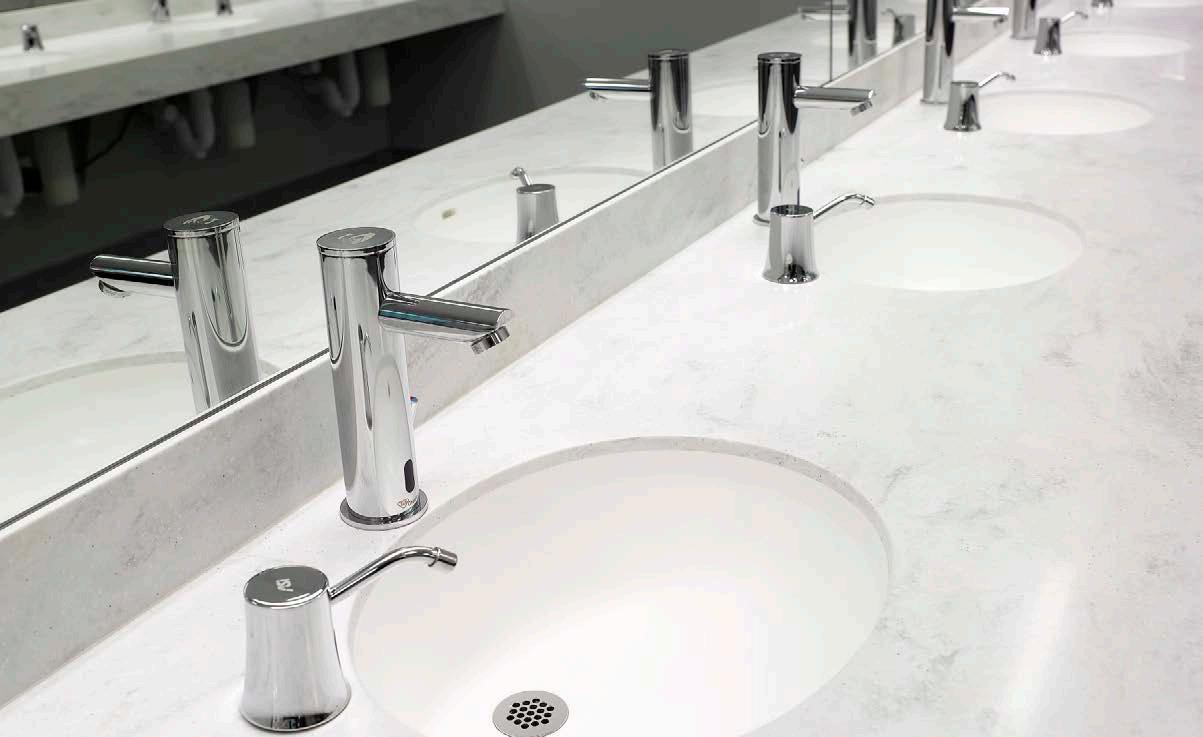
When technology and sustainability meet
How advancements are helping commercial bathrooms go greener. BY
DAVID SCELSI
Economic challenges. Droughts. Green initiatives. Laws and standards. It is hard to pinpoint one single reason water has risen to the forefront of the sustainability conversation in the past few years. But one thing is certain, as demand for greener facilities revs up, advances in plumbing technology and design are changing the way commercial bathrooms look and function.
Commercial bathrooms have long been a haven for water waste and are, in fact, one of the top consumers of water in commercial facilities, according to the U.S. Environmental Protection Agency. Restrooms account for 45 per cent of water use in educational facilities, 37 per cent in office buildings, and 35 per cent in hospitals. In fact, there’s almost no facility where bathrooms are not responsible for at least 30 per cent of the facility’s total water use.
Often faced with high traffic and heavy use, restrooms were once designed with an eye more toward durability than efficiency, but commercial facility managers are now actively looking for ways to curb water use and cut costs without sacrificing performance, quality and style.
Canada is among the top 10 water-consuming countries in the world and, like many others, is facing rising pressures, and incentives, to reduce water use.
Programs such as LEED, for example, encourage the development of environmentally friendly facilities, and its prevalence is growing in Canada. More than 34 million gross square meters (gsm) across more than 2,500 projects were LEED certified in Canada in 2016, up from 26 million gsm the prior year, according to the U.S. Green Building Council, which operates the sustainability certification program.
Aerators can reduce water flow to as little as 1.3 liters per minute (lpm).
CUTTING WATER USE
The standard water-consuming fixtures in bathrooms – faucets, toilets and urinals – have all seen technological advances in the last several years that allow them to function well without guzzling gallons of water with every twist of the handle.
Continued on p46
FOR YOUR CHANCE TO
EXPERIENCE HOCKEY WIN
a professional regular season hockey game in Canada or the U.S.A.

When IPEX introduced the first ULC S636 certified PVC & CPVC flue gas venting systems in 2007, we dedicated ourselves to earning your confidence. We continue to provide training seminars, installation manuals, and an expansive certified product range with a coast-to-coast distribution network. IPEX is committed to supporting you with the most complete product line to get the job done on-time and to the finished quality you expect.












< PLUMBING
Water use can be cut at sinks in a couple of ways. The low-hanging fruit of water conservation at the sink is aerators. These inexpensive, easy-to-install devices can reduce water flow to as little as 1.3 liters per minute (lpm), a dramatic reduction from the 8.3 lpm often seen on standard faucets. Vandalresistant versions also prevent unauthorized removal.
Additionally, upgrading traditional manual faucets to hands-free sensor faucets can save as much as 3.78 liters per handwash over manual faucets by flowing water only when hands are under the faucet. Sensor faucets also avoid the potential for someone purposefully or accidentally leaving water running when they walk out. An automatic shut-off feature ensures any malicious efforts to cover or otherwise interfere with the operation of the sensor still do not result in an untended, endless flow of water.
On the other side of the restroom, urinal flush valves are commonly down to 0.47 liters per flush, and waterless versions are also available, though they require ongoing maintenance to replace cartridges. High-efficiency toilets use as little as 3.8 liters per flush, and retrofitting kits mean older flushometer toilets can be updated to use much less water.
Advances in plumbing are also making it more feasible for facilities to reclaim and recycle non-potable water to flush toilets.
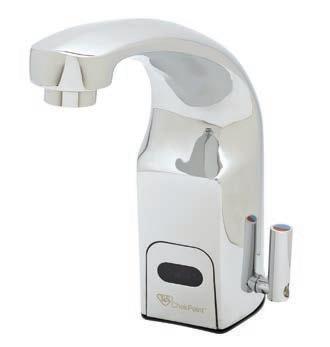
INVESTING FOR THE LONG HAUL
Commercial facilities often see an astounding volume of traffic in restrooms. Hospitals, schools, airports, stadiums and more will typically cater to thousands on a given day. Keeping bathroom fixtures functioning smoothly day in and day out is critical.
Investing in durable, reliable products designed especially for commercial applications ensures facilities get the best performance and longest life.
With regular maintenance for wearable parts, a quality faucet or flush valve can withstand years of heavy use. An inexpensive alternative may seem appealing at the outset but will require more frequent repair and replacement.
Additionally, look for features that support the particular demands of commercial facilities: vandal-resistant aerators on all faucets, automatic shut-off for sensor faucets to prevent water loss from tampering and durable materials that will not break or degrade under heavy use (or abuse).
Getting the right products now will save time and resources in the long term.
SURVEYING THE SCENE
Before undertaking any changes, a commercial facility should understand exactly where its water is being used, so any well considered approach to bathroom design would include a water audit.
An effective audit will analyze water flow across the facility and determine where efficiencies can be gained with repairs, retrofits or updated equipment. Often times these updates can have a return on investment measurable in days, rather than years.
More and more designers and engineers are using water audits to identify areas where increased efficiency can garner the most economical and environmental bang for the buck.
BEYOND WATER
Beyond just saving water, other design advances help commercial restrooms operate efficiently while supporting good health and hygiene.
Hydrogenerators, for instance, which harness the flow of water to produce energy, can be used to power sensor faucets and flush valves, eliminating the need for regular battery replacements or electrical wiring.
Sensor faucets and flush valves also contribute to a cleaner restroom by
eliminating the most common touchpoints in restrooms, places where germs or other contaminants can accumulate and be passed from user to user.
A study recently published by the Society for Risk Analysis revealed that installing touchless fixtures can significantly reduce the transmission of norovirus, a common cause of illness (http://sra.org/sites/default/files/pdf/ press-release/SRA%20Norovirus%20 release.pdf).
Sanitation concerns are also evident in trends and designs that address overall hygiene, including integrating sinks into countertops to eliminate the seam between two materials where dirt and bacteria can collect. Designers are also moving to select quartz and solid surface materials, which feature non-porous surfaces that are low-maintenance and minimize bacteria growth. Regardless of facility type, there are solutions in modern design to tackle nearly any challenge or need for commercial restrooms, and these accelerating technological and design advances are making these places havens for sustainability and efficiency.
David Scelsi is marketing product manager with T&S Brass.
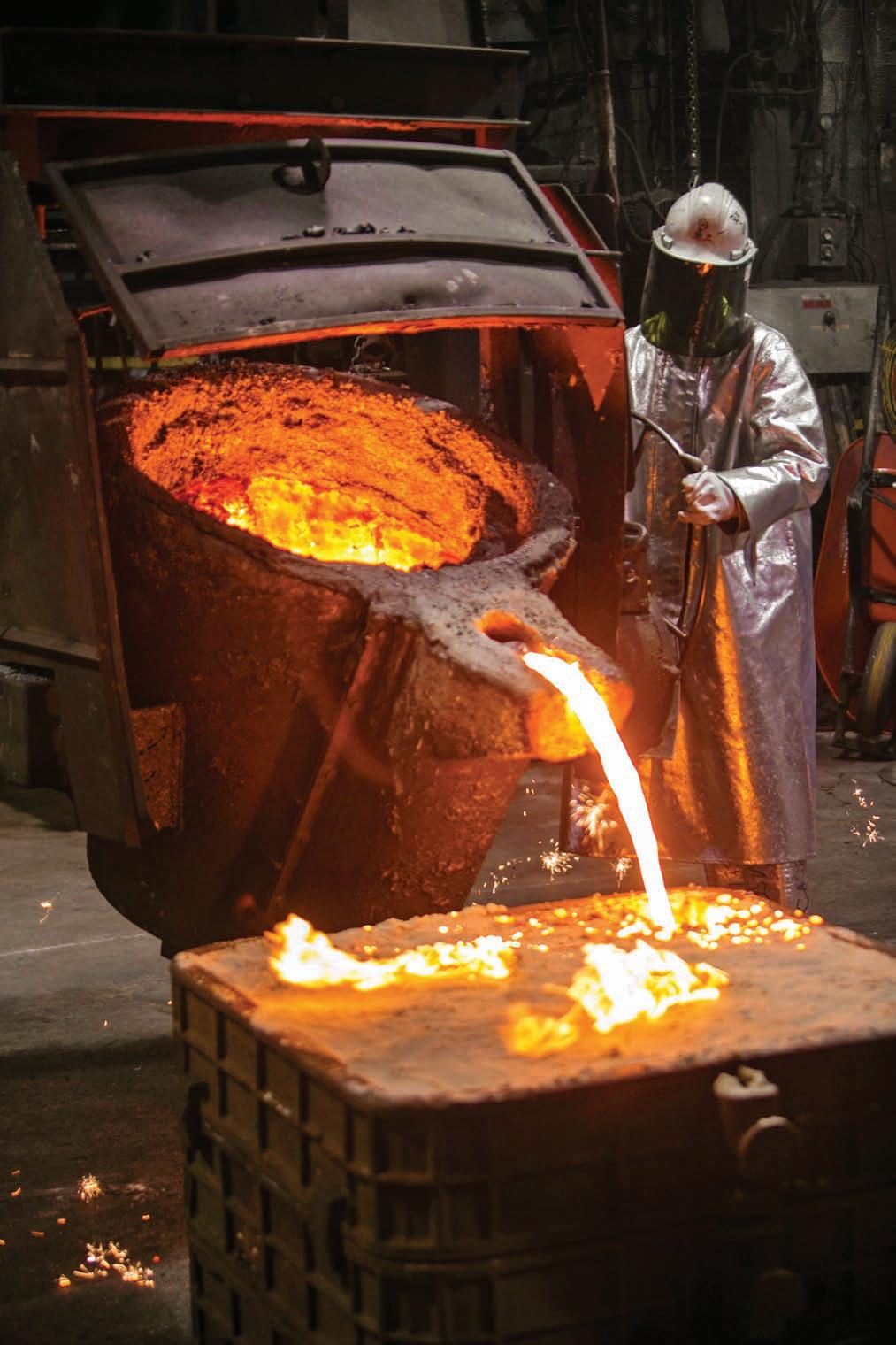

TOWARD THE ON-DEMAND REVOLUTION
BY AARON ENGEL
Cold winter months keep Canadians indoors a great deal more than their southern climate counterparts. Staying indoors longer can be detrimental to health, particularly when you consider the trend toward tighter and more energy efficient home construction mandated by recent building codes. Little or no infiltration of outdoor air, combined with increased indoor time, intensifies the need for HVACbased indoor air quality (IAQ) systems to reduce the unhealthy accumulations of biological contaminants, volatile organic compounds (VOC) and excessive CO2 breathed indoors.
On-demand IAQ is a combination of an air quality monitor, Wi-Fi smart thermostat and an air handler-based indoor air purification system. The three components are available bundled together, branded and packaged for HVAC wholesale distributors to market to HVAC contractors for installation in residences. On-demand IAQ responds to a homeowner’s IAQ condition and automatically corrects it when it surpasses air quality set points, such as VOC, CO2 and particulate, thus the title, on-demand IAQ.
The components inter-communicate via the home’s Wi-Fi network. This automation is possible due to the recent emergence of the Internet of Things (IoT), which is a network of physical devices, vehicles, buildings, and other items embedded with electronics, software, sensors, actuators and network connectivity that enable them all to compatibly exchange data. There are many whole-house air purifiers, air quality monitors, and smart Wi-Fi thermostats already on the market, but it is
the emergence of the Internet of Things (IoT) home connectivity that gives these components the ability for inter-communication.
Florida Energy Water & Air (FEWA), an Orlando, Fla.-based HVAC contractor began installing on-demand IAQ systems late in 2016 consisting of an air quality monitor and a whole house air purifier (FEWA prefers combining it with its own compatible Wi-Fi thermostat brand). The company has sold more than 150 systems and expects the category to command nearly 12.5per cent of its HVAC sales in 2018, according to Dan Cloutier, FEWA’s HVAC division director.
A SKYROCKETING MARKET
FEWA’s results are not surprising considering recent sales statistics in air quality monitors and home automation. Statistics on just air quality monitors have skyrocketed in the last decade. The IAQ monitor market was valued at $2.52 billion in 2015 and is expected to reach $4.63 billion by 2022, according to marketsandmarkets.com, a B2B firm that provides research on 30,000 growth emerging opportunities/threats that will affect 70 to 80-per cent of worldwide companies’ revenues.
On-demand IAQ is just the beginning for HVAC contractors. It is a gateway to an entirely new niche that goes well beyond installing IAQ and HVAC products. For HVAC contractors, on-demand IAQ offers the opportunity to enter the fledgling home automation market. Marketsandmarkets.com research firm also reports that home automation systems were a 39.93 billion mar-
ket in 2016 with a growth potential of nearly $80 billion by 2020.
With home automation expansion appearing as a sure thing, the only uncertainty is what trades will do the majority of the installation. The HVAC and IAQ tiein makes HVAC contractors the best choice, because it is unlikely whether cable, home theater, electrical or security contractors would want, or have the qualifications to install the whole house air treatment systems or thermostat portions of home automation due to the required technical expertise.
An installed on-demand IAQ system offers HVAC contractors the opportunity to add accessories they never dreamed of installing five years ago, such as security cameras, smart doorbells, door lock hardware, lighting controllers, smoke/ carbon monoxide alarms and security systems, all which intercommunicate via the home’s Wi-Fi network. Future ondemand improvements promise that the HVAC system could serve as the home automation hub.
AIR QUALITY MONITOR
An air quality sensor, plugged into a centrally-located 120v outlet in the home, monitors the air for contaminants including particulates, CO2 and volatile organic compounds (VOCs). Should the concentration of these contaminants reach a level of concern, the air quality monitor wirelessly signals a smart thermostat to activate the air handler’s blower. The air is cleaned by the air handler’s on-board whole-house air treatment system before the contaminants reach a critical level. When air quality is restored to an acceptable level, the air
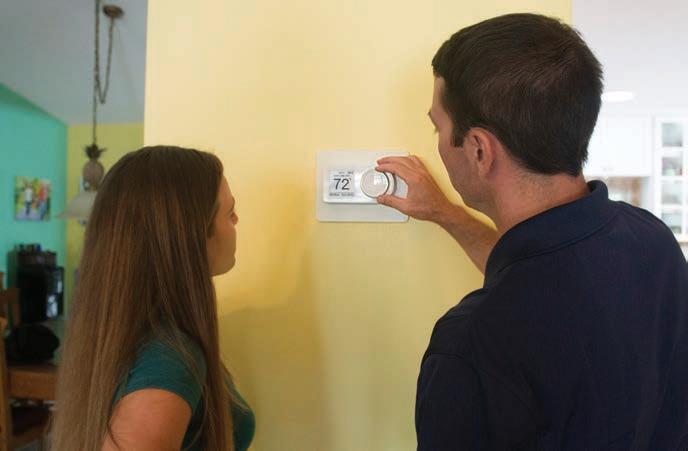
quality monitor then signals the thermostat to turn off the ventilation fan. Until now, no matter how effective any IAQ system may be, it would be ineffective if the system fan was off. With this new approach, the system is proactively addressing the air quality concern and automatically solving the issue.
Thus, excessive contaminants will trigger the monitor. For example, excessive levels of household cleaning chemicals, pet or cooking odors, would trigger the monitor’s VOC sensors. Dusting or vacuuming could trigger the monitor’s particulate sensors.
VOCs and CO2 are typically monitored in parts per million (ppm). Particulates can be monitored as fine as the Particulate Matter (PM) 2.5 standard. Air quality monitors typically include adjustment capabilities to raise or lower the threshold sensitivities of all three contaminant categories.
The air quality monitor also notifies the homeowner of poor IAQ with an onboard LED warning light or a notification to a smartphone, the latter which can be accessed anywhere on the globe via an app.
The Wi-Fi thermostat, which replaces the original thermostat and uses the same 24v wiring, is programed to accept wireless information from the air
quality monitor. The thermostat also has smart and connected capabilities such as remote operation, that provide temperature control based on past usage, occupancy and other intuitive features. Some on-demand IAQ bundles omit the thermostat and leave the control choice up to the contractor.
WHOLE HOUSE AIR TREATMENT SYSTEM
Toxic VOCs, such as formaldehyde and toluene, are the source of many household odours. Until recently, reducing high VOC levels was accomplished through dilution by continually re-circulating the air. Dilution can be accelerated when combined with an outdoor air damper or an energy recovery ventilator (ERV).
While dilution works, it is slower and not as energy efficient as removing VOCs with an HVAC system-based whole house air treatment system that uses gas phase air purification technology. Gas phase air purification removes VOCs from the HVAC airstream by adsorbing them into carbon titanium-based media.
The most effective gas phase air purification devices use photocatalytic oxidation (PCO) to remove VOCs without generating harmful ozone in during the process. The gas phase media consists of carbon cells infused with titanium di-
oxide. A UV-C lamp shining on the carbon media creates a PCO reaction that neutralizes VOCs by breaking them down into trace amounts of harmless water vapour and carbon dioxide. The same reaction keeps the carbon cells clean, effectively regenerating them. Gas phase air purification has a long history in commercial applications where it is used for VOC control in heavy industry and commercial buildings.
Existing air quality monitors may not detect biological contaminants, such as mould, bacteria, viruses, and allergens, which represent about one-third of indoor air pollution. The UV-C light within the PCO system irradiates the air handler’s interior surfaces such as the coil, as well as the airstream disinfecting biological contaminants including mould, biofilm, bacteria and viruses.
A combination UV light/gas phase carbon/PCO air cleaner is designed to remove VOCs and microbes, while the air handler’s onboard fibre media filter removes particulates.
FUTURE INNOVATIONS
The initial offerings of on-demand IAQ are already serving as a springboard for more innovation. Expected introductions at next year’s AHR Expo and CMPX trade shows are on-demand products that go beyond thermostats and will include control centres that will seamlessly integrate all aspects of a building’s IAQ with home automation. The future technology of IAQ is here now and ready for the innovative contractors that want to incorporate it into their business model.
Aaron Engel is vice president of business development at Fresh-Aire UV (www.freshaireuv.com), a North American manufacturer of residential, commercial and medical UV disinfection and carbon/titanium/PCO-based systems, as well as on-demand IAQ packages. Engel can be reached at aaron@ freshaireuv.com.
On-demand IAQ systems can operate with a variety of Wi-Fi thermostat brands.
What you need to know about THE INDUSTRY WORKHORSES
BY IAN MCTEER
Everyone involved in HVAC and refrigeration works with electric motors almost every day. Whether designing new products, specifying equipment, installing, maintaining or repairing a variety of heating, ventilation or cooling products, an electric motor and its needs are regularly the centre of attention. Even at home, the ubiquitous electric motor is indispensable.
As I sat down to write this article, I performed a quick mental survey of the electric motors just in my basement: furnace (three motors, including condensate pump); HRV (three motors); upright freezer (one motor); sump pump ( one motor); propane stove (one motor); desktop computer (one motor); printer (one motor). By the time the refrigerator, vacuum cleaner, washer/drier, range hood, outdoor unit, submersible pump, and several other devices are counted, I am employing north of 25 motors nearly every day.
CREATING A WORLD IN MOTION
The great British scientist, Michael Faraday, experimented with electricity and magnetism and, in 1821, he set in motion a copper conductor rotating around a magnet sitting in a bath of mercury. Faraday had converted chemical energy from a battery into mechanical motion creating the threshold to our world in motion. Years later in 1883, Nicola Tesla invented the first induction motor with rotating magnetic fields thus starting a second industrial revolution still evident today. Indeed, today’s global market for electric motors is close to 100 billion US dollars and is expected to grow to 141 billion by 2022 according to Sherry James of Grand View Research.
HVAC runs on electric motors, which are used in several general classifications:
• Compressor drives: hermetic direct drive and external drive
• Fan drives: condensers, evaporators, induced draft, air circulation
• Pump drives: condensate pumps, hydronic system pumps, chilled water pumps, geothermal system pumps, and cooling towers.
• Miscellaneous drives: deep vacuum pumps, recovery machines, ice makers, EEV stepper motors, among others.
THE WAY WE USED TO BE
Before the advent of electronically controlled motors, there were two general classes used to identify electric motors: single phase induction motors and three phase induction motors. Residential installers and technicians typically encounter single phase induction motors classified by the method used to start them:
• Split phase
• Capacitor start
• Permanent split capacitor
• Capacitor start, capacitor run
The 115-volt split phase AC motor found a home in many belt-driven low starting torque applications (like fossil-fueled furnace fans) long before I ever set foot on the scene. The motor had two windings, the main winding and the high resistance auxiliary winding rotated several degrees in magnetic position from the main winding. Wired in parallel, the auxiliary winding would, during start-up, produce a magnetic field out of phase with the magnetic field produced by the main winding. Thus, the two windings together created a rotating field causing the rotor to revolve. The rotor had no windings,
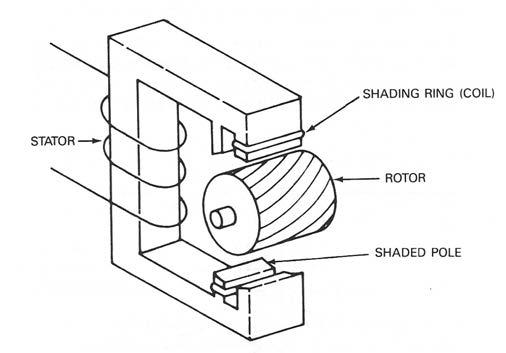
but magnetism built-up around the rotor bars. Once the rotor achieved approximately 75 per cent of running speed, a centrifugal switch would open and take the start winding out of the circuit.
Another single phase motor commonly used throughout the industry in low torque starting applications is the shaded pole motor. The stator core has a pair of permanently short circuited (shading) coils placed over a portion of the main field coil causing an unbalance of magnetic forces so that the motor is self-starting (see Figure 1).
Undoubtedly, the workhorse motor of the residential HVAC industry to this day is the permanent split capacitor motor (PSC). Often found in direct drive furnace fan applications and in hermetic compressors, the PSC motor has no centrifugal switch to take the start winding out of the circuit. The motor could easily operate on the run winding alone; however, it will run more smoothly and efficiently when the start winding and capacitor remain in the circuit. Smoother operation results from the out-of-phase force generated by the start winding. This is especially useful when used with the pulsating load of a hermetic compressor.
A run capacitor is connected between the start and run compressor terminals and is in series with the start winding. It unbalances magnetic lines of force for improved starting torque and reduces the current drawn by the motor by improving the power factor. The run capacitor in an AC motor circuit constantly charges and discharges effectively producing another phase by maintaining a slight lead/lag between voltage and current in the rotating motor.
In hermetic applications, PSC motors sometimes struggle to start in low voltage situations, just a five per cent voltage drop could cause starting difficulty and overheating. Because the starting torque is low, a hermetic PSC can only start when the system pressure is balanced. A non-bleed TXV must not be used with this motor without a properly sized start assist kit that includes a start capacitor and start relay. The start capacitor must be taken out of the circuit just as the motor achieves running speed, otherwise the compressor may be damaged.
NOTE: The starting capacitor does NOT send a “Jolt of Juice” to the compressor motor. It is specifically designed to shift the phase by increasing in-rush current in the start winding in relation to the run winding thus providing necessary starting torque needed by the motor to overcome the unbalanced refrigeration side pressures created by the TXV locking up at the end of the previous cycle.
NOTE: The voltage sensing starting relay is position sensitive. The “pick-up” and “drop out” voltages must match the requirements of the compressor manufacturer. Using any old starting relay could easily damage the compressor motor
Continued on p52
ECM SERVICE AND PERFORMANCE TIPS
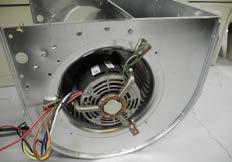
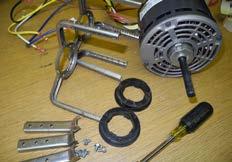
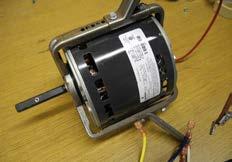
Resilient mount PSC multi-tap motor. A special bracket supports the motor on both ends using rubber resilient rings. Special tri-oval thread cutting screws are used to hold the brackets tightly together. Resilient mounts provide superior vibration control provided the bracket is tight. Sheet metal screws must not be used for securing the two-piece bracket – get the proper screws when necessary.
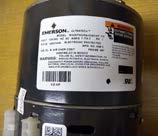

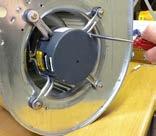
Two-piece ECM has a motor and control module. Module can typically be detached without having to remove the module/motor from the blower assembly. ECM’s are constantly powered with line voltage. This unit has a 115 volt jumper installed. Jumper is removed for 230 volt applications. Be sure to follow the high voltage warning –allow 5 minutes to pass after disconnection from power supply before opening motor assembly.
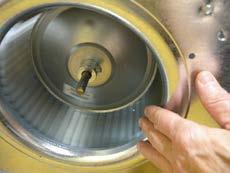
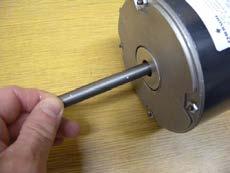
Fan wheel and motor shaft should spin freely. Motor may have a slight ratcheting feel as the armature permanent magnets pass the stator poles.
< MOTORS
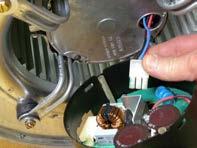

Three phase motor portion of the ECM is fully mounted while module is being detached. Carefully remove three wire harness connecting module to the motor windings.
This ECM is communicates with the control board DIP switches via a 16-wire harness. DIP switches change some motor operating characteristics based on pre-programmed limitations.

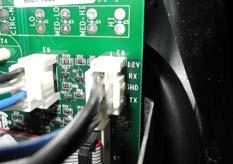
This serial port ECM receives programing instructions from the personality module (PM) tethered to the control board with the red wire tie. Serial port motors use blank replacement modules, only the voltage and horsepower must match the original relieving the supply house from stocking numerous pre-programmed replacement parts.
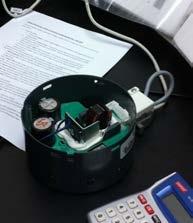
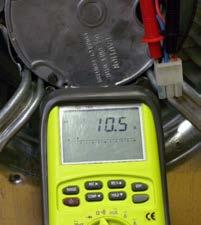
ECM 2.3 motors are factory pre-programmed for specific furnaces and air handlers.
Modules are not interchangeable unless the parts supply house can re-program an existing module or program the appropriate blank module.
Should a control module ever need to be replaced, be sure to ohm out the motor windings to prevent another failure. Readings from L1 to L2, L1 to L3 and L2 to L3 must be the same. Otherwise, the motor is bad too.
windings. Some aftermarket starting relays are current sensing. Once the current draw of the compressor motor reaches a pre-determined level, the relay drops out the start capacitor. Technicians should consult with the equipment manufacturer for more information about using a current sensing relay when replacing an OEM voltage sensing starting relay. PSC motors, when used in residential air handling applications, replaced the older less efficient belt drive blowers by directly attaching the blower wheel to the rotor shaft. PSC powered blowers typically feature multiple winding motors that provide a selection of running torques, which, when driving the load of a blower wheel, allows the technician to select a different fan speed for specific heating and cooling cfm requirements.
TODAY’S HVAC MOTORS
New energy performance standards proposed by NRCan for gas furnace fans, set to be law by July 2019, mean the PSC motor will be steamrollered out of existence. Barley able to convert a paltry 65 per cent of its electrical input into mechanical work, PSC motors suffer from asynchronous alignment, that is, the rotor constantly lags the magnetic field in the stator. Known as slippage, it means that a six pole PSC motor, for example, should turn at 1200 rpm:
Synchronous motor rpm = AC Frequency in Hz x 120 Number of poles in the motor
Thus, 60Hz x 120 = 7200/6 should result in 1200 rpm; however, slippage means the motor turns at 1075 rpm. A considerable amount of waste heat is the byproduct of slippage. PSC motors start abruptly adding stress to internal motor components and noise to the air handling system. Multi tap PSC motors must be carefully matched to the application as only minor changes in speed are possible.
Electronically Commutated Motor (ECM)
In the last two decades, several electric motor manufacturers, including Genteq and Emerson introduced fractional horsepower variable speed ECMs touting a wide range of benefits such as:
• Incorporating a separate motor that is wound like an industrial three-phase motor with a computer that “decides” which winding to power at exactly the right time thus optimizing efficiency.
• The rotor consists of three permanent magnets so no energy is wasted in creating an armature magnetic field; rotor losses are very low; goodbye slippage.
• Emerson’s serial port communicating ECM uses 10 poles
• The motor computer, housed in a replaceable module, can control torque over a wide range of applications; pro -
vides a much wider range of airflows between lowest and highest settings.
• The motor computer “knows” the rotor position allowing control without the need for mechanical brushes and commutators.
• Motor starts softly, ramps to proper speed.
• Under standard residential operating conditions, a variable speed ECM is typically 40 per cent more efficient than a PSC motor.
• ECMs used with furnace fans are optimized to provide constant air volume should the external static pressure change for some reason.
Constant Torque Motor (or X13 Motor)
Think of CTMs as the next generation PSC motors. The non-ramping CTM motor programming is optimized around providing a consistent rotational force. Should the system external static pressure change due to a restricted air filter, for example, then the motor program will maintain its programmed torque although airflow will decrease, but not as drastically as a PSC motor in similar circumstances.
CTMs reduce power consumption compared to a PSC motor, have soft start capability, and provide multiple speed taps providing a level of torque suitable for varied applications. The motor interface, simpler than that of an ECM, receives analog 24-volt turn-on instructions to the appropriate motor speed tap by the furnace or air handler control board.
Inverter Drive
Many high efficiency heat pumps and cooling units feature a variable speed hermetic scroll compressor powered by an inverter or variable frequency drive that alters AC power by changing it into DC power. Then, using diodes and capacitors, the converted DC power feeds the appropriate motor windings in the compressor at the right time in a similar fashion to the ECM fractional horsepower motor. Inverter drives are continuously variable, brushless DC motors driven by a switching frequency typically ramping some motors from 900 rpm to as high as 6000 rpm based on load. Variable speed drives incorporate protection and monitoring functions that continuously adjust compressor operation preventing undesirable operating conditions and situations that could damage the compressor.
NOTE: ECM motors and inverter drive compressors could cause personal injury or death due to electrocution. Be sure to understand and follow the manufacturer’s instructions before touching electrical components.
IT IS ALWAYS SOMETHING
I said it once before: air is a commodity, it has weight. One cubic foot of air weighs approximately 0.075 pounds. A blower moving 1000 cubic feet of air per minute will move 0.075 x
Continued on p77
ECM SERVICE AND PERFORMANCE TIPS
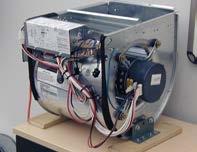
All electric motors in a fan application below the evaporator coil should have a drip loop. Water dripping onto the wiring from overhead will travel to the bottom of the loop and drip onto the floor instead of into the motor.
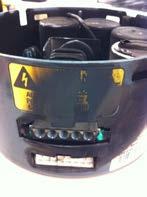
Rarely do ECM’s fail completely. Modules exposed to water (overflowing drain pan, leaking humidifier, flooded basement) and abnormal operating conditions (continued high static operation, voltage spikes) will fail prematurely.
CONSTANT TORQUE MOTOR
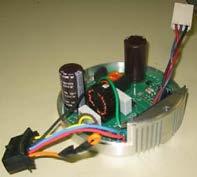
Control is optimized around providing constant torque
• Not as flexible as an ECM
• Motor receives line voltage all the time – just like variable speed
• Motor is programmed, similar to variable speed
• Soft (controlled) starting –similar to variable speed
• Simpler Interface than variable speed
CONNECTIONS
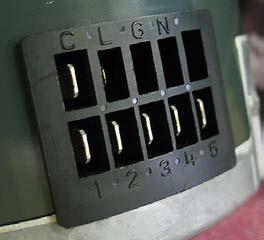
Applying 24vac to the appropriate “Tap” tells the motor to produce the torque programmed into that memory location
CTM LOW-VOLTAGE
24vac Common
OPTIMIZE PRODUCTIVITY AND WORKER SAFETY
How to pick a low-level scissor lift that fits your project. BY
JUSTIN KISSINGER
Using an oversized lift on indoor worksites is sometimes like attacking a mosquito with a baseball bat. It is impractical, unsafe and might do more damage than good. Low-level scissor lifts are great tools for indoor projects, such as installing ductwork or plumbing. They are easy to manoeuvre, have intuitive controls, and most importantly, get you to the right working heights without lugging tools and building materials up shaky ladders and scaffolds.
There are hundreds of lifts on the market and picking the right one optimizes productivity and operator safety on the jobsite, as well as adds a low-maintenance machine to any tool fleet. When faced with multiple catalogs of varying models and specs, customers should consider four features before making a purchase: working height, platform size, worksite impact and lifting capacity.
HEIGHTENED AWARENESS
Less is more when it comes to interior working heights. Contractors might think they need a lift with working heights taller than seven meters, when actually they may be able to reach all projects with one that reaches a six-meter working height. In fact, roughly 70 per cent of lift operators say their jobs required working heights lower than seven meters.
Those smaller lifts bring added benefits to many jobsites. Low-level scissor lifts have step-in heights as low as 50 centimeters, making it easy for operators to load tools and materials onto the platform. Low step-in heights eliminate the fatigue caused by climbing multiple ladder rungs; reduce the chance of a serious fall; and minimize repetitive strains that can ultimately lead to workers’ compensation claims. Some manufacturers also incorporate a full swing gate, which makes platform loading easier and safer because the operator does not have to duck under chains or railings.
Using an oversized scissor lift for interior work, such as ductwork installation, can even endanger the operator. Crush hazards are a constant presence when operators use an
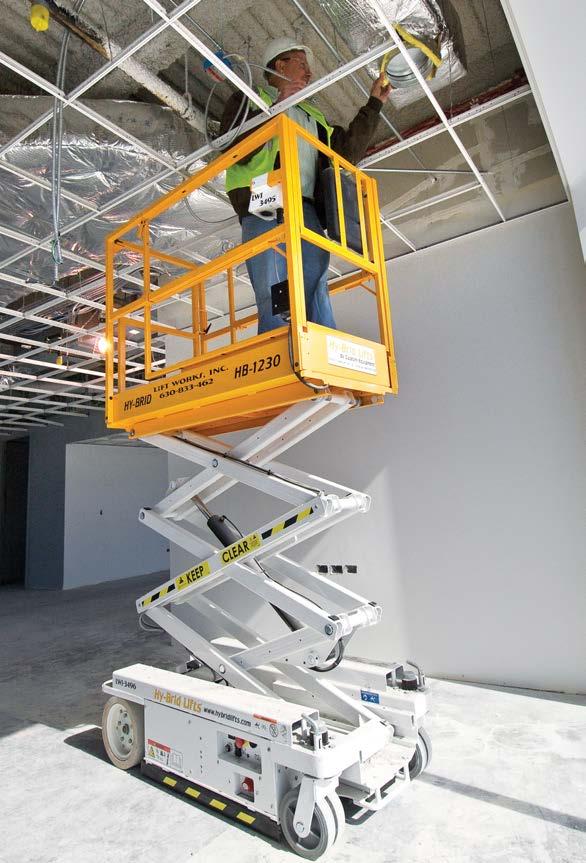
Low-level scissor lifts are ideal for indoor projects, such as installing plumbing or ductwork, because they are easy to manoeuvre, have intuitive controls, and most importantly, get you to the right working heights.
oversized lift indoors because the platform height exceeds the ceiling height. For instance, if an installer is using a sixmeter lift inside a six-meter-tall room, he or she might get distracted while looking down over the railing as the platform is nearing the ceiling, creating a potential crush hazard. A lowlevel lift, on the other hand, has roughly a 4.5-meter-tall platform height, which allows the installer to achieve a six-meter reach with virtually no crushing hazard.
Stowed height is also important for operators to consider when selecting a low-level lift. If a lift is less than two meters tall with the platform fully-lowered, operators can easily push or drive the lift under overhead fixtures, such as support beams and doorframes.
THE SHORT AND LONG OF LOW-LEVEL LIFTS
Having a lift that offers plenty of working space, yet still fits through cramped worksites, is just as important as reaching the correct working height. A low-level lift should be less than one meter wide and two meters long so operators can easily transport it or manoeuvre it through narrow pathways. For example, some drive-around, low-level lifts are as narrow as 75 centime-
ters, which is wide enough for an operator and any tools he or she might need, yet still small enough to fit through doorways and take up minimal space in narrow hallways. And a lift that is less than two meters long will fit inside most elevators.
Some lifts have platform extensions that give operators extra working space for an additional person or building materials. The extension also allows operators to work over obstacles that might prevent the lift from moving forward. For example, an operator can slide out the extension to install a lighting fixture over a stairway railing.
If a lift has an extension, customers should inspect how it is attached to the platform to avoid extra maintenance. Some extensions are attached to the platform’s floor and use wheels that can collect debris and become jammed. This creates downtime to clear the obstruction. To virtually eliminate the chance of debris jamming an extended platform, look for models that have extensions attached to the platform midrails using C-clamps.
MINIMIZE DAMAGE
Low-level lifts should have minimal or no impact on the worksite. For instance, dual front wheels, counter-rotating wheels and self-contained hydraulic systems prevent the chance of hydraulic oil leaking and damaging costly carpeted, hardwood or tiled floors.
Low-level scissor lifts have some of the best weight distributions in the industry. Their wheels spread the lift’s weight throughout the unit to reduce pressure on sensitive surfaces, including tile and stone floors. For example, a 544 kilogram lift with dual front wheels might have wheel loads as low as 632.3 kPa, which enables operators to manoeuvre the lift over tile, laminate, raised floors and mezzanines with minimal risk of damage. The weight distribution also means operators can get onto poured concrete several days sooner than with heavier lifts.
Counter-rotating wheels also minimize the risk of damaging sensitive floors, such as carpet and linoleum. Non-rotating wheels twist and bunch up the floor when the operator turns the lift, causing tears or deformations. Counter-rotating wheels, on the other hand, allow one side of the wheel to move forward, while the other moves back, which prevents bunching or twisting.
Hydraulically driven lifts have the highest potential for hydraulic oil leaks since they use the fluid to drive, raise and lower as well as steer the lift. Hydraulically driven lifts also have multiple connection points between the hydraulic pump and systems, which increases the risk of a leak occurring. If a leak occurs, the oil can stain floors and create slippery surfaces. And hydraulic units require considerable maintenance. For instance, they consume hydraulic oil faster and require more frequent filter changes than electric-driven units.
To minimize the risk of harmful leaks, some manufacturers make electric-driven lifts with hydraulic systems that have only two connection points. These lifts’ hydraulic systems are
solely dedicated to elevating the platform instead of driving, lifting and steering the lifts, which reduces the chance of leaks. These units also generally have greater motor efficiency. And since connection points are a major source of hydraulic leaks, having only two connection points minimizes the chance of a leak occurring in multiple spots.
LOCKED IN AND CHARGED UP
When faced with a project that requires working through long hallways and working hours, consider lifts that feature castor locks and efficient, built-in charging systems. Some manufacturers include caster locks that limit the wheels’ turning radius. These locks, when engaged, allow operators to drive easily in a straight path while permitting minor steering adjustments.
Customers also should consider features that protect the environment if they are purchasing low-level lifts. For example, some manufacturers build lifts that have electrical drive motors and steering systems. These systems draw fewer amps and require less overall power than hydraulically driven engines, which results in long operational hours, sometimes as long as 16 hours, and fewer recharges. Some manufacturers also include an on-board battery charger that self-monitors the electrical current and stops it once the battery is fully charged. This reduces energy consumption and prevents the battery from overcharging, which can shorten its life. Some chargers also maintain batteries independently from each other instead of pushing the electrical current from one battery to the next. Combined with a self-monitoring system, they help ensure the equipment owner gets the most life from their battery.
IT LIFTS ME; IT LIFTS A LOT
Having a low-level scissor lift that can elevate workers and building materials while maintaining its stability is key to maximizing productivity. Low-level lifts excel with their large lifting capacity. For example, some three-meter lifts have 340-kilogram lifting capacities, which is generally enough to support two operators or a single operator and any building materials needed on the jobsite. To minimize a scissor lift swaying under heavy loads, platform stability can be enhanced using a robust scissor stack and oversized pins.
Identifying the features that fit your business or project needs puts you ahead of the curve. Each feature should increase productivity and minimize costly downtime. From hanging ductwork to installing a thermostat, the best lowlevel lift safeguards the operator, the project, and the production schedule from beginning to end.
Justin Kissinger is the marketing manager for Custom Equipment, Inc., which manufactures Hy-Brid Lifts. He can be reached at justin@customequipmentlifts.com.
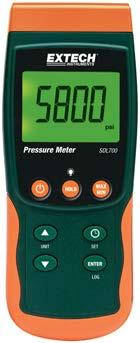
The SDL700 Pressure Meter and Datalogger from Extech Instruments measures and monitors pressure conditions in HVAC systems as well as process control and compressor control systems in industrial settings. The meter provides flexible programming configurations and data-logging readings in Excel onto an SD card. It operates in three ranges: 30, 150, and 300psi using corresponding transducers. The pressure meter has a range of 10 measurement units and the display indicates real-time measurements. Sampling rates can be set from once every second to nearly once every nine hours. www.extech.com
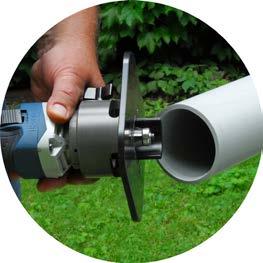
Reed offers the Cordless Power Pipe Beveler, which deburrs and bevels plastic pipe of twoin. and larger diameter. It works on most PVC glued joints and some sizes of bell and gasket joints. Adjustable for bevel length, the RBIT1 router bit cuts a 15-degree external bevel up to 5/8 in. long. Add the optional RBIT2 router bit for 12-degree bevels up to one-in. long. The kit (CPBKIT) includes the beveler attachment powered by a 22,000 RPM, 18V cordless die grinder with a four Amp hour Lithium-Ion battery. The included RBIT1 cutting tool is a four flute, carbide router bit. www.reedmfgco.com

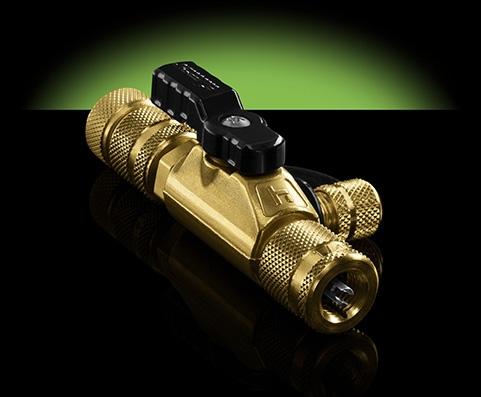
hilmor’s Valve Core Removal Tool is designed to help keep track of tools and equipment with its built-in rare earth magnet. The magnet is in the back of the plunger so it can adhere to the side of the unit. The tool allows technicians to remove valve cores for unrestricted flow. It is vacuum tested to 20 microns and up to 800 PSI working pressure. When the valve cores are removed, they can be left in the gripper and stored next to the body of the tool that is on the system port. The Valve Core Removal Tool comes in ¼-in. and 5/16-in. and connects to a vacuum gauge. www.hilmor.com
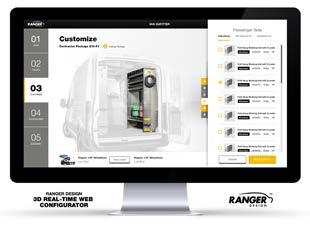
Ranger Design, a commercial van outfitting manufacturer, has launched an online configurator tool to configure a custom system for Ford Transit and Ford Transit Connect commercial vans. It enables several configurations for end users that suit the dimensions and designs of any Ford Transit or Ford Transit Connect van. www.rangerdesign.com
Smappee, a developer of smart energy monitoring solutions, has launched the Smappee Plus. The system helps manage electricity use and costs by providing real-time measurements of energy production and consumption. The product integrates Smappee’s patented NILM (Non Intrusive Load Monitoring) technology with submetering clamps to measure real-time energy use from household electronics and appliances. Suited for homes with solar and other renewable technologies, Smappee Plus directs energy flow within a home for energy efficiency and clean energy payback. www.smappee.com
The 64 MAX IR thermometer from Fluke features Auto Capture, allowing technicians to set time and intervals to record up to 99 data points unattended. The thermometer can be mounted on a standard tripod for unattended measurements. It has laser technology (up to ± 1° Cor ± one percent of reading whichever is greater) and up to 30 hours battery life. The thermometer is IP54 rated for protection against airborne contaminants. The 64 MAX has a flashlight and large, backlit LCD display and displays minimum, maximum or average temperature, or the difference between two measurements, and features Hi and Lo alarms for display of measurements outside set limits. www.fluke.com
Milwaukee Tool has introduced the next generation of Milwaukee Aviation Snips, featuring forged blades for up to 10X more cuts, one-handed metal lock secures tool closed for storage, a bolt lock to prevent loosening and chrome rust protection. Ergonomic grips allow for comfortable extended use. www.milwaukeetool.com
Freakishly Strong.

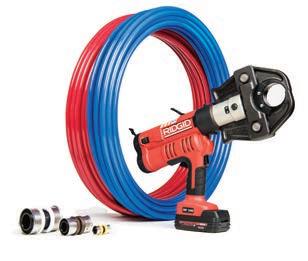
Presenting Viega PureFlow® System. Freakish Performance. This PureFlow PEX is more than meets the eye. It’s been specially designed for commercial and residential builders. The system installs in a fraction of the time compared to alternatives. It’s the amazingly reliable. The incredibly efficient. A modern feat of German engineering. It’s the one, the only Viega PureFlow System. Viega. Connected in quality. Learn
CHANGE IS IN THE AIR
HRAI president Warren Heeley announces retirement, while Bruce Passmore becomes new chair, at AGM in Quebec City.
BY MICHAEL POWER
Attendance and enthusiasm ramped up for the 49th-annual conference of the Heating, Refrigeration and Air Conditioning Institute of Canada (HRAI) in historic Quebec City. Held August 16-18, the event saw changes to the organization that included Bruce Passmore appointed chair, while Warren Heeley, HRAI’s president, announced his retirement.
Strengthening regional representation and ensuring money earmarked for climate change projects is spent wisely are among top priorities for Passmore, of Emco Corporation, who described some of his agenda for the upcoming year to members during the Chairs’ Banquet on August 17.
He noted the importance of communication with governments and utilities as well as industry consultation on climate change issues. He also stressed that HRAI will continue investing in online courses, webinars and other educational events.
“There are many regions that could use our support,” said Passmore, while pressing members to encourage their colleagues to volunteer at the organization.
Similar to previous years, the conference kicked off with a year in review presentation that, among other areas, described HRAI’s communications efforts. The organization has gotten a social media consultant and new LinkedIn account, as well as initiating more targeted advertising. It also held its first Day on the Hill in Ottawa, during which HRAI’s board and senior staff met with MPs and senior civil servants to discuss climate change, door-to-door sales tactics and raising awareness of the HVAC/R industry.
EDUCATIONAL SESSIONS
HPAC columnist Robert Bean of Indoor Climate Consultants Inc., presented a session called Online, Simple and Free: Thermal Discomfort Risk Assessment Tools for Residential and Small Commercial Buildings. The tools he discussed can predict how uncomfortable people will be in an indoor space. The websites, for example one created by Payette, also allow users to pinpoint where changes can be made to a building.
“They’re free, they’re online and they’re dead simple to use,” Bean told the audience. “What’s not to like about that?”
Users must fill out input values into the software, for example drywall temperature. “Everybody can do that,” Bean said. “Everybody has an instrument that you can measure the temperature, or you’re going to be able to read it off the thermostat on the wall.”
Other inputs include humidity, air speed, the metabolic rates of the room’s occupants, surface temperatures and so on. Bean also explained how to calculate mean radiant temperature, which describes the relationship of a person in a space to all the surfaces in the room and is a function of the area, distance and the temperature.
As windows are added to a building, the lower the radiant temperature will be and the higher the risk of discomfort, Bean said. As well, since women often wear lighter clothing, they tend to feel colder in rooms than men. Payette’s online tool can account for this and other factors, Bean said.
Knowing this allows for conversations with architects about the risks, he noted, and users can show clients what they will experience in the space.
“What you’re doing is you’re having those discussions upfront with the client rather than on the back end,” Bean said.
An education session that proved popular was entitled IoT Trends Revealed as it Relates to Intelligent Residential & Commercial Buildings, Net Zero Energy, Controls and Cybersecurity. The session, run by Ron Zimmer, president and CEO of Continental Automated Buildings Association (CABA), focused on intelligent buildings research. Zimmer noted that connectivity through the Internet of Things (IoT) is spreading as technology adoption goes up while costs fall. And while there are currently 0 billion connected devices, Zimmer estimated that number will climb to 80 billion by 0 5.
“It will impact on every one of us–as consumers, as home owners, in our business, how we shop, how we play, how we drive,” he said.
How big is the market? Lighting represents a low-hanging fruit in this area, Zimmer said. Not many buildings have lighting controls that change the lighting, he added, which represents enormous opportunity.
Meanwhile, sensors now allow people to provide greater value to clients. For instance, heating professionals can differentiate themselves from competitors by using sensors to determine the location of a leakage or when something is failing.
“Sensors are what is going to make the big difference,” Zimmer said. “Sensors are everywhere.”
Whatever the technology, businesses must change with the times. Those that stay the same will be left behind.
Some places, such as Germany and certain jurisdictions in California, are moving towards zero net energy buildings,
Zimmer said. It makes sense to shoot for zero net energy for new buildings, he noted, although not necessarily for existing ones.
Plug loads are becoming an enormous energy cost, with users plugging several devices into a single plug, he said. Human behaviour plays a key role in moving towards zero net energy. Zimmer encouraged companies to use incentives as a tool to change behaviour—for example, use the savings from lower energy use to through a party for employees.
“The occupants are key to this whole process,” he said.
PAINT THE INDUSTRY BRIGHT
A town hall meeting on August 8 wrapped up the event with a panel touching on topics that included careers, refrigerants and climate change. To attract new people the industry must spread the word about what the field has to offer, said panel member Bruce Passmore.
“The opportunities aren’t going away quickly. There are great paying jobs,” he said. “It’s up to all of us to paint the industry with a positive start.”
Outgoing chair and fellow panelist Rick Ellul, of Belimo Americas, agreed that reframing the industry for a fresh audience could help attract newcomers. The field now involves more technology—and not just traditional tools—that could appeal to those considering it for a potential career. “That should be more attractive to young people,” he said.
Heeley, the moderator, noted that the industry is sophisticated and becoming more so as time goes on. To interest newcomers, it is important to tell the story of that sophistication and how important they will be to the lives of people in Canada.
The town hall moved on to discuss refrigerants, with Heeley noting that the push is to move refrigerants towards lower global warming potential. With that typically comes the issue of flammability, he noted. “These alternatives could bring into play increased safety
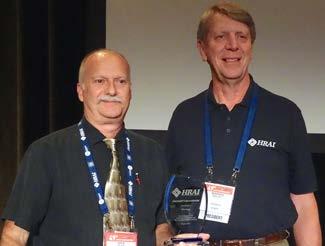
Nick Reggi (l) accepts the 2017 President’s Award from Warren Heeley at the HRAI conference in Quebec City. Reggi was recently sworn in as RSES International president.
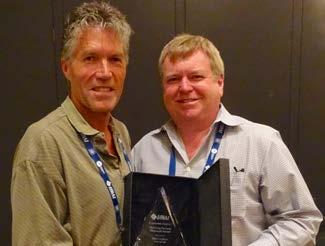
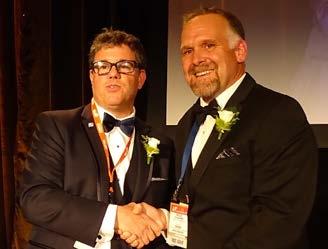

concerns for technicians and customers,” Healey said. “How will the industry manage this safety concern as these substances become more prevalent?”
Regarding equipment, the U.S. is behind Canada by about two years, said Dave McPherson, so changes will take place in Canada first. Labeling on equipment will help reduce safety risks, he noted. “But I think one of the most important ways to help reduce the risk of flammability is education and awareness, and baking it into your contractor technical training,” he said. “Ensure it’s on your website and all the ways you touch consumers, your contractors and stakeholders.”
On climate change, the panel looked at how HRAI should position itself as governments move towards greenhouse gas reductions. The industry is evolving and HRAI must keep up, said David Weishuhn, secretary/treasurer and chair, contractors division, also of Blue Flame Heating & Air Conditioning Ltd. Going forward, the government will not introduce incentives for natural gas and is moving towards banning the installation of natural gas in new homes by 030. Heat pump incentives, however, are on their way, said Weishuhn.
NEW BEGINNINGS
At the chair’s banquet, Heeley announced plans to retire from the organization next June. While addressing attendees Heeley, who has worked for HRAI for more than 35 years, remarked on the growth that the association had experienced over the years and thanked the audience for a fulfilling career.
“It’s time for a new leader to take HRAI forward,” he said, also noting that he will work with the board in searching for a replacement, a process that will begin in fall, 017.
Heeley’s career will be celebrated at HRAI’s 50th-Anniversary Conference on October 14-17, 018 in Playa del Carmen, Mexico. www.hrai.ca
Dave Weishuhn (r) accepts the Craig McCarty award. Weishuhn received the award for his outstanding leadership and dedication to the HVAC/R contracting industry in Canada and for his volunteerism within HRAI’s Contractor Division.
Passing of the gavel, Rick Ellul (l), outgoing chair congratulates Bruce Passmore, 20172018 HRAI board chair.
Town Hall panel from left, Bruce Passmore, Dave Weishuhn, Rick Ellul and Dave McPherson with moderator Warren Heeley onscreen.
PLUMBING PRODUCTS
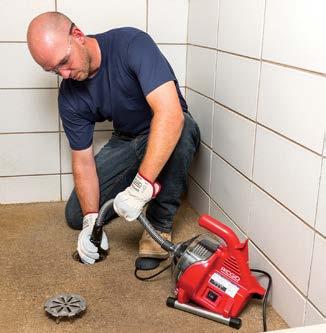
Emerson’s RIDGID PowerClear drain cleaning machine for tub, shower and sink blockages is suitable for commercial and residential use. It eliminates clogs from lines ¾ in. to 1.5 in. in diameter and features Autofeed technology. The PowerClean weighs 12 lbs. and its 120V motor feeds cable at 18 ft. per minute, up to a maximum of 25 ft. The clear cover allows users to see the remaining cable. The heavy-duty inner core cable provides increased strength and kink resistance. www.emerson.com

From Moen comes the U by Moen shower, a Wi-Fi/cloud-based digital shower. Users control shower preferences, and the product includes a digital valve with thermostatic temperature control to connect up to four shower devices. The Wi-Fi-connected digital shower controller has a five-in., non-touch LCD screen providing on-screen messaging and notifications. As water temperature changes, the screen colour evolves to indicate warm up or cool down. The U by Moen smartphone app lets users create up to 12 personalized presets including name, greeting, outlets, temperature, shower timer and notifications. www.moen.ca
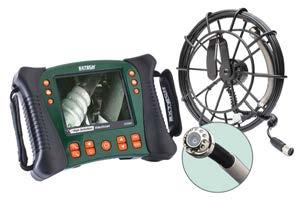
From Extech Instruments comes the Extech HDV650-30G, a wireless videoscope inspection camera kit. The videoscope includes a 30m-fiberglass cable to inspect problems on long pipe runs. The HDV650-30G features a 5.3-in. and LCD screen with 640x480 pixel resolution. A 25mm camera head with 12-LED illumination and a 60° field of view/long depth of field inspects piping and dislodges minor clogs. The videoscope’s SD card stores over 15,000 images or four hours of video. The available HDV650W-30G kit includes a wireless transmitter handset so users can position the display separately from the cable spool. www.extech.com
Continued on p62
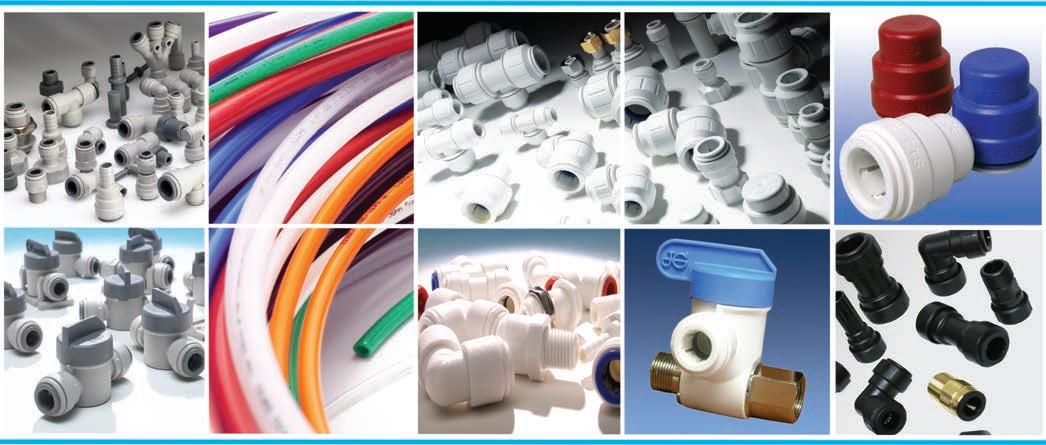



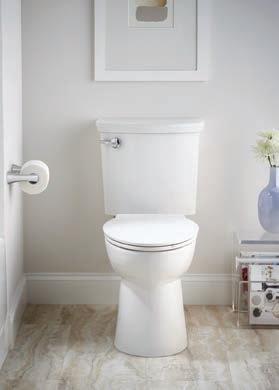
The collection of VorMax toilets from American Standard includes two new models. The 1.28 gallons per flush (gpf) high efficiency (HET) and the 1.0 gpf ultra-high efficiency (UHET) toilets are WaterSense-certified and suit residential and commercial applications. They feature EverClean, a permanent finish inhibiting stains and bacteria, mold and mildew on the surface and have the highest bulk removal score on the Maximum Performance (MaP) test. With Right Height (16.5-inch) elongated bowl configurations and polished chrome trip levers, the VorMax styles come with an EZ-Install kit. Optional trip levers come in American Standard faucet finishes, including polished nickel, legacy bronze and brushed nickel. www.americanstandard.ca
Franke granite sinks are tested against thermal shock, staining, scratching and impact. The granite’s sanitized silver compounds include silver ions that attack bacteria. Shadow Grey is the newest colour in the Franke Granite families of Peak, Kubus and Orca. Faucets to match in the Active Plus series, roller mats, grids and cutting boards are designed to expand a sink’s use. www.franke.com
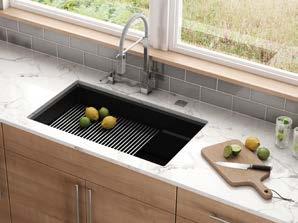
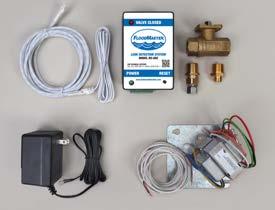
Reliance Detection Technologies (RDT) offers the FloodMaster RS-092 leak detection and automatic shut-off system. The system uses a rope-style water sensor, controller and ½-in. NPT valve with 3/8-in. fittings to sound an alarm and automatically shut off the water to a hose-fed appliance. The system is reusable and interfaces with most security, automation and smart home systems. Two kit options are available: RS-092-MK1 features a standard 120 VAC wall wart, while RS-092-MK2 includes a step-down transformer (120, 208 or 240 VAC to 24 VAC) and mounting plate. www.reliancedetection.com
Continued on p64

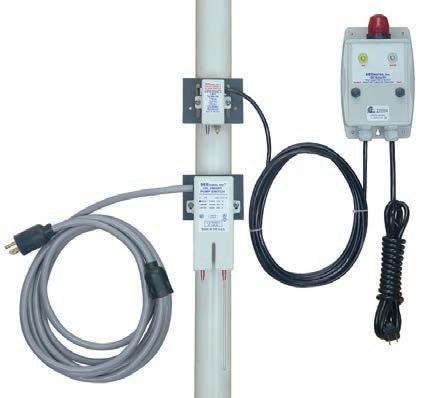
THE ORIGINAL, RESPONSIBLE WAY TO PUMP WATER, NOT OIL.
The OSS-100 is the trusted and proven plug & play system that pumps water, not oil from elevator sumps, transformer oil containment areas and underground electrical vaults.
Oil Smart® systems satisfy ASME A17.1, IEEE 980 and EPA SPCC requirements.
Your trusted source for quality control panels.™ Phone: 888-733-9283 www.seewaterinc.com



CONQUEST® GAS WATER HEATERS
100 GALLONS STORAGE
199,000 to 300,000 Btu


15-YEAR TANK WARRANTY IS STANDARD 96% thermal efficiency
CONQUEST® GAS WATER HEATERS
130 GALLONS STORAGE
399,000 to 800,000 Btu
Modulating Burners Available
ENGINEERED DUPLEX ALLOY
AquaPLEX is a remarkable new water heater tank material created by alloying 300 and 400 series stainless steels and capturing the benefits of both. Fully pickle-passivated after complete tank fabrication, AquaPLEX is naturally corrosion-proof in potable water regardless of stored water temperature.
• Tank walls are solid AquaPLEX. There is no lining, coating, cladding or plating of any kind. Nothing that can erode, crack, delaminate or wear through over time and expose a steel tank to water
• No anodes of any type are required. AquaPLEX tanks are unaffected by aqueous or galvanic corrosion so an anode rod has nothing to do. And this means tank life cannot be compromised by insufficient anode rod “reach” or condition
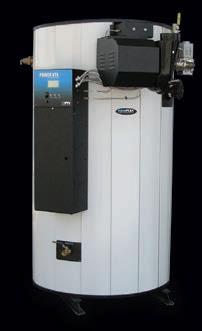
15-YEAR
TANK WARRANTY IS STANDARD
thermal efficiency
POWER VTX® GAS WATER HEATERS
225 GALLONS STORAGE
500,000 to 1,000,000 Btu
Modulating Burners Standard
15-YEAR TANK WARRANTY IS STANDARD www.pvi.com
• AquaPLEX is immune to chloride-induced stress corrosion cracking; a known failure mode for 304L and 316L stainless steel in hot potable water
• AquaPLEX is as much a process as it is a material. Tanks and welds are designed to eliminate crevices and we employ unique fabrication processes to ensure maximum longevity of the tanks
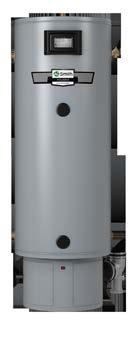
A.O. Smith offers the Polaris high efficiency condensing gas water heater, which operates at a thermal efficiency of up to 96 per cent and pairs with recirculating or domestic space heating systems. Available in 34- and 50-gallon models, Polaris has a low NOx modulating gas burner with a durable tank and heat exchanger. It features a power direct vent design that fits with PVC, CPVC or Polypropylene (solid core only) through a sidewall or roof. The Polaris pairs with an optional concentric vent kit. Front-access panels provide access to components. The electronic controls give temperature control and water heater diagnostics. www.hotwatercanada.ca
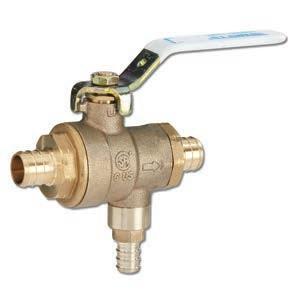
Watts offers the Series LFBRVM1 all-in-one ball valve and relief valve.
The water heater shutoff valve gives protection from excess water pressure caused by thermal expansion. It features nine end connection options and can be installed in any orientation. The design incorporates tighter pressure release tolerances for accuracy in compliance with IAPMO and CSA standards. The new valve includes a forged body construction and blowout-proof stem. www.watts.com
From Sustainable Solutions International comes the High Efficiency Toilet (HET) No Clog Point 8. Its trapway is double the industry standard size. The SSi No Clog Point 8 toilet uses a technology that is independent of pressure or vacuum assisted mechanisms. The toilet flushes at .8 gallons per flush (GPF) and features Easy-Clean bowl glaze coating. It has a MaP score of 800g, nominal four-in. trapway and washdown flush technology. www.sustainablesolutions.com
Chicago Faucets has introduced the Emergency Backup Power System (EBPS) that assures water flow in electronic faucets during power outag es. EBPS is available on select HyTronic and Eelectronic faucets. EBPS offers faucet operation with batteries that last 10 or more years and a shut-off screw that stops water flow during maintenance. The unit plugs into a standard AC transformer. Faucets with EBPS meet ASME A112.18.1.M and ADA requirements. They are certified to CSA B125.1 and NSF/ ANSI 61, Section 9 by CSA. www.chicagofaucets.com
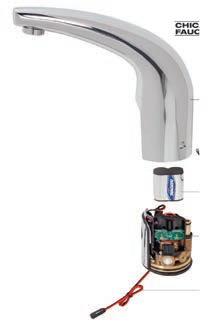
Innovative solutions to save time and money
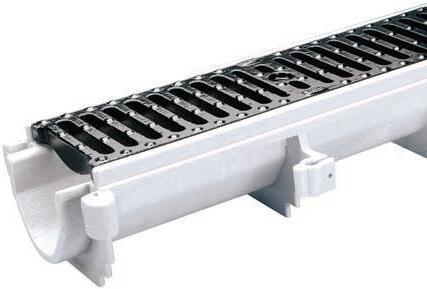
Engineered with the contractor in mind, the Z886 linear trench drain has longer, pre-sloped, light weight channels with easy to join connections for a quick and easy installation. Class A through Class F grating is available with optional debris cover for channel protection. Contact the experts at Zurn for customized, readily available linear drainage solutions with the lowest total installed cost.
6" [152 mm] wide pre-sloped trench drainage system
Z886 PERMA-TRENCH® LINEAR TRENCH DRAIN SYSTEM
WE’VE GOT EXPERIENCE
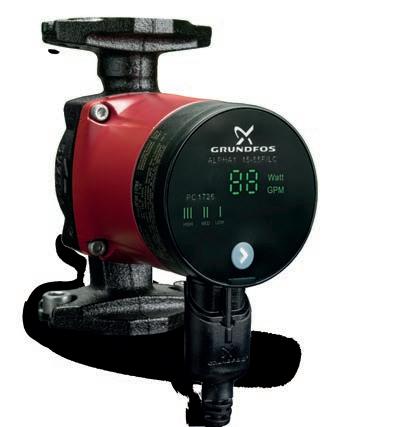
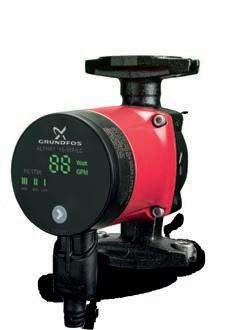
MECHANICAL SUPPLY NEWS
MANUFACTURERS • DISTRIBUTORS • WHOLESALERS
RHEEM AND QBD COOLING SYSTEMS WIN ENERGY STAR AWARDS

Rheem and QBD Cooling Systems Inc. have both won awards from ENERGY STAR Canada.
ENERGY STAR awarded Rheem the 2017 HVAC Manufacturer of the Year award. Rheem has supported the ENERGY STAR program since 1996 with ENERGY STAR-certified heating, cooling and water heating products that meet or exceed the ENERGY STAR requirements. In 2016, the company introduced the Rheem Prestige Series R97V modulating gas furnaces. The ENERGY STAR-
NOBLE FULLY LOADED SHOW DELIVERS WITH FULL HOUSE, PACKED AGENDA
Noble’s 2017 “Fully Loaded” show on September 28, featured plumbing, HVAC, hydronics, industrial and fire protection products from more than 80 industry leading exhibitors, as well as five complimentary seminars. There was no shortage of great food and prizes, including eight furnace package giveaways and eight American Standard powder room package giveaways. www.noble.ca
certified units, with 97-percent AFUE, are on the ENERGY STAR Most Efficient list for 2016. The company also introduced the Prestige Series variable speed air conditioners and heat pumps, which are ENERGY STAR-certified and rated up to 20-SEER and 11 HSPF for heat pumps. The company has partnered with NRCan, NetZero Project, the Province of BC, FortisBC and BC Hydro to test and validate the 3.50 EF efficiency of a hybrid electric water heater.
QBD was named the 2017 ENERGY STAR Manufacturer of the Year for Commercial Products. The company’s noteworthy 2016 accomplishments include developing a line of coolers based on hydrocarbon (HC) refrigerants that are more energy efficient than traditional coolers. All of its HC products in
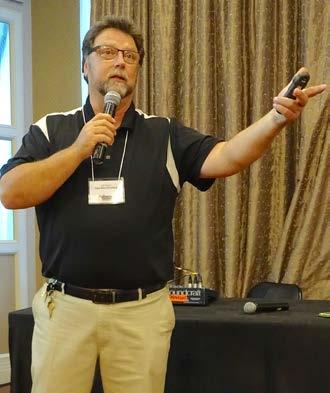
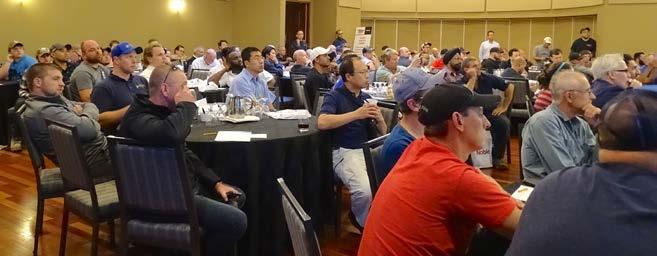
2016 are ENERGY STAR-certified. www.rheem.com www.qbd.com www.energystar.gov
RINNAI TO MANUFACTURE TANKLESS WATER HEATERS IN GEORGIA
Rinnai’s new headquarters’ building exterior will be translucent Kalwall panel technology.
Rinnai Corporation has announced it will be “the first to manufacture tankless gas water heaters in North America.” Rinnai America Corporation, a subsidiary of Rinnai Corporation, plans to build the facility in Griffin, GA.
The company intends to start its manufacturing and assembly operations in an existing factory in Griffin in April 2018 and then move these operations to a new 300,000-square-foot facility that Rinnai will construct. Rinnai will produce both residential and commercial products in Griffin.
“Rinnai America is bullish about building a factory in America and is exceptionally proud to show our industry leadership,” said Frank Windsor, chief operating officer. “Rinnai is dedicated to product and technology innovation that exceeds the expectations of our dealers, installers, customers and consumers.”
“Our investment in our new innovation center and headquarters expansion in Peachtree City and now in manufacturing operations in Griffin further demonstrates our commitment to driving category growth in North America, said Windsor.
Rinnai conducted a thorough search of potential manufacturing sites and had narrowed the list of potential loca -
Continued on p68
It was standing room only for a session on hydronic piping, zoning, controls and snow melt by Jeff House training manager with Jess-Don Dunford and Sean Giberson of Taco.

tions down to sites in Alabama, South Carolina and Georgia, before settling on the Griffin location.
Rinnai’s manufacturing operations will complement its growing presence in the Atlanta area. The Griffin operations are in proximity to Rinnai’s North American headquarters in Peachtree City and to Atlanta Motor Speedway, where Rinnai leverages its branding via its multi-year sponsorship of the NASCAR XFINITY Series Rinnai 250 race, showcases product installations and entertains over 2,000 plumbing and contractor professionals each year.
In addition, in July 2017 Rinnai America announced it will expand its North American headquarters by building a new two-storey headquarters building and by launching a North America Innovation and Training Center. www.rinnai.us
SIDNEY MANNING RECEIVES 2017 JOSEPH K. SEIDNER AWARD
Sidney Manning, chief plumbing and gas administrator, Alberta Municipal Affairs/ Safety Services, received the Joseph K. Seidner Award in August at the annual Canadian Advisory Council on Plumbing meeting in Charlottetown, PE. Manning is the award’s 16th recipient, recognizing his contributions to Canadian plumbing codes and standards.
“This unique award and honour is bestowed to those in our industry who share their knowledge and expertise in developing safer plumbing codes and standards,” said Kevin Ernst, Plumbing & Mechanical Advisory Council (PMAC) chair Kevin Ernst. “Sidney follows Joe’s example and has been a key leader for the regulatory and policy development, codes and standards development; participating on both the plumbing and gas

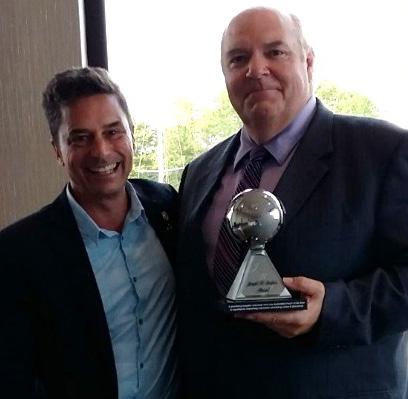
side for the last two decades. Sidney has led CACP with obvious passion and vision.” www.ciph.site-ym.com
WAJAX EXCLUSIVE CANADIAN INDUSTRIAL DISTRIBUTOR OF B’LASTER PRODUCTS
DROP DOWN LADDER RACK
Exclusive twist-to-adjust feature
Easy to operate: Anyone 5’4” or taller can operate
Corrosion resistant design
GRIP LOCK LADDER RACK
Easy reach for anyone 5’7” or taller
Secure clamping mechanism
Corrosion resistant design
Wajax has become the exclusive industrial distributor in Canada of B’laster products. Among the B’laster professional-grade products now available through Wajax are the Original PB B’laster Penetrant, which breaks loose rusted or frozen parts caused by rust and corrosion; B’laster HighPerformance White Lithium Grease, which lubricates by creating a protective barrier against moisture and oxidation; B’laster Industrial Graphite Dry Lubricant which creates a quick-drying film for lubrication. Several other B’laster products also available through Wajax are formulated with Teflon fluropolymer to reduce friction and wear, enhance performance and protect surfaces.
www.wajax.com
AdrianSteel.com
Sidney Manning (r) accepts the Joseph K. Seidner Award from Kevin Ernst, who is the Plumbing & Mechanical Advisory Council (PMAC) chair.
THIRD WOMEN’S NETWORK EVENT FEATURES COVERGALLS FOUNDER
More than 90 attendees gathered to hear entrepreneur and mining executive Alicia Woods speak at the CIPH Women’s Network lunch on September 28 in Mississauga, ON. Woods recounted the development of the Covergalls Workwear, her appearance on CBC’s Dragon’s Den, and the trials of juggling that venture with a challenging career as general manager of Marcotte Mining Machinery Services Inc. “You have a choice, to build someone else’s dream, or to build your own,” said Woods. She encouraged everyone in the audience to push the boundaries in pursuit of their dreams and goals. Women’s Network committee member Sian Smith, noted that the organization now has 221 members just 10 months after it was established. www.ciph.com/page/WomensNetwork
WOLSELEY CANADA AQUIRES TACKABERRY, OPENS CONSOLIDATED HVAC/R BRANCH
Kevin Fullan, general manager–plumbing and HVAC/R (Ontario and Atlantic) has announced Wolseley Canada Inc.’s acquisition of Tackaberry Heating Supplies Limited, an HVAC/R distributor and sheet metal fabricator headquartered in Kingston with additional branches in Belleville, Brockville and Cornwall. Approximately 50 Tackaberry employees join Wolseley. Wolseley Canada has also opened a consolidated plumbing and HVAC/R branch in Oshawa, ON. The branch has been relocated and expanded to include the company’s plumbing offerings so contractors can source products at one location. The new 13,500-sq.-ft. branch is located at 345 Marwood Dr.
“We believe a combined plumbing and HVAC/R branch is beneficial for our customers because, quite simply, it’s more convenient for them to have all of the products in one place,” said Fullan.
The new branch’s manager is Paul Duncan who, for 32 years, has been the only manager of Oshawa’s original HVAC/R branch. Wolseley has recently opened locations in Antigonish, NS, Lachine and Laval, QC, and Concord, ON. www.wolseleyinc.ca


Bosch Thermotechnology has appointed David Lopes and Melvin Harris to sales director for commercial applications and sales director for residential applications, respectively. Lopes is responsible for the sale of heating and air-conditioning applications, focused on the commercial and spec-bid channels. He has been with the Bosch Thermotechnology division for 10 years, working in Portugal, Spain and most recently in Mexico. Harris is responsible for sales in the wholesale and retail channel and developing online sales for the entire product range. He was sales director at Johnson Controls and held roles at Carrier Corporation and LG Electronics.
Ouellet Canada has named Vincent Tremblay sales representative for New Brunswick and Prince Edward Island. Tremblay has extensive knowledge of the construction market. Effective September, the Atlantic territory is covered between William Healey and Tremblay.


ble for increasing Axiom’s market presence through the company’s independent representative network. He has 10 years experience in the hydronics industry and is experienced in providing support and solutions to contractors, wholesalers and engineers in the hydronics marketplace.

Larry Hope has joined Aquatherm North America as an area manager covering Alberta. A part of the plumbing and heating wholesale industry for almost 20 years at the Red Deer branches of Crane Supply and the Westlund division of EMCO Corp., Hope has worked with the Aquatherm product line since 2006.



Weaam Kakush has been appointed technical sales specialist for Canada Controls in Quebec and Eastern Canada. He is responsible for building automation and controls technical sales for the region with support from the Canada Controls technical team. He has been in the controls industry for several years. Kakush has a gas license and is a graduate in HVAC/building automation from La Cite Collegiale in Ottawa.
Rheem has appointed Dave Voltan as Eastern Canadian sales manager–HVAC. Voltan has over 16 years experience in sales including hospitality and social media. He spent eight years as a national and district sales manager in the HVAC industry.

Eric Peterson has joined Viega LLC as product and sales development manager for its flushing systems technology division. Peterson is responsible for developing and launching Viega’s new inwall flushing technology. He has over 30 years of industry experience and previously worked as vice-president of sales at Gerber Plumbing Fixtures, wholesale division sales manager at Price Pfister Inc. and sales manager at Oatey Company.
Knipex Tools has appointed Daryl Warren key accounts sales manager. Warren is responsible for developing and maintaining relationships with key account customers while meeting the company’s sales and financial objectives. He has over 20 years of industry experience. Before joining Knipex, Warren was regional sales manager at General Tools and Instruments.




Brad Cornelissen has been appointed national sales manager at OS&B, a maker of bath wastes, shower drains and lavatory drains. He will be responsible for all OS&B business and agents in Canada, along with some areas of the U.S. Corelissen has been with OS&B since 2006. OS&B has also appointed Craig Smith to Eastern regional manager, effective. Smith will be responsible for all OS&B business agents in Southwest, Northern and Eastern Ontario, as well as Quebec and Atlantic Canada. Smith has been with OS&B since 1990.
Alan Zanidean has joined Axiom Industries Ltd. as national sales manager for North America. Zanidean will be responsi -
Claude DesRosiers has retired as vice president and general manager at Boone Plumbing and Heating Supply. DesRosiers, who joined Boone in 1982, plans to spend more time with his family, travel and continue volunteering on The Ottawa Hospital’s board of governors. He will also work with Water Aid Canada and lead the DesRosiers Foundation’s efforts in education & health. Joe Desjardins became vice president and general manager, effective July 3, 2017.


David Mason has joined The Morgan Group as technical sales manager where he will be primarily working with commercial hydronic customers. On the commercial heating and plumbing side, Brian Shaw has joined the company in the position of sales representative.
Harris
Desjardins
Shaw
Tremblay
Kakush
Voltan
Cornelissen
Zanidean
Hope
Peterson
Warren
Lopes
DesRosiers
Mason


< PLUMBING
attempts to bring the outdoors indoors through plants, flowers and even grass. As for materials, brick, wood and natural stone will find more uses in the bathroom.
7. DARKER TONES WILL PICK UP…THOUGH IT IS NOT THEIR TIME YET
There is currently a surprising parallel in kitchen and bathroom design trends. In the kitchen, darker shades are starting to pick up especially on appliances, countertops and cabinetry. In the bathroom, the same thing is happening.
In a space known so long for its neutral whites and creams, it is a bit surprising to see dark shades starting to pick up pace. This includes dark tile flooring, grey elegant cabinets, jet black fixtures and even black accent walls.
Many homeowners are hesitant to introduce black in their personal spas and it is understandable. It is a colour that can prove tricky to use and match. If used wrongly, it can create a feeling of gloom or result in a painfully awkward mix and match. Though the trend is slow, darker tones will continue to get popular as homeowners get more comfortable with it.
8. UNIQUE TILE SHAPES
Tiles are getting interesting. We have already seen how technology is allowing manufacturers to create all sorts of faux looks and styles using same old tile. But now they are going beyond the colours and graphics to change the traditional tile shape into something more interesting.
In 2017, we are going to see bathrooms make use of geometric tiles with a variety of unique and interesting tile patterns. These eye-catching patterns will not just grace the floor; they will also be used as bathroom backsplashes, as ceiling accents and to create bold wall backgrounds.
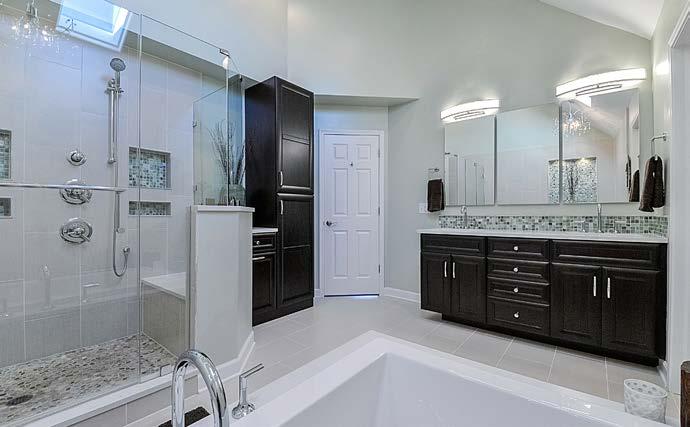
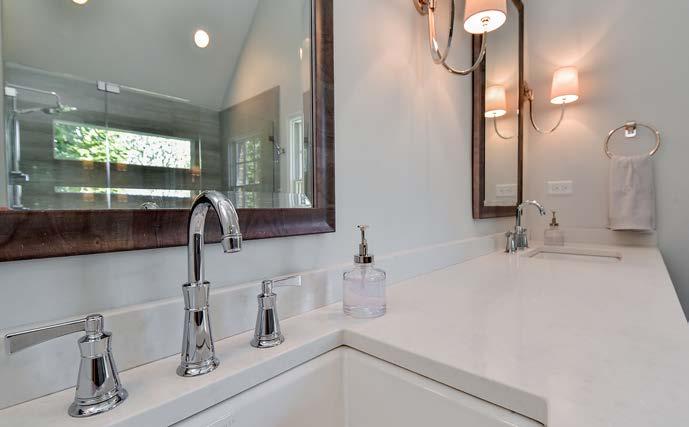
9. BOLD ACCENT WALLS
In the modern neutral bathroom, an accent wall is the sparkle that sets the space on fire. It is the defining statement on personal style and character. It is the focal point that greatly determines the mood and look of the bathroom.
The venerable accent wall will get even bigger in 2017 as homeowners look for inexpensive bathroom remodel designs. In the previous point, we have seen how geometric tiles can make for a simple yet bold accent wall. Something as simple as a bright coat of paint can have the same effect. If you are feeling a bit creative, you can have a graphic
drawn on the full wall or hang a large painting that covers the entire wall.
A COMMON THREAD
One common thread has been evident in all home design trends is that homeowners are looking for ways to break from the mould and be different. In the bathroom, they are relying on technology, tiles and bold accents to make their shower time more interesting.
This material is provided by Sebring Services, an award winning design/ build company. Its founder, Bryan Sebring has been featured on hgtv. com. www.sebringservices.com
Lighting, tile selection and paint colour all compliment choices in fixtures and faucets.
In a smaller space a shower seat will sometimes remove the bathtub from the equation.


March 21 - 23, 2018
A COMPREHENSIVE APPROACH
A great preventive maintenance program will partner with end users over the entire life of a unit.
BY JONATHAN MOSTERD
Building automation and advancements in efficiency have exponentially increased over the last few decades, bringing about a new era in industry. With this, a whole new series of electronic devices have been integrated in large commercial buildings and in industrial and residential environments. These devices help automate and improve system performance, all while reducing energy and improving user experiences. This new equipment calls for a change in mindset toward maintenance. Maintenance is no longer about just checking belts, greasing bearings and cleaning filters; rather, it must also reflect taking care of electrical equipment as well. When looking more specifically at the maintenance of electrical motors, a more comprehensive view is required. This is because many pump and fan motors are now using variable frequency drives. They too have recommended maintenance guidelines that include regular inspections, replacement parts and predictive monitoring. It is important to not only install and start up these units correctly, but also to perform regular maintenance on them to protect your investment. Information regarding maintenance work can be found in multiple places and as such the best thing to often do is seek out assistance. Almost all AC drive manufacturers have published guidelines and a recommended scope of work, which are typically found in user or installation manuals. Also,

many manufacturers are training and developing factory-authorized service partners that can be hired to inspect equipment, or they offer training for end users. Knowing which option to select is best answered by knowing what work needs to be completed, which areas should be checked, and what items should be replaced at specific intervals in a typical VFD maintenance program.
HOLISTIC APPROACH
A good preventive and predictive maintenance program will take a holistic approach to the VFD. It should begin with an assessment that catalogues things such as the environment, quantity of
units and average operational time. From there, it will produce a plan of maintenance that will be unique to each item’s requirements. Drives in harsher environments will require work and parts regularly, while those that are more protected will not need as much. The assessment should also produce a plan that will consider things such as spare parts availability produce digitally backed up parameters and provide different levels of service options for customers to choose from. It should also address worst case scenarios, such as what happens if a VFD fails due to an unexpected event and how long could the process continue without it.
Manufacturers are able to provide end users with many of the best practices and tools used in the industry.
Whatever the interval of service, the main focus of any maintenance program is to remove dirt and debris. This is especially important for the main heatsink. It helps pull heat from the main power components in a VFD: the rectifiers, capacitors and IGBTs. These components are primarily rated on their ability to handle the heat generated by current flowing through them. If the heatsink becomes blocked or layered with oil, dust or other foreign objects, it will decrease its ability to dissipate heat and reduce the life expectancy. Yet, dirt and debris are not just limited to the external parts of the unit. In many drives, this contamination can also get inside and cause problems with circuit boards. It is important to remove debris from these as well, as the reduced ability to cool components inside the drive will cause premature failures. Further, if there is any chance conductive material is entering the VFD, there is a high probability that it will create short circuits that generate non-repairable damage.
Working with your manufacturer is key. They can communicate many of the best practices and tools used in the industry. For instance, when removing debris from inside the drive unit, anti-static and oil free tools are important. Using and antistatic vacuum will prevent someone from inducing a charge into a component that will cause it to fail, or create long-term damage. Further, pressurized air needs to be both oil and water free. This will help to prevent more problems from arising. It is important to be trained and to get the tools that are recommended. Depending on your circumstances and access to competent service people, the other option may be to seek out professionals who already have the maintenance tools and are doing the work on a regular basis.
When considering factory-trained professionals, there are
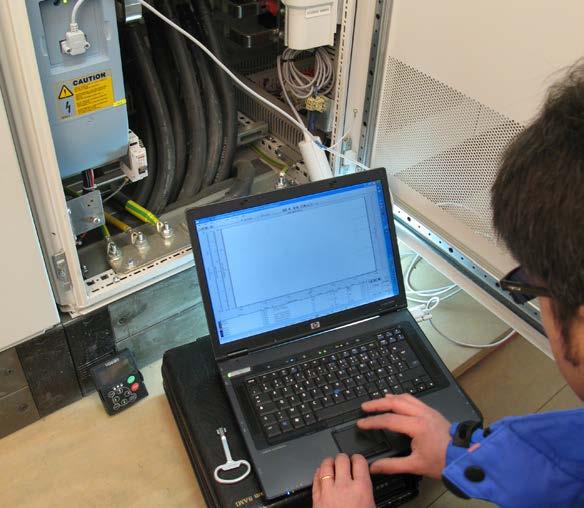
other benefits to consider. First and foremost is that they get to know your equipment. In the event that there is a failure outside your control, you will already have contacts who can provide support. Many of these service groups have 24/7 technicians available as well as inventory. Further, a good preventive and predictive maintenance program will also provide you with a list of critical spares in the event the unexpected happens. They can assist in recommending spare parts to keep on hand based on their experiences with the product. In the event a component fails at an inconvenient time, everyone will know what is on the shelf, which ultimately improves the response time.
Trained professionals will also have access to new products and upgrades. They will be able to advise if there are new options available to meet your needs, or possibly new software that will improve efficiency. While doing the PM they may be able to utilize their experiences and industry knowledge to help reduce costs and increase performance, all while keeping your equipment running.
LIFECYCLE PREDICTION
The last part of a good preventive maintenance program is lifecycle prediction. The end of life for equipment may be due to reliability concerns, or it may be the result of a lack of available parts. Finding the right economic balance between maintenance parts and a new unit may determine when it is time to upgrade. On the other hand, there is also a time when many of the components within a unit need to be replaced for reliability concerns. The labour to perform the work, coupled with the parts, may dictate that it is more economical to purchase a whole new unit.
As the industry continues to grow, many manufacturers have recognized this need and are starting to partner with end users to assist with these upgrades. Whether maintenance is performed locally or outsourced, there are a number of retrofit, or smart step, programs available to assist you. These help to plan upgrades over a long period of time, all while spreading costs over a number of years and budgets.
In the end, not every drive or electronic failure can be prevented. Items such as lightning, power imbalances and spikes, or even a misplaced forklift can cause the unexpected to occur. Partnering with the right people and investing in the right inventory and tools can help to reduce downtime and minimize breakdown costs. A great preventive maintenance program will partner with end users over the entire life of a unit. It will begin with the initial assessments and continue all the way to planning a retrofit or upgrade. Selecting the right drive manufacturer, or factory authorized service group, is key to keeping an efficient and reliable process going.
Jonathan Mosterd is Canadian service manager with Danfoss.
TRAINING
EDUCATIONAL OPPORTUNITIES ACROSS CANADA
Hydraulic Institute
CIET has entered into a partnership with the Hydraulic Institute for the delivery of the Pump Systems Optimisation one-day course across Canada. This course is product-neutral and provides case studies and actual field data to show the energy savings and kilowatt reduction with a more efficient pumping system. It covers all the energy standards used in pump systems assessment. http://cietcanada.com
HRAI Training
The Heating, Refrigeration and Air Conditioning Institute of Canada (HRAI) offers a variety of residential and commercial courses. The Small Commercial Heat Loss & Heat Gain Calculations course is developed for HVAC technicians and designers. This three-day course instructs participants in proper calculation of small commercial heat gains and heat losses, and applies to buildings of up to three storeys and 600 sq. metres per storey. For scheduling opportunities, tel. 800.267.2231 ext. 237, or e-mail amantei@hrai.ca. www.hrai.ca
Construction Education Council
CEC’s National Seminar Program offers over 150 seminars. Areas of interest run from supervisory training, estimation, project management, commissioning, safety, leadership and communication, productivity, business management, and service, to name a few. Where applicable the courses have been Gold Seal Accredited. The majority of listed programs are ½ day to two days in duration. To determine if a seminar has been scheduled in your area, tel. 613.232.5169. www.constructioneducation.ca
Hydronics Training
The Canadian Hydronics Council (CHC) has partnered with NAIT and British Columbia Institute of Technology to provide course blocks toward
< WHAT AM I?
Welcome to the October edition of
CHC certification for hydronic system designers and installers. At NAIT students can register for online or paper-based learning and have nine months to complete each block. www.ciph.com
TECA Quality First Training
TECA’s Quality First training programs are developed by the industry, for the industry, setting minimum standards for the residential and light commercial heating, ventilating and cooling trade in BC. Courses provide contractors with the information they need to install equipment that operates safely and comfortably at rated efficiencies. www.teca.ca
Dollars to $ense Energy Management Workshops
Since 1997, over 30,000 representatives of industrial, commercial and institutional (ICI) organizations have enrolled in the Dollars to $ense energy management workshops. In 2016, the material was completely remodeled and updated; it is now presented in 30 modules, which can easily be used as building blocks for organizations that have limited resources or that wish to focus on specific topics. http://cietcanada.com
GPRO Fundamentals of Building Green
Canada Green Building Council is offering this four-hour course as part of its Green Professional Skills Training (GPRO) program. It teaches the basics of sustainability and provides an overview of the essential strategies and work practices that make buildings more efficient. GPRO covers the “green gap” between standard trade skills and the new awareness required to successfully implement sustainable building practices. It is the prerequisite for all GPRO trade-specific courses. www.cagbc.org
WHAT AM I?
The winner of the What Am I? contest is determined based on the accuracy and detail in the response, with bonus points for entrants who shared and interesting or amusing anecdote about the item. Our congratulations to Barry Crane; a Stanley TLM99 Laser Distance Measurer is on its way to you. This marks the end of the What Am I? contest. Thanks to everyone who entered!
CROSSHEAD THE WINNING ENTRY
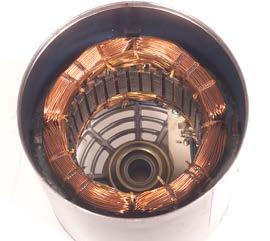
The What am I? featured in the August 2017 edition is an electric motor without the rotor. All I have is my opposite shaft end bell and my stator. I could be a motor from Nidec (Emerson) or Regal (formerly G.E., Fasco, A.O. Smith). I would have been complete if someone would have remembered where they put my shaft. Unfortunately I do not work. There will be no air moving when I am in this condition. I can make a very fine doorstop and then eventually be smuggled to a recycling depot for my copper and aluminum. Barry Crane.

Thanks to the contest participants and Stanley for supporting this contest.
1000 = 75 pounds of air per minute or 4500 pounds (2.05 metric tons) per hour. Suppose a dirty air filter restricts air entering the blower by 50 per cent or 37.5 pounds per hour. A PSC motor simply unloads, current draw decreases. However, a constant volume ECM will ramp up in a futile attempt to maintain programmed airflow. ECM powered fans, starved of air, will simply move whatever they can get at a higher velocity. Motor wattage increases considerably, blowing AHRI rated SEER and HSPF numbers out the window.
ECMs, often promoted as a method of easily overcoming airflow problems, typically operate well beyond rating plate maximum external static pressure in second-rate duct systems. Consistent high static operation of an ECM rated for a total ESP of 0.5” often results in control module failure. My recommendation: do not specify an ECM unless the duct system warrants.
The introduction of ECMs and Inverter Drives created some significant concerns about power quality for electric utilities maintaining the grid. Writing in HRAI’s National Review in 2012, David Terlizzi said, “The need to control the speed of a
THE SOURCE
Adrian Steel AdrianSteel.com
AERCO aerco.com
AHR Expo ahrexpo.com p.35
American Standard americanstandard.ca p.79
Amvic amvicsystem.com p.25
Axiom Industries axiomind.com
Bibby Ste. Croix Bibby-Ste-Croix.com
Brant Radiant Heaters brantradiant.com
Canada Controls canadacontrols.com
CIPH ciph.com/2018gala
motor by manipulating its frequency or voltage has introduced a host of electronic components that introduce waveform distortion (harmonics) into the power distribution systems.”
It will be a long time before expensive ECM12s and Inverter drives begin to surpass the enviable record of low cost, low maintenance and highly reliable PSC motors. Undoubtedly, this technology will prevail and we must become accustomed to it.
I like comedian Dave Barry’s amusing technological insight, “…scientists have developed the laser, an electronic appliance so powerful that it can vaporize a bulldozer 2,000 yards away, yet so precise that doctors can use it to perform delicate operations to the human eyeball, provided they remember to change the power setting from [bulldozer] to [eyeball].”

Ian McTeer is an HVAC consultant with 35 years experience in the industry. He was most recently a field rep for Trane Canada DSO. McTeer is a refrigeration mechanic and Class 1 Gas technician.
CALENDAR
2017 Canadian Conference on Building Science and Technology
November 6-8
CCBST 2017 program content is composed of submitted and peer reviewed building science/building envelope related technical presentations and speakers. It will be held at the Hyatt Regency in Vancouver, BC. www.ccbst2017.ca
Construct Canada
November 29-December 1
An exposition and conference on building design, construction and renovation, Construct Canada will be held at the Metro Toronto Convention Centre, South Building. The event will be co-located with PM Expo, World of Concrete Pavilion and HomeBuilder & Renovator Expo. www.buildingscanada.com
ASHRAE Winter Conference
January 20-24
ASHRAE returns to the Palmer House Hilton in Chicago, IL where the focus will be on resources to design, build, control, commission and operate efficient and resilient facilities and infrastructure. www.ashrae.org/chicago
CMPX
March 21-23
The Canadian Mechanical & Plumbing Expo will be held at the Metro Toronto Convention Centre, north building, in Toronto, ON. It features over 500 exhibitors representing all the products, innovations, applications and information that really define the mechanicals industry today. www.cmpxshow.com
CIPH ABC
June 17-19
The Canadian Institute of Plumbing & Heating will hold its annual business conference in Whistler, BC at the Fairmont Chateau Whistler. www.ciph.com
MCA CANADA 76TH NATIONAL CONFERENCE
November 6-9
The Mechanical Contractors Association of Canada heads to Maui, HI for its 2017 conference. www.mcac.ca
2018
KBIS
January 9-11
KBIS, in conjunction with the National Kitchen and Bath Association (NKBA), showcases the latest industry products, trends and technologies. KBIS will host more than 600 brands, including over 100 new companies, spanning across two halls at the Orange County Convention Center in Orlando, FL. www.kbis.com
AHR Expo
January 22-24
McCormick Place in Chicago, IL will be the venue for North America’s largest HVAC/R marketplace. www.ahrexpo.com
Sixth Biennial EXTS
May 15-16
The American Society of Plumbing Engineers (ASPE), the Alliance for Water Efficiency (AWE), the International Association of Plumbing and Mechanical Officials (IAPMO), and Plumbing Manufacturers International (PMI), in cooperation with the World Plumbing Council (WPC), will convene the Emerging Water Technology Symposium in Ontario, CA. https://aspe.org
MCA CANADA 77TH NATIONAL CONFERENCE
September 19-22
The Mechanical Contractors Association of Canada heads to the Westin Resort & Spa in Whistler, BC for its 2018 conference. www.mcac.ca
BUILDEX Calgary
November 8-November 9
BUILDEX Calgary tradeshow and conference at BMO Centre, Stampede Park, will feature more than 225 exhibits and over 35 educational seminars. www.buildingscanada.com
International Builders’ Show
January 9-11
Featuring the co-location of the NAHB International Builders’ Show and KBIS, Design & Construction Week will bring more than 80,000 building industry professionals from around the globe to Orlando, FL. www.buildersshow.com
CIPH Gala
March 20
Join the industry for a celebration of another successful fundraising campaign by the Canadian Institute of Plumbing & Heating in support of Habitat for Humanity at the Metro Toronto Convention Centre in Toronto, ON. www.ciph.com/page/2018gala
MEET
May 2-3
The Mechanical Electrical Electronic Technology Show will be held at the Moncton Coliseum in Moncton, NB. The show offers 400 booths of plumbing, electrical, automation, lighting, HVAC, and hardware products and services. www.meetshow.ca
ASPE Convention
September 28-October 3
The American Society of Plumbing Engineers will meet in Atlanta, GA. www.aspe.org/futureconferences
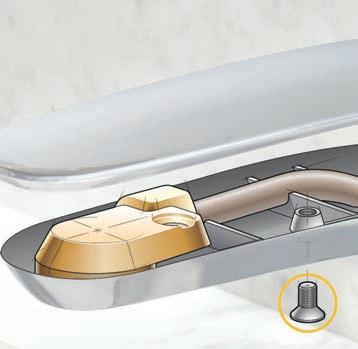
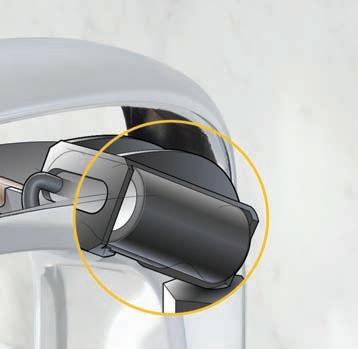
Battery and AC power options
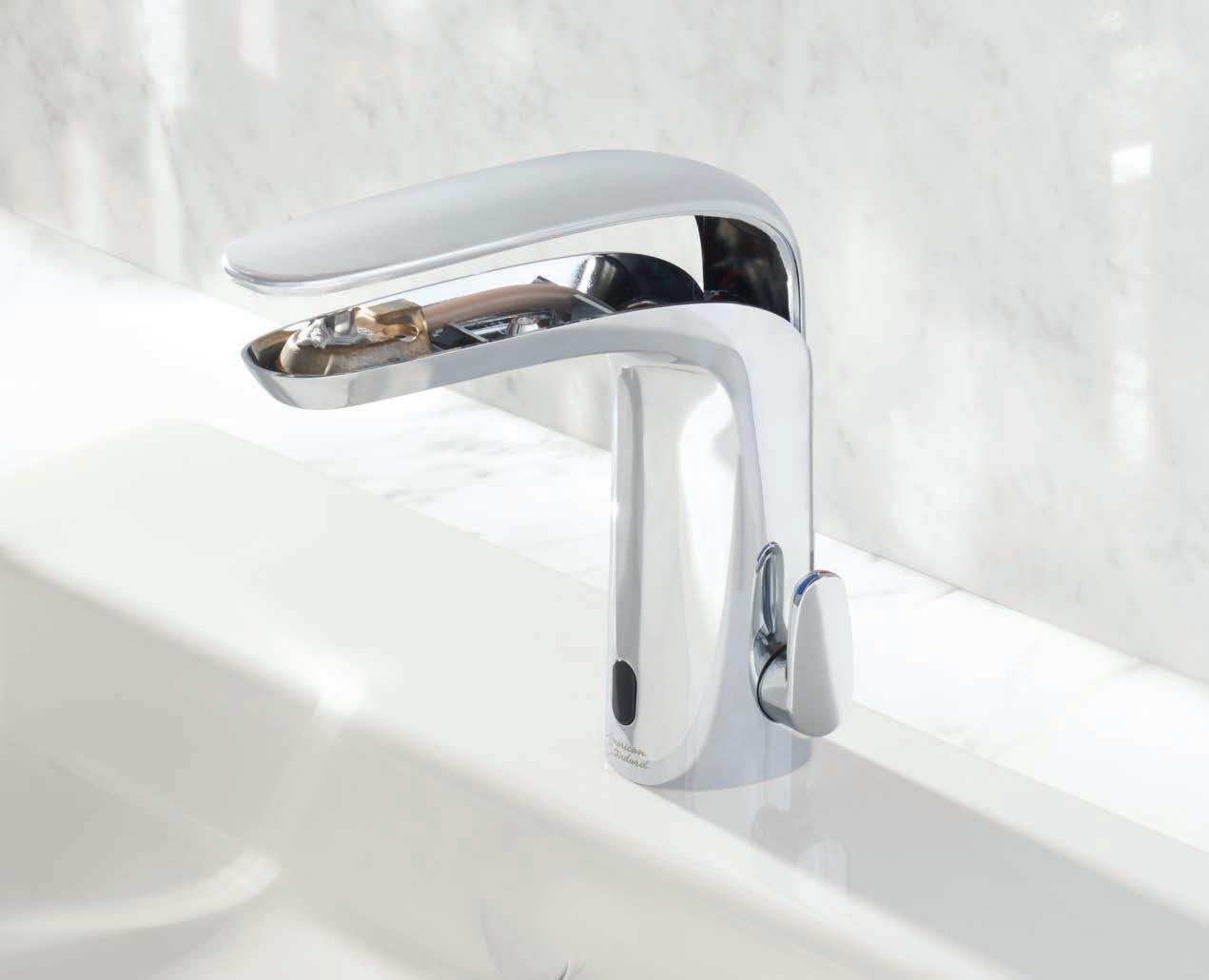
All components easily accessible with just one screw
Innovative SmarTherm™ technology provides automatic scald protection Sensor touch-free operation

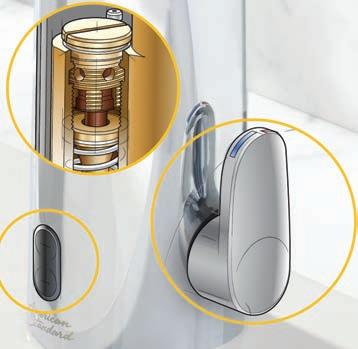
Mixing handle easily controls temperature to desired liking
You
asked for it.
(You literally asked for it.)
Your request. Our innovation. The NextGen Selectronic® Integrated Faucet was inspired by engineers, and is the first ASSE 1070-certified faucet with all components and scald protection housed inside the faucet spout. Learn more at americanstandard.ca
• NEW innovative SmarTherm Safety Shut-O
• ASSE 1070-certified
• No separate thermostatic mixing valve required
• Easy to install and maintain
• Water-e cient options contribute to LEED points