HEATING SYSTEM TUNE UPS:
TAKE THE EXTRA STEPS TO SAFETY, COMFORT & EFFICIENCY GET THE MOST OUT OF HEAT EXCHANGERS

WHATEVER HAPPENED TO SOLAR THERMAL? THE HOWS AND WHYS OF REDUCED WATER CONSUMPTION
HOW TO COUNTER THE EFFECTS OF THERMAL CHANGES

TAKE THE EXTRA STEPS TO SAFETY, COMFORT & EFFICIENCY GET THE MOST OUT OF HEAT EXCHANGERS
WHATEVER HAPPENED TO SOLAR THERMAL? THE HOWS AND WHYS OF REDUCED WATER CONSUMPTION
HOW TO COUNTER THE EFFECTS OF THERMAL CHANGES
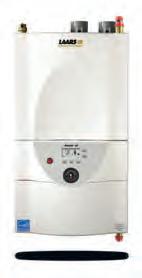
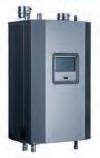
Mascot® LX Combi Boiler
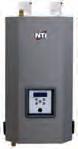
The Mascot LX is an all-in-one, wall-hung, space heating boiler and tankless water heater available in seven sizes to meet the smallest to largest home’s heating needs. It efficiently transfers the most heat possible by using modern controls, a stainless steel heat exchanger and efficient condensing design.
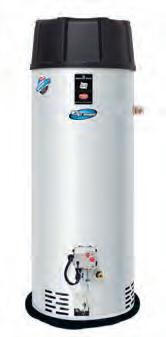
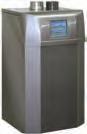
www.laars.com Residential eF Series® Water Heater
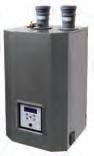
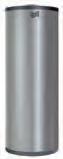
This high efficiency, condensing power-vent water heater features a vertical, dual-pass heat exchanger system. It has a thermal efficiency of over 90% and a high recovery to deliver an impressive amount of usable hot water.

18
BEYOND THE FURNACE TUNE-UP
Pointers to help improve overall comfort and efficiency and customer relations.
By Ian McTeer

22 THERMAL COMFORT
IT’S TIME HVAC SYSTEM DESIGN GREW UP
How to counter the effect aggressive thermal changes have on vulnerable populations. By Robert Bean
28 SALES AND MARKETING THE 4 RS OF SELLING IN A COMPETITIVE MARKET
By Mark Evans

THE HOWS AND WHYS OF
Technology exists to move Canada closer to the European average water usage, the only obstacle is ourselves. By Steve Goldie
Welcome to the launch of HPAC’s What Am I? contest. Identify items, which will be featured in whole or in part and may be from any era, for a chance to win a TLM99s Laser Distance Measurer.
38 HYDRONICS ONE COIL WONDER
Changing flow direction for optimal heat exchanger performance. By John Siegenthaler
42 REFRIGERATION TWO PART GOOD DESIGN ONE PART “GUESSTIMATE”
How to size refrigeration correctly for the box and application. By Dave Demma

HVAC firm beneficiary of media interest in orphaned Sidewalk to Nowhere



CIPHEX WEST 2016 SHOW PREVIEW
SOLAR THERMAL RUNS HOT AND COLD
A look at the state of the solar water heating industry in Canada and internationally. By Robert Waters

94 EVENT
ASSOCIATION EMBRACES CHANGE
Proactive approach to the future sets the tone for HRAI’s 48th annual conference. By Kerry Turner
SAVING BIG WITH LITTLE CHANGES
Make a big impact on water conservation with small parts. By Jon Gustafson


98
CONSTRUCT CANADA 2016
What to expect at the 28th annual Construct Canada show, the country’s largest building, design and construction event. By Doug Picklyk
MIKE MILLER RETURNS NEXT ISSUE
www.hpacmag.com
EDITOR
CONTRIBUTING EDITOR
SALES & MARKETING COORDINATOR ASSOCIATE PUBLISHER ACCOUNT MANAGER ART DIRECTOR
ACCOUNT COORDINATOR
CIRCULATION MANAGER
PUBLISHER
Kerry Turner (416) 510-5218 KTurner@hpacmag.com
Doug Picklyk DPicklyk@annexbizmedia.com
Kim Rossiter (416) 510-6794 KRossiter@hpacmag.com
David Skene (416) 510-6884 DSkene@hpacmag.com
Stephen Kranabetter (416) 510-6791 skranabetter@hpacmag.com
Graham Jeffrey (905) 713-4348 gjeffrey@annexweb.com
Barb Vowles (416) 510-5103 bvowles@annexbizmedia.com
Urszula Grzyb (416) 442-5600 ext. 3537 ugrzyb@annexbizmedia.com
Peter Leonard (416) 510-6847 PLeonard@hpacmag.com
ANNEX PUBLISHING & PRINTING INC.
VICE PRESIDENT Tim Dimopoulos (416) 510-5100 tdimopoulos@annexbizmedia.com
PRESIDENT & CEO Mike Fredericks mfredericks@annexweb.com
PUBLICATIONS MAIL AGREEMENT NO. 40065710, REGISTRATION NO. 10815
Heating Plumbing Air Conditioning (established 1925) is published 7 times per year by Annex Publishing & Printing Inc. HPAC Magazine is the leading Canadian business publication for the owner/manager of mechanical contracting businesses and their supply partners.
ISSN: 0017-9418
Contents Copyright © 2016 by Annex Publishing & Printing Inc. may not be reprinted without permission.
SUBSCRIBER SERVICES: To subscribe, renew your subscription or to change your address or information please visit us at www.hpacmag.com.
Subscription Price per year: $41.95 (plus tax) CDN; Outside Canada per year: $81.95 US; Elsewhere: 1 year $89.95; Single copy Canada: $5.00 CDN. Heating Plumbing Air Conditioning is published 7 times per year except for occasional combined, expanded or premium issues, which count as two subscription issues.
MAIL PREFERENCES: From time to time we make our subscription list available to select companies and organizations whose product or service may interest you. If you do not wish your contact information to be made available, please contact us via one of the following methods: Tel: 800.387.0273, Fax: 416.442.2191; E-mail: vmoore@ annexnewcom.ca; or by mail: Privacy Office, 80 Valleybrook Dr., Toronto, ON M3B 2S9.
HPAC Magazine receives unsolicited materials (including letters to the editor, press releases, promotional items and images) from time to time. HPAC Magazine, its affiliates and assignees may use, reproduce, publish, re-publish, distribute, store and archive such unsolicited submissions in whole or in part in any form or medium whatsoever, without compensation of any sort.
NOTICE: HPAC Magazine, Annex Publishing & Printing Inc., their staff, officers, directors and shareholders (hence known as the “Publisher”) assume no liability, obligations, or responsibility for claims arising from advertised products. The Publisher also reserves the right to limit liability for editorial errors, omissions and oversights to a printed correction in a subsequent issue. HPAC Magazine’s editorial is written for management level mechanical industry personnel who have documented training in the mechanical fields in which they work. Manufacturers’ printed instructions, datasheets and notices always take precedence to published editorial statements.
We acknowledge the financial support of the Government of Canada through the Canada Periodical Fund of the Department of Canadian Heritage.
Proud member of:
AERCO’s AM Rapid Recovery. Any other hot water solution is for the birds. Featuring advanced condensing hydronic technology, AERCO’s AMR is perfect for systems requiring 199 to 1000 MBTU and above. When you need a fast, reliable replacement, the AMR delivers high efficiency in a small space — all while lowering operating costs.
AERCO’s AMR. Performance that flies high above the competition.



It is hard to believe that winter is approaching – as I write this it is 22 degrees celsius, almost 10 degrees warmer than the seasonal average for central Ontario. After a steamy summer the promise of an icy, snowy winter is music to some people’s ears. Certainly for HVAC/R businesses it bodes well. The challenge is to get customers who are not on a service contract to make the call for a tune up before the temperature drops and panic sets in.
To get you geared up for the rush we feature a detailed heating system tune up “how to” article in this issue. Beyond the tweaking, Ian McTeer shares some pointers on improving comfort and efficiency. There are many ways to improve a system’s performance, even if the initial design was not optimum.
As the focus on comfort and efficiency begins to resonate with residential, commercial and institutional customers the HVAC industry must take steps to improve the initial design and as Robert Bean points out in this issue, that requires working with all parties involved in the project.
If you are looking for lighter fare, check out WHAT AM I? on page 101. This new HPAC contest features photos of items in whole or in part, and they may be from any era. To enter, identify the product featured and include other details. There are two chances to win. Prizes are awarded for identifying the item and for submitting photos. Appliances, components, fixtures, tools, pvfs, and so on may be submitted. I look forward to seeing your responses! Editor




• Unrivaled quality control processes yield an exceptionally low (.01%) product failure rate
• Over 40 years of HVAC manufacturing experience means peace of mind for contractors
• Registered systems earn points toward reaching Elite Contractor Status
• Elite Contractors receive consumer leads, loyalty rewards and priority ranking on the online Contractor Locator


The Ministry of the Attorney General released the Construction Lien Act report, titled Striking the Balance: Expert Review of Ontario’s Construction Lien Act, on September 26, 2016. It can be viewed at www.attorneygeneral.jus.gov.on.ca/english/about/pubs/cla_report/.
The report looks at the effectiveness of the Act in achieving its policy objectives within a modern context, and addresses the issue of promptness of payment and the effectiveness of dispute resolution under the Act.
According to the Ministry, the information on the website is intended to set the stage for an understanding by stakeholders of what the various positions and schools of thought are regarding the Act.
Bruce Reynolds and Sharon Vogel of Borden Ladner

The CSA is hosting one-day workshops in Vancouver and Toronto to discuss the Canadian health care facilities building standard CSA Z8000. The interactive workshops, Designing for the Future CSA Z8000, are being led by Gordon Burrill, P.Eng., SASHE, president of Teegor Consulting Inc., a firm specializing in health care engineering and construction. Burrill participated in the development of Z8000 and will share his knowledge and experience. Attendees will learn to navigate the standard, learn practical strategies for risk mitigation and gain insight into the latest developments and requirements in the ever-evolving field of health care facility construction, maintenance and renovation. The workshops are being held in Toronto on November 4 and in Vancouver on November 15. http://shop.csa.ca/en/canada/scat/onlineinstructor
The transition period ends on November 1, 2016 for voluntary application of the National Energy Code for Buildings (NECB) 2011, and Section 9.36. Alberta Building Code (ABC) 2014 for housing and small buildings. For any building permit applications for site-constructed buildings received on or after November 1, the building design must comply with the requirements of the NECB 2011 or Section 9.36. ABC 2014 as appropriate.
Contractors are encouraged to see the April 2016 Interpretation STANDATA – Application of Energy Efficiency
Gervais LLP, were retained by the Ministry of the Attorney General and the Ministry of Economic Development, Employment and Infrastructure to conduct the review in February 2015.
The report makes over 100 recommendations intended to address concerns raised by a variety of industry stakeholders. The recommendations address issues such as: elongated payment cycles causing a wide ripple effect to industry participants; inefficient dispute resolution resulting in a drain on judicial resources and the provincial construction economy; the disruptive nature of federal insolvency legislation on construction projects in the event of contractor insolvency; and a variety of technical issues noted by stakeholders to be frustrating the purpose of the Construction Lien Act. www.constructionlienactreview.com
Requirements and Enforcement Dates for details on the application of the NECB 2011 and Section 9.36 ABC. www.municipalaffairs.alberta.ca

Manitobans have embraced the online underground natural gas and electrical line-locate system recently introduced by Manitoba Hydro. Since April, more than 31,000 line-locate requests have been completed, an increase of 12 per cent compared to last year. Manitoba Hydro joined Click Before You Dig earlier this year. Previously known as Call Before You Dig, the free online system allows homeowners and contractors to know where underground natural gas and electrical lines are located prior to any excavation.
Another notable change is that Manitoba Hydro customers no longer have to be on-site to sign the required line locate clearance form. The new system features a shorter processing time to allow for a quicker start on projects where underground natural gas and electricity lines are present. Once a request is received from the electronic service, it schedules the line locate for the next available opportunity. The customer receives an e-mail by the end of the same day the locate was completed. The e-mail provides the clearance form, an electronic map of the area with the hazards and dig area identified and links to safe excavation practices they need to follow.
In Manitoba, The Gas Pipe Line Act requires all lines to be marked and located prior to excavating beyond 15 cm. in depth. www.clickbeforeyoudigmb.com

BC Safety Authority has announced there will be an upcoming change to the Safety Standards Act that may impact clients that have a tie-in with oil and gas. The amendments, to be announced later this year, were designed to eliminate overlapping jurisdiction between BC Safety Authority (BCSA) and the BC Oil and Gas Commission (OGC).
When a date has been determined for Bill 13 to come into force, BCSA will communicate more information, but there are three significant changes in Bill 13 with respect to the application of the Safety Standards Act in relation to pipelines, and oil and gas facilities. Specifically, the Safety Standards Act and regulations will no longer apply to refrigeration systems used in the processing of oil and gas but will continue to apply to individual pressure vessels and the electrical wiring used in those refrigeration systems.
The Safety Standards Act and regulations will no longer apply to pressure piping that is used in oil and gas processing but will continue to apply to pressure piping that forms part of any power plant located at an oil and gas facility; and the Safety Standards Act will now apply to any elevating devices or passenger ropeways that may be present at oil and gas facilities. www.safetyauthority.ca
Mandalay Bay Resort. The prize also includes one group dinner and a complimentary pass to the AHR trade show for the winner and a guest.
www.weil-mclain.ca/promotions
This past summer 16 Edmonton, AB-area high school students took part in the Christian Labour Association of Canada’s (CLAC) first summer construction boot camp. CLAC is the labour partner of the Progressive Contractors Association of Canada (PCA).

“The boot camp was a great way to introduce young people to the trades,” said Brad Bent, CLAC’s director of training–Alberta, in a media release. “We wanted them to see that the trades open up all kinds of career possibilities.”
The two-week summer boot camp, in
conjunction with the Edmonton Public School Board and Merit Canada is an extension of union’s High School 2 Hard Hats program that began in 2011. CLAC’s goal is to expand its program through partnerships in each province to expose as many students as possible to the skilled trades.
www.clac.ca

Belimo Americas’ Innovation Contest aims to find a simple method for detecting and measuring internal leakage in zone valves such as short-stroke or paddle valves. The solution should be userfriendly, non-invasive, portable and applicable to operating heating or cooling systems in a building.
The winning entry will be awarded prize money of CHF 10’000 (approximately $13,316 Cdn.). Entries in second and third place will be awarded prize money of CHF 2’500 (approximately $3,400 Cdn.) each. The application deadline is November 30, 2016.
www.belimo.us/americas

Marc-André Lesmerises, is president and owner of Carnot Réfrigération in Trois-Rivieres, QC. continued on p12

Twenty lucky contractors will be joining Weil-McLain Canada at the 2017 AHR Expo trade show in Las Vegas. Entries into the draw are earned by purchasing select Weil-McLain products between September 1 and December 1, 2016. Winners will depart on January 28, returning January 31, and will receive round-trip airfare, all transfers and accommodation for three nights at
Marc-André Lesmerises, president and owner of Carnot Réfrigération, has received the 2016 Accelerate America Personof-the-Year Award, presented by Accelerate America, the online magazine produced by shecco, promoter of natural refrigerant-based solutions.
A profile of Lesmerises in the online
magazine’s July-August issue explains why he cofounded Carnot Réfrigération in 2008, at the age of 31. Carnot became one of the first manufacturers of all-natural CO2 transcritical refrigeration systems in North America, providing CO2 systems to Sobeys and other supermarket customers as well as warehouses, wineries, ice rinks and data centres.
www.carnotrefrigeration.com/en/










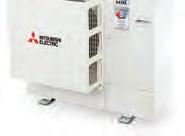




Protecting important data depends on maintaining a controlled environment. That’s why it is essential to install a commercial-grade server room cooling system that is consistent, efficient and reliable, 24 hours a day, 7 days a week.


With so much on the line, it’s surprising that there are modified residential units claiming to be sufficient for server room applications. Little wonder that these units can’t take the strain placed on them by modern server rooms.
Mitsubishi Electric’s P-Series precision cooling system is different. It’s a commercial grade ductless unit that is designed for commercial applications and is tooled specifically for durability and to maintain consistent, reliable server room temperature.

So whether you’re expanding your server room or designing a new one from the ground up, Mitsubishi Electric P-Series can help keep your critical systems up and running 24/7. Now that’s a cool idea!






As part of our commitment to the Canadian market, Mitsubishi Electric’s Ultra Low Ambient System is designed to withstand extreme weather conditions, whether the outdoor temperature is +46°C or -40°C.





Health Canada and the U.S. Consumer Product Safety Commission have issued a joint recall of certain Kohler portable generators because of a wiring error that could result in a shock risk if an electrical device is plugged into the generator. Approximately 230 units of the recalled products were sold across Canada and approximately 5,200 units in the U.S.
The recalled models include: PRO3.7, PRO3.7E, PRO5.2, PRO5.2E, and GEN5.0 with Spec Number PA-GEN50-3003. Only generators with serial number 4528733735 or lower, and a manufacture date prior to 06/2016, are included in the recall. The affected products are CSA certified with CSA certification file number 261378. The units were made in China and sold through authorized Kohler distributors and dealers from June 2014 through May 2016.
Users are instructed to stop using the
recalled generators and contact Kohler to schedule a free repair by the closest authorized dealer.
www.healthycanadians.gc.ca/recallalert-rappel-avis/hc-sc/2016/59734reng.php
Awesome Neil Pasricha, and security expert Chris Mathers. Other educational talks will include a future forecast, a talk on tender law and a review of ongoing changes in the construction industry. www.mcac.ca


The Mechanical Contractors Association of Canada (MCAC) is inviting members to Celebrate the Magic at the association’s 75th Annual National Conference. It is being held November 14-17 on the grounds of Disney World at the Disney Yacht and Beach Club in Lake Buena Vista, FL. Along with a golf day, social programs and networking opportunities, highlights will include keynotes by former NHL allstar Theo Fleury, happiness expert and author of the best-selling The Book of

The new Thermostat Recovery Program Website (TRP) website has been launched and is linked in as part of the revamped Heating, Refrigeration and Air Conditioning Institute of Canada (HRAI) website. TRP was previously known as Switch the Stat. www.hrai.ca/trp

Eden Energy Equipment hosted Contemporary Approaches to Hydronic Heating and Cooling in Guelph, ON on September 13 and 14. Presented by John Siegenthaler, topics in the session, which repeated on the second day, included hydraulic separation; distribution efficiency and low power pumping; combining hydronics and geothermal heat pumps; thermal storage; low temperature heat emitter applications; and small scale chilled-water cooling applications.
Originally scheduled as a one-day event, organizers quickly added the second day when registration surpassed 150.
Siegenthaler, who is an HPAC columnist and founder of Appropriate Designs, spoke at length about distribution efficiency. “We’ve done a lot of work on the equipment–we have largely ignored the distribution system,” said Siegenthaler. “For decades our industry has focused on incremental improvements in the thermal efficiency of systems.”
Using system examples, he demonstrated the efficiencies and savings that could be achieved with smarter design strategies. “Distribution efficiency is the untold story,” said Siegenthaler. “With good design it is possible to achieve significant distribution efficiencies.
“This will become increasingly important in low energy and
Completed four months ahead of schedule, the 18-storey Brock Commons student residence at the University of British Columbia in Vancouver is now the world’s tallest wood building.

It is the first mass wood, steel and concrete hybrid project taller than 14 storeys in the world. The building has a concrete podium and two concrete cores, with 17 storeys of cross-laminated-timber floors supported on gluelaminated wood columns. The cladding for the facade is made with 70 per cent wood fibre.
With the structure and cladding finished, the focus is now on interior elements, with completion expected in early May 2017. According to the release, the residence, which will welcome more than 400 students in September 2017, is expected to cost approximately $51.5 million. The building is targeting LEED Gold certification. www.ubc.ca
A Canada Green Building Council (CaGBC) and Dodge Data & Analytics report released recently titled Healthier Buildings in Canada 2016: Transforming Building Design and Construction revealed new information about the factors influencing

Net Zero. Right now the mini split heat pump is capturing that market. They are not looking at comfort, it is about energy use,” added Siegenthaler.
He suggested that contractors look at pairing geothermal with hydronics, particularly since “geothermal is the darling of the HVAC industry. Let’s marry that up with the hydronic distribution system.”
The consistent theme was to simplify systems and install the most efficient equipment. Siegenthaler had several slides of excessive, over pumped and over zoned systems. “It is the wrong concept, it is the wrong message about hydronics. We are shooting ourselves in the foot,” said Siegenthaler.
“Consumers [look at that and] see expense, complexity, and wonder who is going to fix it.”
Eden Energy plans to host another educational day with Robert Bean this coming winter. www.edenenergy.com
Canada’s building owners, architects, designers, contractors and public health professionals in their decisions for adopting healthier building practices and features.
Among its key findings, the report shows that business benefits are driving investments in healthier buildings. Nearly half of the Canadian commercial building owners surveyed say they are able to lease space more quickly in buildings with healthy features, and of the owners that report they see a positive impact on the value of their buildings with healthier practices, over one third see an increase of seven per cent or more.

When asked to rank the top goals for having healthier buildings, owners surveyed ranked improved tenant/employee satisfaction with the building and happier and healthier building occupants as their top two choices.
The top healthy building feature was improved indoor lighting conditions and daylighting, with 80 per cent of all respondents incorporating this feature. Rounding out the top three most popular features included, are products that enhance thermal comfort with 77 per cent, and enhanced indoor air quality with 75 per cent.
The report Introduction and Executive Summary are available publically at www.cagbc.org/cagbcdocs/Smart_Market_ Report_Final_Web_PUBLIC.pdf. www.cagbc.org

BY DOUG PICKLYK
Alonely stretch of sidewalk located across the road from North Central Plumbing and Heating in Smithers, B.C. made national headlines in late August, drawing attention to the company and scrutiny to a local bylaw.
North Central, which is celebrating its 50th anniversary this year, moved from its original 6,500 sq. ft. location in the town centre to a new 10,000 sq. ft. space in a light industrial area along the highway.
“In Smithers, when you do a construction project of over $75,000, not only do you have to take out a building permit, you have to take out a development permit for your location,” explains Trevor Bruintjes, general manager of North Central.
As part of an infrastructure bylaw, the company was required to build a $10,000 sidewalk that is 100 feet long. However, there is no sidewalk anywhere to the south of their location, and the next sidewalk north is half a kilometer away.
“The funny thing is, even that sidewalk is not complete,” notes Bruintjes. A vast 500-metre expanse leads to North Central’s 100-foot section, affectionately referred to as the ‘sidewalk to nowhere.’
When North Central held its 50th anniversary celebration and grand opening on August 27th, the company had fun on its paved straightaway.
“The local radio station that was on location during the grand opening had some tickets to give away, so we thought that the first few people who showed up and wanted the tickets

could have a [foot]race on our sidewalk,” says Bruintjes. “I couldn’t ask for better exposure for our new location than a weird little sidewalk to point the way. Pretty much everybody in British Columbia knows where my sidewalk to nowhere is,” adds Bruintjes.
North Central is a 27-employee outfit offering a mix of HVAC, plumbing, gas fitting, sheet metal and instrumentation, servicing an area extending four hours in every direction.
The company’s sidewalk issue became a topic of discussion at a town hall meeting following their event. According to Bruintjes, a number of local developers and contractors attended the meeting, and business owners in attendance stated they had not built in Smithers because the development costs were so prohibitive.
“There was talk that the town may connect my sidewalk, or find dollars to make my sidewalk less ridiculous by adding sidewalk to it next year. But of course they’re going to have to go to some sort of a vote to get that done,” laughs Bruintjes.
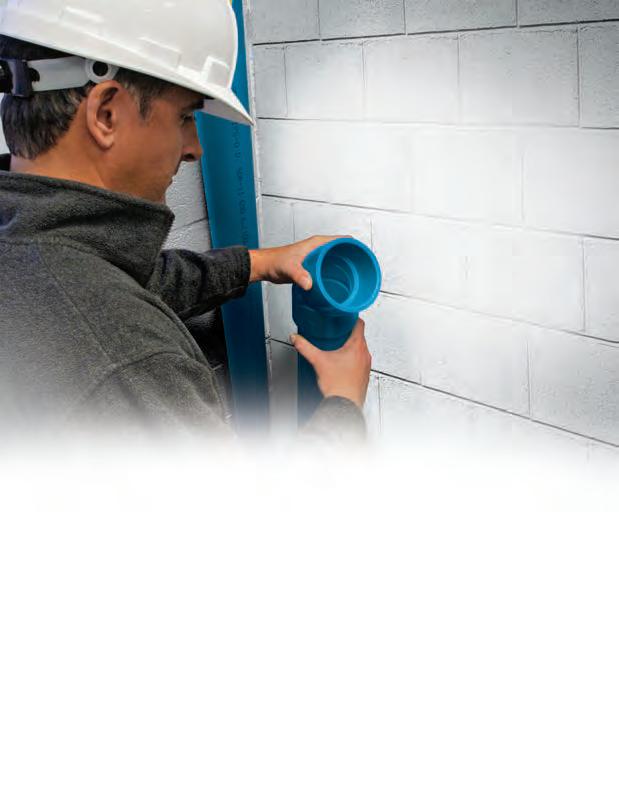
AquaRise®, a nonmetallic potable water distribution system for commercial and high building construction. Based on over 15 years’ experience designing and manufacturing industry-leading CPVC systems, AquaRise offers numerous benefits over metal with a system that’s fully-approved for noncombustible applications.

ALTERNATIVE TO
LONG-TERM PERFORMANCE FULLY-CERTIFIED COMPLIANCE FULL FLAME & SMOKE LISTINGS PERMANENT JOINING SYSTEM PROJECT SAVINGS
Pointers to help improve overall comfort and efficiency, and customer relations. BY
IAN MCTEER
Afurnace tune-up is really a comprehensive maintenance job.
Contractors know that it is essential to maintain a long-term relationship with every customer by providing timely preventive maintenance (PM) at least once per year. It is better to work with a preferred brand: parts availability, warranty claims and technician training are known quantities allowing the contractor to offer better service.
Maintenance becomes problematic when end-users do not subscribe to a PM program.
When it comes to safety, every properly trained technician knows to inspect important things like chimneys, vents, flue dampers, gas piping, limit controls and other devices that the manufacturer deems necessary. It is the stuff one never expects that can lead to very uncomfortable situations with the customer. “Le client n’a jamais tort” (the customer is never wrong) proclaimed César Ritz, a famous hotelier. Sales people seem to warmly embrace such ideas,
however, technicians know that some customers have unrealistic expectations and will otherwise abuse or neglect a furnace so that a warranty or extended warranty might become void.
Sometimes it is a safety issue related to a homeowner’s DIYing. Once on a no heat call, I noticed the mid-efficient furnace was vented with the long-since banned HTTP plastic venting material. The customer had completely finished his basement having moved the furnace about 10 feet away from the outside wall. Since he could not buy more HTTP piping material, he had Macgyvered a coupling to an additional length of threeinch stainless steel pipe that continued the vent to a termination point outside.
The HTTP was in contact with wooden joists and studs; the original specification required nine inches of clearance to combustible material. I turned him off and it was only after I asked him to consider the safety of his family that he calmed down and pulled out some electric space heaters.
A word of advice to technicians – do not end up owning someone’s dangerous incompetence. Keep a supply of red tags handy and be sure to carefully explain your intent to tag an appliance citing violations of gas code or manufacturer’s installation instructions.
From a mechanical perspective, a PM visit to a modern high efficiency gas furnace is considerably more complex than the standing pilot models of yesterday. I would argue that draft induced furnaces are safer than their draft hood equipped brethren simply because a cracked heat exchanger is, realistically, no longer a potential killer. Since a draft induced heat exchanger operates under a negative pressure, there is no risk of flue products leaking into the airstream during operation. Indeed, a draft induced furnace could operate for an entire heating season before a heat exchanger crack prevents the pressure switch contacts from closing at the start of the cycle or opening during the cycle.
It is the small things that must be
“Fall weather is coming. Check your furnaces.” So said one of my HVAC colleagues on LinkedIn back in late August. This coming winter, according to the Old Farmer’s Almanac, will be long and cold thanks partly to an expiring El Nino effect in the Pacific Ocean. Homeowners will still benefit from lower cost fossil fuels, but other costs such as new carbon taxes and outrageous electric utility rate
increases will drive a wedge between putting dinner on the table and seemingly more obscure things like routine furnace maintenance for many people. According to Statistics Canada, 76 per cent of homes in Ontario used natural gas for heating in 2011; 14 per cent on electricity; five per cent on fuel oil; five per cent on all others, including propane, wood and wood pellets.
Canada may also sign-on to the Paris Climate Change Accord assuming Prime Minister Trudeau can convince all the provinces to table aggressive climate change plans in the very near future. In a document leaked to the public last May, Ontario’s government announced a Climate Change Plan calling for the phase out of natural gas as a heating fuel for new homes by 2030, however,
checked on a PM, such as the flame rod, condensate system, electrical connections, gas pressure, total amps, air filter, cleanliness of major components and vent termination. Some technicians simply replace the flame rod every year, but this act does not guarantee a trouble free heating season without testing the flame signal too. For example, a WhiteRodgers ignition system will lock out the combustion process if the flame signal drops below one DC microamp. Even
Premiere Wynne recently backed away from that idea. Apparently, electricity generated somehow or other will do all the heating heavy lifting into the future. In the meantime, Canadians need to keep homes and businesses reliably and affordably heated without the fanfare created by political interference.
Many homeowners are very concerned about energy costs and are willing to entertain a cornucopia of disparate energy efficiency schemes. Some HVAC contractors advertise a
though the flame rod was replaced, how would a technician know if there were other problems in the flame detection system. These might include a control board problem, grounding issue or perhaps the burner crosslighter is partially blocked so that the flame rod is not always completely enveloped by the flame.
Modern heat exchangers are paper thin compared to yesterday’s “boiler plate”
low-ball furnace tune-up price or water heater inspection as a way to leverage the sale or lease of a new system. I am not against this practice as long as there is a legitimate need to replace inefficient old appliances. Assuming the equipment is still serviceable, a proper inspection must be completed.
Recently, on the evening TV news, there was a story about a number of Toronto homeowners induced into leasing new HVAC equipment. The story was about questionable financing tactics,
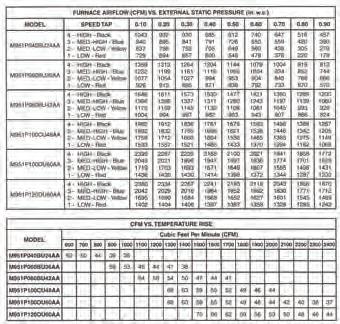
This manufacturer’s blower performance chart shows airflow and temperature rise for several different models. The unit outlined in red has four potential blower speeds and shows the maximum airflow against the rating plate external static pressure of 0.5inch w.c. The medium low speed delivers 953 cfm, which is the lowest speed this model could ever use for heating. Notice the temperature rise chart shows the measured temperature rise should be 59F at 900 cfm. The maximum temperature rise for this particular model is 60F. There is no temperature rise number for this model associated with an airflow of 800 cfm – it means an air volume less than 900 cfm will eventually damage the heat exchanger. Technicians should be familiar with temperate rise and blower performance charts to ensure proper air volumes will result in heat exchangers standing up to the test of time.
assemblies. Aluminized steel of 18 to 20 gauge thickness is used by many manufacturers because heat is transferred to the airstream rapidly and efficiently, less fuel is consumed in the act of warming up the heat exchanger itself. Clam shell, tubular aluminized and tubular stainless steel designs are commonly used today, but there is one
continued on p20 see HVAC tune up: What to watch for on p18
but when the camera scanned past one of the furnace installations, I was appalled by the slap-dash installation of a thoroughbred product. It is not about replacing boxes for the lowest price, it is about providing comfort and efficiency. It really is a shame that some contractors have never been exposed to the moral capitalist credo of trading value for value: a contractor trades his or her knowledge, skill and workmanship for the customer’s hard-earned dollars.

Condensate management: acidic condensate leaks cause property damage. Manufacturers typically want ½-inch PVC (minimum) used as drain piping material as it prevents kinks, is leak resistant and cannot be easily crushed.

Burners must be clean. A tiny amount of lint in the cross lighter can cause delayed ignition and/or inadequate flame signal.
Rust on top of the burner caused by flue gas recirculation into the combustion chamber. Incorrect vent termination: tee-wye not allowed, must be straight tee. In this case, a tee is not even necessary.
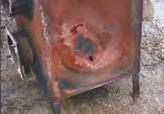
This 1956 vintage heat exchanger has a large hole that was probably caused by years of flame impingement. This is a serious safety issue.

Aluminized steel heat exchanger with several hairline cracks. Cracks caused by inadequate air flow through an undersized evaporator coil.

Cased evaporator coils can sometimes be used as an inspection portal to observe coil cleanliness and heat exchanger condition. Removal of inner panel allows adequate access to important components.
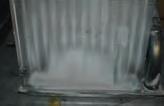
Secondary heat exchangers must be clean to guarantee efficient heat transfer.

Blower wheels get dirty and should be checked every PM. Depending on condi -
tions and the type of air filter used, the wheel may have to be cleaned every other year. After any construction work done in a house while the furnace is running, a thorough cleaning should be done once the construction is finished.

This 80K btuh furnace (using indoor air for combustion) and a 50K water heater were once in a wide-open basement. Subsequent finishing by the homeowner created a room with an air volume of only 2016 cubic feet. Furnace installer’s guide requires outdoor air whenever a confined space has less than 50 cubic feet of volume per 1000 btuh of gas input including that of other gas appliance in the space. A PM or no heat call to this job means the new customer is facing an unexpected expense.

A PM does not include a heating distribution system tune-up. If the customer has specific issues like velocity noise or poor airflow to a particular area, an hour’s worth of investigation could help a bit. In this case, no wonder the register is noisy: 111 cfm at a velocity of 903 fpm through a five-inch pipe is enough to keep anyone awake at night.

YOU’RE NO LIGHTWEIGHT. YOU’VE BEEN AT IT SINCE DAWN. BUT AS THE DAY GOES ON, YOU FEEL THE HEAT BEARING DOWN AND THE WORK PILING UP. THIS IS WHEN YOUR DETERMINATION KICKS IN. TIME TO SHOW THIS JOB WHO’S BOSS.
YOU DON’T HOLD BACK. WHICH IS WHY YOU NEED A TRUCK THAT’S MEET



weakness: operation outside of the manufacturers’ designated temperature rise range will lead to premature failure. The manufacturer’s gas furnace rating plate shows the temperature rise range within which the unit must operate at all times. Drilling down into a particular furnace’s specifications will provide details of expected temperature rise at a given airflow. For example, even though a rating plate indicates a rise range of 40F to 65F, data might show that a specific unit operating at 1000 cfm should have a rise of 60F maximum. A rise measurement of 65F on this unit and subsequent calculation (CFM = Btuh/temperature rise x 1.08) shows the airflow is only 900 cfm means this unit is running outside its rise range and premature failure of the heat exchanger will occur.
Forced air furnaces, whether they are gas, oil or electric, operate outside of


their temperature rise ranges almost always because of system-related problems. Other than massive over firing or a failed blower motor, a furnace that cannot get enough air through the return side or cannot get rid of enough heated air through the supply side will continually overheat wasting incredible amounts of fuel in the process. Assuming the furnace and its related air handling components are clean and serviceable, customer complaints about cold rooms, drafts and velocity noise arise solely from inadequate distribution systems. It may be next to impossible to solve ductwork related problems. But, as an add-on service, a system tune up might be in order. Spend an hour finding out where the air is going and in what quantity. With existing dampers and perhaps a few other dampers installed at appropriate locations in the ductwork, air can be forced to places it has never been. There are several helpful things to be


done above and beyond a typical furnace maintenance call to help improve overall comfort and efficiency. A clean and superbly tuned modern gas furnace resigned to work in a crummy duct system is somewhat analogous to driving a Lamborghini Centenario along the bumpiest road in the county.
Every marketing person knows that it costs more to gain new customers than it does to keep existing customers. Tune them up, keep them happy and comfortable, you will have a customer for life and maybe a referral or two.

Ian McTeer is an HVAC consultant with 35 years experience in the industry. He was most recently a field rep for Trane Canada DSO. McTeer is a refrigeration mechanic and Class 1 Gas technician.

THE GAME CHANGER IN HOME COMFORT.






smaller, easier, BETTER. The all-new KeepRite® ProComfort™ Deluxe 19 Air Conditioner and ProComfort™ Deluxe 18 Heat Pump with SmartSense™ Technology quietly deliver steady comfort, higher efficiency, and savings in a more compact design, thanks to the variable-speed inverter. The air conditioner delivers a superior rating of up to 19 SEER and the heat pump features ratings up to 19 SEER and 11 HSPF for optimal home comfort levels. They are easier to sell, easier to service, and easier to install. KeepRite® ProComfort™ AC & HP with SmartSense™ Technology


























































Of course overheating does not happen in Neverland: Peter Pan is in the house. BY ROBERT BEAN
Recently Wilma Leung, my new favourite sage, and her progressive team from BC Housing-Homeowner Protection Office hosted 340 builders and affiliated service providers from British Columbia to participate in my class on thermal comfort for vulnerable populations. The program included passive cooling and solar control techniques for mitigating overheating risks during climate changes of consequence.
You do not have to be a climatologist or frontline healthcare worker to understand that aggressive thermal changes affect vulnerable populations. This is apparent from the heat-related morbidity and mortality reports increase across the planet.i Concern is specifically for infants, the infirm, the injured, elderly and others in palliative care environments. This group spends more time indoors, is unable to find refuge from the heat, and is unable to, or finds it difficult to adapt.ii
It would be naive for residential HVAC designers to observe this specific combination of demographics and climate change from the perspective of a spectator. That is because clients or their relatives have a high probability of entering one or more dimensions in the vulnerable category. Statistically most people will want to navigate that experience at home rather than in the confines of an institution. But consider the significance in choosing the indoor environmental quality and vigour of a modern healthcare facility versus that of a code-built house. A healthcare facility is designed to promote healing
and built to function during environmental stress and/or failures in infrastructure. A code-built house by default is a satellite extension of the former but only designed to reduce the probability of illness. Arguably, code-built homes are designed for aesthetics rather than resiliency. The thing is, the last time I checked there was not any doctrine to say we cannot covet for our homes the quality environmental systems found in modern healthcare.
Setting aside the exceptions, residential HVAC designers employed in the distribution chain generally practice in a Peter Pan world where clients never become old, injured or sick. For the most part the residents’ potential palliative needs or needs due to changes in the earth’s environment are not even on the radar screen for discussion as builders frequently isolate the purchaser from the designer. By choice or direction, the majority of practitioners take a passive position within a segregated construction system; only a few become active participants on integrated design teams.
In the first scenario the design business follows the status quo, resigned to have zero influence on property schemes, architectural, interior and building systems. There is no motivation or there are obstructions to reaching out to the client to actually ask what problems they might want to mitigate if the home and/or occupants become at risk due to changes in health and/or the environment.
In this scenario the designer accepts the construction drawings as delivered to the office; load calculations are performed as per minimum requirements; and schematics are developed based on first cost rather than lifecycle cost. The specifications and equipment list are then prepared and sent out for tendering, where typically the lowest cost prevails. It is unfortunate but this represents the majority of residential design practices across North America, and for some occupants this ultimately creates a need for Tinkerbell and her pixie dust.
At the other end of the spectrum is the forward-thinking educated client who lives outside of Neverland and who is realistic. He or she is looking for that integrated HVAC designer to influence the architecture, building orientation and enclosure, and materials and methods of construction. This is the approach where significant differences can be made for and on behalf of the family.
Since we are in a climate where temperatures are rising, let’s look at some strategies and tactics that can be used to control overheating when people need comforting care environments during failures of one form or another.
First let’s state the obvious – the number one reason for overheating is a radiant problem – that is the shortwave high intensity solar energy absorbed by and transmitted into the building. Poor to no shading, inadequate enclosures and high window to wall ratios are the major
culprits here. Second to this are internal loads created by the conversion of shortwave to longwave energy in relation to absorption and conduction; plus radiant (and convective) loads from people, lights, appliances and IT/entertainment equipment. All of the above raise the mean radiant temperature (MRT), which retards the shedding of body heat. Why we try to solve predominantly MRT problems with convective solutions is a testament to bad habits.
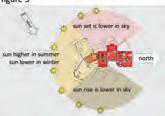
To solve the radiant problem you need to understand how the earth revolves around the sun and how that path affects the real estate being developed. There are many free online solar path tools but my favourites are those developed by Dr. Andrew Marsh. iii Figure 1 shows how that solar load on a random spot in western Canada on September 22 looks from outer space. Figure 2 is the sun path details for the same location, and Figure 3 illustrates the exposure and shading at the same location (late afternoon) for a hypothetical city populated by various building geometries.
Now consider the sun paths and the solar irradiance at the earth’s atmosphere of about 1.36 kW/m2, of which



approximately 1000 W/m2 makes it to the earth’s surface when measured perpendicular to the sun. Even when measured through various filters such as clouds and particulate at various altitudes throughout the year it is still a lot of energy that gets absorbed and transmitted into the building (see Figure 4).
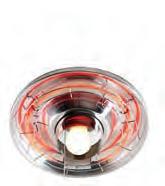
4 750-Watt heat lamp. Imagine one of these on every m2 of solar exposed surface. That is a lot of energy that is absorbed and transmitted into the building. If it is not controlled, it leads to an increase in the MRT leading to overheating of the occupants.
So, the first non-mechanical strategy to prevent overheating when “designing for failure” is to stop the shortwave radiation from hitting the building. Unfortunately, 100 per cent success would be equivalent to living inside a shaded bubble, which is neither desirable nor practical. Here are some practical tactics that the HVAC designer should be discussing with clients to eliminate or reduce mechanical cooling, or at the very least to enable peak performance from cooling equipment when absolutely needed.
1. Building orientation and shading: fixed overhead shading (includes
roof overhangs) does not work on eastern and western exposures but can work on the south during cooling season; use windows inset into the structure with adjustable exterior horizontal or vertical shading on the east and west exposures (see Figure 5). When possible orientate the building on an east-west axis.
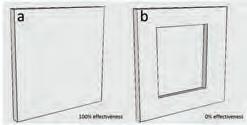
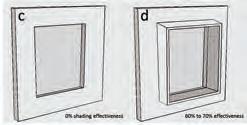
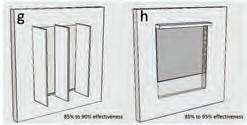
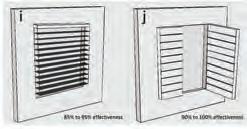
2. Use exterior window shading as discussed below and as shown in Figure 6 (types a through j).
Typ e a: A wall is the perfect window for HVAC engineers. It has a 100 per cent shading effectiveness and if built properly it is secure, does not leak, has a low thermal load and is effective at reducing air and sound pollution. Its only flaws are you cannot see out of it and it lets no light in.
Typ e b: This is the project budget window: large, clear, no shades, cheap and lots of them.
Typ e c: This is the bare minimum window: double pane, single coating, no exterior or interior shades. Solar coatings are good but both b. and c. still allow short wave energy to hit 100 per cent of the glass surface area thus the 0 per cent shading effectiveness.
Typ e d: Getting clients to use exterior fins or inset windows puts you into a new league. They work on southern exposures and can work on some northeast and northwest exposures. Up to 70 per cent shading effectiveness.
Typ e e: Brise solei will put you in
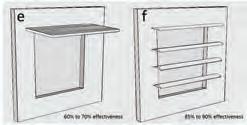
with the architectural crowd but only if you pronounce it correctly. This works on southern exposures but not the east or west. It works with windows that swing both ways (hoppers, awnings and casement windows)iv and provides up to 70 per cent shading effectiveness.
Typ e f: Horizontal louvres work on all exposures when adjustable. They do not work with windows that swing outward – only inward, sliders and double hung. They are more stable in windy climates, but can accumulate snow, bird droppings, and so on. They provide up to 90 per cent shading effectiveness.
Type g: Vertical louvres, as above except no issues with snow, bird droppings, and so on.v
Typ e h: Roller shades, as above but providing better efficacy depending on the openness factor with up to 95 per cent shading effectiveness.
Typ e i: Venetian blinds as per g. and f. but better rangeability. Some types not suited for windy climates. They also do not work with windows, which swing outward only inward, double hung and sliders. Up to 95 per cent shading effectiveness.
Typ e j: Shutters are still and always the classic solution. They do not work with windows, which swing outward only inward, double hung and sliders. Up to 100 per cent shading effectiveness.
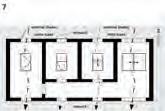
3. For climates where nighttime ventilation cooling is possible, try to integrate window orientation with predominate wind patterns (see Figures 5 and 7 ).
4. Use window types that enable natural ventilation and can be fitted with exterior shades; i.e. swing inward, sliders, double hung, and so on. (see Figure 7 ).
5. Complex building geometry equals increases in thermal bridging and infiltration, both of which lead to increases in interior temperatures. Simple building shapes using advanced framing techniques are better.
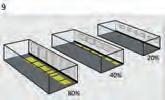
6. Us e high performance light coloured enclosures reducing U values, bridging and solar gains through windows orientated for natural ventilation (see Figure 8). The enclosure specification for cold climates work for the summer; use R60 roofs, R40 above grade walls and cantilevered floors, R20 below grade walls, R10 slabs and min. R4 windows with <.25 SHGC. The width of overhangs should be a minimum of 50 per cent of the height of the window or glass doors. Window to wall ratios should be kept below 30 per cent (see Figure 9).
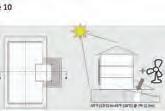
7. Use architecture to create solar refuge zones; north side, below grade, heavy mass enclosure. Think either enclosed or open north side courtyards. If they can take advantage of cool night time ventilation air all the better, if not use fans (see Figure 10).
See us at CIPHEX West Booth 224

Figure 7 Cool winds with building and window orientation works best with night time cooling of high mass structures
8 High performance light coloured enclosures, reduce U values, bridging and solar gains through windows orientated for natural ventilation

8. Use property shading starting with soft and hardscapes such as trees and pergolas.
9. If you do the above and still need active mechanical cooling then size the system based on nighttime loads. Run the system to cool the building mass during the evening, seal the house up during the day and ventilate only as necessary (see Figure 11). This strategy works exceptionally well with high mass enclosures with embedded cooling pipes.
10. If outdoor humidity is a problem forget the natural ventilation. Seal up the home and use a dedicated dehumidification system. By lowering the absolute moisture in the space, in -
Figure 9 Window to wall ratios of less than 40 per cent are good, 30 per cent is better. Even I draw the line at 20 per cent. Over 40 per cent promotes excessive daylighting, destroys thermal comfort, enables fabric fading and VOC emissions and significantly increases HVAC loads
creasing air velocity with fans and encouraging or enabling reductions in clothing you can solve the majority of overheating problems, but only if you get the building and mechanical ventilation system right.
These shading and ventilation strategies and tactics work on all building types using air-based systems, hydronic systems or hybrid systems. Take advantage of your local climate. Below grade soil temperatures are always cooler than above grade air temperatures. Use trees. Put window shades on the outside. Work window locations and selections into wind patterns. Nighttime naturally ventilated cooling works in many parts of the country. Low humidity, high air velocity and near naked works–just stay hydrated. If necessary, consider using non-compressor cooling methods as discussed in Cooling Without Compressors in HPAC May 2016.
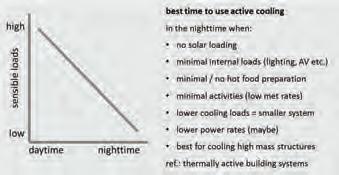
Figure 10 Use architecture to create solar refuge zones; north side, below grade, heavy mass enclosure.
If you still cannot convince your clients and their architects to employ these sustainable principles, we have been teaching our students to use the CBE Thermal Comfort Tool and its new solar calculator to shame them into submission. When it comes to architectural choices leading to overheating, guilt and reality are two gifts that keep on giving.

Robert Bean, who is president of Indoor Climate Consultants Inc., is a Registered Engineering Technologist in building construction through the Association of Science and Engineering Technology Professionals of Alberta and a Professional Licensee in mechanical engineering through the Association of Professional Engineers, Geologists and Geophysicists of Alberta. He has served two terms as an ASHRAE distinguished lecturer, serves on ASHRAE committees TC 6.1 (Hydronics), TC 6.5 (Radiant), TC 7.4 (Exergy) and SSPC 55 (Thermal Comfort) and is a recipient of ASHRAE’s Lou Flagg Award.
i Hales, S., Edwards, S.J., Kovats, R.S.. Impacts on health of climate extremes, World Health Organization < ht tp://www.who.int/globalchange/publications/ climatechangechap5.pdf > accessed August 2016
ii A Human Health Perspective On Climate Change A Report Outlining the Research Needs on the Human Health Effects of Climate Change. Environmental Health Perspectives and the National Institute of Environmental Health Sciences. April 22, 2010 <http://www.niehs.nih. gov/health/materials/a_human_health_perspective_on_ climate_change_full_report_508.pdf>accessed August 2016
iii Marsh, A. Sun Path Tools < http://andrewmarsh.com/ software/> accessed August 2016
iv Engineers don’t judge we’re only concerned about performance.
v Canadians deliberately put the letter “u” in the word mould and louvres. When Americans spell these words without the “u” it changes the entire meaning.
9
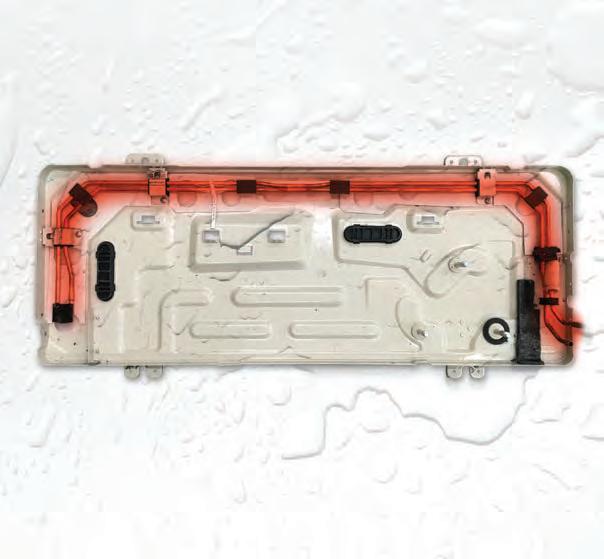
SHARP’s patented “Hot Pipe” keeps you comfy inside, no matter what happens outside.
SHARP’s hot gas pipe system utilizes heat generated from the indoor unit to keep the outdoor unit from freezing. And because it doesn’t require a separate heat source, this system is both safe and energy-efficient. Proven effective in SHARP air conditioners designed for the Nordic market, SHARP’s hot gas pipe system is now available in North American models.



BY MARK EVANS
What is the right path to success in business? There are many answers to this question and for every answer opinions abound as to which one is right. Everyone would agree that finding success is one thing, keeping it is another – especially when you sell a mature product in a mature market.
From Greek philosophers to hardened literary characters, the common thread of wisdom is knowledge. For example, the saying “know thyself” is a central precept of ancient Greek philosophy and can be seen as good advice for any modern businessperson. To be successful it is necessary to know the strengths and weaknesses of your products and to understand your company and its capabilities. Menander, who was a Greek dramatist, offered a different perspective on that philosophy. He noted that the saying “know thyself” is not well put. It would be more beneficial to say “know others.” This is a good lesson for business.
Know your competition as well as you know yourself. See both the practical benefits and perceived value that resides in their products or services. Rather than simply try to defend against them, find ways to align yourself – take the battle from their field onto your field. Highlighting a mature product’s similar features and benefits in a mature market may result in your product being seen as a “Like Product.”
Understanding some of the dynamics of selling a mature product in a mature market requires a look at the phases in a product’s lifecycle. The three distinct phases prior to obsolescence are pioneering, optimization and maintenance:
Pioneering In the pioneering phase, the features and benefits are unique and sales are driven by such things as product application knowledge and system design knowledge, coupled with installation knowledge and training. Loyalties with customers are built as product acceptance and utilization grows. Meaningful competitive comparisons are difficult to determine.
“Ours is an industry where “ my prOducts speak fOr themselves” was the mantra. Our prOducts nO lOnger speak fOr themselves.”
Differentiating your company and your services changes the perceived value of the customer experience. Raising the value inside the customer experience earns and maintains loyalty. This is also where you earn your market price premium and sustain it. In addition, the more you know about customers through the eyes of competitors, the more likely you are to be capable of maintaining those relationships, and identifying and satisfying the customer’s evolving needs profitably.
Optimization In the optimization phase, the product has found acceptance. At this point meaningful competitive comparisons start to come to the forefront as the effect of benchmarking becomes evident. The market leader position established in the pioneering phase aids in retention of existing market share as the customer experience along with the product attributes become the standard of comparison by which new competitors are judged.
Maintenance In the maintenance phase, the market for the product has fully matured. Continued growth comes from cannibalizing shares of a static market. As the product becomes perceived as a commodity pricing pressures intensify. Competition is at its apex now creating a new challenge: the unique features and benefits of the product no longer have the same perceived value and are more homogenous in the eyes of the market.
Finding yourself deep in a competitive situation, where the price/value relationship begins to weaken your market leader position, the easiest path is to follow the market down by failing to recognize that in the maintenance phase the differentiation must come more from within the vendor/customer
transaction. Be it packaging, supply-chain capability, warranty or service, there are many ways to maintain a price premium and a market leader position in the face of intense competition.
At this juncture the sage advice of “Wise Guy” philosopher Michael Corleone might be relevant. In The Godfather Part II he says to Frank Pentangeli “keep your friends close but your enemies closer.” The fact that a technical approach to sales resonates in this industry sometimes has us focus too much on the technical merits of products, which narrows our field of view. It is with that thought in mind that you must learn more about your competitors, not just about their products but their business, particularly through the eyes of the customer.
Use easily accessible sources of business information to research competitors. Many may be public companies with financial results reported to shareholders that include not only sales and profit reports, but insight into marketing focuses and messaging, new product developments and industry sector focuses and results.
Keep in mind your own predilection – take the customer perspective and do not focus on the obvious competitive performance analysis of features versus features, and benefits versus benefits. Consider what the customers’ estimation of your competitors’ perceived value is, and their value proposi -
tion versus your value proposition. With that in mind, look at hiring a third party to conduct a market survey on your behalf. Whether it is a blind survey or a sponsored survey, you will see what customers think of you in relation to your competitors. It will help you discover opportunities to differentiate or further differentiate your company and its service capability through real change or through messaging to better position and communicate an improved value proposition.
We live in an age where information flows across so many planes that it is difficult to control perception. Ours is an industry where “my products speak for themselves” was the mantra. Our products no longer speak for themselves. We must speak for them but in new ways with a new message.
You have heard of the 3 Rs- Reading, wRiting and aRithmatic. Consider the 4 Rs when it comes to selling a mature product in a mature market in today’s world. Be the Right person in the Right place at the Right time with the Right message.

Mark Evans has held positions of increasing responsibility at the regional and national level of the wholesale supply, rep agency and manufacturing sectors of the plumbing and heating industry.


BY STEVE GOLDIE

“Water, water, every where, And all the boards did shrink; Water, water, every where, Nor any drop to drink.”
It has been 40 years since I first read these words in my high school English class and for some reason unbeknownst to me they have always stuck with me, popping up in my brain sometimes for no apparent reason, or more often and predictably, every time I had to deal with a burst water line or a flooded basement. This time the verse from The Rime of The Ancient Mariner is spinning around in my brain as I address the topic of water conservation.
Water is at once one of the world’s most plentiful and most precious resources. Everyone knows water is essential to life and with approximately 70 per cent of the surface of our planet covered with the stuff it is understandable why many seem to believe its supply is inexhaustible. However, as the old mariner discovered, an abundance of water does not always mean that water is fresh and usable.
Today, 36 per cent of the global population lives in water scarce regions and a UN study predicts that by 2025 up to 75 per cent will be “water poor.” For Canadians it is sometimes tough be mindful and deliberate about water conservation considering we are particularly blessed with up to 20 per cent of the world’s fresh water supply and only make up 0.5 per cent of the global population. Water usage statistics reflect this with Canadians on average using 300 litres per day per person, second only to our U.S. neighbours to the south. In comparison, the average usage in France is just 150 litres per day per person. The truth is, fresh water is a finite resource that is becoming scarce even here in Canada. When it comes to managing this precious resource we can and we should be able to do better.
The why we should manage our water resources better is easy, first of all it is simply the right thing to do. Morally, ethically and economically it makes sense and I cannot imagine anyone
who would not be motivated by at least one of these things. Being good stewards of these resources will help ensure they will continue to be available for future generations. For many of us the most effective motivator is economic so we need to understand the true cost of water usage is not simply the amount we pay each month on our water bill.
Water treatment plants that provide safe clean water, as well as wastewater treatment plants that process our sewage and drain water, are very costly to build and operate. Effective water conservation products, policies and habits can delay or even eliminate the need for developing new or expanded municipal facilities, saving all of us consumers and taxpayers millions of dollars. Conserving and reducing water use is not just ethically and morally green; it saves green, taxpayer dollars. There is considerable evidence that investing in water efficiency can result in several potential economic benefits according to a study by The Alliance for Water Efficiency (AWE). The AWE is a stakeholder-based nonprofit organization dedicated to the efficient and sustainable use of water. Headquartered in Chicago, IL, the Alliance serves as a North American advocate for water efficient products and programs and provides information and assistance on water conservation efforts.
Its report quantitatively examines economic growth impacts of water/energy efficiency investments, specifically in terms of job creation, income, GDP, national output, water savings and other benefits. To produce the report a consultant team modeled a wide range of water efficiency program possibilities and confirmed that economic stimulus benefits could be broadly distributed throughout a national economy. Among the report’s findings: the economic benefits per $1 million of investment could be between $1.3 million and $1.5 million of generated GDP and between 15 and 22 jobs created. That is a pretty good return on investment which strongly supports the idea that conservation simply makes good economic sense.
If the why is easy, the how is much more complex and multi leveled. My first introduction to water conservation occurred
29/16˝IN 2x10 SPF using DCB606 battery ON A SINGLE CHARGE UP TO
WORLD’S FIRST BATTERY PACK THAT AUTOMATICALLY CHANGES VOLTAGE WHEN YOU CHANGE TOOLS.
The FLEXVOLT™ battery's ability to automatically change between two voltages gives users a serious advantage when it comes to efficiency. It's the battery that not only powers, but improves the runtime** of our DEWALT® 20V MAX* tools, so you don't have to invest in a whole new system. It's the battery that brings the power of corded to a new lineup of 60V MAX* and 120V MAX* DEWALT® tools so you can finally work on a fully cordless jobsite. Built Guaranteed Tough®, Built by DEWALT®

COMPATIBLE
Compatible with all our 20V MAX* tools
EXPANDABLE
Brings power to a whole new lineup of tools
POWERFUL
Combine two 60V MAX* batteries for revolutionary cordless freedom
way back in the 1970s when I visited my friend’s cottage as a kid. The cottage had a single toilet and was on a septic system. My friend’s father was very serious when he explained to me the acceptable toilet protocol, which went like this; “if it’s yellow let it mellow, if it’s brown flush it down.” It was the first time I had heard that one, sort of an early version of the dual flush toilet. If my memory serves I think the toilet was also fitted with an early water reduction device, the low tech but effective brick in the toilet tank. You scoff at the brick? By now that brick might just have saved over 49,000 litres of water if it is still in use and I’m betting it is. Seriously, I did the math and I was being very conservative.
My friend’s father was way ahead of the industry. It was not until after the Energy Policy Act (EPAct) was enacted in the early 1990s in the U.S. that we started to see low water consumption

“…multi head, water guzzling car wash showers are more and more popular these days, they were very rare 20 to 30 years ago, so in this respect we are moving backwards when it comes to conservation.”
fixtures getting widespread use. I do not recall exactly when they were mandated here in Canada but I do remember that long afterwards there was still a pretty good underground market for the older water guzzlers.
Consumers were skeptical about the effectiveness of the early low flush toilets and there were plenty of anecdotal stories of failures and clogged drains. In truth I think even most of the early models did perform reasonably well. Today there really is no reason to doubt the performance; there is no shortage of high performance flushers in the current marketplace.
Fixture engineers use advanced hydraulic modeling techniques to literally change the way water moves through the channels of a toilet to eliminate waste. Newer finishes fired into the chinaware give more power to less water. Not only do todays toilets use far less water, they actually clear the bowl even better than the old cottage model, brick or no brick. Those old guzzlers used anywhere from 3.5 to 5 gallons per flush (gpf). Today’s best use just 1.28gpf to 1.6gpf. Dual flush models, which are now very common, are estimated to use on average 0.96gpf based on five
continued on p36

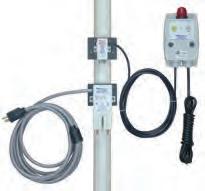
The OSS-100 is the trusted and proven plug & play system that pumps water, not oil from elevator sumps, transformer oil containment areas and underground electrical vaults.
Oil Smart® systems satisfy ASME A17.1, IEEE 980 and EPA SPCC requirements.















































































flushes/day/person with only one 1.6gpf flush and four 0.8gpf flushes.
Much of the water-saving focus is on the toilet for good reason since it is estimated toilets account for about 47 per cent of household water usage but improvements have been made in other areas also. Low flow aerators on taps are mandated however I discount the effectiveness of these in a residential setting. If you are filling a pot, or a sink or a glass, a slowed down flow rate will not necessarily cause you to fill it with less water, it will simply take longer. Shower heads are a different story however and there have been great improvements with these. Back in the early 1990s when lower flow shower heads started to appear they were not very effective at all. Showerheads had flowrates in the range of three to five gallons per minute. To reduce these manufacturer’s simply added flow restrictors to their old models. Most plumbers, myself included, would routinely remove these rather than face the complaints of their customers.
The industry did get better and there are countless models of showerheads that perform very well at flow rates as low as 1.5 to two gallons per minute, and they are engineered to do so from the ground up, this means no easily removable flow re -

strictor. On the other hand, the multi head, water guzzling car wash showers are more and more popular these days, they were very rare 20 to 30 years ago, so in this respect we are moving backwards when it comes to conservation. Today technology has truly given us the opportunity to significantly reduce the amount of water we use to live our daily lives and it really is in all of our interests to do so. I do not think most of us want to be seen by the rest of the world as wasteful. The technology exists to move us closer to the European average water usage, which is about half of our current average, the only thing that stands in the way is ourselves.
Ultimately the easiest and most cost-effective thing we can do to protect and preserve water is learn to use less. There is an old saying; “We never know the worth of water till the well is dry.” Let’s not prove this, nor the words of the ancient mariner, true.

Steve Goldie learned his trade from his father while working as a plumber in the family business. After 21 years in the field, he joined the wholesale side of the business in 2002. He is frequently called on to troubleshoot systems and to share his expertise with contractors. He can be reached at sgoldie@nextsupply.ca.
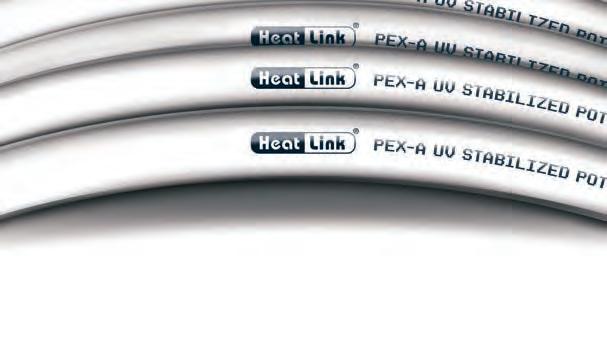
HeatLink PEX-a tubing is engineered to perform. Our PEX-a tubing is manufactured using the one step crosslinking extrusion process, creating a superior and more uniform molecular structure, which means increased strength, flexibility and thermal memory. Amazingly, a section of ½” tubing can be bent into a 3” radius without affecting tubing integrity. So you can count on great performance in the corners.
HeatLink PEX-a is highly crush and abrasion resistant and perfect for projects where it’s buried in earth or covered in concrete. It’s built to take the heat, the cold, and the pressure–above and beyond industry specifications–to last a lifetime. UV stabilized to withstand up to 12 months exposure to sunlight, it’s the reliable tubing choice for your next potable water or radiant heating or cooling project.
HeatLink PEX-a tubing is lightweight, durable and requires fewer fittings–so it’s really quick and easy to install on the straightaways too.
HeatLink PEX-a is certified to meet or exceed industry performance standards and approved for installation across North America. Install our PEX-a tubing with confidence–we cover every inch of it with a worry free 25 year warranty.

We’ve been proudly making HeatLink PEX-a tubing right here in North America since 1998.
Changing flow direction for optimal heat exchanger performance.

BY JOHN SIEGENTHALER
Many systems with renewable energy heat sources also have large thermal storage tanks. Examples include systems using biomass boilers and solar thermal collectors.
I call these heat sources “wild” since they can operate over a wide range of conditions and often at temperatures significantly higher than required by modern low-temperature hydronic distribution systems. That word “wild” might seem a bit strong, but I use it to emphasize that managing these heat sources within a system is very different from just turning a gas-fired boiler or some other conventional heat source on and off.
Significant thermal storage is also used in systems with electric boilers operating on off-peak rates or combined heat and power systems. These heat sources can also produce high water temperatures, which mandate one or more mixing assemblies be used between the thermal storage tank and any low temperature hydronic distribution system.
When storage volume requirements reach a few hundred gallons, some designers look to unpressurized thermal storage tanks as being less expensive on a dollar per gallon basis, and easier to install compared to pressure-rated steel tanks. In some cases an unpressurized thermal storage tank, which ships in a “knock-down” configuration, is the only practical option if the tank has to pass through a narrow door into an existing basement or mechanical room.
In limited applications, it is possible to route water from unpressurized thermal storage tanks directly to a heat source or hydronic distribution system. However, this requires specific components, careful design and details that are not common in closed-loop hydronic systems.
One requirement is that all wetted components must be suitable for open-loop systems. Since the unpressurized tank
is vented to the atmosphere, the water has a “connection” to a virtually unlimited supply of oxygen. It will absorb and release oxygen molecules based on temperature and pressure. Some of those oxygen molecules will be carried through wetted portions of the system, and oxygen combined with iron does not lead to good results.
To avoid inevitable corrosion, all wetted surfaces in open hydronic systems must be nonferrous. This usually implies the use of materials such as copper, copper alloys (brass and bronze), stainless steel or polymers such as PEX. No ferrous metals such as carbon steel or cast-iron should be used in any open-loop hydronic system.
That last sentence precludes direct flow between any biomass boiler with a carbon steel heat exchanger, which is by far the most common type of biomass boiler construction. It also should preclude the use of any cast-iron circulators. This point is clearly documented by circulator manufacturers but, unfortunately, it is not always adhered to since cast iron circulators are significantly less expensive than those made of bronze or stainless steel. Open-loop designs also preclude the use of standard steel expansion tanks and steel panel radiators.
The restrictions associated with open-loop design often lead designers to specify a heat exchanger between the water in the unpressurized thermal storage tank and closed-loop circuits that add or remove heat from the tank.
One of the most common heat exchangers used in combination with large unpressurized thermal storage tanks is a helical copper coil. In some systems, one coil heat exchanger is used to dissipate heat from the heat source into the tank’s water. Another coil is used to extract heat from the tank and send it to the load. The connections to the coils are typically routed through the tank walls just above the maximum height water line. This reduces the potential for leakage through the tank penetrations.
To attain maximum heat transfer from a heat exchanger, it is important that the fluids exchanging heat flow in opposite directions. This is called “counterflow” heat exchange. It provides the highest average water temperature difference between the two fluids.
Figure 1 shows how counterflow heat exchange is achieved when two coils, one for heat input and the other for heat extraction, are used in an unpressurized thermal storage tank.
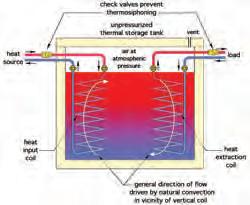
The coil on the left is dissipating heat into the tank. Hot water enters the top of the coil and passes downward. This is opposite to the natural convection flow within the tank, where heated water rises due to decreasing density. The coil on the right is extracting energy from the tank. Cooler water returning from the distribution system is sent to the bottom of the coil and flows upward. This is opposite to the direction of the tank water movements, which is sinking due to increasing density as it cools.
Some designer wants to use a single coil for heat input to the tank and heat extraction from the tank. If flow passes through the coil in only one direction, counterflow cannot be achieved in both heat dissipation and heat absorption modes. This will compromise performance.
One solution is to change the flow direction depending on the operating mode of the coil: top-to-bottom flow when adding heat to the tank and bottom-to-top flow when extracting heat. There are several possible ways to reverse flow through the coil. One approach is shown in Figure 2
This arrangement uses two temperature-controlled (e.g., “setpoint”) circulators, (P1) and (P2). They face each other as far as flow direction is concerned. Only one circulator operates at a time, and neither contains a check valve. The op -
erating circulator pushes flow through the coil and backward through the volute of the non-operating circulator.
Circulator (P1) monitors the temperature of sensor (T1). If the wild heat source circulator (P4) is off and a heating demand occurs, circulator (P3) and the mixing valve controller are turned on. Flow passes by sensor (T1). If the temperature at sensor (T1) is below a minimum setpoint value, the speed of circulator (P1) increases to drive flow upward within the coil heat exchanger, through the volute of circulator (P2) and into the hydraulic separator. The latter uncouples the flow dynamics of circulator (P1) from those of (P3). If circulator (P1) reaches maximum speed and flow from the coil is unable to meet the required temperature at (T1), an auxiliary heat source can be turned on.
A time delay should be allowed between a call for heat from the distribution system and activation of the auxiliary heat source. This allows the variable-speed pump time to ramp up if necessary, and have its turn at trying to produce the required supply water temperature before resorting to auxiliary energy.
Be sure your controls do not allow the auxiliary heat source to inadvertently send heat produced by the auxiliary heat source back to storage. The simplest way to do this is to interrupt power to circulator (P1) and (P2) whenever the auxiliary heat source is on.
If the wild heat source is operating at the same time as the load and the temperature at sensor (T2) climbs a few degrees above the required supply water temperature, circulator (P2) is enabled. It ramps up speed based on its temperature settings to push flow downward through the
continued on p40
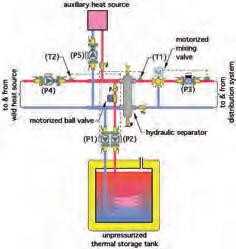
“...managing these renewable heat sources within a system is very different from just turning a gas-fired boiler or some other conventional heat source on and off.”
coil. Heat that is more than what the distribution system needs is routed into thermal storage.
Both (P1) and (P2) can be off if heat from the wild heat source is just sufficient to meet the required supply water temperature. This allows heat to fully bypass thermal storage, which can be beneficial when recovering loads from setback conditions.
I have shown a motorized ball valve in the coil circuit, which would close whenever circulator (P1) or (P2) is not operating. Since there cannot be any check valves in the coil circuit, this valve prevents slight but undesirable flow due to buoyancy differences and very small pressure differentials through the hydraulic separator and its headers. A ball valve is best since it has the same flow characteristics in either flow direction.
If the wild heat source is on and there is no call for heating from the load, circulator (P2) is on, circulators (P1), (P3) and (P5) are off, and the auxiliary heat source is off. All heat produced by the wild heat source is directed into thermal storage.
Accomplishing the above sequences will require some hard-wired or programmable control logic.
If the system is designed around primary/secondary piping, it is also possible to reverse the flow direction through a heat exchanger coil using a cross fitting with a brazed-in baffle plate, as shown in Figure 3
The cross fitting produces the same pressure at the beginning and end of the coil circuit. Thus, there is virtually no tendency for flow to develop in the coil circuit unless one of the circulators is operating. The baffle plate prevents what would otherwise be significant mixing due to flow momentum entering the upper connection of the cross and exiting the lower connection.
To my knowledge, there is no commercially available fitting with the geometry shown in Figure 3. If you want to use this, you will have to fabricate your own. It should not be too difficult if you can trim some flat copper or brass plate stock to the proper size and braze it down the centreline of the fitting.
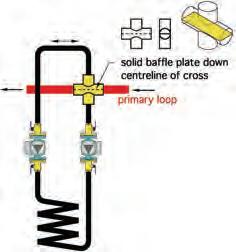
Another detail I would recommend is the use of a time delay relay with a delay-on-make function in the circuit supplying the two circulators on the coil circuit. The idea is to allow both circulator impellers to fully stop before turning on either circulator. A nominal five-to 10-second delay should suffice.
Finally, I do not recommend using circulators with permanent magnet motors for the coil circuits shown in the figures. Reverse flow through the unpowered circulator may spin the impeller in reverse and thus cause the permanent magnet rotor to spin within the stator coils. This is likely to generate unwanted electrical feedback.
This article illustrates unique application details made possible through modern hydronics. Add these details to your bag of tricks; perhaps you will come across a situation where they can be applied.

John Siegenthaler, P.E., is a mechanical engineering graduate of Rensselaer Polytechnic Institute and a licensed professional engineer. www.hydronicpros.com











The Presscon™ press connections, with its exclusive LEAK DETECTION feature, will detect leaks during system testing if a press connection is unpressed. Calef was the rst to introduce zone valves with press connections and has expanded press connections to its broad range of hydronic components. Press sizes from ½” to 2” copper are available on several air separators, dirt separators, hydronic separators, magnetic separators, thermostatic mixing valves, balancing valves, press reducing valves and more.

Presscon connections have a temperature range of 0°F - 250°F for up to 50% glycol mixtures and pressure rated to 200 psi. Connections meet low lead law requirements for use in accordance with U.S. and Canadian plumbing and mechanical codes.


Components for today's modern hydronic systems
Heating & Cooling
to size refrigeration correctly for the box and application.
The key to a properly operating walk-in box system starts with a good design and the basis of a good design is to accurately determine what the refrigeration heat load is. To do this one has to realize that heat enters the refrigerated space in several different ways:
• Transmission load (heat transferring through the physical barrier of the structure).
• Air change load (air entering the refrigerated space as doors are opened for product loading, people entering, etc).
• Product load (unless the new product to be refrigerated is brought in at the same temperature that it is to be stored at, the product will add heat to the refrigerated space).
• Miscellaneous loads (any other means of adding heat to the refrigerated space, such as the electric motors in the evaporators or process machinery, people, lighting, forklifts, and so on).
As can be imagined, there will be no consistency to any of these various heat loads. As the temperature outside the refrigerated box changes, so will the transmission load. The air change load will vary with how often the box door(s) are opened, the product load will vary with the quantity and temperature of new product coming in, and the miscellaneous load will vary with how often lights are on, process equipment is operating, how often/how long a fork lift might be in use, etc.
So, it becomes an educated guesstimate as to what the worst-case scenario is. That way, even on the most miserably hot day in the middle of summer, when production is high and extra personnel are working inside the refrigerated box, the doors are opening at an accelerated rate, and a high quantity of new product at higher than normal temperature is constantly being brought into the space, there is sufficient refrigeration equipment capacity to maintain the desired space temperature.
So, it is a logical step to put together a survey of the appli-
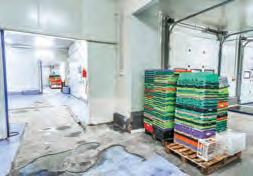
cation. The following Information is necessary to properly determine the refrigeration heat load:
To determine what the peak transmission load will be. This may be the outdoor temperature in the case of an outdoor refrigerated box, or a warehouse temperature in the case of an indoor refrigerated box. The heat gain through the walls and glass doors (if used) will be directly proportional to the TD (temperature difference between the ambient temperature and the refrigerated space temperature). The other factors determining the heat load will be the size of the walls and the type/thickness of insulation used in the box walls.
It is also important to consider the heat gain through the floor, and in freezer applications it is recommended that the floor be insulated as well.
This will be dependent on the product to be stored in the refrigerated space. In addition to temperature, the required humidity will need to be considered.
energy saving potential in today’s buildings and industrial processes

Canadian infrastructure investments are on the rise, and with ambitious climate and energy targets in place, Danfoss has been helping make Canadian cities more efficient and sustainable for 65 years. Heating and cooling consume as much as 40 percent of a building’s total energy use. Danfoss solutions like AC drives, variable speed compressors and hydronic control valves help cut energy consumption and improve comfort and control. City-wide, Danfoss’ innovative district heating solutions amplify efficiencies — cost-effectively boosting energy productivity, minimizing environmental impacts and helping cities plan for a sustainable future. With Danfoss, our cities can get more out of less without sacrificing performance or reliability.
Discover how we’re Engineering Tomorrow at danfoss.ca 63%
Some products (such as meat, product, flowers, etc) are especially sensitive to low humidity. Storage in a low humidity environment will dry the product out, resulting in a loss of product integrity as well as weight (which translates into value…$$/lb) The system design will need to consider humidity, and can be managed by the appropriate evaporator TD (difference between refrigerated space temperature and refrigeration saturation temperature in the evaporator). The greater the TD, the more moisture will be removed from the air as it passes through the fin-tube structure of the evaporator.
This is pretty straight forward, but the transmission load is dependent on the size of the walls through which heat will be transferred into the box.
The type of walls (and the insulation that is used in them), and glass doors (if used) will have specific insulation K values (the relative ability to conduct heat). This value, along with the area and TD between the refrigerated space temperature and ambient temperature will be used to determine the transmission load.
Every time a box door is opened, warm air enters the refrigerated space. This results in both sensible and latent heat, which will need to be removed to maintain the design space temperature. Knowing the maximum temperature where the box is located should be a relatively simple thing to determine. It is the number of door openings/day that is the big variable, especially in a retail application where there are glass doors for customer access to product. This is where the term “guesstimate” comes into play. In case you are not familiar with this scientific/engineering term:
Noun
• an estimate based on a mixture of guesswork and calculation
Verb
• to form an estimate based on guesswork and calculation
Again, this is another item that falls under the category of guesstimate. While the box might be designed for a specific product like apples, it is sometimes difficult to determine how much product will be entering the box at any given time. Once that amount has been determined, the weight, entering temperature and expected pull-down time will also be required. The refrigeration equipment capacity will differ substantially in an application where the pull-down time is two hours versus 24 hours.
How many lights, and how often are they on? How many evaporator fan motors, and what horsepower rating are they? Is there any process equipment such as meat grinders, saws, etc., in the refrigerated space? If so, what are the horsepower ratings of the motors? During peak production periods, how many people will be inside the refrigerated space? Will there be a forklift utilized inside the refrigerated space? If so, how many, and for how long?
Is this a medium temperature or low temperature application, is it a storage application or a quick chill or blast freezer application? Are there any other specifics of the application that would influence the system design?
Now, it used to be that once this information was gathered, a long arduous process was required to determine the refrigeration heat load. It required having access to insulation K values for varying types of materials, specific heat of various types of product (to determine the product load), tables for lighting and motor heat loads, and so on.
Fortunately, all of that is in the past. There are many resources available online to easily determine the refrigerated space load for a walk-in box. The above information will still be required, but rather than manually performing the heat load calculations, the box load program will do the work for you.

Demma holds a degree in refrigeration engineering and worked as a journeyman refrigeration technician before moving into the manufacturing sector where he regularly trains contractor and engineering groups. He can be reached at ddemma@uri.com.
The ideal replacement for R404A in supermarkets is here — Honeywell Solstice ® N40 (R448A).
There’s no need to wait for a replacement solution. Honeywell has you covered. Solstice N40 is a versatile, blended, ASHRAE A1-rated refrigerant that satisfies all your low- and medium-temperature refrigerant replacement needs. Plus, it’s 5-10% more energy efficient than R404A! Its close match to existing equipment designs and compressors makes for rapid, cost-efficient adoption, and its GWP is 40% lower than R404A, making it a good choice to meet evolving regulatory standards. It’s also a superior replacement for R22 with a good capacity match and no TXV changes.
A look at the current state of the solar water heating industry in Canada and internationally.

BY ROBERT WATERS
Having been involved with the solar water heating (SWH) industry since the early 1980s, I can tell you that it has faced many challenges. A look at its history in Canada reveals that SWH has been on a roller coaster ride since the late 1970s. Today the SWH industry is certainly down, but is it out?
Looking back, the first upward trend for the SWH industry occurred in the post Middle East oil embargo period of the early 1980s. The federal government invested heavily in SWH startup companies and subsidized both residential and commercial SWH installations. There were many new solar companies involved in manufacturing, design and installation of SWH systems that evolved at that time. However in approximately 1984 government funding for solar was discontinued and the industry collapsed with many companies going bankrupt or switching to other industries.
Fast-forward to the early 2000s and
the solar industry started to show some signs of renewal. There was a newfound interest in green technology, fossil fuel prices were rising rapidly and climate change was becoming an important issue. A renewed interest in SWH developed, with multiple levels of government jumping in to provide support programs.
It seemed that all indicators were pointing in the right direction and many in the industry truly believed that this time solar thermal would be here to stay. The Canadian solar thermal industry, including solar water and solar air, saw huge
growth rates from 2005 to 2010 with glazed and unglazed solar collectors installations peaking in 2010 with close to 199,000 m2 of collector area installed.
This newfound enthusiasm did not last. In 2010 the federal government slashed funding again and the industry has gone into steady decline. There have been five straight years of declining installations and in 2014 installations had dropped to 57,000 m2 of installed collector area. Once the numbers are reported for 2015 and 2016, it is expected the totals will have shrunk even further.
The story is similar for the rest of the world, although not quite as dramatic a drop off as in Canada. This is in contrast to the renewable electricity industry sector made up primarily of solar PV and wind, which has seen explosive growth rates over the last 10 years. Worldwide installed capacity of solar PV in 2005 was 5.1 GW and in 2015 the total reached 227 GW. Wind power has seen an equally impressive growth rate going from 59 GW in 2005 to 227 GW in 2015. Future growth is expected to continue at this fast pace.
There are many factors related to policies and economics that are driving the growth of the power sector worldwide.

Innovative solutions that save time and preserve resources.
Zurn is committed to providing smart water protection solutions. The trusted leader in backflow prevention and pressure regulation, our Zurn Wilkins customized solutions combine superior design with ease of service and lowest lifecycle costs.
Come see us at the CIPHEX West Show, Vancouver Convention Centre, November 2 & 3, 2016 Booth #800
350XL
Lead-Free Double Check Valve Assembly
350ASTR
Lead-Free Replacement
Double Check Valve Assembly with Stainless Steel Body and Spool

375XL
Reduced Pressure Principle Assembly with Blow-Out/Flush Fitting (BOF)
The Zurn Wilkins 375XL features a removable pressure vessel for faster testing, maintenance, and repair.
Pressure Vessel is replaced in seconds, reducing water system down time and allowing off-line maintenance and repair.
Since power sectors consist of centralized distribution systems, it has been far easier for large-scale deployment of PV and wind into the electrical grids. PV and wind have also experienced dramatic decreases in costs as the economy of scale has ramped up production.
The heating sector on the other hand is made up of systems that are primarily de-centralized, requiring on-site storage or direct use and must be tackled on an individual building basis. This has made large-scale deployment much more challenging.
Government policies often drive the growth of renewable technologies and this is another area where the power sector is far ahead. Heating accounts for over half of the world’s final energy consumption (this percentage is even higher in Canada’s colder climate), so if the world is to reach its global climate
change targets, more emphasis on the renewable heating sector is required everywhere.
Canada currently does not have any national renewable programs or strategies and only a few provinces have renewable programs. The new federal government has shown a change in its attitude toward climate change and renewables – time will tell how this plays out with actual policies and programs.
In Canada we can attribute the drop in the SWH market primarily to changes in government policies and the low cost of fossil fuels. SWH systems rapidly became economically uncompetitive when the federal and provincial government’s subsidy programs ended at the same time as the price of natural gas plummeted. These factors were a double
whammy that made it almost impossible for anyone to justify the high installation cost of SWH systems.
Many governments and organizations changed their focus to renewable electricity rather than renewable heating. In Ontario where the Green Energy Act introduced very generous financial incentives for the PV industry, the collapse of the solar thermal industry was especially dramatic. Many contractors who were in the SWH business changed over to selling solar PV because of the Fit and MicroFit feed in tariff program. In many areas this left a void with no one left to install or service SWH systems.
The decline of the SWH market cannot be attributed to the technology itself. In many ways the SWH industry has matured with products that are now high quality, reliable and technologically adcontinued on p50






Threading and joining black iron pipe on a busy job site can be complicated. Viega MegaPress is ameless and eliminates heavy equipment and messy joining materials. Differentiated by sealing elements, Viega MegaPress and Viega MegaPressG are approved for more applications than any other black iron pipe press system. Reduce the installation time on your next job by up to 60%.
• Suitable for ASTM Schedule 5 to Schedule 40 black iron pipe and NFPA 13, 13D and 13R re sprinkler systems
• Secure press connections made in seconds
• Equipped with the Smart Connect® feature for easy identi cation of unpressed ttings
• No need for messy and toxic threading or cutting oils
For more information, call 800-976-9819 or visit www.viega.us
vanced. It is ironic that the market has seen such a decline when SWH products have been making gains technologically.
Those gains include the introduction of high tech collector systems with quick connect fittings, pre-engineered mounting hardware, pre-fabricated pumping stations, complete packaged residential systems and high tech electronic control systems that can communicate through the internet. All of these things can make modern SWH systems highly efficient, faster and easier to install, and more reliable than in the past.
The cost of properly installing a good quality SWH system is still the biggest drawback for the technology. SWH systems still have a high capital cost for equipment and can be labour intensive to install. This differs from the dramatic decline in prices seen in the solar PV industry. Unlike PV systems that typically transfer collected energy straight into the electrical grid, most SWH systems must have the ability to store energy on-site until it is needed. This adds the cost and space requirements of storage tanks to a SWH system.
Solar pool heating systems are the exception to the high cost and storage requirements of solar. DHW heaters use low cost unglazed plastic collectors and do not require solar storage tanks. This has made solar pool heating systems the most cost effective use of SWH in North America for many years. This application continues to hold the largest market share of solar collector area installed in North America.
Solar pool heaters offer a cost competitive pool heating solution that can compete with any alternative pool heating system, even with the low cost of natural gas.

Another issue that the SWH industry faces is the lack of knowledgeable designers and installers. Many good SWH installers have turned to other market areas to survive.
Globally SWH continues to be a very important piece of the global renewable energy mix. Even with the recent decline in the growth of the market, many countries around the world see SWH as an important part of their low-carbon heating requirements. In its recent publication Solar Heat Worldwide 2016, the International Energy Agency reports that SWH continues to grow in some countries and highlighted a few new emerging trends in the SWH industry.
Many countries are seeing a transition away from single-
family home SWH systems to commercial SWH applications in multi-family homes, public sector buildings and tourism. Another emerging market is developing for large-scale solar district heating systems. Large-scale process heat applications are also seeing growth with many interesting applications in the mining, food service and brewing industries. There is also growth in new companies offering energy performance contracting.
In Canada there is still a small but very committed group of companies promoting SWH products. Enerworks located in Woodstock, ON supplies flat-plate, vacuum tube and unglazed plastic pool collectors. “The residential SWH market is essentially dead, however the solar pool heating market is still going strong,” said Suni Ball, general manager of Enerworks. He sees opportunities for commercial SWH heating systems, especially in the dairy industry and in the multi-family building sector.
Ian Lindsay, director of technical operations at Viessmann Manufacturing Company in Waterloo, ON indicated that “Viessmann sees SWH as an important part of our renewable product offering and we are still committed to the SWH industry in Canada with a full range of flat plate and evacuated tube collectors.” The company plans to introduce some new products later this year, which will further advance its collector technology.
Dartmouth,NS-based Thermodynamics Ltd. has been in business since 1981 and is considered to be one of the longest serving SWH manufacturing companies in Canada. The company has been very active the last few years supplying residential SWH systems for the City of Halifax’s Solar City Program. There are other companies scattered across Canada supplying SWH and solar air heating systems, and the Canadian Solar Industries Association (www.cansia.ca) is a good spot to search for companies involved in the solar thermal industry.
With space and domestic water heating making up such a large part of Canada’s energy use, it is important for governments not to focus all their attention on the renewable power sector. SWH systems still offer a great way to provide low-carbon emission free renewable heating technology for the HVAC industry. Whether it is for domestic water heating, pool heating or combined space heating applications, they provide an important tool in Canada’s battle to reduce greenhouse gas emissions and climate change. Hopefully there is government willpower to support this renewable heating industry.

Robert Waters is president of Solar Water Services Inc., which provides training, education and support services to the hydronic industry. He is a mechanical engineering technologist graduate of Humber College and has over 30 years experience in the hydronic and solar water heating industry.

In addition to 30,000 square feet of exhibits, CIPHEX West will feature a full conference program, new product showcase, the Canadian Hydronics Conference and the new Executive Summit. Held at the Vancouver Convention Centre, CIPHEX West is co-locating with BUILDEX Express. Visitors to BUILDEX Express and CIPHEX West can tour both trade shows with one badge and registration.
“Co-locating with BUILDEX Express gives visitors who attend CIPHEX West on November 3 the opportunity to see 100 extra exhibits of products and technologies for building design, management and renovation,” reported Elizabeth McCullough, general manager of trade shows with the Canadian Institute of Plumbing & Heating (CIPH).
“CIPHEX West has very successfully co-located with BUILDEX Calgary, but this marks the first co-location in BC,” added CIPH president and general manager Ralph Suppa. “It allows us to provide significant added value for our exhibitors and visitors.”
The HVAC/R and Plumbing Design Forum offers advanced training for heating and plumbing professionals. Seminars and workshops cover the latest heating and plumbing engineering/design topics and trends. The sessions are geared to heating and plumbing engineers, but are open to all visitors interested in more advanced training.
Anchored by internationally recognized hydronics expert John Siegenthaler, the Canadian Hydronics Conference will provide the information contractors, wholesalers and engineers need to specify, install and maintain hydronic systems, expert insights into future trends in modern hot water heating and practical solutions to increase hydronic sales. Launched at CIPHEX West 2014 in Calgary, the con -
November 2: 10:00 a.m. to 8:00 p.m.
November 3: 10:00 a.m. to 4:00 p.m.
Stop by HPAC’s Booth (#401) For your chance to win John Siegenthaler’s latest book: Heating with Renewable Energy
ference draws contractors, wholesalers, engineers and homebuilders.
Attendees of the hydronics conference, which is presented by the Canadian Hydronics Council (CHC), will also receive free admission to CIPHEX West 2016. The exhibit hall will once again include the Hydronics Alley, a showwithin-a-show dedicated to the sector.
A new by-invitation event, the Executive Summit will bring top executives from a variety of industries together for a thought-provoking dialogue. Human capital and fast-paced regulatory changes can create headaches in the boardroom. CIPH has brought in experts to provide their insights and get the conversation started. The Executive Summit will take place on day one of the show.
The New Product Showcase returns to the show with a preview of the newest products and technologies. A record 65 new products were showcased in the 2014 competition in the exhibit hall and online, with the best of them receiving innovation awards at the show.
The 2016 program also offers sessions to help contractors, and those that supply them, with information and tools they can use right away to sell more, install and service more efficiently and be more profitable. The Canadian Water Quality Association (CWQA) is presenting a workshop focusing on the fundamentals of water treatment.
Produced by the Canadian Institute of Plumbing & Heating (CIPH), CIPHEX West is the largest heating and plumbing industry event in Western Canada. BUILDEX Express is an exclusive one-day event produced by Informa for the construction, property management, interior design and architecture industries. www.ciphexwest.ca


























































































Learn about the latest in building and design innovation, technologies, codes and standards, best practices and applications, and practical insights into building your business. Registration for these sessions includes admission to the CIPHEX West trade show.
Time: 11:00 a.m. to 12:00 p.m.
Fee: $40.00
Panelists will discuss the comfort of instant hot water and the importance of saving water, including systems, pipe sizing, pump sizing and application.
Tim Main, residential HVAC market development manager, Xylem Applied Water Systems Canada
Sean Giberson, Canadian sales manager of residential products, Taco Comfort Systems


Rod Parker, district sales manager, Grundfos Canada Inc.
90.1: UNDERSTANDING CODE COMPLIANCE AND ENERGY EFFICIENCY
Time: 12:30 p.m. to 2:30 p.m.
Fee: $50.00
ASHRAE 90.1 2010 is currently one of the most commonly used energy standards mandated under the BC Building Code. Since it was introduced at the end of 2013, building owners, code officials, as well as design professionals, have had to apply this new and more stringent requirement to comply with the latest building code/by-law. This seminar will explore compliance requirements of ASHRAE 90.1 on HVAC and plumbing mechanical systems design, along with offering insights on how to apply this standard in new and existing buildings. It is aimed at engineers, designers, inspectors, contractors, property managers and owners.
Speaker: Stephen Kooiman, mechanical team leader, Prism Engineering
Time: 3:00 p.m. to 4:00 p.m.
Fee: $40.00
The lead situation in Pemberton, BC, has far-reaching implications for all water utilities across Canada. Although the current health situation focus on the effects on this small community, lead persists in communities across Canada. Come and hear the courageous actions Pemberton took and how your community can learn from it. This is an open panel discussion on the crisis with three notable first response figures involved from the Village of Pemberton, local responding plumbing companies and Canadian Water Quality Association (CWQA).
Moderator: Kevin Wong, executive director, (CWQA)
Panelists:
Robert Szachury, owner, Turbo Plumbing and Heating Jill Brooksbank, communications and grant coordinator, Village of Pemberton


Nikki Gilmore, chief administrative officer, Village of Pemberton
Time: 4:30 p.m. to 5:30 p.m.
Fee: $50.00
The BOABC now requires that every bedroom have mechanical ventilation. Indoor air quality is a growing health/safety concern especially in these rooms. Being smaller, closed and typically occupied for eight hours per night, air quality will typically deteriorate yet go unnoticed. Ventilation is no longer included as a standard built-in feature with every chimney equipped gas furnace installation as it was 10-plus years ago. While installation of effective ventilation can be relatively painless in new forced air heated homes, for those that are not forced air heated the need is greater but also more expensive to install. Learn about the four different code compliant ventilation system choices available. Attendees can receive CPD credits from Building Officials’ Association of BC (BOABC).
Speaker: David Hill, president, Eneready Products Ltd.
CB Supplies is proud to announce the launch of Vipert Potable & Radiant PERT Tubing, designed to perform as well or better than any other flexible plastic tubing in the market today.
IMPROVED FLEXIBILITY FOR EASIER INSTALLATION
With relaxed memory you’ll experience less spring back than PEX for easier installation
RECYCLABLE
VIPERT is recyclable and requires less energy to be produced than PEX
STRENGTH & DURABILITY
Excellent hydrostatic strength at high temperatures and very high burst pressures
BUILT FOR EXTREME TEMPERATURES
Maintains excellent flexibility in extreme cold and hot environments
25-YEAR WARRANTY
CB Supplies stands behind VIPERT with a 25-year warranty
EASY LINE IDENTIFICATION BY COLOUR
Eliminate hot and cold water cross connections
Potable: Radiant:
Manufactured by:
POTABLE
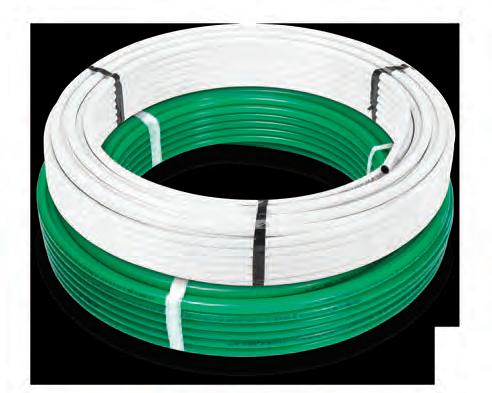
MODERN PUMP SELECTION FOR SYSTEM EFFICIENCY
Time: 6:00 p.m. to 7:00 p.m.
Time: 2:30 p.m. to 3:30 p.m.

Fee: $50.00 for registrations after September 30. Originally developed for ASHRAE, this presentation provides HVAC and plumbing engineers, system designers and mechanical contractors with an understanding of pumping systems and pump selection, as well as the setting of key operating parameters to reduce pump life cycle cost.
Speaker: Larry Konopacz, manager of training and education, Bell & Gossett, Little Red Schoolhouse.
Thursday, November 3
IMPACT OF PLUMBING CODE AND DESIGN ON LEGIONNAIRES’ DISEASE OUTBREAKS
Time: 10:00 a.m. to 12:00 p.m.
Fee: $50.00

CEU’s are available through ASPE as this is an accredited and pre-approved course.
Speaker: Tim Keane, consulting engineer, Legionella Risk Management
BUILDING A PLAN FOR SUCCESS
Time: 12:30 p.m. to 2:00 p.m.
Fee: $40.00
In this session you will learn how to build and execute a successful plan for your business, including: the top 10 building blocks to business success; how to create a successful business plan; how to implement and execute a successful strategy; the daily/weekly/monthly activities required to succeed; and how to implement an effective Territory Management plan. At the end of the session attendees will receive a summary of topics discussed and a suggested process for implementation.
Speaker: Stephen Hnatko, associate speaker and trainer, Trainwest Management and Consulting Inc.
Fee: $40.00

Discover undocumented information on aspects of the codes and standards development process in regards to plastic piping components and their application within the building system. The plastic piping standard development and its relevance to the applicable codes will be explored. Get specific information on performance characteristics for demanding applications, and look at the specifics on the use of PEX piping systems for commercial applications with emphasis on meeting fire resistance requirements. This seminar will be of interest to architects, engineers, designers, inspectors contractors and property owners.
Speaker: Haemi Pollett, PEO, strategic technology, codes and standards manager, Uponor Ltd.
See p60 for Executive Summit description and speaker profiles
See p62 for Hydronic Conference description and speaker profiles
Date: Thursday, November 3
Time: 1:00 p.m. to 4:00 p.m.
Fee: $69.00
Room: 205
With drinking water treatment systems now included in the 2015 National Plumbing code, released March 2016, this course is a good introduction to water treatment or a refresher course if you think your knowledge is dated. Water Treatment 101 will introduce the essentials of water treatment. The topics covered will include water and water quality; water treatment and chemistry; water hardness; iron and manganese; corrosion and pH; TDS (total dissolved solids), hydrogen sulfide, fluorides and other water impurities; and taste, odour and turbidity.
Speaker: Ric Harry, CWQA education chair
See p64 for Exhibitor List
See p66 for Product Showcase






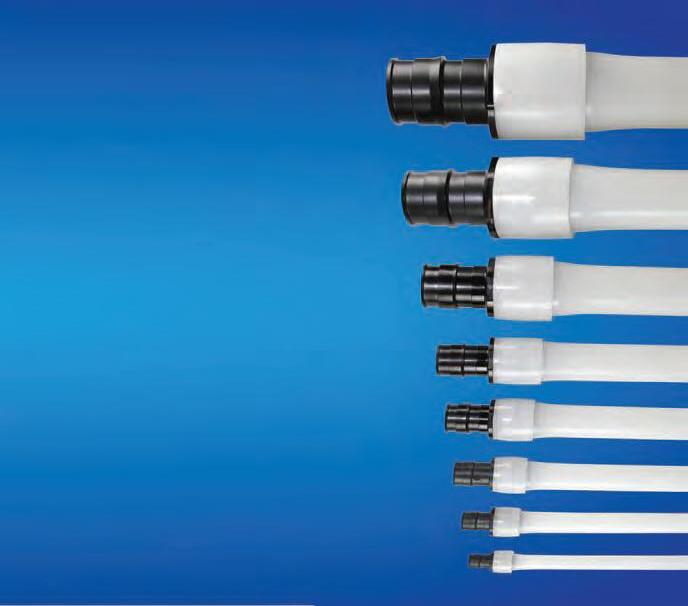
Design and install even more commercial plumbing and hydronic piping systems with Uponor PEX.
If you’ve been using steel, copper, polypropylene or CPVC for your commercial piping projects, you need to take a look at Uponor PEX. It’s a very durable, cost-effective solution for potable-plumbing risers and distribution lines as well as for transporting water to terminal units such as chilled beams and fan coil units.
A new first in the Industry Uponor PEX Pipe and ProPEX® Fittings are now available in larger sizes 2½” and 3” offering professionals who normally use traditional piping products the ability to design and install even more commercial plumbing and hydronic piping systems with PEX.
The pipe offering, which includes Uponor AquaPEX® for potable-plumbing applications and Wirsbo hePEX™ oxygen-barrier pipe for hydronic heating and cooling applications, is available in various coil lengths and straight lengths to meet any application need. And Uponor even offers a PEX-a Pipe Support steel channel for suspended piping applications that enables hanger spacing similar to that of copper.
In fact, Uponor’s suspended piping assembly, including the PEX pipe, PEX-a Pipe Support and ProPEX® F1960 Engineered Polymer (EP) listed to ASTM E84 meeting Flame Spread Index (FSI) / Smoke Developed Rating (SDR) of less than 25/50 for use in plenum applications.
With more than 40 years of proven performance, Uponor PEX is the superior choice for commercial plumbing as well as hydronic heating and chilled water applications. More than 15 billion feet of Uponor PEX is in service worldwide and it is the most tested and third-party listed PEX system in the industry, making it the professional’s choice for durable, reliable, long-lasting performance.
To learn how larger-dimension Uponor PEX can benefit your business, visit www.uponorpro.com/commercialpiping.


Expand your commercial business with large-dimension Uponor PEX piping and ProPEX® fittings.
The Milwaukee® M18™ FORCELOGIC™ ProPEX Expansion Tool generates the power you need to create strong, large-dimension connections fast.
EXPAND YOUR BUSINESS uponorpro.com/commercialpiping


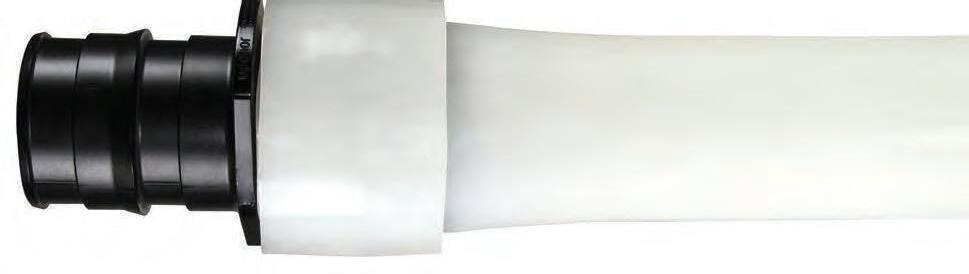

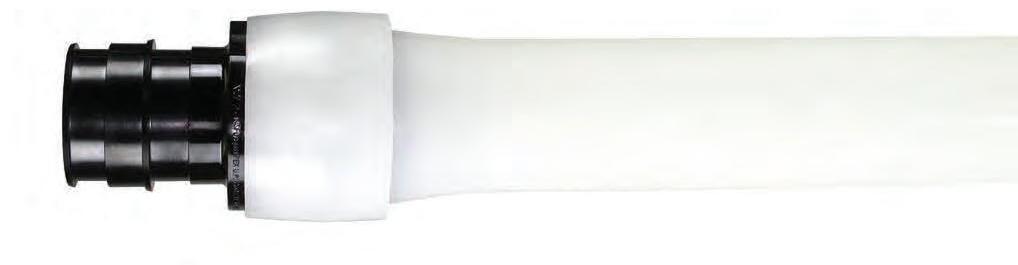
Vancouver Convention Centre, West - Room 109
Program:
7:45 a.m. Buffet Breakfast
8:30 a.m. CIPH Executive Summit
9:45 a.m. Q & A
10:00 a.m. Summit ends. Doors open for CIPHEX West 2016
Join other senior executives and leaders on Wednesday, November 2 in Room 109 for an exclusive and thought-provoking conversation about the digital economy and generating transformational opportunities; sustainable strategies to develop growth and business rewards; understanding what is trending and why in the BC economy; and women in industry: creating new norms in recruitment and development.
Registration of $129 per person includes breakfast, CIPH Executive Summit and admission to the CIPHEX West 2016 trade show. Register online through CIPHEX West 2016 –space is limited to the first 100 people.
Moderator: Richard Dettman
Richard Dettman has been a fixture of the B.C. Lower Mainland radio and television news scene for years. Dettman joined News1130 when it launched in 1996. After leaving broadcasting in 2000, he returned to News1130 in 2004. His voice and face are familiar in the community thanks to daily business reports on CityTV’s Breakfast Television.

Siân Smith
Siân Smith is the senior director of procurement, pricing and IT with Noble Corporation. An industry advocate, Smith encourages women to pursue their career goals within the plumbing and heating industry. She urges organizations to challenge long-established industry norms to ensure they benefit from recruiting and investing in the proactive development of high potential female teammates for nontraditional roles. Smith was the keynote speaker at the 2016 American Supply Association’s Women in Industry Conference. Following completion of her MBA at Wilfrid Laurier University in 1999, Smith began her career in the plumbing and heating industry with Emco Corporation in London, ON. In 2007, she was named vice president, procurement. In November 2013, Smith joined Noble as
senior director of strategic procurement. First elected to the Canadian Institute of Plumbing and Heating (CIPH) board of directors in 2009, she holds the distinctions of being the first female and youngest chairman of CIPH.

Jessie Adcock is the chief digital officer for the City of Vancouver where she is leading a multi-year digital transformation strategy with goals for enhancing citizen services and engagement; improving the city’s technology infrastructure and helping create opportunity for the digital economy. Prior to transitioning from the financial services industry into the public sector in 2013, she was a technology, marketing and digital professional who worked in high-tech globally. Adcock held a series of senior roles in global marketing and IT at HSBC, including responsibility for developing and implementing global digital strategies, application development and online service delivery for consumer and business markets. She also has a wealth of experience working in the telecommunications sector and has worked with multiple global agencies and Fortune 500 brands over the course of her career.

Dr. John Nightingale is the president and CEO of the Vancouver Aquarium. As a professional biologist and public educator, Dr. Nightingale has been responsible for the development and operation of some of the world’s best aquariums. His background and lifelong work in public communications and both formal and informal public education make him a leader in the current rapid development of new conservation efforts in aquariums, zoos and museums. During his years at the Vancouver Aquarium, he has guided the expansion of the aquarium’s leadership in conservation and research while focusing operations on sustainability and solid fiscal performance. As a result, the Vancouver Aquarium is not only one of the “greenest” cultural institutions in Canada, it is the only one that is financially self-sufficient.
Wednesday | November 2 10 am – 8 pm
Thursday | November 3 10 am – 4 pm
VANCOUVER CONVENTION CENTRE
LATER HOURS ON WEDNESDAY SO YOU CAN VISIT THE SHOW AFTER WORK!



Learn about new technologies that can help grow your business
Your CIPHEX West badge will give you FREE admission to the BUILDEX Express exhibits on Nov. 3

Take advantage of the stream of information and ideas to help increase your profits
Meet with over 3,000 industry professionals
WESTERN CANADA’S LARGEST MEETING PLACE FOR THE HVACR, PLUMBING, HYDRONICS & WATER TREATMENT INDUSTRIES
• meet more than 200 exhibitors
• see thousands of products, in hundreds of categories
• visit the New Product Showcase
• find new ideas to help you design and install
• get answers from technical experts
• increase your knowledge & expertise at seminars and workshops
The Canadian Hydronics Council (CHC) is holding the second Canadian Hydronics Conference in conjunction with the CIPHEX West 2016 trade show, November 2-3 at the Vancouver Convention Centre.
SESSIONS:
Wednesday, November 2 Room: 205
HYDRONIC SYSTEMS USING LOW-AMBIENT
AIR-TO-WATER HEAT PUMPS
Time: 7:30 a.m. - Continental breakfast 8:00 a.m. to 12:00 p.m. - Workshop
Fee: $129.00
Includes admission to the CIPHEX West Trade Show (exhibits) and breakfast
This session will focus on the emerging technology used in heat pumps that can absorb heat from very low temperatures (sub 0F) and use that heat to produce water temperatures up to 130F. You will learn about their unique operating characteristics and see several ways to incorporate these heat pumps into a system that provides space heating, cooling and domestic hot water.

Speaker: John Siegenthaler, P.E., Appropriate Designs
A regular speaker at CIPHEX, John Siegenthaler, P.E. is the leading hydronics educator in North America. “Siggy” has over 30 years of experience in designing modern hydronic heating systems including several using renewable energy subsystems. He is principal of Appropriate Designs, a consulting engineering firm in Holland Patent, New York, and is a regular contributor to HPAC magazine.
SYSTEMS EFFICIENCIES AND COMFORT:
WATER (HYDRONICS) VERSUS VAV AND VRF
TIME: 1:30 P.M. - 3:30 P.M.
FEE: $35.00
This session will discuss and compare efficiencies of the three major types of HVAC systems: hydronic, air and refrigerant. Examples of efficiencies of operating projects will be presented and discussed, as will an analysis of manufacturers published AHRI efficiency data and a comparison with the results of operating projects. A methodology will be presented to compare efficiencies of different HVAC systems using manufacturers’ AHRI published equipment efficiency data.

Speaker: Greg Cunniff, manager of application engineering, Taco, Inc.
Greg Cunniff has experience with his own businesses as a consulting engineer for 10 years, a manufacturer’s representative and building automation system contractor for 10 years and a design-build contractor for 10 years. He has been in his current position since 2000.
UP YOUR HYDRONIC SALES – TIPS TO GROW YOUR BUSINESS
Time: 4:30 p.m. to 5:30 p.m.
Fee: $25.00
Attendees will leave this session armed with new ideas and tools to increase sales including: the top benefits of hydronic heating for home-owners; trends in hydronic heating; Insight into the minds of consumers and how to connect with them; five ways to promote your business via social media; tips for packaging your services; and ways to set your business apart

Speaker: David Hughes, Northern Alberta Institute of Technology
David Hughes is associate chair (special projects), pipe trades with the Northern Alberta Institute of Technology. He is also the current chairman of the Canadian Hydronics Council (CHC).
Thursday, November 3
Time: 8:00 a.m. to 12:00 p.m.
Fee: $129.00 Includes admission to the CIPHEX West Trade Show (exhibits) and breakfast
John Siegenthaler explains the specific operating characteristics of pellet-fired and cordwood gasification boilers, and how modern hydronics can be used to create a system that respects these characteristics. Topics covered will include boiler operating characteristics, boiler protection, thermal storage tank piping and control methods, integration of auxiliary boilers and several complete system designs. You will see how off-the-shelf hardware can be combined in unique ways to create systems that burn carbon-neutral fuels and deliver unsurpassed comfort.
Speaker: John Siegenthaler, P.E., Appropriate Designs
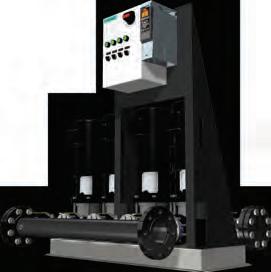
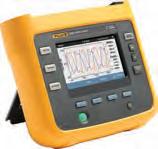

ACO Systems 126
A.M.T.S. Limited ....................................... 610
A.O. Smith 201
ACPP Custom Plumbing Parts 210
AIC Heat Exchangers 608
Action Car & Truck 643
Advance Metalpres 732
Aimco International 730
Allied Engineering..................................... 836
Amerec 138
American Standard Brands 219
Anvil International Canada 914
Aprilaire 108
Aqua Tech Sales & Marketing Inc. 724
Aquatherm 523
Argco ....................................................... 923
Armstrong Fluid Technology 619
ASPE BC Chapter ..................................... 128
Axiom Industries Ltd. 626
B.A. Robinson Co. Ltd. 228
Barclay Sales Ltd. 112,122
BC Safety Authority 806
BC Water and Waste Association ............. 129
BCIT 235
Beaver Plastics Ltd. 830
Belanger-UPT 127
Bibby-Ste-Croix 405
Blanco Canada Inc. 120
Blue Angel 138
BMI Canada Inc ....................................... 211
Brady 232
Bosch Thermotechnology Corp. ................ 837
Boshart Industries Inc. 222
Bradford White Canada Inc. 737
Burnaby Mfg. Ltd. 807
Canadian Water Quality Association 709
Canature WaterGroup............................... 424
Canplas Industries Ltd 437
Carlo Gavazzi (Canada) Inc. ...................... 609
CB Supplies
CCTF Corporation 736
Centrotherm Eco Systems 428
Chemline Plastics 531
Conbraco/Apollo Valves 100
Copper Development Association 227
Dahls Bros 140 Danfoss
Emona
Enercall
Enerpro Systems Corp.
Excalibur
Ratech
Rinnai
Selkirk
Service Roundtable
Sinus North America Mfg. 829
SJE Rhombus & Primex 811
Spartan Peripheral Devices 823
Spectrum 130
Stelpro..................................................... 119
Stiebel Eltron, Inc. 506
Sunrise Tradex Corp. ................................ 213
Taco (Canada) Ltd. 713
Tamas Hydronic Systems 834
TB Concept Inc. 700
Thermal
TomTom Telematics Inc./Virtace Inc.
Sandale



The HeatMatrix from SunTouch, a Watts brand, is an uncoupling membrane installation solution for WarmWire underfloor electric radiant heating. Heating wire may be installed horizontally or vertically to accommodate a variety of underfloor spaces. It has less rollback memory and offers installers the versatility to vary wire spacing, allowing customers a choice of different heat outputs. The membrane can be installed using modified thinset on top and bottom of the mat. The heating wire sits below the surface of the mat. In addition, the thicker, constant diameter wire offers increased durability and is made specifically for securement in the HeatMatrix membrane. www.suntouch.com.
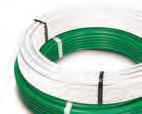
VIPERT’s recyclable potable and radiant tubing products from CB Supplies offer increased flexibility and are compatible with many popular fitting systems. Suited to residential and commercial potable water distribution, the polyethylene-raised temperature potable tubing comes in ½-in to two-inch diameters. The polyethylene-raised temperature with oxy-barrier radiant tubing is available in ½-in., 5/8-in., ¾-in. and one-inch diameters. Both products have a 25-year warranty and are designed to perform at extreme outdoor temperatures. www.vipert.ca
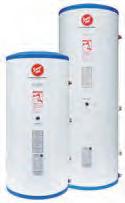
Seventy-nine and 119 US gallon single coil tanks are among the latest additions to Allied Engineering’s EPJ indirect tank line-up. The tanks, along with its 40 and 56 US gallon models, are constructed of 444 stainless steel, which has been passivated and pickled for improved corrosion resistance and durability. The casing has been designed using polypropylene plastic for scratch, dent and rust resistance.
http://alliedboilers.com
Heat-Sheet insulation panels for hydronic applications from Beaver Plastics Ltd. feature a multi-directional grid design, interlocking panels and positive friction fit. The compact two-foot by four-foot panels are available in several thicknesses that will accommodate ½-in. and 5/8-in. I.D. tubing. R-Values range from R4 to R14. The panels are also available in commercial grade versions that will accommodate ¾-in tubing. Tubing is stepped into the panels. www.heat-sheet.com

Belanger-UPT’s H2flo Vogue lavatory faucet has a solid brass body and 9/16-in. IPS connections with flexible stainless steel braided connectors. Features include a maximum flow of 1.5 gpm at 60 psi and a ceramic cartridge. The low lead (less than 0.25 per cent), single-hole faucet (minimum one-inch hole) is available in polished chrome. A Presto drain is included.
www.belanger-upt.com
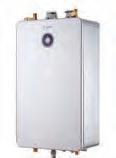
Suited to residential and commercial applications, the Greentherm 9900i series gas condensing tankless water heater from Bosch Thermotechnology Corp. has a recirculation pump, and Wi-Fi control on the i-Series CDi models. Rated at .98 EF, the units have a minimum capacity of 9000 Btu with a minimum activation flow rate of 0.4 gpm. Features include top-mounted water connections on indoor models, up to 280 ft. of venting with three-inch pipe, ½-in. gas connection and a built-in recirculation pump (optional model). The water heaters’ heat exchangers are copper primary and stainless steel secondary. Active bypass eliminates the need for a buffer tank, even with varying water flow rates and supply water temperatures. Conversion to LPG is enabled with a manifold injector. www.boschheatingandcooling.com
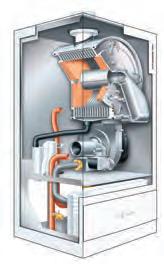
CondenSafe’s modular commercial condensate neutralizer unit from Calefactio allows commercial users to neutralize acidic condensate in boilers with a 3500 MBH capacity (1026 kWh). Equipped with a stainless steel plate, each unit is made of roto-moulded plastic containing Calefactio’s own engineered media. Its modular design allows up to three units to be installed in series, tripling treatment capacity to 10,500 MBH. A double-walled reactor features additional buffer volume for preneutralization. Preneutralized condensate flows up vertically
through the reactive media for better spatial distribution of condensate throughout the reactor.
www.calefactio.com
Canature WaterGroup offer the Aqua Flo Platinum line of third-party certified, POU filtration products. The filtration systems consist of a filter housing that connects to the plumbing system and a disposable filter cartridge. Depending on the application, systems can consist of a single or series of housings installed at POU or POE. Filter cartridges are designed to be easily replaced, typically on an
• UL/ULC classified 2-hour fire rating
• Factory built for consistent high quality and durability
• Eliminates need for separate firerated shaft wall construction and field fabricated ductwork (single wall duct design available for existing shaft walls)
• Low material and labor costs
• Simple and quick to install
• Available with one or more integral subducts – ideal for clothes dryers, bathroom fans and range hoods
• Limited Lifetime Warranty
annual or semi-annual basis depending on incoming water quality. The filters remove iron, dirt, silt, clay and other sediments, and minimize odours, including chlorine. www.canaturewg.com
Franklin Electric’s FPS IGPDS dual seal grinder pump series utilizes two mechanical seals, coupled with sensor probe and seal leak detection circuitry in the panel. This provides added pump protection and extended overall pump life. It pumps sewage slurries up to 130 ft. and features a patented cutting system that grinds at 414,000 cuts per minute. www.franklinwater.com
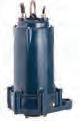
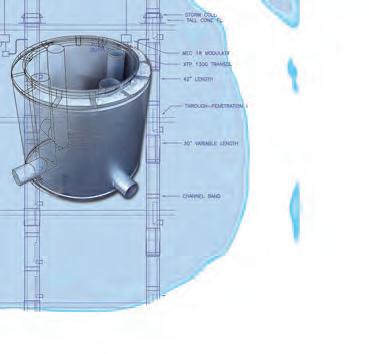

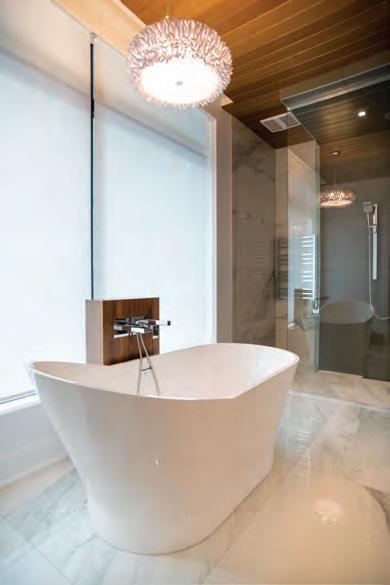
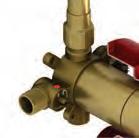
PEX and expansion PEX valves:
No need to weld inside walls
Eliminate the risk of water damage 3 to 4x faster to install
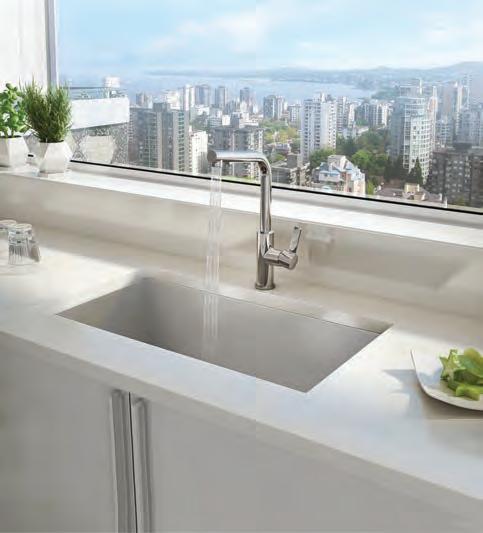
Also available, NPT or sweat valves
No more worrying about damaging the trim:
Rough for valves can be purchased separately from Riobel trims
Roughs for valves and freestanding faucets are universal
Come visit us at the CIPHEX in Vancouver, booth 212, November 2 and 3!

The Eco-King condensing wall hung boiler from King Heating Products has been revamped with a matte black cover. The boiler has a 6:1 turndown ratio and comes in three sizes ranging from 100,000 to 200,000 Btu. Combi models have on demand hot water, while H models connect to indirect tanks via a temperature thermistor. They feature a fully integrated expansion tank and Grundfos pump, and have outdoor reset capability and multiple venting options. Separate DHW and CH connections simplify installation. www.ecokingheating.com

The Triton Series compact, vertically fired water tube boiler from Ace Heating Solutions is available in 800MBH, 1,000MBH, 1,500MBH, and 2,000MBH. Features include modular design, low emissions, advanced controls and a double pass, double row high finned copper tube heat exchanger. Units have custom cast iron one-piece gasketless headers and built-in lead-lag capability for up to eight boilers. The boilers, which are certified seismic design, are available in natural gas or LP gas. www.emonasales.com
The Grundfos SCALA2 is a fully-integrated water booster pump designed to deliver perfect water pressure to all taps. The pump, motor, tank, sensor, drive and non-return valve are contained within a compact unit. With its intelligent pump control, SCALA2 adjusts performance to demand. A water-cooled motor lowers noise levels. Features include intelligent pump control, permanent magnet motor, dry running protection and a user-friendly control panel. It is self-priming and outdoor-ready. www.grundfos.ca
Allows site water to be used for filling any hydronic system while meeting the strict water quality requirements of boiler and glycol manufacturers

Introducing the DM284, an all-in-one True RMS digital multimeter and thermal imager that show you exactly where an electrical problem is to speed up troubleshooting.
Infrared Guided Measurement (IGM™) is the future of instrument and tool technology. Plain and simple. And for the hardworking professionals in the building and electrical industries, it’s the perfect addition to the toolbox. By helping you identify and verify problems invisible to the naked eye, you’ll save time, money, and maybe even lives.
Request a demo from participating distributors at FLIR.ca/DM284
· THERMAL IMAGING AT YOUR FINGERTIPS
· CONVENIENT, ALL-IN-ONE TOOL
· PINPOINT PROBLEMS QUICKLY
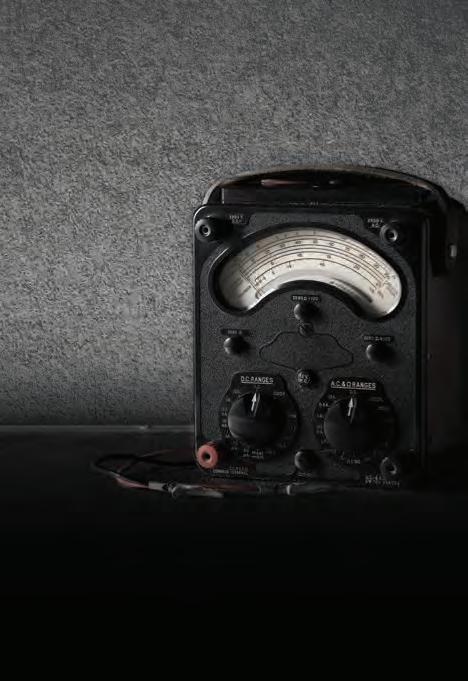



The Chef Center system from Franke features two anti-microbial compartments that serve as a composter, wine bucket or storage bin. Crafted from 18-gauge stainless steel, it comes with a number of custom accessories, including a mobile drainer board, push button remote controlled operated strainer basket, cutting board, colander, grid and Franke’s Roller Mat. A wide basin (available in 30- or 36-in.) accommodates large pots and pans and the sink reveal allows accessories to lay flat on the sink ledge and slide from side to side. Franke is preparing to launch its Chef Center in Canada in March 2017. www.franke.com
Masters Pro-Dope is a non-toxic, non-corrosive, non-hardening PTFE pipe thread sealant. The paste seals metal and plastic threaded connections against liquid and gas leakage to 10,000 psi and from -200F to +400F (-129C to +204C). It is certified to NSF/ANSI 61 and 372. www.gfthompson.com
Gerber has expanded its Wicker Park Collection with the addition of new rectangular and square lavatory sink options. The rectangular sink options include a countertop model (shown here) that mirrors a vessel option by sitting on the counter, yet fits like a drop-in sink for a 7.25-in. deep basin. For space savings, the overall size of the sink is slightly smaller. A

drop-in model has a U-shaped bowl design to help contain the splash and simplify cleaning. It is suited to hospitality, commercial and residential applications where retrofits are being made in existing counter cutouts. The rectangular under-counter sink has a 17 in. by 13 in. washbasin.
www.gerberonline.com
flexible 1 ½-in. pipe, remote and has a crystal black panel with LED display. The filter is washable.
www.gree.ca

Giant’s commercial gas water heaters are available with capacities of 55, 80 and 119 gallons, in either natural or propane gas. Thermal efficiency is up to 96 per cent and output ranges from 100,000 to 199,000 Btu. Other features include a stainless steel 316 L inner tank, load matched modulating burner for maximum fuel efficiency and low NOx emission. w ww.giantinc.com

The ForestAir cooling dehumidifier fan features compact design, quiet operation, as low as 42 dB(A) for the indoor unit, leak proof detachable valves to facilitate installation and an outdoor unit with built-in condensate pump. The mini portable air conditioner comes with 10 ft. of
The Flir DM284 imaging multimeter is a professional, all-in-one true RMS digital multimeter and thermal imager designed to identify electrical problems and speed up troubleshooting. Featuring infraredguided measurement (IGM) technology powered by a built-in 160x120 Flir thermal imager, users can scan panels, connectors, and wires without requiring any direct contact. When the issue is pinpointed, the multimeter can verify and confirm findings with advanced contact measurement features. Thermal colour palettes include iron, rainbow and greyscale. www.flir.com/DM284
The Magnum DVR command module form Hathorn Corporation features USB recording and a new navigation menu. With the 10.4-in. daylight readable monitor images can be seen clearly in bright sunlight. The system has a full-size keyboard, 16 pages of text writing, 512 Hz sonde, on screen footage counter, 8X zoom, microphone, speaker and a two hour built-in battery with smart charger. There are several different reel options available along with five different camera head sizes. www.hathorncorp.com
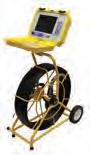












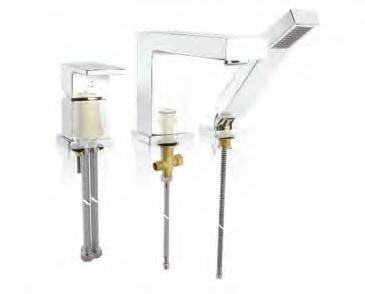

The HeatLink BTU Metering Panel enables developers to install hot and cold water meters and thermal meters for each building unit. The unit is then billed and pays according to its actual water and energy usage. Each panel includes a recessed housing (visible parts are satin coated) with coin/screwdriver locks, stainless steel manifolds in two, three, or four loop configuration with 1.5 US gpm circuit flow rate and flow meters, a prewired 24Vac transformer and StatLink Base Module. With the addition of thermostats and actuators the manifold allows for zoning hydronic systems. Panels are shipped with spool pieces as placeholders for third-party supplied water and thermal meters. www.heatlink.com
The national Thermostat Recovery Program (TRP) has been in operation since 2006. It was previously known as Switch the Stat. To date the program as successfully collected over 134,000 thermostats.
Over 1,600 contractors, wholesalers, municipalities and regional districts are participating.
The program helps to ensure old mercurycontaining and electronic thermostats are responsibly captured and recycled rather than sent to landfill. www.hrai.ca
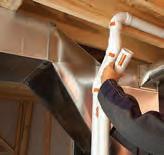
System 636 flue gas venting from Ipex is fully Certified to ULC S636. System 636 PVC is rated for temperatures up to and including 65C. System 636 CPVC is rated for temperatures up to and including 90C. Installer training is available that focuses on proper solvent welding and more.
ipexna.com
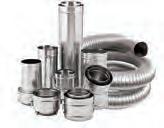
Secure Seal special gas vent by Security Chimneys is manufactured from AL29-4C, a super-ferritic stainless steel designed for extreme resistance to chloride ion pitting, crevice and stress corrosion cracking, as well as general corrosion in oxidizing and moderately reducing environments. The vent features a smooth weld seam inside and out, which is completely shielded during the welding process. Contamination or molecular changes in the weld seam are avoided and no fillers are used in the welding process. The double-wall system is fully interchangeable with the company’s Secure Seal single-wall system; both conform to UL1738 and are certified to ULC-S636 safety standards.
http://securitychimneys.com

The 2016 Metris cargo van has an overall height of 189 cm (74.4 in.), with 5.27 m3 (186 cu. Ft.) of cargo space and up to 1135 kg (2502 lbs.) of payload capacity. Overall length of the van is up to 514.1 cm (202.4 in.). Interior height is 136.7 cm (53.8 in.). Features include Attention Assist, which detects fatigue and alerts the driver, and Crosswind Assist. The mid-size van is equipped with a 2.0 L, four-cylinder turbocharged engine. www.vancouver.mb-vans.ca/
The Big Max large capacity grease interceptor from Mifab is a rotational moulded HDPE plastic grease interceptor available in 75 and 100 GPM flow rates. Suited to outside installations, it is standard with a 24-in.-high dimension from the inlet/outlet to the top of the interceptor making extensions less likely. If an extension is needed, the design uses a standard 18-in. corrugated drainage pipe. www.mifab.com

Milwaukee’s M18 Redlithium High Demand 9.0 battery pack is designed to deliver more run-time, provide more power and run cooler than standard lithium-ion batteries. It is compatible with the entire M18 system and is optimized for high draw M18 Fuel tools and solutions needing sustained power and run-time for applications.
www.milwaukeetool.com


Compatible with any valve or showerhead, the new Annex chrome shower rail system from Moen meets the ADA pull-force requirement of 250 lbs. A hand shower and slide bar can be added to the existing shower arm connection point in the wall without tearing through a finished wall. It features a built-in two-function diverter to simply switch from showerhead to hand shower. To simplify installation it has 2½-in. adjustability to accommodate varying wall thicknesses. Moen’s limited lifetime warranty applies.
www.moen.ca

NaviLink is designed to support remote access for all Navien tankless water heaters (NPE series), combi-boilers (NCB-E series) and gas condensing boilers (NHB series) through the new NaviLink Wi-Fi control and mobile App. Smart phone and tablet owners can control temperatures remotely, access usage data, receive diagnostic notifications and remotely activate recirculation with the HotButton accessory. It reports and monitors diagnostic data through the companion App along with error code notification. The following information may be reported: DHW and space heating
set temperatures, current DHW temperature, DHW flow rates, inlet water temperature, total DHW consumption, average firing rate, cumulative gas consumption, and on demand activation tracking.
www.navien.com

The NextGen electric boiler is suited to radiant heating applications. Engineered into one plug-and-play system, it includes a stainless steel heat exchanger, Wilo three-speed circulating pump, expansion tank, air vent, safety relief valve and a user-friendly control panel. Standard features are four to 14.4 kW output, 13,652 to 49,147 Btu output, modulated three-stage heating, temperature output of 85F to 140F, stainless steel heat exchanger, and primary/secondary pump relay control. A flat expansion tank is housed inside the boiler. The control panel includes inlet and outlet temperature readings, precise temperature control, flow rate reading (GPM), pressure reading (psi), Btu output reading, fault code reading and pump exercise mode. www.nextgenboiler.com

to pipe systems to allow repairs and alterations to be carried out without the need for a major building shutdown. The system utilizes liquid
nitrogen to create freeze plugs within the pipe that act as de facto shut-off valves. Repairs or alterations can then be carried out downstream. www.nitropipefreeze.com
Oetiker’s stainless steel, one-inch StepLess Ear Clamp with PEXGrip technology is preset and grips the tube for simplified installation. The narrow band concentrates transmission of clamping force and 360° StepLess sealing technology allows for uniform compression. Features include tamper detectable design and a standard ear. The clamps are patent pending, certified by NSF to meet NSF/ANSI 14 requirements and conform to ASTM F877/ F2098 standards. www.pex.technology
RedZone’s HVS high velocity air handler’s sloped top reduces air noise and easily attaches to eight-inch diameter duct. Low water flow for domestic water prioritization reduces the need for hot water storage. Engineered low-flow water technology with the high velocity design reduces the need for priority flow management. Models include a 35,000 Btu and a 46,000 Btu (based on 140F water temperature) unit. An ECM motor is standard on both models. Units have an 18-in. by 18-in. by six-row water coil and an external three-speed Grundfos water pump. If there has not been a call for heat within a 12-hour period the circulator will turn on for two minutes to eliminate the risk of bacteria. www.redzone-products.com




















































The Exdirt for in line dirt separation from Reflex Winkelmann GmbH creates a chamber of lower velocity in the lower part of the unit where dirt or sediment will be forced to fall down. Opening the tangentially positioned draining valve causes a vortex effect inside, which assists the draining process. Models include brass with NPT thread, steel with welded or flanged connection, and steel with inspection opening, welded or flanged connection. All have a maximum operating pressure of 150 psi and a maximum operating temperature of 230F. There is a magnetic alternative. www.reflex.de/en

REHAU’s Raupex Speed radiant overpour fastening system is designed to speed up the installation of heating pipe in overpour and concrete installations. The O2 barrier pipe with hook-and-loop wrap is walked on to the mat without the use of specialized tools. The Raupex Speed mat features an adhesive backer that attaches to a range of different thermal insulation, concrete and plywood materials without penetrating the surface. Pipe can be detached and repositioned. http://na.rehau.com/speed
SharkBite Tee Stops allow the user to tap into existing supply lines to add fixtures and appliances with the speed and convenience of push-fit connections to the final phase of plumbing projects. The SharkBite Tee can be used on Copper, CPVC, PEX and PE-RT. Available sizes include: ½-in. x ½-in. x ½-in. COMP; ½-in. x ½-in. x 3/8-in. COMP; ¾-in. x ¾-in. x ¼-in. COMP; ¾-in. x ¾-in. x 3/8-in. COMP; and ½-in. x ½-in. x ¼-in. (3/8 in. OD) SB. www.sharkbite.com
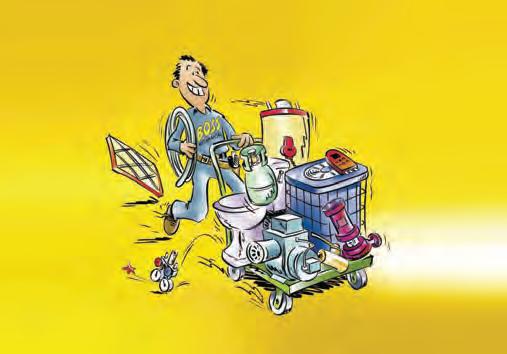
Catch a professional regular season hockey game in Canada or the U.S.A.
The Grand Prize includes:
• 2 PREMIUM TICKETS
• FLIGHTS & ACCOMMODATIONS FOR 2 PEOPLE
• PRE-GAME DINNER FOR 2 PEOPLE
• 2 AUTHENTIC JERSEYS
• $500 CAD SPENDING MONEY
* Maximum total retail value approximately $6,000 CAD
When IPEX introduced the first ULC S636 certified PVC & CPVC flue gas venting systems in 2007, we dedicated ourselves to earning your confidence.. We continue to provide training seminars, installation manuals, and an expansive certified product range with a coast-to-coast distribution network. IPEX is committed to supporting you with the most complete product line to get the job done on-time and to the finished quality you expect.


A chrome wall-mount thermostatic pressure balance coaxial tub filler with hand shower from Riobel has a ½-in. inlet female NPT. Features include thermostatic/ pressure balance coaxial cartridge with check valves, service valves, one-jet hand shower/scale free and two-way non-shared. The flow rate is 20.5 L/min. 5.4 gpm (US 60 psi).
https://riobel.ca/en/

The Sanicompact is a self-contained residential system suited to installations of a half-bathroom up to nine feet below the sewer line, or up to 100 feet away from a soil stack with gravity fall. It can handle the effluent from a toilet and sink. It is designed for applications where space, water usage and venting are restricted. www.saniflo.ca
Stopcon Technologies offers a compressed CO 2 -powered pneumatic pipe plug system. The EPS-Mini is designed for plumbers looking for a
dependable, portable and affordable pipe plug system. It features a patented gas system that inflates a plug into sewer lines, floor drains, toilet flange, or piping in less than five seconds allowing for single person operation. Five four-inch plugs can be inflated with one charge. www.stopcontechnologies.com
Taco’s 007e is a high-efficiency wet rotor circulator with an ECM permanent magnet motor. It is suited to closed loop hydronic systems zoned with circulators or zone valves. It features dual electrical knockouts, six-inch stranded wire leads for easy wiring and integral flow check. Maximum flow is 16 GPM and maximum operating pressure is 125 psi. The pump is acceptable for use in applications with water or a maximum of 50 per cent water/glycol solution.
www.taco-hvac.com
Tamas Hydronic packaged booster pump systems allow for a single point of reasonability while ensuring better overall pumping efficiency. The Tamas control box is programmable up to five pumps for a single VFD and has LED operational lights. Its manual override switches can be set to automatic (VFD run), manual (full
output) or in the off position. These features allow any potential servicing that may be required to be carried out safely without having to compromise the building load and keep the system running. The systems can be wired to accommodate duty standby, parallel and cascade applications.
www.tamashydronic.com
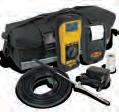
The C85KIT portable combustion analyzer from UEi incorporates electro-optical sensor (EOS) CO2 measurement technology, which means the gas does not touch the sensor. Suited to residential and light commercial applications, the device measures CO2, CO and flue temperature and calculates 02, efficiency, excess air and CO air free. It includes a long life CO sensor. The multimeter style rotary selector allows quick access to parameters.
www.ueitest.com

Mem, which is Valley Acrylic’s Coco Chanel inspired collection, features a polka-dot designed circular sink, faucet and furniture set. Created from high durability Shila Stone, the 16.5-in. by 6.5-in. basins are offered in over 15 colours.
www.valleyacrylic.com
Now featuring a snap off Test Cap!
Install a Freestanding Bath Tub in minutes with our Patented ITD35 (ABS) / ITD5135 (PVC) - for wood sub floor install or ID357 (Cast Iron) - concrete slab install Drain Rough-in.
No muss. No fuss. No kidding. Your job just got easier.



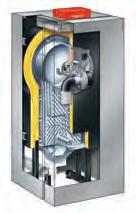
Viessmann’s Vitocrossal 300 CU3A gas-condensing boiler is suited to residential and light commercial applications. The vertical stainless steel Inox-Crossal heat exchanger results in efficiencies of up to 98 per cent. Large water content is contained within the pocket design of the heat exchanger. This allows for simplified system piping with full system flow, eliminating the need for a dedicated boiler pump or primary/secondary piping. The Vitotronic 200, KW6B control manages the entire heating system. Features such as control of up to three heating circuits, intelligent DHW control, a variable speed pump output (0-10V), and multiple setback timers all give the user complete control of their system. www.viessmann.ca

Weltem’s portable air conditioner is designed to cool users through flexible cooling ducts. Features include metal construction, washable filters, an off-timer, spot and room cool function and auto restart. An optional drain pump kit is available. Safety features include compressor time delay, compressor overload protection, high-pressure
switch, self-diagnostic functions, an anti-freezing thermistor and drain overflow protection. www.weltam.com
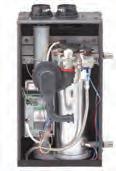
Weil-McLain Canada’s wall or floor mount ECO boiler delivers flexibility in 70, 110 and 155 MBH sizes. Designed for retrofit installations, it delivers up to 95.2 per cent AFUE. Features and benefits include stainless steel fire tube heat exchanger, a high water content heat exchanger that allows direct connect system piping, one-space heating zone plus DHW priority, five to one turndown, one-screen programming, and quick clip design for easy service and maintenance (70 and 110 sizes). A 3.5-in. LCD display can be mounted on the boiler or a wall up to two feet away. Vent with S636 PVC, CPVC, PP or SS venting up to 100 ft. for both exhaust and air intake.
http://weil-mclain.ca/products/eco/

Winters Instruments has launched a line of lead free pressure gauges, thermometers and accessories. The line has been manufactured to comply with the 2014 U.S. Safe Drinking Water Act. The act, which took effect January 4th,
2014, limits the amount of lead content of all products installed in potable/drinking water systems.
www.winters.com
The PHIX acid neutralization cartridge from Zurn is installed under the sink in applications such as school laboratories, healthcare facilities, maintenance and commercial rinse sinks. NSF certified PHIX media does not require special equipment, storage or handling. The media is formulated to last longer than limestone for lower maintenance. Its compact design is suited to retrofit applications. The durable glass-filled polypropylene construction is backed by a 10-year warranty.
www.zurn.com
Viega offers six new, extended no-stop coupling options for the Viega MegaPress and MegaPressG systems for joining schedule 5 to schedule 40 black iron pipe in sizes 1/2 in. to 2 in. The MegaPress system uses modern cold press connections for pipe installation and is suited for hydronic heat, chilled water, compressed air, fire sprinkler systems, low-pressure steam and vacuum lines. The MegaPressG fittings are designed for use in fuel oil and natural gas applications. The extended no-stop couplings are available in 1/2-in., 3/4-in., 1-in., 1 1/4-in., 1 1/2-in. and 2-in. sizes.
www.viega.us
You could walk away with thousands of dollars in FREE tools while attending CIPHEX West 2016! Visit hpacmag.com/tools to check out all the tools and visit the suppliers’ websites. Stop by the HPAC booth (#401) and you’re in! Good Luck – see you at the show!
DeWalt 1/2” VSR Stud and Joist Drill (DCD460)
Featuring DEWALT’s new FLEXVOLT™ system. The FLEXVOLT™ battery is the world’s first battery that automatically changes voltage when the user changes tools. It powers a new lineup of brushless 60V MAX* and 120V MAX* FLEXVOLT™ tools. www.dewalt.com
Viega ProPress® Tool Kit


Viega’s flameless press technology system reduces installation times by up to 60%. Viega ProPress enables installers to make press connections in difficult-to-reach areas. www.viega.us
UEI COA1 Carbon Monoxide Detector Adapter
Compatible with most iOS and Android platforms the COA1 turns your compatible smart phone into a CO detector that reads to 999 ppm with 1 ppm resolution. www.ueitest.com

Milwaukee M18 FUEL™ 2-Tool Combo Kit with ONE-KEY™ (model # 2796-22) M18 FUEL™ features the most advanced cordless technology available, resulting in longer motor life, more run time and more power. Both tools feature ONE-KEY™ technology. www.milwaukeetool.ca

Uponor ProPEX Expansion Tool
The M18™ FORCE LOGIC™ 2” - 3” ProPEX® Expansion Tool combines with the M12™ and M18™ ProPEX® Expansion Tools to deliver the industry’s most consistent commercial installations. www.uponor.ca

Digital Multimeter
The testo 770-3 includes real-time power measurements (Watts), Power Factor, and Bluetooth. The Testo App can be used for remote viewing, monitoring, data logging, and creating reports. www.testo.com
For your chance to win these products come to CIPHEX West in Vancouver NOVEMBER 2-3. Stop by the HPAC booth and you’re in!
Visit www.ciphexwest.ca for show details

The FLIR ONE is a lightweight accessory for your iOS or Android Device that shows you the world from a “Thermal Perspective” with live thermal infrared imagery using the FLIR ONE iPhone app. www.flir.com
“The creation of the GPG platform provides the foundation to accelerate growth in our plumbing segment,” said Fortune Brands CEO Chris Klein in a company release. “Most importantly, the GPG platform enhances the poten to grow plumbing sales to $2.5 billion by 2020.”

Nicholas Fink, who had been leading the company’s global growth and development team, has been named president of the GPG. While leveraging the company’s existing global supply chain and broad distribution network, the new structure is expected to lead to further acquisitions, joint ventures, supply agreements and distribution agreements.
Founded in 1995, Riobel is a premium showroom brand. It is based in the Montreal suburb of St. Jerome.
The brands will retain their own identities, teams, locations and partners, and other elements of the businesses.
Entries are now being accepted for the 2017 Best of KBIS Awards. Presented annually at the Kitchen & Bath Industry Show (KBIS), the Best of KBIS awards recognize the best new kitchen and bath products of the year. A committee of five design professionals will judge this year’s competition. The deadline to apply is November 11, 2016. www.kbis.com/show/best-of-kbis/

Kevin Ernst, general manager of Oakville Bending & Stamping, is the sixteenth recipient of the Joseph K. Seidner Award. The award, which was established by the Canadian Institute of Plumbing & Heating (CIPH) in 2000, recognizes outstanding contributions to Canadian plumbing codes and standards. Ernst received the award at the annual Canadian Advisory Council on Plumbing meeting in Ottawa on August 16.
“Kevin is one of the new breed of codes and standards developer that we critically need,” said CIPH president and general manager Ralph Suppa. “He has been an integral part
of the codes and standards development community in both Canada and the U.S., participating on several technical committees, task groups and industry advisory bodies over the last 25 years.”
In other CIPH news, it has announced that its Annual Business Conference will take place June 25 to June 27, 2017 in Ottawa, just prior to the 150th Canada Day Celebration in the Nation’s Capital. CIPH has secured a block of rooms at the Delta City Centre from Friday, June 23 to Wednesday, June 28. For more details contact Nancy Barden: ontario@ciph.com or 519.855.6474. www.ciph.com

Each truck features mounted high-definition monitors and a touchscreen tablet, offering informative how-to videos and overviews of Lennox’ proprietary apps that support commercial customers
Lennox Commercial took its light commercial products on the road with the new Innovation Trucks, bringing customers the opportunity to view and interact firsthand with the latest in HVAC technology. Among the first to take equipment on the road with the original Energence Trucks, Lennox has converted commercial box trucks into mobile show.rooms to exhibit products for customers across the country. Outfitted with interactive and informative displays, customers can personally experience Lennox Commercial’s most advanced and efficient products.
“Our vision is to give our customers a better picture of how Lennox Commercial will be a solution for them,” said Mike Walker, vice president of sales, Lennox International. “Seeing the products firsthand allows customers to go beyond a concept to truly visualize how the products can work in their projects.”
The Lennox Innovation Trucks made stops in Edmonton, Calgary, Burnaby, Brampton, London and Waterloo through July and August. www.LennoxCommercial.com
Ford and Mercedes-Benz dominated the commercial cargo van categories in Vincentric’s fifth annual Best Fleet Value in Canada awards. Ford led the way with three awards, while Mercedes-Benz topped two categories. Winners are as follows: • Small commercial cargo van:


When you need major horsepower in a tight space.

There’s nothing small about its performance...just its dimensions.
AERCO’s Benchmark 6000 boiler packs six million BTU/hr., 94.5% efficiency and unmatched reliability into a compact footprint that’s a third the size of the competition. You can park it anywhere.

Ford Transit Connect XL cargo van liftgate.
• Mid-size commercial cargo van: Mercedes-Benz Metris cargo van.
• Full-size ½-ton cargo van: Ford Transit 150 Base Cargo LR 130WB.
• Full-size 3/4-ton cargo van: Mercedes-Benz Sprinter cargo van 2500 Std Roof 144 WB.
• Full-size one-ton cargo van: Ford
Transit 350 Base Cargo LR 148WB. Vincentric evaluates fleet vehicles across 37 categories. To determine the 2016 Best Fleet Value in Canada awards the group performed a cost of ownership analysis on over 2,500 vehicle configurations based on typical use in commercial fleet. Each vehicle was evaluated in all 10 provinces using 24 different lifecycle cost scenarios and eight different cost
factors: depreciation, fees and taxes, financing, fuel, insurance, maintenance, opportunity cost, and repairs. The winning vehicle had the lowest fleet lifecycle cost in the most scenarios for its respective segment. www.vincentric.com




Montreal-based Deschênes Group Inc. has acquired the main assets of Ideal Supply Company Ltd., a southwestern Ontario wholesale distributor to the electrical, industrial and automotive industries. With the purchase of Ideal Supply, Deschênes Group now operates nine companies across Canada, each managed independently. The Ideal Supply name will be retained, and its headquarters and distribution centre will continue to be in Listowel, ON. The management team will also remain intact as does its franchise affiliation with NAPA. www.groupedeschenes.com www.idealsupply.com

Viega has moved production of PEX resin used in the manufacturing of its ViegaPEX Ultra tubing for plumbing systems from Georgia to its McPherson, KS, manufacturing and distribution centre. The move eliminates the need for additional packaging and shipping.
The company expects that by centralizing the PEX tubing manufacturing process in McPherson, it will be better able to monitor its PEX products for quality, improve product innovations, as well as better integrate sustainability practices in production. The ViegaPEX Ultra tubing produced in the vertically-integrated McPherson facility includes the standard blue, red, white and black ViegaPEX tubing as well as the purple ViegaPEX tubing for reclaimed water.
Viega also recently announced that production of Viega MegaPress and
MegaPressG carbon steel press fittings has begun at the McPherson metals manufacturing facility. Viega broke ground for the 80,000-square-foot manufacturing addition to its McPherson campus in November of 2014.
The first Viega MegaPress forming cell is now producing the first of Viega’s metal products in the U.S. The new Viega metals manufacturing facility cold forms 1/2- to two-inch press by press and straight elbow MegaPress and MegaPressG fittings.
www.viega.us
Johnson Controls has successfully completed its merger with Tyco. With $30 billion in revenue and 117,000 employees the combined companies bring together technology and service capabilities across controls, fire, security, HVAC and energy storage, to serve a spectrum of end markets including large institutions, government, commercial buildings, retail, industrial, small business and residential. Tyco and Johnson Controls buildings platforms create opportunities for growth through cross-selling, complementary branch and distribution channel networks, and expanded global reach for established businesses. As a result of the integration, the company claims to be on track to realize $1 billion of savings related to synergies and productivity initiatives.
www.johnsoncontrols.com
Local, state and federal officials joined Roth Industries, Inc. recently gathered to celebrate the company’s $6.0 million expansion project ground breaking at its Watertown, NY facility in the City Center Industrial Park. Manfred Roth, chairman and CEO of the company, was in town from Germany for the event, and kicked off the ceremony by welcoming guests and local/state representatives.
“Watertown is very important to us.
After having started our production in Watertown just ten years ago, we are now entering into our next phase of the expansion,” stated Roth.
“It’s really exciting to have this day and now the hard work begins,” said Joe Brown, president and CEO of Roth Industries North American Operations. “The bulk of the company’s products are used in the residential housing market and times were very difficult during the economic downturn for several years.
The Roth ownership remained steadfast, loyal and supportive and we stand here today a stronger, leaner, better organized business than ever before with a goal to continue to improve, grow and give back to our employees as a result of Roth stewardships,” noted Brown.
The project will include a 27,000 sq. ft. expansion, the installation of a new blow moulding machine and the creation of at least 12 new jobs–six upon completion of the project, with the balance added as
business grows over the next several years. The new machine will add the capacity to produce additional product lines at the Watertown plant that are in prototype development now.
Roth’s Watertown facility produces double-wall oil storage tanks, blowmoulded construction/traffic barriers, manifolds and tubing for in-floor radiant heating systems. The Watertown location currently encompasses 42,000 square feet and employs 24 people. www.roth-usa.com
The largest contractor and industrial products wholesale buying group in North America, AD, reports that sales for its members, across seven divisions and three countries grew by 5.3 per cent for the first half of 2016, climbing to $16.7 billion US.
continued on p88

Exclusive twist-to-adjust feature
Easy to operate: Anyone 5’4” or taller can operate
Corrosion resistant design
Easy reach for anyone 5’7” or taller
Secure clamping mechanism
Corrosion resistant design

“Economic conditions are mixed; but the AD community is diversified, strong and growing,” said Bill Weisberg, AD’s chairman and CEO in a release. Based on a same store basis by country, AD Canada was up eight per cent; AD U.S. was flat; and AD Mexico grew 25 per cent. By industry, HVAC was up nine per cent; plumbing was up four per cent; building materials was up 16 per cent; electrical was flat; bearings and power transmission was down one per cent; PVF was down two per cent; and industrial was down five per cent. www.adhq.com
Wolseley Canada has been named ICP (International Comfort Products) Canadian Distributor of the Year for its sales achievements and excellence in customer support for ICP’s KeepRite products during the 2015 calendar year.
“Last year they [Wolseley] grew their business in all product categories,” said Mike DuFour, general sales manager, ICP Canada. “They added a number of new sales team members, which means more feet on the street to propel them towards their aggressive sales objectives.”
This is the third time that Wolseley has been recognized with ICP’s Canadian Distributor of the Year award. Last year’s award was also in recognition of sales excellence for ICP’s KeepRite brand, and the 2013 award recognized Wolseley’s sales excellence for ICP’s Heil line of products. www.wolseleyinc.ca
NTI, a manufacturer of high-efficiency condensing boilers and water heaters, with manufacturing facilities in New Brunswick, has announced that Ariston Thermo of Milan, Italy, has acquired controlling interest in the family-run business. NTI has been manufacturing in Canada for the last 49 years.
With the acquisition of NTI, Ariston Thermo enters the North American market with the goal of strengthening its leadership in the global heating, water heating, and energy efficiency industry.
“The goal of Ariston Thermo is to continue its growing path,” stated Paolo Merloni, executive chairman of Ariston Thermo.
“The expertise and the positioning of NTI – as well as the quality of its management and of its people – make the company a true benchmark for the market in Canada and the USA and allow us to enter the North American market and develop important projects common to the whole group. All this being consistent with our strategic prospects of increasingly becoming leading players in the field of high-efficiency solutions and renewable energy systems,” added Merloni.
“We are very excited with the new opportunity to advance our brand; to be the top provider of condensing boilers and highefficiency equipment in North America,” said NTI president
and CEO Kevin Dennison. “We are very proud that Ariston has seen our vision and wishes to partner with us. Ariston and NTI share a similar family-run philosophy and history, and it is my belief that we have the perfect partnership to capture the North American marketplace. Ariston will bring world-class manufacturing technologies and significant purchasing power to propel NTI into the future. I can assure our customers that all our management and ownership are all remaining in place, and we will continue to offer world-class service and support.” www.ntiboilers.com www.aristonthermo.com

Saniflo Canada has been travelling across the country providing hands-on experience for plumbers and contractors with its mobile showroom. Featuring working models and a full line up of Saniflo products, the mobile showroom gives its visitors a look at how the technology works, the system’s ease of installation and the solutions offered for bathrooms, kitchens and more.
Equipped with Saniflo team members, the trailer has been stopping at retailers and wholesalers to provide product training at every stop. “We expanded this program with a second trailer as we felt this was an excellent way to interact with our customers and provide them with insights into Saniflo and our solutions,” said Ross Evans, national sales manager, Saniflo Canada. “Once plumbers and contractors see up close just how fast and easy Saniflo products are to install they can’t wait to try them on their next job,” added Evans. www.saniflo.ca
Asahi/America has partnered with German manufacturer Bänninger establishing exclusive distribution rights in North America to Bänninger’s PP-RCT piping systems for the commercial plumbing market. Marketed under the tradename Asahitec, Asahi/ America will offer Bänninger’s Climatec system for hydronic heating applications and the Watertec system for potable water. www.asahi-america.com


Wolf Steel has become the distributor in Canada and the U.S. for the Italian-designed and manufactured Vicenza pelcontinued on p90





































































































































































































let stoves. Vicenza stoves are available in three models with heating capabilities from 34,000 to 52,000 Btu. www.vicenzahome.com http://napoleonheatingandcooling.com
Designed and manufactured in Italy, Fortis is a new luxury brand of faucets being made available in Canada by Spectrum Brands. “Fortis is known for truly unique looking faucets that make a statement in whatever room they’re in,” said Adam Findlay, senior marketing manager with Spectrum Brands. The Fortis brand began in 1954 as a small artisan company with roots in Pogno, Italy. Fortis faucets were to become available at select showrooms across Canada this fall. www.fortisfaucet.com
Fleet tracking company GPS Insights were ranked on the Inc. 5000 list of the fastest growing privately-held companies in North America for the 7th consecutive year. This year GPS Insights ranked in the 3,668th spot with three-year sales growth of 85 per cent. www.gpsinsight.com
Fluke Corporation has acquired eMaint Enterprises, LLC, a provider of computerized maintenance management software (CMMS). eMaint’s award-winning software platform is used by more than 50,000 mainte -
nance professionals in 55 countries providing asset management solutions in multiple markets including food processing, healthcare, facilities, fleet, services, manufacturing, and more. www.fluke.com

Wolseley Canada has launched the Wolseley Express app for Android, developed to simplify Wolseley Express account management and expedite the ordering process. Free and available at the Google Play store, the app is a secure account management tool that allows customers to manage their account from their smartphone. www.wolseleyexpress.com
Schneider Electric has updated Wonderware Online, its cloud platform capable of collecting, visualizing, and managing operational data across industrial operations.
Built on the Microsoft Azure cloud platform, end users can benefit from realtime data and analytics capabilities in a secure solution with seamless convergence of OT/IT with security, discoverability, and extensibility all being native to the platform. www.schneider-electric.ca
Airmaster has named Robert Zellhoefer as its director of HVAC sales. In this position, Zellhoefer is responsible for product line development and acquisition, as well as training, development and management of the channel partner sales organization. He is also responsible for acquiring, developing and retaining key regional and national accounts in residential, commercial, industrial and institutional HVAC markets in North America.
Bélanger-Upt has introduced Harry Kandilas as its new general manager. Kandilas has a strong back-
Ingersoll Rand, the industrial manufacturer of brands including Trane, American Standard and Aro among others, has been named to the 2016 Dow Jones Sustainability World and North America Indices for a sixth consecutive year, showcasing the company’s economic, environmental and social leadership. www.irco.com
DeWalt hosted an event in Baltimore, MD, to introduce its new FlexVolt technology. The FlexVolt battery is backwards compatible with most of the company’s 20V Max tools, and can also be used in the new line-up of 60V Max and 120V Max tools. The batteries also automatically change voltage when plugged into various DeWalt tools. www.dewalt.ca

Noritz America has launched a free online training course for the new CB combination boiler. The two-part residential combination boiler training prepares contractors to be on the forefront of this segment of the residential boiler market. Members of Noritz’s PROCard program can elevate their Noritz Power Rankings by completing the course. www.training.noritz.com


ground in the home appliance and plumbing industries, serving as general manager for American Standard brands for all of Canada, board member of the CIPH and member of CHBA.

Fujitsu General America, Inc., based in Fairfield, NJ, has announced the hiring of Matt Peterson as president and COO, and the retirement of Tedd Rozylowicz, effective October 1. Peterson will lead Fujitsu’s heating and cooling business, including both split system heat pump and VRF systems, throughout North America. His responsibilities also include
on p92
SAMSUNG HVAC CONTINUES ITS PROUD TRADITION OF COMBINING THE BEST TECHNOLOGIES IN THE WORLD WITH TRULY INNOVATIVE IDEAS. AS A RESULT, SEVERAL NEW AIR CONDITIONING SYSTEMS ARE JOINING THE FAMILY.
• THE “FORM FOLLOWS FUNCTION” 360 CASSETTE. THIS ONE-TO-ONE SYSTEM EMBODIES THE REAL MEANING OF FORM FOLLOWING FUNCTION, BUT FOR A VERY PARTICULAR REASON. THE 360° WIND OUTPUT ALLOWS FOR PERFECT AND EFFICIENT WIND DISTRIBUTION, WHICH EQUATES TO ULTIMATE COMFORT, THE CIRCLE IS ALSO THE PERFECT DESIGN SHAPE, SO THE 360 CASSETTE DOES ALL OF THIS IN STYLE.
• THE SMART WHISPER CAN COMMUNICATE WITH THE SAME SAMSUNG SMART HOME APP* THAT YOUR OTHER SAMSUNG APPLIANCES USE. AN ALREADY-RELIABLE PERFORMER JUST GOT BETTER, GIVING THE USER TOTAL CONTROL FROM VIRTUALLY ANYWHERE VIA A SMARTPHONE (A NEW WALL MOUNT CALLED THE QUANTUM 17 SEER IS ALSO AVAILABLE ).
• THE MULTI-POSITION AIR HANDLING UNIT AND THE NEW DUCT TYPE ALLOW FOR FLEXIBLE INSTALLATION, GIVING THE CONTRACTOR MORE OPTIONS.

* With the Samsung Smart Home App, you can control your air conditioner via your smart phone or tablet from virtually anywhere!1
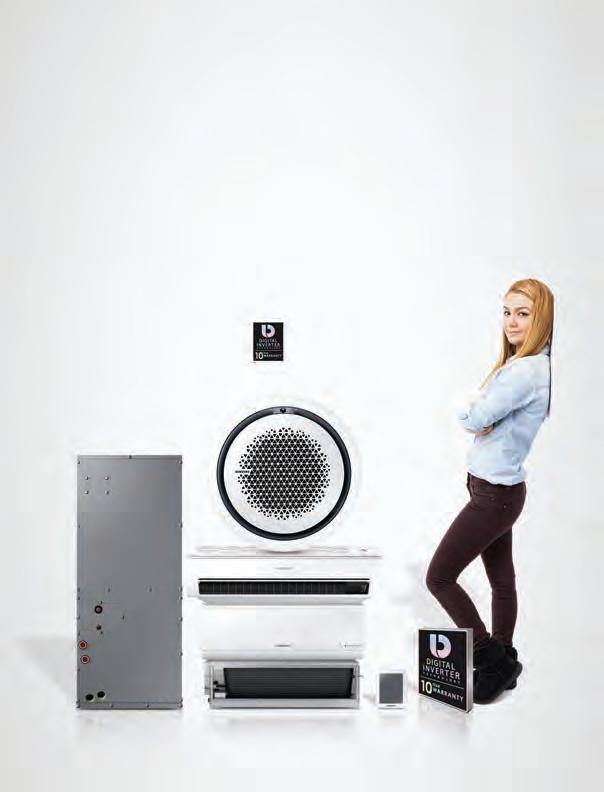
For full product features/specs and a detailed look at Samsung HVAC’s robust line up, please visit our new website, www.samsunghvac.com
BUY SAMSUNG WITH CONFIDENCE**
ALL SAMSUNG MINI SPLITS CARRY A 10 YR WARRANTY (ON COMPRESSOR AND PARTS, REGISTRATION REQUIRED)
**Novus warranty is 7 yrs compressor/5 yrs parts. Registration required. Restrictions Apply.
leadership of the company’s sales, marketing, service and engineering. Peterson will also take charge of the firm’s strategic planning and growth initiatives. Previously he was with Whirlpool Corporation, where he served as national director of sales and director of the KitchenAid brand, Johnson Controls, where he was vice president of sales and marketing for nine years, and Jetta Corporation, where he was president and CEO.


Centrotherm Eco Systems has promoted Katie Mullarkey and Matthew Pryce to inside sales roles (east coast and west coast respectively). The company has also hired Cara Rupp as a customer service representative and Bryan Schrader as shipping lead. Also added to the team is Aleksandr Repnoy as process engineer.

Paul Kemboi has joined Aqua-Tech as a technical sales representative. A graduate of Humber College with a diploma as an HVAC Technologist, Kemboi was previously employed in customer service, technical support and project management roles for a Toronto wholesale distribution company. Ron McAvoy has joined the Aqua-Tech Sales and Marketing Inc. team as a technical support representative. McAvoy has over 15 years of experience as a plumber/ pipefitter. He will work with Aqu-Tech’s inside customer service and outside sales teams providing technical/field support for the company’s hydronic heating products.
Grundfos has named Dieter Sauer regional managing director for Grundfos Americas. Thomas Morrison replaces Sauer as executive vice president of the company’s U.S. water utility business.
Becky Wampler joins T&S Brass and Bronze Works in the role of sales coordinator. Working with global sales manager Ken Gallagher, Wampler will be involved with T&S in Canada and around the world. Her role involves providing general support to sales, assisting with training coordination and supporting trade show and buying group activities.


Danfoss has appointed Jeffrey Flannery as business development manager of its heating business in North America. In this role, Flannery will focus on the growth of the Danfoss AB-QM pressure independent control valve in hydronic heating applications, and advancing solutions for efficient, resilient district energy systems in the U.S. and Canada. Flannery has more than 20 years of engineering, product management and business development experience in the global HVACR industry, having worked with customers, products, and applications in Europe, the Americas, and China.
Martin Beaulieu who is part of the ownership group and CEO of the Ouellet Group and president at Dettson Industries has assumed Marc Chénier’s duties as general manager. Chénier left the company effective September 2.
Simon Oakland, Wolseley’s global head of corporate development, has assumed he leadership role of Wolseley Canada on an interim basis following the departure of Darcy Curran, senior vice-president.
Marissa Granados has joined Fresh-Aire UV as sales and training manager. Granados is responsible for technical training and best practices on residential and commercial air purification and UV sterilization technology for contractors, technicians, manufacturers representatives and distributors, a role she previously held at Appion.


Terrilynn Million Short has joined Marley Engineered Products (MEP) as general manager. Most recently Short was the global business unit manager at Illinois Tool Works for the Kester Division. In her new role, based at MEP’s Burr Ridge, IL facility, Short will be responsible for integrating sales, product management and engineering processes to accelerate growth.


Dexter + Chaney has promoted Scott Rosenbloom to vice president-strategy, and Curt Westberg has been named vice president-customer. He will oversee product direction and management, as well as third-party partnerships and technology integrations. Westberg will manage all aspects of client relationships.

Airmaster, a manufacturer of air circulation and ventilation fan solutions, has named Greg Helbling as its director of sales and marketing. In this position, he is responsible for strengthening brand awareness and upgrading Airmaster’s sales force for its industrial and electrical divisions. Helbling is also responsible for reinstating Airmaster’s position in all of its marketing channels. Prior to working at Airmaster, he worked as the vice president of sales and marketing for Wright Tool Company and a director of product and channel management at Bolttech Mannings Inc.
Continuing to grow in Southwestern Ontario TO SERVE YOU BETTER!
7,600 sq ft with large inventory including all HVAC-R specialties and top brands
Strategically located north of the QEW between Appleby Line and Burloak Drive
5040 Mainway, Unit 8, Burlington
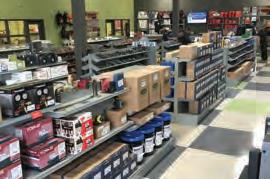
HYDRONICS HEATING BRANCH RELOCATION
Easy access displays
Expanded selection of products
Improved access and parking
6300 Viscount Road, Unit 1B, Mississauga
Proactive approach to the future sets the tone for HRAI’s 48th annual conference.
BY KERRY TURNER
The Heating, Refrigeration and Air Conditioning Institute (HRAI) held its annual conference August 24 to 26 at the Hyatt Regency in Calgary, AB. Themed Making Every Connection Matter, the event opened with a Year in Review presentation.
While reviewing material for Year in Review, HRAI president Warren Heeley “noticed a common thread and that was


change. Positive change, the kind that propels the association forward.”
That is evident in current HRAI initiatives. The organization is expanding its work in the ICI industry and is taking a more comprehensive approach to building its membership, reported Heeley. He went on to say that among the most positive developments to date is the harmonizing of standards between Canada and the U.S.
“Amendment 13 and a commitment to revise Amendment 14 are both big steps to harmonization,” said Heeley. Refrigerant Management Canada, has also been the beneficiary of positive developments with the passing of P2 (Pollution Prevention) planning on May 21, 2016. The Minister of Environment published a notice under Part 4 of the Canadian Environmental Protection Act, 1999 (CEPA 1999) requiring the preparation and implementation of Pollution Prevention Plans in respect of halocarbons used as a refrigerant. An industryled environmental care program, RMC is a not-for-profit corporation established by HRAI and the Canadian refrigeration

Impressive quartet: following Robert Bean’s (l), standing room only session IAQ: Find success in an untapped, growing market, well-know trainers and training advocates Nick Reggi, Tom Cates and Bob McKeraghan took a few moments to get caught up.
and air conditioning industry. RMC facilitates the responsible disposal of surplus ozone depleting refrigerants from the stationary refrigeration and air conditioning industry.
He went on to report that Switch the Stat, the thermostat recovery initiative administered by the association, will be ongoing and has been rebranded as the Thermostat Recovery Program (TRP).
Prior to turning the mic over to Martin Luymes, HRAI director programs/relations, Heeley said, “We [HRAI] will continue to operate outside our comfort zone. This provides the foundation for the conference.”
That zest for change and positive, forward reaching results was reflected in Luymes’ presentation. Among the points mentioned by him were plans to implement codes and standards webinars for the manufacturer division and a wholesalers education plan, and an investigation of e-commerce options with the Canadian Institute of Plumbing & Heating and Heating, Air-conditioning and Refrigeration Distributors International (HARDI).
In terms of the contractor division Luymes discussed the implementation of strategic plan elements, a new approach to regional support staffing, which includes the hiring of a full-time support staff person in Alberta, and tracking of member advantage programs.
Key policy issues identified by Luymes for the coming year include the federal and provincial climate change agenda and the low carbon economy, refrigerant regulation and new refrigerants, harmonization of codes and standards, trades training and apprenticeship, issues with utility competition and consumer protection.
“Challenges are intermingled with opportunities–there’s never a dull moment,” concluded Luymes.
Training was a recurring issue over the three-day event particularly during Andrew Stapleford’s presentation titled The Move to Low GDP Refrigerants.



Stapleford, who is with Emerson Climate Technologies, explained the growing popularity of CO2 and the safety implications for contractors working with this natural refrigerant. Despite its environmental appeal, contractors must be aware of CO2 systems’ high pressure, high triple point; the danger of asphyxiation; moisture is a concern; and concerns in the event of a power outage and resumption of power which call for a staged effect to avoid fluid flow back.
Heeley questioned training given all of the changes. “How do they fit everything into the curriculum?” asked Heeley. “It becomes a safety issue–it appears that what qualifications the service tech has will become a bigger and bigger issue and will have to be addressed.”
Dennis Kozina of Emerson agreed. “I bet there’s not a lot of the final refrigeration tech papers that refer to CO2,” said Kozina.
Stephen Yurek, president and CEO of
AHRI, agreed, “big changes are coming.” He questioned, “Why it takes so long to adapt safety standards?” Yurek noted that change as a result of restrictions takes a long time to get into building codes.
“Safety is what is important, if it doesn’t come up in the environmental side, there is a disconnect,” said Heeley. A challenge faced by HVAC advocacy organizations is the provincial approach to climate change. “When you start to look at the patchwork quilt that our industry would have to deal with, it is a huge concern,” said Heeley. “There are so many different issues you have to have some federal strategy to deal with this.”
In addition to this, and other sessions supporting the tone set by the review, the conference included division meetings, the AGM and awards presentations. HRAI will hold its 2017 conference August 16 to 18 in Quebec City, QC.
Rick Ellul, Belimo Aircontrol (Can) Inc. HRAI chair
Peter Steffes, Ideal Heating and Cooling, HRAI past chair
Bruce Passmore, Emco HVAC, vice chair of HRAI and chair of the wholesalers division
David Weishuhn, Blue Flame Heating and Air Conditioning, secretary treasurer HRAI and chair of the contractors division
Dave McPherson, Rheem Canada, chair of the manufacturers division
Rob Flipse, Gordon Latham Limited, vice chair of the contractors division
John Bonus, Wolseley Canada, vice chair of the wholesalers division
Warren Heeley, president of HRAI
Make a big impact on water conservation with small parts.
BY JON GUSTAFSON
Professionals looking to boost water conservation often set their sights on the biggest — and often most expensive — water-using equipment in a facility. But while big-ticket items are an important part of overall conservation, there is a lot to be said for the role of the “little guy.”
Some simple upgrades or updates cost only a few dollars but save thousands in the long run.
According to the Environment and Climate Change Canada, Canada is the world’s second highest consumer of water per capita, following only the United States. The first step to reducing commercial water use is to understand how that water is being used in the first place.
A systematic look at water consump -

tion, through an audit or other review process, can help operators get a clear look at usage and ways to reduce it. For example, a handwash sink without an aerator may be flowing at excessive rates, in some cases as high as 30 litres of water per minute, well above the standard flow rate.
Aerators, in fact, are one of the most commonly overlooked ways to reduce
water consumption. Water savings multiplied over dozens or hundreds of sinks in a large facility can make a significant impact.
An aerator change or installation, which is inexpensive and simple to complete, can reduce water consumption by tens of thousands of litres and utility expenses by hundreds of dollars every year.
Expert Instructor: Aaron Stotko Date: Tuesday, Nov 8 @ 2pm EST

Using PEX for chilled water and heating hot water distribution is a very durable, cost-effective solution for transporting water to terminal units. Learn about the benefits of using PEX for hydronic piping applications that include fan-coil units, VAVs, AHUs, unit heaters, radiant manifolds and much more. This course will cover topics such as system longevity, reduced liability and time and materials cost savings as well as the similarities and differences compared to other piping materials.
Additional topics will include:
• Different PEX types
• Installation methods
• Design and sizing
TO REGISTER http://hpacmag.com/PEX-webinar
• Codes and standards
• Performance
• Fitting solutions
• Fire-resistive construction
For example, in a facility with 40 hand washes per day, at 30 seconds per wash, switching from an 8.3 lpm aerator to 1.9 lpm saves more than 45,000 liters of water per year.
Aerators, which reduce the flow of water from faucets, are sometimes removed under the assumption that more water is better. Vandal-resistant aerators are recommended to prevent tampering and maintain the integrity of the product.
Plumbing advances mean the aerators available today can offer water flow lower than previous standard flow rates without diminishing performance. Lower-flow aerators can range from 5.6 lpm to 1.3 lpm.
With savings from water, sewer and energy costs to heat the water, the return on investment for aerators can be measured in days instead of years.
When considering this change, it is imperative to understand how a faucet is used on a day-to-day basis. Is it a simple restroom sink? Low flow will not diminish performance and will decrease water use.
In high use areas, proper selection of aerator flow rate is critical to ensure tasks can still be performed effectively. Going to the lowest possible flow rate available may not always be the right option for maintaining efficiency in the workplace.
There are facilities, notably healthcare, where aerators are not preferred due to concerns over bacterial contamination, but not using aerators can lead to increased water consumption.
In situations where laminar or nonaerated flow restrictors are required, other flow-restricting devices are available and can be used to reduce water usage.
Flow-control devices can be installed at the base of the faucet or spout to reduce annual water usage by up to 20 per cent. These types of controls are also inherently vandal resistant since they are installed inside the faucet body and are not easily accessible.
“In
The key to capitalizing on this lowhanging fruit of water conservation is assessment. Many facility owners or operators may not be fully aware of their current water usage and existing issues, but a regular review of plumbing equipment should address some basic questions: How old is it? Is it functional? Are there leaks? Are better options available? Should it be replaced? When excessive water usage is taken into account, plumbing products may be a larger contributor to water consumption than they appear.
Much as major building systems tend to undergo regular evaluation and maintenance, everyday plumbing fixtures should receive a periodic review of their status and functionality. With minimal expense and effort, there are plenty of savings to be realized in places other than the HVAC or energy systems.
Jon Gustafson is a regional sales manager for T&S Brass. He has more than a decade of experience in plumbing and is active in industry organizations and events.

• Primary loop with pump and the choice of 1 to 6 secondary zone pumps all within one wall mounted station
• PSS Circuitry allows each zone to be set, supplying either high or low temperature output from a condensing boiler
• Boiler supply and return is available in either bottom left or bottom right side of the station
• All field settings can be adjusted using jumpers
• Variety of pump options available


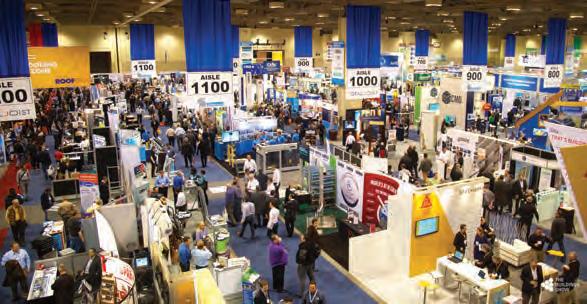
The 28th annual Construct Canada show, the country’s largest building, design and construction event, will run Wednesday, November 30 through Friday, December 2 in downtown Toronto at the Metro Toronto Convention Centre, located at the base of the CN Tower.
The three-day event is part of The Buildings Show, North America’s comprehensive expo for designers, builders, contractors and real estate professionals. Five concurrent events will feature over 1,600 exhibits displaying the latest in design and construction innovation in products, technologies, best practices and applications.
Construct Canada will share the South Building of the Convention Centre with the HomeBuilder and Renovator Expo, the Property Management Expo and the World of Concrete Pavilion. The North Building of the convention centre will feature IIDEX Canada, the national design and architecture show.
Anticipating over 30,000 attendees, The Buildings Show also includes over 350 seminars and educational demonstrations. With the trend towards building automation and the Construction LIEN Act review, this year’s seminar
program will focus on the processes, technologies and research that support innovative and sustainable design, cost and energy efficiencies, and high performance buildings. Featured sessions will include:
• Cost-effective strategies for maintaining and prolonging the life of aging plumbing and HVAC systems
• Why building homes 15 years ahead of building code changes makes sense
• NBC (National Building Code) 2015
– Part 3: current implementation and shifts for 2020
November 30-December 2
Metro Toronto Convention Centre South Building
Wednesday, November 30
10 a.m. – 5 p.m.
Thursday, December 1
10 a.m. – 5 p.m.
Friday, December 2
9 a.m. – 1 p.m.
www.constructcanada.com
• The carbon impact initiative: how will it affect building design and construction going forward?
• How NetZero commercial buildings are becoming a reality
• How is technology, automation and innovation transforming buildings?
New this year is Breakfast With the Experts, beginning at 7 a.m. on November 30. It will feature a panel of concrete industry experts offering solutions to audience questions regarding challenges associated with production, construction, repair and maintenance on concrete projects. And this year’s 2016 International Architectural Roundtable will focus on designing resilient buildings in the face of climate change.
Attendee registration for Construct Canada is free until November 17, and any online or on-site registrations after that date will be $25. Seminar times and pricing is all available online. Event registration allows entry to all five events in both buildings. The show floor opens 10 a.m. to 5 p.m. Wednesday and Thursday, and 9 a.m. to 1 p.m. on Friday. HPAC will be located at Booth 341 in the Construct Canada show hall–come and see us there.
Adrian Steel ............................................................ www.AdrianSteel.com ...................................................................... page 87
AERCO .................................................................... www.aerco.com ........................................................................... page 5, 85
AHR Expo ................................................................ www.ahrexpo.com ............................................................................ page 89
Axiom www.axiomind.com page 70
Bardon Supplies ...................................................... www.bardonsupplies.com ................................................................. page 51
Belanger UPT .......................................................... www.belanger-upt.com ..................................................................... page 73
Boshar t ................................................................... www.boshart.com ............................................................................ page 36
Bradford White www.bradfordwhite.com page 2
Brant Radiant Heaters ............................................. www.brantradiant.com ..................................................................... page 12
Caleffi ..................................................................... www.caleffi.com ............................................................................... page 41
CB Supplies............................................................. www.vipert.com ............................................................................... page 55
Centrotherm www.centrotherm.us.com page 14
CIPHEX West .......................................................... www.ciphexwest.ca ......................................................................... page 61
Danfoss ................................................................... www.danfoss.ca ............................................................................... page 43
Delta Faucet ........................................................... www.deltacommercialfaucets.com
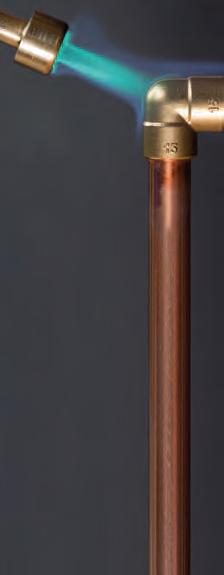

Welcome to the launch of HPAC’s
Items will be featured in whole or in part and may be from any era–they may be appliances, fixtures, tools, pvfs, components, and so on.

To enter, identify the product featured on the right and include what it is, where would you find it, how it works and who made it–bonus points to the entrant who has an interesting anecdote about the item. Send your response to kturner@hpacmag.com for your chance to win a Stanley TLM99 Laser Distance Measurer. The winner will be determined based on the accuracy and detail in the response, remember there are bonus points for entrants who share an interesting/ amusing anecdote about the item.
Readers are invited to send photos for possible inclusion in the contest. If your photo is selected you will receive a 25-foot FATMAX tape rule.

The Construction Education Council offers a number of management and supervisory courses across Canada through webinars and classroom settings. For more information, e-mail education@mcac.ca. www.constructioneducation.ca
TECA’s Quality First training programs are developed by the industry, for the industry, setting minimum standards for the residential and light commercial heating, ventilating and cooling trade in British Columbia. Courses provide contractors with the information they need to install equipment that operates safely and comfortably at rated efficiencies. www.teca.ca
Canada Green Building Council workshops include LEED Green Associate Exam Preparation, Net Positive Energy Buildings, and Introduction to the LEED-v4 Rating System, tel. 866.941.1184. www.cagbc.org
Natural Resource Canada has announced that the Canadian Institute for Energy Training (CIET) is the sole licensee of the Dollars to $ense energy management workshops in Canada, with non-exclusive rights for
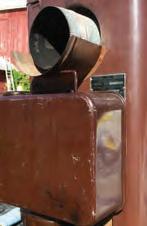
the commercial exploitation of the workshops in any country around the world. For information on booking a Dollars to $ense energy management workshop contact CIET by phone at 800.461.7618, or e-mail info@cietcanada.com. http://cietcanada.com
The Canadian Hydronics Council (CHC) has partnered with the Northern Alberta Institute of Technology and British Columbia Institute of Technology to provide course blocks toward CHC certification for hydronic system designers and installers. At NAIT students can register for online or paper-based learning and have nine months to complete each block of courses. www.ciph.com
The Heating, Refrigeration and Air Conditioning Institute of Canada (HRAI) offers a variety of residential and commercial courses for the advancement of its members’ business and technical excellence. It recently launched Introduction to Residential HVAC Equipment. This course discusses equipment metrics and basics of furnaces, air conditioners, heat pumps, water heaters, boilers, HRVs and ERVs, and more. The course is being held across Canada, starting with the pilot in Mississauga, ON on November 8. For more information, contact Angie Mantei by e-mail amantei@hrai.ca. www.hrai.ca/hrai-training-courses
November 2-3
The tradeshow will feature a full conference program, including the Canadian Hydronics Conference and a product showcase. It is co-locating with the BUILDEX Express show at the Vancouver Convention Centre in Vancouver, BC. www.ciphexwest.ca
November 14-17
MCA Canada will hold its 75th National Conference in Florida at the Disney Yacht Club Resort in Orlando, FL. www.mcac.ca
NAHB International Builder’s Show
January10-12
IBS 2017 is being held at the Orange Country Convention Centre in Orlando, FL. It is colocating with KBIS and the NKBA’s Kitchen and Bath Industry Show, bringing together over 80,000 building industry professionals. www.buildersshow.com
March 14-18
ISH – a trade fair for the bathroom experience, building services, energy, air conditioning technology and renewable energies will be held in Frankfurt, Germany. http://ish.messefrankfurt.com
CaGBC National Conference and Expo
May 30-June 1, 2017
The Canadian Green Building Council (CaGBC) will be holding its annual event in Vancouver, BC. www.cagbc.org
November 3
This tradeshow and conference is co-locating with CIPHEX West at the Vancouver Convention Centre in Vancouver, BC. It is for the construction, property management, interior design and architecture industries. www.buildexexpress.com
Construct Canada
November 30-December 2
The 28th annual Construct Canada Expo will have over 1,600 exhibits. It is being held at the Metro Toronto Convention Centre in Toronto, ON. www.constructcanada.com
ASHRAE Winter Meeting
January 28-February 1
The ASHRAE winter meeting will be held in Las Vegas, NV at Caesars Palace. www.ashrae.org
November 13-15
The Air-Conditioning, Heating & Refrigeration Institute is holding its annual meeting in Scottsdale, AZ. www.ahrinet.org
January 10-12
The Kitchen & Bath Industry Show will be held in Orlando, FL at the Orange County Convention Centre. The show will host 500+ brands including over 100 new companies. www.kbis.com
AHR Expo
January 30-February
The 2017 AHR Expo will be held at the Las Vegas Convention Centre in Las Vegas, NV. www.ahrexpo.com

CCA Conference
March 19-23
The Canadian Construction Association will hold its 99th annual conference in Riviera Maya, Mexico. www.cca-acc.com/en/annualconference
CIPH ABC and AGM
June 25-27
The Canadian Institute of Plumbing’s (CIPH) annual business conference will be held in Ottawa, ON. The annual general meeting will be held on June 27. www.ciph.com
CMPX
March 21-23
CMPX will be held at the Toronto Convention Centre, north building, in Toronto, ON. www.cmpxshow.com
April 26-27
Mécanex, Climatex, Expolectriq, Éclairage (MCEE), a plumbing, HVAC/R, hydronic, electrical and lighting expo, will be held at Place Bonaventure in Montreal, QC. www.mcee.ca
HRAI AGM
August 16-18
The Heating, Refrigeration and Air Conditioning Institute of Canada will hold its 49th annual conference at the Hilton Quebec in Quebec City, QC. www.hrai.ca
CIPH ABC and AGM
June 17-19
The Canadian Institute of Plumbing’s (CIPH) annual business conference will be held in Whistler, BC. The annual general meeting will be held on June 19. www.ciph.com



























The new Delta hands-free thermostatic lavatory faucet is the smart choice for applications requiring thermostatic temperature regulation. The mixing valve and solenoid are contained within the body of the faucet and the supply lines are factory-installed, making installation quick and simple. Outlet temperature limits can be set easily from above the deck by the installer and a top mixer allows the user to adjust the water temperature to comfort. Now that’s smart. Backed by an






• Access tekmar WiFi thermostats & controls remotely with tekmar Connect mobile app
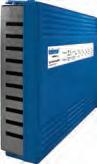
•
•