Celebrating the top residential and commercial entries in the first-ever Sweet Heat hydronics installation competition.
BY LOGAN CASWELL AND DOUG PICKLYK
Launched in late fall 2020, the first ever Canadian Sweet Heat Installation contest called on hydronic contractors from across the country to share photos of recent projects and explain the challenges and creative solutions their teams used to deliver comfort to their clients.
The installations could be in a new-build or a retrofit project, and it needed to be a Canadian contractor and a Canadianbased project. The community answered the call, and the competition received 31 entries from Victoria, B.C. to Bridgewater, Nova Scotia. The entries were divided into two categories (commercial and residential) and the final judging was performed by experts, John Seigenthaler and Robert Bean, who together bring 80 years of industry experience.
The winners and first runners-up in both categories were first revealed during the final session of the 2021 Modern Hydronics Summit, held online on March 30 and 31.
RIVERDALE PLUMBING
First, our congratulations go to Riverdale Plumbing in Toronto for taking first place in the residential category for a modern custom home project located in the prestigious Forrest Hill area of Toronto.
Riverdale is a small family-owned company formed in 1974 and specializes in new build and retrofits, specifically in-floor heat, air handlers, hot water generation and snow melts.
The company's operations manager, Pierce Akins, explained some challenges the company faced with this award-winning project. “We had to redesign the hydronic system so it could physically fit based on the limited space we were given to build our heating stations throughout the house,” said Akins. “We used modulating pumps instead of fixed-speed pumps to save more energy and save space.”
Akins said he has seen an increased demand for hydronics in his business, especially in the high-end new builds in and around Toronto where the new designs present challenges to heat with traditional equipment.
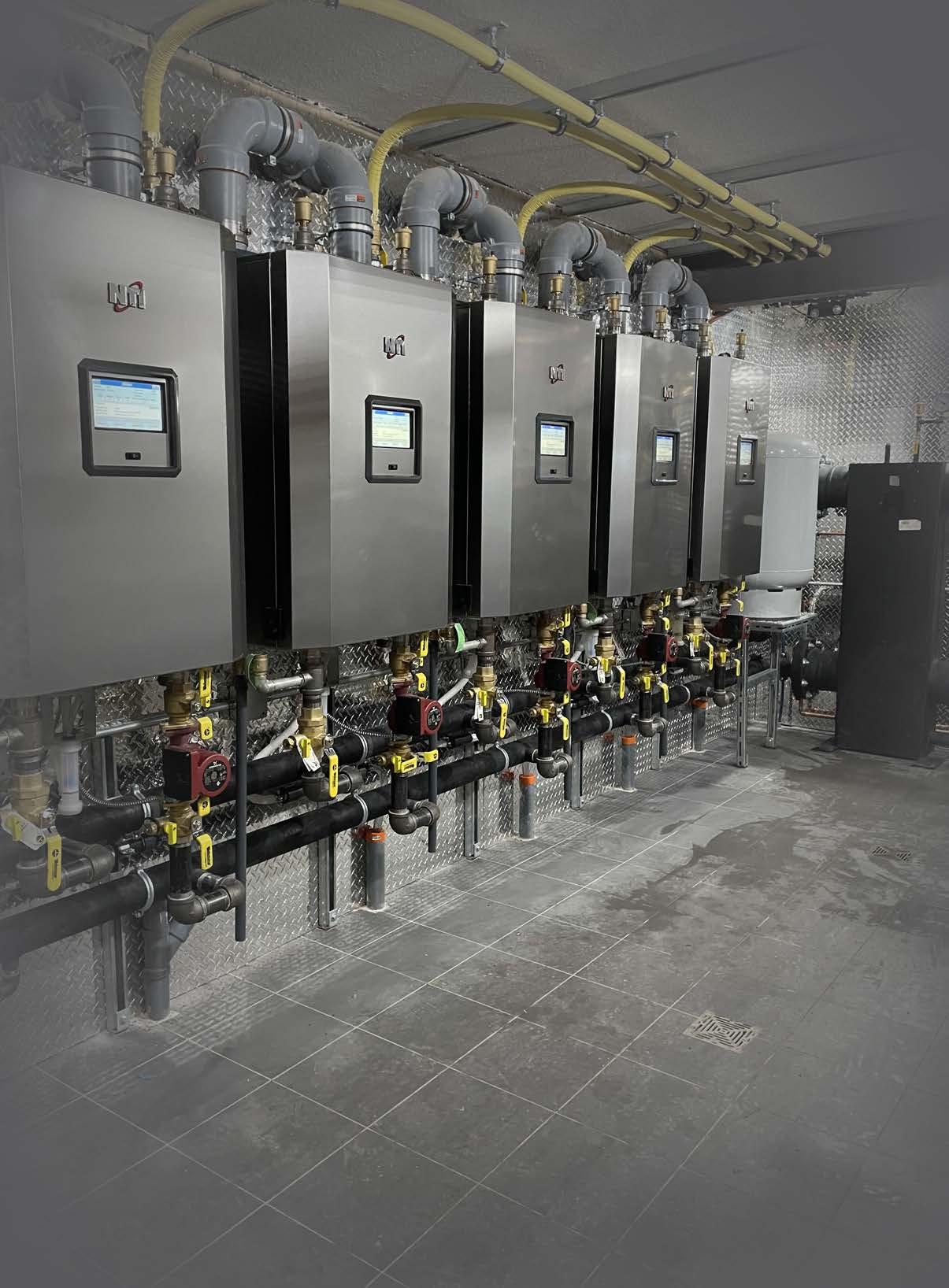
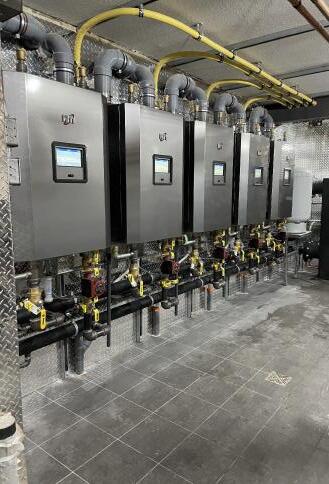
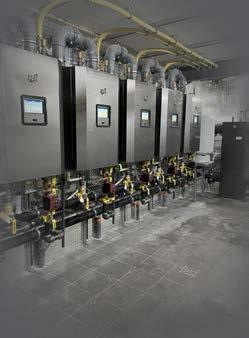
On this project Akins explains how they changed the design from the original drawings of two large boilers to five smaller units. “It gave us the advantage of lower modulations while also meeting the higher loads once they all fire up together.
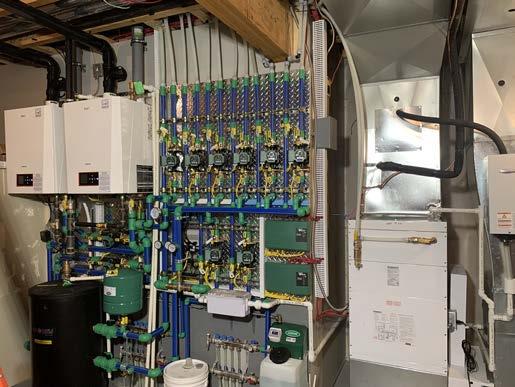
Winner in the residential category, this custom home project was completed by Riverdale Plumbing in Toronto.
The Riverdale Plumbing project used modulating pumps instead of fixed-speed pumps to save energy and space.
Doing this we could get down to 40,000 Btus, which allowed us to save energy and use the boilers as effectively as possible.”
The boilers were installed to provide heat for two indirect hot water tanks, a large snow melt, indoor spa, outdoor spa, outdoor pool and supplementary heat (in-floor heat and heating coils) to the building. The primary heat for the building is provided by heat pumps.
Contest judge, Robert Bean, gave the Riverdale Plumbing project his vote for the top spot because the of its energy-saving efficiencies. “What I liked about this project was given the size of the loads, they used the least amount of electrical power to move the thermal energy through the building.”
Co-judge, John Seigenthaler concurred, adding that the untold story of hydronics is about judging the quality of a system by looking at both the energy consumed to produce the heat and the energy used to move it through the building.
500-seat dining hall, commercial kitchen and amenity spaces on bottom two floors.
Patrick Waunch, president and CEO of Rambow Mechanical, founded the business in 1985. Today, the firm specializes in industrial and commercial projects filling a niche throughout Western Canada with a regular team of around 45 people. “I enjoy a challenge,” says Waunch, who has over 50 years of experience in the commercial and industrial mechanical sector.
“We had to redesign the hydronic system so it could fit.”
Seigenthaler also admired the use of valves rather than zone circulators which use less electricity as well as the beautiful workmanship, well thought-out design, modern technology and well-placed hardware from a servicing standpoint.
“From an energy standpoint, the use of a variable speed pressure-regulated circulator combined with valves is definitely going to use less energy,” said Seigenthaler. “A lot of preplanning went into this relatively small space in a very large home.”
RAMBOW MECHANICAL
The top entry in the commercial category was awarded to Rambow Mechanical of Kelowna, B.C. This new construction project, the Nechako residence, is part of the UBC Okanagan housing commons in Kelowna. The building itself is a 137,000 sq. ft. six-storey residence with some 220 bedrooms and a
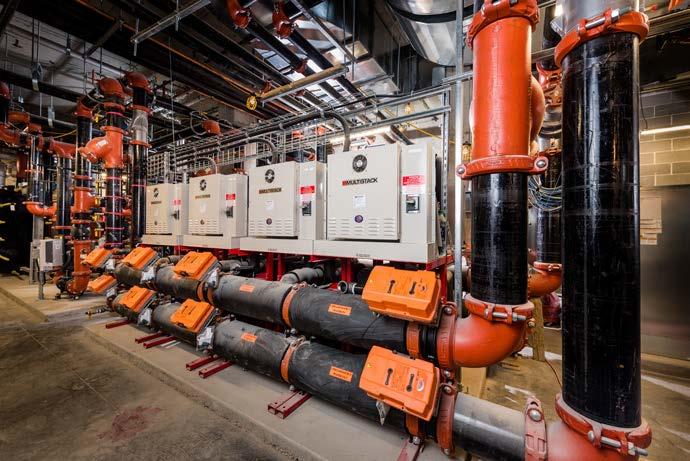
For this project, which lasted about two years, the building is tied into a centralized campus low-temperature district energy system (LDES). Heat pumps located in the Nechako building use water-to-water heat recovery for maximum efficiency when both heating and cooling are required. Two 8-in. stainless steel connections, which connect to two heat exchangers, provide an effective heat surface of 386 sq.m. per heat exchanger. This allows the system to both draw heat or reject heat back into the system.
The heat pumps send either hot or chilled water through a network of 6-way control valves that, in conjunction with a large number of thermostats, allow various fan coils, unit heaters and in-slab heating/cooling. The in-slab heating is located in the common restaurant area and unit heaters are located in main doorways and loading dock areas.
All of the pumps in the system have variable speed drives on them, ramping up and down driven by controls. In addition to the complex heating/cooling system, all the student room windows have a built-in contact sensor, monitored by a direct digital control (DDC) system, so when the window is opened the DDC is programmed to shut down the heating/cooling for energy savings. When the window is closed the DDC reactivates the fan coil in the room to its previous program.
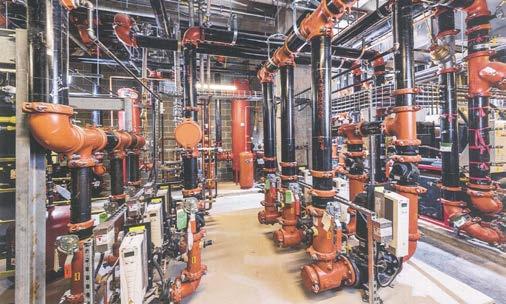
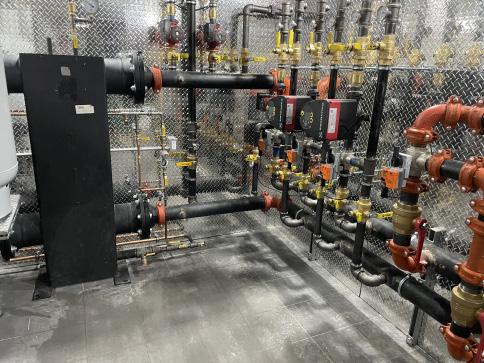
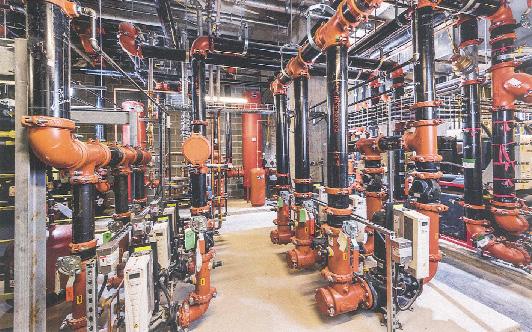
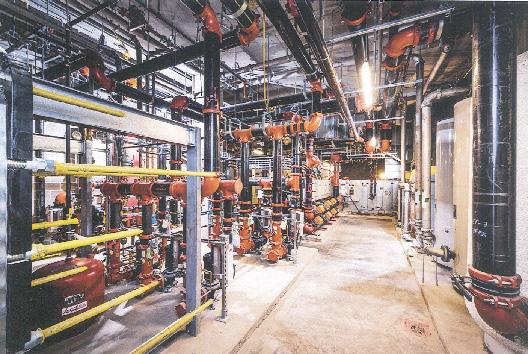
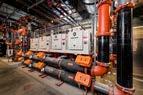
Winner of the commercial category; this is the mechanical room located in the basement of UBCO Nechako residence completed by Rambow Mechanical located in Kelowna, B.C.
The mechanical room is tied into a centralized campus lowtemperature district energy system (LDES).
Another energy-saving element is the heat recovery system that captures heat from exhaust fans and the commercial kitchen range hood using an energy recovery ventilator (ERV) and repurposing that energy back into the HVAC system.
The heating system also aides the domestic hot water. “Once our heating side returns back from the system it runs through a heat exchanger that tempers the incoming domestic cold water, so when you have low loads situations for heating you gain a lot of benefit from this second heat exchanger taking heat out of the heating system,” says Shayne Haller, project manager with Rambow Mechanical.
According to Wauch and Haller, working to the LEED Gold certification requirements on this project meant sourcing local materials that met the low environmental impact specifications (including cements, sealants, etc.). “A lot of paperwork and effort is required to satisfy the LEED certifications,” says Waunch, a process which is becoming a more common practice on all of their projects.
The Sweet Heat contest judges applauded the certification
2021 SWEET HEAT ENTRIES
Thank you to everyone who took the time to enter our first Sweet Heat Contest:
Air Design Services, London, ON AV Mechanical, Caledon, ON Battye Mechanical, Peterborough, ON Boss Plumbing, Saskatoon, SK Canadian In-Floor Radiant Solutions, Burlington, ON Canuck Mechanical, Prince George, BC Deer Bridge Plumbing & Heating, Calgary, AB Denrite Mechanical, Sturgeon County, AB Doyle Plumbing Heating & Cooling, Fraserville, ON Gleeson Plumbing, Moorefield, ON Good Grade Plumbing & Gas, Victoria, BC Grand Mechanical Solutions, Brantford, ON GTAHeat.ca, Vaughan, ON JJM Mechanical Group, Burnaby, BC
John Sadler Plumbing & Heating, Surrey, BC Lloyd HVAC Services, Toronto, ON Mason Place, Keswick, ON MICA Energy Solutions, Oshawa, ON Micon Plumbing, Mississauga, ON Northern Air & Mechanical Systems, Sudbury, ON Parr Mechanical Plumbing & Heating, St. Pauls, ON POC Plumbing & Heating, Oakville, ON Pre-Con Builders, Oakbluff, MB Pro Climate Mechanical, Concord, ON R4 Mechanical Systems, Wetaskiwin, AB Rambow Mechanical, Kelowna, BC RBA Mechanical, Edmonton, AB Rhynos, Bridgewater, NS Riverdale Plumbing, Toronto, ON TJL Mechanical, Fergus, ON TT Plumbing & Heating, King City, ON
requirements of the project. “I really liked the attention to the low temperatures in the heating, and that just makes the systems operate at their peak efficiency,” said Bean.
Siegenthaler added, “It really looked like they were taking advantage of opportunities to minimize energy use and use systems that work with good attention to the exergy concept. As we move towards decarbonization, here’s a hydronic system that does a good job of recognizing that electrical-based systems and low-temperature systems are going to be the new normal in hydronics.”
“When we talk about the challenges we had, we also went through the Covid-19 scenario,” adds Waunch. “We had to maintain manpower, but we were very fortunate to be able to have people come in and out and have not one single case of Covid on-site.”
In all, the residence project lasted about a two-years for Rambow Mechanical, and it’s anticipated that the building will be full of students this fall.
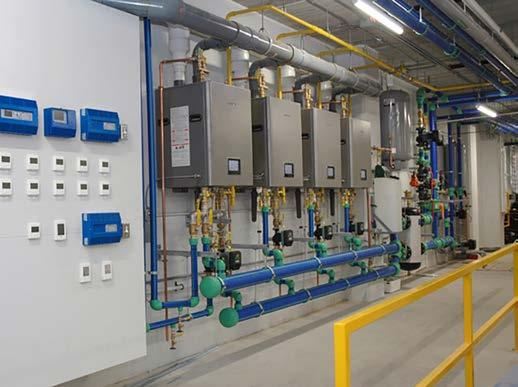
Commercial installation runner-up, Grand Mechanical
Runner-up in the residential category, Denrite Mechanical
DO MORE WITH LESS
Cover 90% of your residential circulator needs with the ALPHA2 15-55 and ALPHA2 26-99.
ALPHA2 – Delivers comfort and savings to your customers for years to come. Install our most efficient variable speed ECM circulator with patented AutoAdapt function.
CROSS REFERENCE CHART
ALPHA2 15-55
UPS 15-58F/FR
UPS-15-42F/FR
UP15-10F
UP15-42F
005
006
007
008
0010
0015
00R-IFC
00R-MSF1-1FC
007E
0015E
0018E
ALPHA2 26-99 UPS 26-99F 0010 0011
NRF-22
NRF-25
NRF9F/LW
ECOCIRC 19-14
LR-20WR
NRF-36 SP#2
NRF-45 SP#2 SERIES 100 PL-30 PR
NRF-36SP#1
NRF-45SP#1 LR-15BWR
ASTRO 30
ASTRO 50-3
ASTRO 25
ASTRO 30-0
ASTRO 20
ASTRO 230CI-R
E7(B)
ASTRO 50(B) H41
ASTRO30(B)
ASTRO 250CI-R
ALPHA2 15-55 with terminal box
ALPHA2 15-55 with line cord
ALPHA2 26-99 with terminal box
Grundfos
TACO Bell & Gossett
Armstrong Wilo
RUNNERS UP
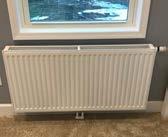
The runner-up spot in the residential category was awarded to Denrite Mechanical of Sturgeon County, Alberta. This home had a mechanical system which, according to Bean, “needed some therapy.” Bean said he awarded the runner-up prize because of Denrite’s design and installation, particularly their attention to low-temp return temperatures.
“In order to get the maximum amount of work out of a boiler you need to get those temperatures down to 75-80F return water temperature. The only way to do this is to oversize the heat exchangers on the air handlers,” said Bean.
The project was also commended by Seigenthaler for its workmanship and design. “I gave a good rating for their ability to integrate that much hardware into the small space and yet keep accessibility for servicing,” said Seigenthaler.
SWEET HEAT 2022
We are now inviting hydronics professionals across the country to get out your cameras and do it all over again.
Sweet Heat 2022 launches now, so if you take great pride in the work your team is doing and have new installation projects that are worth talking about (either new build or retrofits), it’s time to bring it on!
The entry process is simple, and you’ll find all the entry details at hpacmag.com/sweet-heat-2022 and maybe you’ll be our feature story next year.
Good luck to all.
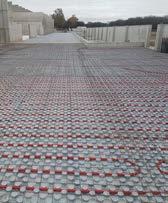
Grand Mechanical Solutions of Brantford, Ontario was the runner-up in the commercial category. Their project was a new build facility for a landscape equipment supplier. The building included over 30,000 sq.ft. of radiant in-
floor heat and snow melt among the showroom, offices, service shop and underground garage. “I liked the application of multiple boilers staged, instead of putting one large device in,” says Bean. For Siegenthaler: “It was a good use of modern piping materials, and ECM circulators," and he appreciated how the controls were well separated from anywhere water could affect them.
Both judges were impressed with the quality of workmanship in all entries, but are always looking for how contractors use engineering principles which promote energy efficiency and compliance with standards. “When it comes to energy, conserve it first,” says Bean.
Their recommendations to future entrants is to demonstrate how you made your systems efficient, and where possible identify what standards you are meeting to provide comfort to your clients. <>
Your business is all about cash flow, project performance and planning, going big too soon, having the best people, innovating and working with partners that really want to help you grow your business.
Your business needs innovative partnerships that incorporate the newest product technologies and digital tools — reliable
brands that make things better. That’s why AQUATECHTM is proud to offer Lochinvar® heating and hot water boiler solutions that perform for you and your customers. Energy efficiency. Quality performance. Broad product selection. And technical support.
Call us today and explore how our over 40 years of experience can support you.
ZONING CONSIDERATIONS
Things to consider when planning your piping layouts.
BY JOHN SIEGENTHALER
Azone is any area of a building for which indoor air temperature is controlled by a single thermostat (or other type of temperature controller). A zone can be as small as a single room, or it may be as large as an entire building.
Multi-zone systems have the potential to provide two important benefits not available in single zone systems, namely:
• The ability to meet individual comfort requirements through independent control of room temperature
• And, the ability to conserve energy by reducing the temperature of unoccupied zones and thus the rate of heat loss from them.
Multi-zone hydronic systems are easy to create, much easier than their forcedair counterparts, and several hardware options exist for implementing zoning in different types of distribution systems.
However, before attempting to layout a zoned distribution system it’s important to evaluate how zoning can best be implemented in the building. The goal is to maximize the benefits of zoning while at the same time keeping the system affordable, energy efficient, reliable and as simple as possible.
AVOID OVERSELLING
In some cases, hydronic zoning has been “oversold.” For example, potential clients, and even some heating professionals, sometimes think that the more zones a system has the better it is designed. This is not true. Just because it is possible to create a separate zone for every room does not mean it is the best choice.
In some cases, the extra piping and control hardware necessary for roomby-room zoning adds complexity and cost without returning tangible benefits. Dividing a system into an excessive number of zones may even create operational problems such as heat source short-cycling. It can also add to system maintenance requirements, again without returning any benefit to the owner.
Here are several factors designers should consider when deciding how to best implement zoning.
THERMAL MASS
Some people assume that zoned systems are somehow able to lower the temperature of a room (or group of rooms) down to some setback temperature as soon as the thermostat is turned down. Likewise, they might assume that any given room will quickly warm back to normal occupied temperatures as soon as the thermostat is turned up.
No occupied space can undergo a drop in temperature of several degrees over one to two minutes simply by stopping heat input. Similarly, no practical heating system can instantly raise the temperature of an occupied space by several degrees. The time required to cool down or warm up a zone is significantly affected by the thermal mass of the heat emitter(s), and the building itself.
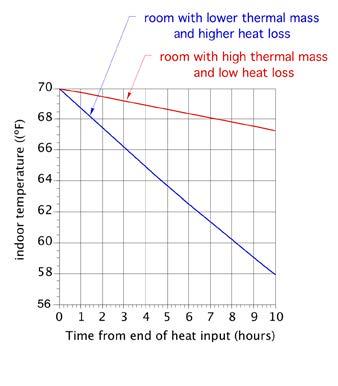
The greater the thermal mass of the heating system and building components, the slower the decrease in indoor temperature when heat input to the zone stops. This is illustrated in Figure 1.
The two curves shown represent combinations of rooms and their associated heat emitter(s) with significantly different thermal masses. The room with low thermal mass could be a typical woodframed residential room with fin-tube
baseboard or perhaps a fan-coil as the heat emitter. The room with high thermal mass could be the same room, but equipped with a 4-in. thick heated floor slab as its heat emitter.
A very well insulated room (or an entire building) with high thermal mass might only experience a temperature drop of 3F to 5F over a cold midwinter nighttime lasting 8 to 10 hours, even with its heating system completely off.
If the occupants reduced the thermostat setting from 70F to 60F at night, the inside air temperature would not decrease to the reduced setpoint before morning. The energy savings potential of such a situation is very limited. If the thermostat were turned down 10F or even 20F, the results would be the same.
The thermal mass of the heat emitter also affects the recovery period when the setback ends. Low thermal mass heat emitters such as finned-tube convectors can usually restore a room that has been set back 10F to normal comfort in perhaps 15 to 30 minutes.
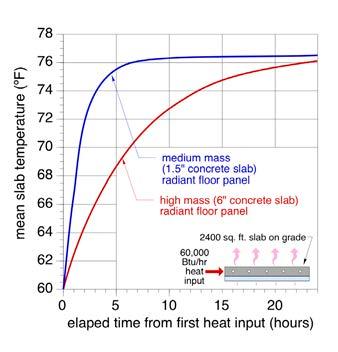
High thermal mass systems such as a heated concrete slab-on-grade floor can take several hours to bring a space back to normal comfort temperature following
Figure 1. Variables effecting heat loss
a prolonged setback period. This is illustrated in Figure 2, which shows the simulated heating of both medium-mass and high-mass radiant floor panels, starting at an initial temperature of 60F, and having a sustained heat input rate of 60,000 Btu/h.
It’s important not to use heat emitters having significantly different thermal mass in the same zone when that zone will operate with frequent changes in setpoint temperature. Because their response times during both cool down and warm up are so different, neither type of heat emitter is likely to produce acceptable comfort during the transition periods between stable setpoint temperatures.
It’s also important to realize that the energy conservation potential of a high thermal mass-zoned system is very dependent on the duration of any reduced thermostat setting.
If a zone can be maintained at a reduced temperature for several days, the energy conservation potential can be significant. However, attempting to create significant temperature changes on a daily basis in zones with high thermal mass heat emitters is futile.
The energy savings will be very small and the potential for temperature overshoot and undershoot will be significant. This characteristic should be explained to eventual owners who may not understand how high-mass systems respond to changes in the thermostat settings.
HEAT FLOW TO ADJACENT ROOMS
Another factor affecting zoning performance is inter-zone heat transfer. This refers to heat transfer through interior partitions as the building attempts to equalize temperature differences from one room to another.
If, for example, a particular room is kept at 65F, while an adjacent room is kept at 75F, heat will flow from the warmer to the cooler room through the wall separating them.
This partially defeats attempts to
maintain temperature differences by zoning. The greater the thermal resistance of the exterior envelope of the building, the harder it is to maintain significant temperature differences between rooms separated by uninsulated interior partitions.
OCCUPANT INVOLVEMENT
Another consideration that helps determine the cost effectiveness of zoning is the willingness of the occupants to regulate the system. It might seem obvious that an owner who is willing to pay more for an extensively zoned system would also be willing to regulate it. However, experience has proven that this is not always true, especially when nonprogrammable thermostats are used. Given modern lifestyles people often forget to regulate their heating systems.
Different rooms within a single zone (e.g., controlled by a single thermostat) and supplied with the same water temperature can still be maintained at different temperatures by adjusting the flow rate through individual heat emitters, assuming, that is, that these rooms are not all served by a series piping circuit. Flow balancing is usually adequate when the goal is to maintain several rooms at different (but stable) temperatures.
Room-by-room zoning is justified in situations where several rooms are to
have both different and frequently changing air temperatures. It can also be justified when the added cost of room-by-room zoning is relatively small. A good example of the latter is when panel radiators, each equipped with thermostatic valve actuators, and piped into either a homerun or “1-pipe” distribution system are used as heat emitters. These distinctions should be discussed with eventual owners before committing several hundred dollars for extensive zoning controls that may seldom be used.
INTERNAL HEAT GAINS
Rooms with large south-facing windows may at times be totally heated by solar heat gains. Rooms in the same building that do not receive solar gain may still require heat input. Well-planned zoning separates rooms with likely solar heat gain from those without. It also accommodates the fact that the rooms receiving solar heat gain change over the course of the day as the sun moves.
Rooms that contain heat-producing equipment such as computers, copiers, vending machines, intense lighting or cooking facilities are usually good candidates for separate zoning.
It’s also important to use heat emitters with low thermal mass in areas subject to large and highly variable heat gain from the sun or other internal heat sources. The low-mass heat emitters can quickly start and stop heat input as necessary. This is especially important in modern buildings having very low rates of heat loss.
SLEEPING COMFORT
Many people prefer to sleep in cool bedrooms. Good zoning design allows for this possibility. It’s common to zone a residential system so one or more bedrooms are controlled as a single zone. Another common strategy is to create one zone for the master bedroom, with a separate zone for the master bathroom.
Figure 2. Simulated heating of both medium-mass and high-mass radiant floor panels.
This allows the bathroom to remain comfortable even when the bedroom is cool.
ACTIVITY LEVEL
Exercise rooms are good candidates for separate zoning, while it’s unnecessary to maintain normal human thermal comfort conditions in spaces that are infrequently occupied—examples include basements, garages, guest rooms, and workshops. Garages, if heated, are usually maintained at air temperatures of 45F to perhaps 60F, and again are usually set up as a separate zone. In cold climates the garage zone is usually designed to operate with antifreeze. This allows the garage zone to be completely turned off, if desired, without the risk of freezing.
TRANSITORY AREAS
Entry vestibules with exterior doors and
doors into fully heated space are good candidates for separate zoning.
In some cases, the goal is to maintain the vestibule at higher temperatures to help buffer interior spaces from cold air gusts when the exterior door is opened.
When floor heating is used in such high-traffic areas, the floor surface temperature is often maintained several degrees above that of other interior areas to help buffer the cold and to dry tracked-in moisture.
EXTERIOR EXPOSURE
Rooms with minimal exterior exposure will have small heating loads relative to their floor area.
When such rooms are controlled as separate zones, overheating can be minimized. Rooms that have no surfaces exposed to the outside typically do not need heat emitters.
BLENDED SOLUTIONS
These consideration should all be “weighed” when deciding upon a distribution system strategy. On some projects one or more of these considerations may not be present. On other projects some may be very dominant.
The “beauty” of modern hydronics technology is the ability to meld these considerations together in a way that enhances owner satisfaction while also providing energy efficiency and decades of reliable operation. <>
John Siegenthaler, P.E., is a licensed professional engineer. He has more than 40 years experience in designing modern hydronic heating systems. His latest book is Heating with Renewable Energy (see www.hydronicpros.com for more info).
Hydronic Heat Pump
For Hydronic Designers
This is a must have to utilize the new TECA heatpump drawings and design projects involving air-to-water or water-to-water heat pumps.
For Hydronic Installers
This is great insight into the proper sizing, operation and logic of heat pumps when utilized in a hydronic heating or cooling system
OPTIMIZING BOILER CHEMISTRY
In this edition of 30 Mechanical Minutes panelists review why maintaining proper water chemistry is essential with modern boiler systems.
BY LOGAN CASWELL
In a recent installment of HPAC Magazine’s 30 Mechanical Minutes, the free webinar featuring virtual content for real world professionals, HPAC editor Doug Picklyk sat down with HPAC contributing writer Steve Goldie and Brian Morgan of The Morgan Group to discuss the merits of being proactive in dealing with water chemistry in the design, operation, and maintenance of hydronic systems. Goldie and Morgan shared their knowledge of treatment solutions and what’s important to consider in new and retrofit applications —both residential and commercial.
Although water is the optimal heat transfer medium, optimizing the water chemistry is vital in the new generation of modern boilers. Goldie, a hydronics specialist with Next Supply with more than 40-years-experience in the plumbing industry, recalled the main cause of corrosion and subsequent reduced reliability in old cast-iron boilers was oxidization due to air in the system.
The main culprit today is the quality of the water being pushed through the much narrower passageways. New technologies create hot water very quickly, and there are a lot of opportunities for scale build-up especially around the heat exchangers. This build-up can cause the heat exchanger to overheat
and fail which is a huge contrast to old cast iron systems which could be full of sediment for decades and still be functionally operational.
“Water chemistry is crucial these days,” said Goldie, “In my day, the most important component was the air separator. Now it’s not the case.” He went on to stress the importance of testing the pH of the water—even from the municipal supply—and to install a de-mineralizing cartridge which triggers an alarm to alert the owner when it needs to be replaced.
“Water quality and chemistry is something you can’t ignore anymore,” said Goldie. “It needs to be part of the regular maintenance schedule and routine of your boiler system.”
Boiler manufactures have now identified water chemistry as a catalyst for premature boiler system failures and have even made a point of nullifying their warranty if the boiler’s water supply is not maintained to their specifications.
Morgan illustrated the new best practices and recommendations issued by
manufacturers which included procedures such as:
• Test the water before you fill the system.
• Make sure you have air elimination in the system.
• Treat all boiler feed water as though it is hard water.
• Use chemical inhibitors on every job.
• Flush old and new systems with fresh clean water before commissioning the new boiler.
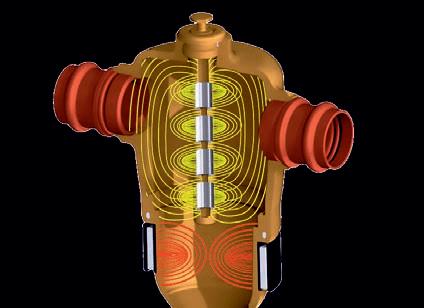
• Use magnetic dirt separators on systems containing large amounts of iron and to remove debris from system water.
• Where possible, treat boiler feed water.
• Repair system leaks immediately to prevent oxygen and untreated water from entering the system.
When installing a new boiler into a large building with existing steel and copper piping, sometimes it’s difficult to flush an entire system, Morgan recommends at the least testing the water and treating the system water before introducing new
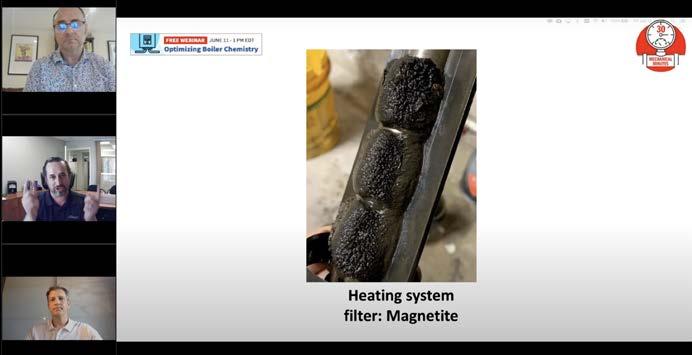
Webinar participants (top to bottom) Steve Goldie, Brian Morgan and Doug Picklyk, here discussing the important role of magnetic separators at keeping hydronic systems clean.
Trust Mitsubishi Electric For Your Net Zero Hydronic Solutions
LOW CARBON HYDRONIC HEATING & COOLING, AND DOMESTIC HOT WATER SYSTEMS
u Natural Gas Alternatives for Electrification
u Trusted Performance, Quality and Reliability
u Reduces Energy Consumption Over Comparable Natural Gas Systems
u Strong Canadian Customer Support Team
VISIT US AT CIPHEX WEST BOOTH 625
Game changing innovation
Introducing the smart generation of Vitodens
Grow your business with Viessmann future-proof solutions. Our smart generation of high-efficiency gas condensing boilers and digital applications are designed to work for you, saving you time and energy on and off the job.
+ Flexible installation with dual position display
+ Fast commissioning with preconfigured start-up guide
+ Easy remote monitoring and servicing with Vitoguide
+ Optimize maintenance with interchangeable spare parts and accessories
+ Fits any home with residential boiler sizes from 85 to 199 MBH, all with WiFi inside
Wifi inside
Your all-in-one Digital assistant
Introducing Vitoguide
Our new Vitoguide app connects to any Vitodens smart generation boiler to streamline and simplify each installation.
boilers, or look at de-coupling the new boiler system from the existing system with a heat exchanger, so you can ensure you have great water quality flowing through the boilers.
He’s also seeing installations where the hydronic system is decoupled from the make-up water feed system with a make-up package to easily treat and test the water in the boiler system.
“I’ve seen closed-loop heating boilers installed in buildings where they’ve had leaks and in a very short order of time will fail because of scale build-up on the boiler,” agreed Goldie, who also pointed out the importance of the volume of water in a system even if the municipal water has been tested before entering the system.
“The problem is there might be so much volume in that building that there’s still enough mineral content in that volume of water…even though the water is within the acceptable limits,” said Goldie. “The total volume brings so much calcium into these heat exchangers that you’re still going to have a problem. I’m a big fan of isolating your boiler system from your building, so putting a heat exchanger in between your boiler and your system enables you to have much better control over the boiler water.”
Custom Built Retrofit Fan Coil Systems for Apartments & Condos
Saving you and your customers time and unnecessary cost
Installation of our high quality, custom-sized systems virtually eliminates all drywall, painting and finishing work while delivering, highly efficient, whisper quite comfort!
OUR PRODUCTS ARE:
• Canadian made
• Carry up to 5 year warranties
• Available in both vertical and horizontal configurations
Contact us at 905-766-1513 and visit us online at inner-coolsystems.ca to check out our range of customizable options and our engineering excellence! INNER-COOL SYSTEMS
“Magnetic filtration cannot be ignored anymore.”
This installation method is especially beneficial for instance when a service contractor may need to drain the riser. Without isolation the contractor is most likely to be refilling the system with untreated municipal water.
What about the use of glycol in hydronic systems? Morgan said the use of glycol can be beneficial for both its anti-freeze protection and its inhibitors which help prevent any microfilm build-up or rust in the piping system. The inhibitors also lubricate the seals and pumps which help the hydronics system overall.
Another crucial piece of equipment, in our experts’ opinions, is a magnetic filtration system. Magnetic filtration systems trap magnetite which is a build-up of metal particulates which attach to components in the heat exchangers and pumps. More and more manufacturers are recommending the installation of magnetic filters on inlets before the water goes into the heat exchanger or pump as a way of treating the magnetite problem.
“Magnetic filtration cannot be ignored anymore,” said Morgan who stressed it must be properly managed by the installer, and building owners need to be educated on the downfalls of noncompliance with the manufacturers’ recommendations.
“When someone spends $150,000 or more on a new commercial boiler system, and after one heating season it’s not covered under warranty and it’s failing … that’s a much bigger issue than what the investment would have been up front,” said Morgan.
The webinar ended after a brief question and answer session with the conclusion that optimizing boiler chemistry is not an option anymore, and it can save a lot of money if you maintain these systems according to the manufacturers’ recommendations no matter where your water comes from.
To view the full webinar visit hpacmag.com/tech-pulse <>
HEAT TRANSFER PLATES
The next edition of 30 Mechanical Minutes will feature hydronics expert John Siegenthaler discussing the effect of heat transfer plates on the performance of “staple up” radiant floor heating systems.
Date: Thursday, September 2nd at 1PM (eastern time). Visit hpacmag.com for registration details.
Sponsored by
INNER-COOL
SmartPlate Has EVolved
Introducing SmartPlate EV. With its ultracompact 24" x 32" footprint, vertical piping connections and capacities up to 4500 MBH and 300 PSIG, the SmartPlate EV indirect water heater gives you greater design fl exibility for standard and highpressure systems. It also easily integrates with AERCO’s Benchmark boilers and smart Edge Controllers for a powerful combination system. Join the EVolution. SmartPlate EV. 24 x 32
WATER WORKS
The design of the new headquarters for the Toronto and Region Conservation Authority will showcase its mechanical systems.
BY DOUG PICKLYK
Managing and protecting natural water systems in and around the city of Toronto is the mandate of the Toronto and Region Conservation Authority (TRCA), so it’s no surprise the design of the organization’s new headquarters incorporates water in many ways including, of course, its mechanical systems.
Being built near the Black Creek ravine in Toronto’s north end, the $65 million project (with support through NRCan’s GCWood Program) broke ground in January of 2020 with occupancy slated for September 2022. The new light-filled open-plan four-storey office building covers some 90,000 sq. ft. (8,100 m2) and will be a unique mass timber structure.
ZAS Architects of Toronto in a joint venture with Irish-based Bucholz McEvoy Architects designed the TRCA headquarters to be one of the most energy efficient mid-rise commercial buildings in North America
“We envisioned TRCA’s new workplace as one that will inspire, motivate and support the culture of its employees, who are champions of the local environment,” says Peter Duckworth Pilkington, principal with ZAS Architects. In addition to the use of wood, other sustainable design features include an energy efficient building envelope, a green roof, rainwater harvesting, low impact landscape development, and solar chimneys which increase efficiency by heating ventilation air. The heating and cooling system is
electric, using geothermal heat pumps along with roof mounted solar panels for thermal assistance. The project is participating in the Canadian Green Building Council’s (CaGBC) Zero Carbon Building Pilot Program, and it’s targeting Net Carbon Zero, LEED Platinum v4, Toronto Green Standard Level 2, and WELL Building Silver certifications.
“Overall, this building is tracking to be among the most energy efficient buildings in the country, somewhere around 54 ekWh/m² [equivalent kilowatt hours per meter-squared],” notes Duckworth Pilkington. When compared to traditional office buildings of this size, carbon emissions along with operating costs are projected to be reduced by up to 50%.
A main feature will be four water walls in the main atrium—each water wall is actually a glass enclosure (like a duct) in which the ventilation air is pulled down from the outdoor intake at the roof level and distributed to energy recovery ventilators (ERVs). Inside each of the glass ducts a chain-link mesh is suspended the full height and water cascades down the four-storeys—providing a visual display and playing a role in pre-heating and humidification of the dedicated outdoor air HVAC system. “Through the water wall feature, we’re making the building’s life support systems that are usually hidden infrastructure visible and tangible,” says Duckworth Pilkington. “Making the invisible visible when it comes to energy use, serves as a very real reminder of the impact our daily lives and decisions have on the planet every day.”
The windows on the southern façade feature operable exterior shading, and a secondary skin in front of the shading allows for pre-heating of the air before entering the building in cooler months.
A lot of the building’s control strategy is designed to optimize passive heating,
cooling and ventilation opportunities. For example, the building management system will alert occupants on their phone via an app to either open or close windows to ensure the building is using energy most efficiently.
The central mechanical room in the basement was originally planned as a closed-loop geothermal system, but after ground water was found on the site a redesign led to an open-loop geothermal solution. So instead of drilling some 44 boreholes, now there will be four boreholes. “The open-loop geothermal is an opportunity the client didn’t want to miss out on, because they are experts in water flow, conservation and protection their staff was able identify an underground bedrock valley in which underground aquifer sits” says Jamie Dabner, principal with Integral Group, the mechanical engineers on the project.
The original plan called for a solar thermal system on the roof as a back-up to the ground source heat pump strategy, but now with the geothermal system being configured with an open loop the geothermal system will connect to the mechanical plant in the basement and the solar thermal array on the roof will boost the efficiency of the system
The new TRCA office is a mass timber building with geothermal heating and cooling and solar thermal panels.
and provide greater heating potential for the building. “We actually have it piped up to be available for free heating, so there are times in the shoulder seasons when we might not want to run the compressors, and we’re just going to
run the building on solar thermal only,” explains Dabner.
Because the preference was to expose the wood on the interior and not hide it with drop ceilings, there is an air distribution plenum system, about 14-in. deep, across the top of each cross laminated timber (CLT) floor slab on every storey with supply air diffusers.
The plenum is used for ventilation only, and separate from that is the fourpipe radiant system with six-way valves feeding water-based ceiling panels used for both heating and cooling.
The piping network runs in the plenum, and the pipes poke down to the modular radiant ceiling panels which are hung on the underside of the CLT flooring.
“It’s quite a special strategy that required coordination with all of the design team,” says Dabner. The energy calculations led to about 40% of radiant
coverage in the interior zones of the building and the remaining 60% around the exterior zones of the building.
To accommodate cooling with the ceiling panels, considering Toronto’s summertime humidity, there will be dew point sensors in the thermostats in each of the zones, and if somebody opens a window raising the humidity indoors, the zone will turn off.
There are also ceiling fans, and according to Dabner the fans can increase the capacity of the radiant panels by up to about 10% in cooling mode.
He points out that a well thought-out four-pipe system is really the future of Net Zero carbon design.
Once completed, the new TRCA headquarters will be used as a learning centre–a living laboratory for developers, researchers and students–to demonstrate zero carbon features. <>
IN-FLOOR PROVIDES RELIABLE STORAGE
Radiant heating used for temperature and condensation control in agricultural fertilizer warehouse.
Belmont Farm Supply, located about 185 km outside of Toronto in Belmont, Ont, provides fertilizer, seed and more to farmers in the southwest region of the province. It has been part of the farming community since the 1940s.
When owner-partners Graham Hutton, Brad Walker and Jeff Aarts decided to build a new fertilizer warehouse, they wanted a state-of-the-art building to maintain the floor at a constant temperature. “We were trying to keep the moisture from forming on the concrete when the humidity rises,” Walker notes.
A floor temperature between 57F and 60F is essential when storing fertilizer. A lower floor temperature that allows outside temperatures to rise above it causes risk of condensation that can turn the fertilizer from a solid to a liquid.
Walker selected St. Marys, Ont.based iFH Design and Installations, headed up by Paul McRoberts, to design and install the radiant floor heating.
McRoberts is a 47-year veteran in hydronic heating; after beginning as an apprentice in 1972, he opened his own business in 1984 and was one of the first contractors in southwest Ontario to specialize in radiant floor heat.
DON’T FORGET THE INSULATION
The ceiling height of the steel-constructed building is more than 36 ft. The
concrete slab is 372 x 96 ft. More than four miles of PEX was installed. The radiant system uses piping in ¾-, 1-, 1-¼-, 1-½- and 2-in. sizes; 1 ¼-in. stainlesssteel manifolds; ¾-in. connectors; and compression-sleeve fittings.
“Instead of doing all the large diameter supply and return piping above, we did it all below ground with 2-in. and 1-½-in. oxygen-barrier piping with the fittings,” McRoberts explains. “Then we insulated all the piping with 1-in. foam insulation made for underground use.”
The next step was the placement of 2-in. expanded polystyrene panels that double as insulation and a piping-installation method. The ¾-in. by 500-ft loops were walked into place on top of the boards at 9-in to 12-in spacing then connected to the manifolds. A 40% glycol solution runs through the PEX network.
From the boiler room, all manifolds were supplied with 1-½-in. oxygen barrier supply lines. The longest supply lines were nearly 300 ft from the heat source.
“In each area of the manifolds, we installed floor sensor wells with PEX piping so we could insert our sensors in
after the concrete was installed,” he says. “Before the concrete pour, the floor piping was pressurized to 100 psi to ensure there were no leaks under the floor, which also included the 1-½-in. and 2-in. in-slab distribution piping.”
In the mechanical room, two boilers are the heat source for the radiant heating system — providing nearly 800,000 Btu/h of energy to maintain the required floor temperature. Low-loss headers and a hydronic dirt separator provide hydraulic separation and protect the components. A high capacity circulator distributes water to the five manifold stations. Isolation flange kits and floor sensing and pump controls round out the equipment.
QUALITY AND RELIABILITY
Opened in April 2019, the owners have been through winter seasons with the warehouse full and have fine-tuned the floor temperatures. “We are extremely happy that we have the heated floor,” Walker says. “It certainly helps maintain the quality of our products.” <>
This article provided courtesy of REHAU.
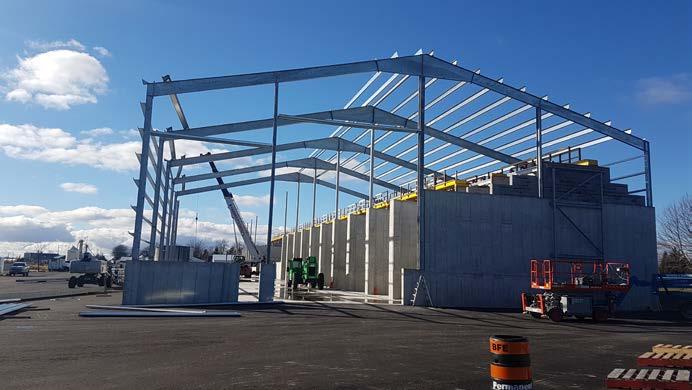
A 20,000 ft² fertilizer warehouse equipped with radiant floor heating.
Discover fresh ideas, expand your network, and fine-tune your skills at Western Canada’s biggest show for plumbing, hydronics and HVACR.
More than 30,000 sq ft of exhibits
Thousands of products from North America’s top manufacturers
Information packed seminars
Fantastic prizes
Free Parking for attendees
REGISTRATION
OPENING SOON
EXPERIENCE THE FUTURE OF PLUMBING, HYDRONICS AND HVACR IN PERSON AT
CIPHEX WEST 2021
NEW DATE! November 3 & 4, 2021
New products. New ideas. New tools. New tech.
CIPHEX WEST
CUT IT OUT WITH THE CUT-OUT QUESTIONS
Old ways of thinking are not compatible with a low carbon future.
BY CHRIS DESROCHES, P.ENG.
The term “heat pump” has many misnomers and gets thrown around far too loosely these days as HVAC conversations shift towards sustainability, low carbon emissions and building electrification.
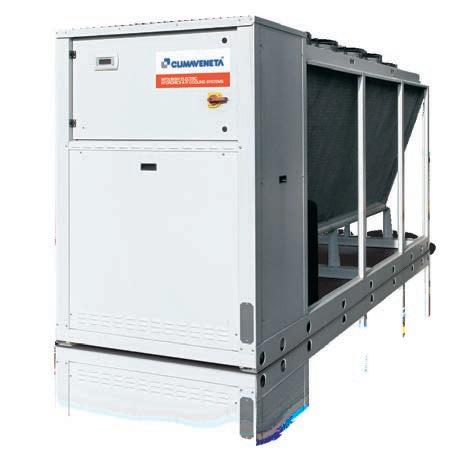
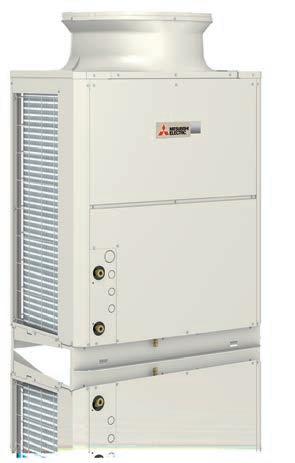
A niche subset of heat pumps that are gaining momentum in the Canadian hydronics market are air-to-water heat pumps, which, aside from electric boilers, are an alternative to traditional fossil-fuel based boilers. Heat pumps sound attractive, so when it comes to hydronic systems, why are they still lurking in the shadows?
Air-to-water heat pumps extract heat from the air outside a building, so the machine’s ability to perform efficiently and provide useful heating is greatly influenced by outside air temperature. Any heat pump will have practical limitations due to the refrigerant being used, and it will eventually shut off when it can no longer effectively provide useful heat to the building. This is commonly referred to as the “low ambient cut-out temperature.”
And when it comes to designing with air-to-water heat pumps, the most critical design consideration the Canadian market is fixated on, and the first question to come up in heat pump conversations with a contractor or engineer is: “So… What about the cut-out temperature?”
While there have been great strides in improving heat pump performance and pushing the limits to operate in colder temperatures, usually, the design tem -
perature is below the heat pump cut out. In these cases, an auxiliary heat source will be required when using airto-water heat pumps. However it is important to recognize the frequency of time where it is colder than the cut-out temperature for the majority of Canada’s built environment is relatively few hours, typically a few weeks of the heating season. In favourable climates, such as coastal cities or even Toronto, it can be less than a week of the entire year. When it comes to heat pumps, it’s about using the heat pump when it makes sense to do so.
“The days of seeking one size fits all solutions are finished.”
Gas-fired boilers have been the norm in Canadian hydronic systems for decades due to widely available low-cost natural gas, not to mention they are relatively inexpensive. Boilers do not have the same design challenges nor constraints that air-to-water heat pumps have, so it was easy for an engineer to explain to a client why they wouldn’t entertain an alternative to a boiler. Today, design criteria are undergoing substantial change as the market shifts towards prioritizing energy efficiency and sustainability. Building and Energy Codes, as well as the metrics used to define what constitutes a “cutting-edge” and sustainable design are becoming more stringent. Limits on Energy Use
Intensity (EUI), Thermal Energy Demand Intensity (TEDI), Greenhouse Gas Intensity (GHGI), among other metrics, are being scrutinized, and the bar is consistently being raised. While these metrics may be optional and modest today, they will become prerequisites as time moves forward to achieve net-zero in new buildings by 2030.
The Federal carbon tax will also transform the industry towards electric heating solutions, which brings us back to air-to-water heat pumps. By focussing on improving building designs with both active and passive energy reduction, we can improve our buildings’ carbon footprint, but will that be enough?
Air-to-water heat pumps are one part of a wider solution, and they will become more common on the path to 2030 in hydronic systems.
Do heat pumps have limitations? Yes, but there are workarounds. The days of one size fits all solutions are finished, as it is often not compatible with a low-carbon future. This should be viewed as a benefit by providing buildings with resiliency and redundancy.
It’s not so much a matter of if air-towater heat pumps will become the norm for hydronic systems, but rather when the market will recognize and understand how the technology fits into a low carbon building. So instead of asking “What is the cut-out temperature?” the real question is “What is the best way to make use of the heat pump while it can operate?” <>
By Chris DesRoches, P. Eng., Applied Product Manager, Mitsubishi Electric Sales Canada, Inc.
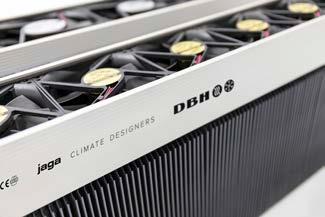
Jaga Climate Systems has announced its new Dynamic Boost Hybrid (DBH) technology. Suited for use with low-water temperature systems such as heat pumps, solar energy and condensing boilers, the new DBH unit connects to a hydronic fin tube element, forcing convection and increasing the efficiency of the emitter to provide quick heat. The unit gives users more control over individual room temperatures and reduces the need for unnecessary heating and overheating.
jaga-canada.com
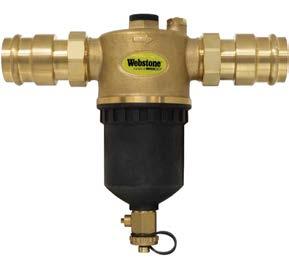
Webstone has announced their new Magnetic Boiler Filter (MBF) XL model. MBF XL is designed for larger residential boilers and is commonly installed on the system run. The magnet captures ferrous particles from the system before reaching the boiler, with an integral drain valve and service tool to remove the accumulated debris. The units are available with a choice of Press, FIP, MIP, or SWT union connections to join to system piping. www.webstonevalves.com
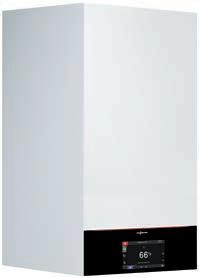
Viessmann has added WiFi connectivity to its latest generation of residential Vitodens condensing boilers. The Vitodens 100, available in both combi (B1KE) and heat-only (B1HE) models, and Vitodens 200 (B2HE) include stainless steel heat exchangers, the company’s Lambda Pro Plus clean combustion control, 10:1 turndown ratio, and work with either propane or natural gas. Both are available in a range of sizes and MBH outputs. The new Vitoguide app allows contractors to commission the boilers from a mobile device. viessmann.ca
Tekmar’s BACnet Snow/Ice Sensor Interface 681 measures the presence of snow or ice through sensor technology and interfaces with building automation systems via BACnet MS/TP to automate the start and stop and slab temperature operation of hydronic or electric snow melting equipment. The interface supports Snow/Ice Sensor 090 (automatic start and stop) and Snow Sensor 095. Features include warm weather shut down and cold weather cut off. watts.com
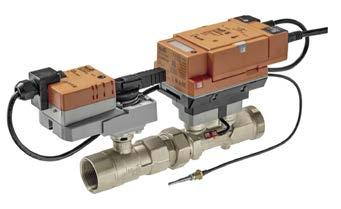
Belimo has introduced its integrated Energy Valve and Thermal Energy Meter that together provide energy measurement and control, Delta T management, and IoT-enabled billing. The solution offers direct integration to building management systems or IoT-based monitoring platforms. The valve and thermal energy meter can be powered using Power over Ethernet (POE) allowing both power and network connectivity. They also connect with the Belimo Assistant apps and web server tool to support the design process, simplify commissioning, and assist with troubleshooting. belimo.com
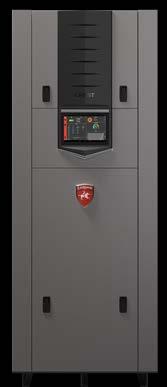
Lochinvar has announced its new Crest condensing boilers with Hellcat combustion technology for commercial applications. The commercial boilers come in eight models ranging from 1 million to 6 million Btu/h, with up to a 25:1 turndown, a wave fire tube design, and CON-X-US Remote Connect capabilities. The Hellcat technology features an O2 sensor located in the combustion chamber that along with its Smart Touch controls helps adapt and account for seasonal changes, shifts in weather patterns and altitude. lochinvar.com
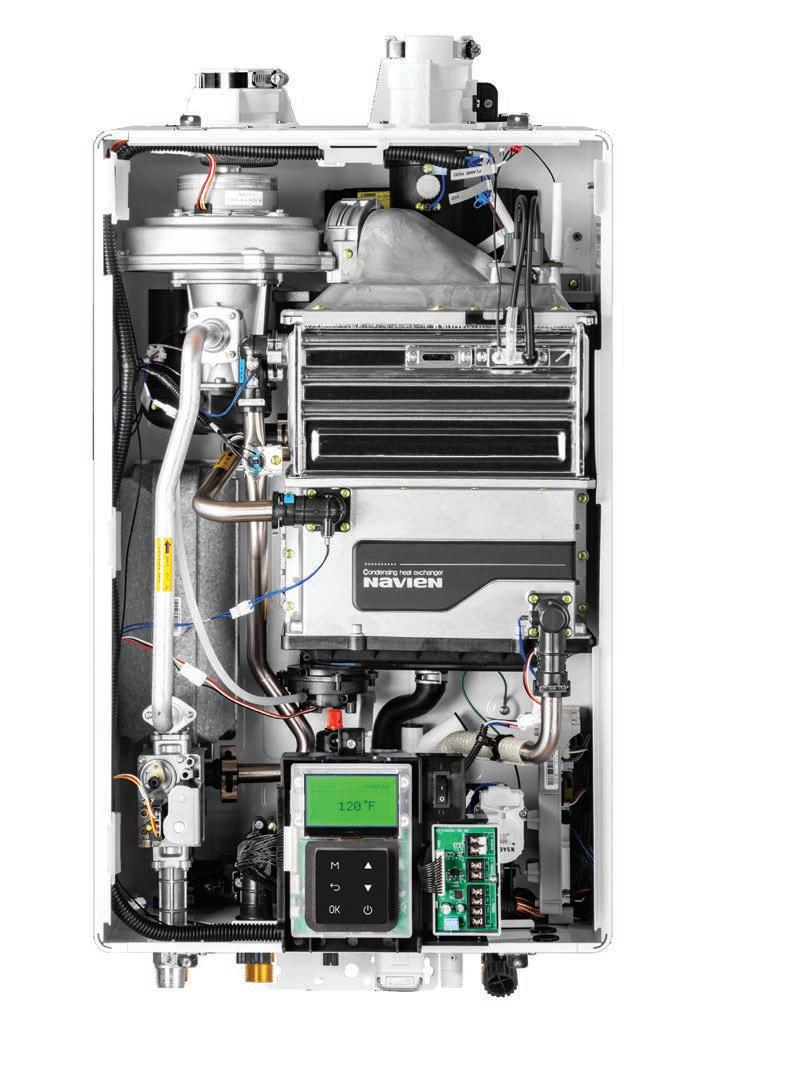
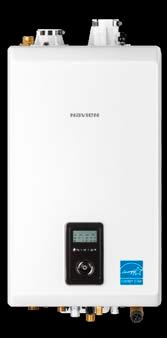
Navien’s NCB-H condensing combi-boiler series includes five models ranging from 160,000 Btu/h for DHW and 60,000 Btu/h for heating, to 210,000 Btu/h DHW and 150,000 Btu/h heating. The NCB-H uses dual stainless steel heat exchangers for heating and a separate flat plate stainless steel heat exchanger for DHW. Other features include: 15:1 turn down ratio for DHW and up to 11:1 for heating, built-in DHW recirculation controls, 2-in. venting up to 65-ft. and 3-in. venting up to 150-ft. navieninc.com
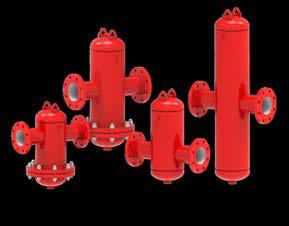
Bell & Gossett is expanding its CRS CoalescingStyle Air & Sediment Separator product line. The units help break entrained air and suspended solids out of system fluid improving heat transfer and energy efficiency. CRS design helps protect pumps, boilers and other components, improving and prolonging the life of a system. Models are available for air-only, sediment-only, and air/sediment combo separation, and in sizes 2-in. through 36-in. with 2-in. – 4-in. flange or groove end connections. bellgossett.com/sales-service
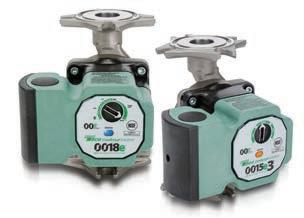
Taco Comfort Solutions has expanded its offering of stainless steel within its ECM circulator family. 00e Series circulators are built with efficient and quiet EC motors to consume up to 85% less electricity, and also offer automatic unblocking and air-purge mode. Their dual electronic knockouts and six-inch stranded wire leads make for easy wiring. They also include the integral flow check and are doubleinsulated, so no ground wire is required. TacoComfort.com
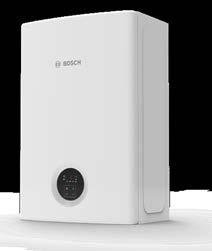
The Bosch Singular Boiler series includes the 5200 and 4000 combi boiler solutions, offering 5.2 and 4 gallons of hot water per minute respectively. The Singular 5200 offers 140,000 Btu/h for space heating, while the 4000 unit offers 80,000 Btu/h. Featuring a 95% AFUE rating and a turndown ratio of up to 10:1, the units include dual stainless-steel heat exchangers and also feature an internal circulator and the capability for outdoor reset. www.boschheatingandcooling.com
ADJUSTING FOR CONDITIONS
How to size panel radiators for low water temperatures. BY JOHN SIEGENTHALER
Modern panel radiators are one of my favorite heat emitters. They’re easy to install, emit radiant as well as convective heat, and have high quality powder coat finishes. They’re nice in new construction and very well suited to retrofitting.
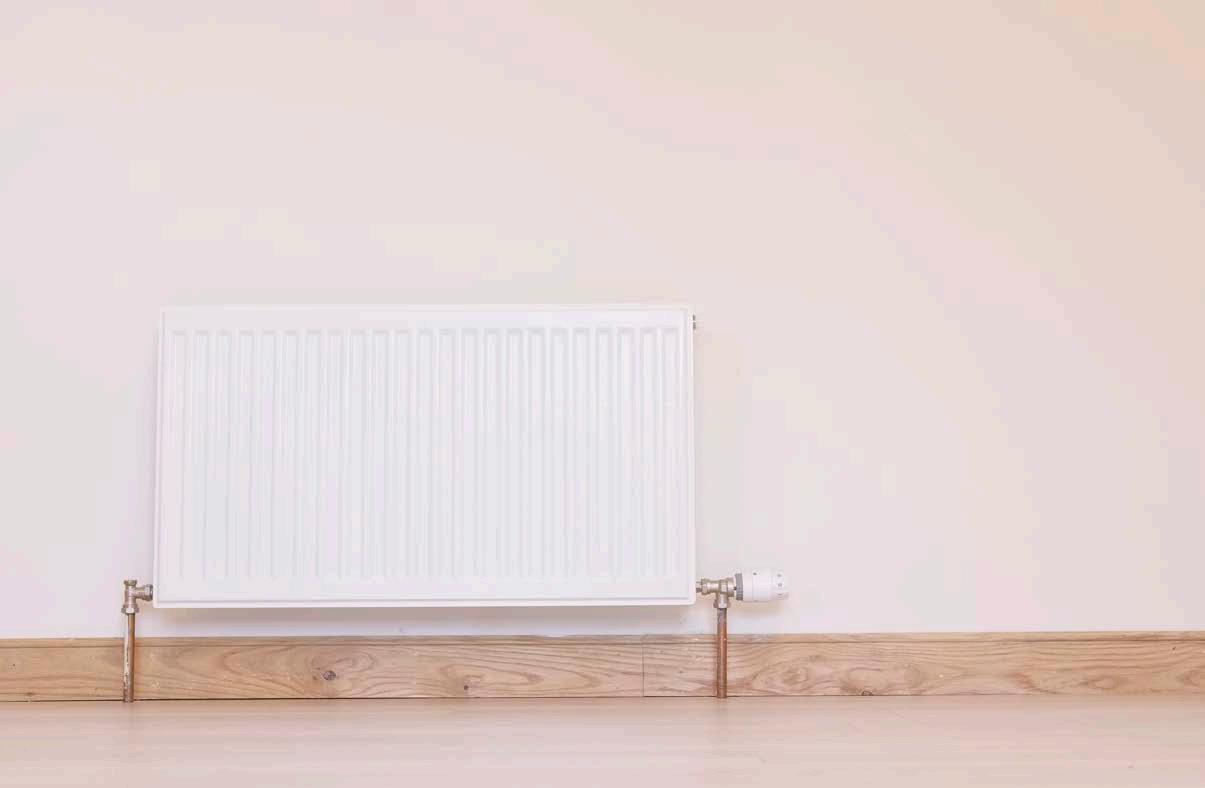
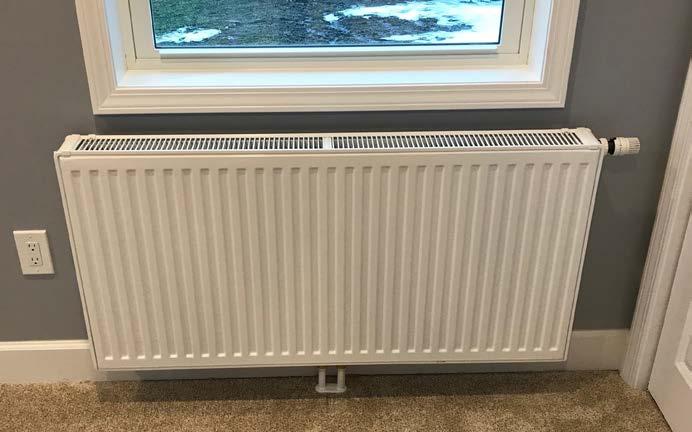
The panel in Figure 1 is about two feet high and four feet wide. You can see the two ½-in. PEX-AL-PEX tubes that supply it connected at the middle of the base of the radiator. You can also see the nonelectric thermostatic valve that regulates the flow rate and thus the heat output of the panel, making it an independent zone. There’s also a dual ball valve fixture at the base of the radiator that can isolate the panel from the system if ever necessary.
SHOW ME THE NUMBERS
As is the case with many heat emitters in North America, the published data for heat output from panel radiators is based on relatively high water temperatures. The most common being an average water temperature of 180F, and an assumed room air temperature of 68F. This makes the difference between the average water temperature in the radiator and the room air temperature 18068=112F. This temperature difference, or Delta T (∆T), is a reference condition which will eventually be used as part of the derating procedure for operation at lower water temperatures.
In North America it’s common to find heat output rating tables based on this 112F temperature difference. One example is shown in Figure 2 (pg. MH30).
The black numbers in Fig. 2 are heat outputs (in Btu/h) based on the dimensions (height, width, and thickness) of the radiator. The typical “thickness” dimension is based on 1, 2 or 3 water plates within the panel. Note the reference conditions in the upper right.
ADJUSTING DOWNWARD
These rating tables are fine for installation where a conventional boiler operating at relatively high water temperatures serves as the heat source. But what happens when panel radiators are installed in lower water temperature systems supplied by heat pumps or other low temperature heat sources? The short answer is that their heat output decreases. But by how much?
To date, there is no North American
rating standard that’s specific to panel radiators. This is where we turn to a European standard called EN442. It is widely accepted across Europe where tens of millions of panel radiators are used, and it provides the basis for adjusting heat outputs over a wide range of conditions. It also involves several calculations. The first of which is
Where:
Formula 1:
Formula 1:
Formula 1:
Where:
Qe = estimated heat output of the panel radiator (Btu/h)
∆Td = temperature difference determined using either Formula 2 or Formula 3 below (F)
∆Td = effective temperature difference (F)
Tin = inlet water temperature to panel (F)
Tout = outlet water temperature from panel (F)
Formula 1:
Tair = room air temperature (F)
ln = natural logarithm function (use [ln] key on scientific calculator or your smart phone)
Formula 2:
Q112 = the output of the panel radiator when the difference between the average water temperature and room air temperature is 112F (Btu/h)
1.3 = an exponent (not a multiplier) (use [yx] key on scientific calculator or your smart phone)
Formula 2: Formula 3:
Formula 3:
Here’s an example: In Figure 2, a 2-water plate radiator that’s 24 inches high and 48 inches long has a rated heat output (at ∆T= 112 ºF) of 9,500 Btu/h. Estimate its heat output assuming an inlet water temperature of 160F, an outlet water temperature of 140F, and a room air temperature of 65F.
For now we will use Formula 2 to calculate the value of ∆Td:
The value of Qn for Formula 1 is the radiator’s listed heat output at ∆T= 112, which was 9500 Btu/h.
Now just put the numbers into Formula 1 and grab your (scientific) cal -
culator. You can use a scientific calculator to raise a number to the 1.3 power. Don’t have one? Just turn on your iPhone, press the calculator APP, and turn the phone to the “landscape” orientation - instant scientific calculator. Here’s the result.
Td = Tin + Tout 2
Formula 3: Formula 4:
u = Tout Tair () Tin Tair ()
As the entering water temperature drops closer to the room air temperature, or the flow rate through the panel changes the EN442 standard introduces a modified way to calculate the difference between the average water temperature in the panel and the room air temperature (e.g., the value of ∆Td used in Formula 1). This is where Formula 3 comes in.
The decision on using Formula 3 rather than Formula 2 is based on yet another formula (sorry, but it’s necessary). We’ll call it Formula 4.
Formula 4: Formula 4:
Btu hr
Where:
Tout = outlet fluid temperature from panel (F)
Tin = inlet fluid temperature to panel (F)
Tair = room air temperature (F)
This formula looks at how the outlet temperature of the radiator is dropping relative to the inlet temperature. As the flow rate through the panel decreases there would be a wider temperature drop across the panel and thus the value of “u” in Formula 4 will drop.
Here’s the criteria set by the EN442 standard:
If u < 0.7 use Formula 3
If u ≥ 0.7 use Formula 2
Here’s another example. Water enters the panel radiator used in the previous example at 115F, and exits at 92F. The Continued on MH30
Figure 1. Example of a modern panel radiator.
air temperature in the room is 65F. Determine the correct ∆Td to use in Formula 1.
Solution: Start by calculating the value of u:
u = Tout Tair () Tin Tair () = 92 65 () 115 65 () = 0.54
Since 0.54 < 0.7 the EN442 standard prescribes use of Formula 3 to calculate
d:
∆ Td = Tin Tout () ln Tin Tair Tout Tair
u = Tout Tair () Tin Tair () = 92 65 () 115 65 () = 0.54
You’ll again need scientific calculator (or your iPhone turned horizontally) to get the natural logarithm [ln] of 1.85185 in the above calculation. No big deal, just enter 1.85185 on the calculator display and press the [ln x] key.
∆
Qe = Q112
= Tin Tout ()
Now that the appropriate value of ∆Td has been determined, the final step is to plug the numbers into Formula 1:
u = Tout Tair () Tin Tair () = 90 70 () 115 70 () = 0.44
u = Tout Tair () Tin Tair () = 90 70 () 115 70 () = 0.44
∆ Td = 115 90 () ln 115 70 90 70
= 30.83º F
This is roughly about one quarter of the “rated” heat output of the panel. I’ve found 25% to be a good “ballpark” ratio between the published heat output ratings of most panel radiators, based on the ∆Td = 112F rating conditions, and the estimated output when operating the panels in the range of 105-110F average water temperature.
WORKING BACKWARDS
1.3 = 13,374 Btu hr
Now that you know how to reduce the heat output of panel radiators operating at lower water temperatures let’s consider a typical sizing calculation where you need to select a specific panel for a specific design load.
Consider a room with a design load of 2,500 Btu/h. The selected panel radiator will be supplied with water at 115F, and operate with a 25F temperature drop. The room temperature will be 70F. Use the above information to select two
possible radiators from the table in Figure 2.
Solution: Start with Formula 4:
=
u = Tout Tair () Tin Tair () = 90 70 () 115 70 () = 0.44
= Tout Tair ()
Since U < 0.7 use Formula 3 to get
u = Tout Tair () Tin Tair () = 90 70 () 115 70 () = 0.44 u = Tout Tair () Tin Tair ()
Tair () = 90
u = Tout Tair ()
Td =
Next, set up Formula 1 with all the known information, including the required heat output at the lower water temperature (e.g., 2,500 Btu/h):
Now it’s just a matter of looking through the table in Figure 2 to find a radiator with a listed output close to this value. A radiator with three water plates, a height of 24 in., and length of 48 in. has an output of 13,664 Btu/h, which is very close to calculated output at ∆Td=112F.
A radiator with three water plates that’s 20 in. high and 64 in. long has a listed output of 15,829 Btu/h - more than enough.
Thanks for hanging in there through the math. Think of these formulas like your tools. Used properly they get you to the results you need. In this case they give you accurate ways to select panel radiators that are compatible with low temperature hydronic heat sources like geothermal or air-to-water heat pumps. That’s a good skill to have as hydronics technology evolves. <>
Btu hr This can be solved for the necessary
=
John Siegenthaler, P.E., is a licensed professional engineer. His latest book is Heating with Renewable Energy (hydronicpros.com for more information).
Figure 2. Sample heat output rating tables for panel radiator
DIRTMAG® PRO
DIRT SEPARATOR WITH 40% MORE POWER
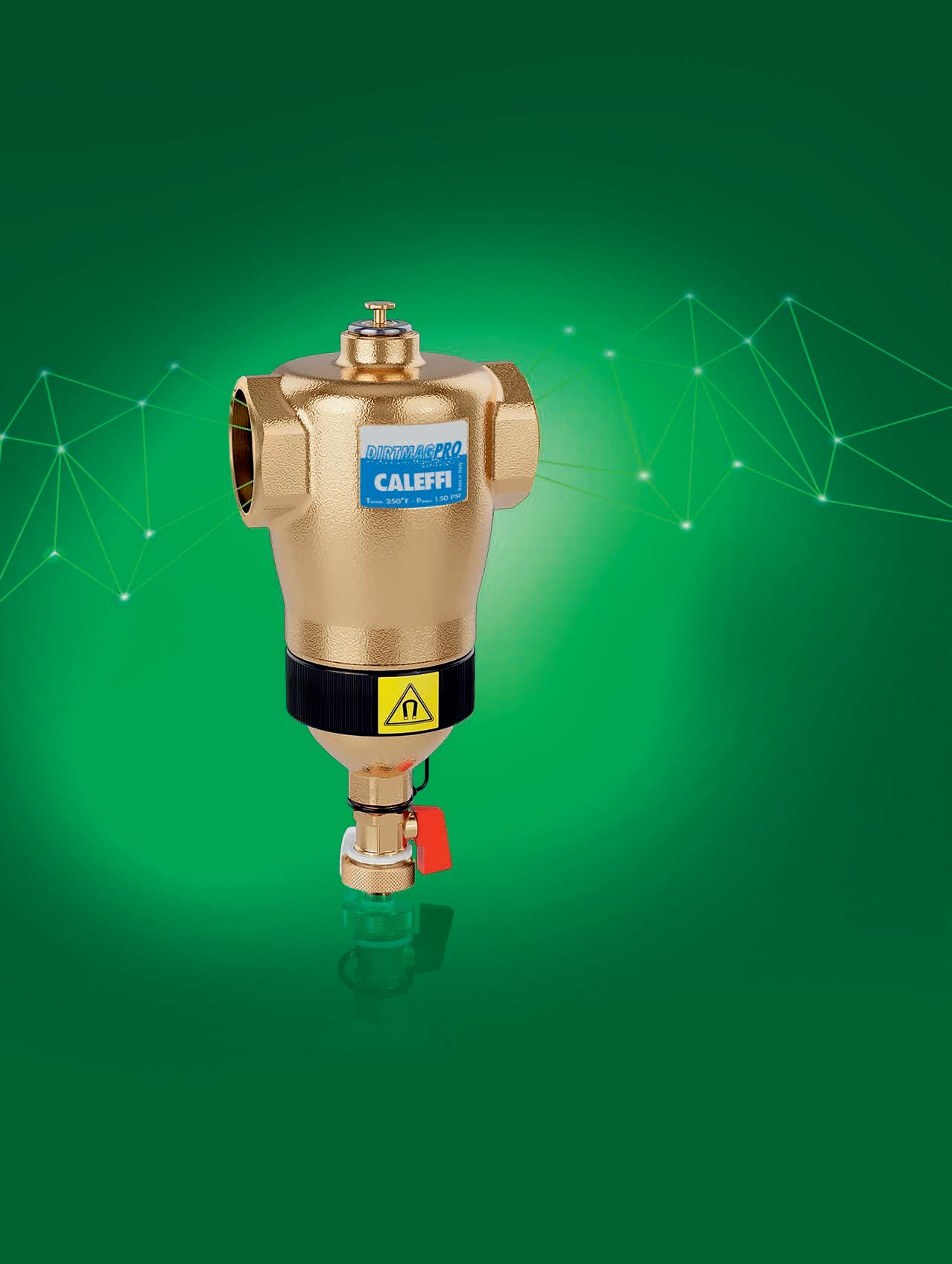
Caleffi pioneered the magnetic dirt separation market in North America over 10 years ago with DIRTMAG® Now say hello to DIRTMAG® PRO – our latest advancement in ferrous and non-ferrous debris separation. Containing powerful, dual magnetic fields and a redesigned collision mesh, DIRTMAG PRO delivers 40% more power for greater efficiency in dirt removal. The debris blow-down valve makes serviceability simple, keeping your hands clean. CALEFFI GUARANTEED.
ComboMax ULTRA
PEAK-PERFORMANCE HEATING SYSTEMS
An electric boiler and instantaneous water heater: a combination without compromise.
VoltMax
Increased temperature control. Increased power control. The ideal electric boiler for your commercial projects.
BuffMax
Optimize any type of hydronic system with the BuffMax buffer tank.
TurboMax
The instantaneous indirect water heater with unmatched exchange capacity, exceptional hot water quality and a lifespan of more than 30 years.
Bth ULTRA and MINI
The reliable and ef cient electric boiler available in compact sizes for your residential needs.